Cambridge IGCSE Malay - Foreign Language 0546 — 2015 May/June Paper 2 · Variant 2
0546/22/M/J/15 · 65 marks · ≈73 min
The question paper and its mark scheme, free to read here and free to download. This is Cambridge’s own paper, exactly as it was sat.
Question paper16 pages


Mark scheme11 pages
Answers below. Sit the paper first if you are practising.
Paper as text
Question paper, page 1
This document consists of 15 printed pages and 1 blank page. DC (LEG/SW) 110086 © UCLES 2015 [Turn over Cambridge International Examinations Cambridge International General Certificate of Secondary Education * 3 2 4 6 0 8 0 5 1 6 * MALAY 0546/22 Paper 2 Reading and Directed Writing May/June 2015 1 hour 30 minutes Candidates answer on the Question Paper. No Additional Materials are required. READ THESE INSTRUCTIONS FIRST Write your Centre number, candidate number and name on all the work you hand in. Write in dark blue or black pen. Do not use staples, paper clips, glue or correction fluid. DO NOT WRITE IN ANY BARCODES. Answer all questions in Section 1, Section 2 and Section 3. The number of marks is given in brackets [ ] at the end of each question or part question.
Question paper, page 2
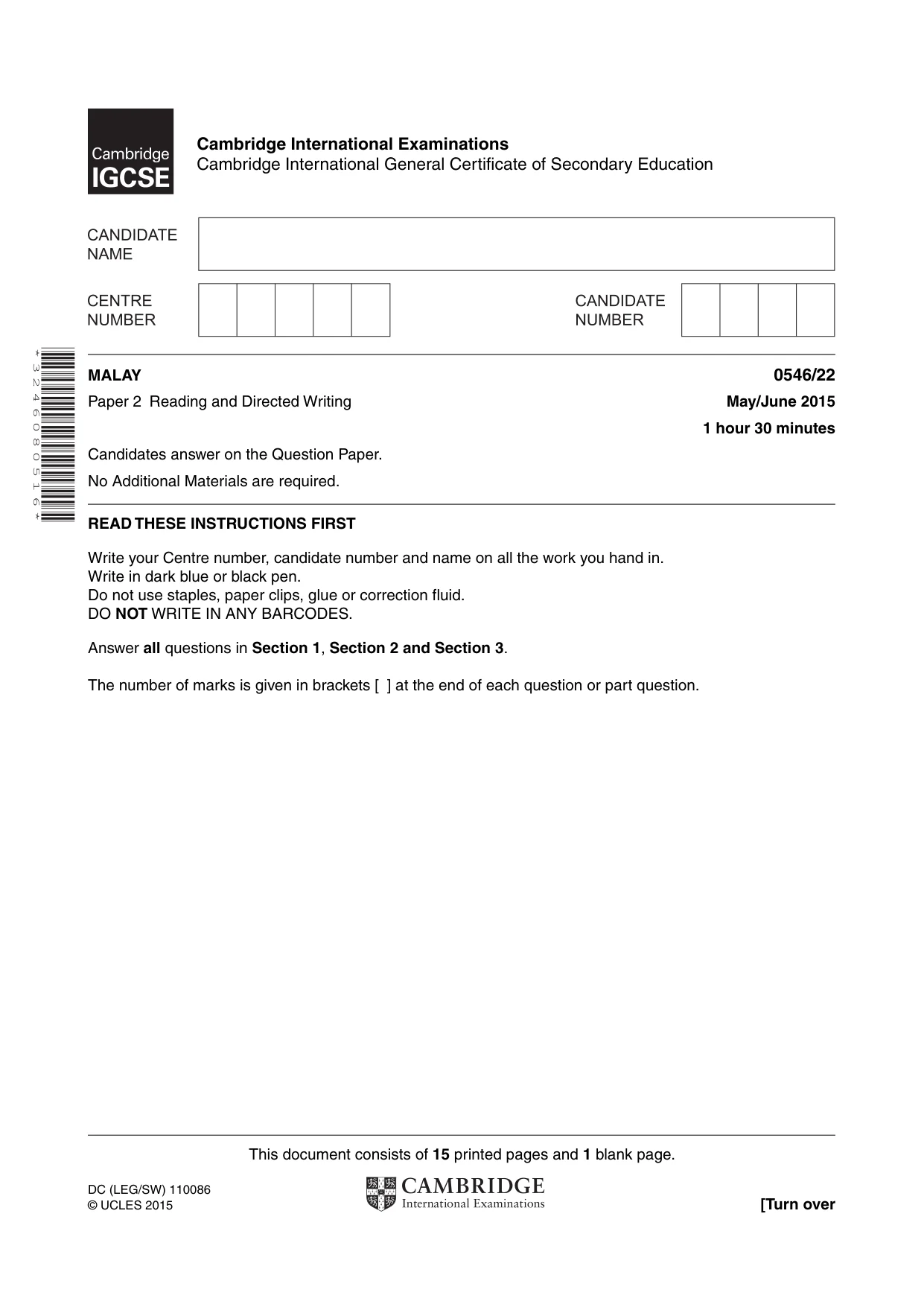
2 0546/22/M/J/15 © UCLES 2015 Bahagian 1 Latihan 1 Soalan 1–5 Pilih jawapan yang betul untuk soalan-soalan di bawah ini: 1 Salah seekor binatang ini hidup di dalam air: A A B D C [1] B C D 2 Sarah menyimpan baju barunya di dalam A almari B sangkar C katil D peti sejuk [1] 3 Anda mahu pergi ke pasar. Anda perlu A baju renang B bakul C cermin D raket [1]
Question paper, page 3
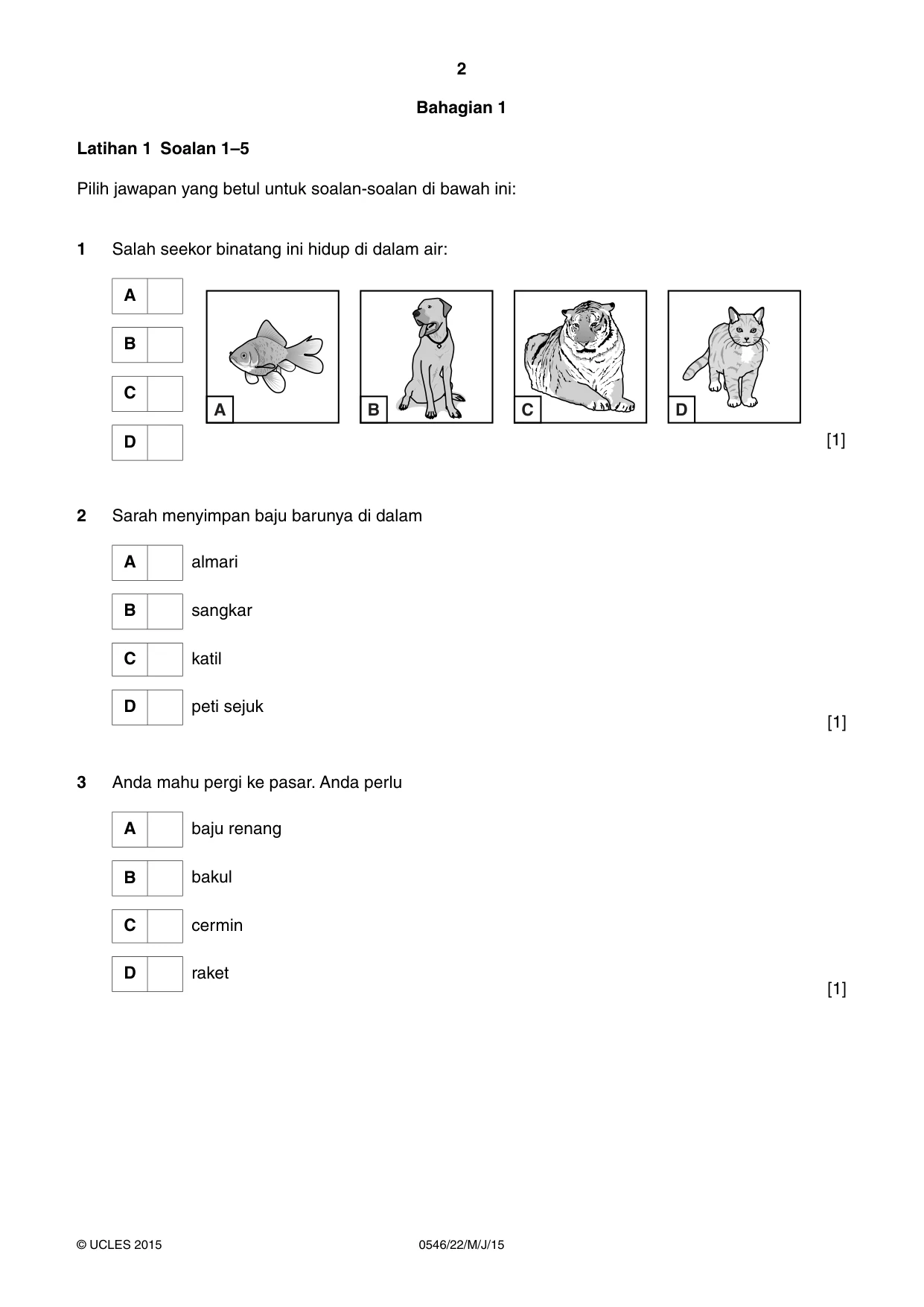
3 0546/22/M/J/15 © UCLES 2015 [Turn over 4 Anda panas. Anda perlu A A B D C [1] B C D 5 Anda terima mesej ini: “Anda telah memenangi pertandingan melukis!” Anda berasa: A gembira B marah C sedih D kecewa [1] [Jumlah: 5 markah]
Question paper, page 4
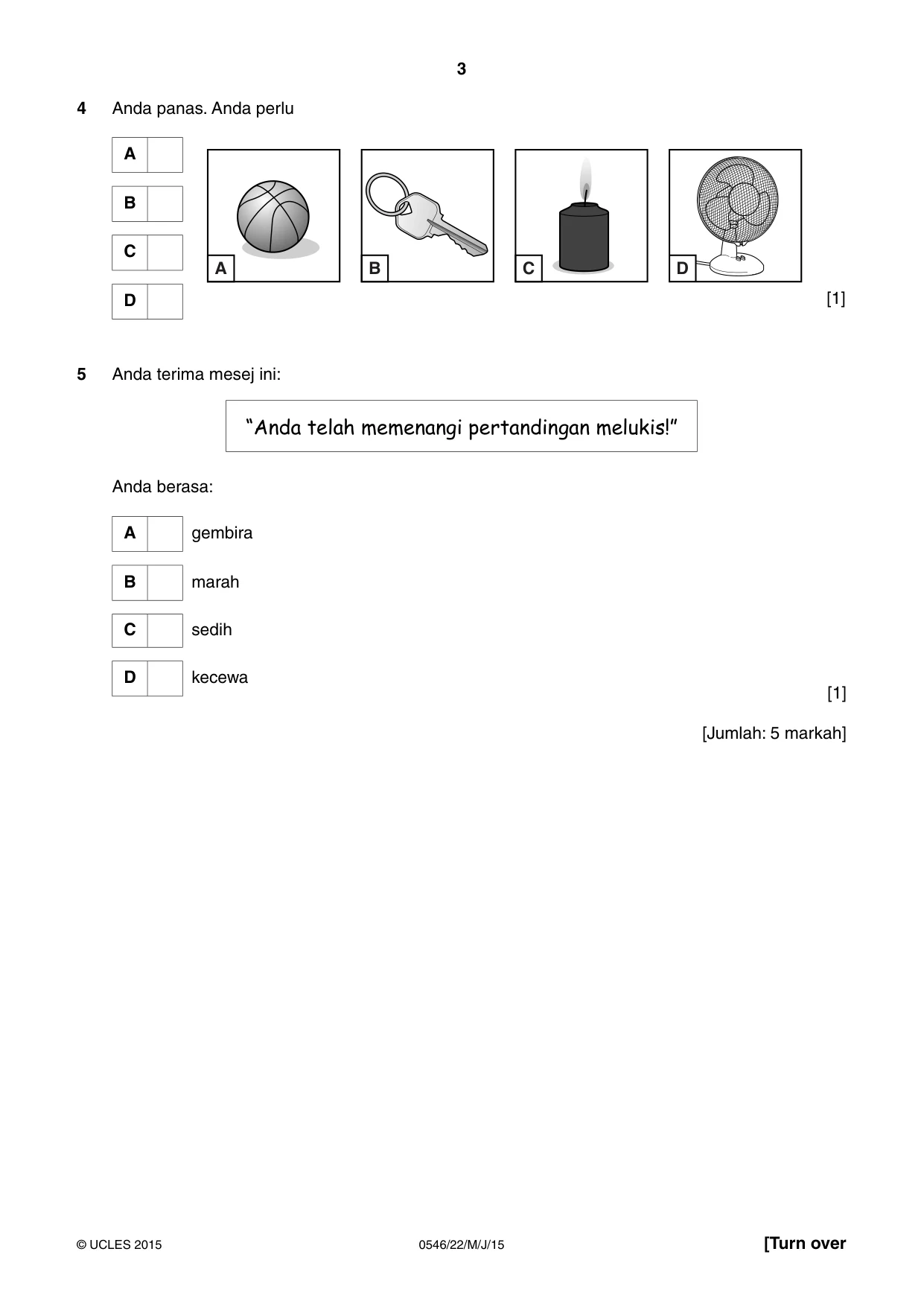
4 0546/22/M/J/15 © UCLES 2015 Latihan 2 Soalan 6–10 Maria sekeluarga sedang berbincang mengenai apa yang mereka akan buat untuk menyambut hari jadi nenek mereka. Tulis huruf setiap orang dalam kotak yang betul mengenai rancangan mereka. A Maria mahu membuat kek coklat. B Lisa mahu membeli sebuah beg tangan sebagai hadiah. C Joan mahu menyanyi di majlis hari jadi itu. D Elaine akan menghantar kad jemputan kepada tetamu. E Susan akan membeli baju baru. F Ann akan menyediakan hiasan untuk majlis itu. 6 [1] 7 [1] 8 [1] 9 [1] 10 [1] [Jumlah: 5 markah]
Question paper, page 5
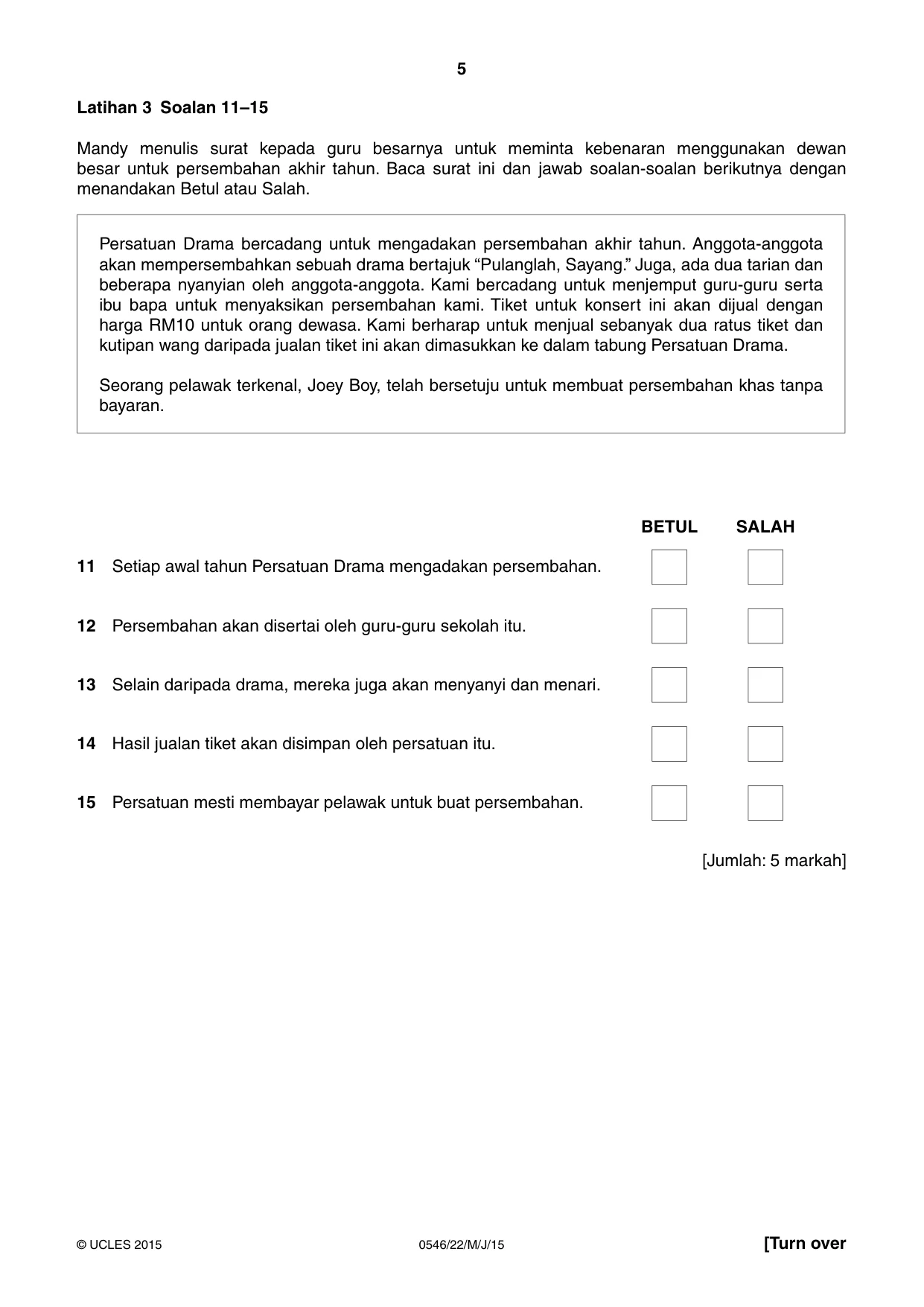
5 0546/22/M/J/15 © UCLES 2015 [Turn over Latihan 3 Soalan 11–15 Mandy menulis surat kepada guru besarnya untuk meminta kebenaran menggunakan dewan besar untuk persembahan akhir tahun. Baca surat ini dan jawab soalan-soalan berikutnya dengan menandakan Betul atau Salah. Persatuan Drama bercadang untuk mengadakan persembahan akhir tahun. Anggota-anggota akan mempersembahkan sebuah drama bertajuk “Pulanglah, Sayang.” Juga, ada dua tarian dan beberapa nyanyian oleh anggota-anggota. Kami bercadang untuk menjemput guru-guru serta ibu bapa untuk menyaksikan persembahan kami. Tiket untuk konsert ini akan dijual dengan harga RM10 untuk orang dewasa. Kami berharap untuk menjual sebanyak dua ratus tiket dan kutipan wang daripada jualan tiket ini akan dimasukkan ke dalam tabung Persatuan Drama. Seorang pelawak terkenal, Joey Boy, telah bersetuju untuk membuat persembahan khas tanpa bayaran. BETUL SALAH 11 Setiap awal tahun Persatuan Drama mengadakan persembahan. 12 Persembahan akan disertai oleh guru-guru sekolah itu. 13 Selain daripada drama, mereka juga akan menyanyi dan menari. 14 Hasil jualan tiket akan disimpan oleh persatuan itu. 15 Persatuan mesti membayar pelawak untuk buat persembahan. [Jumlah: 5 markah]
Question paper, page 6
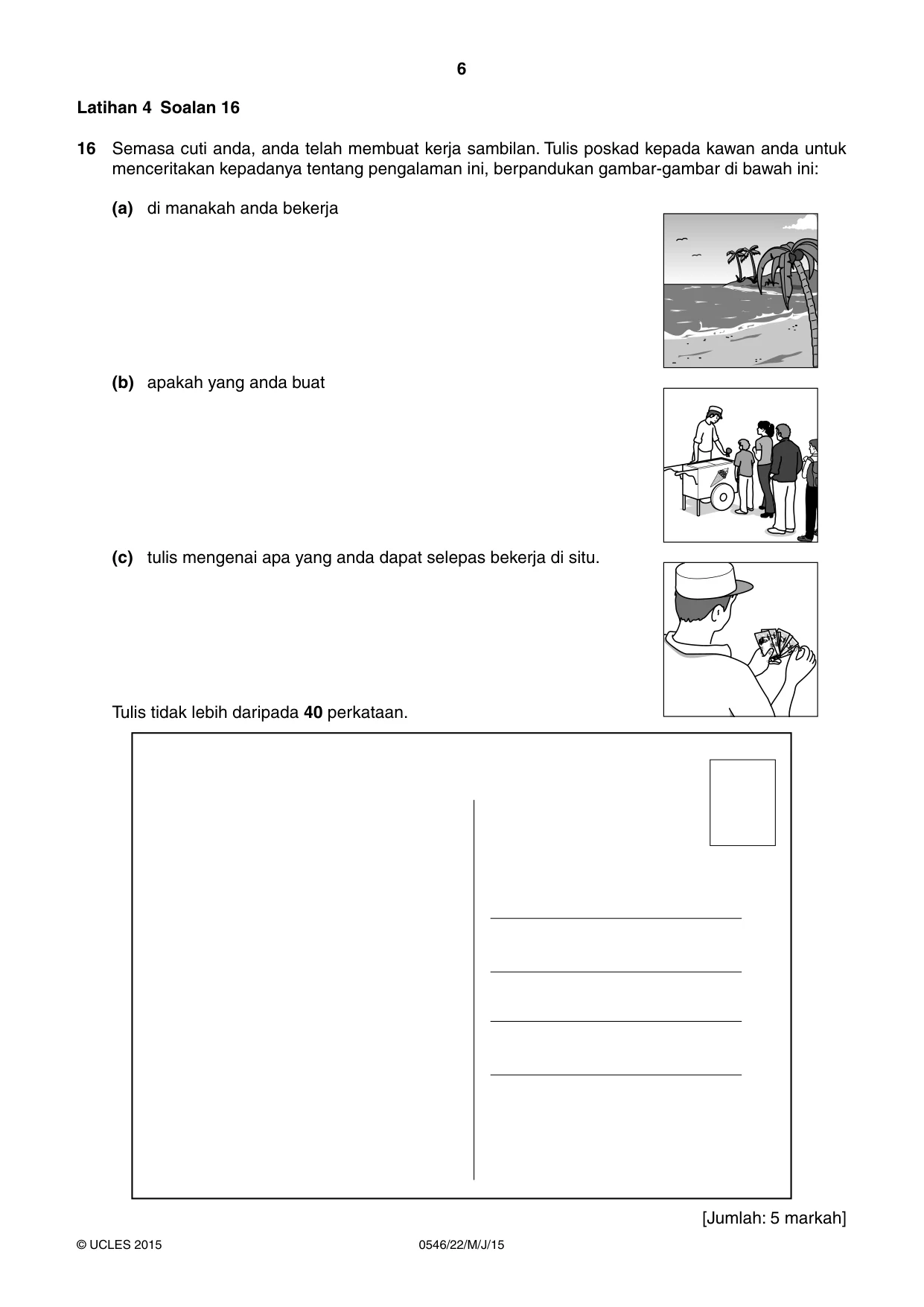
6 0546/22/M/J/15 © UCLES 2015 Latihan 4 Soalan 16 16 Semasa cuti anda, anda telah membuat kerja sambilan. Tulis poskad kepada kawan anda untuk menceritakan kepadanya tentang pengalaman ini, berpandukan gambar-gambar di bawah ini: (a) di manakah anda bekerja (b) apakah yang anda buat (c) tulis mengenai apa yang anda dapat selepas bekerja di situ. Tulis tidak lebih daripada 40 perkataan. [Jumlah: 5 markah]
Question paper, page 7
7 0546/22/M/J/15 © UCLES 2015 [Turn over TURN OVER FOR SECTION 2
Question paper, page 8
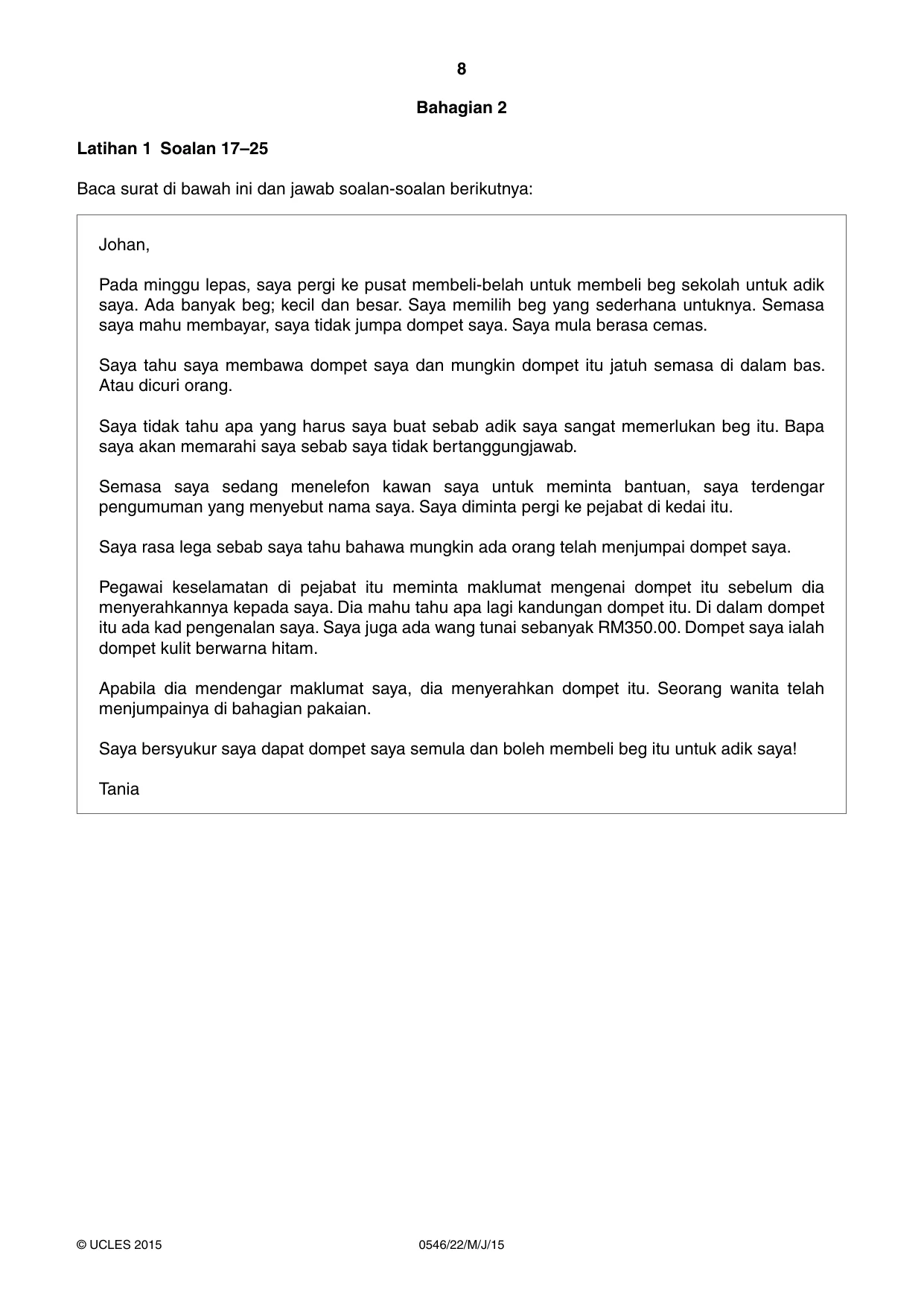
8 0546/22/M/J/15 © UCLES 2015 Bahagian 2 Latihan 1 Soalan 17–25 Baca surat di bawah ini dan jawab soalan-soalan berikutnya: Johan, Pada minggu lepas, saya pergi ke pusat membeli-belah untuk membeli beg sekolah untuk adik saya. Ada banyak beg; kecil dan besar. Saya memilih beg yang sederhana untuknya. Semasa saya mahu membayar, saya tidak jumpa dompet saya. Saya mula berasa cemas. Saya tahu saya membawa dompet saya dan mungkin dompet itu jatuh semasa di dalam bas. Atau dicuri orang. Saya tidak tahu apa yang harus saya buat sebab adik saya sangat memerlukan beg itu. Bapa saya akan memarahi saya sebab saya tidak bertanggungjawab. Semasa saya sedang menelefon kawan saya untuk meminta bantuan, saya terdengar pengumuman yang menyebut nama saya. Saya diminta pergi ke pejabat di kedai itu. Saya rasa lega sebab saya tahu bahawa mungkin ada orang telah menjumpai dompet saya. Pegawai keselamatan di pejabat itu meminta maklumat mengenai dompet itu sebelum dia menyerahkannya kepada saya. Dia mahu tahu apa lagi kandungan dompet itu. Di dalam dompet itu ada kad pengenalan saya. Saya juga ada wang tunai sebanyak RM350.00. Dompet saya ialah dompet kulit berwarna hitam. Apabila dia mendengar maklumat saya, dia menyerahkan dompet itu. Seorang wanita telah menjumpainya di bahagian pakaian. Saya bersyukur saya dapat dompet saya semula dan boleh membeli beg itu untuk adik saya! Tania
Question paper, page 9
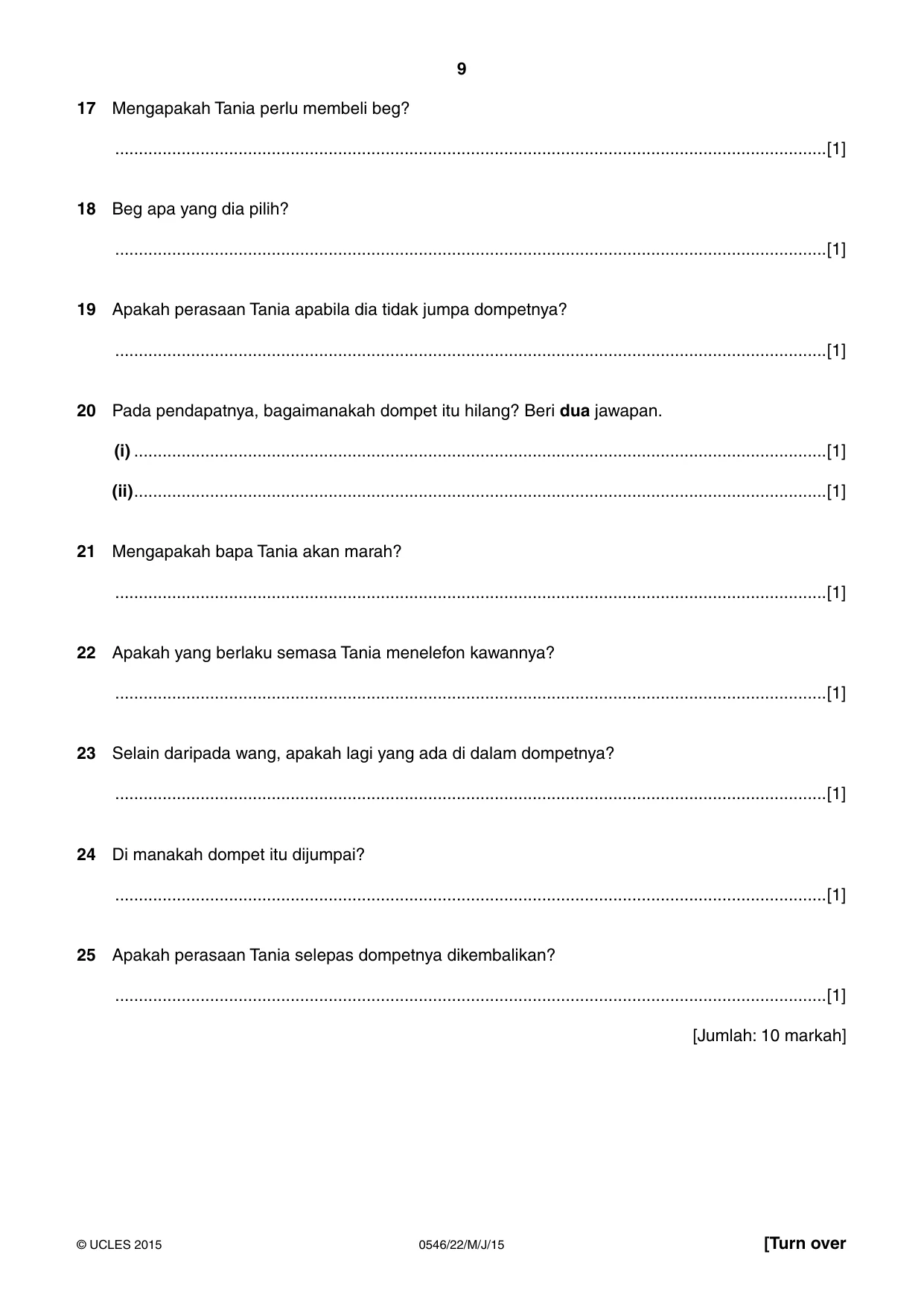
9 0546/22/M/J/15 © UCLES 2015 [Turn over 17 Mengapakah Tania perlu membeli beg? …[1] 18 Beg apa yang dia pilih? …[1] 19 Apakah perasaan Tania apabila dia tidak jumpa dompetnya? …[1] 20 Pada pendapatnya, bagaimanakah dompet itu hilang? Beri dua jawapan. (i) …[1] (ii) …[1] 21 Mengapakah bapa Tania akan marah? …[1] 22 Apakah yang berlaku semasa Tania menelefon kawannya? …[1] 23 Selain daripada wang, apakah lagi yang ada di dalam dompetnya? …[1] 24 Di manakah dompet itu dijumpai? …[1] 25 Apakah perasaan Tania selepas dompetnya dikembalikan? …[1] [Jumlah: 10 markah]
Question paper, page 10
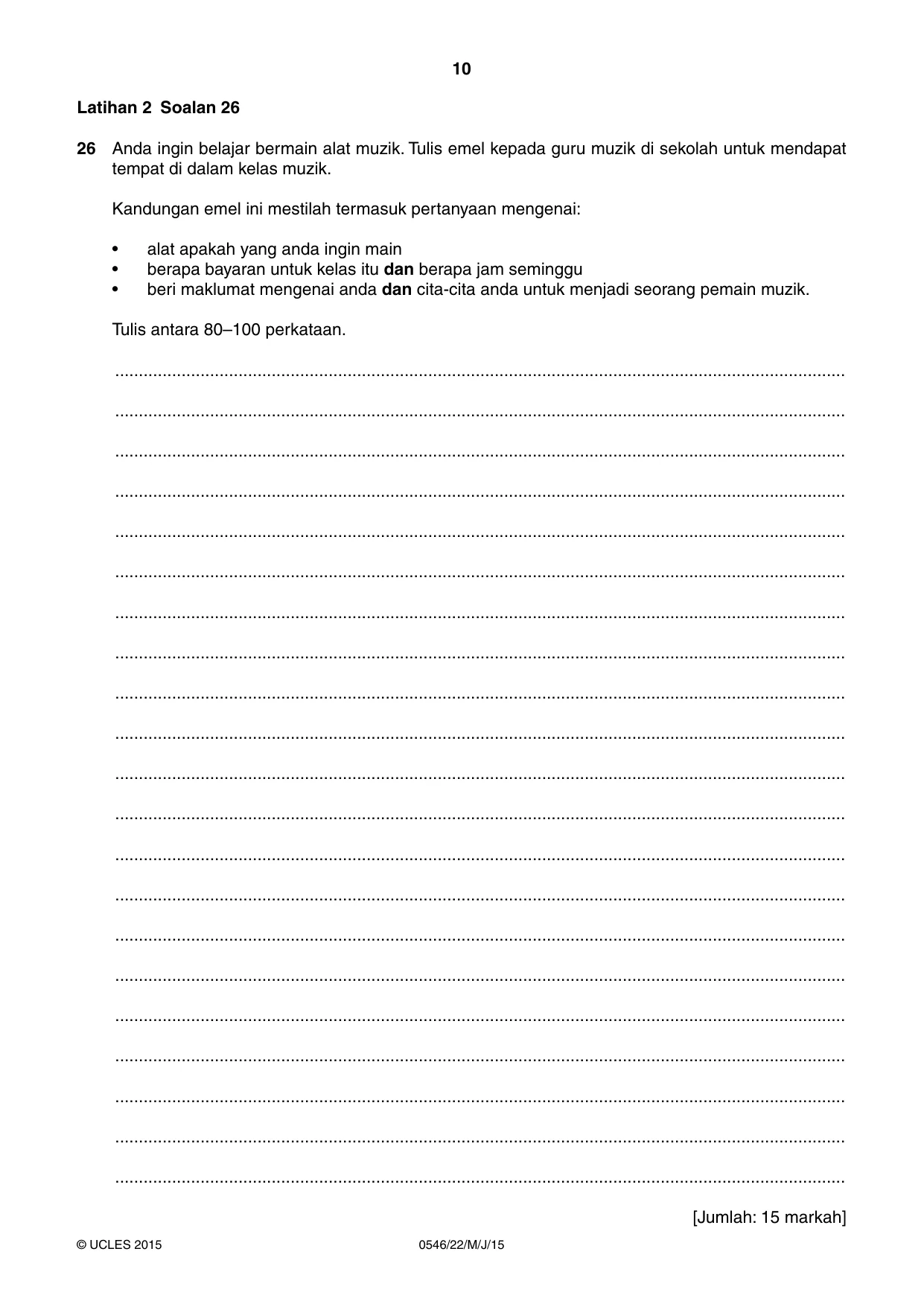
10 0546/22/M/J/15 © UCLES 2015 Latihan 2 Soalan 26 26 Anda ingin belajar bermain alat muzik. Tulis emel kepada guru muzik di sekolah untuk mendapat tempat di dalam kelas muzik. Kandungan emel ini mestilah termasuk pertanyaan mengenai: • alat apakah yang anda ingin main • berapa bayaran untuk kelas itu dan berapa jam seminggu • beri maklumat mengenai anda dan cita-cita anda untuk menjadi seorang pemain muzik. Tulis antara 80–100 perkataan. … … … … … … … … … … … … … … … … … … … … … [Jumlah: 15 markah]
Question paper, page 11
11 0546/22/M/J/15 © UCLES 2015 [Turn over TURN OVER FOR SECTION 3
Question paper, page 12
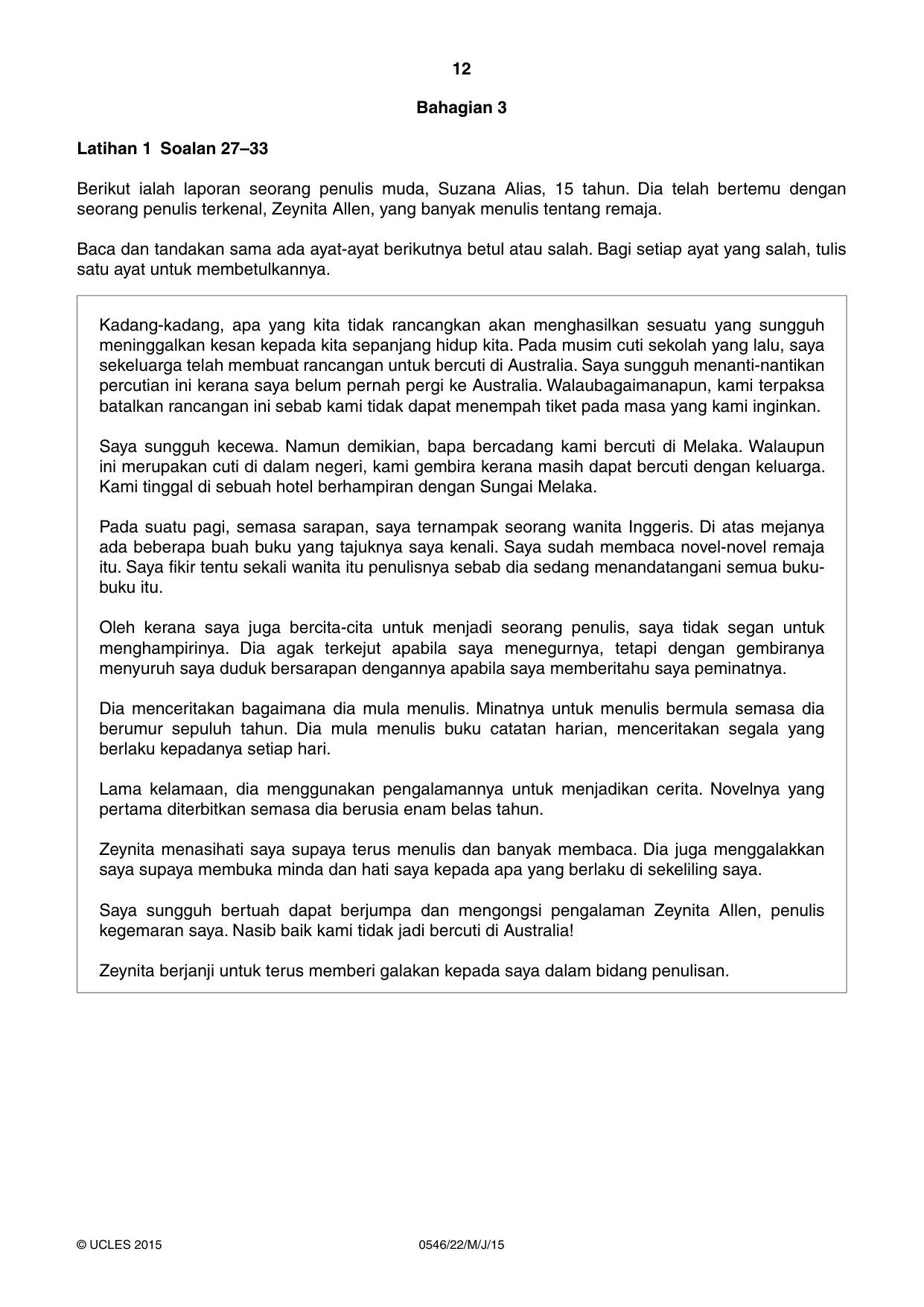
12 0546/22/M/J/15 © UCLES 2015 Bahagian 3 Latihan 1 Soalan 27–33 Berikut ialah laporan seorang penulis muda, Suzana Alias, 15 tahun. Dia telah bertemu dengan seorang penulis terkenal, Zeynita Allen, yang banyak menulis tentang remaja. Baca dan tandakan sama ada ayat-ayat berikutnya betul atau salah. Bagi setiap ayat yang salah, tulis satu ayat untuk membetulkannya. Kadang-kadang, apa yang kita tidak rancangkan akan menghasilkan sesuatu yang sungguh meninggalkan kesan kepada kita sepanjang hidup kita. Pada musim cuti sekolah yang lalu, saya sekeluarga telah membuat rancangan untuk bercuti di Australia. Saya sungguh menanti-nantikan percutian ini kerana saya belum pernah pergi ke Australia. Walaubagaimanapun, kami terpaksa batalkan rancangan ini sebab kami tidak dapat menempah tiket pada masa yang kami inginkan. Saya sungguh kecewa. Namun demikian, bapa bercadang kami bercuti di Melaka. Walaupun ini merupakan cuti di dalam negeri, kami gembira kerana masih dapat bercuti dengan keluarga. Kami tinggal di sebuah hotel berhampiran dengan Sungai Melaka. Pada suatu pagi, semasa sarapan, saya ternampak seorang wanita Inggeris. Di atas mejanya ada beberapa buah buku yang tajuknya saya kenali. Saya sudah membaca novel-novel remaja itu. Saya fikir tentu sekali wanita itu penulisnya sebab dia sedang menandatangani semua buku- buku itu. Oleh kerana saya juga bercita-cita untuk menjadi seorang penulis, saya tidak segan untuk menghampirinya. Dia agak terkejut apabila saya menegurnya, tetapi dengan gembiranya menyuruh saya duduk bersarapan dengannya apabila saya memberitahu saya peminatnya. Dia menceritakan bagaimana dia mula menulis. Minatnya untuk menulis bermula semasa dia berumur sepuluh tahun. Dia mula menulis buku catatan harian, menceritakan segala yang berlaku kepadanya setiap hari. Lama kelamaan, dia menggunakan pengalamannya untuk menjadikan cerita. Novelnya yang pertama diterbitkan semasa dia berusia enam belas tahun. Zeynita menasihati saya supaya terus menulis dan banyak membaca. Dia juga menggalakkan saya supaya membuka minda dan hati saya kepada apa yang berlaku di sekeliling saya. Saya sungguh bertuah dapat berjumpa dan mengongsi pengalaman Zeynita Allen, penulis kegemaran saya. Nasib baik kami tidak jadi bercuti di Australia! Zeynita berjanji untuk terus memberi galakan kepada saya dalam bidang penulisan.
Question paper, page 13
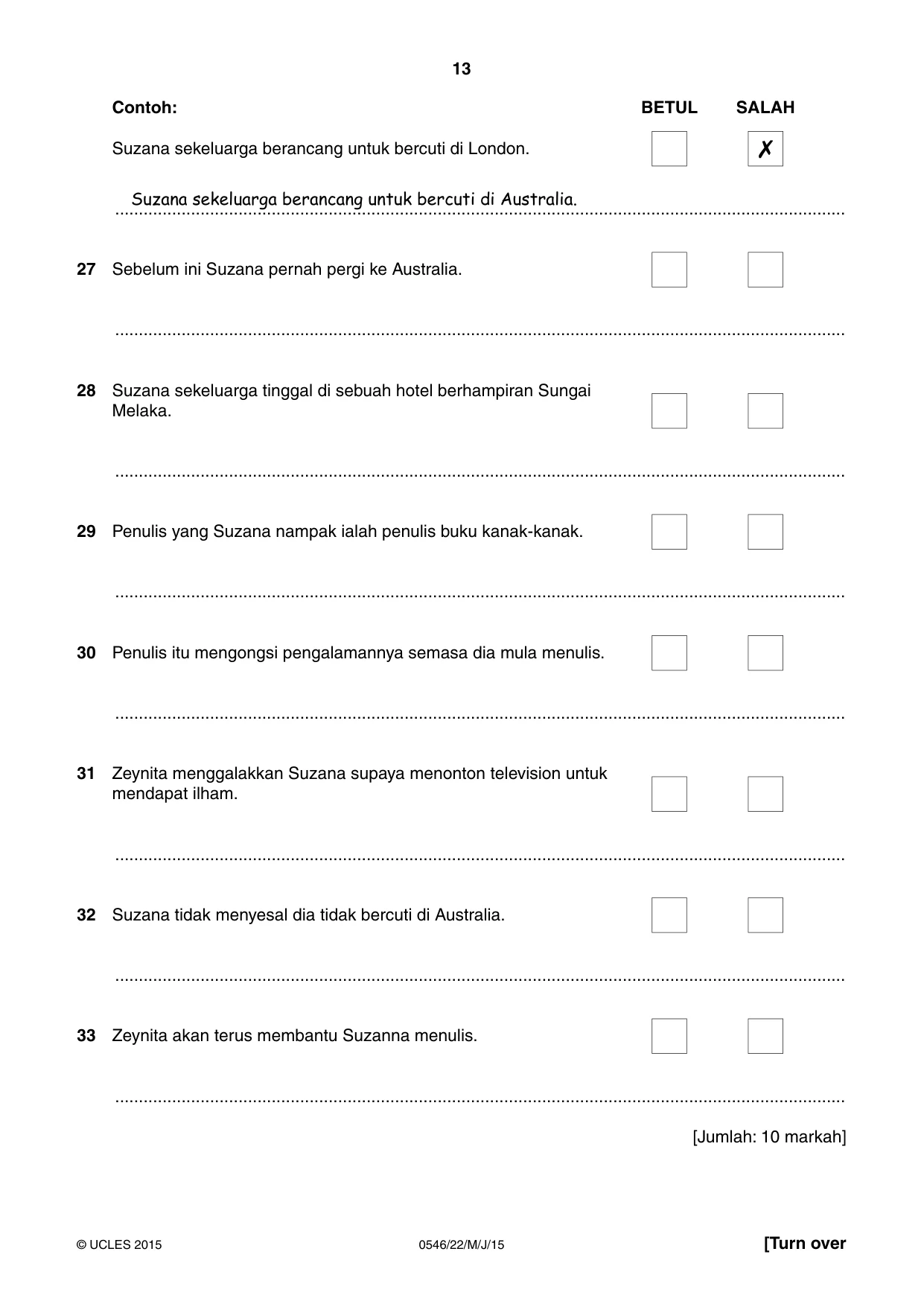
13 0546/22/M/J/15 © UCLES 2015 [Turn over Contoh: BETUL SALAH Suzana sekeluarga berancang untuk bercuti di London. ✗ Suzana sekeluarga berancang untuk bercuti di Australia. … 27 Sebelum ini Suzana pernah pergi ke Australia. … 28 Suzana sekeluarga tinggal di sebuah hotel berhampiran Sungai Melaka. … 29 Penulis yang Suzana nampak ialah penulis buku kanak-kanak. … 30 Penulis itu mengongsi pengalamannya semasa dia mula menulis. … 31 Zeynita menggalakkan Suzana supaya menonton television untuk mendapat ilham. … 32 Suzana tidak menyesal dia tidak bercuti di Australia. … 33 Zeynita akan terus membantu Suzanna menulis. … [Jumlah: 10 markah]
Question paper, page 14
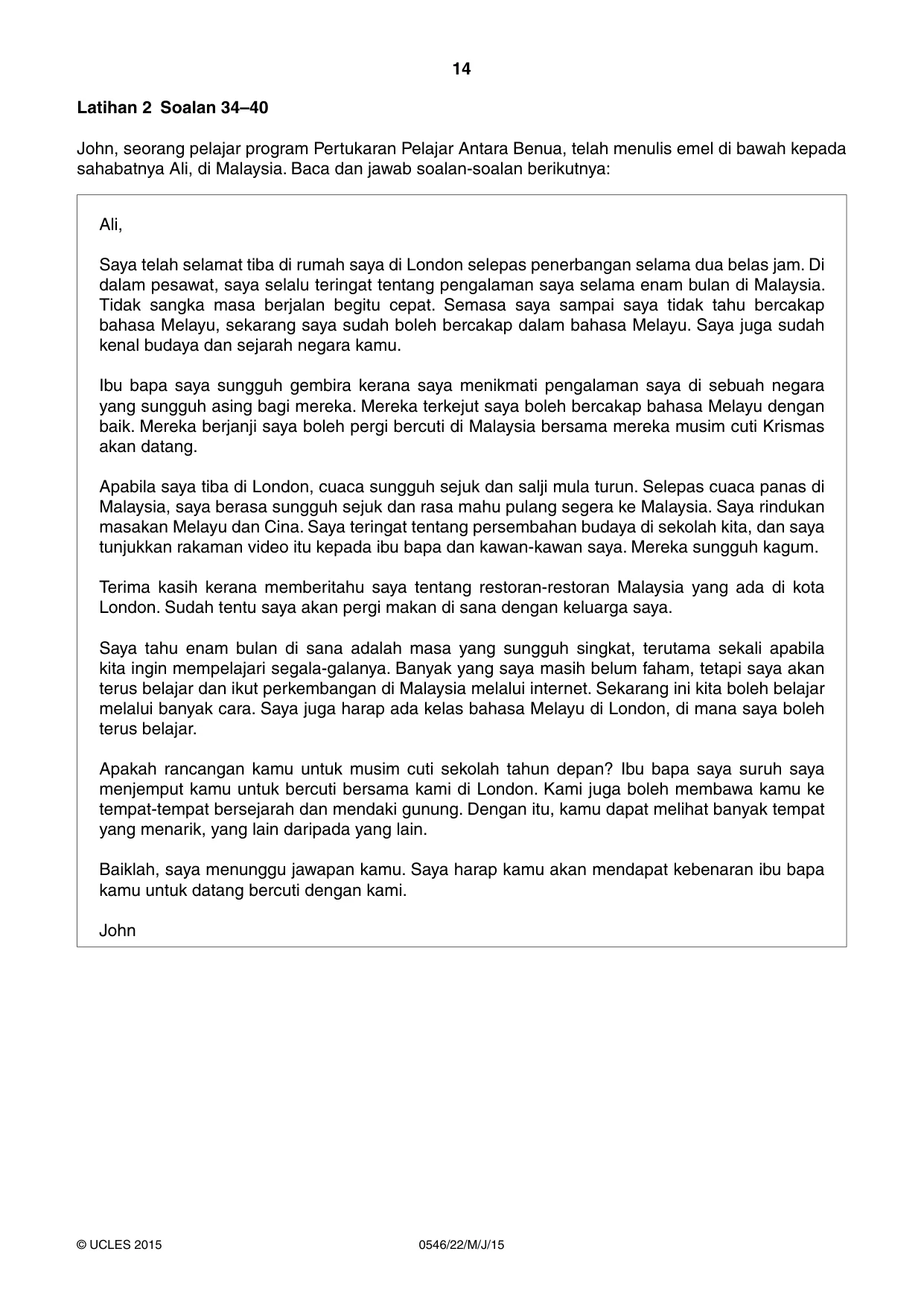
14 0546/22/M/J/15 © UCLES 2015 Latihan 2 Soalan 34–40 John, seorang pelajar program Pertukaran Pelajar Antara Benua, telah menulis emel di bawah kepada sahabatnya Ali, di Malaysia. Baca dan jawab soalan-soalan berikutnya: Ali, Saya telah selamat tiba di rumah saya di London selepas penerbangan selama dua belas jam. Di dalam pesawat, saya selalu teringat tentang pengalaman saya selama enam bulan di Malaysia. Tidak sangka masa berjalan begitu cepat. Semasa saya sampai saya tidak tahu bercakap bahasa Melayu, sekarang saya sudah boleh bercakap dalam bahasa Melayu. Saya juga sudah kenal budaya dan sejarah negara kamu. Ibu bapa saya sungguh gembira kerana saya menikmati pengalaman saya di sebuah negara yang sungguh asing bagi mereka. Mereka terkejut saya boleh bercakap bahasa Melayu dengan baik. Mereka berjanji saya boleh pergi bercuti di Malaysia bersama mereka musim cuti Krismas akan datang. Apabila saya tiba di London, cuaca sungguh sejuk dan salji mula turun. Selepas cuaca panas di Malaysia, saya berasa sungguh sejuk dan rasa mahu pulang segera ke Malaysia. Saya rindukan masakan Melayu dan Cina. Saya teringat tentang persembahan budaya di sekolah kita, dan saya tunjukkan rakaman video itu kepada ibu bapa dan kawan-kawan saya. Mereka sungguh kagum. Terima kasih kerana memberitahu saya tentang restoran-restoran Malaysia yang ada di kota London. Sudah tentu saya akan pergi makan di sana dengan keluarga saya. Saya tahu enam bulan di sana adalah masa yang sungguh singkat, terutama sekali apabila kita ingin mempelajari segala-galanya. Banyak yang saya masih belum faham, tetapi saya akan terus belajar dan ikut perkembangan di Malaysia melalui internet. Sekarang ini kita boleh belajar melalui banyak cara. Saya juga harap ada kelas bahasa Melayu di London, di mana saya boleh terus belajar. Apakah rancangan kamu untuk musim cuti sekolah tahun depan? Ibu bapa saya suruh saya menjemput kamu untuk bercuti bersama kami di London. Kami juga boleh membawa kamu ke tempat-tempat bersejarah dan mendaki gunung. Dengan itu, kamu dapat melihat banyak tempat yang menarik, yang lain daripada yang lain. Baiklah, saya menunggu jawapan kamu. Saya harap kamu akan mendapat kebenaran ibu bapa kamu untuk datang bercuti dengan kami. John
Question paper, page 15
15 0546/22/M/J/15 © UCLES 2015 Jawab soalan-soalan ini: 34 Berapa lamakah penerbangan John dari Malaysia ke London? …[1] 35 Apakah yang John belajar selepas enam bulan berada di Malaysia? Beri dua jawapan. (i) …[1] (ii) …[1] 36 Apakah janji ibu bapa John kepada dia? …[1] 37 Semasa tiba di London, apakah perasaan John? …[1] 38 Apakah yang John rindukan? …[1] 39 Beri dua cara John akan terus ikut perkembangan di Malaysia dan belajar bahasa Melayu? (i) …[1] (ii) …[1] 40 Apakah rancangan John kalau Ali dapat bercuti bersamanya? Beri dua jawapan. (i) …[1] (ii) …[1] [Jumlah: 10 markah]
Question paper, page 16
16 0546/22/M/J/15 © UCLES 2015 Permission to reproduce items where third-party owned material protected by copyright is included has been sought and cleared where possible. Every reasonable effort has been made by the publisher (UCLES) to trace copyright holders, but if any items requiring clearance have unwittingly been included, the publisher will be pleased to make amends at the earliest possible opportunity. To avoid the issue of disclosure of answer-related information to candidates, all copyright acknowledgements are reproduced online in the Cambridge International Examinations Copyright Acknowledgements Booklet. This is produced for each series of examinations and is freely available to download at www.cie.org.uk after the live examination series. Cambridge International Examinations is part of the Cambridge Assessment Group. Cambridge Assessment is the brand name of University of Cambridge Local Examinations Syndicate (UCLES), which is itself a department of the University of Cambridge. BLANK PAGE
Mark scheme, page 1
® IGCSE is the registered trademark of Cambridge International Examinations. CAMBRIDGE INTERNATIONAL EXAMINATIONS Cambridge International General Certificate of Secondary Education MARK SCHEME for the May/June 2015 series 0546 FOREIGN LANGUAGE MALAY 0546/22 Paper 2 (Reading and Directed Writing), maximum raw mark 65 This mark scheme is published as an aid to teachers and candidates, to indicate the requirements of the examination. It shows the basis on which Examiners were instructed to award marks. It does not indicate the details of the discussions that took place at an Examiners’ meeting before marking began, which would have considered the acceptability of alternative answers. Mark schemes should be read in conjunction with the question paper and the Principal Examiner Report for Teachers. Cambridge will not enter into discussions about these mark schemes. Cambridge is publishing the mark schemes for the May/June 2015 series for most Cambridge IGCSE®, Cambridge International A and AS Level components and some Cambridge O Level components.
Mark scheme, page 2
Page 2 Mark Scheme Syllabus Paper Cambridge IGCSE – May/June 2015 0546 22 © Cambridge International Examinations 2015 1 General Marking Notes 2 General Marking Principles 2.1 Please note that it is not possible to list all acceptable alternatives in the Detailed Mark Scheme provided in Section 3 You will need to consider all alternative answers and unexpected approaches in candidates' scripts, make a decision on whether they communicate the required elements, in consultation with your Principal Examiner, and award marks accordingly. 2.2 Crossing out: (a) If a candidate changes his/her mind over an answer and crosses out an attempt, award a mark if the final attempt is correct. (b) If a candidate crosses out an answer to a whole question but makes no second attempt at it, mark the crossed out work. 2.3 Reading tasks: more than the stipulated number of boxes ticked/crossed by the candidate: (a) If more than one attempt is visible, but the candidate has clearly indicated which attempt is his/her final answer (e.g. by crossing out other attempts or by annotating the script in some way), mark in the usual way. (b) If two attempts are visible (e.g. two boxes ticked instead of the 1 box stipulated), and neither has been crossed out/discounted by the candidate, no mark can be awarded. (c) Answers in pen do not take precedence over answers in pencil, e.g. if a candidate is asked to tick one box and ticks two, one in pen and the other in pencil, the mark cannot be awarded unless there is some explicit indication from the candidate as to which is his/her final answer. 2.4 Reading tasks: for questions requiring more than one element for the answer Both correct answers on line 1 and line 2 blank = 2 Both correct answers on line 1 and another, wrong answer on line 2 = 1 (or vice-versa) 2.5 Reading tasks: answers requiring the use of Malay (rather than a non-verbal response) should be marked for communication. Tolerate inaccuracies provided the message is clear. (a) ‘If in doubt, sound it out’: if you read what the candidate has written, does it sound like the correct answer? (b) Look-alike test: does what the candidate has written look like the correct answer? 2.6 Unless the Mark Scheme specifies otherwise, do not accept incorrect Malay if the word given means something else in Malay. (Incorrect Malay which constitutes a word in any language other than Malay is marked (i) on the basis of whether it is accepted or refused in the Mark Scheme and (ii) if not mentioned in the Mark Scheme, on the basis of 2.5 above).
Mark scheme, page 3
Page 3 Mark Scheme Syllabus Paper Cambridge IGCSE – May/June 2015 0546 22 © Cambridge International Examinations 2015 2.7 Annotation used in marking: (a) INVL = Invalidation and is used when additional material included by the candidate is judged to invalidate an otherwise correct answer thus preventing him / her from scoring the mark (INVL = 0) (b) HA = harmless additional material which in conjunction with the correct answer does not prevent the candidate from scoring the mark. (c) BOD = Benefit of the Doubt and is used to indicate material considered by the Examiner and judged to be more correct than incorrect: the benefit of the doubt is given to the candidate and the mark is awarded. (d) X = end of word count (in writing exercises). Use this to show where the candidate reached their word count if their answer is too long. Do not mark material after the red cross. (e) ^ = omission: used to show that the answer is not enough, there is something missing. (g) ✓1, ✓2, ✓3,✓4, ✓5, ✓6 = use these in the writing exercises to show which content bullet point you are rewarding. 2.8 Extra material: Section 2, Exercise 1 In Section 2, Exercise 1, reward the candidate for being able to locate the answer in the passage. Do not worry about lifting unless this would cause the message to be seriously distorted – in which case a lift will be specifically rejected in the Mark Scheme. Ignore extra material given in an answer providing that it does not invalidate an answer.
Mark scheme, page 4
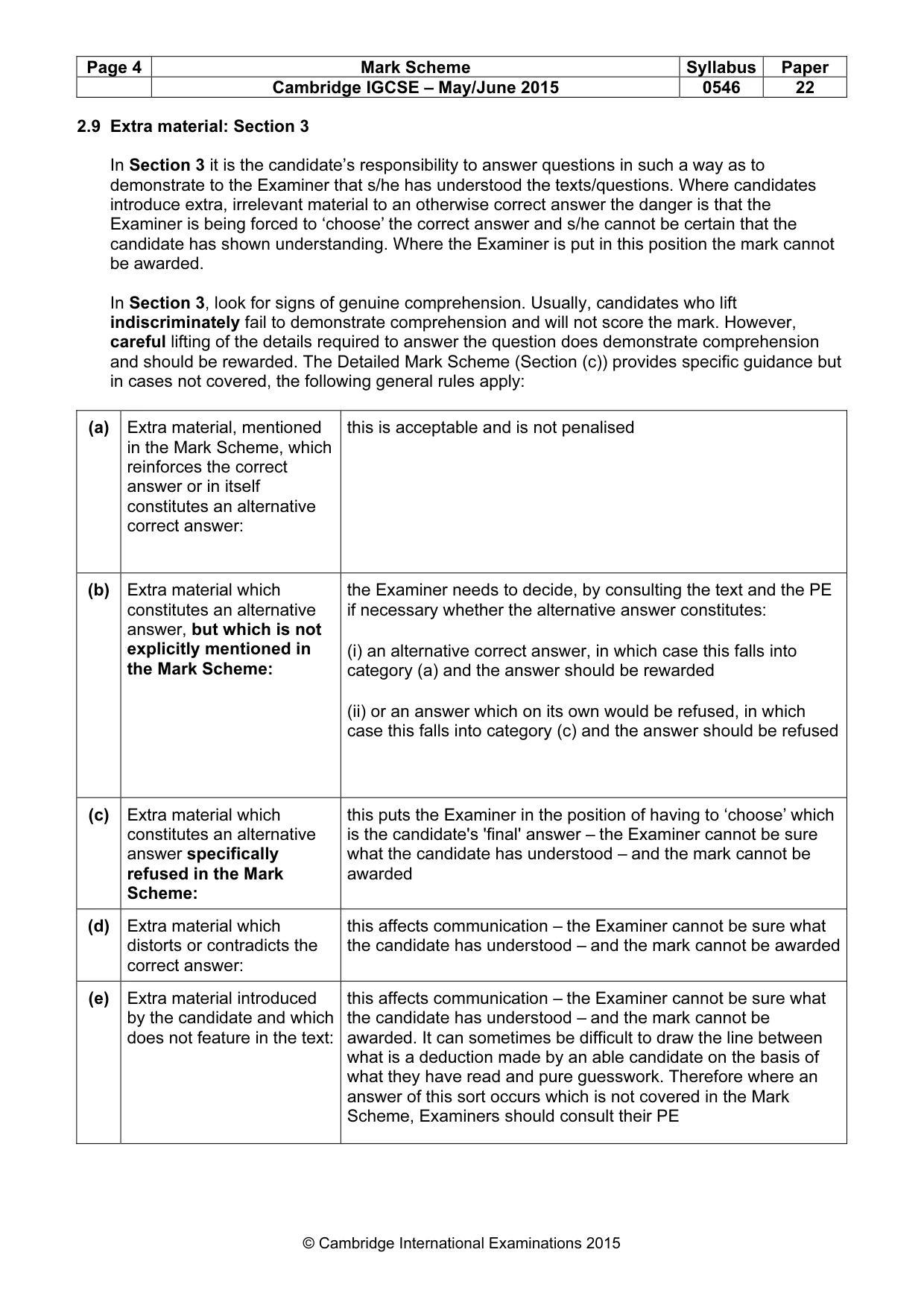
Page 4 Mark Scheme Syllabus Paper Cambridge IGCSE – May/June 2015 0546 22 © Cambridge International Examinations 2015 2.9 Extra material: Section 3 In Section 3 it is the candidate’s responsibility to answer questions in such a way as to demonstrate to the Examiner that s/he has understood the texts/questions. Where candidates introduce extra, irrelevant material to an otherwise correct answer the danger is that the Examiner is being forced to ‘choose’ the correct answer and s/he cannot be certain that the candidate has shown understanding. Where the Examiner is put in this position the mark cannot be awarded. In Section 3, look for signs of genuine comprehension. Usually, candidates who lift indiscriminately fail to demonstrate comprehension and will not score the mark. However, careful lifting of the details required to answer the question does demonstrate comprehension and should be rewarded. The Detailed Mark Scheme (Section (c)) provides specific guidance but in cases not covered, the following general rules apply: (a) Extra material, mentioned in the Mark Scheme, which reinforces the correct answer or in itself constitutes an alternative correct answer: this is acceptable and is not penalised (b) Extra material which constitutes an alternative answer, but which is not explicitly mentioned in the Mark Scheme: the Examiner needs to decide, by consulting the text and the PE if necessary whether the alternative answer constitutes: (i) an alternative correct answer, in which case this falls into category (a) and the answer should be rewarded (ii) or an answer which on its own would be refused, in which case this falls into category (c) and the answer should be refused (c) Extra material which constitutes an alternative answer specifically refused in the Mark Scheme: this puts the Examiner in the position of having to ‘choose’ which is the candidate's 'final' answer – the Examiner cannot be sure what the candidate has understood – and the mark cannot be awarded (d) Extra material which distorts or contradicts the correct answer: this affects communication – the Examiner cannot be sure what the candidate has understood – and the mark cannot be awarded (e) Extra material introduced by the candidate and which does not feature in the text: this affects communication – the Examiner cannot be sure what the candidate has understood – and the mark cannot be awarded. It can sometimes be difficult to draw the line between what is a deduction made by an able candidate on the basis of what they have read and pure guesswork. Therefore where an answer of this sort occurs which is not covered in the Mark Scheme, Examiners should consult their PE
Mark scheme, page 5
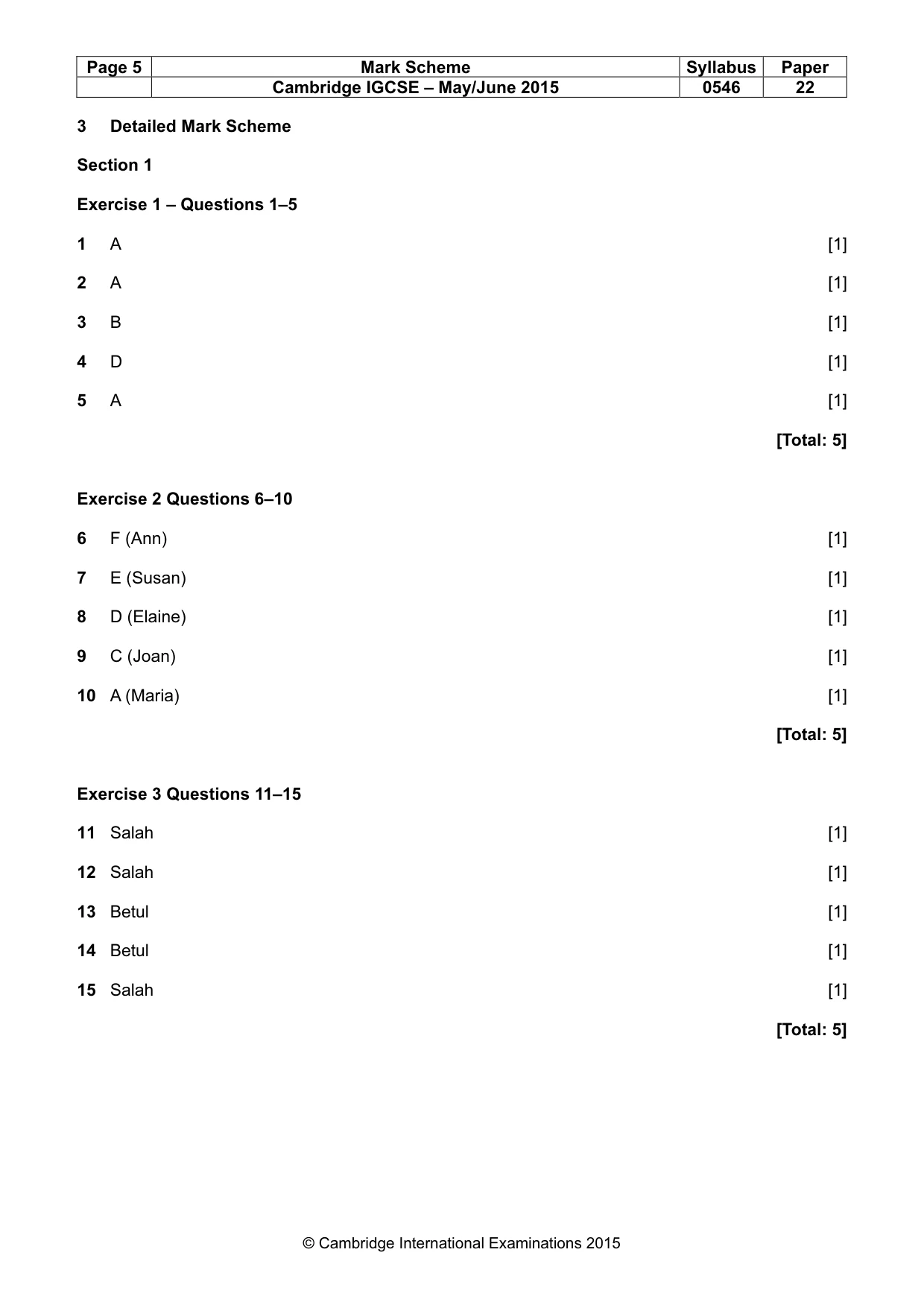
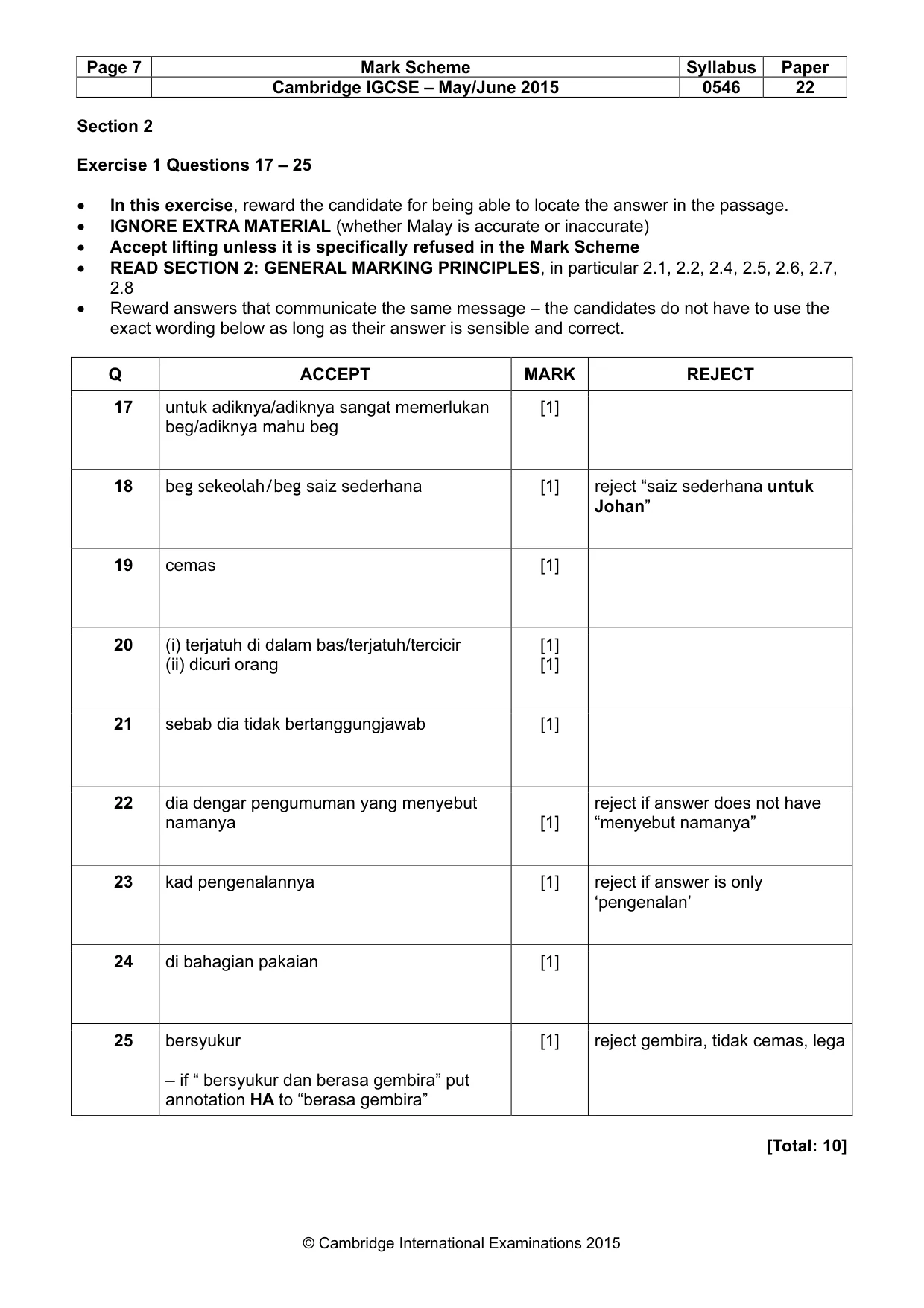
Page 5 Mark Scheme Syllabus Paper Cambridge IGCSE – May/June 2015 0546 22 © Cambridge International Examinations 2015 3 Detailed Mark Scheme Section 1 Exercise 1 – Questions 1–5 1 A [1] 2 A [1] 3 B [1] 4 D [1] 5 A [1] [Total: 5] Exercise 2 Questions 6–10 6 F (Ann) [1] 7 E (Susan) [1] 8 D (Elaine) [1] 9 C (Joan) [1] 10 A (Maria) [1] [Total: 5] Exercise 3 Questions 11–15 11 Salah [1] 12 Salah [1] 13 Betul [1] 14 Betul [1] 15 Salah [1] [Total: 5]
Mark scheme, page 6
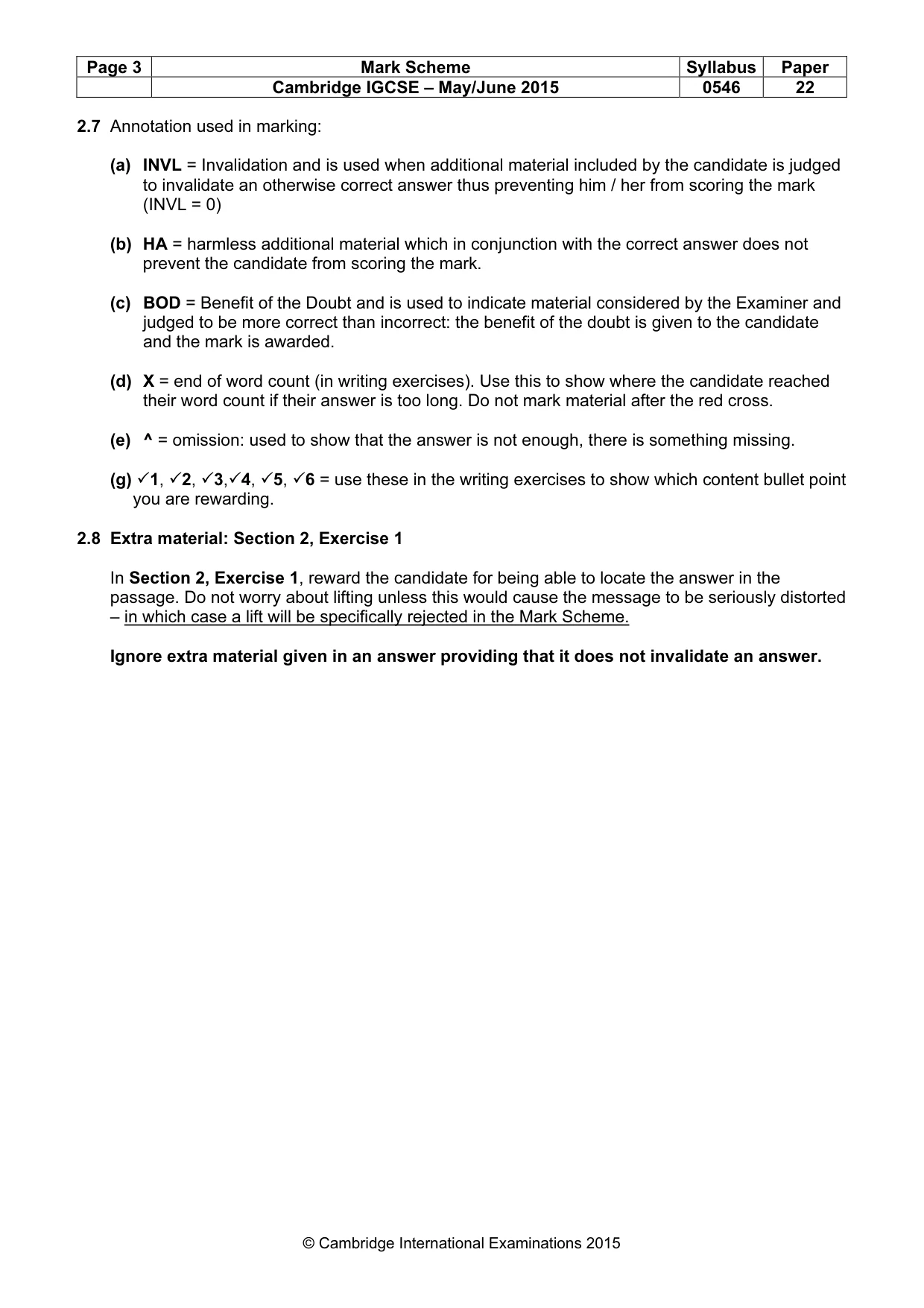
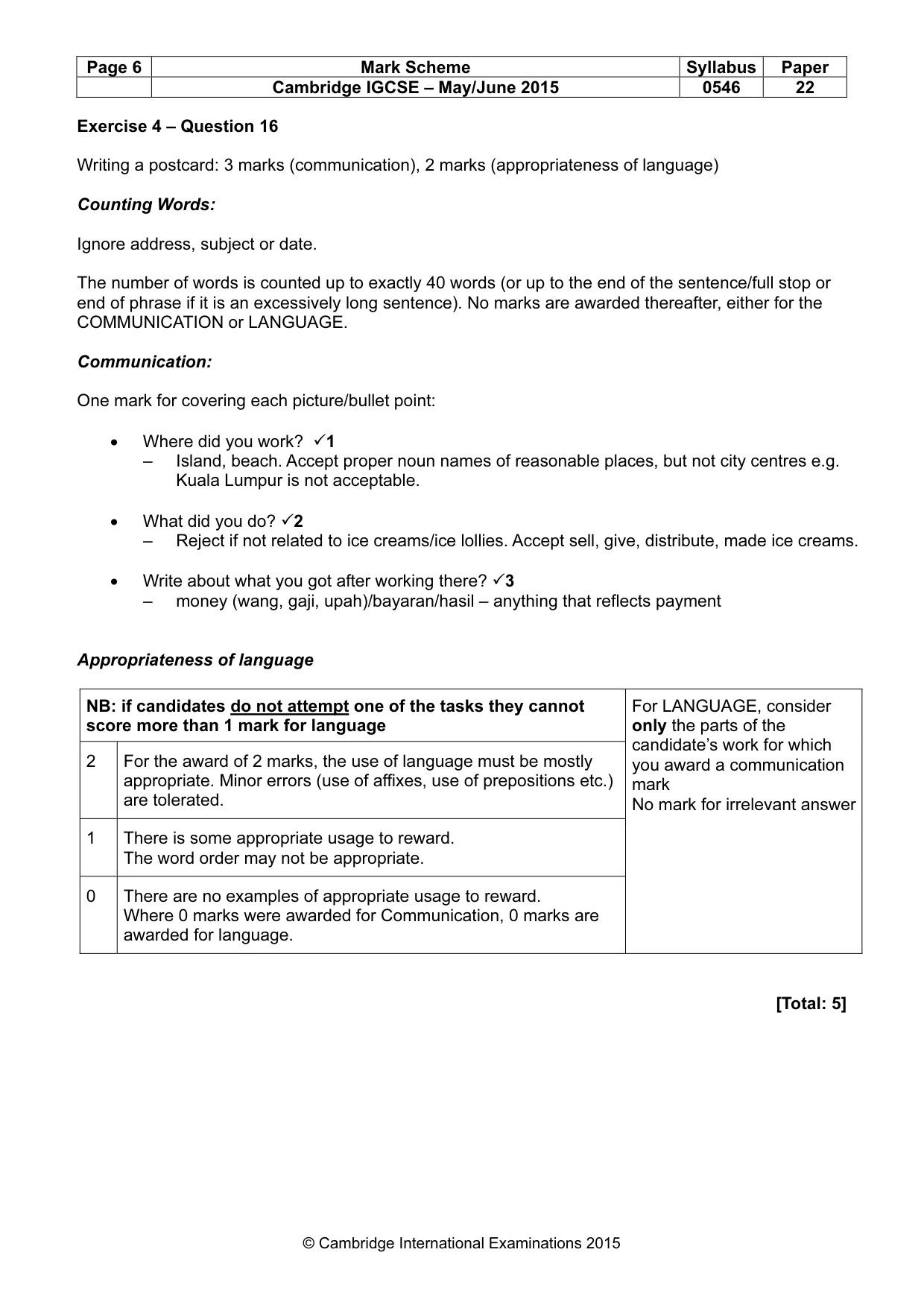
Page 6 Mark Scheme Syllabus Paper Cambridge IGCSE – May/June 2015 0546 22 © Cambridge International Examinations 2015 Exercise 4 – Question 16 Writing a postcard: 3 marks (communication), 2 marks (appropriateness of language) Counting Words: Ignore address, subject or date. The number of words is counted up to exactly 40 words (or up to the end of the sentence/full stop or end of phrase if it is an excessively long sentence). No marks are awarded thereafter, either for the COMMUNICATION or LANGUAGE. Communication: One mark for covering each picture/bullet point: • Where did you work? ✓1 – Island, beach. Accept proper noun names of reasonable places, but not city centres e.g. Kuala Lumpur is not acceptable. • What did you do? ✓2 – Reject if not related to ice creams/ice lollies. Accept sell, give, distribute, made ice creams. • Write about what you got after working there? ✓3 – money (wang, gaji, upah)/bayaran/hasil – anything that reflects payment Appropriateness of language NB: if candidates do not attempt one of the tasks they cannot score more than 1 mark for language For LANGUAGE, consider only the parts of the candidate’s work for which you award a communication mark No mark for irrelevant answer 2 For the award of 2 marks, the use of language must be mostly appropriate. Minor errors (use of affixes, use of prepositions etc.) are tolerated. 1 There is some appropriate usage to reward. The word order may not be appropriate. 0 There are no examples of appropriate usage to reward. Where 0 marks were awarded for Communication, 0 marks are awarded for language. [Total: 5]
Mark scheme, page 7
Page 7 Mark Scheme Syllabus Paper Cambridge IGCSE – May/June 2015 0546 22 © Cambridge International Examinations 2015 Section 2 Exercise 1 Questions 17 – 25 • In this exercise, reward the candidate for being able to locate the answer in the passage. • IGNORE EXTRA MATERIAL (whether Malay is accurate or inaccurate) • Accept lifting unless it is specifically refused in the Mark Scheme • READ SECTION 2: GENERAL MARKING PRINCIPLES, in particular 2.1, 2.2, 2.4, 2.5, 2.6, 2.7, 2.8 • Reward answers that communicate the same message – the candidates do not have to use the exact wording below as long as their answer is sensible and correct. Q ACCEPT MARK REJECT 17 untuk adiknya/adiknya sangat memerlukan beg/adiknya mahu beg [1] 18 beg sekeolah/beg saiz sederhana [1] reject “saiz sederhana untuk Johan” 19 cemas [1] 20 (i) terjatuh di dalam bas/terjatuh/tercicir (ii) dicuri orang [1] [1] 21 sebab dia tidak bertanggungjawab [1] 22 dia dengar pengumuman yang menyebut namanya [1] reject if answer does not have “menyebut namanya” 23 kad pengenalannya [1] reject if answer is only ‘pengenalan’ 24 di bahagian pakaian [1] 25 bersyukur – if “ bersyukur dan berasa gembira” put annotation HA to “berasa gembira” [1] reject gembira, tidak cemas, lega [Total: 10]
Mark scheme, page 8
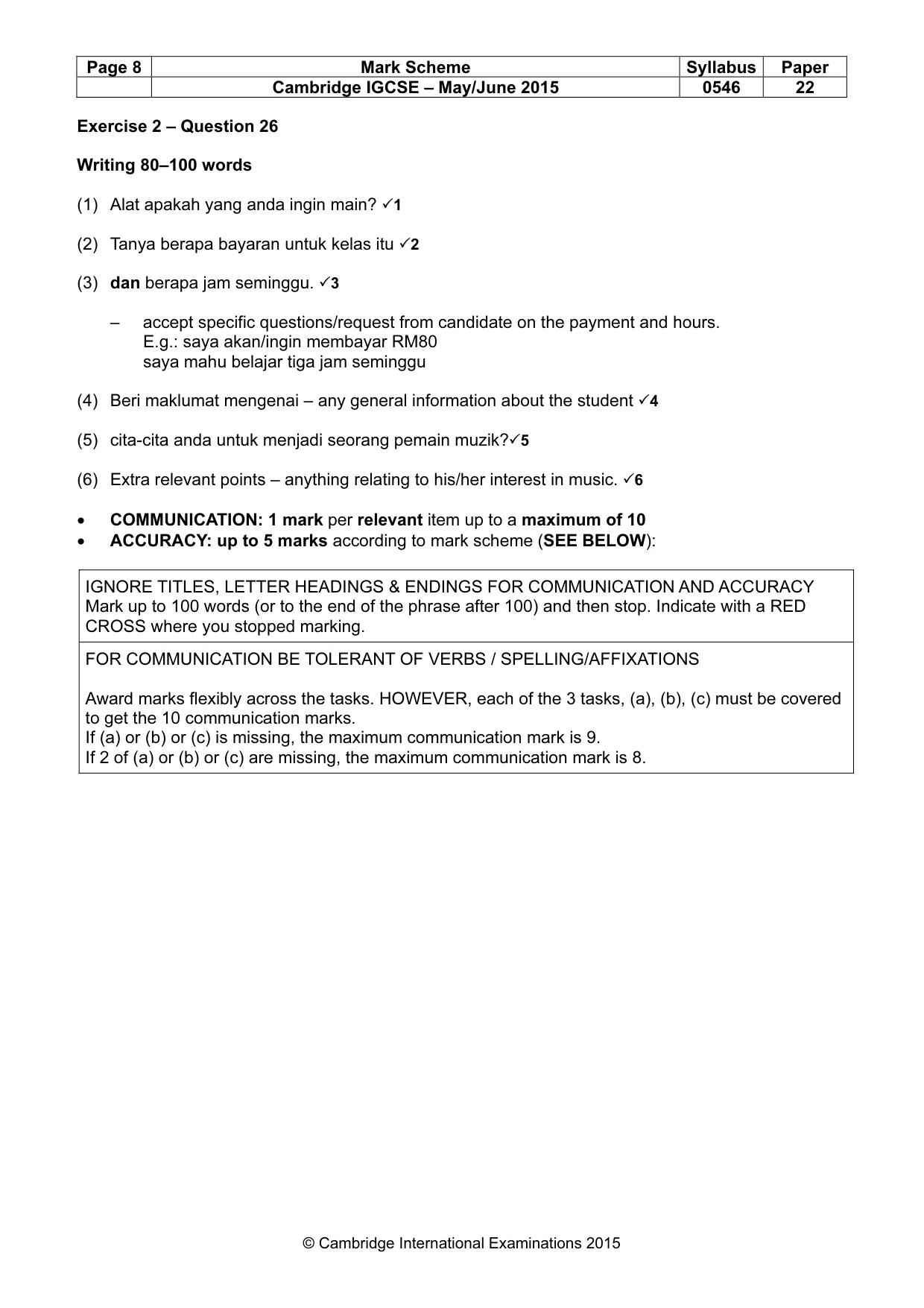
Page 8 Mark Scheme Syllabus Paper Cambridge IGCSE – May/June 2015 0546 22 © Cambridge International Examinations 2015 Exercise 2 – Question 26 Writing 80–100 words (1) Alat apakah yang anda ingin main? ✓1 (2) Tanya berapa bayaran untuk kelas itu ✓2 (3) dan berapa jam seminggu. ✓3 – accept specific questions/request from candidate on the payment and hours. E.g.: saya akan/ingin membayar RM80 saya mahu belajar tiga jam seminggu (4) Beri maklumat mengenai – any general information about the student ✓4 (5) cita-cita anda untuk menjadi seorang pemain muzik?✓5 (6) Extra relevant points – anything relating to his/her interest in music. ✓6 • COMMUNICATION: 1 mark per relevant item up to a maximum of 10 • ACCURACY: up to 5 marks according to mark scheme (SEE BELOW): IGNORE TITLES, LETTER HEADINGS & ENDINGS FOR COMMUNICATION AND ACCURACY Mark up to 100 words (or to the end of the phrase after 100) and then stop. Indicate with a RED CROSS where you stopped marking. FOR COMMUNICATION BE TOLERANT OF VERBS / SPELLING/AFFIXATIONS Award marks flexibly across the tasks. HOWEVER, each of the 3 tasks, (a), (b), (c) must be covered to get the 10 communication marks. If (a) or (b) or (c) is missing, the maximum communication mark is 9. If 2 of (a) or (b) or (c) are missing, the maximum communication mark is 8.
Mark scheme, page 9
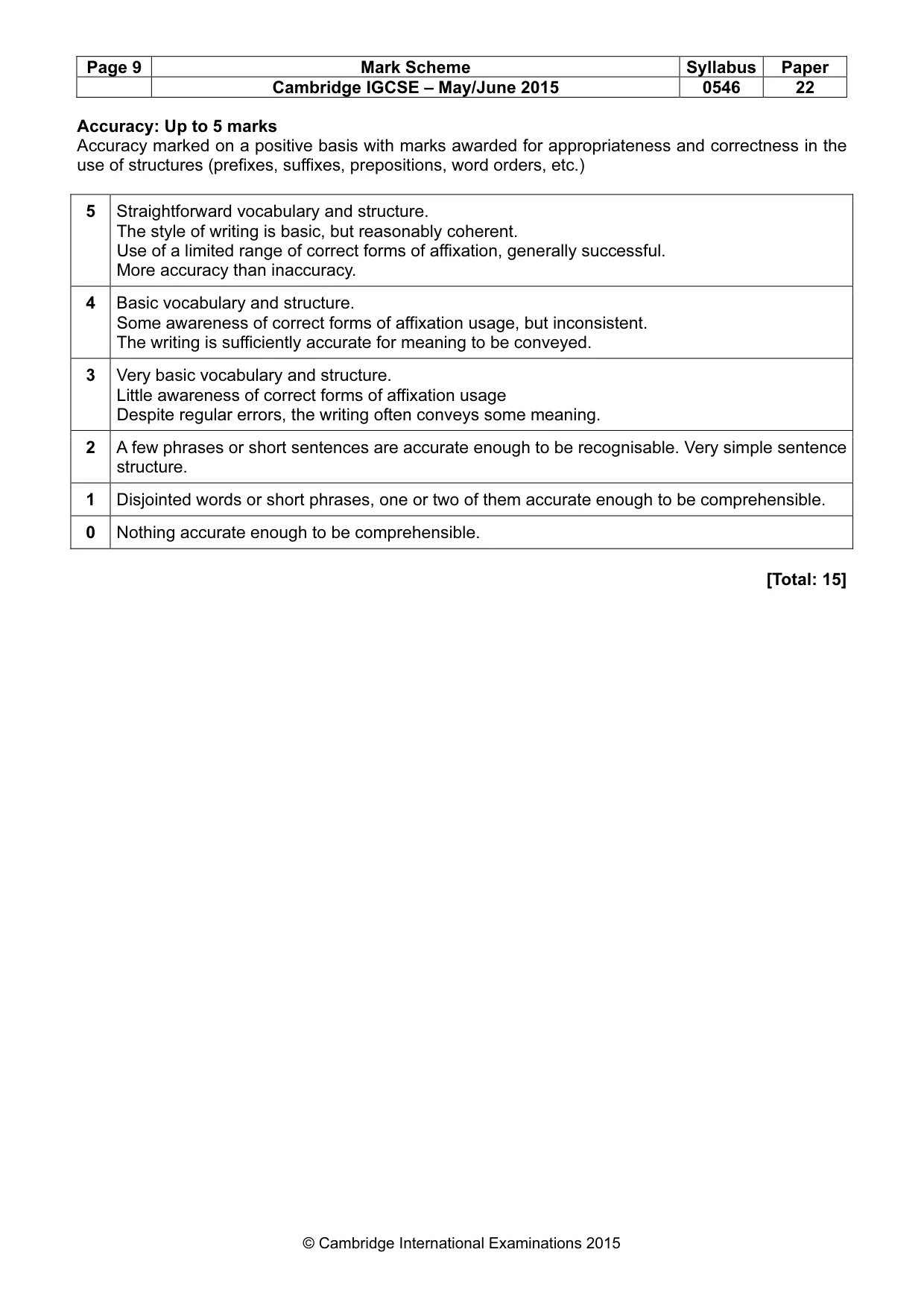
Page 9 Mark Scheme Syllabus Paper Cambridge IGCSE – May/June 2015 0546 22 © Cambridge International Examinations 2015 Accuracy: Up to 5 marks Accuracy marked on a positive basis with marks awarded for appropriateness and correctness in the use of structures (prefixes, suffixes, prepositions, word orders, etc.) 5 Straightforward vocabulary and structure. The style of writing is basic, but reasonably coherent. Use of a limited range of correct forms of affixation, generally successful. More accuracy than inaccuracy. 4 Basic vocabulary and structure. Some awareness of correct forms of affixation usage, but inconsistent. The writing is sufficiently accurate for meaning to be conveyed. 3 Very basic vocabulary and structure. Little awareness of correct forms of affixation usage Despite regular errors, the writing often conveys some meaning. 2 A few phrases or short sentences are accurate enough to be recognisable. Very simple sentence structure. 1 Disjointed words or short phrases, one or two of them accurate enough to be comprehensible. 0 Nothing accurate enough to be comprehensible. [Total: 15]
Mark scheme, page 10
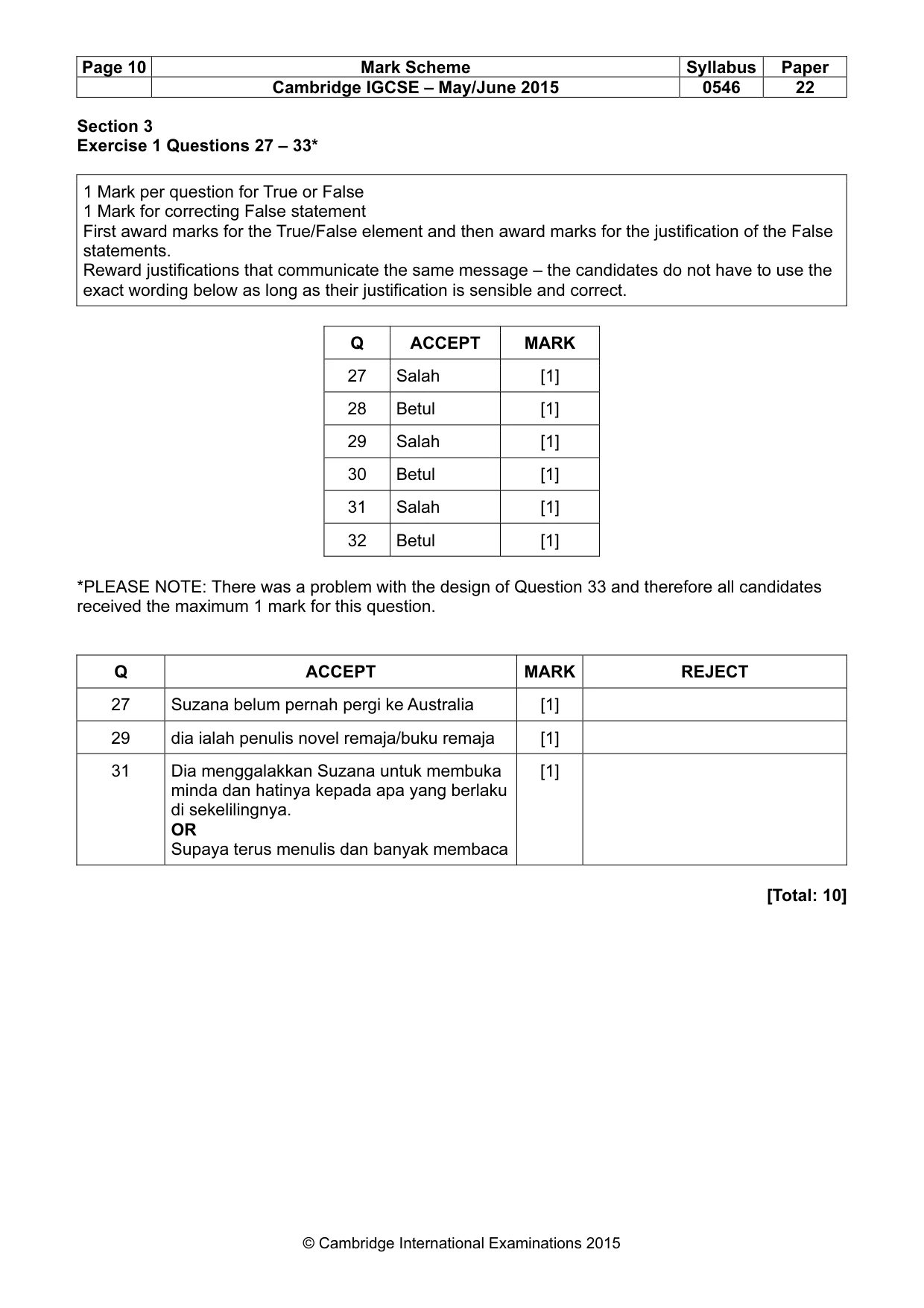
Page 10 Mark Scheme Syllabus Paper Cambridge IGCSE – May/June 2015 0546 22 © Cambridge International Examinations 2015 Section 3 Exercise 1 Questions 27 – 33* 1 Mark per question for True or False 1 Mark for correcting False statement First award marks for the True/False element and then award marks for the justification of the False statements. Reward justifications that communicate the same message – the candidates do not have to use the exact wording below as long as their justification is sensible and correct. Q ACCEPT MARK 27 Salah [1] 28 Betul [1] 29 Salah [1] 30 Betul [1] 31 Salah [1] 32 Betul [1] *PLEASE NOTE: There was a problem with the design of Question 33 and therefore all candidates received the maximum 1 mark for this question. Q ACCEPT MARK REJECT 27 Suzana belum pernah pergi ke Australia [1] 29 dia ialah penulis novel remaja/buku remaja [1] 31 Dia menggalakkan Suzana untuk membuka minda dan hatinya kepada apa yang berlaku di sekelilingnya. OR Supaya terus menulis dan banyak membaca [1] [Total: 10]
Mark scheme, page 11
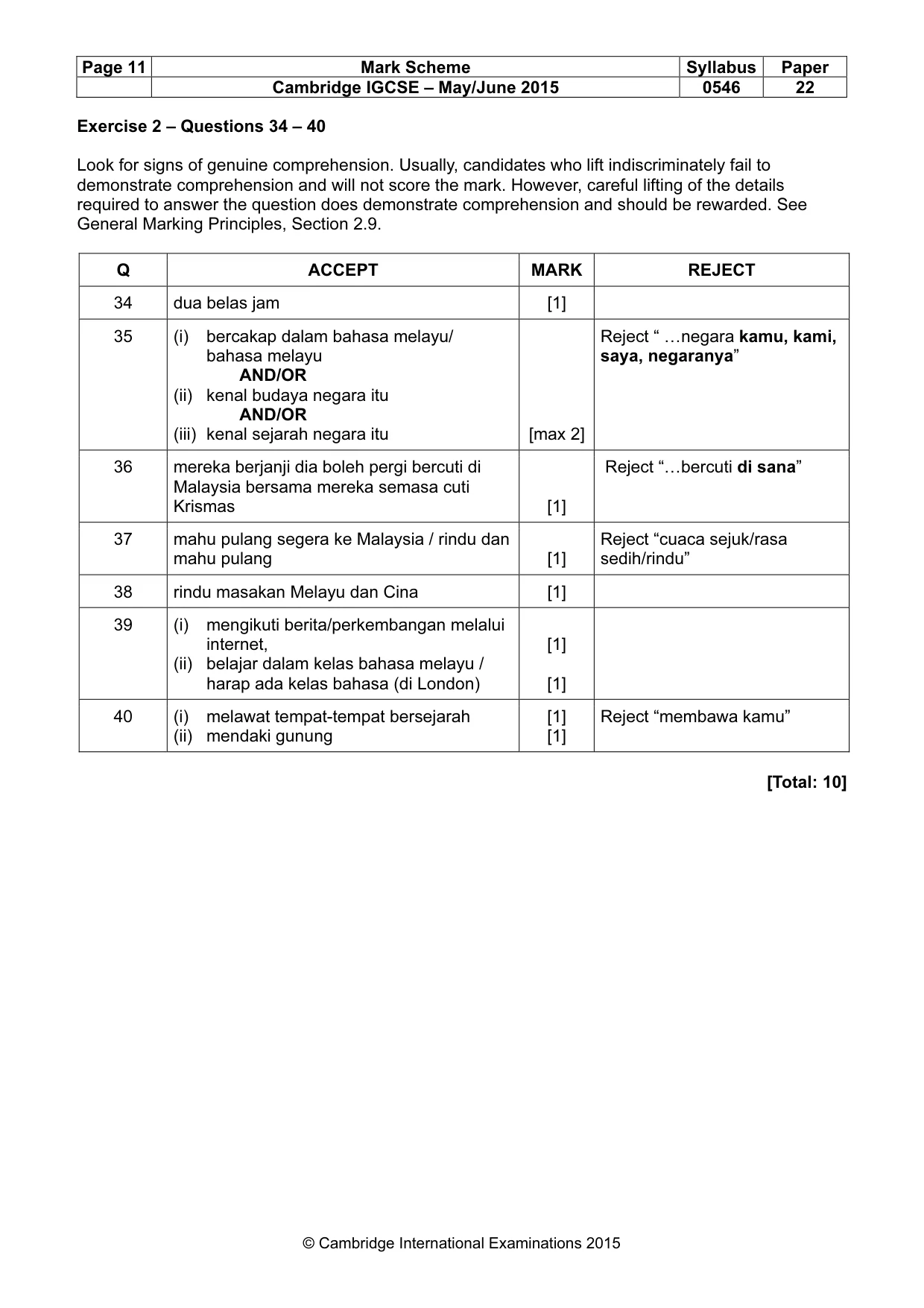
Page 11 Mark Scheme Syllabus Paper Cambridge IGCSE – May/June 2015 0546 22 © Cambridge International Examinations 2015 Exercise 2 – Questions 34 – 40 Look for signs of genuine comprehension. Usually, candidates who lift indiscriminately fail to demonstrate comprehension and will not score the mark. However, careful lifting of the details required to answer the question does demonstrate comprehension and should be rewarded. See General Marking Principles, Section 2.9. Q ACCEPT MARK REJECT 34 dua belas jam [1] 35 (i) bercakap dalam bahasa melayu/ bahasa melayu AND/OR (ii) kenal budaya negara itu AND/OR (iii) kenal sejarah negara itu [max 2] Reject “ …negara kamu, kami, saya, negaranya” 36 mereka berjanji dia boleh pergi bercuti di Malaysia bersama mereka semasa cuti Krismas [1] Reject “…bercuti di sana” 37 mahu pulang segera ke Malaysia / rindu dan mahu pulang [1] Reject “cuaca sejuk/rasa sedih/rindu” 38 rindu masakan Melayu dan Cina [1] 39 (i) mengikuti berita/perkembangan melalui internet, (ii) belajar dalam kelas bahasa melayu / harap ada kelas bahasa (di London) [1] [1] 40 (i) melawat tempat-tempat bersejarah (ii) mendaki gunung [1] [1] Reject “membawa kamu” [Total: 10]
What you needed in this session
Cambridge’s own grade thresholds for 2015 May/June, Paper 2 · Variant 2. A higher threshold means an easier paper — the bar moves with how the cohort did.