Cambridge IGCSE Latin 0480 — 2023 May/June Paper 1 · Variant 2
0480/12/M/J/23 · 160 marks · ≈180 min
The question paper and its mark scheme, free to read here and free to download. This is Cambridge’s own paper, exactly as it was sat.
Question paper8 pages



Mark scheme5 pages
Answers below. Sit the paper first if you are practising.
Paper as text
Question paper, page 1
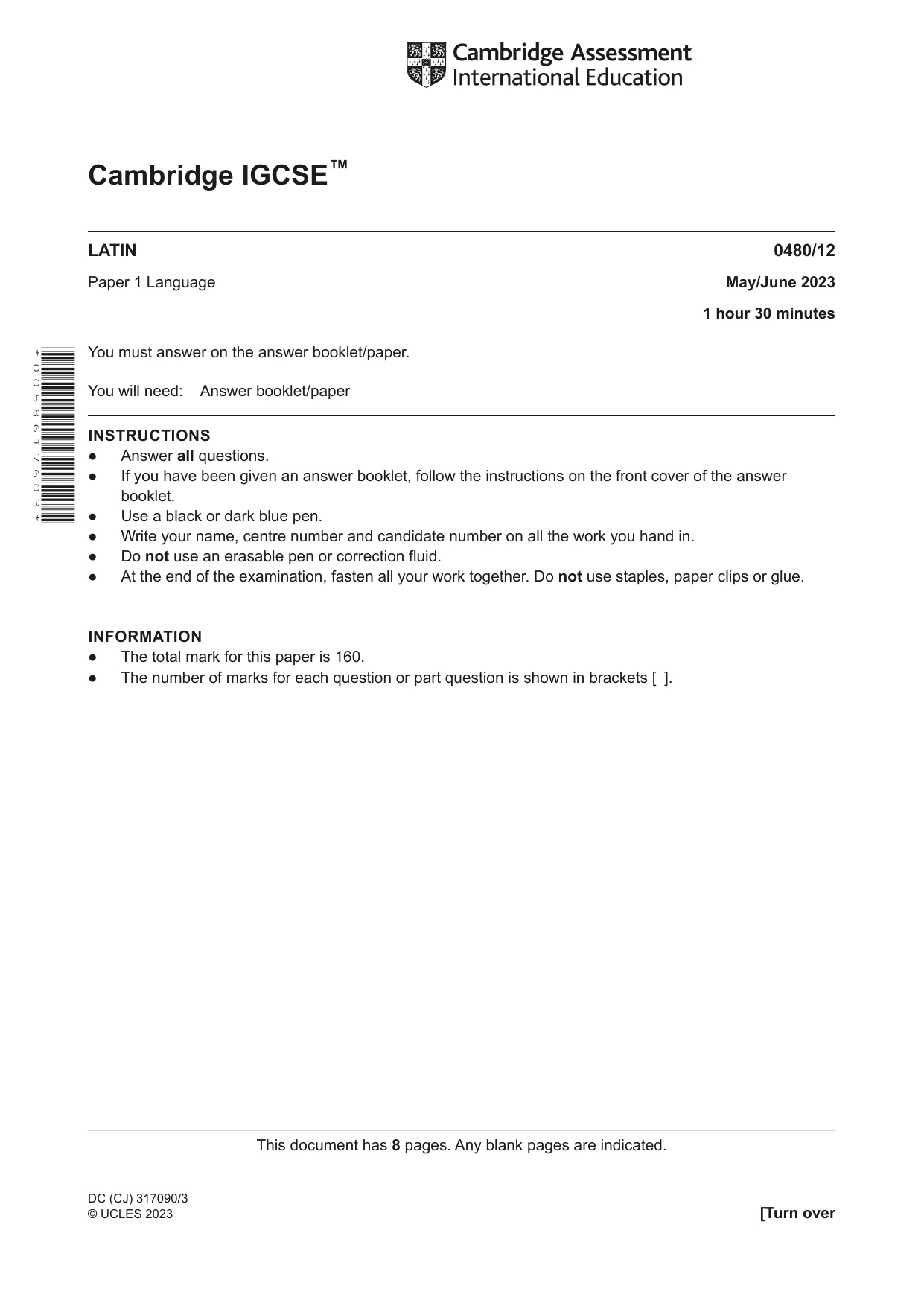
This document has 8 pages. Any blank pages are indicated. [Turn over Cambridge IGCSE™ LATIN 0480/12 Paper 1 Language May/June 2023 1 hour 30 minutes You must answer on the answer booklet/paper. You will need: Answer booklet/paper INSTRUCTIONS ● Answer all questions. ● If you have been given an answer booklet, follow the instructions on the front cover of the answer booklet. ● Use a black or dark blue pen. ● Write your name, centre number and candidate number on all the work you hand in. ● Do not use an erasable pen or correction fluid. ● At the end of the examination, fasten all your work together. Do not use staples, paper clips or glue. INFORMATION ● The total mark for this paper is 160. ● The number of marks for each question or part question is shown in brackets [ ]. * 0 0 5 8 6 1 7 6 0 3 * DC (CJ) 317090/3 © UCLES 2023
Question paper, page 2
2 0480/12/M/J/23 © UCLES 2023 BLANK PAGE
Question paper, page 3
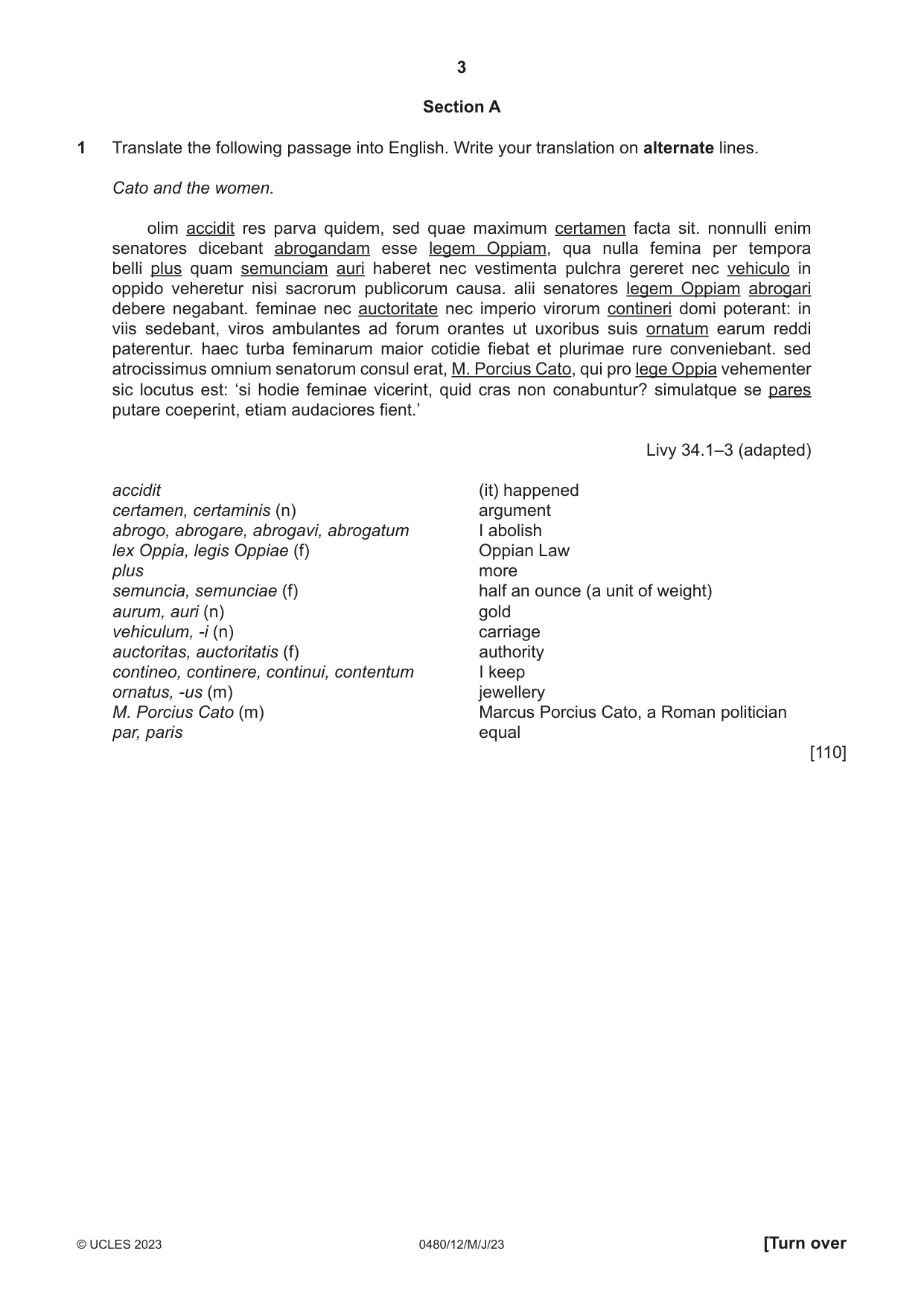
3 0480/12/M/J/23 © UCLES 2023 [Turn over Section A 1 Translate the following passage into English. Write your translation on alternate lines. Cato and the women. olim accidit res parva quidem, sed quae maximum certamen facta sit. nonnulli enim senatores dicebant abrogandam esse legem Oppiam, qua nulla femina per tempora belli plus quam semunciam auri haberet nec vestimenta pulchra gereret nec vehiculo in oppido veheretur nisi sacrorum publicorum causa. alii senatores legem Oppiam abrogari debere negabant. feminae nec auctoritate nec imperio virorum contineri domi poterant: in viis sedebant, viros ambulantes ad forum orantes ut uxoribus suis ornatum earum reddi paterentur. haec turba feminarum maior cotidie fiebat et plurimae rure conveniebant. sed atrocissimus omnium senatorum consul erat, M. Porcius Cato, qui pro lege Oppia vehementer sic locutus est: ‘si hodie feminae vicerint, quid cras non conabuntur? simulatque se pares putare coeperint, etiam audaciores fient.’ Livy 34.1–3 (adapted) accidit (it) happened certamen, certaminis (n) argument abrogo, abrogare, abrogavi, abrogatum I abolish lex Oppia, legis Oppiae (f) Oppian Law plus more semuncia, semunciae (f) half an ounce (a unit of weight) aurum, auri (n) gold vehiculum, -i (n) carriage auctoritas, auctoritatis (f) authority contineo, continere, continui, contentum I keep ornatus, -us (m) jewellery M. Porcius Cato (m) Marcus Porcius Cato, a Roman politician par, paris equal [110]
Question paper, page 4
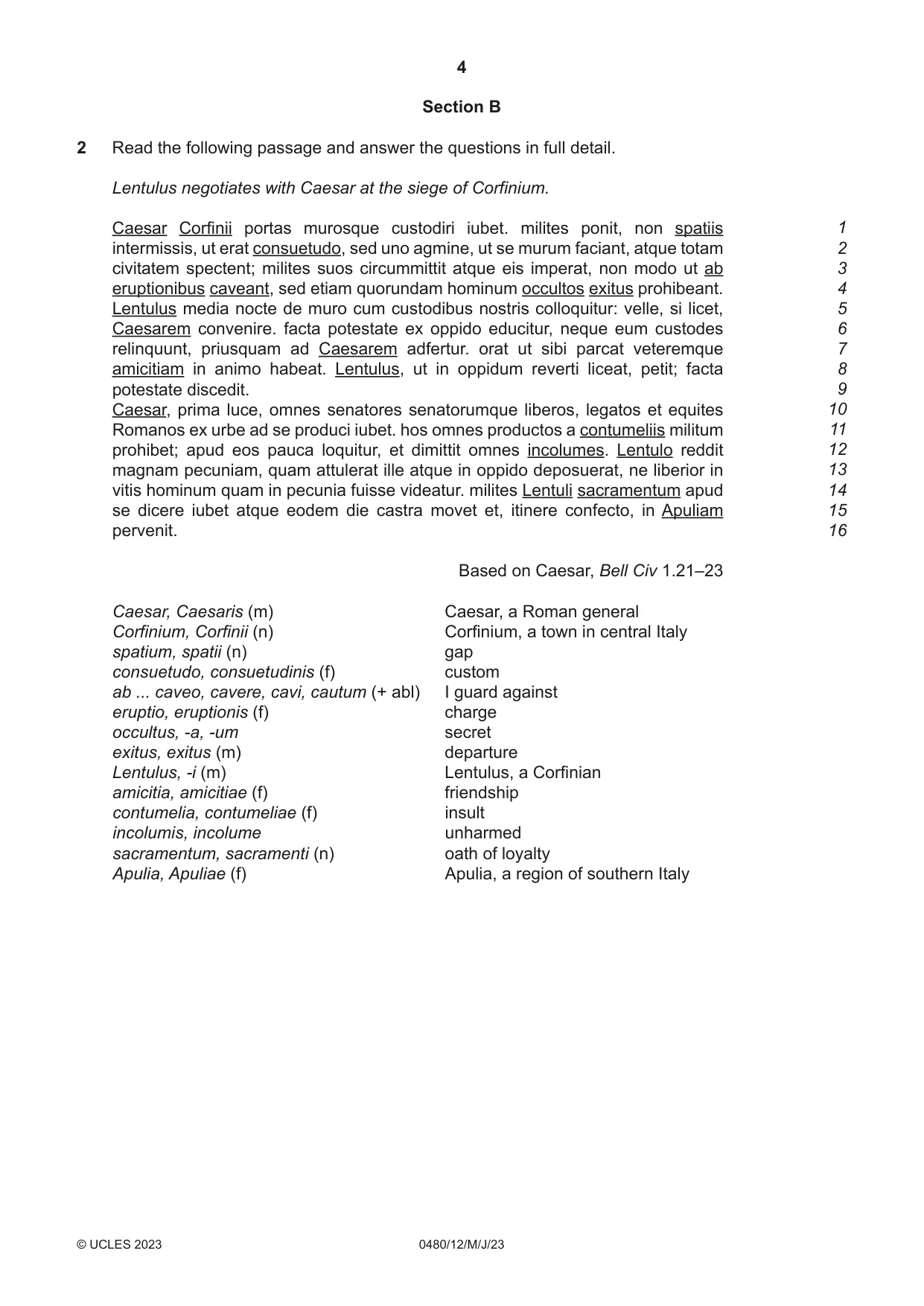
4 0480/12/M/J/23 © UCLES 2023 Section B 2 Read the following passage and answer the questions in full detail. Lentulus negotiates with Caesar at the siege of Corfinium. Caesar Corfinii portas murosque custodiri iubet. milites ponit, non spatiis intermissis, ut erat consuetudo, sed uno agmine, ut se murum faciant, atque totam civitatem spectent; milites suos circummittit atque eis imperat, non modo ut ab eruptionibus caveant, sed etiam quorundam hominum occultos exitus prohibeant. Lentulus media nocte de muro cum custodibus nostris colloquitur: velle, si licet, Caesarem convenire. facta potestate ex oppido educitur, neque eum custodes relinquunt, priusquam ad Caesarem adfertur. orat ut sibi parcat veteremque amicitiam in animo habeat. Lentulus, ut in oppidum reverti liceat, petit; facta potestate discedit. Caesar, prima luce, omnes senatores senatorumque liberos, legatos et equites Romanos ex urbe ad se produci iubet. hos omnes productos a contumeliis militum prohibet; apud eos pauca loquitur, et dimittit omnes incolumes. Lentulo reddit magnam pecuniam, quam attulerat ille atque in oppido deposuerat, ne liberior in vitis hominum quam in pecunia fuisse videatur. milites Lentuli sacramentum apud se dicere iubet atque eodem die castra movet et, itinere confecto, in Apuliam pervenit. Based on Caesar, Bell Civ 1.21–23 Caesar, Caesaris (m) Caesar, a Roman general Corfinium, Corfinii (n) Corfinium, a town in central Italy spatium, spatii (n) gap consuetudo, consuetudinis (f) custom ab ... caveo, cavere, cavi, cautum (+ abl) I guard against eruptio, eruptionis (f) charge occultus, -a, -um secret exitus, exitus (m) departure Lentulus, -i (m) Lentulus, a Corfinian amicitia, amicitiae (f) friendship contumelia, contumeliae (f) insult incolumis, incolume unharmed sacramentum, sacramenti (n) oath of loyalty Apulia, Apuliae (f) Apulia, a region of southern Italy 1 2 3 4 5 6 7 8 9 10 11 12 13 14 15 16
Question paper, page 5
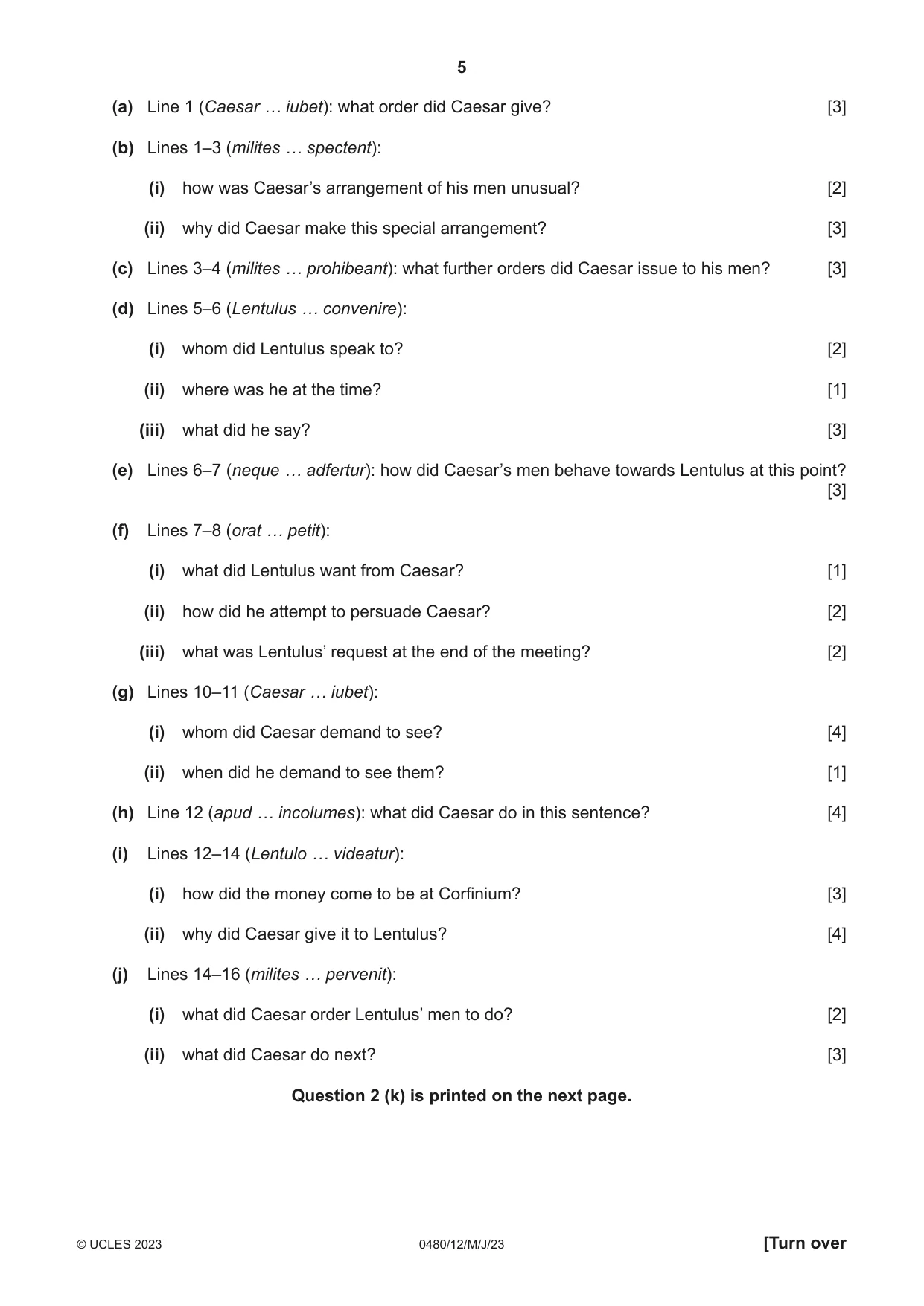
5 0480/12/M/J/23 © UCLES 2023 [Turn over (a) Line 1 (Caesar … iubet): what order did Caesar give? [3] (b) Lines 1–3 (milites … spectent): (i) how was Caesar’s arrangement of his men unusual? [2] (ii) why did Caesar make this special arrangement? [3] (c) Lines 3–4 (milites … prohibeant): what further orders did Caesar issue to his men? [3] (d) Lines 5–6 (Lentulus … convenire): (i) whom did Lentulus speak to? [2] (ii) where was he at the time? [1] (iii) what did he say? [3] (e) Lines 6–7 (neque … adfertur): how did Caesar’s men behave towards Lentulus at this point? [3] (f) Lines 7–8 (orat … petit): (i) what did Lentulus want from Caesar? [1] (ii) how did he attempt to persuade Caesar? [2] (iii) what was Lentulus’ request at the end of the meeting? [2] (g) Lines 10–11 (Caesar … iubet): (i) whom did Caesar demand to see? [4] (ii) when did he demand to see them? [1] (h) Line 12 (apud … incolumes): what did Caesar do in this sentence? [4] (i) Lines 12–14 (Lentulo … videatur): (i) how did the money come to be at Corfinium? [3] (ii) why did Caesar give it to Lentulus? [4] (j) Lines 14–16 (milites … pervenit): (i) what did Caesar order Lentulus’ men to do? [2] (ii) what did Caesar do next? [3] Question 2 (k) is printed on the next page.
Question paper, page 6
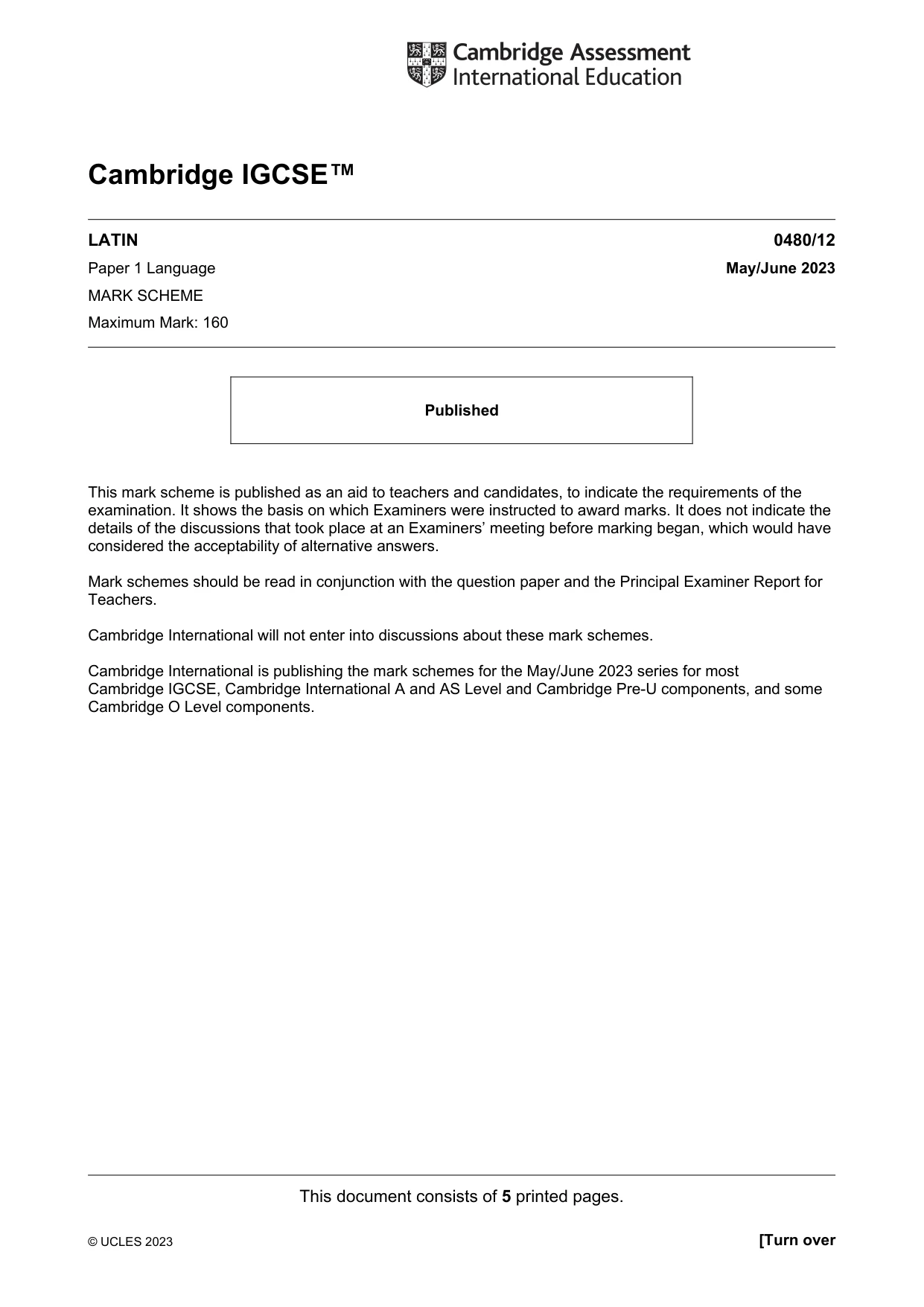
6 0480/12/M/J/23 © UCLES 2023 (k) Choose four of the following Latin words and for each one give an English word derived wholly or partly from the same root: muros (line 1) prohibeant (line 4) custodibus (line 5) veterem (line 7) deposuerat (line 13) vitis (line 14) [4]
Question paper, page 7
7 0480/12/M/J/23 © UCLES 2023 BLANK PAGE
Question paper, page 8
8 0480/12/M/J/23 © UCLES 2023 Permission to reproduce items where third-party owned material protected by copyright is included has been sought and cleared where possible. Every reasonable effort has been made by the publisher (UCLES) to trace copyright holders, but if any items requiring clearance have unwittingly been included, the publisher will be pleased to make amends at the earliest possible opportunity. To avoid the issue of disclosure of answer-related information to candidates, all copyright acknowledgements are reproduced online in the Cambridge Assessment International Education Copyright Acknowledgements Booklet. This is produced for each series of examinations and is freely available to download at www.cambridgeinternational.org after the live examination series. Cambridge Assessment International Education is part of Cambridge Assessment. Cambridge Assessment is the brand name of the University of Cambridge Local Examinations Syndicate (UCLES), which is a department of the University of Cambridge. BLANK PAGE
Mark scheme, page 1
This document consists of 5 printed pages. © UCLES 2023 [Turn over Cambridge IGCSE™ LATIN 0480/12 Paper 1 Language May/June 2023 MARK SCHEME Maximum Mark: 160 Published This mark scheme is published as an aid to teachers and candidates, to indicate the requirements of the examination. It shows the basis on which Examiners were instructed to award marks. It does not indicate the details of the discussions that took place at an Examiners’ meeting before marking began, which would have considered the acceptability of alternative answers. Mark schemes should be read in conjunction with the question paper and the Principal Examiner Report for Teachers. Cambridge International will not enter into discussions about these mark schemes. Cambridge International is publishing the mark schemes for the May/June 2023 series for most Cambridge IGCSE, Cambridge International A and AS Level and Cambridge Pre-U components, and some Cambridge O Level components.
Mark scheme, page 2
0480/12 Cambridge IGCSE – Mark Scheme PUBLISHED May/June 2023 © UCLES 2023 Page 2 of 5 Generic Marking Principles These general marking principles must be applied by all examiners when marking candidate answers. They should be applied alongside the specific content of the mark scheme or generic level descriptors for a question. Each question paper and mark scheme will also comply with these marking principles. GENERIC MARKING PRINCIPLE 1: Marks must be awarded in line with: the specific content of the mark scheme or the generic level descriptors for the question the specific skills defined in the mark scheme or in the generic level descriptors for the question the standard of response required by a candidate as exemplified by the standardisation scripts. GENERIC MARKING PRINCIPLE 2: Marks awarded are always whole marks (not half marks, or other fractions). GENERIC MARKING PRINCIPLE 3: Marks must be awarded positively: marks are awarded for correct/valid answers, as defined in the mark scheme. However, credit is given for valid answers which go beyond the scope of the syllabus and mark scheme, referring to your Team Leader as appropriate marks are awarded when candidates clearly demonstrate what they know and can do marks are not deducted for errors marks are not deducted for omissions answers should only be judged on the quality of spelling, punctuation and grammar when these features are specifically assessed by the question as indicated by the mark scheme. The meaning, however, should be unambiguous. GENERIC MARKING PRINCIPLE 4: Rules must be applied consistently, e.g. in situations where candidates have not followed instructions or in the application of generic level descriptors. GENERIC MARKING PRINCIPLE 5: Marks should be awarded using the full range of marks defined in the mark scheme for the question (however; the use of the full mark range may be limited according to the quality of the candidate responses seen). GENERIC MARKING PRINCIPLE 6: Marks awarded are based solely on the requirements as defined in the mark scheme. Marks should not be awarded with grade thresholds or grade descriptors in mind.
Mark scheme, page 3
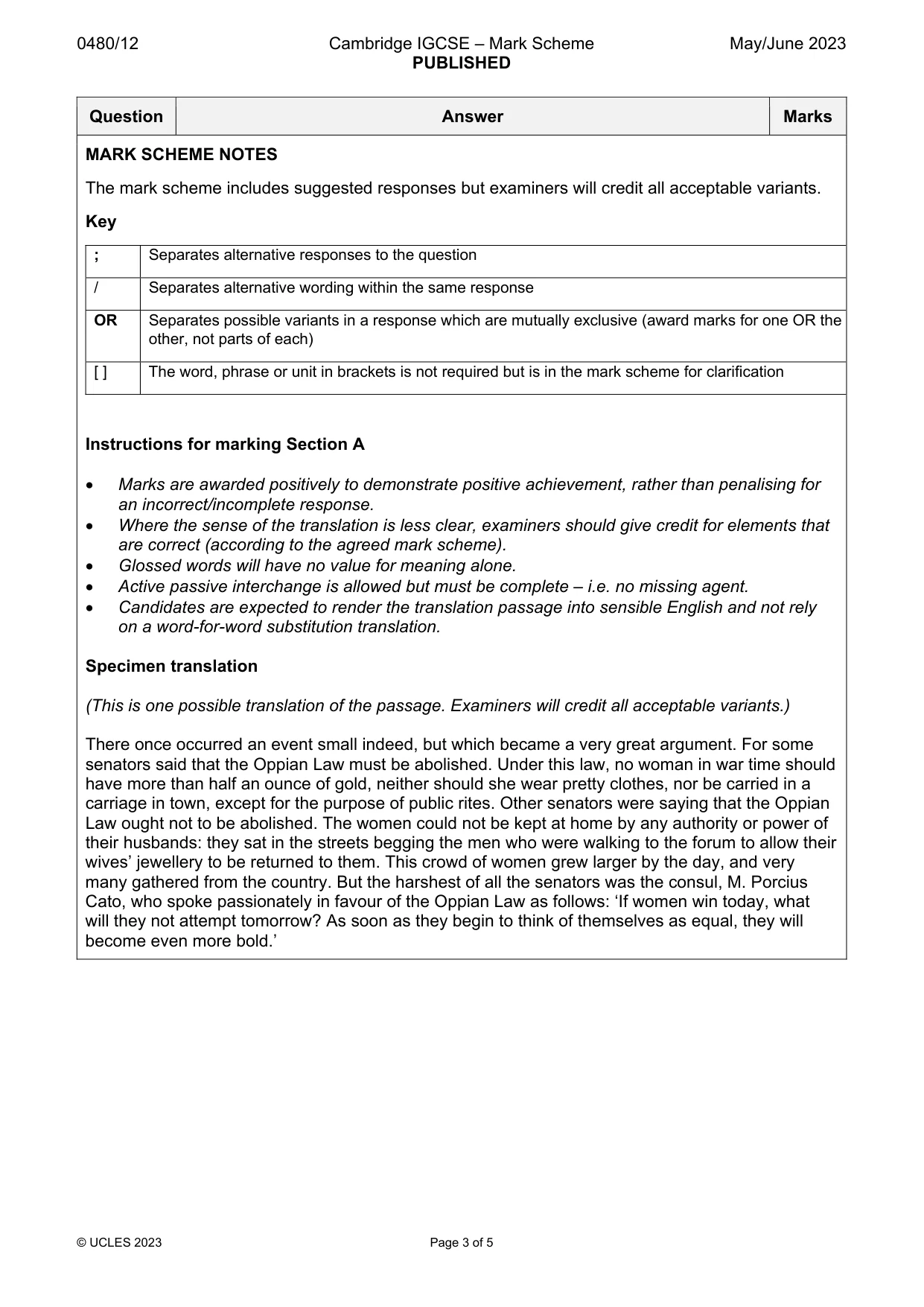
0480/12 Cambridge IGCSE – Mark Scheme PUBLISHED May/June 2023 © UCLES 2023 Page 3 of 5 Question Answer Marks MARK SCHEME NOTES The mark scheme includes suggested responses but examiners will credit all acceptable variants. Key ; Separates alternative responses to the question / Separates alternative wording within the same response OR Separates possible variants in a response which are mutually exclusive (award marks for one OR the other, not parts of each) [ ] The word, phrase or unit in brackets is not required but is in the mark scheme for clarification Instructions for marking Section A Marks are awarded positively to demonstrate positive achievement, rather than penalising for an incorrect/incomplete response. Where the sense of the translation is less clear, examiners should give credit for elements that are correct (according to the agreed mark scheme). Glossed words will have no value for meaning alone. Active passive interchange is allowed but must be complete – i.e. no missing agent. Candidates are expected to render the translation passage into sensible English and not rely on a word-for-word substitution translation. Specimen translation (This is one possible translation of the passage. Examiners will credit all acceptable variants.) There once occurred an event small indeed, but which became a very great argument. For some senators said that the Oppian Law must be abolished. Under this law, no woman in war time should have more than half an ounce of gold, neither should she wear pretty clothes, nor be carried in a carriage in town, except for the purpose of public rites. Other senators were saying that the Oppian Law ought not to be abolished. The women could not be kept at home by any authority or power of their husbands: they sat in the streets begging the men who were walking to the forum to allow their wives’ jewellery to be returned to them. This crowd of women grew larger by the day, and very many gathered from the country. But the harshest of all the senators was the consul, M. Porcius Cato, who spoke passionately in favour of the Oppian Law as follows: ‘If women win today, what will they not attempt tomorrow? As soon as they begin to think of themselves as equal, they will become even more bold.’
Mark scheme, page 4
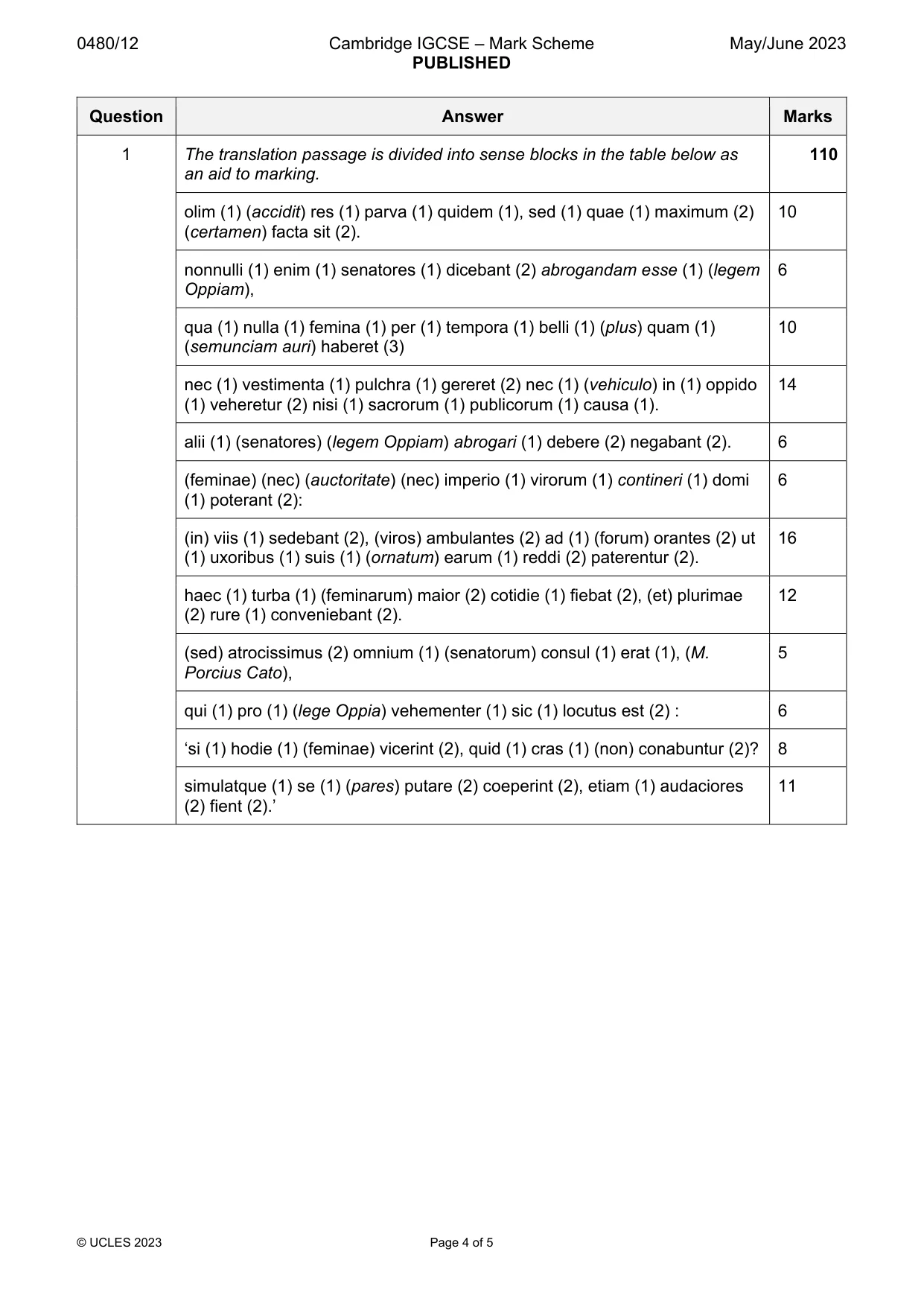
0480/12 Cambridge IGCSE – Mark Scheme PUBLISHED May/June 2023 © UCLES 2023 Page 4 of 5 Question Answer Marks 1 The translation passage is divided into sense blocks in the table below as an aid to marking. 110 olim (1) (accidit) res (1) parva (1) quidem (1), sed (1) quae (1) maximum (2) (certamen) facta sit (2). 10 nonnulli (1) enim (1) senatores (1) dicebant (2) abrogandam esse (1) (legem Oppiam), 6 qua (1) nulla (1) femina (1) per (1) tempora (1) belli (1) (plus) quam (1) (semunciam auri) haberet (3) 10 nec (1) vestimenta (1) pulchra (1) gereret (2) nec (1) (vehiculo) in (1) oppido (1) veheretur (2) nisi (1) sacrorum (1) publicorum (1) causa (1). 14 alii (1) (senatores) (legem Oppiam) abrogari (1) debere (2) negabant (2). 6 (feminae) (nec) (auctoritate) (nec) imperio (1) virorum (1) contineri (1) domi (1) poterant (2): 6 (in) viis (1) sedebant (2), (viros) ambulantes (2) ad (1) (forum) orantes (2) ut (1) uxoribus (1) suis (1) (ornatum) earum (1) reddi (2) paterentur (2). 16 haec (1) turba (1) (feminarum) maior (2) cotidie (1) fiebat (2), (et) plurimae (2) rure (1) conveniebant (2). 12 (sed) atrocissimus (2) omnium (1) (senatorum) consul (1) erat (1), (M. Porcius Cato), 5 qui (1) pro (1) (lege Oppia) vehementer (1) sic (1) locutus est (2) : 6 ‘si (1) hodie (1) (feminae) vicerint (2), quid (1) cras (1) (non) conabuntur (2)? 8 simulatque (1) se (1) (pares) putare (2) coeperint (2), etiam (1) audaciores (2) fient (2).’ 11
Mark scheme, page 5
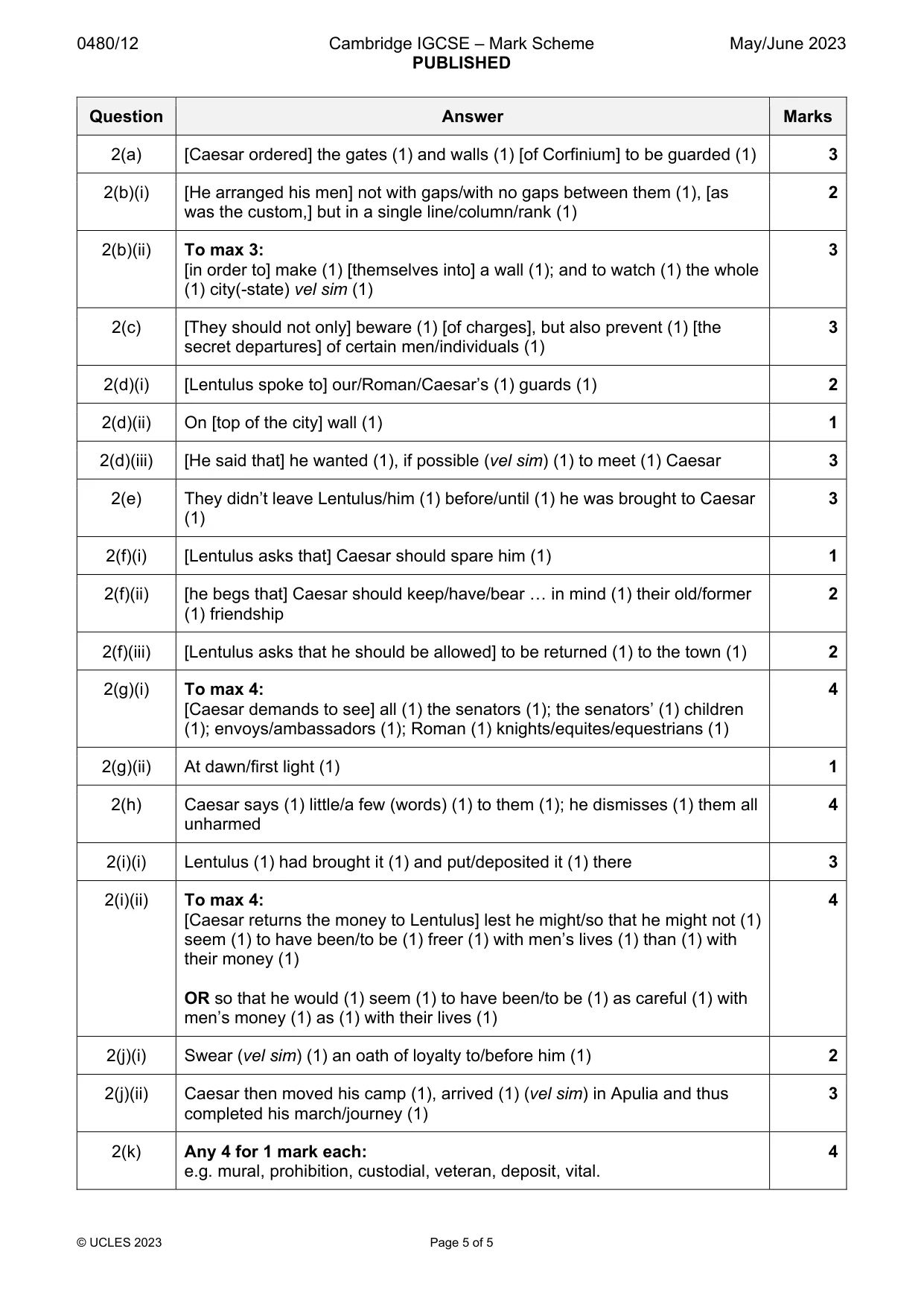
0480/12 Cambridge IGCSE – Mark Scheme PUBLISHED May/June 2023 © UCLES 2023 Page 5 of 5 Question Answer Marks 2(a) [Caesar ordered] the gates (1) and walls (1) [of Corfinium] to be guarded (1) 3 2(b)(i) [He arranged his men] not with gaps/with no gaps between them (1), [as was the custom,] but in a single line/column/rank (1) 2 2(b)(ii) To max 3: [in order to] make (1) [themselves into] a wall (1); and to watch (1) the whole (1) city(-state) vel sim (1) 3 2(c) [They should not only] beware (1) [of charges], but also prevent (1) [the secret departures] of certain men/individuals (1) 3 2(d)(i) [Lentulus spoke to] our/Roman/Caesar’s (1) guards (1) 2 2(d)(ii) On [top of the city] wall (1) 1 2(d)(iii) [He said that] he wanted (1), if possible (vel sim) (1) to meet (1) Caesar 3 2(e) They didn’t leave Lentulus/him (1) before/until (1) he was brought to Caesar (1) 3 2(f)(i) [Lentulus asks that] Caesar should spare him (1) 1 2(f)(ii) [he begs that] Caesar should keep/have/bear … in mind (1) their old/former (1) friendship 2 2(f)(iii) [Lentulus asks that he should be allowed] to be returned (1) to the town (1) 2 2(g)(i) To max 4: [Caesar demands to see] all (1) the senators (1); the senators’ (1) children (1); envoys/ambassadors (1); Roman (1) knights/equites/equestrians (1) 4 2(g)(ii) At dawn/first light (1) 1 2(h) Caesar says (1) little/a few (words) (1) to them (1); he dismisses (1) them all unharmed 4 2(i)(i) Lentulus (1) had brought it (1) and put/deposited it (1) there 3 2(i)(ii) To max 4: [Caesar returns the money to Lentulus] lest he might/so that he might not (1) seem (1) to have been/to be (1) freer (1) with men’s lives (1) than (1) with their money (1) OR so that he would (1) seem (1) to have been/to be (1) as careful (1) with men’s money (1) as (1) with their lives (1) 4 2(j)(i) Swear (vel sim) (1) an oath of loyalty to/before him (1) 2 2(j)(ii) Caesar then moved his camp (1), arrived (1) (vel sim) in Apulia and thus completed his march/journey (1) 3 2(k) Any 4 for 1 mark each: e.g. mural, prohibition, custodial, veteran, deposit, vital. 4
What you needed in this session
Cambridge’s own grade thresholds for 2023 May/June, Paper 1 · Variant 2. A higher threshold means an easier paper — the bar moves with how the cohort did.