Cambridge IGCSE Latin 0480 — 2024 May/June Paper 1 · Variant 2
0480/12/M/J/24 · 160 marks · ≈180 min
The question paper and its mark scheme, free to read here and free to download. This is Cambridge’s own paper, exactly as it was sat.
Question paper8 pages



Mark scheme5 pages
Answers below. Sit the paper first if you are practising.
Paper as text
Question paper, page 1
This document has 8 pages. Any blank pages are indicated. [Turn over Cambridge IGCSE™ LATIN 0480/12 Paper 1 Language May/June 2024 1 hour 30 minutes You must answer on the answer booklet/paper. You will need: Answer booklet/paper INSTRUCTIONS ● Answer all questions. ● If you have been given an answer booklet, follow the instructions on the front cover of the answer booklet. ● Use a black or dark blue pen. ● Write your name, centre number and candidate number on all the work you hand in. ● Do not use an erasable pen or correction fluid. ● At the end of the examination, fasten all your work together. Do not use staples, paper clips or glue. INFORMATION ● The total mark for this paper is 160. ● The number of marks for each question or part question is shown in brackets [ ]. * 7 4 8 9 1 6 2 4 7 4 * DC (SL) 351803/3 © UCLES 2024
Question paper, page 2
2 0480/12/M/J/24 © UCLES 2024 BLANK PAGE
Question paper, page 3
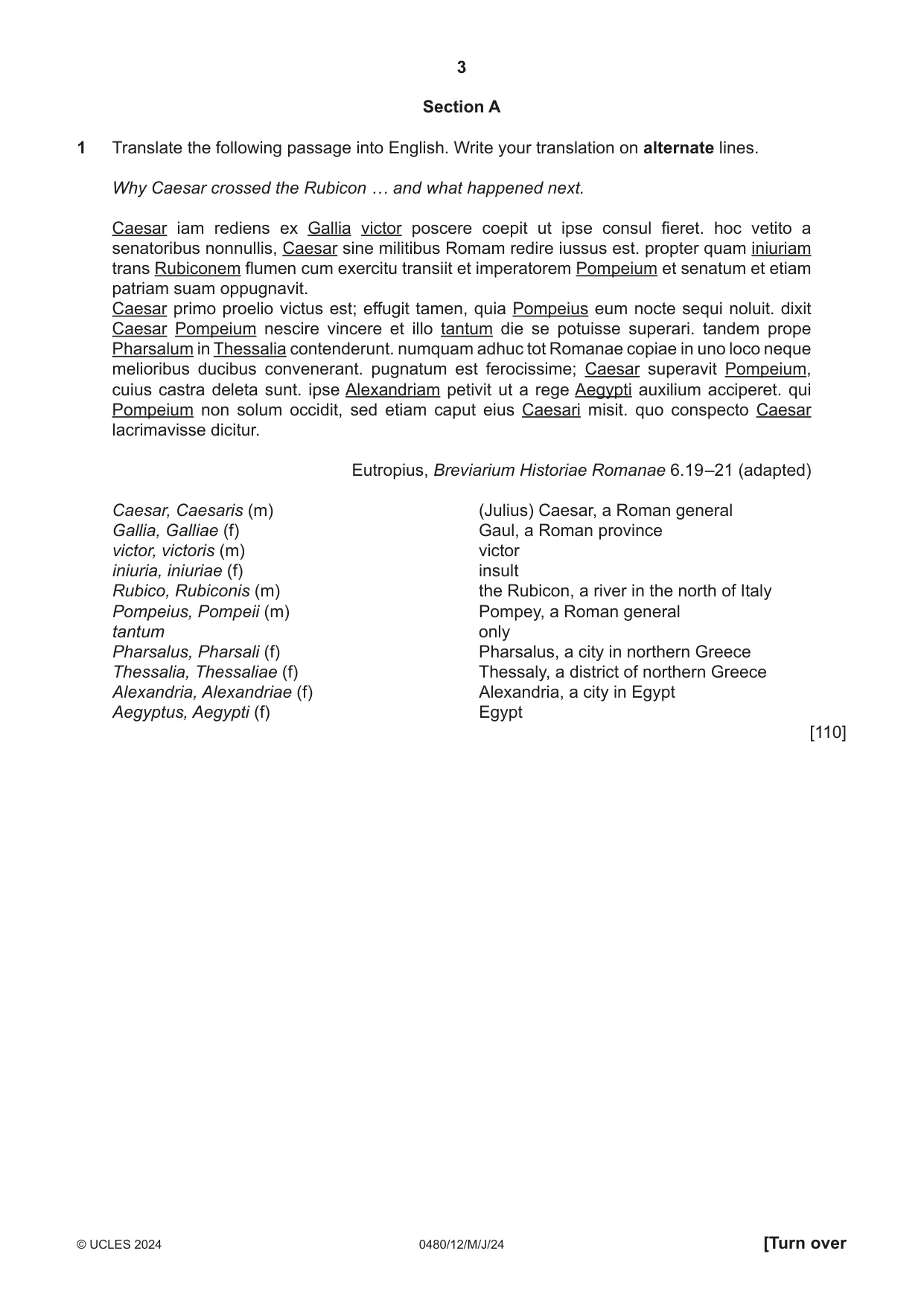
3 0480/12/M/J/24 © UCLES 2024 [Turn over Section A 1 Translate the following passage into English. Write your translation on alternate lines. Why Caesar crossed the Rubicon … and what happened next. Caesar iam rediens ex Gallia victor poscere coepit ut ipse consul fieret. hoc vetito a senatoribus nonnullis, Caesar sine militibus Romam redire iussus est. propter quam iniuriam trans Rubiconem flumen cum exercitu transiit et imperatorem Pompeium et senatum et etiam patriam suam oppugnavit. Caesar primo proelio victus est; effugit tamen, quia Pompeius eum nocte sequi noluit. dixit Caesar Pompeium nescire vincere et illo tantum die se potuisse superari. tandem prope Pharsalum in Thessalia contenderunt. numquam adhuc tot Romanae copiae in uno loco neque melioribus ducibus convenerant. pugnatum est ferocissime; Caesar superavit Pompeium, cuius castra deleta sunt. ipse Alexandriam petivit ut a rege Aegypti auxilium acciperet. qui Pompeium non solum occidit, sed etiam caput eius Caesari misit. quo conspecto Caesar lacrimavisse dicitur. Eutropius, Breviarium Historiae Romanae 6.19 –21 (adapted) Caesar, Caesaris (m) (Julius) Caesar, a Roman general Gallia, Galliae (f) Gaul, a Roman province victor, victoris (m) victor iniuria, iniuriae (f) insult Rubico, Rubiconis (m) the Rubicon, a river in the north of Italy Pompeius, Pompeii (m) Pompey, a Roman general tantum only Pharsalus, Pharsali (f) Pharsalus, a city in northern Greece Thessalia, Thessaliae (f) Thessaly, a district of northern Greece Alexandria, Alexandriae (f) Alexandria, a city in Egypt Aegyptus, Aegypti (f) Egypt [110]
Question paper, page 4
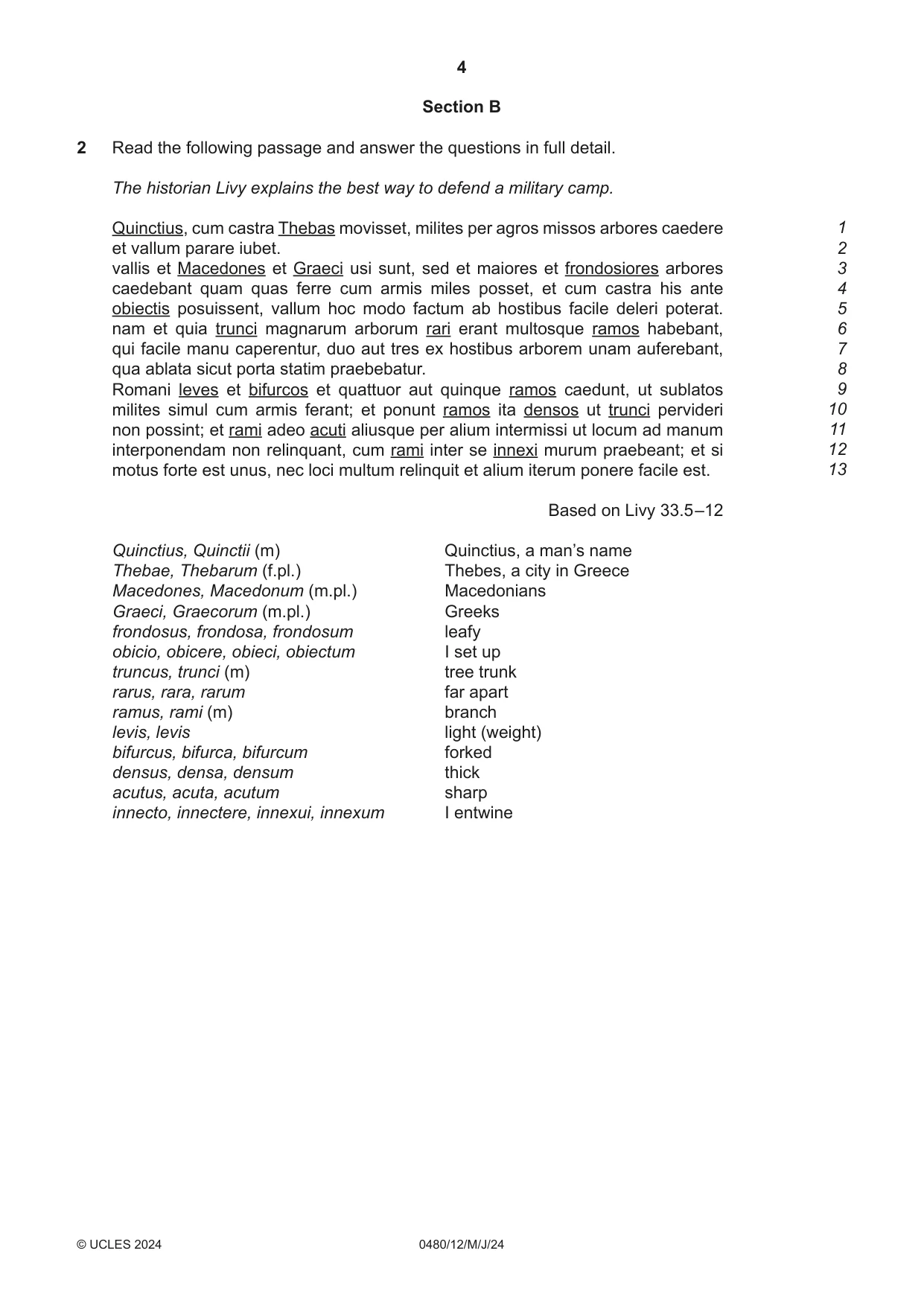
4 0480/12/M/J/24 © UCLES 2024 Section B 2 Read the following passage and answer the questions in full detail. The historian Livy explains the best way to defend a military camp. Quinctius, cum castra Thebas movisset, milites per agros missos arbores caedere et vallum parare iubet. vallis et Macedones et Graeci usi sunt, sed et maiores et frondosiores arbores caedebant quam quas ferre cum armis miles posset, et cum castra his ante obiectis posuissent, vallum hoc modo factum ab hostibus facile deleri poterat. nam et quia trunci magnarum arborum rari erant multosque ramos habebant, qui facile manu caperentur, duo aut tres ex hostibus arborem unam auferebant, qua ablata sicut porta statim praebebatur. Romani leves et bifurcos et quattuor aut quinque ramos caedunt, ut sublatos milites simul cum armis ferant; et ponunt ramos ita densos ut trunci pervideri non possint; et rami adeo acuti aliusque per alium intermissi ut locum ad manum interponendam non relinquant, cum rami inter se innexi murum praebeant; et si motus forte est unus, nec loci multum relinquit et alium iterum ponere facile est. Based on Livy 33.5 –12 Quinctius, Quinctii (m) Quinctius, a man’s name Thebae, Thebarum (f.pl.) Thebes, a city in Greece Macedones, Macedonum (m.pl.) Macedonians Graeci, Graecorum (m.pl.) Greeks frondosus, frondosa, frondosum leafy obicio, obicere, obieci, obiectum I set up truncus, trunci (m) tree trunk rarus, rara, rarum far apart ramus, rami (m) branch levis, levis light (weight) bifurcus, bifurca, bifurcum forked densus, densa, densum thick acutus, acuta, acutum sharp innecto, innectere, innexui, innexum I entwine 1 2 3 4 5 6 7 8 9 10 11 12 13
Question paper, page 5
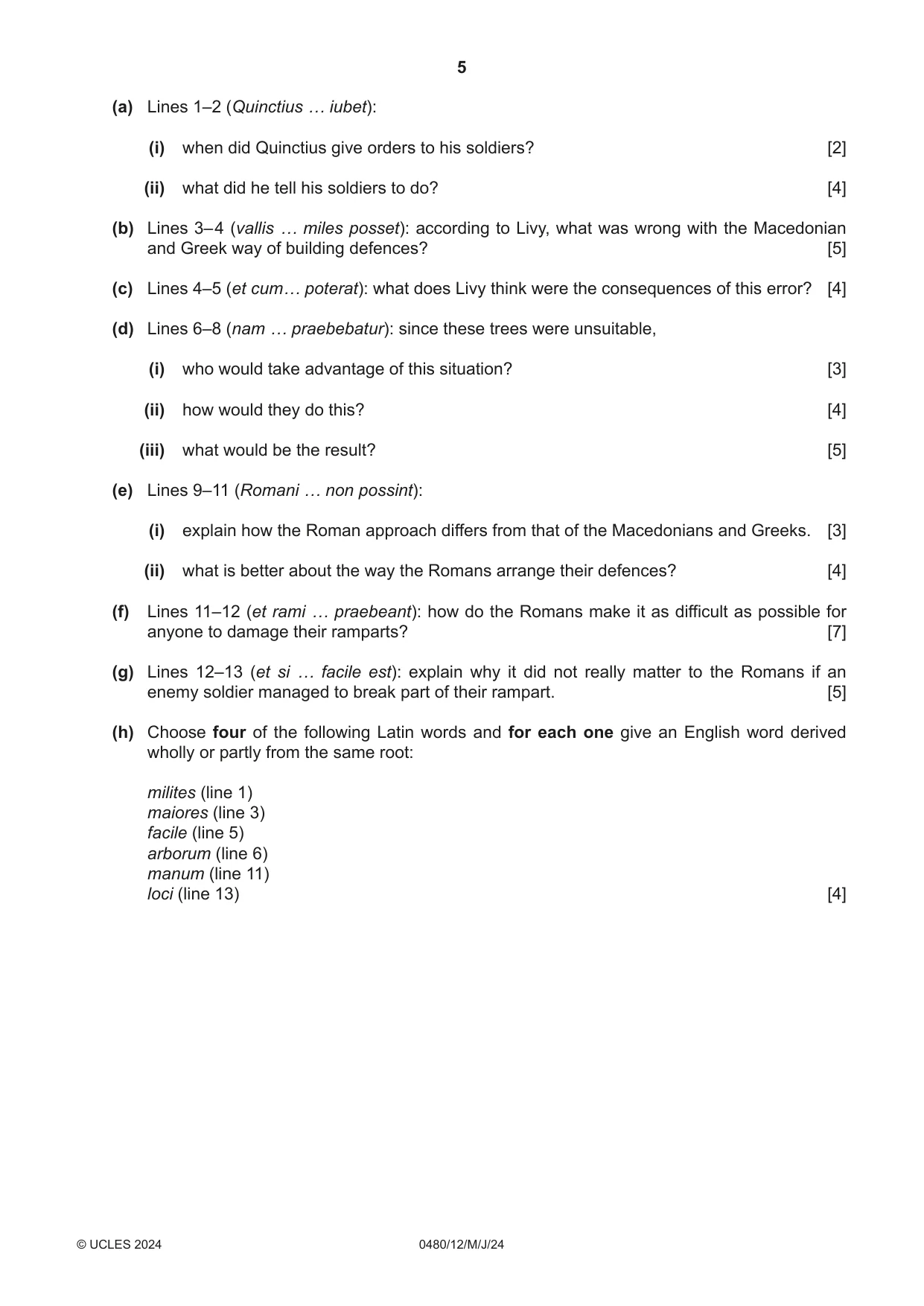
5 0480/12/M/J/24 © UCLES 2024 (a) Lines 1–2 (Quinctius … iubet): (i) when did Quinctius give orders to his soldiers? [2] (ii) what did he tell his soldiers to do? [4] (b) Lines 3– 4 (vallis … miles posset): according to Livy, what was wrong with the Macedonian and Greek way of building defences? [5] (c) Lines 4–5 (et cum… poterat): what does Livy think were the consequences of this error? [4] (d) Lines 6–8 (nam … praebebatur): since these trees were unsuitable, (i) who would take advantage of this situation? [3] (ii) how would they do this? [4] (iii) what would be the result? [5] (e) Lines 9–11 (Romani … non possint): (i) explain how the Roman approach differs from that of the Macedonians and Greeks. [3] (ii) what is better about the way the Romans arrange their defences? [4] (f) Lines 11–12 (et rami … praebeant): how do the Romans make it as difficult as possible for anyone to damage their ramparts? [7] (g) Lines 12–13 (et si … facile est): explain why it did not really matter to the Romans if an enemy soldier managed to break part of their rampart. [5] (h) Choose four of the following Latin words and for each one give an English word derived wholly or partly from the same root: milites (line 1) maiores (line 3) facile (line 5) arborum (line 6) manum (line 11) loci (line 13) [4]
Question paper, page 6
6 0480/12/M/J/24 © UCLES 2024 BLANK PAGE
Question paper, page 7
7 0480/12/M/J/24 © UCLES 2024 BLANK PAGE
Question paper, page 8
8 0480/12/M/J/24 © UCLES 2024 Permission to reproduce items where third-party owned material protected by copyright is included has been sought and cleared where possible. Every reasonable effort has been made by the publisher (UCLES) to trace copyright holders, but if any items requiring clearance have unwittingly been included, the publisher will be pleased to make amends at the earliest possible opportunity. To avoid the issue of disclosure of answer-related information to candidates, all copyright acknowledgements are reproduced online in the Cambridge Assessment International Education Copyright Acknowledgements Booklet. This is produced for each series of examinations and is freely available to download at www.cambridgeinternational.org after the live examination series. Cambridge Assessment International Education is part of Cambridge Assessment. Cambridge Assessment is the brand name of the University of Cambridge Local Examinations Syndicate (UCLES), which is a department of the University of Cambridge. BLANK PAGE
Mark scheme, page 1
This document consists of 5 printed pages. © Cambridge University Press & Assessment 2024 [Turn over Cambridge IGCSE™ LATIN 0480/12 Paper 1 Language May/June 2024 MARK SCHEME Maximum Mark: 160 Published This mark scheme is published as an aid to teachers and candidates, to indicate the requirements of the examination. It shows the basis on which Examiners were instructed to award marks. It does not indicate the details of the discussions that took place at an Examiners’ meeting before marking began, which would have considered the acceptability of alternative answers. Mark schemes should be read in conjunction with the question paper and the Principal Examiner Report for Teachers. Cambridge International will not enter into discussions about these mark schemes. Cambridge International is publishing the mark schemes for the May/June 2024 series for most Cambridge IGCSE, Cambridge International A and AS Level and Cambridge Pre-U components, and some Cambridge O Level components.
Mark scheme, page 2
0480/12 Cambridge IGCSE – Mark Scheme PUBLISHED May/June 2024 © Cambridge University Press & Assessment 2024 Page 2 of 5 Generic Marking Principles These general marking principles must be applied by all examiners when marking candidate answers. They should be applied alongside the specific content of the mark scheme or generic level descriptions for a question. Each question paper and mark scheme will also comply with these marking principles. GENERIC MARKING PRINCIPLE 1: Marks must be awarded in line with: the specific content of the mark scheme or the generic level descriptors for the question the specific skills defined in the mark scheme or in the generic level descriptors for the question the standard of response required by a candidate as exemplified by the standardisation scripts. GENERIC MARKING PRINCIPLE 2: Marks awarded are always whole marks (not half marks, or other fractions). GENERIC MARKING PRINCIPLE 3: Marks must be awarded positively: marks are awarded for correct/valid answers, as defined in the mark scheme. However, credit is given for valid answers which go beyond the scope of the syllabus and mark scheme, referring to your Team Leader as appropriate marks are awarded when candidates clearly demonstrate what they know and can do marks are not deducted for errors marks are not deducted for omissions answers should only be judged on the quality of spelling, punctuation and grammar when these features are specifically assessed by the question as indicated by the mark scheme. The meaning, however, should be unambiguous. GENERIC MARKING PRINCIPLE 4: Rules must be applied consistently, e.g. in situations where candidates have not followed instructions or in the application of generic level descriptors. GENERIC MARKING PRINCIPLE 5: Marks should be awarded using the full range of marks defined in the mark scheme for the question (however; the use of the full mark range may be limited according to the quality of the candidate responses seen). GENERIC MARKING PRINCIPLE 6: Marks awarded are based solely on the requirements as defined in the mark scheme. Marks should not be awarded with grade thresholds or grade descriptors in mind.
Mark scheme, page 3
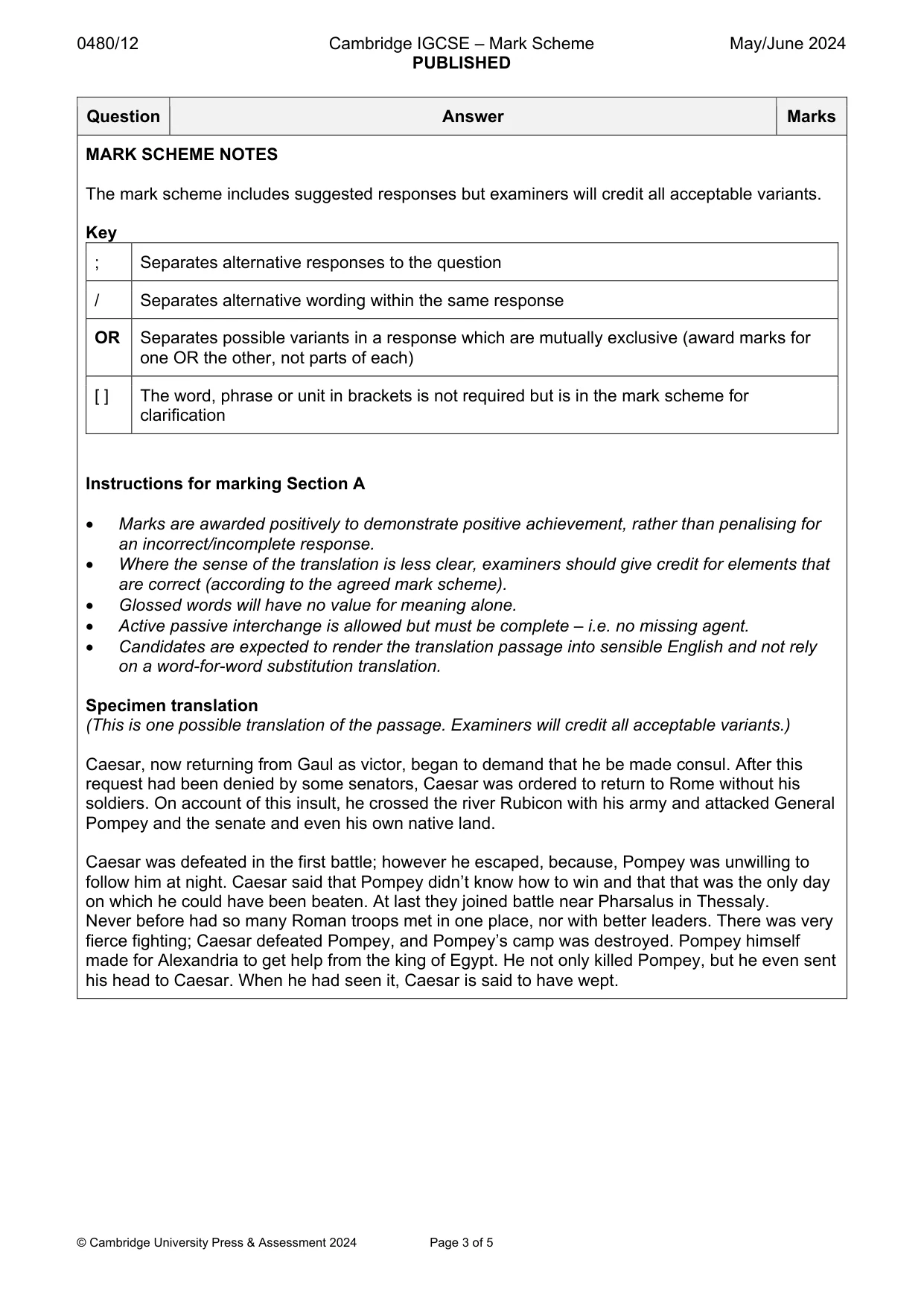
0480/12 Cambridge IGCSE – Mark Scheme PUBLISHED May/June 2024 © Cambridge University Press & Assessment 2024 Page 3 of 5 Question Answer Marks MARK SCHEME NOTES The mark scheme includes suggested responses but examiners will credit all acceptable variants. Key ; Separates alternative responses to the question / Separates alternative wording within the same response OR Separates possible variants in a response which are mutually exclusive (award marks for one OR the other, not parts of each) [ ] The word, phrase or unit in brackets is not required but is in the mark scheme for clarification Instructions for marking Section A Marks are awarded positively to demonstrate positive achievement, rather than penalising for an incorrect/incomplete response. Where the sense of the translation is less clear, examiners should give credit for elements that are correct (according to the agreed mark scheme). Glossed words will have no value for meaning alone. Active passive interchange is allowed but must be complete – i.e. no missing agent. Candidates are expected to render the translation passage into sensible English and not rely on a word-for-word substitution translation. Specimen translation (This is one possible translation of the passage. Examiners will credit all acceptable variants.) Caesar, now returning from Gaul as victor, began to demand that he be made consul. After this request had been denied by some senators, Caesar was ordered to return to Rome without his soldiers. On account of this insult, he crossed the river Rubicon with his army and attacked General Pompey and the senate and even his own native land. Caesar was defeated in the first battle; however he escaped, because, Pompey was unwilling to follow him at night. Caesar said that Pompey didn’t know how to win and that that was the only day on which he could have been beaten. At last they joined battle near Pharsalus in Thessaly. Never before had so many Roman troops met in one place, nor with better leaders. There was very fierce fighting; Caesar defeated Pompey, and Pompey’s camp was destroyed. Pompey himself made for Alexandria to get help from the king of Egypt. He not only killed Pompey, but he even sent his head to Caesar. When he had seen it, Caesar is said to have wept.
Mark scheme, page 4
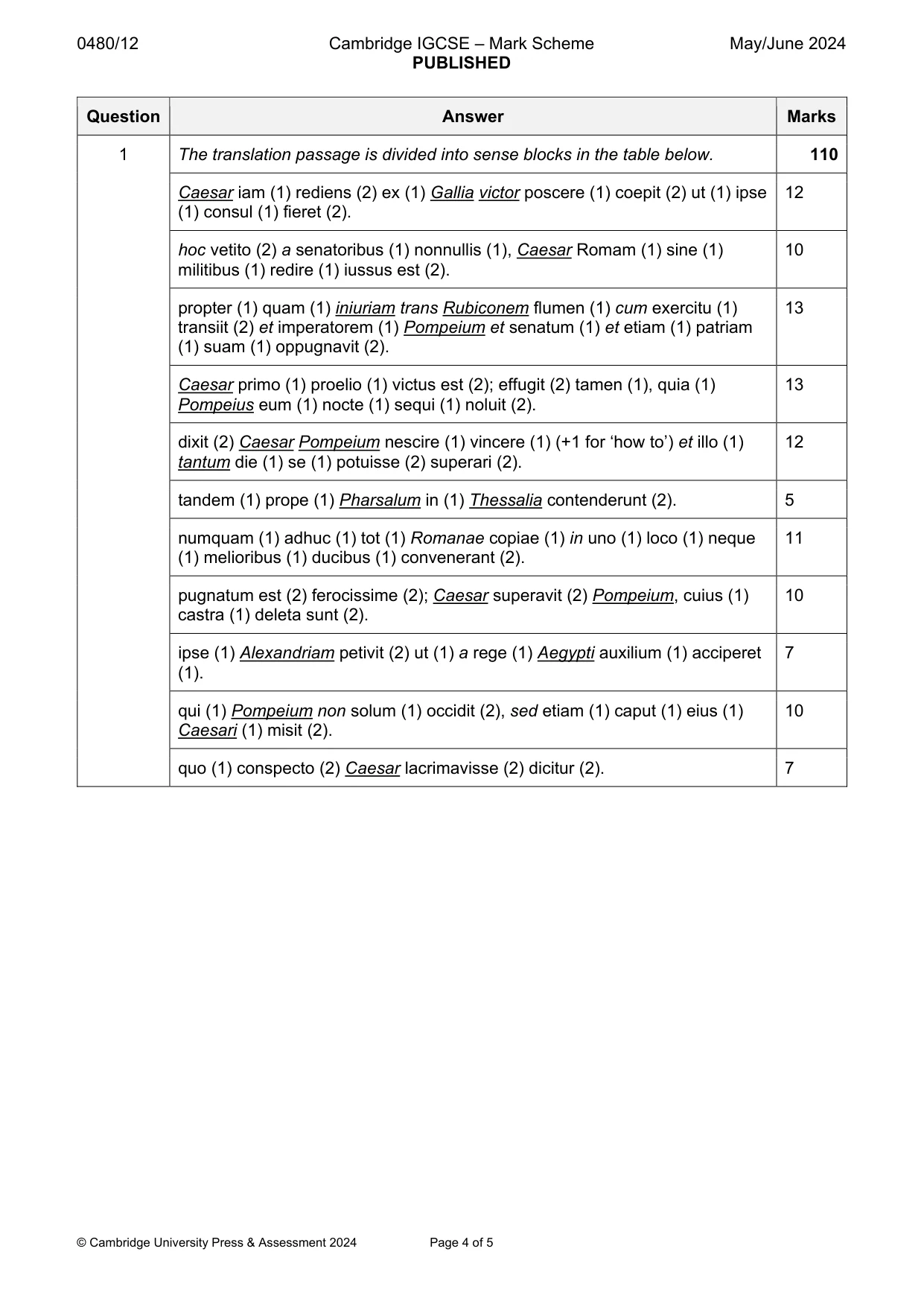
0480/12 Cambridge IGCSE – Mark Scheme PUBLISHED May/June 2024 © Cambridge University Press & Assessment 2024 Page 4 of 5 Question Answer Marks 1 The translation passage is divided into sense blocks in the table below. 110 Caesar iam (1) rediens (2) ex (1) Gallia victor poscere (1) coepit (2) ut (1) ipse (1) consul (1) fieret (2). 12 hoc vetito (2) a senatoribus (1) nonnullis (1), Caesar Romam (1) sine (1) militibus (1) redire (1) iussus est (2). 10 propter (1) quam (1) iniuriam trans Rubiconem flumen (1) cum exercitu (1) transiit (2) et imperatorem (1) Pompeium et senatum (1) et etiam (1) patriam (1) suam (1) oppugnavit (2). 13 Caesar primo (1) proelio (1) victus est (2); effugit (2) tamen (1), quia (1) Pompeius eum (1) nocte (1) sequi (1) noluit (2). 13 dixit (2) Caesar Pompeium nescire (1) vincere (1) (+1 for ‘how to’) et illo (1) tantum die (1) se (1) potuisse (2) superari (2). 12 tandem (1) prope (1) Pharsalum in (1) Thessalia contenderunt (2). 5 numquam (1) adhuc (1) tot (1) Romanae copiae (1) in uno (1) loco (1) neque (1) melioribus (1) ducibus (1) convenerant (2). 11 pugnatum est (2) ferocissime (2); Caesar superavit (2) Pompeium, cuius (1) castra (1) deleta sunt (2). 10 ipse (1) Alexandriam petivit (2) ut (1) a rege (1) Aegypti auxilium (1) acciperet (1). 7 qui (1) Pompeium non solum (1) occidit (2), sed etiam (1) caput (1) eius (1) Caesari (1) misit (2). 10 quo (1) conspecto (2) Caesar lacrimavisse (2) dicitur (2). 7
Mark scheme, page 5
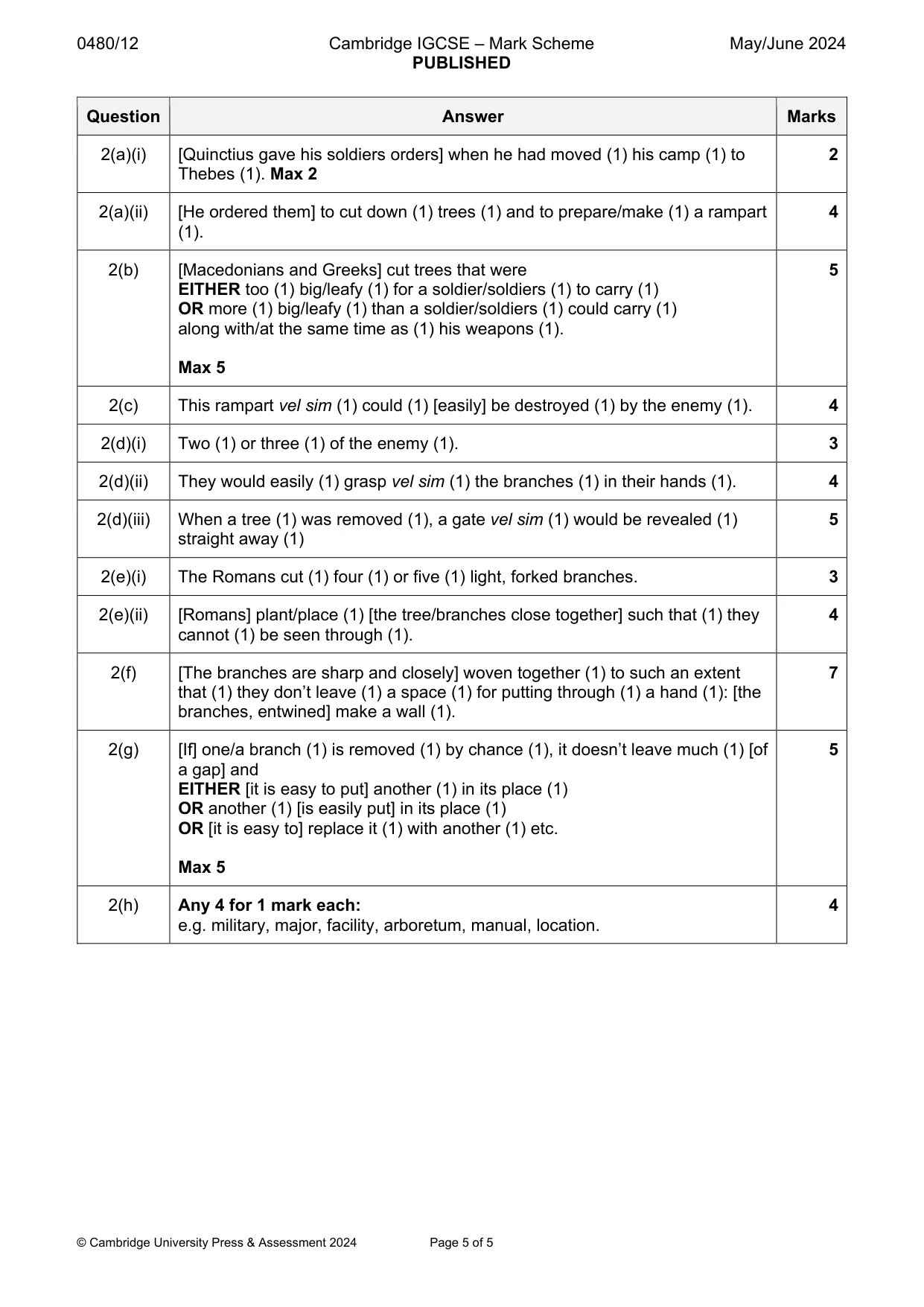
0480/12 Cambridge IGCSE – Mark Scheme PUBLISHED May/June 2024 © Cambridge University Press & Assessment 2024 Page 5 of 5 Question Answer Marks 2(a)(i) [Quinctius gave his soldiers orders] when he had moved (1) his camp (1) to Thebes (1). Max 2 2 2(a)(ii) [He ordered them] to cut down (1) trees (1) and to prepare/make (1) a rampart (1). 4 2(b) [Macedonians and Greeks] cut trees that were EITHER too (1) big/leafy (1) for a soldier/soldiers (1) to carry (1) OR more (1) big/leafy (1) than a soldier/soldiers (1) could carry (1) along with/at the same time as (1) his weapons (1). Max 5 5 2(c) This rampart vel sim (1) could (1) [easily] be destroyed (1) by the enemy (1). 4 2(d)(i) Two (1) or three (1) of the enemy (1). 3 2(d)(ii) They would easily (1) grasp vel sim (1) the branches (1) in their hands (1). 4 2(d)(iii) When a tree (1) was removed (1), a gate vel sim (1) would be revealed (1) straight away (1) 5 2(e)(i) The Romans cut (1) four (1) or five (1) light, forked branches. 3 2(e)(ii) [Romans] plant/place (1) [the tree/branches close together] such that (1) they cannot (1) be seen through (1). 4 2(f) [The branches are sharp and closely] woven together (1) to such an extent that (1) they don’t leave (1) a space (1) for putting through (1) a hand (1): [the branches, entwined] make a wall (1). 7 2(g) [If] one/a branch (1) is removed (1) by chance (1), it doesn’t leave much (1) [of a gap] and EITHER [it is easy to put] another (1) in its place (1) OR another (1) [is easily put] in its place (1) OR [it is easy to] replace it (1) with another (1) etc. Max 5 5 2(h) Any 4 for 1 mark each: e.g. military, major, facility, arboretum, manual, location. 4
What you needed in this session
Cambridge’s own grade thresholds for 2024 May/June, Paper 1 · Variant 2. A higher threshold means an easier paper — the bar moves with how the cohort did.