Cambridge IGCSE Islamiyat 0493 — 2021 May/June Paper 1 · Variant 2
0493/12/M/J/21 · 50 marks · ≈56 min
The question paper and its mark scheme, free to read here and free to download. This is Cambridge’s own paper, exactly as it was sat.
Question paper20 pages












Mark scheme16 pages
Answers below. Sit the paper first if you are practising.
Paper as text
Question paper, page 1
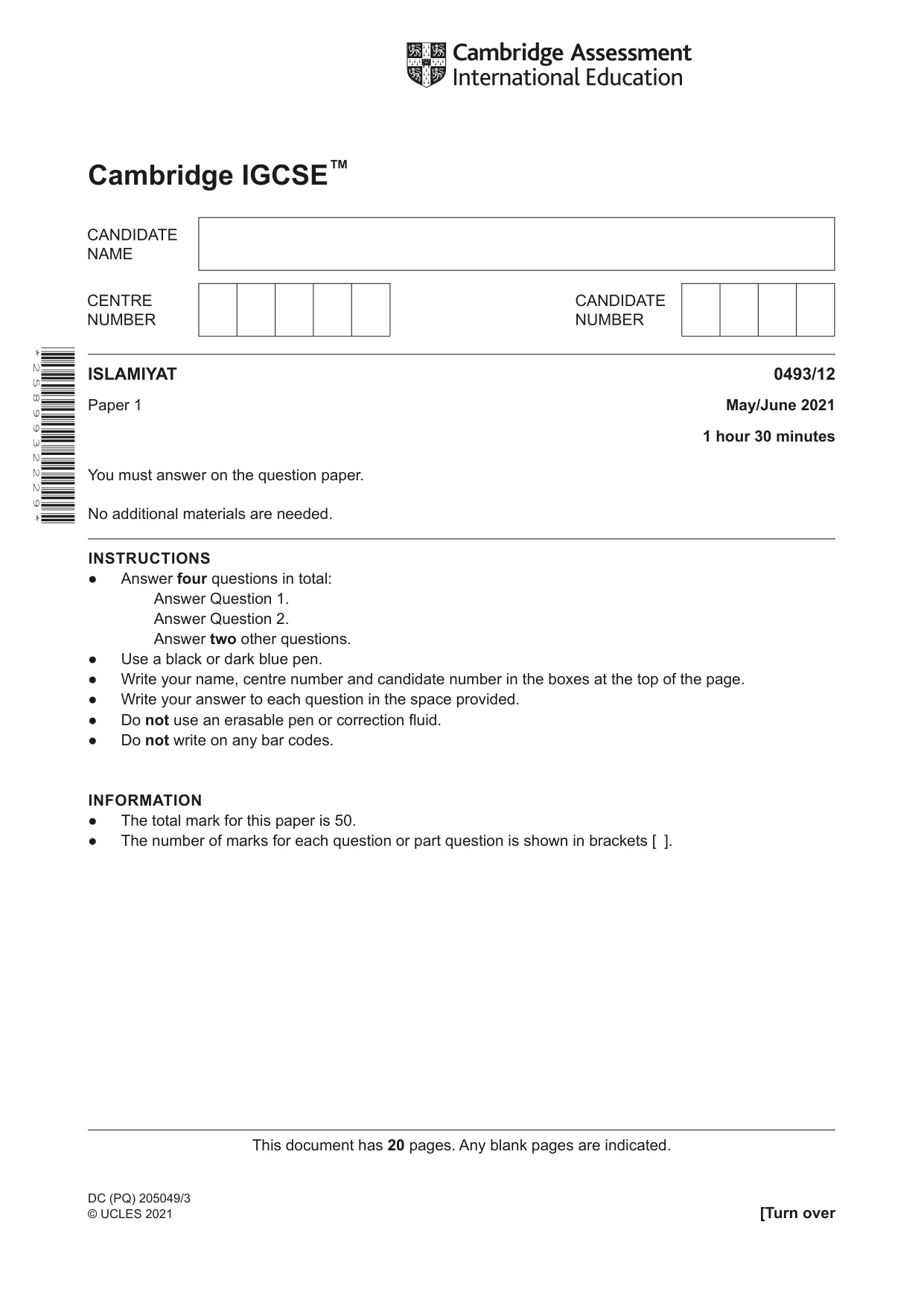
This document has 20 pages. Any blank pages are indicated. Cambridge IGCSE™ DC (PQ) 205049/3 © UCLES 2021 [Turn over * 2 5 8 9 9 3 2 2 2 9 * ISLAMIYAT 0493/12 Paper 1 May/June 2021 1 hour 30 minutes You must answer on the question paper. No additional materials are needed. INSTRUCTIONS ● Answer four questions in total: Answer Question 1. Answer Question 2. Answer two other questions. ● Use a black or dark blue pen. ● Write your name, centre number and candidate number in the boxes at the top of the page. ● Write your answer to each question in the space provided. ● Do not use an erasable pen or correction fluid. ● Do not write on any bar codes. INFORMATION ● The total mark for this paper is 50. ● The number of marks for each question or part question is shown in brackets [ ].
Question paper, page 2
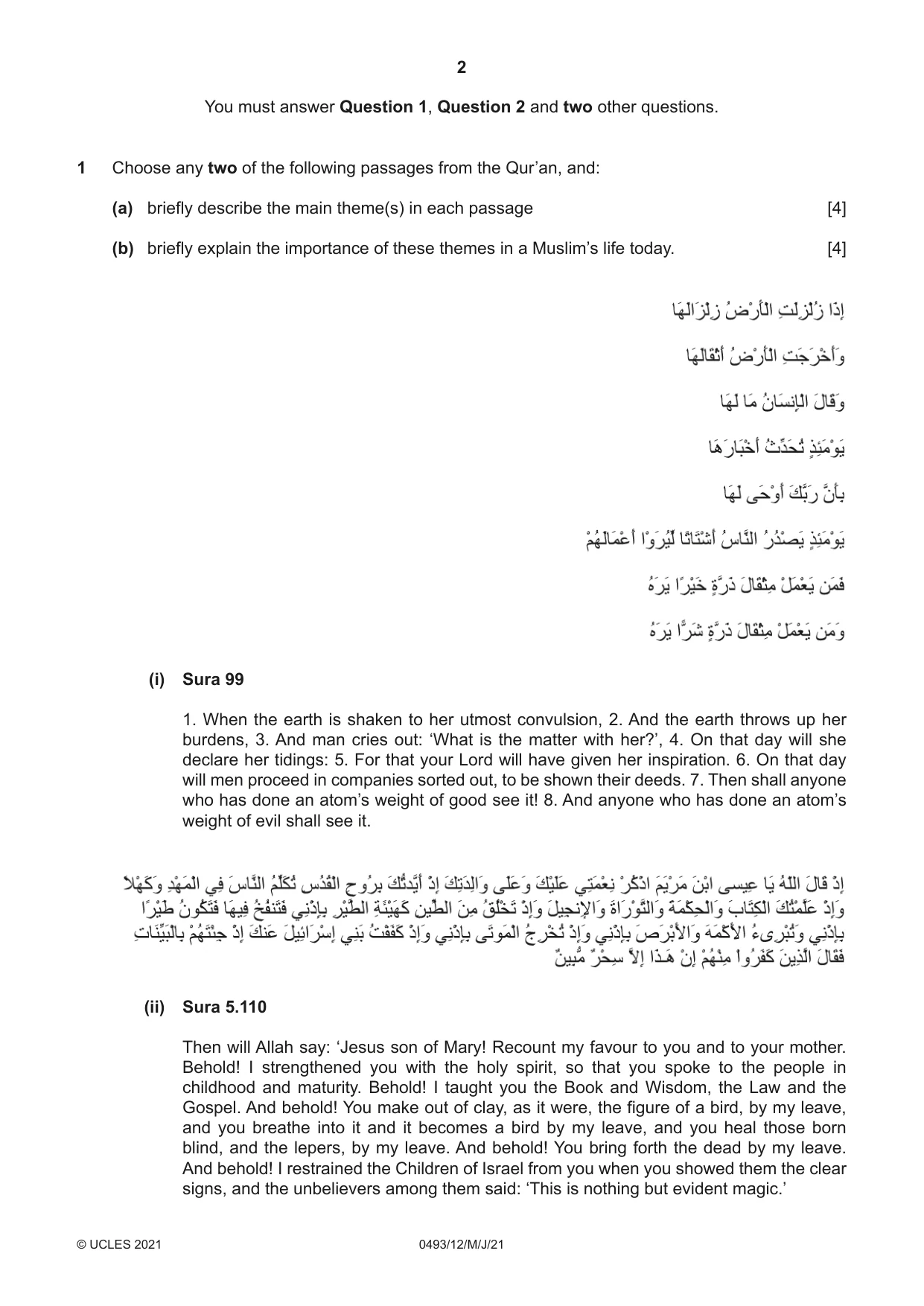
2 0493/12/M/J/21 © UCLES 2021 You must answer Question 1, Question 2 and two other questions. 1 Choose any two of the following passages from the Qur’an, and: (a) briefly describe the main theme(s) in each passage [4] (b) briefly explain the importance of these themes in a Muslim’s life today. [4] (i) Sura 99 1. When the earth is shaken to her utmost convulsion, 2. And the earth throws up her burdens, 3. And man cries out: ‘What is the matter with her?’, 4. On that day will she declare her tidings: 5. For that your Lord will have given her inspiration. 6. On that day will men proceed in companies sorted out, to be shown their deeds. 7. Then shall anyone who has done an atom’s weight of good see it! 8. And anyone who has done an atom’s weight of evil shall see it. (ii) Sura 5.110 Then will Allah say: ‘Jesus son of Mary! Recount my favour to you and to your mother. Behold! I strengthened you with the holy spirit, so that you spoke to the people in childhood and maturity. Behold! I taught you the Book and Wisdom, the Law and the Gospel. And behold! You make out of clay, as it were, the figure of a bird, by my leave, and you breathe into it and it becomes a bird by my leave, and you heal those born blind, and the lepers, by my leave. And behold! You bring forth the dead by my leave. And behold! I restrained the Children of Israel from you when you showed them the clear signs, and the unbelievers among them said: ‘This is nothing but evident magic.’
Question paper, page 3
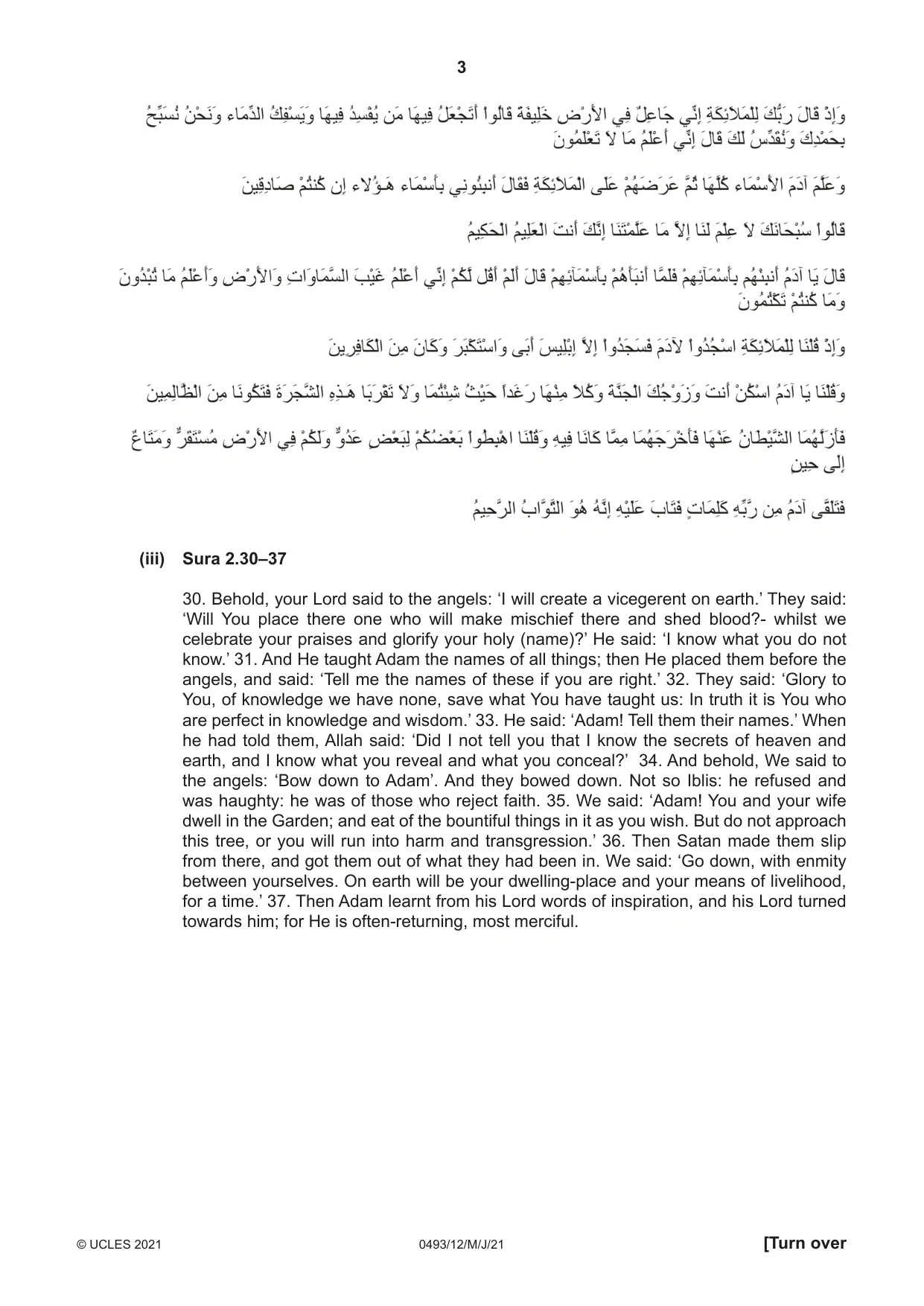
3 0493/12/M/J/21 © UCLES 2021 [Turn over (iii) Sura 2.30–37 30. Behold, your Lord said to the angels: ‘I will create a vicegerent on earth.’ They said: ‘Will You place there one who will make mischief there and shed blood?- whilst we celebrate your praises and glorify your holy (name)?’ He said: ‘I know what you do not know.’ 31. And He taught Adam the names of all things; then He placed them before the angels, and said: ‘Tell me the names of these if you are right.’ 32. They said: ‘Glory to You, of knowledge we have none, save what You have taught us: In truth it is You who are perfect in knowledge and wisdom.’ 33. He said: ‘Adam! Tell them their names.’ When he had told them, Allah said: ‘Did I not tell you that I know the secrets of heaven and earth, and I know what you reveal and what you conceal?’ 34. And behold, We said to the angels: ‘Bow down to Adam’. And they bowed down. Not so Iblis: he refused and was haughty: he was of those who reject faith. 35. We said: ‘Adam! You and your wife dwell in the Garden; and eat of the bountiful things in it as you wish. But do not approach this tree, or you will run into harm and transgression.’ 36. Then Satan made them slip from there, and got them out of what they had been in. We said: ‘Go down, with enmity between yourselves. On earth will be your dwelling-place and your means of livelihood, for a time.’ 37. Then Adam learnt from his Lord words of inspiration, and his Lord turned towards him; for He is often-returning, most merciful.
Question paper, page 4
4 0493/12/M/J/21 © UCLES 2021 … … … … … … … … … … … … … … … … … … … … … … … … … … … …
Question paper, page 5
5 0493/12/M/J/21 © UCLES 2021 [Turn over … … … … … … … … … … … … … … … … … … … … … … … … … … … …
Question paper, page 6
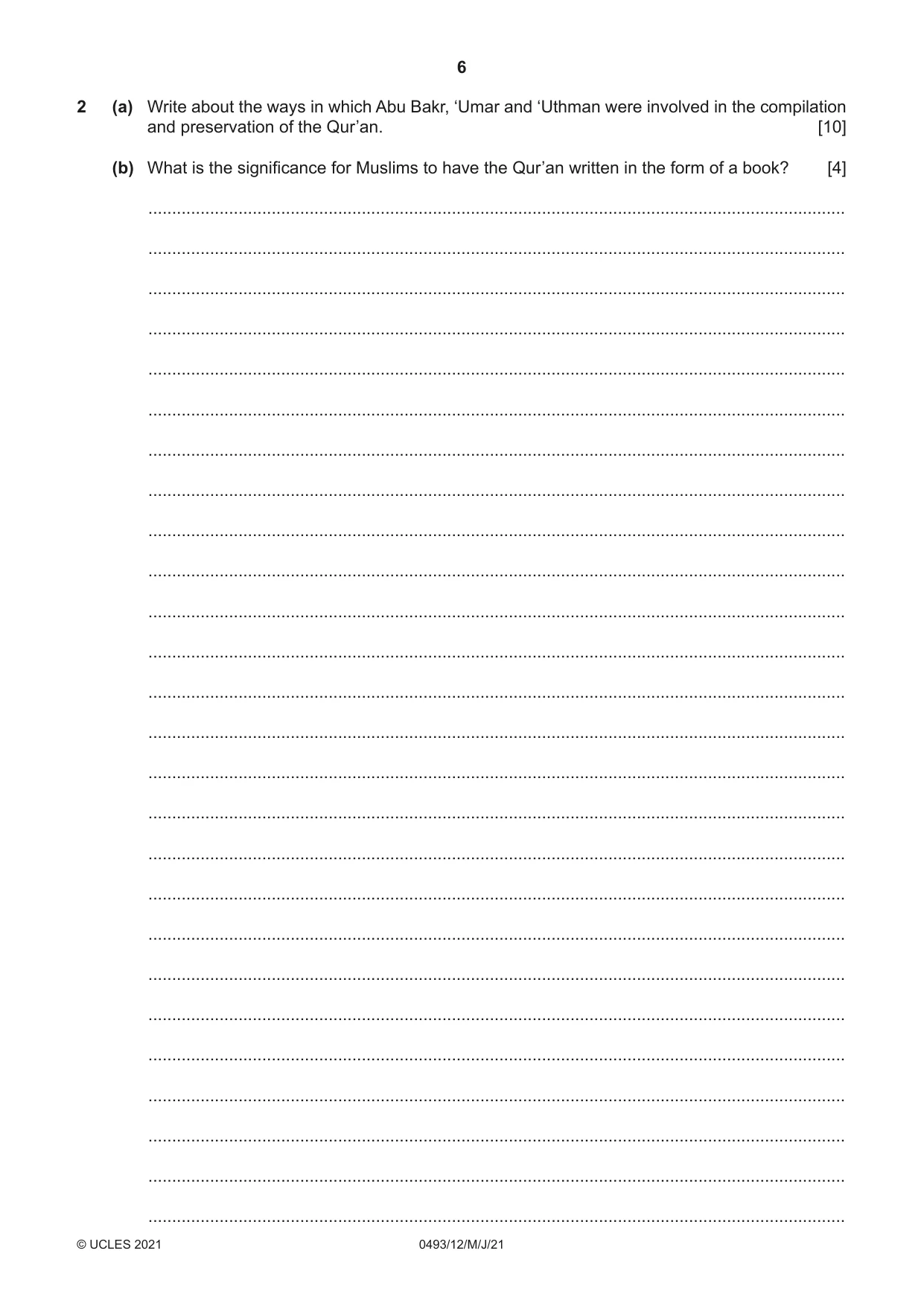
6 0493/12/M/J/21 © UCLES 2021 2 (a) Write about the ways in which Abu Bakr, ‘Umar and ‘Uthman were involved in the compilation and preservation of the Qur’an. [10] (b) What is the significance for Muslims to have the Qur’an written in the form of a book? [4] … … … … … … … … … … … … … … … … … … … … … … … … … …
Question paper, page 7
7 0493/12/M/J/21 © UCLES 2021 [Turn over … … … … … … … … … … … … … … … … … … … … … … … … … … … …
Question paper, page 8
8 0493/12/M/J/21 © UCLES 2021 … … … … … … … … … … … … … … … … … … … … … … … … … … … …
Question paper, page 9
9 0493/12/M/J/21 © UCLES 2021 [Turn over 3 (a) Write about the events of the Battle of Uhud fought in 625. [10] (b) What lessons might be learned from the outcome of the Battle of Uhud? [4] … … … … … … … … … … … … … … … … … … … … … … … … … …
Question paper, page 10
10 0493/12/M/J/21 © UCLES 2021 … … … … … … … … … … … … … … … … … … … … … … … … … … … …
Question paper, page 11
11 0493/12/M/J/21 © UCLES 2021 [Turn over … … … … … … … … … … … … … … … … … … … … … … … … … … … …
Question paper, page 12
12 0493/12/M/J/21 © UCLES 2021 4 (a) Giving examples from the Prophet’s life, write about how he showed both the qualities of patience and forgiveness. [10] (b) Why should Muslims show patience in their everyday lives? [4] … … … … … … … … … … … … … … … … … … … … … … … … … …
Question paper, page 13
13 0493/12/M/J/21 © UCLES 2021 [Turn over … … … … … … … … … … … … … … … … … … … … … … … … … … … …
Question paper, page 14
14 0493/12/M/J/21 © UCLES 2021 … … … … … … … … … … … … … … … … … … … … … … … … … … … …
Question paper, page 15
15 0493/12/M/J/21 © UCLES 2021 [Turn over 5 (a) Write about the life of the Prophet’s daughter, Fatima. [10] (b) What can be learned from her life about the relationship between parents and children? [4] … … … … … … … … … … … … … … … … … … … … … … … … … …
Question paper, page 16
16 0493/12/M/J/21 © UCLES 2021 … … … … … … … … … … … … … … … … … … … … … … … … … … … …
Question paper, page 17
17 0493/12/M/J/21 © UCLES 2021 … … … … … … … … … … … … … … … … … … … … … … … … … … … …
Question paper, page 18
18 0493/12/M/J/21 © UCLES 2021 BLANK PAGE
Question paper, page 19
19 0493/12/M/J/21 © UCLES 2021 BLANK PAGE
Question paper, page 20
20 0493/12/M/J/21 © UCLES 2021 Permission to reproduce items where third-party owned material protected by copyright is included has been sought and cleared where possible. Every reasonable effort has been made by the publisher (UCLES) to trace copyright holders, but if any items requiring clearance have unwittingly been included, the publisher will be pleased to make amends at the earliest possible opportunity. To avoid the issue of disclosure of answer-related information to candidates, all copyright acknowledgements are reproduced online in the Cambridge Assessment International Education Copyright Acknowledgements Booklet. This is produced for each series of examinations and is freely available to download at www.cambridgeinternational.org after the live examination series. Cambridge Assessment International Education is part of the Cambridge Assessment Group. Cambridge Assessment is the brand name of the University of Cambridge Local Examinations Syndicate (UCLES), which itself is a department of the University of Cambridge. BLANK PAGE
Mark scheme, page 1
This document consists of 16 printed pages. © UCLES 2021 [Turn over Cambridge IGCSE™ ISLAMIYAT 0493/12 Paper 1 May/June 2021 MARK SCHEME Maximum Mark: 50 Published This mark scheme is published as an aid to teachers and candidates, to indicate the requirements of the examination. It shows the basis on which Examiners were instructed to award marks. It does not indicate the details of the discussions that took place at an Examiners’ meeting before marking began, which would have considered the acceptability of alternative answers. Mark schemes should be read in conjunction with the question paper and the Principal Examiner Report for Teachers. Cambridge International will not enter into discussions about these mark schemes. Cambridge International is publishing the mark schemes for the May/June 2021 series for most Cambridge IGCSE™, Cambridge International A and AS Level components and some Cambridge O Level components.
Mark scheme, page 2
0493/12 Cambridge IGCSE – Mark Scheme PUBLISHED May/June 2021 © UCLES 2021 Page 2 of 16 Generic Marking Principles These general marking principles must be applied by all examiners when marking candidate answers. They should be applied alongside the specific content of the mark scheme or generic level descriptors for a question. Each question paper and mark scheme will also comply with these marking principles. GENERIC MARKING PRINCIPLE 1: Marks must be awarded in line with: • the specific content of the mark scheme or the generic level descriptors for the question • the specific skills defined in the mark scheme or in the generic level descriptors for the question • the standard of response required by a candidate as exemplified by the standardisation scripts. GENERIC MARKING PRINCIPLE 2: Marks awarded are always whole marks (not half marks, or other fractions). GENERIC MARKING PRINCIPLE 3: Marks must be awarded positively: • marks are awarded for correct/valid answers, as defined in the mark scheme. However, credit is given for valid answers which go beyond the scope of the syllabus and mark scheme, referring to your Team Leader as appropriate • marks are awarded when candidates clearly demonstrate what they know and can do • marks are not deducted for errors • marks are not deducted for omissions • answers should only be judged on the quality of spelling, punctuation and grammar when these features are specifically assessed by the question as indicated by the mark scheme. The meaning, however, should be unambiguous. GENERIC MARKING PRINCIPLE 4: Rules must be applied consistently, e.g. in situations where candidates have not followed instructions or in the application of generic level descriptors. GENERIC MARKING PRINCIPLE 5: Marks should be awarded using the full range of marks defined in the mark scheme for the question (however; the use of the full mark range may be limited according to the quality of the candidate responses seen). GENERIC MARKING PRINCIPLE 6: Marks awarded are based solely on the requirements as defined in the mark scheme. Marks should not be awarded with grade thresholds or grade descriptors in mind.
Mark scheme, page 3
0493/12 Cambridge IGCSE – Mark Scheme PUBLISHED May/June 2021 © UCLES 2021 Page 3 of 16 GUIDE TO MARKING IGCSE ISLAMIYAT – 0493 In an examination of this kind, it is impossible to devise a mark scheme that will cover all acceptable answers. This mark scheme provides guidance on what to look out for in the answers given by the candidates. This means that you must be prepared to use discretion in deciding what constitutes an acceptable answer. In order to ensure that all examiners mark at a uniform level, you are expected regularly to discuss your marking with your Team Leader, especially any examples or forms of answer that differ greatly from the agreed mark scheme. Team Leaders are expected to discuss answers with the Principal Examiner. The mark scheme is discussed at the co-ordination meeting. When marking, all examiners are expected to adhere to what has been agreed. GENERAL POINTS Before starting to mark scripts, please ensure that you are familiar with the following: (a) The syllabus (b) The prescribed passages (where appropriate) PRINCIPLES UNDERLYING THE MARK SCHEME Candidates are tested on their ability to satisfy two general Assessment Objectives (AOs): AO1 To recall, select and present relevant facts from the main elements of the faith and history of Islam. Thus, AO1 is primarily concerned with knowledge. AO2 To demonstrate understanding of the significance of the selected information in the teachings of Islam and in the lives of Muslims. Thus, AO2 is concerned with understanding and evaluation of the material. The paper is marked out of 50. Candidates answer Question 1, Question 2, and any two of the other three questions. Question 1 carries a maximum of 8 marks, and the four other questions carry 14 marks each. In each question, part (a) tests AO1 and earns a maximum of 4 marks in Question 1, and 10 marks in Questions 2–5, while part (b) tests AO2 and earns up to 4 marks in Question 1 and 4 marks in Questions 2–5. Marks are awarded according to the four levels of response for each AO, following the level descriptors detailed below.
Mark scheme, page 4
0493/12 Cambridge IGCSE – Mark Scheme PUBLISHED May/June 2021 © UCLES 2021 Page 4 of 16 LEVELS OF RESPONSE The statements which follow should be used to determine the appropriate level of response for each objective. They should be applied as appropriate to the question and as the assessment of the work of an average 16-year-old. The guiding principle for Examiners in applying the Mark Scheme to answers is to remember the concept of Positive Awarding. Therefore, marks should be awarded for appropriate responses to reasonable interpretations of the question. In the Mark Scheme there are no instances where answers are specifically excluded or required. What is included is information for Examiners, provided as guidance for what one might reasonably expect to find on a script. All appropriate answers therefore have the potential to be credited. It is perfectly possible for a candidate to achieve the highest level of response using a different argument or different information from that which appears in the Mark Scheme. It must be assumed that Examiners are capable of answering the questions on the paper and so they can award the appropriate level of response to the candidate. The detailed marking schemes are there as suggestions of what might be found in the answer. Examiners should not check whether the content of the marking schemes is in the answers but rather be guided by the Levels of Response and the concept of Positive Awarding. Checking on what is not in the answer almost always leads to lower marks than are indicated by the Levels of Response. Examiners should use the full range of marks available within the Levels of Response and not hesitate to award the maximum where it is deserved. Examiners must not exceed the total marks allowable for the Level achieved or the total allowable for the part of the question.
Mark scheme, page 5
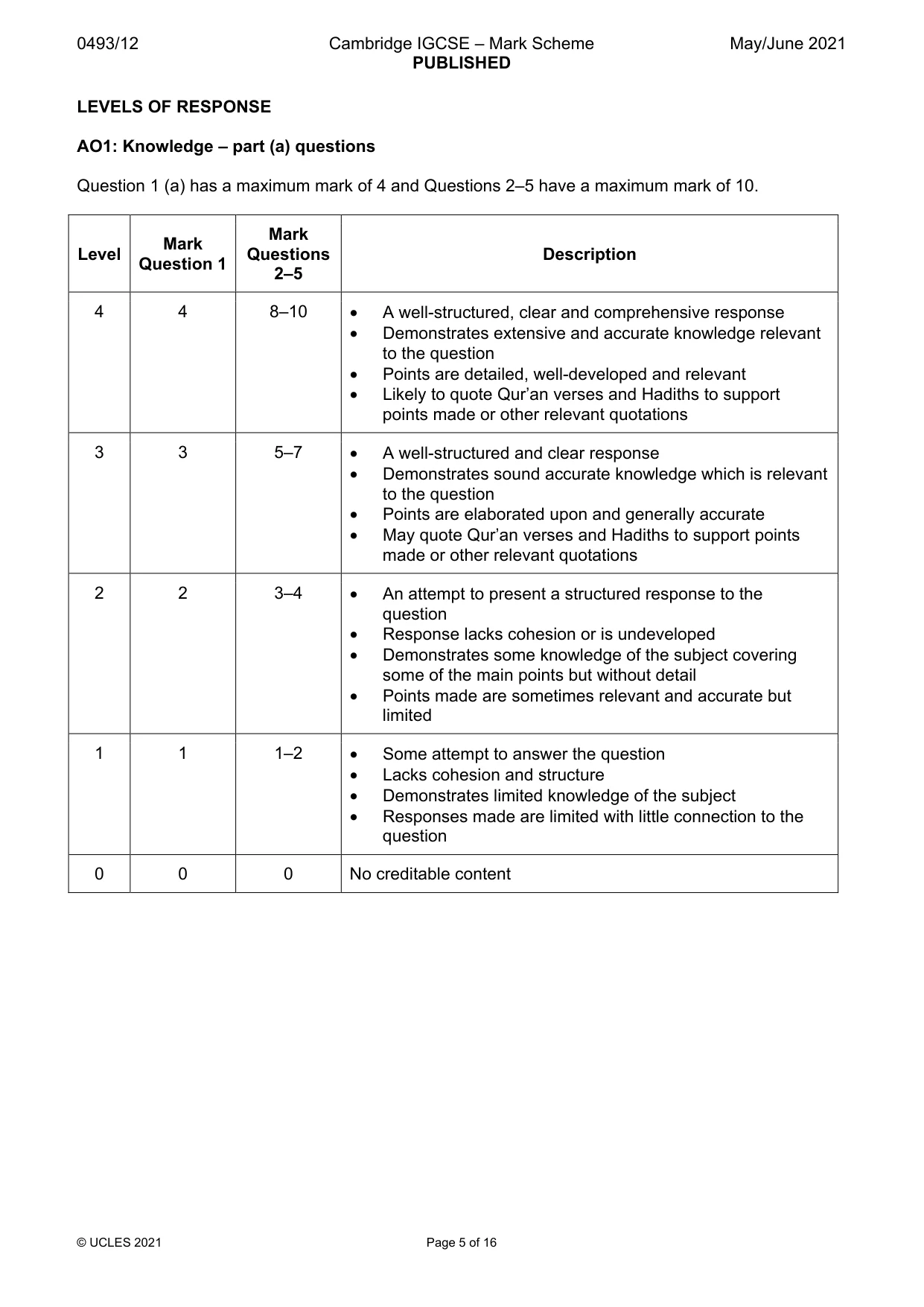
0493/12 Cambridge IGCSE – Mark Scheme PUBLISHED May/June 2021 © UCLES 2021 Page 5 of 16 LEVELS OF RESPONSE AO1: Knowledge – part (a) questions Question 1 (a) has a maximum mark of 4 and Questions 2–5 have a maximum mark of 10. Level Mark Question 1 Mark Questions 2–5 Description 4 4 8–10 • A well-structured, clear and comprehensive response • Demonstrates extensive and accurate knowledge relevant to the question • Points are detailed, well-developed and relevant • Likely to quote Qur’an verses and Hadiths to support points made or other relevant quotations 3 3 5–7 • A well-structured and clear response • Demonstrates sound accurate knowledge which is relevant to the question • Points are elaborated upon and generally accurate • May quote Qur’an verses and Hadiths to support points made or other relevant quotations 2 2 3–4 • An attempt to present a structured response to the question • Response lacks cohesion or is undeveloped • Demonstrates some knowledge of the subject covering some of the main points but without detail • Points made are sometimes relevant and accurate but limited 1 1 1–2 • Some attempt to answer the question • Lacks cohesion and structure • Demonstrates limited knowledge of the subject • Responses made are limited with little connection to the question 0 0 0 No creditable content
Mark scheme, page 6
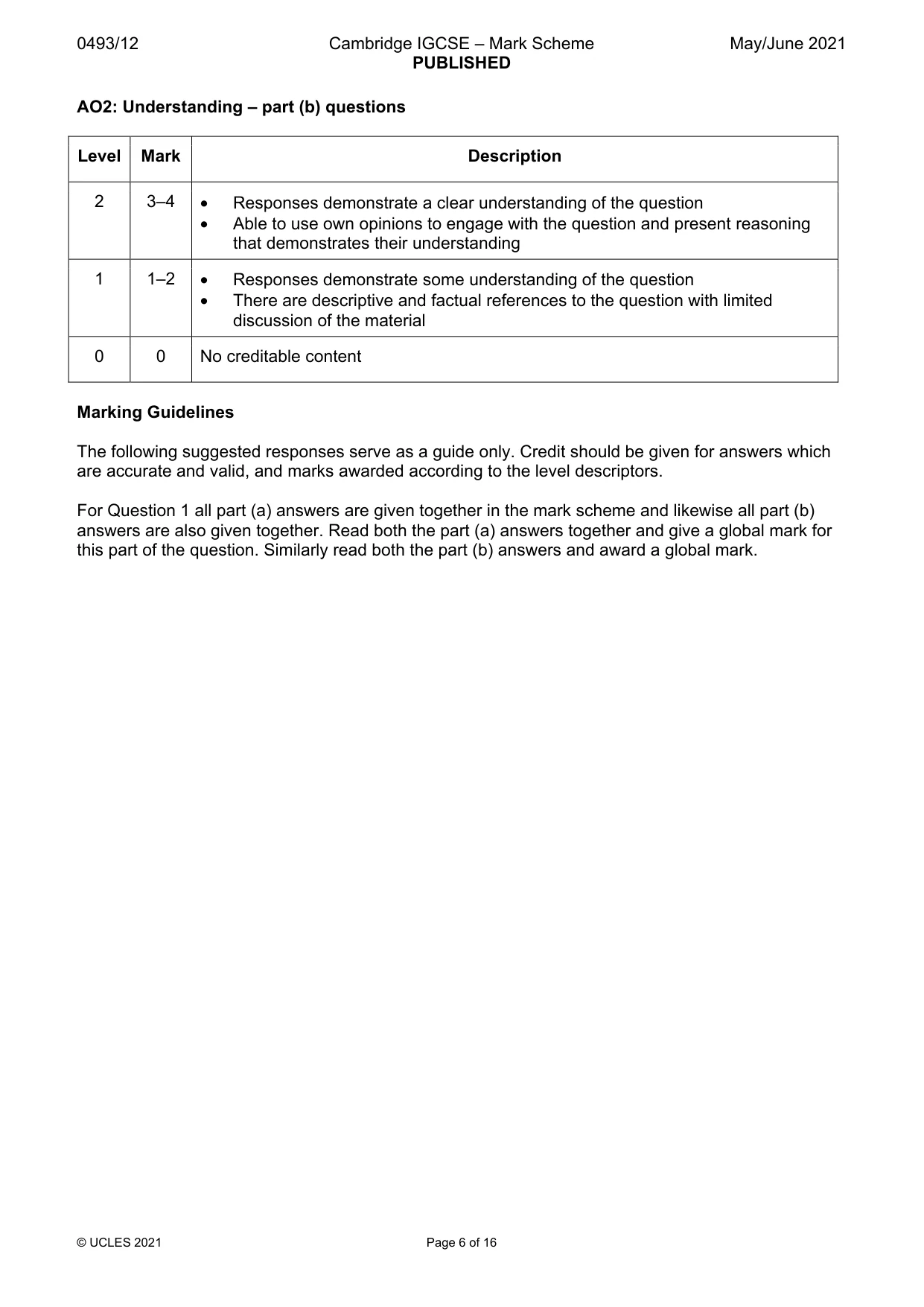
0493/12 Cambridge IGCSE – Mark Scheme PUBLISHED May/June 2021 © UCLES 2021 Page 6 of 16 AO2: Understanding – part (b) questions Level Mark Description 2 3–4 • Responses demonstrate a clear understanding of the question • Able to use own opinions to engage with the question and present reasoning that demonstrates their understanding 1 1–2 • Responses demonstrate some understanding of the question • There are descriptive and factual references to the question with limited discussion of the material 0 0 No creditable content Marking Guidelines The following suggested responses serve as a guide only. Credit should be given for answers which are accurate and valid, and marks awarded according to the level descriptors. For Question 1 all part (a) answers are given together in the mark scheme and likewise all part (b) answers are also given together. Read both the part (a) answers together and give a global mark for this part of the question. Similarly read both the part (b) answers and award a global mark.
Mark scheme, page 7
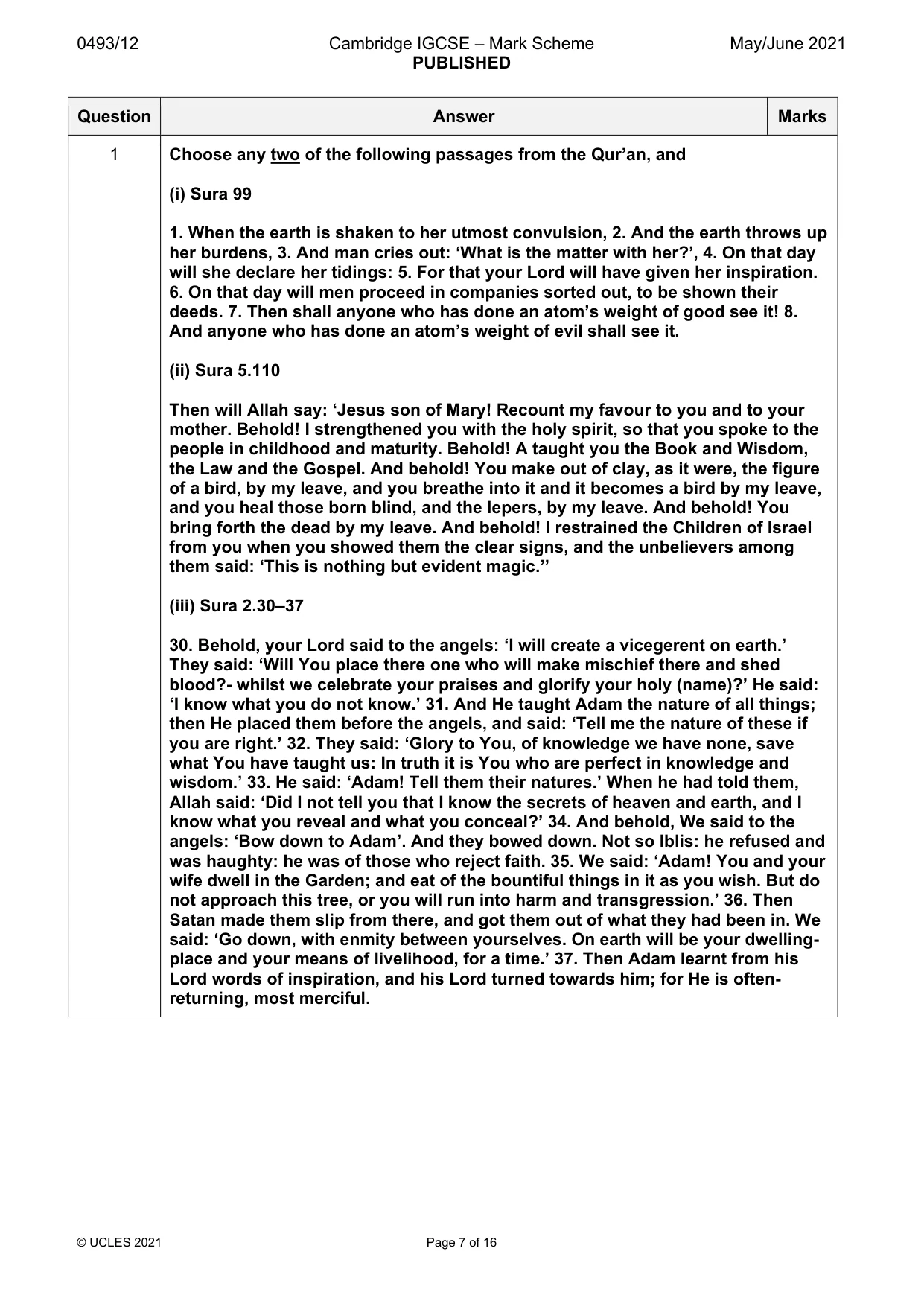
0493/12 Cambridge IGCSE – Mark Scheme PUBLISHED May/June 2021 © UCLES 2021 Page 7 of 16 Question Answer Marks 1 Choose any two of the following passages from the Qur’an, and (i) Sura 99 1. When the earth is shaken to her utmost convulsion, 2. And the earth throws up her burdens, 3. And man cries out: ‘What is the matter with her?’, 4. On that day will she declare her tidings: 5. For that your Lord will have given her inspiration. 6. On that day will men proceed in companies sorted out, to be shown their deeds. 7. Then shall anyone who has done an atom’s weight of good see it! 8. And anyone who has done an atom’s weight of evil shall see it. (ii) Sura 5.110 Then will Allah say: ‘Jesus son of Mary! Recount my favour to you and to your mother. Behold! I strengthened you with the holy spirit, so that you spoke to the people in childhood and maturity. Behold! A taught you the Book and Wisdom, the Law and the Gospel. And behold! You make out of clay, as it were, the figure of a bird, by my leave, and you breathe into it and it becomes a bird by my leave, and you heal those born blind, and the lepers, by my leave. And behold! You bring forth the dead by my leave. And behold! I restrained the Children of Israel from you when you showed them the clear signs, and the unbelievers among them said: ‘This is nothing but evident magic.’’ (iii) Sura 2.30–37 30. Behold, your Lord said to the angels: ‘I will create a vicegerent on earth.’ They said: ‘Will You place there one who will make mischief there and shed blood?- whilst we celebrate your praises and glorify your holy (name)?’ He said: ‘I know what you do not know.’ 31. And He taught Adam the nature of all things; then He placed them before the angels, and said: ‘Tell me the nature of these if you are right.’ 32. They said: ‘Glory to You, of knowledge we have none, save what You have taught us: In truth it is You who are perfect in knowledge and wisdom.’ 33. He said: ‘Adam! Tell them their natures.’ When he had told them, Allah said: ‘Did I not tell you that I know the secrets of heaven and earth, and I know what you reveal and what you conceal?’ 34. And behold, We said to the angels: ‘Bow down to Adam’. And they bowed down. Not so Iblis: he refused and was haughty: he was of those who reject faith. 35. We said: ‘Adam! You and your wife dwell in the Garden; and eat of the bountiful things in it as you wish. But do not approach this tree, or you will run into harm and transgression.’ 36. Then Satan made them slip from there, and got them out of what they had been in. We said: ‘Go down, with enmity between yourselves. On earth will be your dwelling- place and your means of livelihood, for a time.’ 37. Then Adam learnt from his Lord words of inspiration, and his Lord turned towards him; for He is often- returning, most merciful.
Mark scheme, page 8
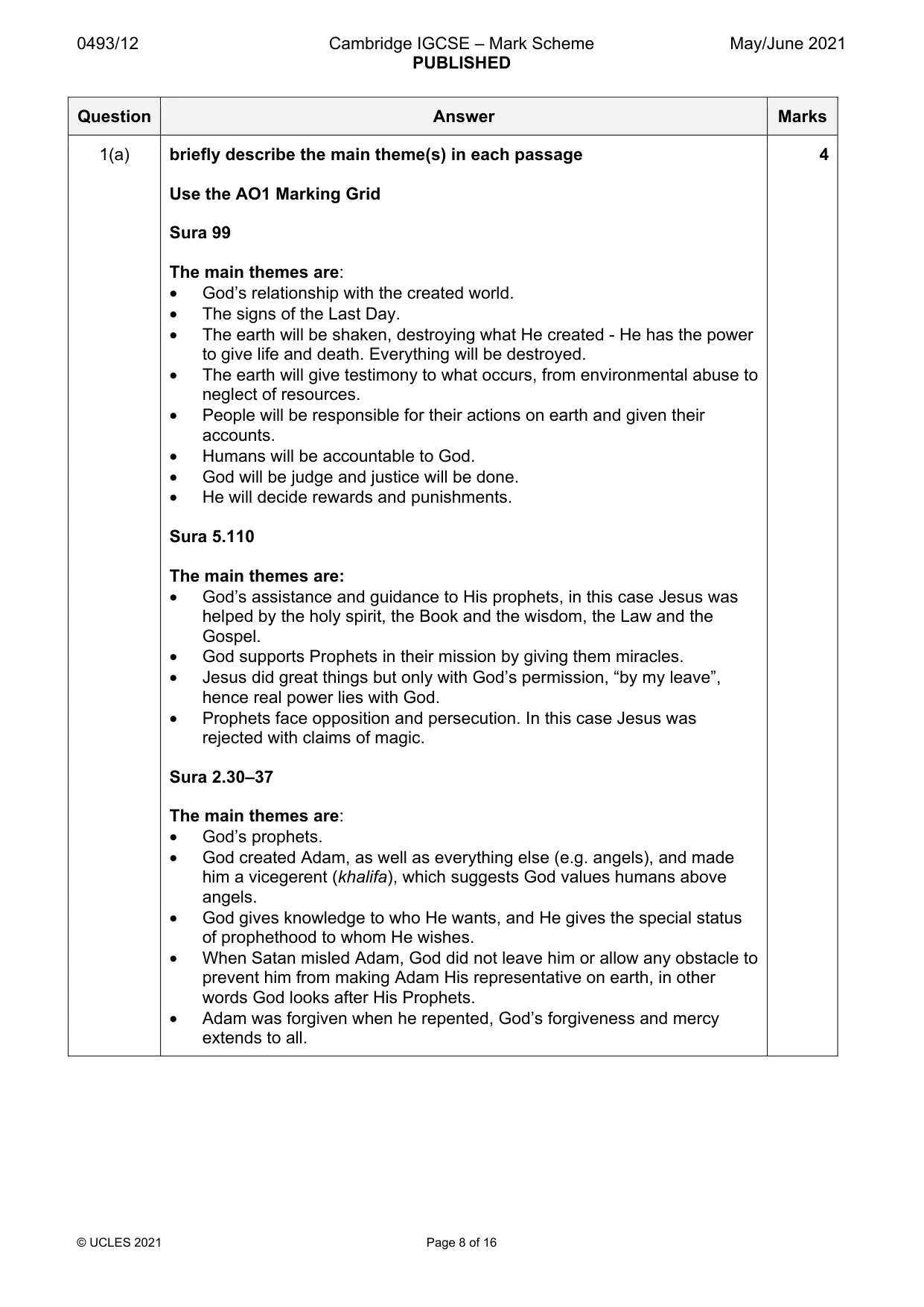
0493/12 Cambridge IGCSE – Mark Scheme PUBLISHED May/June 2021 © UCLES 2021 Page 8 of 16 Question Answer Marks 1(a) briefly describe the main theme(s) in each passage Use the AO1 Marking Grid Sura 99 The main themes are: • God’s relationship with the created world. • The signs of the Last Day. • The earth will be shaken, destroying what He created - He has the power to give life and death. Everything will be destroyed. • The earth will give testimony to what occurs, from environmental abuse to neglect of resources. • People will be responsible for their actions on earth and given their accounts. • Humans will be accountable to God. • God will be judge and justice will be done. • He will decide rewards and punishments. Sura 5.110 The main themes are: • God’s assistance and guidance to His prophets, in this case Jesus was helped by the holy spirit, the Book and the wisdom, the Law and the Gospel. • God supports Prophets in their mission by giving them miracles. • Jesus did great things but only with God’s permission, “by my leave”, hence real power lies with God. • Prophets face opposition and persecution. In this case Jesus was rejected with claims of magic. Sura 2.30–37 The main themes are: • God’s prophets. • God created Adam, as well as everything else (e.g. angels), and made him a vicegerent (khalifa), which suggests God values humans above angels. • God gives knowledge to who He wants, and He gives the special status of prophethood to whom He wishes. • When Satan misled Adam, God did not leave him or allow any obstacle to prevent him from making Adam His representative on earth, in other words God looks after His Prophets. • Adam was forgiven when he repented, God’s forgiveness and mercy extends to all. 4
Mark scheme, page 9
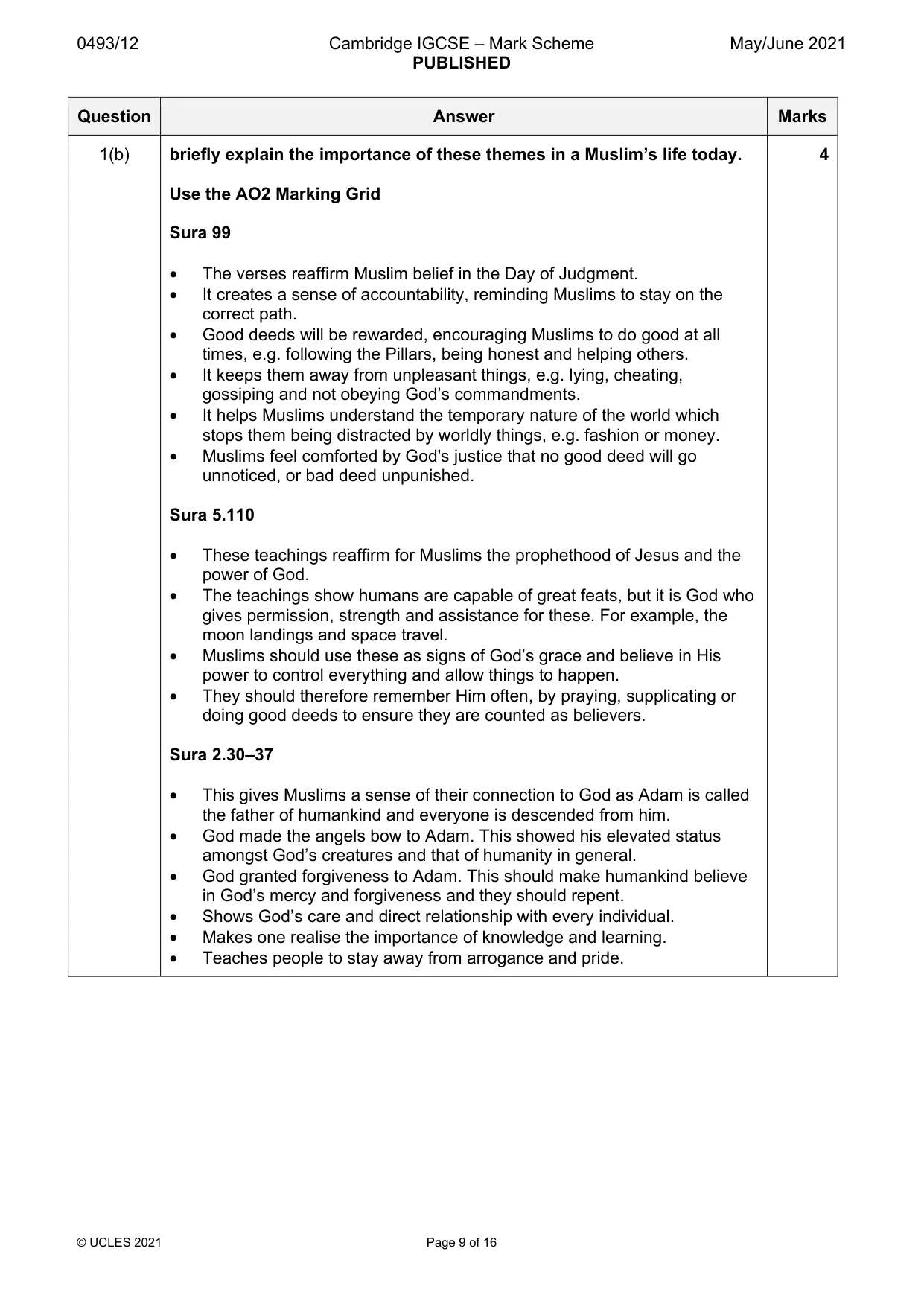
0493/12 Cambridge IGCSE – Mark Scheme PUBLISHED May/June 2021 © UCLES 2021 Page 9 of 16 Question Answer Marks 1(b) briefly explain the importance of these themes in a Muslim’s life today. Use the AO2 Marking Grid Sura 99 • The verses reaffirm Muslim belief in the Day of Judgment. • It creates a sense of accountability, reminding Muslims to stay on the correct path. • Good deeds will be rewarded, encouraging Muslims to do good at all times, e.g. following the Pillars, being honest and helping others. • It keeps them away from unpleasant things, e.g. lying, cheating, gossiping and not obeying God’s commandments. • It helps Muslims understand the temporary nature of the world which stops them being distracted by worldly things, e.g. fashion or money. • Muslims feel comforted by God's justice that no good deed will go unnoticed, or bad deed unpunished. Sura 5.110 • These teachings reaffirm for Muslims the prophethood of Jesus and the power of God. • The teachings show humans are capable of great feats, but it is God who gives permission, strength and assistance for these. For example, the moon landings and space travel. • Muslims should use these as signs of God’s grace and believe in His power to control everything and allow things to happen. • They should therefore remember Him often, by praying, supplicating or doing good deeds to ensure they are counted as believers. Sura 2.30–37 • This gives Muslims a sense of their connection to God as Adam is called the father of humankind and everyone is descended from him. • God made the angels bow to Adam. This showed his elevated status amongst God’s creatures and that of humanity in general. • God granted forgiveness to Adam. This should make humankind believe in God’s mercy and forgiveness and they should repent. • Shows God’s care and direct relationship with every individual. • Makes one realise the importance of knowledge and learning. • Teaches people to stay away from arrogance and pride. 4
Mark scheme, page 10
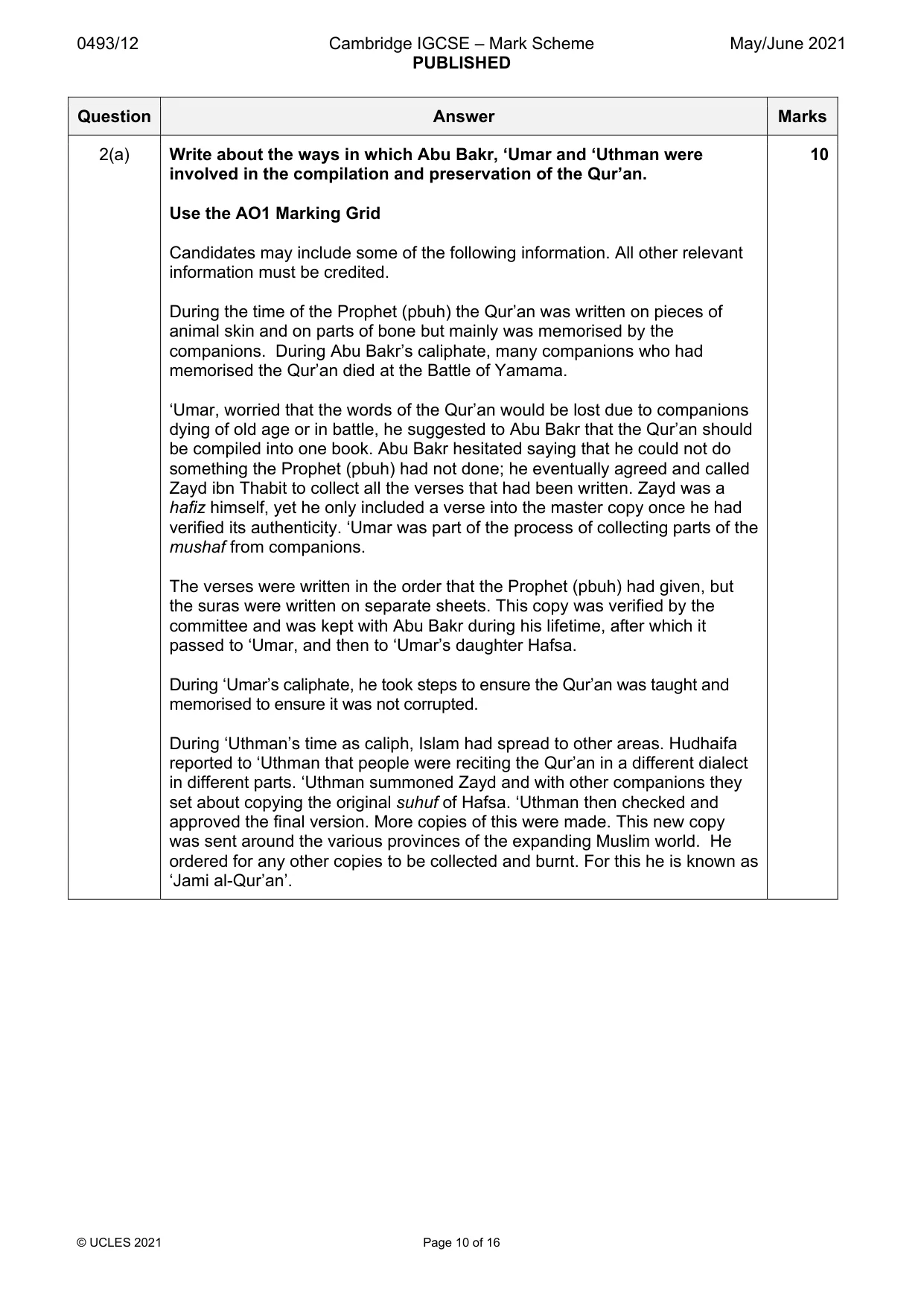
0493/12 Cambridge IGCSE – Mark Scheme PUBLISHED May/June 2021 © UCLES 2021 Page 10 of 16 Question Answer Marks 2(a) Write about the ways in which Abu Bakr, ‘Umar and ‘Uthman were involved in the compilation and preservation of the Qur’an. Use the AO1 Marking Grid Candidates may include some of the following information. All other relevant information must be credited. During the time of the Prophet (pbuh) the Qur’an was written on pieces of animal skin and on parts of bone but mainly was memorised by the companions. During Abu Bakr’s caliphate, many companions who had memorised the Qur’an died at the Battle of Yamama. ‘Umar, worried that the words of the Qur’an would be lost due to companions dying of old age or in battle, he suggested to Abu Bakr that the Qur’an should be compiled into one book. Abu Bakr hesitated saying that he could not do something the Prophet (pbuh) had not done; he eventually agreed and called Zayd ibn Thabit to collect all the verses that had been written. Zayd was a hafiz himself, yet he only included a verse into the master copy once he had verified its authenticity. ‘Umar was part of the process of collecting parts of the mushaf from companions. The verses were written in the order that the Prophet (pbuh) had given, but the suras were written on separate sheets. This copy was verified by the committee and was kept with Abu Bakr during his lifetime, after which it passed to ‘Umar, and then to ‘Umar’s daughter Hafsa. During ‘Umar’s caliphate, he took steps to ensure the Qur’an was taught and memorised to ensure it was not corrupted. During ‘Uthman’s time as caliph, Islam had spread to other areas. Hudhaifa reported to ‘Uthman that people were reciting the Qur’an in a different dialect in different parts. ‘Uthman summoned Zayd and with other companions they set about copying the original suhuf of Hafsa. ‘Uthman then checked and approved the final version. More copies of this were made. This new copy was sent around the various provinces of the expanding Muslim world. He ordered for any other copies to be collected and burnt. For this he is known as ‘Jami al-Qur’an’. 10
Mark scheme, page 11
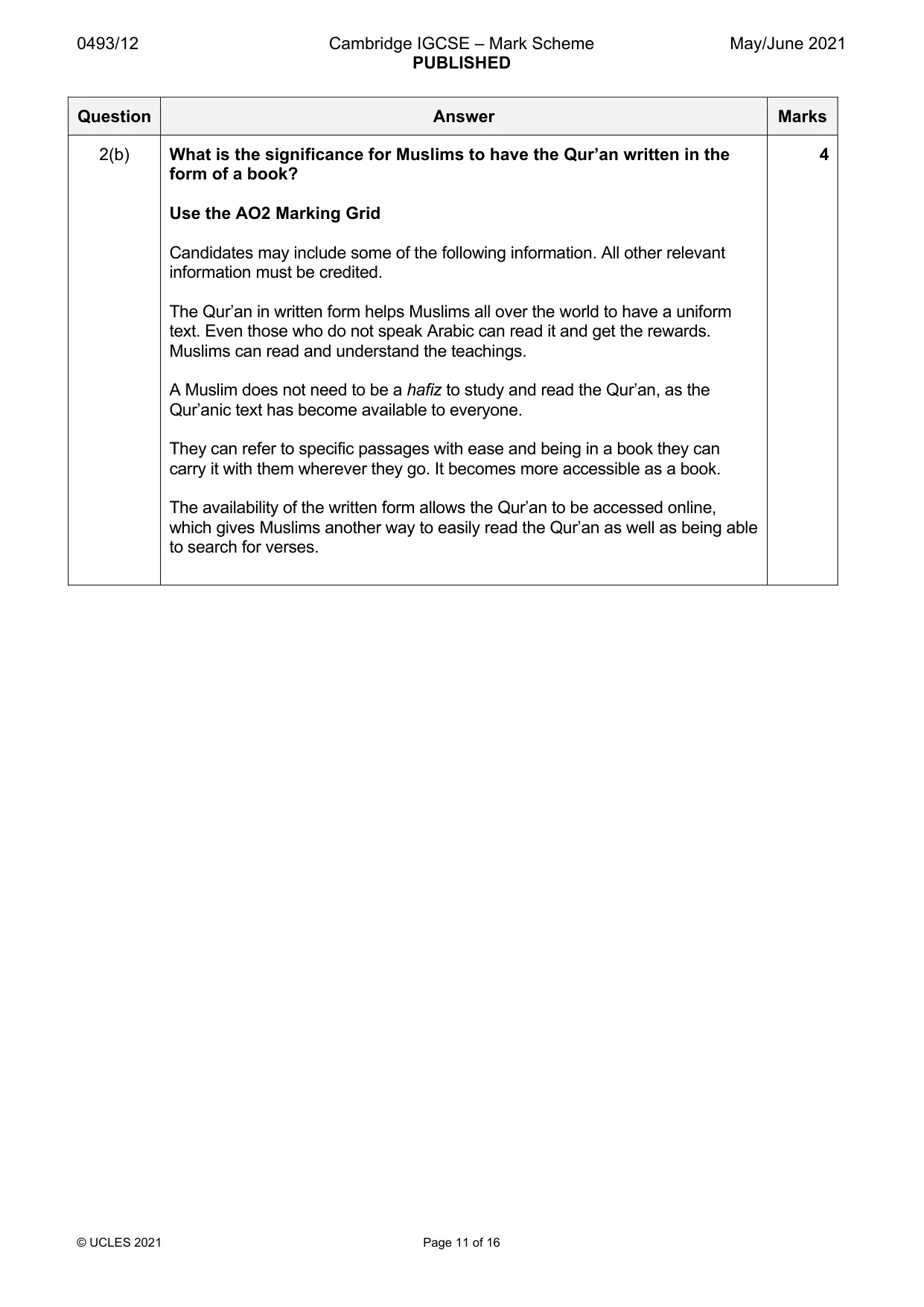
0493/12 Cambridge IGCSE – Mark Scheme PUBLISHED May/June 2021 © UCLES 2021 Page 11 of 16 Question Answer Marks 2(b) What is the significance for Muslims to have the Qur’an written in the form of a book? Use the AO2 Marking Grid Candidates may include some of the following information. All other relevant information must be credited. The Qur’an in written form helps Muslims all over the world to have a uniform text. Even those who do not speak Arabic can read it and get the rewards. Muslims can read and understand the teachings. A Muslim does not need to be a hafiz to study and read the Qur’an, as the Qur’anic text has become available to everyone. They can refer to specific passages with ease and being in a book they can carry it with them wherever they go. It becomes more accessible as a book. The availability of the written form allows the Qur’an to be accessed online, which gives Muslims another way to easily read the Qur’an as well as being able to search for verses. 4
Mark scheme, page 12
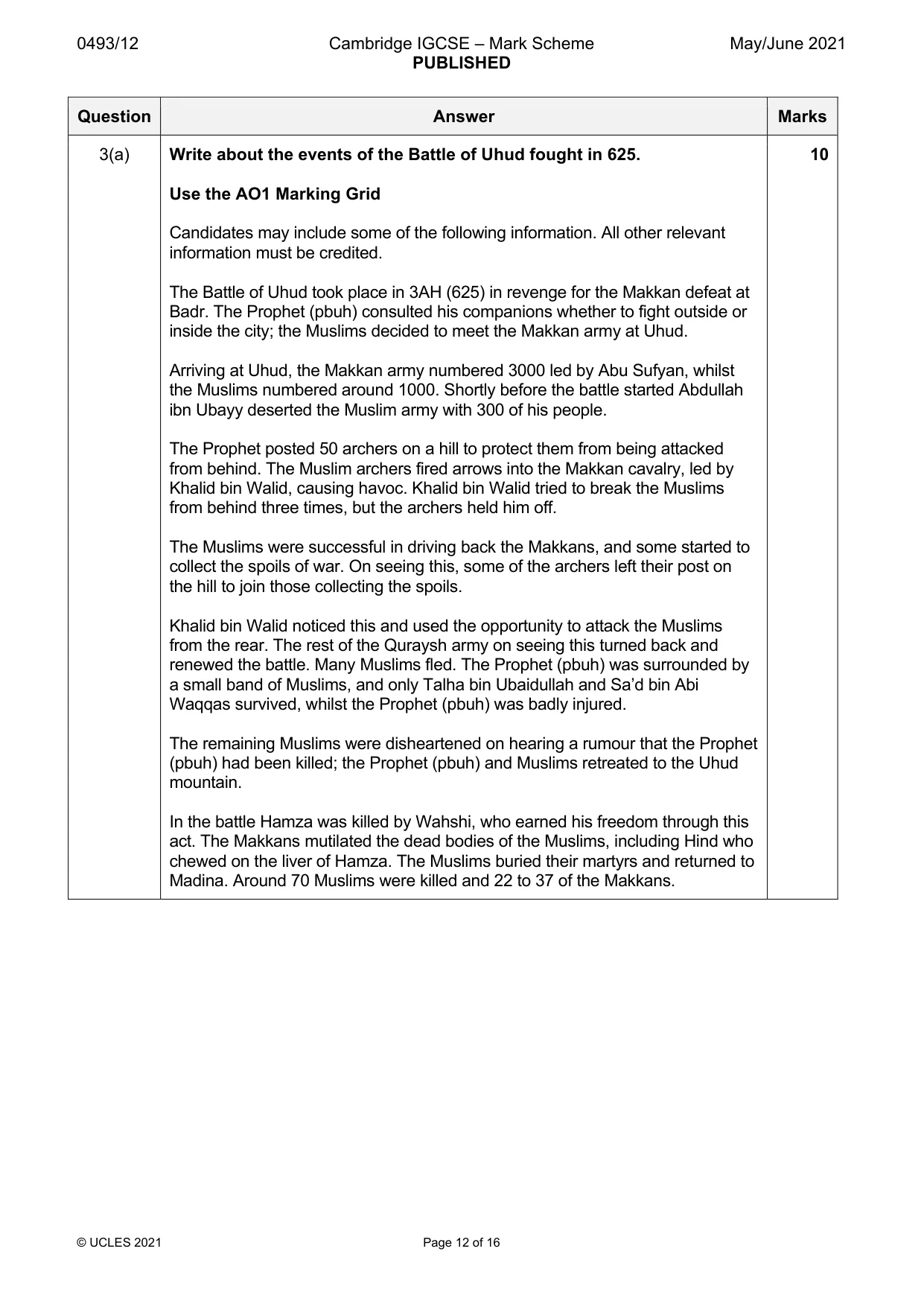
0493/12 Cambridge IGCSE – Mark Scheme PUBLISHED May/June 2021 © UCLES 2021 Page 12 of 16 Question Answer Marks 3(a) Write about the events of the Battle of Uhud fought in 625. Use the AO1 Marking Grid Candidates may include some of the following information. All other relevant information must be credited. The Battle of Uhud took place in 3AH (625) in revenge for the Makkan defeat at Badr. The Prophet (pbuh) consulted his companions whether to fight outside or inside the city; the Muslims decided to meet the Makkan army at Uhud. Arriving at Uhud, the Makkan army numbered 3000 led by Abu Sufyan, whilst the Muslims numbered around 1000. Shortly before the battle started Abdullah ibn Ubayy deserted the Muslim army with 300 of his people. The Prophet posted 50 archers on a hill to protect them from being attacked from behind. The Muslim archers fired arrows into the Makkan cavalry, led by Khalid bin Walid, causing havoc. Khalid bin Walid tried to break the Muslims from behind three times, but the archers held him off. The Muslims were successful in driving back the Makkans, and some started to collect the spoils of war. On seeing this, some of the archers left their post on the hill to join those collecting the spoils. Khalid bin Walid noticed this and used the opportunity to attack the Muslims from the rear. The rest of the Quraysh army on seeing this turned back and renewed the battle. Many Muslims fled. The Prophet (pbuh) was surrounded by a small band of Muslims, and only Talha bin Ubaidullah and Sa’d bin Abi Waqqas survived, whilst the Prophet (pbuh) was badly injured. The remaining Muslims were disheartened on hearing a rumour that the Prophet (pbuh) had been killed; the Prophet (pbuh) and Muslims retreated to the Uhud mountain. In the battle Hamza was killed by Wahshi, who earned his freedom through this act. The Makkans mutilated the dead bodies of the Muslims, including Hind who chewed on the liver of Hamza. The Muslims buried their martyrs and returned to Madina. Around 70 Muslims were killed and 22 to 37 of the Makkans. 10
Mark scheme, page 13
0493/12 Cambridge IGCSE – Mark Scheme PUBLISHED May/June 2021 © UCLES 2021 Page 13 of 16 Question Answer Marks 3(b) What lessons might be learned from the outcome of the Battle of Uhud? Use the AO2 Marking Grid Candidates may include some of the following information. All other relevant information must be credited. Candidates may give different lessons that might be learned. The lessons may include that Muslims should listen to and obey the orders of the Prophet (pbuh) to gain success. Candidates could say that decisions do not have to be made by leaders on their own, and consultation with others can be beneficial. Loyalty is important for Muslims and communities and they should stick together in difficult times. Responses can further elaborate these ideas and where possible support them with examples. 4
Mark scheme, page 14
0493/12 Cambridge IGCSE – Mark Scheme PUBLISHED May/June 2021 © UCLES 2021 Page 14 of 16 Question Answer Marks 4(a) Giving examples from the Prophet’s life, write about how he showed both the qualities of patience and forgiveness. Use the AO1 Marking Grid Candidates may include some of the following information. All other relevant information must be credited. The quality of patience is the quality of waiting calmly without complaining. From the beginning the Prophet (pbuh) was patient in that he waited for guidance from God before teaching others or preaching openly. He did not try to rush the message to hurry people into accepting Islam. His patience was shown when the people used to throw rubbish on him, call him names or commit other atrocities. He never retaliated, nor did he get angry at them. His enemies would often come when he was praying and try to disturb his prayer by whistling and clapping, but the Prophet (pbuh) would not say anything or confront them. When the intestines of a camel were put on his back while prostrating, he did not react or get angry but stayed in that position until his daughter came and took it off his back. He also showed patience while preaching Islam in Makka. Despite his best efforts, only a handful of people accepted Islam, most of whom were poor or slaves but that did not deter him from believing in his mission and continuing to strive patiently. His patience was also shown when he, along with his whole clan, were put under boycott by the Makkans and at the end of it he lost those closest to him in a short period of time, namely Khadija and Abu Talib. Instead of despairing, he sought the reward of God by praying to Him. He waited for God to allow him to migrate, despite the risk to his life. The Prophet (pbuh) showed immense patience throughout his life in Madina where he had to suffer the conspiracies and treacheries of Jewish tribes as well as the hypocrisies of the leaders in Madina. This included the actions of Abdullah bin Ubayy who often used to misbehave with the Prophet (pbuh) and betrayed him on several occasions but he never retaliated. The quality of forgiveness is to not want to punish someone when they have wronged you, to not seek revenge. Aisha said that the Prophet (pbuh) never took revenge on anyone for himself. At the time of his visit to Ta’if, the Angel Jibril came to say that he can crush the people between the two mountains, but the Prophet (pbuh) refused, and prayed for their guidance instead. When returning to Makka, the Prophet (pbuh) forgave many people who had been prominent in persecuting him and his companions, e.g. Abu Sufyan. He also gave a general pardon to the Makkans, despite their actions against him. 10
Mark scheme, page 15
0493/12 Cambridge IGCSE – Mark Scheme PUBLISHED May/June 2021 © UCLES 2021 Page 15 of 16 Question Answer Marks 4(a) He also forgave Wahshi who killed his uncle Hamza as well as Hind who chewed on Hamza’s liver. Abdullah ibn Ubayy was one of the hypocrites who opposed the Prophet (pbuh) whilst outwardly saying he supported him. Despite this the Prophet (pbuh) seemed to show no animosity for Abdullah when he died, attending his funeral and praying at his grave. Candidates can offer other examples of forgiveness, especially for development of the answer, such as the Prophet’s forgiveness of Ikrimah ibn Abi Jahl, Sufwan ibn Umayyah and Habbar ibn al-Aswad. 4(b) Why should Muslims show patience in their everyday lives? Use the AO2 Marking Grid Candidates may include some of the following information. All other relevant information must be credited. Muslims should show patience for a variety of reasons, candidates should offer reasons with examples. Candidates might say it is one of God’s names (as-Sabbur), and He says that He loves those who are patient (Sura 2.153, Sura 39.10) hence it is one of the main teachings of the Qur’an. It shows tolerance if a person does not react negatively to others. It can help change people’s attitude for the better. It can lead to a more peaceful society if people continue to strive to do good and stop themselves from doing bad, even when the result/benefit does not come immediately. The Prophet (pbuh) showed patience throughout his life, as a Muslim one is bound to follow the Seerah of the Prophet (pbuh). 4
Mark scheme, page 16
0493/12 Cambridge IGCSE – Mark Scheme PUBLISHED May/June 2021 © UCLES 2021 Page 16 of 16 Question Answer Marks 5(a) Write about the life of the Prophet’s daughter, Fatima. Use the AO1 Marking Grid Candidates may include some of the following information. All other relevant information must be credited. Fatima was the Prophet Muhammad’s youngest daughter, born a few years before prophethood. She was upset over the treatment her father faced by the Quraysh in Makka; when he was persecuted and the Quraysh threw animal entrails on him, she lifted it off and cleaned him. She was married to ‘Ali and had two sons and two daughters (Hassan, Hussain, Zaynab and Umm Kulthum). She suffered hardships after her marriage and did all the work at home herself, for example, grinding flour and carrying water from the well. When she asked the Prophet (pbuh) for a share in the spoils of war after one of the battles, thinking she may be able to get a maid to help at home, he said, I shall give you something better and told her to say Subhanallah, Alhamdulillah, Allahu Akbar before going to sleep. One of her nicknames was Az-Zahra, the resplendent one. Aisha said that she was the one who resembled the Prophet (pbuh) the most. The Prophet (pbuh) is reported to have said, "Fatima is a part of me and whoever offends her offends me." The Prophet (pbuh) showed his affection for her and would visit her before he left on a journey and upon returning. When the Prophet (pbuh) was ill, she was upset that he was dying but happy when he told her she would be joining him soon. She was the only daughter to outlive the Prophet (pbuh) and passed away five months after her father at the age of 29. 10 5(b) What can be learned from her life about the relationship between parents and children? Use the AO2 Marking Grid Candidates may include some of the following information. All other relevant information must be credited. The bond between the Prophet (pbuh) and Fatima shows that mutual love and respect needs to be nurtured between parents and children. Parents should love all their children, male and female, and treat them well. The way the Prophet (pbuh) showed love and respect for his daughter and the way Fatima always stood by her father hold great lessons for Muslims. 4
What you needed in this session
Cambridge’s own grade thresholds for 2021 May/June, Paper 1 · Variant 2. A higher threshold means an easier paper — the bar moves with how the cohort did.