Cambridge IGCSE Islamiyat 0493 — 2020 May/June Paper 1 · Variant 2
0493/12/M/J/20
The question paper and its mark scheme, free to read here and free to download. This is Cambridge’s own paper, exactly as it was sat.
Question paper16 pages





Mark scheme10 pages
Answers below. Sit the paper first if you are practising.
Paper as text
Question paper, page 1
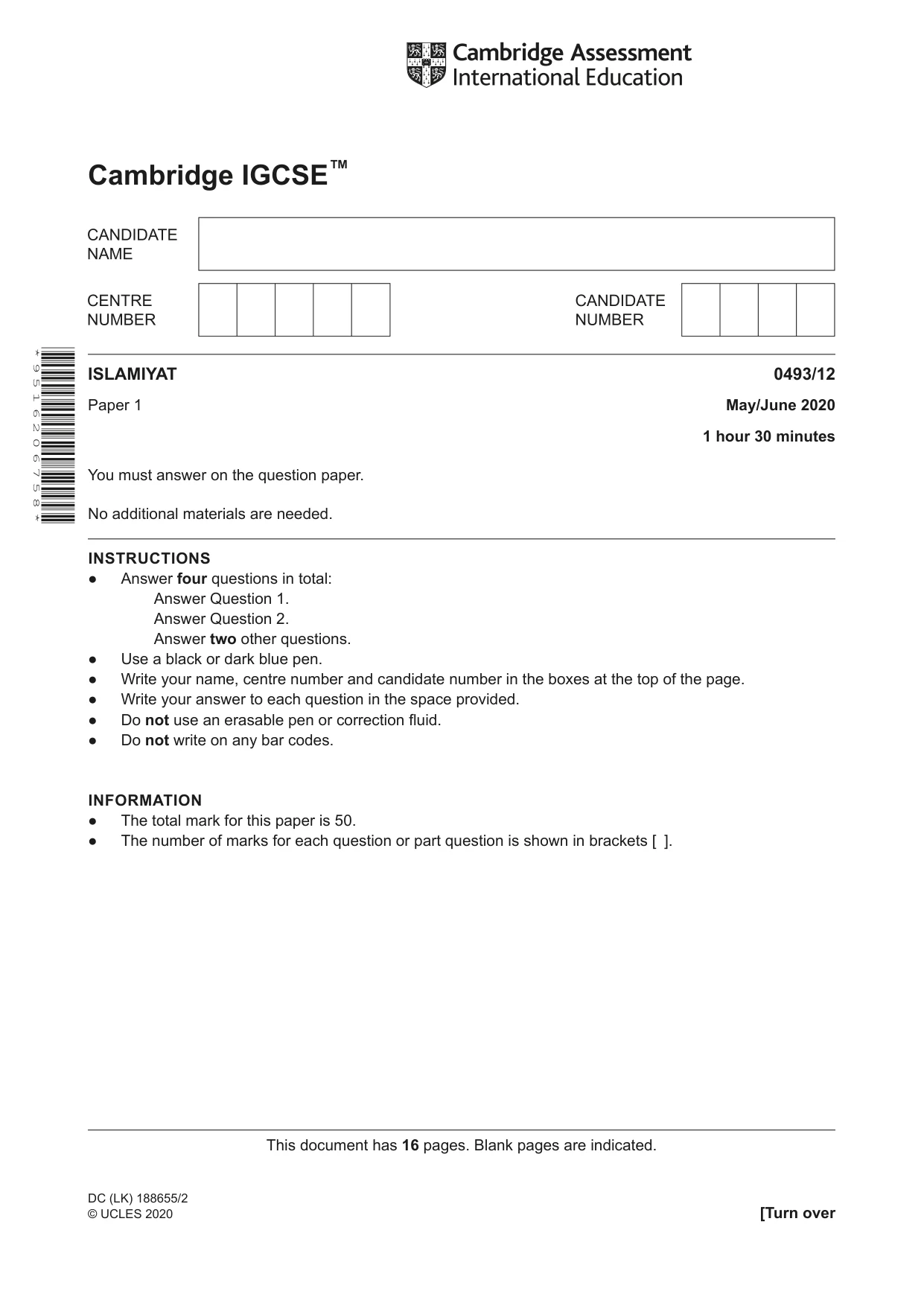
Cambridge IGCSE™ ISLAMIYAT 0493/12 Paper 1 May/June 2020 1 hour 30 minutes You must answer on the question paper. No additional materials are needed. INSTRUCTIONS ● Answer four questions in total: Answer Question 1. Answer Question 2. Answer two other questions. ● Use a black or dark blue pen. ● Write your name, centre number and candidate number in the boxes at the top of the page. ● Write your answer to each question in the space provided. ● Do not use an erasable pen or correction fluid. ● Do not write on any bar codes. INFORMATION ● The total mark for this paper is 50. ● The number of marks for each question or part question is shown in brackets [ ]. This document has 16 pages. Blank pages are indicated. DC (LK) 188655/2 © UCLES 2020 [Turn over * 9 5 1 6 2 0 6 7 5 8 *
Question paper, page 2
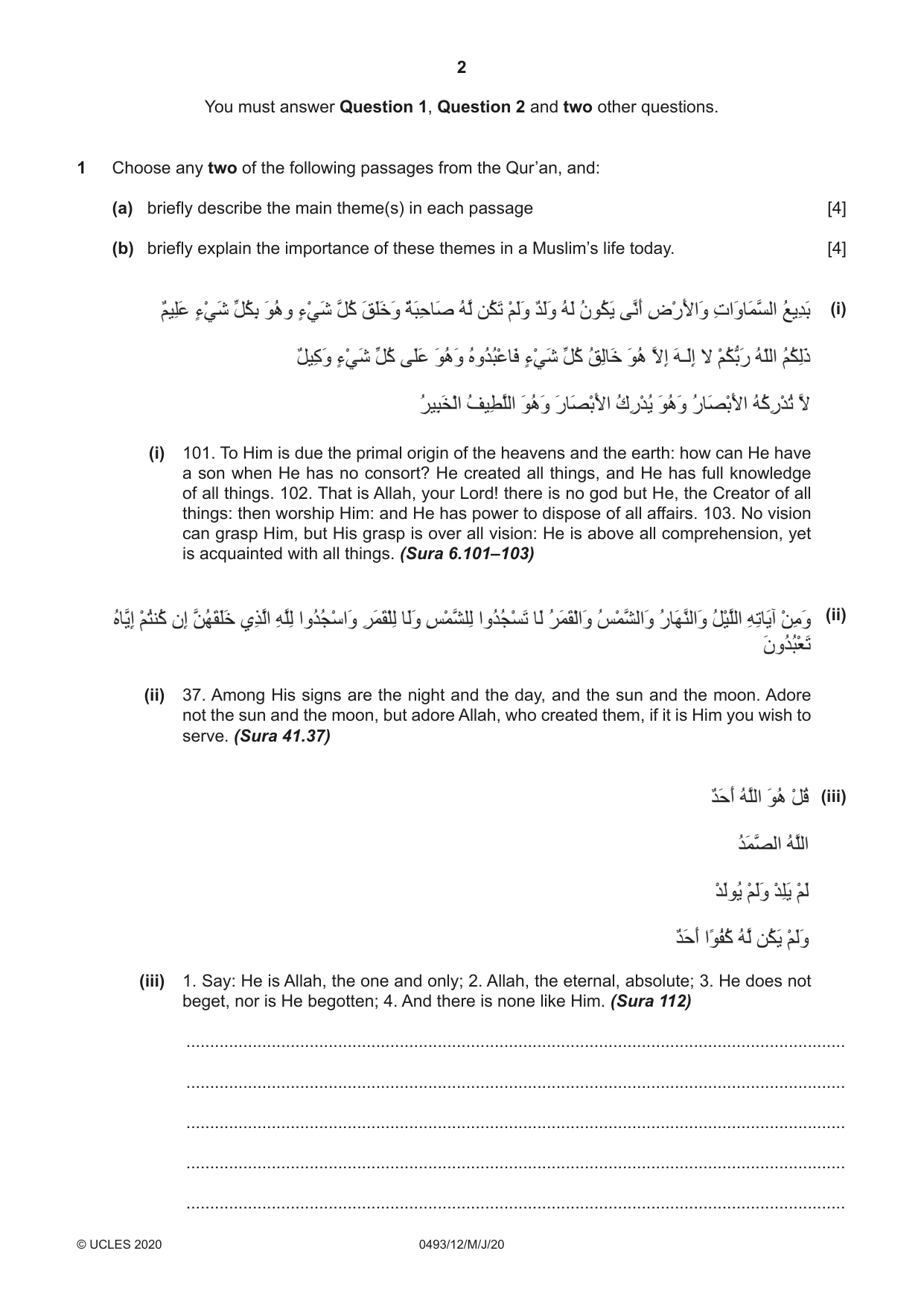
2 0493/12/M/J/20 © UCLES 2020 You must answer Question 1, Question 2 and two other questions. 1 Choose any two of the following passages from the Qur’an, and: (a) briefly describe the main theme(s) in each passage [4] (b) briefly explain the importance of these themes in a Muslim’s life today. [4] (i) (i) 101. To Him is due the primal origin of the heavens and the earth: how can He have a son when He has no consort? He created all things, and He has full knowledge of all things. 102. That is Allah, your Lord! there is no god but He, the Creator of all things: then worship Him: and He has power to dispose of all affairs. 103. No vision can grasp Him, but His grasp is over all vision: He is above all comprehension, yet is acquainted with all things. (Sura 6.101–103) (ii) (ii) 37. Among His signs are the night and the day, and the sun and the moon. Adore not the sun and the moon, but adore Allah, who created them, if it is Him you wish to serve. (Sura 41.37) (iii) (iii) 1. Say: He is Allah, the one and only; 2. Allah, the eternal, absolute; 3. He does not beget, nor is He begotten; 4. And there is none like Him. (Sura 112) … … … … …
Question paper, page 3
3 0493/12/M/J/20 © UCLES 2020 [Turn over … … … … … … … … … … … … … … … … … … … … … … … … … … … …
Question paper, page 4
4 0493/12/M/J/20 © UCLES 2020 … … … … … … … … … … … … … … … … … … … … … … … … … … … …
Question paper, page 5
5 0493/12/M/J/20 © UCLES 2020 [Turn over 2 (a) Using three passages you have studied from the syllabus, write about God’s relationship with His created world. [10] (b) How might teachings from these passages encourage people to take care of their environment? [4] … … … … … … … … … … … … … … … … … … … … … … … … …
Question paper, page 6
6 0493/12/M/J/20 © UCLES 2020 … … … … … … … … … … … … … … … … … … … … … … … … … … … …
Question paper, page 7
7 0493/12/M/J/20 © UCLES 2020 [Turn over … … … … … … … … … … … … … … … … … … … … … … … … … … … …
Question paper, page 8
8 0493/12/M/J/20 © UCLES 2020 3 (a) Give an account of the main events of the Prophet’s preaching up until the public declaration on Mount Safa. [10] (b) What do the Prophet’s struggles in these early years teach Muslims about dealing with their own difficulties? [4] … … … … … … … … … … … … … … … … … … … … … … … … …
Question paper, page 9
9 0493/12/M/J/20 © UCLES 2020 [Turn over … … … … … … … … … … … … … … … … … … … … … … … … … … … …
Question paper, page 10
10 0493/12/M/J/20 © UCLES 2020 … … … … … … … … … … … … … … … … … … … … … … … … … … … …
Question paper, page 11
11 0493/12/M/J/20 © UCLES 2020 [Turn over 4 (a) Describe the main events of the Battle of Mu’ta and the Battle of Hunain. [10] (b) From these battles, what can be learnt about good leadership skills? [4] … … … … … … … … … … … … … … … … … … … … … … … … … …
Question paper, page 12
12 0493/12/M/J/20 © UCLES 2020 … … … … … … … … … … … … … … … … … … … … … … … … … … … …
Question paper, page 13
13 0493/12/M/J/20 © UCLES 2020 [Turn over … … … … … … … … … … … … … … … … … … … … … … … … … … … …
Question paper, page 14
14 0493/12/M/J/20 © UCLES 2020 5 (a) Give an account of the life of the Prophet’s wife Aisha during the lifetime of the Prophet (pbuh). [10] (b) From the example of Aisha, what lessons can be learnt about education in Islam? [4] … … … … … … … … … … … … … … … … … … … … … … … … … …
Question paper, page 15
15 0493/12/M/J/20 © UCLES 2020 [Turn over … … … … … … … … … … … … … … … … … … … … … … … … … … … …
Question paper, page 16
16 0493/12/M/J/20 © UCLES 2020 Permission to reproduce items where third-party owned material protected by copyright is included has been sought and cleared where possible. Every reasonable effort has been made by the publisher (UCLES) to trace copyright holders, but if any items requiring clearance have unwittingly been included, the publisher will be pleased to make amends at the earliest possible opportunity. To avoid the issue of disclosure of answer-related information to candidates, all copyright acknowledgements are reproduced online in the Cambridge Assessment International Education Copyright Acknowledgements Booklet. This is produced for each series of examinations and is freely available to download at www.cambridgeinternational.org after the live examination series. Cambridge Assessment International Education is part of the Cambridge Assessment Group. Cambridge Assessment is the brand name of the University of Cambridge Local Examinations Syndicate (UCLES), which itself is a department of the University of Cambridge. … … … … … … … … … … … … … … … … … … … … … … … …
Mark scheme, page 1
This document consists of 10 printed pages. © UCLES 2020 [Turn over Cambridge IGCSE™ ISLAMIYAT 0493/12 Paper 1 May/June 2020 MARK SCHEME Maximum Mark: 50 Published Students did not sit exam papers in the June 2020 series due to the Covid-19 global pandemic. This mark scheme is published to support teachers and students and should be read together with the question paper. It shows the requirements of the exam. The answer column of the mark scheme shows the proposed basis on which Examiners would award marks for this exam. Where appropriate, this column also provides the most likely acceptable alternative responses expected from students. Examiners usually review the mark scheme after they have seen student responses and update the mark scheme if appropriate. In the June series, Examiners were unable to consider the acceptability of alternative responses, as there were no student responses to consider. Mark schemes should usually be read together with the Principal Examiner Report for Teachers. However, because students did not sit exam papers, there is no Principal Examiner Report for Teachers for the June 2020 series. Cambridge International will not enter into discussions about these mark schemes. Cambridge International is publishing the mark schemes for the June 2020 series for most Cambridge IGCSE™ and Cambridge International A & AS Level components, and some Cambridge O Level components.
Mark scheme, page 2
0493/12 Cambridge IGCSE – Mark Scheme PUBLISHED May/June 2020 © UCLES 2020 Page 2 of 10 Generic Marking Principles These general marking principles must be applied by all examiners when marking candidate answers. They should be applied alongside the specific content of the mark scheme or generic level descriptors for a question. Each question paper and mark scheme will also comply with these marking principles. GENERIC MARKING PRINCIPLE 1: Marks must be awarded in line with: • the specific content of the mark scheme or the generic level descriptors for the question • the specific skills defined in the mark scheme or in the generic level descriptors for the question • the standard of response required by a candidate as exemplified by the standardisation scripts. GENERIC MARKING PRINCIPLE 2: Marks awarded are always whole marks (not half marks, or other fractions). GENERIC MARKING PRINCIPLE 3: Marks must be awarded positively: • marks are awarded for correct/valid answers, as defined in the mark scheme. However, credit is given for valid answers which go beyond the scope of the syllabus and mark scheme, referring to your Team Leader as appropriate • marks are awarded when candidates clearly demonstrate what they know and can do • marks are not deducted for errors • marks are not deducted for omissions • answers should only be judged on the quality of spelling, punctuation and grammar when these features are specifically assessed by the question as indicated by the mark scheme. The meaning, however, should be unambiguous. GENERIC MARKING PRINCIPLE 4: Rules must be applied consistently e.g. in situations where candidates have not followed instructions or in the application of generic level descriptors. GENERIC MARKING PRINCIPLE 5: Marks should be awarded using the full range of marks defined in the mark scheme for the question (however; the use of the full mark range may be limited according to the quality of the candidate responses seen). GENERIC MARKING PRINCIPLE 6: Marks awarded are based solely on the requirements as defined in the mark scheme. Marks should not be awarded with grade thresholds or grade descriptors in mind.
Mark scheme, page 3
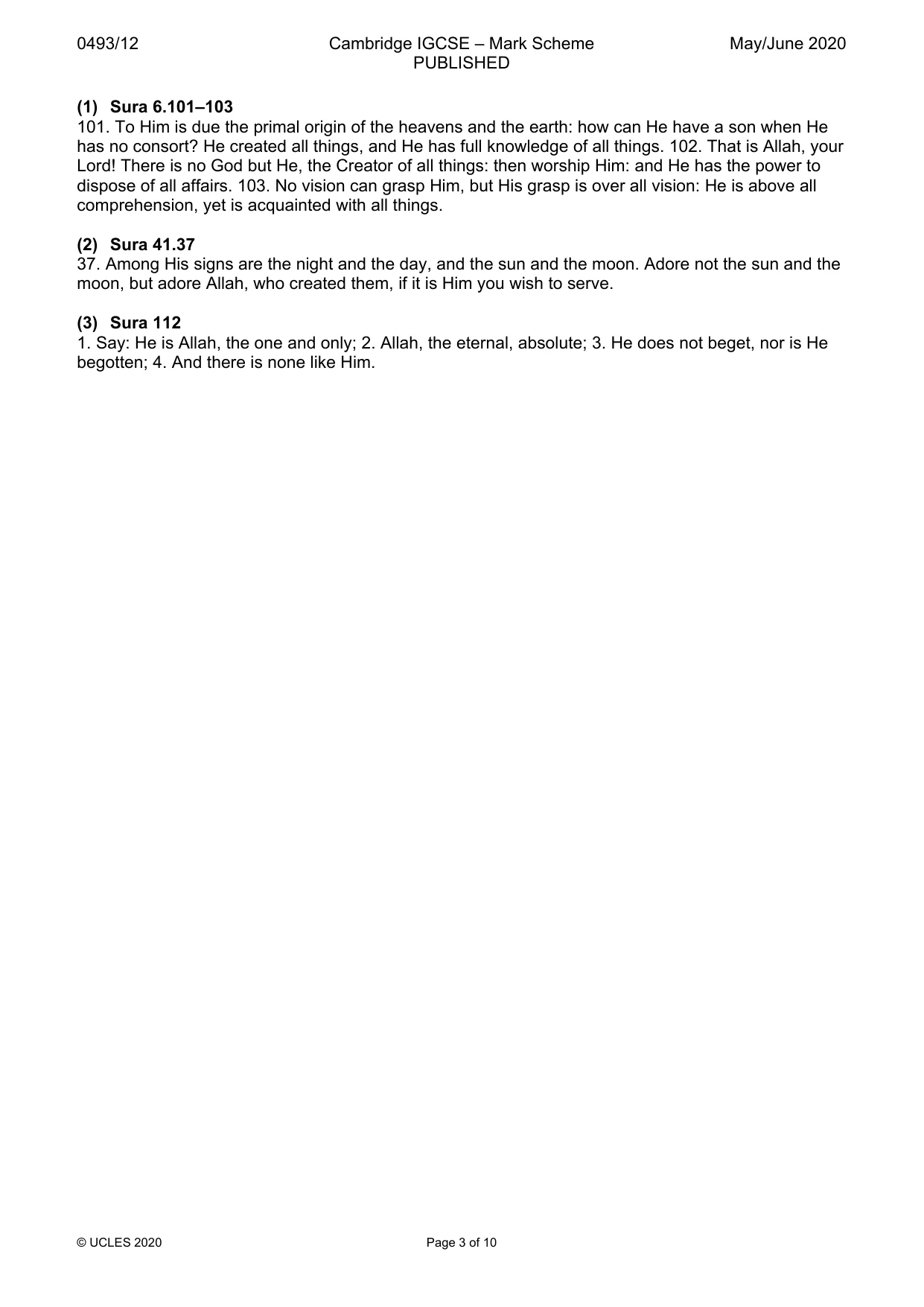
0493/12 Cambridge IGCSE – Mark Scheme PUBLISHED May/June 2020 © UCLES 2020 Page 3 of 10 (1) Sura 6.101–103 101. To Him is due the primal origin of the heavens and the earth: how can He have a son when He has no consort? He created all things, and He has full knowledge of all things. 102. That is Allah, your Lord! There is no God but He, the Creator of all things: then worship Him: and He has the power to dispose of all affairs. 103. No vision can grasp Him, but His grasp is over all vision: He is above all comprehension, yet is acquainted with all things. (2) Sura 41.37 37. Among His signs are the night and the day, and the sun and the moon. Adore not the sun and the moon, but adore Allah, who created them, if it is Him you wish to serve. (3) Sura 112 1. Say: He is Allah, the one and only; 2. Allah, the eternal, absolute; 3. He does not beget, nor is He begotten; 4. And there is none like Him.
Mark scheme, page 4
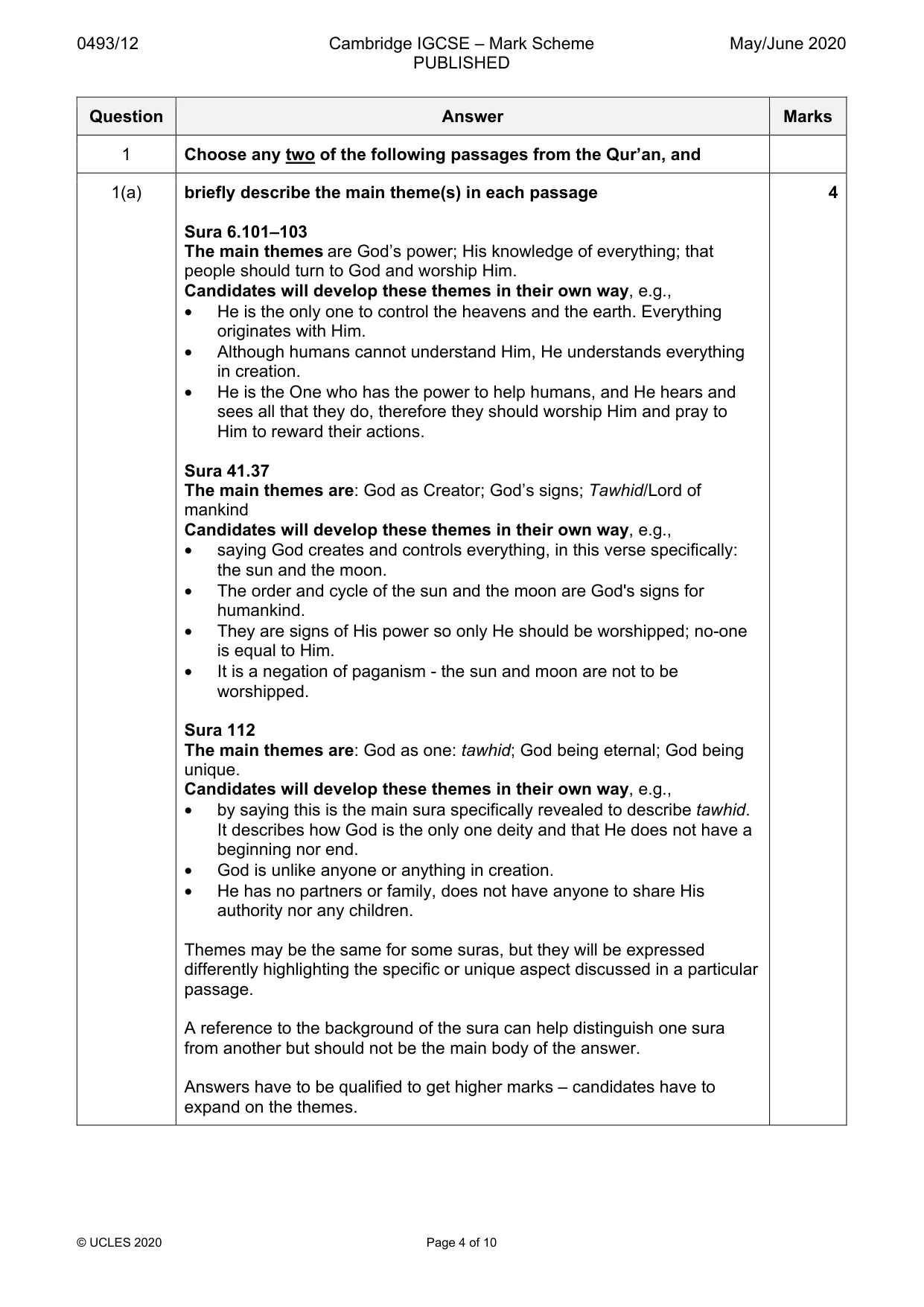
0493/12 Cambridge IGCSE – Mark Scheme PUBLISHED May/June 2020 © UCLES 2020 Page 4 of 10 Question Answer Marks 1 Choose any two of the following passages from the Qur’an, and 1(a) briefly describe the main theme(s) in each passage Sura 6.101–103 The main themes are God’s power; His knowledge of everything; that people should turn to God and worship Him. Candidates will develop these themes in their own way, e.g., • He is the only one to control the heavens and the earth. Everything originates with Him. • Although humans cannot understand Him, He understands everything in creation. • He is the One who has the power to help humans, and He hears and sees all that they do, therefore they should worship Him and pray to Him to reward their actions. Sura 41.37 The main themes are: God as Creator; God’s signs; Tawhid/Lord of mankind Candidates will develop these themes in their own way, e.g., • saying God creates and controls everything, in this verse specifically: the sun and the moon. • The order and cycle of the sun and the moon are God's signs for humankind. • They are signs of His power so only He should be worshipped; no-one is equal to Him. • It is a negation of paganism - the sun and moon are not to be worshipped. Sura 112 The main themes are: God as one: tawhid; God being eternal; God being unique. Candidates will develop these themes in their own way, e.g., • by saying this is the main sura specifically revealed to describe tawhid. It describes how God is the only one deity and that He does not have a beginning nor end. • God is unlike anyone or anything in creation. • He has no partners or family, does not have anyone to share His authority nor any children. Themes may be the same for some suras, but they will be expressed differently highlighting the specific or unique aspect discussed in a particular passage. A reference to the background of the sura can help distinguish one sura from another but should not be the main body of the answer. Answers have to be qualified to get higher marks – candidates have to expand on the themes. 4
Mark scheme, page 5
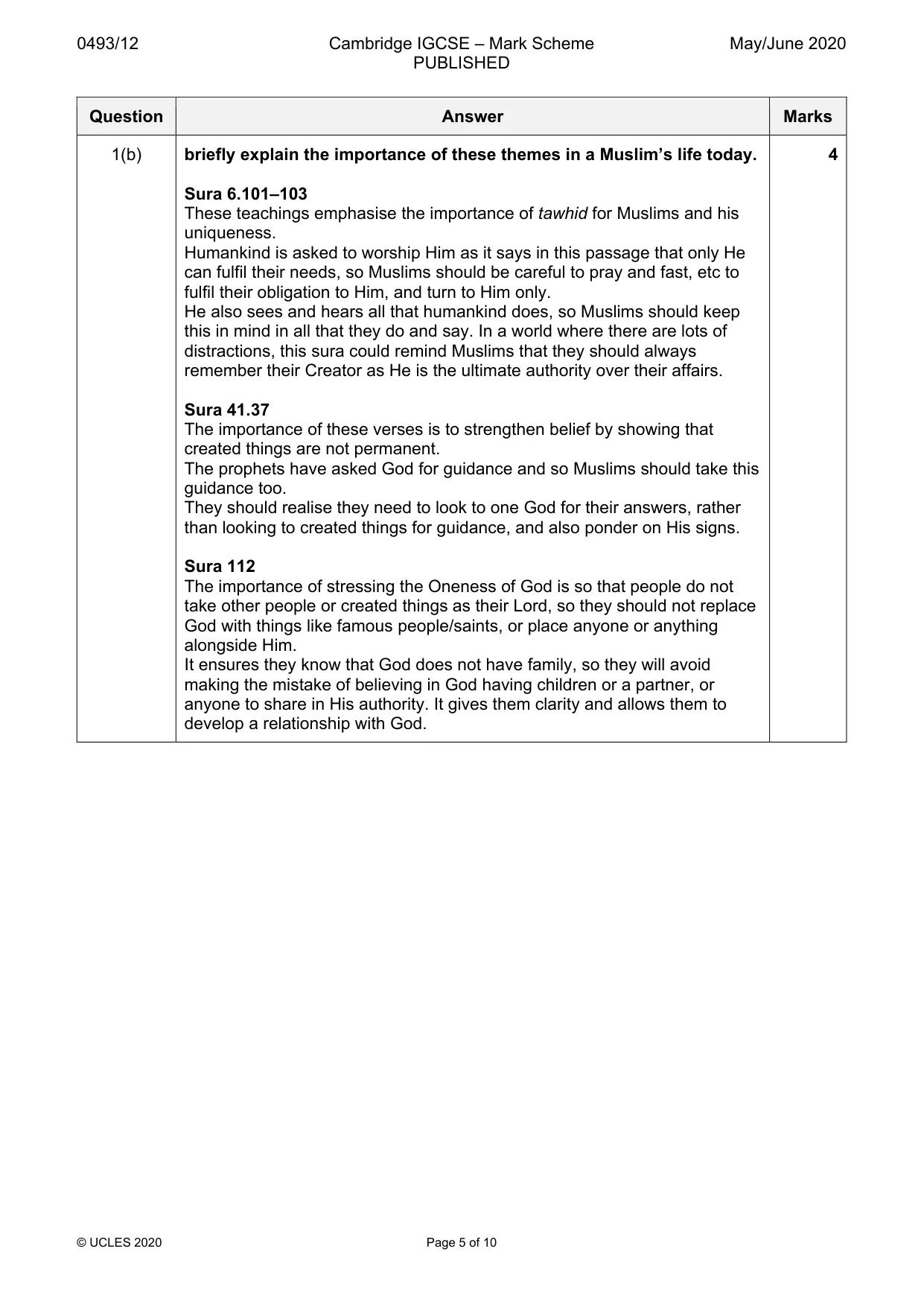
0493/12 Cambridge IGCSE – Mark Scheme PUBLISHED May/June 2020 © UCLES 2020 Page 5 of 10 Question Answer Marks 1(b) briefly explain the importance of these themes in a Muslim’s life today. Sura 6.101–103 These teachings emphasise the importance of tawhid for Muslims and his uniqueness. Humankind is asked to worship Him as it says in this passage that only He can fulfil their needs, so Muslims should be careful to pray and fast, etc to fulfil their obligation to Him, and turn to Him only. He also sees and hears all that humankind does, so Muslims should keep this in mind in all that they do and say. In a world where there are lots of distractions, this sura could remind Muslims that they should always remember their Creator as He is the ultimate authority over their affairs. Sura 41.37 The importance of these verses is to strengthen belief by showing that created things are not permanent. The prophets have asked God for guidance and so Muslims should take this guidance too. They should realise they need to look to one God for their answers, rather than looking to created things for guidance, and also ponder on His signs. Sura 112 The importance of stressing the Oneness of God is so that people do not take other people or created things as their Lord, so they should not replace God with things like famous people/saints, or place anyone or anything alongside Him. It ensures they know that God does not have family, so they will avoid making the mistake of believing in God having children or a partner, or anyone to share in His authority. It gives them clarity and allows them to develop a relationship with God. 4
Mark scheme, page 6
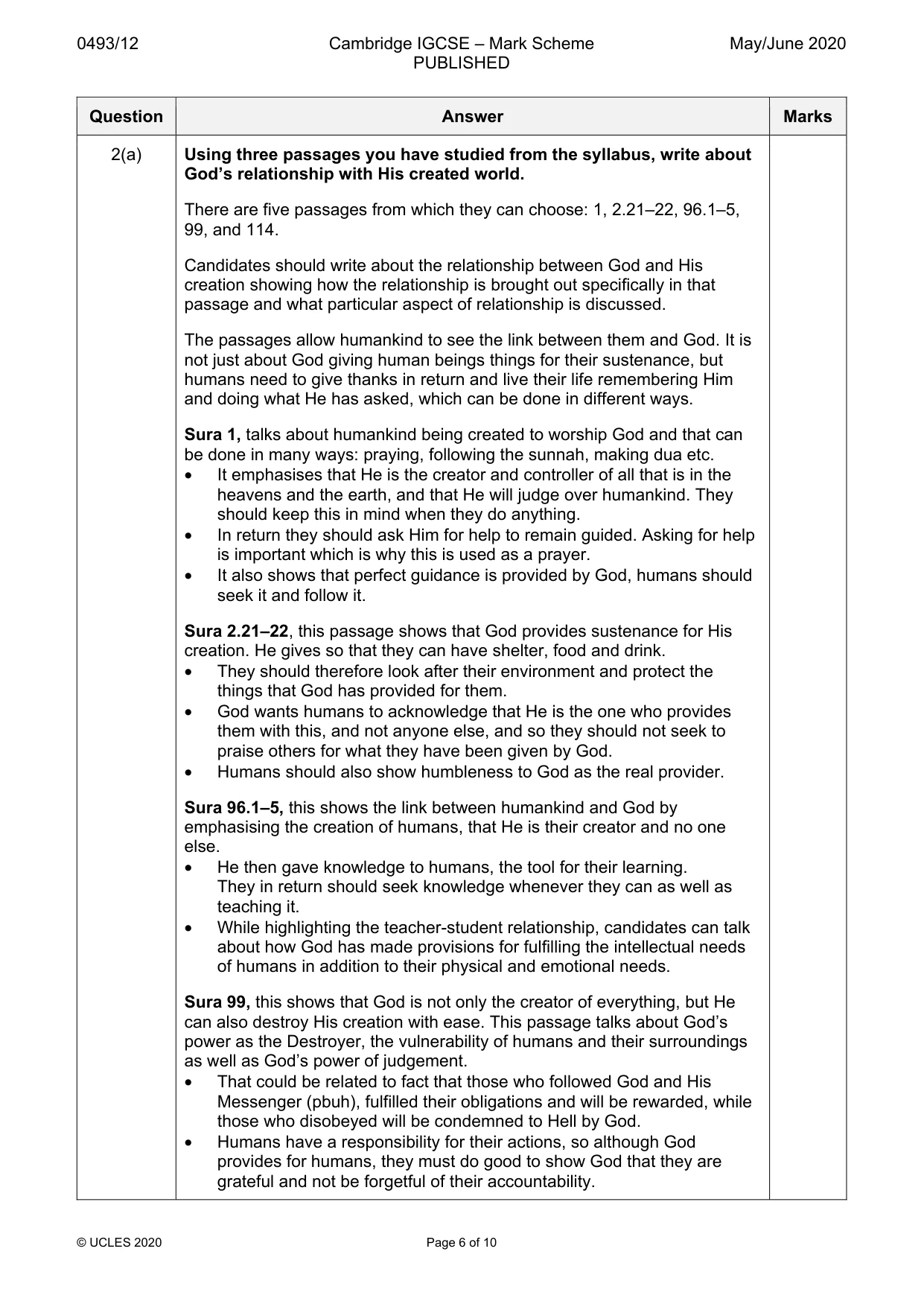
0493/12 Cambridge IGCSE – Mark Scheme PUBLISHED May/June 2020 © UCLES 2020 Page 6 of 10 Question Answer Marks 2(a) Using three passages you have studied from the syllabus, write about God’s relationship with His created world. There are five passages from which they can choose: 1, 2.21–22, 96.1–5, 99, and 114. Candidates should write about the relationship between God and His creation showing how the relationship is brought out specifically in that passage and what particular aspect of relationship is discussed. The passages allow humankind to see the link between them and God. It is not just about God giving human beings things for their sustenance, but humans need to give thanks in return and live their life remembering Him and doing what He has asked, which can be done in different ways. Sura 1, talks about humankind being created to worship God and that can be done in many ways: praying, following the sunnah, making dua etc. • It emphasises that He is the creator and controller of all that is in the heavens and the earth, and that He will judge over humankind. They should keep this in mind when they do anything. • In return they should ask Him for help to remain guided. Asking for help is important which is why this is used as a prayer. • It also shows that perfect guidance is provided by God, humans should seek it and follow it. Sura 2.21–22, this passage shows that God provides sustenance for His creation. He gives so that they can have shelter, food and drink. • They should therefore look after their environment and protect the things that God has provided for them. • God wants humans to acknowledge that He is the one who provides them with this, and not anyone else, and so they should not seek to praise others for what they have been given by God. • Humans should also show humbleness to God as the real provider. Sura 96.1–5, this shows the link between humankind and God by emphasising the creation of humans, that He is their creator and no one else. • He then gave knowledge to humans, the tool for their learning. They in return should seek knowledge whenever they can as well as teaching it. • While highlighting the teacher-student relationship, candidates can talk about how God has made provisions for fulfilling the intellectual needs of humans in addition to their physical and emotional needs. Sura 99, this shows that God is not only the creator of everything, but He can also destroy His creation with ease. This passage talks about God’s power as the Destroyer, the vulnerability of humans and their surroundings as well as God’s power of judgement. • That could be related to fact that those who followed God and His Messenger (pbuh), fulfilled their obligations and will be rewarded, while those who disobeyed will be condemned to Hell by God. • Humans have a responsibility for their actions, so although God provides for humans, they must do good to show God that they are grateful and not be forgetful of their accountability.
Mark scheme, page 7
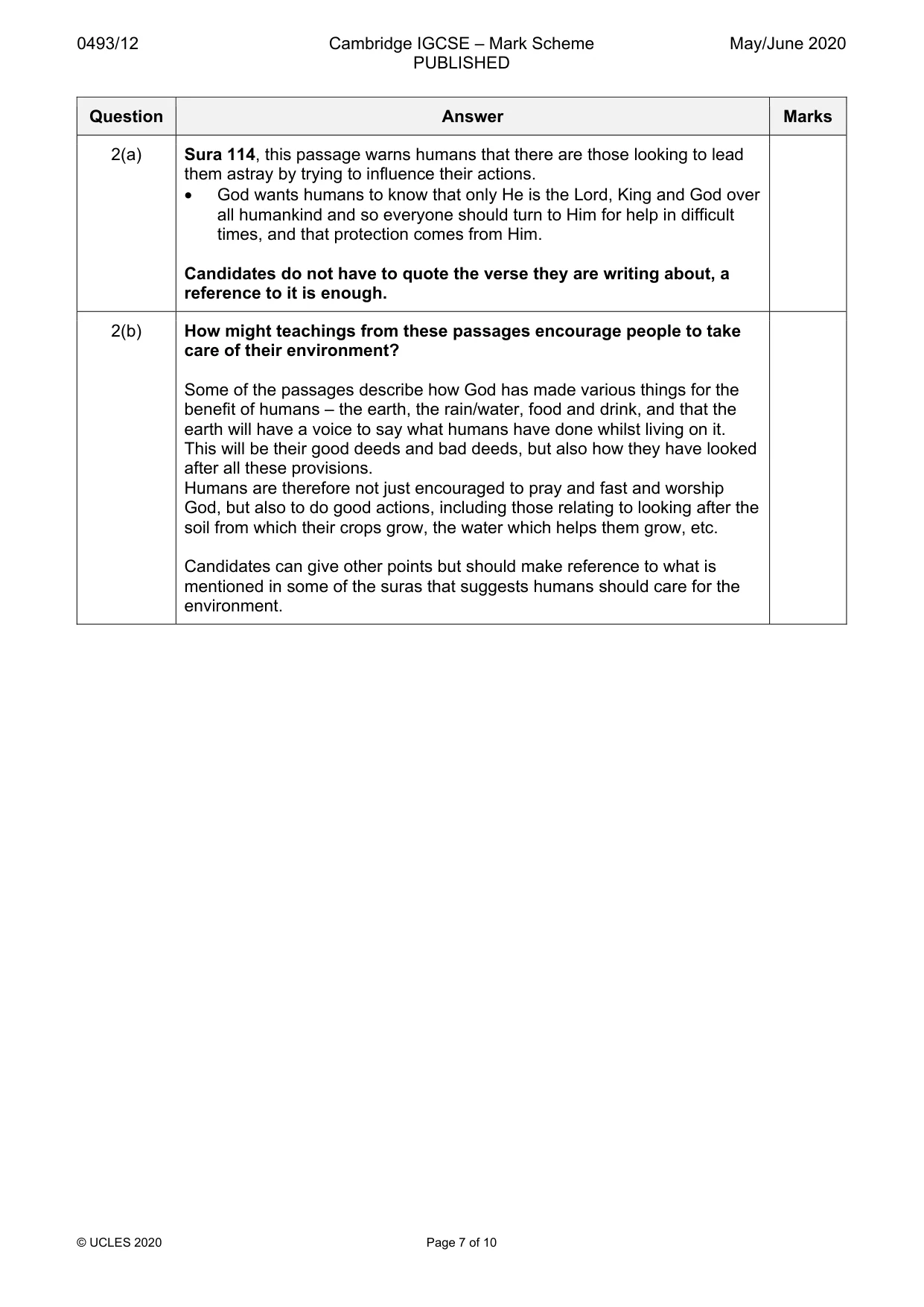
0493/12 Cambridge IGCSE – Mark Scheme PUBLISHED May/June 2020 © UCLES 2020 Page 7 of 10 Question Answer Marks 2(a) Sura 114, this passage warns humans that there are those looking to lead them astray by trying to influence their actions. • God wants humans to know that only He is the Lord, King and God over all humankind and so everyone should turn to Him for help in difficult times, and that protection comes from Him. Candidates do not have to quote the verse they are writing about, a reference to it is enough. 2(b) How might teachings from these passages encourage people to take care of their environment? Some of the passages describe how God has made various things for the benefit of humans – the earth, the rain/water, food and drink, and that the earth will have a voice to say what humans have done whilst living on it. This will be their good deeds and bad deeds, but also how they have looked after all these provisions. Humans are therefore not just encouraged to pray and fast and worship God, but also to do good actions, including those relating to looking after the soil from which their crops grow, the water which helps them grow, etc. Candidates can give other points but should make reference to what is mentioned in some of the suras that suggests humans should care for the environment.
Mark scheme, page 8
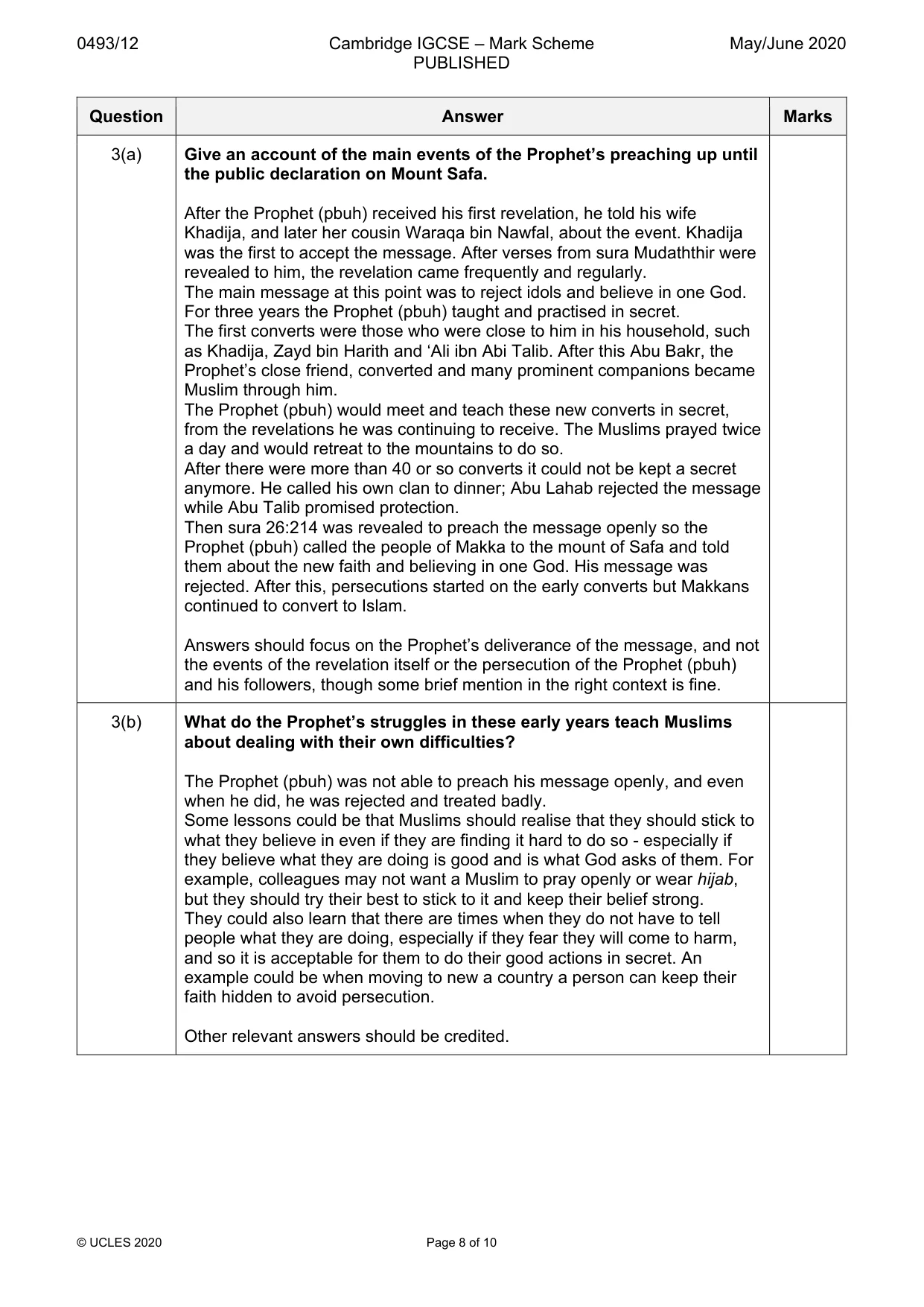
0493/12 Cambridge IGCSE – Mark Scheme PUBLISHED May/June 2020 © UCLES 2020 Page 8 of 10 Question Answer Marks 3(a) Give an account of the main events of the Prophet’s preaching up until the public declaration on Mount Safa. After the Prophet (pbuh) received his first revelation, he told his wife Khadija, and later her cousin Waraqa bin Nawfal, about the event. Khadija was the first to accept the message. After verses from sura Mudaththir were revealed to him, the revelation came frequently and regularly. The main message at this point was to reject idols and believe in one God. For three years the Prophet (pbuh) taught and practised in secret. The first converts were those who were close to him in his household, such as Khadija, Zayd bin Harith and ‘Ali ibn Abi Talib. After this Abu Bakr, the Prophet’s close friend, converted and many prominent companions became Muslim through him. The Prophet (pbuh) would meet and teach these new converts in secret, from the revelations he was continuing to receive. The Muslims prayed twice a day and would retreat to the mountains to do so. After there were more than 40 or so converts it could not be kept a secret anymore. He called his own clan to dinner; Abu Lahab rejected the message while Abu Talib promised protection. Then sura 26:214 was revealed to preach the message openly so the Prophet (pbuh) called the people of Makka to the mount of Safa and told them about the new faith and believing in one God. His message was rejected. After this, persecutions started on the early converts but Makkans continued to convert to Islam. Answers should focus on the Prophet’s deliverance of the message, and not the events of the revelation itself or the persecution of the Prophet (pbuh) and his followers, though some brief mention in the right context is fine. 3(b) What do the Prophet’s struggles in these early years teach Muslims about dealing with their own difficulties? The Prophet (pbuh) was not able to preach his message openly, and even when he did, he was rejected and treated badly. Some lessons could be that Muslims should realise that they should stick to what they believe in even if they are finding it hard to do so - especially if they believe what they are doing is good and is what God asks of them. For example, colleagues may not want a Muslim to pray openly or wear hijab, but they should try their best to stick to it and keep their belief strong. They could also learn that there are times when they do not have to tell people what they are doing, especially if they fear they will come to harm, and so it is acceptable for them to do their good actions in secret. An example could be when moving to new a country a person can keep their faith hidden to avoid persecution. Other relevant answers should be credited.
Mark scheme, page 9
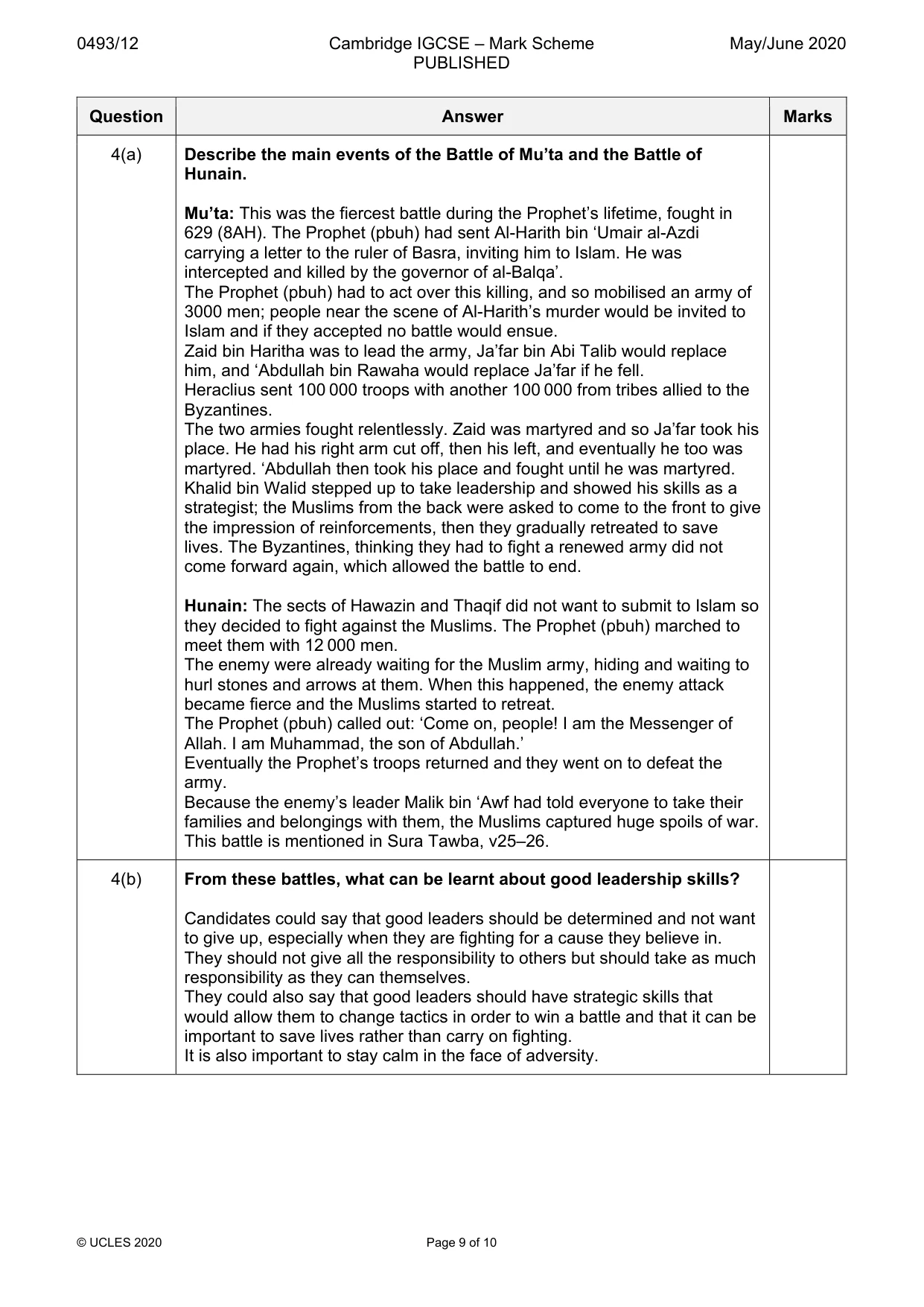
0493/12 Cambridge IGCSE – Mark Scheme PUBLISHED May/June 2020 © UCLES 2020 Page 9 of 10 Question Answer Marks 4(a) Describe the main events of the Battle of Mu’ta and the Battle of Hunain. Mu’ta: This was the fiercest battle during the Prophet’s lifetime, fought in 629 (8AH). The Prophet (pbuh) had sent Al-Harith bin ‘Umair al-Azdi carrying a letter to the ruler of Basra, inviting him to Islam. He was intercepted and killed by the governor of al-Balqa’. The Prophet (pbuh) had to act over this killing, and so mobilised an army of 3000 men; people near the scene of Al-Harith’s murder would be invited to Islam and if they accepted no battle would ensue. Zaid bin Haritha was to lead the army, Ja’far bin Abi Talib would replace him, and ‘Abdullah bin Rawaha would replace Ja’far if he fell. Heraclius sent 100 000 troops with another 100 000 from tribes allied to the Byzantines. The two armies fought relentlessly. Zaid was martyred and so Ja’far took his place. He had his right arm cut off, then his left, and eventually he too was martyred. ‘Abdullah then took his place and fought until he was martyred. Khalid bin Walid stepped up to take leadership and showed his skills as a strategist; the Muslims from the back were asked to come to the front to give the impression of reinforcements, then they gradually retreated to save lives. The Byzantines, thinking they had to fight a renewed army did not come forward again, which allowed the battle to end. Hunain: The sects of Hawazin and Thaqif did not want to submit to Islam so they decided to fight against the Muslims. The Prophet (pbuh) marched to meet them with 12 000 men. The enemy were already waiting for the Muslim army, hiding and waiting to hurl stones and arrows at them. When this happened, the enemy attack became fierce and the Muslims started to retreat. The Prophet (pbuh) called out: ‘Come on, people! I am the Messenger of Allah. I am Muhammad, the son of Abdullah.’ Eventually the Prophet’s troops returned and they went on to defeat the army. Because the enemy’s leader Malik bin ‘Awf had told everyone to take their families and belongings with them, the Muslims captured huge spoils of war. This battle is mentioned in Sura Tawba, v25–26. 4(b) From these battles, what can be learnt about good leadership skills? Candidates could say that good leaders should be determined and not want to give up, especially when they are fighting for a cause they believe in. They should not give all the responsibility to others but should take as much responsibility as they can themselves. They could also say that good leaders should have strategic skills that would allow them to change tactics in order to win a battle and that it can be important to save lives rather than carry on fighting. It is also important to stay calm in the face of adversity.
Mark scheme, page 10
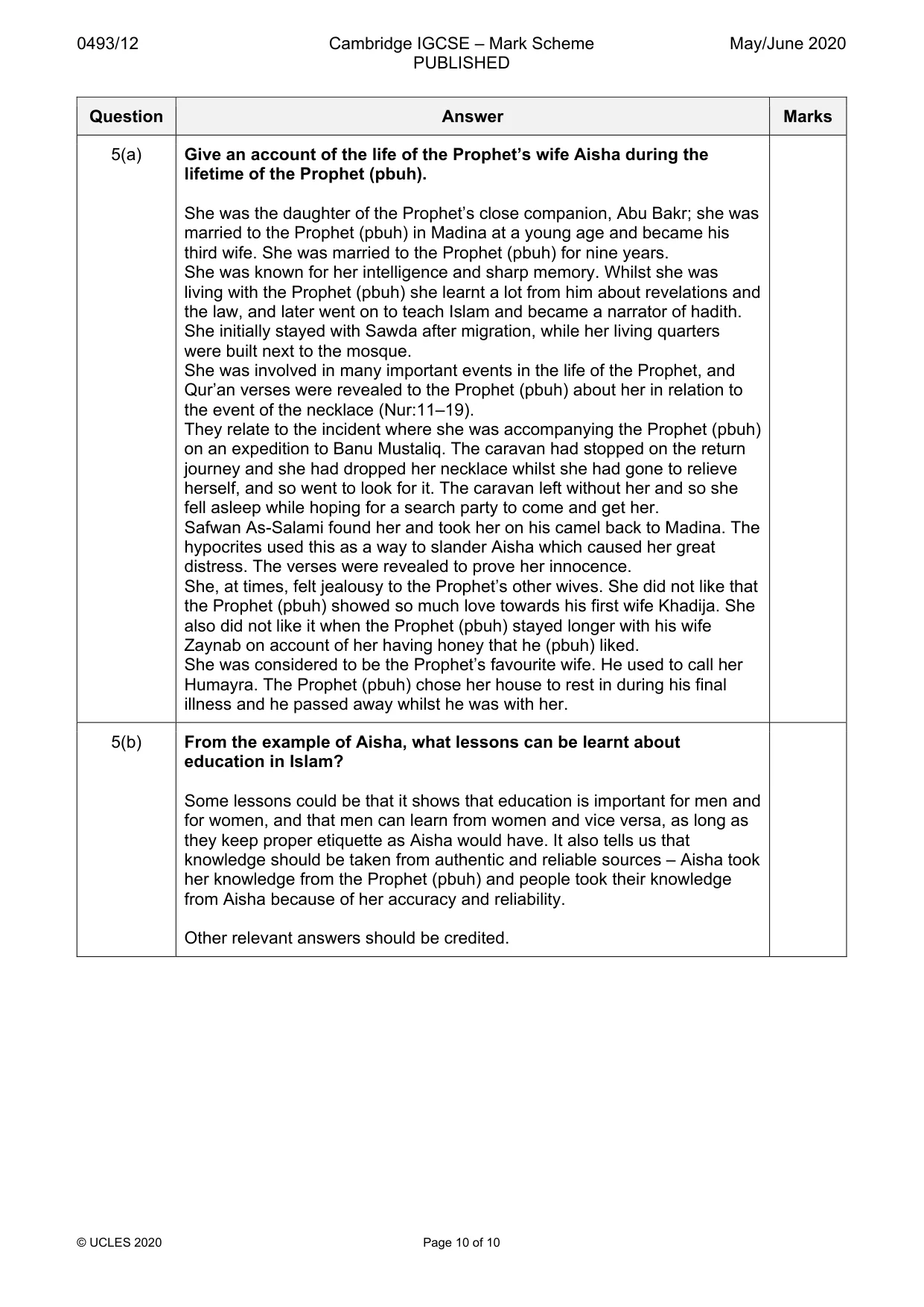
0493/12 Cambridge IGCSE – Mark Scheme PUBLISHED May/June 2020 © UCLES 2020 Page 10 of 10 Question Answer Marks 5(a) Give an account of the life of the Prophet’s wife Aisha during the lifetime of the Prophet (pbuh). She was the daughter of the Prophet’s close companion, Abu Bakr; she was married to the Prophet (pbuh) in Madina at a young age and became his third wife. She was married to the Prophet (pbuh) for nine years. She was known for her intelligence and sharp memory. Whilst she was living with the Prophet (pbuh) she learnt a lot from him about revelations and the law, and later went on to teach Islam and became a narrator of hadith. She initially stayed with Sawda after migration, while her living quarters were built next to the mosque. She was involved in many important events in the life of the Prophet, and Qur’an verses were revealed to the Prophet (pbuh) about her in relation to the event of the necklace (Nur:11–19). They relate to the incident where she was accompanying the Prophet (pbuh) on an expedition to Banu Mustaliq. The caravan had stopped on the return journey and she had dropped her necklace whilst she had gone to relieve herself, and so went to look for it. The caravan left without her and so she fell asleep while hoping for a search party to come and get her. Safwan As-Salami found her and took her on his camel back to Madina. The hypocrites used this as a way to slander Aisha which caused her great distress. The verses were revealed to prove her innocence. She, at times, felt jealousy to the Prophet’s other wives. She did not like that the Prophet (pbuh) showed so much love towards his first wife Khadija. She also did not like it when the Prophet (pbuh) stayed longer with his wife Zaynab on account of her having honey that he (pbuh) liked. She was considered to be the Prophet’s favourite wife. He used to call her Humayra. The Prophet (pbuh) chose her house to rest in during his final illness and he passed away whilst he was with her. 5(b) From the example of Aisha, what lessons can be learnt about education in Islam? Some lessons could be that it shows that education is important for men and for women, and that men can learn from women and vice versa, as long as they keep proper etiquette as Aisha would have. It also tells us that knowledge should be taken from authentic and reliable sources – Aisha took her knowledge from the Prophet (pbuh) and people took their knowledge from Aisha because of her accuracy and reliability. Other relevant answers should be credited.