Cambridge IGCSE Islamiyat 0493 — 2019 Oct/Nov Paper 1 · Variant 2
0493/12/O/N/19 · 50 marks · ≈56 min
The question paper and its mark scheme, free to read here and free to download. This is Cambridge’s own paper, exactly as it was sat.
Question paper20 pages












Mark scheme11 pages
Answers below. Sit the paper first if you are practising.
Paper as text
Question paper, page 1
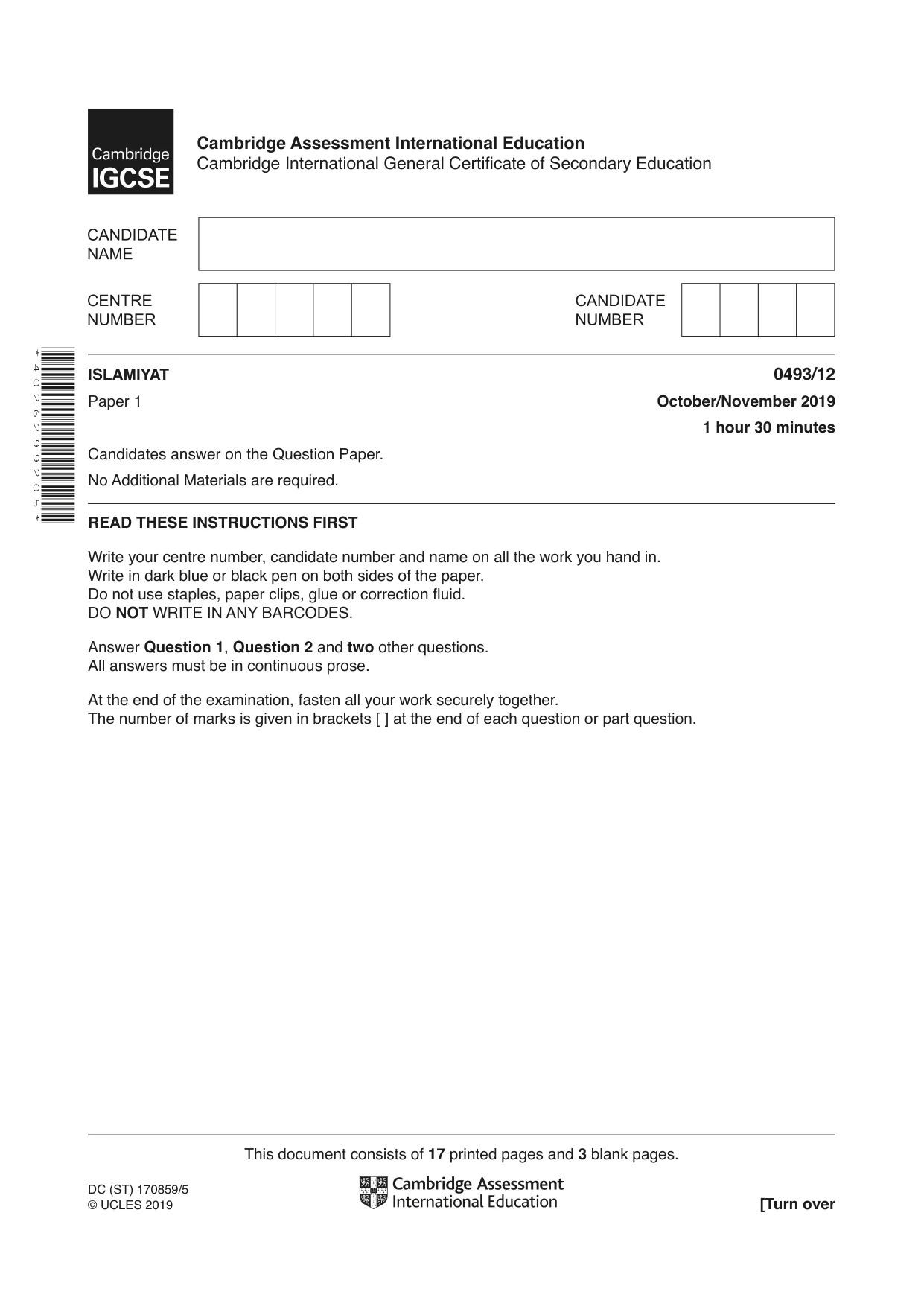
This document consists of 17 printed pages and 3 blank pages. DC (ST) 170859/5 © UCLES 2019 [Turn over * 4 0 2 6 2 9 9 2 0 5 * ISLAMIYAT 0493/12 Paper 1 October/November 2019 1 hour 30 minutes Candidates answer on the Question Paper. No Additional Materials are required. READ THESE INSTRUCTIONS FIRST Write your centre number, candidate number and name on all the work you hand in. Write in dark blue or black pen on both sides of the paper. Do not use staples, paper clips, glue or correction fluid. DO NOT WRITE IN ANY BARCODES. Answer Question 1, Question 2 and two other questions. All answers must be in continuous prose. At the end of the examination, fasten all your work securely together. The number of marks is given in brackets [ ] at the end of each question or part question. Cambridge Assessment International Education Cambridge International General Certificate of Secondary Education
Question paper, page 2
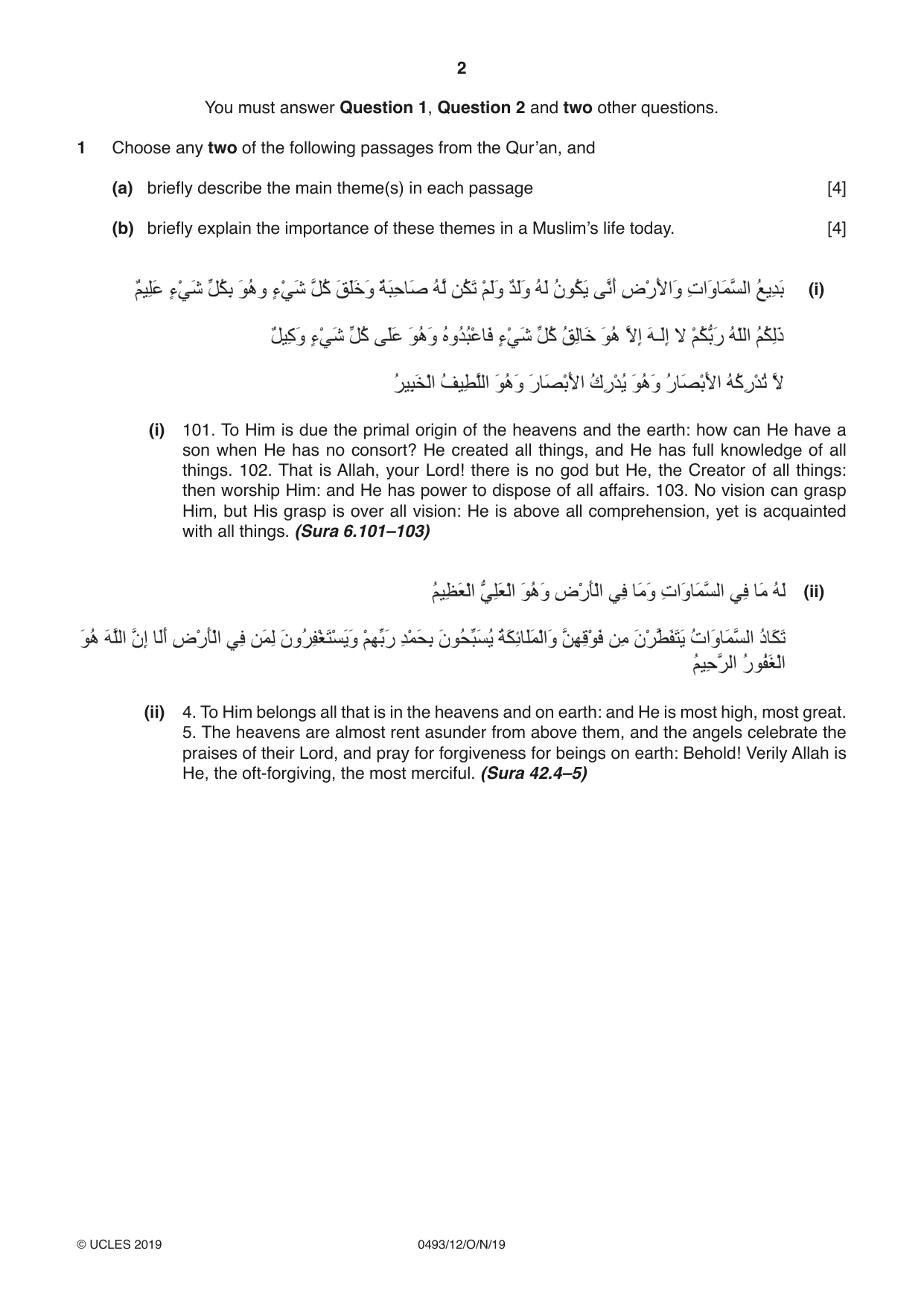
2 0493/12/O/N/19 © UCLES 2019 You must answer Question 1, Question 2 and two other questions. 1 Choose any two of the following passages from the Qur’an, and (a) briefly describe the main theme(s) in each passage [4] (b) briefly explain the importance of these themes in a Muslim’s life today. [4] (i) (i) 101. To Him is due the primal origin of the heavens and the earth: how can He have a son when He has no consort? He created all things, and He has full knowledge of all things. 102. That is Allah, your Lord! there is no god but He, the Creator of all things: then worship Him: and He has power to dispose of all affairs. 103. No vision can grasp Him, but His grasp is over all vision: He is above all comprehension, yet is acquainted with all things. (Sura 6.101–103) (ii) (ii) 4. To Him belongs all that is in the heavens and on earth: and He is most high, most great. 5. The heavens are almost rent asunder from above them, and the angels celebrate the praises of their Lord, and pray for forgiveness for beings on earth: Behold! Verily Allah is He, the oft-forgiving, the most merciful. (Sura 42.4–5)
Question paper, page 3
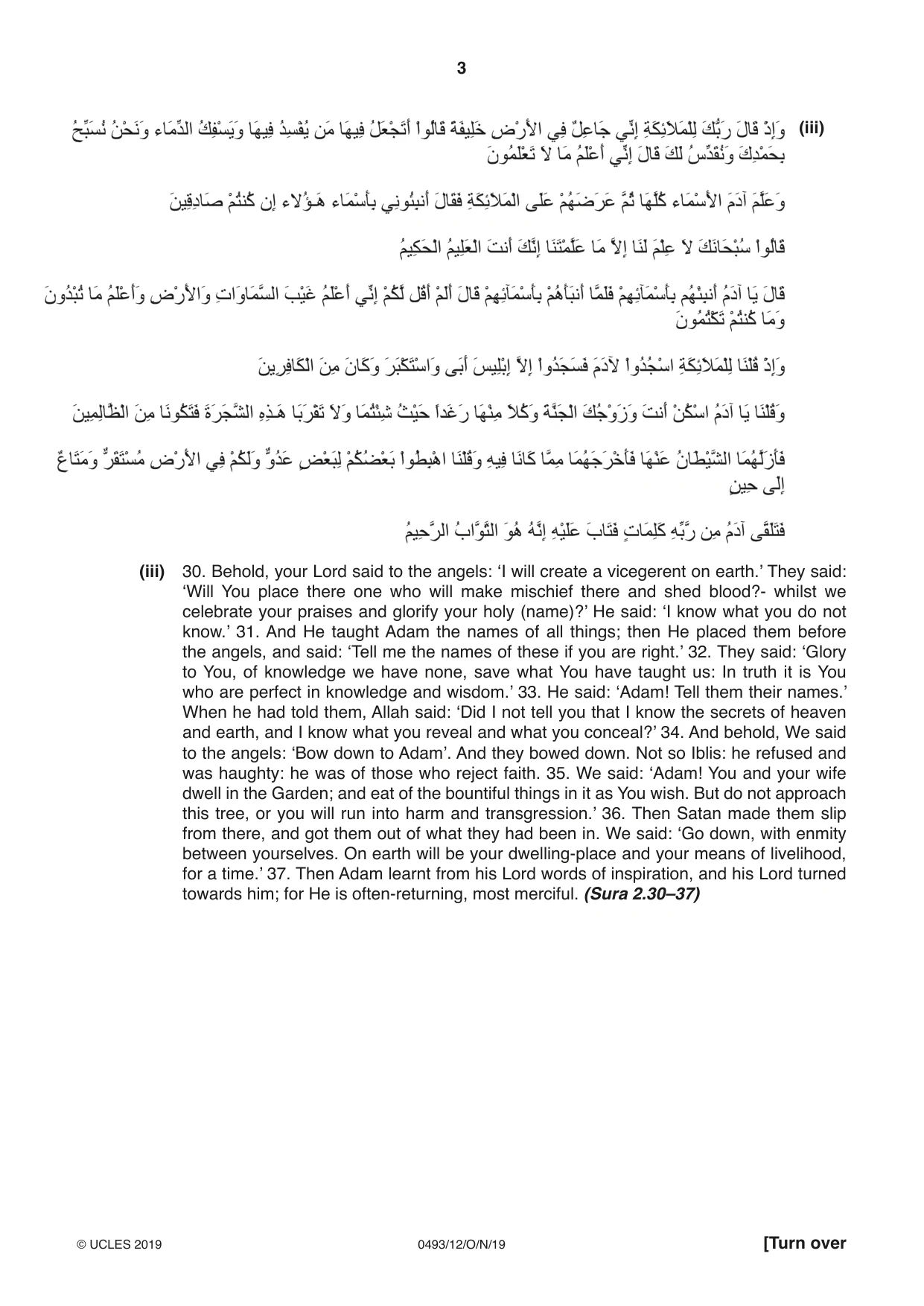
3 0493/12/O/N/19 © UCLES 2019 [Turn over (iii) (iii) 30. Behold, your Lord said to the angels: ‘I will create a vicegerent on earth.’ They said: ‘Will You place there one who will make mischief there and shed blood?- whilst we celebrate your praises and glorify your holy (name)?’ He said: ‘I know what you do not know.’ 31. And He taught Adam the names of all things; then He placed them before the angels, and said: ‘Tell me the names of these if you are right.’ 32. They said: ‘Glory to You, of knowledge we have none, save what You have taught us: In truth it is You who are perfect in knowledge and wisdom.’ 33. He said: ‘Adam! Tell them their names.’ When he had told them, Allah said: ‘Did I not tell you that I know the secrets of heaven and earth, and I know what you reveal and what you conceal?’ 34. And behold, We said to the angels: ‘Bow down to Adam’. And they bowed down. Not so Iblis: he refused and was haughty: he was of those who reject faith. 35. We said: ‘Adam! You and your wife dwell in the Garden; and eat of the bountiful things in it as You wish. But do not approach this tree, or you will run into harm and transgression.’ 36. Then Satan made them slip from there, and got them out of what they had been in. We said: ‘Go down, with enmity between yourselves. On earth will be your dwelling-place and your means of livelihood, for a time.’ 37. Then Adam learnt from his Lord words of inspiration, and his Lord turned towards him; for He is often-returning, most merciful. (Sura 2.30–37)
Question paper, page 4
4 0493/12/O/N/19 © UCLES 2019 … … … … … … … … … … … … … … … … … … … … … … … … … … … …
Question paper, page 5
5 0493/12/O/N/19 © UCLES 2019 [Turn over … … … … … … … … … … … … … … … … … … … … … … … … … … … …
Question paper, page 6
6 0493/12/O/N/19 © UCLES 2019 2 (a) Write about the Prophet Muhammad’s first experience of revelation. [10] (b) The Prophet (pbuh) could not read or write. In what way has this always been significant for Muslims? [4] … … … … … … … … … … … … … … … … … … … … … … … … … …
Question paper, page 7
7 0493/12/O/N/19 © UCLES 2019 [Turn over … … … … … … … … … … … … … … … … … … … … … … … … … … … …
Question paper, page 8
8 0493/12/O/N/19 © UCLES 2019 … … … … … … … … … … … … … … … … … … … … … … … … … … … …
Question paper, page 9
9 0493/12/O/N/19 © UCLES 2019 [Turn over 3 (a) Write about the events related to the signing of the Treaty of Hudaybiyya and the main terms in it. [10] (b) What in your opinion were the benefits, if any, for the Muslims signing the Treaty of Hudaybiyya? [4] … … … … … … … … … … … … … … … … … … … … … … … … … …
Question paper, page 10
10 0493/12/O/N/19 © UCLES 2019 … … … … … … … … … … … … … … … … … … … … … … … … … … … …
Question paper, page 11
11 0493/12/O/N/19 © UCLES 2019 [Turn over … … … … … … … … … … … … … … … … … … … … … … … … … … … …
Question paper, page 12
12 0493/12/O/N/19 © UCLES 2019 4 (a) Describe the events of the first battle in Islam, the Battle of Badr. [10] (b) How important was the outcome of this battle for the Prophet (pbuh) and his followers? Give reasons for your answer. [4] … … … … … … … … … … … … … … … … … … … … … … … … … …
Question paper, page 13
13 0493/12/O/N/19 © UCLES 2019 [Turn over … … … … … … … … … … … … … … … … … … … … … … … … … … … …
Question paper, page 14
14 0493/12/O/N/19 © UCLES 2019 … … … … … … … … … … … … … … … … … … … … … … … … … … … …
Question paper, page 15
15 0493/12/O/N/19 © UCLES 2019 [Turn over 5 (a) Write about the lives of ‘Uthman and ‘Ali during the lifetime of the Prophet (pbuh). [10] (b) From ‘Ali’s early life, what lessons can young people learn about their role in the community? [4] … … … … … … … … … … … … … … … … … … … … … … … … … …
Question paper, page 16
16 0493/12/O/N/19 © UCLES 2019 … … … … … … … … … … … … … … … … … … … … … … … … … … … …
Question paper, page 17
17 0493/12/O/N/19 © UCLES 2019 … … … … … … … … … … … … … … … … … … … … … … … … … … … …
Question paper, page 18
18 0493/12/O/N/19 © UCLES 2019 BLANK PAGE
Question paper, page 19
19 0493/12/O/N/19 © UCLES 2019 BLANK PAGE
Question paper, page 20
20 0493/12/O/N/19 © UCLES 2019 Permission to reproduce items where third-party owned material protected by copyright is included has been sought and cleared where possible. Every reasonable effort has been made by the publisher (UCLES) to trace copyright holders, but if any items requiring clearance have unwittingly been included, the publisher will be pleased to make amends at the earliest possible opportunity. To avoid the issue of disclosure of answer-related information to candidates, all copyright acknowledgements are reproduced online in the Cambridge Assessment International Education Copyright Acknowledgements Booklet. This is produced for each series of examinations and is freely available to download at www.cambridgeinternational.org after the live examination series. Cambridge Assessment International Education is part of the Cambridge Assessment Group. Cambridge Assessment is the brand name of the University of Cambridge Local Examinations Syndicate (UCLES), which itself is a department of the University of Cambridge. BLANK PAGE
Mark scheme, page 1
This document consists of 11 printed pages. © UCLES 2019 [Turn over Cambridge Assessment International Education Cambridge International General Certificate of Secondary Education ISLAMIYAT 0493/12 Paper 1 October/November 2019 MARK SCHEME Maximum Mark: 50 Published This mark scheme is published as an aid to teachers and candidates, to indicate the requirements of the examination. It shows the basis on which Examiners were instructed to award marks. It does not indicate the details of the discussions that took place at an Examiners’ meeting before marking began, which would have considered the acceptability of alternative answers. Mark schemes should be read in conjunction with the question paper and the Principal Examiner Report for Teachers. Cambridge International will not enter into discussions about these mark schemes. Cambridge International is publishing the mark schemes for the October/November 2019 series for most Cambridge IGCSE™, Cambridge International A and AS Level components and some Cambridge O Level components.
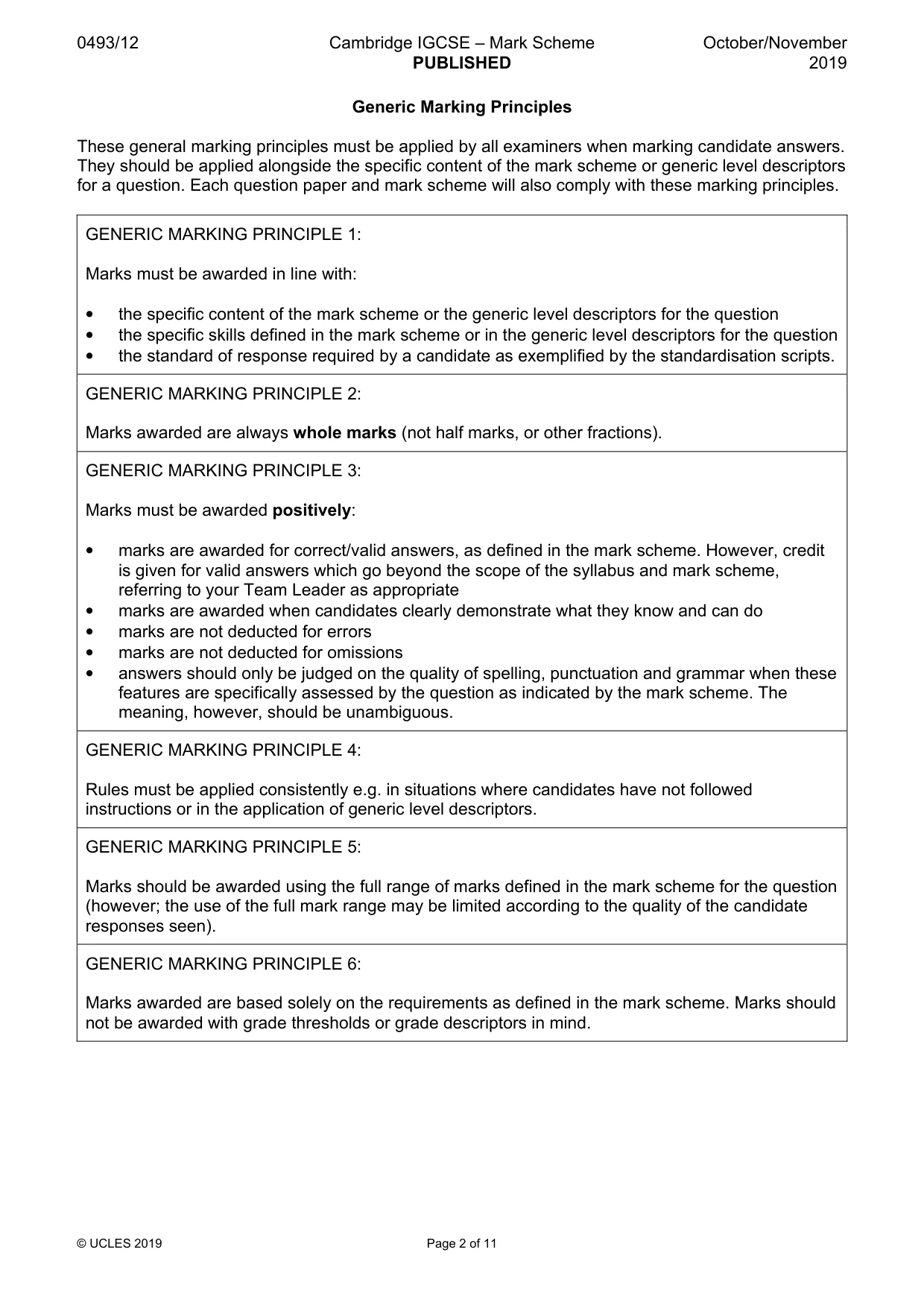
Mark scheme, page 2
0493/12 Cambridge IGCSE – Mark Scheme PUBLISHED October/November 2019 © UCLES 2019 Page 2 of 11 Generic Marking Principles These general marking principles must be applied by all examiners when marking candidate answers. They should be applied alongside the specific content of the mark scheme or generic level descriptors for a question. Each question paper and mark scheme will also comply with these marking principles. GENERIC MARKING PRINCIPLE 1: Marks must be awarded in line with: • the specific content of the mark scheme or the generic level descriptors for the question • the specific skills defined in the mark scheme or in the generic level descriptors for the question • the standard of response required by a candidate as exemplified by the standardisation scripts. GENERIC MARKING PRINCIPLE 2: Marks awarded are always whole marks (not half marks, or other fractions). GENERIC MARKING PRINCIPLE 3: Marks must be awarded positively: • marks are awarded for correct/valid answers, as defined in the mark scheme. However, credit is given for valid answers which go beyond the scope of the syllabus and mark scheme, referring to your Team Leader as appropriate • marks are awarded when candidates clearly demonstrate what they know and can do • marks are not deducted for errors • marks are not deducted for omissions • answers should only be judged on the quality of spelling, punctuation and grammar when these features are specifically assessed by the question as indicated by the mark scheme. The meaning, however, should be unambiguous. GENERIC MARKING PRINCIPLE 4: Rules must be applied consistently e.g. in situations where candidates have not followed instructions or in the application of generic level descriptors. GENERIC MARKING PRINCIPLE 5: Marks should be awarded using the full range of marks defined in the mark scheme for the question (however; the use of the full mark range may be limited according to the quality of the candidate responses seen). GENERIC MARKING PRINCIPLE 6: Marks awarded are based solely on the requirements as defined in the mark scheme. Marks should not be awarded with grade thresholds or grade descriptors in mind.
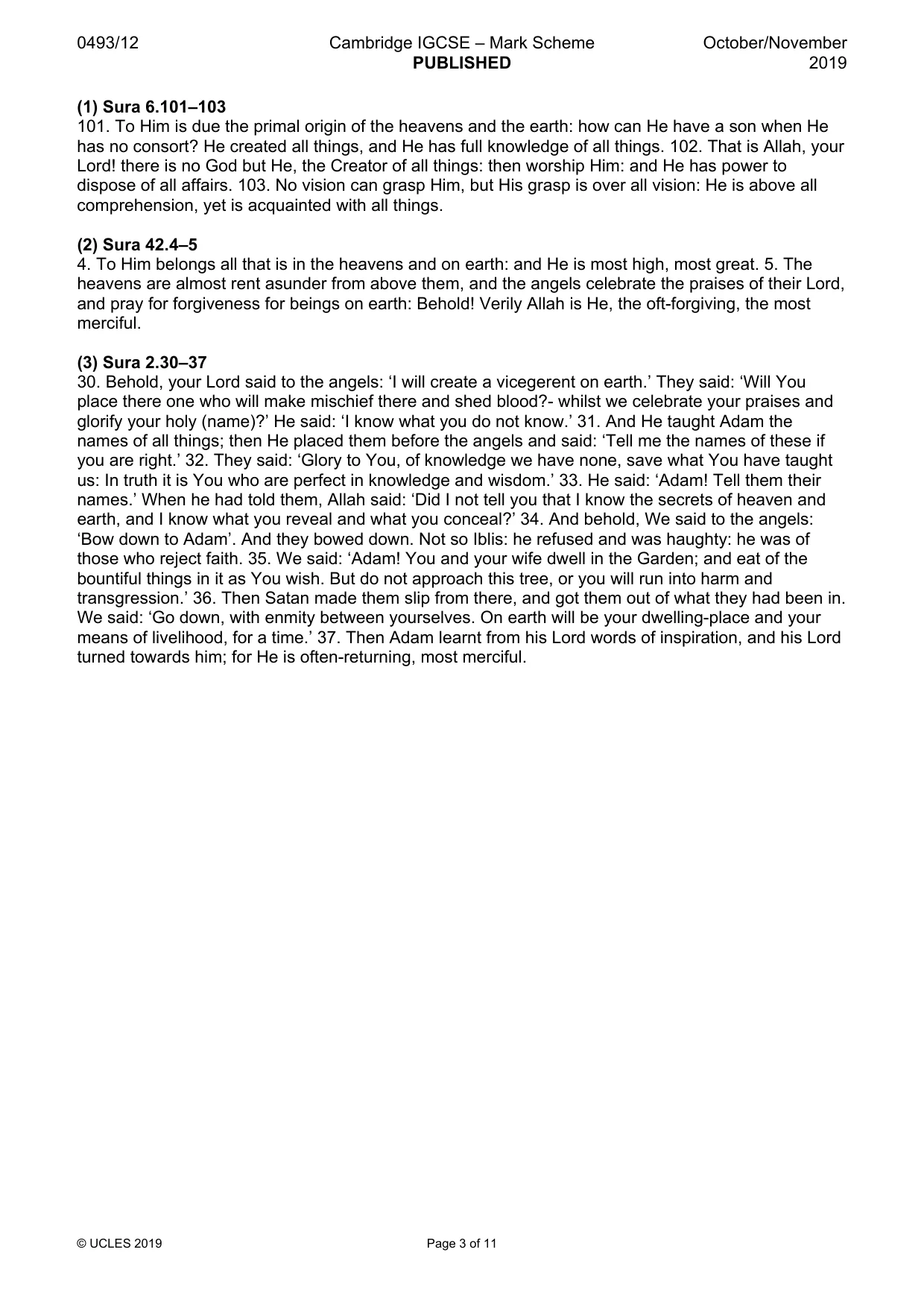
Mark scheme, page 3
0493/12 Cambridge IGCSE – Mark Scheme PUBLISHED October/November 2019 © UCLES 2019 Page 3 of 11 (1) Sura 6.101–103 101. To Him is due the primal origin of the heavens and the earth: how can He have a son when He has no consort? He created all things, and He has full knowledge of all things. 102. That is Allah, your Lord! there is no God but He, the Creator of all things: then worship Him: and He has power to dispose of all affairs. 103. No vision can grasp Him, but His grasp is over all vision: He is above all comprehension, yet is acquainted with all things. (2) Sura 42.4–5 4. To Him belongs all that is in the heavens and on earth: and He is most high, most great. 5. The heavens are almost rent asunder from above them, and the angels celebrate the praises of their Lord, and pray for forgiveness for beings on earth: Behold! Verily Allah is He, the oft-forgiving, the most merciful. (3) Sura 2.30–37 30. Behold, your Lord said to the angels: ‘I will create a vicegerent on earth.’ They said: ‘Will You place there one who will make mischief there and shed blood?- whilst we celebrate your praises and glorify your holy (name)?’ He said: ‘I know what you do not know.’ 31. And He taught Adam the names of all things; then He placed them before the angels and said: ‘Tell me the names of these if you are right.’ 32. They said: ‘Glory to You, of knowledge we have none, save what You have taught us: In truth it is You who are perfect in knowledge and wisdom.’ 33. He said: ‘Adam! Tell them their names.’ When he had told them, Allah said: ‘Did I not tell you that I know the secrets of heaven and earth, and I know what you reveal and what you conceal?’ 34. And behold, We said to the angels: ‘Bow down to Adam’. And they bowed down. Not so Iblis: he refused and was haughty: he was of those who reject faith. 35. We said: ‘Adam! You and your wife dwell in the Garden; and eat of the bountiful things in it as You wish. But do not approach this tree, or you will run into harm and transgression.’ 36. Then Satan made them slip from there, and got them out of what they had been in. We said: ‘Go down, with enmity between yourselves. On earth will be your dwelling-place and your means of livelihood, for a time.’ 37. Then Adam learnt from his Lord words of inspiration, and his Lord turned towards him; for He is often-returning, most merciful.
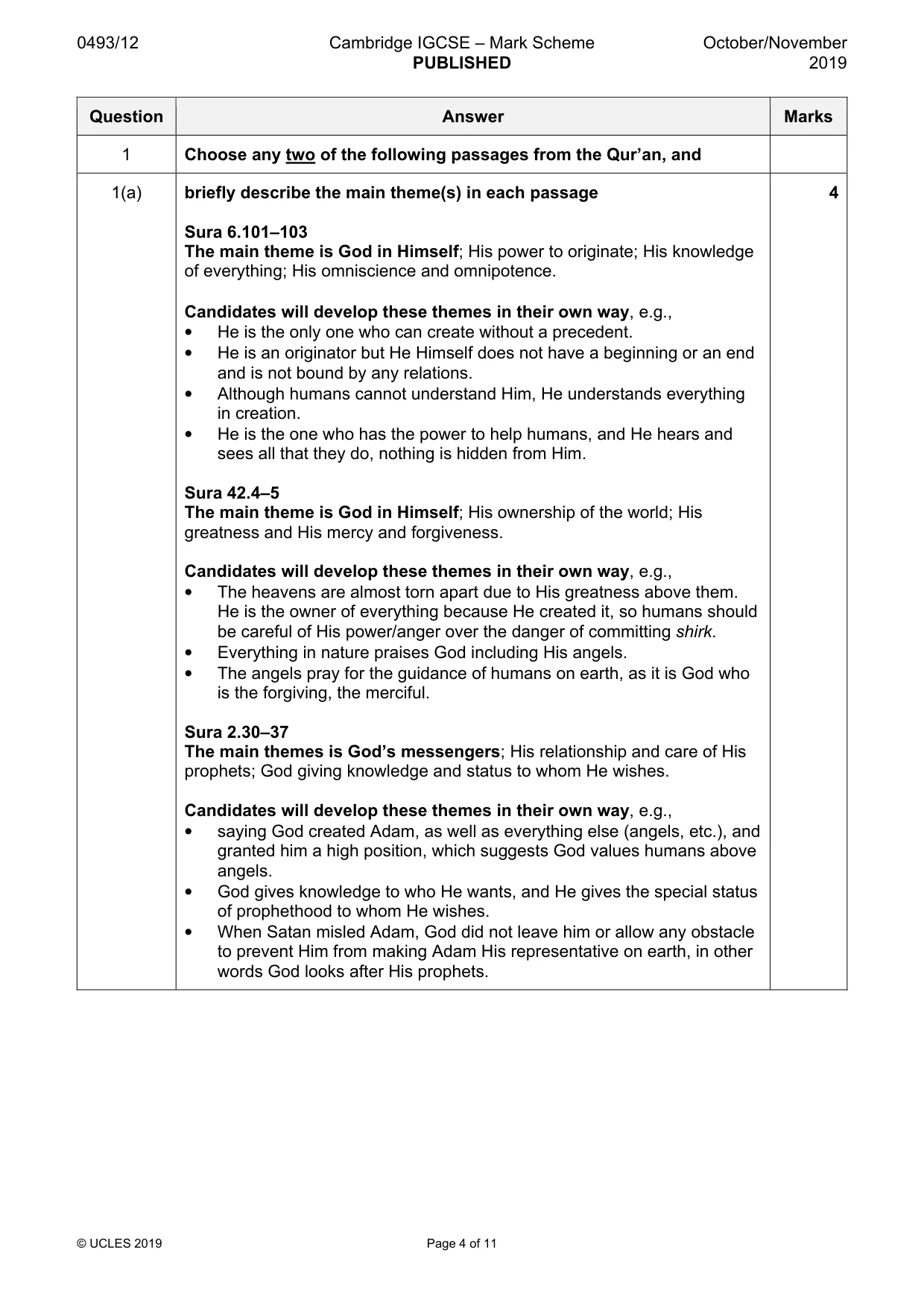
Mark scheme, page 4
0493/12 Cambridge IGCSE – Mark Scheme PUBLISHED October/November 2019 © UCLES 2019 Page 4 of 11 Question Answer Marks 1 Choose any two of the following passages from the Qur’an, and 1(a) briefly describe the main theme(s) in each passage Sura 6.101–103 The main theme is God in Himself; His power to originate; His knowledge of everything; His omniscience and omnipotence. Candidates will develop these themes in their own way, e.g., • He is the only one who can create without a precedent. • He is an originator but He Himself does not have a beginning or an end and is not bound by any relations. • Although humans cannot understand Him, He understands everything in creation. • He is the one who has the power to help humans, and He hears and sees all that they do, nothing is hidden from Him. Sura 42.4–5 The main theme is God in Himself; His ownership of the world; His greatness and His mercy and forgiveness. Candidates will develop these themes in their own way, e.g., • The heavens are almost torn apart due to His greatness above them. He is the owner of everything because He created it, so humans should be careful of His power/anger over the danger of committing shirk. • Everything in nature praises God including His angels. • The angels pray for the guidance of humans on earth, as it is God who is the forgiving, the merciful. Sura 2.30–37 The main themes is God’s messengers; His relationship and care of His prophets; God giving knowledge and status to whom He wishes. Candidates will develop these themes in their own way, e.g., • saying God created Adam, as well as everything else (angels, etc.), and granted him a high position, which suggests God values humans above angels. • God gives knowledge to who He wants, and He gives the special status of prophethood to whom He wishes. • When Satan misled Adam, God did not leave him or allow any obstacle to prevent Him from making Adam His representative on earth, in other words God looks after His prophets. 4
Mark scheme, page 5
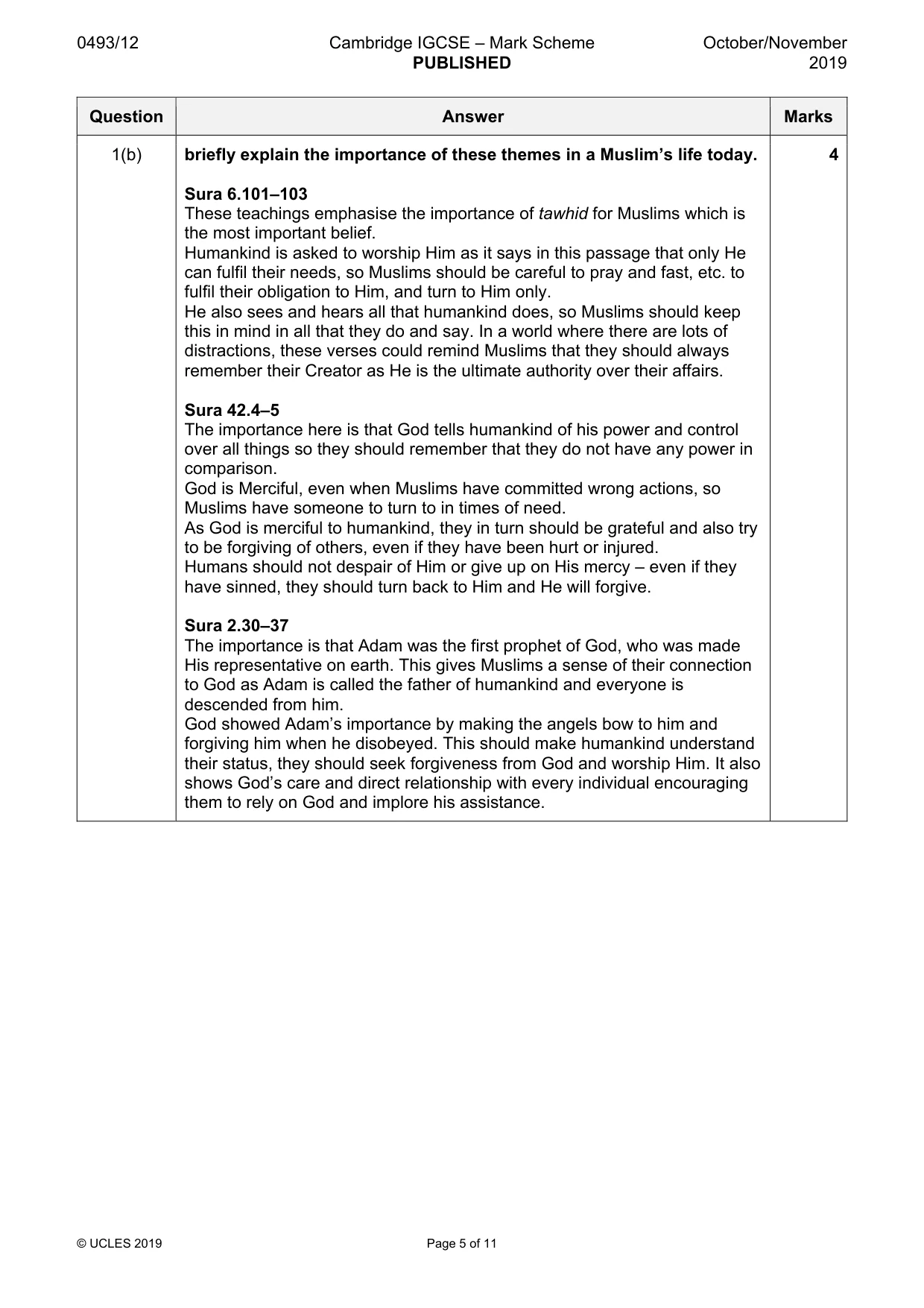
0493/12 Cambridge IGCSE – Mark Scheme PUBLISHED October/November 2019 © UCLES 2019 Page 5 of 11 Question Answer Marks 1(b) briefly explain the importance of these themes in a Muslim’s life today. Sura 6.101–103 These teachings emphasise the importance of tawhid for Muslims which is the most important belief. Humankind is asked to worship Him as it says in this passage that only He can fulfil their needs, so Muslims should be careful to pray and fast, etc. to fulfil their obligation to Him, and turn to Him only. He also sees and hears all that humankind does, so Muslims should keep this in mind in all that they do and say. In a world where there are lots of distractions, these verses could remind Muslims that they should always remember their Creator as He is the ultimate authority over their affairs. Sura 42.4–5 The importance here is that God tells humankind of his power and control over all things so they should remember that they do not have any power in comparison. God is Merciful, even when Muslims have committed wrong actions, so Muslims have someone to turn to in times of need. As God is merciful to humankind, they in turn should be grateful and also try to be forgiving of others, even if they have been hurt or injured. Humans should not despair of Him or give up on His mercy – even if they have sinned, they should turn back to Him and He will forgive. Sura 2.30–37 The importance is that Adam was the first prophet of God, who was made His representative on earth. This gives Muslims a sense of their connection to God as Adam is called the father of humankind and everyone is descended from him. God showed Adam’s importance by making the angels bow to him and forgiving him when he disobeyed. This should make humankind understand their status, they should seek forgiveness from God and worship Him. It also shows God’s care and direct relationship with every individual encouraging them to rely on God and implore his assistance. 4
Mark scheme, page 6
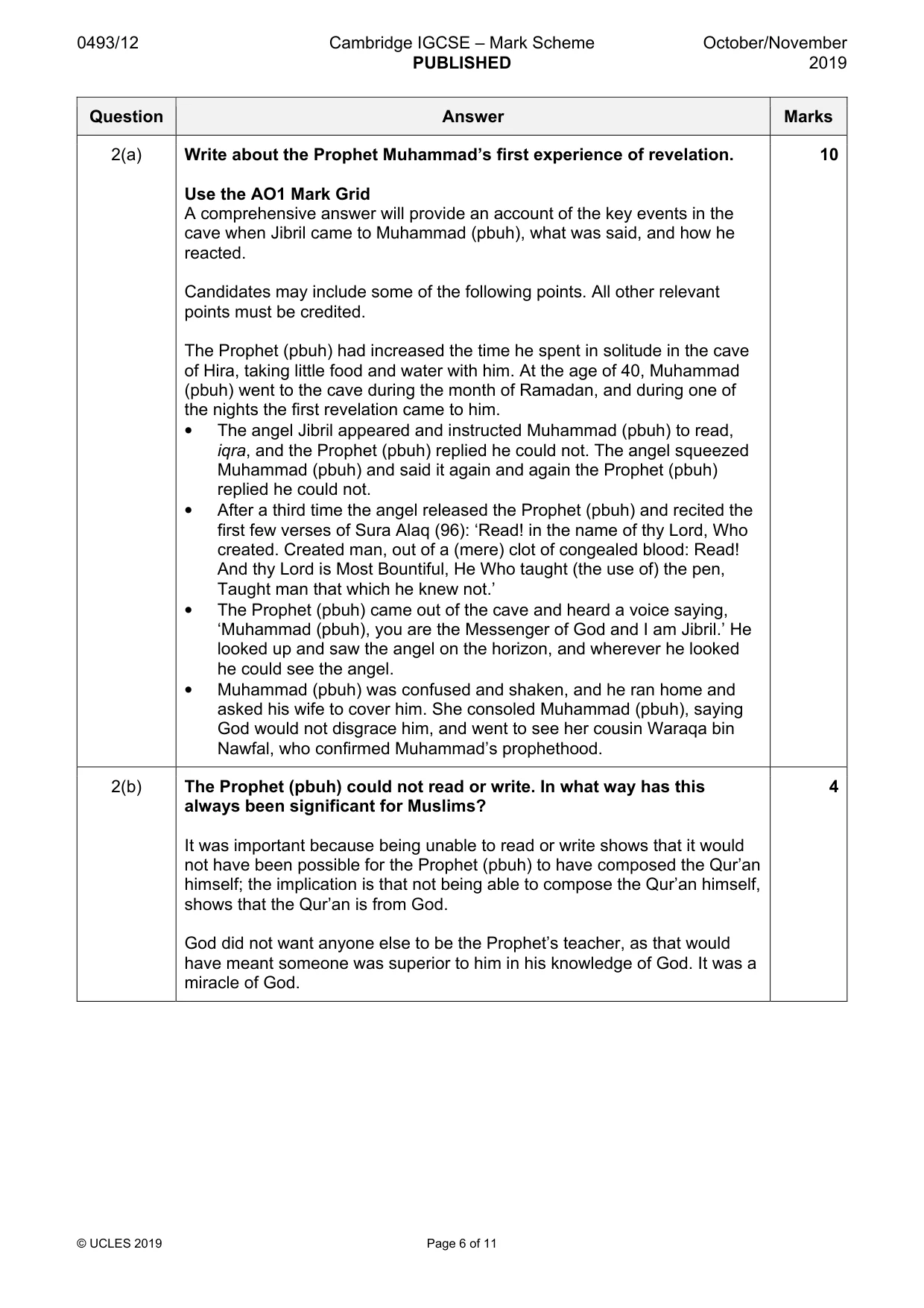
0493/12 Cambridge IGCSE – Mark Scheme PUBLISHED October/November 2019 © UCLES 2019 Page 6 of 11 Question Answer Marks 2(a) Write about the Prophet Muhammad’s first experience of revelation. Use the AO1 Mark Grid A comprehensive answer will provide an account of the key events in the cave when Jibril came to Muhammad (pbuh), what was said, and how he reacted. Candidates may include some of the following points. All other relevant points must be credited. The Prophet (pbuh) had increased the time he spent in solitude in the cave of Hira, taking little food and water with him. At the age of 40, Muhammad (pbuh) went to the cave during the month of Ramadan, and during one of the nights the first revelation came to him. • The angel Jibril appeared and instructed Muhammad (pbuh) to read, iqra, and the Prophet (pbuh) replied he could not. The angel squeezed Muhammad (pbuh) and said it again and again the Prophet (pbuh) replied he could not. • After a third time the angel released the Prophet (pbuh) and recited the first few verses of Sura Alaq (96): ‘Read! in the name of thy Lord, Who created. Created man, out of a (mere) clot of congealed blood: Read! And thy Lord is Most Bountiful, He Who taught (the use of) the pen, Taught man that which he knew not.’ • The Prophet (pbuh) came out of the cave and heard a voice saying, ‘Muhammad (pbuh), you are the Messenger of God and I am Jibril.’ He looked up and saw the angel on the horizon, and wherever he looked he could see the angel. • Muhammad (pbuh) was confused and shaken, and he ran home and asked his wife to cover him. She consoled Muhammad (pbuh), saying God would not disgrace him, and went to see her cousin Waraqa bin Nawfal, who confirmed Muhammad’s prophethood. 10 2(b) The Prophet (pbuh) could not read or write. In what way has this always been significant for Muslims? It was important because being unable to read or write shows that it would not have been possible for the Prophet (pbuh) to have composed the Qur’an himself; the implication is that not being able to compose the Qur’an himself, shows that the Qur’an is from God. God did not want anyone else to be the Prophet’s teacher, as that would have meant someone was superior to him in his knowledge of God. It was a miracle of God. 4
Mark scheme, page 7
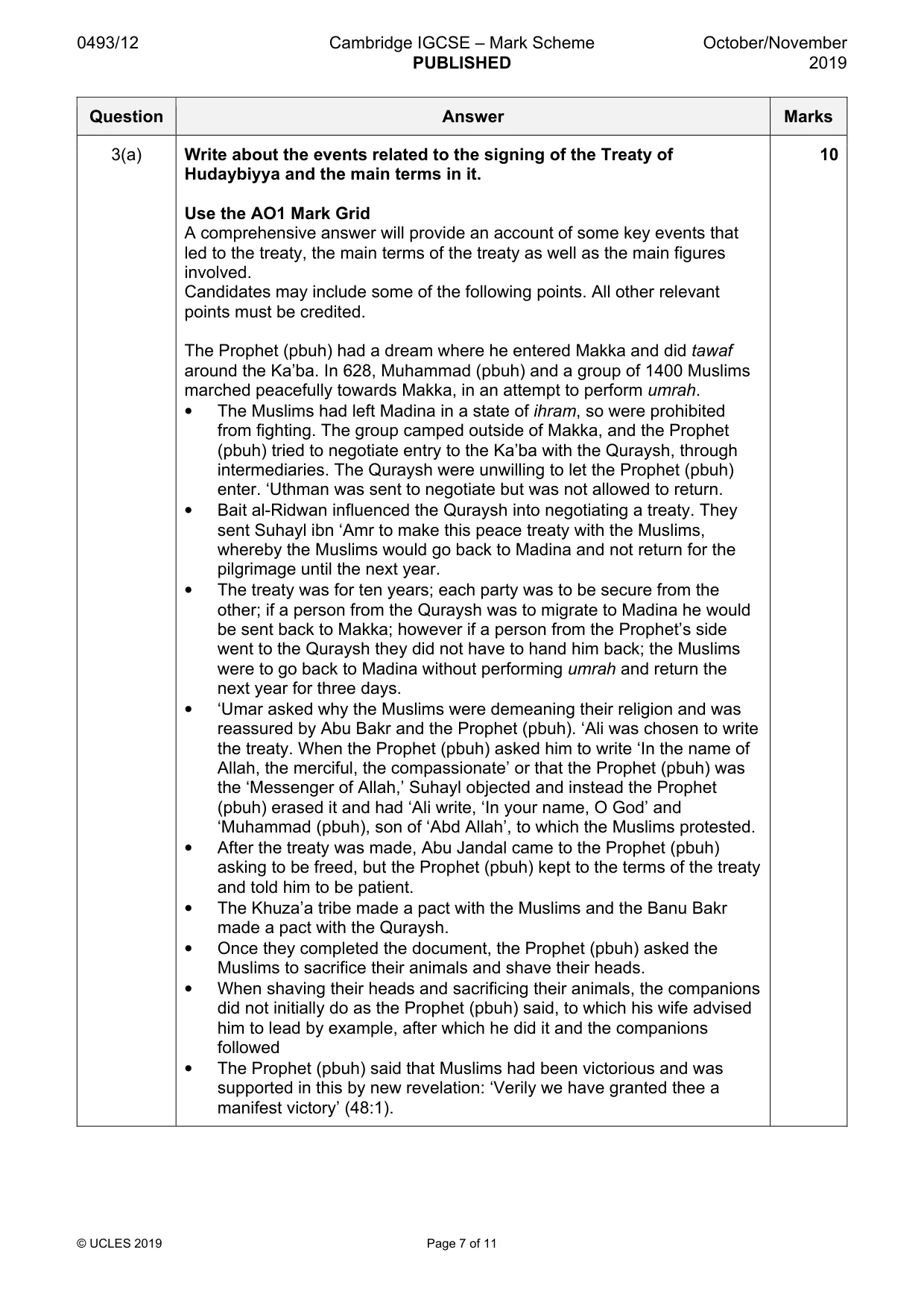
0493/12 Cambridge IGCSE – Mark Scheme PUBLISHED October/November 2019 © UCLES 2019 Page 7 of 11 Question Answer Marks 3(a) Write about the events related to the signing of the Treaty of Hudaybiyya and the main terms in it. Use the AO1 Mark Grid A comprehensive answer will provide an account of some key events that led to the treaty, the main terms of the treaty as well as the main figures involved. Candidates may include some of the following points. All other relevant points must be credited. The Prophet (pbuh) had a dream where he entered Makka and did tawaf around the Ka’ba. In 628, Muhammad (pbuh) and a group of 1400 Muslims marched peacefully towards Makka, in an attempt to perform umrah. • The Muslims had left Madina in a state of ihram, so were prohibited from fighting. The group camped outside of Makka, and the Prophet (pbuh) tried to negotiate entry to the Ka’ba with the Quraysh, through intermediaries. The Quraysh were unwilling to let the Prophet (pbuh) enter. ‘Uthman was sent to negotiate but was not allowed to return. • Bait al-Ridwan influenced the Quraysh into negotiating a treaty. They sent Suhayl ibn ‘Amr to make this peace treaty with the Muslims, whereby the Muslims would go back to Madina and not return for the pilgrimage until the next year. • The treaty was for ten years; each party was to be secure from the other; if a person from the Quraysh was to migrate to Madina he would be sent back to Makka; however if a person from the Prophet’s side went to the Quraysh they did not have to hand him back; the Muslims were to go back to Madina without performing umrah and return the next year for three days. • ‘Umar asked why the Muslims were demeaning their religion and was reassured by Abu Bakr and the Prophet (pbuh). ‘Ali was chosen to write the treaty. When the Prophet (pbuh) asked him to write ‘In the name of Allah, the merciful, the compassionate’ or that the Prophet (pbuh) was the ‘Messenger of Allah,’ Suhayl objected and instead the Prophet (pbuh) erased it and had ‘Ali write, ‘In your name, O God’ and ‘Muhammad (pbuh), son of ‘Abd Allah’, to which the Muslims protested. • After the treaty was made, Abu Jandal came to the Prophet (pbuh) asking to be freed, but the Prophet (pbuh) kept to the terms of the treaty and told him to be patient. • The Khuza’a tribe made a pact with the Muslims and the Banu Bakr made a pact with the Quraysh. • Once they completed the document, the Prophet (pbuh) asked the Muslims to sacrifice their animals and shave their heads. • When shaving their heads and sacrificing their animals, the companions did not initially do as the Prophet (pbuh) said, to which his wife advised him to lead by example, after which he did it and the companions followed • The Prophet (pbuh) said that Muslims had been victorious and was supported in this by new revelation: ‘Verily we have granted thee a manifest victory’ (48:1). 10
Mark scheme, page 8
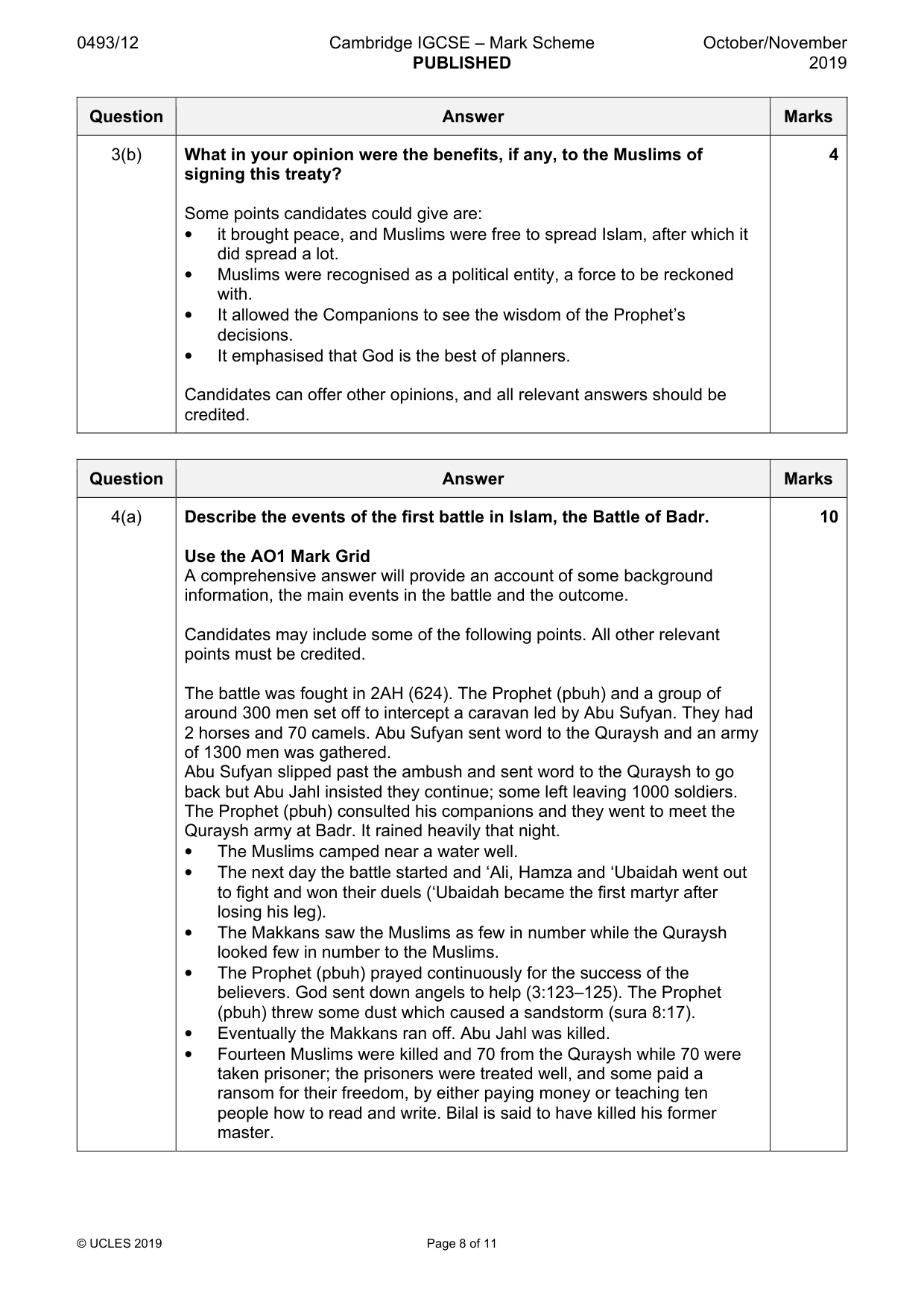
0493/12 Cambridge IGCSE – Mark Scheme PUBLISHED October/November 2019 © UCLES 2019 Page 8 of 11 Question Answer Marks 3(b) What in your opinion were the benefits, if any, to the Muslims of signing this treaty? Some points candidates could give are: • it brought peace, and Muslims were free to spread Islam, after which it did spread a lot. • Muslims were recognised as a political entity, a force to be reckoned with. • It allowed the Companions to see the wisdom of the Prophet’s decisions. • It emphasised that God is the best of planners. Candidates can offer other opinions, and all relevant answers should be credited. 4 Question Answer Marks 4(a) Describe the events of the first battle in Islam, the Battle of Badr. Use the AO1 Mark Grid A comprehensive answer will provide an account of some background information, the main events in the battle and the outcome. Candidates may include some of the following points. All other relevant points must be credited. The battle was fought in 2AH (624). The Prophet (pbuh) and a group of around 300 men set off to intercept a caravan led by Abu Sufyan. They had 2 horses and 70 camels. Abu Sufyan sent word to the Quraysh and an army of 1300 men was gathered. Abu Sufyan slipped past the ambush and sent word to the Quraysh to go back but Abu Jahl insisted they continue; some left leaving 1000 soldiers. The Prophet (pbuh) consulted his companions and they went to meet the Quraysh army at Badr. It rained heavily that night. • The Muslims camped near a water well. • The next day the battle started and ‘Ali, Hamza and ‘Ubaidah went out to fight and won their duels (‘Ubaidah became the first martyr after losing his leg). • The Makkans saw the Muslims as few in number while the Quraysh looked few in number to the Muslims. • The Prophet (pbuh) prayed continuously for the success of the believers. God sent down angels to help (3:123–125). The Prophet (pbuh) threw some dust which caused a sandstorm (sura 8:17). • Eventually the Makkans ran off. Abu Jahl was killed. • Fourteen Muslims were killed and 70 from the Quraysh while 70 were taken prisoner; the prisoners were treated well, and some paid a ransom for their freedom, by either paying money or teaching ten people how to read and write. Bilal is said to have killed his former master. 10
Mark scheme, page 9
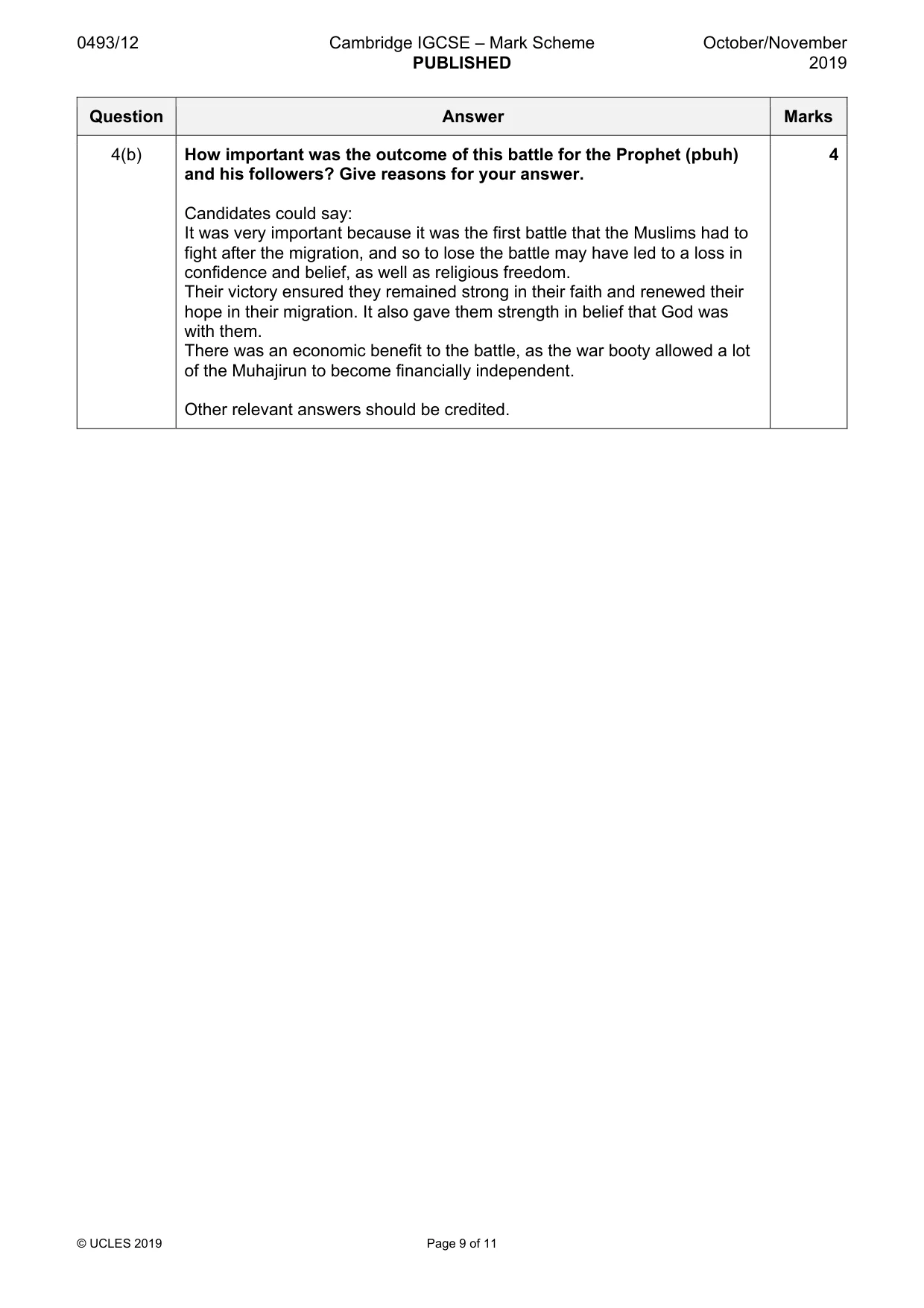
0493/12 Cambridge IGCSE – Mark Scheme PUBLISHED October/November 2019 © UCLES 2019 Page 9 of 11 Question Answer Marks 4(b) How important was the outcome of this battle for the Prophet (pbuh) and his followers? Give reasons for your answer. Candidates could say: It was very important because it was the first battle that the Muslims had to fight after the migration, and so to lose the battle may have led to a loss in confidence and belief, as well as religious freedom. Their victory ensured they remained strong in their faith and renewed their hope in their migration. It also gave them strength in belief that God was with them. There was an economic benefit to the battle, as the war booty allowed a lot of the Muhajirun to become financially independent. Other relevant answers should be credited. 4
Mark scheme, page 10
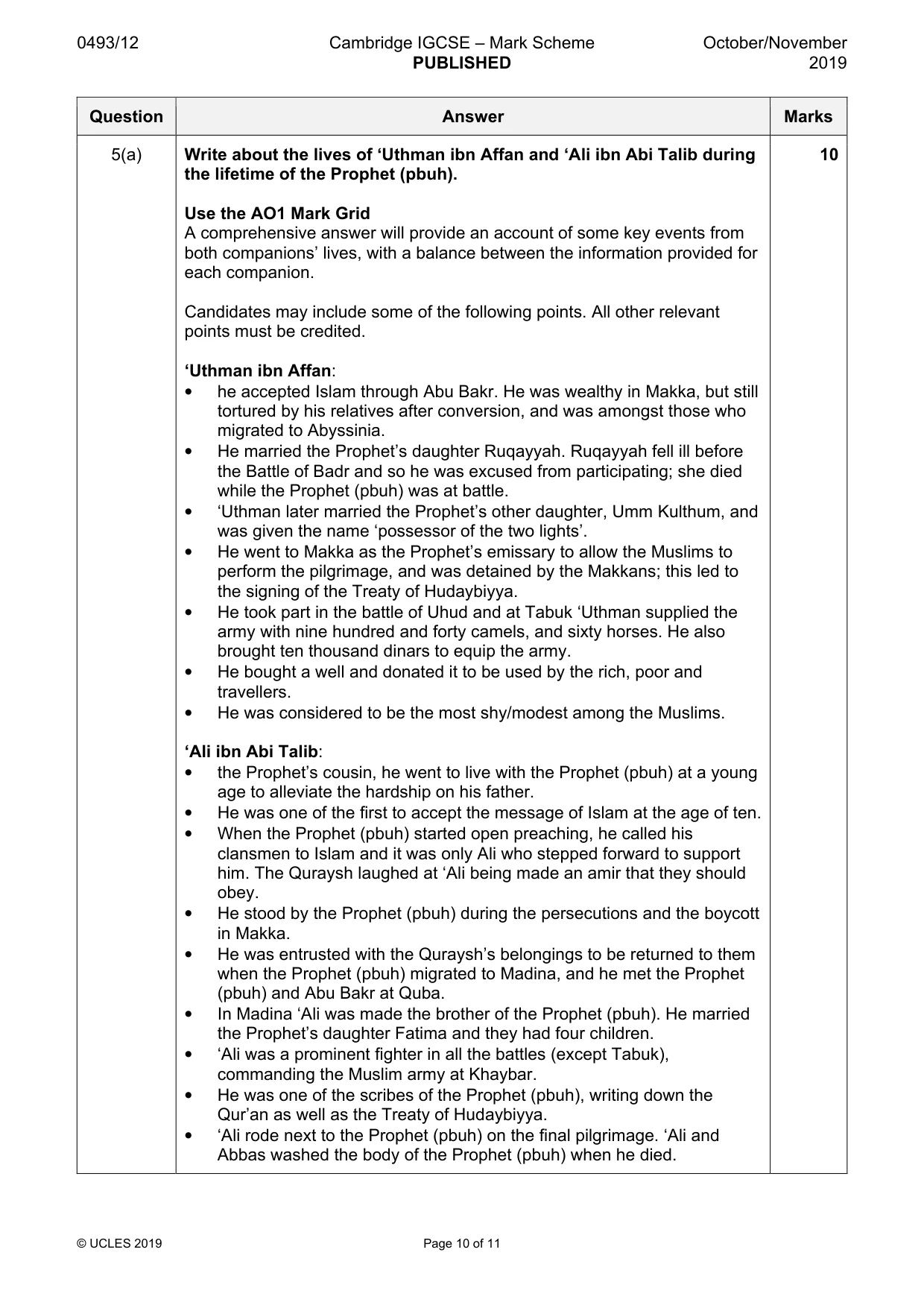
0493/12 Cambridge IGCSE – Mark Scheme PUBLISHED October/November 2019 © UCLES 2019 Page 10 of 11 Question Answer Marks 5(a) Write about the lives of ‘Uthman ibn Affan and ‘Ali ibn Abi Talib during the lifetime of the Prophet (pbuh). Use the AO1 Mark Grid A comprehensive answer will provide an account of some key events from both companions’ lives, with a balance between the information provided for each companion. Candidates may include some of the following points. All other relevant points must be credited. ‘Uthman ibn Affan: • he accepted Islam through Abu Bakr. He was wealthy in Makka, but still tortured by his relatives after conversion, and was amongst those who migrated to Abyssinia. • He married the Prophet’s daughter Ruqayyah. Ruqayyah fell ill before the Battle of Badr and so he was excused from participating; she died while the Prophet (pbuh) was at battle. • ‘Uthman later married the Prophet’s other daughter, Umm Kulthum, and was given the name ‘possessor of the two lights’. • He went to Makka as the Prophet’s emissary to allow the Muslims to perform the pilgrimage, and was detained by the Makkans; this led to the signing of the Treaty of Hudaybiyya. • He took part in the battle of Uhud and at Tabuk ‘Uthman supplied the army with nine hundred and forty camels, and sixty horses. He also brought ten thousand dinars to equip the army. • He bought a well and donated it to be used by the rich, poor and travellers. • He was considered to be the most shy/modest among the Muslims. ‘Ali ibn Abi Talib: • the Prophet’s cousin, he went to live with the Prophet (pbuh) at a young age to alleviate the hardship on his father. • He was one of the first to accept the message of Islam at the age of ten. • When the Prophet (pbuh) started open preaching, he called his clansmen to Islam and it was only Ali who stepped forward to support him. The Quraysh laughed at ‘Ali being made an amir that they should obey. • He stood by the Prophet (pbuh) during the persecutions and the boycott in Makka. • He was entrusted with the Quraysh’s belongings to be returned to them when the Prophet (pbuh) migrated to Madina, and he met the Prophet (pbuh) and Abu Bakr at Quba. • In Madina ‘Ali was made the brother of the Prophet (pbuh). He married the Prophet’s daughter Fatima and they had four children. • ‘Ali was a prominent fighter in all the battles (except Tabuk), commanding the Muslim army at Khaybar. • He was one of the scribes of the Prophet (pbuh), writing down the Qur’an as well as the Treaty of Hudaybiyya. • ‘Ali rode next to the Prophet (pbuh) on the final pilgrimage. ‘Ali and Abbas washed the body of the Prophet (pbuh) when he died. 10
Mark scheme, page 11
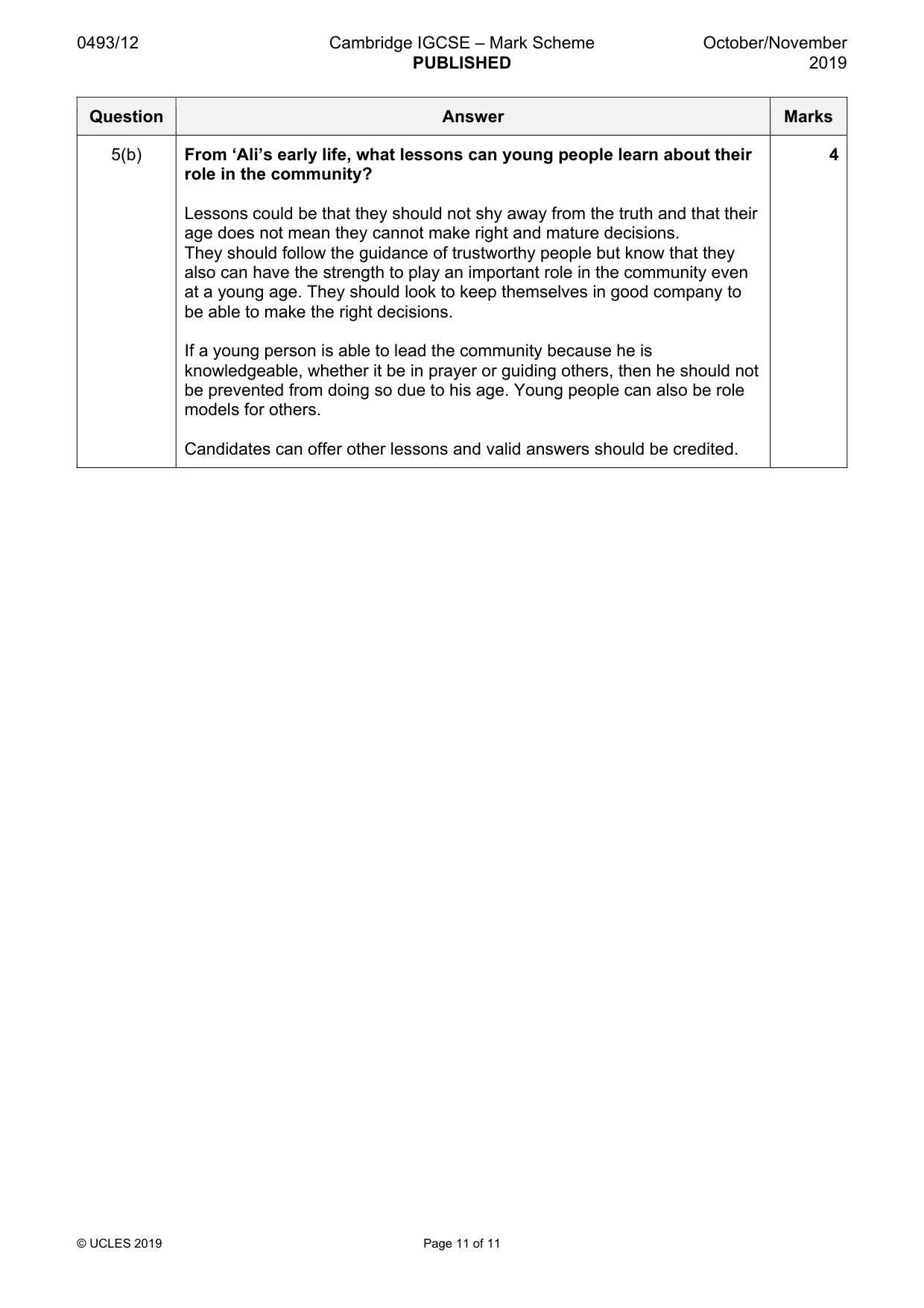
0493/12 Cambridge IGCSE – Mark Scheme PUBLISHED October/November 2019 © UCLES 2019 Page 11 of 11 Question Answer Marks 5(b) From ‘Ali’s early life, what lessons can young people learn about their role in the community? Lessons could be that they should not shy away from the truth and that their age does not mean they cannot make right and mature decisions. They should follow the guidance of trustworthy people but know that they also can have the strength to play an important role in the community even at a young age. They should look to keep themselves in good company to be able to make the right decisions. If a young person is able to lead the community because he is knowledgeable, whether it be in prayer or guiding others, then he should not be prevented from doing so due to his age. Young people can also be role models for others. Candidates can offer other lessons and valid answers should be credited. 4
What you needed in this session
Cambridge’s own grade thresholds for 2019 Oct/Nov, Paper 1 · Variant 2. A higher threshold means an easier paper — the bar moves with how the cohort did.