Cambridge IGCSE Islamiyat 0493 — 2018 Oct/Nov Paper 1 · Variant 2
0493/12/O/N/18 · 50 marks · ≈56 min
The question paper and its mark scheme, free to read here and free to download. This is Cambridge’s own paper, exactly as it was sat.
Question paper16 pages





Mark scheme14 pages
Answers below. Sit the paper first if you are practising.
Paper as text
Question paper, page 1
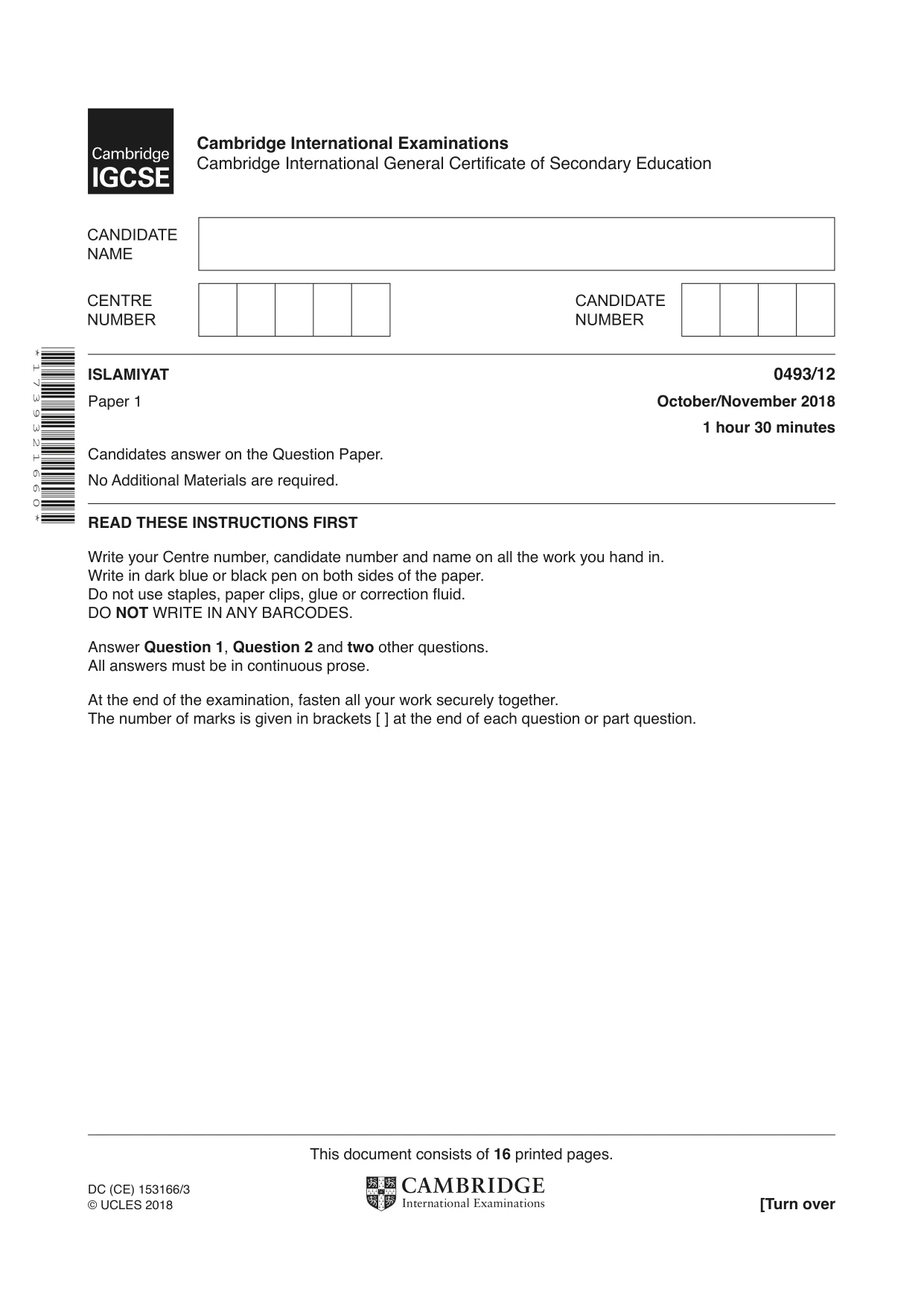
* 1 7 3 9 3 2 1 6 6 0 * This document consists of 16 printed pages. DC (CE) 153166/3 © UCLES 2018 [Turn over Cambridge International Examinations Cambridge International General Certificate of Secondary Education ISLAMIYAT 0493/12 Paper 1 October/November 2018 1 hour 30 minutes Candidates answer on the Question Paper. No Additional Materials are required. READ THESE INSTRUCTIONS FIRST Write your Centre number, candidate number and name on all the work you hand in. Write in dark blue or black pen on both sides of the paper. Do not use staples, paper clips, glue or correction fluid. DO NOT WRITE IN ANY BARCODES. Answer Question 1, Question 2 and two other questions. All answers must be in continuous prose. At the end of the examination, fasten all your work securely together. The number of marks is given in brackets [ ] at the end of each question or part question.
Question paper, page 2
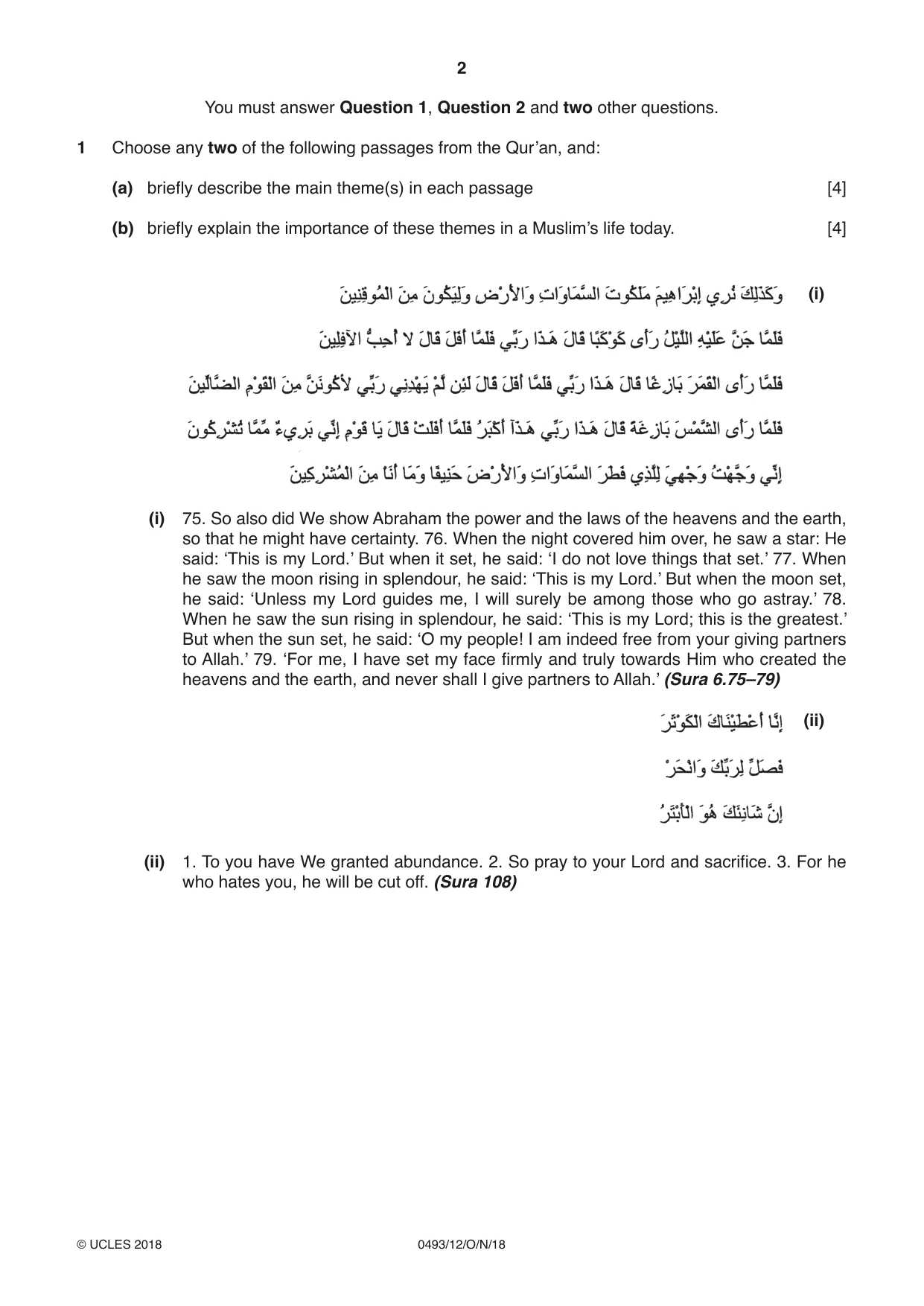
2 0493/12/O/N/18 © UCLES 2018 You must answer Question 1, Question 2 and two other questions. 1 Choose any two of the following passages from the Qur’an, and: (a) briefly describe the main theme(s) in each passage [4] (b) briefly explain the importance of these themes in a Muslim’s life today. [4] (i) (i) 75. So also did We show Abraham the power and the laws of the heavens and the earth, so that he might have certainty. 76. When the night covered him over, he saw a star: He said: ‘This is my Lord.’ But when it set, he said: ‘I do not love things that set.’ 77. When he saw the moon rising in splendour, he said: ‘This is my Lord.’ But when the moon set, he said: ‘Unless my Lord guides me, I will surely be among those who go astray.’ 78. When he saw the sun rising in splendour, he said: ‘This is my Lord; this is the greatest.’ But when the sun set, he said: ‘O my people! I am indeed free from your giving partners to Allah.’ 79. ‘For me, I have set my face firmly and truly towards Him who created the heavens and the earth, and never shall I give partners to Allah.’ (Sura 6.75–79) (ii) (ii) 1. To you have We granted abundance. 2. So pray to your Lord and sacrifice. 3. For he who hates you, he will be cut off. (Sura 108)
Question paper, page 3
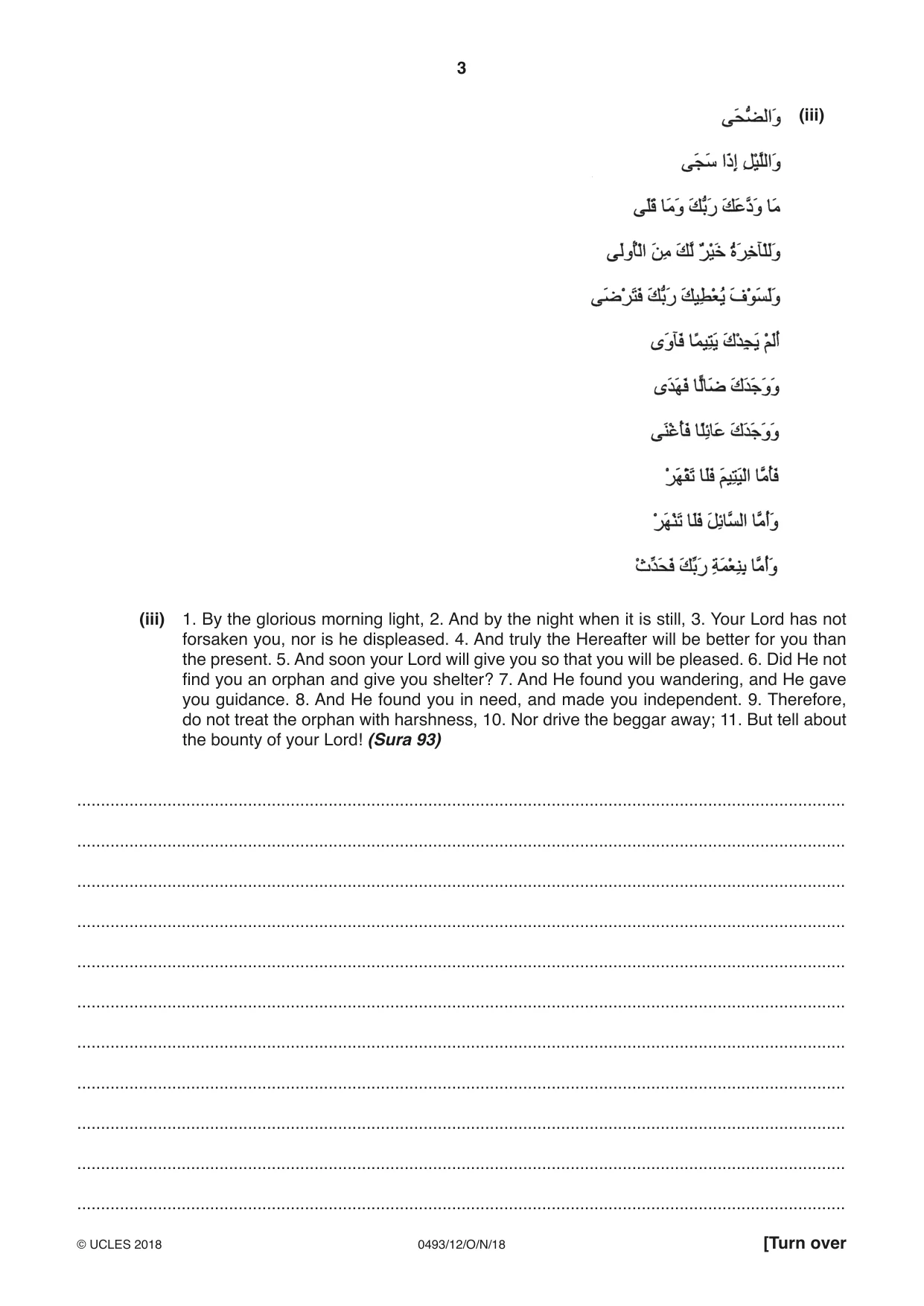
3 0493/12/O/N/18 © UCLES 2018 [Turn over (iii) (iii) 1. By the glorious morning light, 2. And by the night when it is still, 3. Your Lord has not forsaken you, nor is he displeased. 4. And truly the Hereafter will be better for you than the present. 5. And soon your Lord will give you so that you will be pleased. 6. Did He not find you an orphan and give you shelter? 7. And He found you wandering, and He gave you guidance. 8. And He found you in need, and made you independent. 9. Therefore, do not treat the orphan with harshness, 10. Nor drive the beggar away; 11. But tell about the bounty of your Lord! (Sura 93) … … … … … … … … … … …
Question paper, page 4
4 0493/12/O/N/18 © UCLES 2018 … … … … … … … … … … … … … … … … … … … … … … … … … … … …
Question paper, page 5
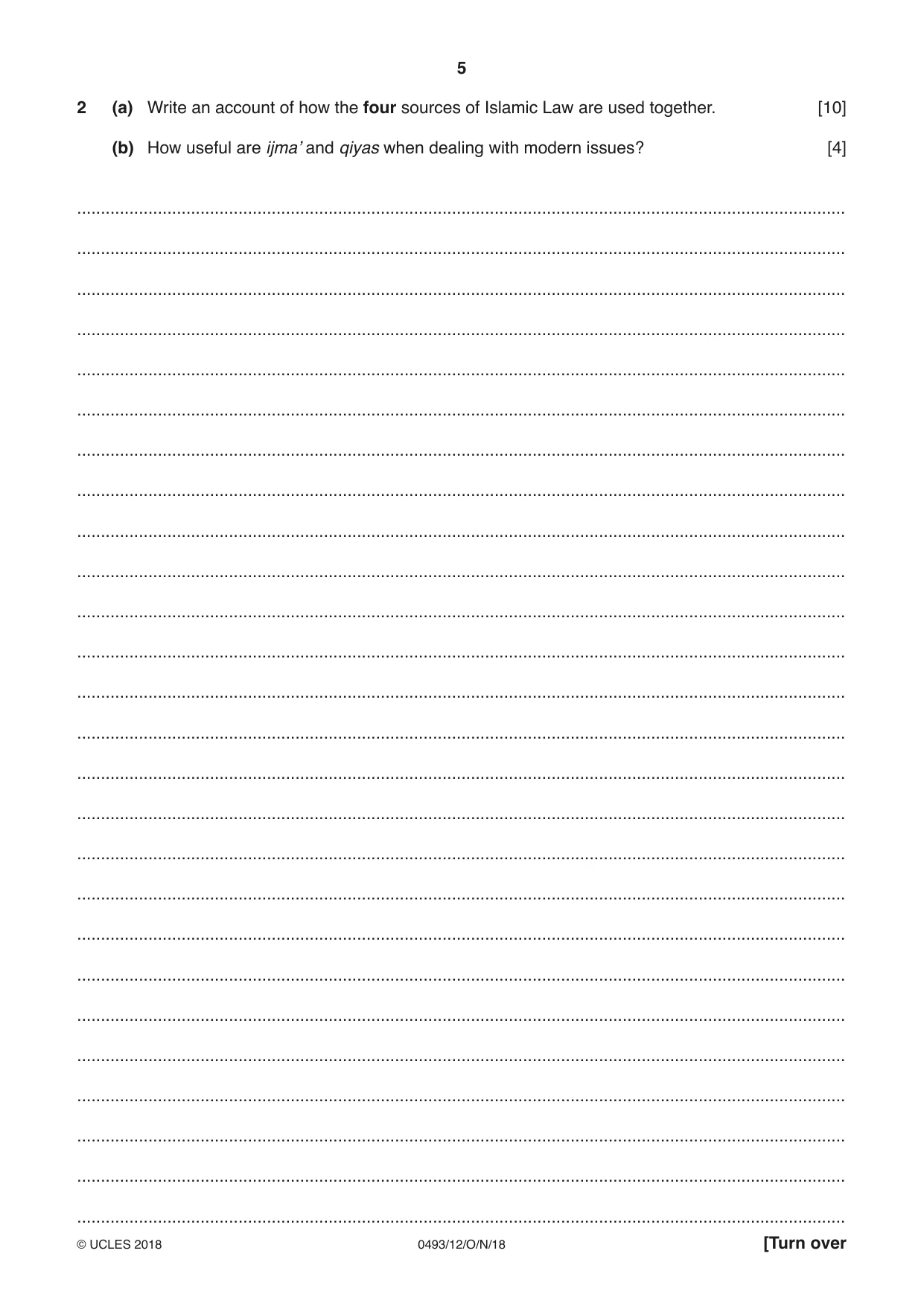
5 0493/12/O/N/18 © UCLES 2018 [Turn over 2 (a) Write an account of how the four sources of Islamic Law are used together. [10] (b) How useful are ijma’ and qiyas when dealing with modern issues? [4] … … … … … … … … … … … … … … … … … … … … … … … … … …
Question paper, page 6
6 0493/12/O/N/18 © UCLES 2018 … … … … … … … … … … … … … … … … … … … … … … … … … … … …
Question paper, page 7
7 0493/12/O/N/18 © UCLES 2018 [Turn over … … … … … … … … … … … … … … … … … … … … … … … … … … … …
Question paper, page 8
8 0493/12/O/N/18 © UCLES 2018 3 (a) Giving at least four examples from his life, write about the ways in which the Prophet Muhammad showed generosity and humility. [10] (b) Giving examples, write about how Muslims can be generous with their neighbours. [4] … … … … … … … … … … … … … … … … … … … … … … … … …
Question paper, page 9
9 0493/12/O/N/18 © UCLES 2018 [Turn over … … … … … … … … … … … … … … … … … … … … … … … … … … … …
Question paper, page 10
10 0493/12/O/N/18 © UCLES 2018 … … … … … … … … … … … … … … … … … … … … … … … … … … … …
Question paper, page 11
11 0493/12/O/N/18 © UCLES 2018 [Turn over 4 (a) The Prophet Muhammad migrated to Madina from Makka. Write about the Ansar and the Muhajirun and the way they helped each other. [10] (b) Using this example, what can Muslims do for those people who have left their homes and come to live amongst them in their communities? [4] … … … … … … … … … … … … … … … … … … … … … … … … …
Question paper, page 12
12 0493/12/O/N/18 © UCLES 2018 … … … … … … … … … … … … … … … … … … … … … … … … … … … …
Question paper, page 13
13 0493/12/O/N/18 © UCLES 2018 [Turn over … … … … … … … … … … … … … … … … … … … … … … … … … … … …
Question paper, page 14
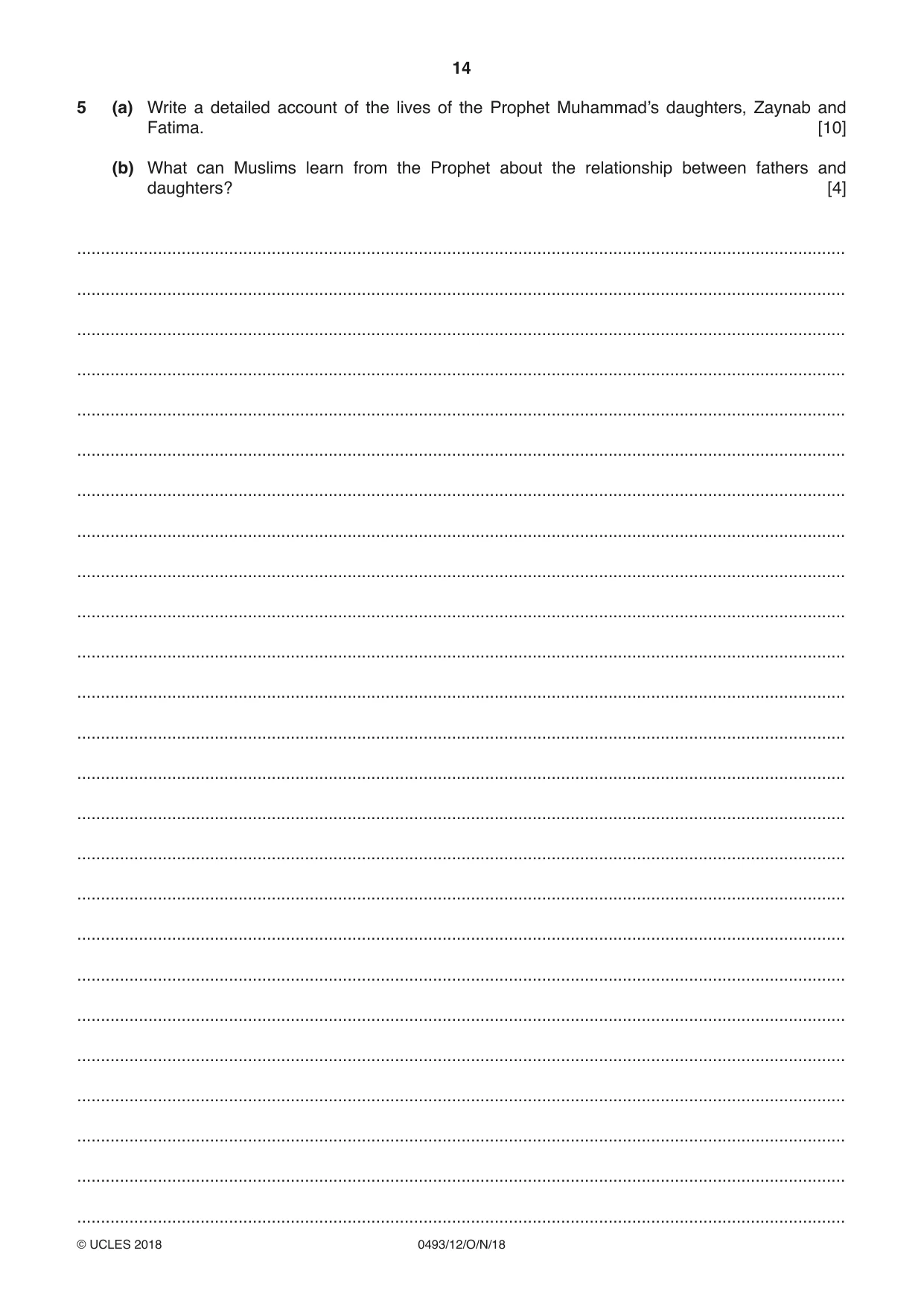
14 0493/12/O/N/18 © UCLES 2018 5 (a) Write a detailed account of the lives of the Prophet Muhammad’s daughters, Zaynab and Fatima. [10] (b) What can Muslims learn from the Prophet about the relationship between fathers and daughters? [4] … … … … … … … … … … … … … … … … … … … … … … … … …
Question paper, page 15
15 0493/12/O/N/18 © UCLES 2018 [Turn over … … … … … … … … … … … … … … … … … … … … … … … … … … … …
Question paper, page 16
16 0493/12/O/N/18 © UCLES 2018 Permission to reproduce items where third-party owned material protected by copyright is included has been sought and cleared where possible. Every reasonable effort has been made by the publisher (UCLES) to trace copyright holders, but if any items requiring clearance have unwittingly been included, the publisher will be pleased to make amends at the earliest possible opportunity. To avoid the issue of disclosure of answer-related information to candidates, all copyright acknowledgements are reproduced online in the Cambridge International Examinations Copyright Acknowledgements Booklet. This is produced for each series of examinations and is freely available to download at www.cie.org.uk after the live examination series. Cambridge International Examinations is part of the Cambridge Assessment Group. Cambridge Assessment is the brand name of University of Cambridge Local Examinations Syndicate (UCLES), which is itself a department of the University of Cambridge. … … … … … … … … … … … … … … … … … … … … … … … …
Mark scheme, page 1
This document consists of 14 printed pages. © UCLES 2018 [Turn over Cambridge Assessment International Education Cambridge International General Certificate of Secondary Education ISLAMIYAT 0493/12 Paper 1 October/November 2018 MARK SCHEME Maximum Mark: 50 Published This mark scheme is published as an aid to teachers and candidates, to indicate the requirements of the examination. It shows the basis on which Examiners were instructed to award marks. It does not indicate the details of the discussions that took place at an Examiners’ meeting before marking began, which would have considered the acceptability of alternative answers. Mark schemes should be read in conjunction with the question paper and the Principal Examiner Report for Teachers. Cambridge International will not enter into discussions about these mark schemes. Cambridge International is publishing the mark schemes for the October/November 2018 series for most Cambridge IGCSE™, Cambridge International A and AS Level components and some Cambridge O Level components.
Mark scheme, page 2
0493/12 Cambridge IGCSE – Mark Scheme PUBLISHED October/November 2018 © UCLES 2018 Page 2 of 14 Generic Marking Principles These general marking principles must be applied by all examiners when marking candidate answers. They should be applied alongside the specific content of the mark scheme or generic level descriptors for a question. Each question paper and mark scheme will also comply with these marking principles. GENERIC MARKING PRINCIPLE 1: Marks must be awarded in line with: • the specific content of the mark scheme or the generic level descriptors for the question • the specific skills defined in the mark scheme or in the generic level descriptors for the question • the standard of response required by a candidate as exemplified by the standardisation scripts. GENERIC MARKING PRINCIPLE 2: Marks awarded are always whole marks (not half marks, or other fractions). GENERIC MARKING PRINCIPLE 3: Marks must be awarded positively: • marks are awarded for correct/valid answers, as defined in the mark scheme. However, credit is given for valid answers which go beyond the scope of the syllabus and mark scheme, referring to your Team Leader as appropriate • marks are awarded when candidates clearly demonstrate what they know and can do • marks are not deducted for errors • marks are not deducted for omissions • answers should only be judged on the quality of spelling, punctuation and grammar when these features are specifically assessed by the question as indicated by the mark scheme. The meaning, however, should be unambiguous. GENERIC MARKING PRINCIPLE 4: Rules must be applied consistently e.g. in situations where candidates have not followed instructions or in the application of generic level descriptors.
Mark scheme, page 3
0493/12 Cambridge IGCSE – Mark Scheme PUBLISHED October/November 2018 © UCLES 2018 Page 3 of 14 GENERIC MARKING PRINCIPLE 5: Marks should be awarded using the full range of marks defined in the mark scheme for the question (however; the use of the full mark range may be limited according to the quality of the candidate responses seen). GENERIC MARKING PRINCIPLE 6: Marks awarded are based solely on the requirements as defined in the mark scheme. Marks should not be awarded with grade thresholds or grade descriptors in mind.
Mark scheme, page 4
0493/12 Cambridge IGCSE – Mark Scheme PUBLISHED October/November 2018 © UCLES 2018 Page 4 of 14 Marking Instructions for IGCSE Islamiyat – 0493 PRINCIPLES UNDERLYING THE MARK SCHEME Candidates are tested on their ability to satisfy two general Assessment Objectives (AOs): AO1 Recall, select and present relevant facts from the main elements of the faith and history of Islam. AO2 Demonstrate understanding of their significance in the teachings of Islam and in the lives of Muslims.
Mark scheme, page 5
0493/12 Cambridge IGCSE – Mark Scheme PUBLISHED October/November 2018 © UCLES 2018 Page 5 of 14 LEVELS OF RESPONSE The statements which follow should be used to determine the appropriate level of response for each objective. It must be assumed that Examiners are capable of answering the questions on the paper and so they can award the appropriate level of response to the candidate. The detailed marking schemes are there as suggestions of what might be found in the answer. Examiners should not check whether the content of the marking schemes is in the answers but rather be guided by the Levels of Response and the concept of Positive Awarding. Checking on what is not in the answer almost always leads to lower marks than are indicated by the Levels of Response. Examiners should use the full range of marks available within the Levels of Response and not hesitate to award the maximum where it is deserved. Examiners must not exceed the total marks allowable for the Level achieved or the total allowable for the part of the question.
Mark scheme, page 6
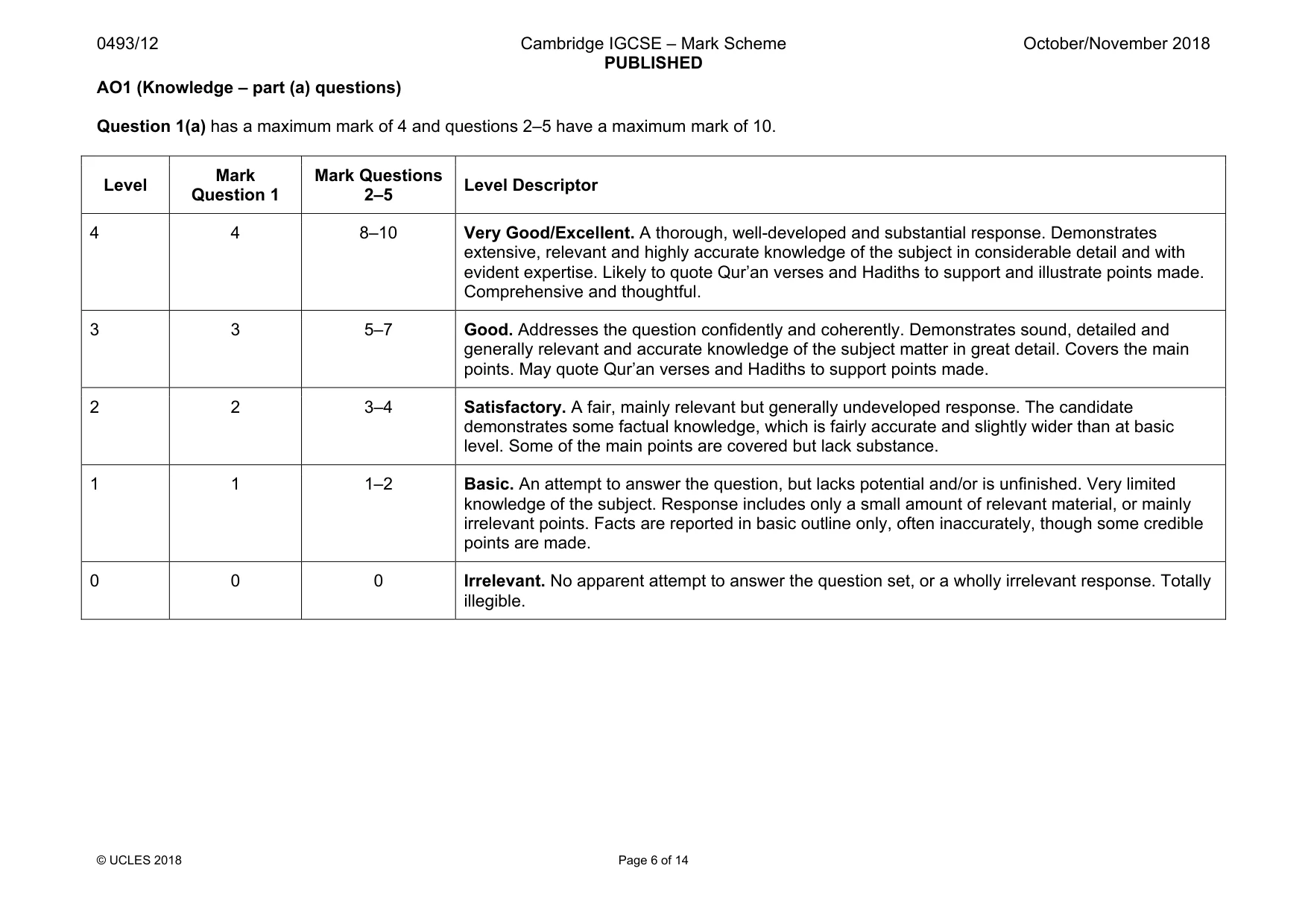
0493/12 Cambridge IGCSE – Mark Scheme PUBLISHED October/November 2018 © UCLES 2018 Page 6 of 14 AO1 (Knowledge – part (a) questions) Question 1(a) has a maximum mark of 4 and questions 2–5 have a maximum mark of 10. Level Mark Question 1 Mark Questions 2–5 Level Descriptor 4 4 8–10 Very Good/Excellent. A thorough, well-developed and substantial response. Demonstrates extensive, relevant and highly accurate knowledge of the subject in considerable detail and with evident expertise. Likely to quote Qur’an verses and Hadiths to support and illustrate points made. Comprehensive and thoughtful. 3 3 5–7 Good. Addresses the question confidently and coherently. Demonstrates sound, detailed and generally relevant and accurate knowledge of the subject matter in great detail. Covers the main points. May quote Qur’an verses and Hadiths to support points made. 2 2 3–4 Satisfactory. A fair, mainly relevant but generally undeveloped response. The candidate demonstrates some factual knowledge, which is fairly accurate and slightly wider than at basic level. Some of the main points are covered but lack substance. 1 1 1–2 Basic. An attempt to answer the question, but lacks potential and/or is unfinished. Very limited knowledge of the subject. Response includes only a small amount of relevant material, or mainly irrelevant points. Facts are reported in basic outline only, often inaccurately, though some credible points are made. 0 0 0 Irrelevant. No apparent attempt to answer the question set, or a wholly irrelevant response. Totally illegible.
Mark scheme, page 7
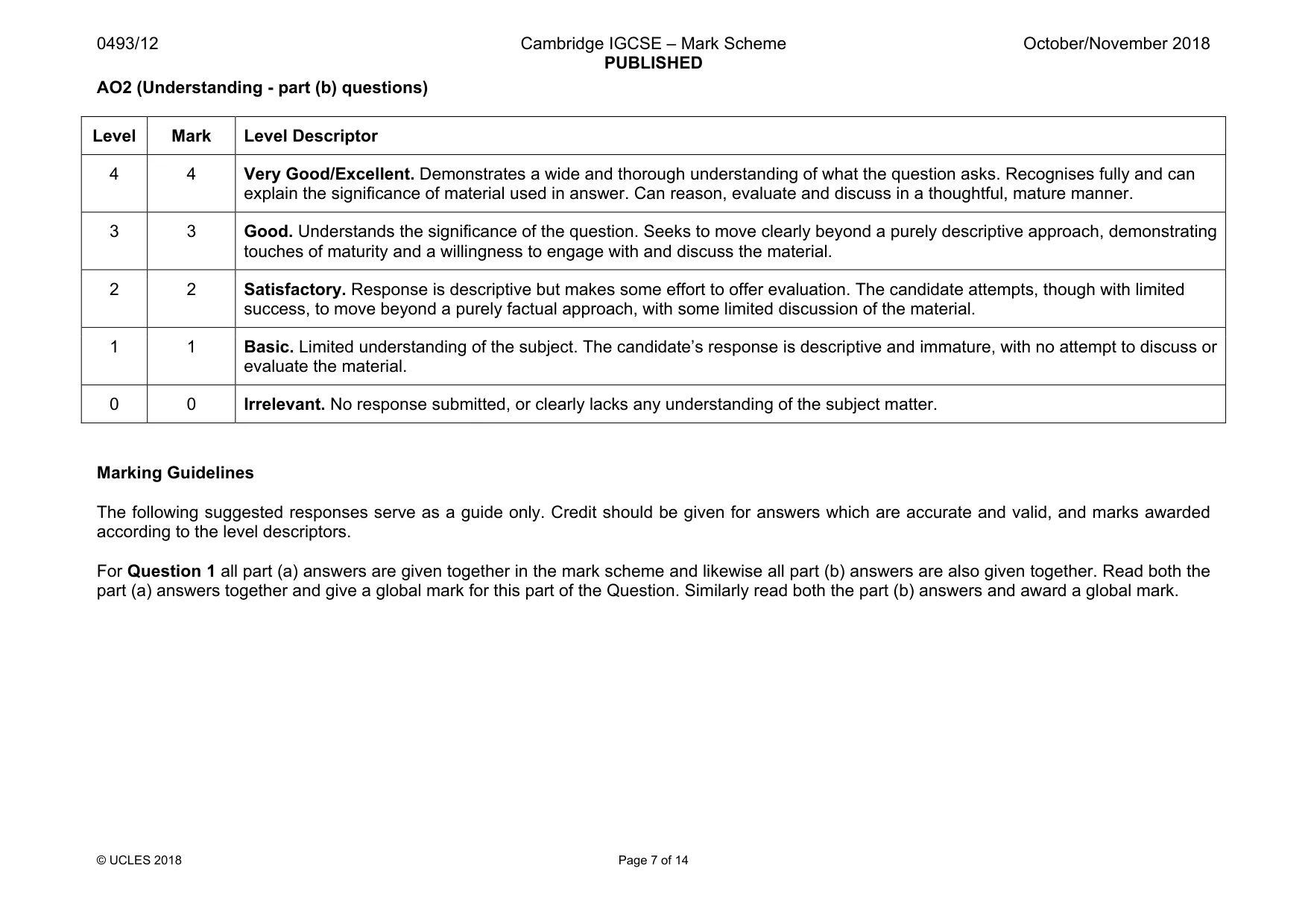
0493/12 Cambridge IGCSE – Mark Scheme PUBLISHED October/November 2018 © UCLES 2018 Page 7 of 14 AO2 (Understanding - part (b) questions) Level Mark Level Descriptor 4 4 Very Good/Excellent. Demonstrates a wide and thorough understanding of what the question asks. Recognises fully and can explain the significance of material used in answer. Can reason, evaluate and discuss in a thoughtful, mature manner. 3 3 Good. Understands the significance of the question. Seeks to move clearly beyond a purely descriptive approach, demonstrating touches of maturity and a willingness to engage with and discuss the material. 2 2 Satisfactory. Response is descriptive but makes some effort to offer evaluation. The candidate attempts, though with limited success, to move beyond a purely factual approach, with some limited discussion of the material. 1 1 Basic. Limited understanding of the subject. The candidate’s response is descriptive and immature, with no attempt to discuss or evaluate the material. 0 0 Irrelevant. No response submitted, or clearly lacks any understanding of the subject matter. Marking Guidelines The following suggested responses serve as a guide only. Credit should be given for answers which are accurate and valid, and marks awarded according to the level descriptors. For Question 1 all part (a) answers are given together in the mark scheme and likewise all part (b) answers are also given together. Read both the part (a) answers together and give a global mark for this part of the Question. Similarly read both the part (b) answers and award a global mark.
Mark scheme, page 8
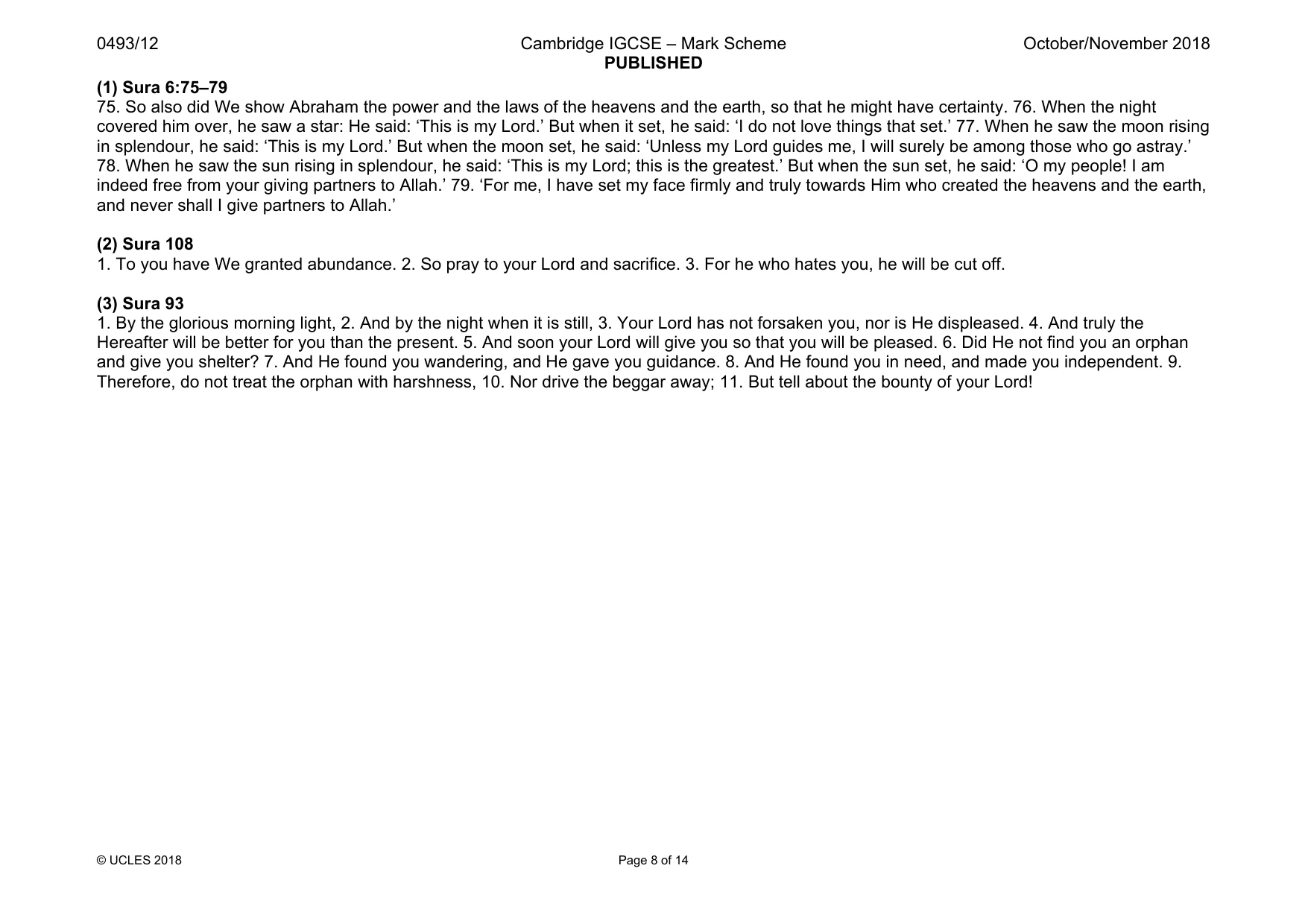
0493/12 Cambridge IGCSE – Mark Scheme PUBLISHED October/November 2018 © UCLES 2018 Page 8 of 14 (1) Sura 6:75–79 75. So also did We show Abraham the power and the laws of the heavens and the earth, so that he might have certainty. 76. When the night covered him over, he saw a star: He said: ‘This is my Lord.’ But when it set, he said: ‘I do not love things that set.’ 77. When he saw the moon rising in splendour, he said: ‘This is my Lord.’ But when the moon set, he said: ‘Unless my Lord guides me, I will surely be among those who go astray.’ 78. When he saw the sun rising in splendour, he said: ‘This is my Lord; this is the greatest.’ But when the sun set, he said: ‘O my people! I am indeed free from your giving partners to Allah.’ 79. ‘For me, I have set my face firmly and truly towards Him who created the heavens and the earth, and never shall I give partners to Allah.’ (2) Sura 108 1. To you have We granted abundance. 2. So pray to your Lord and sacrifice. 3. For he who hates you, he will be cut off. (3) Sura 93 1. By the glorious morning light, 2. And by the night when it is still, 3. Your Lord has not forsaken you, nor is He displeased. 4. And truly the Hereafter will be better for you than the present. 5. And soon your Lord will give you so that you will be pleased. 6. Did He not find you an orphan and give you shelter? 7. And He found you wandering, and He gave you guidance. 8. And He found you in need, and made you independent. 9. Therefore, do not treat the orphan with harshness, 10. Nor drive the beggar away; 11. But tell about the bounty of your Lord!
Mark scheme, page 9
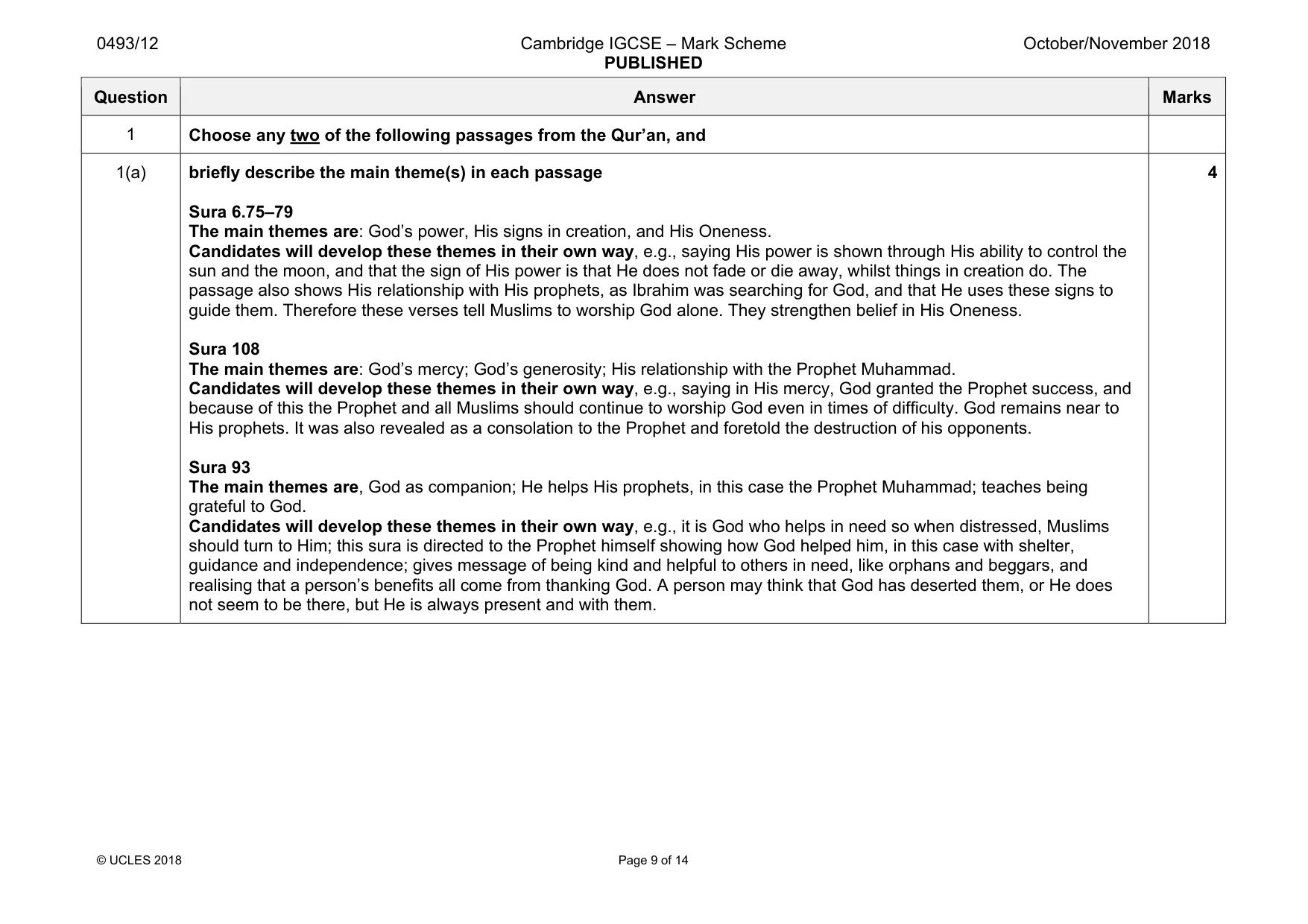
0493/12 Cambridge IGCSE – Mark Scheme PUBLISHED October/November 2018 © UCLES 2018 Page 9 of 14 Question Answer Marks 1 Choose any two of the following passages from the Qur’an, and 1(a) briefly describe the main theme(s) in each passage Sura 6.75–79 The main themes are: God’s power, His signs in creation, and His Oneness. Candidates will develop these themes in their own way, e.g., saying His power is shown through His ability to control the sun and the moon, and that the sign of His power is that He does not fade or die away, whilst things in creation do. The passage also shows His relationship with His prophets, as Ibrahim was searching for God, and that He uses these signs to guide them. Therefore these verses tell Muslims to worship God alone. They strengthen belief in His Oneness. Sura 108 The main themes are: God’s mercy; God’s generosity; His relationship with the Prophet Muhammad. Candidates will develop these themes in their own way, e.g., saying in His mercy, God granted the Prophet success, and because of this the Prophet and all Muslims should continue to worship God even in times of difficulty. God remains near to His prophets. It was also revealed as a consolation to the Prophet and foretold the destruction of his opponents. Sura 93 The main themes are, God as companion; He helps His prophets, in this case the Prophet Muhammad; teaches being grateful to God. Candidates will develop these themes in their own way, e.g., it is God who helps in need so when distressed, Muslims should turn to Him; this sura is directed to the Prophet himself showing how God helped him, in this case with shelter, guidance and independence; gives message of being kind and helpful to others in need, like orphans and beggars, and realising that a person’s benefits all come from thanking God. A person may think that God has deserted them, or He does not seem to be there, but He is always present and with them. 4
Mark scheme, page 10
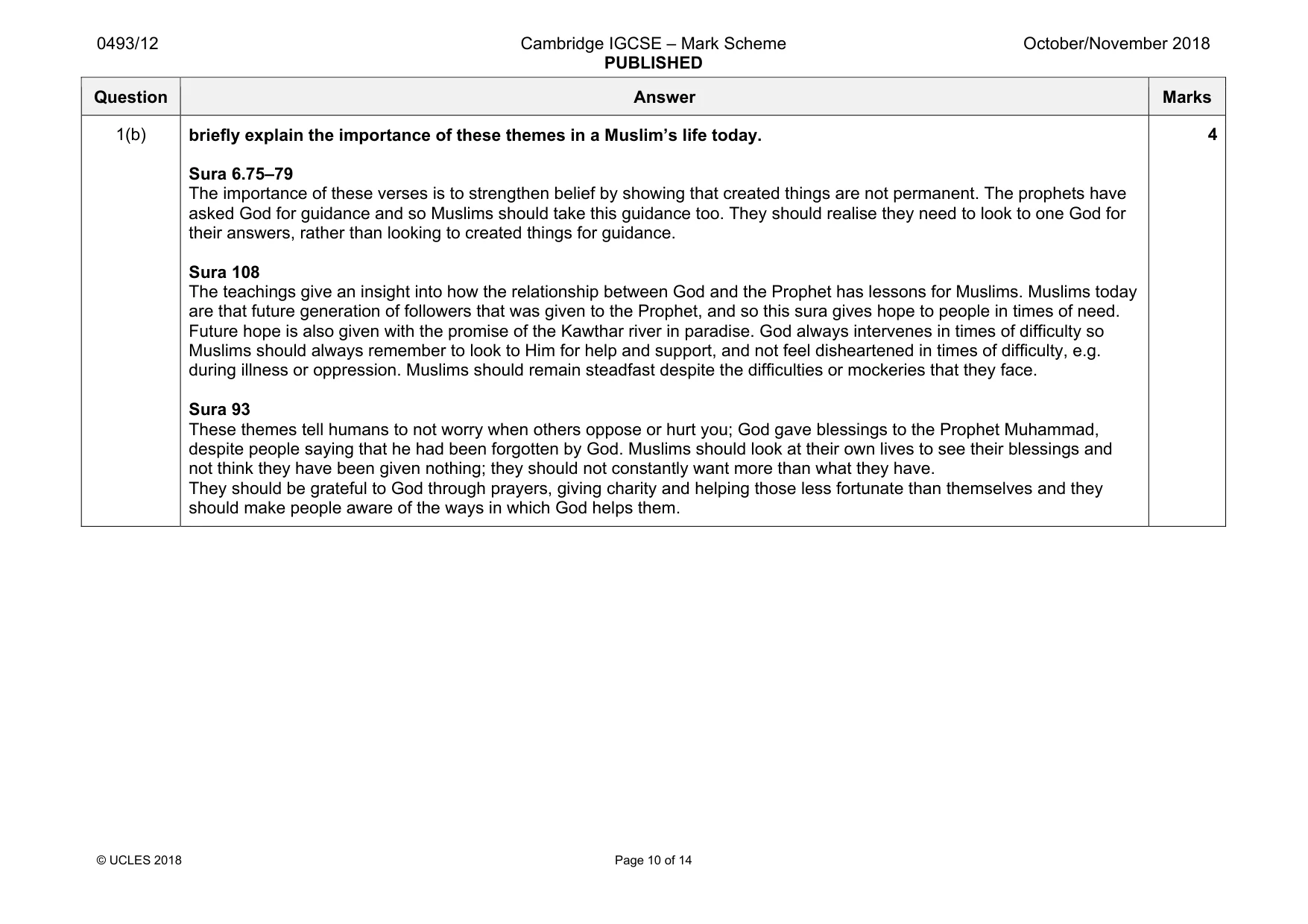
0493/12 Cambridge IGCSE – Mark Scheme PUBLISHED October/November 2018 © UCLES 2018 Page 10 of 14 Question Answer Marks 1(b) briefly explain the importance of these themes in a Muslim’s life today. Sura 6.75–79 The importance of these verses is to strengthen belief by showing that created things are not permanent. The prophets have asked God for guidance and so Muslims should take this guidance too. They should realise they need to look to one God for their answers, rather than looking to created things for guidance. Sura 108 The teachings give an insight into how the relationship between God and the Prophet has lessons for Muslims. Muslims today are that future generation of followers that was given to the Prophet, and so this sura gives hope to people in times of need. Future hope is also given with the promise of the Kawthar river in paradise. God always intervenes in times of difficulty so Muslims should always remember to look to Him for help and support, and not feel disheartened in times of difficulty, e.g. during illness or oppression. Muslims should remain steadfast despite the difficulties or mockeries that they face. Sura 93 These themes tell humans to not worry when others oppose or hurt you; God gave blessings to the Prophet Muhammad, despite people saying that he had been forgotten by God. Muslims should look at their own lives to see their blessings and not think they have been given nothing; they should not constantly want more than what they have. They should be grateful to God through prayers, giving charity and helping those less fortunate than themselves and they should make people aware of the ways in which God helps them. 4
Mark scheme, page 11
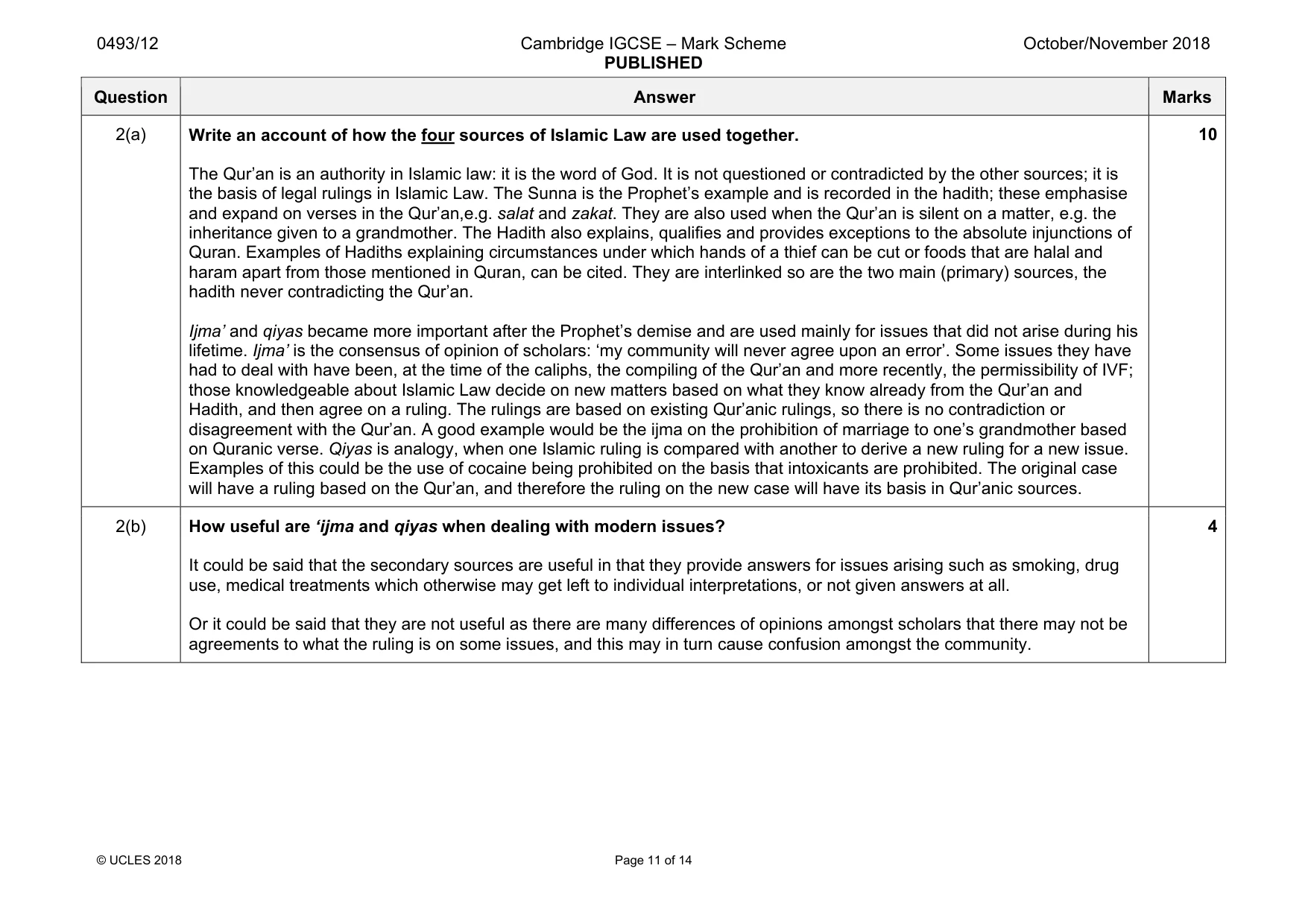
0493/12 Cambridge IGCSE – Mark Scheme PUBLISHED October/November 2018 © UCLES 2018 Page 11 of 14 Question Answer Marks 2(a) Write an account of how the four sources of Islamic Law are used together. The Qur’an is an authority in Islamic law: it is the word of God. It is not questioned or contradicted by the other sources; it is the basis of legal rulings in Islamic Law. The Sunna is the Prophet’s example and is recorded in the hadith; these emphasise and expand on verses in the Qur’an,e.g. salat and zakat. They are also used when the Qur’an is silent on a matter, e.g. the inheritance given to a grandmother. The Hadith also explains, qualifies and provides exceptions to the absolute injunctions of Quran. Examples of Hadiths explaining circumstances under which hands of a thief can be cut or foods that are halal and haram apart from those mentioned in Quran, can be cited. They are interlinked so are the two main (primary) sources, the hadith never contradicting the Qur’an. Ijma’ and qiyas became more important after the Prophet’s demise and are used mainly for issues that did not arise during his lifetime. Ijma’ is the consensus of opinion of scholars: ‘my community will never agree upon an error’. Some issues they have had to deal with have been, at the time of the caliphs, the compiling of the Qur’an and more recently, the permissibility of IVF; those knowledgeable about Islamic Law decide on new matters based on what they know already from the Qur’an and Hadith, and then agree on a ruling. The rulings are based on existing Qur’anic rulings, so there is no contradiction or disagreement with the Qur’an. A good example would be the ijma on the prohibition of marriage to one’s grandmother based on Quranic verse. Qiyas is analogy, when one Islamic ruling is compared with another to derive a new ruling for a new issue. Examples of this could be the use of cocaine being prohibited on the basis that intoxicants are prohibited. The original case will have a ruling based on the Qur’an, and therefore the ruling on the new case will have its basis in Qur’anic sources. 10 2(b) How useful are ‘ijma and qiyas when dealing with modern issues? It could be said that the secondary sources are useful in that they provide answers for issues arising such as smoking, drug use, medical treatments which otherwise may get left to individual interpretations, or not given answers at all. Or it could be said that they are not useful as there are many differences of opinions amongst scholars that there may not be agreements to what the ruling is on some issues, and this may in turn cause confusion amongst the community. 4
Mark scheme, page 12
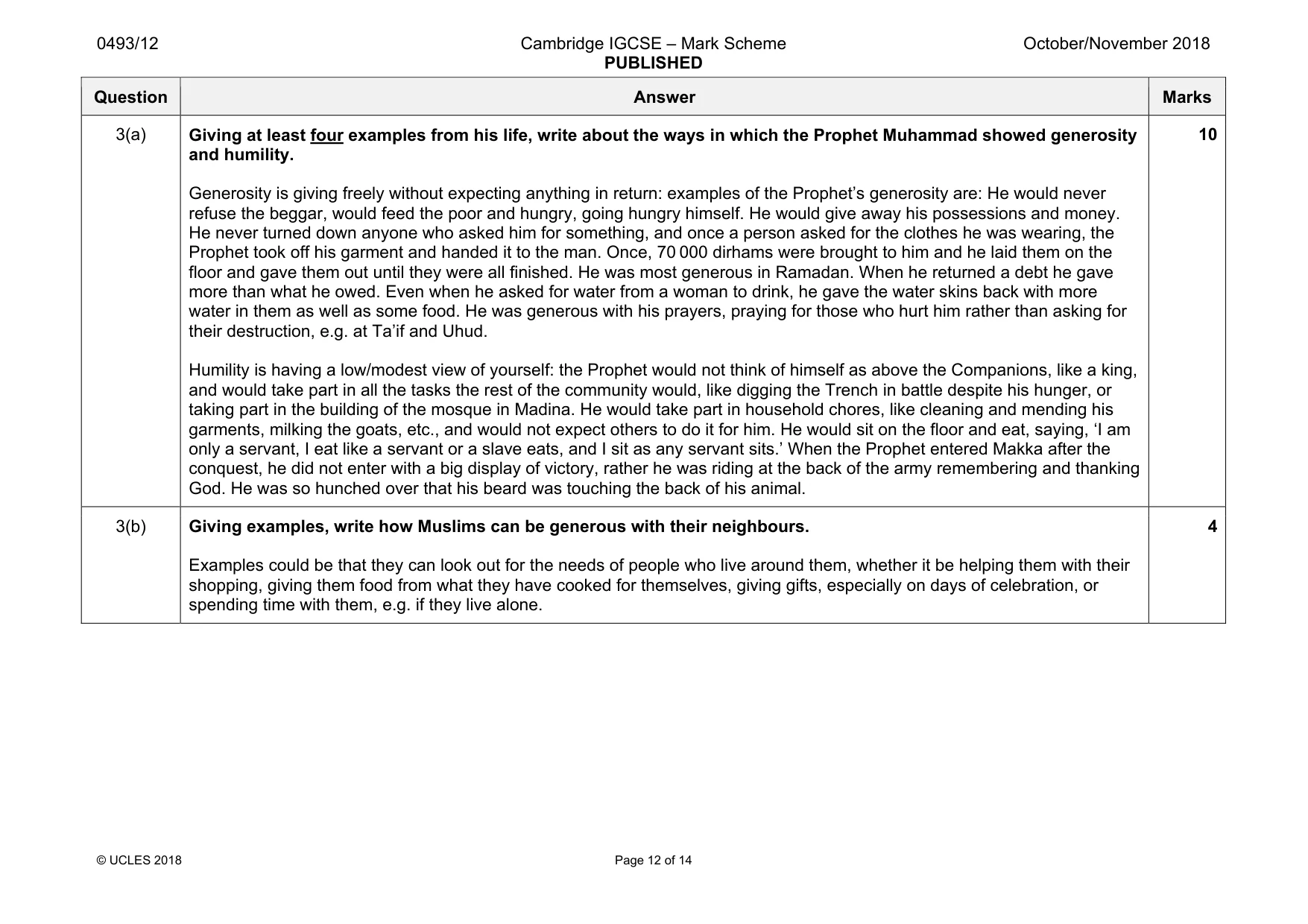
0493/12 Cambridge IGCSE – Mark Scheme PUBLISHED October/November 2018 © UCLES 2018 Page 12 of 14 Question Answer Marks 3(a) Giving at least four examples from his life, write about the ways in which the Prophet Muhammad showed generosity and humility. Generosity is giving freely without expecting anything in return: examples of the Prophet’s generosity are: He would never refuse the beggar, would feed the poor and hungry, going hungry himself. He would give away his possessions and money. He never turned down anyone who asked him for something, and once a person asked for the clothes he was wearing, the Prophet took off his garment and handed it to the man. Once, 70 000 dirhams were brought to him and he laid them on the floor and gave them out until they were all finished. He was most generous in Ramadan. When he returned a debt he gave more than what he owed. Even when he asked for water from a woman to drink, he gave the water skins back with more water in them as well as some food. He was generous with his prayers, praying for those who hurt him rather than asking for their destruction, e.g. at Ta’if and Uhud. Humility is having a low/modest view of yourself: the Prophet would not think of himself as above the Companions, like a king, and would take part in all the tasks the rest of the community would, like digging the Trench in battle despite his hunger, or taking part in the building of the mosque in Madina. He would take part in household chores, like cleaning and mending his garments, milking the goats, etc., and would not expect others to do it for him. He would sit on the floor and eat, saying, ‘I am only a servant, I eat like a servant or a slave eats, and I sit as any servant sits.’ When the Prophet entered Makka after the conquest, he did not enter with a big display of victory, rather he was riding at the back of the army remembering and thanking God. He was so hunched over that his beard was touching the back of his animal. 10 3(b) Giving examples, write how Muslims can be generous with their neighbours. Examples could be that they can look out for the needs of people who live around them, whether it be helping them with their shopping, giving them food from what they have cooked for themselves, giving gifts, especially on days of celebration, or spending time with them, e.g. if they live alone. 4
Mark scheme, page 13
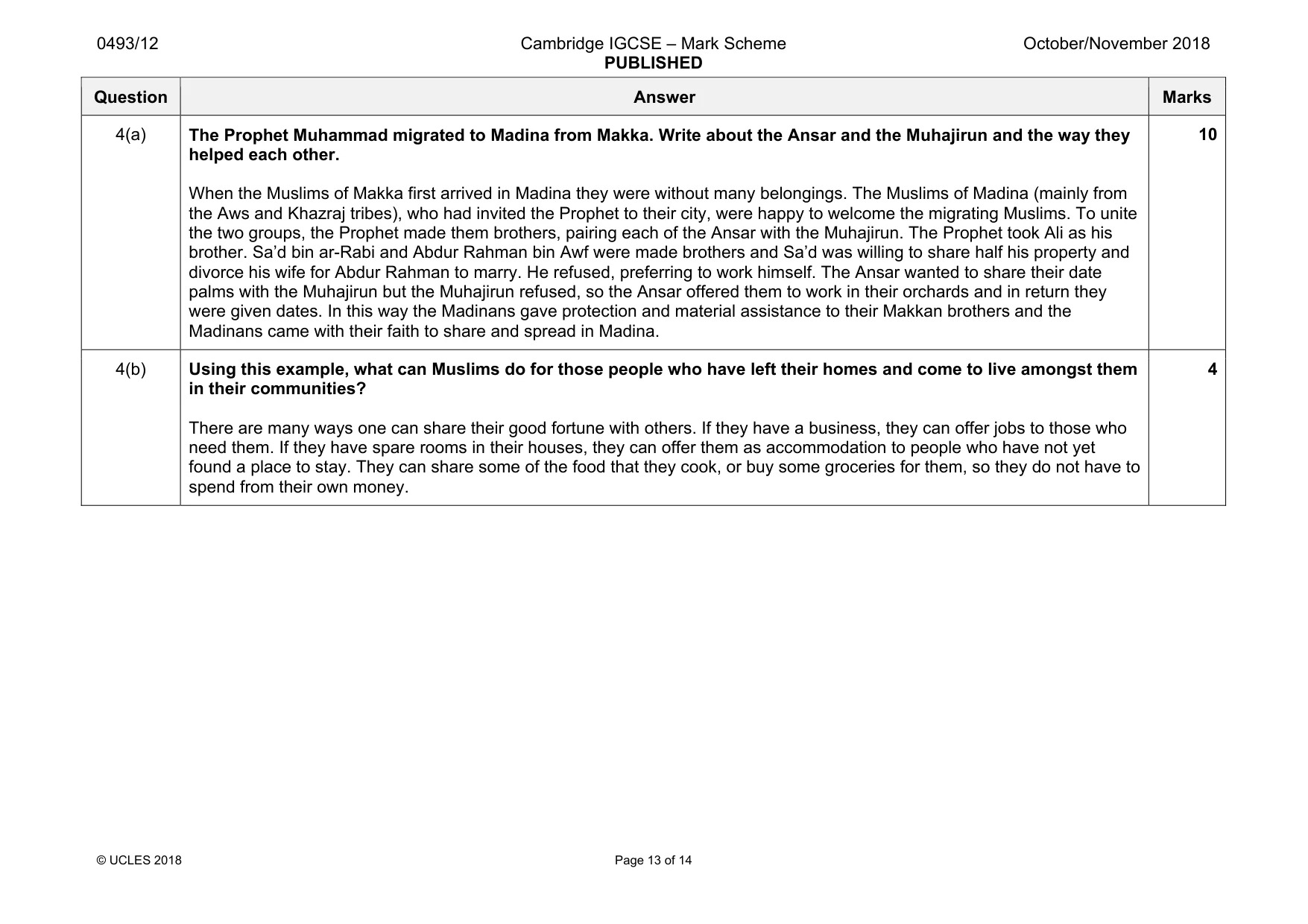
0493/12 Cambridge IGCSE – Mark Scheme PUBLISHED October/November 2018 © UCLES 2018 Page 13 of 14 Question Answer Marks 4(a) The Prophet Muhammad migrated to Madina from Makka. Write about the Ansar and the Muhajirun and the way they helped each other. When the Muslims of Makka first arrived in Madina they were without many belongings. The Muslims of Madina (mainly from the Aws and Khazraj tribes), who had invited the Prophet to their city, were happy to welcome the migrating Muslims. To unite the two groups, the Prophet made them brothers, pairing each of the Ansar with the Muhajirun. The Prophet took Ali as his brother. Sa’d bin ar-Rabi and Abdur Rahman bin Awf were made brothers and Sa’d was willing to share half his property and divorce his wife for Abdur Rahman to marry. He refused, preferring to work himself. The Ansar wanted to share their date palms with the Muhajirun but the Muhajirun refused, so the Ansar offered them to work in their orchards and in return they were given dates. In this way the Madinans gave protection and material assistance to their Makkan brothers and the Madinans came with their faith to share and spread in Madina. 10 4(b) Using this example, what can Muslims do for those people who have left their homes and come to live amongst them in their communities? There are many ways one can share their good fortune with others. If they have a business, they can offer jobs to those who need them. If they have spare rooms in their houses, they can offer them as accommodation to people who have not yet found a place to stay. They can share some of the food that they cook, or buy some groceries for them, so they do not have to spend from their own money. 4
Mark scheme, page 14
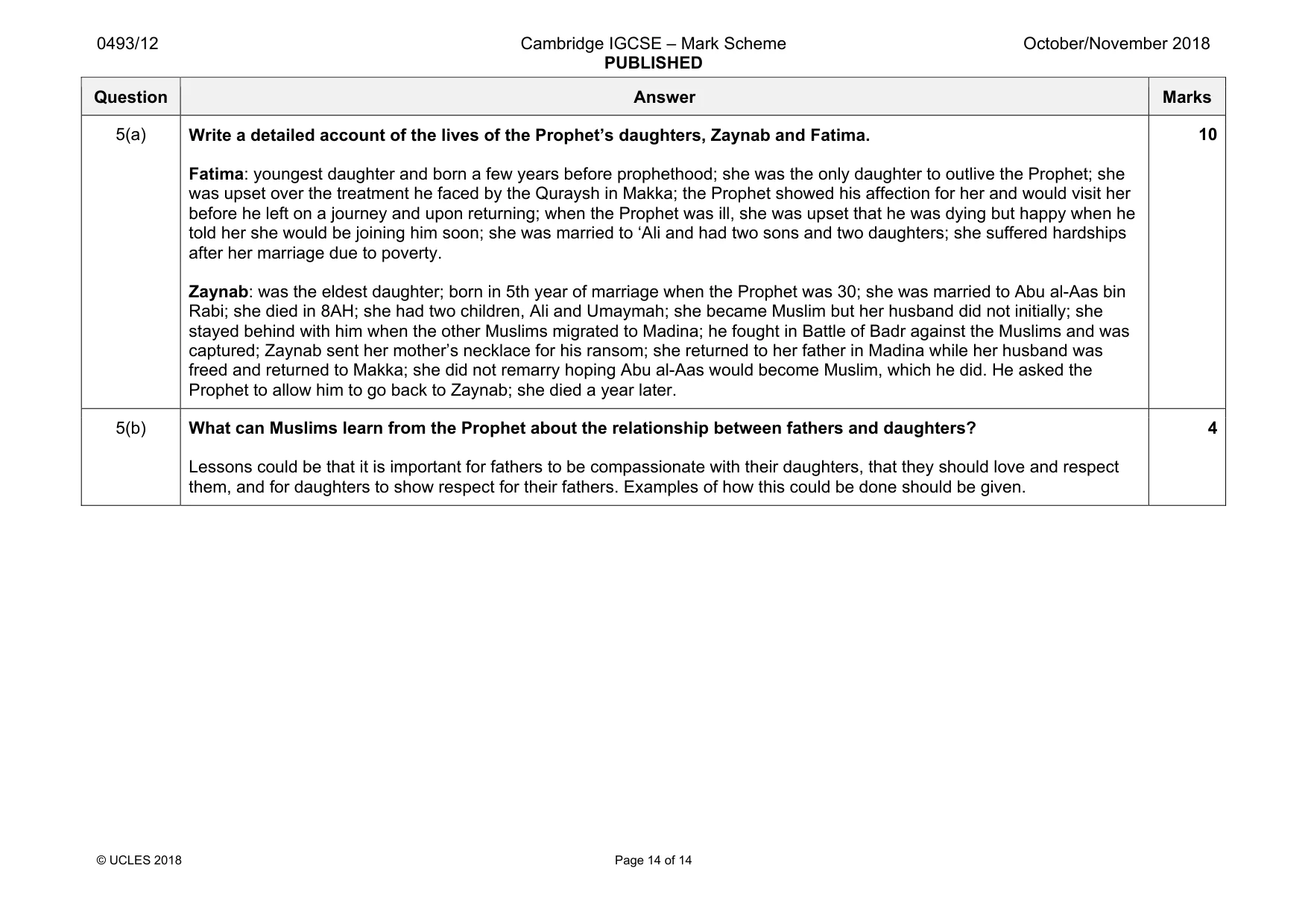
0493/12 Cambridge IGCSE – Mark Scheme PUBLISHED October/November 2018 © UCLES 2018 Page 14 of 14 Question Answer Marks 5(a) Write a detailed account of the lives of the Prophet’s daughters, Zaynab and Fatima. Fatima: youngest daughter and born a few years before prophethood; she was the only daughter to outlive the Prophet; she was upset over the treatment he faced by the Quraysh in Makka; the Prophet showed his affection for her and would visit her before he left on a journey and upon returning; when the Prophet was ill, she was upset that he was dying but happy when he told her she would be joining him soon; she was married to ‘Ali and had two sons and two daughters; she suffered hardships after her marriage due to poverty. Zaynab: was the eldest daughter; born in 5th year of marriage when the Prophet was 30; she was married to Abu al-Aas bin Rabi; she died in 8AH; she had two children, Ali and Umaymah; she became Muslim but her husband did not initially; she stayed behind with him when the other Muslims migrated to Madina; he fought in Battle of Badr against the Muslims and was captured; Zaynab sent her mother’s necklace for his ransom; she returned to her father in Madina while her husband was freed and returned to Makka; she did not remarry hoping Abu al-Aas would become Muslim, which he did. He asked the Prophet to allow him to go back to Zaynab; she died a year later. 10 5(b) What can Muslims learn from the Prophet about the relationship between fathers and daughters? Lessons could be that it is important for fathers to be compassionate with their daughters, that they should love and respect them, and for daughters to show respect for their fathers. Examples of how this could be done should be given. 4
What you needed in this session
Cambridge’s own grade thresholds for 2018 Oct/Nov, Paper 1 · Variant 2. A higher threshold means an easier paper — the bar moves with how the cohort did.