Cambridge IGCSE Information and Communication Technology (9-1) 0983 — 2021 May/June Paper 2 · Variant 2
0983/22/M/J/21 · 80 marks · ≈90 min
The question paper and its mark scheme, free to read here and free to download. This is Cambridge’s own paper, exactly as it was sat.
Question paper12 pages
Mark scheme17 pages
Answers below. Sit the paper first if you are practising.
Paper as text
Question paper, page 1
This document has 12 pages. Cambridge IGCSE™(9–1) INFORMATION AND COMMUNICATION TECHNOLOGY 0983/22 Paper 2 Document Production, Data Manipulation and Presentations May/June 2021 2 hours 30 minutes You will need: Candidate source files (listed on page 2) INSTRUCTIONS ● Carry out all instructions in each step. ● Enter your name, centre number and candidate number on every printout before it is sent to the printer. ● Printouts with handwritten candidate details will not be marked. ● At the end of the examination, put all your printouts into the Assessment Record Folder. ● If you have produced rough copies of printouts, put a cross through each one to indicate that it is not the copy to be marked. ● You must not have access to either the internet or any email system during this examination. INFORMATION ● The total mark for this paper is 80. ● The number of marks for each question or part question is shown in brackets [ ]. * 7 1 0 0 7 1 2 5 1 3 * DC (KS) 214964 © UCLES 2021 [Turn over
Question paper, page 2
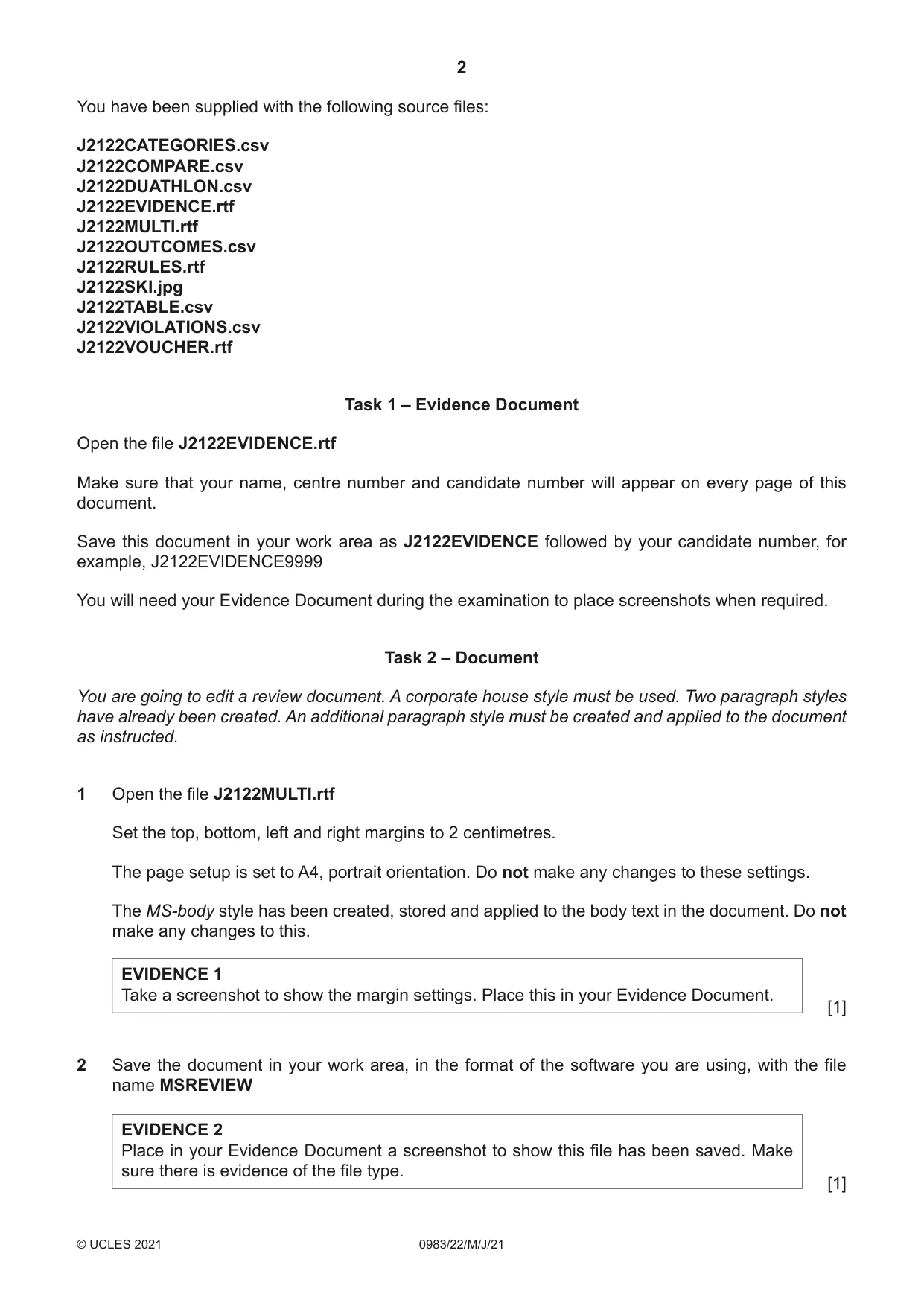
2 0983/22/M/J/21 © UCLES 2021 You have been supplied with the following source files: J2122CATEGORIES.csv J2122COMPARE.csv J2122DUATHLON.csv J2122EVIDENCE.rtf J2122MULTI.rtf J2122OUTCOMES.csv J2122RULES.rtf J2122SKI.jpg J2122TABLE.csv J2122VIOLATIONS.csv J2122VOUCHER.rtf Task 1 – Evidence Document Open the file J2122EVIDENCE.rtf Make sure that your name, centre number and candidate number will appear on every page of this document. Save this document in your work area as J2122EVIDENCE followed by your candidate number, for example, J2122EVIDENCE9999 You will need your Evidence Document during the examination to place screenshots when required. Task 2 – Document You are going to edit a review document. A corporate house style must be used. Two paragraph styles have already been created. An additional paragraph style must be created and applied to the document as instructed. 1 Open the file J2122MULTI.rtf Set the top, bottom, left and right margins to 2 centimetres. The page setup is set to A4, portrait orientation. Do not make any changes to these settings. The MS-body style has been created, stored and applied to the body text in the document. Do not make any changes to this. EVIDENCE 1 Take a screenshot to show the margin settings. Place this in your Evidence Document. [1] 2 Save the document in your work area, in the format of the software you are using, with the file name MSREVIEW EVIDENCE 2 Place in your Evidence Document a screenshot to show this file has been saved. Make sure there is evidence of the file type. [1]
Question paper, page 3
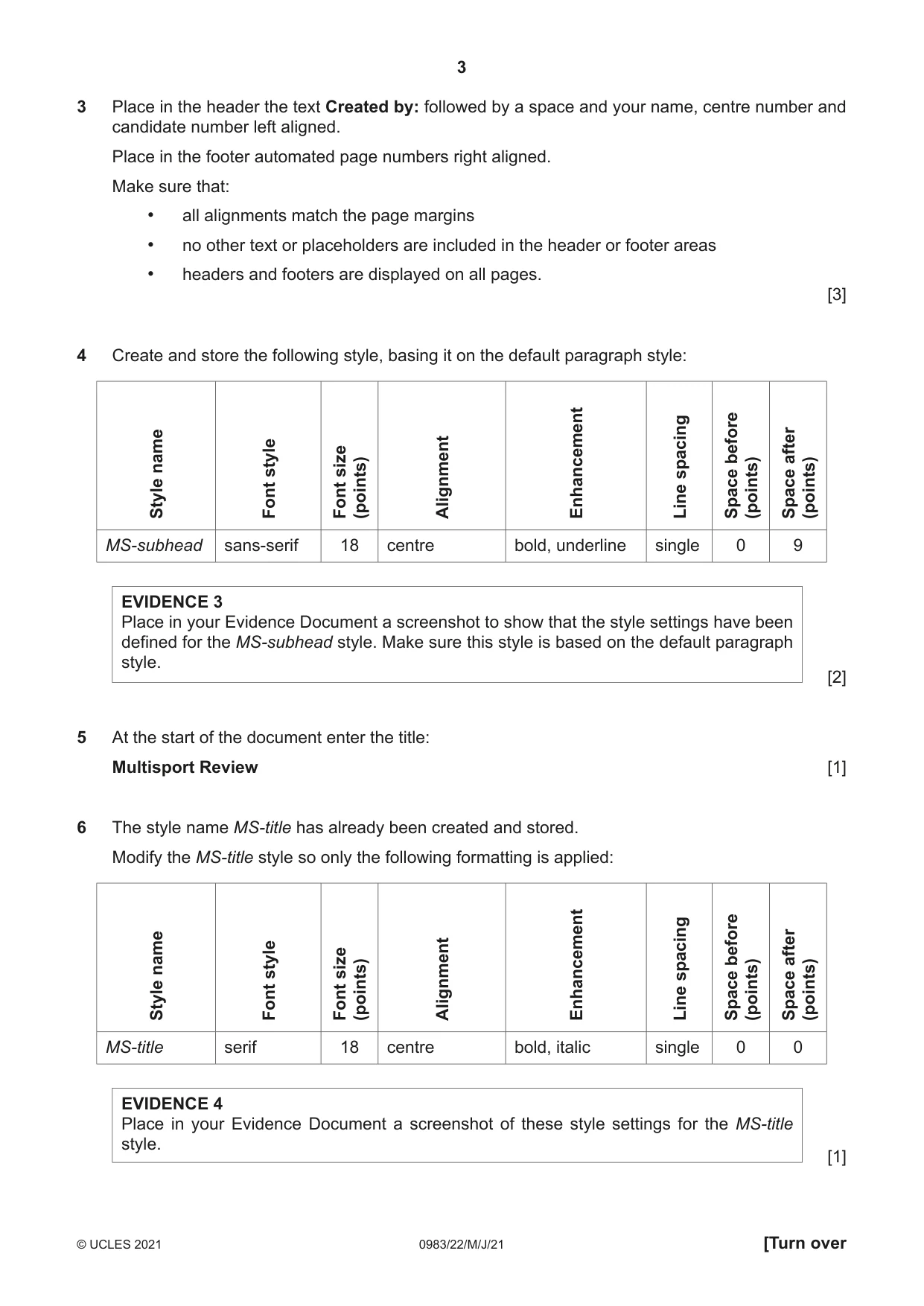
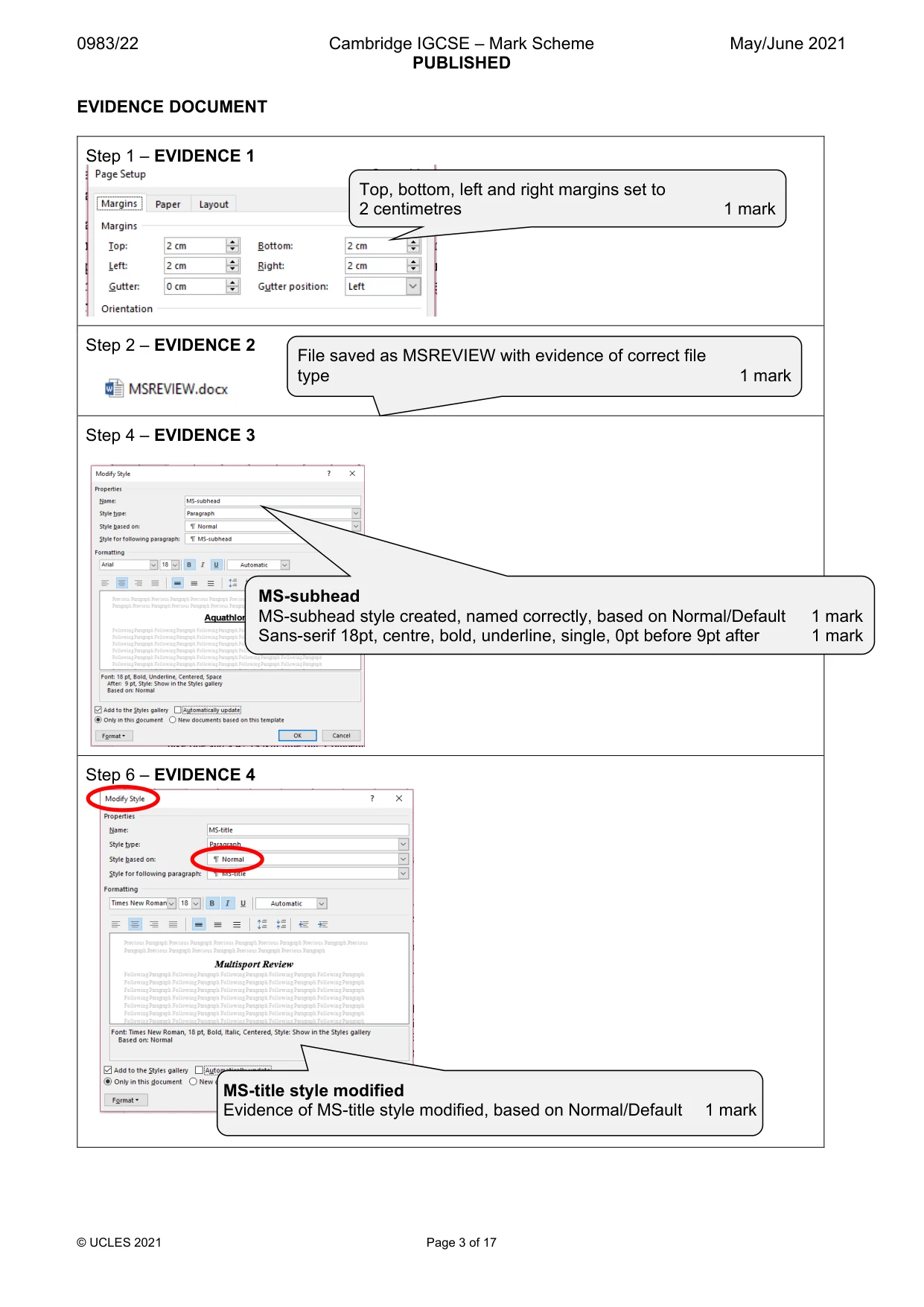
3 0983/22/M/J/21 © UCLES 2021 [Turn over 3 Place in the header the text Created by: followed by a space and your name, centre number and candidate number left aligned. Place in the footer automated page numbers right aligned. Make sure that: • all alignments match the page margins • no other text or placeholders are included in the header or footer areas • headers and footers are displayed on all pages. [3] 4 Create and store the following style, basing it on the default paragraph style: Style name Font style Font size (points) Alignment Enhancement Line spacing Space before (points) Space after (points) MS-subhead sans-serif 18 centre bold, underline single 0 9 EVIDENCE 3 Place in your Evidence Document a screenshot to show that the style settings have been defined for the MS-subhead style. Make sure this style is based on the default paragraph style. [2] 5 At the start of the document enter the title: Multisport Review [1] 6 The style name MS-title has already been created and stored. Modify the MS-title style so only the following formatting is applied: Style name Font style Font size (points) Alignment Enhancement Line spacing Space before (points) Space after (points) MS-title serif 18 centre bold, italic single 0 0 EVIDENCE 4 Place in your Evidence Document a screenshot of these style settings for the MS-title style. [1]
Question paper, page 4
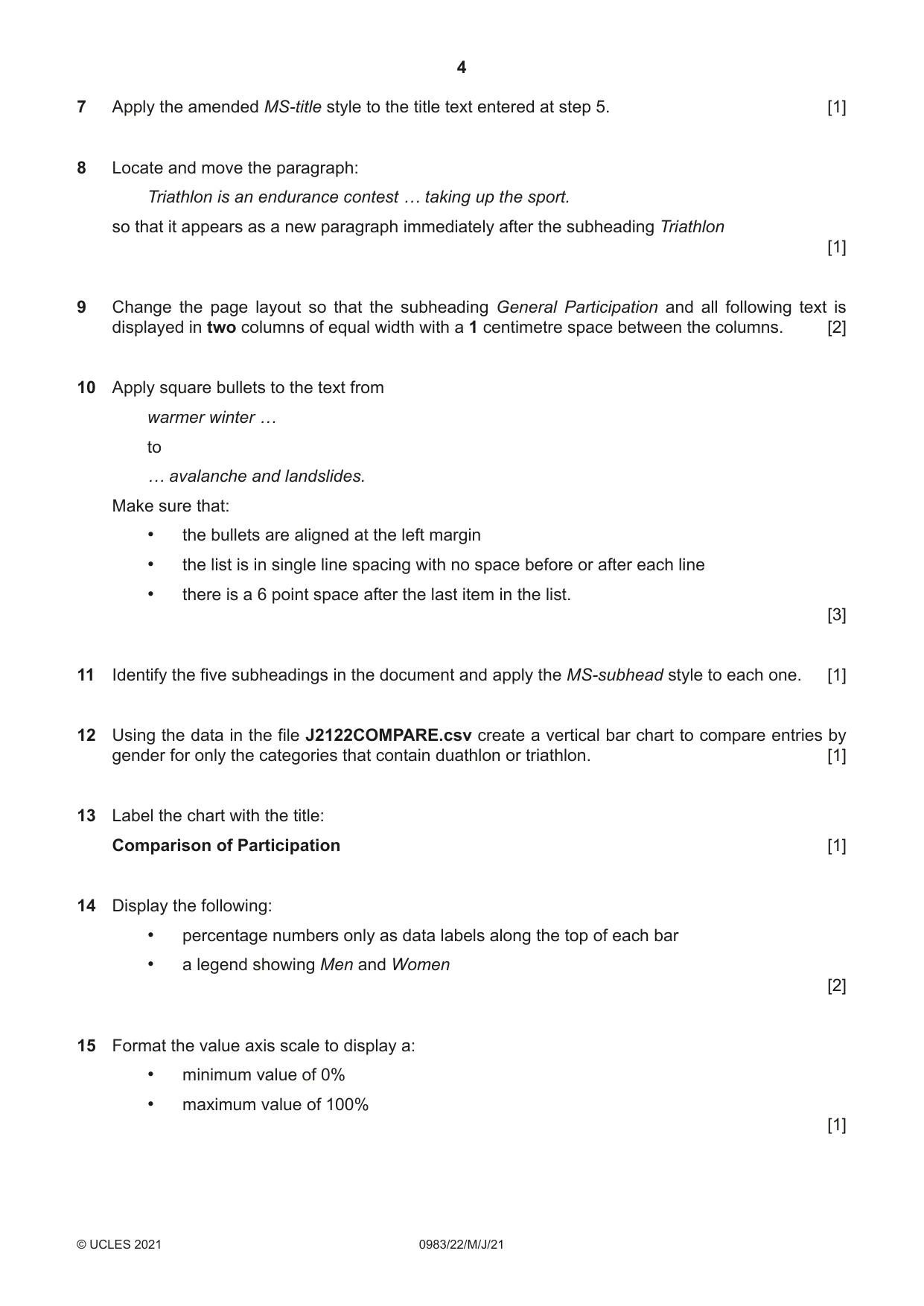
4 0983/22/M/J/21 © UCLES 2021 7 Apply the amended MS-title style to the title text entered at step 5. [1] 8 Locate and move the paragraph: Triathlon is an endurance contest … taking up the sport. so that it appears as a new paragraph immediately after the subheading Triathlon [1] 9 Change the page layout so that the subheading General Participation and all following text is displayed in two columns of equal width with a 1 centimetre space between the columns. [2] 10 Apply square bullets to the text from warmer winter … to … avalanche and landslides. Make sure that: • the bullets are aligned at the left margin • the list is in single line spacing with no space before or after each line • there is a 6 point space after the last item in the list. [3] 11 Identify the five subheadings in the document and apply the MS-subhead style to each one. [1] 12 Using the data in the file J2122COMPARE.csv create a vertical bar chart to compare entries by gender for only the categories that contain duathlon or triathlon. [1] 13 Label the chart with the title: Comparison of Participation [1] 14 Display the following: • percentage numbers only as data labels along the top of each bar • a legend showing Men and Women [2] 15 Format the value axis scale to display a: • minimum value of 0% • maximum value of 100% [1]
Question paper, page 5
5 0983/22/M/J/21 © UCLES 2021 [Turn over 16 Insert the chart after the paragraph ending … are more unpopular with women. Make sure that: • the chart and all data fits within the column width • all data labels are displayed in full with no overlap. [1] 17 Import the image J2122SKI.jpg and place it in the paragraph beginning The running is contested … Crop the image to remove only the bottom third (i.e. most of the snow below the skiers). Format the cropped image so that: • it is resized to a width of 4 centimetres with no distortion • it is aligned to the left of the column and top of the paragraph starting The running is contested … • the text wraps around the image. [4] 18 Spell check and proofread the document. Make sure that: • the list and chart are not split over columns or pages • there are no widows or orphans • there are no blank pages • styles are applied consistently • no changes have been made to the MS-body style • spacing is consistent between all items. Save the document using the same file name and format used in step 2. Print the document. PRINTOUT 1 Make sure your name, centre number and candidate number are on your document. [2] [Total: 29]
Question paper, page 6
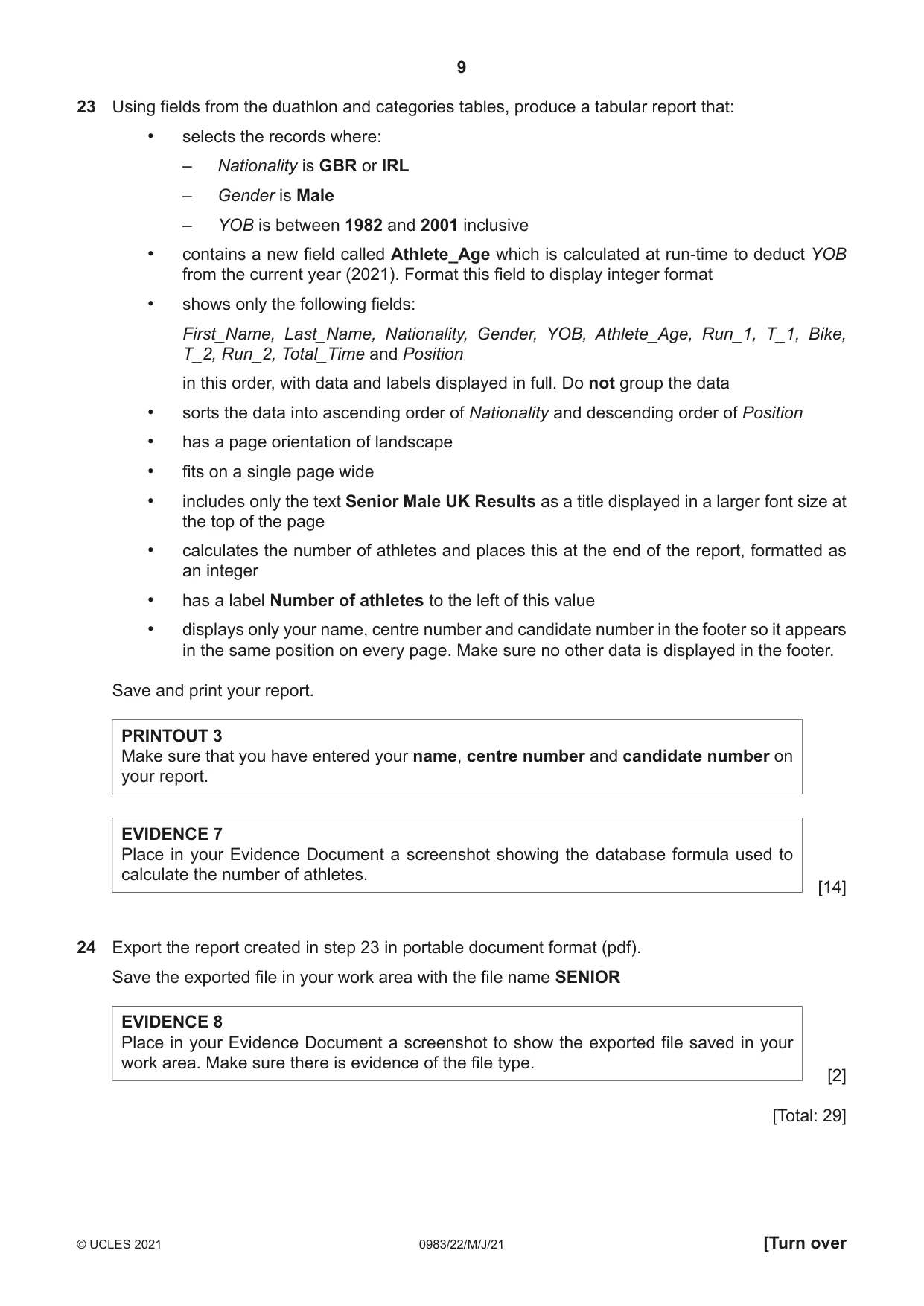
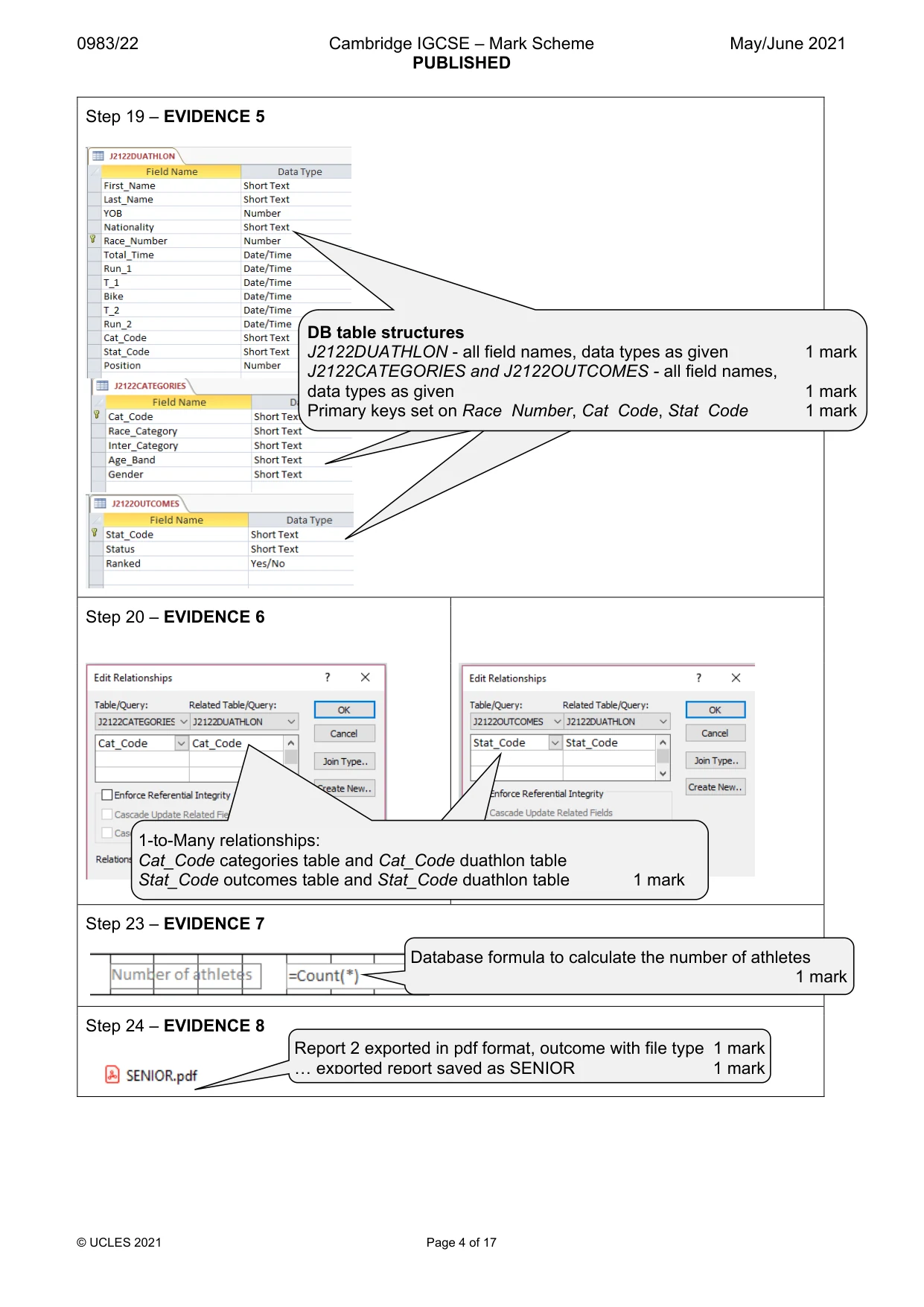
6 0983/22/M/J/21 © UCLES 2021 Task 3 – Database You are now going to prepare some reports based on the duathlon results. 19 Using a suitable database package, import the file J2122DUATHLON.csv Use these field names and data types: Field name Data type Format First_Name Text Last_Name Text YOB Number Integer Nationality Text Race_Number Number Integer Total_Time Date/Time hh:mm:ss Run_1 Date/Time hh:mm:ss T_1 Date/Time hh:mm:ss Bike Date/Time hh:mm:ss T_2 Date/Time hh:mm:ss Run_2 Date/Time hh:mm:ss Cat_Code Text Stat_Code Text Position Number Integer Set Race_Number as a primary key. Import the file J2122CATEGORIES.csv as a new table in your database. Use these field names and data types: Field name Data type Format Cat_Code Text Race_Category Text Inter_Category Text Age_Band Text Gender Text Set the Cat_Code field as a primary key.
Question paper, page 7
7 0983/22/M/J/21 © UCLES 2021 [Turn over Import the file J2122OUTCOMES.csv as a new table in your database. Use these field names and data types: Field name Data type Format Stat_Code Text Status Text Ranked Boolean/Logical To display as Yes/No Set the Stat_Code field as a primary key. Save the data. EVIDENCE 5 Place in your Evidence Document screenshots showing the primary keys, field names and data types used in all three tables. [4] 20 Create one-to-many relationships as links between the: • Cat_Code field in the categories table and the Cat_Code field in the duathlon table • Stat_Code field in the outcomes table and the Stat_Code field in the duathlon table. EVIDENCE 6 Place in your Evidence Document screenshots showing the type of relationships between the three tables. [1]
Question paper, page 8
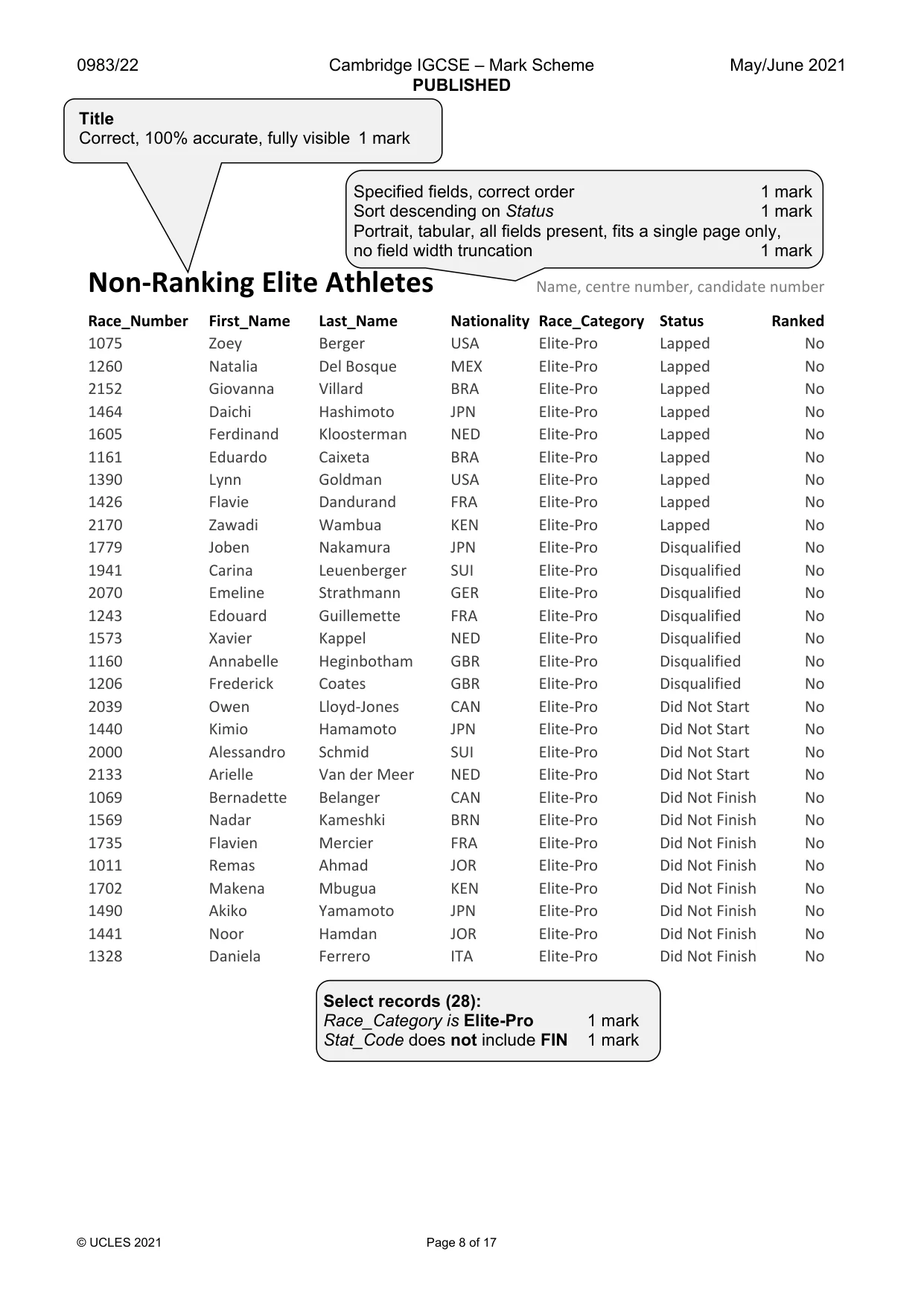
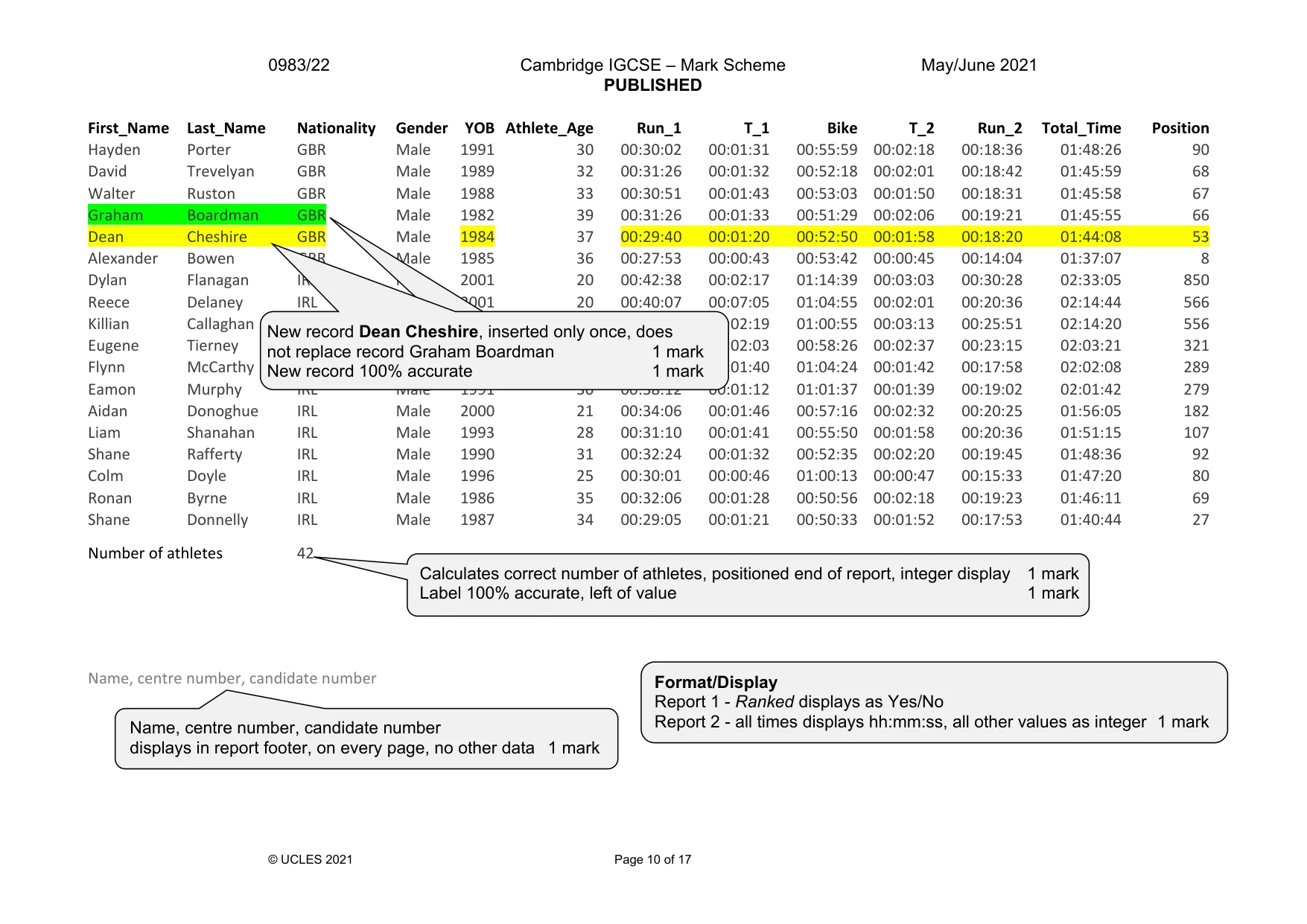
8 0983/22/M/J/21 © UCLES 2021 21 Enter the following details as a new record in the duathlon table: First_Name Dean Last_Name Cheshire YOB 1984 Nationality GBR Race_Number 1193 Total_Time 01:44:08 Run_1 00:29:40 T_1 00:01:20 Bike 00:52:50 T_2 00:01:58 Run_2 00:18:20 Cat_Code AGM-35 Stat_Code FIN Position 53 Check your data entry for errors. Save the data. [2] 22 Using fields from all tables produce a tabular report that: • selects the records where: – Race_Category is Elite-Pro – Stat_Code does not include FIN • shows only the following fields: Race_Number, First_Name, Last_Name, Nationality, Race_Category, Status and Ranked in this order, with data and labels displayed in full. Do not group the data • sorts the data into descending order of Status • has a page orientation of portrait • fits on a single page • includes only the text Non-Ranking Elite Athletes as a title displayed in a larger font size at the top of the page • has your name, centre number and candidate number on the report. Save and print your report. PRINTOUT 2 Make sure that you have entered your name, centre number and candidate number on your report. [6]
Question paper, page 9
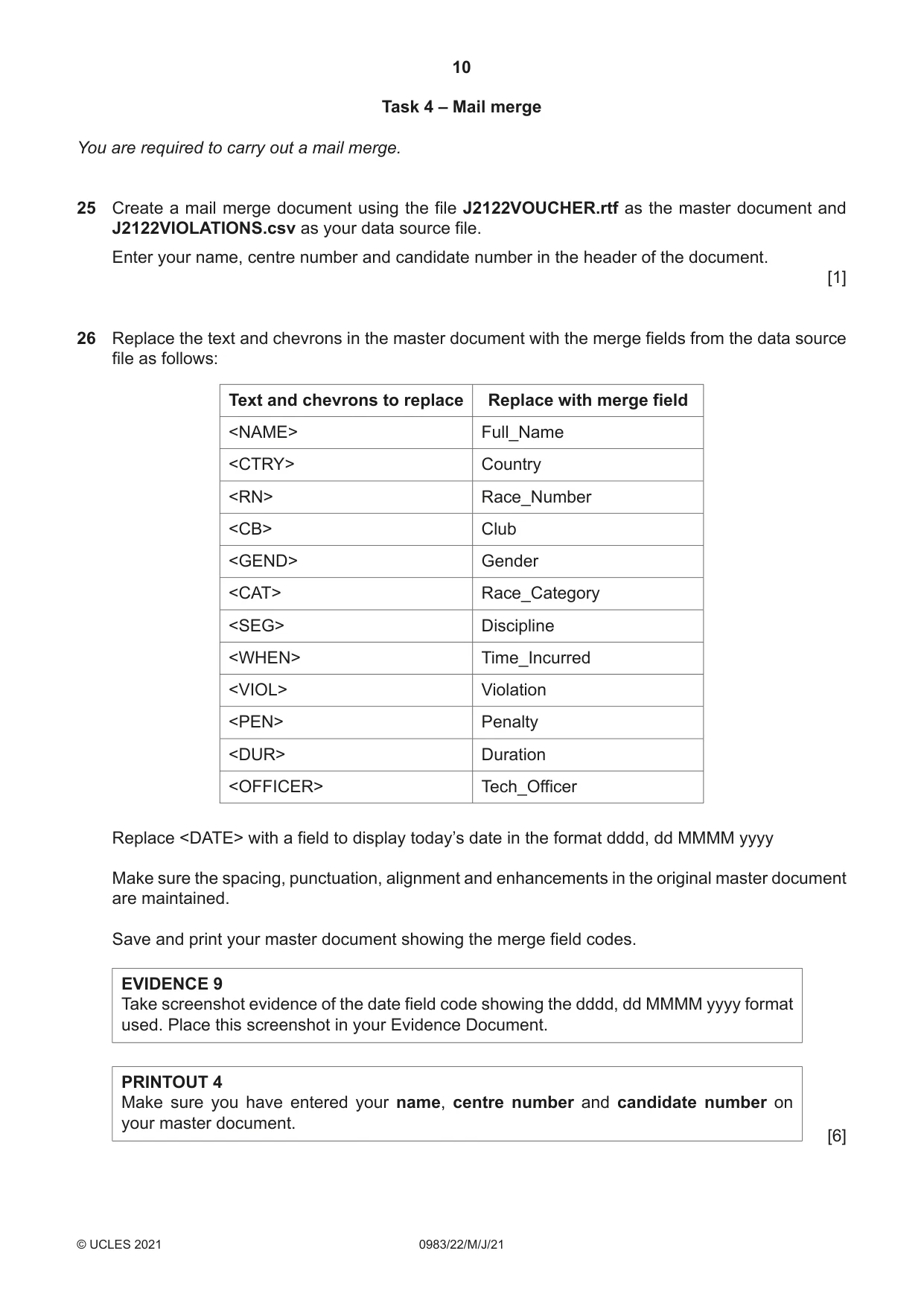
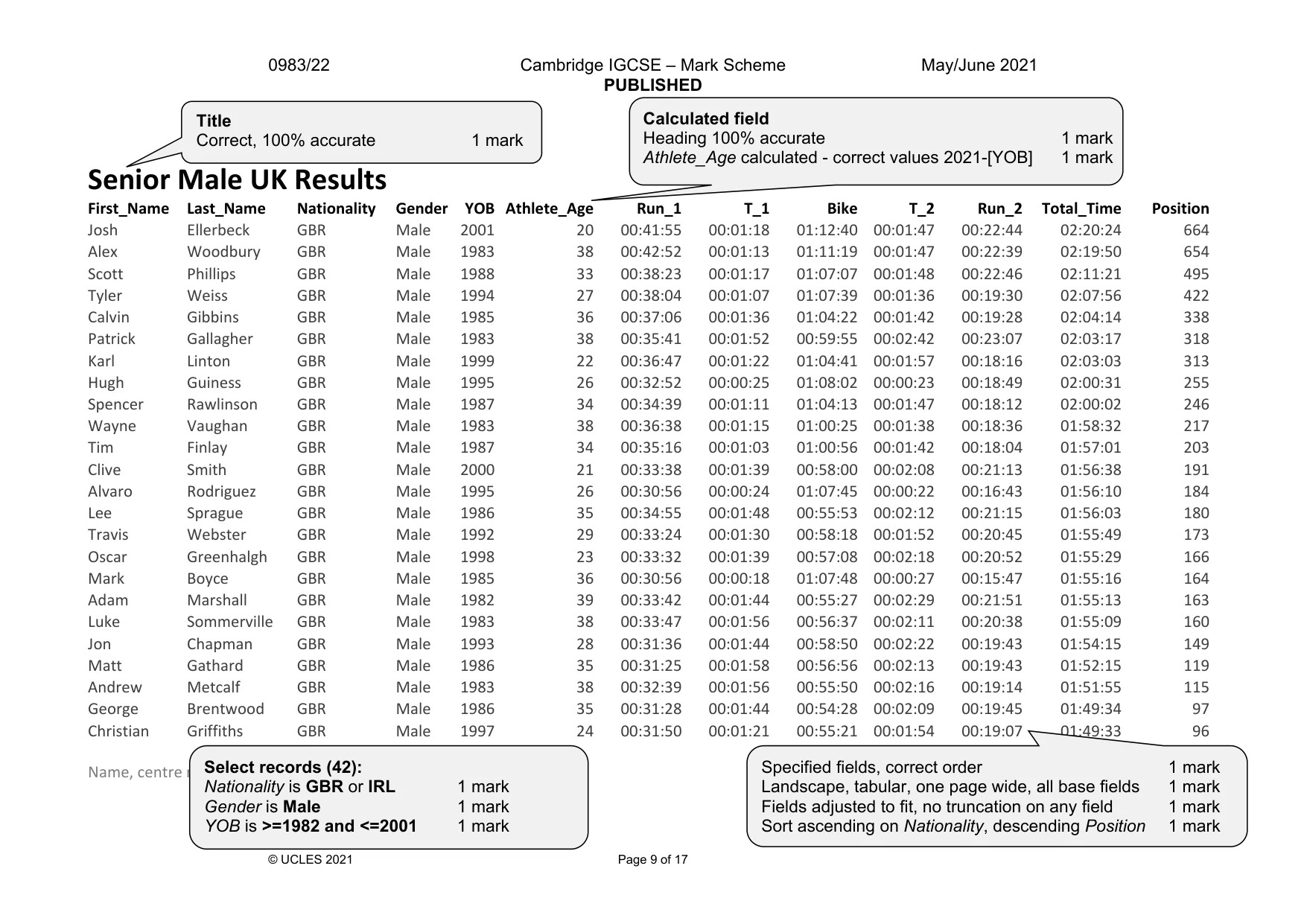
9 0983/22/M/J/21 © UCLES 2021 [Turn over 23 Using fields from the duathlon and categories tables, produce a tabular report that: • selects the records where: – Nationality is GBR or IRL – Gender is Male – YOB is between 1982 and 2001 inclusive • contains a new field called Athlete_Age which is calculated at run-time to deduct YOB from the current year (2021). Format this field to display integer format • shows only the following fields: First_Name, Last_Name, Nationality, Gender, YOB, Athlete_Age, Run_1, T_1, Bike, T_2, Run_2, Total_Time and Position in this order, with data and labels displayed in full. Do not group the data • sorts the data into ascending order of Nationality and descending order of Position • has a page orientation of landscape • fits on a single page wide • includes only the text Senior Male UK Results as a title displayed in a larger font size at the top of the page • calculates the number of athletes and places this at the end of the report, formatted as an integer • has a label Number of athletes to the left of this value • displays only your name, centre number and candidate number in the footer so it appears in the same position on every page. Make sure no other data is displayed in the footer. Save and print your report. PRINTOUT 3 Make sure that you have entered your name, centre number and candidate number on your report. EVIDENCE 7 Place in your Evidence Document a screenshot showing the database formula used to calculate the number of athletes. [14] 24 Export the report created in step 23 in portable document format (pdf). Save the exported file in your work area with the file name SENIOR EVIDENCE 8 Place in your Evidence Document a screenshot to show the exported file saved in your work area. Make sure there is evidence of the file type. [2] [Total: 29]
Question paper, page 10
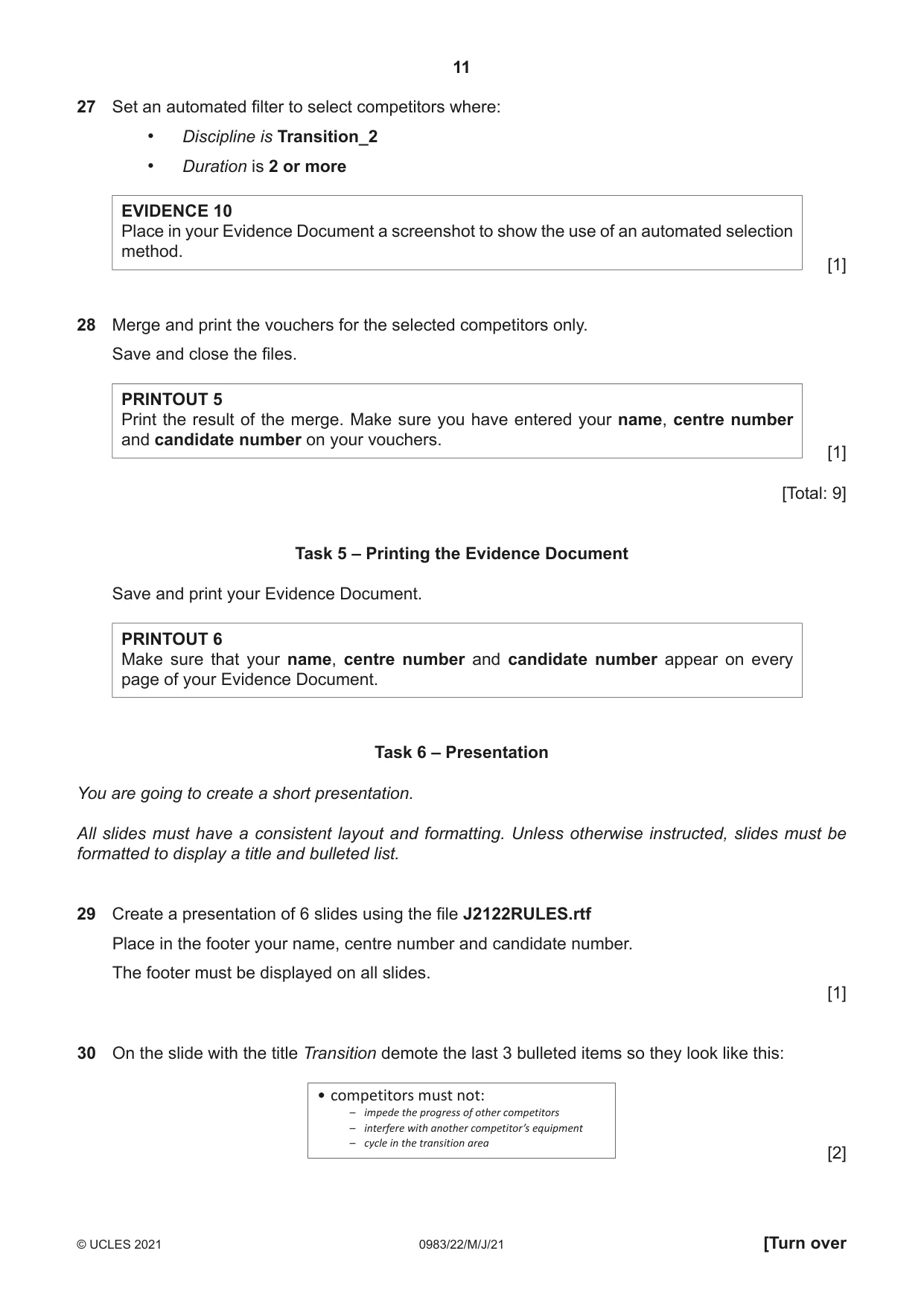
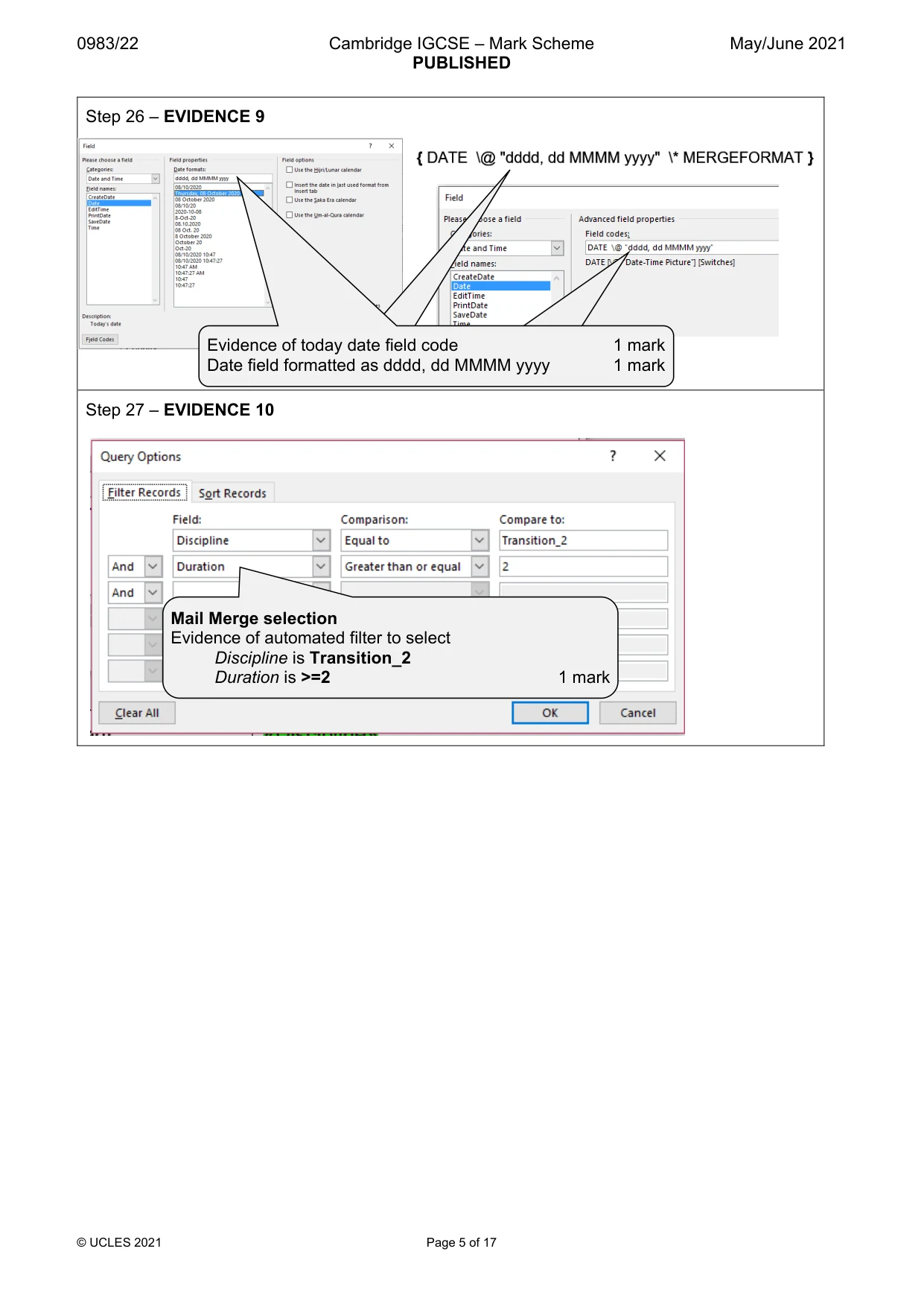
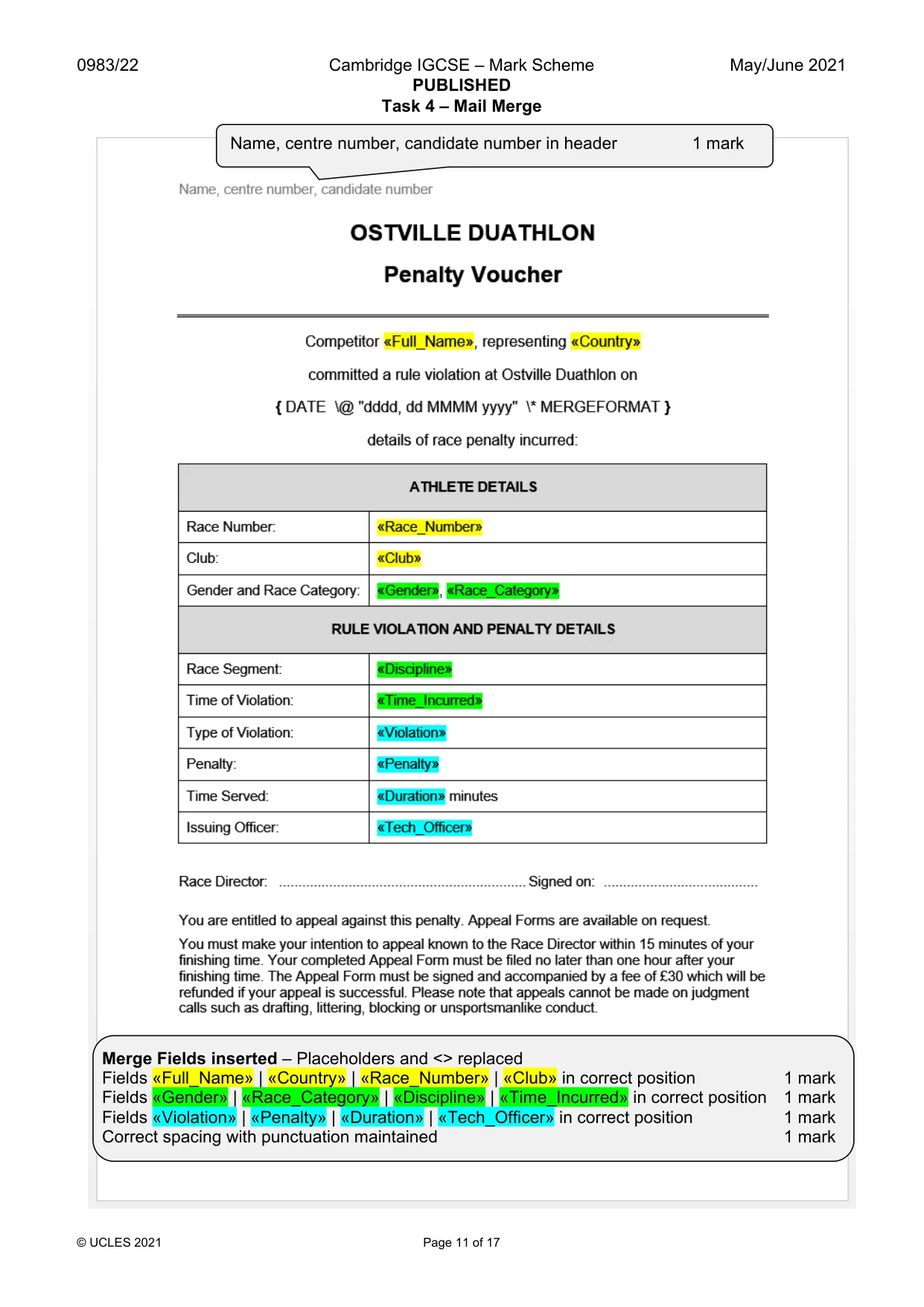
10 0983/22/M/J/21 © UCLES 2021 Task 4 – Mail merge You are required to carry out a mail merge. 25 Create a mail merge document using the file J2122VOUCHER.rtf as the master document and J2122VIOLATIONS.csv as your data source file. Enter your name, centre number and candidate number in the header of the document. [1] 26 Replace the text and chevrons in the master document with the merge fields from the data source file as follows: Text and chevrons to replace Replace with merge field <NAME> Full_Name <CTRY> Country <RN> Race_Number <CB> Club <GEND> Gender <CAT> Race_Category <SEG> Discipline <WHEN> Time_Incurred <VIOL> Violation <PEN> Penalty <DUR> Duration <OFFICER> Tech_Officer Replace <DATE> with a field to display today’s date in the format dddd, dd MMMM yyyy Make sure the spacing, punctuation, alignment and enhancements in the original master document are maintained. Save and print your master document showing the merge field codes. EVIDENCE 9 Take screenshot evidence of the date field code showing the dddd, dd MMMM yyyy format used. Place this screenshot in your Evidence Document. PRINTOUT 4 Make sure you have entered your name, centre number and candidate number on your master document. [6]
Question paper, page 11
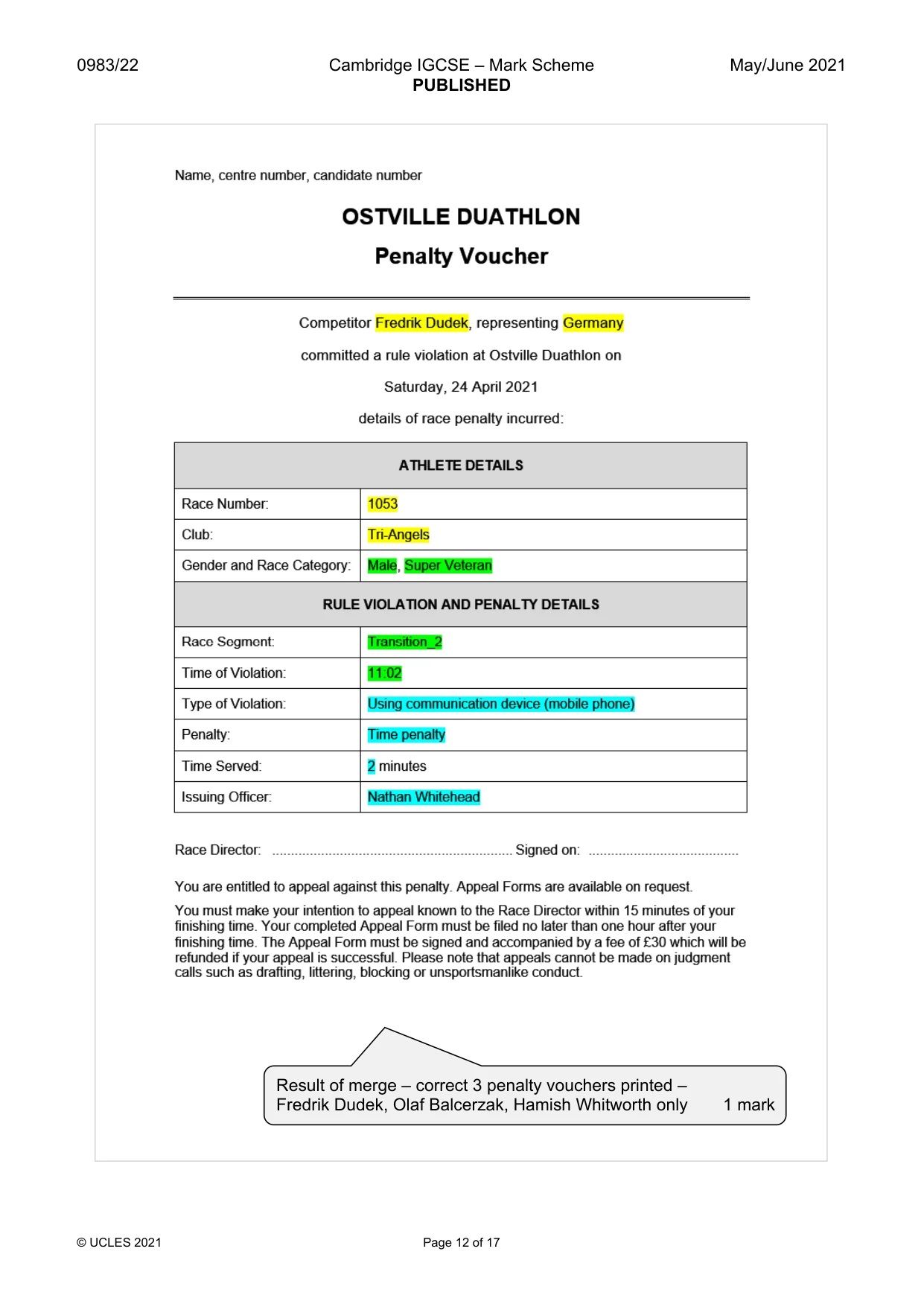
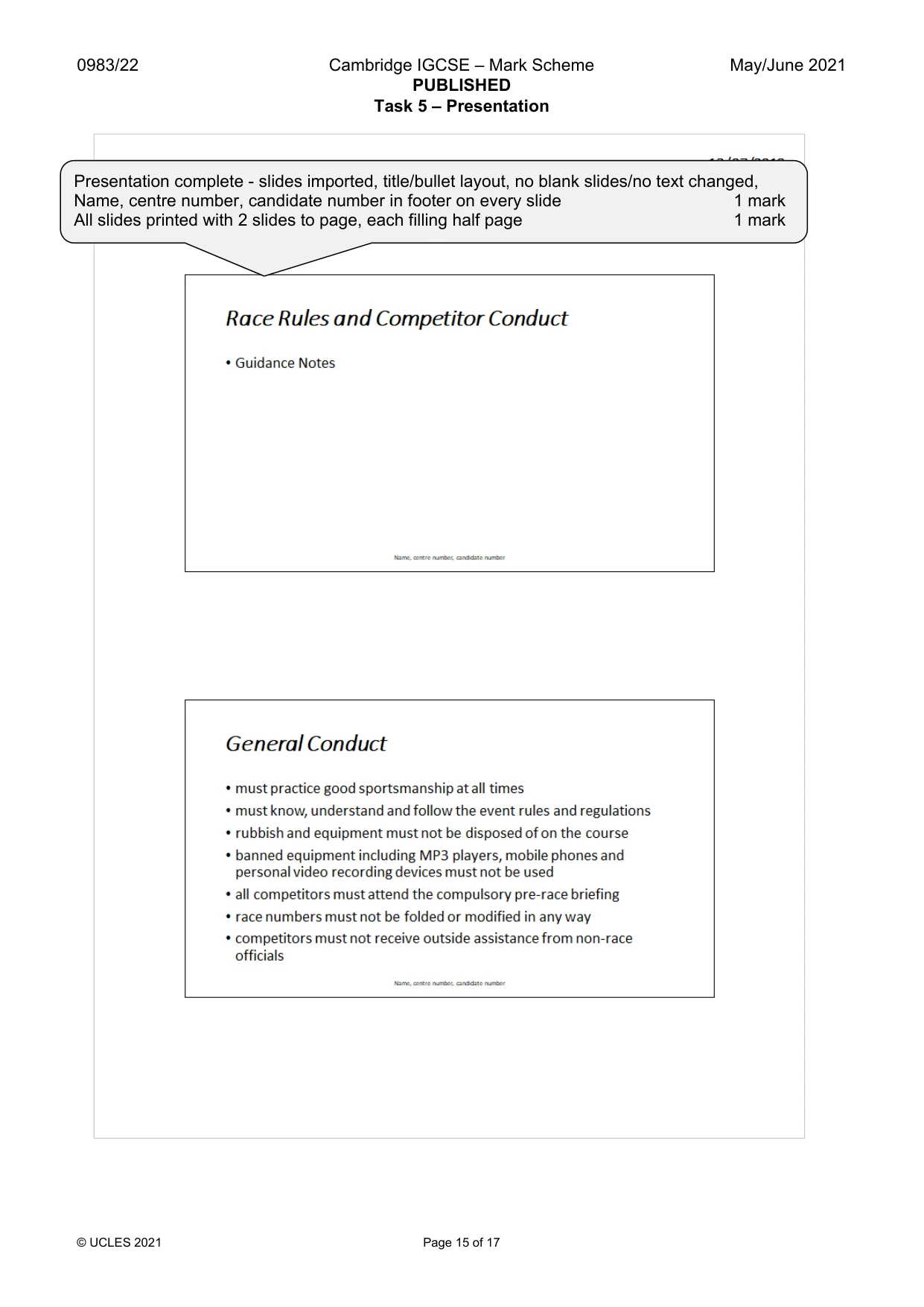
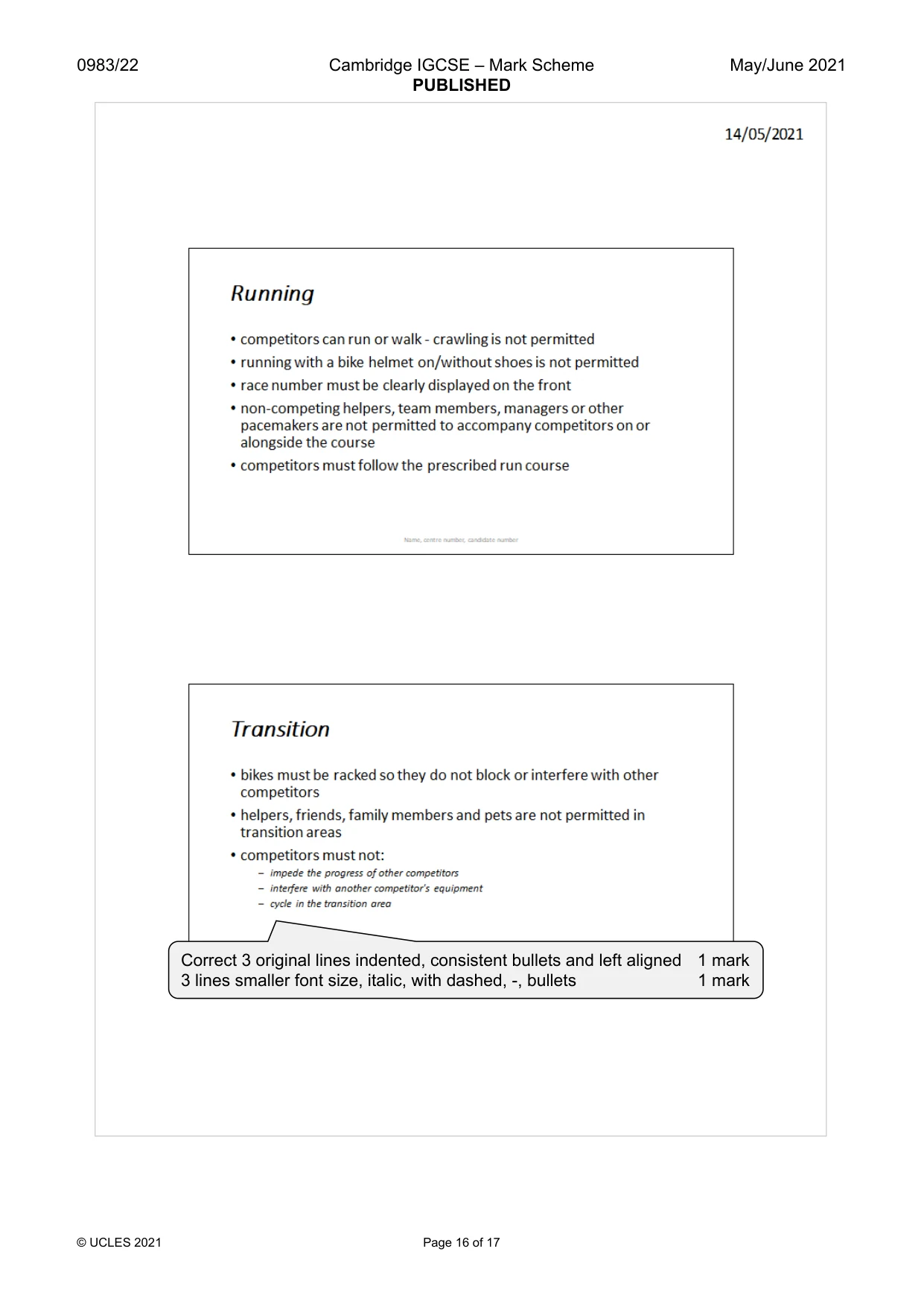
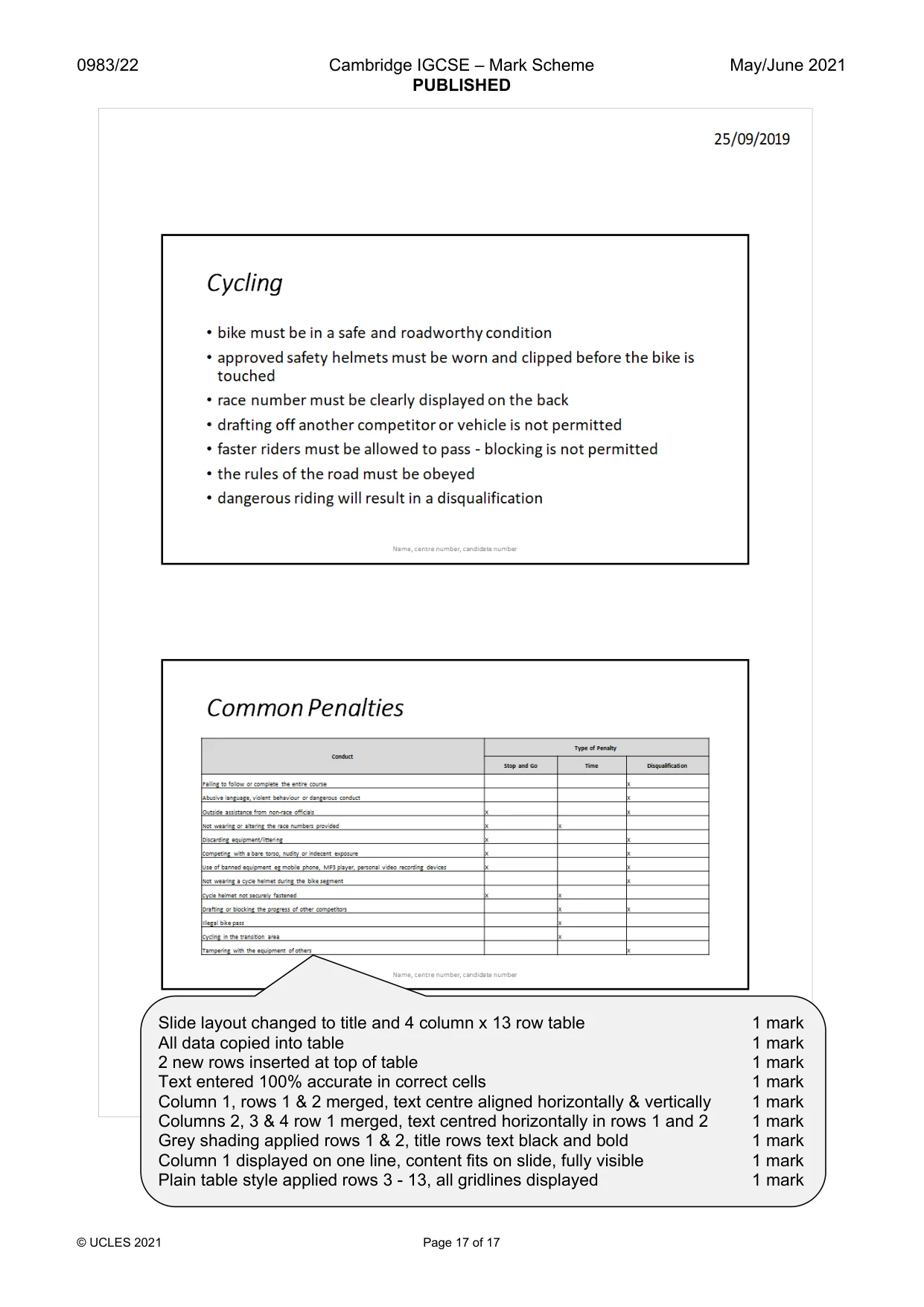
11 0983/22/M/J/21 © UCLES 2021 [Turn over 27 Set an automated filter to select competitors where: • Discipline is Transition_2 • Duration is 2 or more EVIDENCE 10 Place in your Evidence Document a screenshot to show the use of an automated selection method. [1] 28 Merge and print the vouchers for the selected competitors only. Save and close the files. PRINTOUT 5 Print the result of the merge. Make sure you have entered your name, centre number and candidate number on your vouchers. [1] [Total: 9] Task 5 – Printing the Evidence Document Save and print your Evidence Document. PRINTOUT 6 Make sure that your name, centre number and candidate number appear on every page of your Evidence Document. Task 6 – Presentation You are going to create a short presentation. All slides must have a consistent layout and formatting. Unless otherwise instructed, slides must be formatted to display a title and bulleted list. 29 Create a presentation of 6 slides using the file J2122RULES.rtf Place in the footer your name, centre number and candidate number. The footer must be displayed on all slides. [1] 30 On the slide with the title Transition demote the last 3 bulleted items so they look like this: • competitors must not: – impede the progress of other competitors – interfere with another competitor’s equipment – cycle in the transition area [2]
Question paper, page 12
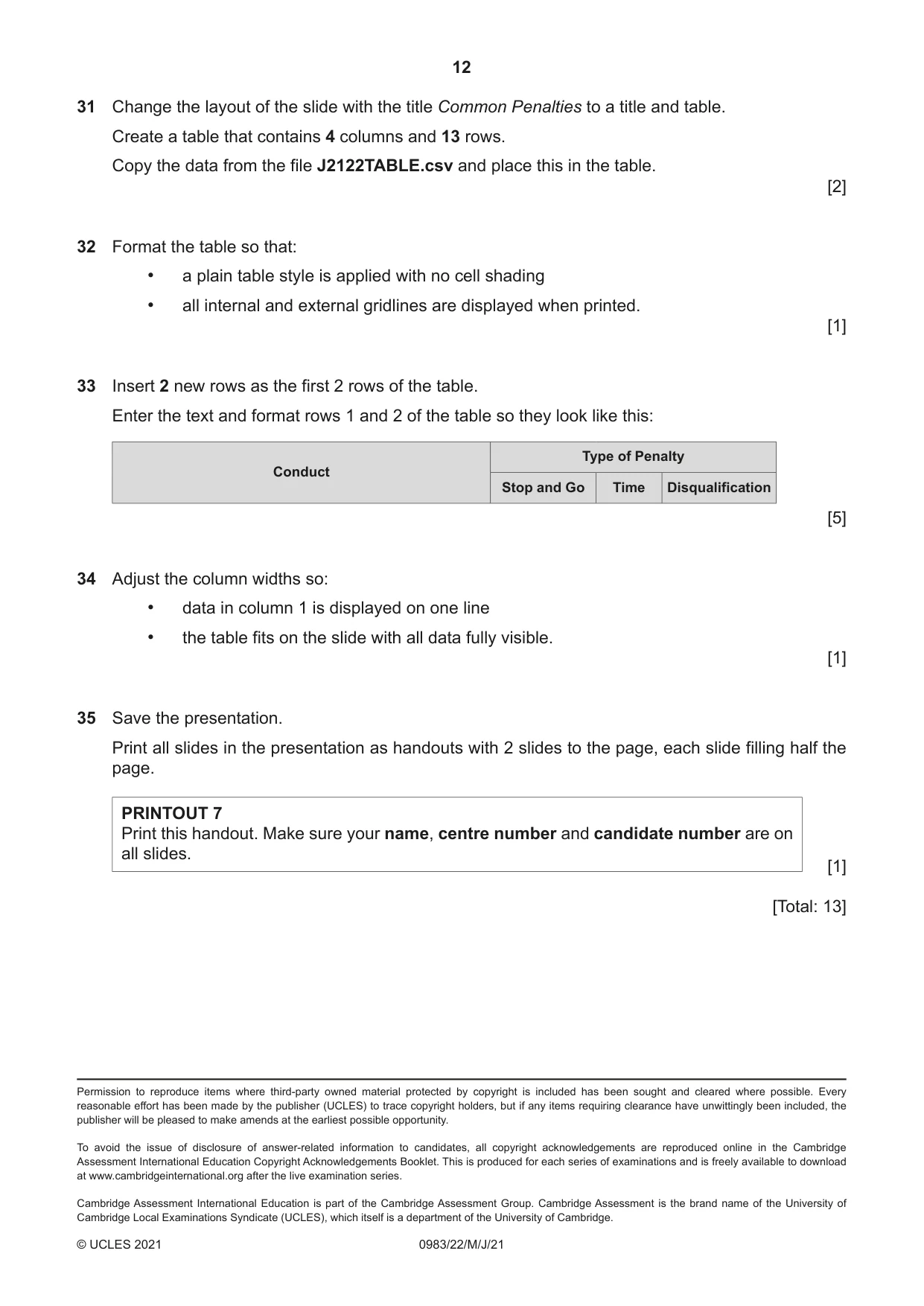
12 0983/22/M/J/21 © UCLES 2021 Permission to reproduce items where third-party owned material protected by copyright is included has been sought and cleared where possible. Every reasonable effort has been made by the publisher (UCLES) to trace copyright holders, but if any items requiring clearance have unwittingly been included, the publisher will be pleased to make amends at the earliest possible opportunity. To avoid the issue of disclosure of answer-related information to candidates, all copyright acknowledgements are reproduced online in the Cambridge Assessment International Education Copyright Acknowledgements Booklet. This is produced for each series of examinations and is freely available to download at www.cambridgeinternational.org after the live examination series. Cambridge Assessment International Education is part of the Cambridge Assessment Group. Cambridge Assessment is the brand name of the University of Cambridge Local Examinations Syndicate (UCLES), which itself is a department of the University of Cambridge. 31 Change the layout of the slide with the title Common Penalties to a title and table. Create a table that contains 4 columns and 13 rows. Copy the data from the file J2122TABLE.csv and place this in the table. [2] 32 Format the table so that: • a plain table style is applied with no cell shading • all internal and external gridlines are displayed when printed. [1] 33 Insert 2 new rows as the first 2 rows of the table. Enter the text and format rows 1 and 2 of the table so they look like this: Conduct Type of Penalty Stop and Go Time Disqualification [5] 34 Adjust the column widths so: • data in column 1 is displayed on one line • the table fits on the slide with all data fully visible. [1] 35 Save the presentation. Print all slides in the presentation as handouts with 2 slides to the page, each slide filling half the page. PRINTOUT 7 Print this handout. Make sure your name, centre number and candidate number are on all slides. [1] [Total: 13]
Mark scheme, page 1
This document consists of 17 printed pages. © UCLES 2021 [Turn over Cambridge IGCSE™ INFORMATION AND COMMUNICATION TECHNOLOGY 0983/22 Paper 2 Practical Test A May/June 2021 MARK SCHEME Maximum Mark: 80 Published This mark scheme is published as an aid to teachers and candidates, to indicate the requirements of the examination. It shows the basis on which Examiners were instructed to award marks. It does not indicate the details of the discussions that took place at an Examiners’ meeting before marking began, which would have considered the acceptability of alternative answers. Mark schemes should be read in conjunction with the question paper and the Principal Examiner Report for Teachers. Cambridge International will not enter into discussions about these mark schemes. Cambridge International is publishing the mark schemes for the May/June 2021 series for most Cambridge IGCSE™, Cambridge International A and AS Level components and some Cambridge O Level components.
Mark scheme, page 2
0983/22 Cambridge IGCSE – Mark Scheme PUBLISHED May/June 2021 © UCLES 2021 Page 2 of 17 Generic Marking Principles These general marking principles must be applied by all examiners when marking candidate answers. They should be applied alongside the specific content of the mark scheme or generic level descriptors for a question. Each question paper and mark scheme will also comply with these marking principles. GENERIC MARKING PRINCIPLE 1: Marks must be awarded in line with: • the specific content of the mark scheme or the generic level descriptors for the question • the specific skills defined in the mark scheme or in the generic level descriptors for the question • the standard of response required by a candidate as exemplified by the standardisation scripts. GENERIC MARKING PRINCIPLE 2: Marks awarded are always whole marks (not half marks, or other fractions). GENERIC MARKING PRINCIPLE 3: Marks must be awarded positively: • marks are awarded for correct/valid answers, as defined in the mark scheme. However, credit is given for valid answers which go beyond the scope of the syllabus and mark scheme, referring to your Team Leader as appropriate • marks are awarded when candidates clearly demonstrate what they know and can do • marks are not deducted for errors • marks are not deducted for omissions • answers should only be judged on the quality of spelling, punctuation and grammar when these features are specifically assessed by the question as indicated by the mark scheme. The meaning, however, should be unambiguous. GENERIC MARKING PRINCIPLE 4: Rules must be applied consistently, e.g. in situations where candidates have not followed instructions or in the application of generic level descriptors. GENERIC MARKING PRINCIPLE 5: Marks should be awarded using the full range of marks defined in the mark scheme for the question (however; the use of the full mark range may be limited according to the quality of the candidate responses seen). GENERIC MARKING PRINCIPLE 6: Marks awarded are based solely on the requirements as defined in the mark scheme. Marks should not be awarded with grade thresholds or grade descriptors in mind.
Mark scheme, page 3
0983/22 Cambridge IGCSE – Mark Scheme PUBLISHED May/June 2021 © UCLES 2021 Page 3 of 17 EVIDENCE DOCUMENT Step 1 – EVIDENCE 1 Step 2 – EVIDENCE 2 Step 4 – EVIDENCE 3 Step 6 – EVIDENCE 4 MS-title style modified Evidence of MS-title style modified, based on Normal/Default 1 mark File saved as MSREVIEW with evidence of correct file type 1 mark MS-subhead MS-subhead style created, named correctly, based on Normal/Default 1 mark Sans-serif 18pt, centre, bold, underline, single, 0pt before 9pt after 1 mark Top, bottom, left and right margins set to 2 centimetres 1 mark
Mark scheme, page 4
0983/22 Cambridge IGCSE – Mark Scheme PUBLISHED May/June 2021 © UCLES 2021 Page 4 of 17 Step 19 – EVIDENCE 5 Step 20 – EVIDENCE 6 Step 23 – EVIDENCE 7 Step 24 – EVIDENCE 8 1-to-Many relationships: Cat_Code categories table and Cat_Code duathlon table Stat_Code outcomes table and Stat_Code duathlon table 1 mark DB table structures J2122DUATHLON - all field names, data types as given 1 mark J2122CATEGORIES and J2122OUTCOMES - all field names, data types as given 1 mark Primary keys set on Race Number, Cat Code, Stat Code 1 mark Database formula to calculate the number of athletes 1 mark Report 2 exported in pdf format, outcome with file type 1 mark … exported report saved as SENIOR 1 mark
Mark scheme, page 5
0983/22 Cambridge IGCSE – Mark Scheme PUBLISHED May/June 2021 © UCLES 2021 Page 5 of 17 Step 26 – EVIDENCE 9 Step 27 – EVIDENCE 10 Mail Merge selection Evidence of automated filter to select Discipline is Transition_2 Duration is >=2 1 mark Evidence of today date field code 1 mark Date field formatted as dddd, dd MMMM yyyy 1 mark
Mark scheme, page 6
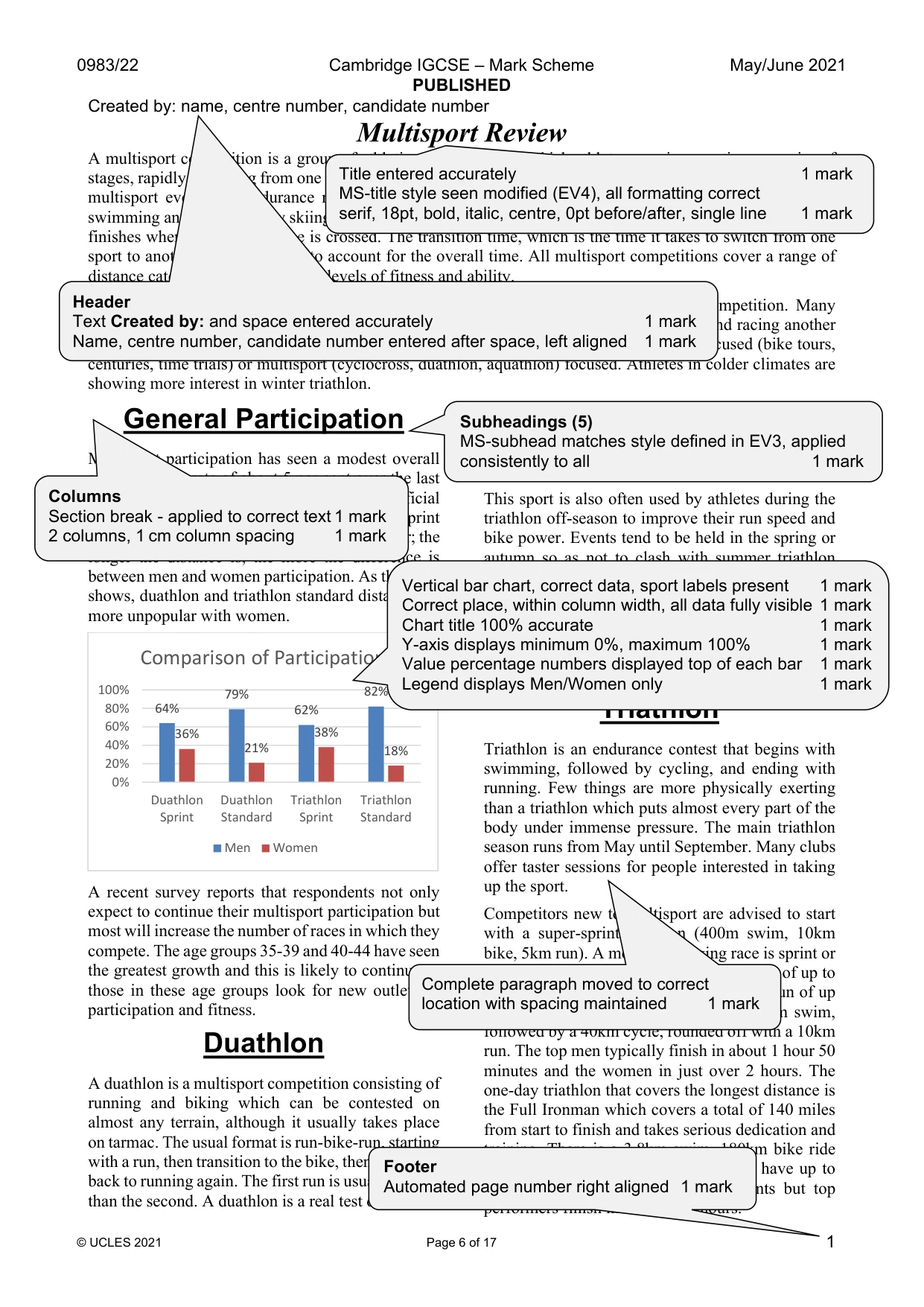
0983/22 Cambridge IGCSE – Mark Scheme PUBLISHED May/June 2021 © UCLES 2021 Page 6 of 17 Created by: name, centre number, candidate number Multisport Review A multisport competition is a group of athletic competitions in which athletes race in a continuous series of stages, rapidly switching from one athletic discipline to another, in order to achieve the best overall time. Most multisport events are endurance races, consisting of aerobic exercise activities such as cycling, running, swimming and cross-country skiing. With all multisport competition the time starts at the start of the race, and finishes when the finishing line is crossed. The transition time, which is the time it takes to switch from one sport to another, is also taken into account for the overall time. All multisport competitions cover a range of distance categories to appeal to all levels of fitness and ability. Multisports are associated with prolonged physical exercise both during training and competition. Many multisport endurance athletes maintain their fitness out of competition season by training and racing another sport. That sport might be running focused (5K, 10K, half-marathon, marathon), cycling focused (bike tours, centuries, time trials) or multisport (cyclocross, duathlon, aquathlon) focused. Athletes in colder climates are showing more interest in winter triathlon. General Participation Multisport participation has seen a modest overall annual growth rate of about 5 per cent over the last five years. There are now more than 13,000 official multisport events held globally each year. Sprint triathlon and duathlons remain the most popular; the longer the distance is, the more the difference is between men and women participation. As the chart shows, duathlon and triathlon standard distance are more unpopular with women. A recent survey reports that respondents not only expect to continue their multisport participation but most will increase the number of races in which they compete. The age groups 35-39 and 40-44 have seen the greatest growth and this is likely to continue as those in these age groups look for new outlets of participation and fitness. Duathlon A duathlon is a multisport competition consisting of running and biking which can be contested on almost any terrain, although it usually takes place on tarmac. The usual format is run-bike-run, starting with a run, then transition to the bike, then transition back to running again. The first run is usually longer than the second. A duathlon is a real test of strength and cardiovascular fitness. The cycling section is non-impact, thus giving the joints a rest, but cycling still requires similar levels of cardiovascular fitness and leg strength to running. This sport is also often used by athletes during the triathlon off-season to improve their run speed and bike power. Events tend to be held in the spring or autumn so as not to clash with summer triathlon races. The sprint distance (5km run, 10km cycle, 2.5km run) is ideal for novice athletes who are not particularly fit. Athletes who exercise five times a week with a mixture of cardiovascular and strength work should test their stamina with the standard distance (10km run, 40km cycle, 5km run). Triathlon Triathlon is an endurance contest that begins with swimming, followed by cycling, and ending with running. Few things are more physically exerting than a triathlon which puts almost every part of the body under immense pressure. The main triathlon season runs from May until September. Many clubs offer taster sessions for people interested in taking up the sport. Competitors new to multisport are advised to start with a super-sprint triathlon (400m swim, 10km bike, 5km run). A more challenging race is sprint or middle distance race which include a swim of up to 1km, a bicycle ride of up to 25km, and a run of up to 5km. Championship distance is a 1.5km swim, followed by a 40km cycle, rounded off with a 10km run. The top men typically finish in about 1 hour 50 minutes and the women in just over 2 hours. The one-day triathlon that covers the longest distance is the Full Ironman which covers a total of 140 miles from start to finish and takes serious dedication and training. There is a 3.8km swim, 180km bike ride and a 42.195km mile run. Competitors have up to 17 hours to complete all three elements but top performers finish in less than 9 hours. 64% 79% 62% 82% 36% 21% 38% 18% 0% 20% 40% 60% 80% 100% Duathlon Sprint Duathlon Standard Triathlon Sprint Triathlon Standard Comparison of Participation Men Women Complete paragraph moved to correct location with spacing maintained 1 mark Footer Automated page number right aligned 1 mark Vertical bar chart, correct data, sport labels present 1 mark Correct place, within column width, all data fully visible 1 mark Chart title 100% accurate 1 mark Y-axis displays minimum 0%, maximum 100% 1 mark Value percentage numbers displayed top of each bar 1 mark Legend displays Men/Women only 1 mark Header Text Created by: and space entered accurately 1 mark Name, centre number, candidate number entered after space, left aligned 1 mark Title entered accurately 1 mark MS-title style seen modified (EV4), all formatting correct serif, 18pt, bold, italic, centre, 0pt before/after, single line 1 mark Subheadings (5) MS-subhead matches style defined in EV3, applied consistently to all 1 mark Columns Section break - applied to correct text 1 mark 2 columns, 1 cm column spacing 1 mark 1
Mark scheme, page 7
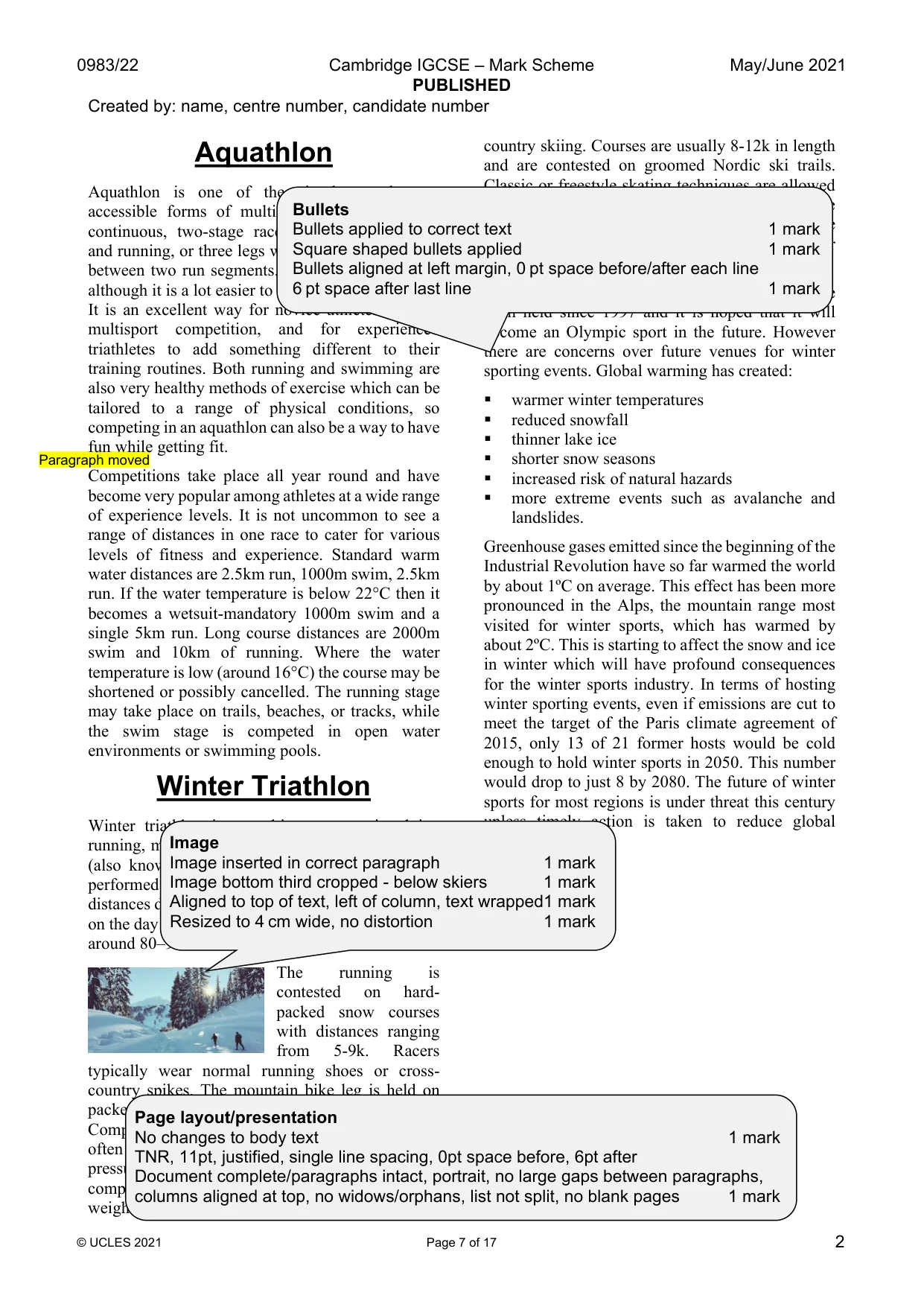
0983/22 Cambridge IGCSE – Mark Scheme PUBLISHED May/June 2021 © UCLES 2021 Page 7 of 17 Paragraph moved Created by: name, centre number, candidate number Aquathlon Aquathlon is one of the simplest and most accessible forms of multisport. It consists of a continuous, two-stage race involving swimming and running, or three legs with a swim sandwiched between two run segments. The order is not rigid, although it is a lot easier to swim first and then run. It is an excellent way for novice athletes to enter multisport competition, and for experienced triathletes to add something different to their training routines. Both running and swimming are also very healthy methods of exercise which can be tailored to a range of physical conditions, so competing in an aquathlon can also be a way to have fun while getting fit. Competitions take place all year round and have become very popular among athletes at a wide range of experience levels. It is not uncommon to see a range of distances in one race to cater for various levels of fitness and experience. Standard warm water distances are 2.5km run, 1000m swim, 2.5km run. If the water temperature is below 22°C then it becomes a wetsuit-mandatory 1000m swim and a single 5km run. Long course distances are 2000m swim and 10km of running. Where the water temperature is low (around 16°C) the course may be shortened or possibly cancelled. The running stage may take place on trails, beaches, or tracks, while the swim stage is competed in open water environments or swimming pools. Winter Triathlon Winter triathlon is a multisport event involving running, mountain biking and cross-country skiing (also known as langlauf). The disciplines are all performed on snow as much as possible. Course distances depend on the snow conditions and are set on the day of the event to achieve a winning time of around 80–90 minutes. The running is contested on hard- packed snow courses with distances ranging from 5-9k. Racers typically wear normal running shoes or cross- country spikes. The mountain bike leg is held on packed ski trails for a distance of 10-15k. Competitors ride standard racing mountain bikes, often equipped with relatively wide tyres run at low pressures. Tyres with spikes are legal but most competitors shun their use because of the additional weight. The final event of winter triathlon is cross- country skiing. Courses are usually 8-12k in length and are contested on groomed Nordic ski trails. Classic or freestyle skating techniques are allowed with most serious competitors using freestyle technique as it is faster. Most race courses involve multiple laps of each stage to enhance the spectator experience. Winter triathlon World Championship races have been held since 1997 and it is hoped that it will become an Olympic sport in the future. However there are concerns over future venues for winter sporting events. Global warming has created: warmer winter temperatures reduced snowfall thinner lake ice shorter snow seasons increased risk of natural hazards more extreme events such as avalanche and landslides. Greenhouse gases emitted since the beginning of the Industrial Revolution have so far warmed the world by about 1ºC on average. This effect has been more pronounced in the Alps, the mountain range most visited for winter sports, which has warmed by about 2ºC. This is starting to affect the snow and ice in winter which will have profound consequences for the winter sports industry. In terms of hosting winter sporting events, even if emissions are cut to meet the target of the Paris climate agreement of 2015, only 13 of 21 former hosts would be cold enough to hold winter sports in 2050. This number would drop to just 8 by 2080. The future of winter sports for most regions is under threat this century unless timely action is taken to reduce global warming. Bullets Bullets applied to correct text 1 mark Square shaped bullets applied 1 mark Bullets aligned at left margin, 0 pt space before/after each line 6 pt space after last line 1 mark Image Image inserted in correct paragraph 1 mark Image bottom third cropped - below skiers 1 mark Aligned to top of text, left of column, text wrapped 1 mark Resized to 4 cm wide, no distortion 1 mark Page layout/presentation No changes to body text 1 mark TNR, 11pt, justified, single line spacing, 0pt space before, 6pt after Document complete/paragraphs intact, portrait, no large gaps between paragraphs, columns aligned at top, no widows/orphans, list not split, no blank pages 1 mark 2
Mark scheme, page 8
0983/22 Cambridge IGCSE – Mark Scheme PUBLISHED May/June 2021 © UCLES 2021 Page 8 of 17 Non-Ranking Elite Athletes Name, centre number, candidate number Race_Number First_Name Last_Name Nationality Race_Category Status Ranked 1075 Zoey Berger USA Elite-Pro Lapped No 1260 Natalia Del Bosque MEX Elite-Pro Lapped No 2152 Giovanna Villard BRA Elite-Pro Lapped No 1464 Daichi Hashimoto JPN Elite-Pro Lapped No 1605 Ferdinand Kloosterman NED Elite-Pro Lapped No 1161 Eduardo Caixeta BRA Elite-Pro Lapped No 1390 Lynn Goldman USA Elite-Pro Lapped No 1426 Flavie Dandurand FRA Elite-Pro Lapped No 2170 Zawadi Wambua KEN Elite-Pro Lapped No 1779 Joben Nakamura JPN Elite-Pro Disqualified No 1941 Carina Leuenberger SUI Elite-Pro Disqualified No 2070 Emeline Strathmann GER Elite-Pro Disqualified No 1243 Edouard Guillemette FRA Elite-Pro Disqualified No 1573 Xavier Kappel NED Elite-Pro Disqualified No 1160 Annabelle Heginbotham GBR Elite-Pro Disqualified No 1206 Frederick Coates GBR Elite-Pro Disqualified No 2039 Owen Lloyd-Jones CAN Elite-Pro Did Not Start No 1440 Kimio Hamamoto JPN Elite-Pro Did Not Start No 2000 Alessandro Schmid SUI Elite-Pro Did Not Start No 2133 Arielle Van der Meer NED Elite-Pro Did Not Start No 1069 Bernadette Belanger CAN Elite-Pro Did Not Finish No 1569 Nadar Kameshki BRN Elite-Pro Did Not Finish No 1735 Flavien Mercier FRA Elite-Pro Did Not Finish No 1011 Remas Ahmad JOR Elite-Pro Did Not Finish No 1702 Makena Mbugua KEN Elite-Pro Did Not Finish No 1490 Akiko Yamamoto JPN Elite-Pro Did Not Finish No 1441 Noor Hamdan JOR Elite-Pro Did Not Finish No 1328 Daniela Ferrero ITA Elite-Pro Did Not Finish No Select records (28): Race_Category is Elite-Pro 1 mark Stat_Code does not include FIN 1 mark Title Correct, 100% accurate, fully visible 1 mark Specified fields, correct order 1 mark Sort descending on Status 1 mark Portrait, tabular, all fields present, fits a single page only, no field width truncation 1 mark
Mark scheme, page 9
0983/22 Cambridge IGCSE – Mark Scheme PUBLISHED May/June 2021 © UCLES 2021 Page 9 of 17 Senior Male UK Results First_Name Last_Name Nationality Gender YOB Athlete_Age Run_1 T_1 Bike T_2 Run_2 Total_Time Position Josh Ellerbeck GBR Male 2001 20 00:41:55 00:01:18 01:12:40 00:01:47 00:22:44 02:20:24 664 Alex Woodbury GBR Male 1983 38 00:42:52 00:01:13 01:11:19 00:01:47 00:22:39 02:19:50 654 Scott Phillips GBR Male 1988 33 00:38:23 00:01:17 01:07:07 00:01:48 00:22:46 02:11:21 495 Tyler Weiss GBR Male 1994 27 00:38:04 00:01:07 01:07:39 00:01:36 00:19:30 02:07:56 422 Calvin Gibbins GBR Male 1985 36 00:37:06 00:01:36 01:04:22 00:01:42 00:19:28 02:04:14 338 Patrick Gallagher GBR Male 1983 38 00:35:41 00:01:52 00:59:55 00:02:42 00:23:07 02:03:17 318 Karl Linton GBR Male 1999 22 00:36:47 00:01:22 01:04:41 00:01:57 00:18:16 02:03:03 313 Hugh Guiness GBR Male 1995 26 00:32:52 00:00:25 01:08:02 00:00:23 00:18:49 02:00:31 255 Spencer Rawlinson GBR Male 1987 34 00:34:39 00:01:11 01:04:13 00:01:47 00:18:12 02:00:02 246 Wayne Vaughan GBR Male 1983 38 00:36:38 00:01:15 01:00:25 00:01:38 00:18:36 01:58:32 217 Tim Finlay GBR Male 1987 34 00:35:16 00:01:03 01:00:56 00:01:42 00:18:04 01:57:01 203 Clive Smith GBR Male 2000 21 00:33:38 00:01:39 00:58:00 00:02:08 00:21:13 01:56:38 191 Alvaro Rodriguez GBR Male 1995 26 00:30:56 00:00:24 01:07:45 00:00:22 00:16:43 01:56:10 184 Lee Sprague GBR Male 1986 35 00:34:55 00:01:48 00:55:53 00:02:12 00:21:15 01:56:03 180 Travis Webster GBR Male 1992 29 00:33:24 00:01:30 00:58:18 00:01:52 00:20:45 01:55:49 173 Oscar Greenhalgh GBR Male 1998 23 00:33:32 00:01:39 00:57:08 00:02:18 00:20:52 01:55:29 166 Mark Boyce GBR Male 1985 36 00:30:56 00:00:18 01:07:48 00:00:27 00:15:47 01:55:16 164 Adam Marshall GBR Male 1982 39 00:33:42 00:01:44 00:55:27 00:02:29 00:21:51 01:55:13 163 Luke Sommerville GBR Male 1983 38 00:33:47 00:01:56 00:56:37 00:02:11 00:20:38 01:55:09 160 Jon Chapman GBR Male 1993 28 00:31:36 00:01:44 00:58:50 00:02:22 00:19:43 01:54:15 149 Matt Gathard GBR Male 1986 35 00:31:25 00:01:58 00:56:56 00:02:13 00:19:43 01:52:15 119 Andrew Metcalf GBR Male 1983 38 00:32:39 00:01:56 00:55:50 00:02:16 00:19:14 01:51:55 115 George Brentwood GBR Male 1986 35 00:31:28 00:01:44 00:54:28 00:02:09 00:19:45 01:49:34 97 Christian Griffiths GBR Male 1997 24 00:31:50 00:01:21 00:55:21 00:01:54 00:19:07 01:49:33 96 Name, centre number, candidate number of 2 Specified fields, correct order 1 mark Landscape, tabular, one page wide, all base fields 1 mark Fields adjusted to fit, no truncation on any field 1 mark Sort ascending on Nationality, descending Position 1 mark Title Correct, 100% accurate 1 mark Select records (42): Nationality is GBR or IRL 1 mark Gender is Male 1 mark YOB is >=1982 and <=2001 1 mark Calculated field Heading 100% accurate 1 mark Athlete_Age calculated - correct values 2021-[YOB] 1 mark
Mark scheme, page 10
0983/22 Cambridge IGCSE – Mark Scheme PUBLISHED May/June 2021 © UCLES 2021 Page 10 of 17 First_Name Last_Name Nationality Gender YOB Athlete_Age Run_1 T_1 Bike T_2 Run_2 Total_Time Position Hayden Porter GBR Male 1991 30 00:30:02 00:01:31 00:55:59 00:02:18 00:18:36 01:48:26 90 David Trevelyan GBR Male 1989 32 00:31:26 00:01:32 00:52:18 00:02:01 00:18:42 01:45:59 68 Walter Ruston GBR Male 1988 33 00:30:51 00:01:43 00:53:03 00:01:50 00:18:31 01:45:58 67 Graham Boardman GBR Male 1982 39 00:31:26 00:01:33 00:51:29 00:02:06 00:19:21 01:45:55 66 Dean Cheshire GBR Male 1984 37 00:29:40 00:01:20 00:52:50 00:01:58 00:18:20 01:44:08 53 Alexander Bowen GBR Male 1985 36 00:27:53 00:00:43 00:53:42 00:00:45 00:14:04 01:37:07 8 Dylan Flanagan IRL Male 2001 20 00:42:38 00:02:17 01:14:39 00:03:03 00:30:28 02:33:05 850 Reece Delaney IRL Male 2001 20 00:40:07 00:07:05 01:04:55 00:02:01 00:20:36 02:14:44 566 Killian Callaghan IRL Male 1982 39 00:4 2:02 00:02:19 01:00:55 00:03:13 00:25:51 02:14:20 556 Eugene Tierney IRL Male 1982 39 00:37:00 00:02:03 00:58:26 00:02:37 00:23:15 02:03:21 321 Flynn McCarthy IRL Male 1984 37 00:36:24 00:01:40 01:04:24 00:01:42 00:17:58 02:02:08 289 Eamon Murphy IRL Male 1991 30 00:38:12 00:01:12 01:01:37 00:01:39 00:19:02 02:01:42 279 Aidan Donoghue IRL Male 2000 21 00:34:06 00:01:46 00:57:16 00:02:32 00:20:25 01:56:05 182 Liam Shanahan IRL Male 1993 28 00:31:10 00:01:41 00:55:50 00:01:58 00:20:36 01:51:15 107 Shane Rafferty IRL Male 1990 31 00:32:24 00:01:32 00:52:35 00:02:20 00:19:45 01:48:36 92 Colm Doyle IRL Male 1996 25 00:30:01 00:00:46 01:00:13 00:00:47 00:15:33 01:47:20 80 Ronan Byrne IRL Male 1986 35 00:32:06 00:01:28 00:50:56 00:02:18 00:19:23 01:46:11 69 Shane Donnelly IRL Male 1987 34 00:29:05 00:01:21 00:50:33 00:01:52 00:17:53 01:40:44 27 Number of athletes 42 Name, centre number, candidate number 2 New record Dean Cheshire, inserted only once, does not replace record Graham Boardman 1 mark New record 100% accurate 1 mark Name, centre number, candidate number displays in report footer, on every page, no other data 1 mark Calculates correct number of athletes, positioned end of report, integer display 1 mark Label 100% accurate, left of value 1 mark Format/Display Report 1 - Ranked displays as Yes/No Report 2 - all times displays hh:mm:ss, all other values as integer 1 mark
Mark scheme, page 11
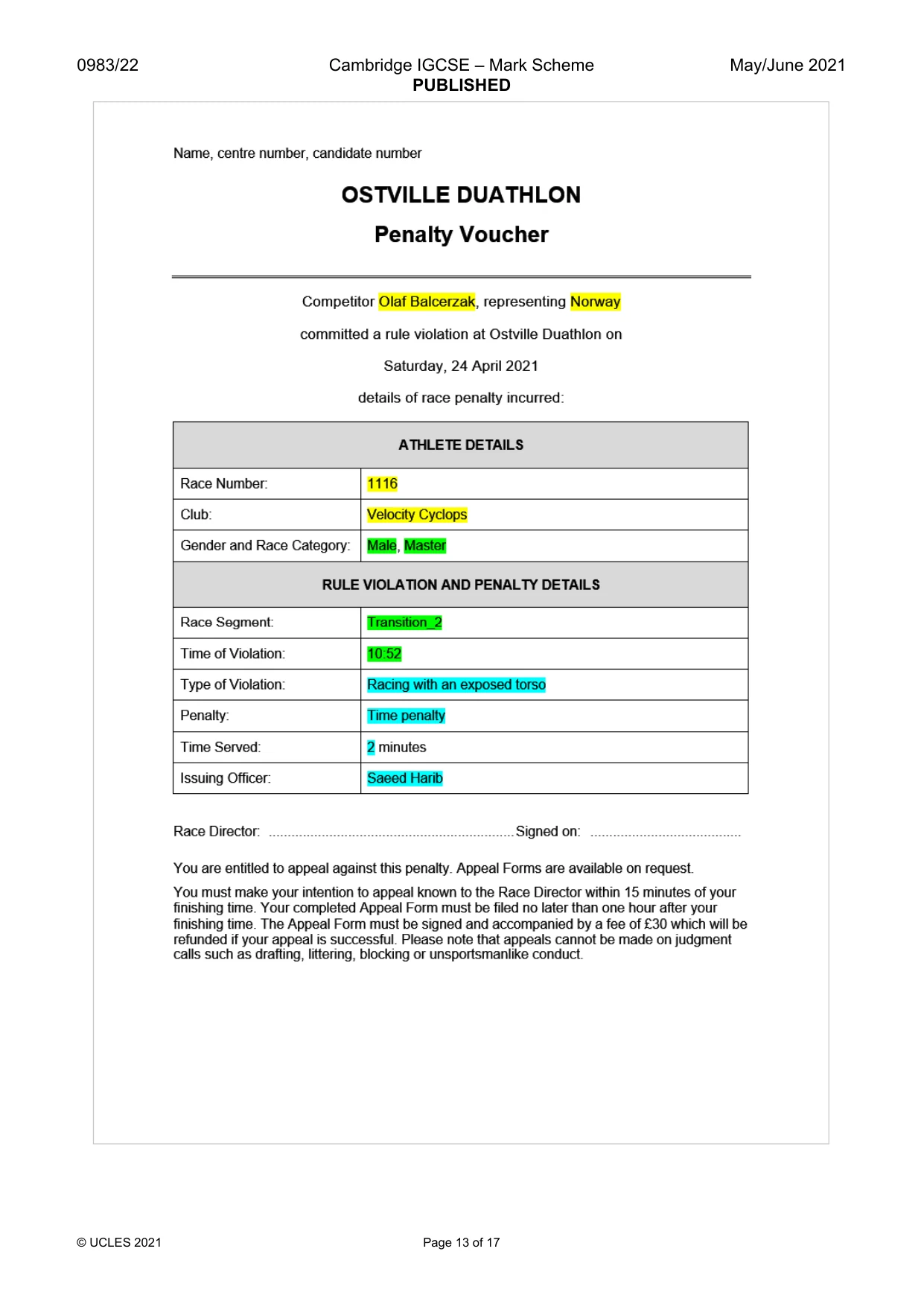
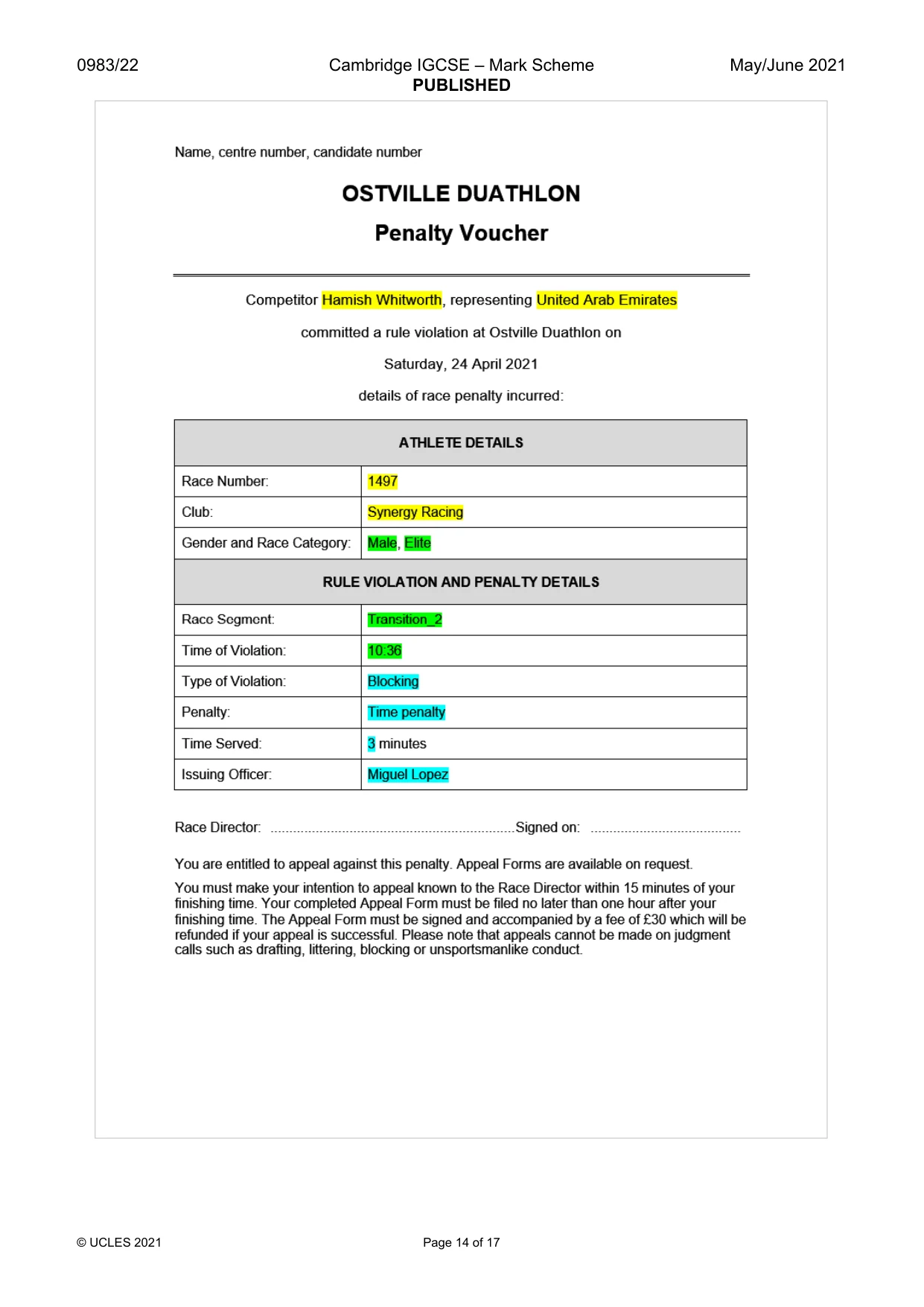
0983/22 Cambridge IGCSE – Mark Scheme PUBLISHED May/June 2021 © UCLES 2021 Page 11 of 17 Task 4 – Mail Merge Merge Fields inserted – Placeholders and <> replaced Fields «Full_Name» | «Country» | «Race_Number» | «Club» in correct position 1 mark Fields «Gender» | «Race_Category» | «Discipline» | «Time_Incurred» in correct position 1 mark Fields «Violation» | «Penalty» | «Duration» | «Tech_Officer» in correct position 1 mark Correct spacing with punctuation maintained 1 mark Name, centre number, candidate number in header 1 mark
Mark scheme, page 12
0983/22 Cambridge IGCSE – Mark Scheme PUBLISHED May/June 2021 © UCLES 2021 Page 12 of 17 Result of merge – correct 3 penalty vouchers printed – Fredrik Dudek, Olaf Balcerzak, Hamish Whitworth only 1 mark
Mark scheme, page 13
0983/22 Cambridge IGCSE – Mark Scheme PUBLISHED May/June 2021 © UCLES 2021 Page 13 of 17
Mark scheme, page 14
0983/22 Cambridge IGCSE – Mark Scheme PUBLISHED May/June 2021 © UCLES 2021 Page 14 of 17
Mark scheme, page 15
0983/22 Cambridge IGCSE – Mark Scheme PUBLISHED May/June 2021 © UCLES 2021 Page 15 of 17 Task 5 – Presentation Presentation complete - slides imported, title/bullet layout, no blank slides/no text changed, Name, centre number, candidate number in footer on every slide 1 mark All slides printed with 2 slides to page, each filling half page 1 mark
Mark scheme, page 16
0983/22 Cambridge IGCSE – Mark Scheme PUBLISHED May/June 2021 © UCLES 2021 Page 16 of 17 Correct 3 original lines indented, consistent bullets and left aligned 1 mark 3 lines smaller font size, italic, with dashed, -, bullets 1 mark
Mark scheme, page 17
0983/22 Cambridge IGCSE – Mark Scheme PUBLISHED May/June 2021 © UCLES 2021 Page 17 of 17 Slide layout changed to title and 4 column x 13 row table 1 mark All data copied into table 1 mark 2 new rows inserted at top of table 1 mark Text entered 100% accurate in correct cells 1 mark Column 1, rows 1 & 2 merged, text centre aligned horizontally & vertically 1 mark Columns 2, 3 & 4 row 1 merged, text centred horizontally in rows 1 and 2 1 mark Grey shading applied rows 1 & 2, title rows text black and bold 1 mark Column 1 displayed on one line, content fits on slide, fully visible 1 mark Plain table style applied rows 3 - 13, all gridlines displayed 1 mark
What you needed in this session
Cambridge’s own grade thresholds for 2021 May/June, Paper 2 · Variant 2. A higher threshold means an easier paper — the bar moves with how the cohort did.