Cambridge IGCSE Information and Communication Technology (9-1) 0983 — 2025 May/June Paper 2 · Variant 2
0983/22/M/J/25 · 70 marks · ≈79 min
The question paper and its mark scheme, free to read here and free to download. This is Cambridge’s own paper, exactly as it was sat.
Question paper12 pages



Mark scheme9 pages
Answers below. Sit the paper first if you are practising.
Paper as text
Question paper, page 1
This document has 12 pages. Any blank pages are indicated. [Turn over Cambridge IGCSE™(9–1) INFORMATION AND COMMUNICATION TECHNOLOGY 0983/22 Paper 2 Document Production, Databases and Presentations May/June 2025 2 hours 15 minutes You will need: Candidate source files (listed on page 2) INSTRUCTIONS ● Carry out all instructions in each step. ● Enter your name, centre number and candidate number on every printout before it is sent to the printer. ● Printouts with handwritten candidate details will not be marked. ● At the end of the examination, put all your printouts into the Assessment Record Folder. ● If you have produced rough copies of printouts, put a cross through each one to indicate that it is not the copy to be marked. ● You must not have access to either the internet or any email system during this examination. INFORMATION ● The total mark for this paper is 70. ● The number of marks for each question or part question is shown in brackets [ ]. * 1 8 5 9 4 8 9 2 2 8 * DC (IP) 354910 © UCLES 2025
Question paper, page 2
2 0983/22/M/J/25 © UCLES 2025 You have been supplied with the following source files: j2522age.csv j2522evidence.rtf j2522group.csv j2522history.jpg j2522info.rtf j2522marathon.rtf j2522runners.csv Task 1 – Evidence Document Open the file j2522evidence.rtf Make sure that your name, centre number and candidate number will appear on every page of this document. Save this document in your work area as EVIDENCE followed by your candidate number, for example, EVIDENCE9999 You will need your Evidence Document during the examination to place screenshots when required. Task 2 – Document You are going to edit a document about marathons. The company uses a corporate house style for all its documents. Paragraph styles must be modified and applied as instructed. 1 Using a suitable software package, open the file j2522marathon.rtf The page setup is set to A4, portrait orientation with 2-centimetre margins. Do not make any changes to these settings. Four paragraph styles have already been created. Do not make any changes to these unless instructed. Save the document in your work area with the file name Marathon Make sure it is saved in the format of the software you are using. Place in your Evidence Document a screenshot to show this file has been saved. Make sure there is evidence of the file type. [1] 2 Place in the header of the Marathon document your name, centre number and candidate number right aligned. Place in the footer automated page numbers right aligned. Make sure that: • all the alignments match the page margins • no other text or placeholders are included in the header or footer areas • the headers and footers are displayed on all pages. [2]
Question paper, page 3
3 0983/22/M/J/25 © UCLES 2025 [Turn over 3 At the start of the document on a new line, enter the title: Marathon Information [1] 4 Apply the TM-title style to the title text entered in Step 3. [1] 5 The style named TM-body has already been created, stored and applied to the text. Modify the TM-body style so only the following formatting is applied: Style name Font style Font size (points) Alignment Enhancement Line spacing Space before (points) Space after (points) TM-body sans-serif 11 justified None 1.5 0 0 Take screenshot evidence to show you have modified the TM-body style and the settings applied. Place this in your Evidence Document. [2] 6 Locate the table in the document. Delete the entire column and contents with the heading Rating [1] 7 Format the left column of the table so that it looks like the left column of this table: Age Graded Percentage Level Above 100% New record performance 100% World record class Above 90% World class Above 80% National class Above 70% Regional class Above 60% Local class [4] 8 Format the left column to have a width of 1.5 centimetres. Take screenshot evidence to show the column width set at 1.5 centimetres. Place this in your Evidence Document. [1]
Question paper, page 4
4 0983/22/M/J/25 © UCLES 2025 9 Select the subheading History and the following text up to and including the paragraph ending … their best performance. Change the page layout so that only this text is displayed in two columns of equal width with a 1-centimetre space between the columns. [2] 10 Import the image j2522history.jpg and place it in the paragraph beginning Legend has it that … Reflect the image so that the man faces the left. [2] 11 Format the image so that: • it is resized to a width of 3 centimetres with the aspect ratio maintained • it is aligned to the right-column guide and the top of the paragraph starting Legend has it that … • the text wraps around the image. [2] 12 Apply the TM-table style to only columns 2 and 3 of the table. Make sure that: • all the text of each row displays on one line • 1-point black internal and external gridlines are displayed when printed • the table borders and all the data fit within the column width • there is a 6-point space after the table. [3] 13 Spell check and proofread the document. Make sure that: • the table is not split over columns or pages • there are no widows or orphans • there are no blank pages • the original styles are maintained • spacing is consistent between all items. Save the document using the same file name and format used in Step 1. Print the document. [2] [Total: 24]
Question paper, page 5
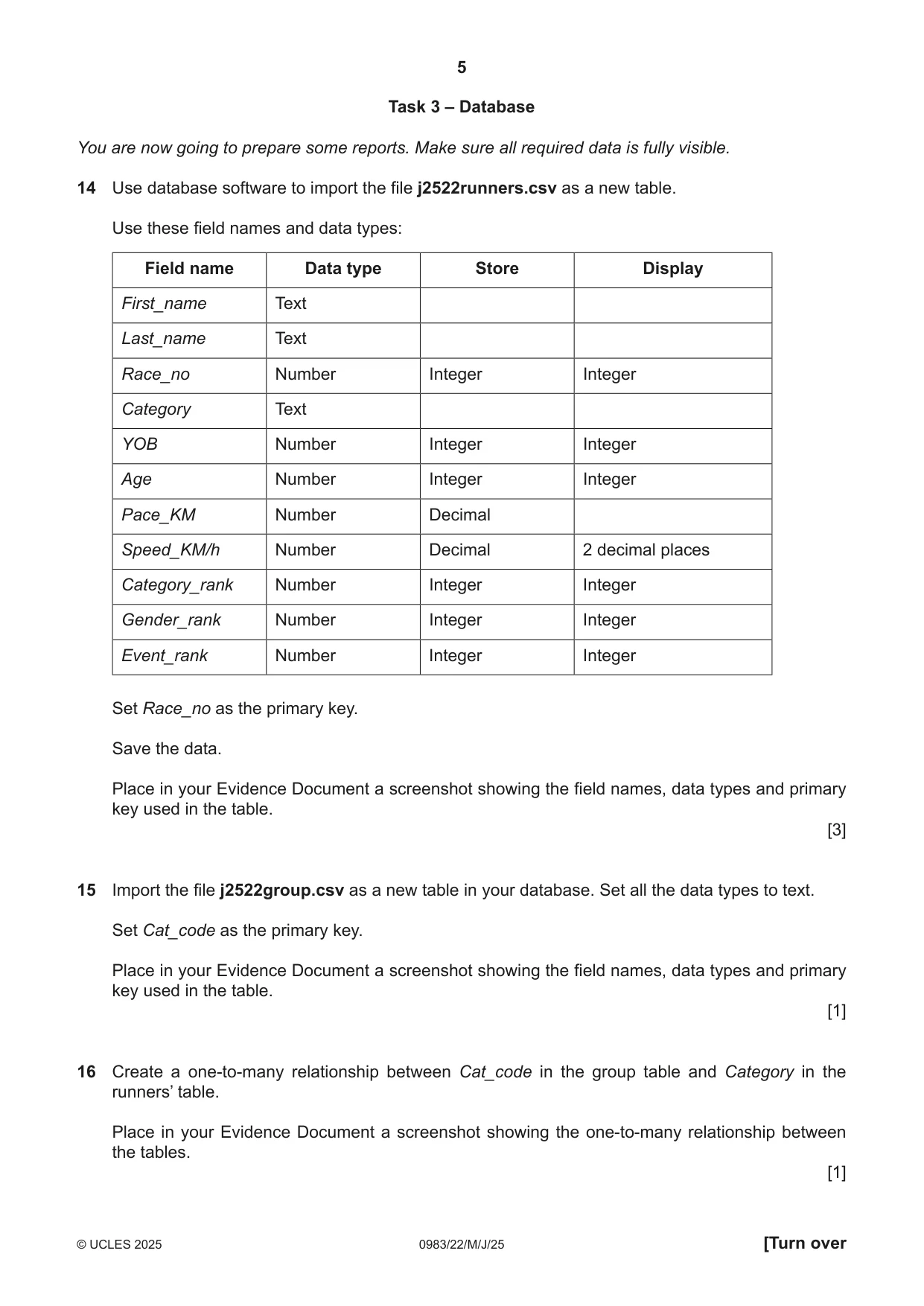
5 0983/22/M/J/25 © UCLES 2025 [Turn over Task 3 – Database You are now going to prepare some reports. Make sure all required data is fully visible. 14 Use database software to import the file j2522runners.csv as a new table. Use these field names and data types: Field name Data type Store Display First_name Text Last_name Text Race_no Number Integer Integer Category Text YOB Number Integer Integer Age Number Integer Integer Pace_KM Number Decimal Speed_KM/h Number Decimal 2 decimal places Category_rank Number Integer Integer Gender_rank Number Integer Integer Event_rank Number Integer Integer Set Race_no as the primary key. Save the data. Place in your Evidence Document a screenshot showing the field names, data types and primary key used in the table. [3] 15 Import the file j2522group.csv as a new table in your database. Set all the data types to text. Set Cat_code as the primary key. Place in your Evidence Document a screenshot showing the field names, data types and primary key used in the table. [1] 16 Create a one-to-many relationship between Cat_code in the group table and Category in the runners’ table. Place in your Evidence Document a screenshot showing the one-to-many relationship between the tables. [1]
Question paper, page 6
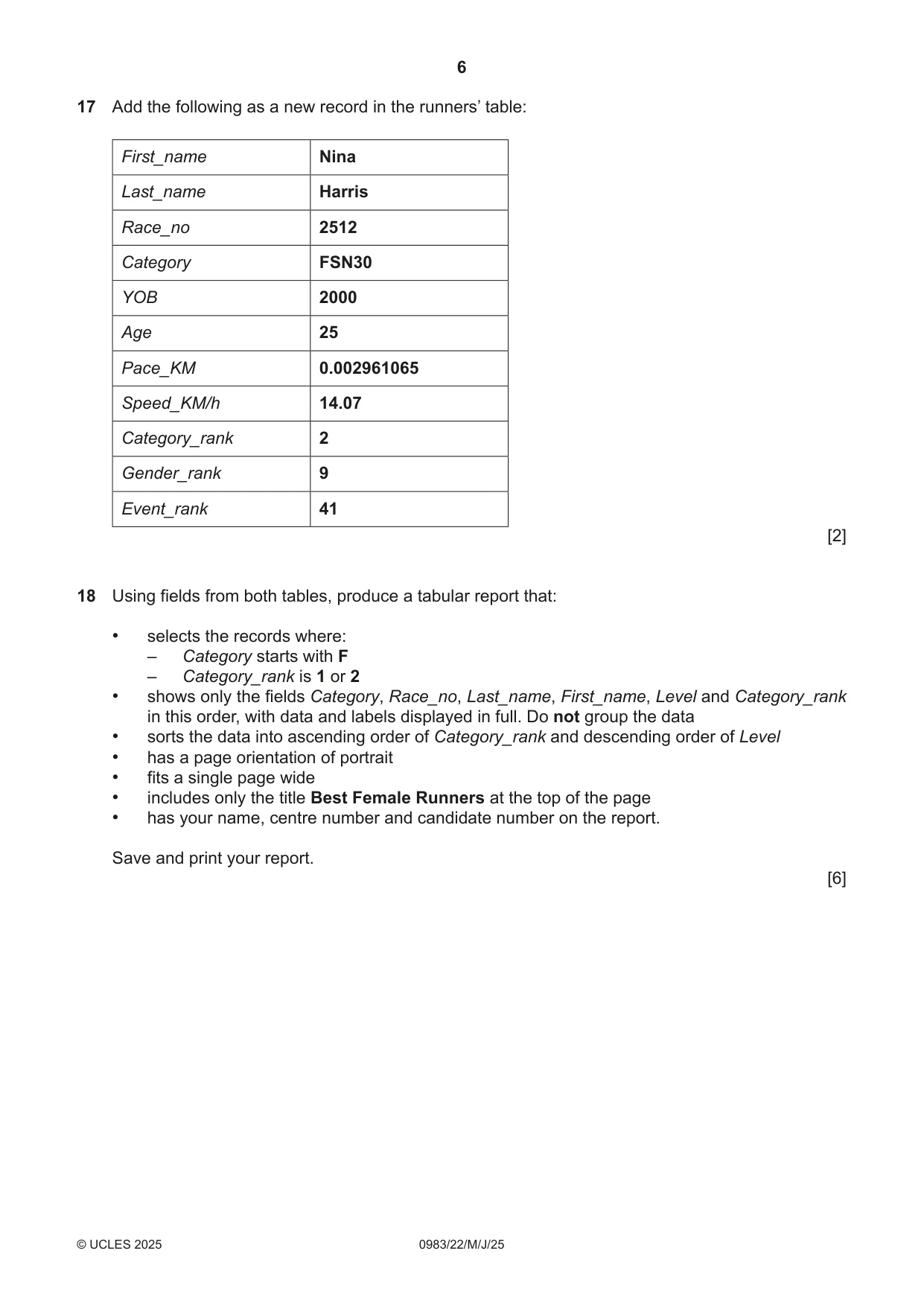
6 0983/22/M/J/25 © UCLES 2025 17 Add the following as a new record in the runners’ table: First_name Nina Last_name Harris Race_no 2512 Category FSN30 YOB 2000 Age 25 Pace_KM 0.002961065 Speed_KM/h 14.07 Category_rank 2 Gender_rank 9 Event_rank 41 [2] 18 Using fields from both tables, produce a tabular report that: • selects the records where: – Category starts with F – Category_rank is 1 or 2 • shows only the fields Category, Race_no, Last_name, First_name, Level and Category_rank in this order, with data and labels displayed in full. Do not group the data • sorts the data into ascending order of Category_rank and descending order of Level • has a page orientation of portrait • fits a single page wide • includes only the title Best Female Runners at the top of the page • has your name, centre number and candidate number on the report. Save and print your report. [6]
Question paper, page 7
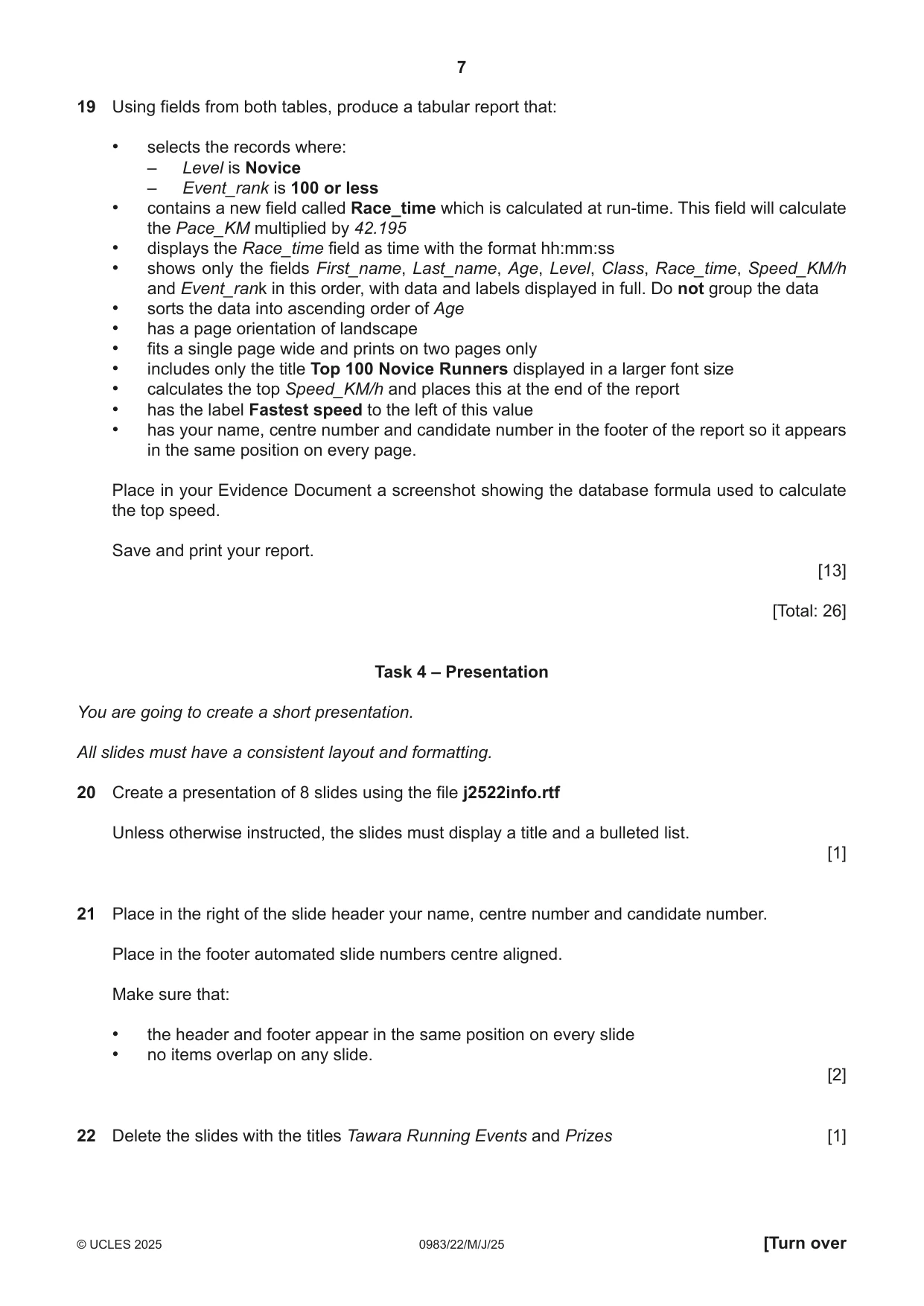
7 0983/22/M/J/25 © UCLES 2025 [Turn over 19 Using fields from both tables, produce a tabular report that: • selects the records where: – Level is Novice – Event_rank is 100 or less • contains a new field called Race_time which is calculated at run-time. This field will calculate the Pace_KM multiplied by 42.195 • displays the Race_time field as time with the format hh:mm:ss • shows only the fields First_name, Last_name, Age, Level, Class, Race_time, Speed_KM/h and Event_rank in this order, with data and labels displayed in full. Do not group the data • sorts the data into ascending order of Age • has a page orientation of landscape • fits a single page wide and prints on two pages only • includes only the title Top 100 Novice Runners displayed in a larger font size • calculates the top Speed_KM/h and places this at the end of the report • has the label Fastest speed to the left of this value • has your name, centre number and candidate number in the footer of the report so it appears in the same position on every page. Place in your Evidence Document a screenshot showing the database formula used to calculate the top speed. Save and print your report. [13] [Total: 26] Task 4 – Presentation You are going to create a short presentation. All slides must have a consistent layout and formatting. 20 Create a presentation of 8 slides using the file j2522info.rtf Unless otherwise instructed, the slides must display a title and a bulleted list. [1] 21 Place in the right of the slide header your name, centre number and candidate number. Place in the footer automated slide numbers centre aligned. Make sure that: • the header and footer appear in the same position on every slide • no items overlap on any slide. [2] 22 Delete the slides with the titles Tawara Running Events and Prizes [1]
Question paper, page 8
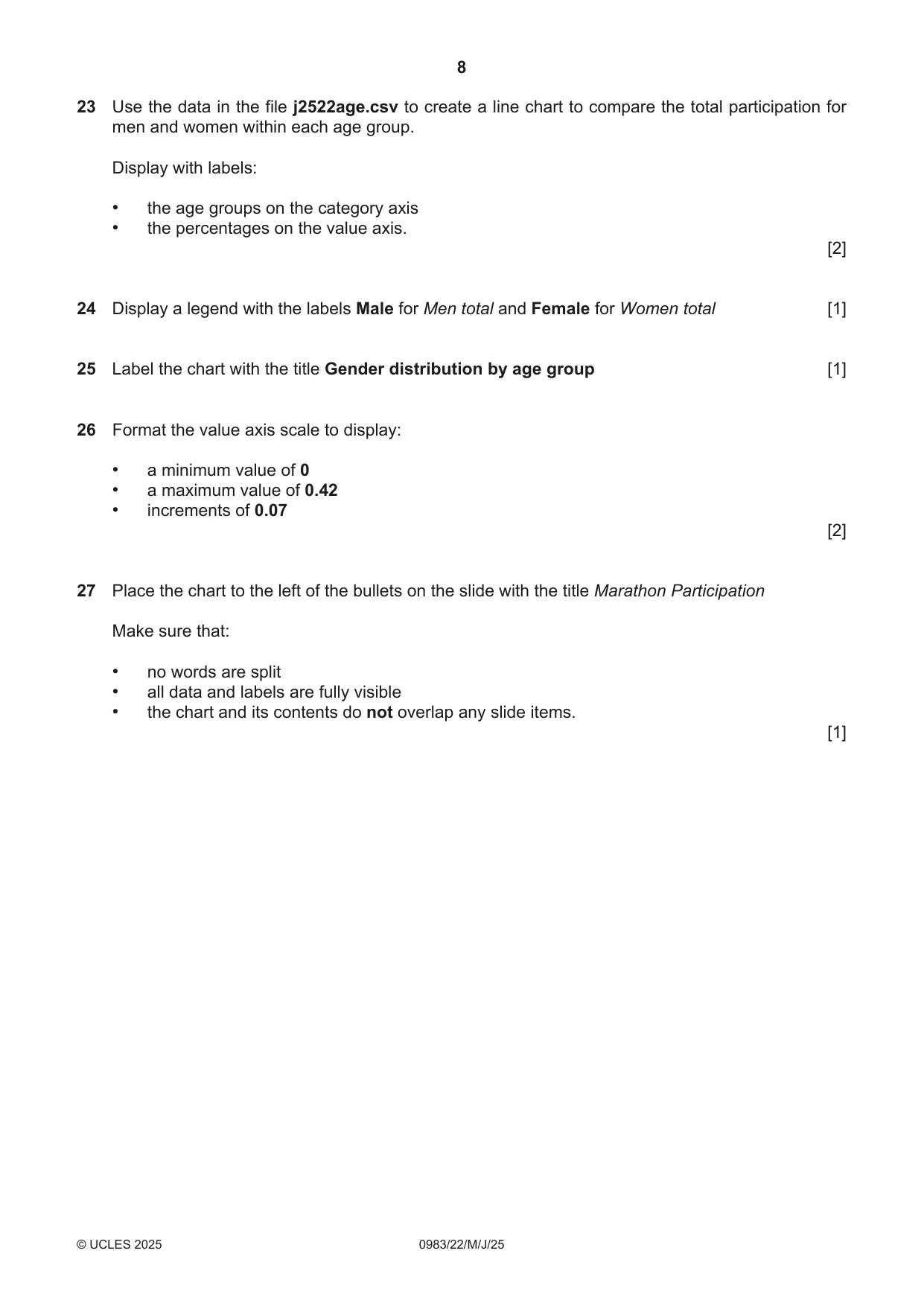
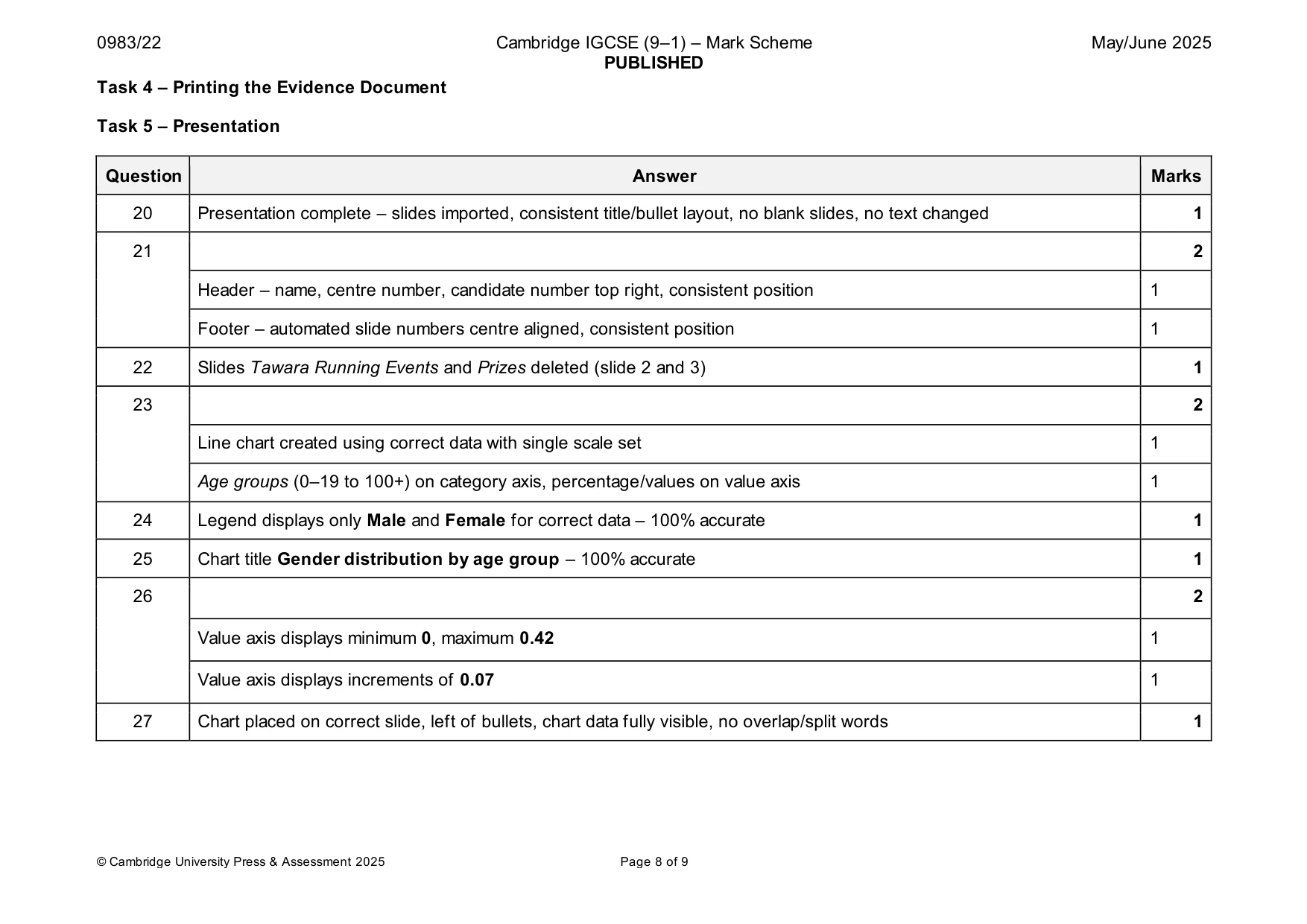
8 0983/22/M/J/25 © UCLES 2025 23 Use the data in the file j2522age.csv to create a line chart to compare the total participation for men and women within each age group. Display with labels: • the age groups on the category axis • the percentages on the value axis. [2] 24 Display a legend with the labels Male for Men total and Female for Women total [1] 25 Label the chart with the title Gender distribution by age group [1] 26 Format the value axis scale to display: • a minimum value of 0 • a maximum value of 0.42 • increments of 0.07 [2] 27 Place the chart to the left of the bullets on the slide with the title Marathon Participation Make sure that: • no words are split • all data and labels are fully visible • the chart and its contents do not overlap any slide items. [1]
Question paper, page 9
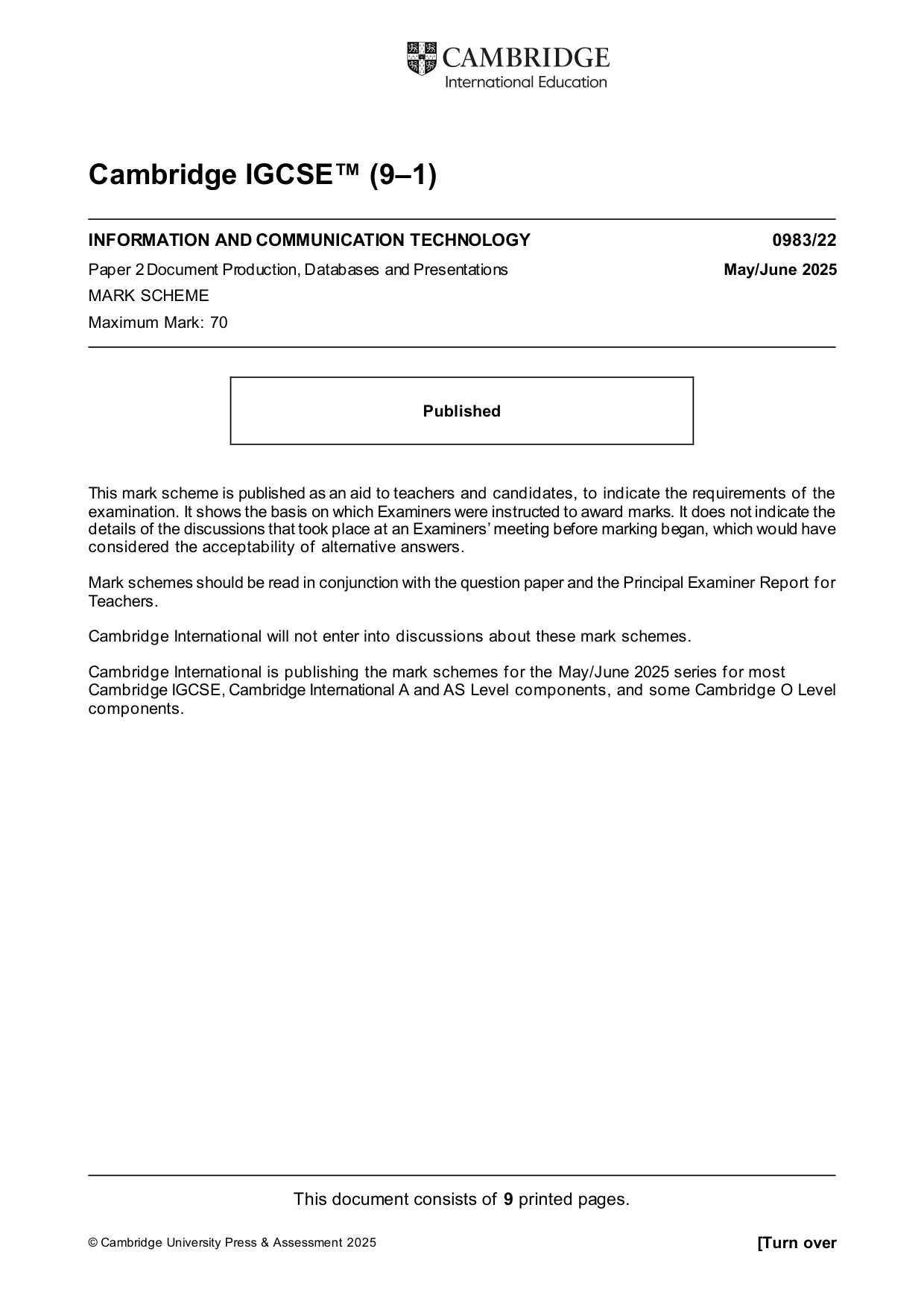
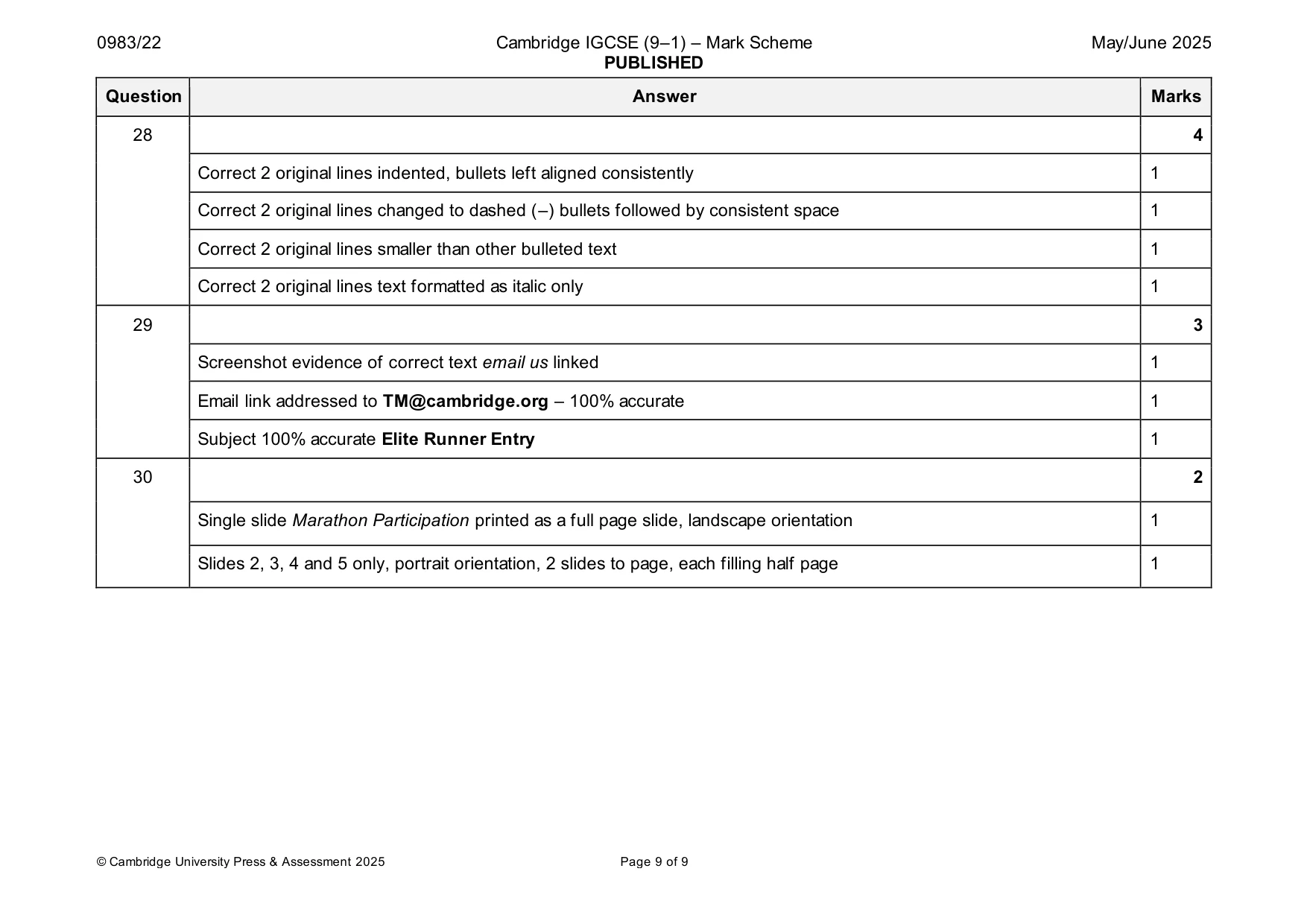
9 0983/22/M/J/25 © UCLES 2025 28 On the slide with the title Elite Runners locate the two bullets describing the qualifying times for men and women. Format only these two bullet points so: • the bullet points are indented to 2.5 centimetres • the bullet style is displayed as a dash (–) • the font size is smaller than the other bulleted text • the text is displayed in italics. The slide should look like this: Name, centre number, candidate number Elite Runners • elite runners are invited to take part in our event free of charge • qualifying times are: – under 02:36:00 for men – under 03:00:00 for women • to book your free elite entry place email us a link to your qualifying time results • places are limited and issued on a first-come basis 3 [4] 29 On the slide with the title Elite Runners format the text email us so that when clicked it opens an email editor ready to send a message to TM@cambridge.org with a subject line Elite Runner Entry Place in your Evidence Document a screenshot showing the linked text, email address and subject. [3] 30 Save the presentation. Print slides 2, 3, 4 and 5 only as handouts in portrait orientation with two slides to the page, each filling half the page. Print only the slide with the title Marathon Participation as a full-page slide in landscape orientation. [2] [Total: 20] Task 5 – Printing the Evidence Document Make sure that your name, centre number and candidate number appear on every page of your Evidence Document. Save your Evidence Document. Print your Evidence Document.
Question paper, page 10
10 0983/22/M/J/25 © UCLES 2025 BLANK PAGE
Question paper, page 11
11 0983/22/M/J/25 © UCLES 2025 BLANK PAGE
Question paper, page 12
12 0983/22/M/J/25 © UCLES 2025 Permission to reproduce items where third-party owned material protected by copyright is included has been sought and cleared where possible. Every reasonable effort has been made by the publisher (UCLES) to trace copyright holders, but if any items requiring clearance have unwittingly been included, the publisher will be pleased to make amends at the earliest possible opportunity. To avoid the issue of disclosure of answer-related information to candidates, all copyright acknowledgements are reproduced online in the Cambridge Assessment International Education Copyright Acknowledgements Booklet. This is produced for each series of examinations and is freely available to download at www.cambridgeinternational.org after the live examination series. Cambridge Assessment International Education is part of Cambridge Assessment. Cambridge Assessment is the brand name of the University of Cambridge Local Examinations Syndicate (UCLES), which is a department of the University of Cambridge. BLANK PAGE
Mark scheme, page 1
This document consists of 9 printed pages. © Cambridge University Press & Assessment 2025 [Turn over Cambridge IGCSE™ (9–1) INFORMATION AND COMMUNICATION TECHNOLOGY 0983/22 Paper 2 Document Production, Databases and Presentations May/June 2025 MARK SCHEME Maximum Mark: 70 Published This mark scheme is published as an aid to teachers and candidates, to indicate the requirements of the examination. It shows the basis on which Examiners were instructed to award marks. It does not indicate the details of the discussions that took place at an Examiners’ meeting before marking began, which would have considered the acceptability of alternative answers. Mark schemes should be read in conjunction with the question paper and the Principal Examiner Report for Teachers. Cambridge International will not enter into discussions about these mark schemes. Cambridge International is publishing the mark schemes for the May/June 2025 series for most Cambridge IGCSE, Cambridge International A and AS Level components, and some Cambridge O Level components.
Mark scheme, page 2
0983/22 Cambridge IGCSE (9–1) – Mark Scheme PUBLISHED May/June 2025 © Cambridge University Press & Assessment 2025 Page 2 of 9 Generic Marking Principles These general marking principles must be applied by all examiners when marking candidate answers. They should be applied alon gside the specific content of the mark scheme or generic level descriptions for a question. Each question paper and mark scheme will also comply with these marking principles. GENERIC MARKING PRINCIPLE 1: Marks must be awarded in line with: • the specific content of the mark scheme or the generic level descriptors for the question • the specific skills defined in the mark scheme or in the generic level descriptors for the question • the standard of response required by a candidate as exemplified by the standardisation scripts. GENERIC MARKING PRINCIPLE 2: Marks awarded are always whole marks (not half marks, or other fractions). GENERIC MARKING PRINCIPLE 3: Marks must be awarded positively: • marks are awarded for correct/valid answers, as defined in the mark scheme. However, credit is given for valid answers which go beyond the scope of the syllabus and mark scheme, referring to your Team Leader as appropriate • marks are awarded when candidates clearly demonstrate what they know and can do • marks are not deducted for errors • marks are not deducted for omissions • answers should only be judged on the quality of spelling, punctuation and grammar when these features are specifically assessed by the question as indicated by the mark scheme. The meaning, however, should be unambiguous. GENERIC MARKING PRINCIPLE 4: Rules must be applied consistently, e.g. in situations where candidates have not followed instructions or in the application of generic level descriptors.
Mark scheme, page 3
0983/22 Cambridge IGCSE (9–1) – Mark Scheme PUBLISHED May/June 2025 © Cambridge University Press & Assessment 2025 Page 3 of 9 GENERIC MARKING PRINCIPLE 5: Marks should be awarded using the full range of marks defined in the mark scheme for the question (however; the use of the full mark range may be limited according to the quality of the candidate responses seen). GENERIC MARKING PRINCIPLE 6: Marks awarded are based solely on the requirements as defined in the mark scheme. Marks should not be awarded with grade thre sholds or grade descriptors in mind.
Mark scheme, page 4
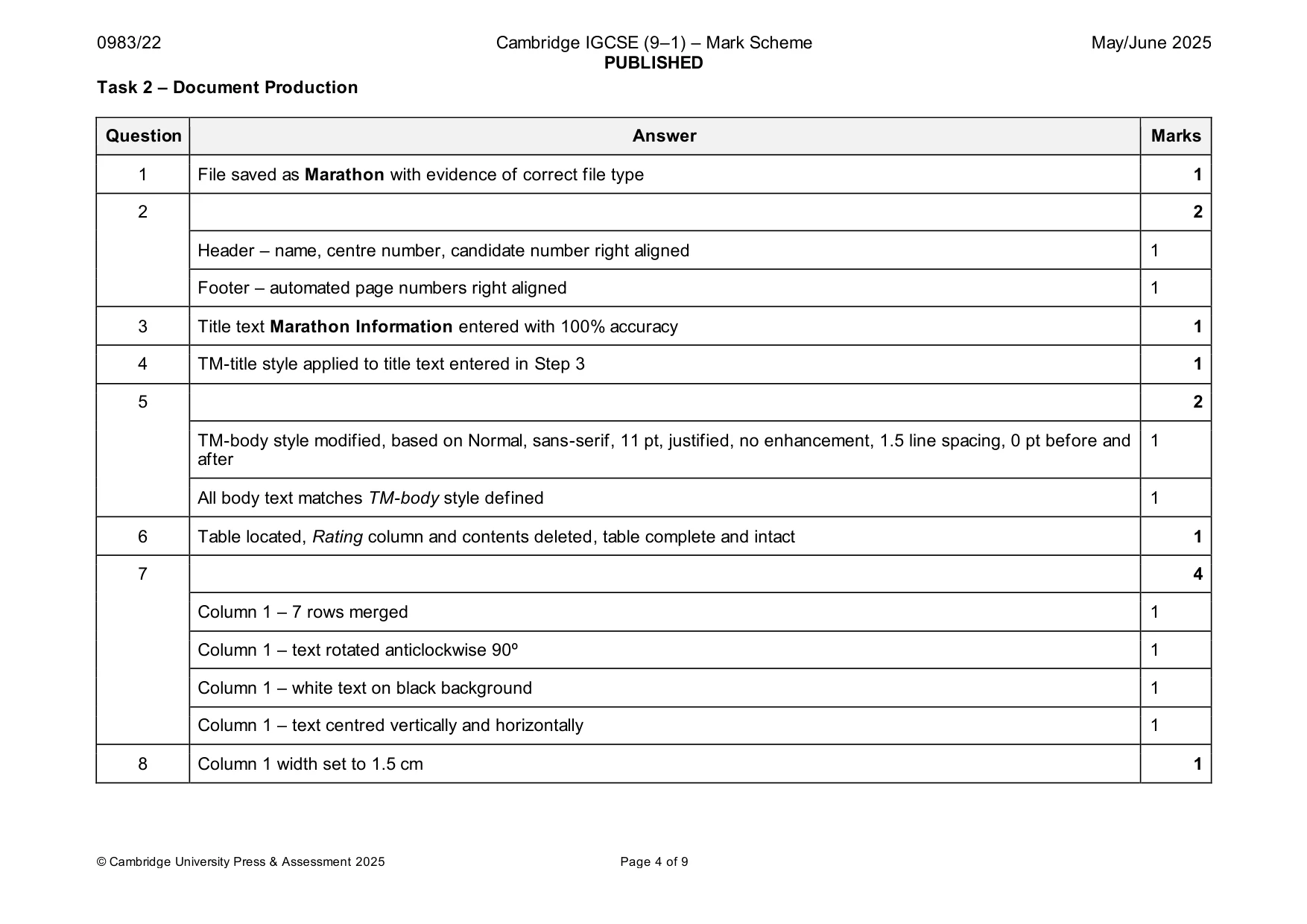
0983/22 Cambridge IGCSE (9–1) – Mark Scheme PUBLISHED May/June 2025 © Cambridge University Press & Assessment 2025 Page 4 of 9 Task 2 – Document Production Question Answer Marks 1 File saved as Marathon with evidence of correct file type 1 2 2 Header – name, centre number, candidate number right aligned 1 Footer – automated page numbers right aligned 1 3 Title text Marathon Information entered with 100% accuracy 1 4 TM-title style applied to title text entered in Step 3 1 5 2 TM-body style modified, based on Normal, sans-serif, 11 pt, justified, no enhancement, 1.5 line spacing, 0 pt before and after 1 All body text matches TM-body style defined 1 6 Table located, Rating column and contents deleted, table complete and intact 1 7 4 Column 1 – 7 rows merged 1 Column 1 – text rotated anticlockwise 90º 1 Column 1 – white text on black background 1 Column 1 – text centred vertically and horizontally 1 8 Column 1 width set to 1.5 cm 1
Mark scheme, page 5
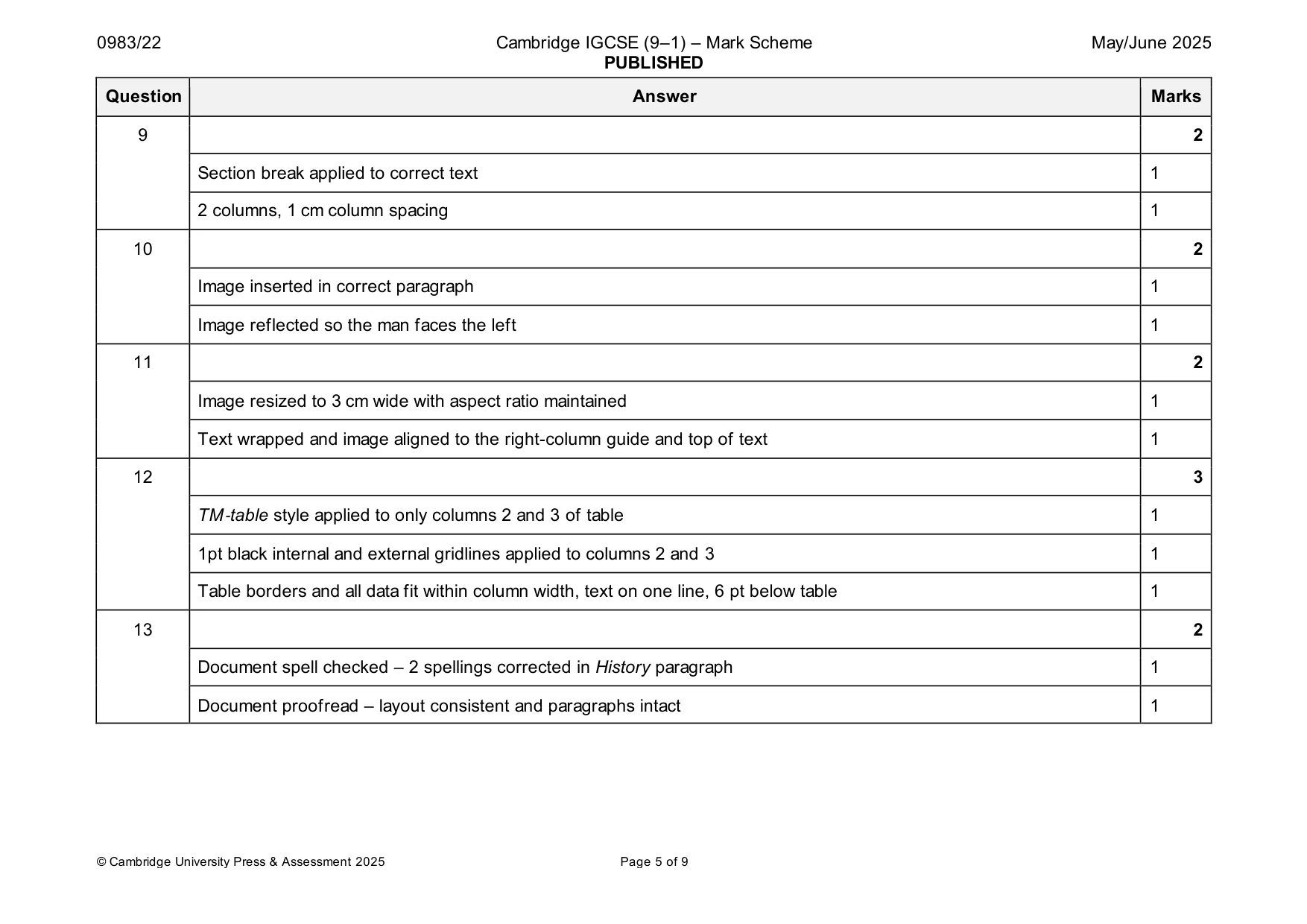
0983/22 Cambridge IGCSE (9–1) – Mark Scheme PUBLISHED May/June 2025 © Cambridge University Press & Assessment 2025 Page 5 of 9 Question Answer Marks 9 2 Section break applied to correct text 1 2 columns, 1 cm column spacing 1 10 2 Image inserted in correct paragraph 1 Image reflected so the man faces the left 1 11 2 Image resized to 3 cm wide with aspect ratio maintained 1 Text wrapped and image aligned to the right-column guide and top of text 1 12 3 TM‑table style applied to only columns 2 and 3 of table 1 1pt black internal and external gridlines applied to columns 2 and 3 1 Table borders and all data fit within column width, text on one line, 6 pt below table 1 13 2 Document spell checked – 2 spellings corrected in History paragraph 1 Document proofread – layout consistent and paragraphs intact 1
Mark scheme, page 6
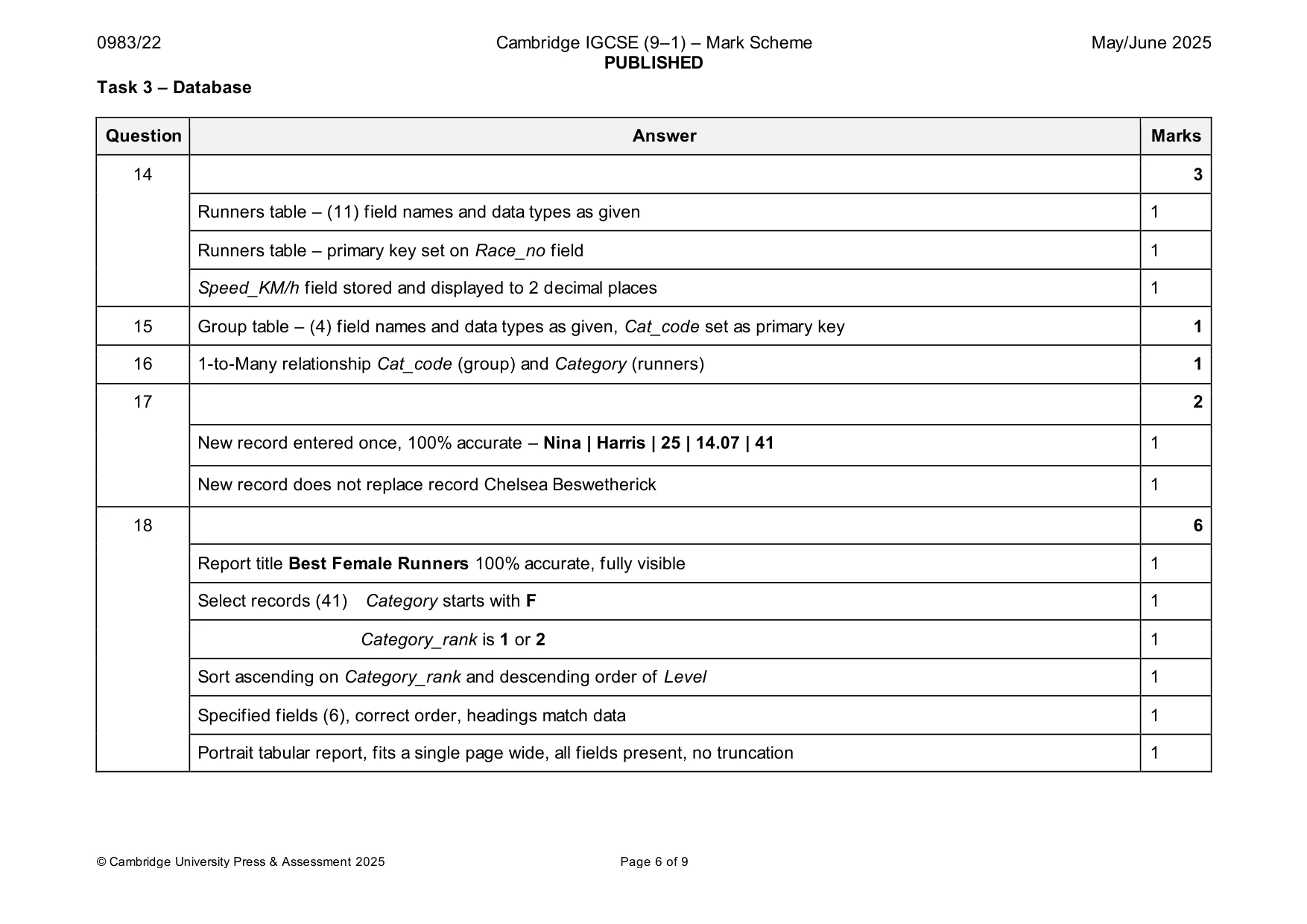
0983/22 Cambridge IGCSE (9–1) – Mark Scheme PUBLISHED May/June 2025 © Cambridge University Press & Assessment 2025 Page 6 of 9 Task 3 – Database Question Answer Marks 14 3 Runners table – (11) field names and data types as given 1 Runners table – primary key set on Race_no field 1 Speed_KM/h field stored and displayed to 2 decimal places 1 15 Group table – (4) field names and data types as given, Cat_code set as primary key 1 16 1-to-Many relationship Cat_code (group) and Category (runners) 1 17 2 New record entered once, 100% accurate – Nina | Harris | 25 | 14.07 | 41 1 New record does not replace record Chelsea Beswetherick 1 18 6 Report title Best Female Runners 100% accurate, fully visible 1 Select records (41) Category starts with F 1 Category_rank is 1 or 2 1 Sort ascending on Category_rank and descending order of Level 1 Specified fields (6), correct order, headings match data 1 Portrait tabular report, fits a single page wide, all fields present, no truncation 1
Mark scheme, page 7
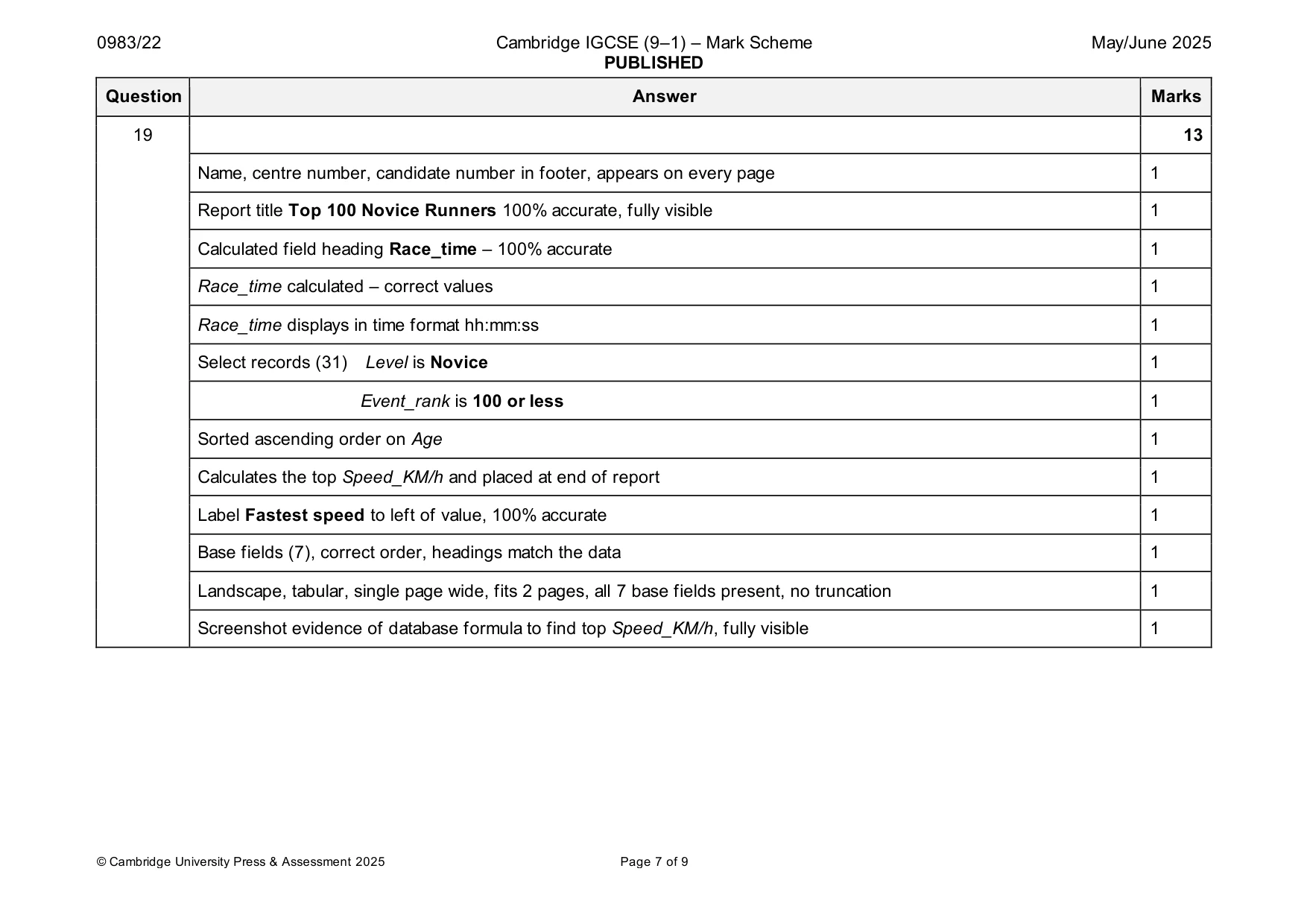
0983/22 Cambridge IGCSE (9–1) – Mark Scheme PUBLISHED May/June 2025 © Cambridge University Press & Assessment 2025 Page 7 of 9 Question Answer Marks 19 13 Name, centre number, candidate number in footer, appears on every page 1 Report title Top 100 Novice Runners 100% accurate, fully visible 1 Calculated field heading Race_time – 100% accurate 1 Race_time calculated – correct values 1 Race_time displays in time format hh:mm:ss 1 Select records (31) Level is Novice 1 Event_rank is 100 or less 1 Sorted ascending order on Age 1 Calculates the top Speed_KM/h and placed at end of report 1 Label Fastest speed to left of value, 100% accurate 1 Base fields (7), correct order, headings match the data 1 Landscape, tabular, single page wide, fits 2 pages, all 7 base fields present, no truncation 1 Screenshot evidence of database formula to find top Speed_KM/h, fully visible 1
Mark scheme, page 8
0983/22 Cambridge IGCSE (9–1) – Mark Scheme PUBLISHED May/June 2025 © Cambridge University Press & Assessment 2025 Page 8 of 9 Task 4 – Printing the Evidence Document Task 5 – Presentation Question Answer Marks 20 Presentation complete – slides imported, consistent title/bullet layout, no blank slides, no text changed 1 21 2 Header – name, centre number, candidate number top right, consistent position 1 Footer – automated slide numbers centre aligned, consistent position 1 22 Slides Tawara Running Events and Prizes deleted (slide 2 and 3) 1 23 2 Line chart created using correct data with single scale set 1 Age groups (0–19 to 100+) on category axis, percentage/values on value axis 1 24 Legend displays only Male and Female for correct data – 100% accurate 1 25 Chart title Gender distribution by age group – 100% accurate 1 26 2 Value axis displays minimum 0, maximum 0.42 1 Value axis displays increments of 0.07 1 27 Chart placed on correct slide, left of bullets, chart data fully visible, no overlap/split words 1
Mark scheme, page 9
0983/22 Cambridge IGCSE (9–1) – Mark Scheme PUBLISHED May/June 2025 © Cambridge University Press & Assessment 2025 Page 9 of 9 Question Answer Marks 28 4 Correct 2 original lines indented, bullets left aligned consistently 1 Correct 2 original lines changed to dashed (–) bullets followed by consistent space 1 Correct 2 original lines smaller than other bulleted text 1 Correct 2 original lines text formatted as italic only 1 29 3 Screenshot evidence of correct text email us linked 1 Email link addressed to TM@cambridge.org – 100% accurate 1 Subject 100% accurate Elite Runner Entry 1 30 2 Single slide Marathon Participation printed as a full page slide, landscape orientation 1 Slides 2, 3, 4 and 5 only, portrait orientation, 2 slides to page, each filling half page 1
What you needed in this session
Cambridge’s own grade thresholds for 2025 May/June, Paper 2 · Variant 2. A higher threshold means an easier paper — the bar moves with how the cohort did.