Cambridge IGCSE History (9-1) 0977 — 2024 Oct/Nov Paper 4 · Variant 1
0977/41/O/N/24 · 40 marks · 60 min
The question paper and its mark scheme, free to read here and free to download. This is Cambridge’s own paper, exactly as it was sat.
Question paper4 pages

Mark scheme19 pages
Answers below. Sit the paper first if you are practising.
Paper as text
Question paper, page 1
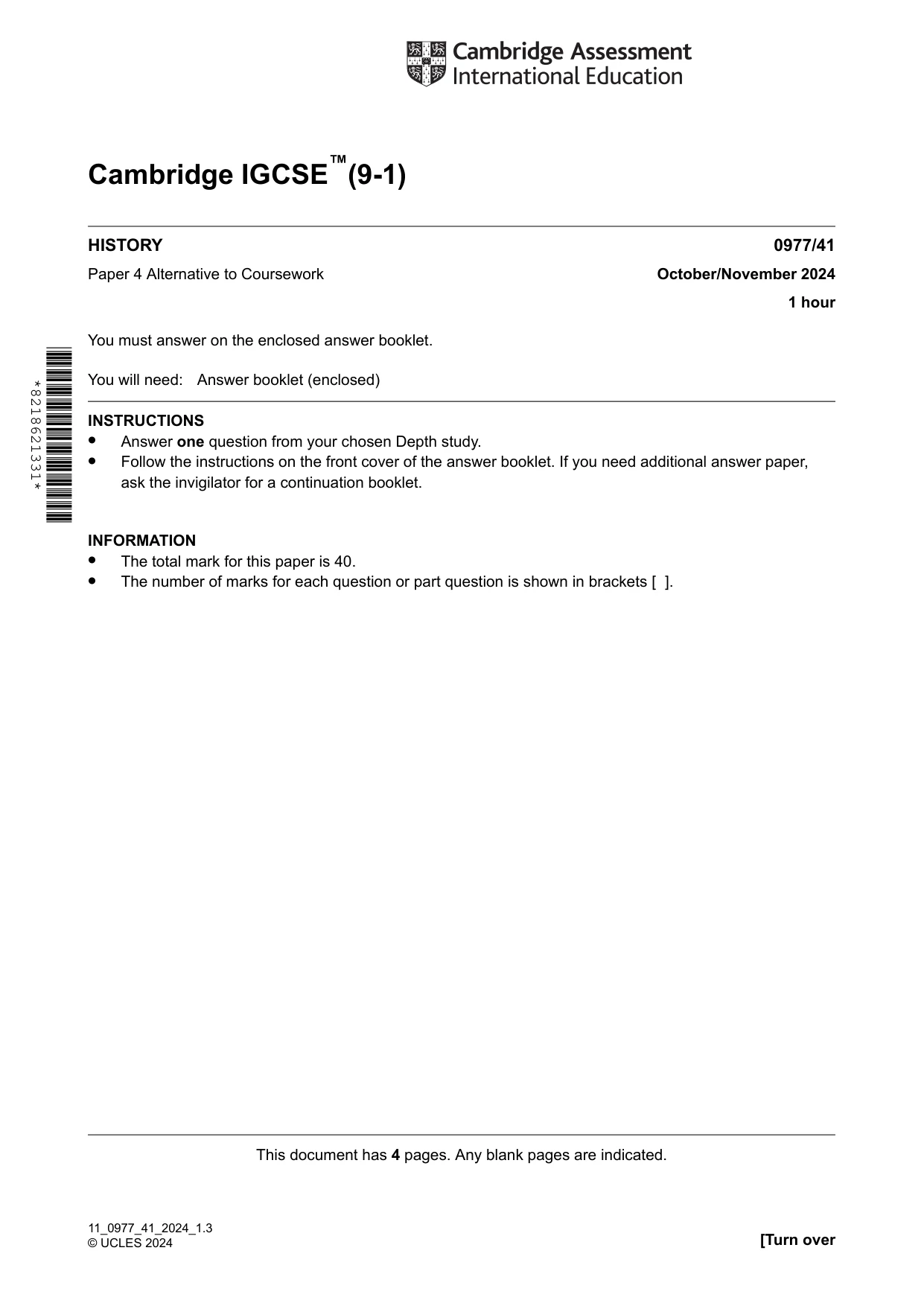
Cambridge IGCSE™(9-1) 0977/41 October/November 2024 1 hour HISTORY Paper 4 Alternative to Coursework You must answer on the enclosed answer booklet. You will need: Answer booklet (enclosed) INSTRUCTIONS • Answer one question from your chosen Depth study. • Follow the instructions on the front cover of the answer booklet. If you need additional answer paper, ask the invigilator for a continuation booklet. INFORMATION • The total mark for this paper is 40. • The number of marks for each question or part question is shown in brackets [ ]. This document has 4 pages. Any blank pages are indicated. [Turn over 11_0977_41_2024_1.3 © UCLES 2024 *8218621331*
Question paper, page 2
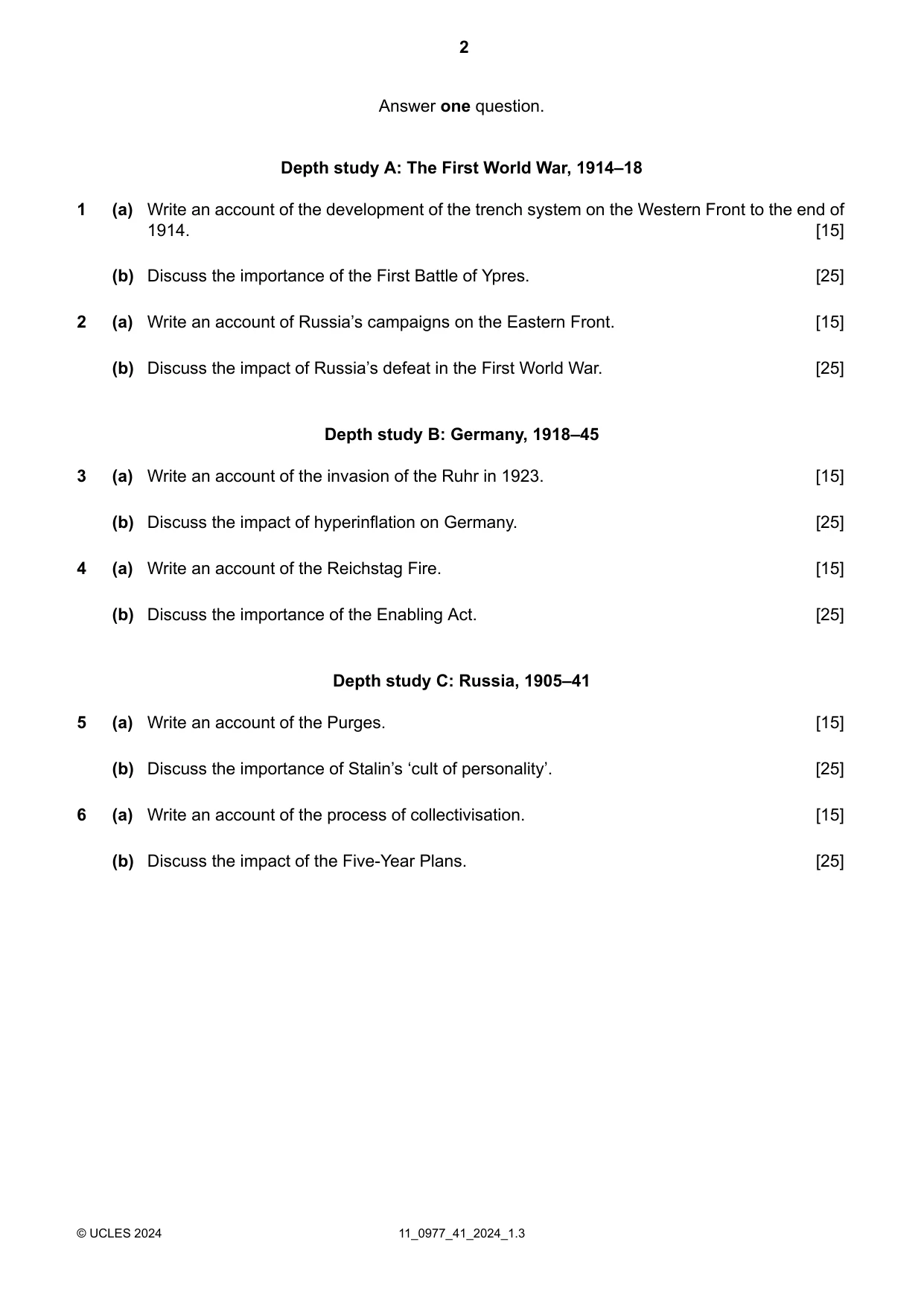
Answer one question. Depth study A: The First World War, 1914–18 Write an account of the development of the trench system on the Western Front to the end of 1914. [15] (a) 1 Discuss the importance of the First Battle of Ypres. [25] (b) Write an account of Russia’s campaigns on the Eastern Front. [15] (a) 2 Discuss the impact of Russia’s defeat in the First World War. [25] (b) Depth study B: Germany, 1918–45 Write an account of the invasion of the Ruhr in 1923. [15] (a) 3 Discuss the impact of hyperinflation on Germany. [25] (b) Write an account of the Reichstag Fire. [15] (a) 4 Discuss the importance of the Enabling Act. [25] (b) Depth study C: Russia, 1905–41 Write an account of the Purges. [15] (a) 5 Discuss the importance of Stalin’s ‘cult of personality’. [25] (b) Write an account of the process of collectivisation. [15] (a) 6 Discuss the impact of the Five-Year Plans. [25] (b) 11_0977_41_2024_1.3 © UCLES 2024 2
Question paper, page 3
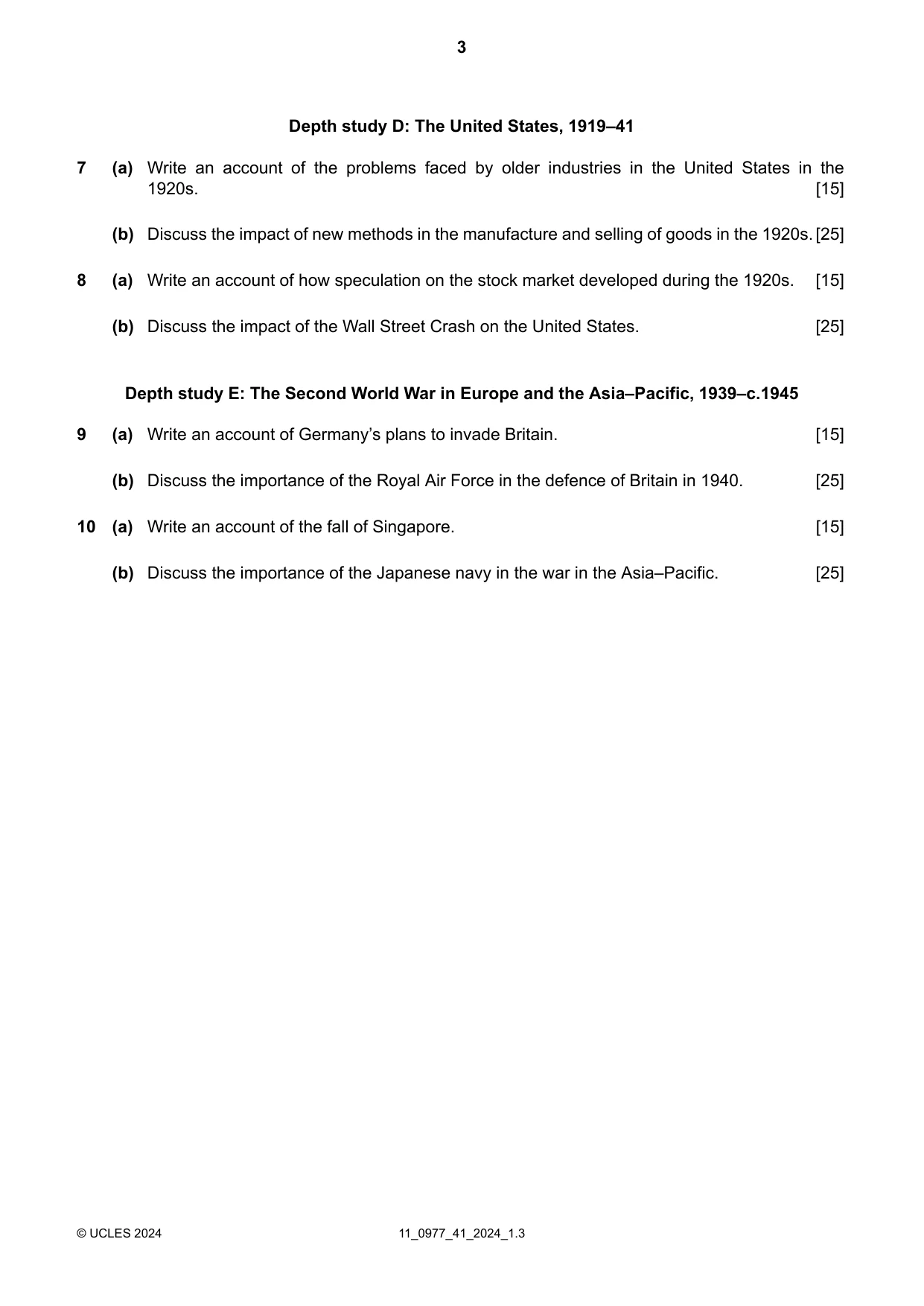
Depth study D: The United States, 1919–41 Write an account of the problems faced by older industries in the United States in the 1920s. [15] (a) 7 Discuss the impact of new methods in the manufacture and selling of goods in the 1920s.[25] (b) Write an account of how speculation on the stock market developed during the 1920s. [15] (a) 8 Discuss the impact of the Wall Street Crash on the United States. [25] (b) Depth study E: The Second World War in Europe and the Asia–Pacific, 1939–c.1945 Write an account of Germany’s plans to invade Britain. [15] (a) 9 Discuss the importance of the Royal Air Force in the defence of Britain in 1940. [25] (b) Write an account of the fall of Singapore. [15] (a) 10 Discuss the importance of the Japanese navy in the war in the Asia–Pacific. [25] (b) 11_0977_41_2024_1.3 © UCLES 2024 3
Question paper, page 4
BLANK PAGE Permission to reproduce items where third-party owned material protected by copyright is included has been sought and cleared where possible. Every reasonable effort has been made by the publisher (UCLES) to trace copyright holders, but if any items requiring clearance have unwittingly been included, the publisher will be pleased to make amends at the earliest possible opportunity. To avoid the issue of disclosure of answer-related information to candidates, all copyright acknowledgements are reproduced online in the Cambridge Assessment International Education Copyright Acknowledgements Booklet. This is produced for each series of examinations and is freely available to download at www.cambridgeinternational.org after the live examination series. Cambridge Assessment International Education is part of Cambridge Assessment. Cambridge Assessment is the brand name of the University of Cambridge Local Examinations Syndicate (UCLES), which is a department of the University of Cambridge. 11_0977_41_2024_1.3 © UCLES 2024 4
Mark scheme, page 1
This document consists of 19 printed pages. © Cambridge University Press & Assessment 2024 [Turn over Cambridge IGCSE™ (9–1) HISTORY 0977/41 Paper 4 Alternative to Coursework October/November 2024 MARK SCHEME Maximum Mark: 40 Published This mark scheme is published as an aid to teachers and candidates, to indicate the requirements of the examination. It shows the basis on which Examiners were instructed to award marks. It does not indicate the details of the discussions that took place at an Examiners’ meeting before marking began, which would have considered the acceptability of alternative answers. Mark schemes should be read in conjunction with the question paper and the Principal Examiner Report for Teachers. Cambridge International will not enter into discussions about these mark schemes. Cambridge International is publishing the mark schemes for the October/November 2024 series for most Cambridge IGCSE, Cambridge International A and AS Level components, and some Cambridge O Level components.
Mark scheme, page 2
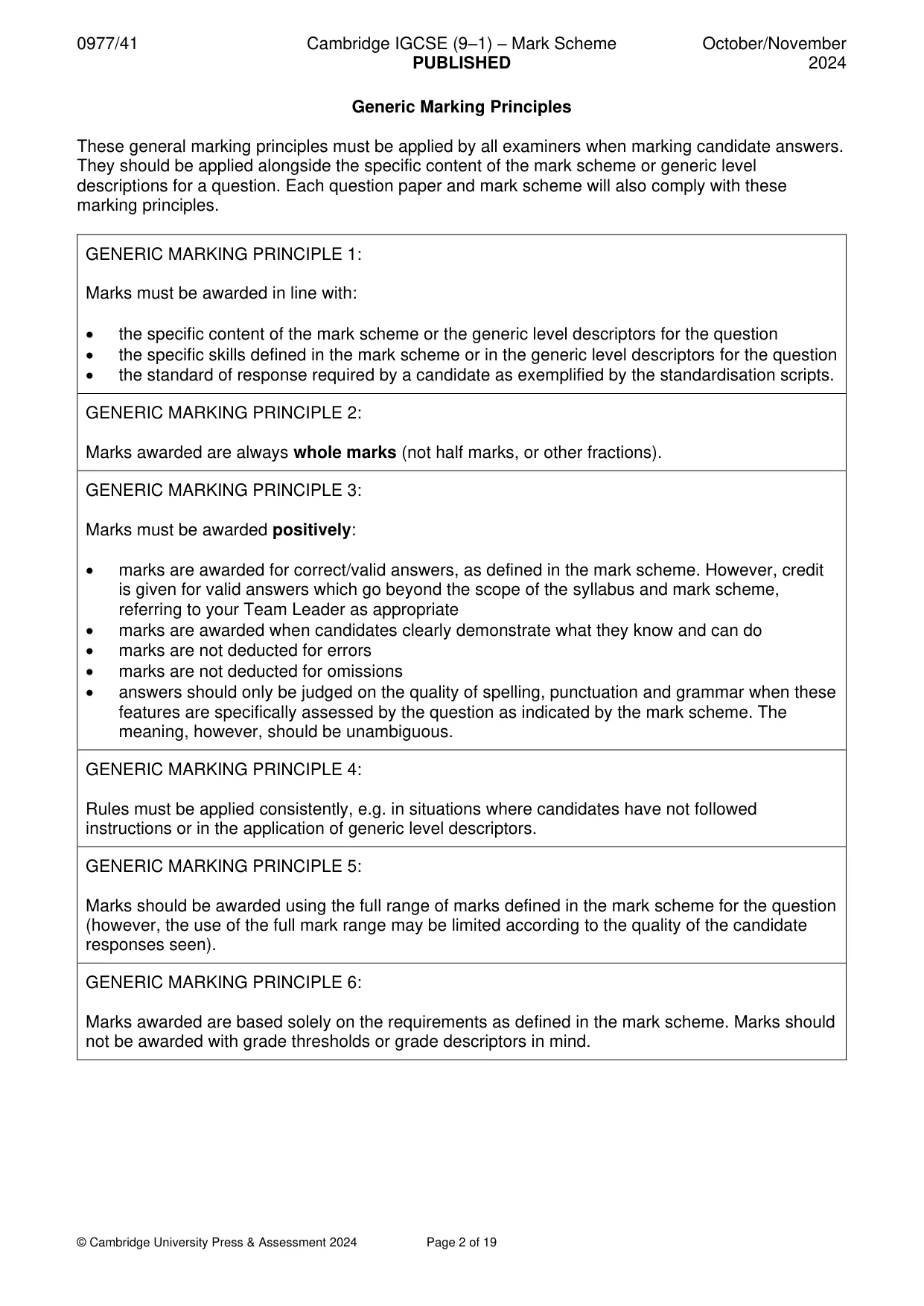
0977/41 Cambridge IGCSE (9–1) – Mark Scheme PUBLISHED October/November 2024 © Cambridge University Press & Assessment 2024 Page 2 of 19 Generic Marking Principles These general marking principles must be applied by all examiners when marking candidate answers. They should be applied alongside the specific content of the mark scheme or generic level descriptions for a question. Each question paper and mark scheme will also comply with these marking principles. GENERIC MARKING PRINCIPLE 1: Marks must be awarded in line with: • the specific content of the mark scheme or the generic level descriptors for the question • the specific skills defined in the mark scheme or in the generic level descriptors for the question • the standard of response required by a candidate as exemplified by the standardisation scripts. GENERIC MARKING PRINCIPLE 2: Marks awarded are always whole marks (not half marks, or other fractions). GENERIC MARKING PRINCIPLE 3: Marks must be awarded positively: • marks are awarded for correct/valid answers, as defined in the mark scheme. However, credit is given for valid answers which go beyond the scope of the syllabus and mark scheme, referring to your Team Leader as appropriate • marks are awarded when candidates clearly demonstrate what they know and can do • marks are not deducted for errors • marks are not deducted for omissions • answers should only be judged on the quality of spelling, punctuation and grammar when these features are specifically assessed by the question as indicated by the mark scheme. The meaning, however, should be unambiguous. GENERIC MARKING PRINCIPLE 4: Rules must be applied consistently, e.g. in situations where candidates have not followed instructions or in the application of generic level descriptors. GENERIC MARKING PRINCIPLE 5: Marks should be awarded using the full range of marks defined in the mark scheme for the question (however, the use of the full mark range may be limited according to the quality of the candidate responses seen). GENERIC MARKING PRINCIPLE 6: Marks awarded are based solely on the requirements as defined in the mark scheme. Marks should not be awarded with grade thresholds or grade descriptors in mind.
Mark scheme, page 3
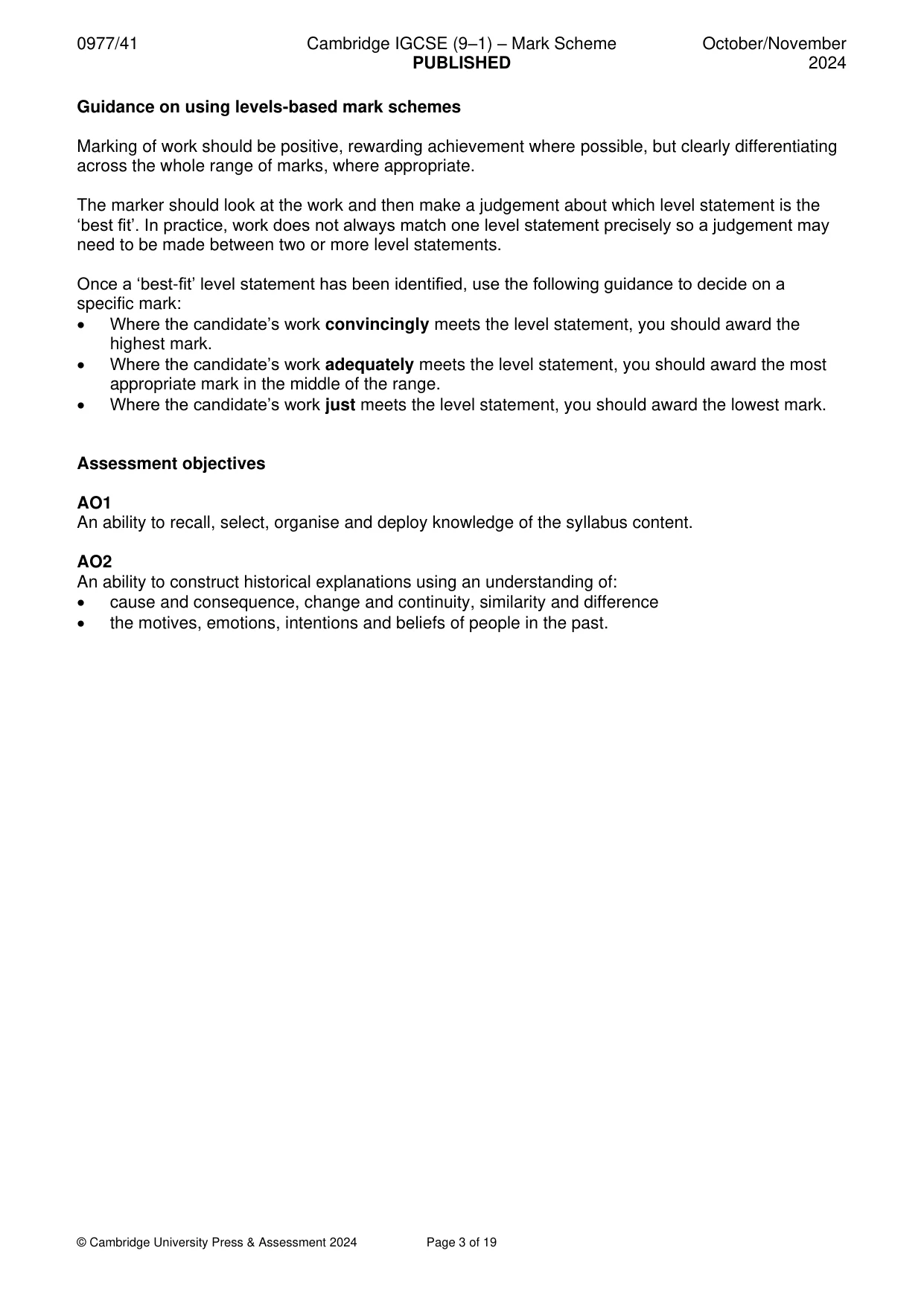
0977/41 Cambridge IGCSE (9–1) – Mark Scheme PUBLISHED October/November 2024 © Cambridge University Press & Assessment 2024 Page 3 of 19 Guidance on using levels-based mark schemes Marking of work should be positive, rewarding achievement where possible, but clearly differentiating across the whole range of marks, where appropriate. The marker should look at the work and then make a judgement about which level statement is the ‘best fit’. In practice, work does not always match one level statement precisely so a judgement may need to be made between two or more level statements. Once a ‘best-fit’ level statement has been identified, use the following guidance to decide on a specific mark: • Where the candidate’s work convincingly meets the level statement, you should award the highest mark. • Where the candidate’s work adequately meets the level statement, you should award the most appropriate mark in the middle of the range. • Where the candidate’s work just meets the level statement, you should award the lowest mark. Assessment objectives AO1 An ability to recall, select, organise and deploy knowledge of the syllabus content. AO2 An ability to construct historical explanations using an understanding of: • cause and consequence, change and continuity, similarity and difference • the motives, emotions, intentions and beliefs of people in the past.
Mark scheme, page 4
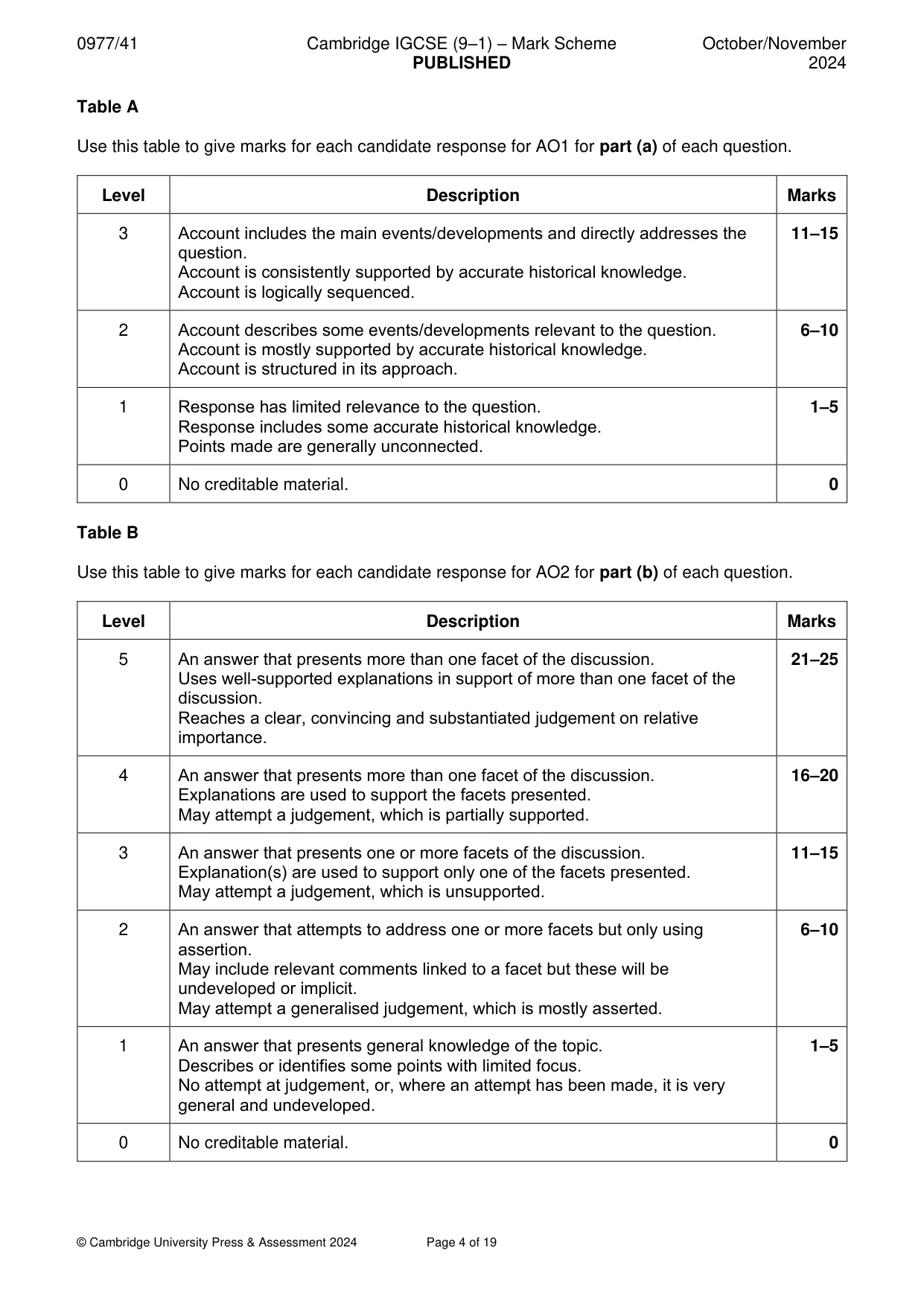
0977/41 Cambridge IGCSE (9–1) – Mark Scheme PUBLISHED October/November 2024 © Cambridge University Press & Assessment 2024 Page 4 of 19 Table A Use this table to give marks for each candidate response for AO1 for part (a) of each question. Level Description Marks 3 Account includes the main events/developments and directly addresses the question. Account is consistently supported by accurate historical knowledge. Account is logically sequenced. 11–15 2 Account describes some events/developments relevant to the question. Account is mostly supported by accurate historical knowledge. Account is structured in its approach. 6–10 1 Response has limited relevance to the question. Response includes some accurate historical knowledge. Points made are generally unconnected. 1–5 0 No creditable material. 0 Table B Use this table to give marks for each candidate response for AO2 for part (b) of each question. Level Description Marks 5 An answer that presents more than one facet of the discussion. Uses well-supported explanations in support of more than one facet of the discussion. Reaches a clear, convincing and substantiated judgement on relative importance. 21–25 4 An answer that presents more than one facet of the discussion. Explanations are used to support the facets presented. May attempt a judgement, which is partially supported. 16–20 3 An answer that presents one or more facets of the discussion. Explanation(s) are used to support only one of the facets presented. May attempt a judgement, which is unsupported. 11–15 2 An answer that attempts to address one or more facets but only using assertion. May include relevant comments linked to a facet but these will be undeveloped or implicit. May attempt a generalised judgement, which is mostly asserted. 6–10 1 An answer that presents general knowledge of the topic. Describes or identifies some points with limited focus. No attempt at judgement, or, where an attempt has been made, it is very general and undeveloped. 1–5 0 No creditable material. 0
Mark scheme, page 5
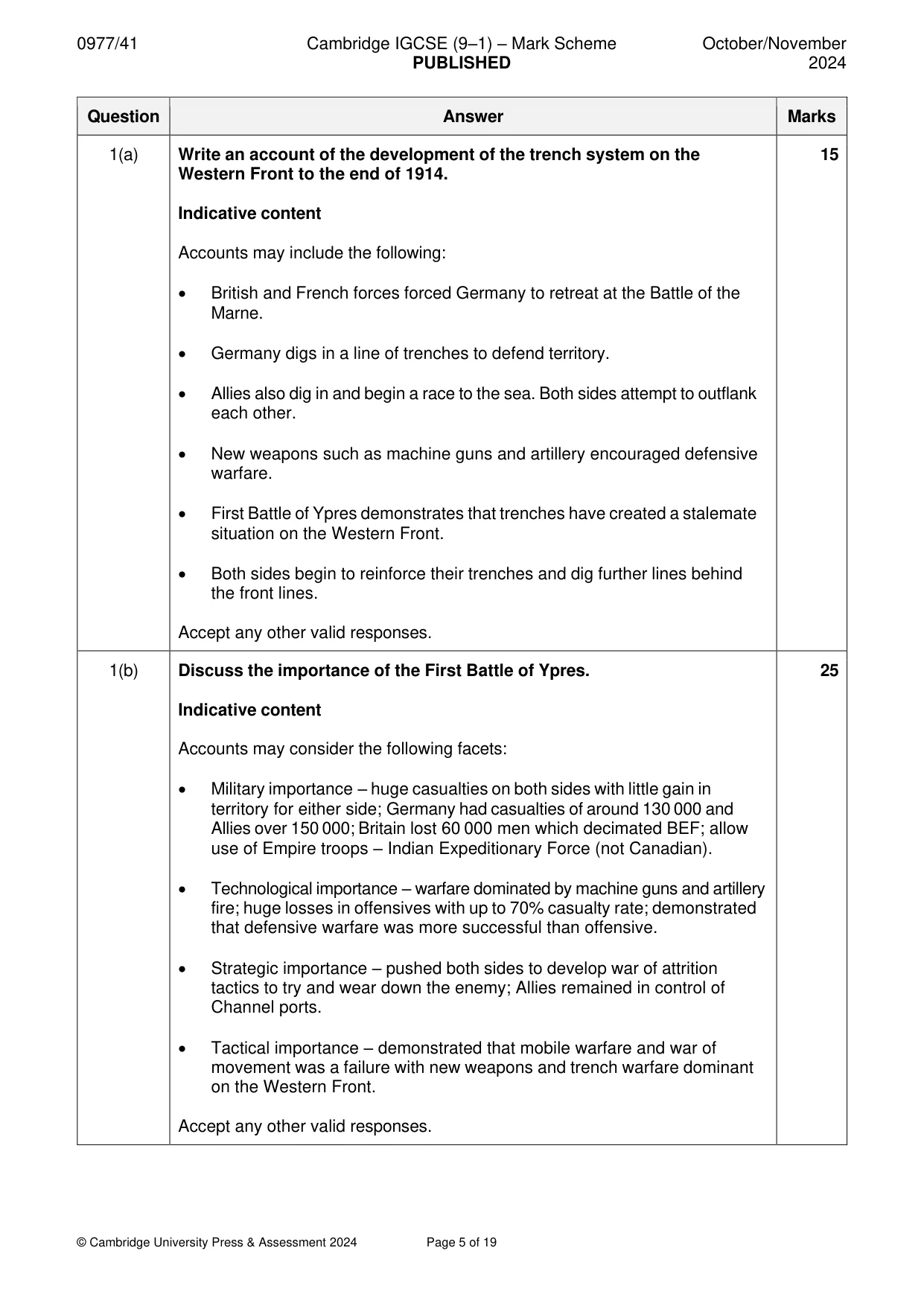
0977/41 Cambridge IGCSE (9–1) – Mark Scheme PUBLISHED October/November 2024 © Cambridge University Press & Assessment 2024 Page 5 of 19 Question Answer Marks 1(a) Write an account of the development of the trench system on the Western Front to the end of 1914. Indicative content Accounts may include the following: • British and French forces forced Germany to retreat at the Battle of the Marne. • Germany digs in a line of trenches to defend territory. • Allies also dig in and begin a race to the sea. Both sides attempt to outflank each other. • New weapons such as machine guns and artillery encouraged defensive warfare. • First Battle of Ypres demonstrates that trenches have created a stalemate situation on the Western Front. • Both sides begin to reinforce their trenches and dig further lines behind the front lines. Accept any other valid responses. 15 1(b) Discuss the importance of the First Battle of Ypres. Indicative content Accounts may consider the following facets: • Military importance – huge casualties on both sides with little gain in territory for either side; Germany had casualties of around 130 000 and Allies over 150 000; Britain lost 60 000 men which decimated BEF; allow use of Empire troops – Indian Expeditionary Force (not Canadian). • Technological importance – warfare dominated by machine guns and artillery fire; huge losses in offensives with up to 70% casualty rate; demonstrated that defensive warfare was more successful than offensive. • Strategic importance – pushed both sides to develop war of attrition tactics to try and wear down the enemy; Allies remained in control of Channel ports. • Tactical importance – demonstrated that mobile warfare and war of movement was a failure with new weapons and trench warfare dominant on the Western Front. Accept any other valid responses. 25
Mark scheme, page 6
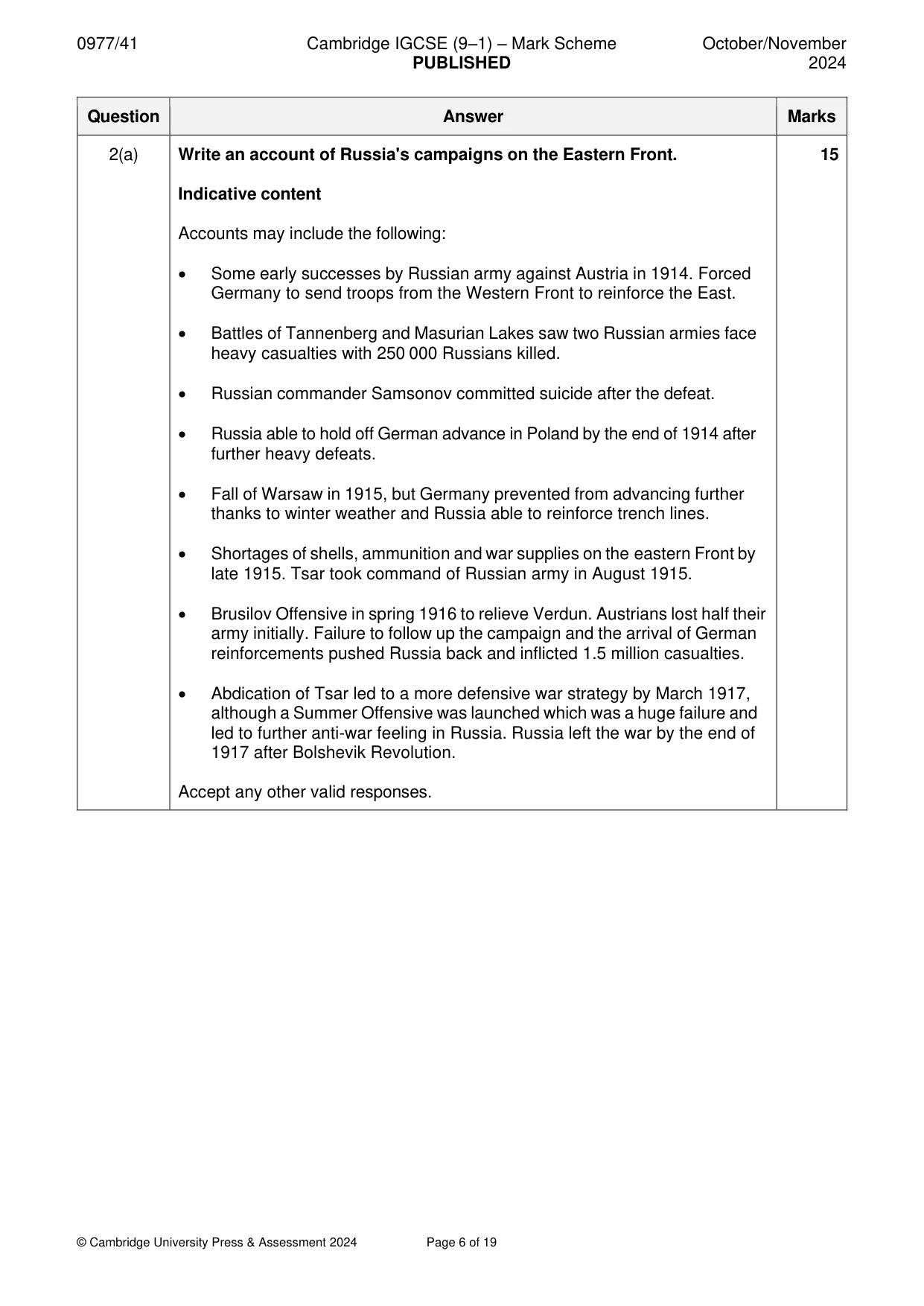
0977/41 Cambridge IGCSE (9–1) – Mark Scheme PUBLISHED October/November 2024 © Cambridge University Press & Assessment 2024 Page 6 of 19 Question Answer Marks 2(a) Write an account of Russia's campaigns on the Eastern Front. Indicative content Accounts may include the following: • Some early successes by Russian army against Austria in 1914. Forced Germany to send troops from the Western Front to reinforce the East. • Battles of Tannenberg and Masurian Lakes saw two Russian armies face heavy casualties with 250 000 Russians killed. • Russian commander Samsonov committed suicide after the defeat. • Russia able to hold off German advance in Poland by the end of 1914 after further heavy defeats. • Fall of Warsaw in 1915, but Germany prevented from advancing further thanks to winter weather and Russia able to reinforce trench lines. • Shortages of shells, ammunition and war supplies on the eastern Front by late 1915. Tsar took command of Russian army in August 1915. • Brusilov Offensive in spring 1916 to relieve Verdun. Austrians lost half their army initially. Failure to follow up the campaign and the arrival of German reinforcements pushed Russia back and inflicted 1.5 million casualties. • Abdication of Tsar led to a more defensive war strategy by March 1917, although a Summer Offensive was launched which was a huge failure and led to further anti-war feeling in Russia. Russia left the war by the end of 1917 after Bolshevik Revolution. Accept any other valid responses. 15
Mark scheme, page 7
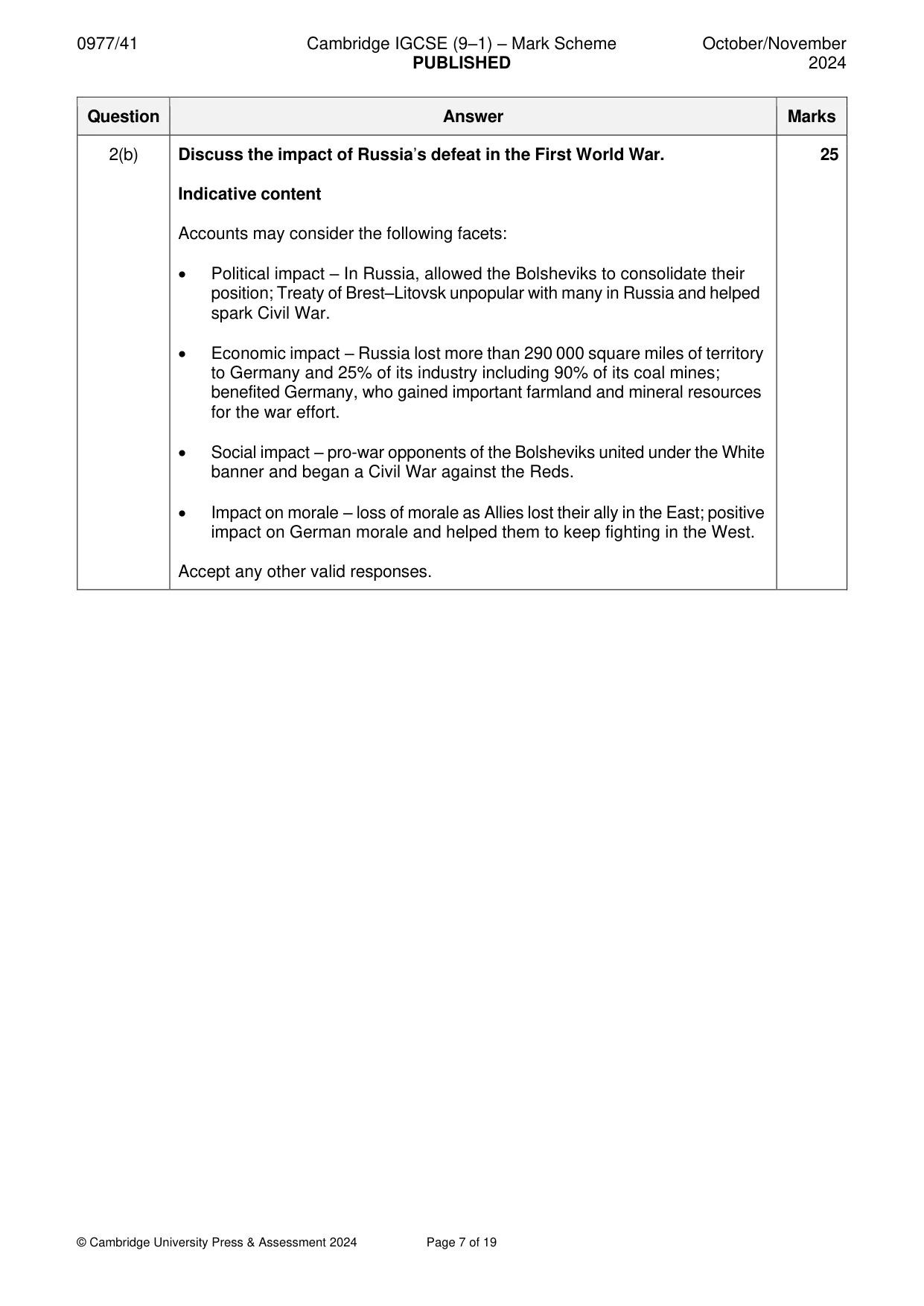
0977/41 Cambridge IGCSE (9–1) – Mark Scheme PUBLISHED October/November 2024 © Cambridge University Press & Assessment 2024 Page 7 of 19 Question Answer Marks 2(b) Discuss the impact of Russia’s defeat in the First World War. Indicative content Accounts may consider the following facets: • Political impact – In Russia, allowed the Bolsheviks to consolidate their position; Treaty of Brest–Litovsk unpopular with many in Russia and helped spark Civil War. • Economic impact – Russia lost more than 290 000 square miles of territory to Germany and 25% of its industry including 90% of its coal mines; benefited Germany, who gained important farmland and mineral resources for the war effort. • Social impact – pro-war opponents of the Bolsheviks united under the White banner and began a Civil War against the Reds. • Impact on morale – loss of morale as Allies lost their ally in the East; positive impact on German morale and helped them to keep fighting in the West. Accept any other valid responses. 25
Mark scheme, page 8
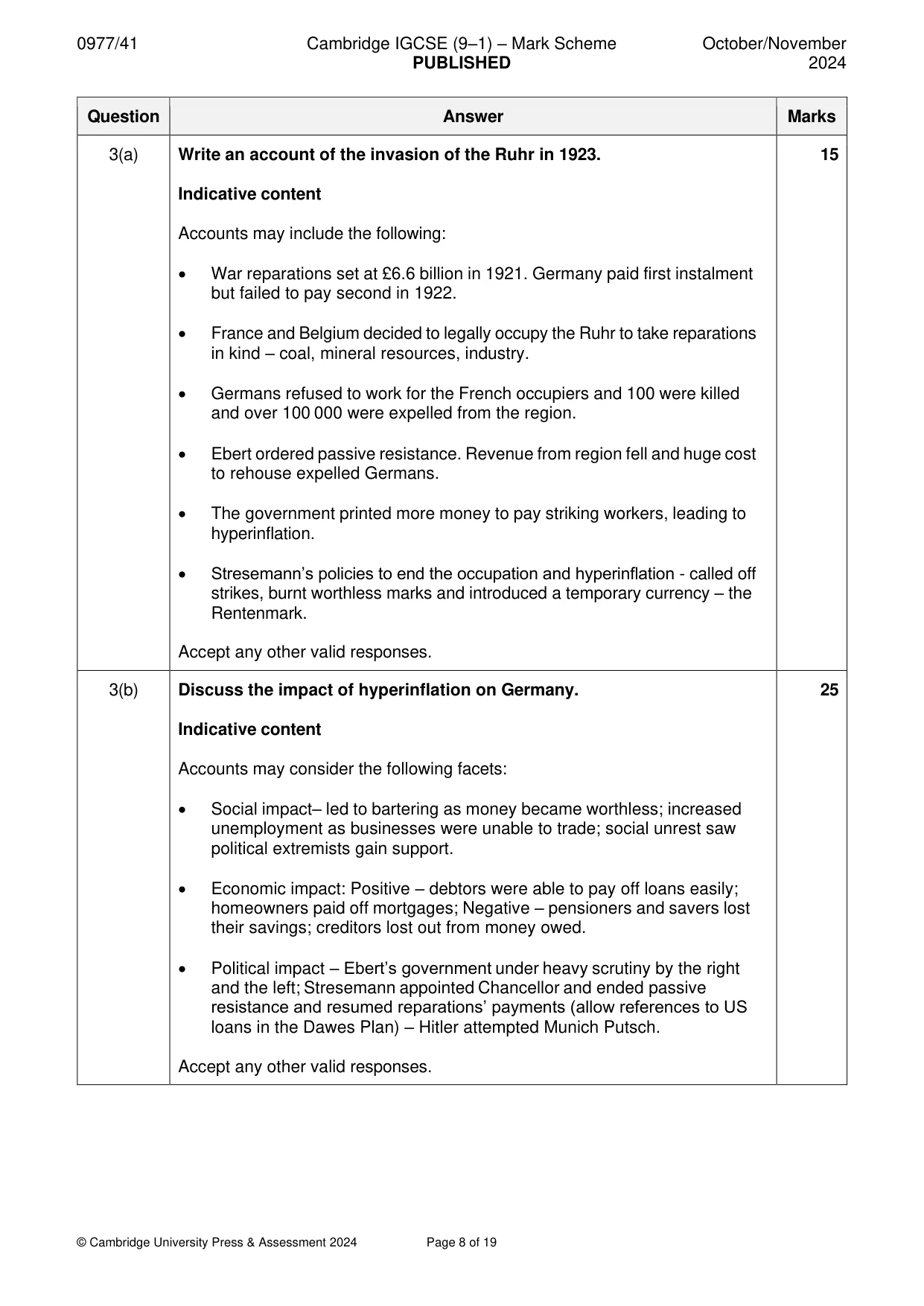
0977/41 Cambridge IGCSE (9–1) – Mark Scheme PUBLISHED October/November 2024 © Cambridge University Press & Assessment 2024 Page 8 of 19 Question Answer Marks 3(a) Write an account of the invasion of the Ruhr in 1923. Indicative content Accounts may include the following: • War reparations set at £6.6 billion in 1921. Germany paid first instalment but failed to pay second in 1922. • France and Belgium decided to legally occupy the Ruhr to take reparations in kind – coal, mineral resources, industry. • Germans refused to work for the French occupiers and 100 were killed and over 100 000 were expelled from the region. • Ebert ordered passive resistance. Revenue from region fell and huge cost to rehouse expelled Germans. • The government printed more money to pay striking workers, leading to hyperinflation. • Stresemann’s policies to end the occupation and hyperinflation - called off strikes, burnt worthless marks and introduced a temporary currency – the Rentenmark. Accept any other valid responses. 15 3(b) Discuss the impact of hyperinflation on Germany. Indicative content Accounts may consider the following facets: • Social impact– led to bartering as money became worthless; increased unemployment as businesses were unable to trade; social unrest saw political extremists gain support. • Economic impact: Positive – debtors were able to pay off loans easily; homeowners paid off mortgages; Negative – pensioners and savers lost their savings; creditors lost out from money owed. • Political impact – Ebert’s government under heavy scrutiny by the right and the left; Stresemann appointed Chancellor and ended passive resistance and resumed reparations’ payments (allow references to US loans in the Dawes Plan) – Hitler attempted Munich Putsch. Accept any other valid responses. 25
Mark scheme, page 9
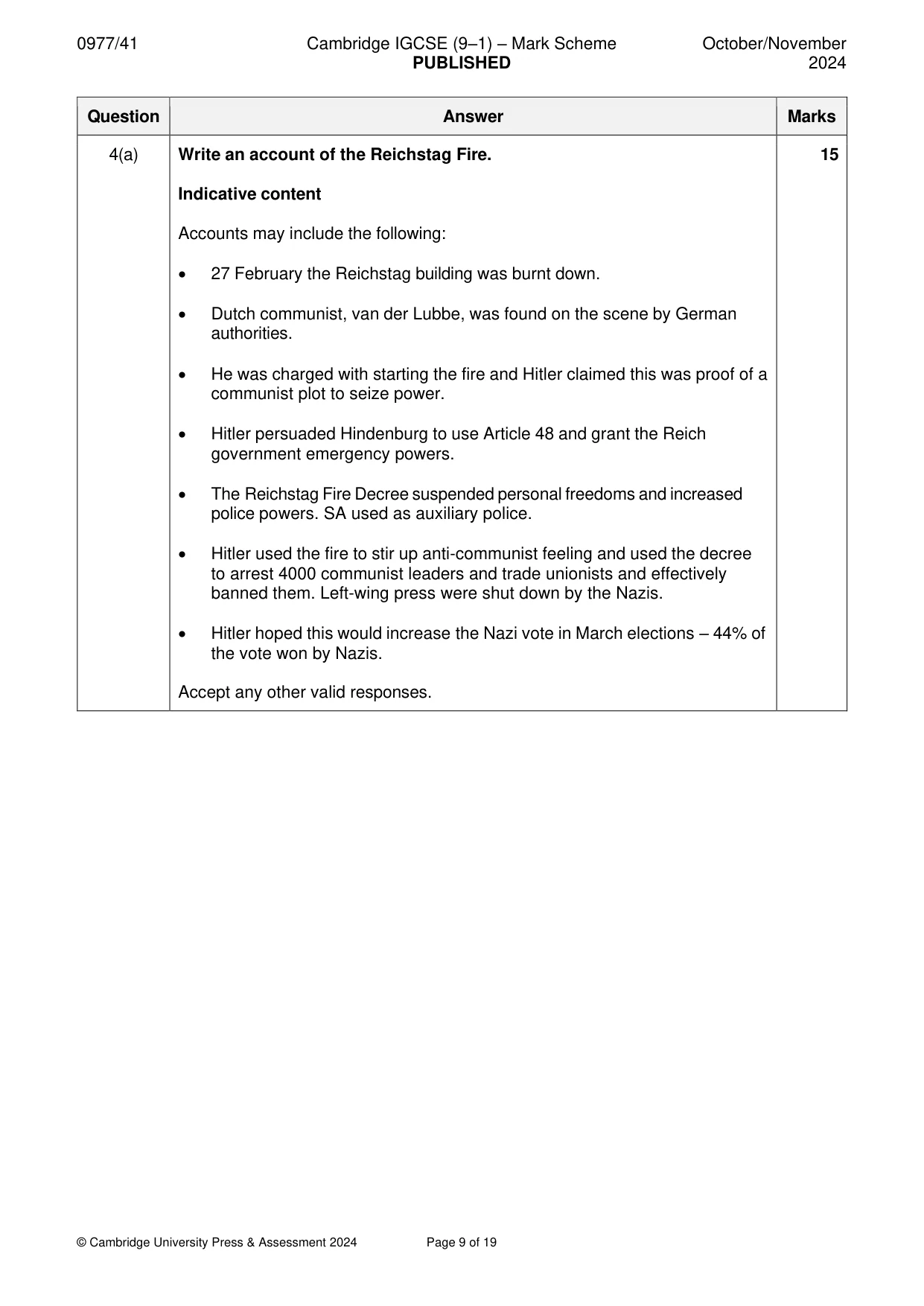
0977/41 Cambridge IGCSE (9–1) – Mark Scheme PUBLISHED October/November 2024 © Cambridge University Press & Assessment 2024 Page 9 of 19 Question Answer Marks 4(a) Write an account of the Reichstag Fire. Indicative content Accounts may include the following: • 27 February the Reichstag building was burnt down. • Dutch communist, van der Lubbe, was found on the scene by German authorities. • He was charged with starting the fire and Hitler claimed this was proof of a communist plot to seize power. • Hitler persuaded Hindenburg to use Article 48 and grant the Reich government emergency powers. • The Reichstag Fire Decree suspended personal freedoms and increased police powers. SA used as auxiliary police. • Hitler used the fire to stir up anti-communist feeling and used the decree to arrest 4000 communist leaders and trade unionists and effectively banned them. Left-wing press were shut down by the Nazis. • Hitler hoped this would increase the Nazi vote in March elections – 44% of the vote won by Nazis. Accept any other valid responses. 15
Mark scheme, page 10
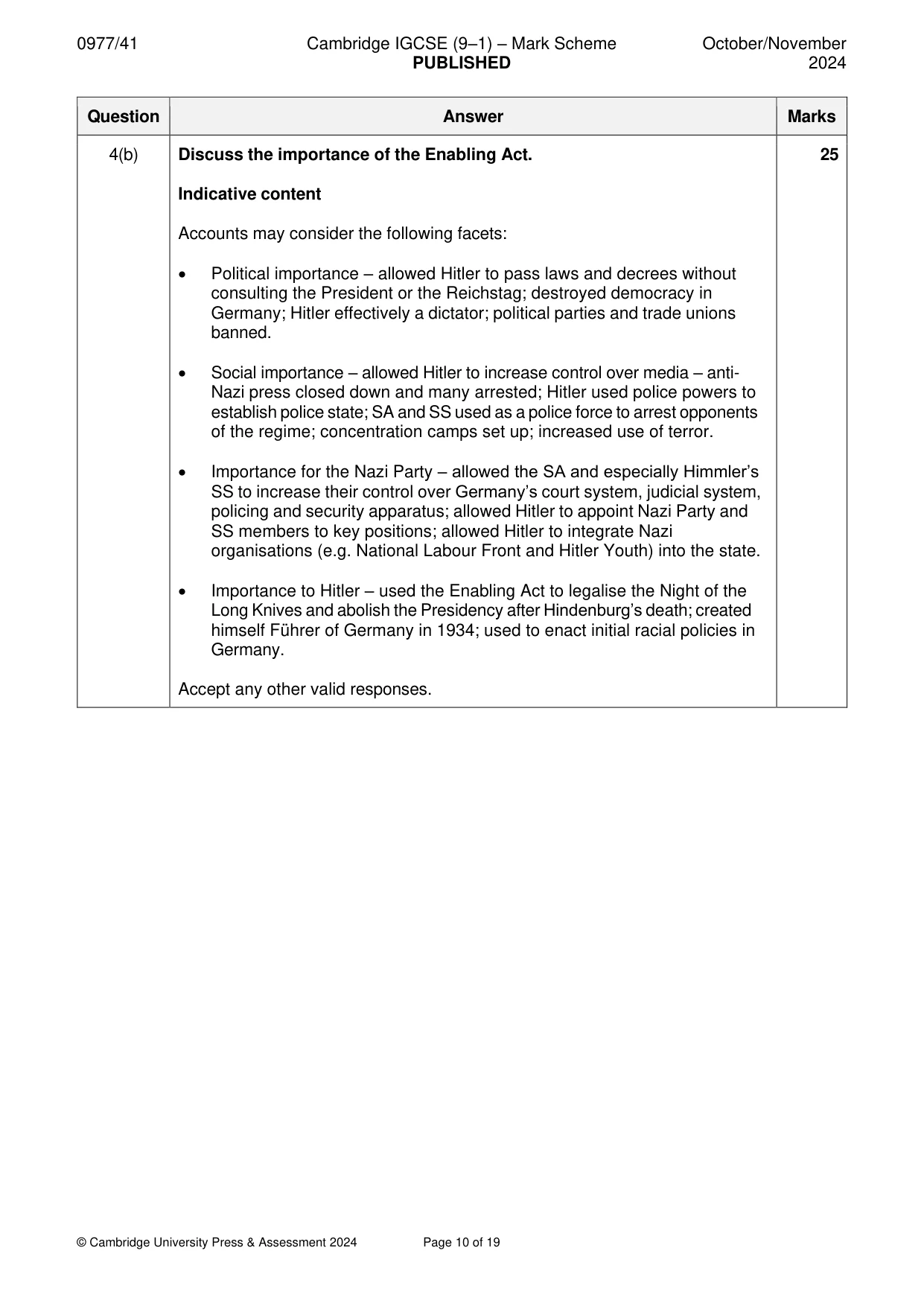
0977/41 Cambridge IGCSE (9–1) – Mark Scheme PUBLISHED October/November 2024 © Cambridge University Press & Assessment 2024 Page 10 of 19 Question Answer Marks 4(b) Discuss the importance of the Enabling Act. Indicative content Accounts may consider the following facets: • Political importance – allowed Hitler to pass laws and decrees without consulting the President or the Reichstag; destroyed democracy in Germany; Hitler effectively a dictator; political parties and trade unions banned. • Social importance – allowed Hitler to increase control over media – anti- Nazi press closed down and many arrested; Hitler used police powers to establish police state; SA and SS used as a police force to arrest opponents of the regime; concentration camps set up; increased use of terror. • Importance for the Nazi Party – allowed the SA and especially Himmler’s SS to increase their control over Germany’s court system, judicial system, policing and security apparatus; allowed Hitler to appoint Nazi Party and SS members to key positions; allowed Hitler to integrate Nazi organisations (e.g. National Labour Front and Hitler Youth) into the state. • Importance to Hitler – used the Enabling Act to legalise the Night of the Long Knives and abolish the Presidency after Hindenburg’s death; created himself Führer of Germany in 1934; used to enact initial racial policies in Germany. Accept any other valid responses. 25
Mark scheme, page 11
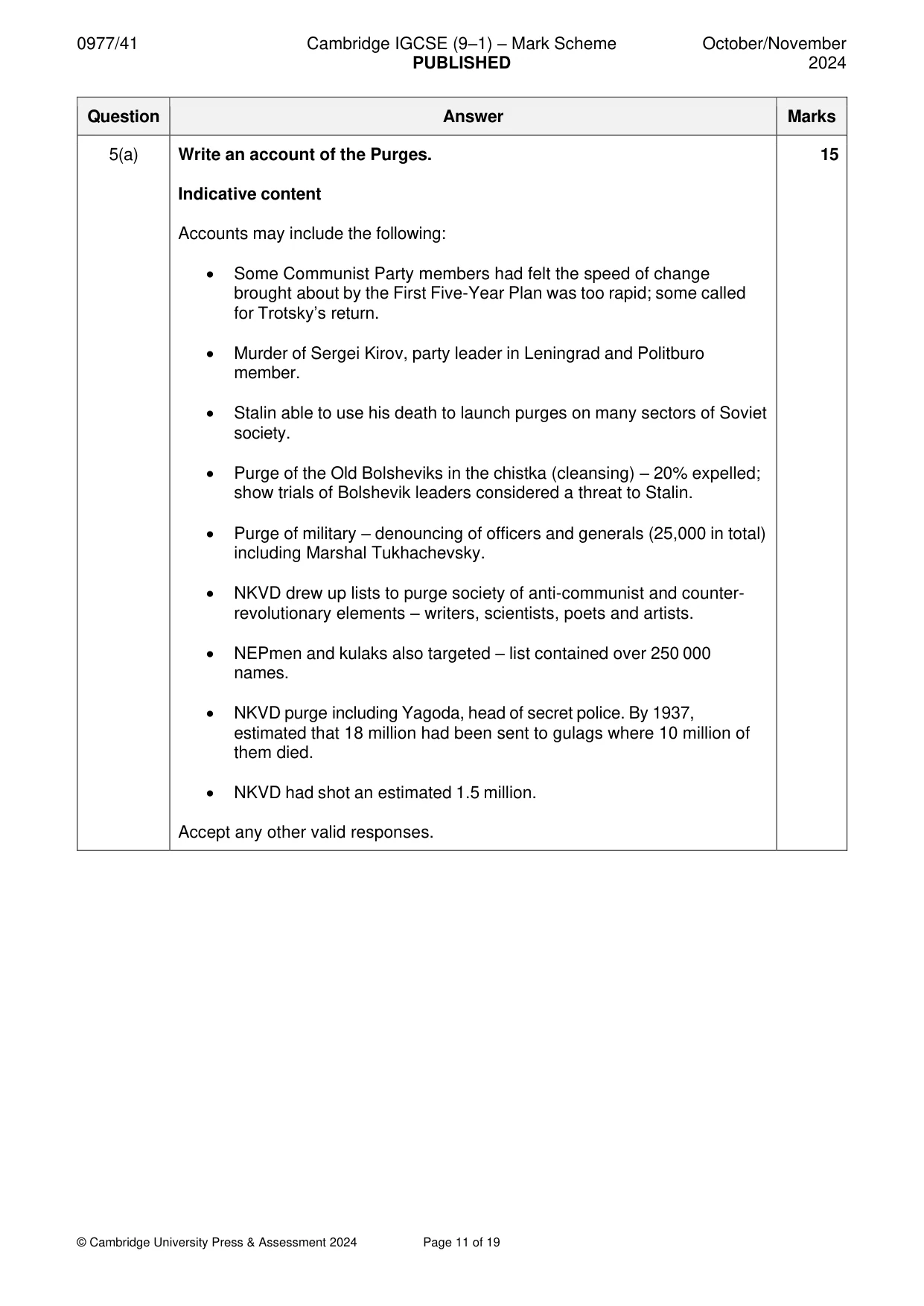
0977/41 Cambridge IGCSE (9–1) – Mark Scheme PUBLISHED October/November 2024 © Cambridge University Press & Assessment 2024 Page 11 of 19 Question Answer Marks 5(a) Write an account of the Purges. Indicative content Accounts may include the following: • Some Communist Party members had felt the speed of change brought about by the First Five-Year Plan was too rapid; some called for Trotsky’s return. • Murder of Sergei Kirov, party leader in Leningrad and Politburo member. • Stalin able to use his death to launch purges on many sectors of Soviet society. • Purge of the Old Bolsheviks in the chistka (cleansing) – 20% expelled; show trials of Bolshevik leaders considered a threat to Stalin. • Purge of military – denouncing of officers and generals (25,000 in total) including Marshal Tukhachevsky. • NKVD drew up lists to purge society of anti-communist and counter- revolutionary elements – writers, scientists, poets and artists. • NEPmen and kulaks also targeted – list contained over 250 000 names. • NKVD purge including Yagoda, head of secret police. By 1937, estimated that 18 million had been sent to gulags where 10 million of them died. • NKVD had shot an estimated 1.5 million. Accept any other valid responses. 15
Mark scheme, page 12
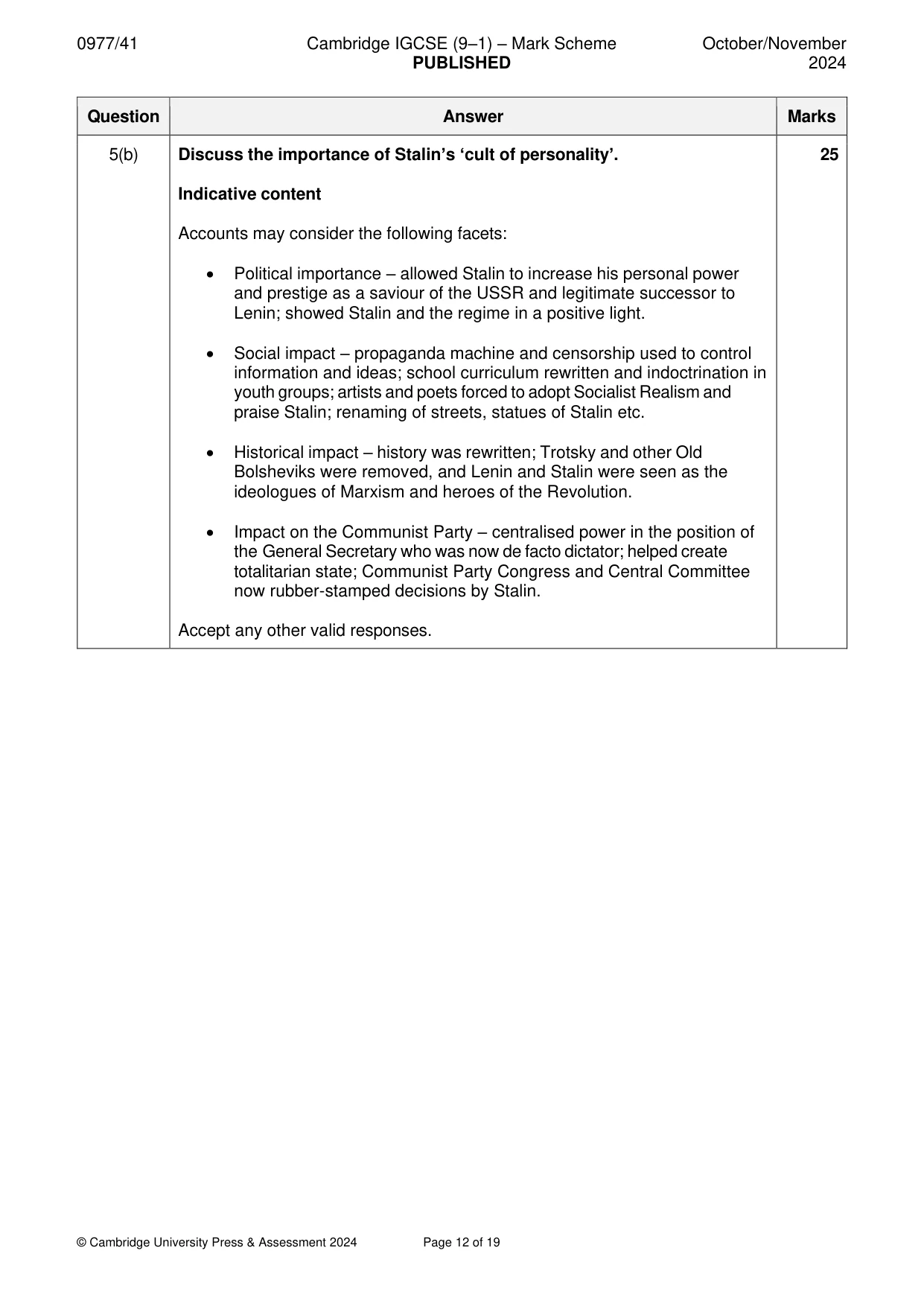
0977/41 Cambridge IGCSE (9–1) – Mark Scheme PUBLISHED October/November 2024 © Cambridge University Press & Assessment 2024 Page 12 of 19 Question Answer Marks 5(b) Discuss the importance of Stalin’s ‘cult of personality’. Indicative content Accounts may consider the following facets: • Political importance – allowed Stalin to increase his personal power and prestige as a saviour of the USSR and legitimate successor to Lenin; showed Stalin and the regime in a positive light. • Social impact – propaganda machine and censorship used to control information and ideas; school curriculum rewritten and indoctrination in youth groups; artists and poets forced to adopt Socialist Realism and praise Stalin; renaming of streets, statues of Stalin etc. • Historical impact – history was rewritten; Trotsky and other Old Bolsheviks were removed, and Lenin and Stalin were seen as the ideologues of Marxism and heroes of the Revolution. • Impact on the Communist Party – centralised power in the position of the General Secretary who was now de facto dictator; helped create totalitarian state; Communist Party Congress and Central Committee now rubber-stamped decisions by Stalin. Accept any other valid responses. 25
Mark scheme, page 13
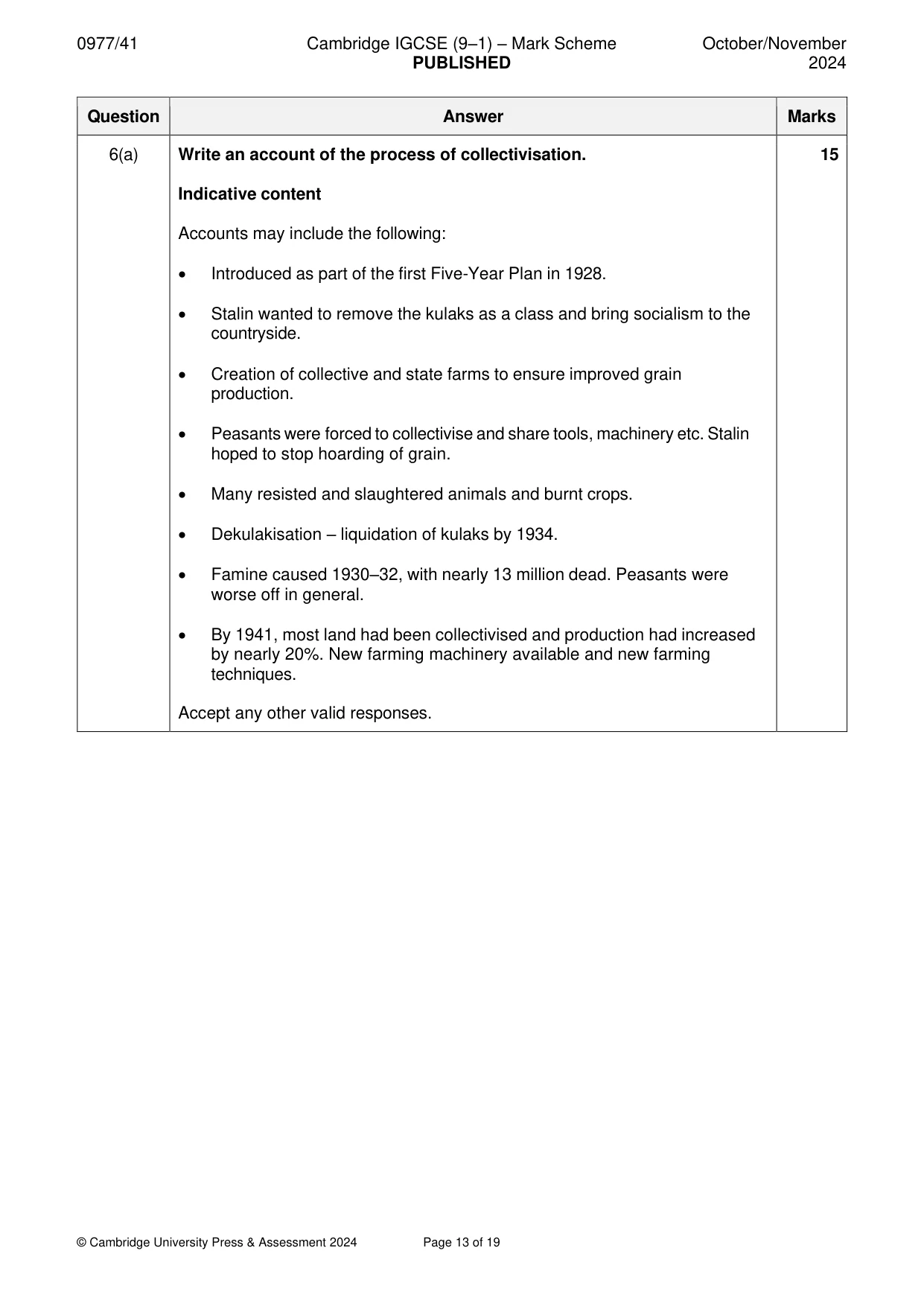
0977/41 Cambridge IGCSE (9–1) – Mark Scheme PUBLISHED October/November 2024 © Cambridge University Press & Assessment 2024 Page 13 of 19 Question Answer Marks 6(a) Write an account of the process of collectivisation. Indicative content Accounts may include the following: • Introduced as part of the first Five-Year Plan in 1928. • Stalin wanted to remove the kulaks as a class and bring socialism to the countryside. • Creation of collective and state farms to ensure improved grain production. • Peasants were forced to collectivise and share tools, machinery etc. Stalin hoped to stop hoarding of grain. • Many resisted and slaughtered animals and burnt crops. • Dekulakisation – liquidation of kulaks by 1934. • Famine caused 1930–32, with nearly 13 million dead. Peasants were worse off in general. • By 1941, most land had been collectivised and production had increased by nearly 20%. New farming machinery available and new farming techniques. Accept any other valid responses. 15
Mark scheme, page 14
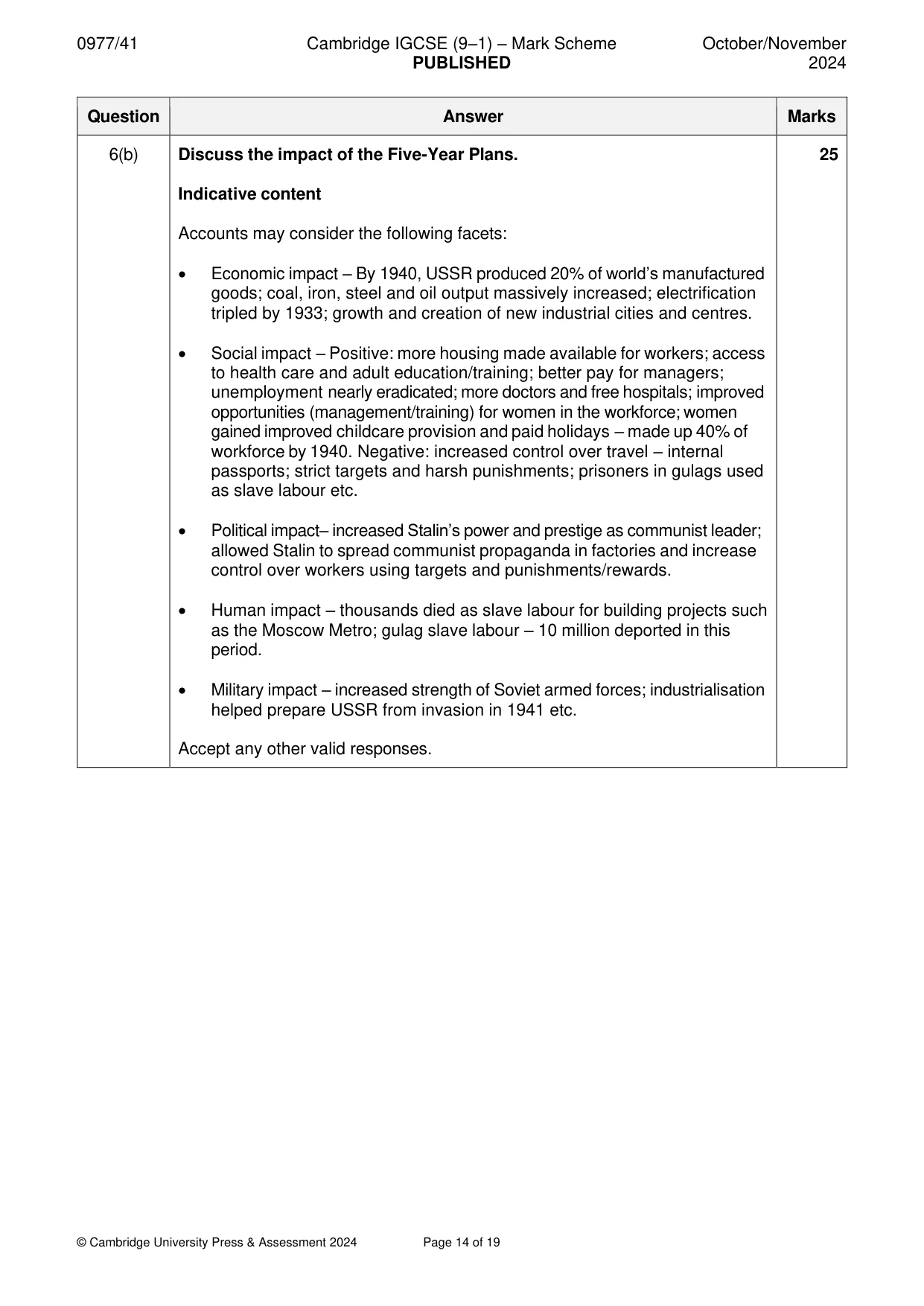
0977/41 Cambridge IGCSE (9–1) – Mark Scheme PUBLISHED October/November 2024 © Cambridge University Press & Assessment 2024 Page 14 of 19 Question Answer Marks 6(b) Discuss the impact of the Five-Year Plans. Indicative content Accounts may consider the following facets: • Economic impact – By 1940, USSR produced 20% of world’s manufactured goods; coal, iron, steel and oil output massively increased; electrification tripled by 1933; growth and creation of new industrial cities and centres. • Social impact – Positive: more housing made available for workers; access to health care and adult education/training; better pay for managers; unemployment nearly eradicated; more doctors and free hospitals; improved opportunities (management/training) for women in the workforce; women gained improved childcare provision and paid holidays – made up 40% of workforce by 1940. Negative: increased control over travel – internal passports; strict targets and harsh punishments; prisoners in gulags used as slave labour etc. • Political impact– increased Stalin’s power and prestige as communist leader; allowed Stalin to spread communist propaganda in factories and increase control over workers using targets and punishments/rewards. • Human impact – thousands died as slave labour for building projects such as the Moscow Metro; gulag slave labour – 10 million deported in this period. • Military impact – increased strength of Soviet armed forces; industrialisation helped prepare USSR from invasion in 1941 etc. Accept any other valid responses. 25
Mark scheme, page 15
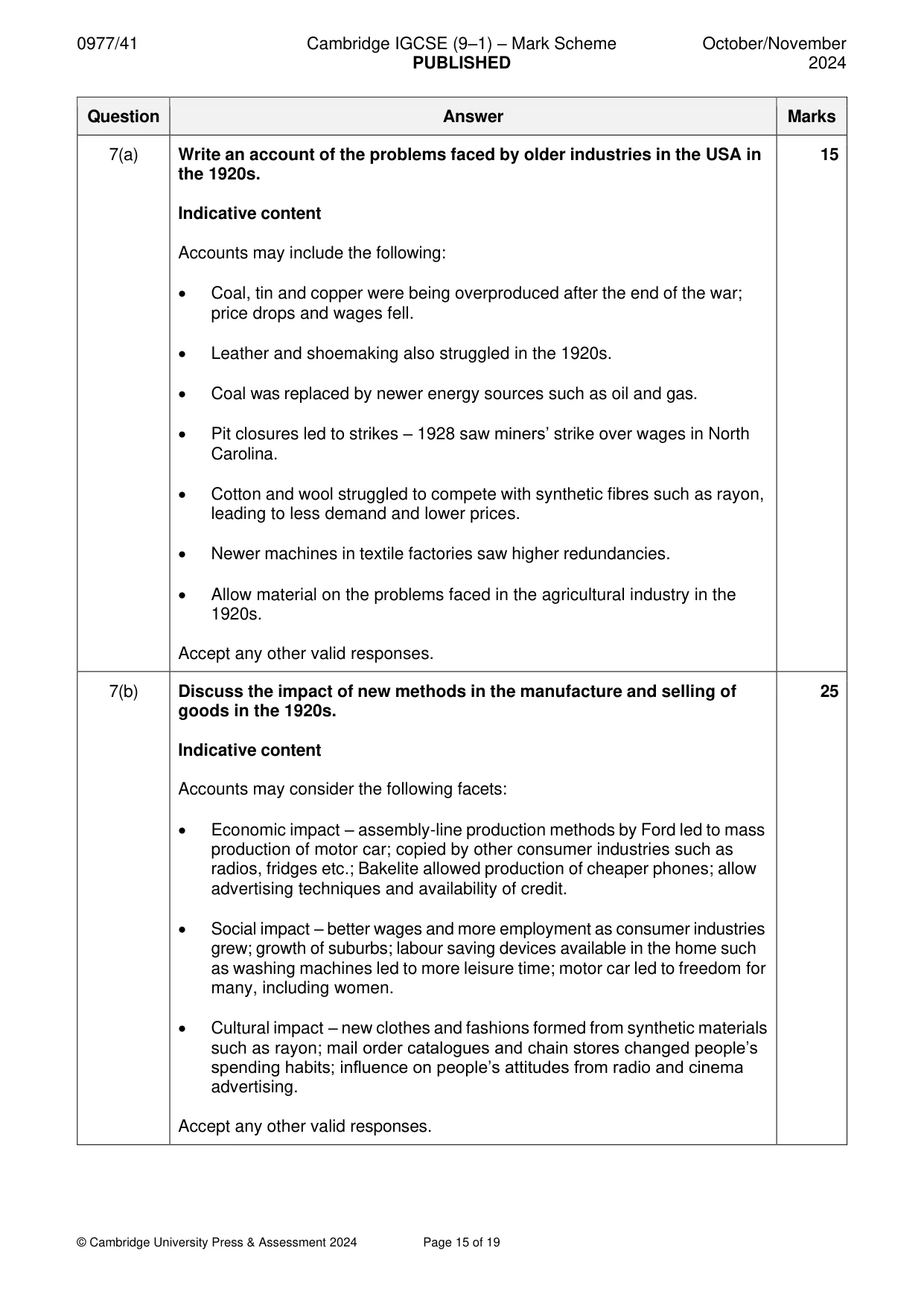
0977/41 Cambridge IGCSE (9–1) – Mark Scheme PUBLISHED October/November 2024 © Cambridge University Press & Assessment 2024 Page 15 of 19 Question Answer Marks 7(a) Write an account of the problems faced by older industries in the USA in the 1920s. Indicative content Accounts may include the following: • Coal, tin and copper were being overproduced after the end of the war; price drops and wages fell. • Leather and shoemaking also struggled in the 1920s. • Coal was replaced by newer energy sources such as oil and gas. • Pit closures led to strikes – 1928 saw miners’ strike over wages in North Carolina. • Cotton and wool struggled to compete with synthetic fibres such as rayon, leading to less demand and lower prices. • Newer machines in textile factories saw higher redundancies. • Allow material on the problems faced in the agricultural industry in the 1920s. Accept any other valid responses. 15 7(b) Discuss the impact of new methods in the manufacture and selling of goods in the 1920s. Indicative content Accounts may consider the following facets: • Economic impact – assembly-line production methods by Ford led to mass production of motor car; copied by other consumer industries such as radios, fridges etc.; Bakelite allowed production of cheaper phones; allow advertising techniques and availability of credit. • Social impact – better wages and more employment as consumer industries grew; growth of suburbs; labour saving devices available in the home such as washing machines led to more leisure time; motor car led to freedom for many, including women. • Cultural impact – new clothes and fashions formed from synthetic materials such as rayon; mail order catalogues and chain stores changed people’s spending habits; influence on people’s attitudes from radio and cinema advertising. Accept any other valid responses. 25
Mark scheme, page 16
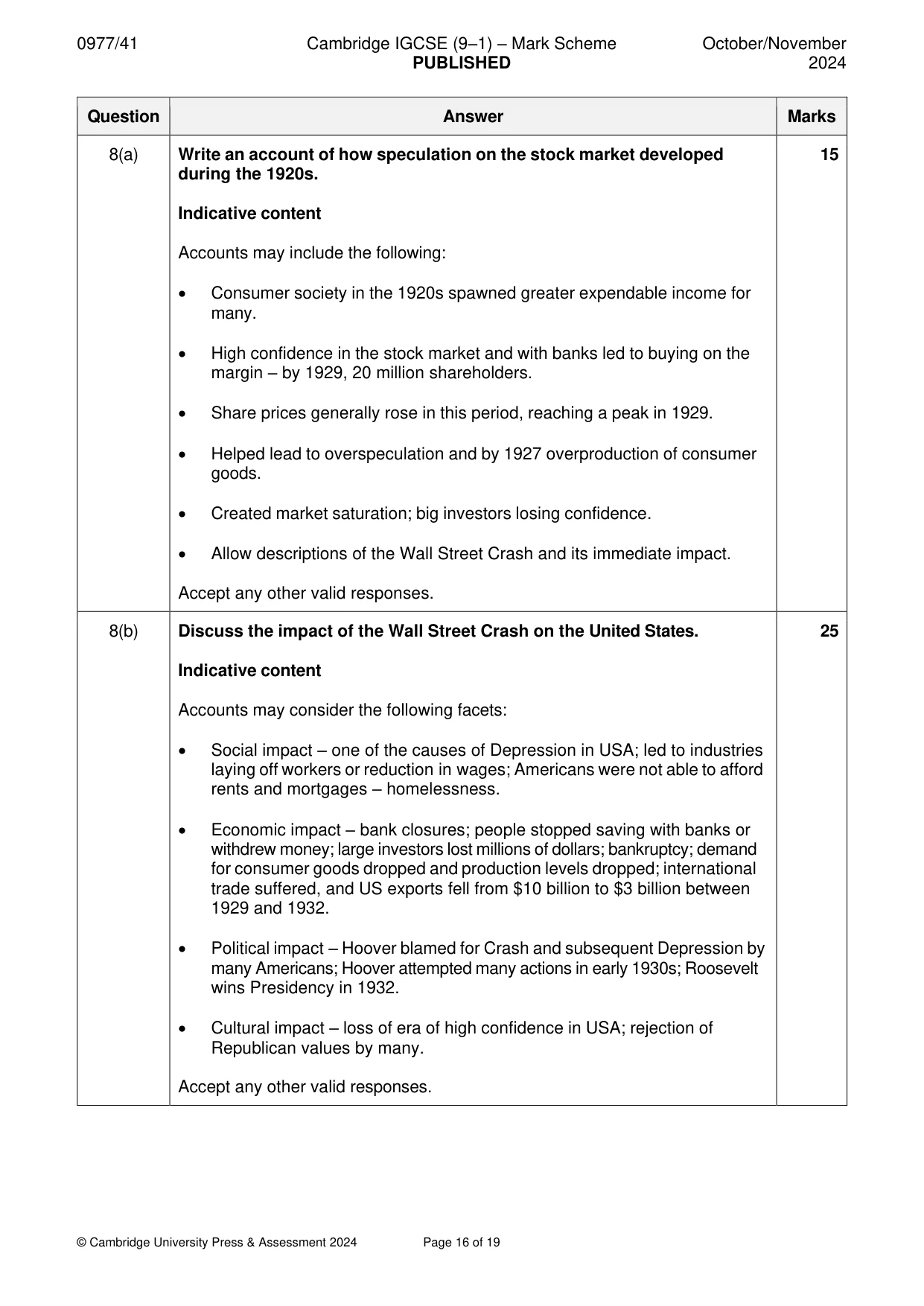
0977/41 Cambridge IGCSE (9–1) – Mark Scheme PUBLISHED October/November 2024 © Cambridge University Press & Assessment 2024 Page 16 of 19 Question Answer Marks 8(a) Write an account of how speculation on the stock market developed during the 1920s. Indicative content Accounts may include the following: • Consumer society in the 1920s spawned greater expendable income for many. • High confidence in the stock market and with banks led to buying on the margin – by 1929, 20 million shareholders. • Share prices generally rose in this period, reaching a peak in 1929. • Helped lead to overspeculation and by 1927 overproduction of consumer goods. • Created market saturation; big investors losing confidence. • Allow descriptions of the Wall Street Crash and its immediate impact. Accept any other valid responses. 15 8(b) Discuss the impact of the Wall Street Crash on the United States. Indicative content Accounts may consider the following facets: • Social impact – one of the causes of Depression in USA; led to industries laying off workers or reduction in wages; Americans were not able to afford rents and mortgages – homelessness. • Economic impact – bank closures; people stopped saving with banks or withdrew money; large investors lost millions of dollars; bankruptcy; demand for consumer goods dropped and production levels dropped; international trade suffered, and US exports fell from $10 billion to $3 billion between 1929 and 1932. • Political impact – Hoover blamed for Crash and subsequent Depression by many Americans; Hoover attempted many actions in early 1930s; Roosevelt wins Presidency in 1932. • Cultural impact – loss of era of high confidence in USA; rejection of Republican values by many. Accept any other valid responses. 25
Mark scheme, page 17
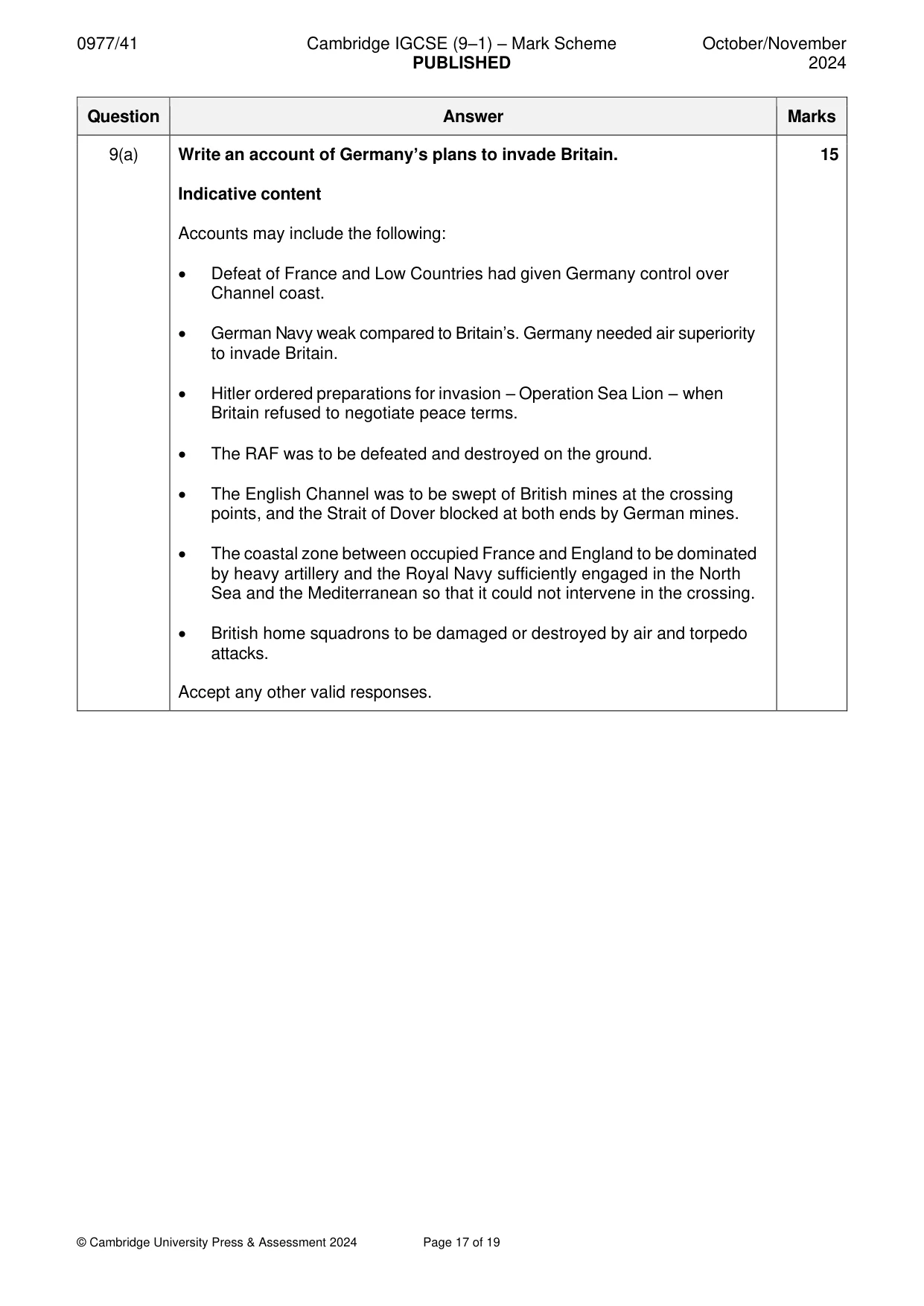
0977/41 Cambridge IGCSE (9–1) – Mark Scheme PUBLISHED October/November 2024 © Cambridge University Press & Assessment 2024 Page 17 of 19 Question Answer Marks 9(a) Write an account of Germany’s plans to invade Britain. Indicative content Accounts may include the following: • Defeat of France and Low Countries had given Germany control over Channel coast. • German Navy weak compared to Britain’s. Germany needed air superiority to invade Britain. • Hitler ordered preparations for invasion – Operation Sea Lion – when Britain refused to negotiate peace terms. • The RAF was to be defeated and destroyed on the ground. • The English Channel was to be swept of British mines at the crossing points, and the Strait of Dover blocked at both ends by German mines. • The coastal zone between occupied France and England to be dominated by heavy artillery and the Royal Navy sufficiently engaged in the North Sea and the Mediterranean so that it could not intervene in the crossing. • British home squadrons to be damaged or destroyed by air and torpedo attacks. Accept any other valid responses. 15
Mark scheme, page 18
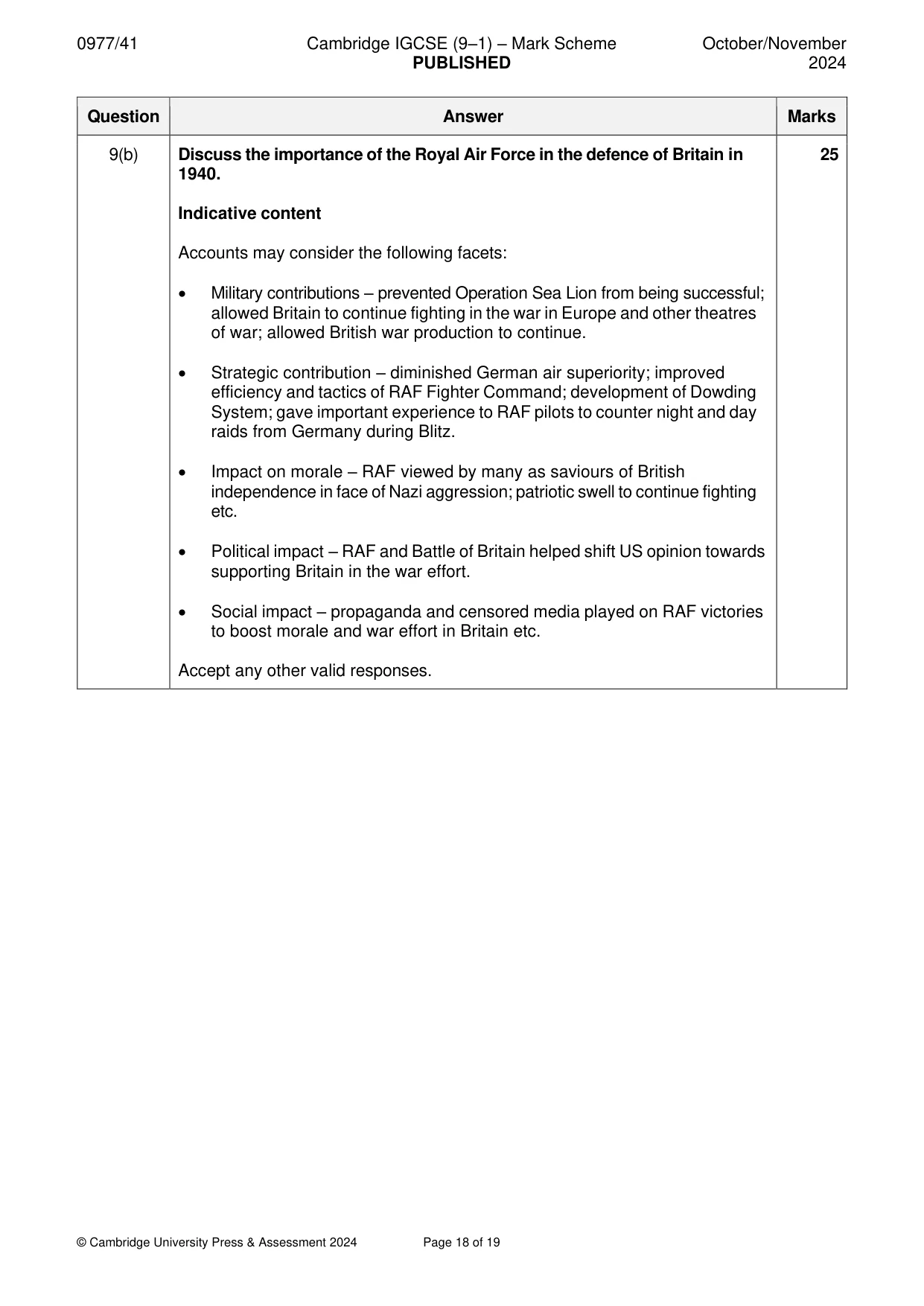
0977/41 Cambridge IGCSE (9–1) – Mark Scheme PUBLISHED October/November 2024 © Cambridge University Press & Assessment 2024 Page 18 of 19 Question Answer Marks 9(b) Discuss the importance of the Royal Air Force in the defence of Britain in 1940. Indicative content Accounts may consider the following facets: • Military contributions – prevented Operation Sea Lion from being successful; allowed Britain to continue fighting in the war in Europe and other theatres of war; allowed British war production to continue. • Strategic contribution – diminished German air superiority; improved efficiency and tactics of RAF Fighter Command; development of Dowding System; gave important experience to RAF pilots to counter night and day raids from Germany during Blitz. • Impact on morale – RAF viewed by many as saviours of British independence in face of Nazi aggression; patriotic swell to continue fighting etc. • Political impact – RAF and Battle of Britain helped shift US opinion towards supporting Britain in the war effort. • Social impact – propaganda and censored media played on RAF victories to boost morale and war effort in Britain etc. Accept any other valid responses. 25
Mark scheme, page 19
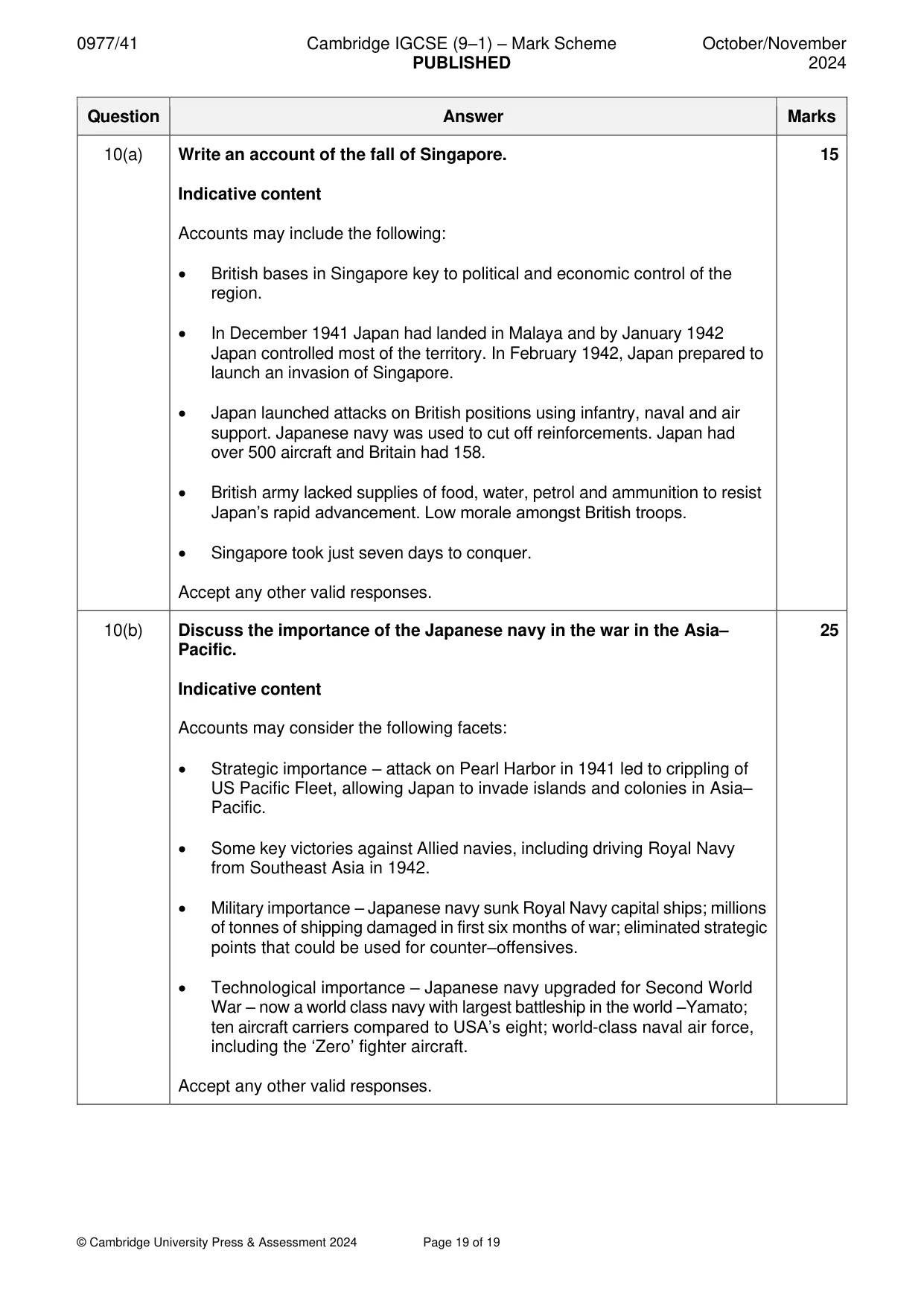
0977/41 Cambridge IGCSE (9–1) – Mark Scheme PUBLISHED October/November 2024 © Cambridge University Press & Assessment 2024 Page 19 of 19 Question Answer Marks 10(a) Write an account of the fall of Singapore. Indicative content Accounts may include the following: • British bases in Singapore key to political and economic control of the region. • In December 1941 Japan had landed in Malaya and by January 1942 Japan controlled most of the territory. In February 1942, Japan prepared to launch an invasion of Singapore. • Japan launched attacks on British positions using infantry, naval and air support. Japanese navy was used to cut off reinforcements. Japan had over 500 aircraft and Britain had 158. • British army lacked supplies of food, water, petrol and ammunition to resist Japan’s rapid advancement. Low morale amongst British troops. • Singapore took just seven days to conquer. Accept any other valid responses. 15 10(b) Discuss the importance of the Japanese navy in the war in the Asia– Pacific. Indicative content Accounts may consider the following facets: • Strategic importance – attack on Pearl Harbor in 1941 led to crippling of US Pacific Fleet, allowing Japan to invade islands and colonies in Asia– Pacific. • Some key victories against Allied navies, including driving Royal Navy from Southeast Asia in 1942. • Military importance – Japanese navy sunk Royal Navy capital ships; millions of tonnes of shipping damaged in first six months of war; eliminated strategic points that could be used for counter–offensives. • Technological importance – Japanese navy upgraded for Second World War – now a world class navy with largest battleship in the world –Yamato; ten aircraft carriers compared to USA’s eight; world-class naval air force, including the ‘Zero’ fighter aircraft. Accept any other valid responses. 25
What you needed in this session
Cambridge’s own grade thresholds for 2024 Oct/Nov, Paper 4 · Variant 1. A higher threshold means an easier paper — the bar moves with how the cohort did.