Cambridge IGCSE History (9-1) 0977 — 2022 Oct/Nov Paper 4 · Variant 1
0977/41/O/N/22 · 14 questions · 40 marks · ≈45 min
The question paper and its mark scheme, free to read here and free to download. This is Cambridge’s own paper, exactly as it was sat.
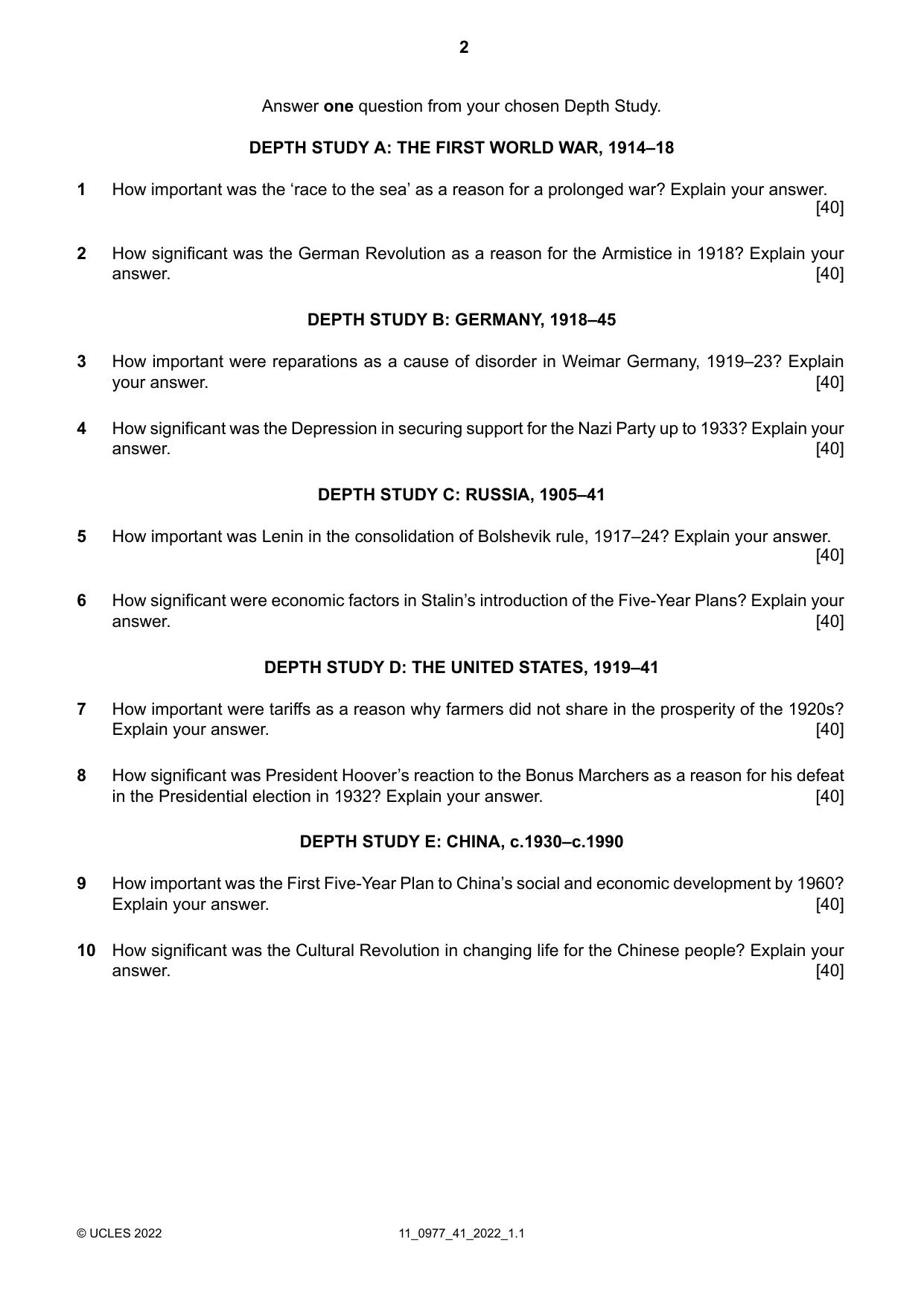
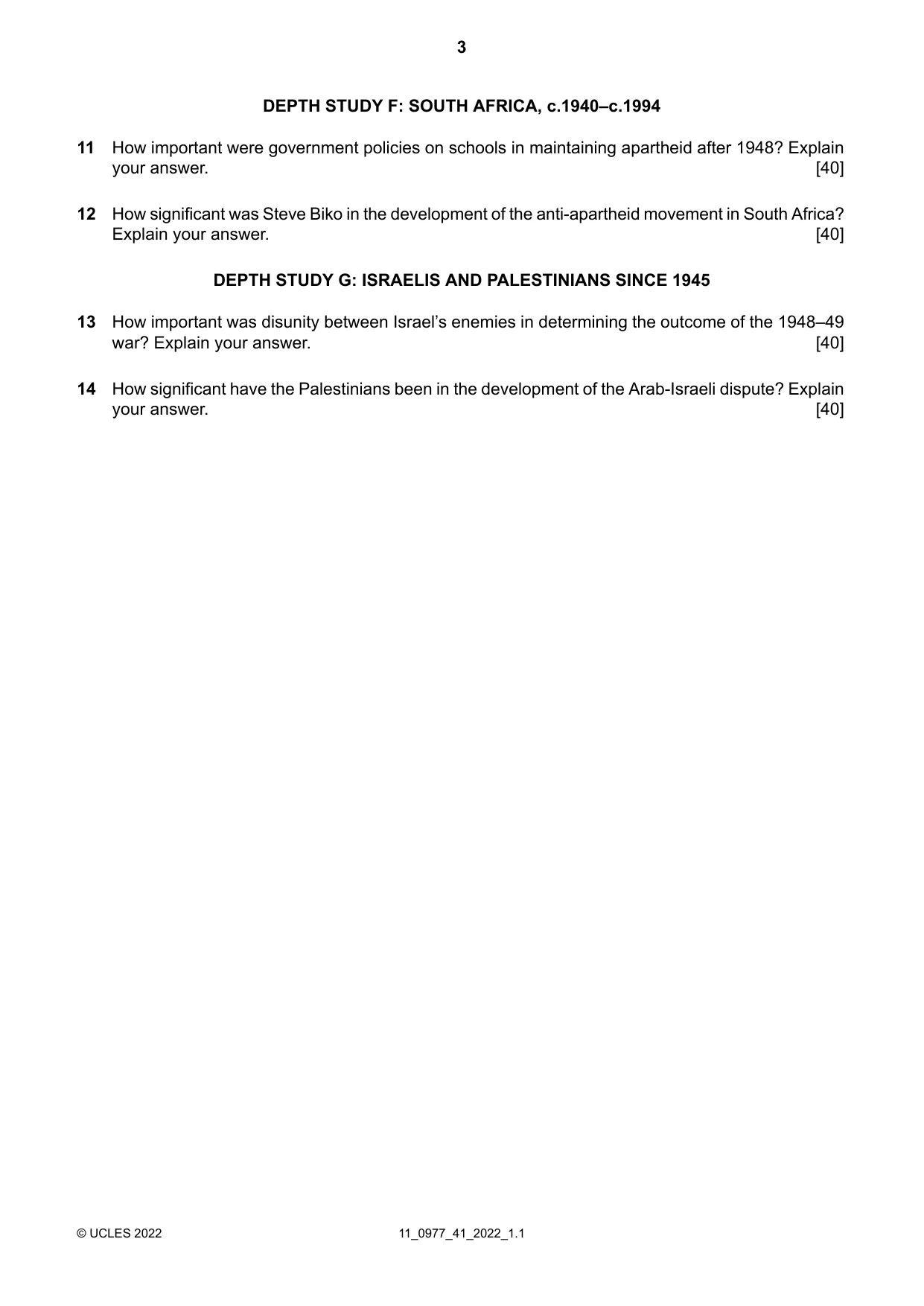
Question paper4 pages

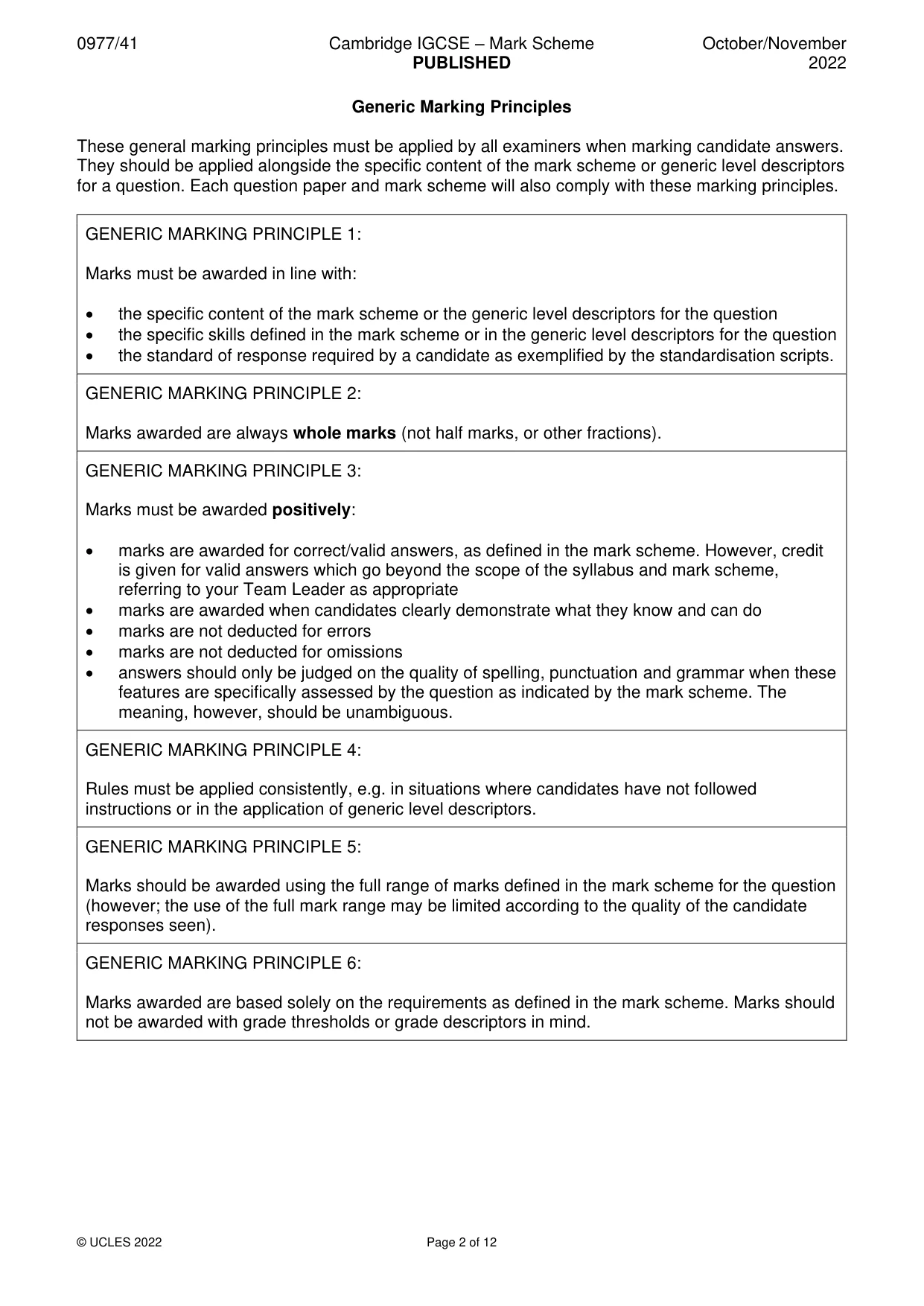
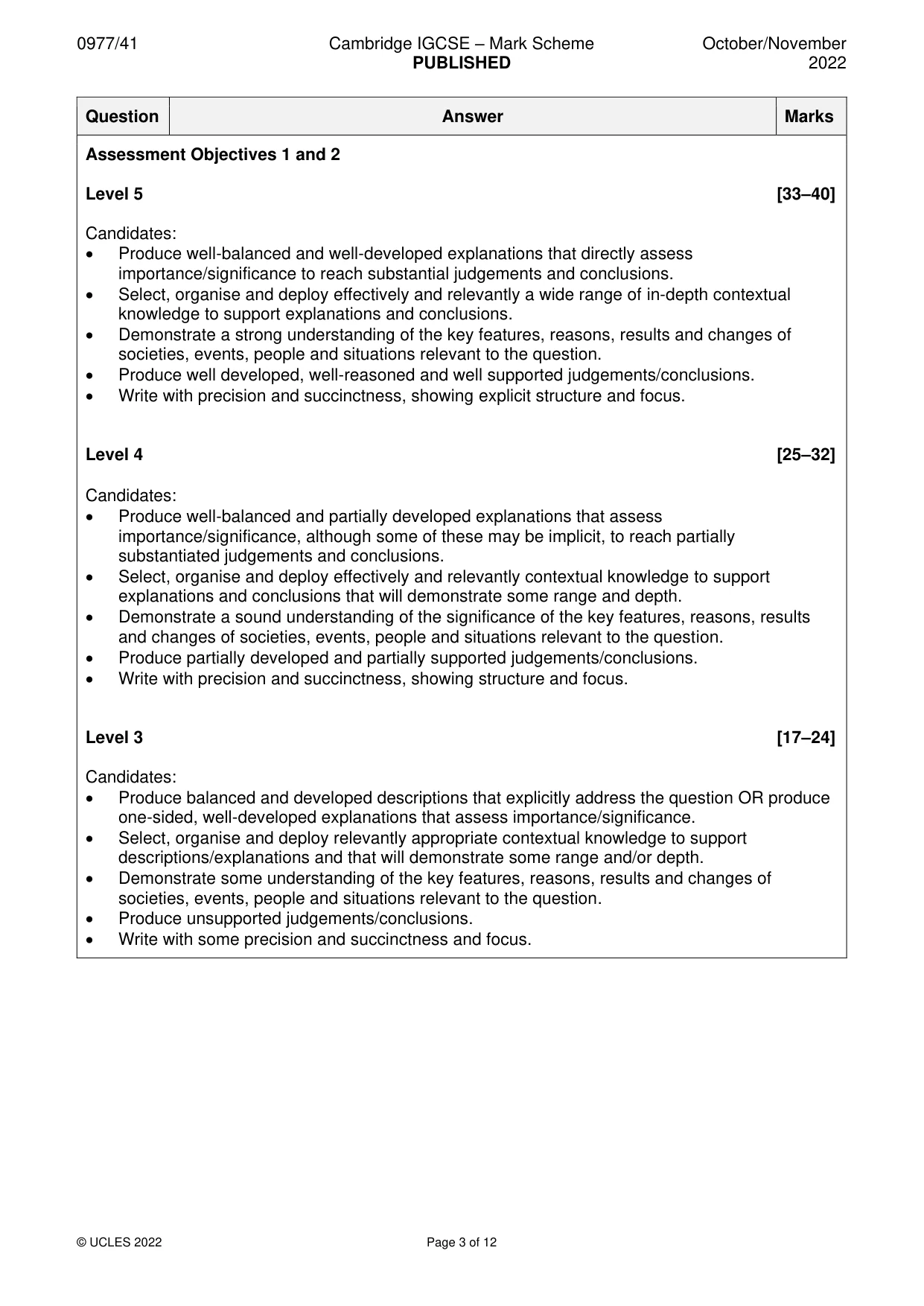
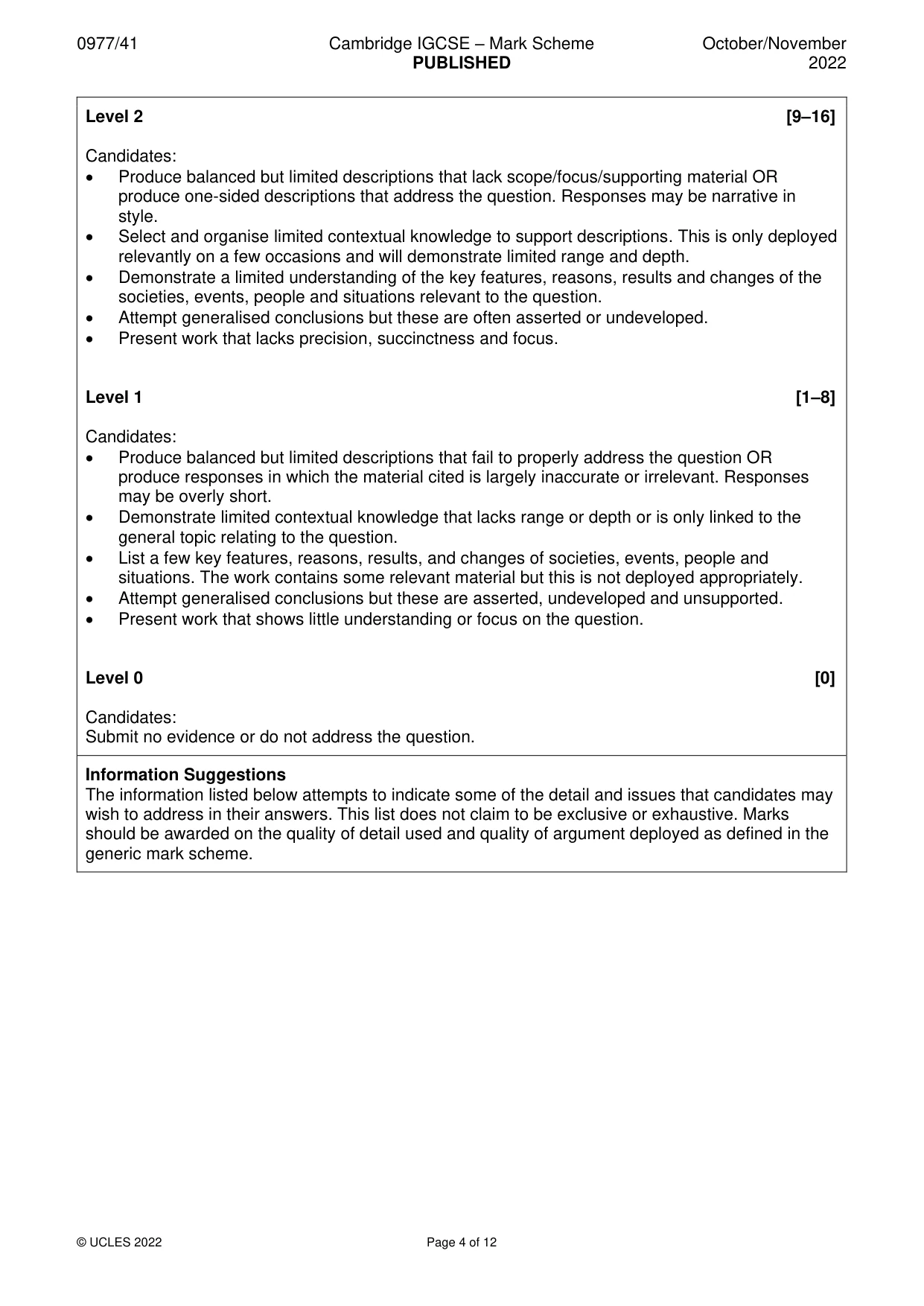
Mark scheme12 pages
Answers below. Sit the paper first if you are practising.
Questions as text
Q1 · How important was the ‘race to the sea’ as a reason for a prolonged war?
1 How important was the ‘race to the sea’ as a reason for a prolonged war? Explain your answer. [40]
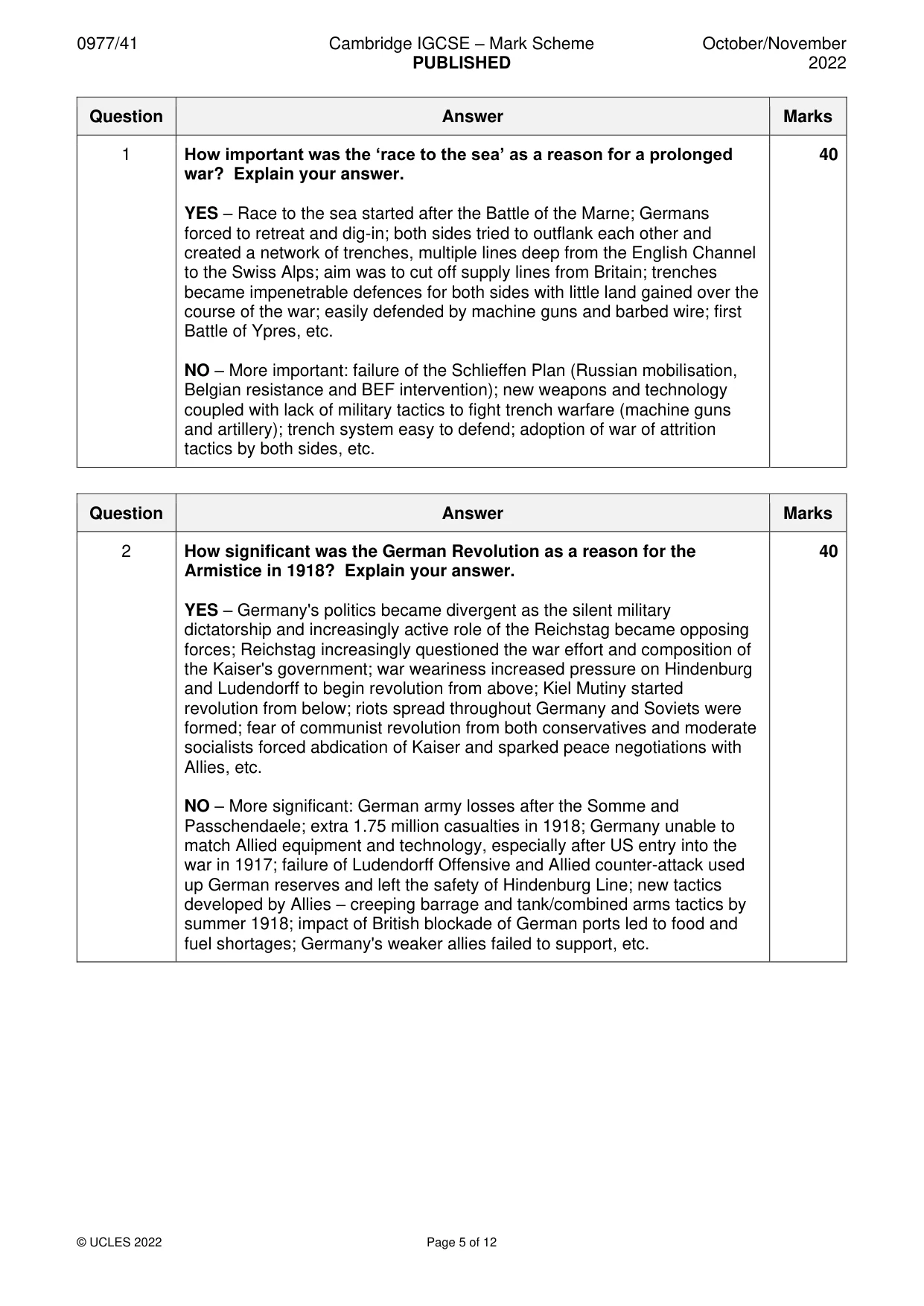
Mark scheme: Question Answer Marks 1 How important was the ‘race to the sea’ as a reason for a prolonged 40 war? Explain your answer. YES – Race to the sea started after the Battle of the Marne; Germans forced to retreat and dig-in; both sides tried to outflank each other and created a network of trenches, multiple lines deep from the English Channel to the Swiss Alps; aim was to cut off supply lines from Britain; trenches became impenetrable defences for both sides with little land gained over the course of the war; easily defended by machine guns and barbed wire; first Battle of Ypres, etc. NO – More important: failure of the Schlieffen Plan (Russian mobilisation, Belgian resistance and BEF intervention); new weapons and technology coupled with lack of military tactics to fight trench warfare (machine guns and artillery); trench system easy to defend; adoption of war of attrition tactics by both sides, etc.
Q2 · How significant was the German Revolution as a reason for the Armistice in 1918?
2 How significant was the German Revolution as a reason for the Armistice in 1918? Explain your answer. [40] DEPTH STUDY B: GERMANY, 1918–45
Mark scheme: 2 How significant was the German Revolution as a reason for the 40 Armistice in 1918? Explain your answer. YES – Germany's politics became divergent as the silent military dictatorship and increasingly active role of the Reichstag became opposing forces; Reichstag increasingly questioned the war effort and composition of the Kaiser's government; war weariness increased pressure on Hindenburg and Ludendorff to begin revolution from above; Kiel Mutiny started revolution from below; riots spread throughout Germany and Soviets were formed; fear of communist revolution from both conservatives and moderate socialists forced abdication of Kaiser and sparked peace negotiations with Allies, etc. NO – More significant: German army losses after the Somme and Passchendaele; extra 1.75 million casualties in 1918; Germany unable to match Allied equipment and technology, especially after US entry into the war in 1917; failure of Ludendorff Offensive and Allied counter-attack used up German reserves and left the safety of Hindenburg Line; new tactics developed by Allies – creeping barrage and tank/combined arms tactics by summer 1918; impact of British blockade of German ports led to food and fuel shortages; Germany's weaker allies failed to support, etc.
Q3 · How important were reparations as a cause of disorder in Weimar Germany, 1919–23?
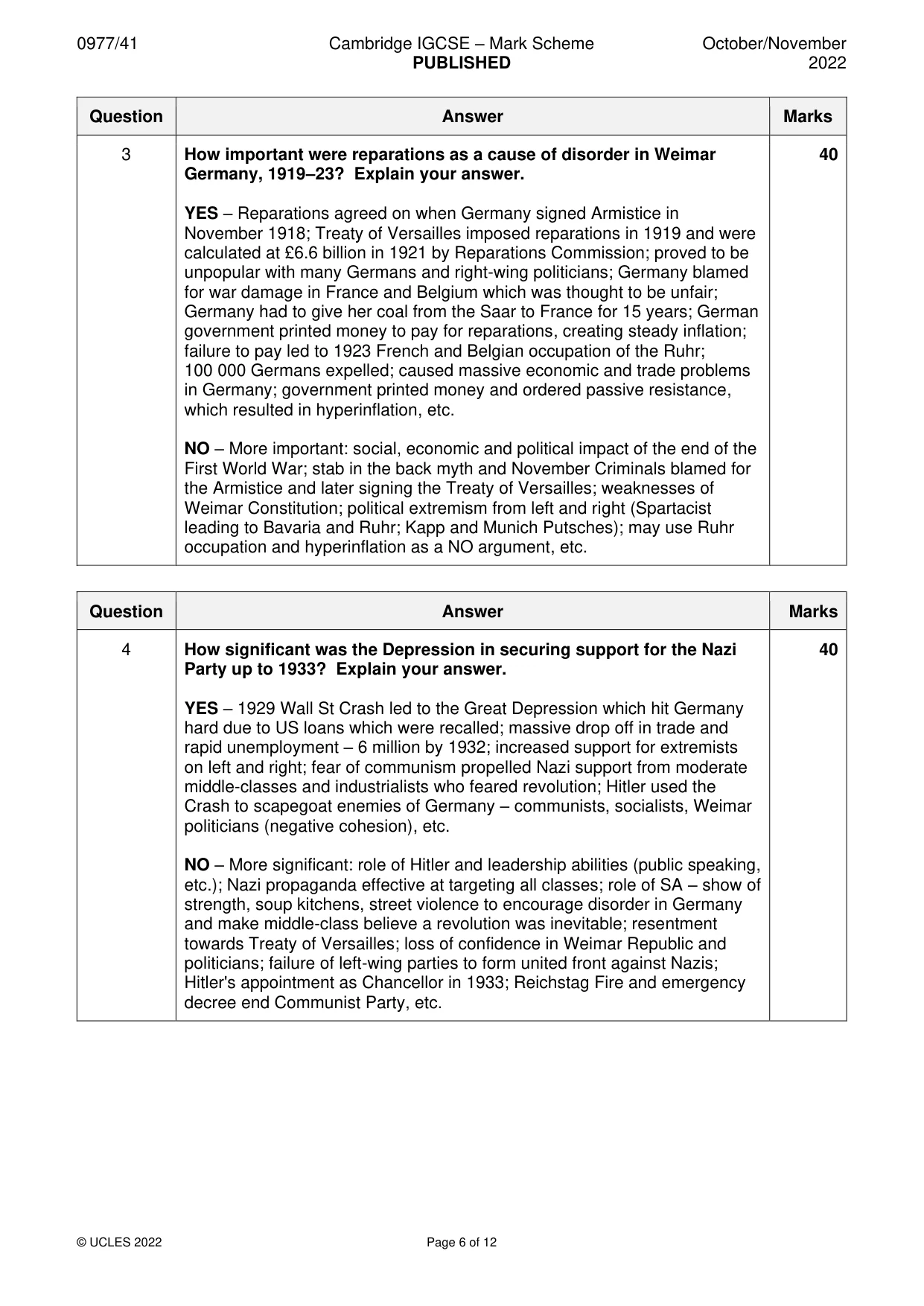
3 How important were reparations as a cause of disorder in Weimar Germany, 1919–23? Explain your answer. [40]
Mark scheme: 3 How important were reparations as a cause of disorder in Weimar 40 Germany, 1919–23? Explain your answer. YES – Reparations agreed on when Germany signed Armistice in November 1918; Treaty of Versailles imposed reparations in 1919 and were calculated at £6.6 billion in 1921 by Reparations Commission; proved to be unpopular with many Germans and right-wing politicians; Germany blamed for war damage in France and Belgium which was thought to be unfair; Germany had to give her coal from the Saar to France for 15 years; German government printed money to pay for reparations, creating steady inflation; failure to pay led to 1923 French and Belgian occupation of the Ruhr; 100 000 Germans expelled; caused massive economic and trade problems in Germany; government printed money and ordered passive resistance, which resulted in hyperinflation, etc. NO – More important: social, economic and political impact of the end of the First World War; stab in the back myth and November Criminals blamed for the Armistice and later signing the Treaty of Versailles; weaknesses of Weimar Constitution; political extremism from left and right (Spartacist leading to Bavaria and Ruhr; Kapp and Munich Putsches); may use Ruhr occupation and hyperinflation as a NO argument, etc.
Q4 · How significant was the Depression in securing support for the Nazi Party up to 1933?
4 How significant was the Depression in securing support for the Nazi Party up to 1933? Explain your answer. [40] DEPTH STUDY C: RUSSIA, 1905–41
Mark scheme: 4 How significant was the Depression in securing support for the Nazi 40 Party up to 1933? Explain your answer. YES – 1929 Wall St Crash led to the Great Depression which hit Germany hard due to US loans which were recalled; massive drop off in trade and rapid unemployment – 6 million by 1932; increased support for extremists on left and right; fear of communism propelled Nazi support from moderate middle-classes and industrialists who feared revolution; Hitler used the Crash to scapegoat enemies of Germany – communists, socialists, Weimar politicians (negative cohesion), etc. NO – More significant: role of Hitler and leadership abilities (public speaking, etc.); Nazi propaganda effective at targeting all classes; role of SA – show of strength, soup kitchens, street violence to encourage disorder in Germany and make middle-class believe a revolution was inevitable; resentment towards Treaty of Versailles; loss of confidence in Weimar Republic and politicians; failure of left-wing parties to form united front against Nazis; Hitler's appointment as Chancellor in 1933; Reichstag Fire and emergency decree end Communist Party, etc.
Q5 · How important was Lenin in the consolidation of Bolshevik rule, 1917–24?
5 How important was Lenin in the consolidation of Bolshevik rule, 1917–24? Explain your answer. [40]
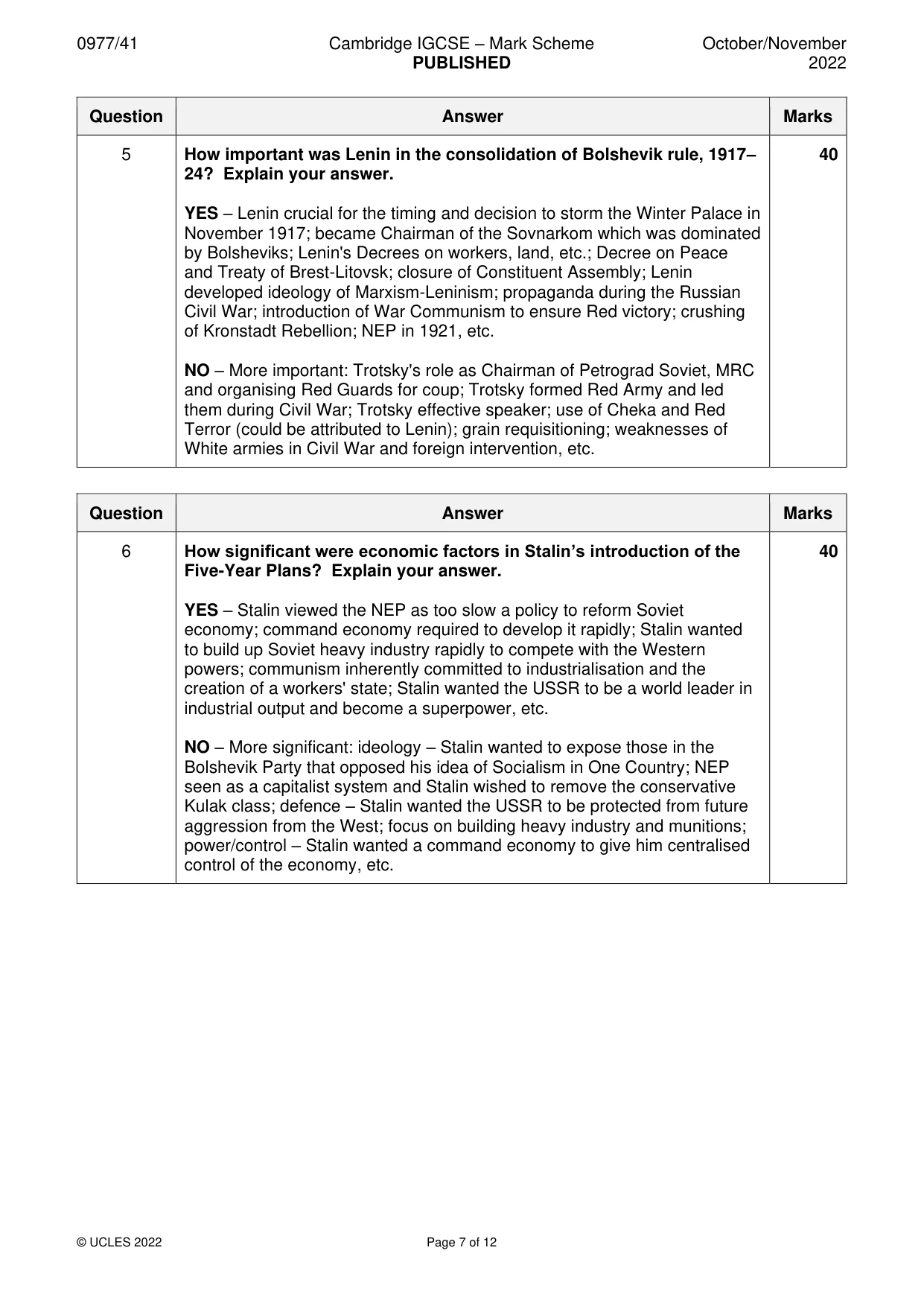
Mark scheme: 5 How important was Lenin in the consolidation of Bolshevik rule, 1917– 40 24? Explain your answer. YES – Lenin crucial for the timing and decision to storm the Winter Palace in November 1917; became Chairman of the Sovnarkom which was dominated by Bolsheviks; Lenin's Decrees on workers, land, etc.; Decree on Peace and Treaty of Brest-Litovsk; closure of Constituent Assembly; Lenin developed ideology of Marxism-Leninism; propaganda during the Russian Civil War; introduction of War Communism to ensure Red victory; crushing of Kronstadt Rebellion; NEP in 1921, etc. NO – More important: Trotsky's role as Chairman of Petrograd Soviet, MRC and organising Red Guards for coup; Trotsky formed Red Army and led them during Civil War; Trotsky effective speaker; use of Cheka and Red Terror (could be attributed to Lenin); grain requisitioning; weaknesses of White armies in Civil War and foreign intervention, etc.
Q6 · How significant were economic factors in Stalin’s introduction of the Five-Year Plans?
6 How significant were economic factors in Stalin’s introduction of the Five-Year Plans? Explain your answer. [40] DEPTH STUDY D: THE UNITED STATES, 1919–41
Mark scheme: 6 How significant were economic factors in Stalin’s introduction of the 40 Five-Year Plans? Explain your answer. YES – Stalin viewed the NEP as too slow a policy to reform Soviet economy; command economy required to develop it rapidly; Stalin wanted to build up Soviet heavy industry rapidly to compete with the Western powers; communism inherently committed to industrialisation and the creation of a workers' state; Stalin wanted the USSR to be a world leader in industrial output and become a superpower, etc. NO – More significant: ideology – Stalin wanted to expose those in the Bolshevik Party that opposed his idea of Socialism in One Country; NEP seen as a capitalist system and Stalin wished to remove the conservative Kulak class; defence – Stalin wanted the USSR to be protected from future aggression from the West; focus on building heavy industry and munitions; power/control – Stalin wanted a command economy to give him centralised control of the economy, etc.
Q7 · How important were tariffs as a reason why farmers did not share in the prosperity of the…
7 How important were tariffs as a reason why farmers did not share in the prosperity of the 1920s? Explain your answer. [40]
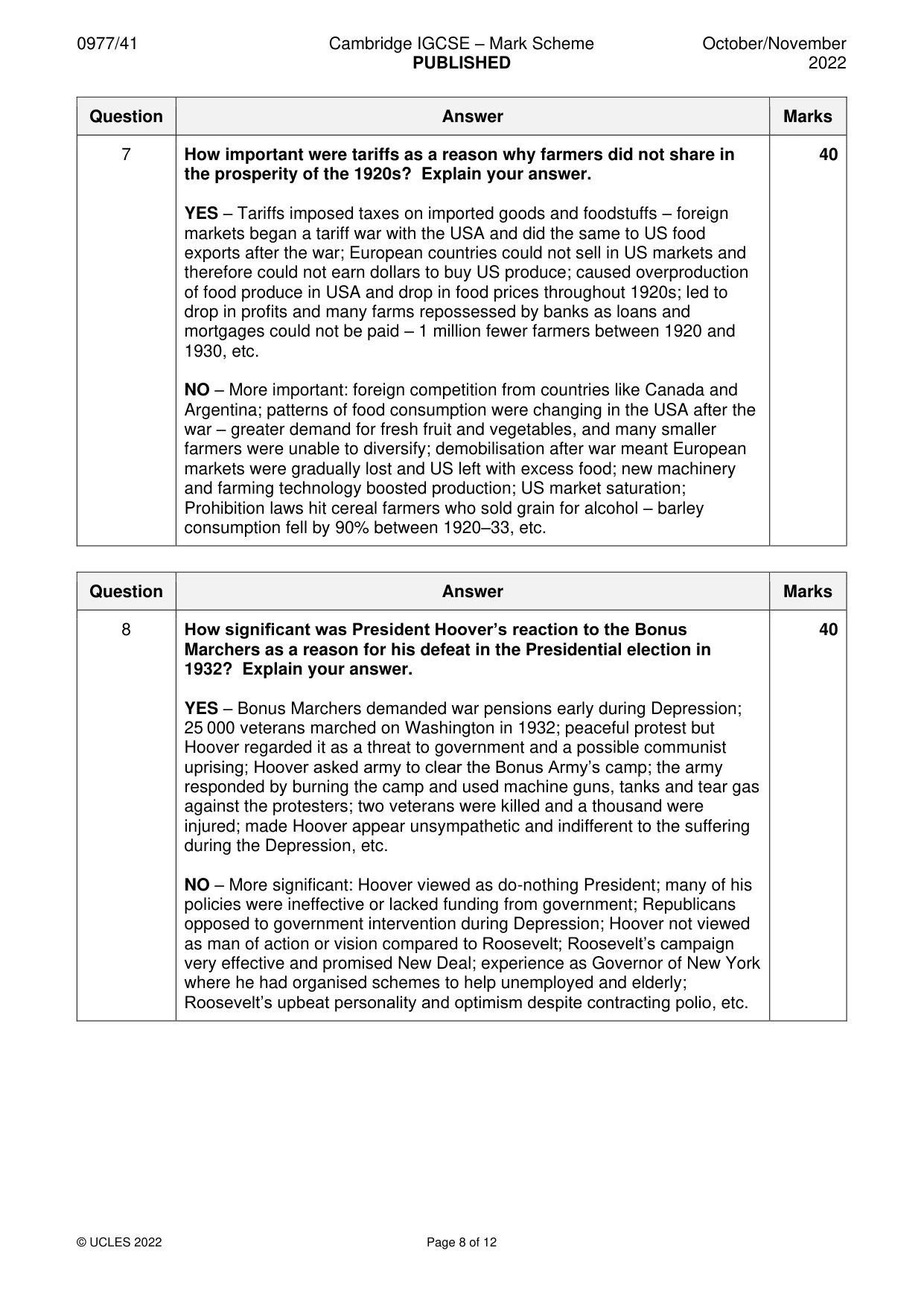
Mark scheme: 7 How important were tariffs as a reason why farmers did not share in 40 the prosperity of the 1920s? Explain your answer. YES – Tariffs imposed taxes on imported goods and foodstuffs – foreign markets began a tariff war with the USA and did the same to US food exports after the war; European countries could not sell in US markets and therefore could not earn dollars to buy US produce; caused overproduction of food produce in USA and drop in food prices throughout 1920s; led to drop in profits and many farms repossessed by banks as loans and mortgages could not be paid – 1 million fewer farmers between 1920 and 1930, etc. NO – More important: foreign competition from countries like Canada and Argentina; patterns of food consumption were changing in the USA after the war – greater demand for fresh fruit and vegetables, and many smaller farmers were unable to diversify; demobilisation after war meant European markets were gradually lost and US left with excess food; new machinery and farming technology boosted production; US market saturation; Prohibition laws hit cereal farmers who sold grain for alcohol – barley consumption fell by 90% between 1920–33, etc.
Q8 · How significant was President Hoover’s reaction to the Bonus Marchers as a reason for his…
8 How significant was President Hoover’s reaction to the Bonus Marchers as a reason for his defeat in the Presidential election in 1932? Explain your answer. [40] DEPTH STUDY E: CHINA, c.1930–c.1990
Mark scheme: 8 How significant was President Hoover’s reaction to the Bonus 40 Marchers as a reason for his defeat in the Presidential election in 1932? Explain your answer. YES – Bonus Marchers demanded war pensions early during Depression; 25 000 veterans marched on Washington in 1932; peaceful protest but Hoover regarded it as a threat to government and a possible communist uprising; Hoover asked army to clear the Bonus Army’s camp; the army responded by burning the camp and used machine guns, tanks and tear gas against the protesters; two veterans were killed and a thousand were injured; made Hoover appear unsympathetic and indifferent to the suffering during the Depression, etc. NO – More significant: Hoover viewed as do-nothing President; many of his policies were ineffective or lacked funding from government; Republicans opposed to government intervention during Depression; Hoover not viewed as man of action or vision compared to Roosevelt; Roosevelt’s campaign very effective and promised New Deal; experience as Governor of New York where he had organised schemes to help unemployed and elderly; Roosevelt’s upbeat personality and optimism despite contracting polio, etc.
Q9 · How important was the First Five-Year Plan to China’s social and economic development by…
9 How important was the First Five-Year Plan to China’s social and economic development by 1960? Explain your answer. [40]
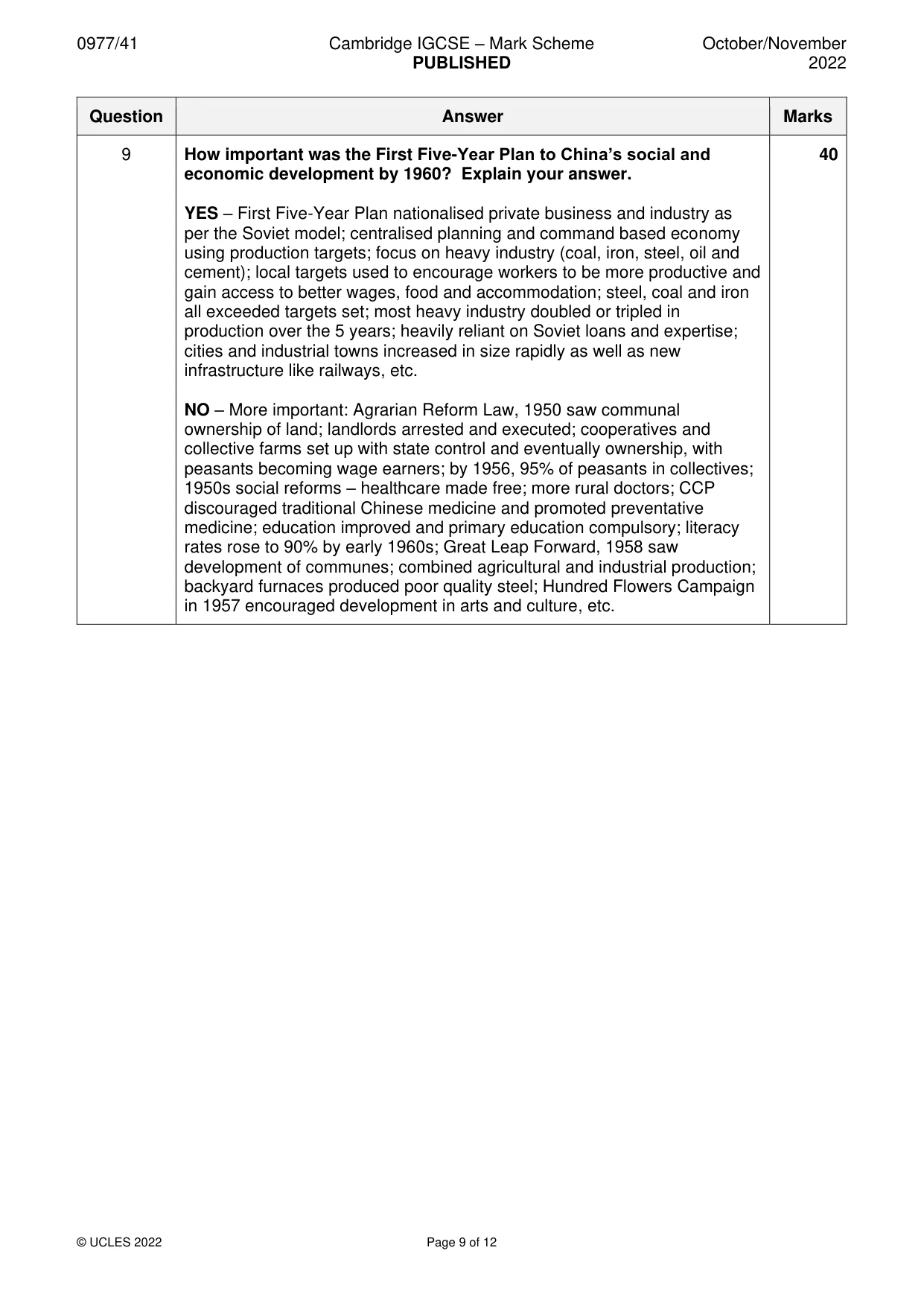
Mark scheme: 9 How important was the First Five-Year Plan to China’s social and 40 economic development by 1960? Explain your answer. YES – First Five-Year Plan nationalised private business and industry as per the Soviet model; centralised planning and command based economy using production targets; focus on heavy industry (coal, iron, steel, oil and cement); local targets used to encourage workers to be more productive and gain access to better wages, food and accommodation; steel, coal and iron all exceeded targets set; most heavy industry doubled or tripled in production over the 5 years; heavily reliant on Soviet loans and expertise; cities and industrial towns increased in size rapidly as well as new infrastructure like railways, etc. NO – More important: Agrarian Reform Law, 1950 saw communal ownership of land; landlords arrested and executed; cooperatives and collective farms set up with state control and eventually ownership, with peasants becoming wage earners; by 1956, 95% of peasants in collectives; 1950s social reforms – healthcare made free; more rural doctors; CCP discouraged traditional Chinese medicine and promoted preventative medicine; education improved and primary education compulsory; literacy rates rose to 90% by early 1960s; Great Leap Forward, 1958 saw development of communes; combined agricultural and industrial production; backyard furnaces produced poor quality steel; Hundred Flowers Campaign in 1957 encouraged development in arts and culture, etc.
Q10 · DEPTH STUDY F: SOUTH AFRICA, c.1940–c.1994
DEPTH STUDY F: SOUTH AFRICA, c.1940–c.1994
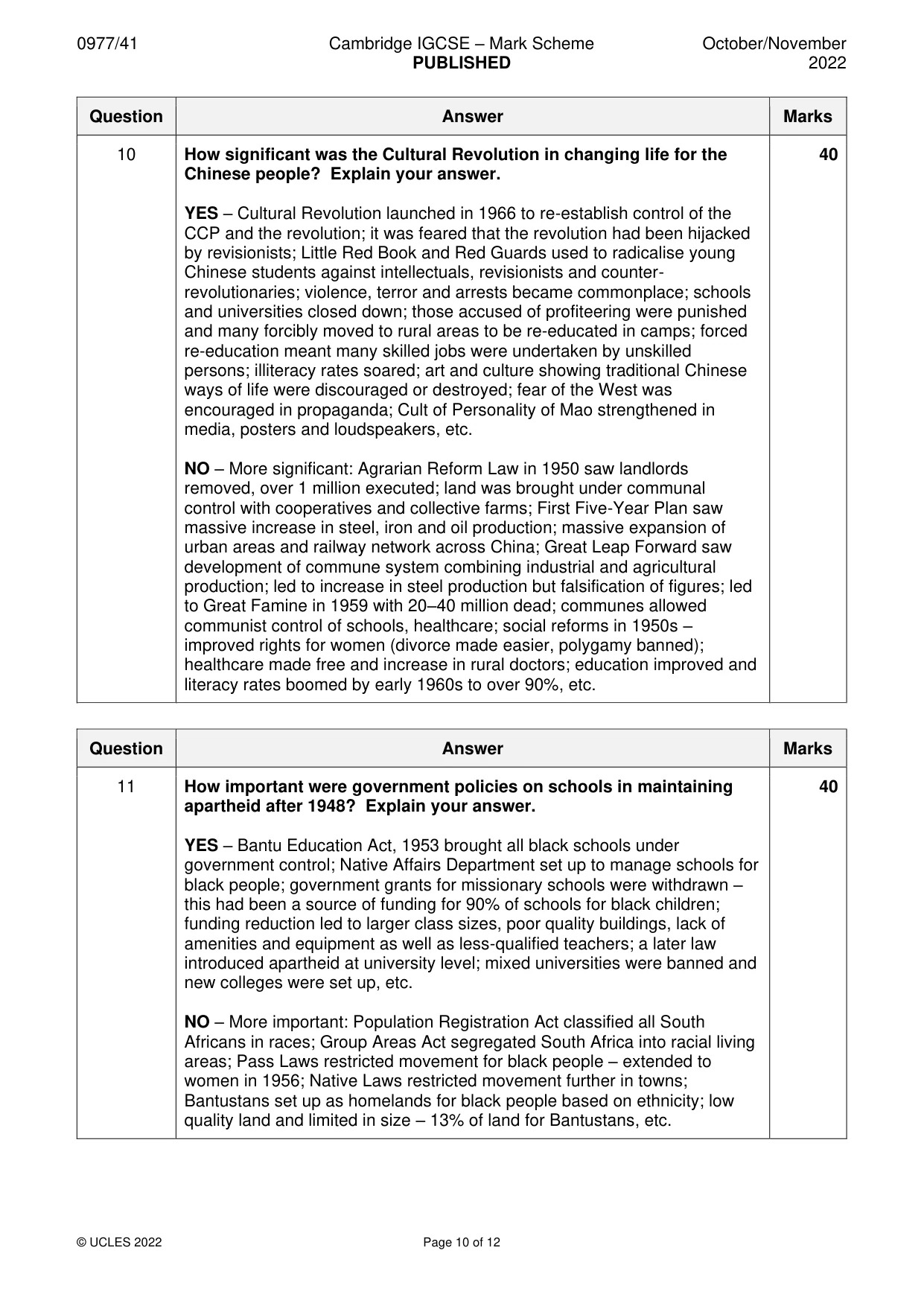
Mark scheme: 10 How significant was the Cultural Revolution in changing life for the 40 Chinese people? Explain your answer. YES – Cultural Revolution launched in 1966 to re-establish control of the CCP and the revolution; it was feared that the revolution had been hijacked by revisionists; Little Red Book and Red Guards used to radicalise young Chinese students against intellectuals, revisionists and counter- revolutionaries; violence, terror and arrests became commonplace; schools and universities closed down; those accused of profiteering were punished and many forcibly moved to rural areas to be re-educated in camps; forced re-education meant many skilled jobs were undertaken by unskilled persons; illiteracy rates soared; art and culture showing traditional Chinese ways of life were discouraged or destroyed; fear of the West was encouraged in propaganda; Cult of Personality of Mao strengthened in media, posters and loudspeakers, etc. NO – More significant: Agrarian Reform Law in 1950 saw landlords removed, over 1 million executed; land was brought under communal control with cooperatives and collective farms; First Five-Year Plan saw massive increase in steel, iron and oil production; massive expansion of urban areas and railway network across China; Great Leap Forward saw development of commune system combining industrial and agricultural production; led to increase in steel production but falsification of figures; led to Great Famine in 1959 with 20–40 million dead; communes allowed communist control of schools, healthcare; social reforms in 1950s – improved rights for women (divorce made easier, polygamy banned); healthcare made free and increase in rural doctors; education improved and literacy rates boomed by early 1960s to over 90%, etc.
Q11 · How important were government policies on schools in maintaining apartheid after 1948?
11 How important were government policies on schools in maintaining apartheid after 1948? Explain your answer. [40]
Mark scheme: 11 How important were government policies on schools in maintaining 40 apartheid after 1948? Explain your answer. YES – Bantu Education Act, 1953 brought all black schools under government control; Native Affairs Department set up to manage schools for black people; government grants for missionary schools were withdrawn – this had been a source of funding for 90% of schools for black children; funding reduction led to larger class sizes, poor quality buildings, lack of amenities and equipment as well as less-qualified teachers; a later law introduced apartheid at university level; mixed universities were banned and new colleges were set up, etc. NO – More important: Population Registration Act classified all South Africans in races; Group Areas Act segregated South Africa into racial living areas; Pass Laws restricted movement for black people – extended to women in 1956; Native Laws restricted movement further in towns; Bantustans set up as homelands for black people based on ethnicity; low quality land and limited in size – 13% of land for Bantustans, etc.
Q12 · How significant was Steve Biko in the development of the anti-apartheid movement in South…
12 How significant was Steve Biko in the development of the anti-apartheid movement in South Africa? Explain your answer. [40] DEPTH STUDY G: ISRAELIS AND PALESTINIANS SINCE 1945
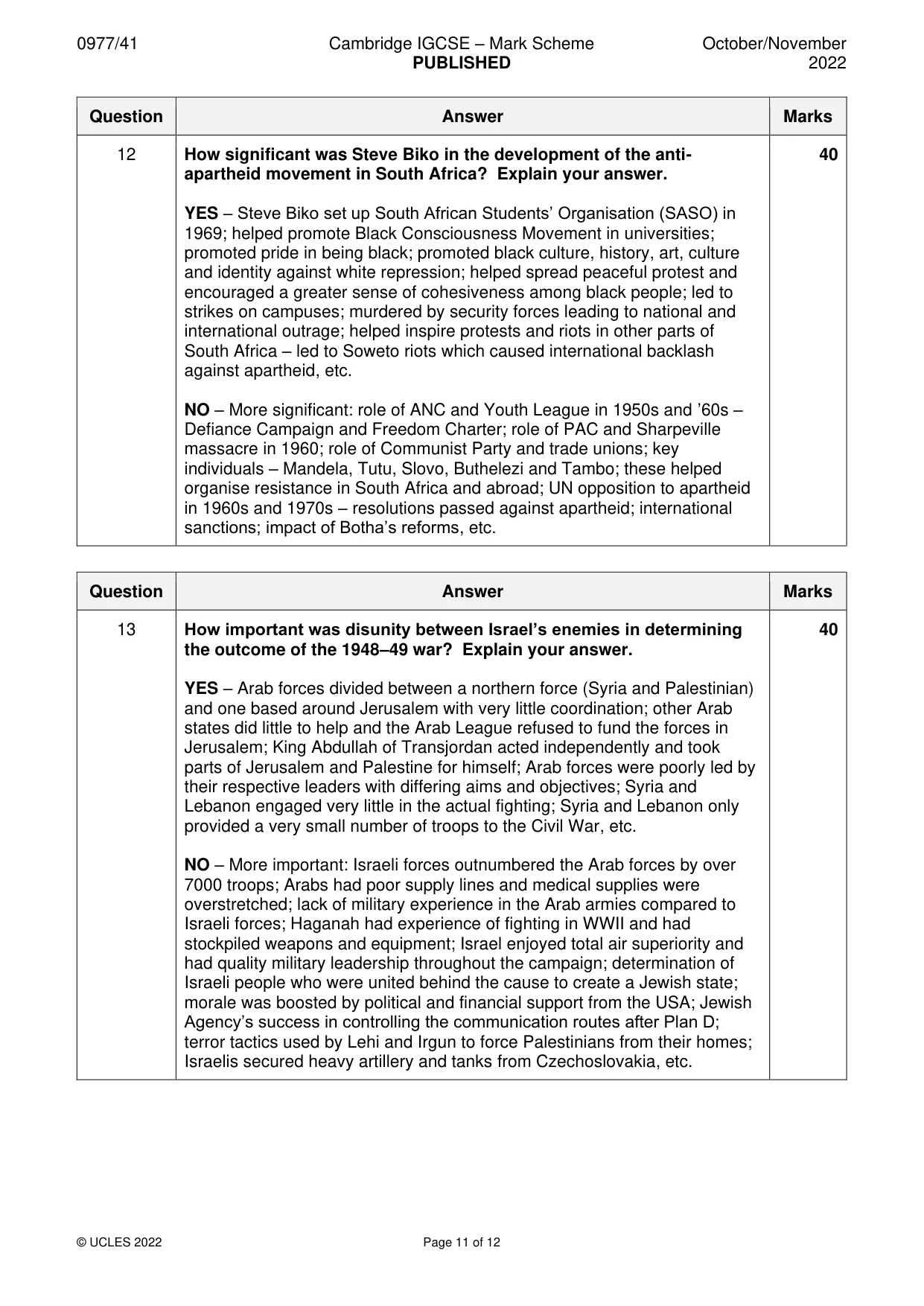
Mark scheme: 12 How significant was Steve Biko in the development of the anti- 40 apartheid movement in South Africa? Explain your answer. YES – Steve Biko set up South African Students’ Organisation (SASO) in 1969; helped promote Black Consciousness Movement in universities; promoted pride in being black; promoted black culture, history, art, culture and identity against white repression; helped spread peaceful protest and encouraged a greater sense of cohesiveness among black people; led to strikes on campuses; murdered by security forces leading to national and international outrage; helped inspire protests and riots in other parts of South Africa – led to Soweto riots which caused international backlash against apartheid, etc. NO – More significant: role of ANC and Youth League in 1950s and ’60s – Defiance Campaign and Freedom Charter; role of PAC and Sharpeville massacre in 1960; role of Communist Party and trade unions; key individuals – Mandela, Tutu, Slovo, Buthelezi and Tambo; these helped organise resistance in South Africa and abroad; UN opposition to apartheid in 1960s and 1970s – resolutions passed against apartheid; international sanctions; impact of Botha’s reforms, etc.
Q13 · How important was disunity between Israel’s enemies in determining the outcome of the…
13 How important was disunity between Israel’s enemies in determining the outcome of the 1948–49 war? Explain your answer. [40]
Mark scheme: 13 How important was disunity between Israel’s enemies in determining 40 the outcome of the 1948–49 war? Explain your answer. YES – Arab forces divided between a northern force (Syria and Palestinian) and one based around Jerusalem with very little coordination; other Arab states did little to help and the Arab League refused to fund the forces in Jerusalem; King Abdullah of Transjordan acted independently and took parts of Jerusalem and Palestine for himself; Arab forces were poorly led by their respective leaders with differing aims and objectives; Syria and Lebanon engaged very little in the actual fighting; Syria and Lebanon only provided a very small number of troops to the Civil War, etc. NO – More important: Israeli forces outnumbered the Arab forces by over 7000 troops; Arabs had poor supply lines and medical supplies were overstretched; lack of military experience in the Arab armies compared to Israeli forces; Haganah had experience of fighting in WWII and had stockpiled weapons and equipment; Israel enjoyed total air superiority and had quality military leadership throughout the campaign; determination of Israeli people who were united behind the cause to create a Jewish state; morale was boosted by political and financial support from the USA; Jewish Agency’s success in controlling the communication routes after Plan D; terror tactics used by Lehi and Irgun to force Palestinians from their homes; Israelis secured heavy artillery and tanks from Czechoslovakia, etc.
Q14 · How significant have the Palestinians been in the development of the Arab-Israeli dispute?
14 How significant have the Palestinians been in the development of the Arab-Israeli dispute? Explain your answer. [40]
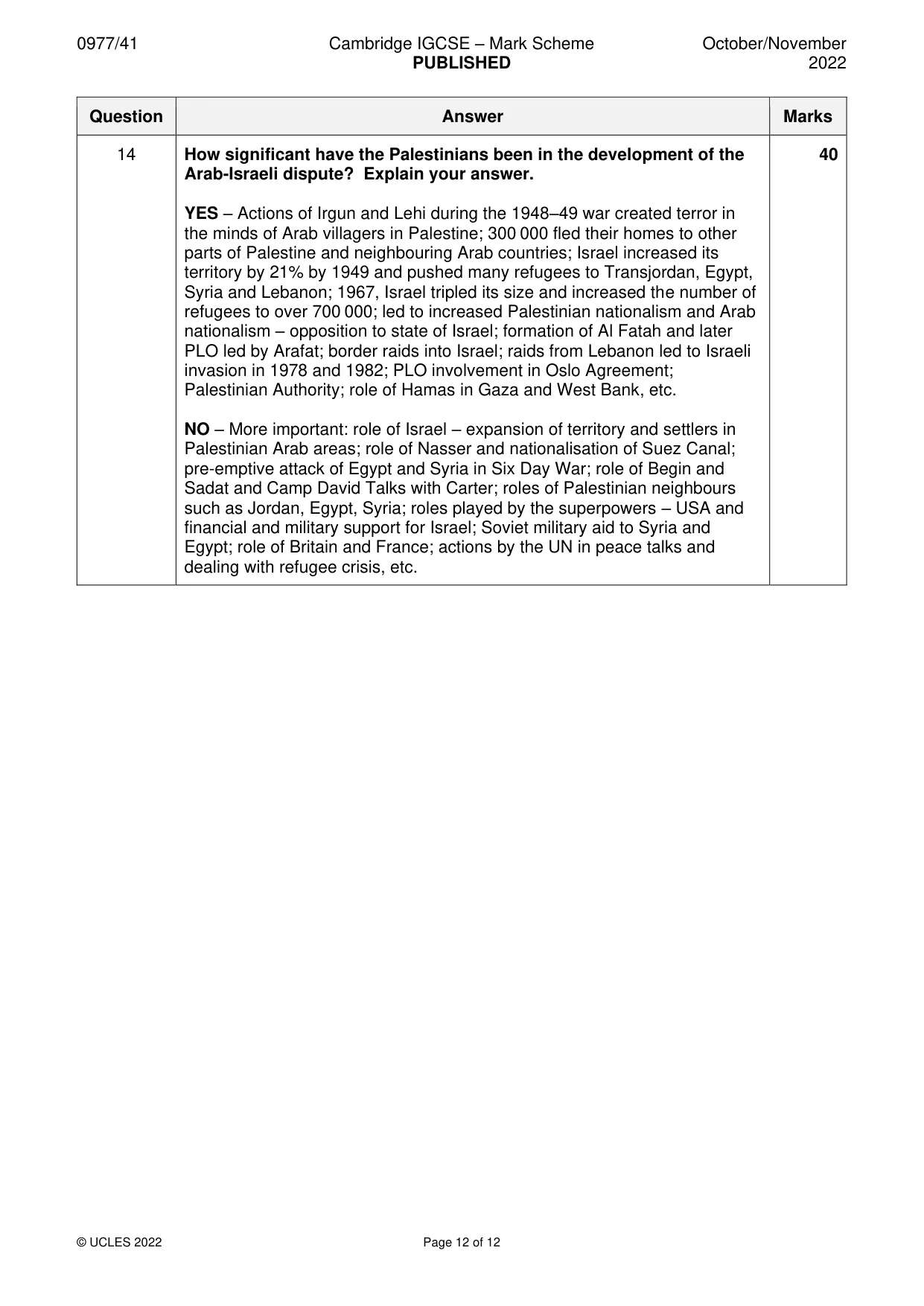
Mark scheme: 14 How significant have the Palestinians been in the development of the 40 Arab-Israeli dispute? Explain your answer. YES – Actions of Irgun and Lehi during the 1948–49 war created terror in the minds of Arab villagers in Palestine; 300 000 fled their homes to other parts of Palestine and neighbouring Arab countries; Israel increased its territory by 21% by 1949 and pushed many refugees to Transjordan, Egypt, Syria and Lebanon; 1967, Israel tripled its size and increased the number of refugees to over 700 000; led to increased Palestinian nationalism and Arab nationalism – opposition to state of Israel; formation of Al Fatah and later PLO led by Arafat; border raids into Israel; raids from Lebanon led to Israeli invasion in 1978 and 1982; PLO involvement in Oslo Agreement; Palestinian Authority; role of Hamas in Gaza and West Bank, etc. NO – More important: role of Israel – expansion of territory and settlers in Palestinian Arab areas; role of Nasser and nationalisation of Suez Canal; pre-emptive attack of Egypt and Syria in Six Day War; role of Begin and Sadat and Camp David Talks with Carter; roles of Palestinian neighbours such as Jordan, Egypt, Syria; roles played by the superpowers – USA and financial and military support for Israel; Soviet military aid to Syria and Egypt; role of Britain and France; actions by the UN in peace talks and dealing with refugee crisis, etc.
What you needed in this session
Cambridge’s own grade thresholds for 2022 Oct/Nov, Paper 4 · Variant 1. A higher threshold means an easier paper — the bar moves with how the cohort did.