Cambridge IGCSE History (9-1) 0977 — 2019 Oct/Nov Paper 4 · Variant 1
0977/41/O/N/19 · 40 marks · ≈45 min
The question paper and its mark scheme, free to read here and free to download. This is Cambridge’s own paper, exactly as it was sat.
Question paper4 pages


Mark scheme9 pages
Answers below. Sit the paper first if you are practising.
Paper as text
Question paper, page 1
Cambridge Assessment International Education Cambridge International General Certificate of Secondary Education (9–1) 0977/41 October/November 2019 1 hour HISTORY Paper 4 Alternative to Coursework Additional Materials: Answer Booklet READ THESE INSTRUCTIONS FIRST An answer booklet is provided inside this question paper. You should follow the instructions on the front cover of the answer booklet. If you need additional answer paper ask the invigilator for a continuation booklet. Answer one question from your chosen Depth Study. The number of marks is given in brackets [ ] at the end of each question or part question. This document consists of 3 printed pages and 1 blank page. [Turn over 11_0977_41_2019_1.4 © UCLES 2019 *9880930322*
Question paper, page 2
Answer one question from your chosen Depth Study. DEPTH STUDY A: THE FIRST WORLD WAR, 1914–1918 How important were trenches in determining the nature of war on the Western Front? Explain your answer. [40] 1 How significant were the actions of German leaders as a reason for the armistice in 1918? Explain your answer. [40] 2 DEPTH STUDY B: GERMANY, 1918–1945 How important were the territorial terms of the Treaty of Versailles as a cause of problems in early Weimar Germany? Explain your answer. [40] 3 How significant were the SA and SS in securing Nazi power by 1934? Explain your answer. [40] 4 DEPTH STUDY C: RUSSIA, 1905–1941 How important were economic problems in causing disturbances in Russia up to 1917? Explain your answer. [40] 5 How significant was defence as a reason for Stalin’s economic policies, 1928-41? Explain your answer. [40] 6 DEPTH STUDY D: THE USA, 1919–1941 How important was the motor industry as a cause of the economic boom in the 1920s? Explain your answer. [40] 7 How significant was the loss of foreign markets as a cause of the Depression in the USA? Explain your answer. [40] 8 DEPTH STUDY E: CHINA, c.1930–c.1990 How important was the failure of the Nationalists to appeal to the peasants in bringing about Communist victory in 1949? Explain your answer. [40] 9 How significant was the Cultural Revolution to the development of Communist rule in China? Explain your answer. [40] 10 11_0977_41_2019_1.4 © UCLES 2019 2
Question paper, page 3
DEPTH STUDY F: SOUTH AFRICA, c.1940–c.1994 How important were the Pass Laws in maintaining segregation in South Africa before 1948? Explain your answer. [40] 11 How significant were the security forces in allowing Nationalist governments to maintain the system of apartheid? Explain your answer. [40] 12 DEPTH STUDY G: ISRAELIS AND PALESTINIANS SINCE 1945 How important was Israeli aggression as a cause of conflict, 1956-73? Explain your answer. [40] 13 How significant was Fatah in determining the nature of Palestinian-Israeli relations to 2005? Explain your answer. [40] 14 11_0977_41_2019_1.4 © UCLES 2019 3
Question paper, page 4
BLANK PAGE Permission to reproduce items where third-party owned material protected by copyright is included has been sought and cleared where possible. Every reasonable effort has been made by the publisher (UCLES) to trace copyright holders, but if any items requiring clearance have unwittingly been included, the publisher will be pleased to make amends at the earliest possible opportunity. To avoid the issue of disclosure of answer-related information to candidates, all copyright acknowledgements are reproduced online in the Cambridge Assessment International Education Copyright Acknowledgements Booklet. This is produced for each series of examinations and is freely available to download at www.cambridgeinternational.org after the live examination series. Cambridge Assessment International Education is part of the Cambridge Assessment Group. Cambridge Assessment is the brand name of the University of Cambridge Local Examinations Syndicate (UCLES), which itself is a department of the University of Cambridge. 11_0977_41_2019_1.4 © UCLES 2019 4
Mark scheme, page 1
This document consists of 9 printed pages. © UCLES 2019 [Turn over Cambridge Assessment International Education Cambridge International General Certificate of Secondary Education (9–1) HISTORY (9–1) 0977/41 Paper 4 Alternative to Coursework October/November 2019 MARK SCHEME Maximum Mark: 40 Published This mark scheme is published as an aid to teachers and candidates, to indicate the requirements of the examination. It shows the basis on which Examiners were instructed to award marks. It does not indicate the details of the discussions that took place at an Examiners’ meeting before marking began, which would have considered the acceptability of alternative answers. Mark schemes should be read in conjunction with the question paper and the Principal Examiner Report for Teachers. Cambridge International will not enter into discussions about these mark schemes. Cambridge International is publishing the mark schemes for the October/November 2019 series for most Cambridge IGCSE™, Cambridge International A and AS Level components and some Cambridge O Level components.
Mark scheme, page 2
0977/41 Cambridge IGCSE (9–1) – Mark Scheme PUBLISHED October/November 2019 © UCLES 2019 Page 2 of 9 Generic Marking Principles These general marking principles must be applied by all examiners when marking candidate answers. They should be applied alongside the specific content of the mark scheme or generic level descriptors for a question. Each question paper and mark scheme will also comply with these marking principles. GENERIC MARKING PRINCIPLE 1: Marks must be awarded in line with: • the specific content of the mark scheme or the generic level descriptors for the question • the specific skills defined in the mark scheme or in the generic level descriptors for the question • the standard of response required by a candidate as exemplified by the standardisation scripts. GENERIC MARKING PRINCIPLE 2: Marks awarded are always whole marks (not half marks, or other fractions). GENERIC MARKING PRINCIPLE 3: Marks must be awarded positively: • marks are awarded for correct/valid answers, as defined in the mark scheme. However, credit is given for valid answers which go beyond the scope of the syllabus and mark scheme, referring to your Team Leader as appropriate • marks are awarded when candidates clearly demonstrate what they know and can do • marks are not deducted for errors • marks are not deducted for omissions • answers should only be judged on the quality of spelling, punctuation and grammar when these features are specifically assessed by the question as indicated by the mark scheme. The meaning, however, should be unambiguous. GENERIC MARKING PRINCIPLE 4: Rules must be applied consistently e.g. in situations where candidates have not followed instructions or in the application of generic level descriptors. GENERIC MARKING PRINCIPLE 5: Marks should be awarded using the full range of marks defined in the mark scheme for the question (however; the use of the full mark range may be limited according to the quality of the candidate responses seen). GENERIC MARKING PRINCIPLE 6: Marks awarded are based solely on the requirements as defined in the mark scheme. Marks should not be awarded with grade thresholds or grade descriptors in mind.
Mark scheme, page 3
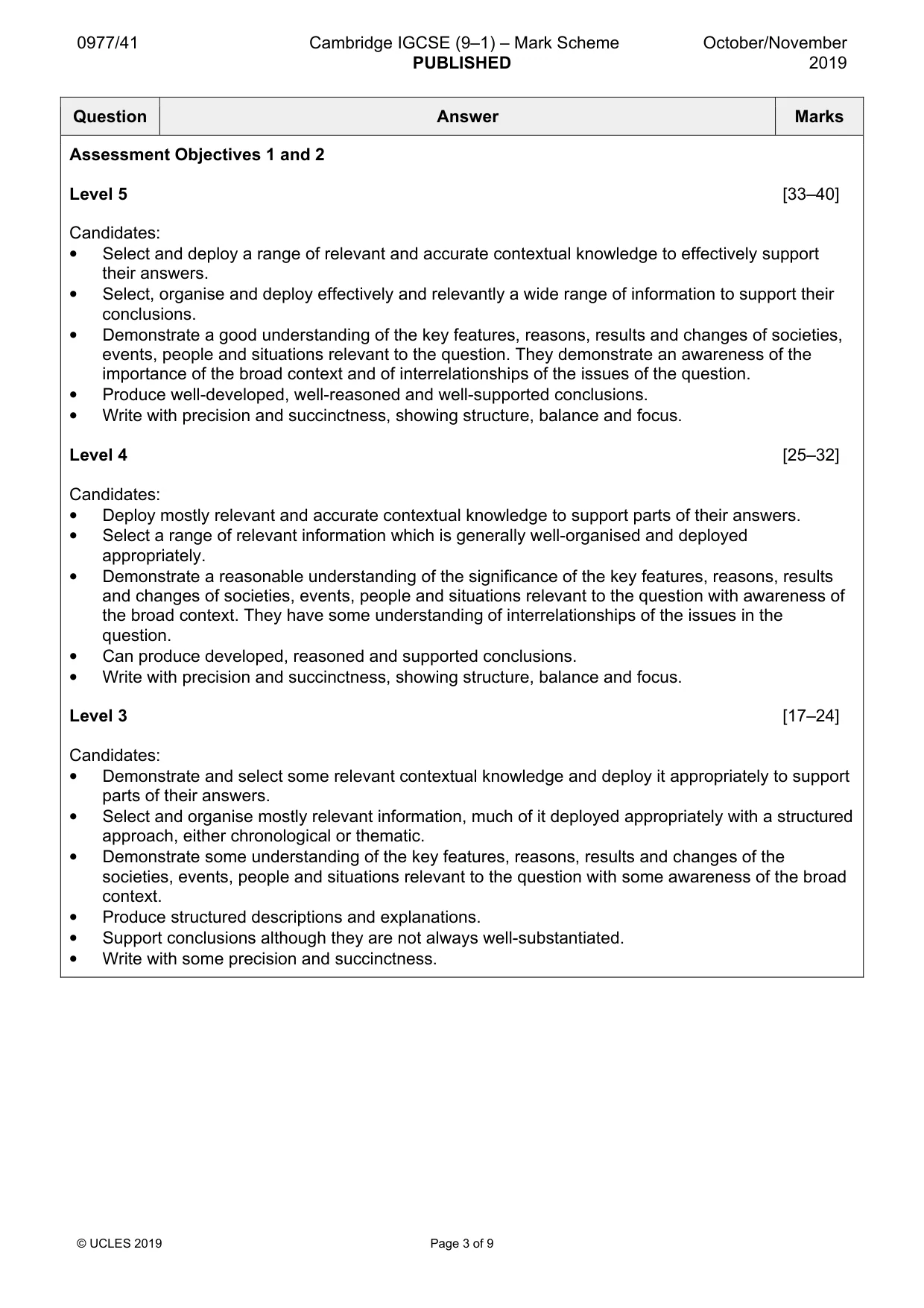
0977/41 Cambridge IGCSE (9–1) – Mark Scheme PUBLISHED October/November 2019 © UCLES 2019 Page 3 of 9 Question Answer Marks Assessment Objectives 1 and 2 Level 5 [33–40] Candidates: • Select and deploy a range of relevant and accurate contextual knowledge to effectively support their answers. • Select, organise and deploy effectively and relevantly a wide range of information to support their conclusions. • Demonstrate a good understanding of the key features, reasons, results and changes of societies, events, people and situations relevant to the question. They demonstrate an awareness of the importance of the broad context and of interrelationships of the issues of the question. • Produce well-developed, well-reasoned and well-supported conclusions. • Write with precision and succinctness, showing structure, balance and focus. Level 4 [25–32] Candidates: • Deploy mostly relevant and accurate contextual knowledge to support parts of their answers. • Select a range of relevant information which is generally well-organised and deployed appropriately. • Demonstrate a reasonable understanding of the significance of the key features, reasons, results and changes of societies, events, people and situations relevant to the question with awareness of the broad context. They have some understanding of interrelationships of the issues in the question. • Can produce developed, reasoned and supported conclusions. • Write with precision and succinctness, showing structure, balance and focus. Level 3 [17–24] Candidates: • Demonstrate and select some relevant contextual knowledge and deploy it appropriately to support parts of their answers. • Select and organise mostly relevant information, much of it deployed appropriately with a structured approach, either chronological or thematic. • Demonstrate some understanding of the key features, reasons, results and changes of the societies, events, people and situations relevant to the question with some awareness of the broad context. • Produce structured descriptions and explanations. • Support conclusions although they are not always well-substantiated. • Write with some precision and succinctness.
Mark scheme, page 4
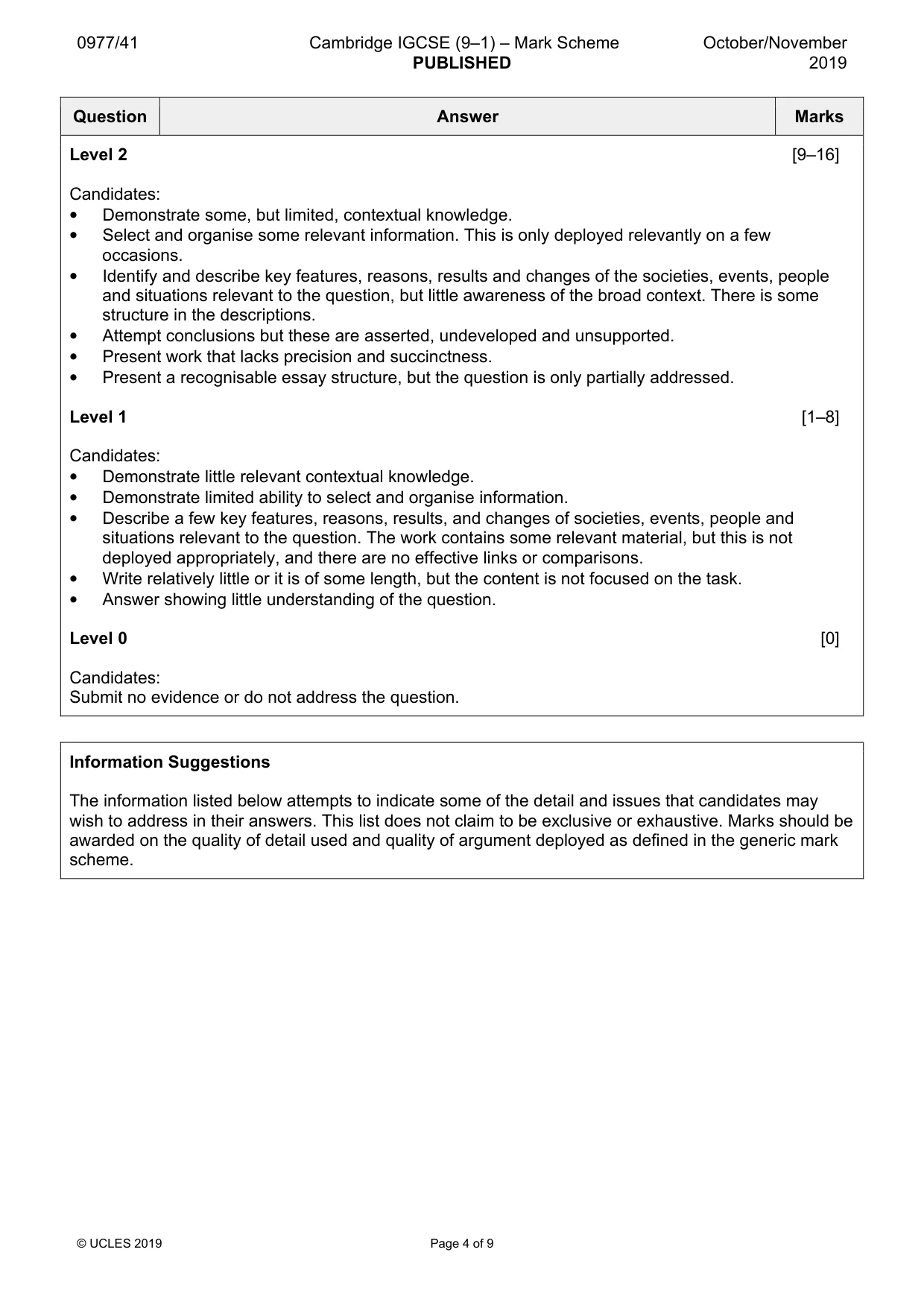
0977/41 Cambridge IGCSE (9–1) – Mark Scheme PUBLISHED October/November 2019 © UCLES 2019 Page 4 of 9 Question Answer Marks Level 2 [9–16] Candidates: • Demonstrate some, but limited, contextual knowledge. • Select and organise some relevant information. This is only deployed relevantly on a few occasions. • Identify and describe key features, reasons, results and changes of the societies, events, people and situations relevant to the question, but little awareness of the broad context. There is some structure in the descriptions. • Attempt conclusions but these are asserted, undeveloped and unsupported. • Present work that lacks precision and succinctness. • Present a recognisable essay structure, but the question is only partially addressed. Level 1 [1–8] Candidates: • Demonstrate little relevant contextual knowledge. • Demonstrate limited ability to select and organise information. • Describe a few key features, reasons, results, and changes of societies, events, people and situations relevant to the question. The work contains some relevant material, but this is not deployed appropriately, and there are no effective links or comparisons. • Write relatively little or it is of some length, but the content is not focused on the task. • Answer showing little understanding of the question. Level 0 [0] Candidates: Submit no evidence or do not address the question. Information Suggestions The information listed below attempts to indicate some of the detail and issues that candidates may wish to address in their answers. This list does not claim to be exclusive or exhaustive. Marks should be awarded on the quality of detail used and quality of argument deployed as defined in the generic mark scheme.
Mark scheme, page 5
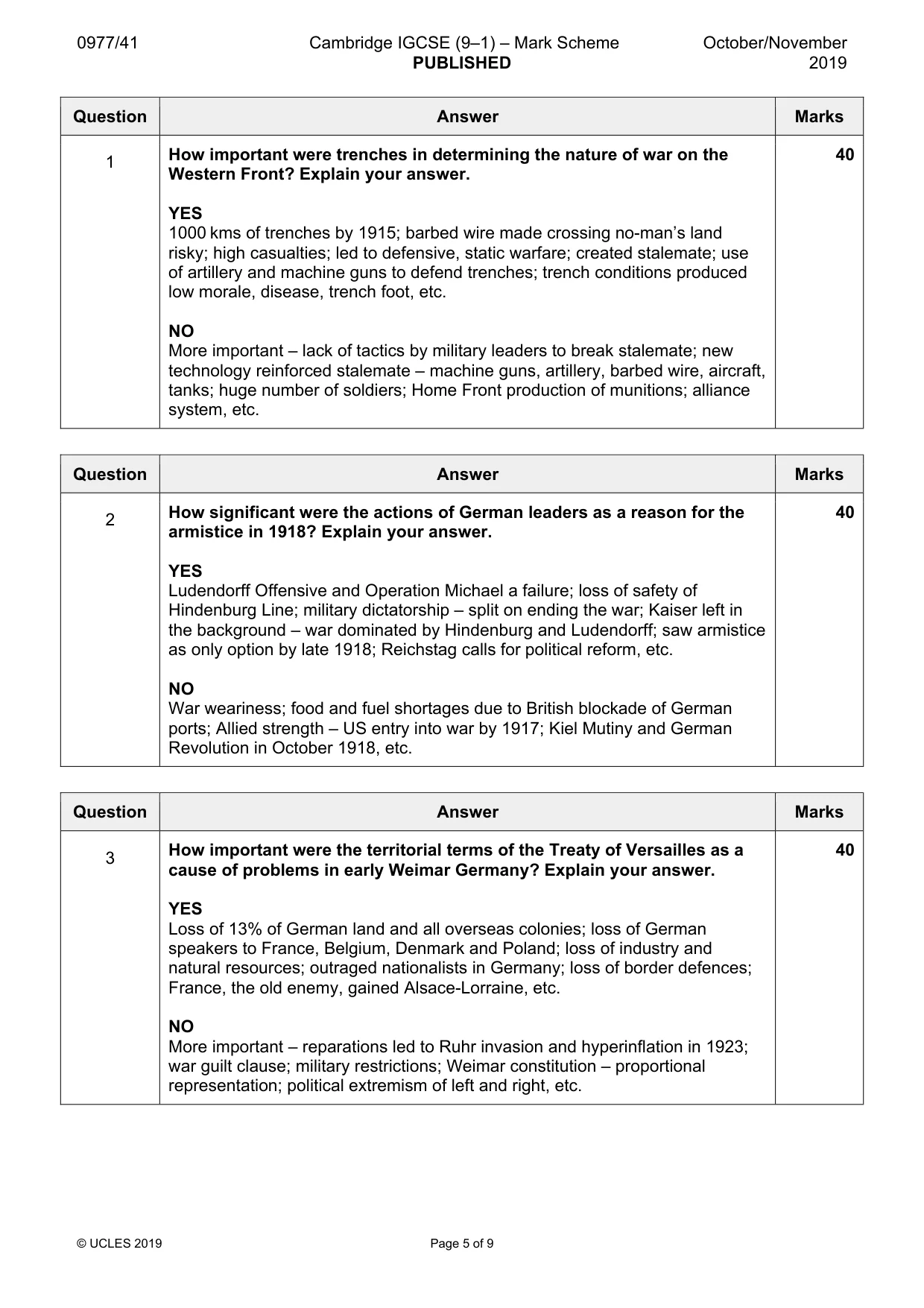
0977/41 Cambridge IGCSE (9–1) – Mark Scheme PUBLISHED October/November 2019 © UCLES 2019 Page 5 of 9 Question Answer Marks 1 How important were trenches in determining the nature of war on the Western Front? Explain your answer. YES 1000 kms of trenches by 1915; barbed wire made crossing no-man’s land risky; high casualties; led to defensive, static warfare; created stalemate; use of artillery and machine guns to defend trenches; trench conditions produced low morale, disease, trench foot, etc. NO More important – lack of tactics by military leaders to break stalemate; new technology reinforced stalemate – machine guns, artillery, barbed wire, aircraft, tanks; huge number of soldiers; Home Front production of munitions; alliance system, etc. 40 Question Answer Marks 2 How significant were the actions of German leaders as a reason for the armistice in 1918? Explain your answer. YES Ludendorff Offensive and Operation Michael a failure; loss of safety of Hindenburg Line; military dictatorship – split on ending the war; Kaiser left in the background – war dominated by Hindenburg and Ludendorff; saw armistice as only option by late 1918; Reichstag calls for political reform, etc. NO War weariness; food and fuel shortages due to British blockade of German ports; Allied strength – US entry into war by 1917; Kiel Mutiny and German Revolution in October 1918, etc. 40 Question Answer Marks 3 How important were the territorial terms of the Treaty of Versailles as a cause of problems in early Weimar Germany? Explain your answer. YES Loss of 13% of German land and all overseas colonies; loss of German speakers to France, Belgium, Denmark and Poland; loss of industry and natural resources; outraged nationalists in Germany; loss of border defences; France, the old enemy, gained Alsace-Lorraine, etc. NO More important – reparations led to Ruhr invasion and hyperinflation in 1923; war guilt clause; military restrictions; Weimar constitution – proportional representation; political extremism of left and right, etc. 40
Mark scheme, page 6
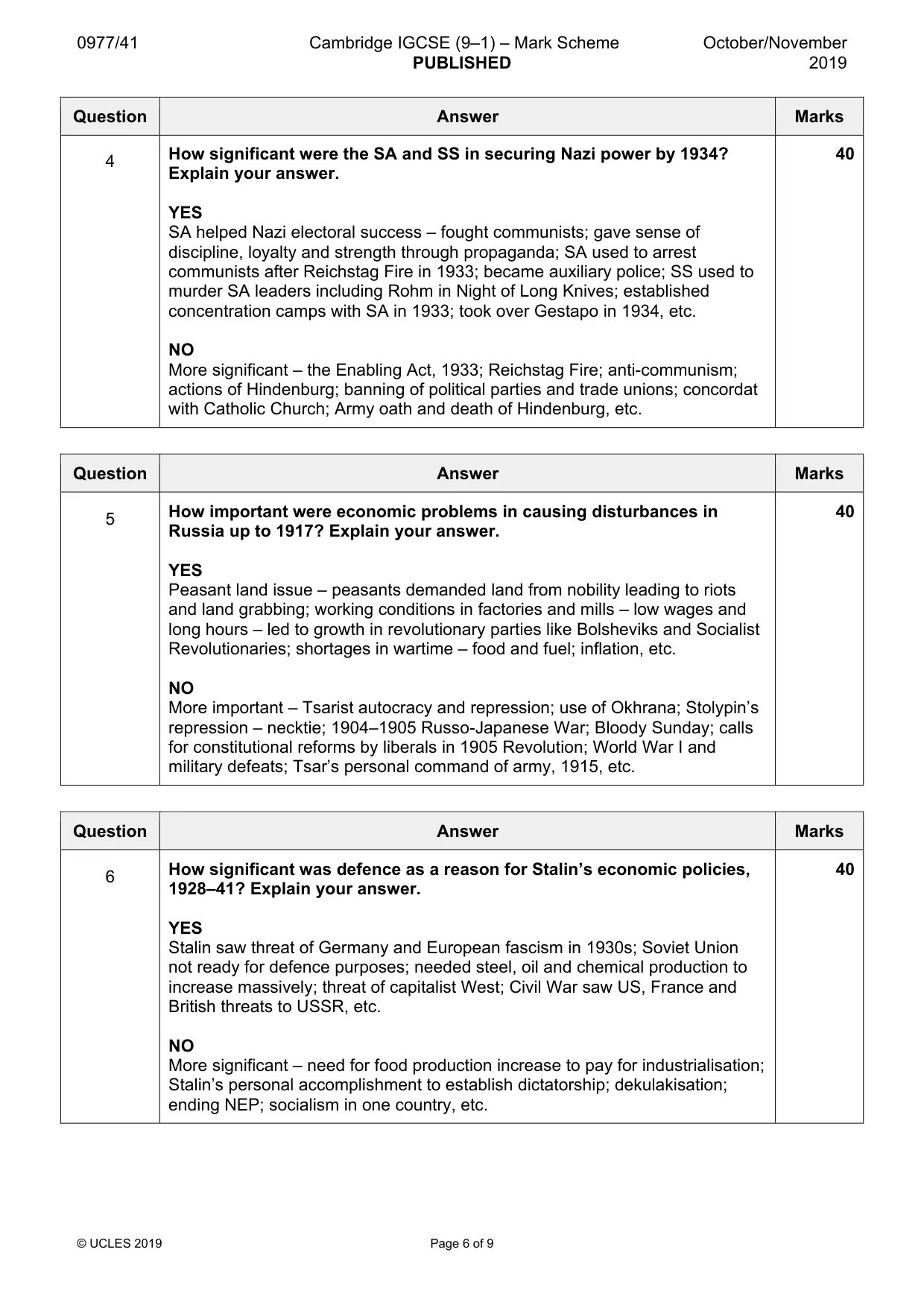
0977/41 Cambridge IGCSE (9–1) – Mark Scheme PUBLISHED October/November 2019 © UCLES 2019 Page 6 of 9 Question Answer Marks 4 How significant were the SA and SS in securing Nazi power by 1934? Explain your answer. YES SA helped Nazi electoral success – fought communists; gave sense of discipline, loyalty and strength through propaganda; SA used to arrest communists after Reichstag Fire in 1933; became auxiliary police; SS used to murder SA leaders including Rohm in Night of Long Knives; established concentration camps with SA in 1933; took over Gestapo in 1934, etc. NO More significant – the Enabling Act, 1933; Reichstag Fire; anti-communism; actions of Hindenburg; banning of political parties and trade unions; concordat with Catholic Church; Army oath and death of Hindenburg, etc. 40 Question Answer Marks 5 How important were economic problems in causing disturbances in Russia up to 1917? Explain your answer. YES Peasant land issue – peasants demanded land from nobility leading to riots and land grabbing; working conditions in factories and mills – low wages and long hours – led to growth in revolutionary parties like Bolsheviks and Socialist Revolutionaries; shortages in wartime – food and fuel; inflation, etc. NO More important – Tsarist autocracy and repression; use of Okhrana; Stolypin’s repression – necktie; 1904–1905 Russo-Japanese War; Bloody Sunday; calls for constitutional reforms by liberals in 1905 Revolution; World War I and military defeats; Tsar’s personal command of army, 1915, etc. 40 Question Answer Marks 6 How significant was defence as a reason for Stalin’s economic policies, 1928–41? Explain your answer. YES Stalin saw threat of Germany and European fascism in 1930s; Soviet Union not ready for defence purposes; needed steel, oil and chemical production to increase massively; threat of capitalist West; Civil War saw US, France and British threats to USSR, etc. NO More significant – need for food production increase to pay for industrialisation; Stalin’s personal accomplishment to establish dictatorship; dekulakisation; ending NEP; socialism in one country, etc. 40
Mark scheme, page 7
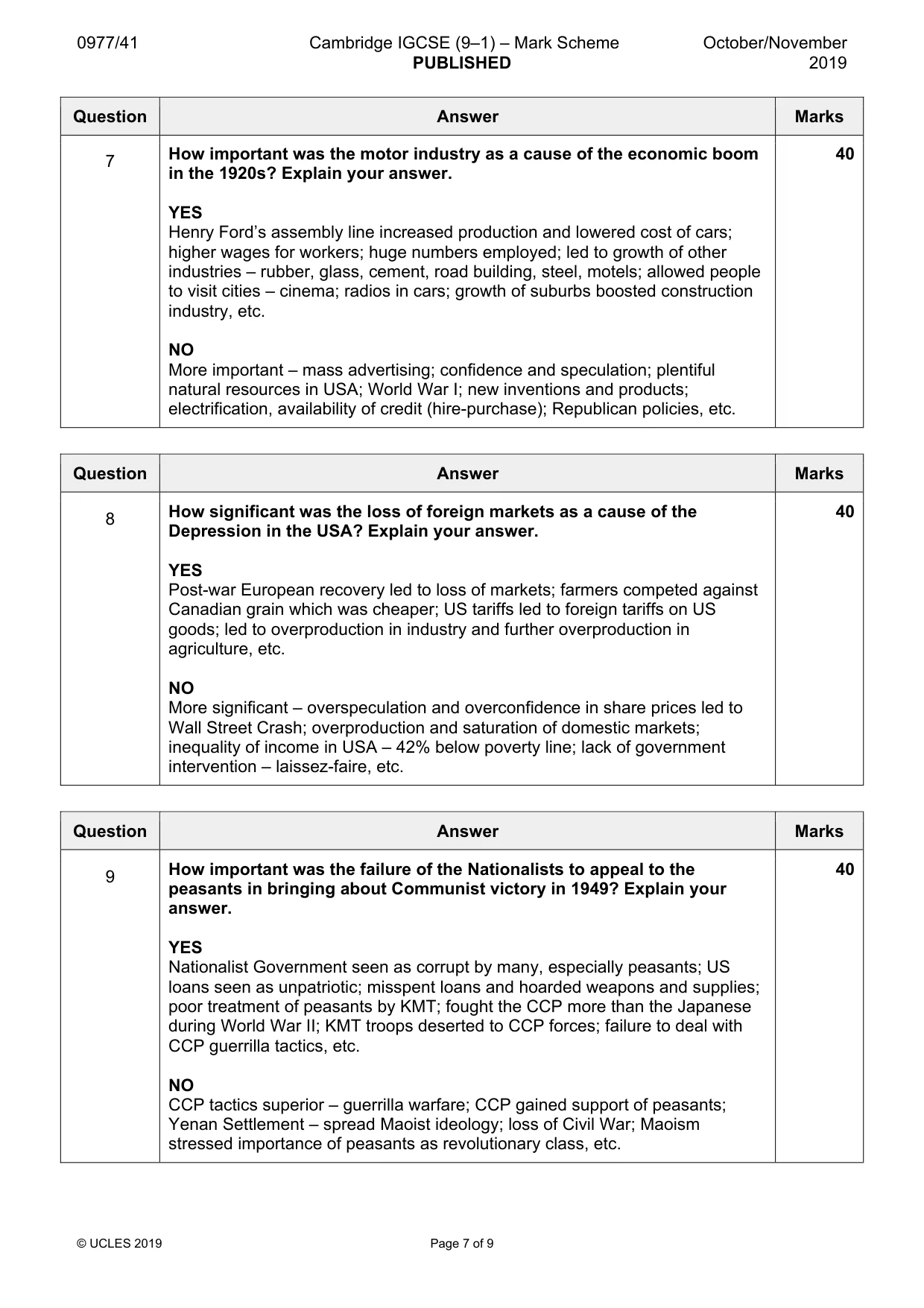
0977/41 Cambridge IGCSE (9–1) – Mark Scheme PUBLISHED October/November 2019 © UCLES 2019 Page 7 of 9 Question Answer Marks 7 How important was the motor industry as a cause of the economic boom in the 1920s? Explain your answer. YES Henry Ford’s assembly line increased production and lowered cost of cars; higher wages for workers; huge numbers employed; led to growth of other industries – rubber, glass, cement, road building, steel, motels; allowed people to visit cities – cinema; radios in cars; growth of suburbs boosted construction industry, etc. NO More important – mass advertising; confidence and speculation; plentiful natural resources in USA; World War I; new inventions and products; electrification, availability of credit (hire-purchase); Republican policies, etc. 40 Question Answer Marks 8 How significant was the loss of foreign markets as a cause of the Depression in the USA? Explain your answer. YES Post-war European recovery led to loss of markets; farmers competed against Canadian grain which was cheaper; US tariffs led to foreign tariffs on US goods; led to overproduction in industry and further overproduction in agriculture, etc. NO More significant – overspeculation and overconfidence in share prices led to Wall Street Crash; overproduction and saturation of domestic markets; inequality of income in USA – 42% below poverty line; lack of government intervention – laissez-faire, etc. 40 Question Answer Marks 9 How important was the failure of the Nationalists to appeal to the peasants in bringing about Communist victory in 1949? Explain your answer. YES Nationalist Government seen as corrupt by many, especially peasants; US loans seen as unpatriotic; misspent loans and hoarded weapons and supplies; poor treatment of peasants by KMT; fought the CCP more than the Japanese during World War II; KMT troops deserted to CCP forces; failure to deal with CCP guerrilla tactics, etc. NO CCP tactics superior – guerrilla warfare; CCP gained support of peasants; Yenan Settlement – spread Maoist ideology; loss of Civil War; Maoism stressed importance of peasants as revolutionary class, etc. 40
Mark scheme, page 8
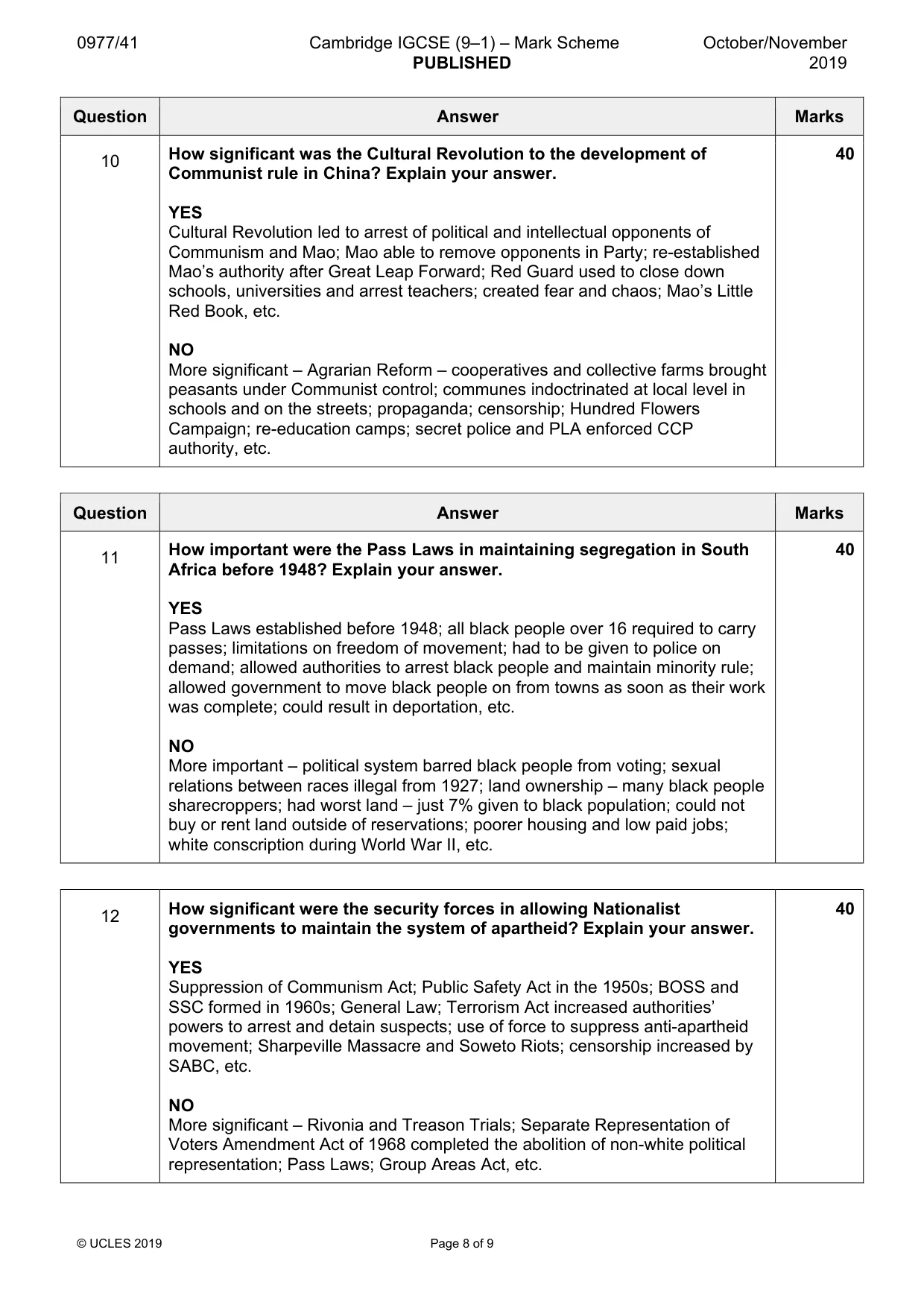
0977/41 Cambridge IGCSE (9–1) – Mark Scheme PUBLISHED October/November 2019 © UCLES 2019 Page 8 of 9 Question Answer Marks 10 How significant was the Cultural Revolution to the development of Communist rule in China? Explain your answer. YES Cultural Revolution led to arrest of political and intellectual opponents of Communism and Mao; Mao able to remove opponents in Party; re-established Mao’s authority after Great Leap Forward; Red Guard used to close down schools, universities and arrest teachers; created fear and chaos; Mao’s Little Red Book, etc. NO More significant – Agrarian Reform – cooperatives and collective farms brought peasants under Communist control; communes indoctrinated at local level in schools and on the streets; propaganda; censorship; Hundred Flowers Campaign; re-education camps; secret police and PLA enforced CCP authority, etc. 40 Question Answer Marks 11 How important were the Pass Laws in maintaining segregation in South Africa before 1948? Explain your answer. YES Pass Laws established before 1948; all black people over 16 required to carry passes; limitations on freedom of movement; had to be given to police on demand; allowed authorities to arrest black people and maintain minority rule; allowed government to move black people on from towns as soon as their work was complete; could result in deportation, etc. NO More important – political system barred black people from voting; sexual relations between races illegal from 1927; land ownership – many black people sharecroppers; had worst land – just 7% given to black population; could not buy or rent land outside of reservations; poorer housing and low paid jobs; white conscription during World War II, etc. 40 12 How significant were the security forces in allowing Nationalist governments to maintain the system of apartheid? Explain your answer. YES Suppression of Communism Act; Public Safety Act in the 1950s; BOSS and SSC formed in 1960s; General Law; Terrorism Act increased authorities’ powers to arrest and detain suspects; use of force to suppress anti-apartheid movement; Sharpeville Massacre and Soweto Riots; censorship increased by SABC, etc. NO More significant – Rivonia and Treason Trials; Separate Representation of Voters Amendment Act of 1968 completed the abolition of non-white political representation; Pass Laws; Group Areas Act, etc. 40
Mark scheme, page 9
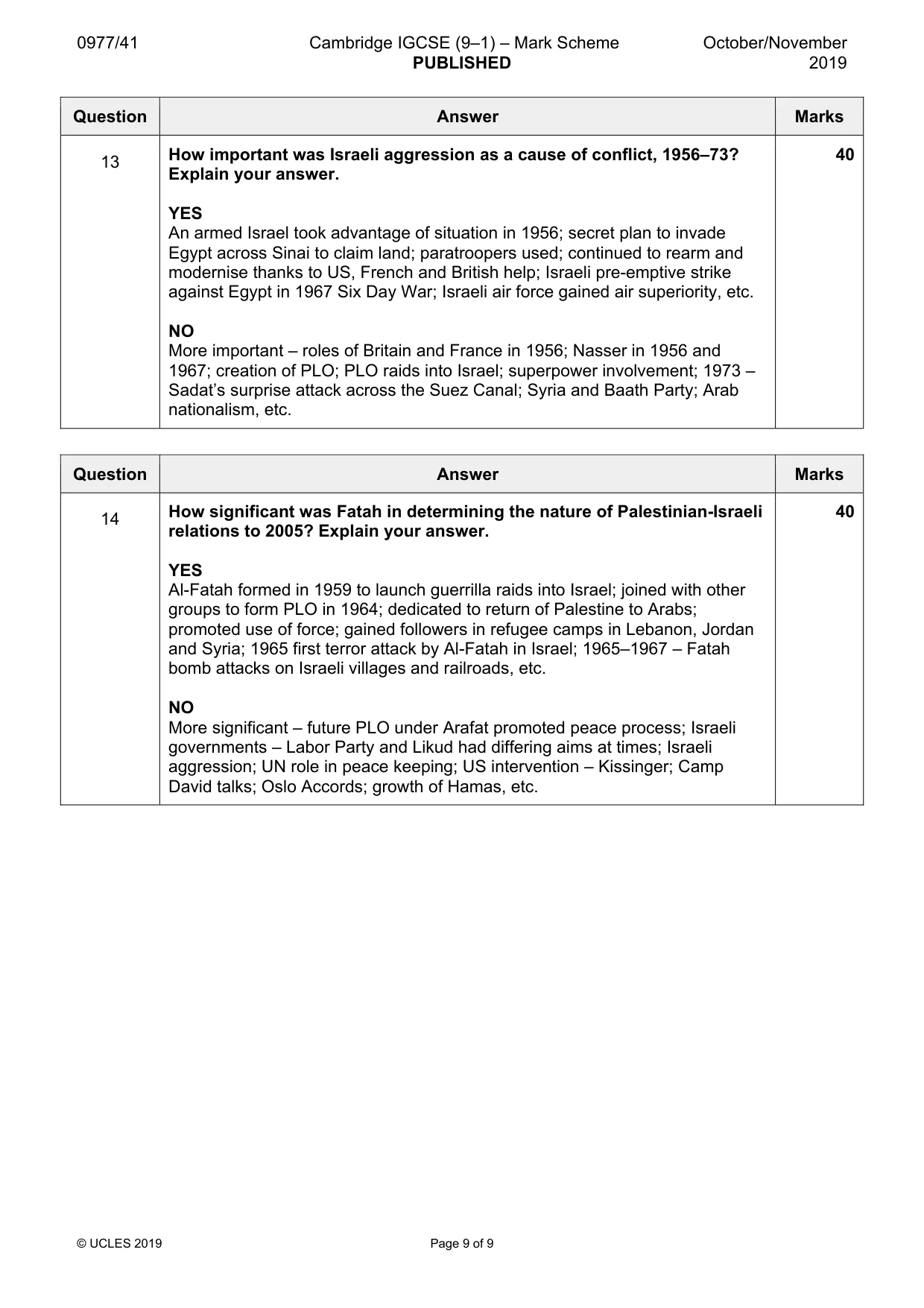
0977/41 Cambridge IGCSE (9–1) – Mark Scheme PUBLISHED October/November 2019 © UCLES 2019 Page 9 of 9 Question Answer Marks 13 How important was Israeli aggression as a cause of conflict, 1956–73? Explain your answer. YES An armed Israel took advantage of situation in 1956; secret plan to invade Egypt across Sinai to claim land; paratroopers used; continued to rearm and modernise thanks to US, French and British help; Israeli pre-emptive strike against Egypt in 1967 Six Day War; Israeli air force gained air superiority, etc. NO More important – roles of Britain and France in 1956; Nasser in 1956 and 1967; creation of PLO; PLO raids into Israel; superpower involvement; 1973 – Sadat’s surprise attack across the Suez Canal; Syria and Baath Party; Arab nationalism, etc. 40 Question Answer Marks 14 How significant was Fatah in determining the nature of Palestinian-Israeli relations to 2005? Explain your answer. YES Al-Fatah formed in 1959 to launch guerrilla raids into Israel; joined with other groups to form PLO in 1964; dedicated to return of Palestine to Arabs; promoted use of force; gained followers in refugee camps in Lebanon, Jordan and Syria; 1965 first terror attack by Al-Fatah in Israel; 1965–1967 – Fatah bomb attacks on Israeli villages and railroads, etc. NO More significant – future PLO under Arafat promoted peace process; Israeli governments – Labor Party and Likud had differing aims at times; Israeli aggression; UN role in peace keeping; US intervention – Kissinger; Camp David talks; Oslo Accords; growth of Hamas, etc. 40
What you needed in this session
Cambridge’s own grade thresholds for 2019 Oct/Nov, Paper 4 · Variant 1. A higher threshold means an easier paper — the bar moves with how the cohort did.