Cambridge IGCSE History 0470 — 2022 Feb/March Paper 4 · Variant 2
0470/42/F/M/22 · 40 marks · ≈45 min
The question paper and its mark scheme, free to read here and free to download. This is Cambridge’s own paper, exactly as it was sat.
Question paper4 pages

Mark scheme12 pages
Answers below. Sit the paper first if you are practising.
Paper as text
Question paper, page 1
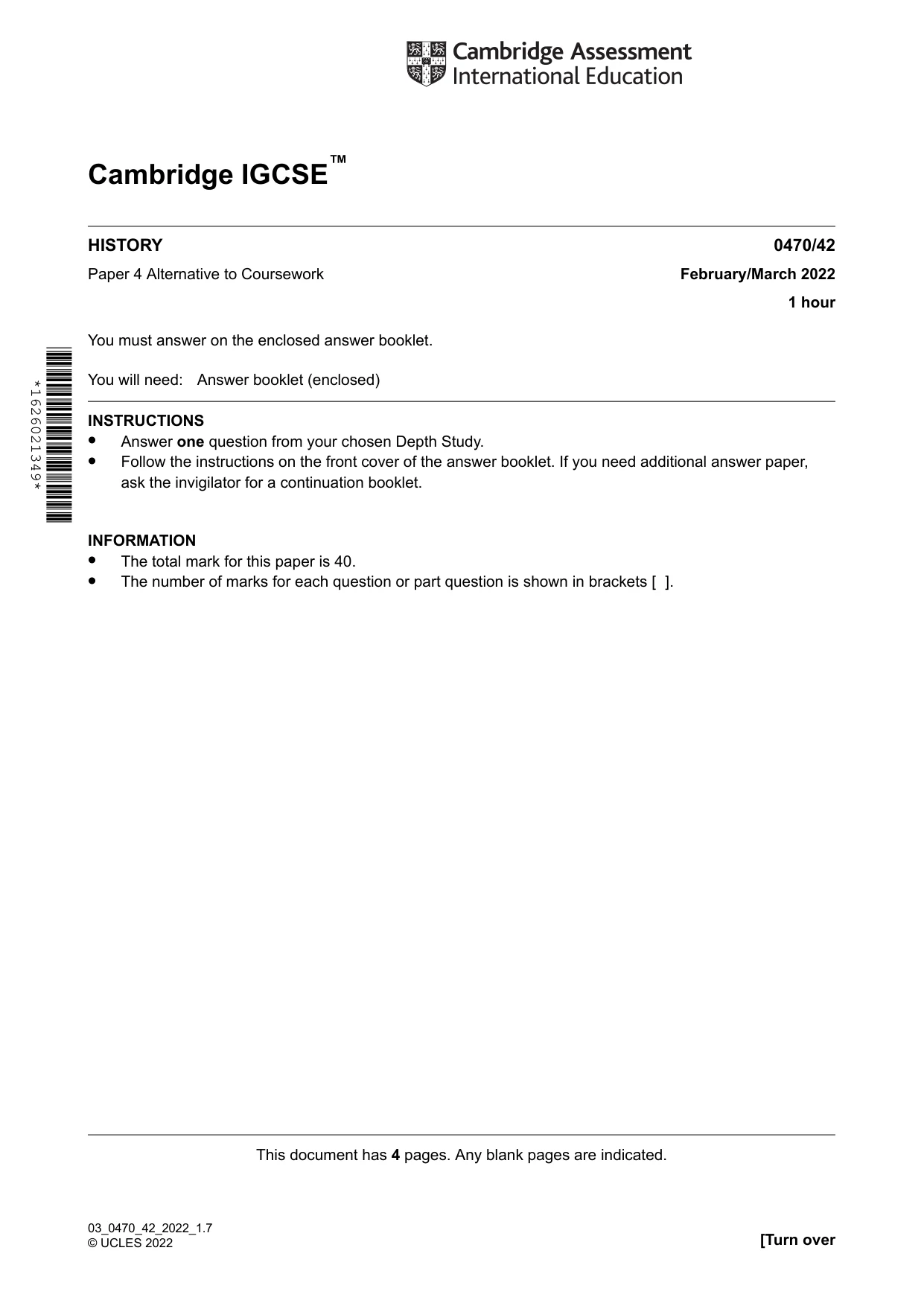
Cambridge IGCSE™ 0470/42 February/March 2022 1 hour HISTORY Paper 4 Alternative to Coursework You must answer on the enclosed answer booklet. You will need: Answer booklet (enclosed) INSTRUCTIONS • Answer one question from your chosen Depth Study. • Follow the instructions on the front cover of the answer booklet. If you need additional answer paper, ask the invigilator for a continuation booklet. INFORMATION • The total mark for this paper is 40. • The number of marks for each question or part question is shown in brackets [ ]. This document has 4 pages. Any blank pages are indicated. [Turn over 03_0470_42_2022_1.7 © UCLES 2022 *1626021349*
Question paper, page 2
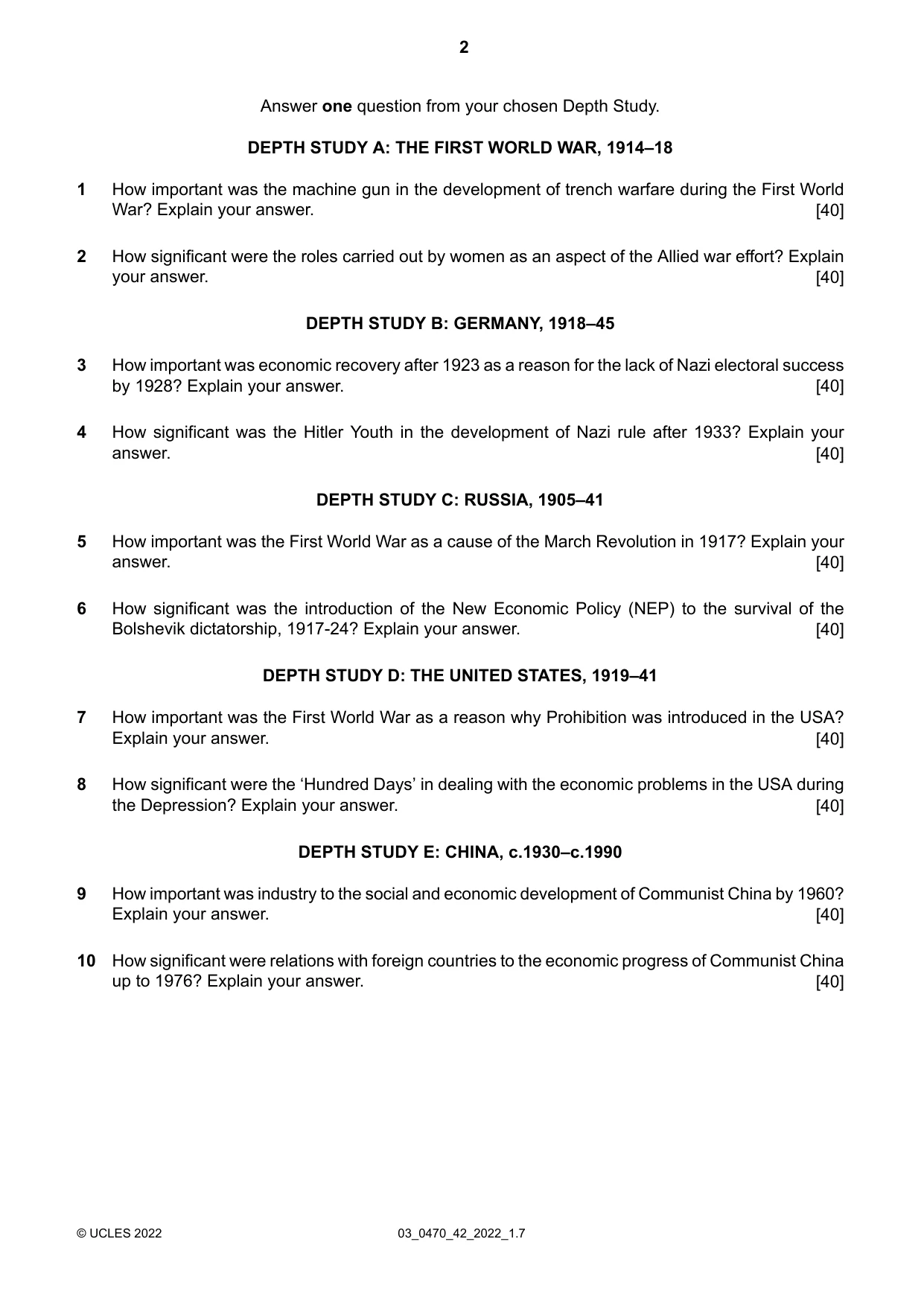
Answer one question from your chosen Depth Study. DEPTH STUDY A: THE FIRST WORLD WAR, 1914–18 How important was the machine gun in the development of trench warfare during the First World War? Explain your answer. [40] 1 How significant were the roles carried out by women as an aspect of the Allied war effort? Explain your answer. [40] 2 DEPTH STUDY B: GERMANY, 1918–45 How important was economic recovery after 1923 as a reason for the lack of Nazi electoral success by 1928? Explain your answer. [40] 3 How significant was the Hitler Youth in the development of Nazi rule after 1933? Explain your answer. [40] 4 DEPTH STUDY C: RUSSIA, 1905–41 How important was the First World War as a cause of the March Revolution in 1917? Explain your answer. [40] 5 How significant was the introduction of the New Economic Policy (NEP) to the survival of the Bolshevik dictatorship, 1917-24? Explain your answer. [40] 6 DEPTH STUDY D: THE UNITED STATES, 1919–41 How important was the First World War as a reason why Prohibition was introduced in the USA? Explain your answer. [40] 7 How significant were the ‘Hundred Days’ in dealing with the economic problems in the USA during the Depression? Explain your answer. [40] 8 DEPTH STUDY E: CHINA, c.1930–c.1990 How important was industry to the social and economic development of Communist China by 1960? Explain your answer. [40] 9 How significant were relations with foreign countries to the economic progress of Communist China up to 1976? Explain your answer. [40] 10 03_0470_42_2022_1.7 © UCLES 2022 2
Question paper, page 3
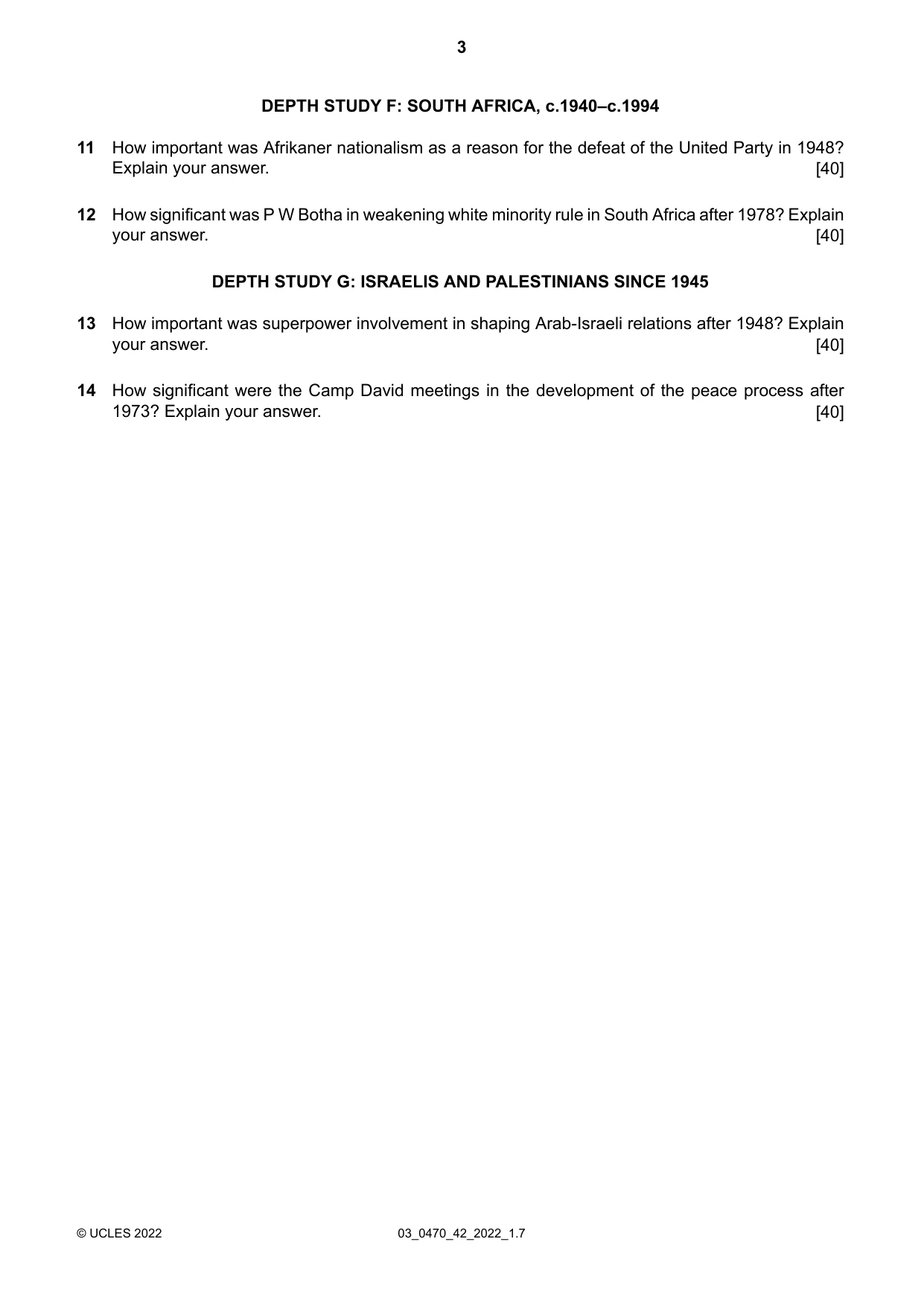
DEPTH STUDY F: SOUTH AFRICA, c.1940–c.1994 How important was Afrikaner nationalism as a reason for the defeat of the United Party in 1948? Explain your answer. [40] 11 How significant was P W Botha in weakening white minority rule in South Africa after 1978? Explain your answer. [40] 12 DEPTH STUDY G: ISRAELIS AND PALESTINIANS SINCE 1945 How important was superpower involvement in shaping Arab-Israeli relations after 1948? Explain your answer. [40] 13 How significant were the Camp David meetings in the development of the peace process after 1973? Explain your answer. [40] 14 03_0470_42_2022_1.7 © UCLES 2022 3
Question paper, page 4
BLANK PAGE Permission to reproduce items where third-party owned material protected by copyright is included has been sought and cleared where possible. Every reasonable effort has been made by the publisher (UCLES) to trace copyright holders, but if any items requiring clearance have unwittingly been included, the publisher will be pleased to make amends at the earliest possible opportunity. To avoid the issue of disclosure of answer-related information to candidates, all copyright acknowledgements are reproduced online in the Cambridge Assessment International Education Copyright Acknowledgements Booklet. This is produced for each series of examinations and is freely available to download at www.cambridgeinternational.org after the live examination series. Cambridge Assessment International Education is part of Cambridge Assessment. Cambridge Assessment is the brand name of the University of Cambridge Local Examinations Syndicate (UCLES), which is a department of the University of Cambridge. 03_0470_42_2022_1.7 © UCLES 2022 4
Mark scheme, page 1
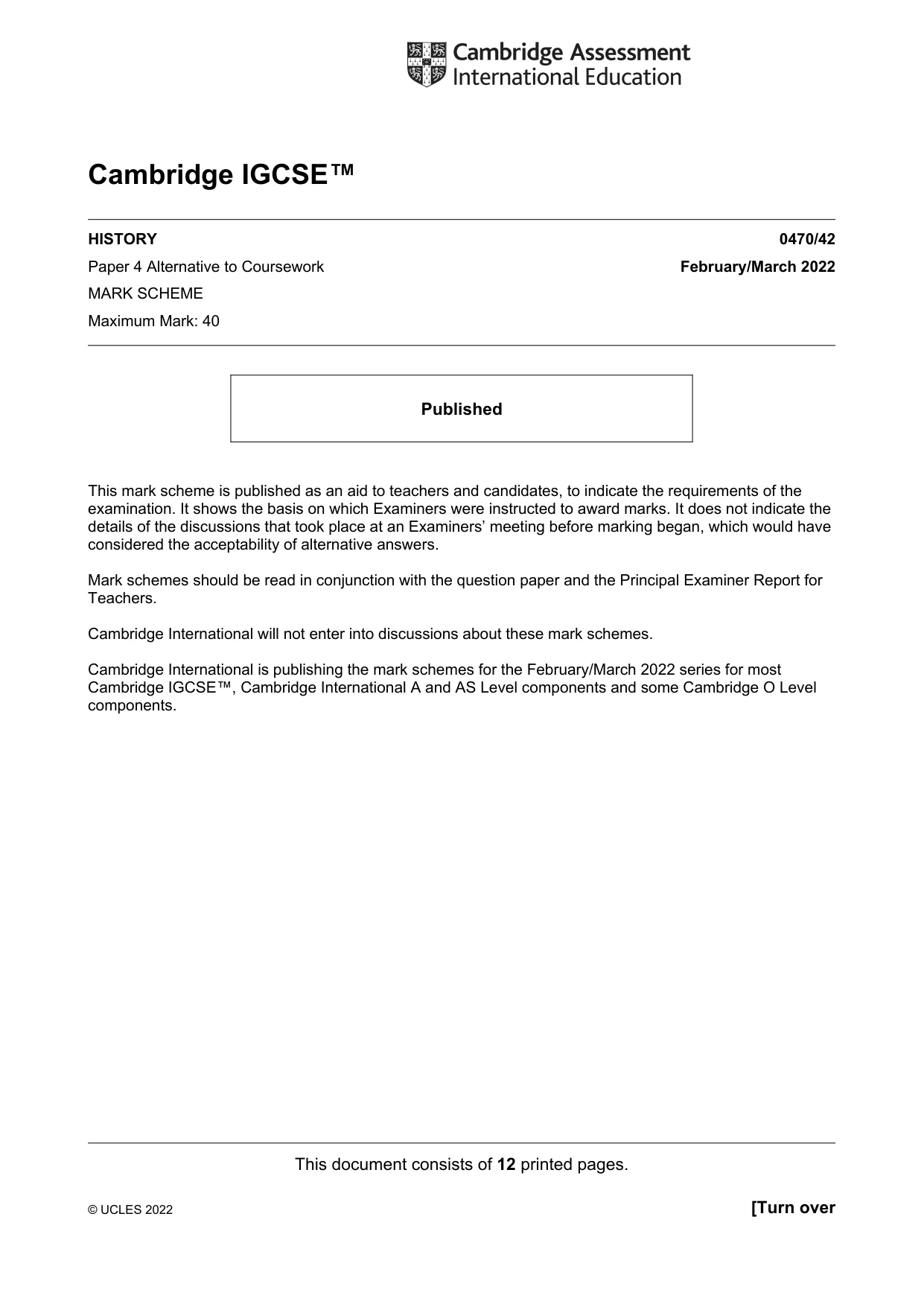
This document consists of 12 printed pages. © UCLES 2022 [Turn over Cambridge IGCSE™ HISTORY 0470/42 Paper 4 Alternative to Coursework February/March 2022 MARK SCHEME Maximum Mark: 40 Published This mark scheme is published as an aid to teachers and candidates, to indicate the requirements of the examination. It shows the basis on which Examiners were instructed to award marks. It does not indicate the details of the discussions that took place at an Examiners’ meeting before marking began, which would have considered the acceptability of alternative answers. Mark schemes should be read in conjunction with the question paper and the Principal Examiner Report for Teachers. Cambridge International will not enter into discussions about these mark schemes. Cambridge International is publishing the mark schemes for the February/March 2022 series for most Cambridge IGCSE™, Cambridge International A and AS Level components and some Cambridge O Level components.
Mark scheme, page 2
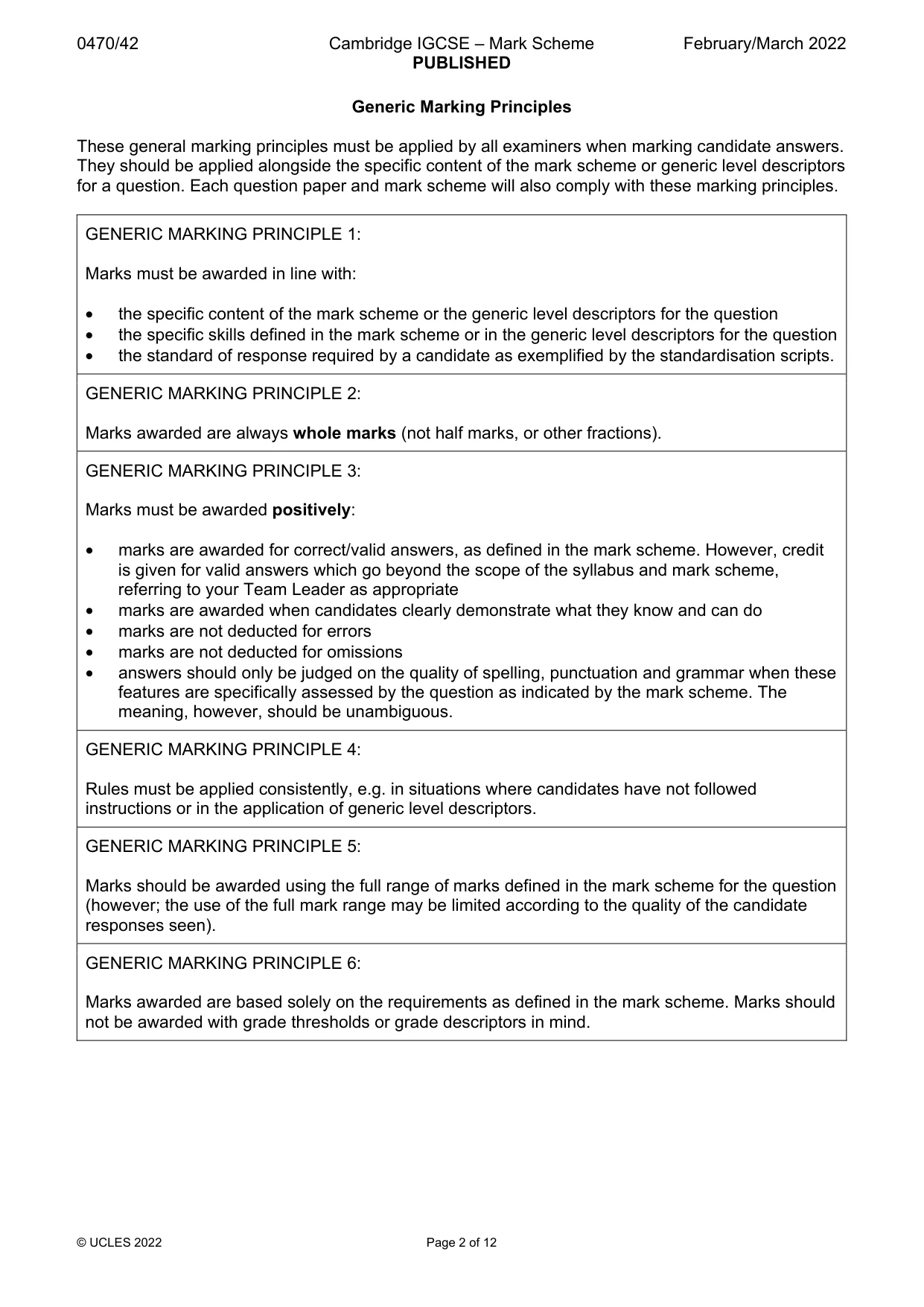
0470/42 Cambridge IGCSE – Mark Scheme PUBLISHED February/March 2022 © UCLES 2022 Page 2 of 12 Generic Marking Principles These general marking principles must be applied by all examiners when marking candidate answers. They should be applied alongside the specific content of the mark scheme or generic level descriptors for a question. Each question paper and mark scheme will also comply with these marking principles. GENERIC MARKING PRINCIPLE 1: Marks must be awarded in line with: • the specific content of the mark scheme or the generic level descriptors for the question • the specific skills defined in the mark scheme or in the generic level descriptors for the question • the standard of response required by a candidate as exemplified by the standardisation scripts. GENERIC MARKING PRINCIPLE 2: Marks awarded are always whole marks (not half marks, or other fractions). GENERIC MARKING PRINCIPLE 3: Marks must be awarded positively: • marks are awarded for correct/valid answers, as defined in the mark scheme. However, credit is given for valid answers which go beyond the scope of the syllabus and mark scheme, referring to your Team Leader as appropriate • marks are awarded when candidates clearly demonstrate what they know and can do • marks are not deducted for errors • marks are not deducted for omissions • answers should only be judged on the quality of spelling, punctuation and grammar when these features are specifically assessed by the question as indicated by the mark scheme. The meaning, however, should be unambiguous. GENERIC MARKING PRINCIPLE 4: Rules must be applied consistently, e.g. in situations where candidates have not followed instructions or in the application of generic level descriptors. GENERIC MARKING PRINCIPLE 5: Marks should be awarded using the full range of marks defined in the mark scheme for the question (however; the use of the full mark range may be limited according to the quality of the candidate responses seen). GENERIC MARKING PRINCIPLE 6: Marks awarded are based solely on the requirements as defined in the mark scheme. Marks should not be awarded with grade thresholds or grade descriptors in mind.
Mark scheme, page 3
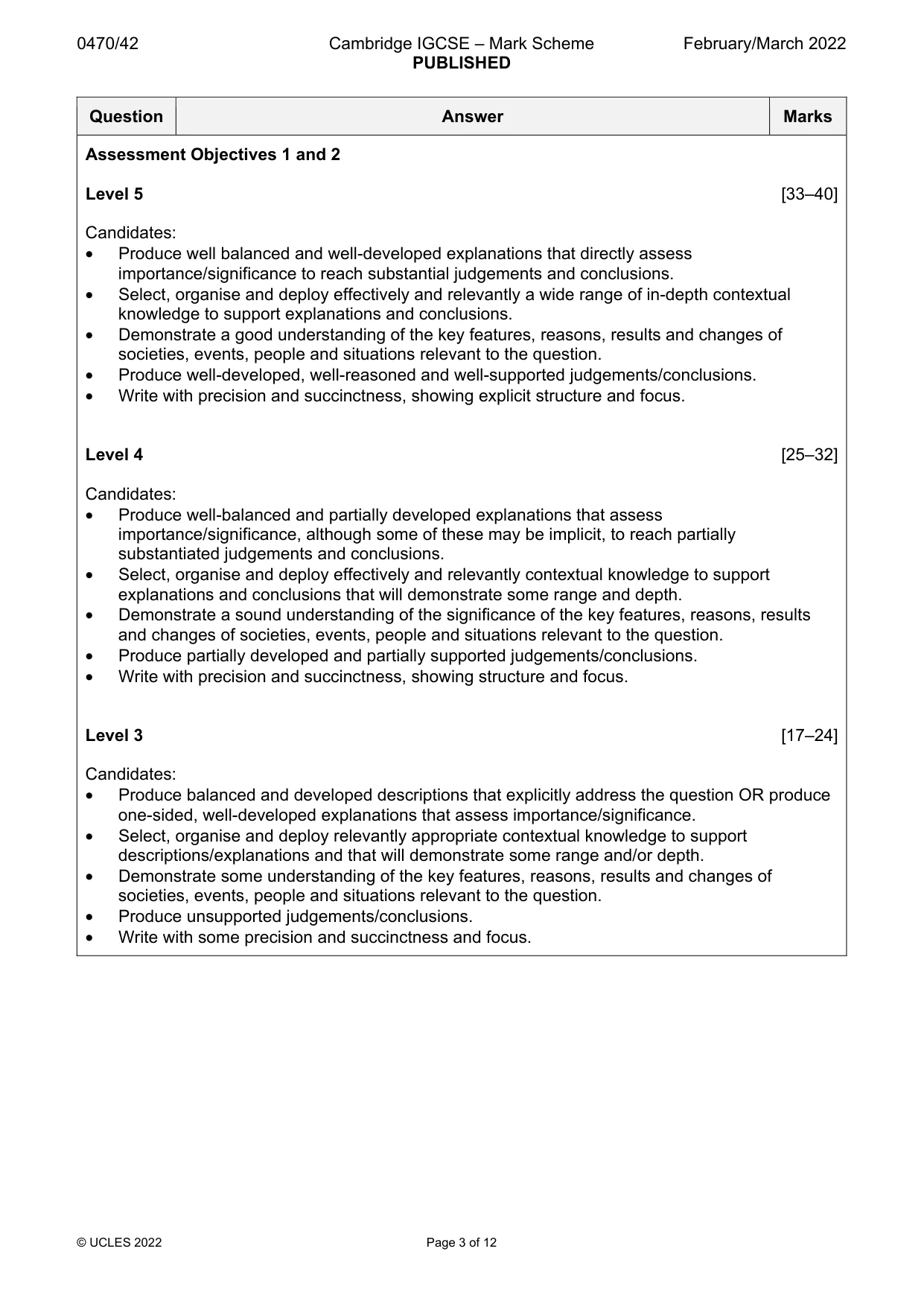
0470/42 Cambridge IGCSE – Mark Scheme PUBLISHED February/March 2022 © UCLES 2022 Page 3 of 12 Question Answer Marks Assessment Objectives 1 and 2 Level 5 [33–40] Candidates: • Produce well balanced and well-developed explanations that directly assess importance/significance to reach substantial judgements and conclusions. • Select, organise and deploy effectively and relevantly a wide range of in-depth contextual knowledge to support explanations and conclusions. • Demonstrate a good understanding of the key features, reasons, results and changes of societies, events, people and situations relevant to the question. • Produce well-developed, well-reasoned and well-supported judgements/conclusions. • Write with precision and succinctness, showing explicit structure and focus. Level 4 [25–32] Candidates: • Produce well-balanced and partially developed explanations that assess importance/significance, although some of these may be implicit, to reach partially substantiated judgements and conclusions. • Select, organise and deploy effectively and relevantly contextual knowledge to support explanations and conclusions that will demonstrate some range and depth. • Demonstrate a sound understanding of the significance of the key features, reasons, results and changes of societies, events, people and situations relevant to the question. • Produce partially developed and partially supported judgements/conclusions. • Write with precision and succinctness, showing structure and focus. Level 3 [17–24] Candidates: • Produce balanced and developed descriptions that explicitly address the question OR produce one-sided, well-developed explanations that assess importance/significance. • Select, organise and deploy relevantly appropriate contextual knowledge to support descriptions/explanations and that will demonstrate some range and/or depth. • Demonstrate some understanding of the key features, reasons, results and changes of societies, events, people and situations relevant to the question. • Produce unsupported judgements/conclusions. • Write with some precision and succinctness and focus.
Mark scheme, page 4
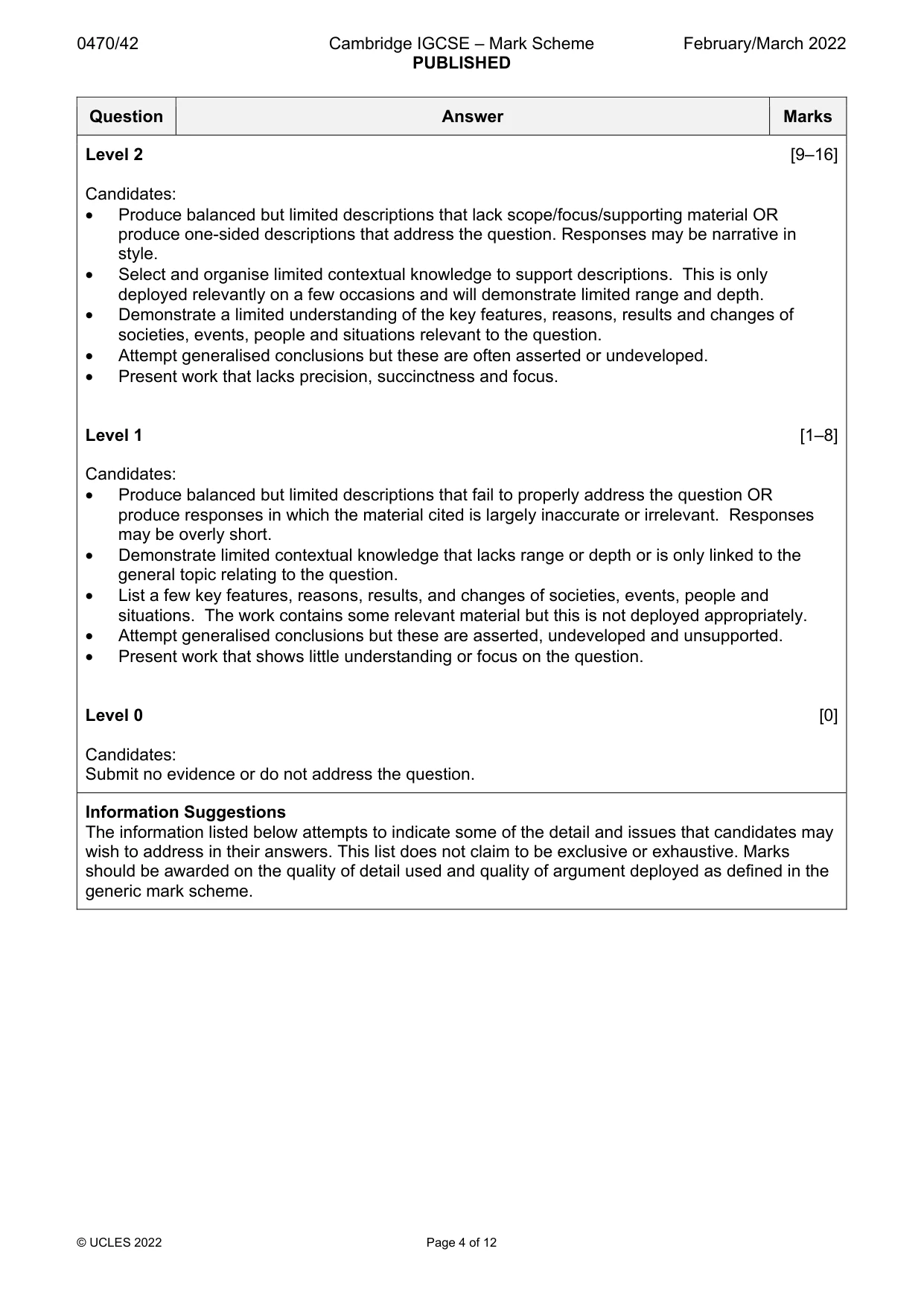
0470/42 Cambridge IGCSE – Mark Scheme PUBLISHED February/March 2022 © UCLES 2022 Page 4 of 12 Question Answer Marks Level 2 [9–16] Candidates: • Produce balanced but limited descriptions that lack scope/focus/supporting material OR produce one-sided descriptions that address the question. Responses may be narrative in style. • Select and organise limited contextual knowledge to support descriptions. This is only deployed relevantly on a few occasions and will demonstrate limited range and depth. • Demonstrate a limited understanding of the key features, reasons, results and changes of societies, events, people and situations relevant to the question. • Attempt generalised conclusions but these are often asserted or undeveloped. • Present work that lacks precision, succinctness and focus. Level 1 [1–8] Candidates: • Produce balanced but limited descriptions that fail to properly address the question OR produce responses in which the material cited is largely inaccurate or irrelevant. Responses may be overly short. • Demonstrate limited contextual knowledge that lacks range or depth or is only linked to the general topic relating to the question. • List a few key features, reasons, results, and changes of societies, events, people and situations. The work contains some relevant material but this is not deployed appropriately. • Attempt generalised conclusions but these are asserted, undeveloped and unsupported. • Present work that shows little understanding or focus on the question. Level 0 [0] Candidates: Submit no evidence or do not address the question. Information Suggestions The information listed below attempts to indicate some of the detail and issues that candidates may wish to address in their answers. This list does not claim to be exclusive or exhaustive. Marks should be awarded on the quality of detail used and quality of argument deployed as defined in the generic mark scheme.
Mark scheme, page 5
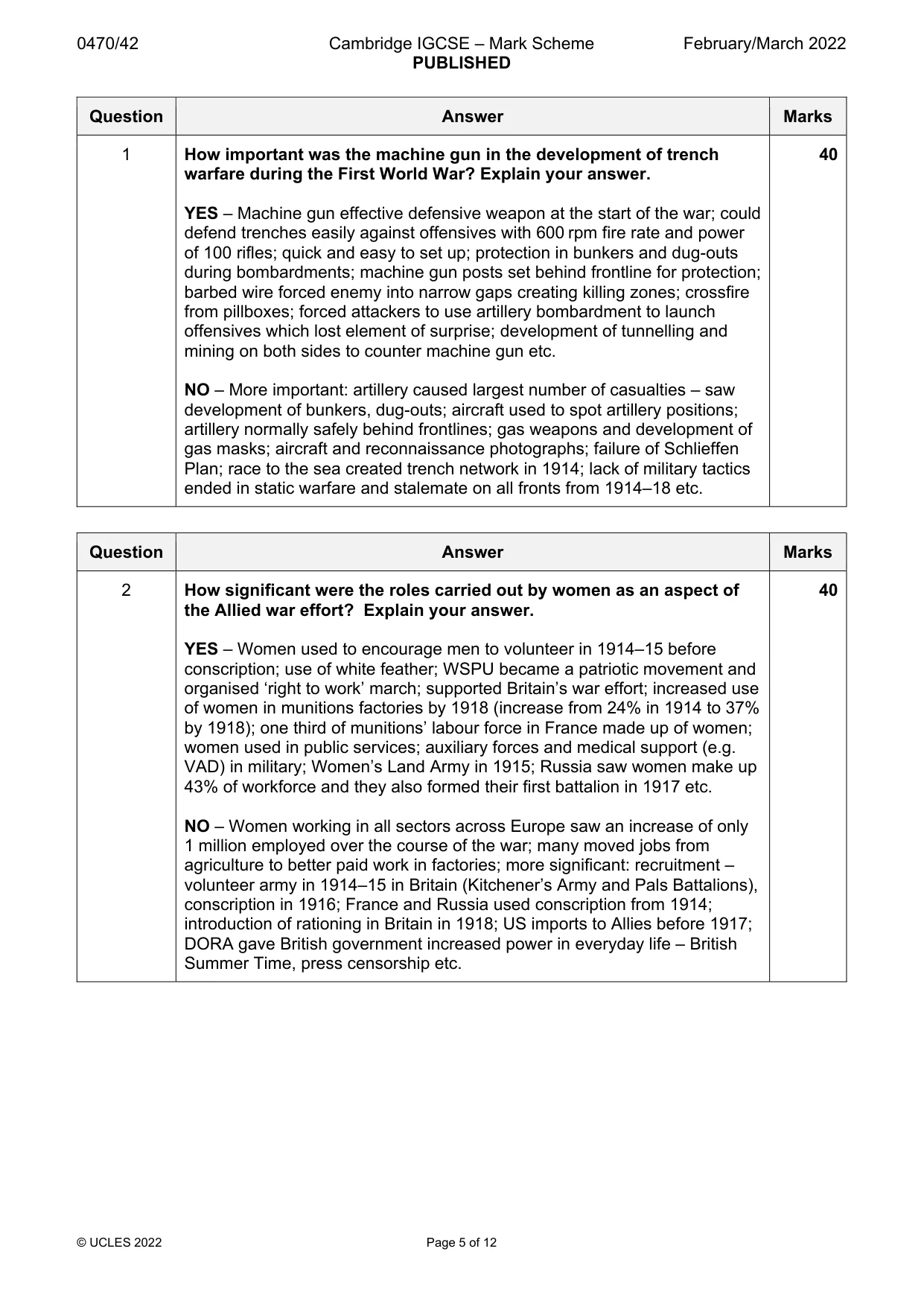
0470/42 Cambridge IGCSE – Mark Scheme PUBLISHED February/March 2022 © UCLES 2022 Page 5 of 12 Question Answer Marks 1 How important was the machine gun in the development of trench warfare during the First World War? Explain your answer. YES – Machine gun effective defensive weapon at the start of the war; could defend trenches easily against offensives with 600 rpm fire rate and power of 100 rifles; quick and easy to set up; protection in bunkers and dug-outs during bombardments; machine gun posts set behind frontline for protection; barbed wire forced enemy into narrow gaps creating killing zones; crossfire from pillboxes; forced attackers to use artillery bombardment to launch offensives which lost element of surprise; development of tunnelling and mining on both sides to counter machine gun etc. NO – More important: artillery caused largest number of casualties – saw development of bunkers, dug-outs; aircraft used to spot artillery positions; artillery normally safely behind frontlines; gas weapons and development of gas masks; aircraft and reconnaissance photographs; failure of Schlieffen Plan; race to the sea created trench network in 1914; lack of military tactics ended in static warfare and stalemate on all fronts from 1914–18 etc. 40 Question Answer Marks 2 How significant were the roles carried out by women as an aspect of the Allied war effort? Explain your answer. YES – Women used to encourage men to volunteer in 1914–15 before conscription; use of white feather; WSPU became a patriotic movement and organised ‘right to work’ march; supported Britain’s war effort; increased use of women in munitions factories by 1918 (increase from 24% in 1914 to 37% by 1918); one third of munitions’ labour force in France made up of women; women used in public services; auxiliary forces and medical support (e.g. VAD) in military; Women’s Land Army in 1915; Russia saw women make up 43% of workforce and they also formed their first battalion in 1917 etc. NO – Women working in all sectors across Europe saw an increase of only 1 million employed over the course of the war; many moved jobs from agriculture to better paid work in factories; more significant: recruitment – volunteer army in 1914–15 in Britain (Kitchener’s Army and Pals Battalions), conscription in 1916; France and Russia used conscription from 1914; introduction of rationing in Britain in 1918; US imports to Allies before 1917; DORA gave British government increased power in everyday life – British Summer Time, press censorship etc. 40
Mark scheme, page 6
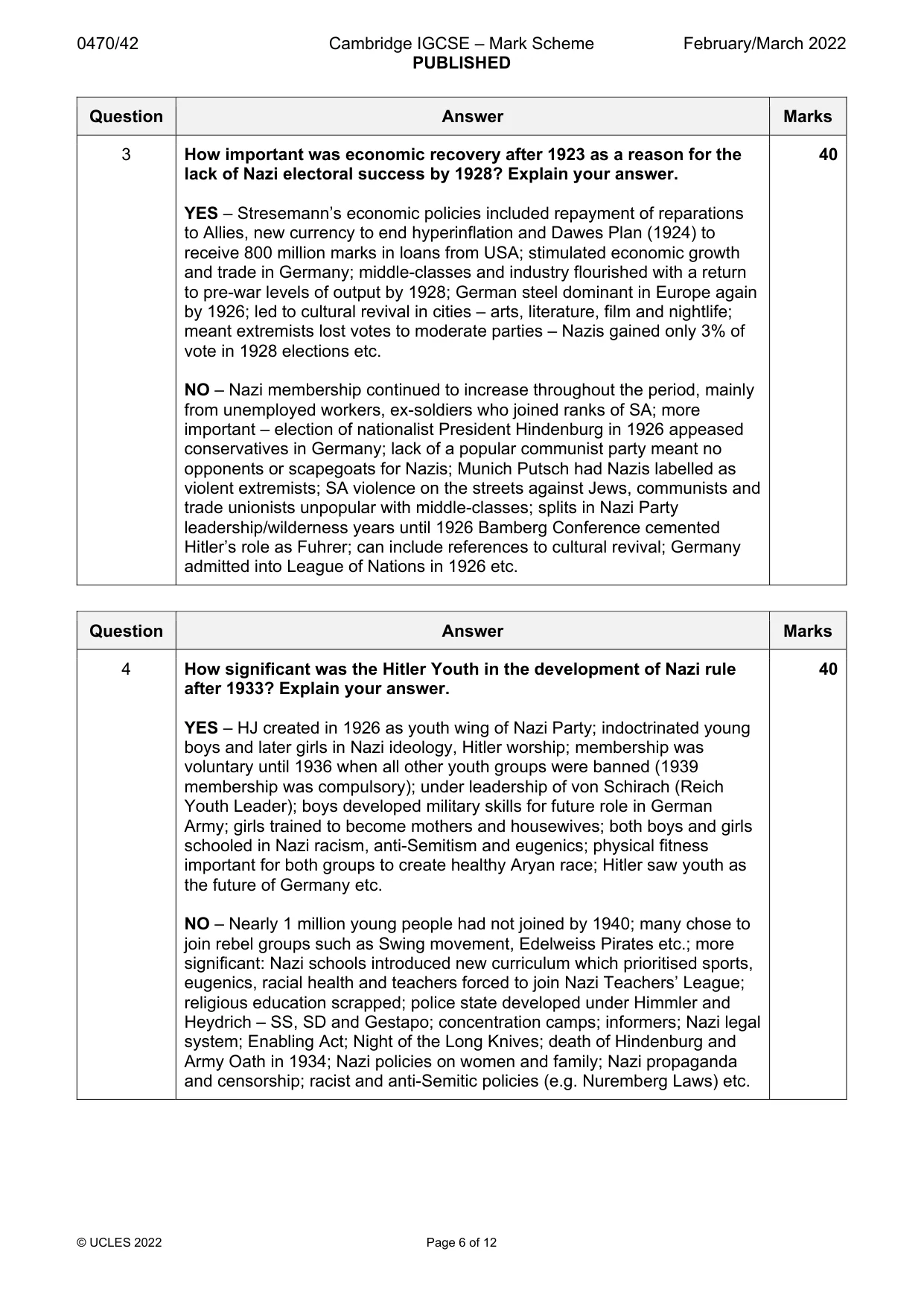
0470/42 Cambridge IGCSE – Mark Scheme PUBLISHED February/March 2022 © UCLES 2022 Page 6 of 12 Question Answer Marks 3 How important was economic recovery after 1923 as a reason for the lack of Nazi electoral success by 1928? Explain your answer. YES – Stresemann’s economic policies included repayment of reparations to Allies, new currency to end hyperinflation and Dawes Plan (1924) to receive 800 million marks in loans from USA; stimulated economic growth and trade in Germany; middle-classes and industry flourished with a return to pre-war levels of output by 1928; German steel dominant in Europe again by 1926; led to cultural revival in cities – arts, literature, film and nightlife; meant extremists lost votes to moderate parties – Nazis gained only 3% of vote in 1928 elections etc. NO – Nazi membership continued to increase throughout the period, mainly from unemployed workers, ex-soldiers who joined ranks of SA; more important – election of nationalist President Hindenburg in 1926 appeased conservatives in Germany; lack of a popular communist party meant no opponents or scapegoats for Nazis; Munich Putsch had Nazis labelled as violent extremists; SA violence on the streets against Jews, communists and trade unionists unpopular with middle-classes; splits in Nazi Party leadership/wilderness years until 1926 Bamberg Conference cemented Hitler’s role as Fuhrer; can include references to cultural revival; Germany admitted into League of Nations in 1926 etc. 40 Question Answer Marks 4 How significant was the Hitler Youth in the development of Nazi rule after 1933? Explain your answer. YES – HJ created in 1926 as youth wing of Nazi Party; indoctrinated young boys and later girls in Nazi ideology, Hitler worship; membership was voluntary until 1936 when all other youth groups were banned (1939 membership was compulsory); under leadership of von Schirach (Reich Youth Leader); boys developed military skills for future role in German Army; girls trained to become mothers and housewives; both boys and girls schooled in Nazi racism, anti-Semitism and eugenics; physical fitness important for both groups to create healthy Aryan race; Hitler saw youth as the future of Germany etc. NO – Nearly 1 million young people had not joined by 1940; many chose to join rebel groups such as Swing movement, Edelweiss Pirates etc.; more significant: Nazi schools introduced new curriculum which prioritised sports, eugenics, racial health and teachers forced to join Nazi Teachers’ League; religious education scrapped; police state developed under Himmler and Heydrich – SS, SD and Gestapo; concentration camps; informers; Nazi legal system; Enabling Act; Night of the Long Knives; death of Hindenburg and Army Oath in 1934; Nazi policies on women and family; Nazi propaganda and censorship; racist and anti-Semitic policies (e.g. Nuremberg Laws) etc. 40
Mark scheme, page 7
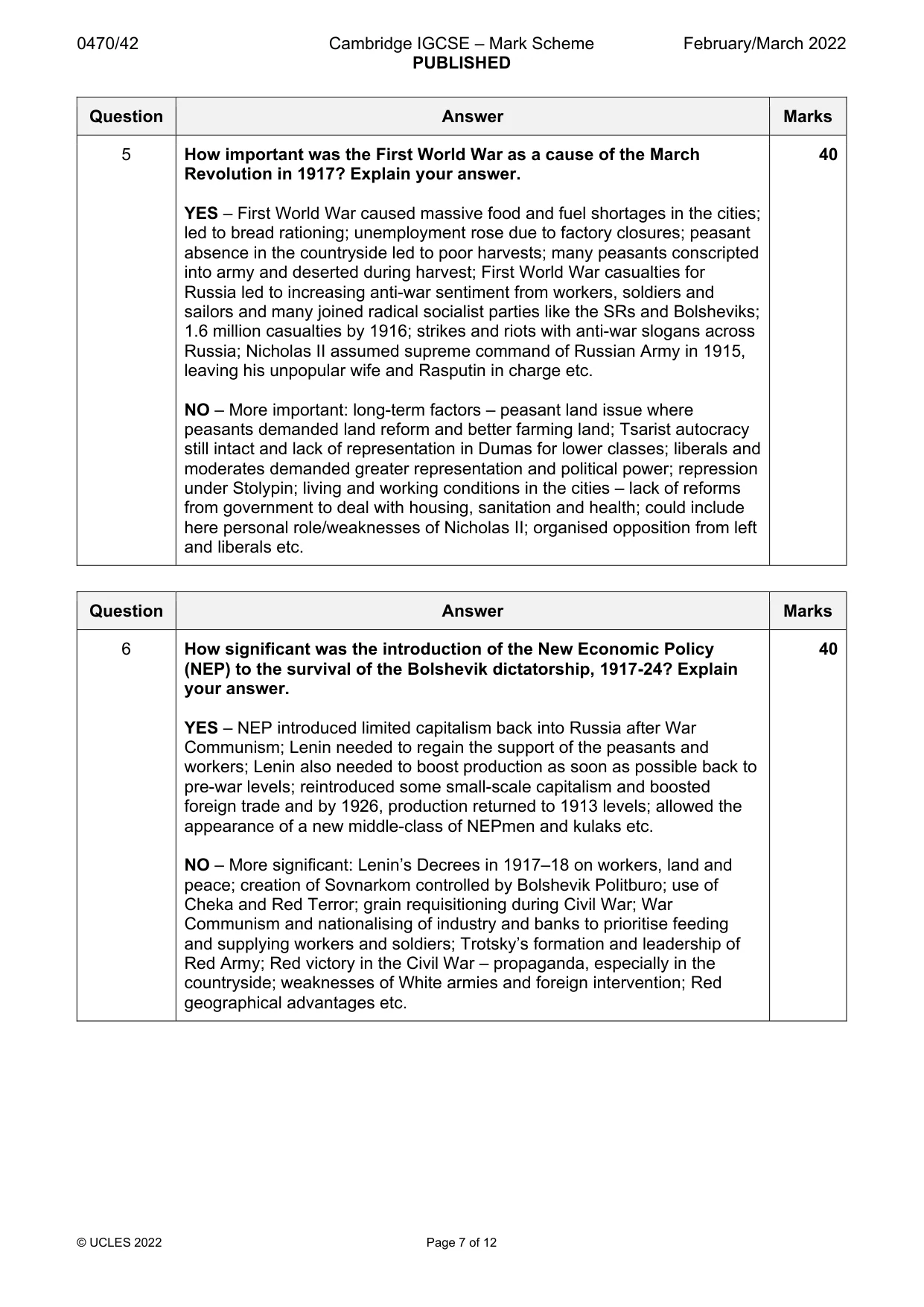
0470/42 Cambridge IGCSE – Mark Scheme PUBLISHED February/March 2022 © UCLES 2022 Page 7 of 12 Question Answer Marks 5 How important was the First World War as a cause of the March Revolution in 1917? Explain your answer. YES – First World War caused massive food and fuel shortages in the cities; led to bread rationing; unemployment rose due to factory closures; peasant absence in the countryside led to poor harvests; many peasants conscripted into army and deserted during harvest; First World War casualties for Russia led to increasing anti-war sentiment from workers, soldiers and sailors and many joined radical socialist parties like the SRs and Bolsheviks; 1.6 million casualties by 1916; strikes and riots with anti-war slogans across Russia; Nicholas II assumed supreme command of Russian Army in 1915, leaving his unpopular wife and Rasputin in charge etc. NO – More important: long-term factors – peasant land issue where peasants demanded land reform and better farming land; Tsarist autocracy still intact and lack of representation in Dumas for lower classes; liberals and moderates demanded greater representation and political power; repression under Stolypin; living and working conditions in the cities – lack of reforms from government to deal with housing, sanitation and health; could include here personal role/weaknesses of Nicholas II; organised opposition from left and liberals etc. 40 Question Answer Marks 6 How significant was the introduction of the New Economic Policy (NEP) to the survival of the Bolshevik dictatorship, 1917-24? Explain your answer. YES – NEP introduced limited capitalism back into Russia after War Communism; Lenin needed to regain the support of the peasants and workers; Lenin also needed to boost production as soon as possible back to pre-war levels; reintroduced some small-scale capitalism and boosted foreign trade and by 1926, production returned to 1913 levels; allowed the appearance of a new middle-class of NEPmen and kulaks etc. NO – More significant: Lenin’s Decrees in 1917–18 on workers, land and peace; creation of Sovnarkom controlled by Bolshevik Politburo; use of Cheka and Red Terror; grain requisitioning during Civil War; War Communism and nationalising of industry and banks to prioritise feeding and supplying workers and soldiers; Trotsky’s formation and leadership of Red Army; Red victory in the Civil War – propaganda, especially in the countryside; weaknesses of White armies and foreign intervention; Red geographical advantages etc. 40
Mark scheme, page 8
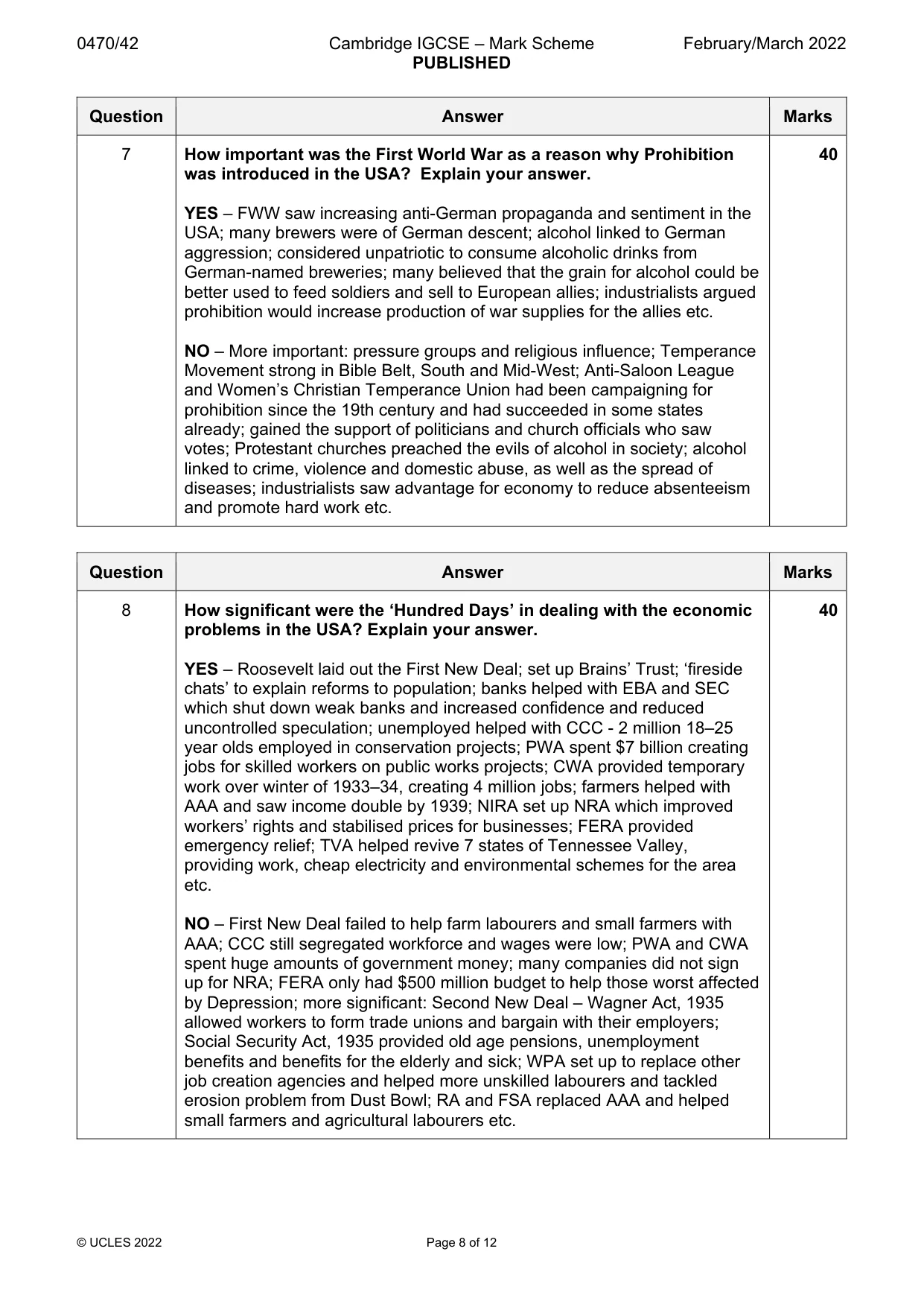
0470/42 Cambridge IGCSE – Mark Scheme PUBLISHED February/March 2022 © UCLES 2022 Page 8 of 12 Question Answer Marks 7 How important was the First World War as a reason why Prohibition was introduced in the USA? Explain your answer. YES – FWW saw increasing anti-German propaganda and sentiment in the USA; many brewers were of German descent; alcohol linked to German aggression; considered unpatriotic to consume alcoholic drinks from German-named breweries; many believed that the grain for alcohol could be better used to feed soldiers and sell to European allies; industrialists argued prohibition would increase production of war supplies for the allies etc. NO – More important: pressure groups and religious influence; Temperance Movement strong in Bible Belt, South and Mid-West; Anti-Saloon League and Women’s Christian Temperance Union had been campaigning for prohibition since the 19th century and had succeeded in some states already; gained the support of politicians and church officials who saw votes; Protestant churches preached the evils of alcohol in society; alcohol linked to crime, violence and domestic abuse, as well as the spread of diseases; industrialists saw advantage for economy to reduce absenteeism and promote hard work etc. 40 Question Answer Marks 8 How significant were the ‘Hundred Days’ in dealing with the economic problems in the USA? Explain your answer. YES – Roosevelt laid out the First New Deal; set up Brains’ Trust; ‘fireside chats’ to explain reforms to population; banks helped with EBA and SEC which shut down weak banks and increased confidence and reduced uncontrolled speculation; unemployed helped with CCC - 2 million 18–25 year olds employed in conservation projects; PWA spent $7 billion creating jobs for skilled workers on public works projects; CWA provided temporary work over winter of 1933–34, creating 4 million jobs; farmers helped with AAA and saw income double by 1939; NIRA set up NRA which improved workers’ rights and stabilised prices for businesses; FERA provided emergency relief; TVA helped revive 7 states of Tennessee Valley, providing work, cheap electricity and environmental schemes for the area etc. NO – First New Deal failed to help farm labourers and small farmers with AAA; CCC still segregated workforce and wages were low; PWA and CWA spent huge amounts of government money; many companies did not sign up for NRA; FERA only had $500 million budget to help those worst affected by Depression; more significant: Second New Deal – Wagner Act, 1935 allowed workers to form trade unions and bargain with their employers; Social Security Act, 1935 provided old age pensions, unemployment benefits and benefits for the elderly and sick; WPA set up to replace other job creation agencies and helped more unskilled labourers and tackled erosion problem from Dust Bowl; RA and FSA replaced AAA and helped small farmers and agricultural labourers etc. 40
Mark scheme, page 9
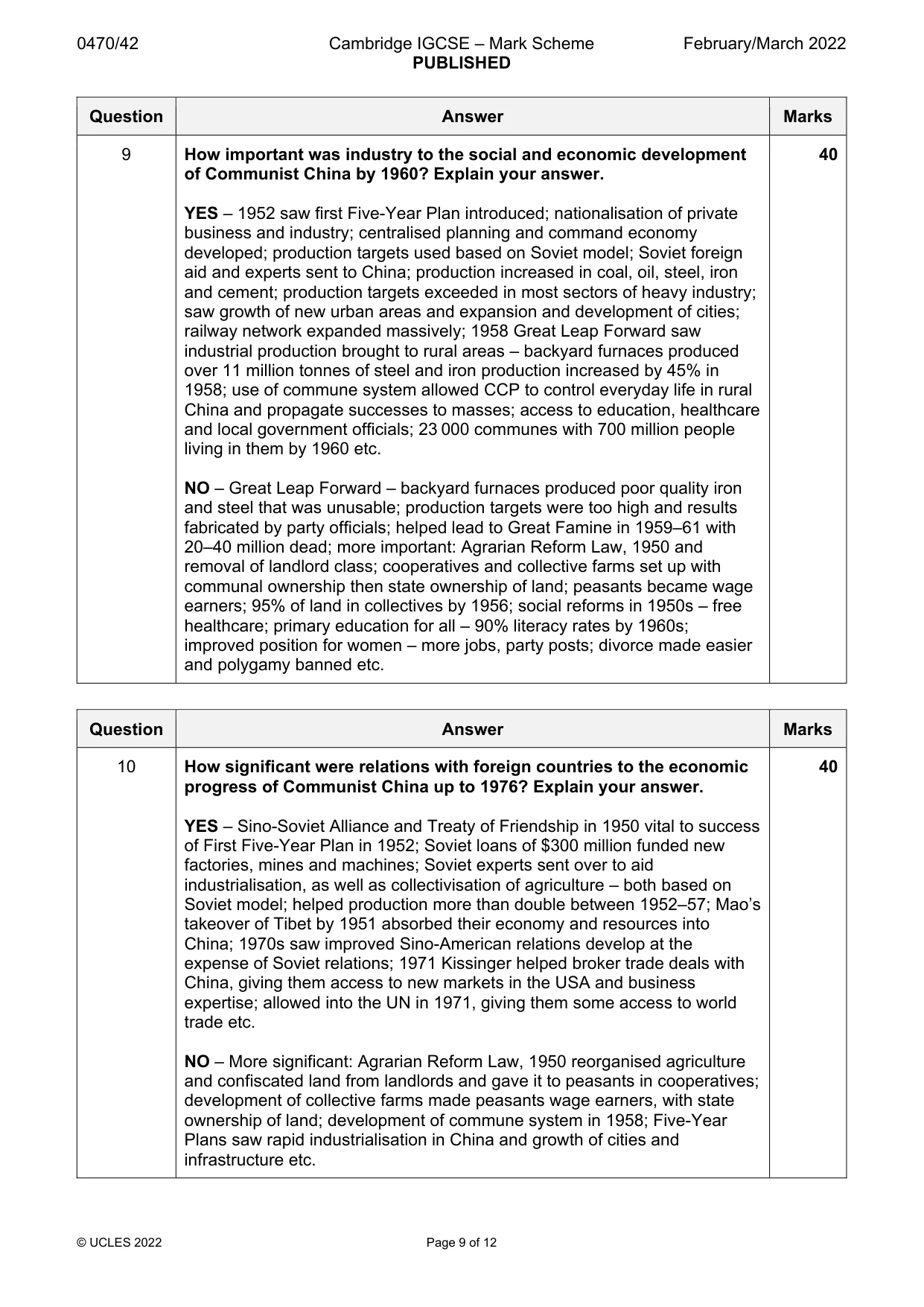
0470/42 Cambridge IGCSE – Mark Scheme PUBLISHED February/March 2022 © UCLES 2022 Page 9 of 12 Question Answer Marks 9 How important was industry to the social and economic development of Communist China by 1960? Explain your answer. YES – 1952 saw first Five-Year Plan introduced; nationalisation of private business and industry; centralised planning and command economy developed; production targets used based on Soviet model; Soviet foreign aid and experts sent to China; production increased in coal, oil, steel, iron and cement; production targets exceeded in most sectors of heavy industry; saw growth of new urban areas and expansion and development of cities; railway network expanded massively; 1958 Great Leap Forward saw industrial production brought to rural areas – backyard furnaces produced over 11 million tonnes of steel and iron production increased by 45% in 1958; use of commune system allowed CCP to control everyday life in rural China and propagate successes to masses; access to education, healthcare and local government officials; 23 000 communes with 700 million people living in them by 1960 etc. NO – Great Leap Forward – backyard furnaces produced poor quality iron and steel that was unusable; production targets were too high and results fabricated by party officials; helped lead to Great Famine in 1959–61 with 20–40 million dead; more important: Agrarian Reform Law, 1950 and removal of landlord class; cooperatives and collective farms set up with communal ownership then state ownership of land; peasants became wage earners; 95% of land in collectives by 1956; social reforms in 1950s – free healthcare; primary education for all – 90% literacy rates by 1960s; improved position for women – more jobs, party posts; divorce made easier and polygamy banned etc. 40 Question Answer Marks 10 How significant were relations with foreign countries to the economic progress of Communist China up to 1976? Explain your answer. YES – Sino-Soviet Alliance and Treaty of Friendship in 1950 vital to success of First Five-Year Plan in 1952; Soviet loans of $300 million funded new factories, mines and machines; Soviet experts sent over to aid industrialisation, as well as collectivisation of agriculture – both based on Soviet model; helped production more than double between 1952–57; Mao’s takeover of Tibet by 1951 absorbed their economy and resources into China; 1970s saw improved Sino-American relations develop at the expense of Soviet relations; 1971 Kissinger helped broker trade deals with China, giving them access to new markets in the USA and business expertise; allowed into the UN in 1971, giving them some access to world trade etc. NO – More significant: Agrarian Reform Law, 1950 reorganised agriculture and confiscated land from landlords and gave it to peasants in cooperatives; development of collective farms made peasants wage earners, with state ownership of land; development of commune system in 1958; Five-Year Plans saw rapid industrialisation in China and growth of cities and infrastructure etc. 40
Mark scheme, page 10
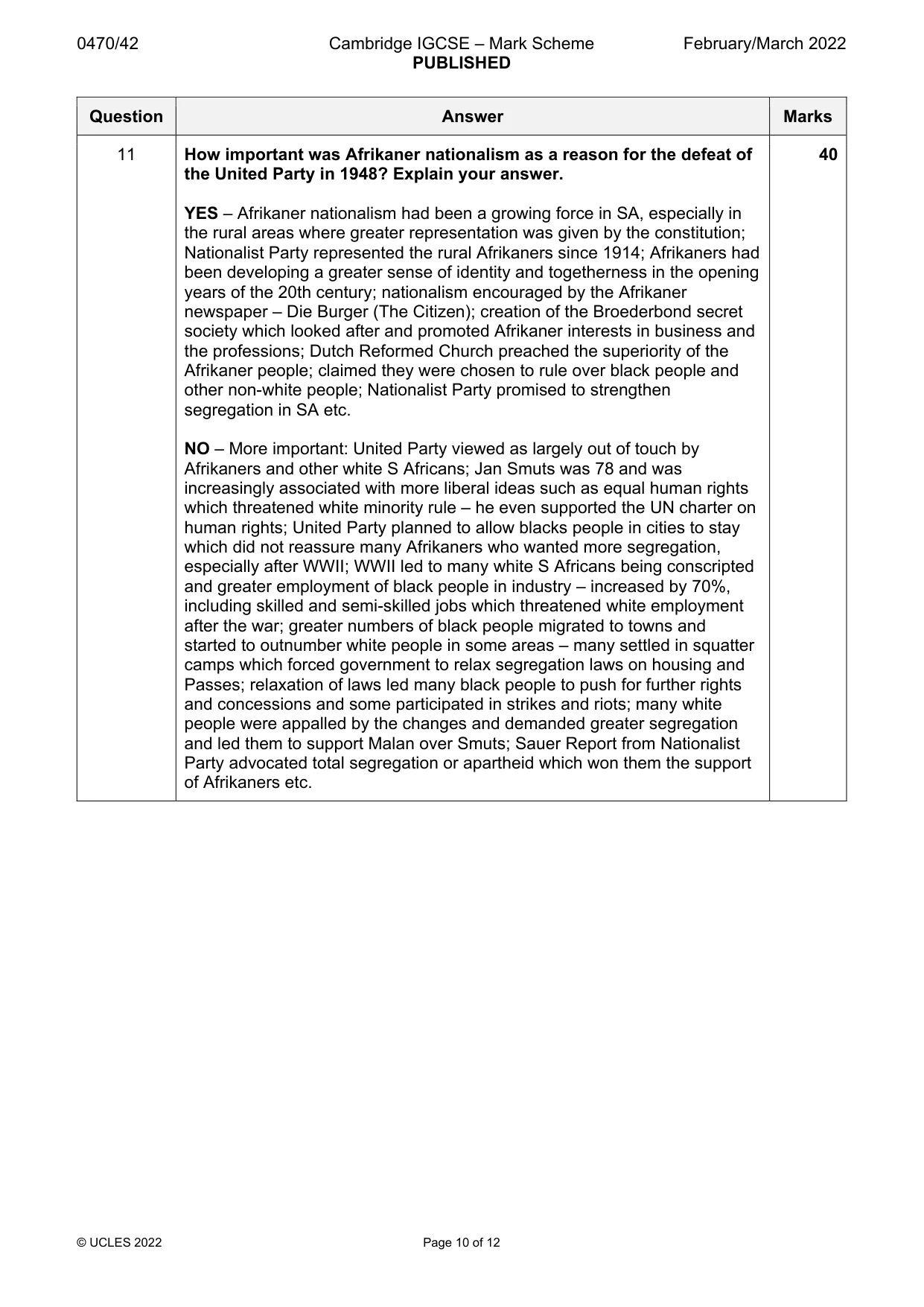
0470/42 Cambridge IGCSE – Mark Scheme PUBLISHED February/March 2022 © UCLES 2022 Page 10 of 12 Question Answer Marks 11 How important was Afrikaner nationalism as a reason for the defeat of the United Party in 1948? Explain your answer. YES – Afrikaner nationalism had been a growing force in SA, especially in the rural areas where greater representation was given by the constitution; Nationalist Party represented the rural Afrikaners since 1914; Afrikaners had been developing a greater sense of identity and togetherness in the opening years of the 20th century; nationalism encouraged by the Afrikaner newspaper – Die Burger (The Citizen); creation of the Broederbond secret society which looked after and promoted Afrikaner interests in business and the professions; Dutch Reformed Church preached the superiority of the Afrikaner people; claimed they were chosen to rule over black people and other non-white people; Nationalist Party promised to strengthen segregation in SA etc. NO – More important: United Party viewed as largely out of touch by Afrikaners and other white S Africans; Jan Smuts was 78 and was increasingly associated with more liberal ideas such as equal human rights which threatened white minority rule – he even supported the UN charter on human rights; United Party planned to allow blacks people in cities to stay which did not reassure many Afrikaners who wanted more segregation, especially after WWII; WWII led to many white S Africans being conscripted and greater employment of black people in industry – increased by 70%, including skilled and semi-skilled jobs which threatened white employment after the war; greater numbers of black people migrated to towns and started to outnumber white people in some areas – many settled in squatter camps which forced government to relax segregation laws on housing and Passes; relaxation of laws led many black people to push for further rights and concessions and some participated in strikes and riots; many white people were appalled by the changes and demanded greater segregation and led them to support Malan over Smuts; Sauer Report from Nationalist Party advocated total segregation or apartheid which won them the support of Afrikaners etc. 40
Mark scheme, page 11
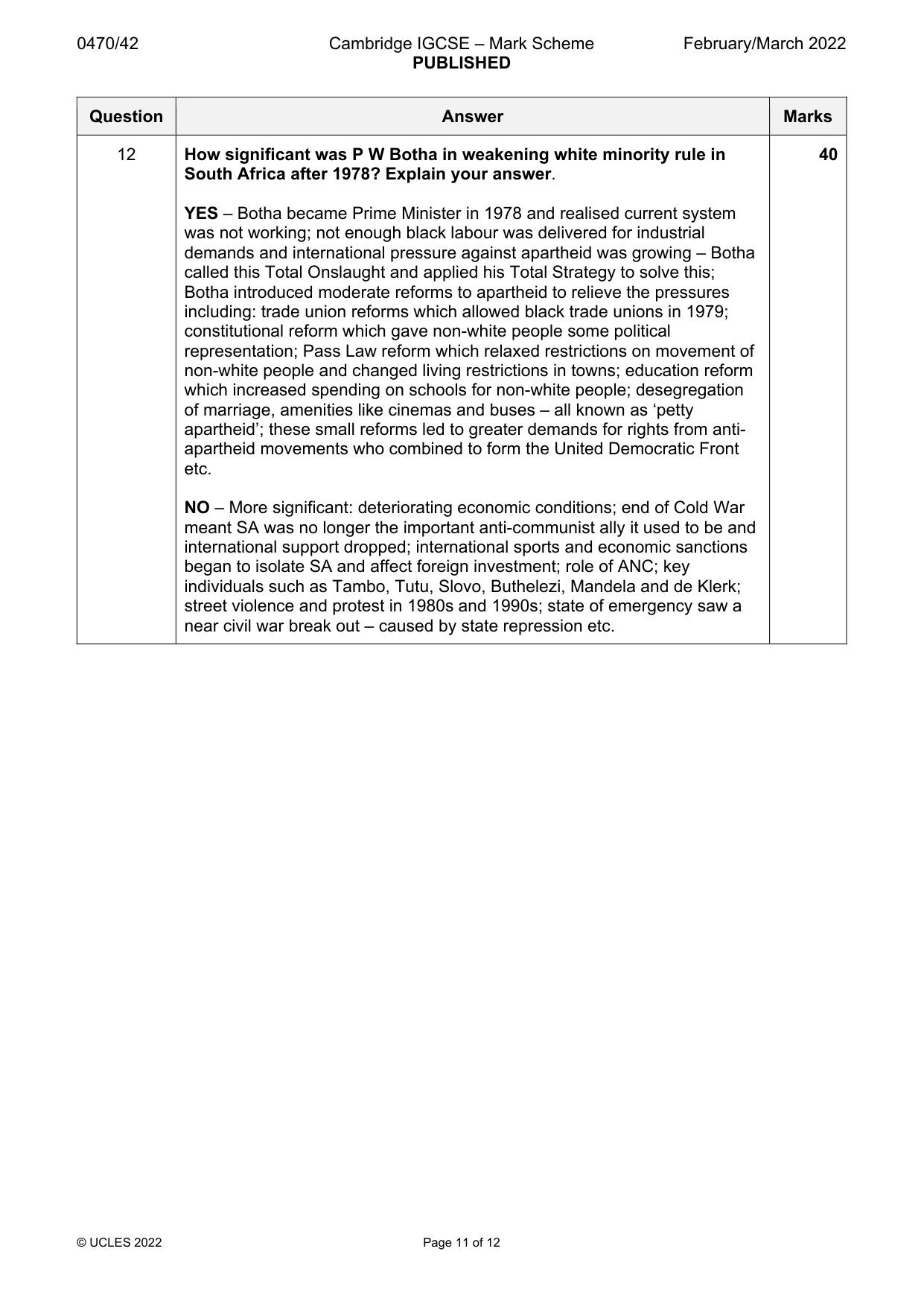
0470/42 Cambridge IGCSE – Mark Scheme PUBLISHED February/March 2022 © UCLES 2022 Page 11 of 12 Question Answer Marks 12 How significant was P W Botha in weakening white minority rule in South Africa after 1978? Explain your answer. YES – Botha became Prime Minister in 1978 and realised current system was not working; not enough black labour was delivered for industrial demands and international pressure against apartheid was growing – Botha called this Total Onslaught and applied his Total Strategy to solve this; Botha introduced moderate reforms to apartheid to relieve the pressures including: trade union reforms which allowed black trade unions in 1979; constitutional reform which gave non-white people some political representation; Pass Law reform which relaxed restrictions on movement of non-white people and changed living restrictions in towns; education reform which increased spending on schools for non-white people; desegregation of marriage, amenities like cinemas and buses – all known as ‘petty apartheid’; these small reforms led to greater demands for rights from anti- apartheid movements who combined to form the United Democratic Front etc. NO – More significant: deteriorating economic conditions; end of Cold War meant SA was no longer the important anti-communist ally it used to be and international support dropped; international sports and economic sanctions began to isolate SA and affect foreign investment; role of ANC; key individuals such as Tambo, Tutu, Slovo, Buthelezi, Mandela and de Klerk; street violence and protest in 1980s and 1990s; state of emergency saw a near civil war break out – caused by state repression etc. 40
Mark scheme, page 12
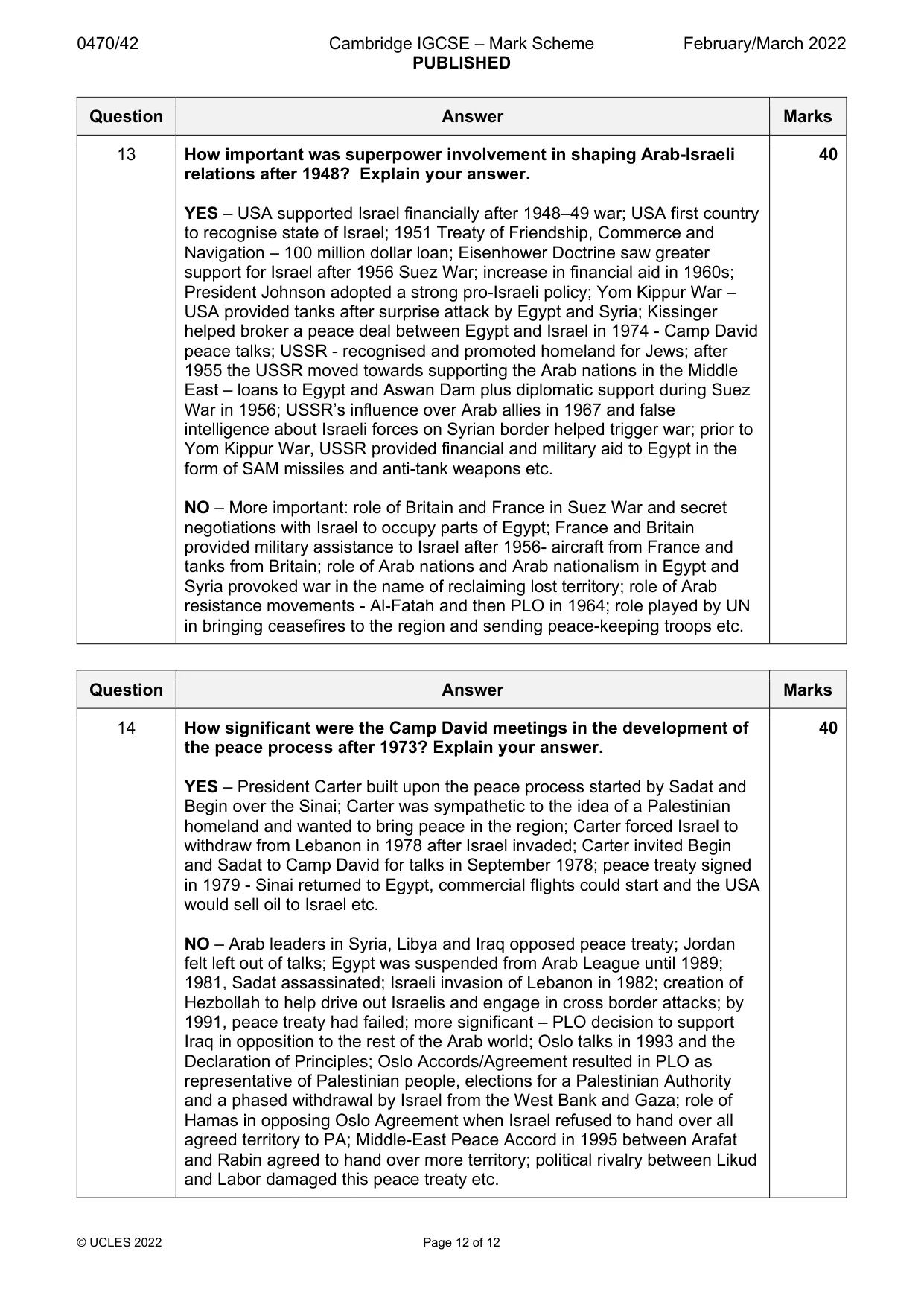
0470/42 Cambridge IGCSE – Mark Scheme PUBLISHED February/March 2022 © UCLES 2022 Page 12 of 12 Question Answer Marks 13 How important was superpower involvement in shaping Arab-Israeli relations after 1948? Explain your answer. YES – USA supported Israel financially after 1948–49 war; USA first country to recognise state of Israel; 1951 Treaty of Friendship, Commerce and Navigation – 100 million dollar loan; Eisenhower Doctrine saw greater support for Israel after 1956 Suez War; increase in financial aid in 1960s; President Johnson adopted a strong pro-Israeli policy; Yom Kippur War – USA provided tanks after surprise attack by Egypt and Syria; Kissinger helped broker a peace deal between Egypt and Israel in 1974 - Camp David peace talks; USSR - recognised and promoted homeland for Jews; after 1955 the USSR moved towards supporting the Arab nations in the Middle East – loans to Egypt and Aswan Dam plus diplomatic support during Suez War in 1956; USSR’s influence over Arab allies in 1967 and false intelligence about Israeli forces on Syrian border helped trigger war; prior to Yom Kippur War, USSR provided financial and military aid to Egypt in the form of SAM missiles and anti-tank weapons etc. NO – More important: role of Britain and France in Suez War and secret negotiations with Israel to occupy parts of Egypt; France and Britain provided military assistance to Israel after 1956- aircraft from France and tanks from Britain; role of Arab nations and Arab nationalism in Egypt and Syria provoked war in the name of reclaiming lost territory; role of Arab resistance movements - Al-Fatah and then PLO in 1964; role played by UN in bringing ceasefires to the region and sending peace-keeping troops etc. 40 Question Answer Marks 14 How significant were the Camp David meetings in the development of the peace process after 1973? Explain your answer. YES – President Carter built upon the peace process started by Sadat and Begin over the Sinai; Carter was sympathetic to the idea of a Palestinian homeland and wanted to bring peace in the region; Carter forced Israel to withdraw from Lebanon in 1978 after Israel invaded; Carter invited Begin and Sadat to Camp David for talks in September 1978; peace treaty signed in 1979 - Sinai returned to Egypt, commercial flights could start and the USA would sell oil to Israel etc. NO – Arab leaders in Syria, Libya and Iraq opposed peace treaty; Jordan felt left out of talks; Egypt was suspended from Arab League until 1989; 1981, Sadat assassinated; Israeli invasion of Lebanon in 1982; creation of Hezbollah to help drive out Israelis and engage in cross border attacks; by 1991, peace treaty had failed; more significant – PLO decision to support Iraq in opposition to the rest of the Arab world; Oslo talks in 1993 and the Declaration of Principles; Oslo Accords/Agreement resulted in PLO as representative of Palestinian people, elections for a Palestinian Authority and a phased withdrawal by Israel from the West Bank and Gaza; role of Hamas in opposing Oslo Agreement when Israel refused to hand over all agreed territory to PA; Middle-East Peace Accord in 1995 between Arafat and Rabin agreed to hand over more territory; political rivalry between Likud and Labor damaged this peace treaty etc. 40
What you needed in this session
Cambridge’s own grade thresholds for 2022 Feb/March, Paper 4 · Variant 2. A higher threshold means an easier paper — the bar moves with how the cohort did.