Cambridge IGCSE History 0470 — 2021 Feb/March Paper 4 · Variant 2
0470/42/F/M/21 · 40 marks · ≈45 min
The question paper and its mark scheme, free to read here and free to download. This is Cambridge’s own paper, exactly as it was sat.
Question paper4 pages

Mark scheme12 pages
Answers below. Sit the paper first if you are practising.

Paper as text
Question paper, page 1
Cambridge IGCSE™ 0470/42 February/March 2021 1 hour HISTORY Paper 4 Alternative to Coursework You must answer on the enclosed answer booklet. You will need: Answer booklet (enclosed) INSTRUCTIONS • Answer one question from your chosen Depth Study. • Follow the instructions on the front cover of the answer booklet. If you need additional answer paper, ask the invigilator for a continuation booklet. INFORMATION • The total mark for this paper is 40. • The number of marks for each question or part question is shown in brackets [ ]. This document has 4 pages. Any blank pages are indicated. [Turn over 03_0470_42_2021_1.6 © UCLES 2021 *2058681171*
Question paper, page 2
Answer one question from your chosen Depth Study. DEPTH STUDY A: THE FIRST WORLD WAR, 1914–18 How important was the Battle of Jutland (1916) in the war at sea? Explain your answer. [40] 1 How significant was the Hindenburg Line to the course of the war on the Western Front? Explain your answer. [40] 2 DEPTH STUDY B: GERMANY, 1918–45 How important were the military restrictions in the Treaty of Versailles as a cause of instability in Germany, 1919–23? Explain your answer. [40] 3 How significant was the Enabling Act (1933) in allowing Hitler to establish a dictatorship in Germany by 1934? Explain your answer. [40] 4 DEPTH STUDY C: RUSSIA, 1905–41 How important was Stolypin in bringing about stability in Russia after the 1905 Revolution? Explain your answer. [40] 5 How significant was the Kronstadt Rising in ensuring the continuance of Bolshevik rule after 1921? Explain your answer. [40] 6 DEPTH STUDY D: THE UNITED STATES, 1919–41 How important was the Scopes ‘Monkey Trial’ as an aspect of intolerance in the USA in the 1920s? Explain your answer. [40] 7 How significant was Huey Long in opposition to the New Deal after 1933? Explain your answer. [40] 8 DEPTH STUDY E: CHINA, c.1930–c.1990 How important was the Shanghai Massacre (1927) to the development of the Chinese Communist Party? Explain your answer. [40] 9 How significant was propaganda in shaping the lives of the Chinese people after 1949? Explain your answer. [40] 10 03_0470_42_2021_1.6 © UCLES 2021 2
Question paper, page 3
DEPTH STUDY F: SOUTH AFRICA, c.1940–c.1994 How important were restrictions on political rights as an aspect of racial discrimination before 1948? Explain your answer. [40] 11 How significant was support from Afrikaners to the maintenance of apartheid after 1948? Explain your answer. [40] 12 DEPTH STUDY G: ISRAELIS AND PALESTINIANS SINCE 1945 How important were Jewish resistance movements in Palestine to the creation of Israel in 1948? Explain your answer. [40] 13 How significant was the creation of the Palestinian Authority (1994) in the Arab–Israeli peace process? Explain your answer. [40] 14 03_0470_42_2021_1.6 © UCLES 2021 3
Question paper, page 4
BLANK PAGE Permission to reproduce items where third-party owned material protected by copyright is included has been sought and cleared where possible. Every reasonable effort has been made by the publisher (UCLES) to trace copyright holders, but if any items requiring clearance have unwittingly been included, the publisher will be pleased to make amends at the earliest possible opportunity. To avoid the issue of disclosure of answer-related information to candidates, all copyright acknowledgements are reproduced online in the Cambridge Assessment International Education Copyright Acknowledgements Booklet. This is produced for each series of examinations and is freely available to download at www.cambridgeinternational.org after the live examination series. Cambridge Assessment International Education is part of the Cambridge Assessment Group. Cambridge Assessment is the brand name of the University of Cambridge Local Examinations Syndicate (UCLES), which itself is a department of the University of Cambridge. 03_0470_42_2021_1.6 © UCLES 2021 4
Mark scheme, page 1
This document consists of 12 printed pages. © UCLES 2021 [Turn over Cambridge IGCSE™ HISTORY 0470/42 Paper 4 Alternative to Coursework March 2021 MARK SCHEME Maximum Mark: 40 Published This mark scheme is published as an aid to teachers and candidates, to indicate the requirements of the examination. It shows the basis on which Examiners were instructed to award marks. It does not indicate the details of the discussions that took place at an Examiners’ meeting before marking began, which would have considered the acceptability of alternative answers. Mark schemes should be read in conjunction with the question paper and the Principal Examiner Report for Teachers. Cambridge International will not enter into discussions about these mark schemes. Cambridge International is publishing the mark schemes for the March 2021 series for most Cambridge IGCSE™, Cambridge International A and AS Level components and some Cambridge O Level components.
Mark scheme, page 2
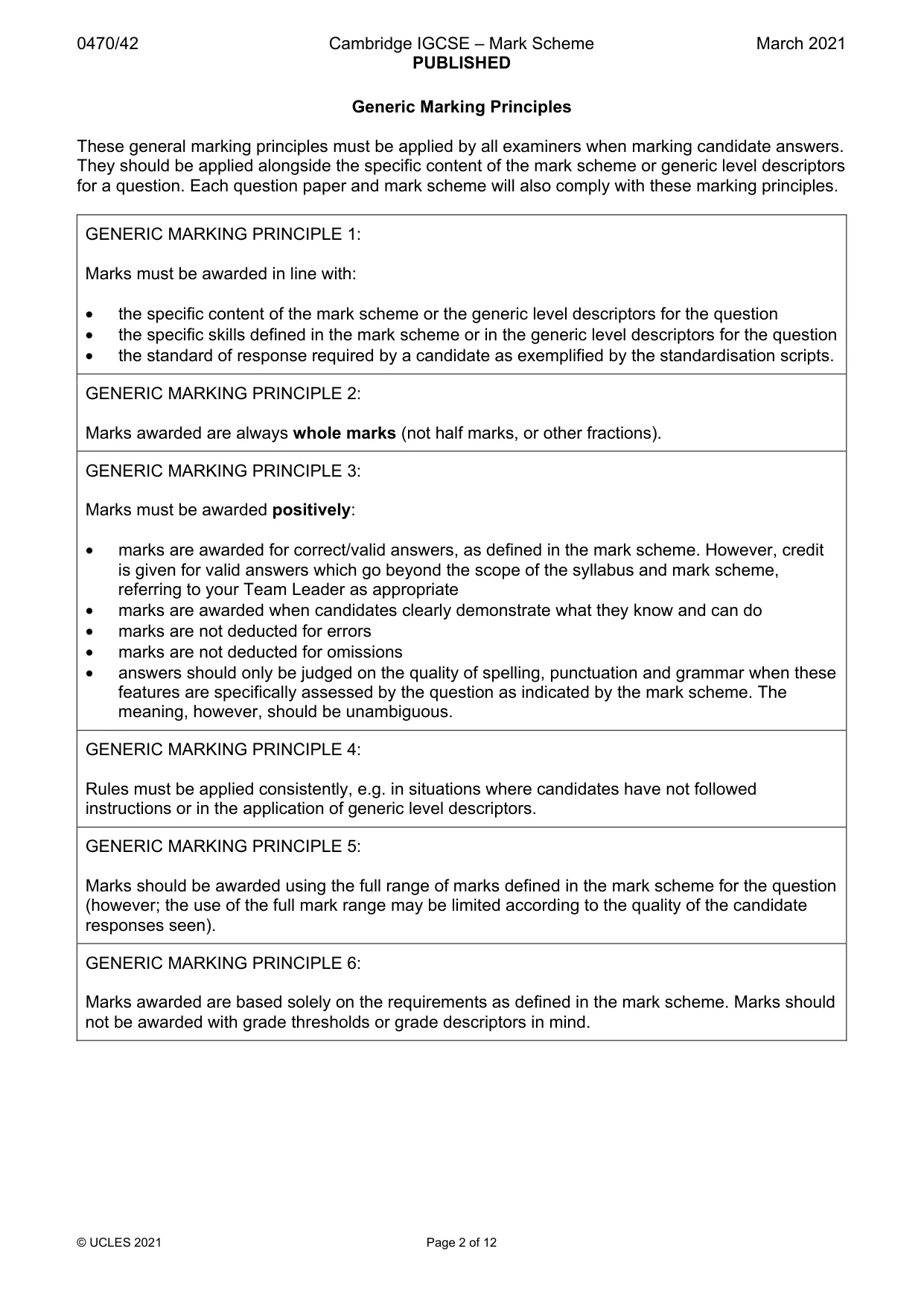
0470/42 Cambridge IGCSE – Mark Scheme PUBLISHED March 2021 © UCLES 2021 Page 2 of 12 Generic Marking Principles These general marking principles must be applied by all examiners when marking candidate answers. They should be applied alongside the specific content of the mark scheme or generic level descriptors for a question. Each question paper and mark scheme will also comply with these marking principles. GENERIC MARKING PRINCIPLE 1: Marks must be awarded in line with: • the specific content of the mark scheme or the generic level descriptors for the question • the specific skills defined in the mark scheme or in the generic level descriptors for the question • the standard of response required by a candidate as exemplified by the standardisation scripts. GENERIC MARKING PRINCIPLE 2: Marks awarded are always whole marks (not half marks, or other fractions). GENERIC MARKING PRINCIPLE 3: Marks must be awarded positively: • marks are awarded for correct/valid answers, as defined in the mark scheme. However, credit is given for valid answers which go beyond the scope of the syllabus and mark scheme, referring to your Team Leader as appropriate • marks are awarded when candidates clearly demonstrate what they know and can do • marks are not deducted for errors • marks are not deducted for omissions • answers should only be judged on the quality of spelling, punctuation and grammar when these features are specifically assessed by the question as indicated by the mark scheme. The meaning, however, should be unambiguous. GENERIC MARKING PRINCIPLE 4: Rules must be applied consistently, e.g. in situations where candidates have not followed instructions or in the application of generic level descriptors. GENERIC MARKING PRINCIPLE 5: Marks should be awarded using the full range of marks defined in the mark scheme for the question (however; the use of the full mark range may be limited according to the quality of the candidate responses seen). GENERIC MARKING PRINCIPLE 6: Marks awarded are based solely on the requirements as defined in the mark scheme. Marks should not be awarded with grade thresholds or grade descriptors in mind.
Mark scheme, page 3
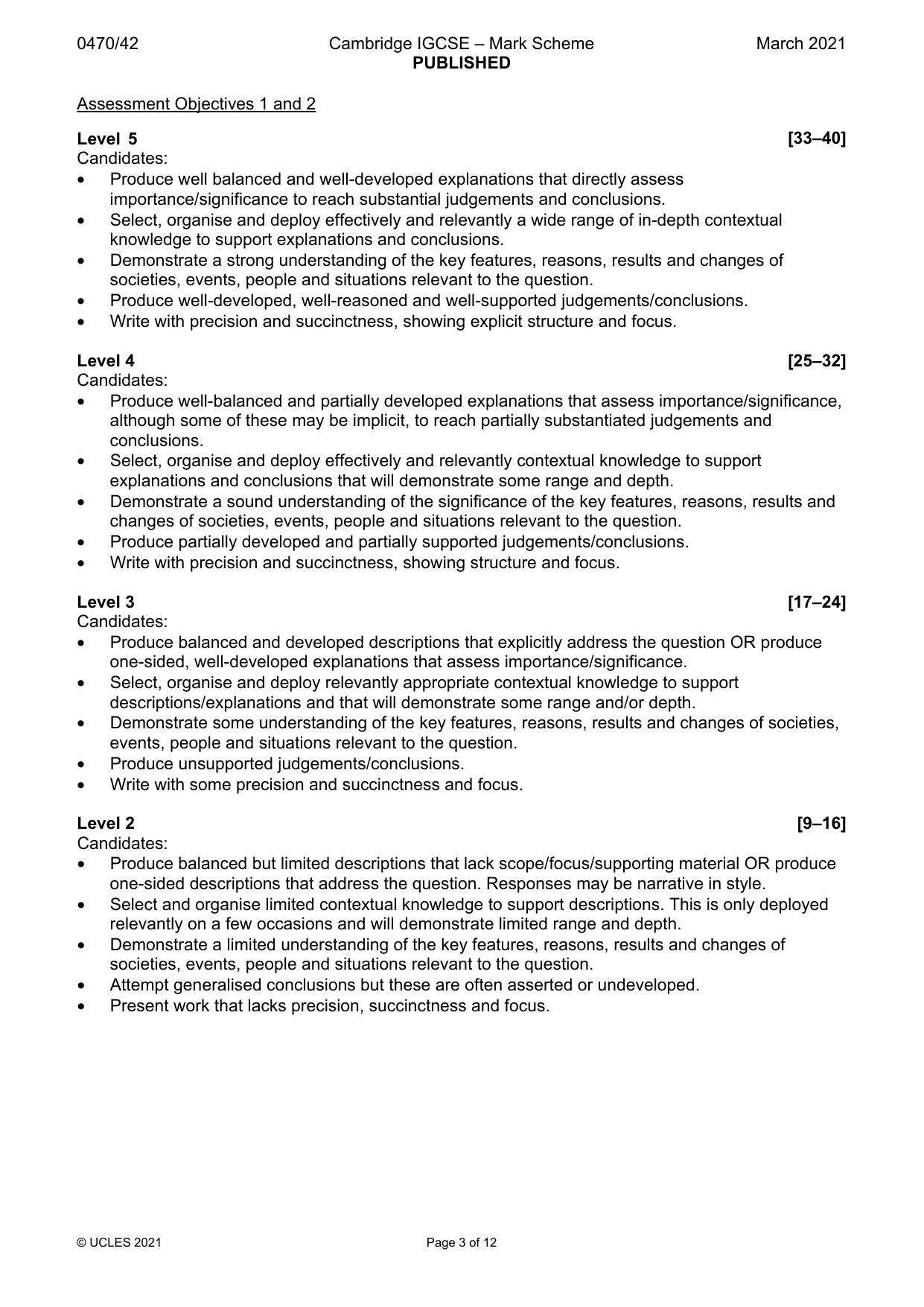
0470/42 Cambridge IGCSE – Mark Scheme PUBLISHED March 2021 © UCLES 2021 Page 3 of 12 Assessment Objectives 1 and 2 Level 5 [33–40] Candidates: • Produce well balanced and well-developed explanations that directly assess importance/significance to reach substantial judgements and conclusions. • Select, organise and deploy effectively and relevantly a wide range of in-depth contextual knowledge to support explanations and conclusions. • Demonstrate a strong understanding of the key features, reasons, results and changes of societies, events, people and situations relevant to the question. • Produce well-developed, well-reasoned and well-supported judgements/conclusions. • Write with precision and succinctness, showing explicit structure and focus. Level 4 [25–32] Candidates: • Produce well-balanced and partially developed explanations that assess importance/significance, although some of these may be implicit, to reach partially substantiated judgements and conclusions. • Select, organise and deploy effectively and relevantly contextual knowledge to support explanations and conclusions that will demonstrate some range and depth. • Demonstrate a sound understanding of the significance of the key features, reasons, results and changes of societies, events, people and situations relevant to the question. • Produce partially developed and partially supported judgements/conclusions. • Write with precision and succinctness, showing structure and focus. Level 3 [17–24] Candidates: • Produce balanced and developed descriptions that explicitly address the question OR produce one-sided, well-developed explanations that assess importance/significance. • Select, organise and deploy relevantly appropriate contextual knowledge to support descriptions/explanations and that will demonstrate some range and/or depth. • Demonstrate some understanding of the key features, reasons, results and changes of societies, events, people and situations relevant to the question. • Produce unsupported judgements/conclusions. • Write with some precision and succinctness and focus. Level 2 [9–16] Candidates: • Produce balanced but limited descriptions that lack scope/focus/supporting material OR produce one-sided descriptions that address the question. Responses may be narrative in style. • Select and organise limited contextual knowledge to support descriptions. This is only deployed relevantly on a few occasions and will demonstrate limited range and depth. • Demonstrate a limited understanding of the key features, reasons, results and changes of societies, events, people and situations relevant to the question. • Attempt generalised conclusions but these are often asserted or undeveloped. • Present work that lacks precision, succinctness and focus.
Mark scheme, page 4
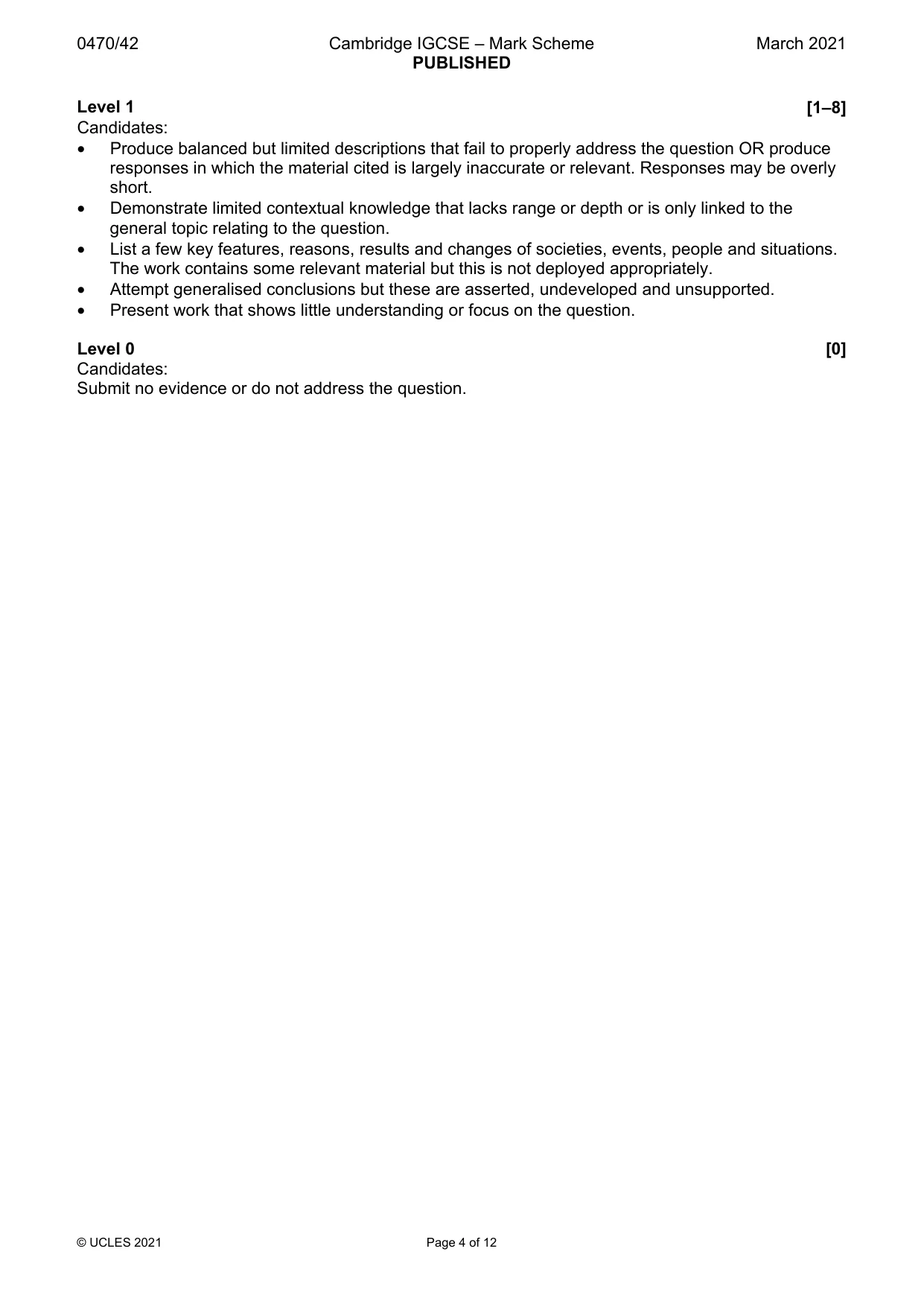
0470/42 Cambridge IGCSE – Mark Scheme PUBLISHED March 2021 © UCLES 2021 Page 4 of 12 Level 1 [1–8] Candidates: • Produce balanced but limited descriptions that fail to properly address the question OR produce responses in which the material cited is largely inaccurate or relevant. Responses may be overly short. • Demonstrate limited contextual knowledge that lacks range or depth or is only linked to the general topic relating to the question. • List a few key features, reasons, results and changes of societies, events, people and situations. The work contains some relevant material but this is not deployed appropriately. • Attempt generalised conclusions but these are asserted, undeveloped and unsupported. • Present work that shows little understanding or focus on the question. Level 0 [0] Candidates: Submit no evidence or do not address the question.
Mark scheme, page 5
0470/42 Cambridge IGCSE – Mark Scheme PUBLISHED March 2021 © UCLES 2021 Page 5 of 12 Information Suggestions The information listed below attempts to indicate some of the detail and issues that candidates may wish to address in their answers. This list does not claim to be exclusive or exhaustive. Marks should be awarded on the quality of detail used and quality of argument deployed as defined in the generic mark scheme.
Mark scheme, page 6
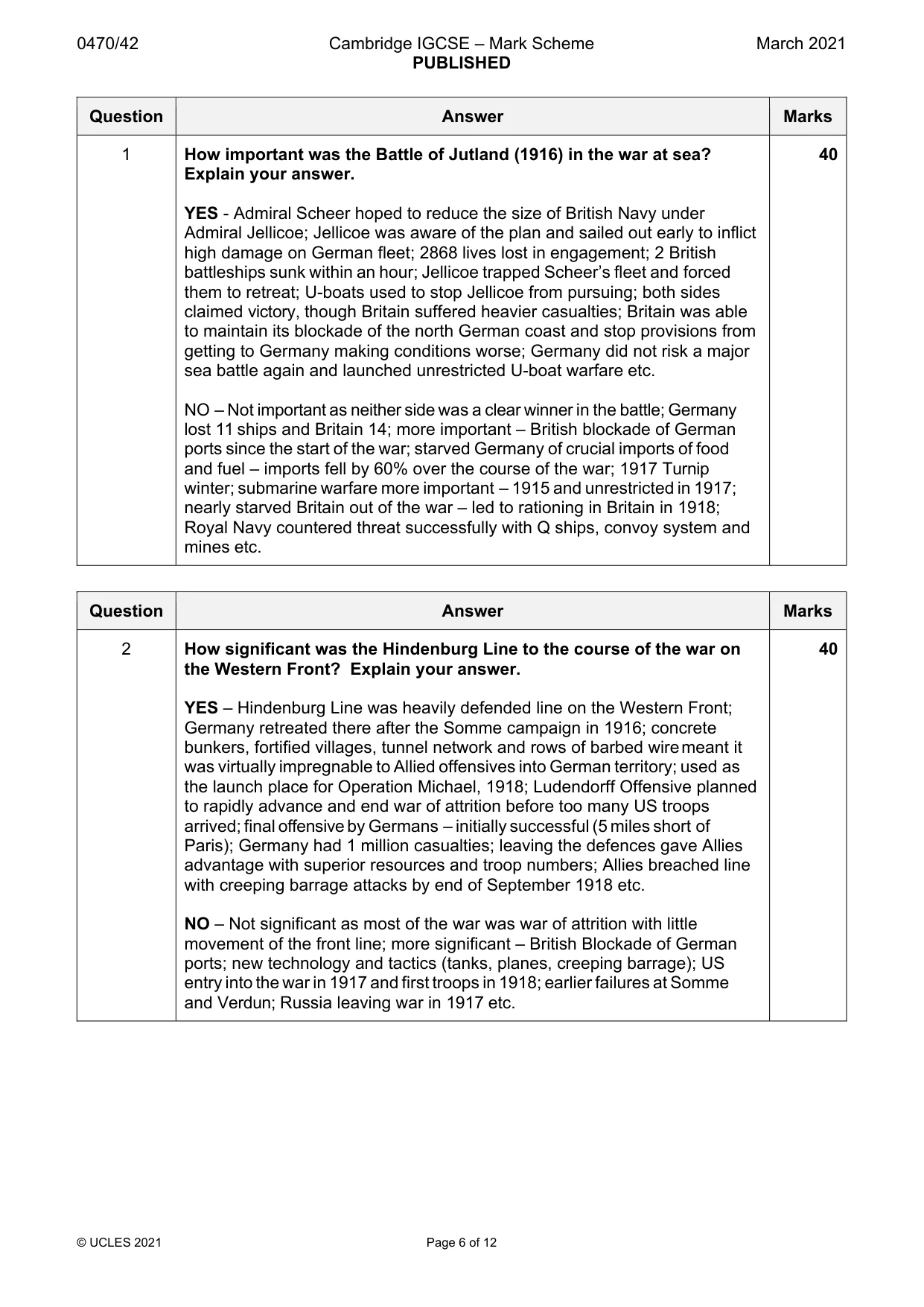
0470/42 Cambridge IGCSE – Mark Scheme PUBLISHED March 2021 © UCLES 2021 Page 6 of 12 Question Answer Marks 1 How important was the Battle of Jutland (1916) in the war at sea? Explain your answer. YES - Admiral Scheer hoped to reduce the size of British Navy under Admiral Jellicoe; Jellicoe was aware of the plan and sailed out early to inflict high damage on German fleet; 2868 lives lost in engagement; 2 British battleships sunk within an hour; Jellicoe trapped Scheer’s fleet and forced them to retreat; U-boats used to stop Jellicoe from pursuing; both sides claimed victory, though Britain suffered heavier casualties; Britain was able to maintain its blockade of the north German coast and stop provisions from getting to Germany making conditions worse; Germany did not risk a major sea battle again and launched unrestricted U-boat warfare etc. NO – Not important as neither side was a clear winner in the battle; Germany lost 11 ships and Britain 14; more important – British blockade of German ports since the start of the war; starved Germany of crucial imports of food and fuel – imports fell by 60% over the course of the war; 1917 Turnip winter; submarine warfare more important – 1915 and unrestricted in 1917; nearly starved Britain out of the war – led to rationing in Britain in 1918; Royal Navy countered threat successfully with Q ships, convoy system and mines etc. 40 Question Answer Marks 2 How significant was the Hindenburg Line to the course of the war on the Western Front? Explain your answer. YES – Hindenburg Line was heavily defended line on the Western Front; Germany retreated there after the Somme campaign in 1916; concrete bunkers, fortified villages, tunnel network and rows of barbed wire meant it was virtually impregnable to Allied offensives into German territory; used as the launch place for Operation Michael, 1918; Ludendorff Offensive planned to rapidly advance and end war of attrition before too many US troops arrived; final offensive by Germans – initially successful (5 miles short of Paris); Germany had 1 million casualties; leaving the defences gave Allies advantage with superior resources and troop numbers; Allies breached line with creeping barrage attacks by end of September 1918 etc. NO – Not significant as most of the war was war of attrition with little movement of the front line; more significant – British Blockade of German ports; new technology and tactics (tanks, planes, creeping barrage); US entry into the war in 1917 and first troops in 1918; earlier failures at Somme and Verdun; Russia leaving war in 1917 etc. 40
Mark scheme, page 7
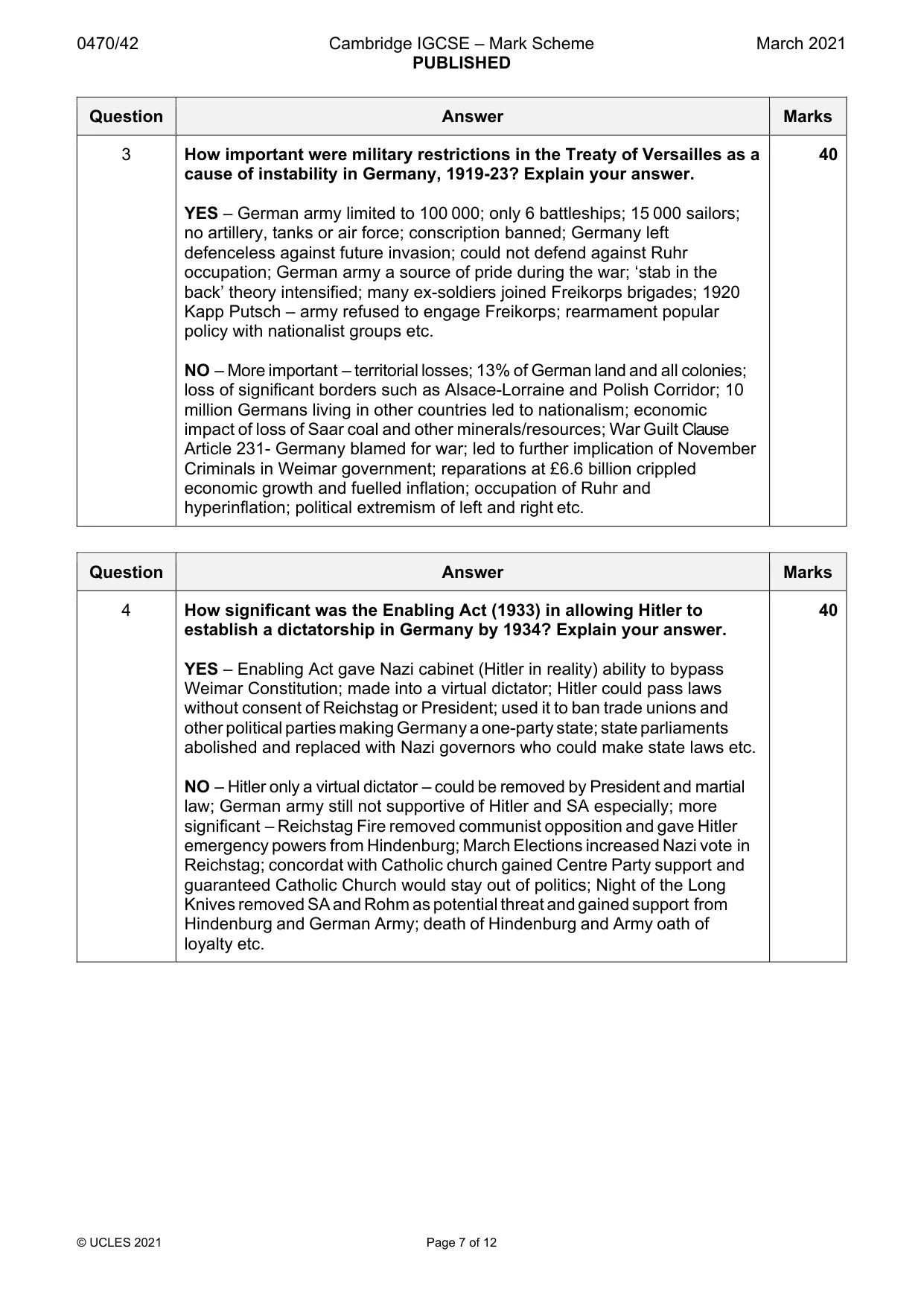
0470/42 Cambridge IGCSE – Mark Scheme PUBLISHED March 2021 © UCLES 2021 Page 7 of 12 Question Answer Marks 3 How important were military restrictions in the Treaty of Versailles as a cause of instability in Germany, 1919-23? Explain your answer. YES – German army limited to 100 000; only 6 battleships; 15 000 sailors; no artillery, tanks or air force; conscription banned; Germany left defenceless against future invasion; could not defend against Ruhr occupation; German army a source of pride during the war; ‘stab in the back’ theory intensified; many ex-soldiers joined Freikorps brigades; 1920 Kapp Putsch – army refused to engage Freikorps; rearmament popular policy with nationalist groups etc. NO – More important – territorial losses; 13% of German land and all colonies; loss of significant borders such as Alsace-Lorraine and Polish Corridor; 10 million Germans living in other countries led to nationalism; economic impact of loss of Saar coal and other minerals/resources; War Guilt Clause Article 231- Germany blamed for war; led to further implication of November Criminals in Weimar government; reparations at £6.6 billion crippled economic growth and fuelled inflation; occupation of Ruhr and hyperinflation; political extremism of left and right etc. 40 Question Answer Marks 4 How significant was the Enabling Act (1933) in allowing Hitler to establish a dictatorship in Germany by 1934? Explain your answer. YES – Enabling Act gave Nazi cabinet (Hitler in reality) ability to bypass Weimar Constitution; made into a virtual dictator; Hitler could pass laws without consent of Reichstag or President; used it to ban trade unions and other political parties making Germany a one-party state; state parliaments abolished and replaced with Nazi governors who could make state laws etc. NO – Hitler only a virtual dictator – could be removed by President and martial law; German army still not supportive of Hitler and SA especially; more significant – Reichstag Fire removed communist opposition and gave Hitler emergency powers from Hindenburg; March Elections increased Nazi vote in Reichstag; concordat with Catholic church gained Centre Party support and guaranteed Catholic Church would stay out of politics; Night of the Long Knives removed SA and Rohm as potential threat and gained support from Hindenburg and German Army; death of Hindenburg and Army oath of loyalty etc. 40
Mark scheme, page 8
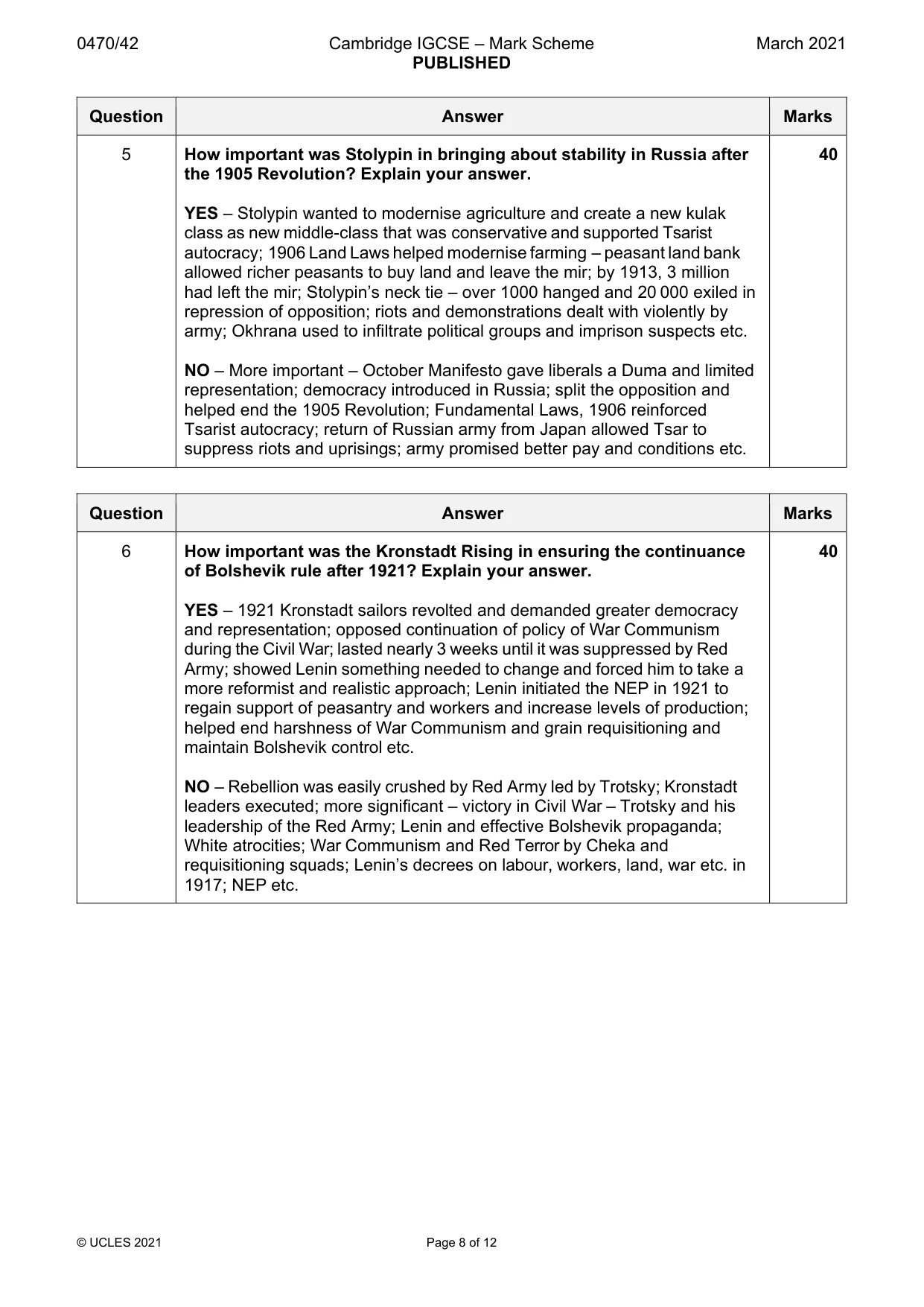
0470/42 Cambridge IGCSE – Mark Scheme PUBLISHED March 2021 © UCLES 2021 Page 8 of 12 Question Answer Marks 5 How important was Stolypin in bringing about stability in Russia after the 1905 Revolution? Explain your answer. YES – Stolypin wanted to modernise agriculture and create a new kulak class as new middle-class that was conservative and supported Tsarist autocracy; 1906 Land Laws helped modernise farming – peasant land bank allowed richer peasants to buy land and leave the mir; by 1913, 3 million had left the mir; Stolypin’s neck tie – over 1000 hanged and 20 000 exiled in repression of opposition; riots and demonstrations dealt with violently by army; Okhrana used to infiltrate political groups and imprison suspects etc. NO – More important – October Manifesto gave liberals a Duma and limited representation; democracy introduced in Russia; split the opposition and helped end the 1905 Revolution; Fundamental Laws, 1906 reinforced Tsarist autocracy; return of Russian army from Japan allowed Tsar to suppress riots and uprisings; army promised better pay and conditions etc. 40 Question Answer Marks 6 How important was the Kronstadt Rising in ensuring the continuance of Bolshevik rule after 1921? Explain your answer. YES – 1921 Kronstadt sailors revolted and demanded greater democracy and representation; opposed continuation of policy of War Communism during the Civil War; lasted nearly 3 weeks until it was suppressed by Red Army; showed Lenin something needed to change and forced him to take a more reformist and realistic approach; Lenin initiated the NEP in 1921 to regain support of peasantry and workers and increase levels of production; helped end harshness of War Communism and grain requisitioning and maintain Bolshevik control etc. NO – Rebellion was easily crushed by Red Army led by Trotsky; Kronstadt leaders executed; more significant – victory in Civil War – Trotsky and his leadership of the Red Army; Lenin and effective Bolshevik propaganda; White atrocities; War Communism and Red Terror by Cheka and requisitioning squads; Lenin’s decrees on labour, workers, land, war etc. in 1917; NEP etc. 40
Mark scheme, page 9
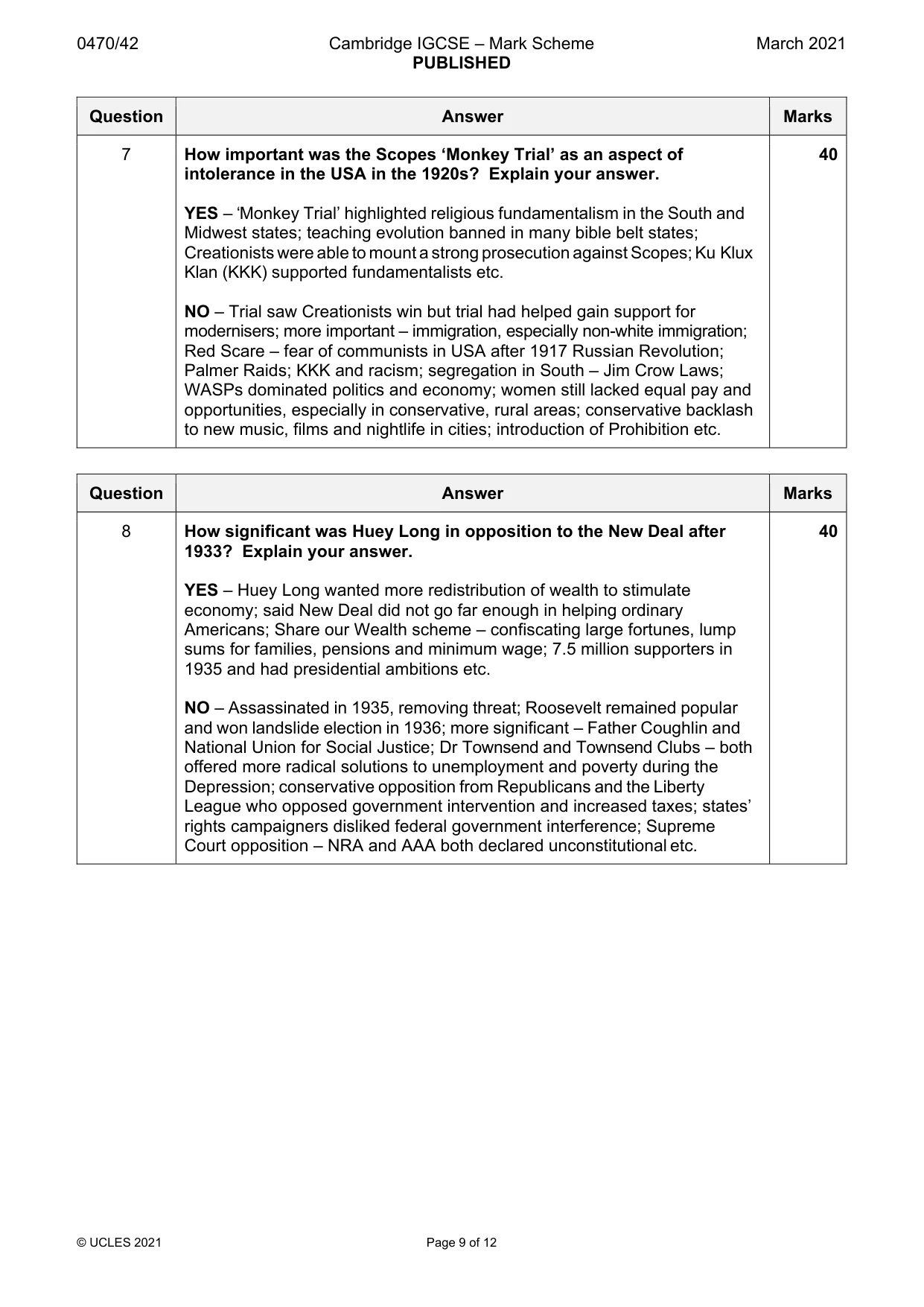
0470/42 Cambridge IGCSE – Mark Scheme PUBLISHED March 2021 © UCLES 2021 Page 9 of 12 Question Answer Marks 7 How important was the Scopes ‘Monkey Trial’ as an aspect of intolerance in the USA in the 1920s? Explain your answer. YES – ‘Monkey Trial’ highlighted religious fundamentalism in the South and Midwest states; teaching evolution banned in many bible belt states; Creationists were able to mount a strong prosecution against Scopes; Ku Klux Klan (KKK) supported fundamentalists etc. NO – Trial saw Creationists win but trial had helped gain support for modernisers; more important – immigration, especially non-white immigration; Red Scare – fear of communists in USA after 1917 Russian Revolution; Palmer Raids; KKK and racism; segregation in South – Jim Crow Laws; WASPs dominated politics and economy; women still lacked equal pay and opportunities, especially in conservative, rural areas; conservative backlash to new music, films and nightlife in cities; introduction of Prohibition etc. 40 Question Answer Marks 8 How significant was Huey Long in opposition to the New Deal after 1933? Explain your answer. YES – Huey Long wanted more redistribution of wealth to stimulate economy; said New Deal did not go far enough in helping ordinary Americans; Share our Wealth scheme – confiscating large fortunes, lump sums for families, pensions and minimum wage; 7.5 million supporters in 1935 and had presidential ambitions etc. NO – Assassinated in 1935, removing threat; Roosevelt remained popular and won landslide election in 1936; more significant – Father Coughlin and National Union for Social Justice; Dr Townsend and Townsend Clubs – both offered more radical solutions to unemployment and poverty during the Depression; conservative opposition from Republicans and the Liberty League who opposed government intervention and increased taxes; states’ rights campaigners disliked federal government interference; Supreme Court opposition – NRA and AAA both declared unconstitutional etc. 40
Mark scheme, page 10
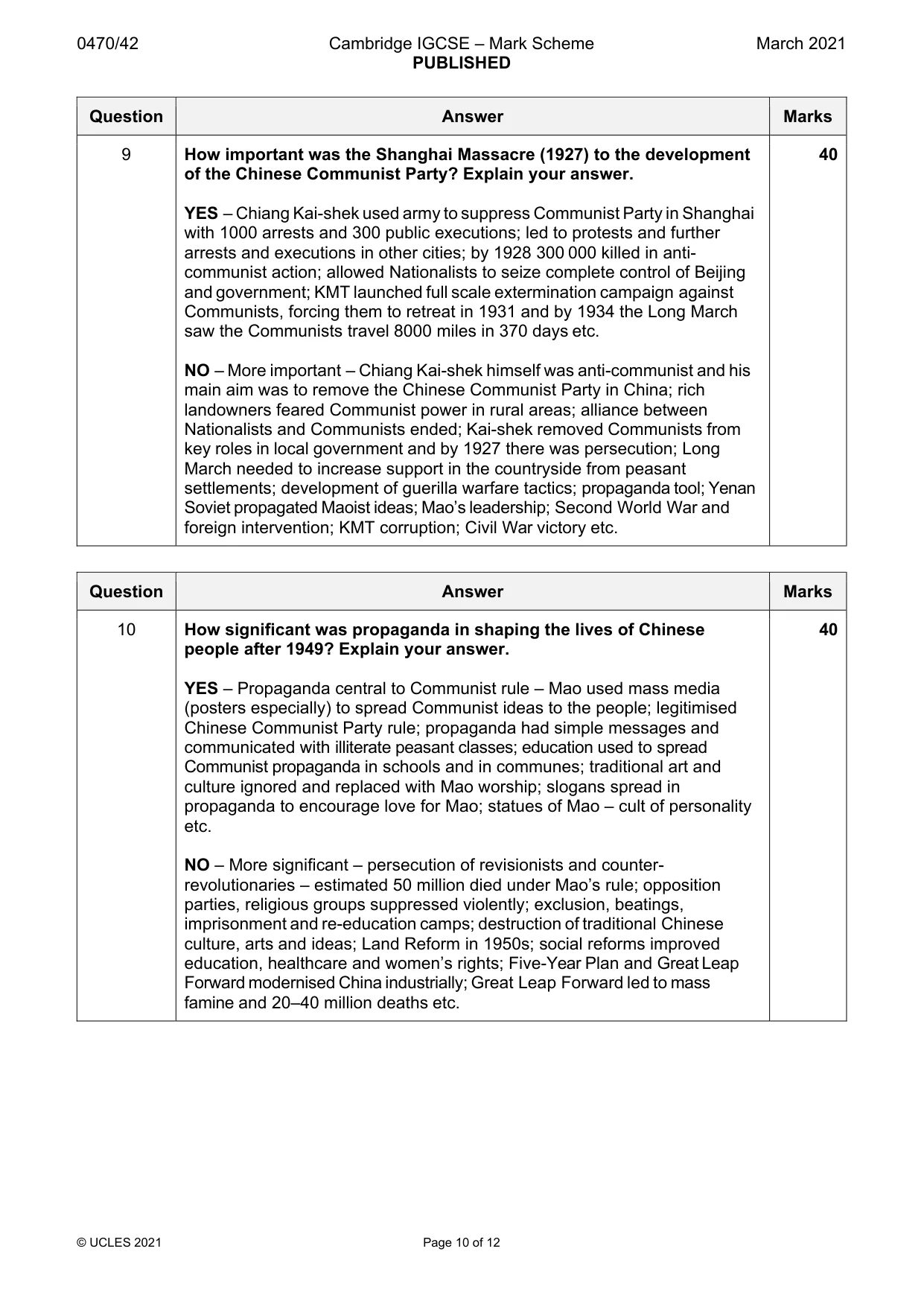
0470/42 Cambridge IGCSE – Mark Scheme PUBLISHED March 2021 © UCLES 2021 Page 10 of 12 Question Answer Marks 9 How important was the Shanghai Massacre (1927) to the development of the Chinese Communist Party? Explain your answer. YES – Chiang Kai-shek used army to suppress Communist Party in Shanghai with 1000 arrests and 300 public executions; led to protests and further arrests and executions in other cities; by 1928 300 000 killed in anti- communist action; allowed Nationalists to seize complete control of Beijing and government; KMT launched full scale extermination campaign against Communists, forcing them to retreat in 1931 and by 1934 the Long March saw the Communists travel 8000 miles in 370 days etc. NO – More important – Chiang Kai-shek himself was anti-communist and his main aim was to remove the Chinese Communist Party in China; rich landowners feared Communist power in rural areas; alliance between Nationalists and Communists ended; Kai-shek removed Communists from key roles in local government and by 1927 there was persecution; Long March needed to increase support in the countryside from peasant settlements; development of guerilla warfare tactics; propaganda tool; Yenan Soviet propagated Maoist ideas; Mao’s leadership; Second World War and foreign intervention; KMT corruption; Civil War victory etc. 40 Question Answer Marks 10 How significant was propaganda in shaping the lives of Chinese people after 1949? Explain your answer. YES – Propaganda central to Communist rule – Mao used mass media (posters especially) to spread Communist ideas to the people; legitimised Chinese Communist Party rule; propaganda had simple messages and communicated with illiterate peasant classes; education used to spread Communist propaganda in schools and in communes; traditional art and culture ignored and replaced with Mao worship; slogans spread in propaganda to encourage love for Mao; statues of Mao – cult of personality etc. NO – More significant – persecution of revisionists and counter- revolutionaries – estimated 50 million died under Mao’s rule; opposition parties, religious groups suppressed violently; exclusion, beatings, imprisonment and re-education camps; destruction of traditional Chinese culture, arts and ideas; Land Reform in 1950s; social reforms improved education, healthcare and women’s rights; Five-Year Plan and Great Leap Forward modernised China industrially; Great Leap Forward led to mass famine and 20–40 million deaths etc. 40
Mark scheme, page 11
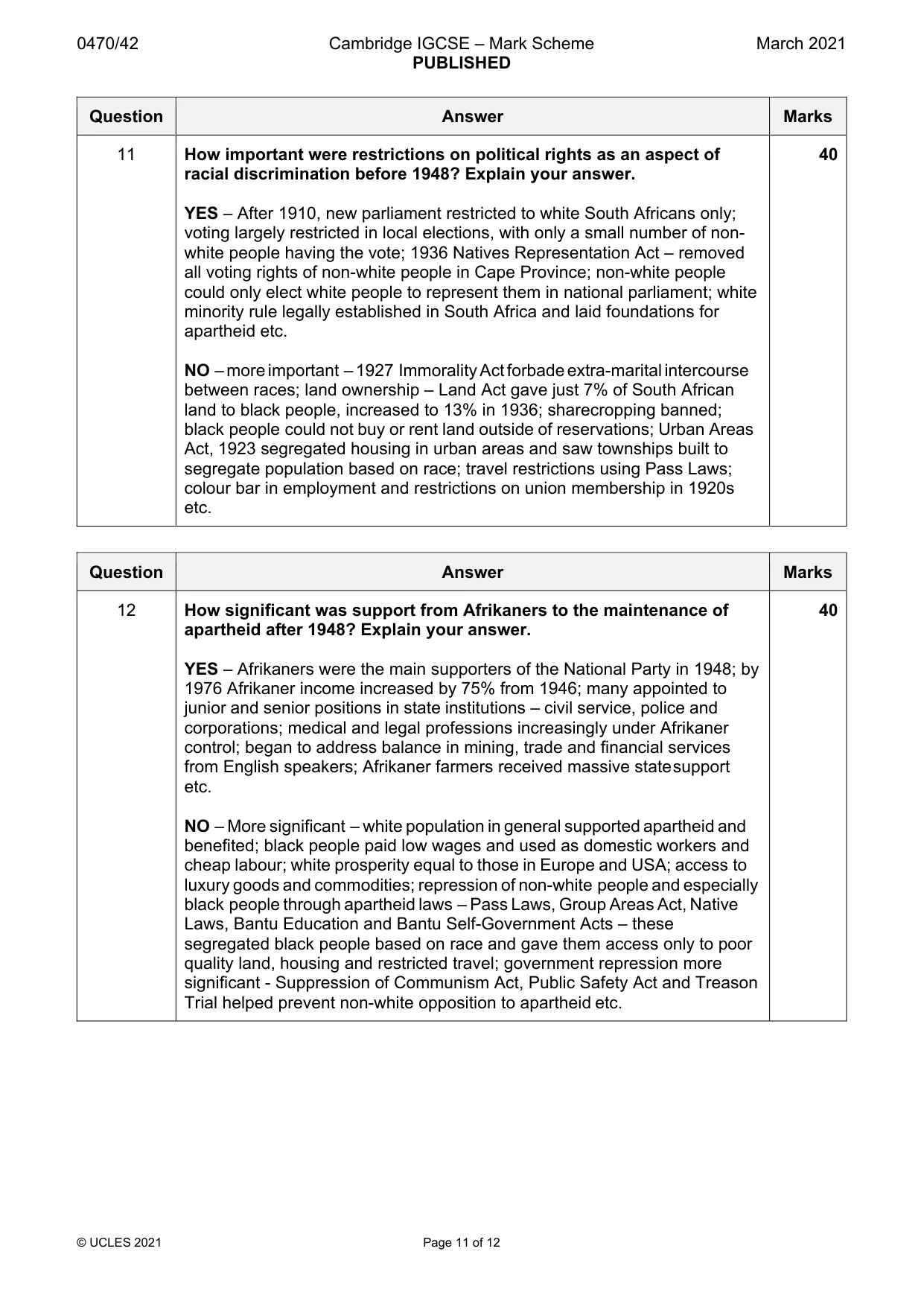
0470/42 Cambridge IGCSE – Mark Scheme PUBLISHED March 2021 © UCLES 2021 Page 11 of 12 Question Answer Marks 11 How important were restrictions on political rights as an aspect of racial discrimination before 1948? Explain your answer. YES – After 1910, new parliament restricted to white South Africans only; voting largely restricted in local elections, with only a small number of non- white people having the vote; 1936 Natives Representation Act – removed all voting rights of non-white people in Cape Province; non-white people could only elect white people to represent them in national parliament; white minority rule legally established in South Africa and laid foundations for apartheid etc. NO – more important – 1927 Immorality Act forbade extra-marital intercourse between races; land ownership – Land Act gave just 7% of South African land to black people, increased to 13% in 1936; sharecropping banned; black people could not buy or rent land outside of reservations; Urban Areas Act, 1923 segregated housing in urban areas and saw townships built to segregate population based on race; travel restrictions using Pass Laws; colour bar in employment and restrictions on union membership in 1920s etc. 40 Question Answer Marks 12 How significant was support from Afrikaners to the maintenance of apartheid after 1948? Explain your answer. YES – Afrikaners were the main supporters of the National Party in 1948; by 1976 Afrikaner income increased by 75% from 1946; many appointed to junior and senior positions in state institutions – civil service, police and corporations; medical and legal professions increasingly under Afrikaner control; began to address balance in mining, trade and financial services from English speakers; Afrikaner farmers received massive state support etc. NO – More significant – white population in general supported apartheid and benefited; black people paid low wages and used as domestic workers and cheap labour; white prosperity equal to those in Europe and USA; access to luxury goods and commodities; repression of non-white people and especially black people through apartheid laws – Pass Laws, Group Areas Act, Native Laws, Bantu Education and Bantu Self-Government Acts – these segregated black people based on race and gave them access only to poor quality land, housing and restricted travel; government repression more significant - Suppression of Communism Act, Public Safety Act and Treason Trial helped prevent non-white opposition to apartheid etc. 40
Mark scheme, page 12
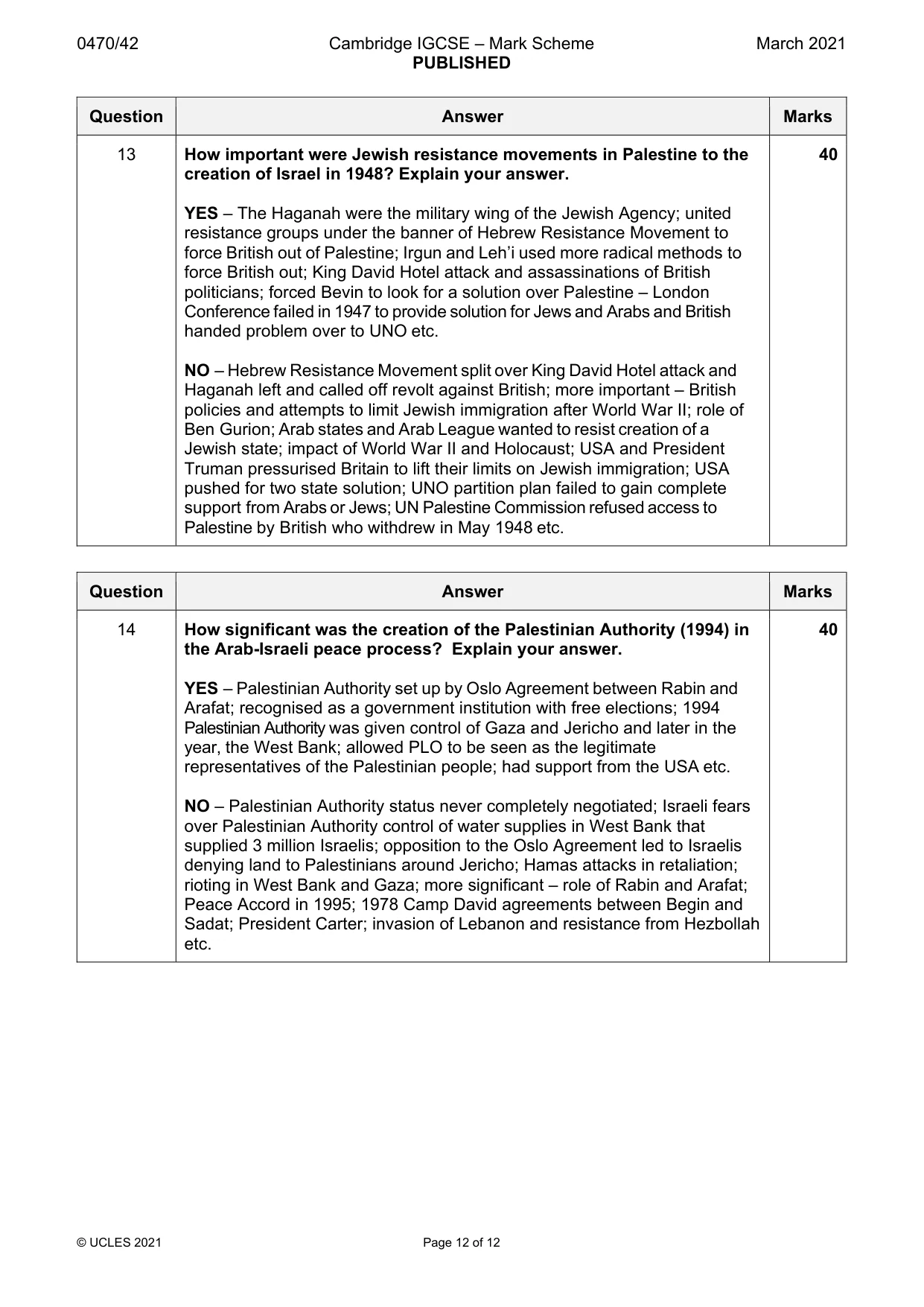
0470/42 Cambridge IGCSE – Mark Scheme PUBLISHED March 2021 © UCLES 2021 Page 12 of 12 Question Answer Marks 13 How important were Jewish resistance movements in Palestine to the creation of Israel in 1948? Explain your answer. YES – The Haganah were the military wing of the Jewish Agency; united resistance groups under the banner of Hebrew Resistance Movement to force British out of Palestine; Irgun and Leh’i used more radical methods to force British out; King David Hotel attack and assassinations of British politicians; forced Bevin to look for a solution over Palestine – London Conference failed in 1947 to provide solution for Jews and Arabs and British handed problem over to UNO etc. NO – Hebrew Resistance Movement split over King David Hotel attack and Haganah left and called off revolt against British; more important – British policies and attempts to limit Jewish immigration after World War II; role of Ben Gurion; Arab states and Arab League wanted to resist creation of a Jewish state; impact of World War II and Holocaust; USA and President Truman pressurised Britain to lift their limits on Jewish immigration; USA pushed for two state solution; UNO partition plan failed to gain complete support from Arabs or Jews; UN Palestine Commission refused access to Palestine by British who withdrew in May 1948 etc. 40 Question Answer Marks 14 How significant was the creation of the Palestinian Authority (1994) in the Arab-Israeli peace process? Explain your answer. YES – Palestinian Authority set up by Oslo Agreement between Rabin and Arafat; recognised as a government institution with free elections; 1994 Palestinian Authority was given control of Gaza and Jericho and later in the year, the West Bank; allowed PLO to be seen as the legitimate representatives of the Palestinian people; had support from the USA etc. NO – Palestinian Authority status never completely negotiated; Israeli fears over Palestinian Authority control of water supplies in West Bank that supplied 3 million Israelis; opposition to the Oslo Agreement led to Israelis denying land to Palestinians around Jericho; Hamas attacks in retaliation; rioting in West Bank and Gaza; more significant – role of Rabin and Arafat; Peace Accord in 1995; 1978 Camp David agreements between Begin and Sadat; President Carter; invasion of Lebanon and resistance from Hezbollah etc. 40
What you needed in this session
Cambridge’s own grade thresholds for 2021 Feb/March, Paper 4 · Variant 2. A higher threshold means an easier paper — the bar moves with how the cohort did.