Cambridge IGCSE History 0470 — 2020 Feb/March Paper 4 · Variant 2
0470/42/F/M/20 · 40 marks · ≈45 min
The question paper and its mark scheme, free to read here and free to download. This is Cambridge’s own paper, exactly as it was sat.
Question paper4 pages

Mark scheme10 pages
Answers below. Sit the paper first if you are practising.
Paper as text
Question paper, page 1
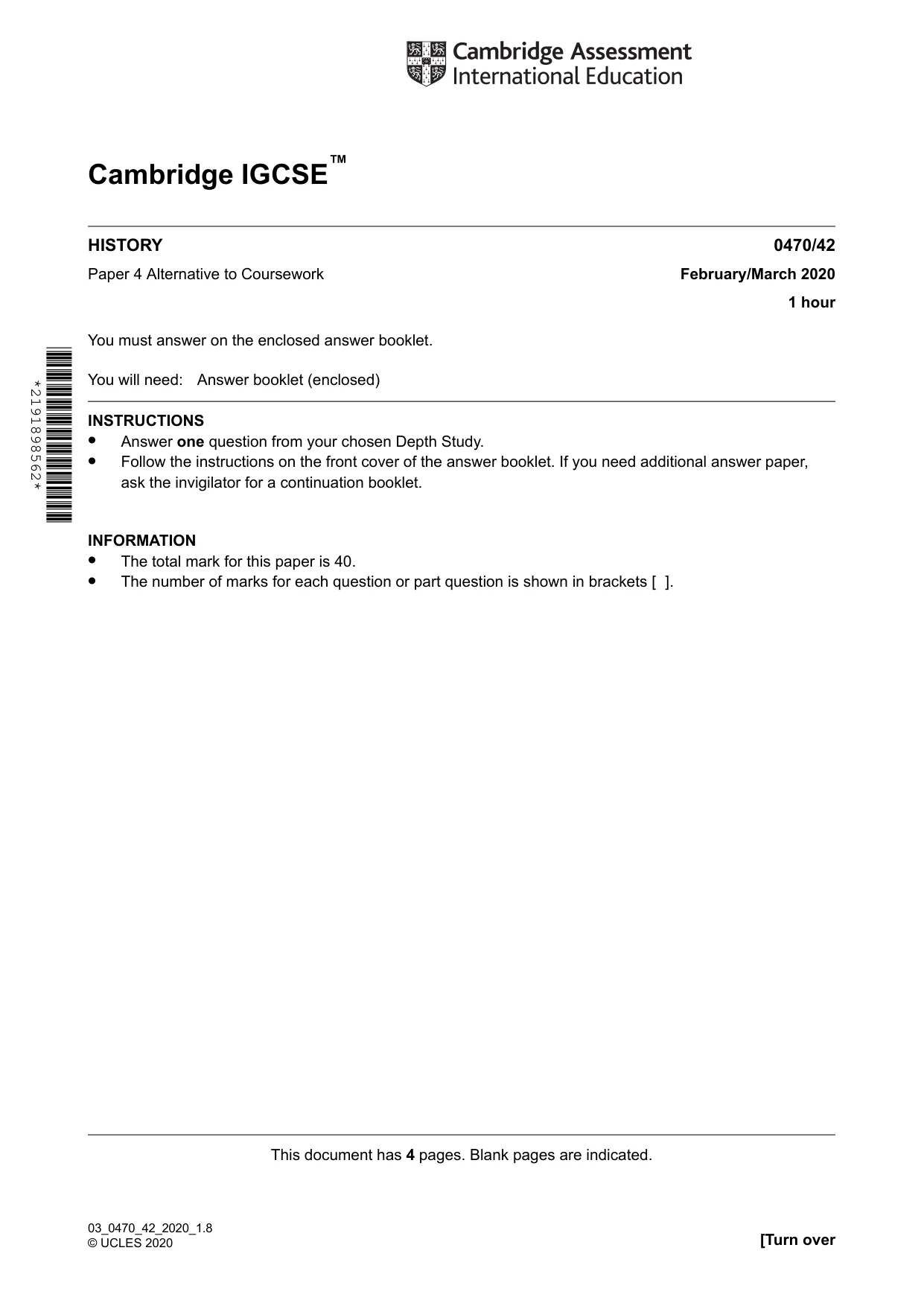
Cambridge IGCSE™ 0470/42 February/March 2020 1 hour HISTORY Paper 4 Alternative to Coursework You must answer on the enclosed answer booklet. You will need: Answer booklet (enclosed) INSTRUCTIONS • Answer one question from your chosen Depth Study. • Follow the instructions on the front cover of the answer booklet. If you need additional answer paper, ask the invigilator for a continuation booklet. INFORMATION • The total mark for this paper is 40. • The number of marks for each question or part question is shown in brackets [ ]. This document has 4 pages. Blank pages are indicated. [Turn over 03_0470_42_2020_1.8 © UCLES 2020 *2191898562*
Question paper, page 2
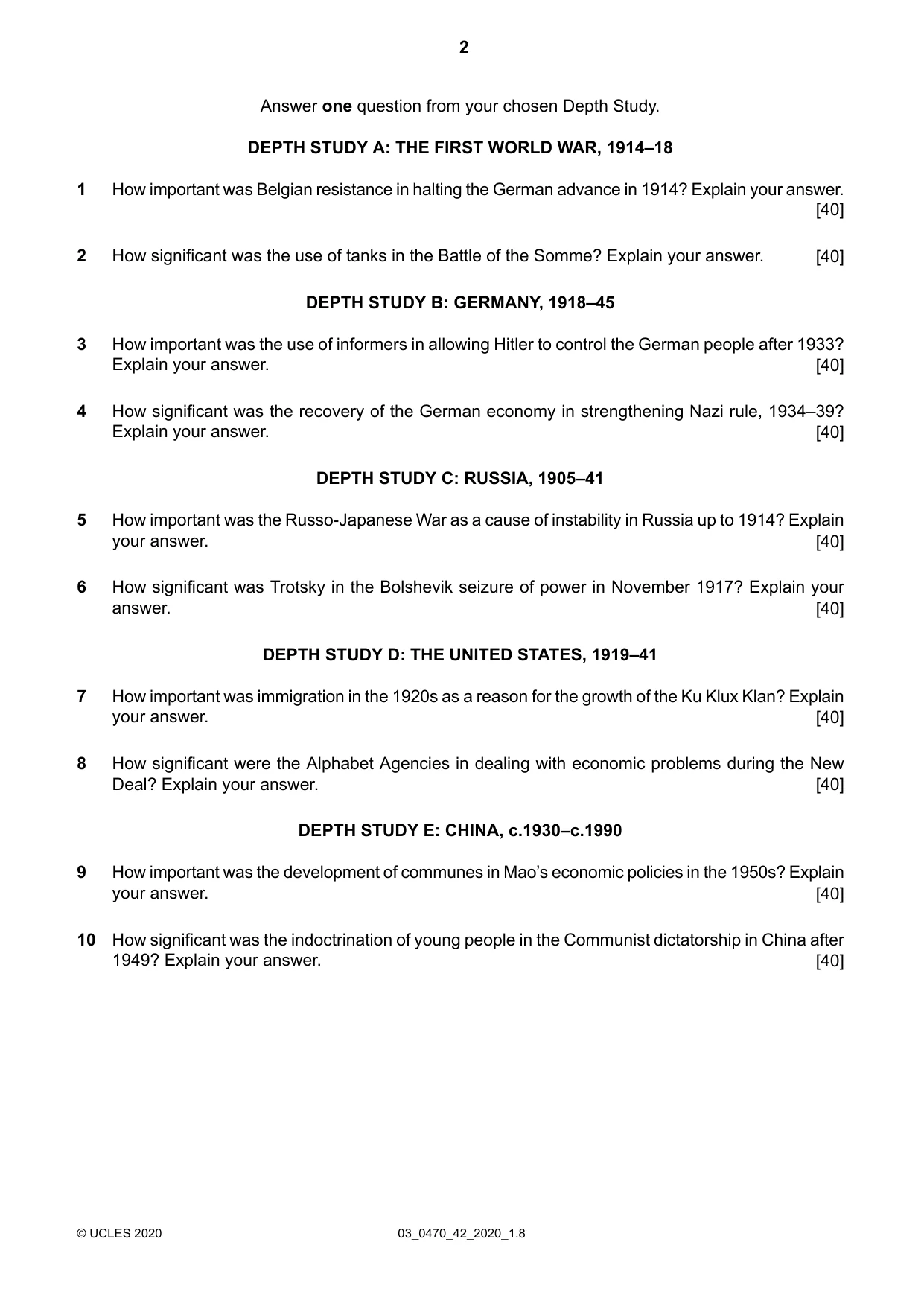
Answer one question from your chosen Depth Study. DEPTH STUDY A: THE FIRST WORLD WAR, 1914–18 How important was Belgian resistance in halting the German advance in 1914? Explain your answer. [40] 1 How significant was the use of tanks in the Battle of the Somme? Explain your answer. [40] 2 DEPTH STUDY B: GERMANY, 1918–45 How important was the use of informers in allowing Hitler to control the German people after 1933? Explain your answer. [40] 3 How significant was the recovery of the German economy in strengthening Nazi rule, 1934–39? Explain your answer. [40] 4 DEPTH STUDY C: RUSSIA, 1905–41 How important was the Russo-Japanese War as a cause of instability in Russia up to 1914? Explain your answer. [40] 5 How significant was Trotsky in the Bolshevik seizure of power in November 1917? Explain your answer. [40] 6 DEPTH STUDY D: THE UNITED STATES, 1919–41 How important was immigration in the 1920s as a reason for the growth of the Ku Klux Klan? Explain your answer. [40] 7 How significant were the Alphabet Agencies in dealing with economic problems during the New Deal? Explain your answer. [40] 8 DEPTH STUDY E: CHINA, c.1930–c.1990 How important was the development of communes in Mao’s economic policies in the 1950s? Explain your answer. [40] 9 How significant was the indoctrination of young people in the Communist dictatorship in China after 1949? Explain your answer. [40] 10 03_0470_42_2020_1.8 © UCLES 2020 2
Question paper, page 3
DEPTH STUDY F: SOUTH AFRICA, c.1940–c.1994 How important was youth opposition in the resistance to apartheid after 1948? Explain your answer. [40] 11 How significant were reforms to the Pass Laws as a reason for the collapse of white minority rule in South Africa? Explain your answer. [40] 12 DEPTH STUDY G: ISRAELIS AND PALESTINIANS SINCE 1945 How important was the Soviet Union in shaping events in the Middle East after 1948? Explain your answer. [40] 13 How significant was President Carter in dealing with the problems between Israel and its neighbours after 1973? Explain your answer. [40] 14 03_0470_42_2020_1.8 © UCLES 2020 3
Question paper, page 4
BLANK PAGE Permission to reproduce items where third-party owned material protected by copyright is included has been sought and cleared where possible. Every reasonable effort has been made by the publisher (UCLES) to trace copyright holders, but if any items requiring clearance have unwittingly been included, the publisher will be pleased to make amends at the earliest possible opportunity. To avoid the issue of disclosure of answer-related information to candidates, all copyright acknowledgements are reproduced online in the Cambridge Assessment International Education Copyright Acknowledgements Booklet. This is produced for each series of examinations and is freely available to download at www.cambridgeinternational.org after the live examination series. Cambridge Assessment International Education is part of the Cambridge Assessment Group. Cambridge Assessment is the brand name of the University of Cambridge Local Examinations Syndicate (UCLES), which itself is a department of the University of Cambridge. 03_0470_42_2020_1.8 © UCLES 2020 4
Mark scheme, page 1
This document consists of 10 printed pages. © UCLES 2020 [Turn over Cambridge IGCSE™ HISTORY 0470/42 Paper 4 Alternative to Coursework March 2020 MARK SCHEME Maximum Mark: 40 Published This mark scheme is published as an aid to teachers and candidates, to indicate the requirements of the examination. It shows the basis on which Examiners were instructed to award marks. It does not indicate the details of the discussions that took place at an Examiners’ meeting before marking began, which would have considered the acceptability of alternative answers. Mark schemes should be read in conjunction with the question paper and the Principal Examiner Report for Teachers. Cambridge International will not enter into discussions about these mark schemes. Cambridge International is publishing the mark schemes for the March 2020 series for most Cambridge IGCSE™, Cambridge International A and AS Level components and some Cambridge O Level components.
Mark scheme, page 2
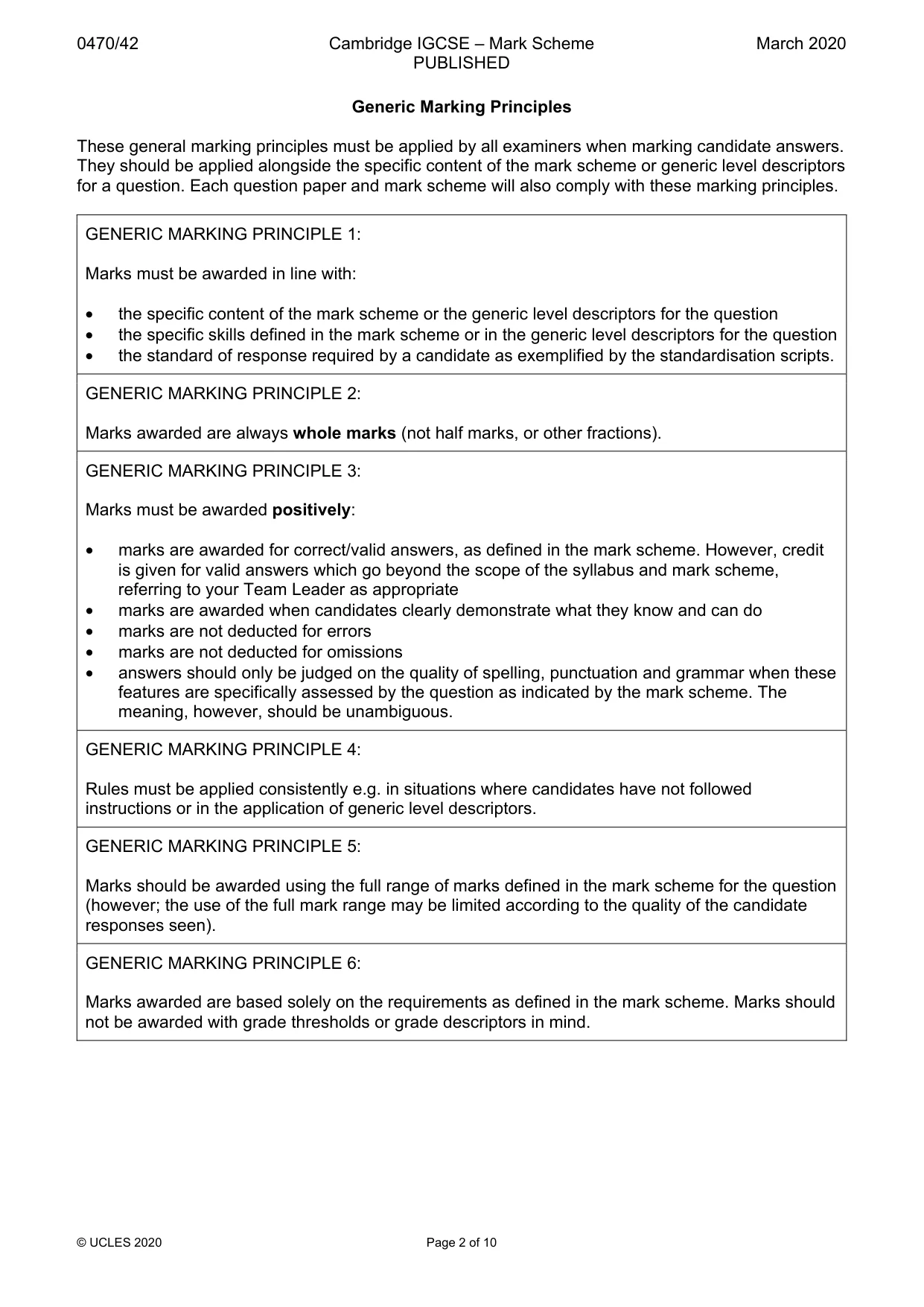
0470/42 Cambridge IGCSE – Mark Scheme PUBLISHED March 2020 © UCLES 2020 Page 2 of 10 Generic Marking Principles These general marking principles must be applied by all examiners when marking candidate answers. They should be applied alongside the specific content of the mark scheme or generic level descriptors for a question. Each question paper and mark scheme will also comply with these marking principles. GENERIC MARKING PRINCIPLE 1: Marks must be awarded in line with: • the specific content of the mark scheme or the generic level descriptors for the question • the specific skills defined in the mark scheme or in the generic level descriptors for the question • the standard of response required by a candidate as exemplified by the standardisation scripts. GENERIC MARKING PRINCIPLE 2: Marks awarded are always whole marks (not half marks, or other fractions). GENERIC MARKING PRINCIPLE 3: Marks must be awarded positively: • marks are awarded for correct/valid answers, as defined in the mark scheme. However, credit is given for valid answers which go beyond the scope of the syllabus and mark scheme, referring to your Team Leader as appropriate • marks are awarded when candidates clearly demonstrate what they know and can do • marks are not deducted for errors • marks are not deducted for omissions • answers should only be judged on the quality of spelling, punctuation and grammar when these features are specifically assessed by the question as indicated by the mark scheme. The meaning, however, should be unambiguous. GENERIC MARKING PRINCIPLE 4: Rules must be applied consistently e.g. in situations where candidates have not followed instructions or in the application of generic level descriptors. GENERIC MARKING PRINCIPLE 5: Marks should be awarded using the full range of marks defined in the mark scheme for the question (however; the use of the full mark range may be limited according to the quality of the candidate responses seen). GENERIC MARKING PRINCIPLE 6: Marks awarded are based solely on the requirements as defined in the mark scheme. Marks should not be awarded with grade thresholds or grade descriptors in mind.
Mark scheme, page 3
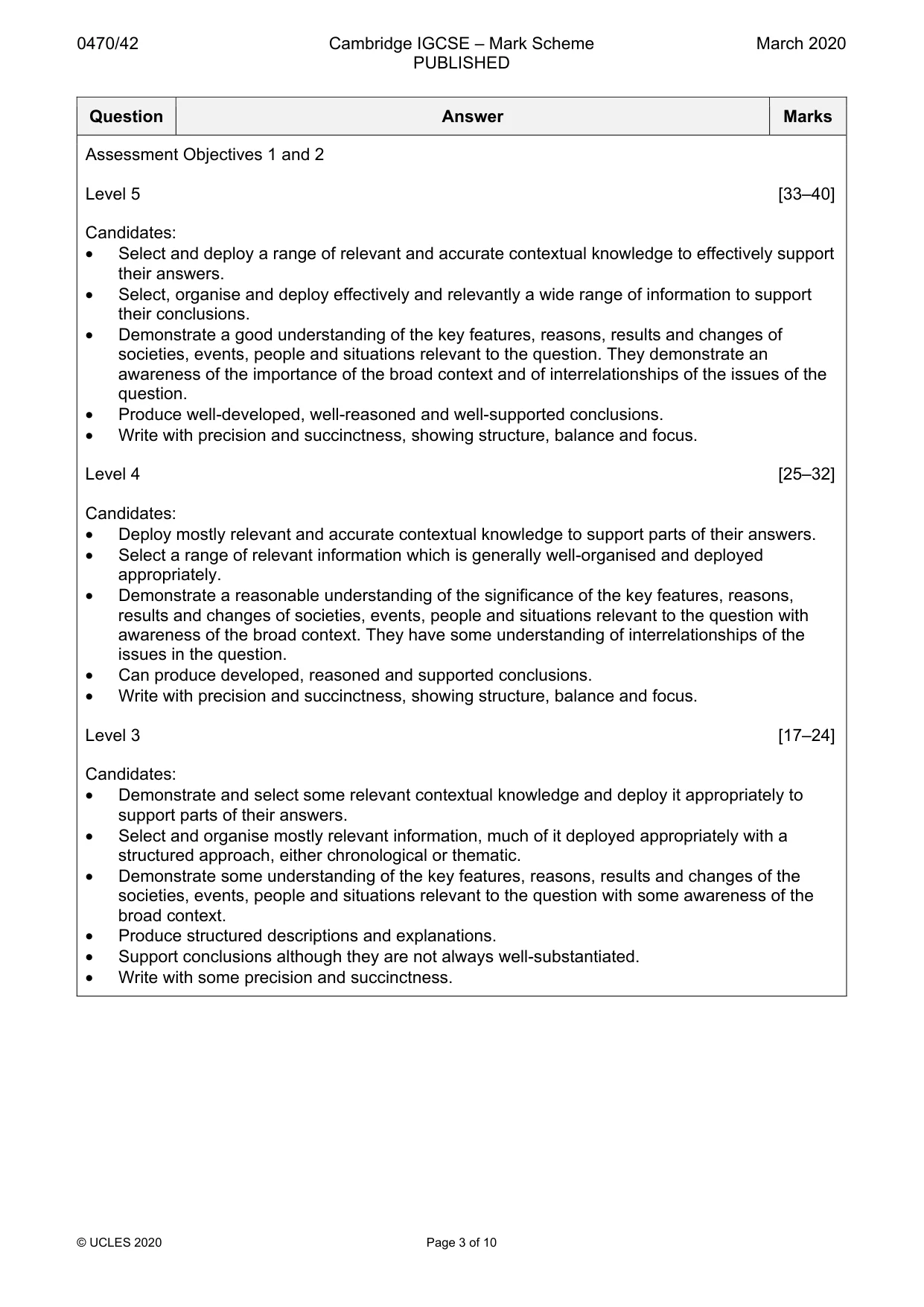
0470/42 Cambridge IGCSE – Mark Scheme PUBLISHED March 2020 © UCLES 2020 Page 3 of 10 Question Answer Marks Assessment Objectives 1 and 2 Level 5 [33–40] Candidates: • Select and deploy a range of relevant and accurate contextual knowledge to effectively support their answers. • Select, organise and deploy effectively and relevantly a wide range of information to support their conclusions. • Demonstrate a good understanding of the key features, reasons, results and changes of societies, events, people and situations relevant to the question. They demonstrate an awareness of the importance of the broad context and of interrelationships of the issues of the question. • Produce well-developed, well-reasoned and well-supported conclusions. • Write with precision and succinctness, showing structure, balance and focus. Level 4 [25–32] Candidates: • Deploy mostly relevant and accurate contextual knowledge to support parts of their answers. • Select a range of relevant information which is generally well-organised and deployed appropriately. • Demonstrate a reasonable understanding of the significance of the key features, reasons, results and changes of societies, events, people and situations relevant to the question with awareness of the broad context. They have some understanding of interrelationships of the issues in the question. • Can produce developed, reasoned and supported conclusions. • Write with precision and succinctness, showing structure, balance and focus. Level 3 [17–24] Candidates: • Demonstrate and select some relevant contextual knowledge and deploy it appropriately to support parts of their answers. • Select and organise mostly relevant information, much of it deployed appropriately with a structured approach, either chronological or thematic. • Demonstrate some understanding of the key features, reasons, results and changes of the societies, events, people and situations relevant to the question with some awareness of the broad context. • Produce structured descriptions and explanations. • Support conclusions although they are not always well-substantiated. • Write with some precision and succinctness.
Mark scheme, page 4
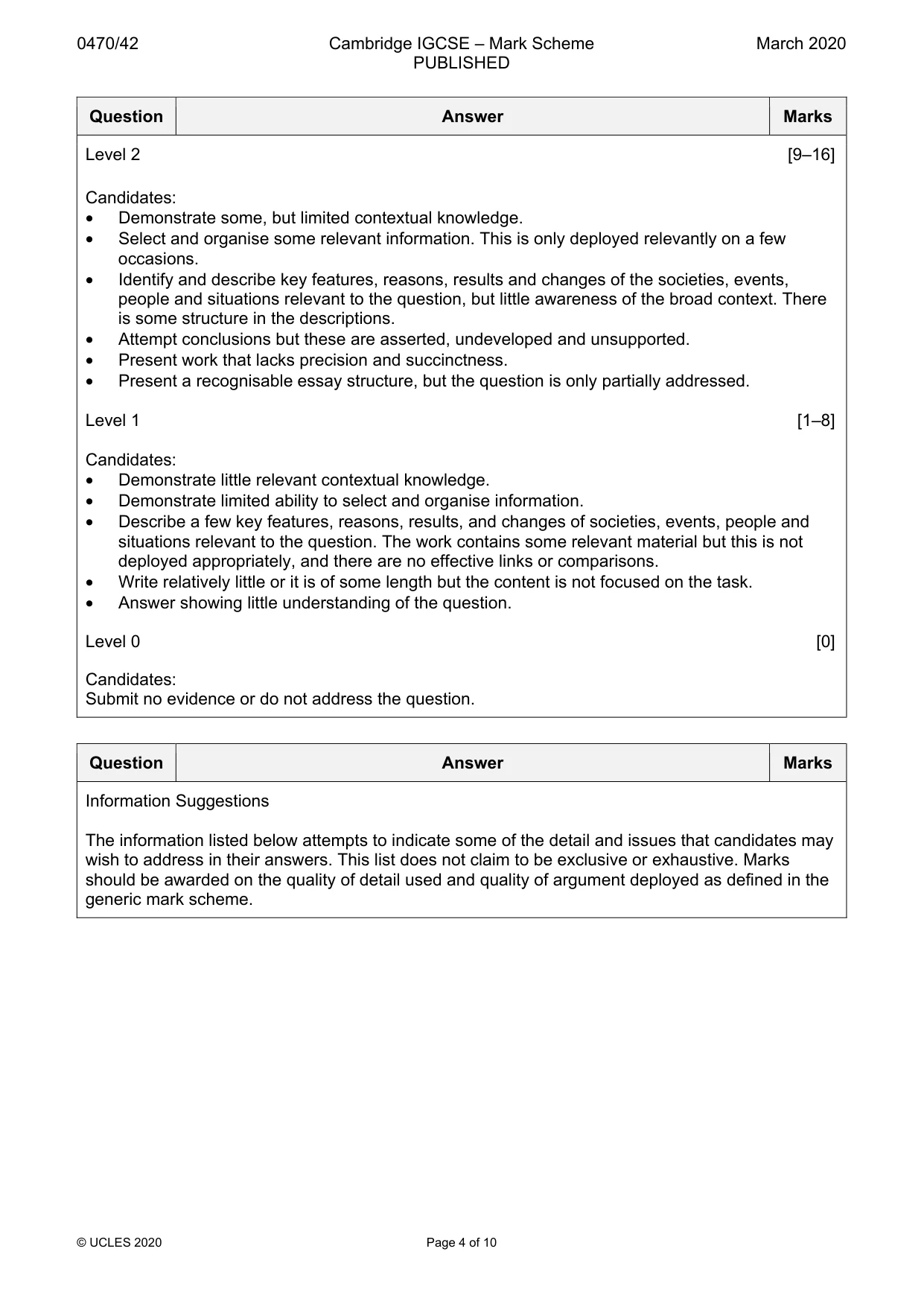
0470/42 Cambridge IGCSE – Mark Scheme PUBLISHED March 2020 © UCLES 2020 Page 4 of 10 Question Answer Marks Level 2 [9–16] Candidates: • Demonstrate some, but limited contextual knowledge. • Select and organise some relevant information. This is only deployed relevantly on a few occasions. • Identify and describe key features, reasons, results and changes of the societies, events, people and situations relevant to the question, but little awareness of the broad context. There is some structure in the descriptions. • Attempt conclusions but these are asserted, undeveloped and unsupported. • Present work that lacks precision and succinctness. • Present a recognisable essay structure, but the question is only partially addressed. Level 1 [1–8] Candidates: • Demonstrate little relevant contextual knowledge. • Demonstrate limited ability to select and organise information. • Describe a few key features, reasons, results, and changes of societies, events, people and situations relevant to the question. The work contains some relevant material but this is not deployed appropriately, and there are no effective links or comparisons. • Write relatively little or it is of some length but the content is not focused on the task. • Answer showing little understanding of the question. Level 0 [0] Candidates: Submit no evidence or do not address the question. Question Answer Marks Information Suggestions The information listed below attempts to indicate some of the detail and issues that candidates may wish to address in their answers. This list does not claim to be exclusive or exhaustive. Marks should be awarded on the quality of detail used and quality of argument deployed as defined in the generic mark scheme.
Mark scheme, page 5
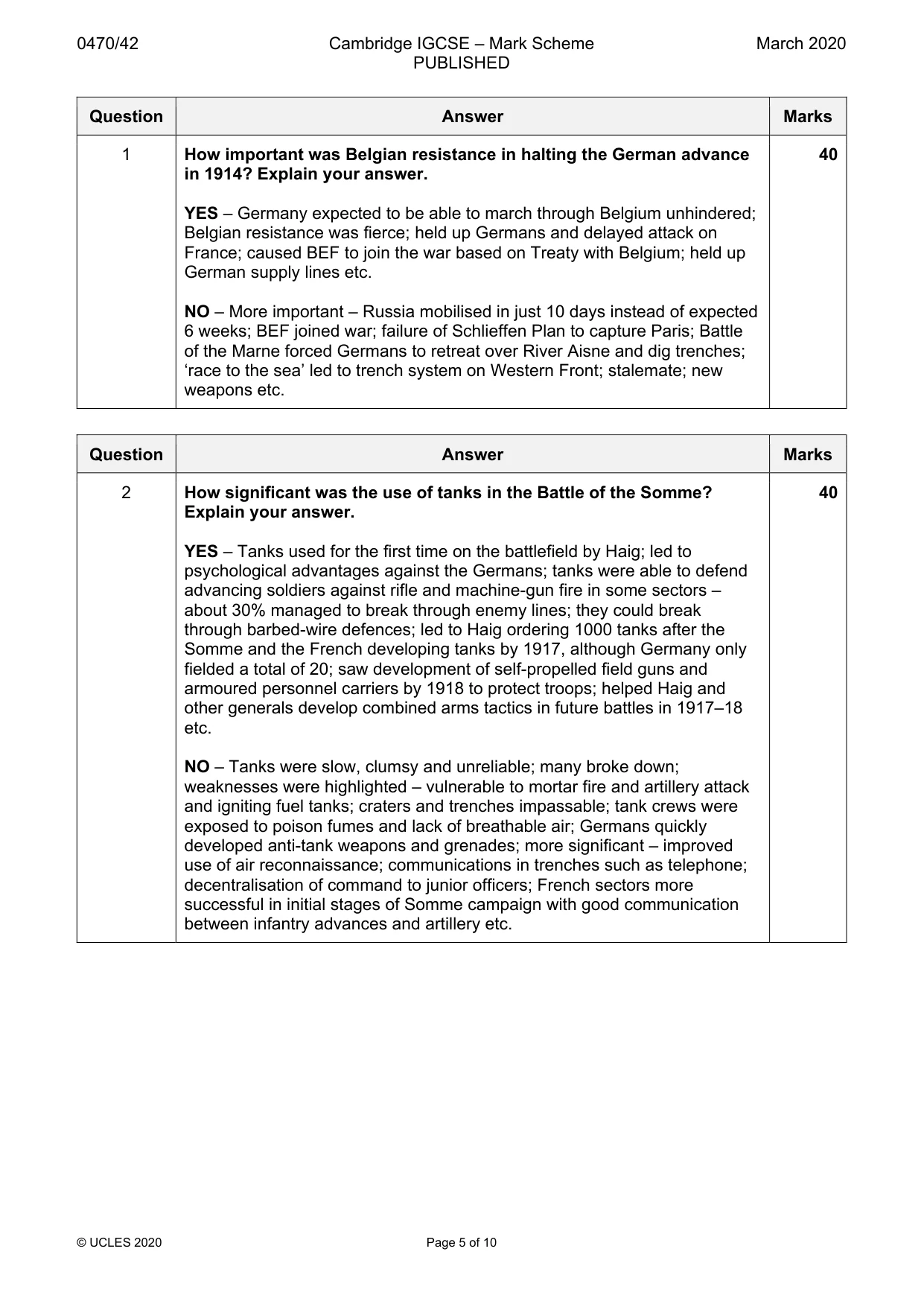
0470/42 Cambridge IGCSE – Mark Scheme PUBLISHED March 2020 © UCLES 2020 Page 5 of 10 Question Answer Marks 1 How important was Belgian resistance in halting the German advance in 1914? Explain your answer. YES – Germany expected to be able to march through Belgium unhindered; Belgian resistance was fierce; held up Germans and delayed attack on France; caused BEF to join the war based on Treaty with Belgium; held up German supply lines etc. NO – More important – Russia mobilised in just 10 days instead of expected 6 weeks; BEF joined war; failure of Schlieffen Plan to capture Paris; Battle of the Marne forced Germans to retreat over River Aisne and dig trenches; ‘race to the sea’ led to trench system on Western Front; stalemate; new weapons etc. 40 Question Answer Marks 2 How significant was the use of tanks in the Battle of the Somme? Explain your answer. YES – Tanks used for the first time on the battlefield by Haig; led to psychological advantages against the Germans; tanks were able to defend advancing soldiers against rifle and machine-gun fire in some sectors – about 30% managed to break through enemy lines; they could break through barbed-wire defences; led to Haig ordering 1000 tanks after the Somme and the French developing tanks by 1917, although Germany only fielded a total of 20; saw development of self-propelled field guns and armoured personnel carriers by 1918 to protect troops; helped Haig and other generals develop combined arms tactics in future battles in 1917–18 etc. NO – Tanks were slow, clumsy and unreliable; many broke down; weaknesses were highlighted – vulnerable to mortar fire and artillery attack and igniting fuel tanks; craters and trenches impassable; tank crews were exposed to poison fumes and lack of breathable air; Germans quickly developed anti-tank weapons and grenades; more significant – improved use of air reconnaissance; communications in trenches such as telephone; decentralisation of command to junior officers; French sectors more successful in initial stages of Somme campaign with good communication between infantry advances and artillery etc. 40
Mark scheme, page 6
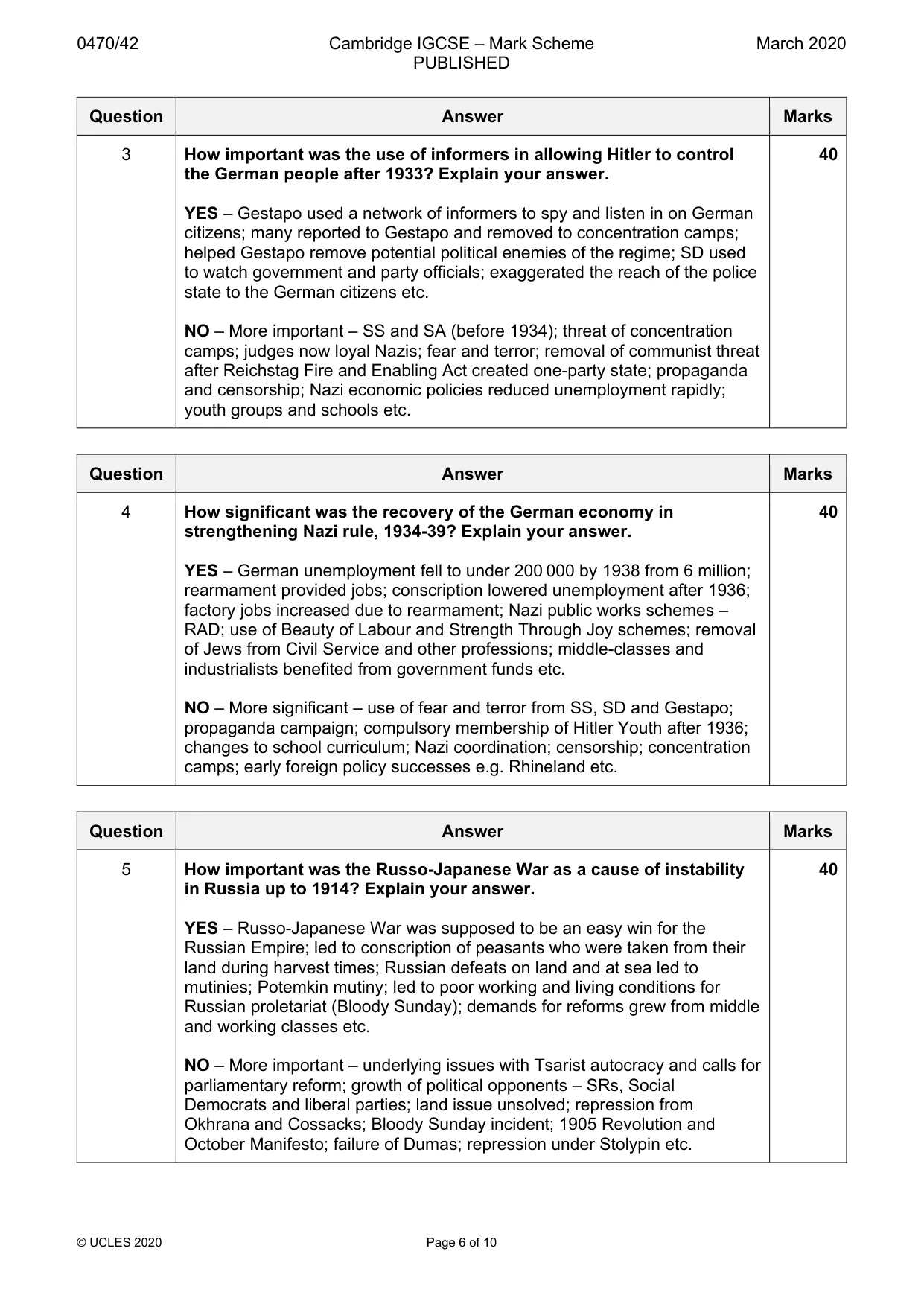
0470/42 Cambridge IGCSE – Mark Scheme PUBLISHED March 2020 © UCLES 2020 Page 6 of 10 Question Answer Marks 3 How important was the use of informers in allowing Hitler to control the German people after 1933? Explain your answer. YES – Gestapo used a network of informers to spy and listen in on German citizens; many reported to Gestapo and removed to concentration camps; helped Gestapo remove potential political enemies of the regime; SD used to watch government and party officials; exaggerated the reach of the police state to the German citizens etc. NO – More important – SS and SA (before 1934); threat of concentration camps; judges now loyal Nazis; fear and terror; removal of communist threat after Reichstag Fire and Enabling Act created one-party state; propaganda and censorship; Nazi economic policies reduced unemployment rapidly; youth groups and schools etc. 40 Question Answer Marks 4 How significant was the recovery of the German economy in strengthening Nazi rule, 1934-39? Explain your answer. YES – German unemployment fell to under 200 000 by 1938 from 6 million; rearmament provided jobs; conscription lowered unemployment after 1936; factory jobs increased due to rearmament; Nazi public works schemes – RAD; use of Beauty of Labour and Strength Through Joy schemes; removal of Jews from Civil Service and other professions; middle-classes and industrialists benefited from government funds etc. NO – More significant – use of fear and terror from SS, SD and Gestapo; propaganda campaign; compulsory membership of Hitler Youth after 1936; changes to school curriculum; Nazi coordination; censorship; concentration camps; early foreign policy successes e.g. Rhineland etc. 40 Question Answer Marks 5 How important was the Russo-Japanese War as a cause of instability in Russia up to 1914? Explain your answer. YES – Russo-Japanese War was supposed to be an easy win for the Russian Empire; led to conscription of peasants who were taken from their land during harvest times; Russian defeats on land and at sea led to mutinies; Potemkin mutiny; led to poor working and living conditions for Russian proletariat (Bloody Sunday); demands for reforms grew from middle and working classes etc. NO – More important – underlying issues with Tsarist autocracy and calls for parliamentary reform; growth of political opponents – SRs, Social Democrats and liberal parties; land issue unsolved; repression from Okhrana and Cossacks; Bloody Sunday incident; 1905 Revolution and October Manifesto; failure of Dumas; repression under Stolypin etc. 40
Mark scheme, page 7
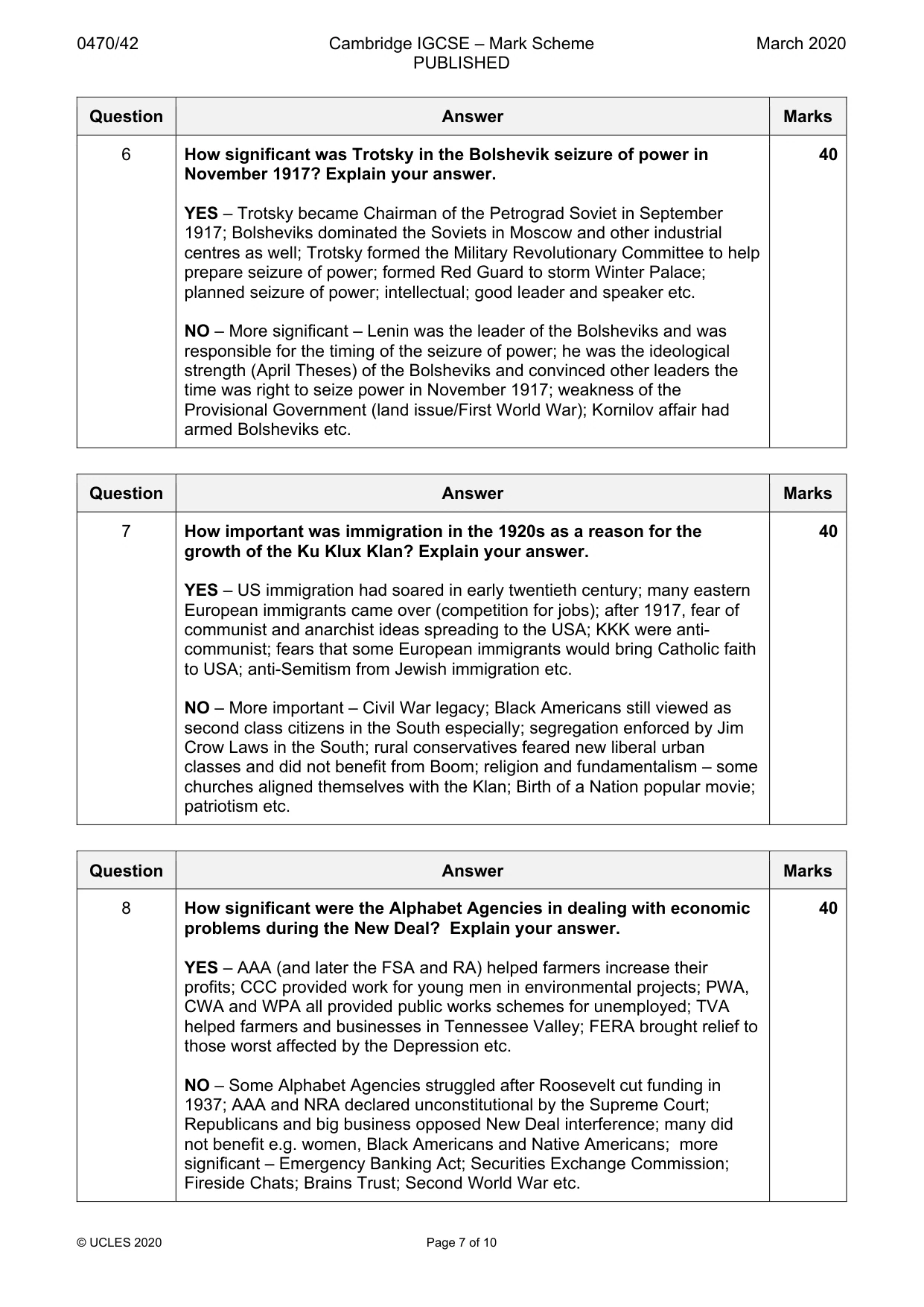
0470/42 Cambridge IGCSE – Mark Scheme PUBLISHED March 2020 © UCLES 2020 Page 7 of 10 Question Answer Marks 6 How significant was Trotsky in the Bolshevik seizure of power in November 1917? Explain your answer. YES – Trotsky became Chairman of the Petrograd Soviet in September 1917; Bolsheviks dominated the Soviets in Moscow and other industrial centres as well; Trotsky formed the Military Revolutionary Committee to help prepare seizure of power; formed Red Guard to storm Winter Palace; planned seizure of power; intellectual; good leader and speaker etc. NO – More significant – Lenin was the leader of the Bolsheviks and was responsible for the timing of the seizure of power; he was the ideological strength (April Theses) of the Bolsheviks and convinced other leaders the time was right to seize power in November 1917; weakness of the Provisional Government (land issue/First World War); Kornilov affair had armed Bolsheviks etc. 40 Question Answer Marks 7 How important was immigration in the 1920s as a reason for the growth of the Ku Klux Klan? Explain your answer. YES – US immigration had soared in early twentieth century; many eastern European immigrants came over (competition for jobs); after 1917, fear of communist and anarchist ideas spreading to the USA; KKK were anti- communist; fears that some European immigrants would bring Catholic faith to USA; anti-Semitism from Jewish immigration etc. NO – More important – Civil War legacy; Black Americans still viewed as second class citizens in the South especially; segregation enforced by Jim Crow Laws in the South; rural conservatives feared new liberal urban classes and did not benefit from Boom; religion and fundamentalism – some churches aligned themselves with the Klan; Birth of a Nation popular movie; patriotism etc. 40 Question Answer Marks 8 How significant were the Alphabet Agencies in dealing with economic problems during the New Deal? Explain your answer. YES – AAA (and later the FSA and RA) helped farmers increase their profits; CCC provided work for young men in environmental projects; PWA, CWA and WPA all provided public works schemes for unemployed; TVA helped farmers and businesses in Tennessee Valley; FERA brought relief to those worst affected by the Depression etc. NO – Some Alphabet Agencies struggled after Roosevelt cut funding in 1937; AAA and NRA declared unconstitutional by the Supreme Court; Republicans and big business opposed New Deal interference; many did not benefit e.g. women, Black Americans and Native Americans; more significant – Emergency Banking Act; Securities Exchange Commission; Fireside Chats; Brains Trust; Second World War etc. 40
Mark scheme, page 8
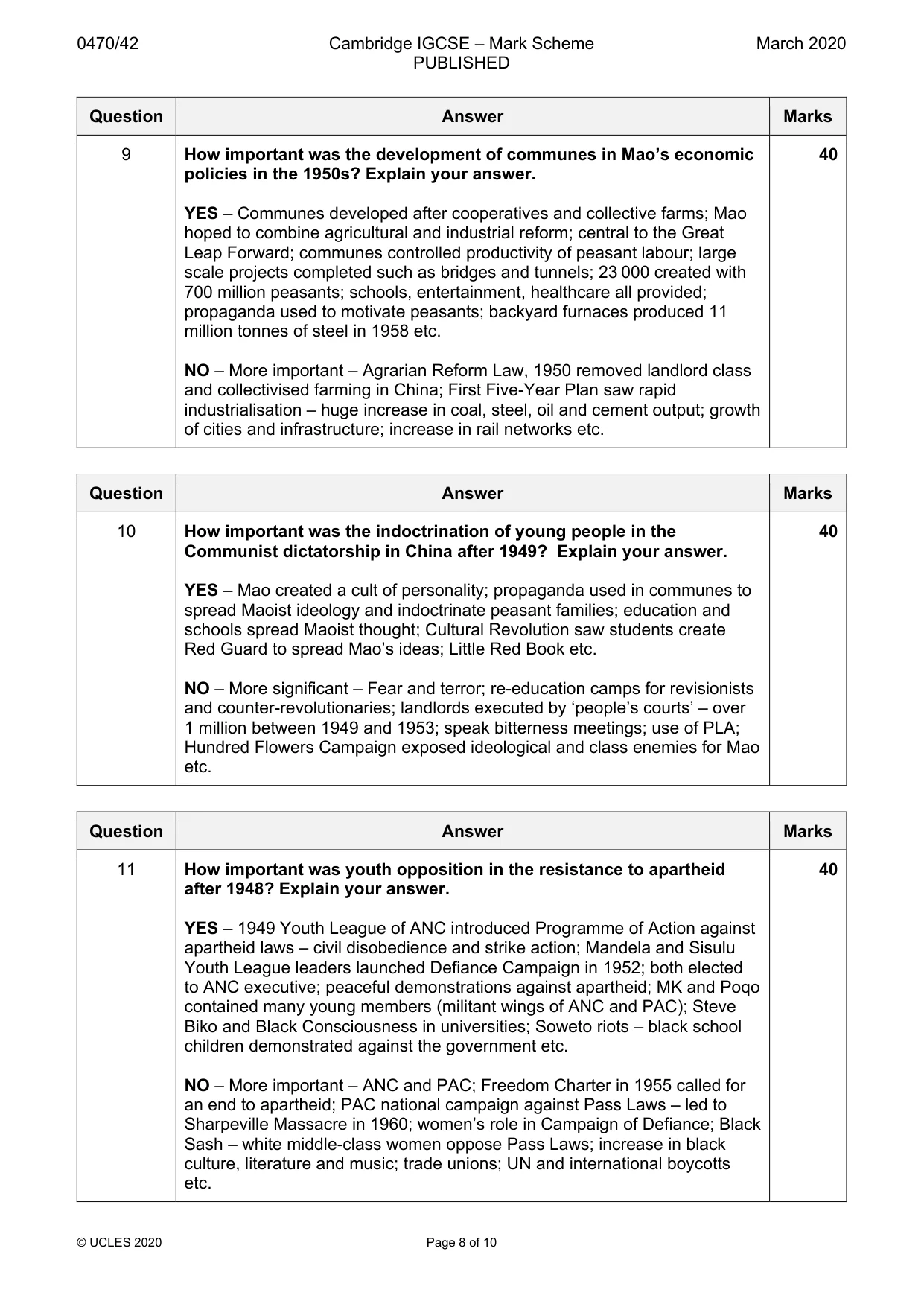
0470/42 Cambridge IGCSE – Mark Scheme PUBLISHED March 2020 © UCLES 2020 Page 8 of 10 Question Answer Marks 9 How important was the development of communes in Mao’s economic policies in the 1950s? Explain your answer. YES – Communes developed after cooperatives and collective farms; Mao hoped to combine agricultural and industrial reform; central to the Great Leap Forward; communes controlled productivity of peasant labour; large scale projects completed such as bridges and tunnels; 23 000 created with 700 million peasants; schools, entertainment, healthcare all provided; propaganda used to motivate peasants; backyard furnaces produced 11 million tonnes of steel in 1958 etc. NO – More important – Agrarian Reform Law, 1950 removed landlord class and collectivised farming in China; First Five-Year Plan saw rapid industrialisation – huge increase in coal, steel, oil and cement output; growth of cities and infrastructure; increase in rail networks etc. 40 Question Answer Marks 10 How important was the indoctrination of young people in the Communist dictatorship in China after 1949? Explain your answer. YES – Mao created a cult of personality; propaganda used in communes to spread Maoist ideology and indoctrinate peasant families; education and schools spread Maoist thought; Cultural Revolution saw students create Red Guard to spread Mao’s ideas; Little Red Book etc. NO – More significant – Fear and terror; re-education camps for revisionists and counter-revolutionaries; landlords executed by ‘people’s courts’ – over 1 million between 1949 and 1953; speak bitterness meetings; use of PLA; Hundred Flowers Campaign exposed ideological and class enemies for Mao etc. 40 Question Answer Marks 11 How important was youth opposition in the resistance to apartheid after 1948? Explain your answer. YES – 1949 Youth League of ANC introduced Programme of Action against apartheid laws – civil disobedience and strike action; Mandela and Sisulu Youth League leaders launched Defiance Campaign in 1952; both elected to ANC executive; peaceful demonstrations against apartheid; MK and Poqo contained many young members (militant wings of ANC and PAC); Steve Biko and Black Consciousness in universities; Soweto riots – black school children demonstrated against the government etc. NO – More important – ANC and PAC; Freedom Charter in 1955 called for an end to apartheid; PAC national campaign against Pass Laws – led to Sharpeville Massacre in 1960; women’s role in Campaign of Defiance; Black Sash – white middle-class women oppose Pass Laws; increase in black culture, literature and music; trade unions; UN and international boycotts etc. 40
Mark scheme, page 9
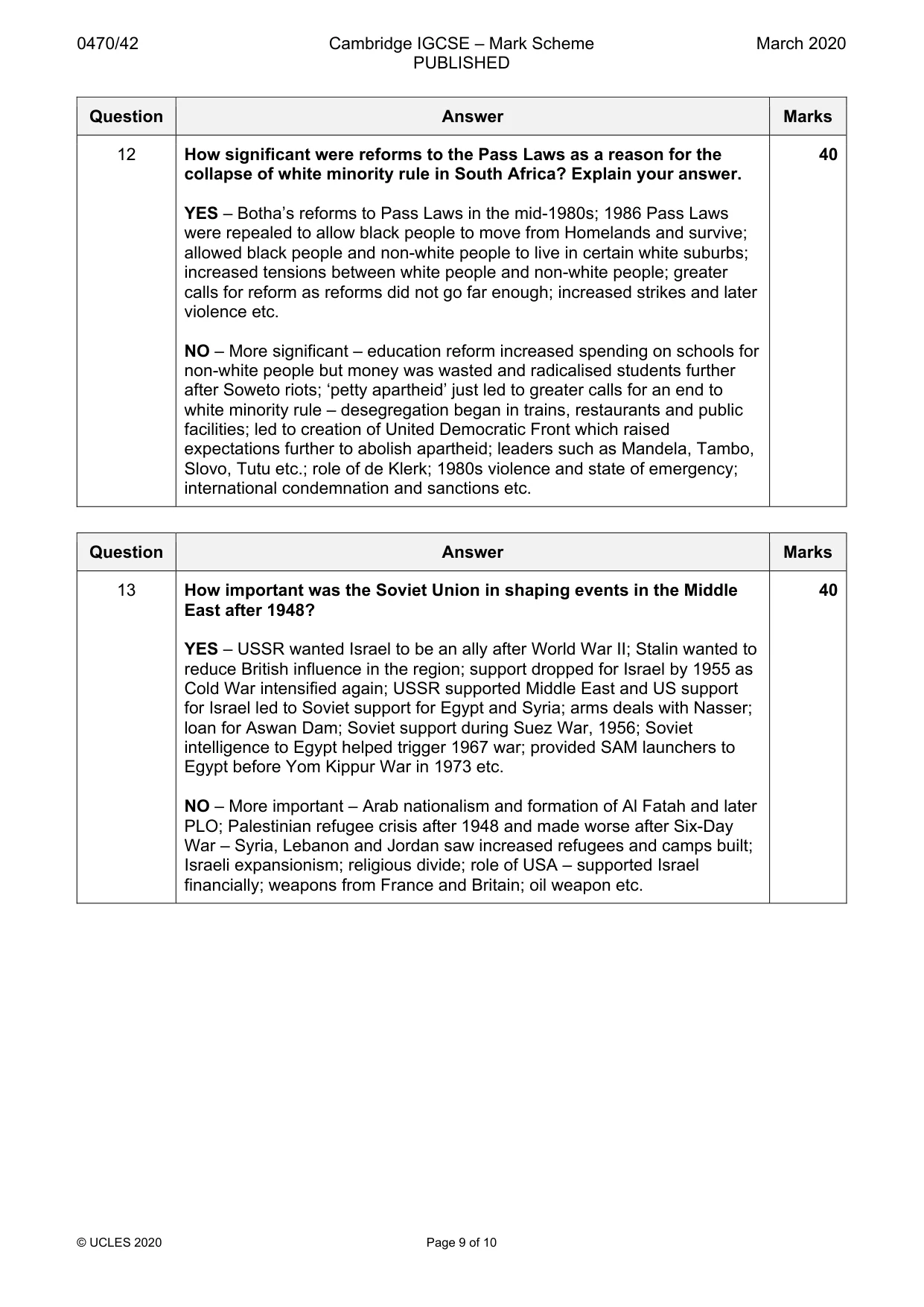
0470/42 Cambridge IGCSE – Mark Scheme PUBLISHED March 2020 © UCLES 2020 Page 9 of 10 Question Answer Marks 12 How significant were reforms to the Pass Laws as a reason for the collapse of white minority rule in South Africa? Explain your answer. YES – Botha’s reforms to Pass Laws in the mid-1980s; 1986 Pass Laws were repealed to allow black people to move from Homelands and survive; allowed black people and non-white people to live in certain white suburbs; increased tensions between white people and non-white people; greater calls for reform as reforms did not go far enough; increased strikes and later violence etc. NO – More significant – education reform increased spending on schools for non-white people but money was wasted and radicalised students further after Soweto riots; ‘petty apartheid’ just led to greater calls for an end to white minority rule – desegregation began in trains, restaurants and public facilities; led to creation of United Democratic Front which raised expectations further to abolish apartheid; leaders such as Mandela, Tambo, Slovo, Tutu etc.; role of de Klerk; 1980s violence and state of emergency; international condemnation and sanctions etc. 40 Question Answer Marks 13 How important was the Soviet Union in shaping events in the Middle East after 1948? YES – USSR wanted Israel to be an ally after World War II; Stalin wanted to reduce British influence in the region; support dropped for Israel by 1955 as Cold War intensified again; USSR supported Middle East and US support for Israel led to Soviet support for Egypt and Syria; arms deals with Nasser; loan for Aswan Dam; Soviet support during Suez War, 1956; Soviet intelligence to Egypt helped trigger 1967 war; provided SAM launchers to Egypt before Yom Kippur War in 1973 etc. NO – More important – Arab nationalism and formation of Al Fatah and later PLO; Palestinian refugee crisis after 1948 and made worse after Six-Day War – Syria, Lebanon and Jordan saw increased refugees and camps built; Israeli expansionism; religious divide; role of USA – supported Israel financially; weapons from France and Britain; oil weapon etc. 40
Mark scheme, page 10
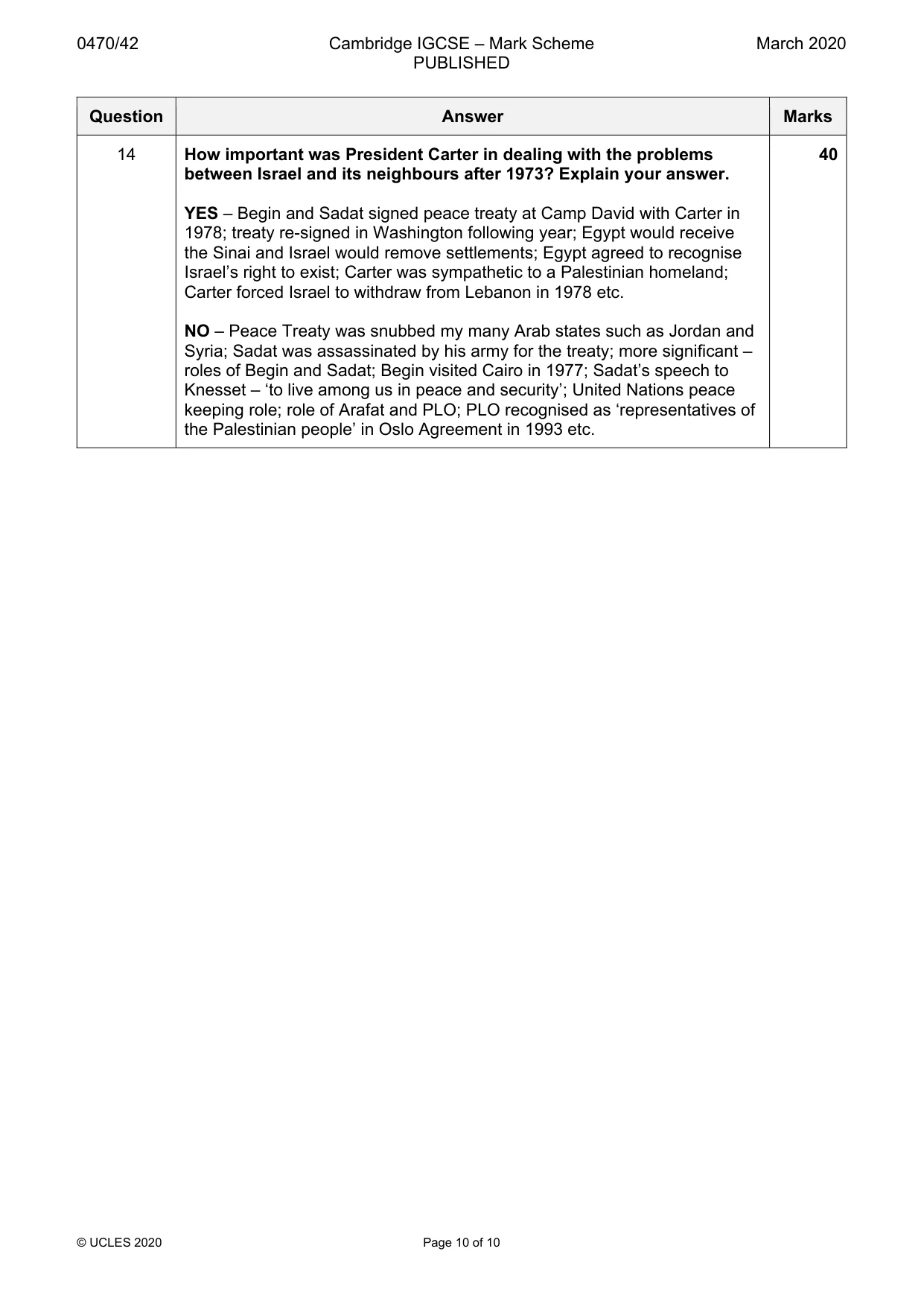
0470/42 Cambridge IGCSE – Mark Scheme PUBLISHED March 2020 © UCLES 2020 Page 10 of 10 Question Answer Marks 14 How important was President Carter in dealing with the problems between Israel and its neighbours after 1973? Explain your answer. YES – Begin and Sadat signed peace treaty at Camp David with Carter in 1978; treaty re-signed in Washington following year; Egypt would receive the Sinai and Israel would remove settlements; Egypt agreed to recognise Israel’s right to exist; Carter was sympathetic to a Palestinian homeland; Carter forced Israel to withdraw from Lebanon in 1978 etc. NO – Peace Treaty was snubbed my many Arab states such as Jordan and Syria; Sadat was assassinated by his army for the treaty; more significant – roles of Begin and Sadat; Begin visited Cairo in 1977; Sadat’s speech to Knesset – ‘to live among us in peace and security’; United Nations peace keeping role; role of Arafat and PLO; PLO recognised as ‘representatives of the Palestinian people’ in Oslo Agreement in 1993 etc. 40
What you needed in this session
Cambridge’s own grade thresholds for 2020 Feb/March, Paper 4 · Variant 2. A higher threshold means an easier paper — the bar moves with how the cohort did.