Cambridge IGCSE History 0470 — 2019 Feb/March Paper 4 · Variant 2
0470/42/F/M/19 · 40 marks · ≈45 min
The question paper and its mark scheme, free to read here and free to download. This is Cambridge’s own paper, exactly as it was sat.
Question paper4 pages

Mark scheme11 pages
Answers below. Sit the paper first if you are practising.
Paper as text
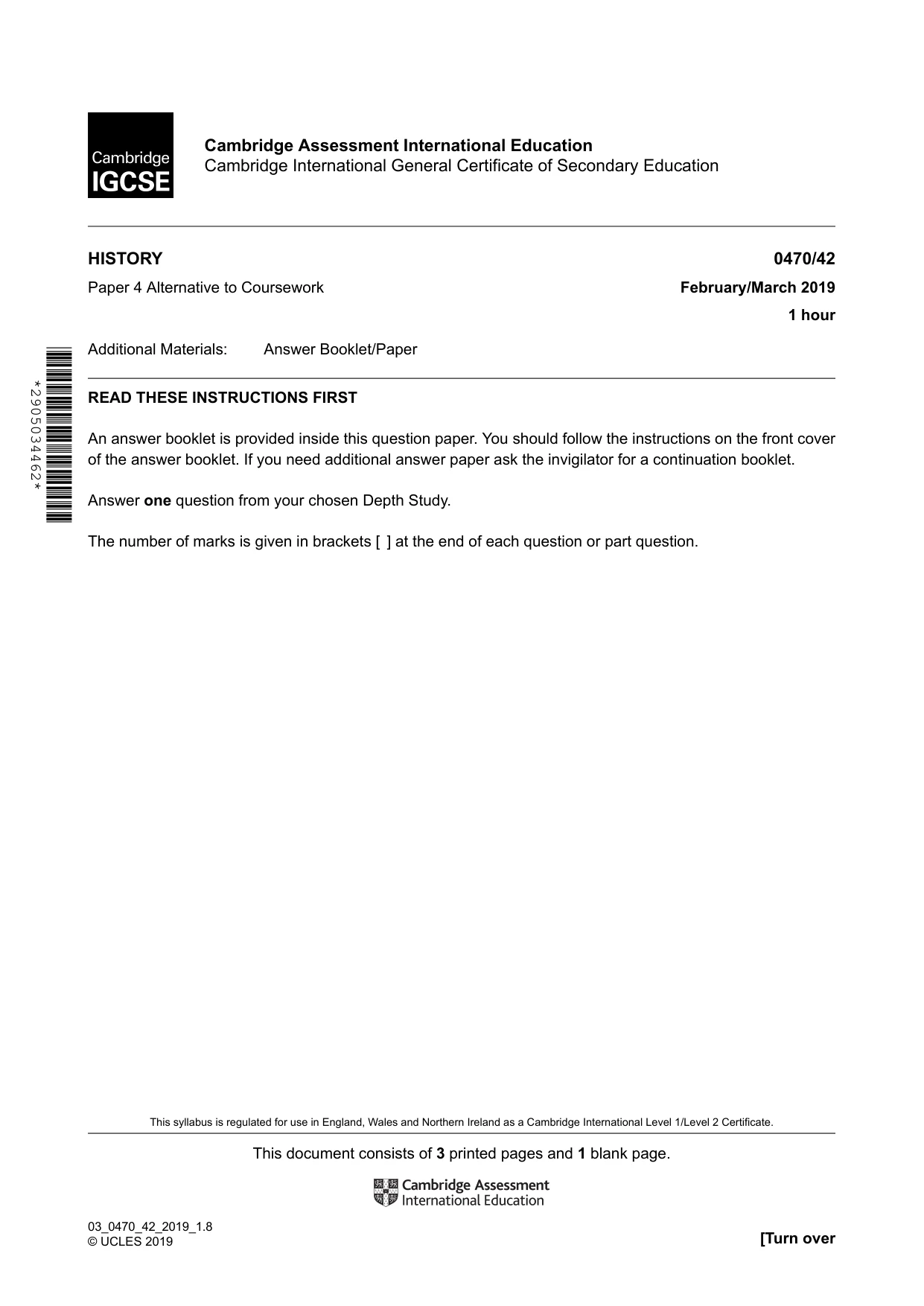
Question paper, page 1
Cambridge Assessment International Education Cambridge International General Certificate of Secondary Education 0470/42 February/March 2019 1 hour HISTORY Paper 4 Alternative to Coursework Additional Materials: Answer Booklet/Paper READ THESE INSTRUCTIONS FIRST An answer booklet is provided inside this question paper. You should follow the instructions on the front cover of the answer booklet. If you need additional answer paper ask the invigilator for a continuation booklet. Answer one question from your chosen Depth Study. The number of marks is given in brackets [ ] at the end of each question or part question. This syllabus is regulated for use in England, Wales and Northern Ireland as a Cambridge International Level 1/Level 2 Certificate. This document consists of 3 printed pages and 1 blank page. [Turn over 03_0470_42_2019_1.8 © UCLES 2019 *2905034462*
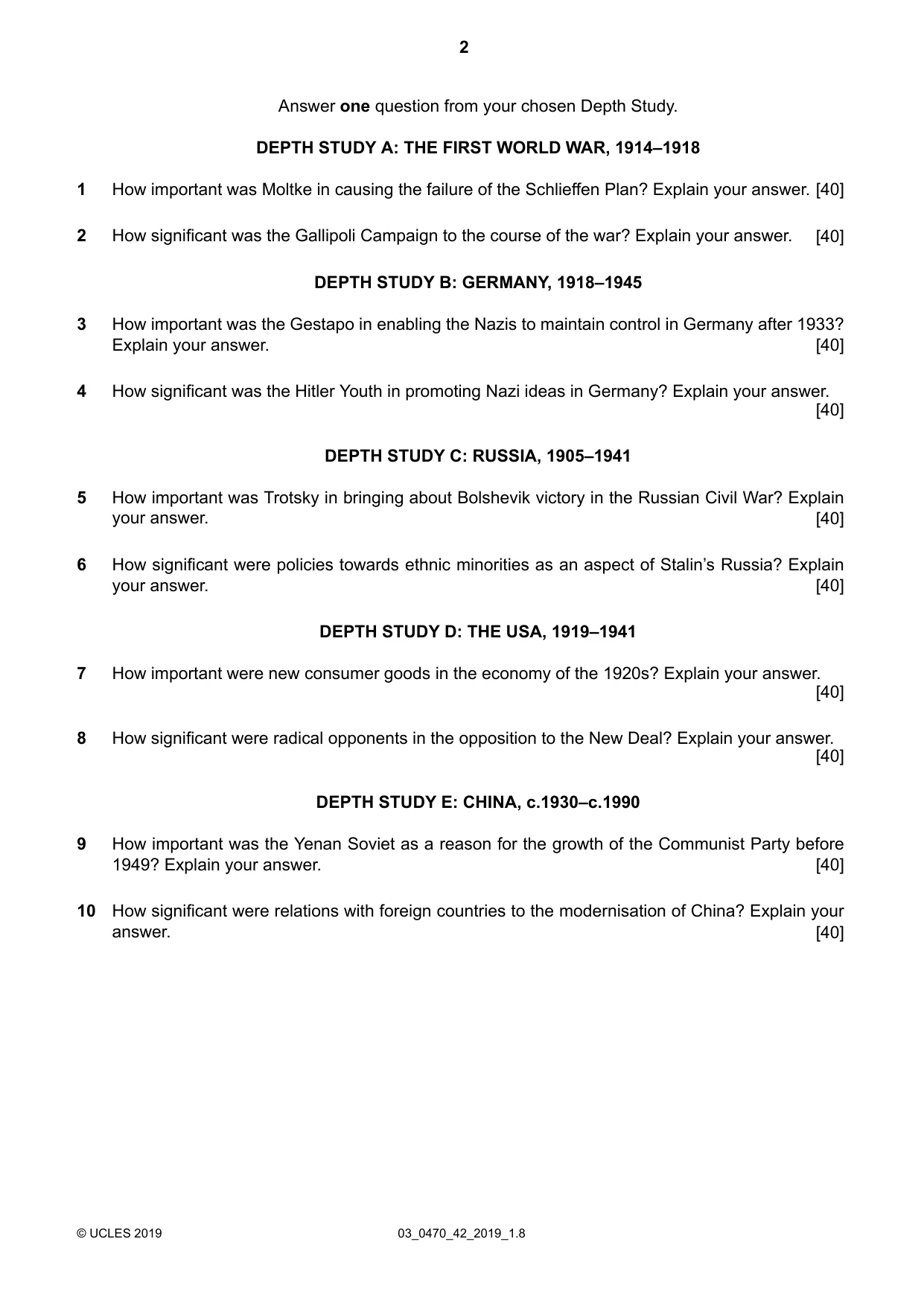
Question paper, page 2
Answer one question from your chosen Depth Study. DEPTH STUDY A: THE FIRST WORLD WAR, 1914–1918 How important was Moltke in causing the failure of the Schlieffen Plan? Explain your answer. [40] 1 How significant was the Gallipoli Campaign to the course of the war? Explain your answer. [40] 2 DEPTH STUDY B: GERMANY, 1918–1945 How important was the Gestapo in enabling the Nazis to maintain control in Germany after 1933? Explain your answer. [40] 3 How significant was the Hitler Youth in promoting Nazi ideas in Germany? Explain your answer. [40] 4 DEPTH STUDY C: RUSSIA, 1905–1941 How important was Trotsky in bringing about Bolshevik victory in the Russian Civil War? Explain your answer. [40] 5 How significant were policies towards ethnic minorities as an aspect of Stalin’s Russia? Explain your answer. [40] 6 DEPTH STUDY D: THE USA, 1919–1941 How important were new consumer goods in the economy of the 1920s? Explain your answer. [40] 7 How significant were radical opponents in the opposition to the New Deal? Explain your answer. [40] 8 DEPTH STUDY E: CHINA, c.1930–c.1990 How important was the Yenan Soviet as a reason for the growth of the Communist Party before 1949? Explain your answer. [40] 9 How significant were relations with foreign countries to the modernisation of China? Explain your answer. [40] 10 03_0470_42_2019_1.8 © UCLES 2019 2
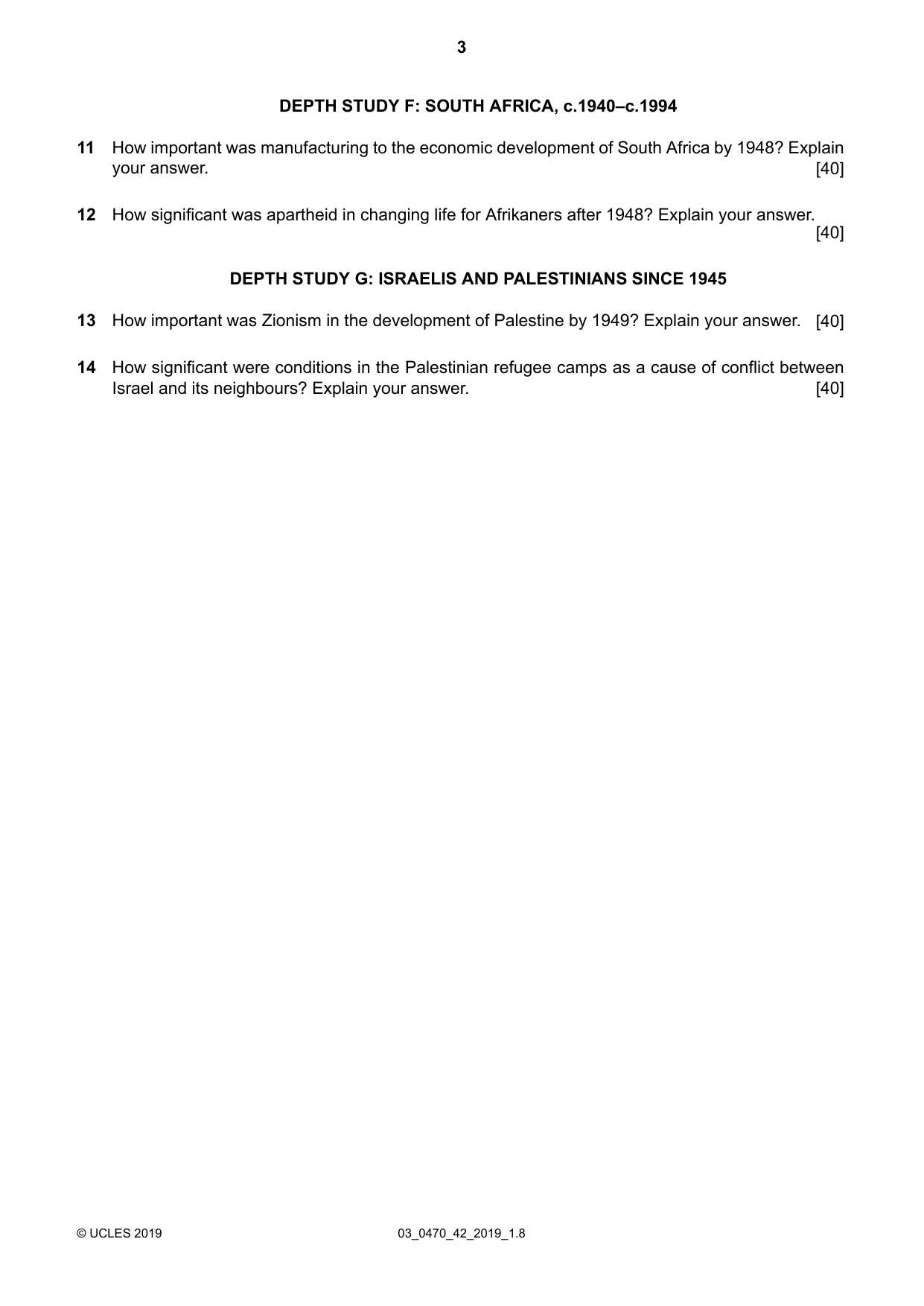
Question paper, page 3
DEPTH STUDY F: SOUTH AFRICA, c.1940–c.1994 How important was manufacturing to the economic development of South Africa by 1948? Explain your answer. [40] 11 How significant was apartheid in changing life for Afrikaners after 1948? Explain your answer. [40] 12 DEPTH STUDY G: ISRAELIS AND PALESTINIANS SINCE 1945 How important was Zionism in the development of Palestine by 1949? Explain your answer. [40] 13 How significant were conditions in the Palestinian refugee camps as a cause of conflict between Israel and its neighbours? Explain your answer. [40] 14 03_0470_42_2019_1.8 © UCLES 2019 3
Question paper, page 4
BLANK PAGE Permission to reproduce items where third-party owned material protected by copyright is included has been sought and cleared where possible. Every reasonable effort has been made by the publisher (UCLES) to trace copyright holders, but if any items requiring clearance have unwittingly been included, the publisher will be pleased to make amends at the earliest possible opportunity. To avoid the issue of disclosure of answer-related information to candidates, all copyright acknowledgements are reproduced online in the Cambridge Assessment International Education Copyright Acknowledgements Booklet. This is produced for each series of examinations and is freely available to download at www.cambridgeinternational.org after the live examination series. Cambridge Assessment International Education is part of the Cambridge Assessment Group. Cambridge Assessment is the brand name of the University of Cambridge Local Examinations Syndicate (UCLES), which itself is a department of the University of Cambridge. 03_0470_42_2019_1.8 © UCLES 2019 4
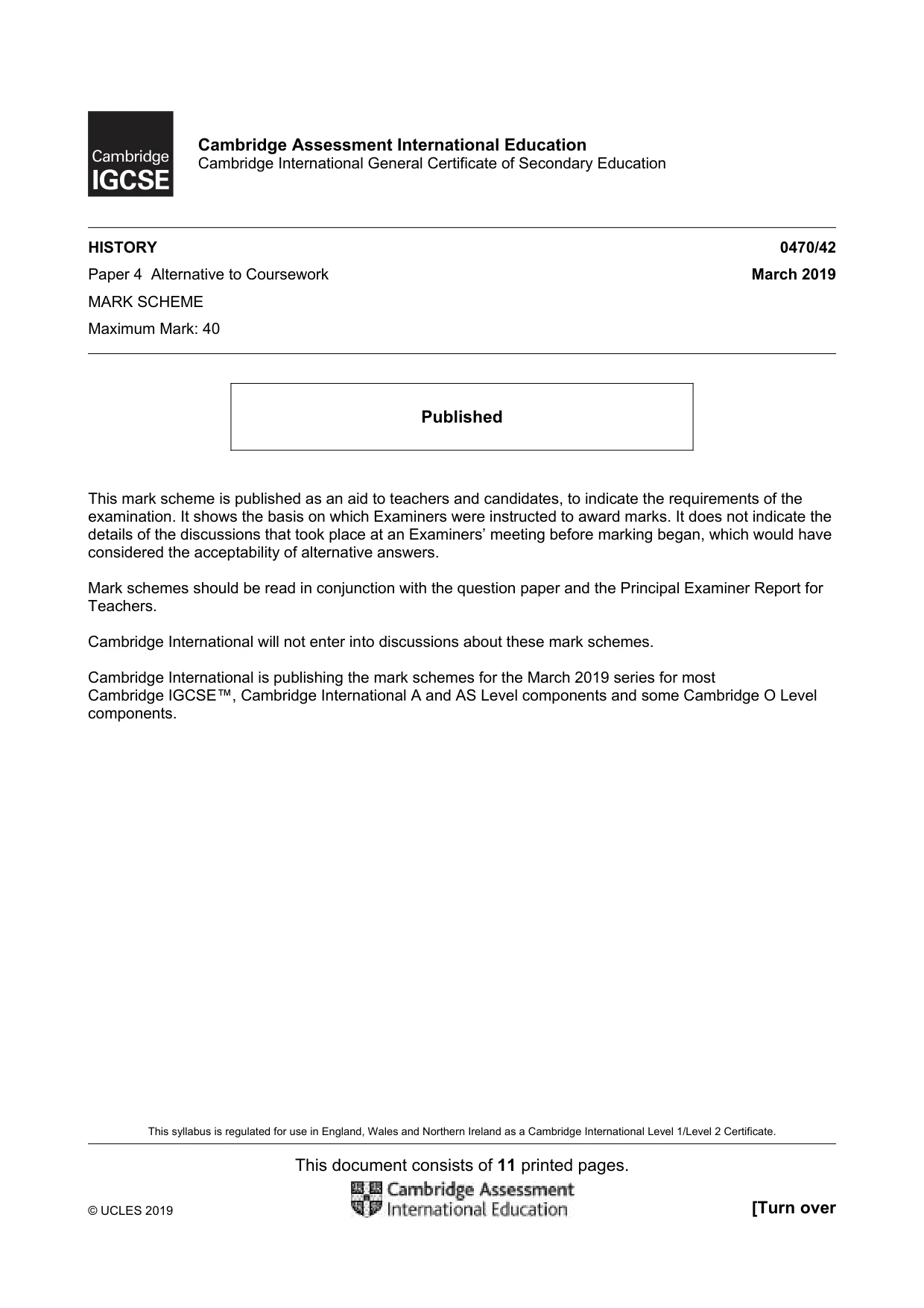
Mark scheme, page 1
This syllabus is regulated for use in England, Wales and Northern Ireland as a Cambridge International Level 1/Level 2 Certificate. This document consists of 11 printed pages. © UCLES 2019 [Turn over Cambridge Assessment International Education Cambridge International General Certificate of Secondary Education HISTORY 0470/42 Paper 4 Alternative to Coursework March 2019 MARK SCHEME Maximum Mark: 40 Published This mark scheme is published as an aid to teachers and candidates, to indicate the requirements of the examination. It shows the basis on which Examiners were instructed to award marks. It does not indicate the details of the discussions that took place at an Examiners’ meeting before marking began, which would have considered the acceptability of alternative answers. Mark schemes should be read in conjunction with the question paper and the Principal Examiner Report for Teachers. Cambridge International will not enter into discussions about these mark schemes. Cambridge International is publishing the mark schemes for the March 2019 series for most Cambridge IGCSE™, Cambridge International A and AS Level components and some Cambridge O Level components.
Mark scheme, page 2
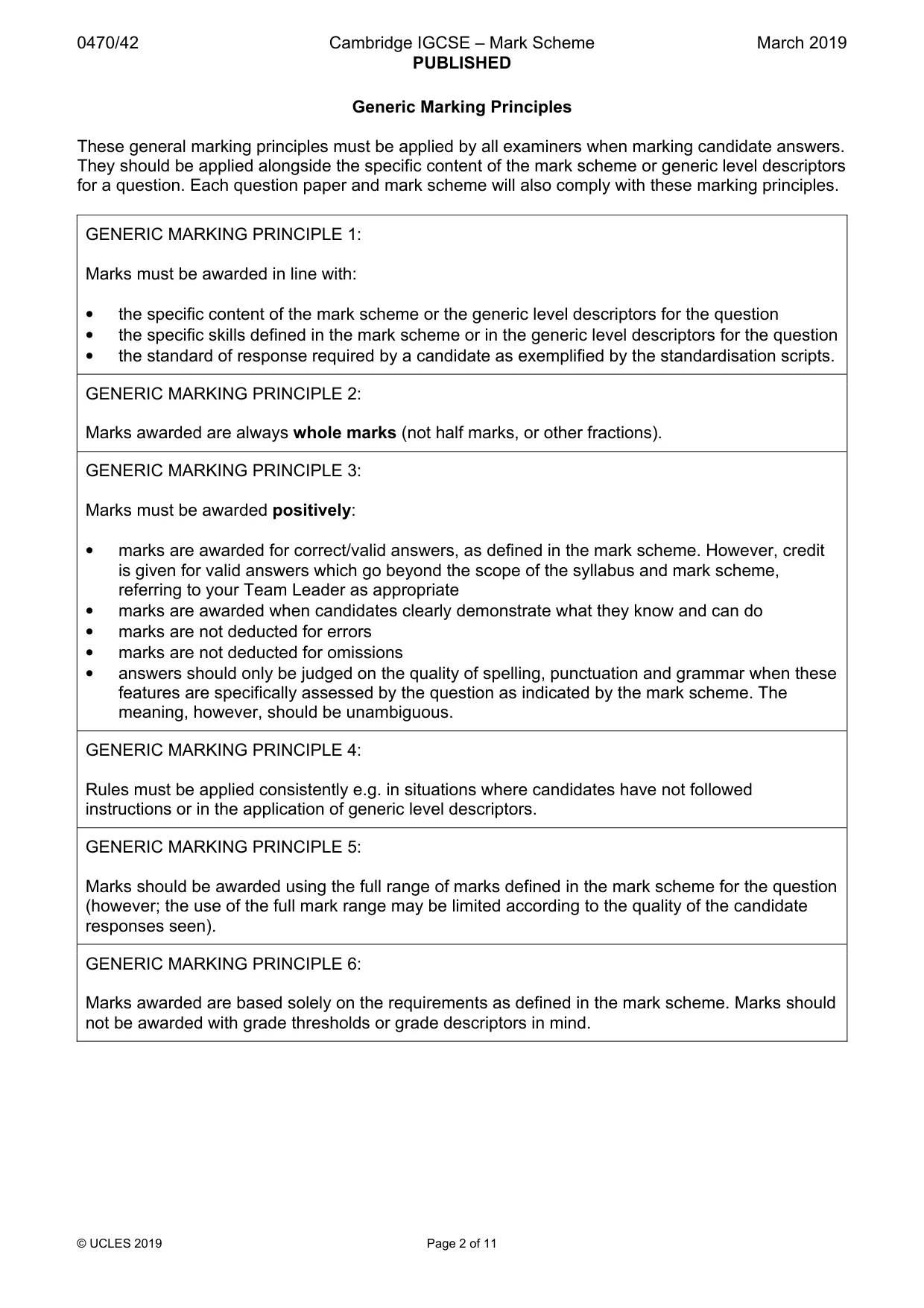
0470/42 Cambridge IGCSE – Mark Scheme PUBLISHED March 2019 © UCLES 2019 Page 2 of 11 Generic Marking Principles These general marking principles must be applied by all examiners when marking candidate answers. They should be applied alongside the specific content of the mark scheme or generic level descriptors for a question. Each question paper and mark scheme will also comply with these marking principles. GENERIC MARKING PRINCIPLE 1: Marks must be awarded in line with: • the specific content of the mark scheme or the generic level descriptors for the question • the specific skills defined in the mark scheme or in the generic level descriptors for the question • the standard of response required by a candidate as exemplified by the standardisation scripts. GENERIC MARKING PRINCIPLE 2: Marks awarded are always whole marks (not half marks, or other fractions). GENERIC MARKING PRINCIPLE 3: Marks must be awarded positively: • marks are awarded for correct/valid answers, as defined in the mark scheme. However, credit is given for valid answers which go beyond the scope of the syllabus and mark scheme, referring to your Team Leader as appropriate • marks are awarded when candidates clearly demonstrate what they know and can do • marks are not deducted for errors • marks are not deducted for omissions • answers should only be judged on the quality of spelling, punctuation and grammar when these features are specifically assessed by the question as indicated by the mark scheme. The meaning, however, should be unambiguous. GENERIC MARKING PRINCIPLE 4: Rules must be applied consistently e.g. in situations where candidates have not followed instructions or in the application of generic level descriptors. GENERIC MARKING PRINCIPLE 5: Marks should be awarded using the full range of marks defined in the mark scheme for the question (however; the use of the full mark range may be limited according to the quality of the candidate responses seen). GENERIC MARKING PRINCIPLE 6: Marks awarded are based solely on the requirements as defined in the mark scheme. Marks should not be awarded with grade thresholds or grade descriptors in mind.
Mark scheme, page 3
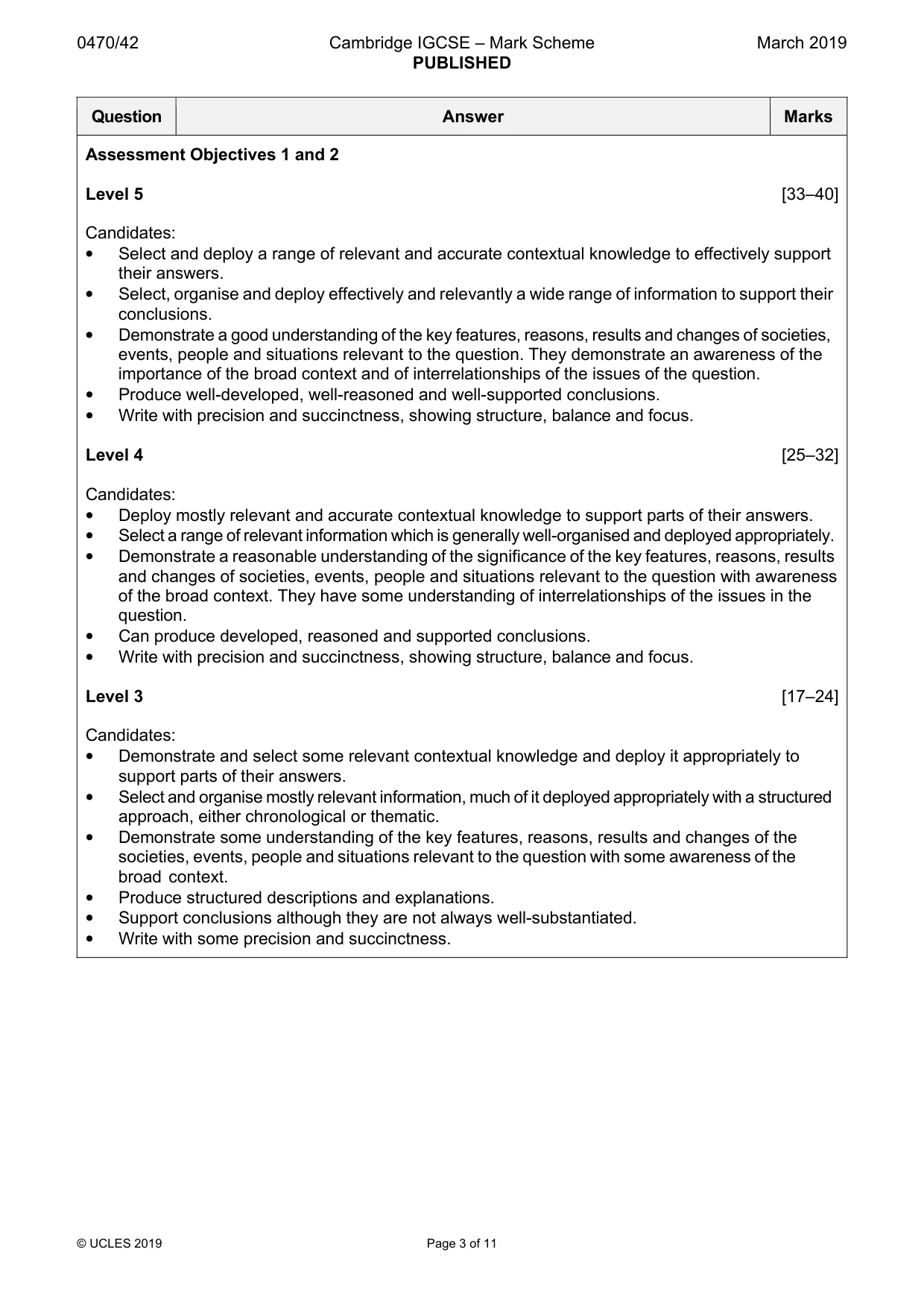
0470/42 Cambridge IGCSE – Mark Scheme PUBLISHED March 2019 © UCLES 2019 Page 3 of 11 Question Answer Marks Assessment Objectives 1 and 2 Level 5 [33–40] Candidates: • Select and deploy a range of relevant and accurate contextual knowledge to effectively support their answers. • Select, organise and deploy effectively and relevantly a wide range of information to support their conclusions. • Demonstrate a good understanding of the key features, reasons, results and changes of societies, events, people and situations relevant to the question. They demonstrate an awareness of the importance of the broad context and of interrelationships of the issues of the question. • Produce well-developed, well-reasoned and well-supported conclusions. • Write with precision and succinctness, showing structure, balance and focus. Level 4 [25–32] Candidates: • Deploy mostly relevant and accurate contextual knowledge to support parts of their answers. • Select a range of relevant information which is generally well-organised and deployed appropriately. • Demonstrate a reasonable understanding of the significance of the key features, reasons, results and changes of societies, events, people and situations relevant to the question with awareness of the broad context. They have some understanding of interrelationships of the issues in the question. • Can produce developed, reasoned and supported conclusions. • Write with precision and succinctness, showing structure, balance and focus. Level 3 [17–24] Candidates: • Demonstrate and select some relevant contextual knowledge and deploy it appropriately to support parts of their answers. • Select and organise mostly relevant information, much of it deployed appropriately with a structured approach, either chronological or thematic. • Demonstrate some understanding of the key features, reasons, results and changes of the societies, events, people and situations relevant to the question with some awareness of the broad context. • Produce structured descriptions and explanations. • Support conclusions although they are not always well-substantiated. • Write with some precision and succinctness.
Mark scheme, page 4
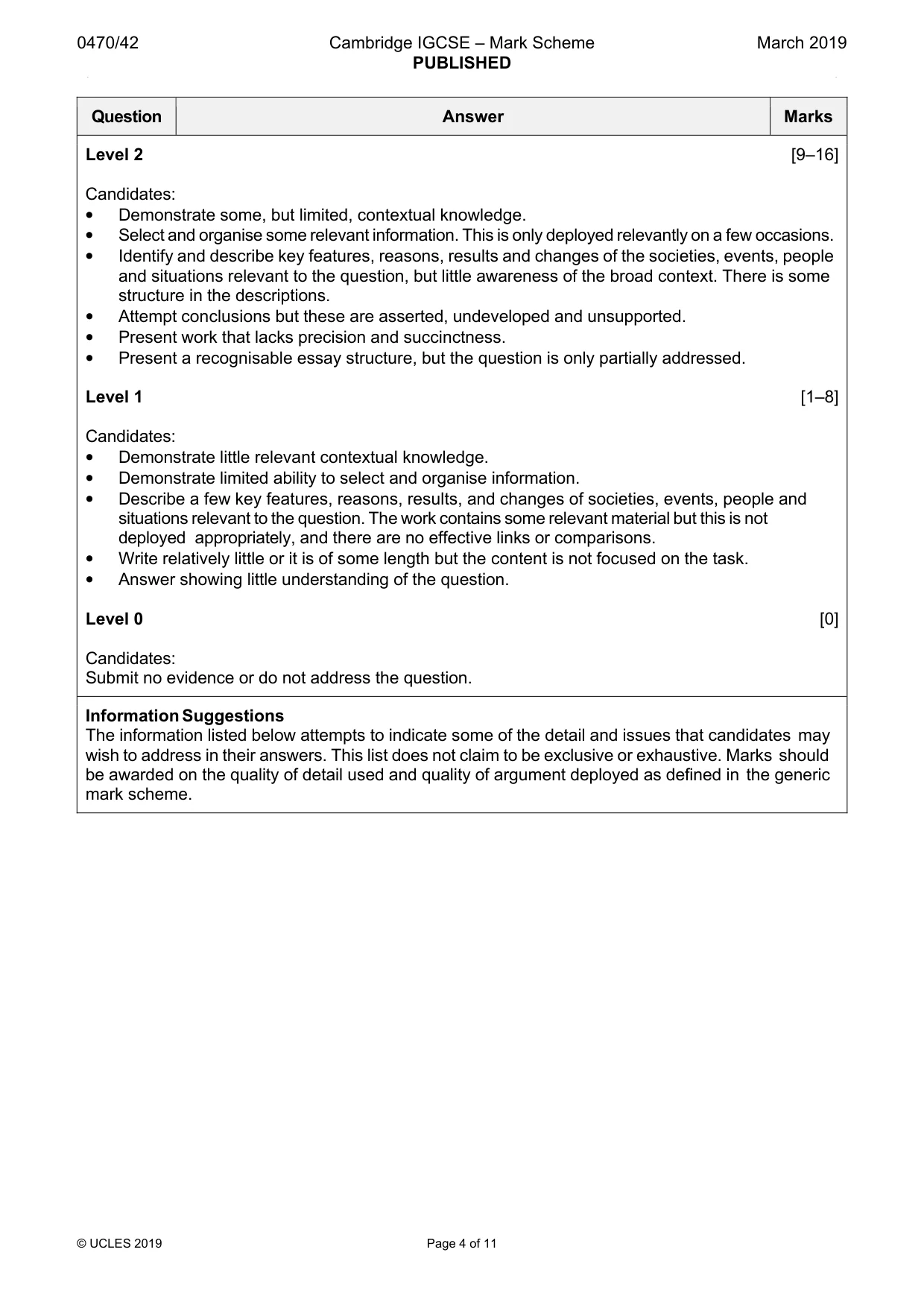
0470/42 Cambridge IGCSE – Mark Scheme PUBLISHED March 2019 © UCLES 2019 Page 4 of 11 Question Answer Marks Level 2 [9–16] Candidates: • Demonstrate some, but limited, contextual knowledge. • Select and organise some relevant information. This is only deployed relevantly on a few occasions. • Identify and describe key features, reasons, results and changes of the societies, events, people and situations relevant to the question, but little awareness of the broad context. There is some structure in the descriptions. • Attempt conclusions but these are asserted, undeveloped and unsupported. • Present work that lacks precision and succinctness. • Present a recognisable essay structure, but the question is only partially addressed. Level 1 [1–8] Candidates: • Demonstrate little relevant contextual knowledge. • Demonstrate limited ability to select and organise information. • Describe a few key features, reasons, results, and changes of societies, events, people and situations relevant to the question. The work contains some relevant material but this is not deployed appropriately, and there are no effective links or comparisons. • Write relatively little or it is of some length but the content is not focused on the task. • Answer showing little understanding of the question. Level 0 [0] Candidates: Submit no evidence or do not address the question. Information Suggestions The information listed below attempts to indicate some of the detail and issues that candidates may wish to address in their answers. This list does not claim to be exclusive or exhaustive. Marks should be awarded on the quality of detail used and quality of argument deployed as defined in the generic mark scheme.
Mark scheme, page 5
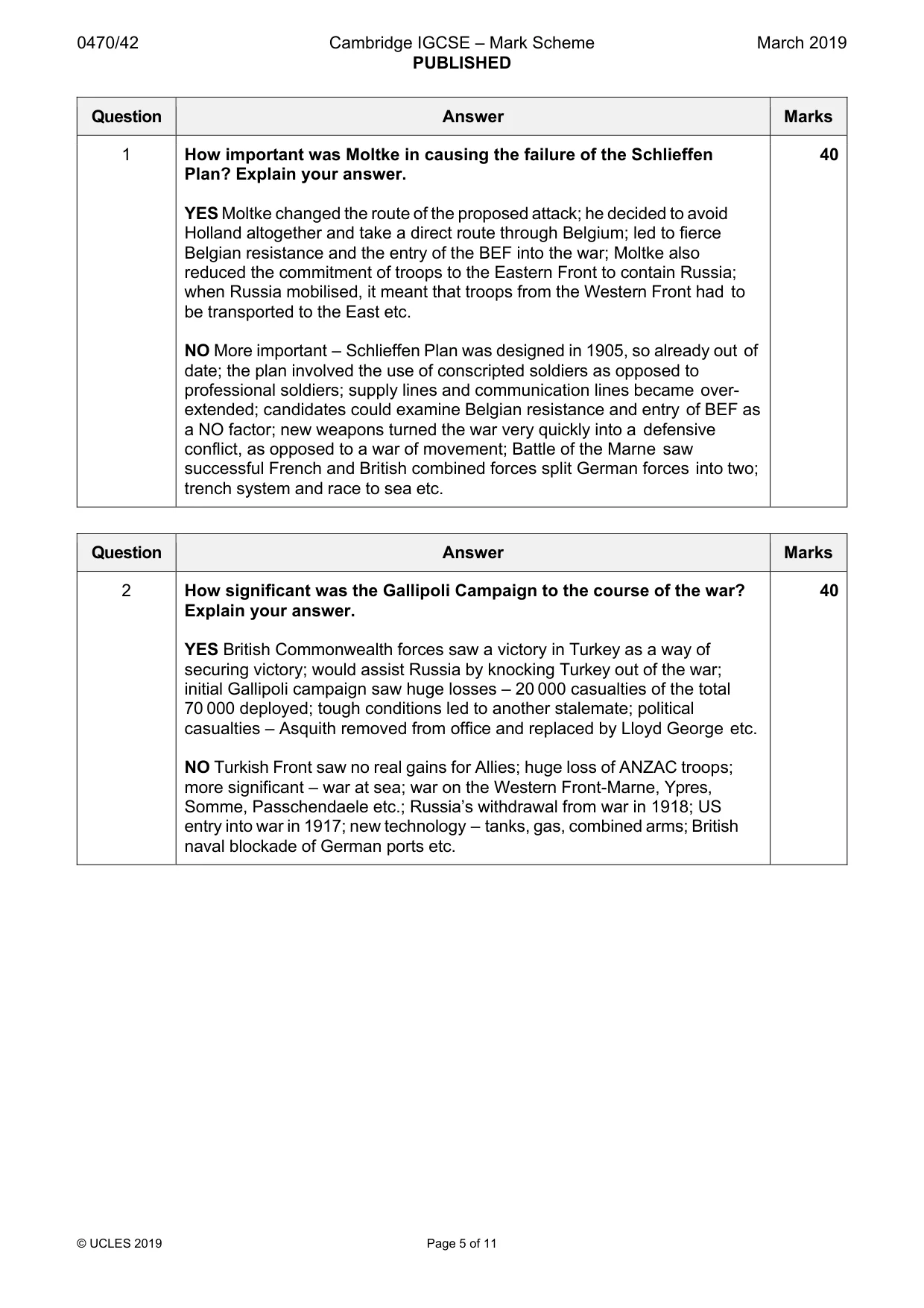
0470/42 Cambridge IGCSE – Mark Scheme PUBLISHED March 2019 © UCLES 2019 Page 5 of 11 Question Answer Marks 1 How important was Moltke in causing the failure of the Schlieffen Plan? Explain your answer. YES Moltke changed the route of the proposed attack; he decided to avoid Holland altogether and take a direct route through Belgium; led to fierce Belgian resistance and the entry of the BEF into the war; Moltke also reduced the commitment of troops to the Eastern Front to contain Russia; when Russia mobilised, it meant that troops from the Western Front had to be transported to the East etc. NO More important – Schlieffen Plan was designed in 1905, so already out of date; the plan involved the use of conscripted soldiers as opposed to professional soldiers; supply lines and communication lines became over- extended; candidates could examine Belgian resistance and entry of BEF as a NO factor; new weapons turned the war very quickly into a defensive conflict, as opposed to a war of movement; Battle of the Marne saw successful French and British combined forces split German forces into two; trench system and race to sea etc. 40 Question Answer Marks 2 How significant was the Gallipoli Campaign to the course of the war? Explain your answer. YES British Commonwealth forces saw a victory in Turkey as a way of securing victory; would assist Russia by knocking Turkey out of the war; initial Gallipoli campaign saw huge losses – 20 000 casualties of the total 70 000 deployed; tough conditions led to another stalemate; political casualties – Asquith removed from office and replaced by Lloyd George etc. NO Turkish Front saw no real gains for Allies; huge loss of ANZAC troops; more significant – war at sea; war on the Western Front-Marne, Ypres, Somme, Passchendaele etc.; Russia’s withdrawal from war in 1918; US entry into war in 1917; new technology – tanks, gas, combined arms; British naval blockade of German ports etc. 40
Mark scheme, page 6
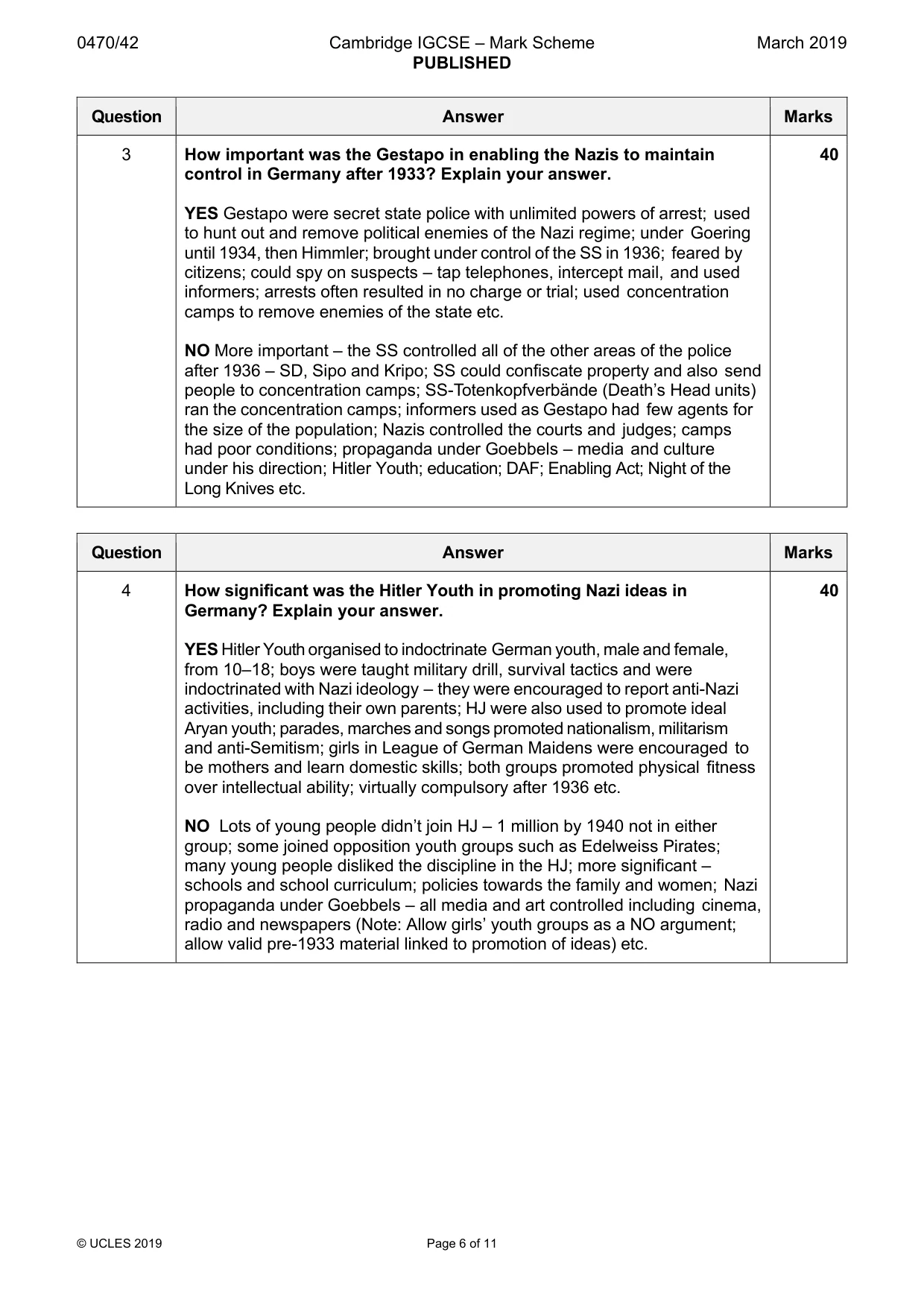
0470/42 Cambridge IGCSE – Mark Scheme PUBLISHED March 2019 © UCLES 2019 Page 6 of 11 Question Answer Marks 3 How important was the Gestapo in enabling the Nazis to maintain control in Germany after 1933? Explain your answer. YES Gestapo were secret state police with unlimited powers of arrest; used to hunt out and remove political enemies of the Nazi regime; under Goering until 1934, then Himmler; brought under control of the SS in 1936; feared by citizens; could spy on suspects – tap telephones, intercept mail, and used informers; arrests often resulted in no charge or trial; used concentration camps to remove enemies of the state etc. NO More important – the SS controlled all of the other areas of the police after 1936 – SD, Sipo and Kripo; SS could confiscate property and also send people to concentration camps; SS-Totenkopfverbände (Death’s Head units) ran the concentration camps; informers used as Gestapo had few agents for the size of the population; Nazis controlled the courts and judges; camps had poor conditions; propaganda under Goebbels – media and culture under his direction; Hitler Youth; education; DAF; Enabling Act; Night of the Long Knives etc. 40 Question Answer Marks 4 How significant was the Hitler Youth in promoting Nazi ideas in Germany? Explain your answer. YES Hitler Youth organised to indoctrinate German youth, male and female, from 10–18; boys were taught military drill, survival tactics and were indoctrinated with Nazi ideology – they were encouraged to report anti-Nazi activities, including their own parents; HJ were also used to promote ideal Aryan youth; parades, marches and songs promoted nationalism, militarism and anti-Semitism; girls in League of German Maidens were encouraged to be mothers and learn domestic skills; both groups promoted physical fitness over intellectual ability; virtually compulsory after 1936 etc. NO Lots of young people didn’t join HJ – 1 million by 1940 not in either group; some joined opposition youth groups such as Edelweiss Pirates; many young people disliked the discipline in the HJ; more significant – schools and school curriculum; policies towards the family and women; Nazi propaganda under Goebbels – all media and art controlled including cinema, radio and newspapers (Note: Allow girls’ youth groups as a NO argument; allow valid pre-1933 material linked to promotion of ideas) etc. 40
Mark scheme, page 7
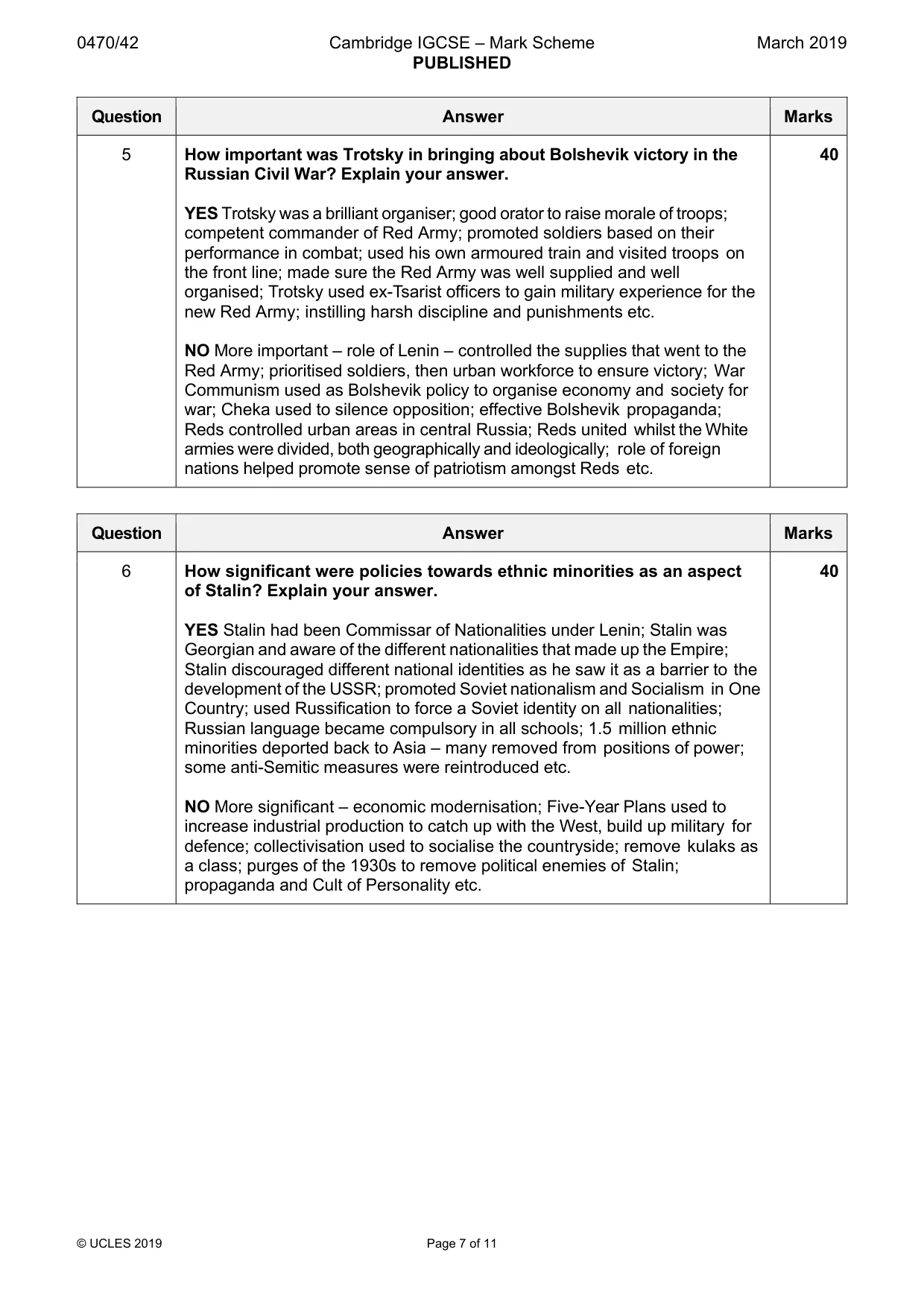
0470/42 Cambridge IGCSE – Mark Scheme PUBLISHED March 2019 © UCLES 2019 Page 7 of 11 Question Answer Marks 5 How important was Trotsky in bringing about Bolshevik victory in the Russian Civil War? Explain your answer. YES Trotsky was a brilliant organiser; good orator to raise morale of troops; competent commander of Red Army; promoted soldiers based on their performance in combat; used his own armoured train and visited troops on the front line; made sure the Red Army was well supplied and well organised; Trotsky used ex-Tsarist officers to gain military experience for the new Red Army; instilling harsh discipline and punishments etc. NO More important – role of Lenin – controlled the supplies that went to the Red Army; prioritised soldiers, then urban workforce to ensure victory; War Communism used as Bolshevik policy to organise economy and society for war; Cheka used to silence opposition; effective Bolshevik propaganda; Reds controlled urban areas in central Russia; Reds united whilst the White armies were divided, both geographically and ideologically; role of foreign nations helped promote sense of patriotism amongst Reds etc. 40 Question Answer Marks 6 How significant were policies towards ethnic minorities as an aspect of Stalin? Explain your answer. YES Stalin had been Commissar of Nationalities under Lenin; Stalin was Georgian and aware of the different nationalities that made up the Empire; Stalin discouraged different national identities as he saw it as a barrier to the development of the USSR; promoted Soviet nationalism and Socialism in One Country; used Russification to force a Soviet identity on all nationalities; Russian language became compulsory in all schools; 1.5 million ethnic minorities deported back to Asia – many removed from positions of power; some anti-Semitic measures were reintroduced etc. NO More significant – economic modernisation; Five-Year Plans used to increase industrial production to catch up with the West, build up military for defence; collectivisation used to socialise the countryside; remove kulaks as a class; purges of the 1930s to remove political enemies of Stalin; propaganda and Cult of Personality etc. 40
Mark scheme, page 8
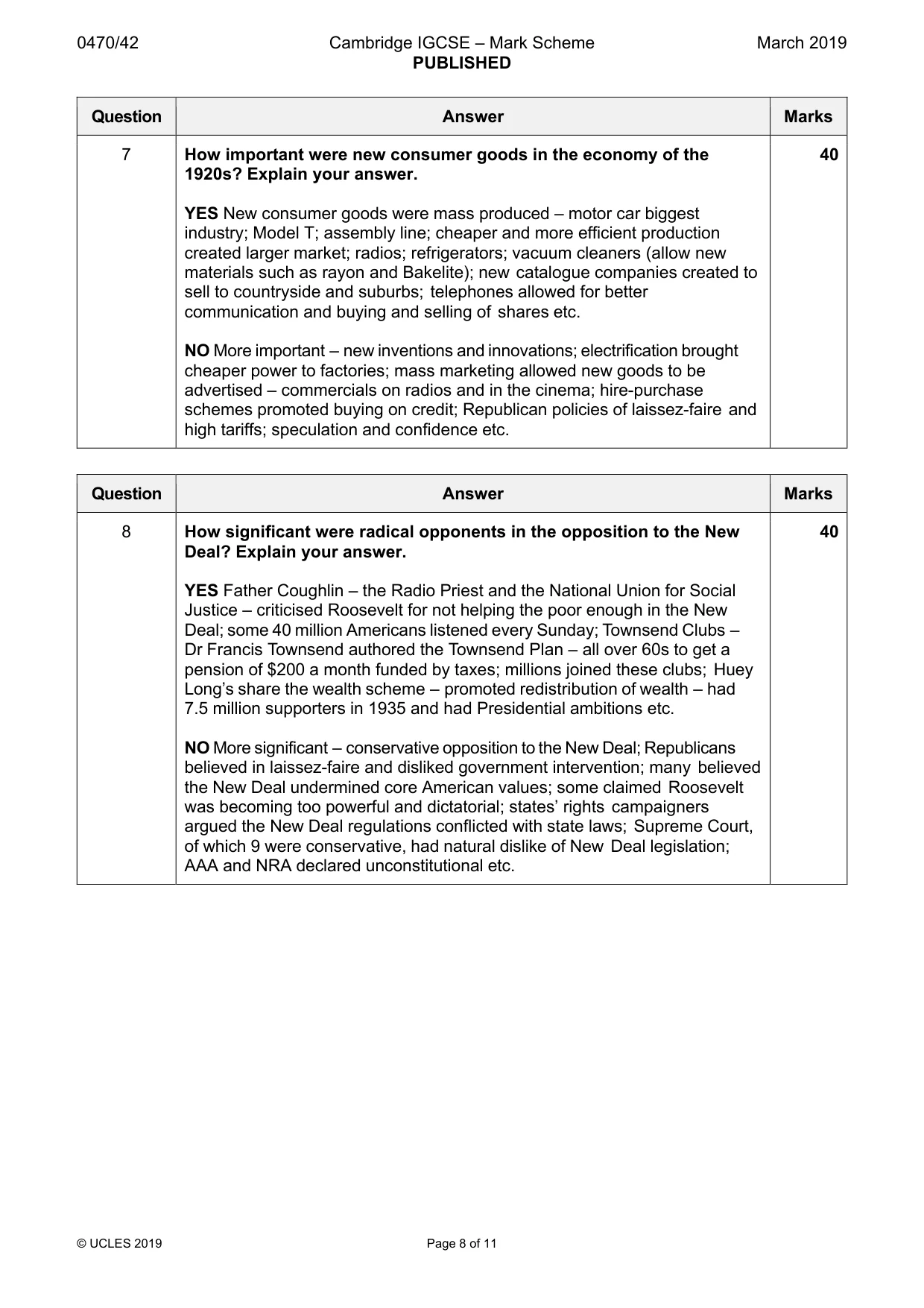
0470/42 Cambridge IGCSE – Mark Scheme PUBLISHED March 2019 © UCLES 2019 Page 8 of 11 Question Answer Marks 7 How important were new consumer goods in the economy of the 1920s? Explain your answer. YES New consumer goods were mass produced – motor car biggest industry; Model T; assembly line; cheaper and more efficient production created larger market; radios; refrigerators; vacuum cleaners (allow new materials such as rayon and Bakelite); new catalogue companies created to sell to countryside and suburbs; telephones allowed for better communication and buying and selling of shares etc. NO More important – new inventions and innovations; electrification brought cheaper power to factories; mass marketing allowed new goods to be advertised – commercials on radios and in the cinema; hire-purchase schemes promoted buying on credit; Republican policies of laissez-faire and high tariffs; speculation and confidence etc. 40 Question Answer Marks 8 How significant were radical opponents in the opposition to the New Deal? Explain your answer. YES Father Coughlin – the Radio Priest and the National Union for Social Justice – criticised Roosevelt for not helping the poor enough in the New Deal; some 40 million Americans listened every Sunday; Townsend Clubs – Dr Francis Townsend authored the Townsend Plan – all over 60s to get a pension of $200 a month funded by taxes; millions joined these clubs; Huey Long’s share the wealth scheme – promoted redistribution of wealth – had 7.5 million supporters in 1935 and had Presidential ambitions etc. NO More significant – conservative opposition to the New Deal; Republicans believed in laissez-faire and disliked government intervention; many believed the New Deal undermined core American values; some claimed Roosevelt was becoming too powerful and dictatorial; states’ rights campaigners argued the New Deal regulations conflicted with state laws; Supreme Court, of which 9 were conservative, had natural dislike of New Deal legislation; AAA and NRA declared unconstitutional etc. 40
Mark scheme, page 9
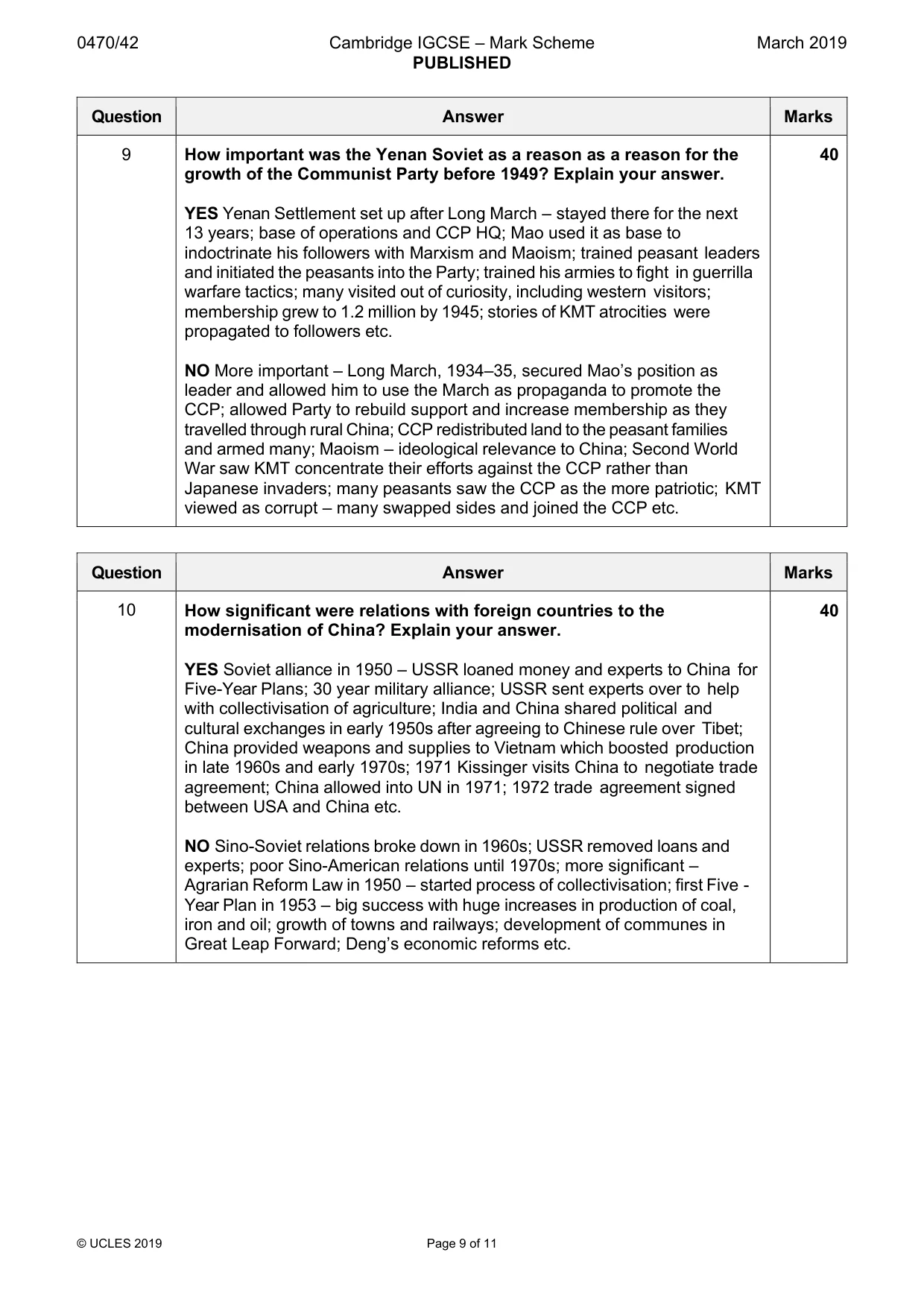
0470/42 Cambridge IGCSE – Mark Scheme PUBLISHED March 2019 © UCLES 2019 Page 9 of 11 Question Answer Marks 9 How important was the Yenan Soviet as a reason as a reason for the growth of the Communist Party before 1949? Explain your answer. YES Yenan Settlement set up after Long March – stayed there for the next 13 years; base of operations and CCP HQ; Mao used it as base to indoctrinate his followers with Marxism and Maoism; trained peasant leaders and initiated the peasants into the Party; trained his armies to fight in guerrilla warfare tactics; many visited out of curiosity, including western visitors; membership grew to 1.2 million by 1945; stories of KMT atrocities were propagated to followers etc. NO More important – Long March, 1934–35, secured Mao’s position as leader and allowed him to use the March as propaganda to promote the CCP; allowed Party to rebuild support and increase membership as they travelled through rural China; CCP redistributed land to the peasant families and armed many; Maoism – ideological relevance to China; Second World War saw KMT concentrate their efforts against the CCP rather than Japanese invaders; many peasants saw the CCP as the more patriotic; KMT viewed as corrupt – many swapped sides and joined the CCP etc. 40 Question Answer Marks 10 How significant were relations with foreign countries to the modernisation of China? Explain your answer. YES Soviet alliance in 1950 – USSR loaned money and experts to China for Five-Year Plans; 30 year military alliance; USSR sent experts over to help with collectivisation of agriculture; India and China shared political and cultural exchanges in early 1950s after agreeing to Chinese rule over Tibet; China provided weapons and supplies to Vietnam which boosted production in late 1960s and early 1970s; 1971 Kissinger visits China to negotiate trade agreement; China allowed into UN in 1971; 1972 trade agreement signed between USA and China etc. NO Sino-Soviet relations broke down in 1960s; USSR removed loans and experts; poor Sino-American relations until 1970s; more significant – Agrarian Reform Law in 1950 – started process of collectivisation; first Five - Year Plan in 1953 – big success with huge increases in production of coal, iron and oil; growth of towns and railways; development of communes in Great Leap Forward; Deng’s economic reforms etc. 40
Mark scheme, page 10
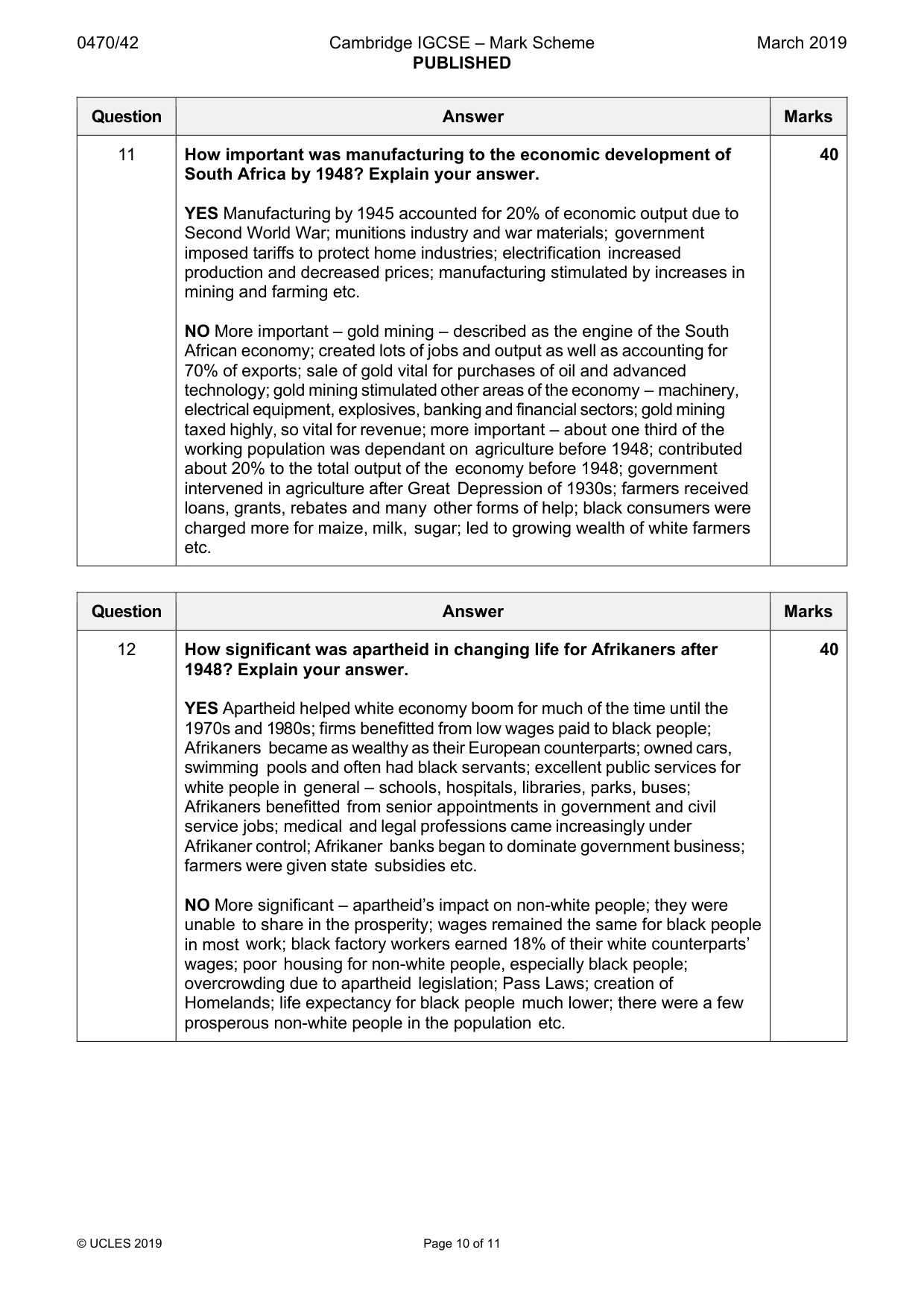
0470/42 Cambridge IGCSE – Mark Scheme PUBLISHED March 2019 © UCLES 2019 Page 10 of 11 Question Answer Marks 11 How important was manufacturing to the economic development of South Africa by 1948? Explain your answer. YES Manufacturing by 1945 accounted for 20% of economic output due to Second World War; munitions industry and war materials; government imposed tariffs to protect home industries; electrification increased production and decreased prices; manufacturing stimulated by increases in mining and farming etc. NO More important – gold mining – described as the engine of the South African economy; created lots of jobs and output as well as accounting for 70% of exports; sale of gold vital for purchases of oil and advanced technology; gold mining stimulated other areas of the economy – machinery, electrical equipment, explosives, banking and financial sectors; gold mining taxed highly, so vital for revenue; more important – about one third of the working population was dependant on agriculture before 1948; contributed about 20% to the total output of the economy before 1948; government intervened in agriculture after Great Depression of 1930s; farmers received loans, grants, rebates and many other forms of help; black consumers were charged more for maize, milk, sugar; led to growing wealth of white farmers etc. 40 Question Answer Marks 12 How significant was apartheid in changing life for Afrikaners after 1948? Explain your answer. YES Apartheid helped white economy boom for much of the time until the 1970s and 1980s; firms benefitted from low wages paid to black people; Afrikaners became as wealthy as their European counterparts; owned cars, swimming pools and often had black servants; excellent public services for white people in general – schools, hospitals, libraries, parks, buses; Afrikaners benefitted from senior appointments in government and civil service jobs; medical and legal professions came increasingly under Afrikaner control; Afrikaner banks began to dominate government business; farmers were given state subsidies etc. NO More significant – apartheid’s impact on non-white people; they were unable to share in the prosperity; wages remained the same for black people in most work; black factory workers earned 18% of their white counterparts’ wages; poor housing for non-white people, especially black people; overcrowding due to apartheid legislation; Pass Laws; creation of Homelands; life expectancy for black people much lower; there were a few prosperous non-white people in the population etc. 40
Mark scheme, page 11
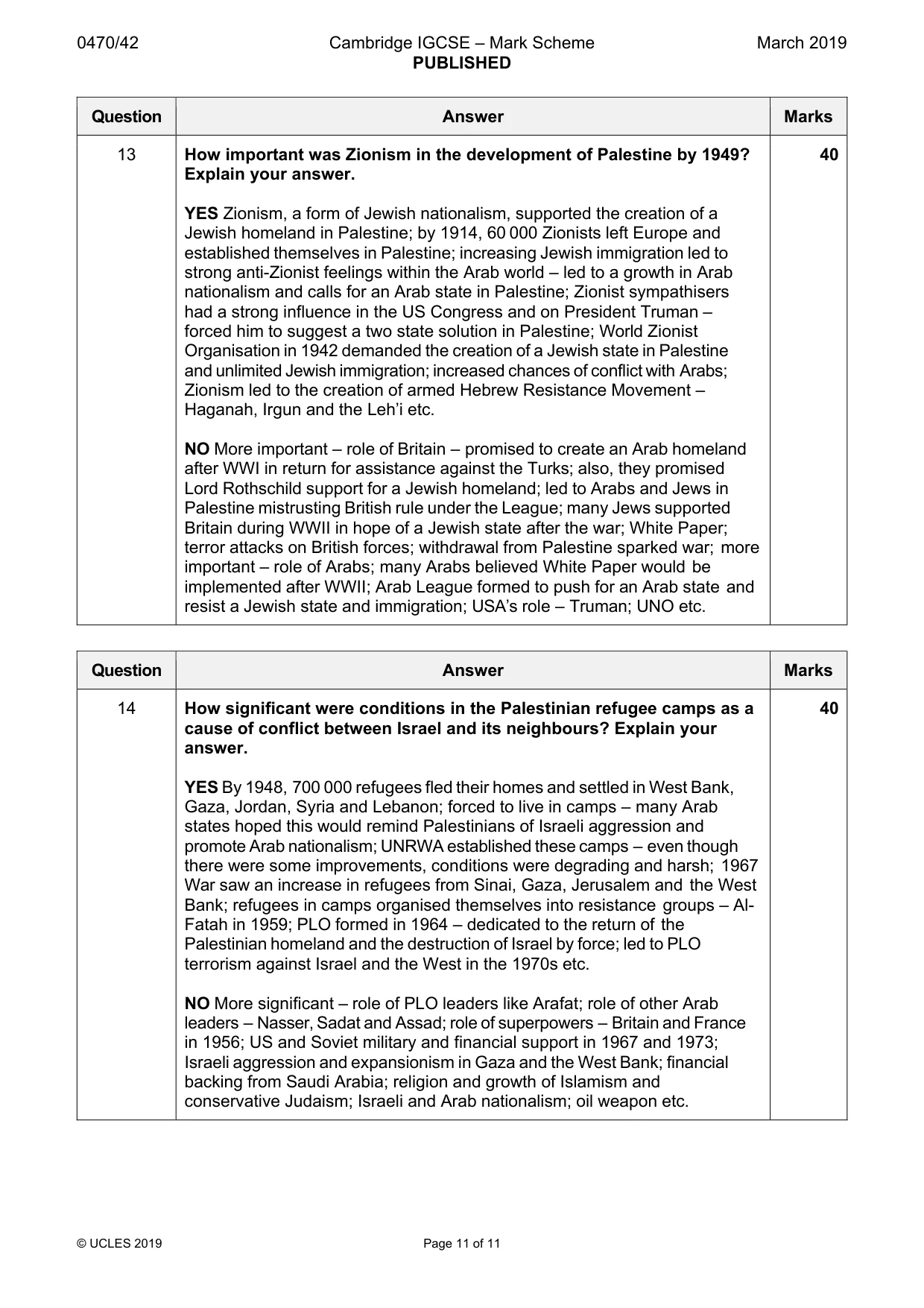
0470/42 Cambridge IGCSE – Mark Scheme PUBLISHED March 2019 © UCLES 2019 Page 11 of 11 Question Answer Marks 13 How important was Zionism in the development of Palestine by 1949? Explain your answer. YES Zionism, a form of Jewish nationalism, supported the creation of a Jewish homeland in Palestine; by 1914, 60 000 Zionists left Europe and established themselves in Palestine; increasing Jewish immigration led to strong anti-Zionist feelings within the Arab world – led to a growth in Arab nationalism and calls for an Arab state in Palestine; Zionist sympathisers had a strong influence in the US Congress and on President Truman – forced him to suggest a two state solution in Palestine; World Zionist Organisation in 1942 demanded the creation of a Jewish state in Palestine and unlimited Jewish immigration; increased chances of conflict with Arabs; Zionism led to the creation of armed Hebrew Resistance Movement – Haganah, Irgun and the Leh’i etc. NO More important – role of Britain – promised to create an Arab homeland after WWI in return for assistance against the Turks; also, they promised Lord Rothschild support for a Jewish homeland; led to Arabs and Jews in Palestine mistrusting British rule under the League; many Jews supported Britain during WWII in hope of a Jewish state after the war; White Paper; terror attacks on British forces; withdrawal from Palestine sparked war; more important – role of Arabs; many Arabs believed White Paper would be implemented after WWII; Arab League formed to push for an Arab state and resist a Jewish state and immigration; USA’s role – Truman; UNO etc. 40 Question Answer Marks 14 How significant were conditions in the Palestinian refugee camps as a cause of conflict between Israel and its neighbours? Explain your answer. YES By 1948, 700 000 refugees fled their homes and settled in West Bank, Gaza, Jordan, Syria and Lebanon; forced to live in camps – many Arab states hoped this would remind Palestinians of Israeli aggression and promote Arab nationalism; UNRWA established these camps – even though there were some improvements, conditions were degrading and harsh; 1967 War saw an increase in refugees from Sinai, Gaza, Jerusalem and the West Bank; refugees in camps organised themselves into resistance groups – Al- Fatah in 1959; PLO formed in 1964 – dedicated to the return of the Palestinian homeland and the destruction of Israel by force; led to PLO terrorism against Israel and the West in the 1970s etc. NO More significant – role of PLO leaders like Arafat; role of other Arab leaders – Nasser, Sadat and Assad; role of superpowers – Britain and France in 1956; US and Soviet military and financial support in 1967 and 1973; Israeli aggression and expansionism in Gaza and the West Bank; financial backing from Saudi Arabia; religion and growth of Islamism and conservative Judaism; Israeli and Arab nationalism; oil weapon etc. 40
What you needed in this session
Cambridge’s own grade thresholds for 2019 Feb/March, Paper 4 · Variant 2. A higher threshold means an easier paper — the bar moves with how the cohort did.