Cambridge IGCSE History 0470 — 2017 Feb/March Paper 4 · Variant 2
0470/42/F/M/17 · 40 marks · ≈45 min
The question paper and its mark scheme, free to read here and free to download. This is Cambridge’s own paper, exactly as it was sat.
Question paper4 pages

Mark scheme17 pages
Answers below. Sit the paper first if you are practising.
Paper as text
Question paper, page 1
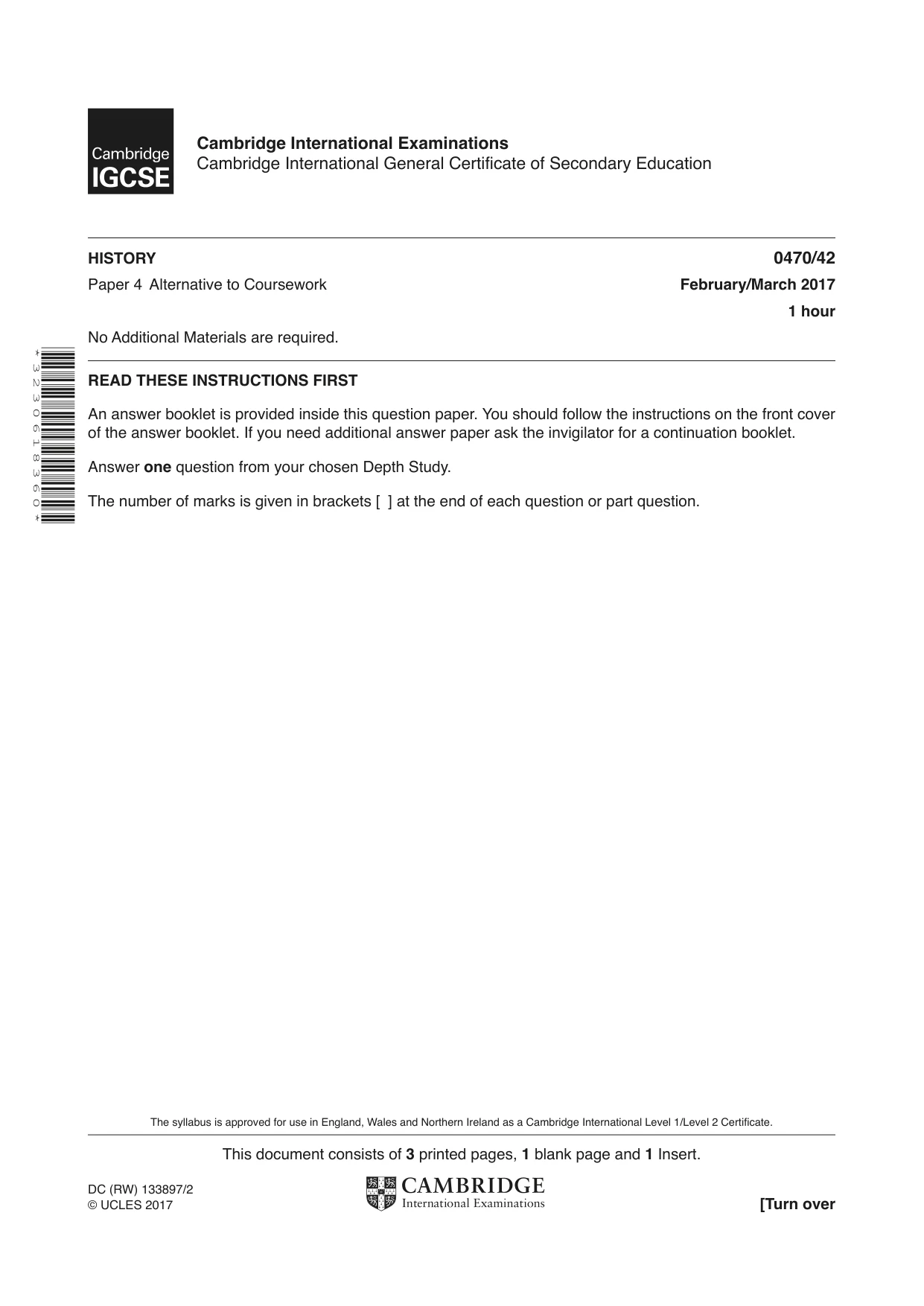
This document consists of 3 printed pages, 1 blank page and 1 Insert. DC (RW) 133897/2 © UCLES 2017 [Turn over Cambridge International Examinations Cambridge International General Certificate of Secondary Education * 3 2 3 0 6 1 8 3 6 0 * HISTORY 0470/42 Paper 4 Alternative to Coursework February/March 2017 1 hour No Additional Materials are required. READ THESE INSTRUCTIONS FIRST An answer booklet is provided inside this question paper. You should follow the instructions on the front cover of the answer booklet. If you need additional answer paper ask the invigilator for a continuation booklet. Answer one question from your chosen Depth Study. The number of marks is given in brackets [ ] at the end of each question or part question. The syllabus is approved for use in England, Wales and Northern Ireland as a Cambridge International Level 1/Level 2 Certificate.
Question paper, page 2
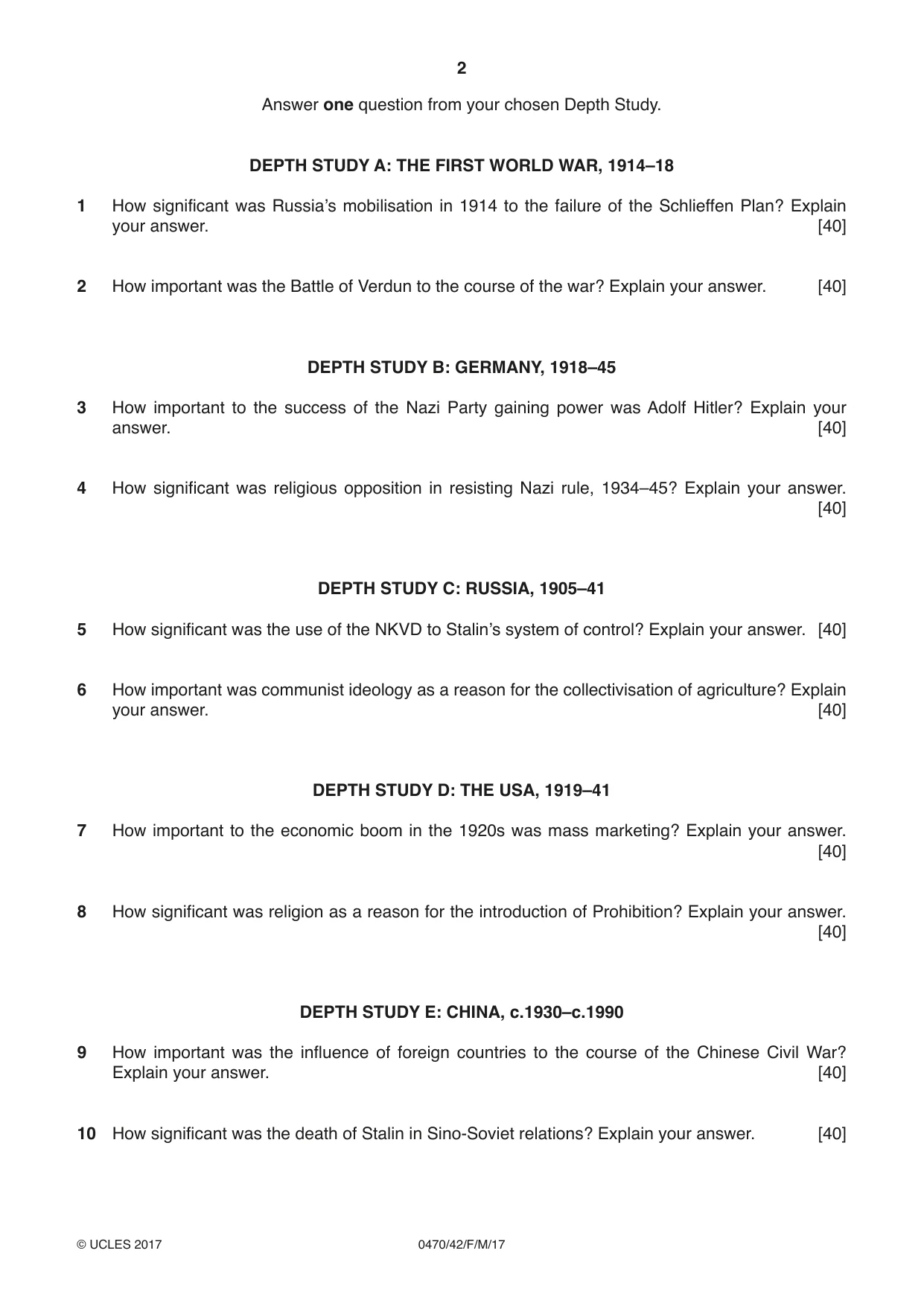
2 0470/42/F/M/17 © UCLES 2017 Answer one question from your chosen Depth Study. DEPTH STUDY A: THE FIRST WORLD WAR, 1914–18 1 How significant was Russia’s mobilisation in 1914 to the failure of the Schlieffen Plan? Explain your answer. [40] 2 How important was the Battle of Verdun to the course of the war? Explain your answer. [40] DEPTH STUDY B: GERMANY, 1918–45 3 How important to the success of the Nazi Party gaining power was Adolf Hitler? Explain your answer. [40] 4 How significant was religious opposition in resisting Nazi rule, 1934–45? Explain your answer. [40] DEPTH STUDY C: RUSSIA, 1905–41 5 How significant was the use of the NKVD to Stalin’s system of control? Explain your answer. [40] 6 How important was communist ideology as a reason for the collectivisation of agriculture? Explain your answer. [40] DEPTH STUDY D: THE USA, 1919–41 7 How important to the economic boom in the 1920s was mass marketing? Explain your answer. [40] 8 How significant was religion as a reason for the introduction of Prohibition? Explain your answer. [40] DEPTH STUDY E: CHINA, c.1930–c.1990 9 How important was the influence of foreign countries to the course of the Chinese Civil War? Explain your answer. [40] 10 How significant was the death of Stalin in Sino-Soviet relations? Explain your answer. [40]
Question paper, page 3
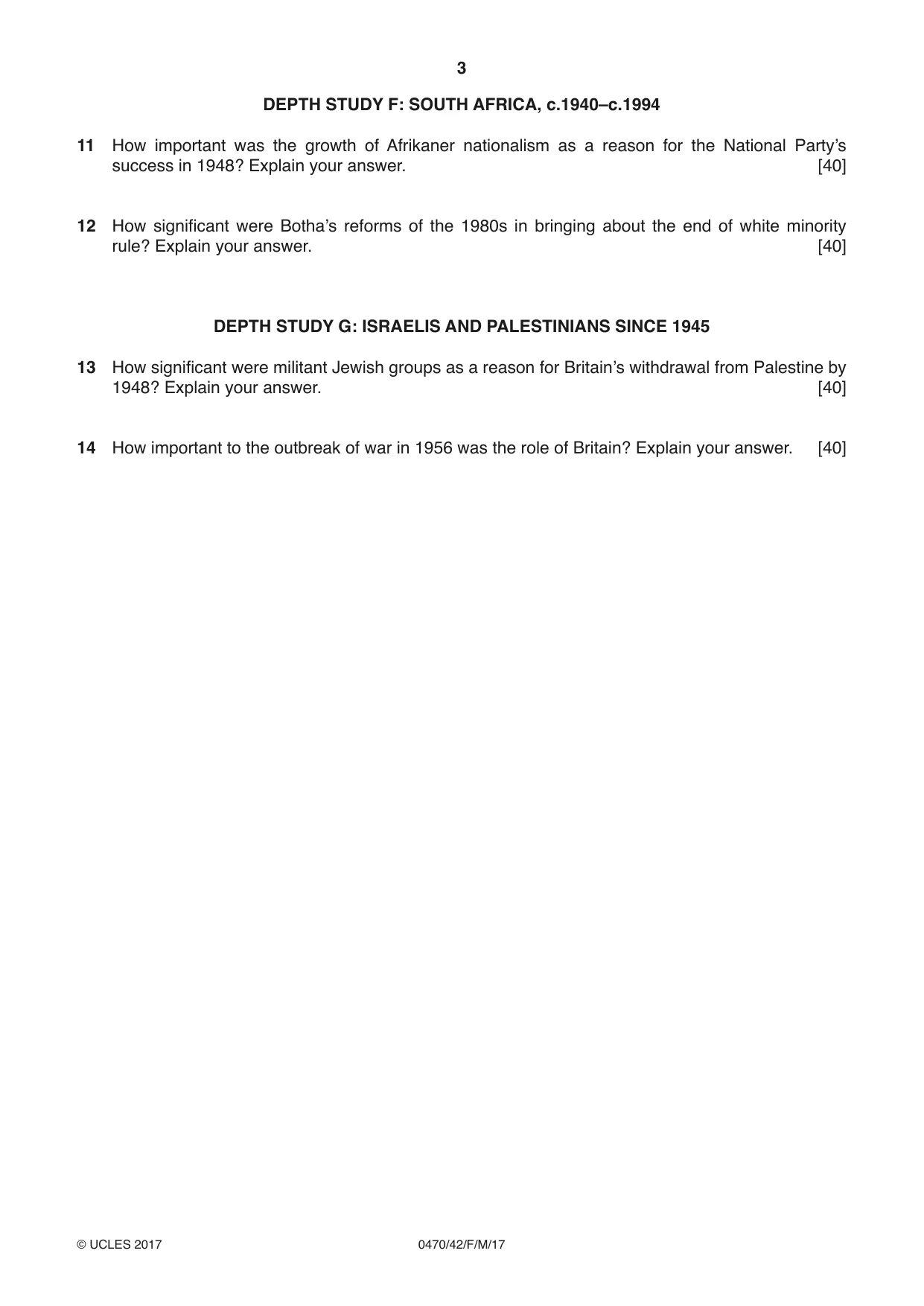
3 0470/42/F/M/17 © UCLES 2017 DEPTH STUDY F: SOUTH AFRICA, c.1940–c.1994 11 How important was the growth of Afrikaner nationalism as a reason for the National Party’s success in 1948? Explain your answer. [40] 12 How significant were Botha’s reforms of the 1980s in bringing about the end of white minority rule? Explain your answer. [40] DEPTH STUDY G: ISRAELIS AND PALESTINIANS SINCE 1945 13 How significant were militant Jewish groups as a reason for Britain’s withdrawal from Palestine by 1948? Explain your answer. [40] 14 How important to the outbreak of war in 1956 was the role of Britain? Explain your answer. [40]
Question paper, page 4
4 0470/42/F/M/17 © UCLES 2017 BLANK PAGE Permission to reproduce items where third-party owned material protected by copyright is included has been sought and cleared where possible. Every reasonable effort has been made by the publisher (UCLES) to trace copyright holders, but if any items requiring clearance have unwittingly been included, the publisher will be pleased to make amends at the earliest possible opportunity. To avoid the issue of disclosure of answer-related information to candidates, all copyright acknowledgements are reproduced online in the Cambridge International Examinations Copyright Acknowledgements Booklet. This is produced for each series of examinations and is freely available to download at www.cie.org.uk after the live examination series. Cambridge International Examinations is part of the Cambridge Assessment Group. Cambridge Assessment is the brand name of University of Cambridge Local Examinations Syndicate (UCLES), which is itself a department of the University of Cambridge.
Mark scheme, page 1
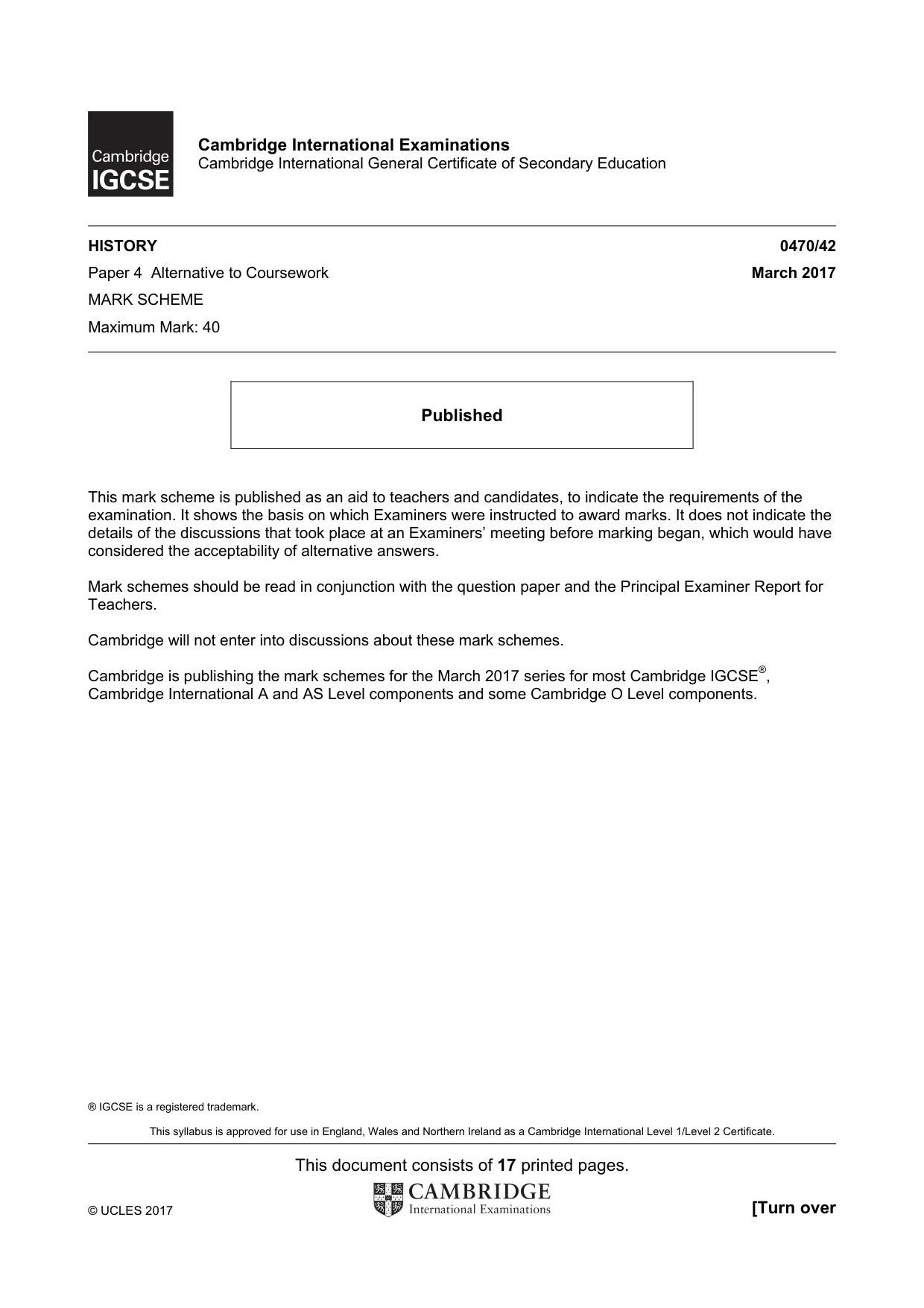
® IGCSE is a registered trademark. This syllabus is approved for use in England, Wales and Northern Ireland as a Cambridge International Level 1/Level 2 Certificate. This document consists of 17 printed pages. © UCLES 2017 [Turn over Cambridge International Examinations Cambridge International General Certificate of Secondary Education HISTORY 0470/42 Paper 4 Alternative to Coursework March 2017 MARK SCHEME Maximum Mark: 40 Published This mark scheme is published as an aid to teachers and candidates, to indicate the requirements of the examination. It shows the basis on which Examiners were instructed to award marks. It does not indicate the details of the discussions that took place at an Examiners’ meeting before marking began, which would have considered the acceptability of alternative answers. Mark schemes should be read in conjunction with the question paper and the Principal Examiner Report for Teachers. Cambridge will not enter into discussions about these mark schemes. Cambridge is publishing the mark schemes for the March 2017 series for most Cambridge IGCSE®, Cambridge International A and AS Level components and some Cambridge O Level components.
Mark scheme, page 2
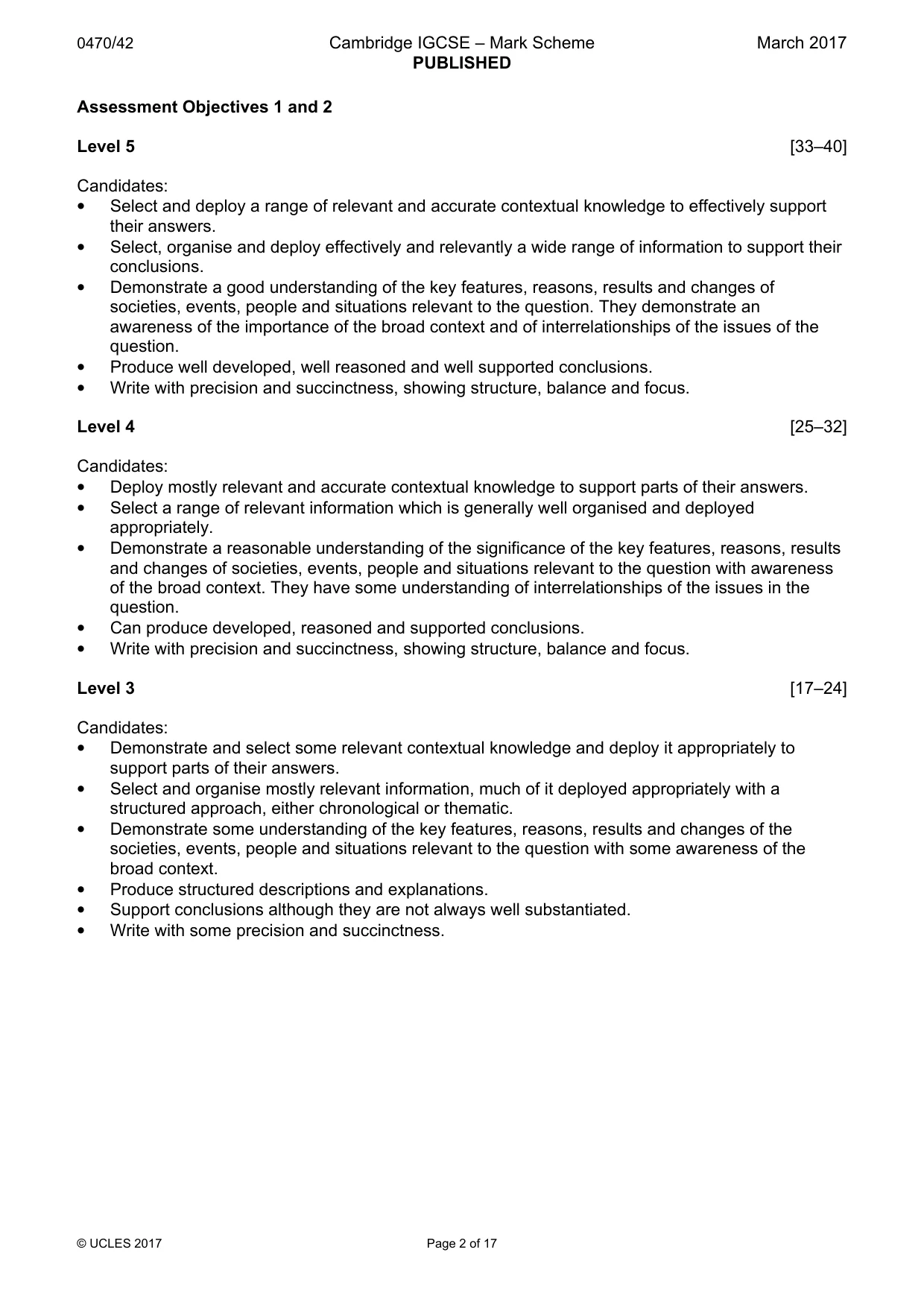
0470/42 Cambridge IGCSE – Mark Scheme PUBLISHED March 2017 © UCLES 2017 Page 2 of 17 Assessment Objectives 1 and 2 Level 5 [33–40] Candidates: • Select and deploy a range of relevant and accurate contextual knowledge to effectively support their answers. • Select, organise and deploy effectively and relevantly a wide range of information to support their conclusions. • Demonstrate a good understanding of the key features, reasons, results and changes of societies, events, people and situations relevant to the question. They demonstrate an awareness of the importance of the broad context and of interrelationships of the issues of the question. • Produce well developed, well reasoned and well supported conclusions. • Write with precision and succinctness, showing structure, balance and focus. Level 4 [25–32] Candidates: • Deploy mostly relevant and accurate contextual knowledge to support parts of their answers. • Select a range of relevant information which is generally well organised and deployed appropriately. • Demonstrate a reasonable understanding of the significance of the key features, reasons, results and changes of societies, events, people and situations relevant to the question with awareness of the broad context. They have some understanding of interrelationships of the issues in the question. • Can produce developed, reasoned and supported conclusions. • Write with precision and succinctness, showing structure, balance and focus. Level 3 [17–24] Candidates: • Demonstrate and select some relevant contextual knowledge and deploy it appropriately to support parts of their answers. • Select and organise mostly relevant information, much of it deployed appropriately with a structured approach, either chronological or thematic. • Demonstrate some understanding of the key features, reasons, results and changes of the societies, events, people and situations relevant to the question with some awareness of the broad context. • Produce structured descriptions and explanations. • Support conclusions although they are not always well substantiated. • Write with some precision and succinctness.
Mark scheme, page 3
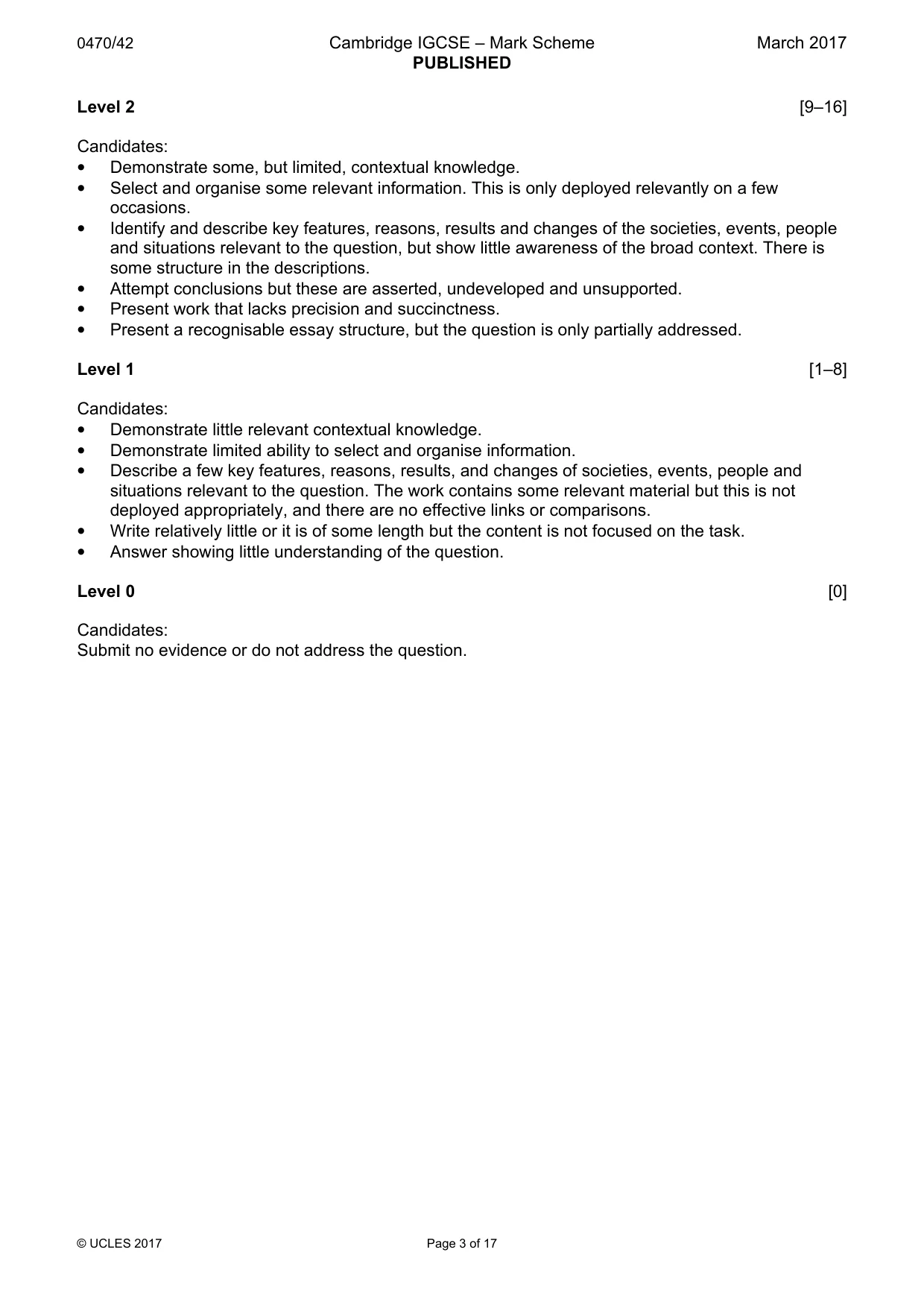
0470/42 Cambridge IGCSE – Mark Scheme PUBLISHED March 2017 © UCLES 2017 Page 3 of 17 Level 2 [9–16] Candidates: • Demonstrate some, but limited, contextual knowledge. • Select and organise some relevant information. This is only deployed relevantly on a few occasions. • Identify and describe key features, reasons, results and changes of the societies, events, people and situations relevant to the question, but show little awareness of the broad context. There is some structure in the descriptions. • Attempt conclusions but these are asserted, undeveloped and unsupported. • Present work that lacks precision and succinctness. • Present a recognisable essay structure, but the question is only partially addressed. Level 1 [1–8] Candidates: • Demonstrate little relevant contextual knowledge. • Demonstrate limited ability to select and organise information. • Describe a few key features, reasons, results, and changes of societies, events, people and situations relevant to the question. The work contains some relevant material but this is not deployed appropriately, and there are no effective links or comparisons. • Write relatively little or it is of some length but the content is not focused on the task. • Answer showing little understanding of the question. Level 0 [0] Candidates: Submit no evidence or do not address the question.
Mark scheme, page 4
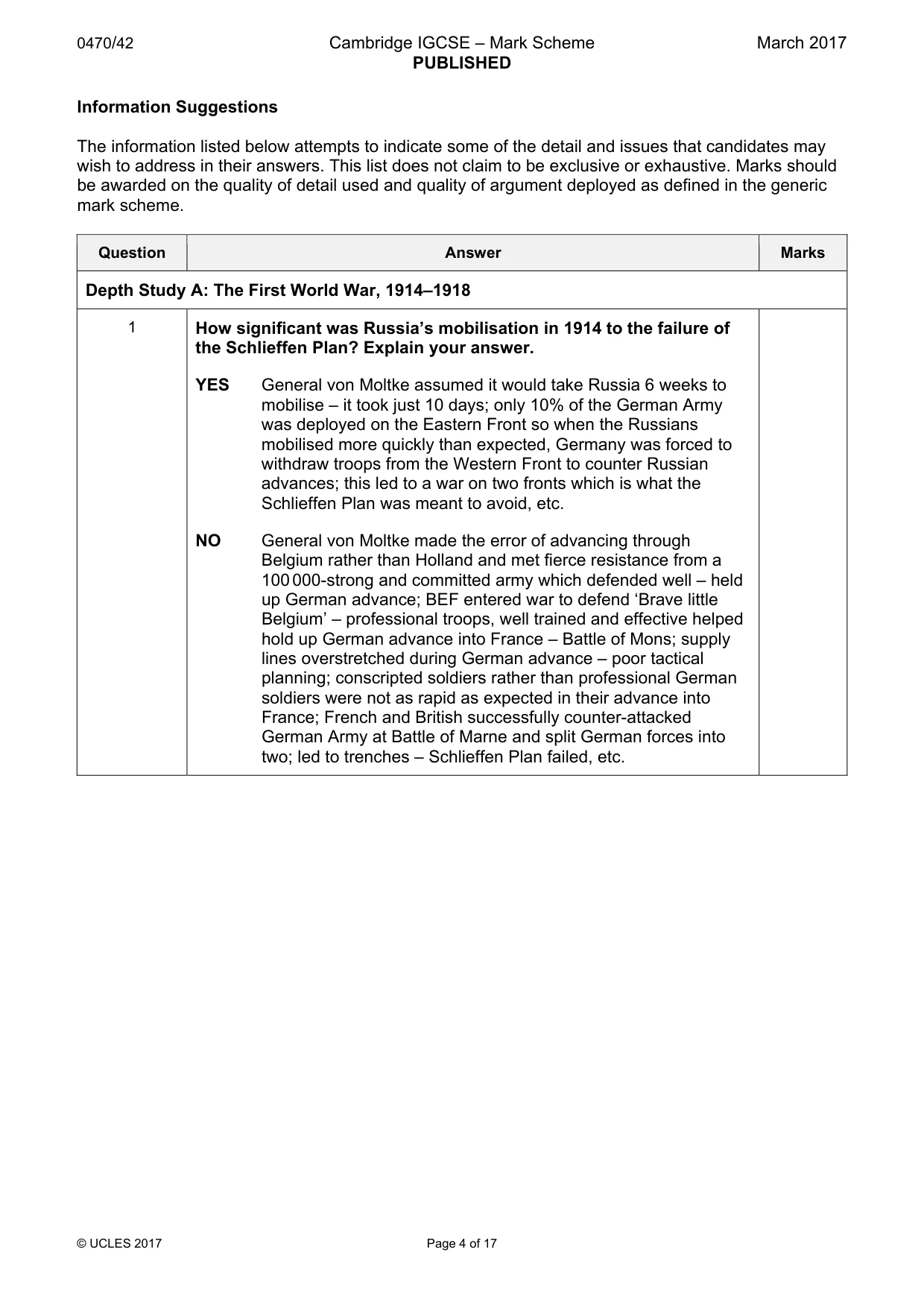
0470/42 Cambridge IGCSE – Mark Scheme PUBLISHED March 2017 © UCLES 2017 Page 4 of 17 Information Suggestions The information listed below attempts to indicate some of the detail and issues that candidates may wish to address in their answers. This list does not claim to be exclusive or exhaustive. Marks should be awarded on the quality of detail used and quality of argument deployed as defined in the generic mark scheme. Question Answer Marks Depth Study A: The First World War, 1914–1918 1 How significant was Russia’s mobilisation in 1914 to the failure of the Schlieffen Plan? Explain your answer. YES General von Moltke assumed it would take Russia 6 weeks to mobilise – it took just 10 days; only 10% of the German Army was deployed on the Eastern Front so when the Russians mobilised more quickly than expected, Germany was forced to withdraw troops from the Western Front to counter Russian advances; this led to a war on two fronts which is what the Schlieffen Plan was meant to avoid, etc. NO General von Moltke made the error of advancing through Belgium rather than Holland and met fierce resistance from a 100 000-strong and committed army which defended well – held up German advance; BEF entered war to defend ‘Brave little Belgium’ – professional troops, well trained and effective helped hold up German advance into France – Battle of Mons; supply lines overstretched during German advance – poor tactical planning; conscripted soldiers rather than professional German soldiers were not as rapid as expected in their advance into France; French and British successfully counter-attacked German Army at Battle of Marne and split German forces into two; led to trenches – Schlieffen Plan failed, etc.
Mark scheme, page 5
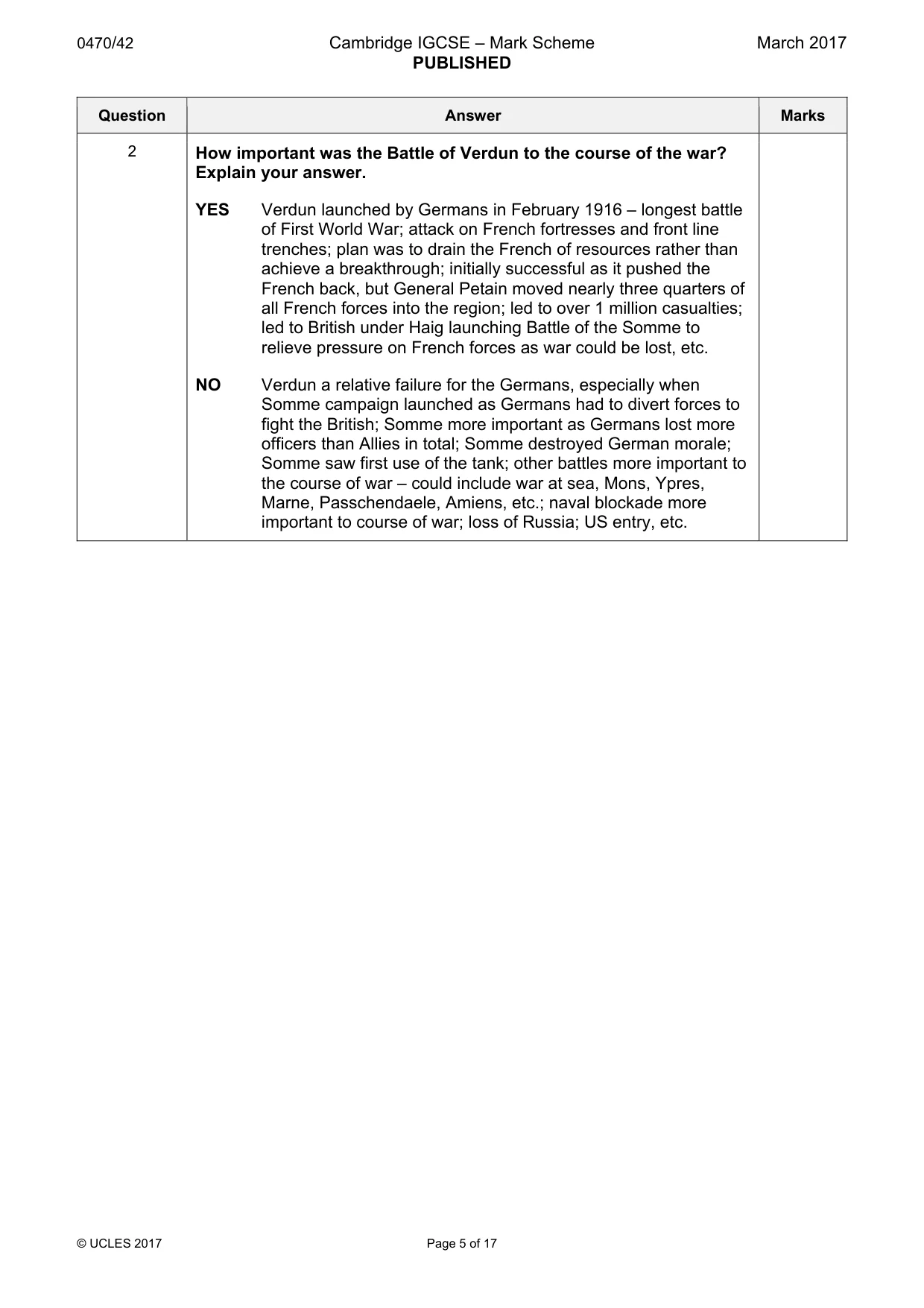
0470/42 Cambridge IGCSE – Mark Scheme PUBLISHED March 2017 © UCLES 2017 Page 5 of 17 Question Answer Marks 2 How important was the Battle of Verdun to the course of the war? Explain your answer. YES Verdun launched by Germans in February 1916 – longest battle of First World War; attack on French fortresses and front line trenches; plan was to drain the French of resources rather than achieve a breakthrough; initially successful as it pushed the French back, but General Petain moved nearly three quarters of all French forces into the region; led to over 1 million casualties; led to British under Haig launching Battle of the Somme to relieve pressure on French forces as war could be lost, etc. NO Verdun a relative failure for the Germans, especially when Somme campaign launched as Germans had to divert forces to fight the British; Somme more important as Germans lost more officers than Allies in total; Somme destroyed German morale; Somme saw first use of the tank; other battles more important to the course of war – could include war at sea, Mons, Ypres, Marne, Passchendaele, Amiens, etc.; naval blockade more important to course of war; loss of Russia; US entry, etc.
Mark scheme, page 6
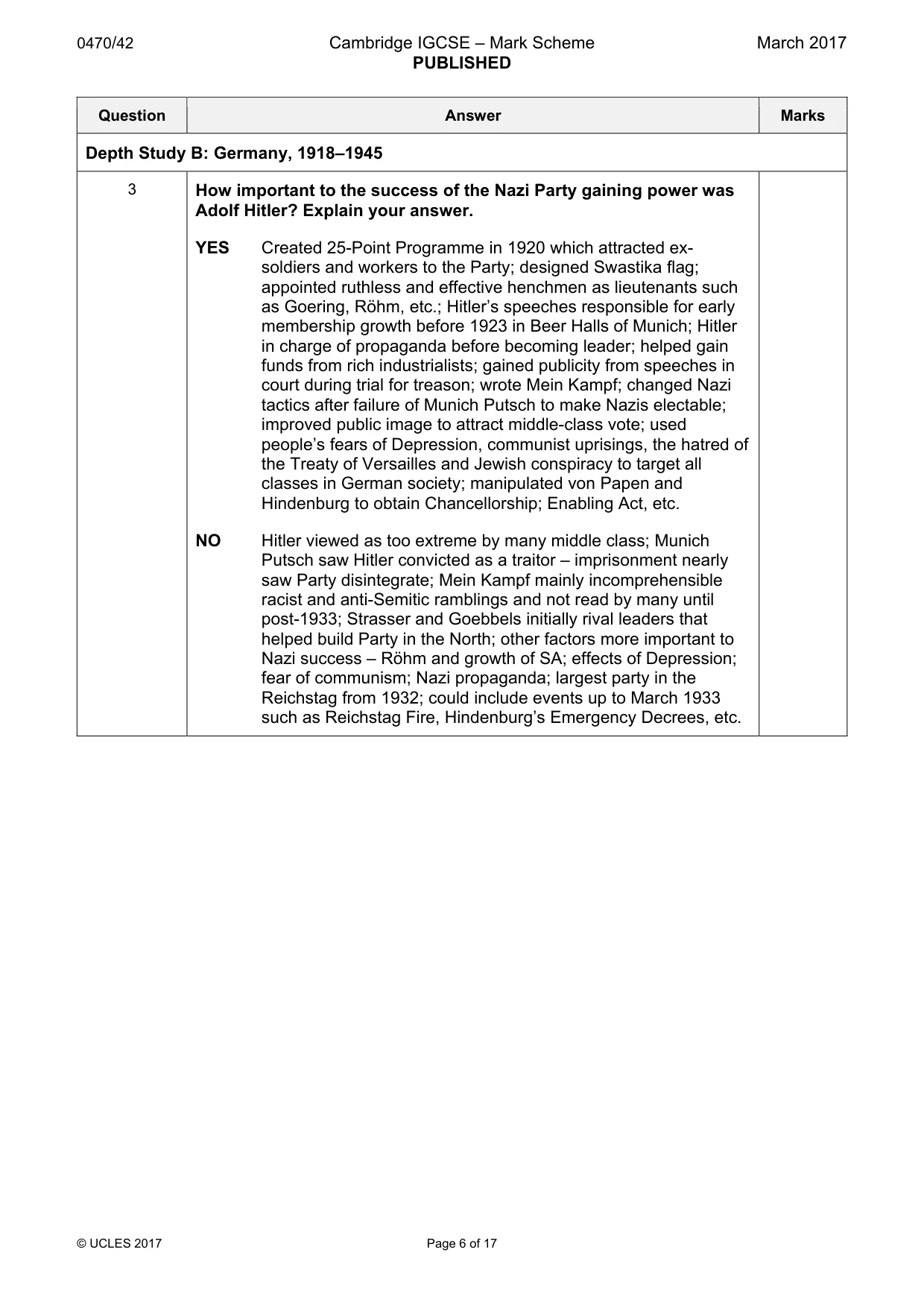
0470/42 Cambridge IGCSE – Mark Scheme PUBLISHED March 2017 © UCLES 2017 Page 6 of 17 Question Answer Marks Depth Study B: Germany, 1918–1945 3 How important to the success of the Nazi Party gaining power was Adolf Hitler? Explain your answer. YES Created 25-Point Programme in 1920 which attracted ex- soldiers and workers to the Party; designed Swastika flag; appointed ruthless and effective henchmen as lieutenants such as Goering, Röhm, etc.; Hitler’s speeches responsible for early membership growth before 1923 in Beer Halls of Munich; Hitler in charge of propaganda before becoming leader; helped gain funds from rich industrialists; gained publicity from speeches in court during trial for treason; wrote Mein Kampf; changed Nazi tactics after failure of Munich Putsch to make Nazis electable; improved public image to attract middle-class vote; used people’s fears of Depression, communist uprisings, the hatred of the Treaty of Versailles and Jewish conspiracy to target all classes in German society; manipulated von Papen and Hindenburg to obtain Chancellorship; Enabling Act, etc. NO Hitler viewed as too extreme by many middle class; Munich Putsch saw Hitler convicted as a traitor – imprisonment nearly saw Party disintegrate; Mein Kampf mainly incomprehensible racist and anti-Semitic ramblings and not read by many until post-1933; Strasser and Goebbels initially rival leaders that helped build Party in the North; other factors more important to Nazi success – Röhm and growth of SA; effects of Depression; fear of communism; Nazi propaganda; largest party in the Reichstag from 1932; could include events up to March 1933 such as Reichstag Fire, Hindenburg’s Emergency Decrees, etc.
Mark scheme, page 7
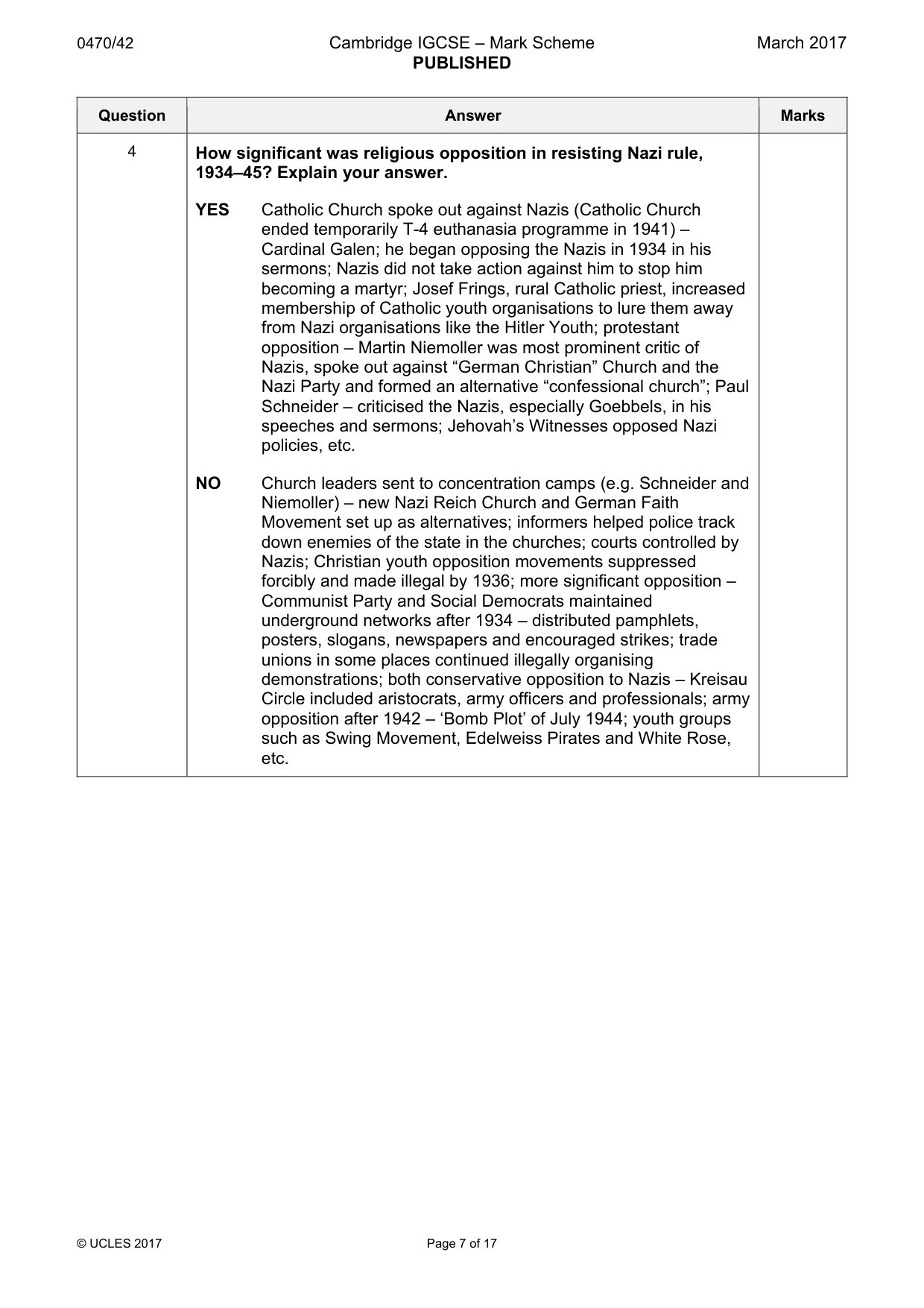
0470/42 Cambridge IGCSE – Mark Scheme PUBLISHED March 2017 © UCLES 2017 Page 7 of 17 Question Answer Marks 4 How significant was religious opposition in resisting Nazi rule, 1934–45? Explain your answer. YES Catholic Church spoke out against Nazis (Catholic Church ended temporarily T-4 euthanasia programme in 1941) – Cardinal Galen; he began opposing the Nazis in 1934 in his sermons; Nazis did not take action against him to stop him becoming a martyr; Josef Frings, rural Catholic priest, increased membership of Catholic youth organisations to lure them away from Nazi organisations like the Hitler Youth; protestant opposition – Martin Niemoller was most prominent critic of Nazis, spoke out against “German Christian” Church and the Nazi Party and formed an alternative “confessional church”; Paul Schneider – criticised the Nazis, especially Goebbels, in his speeches and sermons; Jehovah’s Witnesses opposed Nazi policies, etc. NO Church leaders sent to concentration camps (e.g. Schneider and Niemoller) – new Nazi Reich Church and German Faith Movement set up as alternatives; informers helped police track down enemies of the state in the churches; courts controlled by Nazis; Christian youth opposition movements suppressed forcibly and made illegal by 1936; more significant opposition – Communist Party and Social Democrats maintained underground networks after 1934 – distributed pamphlets, posters, slogans, newspapers and encouraged strikes; trade unions in some places continued illegally organising demonstrations; both conservative opposition to Nazis – Kreisau Circle included aristocrats, army officers and professionals; army opposition after 1942 – ‘Bomb Plot’ of July 1944; youth groups such as Swing Movement, Edelweiss Pirates and White Rose, etc.
Mark scheme, page 8
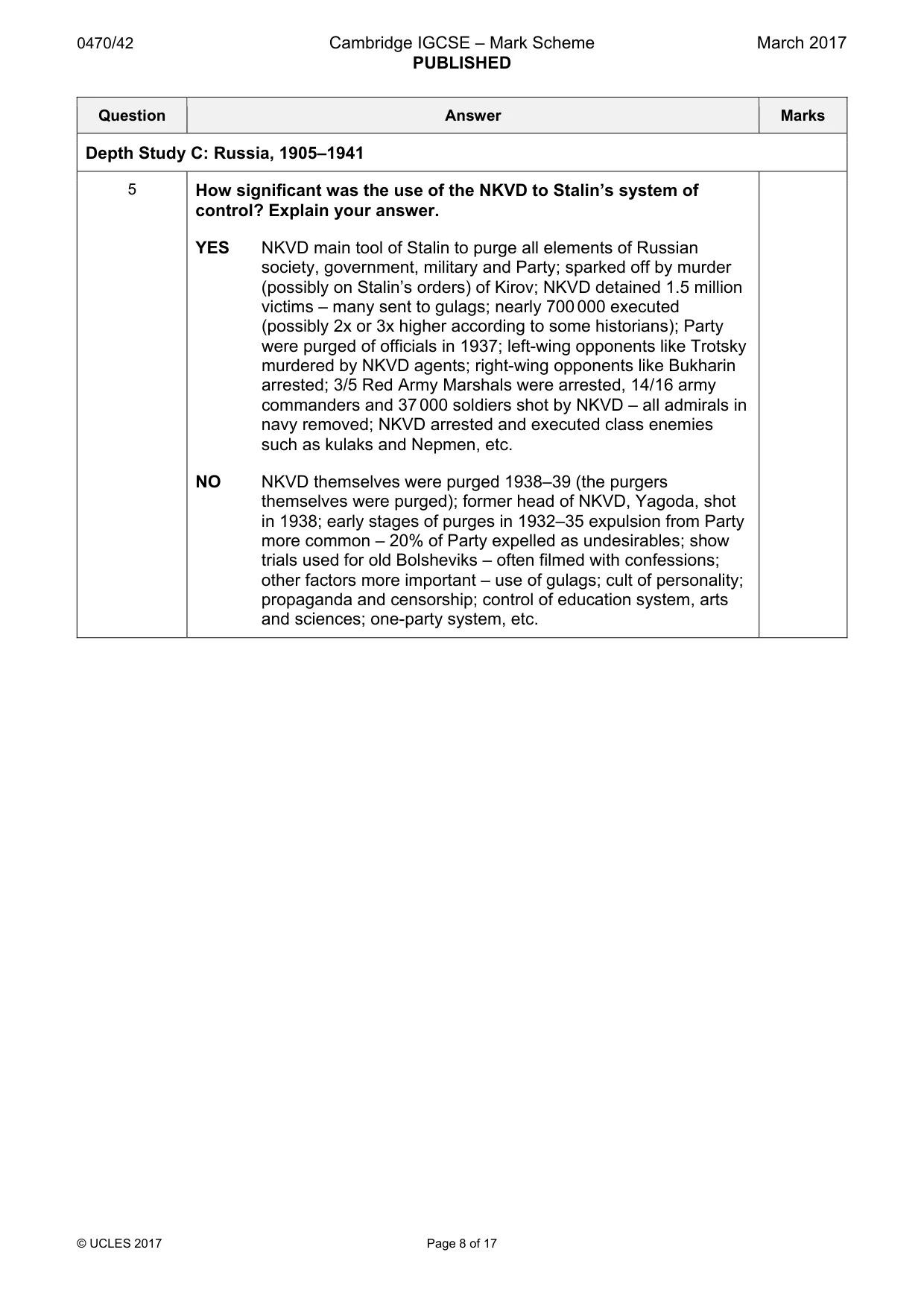
0470/42 Cambridge IGCSE – Mark Scheme PUBLISHED March 2017 © UCLES 2017 Page 8 of 17 Question Answer Marks Depth Study C: Russia, 1905–1941 5 How significant was the use of the NKVD to Stalin’s system of control? Explain your answer. YES NKVD main tool of Stalin to purge all elements of Russian society, government, military and Party; sparked off by murder (possibly on Stalin’s orders) of Kirov; NKVD detained 1.5 million victims – many sent to gulags; nearly 700 000 executed (possibly 2x or 3x higher according to some historians); Party were purged of officials in 1937; left-wing opponents like Trotsky murdered by NKVD agents; right-wing opponents like Bukharin arrested; 3/5 Red Army Marshals were arrested, 14/16 army commanders and 37 000 soldiers shot by NKVD – all admirals in navy removed; NKVD arrested and executed class enemies such as kulaks and Nepmen, etc. NO NKVD themselves were purged 1938–39 (the purgers themselves were purged); former head of NKVD, Yagoda, shot in 1938; early stages of purges in 1932–35 expulsion from Party more common – 20% of Party expelled as undesirables; show trials used for old Bolsheviks – often filmed with confessions; other factors more important – use of gulags; cult of personality; propaganda and censorship; control of education system, arts and sciences; one-party system, etc.
Mark scheme, page 9
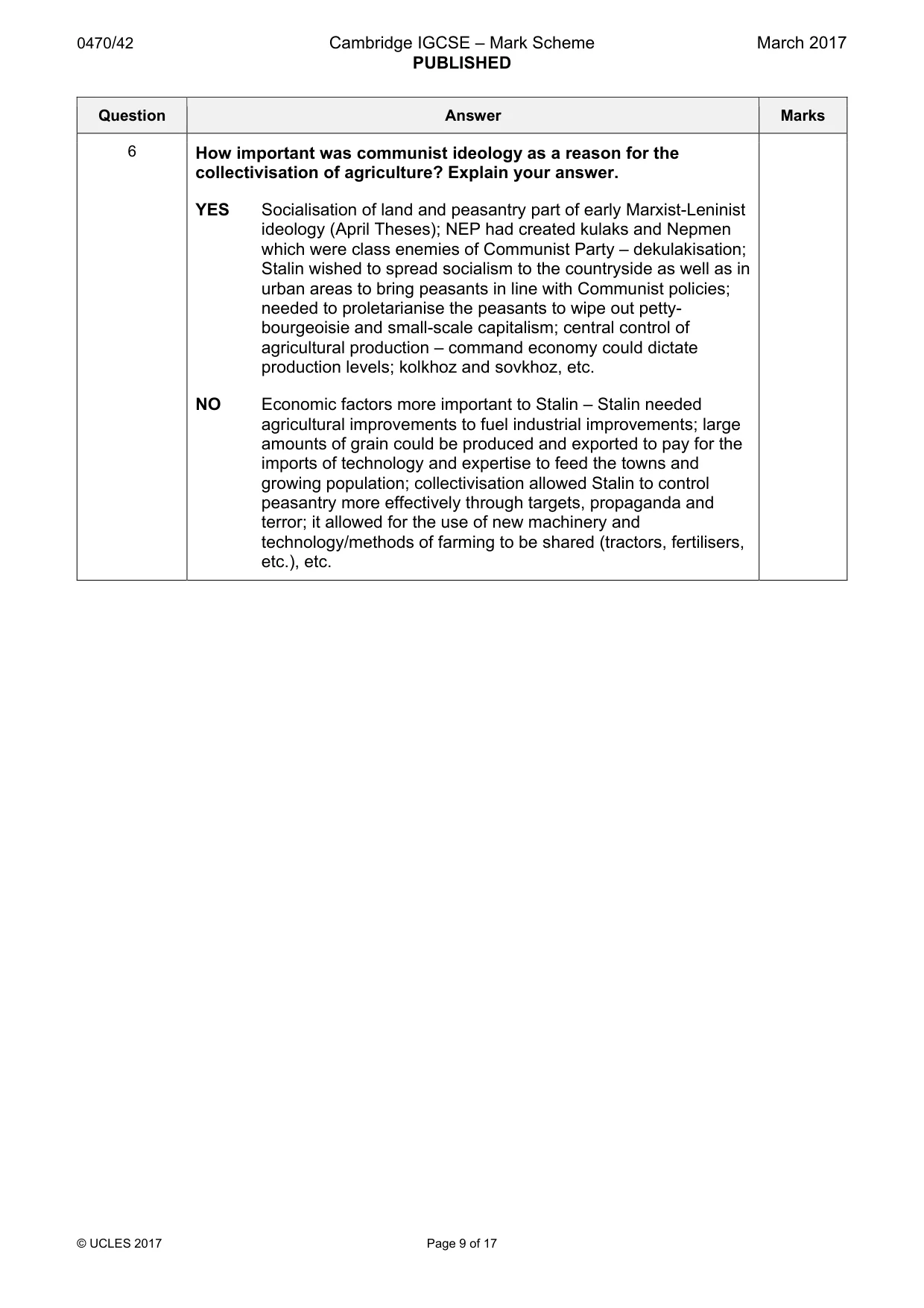
0470/42 Cambridge IGCSE – Mark Scheme PUBLISHED March 2017 © UCLES 2017 Page 9 of 17 Question Answer Marks 6 How important was communist ideology as a reason for the collectivisation of agriculture? Explain your answer. YES Socialisation of land and peasantry part of early Marxist-Leninist ideology (April Theses); NEP had created kulaks and Nepmen which were class enemies of Communist Party – dekulakisation; Stalin wished to spread socialism to the countryside as well as in urban areas to bring peasants in line with Communist policies; needed to proletarianise the peasants to wipe out petty- bourgeoisie and small-scale capitalism; central control of agricultural production – command economy could dictate production levels; kolkhoz and sovkhoz, etc. NO Economic factors more important to Stalin – Stalin needed agricultural improvements to fuel industrial improvements; large amounts of grain could be produced and exported to pay for the imports of technology and expertise to feed the towns and growing population; collectivisation allowed Stalin to control peasantry more effectively through targets, propaganda and terror; it allowed for the use of new machinery and technology/methods of farming to be shared (tractors, fertilisers, etc.), etc.
Mark scheme, page 10
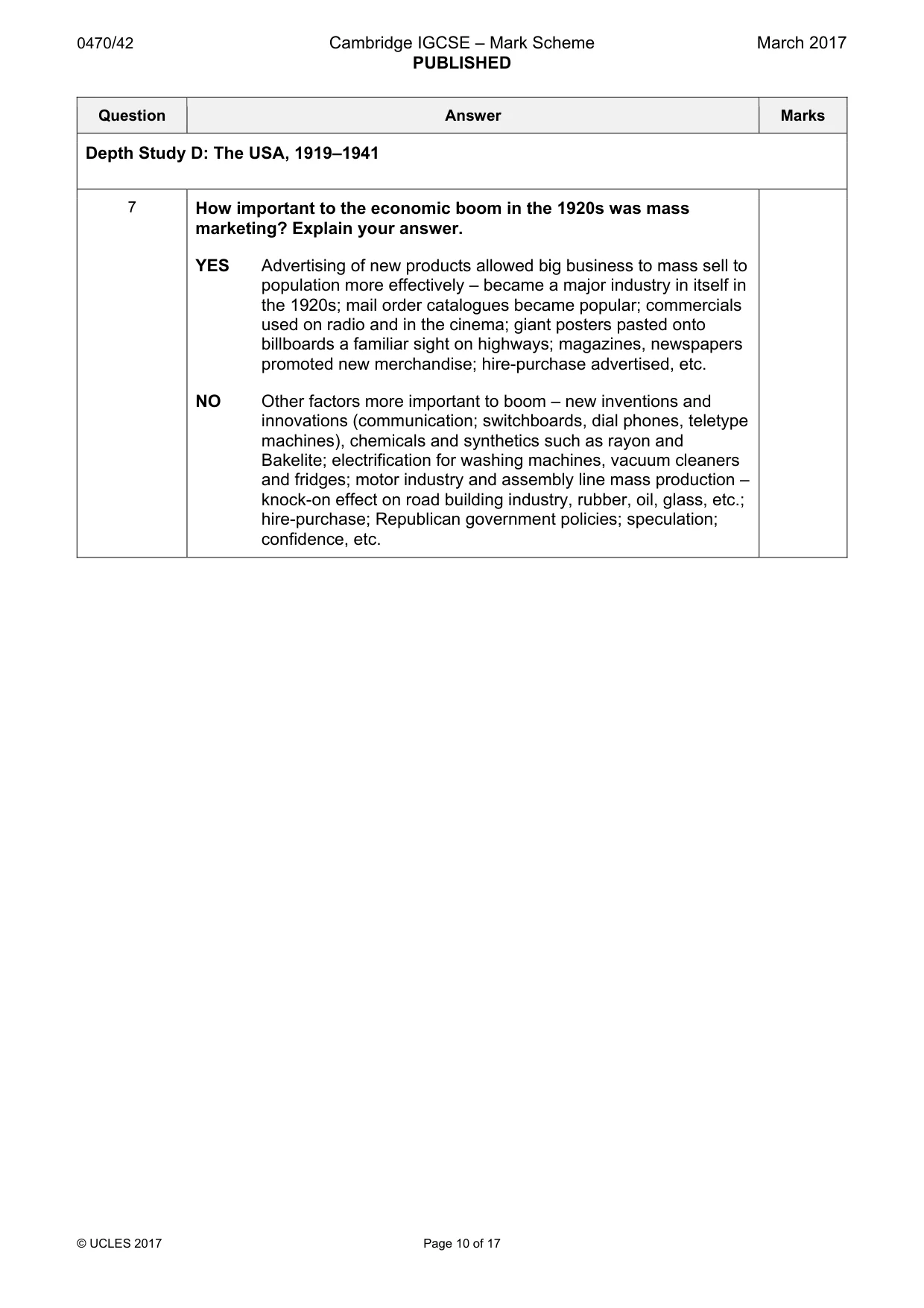
0470/42 Cambridge IGCSE – Mark Scheme PUBLISHED March 2017 © UCLES 2017 Page 10 of 17 Question Answer Marks Depth Study D: The USA, 1919–1941 7 How important to the economic boom in the 1920s was mass marketing? Explain your answer. YES Advertising of new products allowed big business to mass sell to population more effectively – became a major industry in itself in the 1920s; mail order catalogues became popular; commercials used on radio and in the cinema; giant posters pasted onto billboards a familiar sight on highways; magazines, newspapers promoted new merchandise; hire-purchase advertised, etc. NO Other factors more important to boom – new inventions and innovations (communication; switchboards, dial phones, teletype machines), chemicals and synthetics such as rayon and Bakelite; electrification for washing machines, vacuum cleaners and fridges; motor industry and assembly line mass production – knock-on effect on road building industry, rubber, oil, glass, etc.; hire-purchase; Republican government policies; speculation; confidence, etc.
Mark scheme, page 11
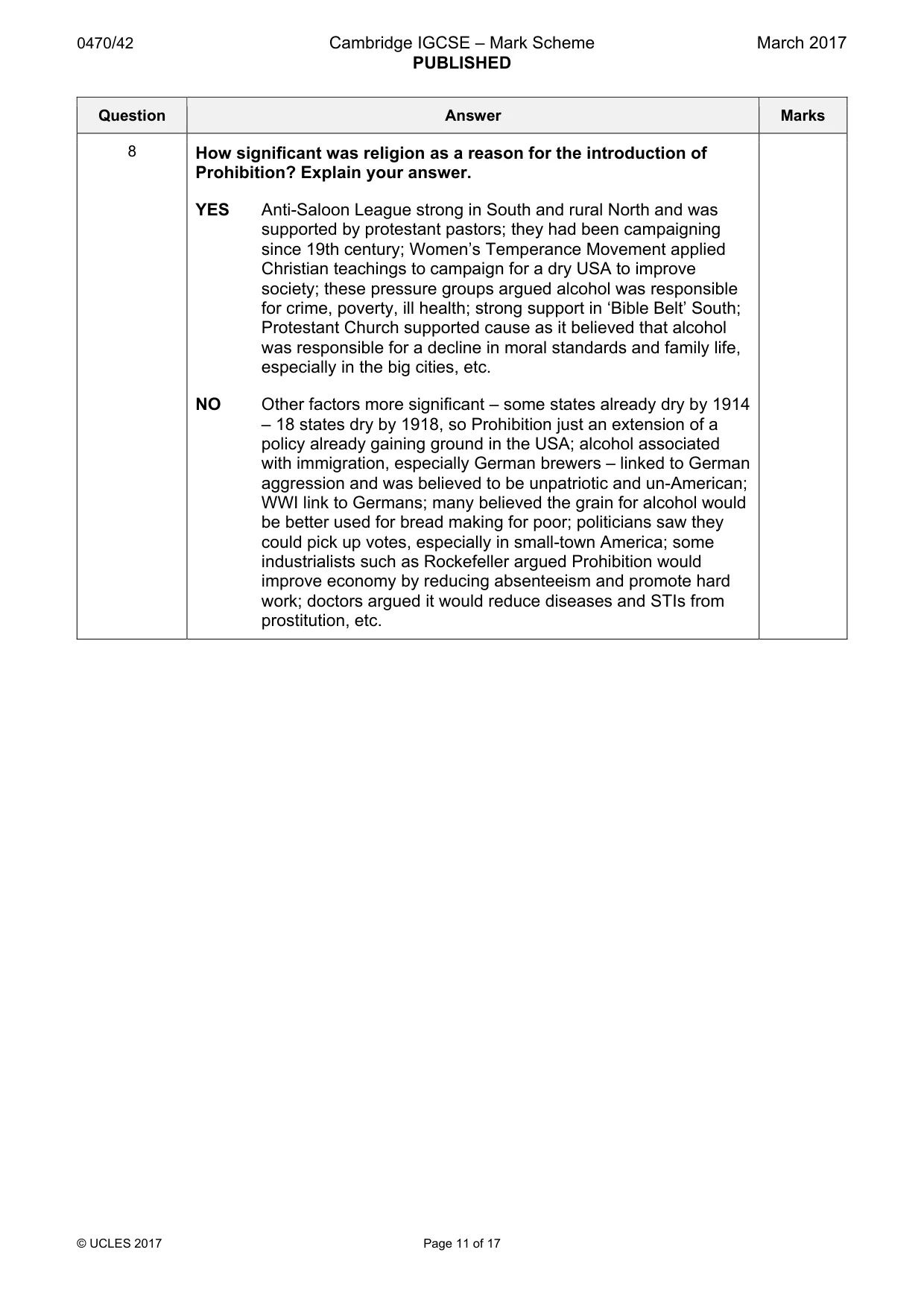
0470/42 Cambridge IGCSE – Mark Scheme PUBLISHED March 2017 © UCLES 2017 Page 11 of 17 Question Answer Marks 8 How significant was religion as a reason for the introduction of Prohibition? Explain your answer. YES Anti-Saloon League strong in South and rural North and was supported by protestant pastors; they had been campaigning since 19th century; Women’s Temperance Movement applied Christian teachings to campaign for a dry USA to improve society; these pressure groups argued alcohol was responsible for crime, poverty, ill health; strong support in ‘Bible Belt’ South; Protestant Church supported cause as it believed that alcohol was responsible for a decline in moral standards and family life, especially in the big cities, etc. NO Other factors more significant – some states already dry by 1914 – 18 states dry by 1918, so Prohibition just an extension of a policy already gaining ground in the USA; alcohol associated with immigration, especially German brewers – linked to German aggression and was believed to be unpatriotic and un-American; WWI link to Germans; many believed the grain for alcohol would be better used for bread making for poor; politicians saw they could pick up votes, especially in small-town America; some industrialists such as Rockefeller argued Prohibition would improve economy by reducing absenteeism and promote hard work; doctors argued it would reduce diseases and STIs from prostitution, etc.
Mark scheme, page 12
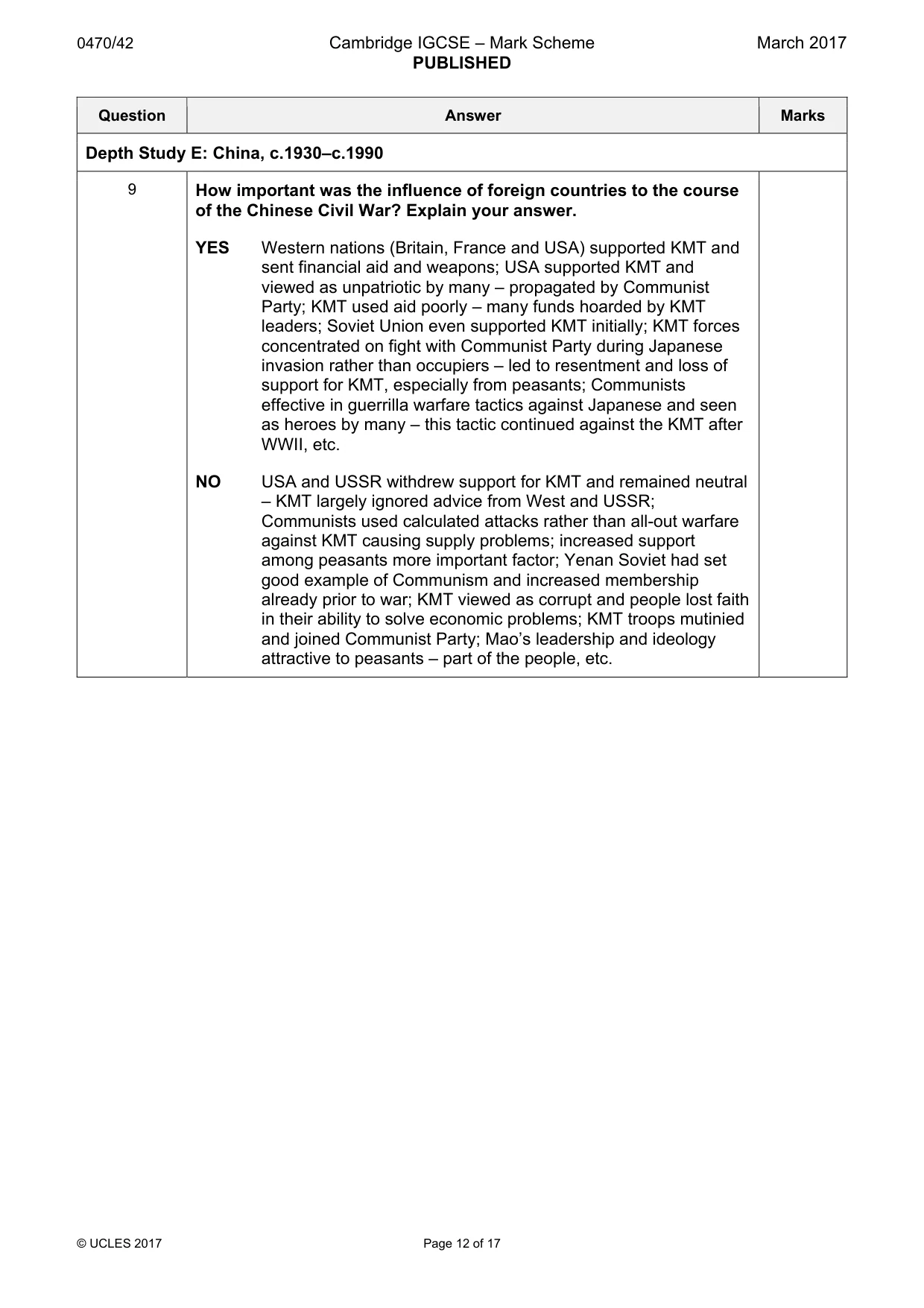
0470/42 Cambridge IGCSE – Mark Scheme PUBLISHED March 2017 © UCLES 2017 Page 12 of 17 Question Answer Marks Depth Study E: China, c.1930–c.1990 9 How important was the influence of foreign countries to the course of the Chinese Civil War? Explain your answer. YES Western nations (Britain, France and USA) supported KMT and sent financial aid and weapons; USA supported KMT and viewed as unpatriotic by many – propagated by Communist Party; KMT used aid poorly – many funds hoarded by KMT leaders; Soviet Union even supported KMT initially; KMT forces concentrated on fight with Communist Party during Japanese invasion rather than occupiers – led to resentment and loss of support for KMT, especially from peasants; Communists effective in guerrilla warfare tactics against Japanese and seen as heroes by many – this tactic continued against the KMT after WWII, etc. NO USA and USSR withdrew support for KMT and remained neutral – KMT largely ignored advice from West and USSR; Communists used calculated attacks rather than all-out warfare against KMT causing supply problems; increased support among peasants more important factor; Yenan Soviet had set good example of Communism and increased membership already prior to war; KMT viewed as corrupt and people lost faith in their ability to solve economic problems; KMT troops mutinied and joined Communist Party; Mao’s leadership and ideology attractive to peasants – part of the people, etc.
Mark scheme, page 13
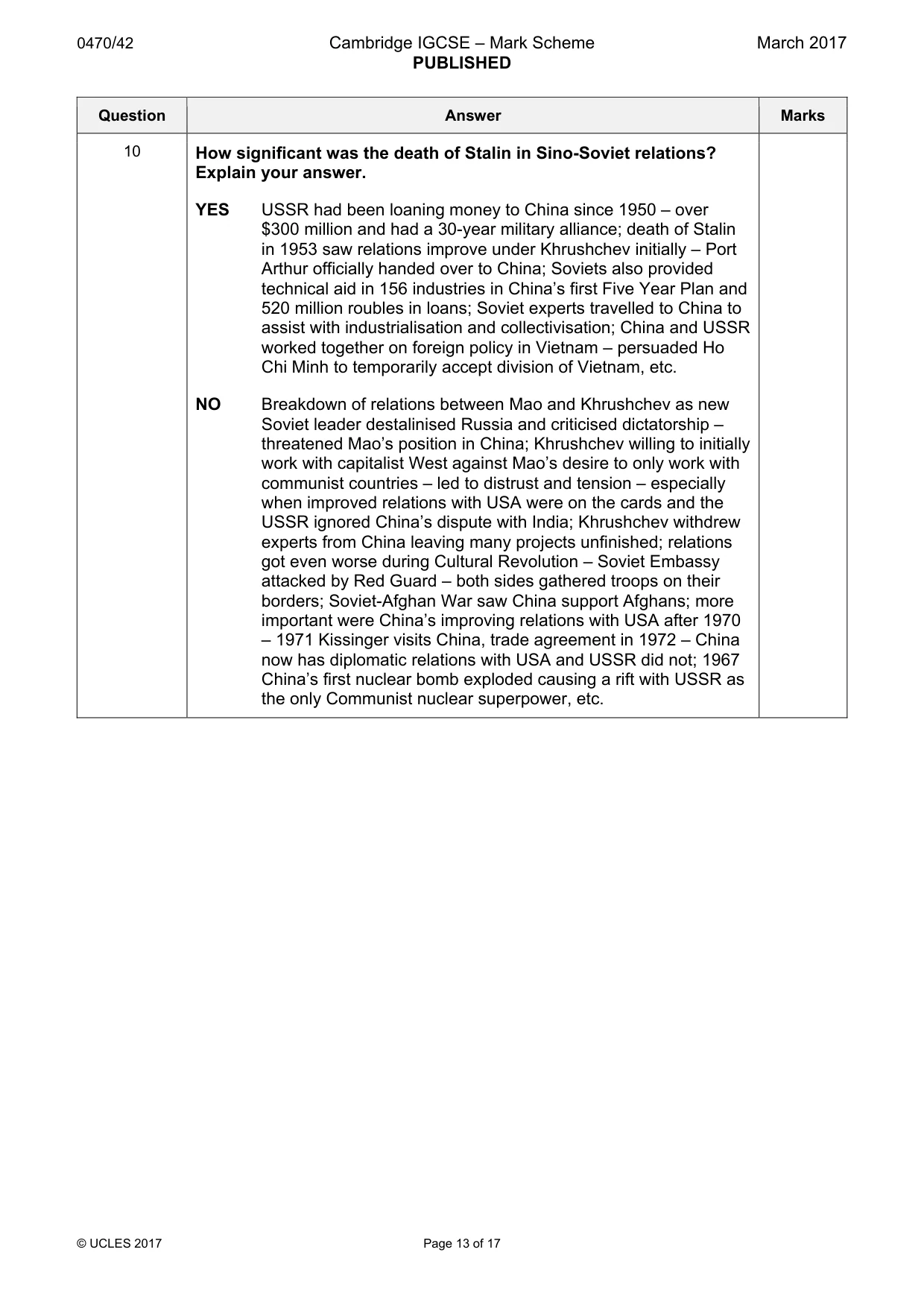
0470/42 Cambridge IGCSE – Mark Scheme PUBLISHED March 2017 © UCLES 2017 Page 13 of 17 Question Answer Marks 10 How significant was the death of Stalin in Sino-Soviet relations? Explain your answer. YES USSR had been loaning money to China since 1950 – over $300 million and had a 30-year military alliance; death of Stalin in 1953 saw relations improve under Khrushchev initially – Port Arthur officially handed over to China; Soviets also provided technical aid in 156 industries in China’s first Five Year Plan and 520 million roubles in loans; Soviet experts travelled to China to assist with industrialisation and collectivisation; China and USSR worked together on foreign policy in Vietnam – persuaded Ho Chi Minh to temporarily accept division of Vietnam, etc. NO Breakdown of relations between Mao and Khrushchev as new Soviet leader destalinised Russia and criticised dictatorship – threatened Mao’s position in China; Khrushchev willing to initially work with capitalist West against Mao’s desire to only work with communist countries – led to distrust and tension – especially when improved relations with USA were on the cards and the USSR ignored China’s dispute with India; Khrushchev withdrew experts from China leaving many projects unfinished; relations got even worse during Cultural Revolution – Soviet Embassy attacked by Red Guard – both sides gathered troops on their borders; Soviet-Afghan War saw China support Afghans; more important were China’s improving relations with USA after 1970 – 1971 Kissinger visits China, trade agreement in 1972 – China now has diplomatic relations with USA and USSR did not; 1967 China’s first nuclear bomb exploded causing a rift with USSR as the only Communist nuclear superpower, etc.
Mark scheme, page 14
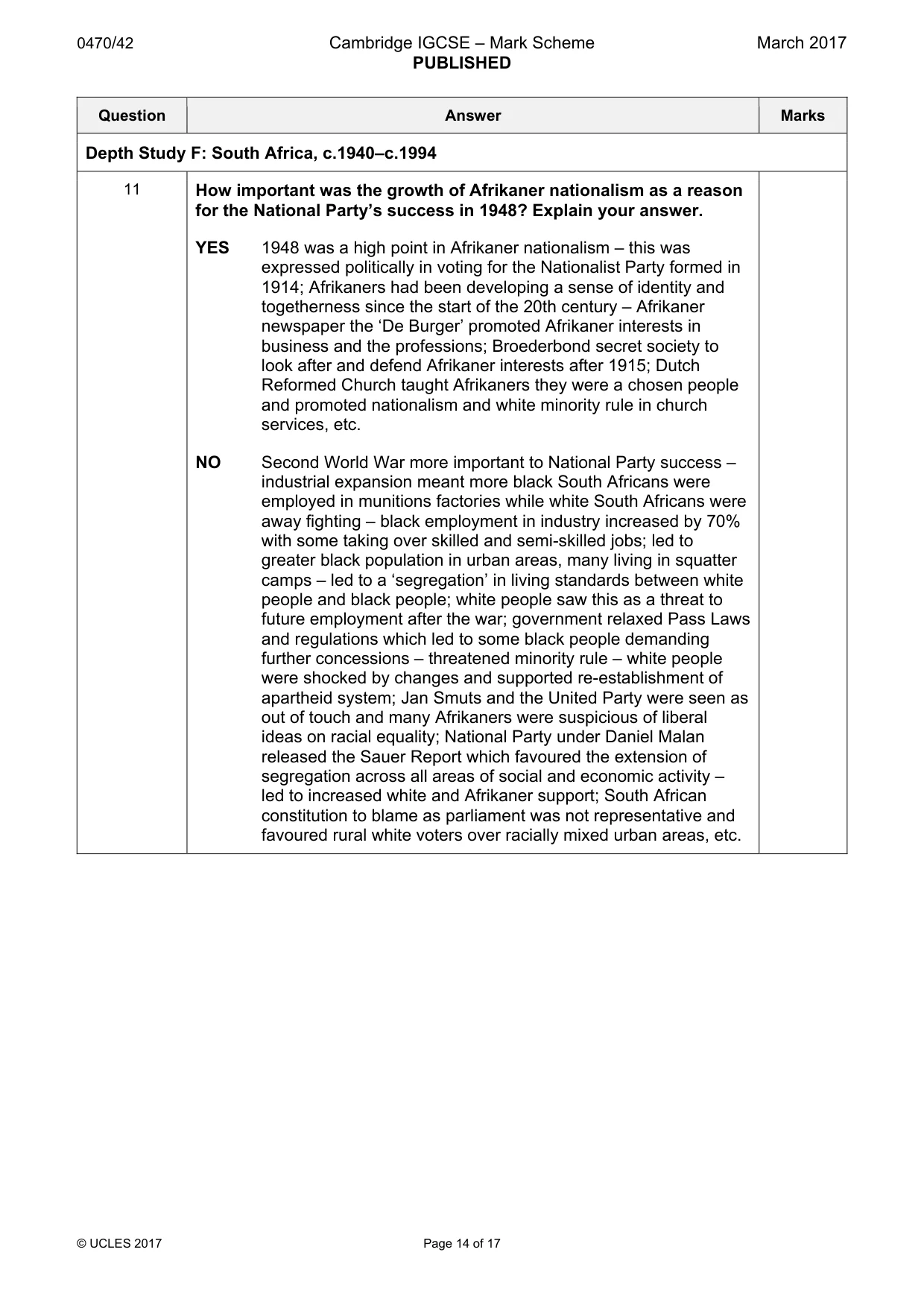
0470/42 Cambridge IGCSE – Mark Scheme PUBLISHED March 2017 © UCLES 2017 Page 14 of 17 Question Answer Marks Depth Study F: South Africa, c.1940–c.1994 11 How important was the growth of Afrikaner nationalism as a reason for the National Party’s success in 1948? Explain your answer. YES 1948 was a high point in Afrikaner nationalism – this was expressed politically in voting for the Nationalist Party formed in 1914; Afrikaners had been developing a sense of identity and togetherness since the start of the 20th century – Afrikaner newspaper the ‘De Burger’ promoted Afrikaner interests in business and the professions; Broederbond secret society to look after and defend Afrikaner interests after 1915; Dutch Reformed Church taught Afrikaners they were a chosen people and promoted nationalism and white minority rule in church services, etc. NO Second World War more important to National Party success – industrial expansion meant more black South Africans were employed in munitions factories while white South Africans were away fighting – black employment in industry increased by 70% with some taking over skilled and semi-skilled jobs; led to greater black population in urban areas, many living in squatter camps – led to a ‘segregation’ in living standards between white people and black people; white people saw this as a threat to future employment after the war; government relaxed Pass Laws and regulations which led to some black people demanding further concessions – threatened minority rule – white people were shocked by changes and supported re-establishment of apartheid system; Jan Smuts and the United Party were seen as out of touch and many Afrikaners were suspicious of liberal ideas on racial equality; National Party under Daniel Malan released the Sauer Report which favoured the extension of segregation across all areas of social and economic activity – led to increased white and Afrikaner support; South African constitution to blame as parliament was not representative and favoured rural white voters over racially mixed urban areas, etc.
Mark scheme, page 15
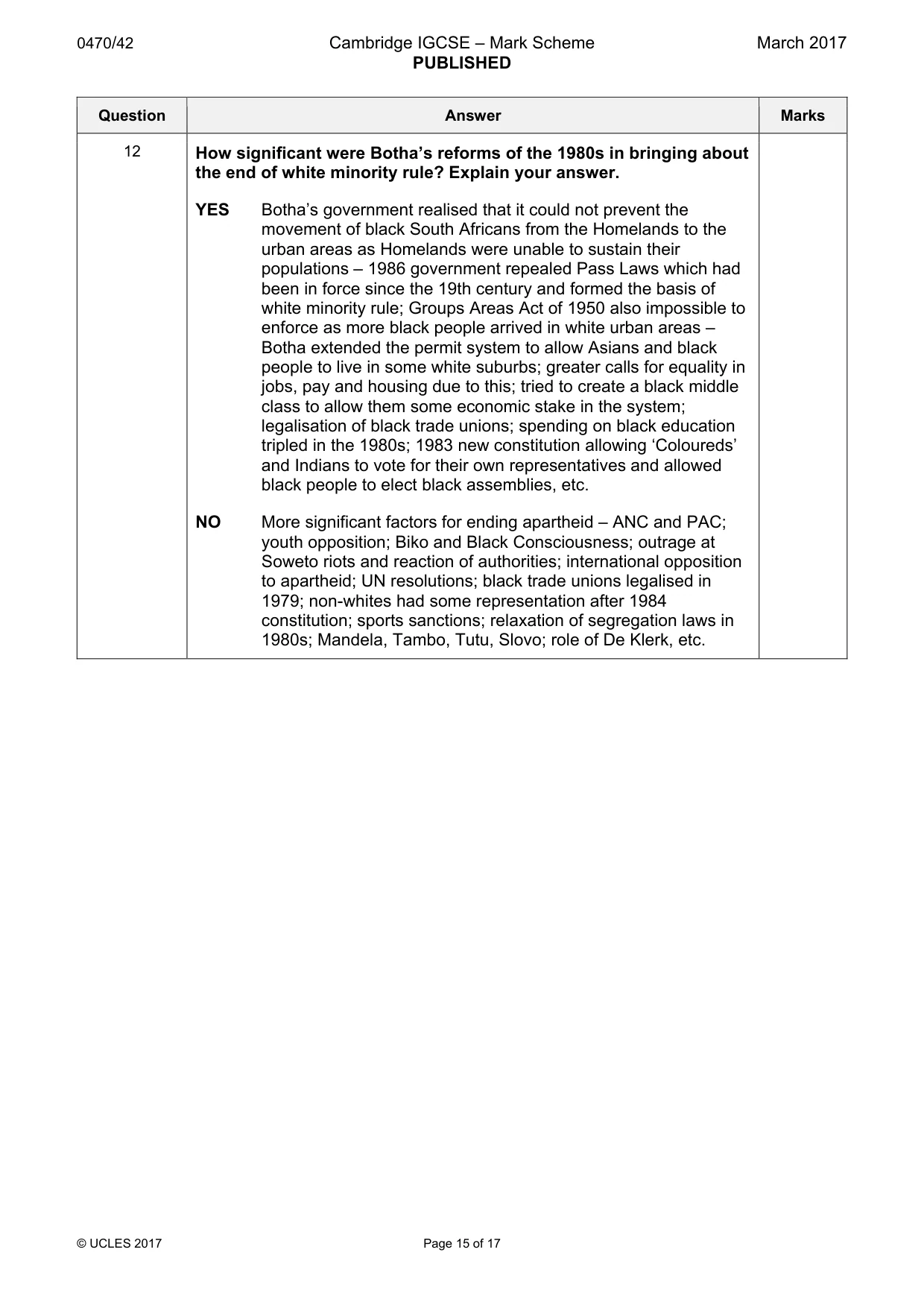
0470/42 Cambridge IGCSE – Mark Scheme PUBLISHED March 2017 © UCLES 2017 Page 15 of 17 Question Answer Marks 12 How significant were Botha’s reforms of the 1980s in bringing about the end of white minority rule? Explain your answer. YES Botha’s government realised that it could not prevent the movement of black South Africans from the Homelands to the urban areas as Homelands were unable to sustain their populations – 1986 government repealed Pass Laws which had been in force since the 19th century and formed the basis of white minority rule; Groups Areas Act of 1950 also impossible to enforce as more black people arrived in white urban areas – Botha extended the permit system to allow Asians and black people to live in some white suburbs; greater calls for equality in jobs, pay and housing due to this; tried to create a black middle class to allow them some economic stake in the system; legalisation of black trade unions; spending on black education tripled in the 1980s; 1983 new constitution allowing ‘Coloureds’ and Indians to vote for their own representatives and allowed black people to elect black assemblies, etc. NO More significant factors for ending apartheid – ANC and PAC; youth opposition; Biko and Black Consciousness; outrage at Soweto riots and reaction of authorities; international opposition to apartheid; UN resolutions; black trade unions legalised in 1979; non-whites had some representation after 1984 constitution; sports sanctions; relaxation of segregation laws in 1980s; Mandela, Tambo, Tutu, Slovo; role of De Klerk, etc.
Mark scheme, page 16
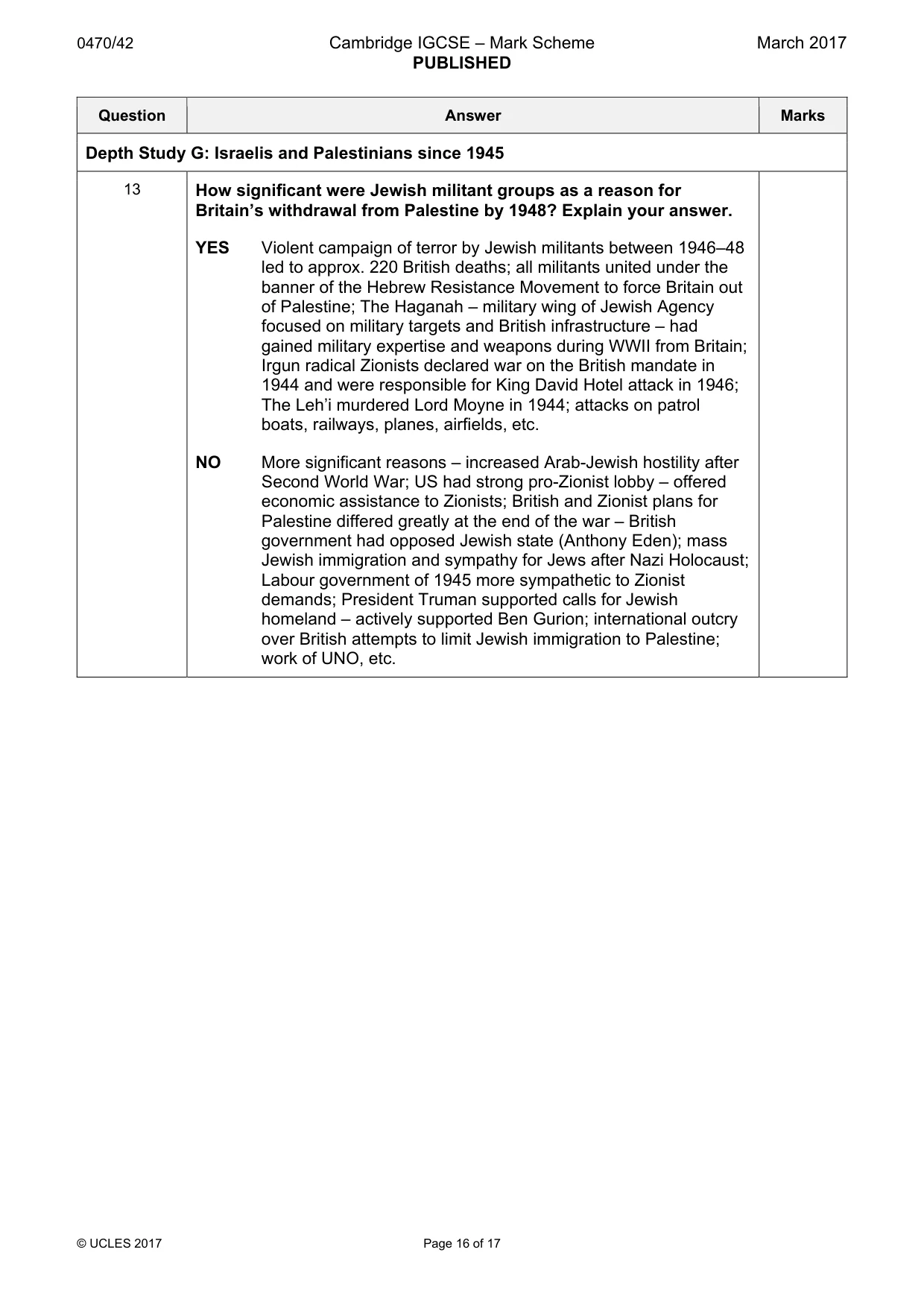
0470/42 Cambridge IGCSE – Mark Scheme PUBLISHED March 2017 © UCLES 2017 Page 16 of 17 Question Answer Marks Depth Study G: Israelis and Palestinians since 1945 13 How significant were Jewish militant groups as a reason for Britain’s withdrawal from Palestine by 1948? Explain your answer. YES Violent campaign of terror by Jewish militants between 1946–48 led to approx. 220 British deaths; all militants united under the banner of the Hebrew Resistance Movement to force Britain out of Palestine; The Haganah – military wing of Jewish Agency focused on military targets and British infrastructure – had gained military expertise and weapons during WWII from Britain; Irgun radical Zionists declared war on the British mandate in 1944 and were responsible for King David Hotel attack in 1946; The Leh’i murdered Lord Moyne in 1944; attacks on patrol boats, railways, planes, airfields, etc. NO More significant reasons – increased Arab-Jewish hostility after Second World War; US had strong pro-Zionist lobby – offered economic assistance to Zionists; British and Zionist plans for Palestine differed greatly at the end of the war – British government had opposed Jewish state (Anthony Eden); mass Jewish immigration and sympathy for Jews after Nazi Holocaust; Labour government of 1945 more sympathetic to Zionist demands; President Truman supported calls for Jewish homeland – actively supported Ben Gurion; international outcry over British attempts to limit Jewish immigration to Palestine; work of UNO, etc.
Mark scheme, page 17
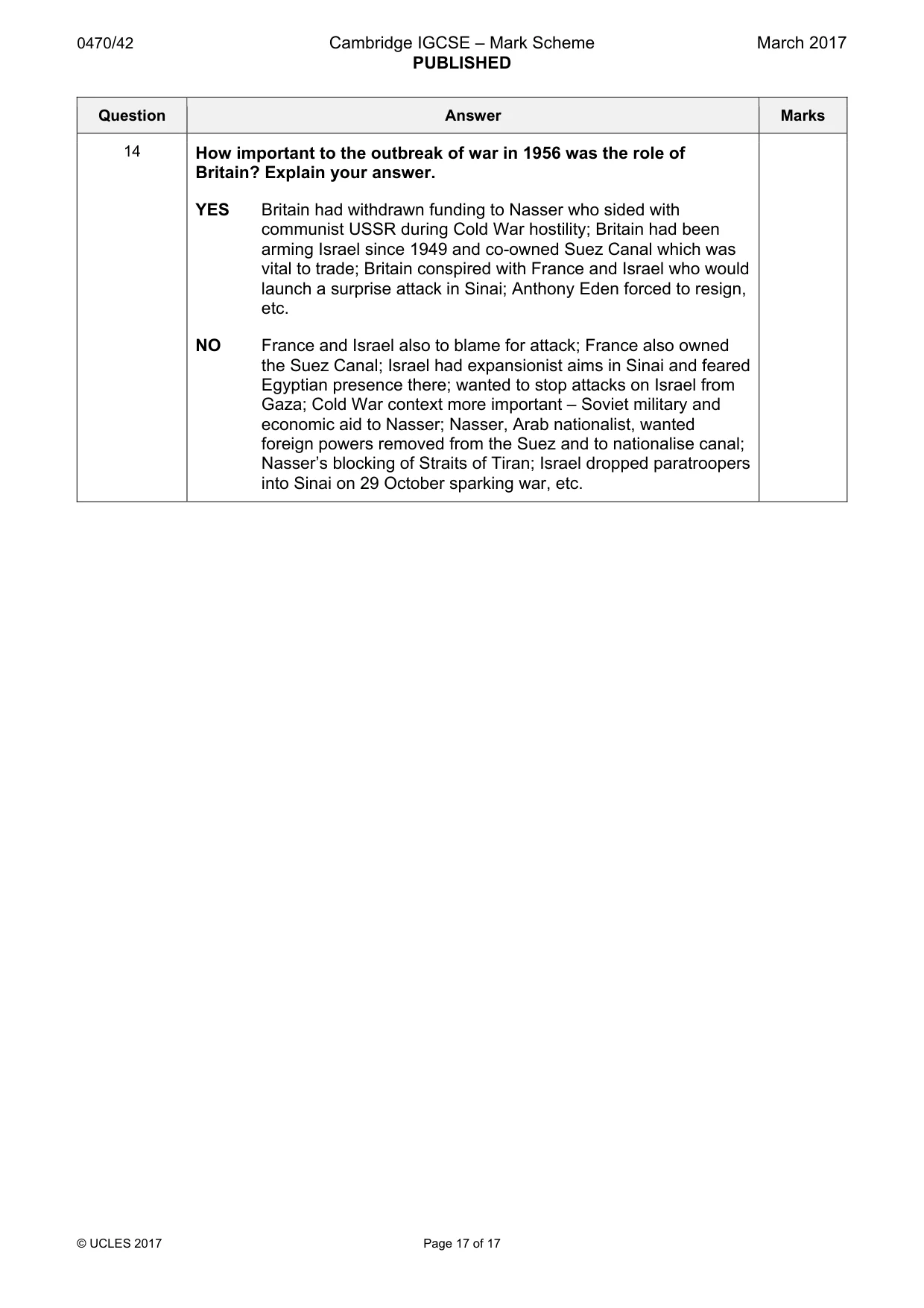
0470/42 Cambridge IGCSE – Mark Scheme PUBLISHED March 2017 © UCLES 2017 Page 17 of 17 Question Answer Marks 14 How important to the outbreak of war in 1956 was the role of Britain? Explain your answer. YES Britain had withdrawn funding to Nasser who sided with communist USSR during Cold War hostility; Britain had been arming Israel since 1949 and co-owned Suez Canal which was vital to trade; Britain conspired with France and Israel who would launch a surprise attack in Sinai; Anthony Eden forced to resign, etc. NO France and Israel also to blame for attack; France also owned the Suez Canal; Israel had expansionist aims in Sinai and feared Egyptian presence there; wanted to stop attacks on Israel from Gaza; Cold War context more important – Soviet military and economic aid to Nasser; Nasser, Arab nationalist, wanted foreign powers removed from the Suez and to nationalise canal; Nasser’s blocking of Straits of Tiran; Israel dropped paratroopers into Sinai on 29 October sparking war, etc.
What you needed in this session
Cambridge’s own grade thresholds for 2017 Feb/March, Paper 4 · Variant 2. A higher threshold means an easier paper — the bar moves with how the cohort did.