Cambridge IGCSE History 0470 — 2016 May/June Paper 4 · Variant 2
0470/42/M/J/16 · 40 marks · ≈45 min
The question paper and its mark scheme, free to read here and free to download. This is Cambridge’s own paper, exactly as it was sat.
Question paper4 pages

Mark scheme11 pages
Answers below. Sit the paper first if you are practising.
Paper as text
Question paper, page 1
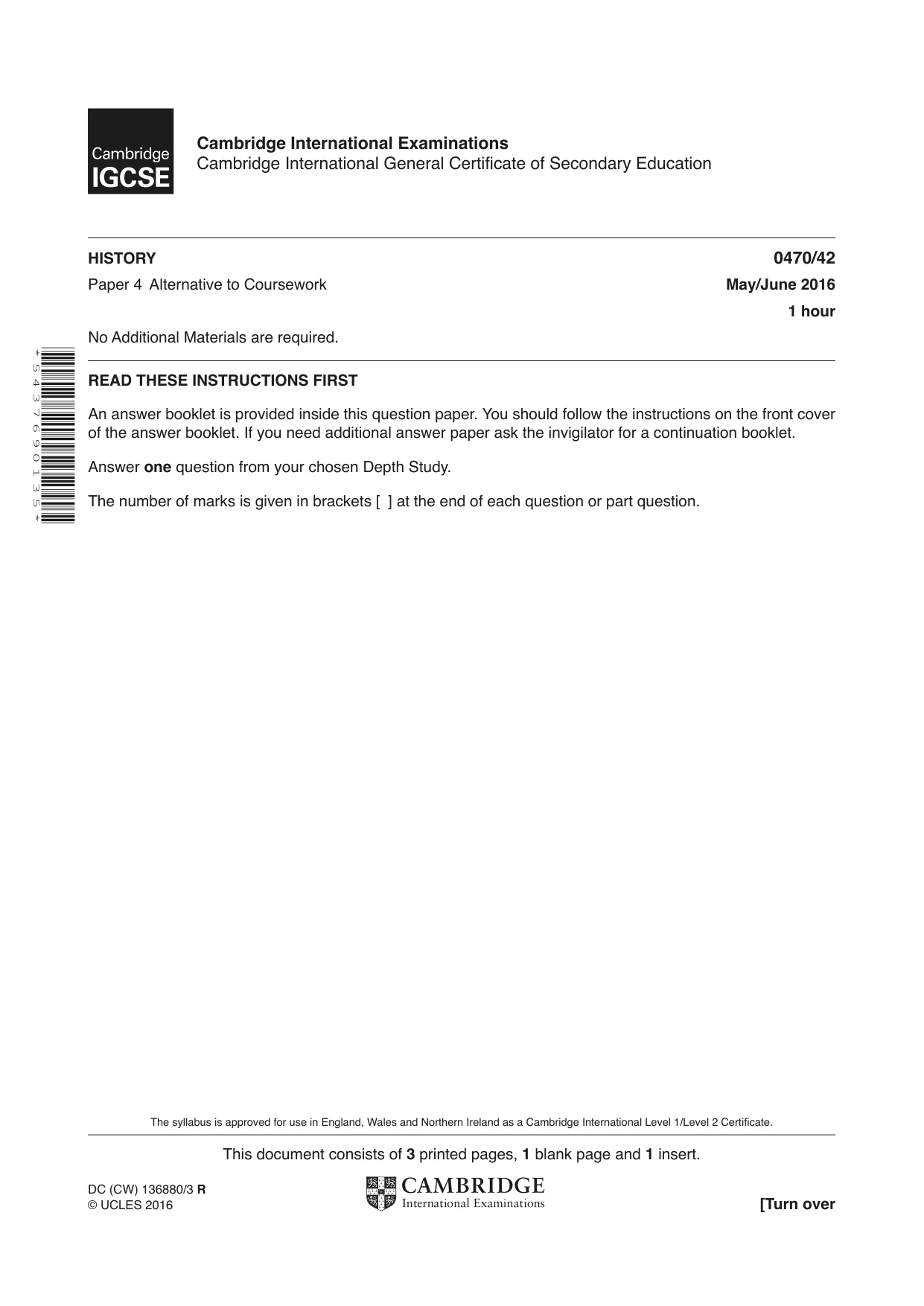
This document consists of 3 printed pages, 1 blank page and 1 insert. DC (CW) 136880/3 R © UCLES 2016 [Turn over Cambridge International Examinations Cambridge International General Certificate of Secondary Education * 5 4 3 7 6 9 0 1 3 5 * HISTORY 0470/42 Paper 4 Alternative to Coursework May/June 2016 1 hour No Additional Materials are required. READ THESE INSTRUCTIONS FIRST An answer booklet is provided inside this question paper. You should follow the instructions on the front cover of the answer booklet. If you need additional answer paper ask the invigilator for a continuation booklet. Answer one question from your chosen Depth Study. The number of marks is given in brackets [ ] at the end of each question or part question. The syllabus is approved for use in England, Wales and Northern Ireland as a Cambridge International Level 1/Level 2 Certificate.
Question paper, page 2
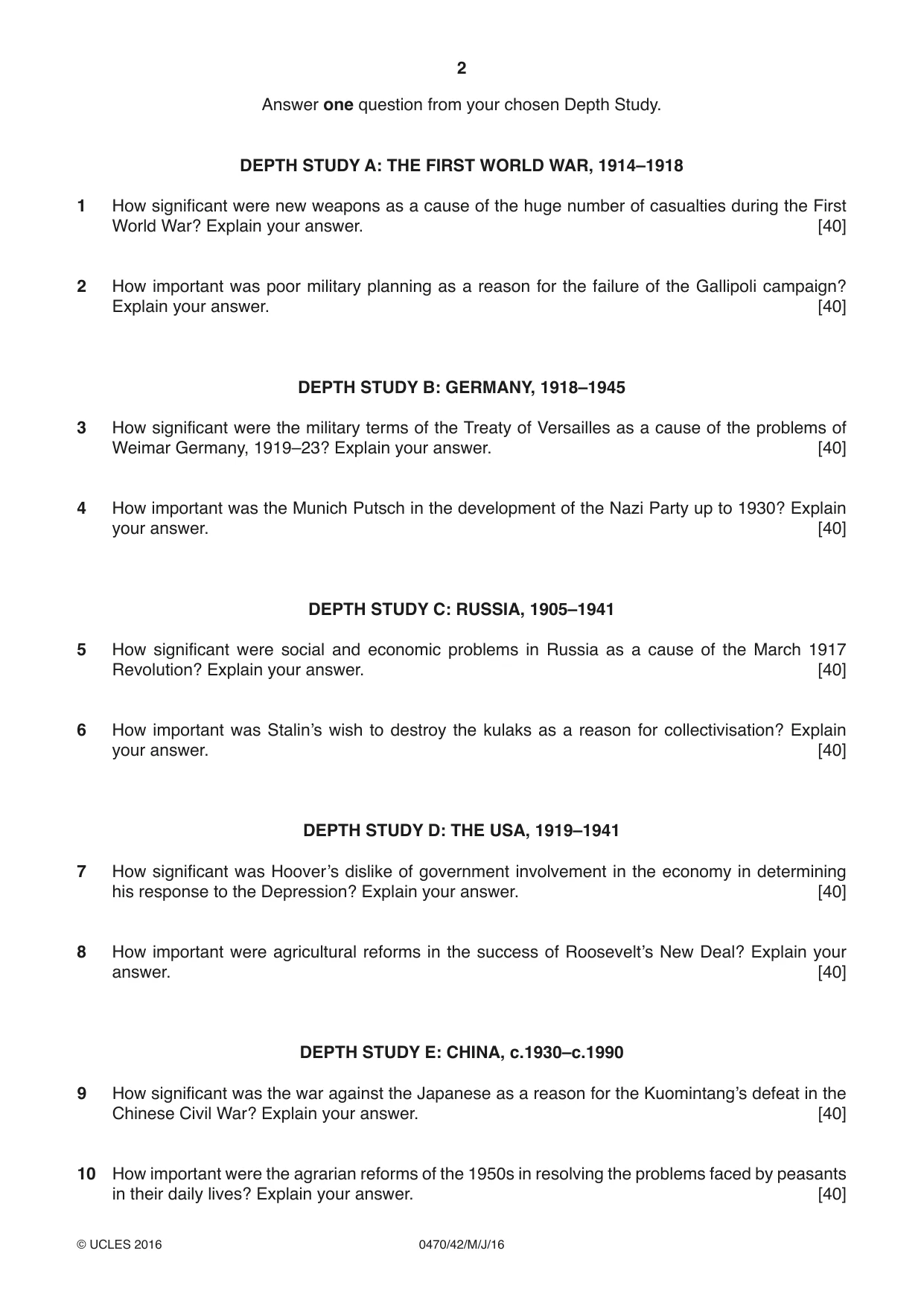
2 0470/42/M/J/16 © UCLES 2016 Answer one question from your chosen Depth Study. DEPTH STUDY A: THE FIRST WORLD WAR, 1914–1918 1 How significant were new weapons as a cause of the huge number of casualties during the First World War? Explain your answer. [40] 2 How important was poor military planning as a reason for the failure of the Gallipoli campaign? Explain your answer. [40] DEPTH STUDY B: GERMANY, 1918–1945 3 How significant were the military terms of the Treaty of Versailles as a cause of the problems of Weimar Germany, 1919–23? Explain your answer. [40] 4 How important was the Munich Putsch in the development of the Nazi Party up to 1930? Explain your answer. [40] DEPTH STUDY C: RUSSIA, 1905–1941 5 How significant were social and economic problems in Russia as a cause of the March 1917 Revolution? Explain your answer. [40] 6 How important was Stalin’s wish to destroy the kulaks as a reason for collectivisation? Explain your answer. [40] DEPTH STUDY D: THE USA, 1919–1941 7 How significant was Hoover’s dislike of government involvement in the economy in determining his response to the Depression? Explain your answer. [40] 8 How important were agricultural reforms in the success of Roosevelt’s New Deal? Explain your answer. [40] DEPTH STUDY E: CHINA, c.1930–c.1990 9 How significant was the war against the Japanese as a reason for the Kuomintang’s defeat in the Chinese Civil War? Explain your answer. [40] 10 How important were the agrarian reforms of the 1950s in resolving the problems faced by peasants in their daily lives? Explain your answer. [40]
Question paper, page 3
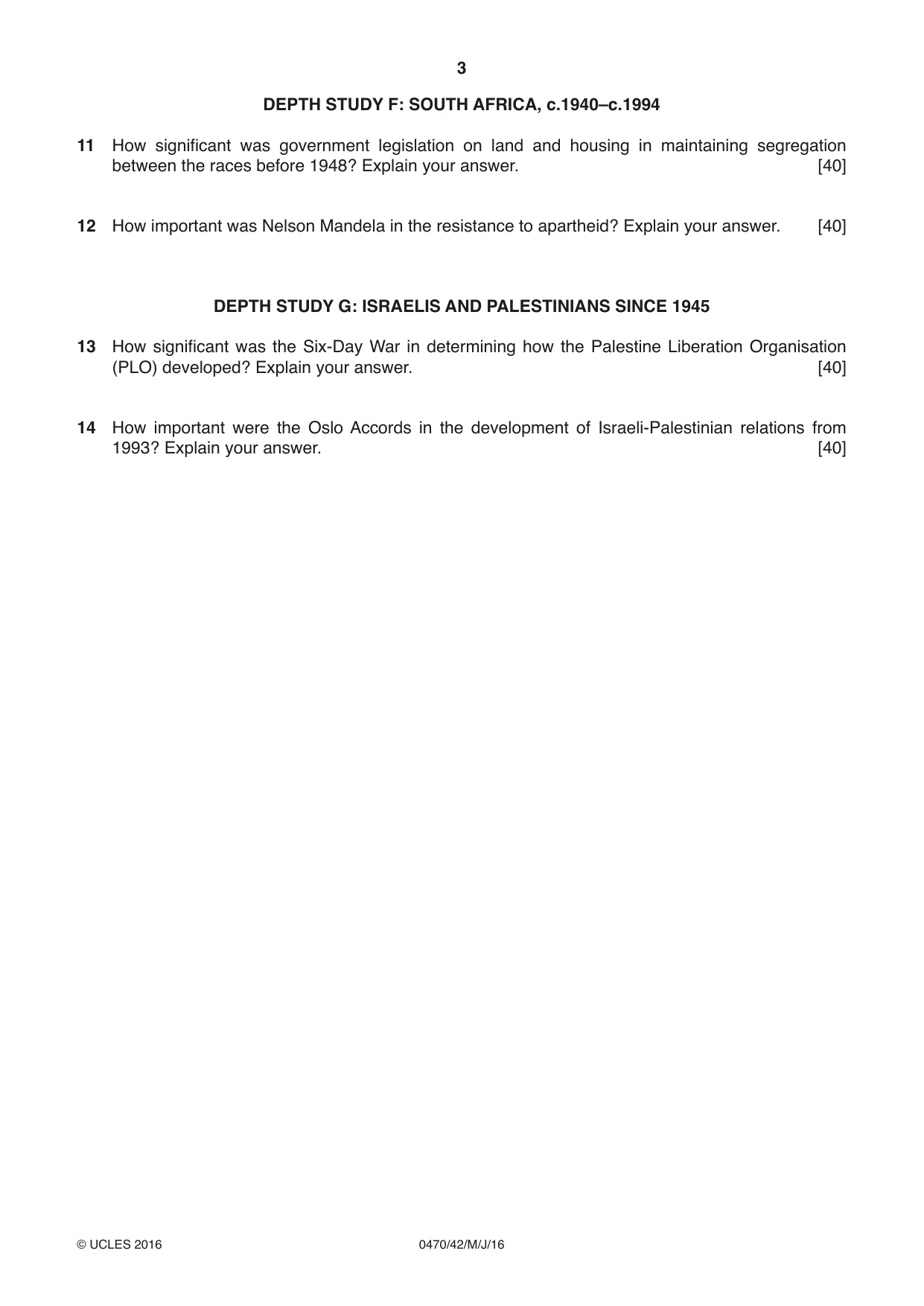
3 0470/42/M/J/16 © UCLES 2016 DEPTH STUDY F: SOUTH AFRICA, c.1940–c.1994 11 How significant was government legislation on land and housing in maintaining segregation between the races before 1948? Explain your answer. [40] 12 How important was Nelson Mandela in the resistance to apartheid? Explain your answer. [40] DEPTH STUDY G: ISRAELIS AND PALESTINIANS SINCE 1945 13 How significant was the Six-Day War in determining how the Palestine Liberation Organisation (PLO) developed? Explain your answer. [40] 14 How important were the Oslo Accords in the development of Israeli-Palestinian relations from 1993? Explain your answer. [40]
Question paper, page 4
4 0470/42/M/J/16 © UCLES 2016 BLANK PAGE Permission to reproduce items where third-party owned material protected by copyright is included has been sought and cleared where possible. Every reasonable effort has been made by the publisher (UCLES) to trace copyright holders, but if any items requiring clearance have unwittingly been included, the publisher will be pleased to make amends at the earliest possible opportunity. To avoid the issue of disclosure of answer-related information to candidates, all copyright acknowledgements are reproduced online in the Cambridge International Examinations Copyright Acknowledgements Booklet. This is produced for each series of examinations and is freely available to download at www.cie.org.uk after the live examination series. Cambridge International Examinations is part of the Cambridge Assessment Group. Cambridge Assessment is the brand name of University of Cambridge Local Examinations Syndicate (UCLES), which is itself a department of the University of Cambridge.
Mark scheme, page 1
® IGCSE is the registered trademark of Cambridge International Examinations. This syllabus is approved for use in England, Wales and Northern Ireland as a Cambridge International Level 1/Level 2 Certificate. This document consists of 11 printed pages. © UCLES 2016 [Turn over Cambridge International Examinations Cambridge International General Certificate of Secondary Education HISTORY 0470/42 Paper 4 Alternative to Coursework May/June 2016 MARK SCHEME Maximum Mark: 40 Published This mark scheme is published as an aid to teachers and candidates, to indicate the requirements of the examination. It shows the basis on which Examiners were instructed to award marks. It does not indicate the details of the discussions that took place at an Examiners’ meeting before marking began, which would have considered the acceptability of alternative answers. Mark schemes should be read in conjunction with the question paper and the Principal Examiner Report for Teachers. Cambridge will not enter into discussions about these mark schemes. Cambridge is publishing the mark schemes for the May/June 2016 series for most Cambridge IGCSE®, Cambridge International A and AS Level components and some Cambridge O Level components.
Mark scheme, page 2
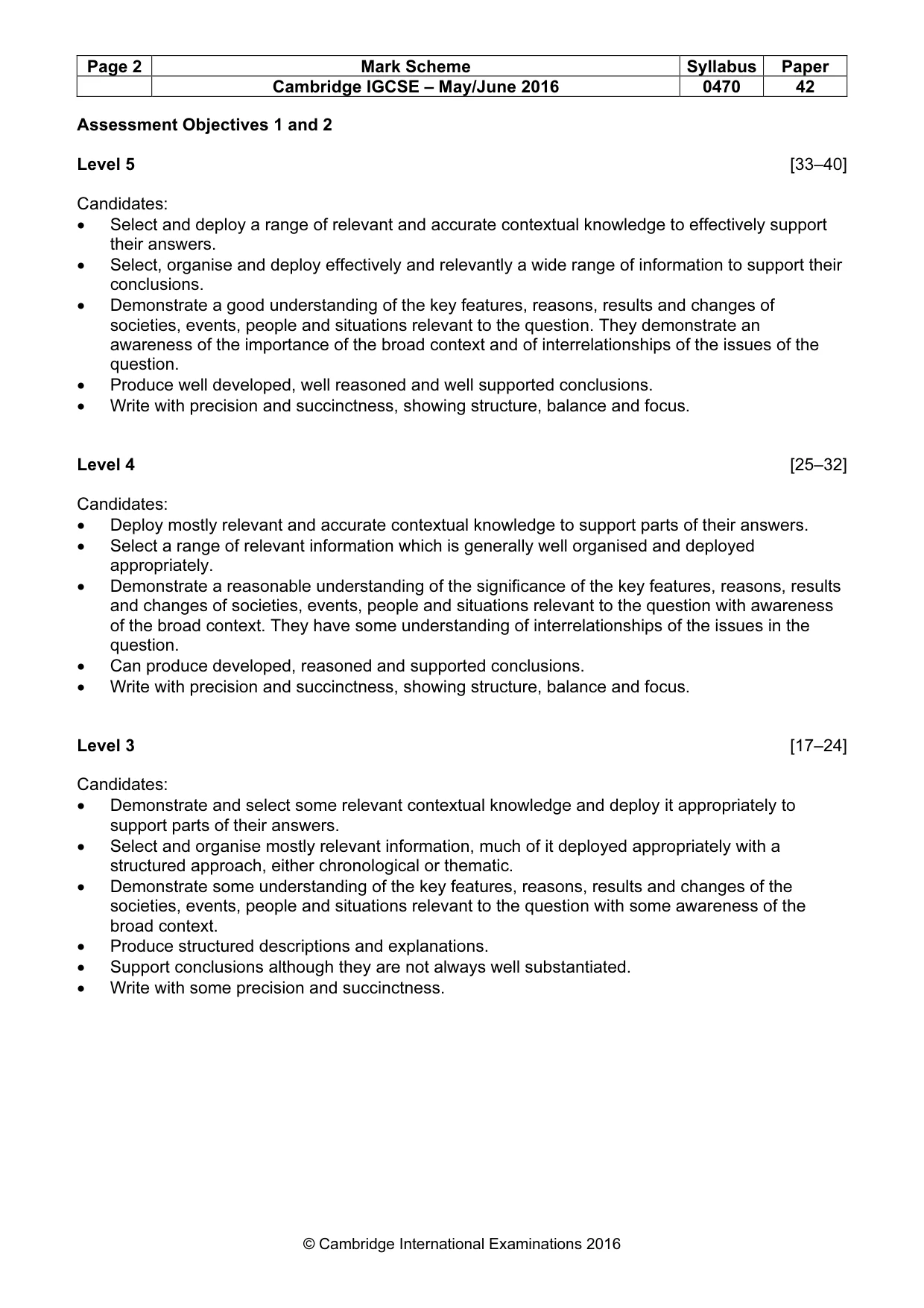
Page 2 Mark Scheme Syllabus Paper Cambridge IGCSE – May/June 2016 0470 42 © Cambridge International Examinations 2016 Assessment Objectives 1 and 2 Level 5 [33–40] Candidates: • Select and deploy a range of relevant and accurate contextual knowledge to effectively support their answers. • Select, organise and deploy effectively and relevantly a wide range of information to support their conclusions. • Demonstrate a good understanding of the key features, reasons, results and changes of societies, events, people and situations relevant to the question. They demonstrate an awareness of the importance of the broad context and of interrelationships of the issues of the question. • Produce well developed, well reasoned and well supported conclusions. • Write with precision and succinctness, showing structure, balance and focus. Level 4 [25–32] Candidates: • Deploy mostly relevant and accurate contextual knowledge to support parts of their answers. • Select a range of relevant information which is generally well organised and deployed appropriately. • Demonstrate a reasonable understanding of the significance of the key features, reasons, results and changes of societies, events, people and situations relevant to the question with awareness of the broad context. They have some understanding of interrelationships of the issues in the question. • Can produce developed, reasoned and supported conclusions. • Write with precision and succinctness, showing structure, balance and focus. Level 3 [17–24] Candidates: • Demonstrate and select some relevant contextual knowledge and deploy it appropriately to support parts of their answers. • Select and organise mostly relevant information, much of it deployed appropriately with a structured approach, either chronological or thematic. • Demonstrate some understanding of the key features, reasons, results and changes of the societies, events, people and situations relevant to the question with some awareness of the broad context. • Produce structured descriptions and explanations. • Support conclusions although they are not always well substantiated. • Write with some precision and succinctness.
Mark scheme, page 3
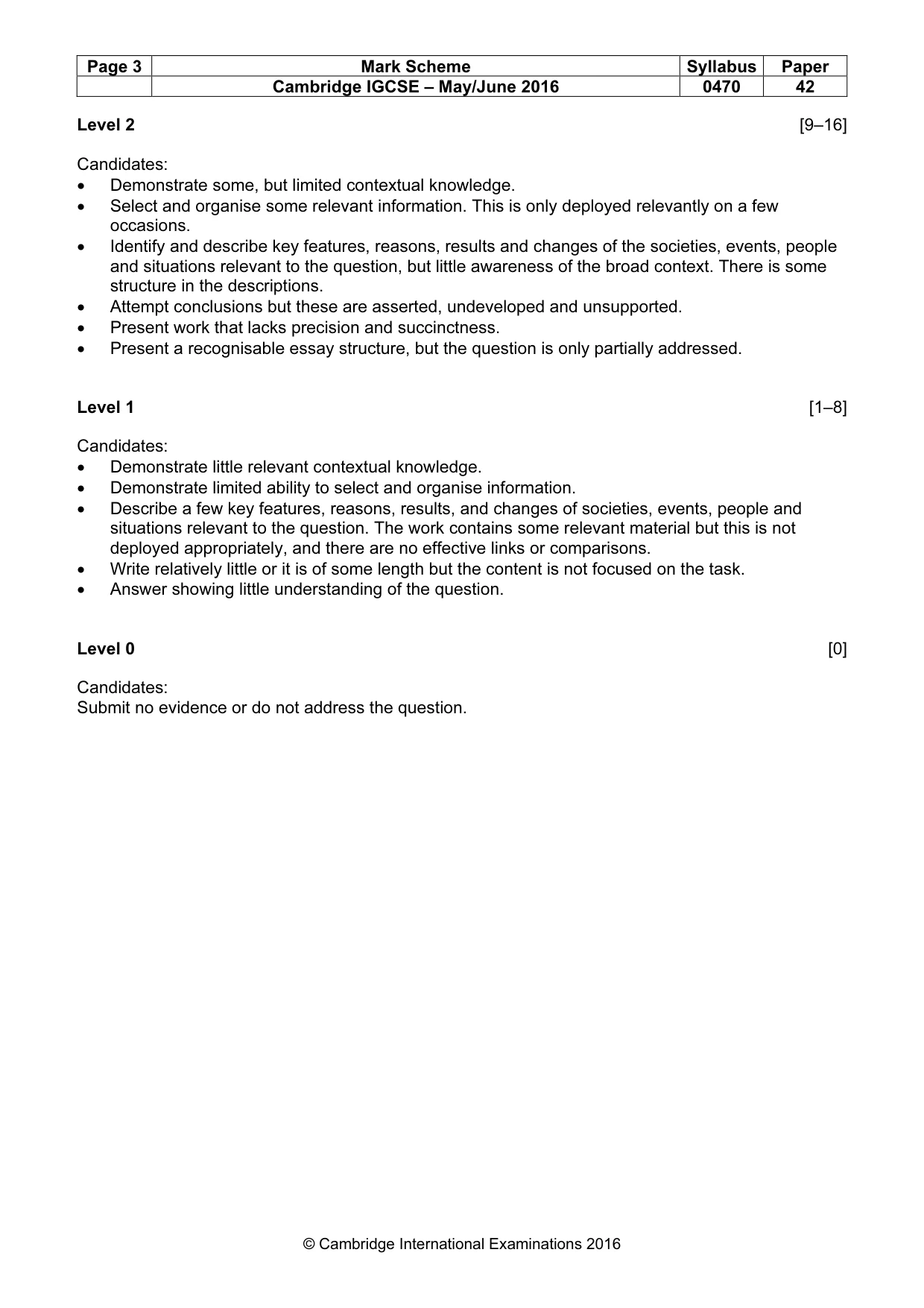
Page 3 Mark Scheme Syllabus Paper Cambridge IGCSE – May/June 2016 0470 42 © Cambridge International Examinations 2016 Level 2 [9–16] Candidates: • Demonstrate some, but limited contextual knowledge. • Select and organise some relevant information. This is only deployed relevantly on a few occasions. • Identify and describe key features, reasons, results and changes of the societies, events, people and situations relevant to the question, but little awareness of the broad context. There is some structure in the descriptions. • Attempt conclusions but these are asserted, undeveloped and unsupported. • Present work that lacks precision and succinctness. • Present a recognisable essay structure, but the question is only partially addressed. Level 1 [1–8] Candidates: • Demonstrate little relevant contextual knowledge. • Demonstrate limited ability to select and organise information. • Describe a few key features, reasons, results, and changes of societies, events, people and situations relevant to the question. The work contains some relevant material but this is not deployed appropriately, and there are no effective links or comparisons. • Write relatively little or it is of some length but the content is not focused on the task. • Answer showing little understanding of the question. Level 0 [0] Candidates: Submit no evidence or do not address the question.
Mark scheme, page 4
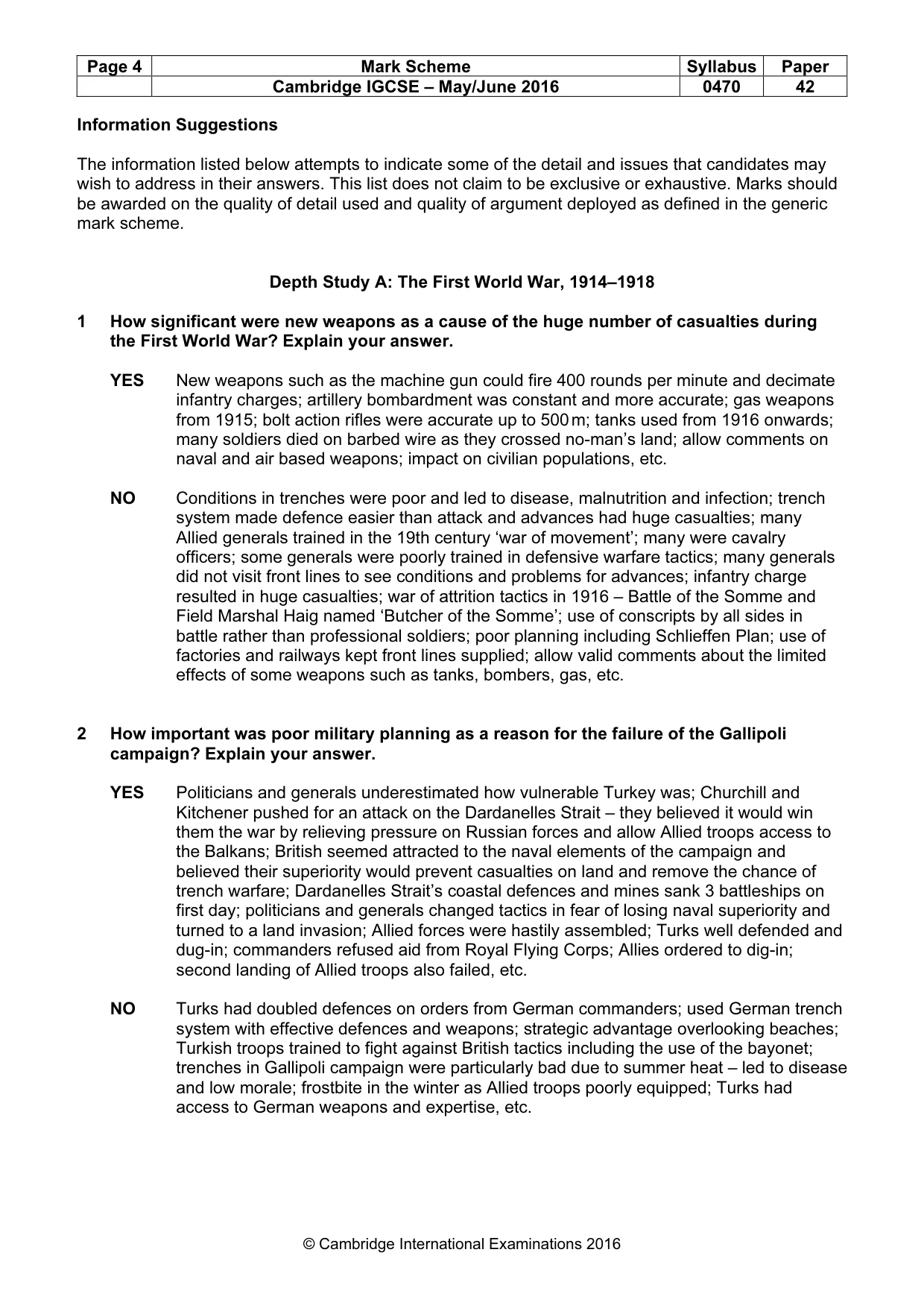
Page 4 Mark Scheme Syllabus Paper Cambridge IGCSE – May/June 2016 0470 42 © Cambridge International Examinations 2016 Information Suggestions The information listed below attempts to indicate some of the detail and issues that candidates may wish to address in their answers. This list does not claim to be exclusive or exhaustive. Marks should be awarded on the quality of detail used and quality of argument deployed as defined in the generic mark scheme. Depth Study A: The First World War, 1914–1918 1 How significant were new weapons as a cause of the huge number of casualties during the First World War? Explain your answer. YES New weapons such as the machine gun could fire 400 rounds per minute and decimate infantry charges; artillery bombardment was constant and more accurate; gas weapons from 1915; bolt action rifles were accurate up to 500 m; tanks used from 1916 onwards; many soldiers died on barbed wire as they crossed no-man’s land; allow comments on naval and air based weapons; impact on civilian populations, etc. NO Conditions in trenches were poor and led to disease, malnutrition and infection; trench system made defence easier than attack and advances had huge casualties; many Allied generals trained in the 19th century ‘war of movement’; many were cavalry officers; some generals were poorly trained in defensive warfare tactics; many generals did not visit front lines to see conditions and problems for advances; infantry charge resulted in huge casualties; war of attrition tactics in 1916 – Battle of the Somme and Field Marshal Haig named ‘Butcher of the Somme’; use of conscripts by all sides in battle rather than professional soldiers; poor planning including Schlieffen Plan; use of factories and railways kept front lines supplied; allow valid comments about the limited effects of some weapons such as tanks, bombers, gas, etc. 2 How important was poor military planning as a reason for the failure of the Gallipoli campaign? Explain your answer. YES Politicians and generals underestimated how vulnerable Turkey was; Churchill and Kitchener pushed for an attack on the Dardanelles Strait – they believed it would win them the war by relieving pressure on Russian forces and allow Allied troops access to the Balkans; British seemed attracted to the naval elements of the campaign and believed their superiority would prevent casualties on land and remove the chance of trench warfare; Dardanelles Strait’s coastal defences and mines sank 3 battleships on first day; politicians and generals changed tactics in fear of losing naval superiority and turned to a land invasion; Allied forces were hastily assembled; Turks well defended and dug-in; commanders refused aid from Royal Flying Corps; Allies ordered to dig-in; second landing of Allied troops also failed, etc. NO Turks had doubled defences on orders from German commanders; used German trench system with effective defences and weapons; strategic advantage overlooking beaches; Turkish troops trained to fight against British tactics including the use of the bayonet; trenches in Gallipoli campaign were particularly bad due to summer heat – led to disease and low morale; frostbite in the winter as Allied troops poorly equipped; Turks had access to German weapons and expertise, etc.
Mark scheme, page 5
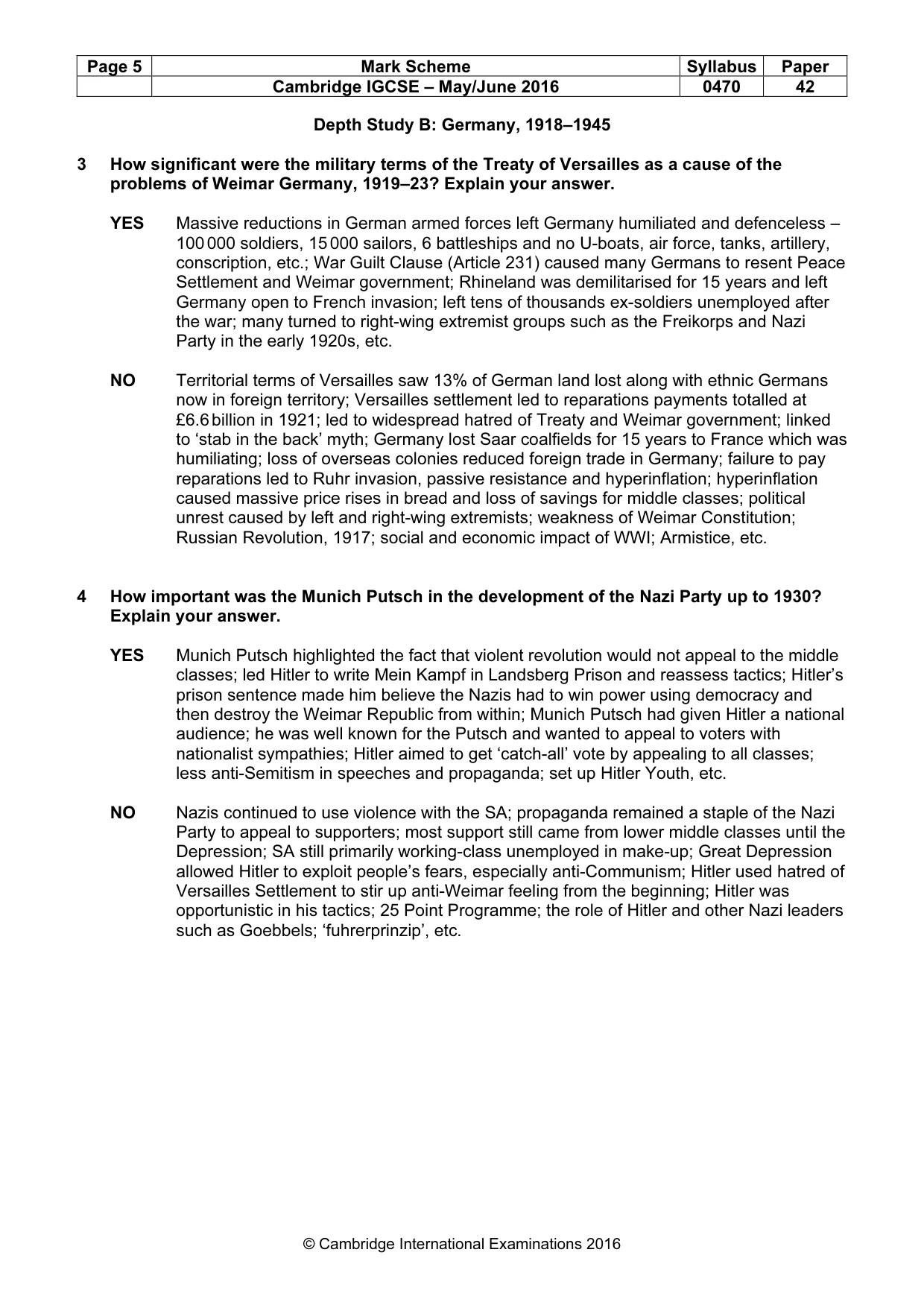
Page 5 Mark Scheme Syllabus Paper Cambridge IGCSE – May/June 2016 0470 42 © Cambridge International Examinations 2016 Depth Study B: Germany, 1918–1945 3 How significant were the military terms of the Treaty of Versailles as a cause of the problems of Weimar Germany, 1919–23? Explain your answer. YES Massive reductions in German armed forces left Germany humiliated and defenceless – 100 000 soldiers, 15 000 sailors, 6 battleships and no U-boats, air force, tanks, artillery, conscription, etc.; War Guilt Clause (Article 231) caused many Germans to resent Peace Settlement and Weimar government; Rhineland was demilitarised for 15 years and left Germany open to French invasion; left tens of thousands ex-soldiers unemployed after the war; many turned to right-wing extremist groups such as the Freikorps and Nazi Party in the early 1920s, etc. NO Territorial terms of Versailles saw 13% of German land lost along with ethnic Germans now in foreign territory; Versailles settlement led to reparations payments totalled at £6.6 billion in 1921; led to widespread hatred of Treaty and Weimar government; linked to ‘stab in the back’ myth; Germany lost Saar coalfields for 15 years to France which was humiliating; loss of overseas colonies reduced foreign trade in Germany; failure to pay reparations led to Ruhr invasion, passive resistance and hyperinflation; hyperinflation caused massive price rises in bread and loss of savings for middle classes; political unrest caused by left and right-wing extremists; weakness of Weimar Constitution; Russian Revolution, 1917; social and economic impact of WWI; Armistice, etc. 4 How important was the Munich Putsch in the development of the Nazi Party up to 1930? Explain your answer. YES Munich Putsch highlighted the fact that violent revolution would not appeal to the middle classes; led Hitler to write Mein Kampf in Landsberg Prison and reassess tactics; Hitler’s prison sentence made him believe the Nazis had to win power using democracy and then destroy the Weimar Republic from within; Munich Putsch had given Hitler a national audience; he was well known for the Putsch and wanted to appeal to voters with nationalist sympathies; Hitler aimed to get ‘catch-all’ vote by appealing to all classes; less anti-Semitism in speeches and propaganda; set up Hitler Youth, etc. NO Nazis continued to use violence with the SA; propaganda remained a staple of the Nazi Party to appeal to supporters; most support still came from lower middle classes until the Depression; SA still primarily working-class unemployed in make-up; Great Depression allowed Hitler to exploit people’s fears, especially anti-Communism; Hitler used hatred of Versailles Settlement to stir up anti-Weimar feeling from the beginning; Hitler was opportunistic in his tactics; 25 Point Programme; the role of Hitler and other Nazi leaders such as Goebbels; ‘fuhrerprinzip’, etc.
Mark scheme, page 6
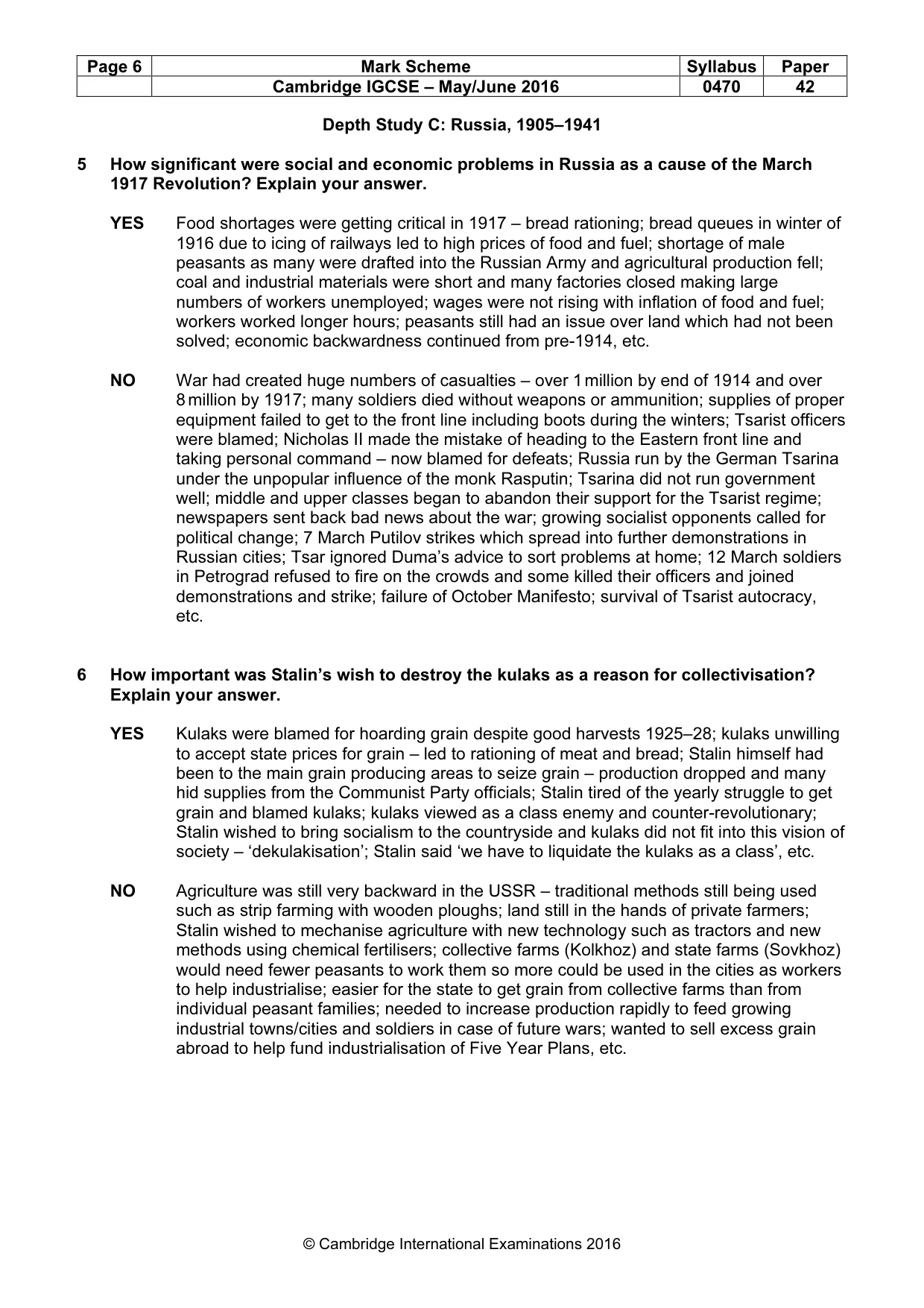
Page 6 Mark Scheme Syllabus Paper Cambridge IGCSE – May/June 2016 0470 42 © Cambridge International Examinations 2016 Depth Study C: Russia, 1905–1941 5 How significant were social and economic problems in Russia as a cause of the March 1917 Revolution? Explain your answer. YES Food shortages were getting critical in 1917 – bread rationing; bread queues in winter of 1916 due to icing of railways led to high prices of food and fuel; shortage of male peasants as many were drafted into the Russian Army and agricultural production fell; coal and industrial materials were short and many factories closed making large numbers of workers unemployed; wages were not rising with inflation of food and fuel; workers worked longer hours; peasants still had an issue over land which had not been solved; economic backwardness continued from pre-1914, etc. NO War had created huge numbers of casualties – over 1 million by end of 1914 and over 8 million by 1917; many soldiers died without weapons or ammunition; supplies of proper equipment failed to get to the front line including boots during the winters; Tsarist officers were blamed; Nicholas II made the mistake of heading to the Eastern front line and taking personal command – now blamed for defeats; Russia run by the German Tsarina under the unpopular influence of the monk Rasputin; Tsarina did not run government well; middle and upper classes began to abandon their support for the Tsarist regime; newspapers sent back bad news about the war; growing socialist opponents called for political change; 7 March Putilov strikes which spread into further demonstrations in Russian cities; Tsar ignored Duma’s advice to sort problems at home; 12 March soldiers in Petrograd refused to fire on the crowds and some killed their officers and joined demonstrations and strike; failure of October Manifesto; survival of Tsarist autocracy, etc. 6 How important was Stalin’s wish to destroy the kulaks as a reason for collectivisation? Explain your answer. YES Kulaks were blamed for hoarding grain despite good harvests 1925–28; kulaks unwilling to accept state prices for grain – led to rationing of meat and bread; Stalin himself had been to the main grain producing areas to seize grain – production dropped and many hid supplies from the Communist Party officials; Stalin tired of the yearly struggle to get grain and blamed kulaks; kulaks viewed as a class enemy and counter-revolutionary; Stalin wished to bring socialism to the countryside and kulaks did not fit into this vision of society – ‘dekulakisation’; Stalin said ‘we have to liquidate the kulaks as a class’, etc. NO Agriculture was still very backward in the USSR – traditional methods still being used such as strip farming with wooden ploughs; land still in the hands of private farmers; Stalin wished to mechanise agriculture with new technology such as tractors and new methods using chemical fertilisers; collective farms (Kolkhoz) and state farms (Sovkhoz) would need fewer peasants to work them so more could be used in the cities as workers to help industrialise; easier for the state to get grain from collective farms than from individual peasant families; needed to increase production rapidly to feed growing industrial towns/cities and soldiers in case of future wars; wanted to sell excess grain abroad to help fund industrialisation of Five Year Plans, etc.
Mark scheme, page 7
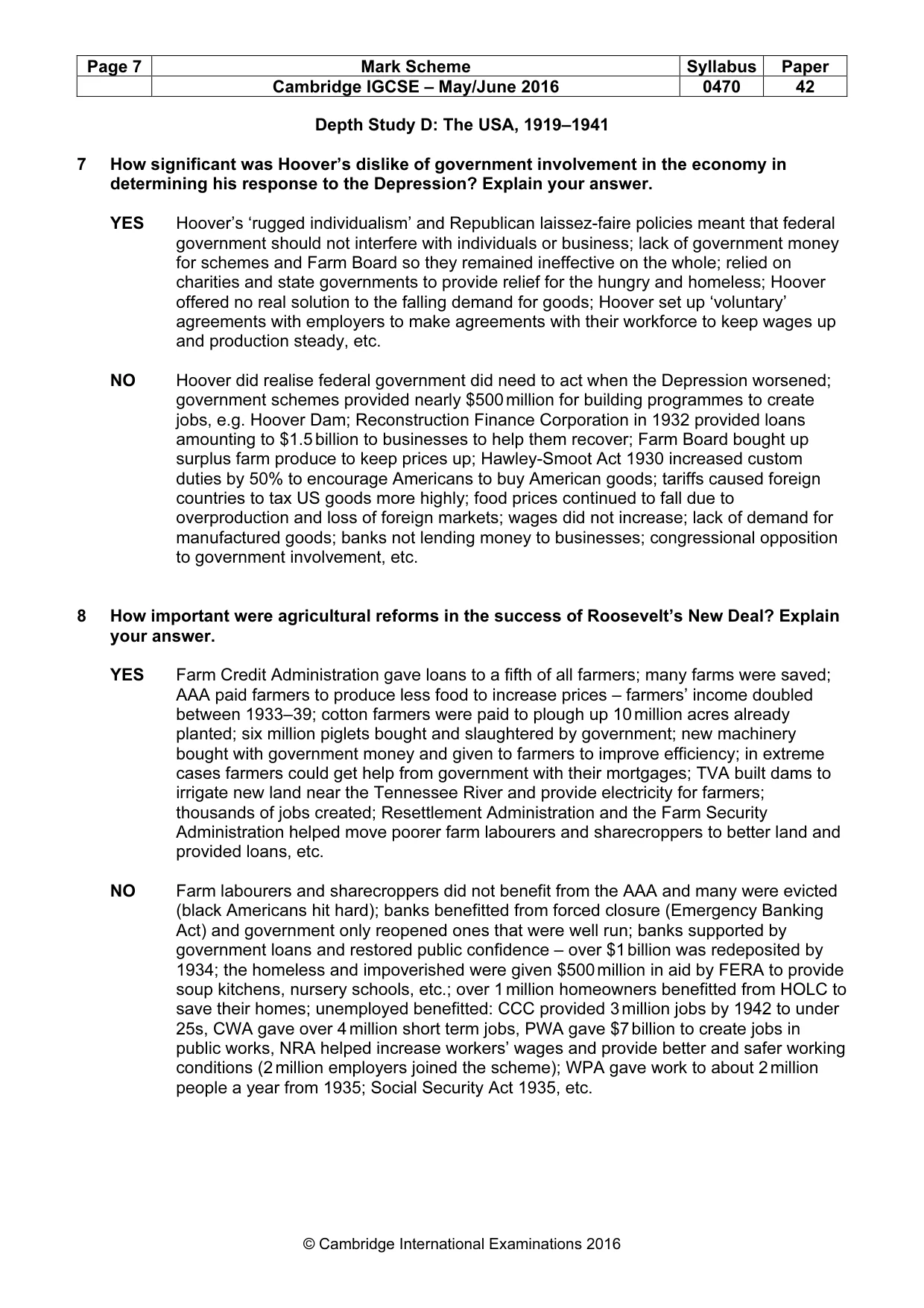
Page 7 Mark Scheme Syllabus Paper Cambridge IGCSE – May/June 2016 0470 42 © Cambridge International Examinations 2016 Depth Study D: The USA, 1919–1941 7 How significant was Hoover’s dislike of government involvement in the economy in determining his response to the Depression? Explain your answer. YES Hoover’s ‘rugged individualism’ and Republican laissez-faire policies meant that federal government should not interfere with individuals or business; lack of government money for schemes and Farm Board so they remained ineffective on the whole; relied on charities and state governments to provide relief for the hungry and homeless; Hoover offered no real solution to the falling demand for goods; Hoover set up ‘voluntary’ agreements with employers to make agreements with their workforce to keep wages up and production steady, etc. NO Hoover did realise federal government did need to act when the Depression worsened; government schemes provided nearly $500 million for building programmes to create jobs, e.g. Hoover Dam; Reconstruction Finance Corporation in 1932 provided loans amounting to $1.5 billion to businesses to help them recover; Farm Board bought up surplus farm produce to keep prices up; Hawley-Smoot Act 1930 increased custom duties by 50% to encourage Americans to buy American goods; tariffs caused foreign countries to tax US goods more highly; food prices continued to fall due to overproduction and loss of foreign markets; wages did not increase; lack of demand for manufactured goods; banks not lending money to businesses; congressional opposition to government involvement, etc. 8 How important were agricultural reforms in the success of Roosevelt’s New Deal? Explain your answer. YES Farm Credit Administration gave loans to a fifth of all farmers; many farms were saved; AAA paid farmers to produce less food to increase prices – farmers’ income doubled between 1933–39; cotton farmers were paid to plough up 10 million acres already planted; six million piglets bought and slaughtered by government; new machinery bought with government money and given to farmers to improve efficiency; in extreme cases farmers could get help from government with their mortgages; TVA built dams to irrigate new land near the Tennessee River and provide electricity for farmers; thousands of jobs created; Resettlement Administration and the Farm Security Administration helped move poorer farm labourers and sharecroppers to better land and provided loans, etc. NO Farm labourers and sharecroppers did not benefit from the AAA and many were evicted (black Americans hit hard); banks benefitted from forced closure (Emergency Banking Act) and government only reopened ones that were well run; banks supported by government loans and restored public confidence – over $1 billion was redeposited by 1934; the homeless and impoverished were given $500 million in aid by FERA to provide soup kitchens, nursery schools, etc.; over 1 million homeowners benefitted from HOLC to save their homes; unemployed benefitted: CCC provided 3 million jobs by 1942 to under 25s, CWA gave over 4 million short term jobs, PWA gave $7 billion to create jobs in public works, NRA helped increase workers’ wages and provide better and safer working conditions (2 million employers joined the scheme); WPA gave work to about 2 million people a year from 1935; Social Security Act 1935, etc.
Mark scheme, page 8
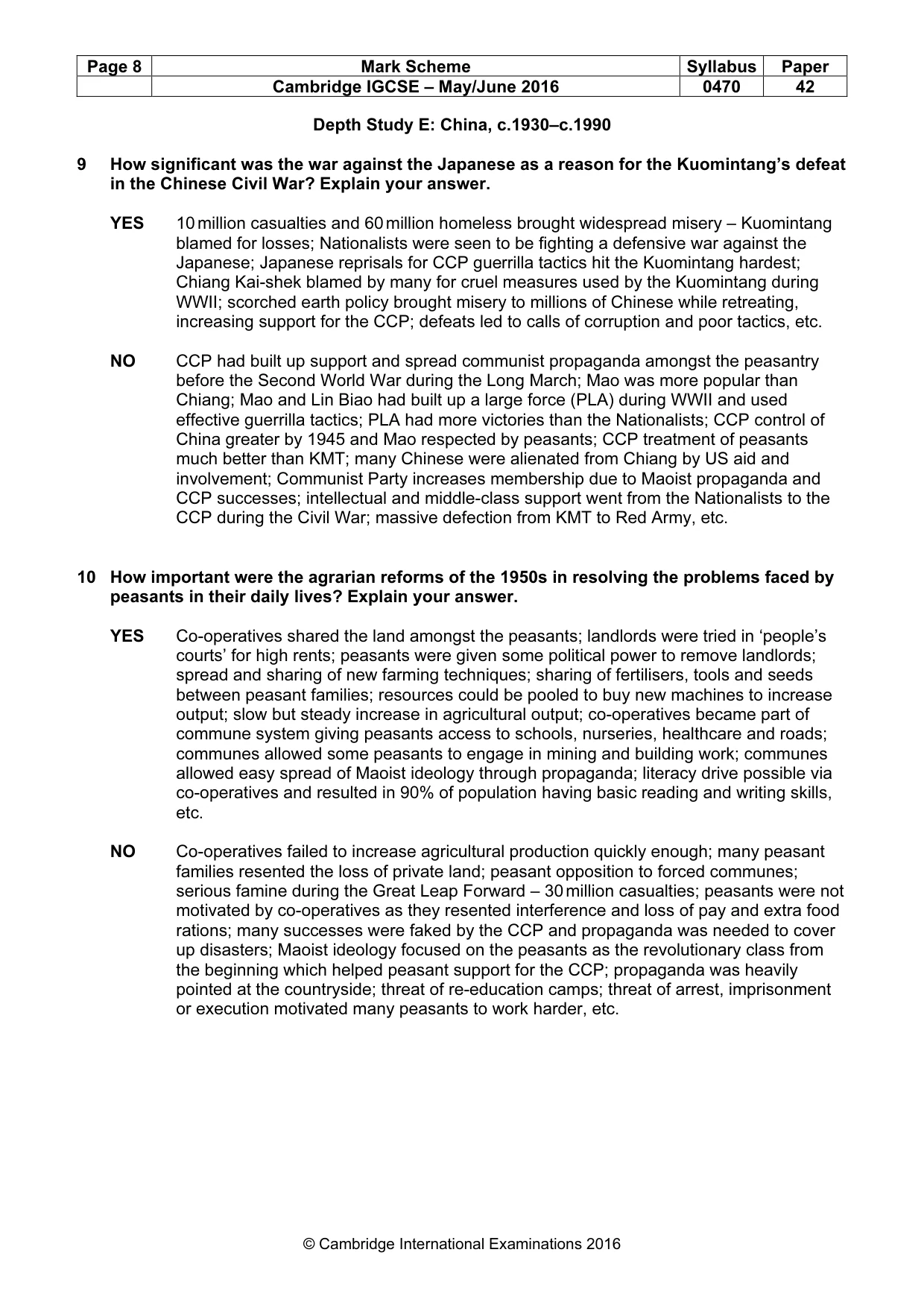
Page 8 Mark Scheme Syllabus Paper Cambridge IGCSE – May/June 2016 0470 42 © Cambridge International Examinations 2016 Depth Study E: China, c.1930–c.1990 9 How significant was the war against the Japanese as a reason for the Kuomintang’s defeat in the Chinese Civil War? Explain your answer. YES 10 million casualties and 60 million homeless brought widespread misery – Kuomintang blamed for losses; Nationalists were seen to be fighting a defensive war against the Japanese; Japanese reprisals for CCP guerrilla tactics hit the Kuomintang hardest; Chiang Kai-shek blamed by many for cruel measures used by the Kuomintang during WWII; scorched earth policy brought misery to millions of Chinese while retreating, increasing support for the CCP; defeats led to calls of corruption and poor tactics, etc. NO CCP had built up support and spread communist propaganda amongst the peasantry before the Second World War during the Long March; Mao was more popular than Chiang; Mao and Lin Biao had built up a large force (PLA) during WWII and used effective guerrilla tactics; PLA had more victories than the Nationalists; CCP control of China greater by 1945 and Mao respected by peasants; CCP treatment of peasants much better than KMT; many Chinese were alienated from Chiang by US aid and involvement; Communist Party increases membership due to Maoist propaganda and CCP successes; intellectual and middle-class support went from the Nationalists to the CCP during the Civil War; massive defection from KMT to Red Army, etc. 10 How important were the agrarian reforms of the 1950s in resolving the problems faced by peasants in their daily lives? Explain your answer. YES Co-operatives shared the land amongst the peasants; landlords were tried in ‘people’s courts’ for high rents; peasants were given some political power to remove landlords; spread and sharing of new farming techniques; sharing of fertilisers, tools and seeds between peasant families; resources could be pooled to buy new machines to increase output; slow but steady increase in agricultural output; co-operatives became part of commune system giving peasants access to schools, nurseries, healthcare and roads; communes allowed some peasants to engage in mining and building work; communes allowed easy spread of Maoist ideology through propaganda; literacy drive possible via co-operatives and resulted in 90% of population having basic reading and writing skills, etc. NO Co-operatives failed to increase agricultural production quickly enough; many peasant families resented the loss of private land; peasant opposition to forced communes; serious famine during the Great Leap Forward – 30 million casualties; peasants were not motivated by co-operatives as they resented interference and loss of pay and extra food rations; many successes were faked by the CCP and propaganda was needed to cover up disasters; Maoist ideology focused on the peasants as the revolutionary class from the beginning which helped peasant support for the CCP; propaganda was heavily pointed at the countryside; threat of re-education camps; threat of arrest, imprisonment or execution motivated many peasants to work harder, etc.
Mark scheme, page 9
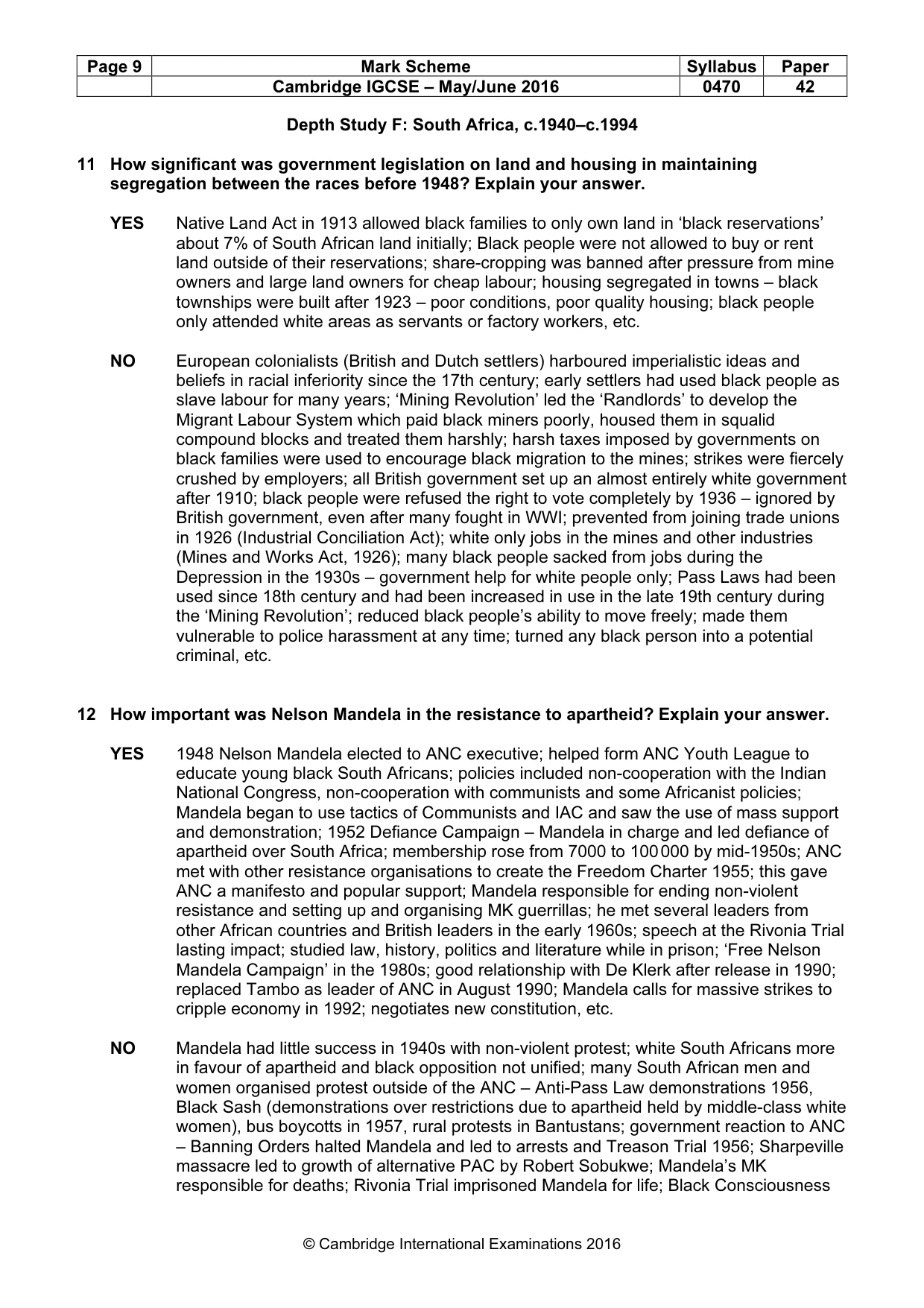
Page 9 Mark Scheme Syllabus Paper Cambridge IGCSE – May/June 2016 0470 42 © Cambridge International Examinations 2016 Depth Study F: South Africa, c.1940–c.1994 11 How significant was government legislation on land and housing in maintaining segregation between the races before 1948? Explain your answer. YES Native Land Act in 1913 allowed black families to only own land in ‘black reservations’ about 7% of South African land initially; Black people were not allowed to buy or rent land outside of their reservations; share-cropping was banned after pressure from mine owners and large land owners for cheap labour; housing segregated in towns – black townships were built after 1923 – poor conditions, poor quality housing; black people only attended white areas as servants or factory workers, etc. NO European colonialists (British and Dutch settlers) harboured imperialistic ideas and beliefs in racial inferiority since the 17th century; early settlers had used black people as slave labour for many years; ‘Mining Revolution’ led the ‘Randlords’ to develop the Migrant Labour System which paid black miners poorly, housed them in squalid compound blocks and treated them harshly; harsh taxes imposed by governments on black families were used to encourage black migration to the mines; strikes were fiercely crushed by employers; all British government set up an almost entirely white government after 1910; black people were refused the right to vote completely by 1936 – ignored by British government, even after many fought in WWI; prevented from joining trade unions in 1926 (Industrial Conciliation Act); white only jobs in the mines and other industries (Mines and Works Act, 1926); many black people sacked from jobs during the Depression in the 1930s – government help for white people only; Pass Laws had been used since 18th century and had been increased in use in the late 19th century during the ‘Mining Revolution’; reduced black people’s ability to move freely; made them vulnerable to police harassment at any time; turned any black person into a potential criminal, etc. 12 How important was Nelson Mandela in the resistance to apartheid? Explain your answer. YES 1948 Nelson Mandela elected to ANC executive; helped form ANC Youth League to educate young black South Africans; policies included non-cooperation with the Indian National Congress, non-cooperation with communists and some Africanist policies; Mandela began to use tactics of Communists and IAC and saw the use of mass support and demonstration; 1952 Defiance Campaign – Mandela in charge and led defiance of apartheid over South Africa; membership rose from 7000 to 100 000 by mid-1950s; ANC met with other resistance organisations to create the Freedom Charter 1955; this gave ANC a manifesto and popular support; Mandela responsible for ending non-violent resistance and setting up and organising MK guerrillas; he met several leaders from other African countries and British leaders in the early 1960s; speech at the Rivonia Trial lasting impact; studied law, history, politics and literature while in prison; ‘Free Nelson Mandela Campaign’ in the 1980s; good relationship with De Klerk after release in 1990; replaced Tambo as leader of ANC in August 1990; Mandela calls for massive strikes to cripple economy in 1992; negotiates new constitution, etc. NO Mandela had little success in 1940s with non-violent protest; white South Africans more in favour of apartheid and black opposition not unified; many South African men and women organised protest outside of the ANC – Anti-Pass Law demonstrations 1956, Black Sash (demonstrations over restrictions due to apartheid held by middle-class white women), bus boycotts in 1957, rural protests in Bantustans; government reaction to ANC – Banning Orders halted Mandela and led to arrests and Treason Trial 1956; Sharpeville massacre led to growth of alternative PAC by Robert Sobukwe; Mandela’s MK responsible for deaths; Rivonia Trial imprisoned Mandela for life; Black Consciousness
Mark scheme, page 10
Page 10 Mark Scheme Syllabus Paper Cambridge IGCSE – May/June 2016 0470 42 © Cambridge International Examinations 2016 helped unify blacks in the 1960s through music, poetry and literature; Steve Biko’s impact and death into the 1970s; trade union strikes in 1973 reenergised black trade unions; Soweto school riot received public and international outcry; Church leaders such as Bishop Desmond Tutu; creation of United Democratic Front in 1983; UN resolutions; foreign opposition including in sports, etc.
Mark scheme, page 11
Page 11 Mark Scheme Syllabus Paper Cambridge IGCSE – May/June 2016 0470 42 © Cambridge International Examinations 2016 Depth Study G: Israelis and Palestinians since 1945 13 How significant was the Six-Day War in determining how the Palestine Liberation Organisation (PLO) developed? Explain your answer. YES 350 000 refugees from West Bank in 1967, fled to Jordan – half the population Palestinian from 1967; Fatah and other groups in the PLO now able to recruit more volunteers from the refugee camps; growing Arab nationalism from Israeli expansion; loss of help from other Arab states strengthened the determination of Palestinians to fight for their homeland; Fatah increased raids into Israel; viewed as heroes by many Arabs who joined PLO – 5000 in 2 days; Fatah gained control of the PLO – Yasser Arafat becomes chairman of PLO; able to co-ordinate the activities of the different groups within the PLO, etc. NO 1948–49 war as the origin of the PLO; Arab states had supported Fatah’s raids into Israel before 1967; Syria, Jordan and Egypt were weakened from the Six-Day War and became more focused on their lands rather than Palestine; these Arab states reduced some of their vital support/aid to the PLO; Fatah bases became the focus point for Israeli retaliation; led to more radical groups emerging in the PLO who carried out attacks in other parts of the world, e.g. PFLP; 1968 and 1970 plane hijacking was bad publicity for the PLO; 1970 Jordan expels PLO, etc. 14 How important were the Oslo Accords in the development of Israeli-Palestinian relations from 1993? Explain your answer. YES Oslo Accord 1993 resulted in PLO recognising Israel’s right to exist and Israel recognising the PLO as the representative of the Palestinian people; Arafat condemned terrorism; White House in Washington became the headline for world cameras as Arafat and Rabin shook hands; Israeli troops would be withdrawn from Gaza and part of the West Bank; elections for a Palestinian Authority to run the West Bank and Gaza for 5 years; Oslo II Accords, 1995 also put a date for the elections, further Israeli withdrawals and release of Palestinian prisoners from Israeli jails; Israel-Jordan peace treaty, 1994 settled border disputes and recognised Israel; trust between both sides increased, etc. NO Oslo Accord a timetable for Palestinian government rather than a peace treaty and final settlements were postponed; issue of Jerusalem not solved – Israeli settlements surrounded the mainly Arab east Jerusalem – 150 000 Israelis; the question of the Jewish settlements in the West Bank not solved; many Palestinians still called for all of Palestine to be united under Palestinian rule; Israel still had many security worries; question of refugees in neighbouring Arab states; still presence of Israeli troops on roads to protect supplies; Israel continues to build settlements in the occupied territories leading to a slowing down of the peace process; growth of militant Hamas as PLO members switch their support; 1995–97 bombings and assassinations; Israeli extremist assassinates Rabin, 1995 in protest at peace process, etc.
What you needed in this session
Cambridge’s own grade thresholds for 2016 May/June, Paper 4 · Variant 2. A higher threshold means an easier paper — the bar moves with how the cohort did.