Cambridge IGCSE Greek - Foreign Language 0543 — 2019 May/June Paper 2 · Variant 1
0543/21/M/J/19 · 45 marks · ≈51 min
The question paper and its mark scheme, free to read here and free to download. This is Cambridge’s own paper, exactly as it was sat.
Question paper16 pages


Mark scheme14 pages
Answers below. Sit the paper first if you are practising.
Paper as text
Question paper, page 1
* 6 9 1 7 0 2 1 9 3 4 * This document consists of 14 printed pages and 2 blank pages. DC (SC/SW) 158289/3 © UCLES 2019 [Turn over GREEK 0543/02 Paper 2 Reading May/June 2019 1 hour Candidates answer on the Question Paper. No Additional Materials are required. READ THESE INSTRUCTIONS FIRST Write your centre number, candidate number and name in the spaces at the top of this page. Write in dark blue or black pen. Do not use staples, paper clips, glue or correction fluid. DO NOT WRITE IN ANY BARCODES. Answer all questions. The number of marks is given in brackets [ ] at the end of each question or part question. Cambridge Assessment International Education Cambridge International General Certificate of Secondary Education This syllabus is regulated for use in England, Wales and Northern Ireland as a Cambridge International Level 1/Level 2 Certificate.
Question paper, page 2
2 0543/02/M/J/19 © UCLES 2019 BLANK PAGE
Question paper, page 3
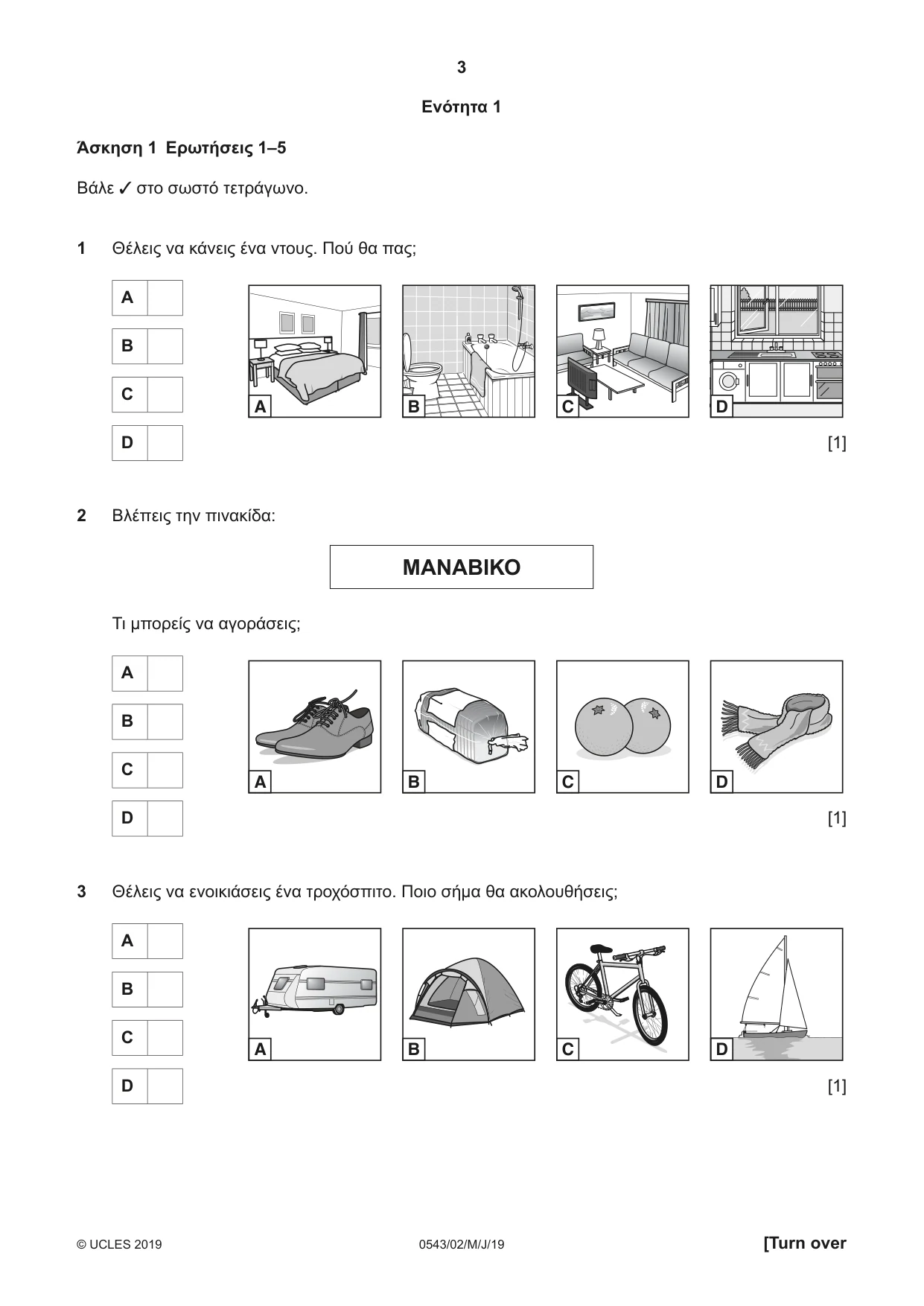
3 0543/02/M/J/19 © UCLES 2019 [Turn over Ενότητα 1 Άσκηση 1 Ερωτήσεις 1–5 Βάλε ✓ στο σωστό τετράγωνο. 1 Θέλεις να κάνεις ένα ντους. Πού θα πας; A A B C D B C D [1] 2 Βλέπεις την πινακίδα: ΜΑΝΑΒΙΚΟ Τι μπορείς να αγοράσεις; A A B C D B C D [1] 3 Θέλεις να ενοικιάσεις ένα τροχόσπιτο. Ποιο σήμα θα ακολουθήσεις; A A B C D B C D [1]
Question paper, page 4
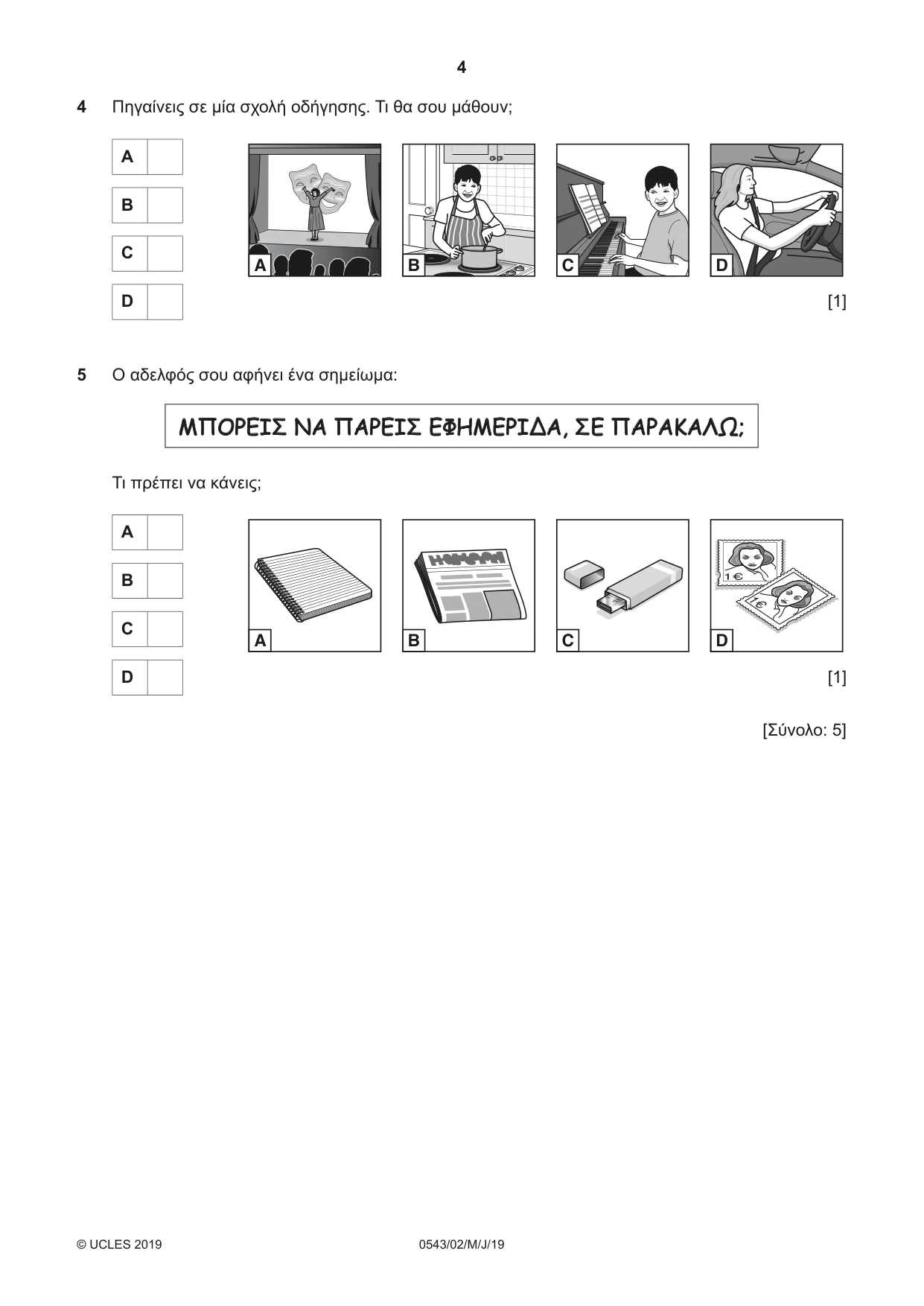
4 0543/02/M/J/19 © UCLES 2019 4 Πηγαίνεις σε μία σχολή οδήγησης. Τι θα σου μάθουν; A A B C D B C D [1] 5 Ο αδελφός σου αφήνει ένα σημείωμα: ΜΠΟΡΕΙΣ ΝΑ ΠΑΡΕΙΣ ΕΦΗΜΕΡΙΔΑ, ΣΕ ΠΑΡΑΚΑΛΩ; Τι πρέπει να κάνεις; A A B C D B C D [1] [Σύνολο: 5]
Question paper, page 5
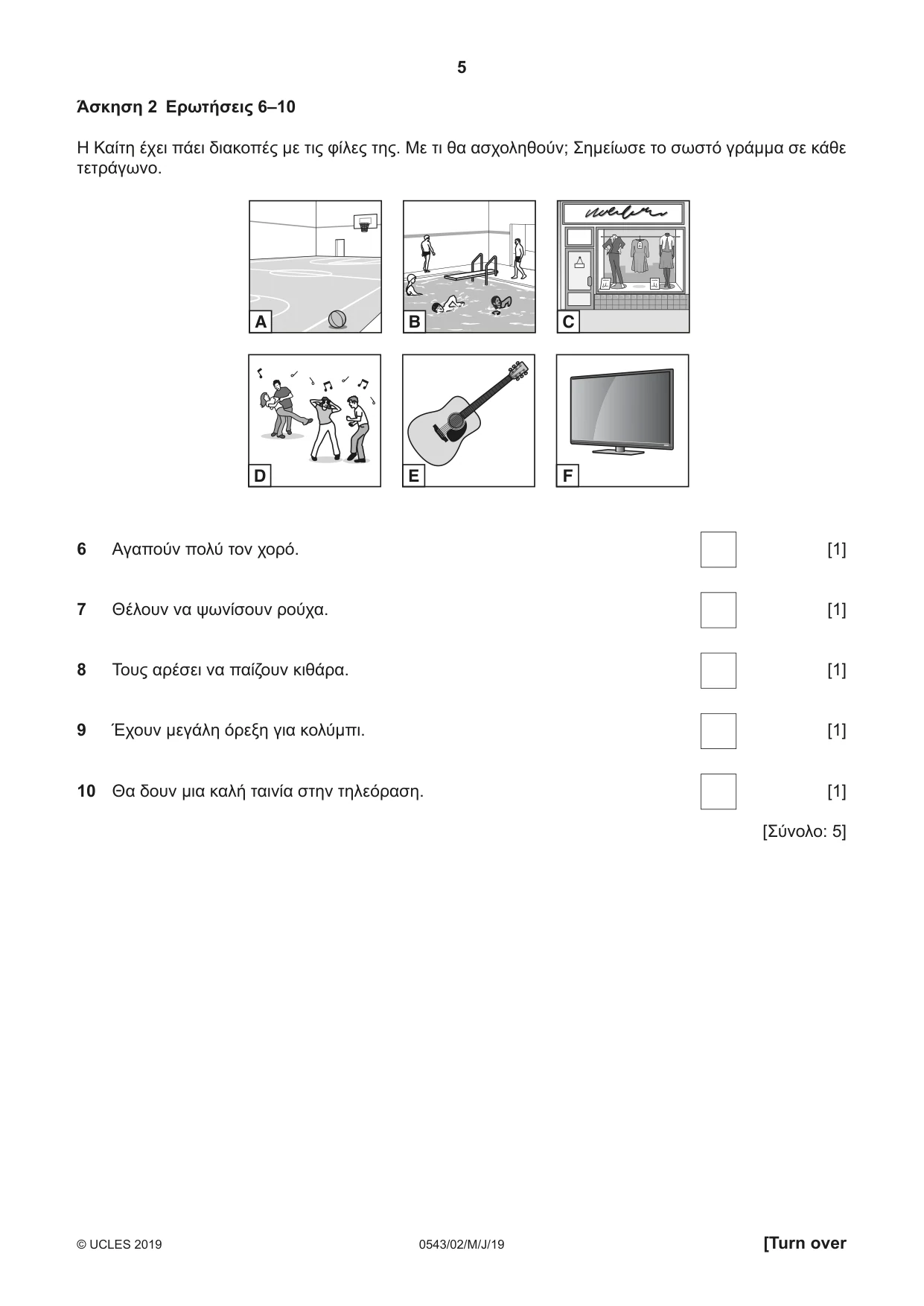
5 0543/02/M/J/19 © UCLES 2019 [Turn over Άσκηση 2 Ερωτήσεις 6–10 Η Καίτη έχει πάει διακοπές με τις φίλες της. Με τι θα ασχοληθούν; Σημείωσε το σωστό γράμμα σε κάθε τετράγωνο. A B C D E F 6 Αγαπούν πολύ τον χορό. [1] 7 Θέλουν να ψωνίσουν ρούχα. [1] 8 Τους αρέσει να παίζουν κιθάρα. [1] 9 Έχουν μεγάλη όρεξη για κολύμπι. [1] 10 Θα δουν μια καλή ταινία στην τηλεόραση. [1] [Σύνολο: 5]
Question paper, page 6
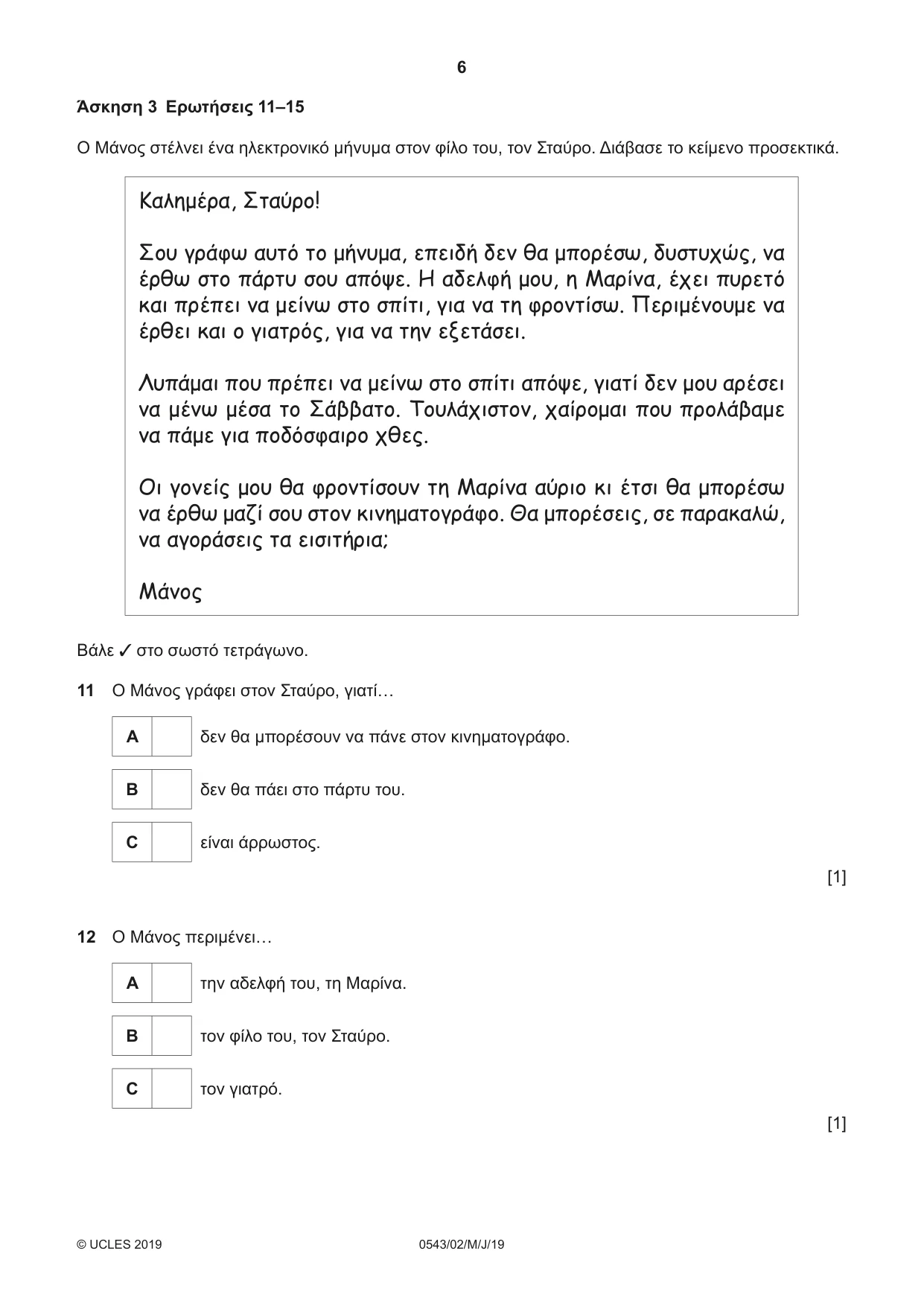
6 0543/02/M/J/19 © UCLES 2019 Άσκηση 3 Ερωτήσεις 11–15 Ο Μάνος στέλνει ένα ηλεκτρονικό μήνυμα στον φίλο του, τον Σταύρο. Διάβασε το κείμενο προσεκτικά. Καλημέρα, Σταύρο! Σου γράφω αυτό το μήνυμα, επειδή δεν θα μπορέσω, δυστυχώς, να έρθω στο πάρτυ σου απόψε. Η αδελφή μου, η Μαρίνα, έχει πυρετό και πρέπει να μείνω στο σπίτι, για να τη φροντίσω. Περιμένουμε να έρθει και ο γιατρός, για να την εξετάσει. Λυπάμαι που πρέπει να μείνω στο σπίτι απόψε, γιατί δεν μου αρέσει να μένω μέσα το Σάββατο. Τουλάχιστον, χαίρομαι που προλάβαμε να πάμε για ποδόσφαιρο χθες. Οι γονείς μου θα φροντίσουν τη Μαρίνα αύριο κι έτσι θα μπορέσω να έρθω μαζί σου στον κινηματογράφο. Θα μπορέσεις, σε παρακαλώ, να αγοράσεις τα εισιτήρια; Μάνος Βάλε ✓ στο σωστό τετράγωνο. 11 Ο Μάνος γράφει στον Σταύρο, γιατί… A δεν θα μπορέσουν να πάνε στον κινηματογράφο. B δεν θα πάει στο πάρτυ του. C είναι άρρωστος. [1] 12 Ο Μάνος περιμένει… A την αδελφή του, τη Μαρίνα. B τον φίλο του, τον Σταύρο. C τον γιατρό. [1]
Question paper, page 7
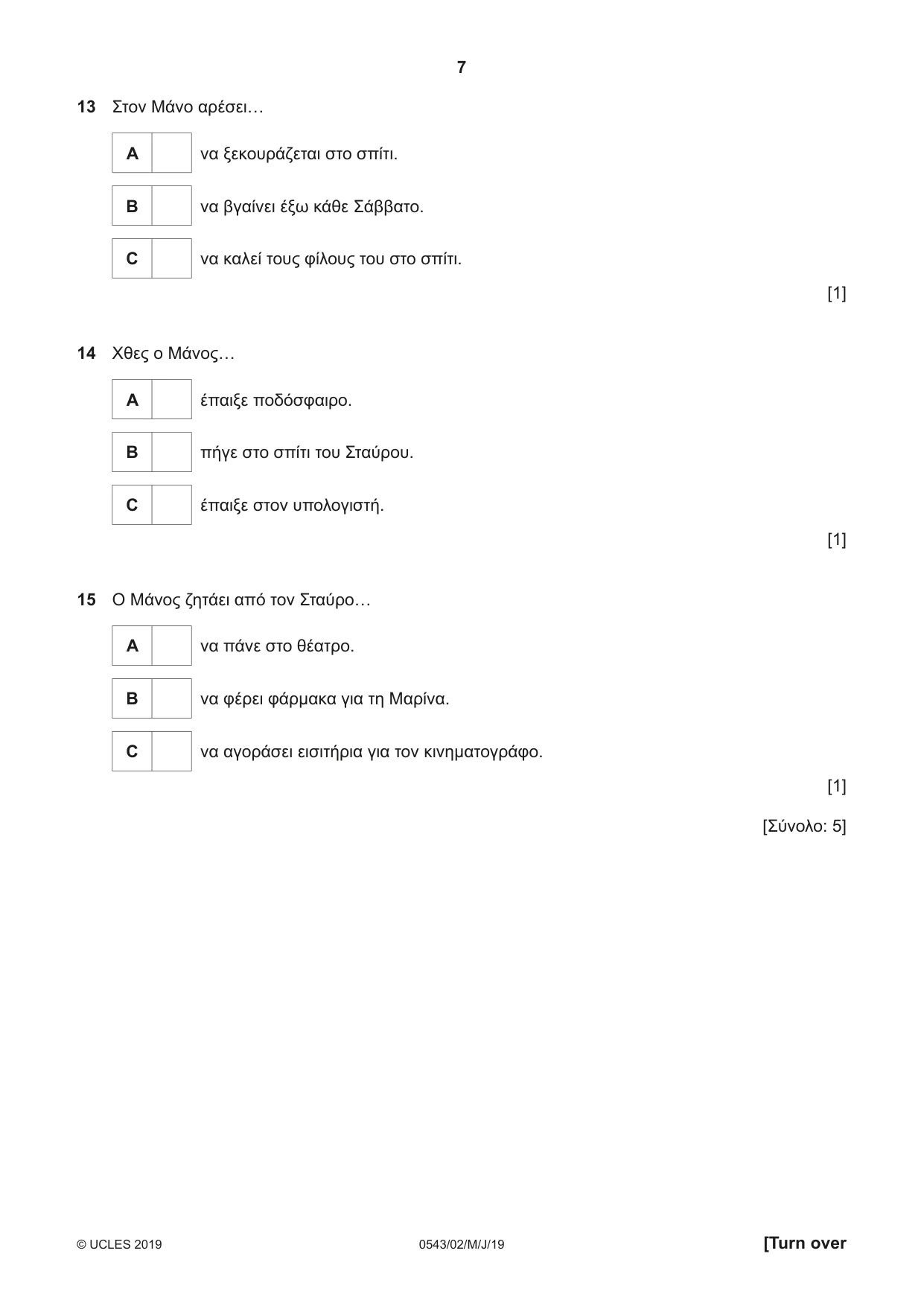
7 0543/02/M/J/19 © UCLES 2019 [Turn over 13 Στον Μάνο αρέσει… A να ξεκουράζεται στο σπίτι. B να βγαίνει έξω κάθε Σάββατο. C να καλεί τους φίλους του στο σπίτι. [1] 14 Χθες ο Μάνος… A έπαιξε ποδόσφαιρο. B πήγε στο σπίτι του Σταύρου. C έπαιξε στον υπολογιστή. [1] 15 Ο Μάνος ζητάει από τον Σταύρο… A να πάνε στο θέατρο. B να φέρει φάρμακα για τη Μαρίνα. C να αγοράσει εισιτήρια για τον κινηματογράφο. [1] [Σύνολο: 5]
Question paper, page 8
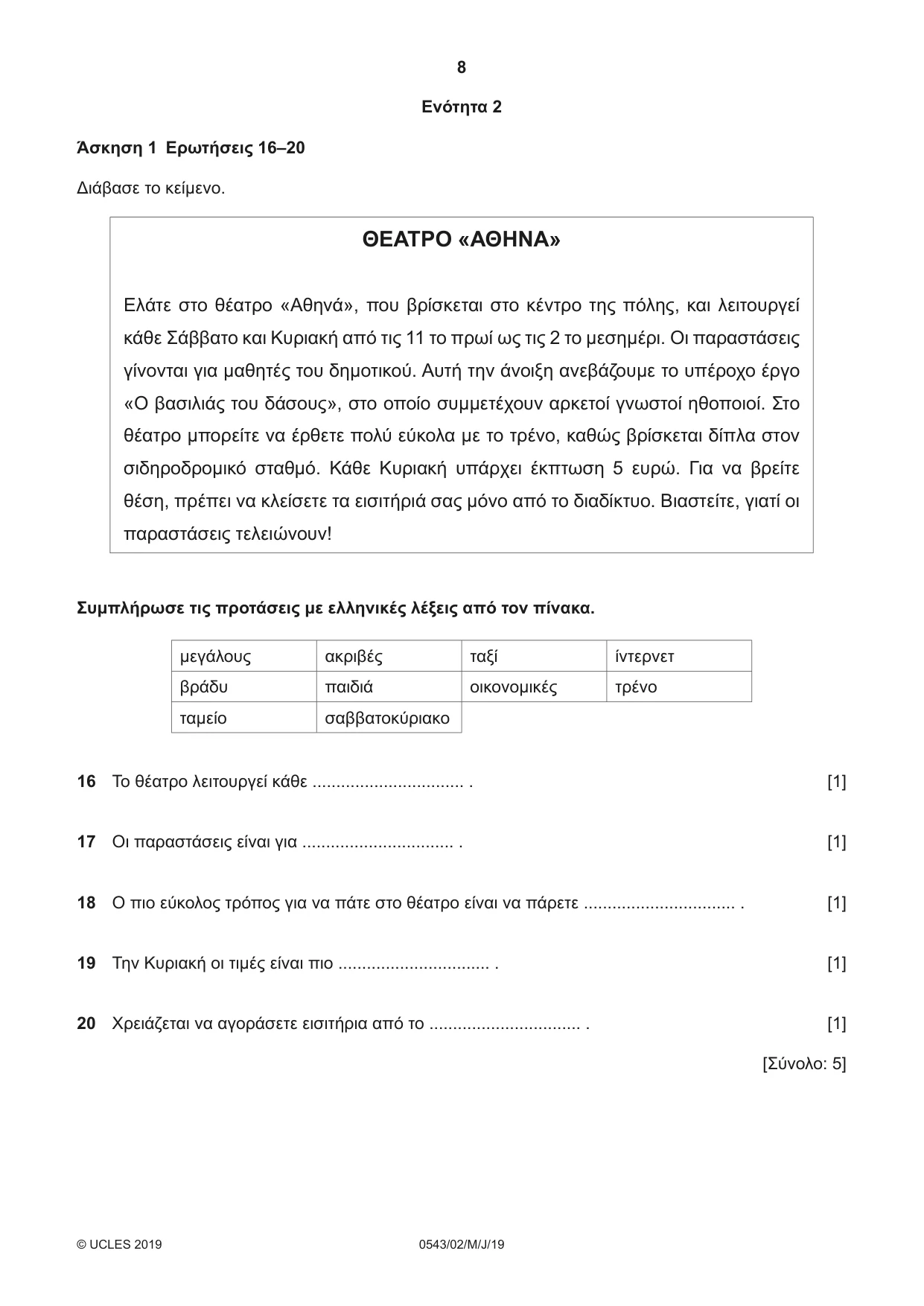
8 0543/02/M/J/19 © UCLES 2019 Ενότητα 2 Άσκηση 1 Ερωτήσεις 16–20 Διάβασε το κείμενο. ΘΕΑΤΡΟ «ΑΘΗΝΑ» Ελάτε στο θέατρο «Αθηνά», που βρίσκεται στο κέντρο της πόλης, και λειτουργεί κάθε Σάββατο και Κυριακή από τις 11 το πρωί ως τις 2 το μεσημέρι. Οι παραστάσεις γίνονται για μαθητές του δημοτικού. Αυτή την άνοιξη ανεβάζουμε το υπέροχο έργο «Ο βασιλιάς του δάσους», στο οποίο συμμετέχουν αρκετοί γνωστοί ηθοποιοί. Στο θέατρο μπορείτε να έρθετε πολύ εύκολα με το τρένο, καθώς βρίσκεται δίπλα στον σιδηροδρομικό σταθμό. Κάθε Κυριακή υπάρχει έκπτωση 5 ευρώ. Για να βρείτε θέση, πρέπει να κλείσετε τα εισιτήριά σας μόνο από το διαδίκτυο. Βιαστείτε, γιατί οι παραστάσεις τελειώνουν! Συμπλήρωσε τις προτάσεις με ελληνικές λέξεις από τον πίνακα. μεγάλους ακριβές ταξί ίντερνετ βράδυ παιδιά οικονομικές τρένο ταμείο σαββατοκύριακο 16 Το θέατρο λειτουργεί κάθε … . [1] 17 Οι παραστάσεις είναι για … . [1] 18 Ο πιο εύκολος τρόπος για να πάτε στο θέατρο είναι να πάρετε … . [1] 19 Την Κυριακή οι τιμές είναι πιο … . [1] 20 Χρειάζεται να αγοράσετε εισιτήρια από το … . [1] [Σύνολο: 5]
Question paper, page 9
9 0543/02/M/J/19 © UCLES 2019 [Turn over [Γύρισε σελίδα για τη 2η Άσκηση]
Question paper, page 10
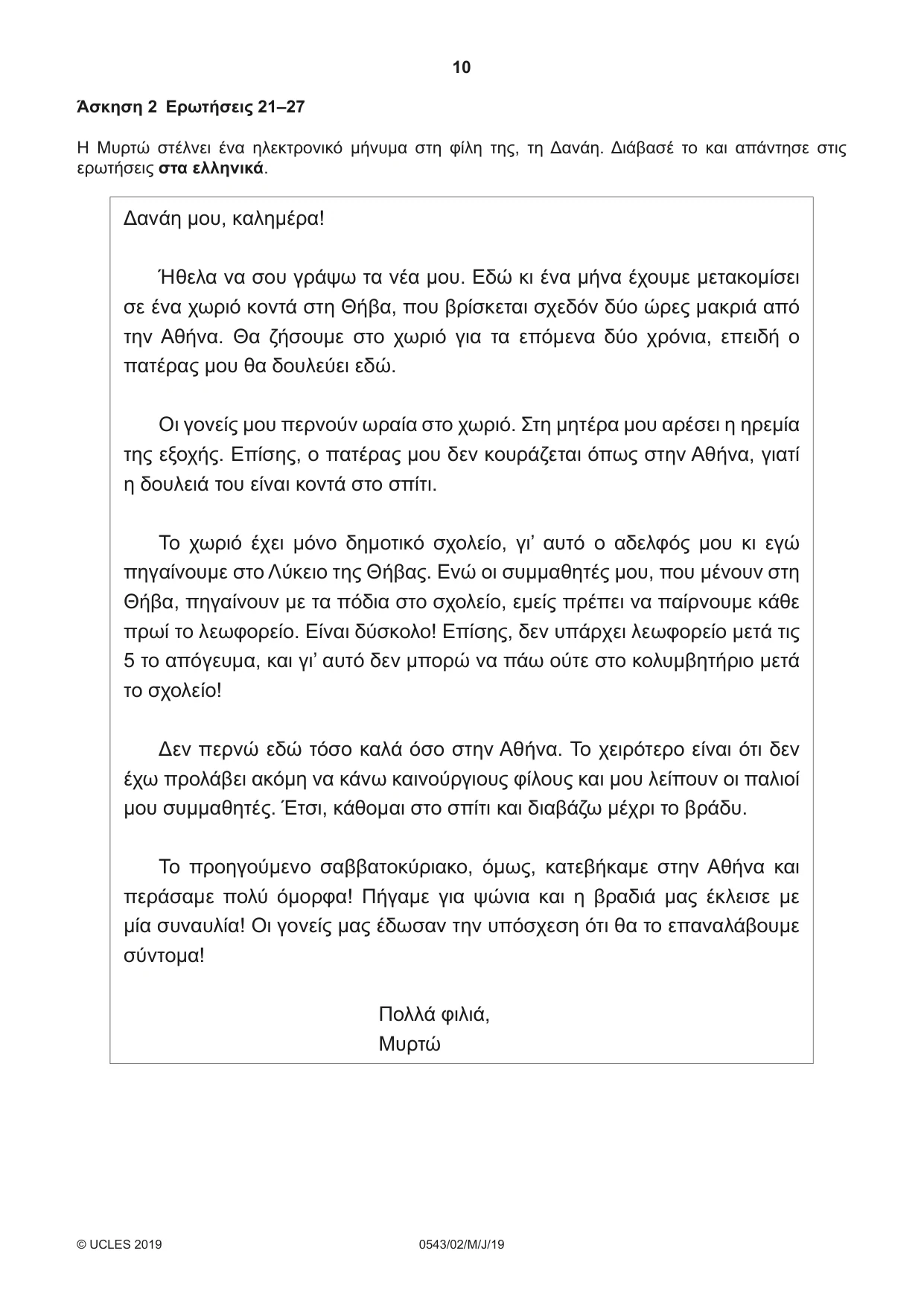
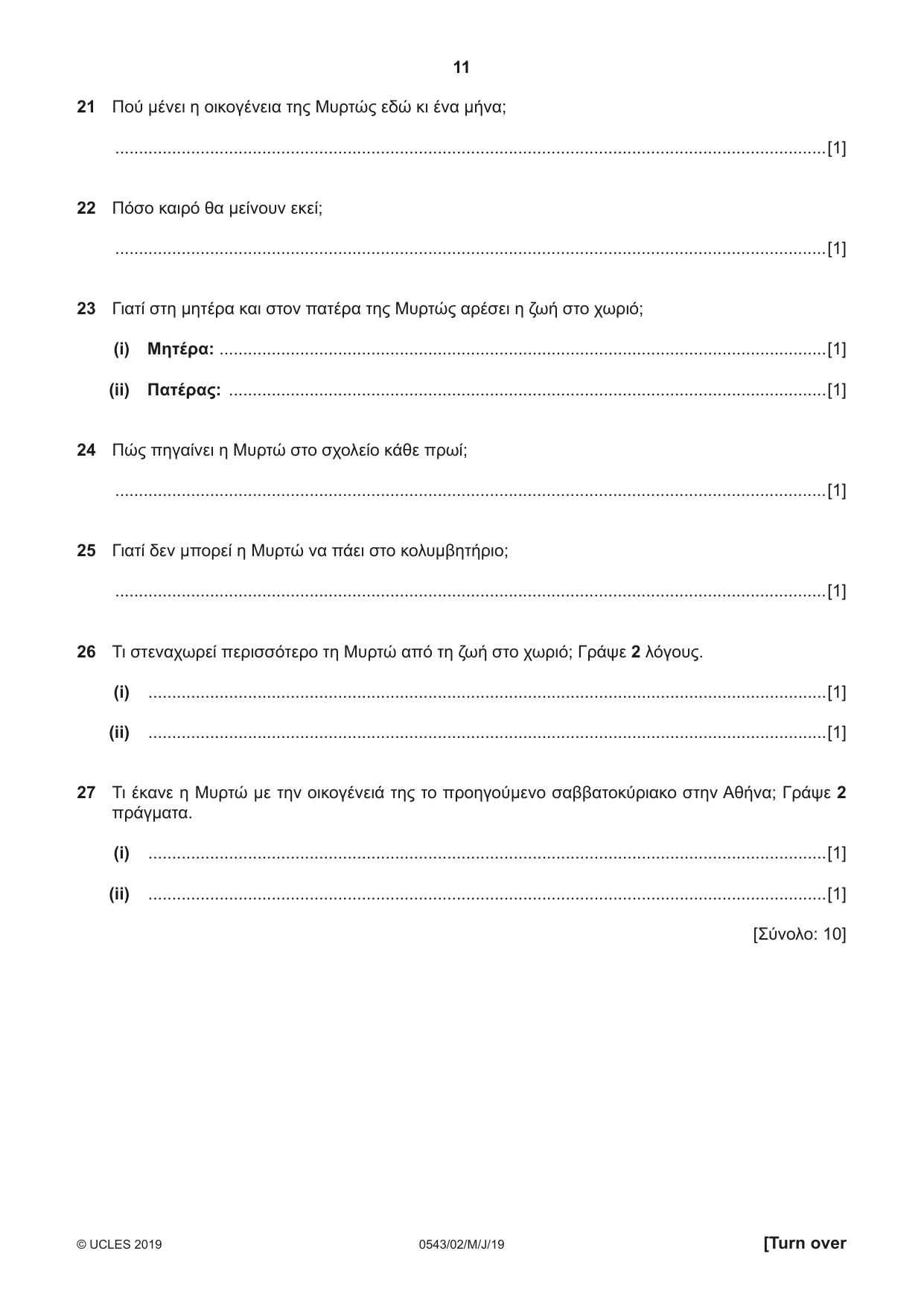
10 0543/02/M/J/19 © UCLES 2019 Άσκηση 2 Ερωτήσεις 21–27 H Μυρτώ στέλνει ένα ηλεκτρονικό μήνυμα στη φίλη της, τη Δανάη. Διάβασέ το και απάντησε στις ερωτήσεις στα ελληνικά. Δανάη μου, καλημέρα! Ήθελα να σου γράψω τα νέα μου. Εδώ κι ένα μήνα έχουμε μετακομίσει σε ένα χωριό κοντά στη Θήβα, που βρίσκεται σχεδόν δύο ώρες μακριά από την Αθήνα. Θα ζήσουμε στο χωριό για τα επόμενα δύο χρόνια, επειδή ο πατέρας μου θα δουλεύει εδώ. Οι γονείς μου περνούν ωραία στο χωριό. Στη μητέρα μου αρέσει η ηρεμία της εξοχής. Επίσης, ο πατέρας μου δεν κουράζεται όπως στην Αθήνα, γιατί η δουλειά του είναι κοντά στο σπίτι. Το χωριό έχει μόνο δημοτικό σχολείο, γι’ αυτό ο αδελφός μου κι εγώ πηγαίνουμε στο Λύκειο της Θήβας. Ενώ οι συμμαθητές μου, που μένουν στη Θήβα, πηγαίνουν με τα πόδια στο σχολείο, εμείς πρέπει να παίρνουμε κάθε πρωί το λεωφορείο. Είναι δύσκολο! Επίσης, δεν υπάρχει λεωφορείο μετά τις 5 το απόγευμα, και γι’ αυτό δεν μπορώ να πάω ούτε στο κολυμβητήριο μετά το σχολείο! Δεν περνώ εδώ τόσο καλά όσο στην Αθήνα. Το χειρότερο είναι ότι δεν έχω προλάβει ακόμη να κάνω καινούργιους φίλους και μου λείπουν οι παλιοί μου συμμαθητές. Έτσι, κάθομαι στο σπίτι και διαβάζω μέχρι το βράδυ. Το προηγούμενο σαββατοκύριακο, όμως, κατεβήκαμε στην Αθήνα και περάσαμε πολύ όμορφα! Πήγαμε για ψώνια και η βραδιά μας έκλεισε με μία συναυλία! Οι γονείς μας έδωσαν την υπόσχεση ότι θα το επαναλάβουμε σύντομα! Πολλά φιλιά, Μυρτώ
Question paper, page 11
11 0543/02/M/J/19 © UCLES 2019 [Turn over 21 Πού μένει η οικογένεια της Μυρτώς εδώ κι ένα μήνα; …[1] 22 Πόσο καιρό θα μείνουν εκεί; …[1] 23 Γιατί στη μητέρα και στον πατέρα της Μυρτώς αρέσει η ζωή στο χωριό; (i) Μητέρα: …[1] (ii) Πατέρας: …[1] 24 Πώς πηγαίνει η Μυρτώ στο σχολείο κάθε πρωί; …[1] 25 Γιατί δεν μπορεί η Μυρτώ να πάει στο κολυμβητήριο; …[1] 26 Τι στεναχωρεί περισσότερο τη Μυρτώ από τη ζωή στο χωριό; Γράψε 2 λόγους. (i) …[1] (ii) …[1] 27 Τι έκανε η Μυρτώ με την οικογένειά της το προηγούμενο σαββατοκύριακο στην Αθήνα; Γράψε 2 πράγματα. (i) …[1] (ii) …[1] [Σύνολο: 10]
Question paper, page 12
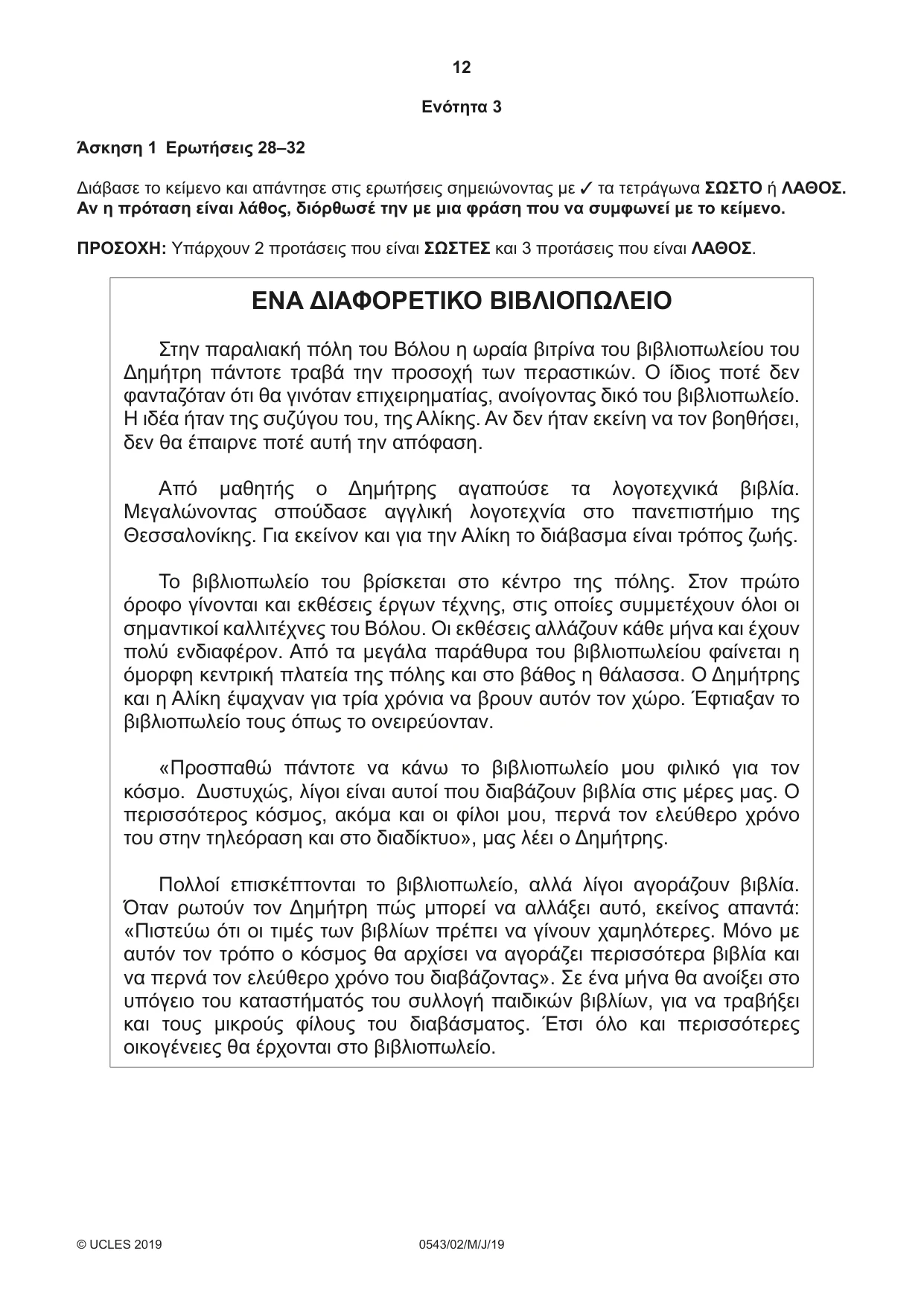
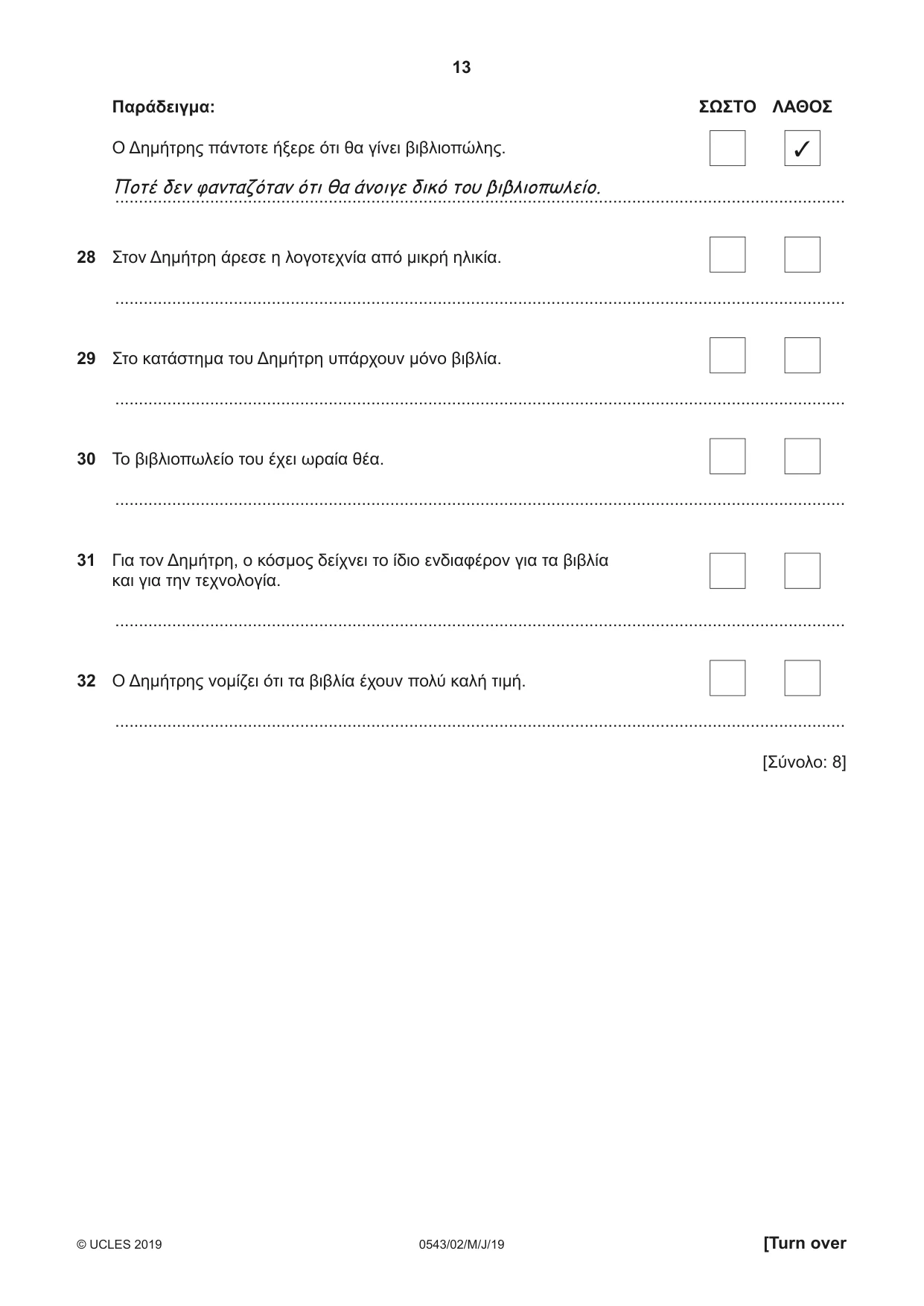
12 0543/02/M/J/19 © UCLES 2019 Ενότητα 3 Άσκηση 1 Ερωτήσεις 28–32 Διάβασε το κείμενο και απάντησε στις ερωτήσεις σημειώνοντας με ✓ τα τετράγωνα ΣΩΣΤΟ ή ΛΑΘΟΣ. Αν η πρόταση είναι λάθος, διόρθωσέ την με μια φράση που να συμφωνεί με το κείμενο. ΠΡΟΣΟΧΗ: Υπάρχουν 2 προτάσεις που είναι ΣΩΣΤΕΣ και 3 προτάσεις που είναι ΛΑΘΟΣ. ΕΝΑ ΔΙΑΦΟΡΕΤΙΚΟ ΒΙΒΛΙΟΠΩΛΕΙΟ Στην παραλιακή πόλη του Βόλου η ωραία βιτρίνα του βιβλιοπωλείου του Δημήτρη πάντοτε τραβά την προσοχή των περαστικών. Ο ίδιος ποτέ δεν φανταζόταν ότι θα γινόταν επιχειρηματίας, ανοίγοντας δικό του βιβλιοπωλείο. Η ιδέα ήταν της συζύγου του, της Αλίκης. Αν δεν ήταν εκείνη να τον βοηθήσει, δεν θα έπαιρνε ποτέ αυτή την απόφαση. Από μαθητής ο Δημήτρης αγαπούσε τα λογοτεχνικά βιβλία. Μεγαλώνοντας σπούδασε αγγλική λογοτεχνία στο πανεπιστήμιο της Θεσσαλονίκης. Για εκείνον και για την Αλίκη το διάβασμα είναι τρόπος ζωής. Το βιβλιοπωλείο του βρίσκεται στο κέντρο της πόλης. Στον πρώτο όροφο γίνονται και εκθέσεις έργων τέχνης, στις οποίες συμμετέχουν όλοι οι σημαντικοί καλλιτέχνες του Βόλου. Οι εκθέσεις αλλάζουν κάθε μήνα και έχουν πολύ ενδιαφέρον. Από τα μεγάλα παράθυρα του βιβλιοπωλείου φαίνεται η όμορφη κεντρική πλατεία της πόλης και στο βάθος η θάλασσα. Ο Δημήτρης και η Αλίκη έψαχναν για τρία χρόνια να βρουν αυτόν τον χώρο. Έφτιαξαν το βιβλιοπωλείο τους όπως το ονειρεύονταν. «Προσπαθώ πάντοτε να κάνω το βιβλιοπωλείο μου φιλικό για τον κόσμο. Δυστυχώς, λίγοι είναι αυτοί που διαβάζουν βιβλία στις μέρες μας. Ο περισσότερος κόσμος, ακόμα και οι φίλοι μου, περνά τον ελεύθερο χρόνο του στην τηλεόραση και στο διαδίκτυο», μας λέει ο Δημήτρης. Πολλοί επισκέπτονται το βιβλιοπωλείο, αλλά λίγοι αγοράζουν βιβλία. Όταν ρωτούν τον Δημήτρη πώς μπορεί να αλλάξει αυτό, εκείνος απαντά: «Πιστεύω ότι οι τιμές των βιβλίων πρέπει να γίνουν χαμηλότερες. Μόνο με αυτόν τον τρόπο ο κόσμος θα αρχίσει να αγοράζει περισσότερα βιβλία και να περνά τον ελεύθερο χρόνο του διαβάζοντας». Σε ένα μήνα θα ανοίξει στο υπόγειο του καταστήματός του συλλογή παιδικών βιβλίων, για να τραβήξει και τους μικρούς φίλους του διαβάσματος. Έτσι όλο και περισσότερες οικογένειες θα έρχονται στο βιβλιοπωλείο.
Question paper, page 13
13 0543/02/M/J/19 © UCLES 2019 [Turn over Παράδειγμα: ΣΩΣΤΟ ΛΑΘΟΣ Ο Δημήτρης πάντοτε ήξερε ότι θα γίνει βιβλιοπώλης. ✓ Ποτέ δεν φανταζόταν ότι θα άνοιγε δικό του βιβλιοπωλείο. … 28 Στον Δημήτρη άρεσε η λογοτεχνία από μικρή ηλικία. … 29 Στο κατάστημα του Δημήτρη υπάρχουν μόνο βιβλία. … 30 Το βιβλιοπωλείο του έχει ωραία θέα. … 31 Για τον Δημήτρη, ο κόσμος δείχνει το ίδιο ενδιαφέρον για τα βιβλία και για την τεχνολογία. … 32 Ο Δημήτρης νομίζει ότι τα βιβλία έχουν πολύ καλή τιμή. … [Σύνολο: 8]
Question paper, page 14
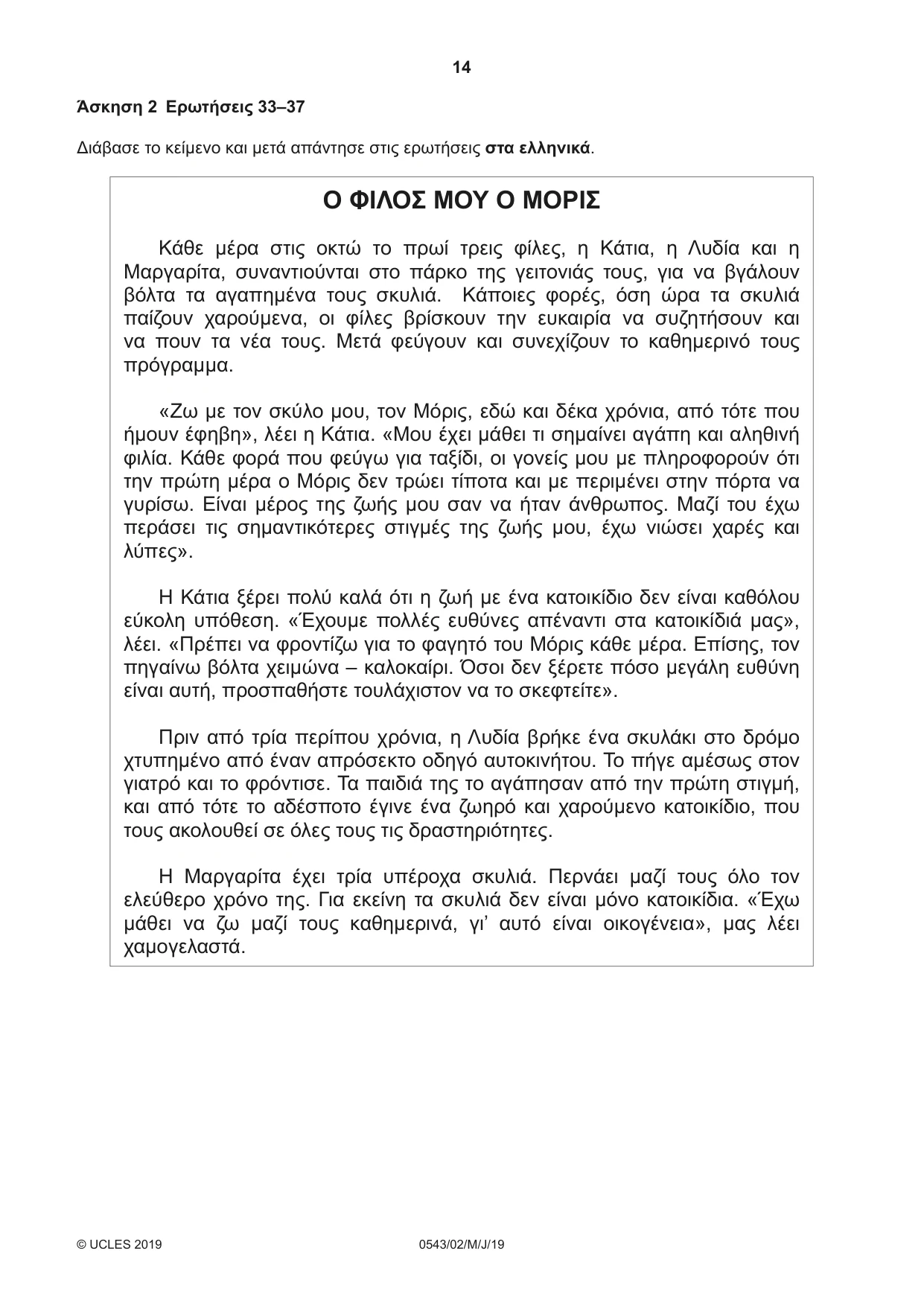
14 0543/02/M/J/19 © UCLES 2019 Άσκηση 2 Ερωτήσεις 33–37 Διάβασε το κείμενο και μετά απάντησε στις ερωτήσεις στα ελληνικά. Ο ΦΙΛΟΣ ΜΟΥ Ο ΜΟΡΙΣ Κάθε μέρα στις οκτώ το πρωί τρεις φίλες, η Κάτια, η Λυδία και η Μαργαρίτα, συναντιούνται στο πάρκο της γειτονιάς τους, για να βγάλουν βόλτα τα αγαπημένα τους σκυλιά. Κάποιες φορές, όση ώρα τα σκυλιά παίζουν χαρούμενα, οι φίλες βρίσκουν την ευκαιρία να συζητήσουν και να πουν τα νέα τους. Μετά φεύγουν και συνεχίζουν το καθημερινό τους πρόγραμμα. «Ζω με τον σκύλο μου, τον Μόρις, εδώ και δέκα χρόνια, από τότε που ήμουν έφηβη», λέει η Κάτια. «Μου έχει μάθει τι σημαίνει αγάπη και αληθινή φιλία. Κάθε φορά που φεύγω για ταξίδι, οι γονείς μου με πληροφορούν ότι την πρώτη μέρα ο Μόρις δεν τρώει τίποτα και με περιμένει στην πόρτα να γυρίσω. Είναι μέρος της ζωής μου σαν να ήταν άνθρωπος. Μαζί του έχω περάσει τις σημαντικότερες στιγμές της ζωής μου, έχω νιώσει χαρές και λύπες». Η Κάτια ξέρει πολύ καλά ότι η ζωή με ένα κατοικίδιο δεν είναι καθόλου εύκολη υπόθεση. «Έχουμε πολλές ευθύνες απέναντι στα κατοικίδιά μας», λέει. «Πρέπει να φροντίζω για το φαγητό του Μόρις κάθε μέρα. Επίσης, τον πηγαίνω βόλτα χειμώνα – καλοκαίρι. Όσοι δεν ξέρετε πόσο μεγάλη ευθύνη είναι αυτή, προσπαθήστε τουλάχιστον να το σκεφτείτε». Πριν από τρία περίπου χρόνια, η Λυδία βρήκε ένα σκυλάκι στο δρόμο χτυπημένο από έναν απρόσεκτο οδηγό αυτοκινήτου. Το πήγε αμέσως στον γιατρό και το φρόντισε. Τα παιδιά της το αγάπησαν από την πρώτη στιγμή, και από τότε το αδέσποτο έγινε ένα ζωηρό και χαρούμενο κατοικίδιο, που τους ακολουθεί σε όλες τους τις δραστηριότητες. Η Μαργαρίτα έχει τρία υπέροχα σκυλιά. Περνάει μαζί τους όλο τον ελεύθερο χρόνο της. Για εκείνη τα σκυλιά δεν είναι μόνο κατοικίδια. «Έχω μάθει να ζω μαζί τους καθημερινά, γι’ αυτό είναι οικογένεια», μας λέει χαμογελαστά.
Question paper, page 15
15 0543/02/M/J/19 © UCLES 2019 33 Για ποιον λόγο πηγαίνουν στο πάρκο κάθε πρωί οι τρεις φίλες; …[1] 34 Τι κάνει ο Μόρις όταν η Κάτια πηγαίνει ταξίδι; Γράψε 2 πράγματα. (i) …[1] (ii) …[1] 35 Σύμφωνα με την Κάτια, ποιες ευθύνες έχει όποιος έχει κατοικίδια; Γράψε 2 πράγματα. (i) …[1] (ii) …[1] 36 Γιατί η Λυδία πήγε τον σκύλο στον γιατρό; …[1] 37 Για ποιον λόγο νιώθει η Μαργαρίτα τα σκυλιά σαν οικογένειά της; …[1] [Σύνολο: 7]
Question paper, page 16
16 0543/02/M/J/19 © UCLES 2019 BLANK PAGE Permission to reproduce items where third-party owned material protected by copyright is included has been sought and cleared where possible. Every reasonable effort has been made by the publisher (UCLES) to trace copyright holders, but if any items requiring clearance have unwittingly been included, the publisher will be pleased to make amends at the earliest possible opportunity. To avoid the issue of disclosure of answer-related information to candidates, all copyright acknowledgements are reproduced online in the Cambridge Assessment International Education Copyright Acknowledgements Booklet. This is produced for each series of examinations and is freely available to download at www.cambridgeinternational.org after the live examination series. Cambridge Assessment International Education is part of the Cambridge Assessment Group. Cambridge Assessment is the brand name of the University of Cambridge Local Examinations Syndicate (UCLES), which itself is a department of the University of Cambridge.
Mark scheme, page 1
This document consists of 14 printed pages. © UCLES 2019 [Turn over Cambridge Assessment International Education Cambridge International General Certificate of Secondary Education GREEK 0543/02 Paper 2 Reading May/June 2019 MARK SCHEME Maximum Mark: 45 Published This mark scheme is published as an aid to teachers and candidates, to indicate the requirements of the examination. It shows the basis on which Examiners were instructed to award marks. It does not indicate the details of the discussions that took place at an Examiners’ meeting before marking began, which would have considered the acceptability of alternative answers. Mark schemes should be read in conjunction with the question paper and the Principal Examiner Report for Teachers. Cambridge International will not enter into discussions about these mark schemes. Cambridge International is publishing the mark schemes for the May/June 2019 series for most Cambridge IGCSE™, Cambridge International A and AS Level and Cambridge Pre-U components, and some Cambridge O Level components.
Mark scheme, page 2
0543/02 Cambridge IGCSE – Mark Scheme PUBLISHED May/June 2019 © UCLES 2019 Page 2 of 14 Generic Marking Principles These general marking principles must be applied by all examiners when marking candidate answers. They should be applied alongside the specific content of the mark scheme or generic level descriptors for a question. Each question paper and mark scheme will also comply with these marking principles. GENERIC MARKING PRINCIPLE 1: Marks must be awarded in line with: • the specific content of the mark scheme or the generic level descriptors for the question • the specific skills defined in the mark scheme or in the generic level descriptors for the question • the standard of response required by a candidate as exemplified by the standardisation scripts. GENERIC MARKING PRINCIPLE 2: Marks awarded are always whole marks (not half marks, or other fractions). GENERIC MARKING PRINCIPLE 3: Marks must be awarded positively: • marks are awarded for correct/valid answers, as defined in the mark scheme. However, credit is given for valid answers which go beyond the scope of the syllabus and mark scheme, referring to your Team Leader as appropriate • marks are awarded when candidates clearly demonstrate what they know and can do • marks are not deducted for errors • marks are not deducted for omissions • answers should only be judged on the quality of spelling, punctuation and grammar when these features are specifically assessed by the question as indicated by the mark scheme. The meaning, however, should be unambiguous. GENERIC MARKING PRINCIPLE 4: Rules must be applied consistently e.g. in situations where candidates have not followed instructions or in the application of generic level descriptors.
Mark scheme, page 3
0543/02 Cambridge IGCSE – Mark Scheme PUBLISHED May/June 2019 © UCLES 2019 Page 3 of 14 GENERIC MARKING PRINCIPLE 5: Marks should be awarded using the full range of marks defined in the mark scheme for the question (however; the use of the full mark range may be limited according to the quality of the candidate responses seen). GENERIC MARKING PRINCIPLE 6: Marks awarded are based solely on the requirements as defined in the mark scheme. Marks should not be awarded with grade thresholds or grade descriptors in mind.
Mark scheme, page 4
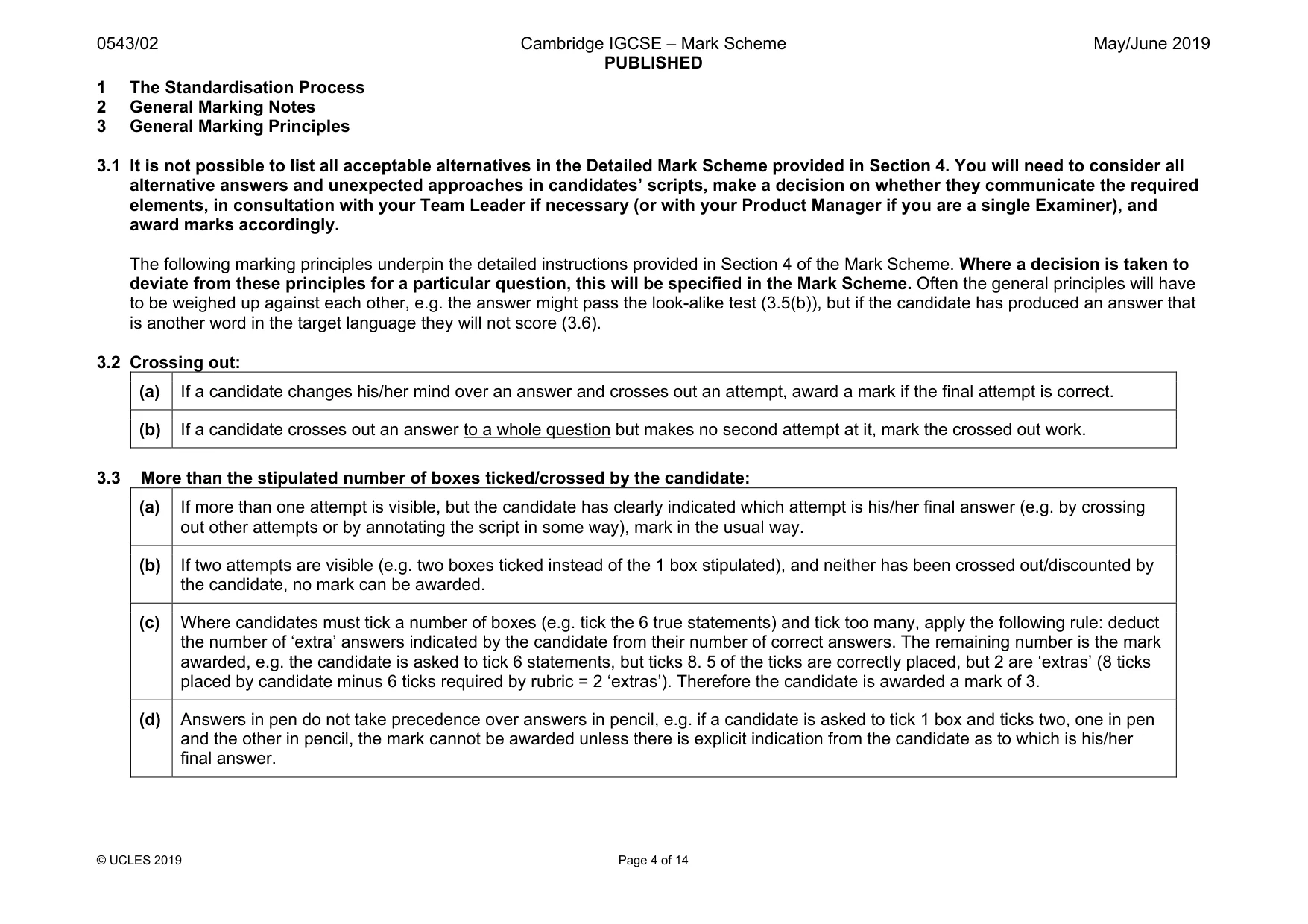
0543/02 Cambridge IGCSE – Mark Scheme PUBLISHED May/June 2019 © UCLES 2019 Page 4 of 14 1 The Standardisation Process 2 General Marking Notes 3 General Marking Principles 3.1 It is not possible to list all acceptable alternatives in the Detailed Mark Scheme provided in Section 4. You will need to consider all alternative answers and unexpected approaches in candidates’ scripts, make a decision on whether they communicate the required elements, in consultation with your Team Leader if necessary (or with your Product Manager if you are a single Examiner), and award marks accordingly. The following marking principles underpin the detailed instructions provided in Section 4 of the Mark Scheme. Where a decision is taken to deviate from these principles for a particular question, this will be specified in the Mark Scheme. Often the general principles will have to be weighed up against each other, e.g. the answer might pass the look-alike test (3.5(b)), but if the candidate has produced an answer that is another word in the target language they will not score (3.6). 3.2 Crossing out: (a) If a candidate changes his/her mind over an answer and crosses out an attempt, award a mark if the final attempt is correct. (b) If a candidate crosses out an answer to a whole question but makes no second attempt at it, mark the crossed out work. 3.3 More than the stipulated number of boxes ticked/crossed by the candidate: (a) If more than one attempt is visible, but the candidate has clearly indicated which attempt is his/her final answer (e.g. by crossing out other attempts or by annotating the script in some way), mark in the usual way. (b) If two attempts are visible (e.g. two boxes ticked instead of the 1 box stipulated), and neither has been crossed out/discounted by the candidate, no mark can be awarded. (c) Where candidates must tick a number of boxes (e.g. tick the 6 true statements) and tick too many, apply the following rule: deduct the number of ‘extra’ answers indicated by the candidate from their number of correct answers. The remaining number is the mark awarded, e.g. the candidate is asked to tick 6 statements, but ticks 8. 5 of the ticks are correctly placed, but 2 are ‘extras’ (8 ticks placed by candidate minus 6 ticks required by rubric = 2 ‘extras’). Therefore the candidate is awarded a mark of 3. (d) Answers in pen do not take precedence over answers in pencil, e.g. if a candidate is asked to tick 1 box and ticks two, one in pen and the other in pencil, the mark cannot be awarded unless there is explicit indication from the candidate as to which is his/her final answer.
Mark scheme, page 5
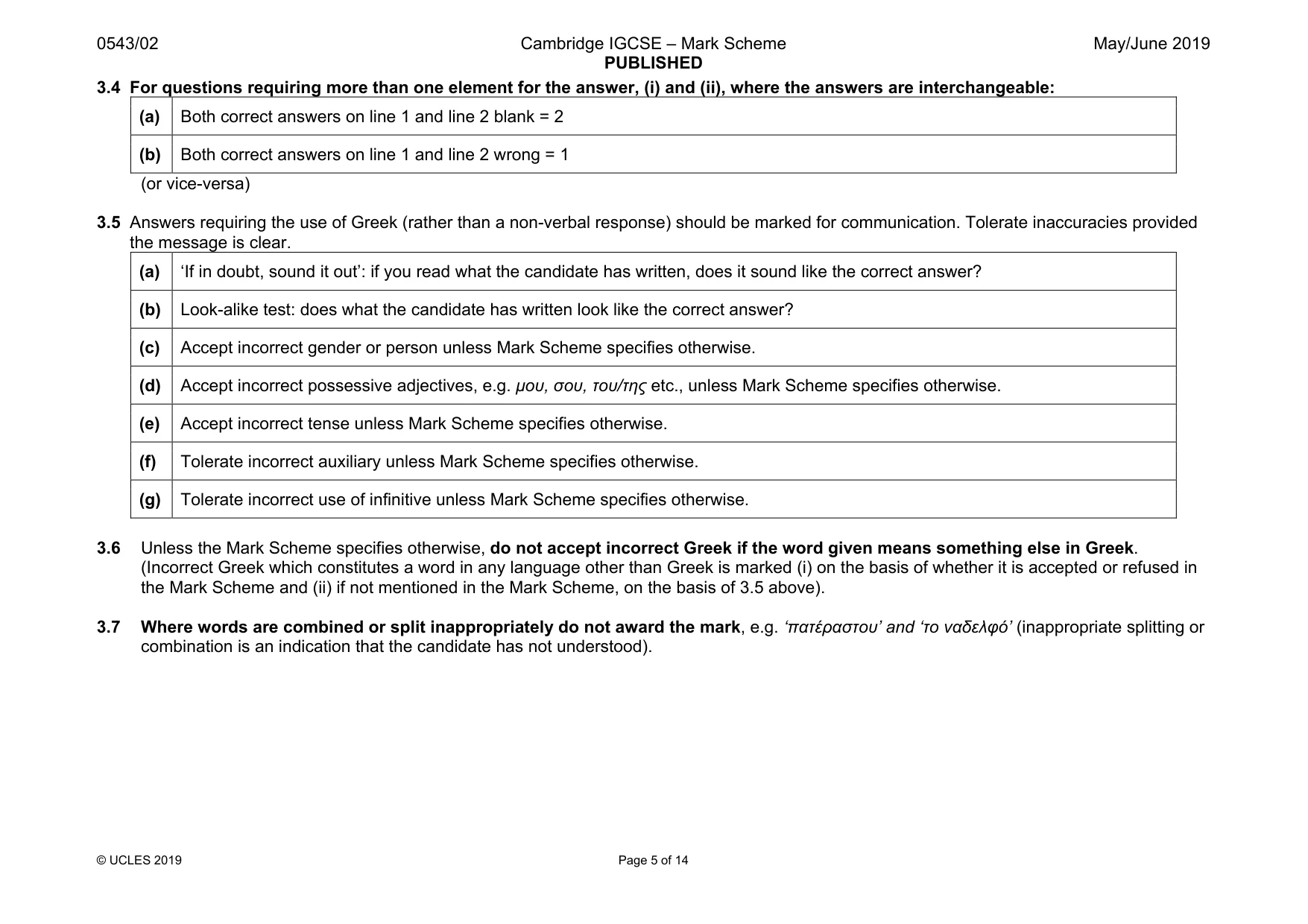
0543/02 Cambridge IGCSE – Mark Scheme PUBLISHED May/June 2019 © UCLES 2019 Page 5 of 14 3.4 For questions requiring more than one element for the answer, (i) and (ii), where the answers are interchangeable: (a) Both correct answers on line 1 and line 2 blank = 2 (b) Both correct answers on line 1 and line 2 wrong = 1 (or vice-versa) 3.5 Answers requiring the use of Greek (rather than a non-verbal response) should be marked for communication. Tolerate inaccuracies provided the message is clear. (a) ‘If in doubt, sound it out’: if you read what the candidate has written, does it sound like the correct answer? (b) Look-alike test: does what the candidate has written look like the correct answer? (c) Accept incorrect gender or person unless Mark Scheme specifies otherwise. (d) Accept incorrect possessive adjectives, e.g. µου, σου, του/της etc., unless Mark Scheme specifies otherwise. (e) Accept incorrect tense unless Mark Scheme specifies otherwise. (f) Tolerate incorrect auxiliary unless Mark Scheme specifies otherwise. (g) Tolerate incorrect use of infinitive unless Mark Scheme specifies otherwise. 3.6 Unless the Mark Scheme specifies otherwise, do not accept incorrect Greek if the word given means something else in Greek. (Incorrect Greek which constitutes a word in any language other than Greek is marked (i) on the basis of whether it is accepted or refused in the Mark Scheme and (ii) if not mentioned in the Mark Scheme, on the basis of 3.5 above). 3.7 Where words are combined or split inappropriately do not award the mark, e.g. ‘πατέραστου’ and ‘το ναδελφό’ (inappropriate splitting or combination is an indication that the candidate has not understood).
Mark scheme, page 6
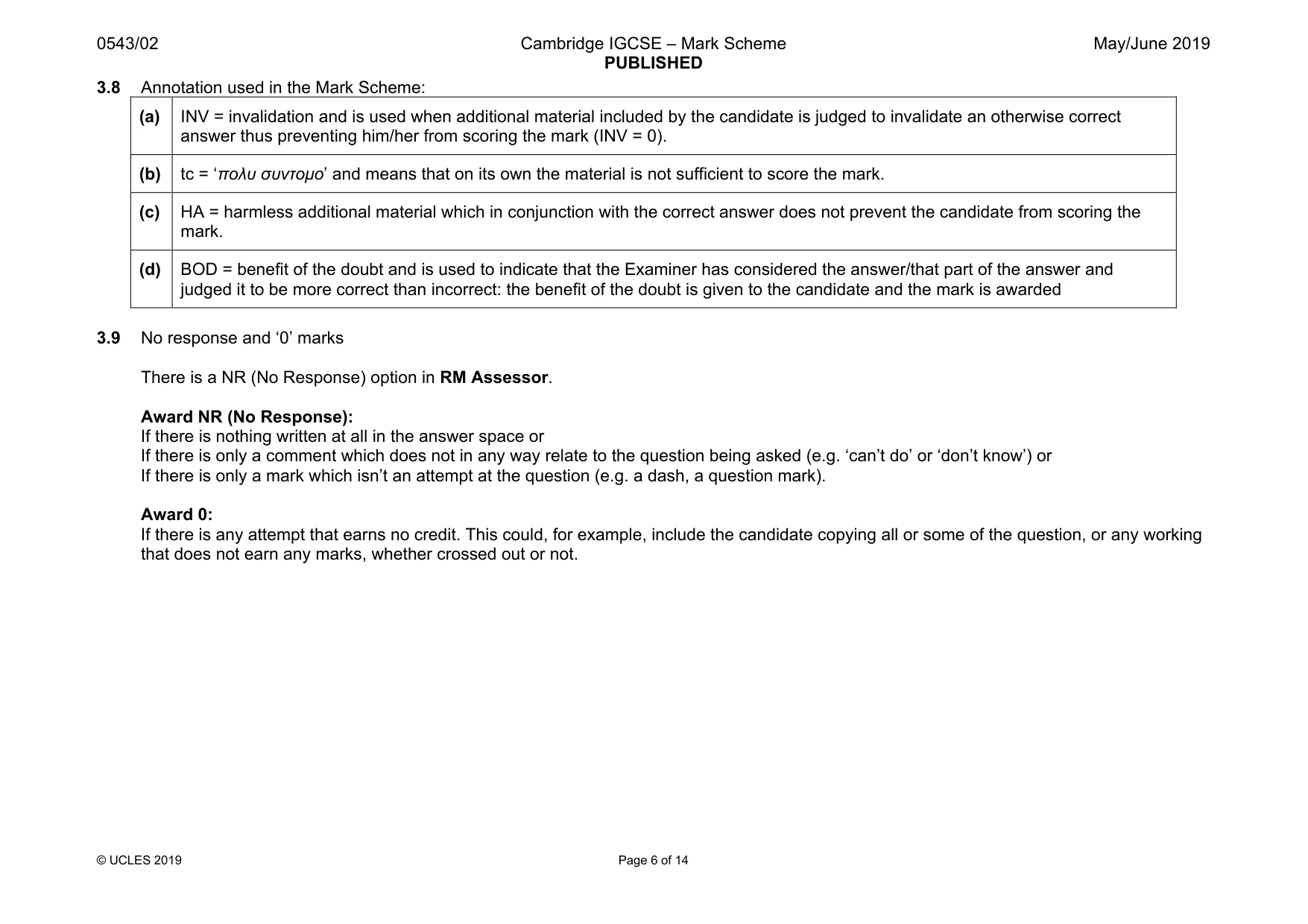
0543/02 Cambridge IGCSE – Mark Scheme PUBLISHED May/June 2019 © UCLES 2019 Page 6 of 14 3.8 Annotation used in the Mark Scheme: (a) INV = invalidation and is used when additional material included by the candidate is judged to invalidate an otherwise correct answer thus preventing him/her from scoring the mark (INV = 0). (b) tc = ‘πολυ συντοµο’ and means that on its own the material is not sufficient to score the mark. (c) HA = harmless additional material which in conjunction with the correct answer does not prevent the candidate from scoring the mark. (d) BOD = benefit of the doubt and is used to indicate that the Examiner has considered the answer/that part of the answer and judged it to be more correct than incorrect: the benefit of the doubt is given to the candidate and the mark is awarded 3.9 No response and ‘0’ marks There is a NR (No Response) option in RM Assessor. Award NR (No Response): If there is nothing written at all in the answer space or If there is only a comment which does not in any way relate to the question being asked (e.g. ‘can’t do’ or ‘don’t know’) or If there is only a mark which isn’t an attempt at the question (e.g. a dash, a question mark). Award 0: If there is any attempt that earns no credit. This could, for example, include the candidate copying all or some of the question, or any working that does not earn any marks, whether crossed out or not.
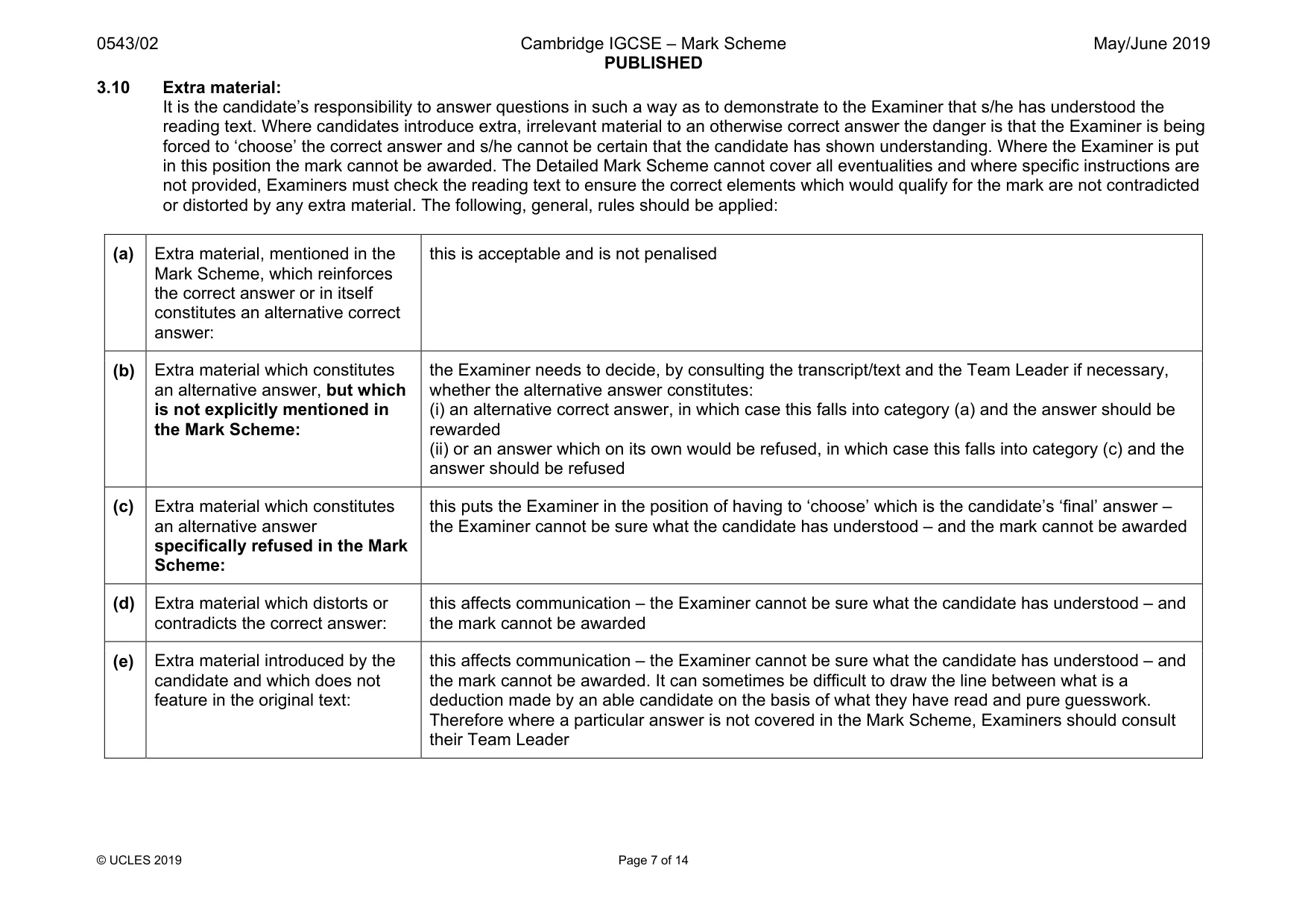
Mark scheme, page 7
0543/02 Cambridge IGCSE – Mark Scheme PUBLISHED May/June 2019 © UCLES 2019 Page 7 of 14 3.10 Extra material: It is the candidate’s responsibility to answer questions in such a way as to demonstrate to the Examiner that s/he has understood the reading text. Where candidates introduce extra, irrelevant material to an otherwise correct answer the danger is that the Examiner is being forced to ‘choose’ the correct answer and s/he cannot be certain that the candidate has shown understanding. Where the Examiner is put in this position the mark cannot be awarded. The Detailed Mark Scheme cannot cover all eventualities and where specific instructions are not provided, Examiners must check the reading text to ensure the correct elements which would qualify for the mark are not contradicted or distorted by any extra material. The following, general, rules should be applied: (a) Extra material, mentioned in the Mark Scheme, which reinforces the correct answer or in itself constitutes an alternative correct answer: this is acceptable and is not penalised (b) Extra material which constitutes an alternative answer, but which is not explicitly mentioned in the Mark Scheme: the Examiner needs to decide, by consulting the transcript/text and the Team Leader if necessary, whether the alternative answer constitutes: (i) an alternative correct answer, in which case this falls into category (a) and the answer should be rewarded (ii) or an answer which on its own would be refused, in which case this falls into category (c) and the answer should be refused (c) Extra material which constitutes an alternative answer specifically refused in the Mark Scheme: this puts the Examiner in the position of having to ‘choose’ which is the candidate’s ‘final’ answer – the Examiner cannot be sure what the candidate has understood – and the mark cannot be awarded (d) Extra material which distorts or contradicts the correct answer: this affects communication – the Examiner cannot be sure what the candidate has understood – and the mark cannot be awarded (e) Extra material introduced by the candidate and which does not feature in the original text: this affects communication – the Examiner cannot be sure what the candidate has understood – and the mark cannot be awarded. It can sometimes be difficult to draw the line between what is a deduction made by an able candidate on the basis of what they have read and pure guesswork. Therefore where a particular answer is not covered in the Mark Scheme, Examiners should consult their Team Leader
Mark scheme, page 8
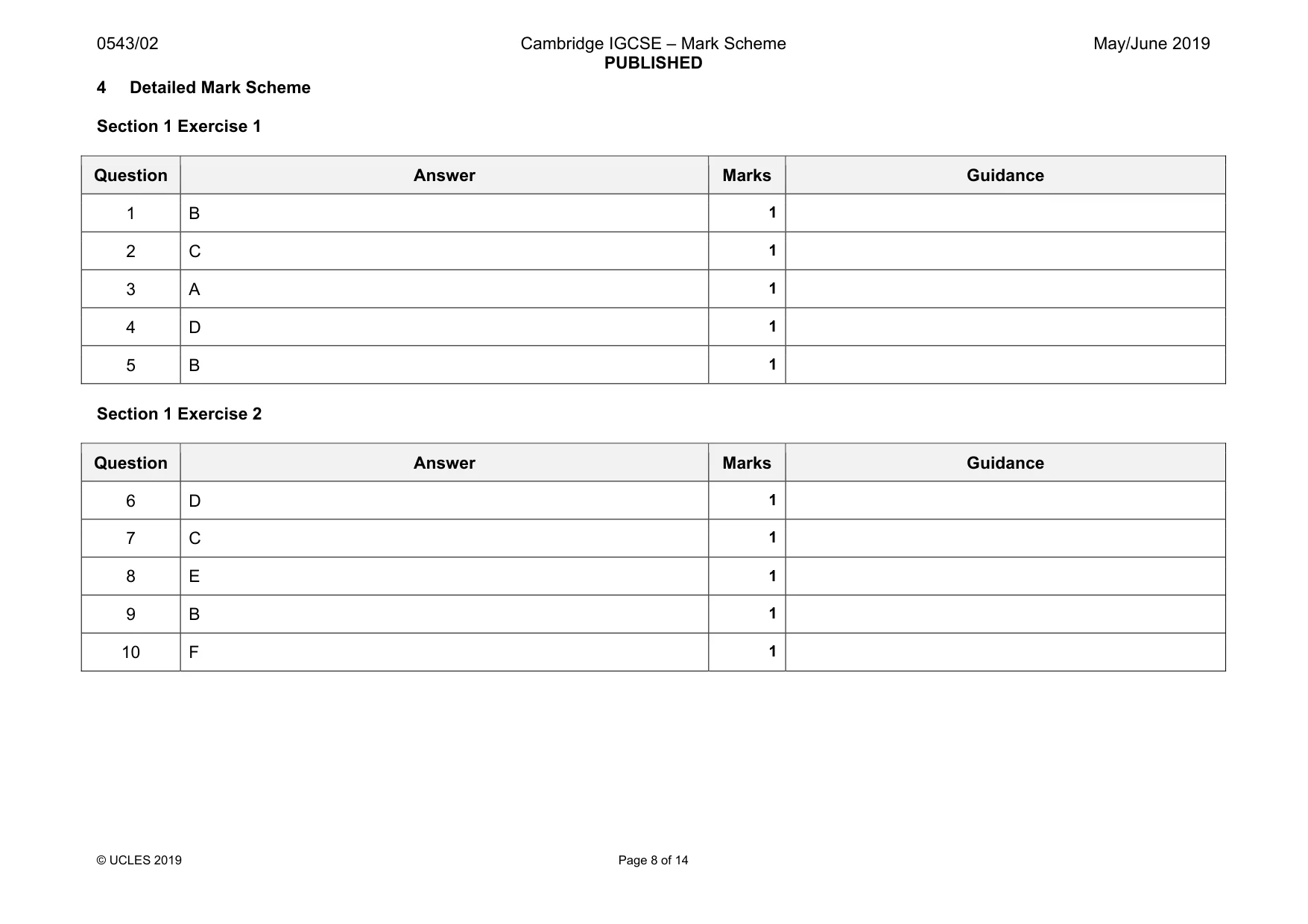
0543/02 Cambridge IGCSE – Mark Scheme PUBLISHED May/June 2019 © UCLES 2019 Page 8 of 14 4 Detailed Mark Scheme Section 1 Exercise 1 Question Answer Marks Guidance 1 B 1 2 C 1 3 A 1 4 D 1 5 B 1 Section 1 Exercise 2 Question Answer Marks Guidance 6 D 1 7 C 1 8 E 1 9 B 1 10 F 1
Mark scheme, page 9
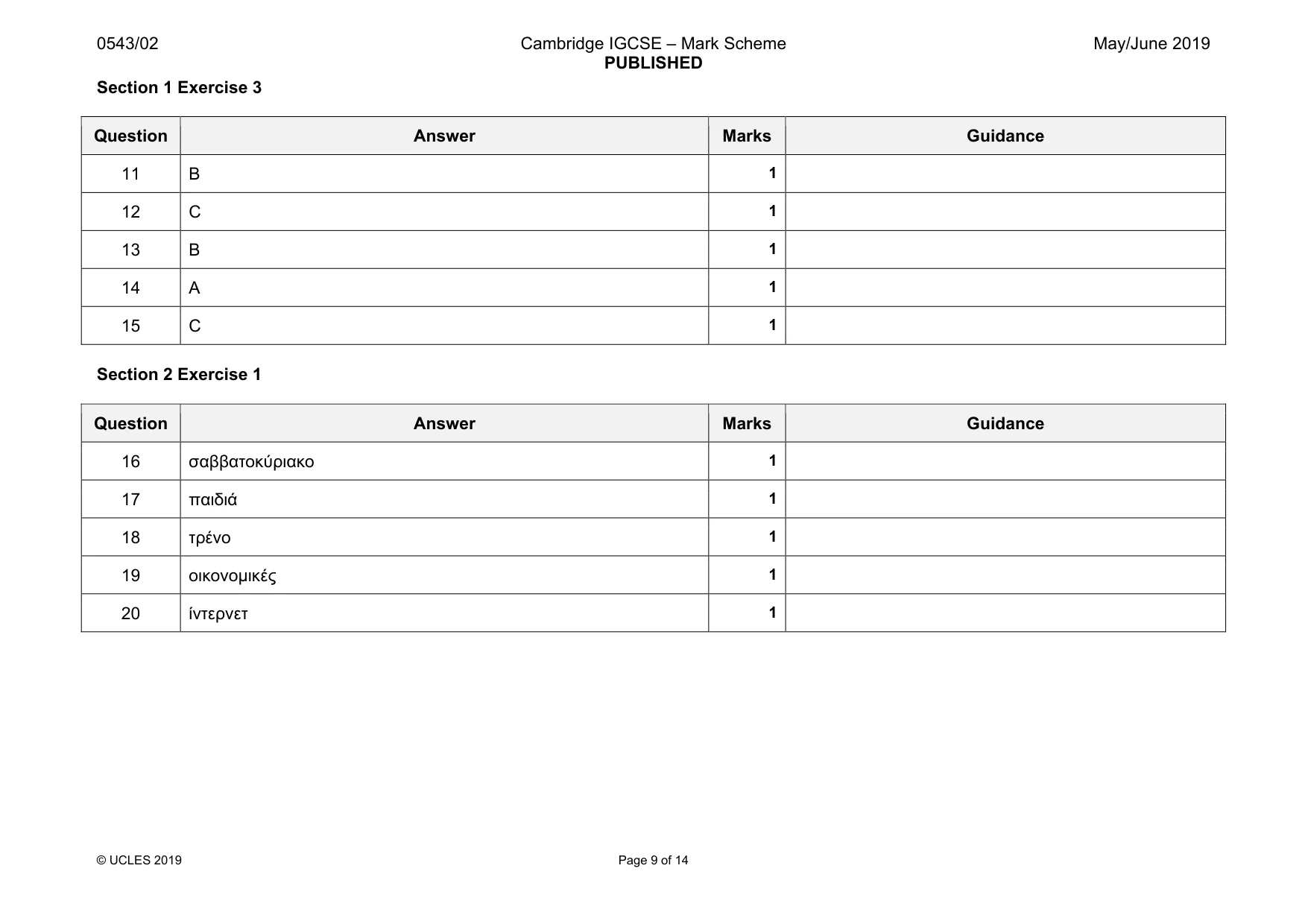
0543/02 Cambridge IGCSE – Mark Scheme PUBLISHED May/June 2019 © UCLES 2019 Page 9 of 14 Section 1 Exercise 3 Question Answer Marks Guidance 11 B 1 12 C 1 13 B 1 14 A 1 15 C 1 Section 2 Exercise 1 Question Answer Marks Guidance 16 σαββατοκύριακο 1 17 παιδιά 1 18 τρένο 1 19 οικονοµικές 1 20 ίντερνετ 1
Mark scheme, page 10
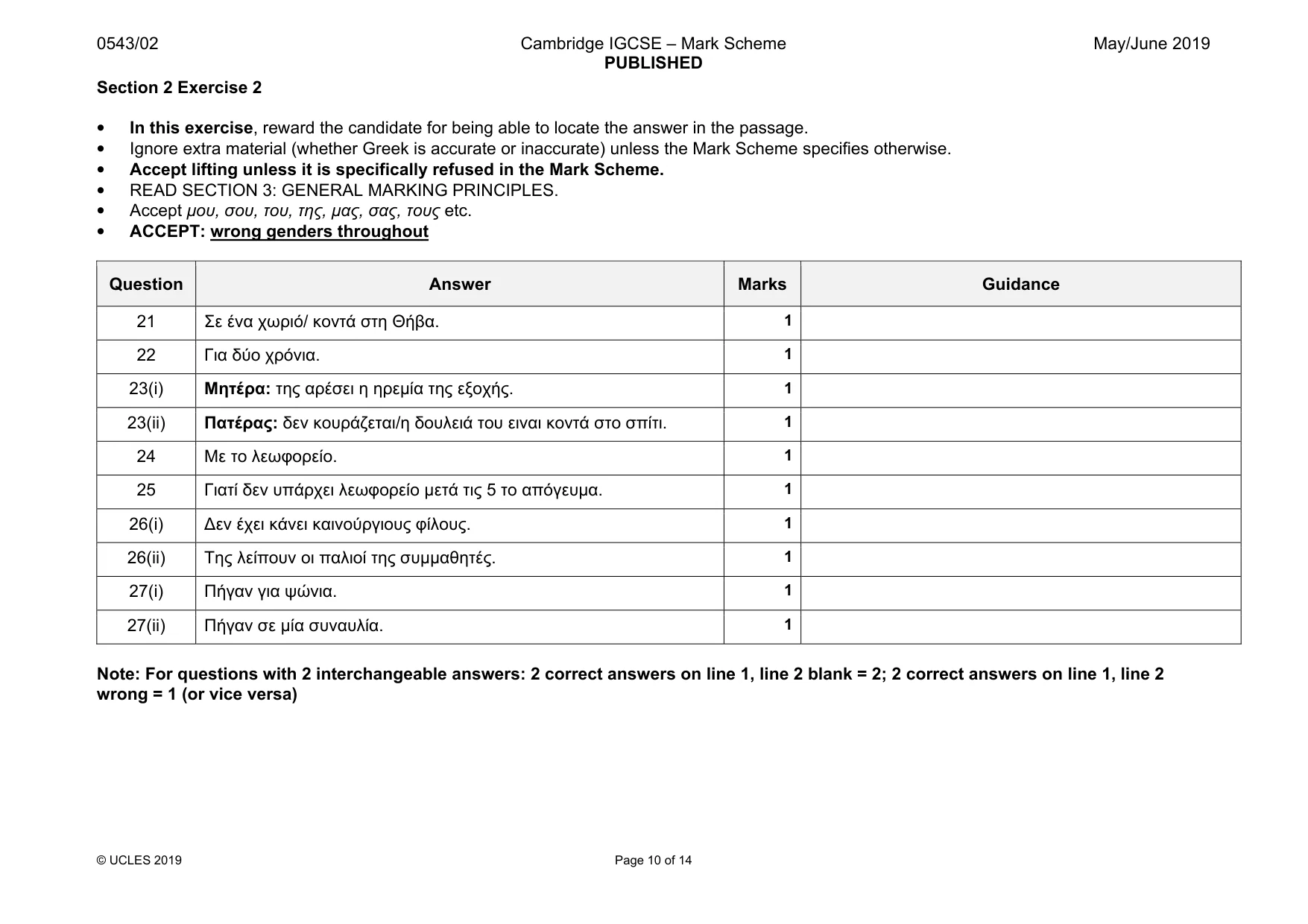
0543/02 Cambridge IGCSE – Mark Scheme PUBLISHED May/June 2019 © UCLES 2019 Page 10 of 14 Section 2 Exercise 2 • In this exercise, reward the candidate for being able to locate the answer in the passage. • Ignore extra material (whether Greek is accurate or inaccurate) unless the Mark Scheme specifies otherwise. • Accept lifting unless it is specifically refused in the Mark Scheme. • READ SECTION 3: GENERAL MARKING PRINCIPLES. • Accept µου, σου, του, της, µας, σας, τους etc. • ACCEPT: wrong genders throughout Question Answer Marks Guidance 21 Σε ένα χωριό/ κοντά στη Θήβα. 1 22 Για δύο χρόνια. 1 23(i) Μητέρα: της αρέσει η ηρεµία της εξοχής. 1 23(ii) Πατέρας: δεν κουράζεται/η δουλειά του ειναι κοντά στο σπίτι. 1 24 Με το λεωφορείο. 1 25 Γιατί δεν υπάρχει λεωφορείο µετά τις 5 το απόγευµα. 1 26(i) ∆εν έχει κάνει καινούργιους φίλους. 1 26(ii) Της λείπουν οι παλιοί της συµµαθητές. 1 27(i) Πήγαν για ψώνια. 1 27(ii) Πήγαν σε µία συναυλία. 1 Note: For questions with 2 interchangeable answers: 2 correct answers on line 1, line 2 blank = 2; 2 correct answers on line 1, line 2 wrong = 1 (or vice versa)
Mark scheme, page 11
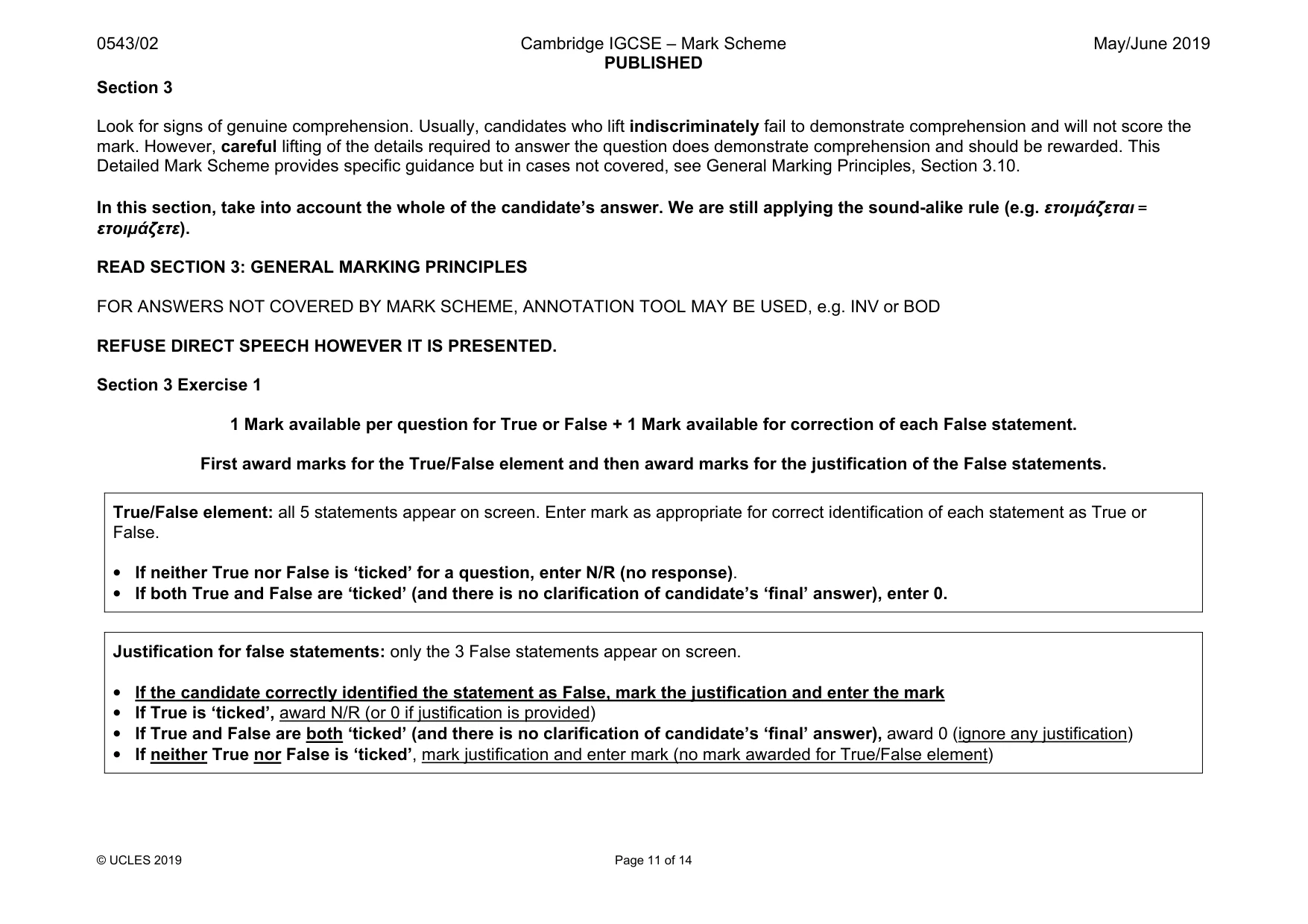
0543/02 Cambridge IGCSE – Mark Scheme PUBLISHED May/June 2019 © UCLES 2019 Page 11 of 14 Section 3 Look for signs of genuine comprehension. Usually, candidates who lift indiscriminately fail to demonstrate comprehension and will not score the mark. However, careful lifting of the details required to answer the question does demonstrate comprehension and should be rewarded. This Detailed Mark Scheme provides specific guidance but in cases not covered, see General Marking Principles, Section 3.10. In this section, take into account the whole of the candidate’s answer. We are still applying the sound-alike rule (e.g. ετοιµάζεται = ετοιµάζετε). READ SECTION 3: GENERAL MARKING PRINCIPLES FOR ANSWERS NOT COVERED BY MARK SCHEME, ANNOTATION TOOL MAY BE USED, e.g. INV or BOD REFUSE DIRECT SPEECH HOWEVER IT IS PRESENTED. Section 3 Exercise 1 1 Mark available per question for True or False + 1 Mark available for correction of each False statement. First award marks for the True/False element and then award marks for the justification of the False statements. True/False element: all 5 statements appear on screen. Enter mark as appropriate for correct identification of each statement as True or False. • If neither True nor False is ‘ticked’ for a question, enter N/R (no response). • If both True and False are ‘ticked’ (and there is no clarification of candidate’s ‘final’ answer), enter 0. Justification for false statements: only the 3 False statements appear on screen. • If the candidate correctly identified the statement as False, mark the justification and enter the mark • If True is ‘ticked’, award N/R (or 0 if justification is provided) • If True and False are both ‘ticked’ (and there is no clarification of candidate’s ‘final’ answer), award 0 (ignore any justification) • If neither True nor False is ‘ticked’, mark justification and enter mark (no mark awarded for True/False element)
Mark scheme, page 12
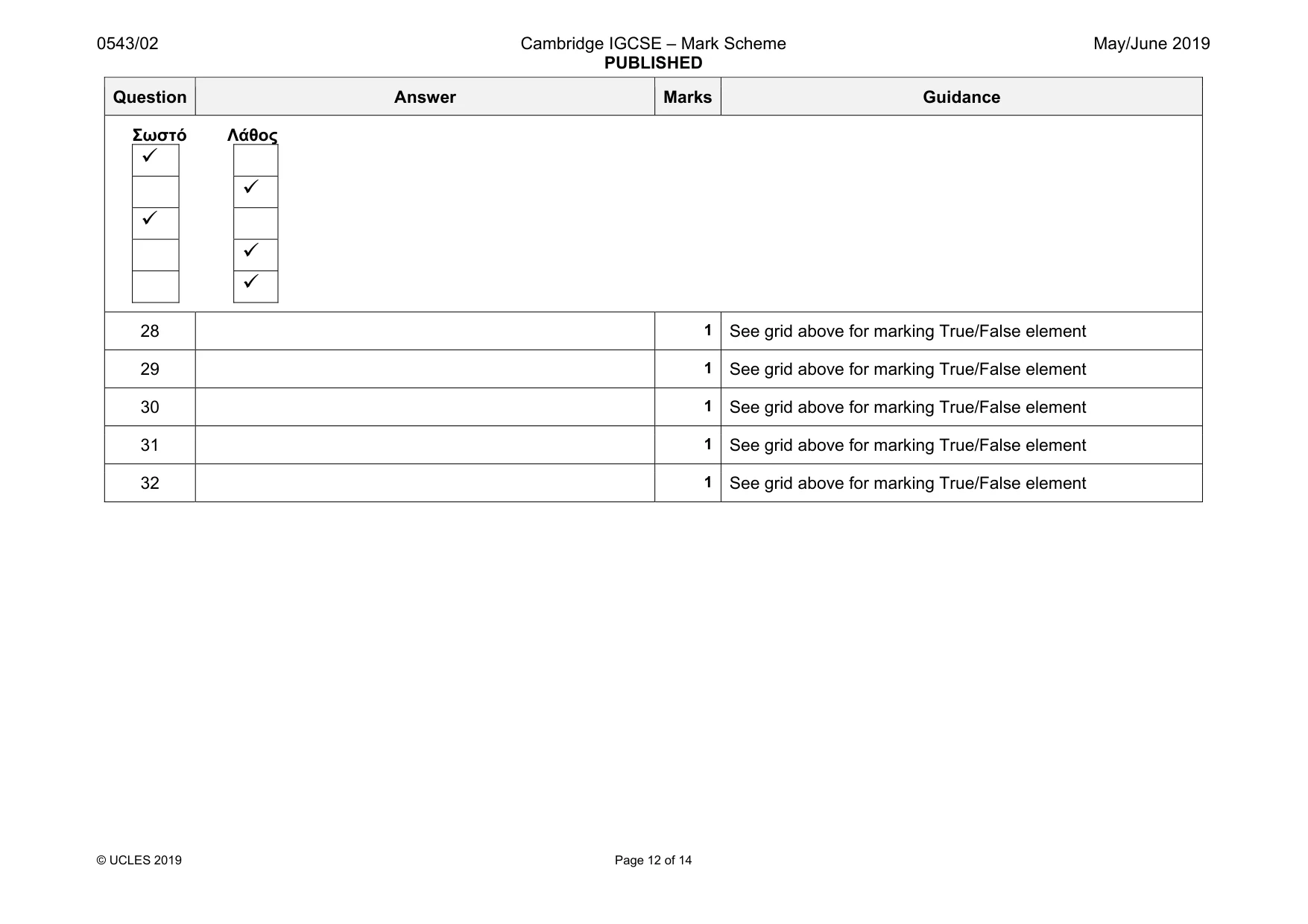
0543/02 Cambridge IGCSE – Mark Scheme PUBLISHED May/June 2019 © UCLES 2019 Page 12 of 14 Question Answer Marks Guidance Σωστό Λάθος 9 9 9 9 9 28 1 See grid above for marking True/False element 29 1 See grid above for marking True/False element 30 1 See grid above for marking True/False element 31 1 See grid above for marking True/False element 32 1 See grid above for marking True/False element
Mark scheme, page 13
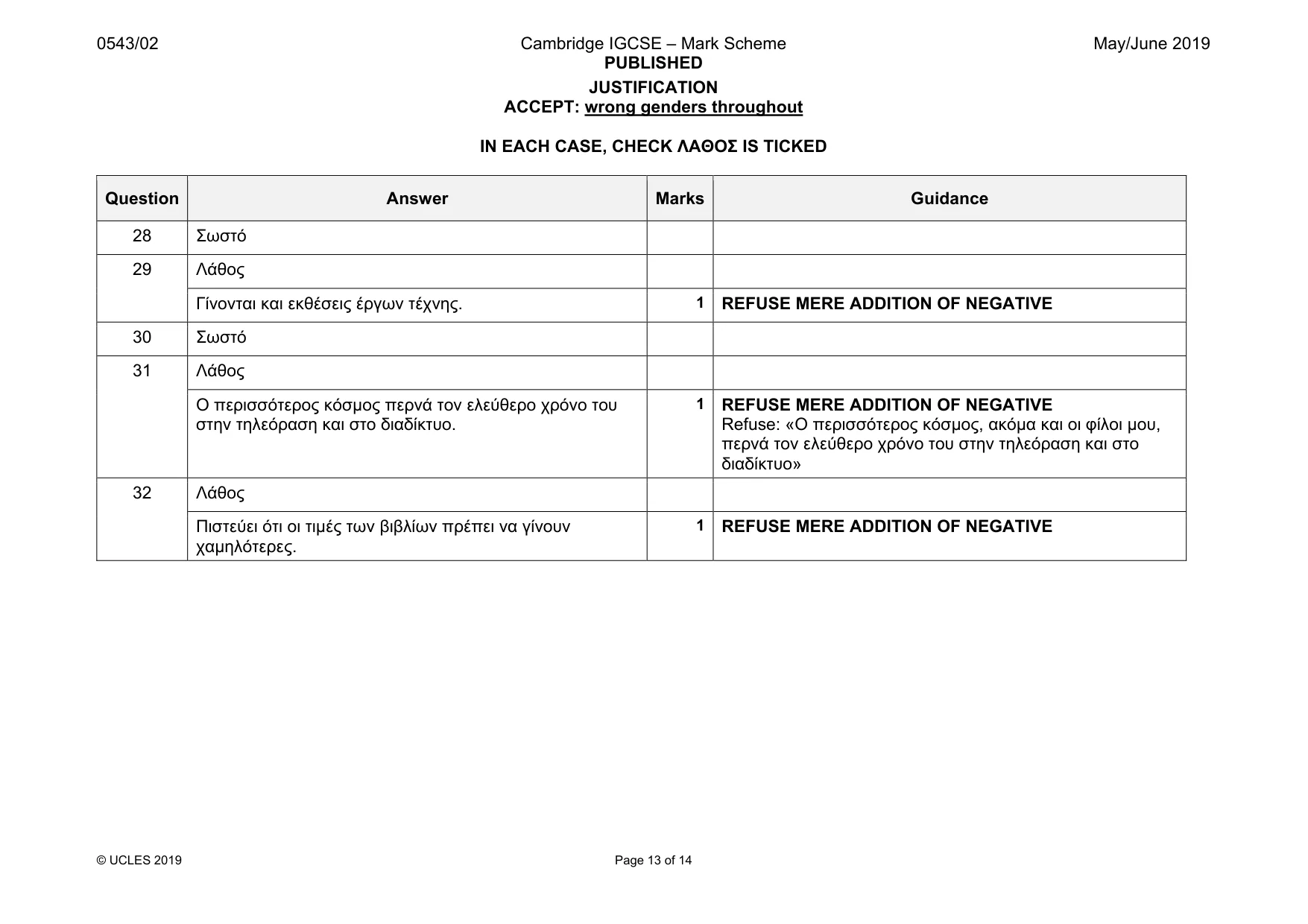
0543/02 Cambridge IGCSE – Mark Scheme PUBLISHED May/June 2019 © UCLES 2019 Page 13 of 14 JUSTIFICATION ACCEPT: wrong genders throughout IN EACH CASE, CHECK ΛAΘΟΣ IS TICKED Question Answer Marks Guidance 28 Σωστό 29 Λάθος Γίνονται και εκθέσεις έργων τέχνης. 1 REFUSE MERE ADDITION OF NEGATIVE 30 Σωστό 31 Λάθος Ο περισσότερος κόσµος περνά τον ελεύθερο χρόνο του στην τηλεόραση και στο διαδίκτυο. 1 REFUSE MERE ADDITION OF NEGATIVE Refuse: «Ο περισσότερος κόσµος, ακόµα και οι φίλοι µου, περνά τον ελεύθερο χρόνο του στην τηλεόραση και στο διαδίκτυο» 32 Λάθος Πιστεύει ότι οι τιµές των βιβλίων πρέπει να γίνουν χαµηλότερες. 1 REFUSE MERE ADDITION OF NEGATIVE
Mark scheme, page 14
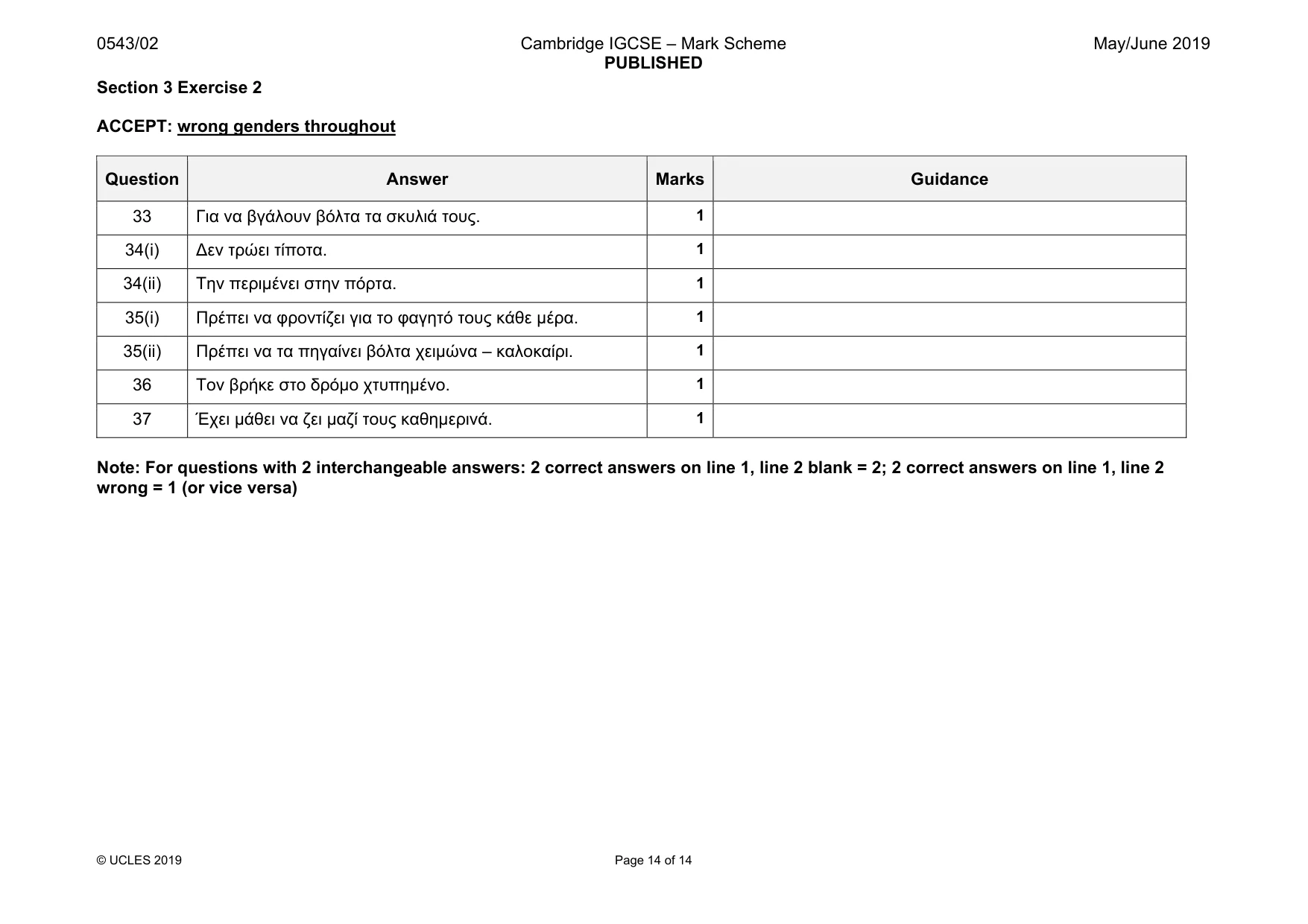
0543/02 Cambridge IGCSE – Mark Scheme PUBLISHED May/June 2019 © UCLES 2019 Page 14 of 14 Section 3 Exercise 2 ACCEPT: wrong genders throughout Question Answer Marks Guidance 33 Για να βγάλουν βόλτα τα σκυλιά τους. 1 34(i) ∆εν τρώει τίποτα. 1 34(ii) Την περιµένει στην πόρτα. 1 35(i) Πρέπει να φροντίζει για το φαγητό τους κάθε µέρα. 1 35(ii) Πρέπει να τα πηγαίνει βόλτα χειµώνα – καλοκαίρι. 1 36 Τον βρήκε στο δρόµο χτυπηµένο. 1 37 Έχει µάθει να ζει µαζί τους καθηµερινά. 1 Note: For questions with 2 interchangeable answers: 2 correct answers on line 1, line 2 blank = 2; 2 correct answers on line 1, line 2 wrong = 1 (or vice versa)
What you needed in this session
Cambridge’s own grade thresholds for 2019 May/June, Paper 2 · Variant 1. A higher threshold means an easier paper — the bar moves with how the cohort did.