Cambridge IGCSE German - Foreign Language 0525 — 2019 May/June Paper 2 · Variant 3
0525/23/M/J/19 · 45 marks · ≈51 min
The question paper and its mark scheme, free to read here and free to download. This is Cambridge’s own paper, exactly as it was sat.
Question paper16 pages
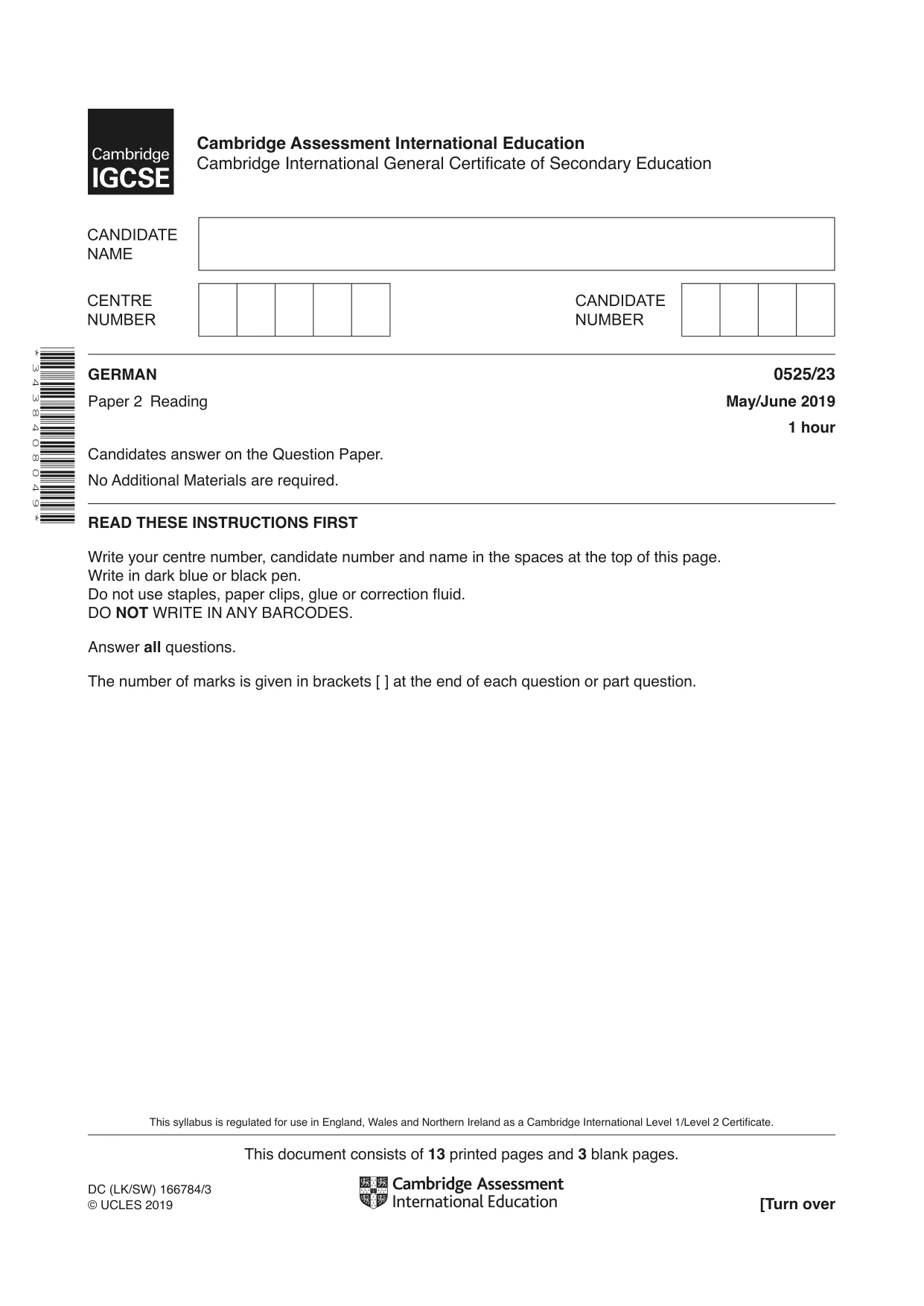



Mark scheme15 pages
Answers below. Sit the paper first if you are practising.
Paper as text
Question paper, page 1
This document consists of 13 printed pages and 3 blank pages. DC (LK/SW) 166784/3 © UCLES 2019 [Turn over * 3 4 3 8 4 0 8 0 4 9 * GERMAN 0525/23 Paper 2 Reading May/June 2019 1 hour Candidates answer on the Question Paper. No Additional Materials are required. READ THESE INSTRUCTIONS FIRST Write your centre number, candidate number and name in the spaces at the top of this page. Write in dark blue or black pen. Do not use staples, paper clips, glue or correction fluid. DO NOT WRITE IN ANY BARCODES. Answer all questions. The number of marks is given in brackets [ ] at the end of each question or part question. Cambridge Assessment International Education Cambridge International General Certificate of Secondary Education This syllabus is regulated for use in England, Wales and Northern Ireland as a Cambridge International Level 1/Level 2 Certificate.
Question paper, page 2
2 0525/23/M/J/19 © UCLES 2019 BLANK PAGE
Question paper, page 3
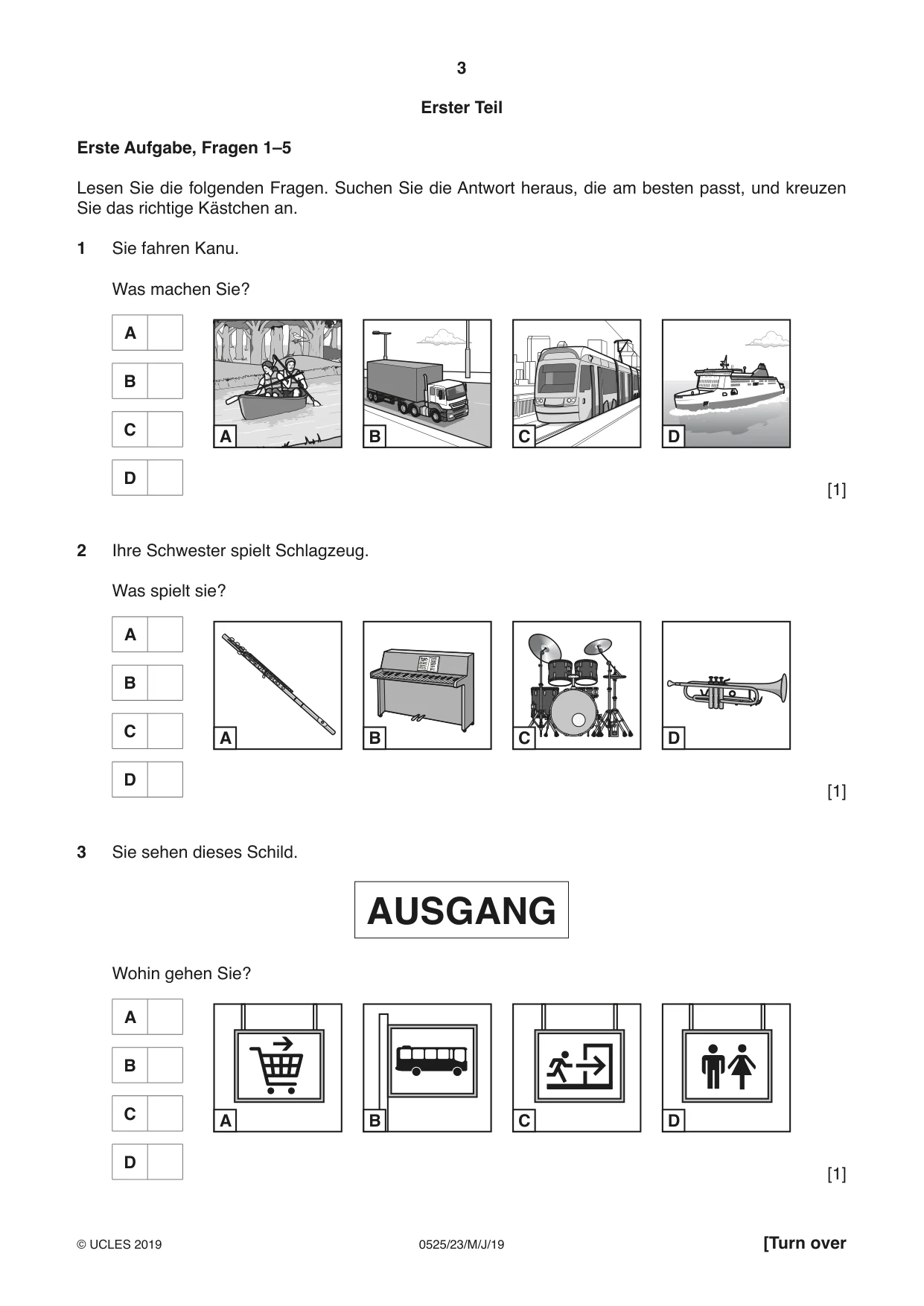
3 0525/23/M/J/19 © UCLES 2019 [Turn over Erster Teil Erste Aufgabe, Fragen 1–5 Lesen Sie die folgenden Fragen. Suchen Sie die Antwort heraus, die am besten passt, und kreuzen Sie das richtige Kästchen an. 1 Sie fahren Kanu. Was machen Sie? A A B C D [1] B C D 2 Ihre Schwester spielt Schlagzeug. Was spielt sie? A A B C D [1] B C D 3 Sie sehen dieses Schild. AUSGANG Wohin gehen Sie? A A B C D [1] B C D
Question paper, page 4
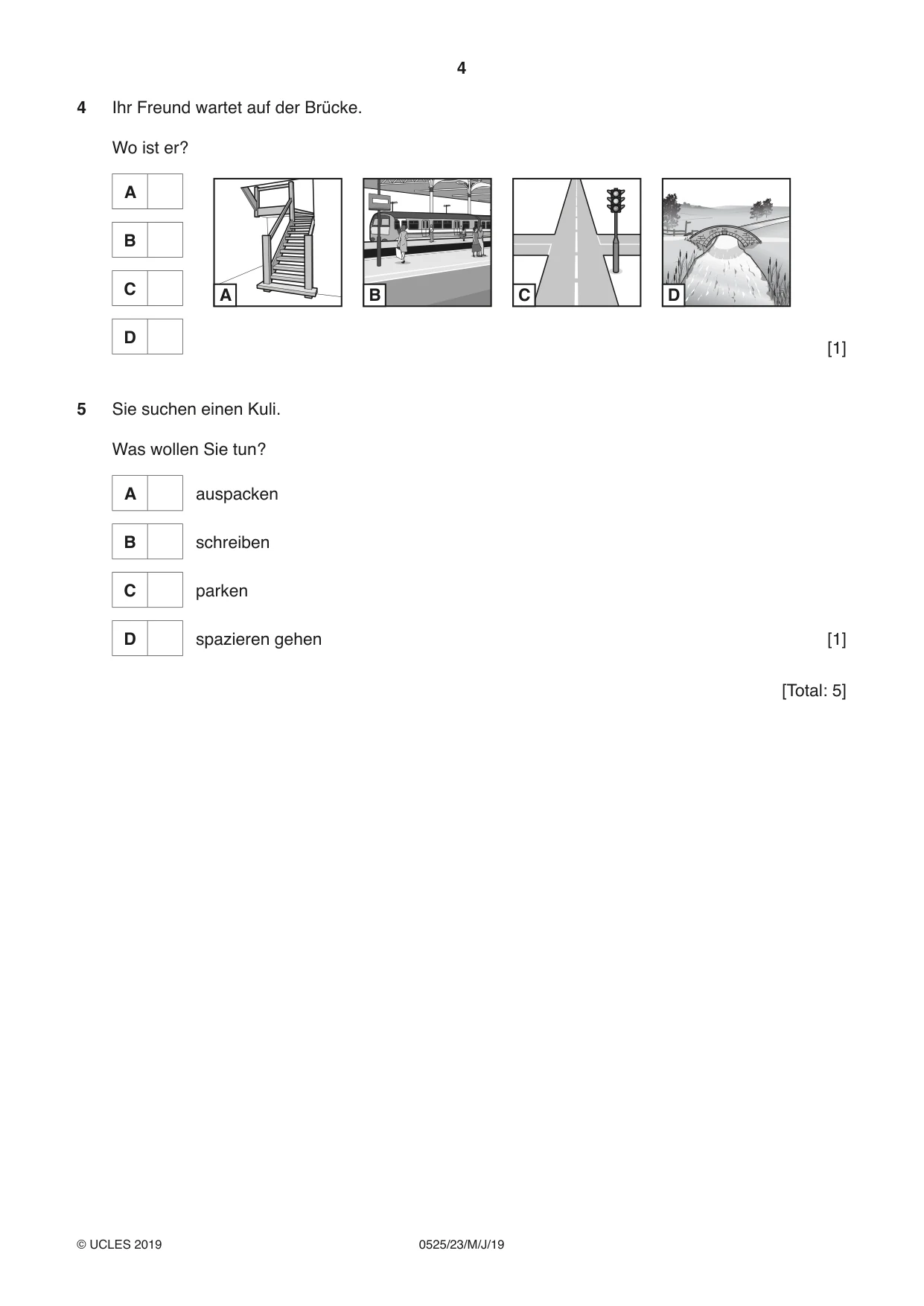
4 0525/23/M/J/19 © UCLES 2019 4 Ihr Freund wartet auf der Brücke. Wo ist er? A A B C D [1] B C D 5 Sie suchen einen Kuli. Was wollen Sie tun? A auspacken B schreiben C parken D spazieren gehen [1] [Total: 5]
Question paper, page 5
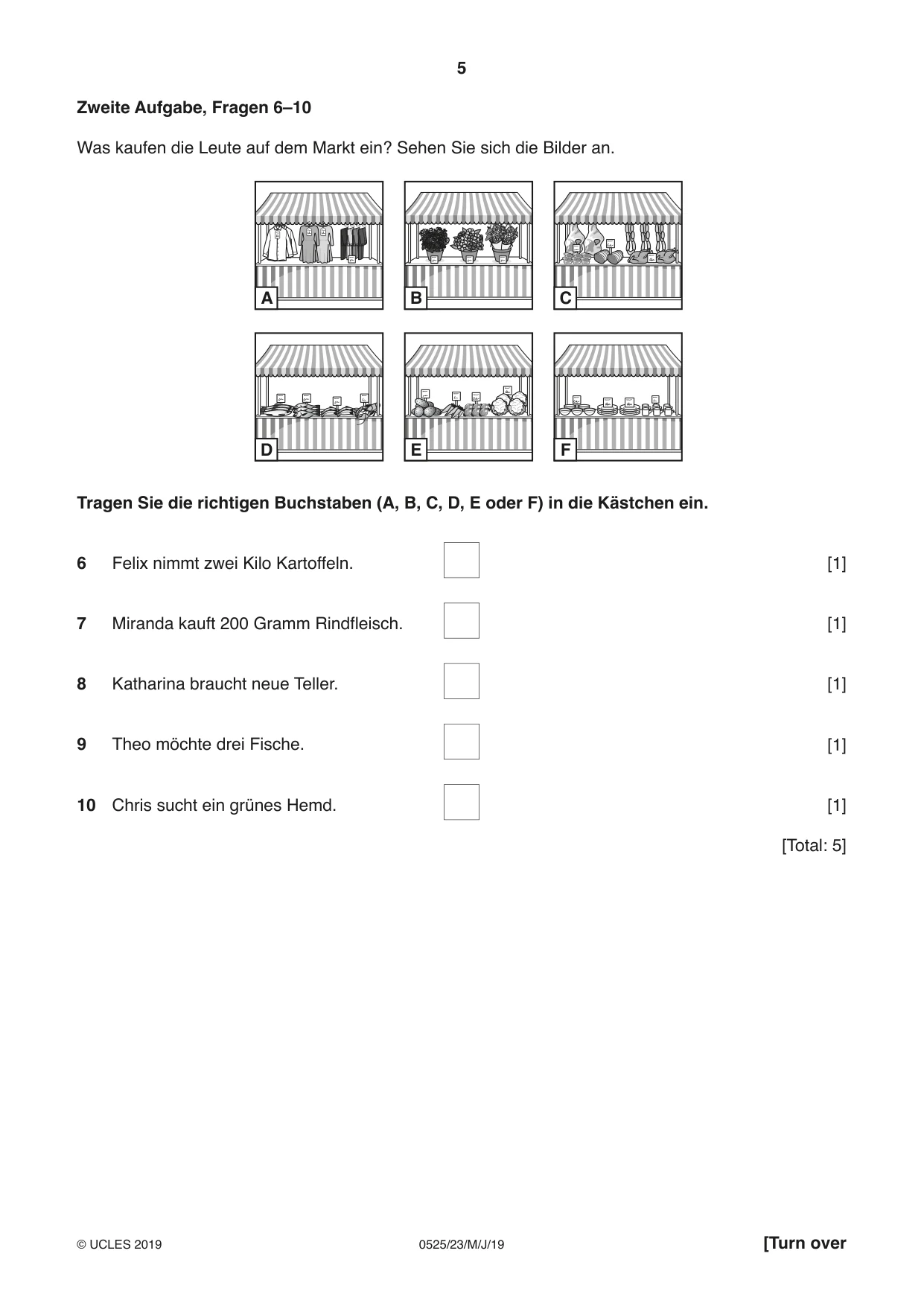
5 0525/23/M/J/19 © UCLES 2019 [Turn over Zweite Aufgabe, Fragen 6–10 Was kaufen die Leute auf dem Markt ein? Sehen Sie sich die Bilder an. A B C D E F Tragen Sie die richtigen Buchstaben (A, B, C, D, E oder F) in die Kästchen ein. 6 Felix nimmt zwei Kilo Kartoffeln. [1] 7 Miranda kauft 200 Gramm Rindfleisch. [1] 8 Katharina braucht neue Teller. [1] 9 Theo möchte drei Fische. [1] 10 Chris sucht ein grünes Hemd. [1] [Total: 5]
Question paper, page 6
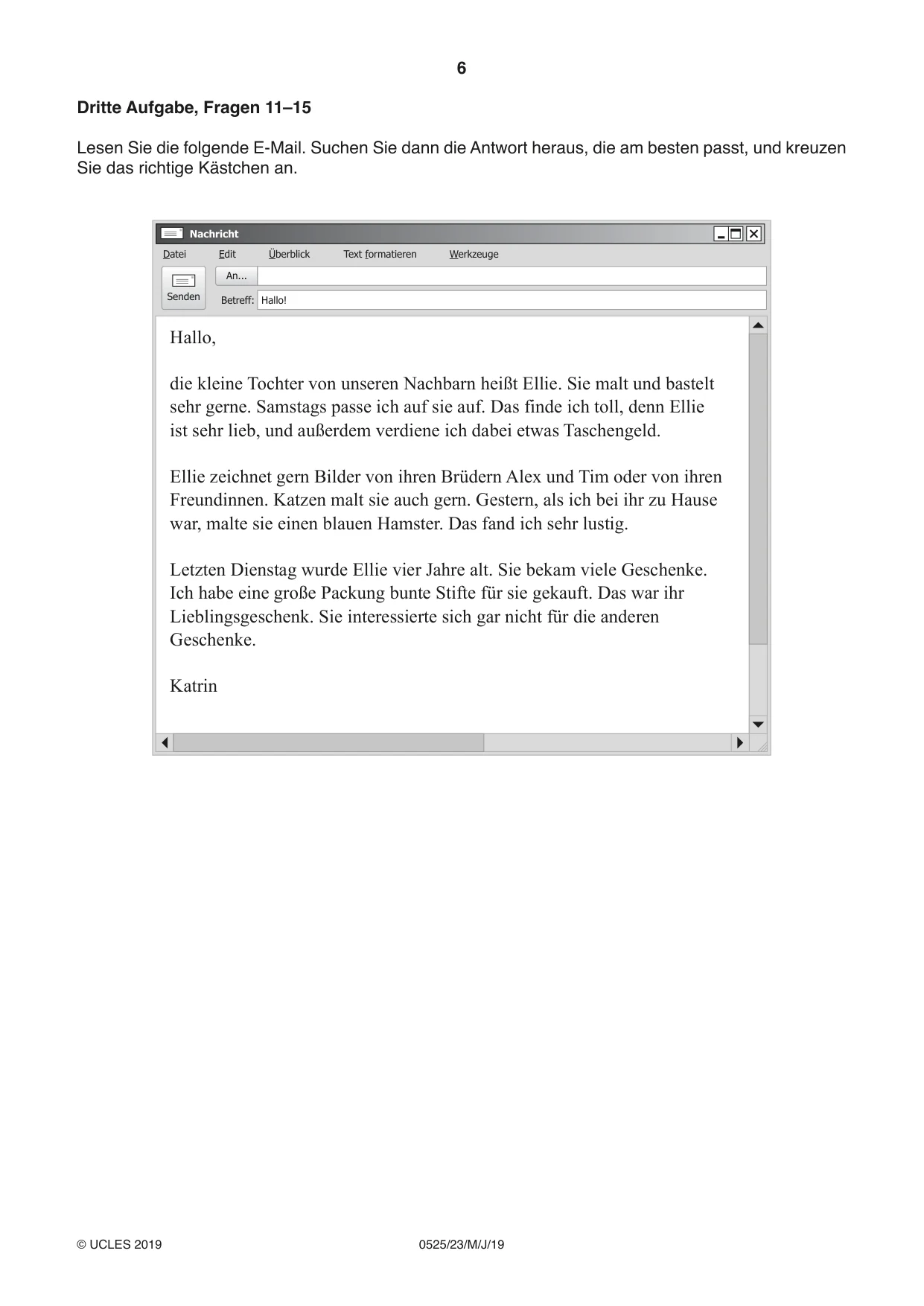
6 0525/23/M/J/19 © UCLES 2019 Dritte Aufgabe, Fragen 11–15 Lesen Sie die folgende E-Mail. Suchen Sie dann die Antwort heraus, die am besten passt, und kreuzen Sie das richtige Kästchen an. Betreff: Hallo! An... Senden Datei Edit Überblick Text formatieren Werkzeuge Nachricht Hallo, die kleine Tochter von unseren Nachbarn heißt Ellie. Sie malt und bastelt sehr gerne. Samstags passe ich auf sie auf. Das finde ich toll, denn Ellie ist sehr lieb, und außerdem verdiene ich dabei etwas Taschengeld. Ellie zeichnet gern Bilder von ihren Brüdern Alex und Tim oder von ihren Freundinnen. Katzen malt sie auch gern. Gestern, als ich bei ihr zu Hause war, malte sie einen blauen Hamster. Das fand ich sehr lustig. Letzten Dienstag wurde Ellie vier Jahre alt. Sie bekam viele Geschenke. Ich habe eine große Packung bunte Stifte für sie gekauft. Das war ihr Lieblingsgeschenk. Sie interessierte sich gar nicht für die anderen Geschenke. Katrin
Question paper, page 7
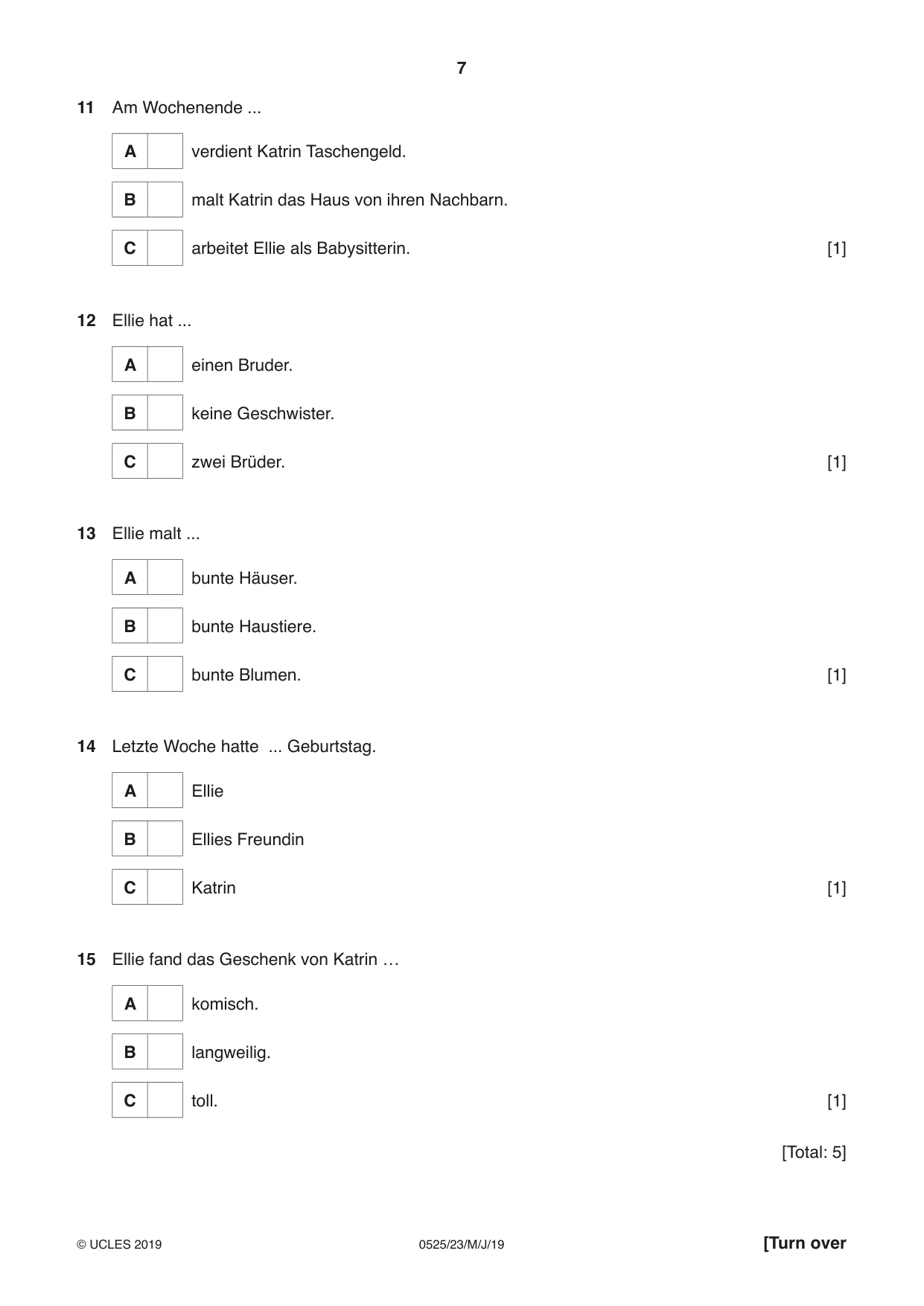
7 0525/23/M/J/19 © UCLES 2019 [Turn over 11 Am Wochenende ... A verdient Katrin Taschengeld. B malt Katrin das Haus von ihren Nachbarn. C arbeitet Ellie als Babysitterin. [1] 12 Ellie hat ... A einen Bruder. B keine Geschwister. C zwei Brüder. [1] 13 Ellie malt ... A bunte Häuser. B bunte Haustiere. C bunte Blumen. [1] 14 Letzte Woche hatte ... Geburtstag. A Ellie B Ellies Freundin C Katrin [1] 15 Ellie fand das Geschenk von Katrin … A komisch. B langweilig. C toll. [1] [Total: 5]
Question paper, page 8
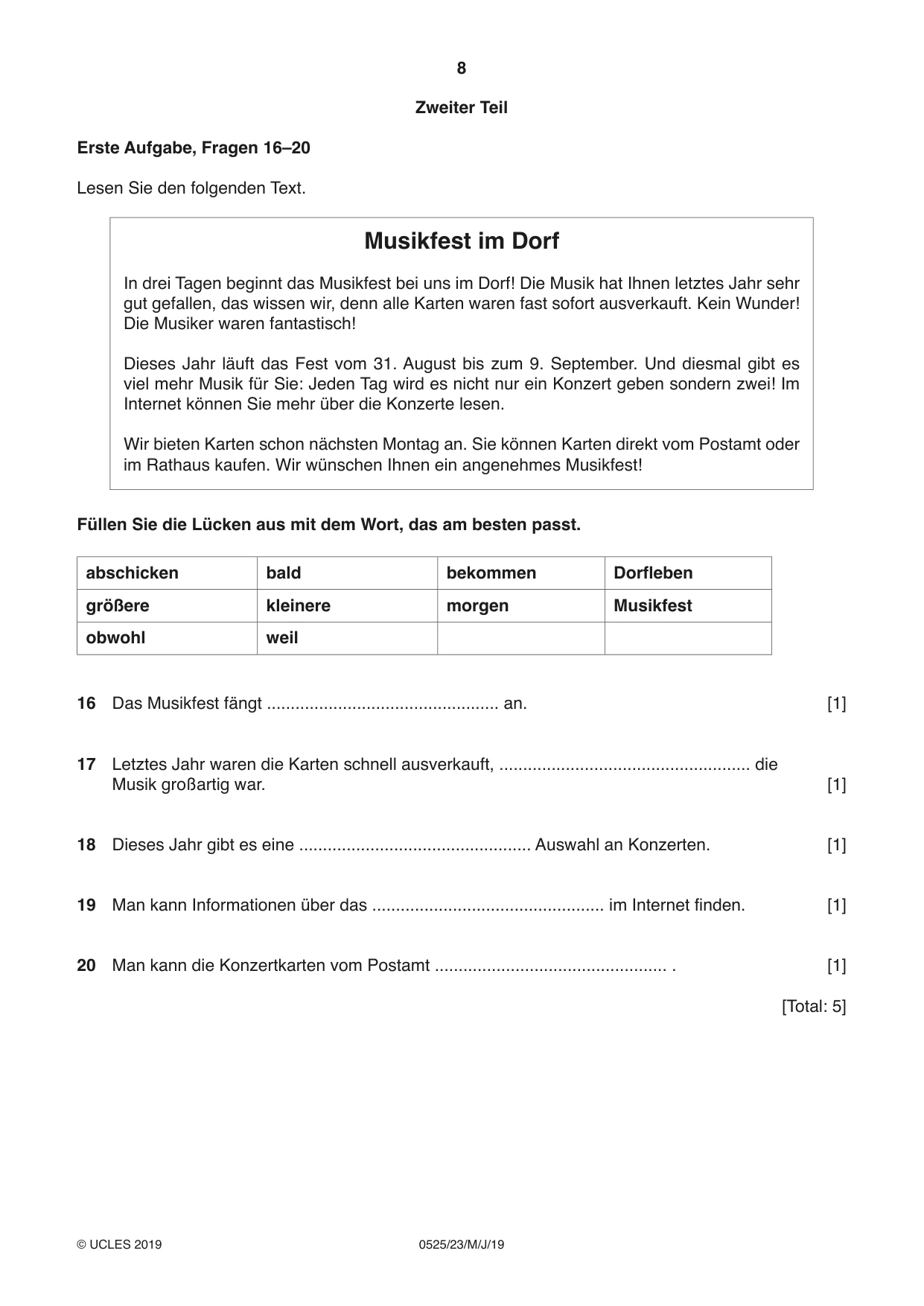
8 0525/23/M/J/19 © UCLES 2019 Zweiter Teil Erste Aufgabe, Fragen 16–20 Lesen Sie den folgenden Text. Musikfest im Dorf In drei Tagen beginnt das Musikfest bei uns im Dorf! Die Musik hat Ihnen letztes Jahr sehr gut gefallen, das wissen wir, denn alle Karten waren fast sofort ausverkauft. Kein Wunder! Die Musiker waren fantastisch! Dieses Jahr läuft das Fest vom 31. August bis zum 9. September. Und diesmal gibt es viel mehr Musik für Sie: Jeden Tag wird es nicht nur ein Konzert geben sondern zwei! Im Internet können Sie mehr über die Konzerte lesen. Wir bieten Karten schon nächsten Montag an. Sie können Karten direkt vom Postamt oder im Rathaus kaufen. Wir wünschen Ihnen ein angenehmes Musikfest! Füllen Sie die Lücken aus mit dem Wort, das am besten passt. abschicken bald bekommen Dorfleben größere kleinere morgen Musikfest obwohl weil 16 Das Musikfest fängt … an. [1] 17 Letztes Jahr waren die Karten schnell ausverkauft, … die Musik großartig war. [1] 18 Dieses Jahr gibt es eine … Auswahl an Konzerten. [1] 19 Man kann Informationen über das … im Internet finden. [1] 20 Man kann die Konzertkarten vom Postamt … . [1] [Total: 5]
Question paper, page 9
9 0525/23/M/J/19 © UCLES 2019 [Turn over BLANK PAGE
Question paper, page 10
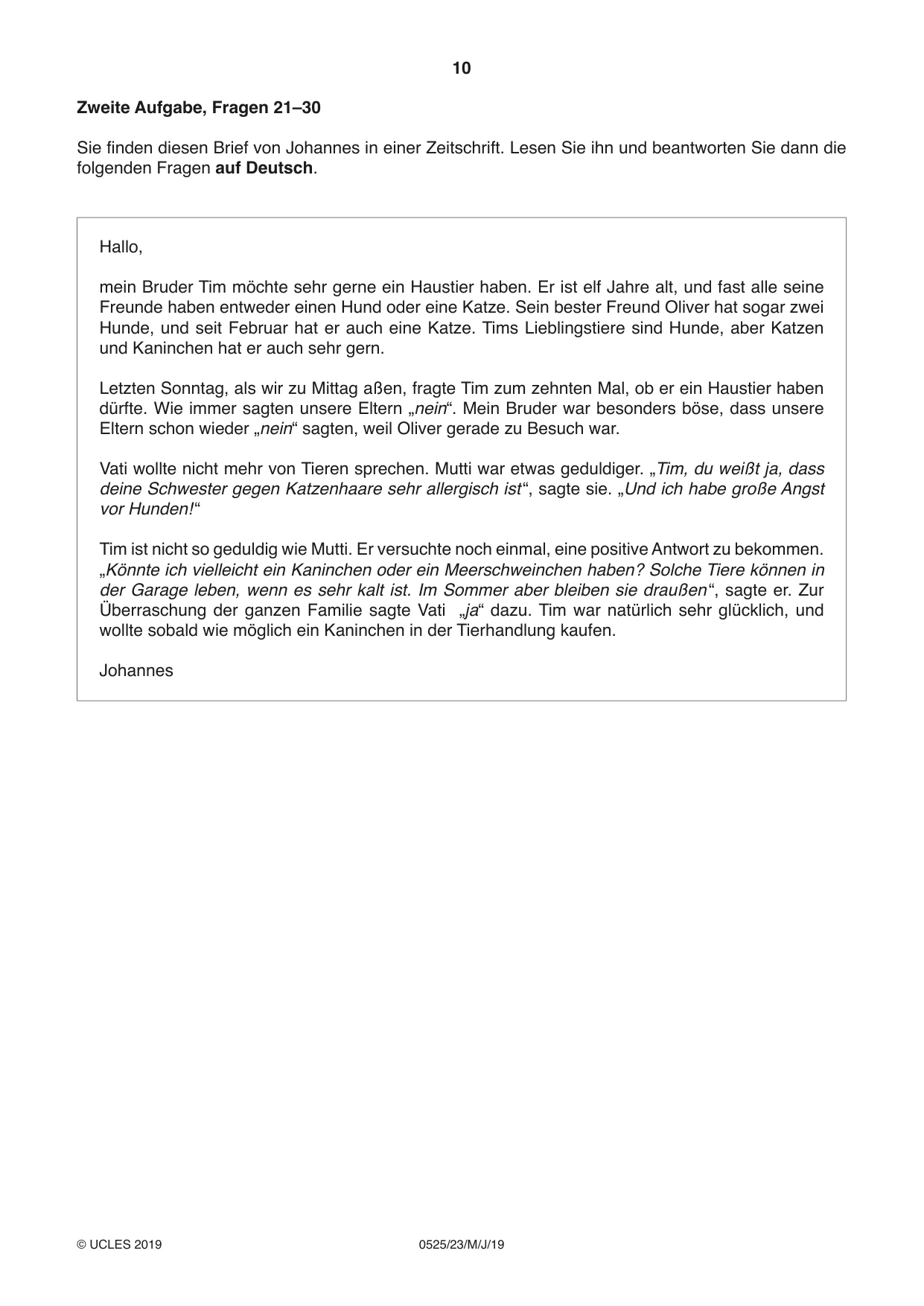
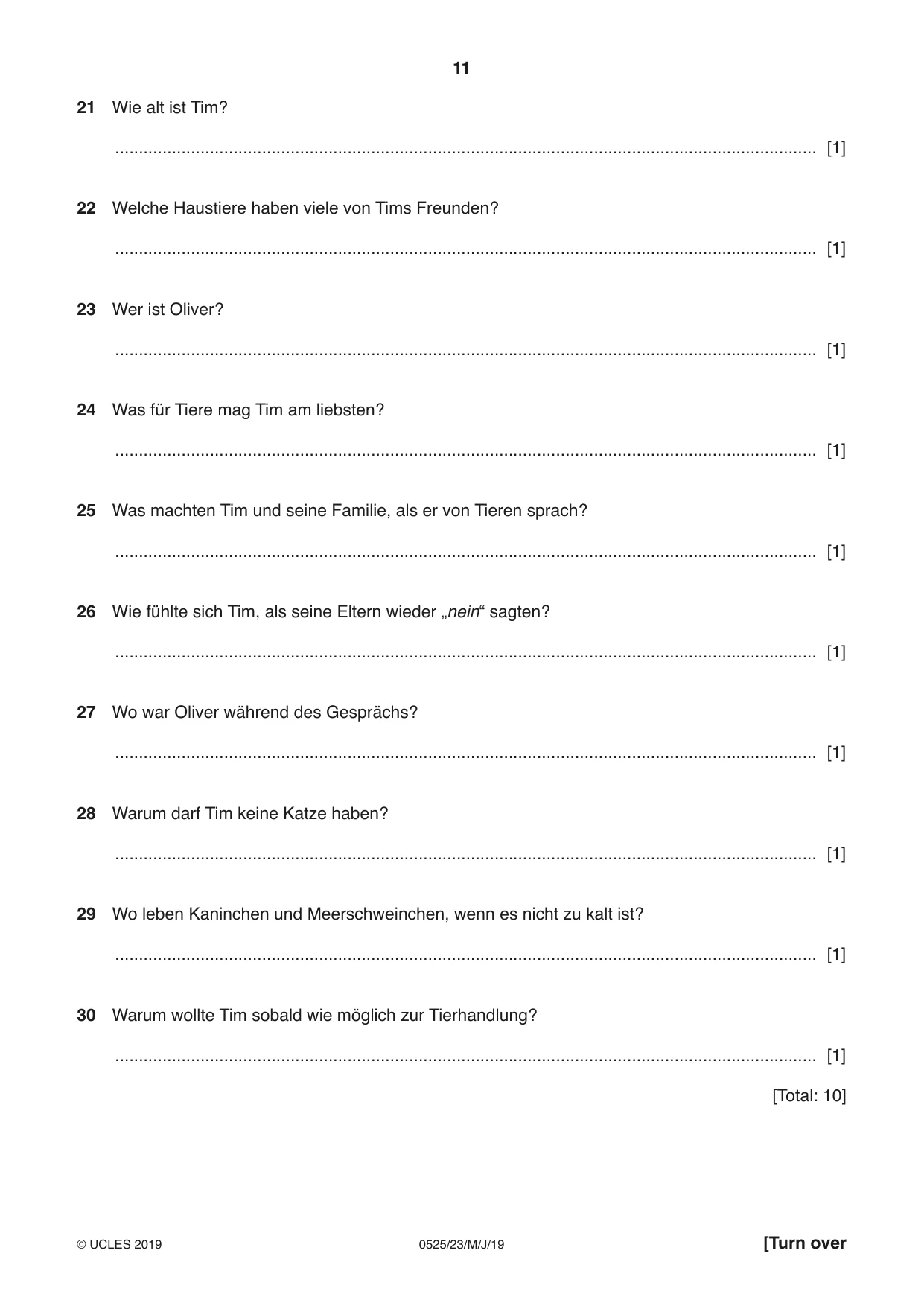
10 0525/23/M/J/19 © UCLES 2019 Zweite Aufgabe, Fragen 21–30 Sie finden diesen Brief von Johannes in einer Zeitschrift. Lesen Sie ihn und beantworten Sie dann die folgenden Fragen auf Deutsch. Hallo, mein Bruder Tim möchte sehr gerne ein Haustier haben. Er ist elf Jahre alt, und fast alle seine Freunde haben entweder einen Hund oder eine Katze. Sein bester Freund Oliver hat sogar zwei Hunde, und seit Februar hat er auch eine Katze. Tims Lieblingstiere sind Hunde, aber Katzen und Kaninchen hat er auch sehr gern. Letzten Sonntag, als wir zu Mittag aßen, fragte Tim zum zehnten Mal, ob er ein Haustier haben dürfte. Wie immer sagten unsere Eltern „nein“. Mein Bruder war besonders böse, dass unsere Eltern schon wieder „nein“ sagten, weil Oliver gerade zu Besuch war. Vati wollte nicht mehr von Tieren sprechen. Mutti war etwas geduldiger. „Tim, du weißt ja, dass deine Schwester gegen Katzenhaare sehr allergisch ist “, sagte sie. „Und ich habe große Angst vor Hunden! “ Tim ist nicht so geduldig wie Mutti. Er versuchte noch einmal, eine positive Antwort zu bekommen. „Könnte ich vielleicht ein Kaninchen oder ein Meerschweinchen haben? Solche Tiere können in der Garage leben, wenn es sehr kalt ist. Im Sommer aber bleiben sie draußen “, sagte er. Zur Überraschung der ganzen Familie sagte Vati „ja“ dazu. Tim war natürlich sehr glücklich, und wollte sobald wie möglich ein Kaninchen in der Tierhandlung kaufen. Johannes
Question paper, page 11
11 0525/23/M/J/19 © UCLES 2019 [Turn over 21 Wie alt ist Tim? … [1] 22 Welche Haustiere haben viele von Tims Freunden? … [1] 23 Wer ist Oliver? … [1] 24 Was für Tiere mag Tim am liebsten? … [1] 25 Was machten Tim und seine Familie, als er von Tieren sprach? … [1] 26 Wie fühlte sich Tim, als seine Eltern wieder „nein“ sagten? … [1] 27 Wo war Oliver während des Gesprächs? … [1] 28 Warum darf Tim keine Katze haben? … [1] 29 Wo leben Kaninchen und Meerschweinchen, wenn es nicht zu kalt ist? … [1] 30 Warum wollte Tim sobald wie möglich zur Tierhandlung? … [1] [Total: 10]
Question paper, page 12
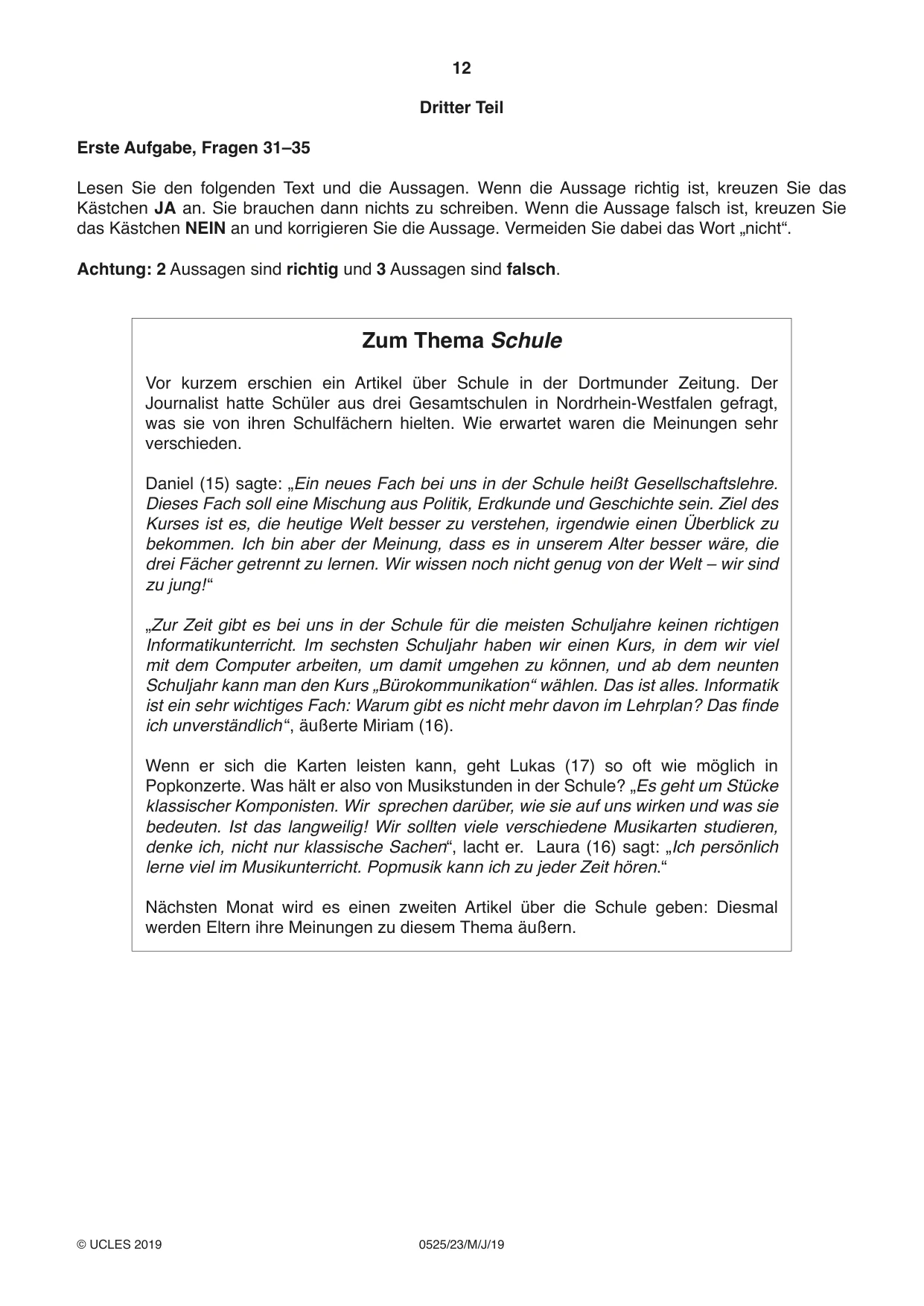
12 0525/23/M/J/19 © UCLES 2019 Dritter Teil Erste Aufgabe, Fragen 31–35 Lesen Sie den folgenden Text und die Aussagen. Wenn die Aussage richtig ist, kreuzen Sie das Kästchen JA an. Sie brauchen dann nichts zu schreiben. Wenn die Aussage falsch ist, kreuzen Sie das Kästchen NEIN an und korrigieren Sie die Aussage. Vermeiden Sie dabei das Wort „nicht“. Achtung: 2 Aussagen sind richtig und 3 Aussagen sind falsch. Zum Thema Schule Vor kurzem erschien ein Artikel über Schule in der Dortmunder Zeitung. Der Journalist hatte Schüler aus drei Gesamtschulen in Nordrhein-Westfalen gefragt, was sie von ihren Schulfächern hielten. Wie erwartet waren die Meinungen sehr verschieden. Daniel (15) sagte: „Ein neues Fach bei uns in der Schule heißt Gesellschaftslehre. Dieses Fach soll eine Mischung aus Politik, Erdkunde und Geschichte sein. Ziel des Kurses ist es, die heutige Welt besser zu verstehen, irgendwie einen Überblick zu bekommen. Ich bin aber der Meinung, dass es in unserem Alter besser wäre, die drei Fächer getrennt zu lernen. Wir wissen noch nicht genug von der Welt – wir sind zu jung! “ „Zur Zeit gibt es bei uns in der Schule für die meisten Schuljahre keinen richtigen Informatikunterricht. Im sechsten Schuljahr haben wir einen Kurs, in dem wir viel mit dem Computer arbeiten, um damit umgehen zu können, und ab dem neunten Schuljahr kann man den Kurs „Bürokommunikation“ wählen. Das ist alles. Informatik ist ein sehr wichtiges Fach: Warum gibt es nicht mehr davon im Lehrplan? Das finde ich unverständlich “, äußerte Miriam (16). Wenn er sich die Karten leisten kann, geht Lukas (17) so oft wie möglich in Popkonzerte. Was hält er also von Musikstunden in der Schule? „Es geht um Stücke klassischer Komponisten. Wir sprechen darüber, wie sie auf uns wirken und was sie bedeuten. Ist das langweilig! Wir sollten viele verschiedene Musikarten studieren, denke ich, nicht nur klassische Sachen“, lacht er. Laura (16) sagt: „Ich persönlich lerne viel im Musikunterricht. Popmusik kann ich zu jeder Zeit hören.“ Nächsten Monat wird es einen zweiten Artikel über die Schule geben: Diesmal werden Eltern ihre Meinungen zu diesem Thema äußern.
Question paper, page 13
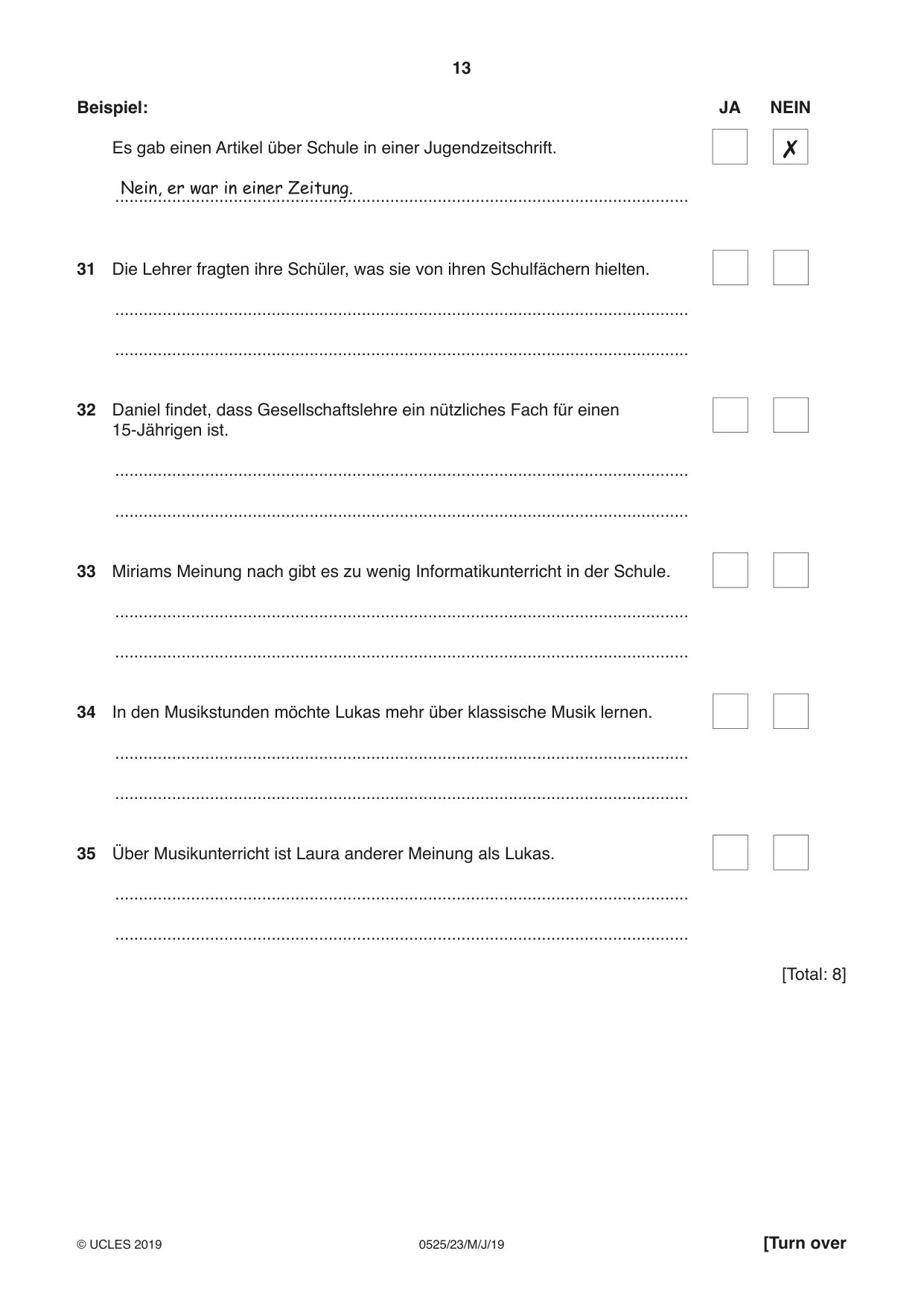
13 0525/23/M/J/19 © UCLES 2019 [Turn over Beispiel: JA NEIN Es gab einen Artikel über Schule in einer Jugendzeitschrift. 7 Nein, er war in einer Zeitung. … 31 Die Lehrer fragten ihre Schüler, was sie von ihren Schulfächern hielten. … … 32 Daniel findet, dass Gesellschaftslehre ein nützliches Fach für einen 15-Jährigen ist. … … 33 Miriams Meinung nach gibt es zu wenig Informatikunterricht in der Schule. … … 34 In den Musikstunden möchte Lukas mehr über klassische Musik lernen. … … 35 Über Musikunterricht ist Laura anderer Meinung als Lukas. … … [Total: 8]
Question paper, page 14
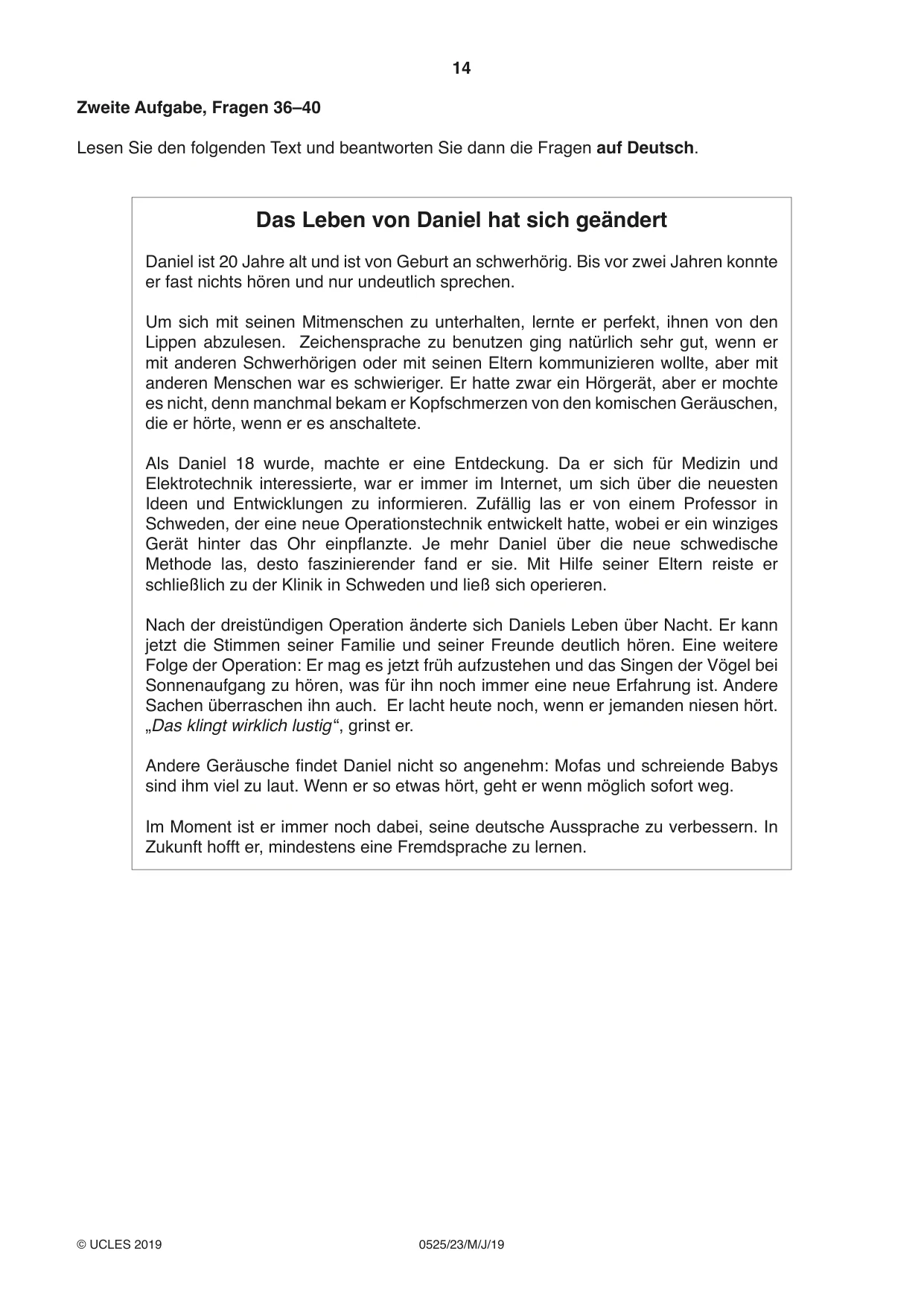
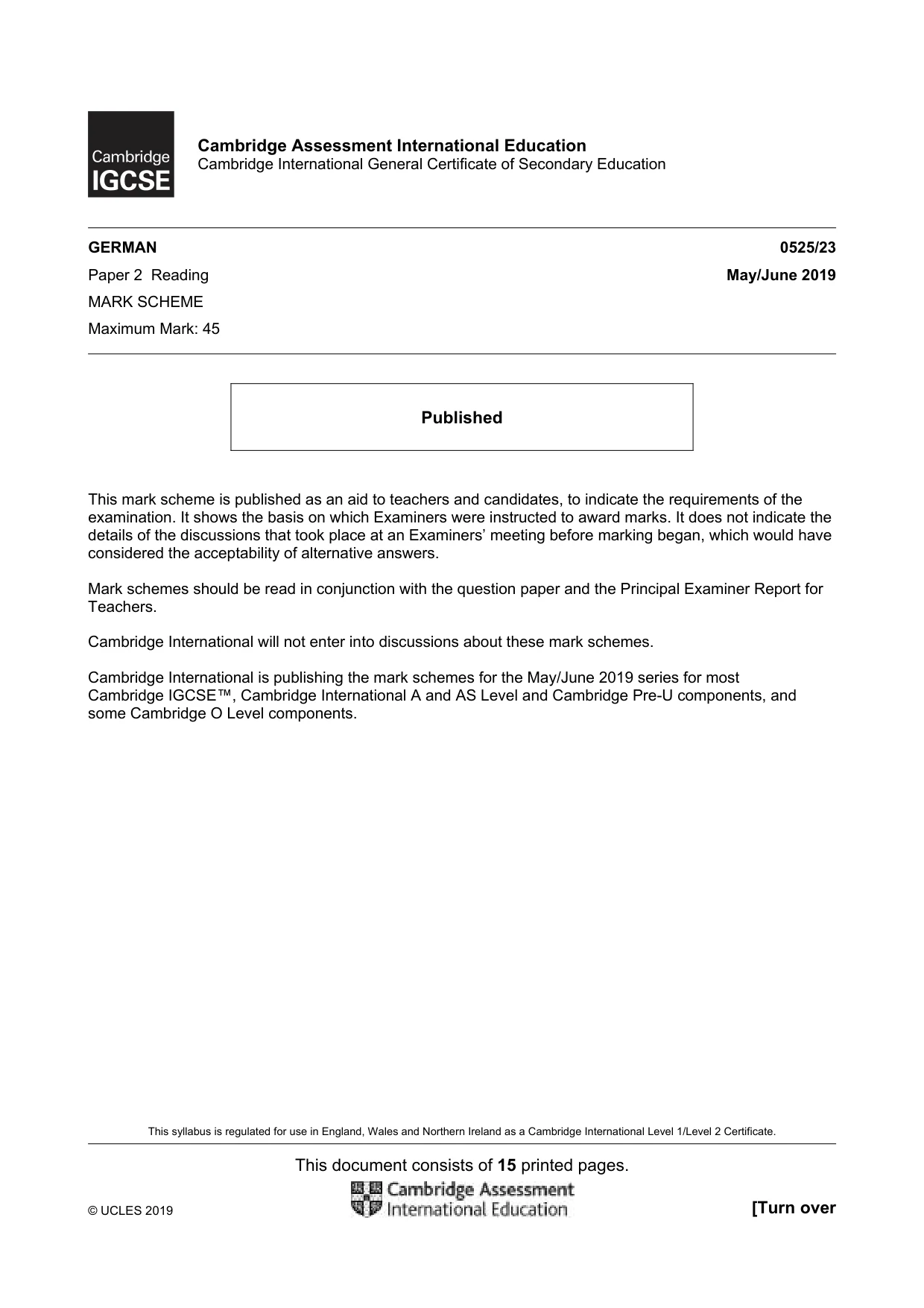
14 0525/23/M/J/19 © UCLES 2019 Zweite Aufgabe, Fragen 36–40 Lesen Sie den folgenden Text und beantworten Sie dann die Fragen auf Deutsch. Das Leben von Daniel hat sich geändert Daniel ist 20 Jahre alt und ist von Geburt an schwerhörig. Bis vor zwei Jahren konnte er fast nichts hören und nur undeutlich sprechen. Um sich mit seinen Mitmenschen zu unterhalten, lernte er perfekt, ihnen von den Lippen abzulesen. Zeichensprache zu benutzen ging natürlich sehr gut, wenn er mit anderen Schwerhörigen oder mit seinen Eltern kommunizieren wollte, aber mit anderen Menschen war es schwieriger. Er hatte zwar ein Hörgerät, aber er mochte es nicht, denn manchmal bekam er Kopfschmerzen von den komischen Geräuschen, die er hörte, wenn er es anschaltete. Als Daniel 18 wurde, machte er eine Entdeckung. Da er sich für Medizin und Elektrotechnik interessierte, war er immer im Internet, um sich über die neuesten Ideen und Entwicklungen zu informieren. Zufällig las er von einem Professor in Schweden, der eine neue Operationstechnik entwickelt hatte, wobei er ein winziges Gerät hinter das Ohr einpflanzte. Je mehr Daniel über die neue schwedische Methode las, desto faszinierender fand er sie. Mit Hilfe seiner Eltern reiste er schließlich zu der Klinik in Schweden und ließ sich operieren. Nach der dreistündigen Operation änderte sich Daniels Leben über Nacht. Er kann jetzt die Stimmen seiner Familie und seiner Freunde deutlich hören. Eine weitere Folge der Operation: Er mag es jetzt früh aufzustehen und das Singen der Vögel bei Sonnenaufgang zu hören, was für ihn noch immer eine neue Erfahrung ist. Andere Sachen überraschen ihn auch. Er lacht heute noch, wenn er jemanden niesen hört. „Das klingt wirklich lustig “, grinst er. Andere Geräusche findet Daniel nicht so angenehm: Mofas und schreiende Babys sind ihm viel zu laut. Wenn er so etwas hört, geht er wenn möglich sofort weg. Im Moment ist er immer noch dabei, seine deutsche Aussprache zu verbessern. In Zukunft hofft er, mindestens eine Fremdsprache zu lernen.
Question paper, page 15
15 0525/23/M/J/19 © UCLES 2019 36 Wie konnte Daniel bis vor zwei Jahren andere Menschen verstehen und mit ihnen reden? Nennen Sie zwei Beispiele. (i) … … [1] (ii) … … [1] 37 Welches Problem hatte Daniel mit seinem alten Hörgerät? … … [1] 38 Warum wollte Daniel den schwedischen Professor besuchen? Nennen Sie zwei Gründe. (i) … … [1] (ii) … … [1] 39 Warum steht Daniel jetzt früh auf? … … [1] 40 Was macht Daniel, wenn er laute Mofas hört? … … [1] [Total: 7]
Question paper, page 16
16 0525/23/M/J/19 © UCLES 2019 Permission to reproduce items where third-party owned material protected by copyright is included has been sought and cleared where possible. Every reasonable effort has been made by the publisher (UCLES) to trace copyright holders, but if any items requiring clearance have unwittingly been included, the publisher will be pleased to make amends at the earliest possible opportunity. To avoid the issue of disclosure of answer-related information to candidates, all copyright acknowledgements are reproduced online in the Cambridge Assessment International Education Copyright Acknowledgements Booklet. This is produced for each series of examinations and is freely available to download at www.cambridgeinternational.org after the live examination series. Cambridge Assessment International Education is part of the Cambridge Assessment Group. Cambridge Assessment is the brand name of the University of Cambridge Local Examinations Syndicate (UCLES), which itself is a department of the University of Cambridge. BLANK PAGE
Mark scheme, page 1
This syllabus is regulated for use in England, Wales and Northern Ireland as a Cambridge International Level 1/Level 2 Certificate. This document consists of 15 printed pages. © UCLES 2019 [Turn over Cambridge Assessment International Education Cambridge International General Certificate of Secondary Education GERMAN 0525/23 Paper 2 Reading May/June 2019 MARK SCHEME Maximum Mark: 45 Published This mark scheme is published as an aid to teachers and candidates, to indicate the requirements of the examination. It shows the basis on which Examiners were instructed to award marks. It does not indicate the details of the discussions that took place at an Examiners’ meeting before marking began, which would have considered the acceptability of alternative answers. Mark schemes should be read in conjunction with the question paper and the Principal Examiner Report for Teachers. Cambridge International will not enter into discussions about these mark schemes. Cambridge International is publishing the mark schemes for the May/June 2019 series for most Cambridge IGCSE™, Cambridge International A and AS Level and Cambridge Pre-U components, and some Cambridge O Level components.
Mark scheme, page 2
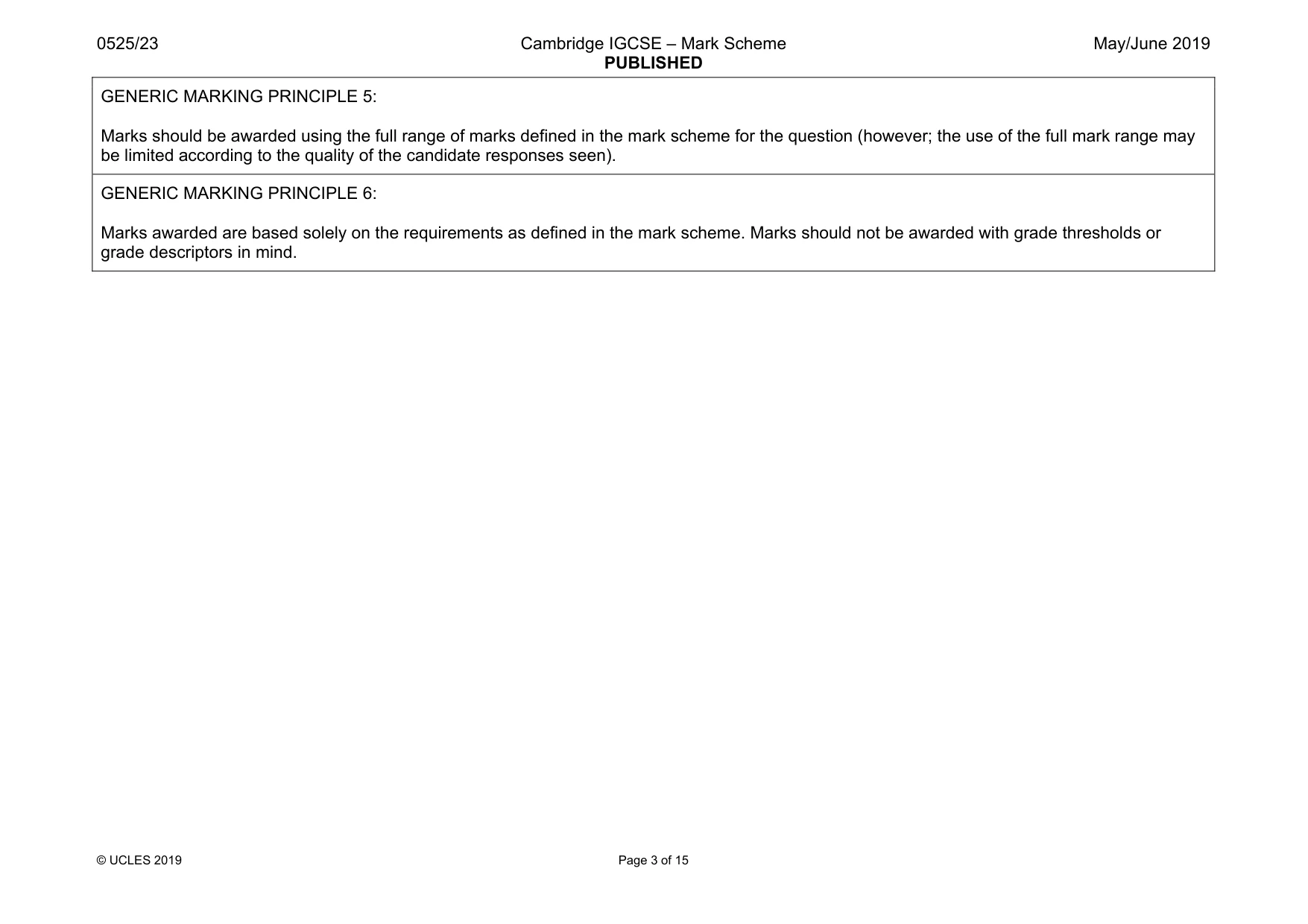
0525/23 Cambridge IGCSE – Mark Scheme PUBLISHED May/June 2019 © UCLES 2019 Page 2 of 15 1 Generic Marking Principles These general marking principles must be applied by all examiners when marking candidate answers. They should be applied alongside the specific content of the mark scheme or generic level descriptors for a question. Each question paper and mark scheme will also comply with these marking principles. GENERIC MARKING PRINCIPLE 1: Marks must be awarded in line with: • the specific content of the mark scheme or the generic level descriptors for the question • the specific skills defined in the mark scheme or in the generic level descriptors for the question • the standard of response required by a candidate as exemplified by the standardisation scripts. GENERIC MARKING PRINCIPLE 2: Marks awarded are always whole marks (not half marks, or other fractions). GENERIC MARKING PRINCIPLE 3: Marks must be awarded positively: • marks are awarded for correct/valid answers, as defined in the mark scheme. However, credit is given for valid answers which go beyond the scope of the syllabus and mark scheme, referring to your Team Leader as appropriate • marks are awarded when candidates clearly demonstrate what they know and can do • marks are not deducted for errors • marks are not deducted for omissions • answers should only be judged on the quality of spelling, punctuation and grammar when these features are specifically assessed by the question as indicated by the mark scheme. The meaning, however, should be unambiguous. GENERIC MARKING PRINCIPLE 4: Rules must be applied consistently e.g. in situations where candidates have not followed instructions or in the application of generic level descriptors.
Mark scheme, page 3
0525/23 Cambridge IGCSE – Mark Scheme PUBLISHED May/June 2019 © UCLES 2019 Page 3 of 15 GENERIC MARKING PRINCIPLE 5: Marks should be awarded using the full range of marks defined in the mark scheme for the question (however; the use of the full mark range may be limited according to the quality of the candidate responses seen). GENERIC MARKING PRINCIPLE 6: Marks awarded are based solely on the requirements as defined in the mark scheme. Marks should not be awarded with grade thresholds or grade descriptors in mind.
Mark scheme, page 4
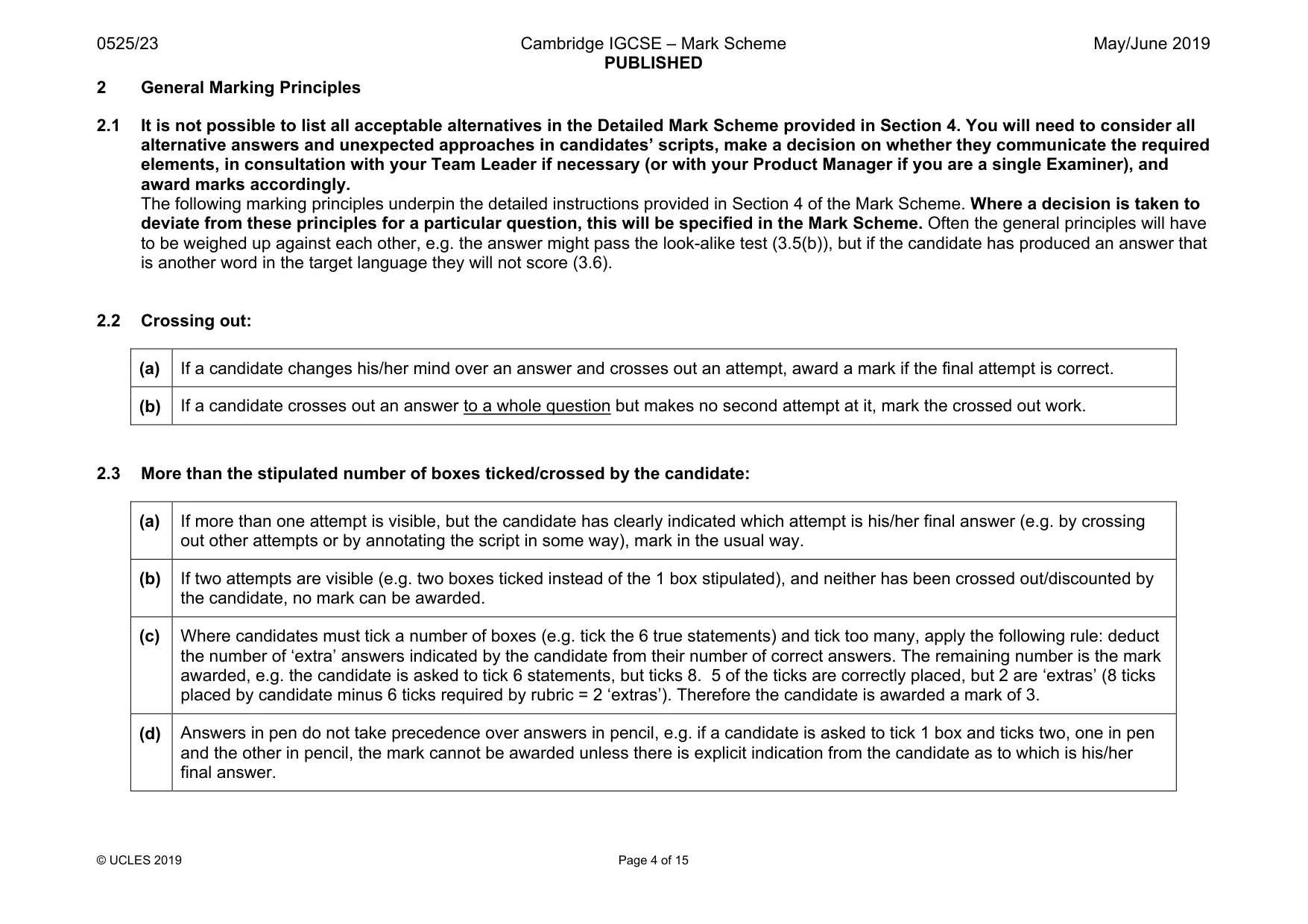
0525/23 Cambridge IGCSE – Mark Scheme PUBLISHED May/June 2019 © UCLES 2019 Page 4 of 15 2 General Marking Principles 2.1 It is not possible to list all acceptable alternatives in the Detailed Mark Scheme provided in Section 4. You will need to consider all alternative answers and unexpected approaches in candidates’ scripts, make a decision on whether they communicate the required elements, in consultation with your Team Leader if necessary (or with your Product Manager if you are a single Examiner), and award marks accordingly. The following marking principles underpin the detailed instructions provided in Section 4 of the Mark Scheme. Where a decision is taken to deviate from these principles for a particular question, this will be specified in the Mark Scheme. Often the general principles will have to be weighed up against each other, e.g. the answer might pass the look-alike test (3.5(b)), but if the candidate has produced an answer that is another word in the target language they will not score (3.6). 2.2 Crossing out: (a) If a candidate changes his/her mind over an answer and crosses out an attempt, award a mark if the final attempt is correct. (b) If a candidate crosses out an answer to a whole question but makes no second attempt at it, mark the crossed out work. 2.3 More than the stipulated number of boxes ticked/crossed by the candidate: (a) If more than one attempt is visible, but the candidate has clearly indicated which attempt is his/her final answer (e.g. by crossing out other attempts or by annotating the script in some way), mark in the usual way. (b) If two attempts are visible (e.g. two boxes ticked instead of the 1 box stipulated), and neither has been crossed out/discounted by the candidate, no mark can be awarded. (c) Where candidates must tick a number of boxes (e.g. tick the 6 true statements) and tick too many, apply the following rule: deduct the number of ‘extra’ answers indicated by the candidate from their number of correct answers. The remaining number is the mark awarded, e.g. the candidate is asked to tick 6 statements, but ticks 8. 5 of the ticks are correctly placed, but 2 are ‘extras’ (8 ticks placed by candidate minus 6 ticks required by rubric = 2 ‘extras’). Therefore the candidate is awarded a mark of 3. (d) Answers in pen do not take precedence over answers in pencil, e.g. if a candidate is asked to tick 1 box and ticks two, one in pen and the other in pencil, the mark cannot be awarded unless there is explicit indication from the candidate as to which is his/her final answer.
Mark scheme, page 5
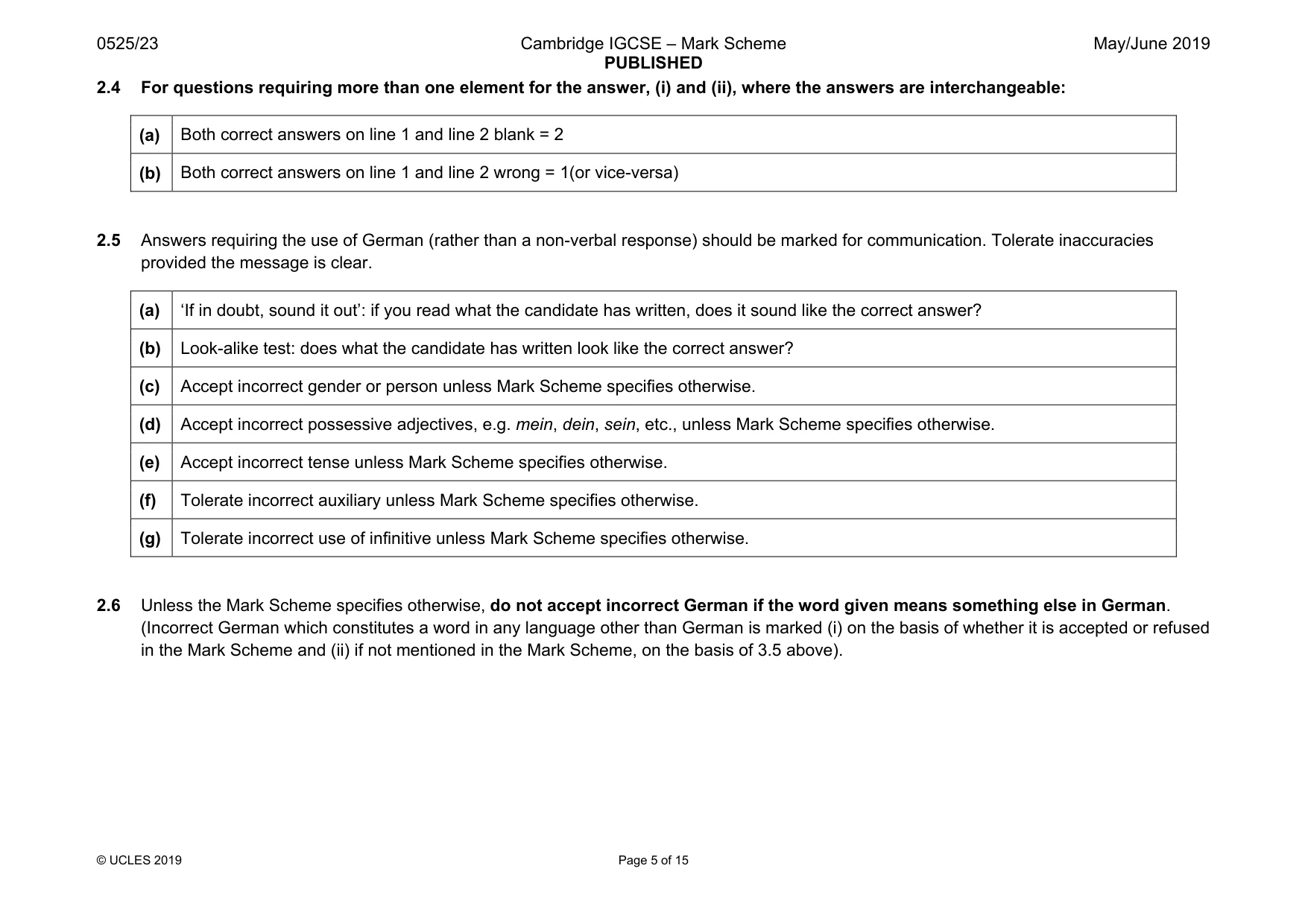
0525/23 Cambridge IGCSE – Mark Scheme PUBLISHED May/June 2019 © UCLES 2019 Page 5 of 15 2.4 For questions requiring more than one element for the answer, (i) and (ii), where the answers are interchangeable: (a) Both correct answers on line 1 and line 2 blank = 2 (b) Both correct answers on line 1 and line 2 wrong = 1(or vice-versa) 2.5 Answers requiring the use of German (rather than a non-verbal response) should be marked for communication. Tolerate inaccuracies provided the message is clear. (a) ‘If in doubt, sound it out’: if you read what the candidate has written, does it sound like the correct answer? (b) Look-alike test: does what the candidate has written look like the correct answer? (c) Accept incorrect gender or person unless Mark Scheme specifies otherwise. (d) Accept incorrect possessive adjectives, e.g. mein, dein, sein, etc., unless Mark Scheme specifies otherwise. (e) Accept incorrect tense unless Mark Scheme specifies otherwise. (f) Tolerate incorrect auxiliary unless Mark Scheme specifies otherwise. (g) Tolerate incorrect use of infinitive unless Mark Scheme specifies otherwise. 2.6 Unless the Mark Scheme specifies otherwise, do not accept incorrect German if the word given means something else in German. (Incorrect German which constitutes a word in any language other than German is marked (i) on the basis of whether it is accepted or refused in the Mark Scheme and (ii) if not mentioned in the Mark Scheme, on the basis of 3.5 above).
Mark scheme, page 6
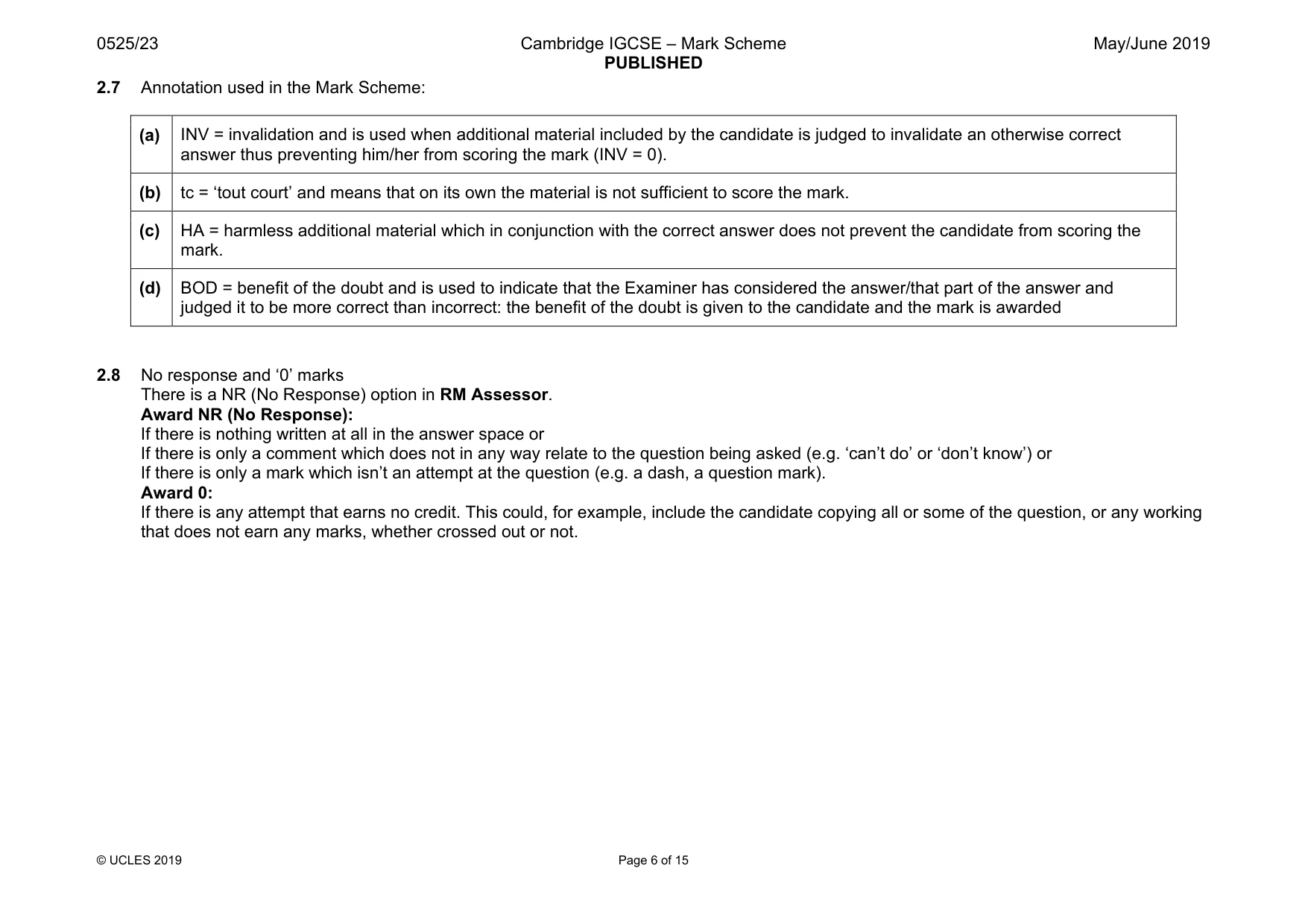
0525/23 Cambridge IGCSE – Mark Scheme PUBLISHED May/June 2019 © UCLES 2019 Page 6 of 15 2.7 Annotation used in the Mark Scheme: (a) INV = invalidation and is used when additional material included by the candidate is judged to invalidate an otherwise correct answer thus preventing him/her from scoring the mark (INV = 0). (b) tc = ‘tout court’ and means that on its own the material is not sufficient to score the mark. (c) HA = harmless additional material which in conjunction with the correct answer does not prevent the candidate from scoring the mark. (d) BOD = benefit of the doubt and is used to indicate that the Examiner has considered the answer/that part of the answer and judged it to be more correct than incorrect: the benefit of the doubt is given to the candidate and the mark is awarded 2.8 No response and ‘0’ marks There is a NR (No Response) option in RM Assessor. Award NR (No Response): If there is nothing written at all in the answer space or If there is only a comment which does not in any way relate to the question being asked (e.g. ‘can’t do’ or ‘don’t know’) or If there is only a mark which isn’t an attempt at the question (e.g. a dash, a question mark). Award 0: If there is any attempt that earns no credit. This could, for example, include the candidate copying all or some of the question, or any working that does not earn any marks, whether crossed out or not.
Mark scheme, page 7
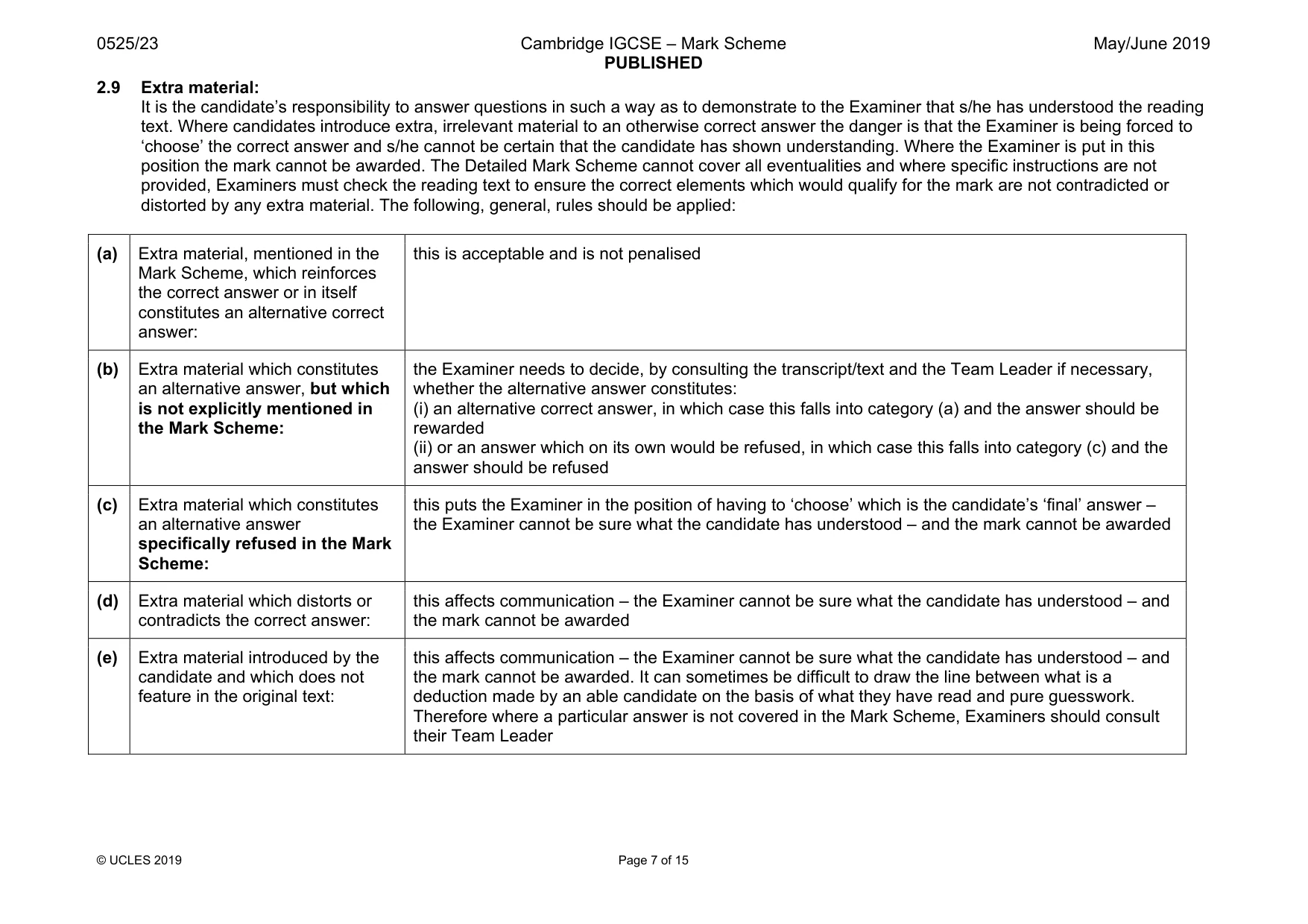
0525/23 Cambridge IGCSE – Mark Scheme PUBLISHED May/June 2019 © UCLES 2019 Page 7 of 15 2.9 Extra material: It is the candidate’s responsibility to answer questions in such a way as to demonstrate to the Examiner that s/he has understood the reading text. Where candidates introduce extra, irrelevant material to an otherwise correct answer the danger is that the Examiner is being forced to ‘choose’ the correct answer and s/he cannot be certain that the candidate has shown understanding. Where the Examiner is put in this position the mark cannot be awarded. The Detailed Mark Scheme cannot cover all eventualities and where specific instructions are not provided, Examiners must check the reading text to ensure the correct elements which would qualify for the mark are not contradicted or distorted by any extra material. The following, general, rules should be applied: (a) Extra material, mentioned in the Mark Scheme, which reinforces the correct answer or in itself constitutes an alternative correct answer: this is acceptable and is not penalised (b) Extra material which constitutes an alternative answer, but which is not explicitly mentioned in the Mark Scheme: the Examiner needs to decide, by consulting the transcript/text and the Team Leader if necessary, whether the alternative answer constitutes: (i) an alternative correct answer, in which case this falls into category (a) and the answer should be rewarded (ii) or an answer which on its own would be refused, in which case this falls into category (c) and the answer should be refused (c) Extra material which constitutes an alternative answer specifically refused in the Mark Scheme: this puts the Examiner in the position of having to ‘choose’ which is the candidate’s ‘final’ answer – the Examiner cannot be sure what the candidate has understood – and the mark cannot be awarded (d) Extra material which distorts or contradicts the correct answer: this affects communication – the Examiner cannot be sure what the candidate has understood – and the mark cannot be awarded (e) Extra material introduced by the candidate and which does not feature in the original text: this affects communication – the Examiner cannot be sure what the candidate has understood – and the mark cannot be awarded. It can sometimes be difficult to draw the line between what is a deduction made by an able candidate on the basis of what they have read and pure guesswork. Therefore where a particular answer is not covered in the Mark Scheme, Examiners should consult their Team Leader
Mark scheme, page 8
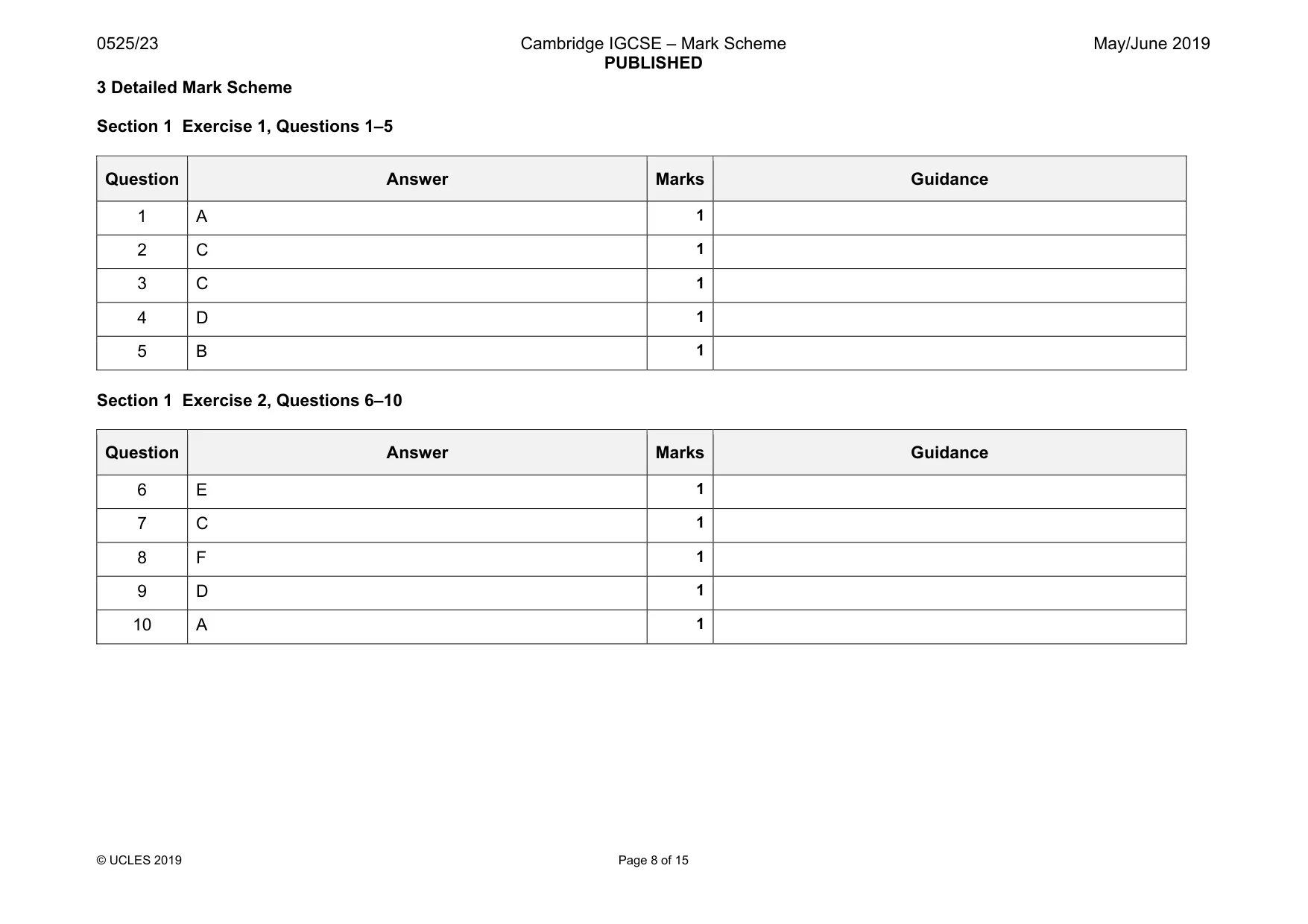
0525/23 Cambridge IGCSE – Mark Scheme PUBLISHED May/June 2019 © UCLES 2019 Page 8 of 15 3 Detailed Mark Scheme Section 1 Exercise 1, Questions 1–5 Question Answer Marks Guidance 1 A 1 2 C 1 3 C 1 4 D 1 5 B 1 Section 1 Exercise 2, Questions 6–10 Question Answer Marks Guidance 6 E 1 7 C 1 8 F 1 9 D 1 10 A 1
Mark scheme, page 9
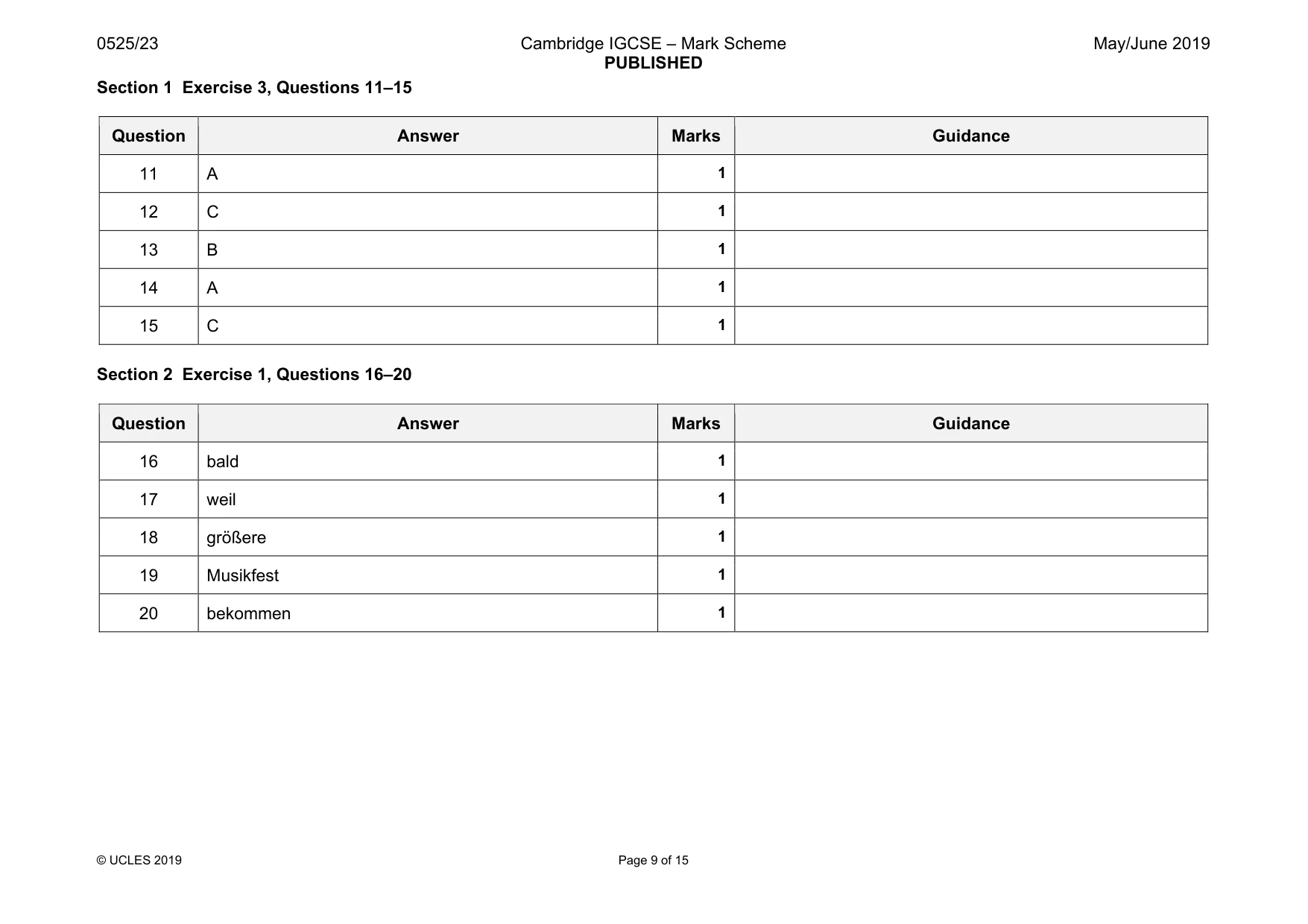
0525/23 Cambridge IGCSE – Mark Scheme PUBLISHED May/June 2019 © UCLES 2019 Page 9 of 15 Section 1 Exercise 3, Questions 11–15 Question Answer Marks Guidance 11 A 1 12 C 1 13 B 1 14 A 1 15 C 1 Section 2 Exercise 1, Questions 16–20 Question Answer Marks Guidance 16 bald 1 17 weil 1 18 größere 1 19 Musikfest 1 20 bekommen 1
Mark scheme, page 10
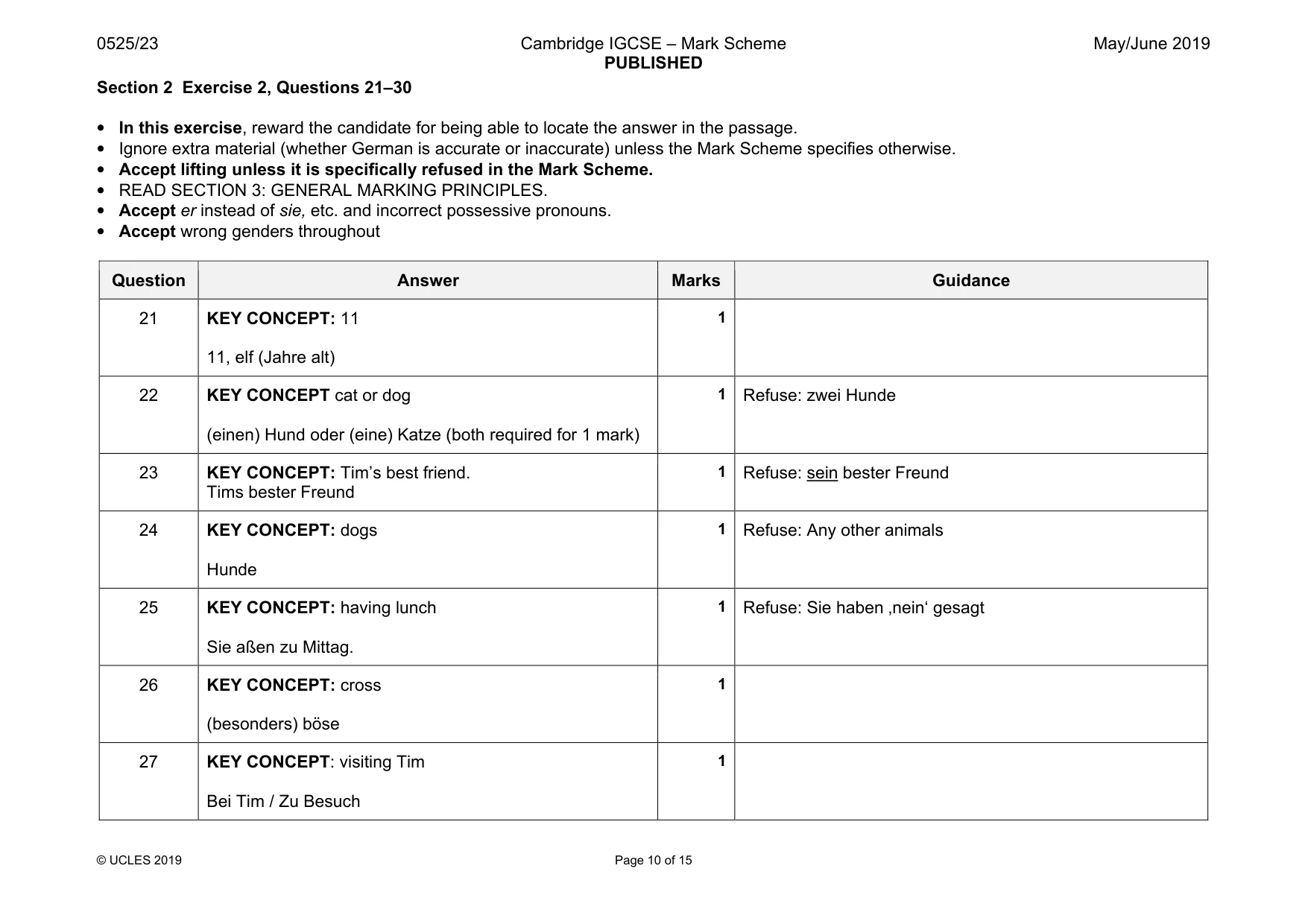
0525/23 Cambridge IGCSE – Mark Scheme PUBLISHED May/June 2019 © UCLES 2019 Page 10 of 15 Section 2 Exercise 2, Questions 21–30 • In this exercise, reward the candidate for being able to locate the answer in the passage. • Ignore extra material (whether German is accurate or inaccurate) unless the Mark Scheme specifies otherwise. • Accept lifting unless it is specifically refused in the Mark Scheme. • READ SECTION 3: GENERAL MARKING PRINCIPLES. • Accept er instead of sie, etc. and incorrect possessive pronouns. • Accept wrong genders throughout Question Answer Marks Guidance 21 KEY CONCEPT: 11 11, elf (Jahre alt) 1 22 KEY CONCEPT cat or dog (einen) Hund oder (eine) Katze (both required for 1 mark) 1 Refuse: zwei Hunde 23 KEY CONCEPT: Tim’s best friend. Tims bester Freund 1 Refuse: sein bester Freund 24 KEY CONCEPT: dogs Hunde 1 Refuse: Any other animals 25 KEY CONCEPT: having lunch Sie aßen zu Mittag. 1 Refuse: Sie haben ‚nein‘ gesagt 26 KEY CONCEPT: cross (besonders) böse 1 27 KEY CONCEPT: visiting Tim Bei Tim / Zu Besuch 1
Mark scheme, page 11
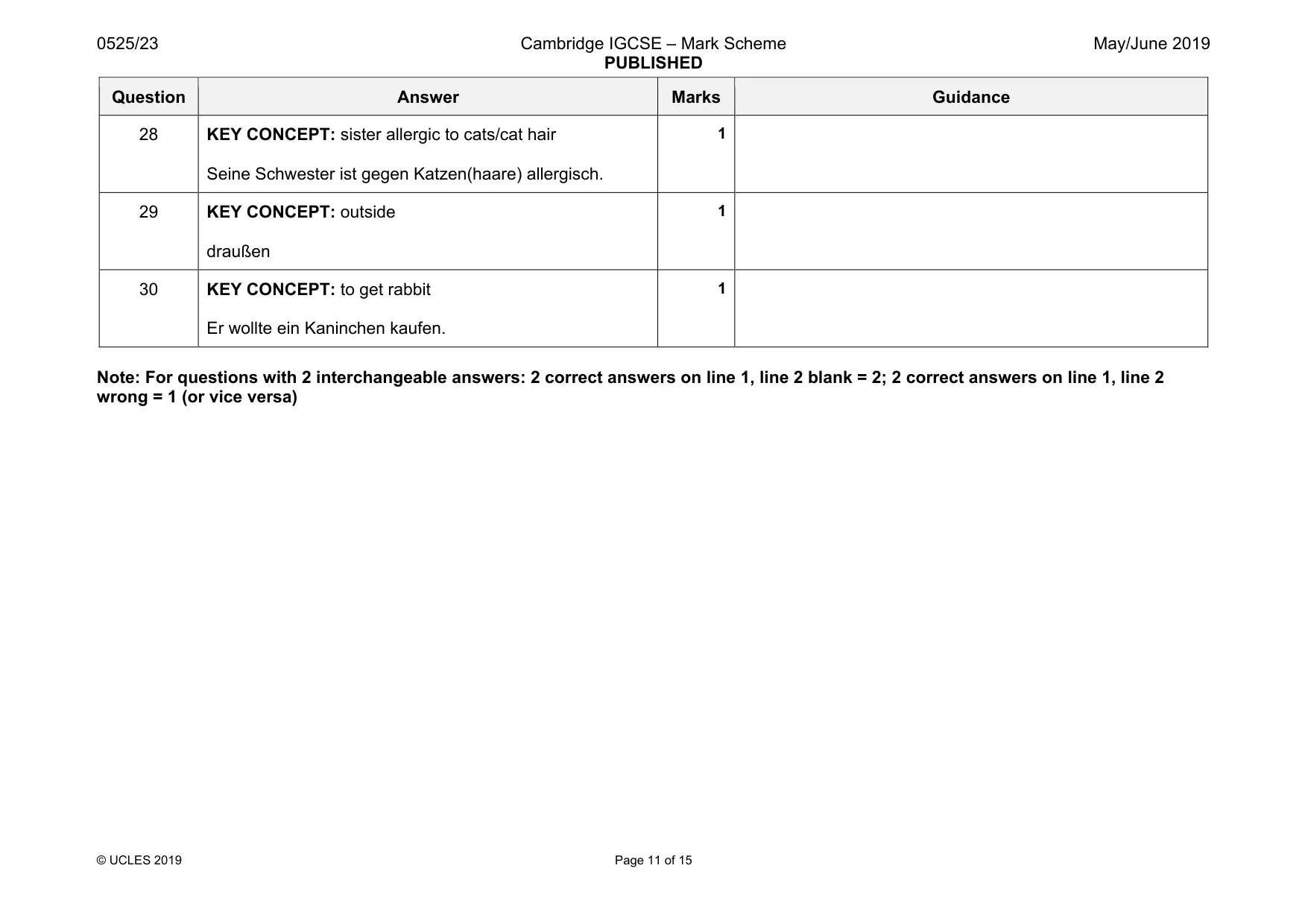
0525/23 Cambridge IGCSE – Mark Scheme PUBLISHED May/June 2019 © UCLES 2019 Page 11 of 15 Question Answer Marks Guidance 28 KEY CONCEPT: sister allergic to cats/cat hair Seine Schwester ist gegen Katzen(haare) allergisch. 1 29 KEY CONCEPT: outside draußen 1 30 KEY CONCEPT: to get rabbit Er wollte ein Kaninchen kaufen. 1 Note: For questions with 2 interchangeable answers: 2 correct answers on line 1, line 2 blank = 2; 2 correct answers on line 1, line 2 wrong = 1 (or vice versa)
Mark scheme, page 12
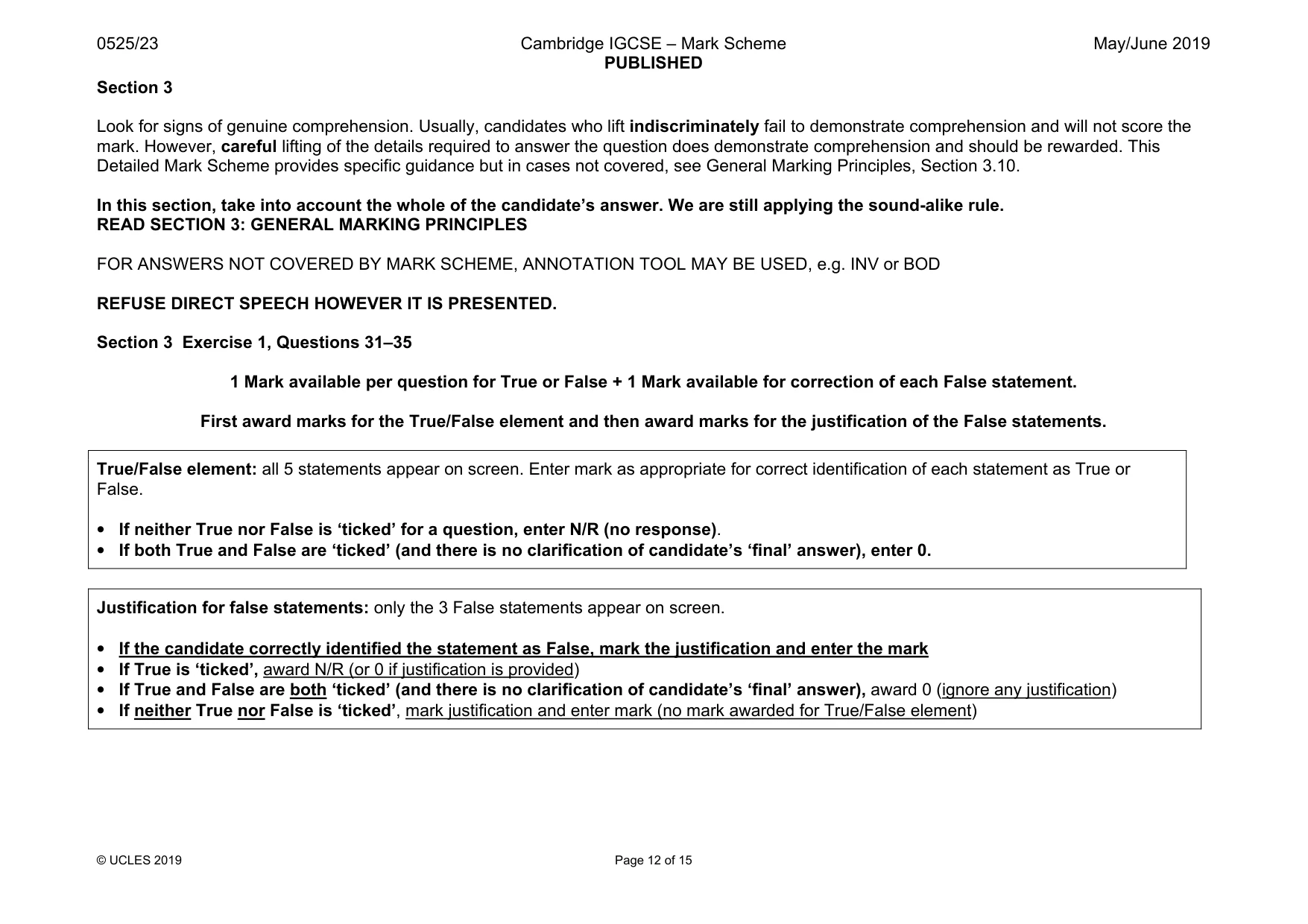
0525/23 Cambridge IGCSE – Mark Scheme PUBLISHED May/June 2019 © UCLES 2019 Page 12 of 15 Section 3 Look for signs of genuine comprehension. Usually, candidates who lift indiscriminately fail to demonstrate comprehension and will not score the mark. However, careful lifting of the details required to answer the question does demonstrate comprehension and should be rewarded. This Detailed Mark Scheme provides specific guidance but in cases not covered, see General Marking Principles, Section 3.10. In this section, take into account the whole of the candidate’s answer. We are still applying the sound-alike rule. READ SECTION 3: GENERAL MARKING PRINCIPLES FOR ANSWERS NOT COVERED BY MARK SCHEME, ANNOTATION TOOL MAY BE USED, e.g. INV or BOD REFUSE DIRECT SPEECH HOWEVER IT IS PRESENTED. Section 3 Exercise 1, Questions 31–35 1 Mark available per question for True or False + 1 Mark available for correction of each False statement. First award marks for the True/False element and then award marks for the justification of the False statements. True/False element: all 5 statements appear on screen. Enter mark as appropriate for correct identification of each statement as True or False. • If neither True nor False is ‘ticked’ for a question, enter N/R (no response). • If both True and False are ‘ticked’ (and there is no clarification of candidate’s ‘final’ answer), enter 0. Justification for false statements: only the 3 False statements appear on screen. • If the candidate correctly identified the statement as False, mark the justification and enter the mark • If True is ‘ticked’, award N/R (or 0 if justification is provided) • If True and False are both ‘ticked’ (and there is no clarification of candidate’s ‘final’ answer), award 0 (ignore any justification) • If neither True nor False is ‘ticked’, mark justification and enter mark (no mark awarded for True/False element)
Mark scheme, page 13
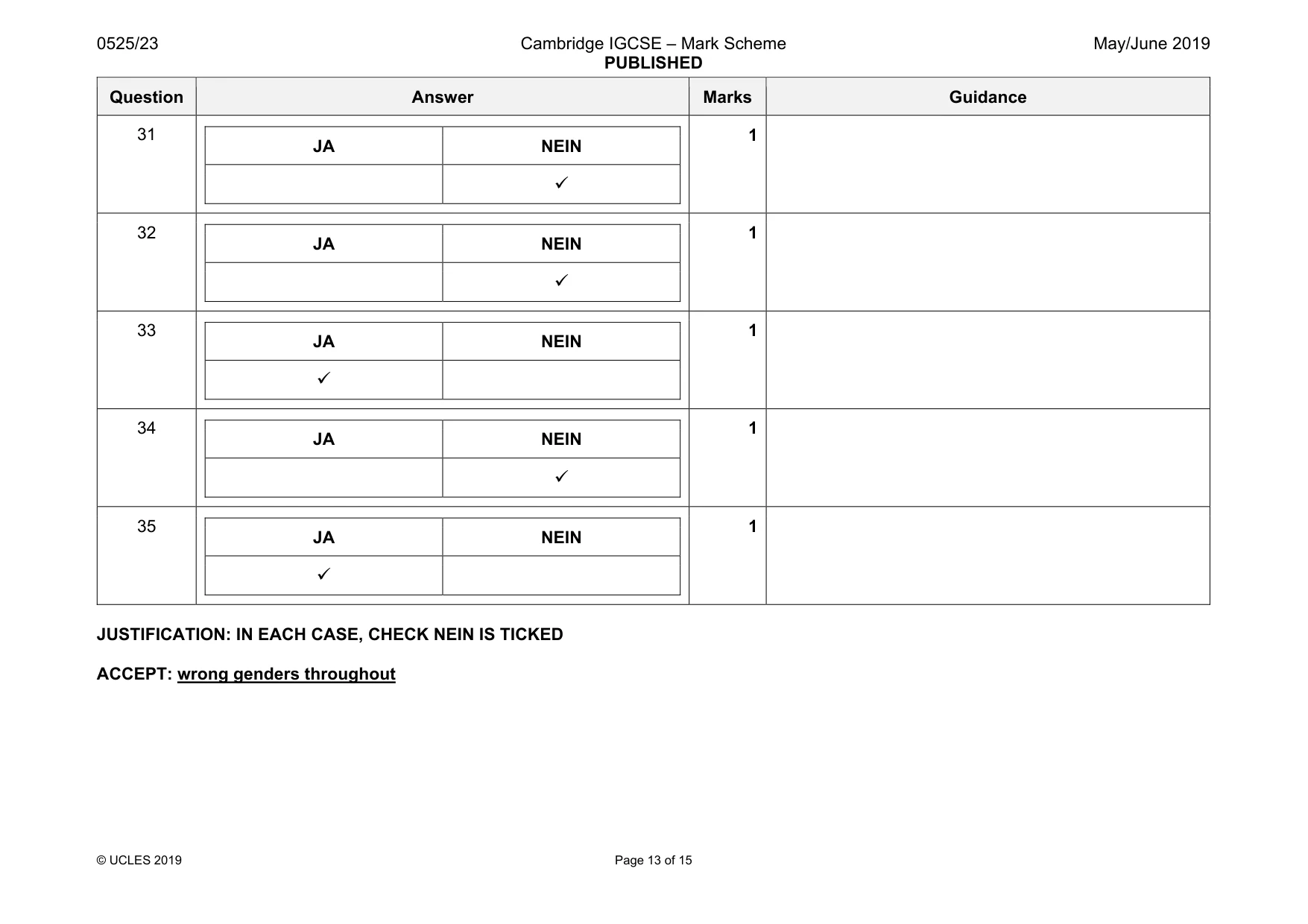
0525/23 Cambridge IGCSE – Mark Scheme PUBLISHED May/June 2019 © UCLES 2019 Page 13 of 15 Question Answer Marks Guidance 31 JA NEIN 9 1 32 JA NEIN 9 1 33 JA NEIN 9 1 34 JA NEIN 9 1 35 JA NEIN 9 1 JUSTIFICATION: IN EACH CASE, CHECK NEIN IS TICKED ACCEPT: wrong genders throughout
Mark scheme, page 14
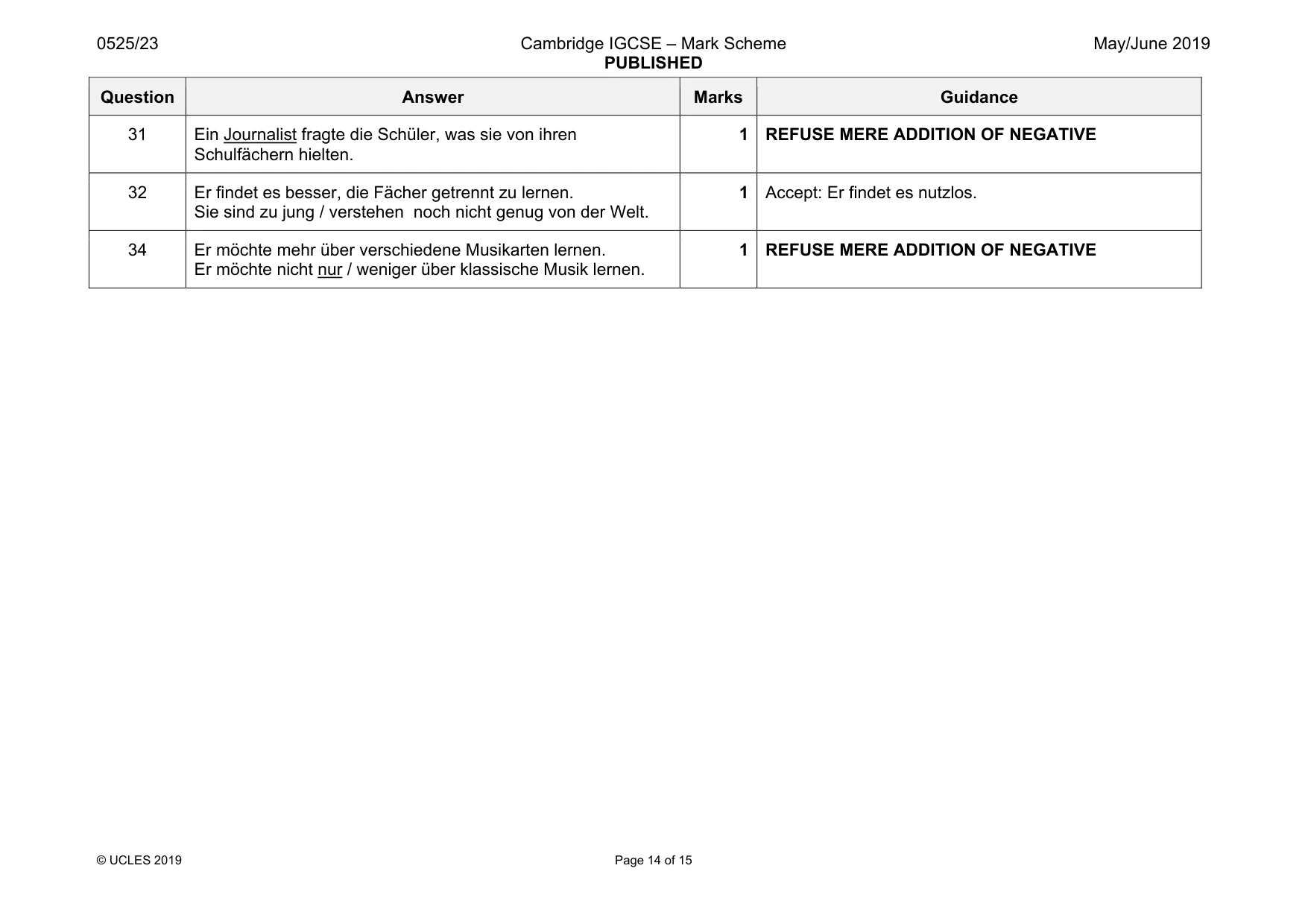
0525/23 Cambridge IGCSE – Mark Scheme PUBLISHED May/June 2019 © UCLES 2019 Page 14 of 15 Question Answer Marks Guidance 31 Ein Journalist fragte die Schüler, was sie von ihren Schulfächern hielten. 1 REFUSE MERE ADDITION OF NEGATIVE 32 Er findet es besser, die Fächer getrennt zu lernen. Sie sind zu jung / verstehen noch nicht genug von der Welt. 1 Accept: Er findet es nutzlos. 34 Er möchte mehr über verschiedene Musikarten lernen. Er möchte nicht nur / weniger über klassische Musik lernen. 1 REFUSE MERE ADDITION OF NEGATIVE
Mark scheme, page 15
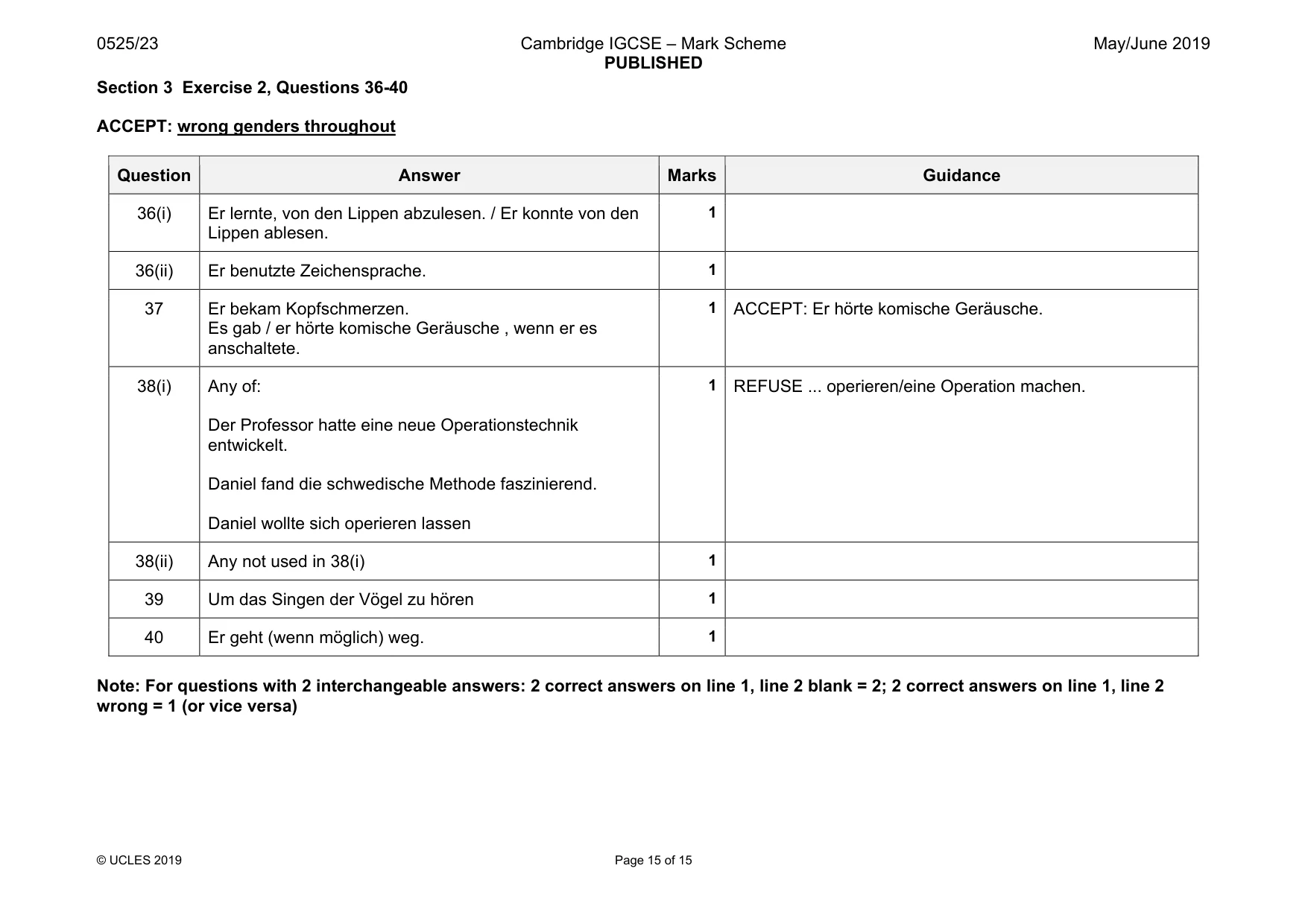
0525/23 Cambridge IGCSE – Mark Scheme PUBLISHED May/June 2019 © UCLES 2019 Page 15 of 15 Section 3 Exercise 2, Questions 36-40 ACCEPT: wrong genders throughout Question Answer Marks Guidance 36(i) Er lernte, von den Lippen abzulesen. / Er konnte von den Lippen ablesen. 1 36(ii) Er benutzte Zeichensprache. 1 37 Er bekam Kopfschmerzen. Es gab / er hörte komische Geräusche , wenn er es anschaltete. 1 ACCEPT: Er hörte komische Geräusche. 38(i) Any of: Der Professor hatte eine neue Operationstechnik entwickelt. Daniel fand die schwedische Methode faszinierend. Daniel wollte sich operieren lassen 1 REFUSE ... operieren/eine Operation machen. 38(ii) Any not used in 38(i) 1 39 Um das Singen der Vögel zu hören 1 40 Er geht (wenn möglich) weg. 1 Note: For questions with 2 interchangeable answers: 2 correct answers on line 1, line 2 blank = 2; 2 correct answers on line 1, line 2 wrong = 1 (or vice versa)
What you needed in this session
Cambridge’s own grade thresholds for 2019 May/June, Paper 2 · Variant 3. A higher threshold means an easier paper — the bar moves with how the cohort did.