Cambridge IGCSE German - Foreign Language 0525 — 2012 May/June Paper 2 · Variant 3
0525/23/M/J/12
The question paper and its mark scheme, free to read here and free to download. This is Cambridge’s own paper, exactly as it was sat.
Question paper20 pages




Mark scheme11 pages
Answers below. Sit the paper first if you are practising.
Paper as text
Question paper, page 1
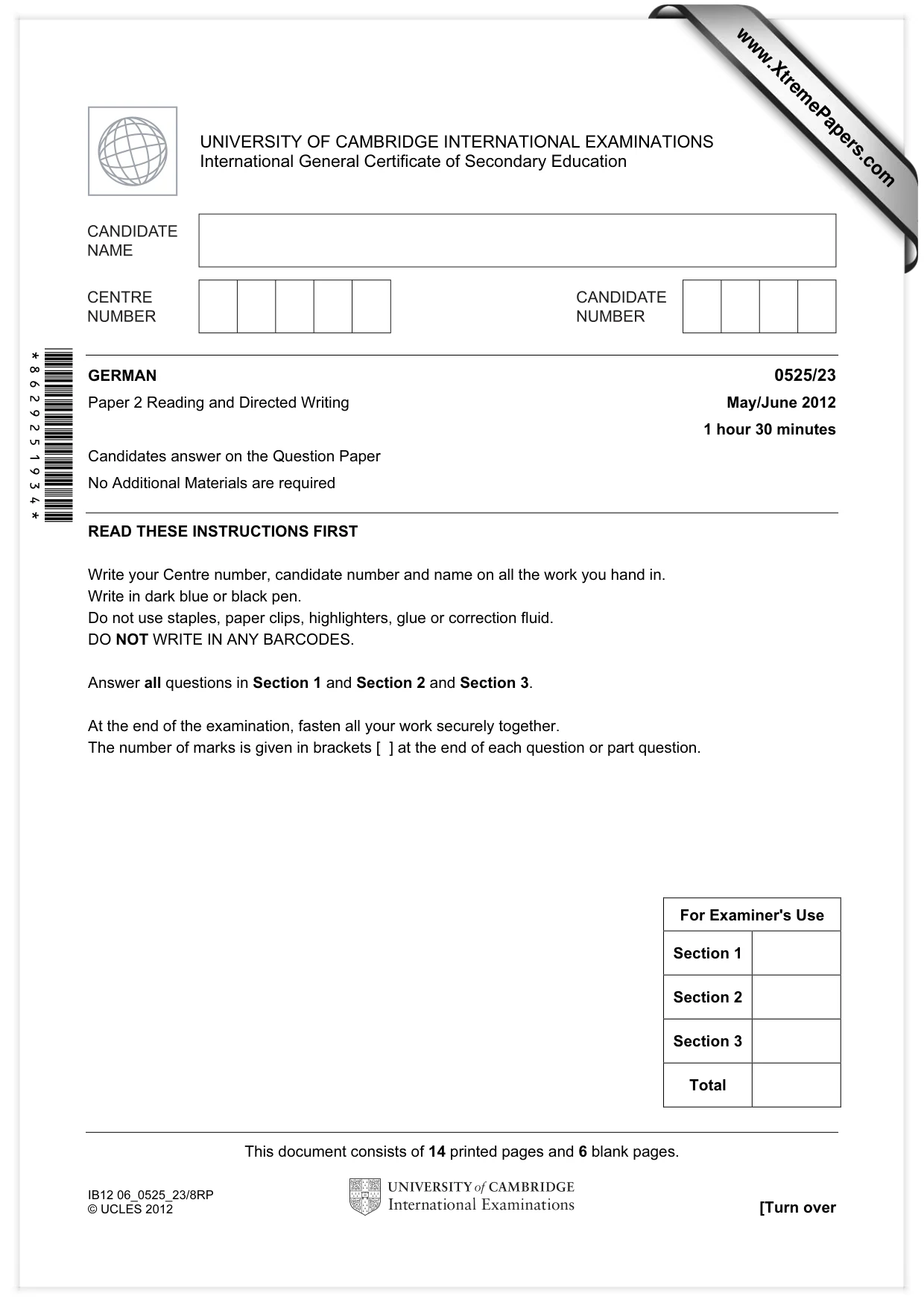
This document consists of 14 printed pages and 6 blank pages. IB12 06_0525_23/8RP © UCLES 2012 [Turn over *8629251934* For Examiner's Use Section 1 Section 2 Section 3 Total UNIVERSITY OF CAMBRIDGE INTERNATIONAL EXAMINATIONS International General Certificate of Secondary Education GERMAN 0525/23 Paper 2 Reading and Directed Writing May/June 2012 1 hour 30 minutes Candidates answer on the Question Paper No Additional Materials are required READ THESE INSTRUCTIONS FIRST Write your Centre number, candidate number and name on all the work you hand in. Write in dark blue or black pen. Do not use staples, paper clips, highlighters, glue or correction fluid. DO NOT WRITE IN ANY BARCODES. Answer all questions in Section 1 and Section 2 and Section 3. At the end of the examination, fasten all your work securely together. The number of marks is given in brackets [ ] at the end of each question or part question. www.XtremePapers.com
Question paper, page 2
2 © UCLES 2012 0525/23/M/J/12 BLANK PAGE
Question paper, page 3
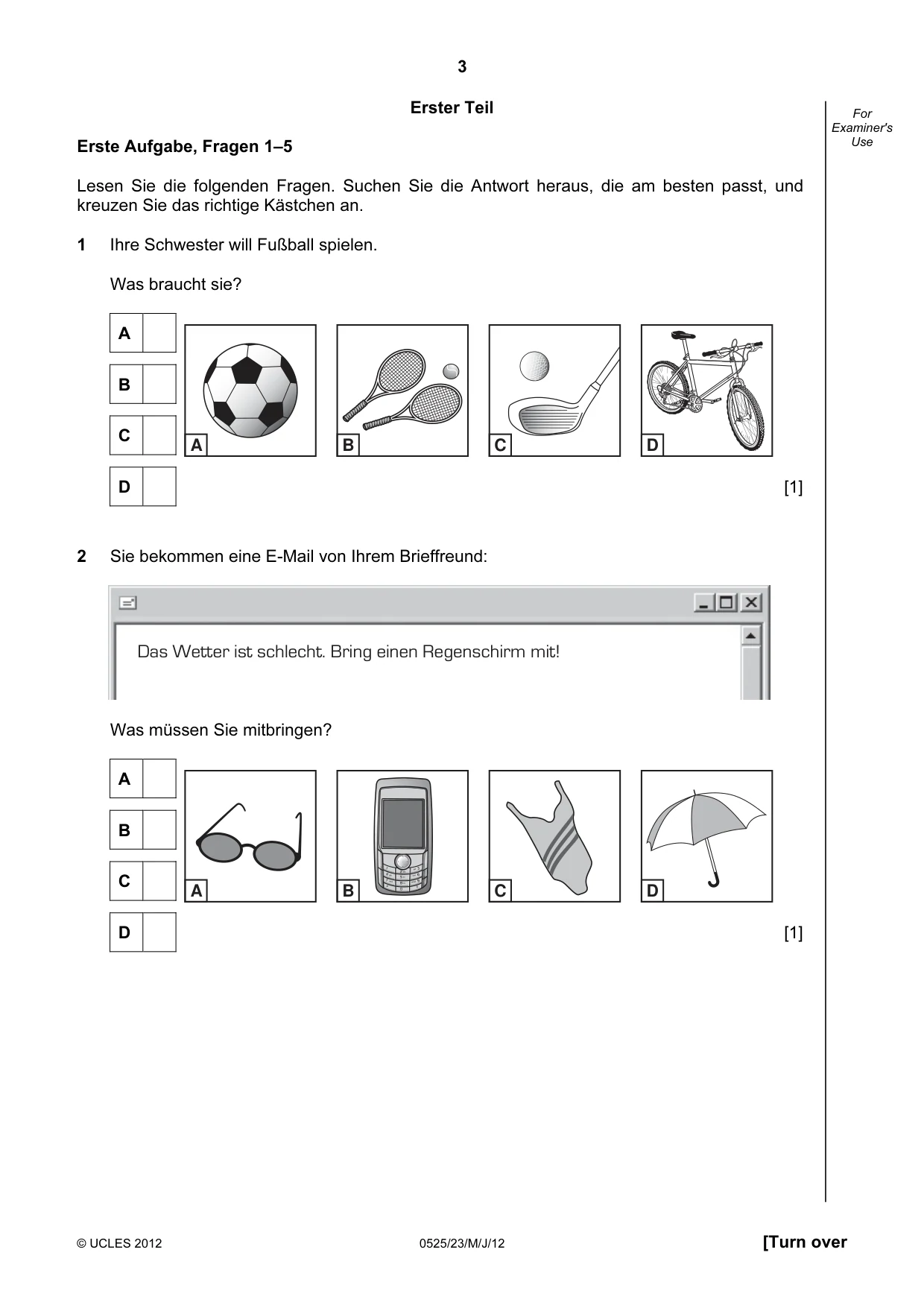
3 © UCLES 2012 0525/23/M/J/12 [Turn over For Examiner's Use Erster Teil Erste Aufgabe, Fragen 1–5 Lesen Sie die folgenden Fragen. Suchen Sie die Antwort heraus, die am besten passt, und kreuzen Sie das richtige Kästchen an. 1 Ihre Schwester will Fußball spielen. Was braucht sie? A B C A B C D D [1] 2 Sie bekommen eine E-Mail von Ihrem Brieffreund: Das Wetter ist schlecht. Bring einen Regenschirm mit! Was müssen Sie mitbringen? A B C A B C D D [1]
Question paper, page 4
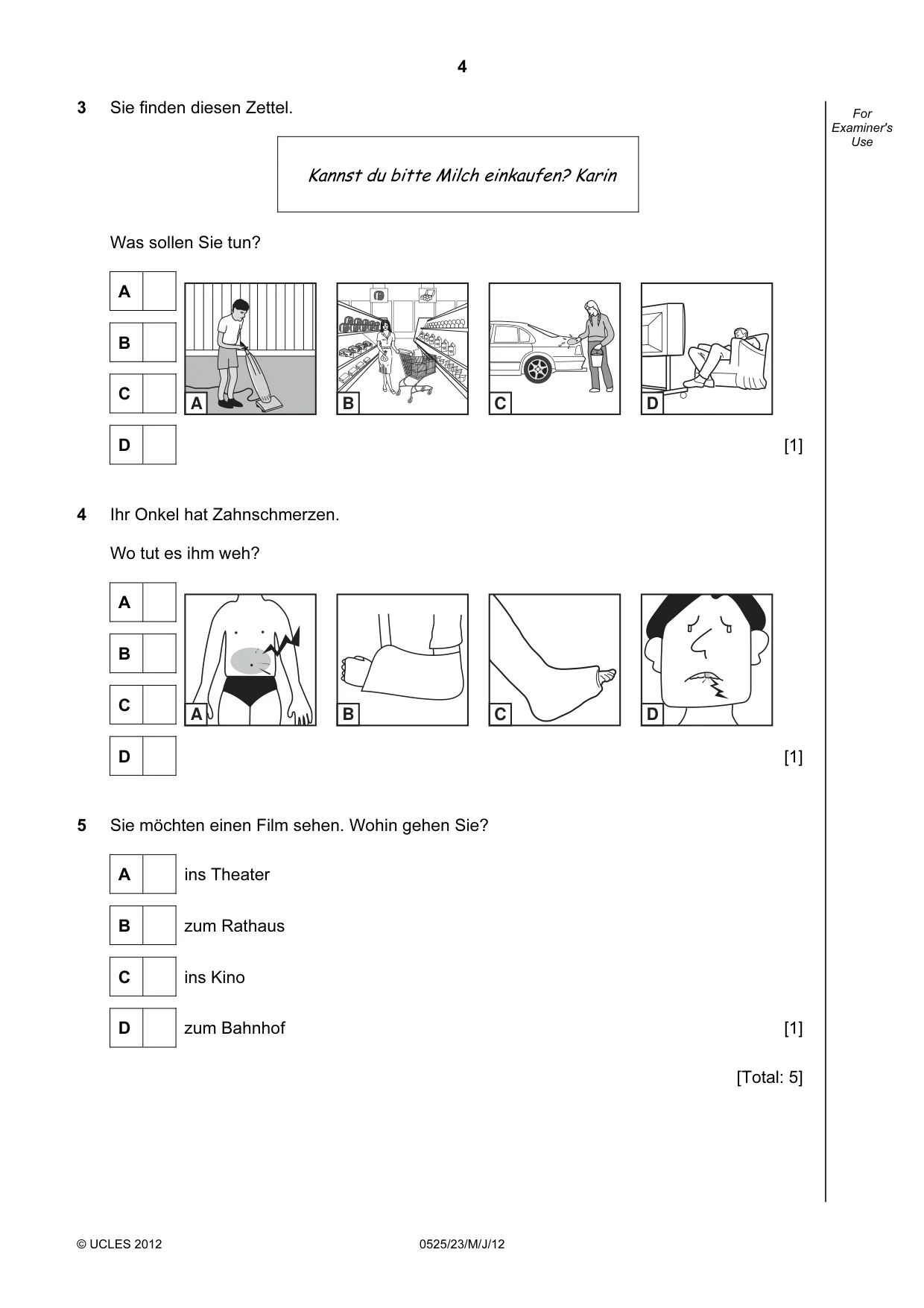
4 © UCLES 2012 0525/23/M/J/12 For Examiner's Use 3 Sie finden diesen Zettel. Kannst du bitte Milch einkaufen? Karin Was sollen Sie tun? A B C A B D C D [1] 4 Ihr Onkel hat Zahnschmerzen. Wo tut es ihm weh? A B C A B C D D [1] 5 Sie möchten einen Film sehen. Wohin gehen Sie? A ins Theater B zum Rathaus C ins Kino D zum Bahnhof [1] [Total: 5]
Question paper, page 5
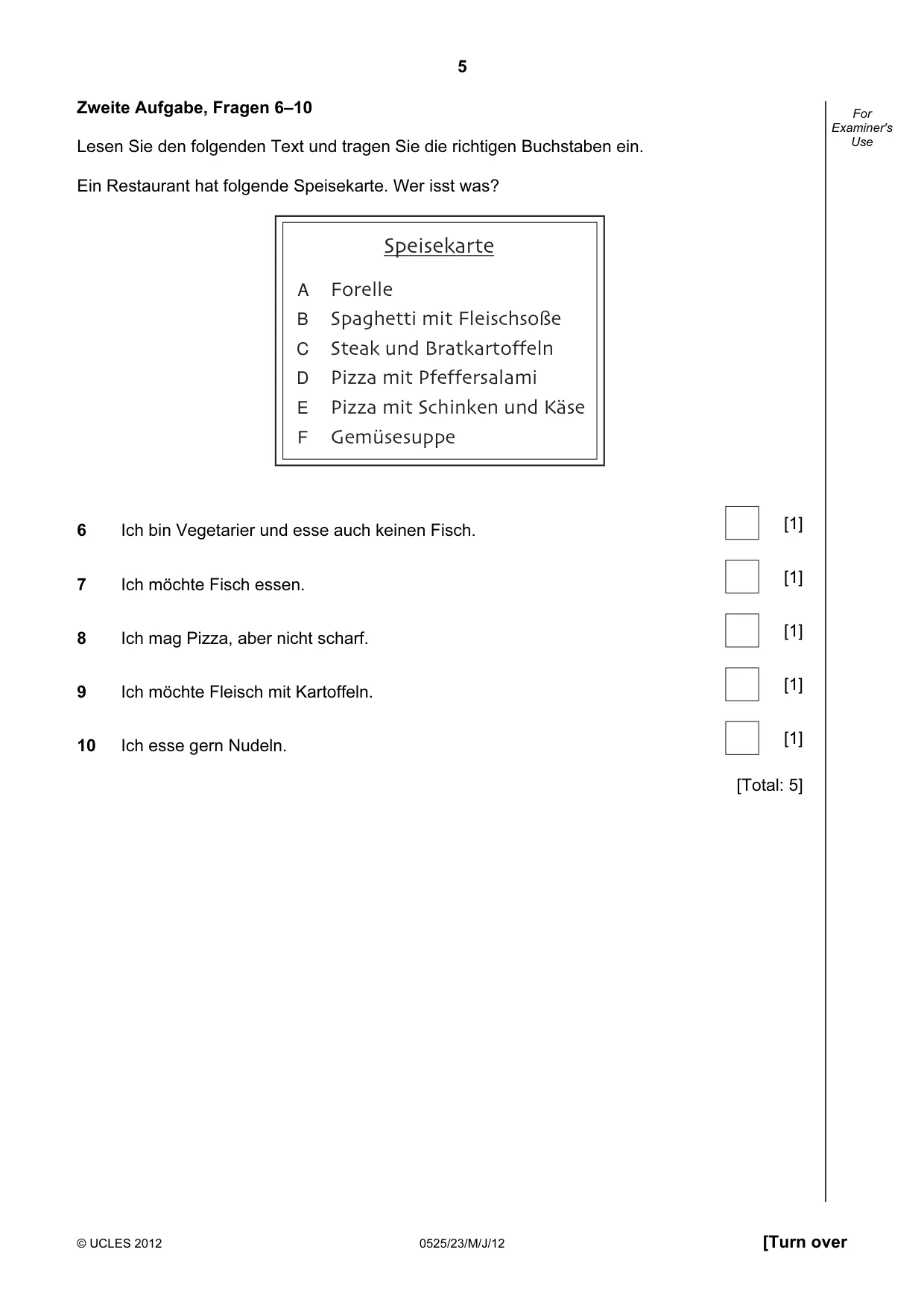
5 © UCLES 2012 0525/23/M/J/12 [Turn over For Examiner's Use Zweite Aufgabe, Fragen 6–10 Lesen Sie den folgenden Text und tragen Sie die richtigen Buchstaben ein. Ein Restaurant hat folgende Speisekarte. Wer isst was? Speisekarte Forelle Spaghetti mit Fleischsoße Steak und Bratkartoffeln Pizza mit Pfeffersalami Pizza mit Schinken und Käse Gemüsesuppe A B C D E F 6 Ich bin Vegetarier und esse auch keinen Fisch. [1] 7 Ich möchte Fisch essen. [1] 8 Ich mag Pizza, aber nicht scharf. [1] 9 Ich möchte Fleisch mit Kartoffeln. [1] 10 Ich esse gern Nudeln. [1] [Total: 5]
Question paper, page 6
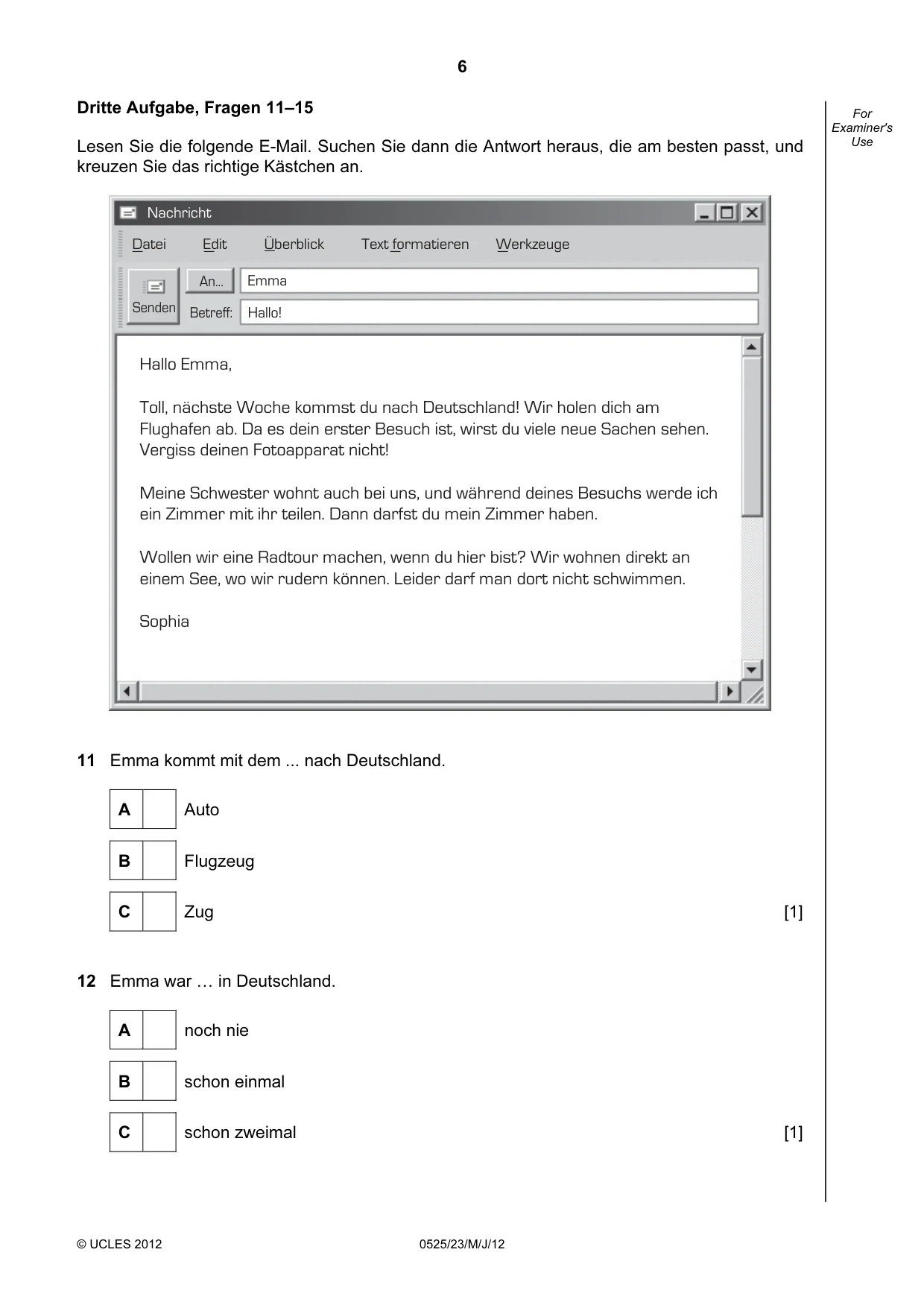
6 © UCLES 2012 0525/23/M/J/12 For Examiner's Use Dritte Aufgabe, Fragen 11–15 Lesen Sie die folgende E-Mail. Suchen Sie dann die Antwort heraus, die am besten passt, und kreuzen Sie das richtige Kästchen an. Senden An... Betreff: Hallo! Emma Datei Edit Überblick Text formatieren Werkzeuge _ _ _ _ _ Nachricht Hallo Emma, Toll, nächste Woche kommst du nach Deutschland! Wir holen dich am Flughafen ab. Da es dein erster Besuch ist, wirst du viele neue Sachen sehen. Vergiss deinen Fotoapparat nicht! Meine Schwester wohnt auch bei uns, und während deines Besuchs werde ich ein Zimmer mit ihr teilen. Dann darfst du mein Zimmer haben. Wollen wir eine Radtour machen, wenn du hier bist? Wir wohnen direkt an einem See, wo wir rudern können. Leider darf man dort nicht schwimmen. Sophia 11 Emma kommt mit dem ... nach Deutschland. A Auto B Flugzeug C Zug [1] 12 Emma war … in Deutschland. A noch nie B schon einmal C schon zweimal [1]
Question paper, page 7
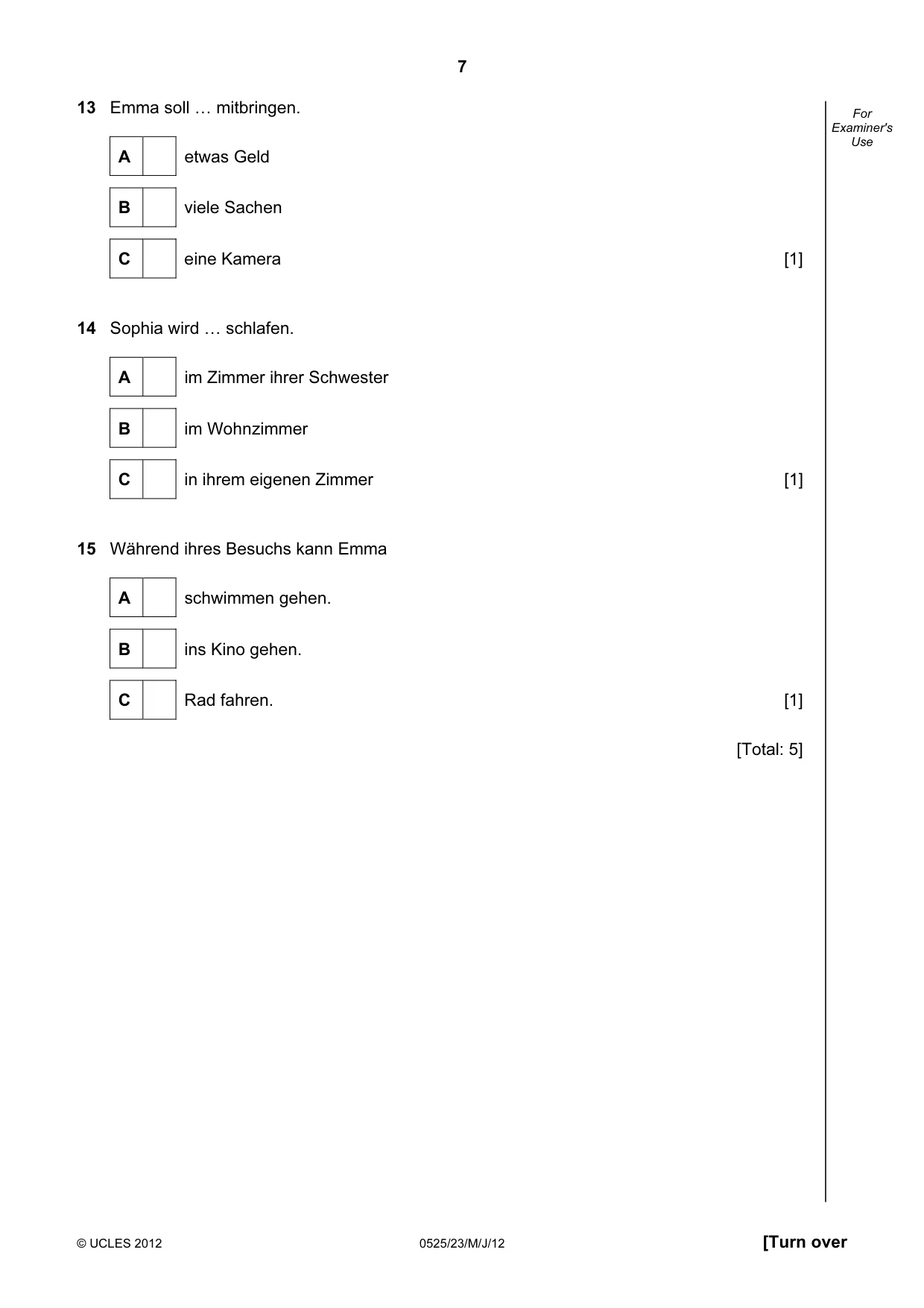
7 © UCLES 2012 0525/23/M/J/12 [Turn over For Examiner's Use 13 Emma soll … mitbringen. A etwas Geld B viele Sachen C eine Kamera [1] 14 Sophia wird … schlafen. A im Zimmer ihrer Schwester B im Wohnzimmer C in ihrem eigenen Zimmer [1] 15 Während ihres Besuchs kann Emma A schwimmen gehen. B ins Kino gehen. C Rad fahren. [1] [Total: 5]
Question paper, page 8
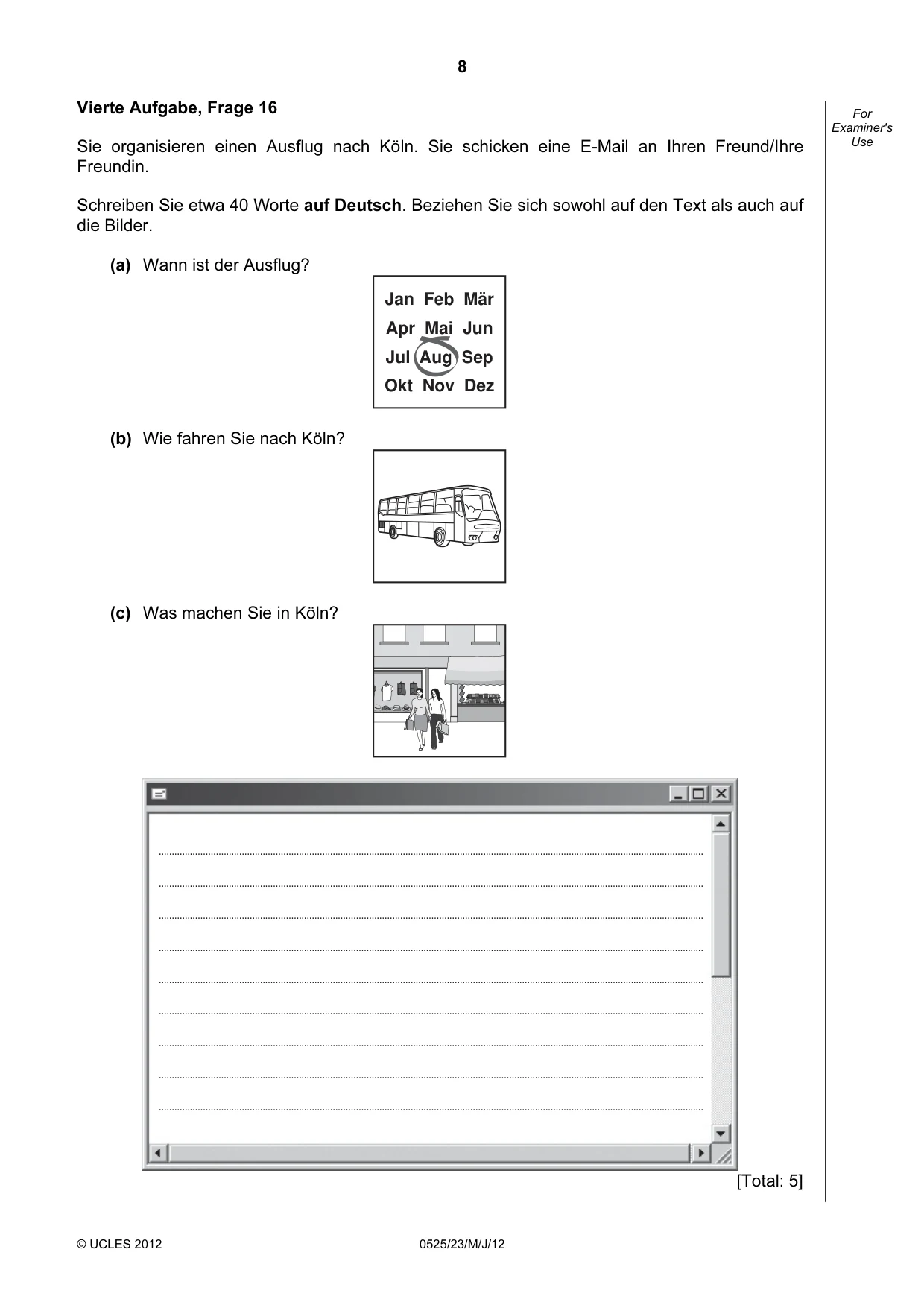
8 © UCLES 2012 0525/23/M/J/12 For Examiner's Use Vierte Aufgabe, Frage 16 Sie organisieren einen Ausflug nach Köln. Sie schicken eine E-Mail an Ihren Freund/Ihre Freundin. Schreiben Sie etwa 40 Worte auf Deutsch. Beziehen Sie sich sowohl auf den Text als auch auf die Bilder. (a) Wann ist der Ausflug? Jan Feb Mär Apr Mai Jun Jul Aug Sep Okt Nov Dez (b) Wie fahren Sie nach Köln? (c) Was machen Sie in Köln? … … … … … … … … … [Total: 5]
Question paper, page 9
9 © UCLES 2012 0525/23/M/J/12 [Turn over BLANK PAGE [PLEASE TURN OVER FOR SECTION TWO]
Question paper, page 10
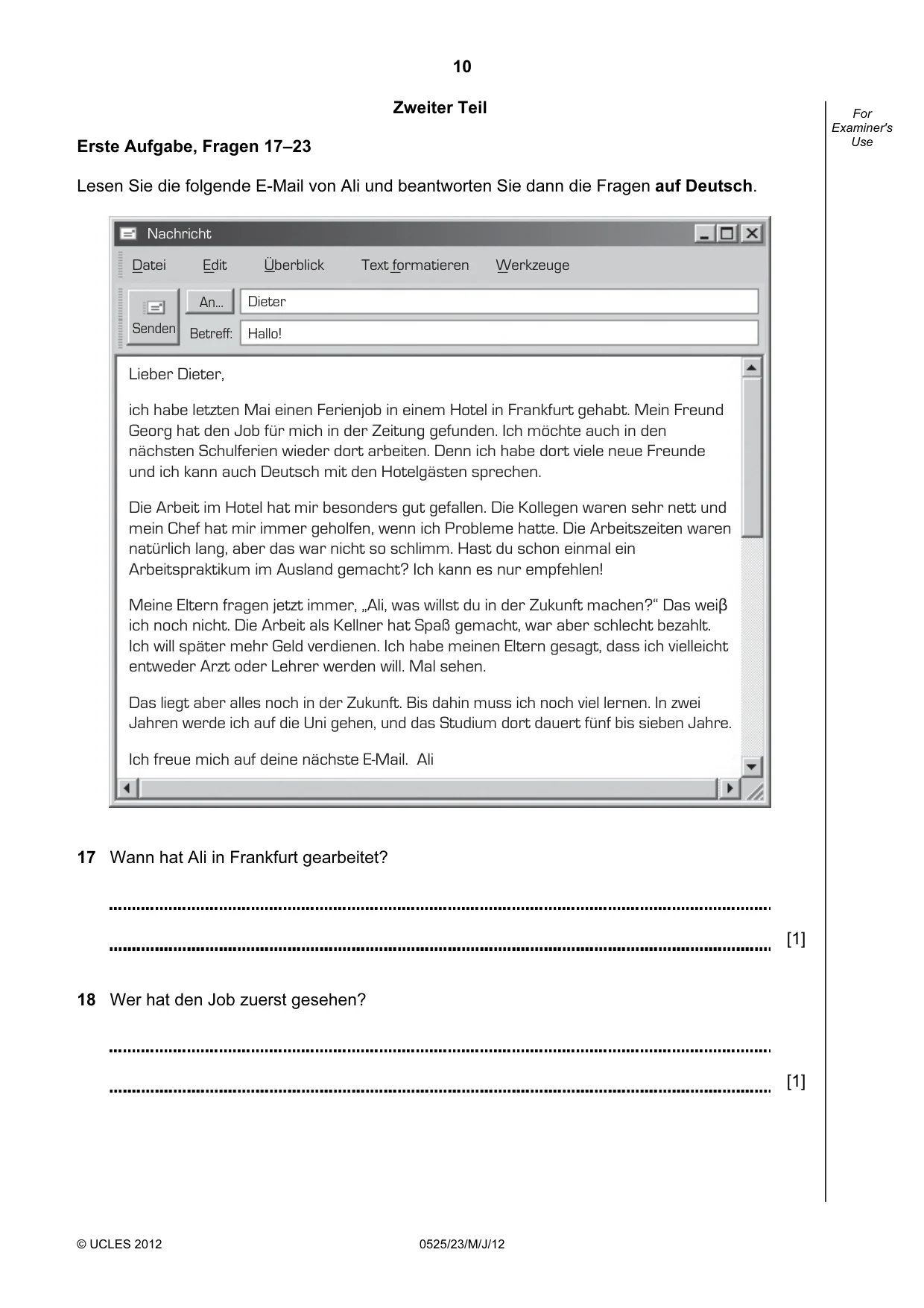
10 © UCLES 2012 0525/23/M/J/12 For Examiner's Use Zweiter Teil Erste Aufgabe, Fragen 17–23 Lesen Sie die folgende E-Mail von Ali und beantworten Sie dann die Fragen auf Deutsch. Senden An... Betreff: Hallo! Dieter Datei Edit Überblick Text formatieren Werkzeuge _ _ _ _ _ Nachricht Lieber Dieter, ich habe letzten Mai einen Ferienjob in einem Hotel in Frankfurt gehabt. Mein Freund Georg hat den Job für mich in der Zeitung gefunden. Ich möchte auch in den nächsten Schulferien wieder dort arbeiten. Denn ich habe dort viele neue Freunde und ich kann auch Deutsch mit den Hotelgästen sprechen. Die Arbeit im Hotel hat mir besonders gut gefallen. Die Kollegen waren sehr nett und mein Chef hat mir immer geholfen, wenn ich Probleme hatte. Die Arbeitszeiten waren natürlich lang, aber das war nicht so schlimm. Hast du schon einmal ein Arbeitspraktikum im Ausland gemacht? Ich kann es nur empfehlen! Meine Eltern fragen jetzt immer, „Ali, was willst du in der Zukunft machen?“ Das weiβ ich noch nicht. Die Arbeit als Kellner hat Spaß gemacht, war aber schlecht bezahlt. Ich will später mehr Geld verdienen. Ich habe meinen Eltern gesagt, dass ich vielleicht entweder Arzt oder Lehrer werden will. Mal sehen. Das liegt aber alles noch in der Zukunft. Bis dahin muss ich noch viel lernen. In zwei Jahren werde ich auf die Uni gehen, und das Studium dort dauert fünf bis sieben Jahre. Ich freue mich auf deine nächste E-Mail. Ali 17 Wann hat Ali in Frankfurt gearbeitet? [1] 18 Wer hat den Job zuerst gesehen? [1]
Question paper, page 11
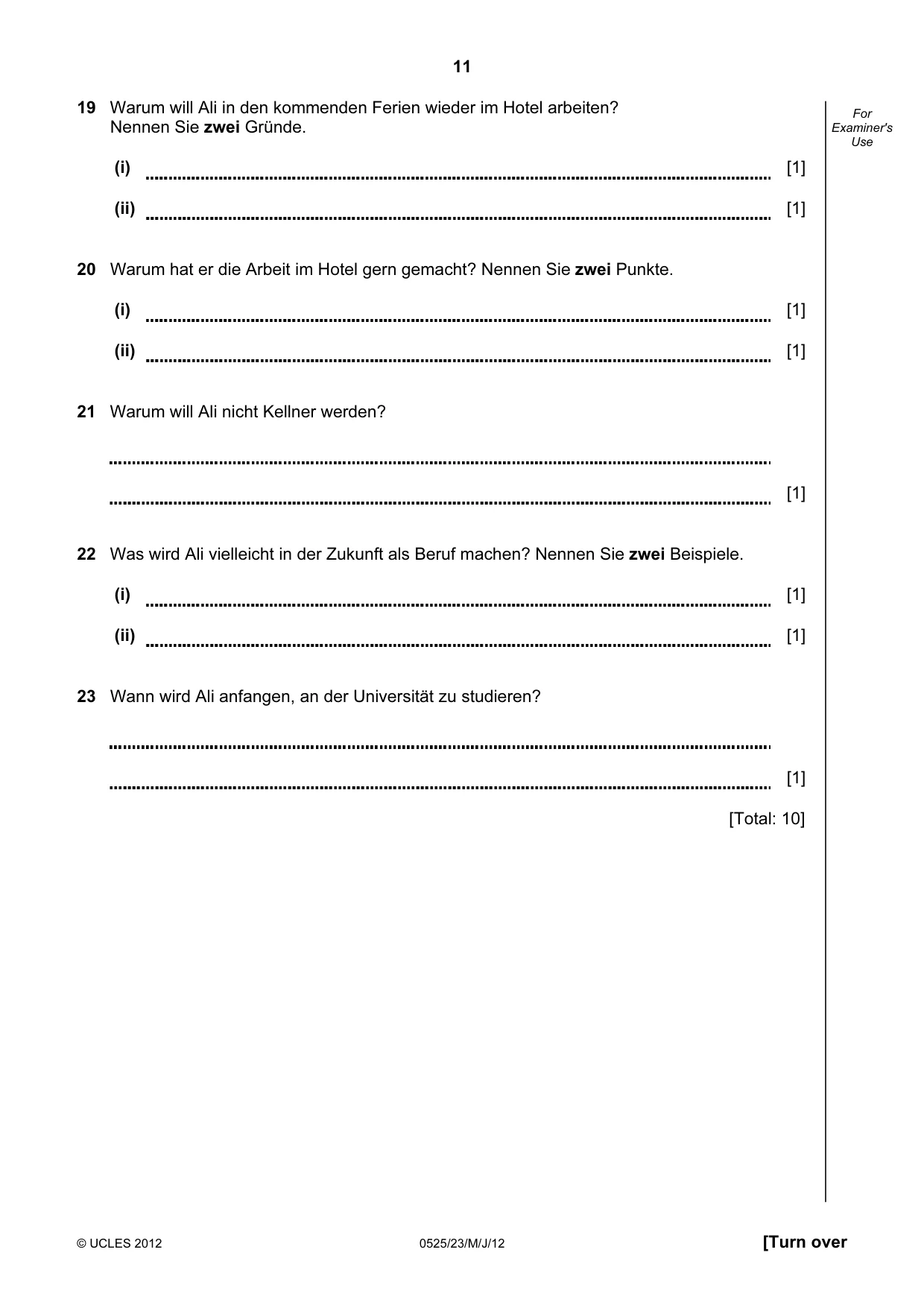
11 © UCLES 2012 0525/23/M/J/12 [Turn over For Examiner's Use 19 Warum will Ali in den kommenden Ferien wieder im Hotel arbeiten? Nennen Sie zwei Gründe. (i) [1] (ii) [1] 20 Warum hat er die Arbeit im Hotel gern gemacht? Nennen Sie zwei Punkte. (i) [1] (ii) [1] 21 Warum will Ali nicht Kellner werden? [1] 22 Was wird Ali vielleicht in der Zukunft als Beruf machen? Nennen Sie zwei Beispiele. (i) [1] (ii) [1] 23 Wann wird Ali anfangen, an der Universität zu studieren? [1] [Total: 10]
Question paper, page 12
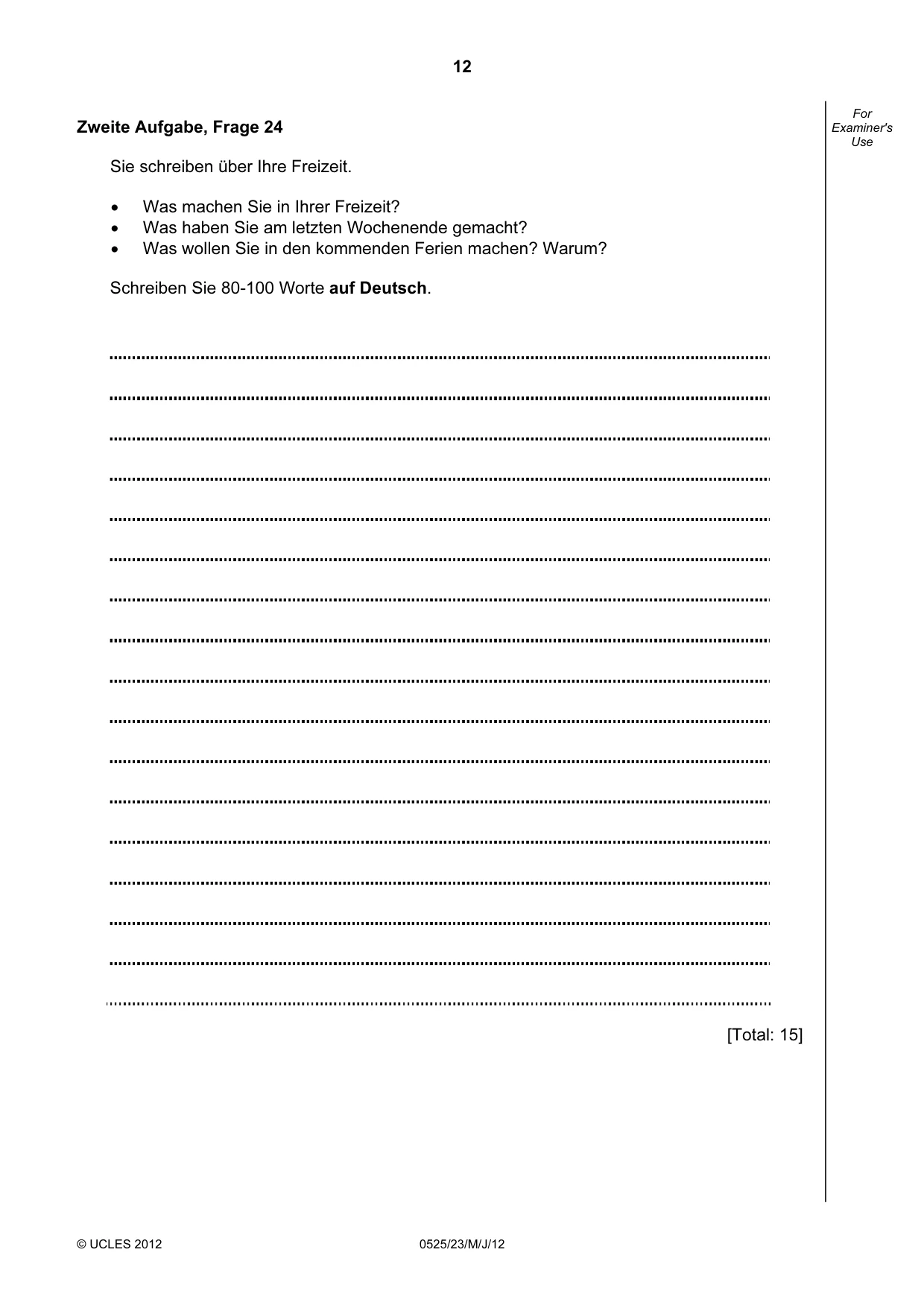
12 © UCLES 2012 0525/23/M/J/12 For Examiner's Use Zweite Aufgabe, Frage 24 Sie schreiben über Ihre Freizeit. • Was machen Sie in Ihrer Freizeit? • Was haben Sie am letzten Wochenende gemacht? • Was wollen Sie in den kommenden Ferien machen? Warum? Schreiben Sie 80-100 Worte auf Deutsch. [Total: 15]
Question paper, page 13
13 © UCLES 2012 0525/23/M/J/12 [Turn over BLANK PAGE [PLEASE TURN OVER FOR SECTION THREE]
Question paper, page 14
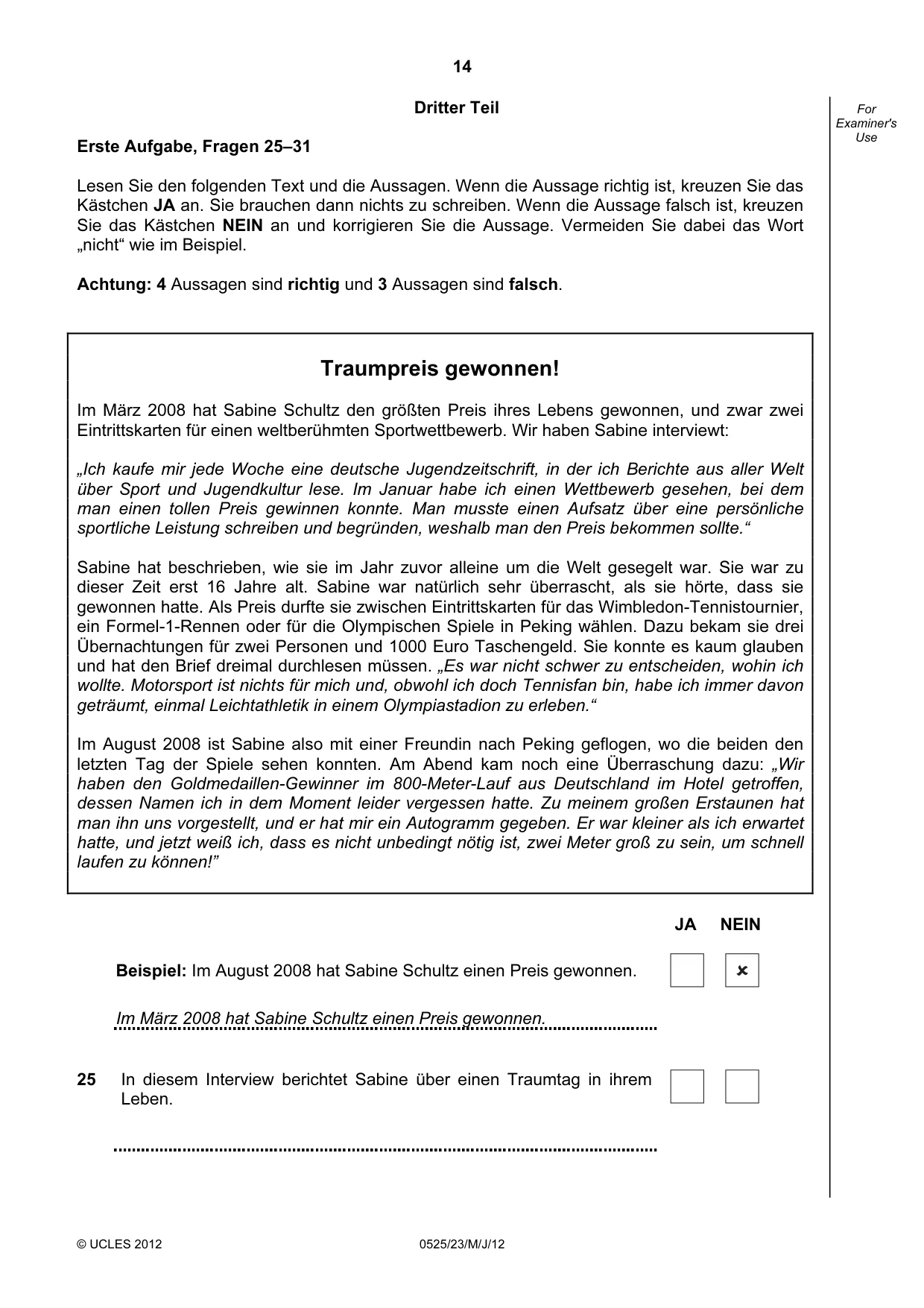
14 © UCLES 2012 0525/23/M/J/12 For Examiner's Use Dritter Teil Erste Aufgabe, Fragen 25–31 Lesen Sie den folgenden Text und die Aussagen. Wenn die Aussage richtig ist, kreuzen Sie das Kästchen JA an. Sie brauchen dann nichts zu schreiben. Wenn die Aussage falsch ist, kreuzen Sie das Kästchen NEIN an und korrigieren Sie die Aussage. Vermeiden Sie dabei das Wort „nicht“ wie im Beispiel. Achtung: 4 Aussagen sind richtig und 3 Aussagen sind falsch. Traumpreis gewonnen! Im März 2008 hat Sabine Schultz den größten Preis ihres Lebens gewonnen, und zwar zwei Eintrittskarten für einen weltberühmten Sportwettbewerb. Wir haben Sabine interviewt: „Ich kaufe mir jede Woche eine deutsche Jugendzeitschrift, in der ich Berichte aus aller Welt über Sport und Jugendkultur lese. Im Januar habe ich einen Wettbewerb gesehen, bei dem man einen tollen Preis gewinnen konnte. Man musste einen Aufsatz über eine persönliche sportliche Leistung schreiben und begründen, weshalb man den Preis bekommen sollte.“ Sabine hat beschrieben, wie sie im Jahr zuvor alleine um die Welt gesegelt war. Sie war zu dieser Zeit erst 16 Jahre alt. Sabine war natürlich sehr überrascht, als sie hörte, dass sie gewonnen hatte. Als Preis durfte sie zwischen Eintrittskarten für das Wimbledon-Tennistournier, ein Formel-1-Rennen oder für die Olympischen Spiele in Peking wählen. Dazu bekam sie drei Übernachtungen für zwei Personen und 1000 Euro Taschengeld. Sie konnte es kaum glauben und hat den Brief dreimal durchlesen müssen. „Es war nicht schwer zu entscheiden, wohin ich wollte. Motorsport ist nichts für mich und, obwohl ich doch Tennisfan bin, habe ich immer davon geträumt, einmal Leichtathletik in einem Olympiastadion zu erleben.“ Im August 2008 ist Sabine also mit einer Freundin nach Peking geflogen, wo die beiden den letzten Tag der Spiele sehen konnten. Am Abend kam noch eine Überraschung dazu: „Wir haben den Goldmedaillen-Gewinner im 800-Meter-Lauf aus Deutschland im Hotel getroffen, dessen Namen ich in dem Moment leider vergessen hatte. Zu meinem großen Erstaunen hat man ihn uns vorgestellt, und er hat mir ein Autogramm gegeben. Er war kleiner als ich erwartet hatte, und jetzt weiß ich, dass es nicht unbedingt nötig ist, zwei Meter groß zu sein, um schnell laufen zu können!” JA NEIN Beispiel: Im August 2008 hat Sabine Schultz einen Preis gewonnen. Im März 2008 hat Sabine Schultz einen Preis gewonnen. 25 In diesem Interview berichtet Sabine über einen Traumtag in ihrem Leben.
Question paper, page 15
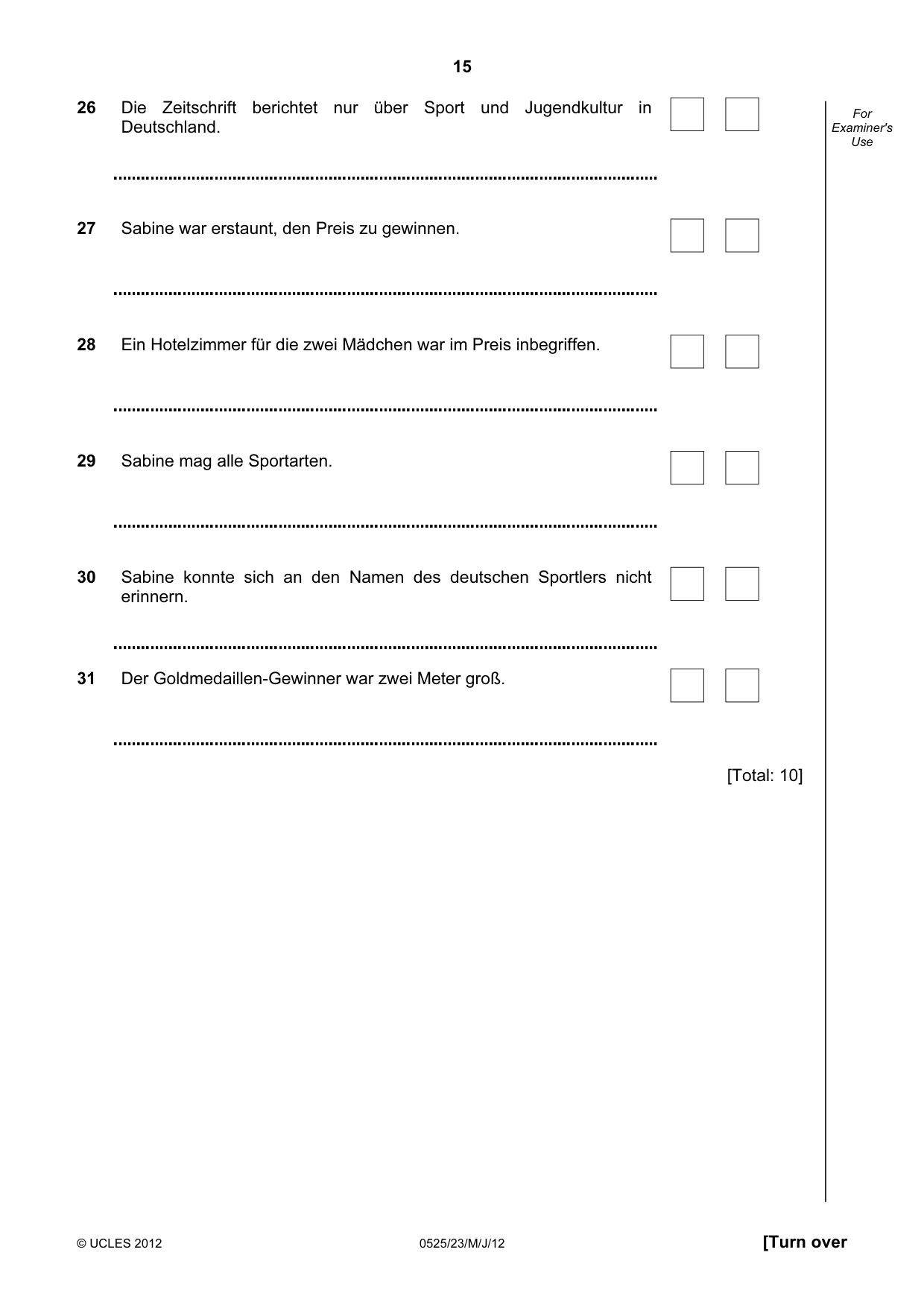
15 © UCLES 2012 0525/23/M/J/12 [Turn over For Examiner's Use 26 Die Zeitschrift berichtet nur über Sport und Jugendkultur in Deutschland. 27 Sabine war erstaunt, den Preis zu gewinnen. 28 Ein Hotelzimmer für die zwei Mädchen war im Preis inbegriffen. 29 Sabine mag alle Sportarten. 30 Sabine konnte sich an den Namen des deutschen Sportlers nicht erinnern. 31 Der Goldmedaillen-Gewinner war zwei Meter groß. [Total: 10]
Question paper, page 16
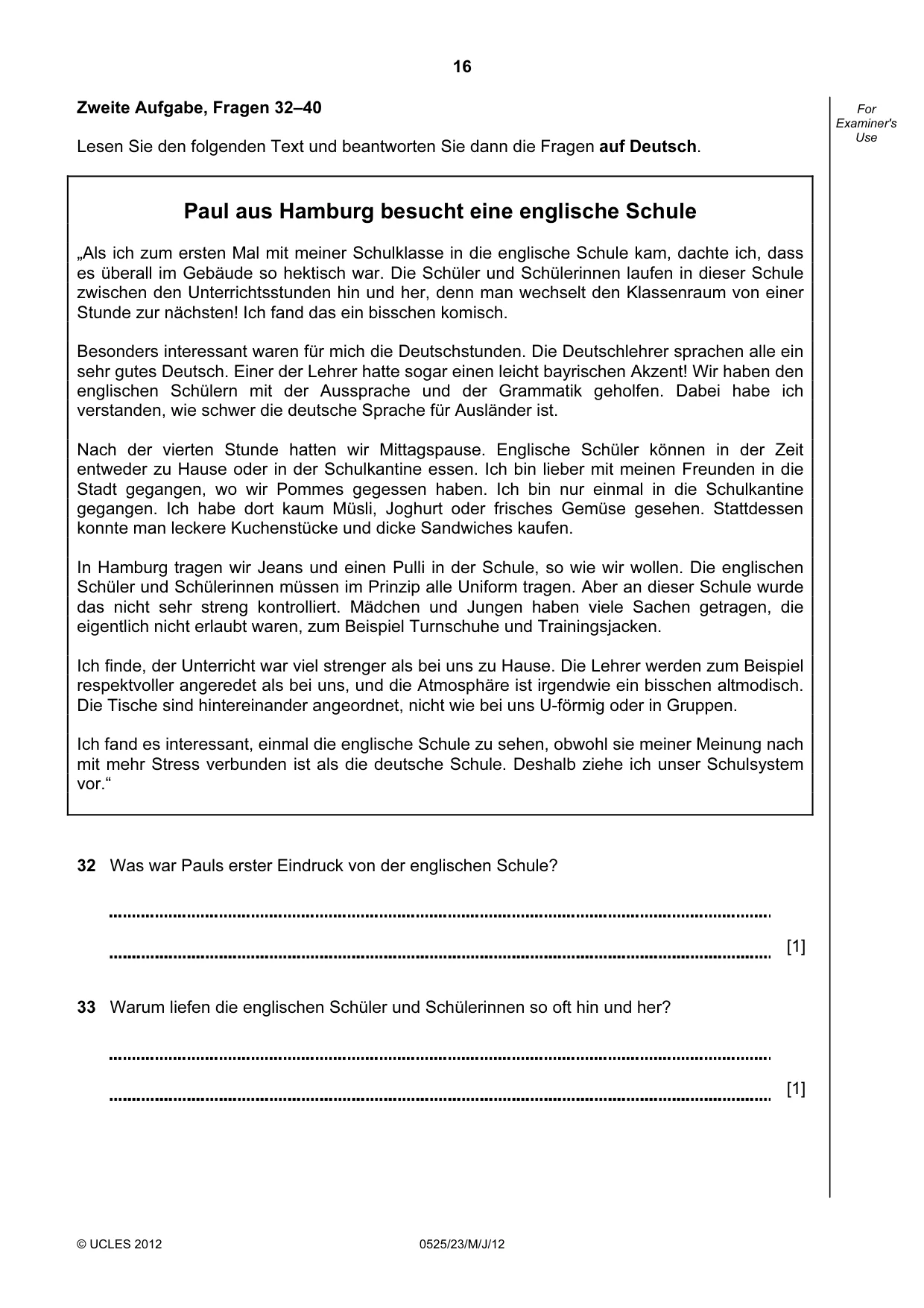
16 © UCLES 2012 0525/23/M/J/12 For Examiner's Use Zweite Aufgabe, Fragen 32–40 Lesen Sie den folgenden Text und beantworten Sie dann die Fragen auf Deutsch. Paul aus Hamburg besucht eine englische Schule „Als ich zum ersten Mal mit meiner Schulklasse in die englische Schule kam, dachte ich, dass es überall im Gebäude so hektisch war. Die Schüler und Schülerinnen laufen in dieser Schule zwischen den Unterrichtsstunden hin und her, denn man wechselt den Klassenraum von einer Stunde zur nächsten! Ich fand das ein bisschen komisch. Besonders interessant waren für mich die Deutschstunden. Die Deutschlehrer sprachen alle ein sehr gutes Deutsch. Einer der Lehrer hatte sogar einen leicht bayrischen Akzent! Wir haben den englischen Schülern mit der Aussprache und der Grammatik geholfen. Dabei habe ich verstanden, wie schwer die deutsche Sprache für Ausländer ist. Nach der vierten Stunde hatten wir Mittagspause. Englische Schüler können in der Zeit entweder zu Hause oder in der Schulkantine essen. Ich bin lieber mit meinen Freunden in die Stadt gegangen, wo wir Pommes gegessen haben. Ich bin nur einmal in die Schulkantine gegangen. Ich habe dort kaum Müsli, Joghurt oder frisches Gemüse gesehen. Stattdessen konnte man leckere Kuchenstücke und dicke Sandwiches kaufen. In Hamburg tragen wir Jeans und einen Pulli in der Schule, so wie wir wollen. Die englischen Schüler und Schülerinnen müssen im Prinzip alle Uniform tragen. Aber an dieser Schule wurde das nicht sehr streng kontrolliert. Mädchen und Jungen haben viele Sachen getragen, die eigentlich nicht erlaubt waren, zum Beispiel Turnschuhe und Trainingsjacken. Ich finde, der Unterricht war viel strenger als bei uns zu Hause. Die Lehrer werden zum Beispiel respektvoller angeredet als bei uns, und die Atmosphäre ist irgendwie ein bisschen altmodisch. Die Tische sind hintereinander angeordnet, nicht wie bei uns U-förmig oder in Gruppen. Ich fand es interessant, einmal die englische Schule zu sehen, obwohl sie meiner Meinung nach mit mehr Stress verbunden ist als die deutsche Schule. Deshalb ziehe ich unser Schulsystem vor.“ 32 Was war Pauls erster Eindruck von der englischen Schule? [1] 33 Warum liefen die englischen Schüler und Schülerinnen so oft hin und her? [1]
Question paper, page 17
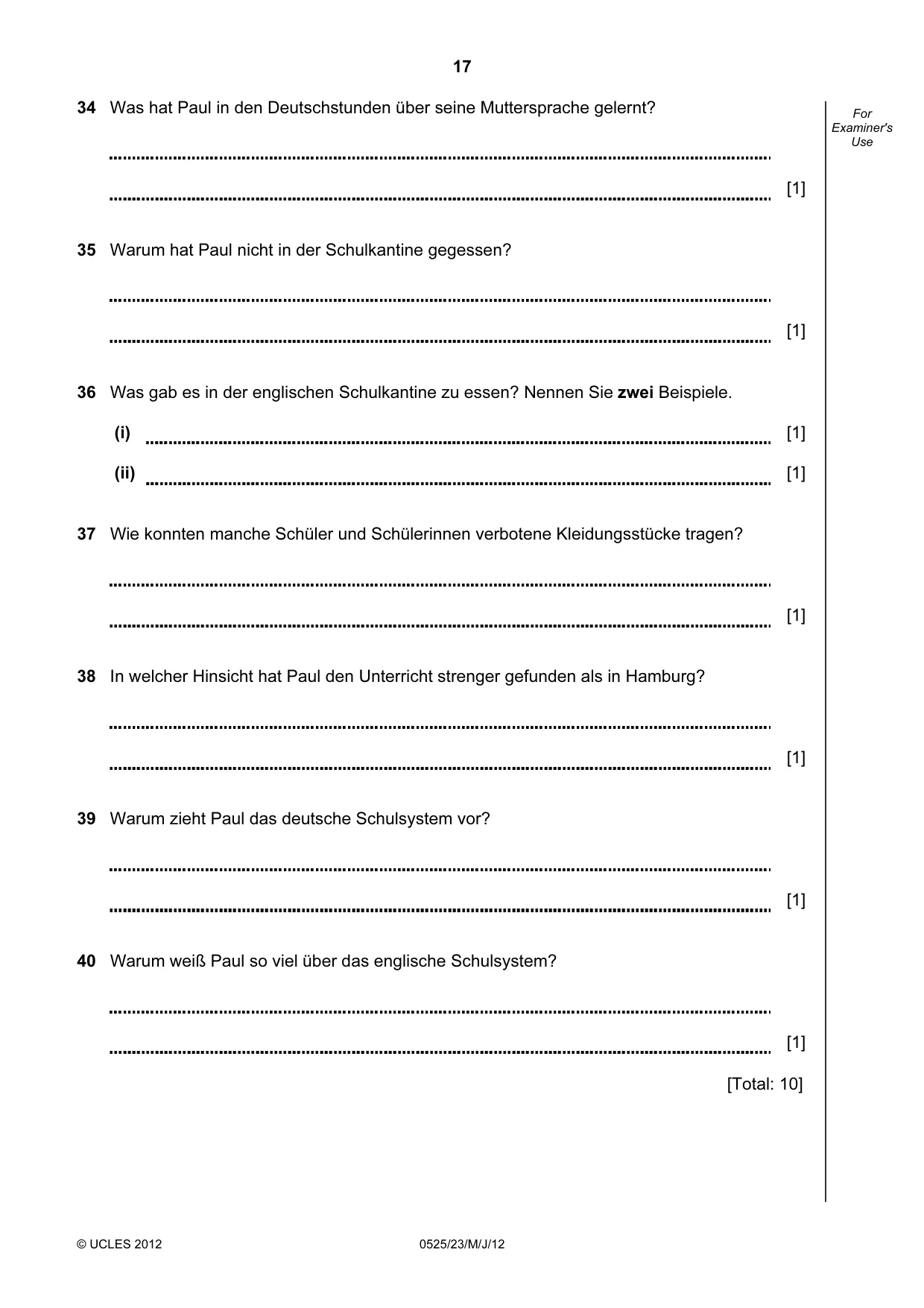
17 © UCLES 2012 0525/23/M/J/12 For Examiner's Use 34 Was hat Paul in den Deutschstunden über seine Muttersprache gelernt? [1] 35 Warum hat Paul nicht in der Schulkantine gegessen? [1] 36 Was gab es in der englischen Schulkantine zu essen? Nennen Sie zwei Beispiele. (i) [1] (ii) [1] 37 Wie konnten manche Schüler und Schülerinnen verbotene Kleidungsstücke tragen? [1] 38 In welcher Hinsicht hat Paul den Unterricht strenger gefunden als in Hamburg? [1] 39 Warum zieht Paul das deutsche Schulsystem vor? [1] 40 Warum weiß Paul so viel über das englische Schulsystem? [1] [Total: 10]
Question paper, page 18
18 © UCLES 2012 0525/23/M/J/12 BLANK PAGE
Question paper, page 19
19 © UCLES 2012 0525/23/M/J/12 BLANK PAGE
Question paper, page 20
20 Permission to reproduce items where third-party owned material protected by copyright is included has been sought and cleared where possible. Every reasonable effort has been made by the publisher (UCLES) to trace copyright holders, but if any items requiring clearance have unwittingly been included, the publisher will be pleased to make amends at the earliest possible opportunity. University of Cambridge International Examinations is part of the Cambridge Assessment Group. Cambridge Assessment is the brand name of University of Cambridge Local Examinations Syndicate (UCLES), which is itself a department of the University of Cambridge. © UCLES 2012 0525/23/M/J/12 BLANK PAGE
Mark scheme, page 1
UNIVERSITY OF CAMBRIDGE INTERNATIONAL EXAMINATIONS International General Certificate of Secondary Education MARK SCHEME for the May/June 2012 question paper for the guidance of teachers 0525 GERMAN (FOREIGN LANGUAGE) 0525/23 Paper 2 (Reading and Directed Writing), maximum raw mark 65 This mark scheme is published as an aid to teachers and candidates, to indicate the requirements of the examination. It shows the basis on which Examiners were instructed to award marks. It does not indicate the details of the discussions that took place at an Examiners’ meeting before marking began, which would have considered the acceptability of alternative answers. Mark schemes must be read in conjunction with the question papers and the report on the examination. • Cambridge will not enter into discussions or correspondence in connection with these mark schemes. Cambridge is publishing the mark schemes for the May/June 2012 question papers for most IGCSE, GCE Advanced Level and Advanced Subsidiary Level syllabuses and some Ordinary Level syllabuses. www.XtremePapers.com
Mark scheme, page 2
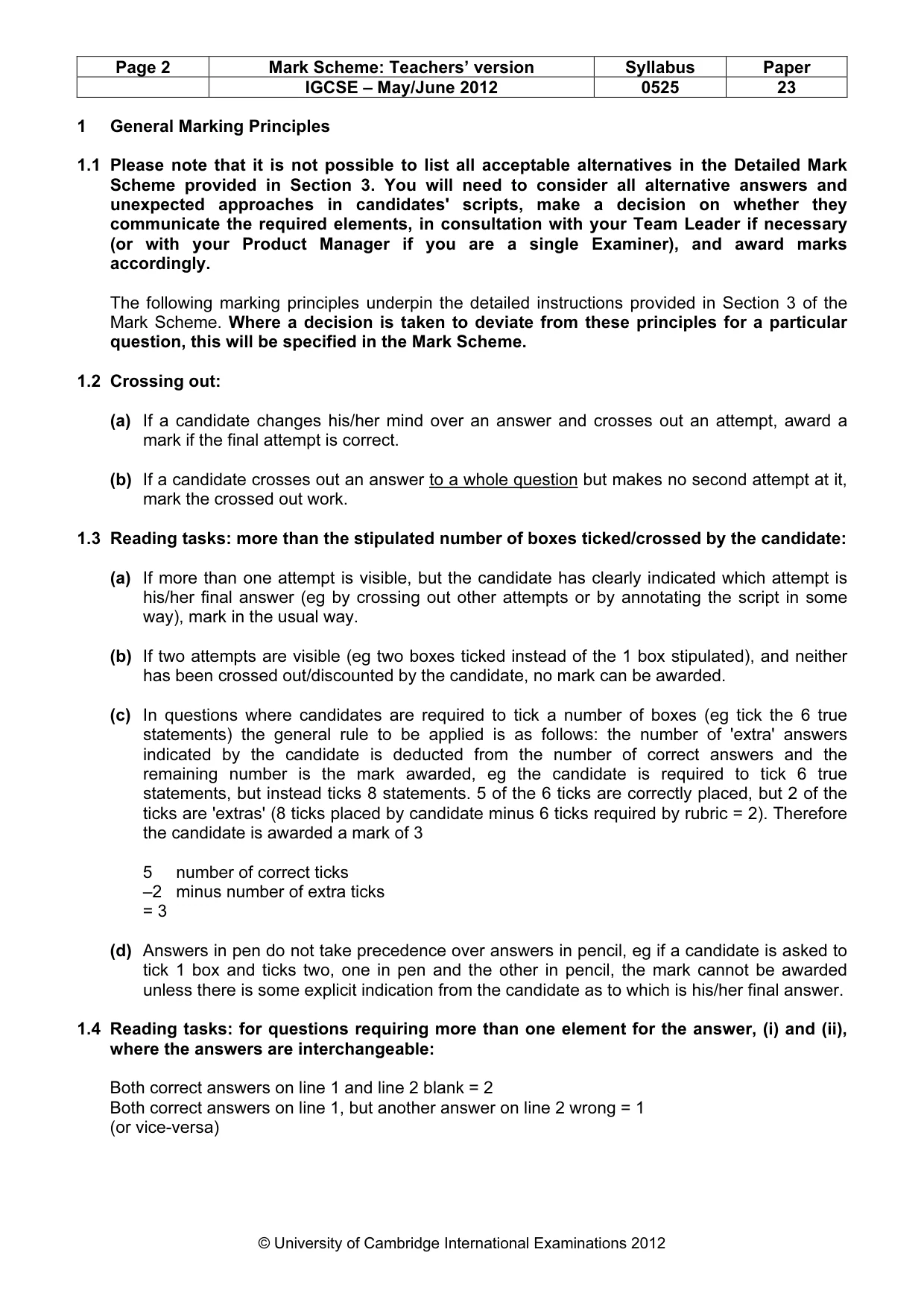
Page 2 Mark Scheme: Teachers’ version Syllabus Paper IGCSE – May/June 2012 0525 23 © University of Cambridge International Examinations 2012 1 General Marking Principles 1.1 Please note that it is not possible to list all acceptable alternatives in the Detailed Mark Scheme provided in Section 3. You will need to consider all alternative answers and unexpected approaches in candidates' scripts, make a decision on whether they communicate the required elements, in consultation with your Team Leader if necessary (or with your Product Manager if you are a single Examiner), and award marks accordingly. The following marking principles underpin the detailed instructions provided in Section 3 of the Mark Scheme. Where a decision is taken to deviate from these principles for a particular question, this will be specified in the Mark Scheme. 1.2 Crossing out: (a) If a candidate changes his/her mind over an answer and crosses out an attempt, award a mark if the final attempt is correct. (b) If a candidate crosses out an answer to a whole question but makes no second attempt at it, mark the crossed out work. 1.3 Reading tasks: more than the stipulated number of boxes ticked/crossed by the candidate: (a) If more than one attempt is visible, but the candidate has clearly indicated which attempt is his/her final answer (eg by crossing out other attempts or by annotating the script in some way), mark in the usual way. (b) If two attempts are visible (eg two boxes ticked instead of the 1 box stipulated), and neither has been crossed out/discounted by the candidate, no mark can be awarded. (c) In questions where candidates are required to tick a number of boxes (eg tick the 6 true statements) the general rule to be applied is as follows: the number of 'extra' answers indicated by the candidate is deducted from the number of correct answers and the remaining number is the mark awarded, eg the candidate is required to tick 6 true statements, but instead ticks 8 statements. 5 of the 6 ticks are correctly placed, but 2 of the ticks are 'extras' (8 ticks placed by candidate minus 6 ticks required by rubric = 2). Therefore the candidate is awarded a mark of 3 5 number of correct ticks –2 minus number of extra ticks = 3 (d) Answers in pen do not take precedence over answers in pencil, eg if a candidate is asked to tick 1 box and ticks two, one in pen and the other in pencil, the mark cannot be awarded unless there is some explicit indication from the candidate as to which is his/her final answer. 1.4 Reading tasks: for questions requiring more than one element for the answer, (i) and (ii), where the answers are interchangeable: Both correct answers on line 1 and line 2 blank = 2 Both correct answers on line 1, but another answer on line 2 wrong = 1 (or vice-versa)
Mark scheme, page 3
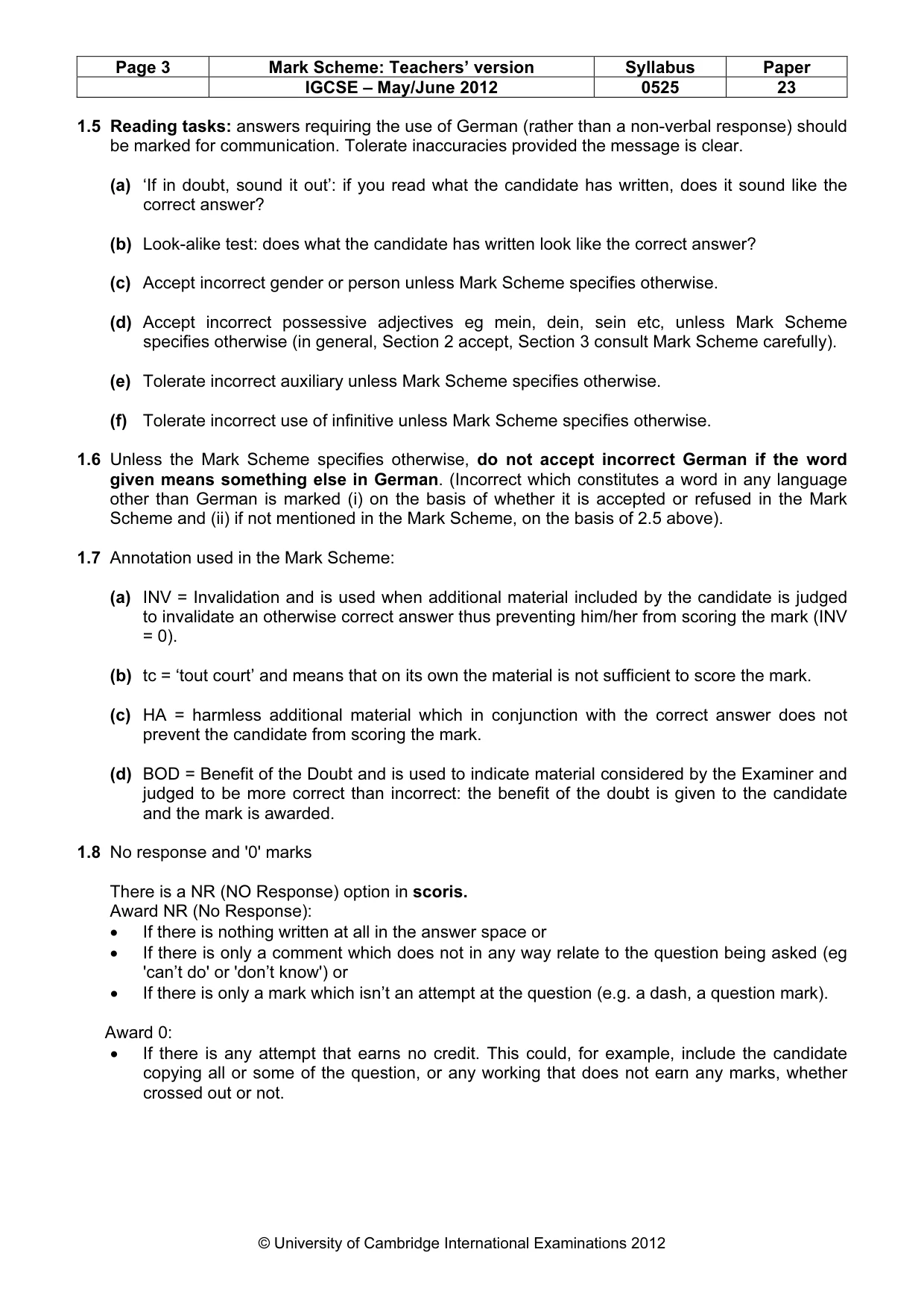
Page 3 Mark Scheme: Teachers’ version Syllabus Paper IGCSE – May/June 2012 0525 23 © University of Cambridge International Examinations 2012 1.5 Reading tasks: answers requiring the use of German (rather than a non-verbal response) should be marked for communication. Tolerate inaccuracies provided the message is clear. (a) ‘If in doubt, sound it out’: if you read what the candidate has written, does it sound like the correct answer? (b) Look-alike test: does what the candidate has written look like the correct answer? (c) Accept incorrect gender or person unless Mark Scheme specifies otherwise. (d) Accept incorrect possessive adjectives eg mein, dein, sein etc, unless Mark Scheme specifies otherwise (in general, Section 2 accept, Section 3 consult Mark Scheme carefully). (e) Tolerate incorrect auxiliary unless Mark Scheme specifies otherwise. (f) Tolerate incorrect use of infinitive unless Mark Scheme specifies otherwise. 1.6 Unless the Mark Scheme specifies otherwise, do not accept incorrect German if the word given means something else in German. (Incorrect which constitutes a word in any language other than German is marked (i) on the basis of whether it is accepted or refused in the Mark Scheme and (ii) if not mentioned in the Mark Scheme, on the basis of 2.5 above). 1.7 Annotation used in the Mark Scheme: (a) INV = Invalidation and is used when additional material included by the candidate is judged to invalidate an otherwise correct answer thus preventing him/her from scoring the mark (INV = 0). (b) tc = ‘tout court’ and means that on its own the material is not sufficient to score the mark. (c) HA = harmless additional material which in conjunction with the correct answer does not prevent the candidate from scoring the mark. (d) BOD = Benefit of the Doubt and is used to indicate material considered by the Examiner and judged to be more correct than incorrect: the benefit of the doubt is given to the candidate and the mark is awarded. 1.8 No response and '0' marks There is a NR (NO Response) option in scoris. Award NR (No Response): • If there is nothing written at all in the answer space or • If there is only a comment which does not in any way relate to the question being asked (eg 'can’t do' or 'don’t know') or • If there is only a mark which isn’t an attempt at the question (e.g. a dash, a question mark). Award 0: • If there is any attempt that earns no credit. This could, for example, include the candidate copying all or some of the question, or any working that does not earn any marks, whether crossed out or not.
Mark scheme, page 4
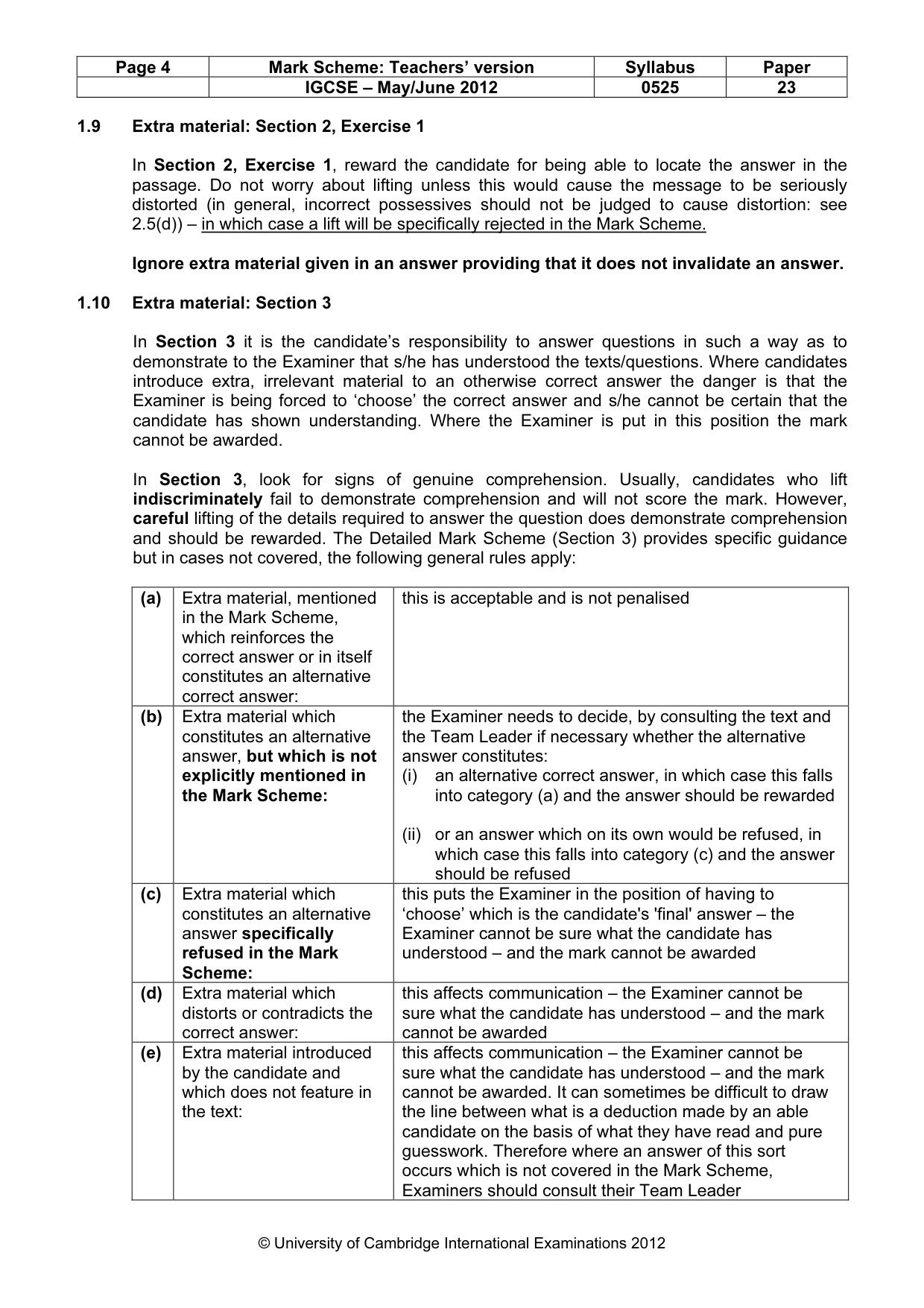
Page 4 Mark Scheme: Teachers’ version Syllabus Paper IGCSE – May/June 2012 0525 23 © University of Cambridge International Examinations 2012 1.9 Extra material: Section 2, Exercise 1 In Section 2, Exercise 1, reward the candidate for being able to locate the answer in the passage. Do not worry about lifting unless this would cause the message to be seriously distorted (in general, incorrect possessives should not be judged to cause distortion: see 2.5(d)) – in which case a lift will be specifically rejected in the Mark Scheme. Ignore extra material given in an answer providing that it does not invalidate an answer. 1.10 Extra material: Section 3 In Section 3 it is the candidate’s responsibility to answer questions in such a way as to demonstrate to the Examiner that s/he has understood the texts/questions. Where candidates introduce extra, irrelevant material to an otherwise correct answer the danger is that the Examiner is being forced to ‘choose’ the correct answer and s/he cannot be certain that the candidate has shown understanding. Where the Examiner is put in this position the mark cannot be awarded. In Section 3, look for signs of genuine comprehension. Usually, candidates who lift indiscriminately fail to demonstrate comprehension and will not score the mark. However, careful lifting of the details required to answer the question does demonstrate comprehension and should be rewarded. The Detailed Mark Scheme (Section 3) provides specific guidance but in cases not covered, the following general rules apply: (a) Extra material, mentioned in the Mark Scheme, which reinforces the correct answer or in itself constitutes an alternative correct answer: this is acceptable and is not penalised (b) Extra material which constitutes an alternative answer, but which is not explicitly mentioned in the Mark Scheme: the Examiner needs to decide, by consulting the text and the Team Leader if necessary whether the alternative answer constitutes: (i) an alternative correct answer, in which case this falls into category (a) and the answer should be rewarded (ii) or an answer which on its own would be refused, in which case this falls into category (c) and the answer should be refused (c) Extra material which constitutes an alternative answer specifically refused in the Mark Scheme: this puts the Examiner in the position of having to ‘choose’ which is the candidate's 'final' answer – the Examiner cannot be sure what the candidate has understood – and the mark cannot be awarded (d) Extra material which distorts or contradicts the correct answer: this affects communication – the Examiner cannot be sure what the candidate has understood – and the mark cannot be awarded (e) Extra material introduced by the candidate and which does not feature in the text: this affects communication – the Examiner cannot be sure what the candidate has understood – and the mark cannot be awarded. It can sometimes be difficult to draw the line between what is a deduction made by an able candidate on the basis of what they have read and pure guesswork. Therefore where an answer of this sort occurs which is not covered in the Mark Scheme, Examiners should consult their Team Leader
Mark scheme, page 5
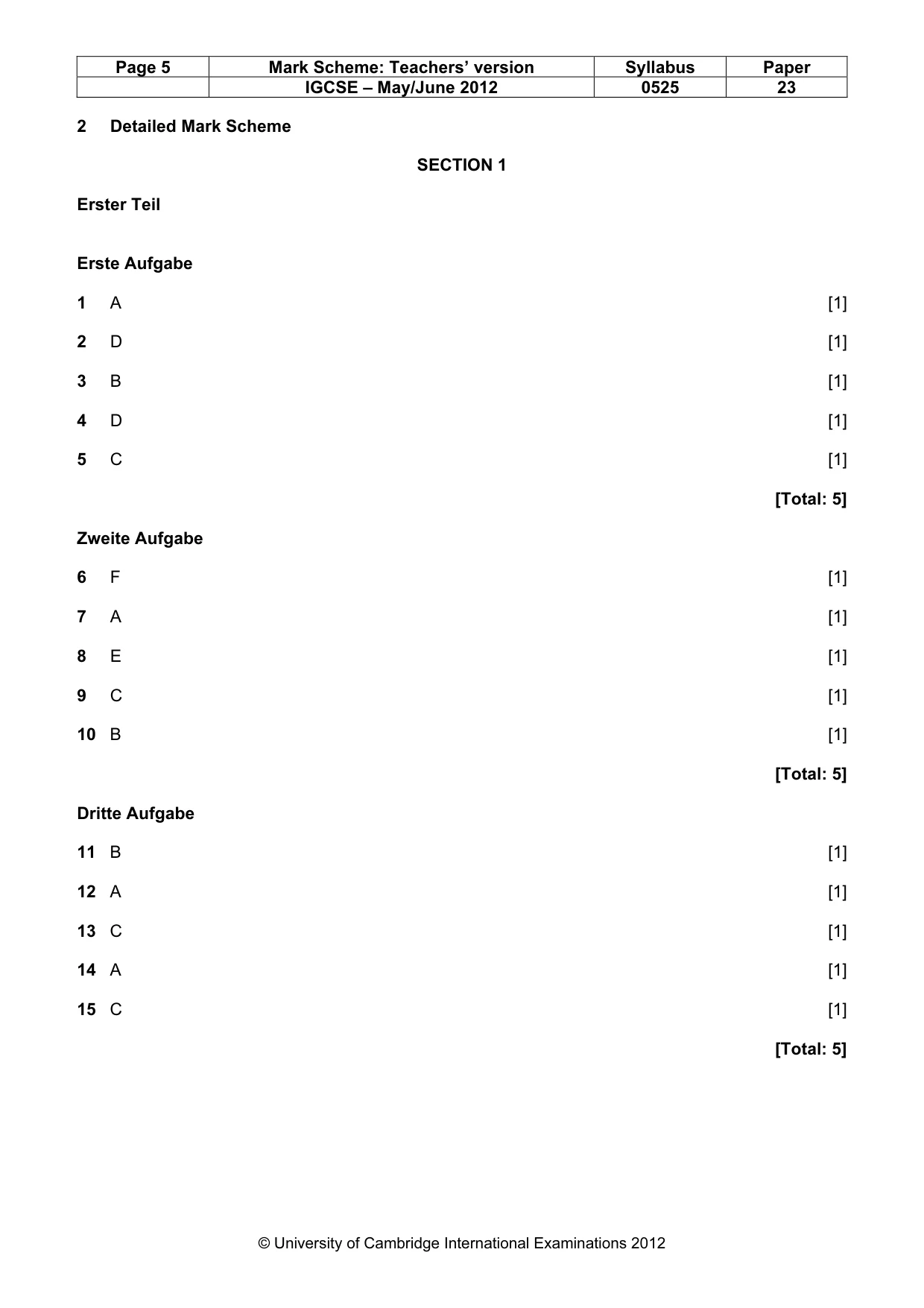
Page 5 Mark Scheme: Teachers’ version Syllabus Paper IGCSE – May/June 2012 0525 23 © University of Cambridge International Examinations 2012 2 Detailed Mark Scheme SECTION 1 Erster Teil Erste Aufgabe 1 A [1] 2 D [1] 3 B [1] 4 D [1] 5 C [1] [Total: 5] Zweite Aufgabe 6 F [1] 7 A [1] 8 E [1] 9 C [1] 10 B [1] [Total: 5] Dritte Aufgabe 11 B [1] 12 A [1] 13 C [1] 14 A [1] 15 C [1] [Total: 5]
Mark scheme, page 6
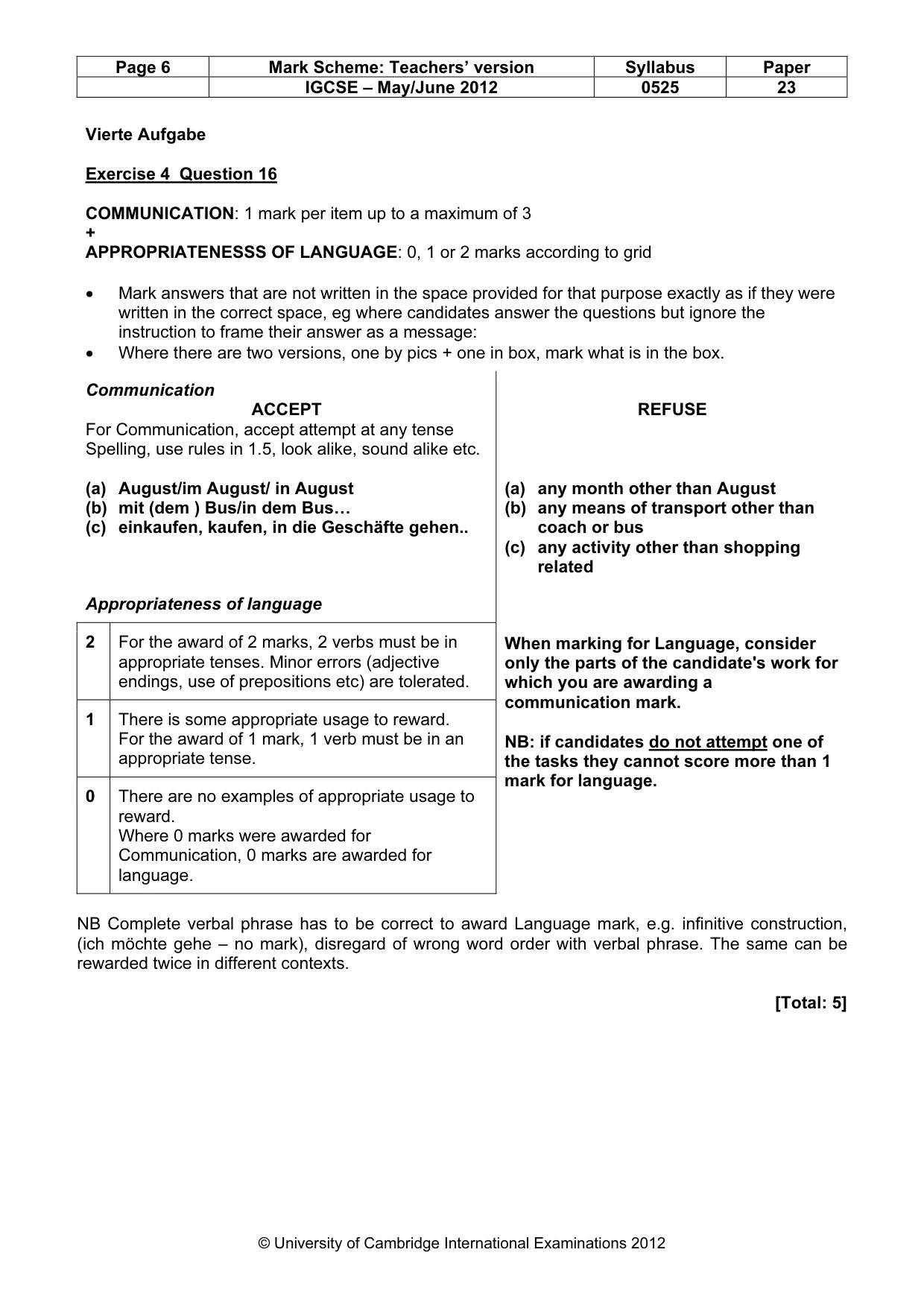
Page 6 Mark Scheme: Teachers’ version Syllabus Paper IGCSE – May/June 2012 0525 23 © University of Cambridge International Examinations 2012 Vierte Aufgabe Exercise 4 Question 16 COMMUNICATION: 1 mark per item up to a maximum of 3 + APPROPRIATENESSS OF LANGUAGE: 0, 1 or 2 marks according to grid • Mark answers that are not written in the space provided for that purpose exactly as if they were written in the correct space, eg where candidates answer the questions but ignore the instruction to frame their answer as a message: • Where there are two versions, one by pics + one in box, mark what is in the box. Communication ACCEPT For Communication, accept attempt at any tense Spelling, use rules in 1.5, look alike, sound alike etc. (a) August/im August/ in August (b) mit (dem ) Bus/in dem Bus… (c) einkaufen, kaufen, in die Geschäfte gehen.. REFUSE (a) any month other than August (b) any means of transport other than coach or bus (c) any activity other than shopping related Appropriateness of language 2 For the award of 2 marks, 2 verbs must be in appropriate tenses. Minor errors (adjective endings, use of prepositions etc) are tolerated. 1 There is some appropriate usage to reward. For the award of 1 mark, 1 verb must be in an appropriate tense. 0 There are no examples of appropriate usage to reward. Where 0 marks were awarded for Communication, 0 marks are awarded for language. When marking for Language, consider only the parts of the candidate's work for which you are awarding a communication mark. NB: if candidates do not attempt one of the tasks they cannot score more than 1 mark for language. NB Complete verbal phrase has to be correct to award Language mark, e.g. infinitive construction, (ich möchte gehe – no mark), disregard of wrong word order with verbal phrase. The same can be rewarded twice in different contexts. [Total: 5]
Mark scheme, page 7
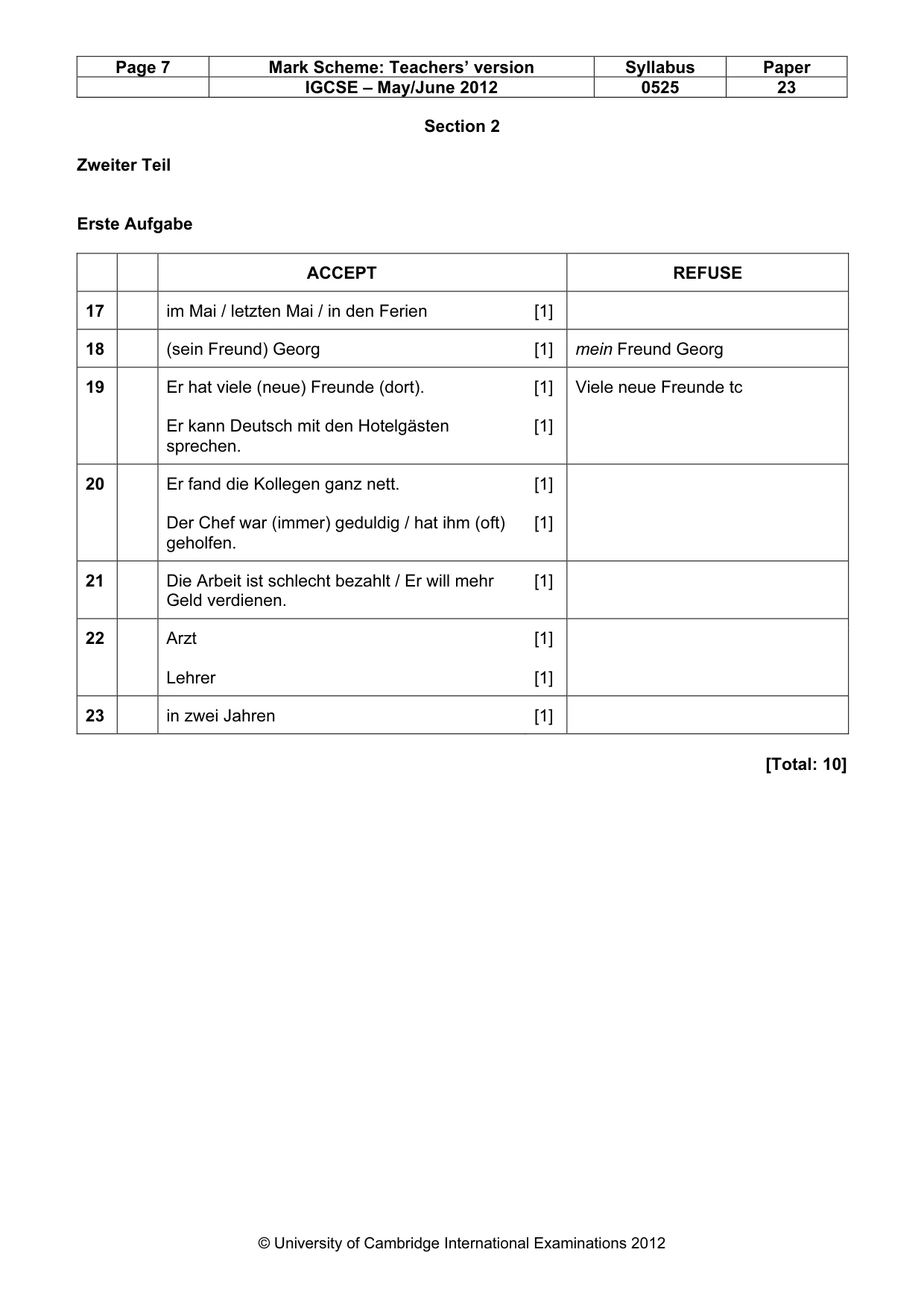
Page 7 Mark Scheme: Teachers’ version Syllabus Paper IGCSE – May/June 2012 0525 23 © University of Cambridge International Examinations 2012 Section 2 Zweiter Teil Erste Aufgabe ACCEPT REFUSE 17 im Mai / letzten Mai / in den Ferien [1] 18 (sein Freund) Georg [1] mein Freund Georg 19 Er hat viele (neue) Freunde (dort). Er kann Deutsch mit den Hotelgästen sprechen. [1] [1] Viele neue Freunde tc 20 Er fand die Kollegen ganz nett. Der Chef war (immer) geduldig / hat ihm (oft) geholfen. [1] [1] 21 Die Arbeit ist schlecht bezahlt / Er will mehr Geld verdienen. [1] 22 Arzt Lehrer [1] [1] 23 in zwei Jahren [1] [Total: 10]
Mark scheme, page 8
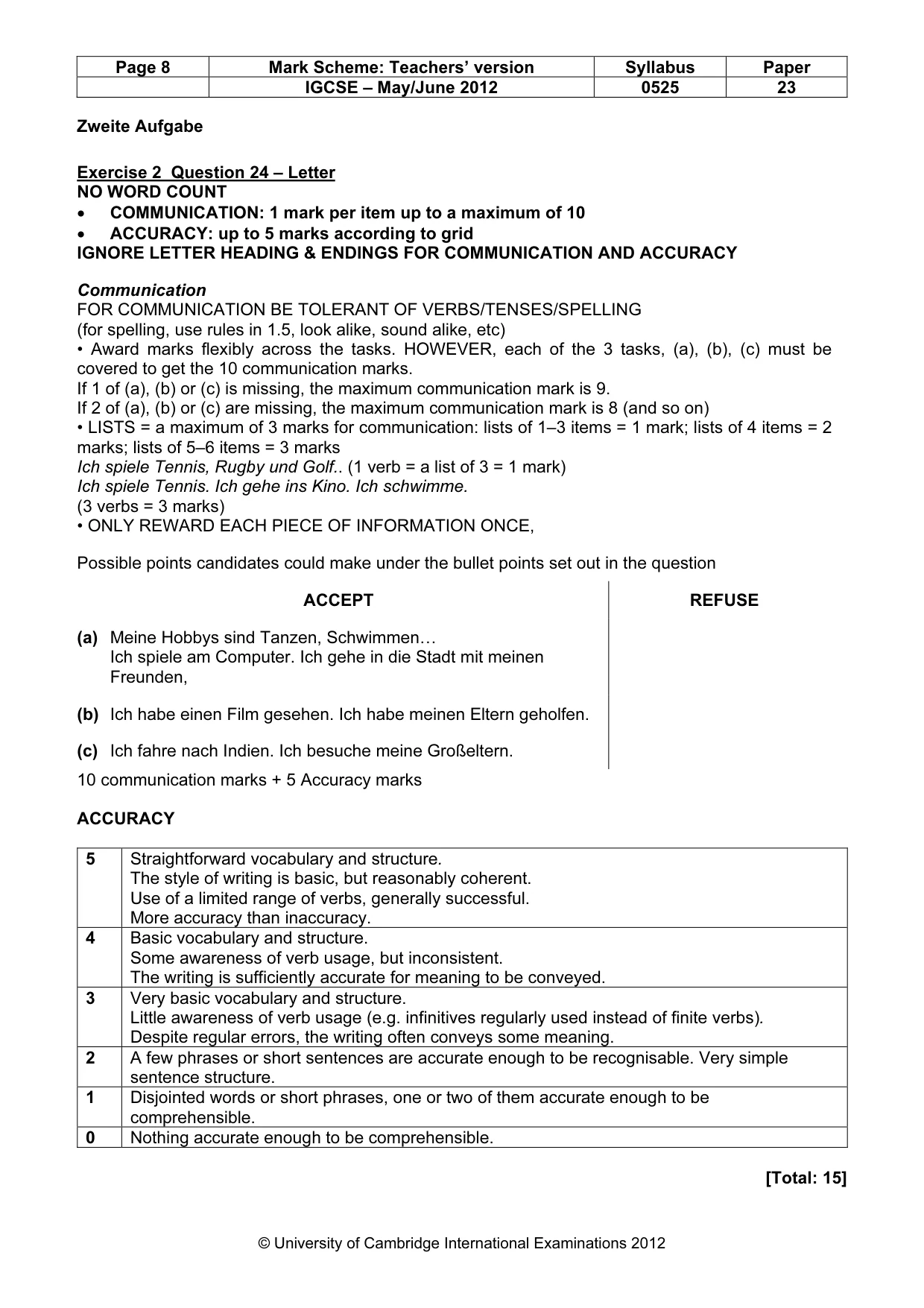
Page 8 Mark Scheme: Teachers’ version Syllabus Paper IGCSE – May/June 2012 0525 23 © University of Cambridge International Examinations 2012 Zweite Aufgabe Exercise 2 Question 24 – Letter NO WORD COUNT • COMMUNICATION: 1 mark per item up to a maximum of 10 • ACCURACY: up to 5 marks according to grid IGNORE LETTER HEADING & ENDINGS FOR COMMUNICATION AND ACCURACY Communication FOR COMMUNICATION BE TOLERANT OF VERBS/TENSES/SPELLING (for spelling, use rules in 1.5, look alike, sound alike, etc) • Award marks flexibly across the tasks. HOWEVER, each of the 3 tasks, (a), (b), (c) must be covered to get the 10 communication marks. If 1 of (a), (b) or (c) is missing, the maximum communication mark is 9. If 2 of (a), (b) or (c) are missing, the maximum communication mark is 8 (and so on) • LISTS = a maximum of 3 marks for communication: lists of 1–3 items = 1 mark; lists of 4 items = 2 marks; lists of 5–6 items = 3 marks Ich spiele Tennis, Rugby und Golf.. (1 verb = a list of 3 = 1 mark) Ich spiele Tennis. Ich gehe ins Kino. Ich schwimme. (3 verbs = 3 marks) • ONLY REWARD EACH PIECE OF INFORMATION ONCE, Possible points candidates could make under the bullet points set out in the question ACCEPT REFUSE (a) Meine Hobbys sind Tanzen, Schwimmen… Ich spiele am Computer. Ich gehe in die Stadt mit meinen Freunden, (b) Ich habe einen Film gesehen. Ich habe meinen Eltern geholfen. (c) Ich fahre nach Indien. Ich besuche meine Großeltern. 10 communication marks + 5 Accuracy marks ACCURACY 5 Straightforward vocabulary and structure. The style of writing is basic, but reasonably coherent. Use of a limited range of verbs, generally successful. More accuracy than inaccuracy. 4 Basic vocabulary and structure. Some awareness of verb usage, but inconsistent. The writing is sufficiently accurate for meaning to be conveyed. 3 Very basic vocabulary and structure. Little awareness of verb usage (e.g. infinitives regularly used instead of finite verbs). Despite regular errors, the writing often conveys some meaning. 2 A few phrases or short sentences are accurate enough to be recognisable. Very simple sentence structure. 1 Disjointed words or short phrases, one or two of them accurate enough to be comprehensible. 0 Nothing accurate enough to be comprehensible. [Total: 15]
Mark scheme, page 9
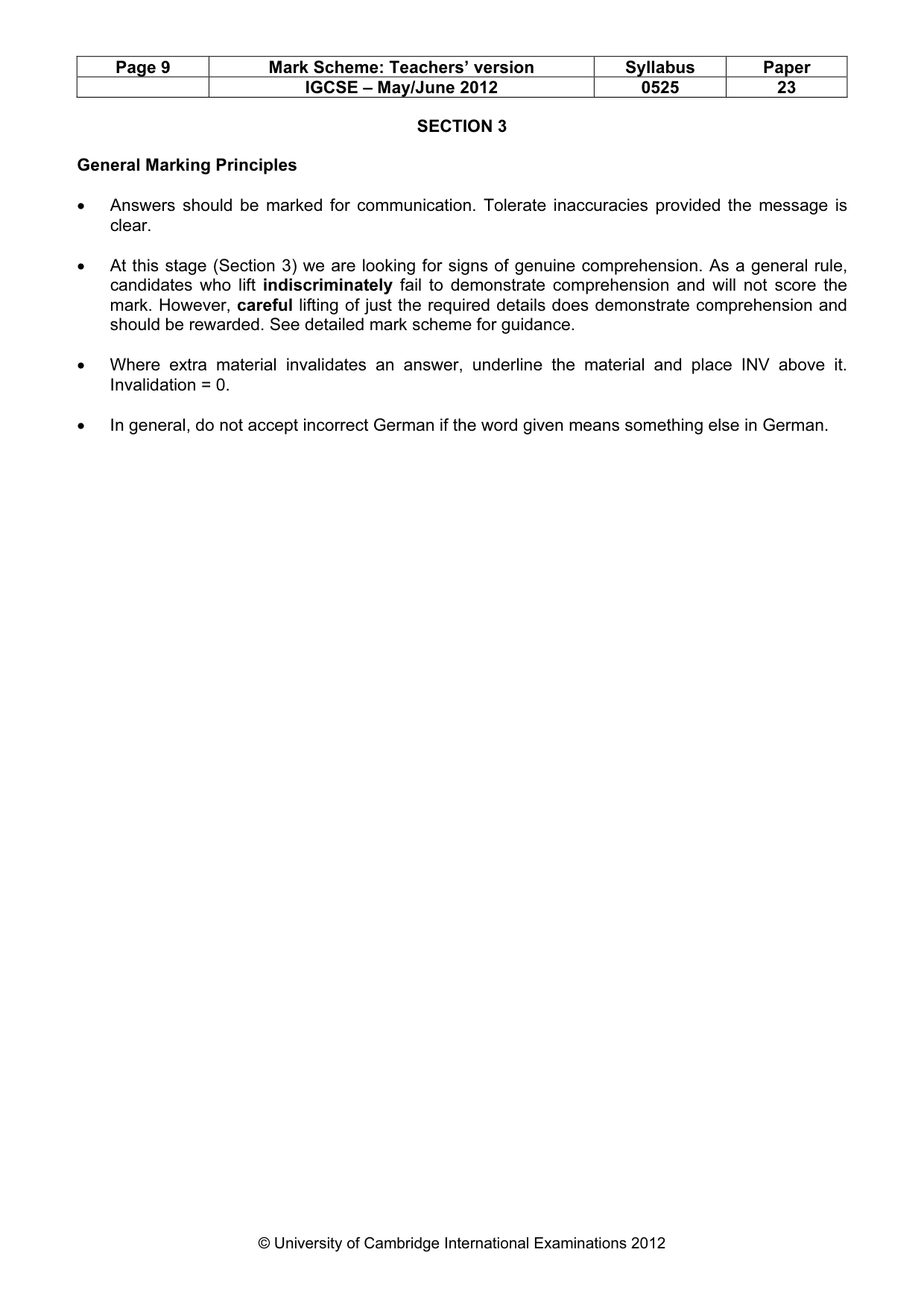
Page 9 Mark Scheme: Teachers’ version Syllabus Paper IGCSE – May/June 2012 0525 23 © University of Cambridge International Examinations 2012 SECTION 3 General Marking Principles • Answers should be marked for communication. Tolerate inaccuracies provided the message is clear. • At this stage (Section 3) we are looking for signs of genuine comprehension. As a general rule, candidates who lift indiscriminately fail to demonstrate comprehension and will not score the mark. However, careful lifting of just the required details does demonstrate comprehension and should be rewarded. See detailed mark scheme for guidance. • Where extra material invalidates an answer, underline the material and place INV above it. Invalidation = 0. • In general, do not accept incorrect German if the word given means something else in German.
Mark scheme, page 10
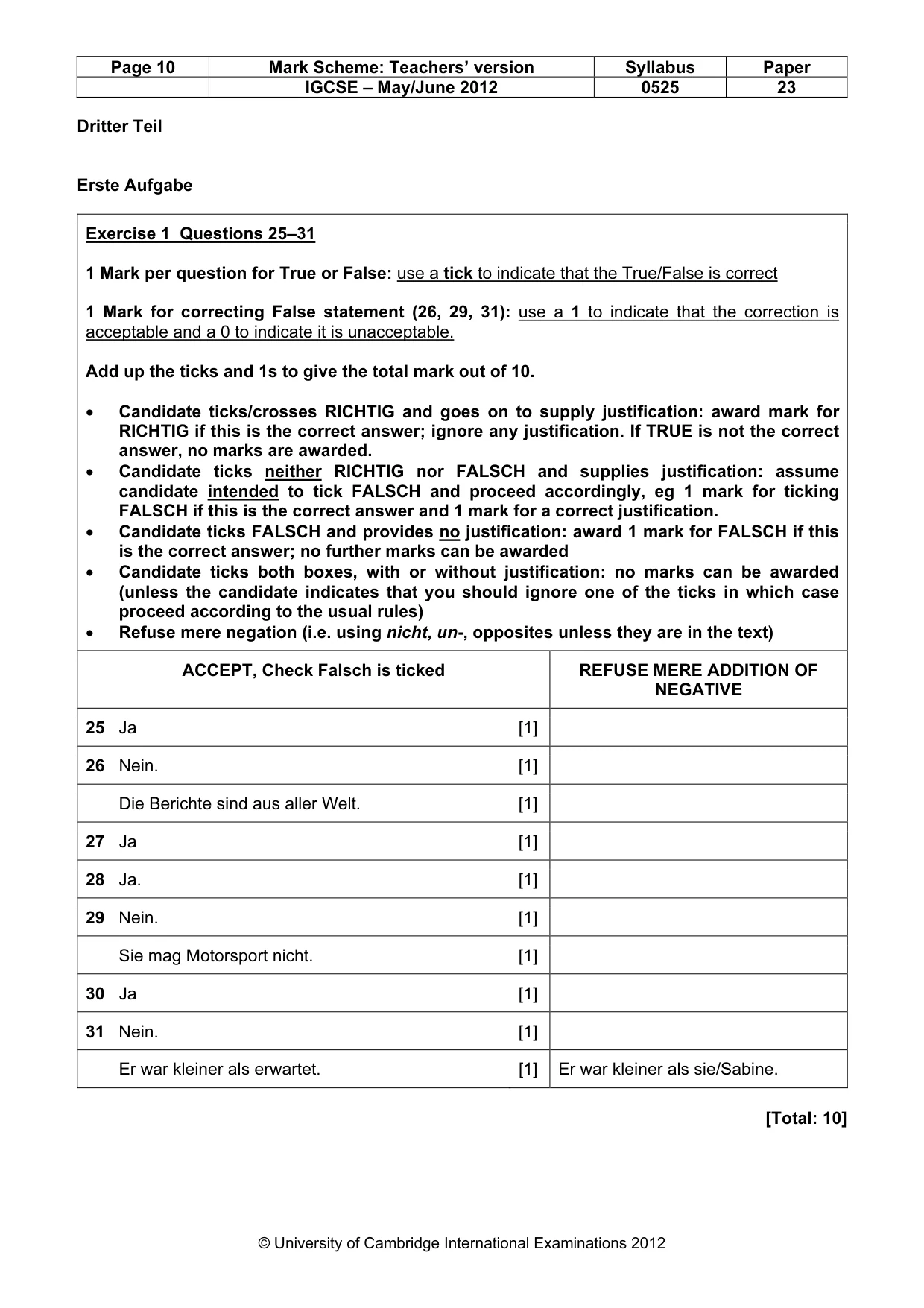
Page 10 Mark Scheme: Teachers’ version Syllabus Paper IGCSE – May/June 2012 0525 23 © University of Cambridge International Examinations 2012 Dritter Teil Erste Aufgabe Exercise 1 Questions 25–31 1 Mark per question for True or False: use a tick to indicate that the True/False is correct 1 Mark for correcting False statement (26, 29, 31): use a 1 to indicate that the correction is acceptable and a 0 to indicate it is unacceptable. Add up the ticks and 1s to give the total mark out of 10. • Candidate ticks/crosses RICHTIG and goes on to supply justification: award mark for RICHTIG if this is the correct answer; ignore any justification. If TRUE is not the correct answer, no marks are awarded. • Candidate ticks neither RICHTIG nor FALSCH and supplies justification: assume candidate intended to tick FALSCH and proceed accordingly, eg 1 mark for ticking FALSCH if this is the correct answer and 1 mark for a correct justification. • Candidate ticks FALSCH and provides no justification: award 1 mark for FALSCH if this is the correct answer; no further marks can be awarded • Candidate ticks both boxes, with or without justification: no marks can be awarded (unless the candidate indicates that you should ignore one of the ticks in which case proceed according to the usual rules) • Refuse mere negation (i.e. using nicht, un-, opposites unless they are in the text) ACCEPT, Check Falsch is ticked REFUSE MERE ADDITION OF NEGATIVE 25 Ja [1] 26 Nein. [1] Die Berichte sind aus aller Welt. [1] 27 Ja [1] 28 Ja. [1] 29 Nein. [1] Sie mag Motorsport nicht. [1] 30 Ja [1] 31 Nein. [1] Er war kleiner als erwartet. [1] Er war kleiner als sie/Sabine. [Total: 10]
Mark scheme, page 11
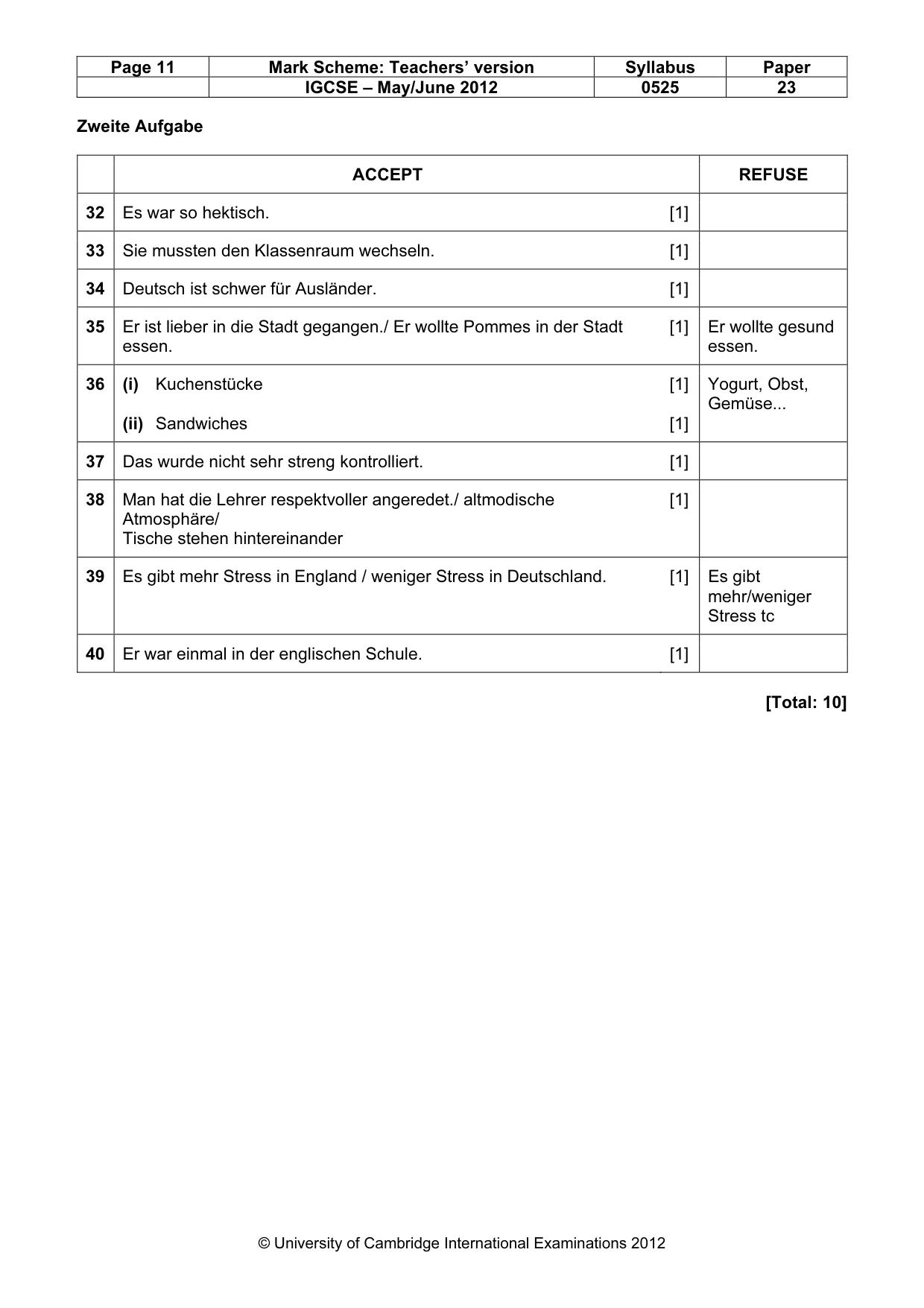
Page 11 Mark Scheme: Teachers’ version Syllabus Paper IGCSE – May/June 2012 0525 23 © University of Cambridge International Examinations 2012 Zweite Aufgabe ACCEPT REFUSE 32 Es war so hektisch. [1] 33 Sie mussten den Klassenraum wechseln. [1] 34 Deutsch ist schwer für Ausländer. [1] 35 Er ist lieber in die Stadt gegangen./ Er wollte Pommes in der Stadt essen. [1] Er wollte gesund essen. 36 (i) Kuchenstücke (ii) Sandwiches [1] [1] Yogurt, Obst, Gemüse... 37 Das wurde nicht sehr streng kontrolliert. [1] 38 Man hat die Lehrer respektvoller angeredet./ altmodische Atmosphäre/ Tische stehen hintereinander [1] 39 Es gibt mehr Stress in England / weniger Stress in Deutschland. [1] Es gibt mehr/weniger Stress tc 40 Er war einmal in der englischen Schule. [1] [Total: 10]