Cambridge IGCSE German - First Language 0505 — 2019 May/June Paper 1 · Variant 1
0505/11/M/J/19 · 50 marks · ≈56 min
The question paper and its mark scheme, free to read here and free to download. This is Cambridge’s own paper, exactly as it was sat.
Question paper8 pages


Mark scheme9 pages
Answers below. Sit the paper first if you are practising.
Paper as text
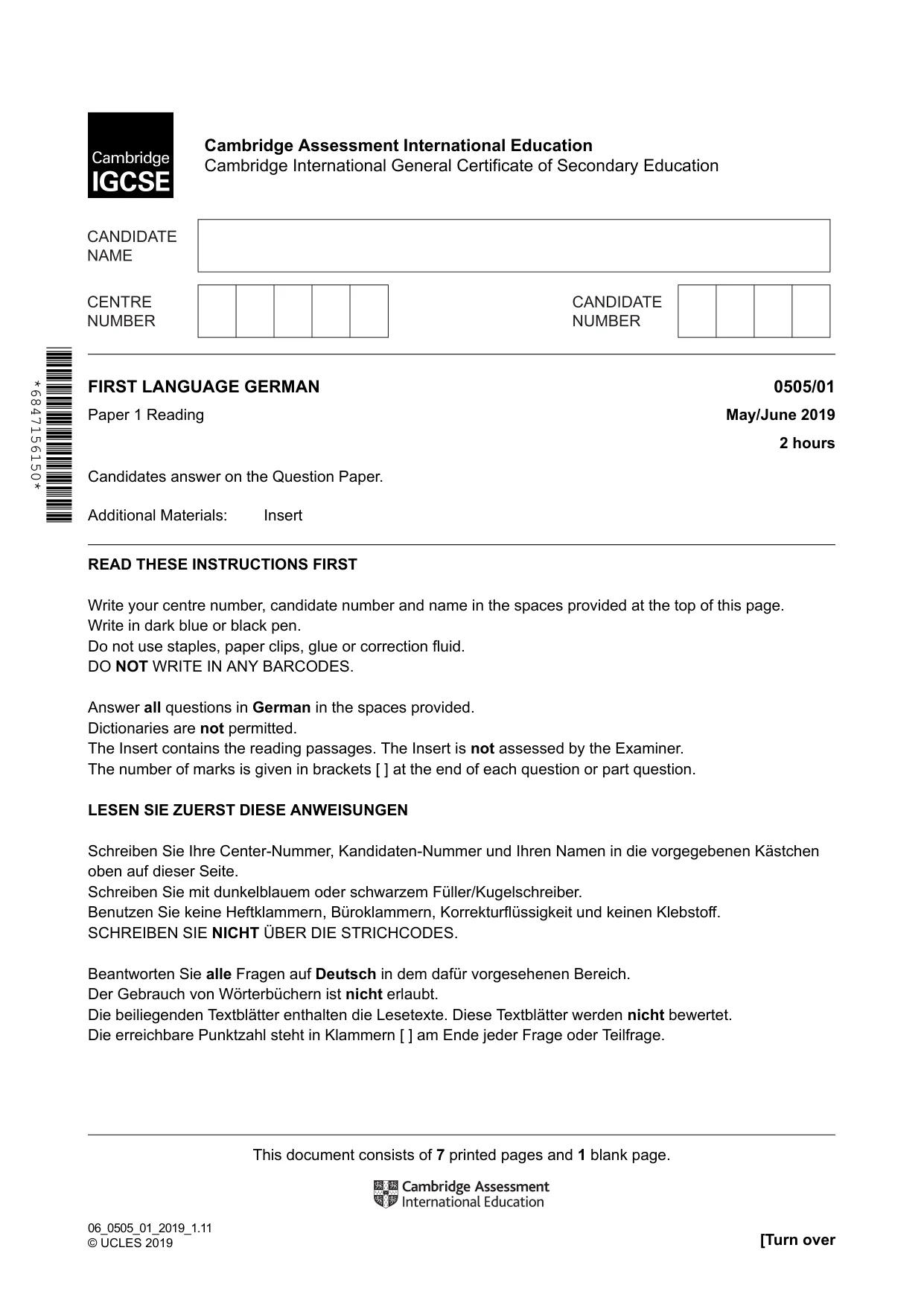
Question paper, page 1
Cambridge Assessment International Education Cambridge International General Certificate of Secondary Education 0505/01 FIRST LANGUAGE GERMAN May/June 2019 Paper 1 Reading 2 hours Candidates answer on the Question Paper. Additional Materials: Insert READ THESE INSTRUCTIONS FIRST Write your centre number, candidate number and name in the spaces provided at the top of this page. Write in dark blue or black pen. Do not use staples, paper clips, glue or correction fluid. DO NOT WRITE IN ANY BARCODES. Answer all questions in German in the spaces provided. Dictionaries are not permitted. The Insert contains the reading passages. The Insert is not assessed by the Examiner. The number of marks is given in brackets [ ] at the end of each question or part question. LESEN SIE ZUERST DIESE ANWEISUNGEN Schreiben Sie Ihre Center-Nummer, Kandidaten-Nummer und Ihren Namen in die vorgegebenen Kästchen oben auf dieser Seite. Schreiben Sie mit dunkelblauem oder schwarzem Füller/Kugelschreiber. Benutzen Sie keine Heftklammern, Büroklammern, Korrekturflüssigkeit und keinen Klebstoff. SCHREIBEN SIE NICHT ÜBER DIE STRICHCODES. Beantworten Sie alle Fragen auf Deutsch in dem dafür vorgesehenen Bereich. Der Gebrauch von Wörterbüchern ist nicht erlaubt. Die beiliegenden Textblätter enthalten die Lesetexte. Diese Textblätter werden nicht bewertet. Die erreichbare Punktzahl steht in Klammern [ ] am Ende jeder Frage oder Teilfrage. This document consists of 7 printed pages and 1 blank page. [Turn over 06_0505_01_2019_1.11 © UCLES 2019 *6847156150*
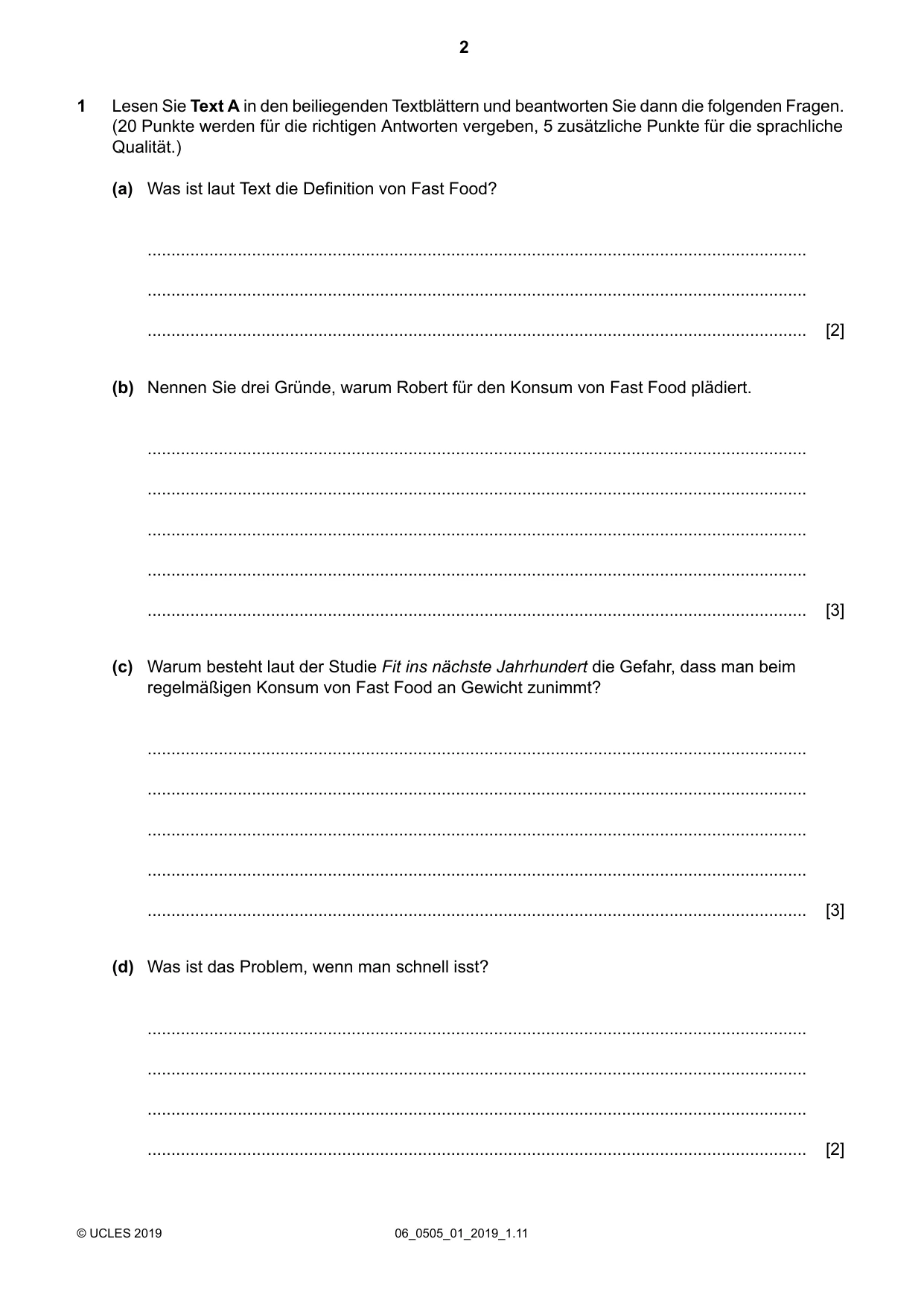
Question paper, page 2
Lesen Sie Text A in den beiliegenden Textblättern und beantworten Sie dann die folgenden Fragen. (20 Punkte werden für die richtigen Antworten vergeben, 5 zusätzliche Punkte für die sprachliche Qualität.) 1 Was ist laut Text die Definition von Fast Food? (a) … … … [2] Nennen Sie drei Gründe, warum Robert für den Konsum von Fast Food plädiert. (b) … … … … … [3] Warum besteht laut der Studie Fit ins nächste Jahrhundert die Gefahr, dass man beim regelmäßigen Konsum von Fast Food an Gewicht zunimmt? (c) … … … … … [3] Was ist das Problem, wenn man schnell isst? (d) … … … … [2] 06_0505_01_2019_1.11 © UCLES 2019 2
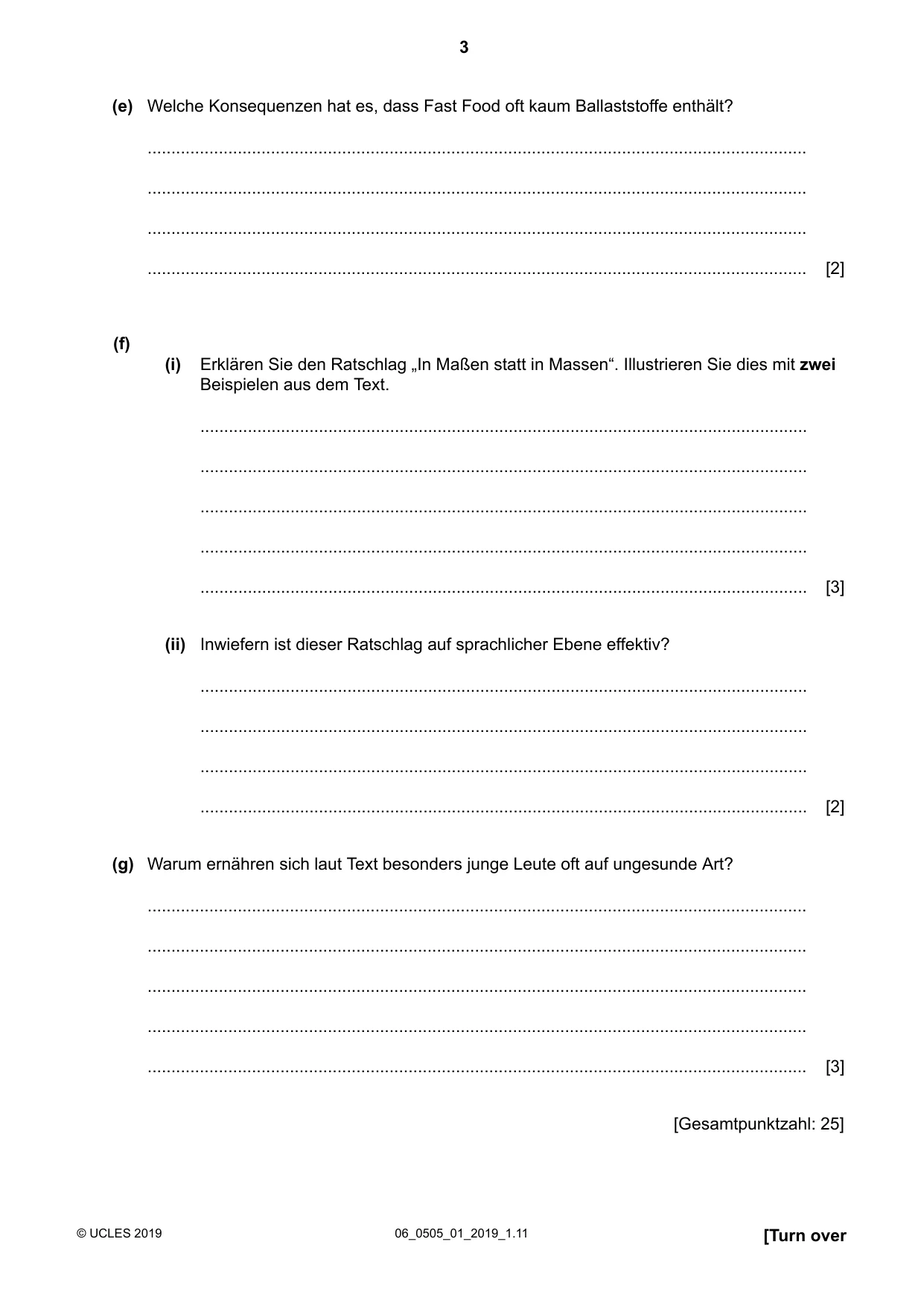
Question paper, page 3
Welche Konsequenzen hat es, dass Fast Food oft kaum Ballaststoffe enthält? (e) … … … … [2] (f) Erklären Sie den Ratschlag „In Maßen statt in Massen“. Illustrieren Sie dies mit zwei Beispielen aus dem Text. (i) … … … … … [3] Inwiefern ist dieser Ratschlag auf sprachlicher Ebene effektiv? (ii) … … … … [2] Warum ernähren sich laut Text besonders junge Leute oft auf ungesunde Art? (g) … … … … … [3] [Gesamtpunktzahl: 25] [Turn over 06_0505_01_2019_1.11 © UCLES 2019 3
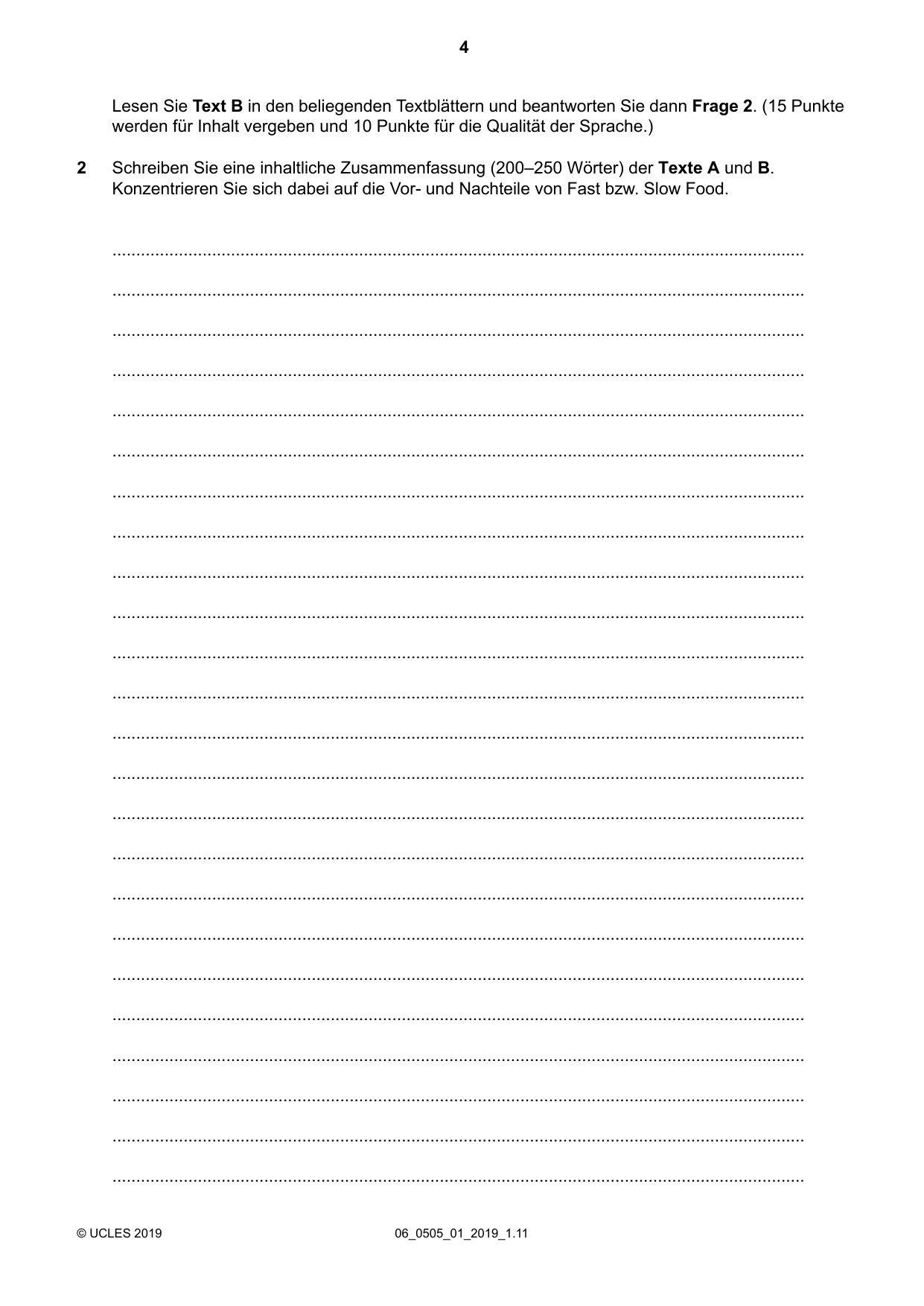
Question paper, page 4
Lesen Sie Text B in den beliegenden Textblättern und beantworten Sie dann Frage 2. (15 Punkte werden für Inhalt vergeben und 10 Punkte für die Qualität der Sprache.) Schreiben Sie eine inhaltliche Zusammenfassung (200–250 Wörter) der Texte A und B. Konzentrieren Sie sich dabei auf die Vor- und Nachteile von Fast bzw. Slow Food. 2 … … … … … … … … … … … … … … … … … … … … … … … … 06_0505_01_2019_1.11 © UCLES 2019 4
Question paper, page 5
… … … … … … … … … … … … … … … … … … … … … … … … … … … … [Turn over 06_0505_01_2019_1.11 © UCLES 2019 5
Question paper, page 6
… … … … … … … … … … … … … … … … … … … … … … … … … … … … 06_0505_01_2019_1.11 © UCLES 2019 6
Question paper, page 7
… … … … … … … … … … … … … … [25] 06_0505_01_2019_1.11 © UCLES 2019 7
Question paper, page 8
BLANK PAGE Permission to reproduce items where third-party owned material protected by copyright is included has been sought and cleared where possible. Every reasonable effort has been made by the publisher (UCLES) to trace copyright holders, but if any items requiring clearance have unwittingly been included, the publisher will be pleased to make amends at the earliest possible opportunity. To avoid the issue of disclosure of answer-related information to candidates, all copyright acknowledgements are reproduced online in the Cambridge Assessment International Education Copyright Acknowledgements Booklet. This is produced for each series of examinations and is freely available to download at www.cambridgeinternational.org after the live examination series. Cambridge Assessment International Education is part of the Cambridge Assessment Group. Cambridge Assessment is the brand name of the University of Cambridge Local Examinations Syndicate (UCLES), which itself is a department of the University of Cambridge. 06_0505_01_2019_1.11 © UCLES 2019 8
Mark scheme, page 1
This document consists of 9 printed pages. © UCLES 2019 [Turn over Cambridge Assessment International Education Cambridge International General Certificate of Secondary Education FIRST LANGUAGE GERMAN 0505/01 Paper 1 Reading May/June 2019 MARK SCHEME Maximum Mark: 50 Published This mark scheme is published as an aid to teachers and candidates, to indicate the requirements of the examination. It shows the basis on which Examiners were instructed to award marks. It does not indicate the details of the discussions that took place at an Examiners’ meeting before marking began, which would have considered the acceptability of alternative answers. Mark schemes should be read in conjunction with the question paper and the Principal Examiner Report for Teachers. Cambridge International will not enter into discussions about these mark schemes. Cambridge International is publishing the mark schemes for the May/June 2019 series for most Cambridge IGCSE™, Cambridge International A and AS Level and Cambridge Pre-U components, and some Cambridge O Level components.
Mark scheme, page 2
0505/01 Cambridge IGCSE – Mark Scheme PUBLISHED May/June 2019 © UCLES 2019 Page 2 of 9 Generic Marking Principles These general marking principles must be applied by all examiners when marking candidate answers. They should be applied alongside the specific content of the mark scheme or generic level descriptors for a question. Each question paper and mark scheme will also comply with these marking principles. GENERIC MARKING PRINCIPLE 1: Marks must be awarded in line with: • the specific content of the mark scheme or the generic level descriptors for the question • the specific skills defined in the mark scheme or in the generic level descriptors for the question • the standard of response required by a candidate as exemplified by the standardisation scripts. GENERIC MARKING PRINCIPLE 2: Marks awarded are always whole marks (not half marks, or other fractions). GENERIC MARKING PRINCIPLE 3: Marks must be awarded positively: • marks are awarded for correct/valid answers, as defined in the mark scheme. However, credit is given for valid answers which go beyond the scope of the syllabus and mark scheme, referring to your Team Leader as appropriate • marks are awarded when candidates clearly demonstrate what they know and can do • marks are not deducted for errors • marks are not deducted for omissions • answers should only be judged on the quality of spelling, punctuation and grammar when these features are specifically assessed by the question as indicated by the mark scheme. The meaning, however, should be unambiguous. GENERIC MARKING PRINCIPLE 4: Rules must be applied consistently e.g. in situations where candidates have not followed instructions or in the application of generic level descriptors.
Mark scheme, page 3
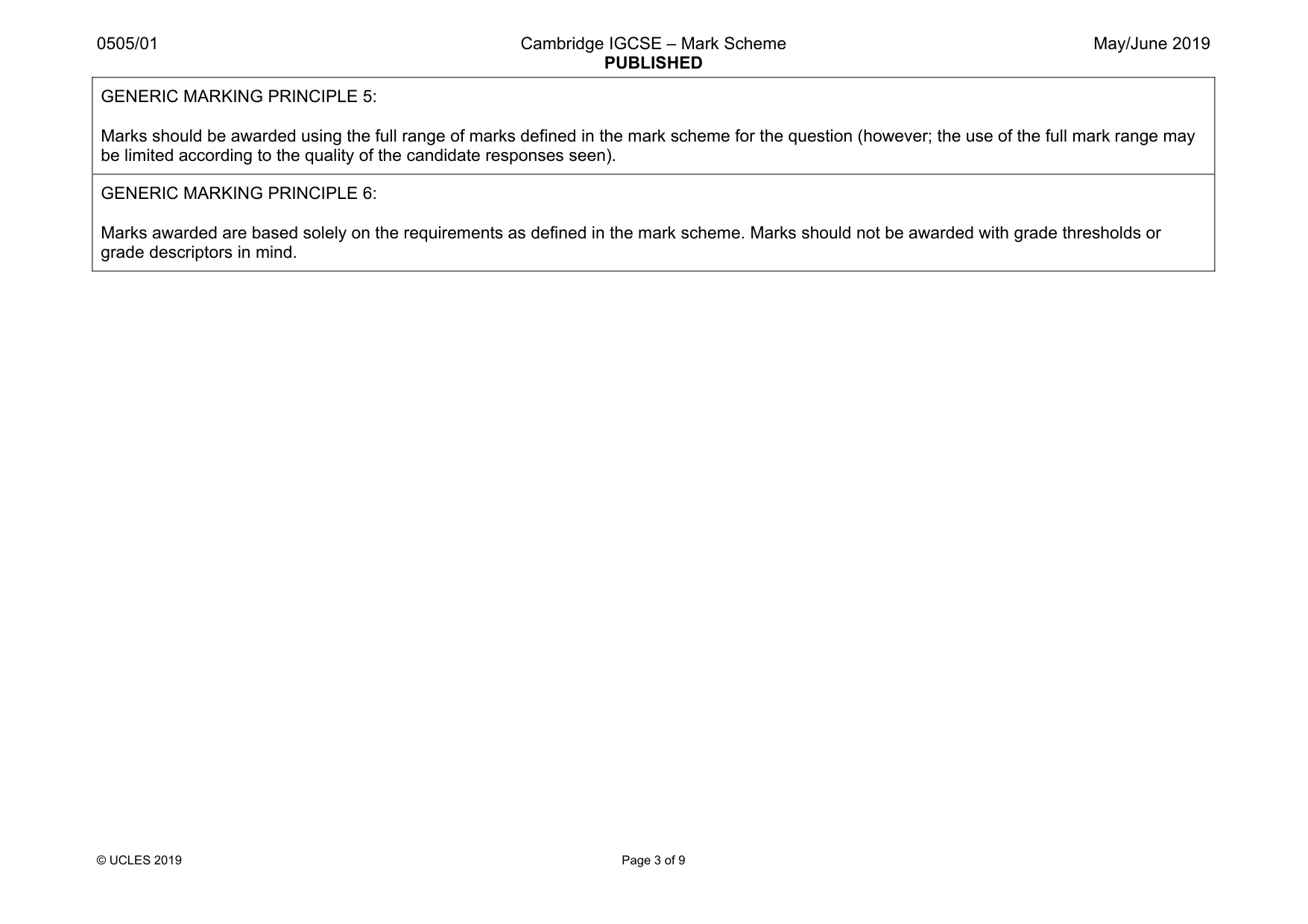
0505/01 Cambridge IGCSE – Mark Scheme PUBLISHED May/June 2019 © UCLES 2019 Page 3 of 9 GENERIC MARKING PRINCIPLE 5: Marks should be awarded using the full range of marks defined in the mark scheme for the question (however; the use of the full mark range may be limited according to the quality of the candidate responses seen). GENERIC MARKING PRINCIPLE 6: Marks awarded are based solely on the requirements as defined in the mark scheme. Marks should not be awarded with grade thresholds or grade descriptors in mind.
Mark scheme, page 4
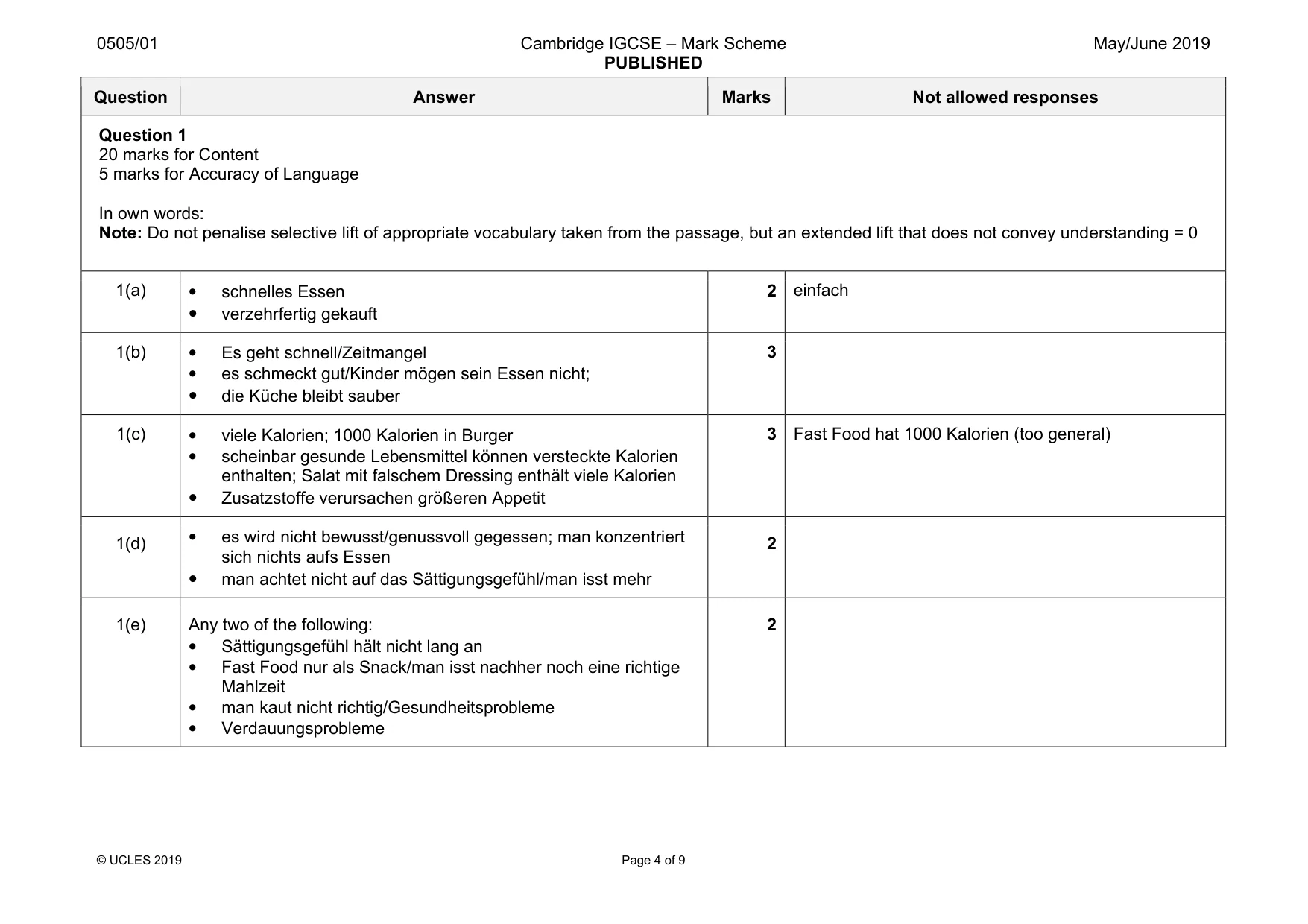
0505/01 Cambridge IGCSE – Mark Scheme PUBLISHED May/June 2019 © UCLES 2019 Page 4 of 9 Question Answer Marks Not allowed responses Question 1 20 marks for Content 5 marks for Accuracy of Language In own words: Note: Do not penalise selective lift of appropriate vocabulary taken from the passage, but an extended lift that does not convey understanding = 0 1(a) • schnelles Essen • verzehrfertig gekauft 2 einfach 1(b) • Es geht schnell/Zeitmangel • es schmeckt gut/Kinder mögen sein Essen nicht; • die Küche bleibt sauber 3 1(c) • viele Kalorien; 1000 Kalorien in Burger • scheinbar gesunde Lebensmittel können versteckte Kalorien enthalten; Salat mit falschem Dressing enthält viele Kalorien • Zusatzstoffe verursachen größeren Appetit 3 Fast Food hat 1000 Kalorien (too general) 1(d) • es wird nicht bewusst/genussvoll gegessen; man konzentriert sich nichts aufs Essen • man achtet nicht auf das Sättigungsgefühl/man isst mehr 2 1(e) Any two of the following: • Sättigungsgefühl hält nicht lang an • Fast Food nur als Snack/man isst nachher noch eine richtige Mahlzeit • man kaut nicht richtig/Gesundheitsprobleme • Verdauungsprobleme 2
Mark scheme, page 5
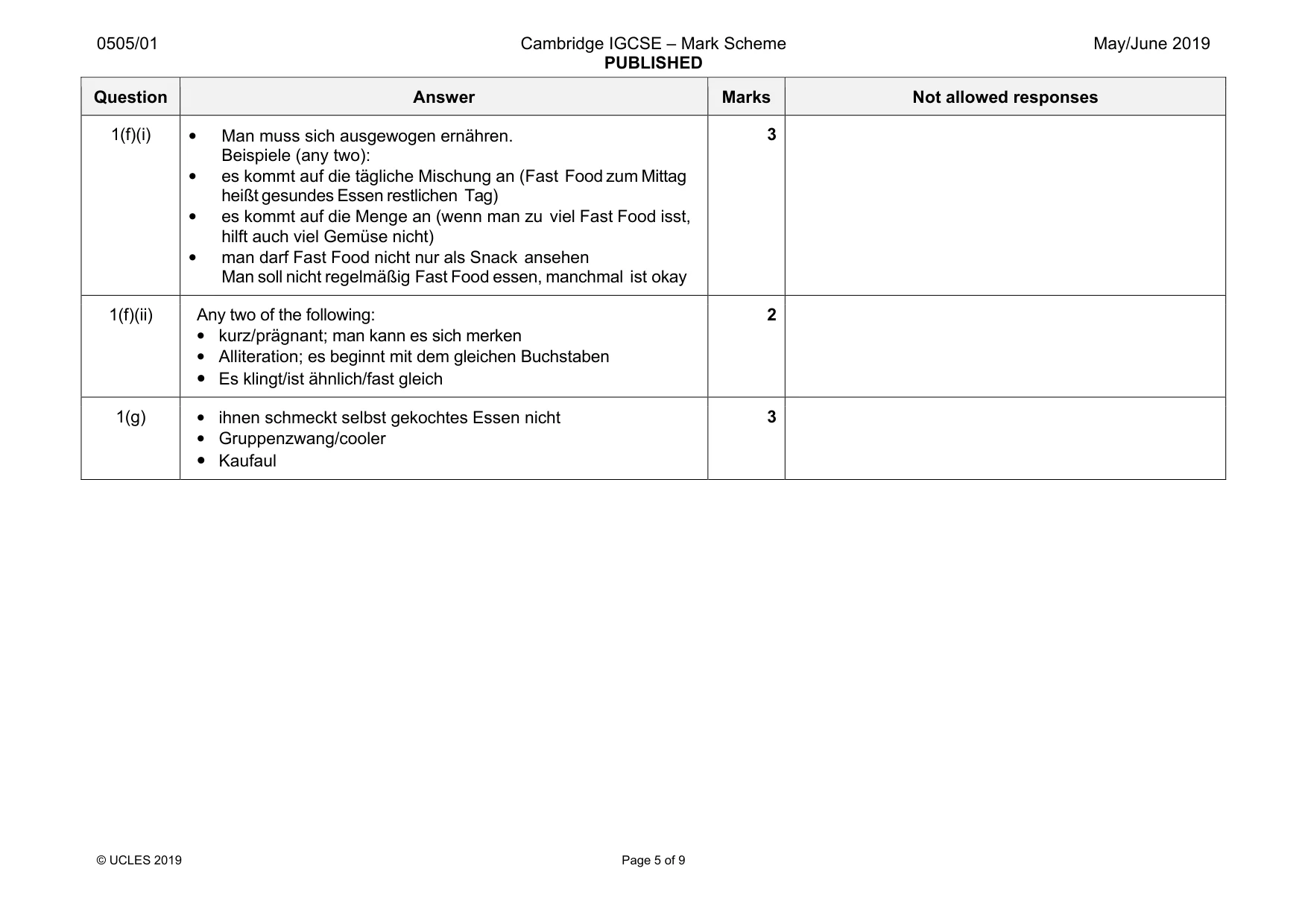
0505/01 Cambridge IGCSE – Mark Scheme PUBLISHED May/June 2019 © UCLES 2019 Page 5 of 9 Question Answer Marks Not allowed responses 1(f)(i) • Man muss sich ausgewogen ernähren. Beispiele (any two): • es kommt auf die tägliche Mischung an (Fast Food zum Mittag heißt gesundes Essen restlichen Tag) • es kommt auf die Menge an (wenn man zu viel Fast Food isst, hilft auch viel Gemüse nicht) • man darf Fast Food nicht nur als Snack ansehen Man soll nicht regelmäßig Fast Food essen, manchmal ist okay 3 1(f)(ii) Any two of the following: • kurz/prägnant; man kann es sich merken • Alliteration; es beginnt mit dem gleichen Buchstaben • Es klingt/ist ähnlich/fast gleich 2 1(g) • ihnen schmeckt selbst gekochtes Essen nicht • Gruppenzwang/cooler • Kaufaul 3
Mark scheme, page 6
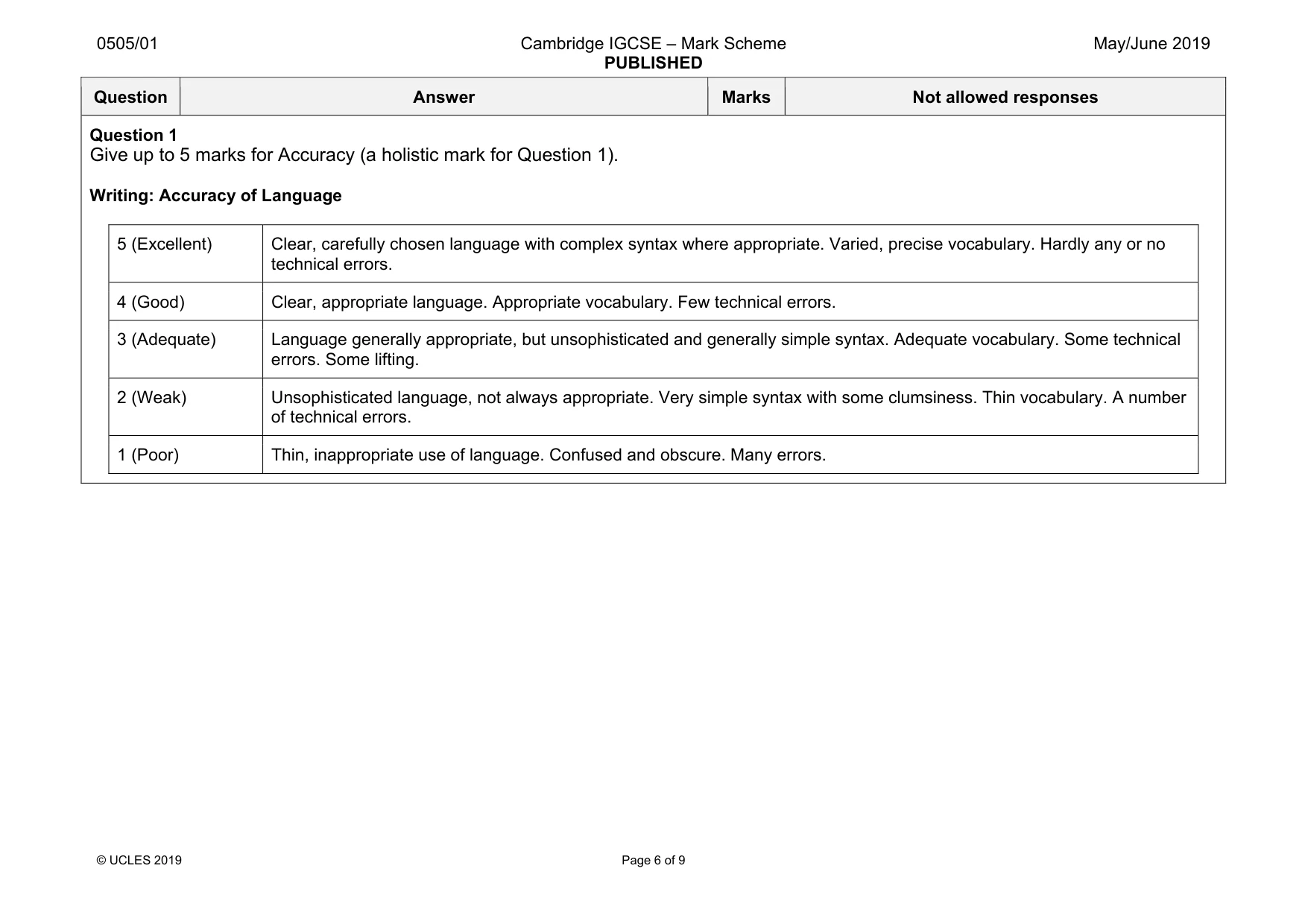
0505/01 Cambridge IGCSE – Mark Scheme PUBLISHED May/June 2019 © UCLES 2019 Page 6 of 9 Question Answer Marks Not allowed responses Question 1 Give up to 5 marks for Accuracy (a holistic mark for Question 1). Writing: Accuracy of Language 5 (Excellent) Clear, carefully chosen language with complex syntax where appropriate. Varied, precise vocabulary. Hardly any or no technical errors. 4 (Good) Clear, appropriate language. Appropriate vocabulary. Few technical errors. 3 (Adequate) Language generally appropriate, but unsophisticated and generally simple syntax. Adequate vocabulary. Some technical errors. Some lifting. 2 (Weak) Unsophisticated language, not always appropriate. Very simple syntax with some clumsiness. Thin vocabulary. A number of technical errors. 1 (Poor) Thin, inappropriate use of language. Confused and obscure. Many errors.
Mark scheme, page 7
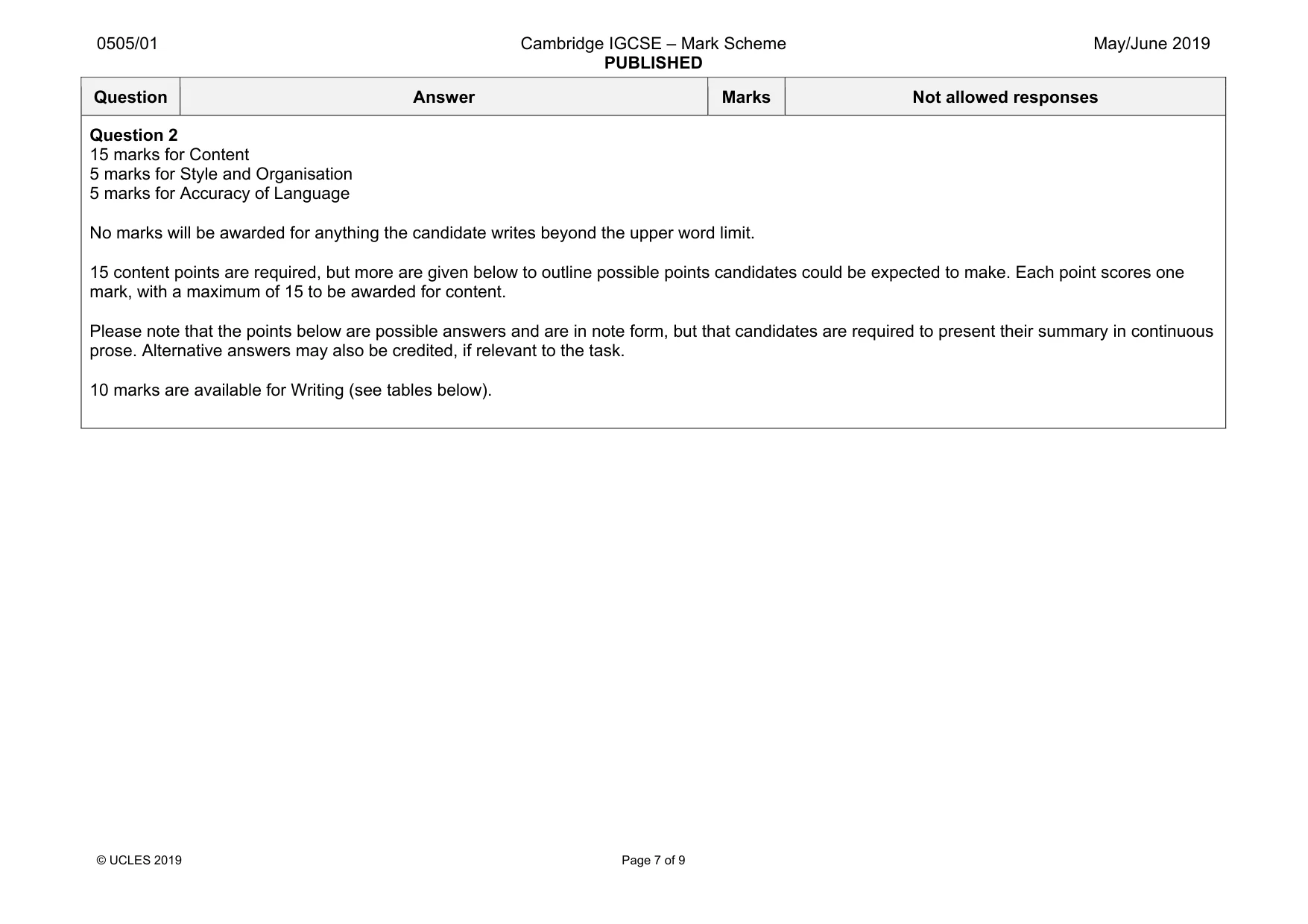
0505/01 Cambridge IGCSE – Mark Scheme PUBLISHED May/June 2019 © UCLES 2019 Page 7 of 9 Question Answer Marks Not allowed responses Question 2 15 marks for Content 5 marks for Style and Organisation 5 marks for Accuracy of Language No marks will be awarded for anything the candidate writes beyond the upper word limit. 15 content points are required, but more are given below to outline possible points candidates could be expected to make. Each point scores one mark, with a maximum of 15 to be awarded for content. Please note that the points below are possible answers and are in note form, but that candidates are required to present their summary in continuous prose. Alternative answers may also be credited, if relevant to the task. 10 marks are available for Writing (see tables below).
Mark scheme, page 8
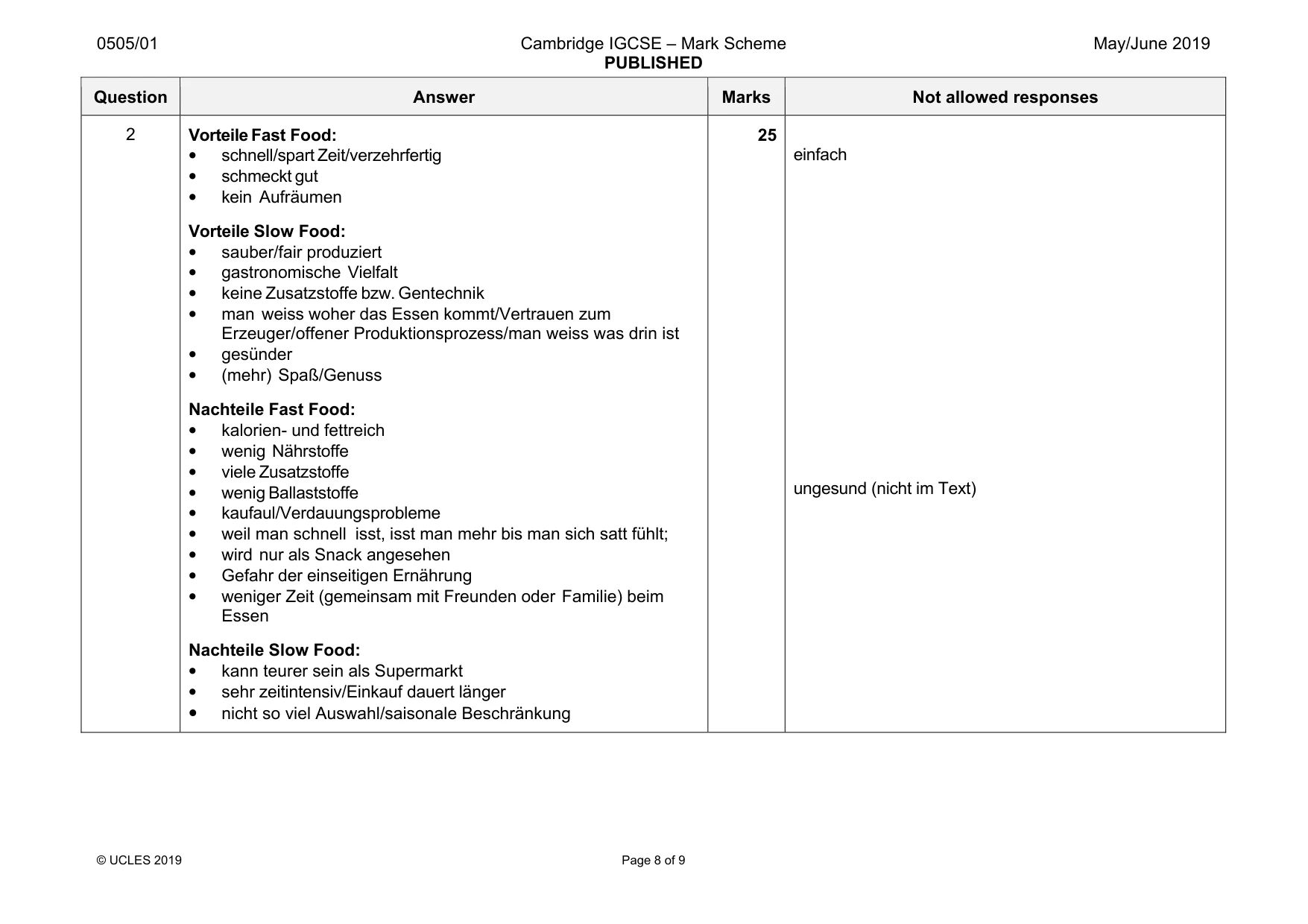
0505/01 Cambridge IGCSE – Mark Scheme PUBLISHED May/June 2019 © UCLES 2019 Page 8 of 9 Question Answer Marks Not allowed responses 2 Vorteile Fast Food: • schnell/spart Zeit/verzehrfertig • schmeckt gut • kein Aufräumen Vorteile Slow Food: • sauber/fair produziert • gastronomische Vielfalt • keine Zusatzstoffe bzw. Gentechnik • man weiss woher das Essen kommt/Vertrauen zum Erzeuger/offener Produktionsprozess/man weiss was drin ist • gesünder • (mehr) Spaß/Genuss Nachteile Fast Food: • kalorien- und fettreich • wenig Nährstoffe • viele Zusatzstoffe • wenig Ballaststoffe • kaufaul/Verdauungsprobleme • weil man schnell isst, isst man mehr bis man sich satt fühlt; • wird nur als Snack angesehen • Gefahr der einseitigen Ernährung • weniger Zeit (gemeinsam mit Freunden oder Familie) beim Essen Nachteile Slow Food: • kann teurer sein als Supermarkt • sehr zeitintensiv/Einkauf dauert länger • nicht so viel Auswahl/saisonale Beschränkung 25 einfach ungesund (nicht im Text)
Mark scheme, page 9
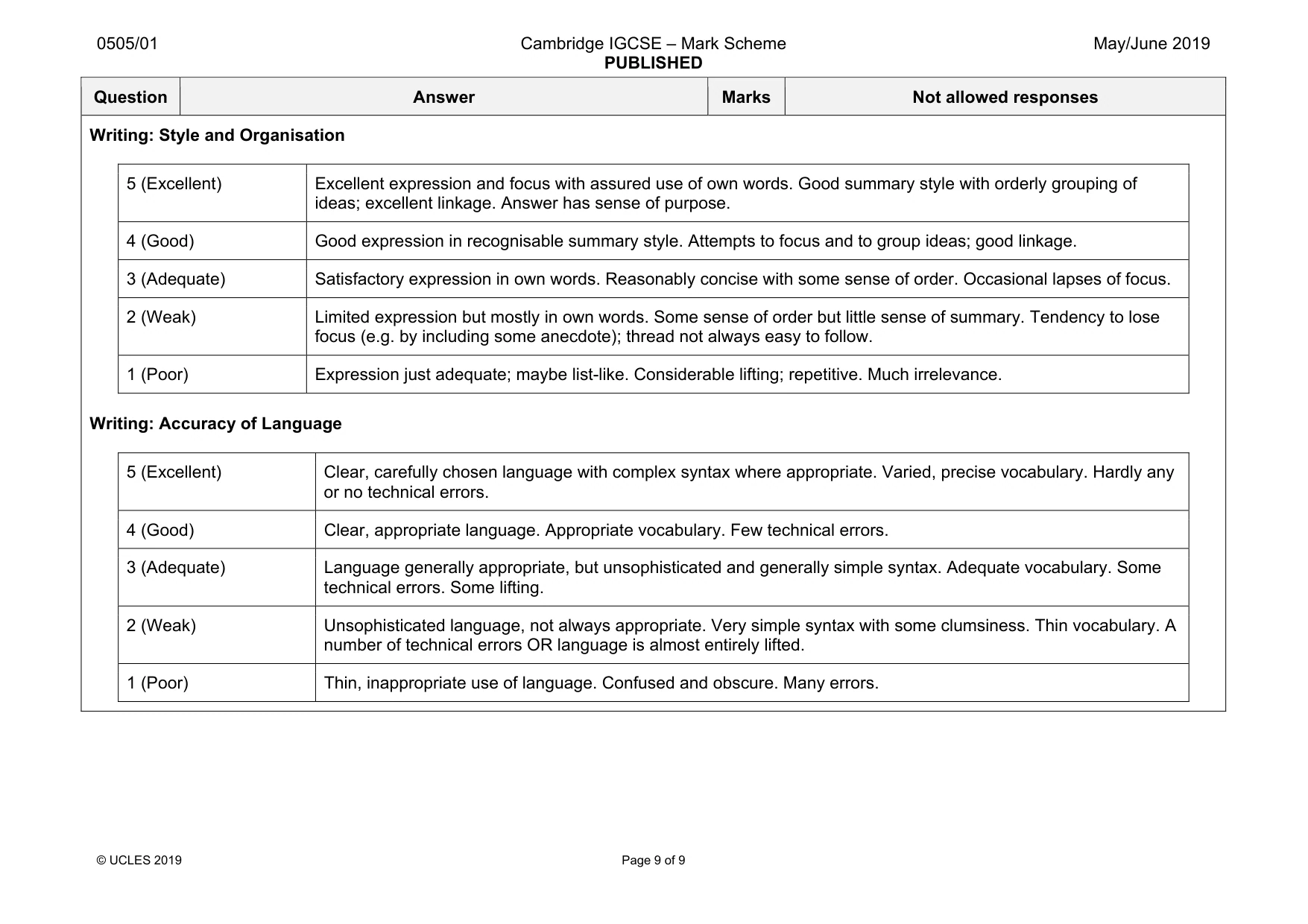
0505/01 Cambridge IGCSE – Mark Scheme PUBLISHED May/June 2019 © UCLES 2019 Page 9 of 9 Question Answer Marks Not allowed responses Writing: Style and Organisation 5 (Excellent) Excellent expression and focus with assured use of own words. Good summary style with orderly grouping of ideas; excellent linkage. Answer has sense of purpose. 4 (Good) Good expression in recognisable summary style. Attempts to focus and to group ideas; good linkage. 3 (Adequate) Satisfactory expression in own words. Reasonably concise with some sense of order. Occasional lapses of focus. 2 (Weak) Limited expression but mostly in own words. Some sense of order but little sense of summary. Tendency to lose focus (e.g. by including some anecdote); thread not always easy to follow. 1 (Poor) Expression just adequate; maybe list-like. Considerable lifting; repetitive. Much irrelevance. Writing: Accuracy of Language 5 (Excellent) Clear, carefully chosen language with complex syntax where appropriate. Varied, precise vocabulary. Hardly any or no technical errors. 4 (Good) Clear, appropriate language. Appropriate vocabulary. Few technical errors. 3 (Adequate) Language generally appropriate, but unsophisticated and generally simple syntax. Adequate vocabulary. Some technical errors. Some lifting. 2 (Weak) Unsophisticated language, not always appropriate. Very simple syntax with some clumsiness. Thin vocabulary. A number of technical errors OR language is almost entirely lifted. 1 (Poor) Thin, inappropriate use of language. Confused and obscure. Many errors.
What you needed in this session
Cambridge’s own grade thresholds for 2019 May/June, Paper 1 · Variant 1. A higher threshold means an easier paper — the bar moves with how the cohort did.