Cambridge IGCSE Geography (9-1) 0976 — 2024 May/June Paper 1 · Variant 2
0976/12/M/J/24 · 75 marks · ≈84 min
The question paper and its mark scheme, free to read here and free to download. This is Cambridge’s own paper, exactly as it was sat.
Question paper24 pages


Mark scheme26 pages
Answers below. Sit the paper first if you are practising.
Paper as text
Question paper, page 1
This document has 24 pages. [Turn over Cambridge IGCSE™(9–1) GEOGRAPHY 0976/12 Paper 1 Geographical Themes May/June 2024 1 hour 45 minutes You must answer on the question paper. You will need: Insert (enclosed) Ruler Calculator Protractor INSTRUCTIONS ● Answer three questions in total, one from each section. ● Use a black or dark blue pen. You may use an HB pencil for any diagrams or graphs. ● Write your name, centre number and candidate number in the boxes at the top of the page. ● Write your answer to each question in the space provided. ● Do not use an erasable pen or correction fluid. ● Do not write on any bar codes. ● If additional space is needed, you should use the lined pages at the end of this booklet; the question number or numbers must be clearly shown. INFORMATION ● The total mark for this paper is 75. ● The number of marks for each question or part question is shown in brackets [ ]. ● The insert contains additional resources referred to in the questions. Definitions MEDCs – More Economically Developed Countries LEDCs – Less Economically Developed Countries * 0 6 2 5 7 5 6 8 0 0 * DC (SL) 342032/1 © UCLES 2024
Question paper, page 2
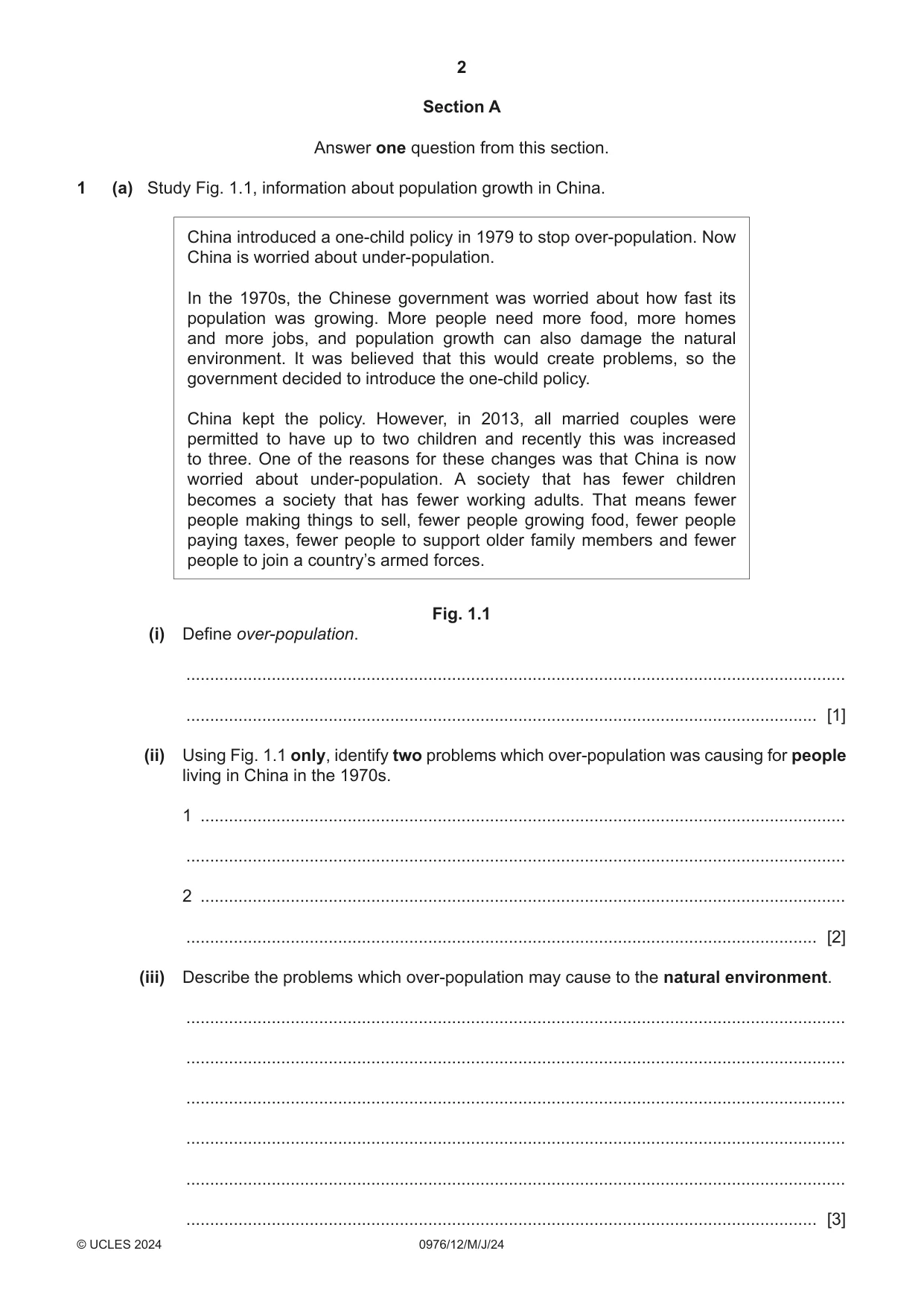
2 0976/12/M/J/24 © UCLES 2024 Section A Answer one question from this section. 1 (a) Study Fig. 1.1, information about population growth in China. China introduced a one-child policy in 1979 to stop over-population. Now China is worried about under-population. In the 1970s, the Chinese government was worried about how fast its population was growing. More people need more food, more homes and more jobs, and population growth can also damage the natural environment. It was believed that this would create problems, so the government decided to introduce the one-child policy. China kept the policy. However, in 2013, all married couples were permitted to have up to two children and recently this was increased to three. One of the reasons for these changes was that China is now worried about under-population. A society that has fewer children becomes a society that has fewer working adults. That means fewer people making things to sell, fewer people growing food, fewer people paying taxes, fewer people to support older family members and fewer people to join a country’s armed forces. Fig. 1.1 (i) Define over-population. … … [1] (ii) Using Fig. 1.1 only, identify two problems which over-population was causing for people living in China in the 1970s. 1 … … 2 … … [2] (iii) Describe the problems which over-population may cause to the natural environment. … … … … … … [3]
Question paper, page 3
3 0976/12/M/J/24 © UCLES 2024 [Turn over (iv) Suggest why the government of China was concerned about the following impacts of under-population: fewer people were paying taxes … … fewer people were available to join the armed forces … … fewer people were growing food … … fewer people were making things to sell. … … [4]
Question paper, page 4
4 0976/12/M/J/24 © UCLES 2024 (b) Study Fig. 1.2 (Insert), a map showing when deaths are expected to be higher than births in different countries. (i) Describe the distribution of countries where deaths were higher than births before 2024. … … … … … … [3] (ii) Explain how birth rates are being reduced in many LEDCs. … … … … … … … … … … [5]
Question paper, page 5
5 0976/12/M/J/24 © UCLES 2024 [Turn over (c) For a country you have studied, explain why it attracts many international migrants. Name of country … … … … … … … … … … … … … … … … … … … … … … … … … [7] [Total: 25]
Question paper, page 6
6 0976/12/M/J/24 © UCLES 2024 2 (a) Study Fig. 2.1 (Insert), a graph showing information about the number of people living in urban areas between 1950 and 2050 (estimated). (i) What was the total urban population in 2000? … billion [1] (ii) Compare the urban population living in North America in 1950 with 2050 (estimated). Use statistics to support your answer. … … … … [2] (iii) Put the following continents in rank order according to their urban population in 1950, 2000 and 2050 (estimated). Africa Asia Europe 1950 first … highest second … third … lowest 2000 first … highest second … third … lowest 2050 (estimated) first … highest second … third … lowest [3]
Question paper, page 7
7 0976/12/M/J/24 © UCLES 2024 [Turn over (iv) Describe four different problems faced by people living in large urban areas in LEDCs. 1 … … 2 … … 3 … … 4 … … [4] (b) Study Fig. 2.2 (Insert), a photograph taken in Mumbai, an urban area in India (an LEDC in Asia). (i) Describe three characteristics of the housing shown by X in Fig. 2.2. 1 … … 2 … … 3 … … [3] (ii) Explain why urban areas are attractive to migrants from rural areas in LEDCs. … … … … … … … … … … [5]
Question paper, page 8
8 0976/12/M/J/24 © UCLES 2024 (c) For an area you have studied, describe and explain the service provision. Name of area … … … … … … … … … … … … … … … … … … … … … … … … … [7] [Total: 25]
Question paper, page 9
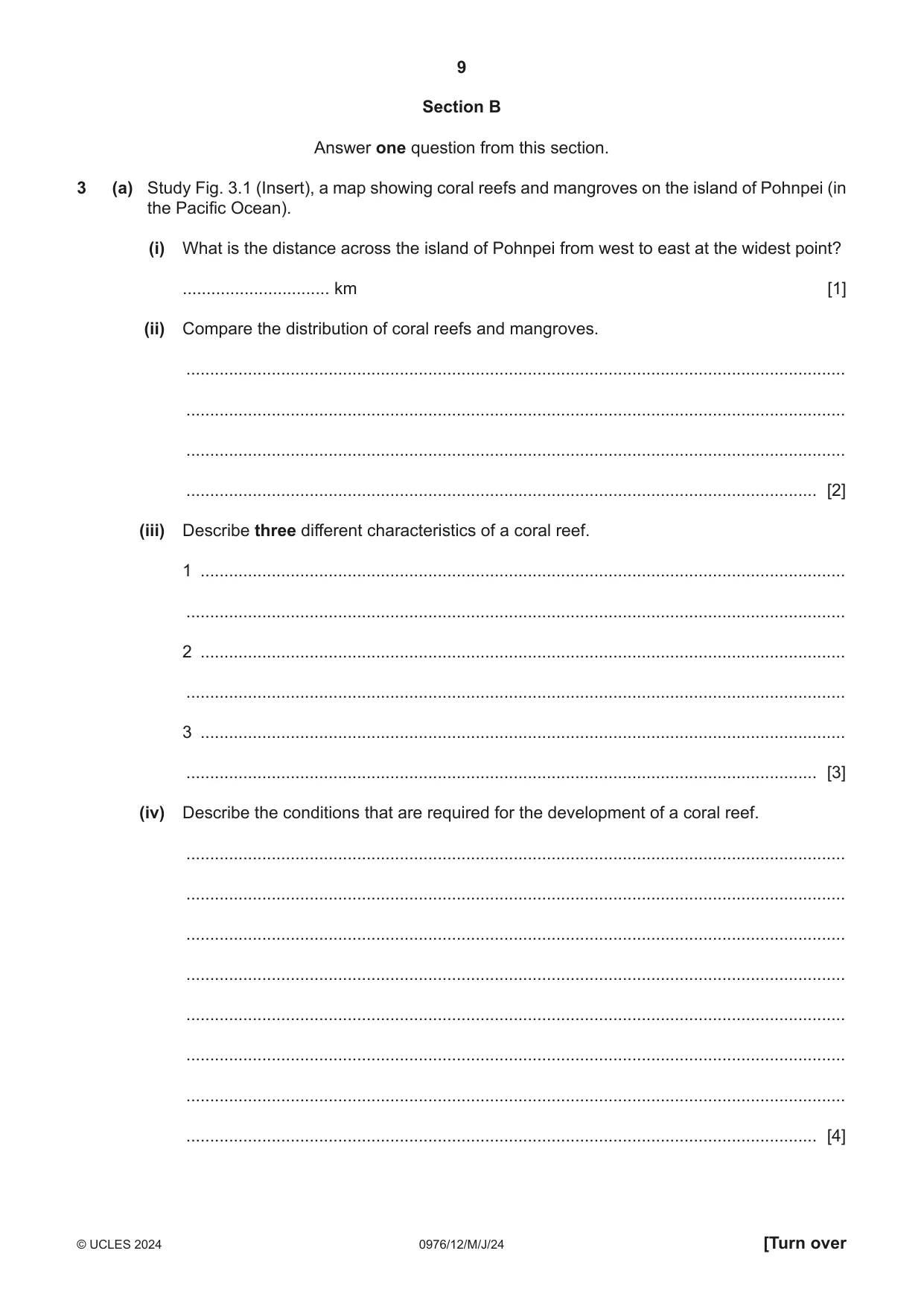
9 0976/12/M/J/24 © UCLES 2024 [Turn over Section B Answer one question from this section. 3 (a) Study Fig. 3.1 (Insert), a map showing coral reefs and mangroves on the island of Pohnpei (in the Pacific Ocean). (i) What is the distance across the island of Pohnpei from west to east at the widest point? … km [1] (ii) Compare the distribution of coral reefs and mangroves. … … … … [2] (iii) Describe three different characteristics of a coral reef. 1 … … 2 … … 3 … … [3] (iv) Describe the conditions that are required for the development of a coral reef. … … … … … … … … [4]
Question paper, page 10
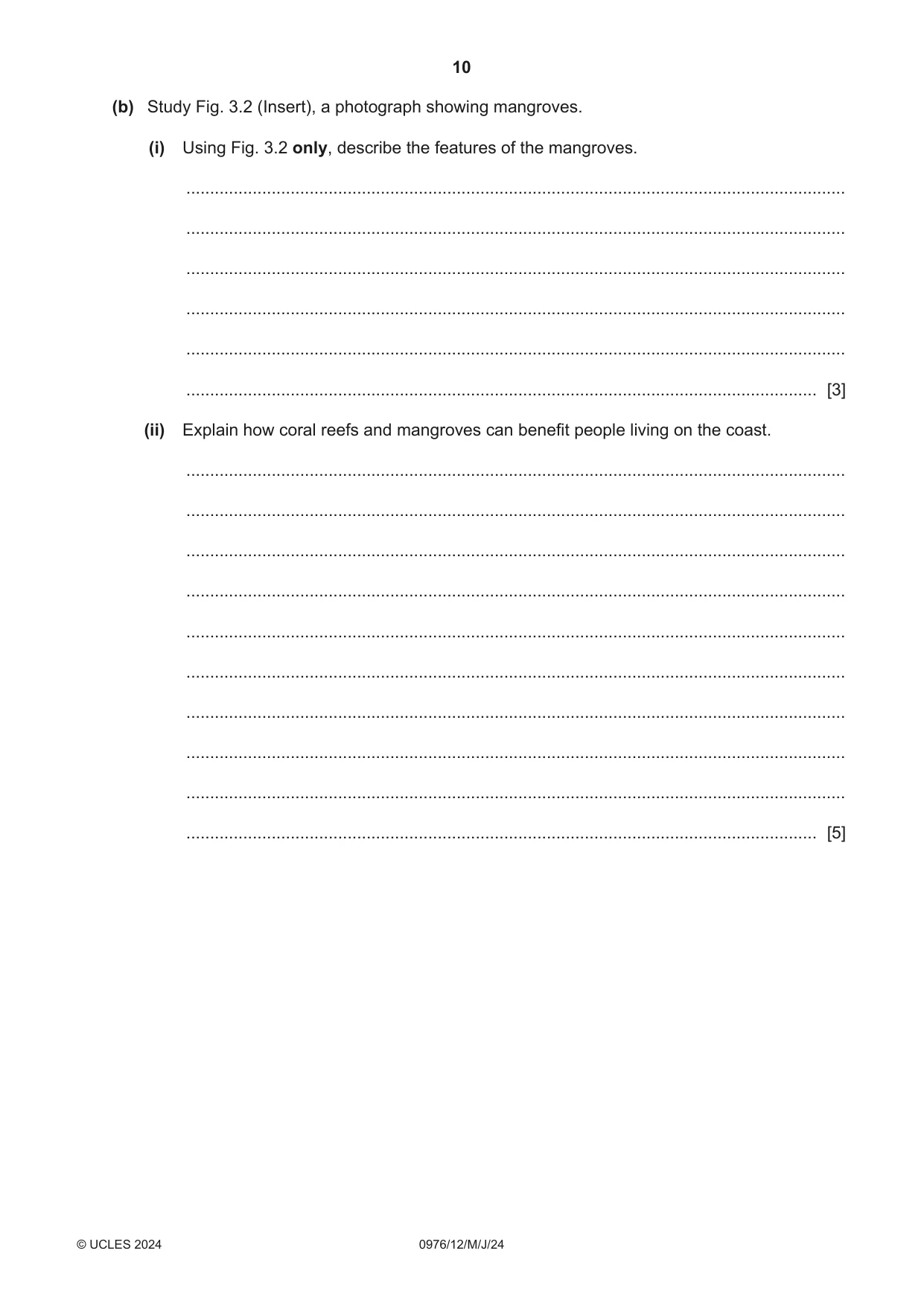
10 0976/12/M/J/24 © UCLES 2024 (b) Study Fig. 3.2 (Insert), a photograph showing mangroves. (i) Using Fig. 3.2 only, describe the features of the mangroves. … … … … … … [3] (ii) Explain how coral reefs and mangroves can benefit people living on the coast. … … … … … … … … … … [5]
Question paper, page 11
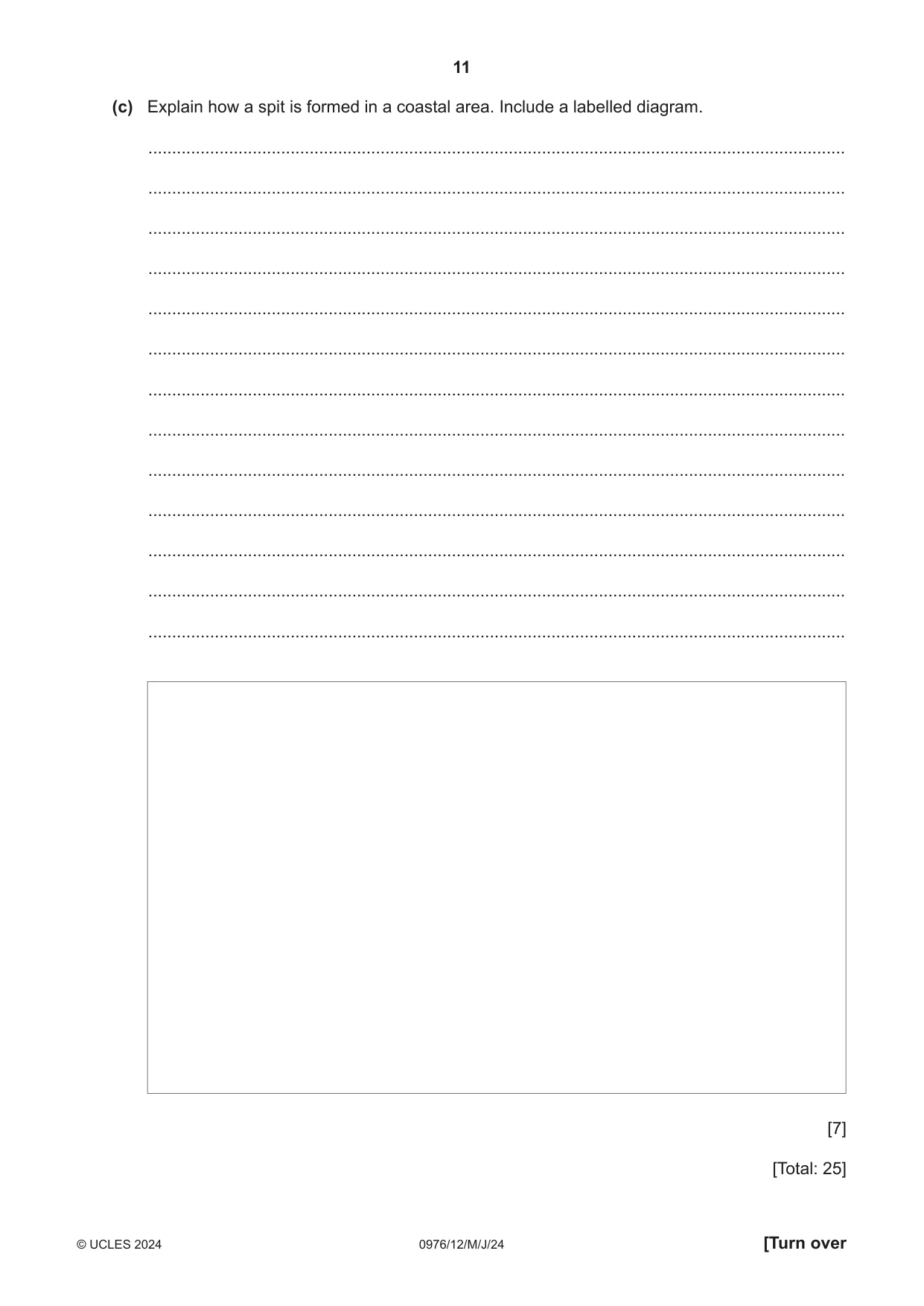
11 0976/12/M/J/24 © UCLES 2024 [Turn over (c) Explain how a spit is formed in a coastal area. Include a labelled diagram. … … … … … … … … … … … … … [7] [Total: 25]
Question paper, page 12
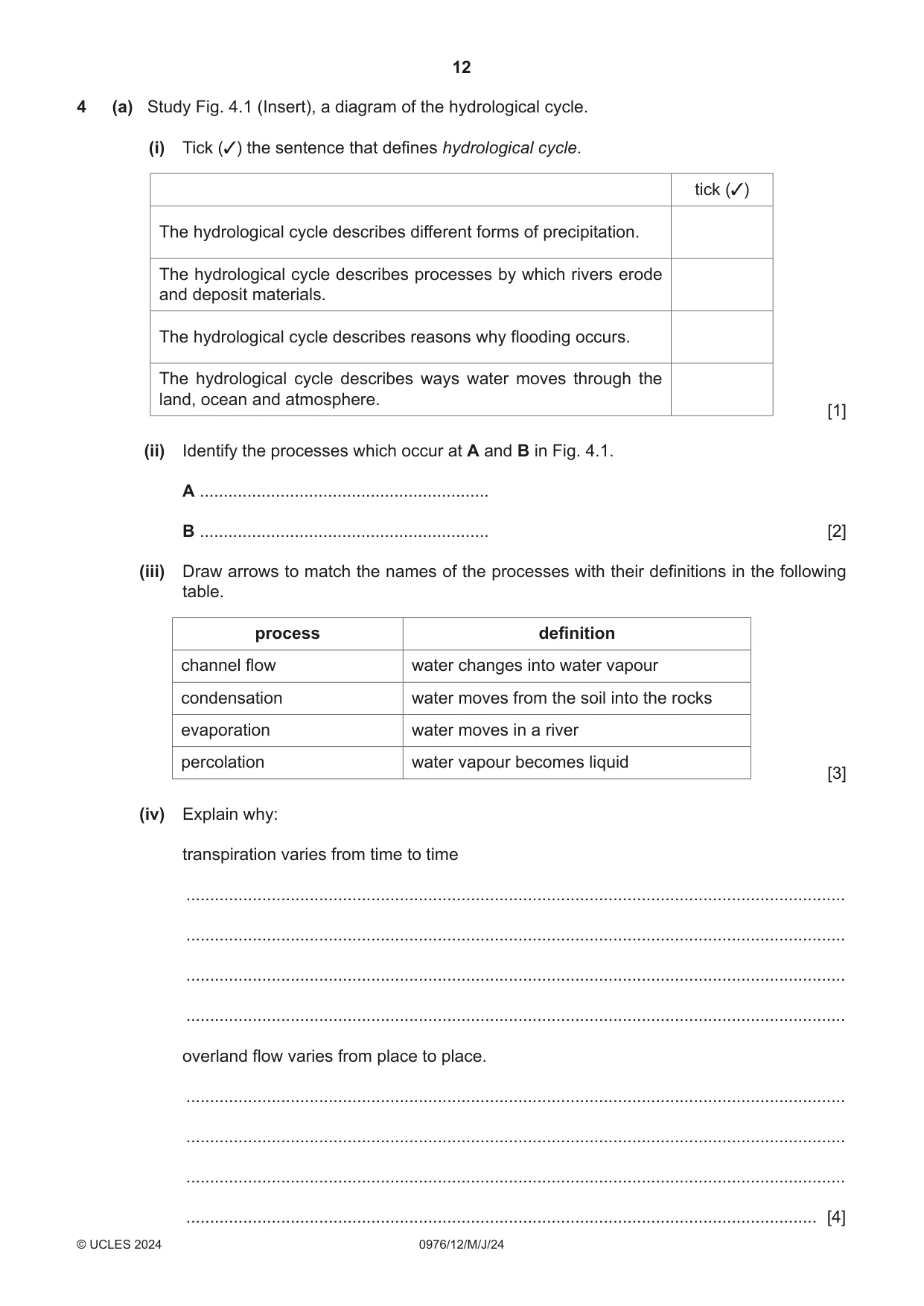
12 0976/12/M/J/24 © UCLES 2024 4 (a) Study Fig. 4.1 (Insert), a diagram of the hydrological cycle. (i) Tick (3) the sentence that defines hydrological cycle. tick (3) The hydrological cycle describes different forms of precipitation. The hydrological cycle describes processes by which rivers erode and deposit materials. The hydrological cycle describes reasons why flooding occurs. The hydrological cycle describes ways water moves through the land, ocean and atmosphere. [1] (ii) Identify the processes which occur at A and B in Fig. 4.1. A … B … [2] (iii) Draw arrows to match the names of the processes with their definitions in the following table. process definition channel flow water changes into water vapour condensation water moves from the soil into the rocks evaporation water moves in a river percolation water vapour becomes liquid [3] (iv) Explain why: transpiration varies from time to time … … … … overland flow varies from place to place. … … … … [4]
Question paper, page 13
13 0976/12/M/J/24 © UCLES 2024 [Turn over (b) Study Figs. 4.2 and 4.3 (Insert), photographs of different rivers in Scotland, in the UK. (i) Describe three differences between the natural characteristics of the rivers shown in Figs. 4.2 and 4.3. 1 … … 2 … … 3 … … [3] (ii) Explain how rivers, such as those shown in Figs. 4.2 and 4.3, erode their banks and bed. … … … … … … … … … … [5]
Question paper, page 14
14 0976/12/M/J/24 © UCLES 2024 (c) Explain how a river you have studied has been managed to reduce the risk of flooding. Name of river … … … … … … … … … … … … … … … … … … … … … … … … … [7] [Total: 25]
Question paper, page 15
15 0976/12/M/J/24 © UCLES 2024 [Turn over Section C Answer one question from this section. 5 (a) Study Figs. 5.1 and 5.2 (Insert), maps of South Africa, in southern Africa. Fig. 5.1 shows the main agricultural land uses. Fig. 5.2 shows the annual rainfall. (i) What agricultural land use occupies the largest area in South Africa? … [1] (ii) Using Fig. 5.1 only, identify two crops grown within 100 km of Pretoria. 1 … 2 … [2] (iii) Using Figs. 5.1 and 5.2 only, explain how the amount of rainfall influences agricultural land use. … … … … … … [3] (iv) Some parts of South Africa experience tropical storms. Describe the problems this may create for farmers. … … … … … … … … [4]
Question paper, page 16
16 0976/12/M/J/24 © UCLES 2024 (b) Study Figs. 5.3 and 5.4 (Insert), photographs of two different types of farm. (i) State three differences between the farms shown in Figs. 5.3 and 5.4. 1 … … 2 … … 3 … … [3] (ii) Explain how agricultural output can be increased. … … … … … … … … … … [5]
Question paper, page 17
17 0976/12/M/J/24 © UCLES 2024 [Turn over (c) For a farm or agricultural system which you have studied, describe the inputs, processes and outputs. You may draw a systems diagram. Name of farm or agricultural system … … … … … … … … … … … … … [7] [Total: 25]
Question paper, page 18
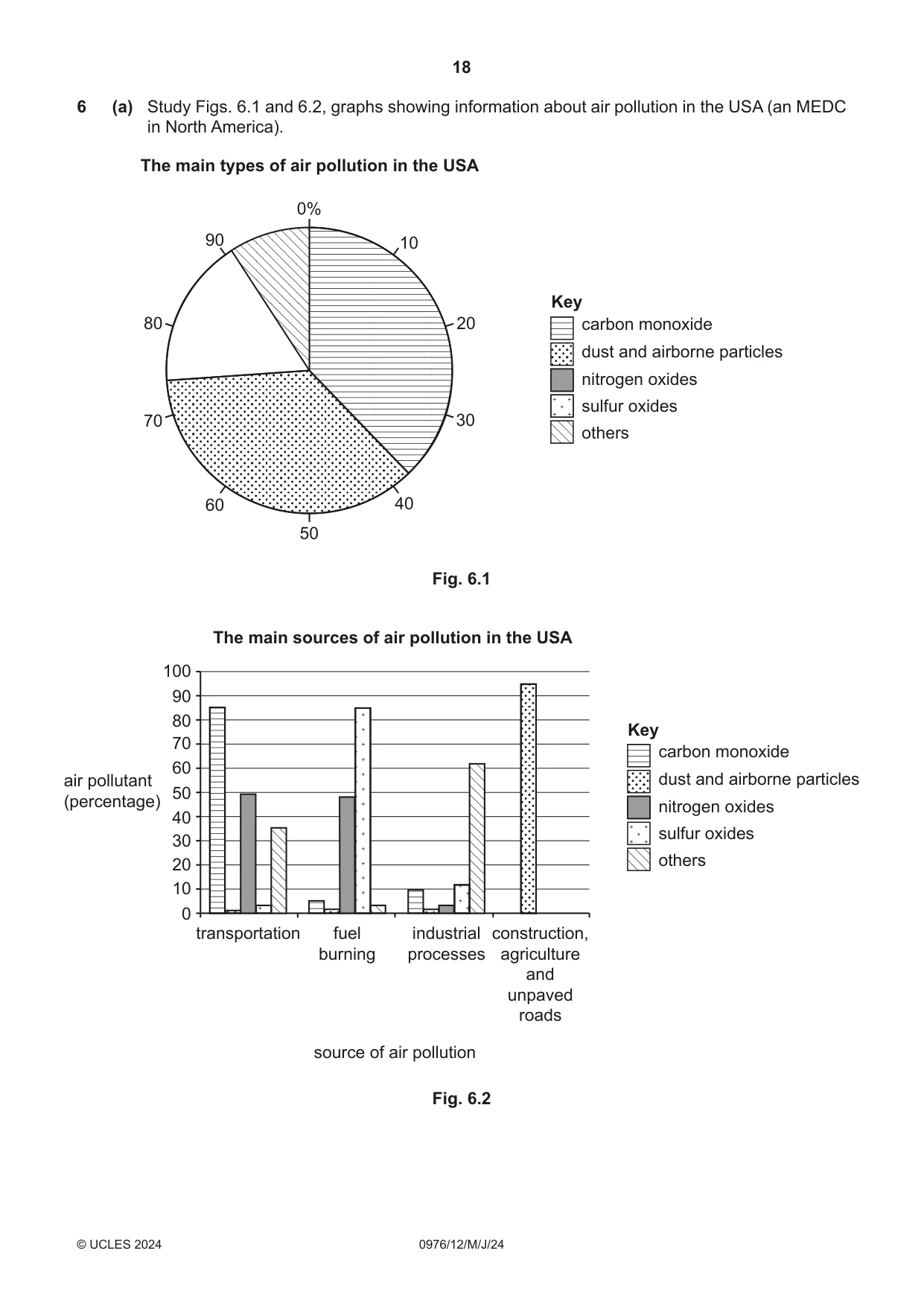
18 0976/12/M/J/24 © UCLES 2024 6 (a) Study Figs. 6.1 and 6.2, graphs showing information about air pollution in the USA (an MEDC in North America). Key 0% 10 20 30 40 50 60 70 80 90 The main types of air pollution in the USA others carbon monoxide dust and airborne particles nitrogen oxides sulfur oxides Fig. 6.1 The main sources of air pollution in the USA 100 90 80 70 60 50 40 30 20 10 0 Key others carbon monoxide dust and airborne particles nitrogen oxides sulfur oxides source of air pollution air pollutant (percentage) transportation industrial processes construction, agriculture and unpaved roads fuel burning Fig. 6.2
Question paper, page 19
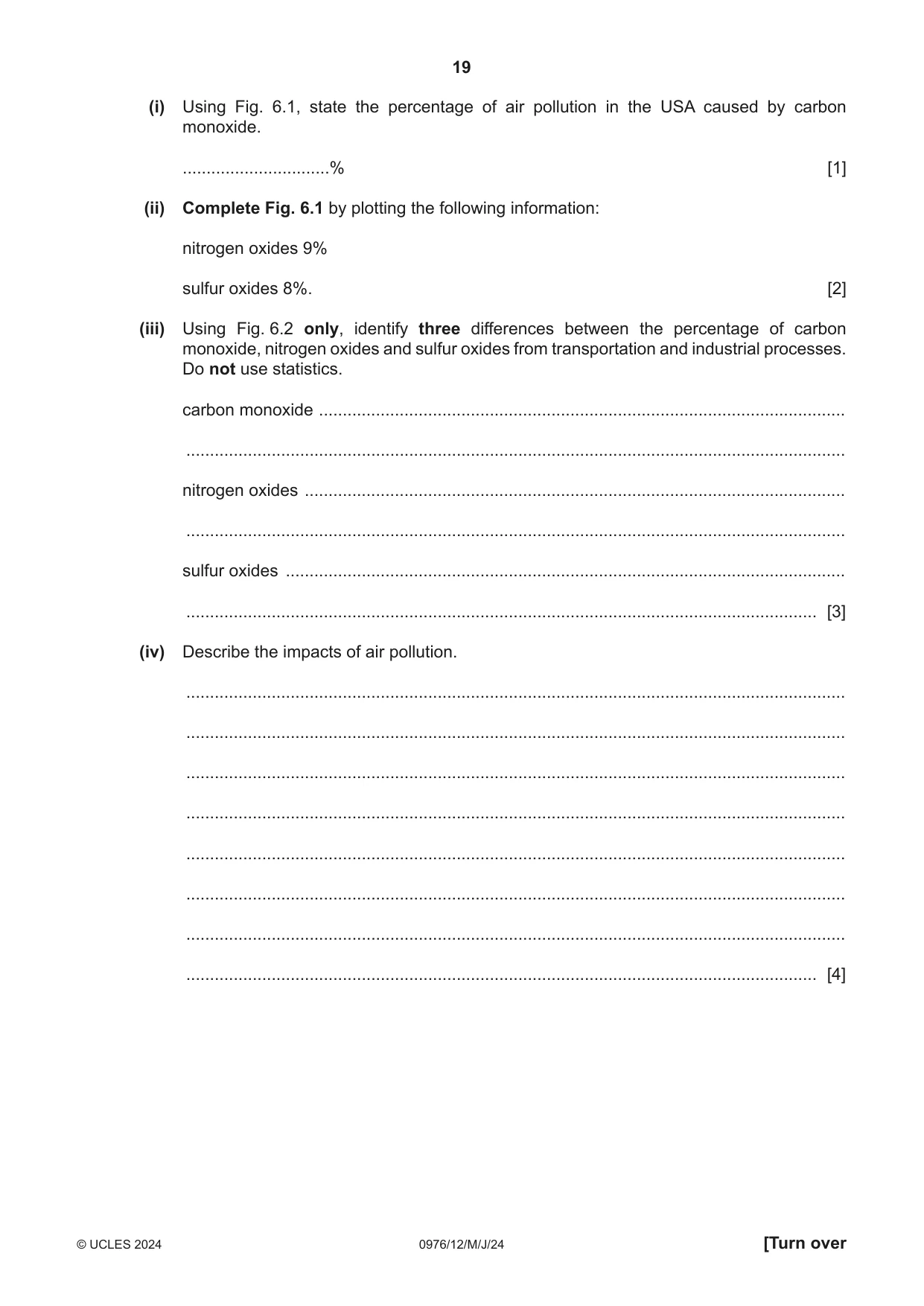
19 0976/12/M/J/24 © UCLES 2024 [Turn over (i) Using Fig. 6.1, state the percentage of air pollution in the USA caused by carbon monoxide. …% [1] (ii) Complete Fig. 6.1 by plotting the following information: nitrogen oxides 9% sulfur oxides 8%. [2] (iii) Using Fig. 6.2 only, identify three differences between the percentage of carbon monoxide, nitrogen oxides and sulfur oxides from transportation and industrial processes. Do not use statistics. carbon monoxide … … nitrogen oxides … … sulfur oxides … … [3] (iv) Describe the impacts of air pollution. … … … … … … … … [4]
Question paper, page 20
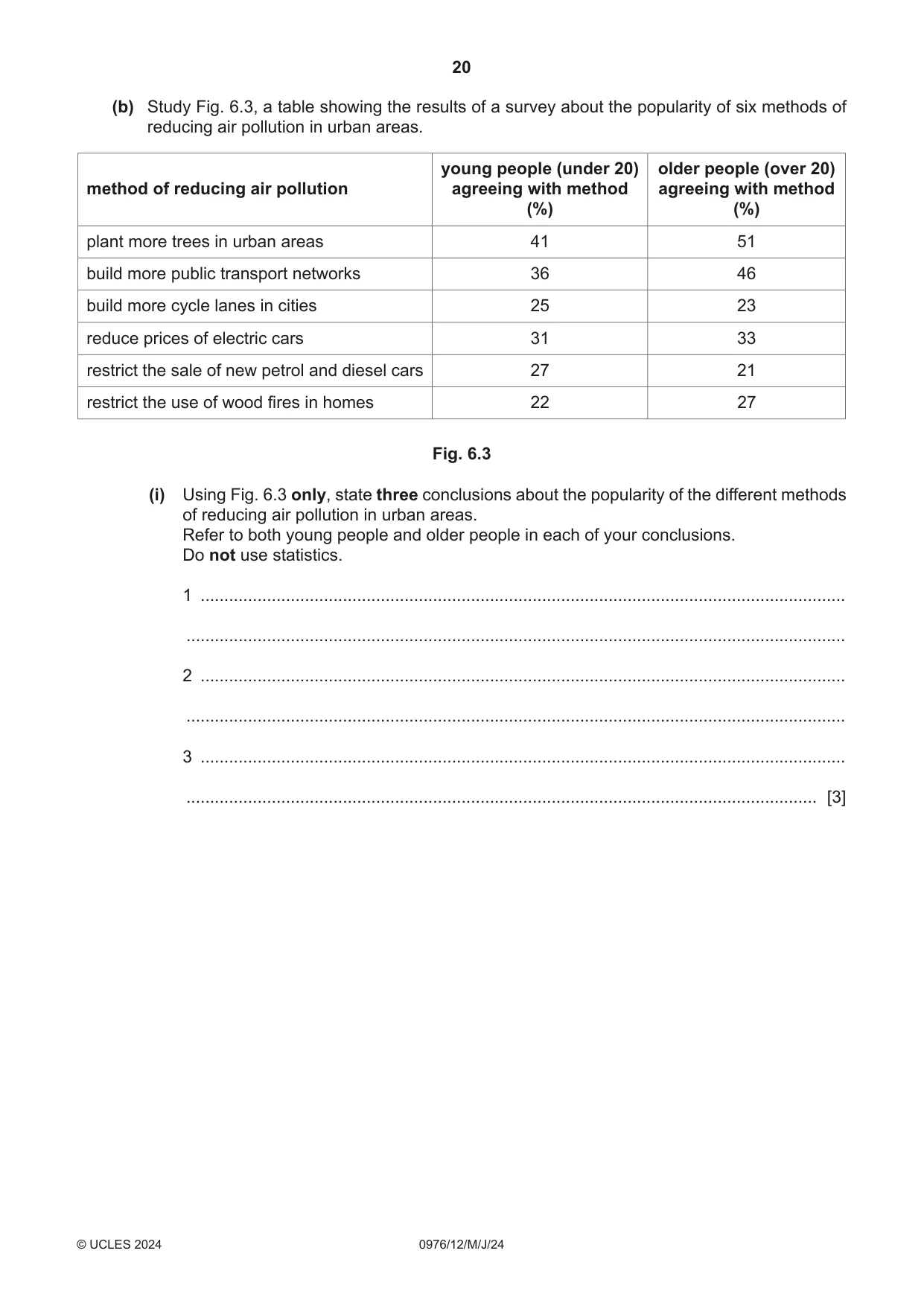
20 0976/12/M/J/24 © UCLES 2024 (b) Study Fig. 6.3, a table showing the results of a survey about the popularity of six methods of reducing air pollution in urban areas. method of reducing air pollution young people (under 20) agreeing with method (%) older people (over 20) agreeing with method (%) plant more trees in urban areas 41 51 build more public transport networks 36 46 build more cycle lanes in cities 25 23 reduce prices of electric cars 31 33 restrict the sale of new petrol and diesel cars 27 21 restrict the use of wood fires in homes 22 27 Fig. 6.3 (i) Using Fig. 6.3 only, state three conclusions about the popularity of the different methods of reducing air pollution in urban areas. Refer to both young people and older people in each of your conclusions. Do not use statistics. 1 … … 2 … … 3 … … [3]
Question paper, page 21
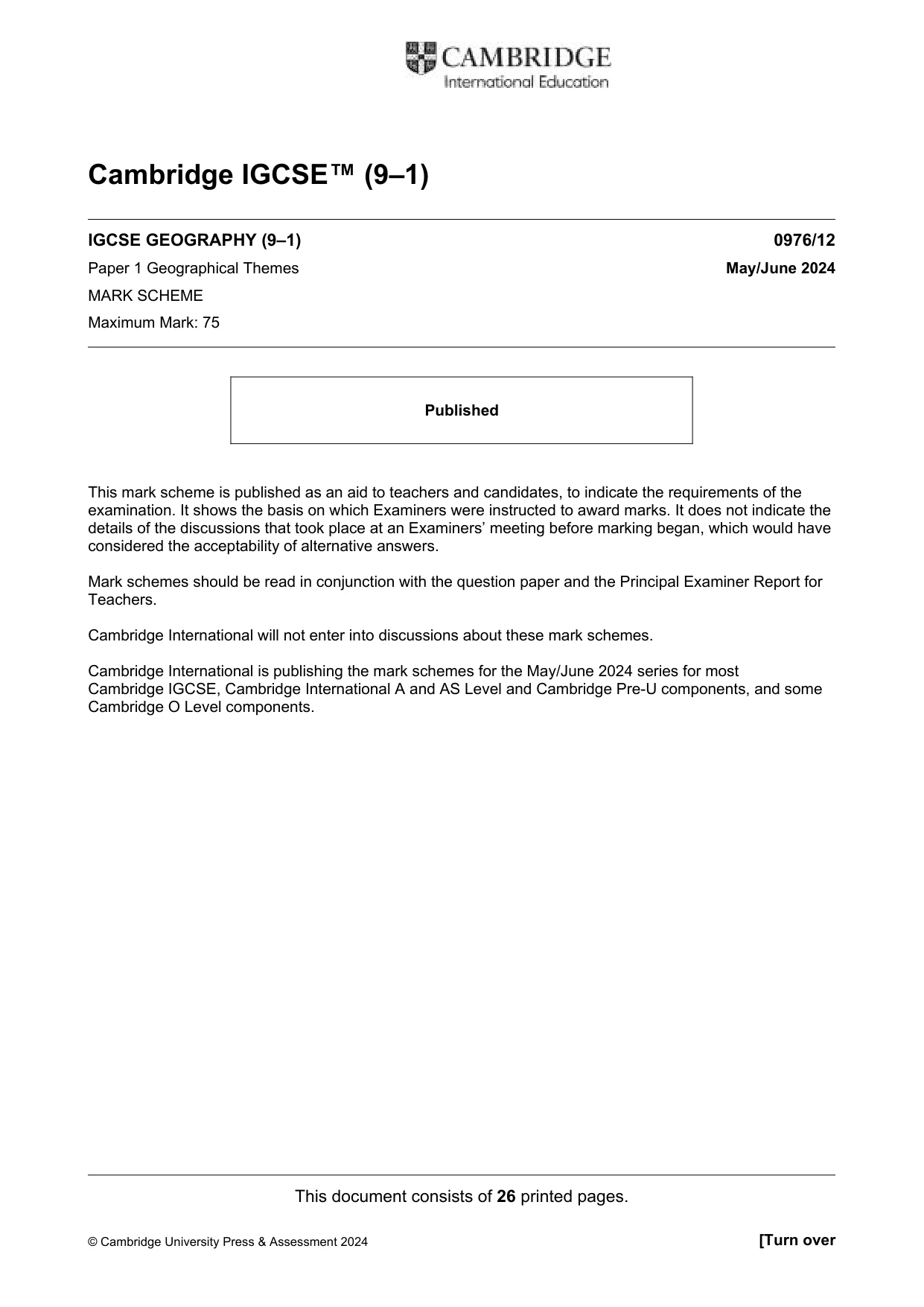
21 0976/12/M/J/24 © UCLES 2024 [Turn over (ii) Fig. 6.3 shows six methods for reducing air pollution. Which method do you think is most effective? Justify your answer by referring to the advantages of the method you have chosen and the disadvantages of one of the methods you rejected. Method chosen … advantages … … … … … … Method rejected … disadvantages … … … … … … [5]
Question paper, page 22
22 0976/12/M/J/24 © UCLES 2024 (c) For an example you have studied, describe the impacts of a transnational corporation (TNC) on the people living in an LEDC. Name of transnational corporation (TNC) … Name of LEDC … … … … … … … … … … … … … … … … … … … … … … … … … [7] [Total: 25]
Question paper, page 23
23 0976/12/M/J/24 © UCLES 2024 Additional pages If you use the following pages to complete the answer to any question, the question number must be clearly shown. … … … … … … … … … … … … … … … … … … … … … … … … … …
Question paper, page 24
24 0976/12/M/J/24 © UCLES 2024 … … … … … … … … … … … … … … … … … … … … … … The boundaries and names shown, the designations used and the presentation of material on any maps contained in this question paper/insert do not imply official endorsement or acceptance by Cambridge Assessment International Education concerning the legal status of any country, territory, or area or any of its authorities, or of the delimitation of its frontiers or boundaries. Permission to reproduce items where third-party owned material protected by copyright is included has been sought and cleared where possible. Every reasonable effort has been made by the publisher (UCLES) to trace copyright holders, but if any items requiring clearance have unwittingly been included, the publisher will be pleased to make amends at the earliest possible opportunity. To avoid the issue of disclosure of answer-related information to candidates, all copyright acknowledgements are reproduced online in the Cambridge Assessment International Education Copyright Acknowledgements Booklet. This is produced for each series of examinations and is freely available to download at www.cambridgeinternational.org after the live examination series. Cambridge Assessment International Education is part of Cambridge Assessment. Cambridge Assessment is the brand name of the University of Cambridge Local Examinations Syndicate (UCLES), which is a department of the University of Cambridge.
Mark scheme, page 1
This document consists of 26 printed pages. © Cambridge University Press & Assessment 2024 [Turn over Cambridge IGCSE™ (9–1) IGCSE GEOGRAPHY (9–1) 0976/12 Paper 1 Geographical Themes May/June 2024 MARK SCHEME Maximum Mark: 75 Published This mark scheme is published as an aid to teachers and candidates, to indicate the requirements of the examination. It shows the basis on which Examiners were instructed to award marks. It does not indicate the details of the discussions that took place at an Examiners’ meeting before marking began, which would have considered the acceptability of alternative answers. Mark schemes should be read in conjunction with the question paper and the Principal Examiner Report for Teachers. Cambridge International will not enter into discussions about these mark schemes. Cambridge International is publishing the mark schemes for the May/June 2024 series for most Cambridge IGCSE, Cambridge International A and AS Level and Cambridge Pre-U components, and some Cambridge O Level components.
Mark scheme, page 2
0976/12 Cambridge IGCSE (9–1) – Mark Scheme PUBLISHED May/June 2024 © Cambridge University Press & Assessment 2024 Page 2 of 26 Generic Marking Principles These general marking principles must be applied by all examiners when marking candidate answers. They should be applied alongside the specific content of the mark scheme or generic level descriptions for a question. Each question paper and mark scheme will also comply with these marking principles. GENERIC MARKING PRINCIPLE 1: Marks must be awarded in line with: the specific content of the mark scheme or the generic level descriptors for the question the specific skills defined in the mark scheme or in the generic level descriptors for the question the standard of response required by a candidate as exemplified by the standardisation scripts. GENERIC MARKING PRINCIPLE 2: Marks awarded are always whole marks (not half marks, or other fractions). GENERIC MARKING PRINCIPLE 3: Marks must be awarded positively: marks are awarded for correct/valid answers, as defined in the mark scheme. However, credit is given for valid answers which go beyond the scope of the syllabus and mark scheme, referring to your Team Leader as appropriate marks are awarded when candidates clearly demonstrate what they know and can do marks are not deducted for errors marks are not deducted for omissions answers should only be judged on the quality of spelling, punctuation and grammar when these features are specifically assessed by the question as indicated by the mark scheme. The meaning, however, should be unambiguous. GENERIC MARKING PRINCIPLE 4: Rules must be applied consistently, e.g. in situations where candidates have not followed instructions or in the application of generic level descriptors. GENERIC MARKING PRINCIPLE 5: Marks should be awarded using the full range of marks defined in the mark scheme for the question (however; the use of the full mark range may be limited according to the quality of the candidate responses seen). GENERIC MARKING PRINCIPLE 6: Marks awarded are based solely on the requirements as defined in the mark scheme. Marks should not be awarded with grade thresholds or grade descriptors in mind.
Mark scheme, page 3
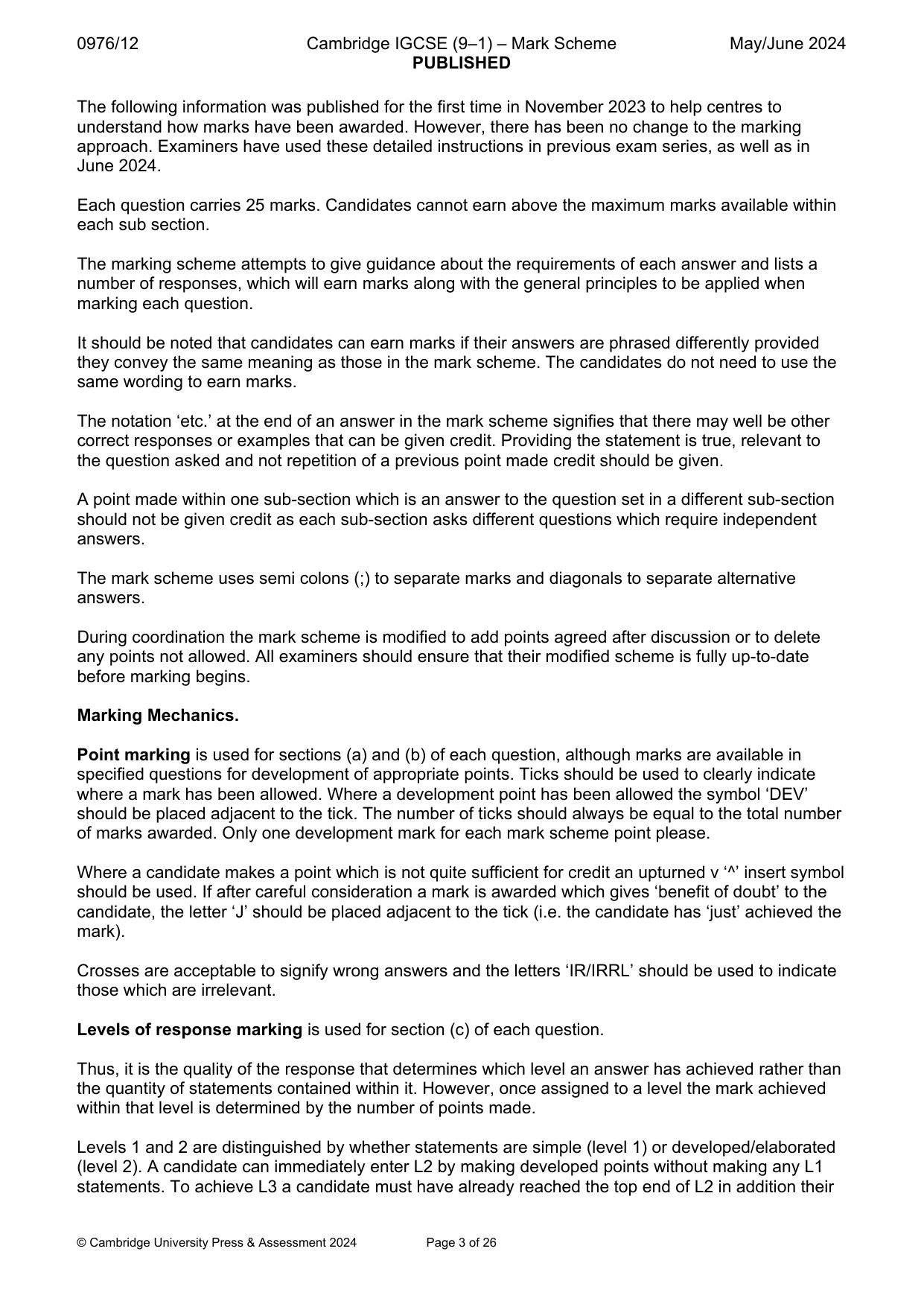
0976/12 Cambridge IGCSE (9–1) – Mark Scheme PUBLISHED May/June 2024 © Cambridge University Press & Assessment 2024 Page 3 of 26 The following information was published for the first time in November 2023 to help centres to understand how marks have been awarded. However, there has been no change to the marking approach. Examiners have used these detailed instructions in previous exam series, as well as in June 2024. Each question carries 25 marks. Candidates cannot earn above the maximum marks available within each sub section. The marking scheme attempts to give guidance about the requirements of each answer and lists a number of responses, which will earn marks along with the general principles to be applied when marking each question. It should be noted that candidates can earn marks if their answers are phrased differently provided they convey the same meaning as those in the mark scheme. The candidates do not need to use the same wording to earn marks. The notation ‘etc.’ at the end of an answer in the mark scheme signifies that there may well be other correct responses or examples that can be given credit. Providing the statement is true, relevant to the question asked and not repetition of a previous point made credit should be given. A point made within one sub-section which is an answer to the question set in a different sub-section should not be given credit as each sub-section asks different questions which require independent answers. The mark scheme uses semi colons (;) to separate marks and diagonals to separate alternative answers. During coordination the mark scheme is modified to add points agreed after discussion or to delete any points not allowed. All examiners should ensure that their modified scheme is fully up-to-date before marking begins. Marking Mechanics. Point marking is used for sections (a) and (b) of each question, although marks are available in specified questions for development of appropriate points. Ticks should be used to clearly indicate where a mark has been allowed. Where a development point has been allowed the symbol ‘DEV’ should be placed adjacent to the tick. The number of ticks should always be equal to the total number of marks awarded. Only one development mark for each mark scheme point please. Where a candidate makes a point which is not quite sufficient for credit an upturned v ‘^’ insert symbol should be used. If after careful consideration a mark is awarded which gives ‘benefit of doubt’ to the candidate, the letter ‘J’ should be placed adjacent to the tick (i.e. the candidate has ‘just’ achieved the mark). Crosses are acceptable to signify wrong answers and the letters ‘IR/IRRL’ should be used to indicate those which are irrelevant. Levels of response marking is used for section (c) of each question. Thus, it is the quality of the response that determines which level an answer has achieved rather than the quantity of statements contained within it. However, once assigned to a level the mark achieved within that level is determined by the number of points made. Levels 1 and 2 are distinguished by whether statements are simple (level 1) or developed/elaborated (level 2). A candidate can immediately enter L2 by making developed points without making any L1 statements. To achieve L3 a candidate must have already reached the top end of L2 in addition their
Mark scheme, page 4
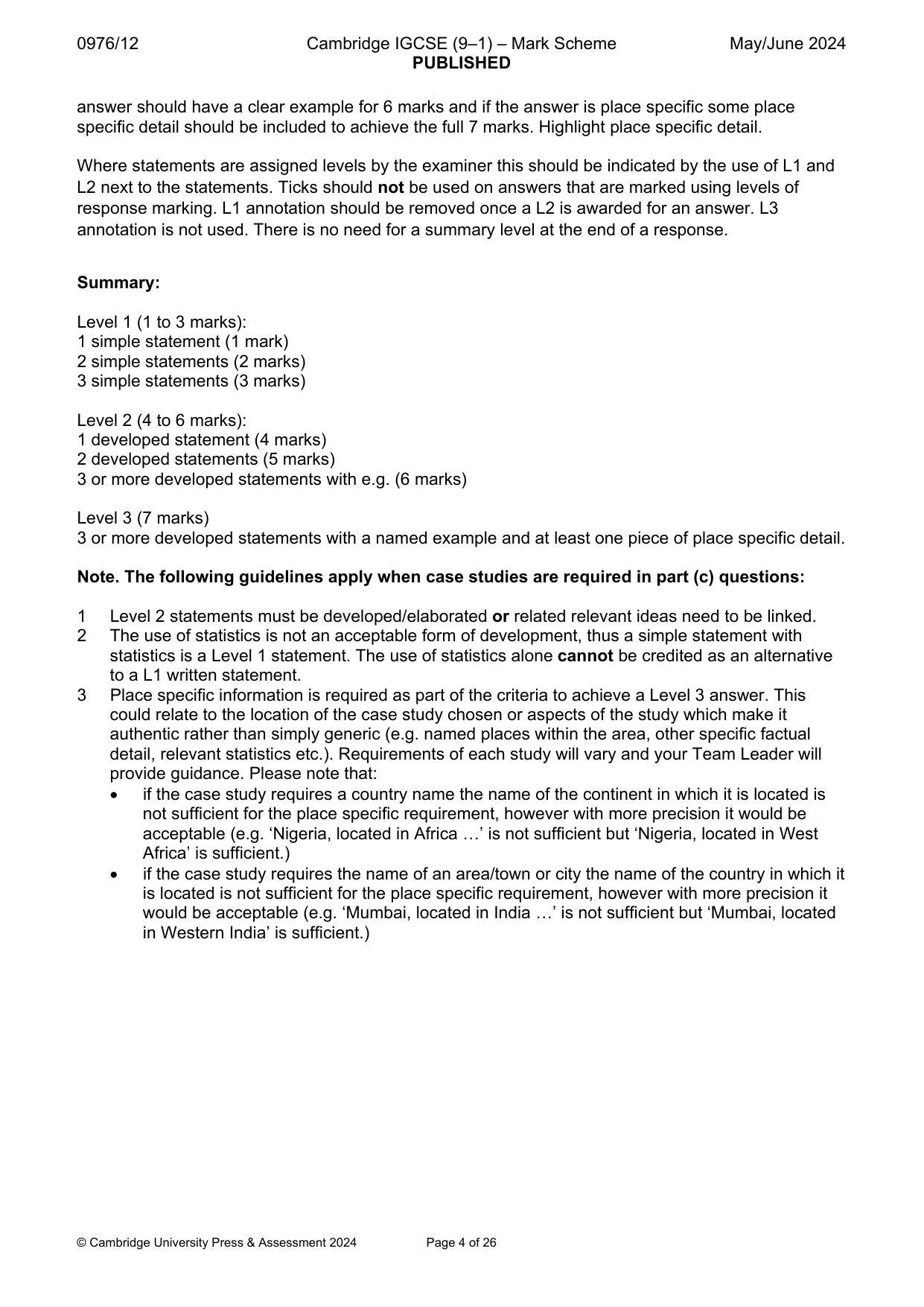
0976/12 Cambridge IGCSE (9–1) – Mark Scheme PUBLISHED May/June 2024 © Cambridge University Press & Assessment 2024 Page 4 of 26 answer should have a clear example for 6 marks and if the answer is place specific some place specific detail should be included to achieve the full 7 marks. Highlight place specific detail. Where statements are assigned levels by the examiner this should be indicated by the use of L1 and L2 next to the statements. Ticks should not be used on answers that are marked using levels of response marking. L1 annotation should be removed once a L2 is awarded for an answer. L3 annotation is not used. There is no need for a summary level at the end of a response. Summary: Level 1 (1 to 3 marks): 1 simple statement (1 mark) 2 simple statements (2 marks) 3 simple statements (3 marks) Level 2 (4 to 6 marks): 1 developed statement (4 marks) 2 developed statements (5 marks) 3 or more developed statements with e.g. (6 marks) Level 3 (7 marks) 3 or more developed statements with a named example and at least one piece of place specific detail. Note. The following guidelines apply when case studies are required in part (c) questions: 1 Level 2 statements must be developed/elaborated or related relevant ideas need to be linked. 2 The use of statistics is not an acceptable form of development, thus a simple statement with statistics is a Level 1 statement. The use of statistics alone cannot be credited as an alternative to a L1 written statement. 3 Place specific information is required as part of the criteria to achieve a Level 3 answer. This could relate to the location of the case study chosen or aspects of the study which make it authentic rather than simply generic (e.g. named places within the area, other specific factual detail, relevant statistics etc.). Requirements of each study will vary and your Team Leader will provide guidance. Please note that: if the case study requires a country name the name of the continent in which it is located is not sufficient for the place specific requirement, however with more precision it would be acceptable (e.g. ‘Nigeria, located in Africa …’ is not sufficient but ‘Nigeria, located in West Africa’ is sufficient.) if the case study requires the name of an area/town or city the name of the country in which it is located is not sufficient for the place specific requirement, however with more precision it would be acceptable (e.g. ‘Mumbai, located in India …’ is not sufficient but ‘Mumbai, located in Western India’ is sufficient.)
Mark scheme, page 5
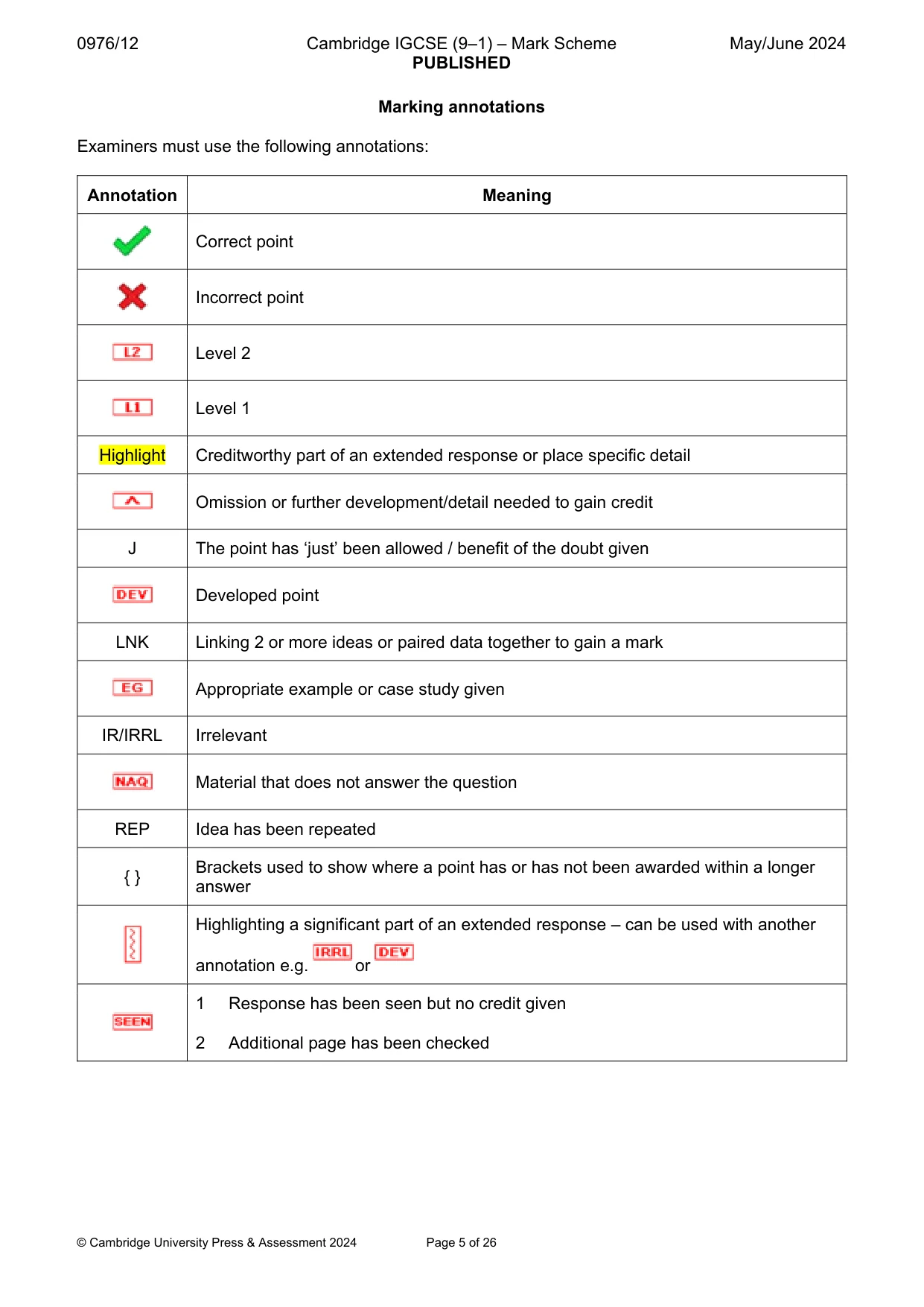
0976/12 Cambridge IGCSE (9–1) – Mark Scheme PUBLISHED May/June 2024 © Cambridge University Press & Assessment 2024 Page 5 of 26 Marking annotations Examiners must use the following annotations: Annotation Meaning Correct point Incorrect point Level 2 Level 1 Highlight Creditworthy part of an extended response or place specific detail Omission or further development/detail needed to gain credit J The point has ‘just’ been allowed / benefit of the doubt given Developed point LNK Linking 2 or more ideas or paired data together to gain a mark Appropriate example or case study given IR/IRRL Irrelevant Material that does not answer the question REP Idea has been repeated { } Brackets used to show where a point has or has not been awarded within a longer answer Highlighting a significant part of an extended response – can be used with another annotation e.g. or 1 Response has been seen but no credit given 2 Additional page has been checked
Mark scheme, page 6
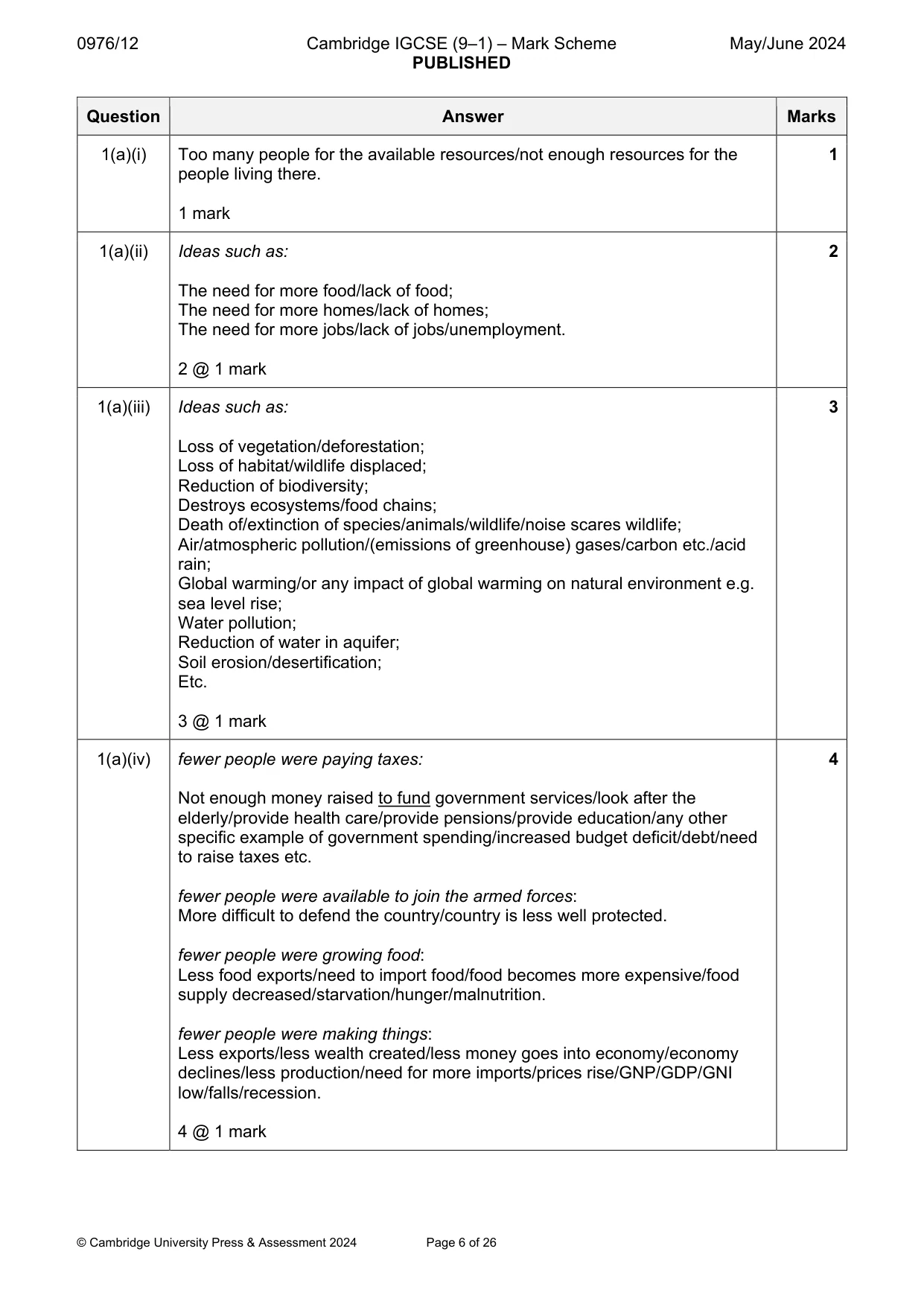
0976/12 Cambridge IGCSE (9–1) – Mark Scheme PUBLISHED May/June 2024 © Cambridge University Press & Assessment 2024 Page 6 of 26 Question Answer Marks 1(a)(i) Too many people for the available resources/not enough resources for the people living there. 1 mark 1 1(a)(ii) Ideas such as: The need for more food/lack of food; The need for more homes/lack of homes; The need for more jobs/lack of jobs/unemployment. 2 @ 1 mark 2 1(a)(iii) Ideas such as: Loss of vegetation/deforestation; Loss of habitat/wildlife displaced; Reduction of biodiversity; Destroys ecosystems/food chains; Death of/extinction of species/animals/wildlife/noise scares wildlife; Air/atmospheric pollution/(emissions of greenhouse) gases/carbon etc./acid rain; Global warming/or any impact of global warming on natural environment e.g. sea level rise; Water pollution; Reduction of water in aquifer; Soil erosion/desertification; Etc. 3 @ 1 mark 3 1(a)(iv) fewer people were paying taxes: Not enough money raised to fund government services/look after the elderly/provide health care/provide pensions/provide education/any other specific example of government spending/increased budget deficit/debt/need to raise taxes etc. fewer people were available to join the armed forces: More difficult to defend the country/country is less well protected. fewer people were growing food: Less food exports/need to import food/food becomes more expensive/food supply decreased/starvation/hunger/malnutrition. fewer people were making things: Less exports/less wealth created/less money goes into economy/economy declines/less production/need for more imports/prices rise/GNP/GDP/GNI low/falls/recession. 4 @ 1 mark 4
Mark scheme, page 7
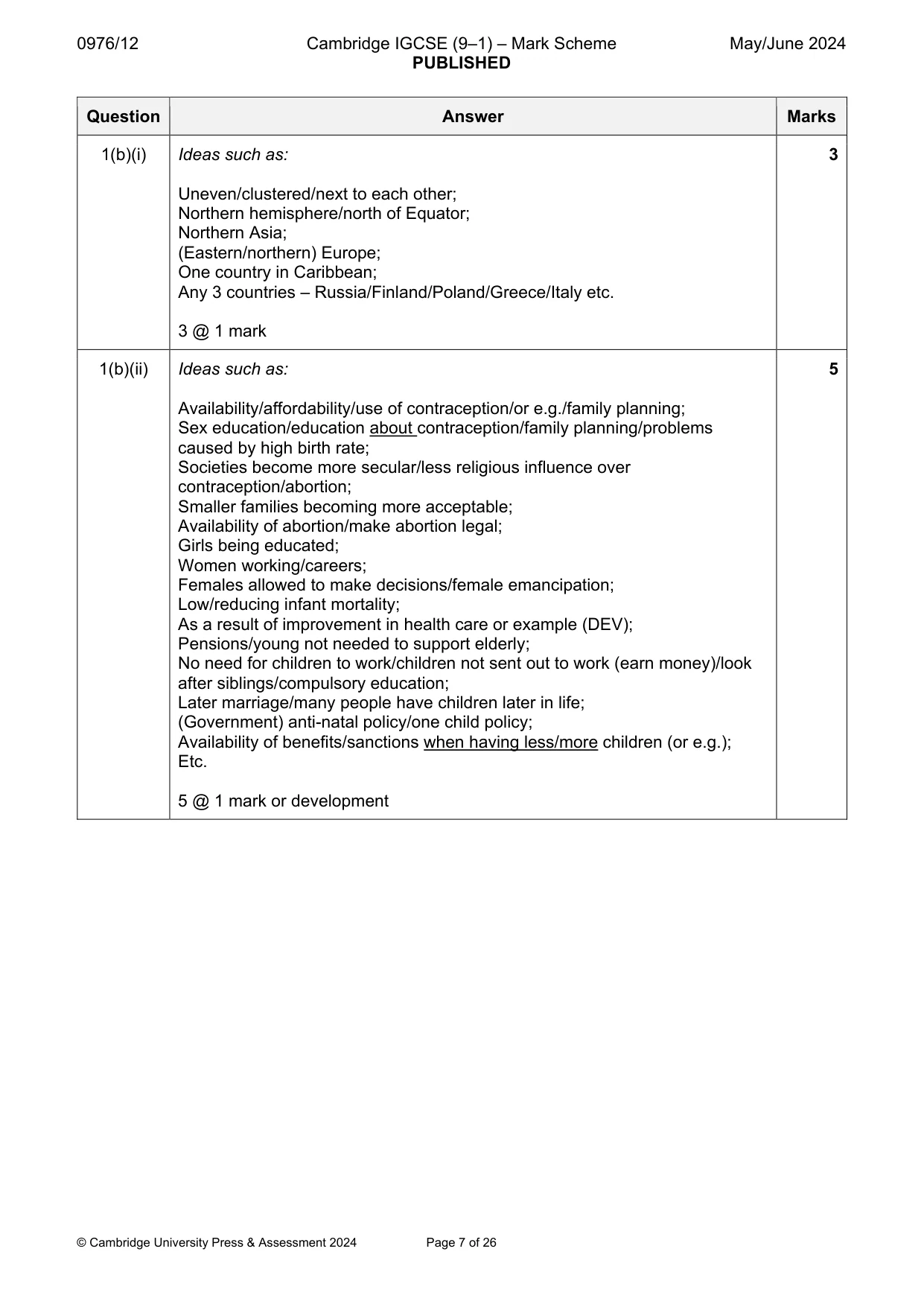
0976/12 Cambridge IGCSE (9–1) – Mark Scheme PUBLISHED May/June 2024 © Cambridge University Press & Assessment 2024 Page 7 of 26 Question Answer Marks 1(b)(i) Ideas such as: Uneven/clustered/next to each other; Northern hemisphere/north of Equator; Northern Asia; (Eastern/northern) Europe; One country in Caribbean; Any 3 countries – Russia/Finland/Poland/Greece/Italy etc. 3 @ 1 mark 3 1(b)(ii) Ideas such as: Availability/affordability/use of contraception/or e.g./family planning; Sex education/education about contraception/family planning/problems caused by high birth rate; Societies become more secular/less religious influence over contraception/abortion; Smaller families becoming more acceptable; Availability of abortion/make abortion legal; Girls being educated; Women working/careers; Females allowed to make decisions/female emancipation; Low/reducing infant mortality; As a result of improvement in health care or example (DEV); Pensions/young not needed to support elderly; No need for children to work/children not sent out to work (earn money)/look after siblings/compulsory education; Later marriage/many people have children later in life; (Government) anti-natal policy/one child policy; Availability of benefits/sanctions when having less/more children (or e.g.); Etc. 5 @ 1 mark or development 5
Mark scheme, page 8
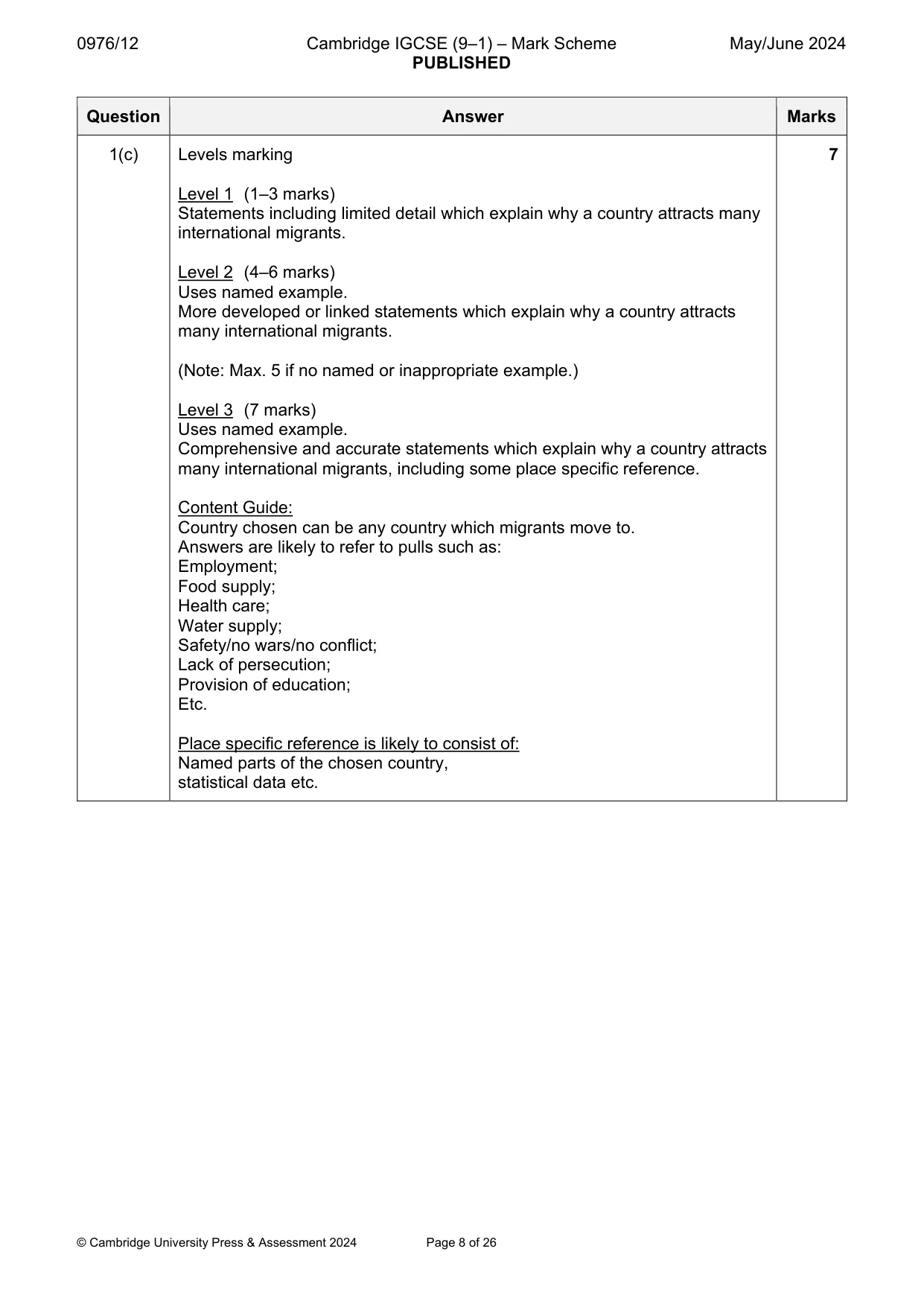
0976/12 Cambridge IGCSE (9–1) – Mark Scheme PUBLISHED May/June 2024 © Cambridge University Press & Assessment 2024 Page 8 of 26 Question Answer Marks 1(c) Levels marking Level 1 (1–3 marks) Statements including limited detail which explain why a country attracts many international migrants. Level 2 (4–6 marks) Uses named example. More developed or linked statements which explain why a country attracts many international migrants. (Note: Max. 5 if no named or inappropriate example.) Level 3 (7 marks) Uses named example. Comprehensive and accurate statements which explain why a country attracts many international migrants, including some place specific reference. Content Guide: Country chosen can be any country which migrants move to. Answers are likely to refer to pulls such as: Employment; Food supply; Health care; Water supply; Safety/no wars/no conflict; Lack of persecution; Provision of education; Etc. Place specific reference is likely to consist of: Named parts of the chosen country, statistical data etc. 7
Mark scheme, page 9
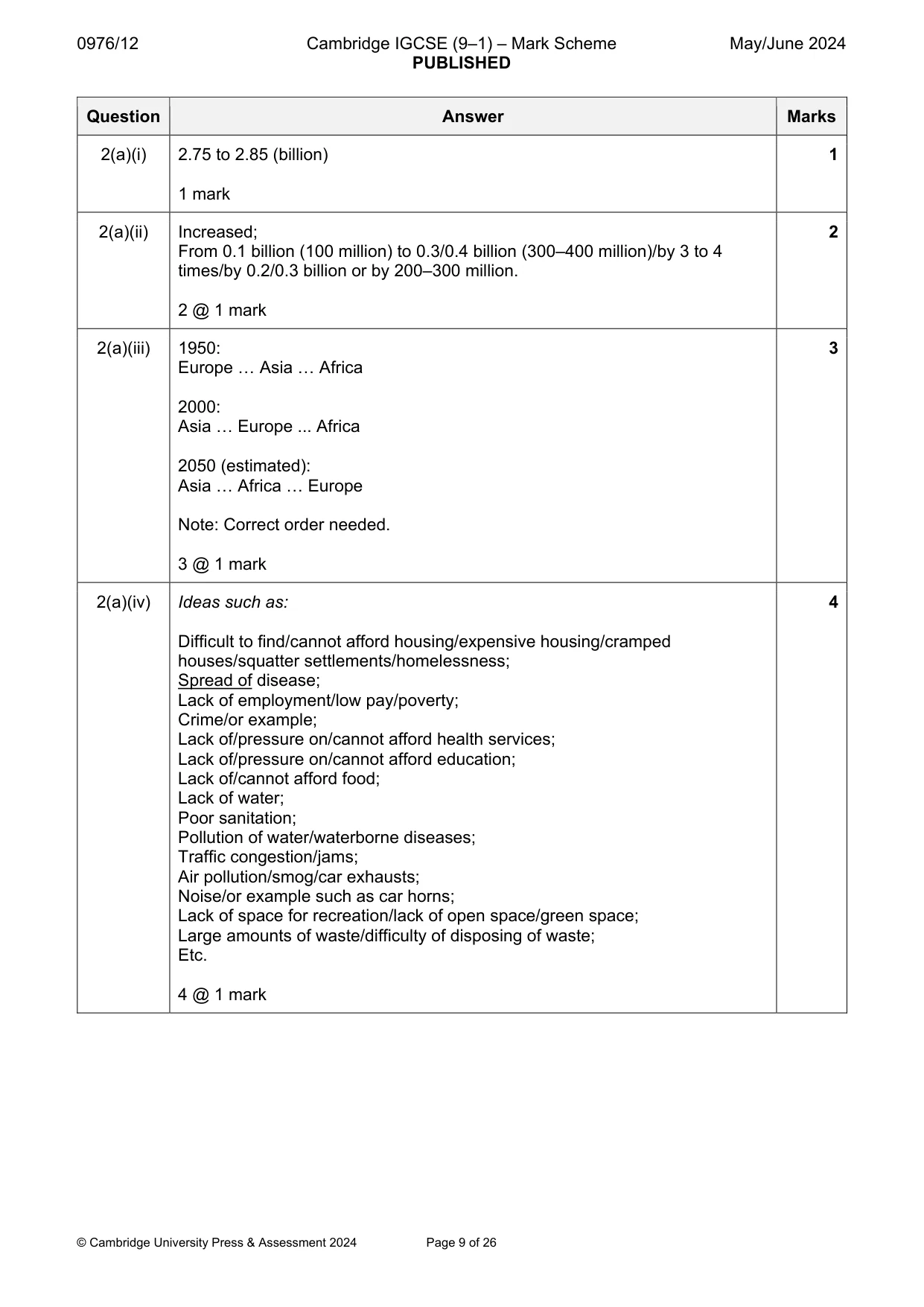
0976/12 Cambridge IGCSE (9–1) – Mark Scheme PUBLISHED May/June 2024 © Cambridge University Press & Assessment 2024 Page 9 of 26 Question Answer Marks 2(a)(i) 2.75 to 2.85 (billion) 1 mark 1 2(a)(ii) Increased; From 0.1 billion (100 million) to 0.3/0.4 billion (300–400 million)/by 3 to 4 times/by 0.2/0.3 billion or by 200–300 million. 2 @ 1 mark 2 2(a)(iii) 1950: Europe … Asia … Africa 2000: Asia … Europe ... Africa 2050 (estimated): Asia … Africa … Europe Note: Correct order needed. 3 @ 1 mark 3 2(a)(iv) Ideas such as: Difficult to find/cannot afford housing/expensive housing/cramped houses/squatter settlements/homelessness; Spread of disease; Lack of employment/low pay/poverty; Crime/or example; Lack of/pressure on/cannot afford health services; Lack of/pressure on/cannot afford education; Lack of/cannot afford food; Lack of water; Poor sanitation; Pollution of water/waterborne diseases; Traffic congestion/jams; Air pollution/smog/car exhausts; Noise/or example such as car horns; Lack of space for recreation/lack of open space/green space; Large amounts of waste/difficulty of disposing of waste; Etc. 4 @ 1 mark 4
Mark scheme, page 10
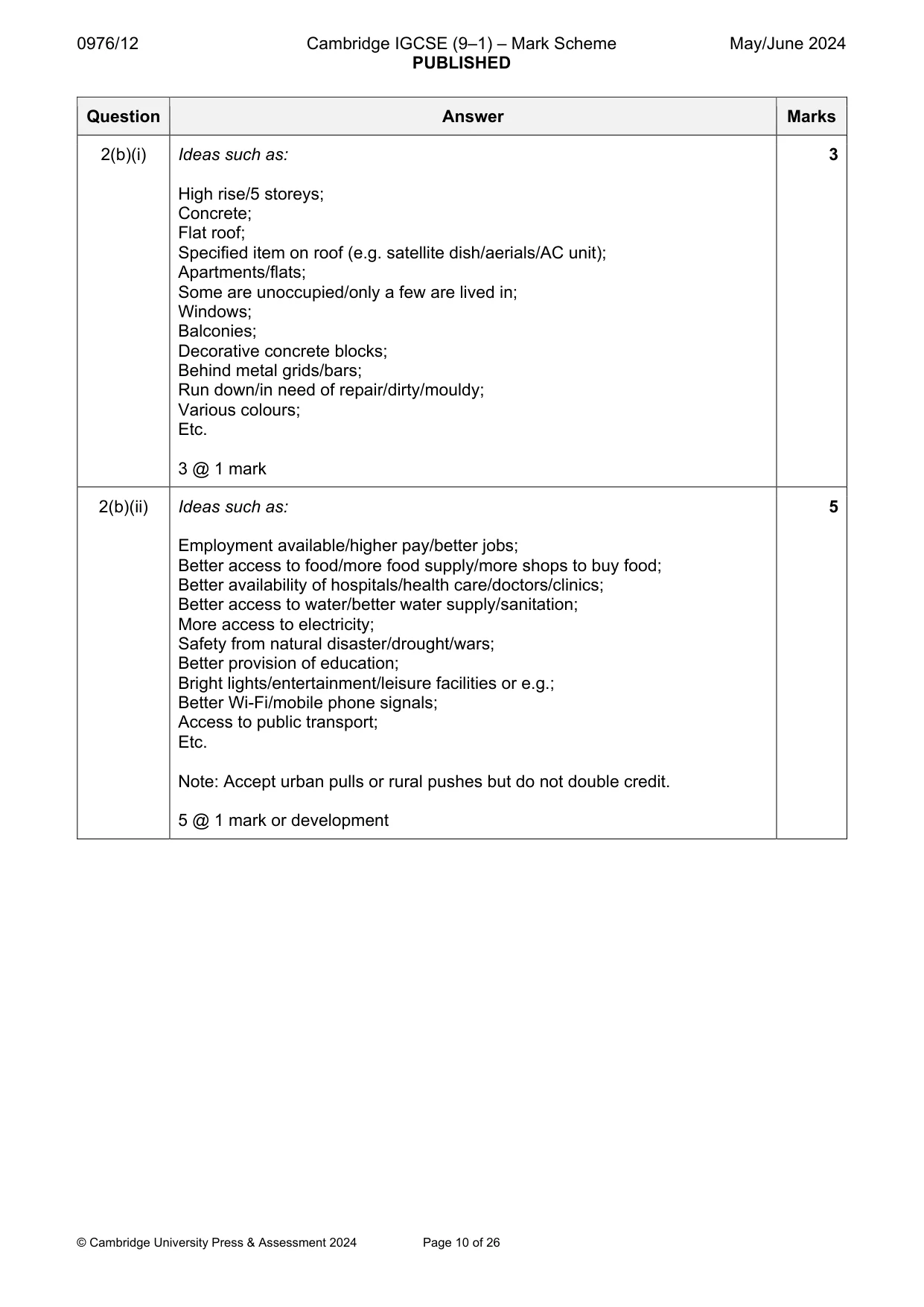
0976/12 Cambridge IGCSE (9–1) – Mark Scheme PUBLISHED May/June 2024 © Cambridge University Press & Assessment 2024 Page 10 of 26 Question Answer Marks 2(b)(i) Ideas such as: High rise/5 storeys; Concrete; Flat roof; Specified item on roof (e.g. satellite dish/aerials/AC unit); Apartments/flats; Some are unoccupied/only a few are lived in; Windows; Balconies; Decorative concrete blocks; Behind metal grids/bars; Run down/in need of repair/dirty/mouldy; Various colours; Etc. 3 @ 1 mark 3 2(b)(ii) Ideas such as: Employment available/higher pay/better jobs; Better access to food/more food supply/more shops to buy food; Better availability of hospitals/health care/doctors/clinics; Better access to water/better water supply/sanitation; More access to electricity; Safety from natural disaster/drought/wars; Better provision of education; Bright lights/entertainment/leisure facilities or e.g.; Better Wi-Fi/mobile phone signals; Access to public transport; Etc. Note: Accept urban pulls or rural pushes but do not double credit. 5 @ 1 mark or development 5
Mark scheme, page 11
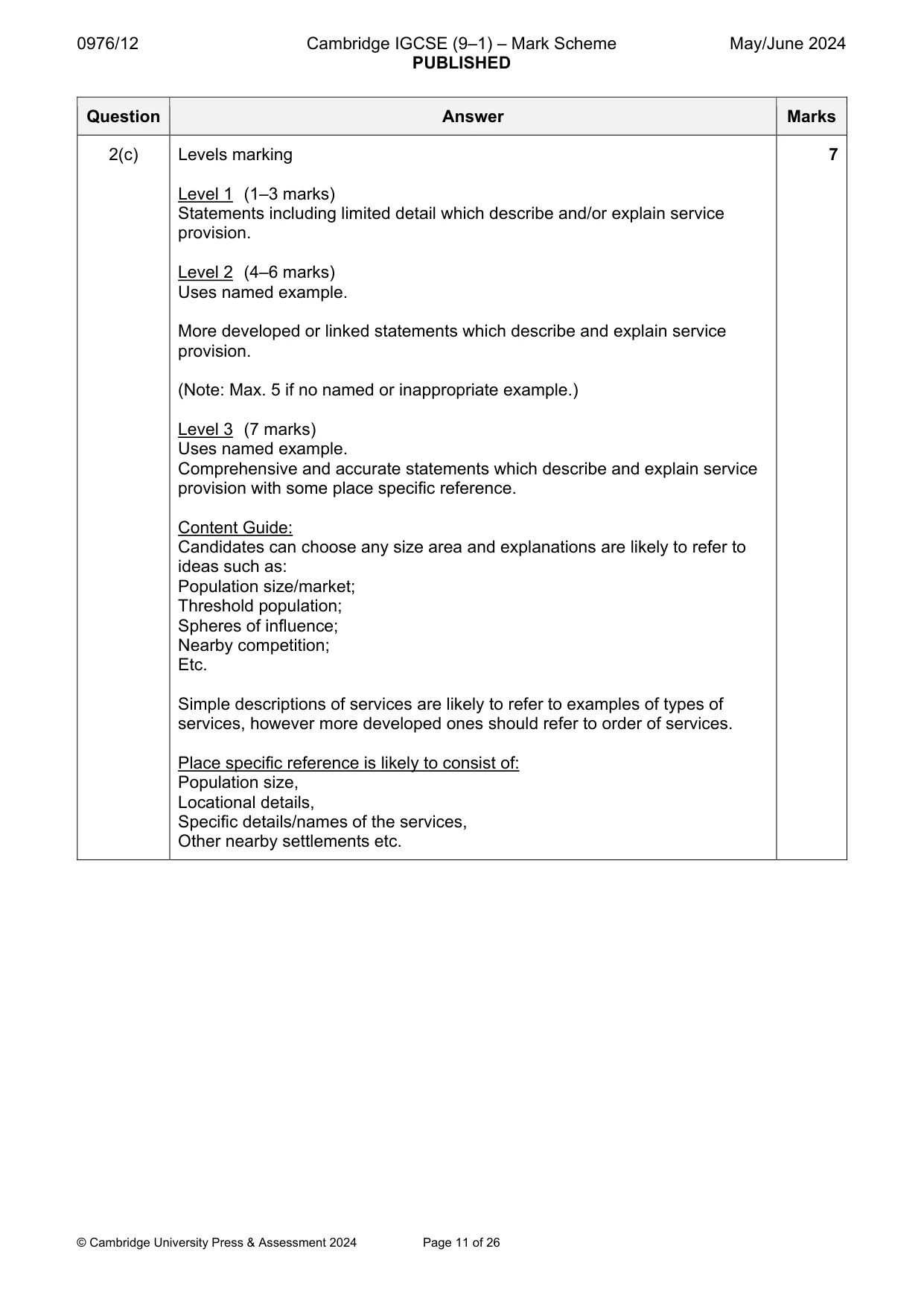
0976/12 Cambridge IGCSE (9–1) – Mark Scheme PUBLISHED May/June 2024 © Cambridge University Press & Assessment 2024 Page 11 of 26 Question Answer Marks 2(c) Levels marking Level 1 (1–3 marks) Statements including limited detail which describe and/or explain service provision. Level 2 (4–6 marks) Uses named example. More developed or linked statements which describe and explain service provision. (Note: Max. 5 if no named or inappropriate example.) Level 3 (7 marks) Uses named example. Comprehensive and accurate statements which describe and explain service provision with some place specific reference. Content Guide: Candidates can choose any size area and explanations are likely to refer to ideas such as: Population size/market; Threshold population; Spheres of influence; Nearby competition; Etc. Simple descriptions of services are likely to refer to examples of types of services, however more developed ones should refer to order of services. Place specific reference is likely to consist of: Population size, Locational details, Specific details/names of the services, Other nearby settlements etc. 7
Mark scheme, page 12
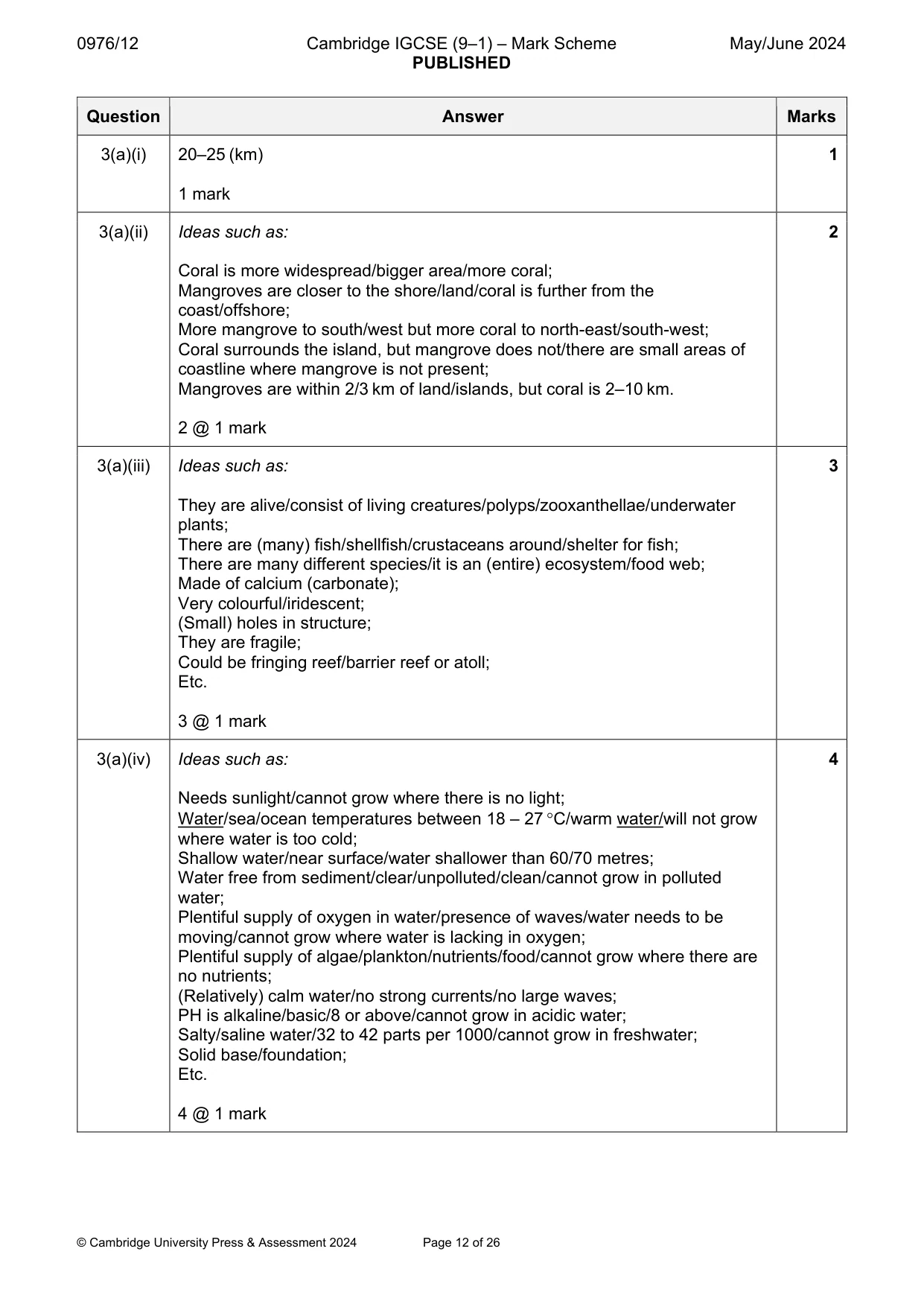
0976/12 Cambridge IGCSE (9–1) – Mark Scheme PUBLISHED May/June 2024 © Cambridge University Press & Assessment 2024 Page 12 of 26 Question Answer Marks 3(a)(i) 20–25 (km) 1 mark 1 3(a)(ii) Ideas such as: Coral is more widespread/bigger area/more coral; Mangroves are closer to the shore/land/coral is further from the coast/offshore; More mangrove to south/west but more coral to north-east/south-west; Coral surrounds the island, but mangrove does not/there are small areas of coastline where mangrove is not present; Mangroves are within 2/3 km of land/islands, but coral is 2–10 km. 2 @ 1 mark 2 3(a)(iii) Ideas such as: They are alive/consist of living creatures/polyps/zooxanthellae/underwater plants; There are (many) fish/shellfish/crustaceans around/shelter for fish; There are many different species/it is an (entire) ecosystem/food web; Made of calcium (carbonate); Very colourful/iridescent; (Small) holes in structure; They are fragile; Could be fringing reef/barrier reef or atoll; Etc. 3 @ 1 mark 3 3(a)(iv) Ideas such as: Needs sunlight/cannot grow where there is no light; Water/sea/ocean temperatures between 18 – 27 C/warm water/will not grow where water is too cold; Shallow water/near surface/water shallower than 60/70 metres; Water free from sediment/clear/unpolluted/clean/cannot grow in polluted water; Plentiful supply of oxygen in water/presence of waves/water needs to be moving/cannot grow where water is lacking in oxygen; Plentiful supply of algae/plankton/nutrients/food/cannot grow where there are no nutrients; (Relatively) calm water/no strong currents/no large waves; PH is alkaline/basic/8 or above/cannot grow in acidic water; Salty/saline water/32 to 42 parts per 1000/cannot grow in freshwater; Solid base/foundation; Etc. 4 @ 1 mark 4
Mark scheme, page 13
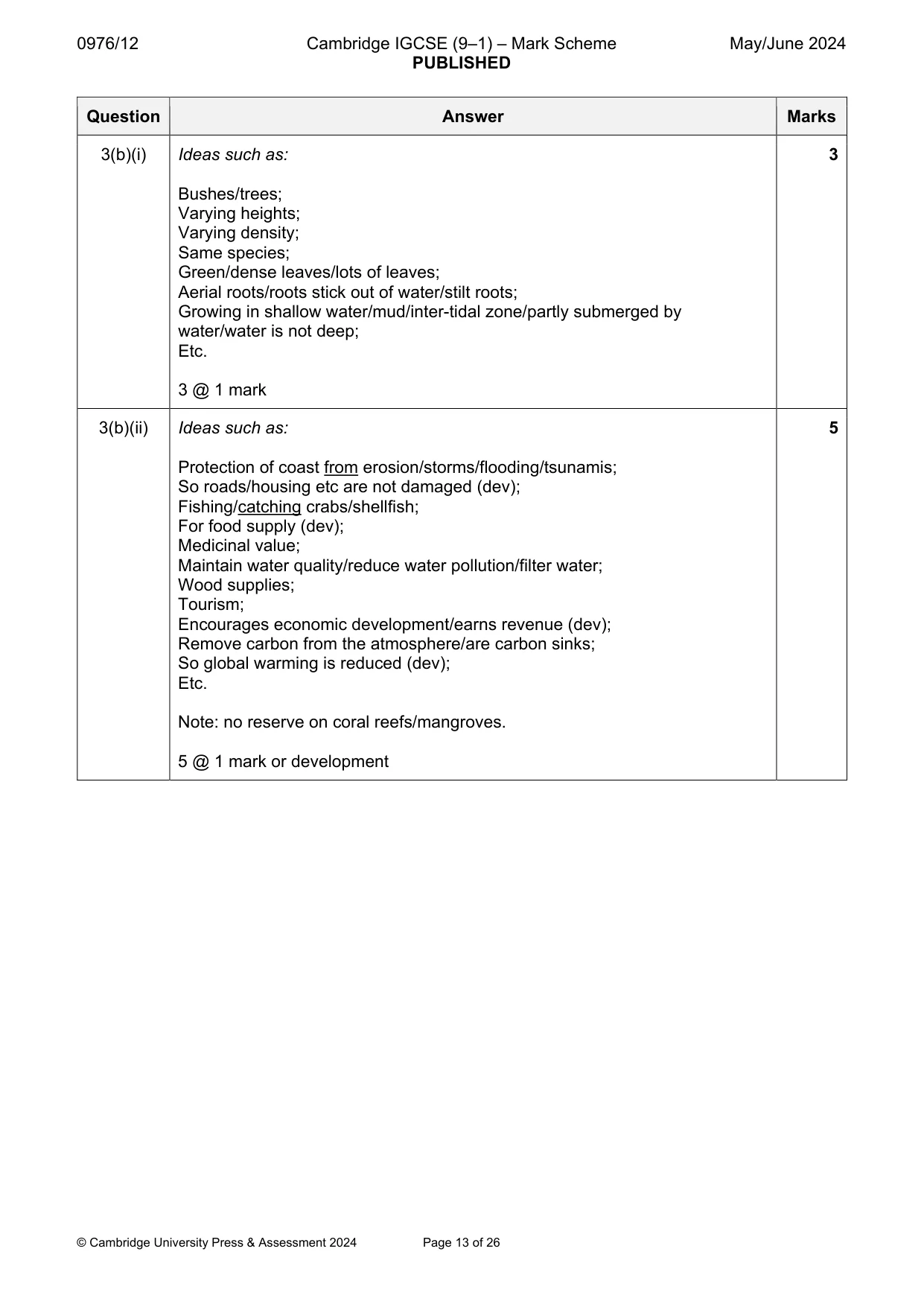
0976/12 Cambridge IGCSE (9–1) – Mark Scheme PUBLISHED May/June 2024 © Cambridge University Press & Assessment 2024 Page 13 of 26 Question Answer Marks 3(b)(i) Ideas such as: Bushes/trees; Varying heights; Varying density; Same species; Green/dense leaves/lots of leaves; Aerial roots/roots stick out of water/stilt roots; Growing in shallow water/mud/inter-tidal zone/partly submerged by water/water is not deep; Etc. 3 @ 1 mark 3 3(b)(ii) Ideas such as: Protection of coast from erosion/storms/flooding/tsunamis; So roads/housing etc are not damaged (dev); Fishing/catching crabs/shellfish; For food supply (dev); Medicinal value; Maintain water quality/reduce water pollution/filter water; Wood supplies; Tourism; Encourages economic development/earns revenue (dev); Remove carbon from the atmosphere/are carbon sinks; So global warming is reduced (dev); Etc. Note: no reserve on coral reefs/mangroves. 5 @ 1 mark or development 5
Mark scheme, page 14
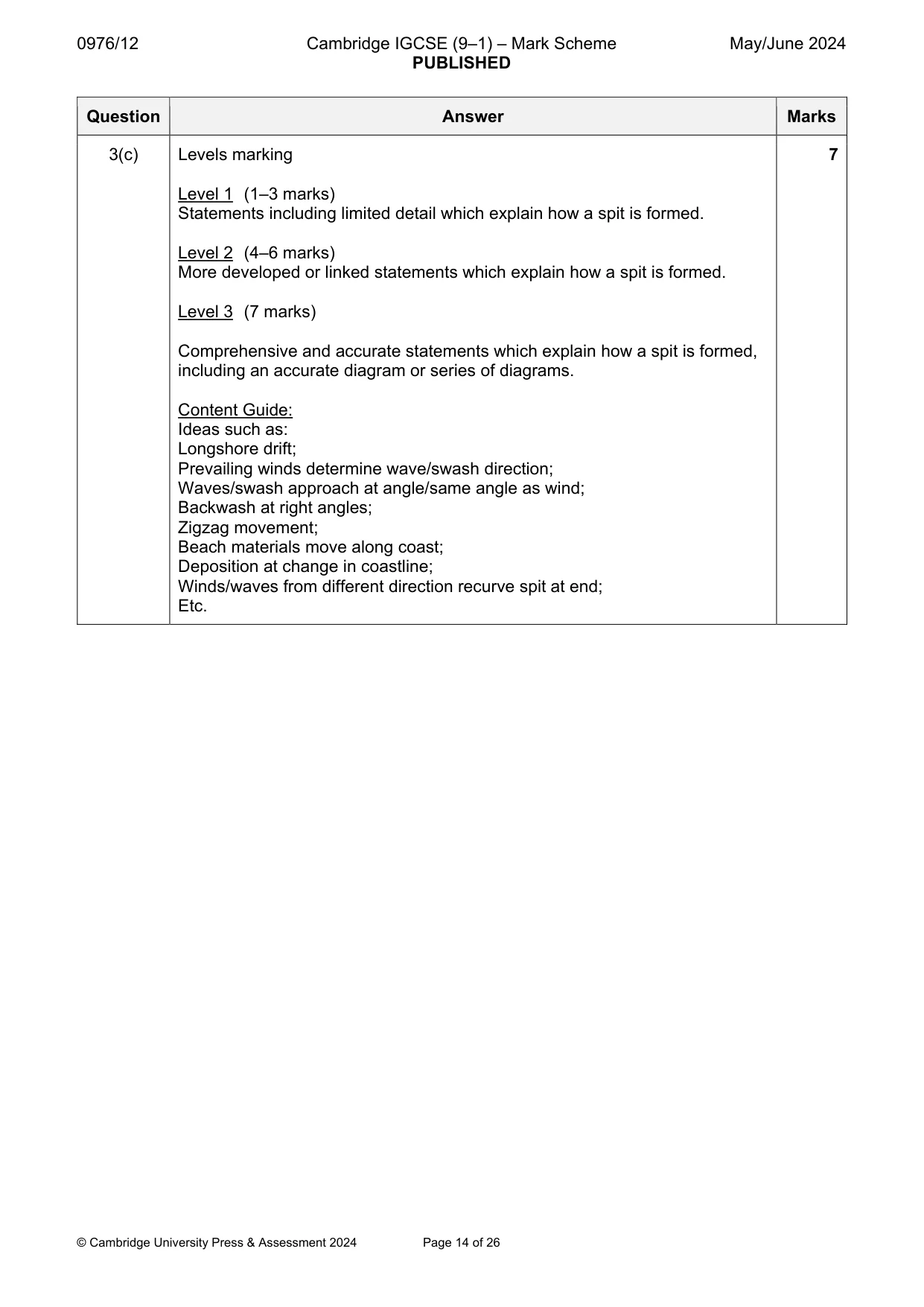
0976/12 Cambridge IGCSE (9–1) – Mark Scheme PUBLISHED May/June 2024 © Cambridge University Press & Assessment 2024 Page 14 of 26 Question Answer Marks 3(c) Levels marking Level 1 (1–3 marks) Statements including limited detail which explain how a spit is formed. Level 2 (4–6 marks) More developed or linked statements which explain how a spit is formed. Level 3 (7 marks) Comprehensive and accurate statements which explain how a spit is formed, including an accurate diagram or series of diagrams. Content Guide: Ideas such as: Longshore drift; Prevailing winds determine wave/swash direction; Waves/swash approach at angle/same angle as wind; Backwash at right angles; Zigzag movement; Beach materials move along coast; Deposition at change in coastline; Winds/waves from different direction recurve spit at end; Etc. 7
Mark scheme, page 15
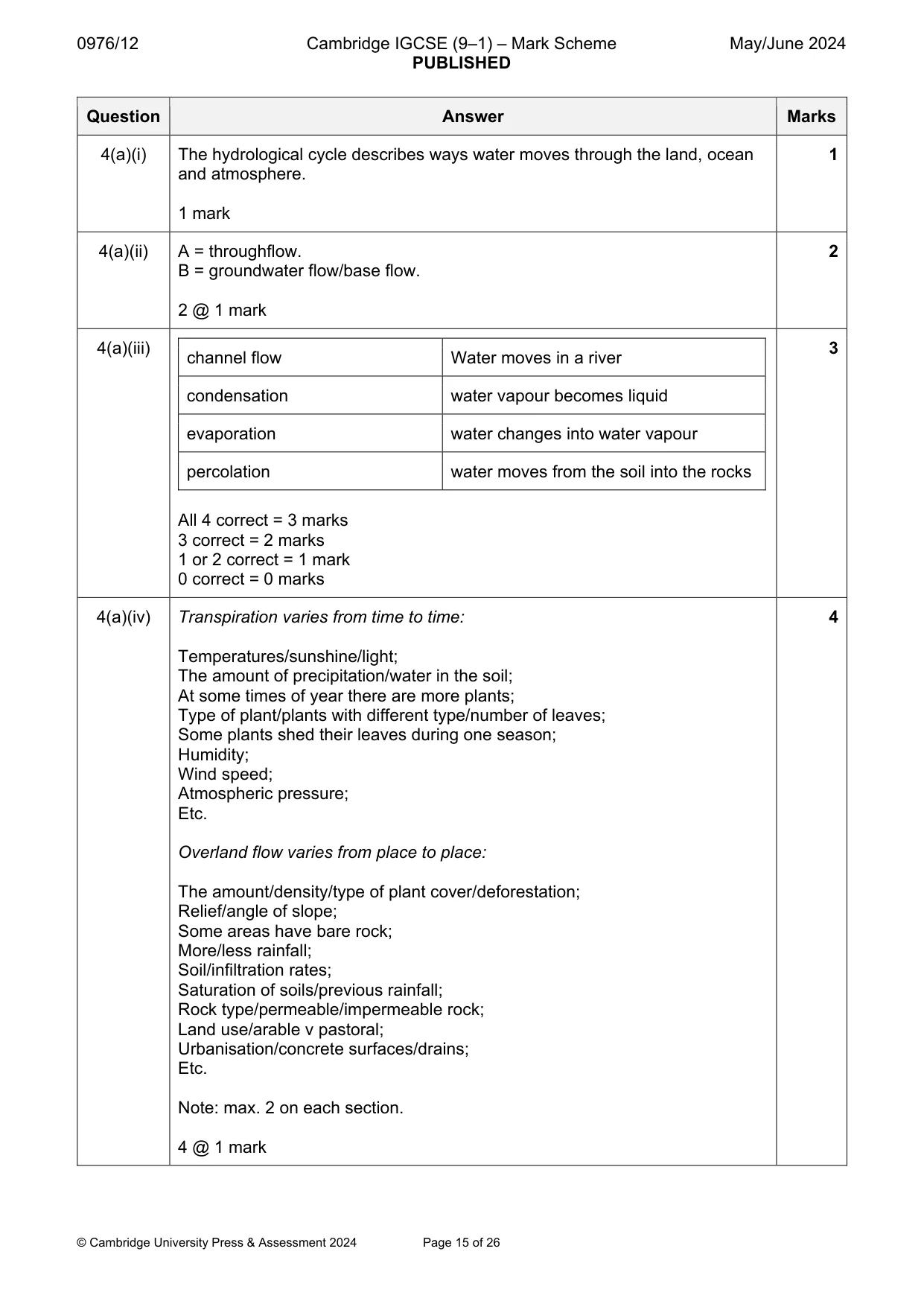
0976/12 Cambridge IGCSE (9–1) – Mark Scheme PUBLISHED May/June 2024 © Cambridge University Press & Assessment 2024 Page 15 of 26 Question Answer Marks 4(a)(i) The hydrological cycle describes ways water moves through the land, ocean and atmosphere. 1 mark 1 4(a)(ii) A = throughflow. B = groundwater flow/base flow. 2 @ 1 mark 2 4(a)(iii) channel flow Water moves in a river condensation water vapour becomes liquid evaporation water changes into water vapour percolation water moves from the soil into the rocks All 4 correct = 3 marks 3 correct = 2 marks 1 or 2 correct = 1 mark 0 correct = 0 marks 3 4(a)(iv) Transpiration varies from time to time: Temperatures/sunshine/light; The amount of precipitation/water in the soil; At some times of year there are more plants; Type of plant/plants with different type/number of leaves; Some plants shed their leaves during one season; Humidity; Wind speed; Atmospheric pressure; Etc. Overland flow varies from place to place: The amount/density/type of plant cover/deforestation; Relief/angle of slope; Some areas have bare rock; More/less rainfall; Soil/infiltration rates; Saturation of soils/previous rainfall; Rock type/permeable/impermeable rock; Land use/arable v pastoral; Urbanisation/concrete surfaces/drains; Etc. Note: max. 2 on each section. 4 @ 1 mark 4
Mark scheme, page 16
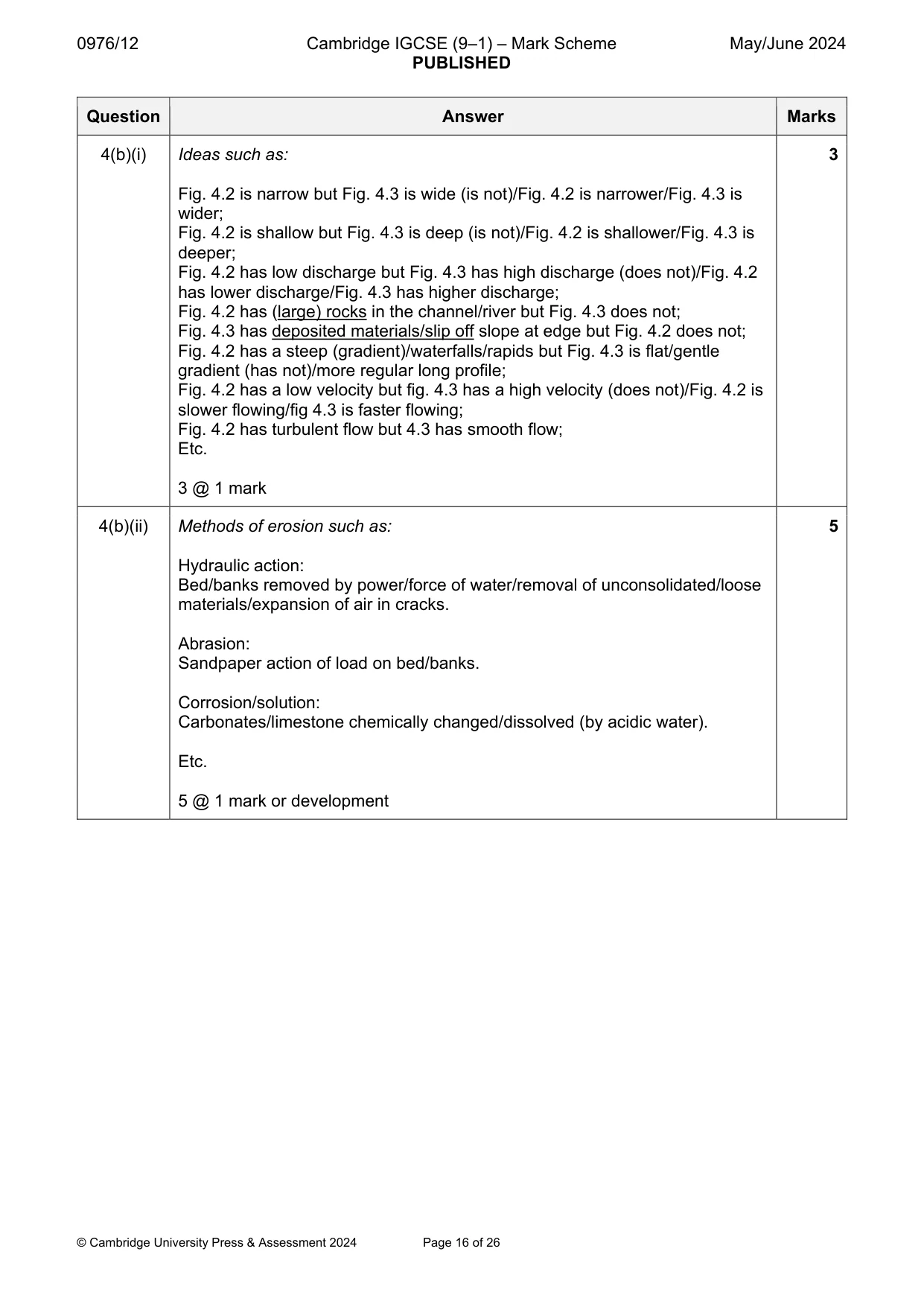
0976/12 Cambridge IGCSE (9–1) – Mark Scheme PUBLISHED May/June 2024 © Cambridge University Press & Assessment 2024 Page 16 of 26 Question Answer Marks 4(b)(i) Ideas such as: Fig. 4.2 is narrow but Fig. 4.3 is wide (is not)/Fig. 4.2 is narrower/Fig. 4.3 is wider; Fig. 4.2 is shallow but Fig. 4.3 is deep (is not)/Fig. 4.2 is shallower/Fig. 4.3 is deeper; Fig. 4.2 has low discharge but Fig. 4.3 has high discharge (does not)/Fig. 4.2 has lower discharge/Fig. 4.3 has higher discharge; Fig. 4.2 has (large) rocks in the channel/river but Fig. 4.3 does not; Fig. 4.3 has deposited materials/slip off slope at edge but Fig. 4.2 does not; Fig. 4.2 has a steep (gradient)/waterfalls/rapids but Fig. 4.3 is flat/gentle gradient (has not)/more regular long profile; Fig. 4.2 has a low velocity but fig. 4.3 has a high velocity (does not)/Fig. 4.2 is slower flowing/fig 4.3 is faster flowing; Fig. 4.2 has turbulent flow but 4.3 has smooth flow; Etc. 3 @ 1 mark 3 4(b)(ii) Methods of erosion such as: Hydraulic action: Bed/banks removed by power/force of water/removal of unconsolidated/loose materials/expansion of air in cracks. Abrasion: Sandpaper action of load on bed/banks. Corrosion/solution: Carbonates/limestone chemically changed/dissolved (by acidic water). Etc. 5 @ 1 mark or development 5
Mark scheme, page 17
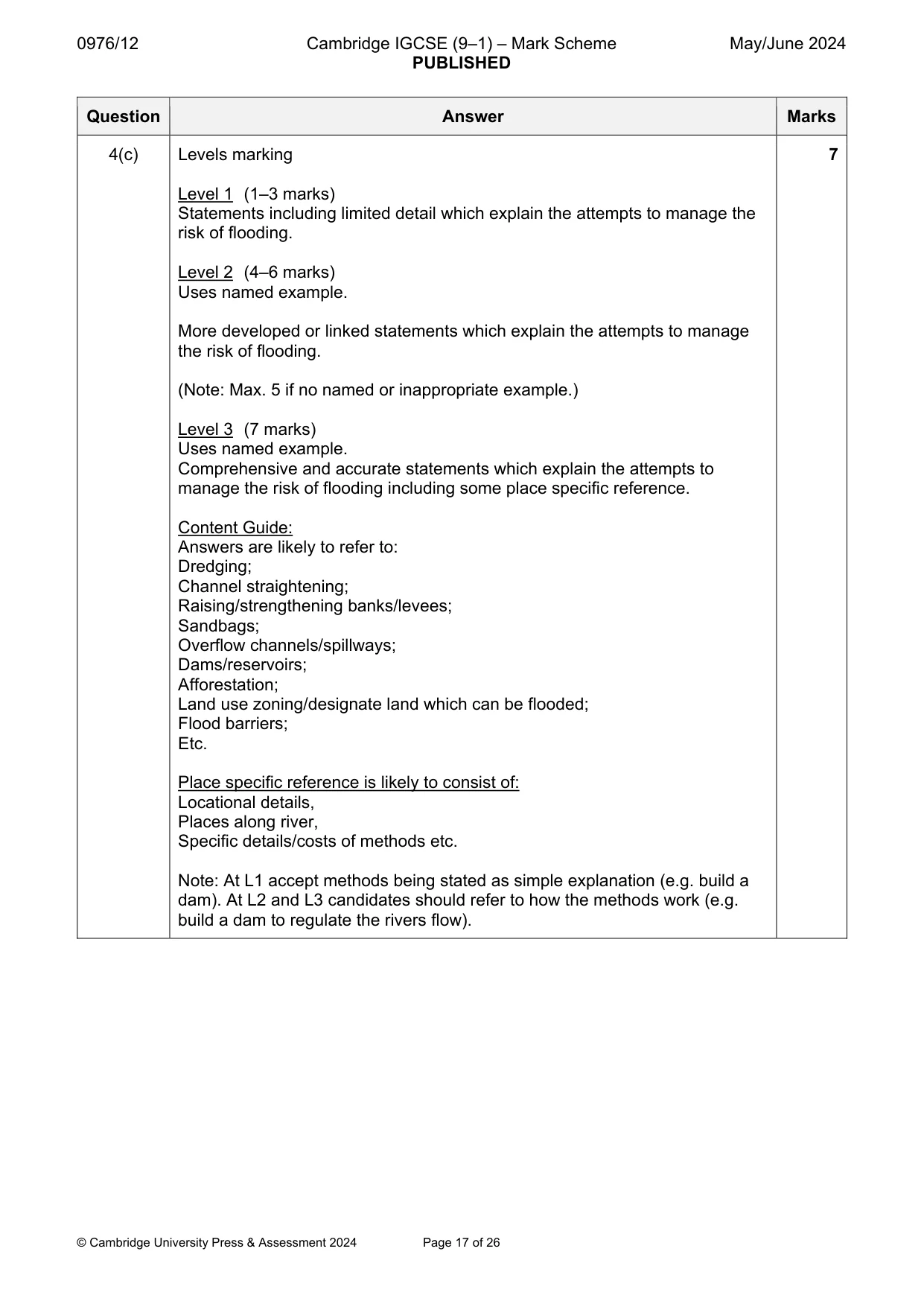
0976/12 Cambridge IGCSE (9–1) – Mark Scheme PUBLISHED May/June 2024 © Cambridge University Press & Assessment 2024 Page 17 of 26 Question Answer Marks 4(c) Levels marking Level 1 (1–3 marks) Statements including limited detail which explain the attempts to manage the risk of flooding. Level 2 (4–6 marks) Uses named example. More developed or linked statements which explain the attempts to manage the risk of flooding. (Note: Max. 5 if no named or inappropriate example.) Level 3 (7 marks) Uses named example. Comprehensive and accurate statements which explain the attempts to manage the risk of flooding including some place specific reference. Content Guide: Answers are likely to refer to: Dredging; Channel straightening; Raising/strengthening banks/levees; Sandbags; Overflow channels/spillways; Dams/reservoirs; Afforestation; Land use zoning/designate land which can be flooded; Flood barriers; Etc. Place specific reference is likely to consist of: Locational details, Places along river, Specific details/costs of methods etc. Note: At L1 accept methods being stated as simple explanation (e.g. build a dam). At L2 and L3 candidates should refer to how the methods work (e.g. build a dam to regulate the rivers flow). 7
Mark scheme, page 18
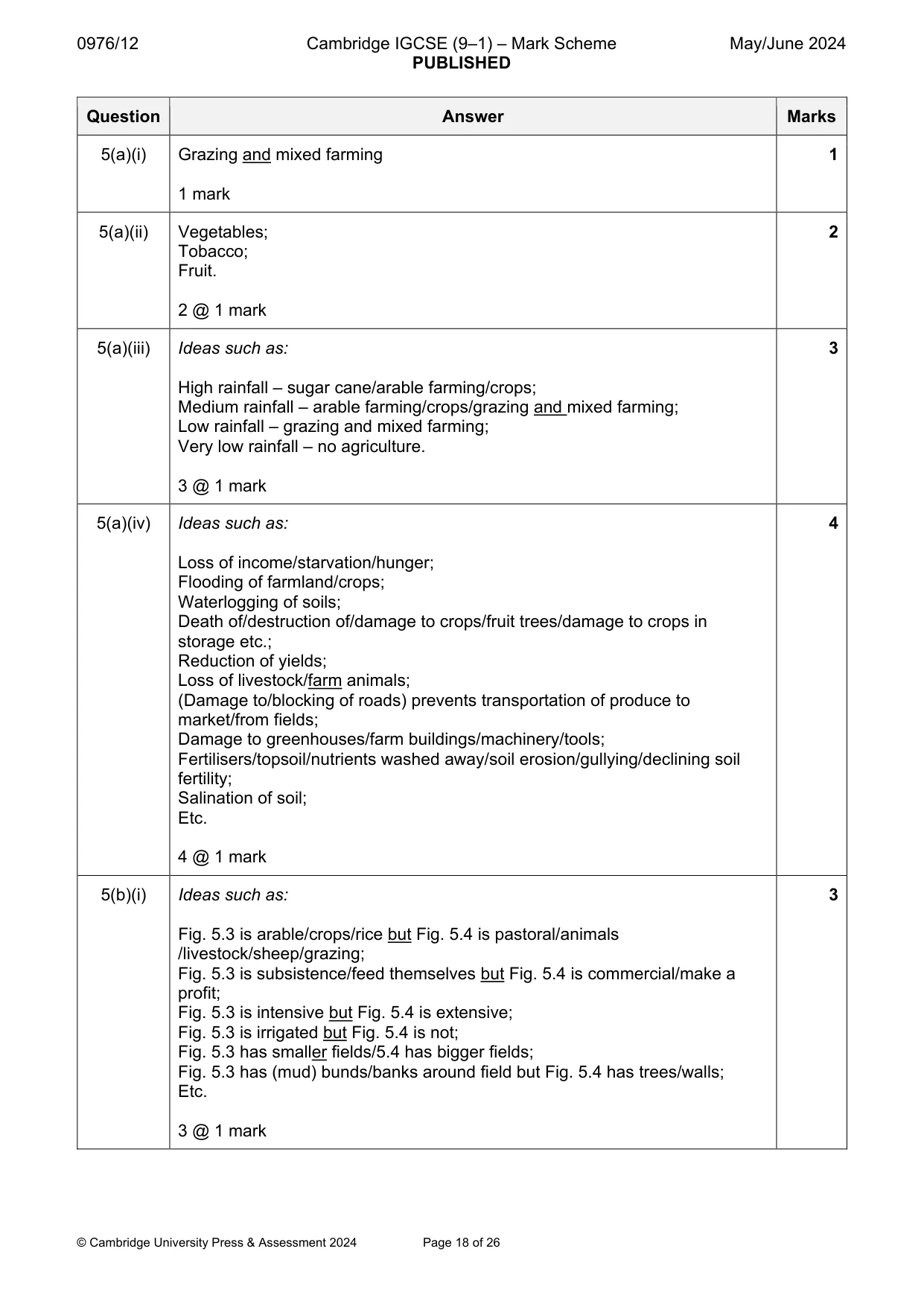
0976/12 Cambridge IGCSE (9–1) – Mark Scheme PUBLISHED May/June 2024 © Cambridge University Press & Assessment 2024 Page 18 of 26 Question Answer Marks 5(a)(i) Grazing and mixed farming 1 mark 1 5(a)(ii) Vegetables; Tobacco; Fruit. 2 @ 1 mark 2 5(a)(iii) Ideas such as: High rainfall – sugar cane/arable farming/crops; Medium rainfall – arable farming/crops/grazing and mixed farming; Low rainfall – grazing and mixed farming; Very low rainfall – no agriculture. 3 @ 1 mark 3 5(a)(iv) Ideas such as: Loss of income/starvation/hunger; Flooding of farmland/crops; Waterlogging of soils; Death of/destruction of/damage to crops/fruit trees/damage to crops in storage etc.; Reduction of yields; Loss of livestock/farm animals; (Damage to/blocking of roads) prevents transportation of produce to market/from fields; Damage to greenhouses/farm buildings/machinery/tools; Fertilisers/topsoil/nutrients washed away/soil erosion/gullying/declining soil fertility; Salination of soil; Etc. 4 @ 1 mark 4 5(b)(i) Ideas such as: Fig. 5.3 is arable/crops/rice but Fig. 5.4 is pastoral/animals /livestock/sheep/grazing; Fig. 5.3 is subsistence/feed themselves but Fig. 5.4 is commercial/make a profit; Fig. 5.3 is intensive but Fig. 5.4 is extensive; Fig. 5.3 is irrigated but Fig. 5.4 is not; Fig. 5.3 has smaller fields/5.4 has bigger fields; Fig. 5.3 has (mud) bunds/banks around field but Fig. 5.4 has trees/walls; Etc. 3 @ 1 mark 3
Mark scheme, page 19
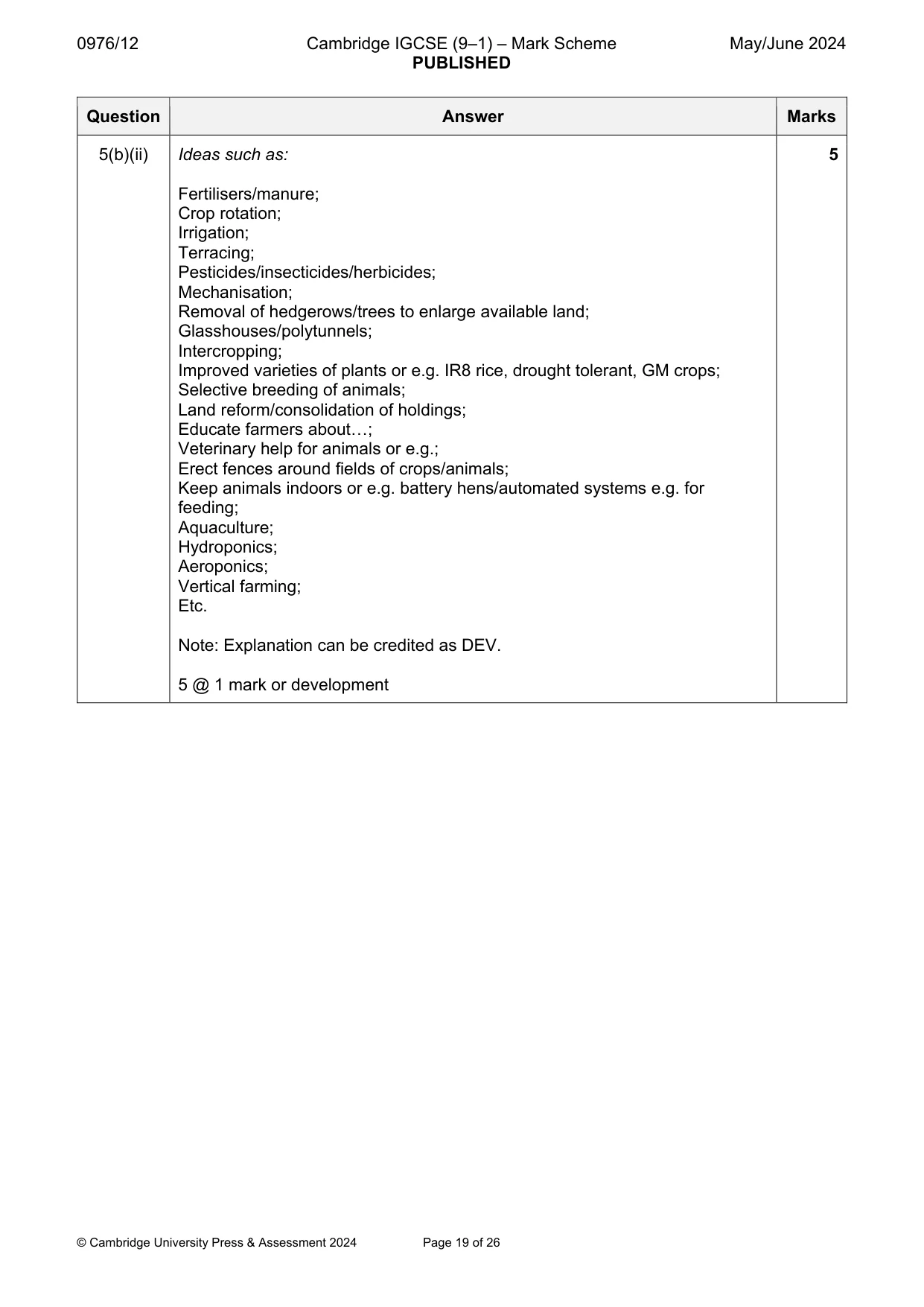
0976/12 Cambridge IGCSE (9–1) – Mark Scheme PUBLISHED May/June 2024 © Cambridge University Press & Assessment 2024 Page 19 of 26 Question Answer Marks 5(b)(ii) Ideas such as: Fertilisers/manure; Crop rotation; Irrigation; Terracing; Pesticides/insecticides/herbicides; Mechanisation; Removal of hedgerows/trees to enlarge available land; Glasshouses/polytunnels; Intercropping; Improved varieties of plants or e.g. IR8 rice, drought tolerant, GM crops; Selective breeding of animals; Land reform/consolidation of holdings; Educate farmers about…; Veterinary help for animals or e.g.; Erect fences around fields of crops/animals; Keep animals indoors or e.g. battery hens/automated systems e.g. for feeding; Aquaculture; Hydroponics; Aeroponics; Vertical farming; Etc. Note: Explanation can be credited as DEV. 5 @ 1 mark or development 5
Mark scheme, page 20
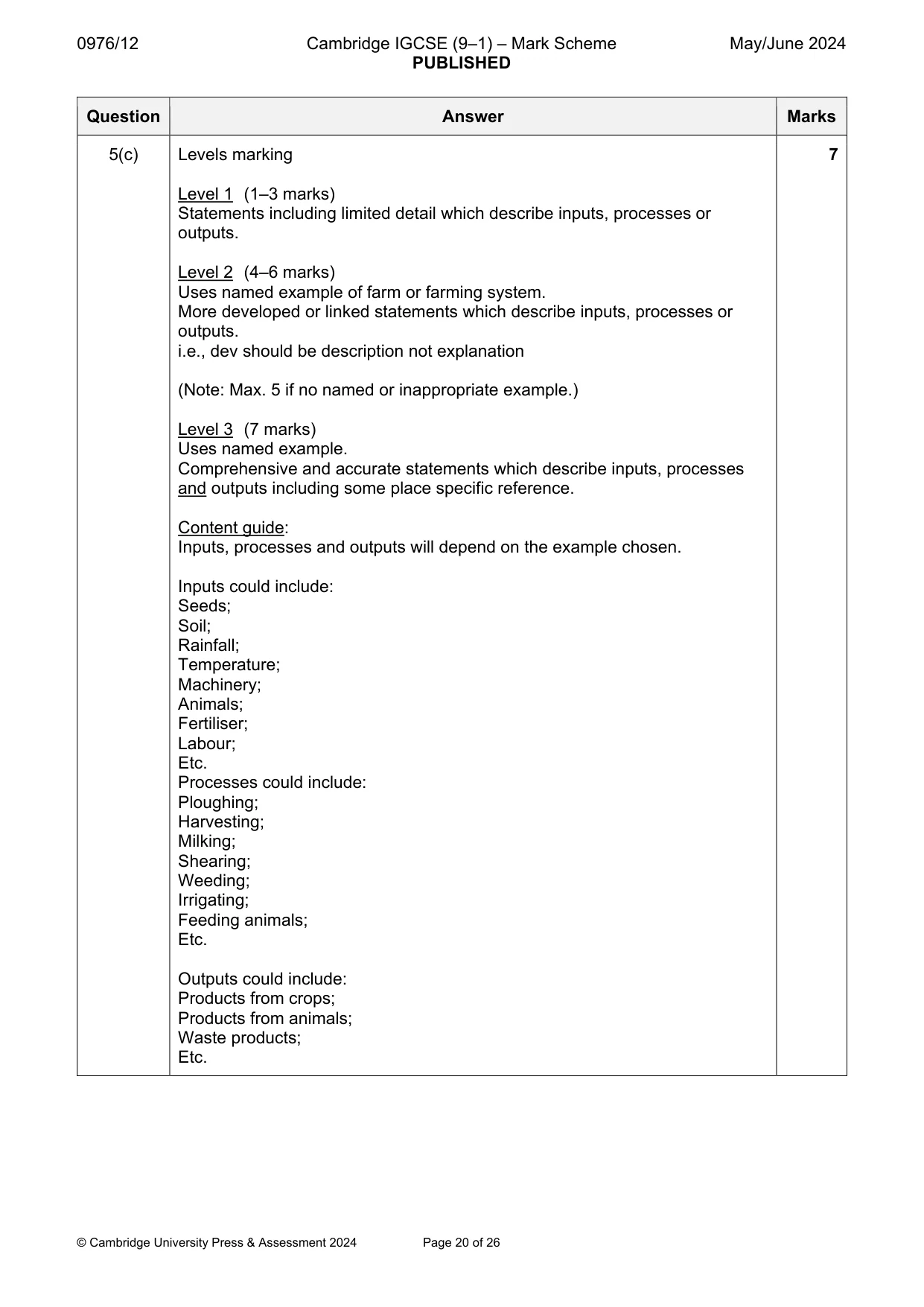
0976/12 Cambridge IGCSE (9–1) – Mark Scheme PUBLISHED May/June 2024 © Cambridge University Press & Assessment 2024 Page 20 of 26 Question Answer Marks 5(c) Levels marking Level 1 (1–3 marks) Statements including limited detail which describe inputs, processes or outputs. Level 2 (4–6 marks) Uses named example of farm or farming system. More developed or linked statements which describe inputs, processes or outputs. i.e., dev should be description not explanation (Note: Max. 5 if no named or inappropriate example.) Level 3 (7 marks) Uses named example. Comprehensive and accurate statements which describe inputs, processes and outputs including some place specific reference. Content guide: Inputs, processes and outputs will depend on the example chosen. Inputs could include: Seeds; Soil; Rainfall; Temperature; Machinery; Animals; Fertiliser; Labour; Etc. Processes could include: Ploughing; Harvesting; Milking; Shearing; Weeding; Irrigating; Feeding animals; Etc. Outputs could include: Products from crops; Products from animals; Waste products; Etc. 7
Mark scheme, page 21
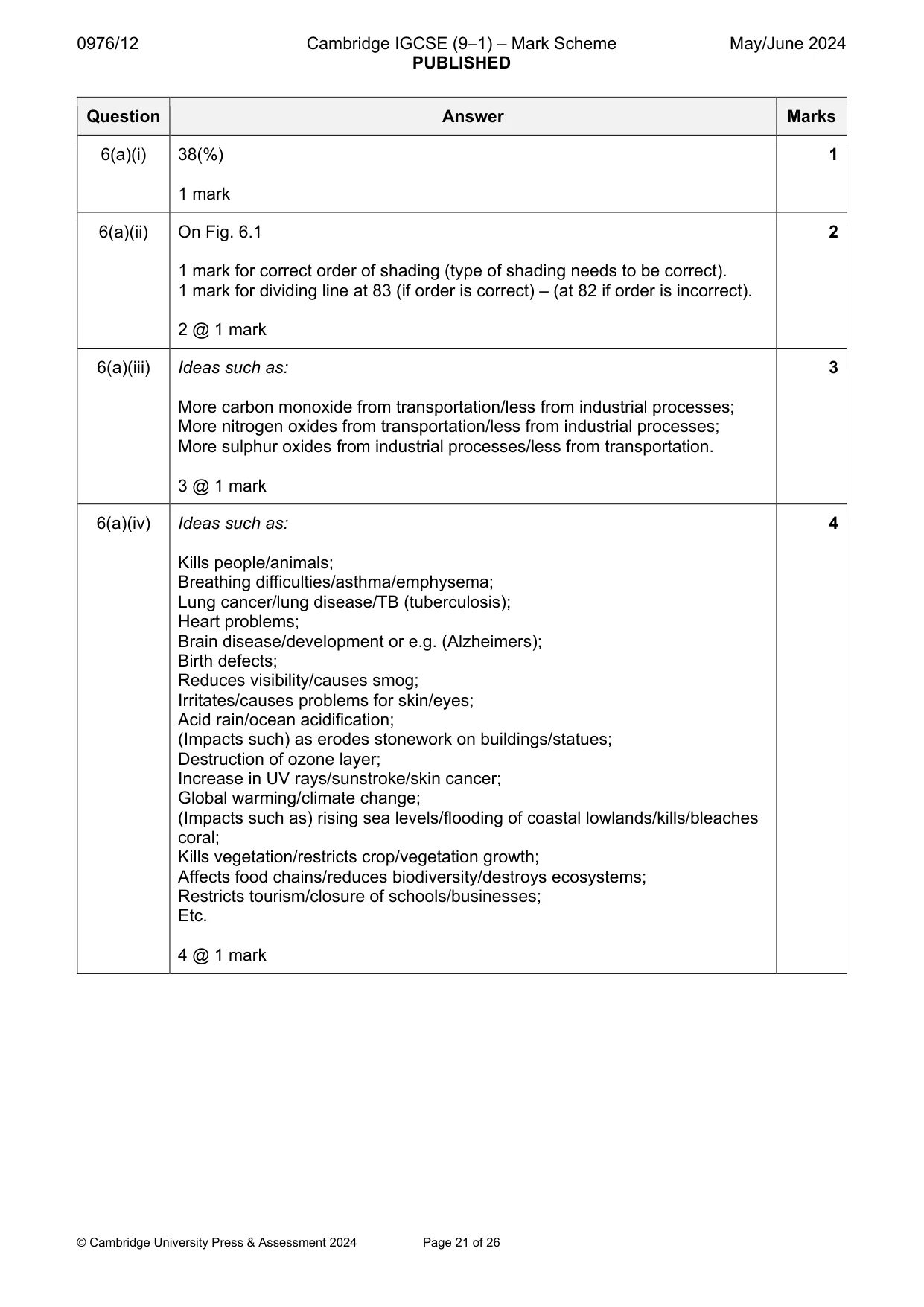
0976/12 Cambridge IGCSE (9–1) – Mark Scheme PUBLISHED May/June 2024 © Cambridge University Press & Assessment 2024 Page 21 of 26 Question Answer Marks 6(a)(i) 38(%) 1 mark 1 6(a)(ii) On Fig. 6.1 1 mark for correct order of shading (type of shading needs to be correct). 1 mark for dividing line at 83 (if order is correct) – (at 82 if order is incorrect). 2 @ 1 mark 2 6(a)(iii) Ideas such as: More carbon monoxide from transportation/less from industrial processes; More nitrogen oxides from transportation/less from industrial processes; More sulphur oxides from industrial processes/less from transportation. 3 @ 1 mark 3 6(a)(iv) Ideas such as: Kills people/animals; Breathing difficulties/asthma/emphysema; Lung cancer/lung disease/TB (tuberculosis); Heart problems; Brain disease/development or e.g. (Alzheimers); Birth defects; Reduces visibility/causes smog; Irritates/causes problems for skin/eyes; Acid rain/ocean acidification; (Impacts such) as erodes stonework on buildings/statues; Destruction of ozone layer; Increase in UV rays/sunstroke/skin cancer; Global warming/climate change; (Impacts such as) rising sea levels/flooding of coastal lowlands/kills/bleaches coral; Kills vegetation/restricts crop/vegetation growth; Affects food chains/reduces biodiversity/destroys ecosystems; Restricts tourism/closure of schools/businesses; Etc. 4 @ 1 mark 4
Mark scheme, page 22
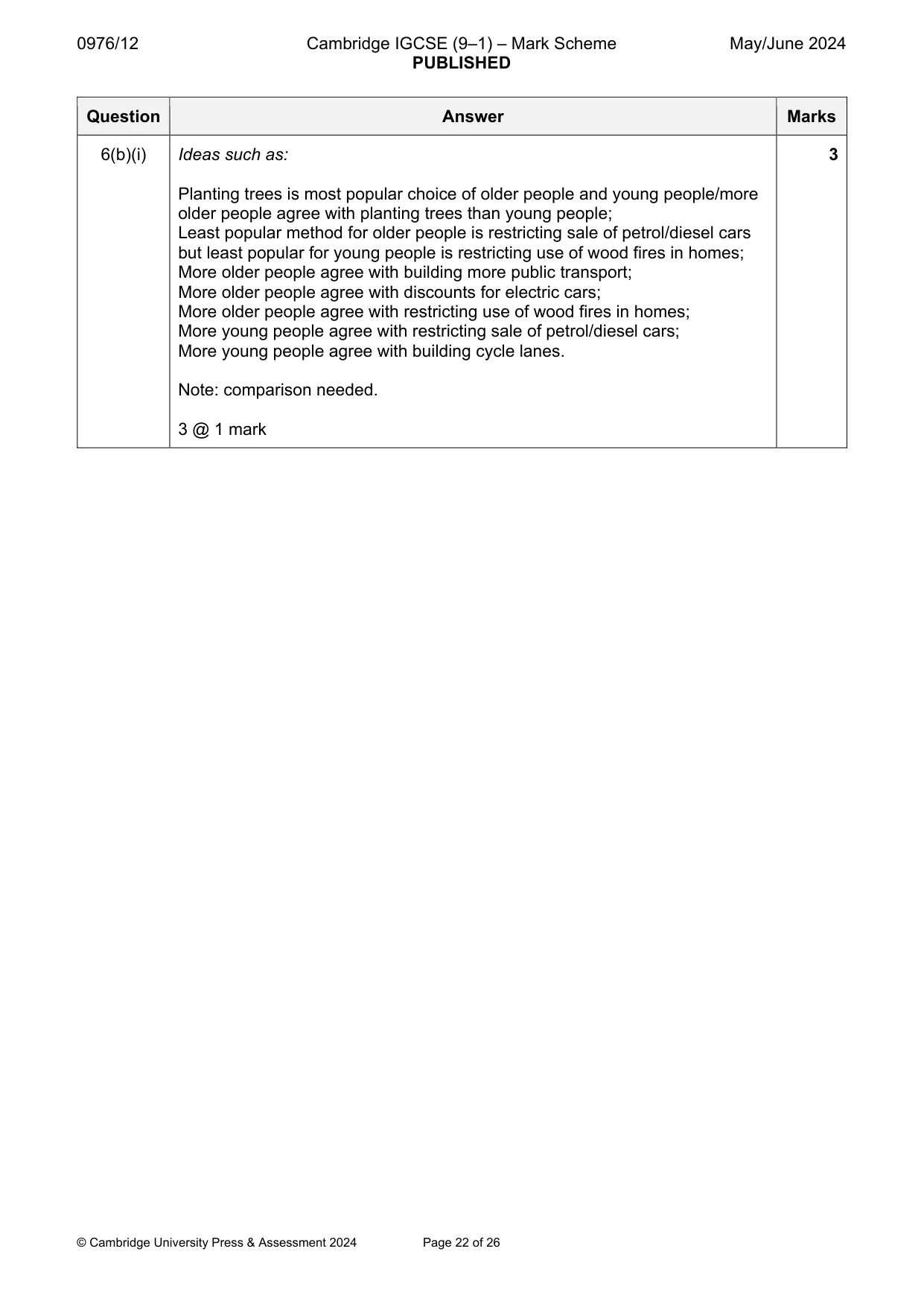
0976/12 Cambridge IGCSE (9–1) – Mark Scheme PUBLISHED May/June 2024 © Cambridge University Press & Assessment 2024 Page 22 of 26 Question Answer Marks 6(b)(i) Ideas such as: Planting trees is most popular choice of older people and young people/more older people agree with planting trees than young people; Least popular method for older people is restricting sale of petrol/diesel cars but least popular for young people is restricting use of wood fires in homes; More older people agree with building more public transport; More older people agree with discounts for electric cars; More older people agree with restricting use of wood fires in homes; More young people agree with restricting sale of petrol/diesel cars; More young people agree with building cycle lanes. Note: comparison needed. 3 @ 1 mark 3
Mark scheme, page 23
0976/12 Cambridge IGCSE (9–1) – Mark Scheme PUBLISHED May/June 2024 © Cambridge University Press & Assessment 2024 Page 23 of 26 Question Answer Marks 6(b)(ii) Candidates can choose any of the strategies (no mark). Marks to be awarded for advantages of chosen strategy and disadvantages of the chosen rejected method. plant more trees in urban areas: Advantages: Trees reduce carbon dioxide in the atmosphere/reduce global warming/reduce climate change; Impacts of climate change or e.g. of impacts; Aesthetic value/provides recreational areas in city; Help to provide shade/cooling effect; Wood supply; Creation of employment; Cheap; Habitat creation for wildlife; Etc. Disadvantages; Impacts are not immediate/they take a long time to grow; They would have minimal effect locally; Industries/vehicles will still pollute; There is little land available in urban areas to plant trees; Etc. Build more public transport networks: Advantages: Replaces the number of cars emitting greenhouse gases; Reduce carbon dioxide in the atmosphere/reduce global warming; Impacts of climate change or e.g. of impacts; Reduce particulate emissions/less soot on buildings; Reduce commuting times; Reduces congestion/less chance of being in traffic jam; Cheaper than owning and maintaining cars; Carries more people in a single vehicle; Etc. Disadvantages: Expensive to build; No flexibility on timetables; Wait times; Slower than personal transport; Don't stop at all destinations; Lack of personal space/lack of privacy, cleanliness, comfort; Time consuming to construct/problems during construction; Etc. 5
Mark scheme, page 24
0976/12 Cambridge IGCSE (9–1) – Mark Scheme PUBLISHED May/June 2024 © Cambridge University Press & Assessment 2024 Page 24 of 26 Question Answer Marks 6(b)(ii) Build more cycle lanes in cities: Advantages: Replaces the number of cars emitting greenhouse gases; Leads to fresher air; Creates employment; Health benefits; Safety/separates cyclists from motorists/less accidents; Cycling to work/college is cheaper than other forms of transport; Etc. Disadvantages: Funding the creation and maintenance of cycle lanes is costly; Not suitable for some people to cycle – disabilities; Impact is not immediate/they take a long time to construct; Industries/delivery vehicles will still pollute; Cycle lanes cause problems for on-street parking/deliveries for store owners; Reduces space for motor vehicles/pedestrians; Pedestrians have been injured/died from collisions with cyclists; Some cycle lanes have to be built on private property or on public spaces; Some cycle lane designs place cyclists in danger of parked vehicles due to the opening of doors; Etc. Reduce prices of electric cars: Advantages: Reduce carbon dioxide in the atmosphere/reduce global warming; Impacts of climate change or e.g. of impacts; Reduce particulate emissions/less soot on buildings; Low cost; More people will buy them; Quieter vehicles; Fewer tankers needed to deliver fuel; Powered using sustainable energy; Lower running costs for drivers; Health benefits e.g. fewer breathing problems; Etc. Disadvantages: Danger from quiet vehicles; Pollution from electricity generation to power the EVs; Cost for manufacturers will increase/less profit for manufacturers; Cost/practicality of charging infrastructure; Etc.
Mark scheme, page 25
0976/12 Cambridge IGCSE (9–1) – Mark Scheme PUBLISHED May/June 2024 © Cambridge University Press & Assessment 2024 Page 25 of 26 Question Answer Marks 6(b)(ii) Restrict the sale of new petrol and diesel cars: Advantages: Reduce carbon dioxide in the atmosphere/reduce global warming; Impacts of climate change or e.g. of impacts; Reduce particulate emissions/less soot on buildings; Health benefits e.g. fewer breathing problems; Low/no cost to government; Etc. Disadvantages: Many diesel and petrol cars will still be on the road/still pollute; Industries/domestic users will still pollute; Loss of employment (manufacturers/retailers); Cost to consumer/manufacturer/people have no alternative than buying expensive electric cars; Etc. Restrict the use of wood fires in homes: Advantages: Less wood cut down; Low cost; Which provide shade/cooling; Which provide habitat for wildlife; Which provide aesthetic value/recreational areas in city; Reduces smog locally; Profit for suppliers of other heating methods; Etc. Disadvantages: Industries/domestic users will still pollute; Cost to residents to convert heating systems; Cost/lack of profit for wood suppliers/log burner sellers; Lack of employment for wood suppliers/log burner sellers; Etc. Note: max. 3 marks for advantages/disadvantages. Only accept a cost reference as an advantage or a disadvantage for 1 mark max. 5 @ 1 mark or development
Mark scheme, page 26
0976/12 Cambridge IGCSE (9–1) – Mark Scheme PUBLISHED May/June 2024 © Cambridge University Press & Assessment 2024 Page 26 of 26 Question Answer Marks 6(c) Levels marking Level 1 (1–3 marks) Statements including limited detail which describe impacts of a TNC on people living in a country where it operates. Level 2 (4–6 marks) More developed or linked statements which describe impacts of a TNC on people living in a country where it operates. (Note: Max. 5 if no named or inappropriate example.) Level 3 (7 marks) Comprehensive and accurate statements which describe impacts of a TNC on people living in a country where it operates, including some place references. Note: Place specific reference must be for the country selected as the example. Content Guide: Answers are likely to refer to: Employment; Multiplier effect; Infrastructure development; Transport improvements; Impact of economic growth/development on population; Exploitation of workforce; Impacts of specified pollution on people; Etc. Place specific reference is likely to consist of: Locational details, Named places/countries, Specific details of TNC etc. 7
What you needed in this session
Cambridge’s own grade thresholds for 2024 May/June, Paper 1 · Variant 2. A higher threshold means an easier paper — the bar moves with how the cohort did.