Cambridge IGCSE Geography (9-1) 0976 — 2022 May/June Paper 1 · Variant 2
0976/12/M/J/22 · 75 marks · ≈84 min
The question paper and its mark scheme, free to read here and free to download. This is Cambridge’s own paper, exactly as it was sat.
Question paper24 pages

Mark scheme19 pages
Answers below. Sit the paper first if you are practising.
Paper as text
Question paper, page 1
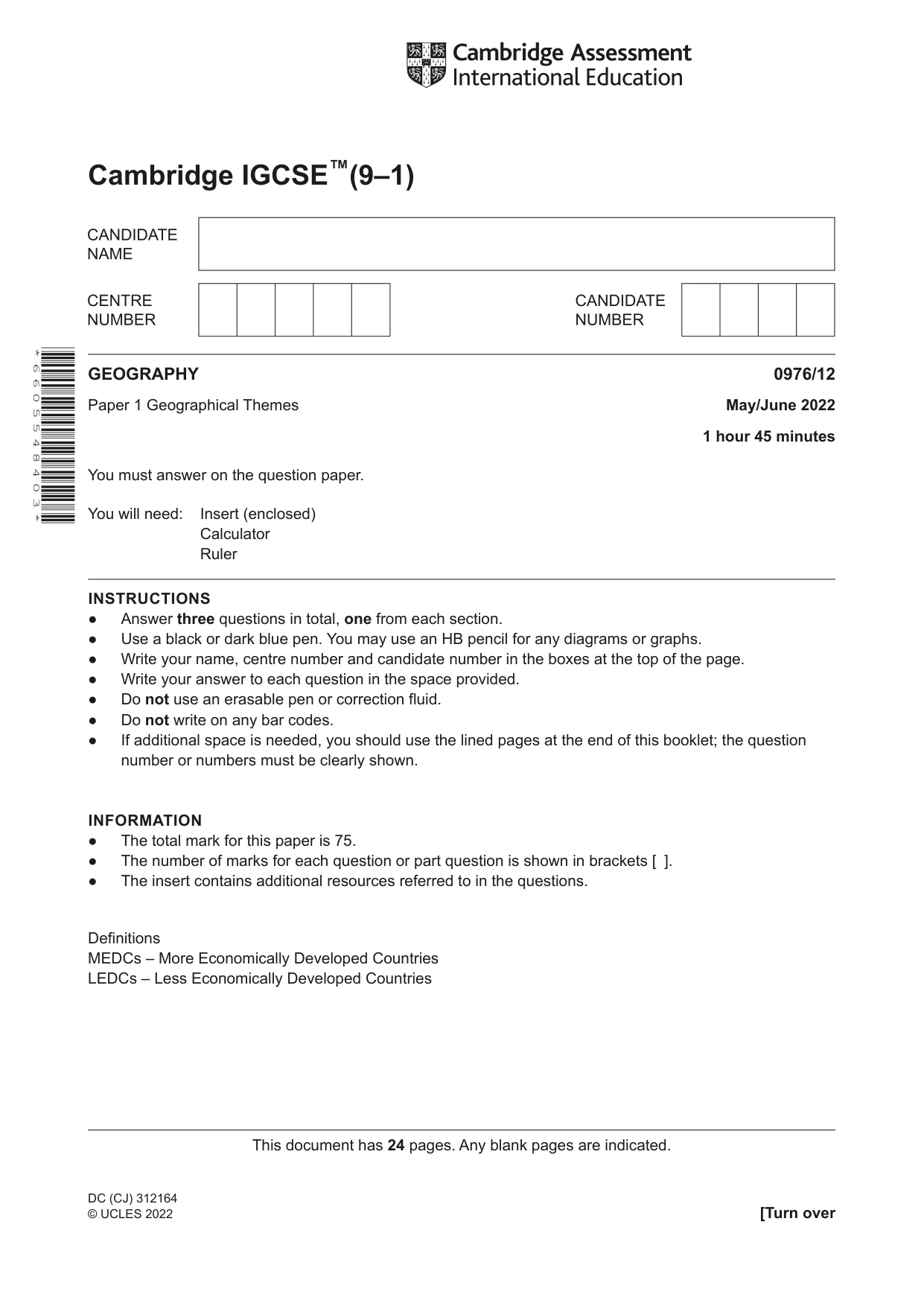
This document has 24 pages. Any blank pages are indicated. [Turn over Cambridge IGCSE™(9–1) DC (CJ) 312164 © UCLES 2022 * 6 6 0 5 5 4 8 4 0 3 * GEOGRAPHY 0976/12 Paper 1 Geographical Themes May/June 2022 1 hour 45 minutes You must answer on the question paper. You will need: Insert (enclosed) Calculator Ruler INSTRUCTIONS ● Answer three questions in total, one from each section. ● Use a black or dark blue pen. You may use an HB pencil for any diagrams or graphs. ● Write your name, centre number and candidate number in the boxes at the top of the page. ● Write your answer to each question in the space provided. ● Do not use an erasable pen or correction fluid. ● Do not write on any bar codes. ● If additional space is needed, you should use the lined pages at the end of this booklet; the question number or numbers must be clearly shown. INFORMATION ● The total mark for this paper is 75. ● The number of marks for each question or part question is shown in brackets [ ]. ● The insert contains additional resources referred to in the questions. Definitions MEDCs – More Economically Developed Countries LEDCs – Less Economically Developed Countries
Question paper, page 2
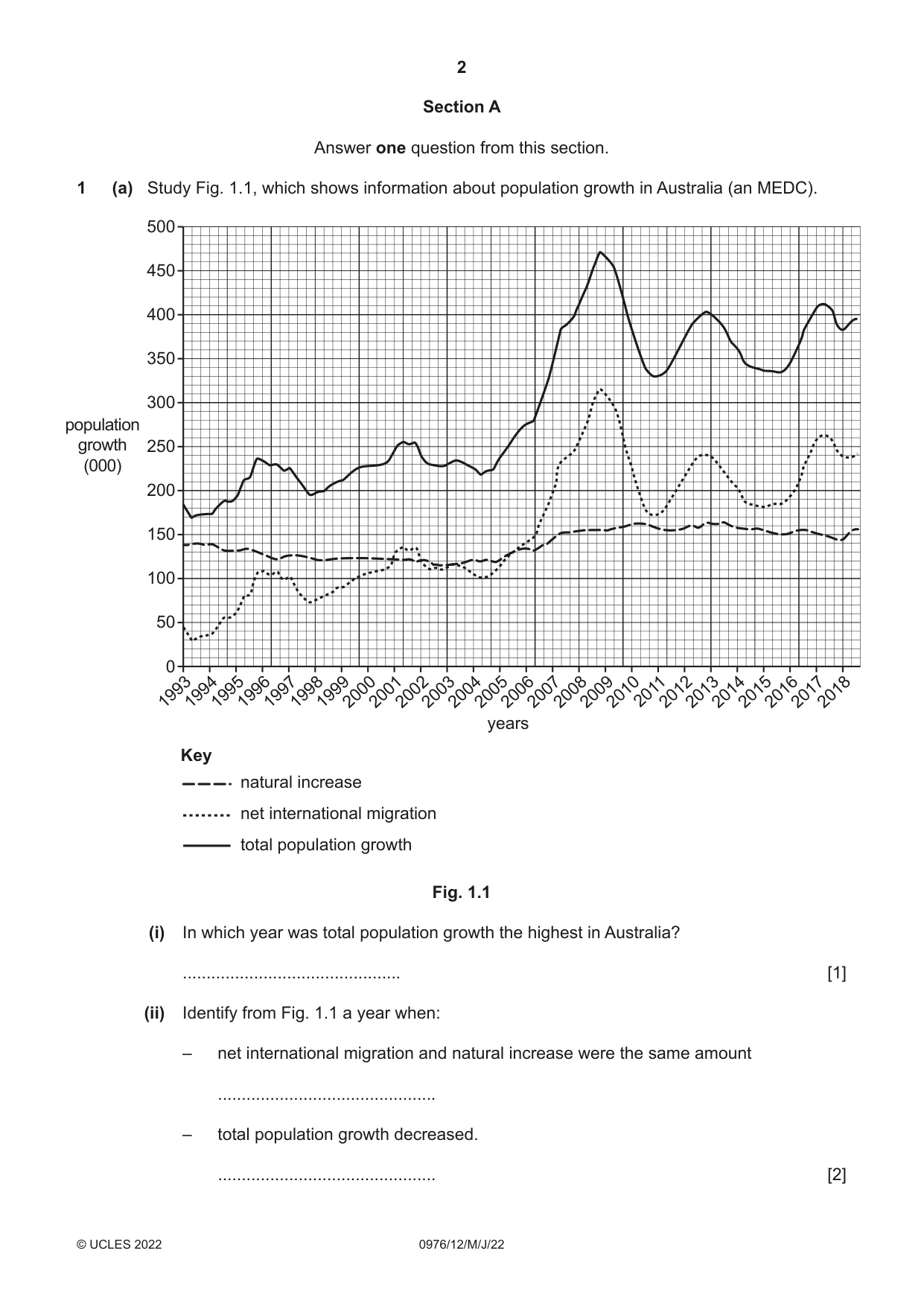
2 0976/12/M/J/22 © UCLES 2022 Section A Answer one question from this section. 1 (a) Study Fig. 1.1, which shows information about population growth in Australia (an MEDC). 1993 1994 1995 1996 1997 1998 1999 2000 2001 2002 2003 2004 2005 2006 2007 2008 2009 2010 2011 2012 2013 2014 2015 2016 2017 2018 50 0 100 150 200 250 300 350 400 450 500 years population growth (000) Key natural increase net international migration total population growth Fig. 1.1 (i) In which year was total population growth the highest in Australia? … [1] (ii) Identify from Fig. 1.1 a year when: – net international migration and natural increase were the same amount … – total population growth decreased. … [2]
Question paper, page 3
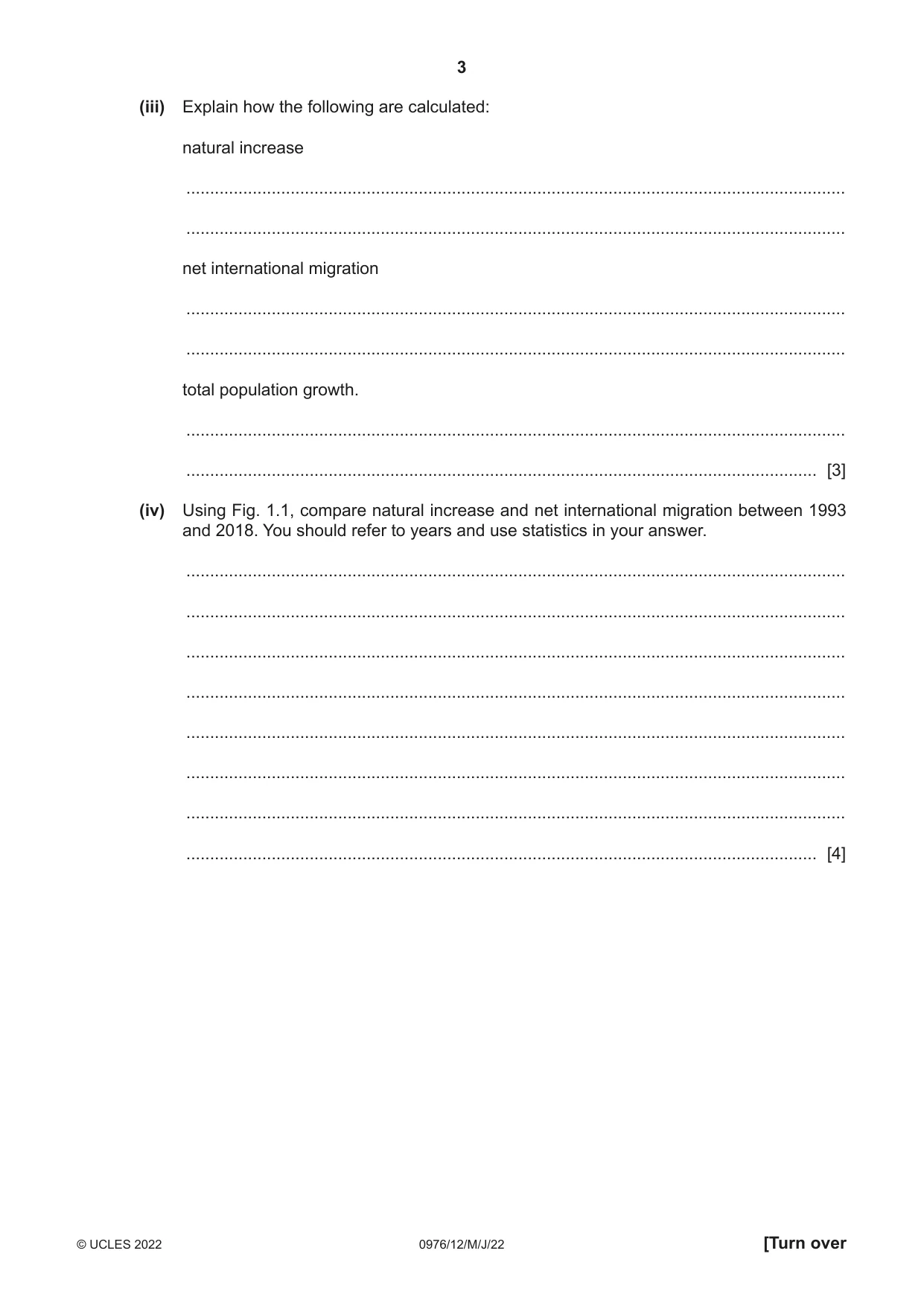
3 0976/12/M/J/22 © UCLES 2022 [Turn over (iii) Explain how the following are calculated: natural increase … … net international migration … … total population growth. … … [3] (iv) Using Fig. 1.1, compare natural increase and net international migration between 1993 and 2018. You should refer to years and use statistics in your answer. … … … … … … … … [4]
Question paper, page 4
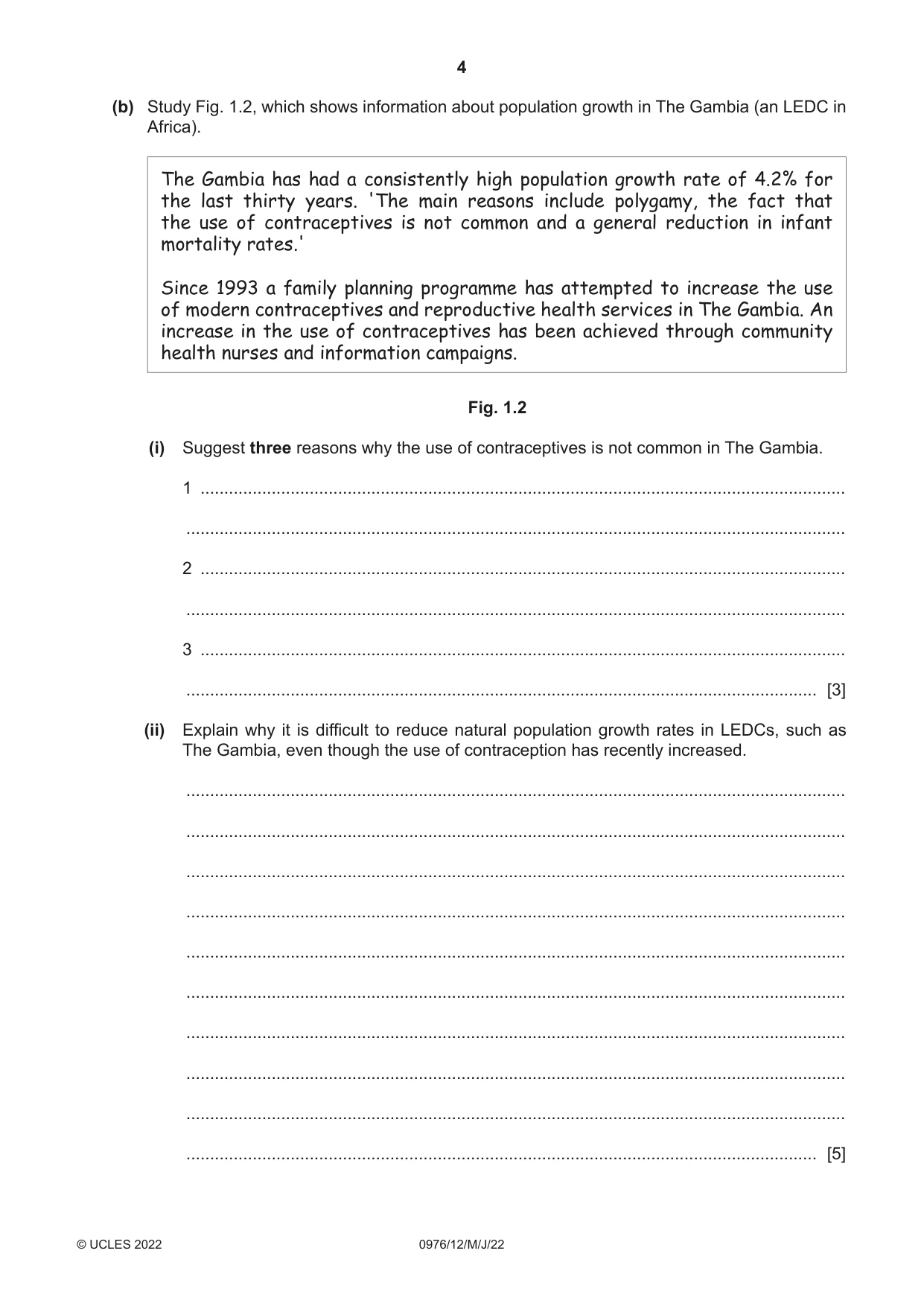
4 0976/12/M/J/22 © UCLES 2022 (b) Study Fig. 1.2, which shows information about population growth in The Gambia (an LEDC in Africa). The Gambia has had a consistently high population growth rate of 4.2% for the last thirty years. 'The main reasons include polygamy, the fact that the use of contraceptives is not common and a general reduction in infant mortality rates.' Since 1993 a family planning programme has attempted to increase the use of modern contraceptives and reproductive health services in The Gambia. An increase in the use of contraceptives has been achieved through community health nurses and information campaigns. Fig. 1.2 (i) Suggest three reasons why the use of contraceptives is not common in The Gambia. 1 … … 2 … … 3 … … [3] (ii) Explain why it is difficult to reduce natural population growth rates in LEDCs, such as The Gambia, even though the use of contraception has recently increased. … … … … … … … … … … [5]
Question paper, page 5
5 0976/12/M/J/22 © UCLES 2022 [Turn over (c) For a named country you have studied, describe the problems caused by a high rate of population growth. Name of country … … … … … … … … … … … … … … … … … … … … … … … … … … [7] [Total: 25]
Question paper, page 6
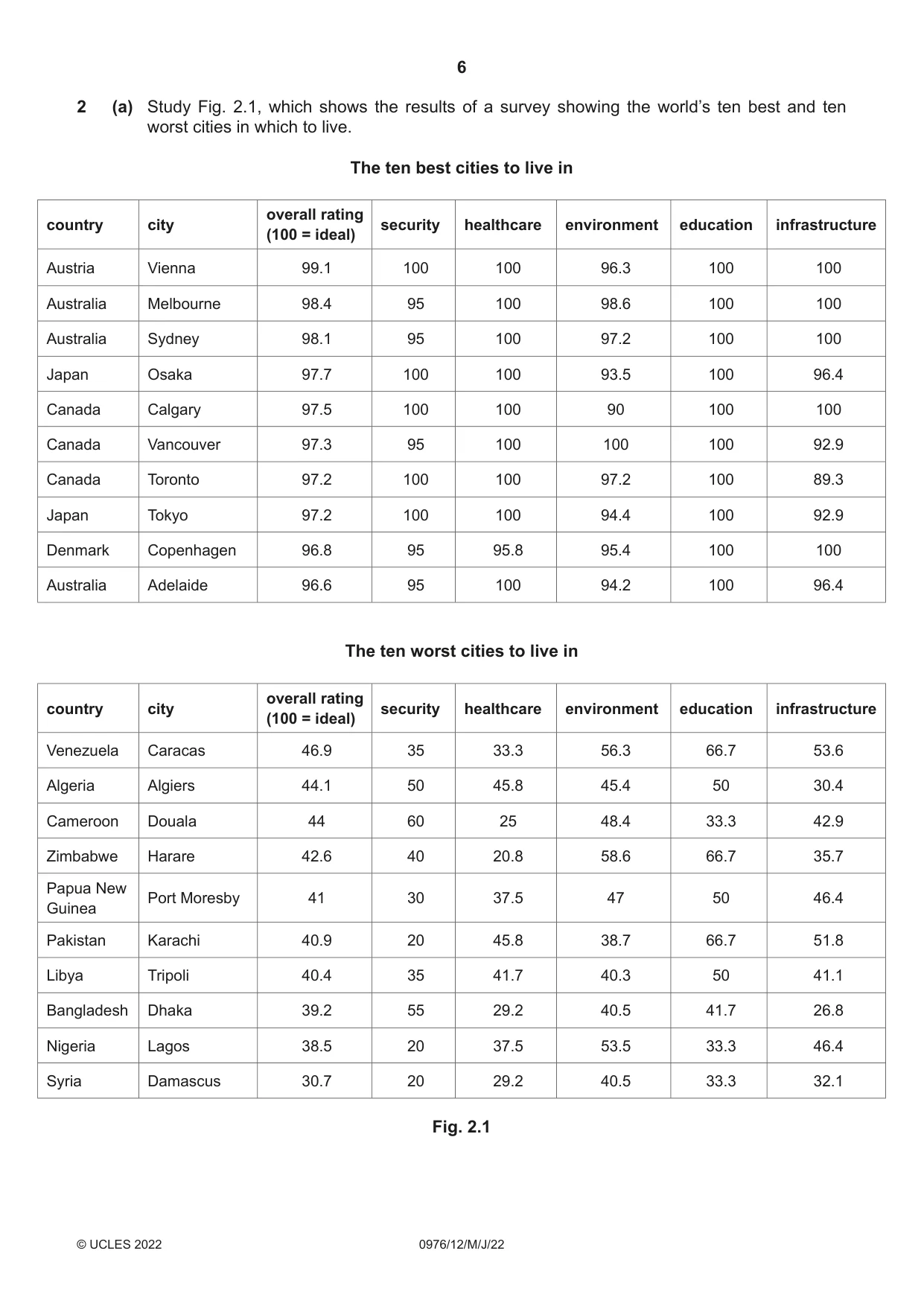
6 0976/12/M/J/22 © UCLES 2022 2 (a) Study Fig. 2.1, which shows the results of a survey showing the world’s ten best and ten worst cities in which to live. The ten best cities to live in country city overall rating (100 = ideal) security healthcare environment education infrastructure Austria Vienna 99.1 100 100 96.3 100 100 Australia Melbourne 98.4 95 100 98.6 100 100 Australia Sydney 98.1 95 100 97.2 100 100 Japan Osaka 97.7 100 100 93.5 100 96.4 Canada Calgary 97.5 100 100 90 100 100 Canada Vancouver 97.3 95 100 100 100 92.9 Canada Toronto 97.2 100 100 97.2 100 89.3 Japan Tokyo 97.2 100 100 94.4 100 92.9 Denmark Copenhagen 96.8 95 95.8 95.4 100 100 Australia Adelaide 96.6 95 100 94.2 100 96.4 The ten worst cities to live in country city overall rating (100 = ideal) security healthcare environment education infrastructure Venezuela Caracas 46.9 35 33.3 56.3 66.7 53.6 Algeria Algiers 44.1 50 45.8 45.4 50 30.4 Cameroon Douala 44 60 25 48.4 33.3 42.9 Zimbabwe Harare 42.6 40 20.8 58.6 66.7 35.7 Papua New Guinea Port Moresby 41 30 37.5 47 50 46.4 Pakistan Karachi 40.9 20 45.8 38.7 66.7 51.8 Libya Tripoli 40.4 35 41.7 40.3 50 41.1 Bangladesh Dhaka 39.2 55 29.2 40.5 41.7 26.8 Nigeria Lagos 38.5 20 37.5 53.5 33.3 46.4 Syria Damascus 30.7 20 29.2 40.5 33.3 32.1 Fig. 2.1
Question paper, page 7
7 0976/12/M/J/22 © UCLES 2022 [Turn over (i) Name a country which has three of the ten best cities in which to live. … [1] (ii) State two different types of infrastructure in a city. 1 … 2 … [2] (iii) Suggest three different ways that the environment may cause problems for people living in the ten worst cities. 1 … … 2 … … 3 … … [3] (iv) Using Fig. 2.1 only, explain why Vienna is a better city in which to live than Damascus. You should not use statistics. … … … … … … … … [4]
Question paper, page 8
8 0976/12/M/J/22 © UCLES 2022 (b) Study Fig. 2.2, which shows information about the functions of cities. Fig. 2.2 (i) What is meant by the following functions? commercial … … residential … … industrial … … [3] (ii) Explain why many large cities have an administrative function. … … … … … … … … … … [5] Content removed due to copyright restrictions.
Question paper, page 9
9 0976/12/M/J/22 © UCLES 2022 [Turn over (c) For a named urban area you have studied, describe the problems caused by urban sprawl for the surrounding natural environment. Name of urban area … … … … … … … … … … … … … … … … … … … … … … … … … … [7] [Total: 25]
Question paper, page 10
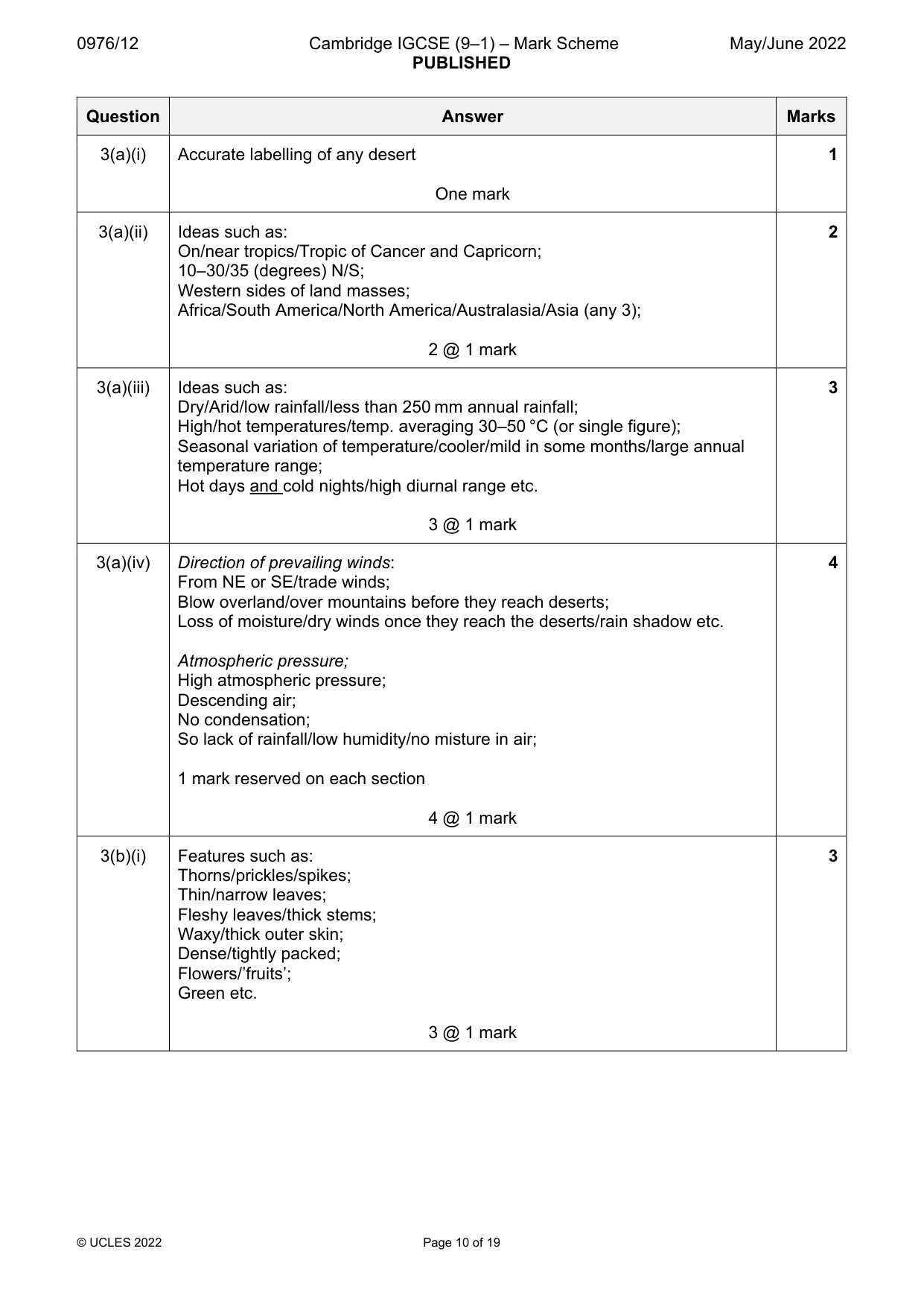
10 0976/12/M/J/22 © UCLES 2022 Section B Answer one question from this section. 3 (a) Study Fig. 3.1, which is a map showing hot deserts. Fig. 3.1 (i) On Fig. 3.1, draw a labelled arrow to name a hot desert. [1] (ii) Using Fig. 3.1 only, describe the distribution of hot deserts. … … … … [2] (iii) Describe the typical climate of an area of hot desert. … … … … … … [3] Content removed due to copyright restrictions.
Question paper, page 11
11 0976/12/M/J/22 © UCLES 2022 [Turn over (iv) Explain how the following factors influence the climate of an area of hot desert. direction of prevailing wind … … … … atmospheric pressure … … … … [4] (b) Study Fig. 3.2 (Insert), which is a photograph of hot desert vegetation. (i) Using Fig. 3.2 only, describe three features of the vegetation shown. 1 … … 2 … … 3 … … [3] (ii) Explain how vegetation, such as that shown in Fig. 3.2, can survive in a hot desert. … … … … … … … … … … [5]
Question paper, page 12
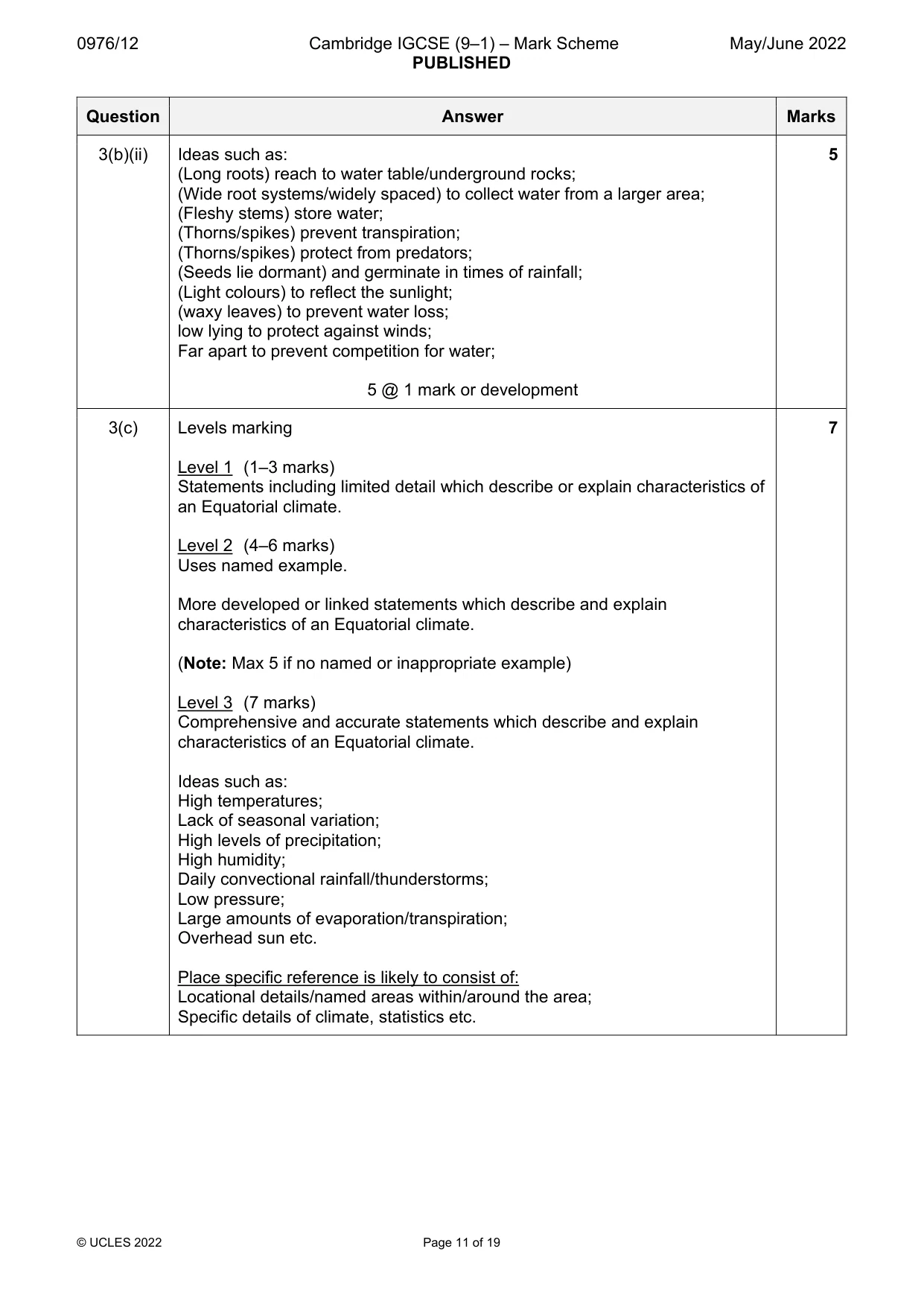
12 0976/12/M/J/22 © UCLES 2022 (c) For an area you have studied with an equatorial climate, describe and explain the climatic characteristics. Name of area … … … … … … … … … … … … … … … … … … … … … … … … … … [7] [Total: 25]
Question paper, page 13
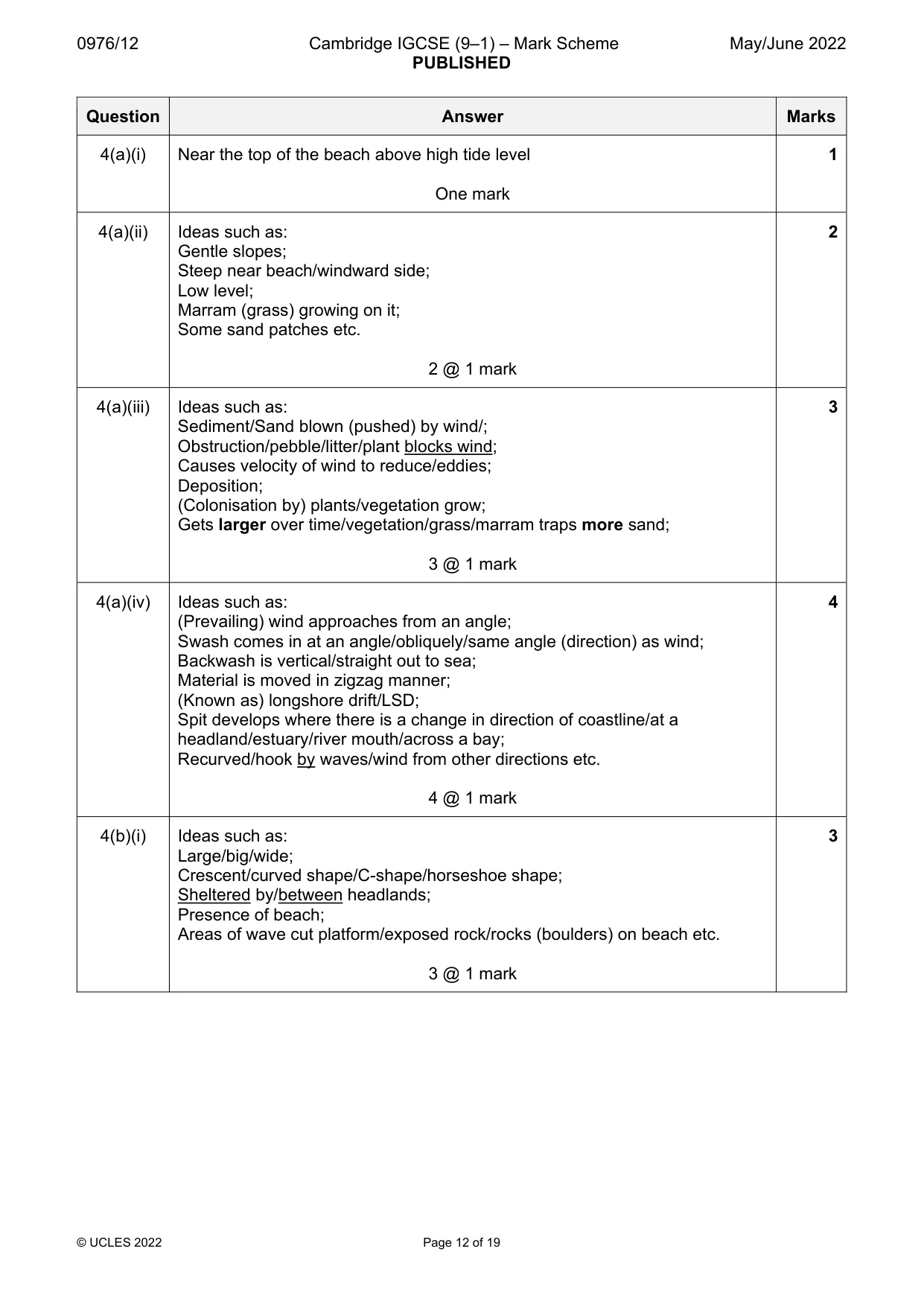
13 0976/12/M/J/22 © UCLES 2022 [Turn over 4 (a) Study Fig. 4.1 (Insert), which is a photograph of an area of sand dunes. (i) Which one of the following statements best describes the location of the sand dunes shown in Fig. 4.1? Tick (3) the correct statement in the table below. tick (3) close to the sea at low tide level on a headland next to the cliff edge on the beach between high and low tide levels near the top of the beach above high tide level [1] (ii) Describe two characteristics of the sand dunes shown in Fig. 4.1. 1 … … 2 … … [2] (iii) Suggest how the sand dunes shown in Fig. 4.1 were formed. … … … … … … [3] (iv) Many areas of sand dunes are located on spits. Explain how a spit is formed. … … … … … … … … [4]
Question paper, page 14
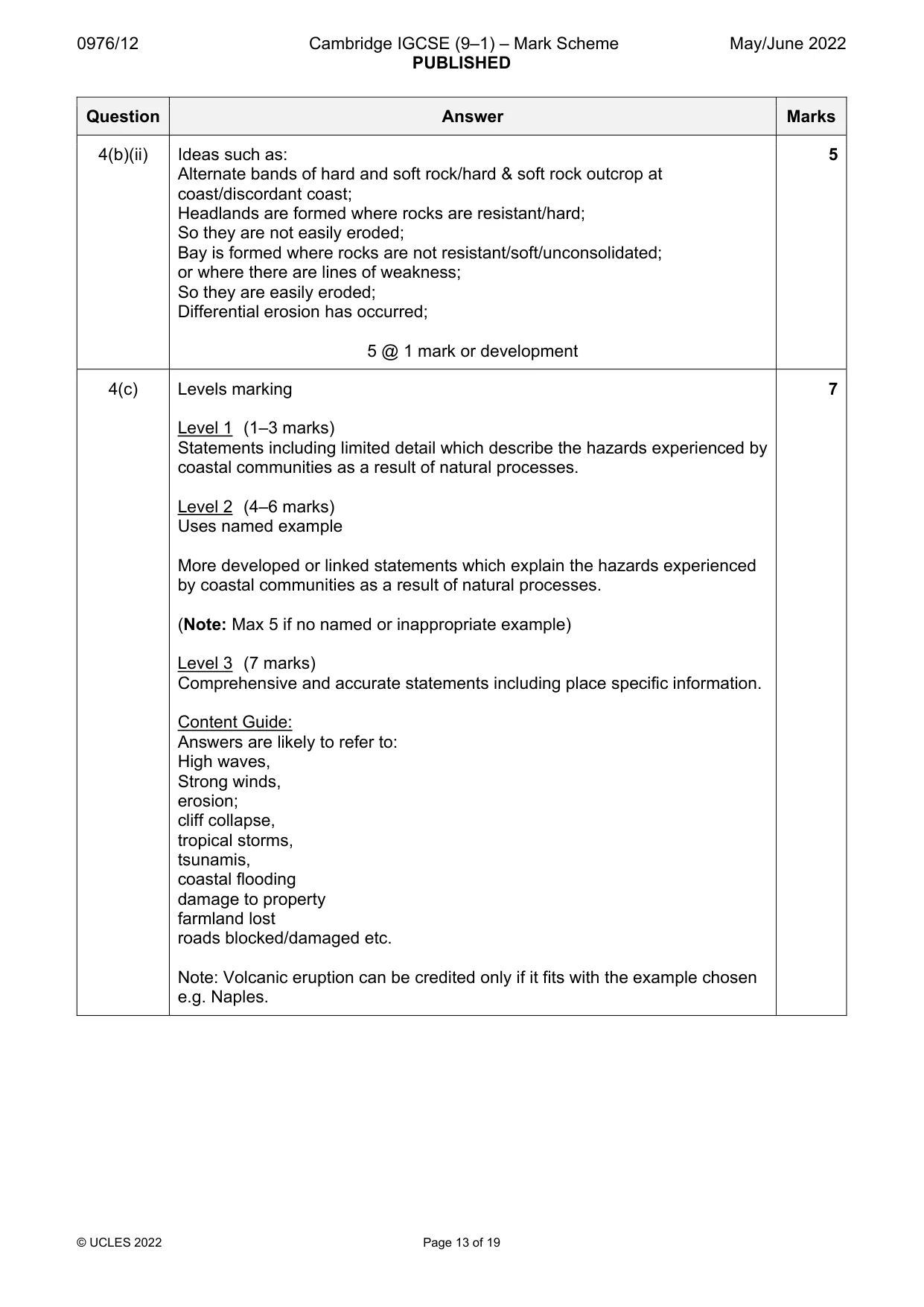
14 0976/12/M/J/22 © UCLES 2022 (b) Study Fig. 4.2 (Insert), which is a photograph of an area of coastline. (i) Describe the characteristics of the bay shown in Fig. 4.2. … … … … … … [3] (ii) Suggest how the bay shown in Fig. 4.2 has been formed. … … … … … … … … … … [5]
Question paper, page 15
15 0976/12/M/J/22 © UCLES 2022 [Turn over (c) For a named area you have studied, explain the hazards faced by coastal communities as a result of natural processes. Name of coastal area … … … … … … … … … … … … … … … … … … … … … … … … … … [7] [Total: 25]
Question paper, page 16
16 0976/12/M/J/22 © UCLES 2022 Section C Answer one question from this section. 5 (a) Study Figs. 5.1 and 5.2 (Insert), which are photographs of two different farms. Fig. 5.1 shows extensive farming. Fig. 5.2 shows intensive farming. (i) What is meant by extensive farming? … … [1] (ii) Describe the agricultural land use in the areas shown in each of Fig. 5.1 and Fig. 5.2. Fig. 5.1 … … Fig. 5.2 … … [2] (iii) State three ways in which a farmer is able to increase the yield per hectare by intensive farming. 1 … … 2 … … 3 … … [3] (iv) Explain why a location close to a market is important for many farmers. … … … … … … … … [4]
Question paper, page 17
17 0976/12/M/J/22 © UCLES 2022 [Turn over (b) Study Fig. 5.3 (Insert), which is a map showing areas where grapes are grown in part of the Rhône Valley, Switzerland. (i) Using Fig. 5.3 only, describe the distribution of the areas where grapes are grown. 1 … … 2 … … 3 … … [3] (ii) Suggest reasons for the distribution of the areas where grapes are grown in the part of the Rhône Valley shown in Fig. 5.3. … … … … … … … … … … [5]
Question paper, page 18
18 0976/12/M/J/22 © UCLES 2022 (c) For a named country or region you have studied, describe the impacts of food shortages. Name of country or region … … … … … … … … … … … … … … … … … … … … … … … … … … [7] [Total: 25]
Question paper, page 19
19 0976/12/M/J/22 © UCLES 2022 [Turn over 6 (a) Study Fig. 6.1 (Insert), which shows information about sources of energy which were used for electricity production in four countries in Europe in 2019. (i) What percentage of Germany’s electricity was generated from coal? … [1] (ii) Identify two differences between the use of fossil fuels for generating electricity in Austria and Germany. 1 … … 2 … … [2] (iii) Using Fig. 6.1 only, compare the importance of nuclear power in the countries shown. … … … … … … [3] (iv) Explain why some governments do not choose to use nuclear power as a source of energy. … … … … … … … … [4]
Question paper, page 20
20 0976/12/M/J/22 © UCLES 2022 (b) Study Fig. 6.2 (Insert), which is a photograph showing an area where electricity is generated using wind turbines in the Netherlands (an MEDC in Europe). (i) Suggest why this method of electricity generation is possible at this location. … … … … … … [3] (ii) Describe the benefits and disadvantages of using wind power as a form of energy. … … … … … … … … … … [5]
Question paper, page 21
21 0976/12/M/J/22 © UCLES 2022 (c) For a named country you have studied, explain how water supply is being managed to meet present and future demand. Name of country … … … … … … … … … … … … … … … … … … … … … … … … … … [7] [Total: 25]
Question paper, page 22
22 0976/12/M/J/22 © UCLES 2022 Additional pages If you use the following pages to complete the answer to any question, the question number must be clearly shown. … … … … … … … … … … … … … … … … … … … … … … … … … …
Question paper, page 23
23 0976/12/M/J/22 © UCLES 2022 … … … … … … … … … … … … … … … … … … … … … … … … … … … …
Question paper, page 24
24 0976/12/M/J/22 © UCLES 2022 The boundaries and names shown, the designations used and the presentation of material on any maps contained in this question paper/insert do not imply official endorsement or acceptance by Cambridge Assessment International Education concerning the legal status of any country, territory, or area or any of its authorities, or of the delimitation of its frontiers or boundaries. Permission to reproduce items where third-party owned material protected by copyright is included has been sought and cleared where possible. Every reasonable effort has been made by the publisher (UCLES) to trace copyright holders, but if any items requiring clearance have unwittingly been included, the publisher will be pleased to make amends at the earliest possible opportunity. To avoid the issue of disclosure of answer-related information to candidates, all copyright acknowledgements are reproduced online in the Cambridge Assessment International Education Copyright Acknowledgements Booklet. This is produced for each series of examinations and is freely available to download at www.cambridgeinternational.org after the live examination series. Cambridge Assessment International Education is part of Cambridge Assessment. Cambridge Assessment is the brand name of the University of Cambridge Local Examinations Syndicate (UCLES), which is a department of the University of Cambridge. BLANK PAGE
Mark scheme, page 1
This document consists of 19 printed pages. © UCLES 2022 [Turn over Cambridge IGCSE™ (9–1) IGCSE GEOGRAPHY (9–1) 0976/12 Paper 1 Geographical Themes May/June 2022 MARK SCHEME Maximum Mark: 75 Published This mark scheme is published as an aid to teachers and candidates, to indicate the requirements of the examination. It shows the basis on which Examiners were instructed to award marks. It does not indicate the details of the discussions that took place at an Examiners’ meeting before marking began, which would have considered the acceptability of alternative answers. Mark schemes should be read in conjunction with the question paper and the Principal Examiner Report for Teachers. Cambridge International will not enter into discussions about these mark schemes. Cambridge International is publishing the mark schemes for the May/June 2022 series for most Cambridge IGCSE, Cambridge International A and AS Level and Cambridge Pre-U components, and some Cambridge O Level components.
Mark scheme, page 2
0976/12 Cambridge IGCSE (9–1) – Mark Scheme PUBLISHED May/June 2022 © UCLES 2022 Page 2 of 19 Generic Marking Principles These general marking principles must be applied by all examiners when marking candidate answers. They should be applied alongside the specific content of the mark scheme or generic level descriptors for a question. Each question paper and mark scheme will also comply with these marking principles. GENERIC MARKING PRINCIPLE 1: Marks must be awarded in line with: the specific content of the mark scheme or the generic level descriptors for the question the specific skills defined in the mark scheme or in the generic level descriptors for the question the standard of response required by a candidate as exemplified by the standardisation scripts. GENERIC MARKING PRINCIPLE 2: Marks awarded are always whole marks (not half marks, or other fractions). GENERIC MARKING PRINCIPLE 3: Marks must be awarded positively: marks are awarded for correct/valid answers, as defined in the mark scheme. However, credit is given for valid answers which go beyond the scope of the syllabus and mark scheme, referring to your Team Leader as appropriate marks are awarded when candidates clearly demonstrate what they know and can do marks are not deducted for errors marks are not deducted for omissions answers should only be judged on the quality of spelling, punctuation and grammar when these features are specifically assessed by the question as indicated by the mark scheme. The meaning, however, should be unambiguous. GENERIC MARKING PRINCIPLE 4: Rules must be applied consistently, e.g. in situations where candidates have not followed instructions or in the application of generic level descriptors. GENERIC MARKING PRINCIPLE 5: Marks should be awarded using the full range of marks defined in the mark scheme for the question (however; the use of the full mark range may be limited according to the quality of the candidate responses seen). GENERIC MARKING PRINCIPLE 6: Marks awarded are based solely on the requirements as defined in the mark scheme. Marks should not be awarded with grade thresholds or grade descriptors in mind.
Mark scheme, page 3
0976/12 Cambridge IGCSE (9–1) – Mark Scheme PUBLISHED May/June 2022 © UCLES 2022 Page 3 of 19 Each question carries 25 marks. Candidates cannot earn above the maximum marks available within each sub section. The marking scheme attempts to give guidance about the requirements of each answer and lists a number of responses, which will earn marks along with the general principles to be applied when marking each question. It should be noted that candidates can earn marks if their answers are phrased differently provided they convey the same meaning as those in the mark scheme. THE CANDIDATES DO NOT NEED TO USE THE SAME WORDING TO EARN MARKS. The notation ‘etc.’ at the end of an answer in the mark scheme signifies that there may well be other correct responses or examples that can be given credit. Providing the statement is true, relevant to the question asked and not repetition of a previous point made credit should be given. A point made within one sub-section which is an answer to the question set in a different sub-section should not be given credit as each sub-section asks different questions which require independent answers. The mark scheme uses semi colons (;) to separate marks and diagonals to separate alternative answers. During coordination the mark scheme is modified to add points agreed after discussion or to delete any points not allowed. All examiners should ensure that their modified scheme is fully up-to-date before marking begins. Marking Mechanics. Point marking is used for sections (a) and (b) of each question, although marks are available in specified questions for development of appropriate points. Ticks should be used to clearly indicate where a mark has been allowed. Where a development point has been allowed the symbol “DEV” should be placed adjacent to the tick. The number of ticks should always be equal to the total number of marks awarded. Only one development mark for each mark scheme point please. Where a candidate makes a point which is not quite sufficient for credit an upturned ‘V’ insert symbol should be used. If after careful consideration a mark is awarded which gives ‘benefit of doubt’ to the candidate the letter ‘J’ should be placed adjacent to the tick (i.e. the candidate has ‘just’ achieved the mark). Crosses are acceptable to signify wrong answers and the letters ‘I/R’ should be used to indicate those which are irrelevant. Levels of response marking is used for section (c) of each question. Thus it is the quality of the response that determines which level an answer is achieved rather than the quantity of statements contained within it. However, once assigned to a level the mark achieved within that level is determined by the number of points made. Levels 1 and 2 are distinguished by whether statements are simple (level 1) or developed/elaborated (level 2). A candidate can immediately enter L2 by making developed points without making any L1 statements. In order to achieve L3 a candidate must have already reached the top end of L2 – in addition his/her answer should have a clear example and if the answer is place specific as well (7 marks). Highlight place specific detail. Where statements are assigned levels by the examiner this should be indicated by the use of L1 and L2 next to the statements. Ticks should not be used on answers that are marked using levels of response marking. L1 annotation should be removed once a L2 is awarded for an answer. L3 annotation is not used. There is no need for a summary level at the end of a response.
Mark scheme, page 4
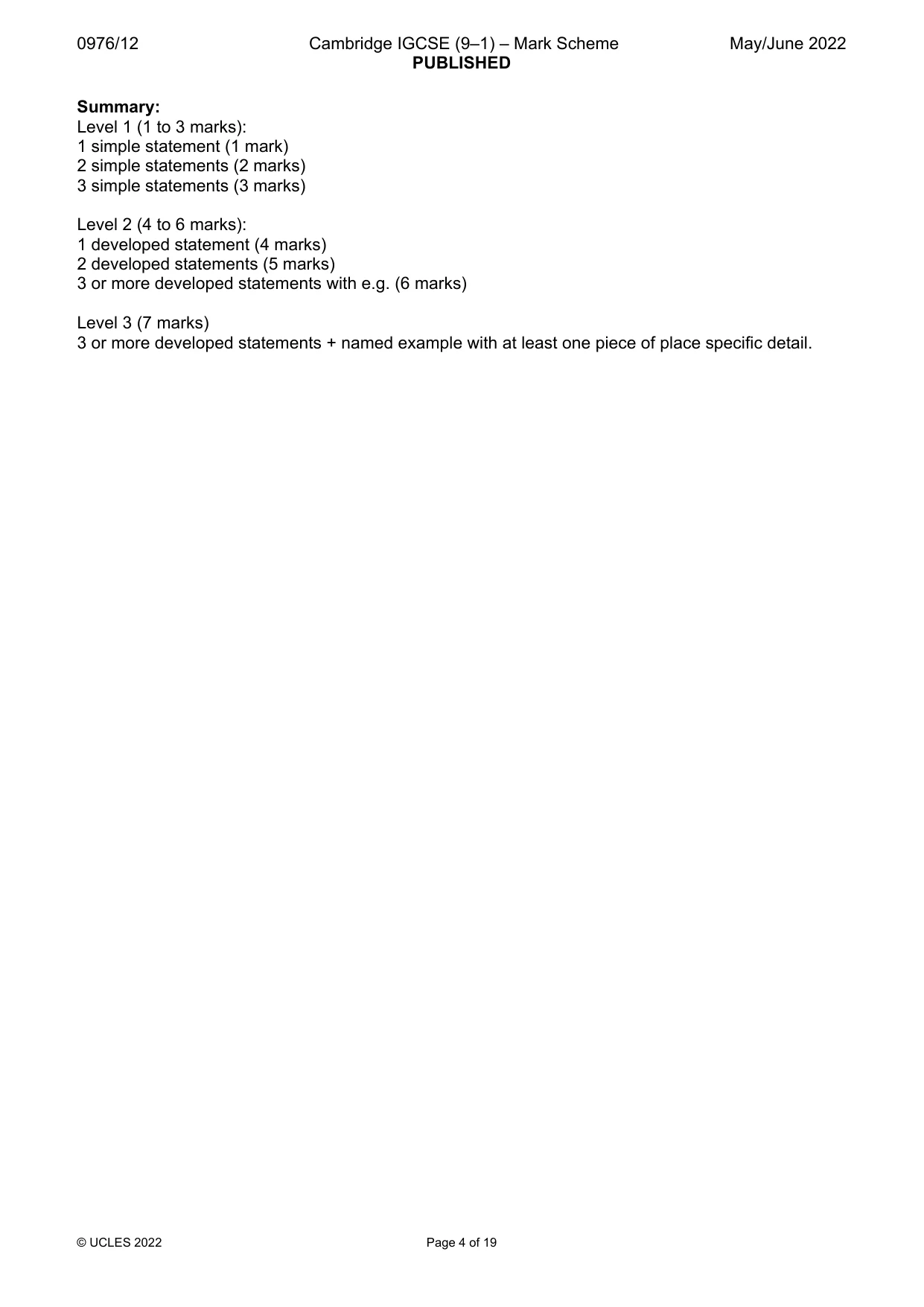
0976/12 Cambridge IGCSE (9–1) – Mark Scheme PUBLISHED May/June 2022 © UCLES 2022 Page 4 of 19 Summary: Level 1 (1 to 3 marks): 1 simple statement (1 mark) 2 simple statements (2 marks) 3 simple statements (3 marks) Level 2 (4 to 6 marks): 1 developed statement (4 marks) 2 developed statements (5 marks) 3 or more developed statements with e.g. (6 marks) Level 3 (7 marks) 3 or more developed statements + named example with at least one piece of place specific detail.
Mark scheme, page 5
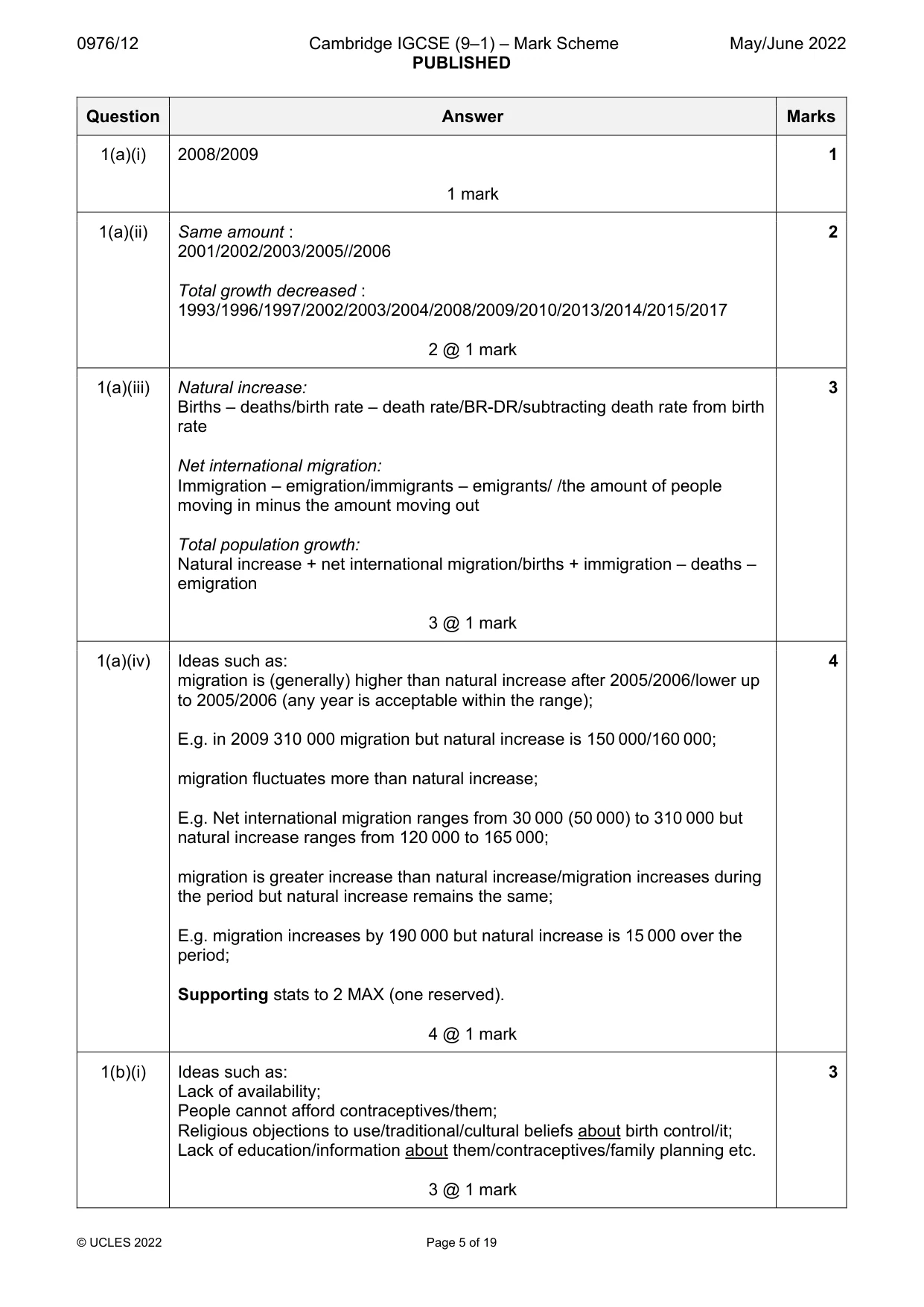
0976/12 Cambridge IGCSE (9–1) – Mark Scheme PUBLISHED May/June 2022 © UCLES 2022 Page 5 of 19 Question Answer Marks 1(a)(i) 2008/2009 1 mark 1 1(a)(ii) Same amount : 2001/2002/2003/2005//2006 Total growth decreased : 1993/1996/1997/2002/2003/2004/2008/2009/2010/2013/2014/2015/2017 2 @ 1 mark 2 1(a)(iii) Natural increase: Births – deaths/birth rate – death rate/BR-DR/subtracting death rate from birth rate Net international migration: Immigration – emigration/immigrants – emigrants/ /the amount of people moving in minus the amount moving out Total population growth: Natural increase + net international migration/births + immigration – deaths – emigration 3 @ 1 mark 3 1(a)(iv) Ideas such as: migration is (generally) higher than natural increase after 2005/2006/lower up to 2005/2006 (any year is acceptable within the range); E.g. in 2009 310 000 migration but natural increase is 150 000/160 000; migration fluctuates more than natural increase; E.g. Net international migration ranges from 30 000 (50 000) to 310 000 but natural increase ranges from 120 000 to 165 000; migration is greater increase than natural increase/migration increases during the period but natural increase remains the same; E.g. migration increases by 190 000 but natural increase is 15 000 over the period; Supporting stats to 2 MAX (one reserved). 4 @ 1 mark 4 1(b)(i) Ideas such as: Lack of availability; People cannot afford contraceptives/them; Religious objections to use/traditional/cultural beliefs about birth control/it; Lack of education/information about them/contraceptives/family planning etc. 3 @ 1 mark 3
Mark scheme, page 6
0976/12 Cambridge IGCSE (9–1) – Mark Scheme PUBLISHED May/June 2022 © UCLES 2022 Page 6 of 19 Question Answer Marks 1(b)(ii) Ideas such as: Birth rates are high/they have many children; Polygamy; Men may have children with several wives; Reduction in/high infant mortality rates; But people still have more children in case they do not all survive; Reduction of death rates/increase in life expectancy; Improvement in health care/medicines/vaccines etc; Improvements in sanitation; Improvements in water supply; Better food supply/nutrition; Availability of medicines/cures for diseases; Traditional expectation of people to have large families/cultural beliefs/religious beliefs re. large families or example; Need for children to look after the elderly/siblings/do household chores or example; Need for children to be sent out to work/work on the land; Many women are not educated/don’t have careers; Low status of women; Early marriage; Lack of government anti-natal policy; Abortions not readily available etc. 5 @ 1 mark or development 5
Mark scheme, page 7
0976/12 Cambridge IGCSE (9–1) – Mark Scheme PUBLISHED May/June 2022 © UCLES 2022 Page 7 of 19 Question Answer Marks 1(c) Levels marking Level 1 (1–3 marks) Statements including limited detail which describe the problems caused by a high rate of population growth. Level 2 (4–6 marks) Uses named example. More developed statements which describe the problems caused by a high rate of population growth. (Note: Max 5 if no named or inappropriate example) Level 3 (7 marks) Uses named example. Comprehensive and accurate statements including some place specific reference. Content Guide: Answers are likely to refer to: Employment; Food supply; Provision of health care; Provision of housing/shelter; Water supply; Sanitation; Provision of education etc. Place specific reference is likely to consist of: Named parts of the chosen country; Population data etc. 7
Mark scheme, page 8
0976/12 Cambridge IGCSE (9–1) – Mark Scheme PUBLISHED May/June 2022 © UCLES 2022 Page 8 of 19 Question Answer Marks 2(a)(i) Canada/Australia 1 mark 1 2(a)(ii) Ideas such as: Transport/roads/railways/metro/buses/trams/canals; power supply/gas/electricity; Water supply; Communications network/telephone/fibre optic network/wifi/mobile phone (cellphone) network; Sanitation/sewage disposal etc. 2 @ 1 mark 2 2(a)(iii) Ideas such as: Air pollution/difficulty breathing/chest complaints; Water pollution/unsafe drinking water; Noise pollution/disturbance from traffic noise; Lack of open space/natural vegetation; Land pollution/waste disposal/landfill sites/litter; Drought/floods/earthquakes etc. 3 @ 1 mark 3 2(a)(iv) Ideas such as Vienna is: More secure/safer; Better healthcare; Better environment; Better education; Better infrastructure; 4 @ 1 mark 4 2(b)(i) Commercial: Selling things/shops/retail/trade/service provision etc. Residential: Housing/homes/places to live/houses/where people live etc. Industrial: Factories/workshops/manufacturing/making things etc. 3 @ 1 mark 3
Mark scheme, page 9
0976/12 Cambridge IGCSE (9–1) – Mark Scheme PUBLISHED May/June 2022 © UCLES 2022 Page 9 of 19 Question Answer Marks 2(b)(ii) Ideas such as: They have large populations; So efficient organisation is necessary/so they will function effectively; They are near the top of the settlement hierarchy; They provide many services; E.g. education/healthcare/transport/banks/offices/law courts etc.; They govern the country/surrounding area/there are government buildings there; E.g. embassies, town hall, parliament etc. Planning of local authority spending in the region; Many large companies have offices/HQs there etc. 5 @ 1 mark or development 5 2(c) Levels marking Level 1 (1–3 marks) Statements including limited detail which describe the problems which are caused by urban sprawl for the natural environment. Level 2 (4–6 marks) Uses named example. More developed statements which describe the problems which are caused by urban sprawl for the natural environment. (Note: Max 5 if no named or inappropriate example) Level 3 (7 marks) Uses named example. More developed statements which describe the problems which are caused by urban sprawl for the natural environment with some place specific reference. Content Guide: Deforestation; Loss of habitats; Atmospheric pollution; Water pollution; Noise pollution; Ecosystems destroyed; Food chains disrupted; Flooding; Killing of wildlife/species loss etc. Place specific reference is likely to consist of: Locational details/named areas within/around the urban area; Specific details of impacts, statistics etc. 7
Mark scheme, page 10
0976/12 Cambridge IGCSE (9–1) – Mark Scheme PUBLISHED May/June 2022 © UCLES 2022 Page 10 of 19 Question Answer Marks 3(a)(i) Accurate labelling of any desert One mark 1 3(a)(ii) Ideas such as: On/near tropics/Tropic of Cancer and Capricorn; 10–30/35 (degrees) N/S; Western sides of land masses; Africa/South America/North America/Australasia/Asia (any 3); 2 @ 1 mark 2 3(a)(iii) Ideas such as: Dry/Arid/low rainfall/less than 250 mm annual rainfall; High/hot temperatures/temp. averaging 30–50 °C (or single figure); Seasonal variation of temperature/cooler/mild in some months/large annual temperature range; Hot days and cold nights/high diurnal range etc. 3 @ 1 mark 3 3(a)(iv) Direction of prevailing winds: From NE or SE/trade winds; Blow overland/over mountains before they reach deserts; Loss of moisture/dry winds once they reach the deserts/rain shadow etc. Atmospheric pressure; High atmospheric pressure; Descending air; No condensation; So lack of rainfall/low humidity/no misture in air; 1 mark reserved on each section 4 @ 1 mark 4 3(b)(i) Features such as: Thorns/prickles/spikes; Thin/narrow leaves; Fleshy leaves/thick stems; Waxy/thick outer skin; Dense/tightly packed; Flowers/’fruits’; Green etc. 3 @ 1 mark 3
Mark scheme, page 11
0976/12 Cambridge IGCSE (9–1) – Mark Scheme PUBLISHED May/June 2022 © UCLES 2022 Page 11 of 19 Question Answer Marks 3(b)(ii) Ideas such as: (Long roots) reach to water table/underground rocks; (Wide root systems/widely spaced) to collect water from a larger area; (Fleshy stems) store water; (Thorns/spikes) prevent transpiration; (Thorns/spikes) protect from predators; (Seeds lie dormant) and germinate in times of rainfall; (Light colours) to reflect the sunlight; (waxy leaves) to prevent water loss; low lying to protect against winds; Far apart to prevent competition for water; 5 @ 1 mark or development 5 3(c) Levels marking Level 1 (1–3 marks) Statements including limited detail which describe or explain characteristics of an Equatorial climate. Level 2 (4–6 marks) Uses named example. More developed or linked statements which describe and explain characteristics of an Equatorial climate. (Note: Max 5 if no named or inappropriate example) Level 3 (7 marks) Comprehensive and accurate statements which describe and explain characteristics of an Equatorial climate. Ideas such as: High temperatures; Lack of seasonal variation; High levels of precipitation; High humidity; Daily convectional rainfall/thunderstorms; Low pressure; Large amounts of evaporation/transpiration; Overhead sun etc. Place specific reference is likely to consist of: Locational details/named areas within/around the area; Specific details of climate, statistics etc. 7
Mark scheme, page 12
0976/12 Cambridge IGCSE (9–1) – Mark Scheme PUBLISHED May/June 2022 © UCLES 2022 Page 12 of 19 Question Answer Marks 4(a)(i) Near the top of the beach above high tide level One mark 1 4(a)(ii) Ideas such as: Gentle slopes; Steep near beach/windward side; Low level; Marram (grass) growing on it; Some sand patches etc. 2 @ 1 mark 2 4(a)(iii) Ideas such as: Sediment/Sand blown (pushed) by wind/; Obstruction/pebble/litter/plant blocks wind; Causes velocity of wind to reduce/eddies; Deposition; (Colonisation by) plants/vegetation grow; Gets larger over time/vegetation/grass/marram traps more sand; 3 @ 1 mark 3 4(a)(iv) Ideas such as: (Prevailing) wind approaches from an angle; Swash comes in at an angle/obliquely/same angle (direction) as wind; Backwash is vertical/straight out to sea; Material is moved in zigzag manner; (Known as) longshore drift/LSD; Spit develops where there is a change in direction of coastline/at a headland/estuary/river mouth/across a bay; Recurved/hook by waves/wind from other directions etc. 4 @ 1 mark 4 4(b)(i) Ideas such as: Large/big/wide; Crescent/curved shape/C-shape/horseshoe shape; Sheltered by/between headlands; Presence of beach; Areas of wave cut platform/exposed rock/rocks (boulders) on beach etc. 3 @ 1 mark 3
Mark scheme, page 13
0976/12 Cambridge IGCSE (9–1) – Mark Scheme PUBLISHED May/June 2022 © UCLES 2022 Page 13 of 19 Question Answer Marks 4(b)(ii) Ideas such as: Alternate bands of hard and soft rock/hard & soft rock outcrop at coast/discordant coast; Headlands are formed where rocks are resistant/hard; So they are not easily eroded; Bay is formed where rocks are not resistant/soft/unconsolidated; or where there are lines of weakness; So they are easily eroded; Differential erosion has occurred; 5 @ 1 mark or development 5 4(c) Levels marking Level 1 (1–3 marks) Statements including limited detail which describe the hazards experienced by coastal communities as a result of natural processes. Level 2 (4–6 marks) Uses named example More developed or linked statements which explain the hazards experienced by coastal communities as a result of natural processes. (Note: Max 5 if no named or inappropriate example) Level 3 (7 marks) Comprehensive and accurate statements including place specific information. Content Guide: Answers are likely to refer to: High waves, Strong winds, erosion; cliff collapse, tropical storms, tsunamis, coastal flooding damage to property farmland lost roads blocked/damaged etc. Note: Volcanic eruption can be credited only if it fits with the example chosen e.g. Naples. 7
Mark scheme, page 14
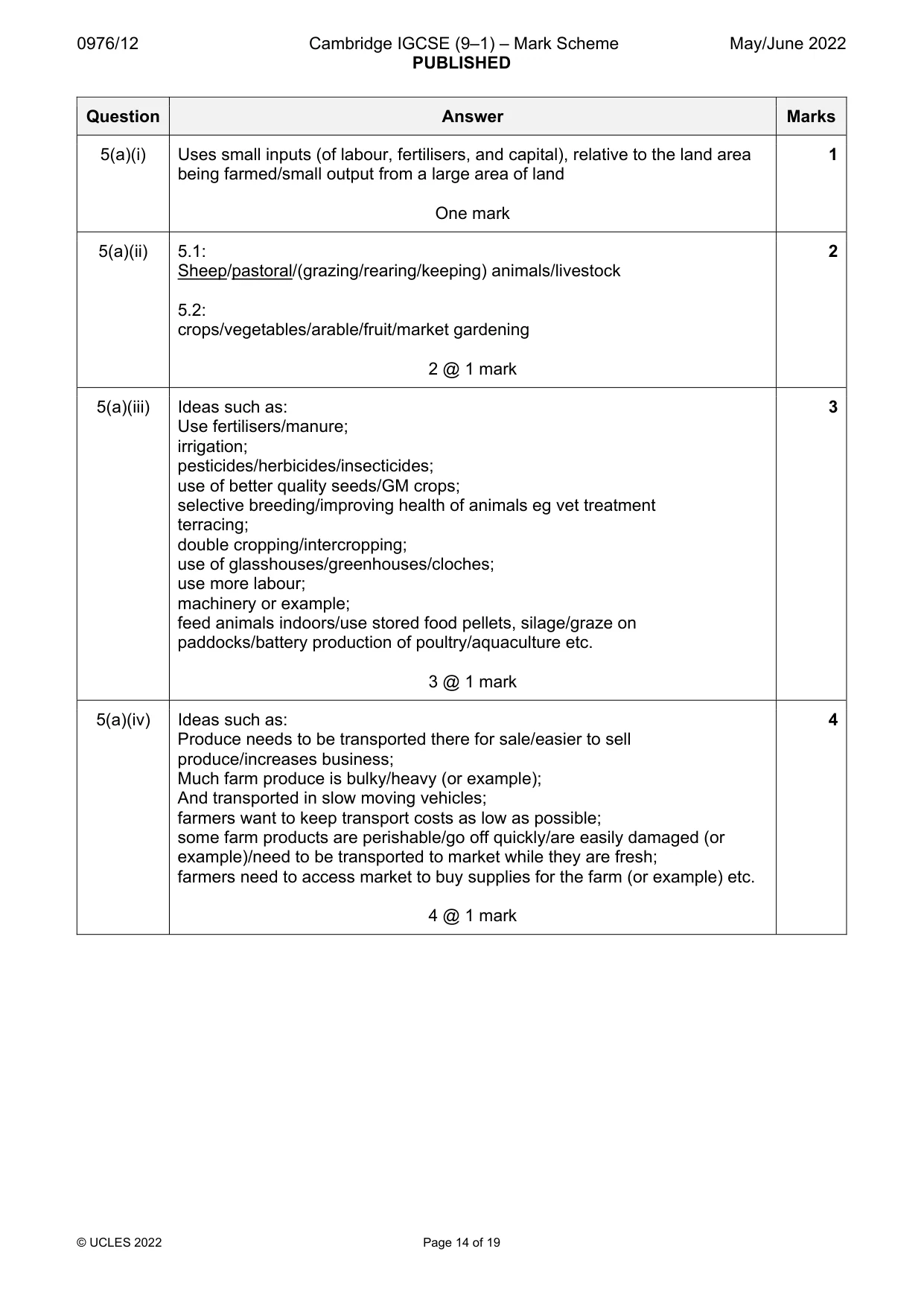
0976/12 Cambridge IGCSE (9–1) – Mark Scheme PUBLISHED May/June 2022 © UCLES 2022 Page 14 of 19 Question Answer Marks 5(a)(i) Uses small inputs (of labour, fertilisers, and capital), relative to the land area being farmed/small output from a large area of land One mark 1 5(a)(ii) 5.1: Sheep/pastoral/(grazing/rearing/keeping) animals/livestock 5.2: crops/vegetables/arable/fruit/market gardening 2 @ 1 mark 2 5(a)(iii) Ideas such as: Use fertilisers/manure; irrigation; pesticides/herbicides/insecticides; use of better quality seeds/GM crops; selective breeding/improving health of animals eg vet treatment terracing; double cropping/intercropping; use of glasshouses/greenhouses/cloches; use more labour; machinery or example; feed animals indoors/use stored food pellets, silage/graze on paddocks/battery production of poultry/aquaculture etc. 3 @ 1 mark 3 5(a)(iv) Ideas such as: Produce needs to be transported there for sale/easier to sell produce/increases business; Much farm produce is bulky/heavy (or example); And transported in slow moving vehicles; farmers want to keep transport costs as low as possible; some farm products are perishable/go off quickly/are easily damaged (or example)/need to be transported to market while they are fresh; farmers need to access market to buy supplies for the farm (or example) etc. 4 @ 1 mark 4
Mark scheme, page 15
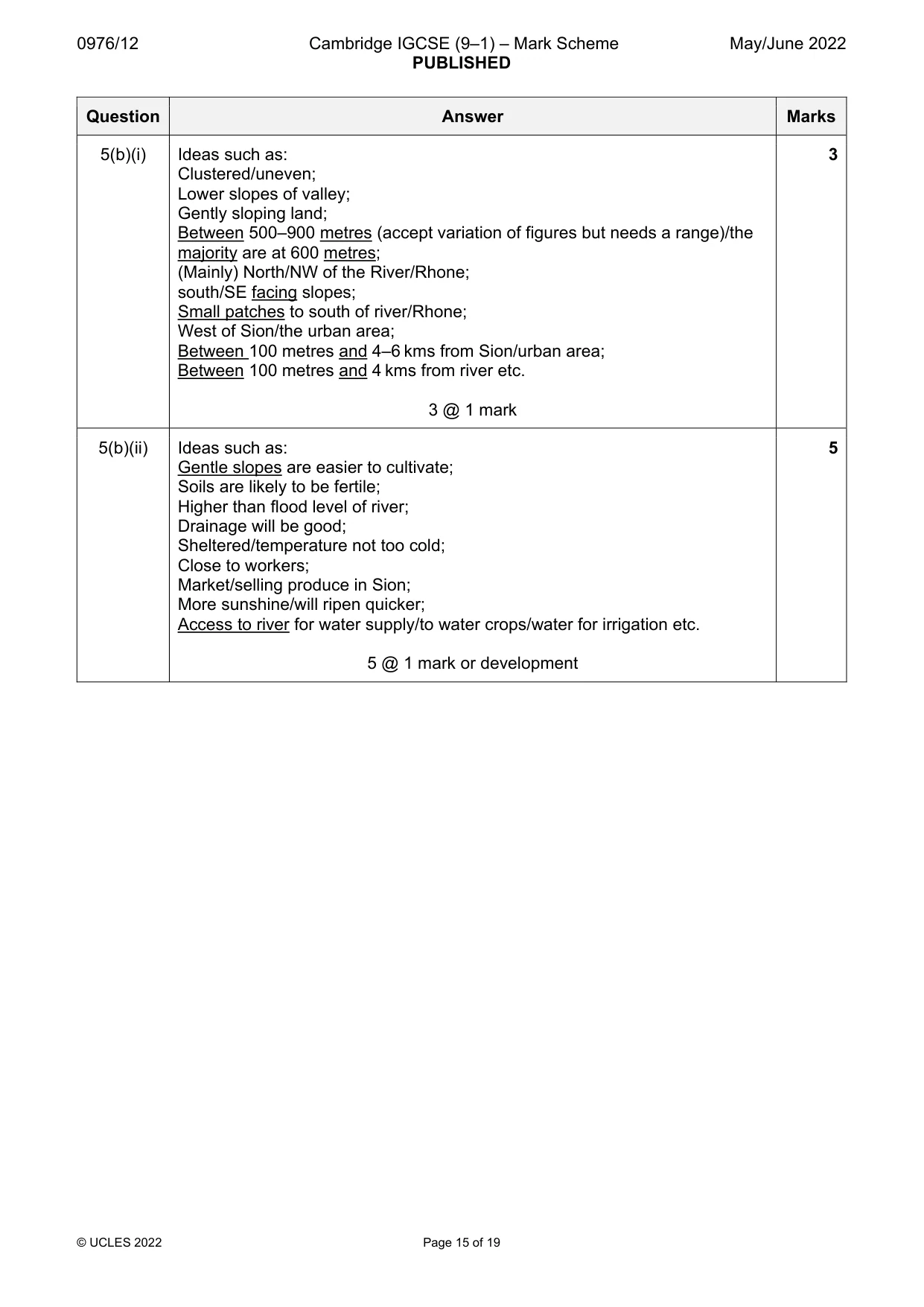
0976/12 Cambridge IGCSE (9–1) – Mark Scheme PUBLISHED May/June 2022 © UCLES 2022 Page 15 of 19 Question Answer Marks 5(b)(i) Ideas such as: Clustered/uneven; Lower slopes of valley; Gently sloping land; Between 500–900 metres (accept variation of figures but needs a range)/the majority are at 600 metres; (Mainly) North/NW of the River/Rhone; south/SE facing slopes; Small patches to south of river/Rhone; West of Sion/the urban area; Between 100 metres and 4–6 kms from Sion/urban area; Between 100 metres and 4 kms from river etc. 3 @ 1 mark 3 5(b)(ii) Ideas such as: Gentle slopes are easier to cultivate; Soils are likely to be fertile; Higher than flood level of river; Drainage will be good; Sheltered/temperature not too cold; Close to workers; Market/selling produce in Sion; More sunshine/will ripen quicker; Access to river for water supply/to water crops/water for irrigation etc. 5 @ 1 mark or development 5
Mark scheme, page 16
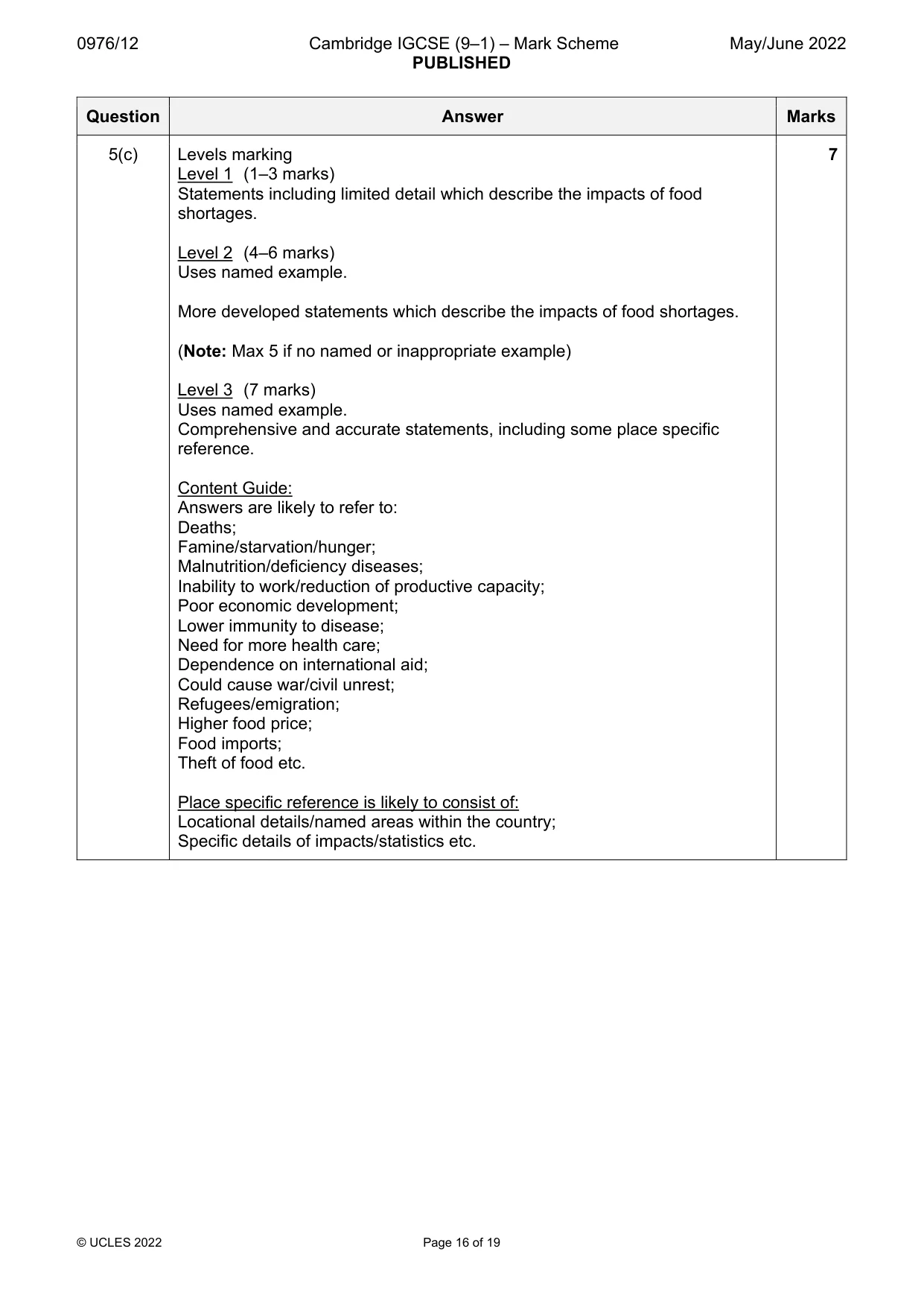
0976/12 Cambridge IGCSE (9–1) – Mark Scheme PUBLISHED May/June 2022 © UCLES 2022 Page 16 of 19 Question Answer Marks 5(c) Levels marking Level 1 (1–3 marks) Statements including limited detail which describe the impacts of food shortages. Level 2 (4–6 marks) Uses named example. More developed statements which describe the impacts of food shortages. (Note: Max 5 if no named or inappropriate example) Level 3 (7 marks) Uses named example. Comprehensive and accurate statements, including some place specific reference. Content Guide: Answers are likely to refer to: Deaths; Famine/starvation/hunger; Malnutrition/deficiency diseases; Inability to work/reduction of productive capacity; Poor economic development; Lower immunity to disease; Need for more health care; Dependence on international aid; Could cause war/civil unrest; Refugees/emigration; Higher food price; Food imports; Theft of food etc. Place specific reference is likely to consist of: Locational details/named areas within the country; Specific details of impacts/statistics etc. 7
Mark scheme, page 17
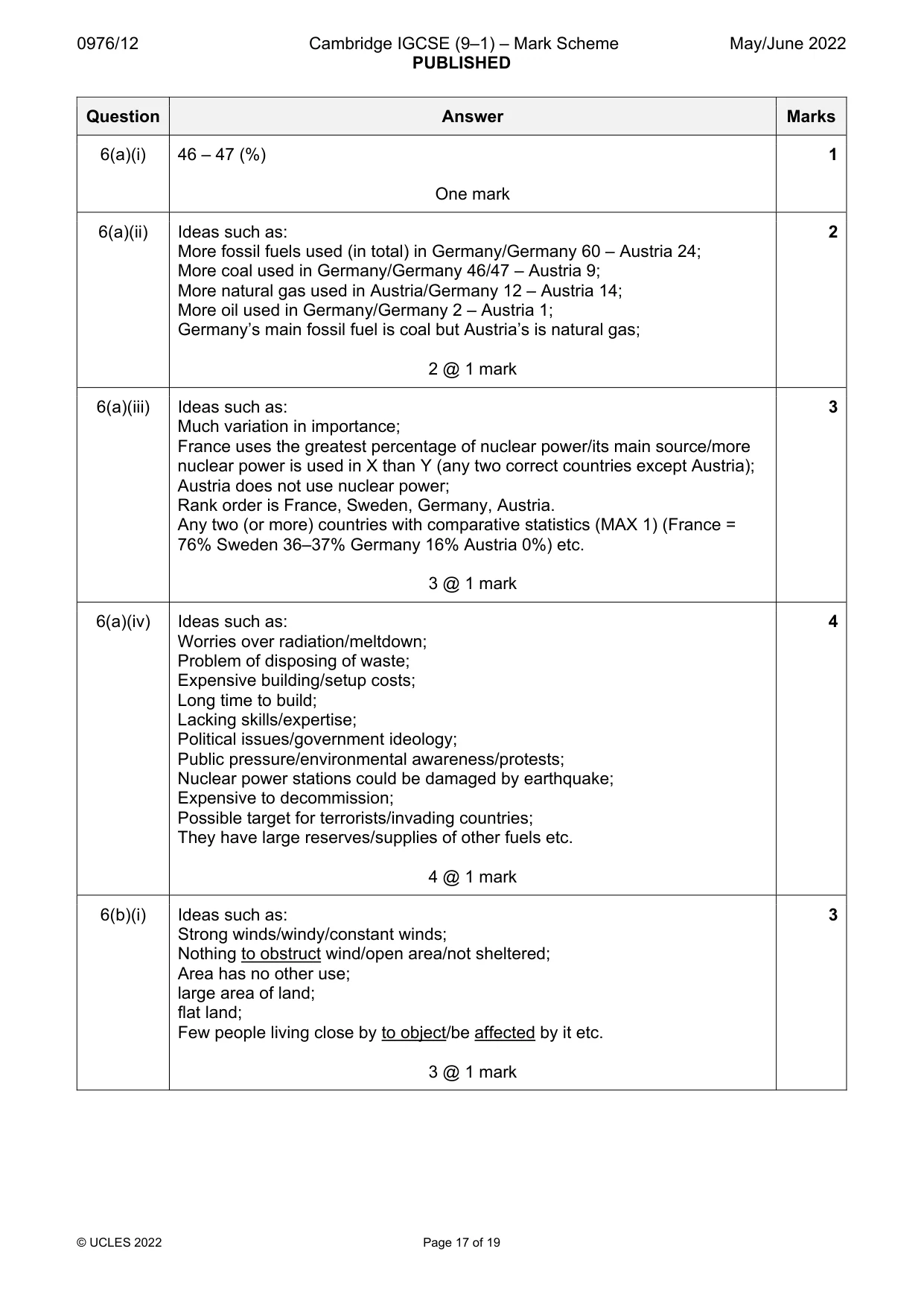
0976/12 Cambridge IGCSE (9–1) – Mark Scheme PUBLISHED May/June 2022 © UCLES 2022 Page 17 of 19 Question Answer Marks 6(a)(i) 46 – 47 (%) One mark 1 6(a)(ii) Ideas such as: More fossil fuels used (in total) in Germany/Germany 60 – Austria 24; More coal used in Germany/Germany 46/47 – Austria 9; More natural gas used in Austria/Germany 12 – Austria 14; More oil used in Germany/Germany 2 – Austria 1; Germany’s main fossil fuel is coal but Austria’s is natural gas; 2 @ 1 mark 2 6(a)(iii) Ideas such as: Much variation in importance; France uses the greatest percentage of nuclear power/its main source/more nuclear power is used in X than Y (any two correct countries except Austria); Austria does not use nuclear power; Rank order is France, Sweden, Germany, Austria. Any two (or more) countries with comparative statistics (MAX 1) (France = 76% Sweden 36–37% Germany 16% Austria 0%) etc. 3 @ 1 mark 3 6(a)(iv) Ideas such as: Worries over radiation/meltdown; Problem of disposing of waste; Expensive building/setup costs; Long time to build; Lacking skills/expertise; Political issues/government ideology; Public pressure/environmental awareness/protests; Nuclear power stations could be damaged by earthquake; Expensive to decommission; Possible target for terrorists/invading countries; They have large reserves/supplies of other fuels etc. 4 @ 1 mark 4 6(b)(i) Ideas such as: Strong winds/windy/constant winds; Nothing to obstruct wind/open area/not sheltered; Area has no other use; large area of land; flat land; Few people living close by to object/be affected by it etc. 3 @ 1 mark 3
Mark scheme, page 18
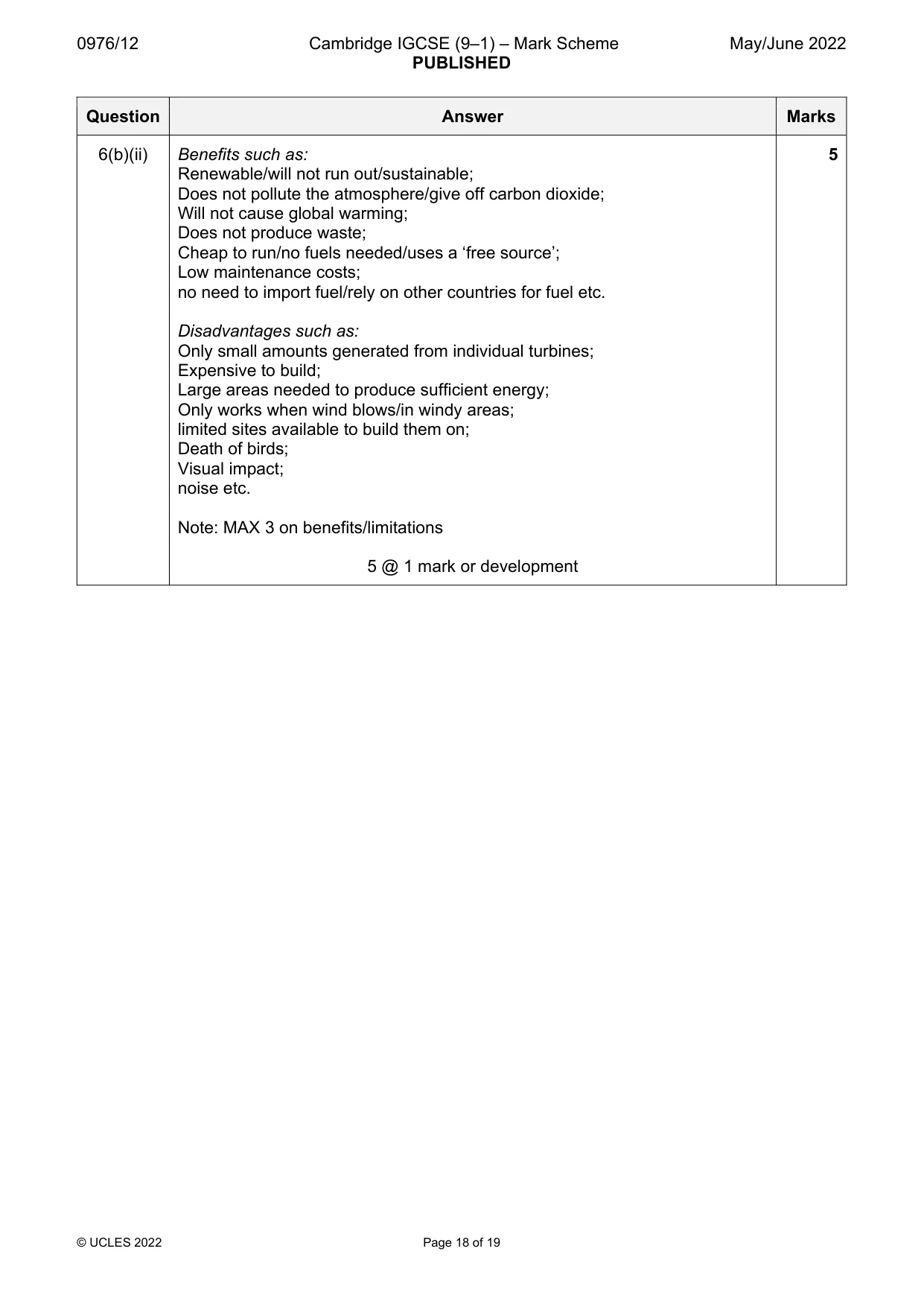
0976/12 Cambridge IGCSE (9–1) – Mark Scheme PUBLISHED May/June 2022 © UCLES 2022 Page 18 of 19 Question Answer Marks 6(b)(ii) Benefits such as: Renewable/will not run out/sustainable; Does not pollute the atmosphere/give off carbon dioxide; Will not cause global warming; Does not produce waste; Cheap to run/no fuels needed/uses a ‘free source’; Low maintenance costs; no need to import fuel/rely on other countries for fuel etc. Disadvantages such as: Only small amounts generated from individual turbines; Expensive to build; Large areas needed to produce sufficient energy; Only works when wind blows/in windy areas; limited sites available to build them on; Death of birds; Visual impact; noise etc. Note: MAX 3 on benefits/limitations 5 @ 1 mark or development 5
Mark scheme, page 19
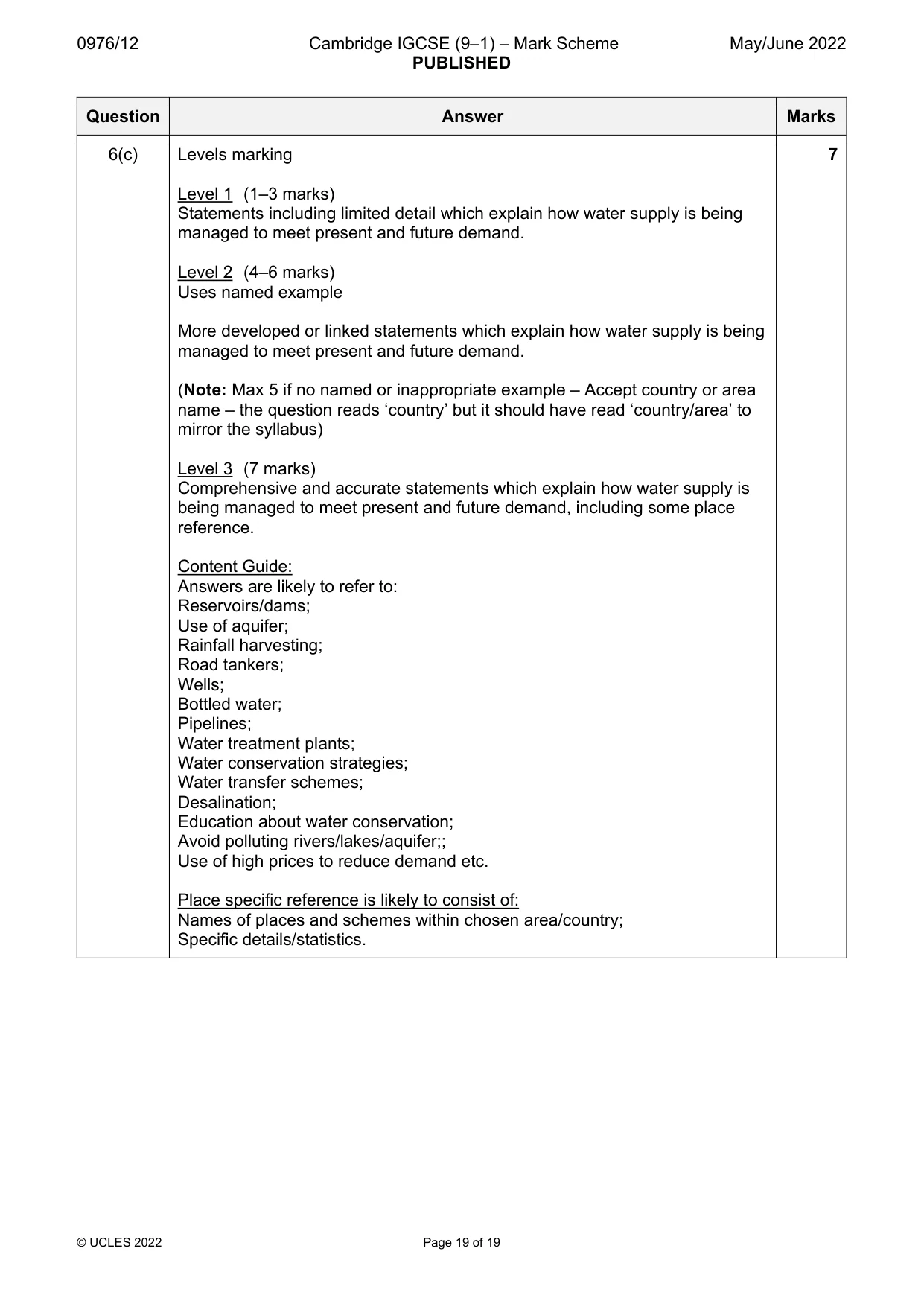
0976/12 Cambridge IGCSE (9–1) – Mark Scheme PUBLISHED May/June 2022 © UCLES 2022 Page 19 of 19 Question Answer Marks 6(c) Levels marking Level 1 (1–3 marks) Statements including limited detail which explain how water supply is being managed to meet present and future demand. Level 2 (4–6 marks) Uses named example More developed or linked statements which explain how water supply is being managed to meet present and future demand. (Note: Max 5 if no named or inappropriate example – Accept country or area name – the question reads ‘country’ but it should have read ‘country/area’ to mirror the syllabus) Level 3 (7 marks) Comprehensive and accurate statements which explain how water supply is being managed to meet present and future demand, including some place reference. Content Guide: Answers are likely to refer to: Reservoirs/dams; Use of aquifer; Rainfall harvesting; Road tankers; Wells; Bottled water; Pipelines; Water treatment plants; Water conservation strategies; Water transfer schemes; Desalination; Education about water conservation; Avoid polluting rivers/lakes/aquifer;; Use of high prices to reduce demand etc. Place specific reference is likely to consist of: Names of places and schemes within chosen area/country; Specific details/statistics. 7
What you needed in this session
Cambridge’s own grade thresholds for 2022 May/June, Paper 1 · Variant 2. A higher threshold means an easier paper — the bar moves with how the cohort did.