Cambridge IGCSE Geography (9-1) 0976 — 2023 May/June Paper 1 · Variant 2
0976/12/M/J/23 · 75 marks · ≈84 min
The question paper and its mark scheme, free to read here and free to download. This is Cambridge’s own paper, exactly as it was sat.
Question paper32 pages


Mark scheme18 pages
Answers below. Sit the paper first if you are practising.
Paper as text
Question paper, page 1
This document has 32 pages. Any blank pages are indicated. [Turn over Cambridge IGCSE™(9–1) * 3 3 9 5 7 2 9 1 5 7 * GEOGRAPHY 0976/12 Paper 1 Geographical Themes May/June 2023 1 hour 45 minutes You must answer on the question paper. You will need: Insert (enclosed) Ruler Calculator Protractor INSTRUCTIONS ● Answer three questions in total, one from each section. ● Use a black or dark blue pen. You may use an HB pencil for any diagrams or graphs. ● Write your name, centre number and candidate number in the boxes at the top of the page. ● Write your answer to each question in the space provided. ● Do not use an erasable pen or correction fluid. ● Do not write on any bar codes. ● If additional space is needed, you should use the lined pages at the end of this booklet; the question number or numbers must be clearly shown. INFORMATION ● The total mark for this paper is 75. ● The number of marks for each question or part question is shown in brackets [ ]. ● The insert contains additional resources referred to in the questions. Definitions MEDCs – More Economically Developed Countries LEDCs – Less Economically Developed Countries DC (LK) 326751 © UCLES 2023
Question paper, page 2
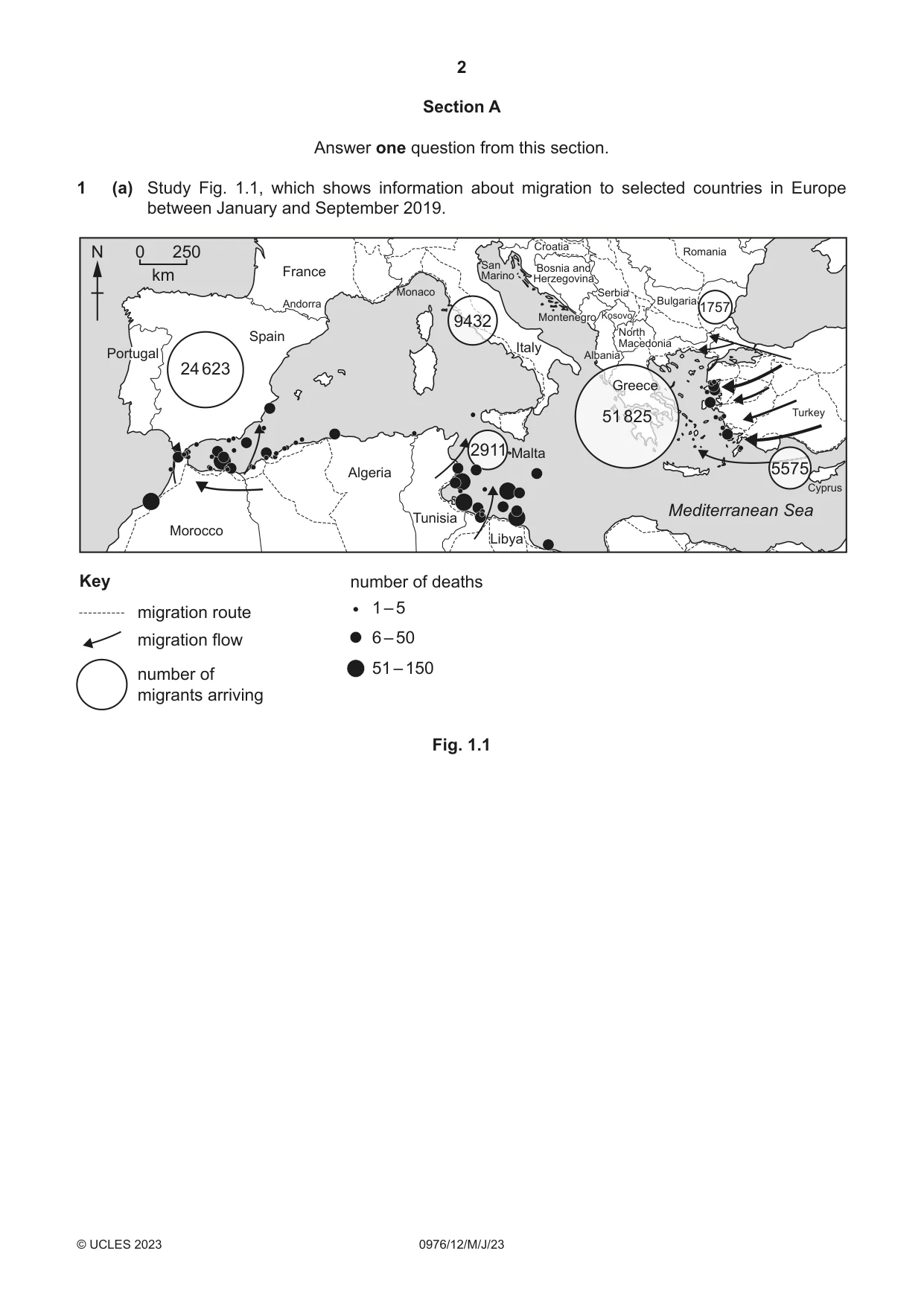
2 0976/12/ M / J /23 © UCLES 2023 Section A Answer one question from this section. 1 (a) Study Fig. 1.1, which shows information about migration to selected countries in Europe between January and September 2019. 0 250 km N Key migration route migration flow number of migrants arriving Mediterranean Sea 24 623 9432 51 825 2911 5575 1757 1 – 5 number of deaths 6 – 50 51 – 150 France Spain Portugal Morocco Algeria Tunisia Libya Malta Italy Greece Croatia Serbia Kosovo Andorra Monaco San Marino Bulgaria Turkey Cyprus North Macedonia North Macedonia Albania Romania Montenegro Bosnia and Herzegovina Fig. 1.1
Question paper, page 3
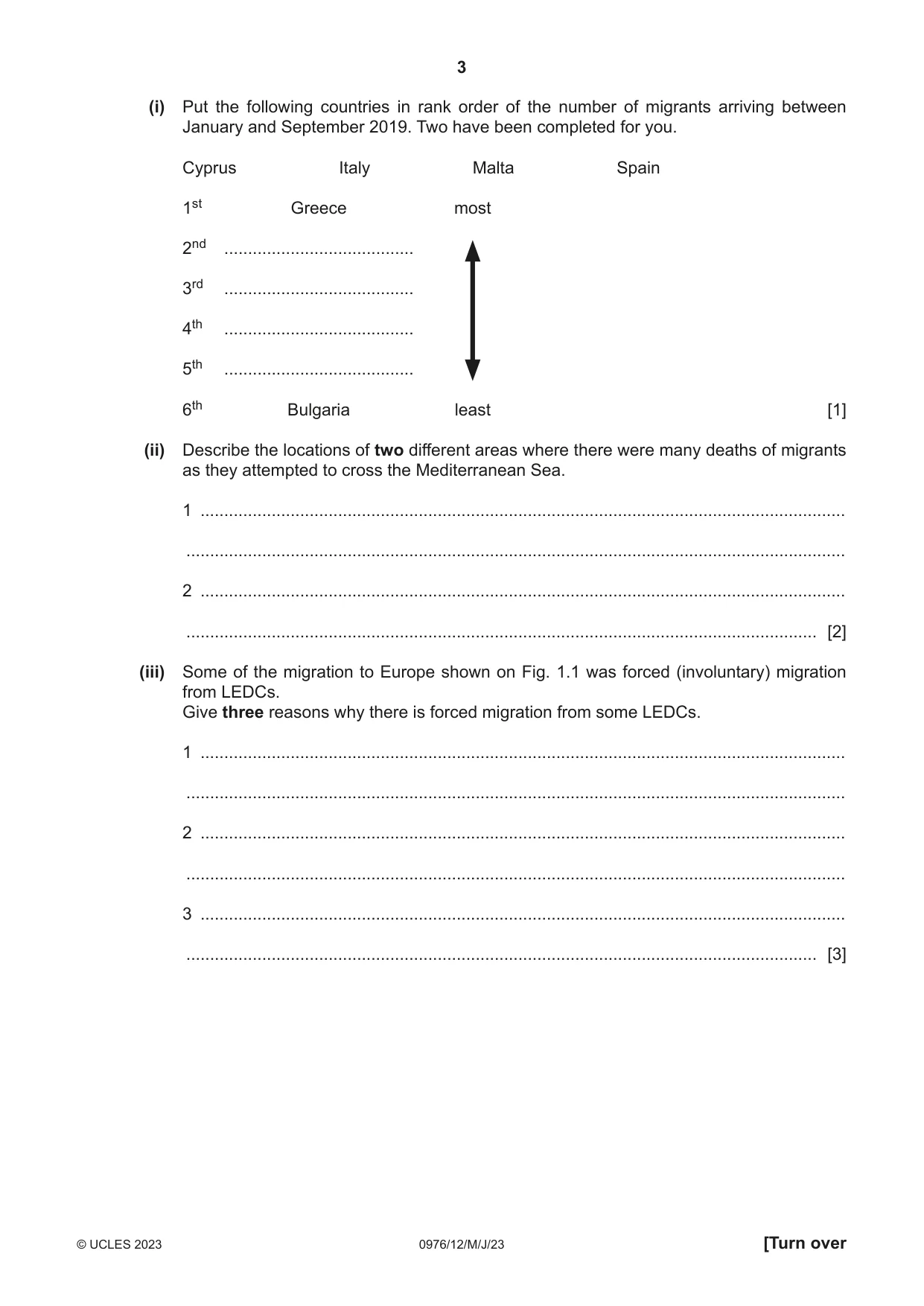
3 0976/12/M/J/23 © UCLES 2023 [Turn over (i) Put the following countries in rank order of the number of migrants arriving between January and September 2019. Two have been completed for you. Cyprus Italy Malta Spain 1st Greece most 2nd … 3rd … 4th … 5th … 6th Bulgaria least [1] (ii) Describe the locations of two different areas where there were many deaths of migrants as they attempted to cross the Mediterranean Sea. 1 … … 2 … … [2] (iii) Some of the migration to Europe shown on Fig. 1.1 was forced (involuntary) migration from LEDCs. Give three reasons why there is forced migration from some LEDCs. 1 … … 2 … … 3 … … [3]
Question paper, page 4
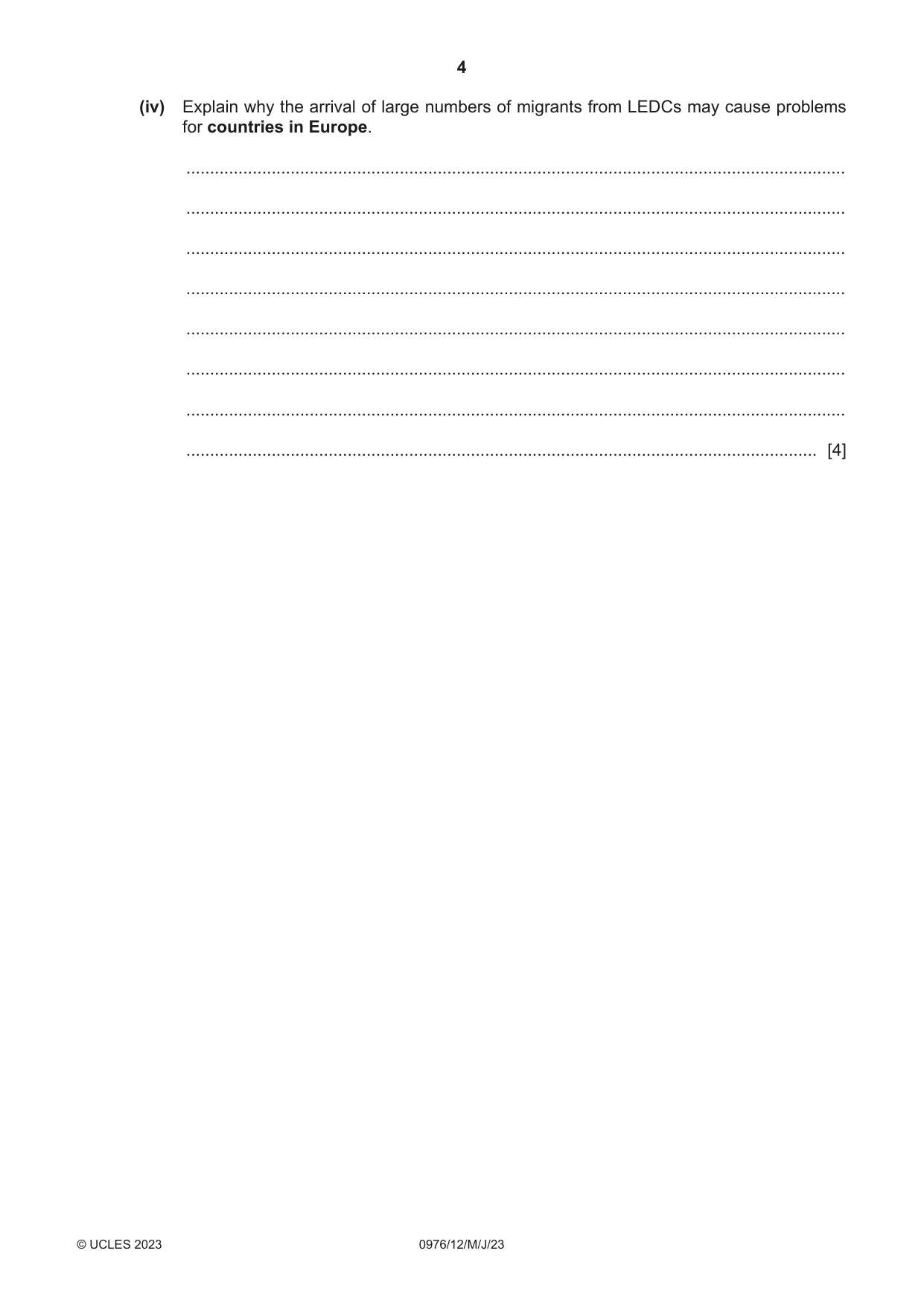
4 0976/12/M/J/23 © UCLES 2023 (iv) Explain why the arrival of large numbers of migrants from LEDCs may cause problems for countries in Europe. … … … … … … … … [4]
Question paper, page 5
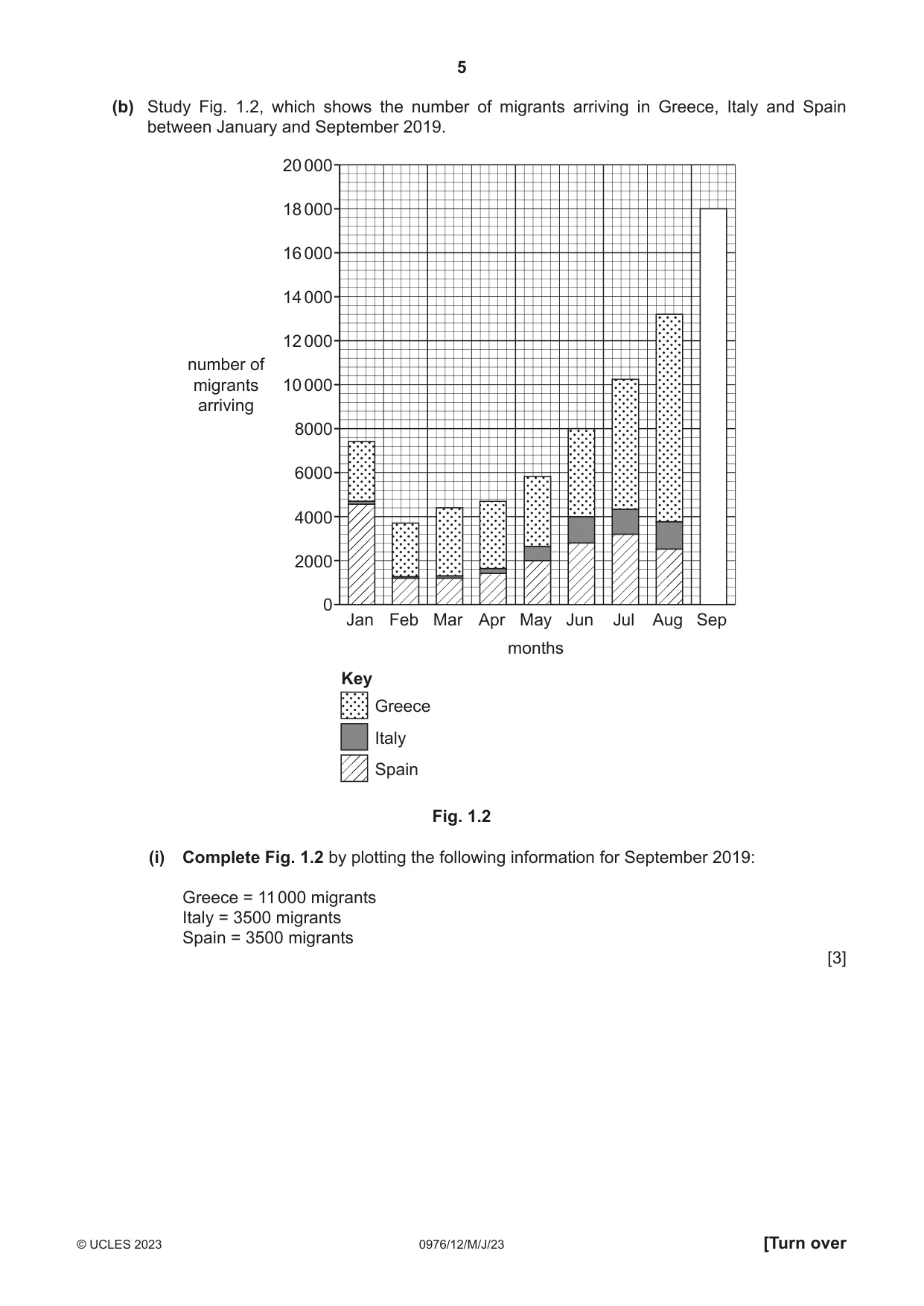
5 0976/12/M/J/23 © UCLES 2023 [Turn over (b) Study Fig. 1.2, which shows the number of migrants arriving in Greece, Italy and Spain between January and September 2019. Jan 2000 0 4000 6000 8000 10 000 number of migrants arriving 12 000 14 000 16 000 18 000 20 000 Feb Mar Apr May months Jun Jul Aug Sep Key Spain Italy Greece Fig. 1.2 (i) Complete Fig. 1.2 by plotting the following information for September 2019: Greece = 11 000 migrants Italy = 3500 migrants Spain = 3500 migrants [3]
Question paper, page 6
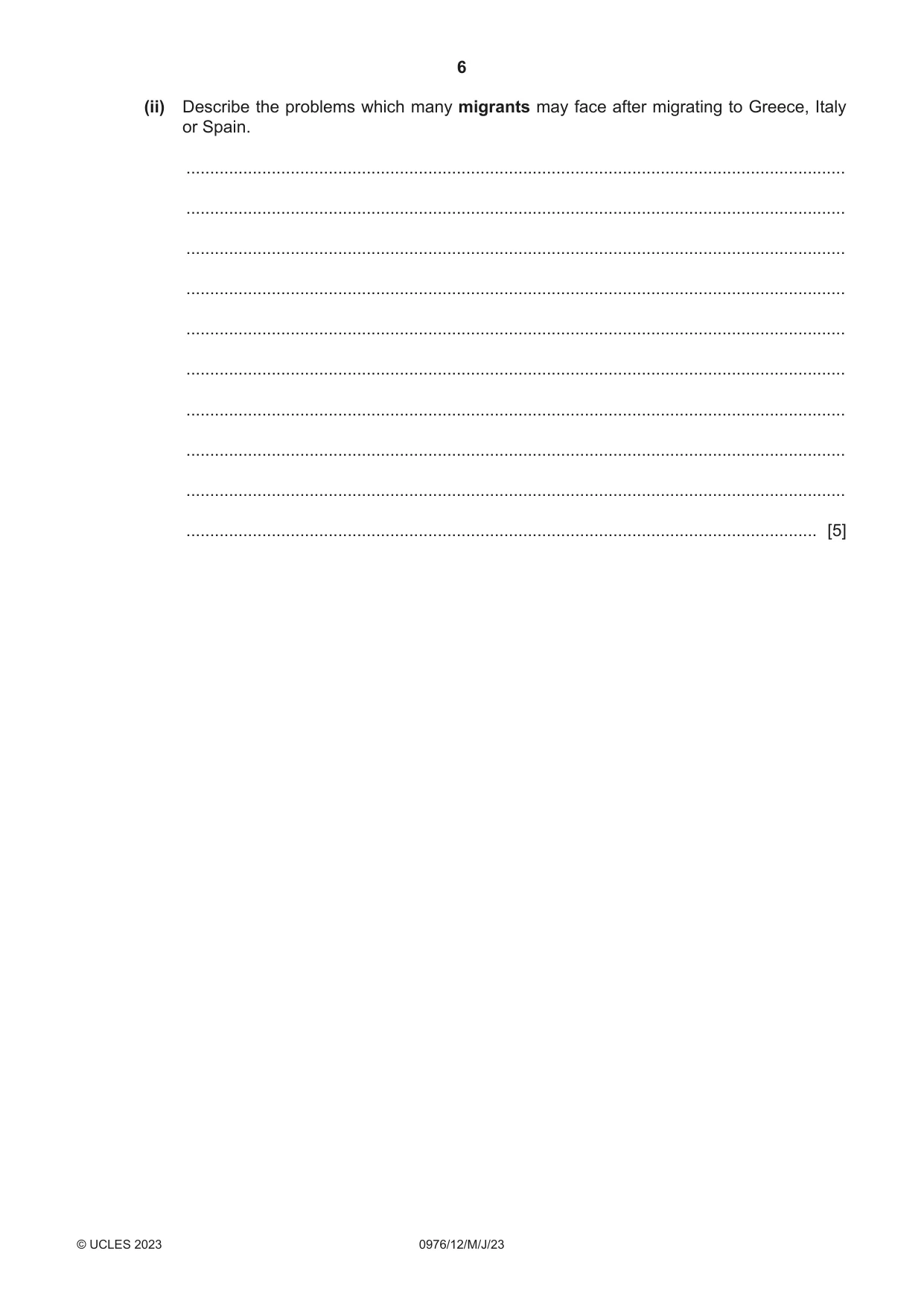
6 0976/12/M/J/23 © UCLES 2023 (ii) Describe the problems which many migrants may face after migrating to Greece, Italy or Spain. … … … … … … … … … … [5]
Question paper, page 7
7 0976/12/M/J/23 © UCLES 2023 [Turn over (c) For a country you have studied with a high dependent population, describe the problems caused by this population structure. Country … … … … … … … … … … … … … … … … … … … … … … … … … [7] [Total: 25]
Question paper, page 8
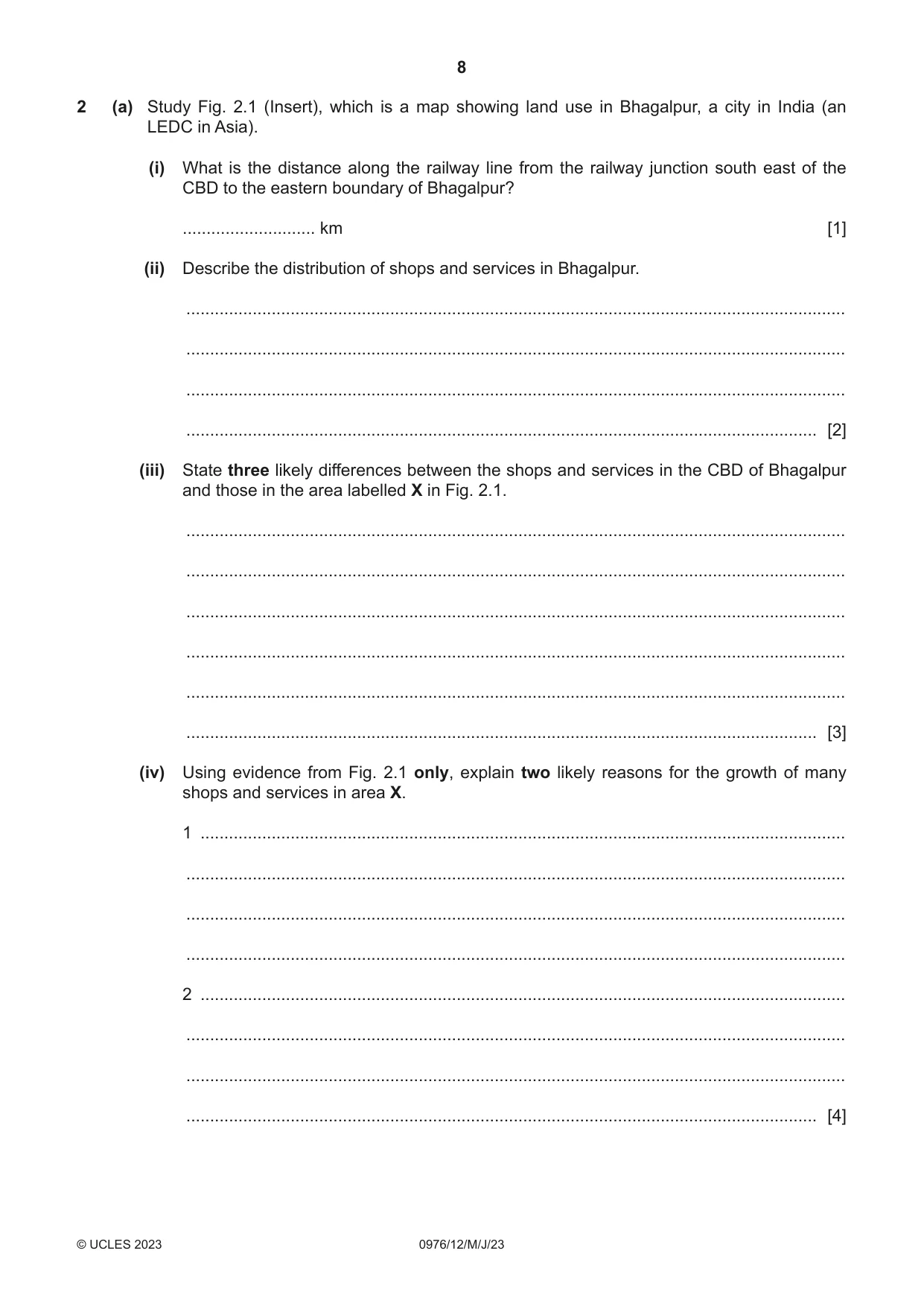
8 0976/12/M/J/23 © UCLES 2023 2 (a) Study Fig. 2.1 (Insert), which is a map showing land use in Bhagalpur, a city in India (an LEDC in Asia). (i) What is the distance along the railway line from the railway junction south east of the CBD to the eastern boundary of Bhagalpur? … km [1] (ii) Describe the distribution of shops and services in Bhagalpur. … … … … [2] (iii) State three likely differences between the shops and services in the CBD of Bhagalpur and those in the area labelled X in Fig. 2.1. … … … … … … [3] (iv) Using evidence from Fig. 2.1 only, explain two likely reasons for the growth of many shops and services in area X. 1 … … … … 2 … … … … [4]
Question paper, page 9
9 0976/12/M/J/23 © UCLES 2023 [Turn over (b) Study Fig. 2.2 (Insert), which is a sketch map showing information about the spheres of influence of two shops in an urban area. (i) Using information from Fig. 2.2 only, compare the sphere of influence of the general store and the large supermarket. … … … … … … [3] (ii) Explain why a general store and a large supermarket will have different spheres of influence. … … … … … … … … … … [5]
Question paper, page 10
10 0976/12/M/J/23 © UCLES 2023 (c) For a named urban area you have studied, describe the methods used to improve the housing conditions of the people who live there. Name of urban area … … … … … … … … … … … … … … … … … … … … … … … … … [7] [Total: 25]
Question paper, page 11
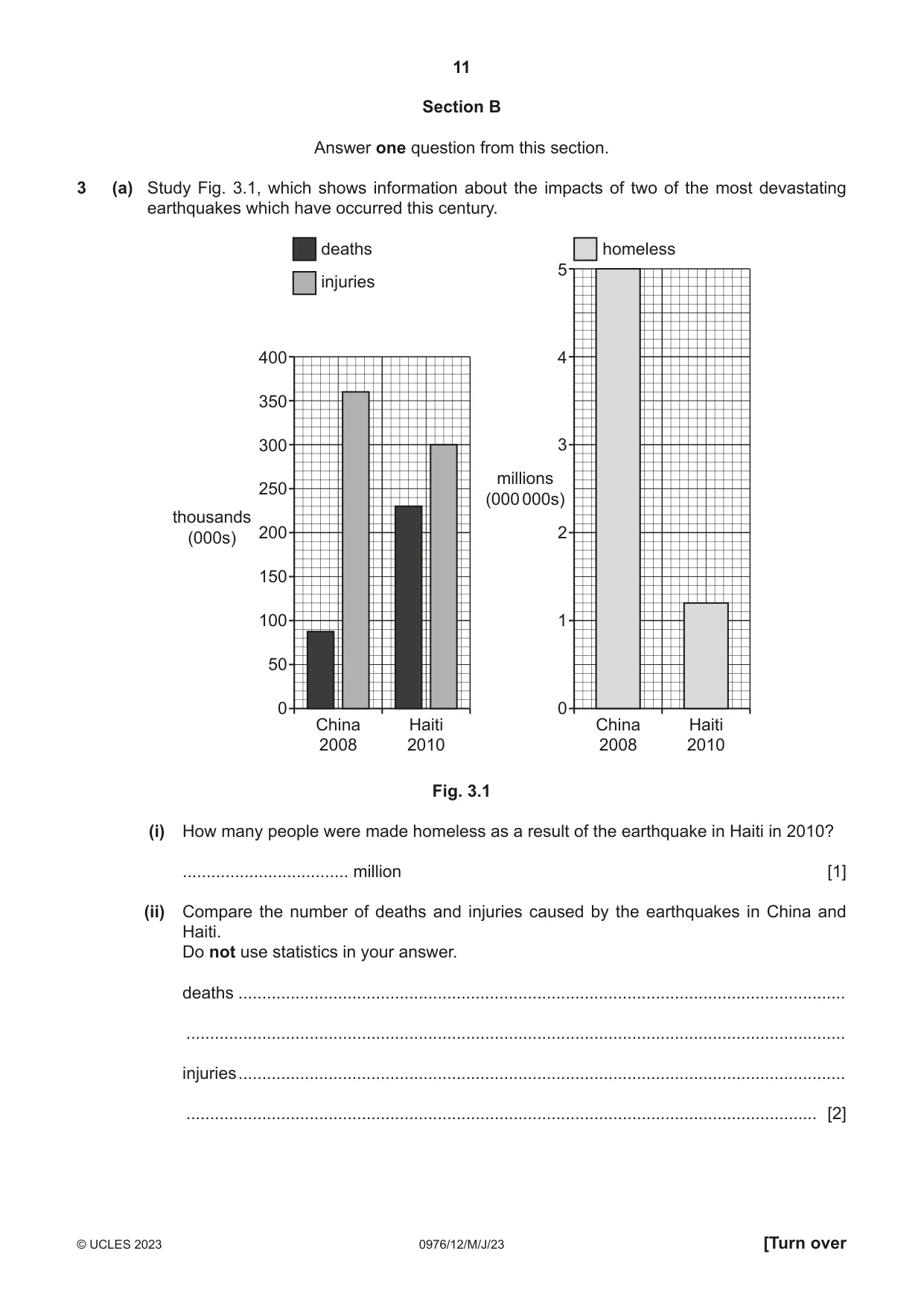
11 0976/12/M/J/23 © UCLES 2023 [Turn over Section B Answer one question from this section. 3 (a) Study Fig. 3.1, which shows information about the impacts of two of the most devastating earthquakes which have occurred this century. China 2008 0 50 100 150 200 250 300 350 400 Haiti 2010 China 2008 0 1 2 3 4 5 Haiti 2010 thousands (000s) deaths injuries millions (000 000s) homeless Fig. 3.1 (i) How many people were made homeless as a result of the earthquake in Haiti in 2010? … million [1] (ii) Compare the number of deaths and injuries caused by the earthquakes in China and Haiti. Do not use statistics in your answer. deaths … … injuries … … [2]
Question paper, page 12
12 0976/12/M/J/23 © UCLES 2023 (iii) In Haiti over 70% of the population live on less than US$2 per day. Suggest how this contributed to the large number of deaths and injuries caused by the earthquake in Haiti. … … … … … … [3] (iv) Describe the likely effects of severe earthquakes, such as those in China and Haiti, on the economies of the countries. … … … … … … … … [4]
Question paper, page 13
13 0976/12/M/J/23 © UCLES 2023 [Turn over BLANK PAGE
Question paper, page 14
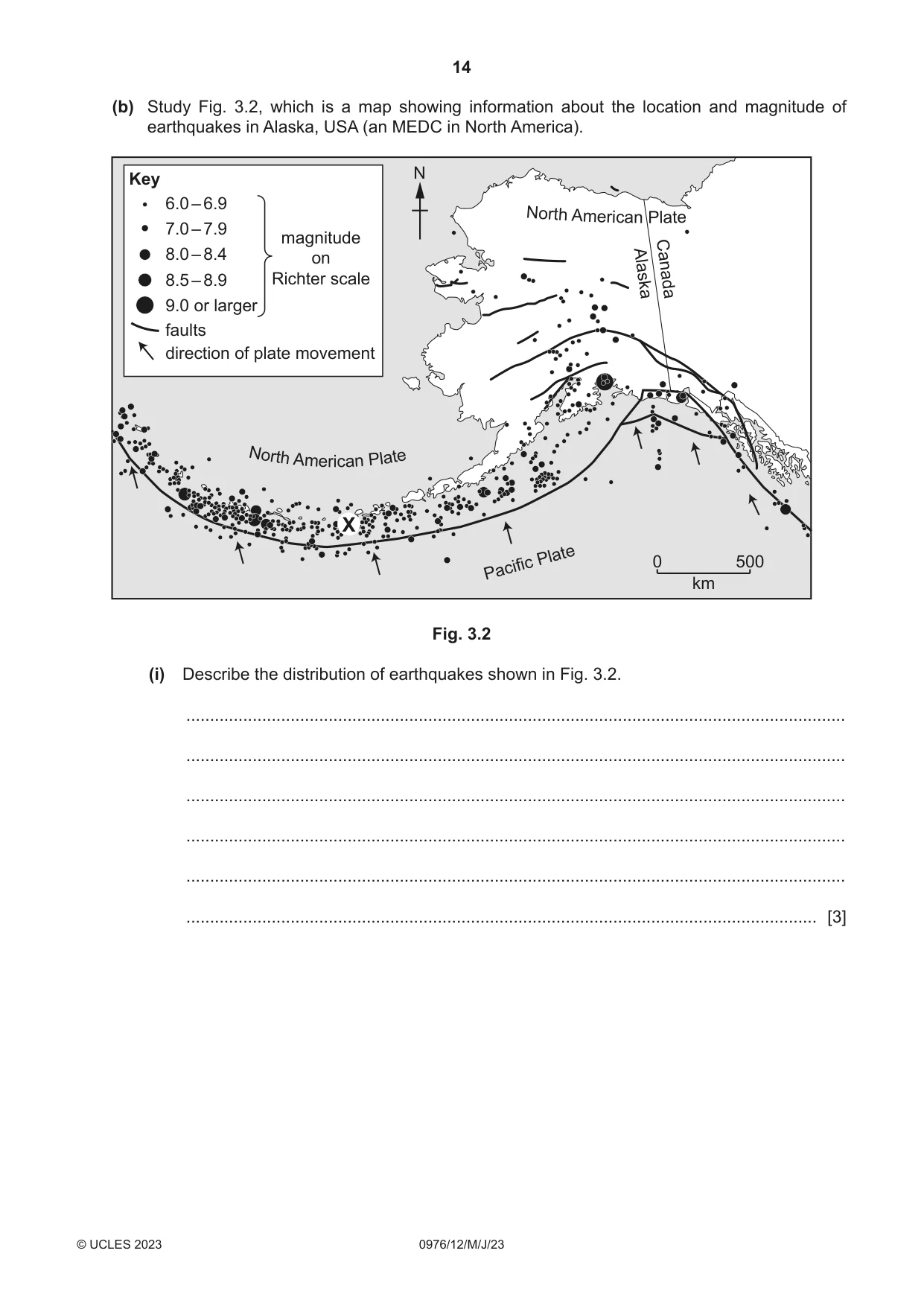
14 0976/12/M/J/23 © UCLES 2023 (b) Study Fig. 3.2, which is a map showing information about the location and magnitude of earthquakes in Alaska, USA (an MEDC in North America). 0 500 km Nor th Am eri ca n P lat e North Am erican Pl ate Alaska Canada Pacific Plate Key 6.0 – 6.9 7.0 – 7.9 8.0 – 8.4 8.5 – 8.9 9.0 or larger faults direction of plate movement N X magnitude on Richter scale Fig. 3.2 (i) Describe the distribution of earthquakes shown in Fig. 3.2. … … … … … … [3]
Question paper, page 15
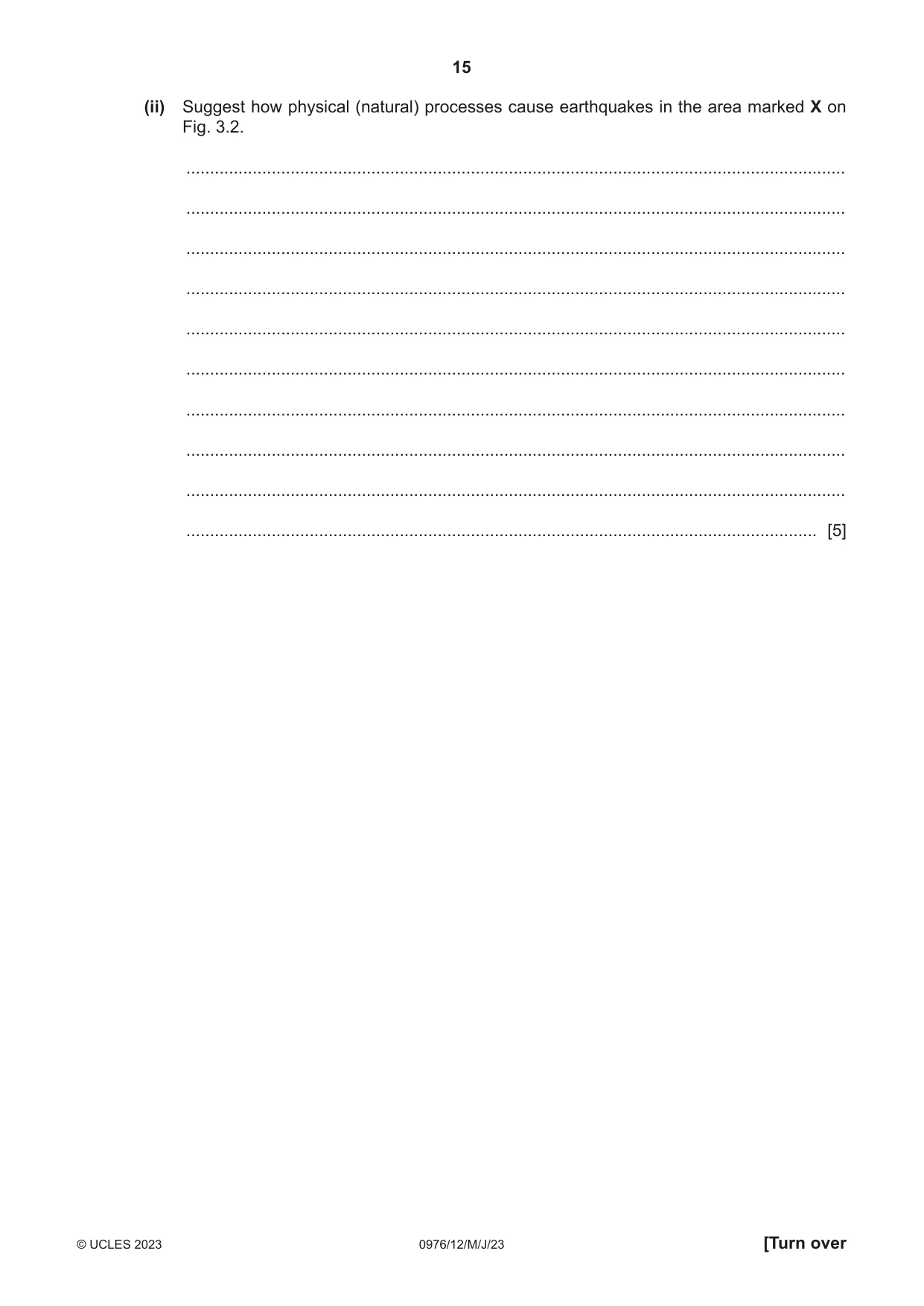
15 0976/12/M/J/23 © UCLES 2023 [Turn over (ii) Suggest how physical (natural) processes cause earthquakes in the area marked X on Fig. 3.2. … … … … … … … … … … [5]
Question paper, page 16
16 0976/12/M/J/23 © UCLES 2023 (c) For a named example you have studied, describe the impacts of a volcanic eruption. Name of example … … … … … … … … … … … … … … … … … … … … … … … … … [7] [Total: 25]
Question paper, page 17
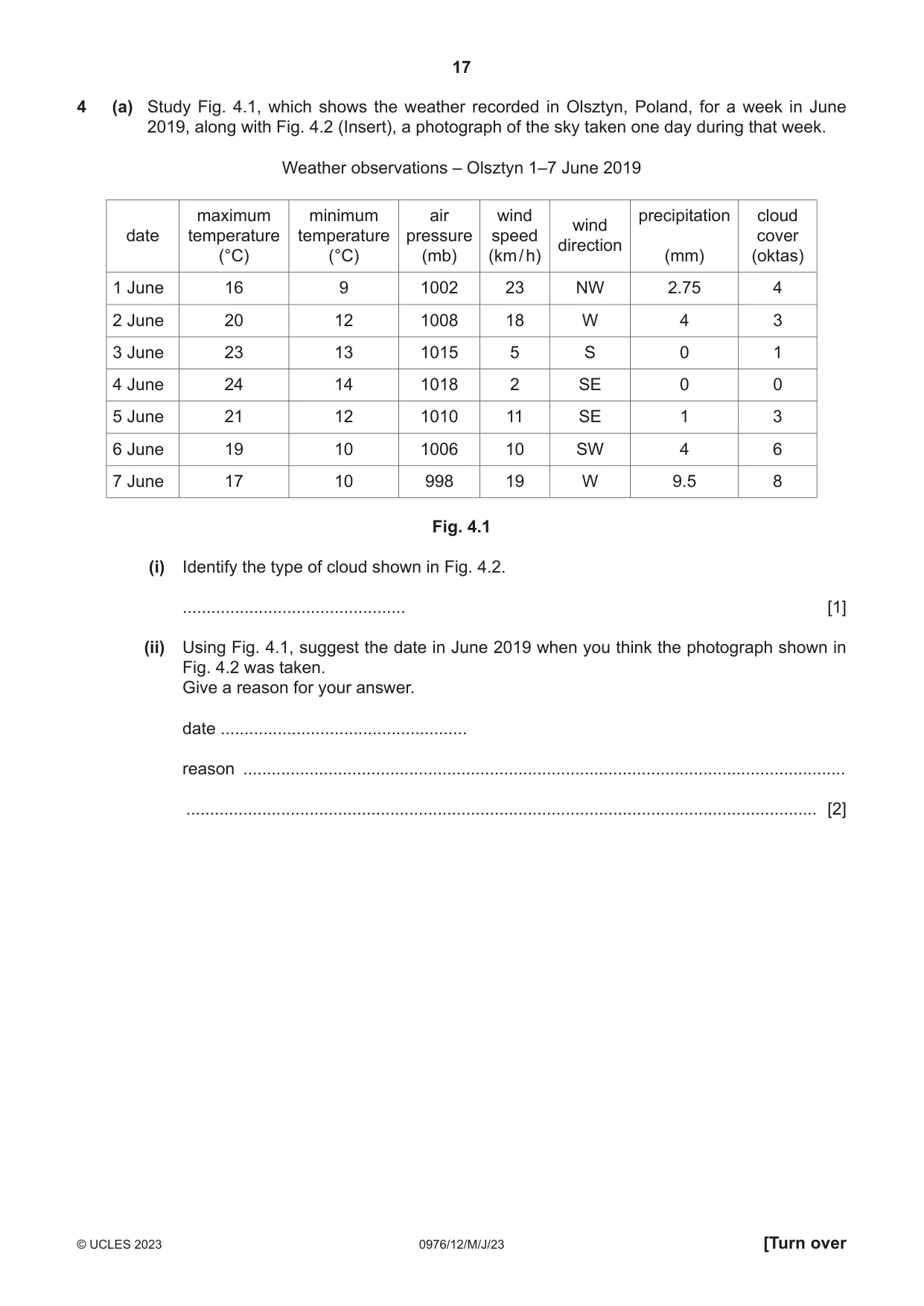
17 0976/12/M/J/23 © UCLES 2023 [Turn over 4 (a) Study Fig. 4.1, which shows the weather recorded in Olsztyn, Poland, for a week in June 2019, along with Fig. 4.2 (Insert), a photograph of the sky taken one day during that week. Weather observations – Olsztyn 1–7 June 2019 date maximum temperature (°C) minimum temperature (°C) air pressure (mb) wind speed (km / h) wind direction precipitation (mm) cloud cover (oktas) 1 June 16 9 1002 23 NW 2.75 4 2 June 20 12 1008 18 W 4 3 3 June 23 13 1015 5 S 0 1 4 June 24 14 1018 2 SE 0 0 5 June 21 12 1010 11 SE 1 3 6 June 19 10 1006 10 SW 4 6 7 June 17 10 998 19 W 9.5 8 Fig. 4.1 (i) Identify the type of cloud shown in Fig. 4.2. … [1] (ii) Using Fig. 4.1, suggest the date in June 2019 when you think the photograph shown in Fig. 4.2 was taken. Give a reason for your answer. date … reason … … [2]
Question paper, page 18
18 0976/12/M/J/23 © UCLES 2023 (iii) Explain how a maximum and minimum thermometer (Six’s thermometer) was used to collect the information on temperature in Fig. 4.1. … … … … … … [3] (iv) Name the traditional weather instruments used to collect information on air pressure, wind speed, wind direction and precipitation. air pressure … wind speed … wind direction … precipitation … [4]
Question paper, page 19
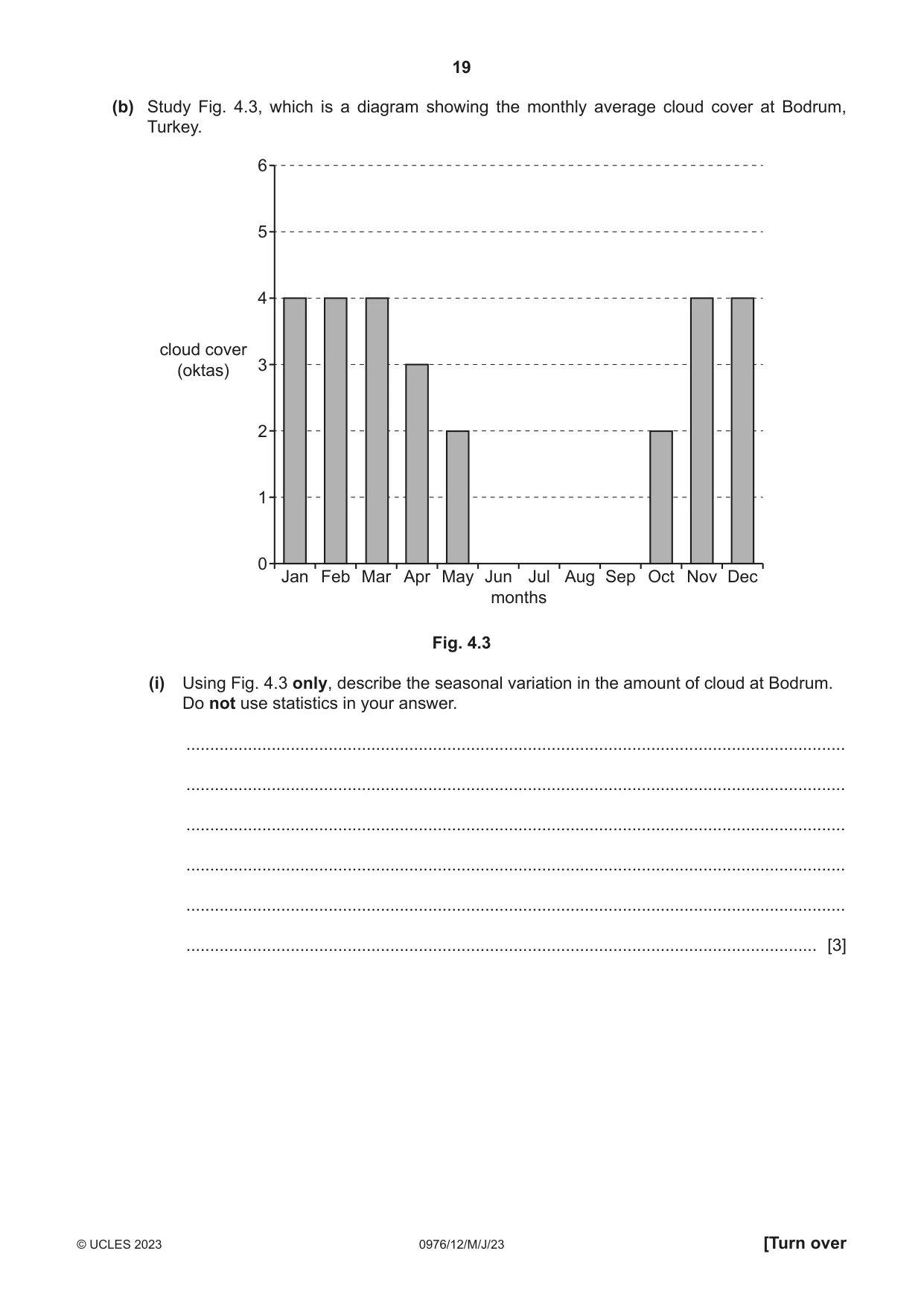
19 0976/12/M/J/23 © UCLES 2023 [Turn over (b) Study Fig. 4.3, which is a diagram showing the monthly average cloud cover at Bodrum, Turkey. 6 5 4 3 2 1 0 Jan Feb Mar Apr May Jun Jul months Aug Sep Oct Nov Dec cloud cover (oktas) Fig. 4.3 (i) Using Fig. 4.3 only, describe the seasonal variation in the amount of cloud at Bodrum. Do not use statistics in your answer. … … … … … … [3]
Question paper, page 20
20 0976/12/M/J/23 © UCLES 2023 (ii) Explain how data on cloud cover and cloud type can be collected over a period of a month. … … … … … … … … … … [5]
Question paper, page 21
21 0976/12/M/J/23 © UCLES 2023 [Turn over (c) For a named river you have studied, describe the impacts of flooding. Name of river … … … … … … … … … … … … … … … … … … … … … … … … … [7] [Total: 25]
Question paper, page 22
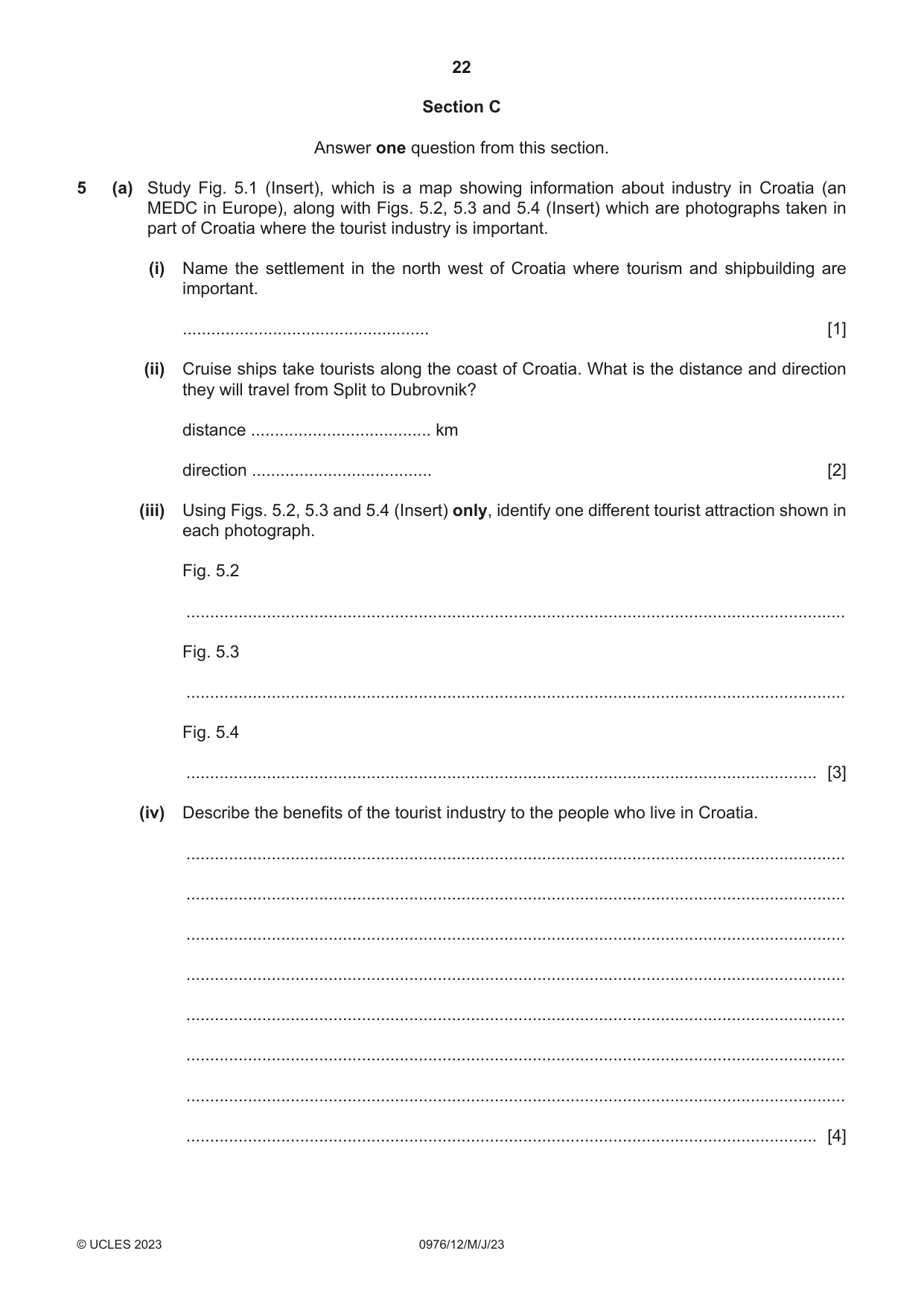
22 0976/12/M/J/23 © UCLES 2023 Section C Answer one question from this section. 5 (a) Study Fig. 5.1 (Insert), which is a map showing information about industry in Croatia (an MEDC in Europe), along with Figs. 5.2, 5.3 and 5.4 (Insert) which are photographs taken in part of Croatia where the tourist industry is important. (i) Name the settlement in the north west of Croatia where tourism and shipbuilding are important. … [1] (ii) Cruise ships take tourists along the coast of Croatia. What is the distance and direction they will travel from Split to Dubrovnik? distance … km direction … [2] (iii) Using Figs. 5.2, 5.3 and 5.4 (Insert) only, identify one different tourist attraction shown in each photograph. Fig. 5.2 … Fig. 5.3 … Fig. 5.4 … [3] (iv) Describe the benefits of the tourist industry to the people who live in Croatia. … … … … … … … … [4]
Question paper, page 23
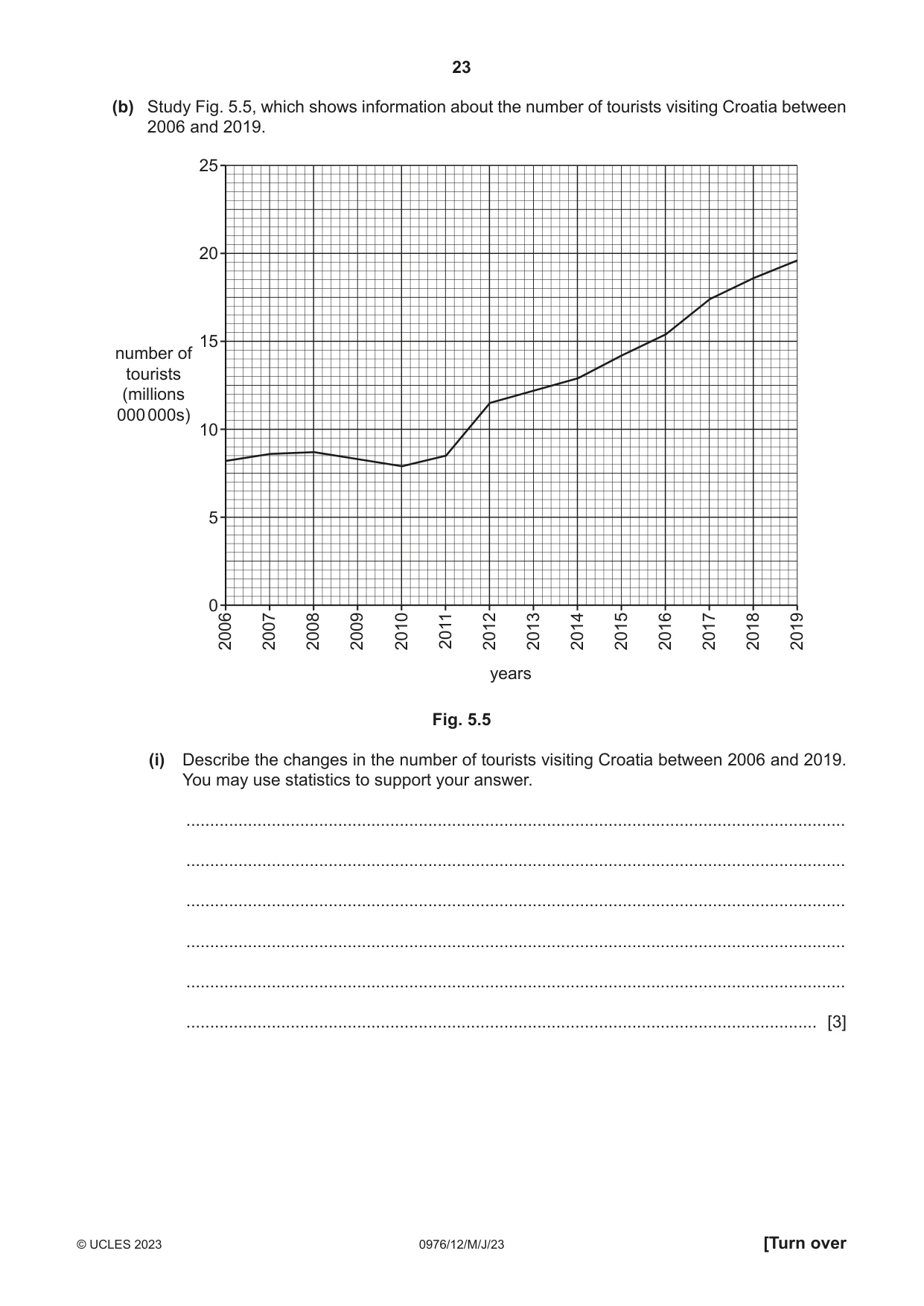
23 0976/12/M/J/23 © UCLES 2023 [Turn over (b) Study Fig. 5.5, which shows information about the number of tourists visiting Croatia between 2006 and 2019. 2006 2007 2008 2009 2010 2011 2012 2013 2014 2015 2016 2017 2018 2019 years 0 5 10 15 20 25 number of tourists (millions 000 000s) Fig. 5.5 (i) Describe the changes in the number of tourists visiting Croatia between 2006 and 2019. You may use statistics to support your answer. … … … … … … [3]
Question paper, page 24
24 0976/12/M/J/23 © UCLES 2023 (ii) Suggest reasons why the number of tourists visiting a country may change from year to year. … … … … … … … … … … [5]
Question paper, page 25
25 0976/12/M/J/23 © UCLES 2023 [Turn over (c) For a named tourist area you have studied, describe the problems tourism causes for people and the natural environment. Name of tourist area … … … … … … … … … … … … … … … … … … … … … … … … … [7] [Total: 25]
Question paper, page 26
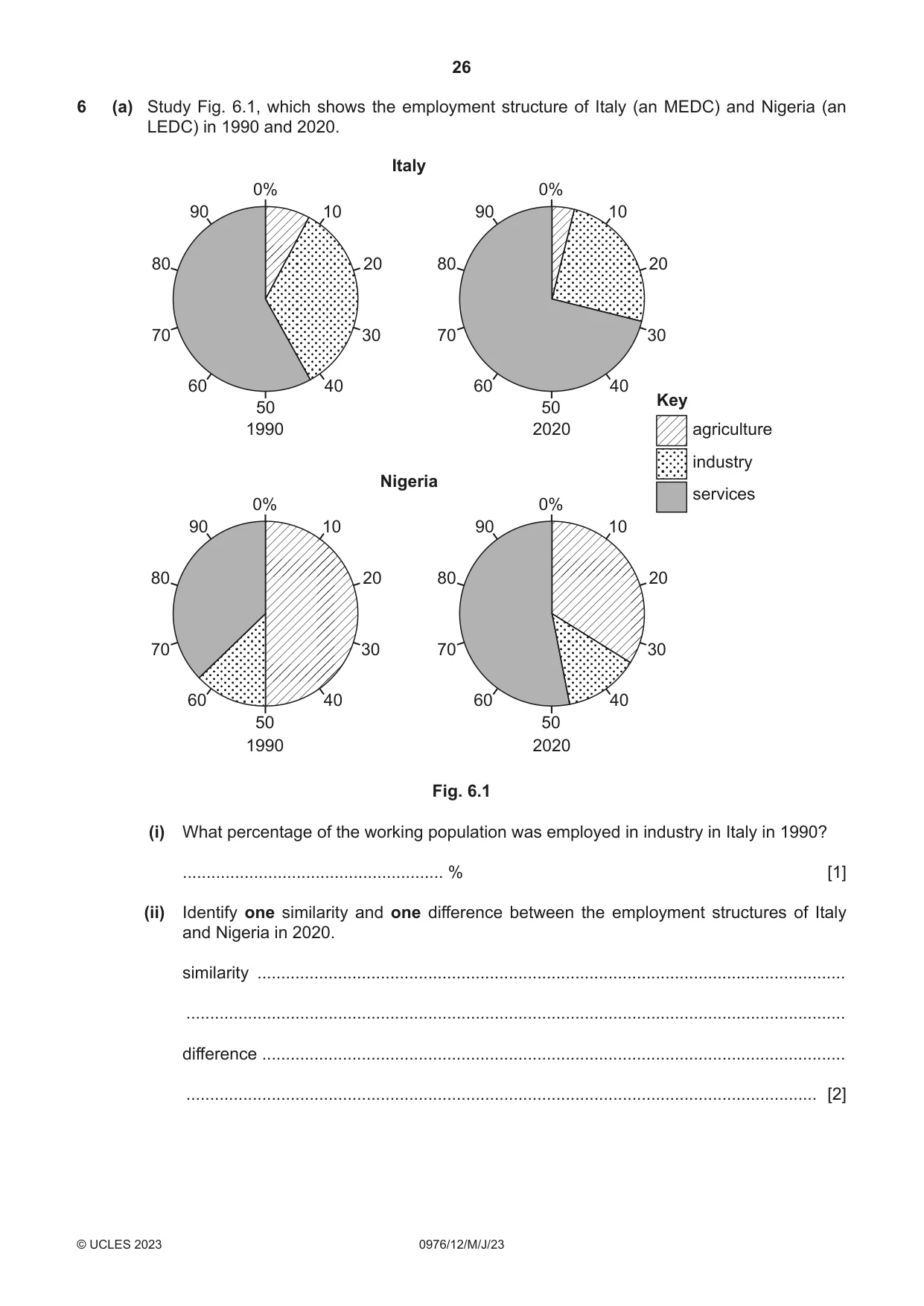
26 0976/12/M/J/23 © UCLES 2023 6 (a) Study Fig. 6.1, which shows the employment structure of Italy (an MEDC) and Nigeria (an LEDC) in 1990 and 2020. 0% 50 40 10 60 90 20 30 80 70 0% 50 40 10 60 90 20 30 80 70 0% 50 40 10 60 90 20 30 80 70 0% 50 40 10 60 90 20 30 80 70 Italy 1990 2020 Nigeria 1990 2020 Key agriculture industry services Fig. 6.1 (i) What percentage of the working population was employed in industry in Italy in 1990? … % [1] (ii) Identify one similarity and one difference between the employment structures of Italy and Nigeria in 2020. similarity … … difference … … [2]
Question paper, page 27
27 0976/12/M/J/23 © UCLES 2023 [Turn over (iii) Compare the changes which have taken place in the employment structure of Italy and Nigeria between 1990 and 2020. Do not use statistics in your answer. … … … … … … … [3] (iv) Suggest reasons for the changes in the employment structure of Nigeria (an LEDC) which have taken place between 1990 and 2020. … … … … … … … … [4]
Question paper, page 28
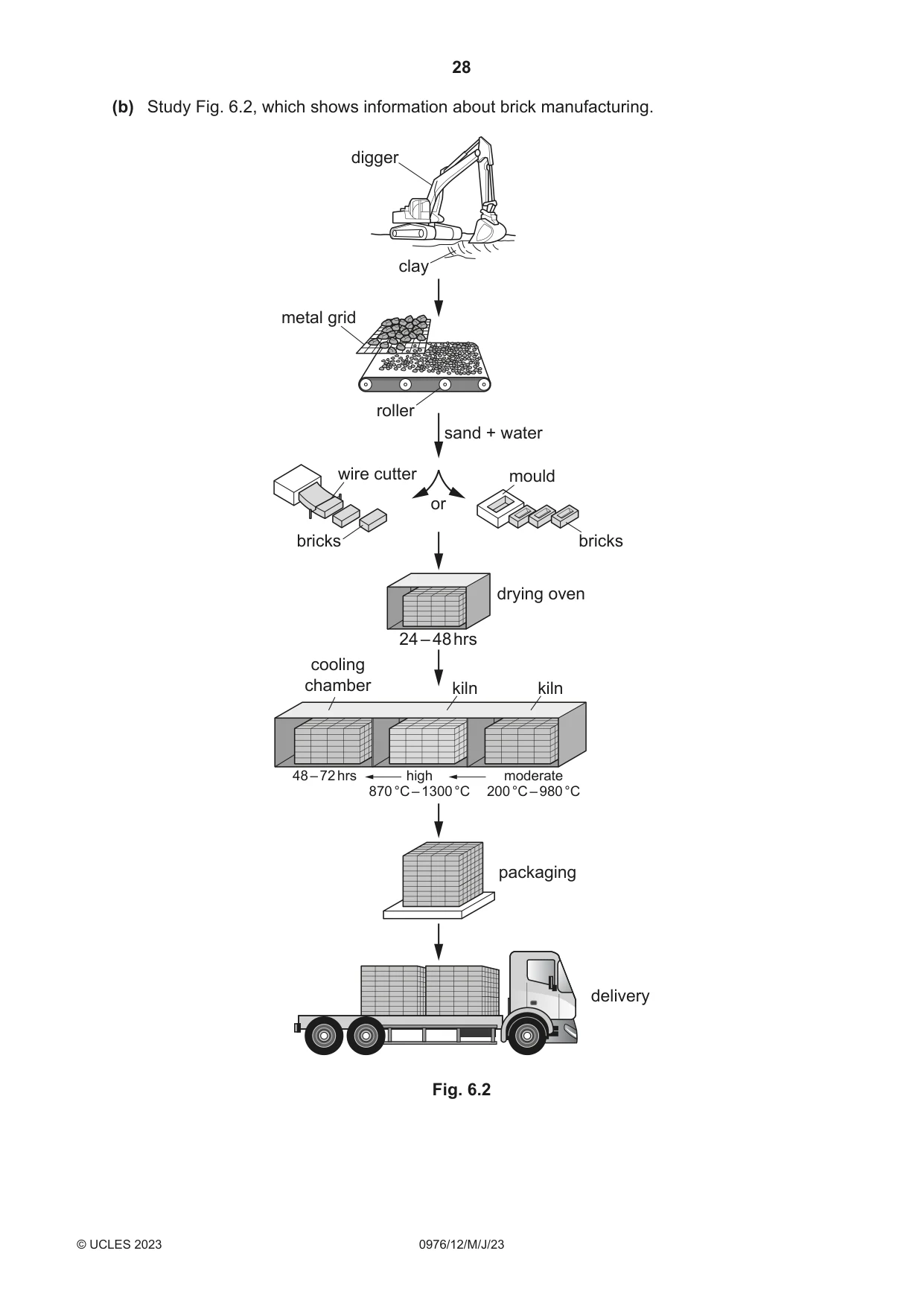
28 0976/12/ M / J /23 © UCLES 2023 (b) Study Fig. 6.2, which shows information about brick manufacturing. digger clay metal grid roller sand + water or wire cutter mould bricks bricks drying oven kiln packaging delivery kiln cooling chamber 24 – 48 hrs moderate 200 °C – 980 °C high 870 °C – 1300 °C 48 – 72 hrs Fig. 6.2
Question paper, page 29
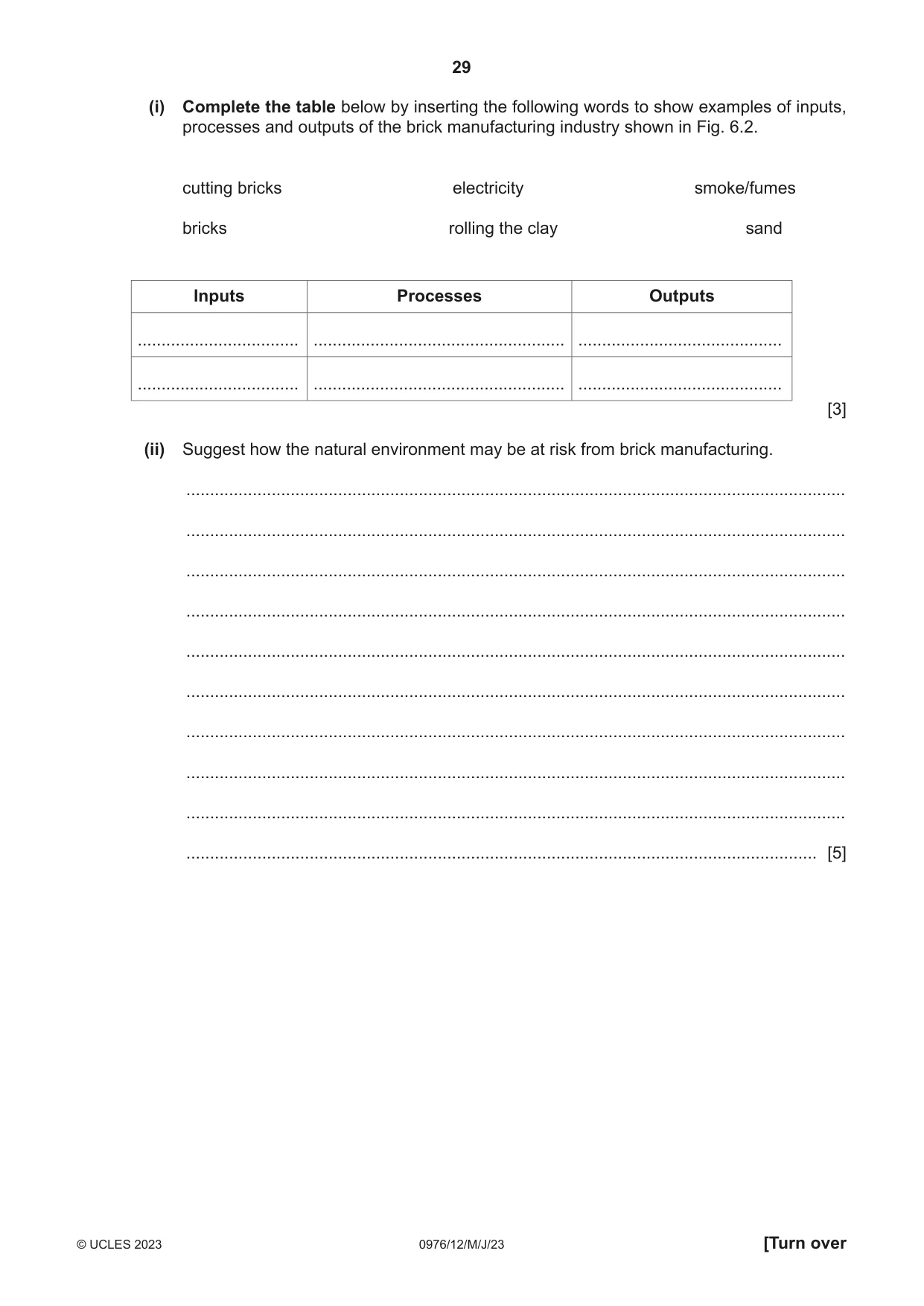
29 0976/12/M/J/23 © UCLES 2023 [Turn over (i) Complete the table below by inserting the following words to show examples of inputs, processes and outputs of the brick manufacturing industry shown in Fig. 6.2. cutting bricks electricity smoke/fumes bricks rolling the clay sand Inputs Processes Outputs … … … … … … [3] (ii) Suggest how the natural environment may be at risk from brick manufacturing. … … … … … … … … … … [5]
Question paper, page 30
30 0976/12/M/J/23 © UCLES 2023 (c) For a named example of a factory or industrial zone you have studied, explain the factors which influence its location. Name of factory or industrial zone … … … … … … … … … … … … … … … … … … … … … … … … … [7] [Total: 25]
Question paper, page 31
31 0976/12/M/J/23 © UCLES 2023 Additional pages If you use the following pages to complete the answer to any question, the question number must be clearly shown. … … … … … … … … … … … … … … … … … … … … … … … … … …
Question paper, page 32
32 0976/12/M/J/23 © UCLES 2023 … … … … … … … … … … … … … … … … … … … … … … The boundaries and names shown, the designations used and the presentation of material on any maps contained in this question paper/insert do not imply official endorsement or acceptance by Cambridge Assessment International Education concerning the legal status of any country, territory, or area or any of its authorities, or of the delimitation of its frontiers or boundaries. Permission to reproduce items where third-party owned material protected by copyright is included has been sought and cleared where possible. Every reasonable effort has been made by the publisher (UCLES) to trace copyright holders, but if any items requiring clearance have unwittingly been included, the publisher will be pleased to make amends at the earliest possible opportunity. To avoid the issue of disclosure of answer-related information to candidates, all copyright acknowledgements are reproduced online in the Cambridge Assessment International Education Copyright Acknowledgements Booklet. This is produced for each series of examinations and is freely available to download at www.cambridgeinternational.org after the live examination series. Cambridge Assessment International Education is part of Cambridge Assessment. Cambridge Assessment is the brand name of the University of Cambridge Local Examinations Syndicate (UCLES), which is a department of the University of Cambridge.
Mark scheme, page 1
This document consists of 18 printed pages. © UCLES 2023 [Turn over Cambridge IGCSE™ (9–1) IGCSE GEOGRAPHY (9–1) 0976/12 Paper 1 Geographical Themes May/June 2023 MARK SCHEME Maximum Mark: 75 Published This mark scheme is published as an aid to teachers and candidates, to indicate the requirements of the examination. It shows the basis on which Examiners were instructed to award marks. It does not indicate the details of the discussions that took place at an Examiners’ meeting before marking began, which would have considered the acceptability of alternative answers. Mark schemes should be read in conjunction with the question paper and the Principal Examiner Report for Teachers. Cambridge International will not enter into discussions about these mark schemes. Cambridge International is publishing the mark schemes for the May/June 2023 series for most Cambridge IGCSE, Cambridge International A and AS Level and Cambridge Pre-U components, and some Cambridge O Level components.
Mark scheme, page 2
0976/12 Cambridge IGCSE (9–1) – Mark Scheme PUBLISHED May/June 2023 © UCLES 2023 Page 2 of 18 Generic Marking Principles These general marking principles must be applied by all examiners when marking candidate answers. They should be applied alongside the specific content of the mark scheme or generic level descriptors for a question. Each question paper and mark scheme will also comply with these marking principles. GENERIC MARKING PRINCIPLE 1: Marks must be awarded in line with: the specific content of the mark scheme or the generic level descriptors for the question the specific skills defined in the mark scheme or in the generic level descriptors for the question the standard of response required by a candidate as exemplified by the standardisation scripts. GENERIC MARKING PRINCIPLE 2: Marks awarded are always whole marks (not half marks, or other fractions). GENERIC MARKING PRINCIPLE 3: Marks must be awarded positively: marks are awarded for correct/valid answers, as defined in the mark scheme. However, credit is given for valid answers which go beyond the scope of the syllabus and mark scheme, referring to your Team Leader as appropriate marks are awarded when candidates clearly demonstrate what they know and can do marks are not deducted for errors marks are not deducted for omissions answers should only be judged on the quality of spelling, punctuation and grammar when these features are specifically assessed by the question as indicated by the mark scheme. The meaning, however, should be unambiguous. GENERIC MARKING PRINCIPLE 4: Rules must be applied consistently, e.g., in situations where candidates have not followed instructions or in the application of generic level descriptors. GENERIC MARKING PRINCIPLE 5: Marks should be awarded using the full range of marks defined in the mark scheme for the question (however; the use of the full mark range may be limited according to the quality of the candidate responses seen). GENERIC MARKING PRINCIPLE 6: Marks awarded are based solely on the requirements as defined in the mark scheme. Marks should not be awarded with grade thresholds or grade descriptors in mind.
Mark scheme, page 3
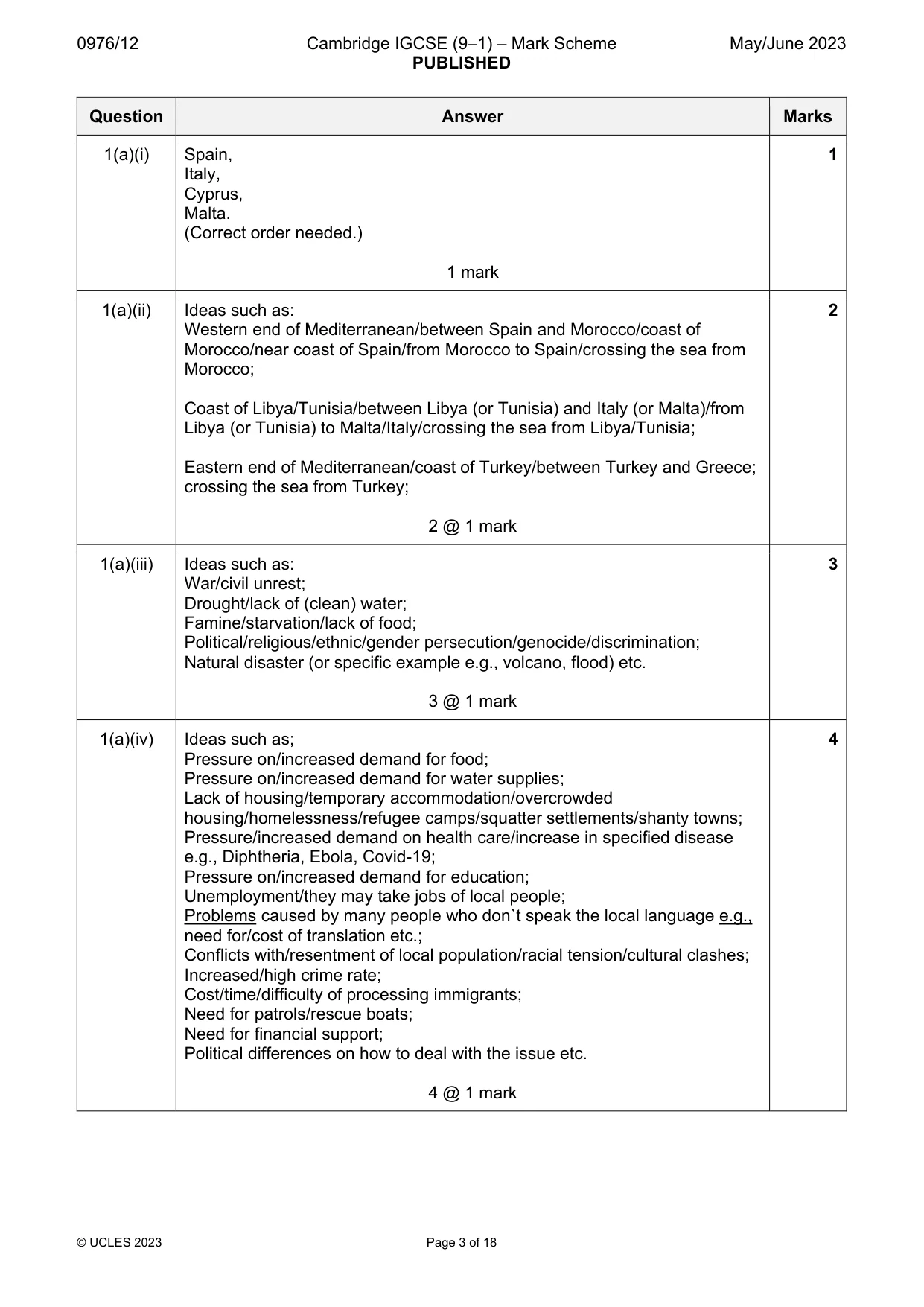
0976/12 Cambridge IGCSE (9–1) – Mark Scheme PUBLISHED May/June 2023 © UCLES 2023 Page 3 of 18 Question Answer Marks 1(a)(i) Spain, Italy, Cyprus, Malta. (Correct order needed.) 1 mark 1 1(a)(ii) Ideas such as: Western end of Mediterranean/between Spain and Morocco/coast of Morocco/near coast of Spain/from Morocco to Spain/crossing the sea from Morocco; Coast of Libya/Tunisia/between Libya (or Tunisia) and Italy (or Malta)/from Libya (or Tunisia) to Malta/Italy/crossing the sea from Libya/Tunisia; Eastern end of Mediterranean/coast of Turkey/between Turkey and Greece; crossing the sea from Turkey; 2 @ 1 mark 2 1(a)(iii) Ideas such as: War/civil unrest; Drought/lack of (clean) water; Famine/starvation/lack of food; Political/religious/ethnic/gender persecution/genocide/discrimination; Natural disaster (or specific example e.g., volcano, flood) etc. 3 @ 1 mark 3 1(a)(iv) Ideas such as; Pressure on/increased demand for food; Pressure on/increased demand for water supplies; Lack of housing/temporary accommodation/overcrowded housing/homelessness/refugee camps/squatter settlements/shanty towns; Pressure/increased demand on health care/increase in specified disease e.g., Diphtheria, Ebola, Covid-19; Pressure on/increased demand for education; Unemployment/they may take jobs of local people; Problems caused by many people who don`t speak the local language e.g., need for/cost of translation etc.; Conflicts with/resentment of local population/racial tension/cultural clashes; Increased/high crime rate; Cost/time/difficulty of processing immigrants; Need for patrols/rescue boats; Need for financial support; Political differences on how to deal with the issue etc. 4 @ 1 mark 4
Mark scheme, page 4
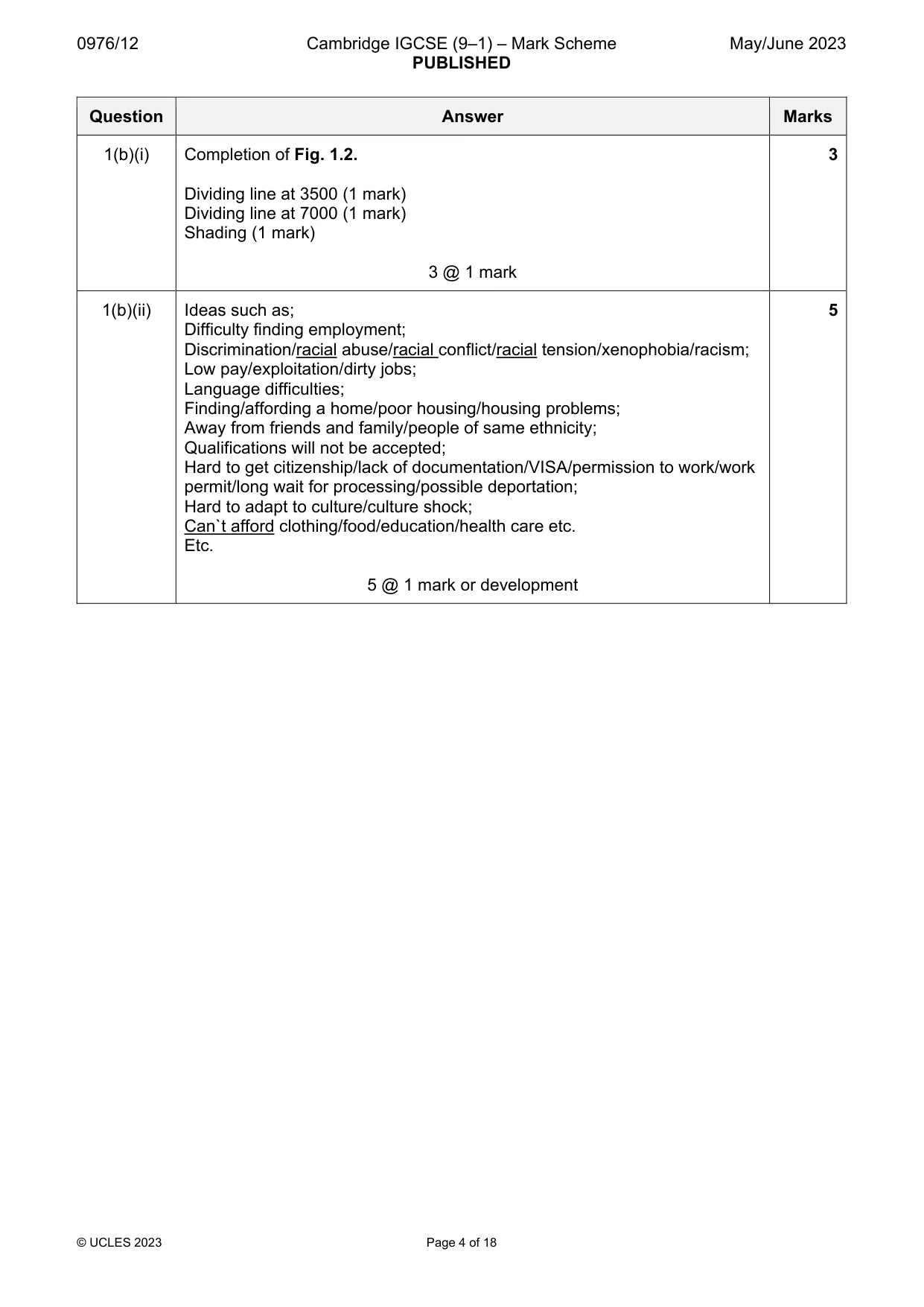
0976/12 Cambridge IGCSE (9–1) – Mark Scheme PUBLISHED May/June 2023 © UCLES 2023 Page 4 of 18 Question Answer Marks 1(b)(i) Completion of Fig. 1.2. Dividing line at 3500 (1 mark) Dividing line at 7000 (1 mark) Shading (1 mark) 3 @ 1 mark 3 1(b)(ii) Ideas such as; Difficulty finding employment; Discrimination/racial abuse/racial conflict/racial tension/xenophobia/racism; Low pay/exploitation/dirty jobs; Language difficulties; Finding/affording a home/poor housing/housing problems; Away from friends and family/people of same ethnicity; Qualifications will not be accepted; Hard to get citizenship/lack of documentation/VISA/permission to work/work permit/long wait for processing/possible deportation; Hard to adapt to culture/culture shock; Can`t afford clothing/food/education/health care etc. Etc. 5 @ 1 mark or development 5
Mark scheme, page 5
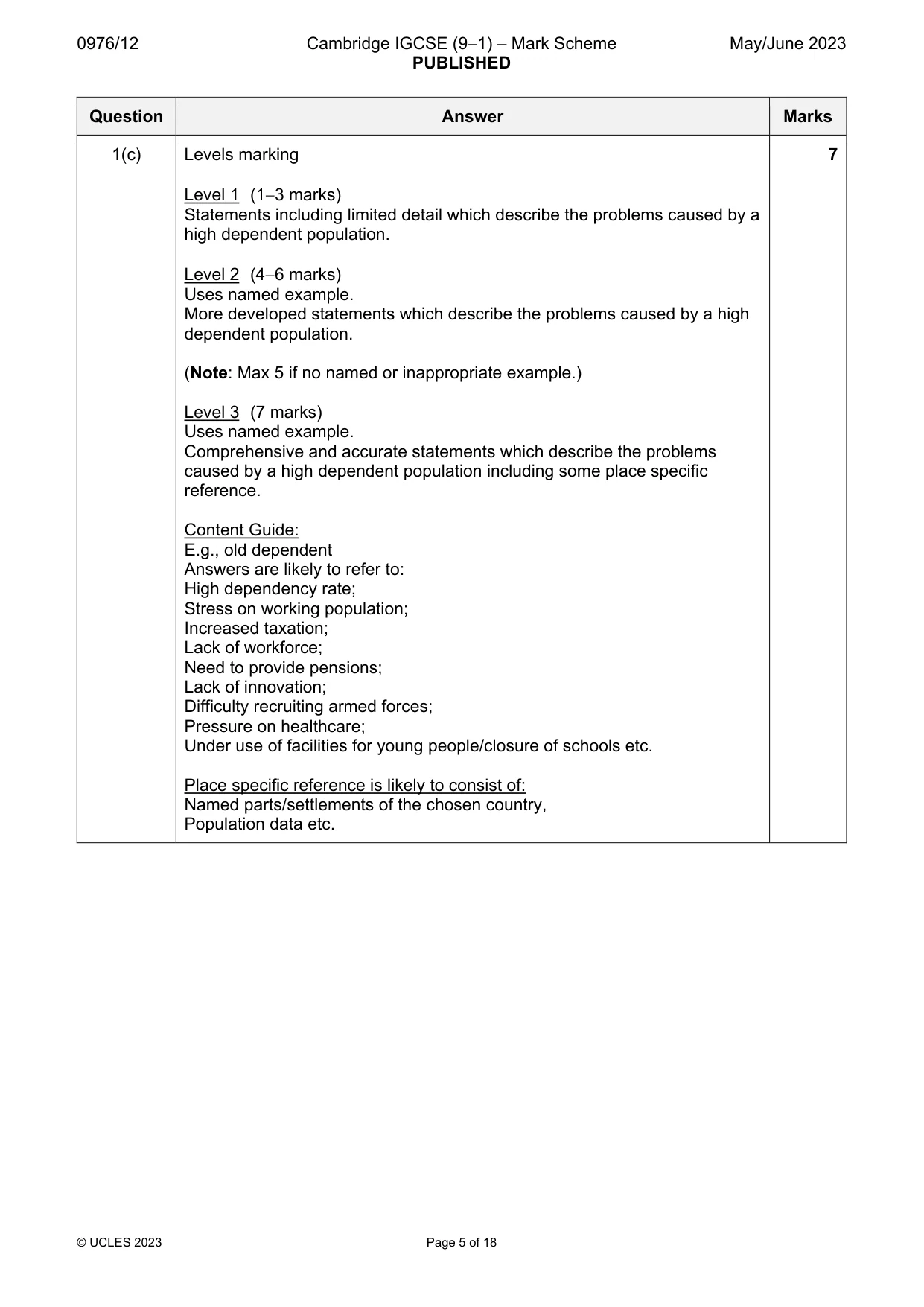
0976/12 Cambridge IGCSE (9–1) – Mark Scheme PUBLISHED May/June 2023 © UCLES 2023 Page 5 of 18 Question Answer Marks 1(c) Levels marking Level 1 (13 marks) Statements including limited detail which describe the problems caused by a high dependent population. Level 2 (46 marks) Uses named example. More developed statements which describe the problems caused by a high dependent population. (Note: Max 5 if no named or inappropriate example.) Level 3 (7 marks) Uses named example. Comprehensive and accurate statements which describe the problems caused by a high dependent population including some place specific reference. Content Guide: E.g., old dependent Answers are likely to refer to: High dependency rate; Stress on working population; Increased taxation; Lack of workforce; Need to provide pensions; Lack of innovation; Difficulty recruiting armed forces; Pressure on healthcare; Under use of facilities for young people/closure of schools etc. Place specific reference is likely to consist of: Named parts/settlements of the chosen country, Population data etc. 7
Mark scheme, page 6
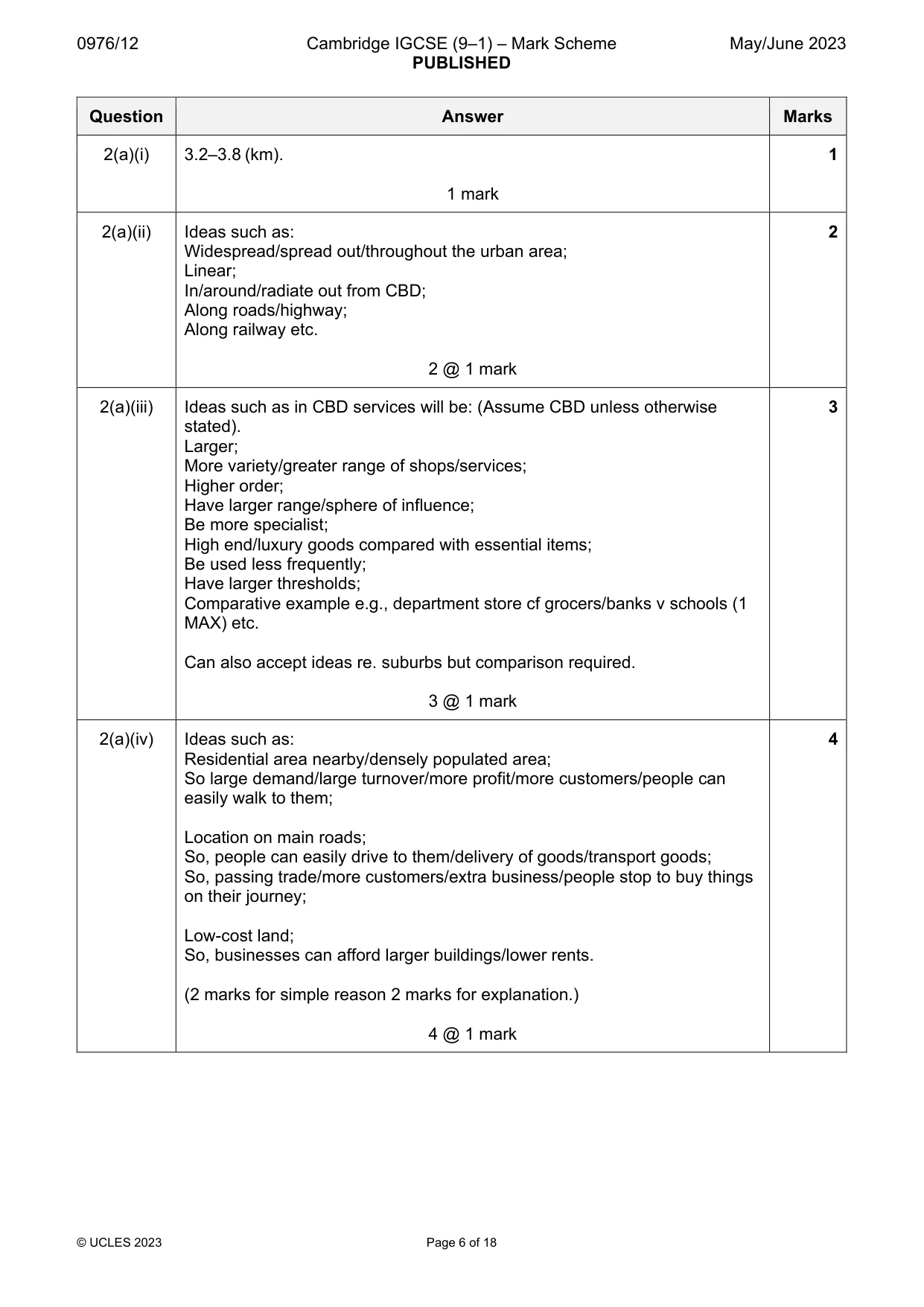
0976/12 Cambridge IGCSE (9–1) – Mark Scheme PUBLISHED May/June 2023 © UCLES 2023 Page 6 of 18 Question Answer Marks 2(a)(i) 3.2–3.8 (km). 1 mark 1 2(a)(ii) Ideas such as: Widespread/spread out/throughout the urban area; Linear; In/around/radiate out from CBD; Along roads/highway; Along railway etc. 2 @ 1 mark 2 2(a)(iii) Ideas such as in CBD services will be: (Assume CBD unless otherwise stated). Larger; More variety/greater range of shops/services; Higher order; Have larger range/sphere of influence; Be more specialist; High end/luxury goods compared with essential items; Be used less frequently; Have larger thresholds; Comparative example e.g., department store cf grocers/banks v schools (1 MAX) etc. Can also accept ideas re. suburbs but comparison required. 3 @ 1 mark 3 2(a)(iv) Ideas such as: Residential area nearby/densely populated area; So large demand/large turnover/more profit/more customers/people can easily walk to them; Location on main roads; So, people can easily drive to them/delivery of goods/transport goods; So, passing trade/more customers/extra business/people stop to buy things on their journey; Low-cost land; So, businesses can afford larger buildings/lower rents. (2 marks for simple reason 2 marks for explanation.) 4 @ 1 mark 4
Mark scheme, page 7
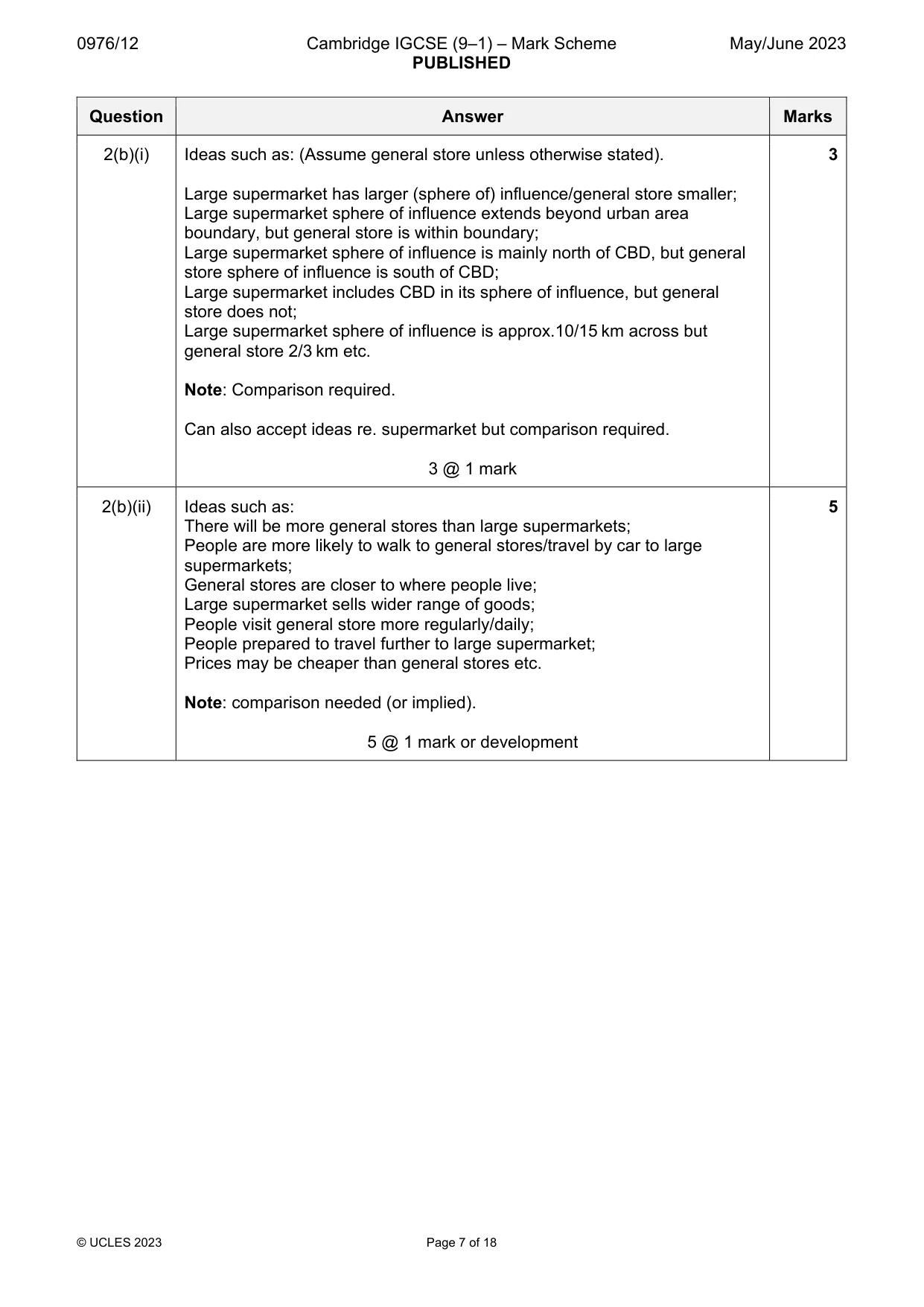
0976/12 Cambridge IGCSE (9–1) – Mark Scheme PUBLISHED May/June 2023 © UCLES 2023 Page 7 of 18 Question Answer Marks 2(b)(i) Ideas such as: (Assume general store unless otherwise stated). Large supermarket has larger (sphere of) influence/general store smaller; Large supermarket sphere of influence extends beyond urban area boundary, but general store is within boundary; Large supermarket sphere of influence is mainly north of CBD, but general store sphere of influence is south of CBD; Large supermarket includes CBD in its sphere of influence, but general store does not; Large supermarket sphere of influence is approx.10/15 km across but general store 2/3 km etc. Note: Comparison required. Can also accept ideas re. supermarket but comparison required. 3 @ 1 mark 3 2(b)(ii) Ideas such as: There will be more general stores than large supermarkets; People are more likely to walk to general stores/travel by car to large supermarkets; General stores are closer to where people live; Large supermarket sells wider range of goods; People visit general store more regularly/daily; People prepared to travel further to large supermarket; Prices may be cheaper than general stores etc. Note: comparison needed (or implied). 5 @ 1 mark or development 5
Mark scheme, page 8
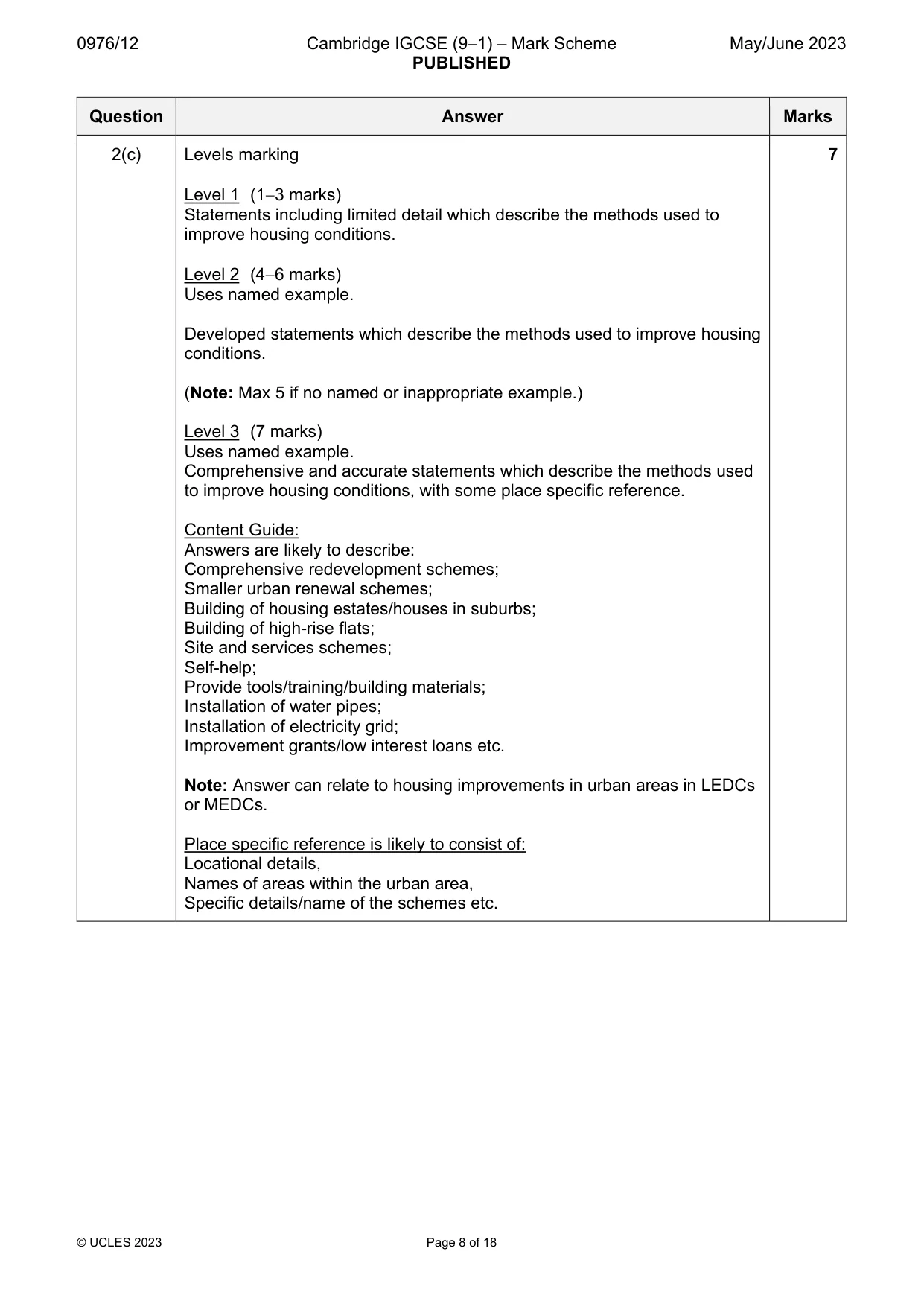
0976/12 Cambridge IGCSE (9–1) – Mark Scheme PUBLISHED May/June 2023 © UCLES 2023 Page 8 of 18 Question Answer Marks 2(c) Levels marking Level 1 (13 marks) Statements including limited detail which describe the methods used to improve housing conditions. Level 2 (46 marks) Uses named example. Developed statements which describe the methods used to improve housing conditions. (Note: Max 5 if no named or inappropriate example.) Level 3 (7 marks) Uses named example. Comprehensive and accurate statements which describe the methods used to improve housing conditions, with some place specific reference. Content Guide: Answers are likely to describe: Comprehensive redevelopment schemes; Smaller urban renewal schemes; Building of housing estates/houses in suburbs; Building of high-rise flats; Site and services schemes; Self-help; Provide tools/training/building materials; Installation of water pipes; Installation of electricity grid; Improvement grants/low interest loans etc. Note: Answer can relate to housing improvements in urban areas in LEDCs or MEDCs. Place specific reference is likely to consist of: Locational details, Names of areas within the urban area, Specific details/name of the schemes etc. 7
Mark scheme, page 9
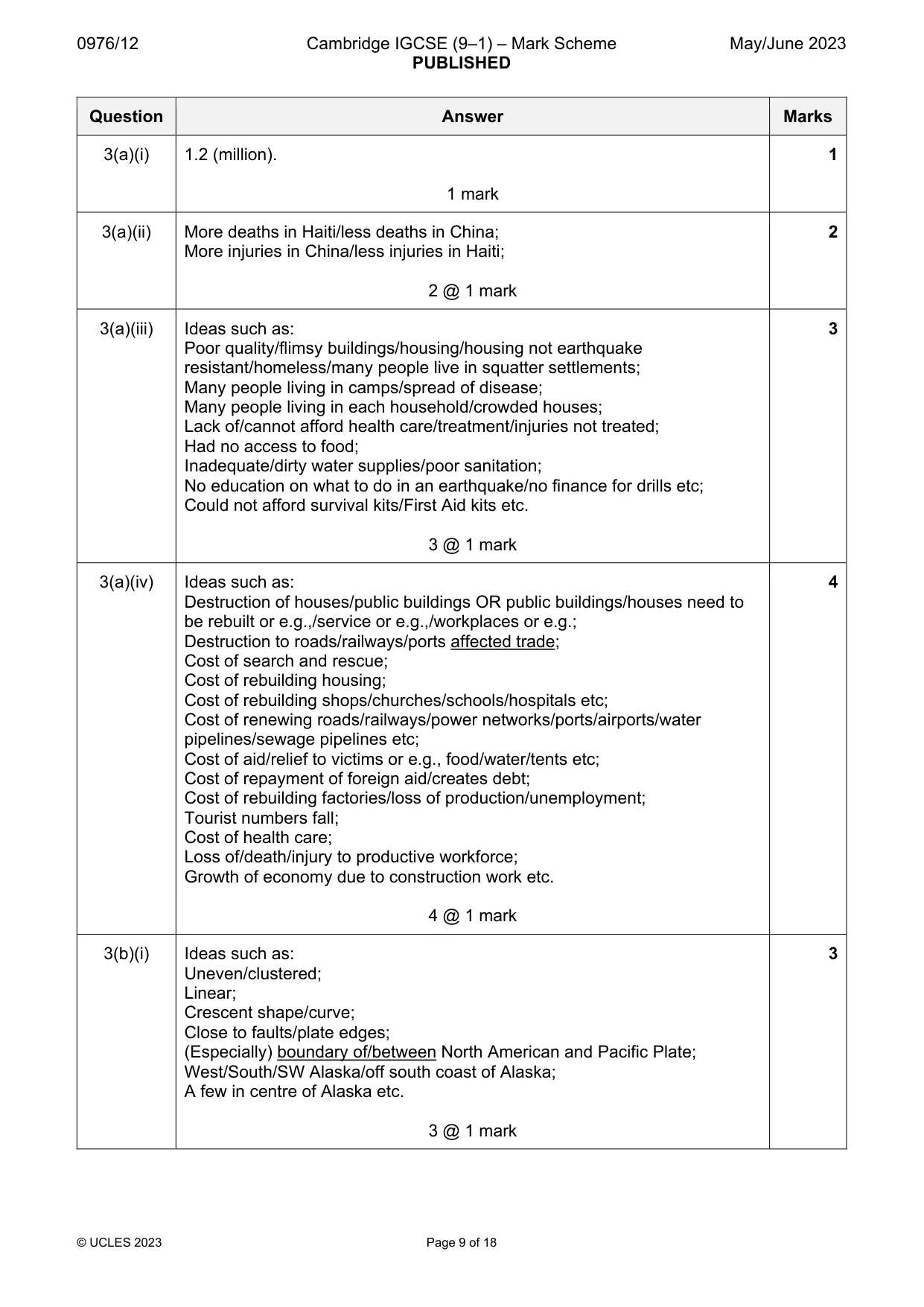
0976/12 Cambridge IGCSE (9–1) – Mark Scheme PUBLISHED May/June 2023 © UCLES 2023 Page 9 of 18 Question Answer Marks 3(a)(i) 1.2 (million). 1 mark 1 3(a)(ii) More deaths in Haiti/less deaths in China; More injuries in China/less injuries in Haiti; 2 @ 1 mark 2 3(a)(iii) Ideas such as: Poor quality/flimsy buildings/housing/housing not earthquake resistant/homeless/many people live in squatter settlements; Many people living in camps/spread of disease; Many people living in each household/crowded houses; Lack of/cannot afford health care/treatment/injuries not treated; Had no access to food; Inadequate/dirty water supplies/poor sanitation; No education on what to do in an earthquake/no finance for drills etc; Could not afford survival kits/First Aid kits etc. 3 @ 1 mark 3 3(a)(iv) Ideas such as: Destruction of houses/public buildings OR public buildings/houses need to be rebuilt or e.g.,/service or e.g.,/workplaces or e.g.; Destruction to roads/railways/ports affected trade; Cost of search and rescue; Cost of rebuilding housing; Cost of rebuilding shops/churches/schools/hospitals etc; Cost of renewing roads/railways/power networks/ports/airports/water pipelines/sewage pipelines etc; Cost of aid/relief to victims or e.g., food/water/tents etc; Cost of repayment of foreign aid/creates debt; Cost of rebuilding factories/loss of production/unemployment; Tourist numbers fall; Cost of health care; Loss of/death/injury to productive workforce; Growth of economy due to construction work etc. 4 @ 1 mark 4 3(b)(i) Ideas such as: Uneven/clustered; Linear; Crescent shape/curve; Close to faults/plate edges; (Especially) boundary of/between North American and Pacific Plate; West/South/SW Alaska/off south coast of Alaska; A few in centre of Alaska etc. 3 @ 1 mark 3
Mark scheme, page 10
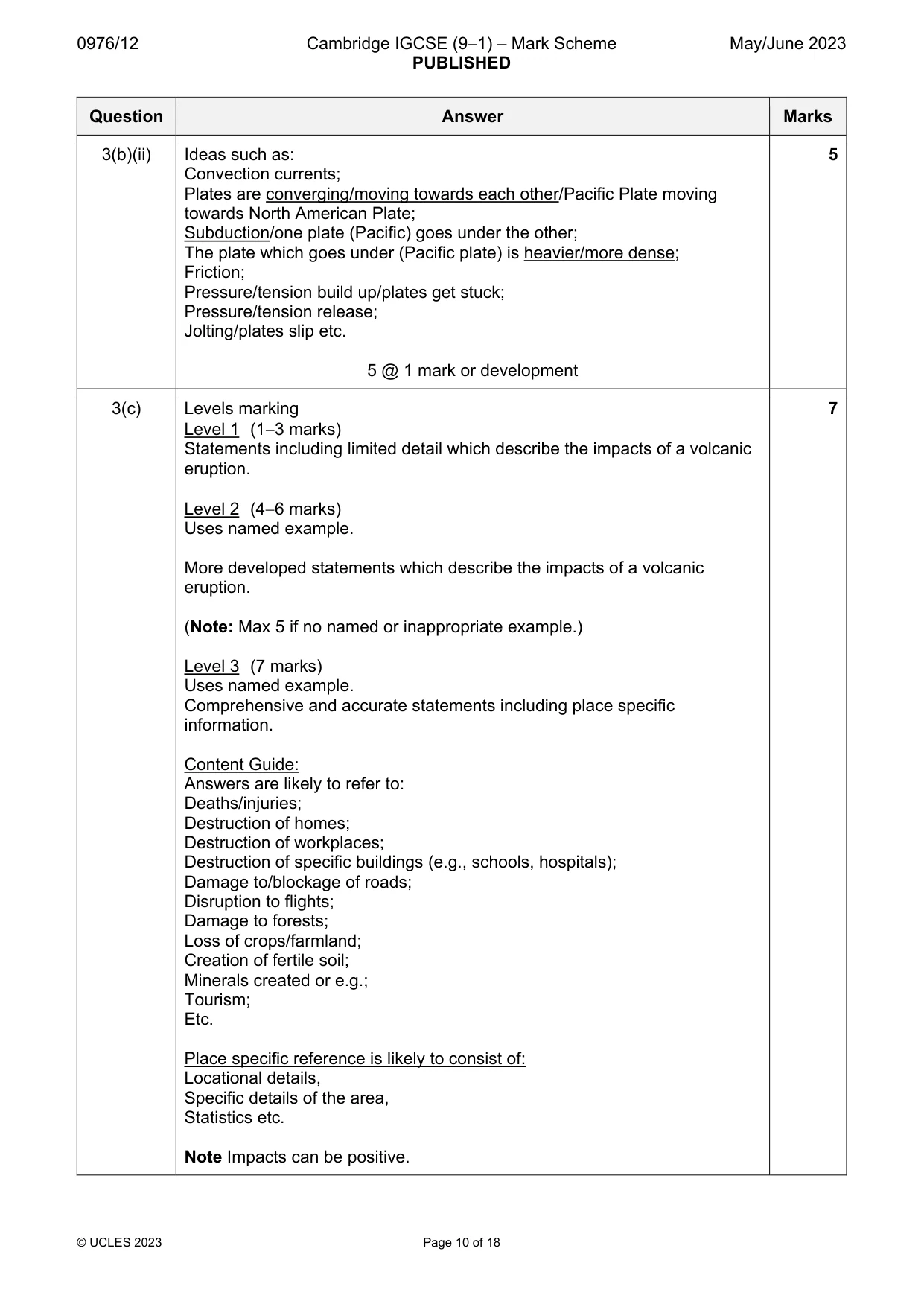
0976/12 Cambridge IGCSE (9–1) – Mark Scheme PUBLISHED May/June 2023 © UCLES 2023 Page 10 of 18 Question Answer Marks 3(b)(ii) Ideas such as: Convection currents; Plates are converging/moving towards each other/Pacific Plate moving towards North American Plate; Subduction/one plate (Pacific) goes under the other; The plate which goes under (Pacific plate) is heavier/more dense; Friction; Pressure/tension build up/plates get stuck; Pressure/tension release; Jolting/plates slip etc. 5 @ 1 mark or development 5 3(c) Levels marking Level 1 (13 marks) Statements including limited detail which describe the impacts of a volcanic eruption. Level 2 (46 marks) Uses named example. More developed statements which describe the impacts of a volcanic eruption. (Note: Max 5 if no named or inappropriate example.) Level 3 (7 marks) Uses named example. Comprehensive and accurate statements including place specific information. Content Guide: Answers are likely to refer to: Deaths/injuries; Destruction of homes; Destruction of workplaces; Destruction of specific buildings (e.g., schools, hospitals); Damage to/blockage of roads; Disruption to flights; Damage to forests; Loss of crops/farmland; Creation of fertile soil; Minerals created or e.g.; Tourism; Etc. Place specific reference is likely to consist of: Locational details, Specific details of the area, Statistics etc. Note Impacts can be positive. 7
Mark scheme, page 11
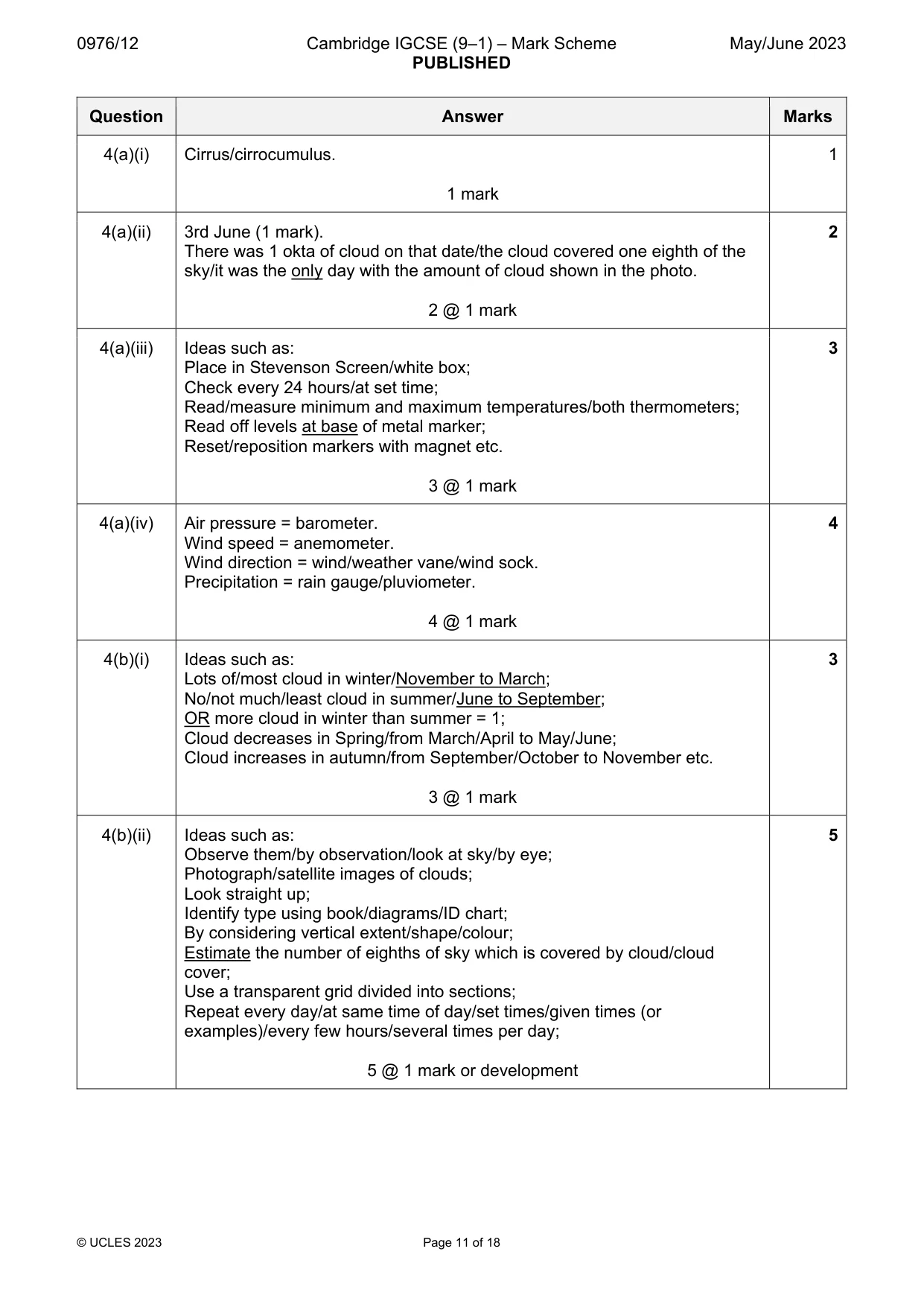
0976/12 Cambridge IGCSE (9–1) – Mark Scheme PUBLISHED May/June 2023 © UCLES 2023 Page 11 of 18 Question Answer Marks 4(a)(i) Cirrus/cirrocumulus. 1 mark 1 4(a)(ii) 3rd June (1 mark). There was 1 okta of cloud on that date/the cloud covered one eighth of the sky/it was the only day with the amount of cloud shown in the photo. 2 @ 1 mark 2 4(a)(iii) Ideas such as: Place in Stevenson Screen/white box; Check every 24 hours/at set time; Read/measure minimum and maximum temperatures/both thermometers; Read off levels at base of metal marker; Reset/reposition markers with magnet etc. 3 @ 1 mark 3 4(a)(iv) Air pressure = barometer. Wind speed = anemometer. Wind direction = wind/weather vane/wind sock. Precipitation = rain gauge/pluviometer. 4 @ 1 mark 4 4(b)(i) Ideas such as: Lots of/most cloud in winter/November to March; No/not much/least cloud in summer/June to September; OR more cloud in winter than summer = 1; Cloud decreases in Spring/from March/April to May/June; Cloud increases in autumn/from September/October to November etc. 3 @ 1 mark 3 4(b)(ii) Ideas such as: Observe them/by observation/look at sky/by eye; Photograph/satellite images of clouds; Look straight up; Identify type using book/diagrams/ID chart; By considering vertical extent/shape/colour; Estimate the number of eighths of sky which is covered by cloud/cloud cover; Use a transparent grid divided into sections; Repeat every day/at same time of day/set times/given times (or examples)/every few hours/several times per day; 5 @ 1 mark or development 5
Mark scheme, page 12
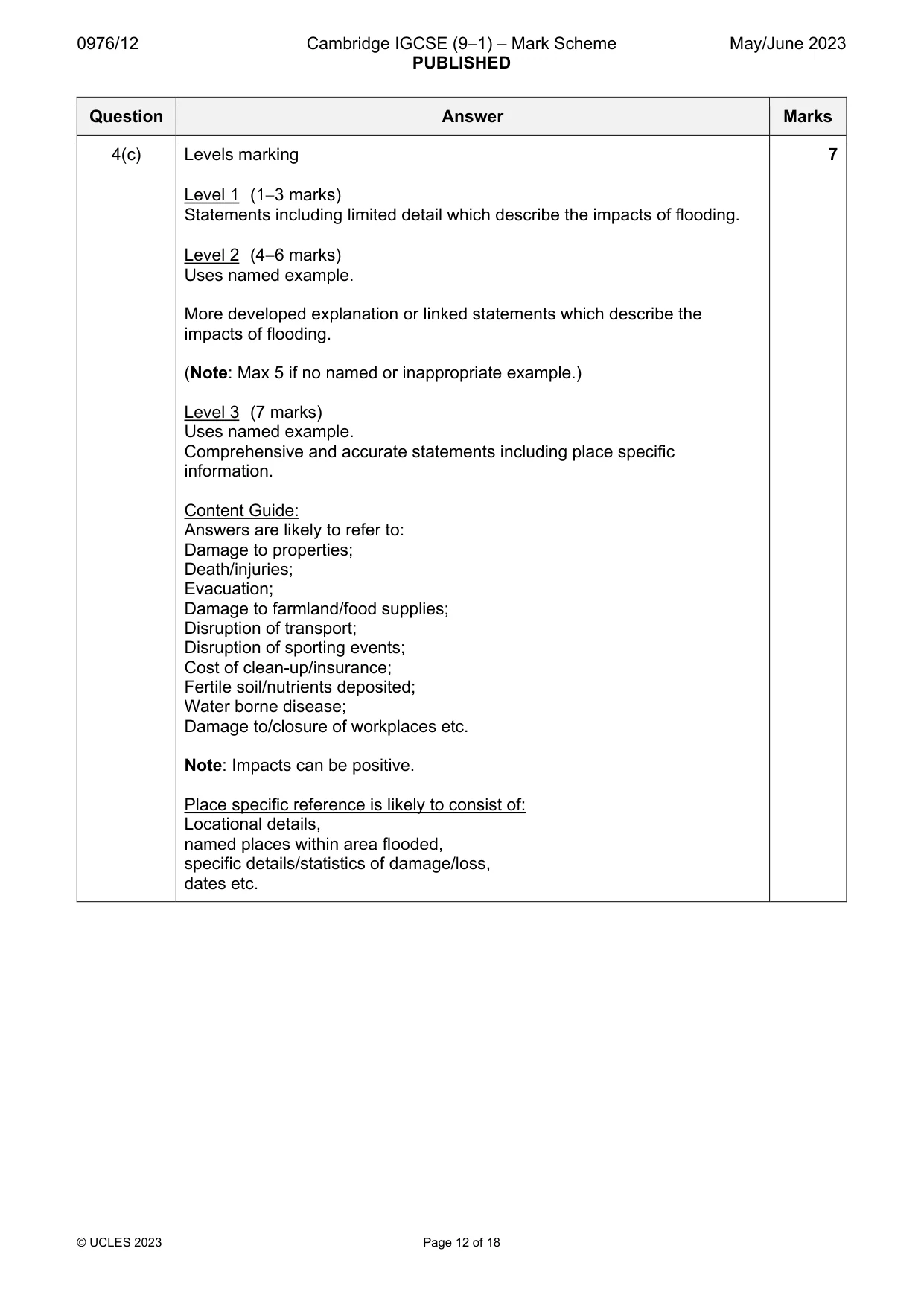
0976/12 Cambridge IGCSE (9–1) – Mark Scheme PUBLISHED May/June 2023 © UCLES 2023 Page 12 of 18 Question Answer Marks 4(c) Levels marking Level 1 (13 marks) Statements including limited detail which describe the impacts of flooding. Level 2 (46 marks) Uses named example. More developed explanation or linked statements which describe the impacts of flooding. (Note: Max 5 if no named or inappropriate example.) Level 3 (7 marks) Uses named example. Comprehensive and accurate statements including place specific information. Content Guide: Answers are likely to refer to: Damage to properties; Death/injuries; Evacuation; Damage to farmland/food supplies; Disruption of transport; Disruption of sporting events; Cost of clean-up/insurance; Fertile soil/nutrients deposited; Water borne disease; Damage to/closure of workplaces etc. Note: Impacts can be positive. Place specific reference is likely to consist of: Locational details, named places within area flooded, specific details/statistics of damage/loss, dates etc. 7
Mark scheme, page 13
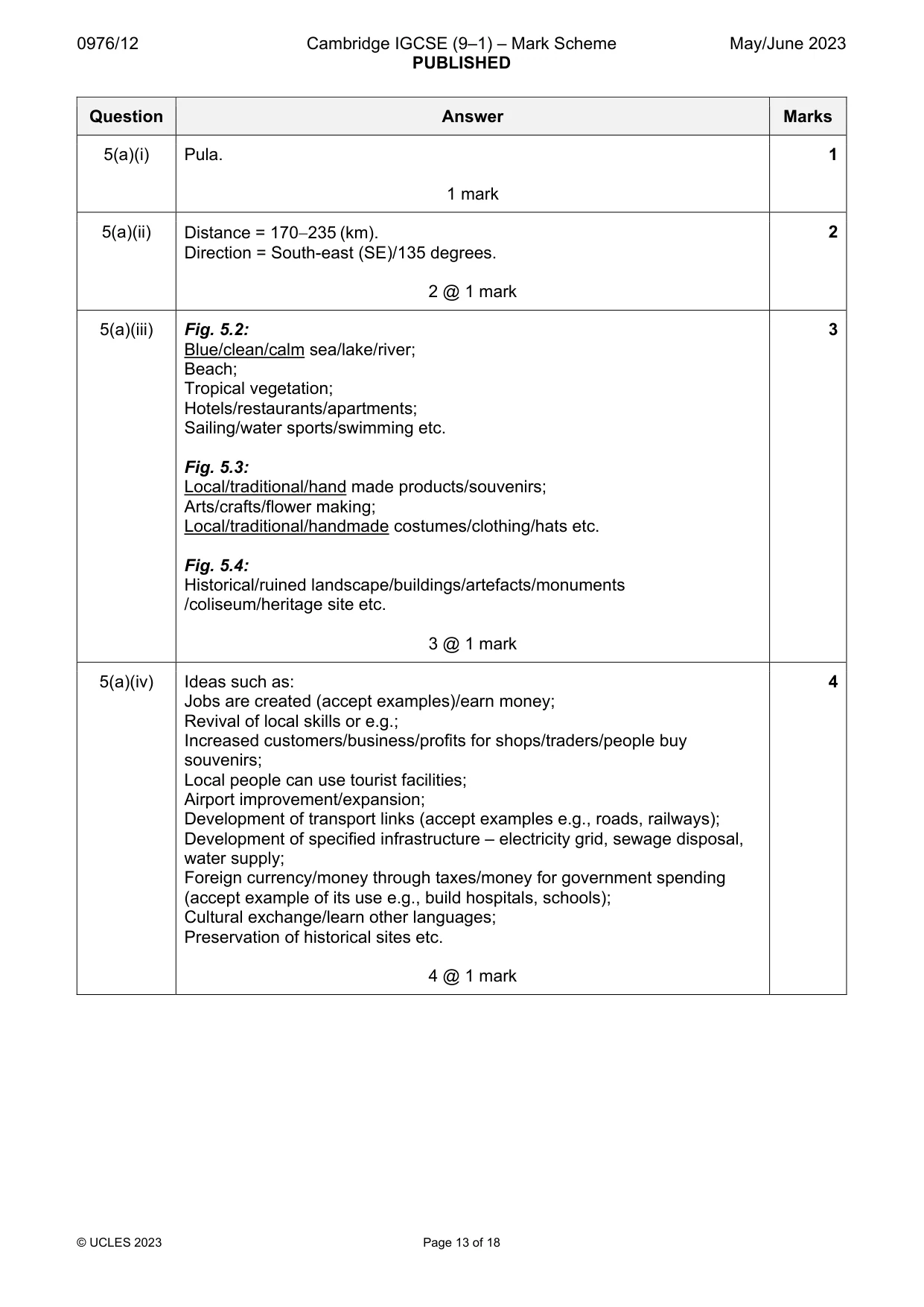
0976/12 Cambridge IGCSE (9–1) – Mark Scheme PUBLISHED May/June 2023 © UCLES 2023 Page 13 of 18 Question Answer Marks 5(a)(i) Pula. 1 mark 1 5(a)(ii) Distance = 170235 (km). Direction = South-east (SE)/135 degrees. 2 @ 1 mark 2 5(a)(iii) Fig. 5.2: Blue/clean/calm sea/lake/river; Beach; Tropical vegetation; Hotels/restaurants/apartments; Sailing/water sports/swimming etc. Fig. 5.3: Local/traditional/hand made products/souvenirs; Arts/crafts/flower making; Local/traditional/handmade costumes/clothing/hats etc. Fig. 5.4: Historical/ruined landscape/buildings/artefacts/monuments /coliseum/heritage site etc. 3 @ 1 mark 3 5(a)(iv) Ideas such as: Jobs are created (accept examples)/earn money; Revival of local skills or e.g.; Increased customers/business/profits for shops/traders/people buy souvenirs; Local people can use tourist facilities; Airport improvement/expansion; Development of transport links (accept examples e.g., roads, railways); Development of specified infrastructure – electricity grid, sewage disposal, water supply; Foreign currency/money through taxes/money for government spending (accept example of its use e.g., build hospitals, schools); Cultural exchange/learn other languages; Preservation of historical sites etc. 4 @ 1 mark 4
Mark scheme, page 14
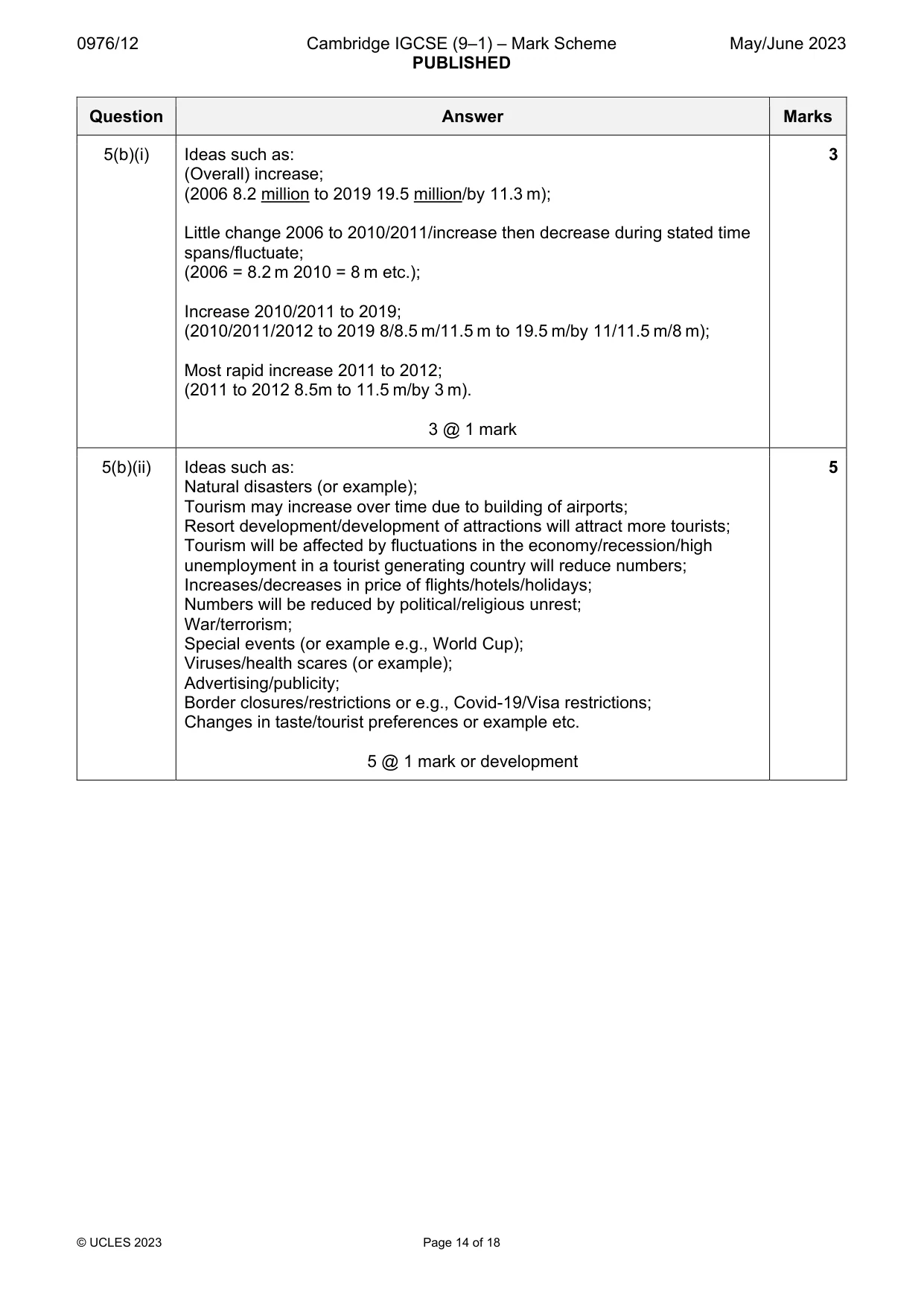
0976/12 Cambridge IGCSE (9–1) – Mark Scheme PUBLISHED May/June 2023 © UCLES 2023 Page 14 of 18 Question Answer Marks 5(b)(i) Ideas such as: (Overall) increase; (2006 8.2 million to 2019 19.5 million/by 11.3 m); Little change 2006 to 2010/2011/increase then decrease during stated time spans/fluctuate; (2006 = 8.2 m 2010 = 8 m etc.); Increase 2010/2011 to 2019; (2010/2011/2012 to 2019 8/8.5 m/11.5 m to 19.5 m/by 11/11.5 m/8 m); Most rapid increase 2011 to 2012; (2011 to 2012 8.5m to 11.5 m/by 3 m). 3 @ 1 mark 3 5(b)(ii) Ideas such as: Natural disasters (or example); Tourism may increase over time due to building of airports; Resort development/development of attractions will attract more tourists; Tourism will be affected by fluctuations in the economy/recession/high unemployment in a tourist generating country will reduce numbers; Increases/decreases in price of flights/hotels/holidays; Numbers will be reduced by political/religious unrest; War/terrorism; Special events (or example e.g., World Cup); Viruses/health scares (or example); Advertising/publicity; Border closures/restrictions or e.g., Covid-19/Visa restrictions; Changes in taste/tourist preferences or example etc. 5 @ 1 mark or development 5
Mark scheme, page 15
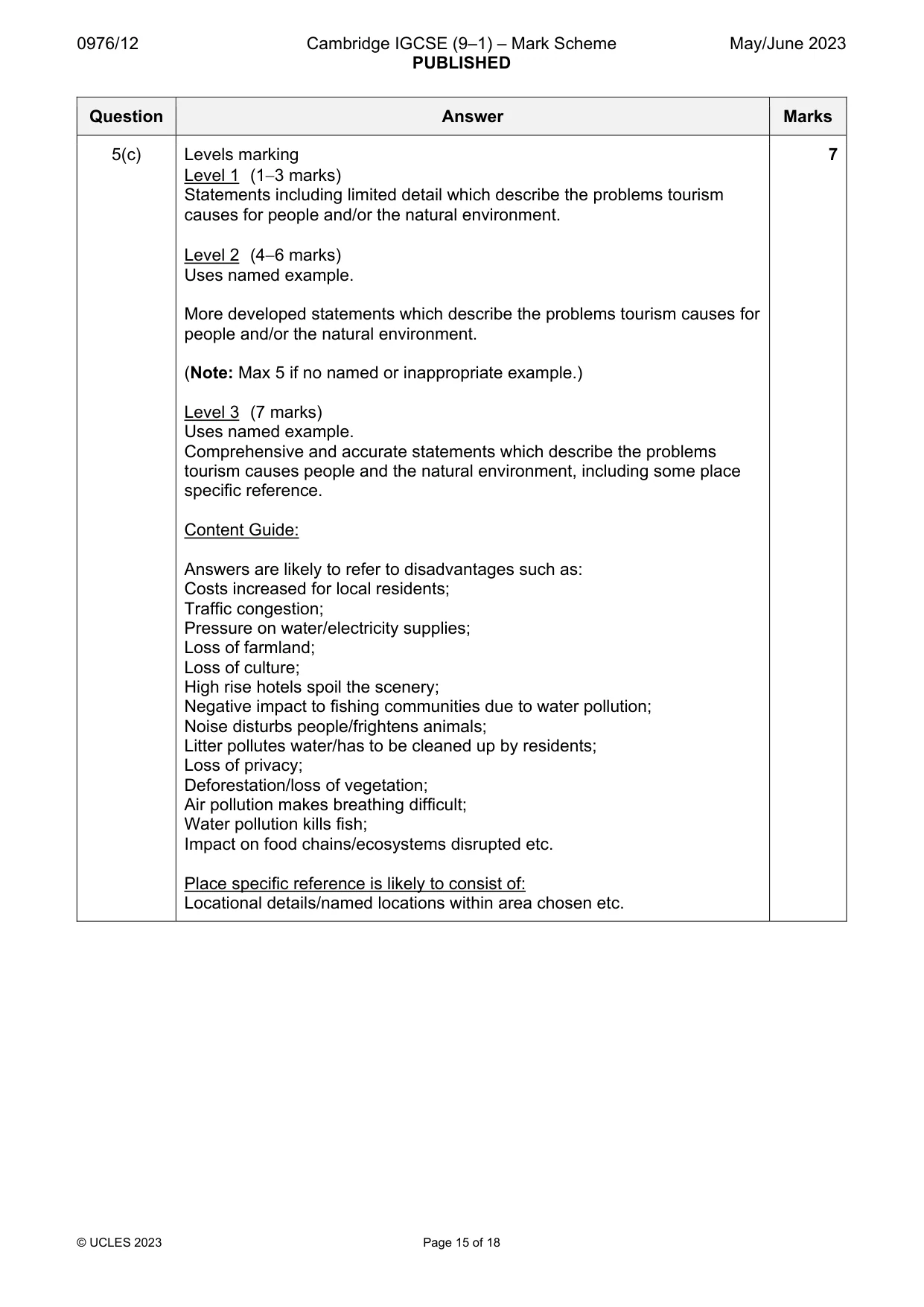
0976/12 Cambridge IGCSE (9–1) – Mark Scheme PUBLISHED May/June 2023 © UCLES 2023 Page 15 of 18 Question Answer Marks 5(c) Levels marking Level 1 (13 marks) Statements including limited detail which describe the problems tourism causes for people and/or the natural environment. Level 2 (46 marks) Uses named example. More developed statements which describe the problems tourism causes for people and/or the natural environment. (Note: Max 5 if no named or inappropriate example.) Level 3 (7 marks) Uses named example. Comprehensive and accurate statements which describe the problems tourism causes people and the natural environment, including some place specific reference. Content Guide: Answers are likely to refer to disadvantages such as: Costs increased for local residents; Traffic congestion; Pressure on water/electricity supplies; Loss of farmland; Loss of culture; High rise hotels spoil the scenery; Negative impact to fishing communities due to water pollution; Noise disturbs people/frightens animals; Litter pollutes water/has to be cleaned up by residents; Loss of privacy; Deforestation/loss of vegetation; Air pollution makes breathing difficult; Water pollution kills fish; Impact on food chains/ecosystems disrupted etc. Place specific reference is likely to consist of: Locational details/named locations within area chosen etc. 7
Mark scheme, page 16
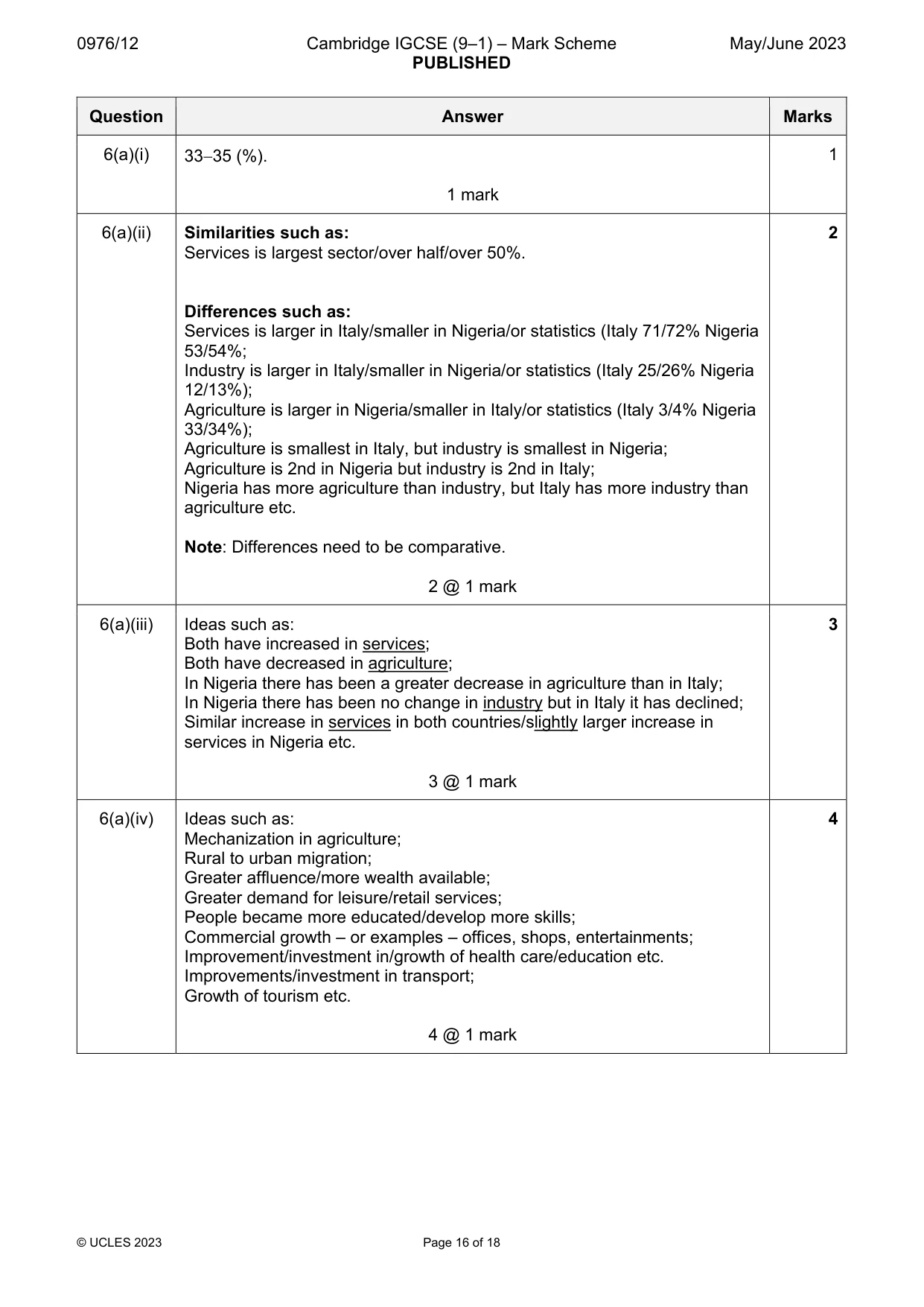
0976/12 Cambridge IGCSE (9–1) – Mark Scheme PUBLISHED May/June 2023 © UCLES 2023 Page 16 of 18 Question Answer Marks 6(a)(i) 3335 (%). 1 mark 1 6(a)(ii) Similarities such as: Services is largest sector/over half/over 50%. Differences such as: Services is larger in Italy/smaller in Nigeria/or statistics (Italy 71/72% Nigeria 53/54%; Industry is larger in Italy/smaller in Nigeria/or statistics (Italy 25/26% Nigeria 12/13%); Agriculture is larger in Nigeria/smaller in Italy/or statistics (Italy 3/4% Nigeria 33/34%); Agriculture is smallest in Italy, but industry is smallest in Nigeria; Agriculture is 2nd in Nigeria but industry is 2nd in Italy; Nigeria has more agriculture than industry, but Italy has more industry than agriculture etc. Note: Differences need to be comparative. 2 @ 1 mark 2 6(a)(iii) Ideas such as: Both have increased in services; Both have decreased in agriculture; In Nigeria there has been a greater decrease in agriculture than in Italy; In Nigeria there has been no change in industry but in Italy it has declined; Similar increase in services in both countries/slightly larger increase in services in Nigeria etc. 3 @ 1 mark 3 6(a)(iv) Ideas such as: Mechanization in agriculture; Rural to urban migration; Greater affluence/more wealth available; Greater demand for leisure/retail services; People became more educated/develop more skills; Commercial growth – or examples – offices, shops, entertainments; Improvement/investment in/growth of health care/education etc. Improvements/investment in transport; Growth of tourism etc. 4 @ 1 mark 4
Mark scheme, page 17
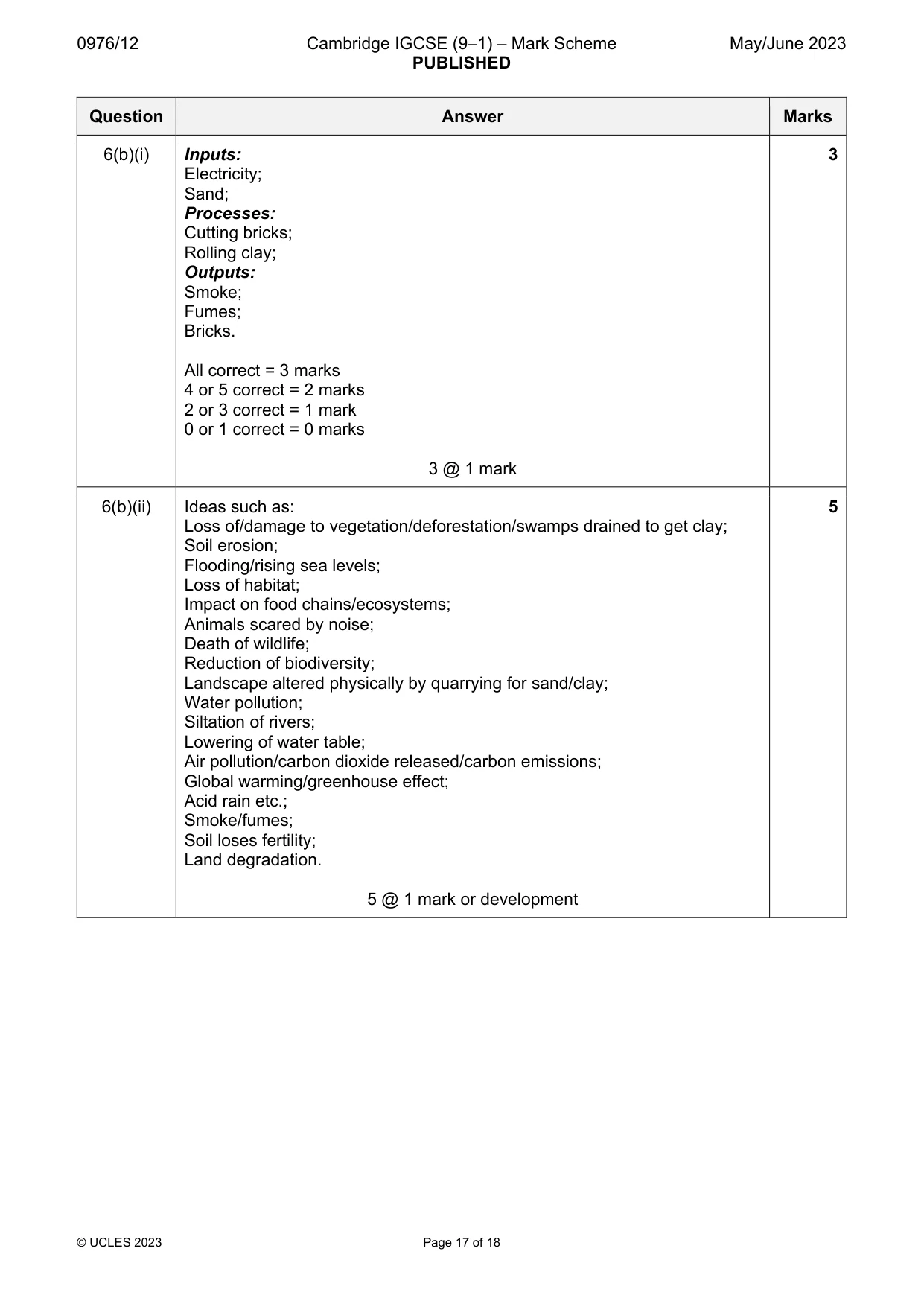
0976/12 Cambridge IGCSE (9–1) – Mark Scheme PUBLISHED May/June 2023 © UCLES 2023 Page 17 of 18 Question Answer Marks 6(b)(i) Inputs: Electricity; Sand; Processes: Cutting bricks; Rolling clay; Outputs: Smoke; Fumes; Bricks. All correct = 3 marks 4 or 5 correct = 2 marks 2 or 3 correct = 1 mark 0 or 1 correct = 0 marks 3 @ 1 mark 3 6(b)(ii) Ideas such as: Loss of/damage to vegetation/deforestation/swamps drained to get clay; Soil erosion; Flooding/rising sea levels; Loss of habitat; Impact on food chains/ecosystems; Animals scared by noise; Death of wildlife; Reduction of biodiversity; Landscape altered physically by quarrying for sand/clay; Water pollution; Siltation of rivers; Lowering of water table; Air pollution/carbon dioxide released/carbon emissions; Global warming/greenhouse effect; Acid rain etc.; Smoke/fumes; Soil loses fertility; Land degradation. 5 @ 1 mark or development 5
Mark scheme, page 18
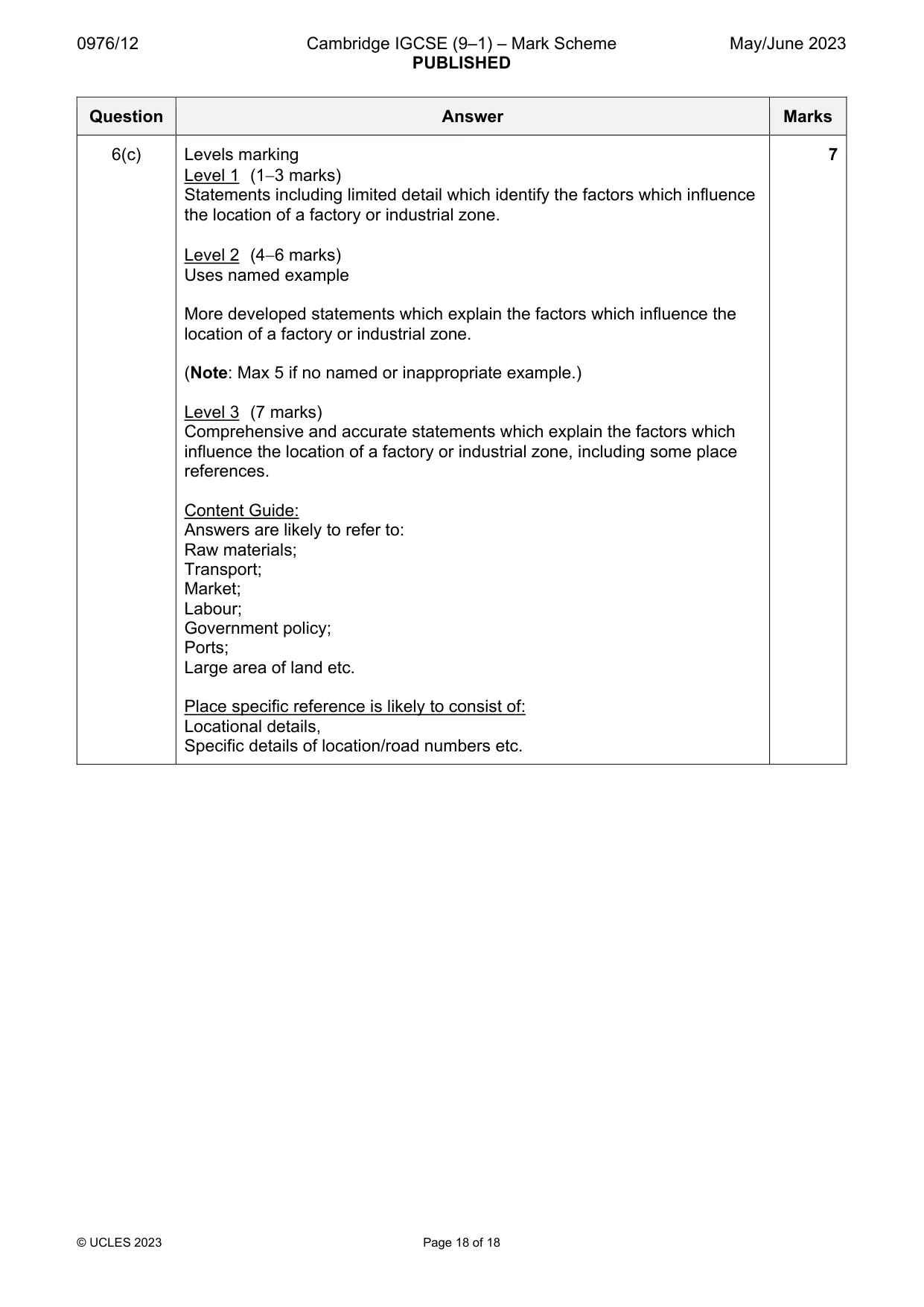
0976/12 Cambridge IGCSE (9–1) – Mark Scheme PUBLISHED May/June 2023 © UCLES 2023 Page 18 of 18 Question Answer Marks 6(c) Levels marking Level 1 (13 marks) Statements including limited detail which identify the factors which influence the location of a factory or industrial zone. Level 2 (46 marks) Uses named example More developed statements which explain the factors which influence the location of a factory or industrial zone. (Note: Max 5 if no named or inappropriate example.) Level 3 (7 marks) Comprehensive and accurate statements which explain the factors which influence the location of a factory or industrial zone, including some place references. Content Guide: Answers are likely to refer to: Raw materials; Transport; Market; Labour; Government policy; Ports; Large area of land etc. Place specific reference is likely to consist of: Locational details, Specific details of location/road numbers etc. 7
What you needed in this session
Cambridge’s own grade thresholds for 2023 May/June, Paper 1 · Variant 2. A higher threshold means an easier paper — the bar moves with how the cohort did.