Cambridge IGCSE Geography (9-1) 0976 — 2022 Oct/Nov Paper 1 · Variant 2
0976/12/O/N/22 · 75 marks · ≈84 min
The question paper and its mark scheme, free to read here and free to download. This is Cambridge’s own paper, exactly as it was sat.
Question paper32 pages




Mark scheme19 pages
Answers below. Sit the paper first if you are practising.

Paper as text
Question paper, page 1
This document has 32 pages. Any blank pages are indicated. [Turn over Cambridge IGCSE™(9–1) DC (DE) 320595 © UCLES 2022 * 2 2 9 6 0 6 6 0 6 5 * GEOGRAPHY 0976/12 Paper 1 Geographical Themes October/November 2022 1 hour 45 minutes You must answer on the question paper. You will need: Insert (enclosed) Ruler Calculator Protractor INSTRUCTIONS ● Answer three questions in total, one from each section. ● Use a black or dark blue pen. You may use an HB pencil for any diagrams or graphs. ● Write your name, centre number and candidate number in the boxes at the top of the page. ● Write your answer to each question in the space provided. ● Do not use an erasable pen or correction fluid. ● Do not write on any bar codes. ● If additional space is needed, you should use the lined pages at the end of this booklet; the question number or numbers must be clearly shown. INFORMATION ● The total mark for this paper is 75. ● The number of marks for each question or part question is shown in brackets [ ]. ● The insert contains additional resources referred to in the questions. Definitions MEDCs – More Economically Developed Countries LEDCs – Less Economically Developed Countries
Question paper, page 2
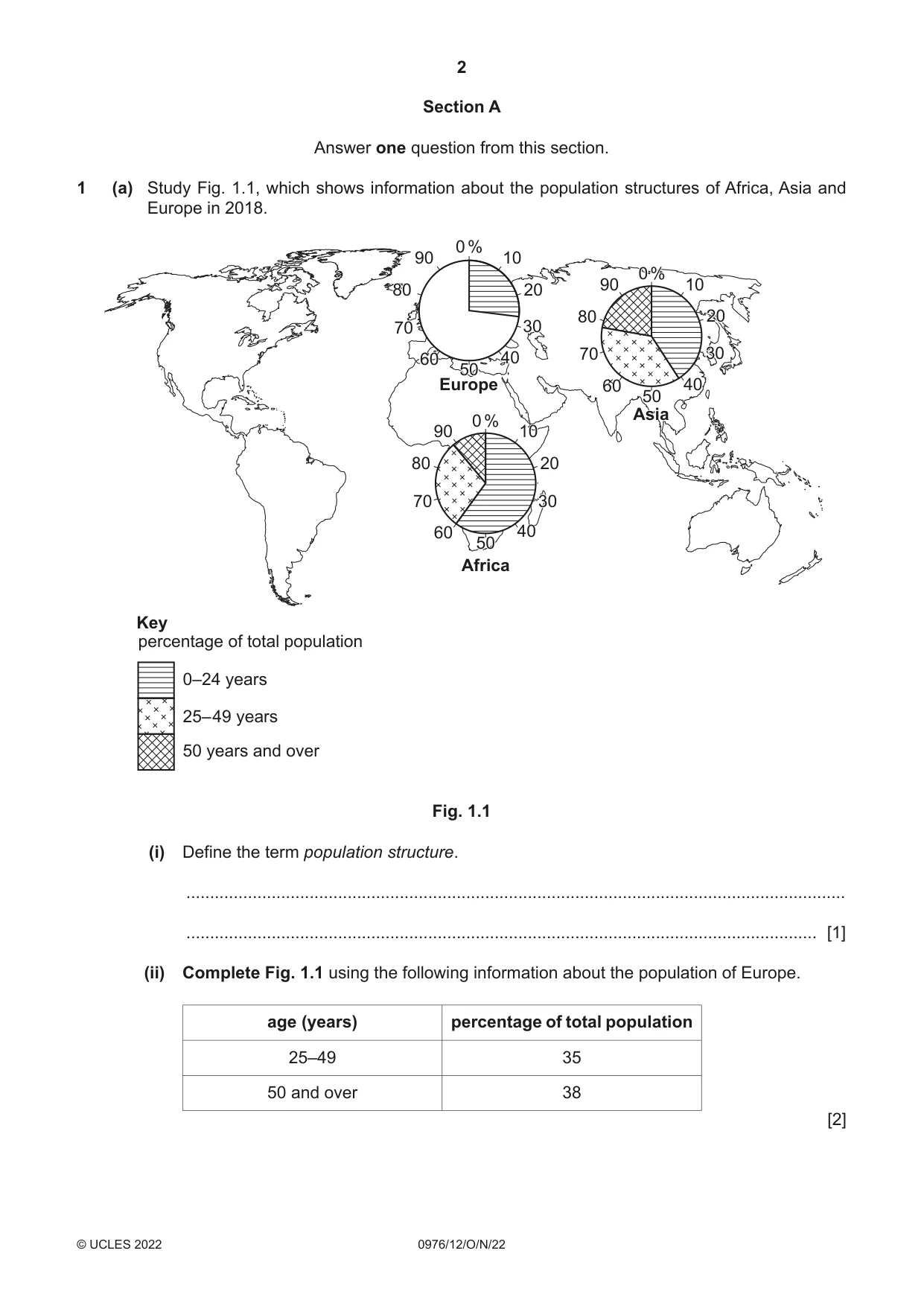
2 0976/12/O/N/22 © UCLES 2022 Section A Answer one question from this section. 1 (a) Study Fig. 1.1, which shows information about the population structures of Africa, Asia and Europe in 2018. 0 % 50 10 40 20 30 90 60 80 70 0 % 50 10 40 20 30 90 60 80 70 0 % 50 10 40 20 30 90 60 80 70 Asia Europe 0 % 50 10 40 20 30 0 % 50 10 40 20 30 90 60 80 70 0 % 50 10 40 20 30 90 60 80 70 Africa Asia Europe Key percentage of total population 0–24 years 25– 49 years 50 years and over Fig. 1.1 (i) Define the term population structure. … … [1] (ii) Complete Fig. 1.1 using the following information about the population of Europe. age (years) percentage of total population 25–49 35 50 and over 38 [2]
Question paper, page 3
3 0976/12/O/N/22 © UCLES 2022 [Turn over (iii) Describe the differences between the population structures of Asia and Africa in 2018. … … … … … … [3] (iv) Explain why life expectancy has increased in many countries during the last 50 years. … … … … … … … … [4]
Question paper, page 4
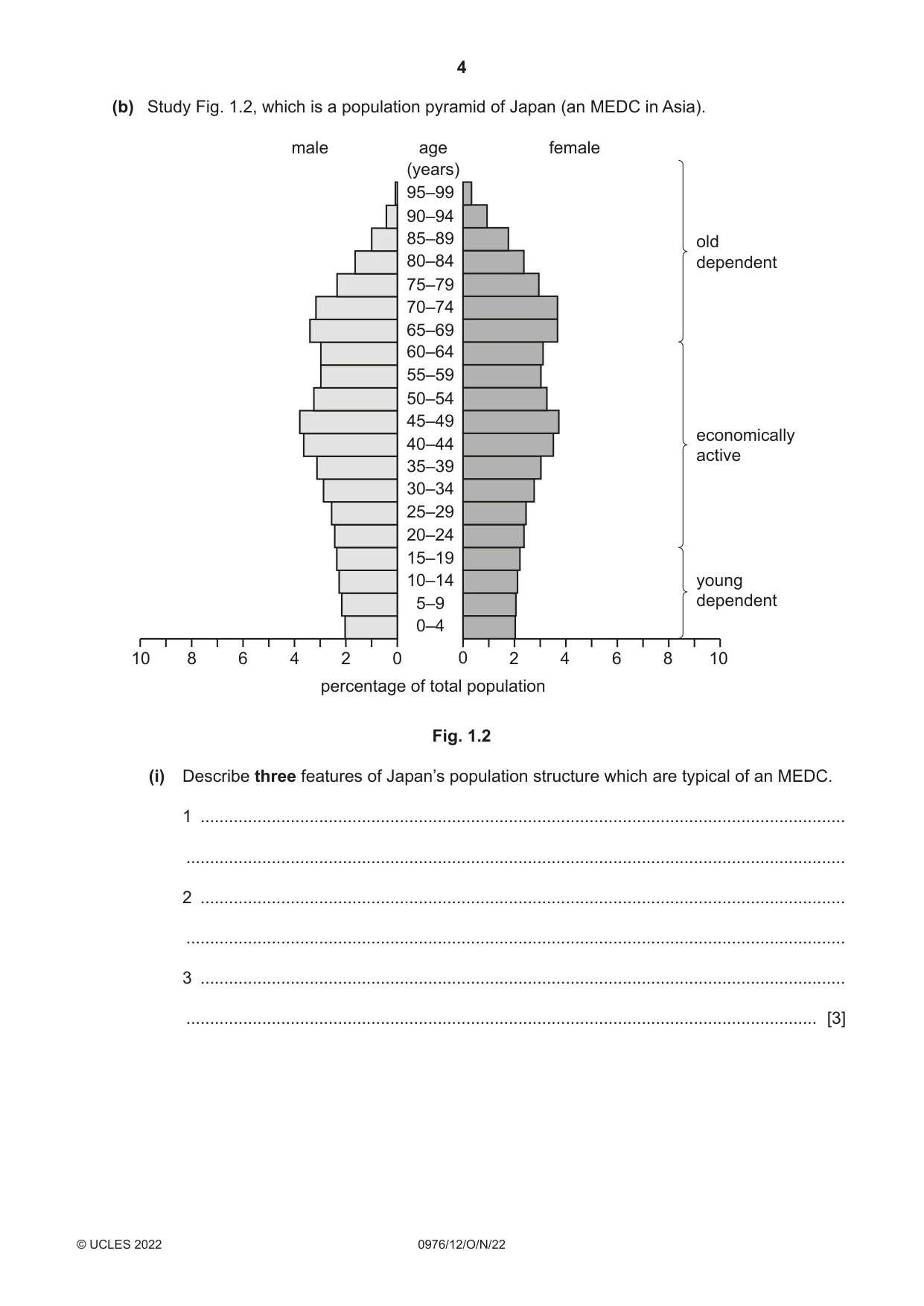
4 0976/12/O/N/22 © UCLES 2022 (b) Study Fig. 1.2, which is a population pyramid of Japan (an MEDC in Asia). 0 percentage of total population 10 8 6 4 2 0 male age (years) female 2 4 6 8 10 0–4 5–9 10–14 15–19 20–24 25–29 30–34 35–39 40–44 45–49 50–54 55–59 60–64 65–69 70–74 75–79 80–84 85–89 90–94 95–99 old dependent economically active young dependent Fig. 1.2 (i) Describe three features of Japan’s population structure which are typical of an MEDC. 1 … … 2 … … 3 … … [3]
Question paper, page 5
5 0976/12/O/N/22 © UCLES 2022 [Turn over (ii) Explain why the percentage of young dependents in an LEDC is likely to be larger than that of Japan. … … … … … … … … … … [5]
Question paper, page 6
6 0976/12/O/N/22 © UCLES 2022 (c) For a named country you have studied, describe the difficulties which result from having a large dependent population. Name of country … … … … … … … … … … … … … … … … … … … … … … … … … … [7] [Total: 25]
Question paper, page 7
7 0976/12/O/N/22 © UCLES 2022 [Turn over 2 (a) Study Figs. 2.1, 2.2 and 2.3 (Insert), which are photographs taken in three different urban land use zones. (i) Which urban land use zone is shown in Fig. 2.1? Underline one answer in the list below. CBD industrial open space residential [1] (ii) Describe the land use shown in Fig. 2.2. … … … … [2] (iii) Suggest a possible location within an urban area for the land use zone shown in Fig. 2.2. Give reasons for your answer. … … … … … … [3] (iv) Explain why land use zones such as the one shown in Fig. 2.3 are often located in the rural–urban fringe. … … … … … … … … [4]
Question paper, page 8
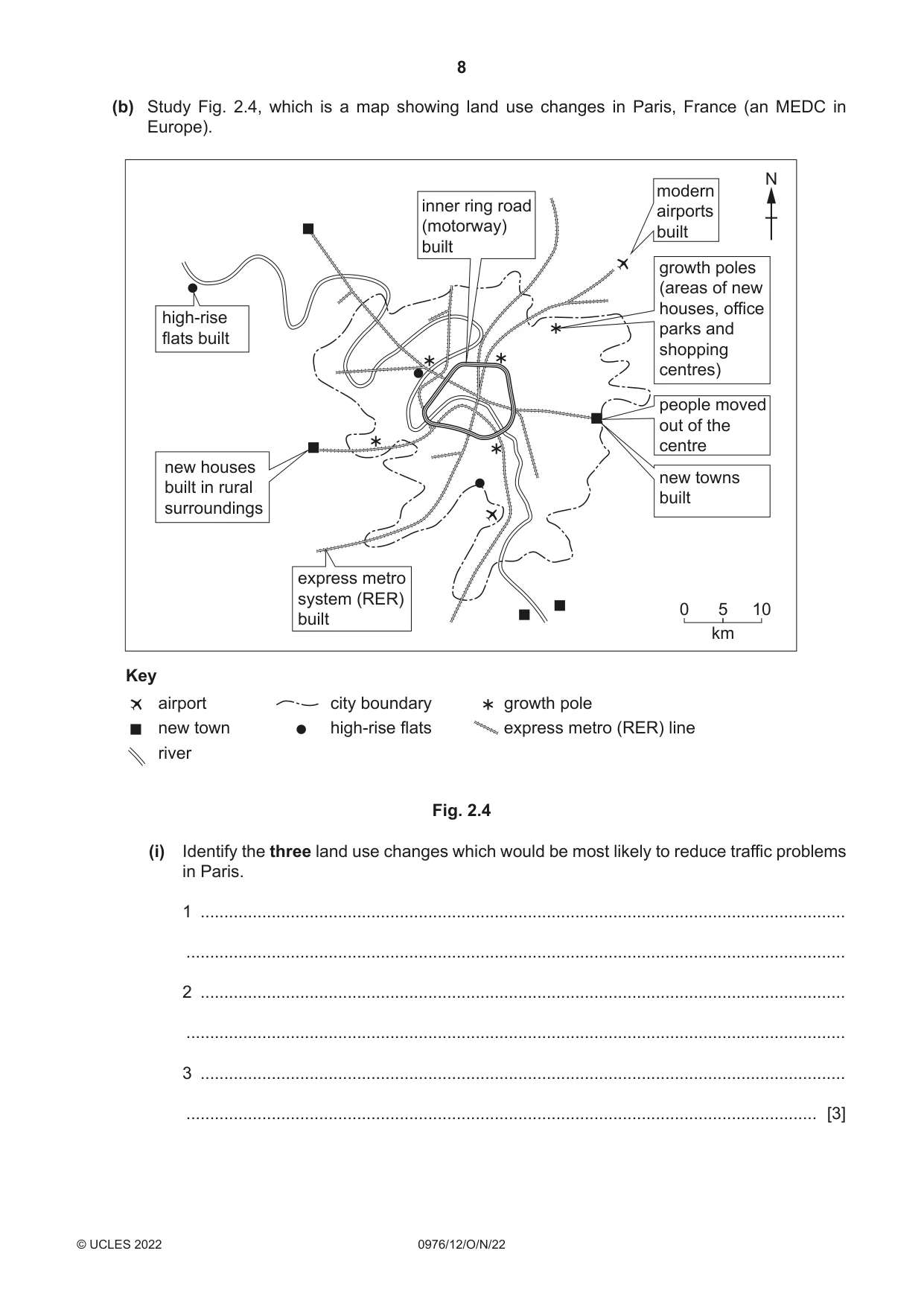
8 0976/12/O/N/22 © UCLES 2022 (b) Study Fig. 2.4, which is a map showing land use changes in Paris, France (an MEDC in Europe). 0 5 10 km new houses built in rural surroundings express metro system (RER) built new towns built people moved out of the centre growth poles (areas of new houses, office parks and shopping centres) modern airports built high-rise flats built Key airport river new town city boundary high-rise flats express metro (RER) line N inner ring road (motorway) built growth pole Fig. 2.4 (i) Identify the three land use changes which would be most likely to reduce traffic problems in Paris. 1 … … 2 … … 3 … … [3]
Question paper, page 9
9 0976/12/O/N/22 © UCLES 2022 [Turn over (ii) Describe the advantages and disadvantages of building new airports in the rural–urban fringe of Paris for the people who live in the city. … … … … … … … … … … [5]
Question paper, page 10
10 0976/12/O/N/22 © UCLES 2022 (c) For a named urban area you have studied, describe the effects of urban sprawl on the natural environment. Name of urban area … … … … … … … … … … … … … … … … … … … … … … … … … … [7] [Total: 25]
Question paper, page 11
11 0976/12/O/N/22 © UCLES 2022 [Turn over TURN PAGE FOR QUESTION 3
Question paper, page 12
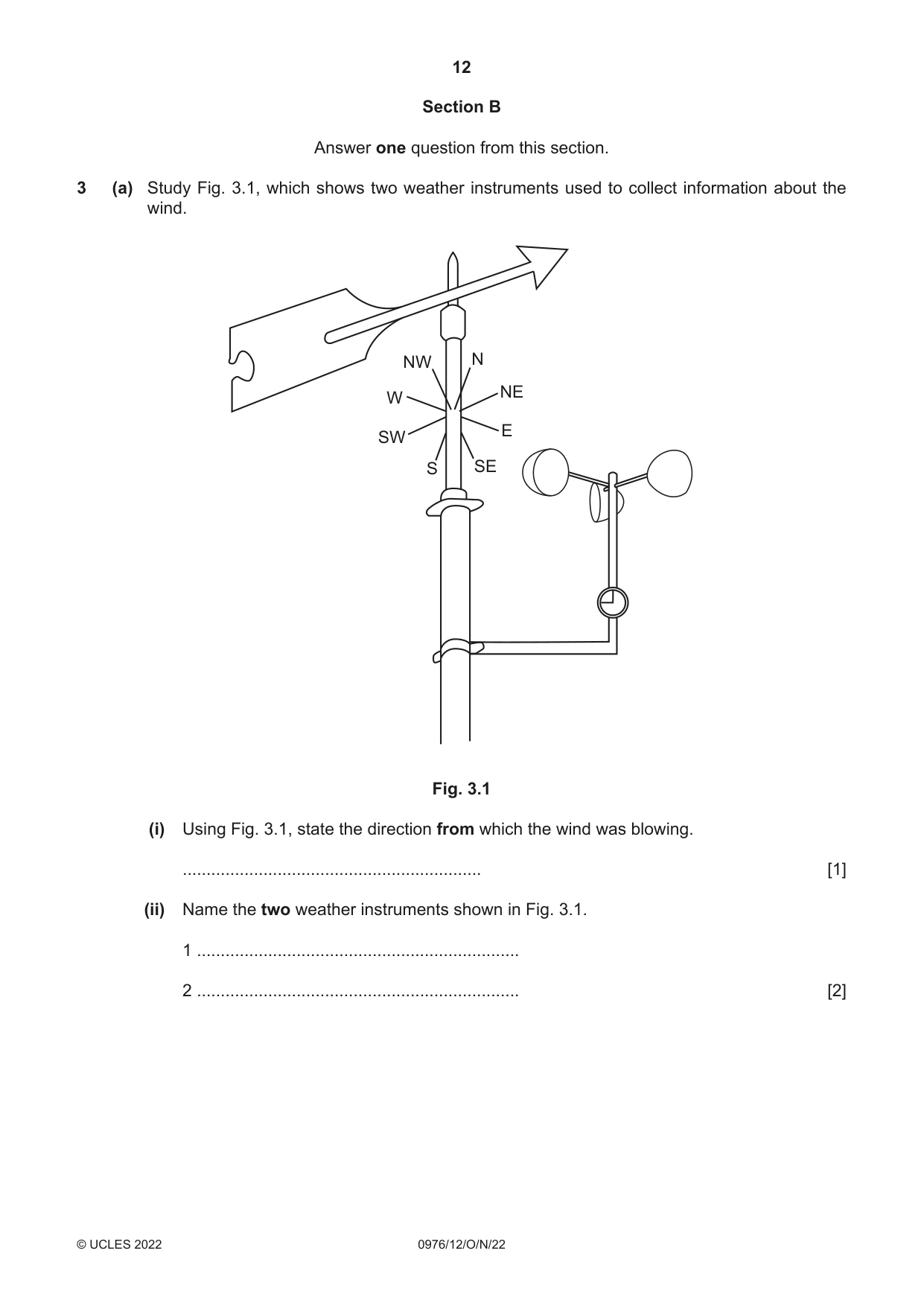
12 0976/12/O/N/22 © UCLES 2022 Section B Answer one question from this section. 3 (a) Study Fig. 3.1, which shows two weather instruments used to collect information about the wind. NW N E NE SE S SW W Fig. 3.1 (i) Using Fig. 3.1, state the direction from which the wind was blowing. … [1] (ii) Name the two weather instruments shown in Fig. 3.1. 1 … 2 … [2]
Question paper, page 13
13 0976/12/O/N/22 © UCLES 2022 [Turn over (iii) Where should the instruments in Fig. 3.1 be located? Give reasons for your answer. … … … … … … [3] (iv) Describe the impacts of tropical storms on people living in coastal communities. … … … … … … … … [4]
Question paper, page 14
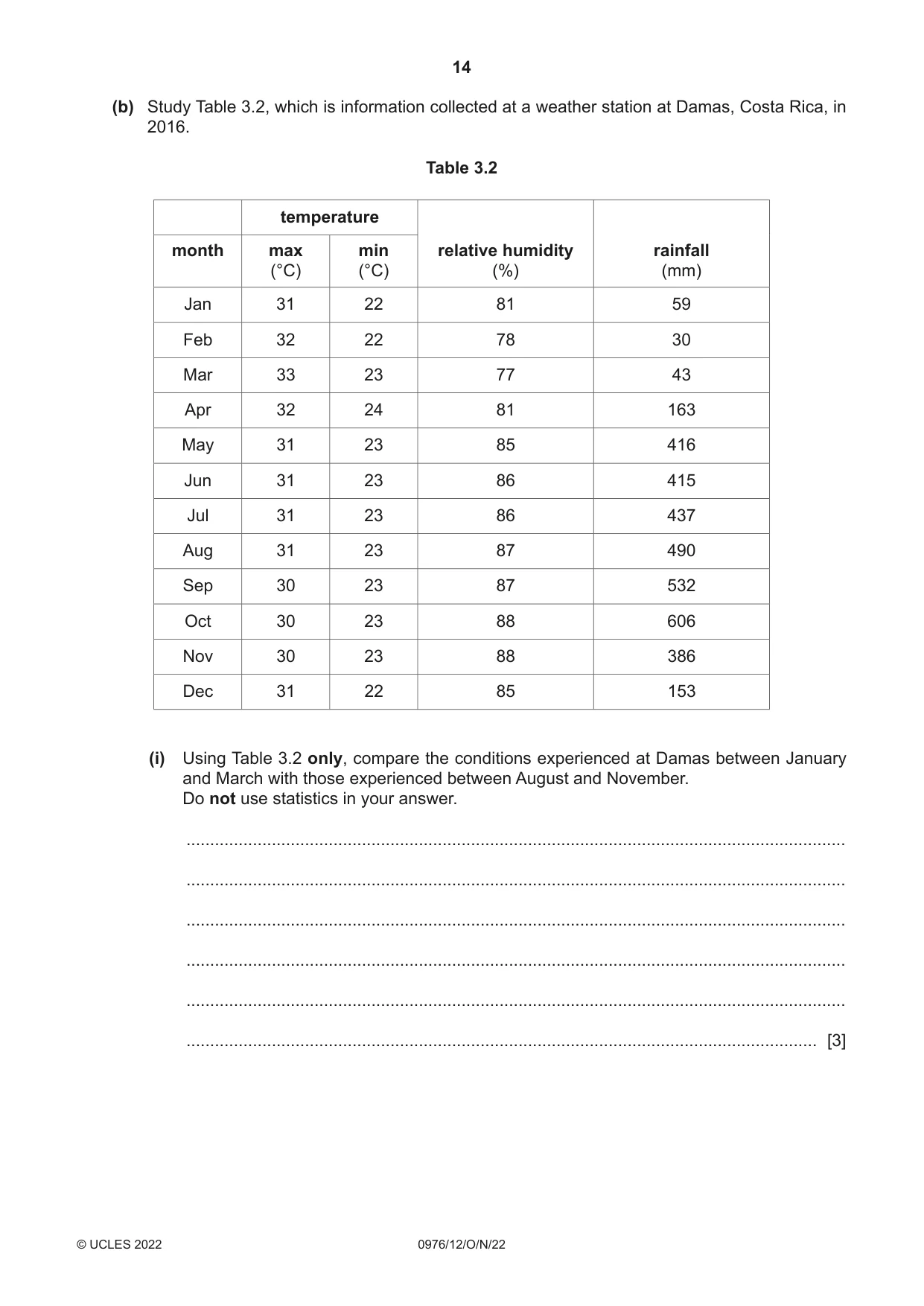
14 0976/12/O/N/22 © UCLES 2022 (b) Study Table 3.2, which is information collected at a weather station at Damas, Costa Rica, in 2016. Table 3.2 temperature relative humidity (%) rainfall (mm) month max (°C) min (°C) Jan 31 22 81 59 Feb 32 22 78 30 Mar 33 23 77 43 Apr 32 24 81 163 May 31 23 85 416 Jun 31 23 86 415 Jul 31 23 86 437 Aug 31 23 87 490 Sep 30 23 87 532 Oct 30 23 88 606 Nov 30 23 88 386 Dec 31 22 85 153 (i) Using Table 3.2 only, compare the conditions experienced at Damas between January and March with those experienced between August and November. Do not use statistics in your answer. … … … … … … [3]
Question paper, page 15
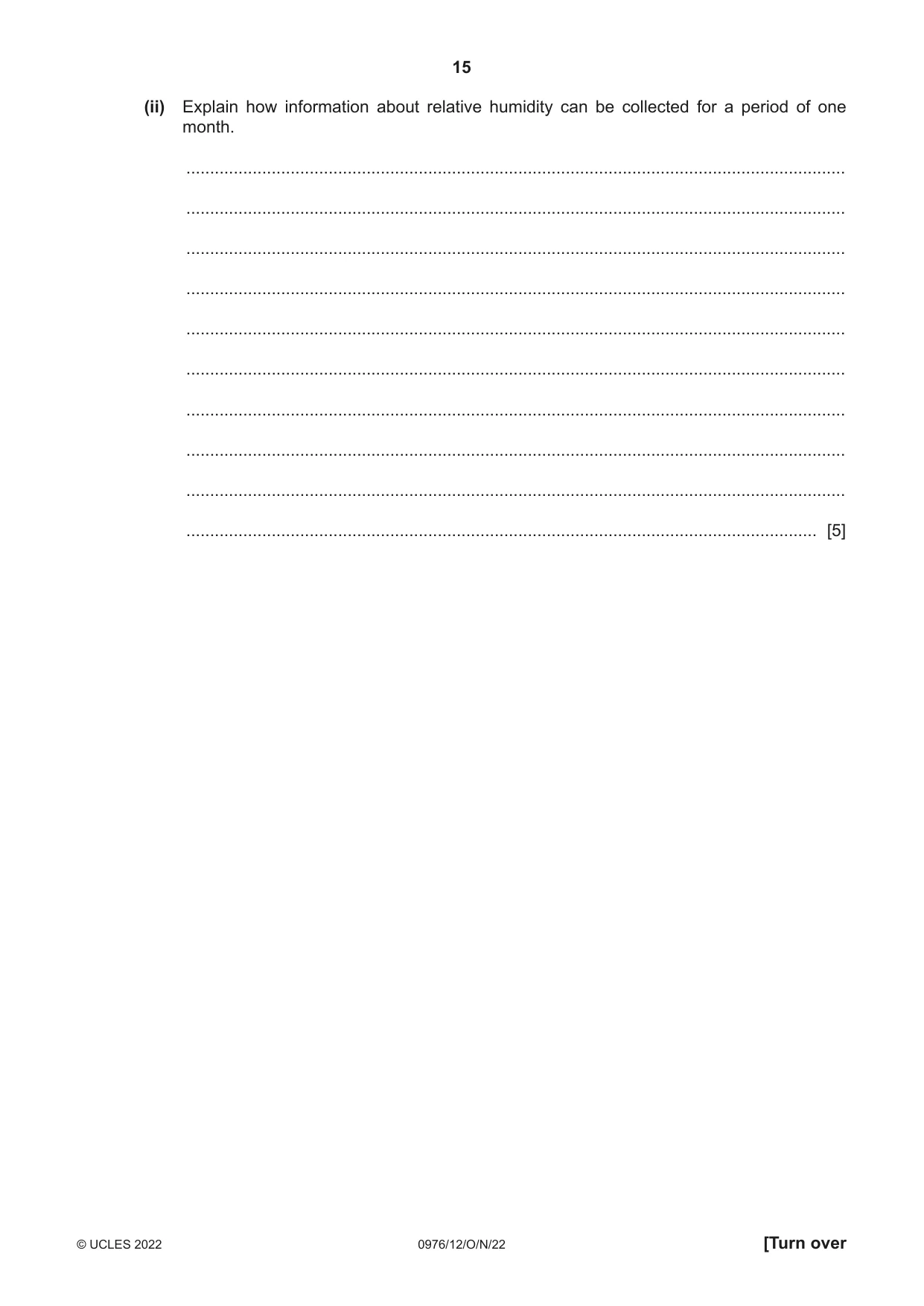
15 0976/12/O/N/22 © UCLES 2022 [Turn over (ii) Explain how information about relative humidity can be collected for a period of one month. … … … … … … … … … … [5]
Question paper, page 16
16 0976/12/O/N/22 © UCLES 2022 (c) For a named river you have studied, explain how flooding is being managed. Named river … … … … … … … … … … … … … … … … … … … … … … … … … … [7] [Total: 25]
Question paper, page 17
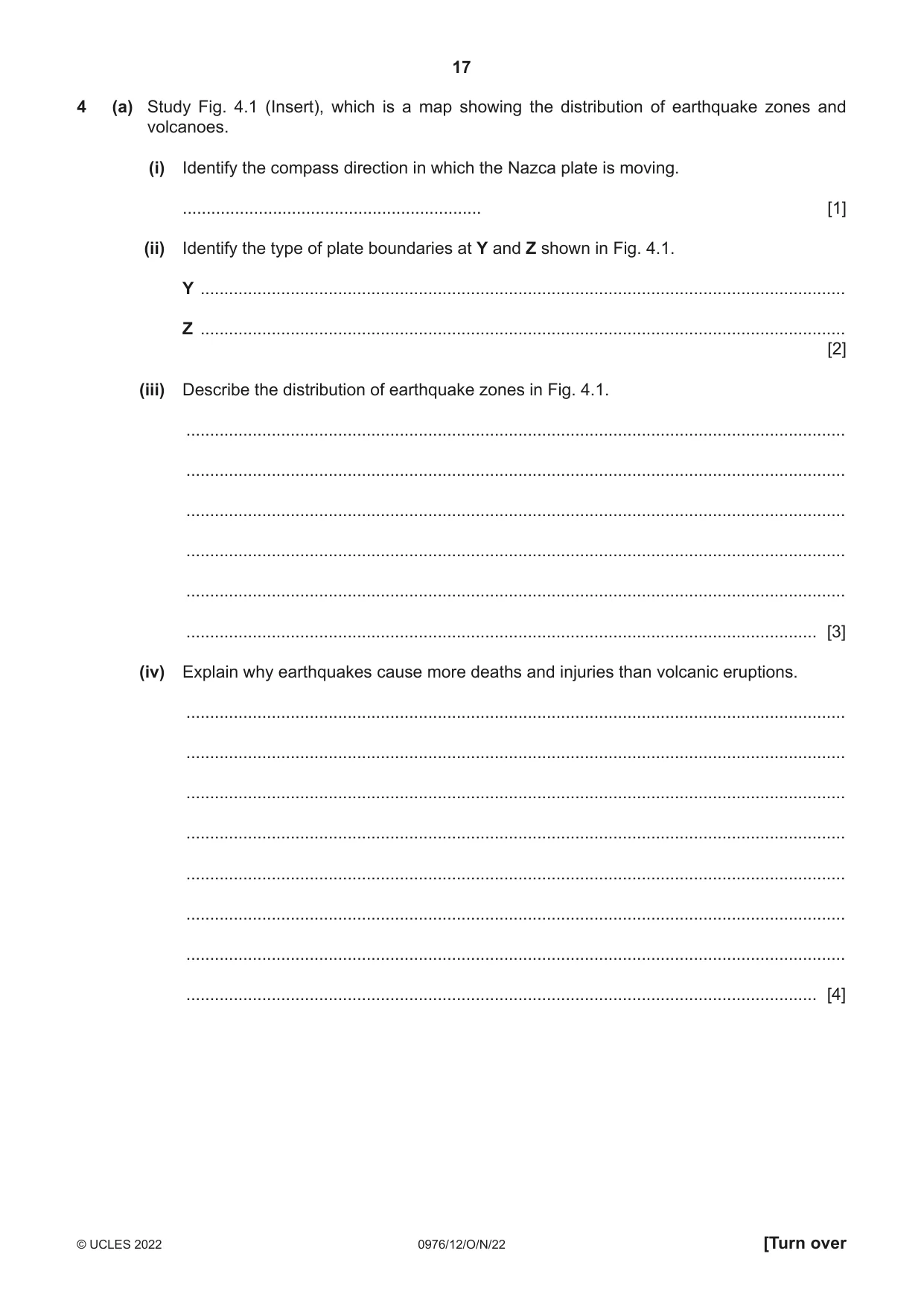
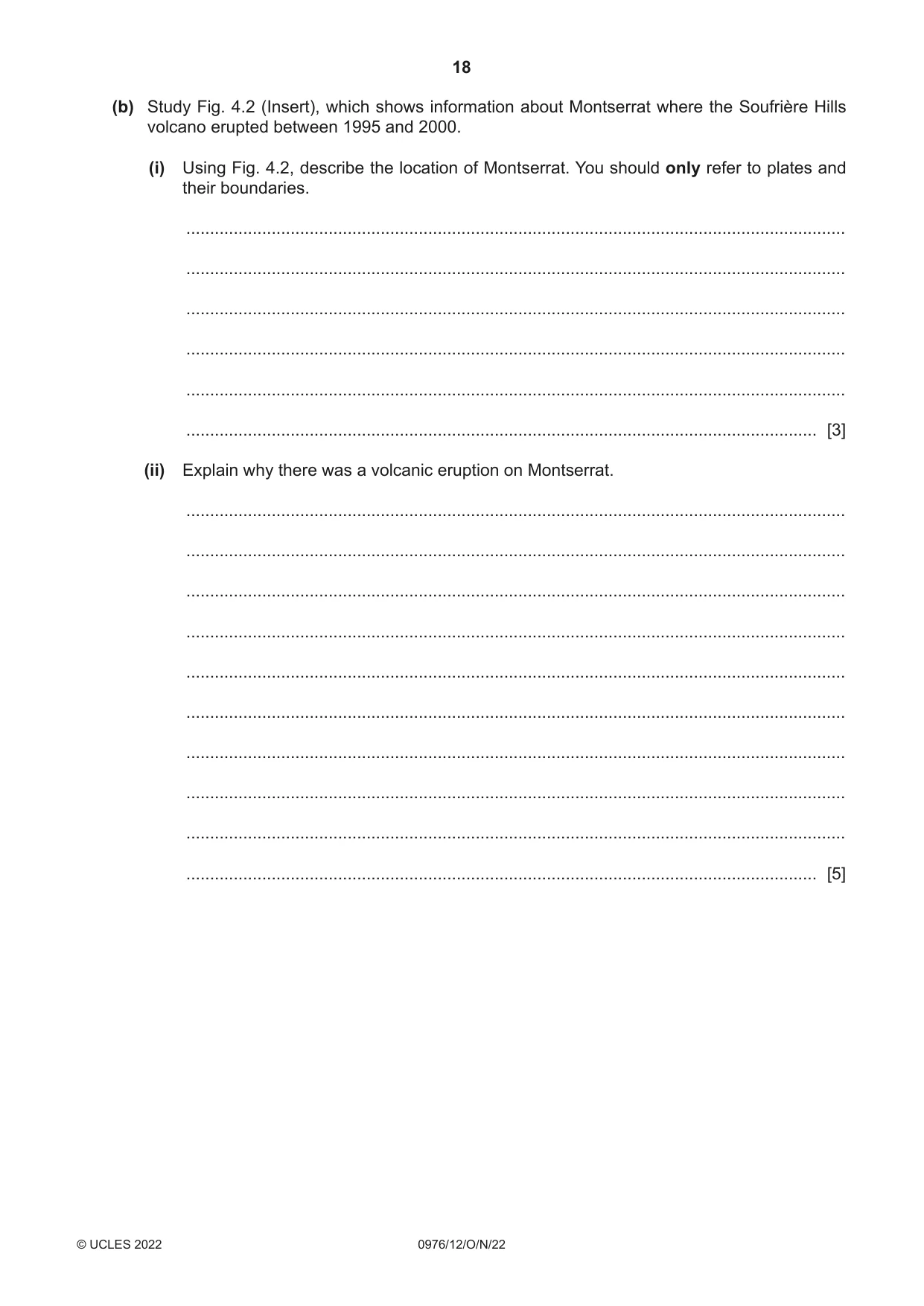
17 0976/12/O/N/22 © UCLES 2022 [Turn over 4 (a) Study Fig. 4.1 (Insert), which is a map showing the distribution of earthquake zones and volcanoes. (i) Identify the compass direction in which the Nazca plate is moving. … [1] (ii) Identify the type of plate boundaries at Y and Z shown in Fig. 4.1. Y … Z … [2] (iii) Describe the distribution of earthquake zones in Fig. 4.1. … … … … … … [3] (iv) Explain why earthquakes cause more deaths and injuries than volcanic eruptions. … … … … … … … … [4]
Question paper, page 18
18 0976/12/O/N/22 © UCLES 2022 (b) Study Fig. 4.2 (Insert), which shows information about Montserrat where the Soufrière Hills volcano erupted between 1995 and 2000. (i) Using Fig. 4.2, describe the location of Montserrat. You should only refer to plates and their boundaries. … … … … … … [3] (ii) Explain why there was a volcanic eruption on Montserrat. … … … … … … … … … … [5]
Question paper, page 19
19 0976/12/O/N/22 © UCLES 2022 [Turn over (c) For a named area you have studied, explain what has been done to reduce the impacts of earthquakes. Name of area … … … … … … … … … … … … … … … … … … … … … … … … … … [7] [Total: 25]
Question paper, page 20
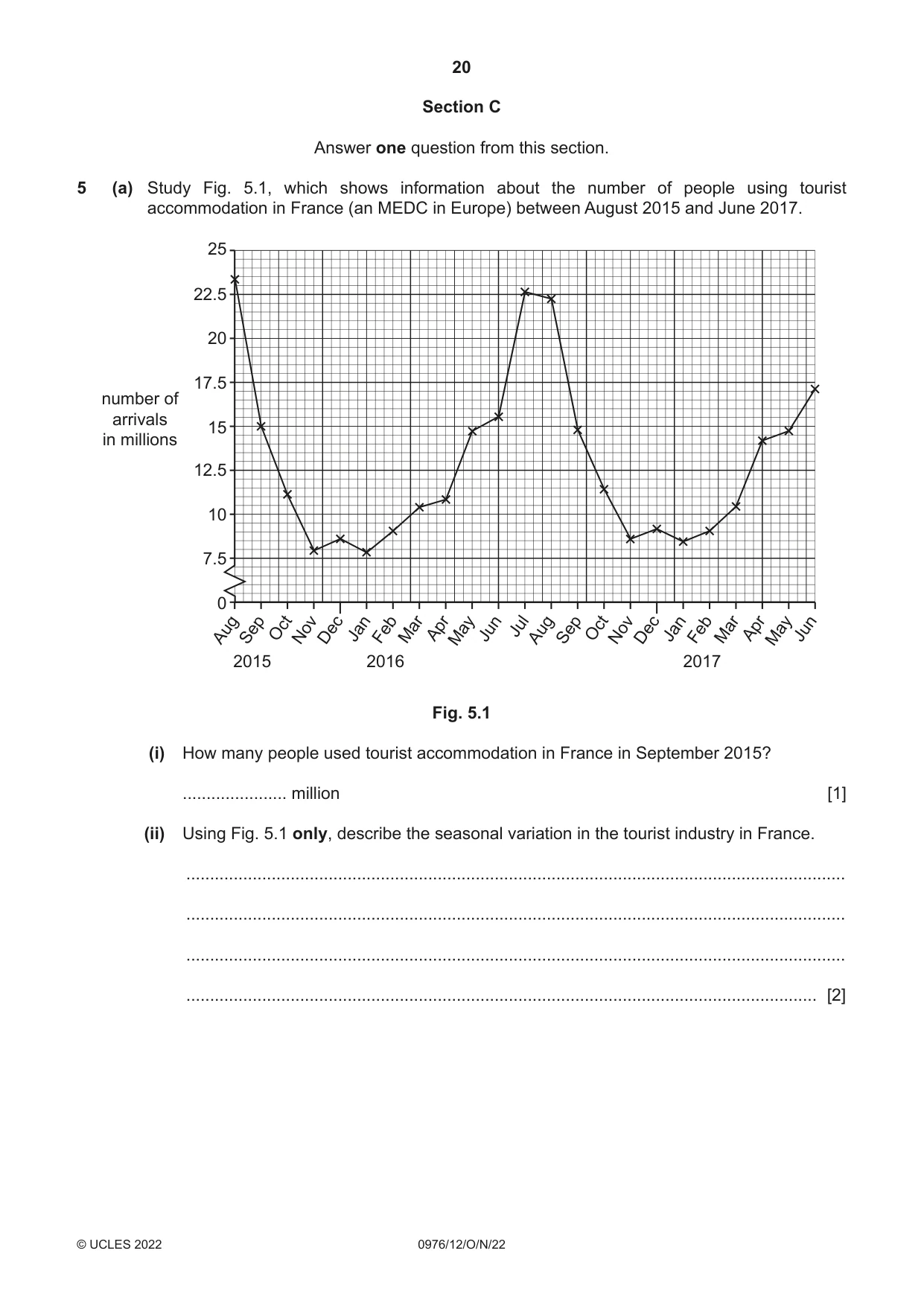
20 0976/12/O/N/22 © UCLES 2022 Section C Answer one question from this section. 5 (a) Study Fig. 5.1, which shows information about the number of people using tourist accommodation in France (an MEDC in Europe) between August 2015 and June 2017. 7.5 0 10 12.5 15 17.5 20 22.5 25 Aug Sep Oct Nov Dec Jan Feb Mar Apr May Jun Jul Aug Sep Oct Nov Dec Jan Feb Mar Apr May Jun 2015 2016 2017 number of arrivals in millions Fig. 5.1 (i) How many people used tourist accommodation in France in September 2015? … million [1] (ii) Using Fig. 5.1 only, describe the seasonal variation in the tourist industry in France. … … … … [2]
Question paper, page 21
21 0976/12/O/N/22 © UCLES 2022 [Turn over (iii) Suggest reasons why the number of people visiting tourist destinations in France varied during the period shown in Fig. 5.1. … … … … … … [3] (iv) Explain two likely benefits for people living in an area where there are many tourists. 1 … … … … 2 … … … … [4]
Question paper, page 22
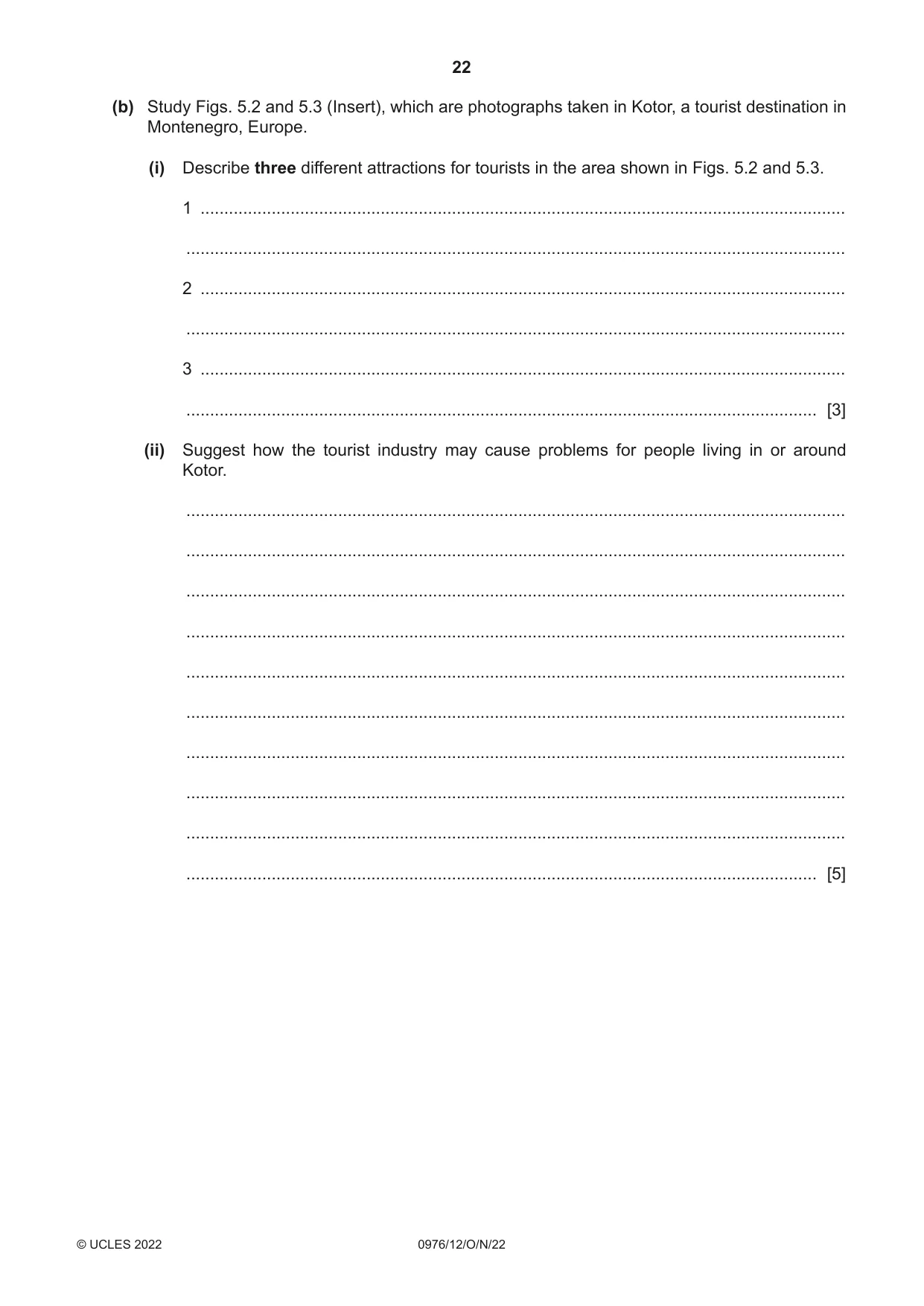
22 0976/12/O/N/22 © UCLES 2022 (b) Study Figs. 5.2 and 5.3 (Insert), which are photographs taken in Kotor, a tourist destination in Montenegro, Europe. (i) Describe three different attractions for tourists in the area shown in Figs. 5.2 and 5.3. 1 … … 2 … … 3 … … [3] (ii) Suggest how the tourist industry may cause problems for people living in or around Kotor. … … … … … … … … … … [5]
Question paper, page 23
23 0976/12/O/N/22 © UCLES 2022 [Turn over (c) For a named example of an area where tourism is important, explain why there are concerns about its impact on the natural environment. Name of area … … … … … … … … … … … … … … … … … … … … … … … … … … [7] [Total: 25]
Question paper, page 24
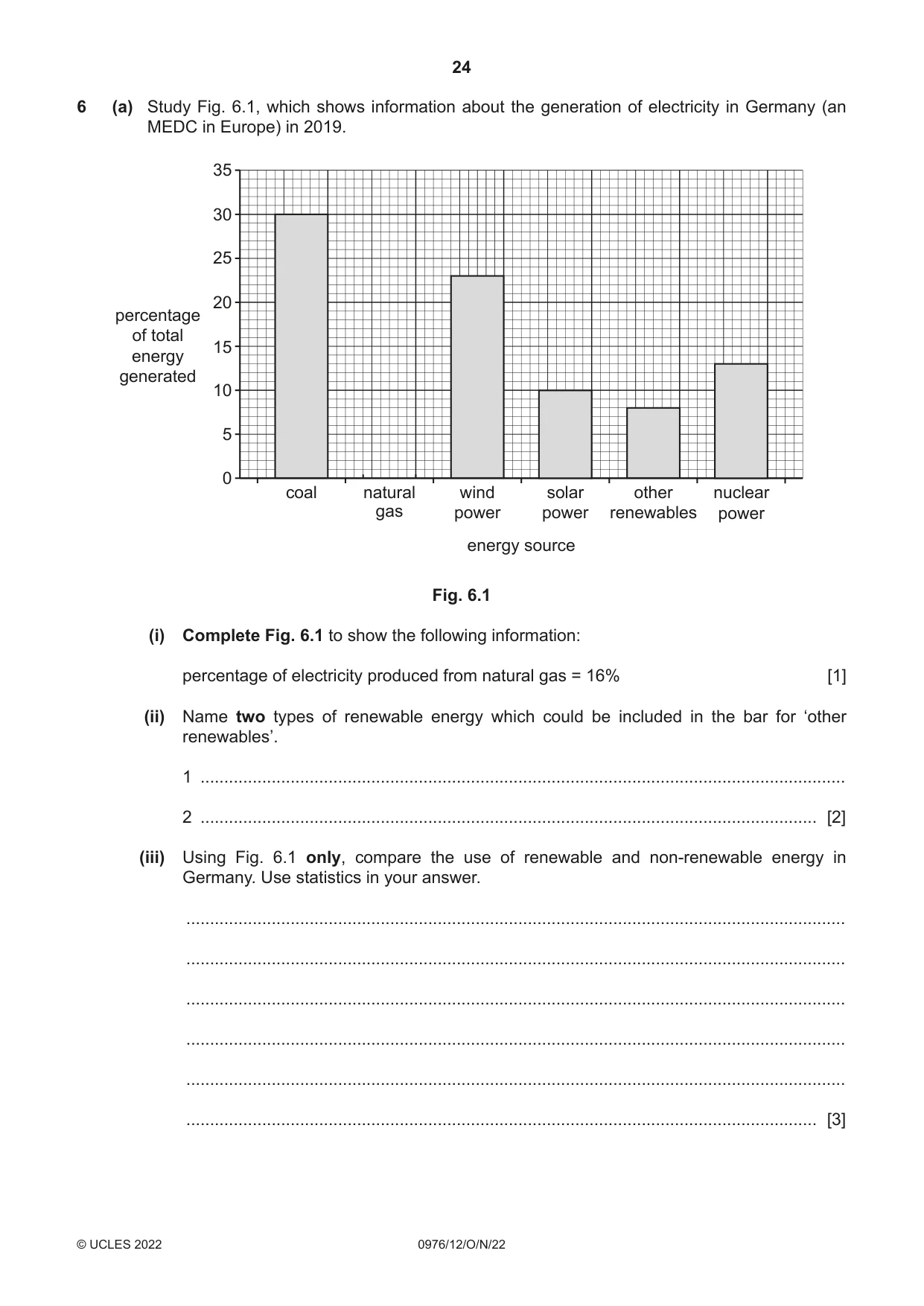
24 0976/12/O/N/22 © UCLES 2022 6 (a) Study Fig. 6.1, which shows information about the generation of electricity in Germany (an MEDC in Europe) in 2019. percentage of total energy generated 0 5 10 15 20 25 30 35 coal natural gas wind power energy source solar power other renewables nuclear power Fig. 6.1 (i) Complete Fig. 6.1 to show the following information: percentage of electricity produced from natural gas = 16% [1] (ii) Name two types of renewable energy which could be included in the bar for ‘other renewables’. 1 … 2 … [2] (iii) Using Fig. 6.1 only, compare the use of renewable and non-renewable energy in Germany. Use statistics in your answer. … … … … … … [3]
Question paper, page 25
25 0976/12/O/N/22 © UCLES 2022 [Turn over (iv) Germany generated twice as much electricity from renewable sources in 2019 than it did in 2010. Suggest reasons for this increase. … … … … … … … … [4]
Question paper, page 26
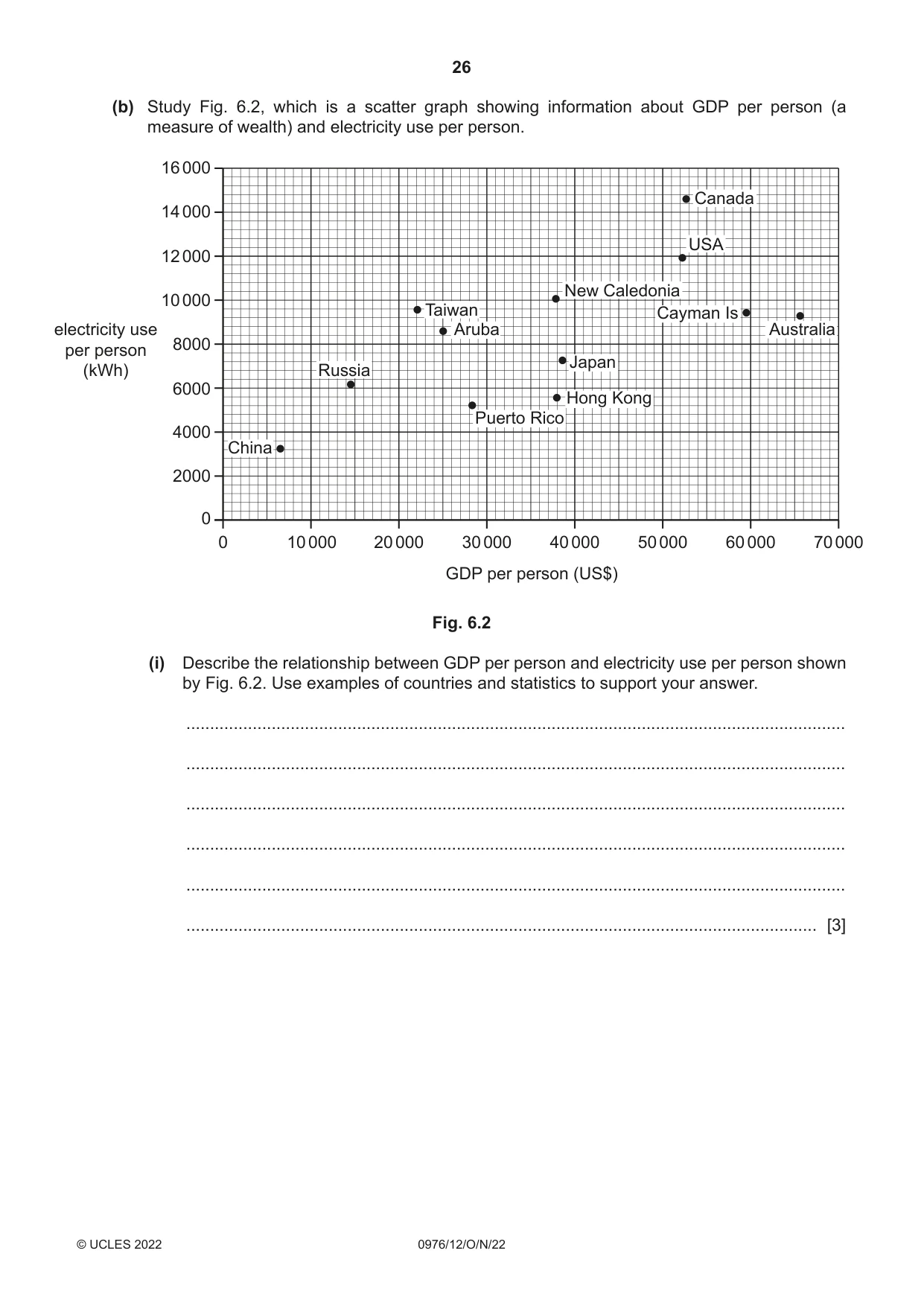
26 0976/12/O/N/22 © UCLES 2022 (b) Study Fig. 6.2, which is a scatter graph showing information about GDP per person (a measure of wealth) and electricity use per person. China Russia Taiwan Aruba Puerto Rico Hong Kong Japan New Caledonia USA Cayman Is Canada Australia 0 0 10 000 20 000 30 000 40 000 50 000 60 000 70 000 2000 4000 6000 8000 10 000 12 000 14 000 16 000 GDP per person (US$) electricity use per person (kWh) Fig. 6.2 (i) Describe the relationship between GDP per person and electricity use per person shown by Fig. 6.2. Use examples of countries and statistics to support your answer. … … … … … … [3]
Question paper, page 27
27 0976/12/O/N/22 © UCLES 2022 [Turn over (ii) Many countries use large amounts of electricity. Explain why there are concerns about the impacts of electricity generation on the global natural environment. … … … … … … … … … … [5]
Question paper, page 28
28 0976/12/O/N/22 © UCLES 2022 (c) For an area you have studied, explain how the risks to the local natural environment of a named economic activity are being managed. Name of area … Economic activity … … … … … … … … … … … … … … … … … … … … … … … … … [7] [Total: 25]
Question paper, page 29
29 0976/12/O/N/22 © UCLES 2022 Additional pages If you use the following pages to complete the answer to any question, the question number must be clearly shown. … … … … … … … … … … … … … … … … … … … … … … … … … …
Question paper, page 30
30 0976/12/O/N/22 © UCLES 2022 … … … … … … … … … … … … … … … … … … … … … … … … … … … …
Question paper, page 31
31 0976/12/O/N/22 © UCLES 2022 BLANK PAGE
Question paper, page 32
32 0976/12/O/N/22 © UCLES 2022 The boundaries and names shown, the designations used and the presentation of material on any maps contained in this question paper/insert do not imply official endorsement or acceptance by Cambridge Assessment International Education concerning the legal status of any country, territory, or area or any of its authorities, or of the delimitation of its frontiers or boundaries. Permission to reproduce items where third-party owned material protected by copyright is included has been sought and cleared where possible. Every reasonable effort has been made by the publisher (UCLES) to trace copyright holders, but if any items requiring clearance have unwittingly been included, the publisher will be pleased to make amends at the earliest possible opportunity. To avoid the issue of disclosure of answer-related information to candidates, all copyright acknowledgements are reproduced online in the Cambridge Assessment International Education Copyright Acknowledgements Booklet. This is produced for each series of examinations and is freely available to download at www.cambridgeinternational.org after the live examination series. Cambridge Assessment International Education is part of Cambridge Assessment. Cambridge Assessment is the brand name of the University of Cambridge Local Examinations Syndicate (UCLES), which is a department of the University of Cambridge. BLANK PAGE
Mark scheme, page 1
This document consists of 19 printed pages. © UCLES 2022 [Turn over Cambridge IGCSE™ (9–1) GEOGRAPHY 0976/12 Paper 1 Geographical Themes October/November 2022 MARK SCHEME Maximum Mark: 75 Published This mark scheme is published as an aid to teachers and candidates, to indicate the requirements of the examination. It shows the basis on which Examiners were instructed to award marks. It does not indicate the details of the discussions that took place at an Examiners’ meeting before marking began, which would have considered the acceptability of alternative answers. Mark schemes should be read in conjunction with the question paper and the Principal Examiner Report for Teachers. Cambridge International will not enter into discussions about these mark schemes. Cambridge International is publishing the mark schemes for the October/November 2022 series for most Cambridge IGCSE™, Cambridge International A and AS Level components and some Cambridge O Level components.
Mark scheme, page 2
0976/12 Cambridge IGCSE (9–1) – Mark Scheme PUBLISHED October/November 2022 © UCLES 2022 Page 2 of 19 Generic Marking Principles These general marking principles must be applied by all examiners when marking candidate answers. They should be applied alongside the specific content of the mark scheme or generic level descriptors for a question. Each question paper and mark scheme will also comply with these marking principles. GENERIC MARKING PRINCIPLE 1: Marks must be awarded in line with: • the specific content of the mark scheme or the generic level descriptors for the question • the specific skills defined in the mark scheme or in the generic level descriptors for the question • the standard of response required by a candidate as exemplified by the standardisation scripts. GENERIC MARKING PRINCIPLE 2: Marks awarded are always whole marks (not half marks, or other fractions). GENERIC MARKING PRINCIPLE 3: Marks must be awarded positively: • marks are awarded for correct/valid answers, as defined in the mark scheme. However, credit is given for valid answers which go beyond the scope of the syllabus and mark scheme, referring to your Team Leader as appropriate • marks are awarded when candidates clearly demonstrate what they know and can do • marks are not deducted for errors • marks are not deducted for omissions • answers should only be judged on the quality of spelling, punctuation and grammar when these features are specifically assessed by the question as indicated by the mark scheme. The meaning, however, should be unambiguous. GENERIC MARKING PRINCIPLE 4: Rules must be applied consistently, e.g., in situations where candidates have not followed instructions or in the application of generic level descriptors. GENERIC MARKING PRINCIPLE 5: Marks should be awarded using the full range of marks defined in the mark scheme for the question (however; the use of the full mark range may be limited according to the quality of the candidate responses seen). GENERIC MARKING PRINCIPLE 6: Marks awarded are based solely on the requirements as defined in the mark scheme. Marks should not be awarded with grade thresholds or grade descriptors in mind.
Mark scheme, page 3
0976/12 Cambridge IGCSE (9–1) – Mark Scheme PUBLISHED October/November 2022 © UCLES 2022 Page 3 of 19 Each question carries 25 marks. Candidates cannot earn above the maximum marks available within each sub section. The marking scheme attempts to give guidance about the requirements of each answer and lists a number of responses, which will earn marks along with the general principles to be applied when marking each question. It should be noted that candidates can earn marks if their answers are phrased differently provided, they convey the same meaning as those in the mark scheme. THE CANDIDATES DO NOT NEED TO USE THE SAME WORDING TO EARN MARKS. The notation `etc.` at the end of an answer in the mark scheme signifies that there may well be other correct responses or examples that can be given credit. Providing the statement is true, relevant to the question asked and not repetition of a previous point made, credit should be given. A point made within one sub-section which is an answer to the question set in a different sub-section should not be given credit as each sub-section asks different questions which require independent answers. The mark scheme uses semi colons (;) to separate marks and diagonals to separate alternative answers. During coordination the mark scheme is modified to add points agreed after discussion or to delete any points not allowed. All examiners should ensure that their modified scheme is fully up-to-date before marking begins. Marking Mechanics. Point marking is used for sections (a) and (b) of each question, although marks are available in specified questions for development of appropriate points. Ticks should be used to clearly indicate where a mark has been allowed. Where a development point has been allowed the symbol “DEV” should be placed adjacent to the tick. The number of ticks should always be equal to the total number of marks awarded. Only one development mark for each mark scheme point please. Where a candidate makes a point which is not quite sufficient for credit an upturned `V` insert symbol should be used. If after careful consideration a mark is awarded which gives `benefit of doubt` to the candidate, the letter `J` should be placed adjacent to the tick (i.e., the candidate has `just` achieved the mark). Crosses are acceptable to signify wrong answers and the letters `I/R` should be used to indicate those which are irrelevant. Levels of response marking is used for section (c) of each question. Thus, it is the quality of the response that determines which level an answer has achieved rather than the quantity of statements contained within it. However, once assigned to a level the mark achieved within that level is determined by the number of points made. Levels 1 and 2 are distinguished by whether statements are simple (level 1) or developed/elaborated (level 2). A candidate can immediately enter L2 by making developed points without making any L1 statements. In order to achieve L3 a candidate must have already reached the top end of L2 – in addition his/her answer should have a clear example and if the answer is place specific as well (7 marks). Highlight place specific detail. Where statements are assigned levels by the examiner this should be indicated by the use of L1 and L2 next to the statements. Ticks should not be used on answers that are marked using levels of response marking. L1 annotation should be removed once a L2 is awarded for an answer. L3 annotation is not used. There is no need for a summary level at the end of a response.
Mark scheme, page 4
0976/12 Cambridge IGCSE (9–1) – Mark Scheme PUBLISHED October/November 2022 © UCLES 2022 Page 4 of 19 Summary: Level 1 (1 to 3 marks): 1 simple statement (1 mark) 2 simple statements (2 marks) 3 simple statements (3 marks) Level 2 (4 to 6 marks): 1 developed statement (4 marks) 2 developed statements (5 marks) 3 or more developed statements with e.g. (6 marks) Level 3 (7 marks) 3 or more developed statements + named example with at least one piece of place specific detail.
Mark scheme, page 5
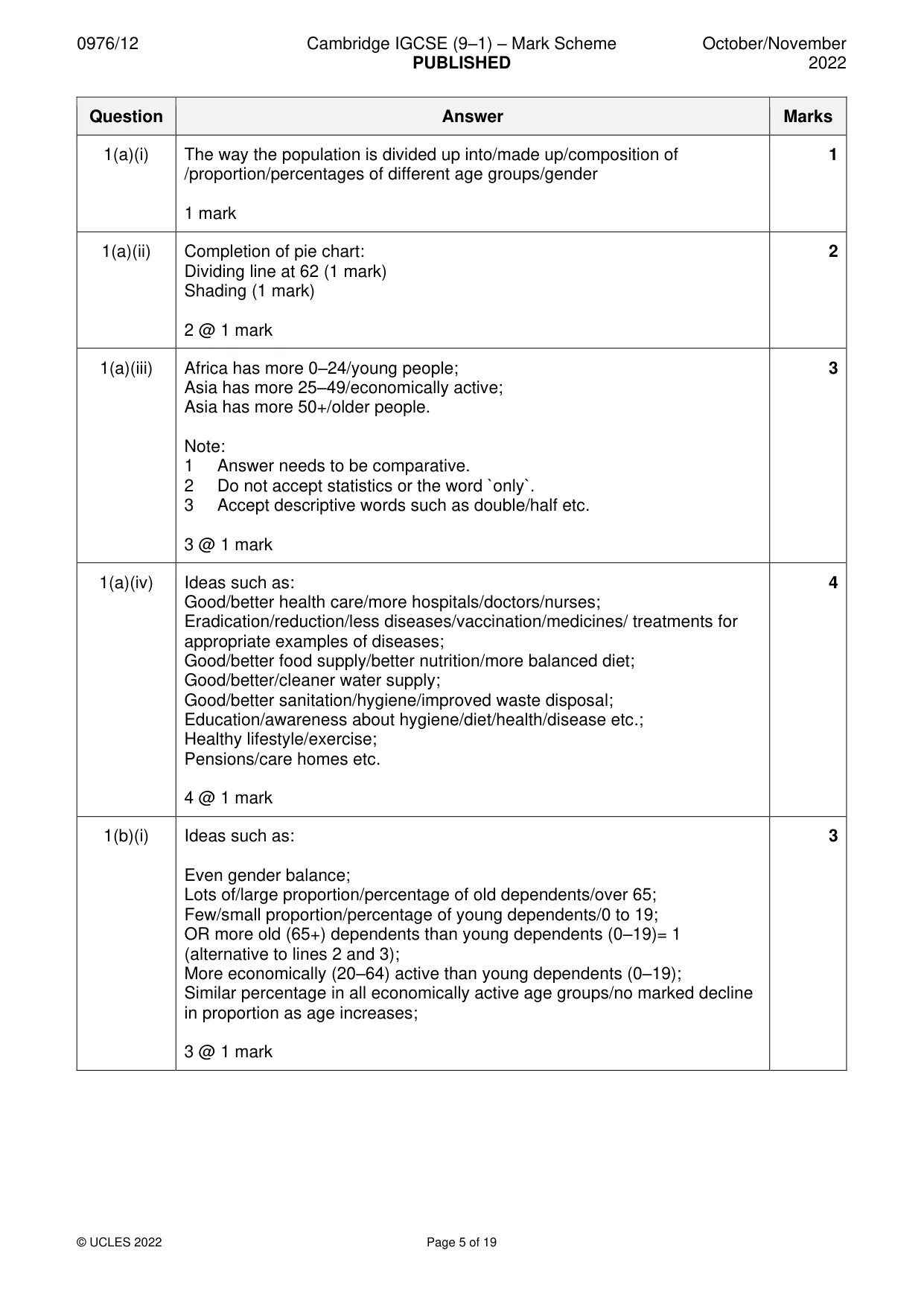
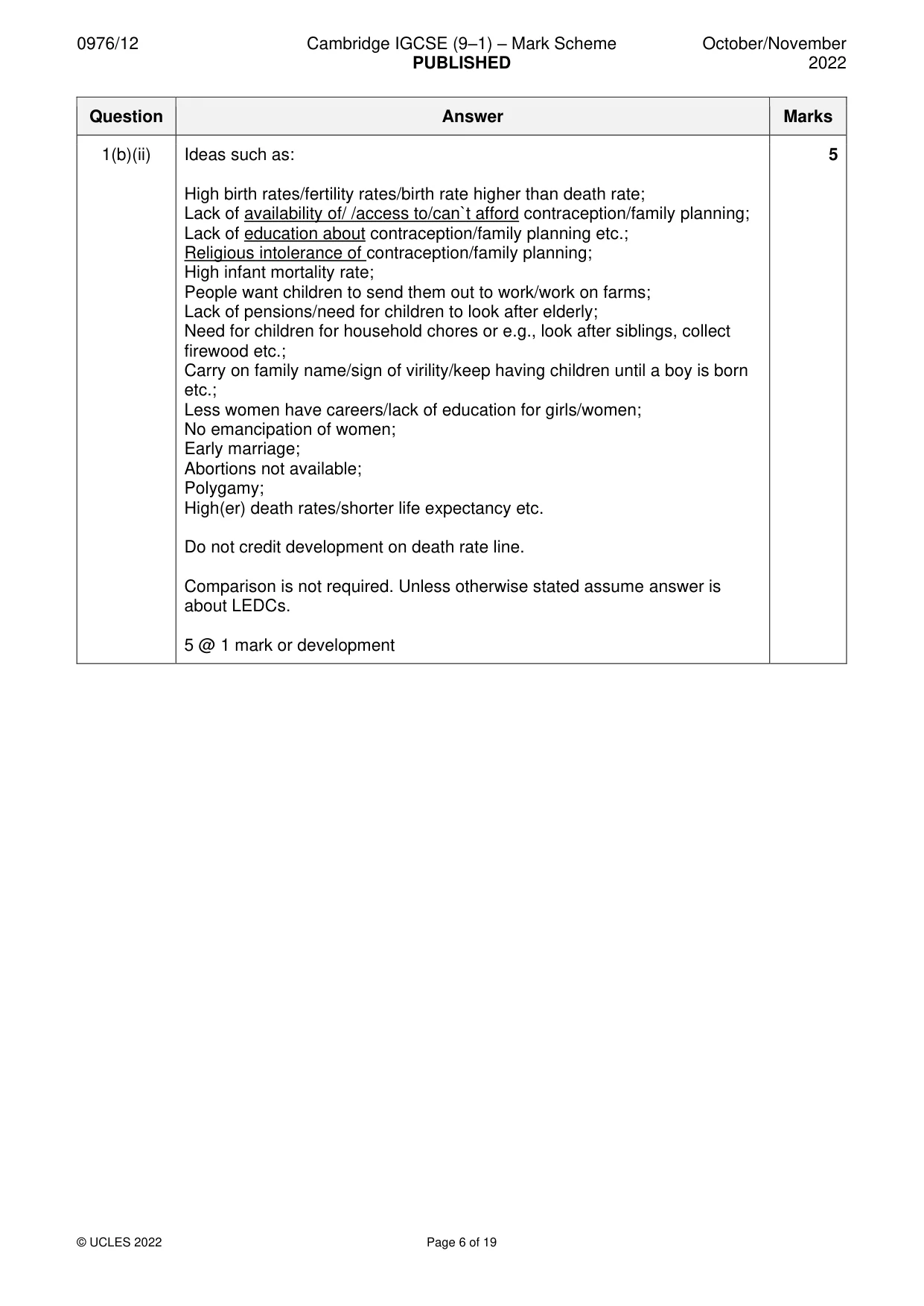
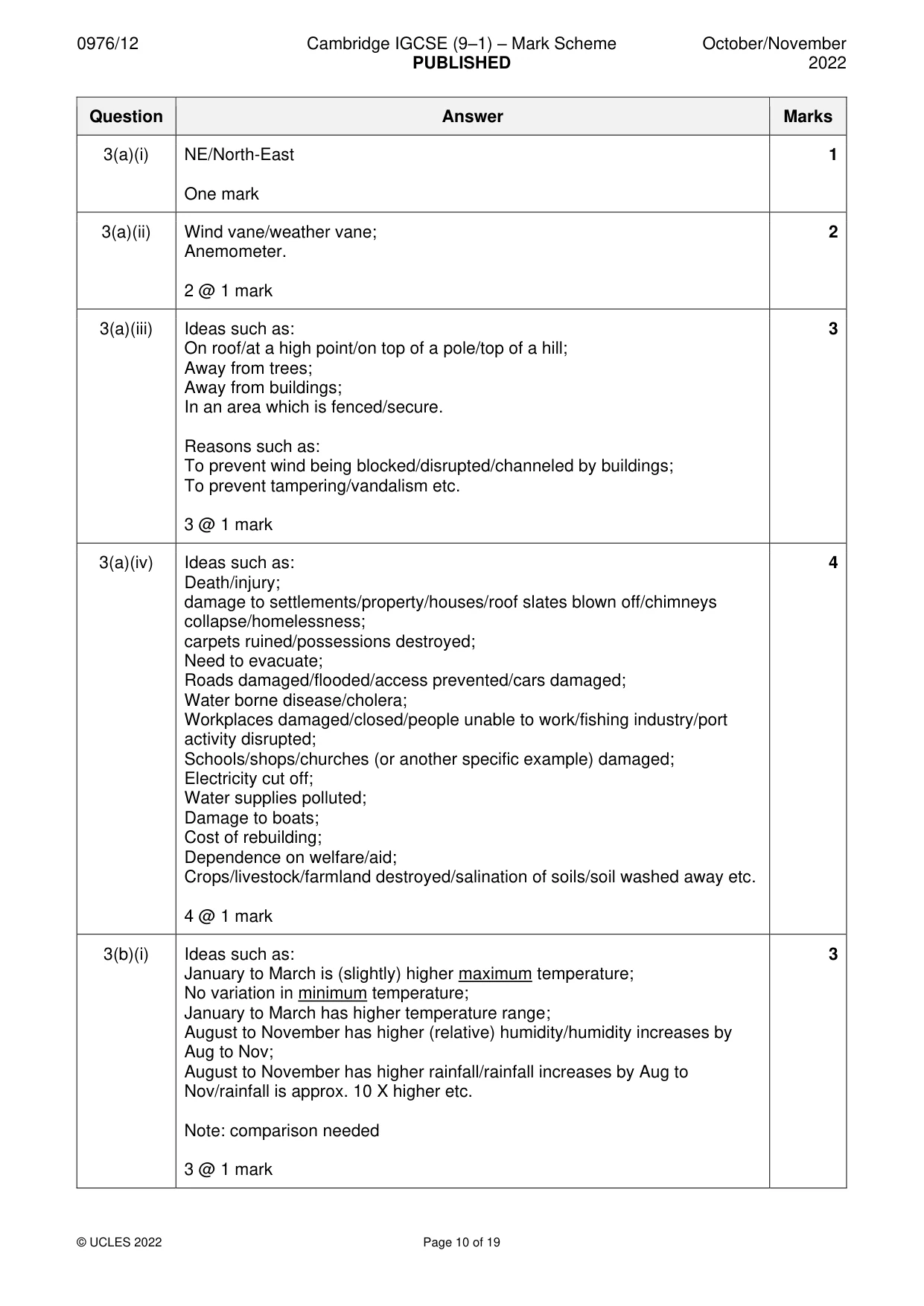
0976/12 Cambridge IGCSE (9–1) – Mark Scheme PUBLISHED October/November 2022 © UCLES 2022 Page 5 of 19 Question Answer Marks 1(a)(i) The way the population is divided up into/made up/composition of /proportion/percentages of different age groups/gender 1 mark 1 1(a)(ii) Completion of pie chart: Dividing line at 62 (1 mark) Shading (1 mark) 2 @ 1 mark 2 1(a)(iii) Africa has more 0–24/young people; Asia has more 25–49/economically active; Asia has more 50+/older people. Note: 1 Answer needs to be comparative. 2 Do not accept statistics or the word `only`. 3 Accept descriptive words such as double/half etc. 3 @ 1 mark 3 1(a)(iv) Ideas such as: Good/better health care/more hospitals/doctors/nurses; Eradication/reduction/less diseases/vaccination/medicines/ treatments for appropriate examples of diseases; Good/better food supply/better nutrition/more balanced diet; Good/better/cleaner water supply; Good/better sanitation/hygiene/improved waste disposal; Education/awareness about hygiene/diet/health/disease etc.; Healthy lifestyle/exercise; Pensions/care homes etc. 4 @ 1 mark 4 1(b)(i) Ideas such as: Even gender balance; Lots of/large proportion/percentage of old dependents/over 65; Few/small proportion/percentage of young dependents/0 to 19; OR more old (65+) dependents than young dependents (0–19)= 1 (alternative to lines 2 and 3); More economically (20–64) active than young dependents (0–19); Similar percentage in all economically active age groups/no marked decline in proportion as age increases; 3 @ 1 mark 3
Mark scheme, page 6
0976/12 Cambridge IGCSE (9–1) – Mark Scheme PUBLISHED October/November 2022 © UCLES 2022 Page 6 of 19 Question Answer Marks 1(b)(ii) Ideas such as: High birth rates/fertility rates/birth rate higher than death rate; Lack of availability of/ /access to/can`t afford contraception/family planning; Lack of education about contraception/family planning etc.; Religious intolerance of contraception/family planning; High infant mortality rate; People want children to send them out to work/work on farms; Lack of pensions/need for children to look after elderly; Need for children for household chores or e.g., look after siblings, collect firewood etc.; Carry on family name/sign of virility/keep having children until a boy is born etc.; Less women have careers/lack of education for girls/women; No emancipation of women; Early marriage; Abortions not available; Polygamy; High(er) death rates/shorter life expectancy etc. Do not credit development on death rate line. Comparison is not required. Unless otherwise stated assume answer is about LEDCs. 5 @ 1 mark or development 5
Mark scheme, page 7
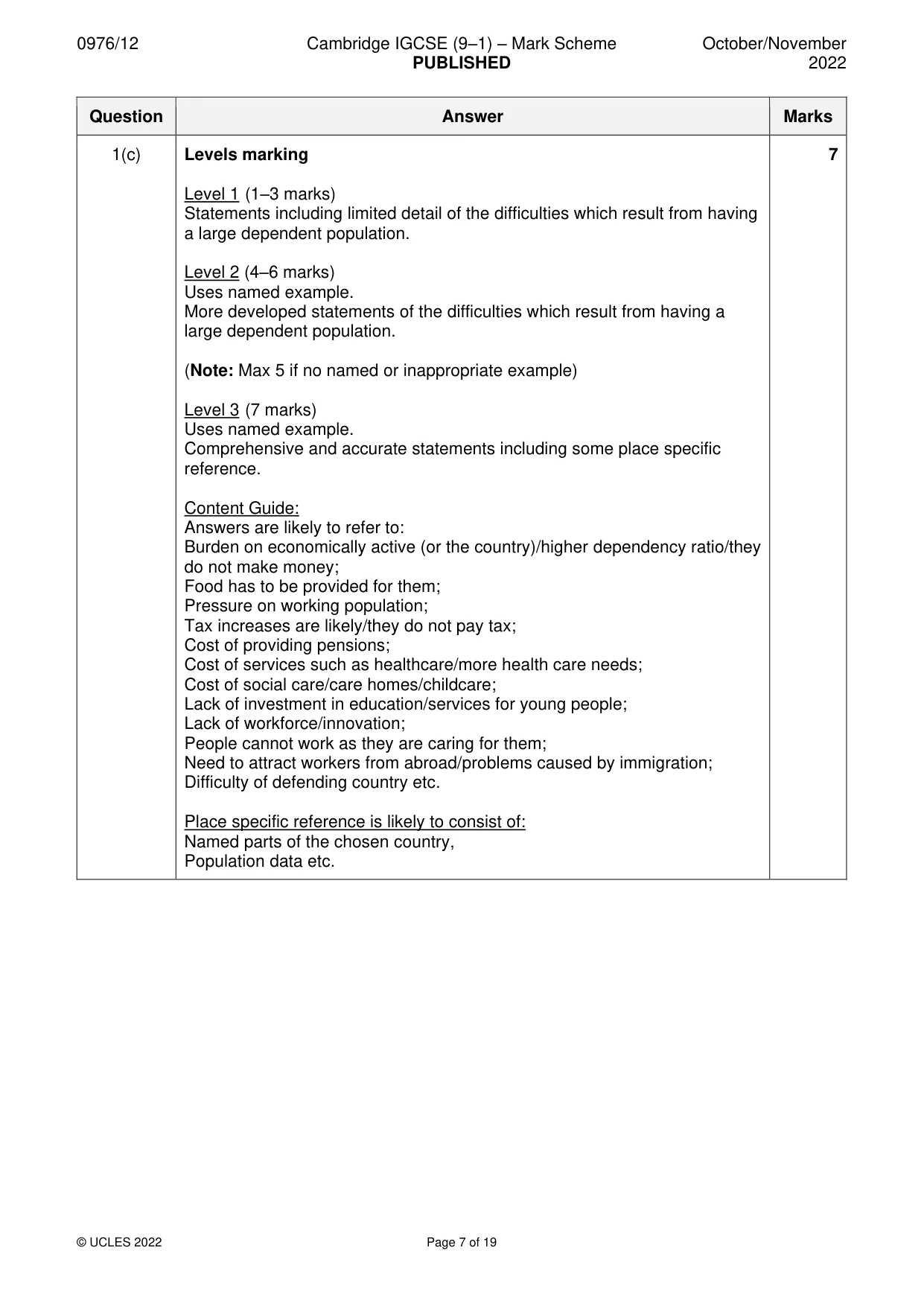
0976/12 Cambridge IGCSE (9–1) – Mark Scheme PUBLISHED October/November 2022 © UCLES 2022 Page 7 of 19 Question Answer Marks 1(c) Levels marking Level 1 (1–3 marks) Statements including limited detail of the difficulties which result from having a large dependent population. Level 2 (4–6 marks) Uses named example. More developed statements of the difficulties which result from having a large dependent population. (Note: Max 5 if no named or inappropriate example) Level 3 (7 marks) Uses named example. Comprehensive and accurate statements including some place specific reference. Content Guide: Answers are likely to refer to: Burden on economically active (or the country)/higher dependency ratio/they do not make money; Food has to be provided for them; Pressure on working population; Tax increases are likely/they do not pay tax; Cost of providing pensions; Cost of services such as healthcare/more health care needs; Cost of social care/care homes/childcare; Lack of investment in education/services for young people; Lack of workforce/innovation; People cannot work as they are caring for them; Need to attract workers from abroad/problems caused by immigration; Difficulty of defending country etc. Place specific reference is likely to consist of: Named parts of the chosen country, Population data etc. 7
Mark scheme, page 8
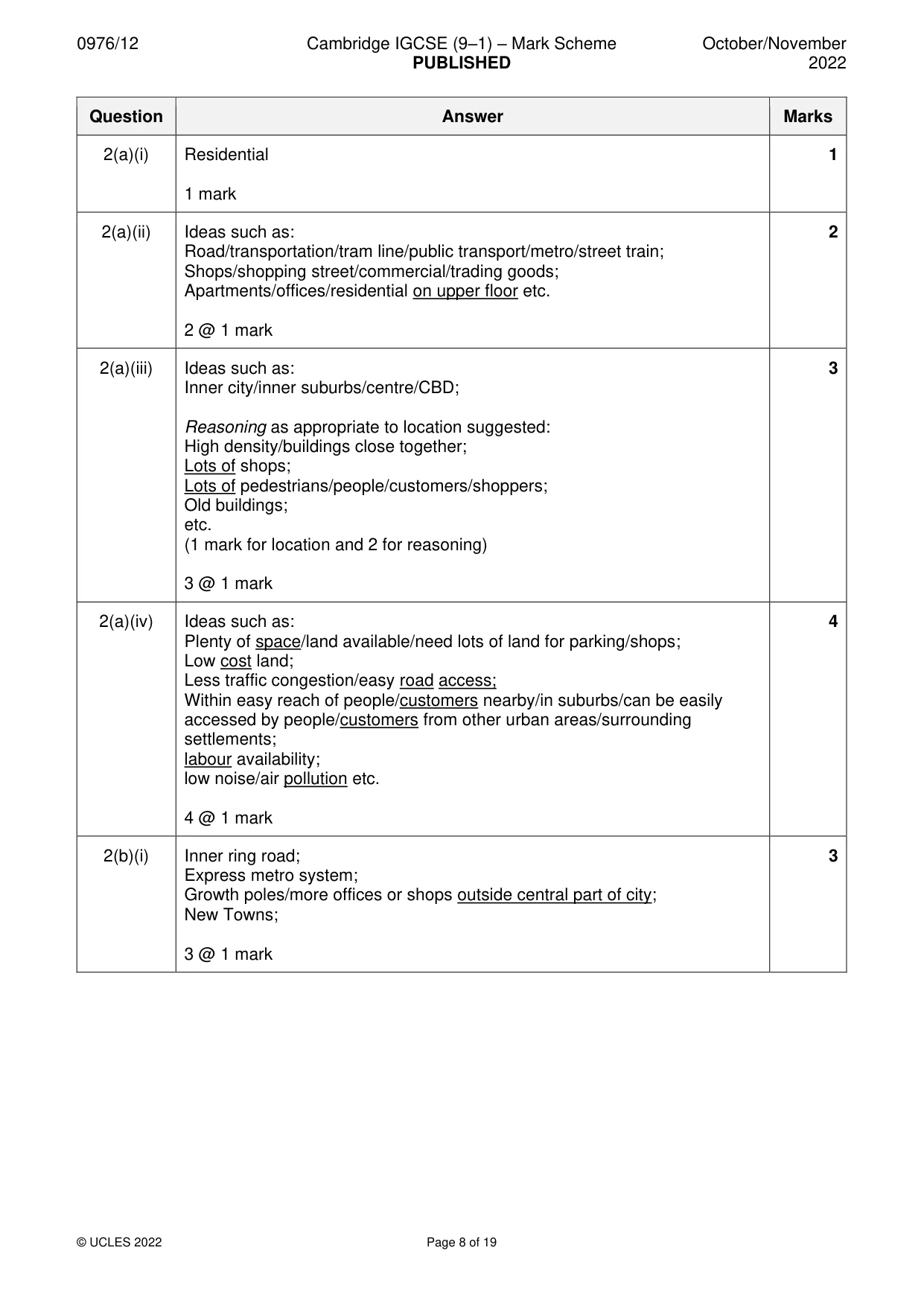
0976/12 Cambridge IGCSE (9–1) – Mark Scheme PUBLISHED October/November 2022 © UCLES 2022 Page 8 of 19 Question Answer Marks 2(a)(i) Residential 1 mark 1 2(a)(ii) Ideas such as: Road/transportation/tram line/public transport/metro/street train; Shops/shopping street/commercial/trading goods; Apartments/offices/residential on upper floor etc. 2 @ 1 mark 2 2(a)(iii) Ideas such as: Inner city/inner suburbs/centre/CBD; Reasoning as appropriate to location suggested: High density/buildings close together; Lots of shops; Lots of pedestrians/people/customers/shoppers; Old buildings; etc. (1 mark for location and 2 for reasoning) 3 @ 1 mark 3 2(a)(iv) Ideas such as: Plenty of space/land available/need lots of land for parking/shops; Low cost land; Less traffic congestion/easy road access; Within easy reach of people/customers nearby/in suburbs/can be easily accessed by people/customers from other urban areas/surrounding settlements; labour availability; low noise/air pollution etc. 4 @ 1 mark 4 2(b)(i) Inner ring road; Express metro system; Growth poles/more offices or shops outside central part of city; New Towns; 3 @ 1 mark 3
Mark scheme, page 9
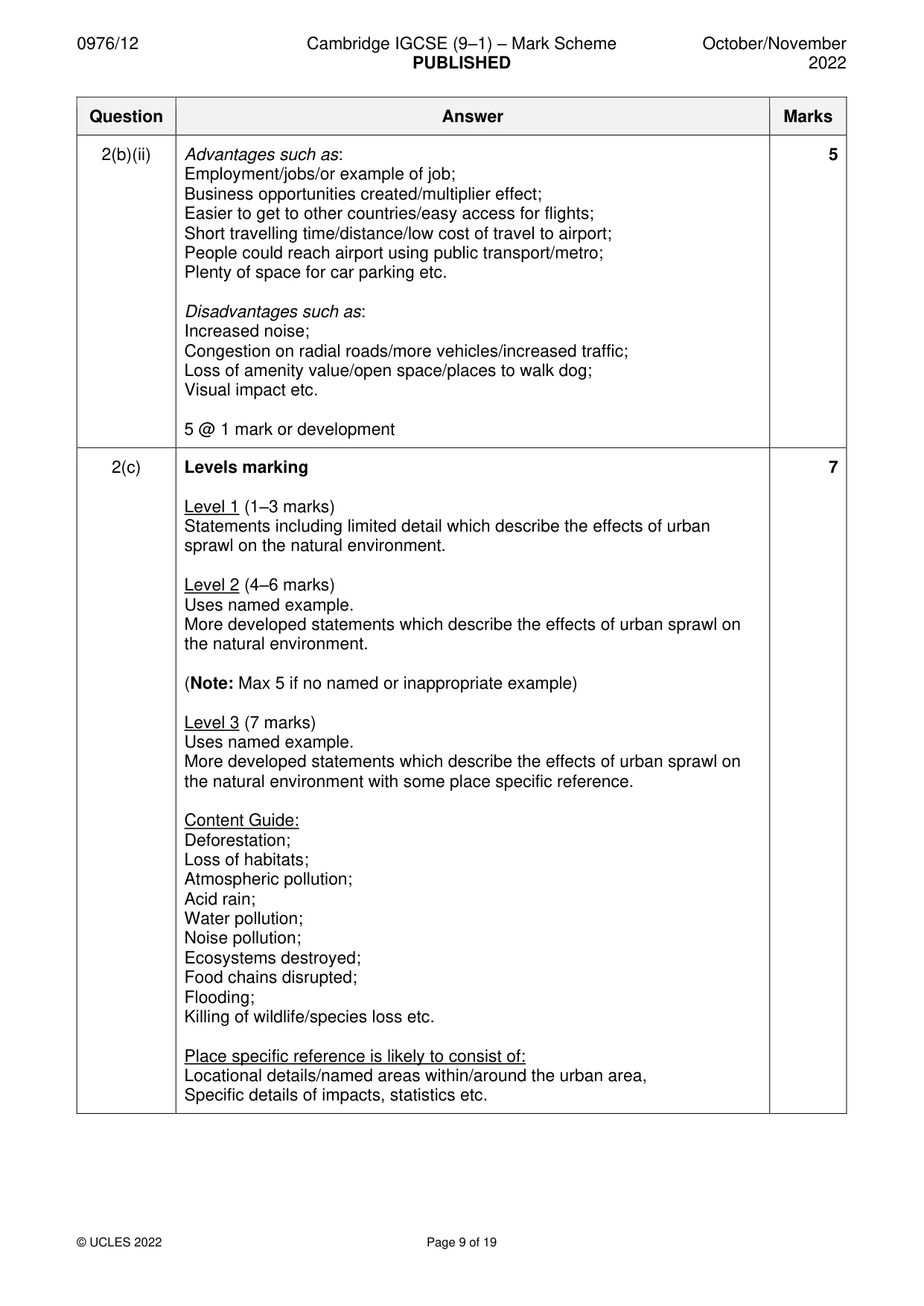
0976/12 Cambridge IGCSE (9–1) – Mark Scheme PUBLISHED October/November 2022 © UCLES 2022 Page 9 of 19 Question Answer Marks 2(b)(ii) Advantages such as: Employment/jobs/or example of job; Business opportunities created/multiplier effect; Easier to get to other countries/easy access for flights; Short travelling time/distance/low cost of travel to airport; People could reach airport using public transport/metro; Plenty of space for car parking etc. Disadvantages such as: Increased noise; Congestion on radial roads/more vehicles/increased traffic; Loss of amenity value/open space/places to walk dog; Visual impact etc. 5 @ 1 mark or development 5 2(c) Levels marking Level 1 (1–3 marks) Statements including limited detail which describe the effects of urban sprawl on the natural environment. Level 2 (4–6 marks) Uses named example. More developed statements which describe the effects of urban sprawl on the natural environment. (Note: Max 5 if no named or inappropriate example) Level 3 (7 marks) Uses named example. More developed statements which describe the effects of urban sprawl on the natural environment with some place specific reference. Content Guide: Deforestation; Loss of habitats; Atmospheric pollution; Acid rain; Water pollution; Noise pollution; Ecosystems destroyed; Food chains disrupted; Flooding; Killing of wildlife/species loss etc. Place specific reference is likely to consist of: Locational details/named areas within/around the urban area, Specific details of impacts, statistics etc. 7
Mark scheme, page 10
0976/12 Cambridge IGCSE (9–1) – Mark Scheme PUBLISHED October/November 2022 © UCLES 2022 Page 10 of 19 Question Answer Marks 3(a)(i) NE/North-East One mark 1 3(a)(ii) Wind vane/weather vane; Anemometer. 2 @ 1 mark 2 3(a)(iii) Ideas such as: On roof/at a high point/on top of a pole/top of a hill; Away from trees; Away from buildings; In an area which is fenced/secure. Reasons such as: To prevent wind being blocked/disrupted/channeled by buildings; To prevent tampering/vandalism etc. 3 @ 1 mark 3 3(a)(iv) Ideas such as: Death/injury; damage to settlements/property/houses/roof slates blown off/chimneys collapse/homelessness; carpets ruined/possessions destroyed; Need to evacuate; Roads damaged/flooded/access prevented/cars damaged; Water borne disease/cholera; Workplaces damaged/closed/people unable to work/fishing industry/port activity disrupted; Schools/shops/churches (or another specific example) damaged; Electricity cut off; Water supplies polluted; Damage to boats; Cost of rebuilding; Dependence on welfare/aid; Crops/livestock/farmland destroyed/salination of soils/soil washed away etc. 4 @ 1 mark 4 3(b)(i) Ideas such as: January to March is (slightly) higher maximum temperature; No variation in minimum temperature; January to March has higher temperature range; August to November has higher (relative) humidity/humidity increases by Aug to Nov; August to November has higher rainfall/rainfall increases by Aug to Nov/rainfall is approx. 10 X higher etc. Note: comparison needed 3 @ 1 mark 3
Mark scheme, page 11
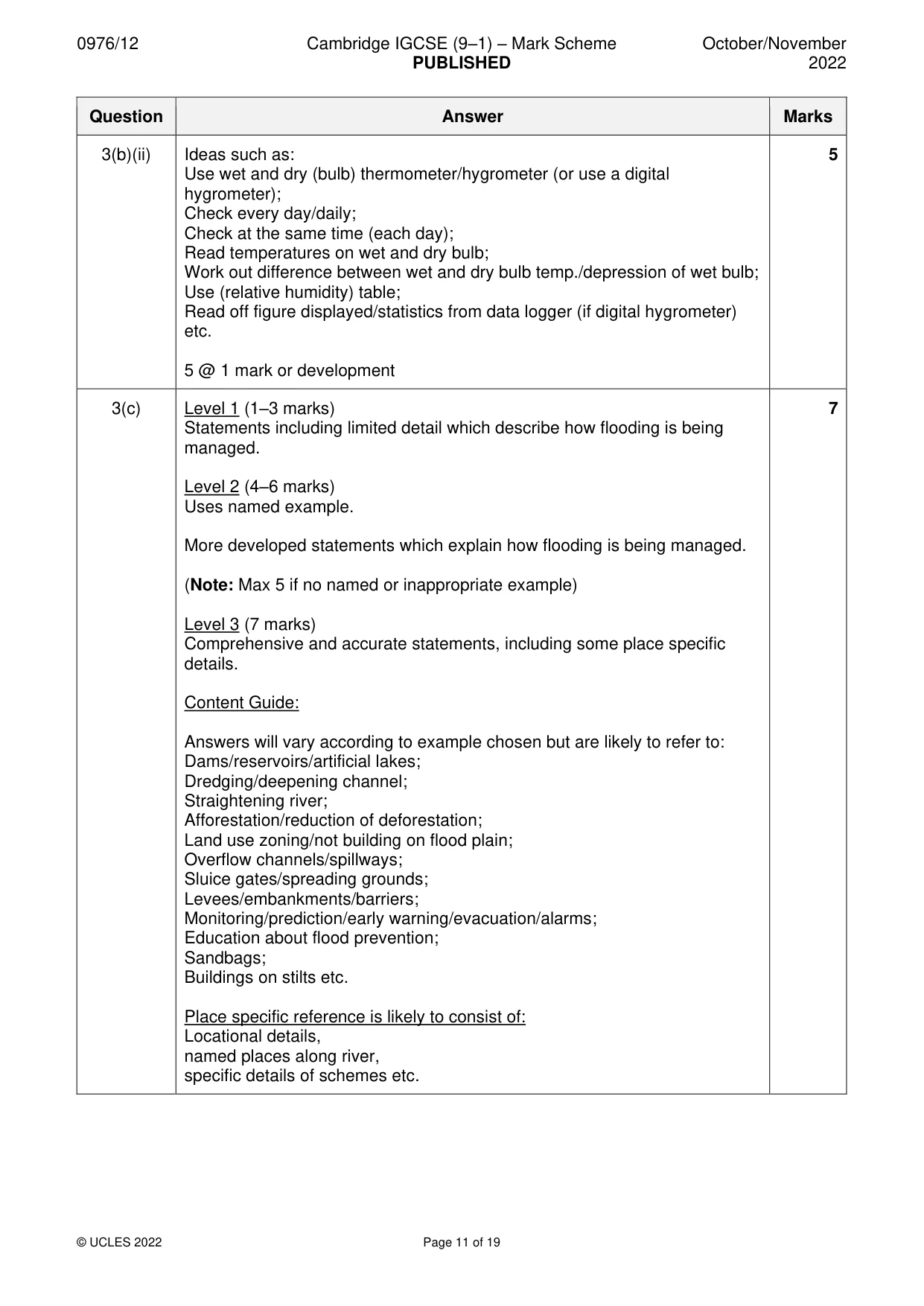
0976/12 Cambridge IGCSE (9–1) – Mark Scheme PUBLISHED October/November 2022 © UCLES 2022 Page 11 of 19 Question Answer Marks 3(b)(ii) Ideas such as: Use wet and dry (bulb) thermometer/hygrometer (or use a digital hygrometer); Check every day/daily; Check at the same time (each day); Read temperatures on wet and dry bulb; Work out difference between wet and dry bulb temp./depression of wet bulb; Use (relative humidity) table; Read off figure displayed/statistics from data logger (if digital hygrometer) etc. 5 @ 1 mark or development 5 3(c) Level 1 (1–3 marks) Statements including limited detail which describe how flooding is being managed. Level 2 (4–6 marks) Uses named example. More developed statements which explain how flooding is being managed. (Note: Max 5 if no named or inappropriate example) Level 3 (7 marks) Comprehensive and accurate statements, including some place specific details. Content Guide: Answers will vary according to example chosen but are likely to refer to: Dams/reservoirs/artificial lakes; Dredging/deepening channel; Straightening river; Afforestation/reduction of deforestation; Land use zoning/not building on flood plain; Overflow channels/spillways; Sluice gates/spreading grounds; Levees/embankments/barriers; Monitoring/prediction/early warning/evacuation/alarms; Education about flood prevention; Sandbags; Buildings on stilts etc. Place specific reference is likely to consist of: Locational details, named places along river, specific details of schemes etc. 7
Mark scheme, page 12
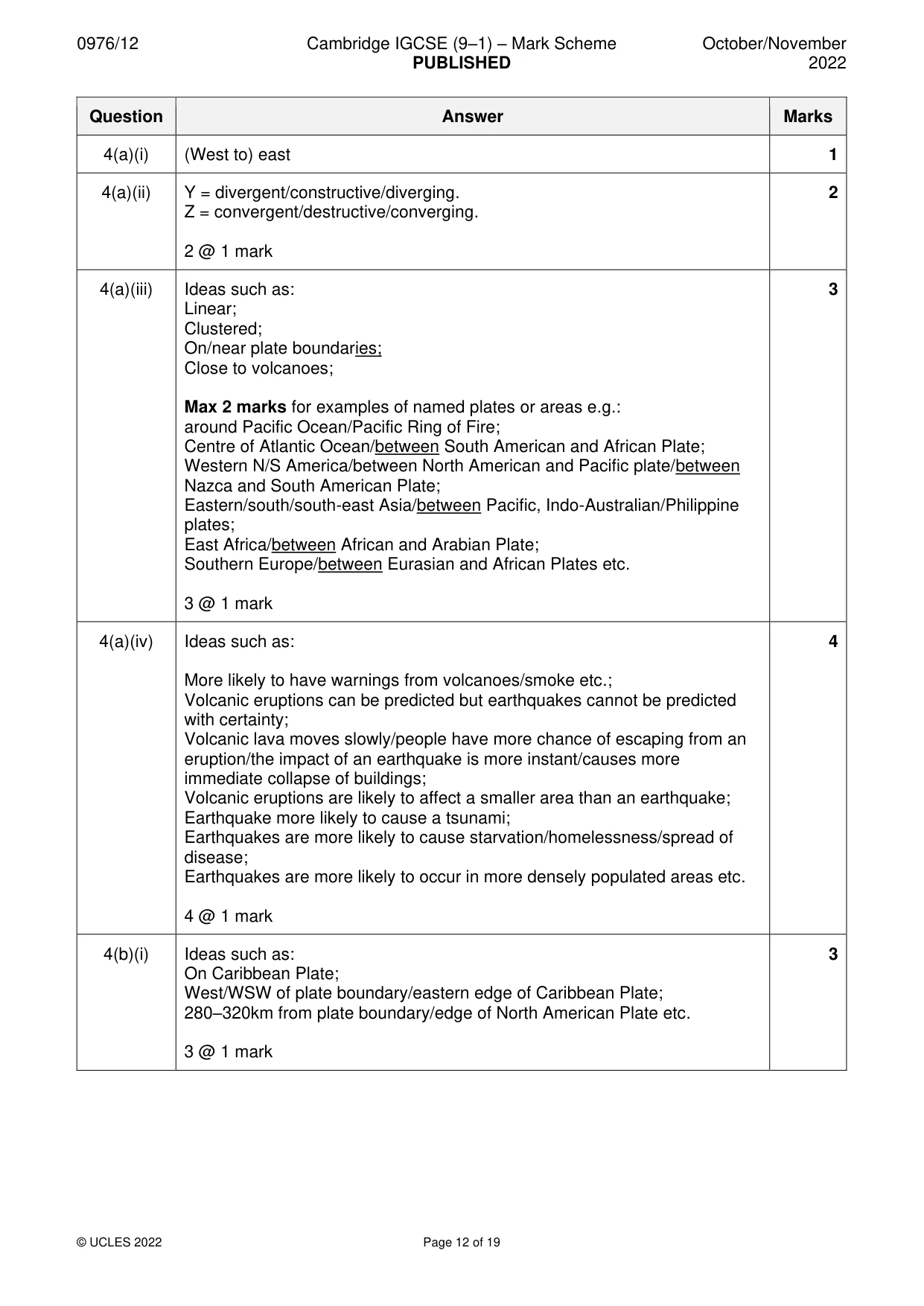
0976/12 Cambridge IGCSE (9–1) – Mark Scheme PUBLISHED October/November 2022 © UCLES 2022 Page 12 of 19 Question Answer Marks 4(a)(i) (West to) east 1 4(a)(ii) Y = divergent/constructive/diverging. Z = convergent/destructive/converging. 2 @ 1 mark 2 4(a)(iii) Ideas such as: Linear; Clustered; On/near plate boundaries; Close to volcanoes; Max 2 marks for examples of named plates or areas e.g.: around Pacific Ocean/Pacific Ring of Fire; Centre of Atlantic Ocean/between South American and African Plate; Western N/S America/between North American and Pacific plate/between Nazca and South American Plate; Eastern/south/south-east Asia/between Pacific, Indo-Australian/Philippine plates; East Africa/between African and Arabian Plate; Southern Europe/between Eurasian and African Plates etc. 3 @ 1 mark 3 4(a)(iv) Ideas such as: More likely to have warnings from volcanoes/smoke etc.; Volcanic eruptions can be predicted but earthquakes cannot be predicted with certainty; Volcanic lava moves slowly/people have more chance of escaping from an eruption/the impact of an earthquake is more instant/causes more immediate collapse of buildings; Volcanic eruptions are likely to affect a smaller area than an earthquake; Earthquake more likely to cause a tsunami; Earthquakes are more likely to cause starvation/homelessness/spread of disease; Earthquakes are more likely to occur in more densely populated areas etc. 4 @ 1 mark 4 4(b)(i) Ideas such as: On Caribbean Plate; West/WSW of plate boundary/eastern edge of Caribbean Plate; 280–320km from plate boundary/edge of North American Plate etc. 3 @ 1 mark 3
Mark scheme, page 13
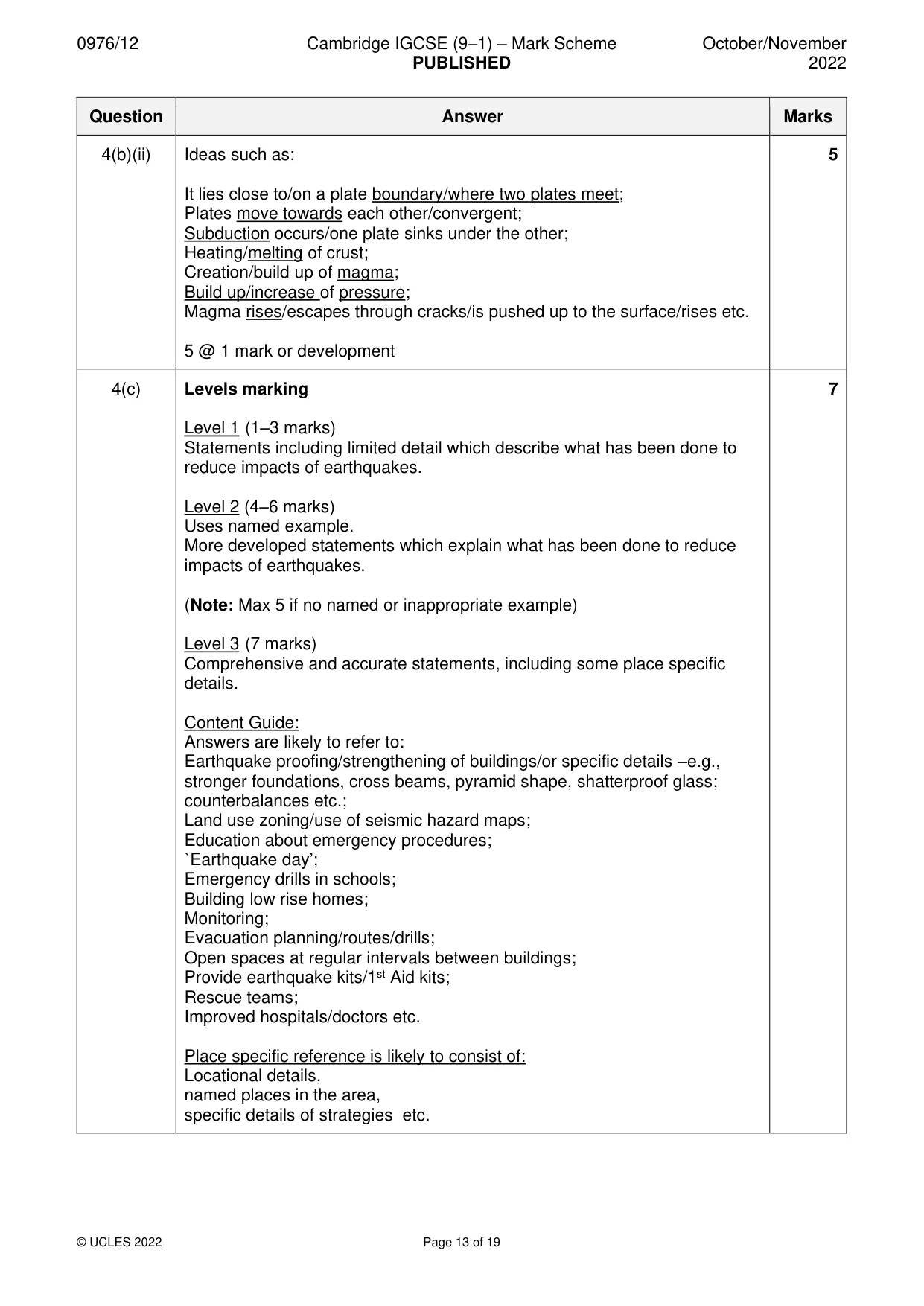
0976/12 Cambridge IGCSE (9–1) – Mark Scheme PUBLISHED October/November 2022 © UCLES 2022 Page 13 of 19 Question Answer Marks 4(b)(ii) Ideas such as: It lies close to/on a plate boundary/where two plates meet; Plates move towards each other/convergent; Subduction occurs/one plate sinks under the other; Heating/melting of crust; Creation/build up of magma; Build up/increase of pressure; Magma rises/escapes through cracks/is pushed up to the surface/rises etc. 5 @ 1 mark or development 5 4(c) Levels marking Level 1 (1–3 marks) Statements including limited detail which describe what has been done to reduce impacts of earthquakes. Level 2 (4–6 marks) Uses named example. More developed statements which explain what has been done to reduce impacts of earthquakes. (Note: Max 5 if no named or inappropriate example) Level 3 (7 marks) Comprehensive and accurate statements, including some place specific details. Content Guide: Answers are likely to refer to: Earthquake proofing/strengthening of buildings/or specific details –e.g., stronger foundations, cross beams, pyramid shape, shatterproof glass; counterbalances etc.; Land use zoning/use of seismic hazard maps; Education about emergency procedures; `Earthquake day’; Emergency drills in schools; Building low rise homes; Monitoring; Evacuation planning/routes/drills; Open spaces at regular intervals between buildings; Provide earthquake kits/1st Aid kits; Rescue teams; Improved hospitals/doctors etc. Place specific reference is likely to consist of: Locational details, named places in the area, specific details of strategies etc. 7
Mark scheme, page 14
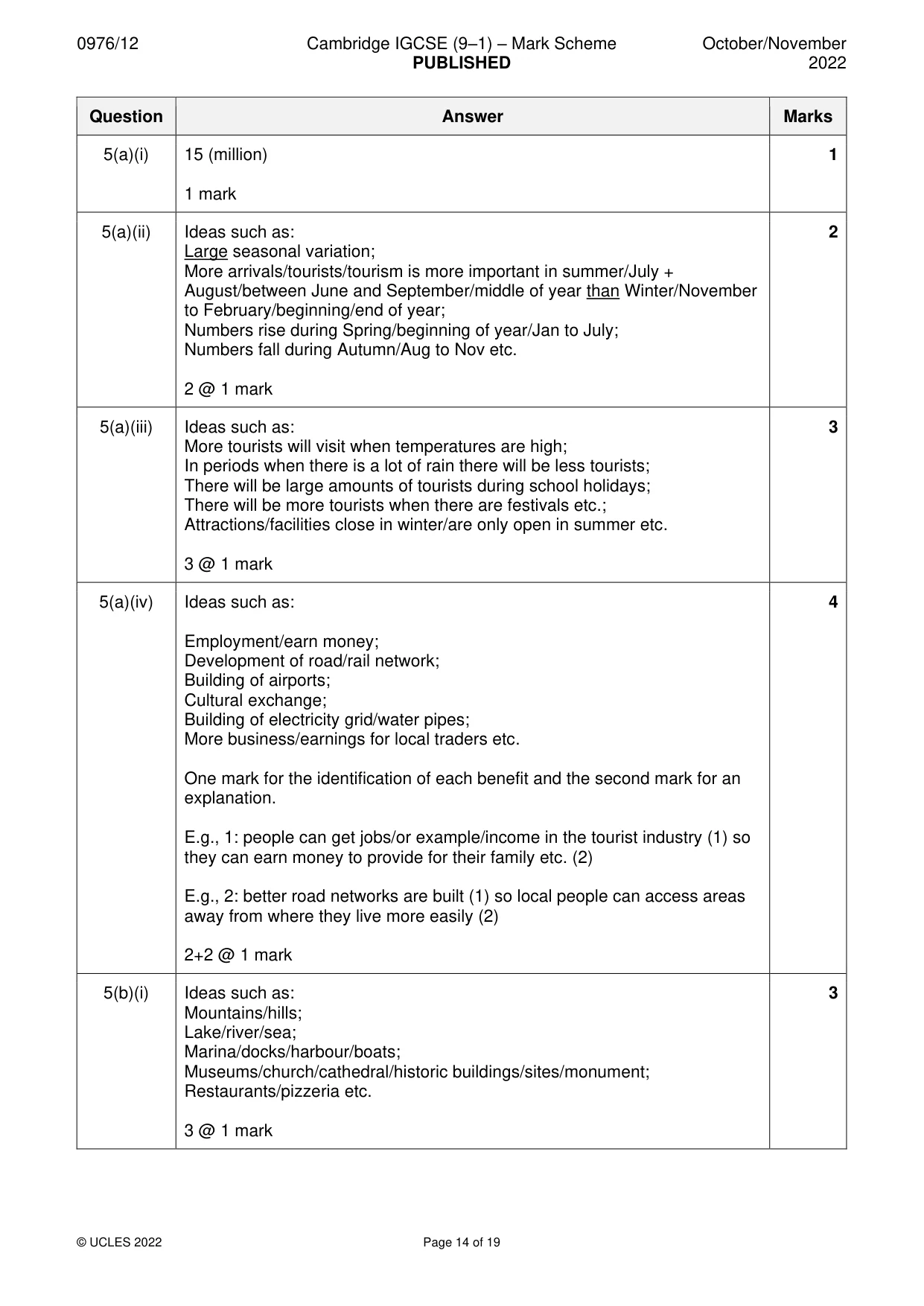
0976/12 Cambridge IGCSE (9–1) – Mark Scheme PUBLISHED October/November 2022 © UCLES 2022 Page 14 of 19 Question Answer Marks 5(a)(i) 15 (million) 1 mark 1 5(a)(ii) Ideas such as: Large seasonal variation; More arrivals/tourists/tourism is more important in summer/July + August/between June and September/middle of year than Winter/November to February/beginning/end of year; Numbers rise during Spring/beginning of year/Jan to July; Numbers fall during Autumn/Aug to Nov etc. 2 @ 1 mark 2 5(a)(iii) Ideas such as: More tourists will visit when temperatures are high; In periods when there is a lot of rain there will be less tourists; There will be large amounts of tourists during school holidays; There will be more tourists when there are festivals etc.; Attractions/facilities close in winter/are only open in summer etc. 3 @ 1 mark 3 5(a)(iv) Ideas such as: Employment/earn money; Development of road/rail network; Building of airports; Cultural exchange; Building of electricity grid/water pipes; More business/earnings for local traders etc. One mark for the identification of each benefit and the second mark for an explanation. E.g., 1: people can get jobs/or example/income in the tourist industry (1) so they can earn money to provide for their family etc. (2) E.g., 2: better road networks are built (1) so local people can access areas away from where they live more easily (2) 2+2 @ 1 mark 4 5(b)(i) Ideas such as: Mountains/hills; Lake/river/sea; Marina/docks/harbour/boats; Museums/church/cathedral/historic buildings/sites/monument; Restaurants/pizzeria etc. 3 @ 1 mark 3
Mark scheme, page 15
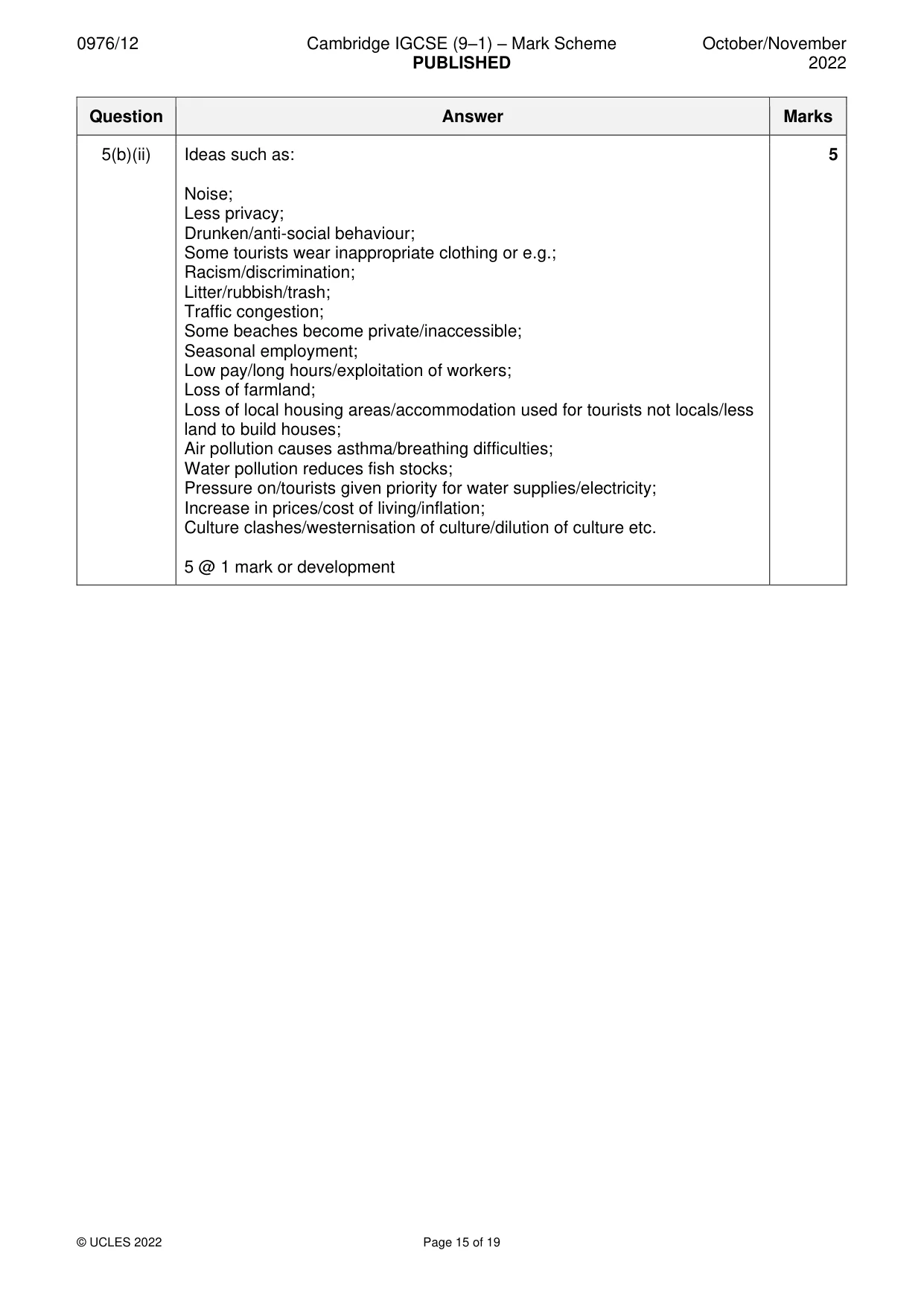
0976/12 Cambridge IGCSE (9–1) – Mark Scheme PUBLISHED October/November 2022 © UCLES 2022 Page 15 of 19 Question Answer Marks 5(b)(ii) Ideas such as: Noise; Less privacy; Drunken/anti-social behaviour; Some tourists wear inappropriate clothing or e.g.; Racism/discrimination; Litter/rubbish/trash; Traffic congestion; Some beaches become private/inaccessible; Seasonal employment; Low pay/long hours/exploitation of workers; Loss of farmland; Loss of local housing areas/accommodation used for tourists not locals/less land to build houses; Air pollution causes asthma/breathing difficulties; Water pollution reduces fish stocks; Pressure on/tourists given priority for water supplies/electricity; Increase in prices/cost of living/inflation; Culture clashes/westernisation of culture/dilution of culture etc. 5 @ 1 mark or development 5
Mark scheme, page 16
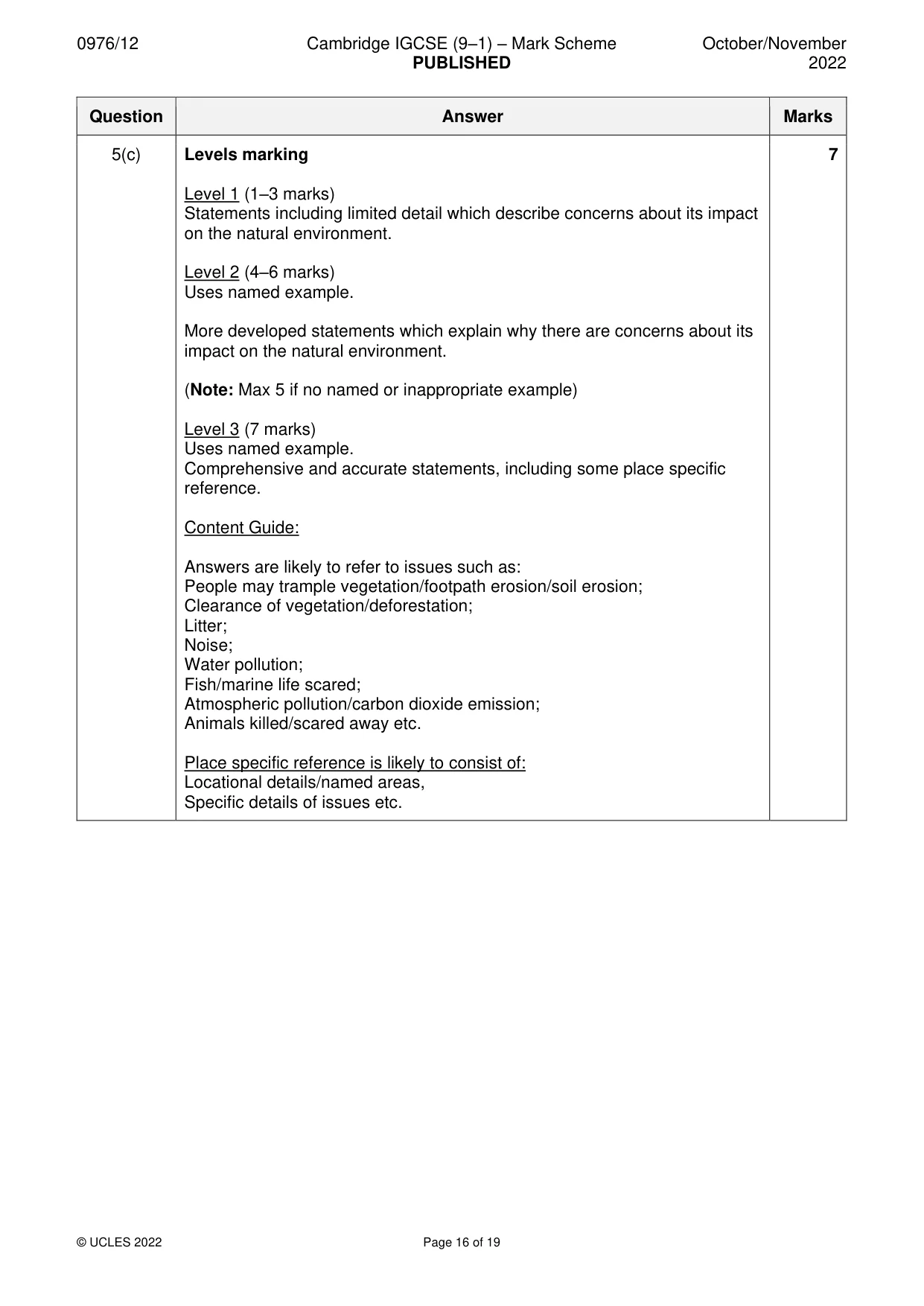
0976/12 Cambridge IGCSE (9–1) – Mark Scheme PUBLISHED October/November 2022 © UCLES 2022 Page 16 of 19 Question Answer Marks 5(c) Levels marking Level 1 (1–3 marks) Statements including limited detail which describe concerns about its impact on the natural environment. Level 2 (4–6 marks) Uses named example. More developed statements which explain why there are concerns about its impact on the natural environment. (Note: Max 5 if no named or inappropriate example) Level 3 (7 marks) Uses named example. Comprehensive and accurate statements, including some place specific reference. Content Guide: Answers are likely to refer to issues such as: People may trample vegetation/footpath erosion/soil erosion; Clearance of vegetation/deforestation; Litter; Noise; Water pollution; Fish/marine life scared; Atmospheric pollution/carbon dioxide emission; Animals killed/scared away etc. Place specific reference is likely to consist of: Locational details/named areas, Specific details of issues etc. 7
Mark scheme, page 17
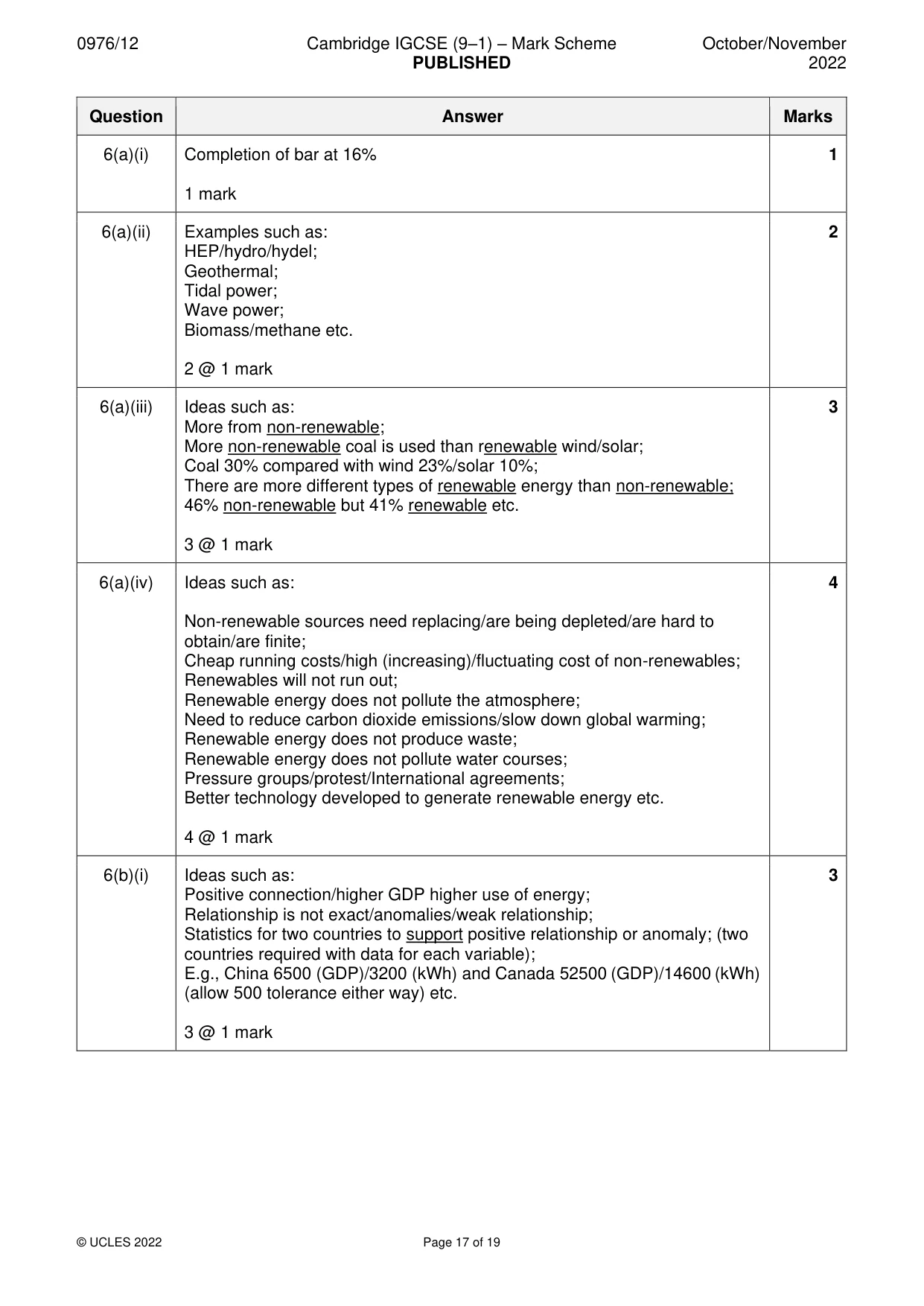
0976/12 Cambridge IGCSE (9–1) – Mark Scheme PUBLISHED October/November 2022 © UCLES 2022 Page 17 of 19 Question Answer Marks 6(a)(i) Completion of bar at 16% 1 mark 1 6(a)(ii) Examples such as: HEP/hydro/hydel; Geothermal; Tidal power; Wave power; Biomass/methane etc. 2 @ 1 mark 2 6(a)(iii) Ideas such as: More from non-renewable; More non-renewable coal is used than renewable wind/solar; Coal 30% compared with wind 23%/solar 10%; There are more different types of renewable energy than non-renewable; 46% non-renewable but 41% renewable etc. 3 @ 1 mark 3 6(a)(iv) Ideas such as: Non-renewable sources need replacing/are being depleted/are hard to obtain/are finite; Cheap running costs/high (increasing)/fluctuating cost of non-renewables; Renewables will not run out; Renewable energy does not pollute the atmosphere; Need to reduce carbon dioxide emissions/slow down global warming; Renewable energy does not produce waste; Renewable energy does not pollute water courses; Pressure groups/protest/International agreements; Better technology developed to generate renewable energy etc. 4 @ 1 mark 4 6(b)(i) Ideas such as: Positive connection/higher GDP higher use of energy; Relationship is not exact/anomalies/weak relationship; Statistics for two countries to support positive relationship or anomaly; (two countries required with data for each variable); E.g., China 6500 (GDP)/3200 (kWh) and Canada 52500 (GDP)/14600 (kWh) (allow 500 tolerance either way) etc. 3 @ 1 mark 3
Mark scheme, page 18
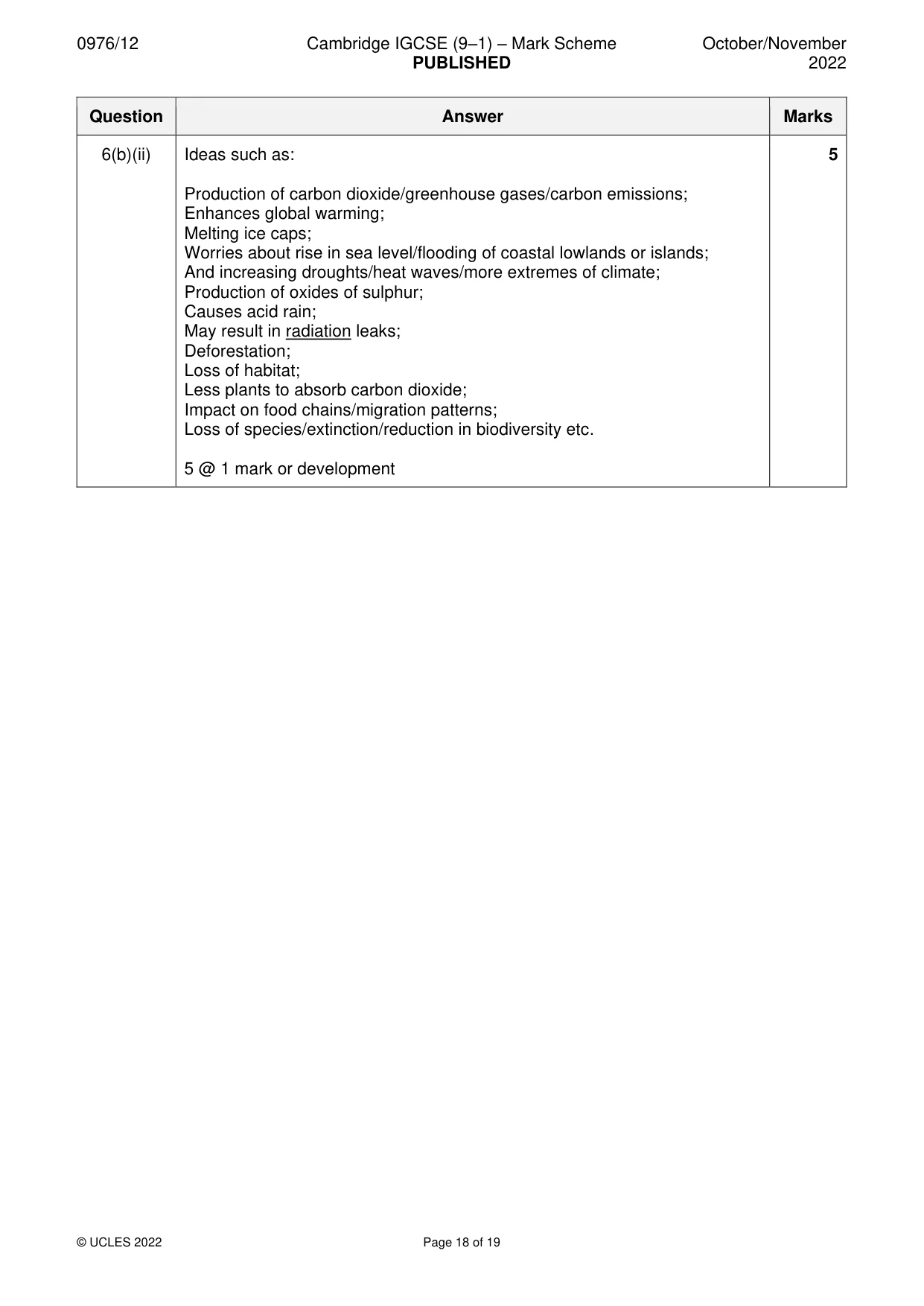
0976/12 Cambridge IGCSE (9–1) – Mark Scheme PUBLISHED October/November 2022 © UCLES 2022 Page 18 of 19 Question Answer Marks 6(b)(ii) Ideas such as: Production of carbon dioxide/greenhouse gases/carbon emissions; Enhances global warming; Melting ice caps; Worries about rise in sea level/flooding of coastal lowlands or islands; And increasing droughts/heat waves/more extremes of climate; Production of oxides of sulphur; Causes acid rain; May result in radiation leaks; Deforestation; Loss of habitat; Less plants to absorb carbon dioxide; Impact on food chains/migration patterns; Loss of species/extinction/reduction in biodiversity etc. 5 @ 1 mark or development 5
Mark scheme, page 19
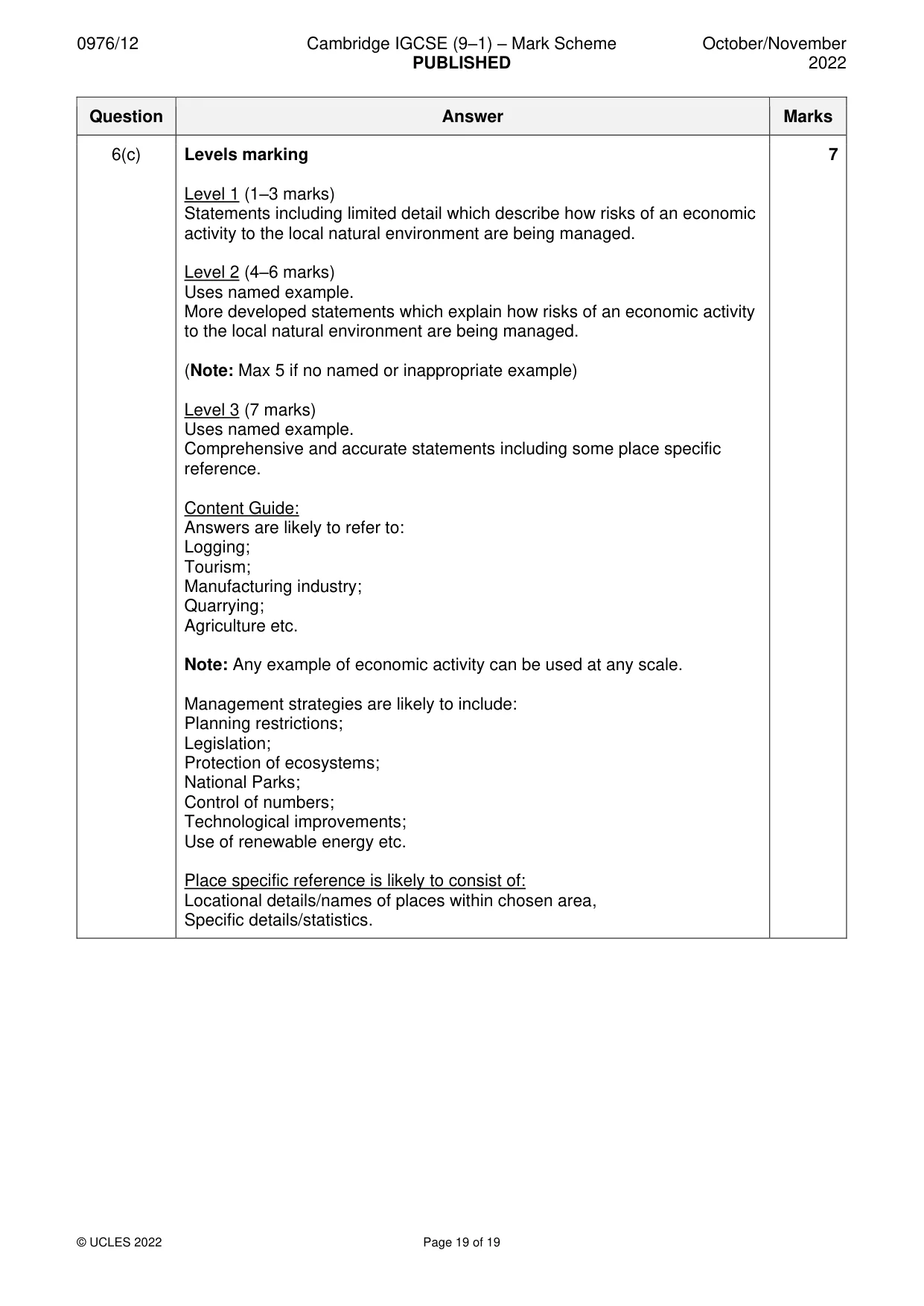
0976/12 Cambridge IGCSE (9–1) – Mark Scheme PUBLISHED October/November 2022 © UCLES 2022 Page 19 of 19 Question Answer Marks 6(c) Levels marking Level 1 (1–3 marks) Statements including limited detail which describe how risks of an economic activity to the local natural environment are being managed. Level 2 (4–6 marks) Uses named example. More developed statements which explain how risks of an economic activity to the local natural environment are being managed. (Note: Max 5 if no named or inappropriate example) Level 3 (7 marks) Uses named example. Comprehensive and accurate statements including some place specific reference. Content Guide: Answers are likely to refer to: Logging; Tourism; Manufacturing industry; Quarrying; Agriculture etc. Note: Any example of economic activity can be used at any scale. Management strategies are likely to include: Planning restrictions; Legislation; Protection of ecosystems; National Parks; Control of numbers; Technological improvements; Use of renewable energy etc. Place specific reference is likely to consist of: Locational details/names of places within chosen area, Specific details/statistics. 7
What you needed in this session
Cambridge’s own grade thresholds for 2022 Oct/Nov, Paper 1 · Variant 2. A higher threshold means an easier paper — the bar moves with how the cohort did.