Cambridge IGCSE Geography 0460 — 2011 May/June Paper 5 · Variant 1
0460/51/M/J/11 · 60 marks · ≈68 min
The question paper and its mark scheme, free to read here and free to download. This is Cambridge’s own paper, exactly as it was sat.
Question paper1 pages
Mark scheme5 pages
Answers below. Sit the paper first if you are practising.
Paper as text
Question paper, page 1
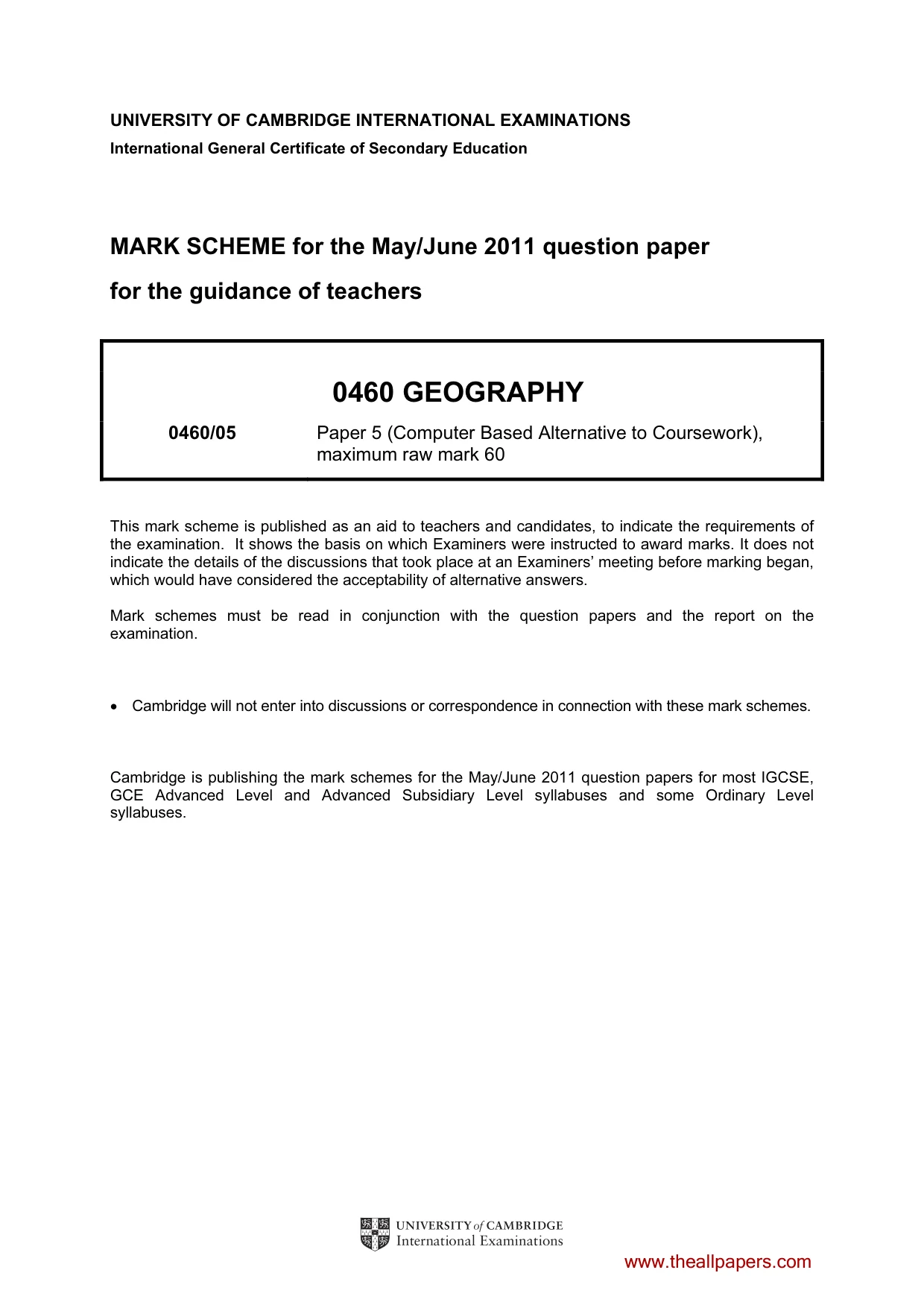
Opening and running the CIE IGCSE Geography Computer Based Test 0460/05 – June 2011 Technical Requirement: To run this test you will need: • A PC with an Internet browser • Adobe Flash player version 8 or higher. If you do not have the Flash player installed on your machine, you can get it here: http://www.adobe.com/products/flashplayer/ To unzip the file You will need a copy of winzip. If you do not have one already, you can get it here: http://www.winzip.com 1. Save the zip file to a suitable location. 2. Double click the zip file and follow the wizard to install the contents to a suitable location To run the test Double click on the file TestPreview.htm You will see this screen: Do not write anything In the Candidate Number box Do not write anything in the Password box Click Submit On the next screen, click Continue On the next screen click Start Test You will a screen like this: Candidates should read the Introduction and the Information File and may use the Notepad and Calculator tools. To close any of those windows, click the x in the top right hand corner of the window. To move through the questions, either click the next button or click the question number at the bottom of the screen. The test lasts for 90 minutes. There is a time counter at the top of the screen. www.theallpapers.com
Mark scheme, page 1
UNIVERSITY OF CAMBRIDGE INTERNATIONAL EXAMINATIONS International General Certificate of Secondary Education MARK SCHEME for the May/June 2011 question paper for the guidance of teachers 0460 GEOGRAPHY 0460/05 Paper 5 (Computer Based Alternative to Coursework), maximum raw mark 60 This mark scheme is published as an aid to teachers and candidates, to indicate the requirements of the examination. It shows the basis on which Examiners were instructed to award marks. It does not indicate the details of the discussions that took place at an Examiners’ meeting before marking began, which would have considered the acceptability of alternative answers. Mark schemes must be read in conjunction with the question papers and the report on the examination. • Cambridge will not enter into discussions or correspondence in connection with these mark schemes. Cambridge is publishing the mark schemes for the May/June 2011 question papers for most IGCSE, GCE Advanced Level and Advanced Subsidiary Level syllabuses and some Ordinary Level syllabuses. www.theallpapers.com
Mark scheme, page 2
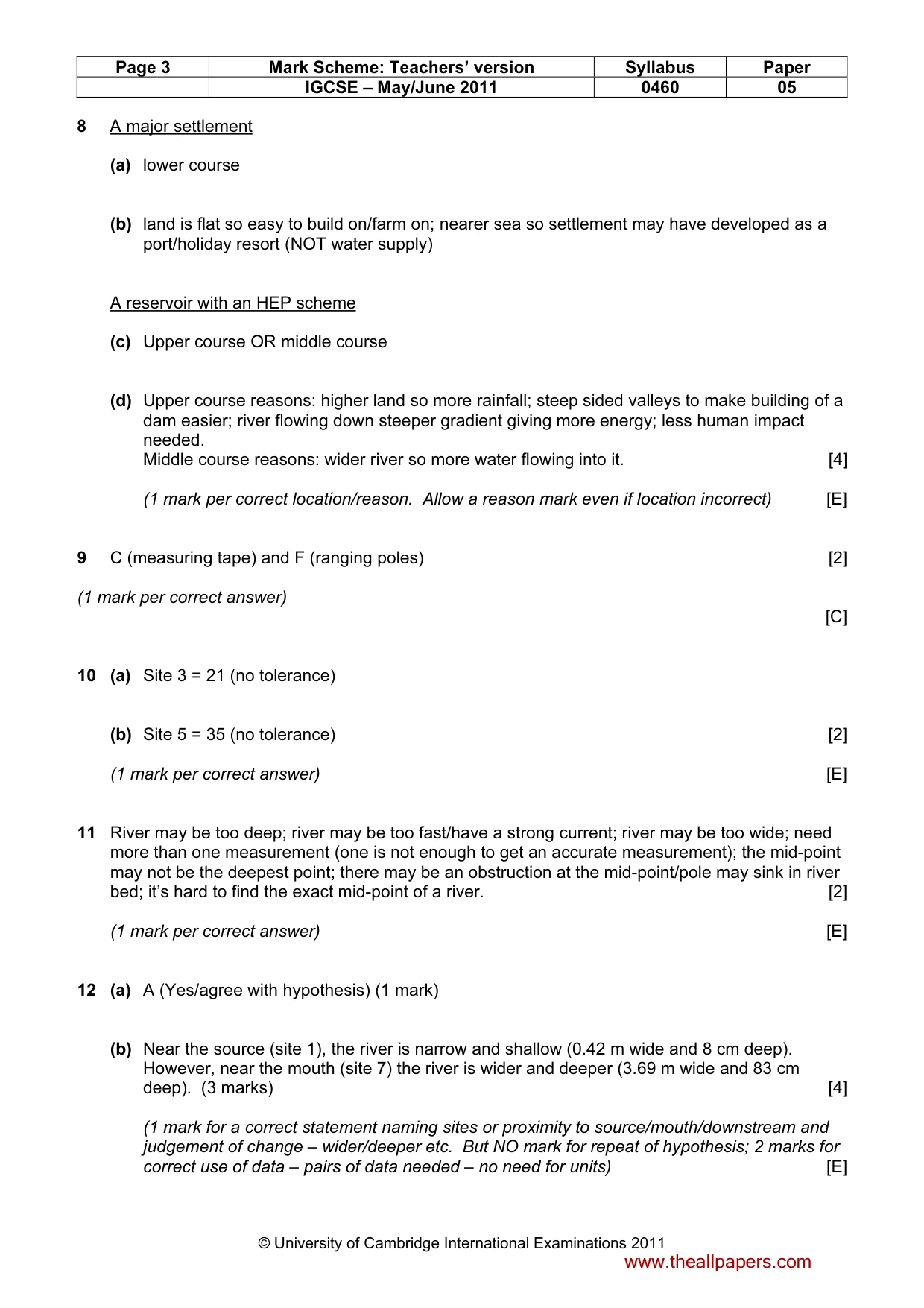
Page 2 Mark Scheme: Teachers’ version Syllabus Paper IGCSE – May/June 2011 0460 05 © University of Cambridge International Examinations 2011 1 Mouth = D; source = A; tributary = E; watershed = C; [4] (1 mark for each correct answer) [C] 2 Meander = lower; rapids = middle; v shaped valley = upper [3] (1 mark for each correct answer) [C] 3 1 = a band of soft (less resistant) rock; 2 = a plunge pool; 3 = a band of hard (resistant) rock [3] (1 mark for each correct answer) [C] 4 Correct sequence = D, B ,A, C [4] (1 mark for each correct answer) [C] 5 A = deposition, B = erosion [2] (1 mark for each correct answer) [C] 6 Site 1 = D (110m); site 4 = C (47m) [2] (1 mark for each correct answer) [C] 7 Bars dragged to correct points: Site 5 = 82 metres; site 6 = 60 metres; site 7 = 38 metres [3] (1 mark per correct answer – no tolerance) [E] www.theallpapers.com
Mark scheme, page 3
Page 3 Mark Scheme: Teachers’ version Syllabus Paper IGCSE – May/June 2011 0460 05 © University of Cambridge International Examinations 2011 8 A major settlement (a) lower course (b) land is flat so easy to build on/farm on; nearer sea so settlement may have developed as a port/holiday resort (NOT water supply) A reservoir with an HEP scheme (c) Upper course OR middle course (d) Upper course reasons: higher land so more rainfall; steep sided valleys to make building of a dam easier; river flowing down steeper gradient giving more energy; less human impact needed. Middle course reasons: wider river so more water flowing into it. [4] (1 mark per correct location/reason. Allow a reason mark even if location incorrect) [E] 9 C (measuring tape) and F (ranging poles) [2] (1 mark per correct answer) [C] 10 (a) Site 3 = 21 (no tolerance) (b) Site 5 = 35 (no tolerance) [2] (1 mark per correct answer) [E] 11 River may be too deep; river may be too fast/have a strong current; river may be too wide; need more than one measurement (one is not enough to get an accurate measurement); the mid-point may not be the deepest point; there may be an obstruction at the mid-point/pole may sink in river bed; it’s hard to find the exact mid-point of a river. [2] (1 mark per correct answer) [E] 12 (a) A (Yes/agree with hypothesis) (1 mark) (b) Near the source (site 1), the river is narrow and shallow (0.42 m wide and 8 cm deep). However, near the mouth (site 7) the river is wider and deeper (3.69 m wide and 83 cm deep). (3 marks) [4] (1 mark for a correct statement naming sites or proximity to source/mouth/downstream and judgement of change – wider/deeper etc. But NO mark for repeat of hypothesis; 2 marks for correct use of data – pairs of data needed – no need for units) [E] www.theallpapers.com
Mark scheme, page 4
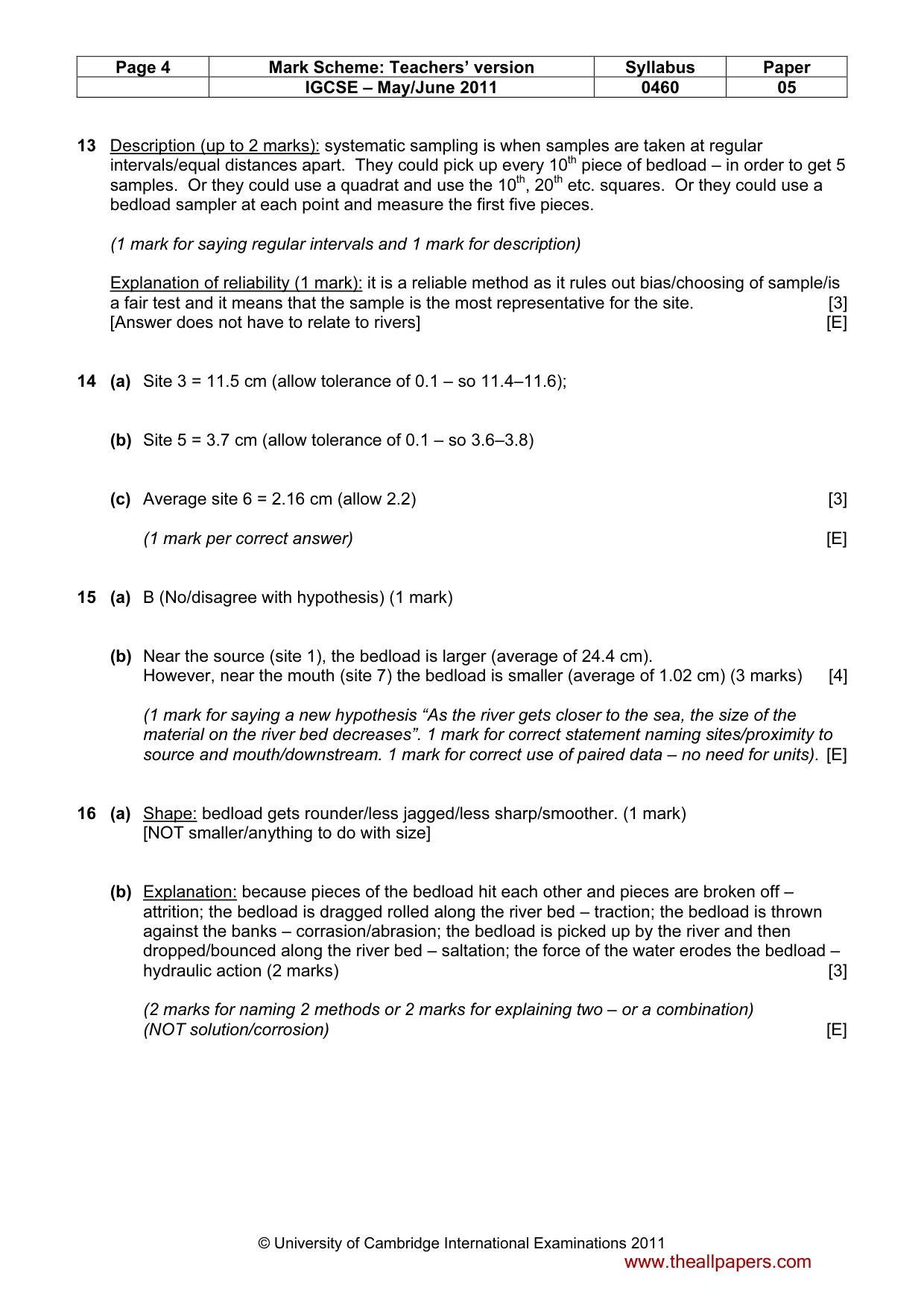
Page 4 Mark Scheme: Teachers’ version Syllabus Paper IGCSE – May/June 2011 0460 05 © University of Cambridge International Examinations 2011 13 Description (up to 2 marks): systematic sampling is when samples are taken at regular intervals/equal distances apart. They could pick up every 10th piece of bedload – in order to get 5 samples. Or they could use a quadrat and use the 10th, 20th etc. squares. Or they could use a bedload sampler at each point and measure the first five pieces. (1 mark for saying regular intervals and 1 mark for description) Explanation of reliability (1 mark): it is a reliable method as it rules out bias/choosing of sample/is a fair test and it means that the sample is the most representative for the site. [3] [Answer does not have to relate to rivers] [E] 14 (a) Site 3 = 11.5 cm (allow tolerance of 0.1 – so 11.4–11.6); (b) Site 5 = 3.7 cm (allow tolerance of 0.1 – so 3.6–3.8) (c) Average site 6 = 2.16 cm (allow 2.2) [3] (1 mark per correct answer) [E] 15 (a) B (No/disagree with hypothesis) (1 mark) (b) Near the source (site 1), the bedload is larger (average of 24.4 cm). However, near the mouth (site 7) the bedload is smaller (average of 1.02 cm) (3 marks) [4] (1 mark for saying a new hypothesis “As the river gets closer to the sea, the size of the material on the river bed decreases”. 1 mark for correct statement naming sites/proximity to source and mouth/downstream. 1 mark for correct use of paired data – no need for units). [E] 16 (a) Shape: bedload gets rounder/less jagged/less sharp/smoother. (1 mark) [NOT smaller/anything to do with size] (b) Explanation: because pieces of the bedload hit each other and pieces are broken off – attrition; the bedload is dragged rolled along the river bed – traction; the bedload is thrown against the banks – corrasion/abrasion; the bedload is picked up by the river and then dropped/bounced along the river bed – saltation; the force of the water erodes the bedload – hydraulic action (2 marks) [3] (2 marks for naming 2 methods or 2 marks for explaining two – or a combination) (NOT solution/corrosion) [E] www.theallpapers.com
Mark scheme, page 5
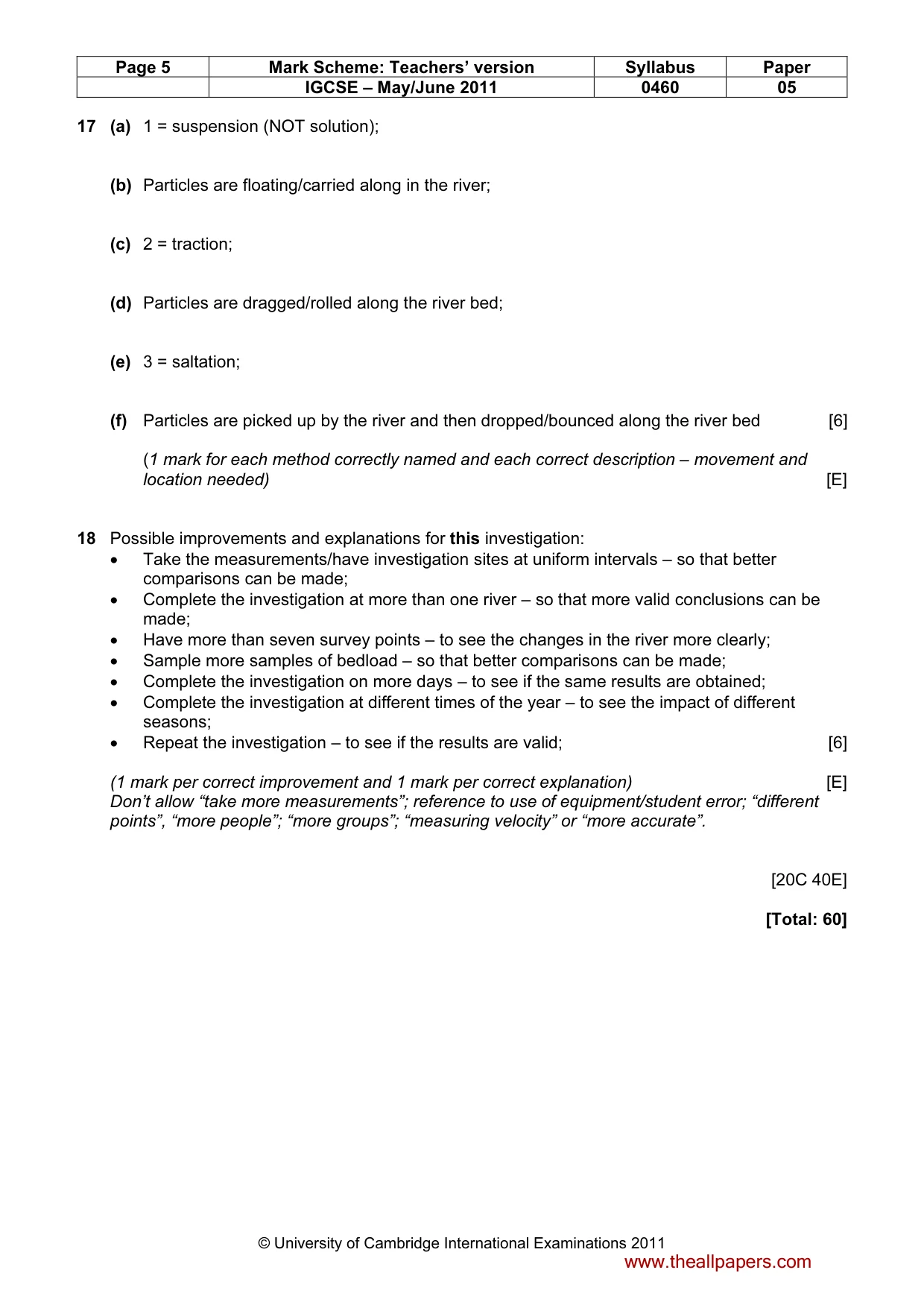
Page 5 Mark Scheme: Teachers’ version Syllabus Paper IGCSE – May/June 2011 0460 05 © University of Cambridge International Examinations 2011 17 (a) 1 = suspension (NOT solution); (b) Particles are floating/carried along in the river; (c) 2 = traction; (d) Particles are dragged/rolled along the river bed; (e) 3 = saltation; (f) Particles are picked up by the river and then dropped/bounced along the river bed [6] (1 mark for each method correctly named and each correct description – movement and location needed) [E] 18 Possible improvements and explanations for this investigation: • Take the measurements/have investigation sites at uniform intervals – so that better comparisons can be made; • Complete the investigation at more than one river – so that more valid conclusions can be made; • Have more than seven survey points – to see the changes in the river more clearly; • Sample more samples of bedload – so that better comparisons can be made; • Complete the investigation on more days – to see if the same results are obtained; • Complete the investigation at different times of the year – to see the impact of different seasons; • Repeat the investigation – to see if the results are valid; [6] (1 mark per correct improvement and 1 mark per correct explanation) [E] Don’t allow “take more measurements”; reference to use of equipment/student error; “different points”, “more people”; “more groups”; “measuring velocity” or “more accurate”. [20C 40E] [Total: 60] www.theallpapers.com
What you needed in this session
Cambridge’s own grade thresholds for 2011 May/June, Paper 5 · Variant 1. A higher threshold means an easier paper — the bar moves with how the cohort did.