Cambridge IGCSE Geography 0460 — 2008 May/June Paper 5 · Variant 1
0460/51/M/J/08 · 60 marks · ≈68 min
The question paper and its mark scheme, free to read here and free to download. This is Cambridge’s own paper, exactly as it was sat.
Question paper2 pages
Mark scheme5 pages
Answers below. Sit the paper first if you are practising.
Paper as text
Question paper, page 1
CIE IGCSE Geography Computer Based Test 0460/05 Warning: The test is a very large file (the test contains video clips), over 30 Megabytes in size, and will take some time to download. Technical Requirements: To run this test you will need: • A PC running Microsoft Windows XP or 2000 with an Internet browser • Adobe Flash Player version 8 or higher If you do not have Adobe Flash player installed on your machine, you can download it here: http://www.adobe.com/products/flashplayer Downloading and Extracting the Test: 1. On the Teacher Support website, click on the June 2008 Paper 5 Supporting Files link. 2. Save the Zip file to a suitable location. 3. Extract the contents of the Zip file to a suitable location; this will create a folder named 0460-05 which will contain all of the files necessary to run the test. (If you do not already have an application on your PC to extract the file you can download an evaluation version of WinZip from http://www.winzip.com) Running the Test: 1. To start the test, in the 0460-05 folder, double click on the file named LIBSTestPreview.htm (or LIBSTestPreview if you do not have your computer set to show filename extensions). This will launch the test in a browser window and you should see this screen: www.XtremePapers.com
Question paper, page 2
2. Do not write anything in the Candidate Number box 3. Do not write anything in the Password box 4. Click Submit 5. On the next screen please ignore the Candidate Details box and click Continue. 6. You may have to wait for some time (up to 10 minutes) for the test to prepare. 7. When you have read the instructions on the screen after this click Start Test 8. Candidates should read the Introduction and the Information File and may use the Notepad and Calculator tools. 9. To move through the questions, either click the Next button or click the question number at the bottom of the screen. The test lasts for 90 minutes. There is a time counter at the top of the screen.
Mark scheme, page 1
UNIVERSITY OF CAMBRIDGE INTERNATIONAL EXAMINATIONS International General Certificate of Secondary Education MARK SCHEME for the May/June 2008 question paper 0460 GEOGRAPHY 0460/05 Paper 5 (Computer Based Alternative to Coursework), maximum raw mark 60 This mark scheme is published as an aid to teachers and candidates, to indicate the requirements of the examination. It shows the basis on which Examiners were instructed to award marks. It does not indicate the details of the discussions that took place at an Examiners’ meeting before marking began. All Examiners are instructed that alternative correct answers and unexpected approaches in candidates’ scripts must be given marks that fairly reflect the relevant knowledge and skills demonstrated. Mark schemes must be read in conjunction with the question papers and the report on the examination. • CIE will not enter into discussions or correspondence in connection with these mark schemes. CIE is publishing the mark schemes for the May/June 2008 question papers for most IGCSE, GCE Advanced Level and Advanced Subsidiary Level syllabuses and some Ordinary Level syllabuses. www.XtremePapers.com
Mark scheme, page 2
Page 2 Mark Scheme Syllabus Paper IGCSE – May/June 2008 0460 05 © UCLES 2008 1 Answers in correct order: weathering, mass movement, corrosion (or solution), hydraulic action and corrasion (or abrasion). 3 marks for five correct answers, 2 marks for four correct answers and 1 mark for two or three correct answers. [3] 2 Overhanging cliff: keep away from/don’t stand on edge of cliff/don’t stand at foot of cliff. (1 mark) Getting cut off by tide: check tide times before fieldwork/do fieldwork at low tide. (1 mark) [2] 3 W = trough X = wave height Y = wave length Z = crest 2 marks for three or four correct answers, 1 mark for one or two correct answers. [2] 4 12 waves (allow any answer between 11 and 16) [1] 5 Bar for 12 waves (allow any bar between 11 and 16 – bar height must match answer for question 4). Mark allowed if incorrect answer in Q4 but bar is correctly drawn. 1 mark for correct length bar X axis: beach location/location/site/place Y axis: number of waves in one minute/number of waves per minute/number of waves/ waves per minute 1 mark for two correct axes labels. [2] 6 Answers in correct order: more, stronger, destructive 2 marks for three correct answers, 1 mark for two correct answers, 0 for one correct answer [2] 7 (a) Three pieces of equipment: B clinometer D ranging poles G tape measure 1 mark per correct piece [3] (b) 1 mark each for basic functions of equipment: clinometer (for measuring angle of beach); measuring tape/ruler (for measuring distance/length of profile). Third mark for development – explanation of use of ranging poles (for marking out sections of the beach to measure/to use with clinometer). [3]
Mark scheme, page 3
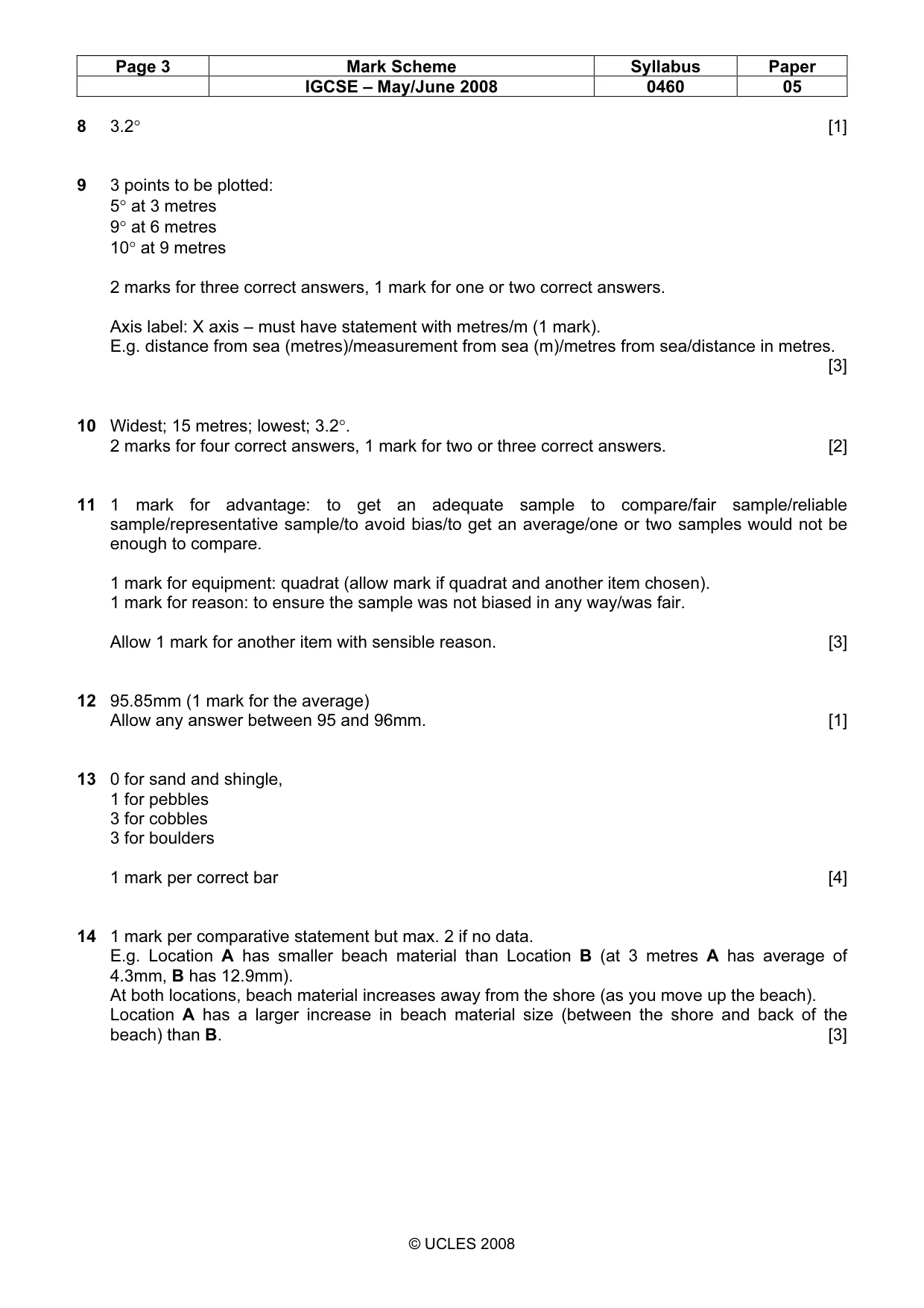
Page 3 Mark Scheme Syllabus Paper IGCSE – May/June 2008 0460 05 © UCLES 2008 8 3.2° [1] 9 3 points to be plotted: 5° at 3 metres 9° at 6 metres 10° at 9 metres 2 marks for three correct answers, 1 mark for one or two correct answers. Axis label: X axis – must have statement with metres/m (1 mark). E.g. distance from sea (metres)/measurement from sea (m)/metres from sea/distance in metres. [3] 10 Widest; 15 metres; lowest; 3.2°. 2 marks for four correct answers, 1 mark for two or three correct answers. [2] 11 1 mark for advantage: to get an adequate sample to compare/fair sample/reliable sample/representative sample/to avoid bias/to get an average/one or two samples would not be enough to compare. 1 mark for equipment: quadrat (allow mark if quadrat and another item chosen). 1 mark for reason: to ensure the sample was not biased in any way/was fair. Allow 1 mark for another item with sensible reason. [3] 12 95.85mm (1 mark for the average) Allow any answer between 95 and 96mm. [1] 13 0 for sand and shingle, 1 for pebbles 3 for cobbles 3 for boulders 1 mark per correct bar [4] 14 1 mark per comparative statement but max. 2 if no data. E.g. Location A has smaller beach material than Location B (at 3 metres A has average of 4.3mm, B has 12.9mm). At both locations, beach material increases away from the shore (as you move up the beach). Location A has a larger increase in beach material size (between the shore and back of the beach) than B. [3]
Mark scheme, page 4
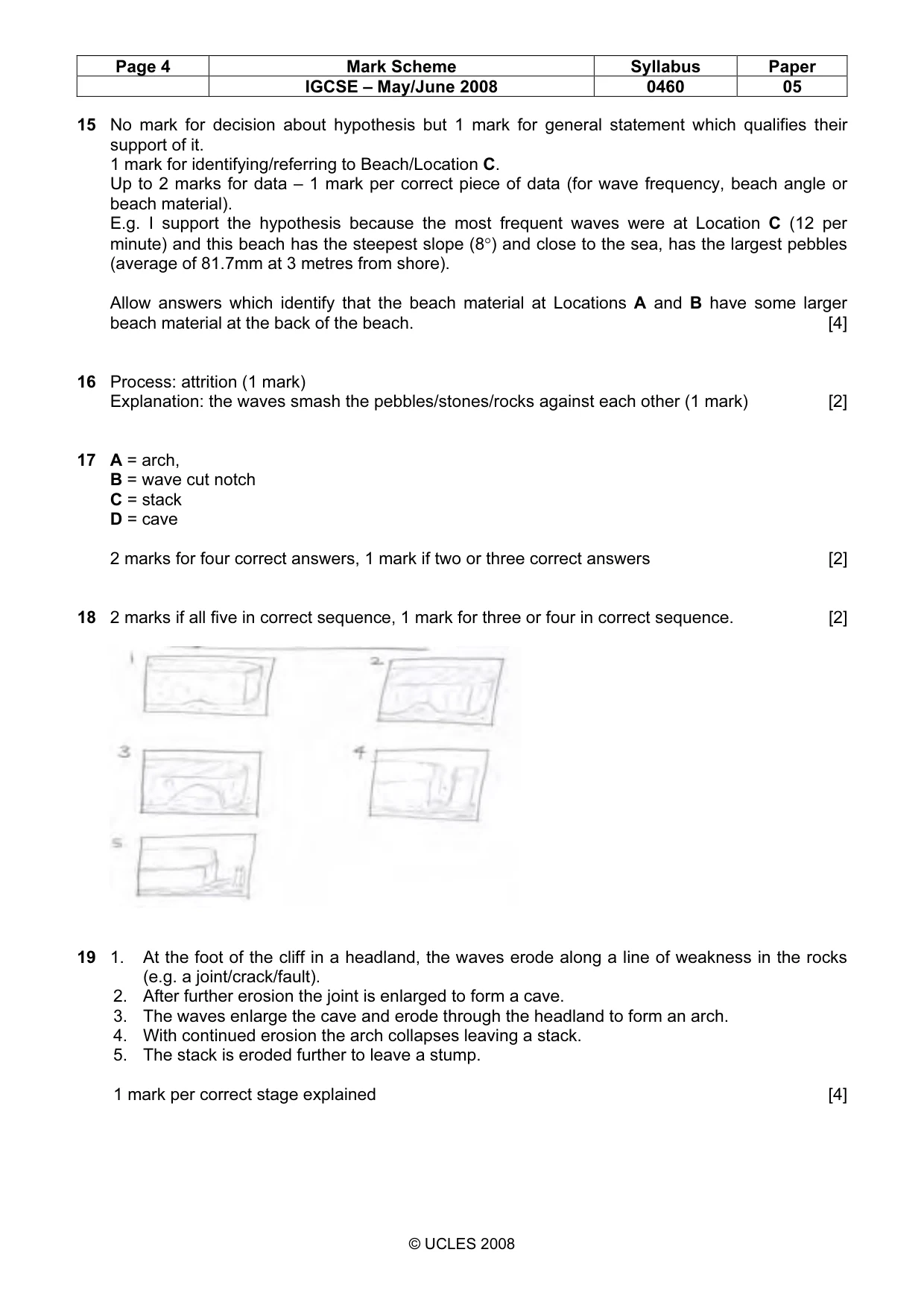
Page 4 Mark Scheme Syllabus Paper IGCSE – May/June 2008 0460 05 © UCLES 2008 15 No mark for decision about hypothesis but 1 mark for general statement which qualifies their support of it. 1 mark for identifying/referring to Beach/Location C. Up to 2 marks for data – 1 mark per correct piece of data (for wave frequency, beach angle or beach material). E.g. I support the hypothesis because the most frequent waves were at Location C (12 per minute) and this beach has the steepest slope (8°) and close to the sea, has the largest pebbles (average of 81.7mm at 3 metres from shore). Allow answers which identify that the beach material at Locations A and B have some larger beach material at the back of the beach. [4] 16 Process: attrition (1 mark) Explanation: the waves smash the pebbles/stones/rocks against each other (1 mark) [2] 17 A = arch, B = wave cut notch C = stack D = cave 2 marks for four correct answers, 1 mark if two or three correct answers [2] 18 2 marks if all five in correct sequence, 1 mark for three or four in correct sequence. [2] 19 1. At the foot of the cliff in a headland, the waves erode along a line of weakness in the rocks (e.g. a joint/crack/fault). 2. After further erosion the joint is enlarged to form a cave. 3. The waves enlarge the cave and erode through the headland to form an arch. 4. With continued erosion the arch collapses leaving a stack. 5. The stack is eroded further to leave a stump. 1 mark per correct stage explained [4]
Mark scheme, page 5
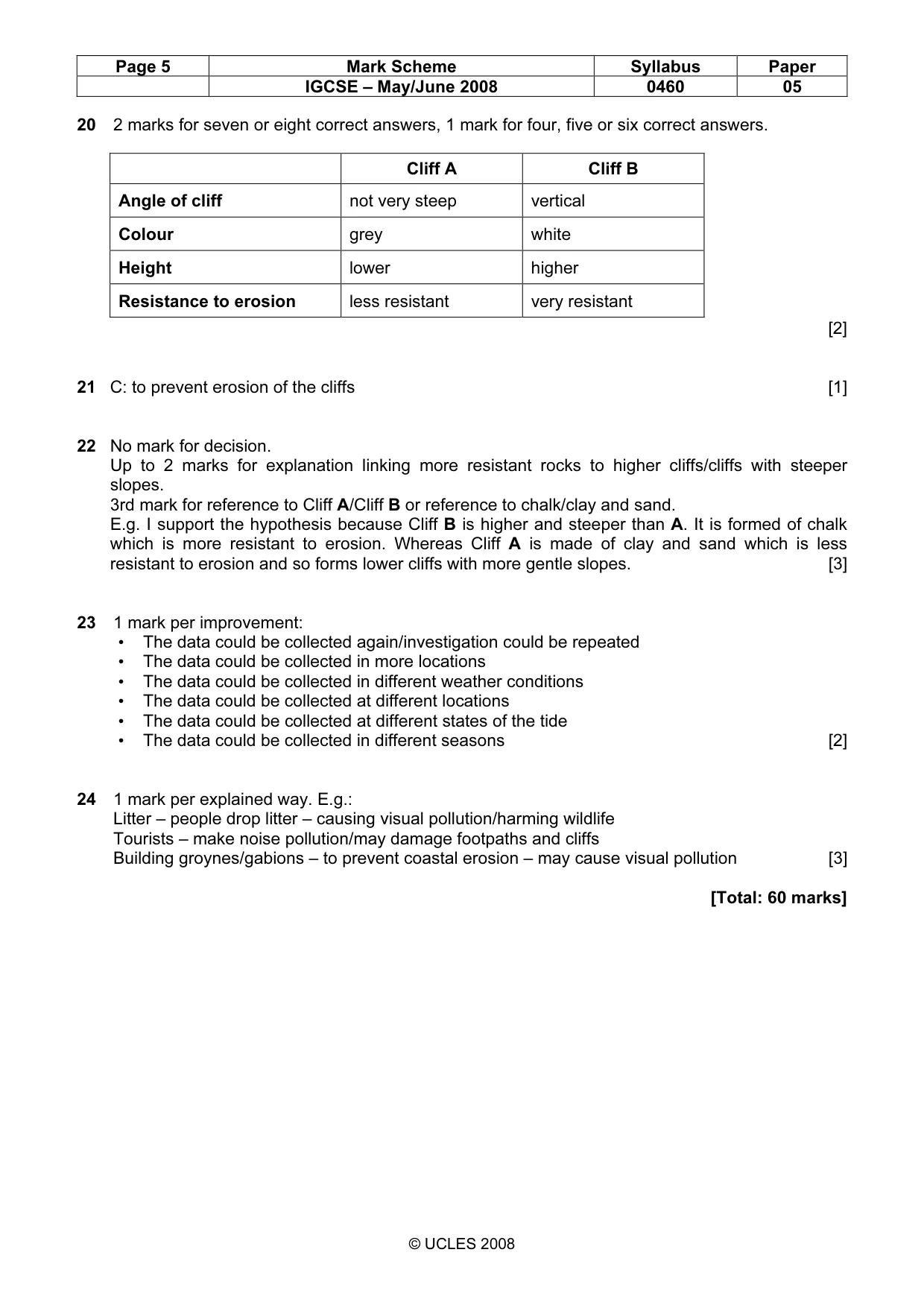
Page 5 Mark Scheme Syllabus Paper IGCSE – May/June 2008 0460 05 © UCLES 2008 20 2 marks for seven or eight correct answers, 1 mark for four, five or six correct answers. Cliff A Cliff B Angle of cliff not very steep vertical Colour grey white Height lower higher Resistance to erosion less resistant very resistant [2] 21 C: to prevent erosion of the cliffs [1] 22 No mark for decision. Up to 2 marks for explanation linking more resistant rocks to higher cliffs/cliffs with steeper slopes. 3rd mark for reference to Cliff A/Cliff B or reference to chalk/clay and sand. E.g. I support the hypothesis because Cliff B is higher and steeper than A. It is formed of chalk which is more resistant to erosion. Whereas Cliff A is made of clay and sand which is less resistant to erosion and so forms lower cliffs with more gentle slopes. [3] 23 1 mark per improvement: • The data could be collected again/investigation could be repeated • The data could be collected in more locations • The data could be collected in different weather conditions • The data could be collected at different locations • The data could be collected at different states of the tide • The data could be collected in different seasons [2] 24 1 mark per explained way. E.g.: Litter – people drop litter – causing visual pollution/harming wildlife Tourists – make noise pollution/may damage footpaths and cliffs Building groynes/gabions – to prevent coastal erosion – may cause visual pollution [3] [Total: 60 marks]
What you needed in this session
Cambridge’s own grade thresholds for 2008 May/June, Paper 5 · Variant 1. A higher threshold means an easier paper — the bar moves with how the cohort did.