Cambridge IGCSE French (9-1) 7156 — 2023 May/June Paper 2 · Variant 2
7156/22/M/J/23 · 45 marks · ≈51 min
The question paper and its mark scheme, free to read here and free to download. This is Cambridge’s own paper, exactly as it was sat.
Question paper12 pages

Mark scheme8 pages
Answers below. Sit the paper first if you are practising.
Paper as text
Question paper, page 1
This document has 12 pages. Any blank pages are indicated. [Turn over Cambridge IGCSE™(9–1) FRENCH 7156/22 Paper 2 Reading May/June 2023 1 hour You must answer on the question paper. No additional materials are needed. INSTRUCTIONS ● Answer all questions. ● Use a black or dark blue pen. ● Write your name, centre number and candidate number in the boxes at the top of the page. ● Write your answer to each question in the space provided. ● Do not use an erasable pen or correction fluid. ● Do not write on any bar codes. ● Dictionaries are not allowed. INFORMATION ● The total mark for this paper is 45. ● The number of marks for each question or part question is shown in brackets [ ]. * 8 2 2 2 1 7 8 7 6 8 * DC (LO) 327435 © UCLES 2023
Question paper, page 2
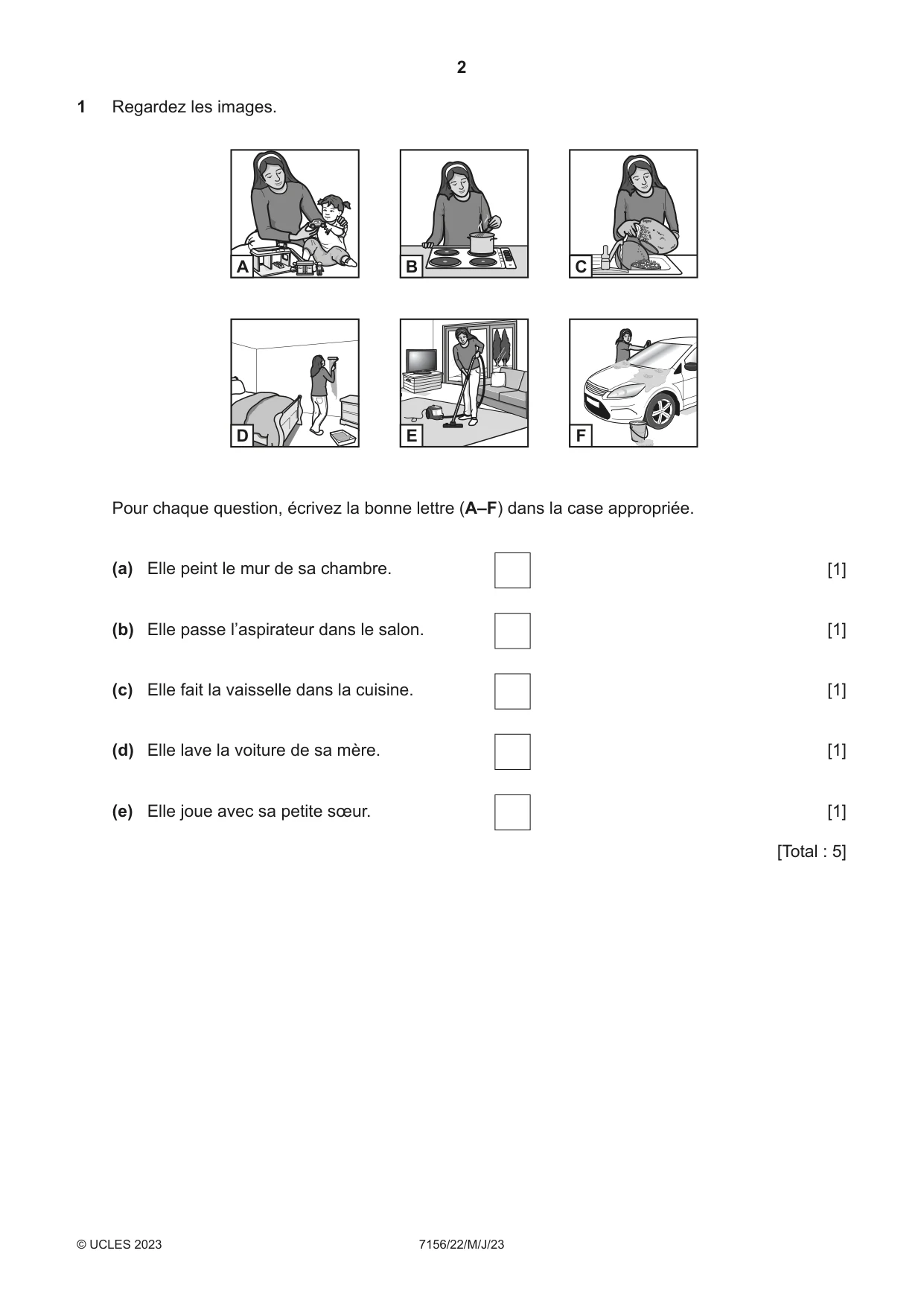
2 7156/22/ M / J /23 © UCLES 2023 1 Regardez les images. A B C D E F Pour chaque question, écrivez la bonne lettre (A–F) dans la case appropriée. (a) Elle peint le mur de sa chambre. [1] (b) Elle passe l’aspirateur dans le salon. [1] (c) Elle fait la vaisselle dans la cuisine. [1] (d) Elle lave la voiture de sa mère. [1] (e) Elle joue avec sa petite sœur. [1] [Total : 5]
Question paper, page 3
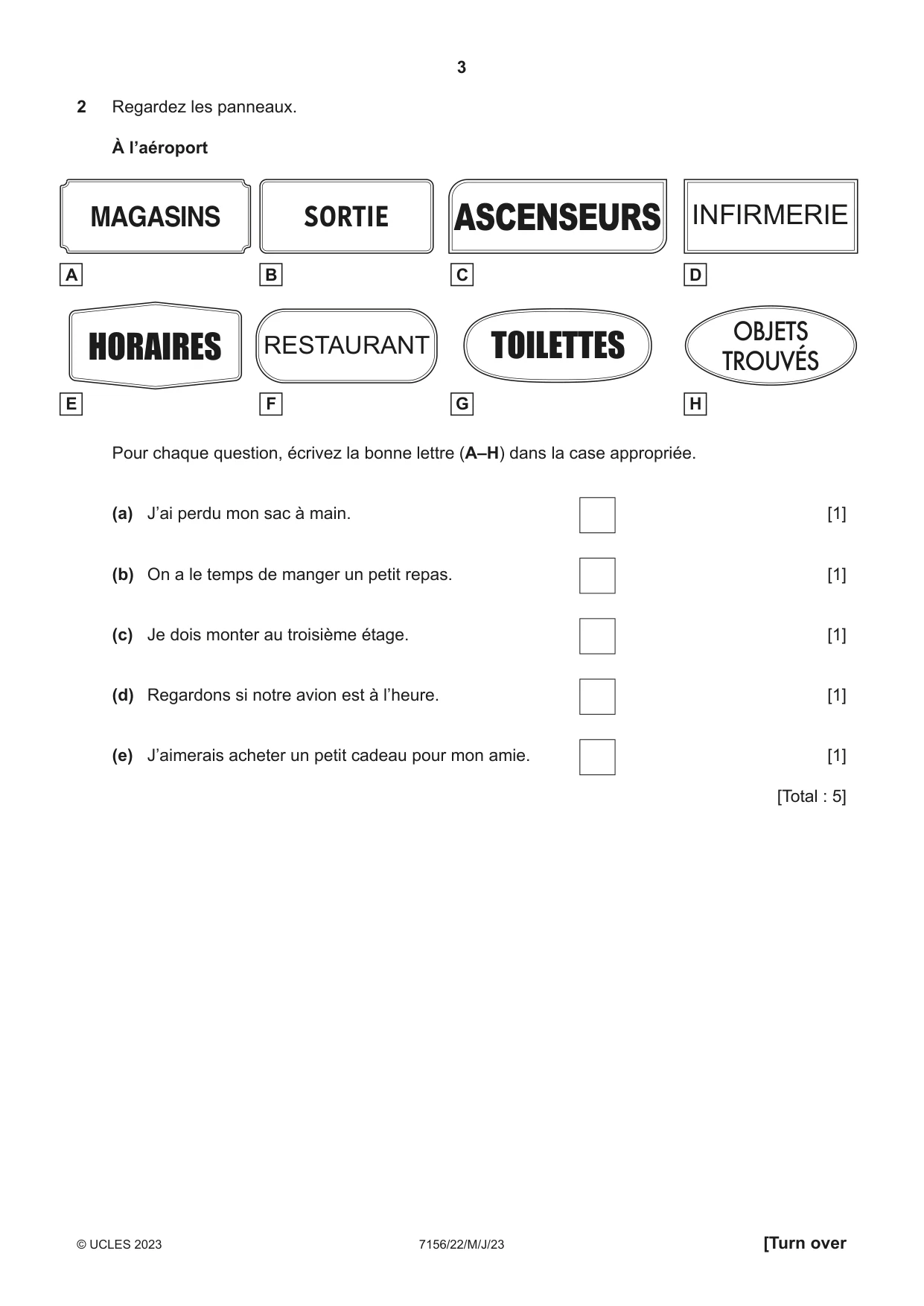
3 7156/22/M/J/23 © UCLES 2023 [Turn over 2 Regardez les panneaux. À l’aéroport MAGASINS HORAIRES RESTAURANT ASCENSEURS SORTIE TOILETTES INFIRMERIE OBJETS TROUVÉS A B C D E F G H Pour chaque question, écrivez la bonne lettre (A–H) dans la case appropriée. (a) J’ai perdu mon sac à main. [1] (b) On a le temps de manger un petit repas. [1] (c) Je dois monter au troisième étage. [1] (d) Regardons si notre avion est à l’heure. [1] (e) J’aimerais acheter un petit cadeau pour mon amie. [1] [Total : 5]
Question paper, page 4
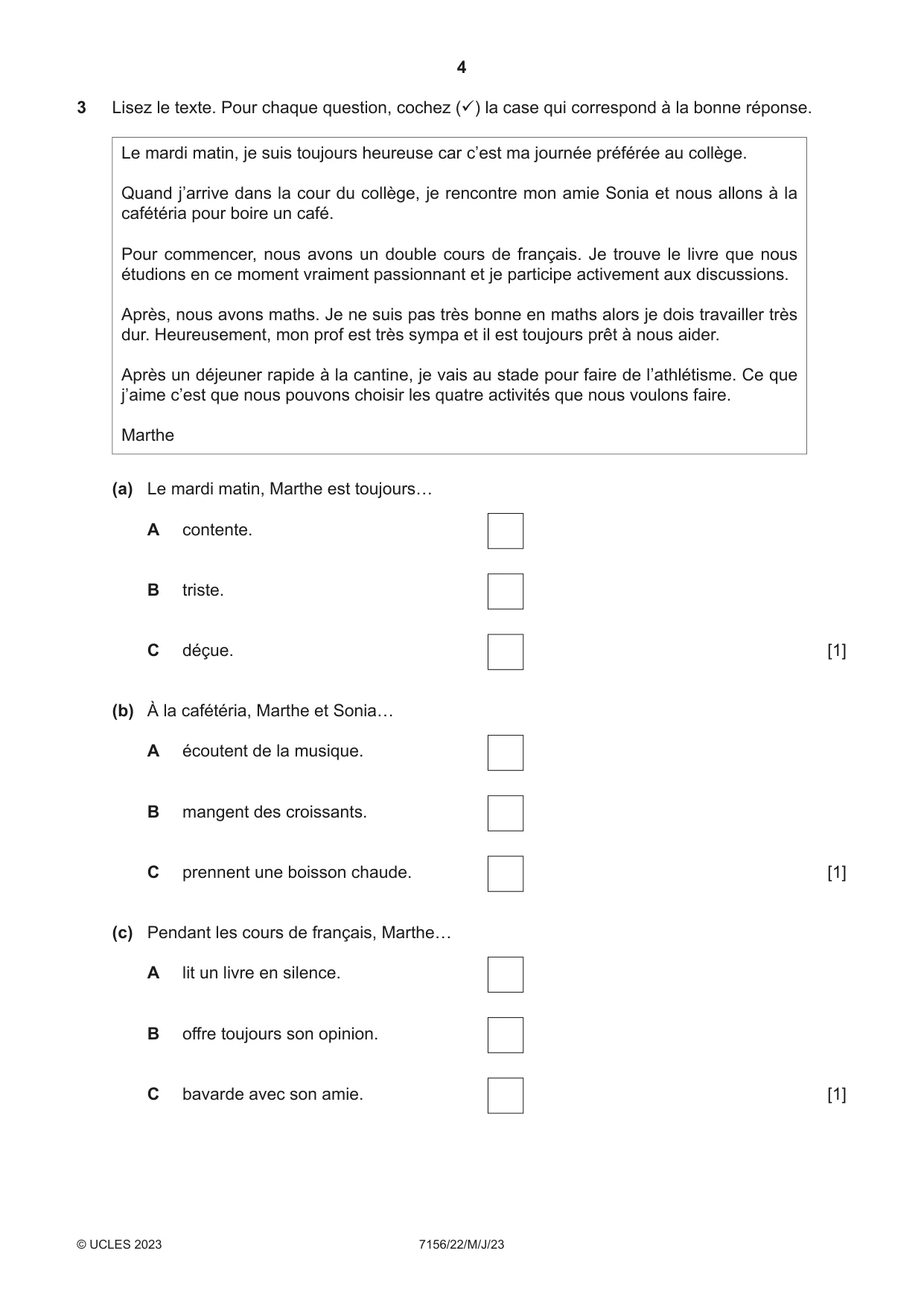
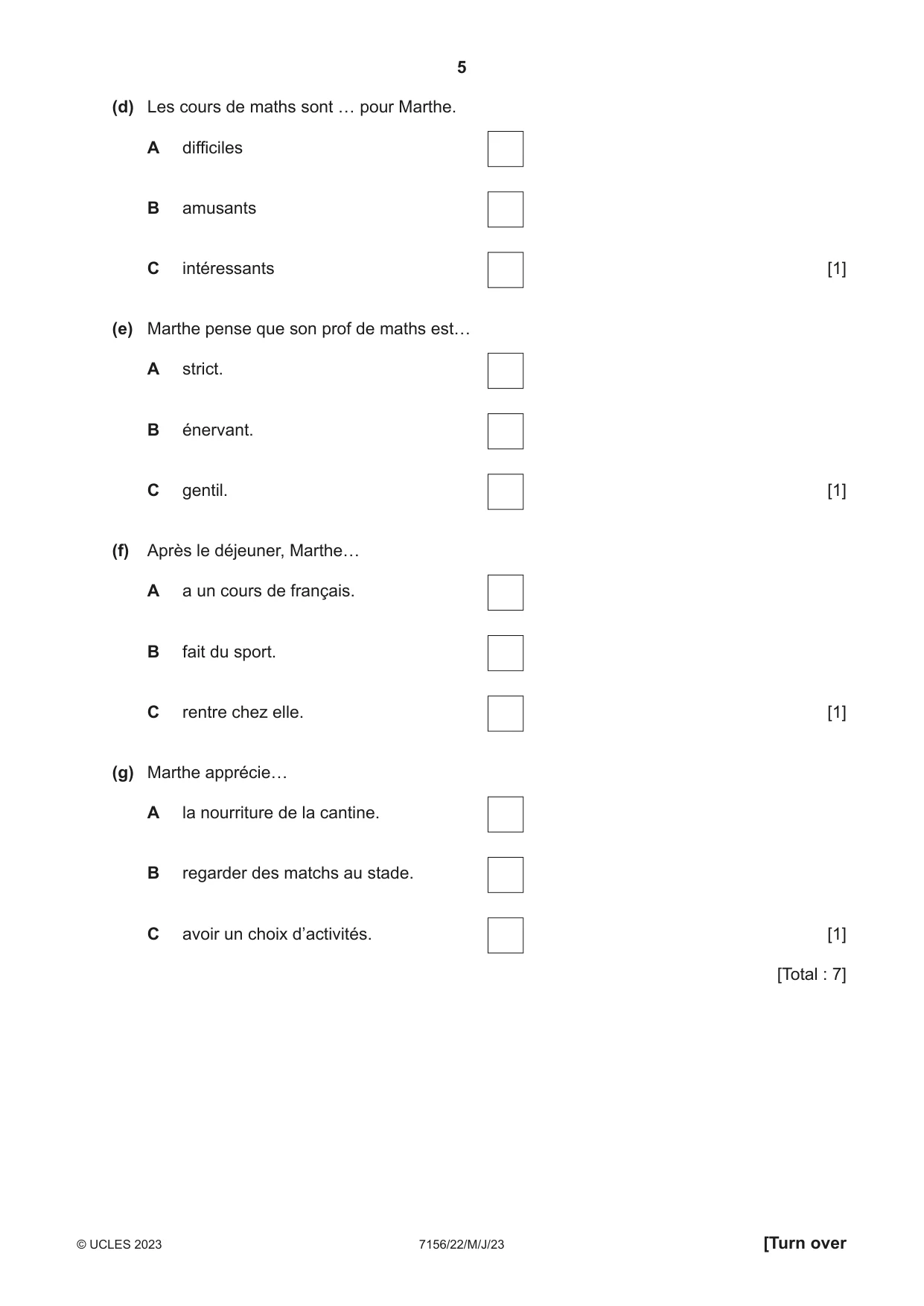
4 7156/22/M/J/23 © UCLES 2023 3 Lisez le texte. Pour chaque question, cochez () la case qui correspond à la bonne réponse. Le mardi matin, je suis toujours heureuse car c’est ma journée préférée au collège. Quand j’arrive dans la cour du collège, je rencontre mon amie Sonia et nous allons à la cafétéria pour boire un café. Pour commencer, nous avons un double cours de français. Je trouve le livre que nous étudions en ce moment vraiment passionnant et je participe activement aux discussions. Après, nous avons maths. Je ne suis pas très bonne en maths alors je dois travailler très dur. Heureusement, mon prof est très sympa et il est toujours prêt à nous aider. Après un déjeuner rapide à la cantine, je vais au stade pour faire de l’athlétisme. Ce que j’aime c’est que nous pouvons choisir les quatre activités que nous voulons faire. Marthe (a) Le mardi matin, Marthe est toujours… A contente. B triste. C déçue. [1] (b) À la cafétéria, Marthe et Sonia… A écoutent de la musique. B mangent des croissants. C prennent une boisson chaude. [1] (c) Pendant les cours de français, Marthe… A lit un livre en silence. B offre toujours son opinion. C bavarde avec son amie. [1]
Question paper, page 5
5 7156/22/M/J/23 © UCLES 2023 [Turn over (d) Les cours de maths sont … pour Marthe. A difficiles B amusants C intéressants [1] (e) Marthe pense que son prof de maths est… A strict. B énervant. C gentil. [1] (f) Après le déjeuner, Marthe… A a un cours de français. B fait du sport. C rentre chez elle. [1] (g) Marthe apprécie… A la nourriture de la cantine. B regarder des matchs au stade. C avoir un choix d’activités. [1] [Total : 7]
Question paper, page 6
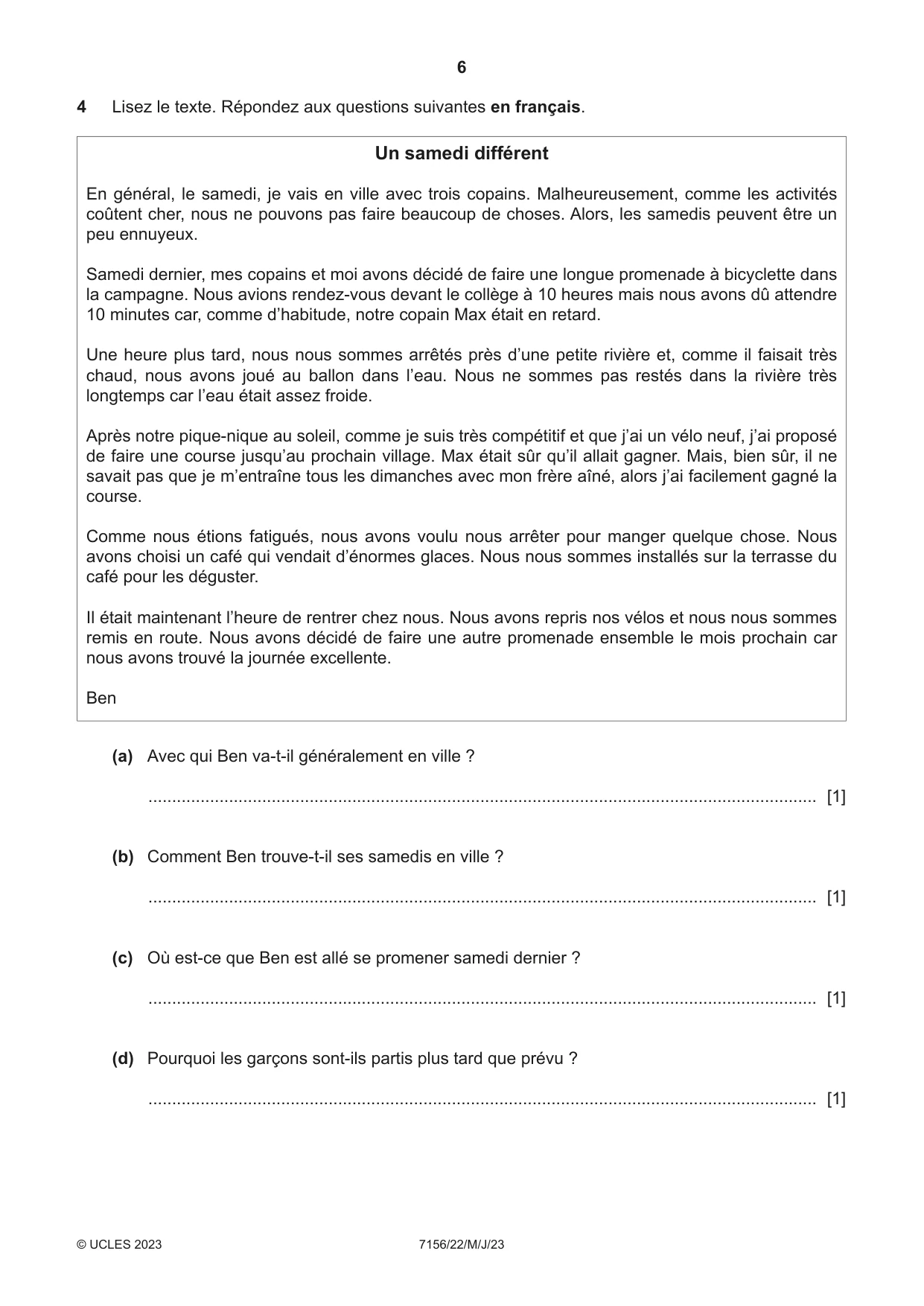
6 7156/22/M/J/23 © UCLES 2023 4 Lisez le texte. Répondez aux questions suivantes en français. Un samedi différent En général, le samedi, je vais en ville avec trois copains. Malheureusement, comme les activités coûtent cher, nous ne pouvons pas faire beaucoup de choses. Alors, les samedis peuvent être un peu ennuyeux. Samedi dernier, mes copains et moi avons décidé de faire une longue promenade à bicyclette dans la campagne. Nous avions rendez-vous devant le collège à 10 heures mais nous avons dû attendre 10 minutes car, comme d’habitude, notre copain Max était en retard. Une heure plus tard, nous nous sommes arrêtés près d’une petite rivière et, comme il faisait très chaud, nous avons joué au ballon dans l’eau. Nous ne sommes pas restés dans la rivière très longtemps car l’eau était assez froide. Après notre pique-nique au soleil, comme je suis très compétitif et que j’ai un vélo neuf, j’ai proposé de faire une course jusqu’au prochain village. Max était sûr qu’il allait gagner. Mais, bien sûr, il ne savait pas que je m’entraîne tous les dimanches avec mon frère aîné, alors j’ai facilement gagné la course. Comme nous étions fatigués, nous avons voulu nous arrêter pour manger quelque chose. Nous avons choisi un café qui vendait d’énormes glaces. Nous nous sommes installés sur la terrasse du café pour les déguster. Il était maintenant l’heure de rentrer chez nous. Nous avons repris nos vélos et nous nous sommes remis en route. Nous avons décidé de faire une autre promenade ensemble le mois prochain car nous avons trouvé la journée excellente. Ben (a) Avec qui Ben va-t-il généralement en ville ? … [1] (b) Comment Ben trouve-t-il ses samedis en ville ? … [1] (c) Où est-ce que Ben est allé se promener samedi dernier ? … [1] (d) Pourquoi les garçons sont-ils partis plus tard que prévu ? … [1]
Question paper, page 7
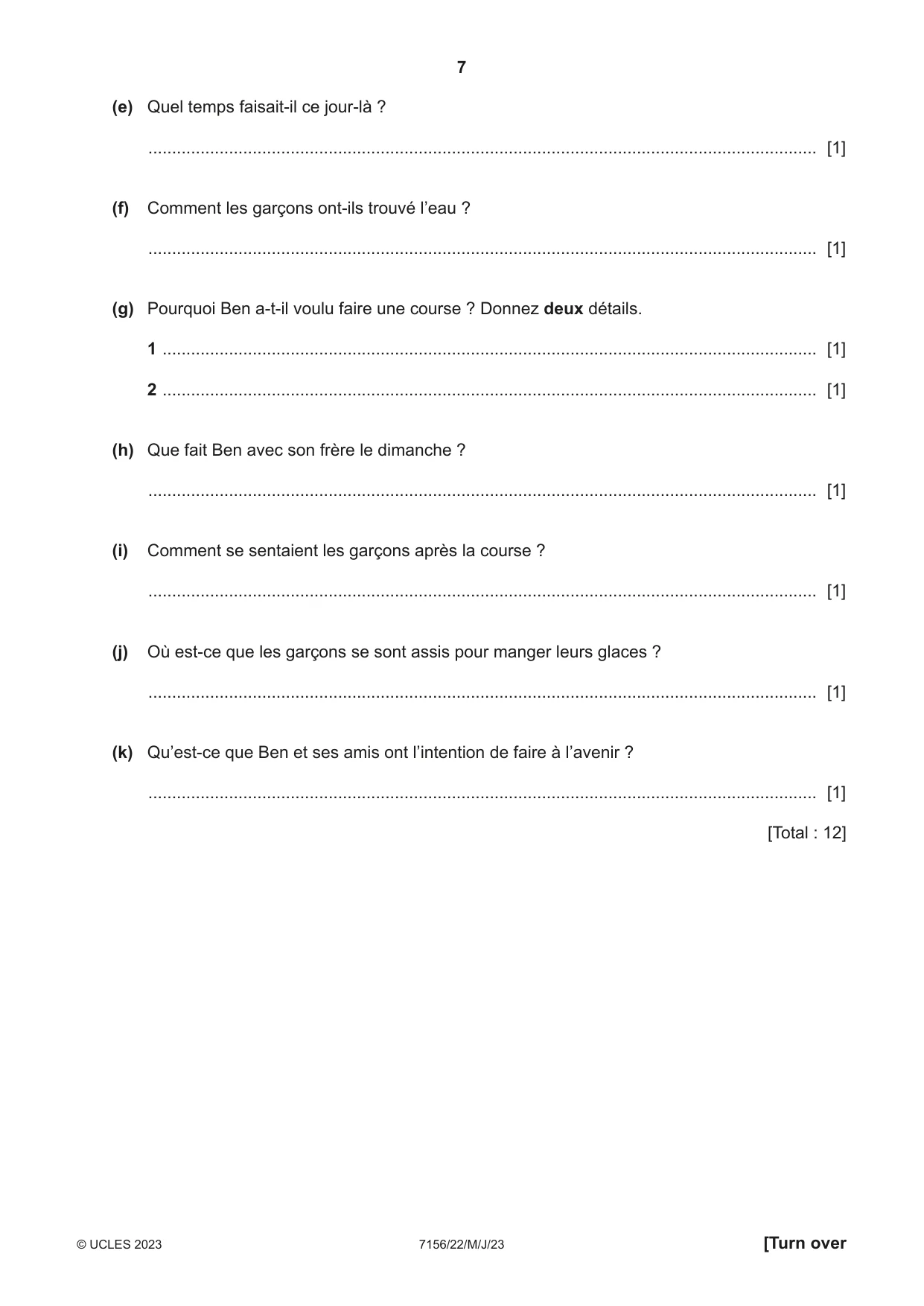
7 7156/22/M/J/23 © UCLES 2023 [Turn over (e) Quel temps faisait-il ce jour-là ? … [1] (f) Comment les garçons ont-ils trouvé l’eau ? … [1] (g) Pourquoi Ben a-t-il voulu faire une course ? Donnez deux détails. 1 … [1] 2 … [1] (h) Que fait Ben avec son frère le dimanche ? … [1] (i) Comment se sentaient les garçons après la course ? … [1] (j) Où est-ce que les garçons se sont assis pour manger leurs glaces ? … [1] (k) Qu’est-ce que Ben et ses amis ont l’intention de faire à l’avenir ? … [1] [Total : 12]
Question paper, page 8
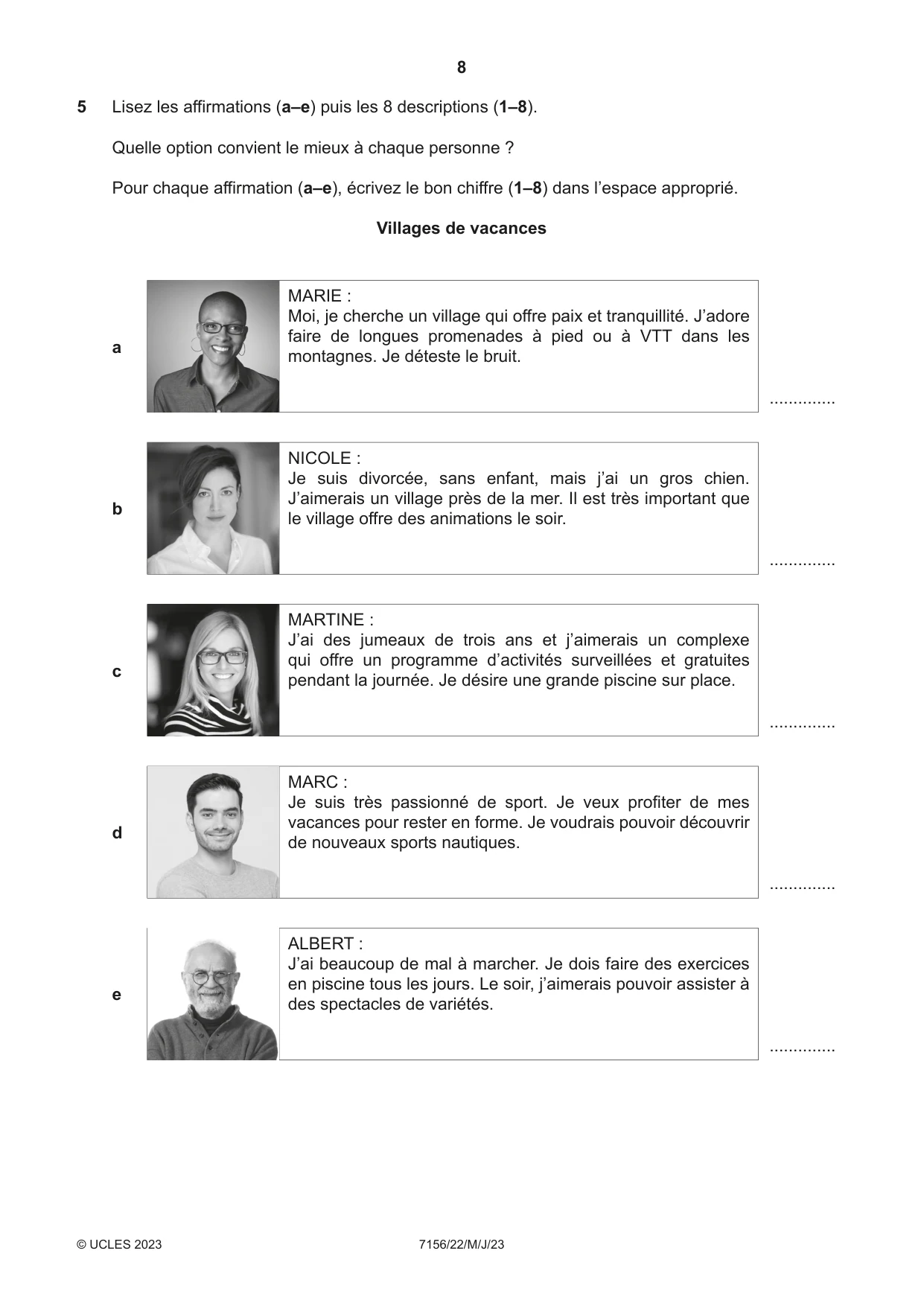
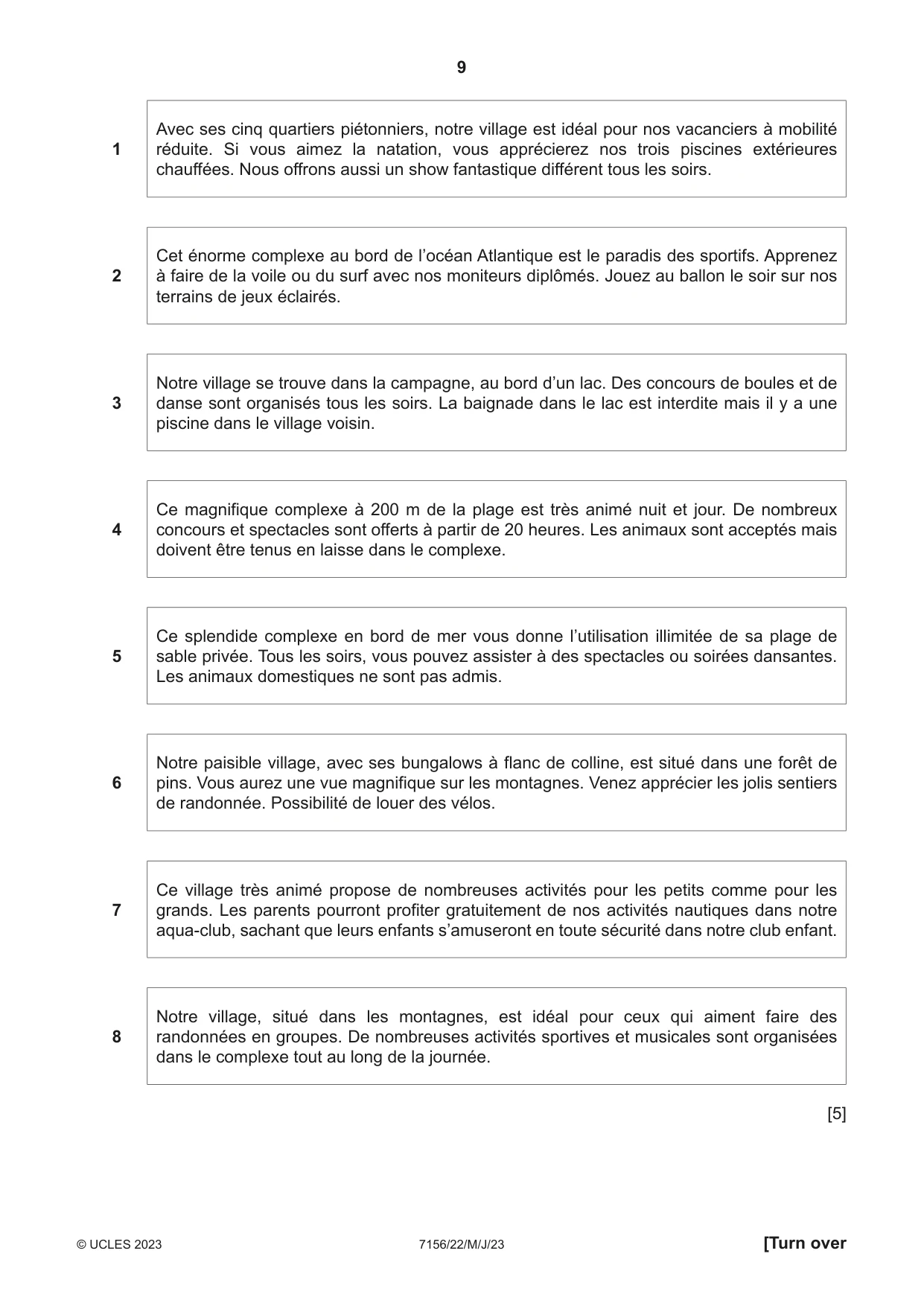
8 7156/22/M/J/23 © UCLES 2023 5 Lisez les affirmations (a–e) puis les 8 descriptions (1–8). Quelle option convient le mieux à chaque personne ? Pour chaque affirmation (a–e), écrivez le bon chiffre (1–8) dans l’espace approprié. Villages de vacances a MARIE : Moi, je cherche un village qui offre paix et tranquillité. J’adore faire de longues promenades à pied ou à VTT dans les montagnes. Je déteste le bruit. … b NICOLE : Je suis divorcée, sans enfant, mais j’ai un gros chien. J’aimerais un village près de la mer. Il est très important que le village offre des animations le soir. … c MARTINE : J’ai des jumeaux de trois ans et j’aimerais un complexe qui offre un programme d’activités surveillées et gratuites pendant la journée. Je désire une grande piscine sur place. … d MARC : Je suis très passionné de sport. Je veux profiter de mes vacances pour rester en forme. Je voudrais pouvoir découvrir de nouveaux sports nautiques. … e ALBERT : J’ai beaucoup de mal à marcher. Je dois faire des exercices en piscine tous les jours. Le soir, j’aimerais pouvoir assister à des spectacles de variétés. …
Question paper, page 9
9 7156/22/M/J/23 © UCLES 2023 [Turn over 1 Avec ses cinq quartiers piétonniers, notre village est idéal pour nos vacanciers à mobilité réduite. Si vous aimez la natation, vous apprécierez nos trois piscines extérieures chauffées. Nous offrons aussi un show fantastique différent tous les soirs. 2 Cet énorme complexe au bord de l’océan Atlantique est le paradis des sportifs. Apprenez à faire de la voile ou du surf avec nos moniteurs diplômés. Jouez au ballon le soir sur nos terrains de jeux éclairés. 3 Notre village se trouve dans la campagne, au bord d’un lac. Des concours de boules et de danse sont organisés tous les soirs. La baignade dans le lac est interdite mais il y a une piscine dans le village voisin. 4 Ce magnifique complexe à 200 m de la plage est très animé nuit et jour. De nombreux concours et spectacles sont offerts à partir de 20 heures. Les animaux sont acceptés mais doivent être tenus en laisse dans le complexe. 5 Ce splendide complexe en bord de mer vous donne l’utilisation illimitée de sa plage de sable privée. Tous les soirs, vous pouvez assister à des spectacles ou soirées dansantes. Les animaux domestiques ne sont pas admis. 6 Notre paisible village, avec ses bungalows à flanc de colline, est situé dans une forêt de pins. Vous aurez une vue magnifique sur les montagnes. Venez apprécier les jolis sentiers de randonnée. Possibilité de louer des vélos. 7 Ce village très animé propose de nombreuses activités pour les petits comme pour les grands. Les parents pourront profiter gratuitement de nos activités nautiques dans notre aqua-club, sachant que leurs enfants s’amuseront en toute sécurité dans notre club enfant. 8 Notre village, situé dans les montagnes, est idéal pour ceux qui aiment faire des randonnées en groupes. De nombreuses activités sportives et musicales sont organisées dans le complexe tout au long de la journée. [5]
Question paper, page 10
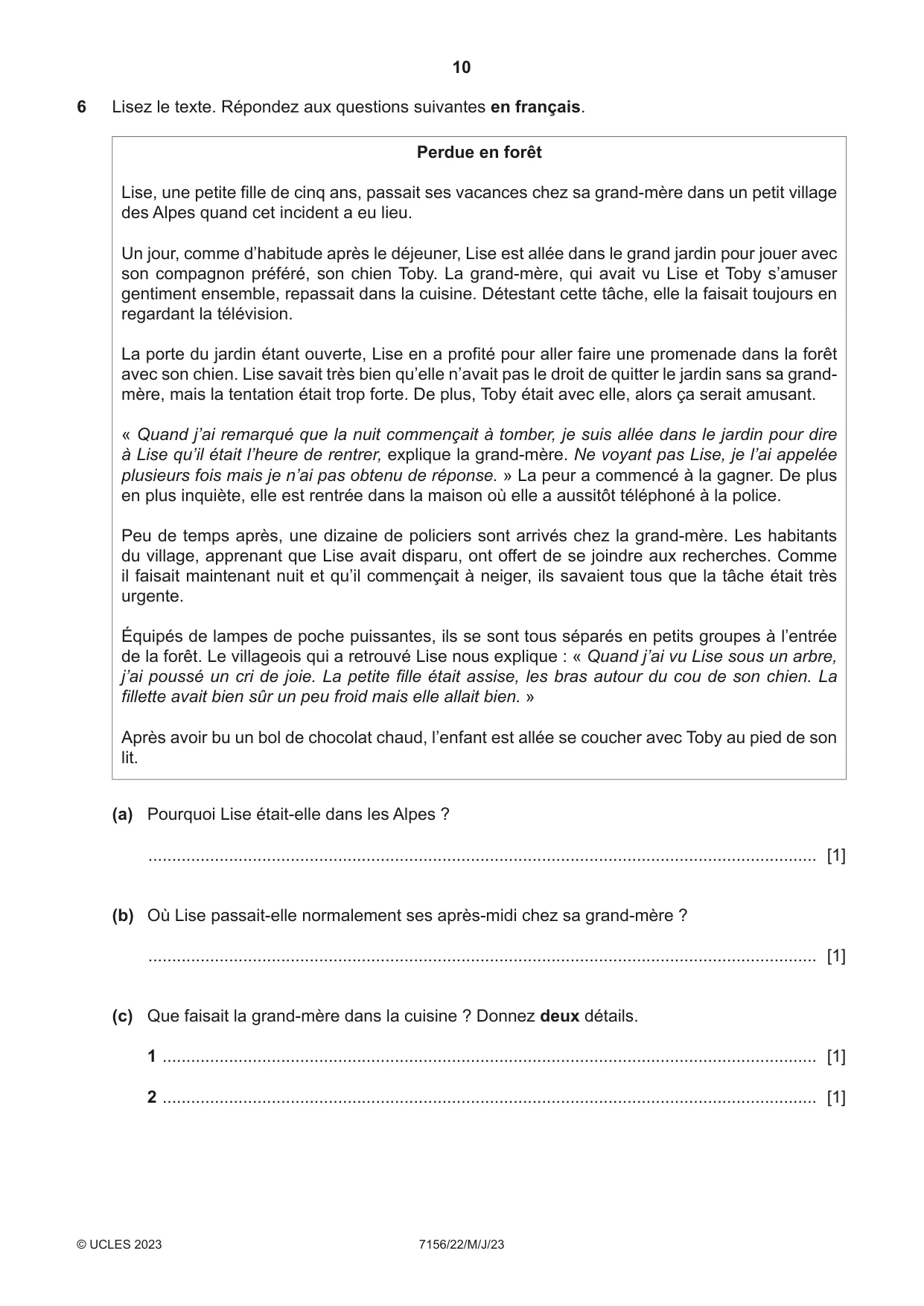
10 7156/22/M/J/23 © UCLES 2023 6 Lisez le texte. Répondez aux questions suivantes en français. Perdue en forêt Lise, une petite fille de cinq ans, passait ses vacances chez sa grand-mère dans un petit village des Alpes quand cet incident a eu lieu. Un jour, comme d’habitude après le déjeuner, Lise est allée dans le grand jardin pour jouer avec son compagnon préféré, son chien Toby. La grand-mère, qui avait vu Lise et Toby s’amuser gentiment ensemble, repassait dans la cuisine. Détestant cette tâche, elle la faisait toujours en regardant la télévision. La porte du jardin étant ouverte, Lise en a profité pour aller faire une promenade dans la forêt avec son chien. Lise savait très bien qu’elle n’avait pas le droit de quitter le jardin sans sa grand- mère, mais la tentation était trop forte. De plus, Toby était avec elle, alors ça serait amusant. « Quand j’ai remarqué que la nuit commençait à tomber, je suis allée dans le jardin pour dire à Lise qu’il était l’heure de rentrer, explique la grand-mère. Ne voyant pas Lise, je l’ai appelée plusieurs fois mais je n’ai pas obtenu de réponse. » La peur a commencé à la gagner. De plus en plus inquiète, elle est rentrée dans la maison où elle a aussitôt téléphoné à la police. Peu de temps après, une dizaine de policiers sont arrivés chez la grand-mère. Les habitants du village, apprenant que Lise avait disparu, ont offert de se joindre aux recherches. Comme il faisait maintenant nuit et qu’il commençait à neiger, ils savaient tous que la tâche était très urgente. Équipés de lampes de poche puissantes, ils se sont tous séparés en petits groupes à l’entrée de la forêt. Le villageois qui a retrouvé Lise nous explique : « Quand j’ai vu Lise sous un arbre, j’ai poussé un cri de joie. La petite fille était assise, les bras autour du cou de son chien. La fillette avait bien sûr un peu froid mais elle allait bien. » Après avoir bu un bol de chocolat chaud, l’enfant est allée se coucher avec Toby au pied de son lit. (a) Pourquoi Lise était-elle dans les Alpes ? … [1] (b) Où Lise passait-elle normalement ses après-midi chez sa grand-mère ? … [1] (c) Que faisait la grand-mère dans la cuisine ? Donnez deux détails. 1 … [1] 2 … [1]
Question paper, page 11
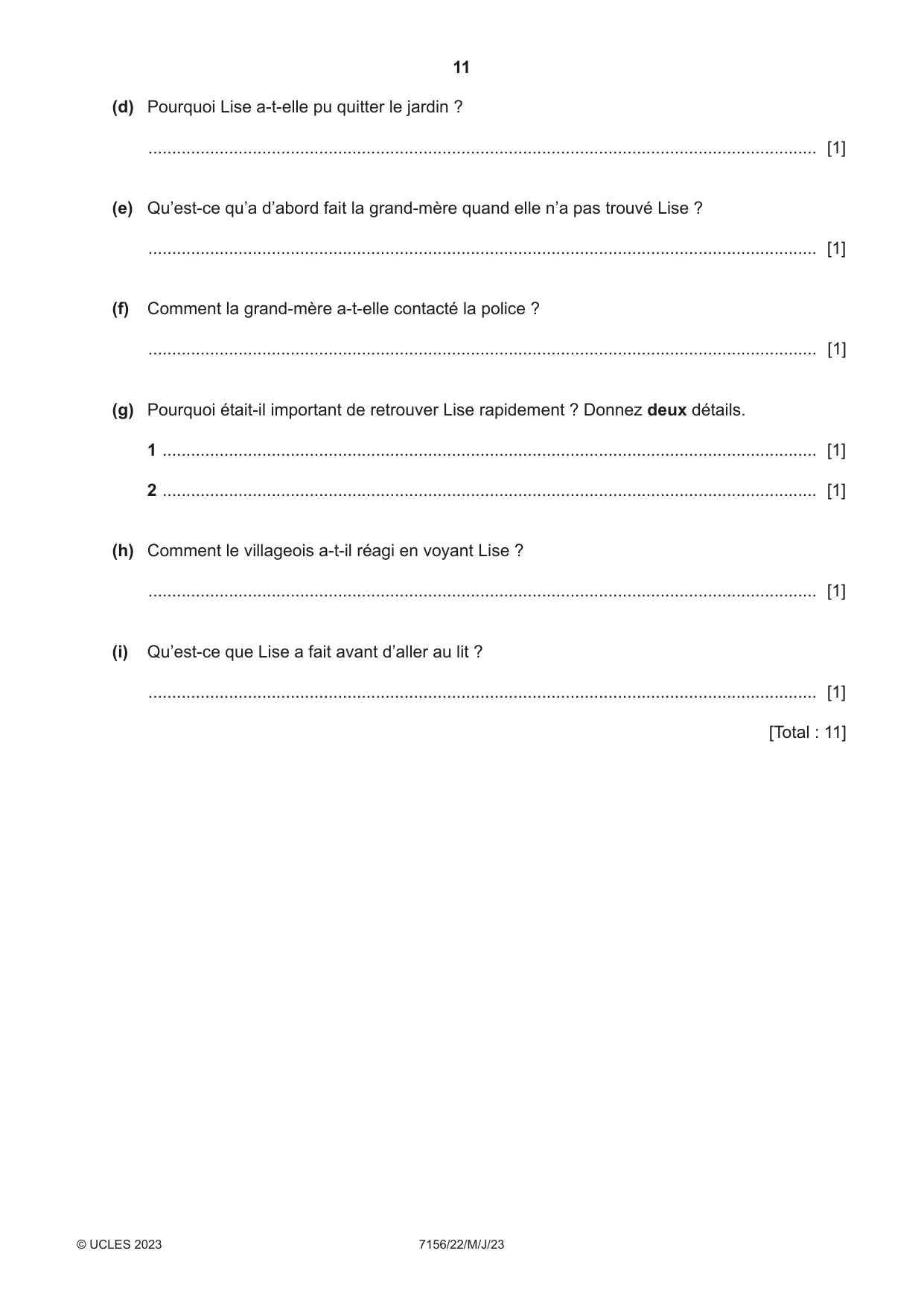
11 7156/22/M/J/23 © UCLES 2023 (d) Pourquoi Lise a-t-elle pu quitter le jardin ? … [1] (e) Qu’est-ce qu’a d’abord fait la grand-mère quand elle n’a pas trouvé Lise ? … [1] (f) Comment la grand-mère a-t-elle contacté la police ? … [1] (g) Pourquoi était-il important de retrouver Lise rapidement ? Donnez deux détails. 1 … [1] 2 … [1] (h) Comment le villageois a-t-il réagi en voyant Lise ? … [1] (i) Qu’est-ce que Lise a fait avant d’aller au lit ? … [1] [Total : 11]
Question paper, page 12
12 7156/22/M/J/23 © UCLES 2023 Permission to reproduce items where third-party owned material protected by copyright is included has been sought and cleared where possible. Every reasonable effort has been made by the publisher (UCLES) to trace copyright holders, but if any items requiring clearance have unwittingly been included, the publisher will be pleased to make amends at the earliest possible opportunity. To avoid the issue of disclosure of answer-related information to candidates, all copyright acknowledgements are reproduced online in the Cambridge Assessment International Education Copyright Acknowledgements Booklet. This is produced for each series of examinations and is freely available to download at www.cambridgeinternational.org after the live examination series. Cambridge Assessment International Education is part of Cambridge Assessment. Cambridge Assessment is the brand name of the University of Cambridge Local Examinations Syndicate (UCLES), which is a department of the University of Cambridge. BLANK PAGE
Mark scheme, page 1
This document consists of 8 printed pages. © UCLES 2023 [Turn over Cambridge IGCSE™ (9–1) FRENCH 7156/22 Paper 2 Reading May/June 2023 MARK SCHEME Maximum Mark: 45 Published This mark scheme is published as an aid to teachers and candidates, to indicate the requirements of the examination. It shows the basis on which Examiners were instructed to award marks. It does not indicate the details of the discussions that took place at an Examiners’ meeting before marking began, which would have considered the acceptability of alternative answers. Mark schemes should be read in conjunction with the question paper and the Principal Examiner Report for Teachers. Cambridge International will not enter into discussions about these mark schemes. Cambridge International is publishing the mark schemes for the May/June 2023 series for most Cambridge IGCSE, Cambridge International A and AS Level and Cambridge Pre-U components, and some Cambridge O Level components.
Mark scheme, page 2
7156/22 Cambridge IGCSE (9–1) – Mark Scheme PUBLISHED May/June 2023 © UCLES 2023 Page 2 of 8 Generic Marking Principles These general marking principles must be applied by all examiners when marking candidate answers. They should be applied alongside the specific content of the mark scheme or generic level descriptors for a question. Each question paper and mark scheme will also comply with these marking principles. GENERIC MARKING PRINCIPLE 1: Marks must be awarded in line with: the specific content of the mark scheme or the generic level descriptors for the question the specific skills defined in the mark scheme or in the generic level descriptors for the question the standard of response required by a candidate as exemplified by the standardisation scripts. GENERIC MARKING PRINCIPLE 2: Marks awarded are always whole marks (not half marks, or other fractions) GENERIC MARKING PRINCIPLE 3: Marks must be awarded positively: marks are awarded for correct/valid answers, as defined in the mark scheme. However, credit is given for valid answers which go beyond the scope of the syllabus and mark scheme, referring to your Team Leader as appropriate marks are awarded when candidates clearly demonstrate what they know and can do marks are not deducted for errors marks are not deducted for omissions answers should only be judged on the quality of spelling, punctuation and grammar when these features are specifically assessed by the question as indicated by the mark scheme. The meaning, however, should be unambiguous. GENERIC MARKING PRINCIPLE 4: Rules must be applied consistently e.g. in situations where candidates have not followed instructions or in the application of generic level descriptors GENERIC MARKING PRINCIPLE 5: Marks should be awarded using the full range of marks defined in the mark scheme for the question (however; the use of the full mark range may be limited according to the quality of the candidate responses seen). GENERIC MARKING PRINCIPLE 6: Marks awarded are based solely on the requirements as defined in the mark scheme. Marks should not be awarded with grade thresholds or grade descriptors in mind.
Mark scheme, page 3
7156/22 Cambridge IGCSE (9–1) – Mark Scheme PUBLISHED May/June 2023 © UCLES 2023 Page 3 of 8 Additional Guidance The following guidance underpins the detailed instructions provided in the mark scheme. Where a decision is taken to deviate from this guidance for a particular question, this will be specified in the mark scheme. Often the additional guidance points will have to be weighed up against each other, e.g. the answer might look or sound like the intended word/phrase in French, but if what the candidate has written means something different in French from what is expected, the mark cannot be awarded. It is not possible to list all acceptable alternatives in the mark scheme. If you encounter an answer which is not covered by the mark scheme, you will need to make a decision about whether it communicates the required elements (in consultation with your Team Leader if necessary, or with your Product Manager if you are a single examiner), and award marks accordingly. Crossing out: (a) If a candidate changes his/her mind about an answer and crosses out an attempt, award a mark if the final attempt is correct. (b) If a candidate crosses out an answer to a whole question but makes no second attempt at it, mark the crossed out work. More than the stipulated number of boxes ticked/crossed by the candidate: (a) If more than one attempt is visible but the candidate has clearly indicated which attempt is his/her final answer (e.g. by crossing out other attempts or by annotating the script in some way), mark in the usual way. (b) If two attempts are visible (e.g. two boxes ticked instead of the one box stipulated), and neither has been crossed out/discounted by the candidate, no mark can be awarded. For questions requiring more than one element for the answer, 1 and 2, where the answers are interchangeable: (a) Both of the correct answers are on line 1 and line 2 blank (or vice versa) = 2 marks (b) Both correct answers on line 1 and line 2 contains a wrong answer (or vice versa) = 1 mark
Mark scheme, page 4
7156/22 Cambridge IGCSE (9–1) – Mark Scheme PUBLISHED May/June 2023 © UCLES 2023 Page 4 of 8 Mark for communication: Answers requiring the use of French (rather than a non-verbal response) should be marked for communication. Tolerate inaccuracies provided that the message is clear. However, do not accept incorrect French if the word written by the candidate means something else in French (unless the mark scheme specifies otherwise). (a) If you read aloud what the candidate has written, does it sound like the correct answer? Would a native speaker of French understand it? (b) Does what the candidate has written look like the correct answer, e.g. one letter missing but no other word created? Would a native speaker of French understand it? Annotations used in the mark scheme: (a) INV = invalidation. This is used when the additional material included by the candidate is judged to invalidate an otherwise correct answer and therefore prevents him/her from scoring the mark. (INV = 0) (b) tc = ‘tout court’. This means that, on its own, the material is not sufficient to score the mark. (c) HA = harmless addition. This means that the candidate has included additional material which, in conjunction with the correct answer, does not prevent him/her from scoring the mark. No response and ‘0’ marks: (a) Award NR (no response): If there is nothing written at all in the answer space or If there is only a comment which does not in any way relate to the question being asked (e.g. ‘can’t do’ or ‘don’t know’) or If there is only a mark which isn’t an attempt at the question (e.g. a dash, a question mark). (b) Award 0: If there is any attempt that earns no credit, e.g. the candidate has copied out part or all of the question.
Mark scheme, page 5
7156/22 Cambridge IGCSE (9–1) – Mark Scheme PUBLISHED May/June 2023 © UCLES 2023 Page 5 of 8 Extra material: Candidates need to answer the questions in such a way as to demonstrate that they have understood the text. The mark scheme cannot cover all eventualities so where specific instructions are not provided, the examiner must check the text to ensure that the correct elements which would attract the mark are not contradicted or distorted by any extra material. The following general rules should be applied: (a) Extra material, mentioned in the mark scheme, which reinforces the correct answer or in itself constitutes an alternative correct answer: This is acceptable and is not penalised. (b) Extra material which constitutes an alternative answer, but which is not explicitly mentioned in the mark scheme: The examiner needs to decide, by consulting the transcript/text and the Team Leader if necessary, whether the alternative answer constitutes: (i) an alternative correct answer, in which case this falls into category (a) and the answer should be rewarded, or (ii) an answer which on its own would be rejected, in which case this falls into category (c) and the answer should be rejected. (c) Extra material which constitutes an alternative answer specifically rejected in the mark scheme: This puts the examiner in the position of having to ‘choose’ which the intended answer is. The examiner cannot therefore be sure what the candidate has understood and the mark cannot be awarded. (d) Extra material which distorts or contradicts the correct answer: This affects communication. The examiner cannot be sure what the candidate has understood and therefore the mark cannot be awarded. (e) Extra material introduced by the candidate and which does not feature in the original text: This affects communication. The examiner cannot be sure what the candidate has understood and therefore the mark cannot be awarded. It can sometimes be difficult to draw the line between what is a deduction made by an able candidate on the basis of what they have read and pure guesswork. Therefore, where a particular answer is not covered by the mark scheme, the examiner should consult the Team Leader.
Mark scheme, page 6
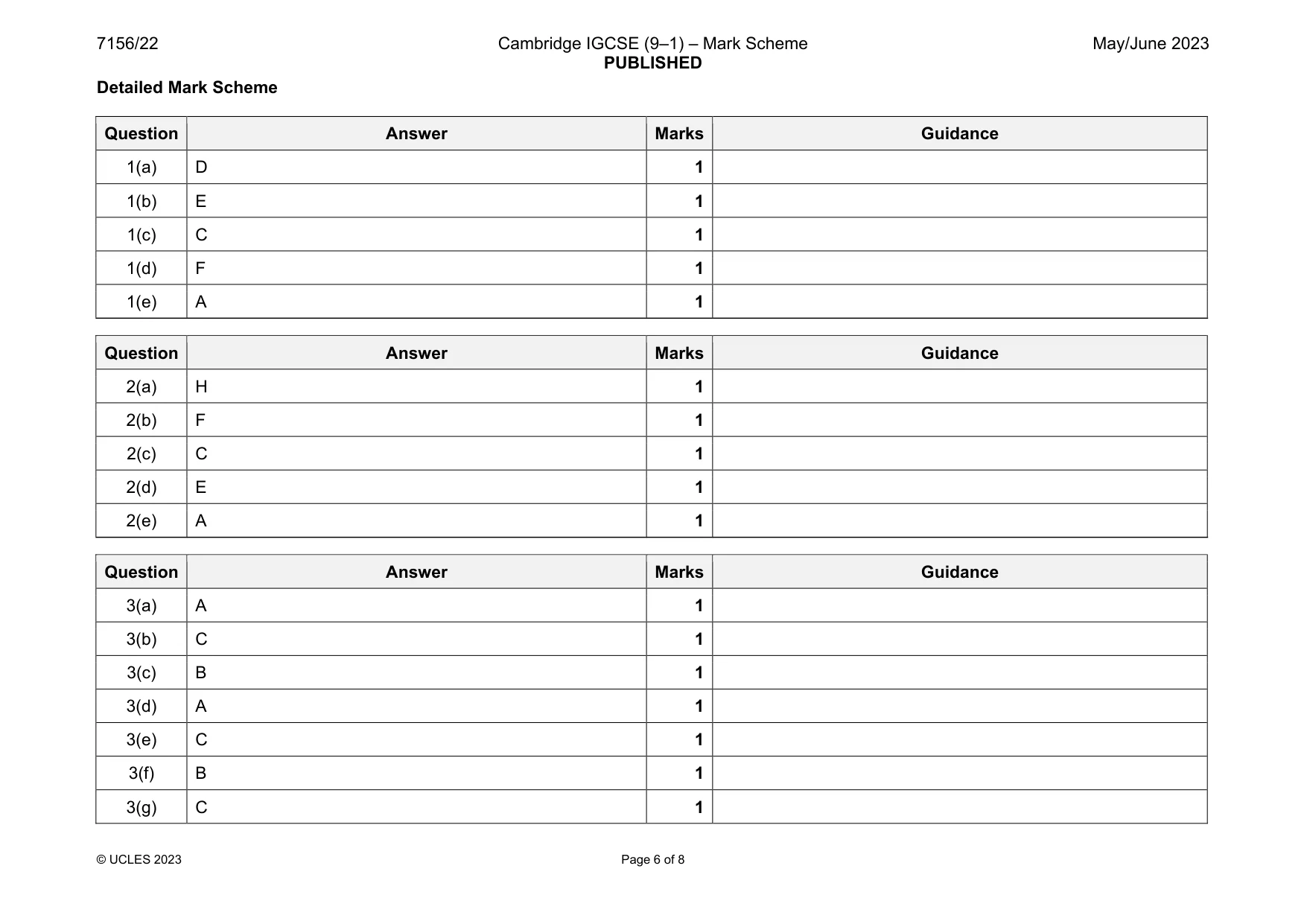
7156/22 Cambridge IGCSE (9–1) – Mark Scheme PUBLISHED May/June 2023 © UCLES 2023 Page 6 of 8 Detailed Mark Scheme Question Answer Marks Guidance 1(a) D 1 1(b) E 1 1(c) C 1 1(d) F 1 1(e) A 1 Question Answer Marks Guidance 2(a) H 1 2(b) F 1 2(c) C 1 2(d) E 1 2(e) A 1 Question Answer Marks Guidance 3(a) A 1 3(b) C 1 3(c) B 1 3(d) A 1 3(e) C 1 3(f) B 1 3(g) C 1
Mark scheme, page 7
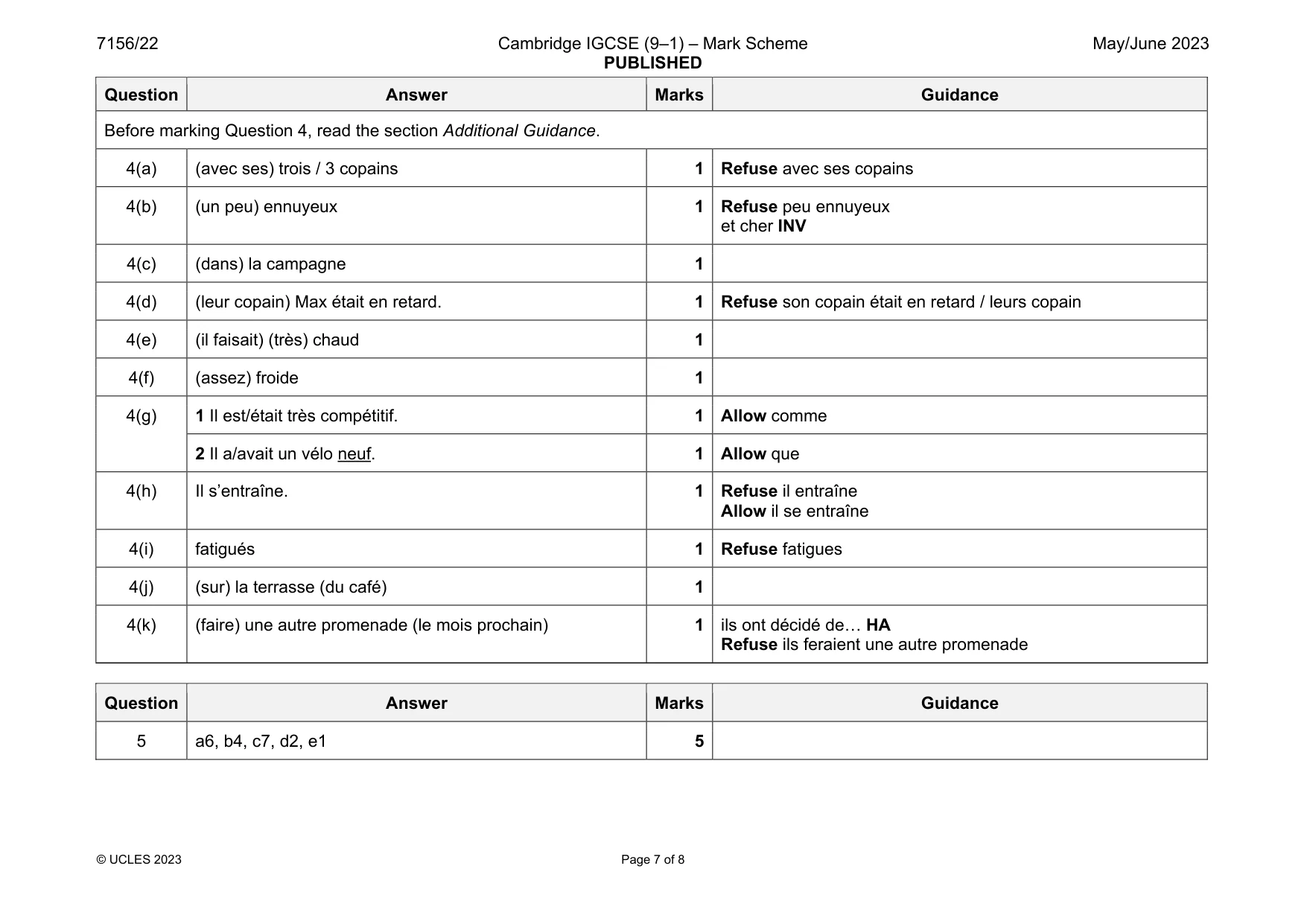
7156/22 Cambridge IGCSE (9–1) – Mark Scheme PUBLISHED May/June 2023 © UCLES 2023 Page 7 of 8 Question Answer Marks Guidance Before marking Question 4, read the section Additional Guidance. 4(a) (avec ses) trois / 3 copains 1 Refuse avec ses copains 4(b) (un peu) ennuyeux 1 Refuse peu ennuyeux et cher INV 4(c) (dans) la campagne 1 4(d) (leur copain) Max était en retard. 1 Refuse son copain était en retard / leurs copain 4(e) (il faisait) (très) chaud 1 4(f) (assez) froide 1 4(g) 1 Il est/était très compétitif. 1 Allow comme 2 Il a/avait un vélo neuf. 1 Allow que 4(h) Il s’entraîne. 1 Refuse il entraîne Allow il se entraîne 4(i) fatigués 1 Refuse fatigues 4(j) (sur) la terrasse (du café) 1 4(k) (faire) une autre promenade (le mois prochain) 1 ils ont décidé de… HA Refuse ils feraient une autre promenade Question Answer Marks Guidance 5 a6, b4, c7, d2, e1 5
Mark scheme, page 8
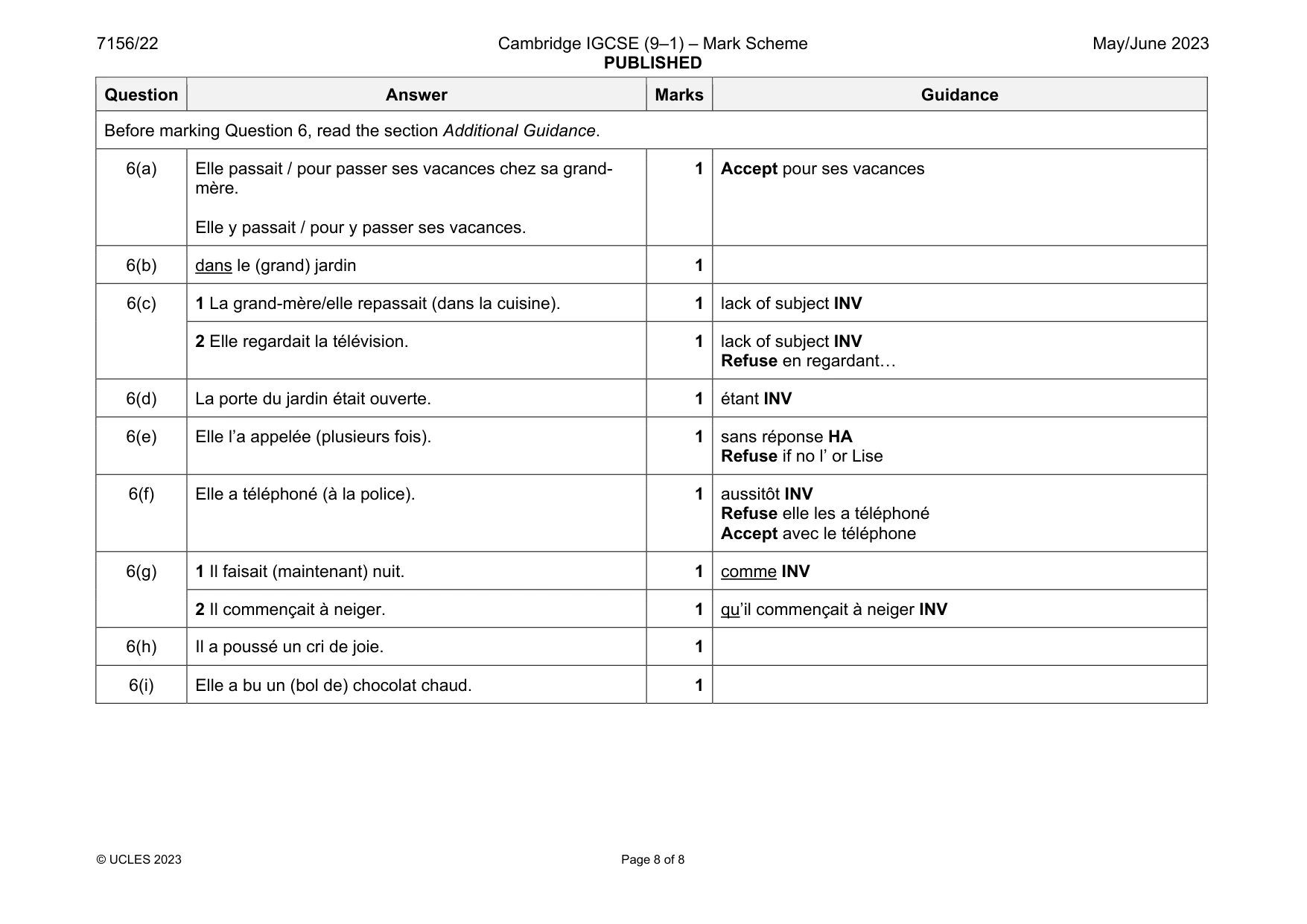
7156/22 Cambridge IGCSE (9–1) – Mark Scheme PUBLISHED May/June 2023 © UCLES 2023 Page 8 of 8 Question Answer Marks Guidance Before marking Question 6, read the section Additional Guidance. 6(a) Elle passait / pour passer ses vacances chez sa grand- mère. Elle y passait / pour y passer ses vacances. 1 Accept pour ses vacances 6(b) dans le (grand) jardin 1 6(c) 1 La grand-mère/elle repassait (dans la cuisine). 1 lack of subject INV 2 Elle regardait la télévision. 1 lack of subject INV Refuse en regardant… 6(d) La porte du jardin était ouverte. 1 étant INV 6(e) Elle l’a appelée (plusieurs fois). 1 sans réponse HA Refuse if no l’ or Lise 6(f) Elle a téléphoné (à la police). 1 aussitôt INV Refuse elle les a téléphoné Accept avec le téléphone 6(g) 1 Il faisait (maintenant) nuit. 1 comme INV 2 Il commençait à neiger. 1 qu’il commençait à neiger INV 6(h) Il a poussé un cri de joie. 1 6(i) Elle a bu un (bol de) chocolat chaud. 1
What you needed in this session
Cambridge’s own grade thresholds for 2023 May/June, Paper 2 · Variant 2. A higher threshold means an easier paper — the bar moves with how the cohort did.