Cambridge IGCSE French (9-1) 7156 — 2022 May/June Paper 2 · Variant 2
7156/22/M/J/22 · 45 marks · ≈51 min
The question paper and its mark scheme, free to read here and free to download. This is Cambridge’s own paper, exactly as it was sat.
Question paper12 pages
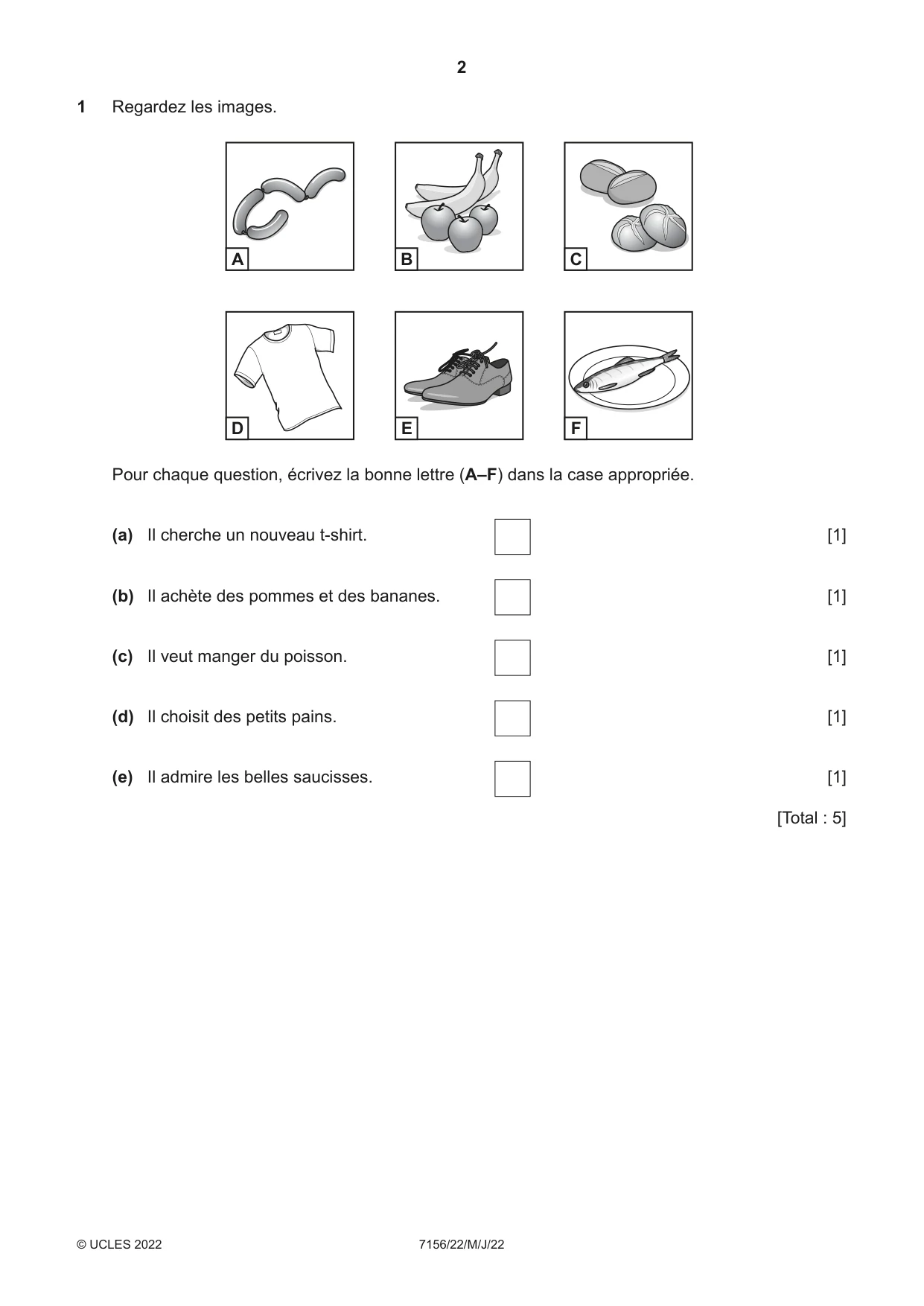
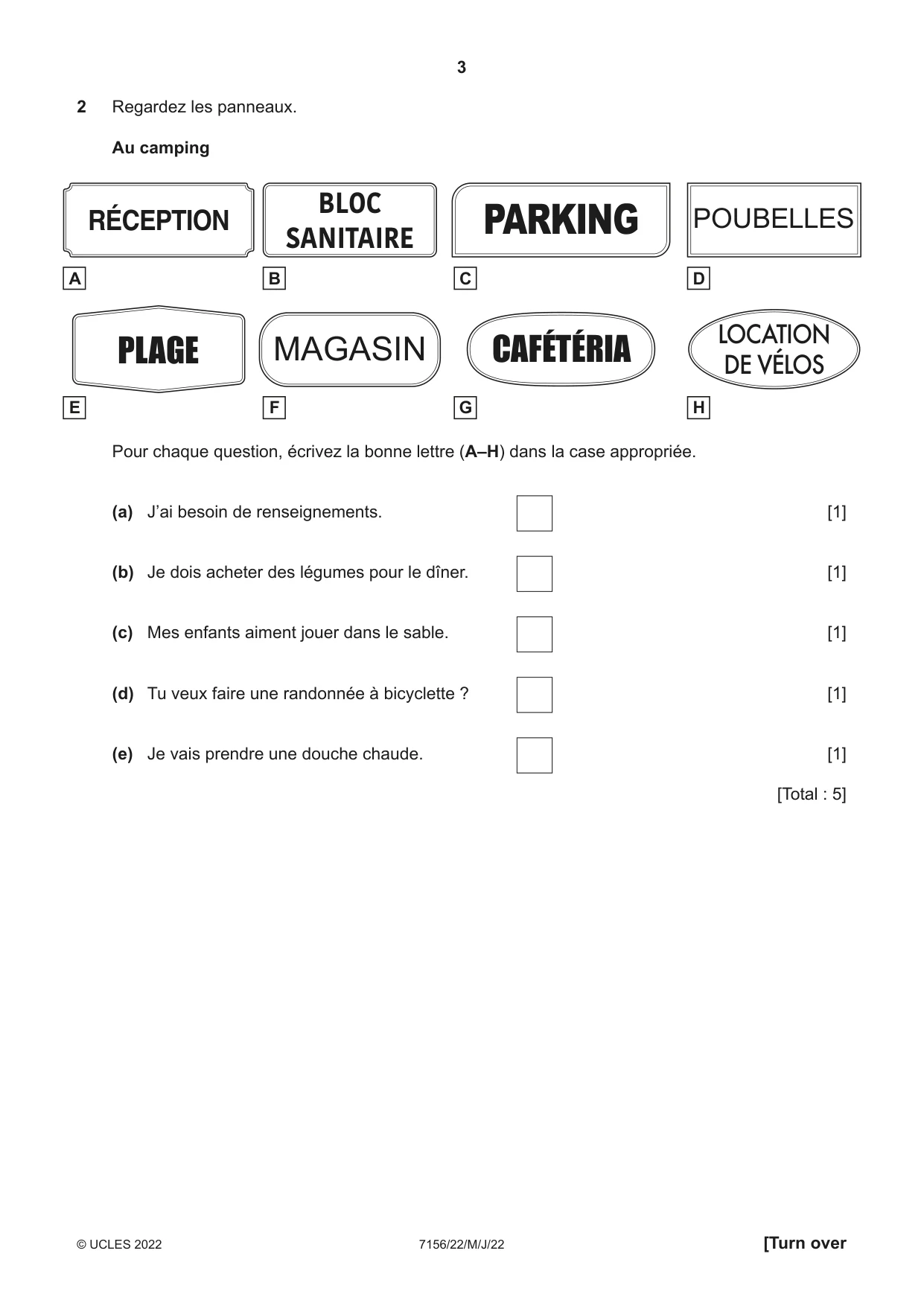
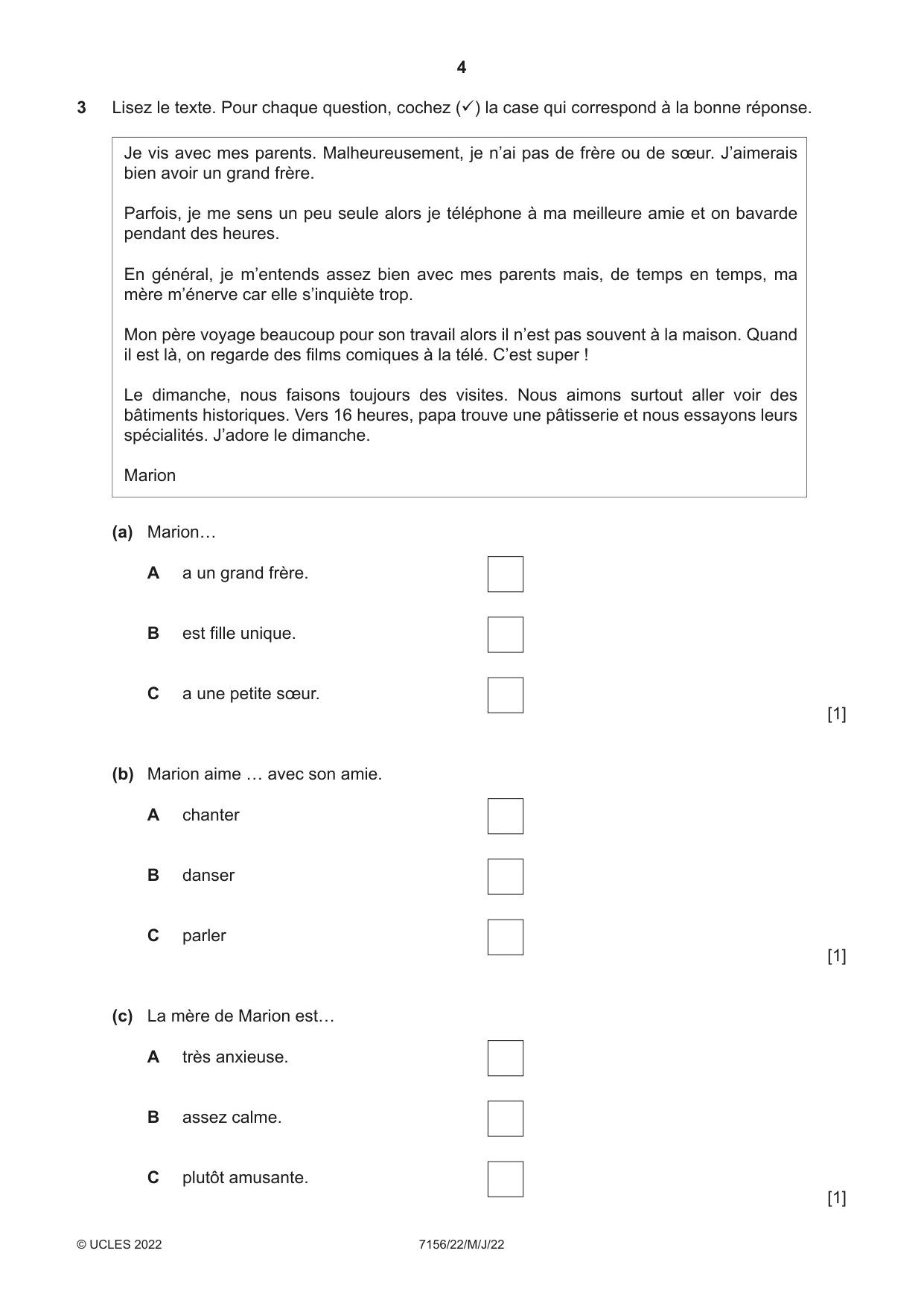

Mark scheme8 pages
Answers below. Sit the paper first if you are practising.
Paper as text
Question paper, page 1
This document has 12 pages. Any blank pages are indicated. [Turn over Cambridge IGCSE™(9–1) DC (LE) 313288 © UCLES 2022 FRENCH 7156/22 Paper 2 Reading May/June 2022 1 hour You must answer on the question paper. No additional materials are needed. INSTRUCTIONS ● Answer all questions. ● Use a black or dark blue pen. ● Write your name, centre number and candidate number in the boxes at the top of the page. ● Write your answer to each question in the space provided. ● Do not use an erasable pen or correction fluid. ● Do not write on any bar codes. ● Dictionaries are not allowed. INFORMATION ● The total mark for this paper is 45. ● The number of marks for each question or part question is shown in brackets [ ]. * 0 4 1 9 6 8 7 6 7 0 *
Question paper, page 2
2 7156/22/ M / J /22 © UCLES 2022 1 Regardez les images. A B C D E F Pour chaque question, écrivez la bonne lettre (A–F) dans la case appropriée. (a) Il cherche un nouveau t-shirt. [1] (b) Il achète des pommes et des bananes. [1] (c) Il veut manger du poisson. [1] (d) Il choisit des petits pains. [1] (e) Il admire les belles saucisses. [1] [Total : 5]
Question paper, page 3
3 7156/22/M/J/22 © UCLES 2022 [Turn over 2 Regardez les panneaux. Au camping RÉCEPTION PLAGE MAGASIN PARKING BLOC SANITAIRE CAFÉTÉRIA POUBELLES LOCATION DE VÉLOS A B C D E F G H Pour chaque question, écrivez la bonne lettre (A–H) dans la case appropriée. (a) J’ai besoin de renseignements. [1] (b) Je dois acheter des légumes pour le dîner. [1] (c) Mes enfants aiment jouer dans le sable. [1] (d) Tu veux faire une randonnée à bicyclette ? [1] (e) Je vais prendre une douche chaude. [1] [Total : 5]
Question paper, page 4
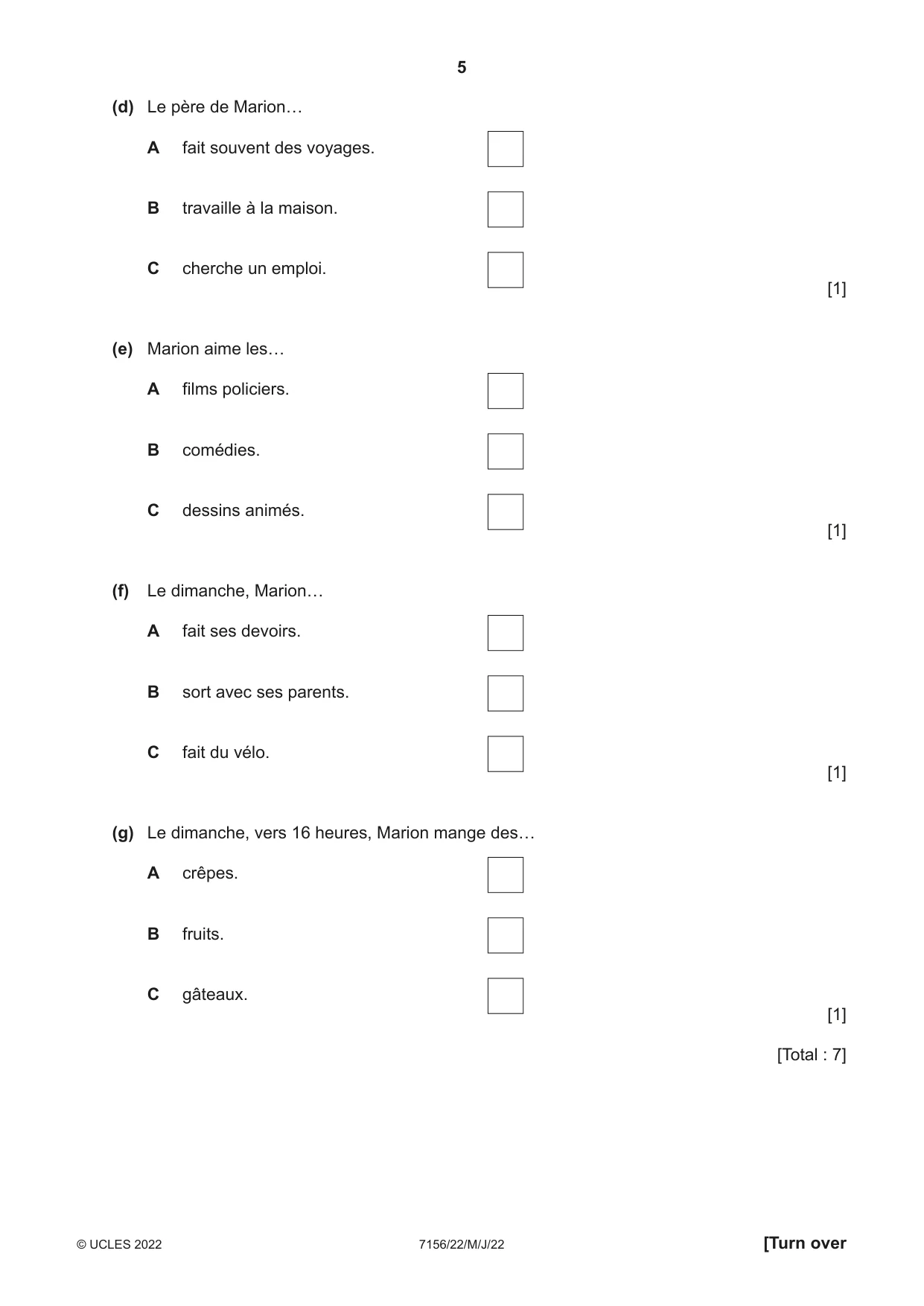
4 7156/22/M/J/22 © UCLES 2022 3 Lisez le texte. Pour chaque question, cochez () la case qui correspond à la bonne réponse. Je vis avec mes parents. Malheureusement, je n’ai pas de frère ou de sœur. J’aimerais bien avoir un grand frère. Parfois, je me sens un peu seule alors je téléphone à ma meilleure amie et on bavarde pendant des heures. En général, je m’entends assez bien avec mes parents mais, de temps en temps, ma mère m’énerve car elle s’inquiète trop. Mon père voyage beaucoup pour son travail alors il n’est pas souvent à la maison. Quand il est là, on regarde des films comiques à la télé. C’est super ! Le dimanche, nous faisons toujours des visites. Nous aimons surtout aller voir des bâtiments historiques. Vers 16 heures, papa trouve une pâtisserie et nous essayons leurs spécialités. J’adore le dimanche. Marion (a) Marion… A a un grand frère. B est fille unique. C a une petite sœur. [1] (b) Marion aime … avec son amie. A chanter B danser C parler [1] (c) La mère de Marion est… A très anxieuse. B assez calme. C plutôt amusante. [1]
Question paper, page 5
5 7156/22/M/J/22 © UCLES 2022 [Turn over (d) Le père de Marion… A fait souvent des voyages. B travaille à la maison. C cherche un emploi. [1] (e) Marion aime les… A films policiers. B comédies. C dessins animés. [1] (f) Le dimanche, Marion… A fait ses devoirs. B sort avec ses parents. C fait du vélo. [1] (g) Le dimanche, vers 16 heures, Marion mange des… A crêpes. B fruits. C gâteaux. [1] [Total : 7]
Question paper, page 6
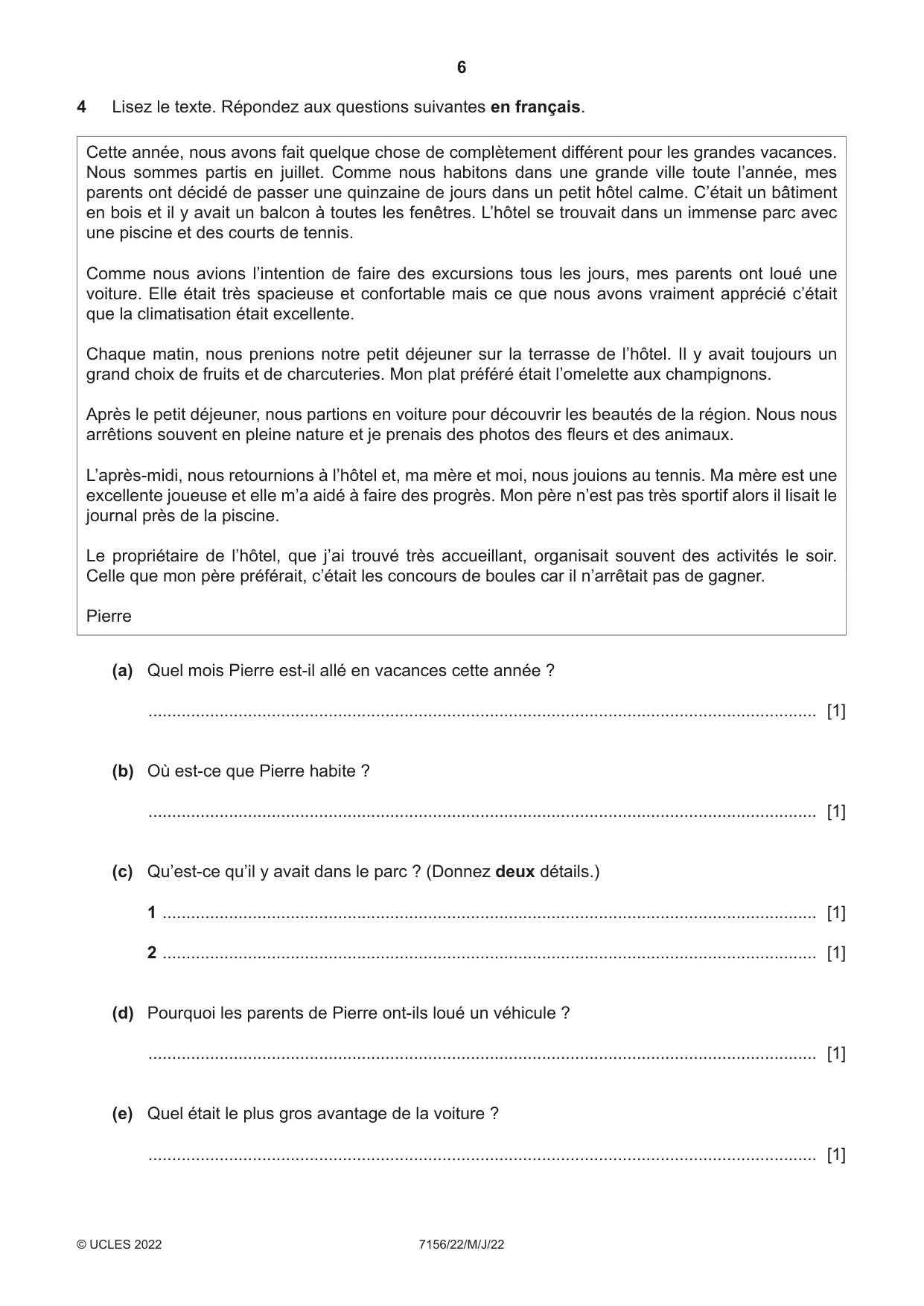
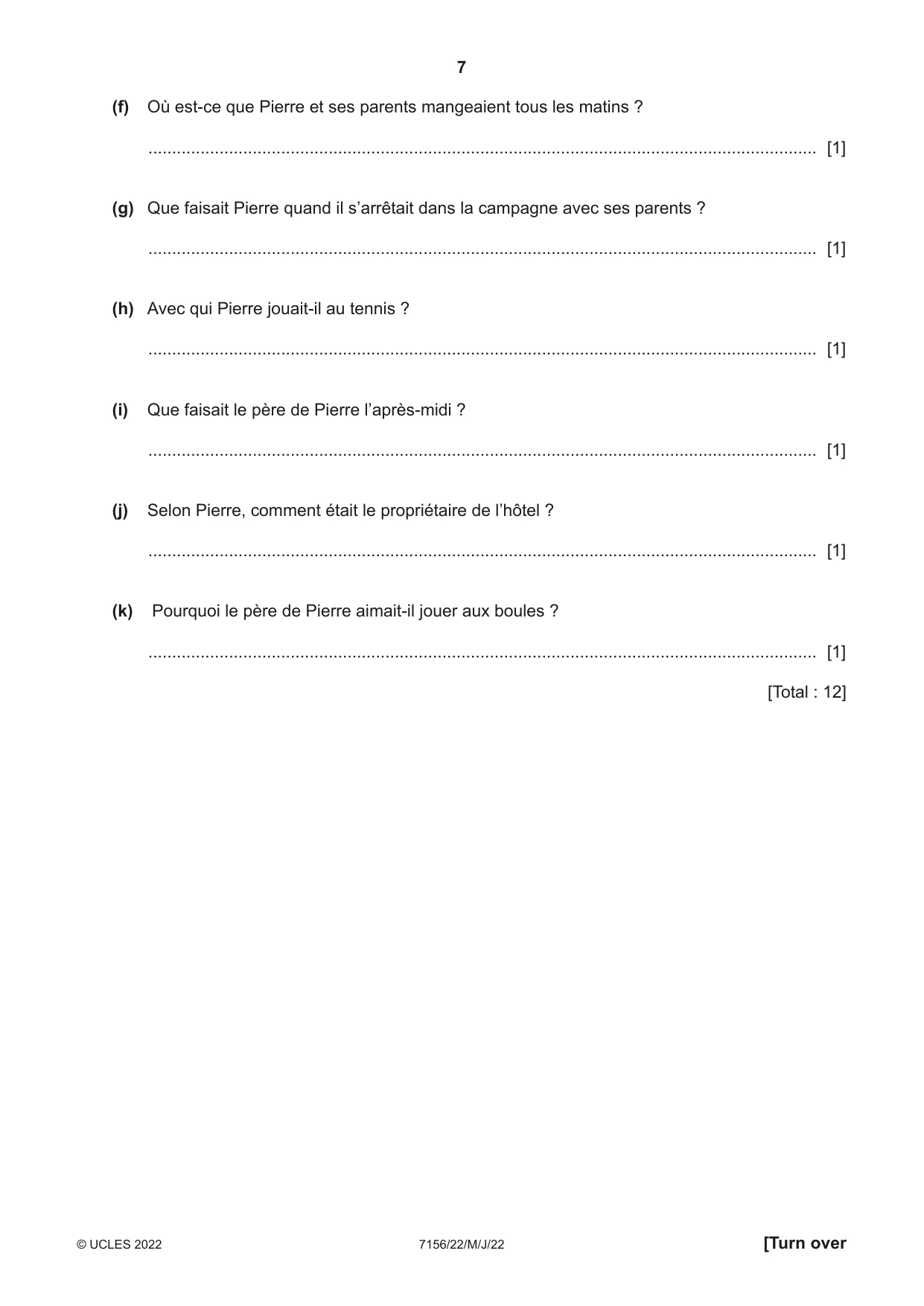
6 7156/22/M/J/22 © UCLES 2022 4 Lisez le texte. Répondez aux questions suivantes en français. Cette année, nous avons fait quelque chose de complètement différent pour les grandes vacances. Nous sommes partis en juillet. Comme nous habitons dans une grande ville toute l’année, mes parents ont décidé de passer une quinzaine de jours dans un petit hôtel calme. C’était un bâtiment en bois et il y avait un balcon à toutes les fenêtres. L’hôtel se trouvait dans un immense parc avec une piscine et des courts de tennis. Comme nous avions l’intention de faire des excursions tous les jours, mes parents ont loué une voiture. Elle était très spacieuse et confortable mais ce que nous avons vraiment apprécié c’était que la climatisation était excellente. Chaque matin, nous prenions notre petit déjeuner sur la terrasse de l’hôtel. Il y avait toujours un grand choix de fruits et de charcuteries. Mon plat préféré était l’omelette aux champignons. Après le petit déjeuner, nous partions en voiture pour découvrir les beautés de la région. Nous nous arrêtions souvent en pleine nature et je prenais des photos des fleurs et des animaux. L’après-midi, nous retournions à l’hôtel et, ma mère et moi, nous jouions au tennis. Ma mère est une excellente joueuse et elle m’a aidé à faire des progrès. Mon père n’est pas très sportif alors il lisait le journal près de la piscine. Le propriétaire de l’hôtel, que j’ai trouvé très accueillant, organisait souvent des activités le soir. Celle que mon père préférait, c’était les concours de boules car il n’arrêtait pas de gagner. Pierre (a) Quel mois Pierre est-il allé en vacances cette année ? … [1] (b) Où est-ce que Pierre habite ? … [1] (c) Qu’est-ce qu’il y avait dans le parc ? (Donnez deux détails.) 1 … [1] 2 … [1] (d) Pourquoi les parents de Pierre ont-ils loué un véhicule ? … [1] (e) Quel était le plus gros avantage de la voiture ? … [1]
Question paper, page 7
7 7156/22/M/J/22 © UCLES 2022 [Turn over (f) Où est-ce que Pierre et ses parents mangeaient tous les matins ? … [1] (g) Que faisait Pierre quand il s’arrêtait dans la campagne avec ses parents ? … [1] (h) Avec qui Pierre jouait-il au tennis ? … [1] (i) Que faisait le père de Pierre l’après-midi ? … [1] (j) Selon Pierre, comment était le propriétaire de l’hôtel ? … [1] (k) Pourquoi le père de Pierre aimait-il jouer aux boules ? … [1] [Total : 12]
Question paper, page 8
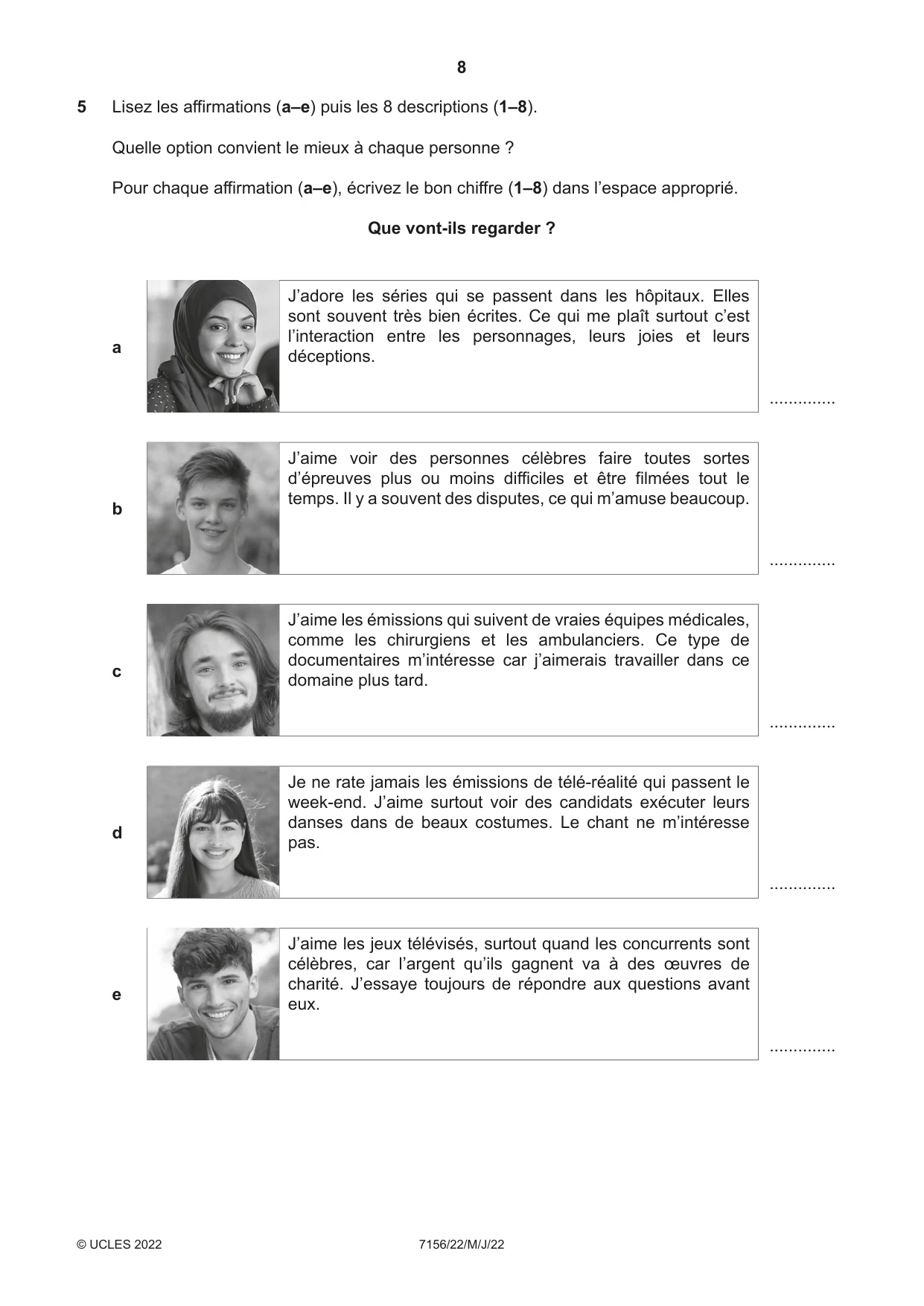
8 7156/22/M/J/22 © UCLES 2022 5 Lisez les affirmations (a–e) puis les 8 descriptions (1–8). Quelle option convient le mieux à chaque personne ? Pour chaque affirmation (a–e), écrivez le bon chiffre (1–8) dans l’espace approprié. Que vont-ils regarder ? a J’adore les séries qui se passent dans les hôpitaux. Elles sont souvent très bien écrites. Ce qui me plaît surtout c’est l’interaction entre les personnages, leurs joies et leurs déceptions. … b J’aime voir des personnes célèbres faire toutes sortes d’épreuves plus ou moins difficiles et être filmées tout le temps. Il y a souvent des disputes, ce qui m’amuse beaucoup. … c J’aime les émissions qui suivent de vraies équipes médicales, comme les chirurgiens et les ambulanciers. Ce type de documentaires m’intéresse car j’aimerais travailler dans ce domaine plus tard. … d Je ne rate jamais les émissions de télé-réalité qui passent le week-end. J’aime surtout voir des candidats exécuter leurs danses dans de beaux costumes. Le chant ne m’intéresse pas. … e J’aime les jeux télévisés, surtout quand les concurrents sont célèbres, car l’argent qu’ils gagnent va à des œuvres de charité. J’essaye toujours de répondre aux questions avant eux. …
Question paper, page 9
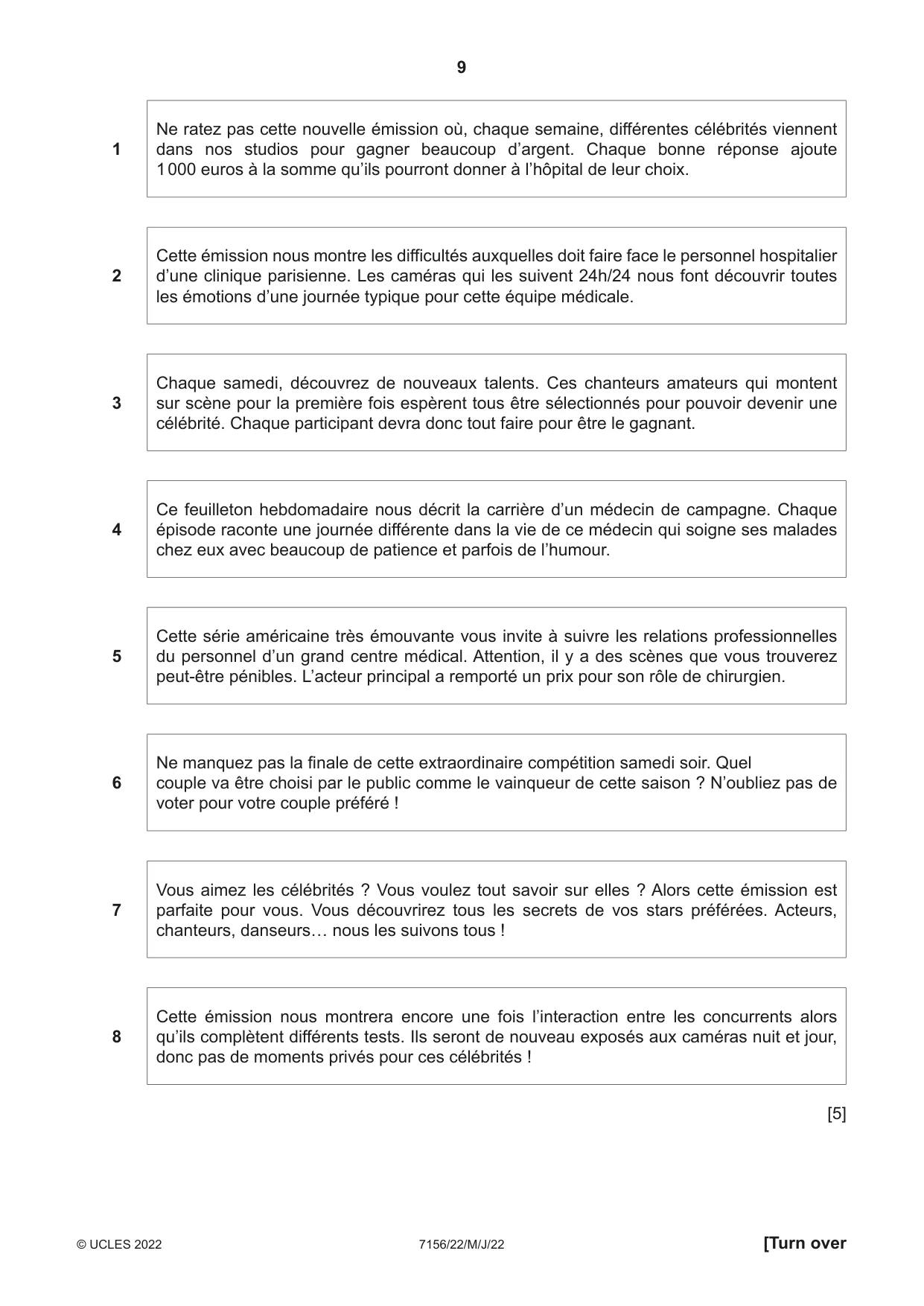
9 7156/22/M/J/22 © UCLES 2022 [Turn over 1 Ne ratez pas cette nouvelle émission où, chaque semaine, différentes célébrités viennent dans nos studios pour gagner beaucoup d’argent. Chaque bonne réponse ajoute 1 000 euros à la somme qu’ils pourront donner à l’hôpital de leur choix. 2 Cette émission nous montre les difficultés auxquelles doit faire face le personnel hospitalier d’une clinique parisienne. Les caméras qui les suivent 24h/24 nous font découvrir toutes les émotions d’une journée typique pour cette équipe médicale. 3 Chaque samedi, découvrez de nouveaux talents. Ces chanteurs amateurs qui montent sur scène pour la première fois espèrent tous être sélectionnés pour pouvoir devenir une célébrité. Chaque participant devra donc tout faire pour être le gagnant. 4 Ce feuilleton hebdomadaire nous décrit la carrière d’un médecin de campagne. Chaque épisode raconte une journée différente dans la vie de ce médecin qui soigne ses malades chez eux avec beaucoup de patience et parfois de l’humour. 5 Cette série américaine très émouvante vous invite à suivre les relations professionnelles du personnel d’un grand centre médical. Attention, il y a des scènes que vous trouverez peut-être pénibles. L’acteur principal a remporté un prix pour son rôle de chirurgien. 6 Ne manquez pas la finale de cette extraordinaire compétition samedi soir. Quel couple va être choisi par le public comme le vainqueur de cette saison ? N’oubliez pas de voter pour votre couple préféré ! 7 Vous aimez les célébrités ? Vous voulez tout savoir sur elles ? Alors cette émission est parfaite pour vous. Vous découvrirez tous les secrets de vos stars préférées. Acteurs, chanteurs, danseurs… nous les suivons tous ! 8 Cette émission nous montrera encore une fois l’interaction entre les concurrents alors qu’ils complètent différents tests. Ils seront de nouveau exposés aux caméras nuit et jour, donc pas de moments privés pour ces célébrités ! [5]
Question paper, page 10
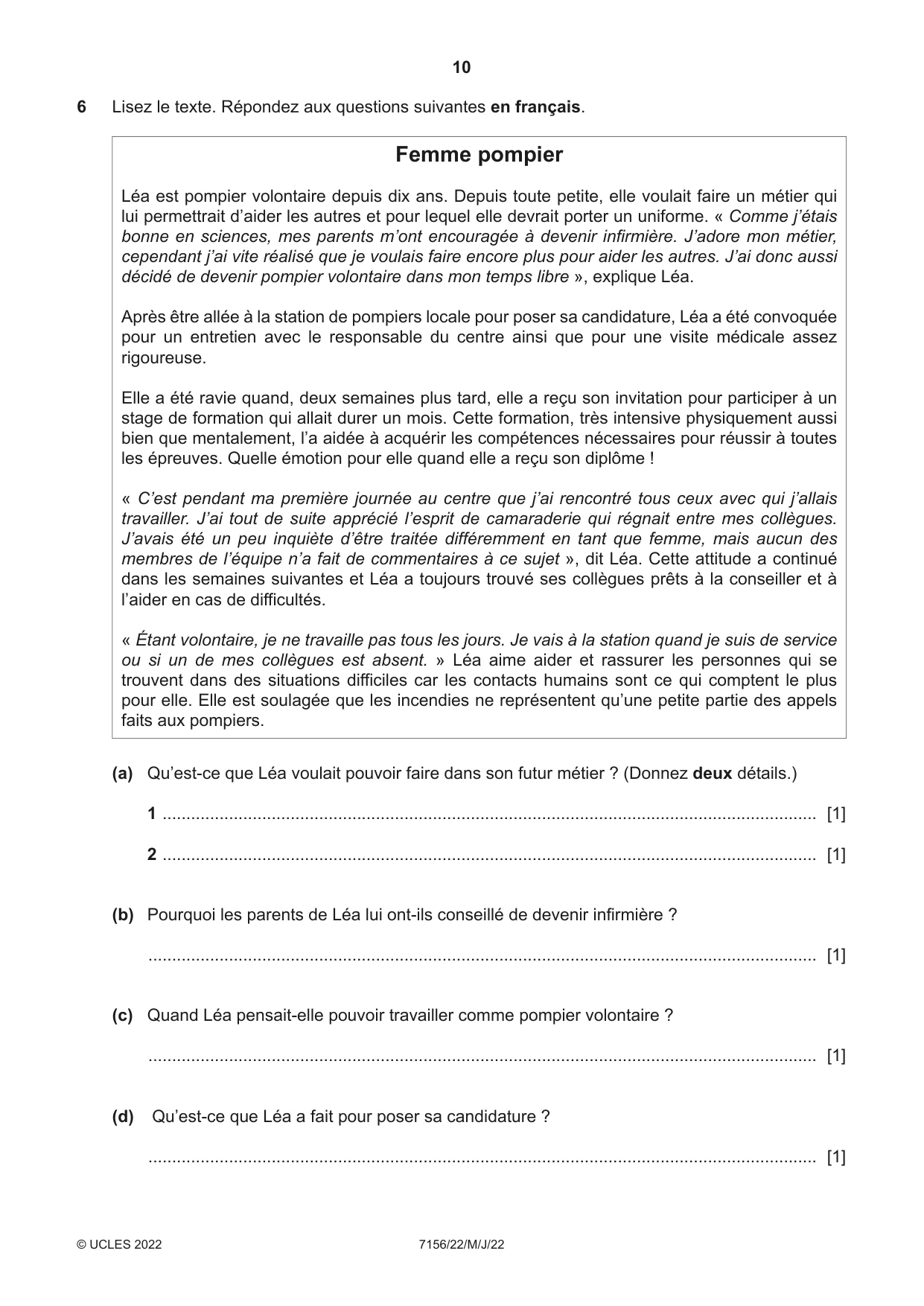
10 7156/22/M/J/22 © UCLES 2022 6 Lisez le texte. Répondez aux questions suivantes en français. Femme pompier Léa est pompier volontaire depuis dix ans. Depuis toute petite, elle voulait faire un métier qui lui permettrait d’aider les autres et pour lequel elle devrait porter un uniforme. « Comme j’étais bonne en sciences, mes parents m’ont encouragée à devenir infirmière. J’adore mon métier, cependant j’ai vite réalisé que je voulais faire encore plus pour aider les autres. J’ai donc aussi décidé de devenir pompier volontaire dans mon temps libre », explique Léa. Après être allée à la station de pompiers locale pour poser sa candidature, Léa a été convoquée pour un entretien avec le responsable du centre ainsi que pour une visite médicale assez rigoureuse. Elle a été ravie quand, deux semaines plus tard, elle a reçu son invitation pour participer à un stage de formation qui allait durer un mois. Cette formation, très intensive physiquement aussi bien que mentalement, l’a aidée à acquérir les compétences nécessaires pour réussir à toutes les épreuves. Quelle émotion pour elle quand elle a reçu son diplôme ! « C’est pendant ma première journée au centre que j’ai rencontré tous ceux avec qui j’allais travailler. J’ai tout de suite apprécié l’esprit de camaraderie qui régnait entre mes collègues. J’avais été un peu inquiète d’être traitée différemment en tant que femme, mais aucun des membres de l’équipe n’a fait de commentaires à ce sujet », dit Léa. Cette attitude a continué dans les semaines suivantes et Léa a toujours trouvé ses collègues prêts à la conseiller et à l’aider en cas de difficultés. « Étant volontaire, je ne travaille pas tous les jours. Je vais à la station quand je suis de service ou si un de mes collègues est absent. » Léa aime aider et rassurer les personnes qui se trouvent dans des situations difficiles car les contacts humains sont ce qui comptent le plus pour elle. Elle est soulagée que les incendies ne représentent qu’une petite partie des appels faits aux pompiers. (a) Qu’est-ce que Léa voulait pouvoir faire dans son futur métier ? (Donnez deux détails.) 1 … [1] 2 … [1] (b) Pourquoi les parents de Léa lui ont-ils conseillé de devenir infirmière ? … [1] (c) Quand Léa pensait-elle pouvoir travailler comme pompier volontaire ? … [1] (d) Qu’est-ce que Léa a fait pour poser sa candidature ? … [1]
Question paper, page 11
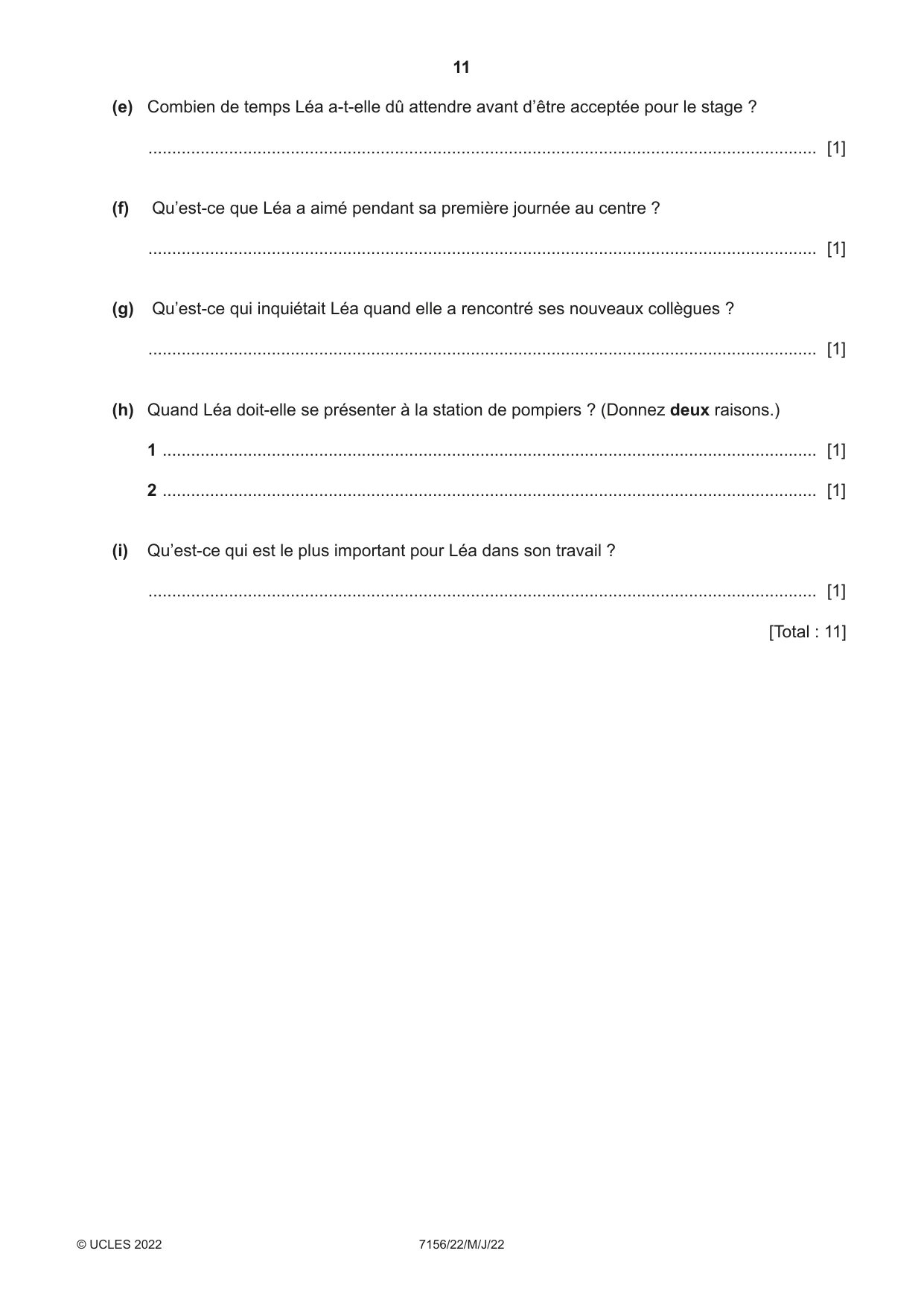
11 7156/22/M/J/22 © UCLES 2022 (e) Combien de temps Léa a-t-elle dû attendre avant d’être acceptée pour le stage ? … [1] (f) Qu’est-ce que Léa a aimé pendant sa première journée au centre ? … [1] (g) Qu’est-ce qui inquiétait Léa quand elle a rencontré ses nouveaux collègues ? … [1] (h) Quand Léa doit-elle se présenter à la station de pompiers ? (Donnez deux raisons.) 1 … [1] 2 … [1] (i) Qu’est-ce qui est le plus important pour Léa dans son travail ? … [1] [Total : 11]
Question paper, page 12
12 7156/22/M/J/22 © UCLES 2022 Permission to reproduce items where third-party owned material protected by copyright is included has been sought and cleared where possible. Every reasonable effort has been made by the publisher (UCLES) to trace copyright holders, but if any items requiring clearance have unwittingly been included, the publisher will be pleased to make amends at the earliest possible opportunity. To avoid the issue of disclosure of answer-related information to candidates, all copyright acknowledgements are reproduced online in the Cambridge Assessment International Education Copyright Acknowledgements Booklet. This is produced for each series of examinations and is freely available to download at www.cambridgeinternational.org after the live examination series. Cambridge Assessment International Education is part of Cambridge Assessment. Cambridge Assessment is the brand name of the University of Cambridge Local Examinations Syndicate (UCLES), which is a department of the University of Cambridge. BLANK PAGE
Mark scheme, page 1
This document consists of 8 printed pages. © UCLES 2022 [Turn over Cambridge IGCSE™ (9–1) FRENCH 7156/22 Paper 2 Reading May/June 2022 MARK SCHEME Maximum Mark: 45 Published This mark scheme is published as an aid to teachers and candidates, to indicate the requirements of the examination. It shows the basis on which Examiners were instructed to award marks. It does not indicate the details of the discussions that took place at an Examiners’ meeting before marking began, which would have considered the acceptability of alternative answers. Mark schemes should be read in conjunction with the question paper and the Principal Examiner Report for Teachers. Cambridge International will not enter into discussions about these mark schemes. Cambridge International is publishing the mark schemes for the May/June 2022 series for most Cambridge IGCSE, Cambridge International A and AS Level and Cambridge Pre-U components, and some Cambridge O Level components.
Mark scheme, page 2
7156/22 Cambridge IGCSE (9–1) – Mark Scheme PUBLISHED May/June 2022 © UCLES 2022 Page 2 of 8 Generic Marking Principles These general marking principles must be applied by all examiners when marking candidate answers. They should be applied alongside the specific content of the mark scheme or generic level descriptors for a question. Each question paper and mark scheme will also comply with these marking principles. GENERIC MARKING PRINCIPLE 1: Marks must be awarded in line with: the specific content of the mark scheme or the generic level descriptors for the question the specific skills defined in the mark scheme or in the generic level descriptors for the question the standard of response required by a candidate as exemplified by the standardisation scripts. GENERIC MARKING PRINCIPLE 2: Marks awarded are always whole marks (not half marks, or other fractions) GENERIC MARKING PRINCIPLE 3: Marks must be awarded positively: marks are awarded for correct/valid answers, as defined in the mark scheme. However, credit is given for valid answers which go beyond the scope of the syllabus and mark scheme, referring to your Team Leader as appropriate marks are awarded when candidates clearly demonstrate what they know and can do marks are not deducted for errors marks are not deducted for omissions answers should only be judged on the quality of spelling, punctuation and grammar when these features are specifically assessed by the question as indicated by the mark scheme. The meaning, however, should be unambiguous. GENERIC MARKING PRINCIPLE 4: Rules must be applied consistently e.g. in situations where candidates have not followed instructions or in the application of generic level descriptors GENERIC MARKING PRINCIPLE 5: Marks should be awarded using the full range of marks defined in the mark scheme for the question (however; the use of the full mark range may be limited according to the quality of the candidate responses seen). GENERIC MARKING PRINCIPLE 6: Marks awarded are based solely on the requirements as defined in the mark scheme. Marks should not be awarded with grade thresholds or grade descriptors in mind.
Mark scheme, page 3
7156/22 Cambridge IGCSE (9–1) – Mark Scheme PUBLISHED May/June 2022 © UCLES 2022 Page 3 of 8 Additional Guidance The following guidance underpins the detailed instructions provided in the mark scheme. Where a decision is taken to deviate from this guidance for a particular question, this will be specified in the mark scheme. Often the additional guidance points will have to be weighed up against each other, e.g. the answer might look or sound like the intended word/phrase in French, but if what the candidate has written means something different in French from what is expected, the mark cannot be awarded. It is not possible to list all acceptable alternatives in the mark scheme. If you encounter an answer which is not covered by the mark scheme, you will need to make a decision about whether it communicates the required elements (in consultation with your Team Leader if necessary, or with your Product Manager if you are a single examiner), and award marks accordingly. Crossing out: (a) If a candidate changes his/her mind about an answer and crosses out an attempt, award a mark if the final attempt is correct. (b) If a candidate crosses out an answer to a whole question but makes no second attempt at it, mark the crossed out work. More than the stipulated number of boxes ticked/crossed by the candidate: (a) If more than one attempt is visible but the candidate has clearly indicated which attempt is his/her final answer (e.g. by crossing out other attempts or by annotating the script in some way), mark in the usual way. (b) If two attempts are visible (e.g. two boxes ticked instead of the one box stipulated), and neither has been crossed out/discounted by the candidate, no mark can be awarded. For questions requiring more than one element for the answer, 1 and 2, where the answers are interchangeable: (a) Both of the correct answers are on line 1 and line 2 blank (or vice versa) = 2 marks (b) Both correct answers on line 1 and line 2 contains a wrong answer (or vice versa) = 1 mark
Mark scheme, page 4
7156/22 Cambridge IGCSE (9–1) – Mark Scheme PUBLISHED May/June 2022 © UCLES 2022 Page 4 of 8 Mark for communication: Answers requiring the use of French (rather than a non-verbal response) should be marked for communication. Tolerate inaccuracies provided that the message is clear. However, do not accept incorrect French if the word written by the candidate means something else in French (unless the mark scheme specifies otherwise). (a) If you read aloud what the candidate has written, does it sound like the correct answer? Would a native speaker of French understand it? (b) Does what the candidate has written look like the correct answer, e.g. one letter missing but no other word created? Would a native speaker of French understand it? Annotations used in the mark scheme: (a) INV = invalidation. This is used when the additional material included by the candidate is judged to invalidate an otherwise correct answer and therefore prevents him/her from scoring the mark. (INV = 0) (b) tc = ‘tout court’. This means that, on its own, the material is not sufficient to score the mark. (c) HA = harmless addition. This means that the candidate has included additional material which, in conjunction with the correct answer, does not prevent him/her from scoring the mark. No response and ‘0’ marks: (a) Award NR (no response): If there is nothing written at all in the answer space or If there is only a comment which does not in any way relate to the question being asked (e.g. ‘can’t do’ or ‘don’t know’) or If there is only a mark which isn’t an attempt at the question (e.g. a dash, a question mark). (b) Award 0: If there is any attempt that earns no credit, e.g. the candidate has copied out part or all of the question.
Mark scheme, page 5
7156/22 Cambridge IGCSE (9–1) – Mark Scheme PUBLISHED May/June 2022 © UCLES 2022 Page 5 of 8 Extra material: Candidates need to answer the questions in such a way as to demonstrate that they have understood the text. The mark scheme cannot cover all eventualities so where specific instructions are not provided, the examiner must check the text to ensure that the correct elements which would attract the mark are not contradicted or distorted by any extra material. The following general rules should be applied: (a) Extra material, mentioned in the mark scheme, which reinforces the correct answer or in itself constitutes an alternative correct answer: This is acceptable and is not penalised. (b) Extra material which constitutes an alternative answer, but which is not explicitly mentioned in the mark scheme: The examiner needs to decide, by consulting the transcript/text and the Team Leader if necessary, whether the alternative answer constitutes: (i) an alternative correct answer, in which case this falls into category (a) and the answer should be rewarded, or (ii) an answer which on its own would be rejected, in which case this falls into category (c) and the answer should be rejected. (c) Extra material which constitutes an alternative answer specifically rejected in the mark scheme: This puts the examiner in the position of having to ‘choose’ which the intended answer is. The examiner cannot therefore be sure what the candidate has understood and the mark cannot be awarded. (d) Extra material which distorts or contradicts the correct answer: This affects communication. The examiner cannot be sure what the candidate has understood and therefore the mark cannot be awarded. (e) Extra material introduced by the candidate and which does not feature in the original text: This affects communication. The examiner cannot be sure what the candidate has understood and therefore the mark cannot be awarded. It can sometimes be difficult to draw the line between what is a deduction made by an able candidate on the basis of what they have read and pure guesswork. Therefore, where a particular answer is not covered by the mark scheme, the examiner should consult the Team Leader.
Mark scheme, page 6
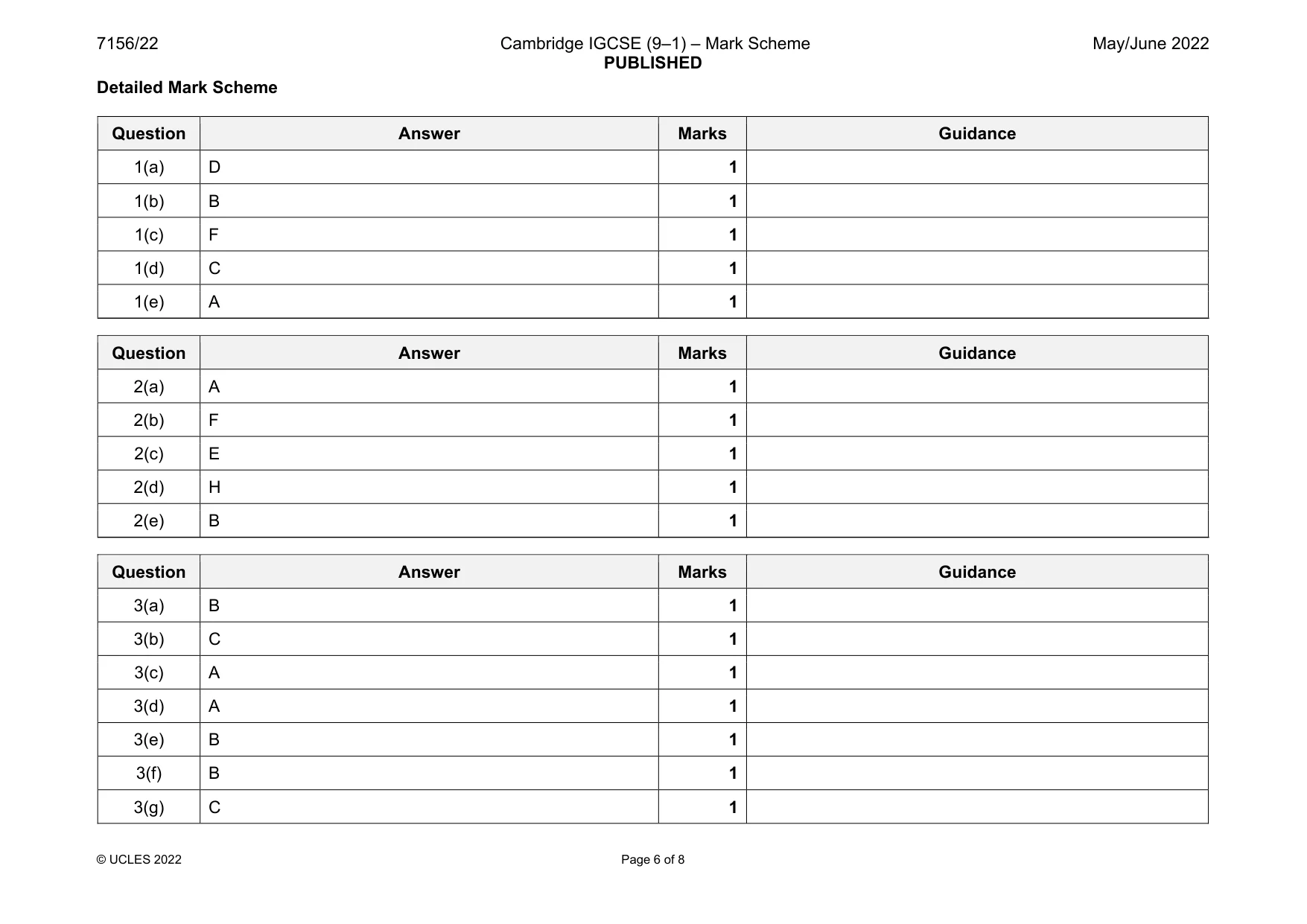
7156/22 Cambridge IGCSE (9–1) – Mark Scheme PUBLISHED May/June 2022 © UCLES 2022 Page 6 of 8 Detailed Mark Scheme Question Answer Marks Guidance 1(a) D 1 1(b) B 1 1(c) F 1 1(d) C 1 1(e) A 1 Question Answer Marks Guidance 2(a) A 1 2(b) F 1 2(c) E 1 2(d) H 1 2(e) B 1 Question Answer Marks Guidance 3(a) B 1 3(b) C 1 3(c) A 1 3(d) A 1 3(e) B 1 3(f) B 1 3(g) C 1
Mark scheme, page 7
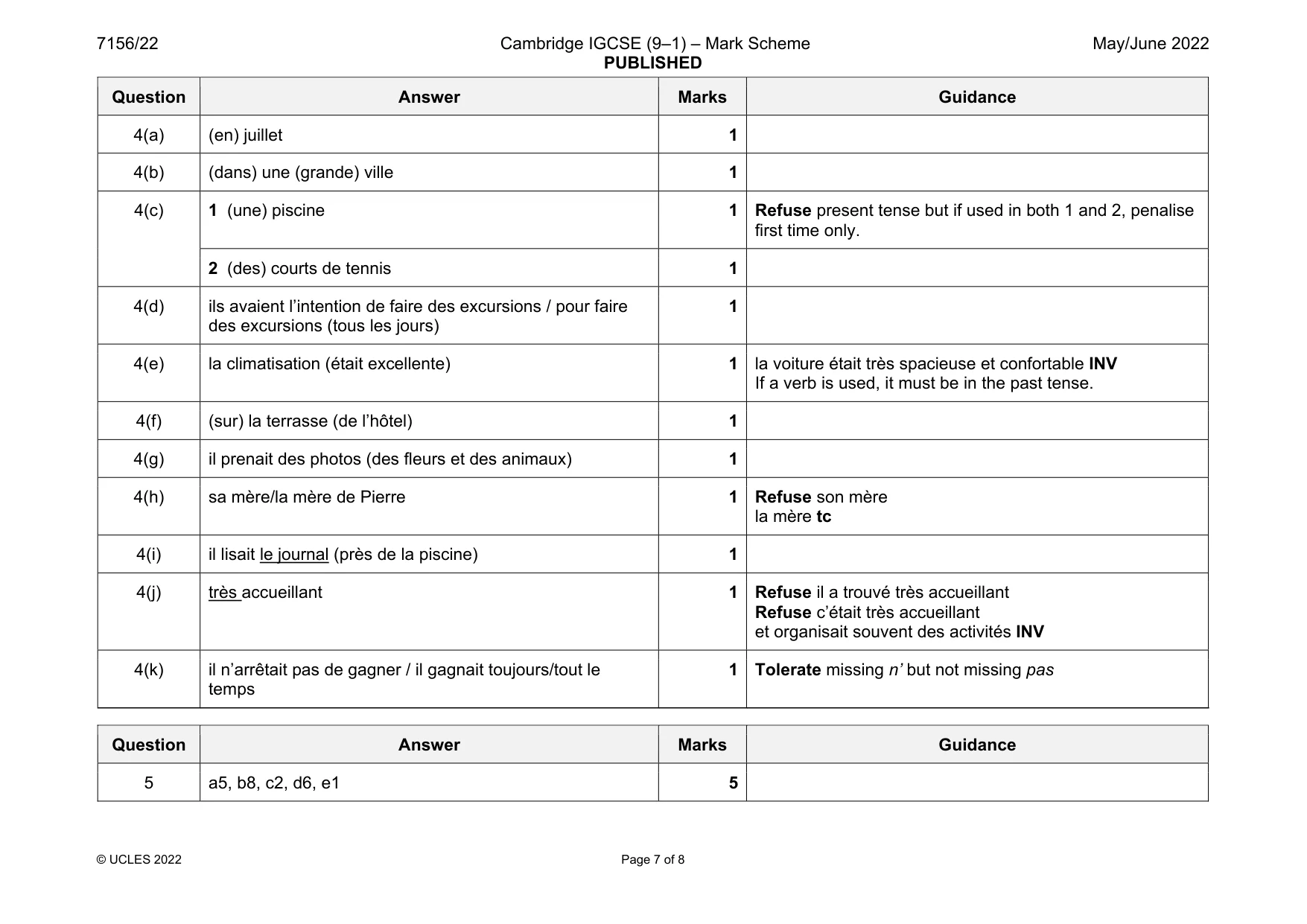
7156/22 Cambridge IGCSE (9–1) – Mark Scheme PUBLISHED May/June 2022 © UCLES 2022 Page 7 of 8 Question Answer Marks Guidance 4(a) (en) juillet 1 4(b) (dans) une (grande) ville 1 4(c) 1 (une) piscine 1 Refuse present tense but if used in both 1 and 2, penalise first time only. 2 (des) courts de tennis 1 4(d) ils avaient l’intention de faire des excursions / pour faire des excursions (tous les jours) 1 4(e) la climatisation (était excellente) 1 la voiture était très spacieuse et confortable INV If a verb is used, it must be in the past tense. 4(f) (sur) la terrasse (de l’hôtel) 1 4(g) il prenait des photos (des fleurs et des animaux) 1 4(h) sa mère/la mère de Pierre 1 Refuse son mère la mère tc 4(i) il lisait le journal (près de la piscine) 1 4(j) très accueillant 1 Refuse il a trouvé très accueillant Refuse c’était très accueillant et organisait souvent des activités INV 4(k) il n’arrêtait pas de gagner / il gagnait toujours/tout le temps 1 Tolerate missing n’ but not missing pas Question Answer Marks Guidance 5 a5, b8, c2, d6, e1 5
Mark scheme, page 8
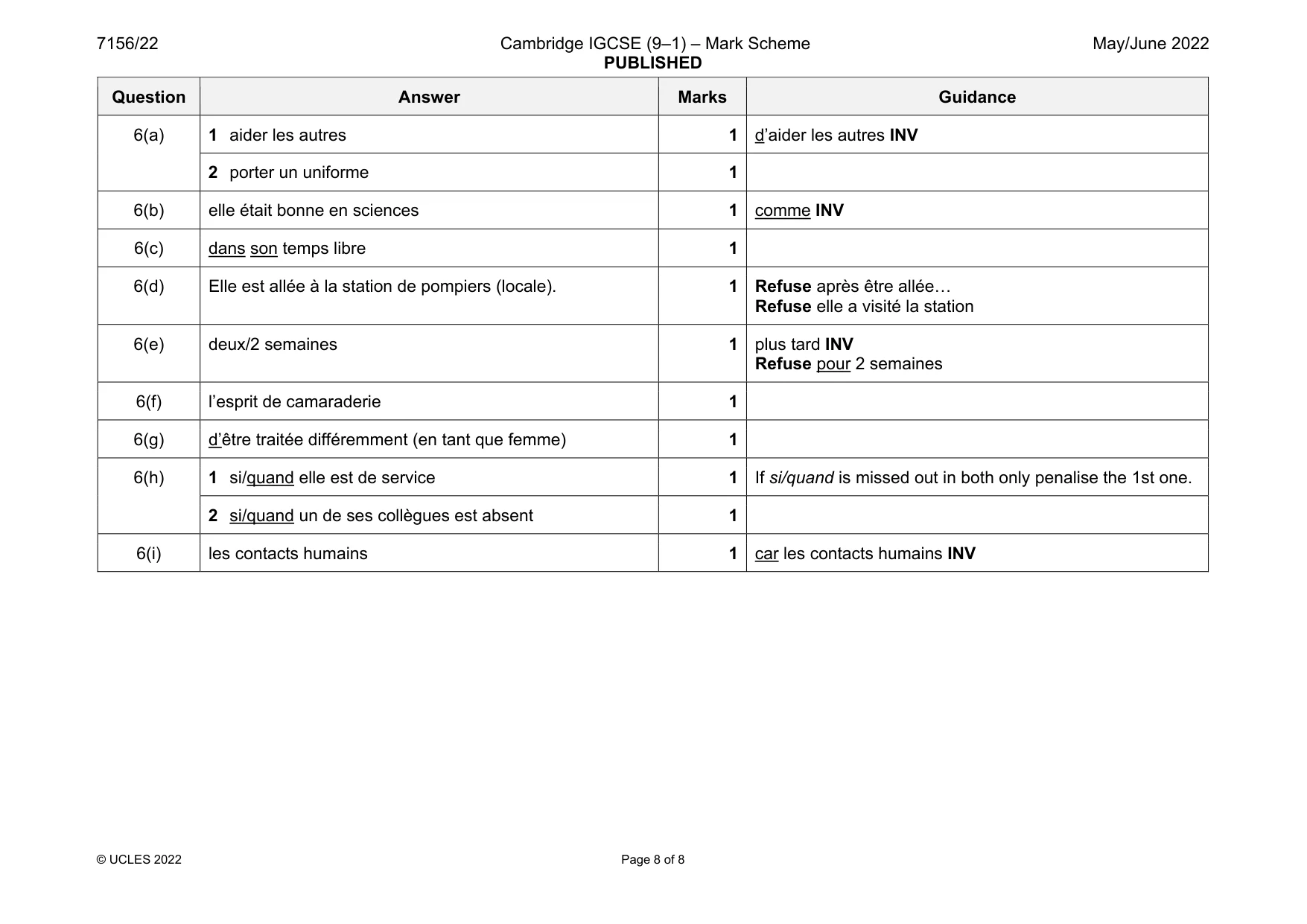
7156/22 Cambridge IGCSE (9–1) – Mark Scheme PUBLISHED May/June 2022 © UCLES 2022 Page 8 of 8 Question Answer Marks Guidance 6(a) 1 aider les autres 1 d’aider les autres INV 2 porter un uniforme 1 6(b) elle était bonne en sciences 1 comme INV 6(c) dans son temps libre 1 6(d) Elle est allée à la station de pompiers (locale). 1 Refuse après être allée… Refuse elle a visité la station 6(e) deux/2 semaines 1 plus tard INV Refuse pour 2 semaines 6(f) l’esprit de camaraderie 1 6(g) d’être traitée différemment (en tant que femme) 1 6(h) 1 si/quand elle est de service 1 If si/quand is missed out in both only penalise the 1st one. 2 si/quand un de ses collègues est absent 1 6(i) les contacts humains 1 car les contacts humains INV
What you needed in this session
Cambridge’s own grade thresholds for 2022 May/June, Paper 2 · Variant 2. A higher threshold means an easier paper — the bar moves with how the cohort did.