Cambridge IGCSE Food and Nutrition 0648 — 2022 May/June Paper 1 · Variant 2
0648/12/M/J/22 · 100 marks · ≈113 min
The question paper and its mark scheme, free to read here and free to download. This is Cambridge’s own paper, exactly as it was sat.
Question paper12 pages



Mark scheme20 pages
Answers below. Sit the paper first if you are practising.
Paper as text
Question paper, page 1
This document has 12 pages. [Turn over Cambridge IGCSE™ DC (KN) 304583/2 © UCLES 2022 * 9 6 5 8 6 5 9 8 0 2 * FOOD & NUTRITION 0648/12 Paper 1 Theory May/June 2022 2 hours You must answer on the question paper. No additional materials are needed. INSTRUCTIONS ● Section A: answer all questions. ● Section B: answer all questions. ● Section C: answer one question. ● Use a black or dark blue pen. You may use an HB pencil for any diagrams or graphs. ● Write your name, centre number and candidate number in the boxes at the top of the page. ● Write your answer to each question in the space provided. ● Do not use an erasable pen or correction fluid. ● Do not write on any bar codes. INFORMATION ● The total mark for this paper is 100. ● The number of marks for each question or part question is shown in brackets [ ].
Question paper, page 2
2 0648/12/M/J/22 © UCLES 2022 Section A Answer all questions. You are advised to spend no longer than 45 minutes on Section A. 1 Name the term used to describe chemical processes, such as growth and cell renewal, that take place in the body. … [1] 2 (a) Simple sugars are molecules from which all carbohydrates are made. (i) State the chemical name for simple sugar. … [1] (ii) Name two examples of simple sugars. 1 … 2 … [2] (b) State two ways the body uses carbohydrate foods. 1 … 2 … [2] [Total: 5] 3 Fish is a good source of high biological value (HBV) protein. (a) Name four different types of oily fish. 1 … 2 … 3 … 4 … [4] (b) Name three different foods that are good sources of HBV protein for a lacto-vegetarian. 1 … 2 … 3 … [3]
Question paper, page 3
3 0648/12/M/J/22 © UCLES 2022 [Turn over (c) (i) Name two enzymes that break down proteins during digestion. 1 … 2 … [2] (ii) Name the end-product of protein digestion. … [1] (d) Name one deficiency disease caused by a lack of protein. … [1] [Total: 11] 4 One function of vitamin E (tocopherol) is to help prevent heart disease. (a) State three other functions of vitamin E in the body. 1 … 2 … 3 … [3] (b) Name three different sources of vitamin E. 1 … 2 … 3 … [3] [Total: 6] 5 State four functions of vitamin C. 1 … 2 … 3 … 4 … [4]
Question paper, page 4
4 0648/12/M/J/22 © UCLES 2022 6 (a) Name the group of people who are most likely to suffer from rickets. … [1] (b) Name one mineral and one vitamin that help to prevent rickets. (i) mineral … [1] (ii) vitamin … [1] (c) Name two different foods that are good sources of the vitamin named in (b)(ii). 1 … 2 … [2] [Total: 5] 7 (a) State four factors that may increase the risk of a person developing type 2 diabetes. 1 … 2 … 3 … 4 … [4] (b) Identify four nutritional guidelines a person should follow to help manage type 2 diabetes. 1 … 2 … 3 … 4 … [4] [Total: 8]
Question paper, page 5
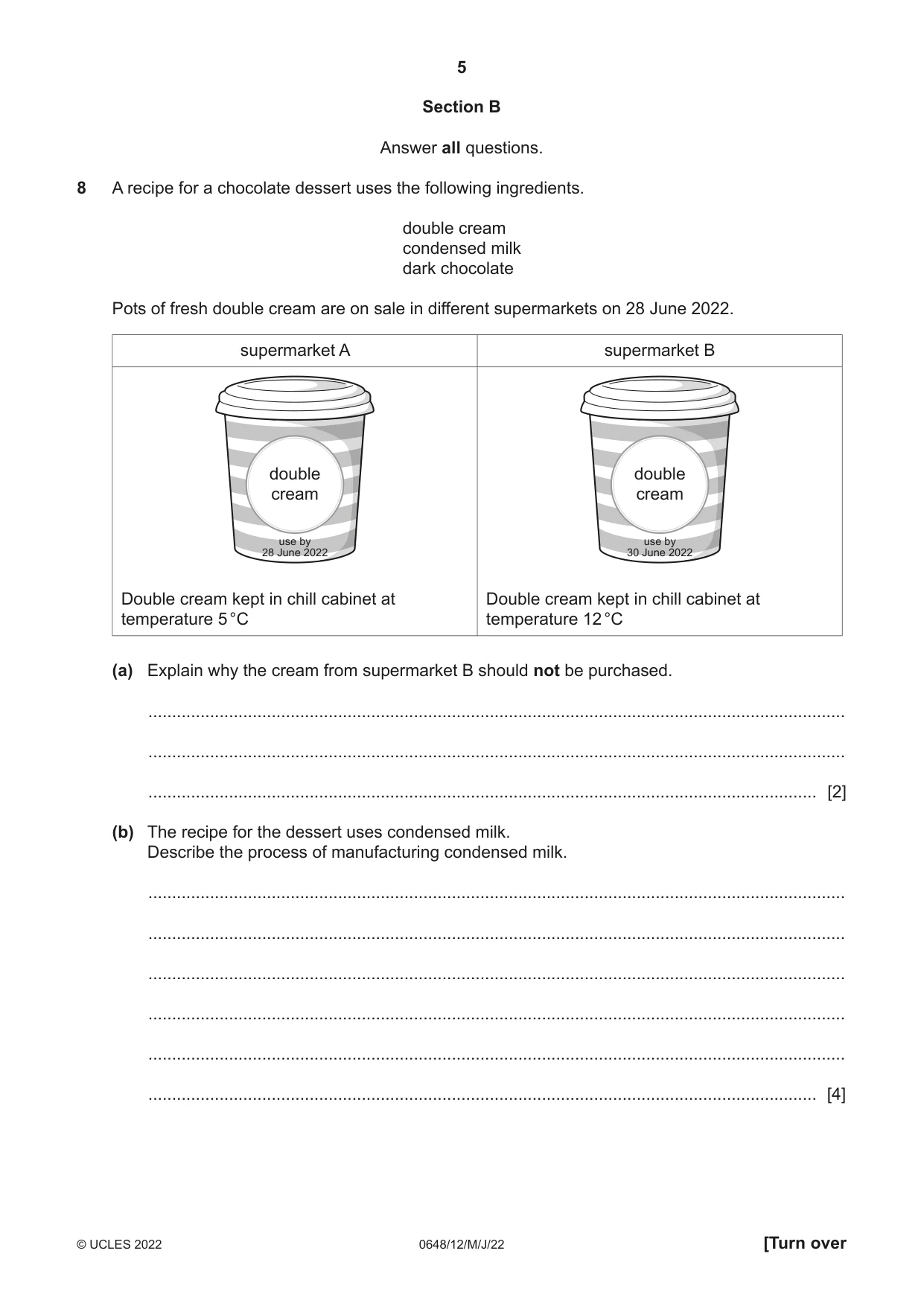
5 0648/12/ M / J /22 © UCLES 2022 [Turn over Section B Answer all questions. 8 A recipe for a chocolate dessert uses the following ingredients. double cream condensed milk dark chocolate Pots of fresh double cream are on sale in different supermarkets on 28 June 2022. supermarket A supermarket B double cream use by 28 June 2022 Double cream kept in chill cabinet at temperature 5 °C double cream use by 30 June 2022 Double cream kept in chill cabinet at temperature 12 °C (a) Explain why the cream from supermarket B should not be purchased. … … … [2] (b) The recipe for the dessert uses condensed milk. Describe the process of manufacturing condensed milk. … … … … … … [4]
Question paper, page 6
6 0648/12/M/J/22 © UCLES 2022 (c) (i) The dark chocolate in the dessert is a good source of iron. Name three different animal foods that are good sources of iron. 1 … 2 … 3 … [3] (ii) State one function of iron in the body. … [1] (d) State what is meant by best-before on a food label. … … … … [2] [Total: 12]
Question paper, page 7
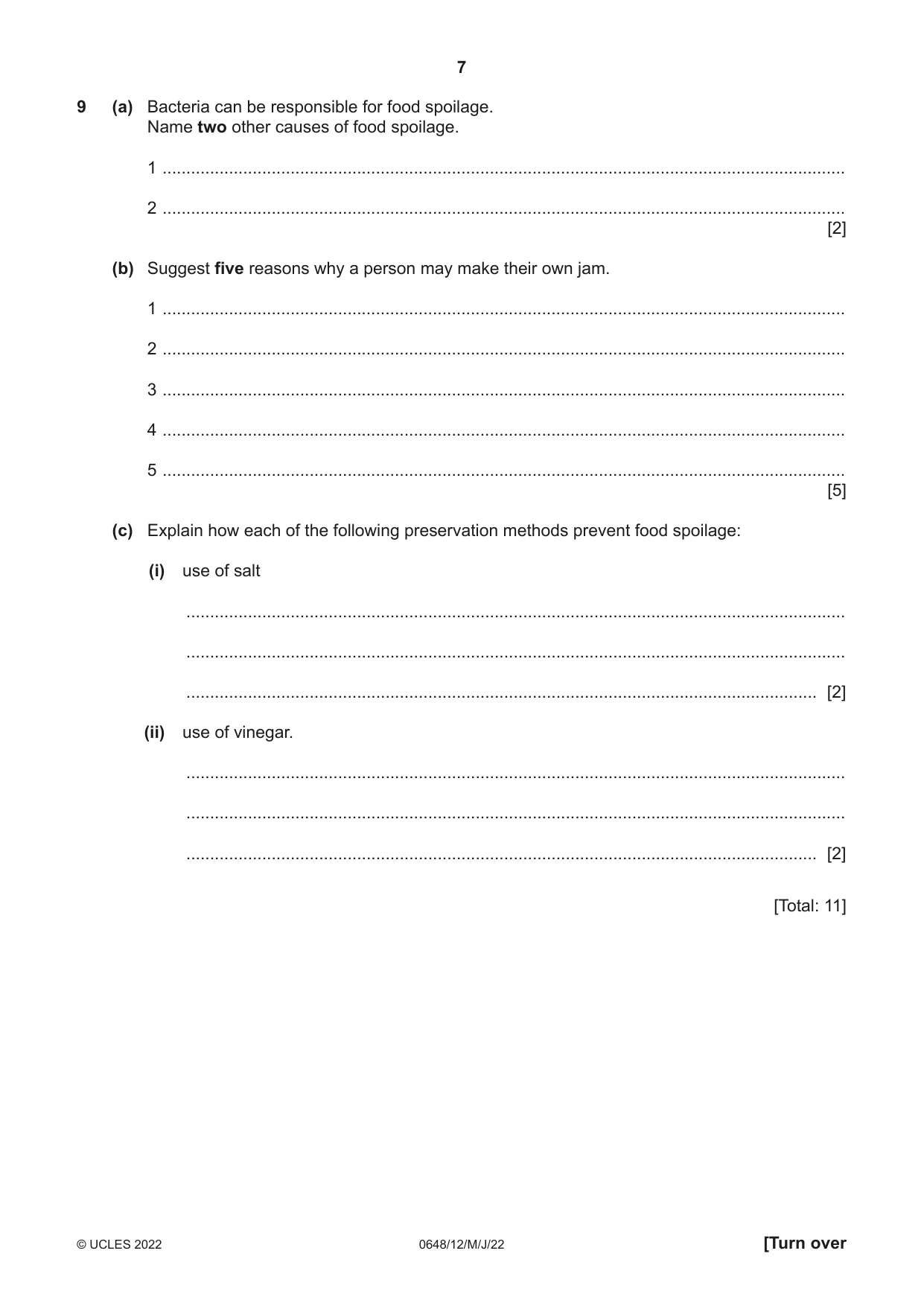
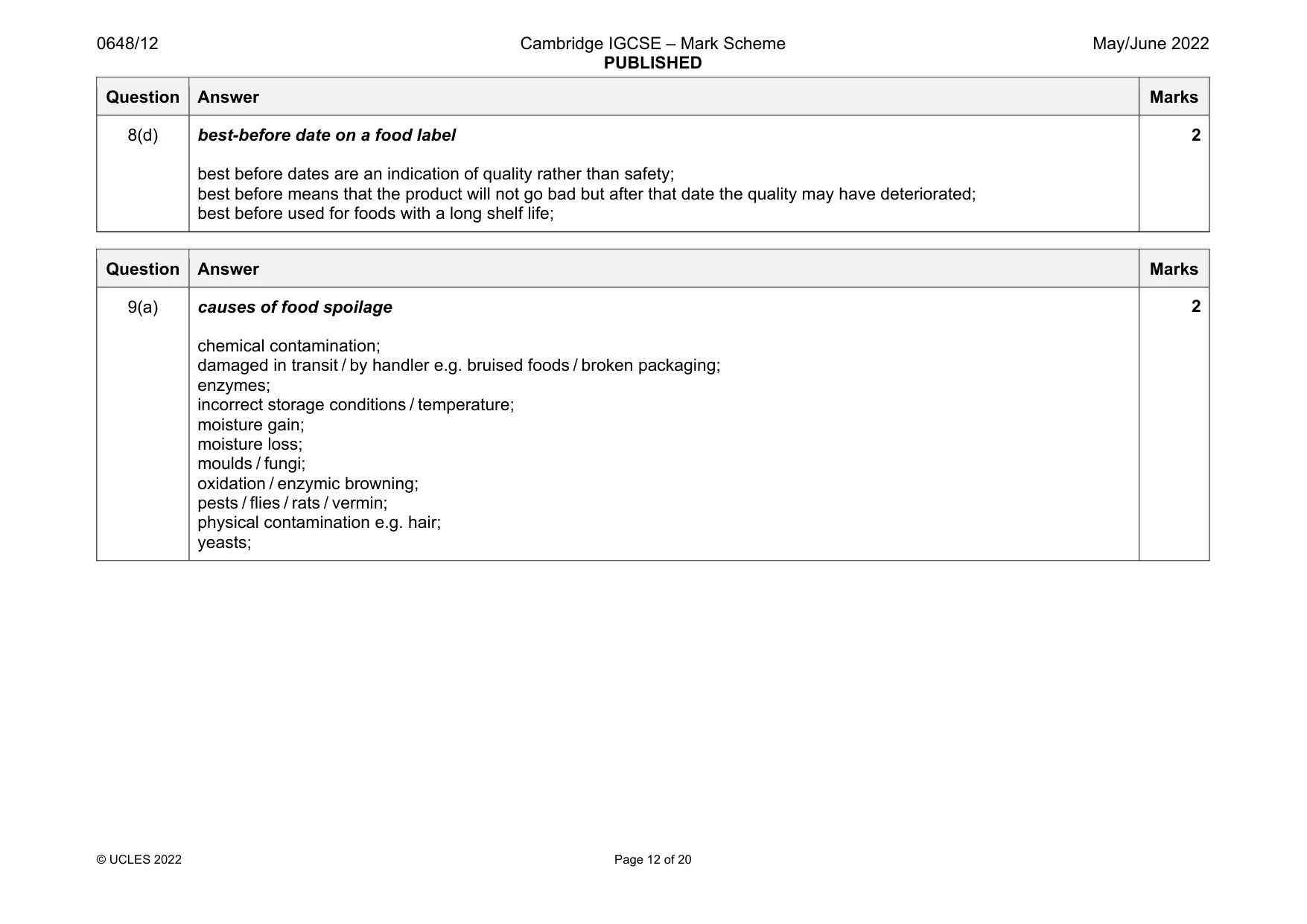
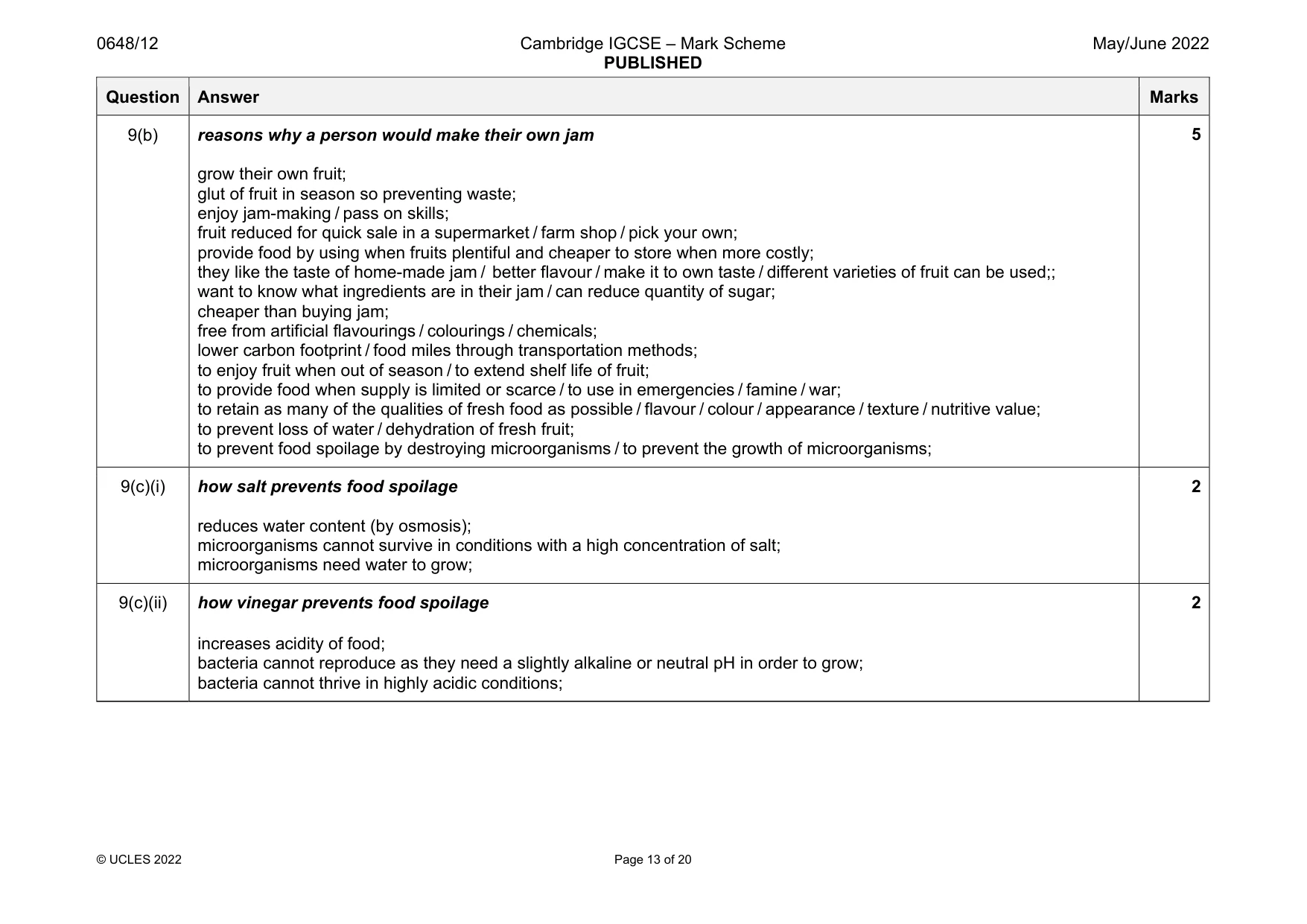
7 0648/12/M/J/22 © UCLES 2022 [Turn over 9 (a) Bacteria can be responsible for food spoilage. Name two other causes of food spoilage. 1 … 2 … [2] (b) Suggest five reasons why a person may make their own jam. 1 … 2 … 3 … 4 … 5 … [5] (c) Explain how each of the following preservation methods prevent food spoilage: (i) use of salt … … … [2] (ii) use of vinegar. … … … [2] [Total: 11]
Question paper, page 8
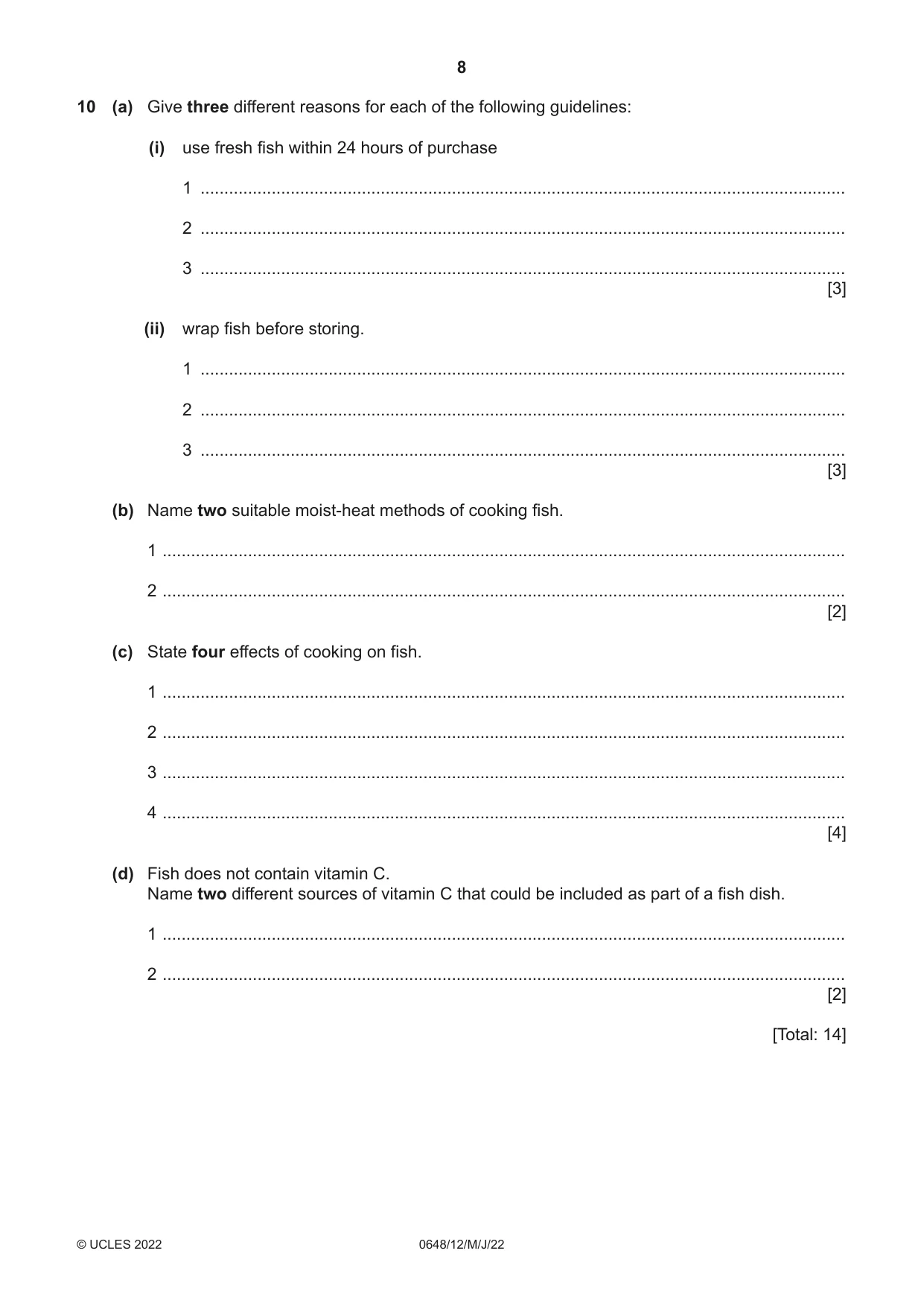
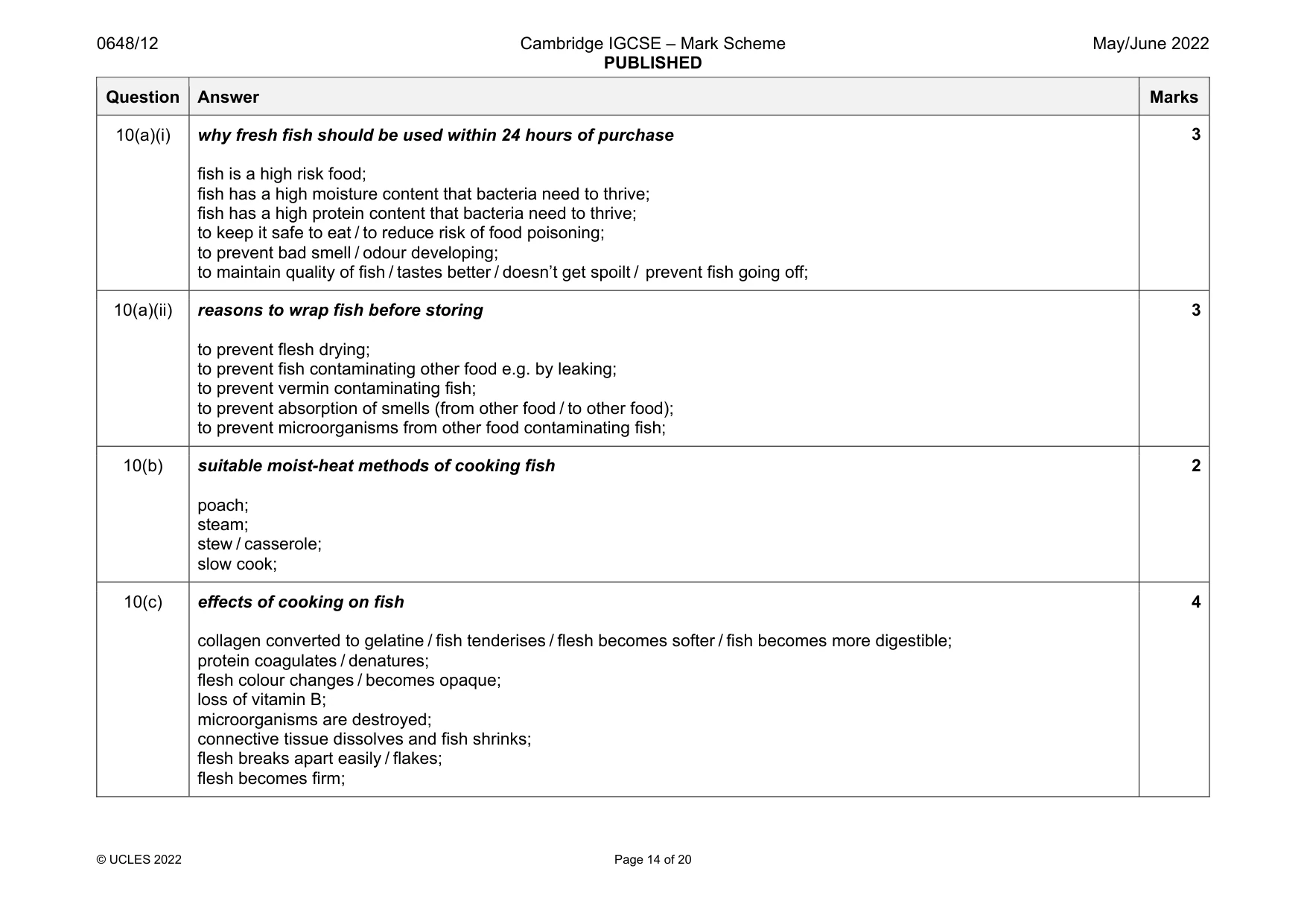
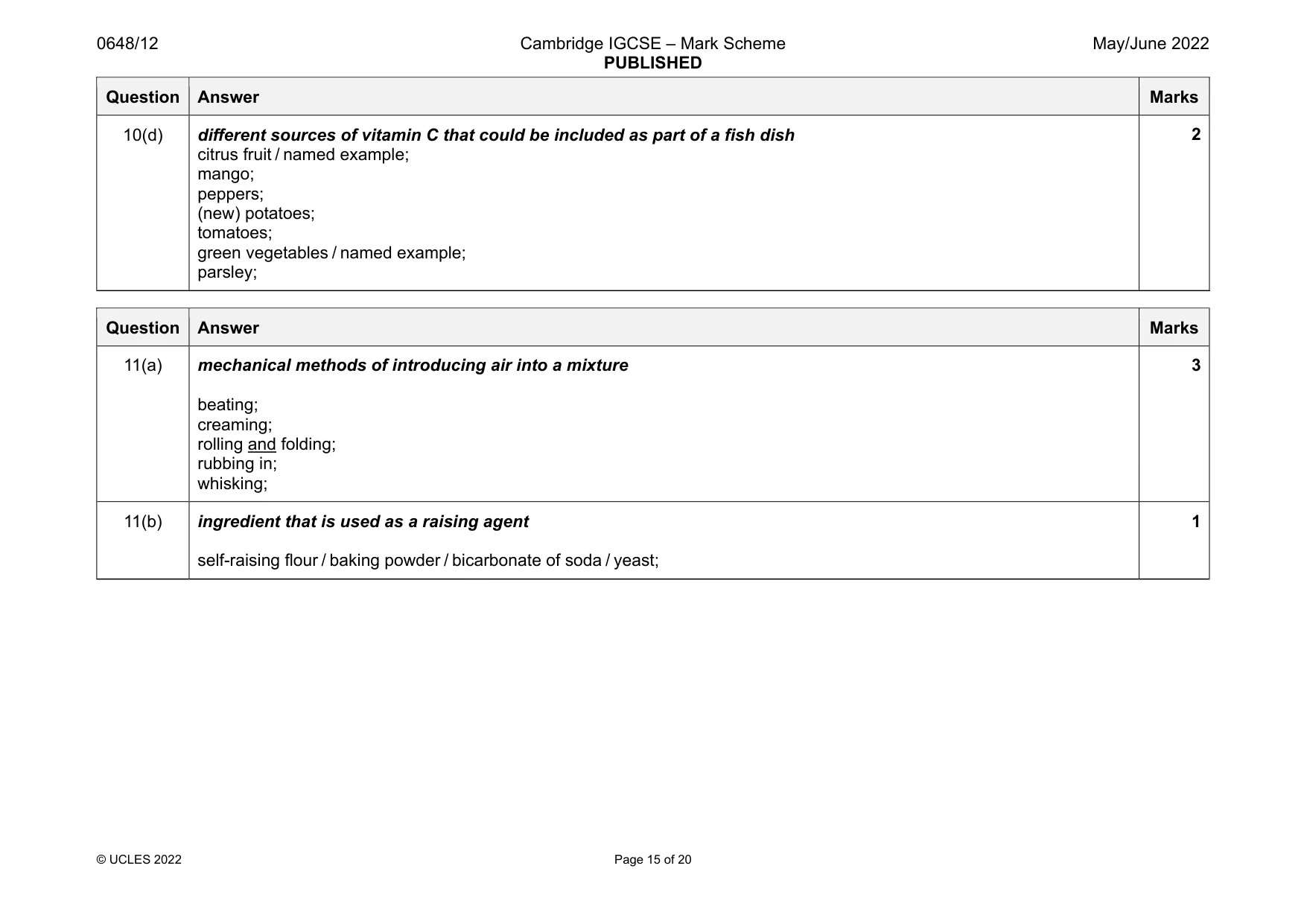
8 0648/12/M/J/22 © UCLES 2022 10 (a) Give three different reasons for each of the following guidelines: (i) use fresh fish within 24 hours of purchase 1 … 2 … 3 … [3] (ii) wrap fish before storing. 1 … 2 … 3 … [3] (b) Name two suitable moist-heat methods of cooking fish. 1 … 2 … [2] (c) State four effects of cooking on fish. 1 … 2 … 3 … 4 … [4] (d) Fish does not contain vitamin C. Name two different sources of vitamin C that could be included as part of a fish dish. 1 … 2 … [2] [Total: 14]
Question paper, page 9
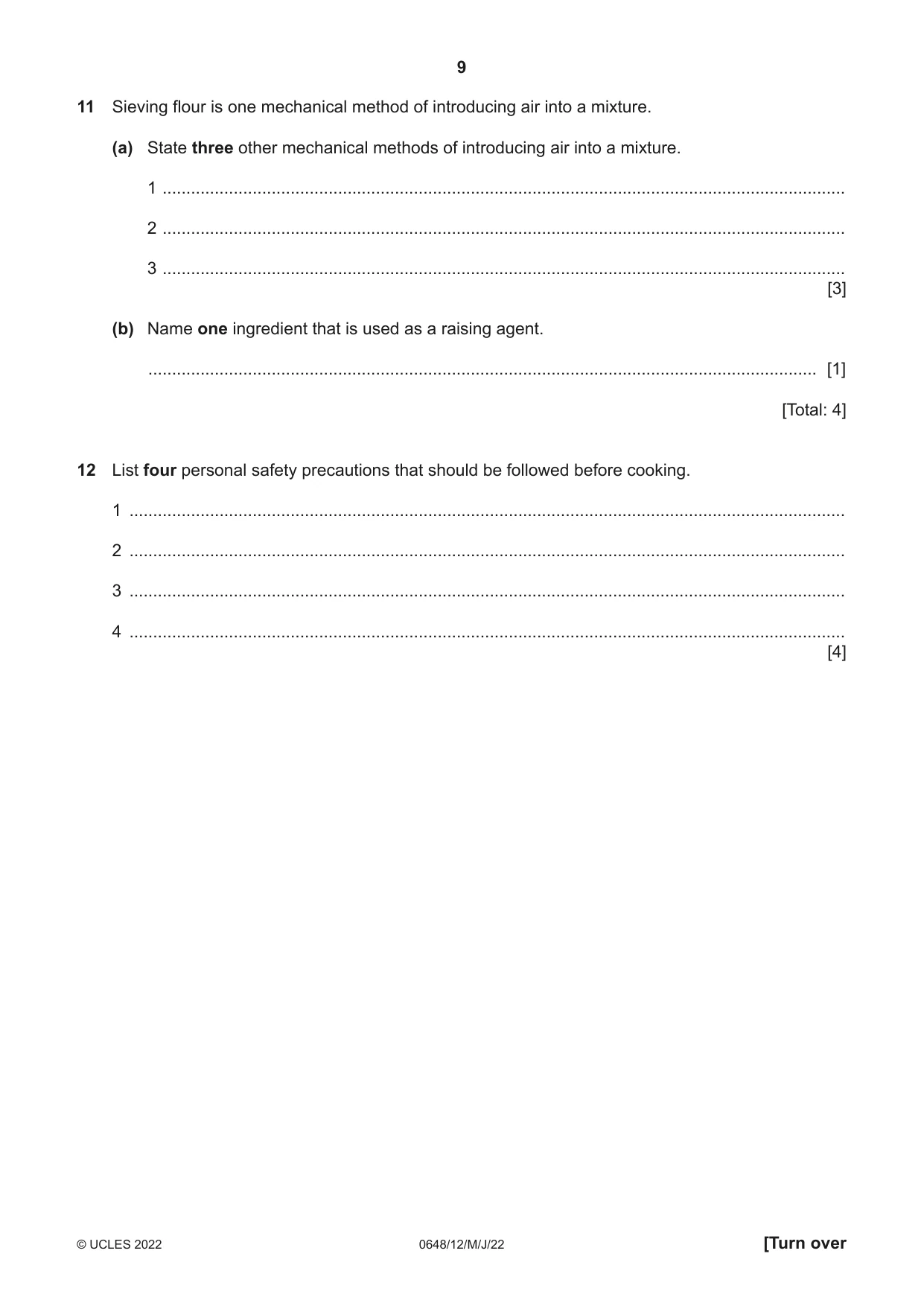
9 0648/12/M/J/22 © UCLES 2022 [Turn over 11 Sieving flour is one mechanical method of introducing air into a mixture. (a) State three other mechanical methods of introducing air into a mixture. 1 … 2 … 3 … [3] (b) Name one ingredient that is used as a raising agent. … [1] [Total: 4] 12 List four personal safety precautions that should be followed before cooking. 1 … 2 … 3 … 4 … [4]
Question paper, page 10
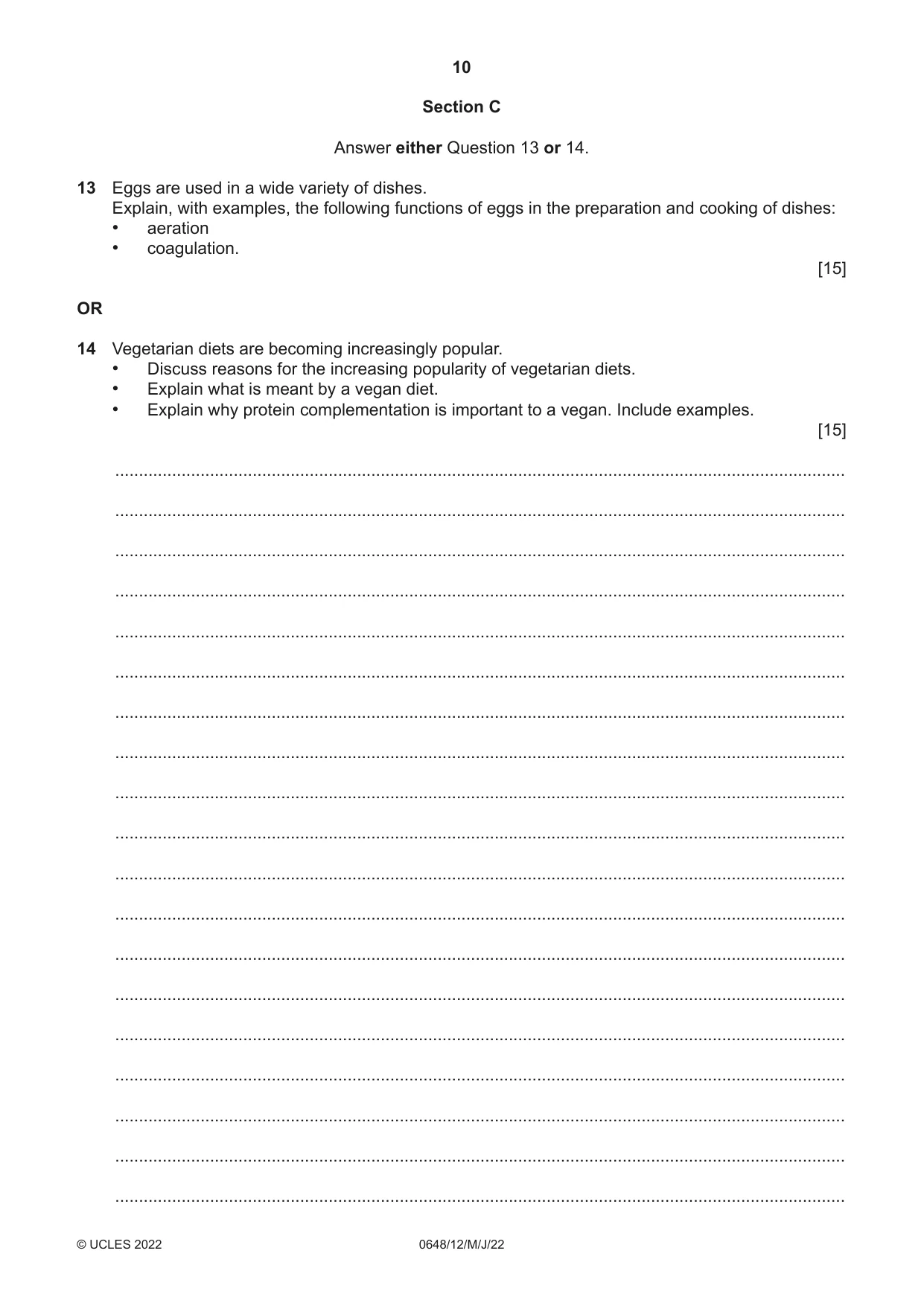
10 0648/12/M/J/22 © UCLES 2022 Section C Answer either Question 13 or 14. 13 Eggs are used in a wide variety of dishes. Explain, with examples, the following functions of eggs in the preparation and cooking of dishes: • aeration • coagulation. [15] OR 14 Vegetarian diets are becoming increasingly popular. • Discuss reasons for the increasing popularity of vegetarian diets. • Explain what is meant by a vegan diet. • Explain why protein complementation is important to a vegan. Include examples. [15] … … … … … … … … … … … … … … … … … … …
Question paper, page 11
11 0648/12/M/J/22 © UCLES 2022 [Turn over … … … … … … … … … … … … … … … … … … … … … … … … … … … …
Question paper, page 12
12 0648/12/M/J/22 © UCLES 2022 … … … … … … … … … … … … … … … … … … … … … … … … Permission to reproduce items where third-party owned material protected by copyright is included has been sought and cleared where possible. Every reasonable effort has been made by the publisher (UCLES) to trace copyright holders, but if any items requiring clearance have unwittingly been included, the publisher will be pleased to make amends at the earliest possible opportunity. To avoid the issue of disclosure of answer-related information to candidates, all copyright acknowledgements are reproduced online in the Cambridge Assessment International Education Copyright Acknowledgements Booklet. This is produced for each series of examinations and is freely available to download at www.cambridgeinternational.org after the live examination series. Cambridge Assessment International Education is part of Cambridge Assessment. Cambridge Assessment is the brand name of the University of Cambridge Local Examinations Syndicate (UCLES), which is a department of the University of Cambridge.
Mark scheme, page 1
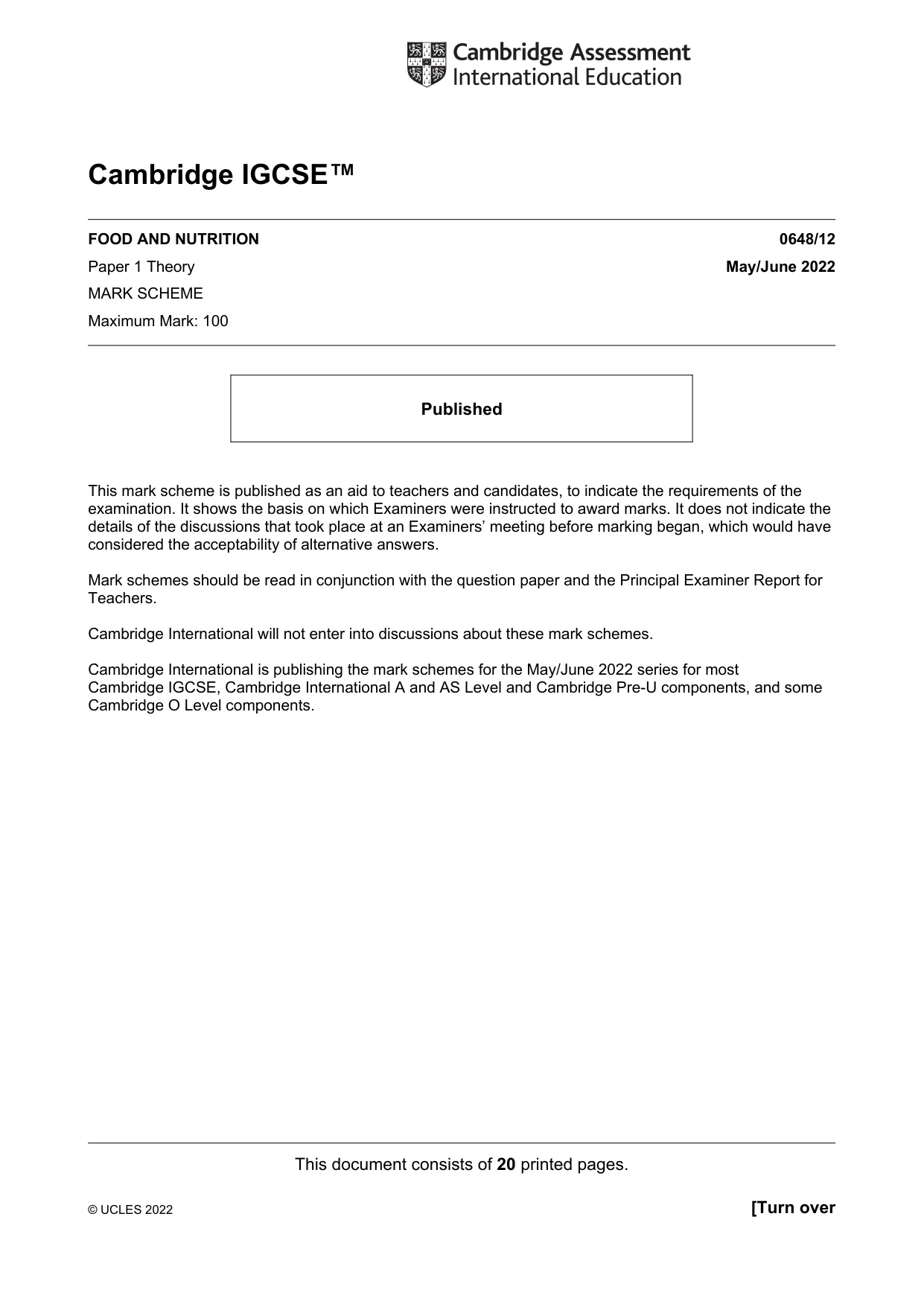
This document consists of 20 printed pages. © UCLES 2022 [Turn over Cambridge IGCSE™ FOOD AND NUTRITION 0648/12 Paper 1 Theory May/June 2022 MARK SCHEME Maximum Mark: 100 Published This mark scheme is published as an aid to teachers and candidates, to indicate the requirements of the examination. It shows the basis on which Examiners were instructed to award marks. It does not indicate the details of the discussions that took place at an Examiners’ meeting before marking began, which would have considered the acceptability of alternative answers. Mark schemes should be read in conjunction with the question paper and the Principal Examiner Report for Teachers. Cambridge International will not enter into discussions about these mark schemes. Cambridge International is publishing the mark schemes for the May/June 2022 series for most Cambridge IGCSE, Cambridge International A and AS Level and Cambridge Pre-U components, and some Cambridge O Level components.
Mark scheme, page 2
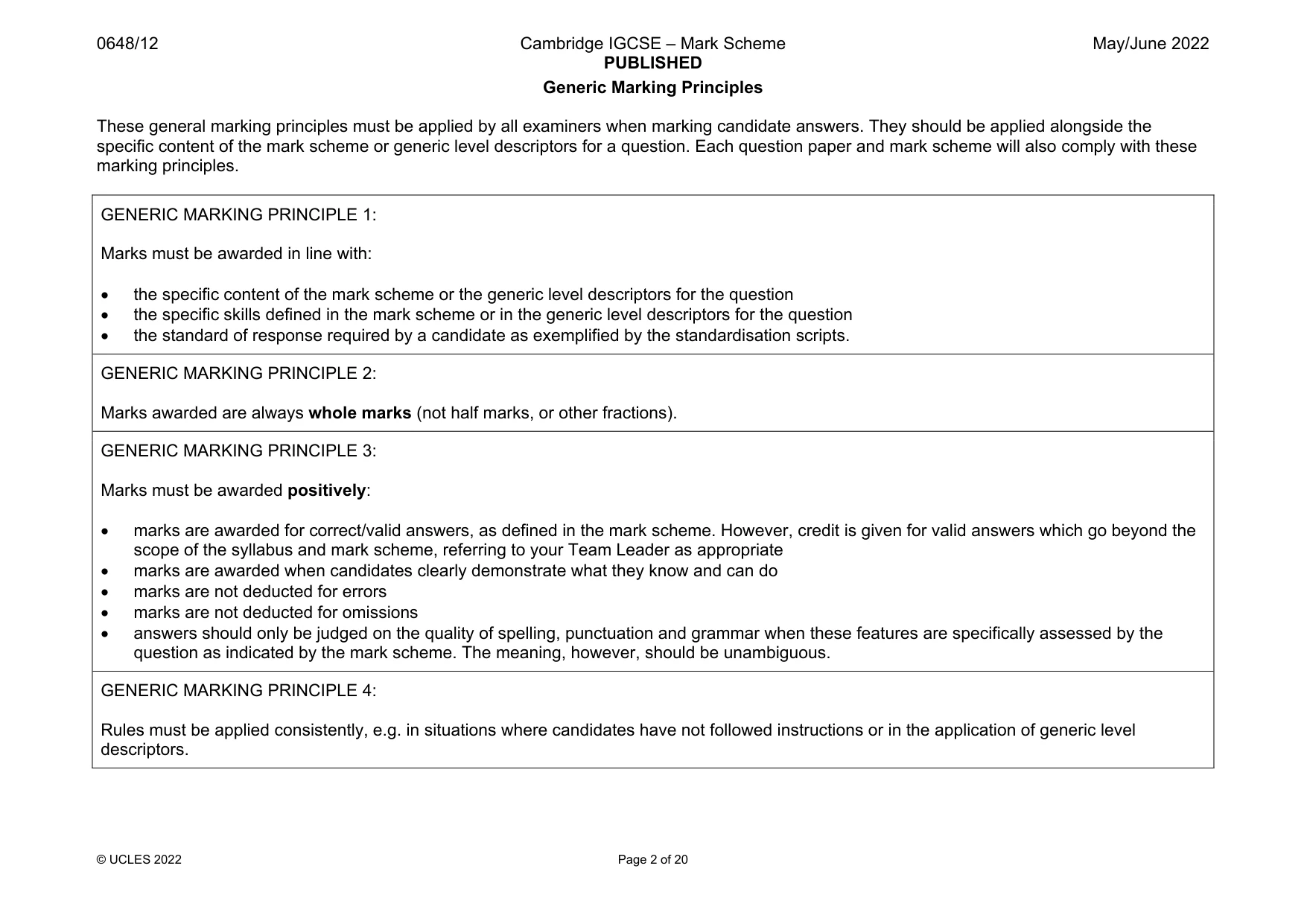
0648/12 Cambridge IGCSE – Mark Scheme PUBLISHED May/June 2022 © UCLES 2022 Page 2 of 20 Generic Marking Principles These general marking principles must be applied by all examiners when marking candidate answers. They should be applied alongside the specific content of the mark scheme or generic level descriptors for a question. Each question paper and mark scheme will also comply with these marking principles. GENERIC MARKING PRINCIPLE 1: Marks must be awarded in line with: the specific content of the mark scheme or the generic level descriptors for the question the specific skills defined in the mark scheme or in the generic level descriptors for the question the standard of response required by a candidate as exemplified by the standardisation scripts. GENERIC MARKING PRINCIPLE 2: Marks awarded are always whole marks (not half marks, or other fractions). GENERIC MARKING PRINCIPLE 3: Marks must be awarded positively: marks are awarded for correct/valid answers, as defined in the mark scheme. However, credit is given for valid answers which go beyond the scope of the syllabus and mark scheme, referring to your Team Leader as appropriate marks are awarded when candidates clearly demonstrate what they know and can do marks are not deducted for errors marks are not deducted for omissions answers should only be judged on the quality of spelling, punctuation and grammar when these features are specifically assessed by the question as indicated by the mark scheme. The meaning, however, should be unambiguous. GENERIC MARKING PRINCIPLE 4: Rules must be applied consistently, e.g. in situations where candidates have not followed instructions or in the application of generic level descriptors.
Mark scheme, page 3
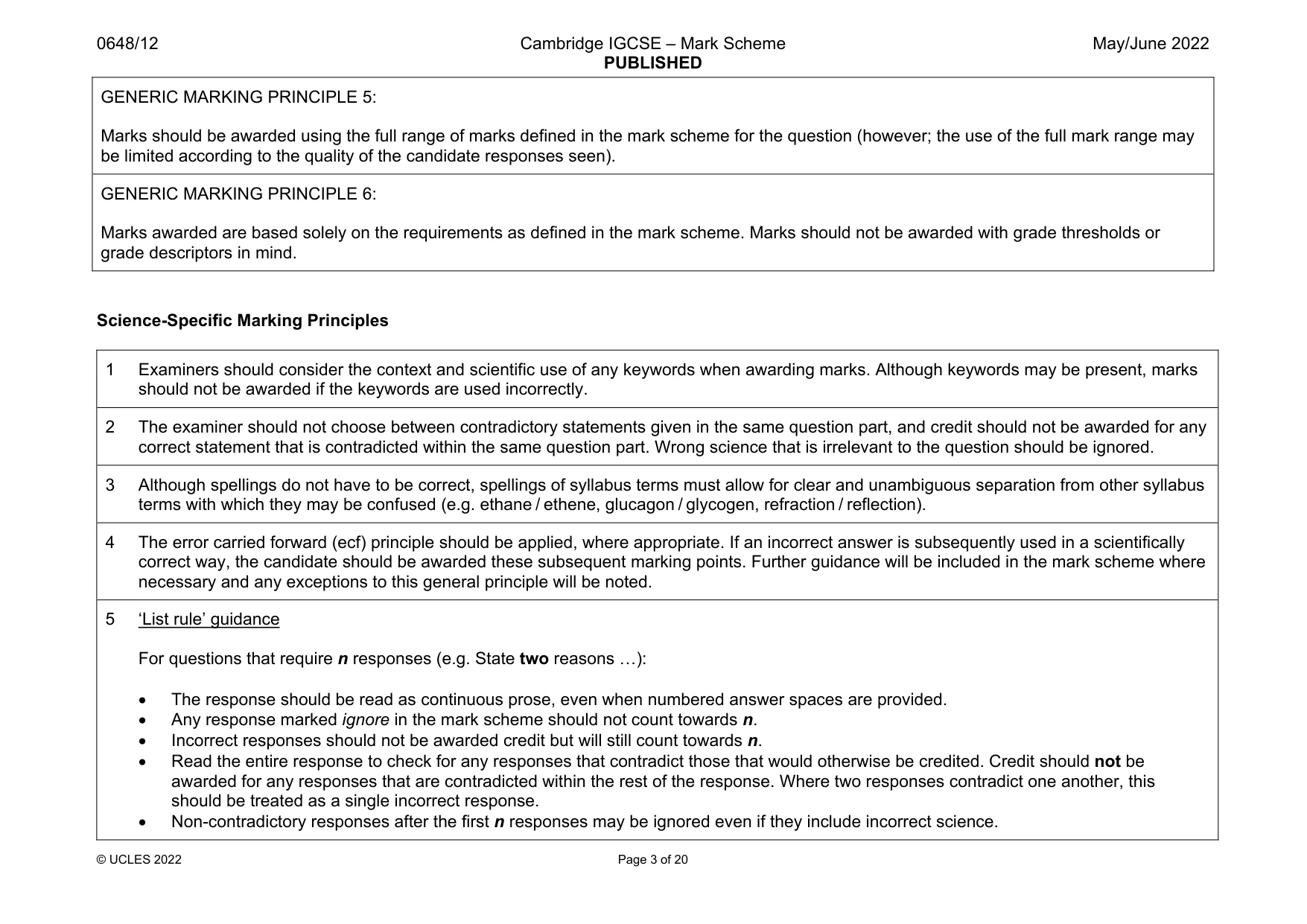
0648/12 Cambridge IGCSE – Mark Scheme PUBLISHED May/June 2022 © UCLES 2022 Page 3 of 20 GENERIC MARKING PRINCIPLE 5: Marks should be awarded using the full range of marks defined in the mark scheme for the question (however; the use of the full mark range may be limited according to the quality of the candidate responses seen). GENERIC MARKING PRINCIPLE 6: Marks awarded are based solely on the requirements as defined in the mark scheme. Marks should not be awarded with grade thresholds or grade descriptors in mind. Science-Specific Marking Principles 1 Examiners should consider the context and scientific use of any keywords when awarding marks. Although keywords may be present, marks should not be awarded if the keywords are used incorrectly. 2 The examiner should not choose between contradictory statements given in the same question part, and credit should not be awarded for any correct statement that is contradicted within the same question part. Wrong science that is irrelevant to the question should be ignored. 3 Although spellings do not have to be correct, spellings of syllabus terms must allow for clear and unambiguous separation from other syllabus terms with which they may be confused (e.g. ethane / ethene, glucagon / glycogen, refraction / reflection). 4 The error carried forward (ecf) principle should be applied, where appropriate. If an incorrect answer is subsequently used in a scientifically correct way, the candidate should be awarded these subsequent marking points. Further guidance will be included in the mark scheme where necessary and any exceptions to this general principle will be noted. 5 ‘List rule’ guidance For questions that require n responses (e.g. State two reasons …): The response should be read as continuous prose, even when numbered answer spaces are provided. Any response marked ignore in the mark scheme should not count towards n. Incorrect responses should not be awarded credit but will still count towards n. Read the entire response to check for any responses that contradict those that would otherwise be credited. Credit should not be awarded for any responses that are contradicted within the rest of the response. Where two responses contradict one another, this should be treated as a single incorrect response. Non-contradictory responses after the first n responses may be ignored even if they include incorrect science.
Mark scheme, page 4
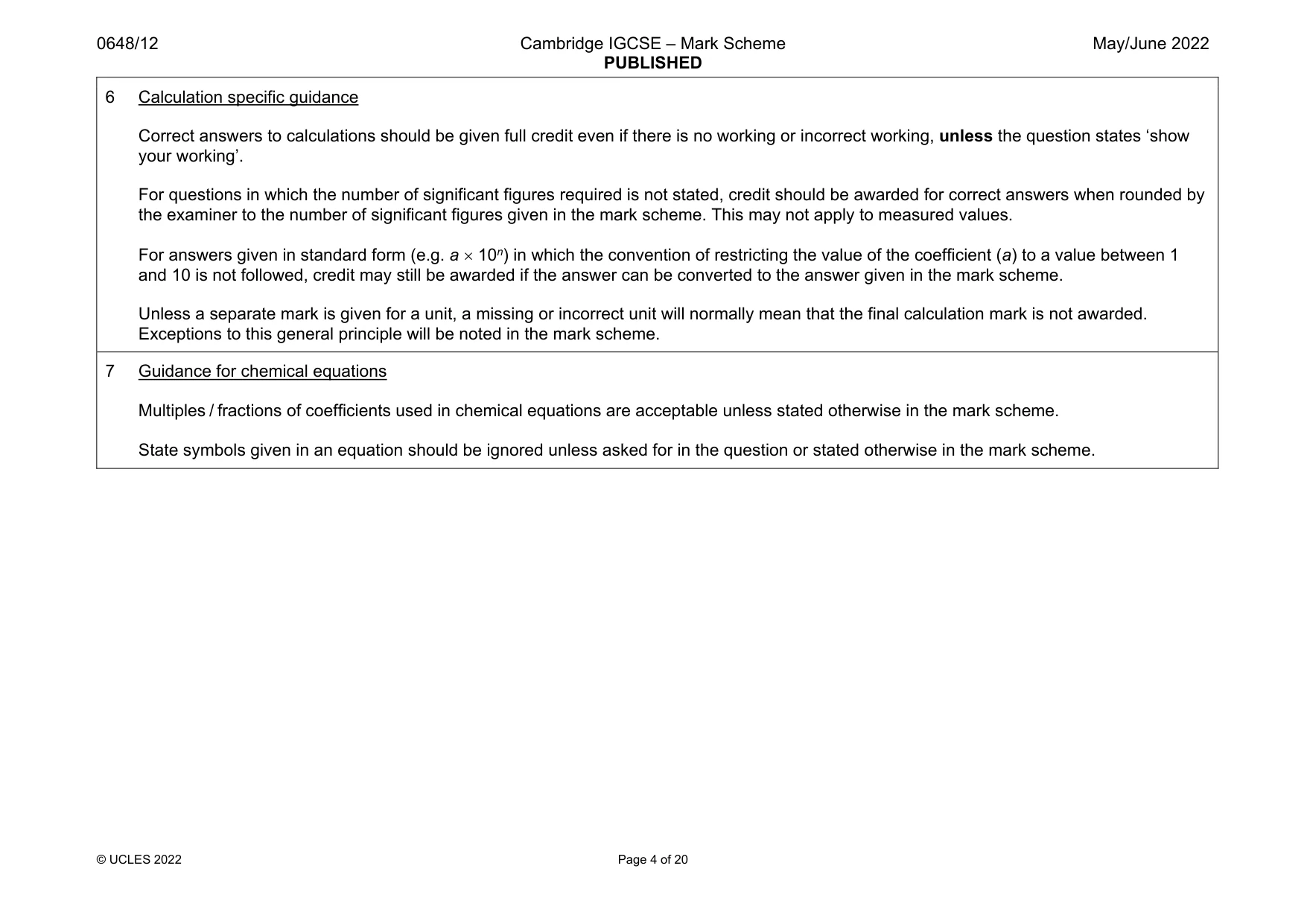
0648/12 Cambridge IGCSE – Mark Scheme PUBLISHED May/June 2022 © UCLES 2022 Page 4 of 20 6 Calculation specific guidance Correct answers to calculations should be given full credit even if there is no working or incorrect working, unless the question states ‘show your working’. For questions in which the number of significant figures required is not stated, credit should be awarded for correct answers when rounded by the examiner to the number of significant figures given in the mark scheme. This may not apply to measured values. For answers given in standard form (e.g. a 10n) in which the convention of restricting the value of the coefficient (a) to a value between 1 and 10 is not followed, credit may still be awarded if the answer can be converted to the answer given in the mark scheme. Unless a separate mark is given for a unit, a missing or incorrect unit will normally mean that the final calculation mark is not awarded. Exceptions to this general principle will be noted in the mark scheme. 7 Guidance for chemical equations Multiples / fractions of coefficients used in chemical equations are acceptable unless stated otherwise in the mark scheme. State symbols given in an equation should be ignored unless asked for in the question or stated otherwise in the mark scheme.
Mark scheme, page 5
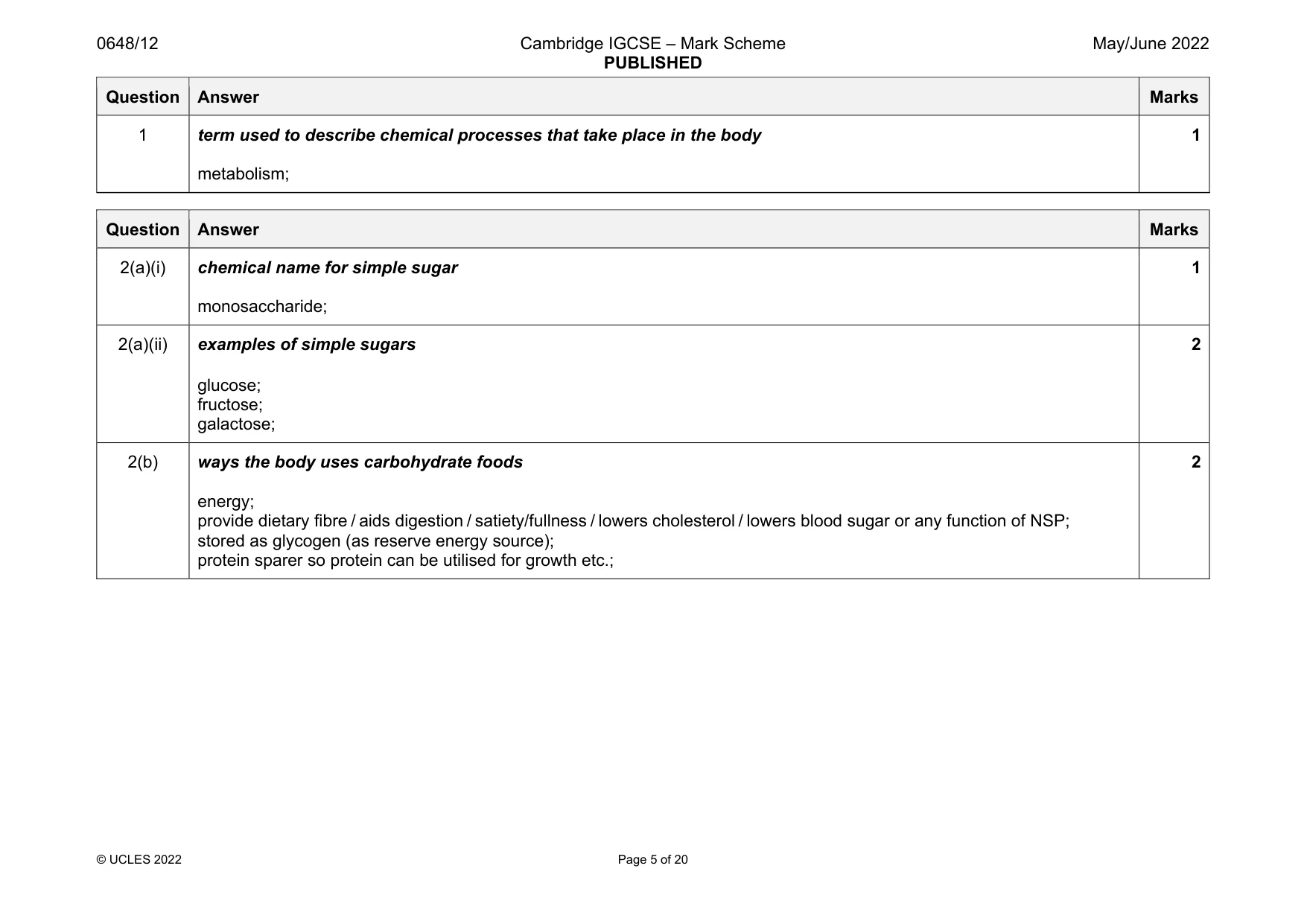
0648/12 Cambridge IGCSE – Mark Scheme PUBLISHED May/June 2022 © UCLES 2022 Page 5 of 20 Question Answer Marks 1 term used to describe chemical processes that take place in the body metabolism; 1 Question Answer Marks 2(a)(i) chemical name for simple sugar monosaccharide; 1 2(a)(ii) examples of simple sugars glucose; fructose; galactose; 2 2(b) ways the body uses carbohydrate foods energy; provide dietary fibre / aids digestion / satiety/fullness / lowers cholesterol / lowers blood sugar or any function of NSP; stored as glycogen (as reserve energy source); protein sparer so protein can be utilised for growth etc.; 2
Mark scheme, page 6
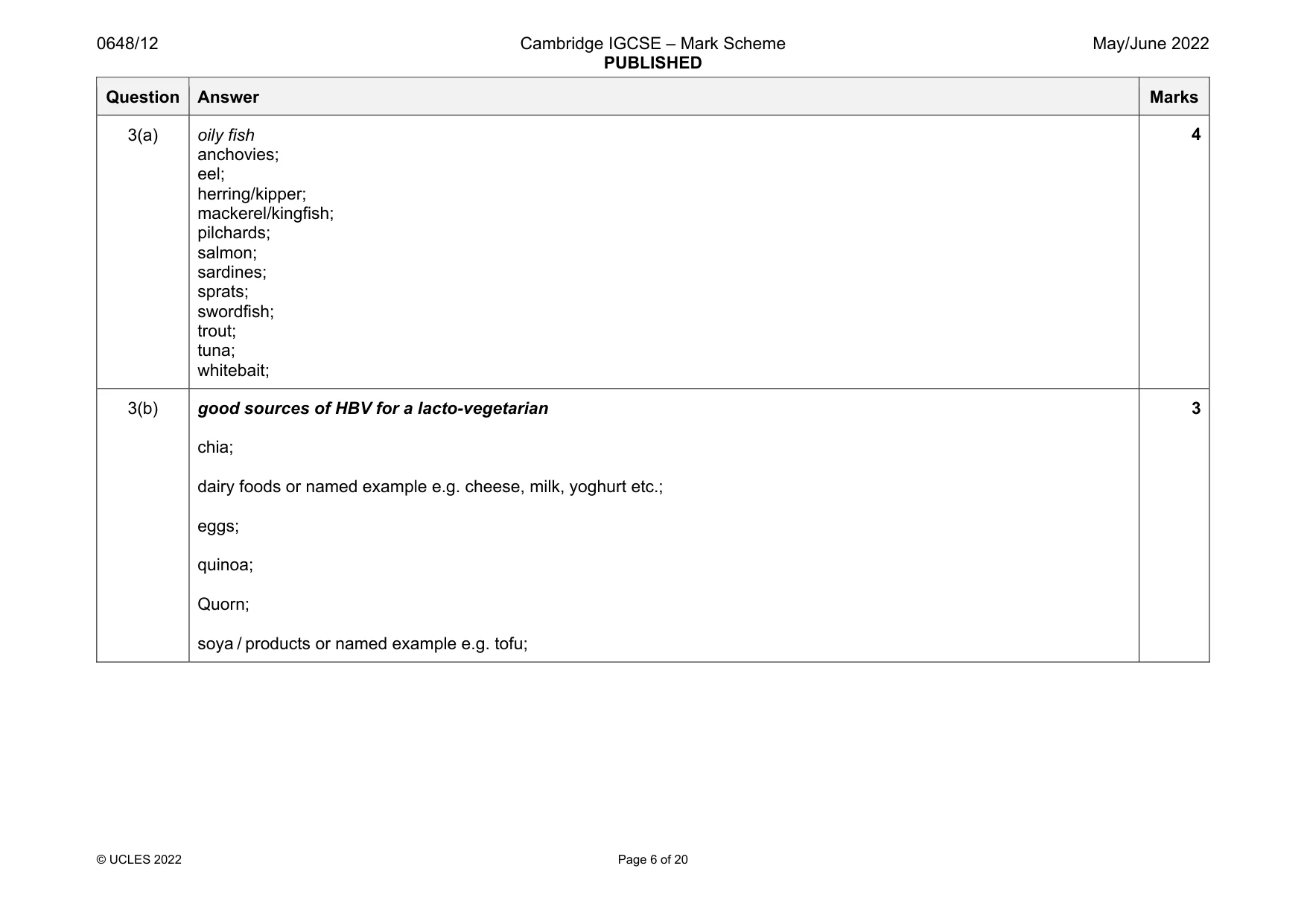
0648/12 Cambridge IGCSE – Mark Scheme PUBLISHED May/June 2022 © UCLES 2022 Page 6 of 20 Question Answer Marks 3(a) oily fish anchovies; eel; herring/kipper; mackerel/kingfish; pilchards; salmon; sardines; sprats; swordfish; trout; tuna; whitebait; 4 3(b) good sources of HBV for a lacto-vegetarian chia; dairy foods or named example e.g. cheese, milk, yoghurt etc.; eggs; quinoa; Quorn; soya / products or named example e.g. tofu; 3
Mark scheme, page 7
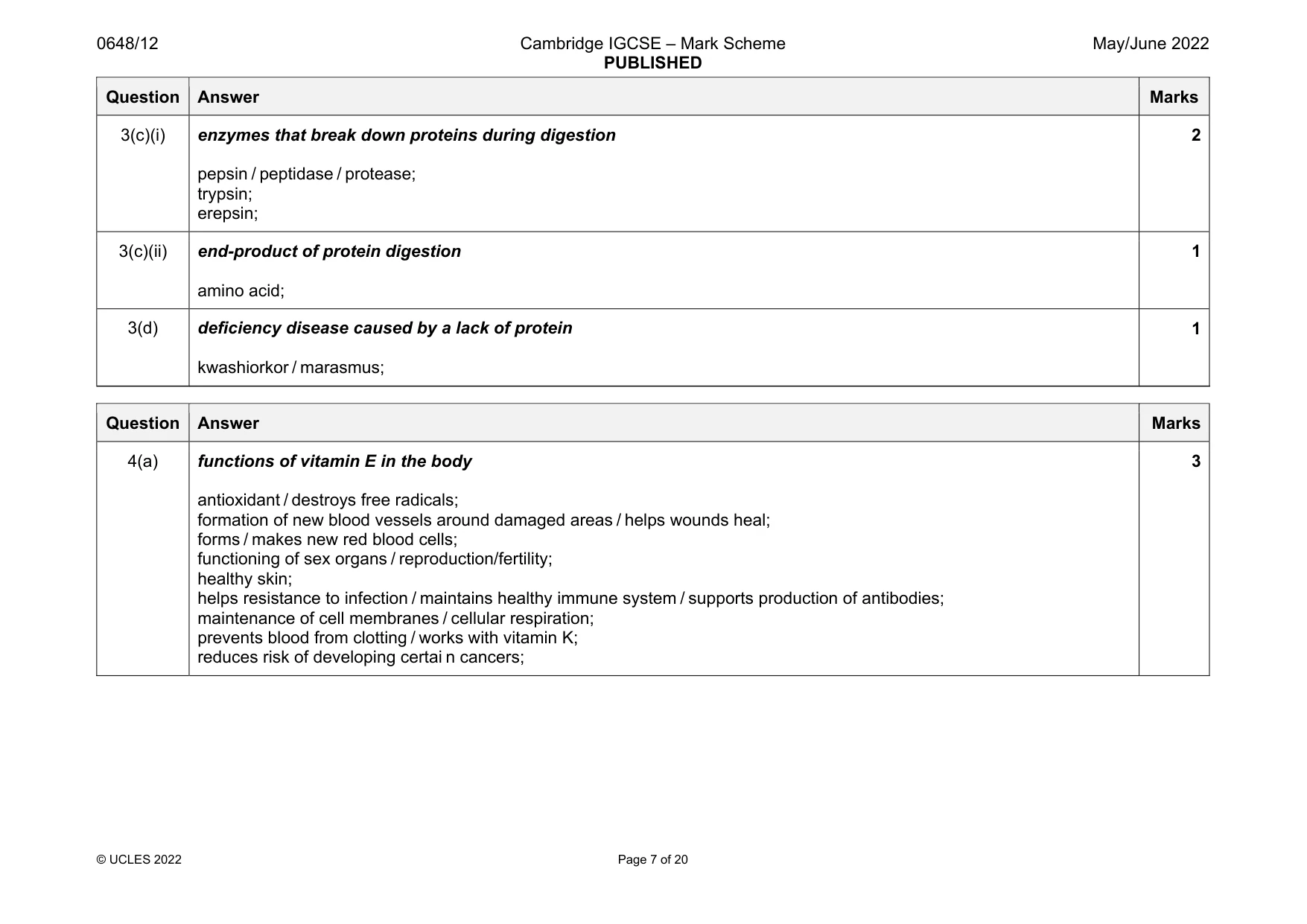
0648/12 Cambridge IGCSE – Mark Scheme PUBLISHED May/June 2022 © UCLES 2022 Page 7 of 20 Question Answer Marks 3(c)(i) enzymes that break down proteins during digestion pepsin / peptidase / protease; trypsin; erepsin; 2 3(c)(ii) end-product of protein digestion amino acid; 1 3(d) deficiency disease caused by a lack of protein kwashiorkor / marasmus; 1 Question Answer Marks 4(a) functions of vitamin E in the body antioxidant / destroys free radicals; formation of new blood vessels around damaged areas / helps wounds heal; forms / makes new red blood cells; functioning of sex organs / reproduction/fertility; healthy skin; helps resistance to infection / maintains healthy immune system / supports production of antibodies; maintenance of cell membranes / cellular respiration; prevents blood from clotting / works with vitamin K; reduces risk of developing certai n cancers; 3
Mark scheme, page 8
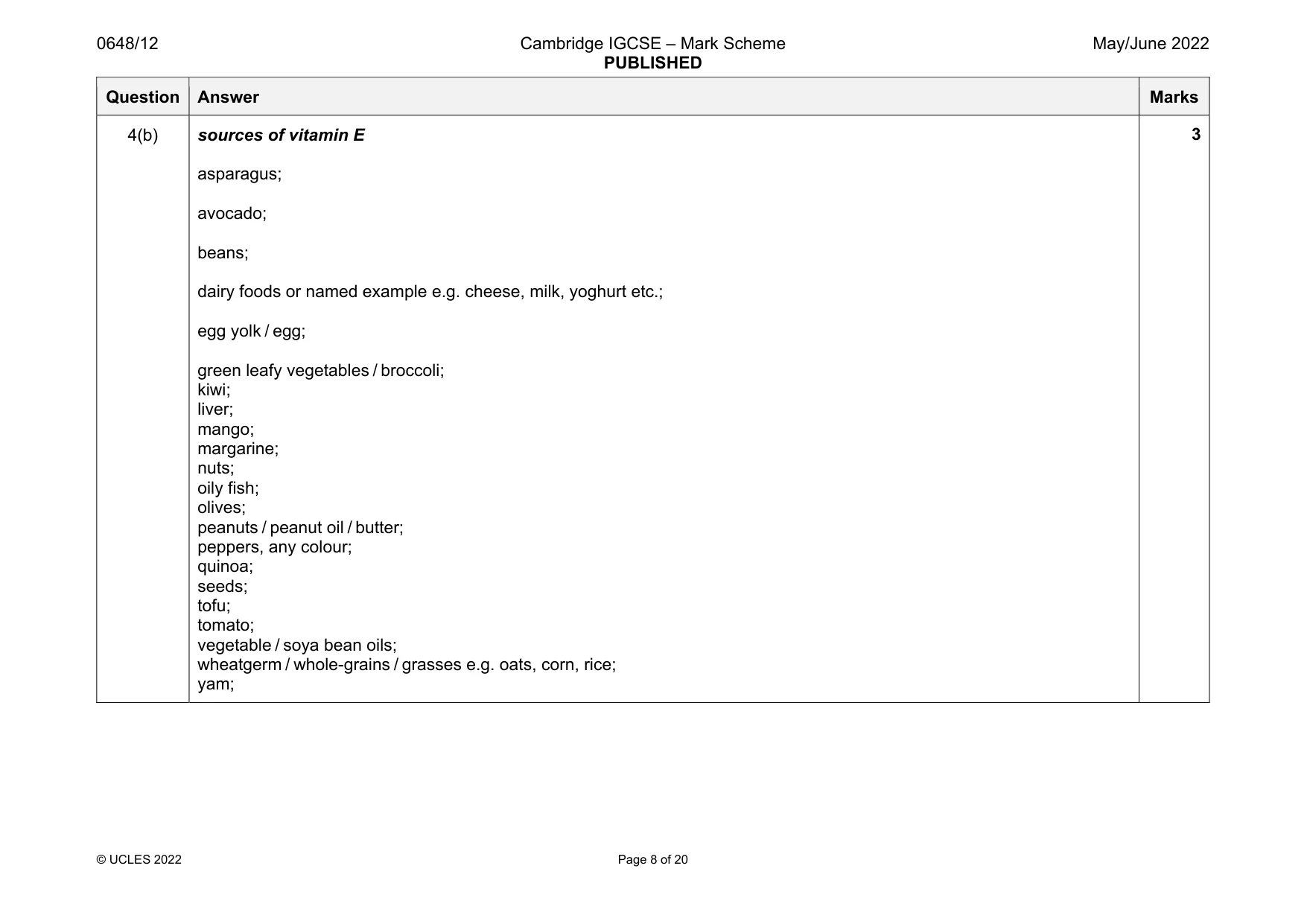
0648/12 Cambridge IGCSE – Mark Scheme PUBLISHED May/June 2022 © UCLES 2022 Page 8 of 20 Question Answer Marks 4(b) sources of vitamin E asparagus; avocado; beans; dairy foods or named example e.g. cheese, milk, yoghurt etc.; egg yolk / egg; green leafy vegetables / broccoli; kiwi; liver; mango; margarine; nuts; oily fish; olives; peanuts / peanut oil / butter; peppers, any colour; quinoa; seeds; tofu; tomato; vegetable / soya bean oils; wheatgerm / whole-grains / grasses e.g. oats, corn, rice; yam; 3
Mark scheme, page 9
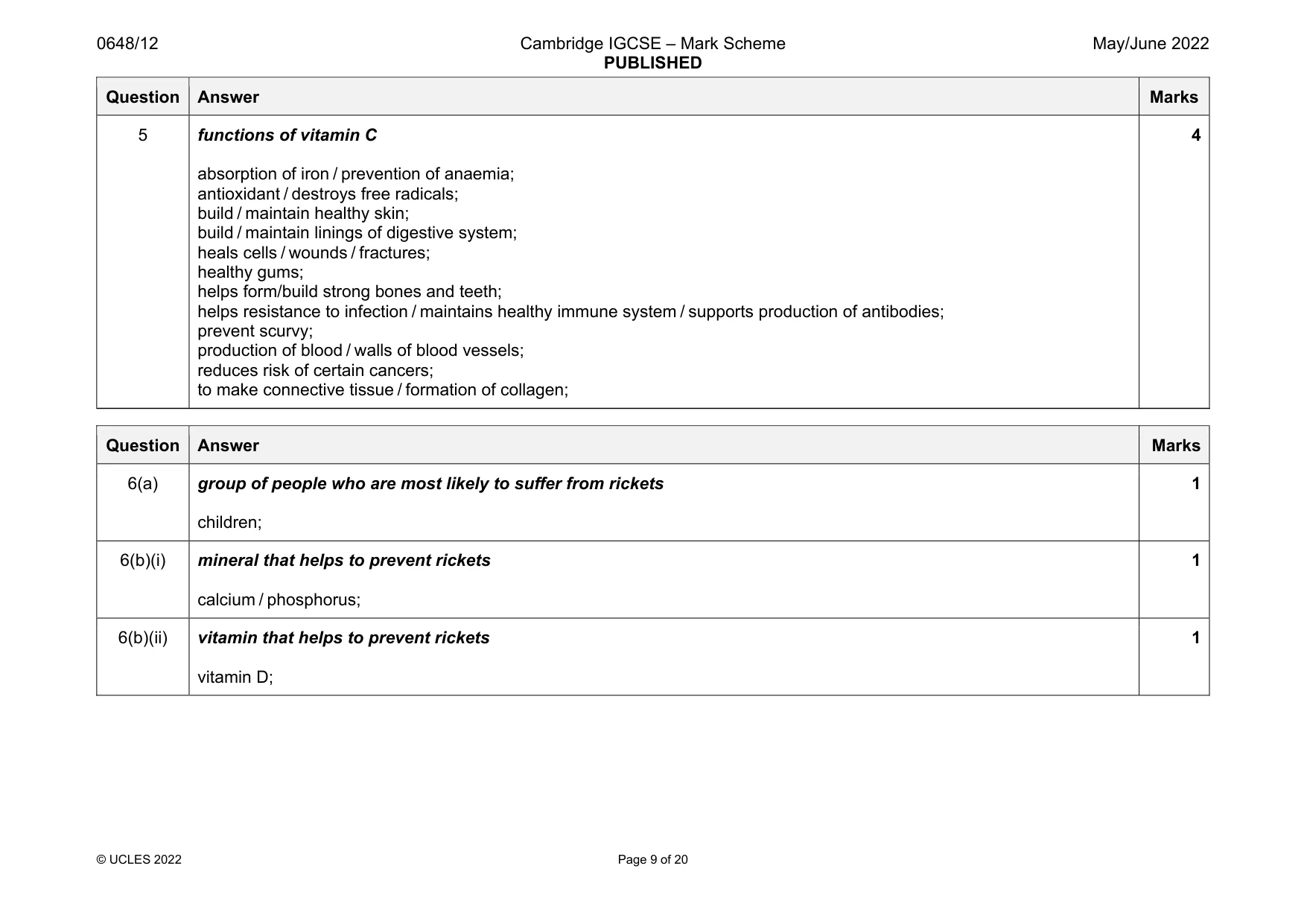
0648/12 Cambridge IGCSE – Mark Scheme PUBLISHED May/June 2022 © UCLES 2022 Page 9 of 20 Question Answer Marks 5 functions of vitamin C absorption of iron / prevention of anaemia; antioxidant / destroys free radicals; build / maintain healthy skin; build / maintain linings of digestive system; heals cells / wounds / fractures; healthy gums; helps form/build strong bones and teeth; helps resistance to infection / maintains healthy immune system / supports production of antibodies; prevent scurvy; production of blood / walls of blood vessels; reduces risk of certain cancers; to make connective tissue / formation of collagen; 4 Question Answer Marks 6(a) group of people who are most likely to suffer from rickets children; 1 6(b)(i) mineral that helps to prevent rickets calcium / phosphorus; 1 6(b)(ii) vitamin that helps to prevent rickets vitamin D; 1
Mark scheme, page 10
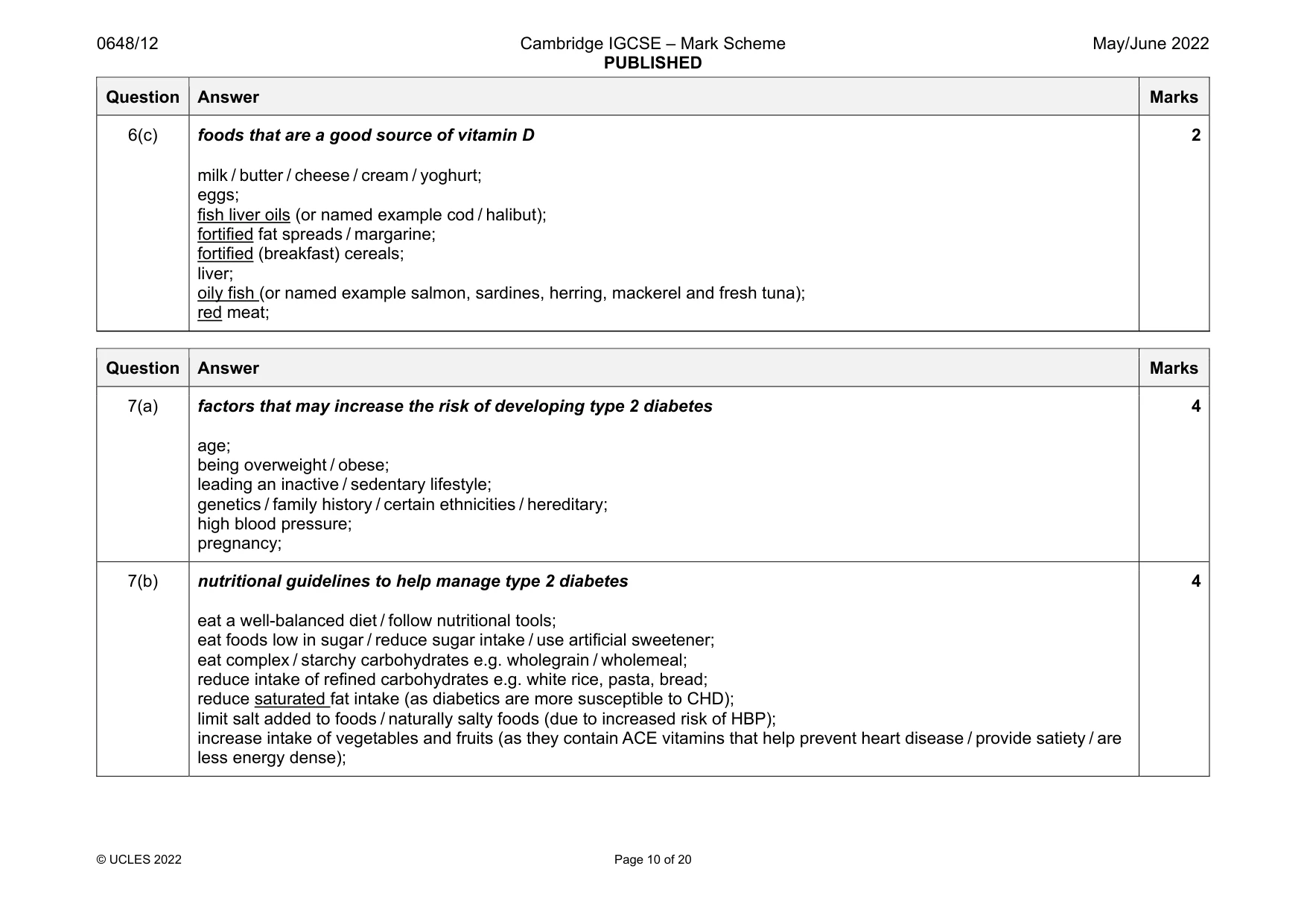
0648/12 Cambridge IGCSE – Mark Scheme PUBLISHED May/June 2022 © UCLES 2022 Page 10 of 20 Question Answer Marks 6(c) foods that are a good source of vitamin D milk / butter / cheese / cream / yoghurt; eggs; fish liver oils (or named example cod / halibut); fortified fat spreads / margarine; fortified (breakfast) cereals; liver; oily fish (or named example salmon, sardines, herring, mackerel and fresh tuna); red meat; 2 Question Answer Marks 7(a) factors that may increase the risk of developing type 2 diabetes age; being overweight / obese; leading an inactive / sedentary lifestyle; genetics / family history / certain ethnicities / hereditary; high blood pressure; pregnancy; 4 7(b) nutritional guidelines to help manage type 2 diabetes eat a well-balanced diet / follow nutritional tools; eat foods low in sugar / reduce sugar intake / use artificial sweetener; eat complex / starchy carbohydrates e.g. wholegrain / wholemeal; reduce intake of refined carbohydrates e.g. white rice, pasta, bread; reduce saturated fat intake (as diabetics are more susceptible to CHD); limit salt added to foods / naturally salty foods (due to increased risk of HBP); increase intake of vegetables and fruits (as they contain ACE vitamins that help prevent heart disease / provide satiety / are less energy dense); 4
Mark scheme, page 11
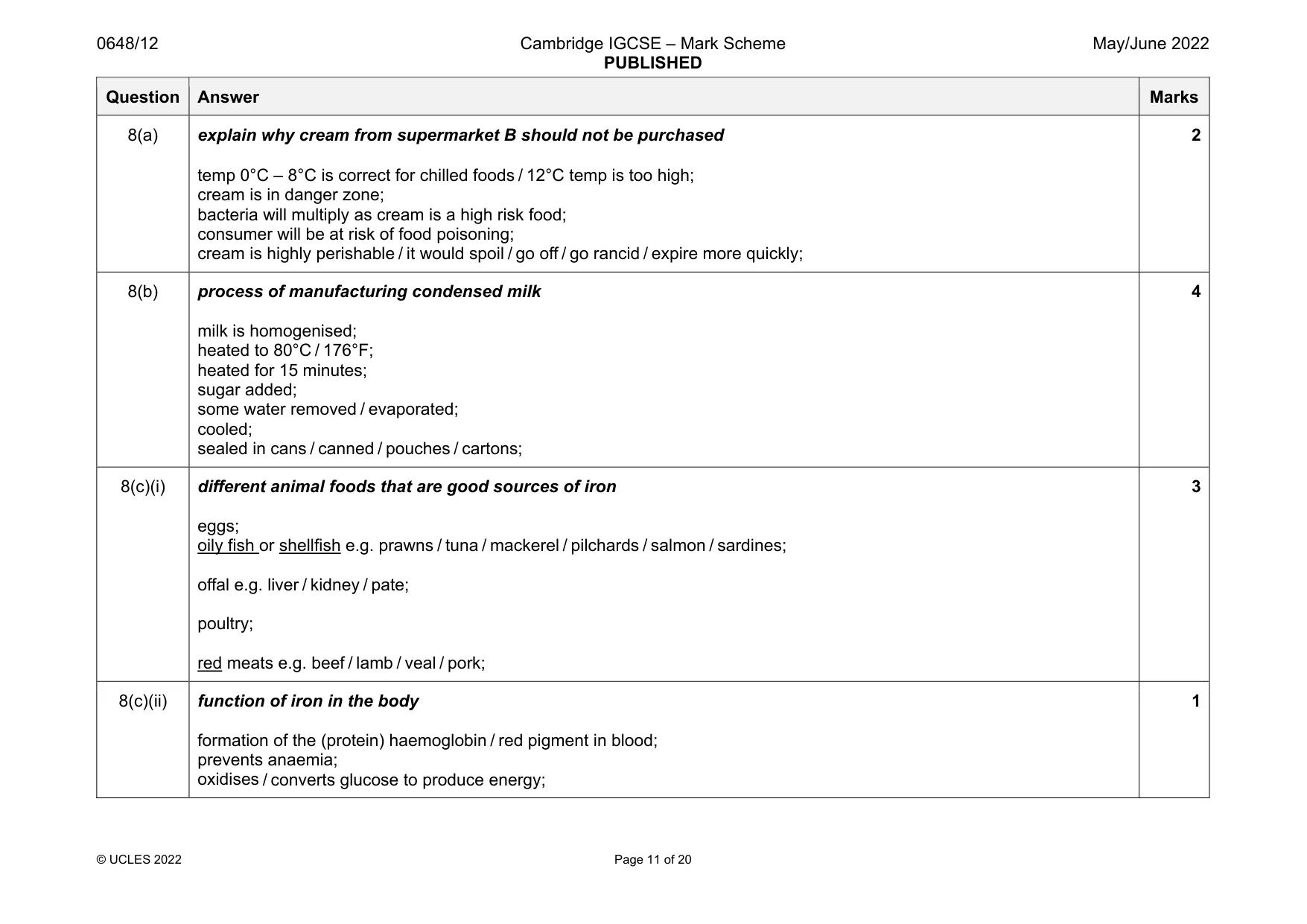
0648/12 Cambridge IGCSE – Mark Scheme PUBLISHED May/June 2022 © UCLES 2022 Page 11 of 20 Question Answer Marks 8(a) explain why cream from supermarket B should not be purchased temp 0°C – 8°C is correct for chilled foods / 12°C temp is too high; cream is in danger zone; bacteria will multiply as cream is a high risk food; consumer will be at risk of food poisoning; cream is highly perishable / it would spoil / go off / go rancid / expire more quickly; 2 8(b) process of manufacturing condensed milk milk is homogenised; heated to 80°C / 176°F; heated for 15 minutes; sugar added; some water removed / evaporated; cooled; sealed in cans / canned / pouches / cartons; 4 8(c)(i) different animal foods that are good sources of iron eggs; oily fish or shellfish e.g. prawns / tuna / mackerel / pilchards / salmon / sardines; offal e.g. liver / kidney / pate; poultry; red meats e.g. beef / lamb / veal / pork; 3 8(c)(ii) function of iron in the body formation of the (protein) haemoglobin / red pigment in blood; prevents anaemia; oxidises / converts glucose to produce energy; 1
Mark scheme, page 12
0648/12 Cambridge IGCSE – Mark Scheme PUBLISHED May/June 2022 © UCLES 2022 Page 12 of 20 Question Answer Marks 8(d) best-before date on a food label best before dates are an indication of quality rather than safety; best before means that the product will not go bad but after that date the quality may have deteriorated; best before used for foods with a long shelf life; 2 Question Answer Marks 9(a) causes of food spoilage chemical contamination; damaged in transit / by handler e.g. bruised foods / broken packaging; enzymes; incorrect storage conditions / temperature; moisture gain; moisture loss; moulds / fungi; oxidation / enzymic browning; pests / flies / rats / vermin; physical contamination e.g. hair; yeasts; 2
Mark scheme, page 13
0648/12 Cambridge IGCSE – Mark Scheme PUBLISHED May/June 2022 © UCLES 2022 Page 13 of 20 Question Answer Marks 9(b) reasons why a person would make their own jam grow their own fruit; glut of fruit in season so preventing waste; enjoy jam-making / pass on skills; fruit reduced for quick sale in a supermarket / farm shop / pick your own; provide food by using when fruits plentiful and cheaper to store when more costly; they like the taste of home-made jam / better flavour / make it to own taste / different varieties of fruit can be used;; want to know what ingredients are in their jam / can reduce quantity of sugar; cheaper than buying jam; free from artificial flavourings / colourings / chemicals; lower carbon footprint / food miles through transportation methods; to enjoy fruit when out of season / to extend shelf life of fruit; to provide food when supply is limited or scarce / to use in emergencies / famine / war; to retain as many of the qualities of fresh food as possible / flavour / colour / appearance / texture / nutritive value; to prevent loss of water / dehydration of fresh fruit; to prevent food spoilage by destroying microorganisms / to prevent the growth of microorganisms; 5 9(c)(i) how salt prevents food spoilage reduces water content (by osmosis); microorganisms cannot survive in conditions with a high concentration of salt; microorganisms need water to grow; 2 9(c)(ii) how vinegar prevents food spoilage increases acidity of food; bacteria cannot reproduce as they need a slightly alkaline or neutral pH in order to grow; bacteria cannot thrive in highly acidic conditions; 2
Mark scheme, page 14
0648/12 Cambridge IGCSE – Mark Scheme PUBLISHED May/June 2022 © UCLES 2022 Page 14 of 20 Question Answer Marks 10(a)(i) why fresh fish should be used within 24 hours of purchase fish is a high risk food; fish has a high moisture content that bacteria need to thrive; fish has a high protein content that bacteria need to thrive; to keep it safe to eat / to reduce risk of food poisoning; to prevent bad smell / odour developing; to maintain quality of fish / tastes better / doesn’t get spoilt / prevent fish going off; 3 10(a)(ii) reasons to wrap fish before storing to prevent flesh drying; to prevent fish contaminating other food e.g. by leaking; to prevent vermin contaminating fish; to prevent absorption of smells (from other food / to other food); to prevent microorganisms from other food contaminating fish; 3 10(b) suitable moist-heat methods of cooking fish poach; steam; stew / casserole; slow cook; 2 10(c) effects of cooking on fish collagen converted to gelatine / fish tenderises / flesh becomes softer / fish becomes more digestible; protein coagulates / denatures; flesh colour changes / becomes opaque; loss of vitamin B; microorganisms are destroyed; connective tissue dissolves and fish shrinks; flesh breaks apart easily / flakes; flesh becomes firm; 4
Mark scheme, page 15
0648/12 Cambridge IGCSE – Mark Scheme PUBLISHED May/June 2022 © UCLES 2022 Page 15 of 20 Question Answer Marks 10(d) different sources of vitamin C that could be included as part of a fish dish citrus fruit / named example; mango; peppers; (new) potatoes; tomatoes; green vegetables / named example; parsley; 2 Question Answer Marks 11(a) mechanical methods of introducing air into a mixture beating; creaming; rolling and folding; rubbing in; whisking; 3 11(b) ingredient that is used as a raising agent self-raising flour / baking powder / bicarbonate of soda / yeast; 1
Mark scheme, page 16
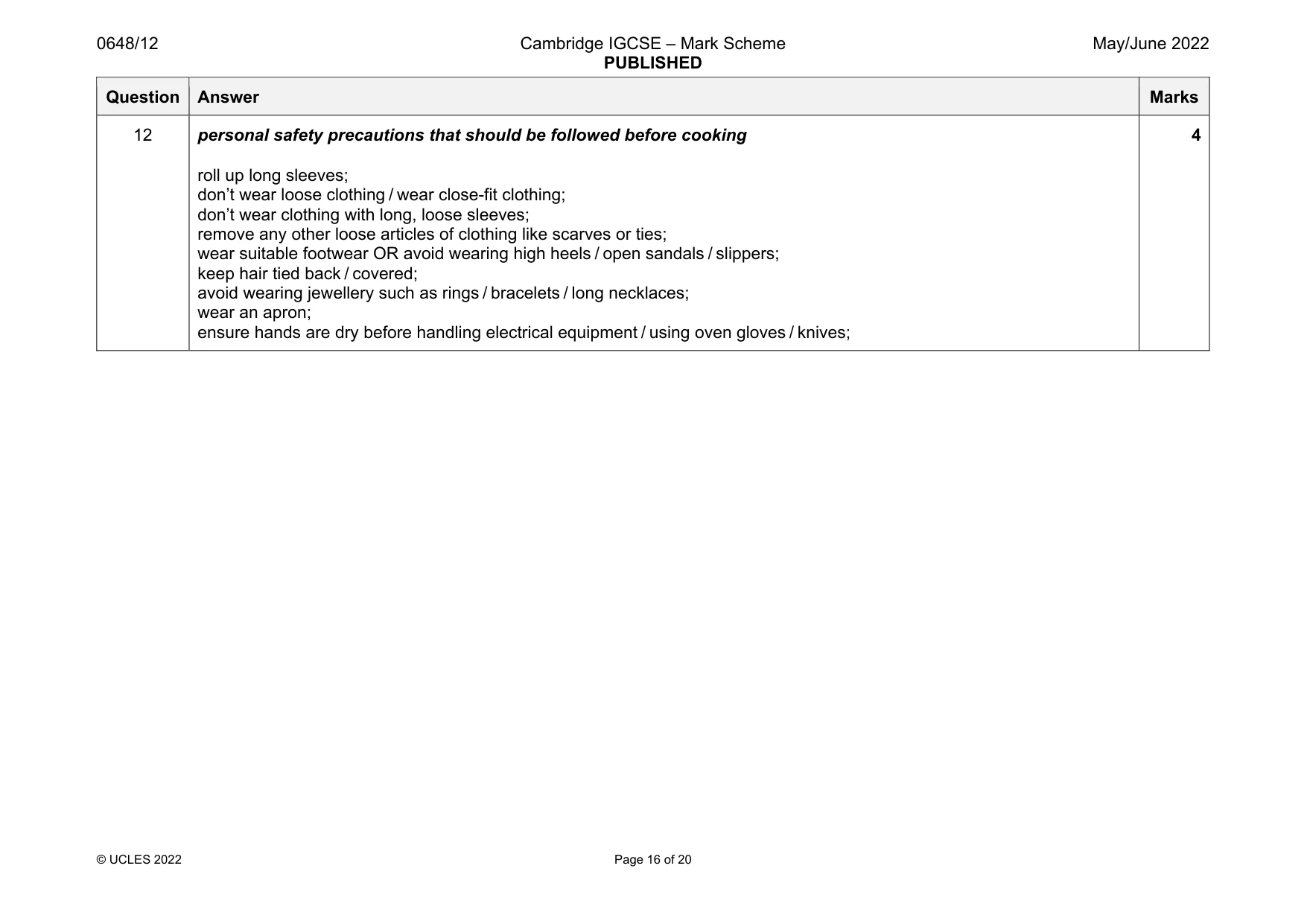
0648/12 Cambridge IGCSE – Mark Scheme PUBLISHED May/June 2022 © UCLES 2022 Page 16 of 20 Question Answer Marks 12 personal safety precautions that should be followed before cooking roll up long sleeves; don’t wear loose clothing / wear close-fit clothing; don’t wear clothing with long, loose sleeves; remove any other loose articles of clothing like scarves or ties; wear suitable footwear OR avoid wearing high heels / open sandals / slippers; keep hair tied back / covered; avoid wearing jewellery such as rings / bracelets / long necklaces; wear an apron; ensure hands are dry before handling electrical equipment / using oven gloves / knives; 4
Mark scheme, page 17
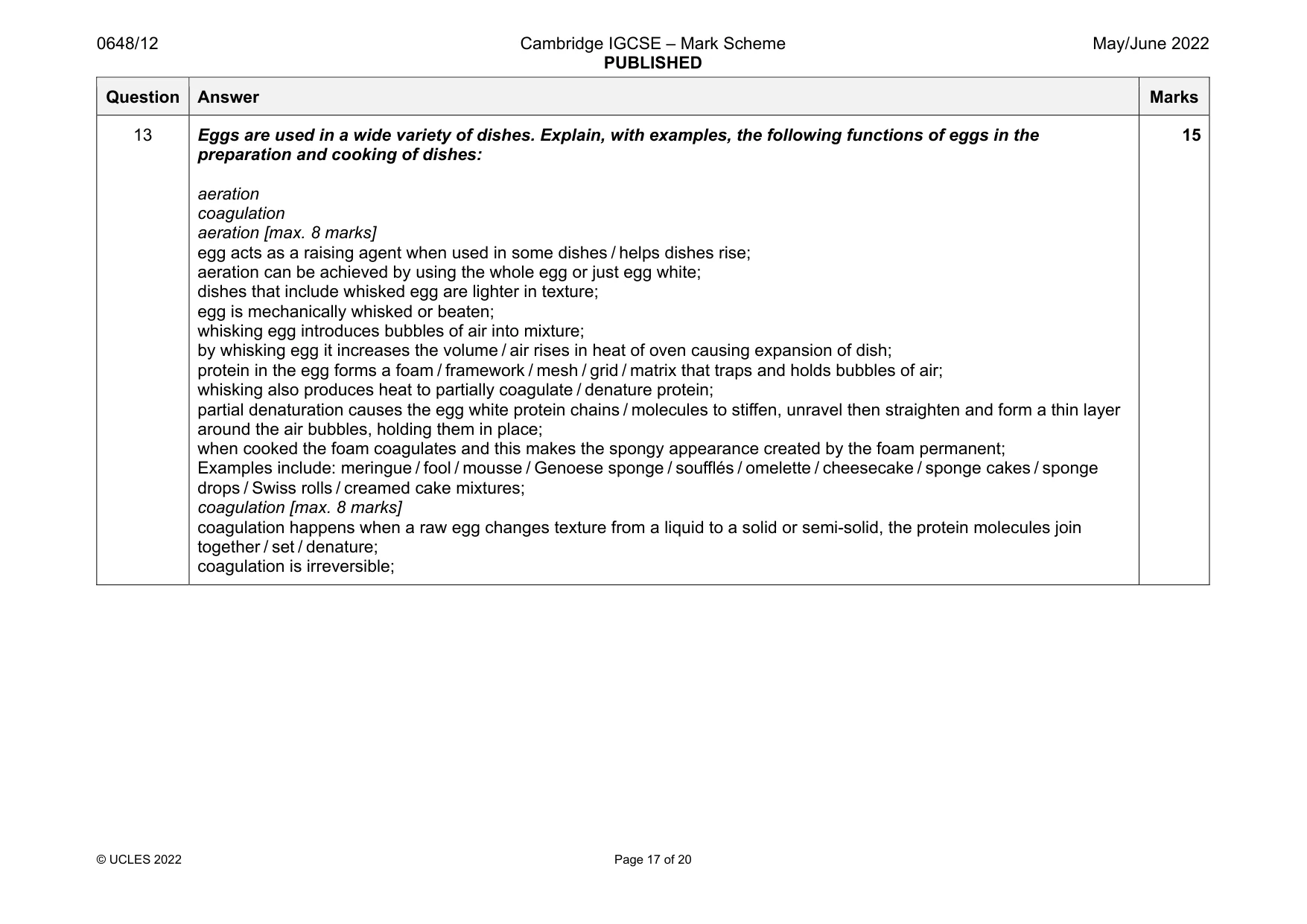
0648/12 Cambridge IGCSE – Mark Scheme PUBLISHED May/June 2022 © UCLES 2022 Page 17 of 20 Question Answer Marks 13 Eggs are used in a wide variety of dishes. Explain, with examples, the following functions of eggs in the preparation and cooking of dishes: aeration coagulation aeration [max. 8 marks] egg acts as a raising agent when used in some dishes / helps dishes rise; aeration can be achieved by using the whole egg or just egg white; dishes that include whisked egg are lighter in texture; egg is mechanically whisked or beaten; whisking egg introduces bubbles of air into mixture; by whisking egg it increases the volume / air rises in heat of oven causing expansion of dish; protein in the egg forms a foam / framework / mesh / grid / matrix that traps and holds bubbles of air; whisking also produces heat to partially coagulate / denature protein; partial denaturation causes the egg white protein chains / molecules to stiffen, unravel then straighten and form a thin layer around the air bubbles, holding them in place; when cooked the foam coagulates and this makes the spongy appearance created by the foam permanent; Examples include: meringue / fool / mousse / Genoese sponge / soufflés / omelette / cheesecake / sponge cakes / sponge drops / Swiss rolls / creamed cake mixtures; coagulation [max. 8 marks] coagulation happens when a raw egg changes texture from a liquid to a solid or semi-solid, the protein molecules join together / set / denature; coagulation is irreversible; 15
Mark scheme, page 18
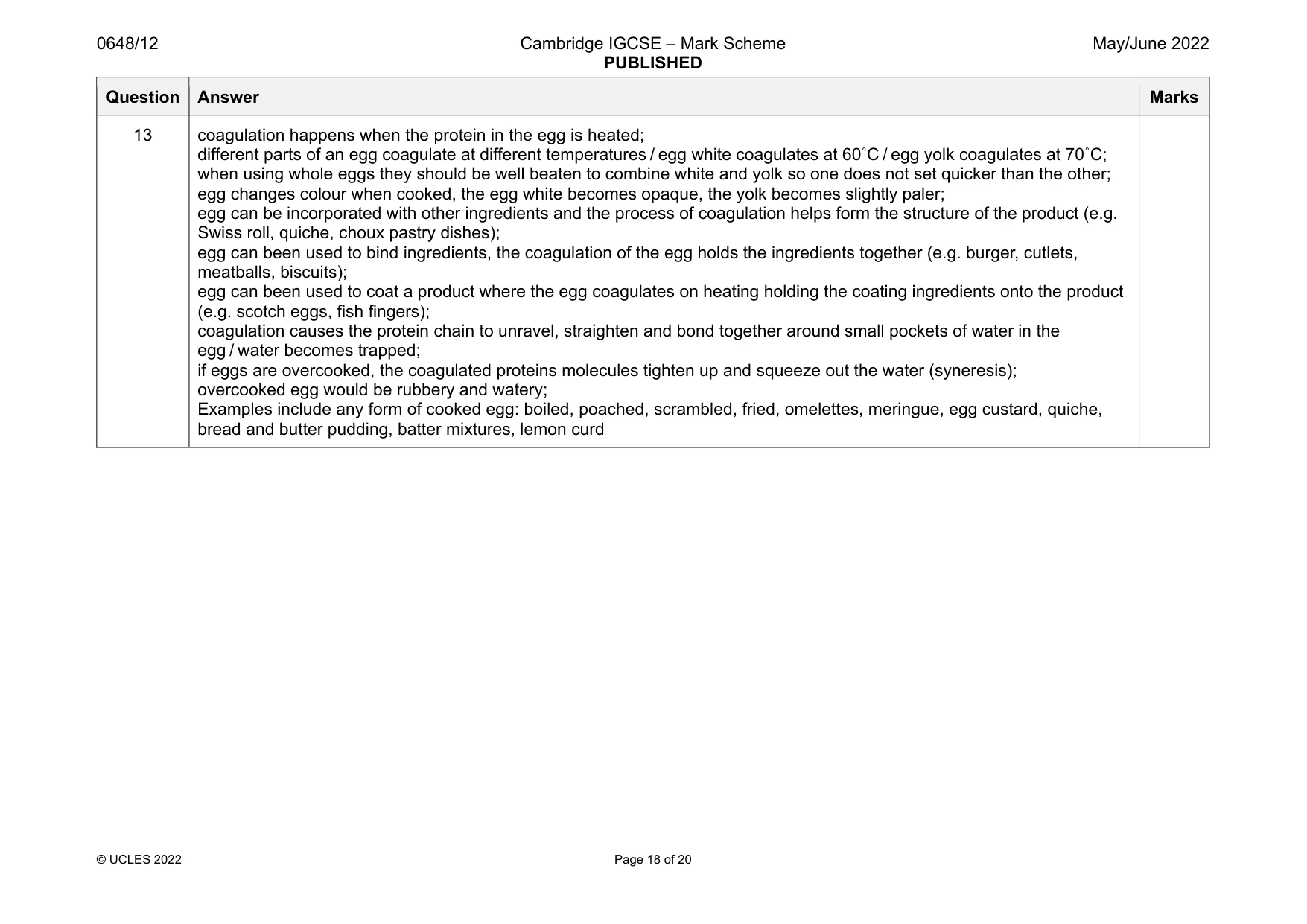
0648/12 Cambridge IGCSE – Mark Scheme PUBLISHED May/June 2022 © UCLES 2022 Page 18 of 20 Question Answer Marks 13 coagulation happens when the protein in the egg is heated; different parts of an egg coagulate at different temperatures / egg white coagulates at 60˚C / egg yolk coagulates at 70˚C; when using whole eggs they should be well beaten to combine white and yolk so one does not set quicker than the other; egg changes colour when cooked, the egg white becomes opaque, the yolk becomes slightly paler; egg can be incorporated with other ingredients and the process of coagulation helps form the structure of the product (e.g. Swiss roll, quiche, choux pastry dishes); egg can been used to bind ingredients, the coagulation of the egg holds the ingredients together (e.g. burger, cutlets, meatballs, biscuits); egg can been used to coat a product where the egg coagulates on heating holding the coating ingredients onto the product (e.g. scotch eggs, fish fingers); coagulation causes the protein chain to unravel, straighten and bond together around small pockets of water in the egg / water becomes trapped; if eggs are overcooked, the coagulated proteins molecules tighten up and squeeze out the water (syneresis); overcooked egg would be rubbery and watery; Examples include any form of cooked egg: boiled, poached, scrambled, fried, omelettes, meringue, egg custard, quiche, bread and butter pudding, batter mixtures, lemon curd
Mark scheme, page 19
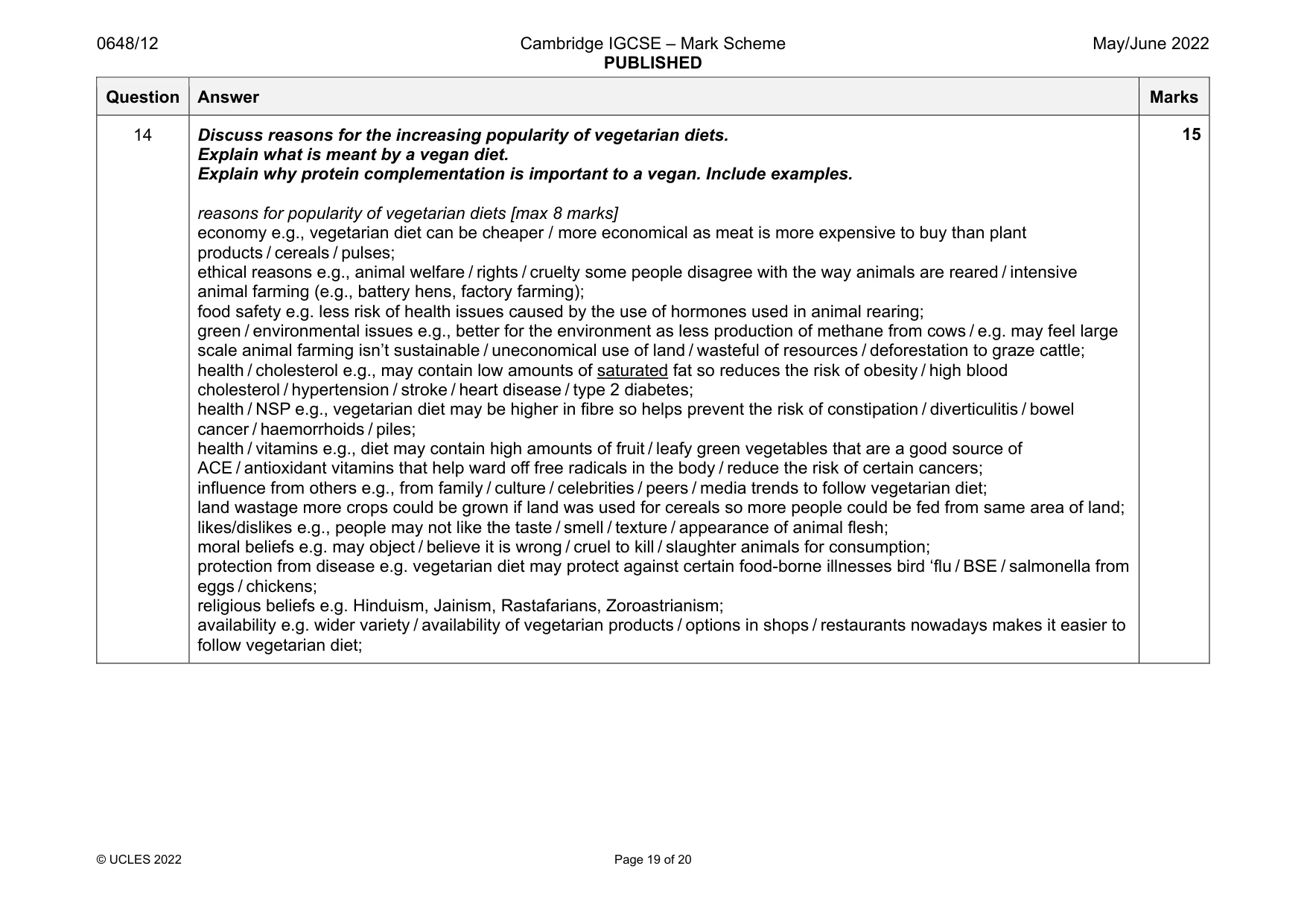
0648/12 Cambridge IGCSE – Mark Scheme PUBLISHED May/June 2022 © UCLES 2022 Page 19 of 20 Question Answer Marks 14 Discuss reasons for the increasing popularity of vegetarian diets. Explain what is meant by a vegan diet. Explain why protein complementation is important to a vegan. Include examples. reasons for popularity of vegetarian diets [max 8 marks] economy e.g., vegetarian diet can be cheaper / more economical as meat is more expensive to buy than plant products / cereals / pulses; ethical reasons e.g., animal welfare / rights / cruelty some people disagree with the way animals are reared / intensive animal farming (e.g., battery hens, factory farming); food safety e.g. less risk of health issues caused by the use of hormones used in animal rearing; green / environmental issues e.g., better for the environment as less production of methane from cows / e.g. may feel large scale animal farming isn’t sustainable / uneconomical use of land / wasteful of resources / deforestation to graze cattle; health / cholesterol e.g., may contain low amounts of saturated fat so reduces the risk of obesity / high blood cholesterol / hypertension / stroke / heart disease / type 2 diabetes; health / NSP e.g., vegetarian diet may be higher in fibre so helps prevent the risk of constipation / diverticulitis / bowel cancer / haemorrhoids / piles; health / vitamins e.g., diet may contain high amounts of fruit / leafy green vegetables that are a good source of ACE / antioxidant vitamins that help ward off free radicals in the body / reduce the risk of certain cancers; influence from others e.g., from family / culture / celebrities / peers / media trends to follow vegetarian diet; land wastage more crops could be grown if land was used for cereals so more people could be fed from same area of land; likes/dislikes e.g., people may not like the taste / smell / texture / appearance of animal flesh; moral beliefs e.g. may object / believe it is wrong / cruel to kill / slaughter animals for consumption; protection from disease e.g. vegetarian diet may protect against certain food-borne illnesses bird ‘flu / BSE / salmonella from eggs / chickens; religious beliefs e.g. Hinduism, Jainism, Rastafarians, Zoroastrianism; availability e.g. wider variety / availability of vegetarian products / options in shops / restaurants nowadays makes it easier to follow vegetarian diet; 15
Mark scheme, page 20
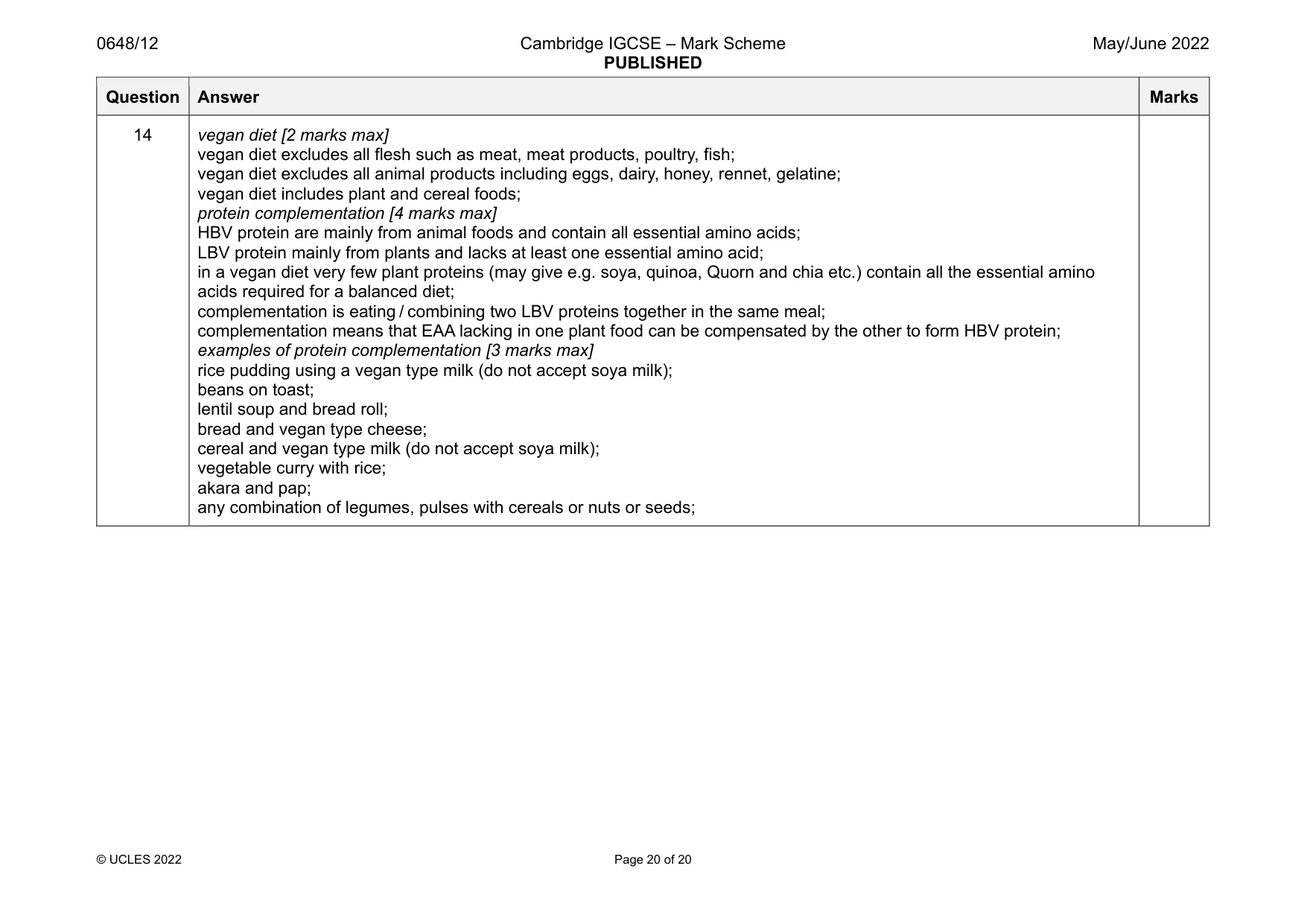
0648/12 Cambridge IGCSE – Mark Scheme PUBLISHED May/June 2022 © UCLES 2022 Page 20 of 20 Question Answer Marks 14 vegan diet [2 marks max] vegan diet excludes all flesh such as meat, meat products, poultry, fish; vegan diet excludes all animal products including eggs, dairy, honey, rennet, gelatine; vegan diet includes plant and cereal foods; protein complementation [4 marks max] HBV protein are mainly from animal foods and contain all essential amino acids; LBV protein mainly from plants and lacks at least one essential amino acid; in a vegan diet very few plant proteins (may give e.g. soya, quinoa, Quorn and chia etc.) contain all the essential amino acids required for a balanced diet; complementation is eating / combining two LBV proteins together in the same meal; complementation means that EAA lacking in one plant food can be compensated by the other to form HBV protein; examples of protein complementation [3 marks max] rice pudding using a vegan type milk (do not accept soya milk); beans on toast; lentil soup and bread roll; bread and vegan type cheese; cereal and vegan type milk (do not accept soya milk); vegetable curry with rice; akara and pap; any combination of legumes, pulses with cereals or nuts or seeds;
What you needed in this session
Cambridge’s own grade thresholds for 2022 May/June, Paper 1 · Variant 2. A higher threshold means an easier paper — the bar moves with how the cohort did.