Cambridge IGCSE Food and Nutrition 0648 — 2024 May/June Paper 1 · Variant 3
0648/13/M/J/24 · 100 marks · ≈113 min
The question paper and its mark scheme, free to read here and free to download. This is Cambridge’s own paper, exactly as it was sat.
Question paper12 pages

Mark scheme18 pages
Answers below. Sit the paper first if you are practising.
Paper as text
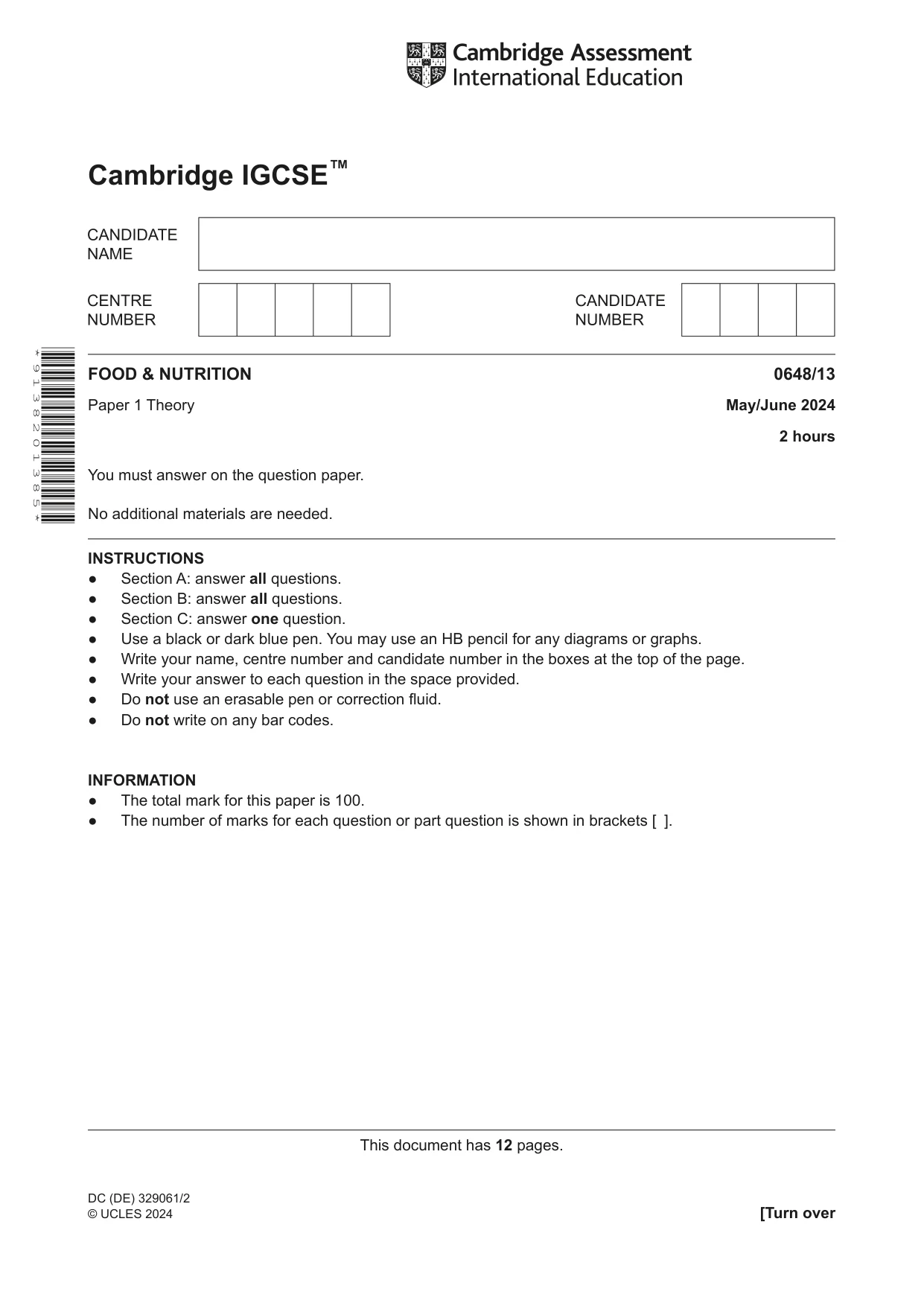
Question paper, page 1
This document has 12 pages. [Turn over * 9 1 3 8 2 0 1 3 8 5 * Cambridge IGCSE™ FOOD & NUTRITION 0648/13 Paper 1 Theory May/June 2024 2 hours You must answer on the question paper. No additional materials are needed. INSTRUCTIONS ● Section A: answer all questions. ● Section B: answer all questions. ● Section C: answer one question. ● Use a black or dark blue pen. You may use an HB pencil for any diagrams or graphs. ● Write your name, centre number and candidate number in the boxes at the top of the page. ● Write your answer to each question in the space provided. ● Do not use an erasable pen or correction fluid. ● Do not write on any bar codes. INFORMATION ● The total mark for this paper is 100. ● The number of marks for each question or part question is shown in brackets [ ]. DC (DE) 329061/2 © UCLES 2024
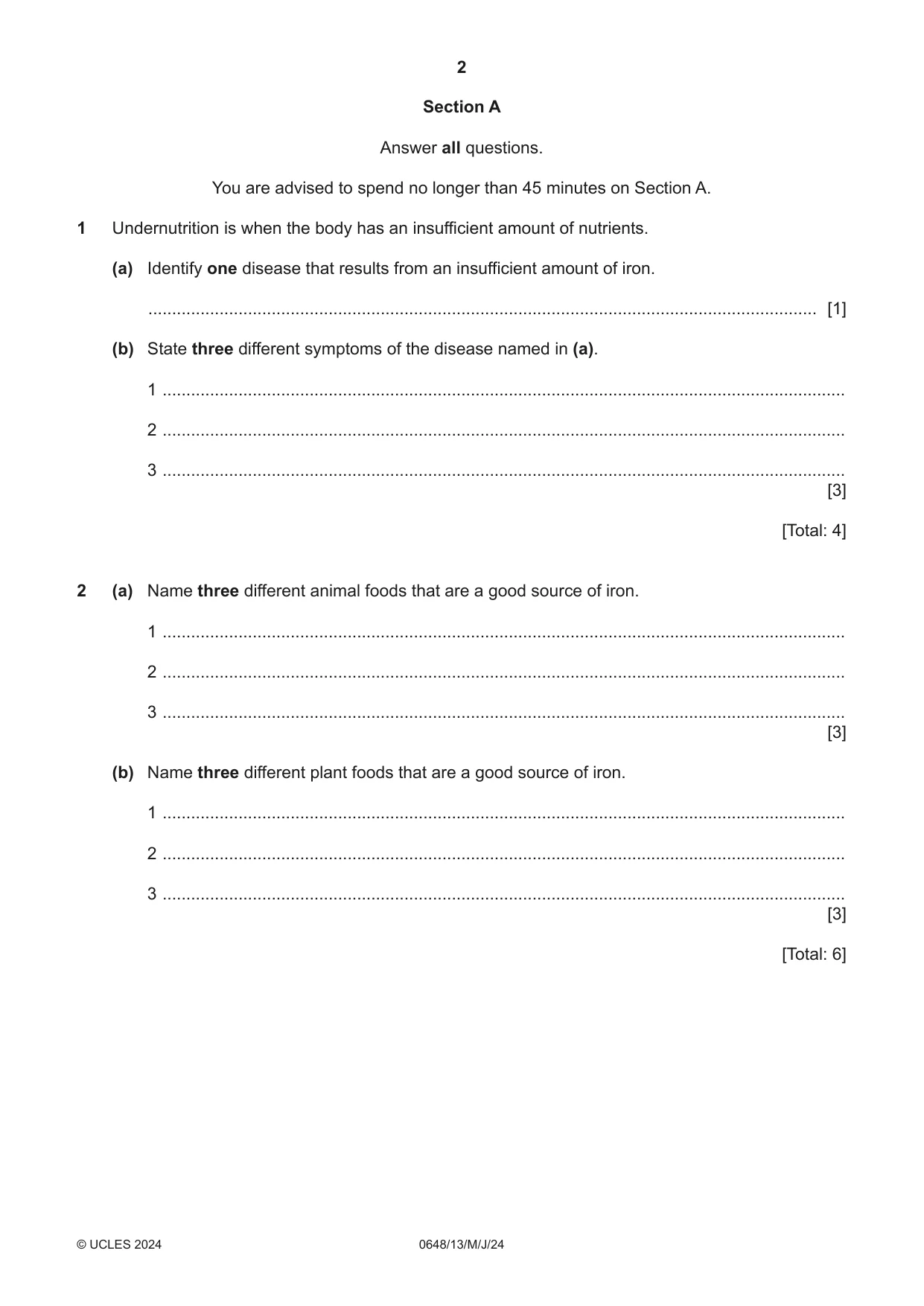
Question paper, page 2
2 0648/13/M/J/24 © UCLES 2024 Section A Answer all questions. You are advised to spend no longer than 45 minutes on Section A. 1 Undernutrition is when the body has an insufficient amount of nutrients. (a) Identify one disease that results from an insufficient amount of iron. … [1] (b) State three different symptoms of the disease named in (a). 1 … 2 … 3 … [3] [Total: 4] 2 (a) Name three different animal foods that are a good source of iron. 1 … 2 … 3 … [3] (b) Name three different plant foods that are a good source of iron. 1 … 2 … 3 … [3] [Total: 6]
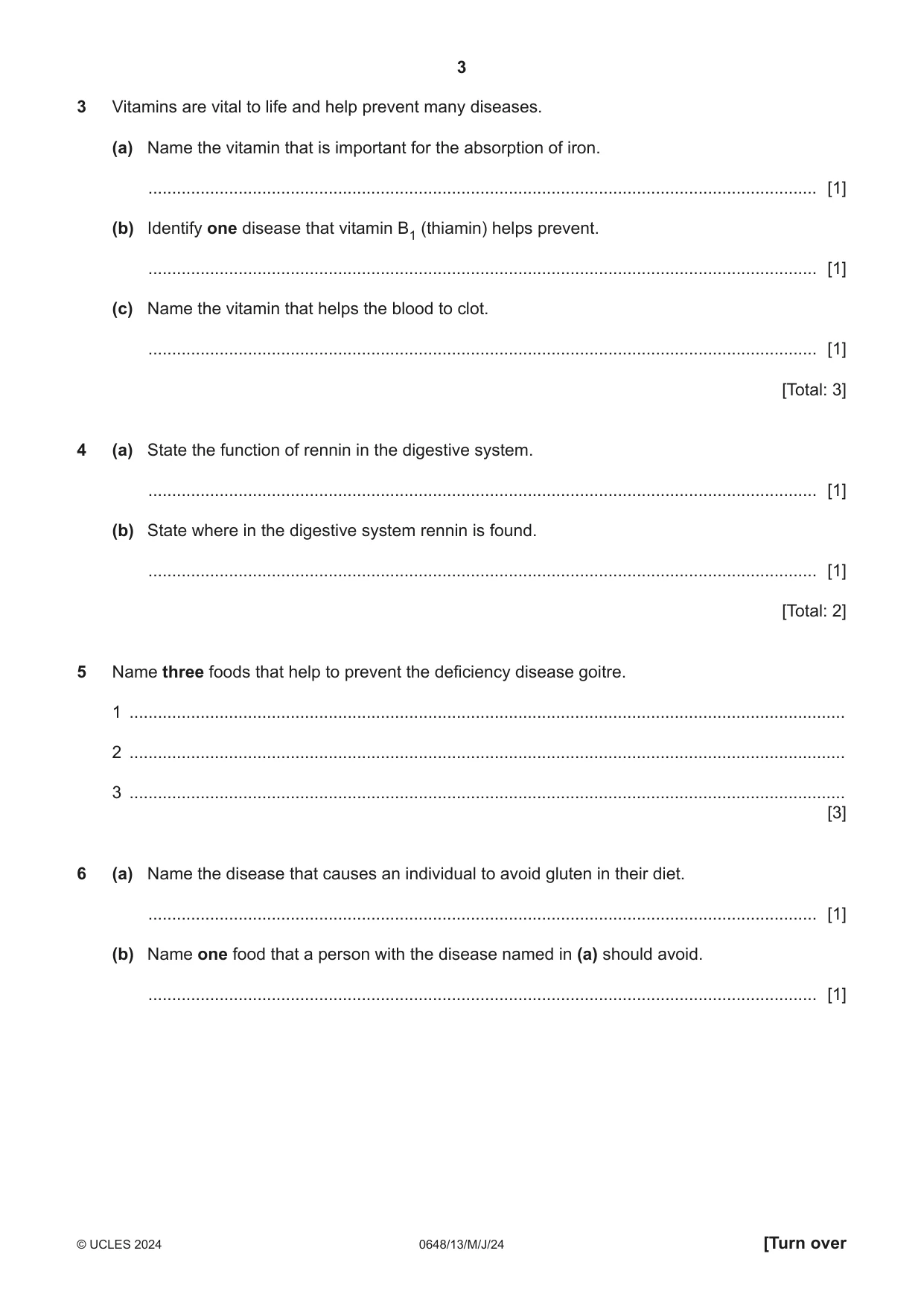
Question paper, page 3
3 0648/13/M/J/24 © UCLES 2024 [Turn over 3 Vitamins are vital to life and help prevent many diseases. (a) Name the vitamin that is important for the absorption of iron. … [1] (b) Identify one disease that vitamin B1 (thiamin) helps prevent. … [1] (c) Name the vitamin that helps the blood to clot. … [1] [Total: 3] 4 (a) State the function of rennin in the digestive system. … [1] (b) State where in the digestive system rennin is found. … [1] [Total: 2] 5 Name three foods that help to prevent the deficiency disease goitre. 1 … 2 … 3 … [3] 6 (a) Name the disease that causes an individual to avoid gluten in their diet. … [1] (b) Name one food that a person with the disease named in (a) should avoid. … [1]
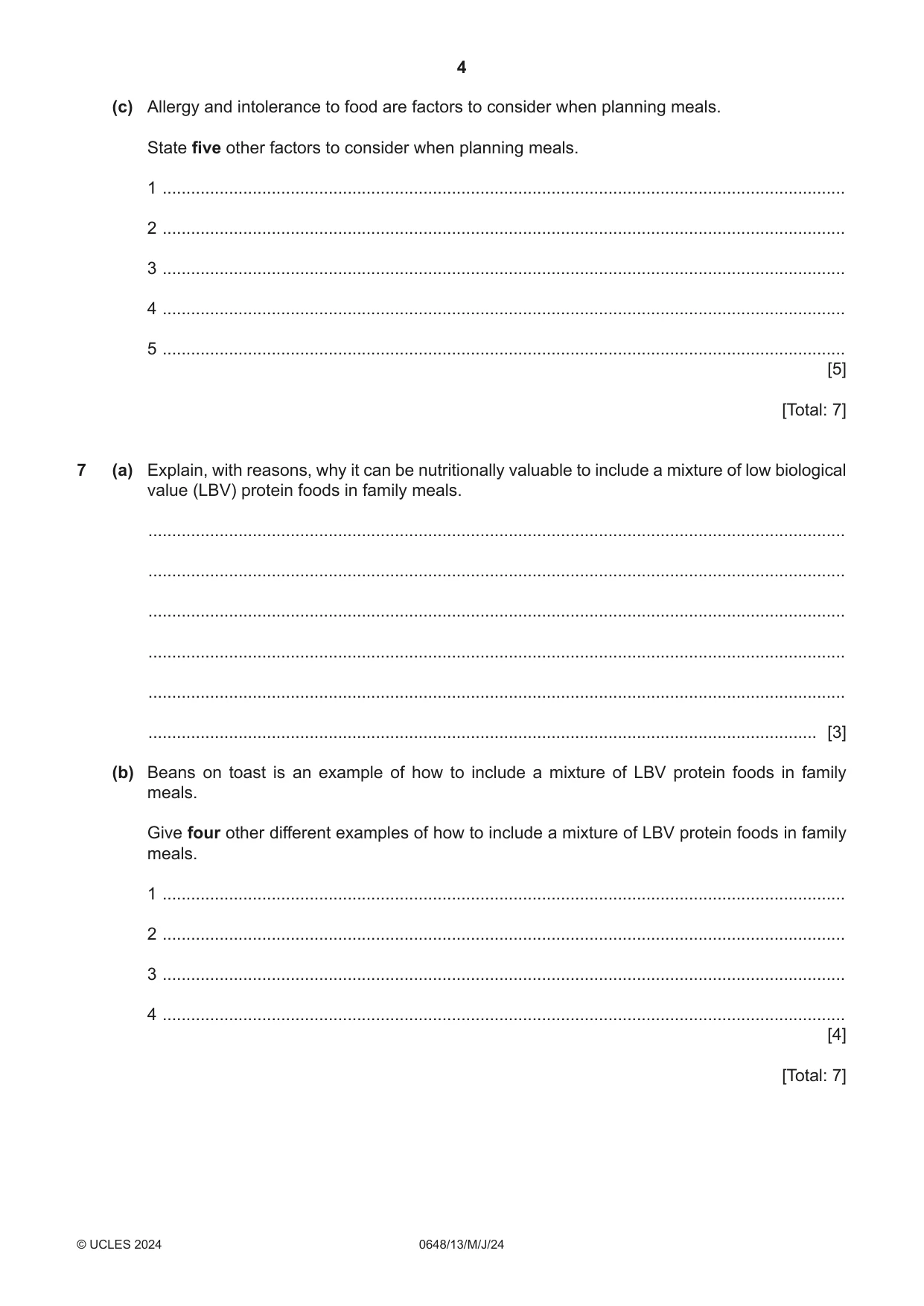
Question paper, page 4
4 0648/13/M/J/24 © UCLES 2024 (c) Allergy and intolerance to food are factors to consider when planning meals. State five other factors to consider when planning meals. 1 … 2 … 3 … 4 … 5 … [5] [Total: 7] 7 (a) Explain, with reasons, why it can be nutritionally valuable to include a mixture of low biological value (LBV) protein foods in family meals. … … … … … … [3] (b) Beans on toast is an example of how to include a mixture of LBV protein foods in family meals. Give four other different examples of how to include a mixture of LBV protein foods in family meals. 1 … 2 … 3 … 4 … [4] [Total: 7]
Question paper, page 5
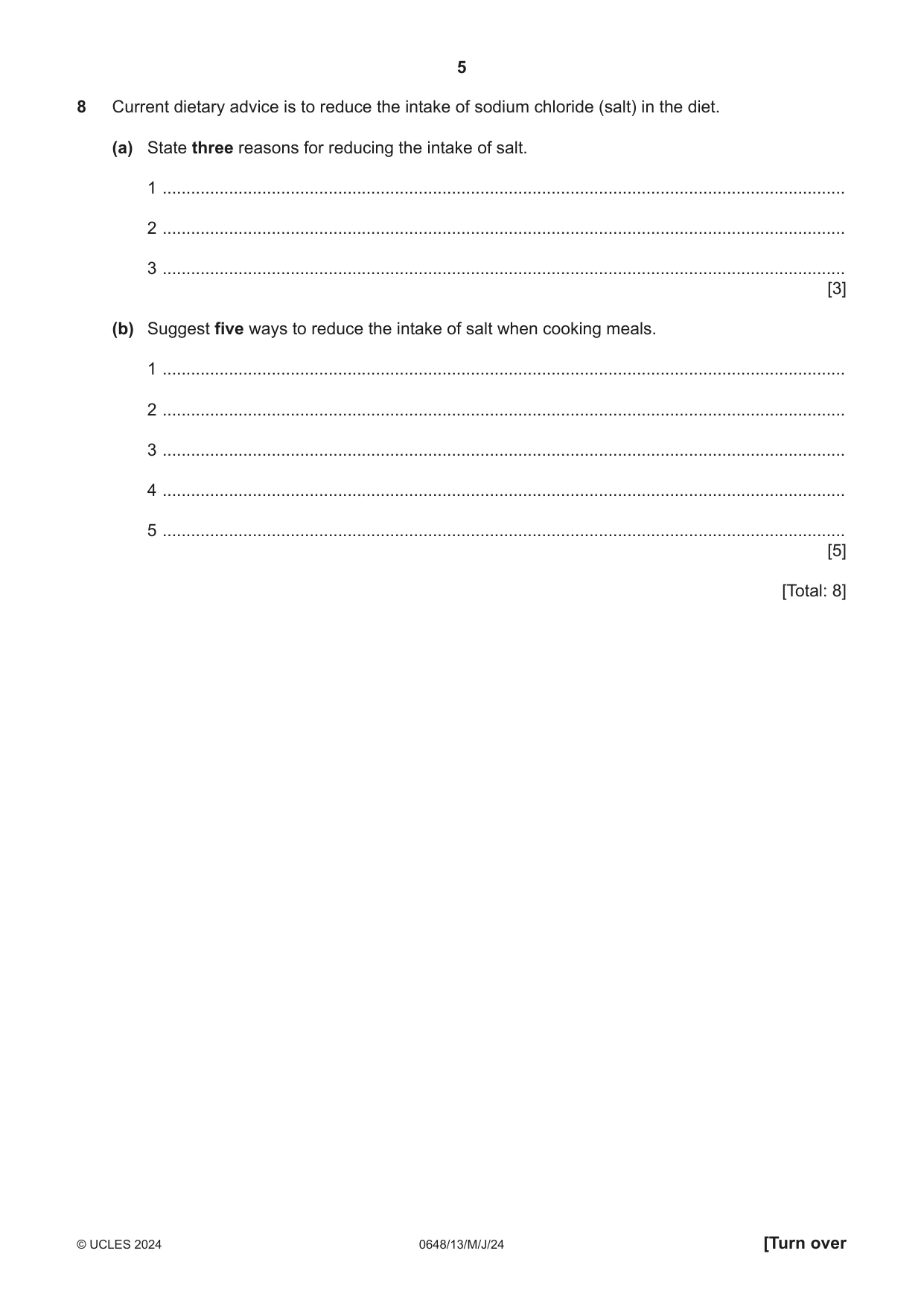
5 0648/13/M/J/24 © UCLES 2024 [Turn over 8 Current dietary advice is to reduce the intake of sodium chloride (salt) in the diet. (a) State three reasons for reducing the intake of salt. 1 … 2 … 3 … [3] (b) Suggest five ways to reduce the intake of salt when cooking meals. 1 … 2 … 3 … 4 … 5 … [5] [Total: 8]
Question paper, page 6
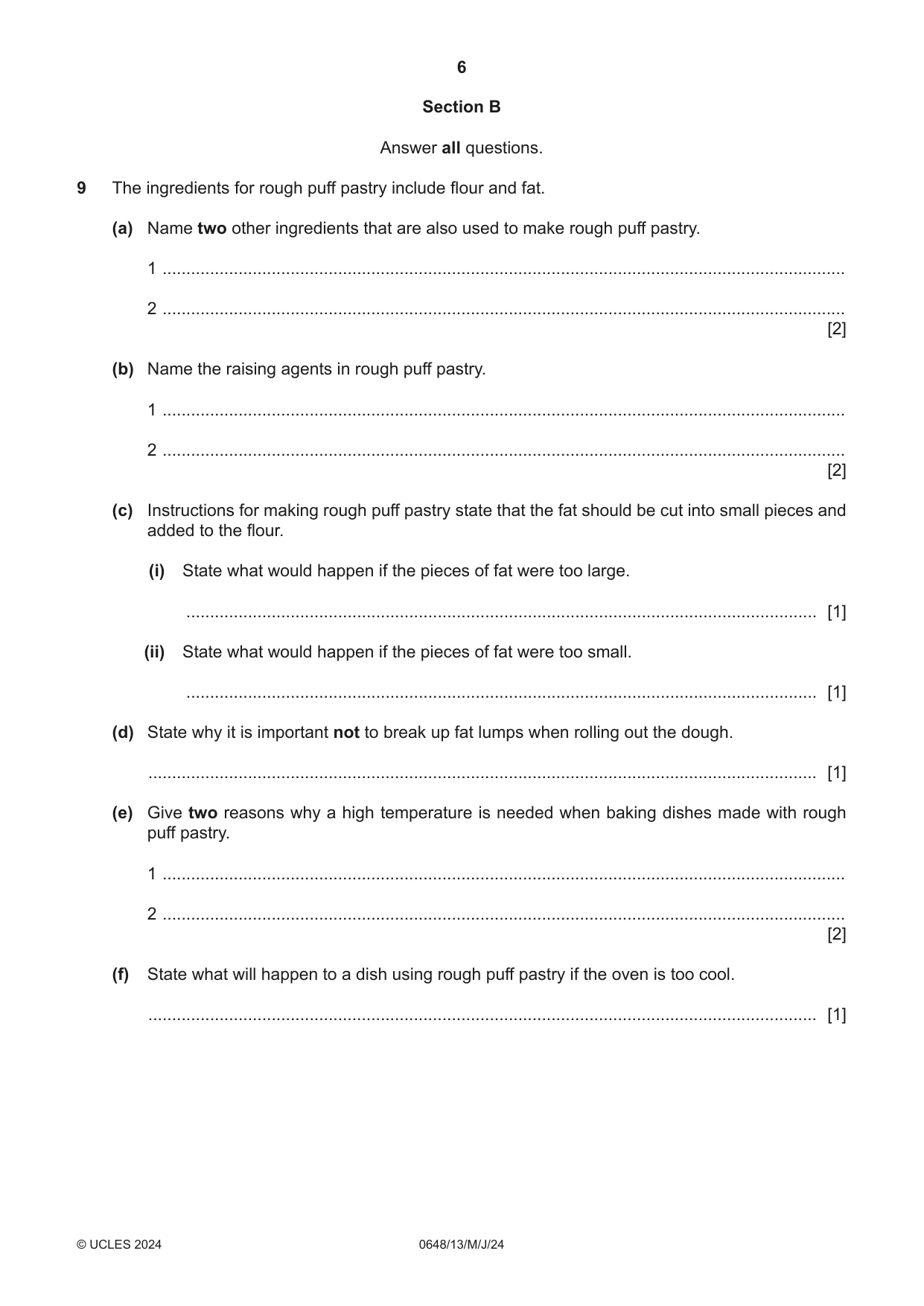
6 0648/13/M/J/24 © UCLES 2024 Section B Answer all questions. 9 The ingredients for rough puff pastry include flour and fat. (a) Name two other ingredients that are also used to make rough puff pastry. 1 … 2 … [2] (b) Name the raising agents in rough puff pastry. 1 … 2 … [2] (c) Instructions for making rough puff pastry state that the fat should be cut into small pieces and added to the flour. (i) State what would happen if the pieces of fat were too large. … [1] (ii) State what would happen if the pieces of fat were too small. … [1] (d) State why it is important not to break up fat lumps when rolling out the dough. … [1] (e) Give two reasons why a high temperature is needed when baking dishes made with rough puff pastry. 1 … 2 … [2] (f) State what will happen to a dish using rough puff pastry if the oven is too cool. … [1]
Question paper, page 7
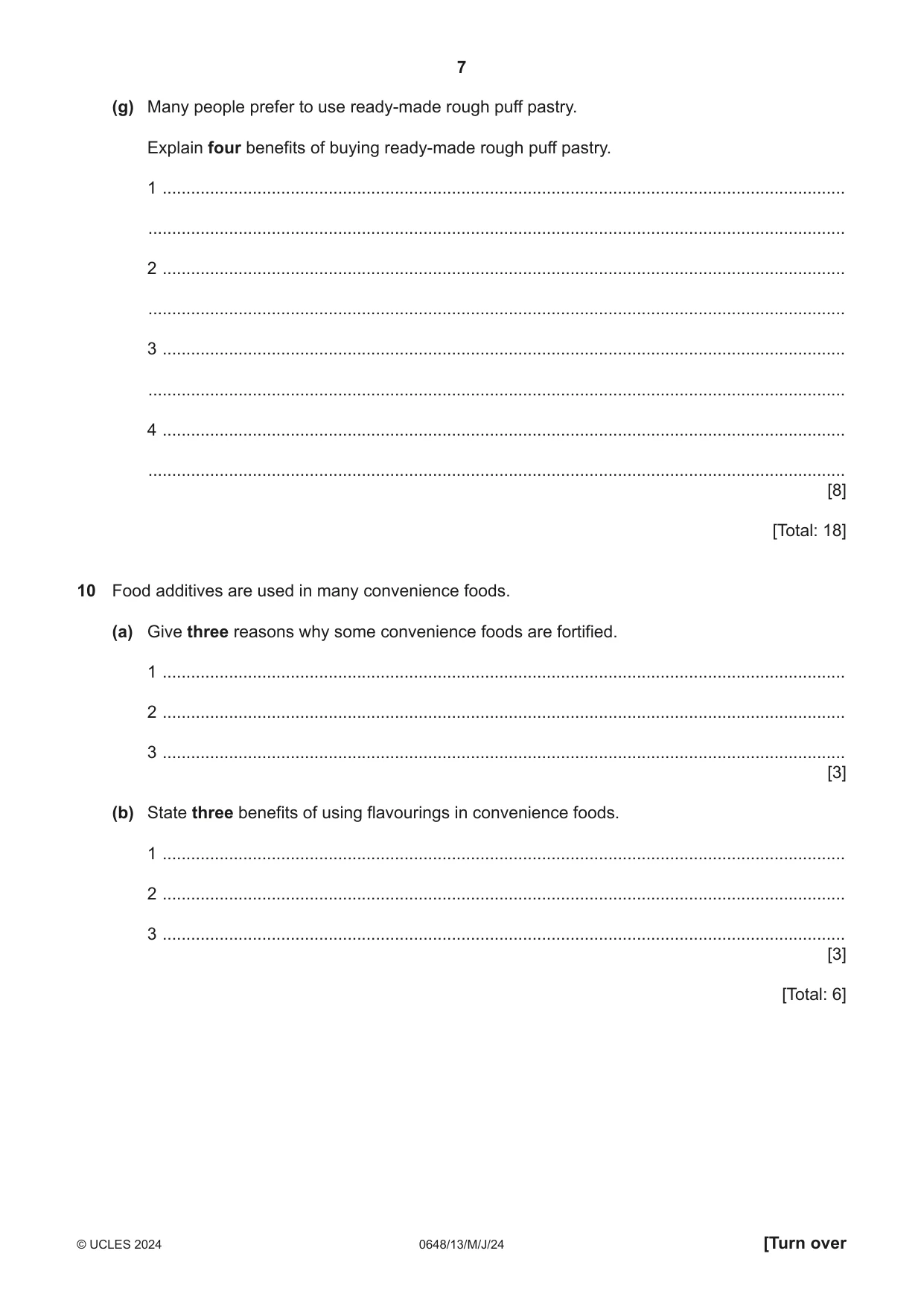
7 0648/13/M/J/24 © UCLES 2024 [Turn over (g) Many people prefer to use ready-made rough puff pastry. Explain four benefits of buying ready-made rough puff pastry. 1 … … 2 … … 3 … … 4 … … [8] [Total: 18] 10 Food additives are used in many convenience foods. (a) Give three reasons why some convenience foods are fortified. 1 … 2 … 3 … [3] (b) State three benefits of using flavourings in convenience foods. 1 … 2 … 3 … [3] [Total: 6]
Question paper, page 8
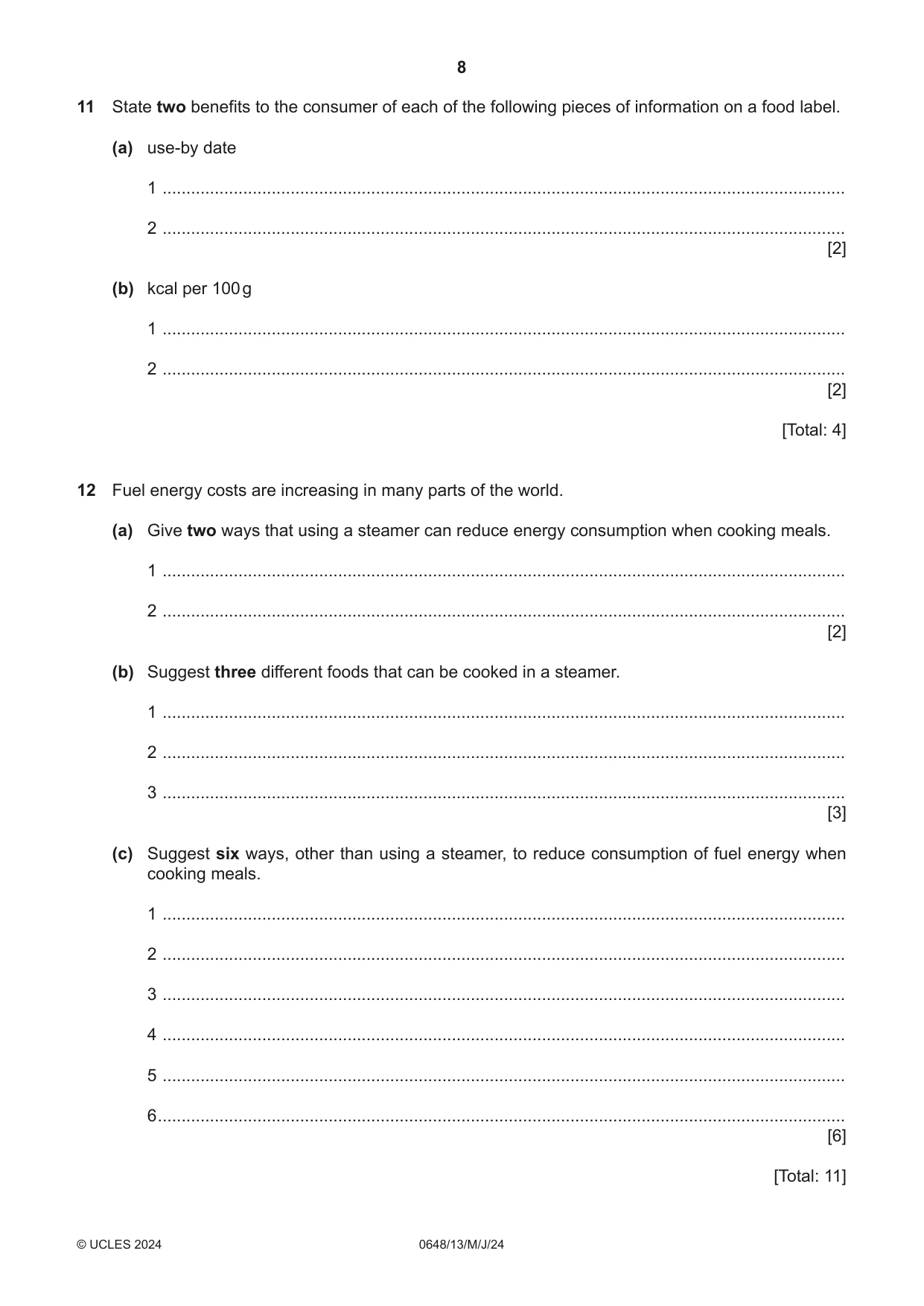
8 0648/13/M/J/24 © UCLES 2024 11 State two benefits to the consumer of each of the following pieces of information on a food label. (a) use-by date 1 … 2 … [2] (b) kcal per 100 g 1 … 2 … [2] [Total: 4] 12 Fuel energy costs are increasing in many parts of the world. (a) Give two ways that using a steamer can reduce energy consumption when cooking meals. 1 … 2 … [2] (b) Suggest three different foods that can be cooked in a steamer. 1 … 2 … 3 … [3] (c) Suggest six ways, other than using a steamer, to reduce consumption of fuel energy when cooking meals. 1 … 2 … 3 … 4 … 5 … 6 … [6] [Total: 11]
Question paper, page 9
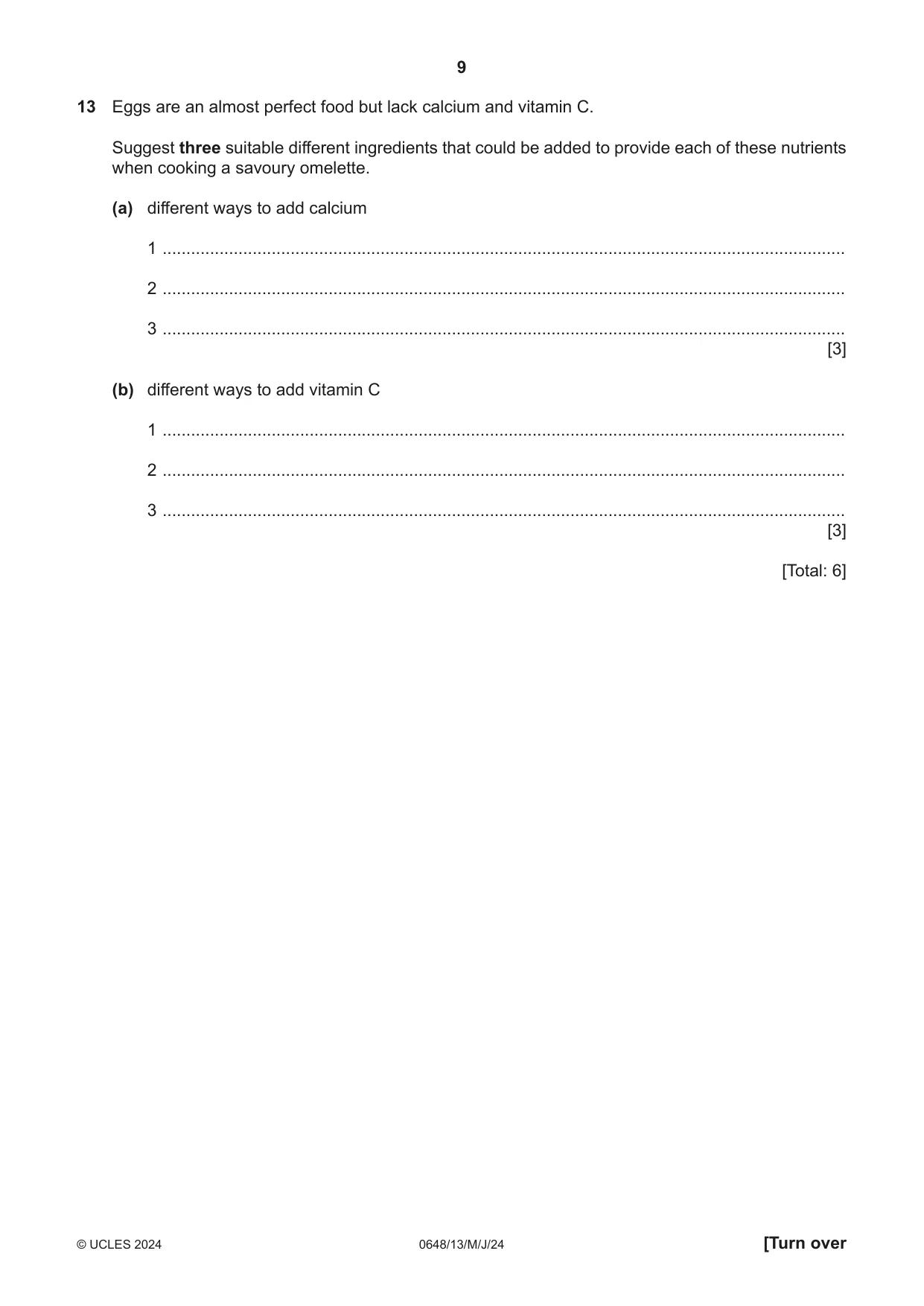
9 0648/13/M/J/24 © UCLES 2024 [Turn over 13 Eggs are an almost perfect food but lack calcium and vitamin C. Suggest three suitable different ingredients that could be added to provide each of these nutrients when cooking a savoury omelette. (a) different ways to add calcium 1 … 2 … 3 … [3] (b) different ways to add vitamin C 1 … 2 … 3 … [3] [Total: 6]
Question paper, page 10
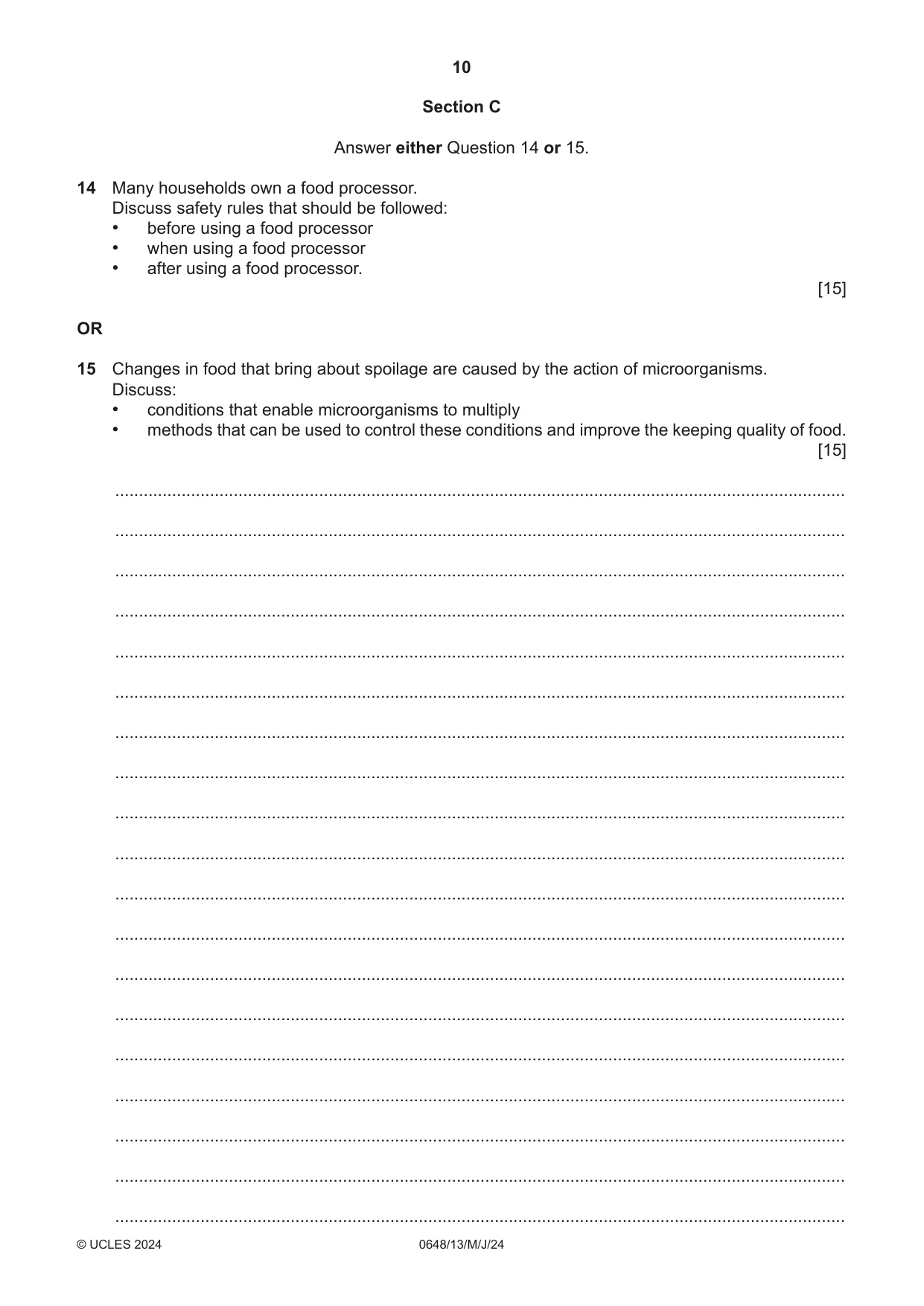
10 0648/13/M/J/24 © UCLES 2024 Section C Answer either Question 14 or 15. 14 Many households own a food processor. Discuss safety rules that should be followed: • before using a food processor • when using a food processor • after using a food processor. [15] OR 15 Changes in food that bring about spoilage are caused by the action of microorganisms. Discuss: • conditions that enable microorganisms to multiply • methods that can be used to control these conditions and improve the keeping quality of food. [15] … … … … … … … … … … … … … … … … … … …
Question paper, page 11
11 0648/13/M/J/24 © UCLES 2024 [Turn over … … … … … … … … … … … … … … … … … … … … … … … … … … … …
Question paper, page 12
12 0648/13/M/J/24 © UCLES 2024 … … … … … … … … … … … … … … … … … … … … … … … … Permission to reproduce items where third-party owned material protected by copyright is included has been sought and cleared where possible. Every reasonable effort has been made by the publisher (UCLES) to trace copyright holders, but if any items requiring clearance have unwittingly been included, the publisher will be pleased to make amends at the earliest possible opportunity. To avoid the issue of disclosure of answer-related information to candidates, all copyright acknowledgements are reproduced online in the Cambridge Assessment International Education Copyright Acknowledgements Booklet. This is produced for each series of examinations and is freely available to download at www.cambridgeinternational.org after the live examination series. Cambridge Assessment International Education is part of Cambridge Assessment. Cambridge Assessment is the brand name of the University of Cambridge Local Examinations Syndicate (UCLES), which is a department of the University of Cambridge.
Mark scheme, page 1
This document consists of 18 printed pages. © Cambridge University Press & Assessment 2024 [Turn over Cambridge IGCSE™ FOOD AND NUTRITION 0648/13 Paper 1 Theory May/June 2024 MARK SCHEME Maximum Mark: 100 Published This mark scheme is published as an aid to teachers and candidates, to indicate the requirements of the examination. It shows the basis on which Examiners were instructed to award marks. It does not indicate the details of the discussions that took place at an Examiners’ meeting before marking began, which would have considered the acceptability of alternative answers. Mark schemes should be read in conjunction with the question paper and the Principal Examiner Report for Teachers. Cambridge International will not enter into discussions about these mark schemes. Cambridge International is publishing the mark schemes for the May/June 2024 series for most Cambridge IGCSE, Cambridge International A and AS Level and Cambridge Pre-U components, and some Cambridge O Level components.
Mark scheme, page 2
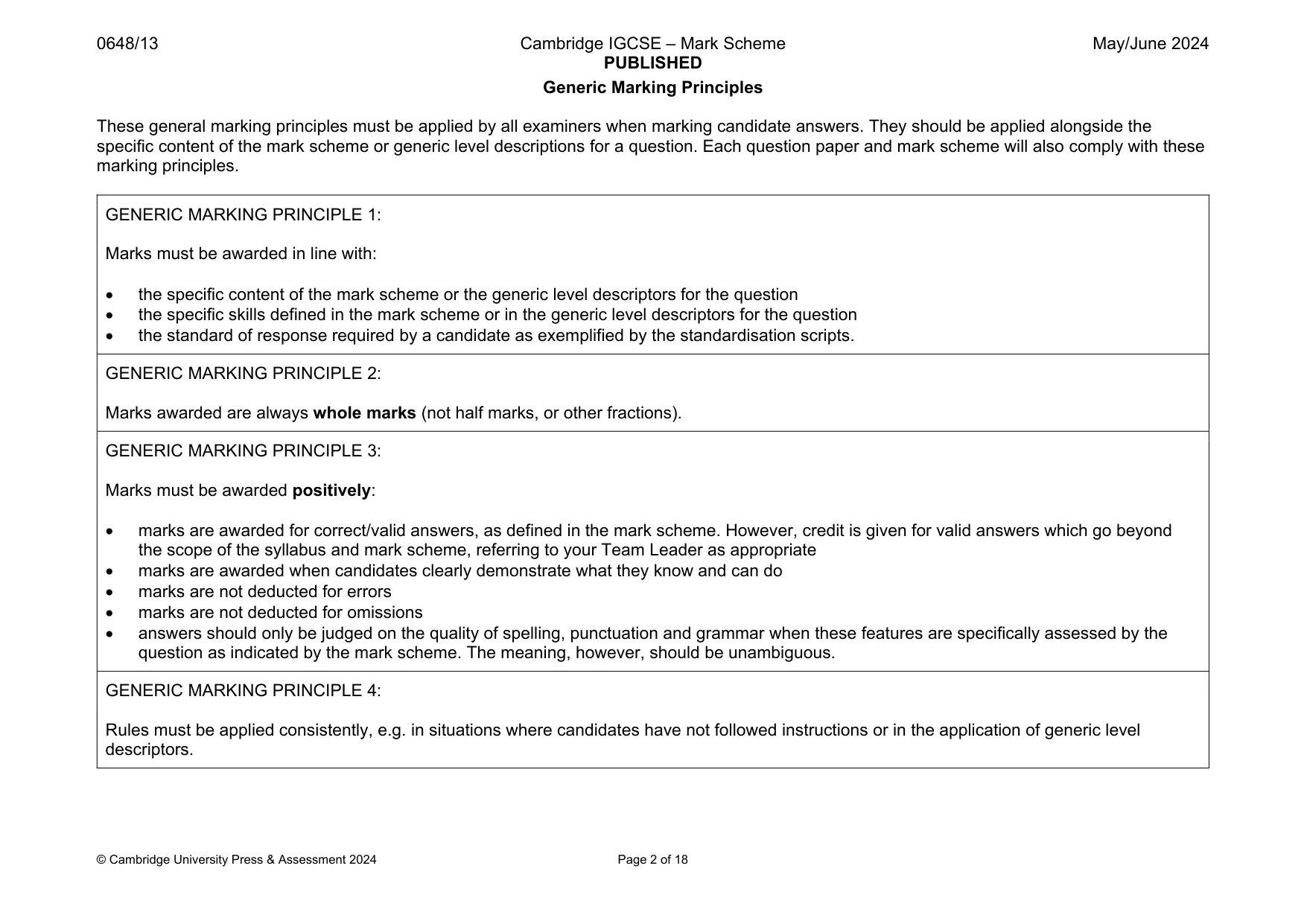
0648/13 Cambridge IGCSE – Mark Scheme PUBLISHED May/June 2024 © Cambridge University Press & Assessment 2024 Page 2 of 18 Generic Marking Principles These general marking principles must be applied by all examiners when marking candidate answers. They should be applied alongside the specific content of the mark scheme or generic level descriptions for a question. Each question paper and mark scheme will also comply with these marking principles. GENERIC MARKING PRINCIPLE 1: Marks must be awarded in line with: the specific content of the mark scheme or the generic level descriptors for the question the specific skills defined in the mark scheme or in the generic level descriptors for the question the standard of response required by a candidate as exemplified by the standardisation scripts. GENERIC MARKING PRINCIPLE 2: Marks awarded are always whole marks (not half marks, or other fractions). GENERIC MARKING PRINCIPLE 3: Marks must be awarded positively: marks are awarded for correct/valid answers, as defined in the mark scheme. However, credit is given for valid answers which go beyond the scope of the syllabus and mark scheme, referring to your Team Leader as appropriate marks are awarded when candidates clearly demonstrate what they know and can do marks are not deducted for errors marks are not deducted for omissions answers should only be judged on the quality of spelling, punctuation and grammar when these features are specifically assessed by the question as indicated by the mark scheme. The meaning, however, should be unambiguous. GENERIC MARKING PRINCIPLE 4: Rules must be applied consistently, e.g. in situations where candidates have not followed instructions or in the application of generic level descriptors.
Mark scheme, page 3
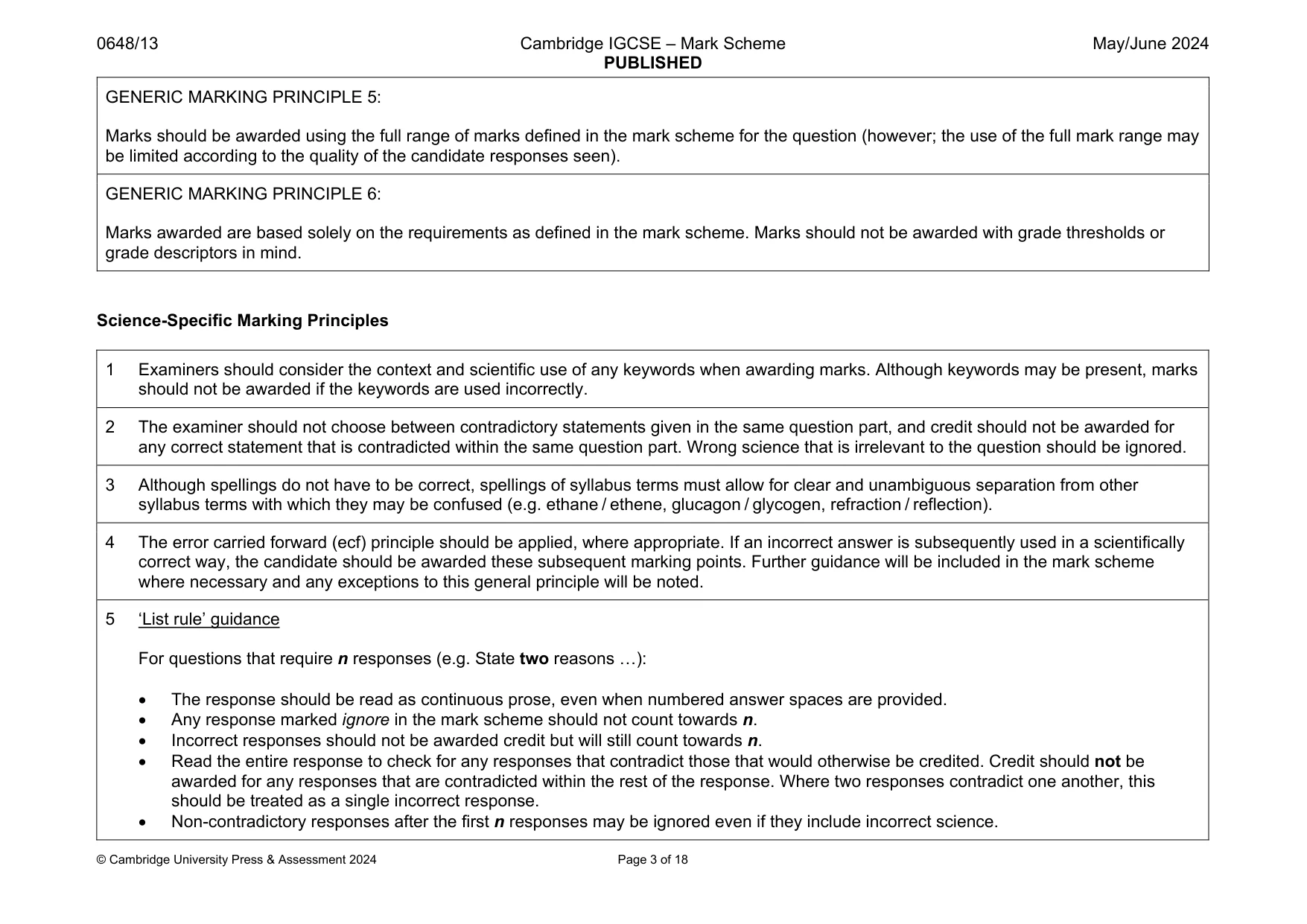
0648/13 Cambridge IGCSE – Mark Scheme PUBLISHED May/June 2024 © Cambridge University Press & Assessment 2024 Page 3 of 18 GENERIC MARKING PRINCIPLE 5: Marks should be awarded using the full range of marks defined in the mark scheme for the question (however; the use of the full mark range may be limited according to the quality of the candidate responses seen). GENERIC MARKING PRINCIPLE 6: Marks awarded are based solely on the requirements as defined in the mark scheme. Marks should not be awarded with grade thresholds or grade descriptors in mind. Science-Specific Marking Principles 1 Examiners should consider the context and scientific use of any keywords when awarding marks. Although keywords may be present, marks should not be awarded if the keywords are used incorrectly. 2 The examiner should not choose between contradictory statements given in the same question part, and credit should not be awarded for any correct statement that is contradicted within the same question part. Wrong science that is irrelevant to the question should be ignored. 3 Although spellings do not have to be correct, spellings of syllabus terms must allow for clear and unambiguous separation from other syllabus terms with which they may be confused (e.g. ethane / ethene, glucagon / glycogen, refraction / reflection). 4 The error carried forward (ecf) principle should be applied, where appropriate. If an incorrect answer is subsequently used in a scientifically correct way, the candidate should be awarded these subsequent marking points. Further guidance will be included in the mark scheme where necessary and any exceptions to this general principle will be noted. 5 ‘List rule’ guidance For questions that require n responses (e.g. State two reasons …): The response should be read as continuous prose, even when numbered answer spaces are provided. Any response marked ignore in the mark scheme should not count towards n. Incorrect responses should not be awarded credit but will still count towards n. Read the entire response to check for any responses that contradict those that would otherwise be credited. Credit should not be awarded for any responses that are contradicted within the rest of the response. Where two responses contradict one another, this should be treated as a single incorrect response. Non-contradictory responses after the first n responses may be ignored even if they include incorrect science.
Mark scheme, page 4
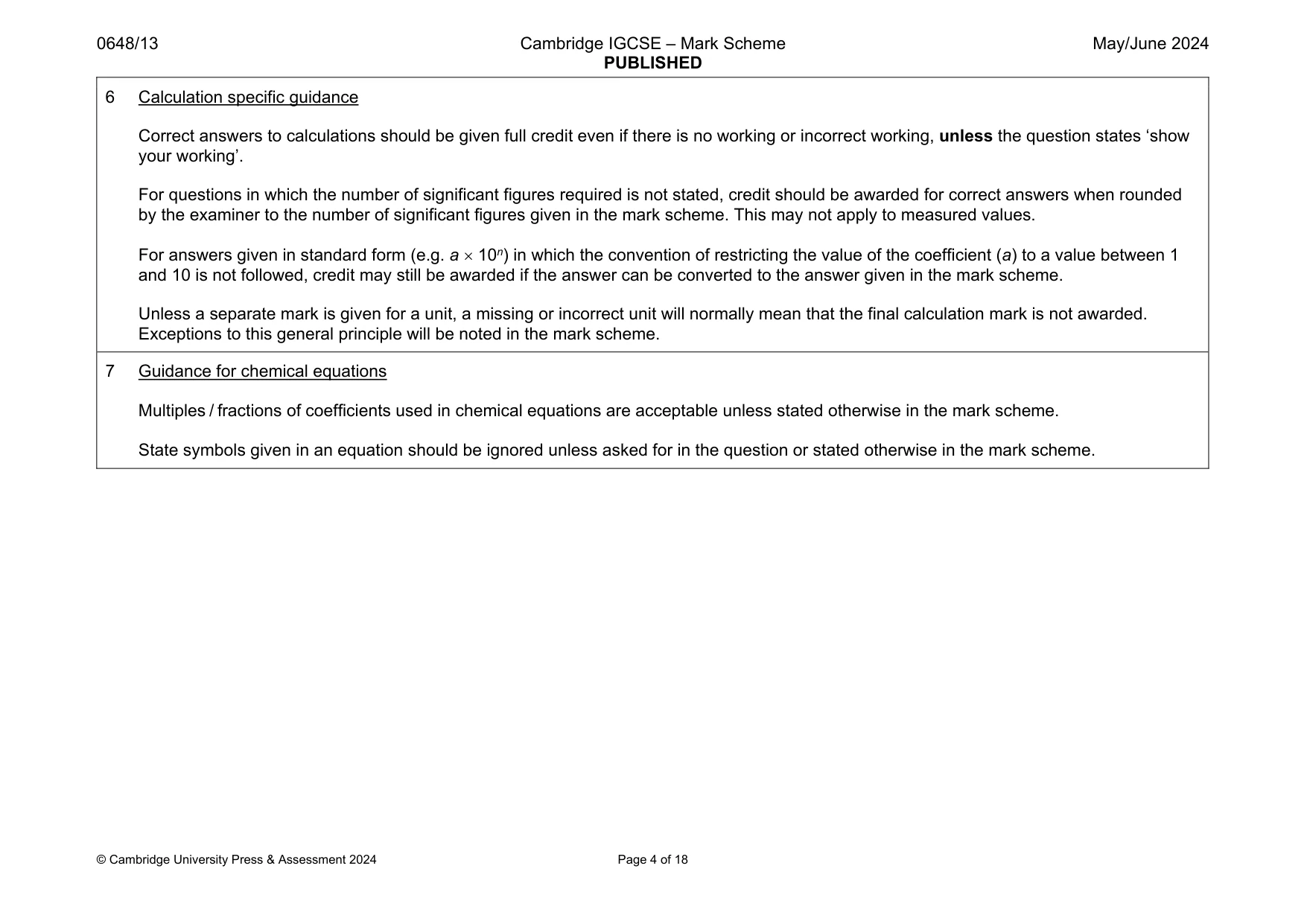
0648/13 Cambridge IGCSE – Mark Scheme PUBLISHED May/June 2024 © Cambridge University Press & Assessment 2024 Page 4 of 18 6 Calculation specific guidance Correct answers to calculations should be given full credit even if there is no working or incorrect working, unless the question states ‘show your working’. For questions in which the number of significant figures required is not stated, credit should be awarded for correct answers when rounded by the examiner to the number of significant figures given in the mark scheme. This may not apply to measured values. For answers given in standard form (e.g. a 10n) in which the convention of restricting the value of the coefficient (a) to a value between 1 and 10 is not followed, credit may still be awarded if the answer can be converted to the answer given in the mark scheme. Unless a separate mark is given for a unit, a missing or incorrect unit will normally mean that the final calculation mark is not awarded. Exceptions to this general principle will be noted in the mark scheme. 7 Guidance for chemical equations Multiples / fractions of coefficients used in chemical equations are acceptable unless stated otherwise in the mark scheme. State symbols given in an equation should be ignored unless asked for in the question or stated otherwise in the mark scheme.
Mark scheme, page 5
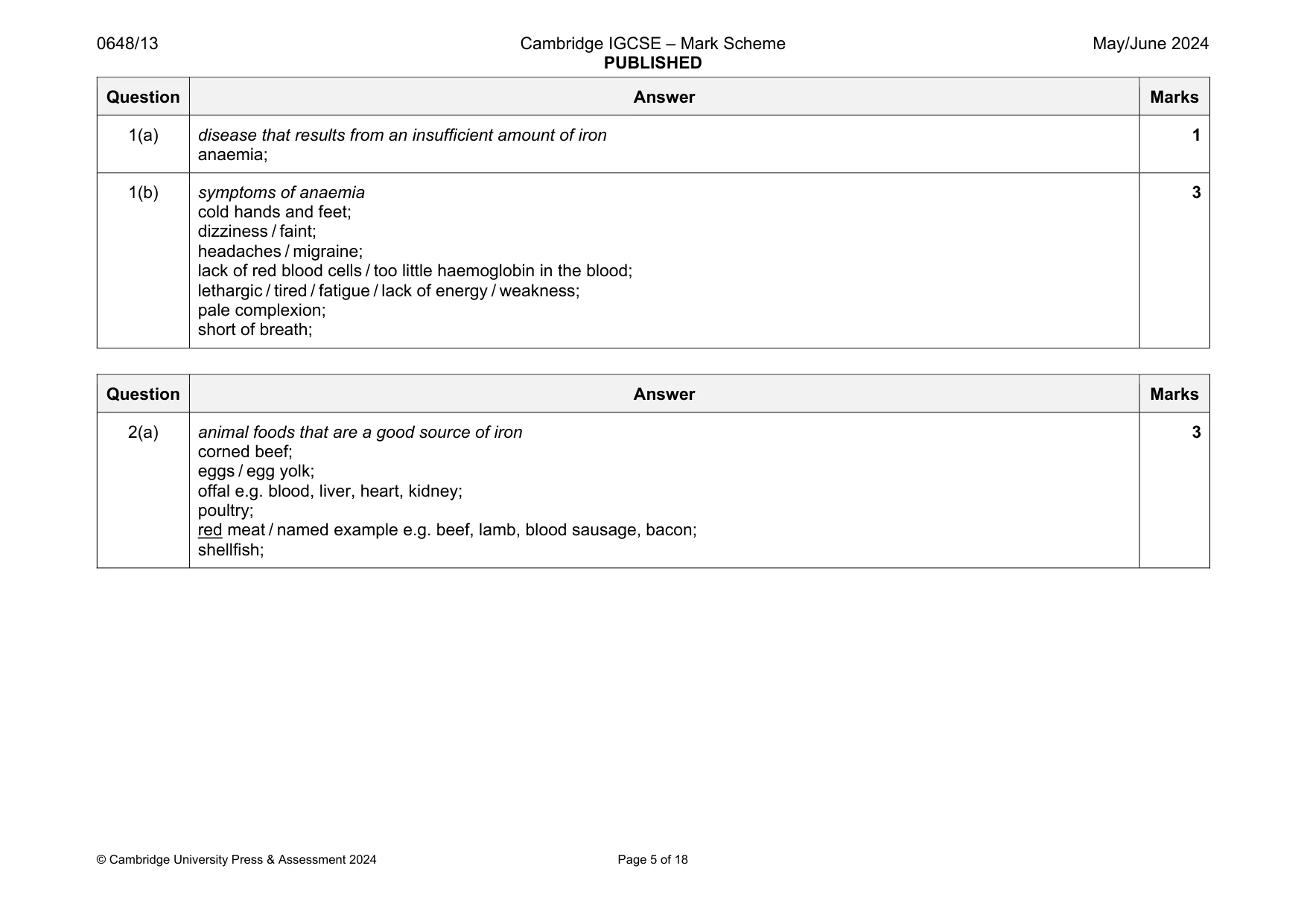
0648/13 Cambridge IGCSE – Mark Scheme PUBLISHED May/June 2024 © Cambridge University Press & Assessment 2024 Page 5 of 18 Question Answer Marks 1(a) disease that results from an insufficient amount of iron anaemia; 1 1(b) symptoms of anaemia cold hands and feet; dizziness / faint; headaches / migraine; lack of red blood cells / too little haemoglobin in the blood; lethargic / tired / fatigue / lack of energy / weakness; pale complexion; short of breath; 3 Question Answer Marks 2(a) animal foods that are a good source of iron corned beef; eggs / egg yolk; offal e.g. blood, liver, heart, kidney; poultry; red meat / named example e.g. beef, lamb, blood sausage, bacon; shellfish; 3
Mark scheme, page 6
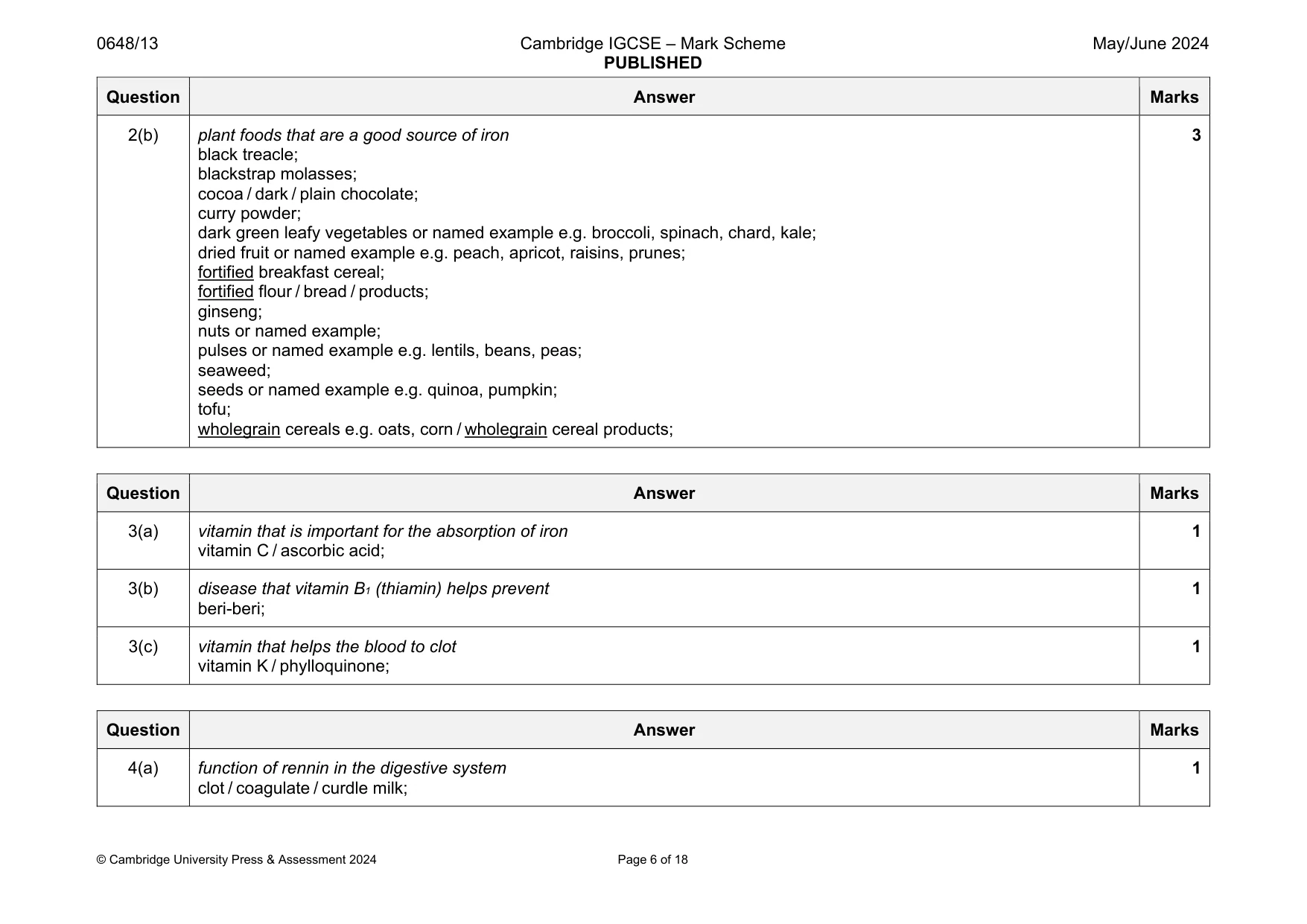
0648/13 Cambridge IGCSE – Mark Scheme PUBLISHED May/June 2024 © Cambridge University Press & Assessment 2024 Page 6 of 18 Question Answer Marks 2(b) plant foods that are a good source of iron black treacle; blackstrap molasses; cocoa / dark / plain chocolate; curry powder; dark green leafy vegetables or named example e.g. broccoli, spinach, chard, kale; dried fruit or named example e.g. peach, apricot, raisins, prunes; fortified breakfast cereal; fortified flour / bread / products; ginseng; nuts or named example; pulses or named example e.g. lentils, beans, peas; seaweed; seeds or named example e.g. quinoa, pumpkin; tofu; wholegrain cereals e.g. oats, corn / wholegrain cereal products; 3 Question Answer Marks 3(a) vitamin that is important for the absorption of iron vitamin C / ascorbic acid; 1 3(b) disease that vitamin B1 (thiamin) helps prevent beri-beri; 1 3(c) vitamin that helps the blood to clot vitamin K / phylloquinone; 1 Question Answer Marks 4(a) function of rennin in the digestive system clot / coagulate / curdle milk; 1
Mark scheme, page 7
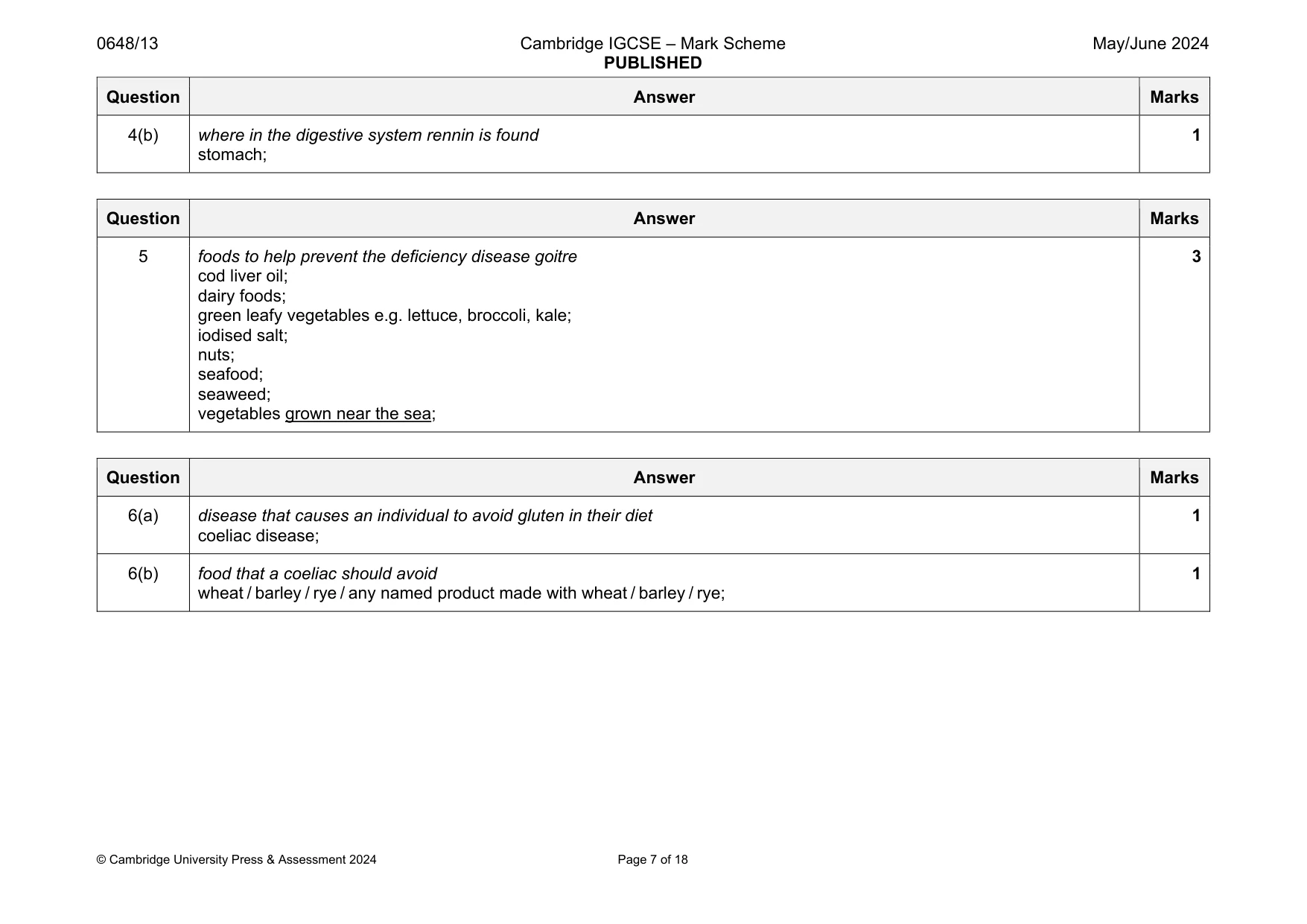
0648/13 Cambridge IGCSE – Mark Scheme PUBLISHED May/June 2024 © Cambridge University Press & Assessment 2024 Page 7 of 18 Question Answer Marks 4(b) where in the digestive system rennin is found stomach; 1 Question Answer Marks 5 foods to help prevent the deficiency disease goitre cod liver oil; dairy foods; green leafy vegetables e.g. lettuce, broccoli, kale; iodised salt; nuts; seafood; seaweed; vegetables grown near the sea; 3 Question Answer Marks 6(a) disease that causes an individual to avoid gluten in their diet coeliac disease; 1 6(b) food that a coeliac should avoid wheat / barley / rye / any named product made with wheat / barley / rye; 1
Mark scheme, page 8
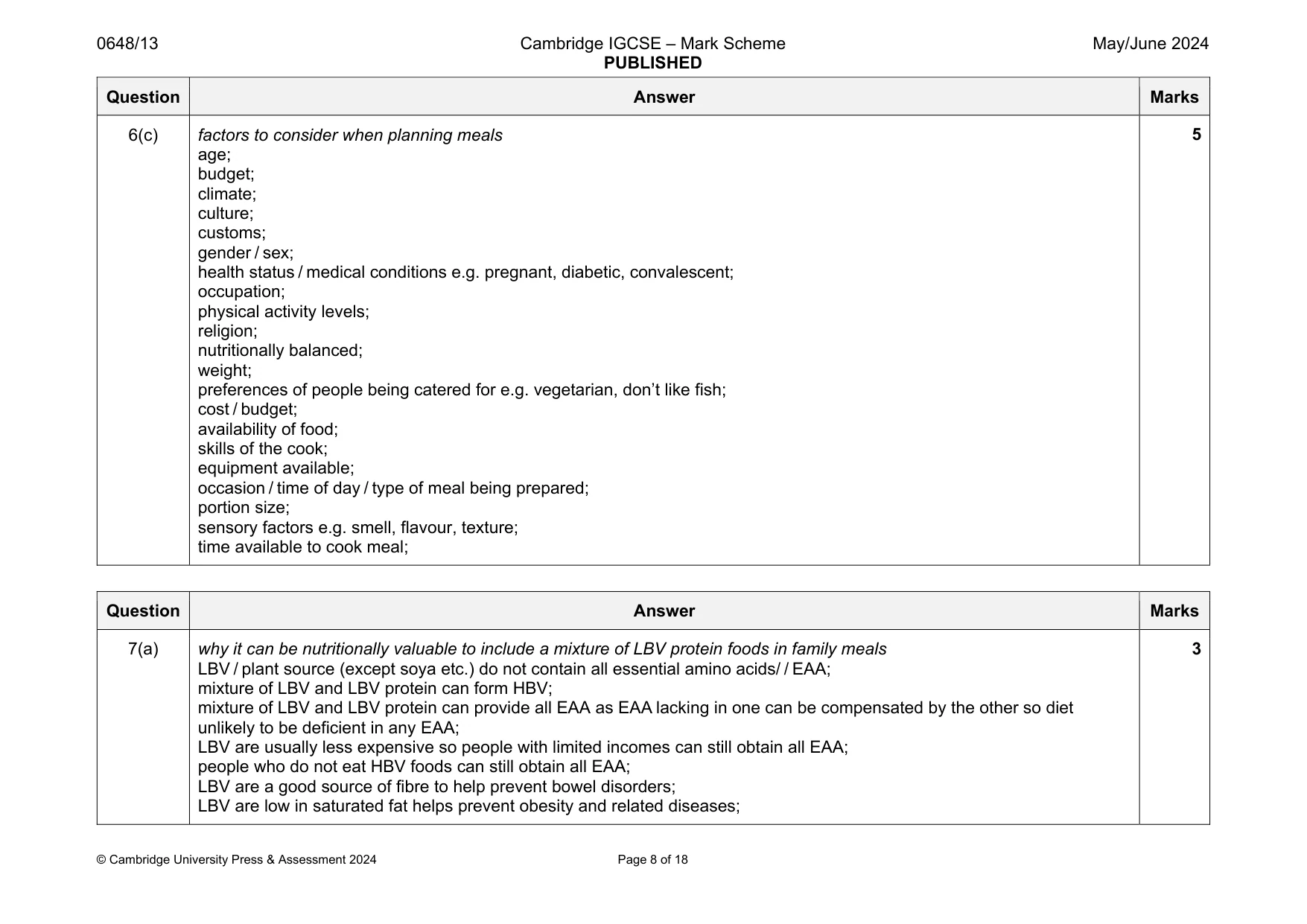
0648/13 Cambridge IGCSE – Mark Scheme PUBLISHED May/June 2024 © Cambridge University Press & Assessment 2024 Page 8 of 18 Question Answer Marks 6(c) factors to consider when planning meals age; budget; climate; culture; customs; gender / sex; health status / medical conditions e.g. pregnant, diabetic, convalescent; occupation; physical activity levels; religion; nutritionally balanced; weight; preferences of people being catered for e.g. vegetarian, don’t like fish; cost / budget; availability of food; skills of the cook; equipment available; occasion / time of day / type of meal being prepared; portion size; sensory factors e.g. smell, flavour, texture; time available to cook meal; 5 Question Answer Marks 7(a) why it can be nutritionally valuable to include a mixture of LBV protein foods in family meals LBV / plant source (except soya etc.) do not contain all essential amino acids/ / EAA; mixture of LBV and LBV protein can form HBV; mixture of LBV and LBV protein can provide all EAA as EAA lacking in one can be compensated by the other so diet unlikely to be deficient in any EAA; LBV are usually less expensive so people with limited incomes can still obtain all EAA; people who do not eat HBV foods can still obtain all EAA; LBV are a good source of fibre to help prevent bowel disorders; LBV are low in saturated fat helps prevent obesity and related diseases; 3
Mark scheme, page 9
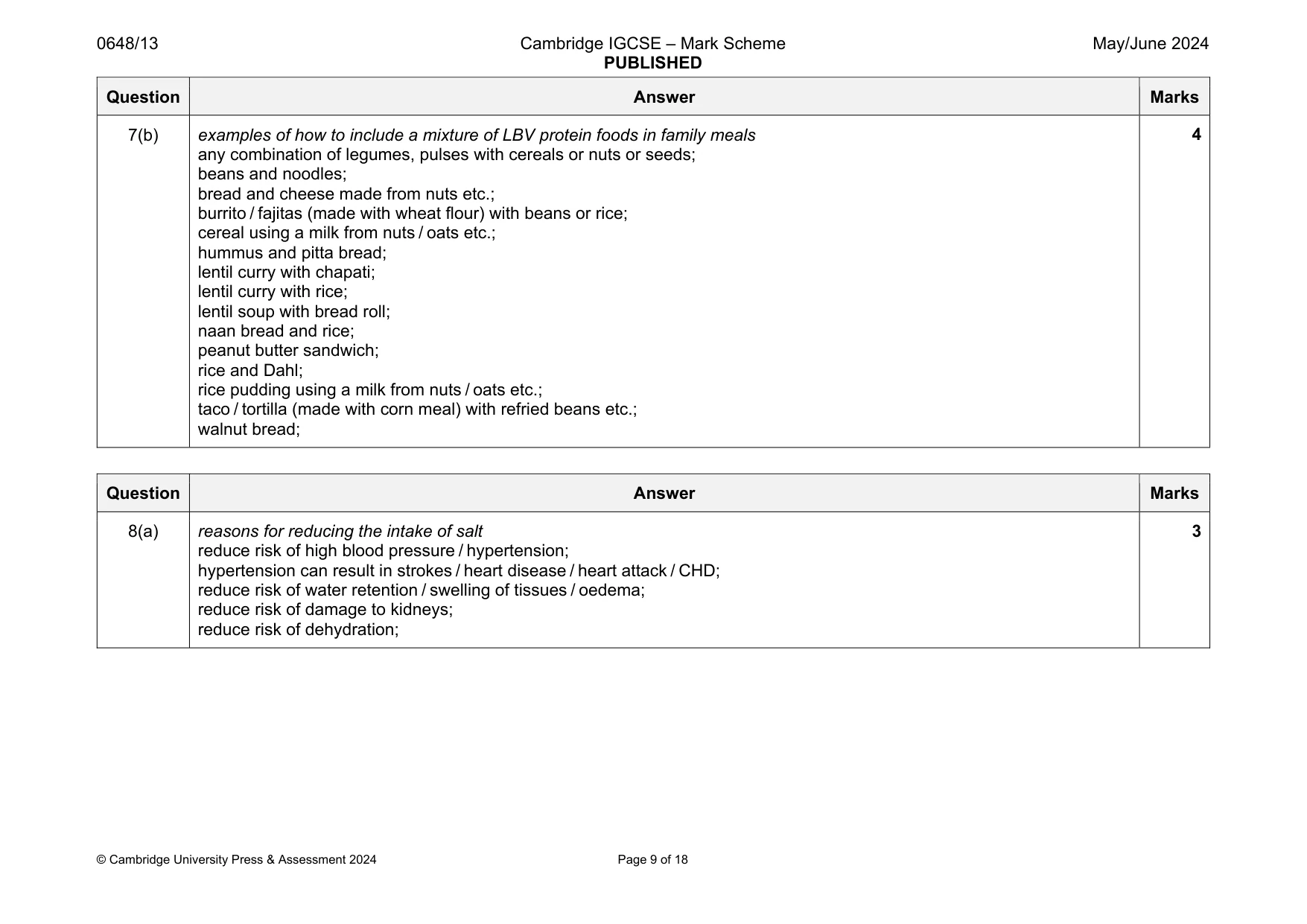
0648/13 Cambridge IGCSE – Mark Scheme PUBLISHED May/June 2024 © Cambridge University Press & Assessment 2024 Page 9 of 18 Question Answer Marks 7(b) examples of how to include a mixture of LBV protein foods in family meals any combination of legumes, pulses with cereals or nuts or seeds; beans and noodles; bread and cheese made from nuts etc.; burrito / fajitas (made with wheat flour) with beans or rice; cereal using a milk from nuts / oats etc.; hummus and pitta bread; lentil curry with chapati; lentil curry with rice; lentil soup with bread roll; naan bread and rice; peanut butter sandwich; rice and Dahl; rice pudding using a milk from nuts / oats etc.; taco / tortilla (made with corn meal) with refried beans etc.; walnut bread; 4 Question Answer Marks 8(a) reasons for reducing the intake of salt reduce risk of high blood pressure / hypertension; hypertension can result in strokes / heart disease / heart attack / CHD; reduce risk of water retention / swelling of tissues / oedema; reduce risk of damage to kidneys; reduce risk of dehydration; 3
Mark scheme, page 10
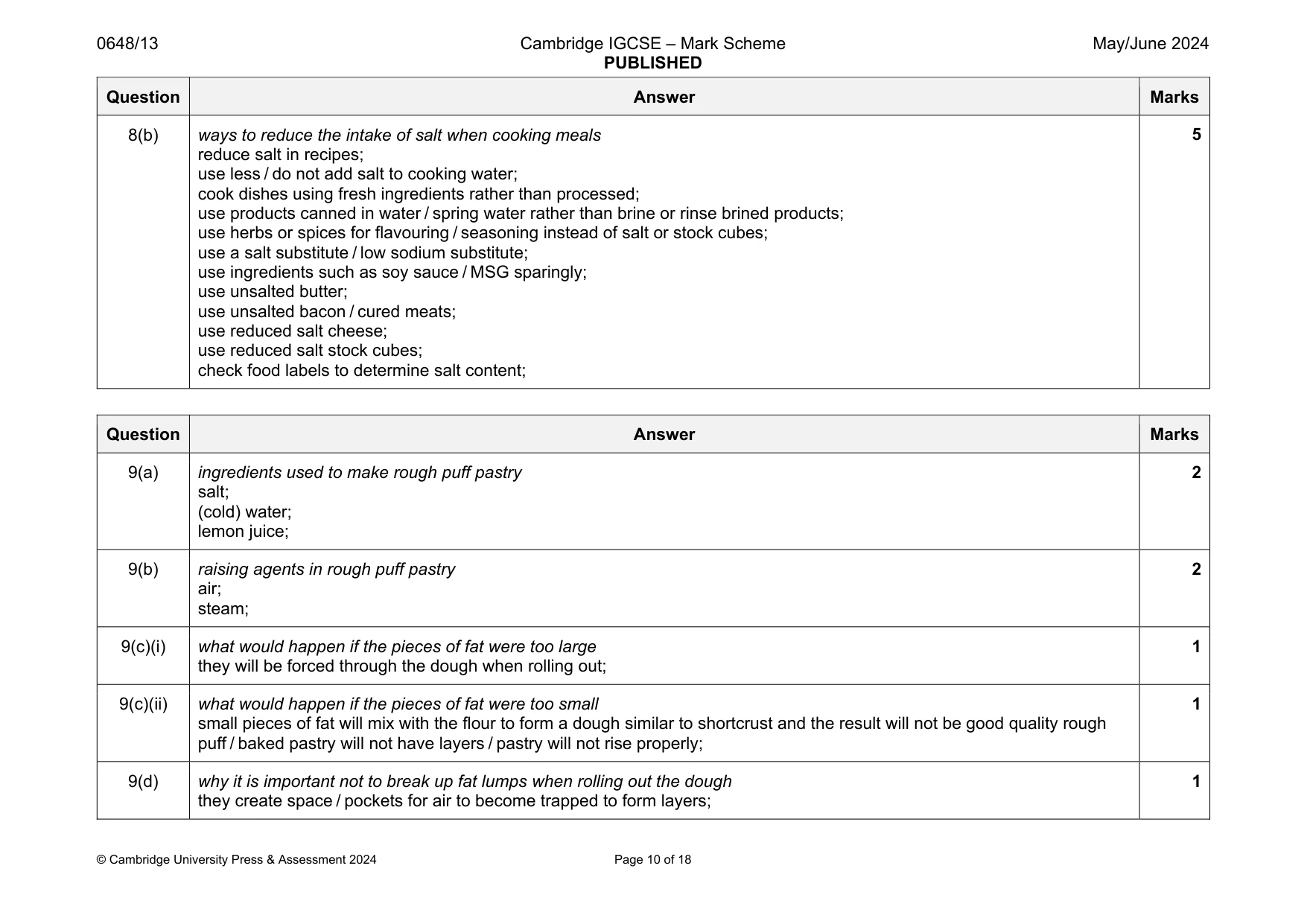
0648/13 Cambridge IGCSE – Mark Scheme PUBLISHED May/June 2024 © Cambridge University Press & Assessment 2024 Page 10 of 18 Question Answer Marks 8(b) ways to reduce the intake of salt when cooking meals reduce salt in recipes; use less / do not add salt to cooking water; cook dishes using fresh ingredients rather than processed; use products canned in water / spring water rather than brine or rinse brined products; use herbs or spices for flavouring / seasoning instead of salt or stock cubes; use a salt substitute / low sodium substitute; use ingredients such as soy sauce / MSG sparingly; use unsalted butter; use unsalted bacon / cured meats; use reduced salt cheese; use reduced salt stock cubes; check food labels to determine salt content; 5 Question Answer Marks 9(a) ingredients used to make rough puff pastry salt; (cold) water; lemon juice; 2 9(b) raising agents in rough puff pastry air; steam; 2 9(c)(i) what would happen if the pieces of fat were too large they will be forced through the dough when rolling out; 1 9(c)(ii) what would happen if the pieces of fat were too small small pieces of fat will mix with the flour to form a dough similar to shortcrust and the result will not be good quality rough puff / baked pastry will not have layers / pastry will not rise properly; 1 9(d) why it is important not to break up fat lumps when rolling out the dough they create space / pockets for air to become trapped to form layers; 1
Mark scheme, page 11
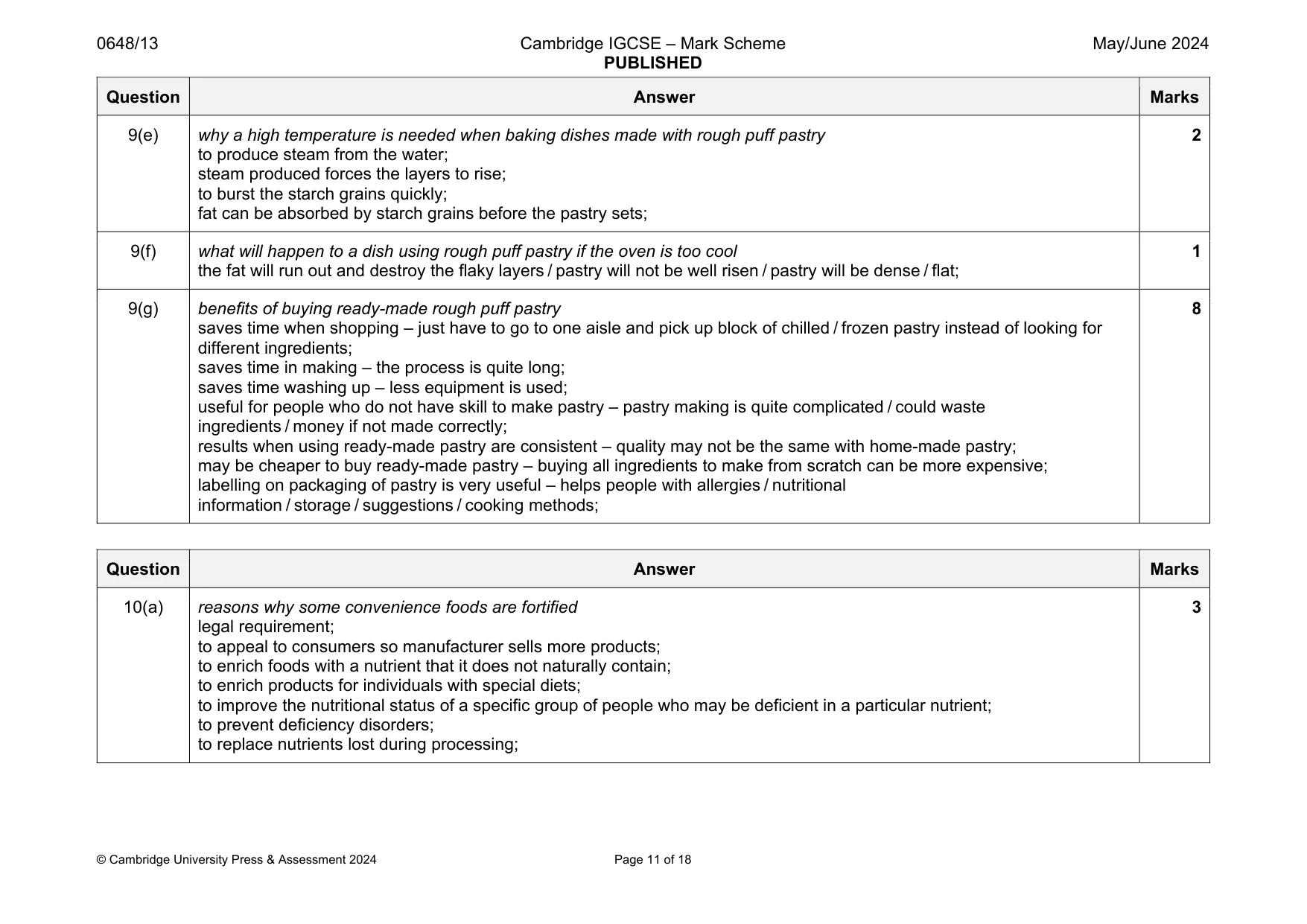
0648/13 Cambridge IGCSE – Mark Scheme PUBLISHED May/June 2024 © Cambridge University Press & Assessment 2024 Page 11 of 18 Question Answer Marks 9(e) why a high temperature is needed when baking dishes made with rough puff pastry to produce steam from the water; steam produced forces the layers to rise; to burst the starch grains quickly; fat can be absorbed by starch grains before the pastry sets; 2 9(f) what will happen to a dish using rough puff pastry if the oven is too cool the fat will run out and destroy the flaky layers / pastry will not be well risen / pastry will be dense / flat; 1 9(g) benefits of buying ready-made rough puff pastry saves time when shopping – just have to go to one aisle and pick up block of chilled / frozen pastry instead of looking for different ingredients; saves time in making – the process is quite long; saves time washing up – less equipment is used; useful for people who do not have skill to make pastry – pastry making is quite complicated / could waste ingredients / money if not made correctly; results when using ready-made pastry are consistent – quality may not be the same with home-made pastry; may be cheaper to buy ready-made pastry – buying all ingredients to make from scratch can be more expensive; labelling on packaging of pastry is very useful – helps people with allergies / nutritional information / storage / suggestions / cooking methods; 8 Question Answer Marks 10(a) reasons why some convenience foods are fortified legal requirement; to appeal to consumers so manufacturer sells more products; to enrich foods with a nutrient that it does not naturally contain; to enrich products for individuals with special diets; to improve the nutritional status of a specific group of people who may be deficient in a particular nutrient; to prevent deficiency disorders; to replace nutrients lost during processing; 3
Mark scheme, page 12
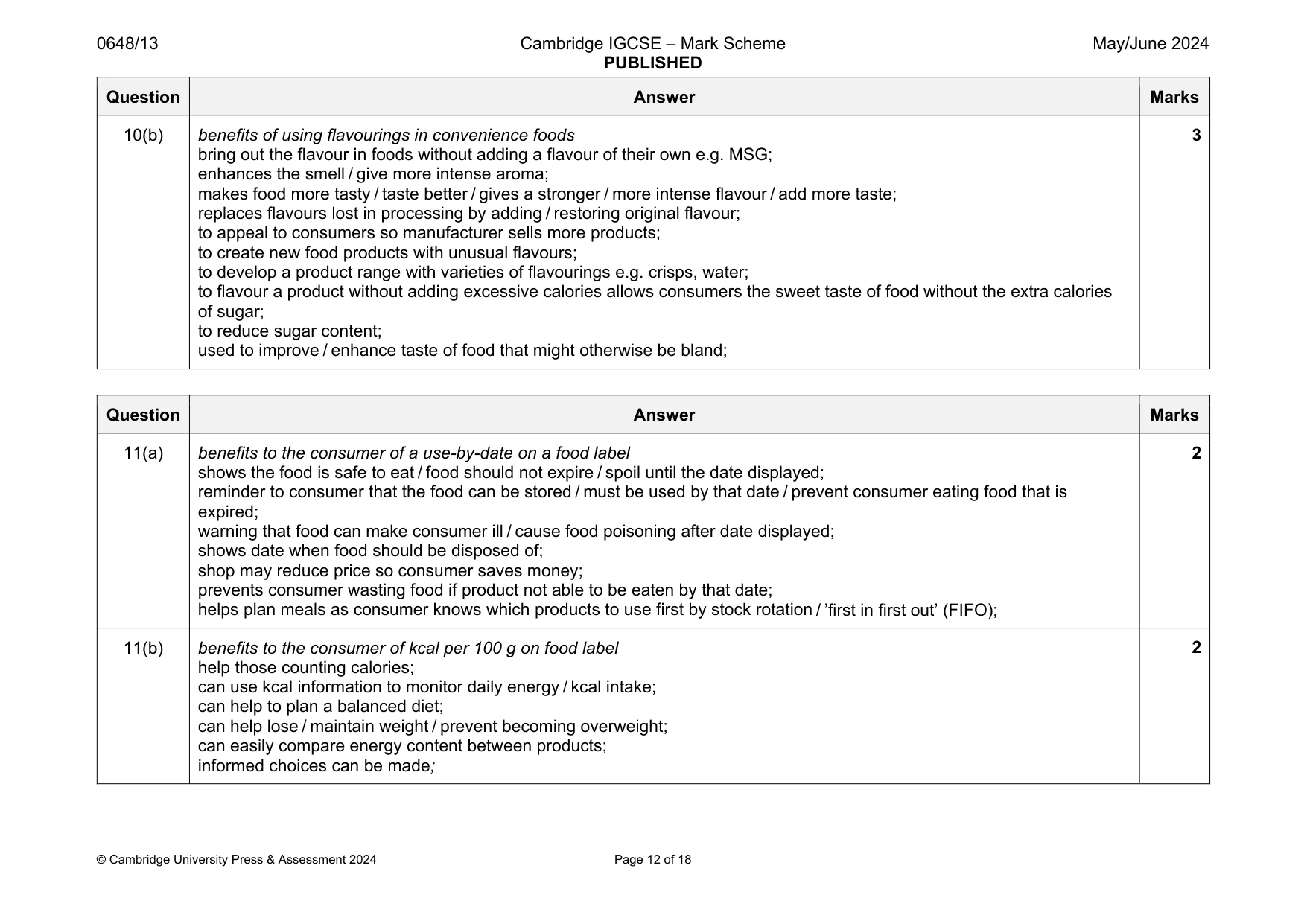
0648/13 Cambridge IGCSE – Mark Scheme PUBLISHED May/June 2024 © Cambridge University Press & Assessment 2024 Page 12 of 18 Question Answer Marks 10(b) benefits of using flavourings in convenience foods bring out the flavour in foods without adding a flavour of their own e.g. MSG; enhances the smell / give more intense aroma; makes food more tasty / taste better / gives a stronger / more intense flavour / add more taste; replaces flavours lost in processing by adding / restoring original flavour; to appeal to consumers so manufacturer sells more products; to create new food products with unusual flavours; to develop a product range with varieties of flavourings e.g. crisps, water; to flavour a product without adding excessive calories allows consumers the sweet taste of food without the extra calories of sugar; to reduce sugar content; used to improve / enhance taste of food that might otherwise be bland; 3 Question Answer Marks 11(a) benefits to the consumer of a use-by-date on a food label shows the food is safe to eat / food should not expire / spoil until the date displayed; reminder to consumer that the food can be stored / must be used by that date / prevent consumer eating food that is expired; warning that food can make consumer ill / cause food poisoning after date displayed; shows date when food should be disposed of; shop may reduce price so consumer saves money; prevents consumer wasting food if product not able to be eaten by that date; helps plan meals as consumer knows which products to use first by stock rotation / ’first in first out’ (FIFO); 2 11(b) benefits to the consumer of kcal per 100 g on food label help those counting calories; can use kcal information to monitor daily energy / kcal intake; can help to plan a balanced diet; can help lose / maintain weight / prevent becoming overweight; can easily compare energy content between products; informed choices can be made; 2
Mark scheme, page 13
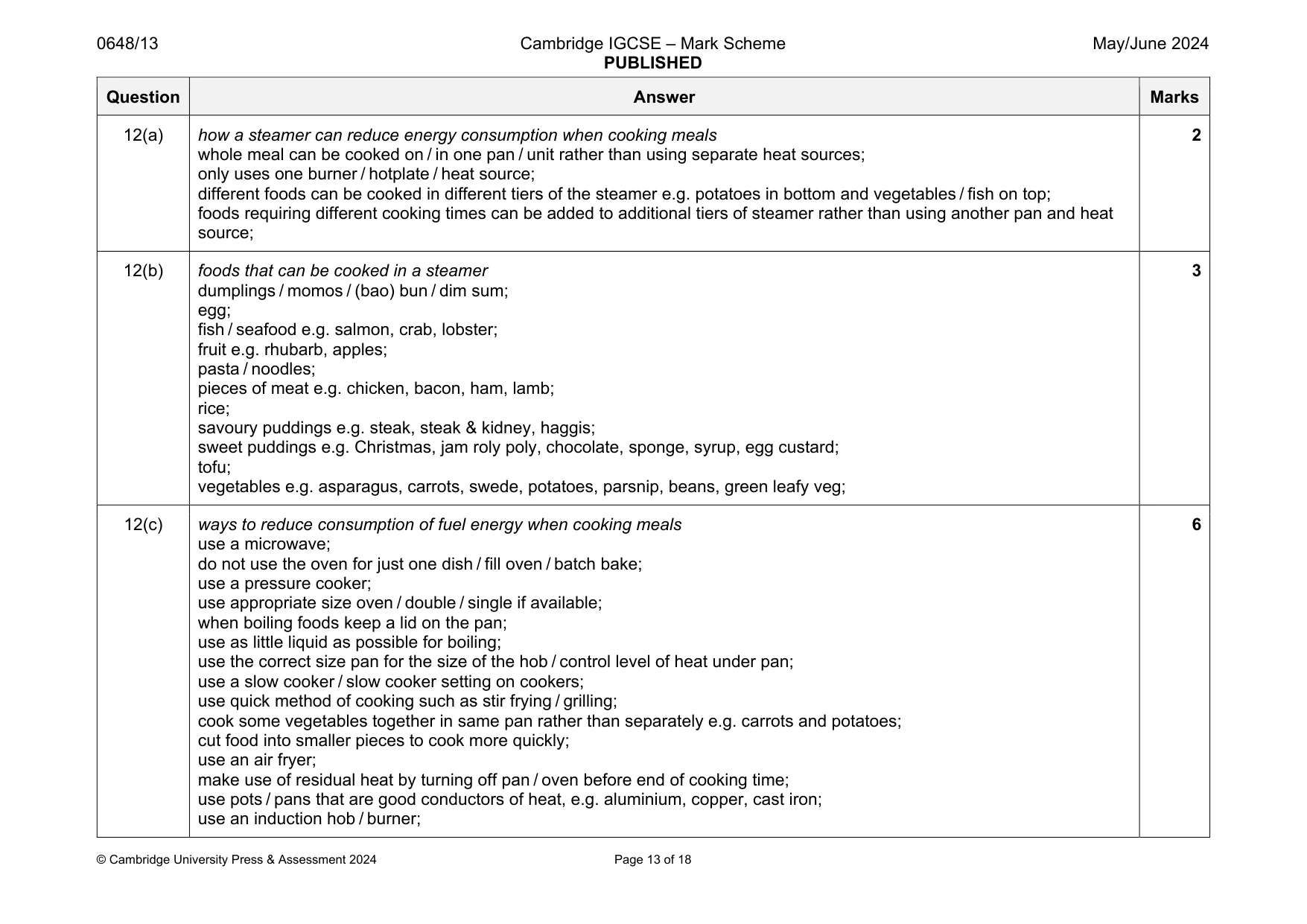
0648/13 Cambridge IGCSE – Mark Scheme PUBLISHED May/June 2024 © Cambridge University Press & Assessment 2024 Page 13 of 18 Question Answer Marks 12(a) how a steamer can reduce energy consumption when cooking meals whole meal can be cooked on / in one pan / unit rather than using separate heat sources; only uses one burner / hotplate / heat source; different foods can be cooked in different tiers of the steamer e.g. potatoes in bottom and vegetables / fish on top; foods requiring different cooking times can be added to additional tiers of steamer rather than using another pan and heat source; 2 12(b) foods that can be cooked in a steamer dumplings / momos / (bao) bun / dim sum; egg; fish / seafood e.g. salmon, crab, lobster; fruit e.g. rhubarb, apples; pasta / noodles; pieces of meat e.g. chicken, bacon, ham, lamb; rice; savoury puddings e.g. steak, steak & kidney, haggis; sweet puddings e.g. Christmas, jam roly poly, chocolate, sponge, syrup, egg custard; tofu; vegetables e.g. asparagus, carrots, swede, potatoes, parsnip, beans, green leafy veg; 3 12(c) ways to reduce consumption of fuel energy when cooking meals use a microwave; do not use the oven for just one dish / fill oven / batch bake; use a pressure cooker; use appropriate size oven / double / single if available; when boiling foods keep a lid on the pan; use as little liquid as possible for boiling; use the correct size pan for the size of the hob / control level of heat under pan; use a slow cooker / slow cooker setting on cookers; use quick method of cooking such as stir frying / grilling; cook some vegetables together in same pan rather than separately e.g. carrots and potatoes; cut food into smaller pieces to cook more quickly; use an air fryer; make use of residual heat by turning off pan / oven before end of cooking time; use pots / pans that are good conductors of heat, e.g. aluminium, copper, cast iron; use an induction hob / burner; 6
Mark scheme, page 14
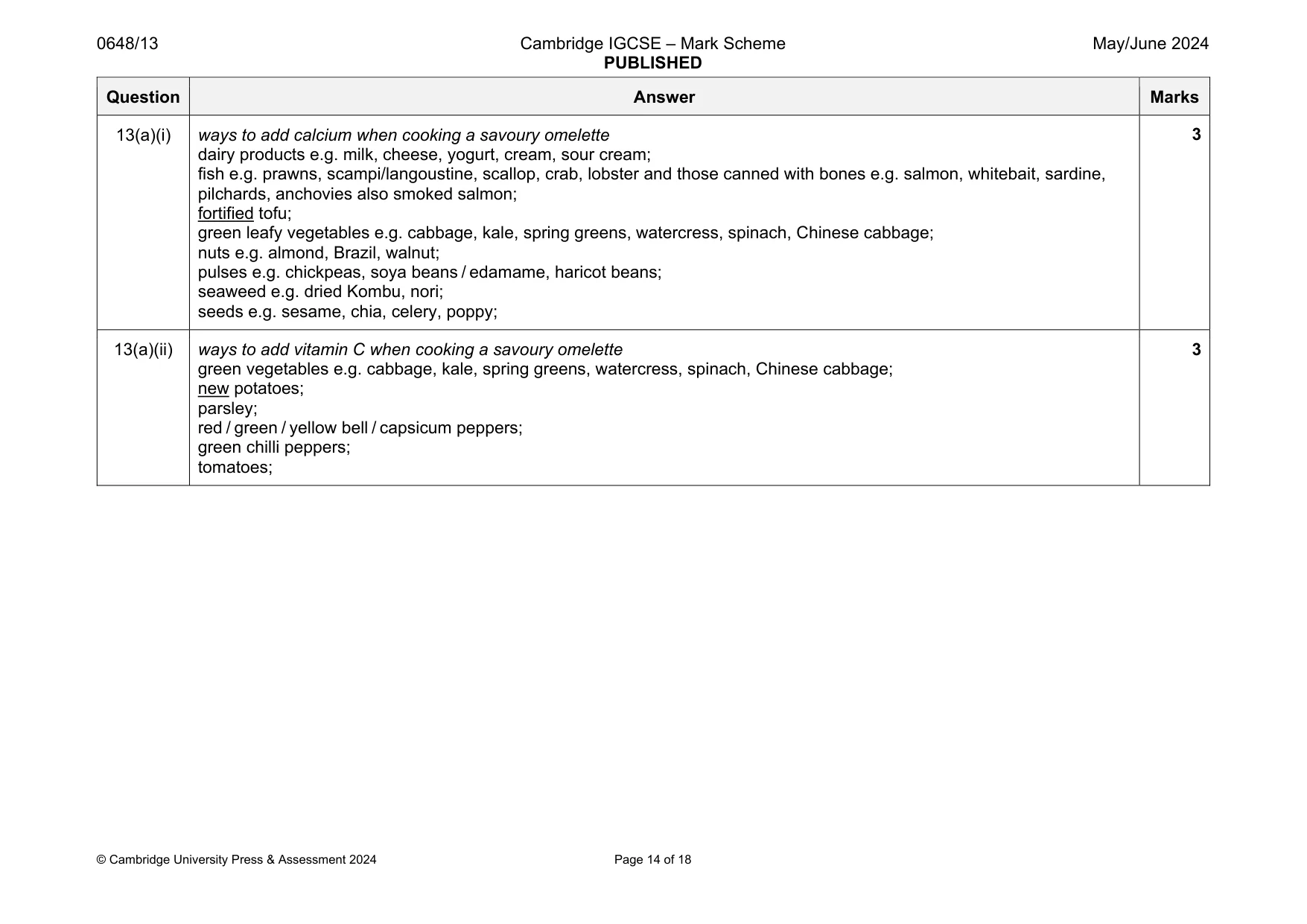
0648/13 Cambridge IGCSE – Mark Scheme PUBLISHED May/June 2024 © Cambridge University Press & Assessment 2024 Page 14 of 18 Question Answer Marks 13(a)(i) ways to add calcium when cooking a savoury omelette dairy products e.g. milk, cheese, yogurt, cream, sour cream; fish e.g. prawns, scampi/langoustine, scallop, crab, lobster and those canned with bones e.g. salmon, whitebait, sardine, pilchards, anchovies also smoked salmon; fortified tofu; green leafy vegetables e.g. cabbage, kale, spring greens, watercress, spinach, Chinese cabbage; nuts e.g. almond, Brazil, walnut; pulses e.g. chickpeas, soya beans / edamame, haricot beans; seaweed e.g. dried Kombu, nori; seeds e.g. sesame, chia, celery, poppy; 3 13(a)(ii) ways to add vitamin C when cooking a savoury omelette green vegetables e.g. cabbage, kale, spring greens, watercress, spinach, Chinese cabbage; new potatoes; parsley; red / green / yellow bell / capsicum peppers; green chilli peppers; tomatoes; 3
Mark scheme, page 15
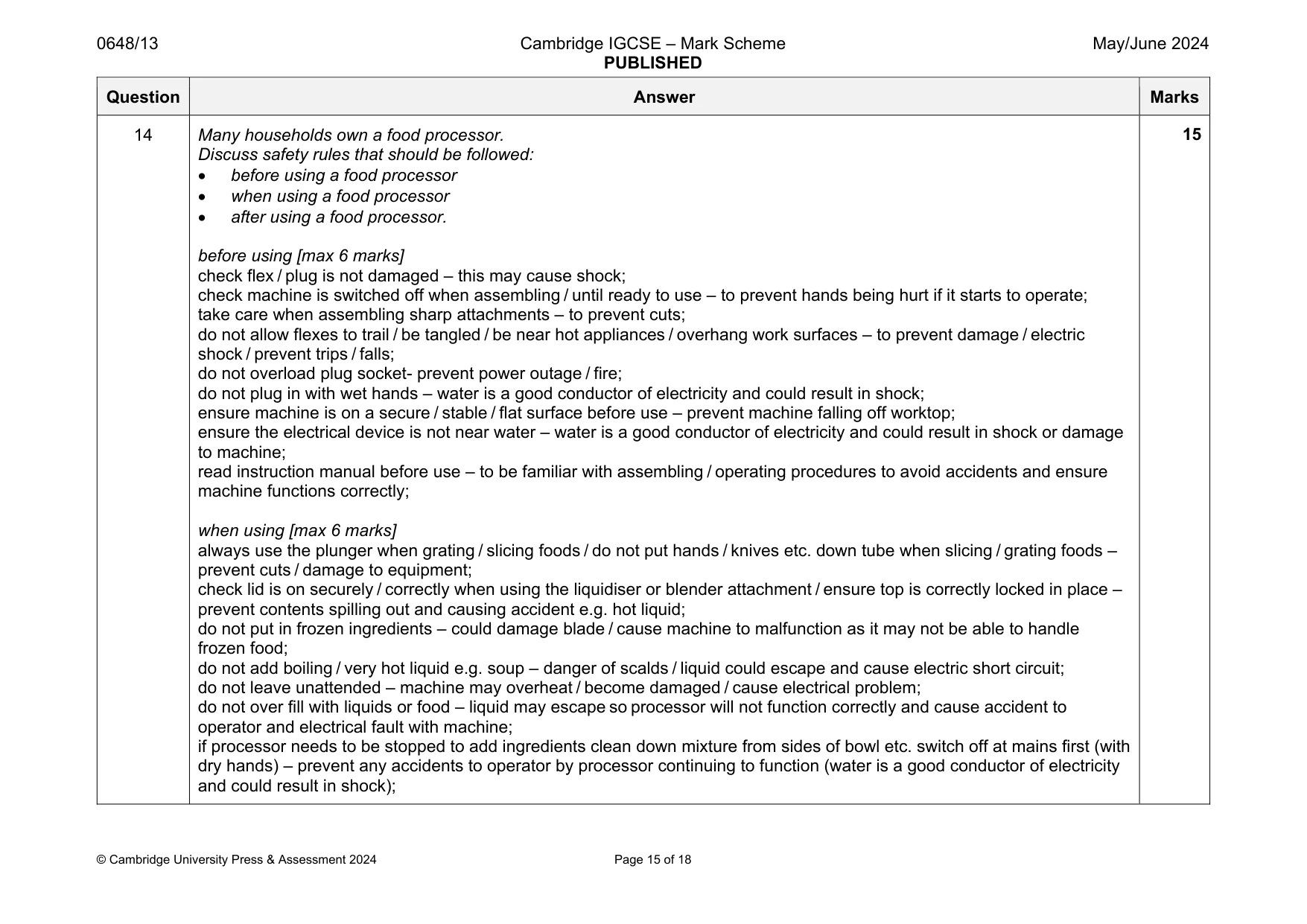
0648/13 Cambridge IGCSE – Mark Scheme PUBLISHED May/June 2024 © Cambridge University Press & Assessment 2024 Page 15 of 18 Question Answer Marks 14 Many households own a food processor. Discuss safety rules that should be followed: before using a food processor when using a food processor after using a food processor. before using [max 6 marks] check flex / plug is not damaged – this may cause shock; check machine is switched off when assembling / until ready to use – to prevent hands being hurt if it starts to operate; take care when assembling sharp attachments – to prevent cuts; do not allow flexes to trail / be tangled / be near hot appliances / overhang work surfaces – to prevent damage / electric shock / prevent trips / falls; do not overload plug socket- prevent power outage / fire; do not plug in with wet hands – water is a good conductor of electricity and could result in shock; ensure machine is on a secure / stable / flat surface before use – prevent machine falling off worktop; ensure the electrical device is not near water – water is a good conductor of electricity and could result in shock or damage to machine; read instruction manual before use – to be familiar with assembling / operating procedures to avoid accidents and ensure machine functions correctly; when using [max 6 marks] always use the plunger when grating / slicing foods / do not put hands / knives etc. down tube when slicing / grating foods – prevent cuts / damage to equipment; check lid is on securely / correctly when using the liquidiser or blender attachment / ensure top is correctly locked in place – prevent contents spilling out and causing accident e.g. hot liquid; do not put in frozen ingredients – could damage blade / cause machine to malfunction as it may not be able to handle frozen food; do not add boiling / very hot liquid e.g. soup – danger of scalds / liquid could escape and cause electric short circuit; do not leave unattended – machine may overheat / become damaged / cause electrical problem; do not over fill with liquids or food – liquid may escape so processor will not function correctly and cause accident to operator and electrical fault with machine; if processor needs to be stopped to add ingredients clean down mixture from sides of bowl etc. switch off at mains first (with dry hands) – prevent any accidents to operator by processor continuing to function (water is a good conductor of electricity and could result in shock); 15
Mark scheme, page 16
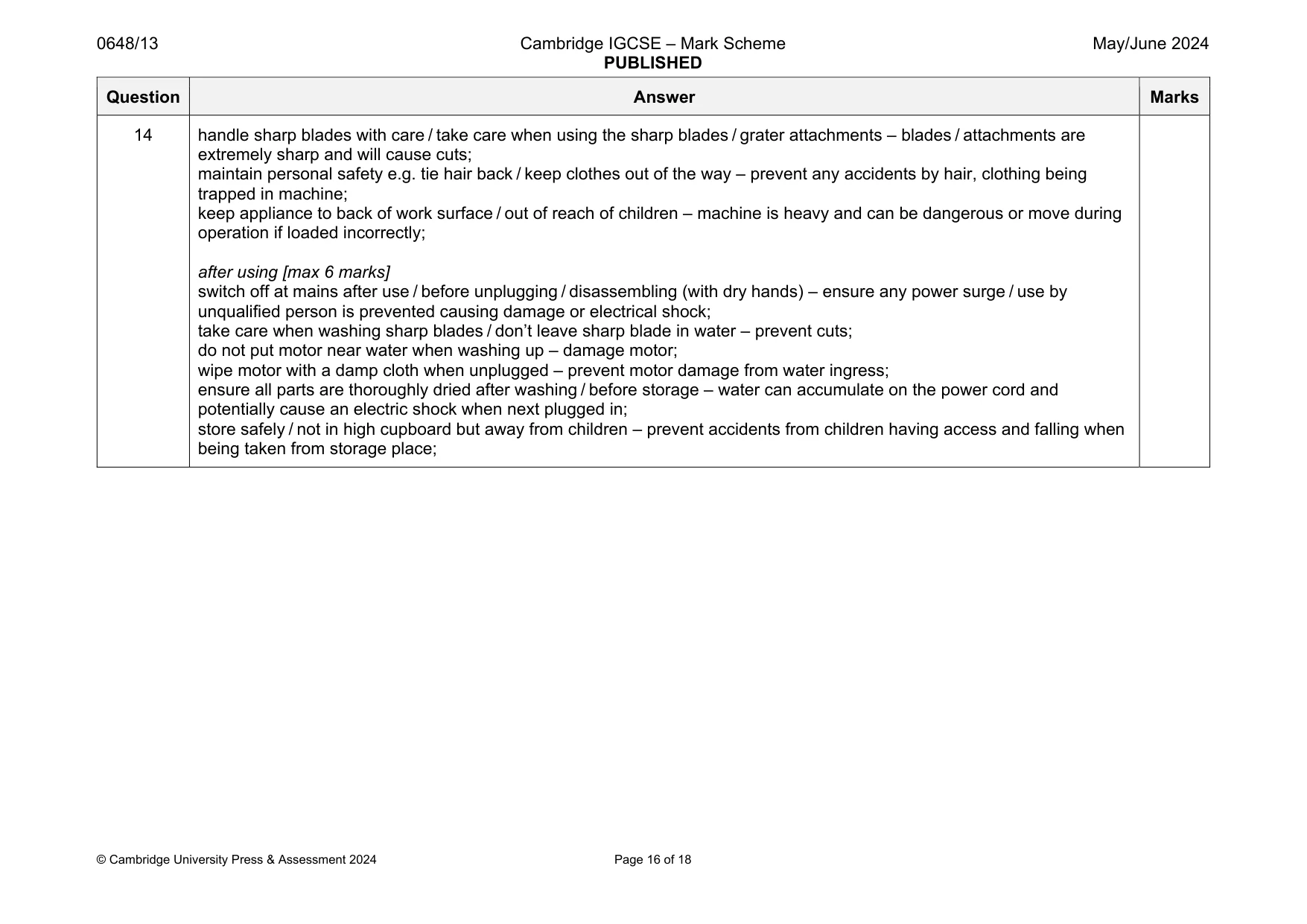
0648/13 Cambridge IGCSE – Mark Scheme PUBLISHED May/June 2024 © Cambridge University Press & Assessment 2024 Page 16 of 18 Question Answer Marks 14 handle sharp blades with care / take care when using the sharp blades / grater attachments – blades / attachments are extremely sharp and will cause cuts; maintain personal safety e.g. tie hair back / keep clothes out of the way – prevent any accidents by hair, clothing being trapped in machine; keep appliance to back of work surface / out of reach of children – machine is heavy and can be dangerous or move during operation if loaded incorrectly; after using [max 6 marks] switch off at mains after use / before unplugging / disassembling (with dry hands) – ensure any power surge / use by unqualified person is prevented causing damage or electrical shock; take care when washing sharp blades / don’t leave sharp blade in water – prevent cuts; do not put motor near water when washing up – damage motor; wipe motor with a damp cloth when unplugged – prevent motor damage from water ingress; ensure all parts are thoroughly dried after washing / before storage – water can accumulate on the power cord and potentially cause an electric shock when next plugged in; store safely / not in high cupboard but away from children – prevent accidents from children having access and falling when being taken from storage place;
Mark scheme, page 17
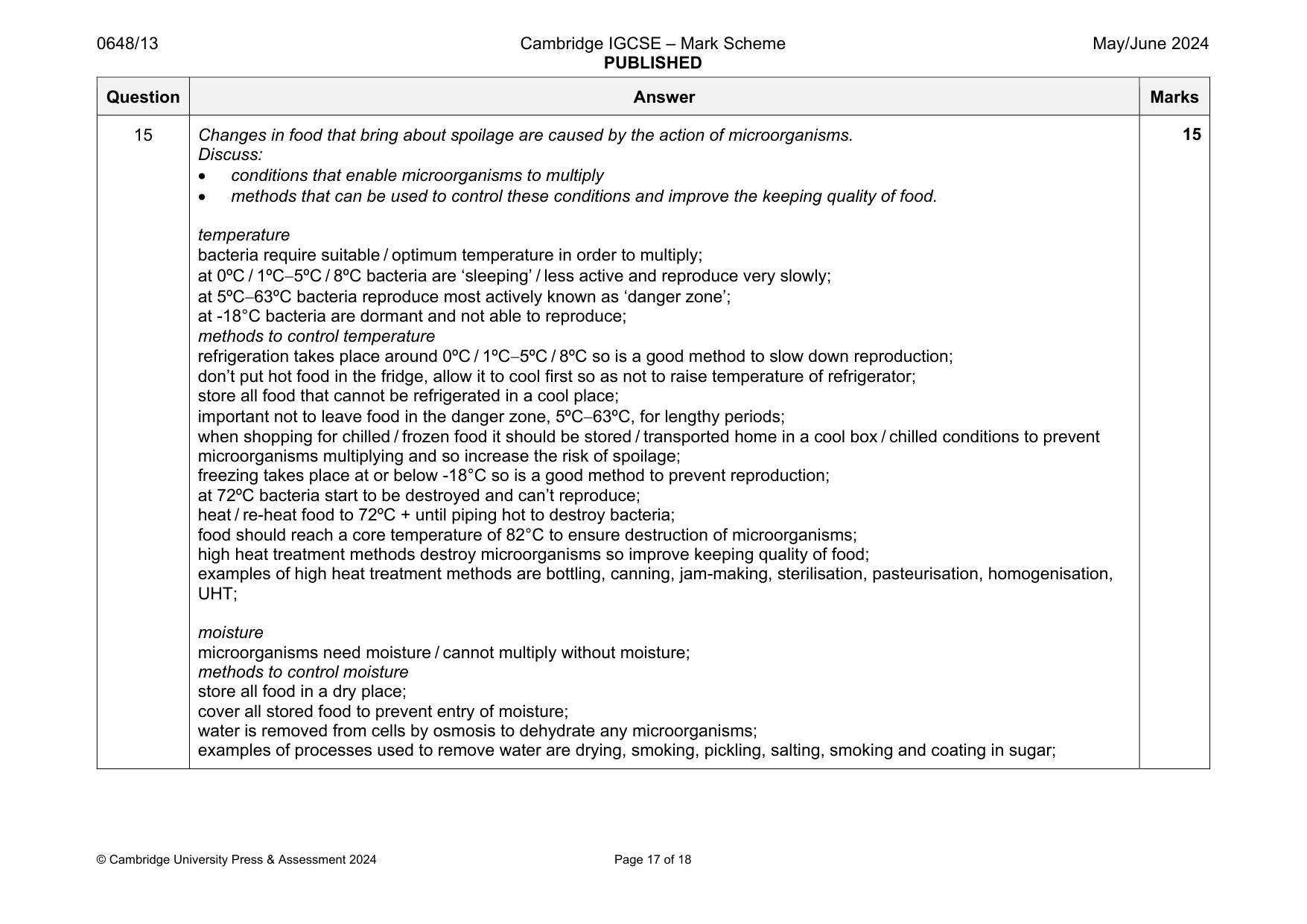
0648/13 Cambridge IGCSE – Mark Scheme PUBLISHED May/June 2024 © Cambridge University Press & Assessment 2024 Page 17 of 18 Question Answer Marks 15 Changes in food that bring about spoilage are caused by the action of microorganisms. Discuss: conditions that enable microorganisms to multiply methods that can be used to control these conditions and improve the keeping quality of food. temperature bacteria require suitable / optimum temperature in order to multiply; at 0ºC / 1ºC5ºC / 8ºC bacteria are ‘sleeping’ / less active and reproduce very slowly; at 5ºC63ºC bacteria reproduce most actively known as ‘danger zone’; at -18°C bacteria are dormant and not able to reproduce; methods to control temperature refrigeration takes place around 0ºC / 1ºC5ºC / 8ºC so is a good method to slow down reproduction; don’t put hot food in the fridge, allow it to cool first so as not to raise temperature of refrigerator; store all food that cannot be refrigerated in a cool place; important not to leave food in the danger zone, 5ºC63ºC, for lengthy periods; when shopping for chilled / frozen food it should be stored / transported home in a cool box / chilled conditions to prevent microorganisms multiplying and so increase the risk of spoilage; freezing takes place at or below -18°C so is a good method to prevent reproduction; at 72ºC bacteria start to be destroyed and can’t reproduce; heat / re-heat food to 72ºC + until piping hot to destroy bacteria; food should reach a core temperature of 82°C to ensure destruction of microorganisms; high heat treatment methods destroy microorganisms so improve keeping quality of food; examples of high heat treatment methods are bottling, canning, jam-making, sterilisation, pasteurisation, homogenisation, UHT; moisture microorganisms need moisture / cannot multiply without moisture; methods to control moisture store all food in a dry place; cover all stored food to prevent entry of moisture; water is removed from cells by osmosis to dehydrate any microorganisms; examples of processes used to remove water are drying, smoking, pickling, salting, smoking and coating in sugar; 15
Mark scheme, page 18
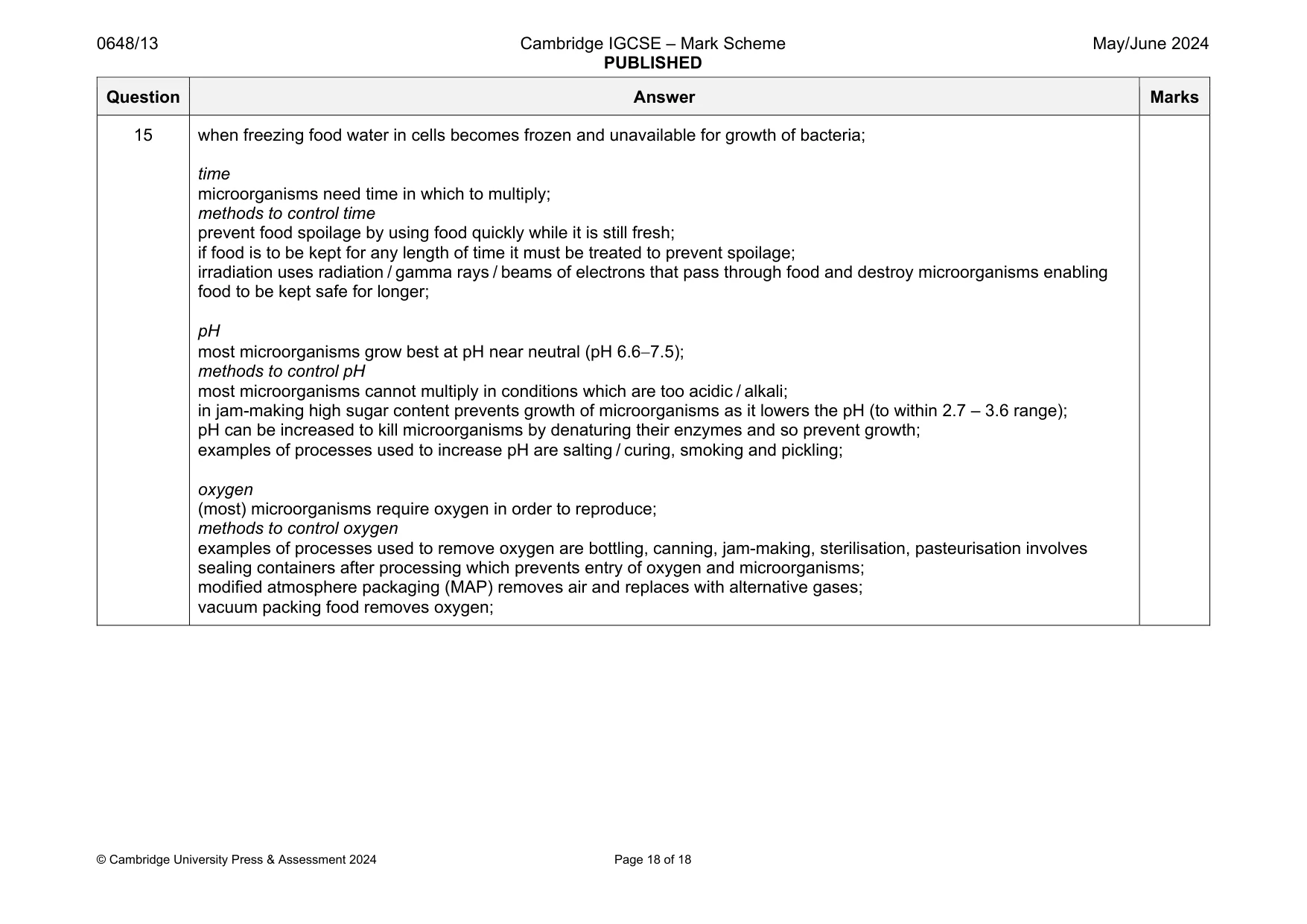
0648/13 Cambridge IGCSE – Mark Scheme PUBLISHED May/June 2024 © Cambridge University Press & Assessment 2024 Page 18 of 18 Question Answer Marks 15 when freezing food water in cells becomes frozen and unavailable for growth of bacteria; time microorganisms need time in which to multiply; methods to control time prevent food spoilage by using food quickly while it is still fresh; if food is to be kept for any length of time it must be treated to prevent spoilage; irradiation uses radiation / gamma rays / beams of electrons that pass through food and destroy microorganisms enabling food to be kept safe for longer; pH most microorganisms grow best at pH near neutral (pH 6.67.5); methods to control pH most microorganisms cannot multiply in conditions which are too acidic / alkali; in jam-making high sugar content prevents growth of microorganisms as it lowers the pH (to within 2.7 – 3.6 range); pH can be increased to kill microorganisms by denaturing their enzymes and so prevent growth; examples of processes used to increase pH are salting / curing, smoking and pickling; oxygen (most) microorganisms require oxygen in order to reproduce; methods to control oxygen examples of processes used to remove oxygen are bottling, canning, jam-making, sterilisation, pasteurisation involves sealing containers after processing which prevents entry of oxygen and microorganisms; modified atmosphere packaging (MAP) removes air and replaces with alternative gases; vacuum packing food removes oxygen;
What you needed in this session
Cambridge’s own grade thresholds for 2024 May/June, Paper 1 · Variant 3. A higher threshold means an easier paper — the bar moves with how the cohort did.