Cambridge IGCSE Food and Nutrition 0648 — 2023 Oct/Nov Paper 1 · Variant 1
0648/11/O/N/23 · 100 marks · ≈113 min
The question paper and its mark scheme, free to read here and free to download. This is Cambridge’s own paper, exactly as it was sat.
Question paper12 pages



Mark scheme17 pages
Answers below. Sit the paper first if you are practising.
Paper as text
Question paper, page 1
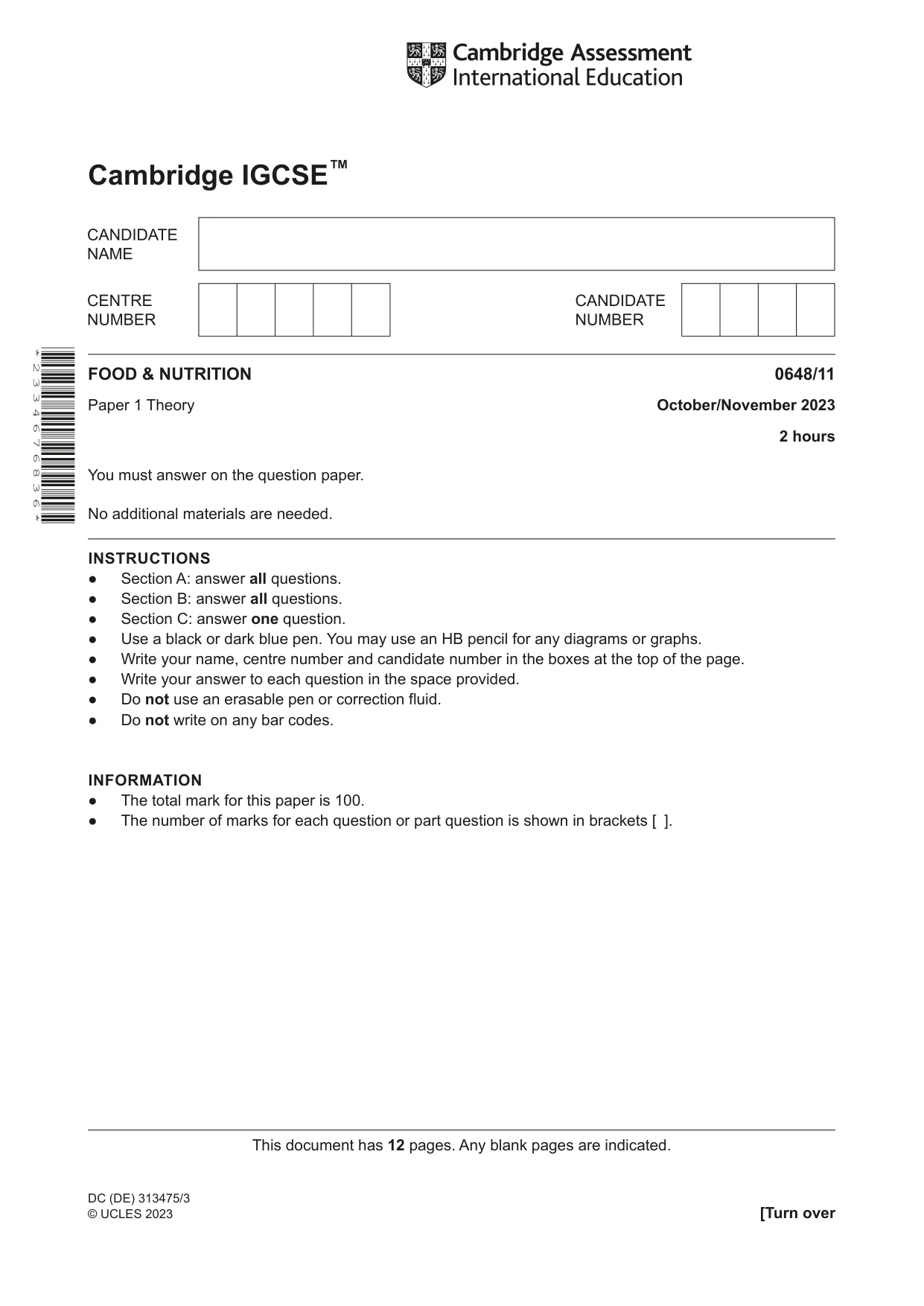
This document has 12 pages. Any blank pages are indicated. [Turn over * 2 3 3 4 6 7 6 8 3 6 * Cambridge IGCSE™ DC (DE) 313475/3 © UCLES 2023 FOOD & NUTRITION 0648/11 Paper 1 Theory October/November 2023 2 hours You must answer on the question paper. No additional materials are needed. INSTRUCTIONS ● Section A: answer all questions. ● Section B: answer all questions. ● Section C: answer one question. ● Use a black or dark blue pen. You may use an HB pencil for any diagrams or graphs. ● Write your name, centre number and candidate number in the boxes at the top of the page. ● Write your answer to each question in the space provided. ● Do not use an erasable pen or correction fluid. ● Do not write on any bar codes. INFORMATION ● The total mark for this paper is 100. ● The number of marks for each question or part question is shown in brackets [ ].
Question paper, page 2
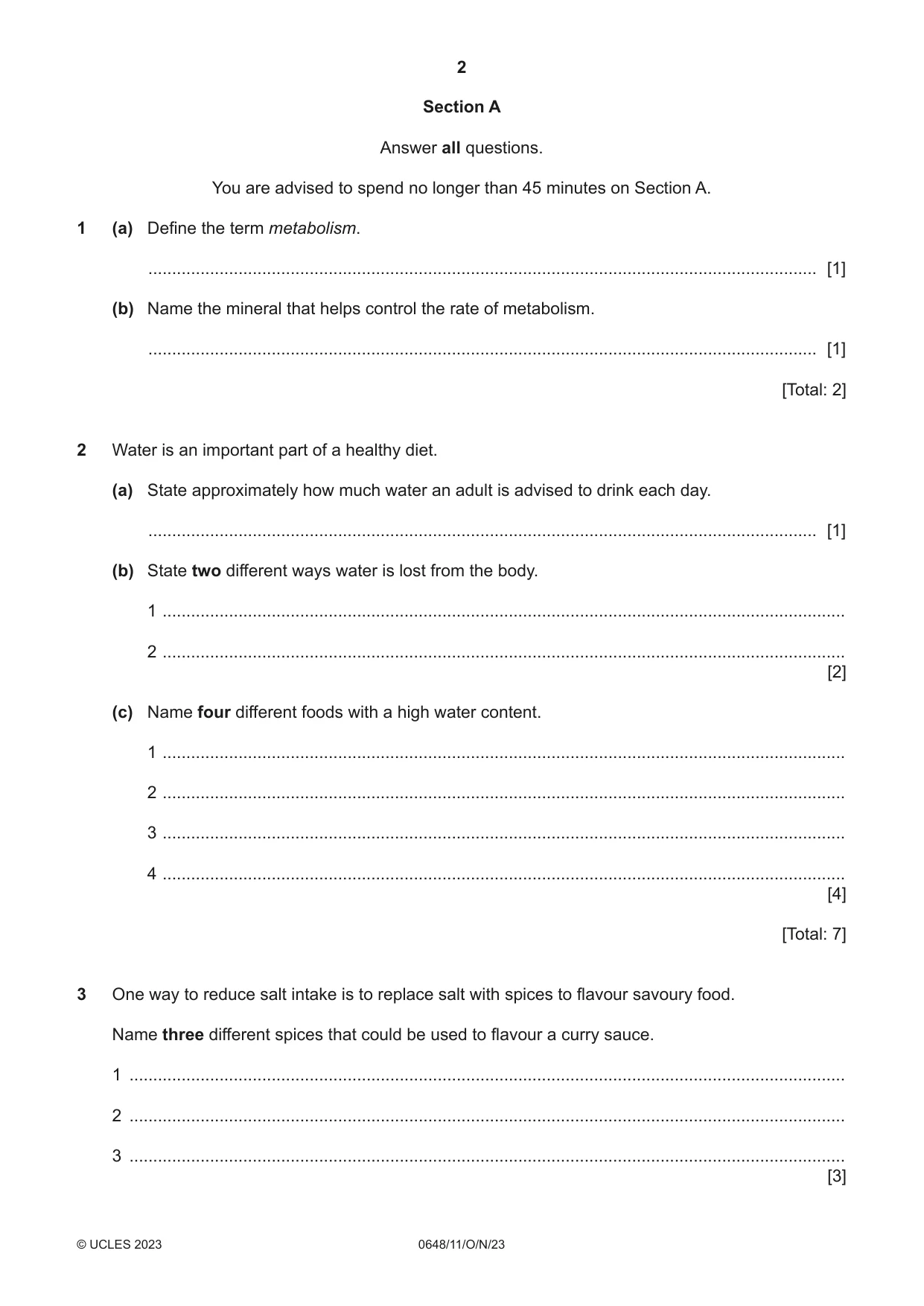
2 0648/11/O/N/23 © UCLES 2023 Section A Answer all questions. You are advised to spend no longer than 45 minutes on Section A. 1 (a) Define the term metabolism. … [1] (b) Name the mineral that helps control the rate of metabolism. … [1] [Total: 2] 2 Water is an important part of a healthy diet. (a) State approximately how much water an adult is advised to drink each day. … [1] (b) State two different ways water is lost from the body. 1 … 2 … [2] (c) Name four different foods with a high water content. 1 … 2 … 3 … 4 … [4] [Total: 7] 3 One way to reduce salt intake is to replace salt with spices to flavour savoury food. Name three different spices that could be used to flavour a curry sauce. 1 … 2 … 3 … [3]
Question paper, page 3
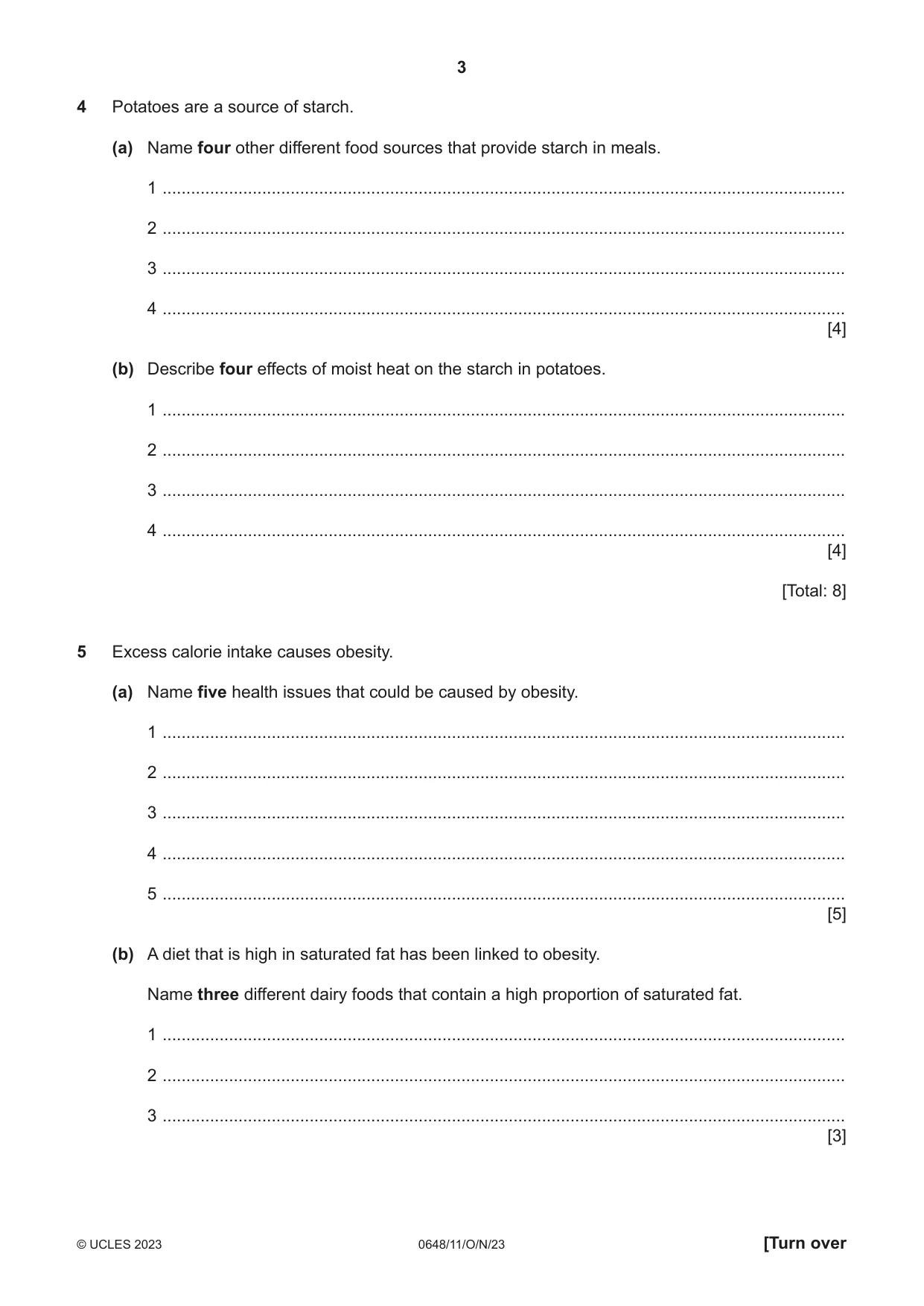
3 0648/11/O/N/23 © UCLES 2023 [Turn over 4 Potatoes are a source of starch. (a) Name four other different food sources that provide starch in meals. 1 … 2 … 3 … 4 … [4] (b) Describe four effects of moist heat on the starch in potatoes. 1 … 2 … 3 … 4 … [4] [Total: 8] 5 Excess calorie intake causes obesity. (a) Name five health issues that could be caused by obesity. 1 … 2 … 3 … 4 … 5 … [5] (b) A diet that is high in saturated fat has been linked to obesity. Name three different dairy foods that contain a high proportion of saturated fat. 1 … 2 … 3 … [3]
Question paper, page 4
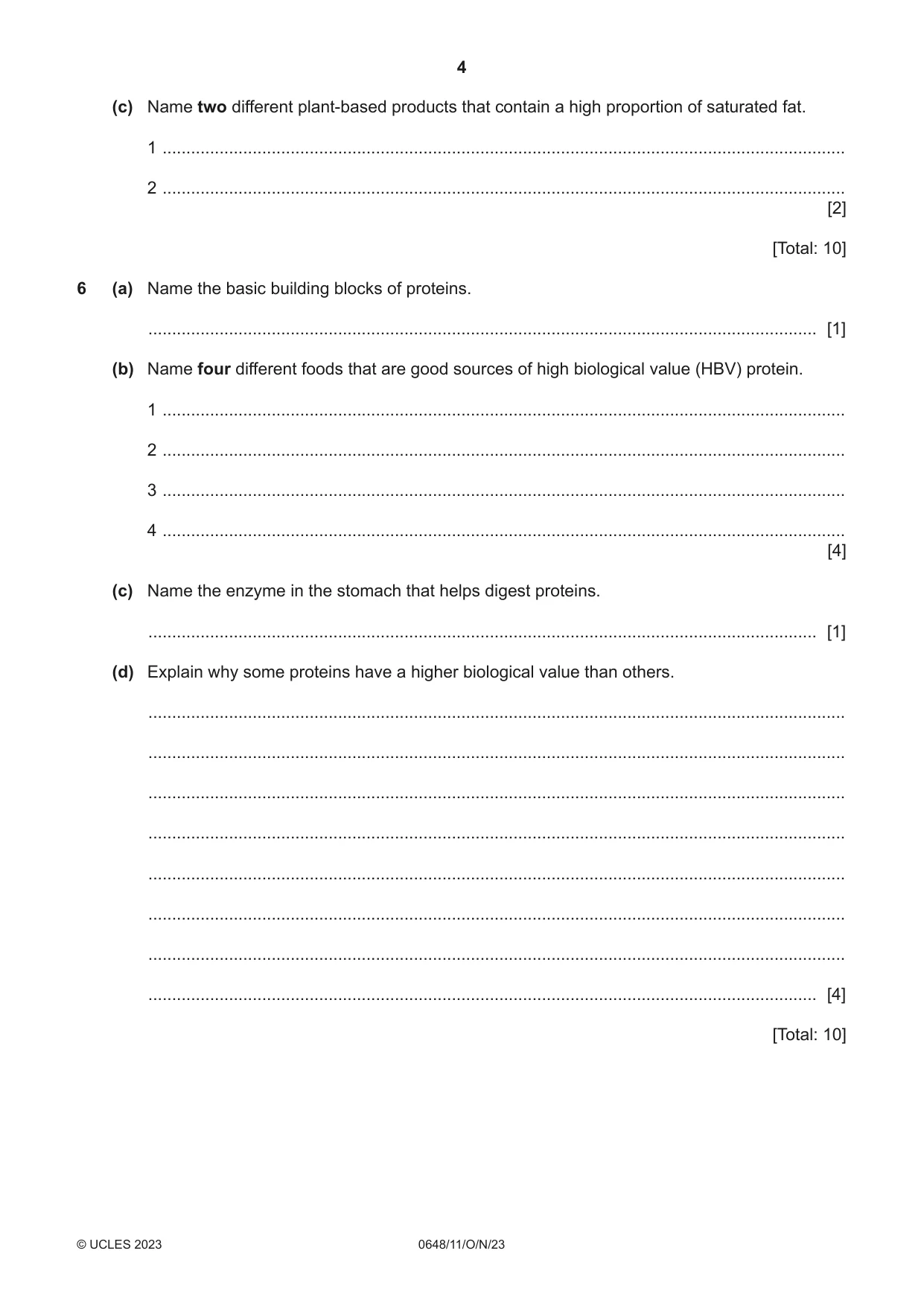
4 0648/11/O/N/23 © UCLES 2023 (c) Name two different plant-based products that contain a high proportion of saturated fat. 1 … 2 … [2] [Total: 10] 6 (a) Name the basic building blocks of proteins. … [1] (b) Name four different foods that are good sources of high biological value (HBV) protein. 1 … 2 … 3 … 4 … [4] (c) Name the enzyme in the stomach that helps digest proteins. … [1] (d) Explain why some proteins have a higher biological value than others. … … … … … … … … [4] [Total: 10]
Question paper, page 5
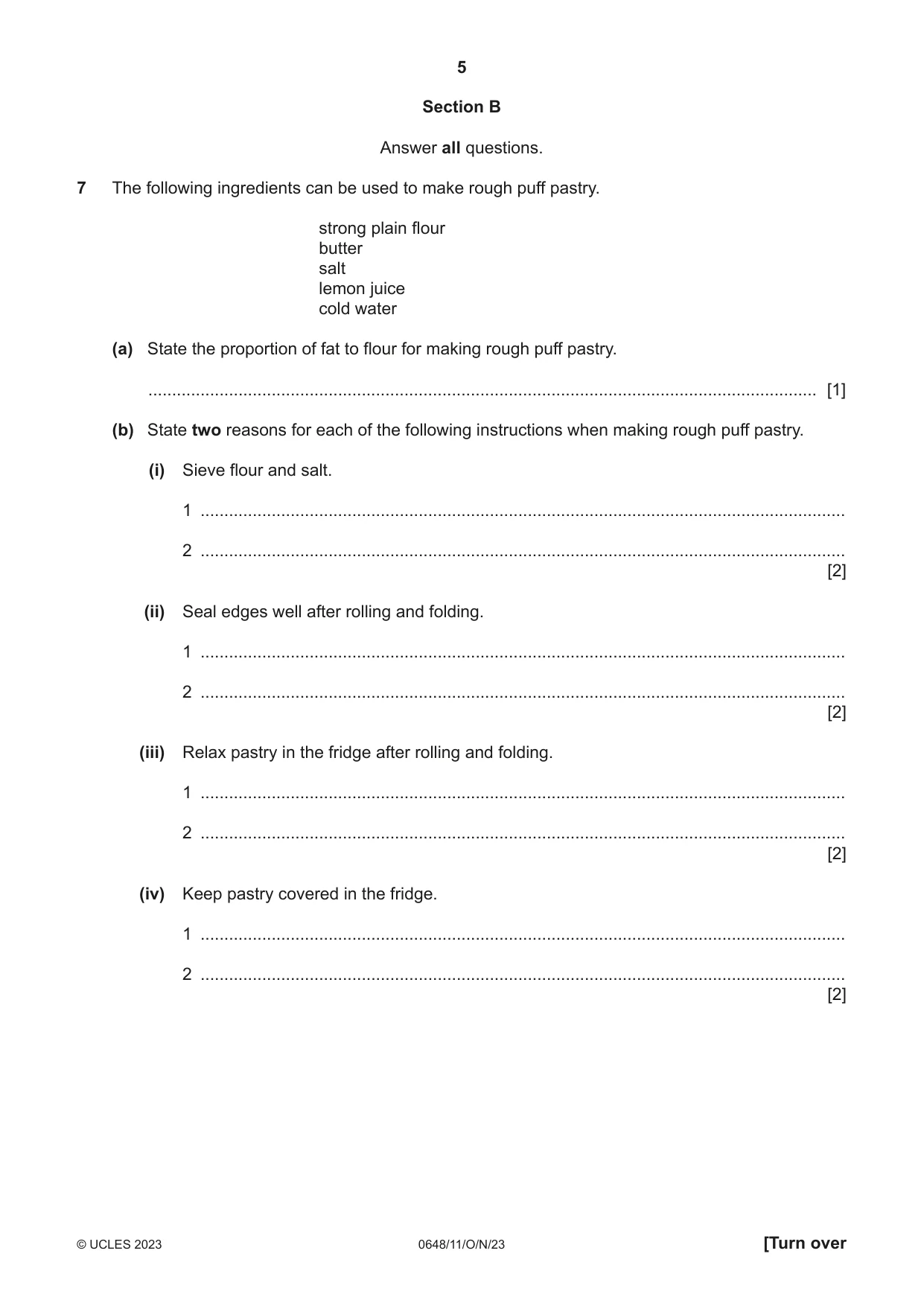
5 0648/11/O/N/23 © UCLES 2023 [Turn over Section B Answer all questions. 7 The following ingredients can be used to make rough puff pastry. strong plain flour butter salt lemon juice cold water (a) State the proportion of fat to flour for making rough puff pastry. … [1] (b) State two reasons for each of the following instructions when making rough puff pastry. (i) Sieve flour and salt. 1 … 2 … [2] (ii) Seal edges well after rolling and folding. 1 … 2 … [2] (iii) Relax pastry in the fridge after rolling and folding. 1 … 2 … [2] (iv) Keep pastry covered in the fridge. 1 … 2 … [2]
Question paper, page 6
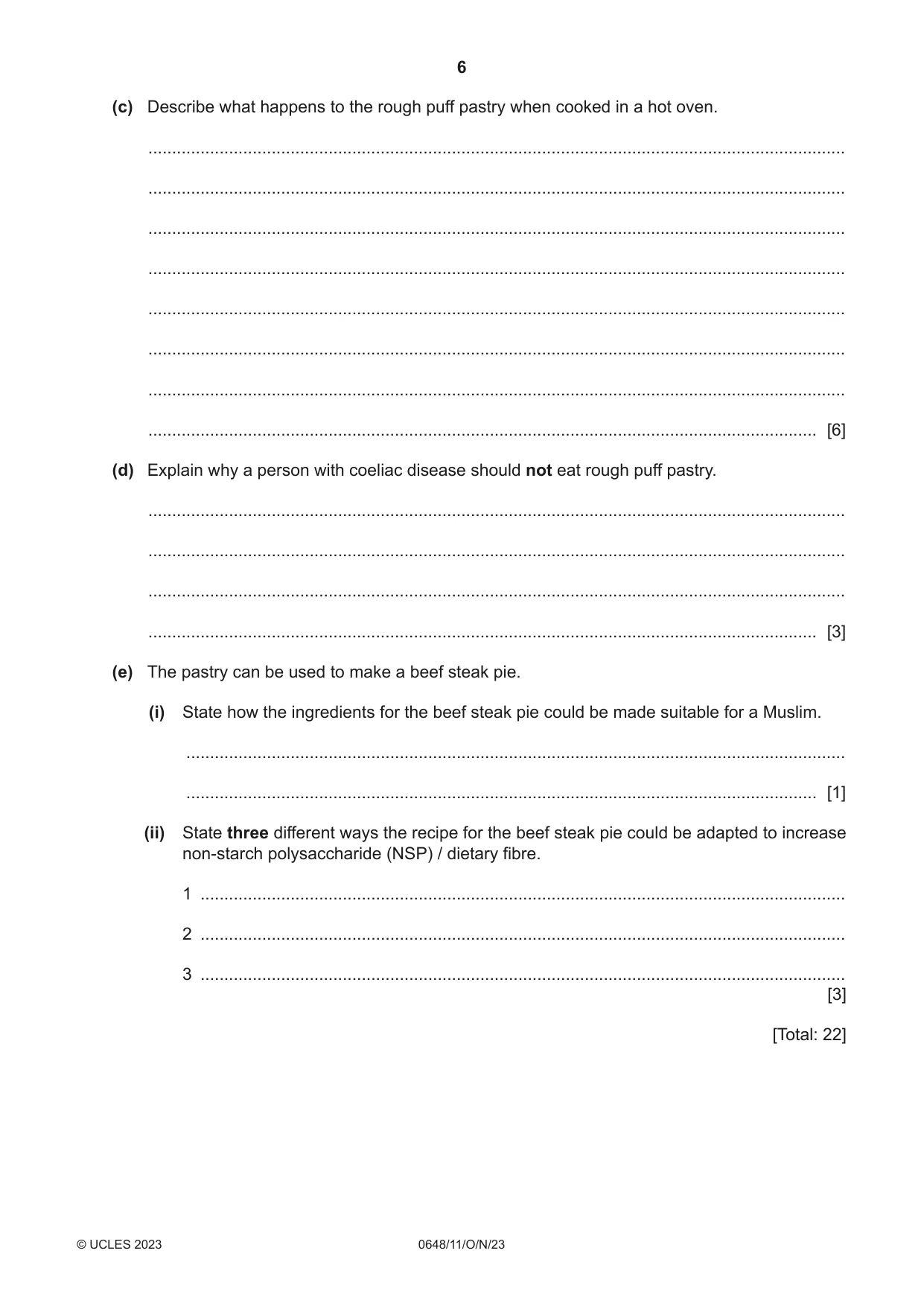
6 0648/11/O/N/23 © UCLES 2023 (c) Describe what happens to the rough puff pastry when cooked in a hot oven. … … … … … … … … [6] (d) Explain why a person with coeliac disease should not eat rough puff pastry. … … … … [3] (e) The pastry can be used to make a beef steak pie. (i) State how the ingredients for the beef steak pie could be made suitable for a Muslim. … … [1] (ii) State three different ways the recipe for the beef steak pie could be adapted to increase non-starch polysaccharide (NSP) / dietary fibre. 1 … 2 … 3 … [3] [Total: 22]
Question paper, page 7
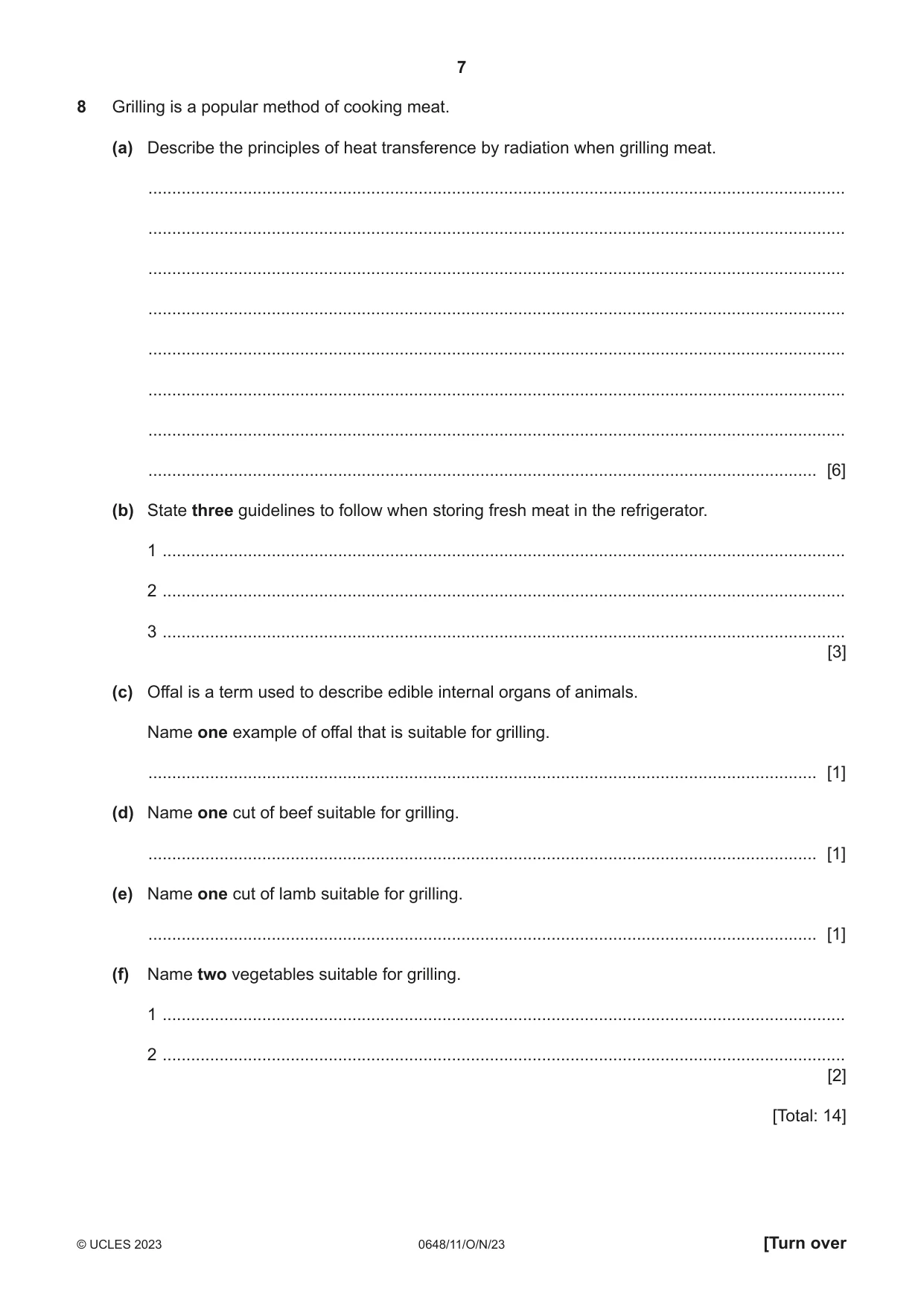
7 0648/11/O/N/23 © UCLES 2023 [Turn over 8 Grilling is a popular method of cooking meat. (a) Describe the principles of heat transference by radiation when grilling meat. … … … … … … … … [6] (b) State three guidelines to follow when storing fresh meat in the refrigerator. 1 … 2 … 3 … [3] (c) Offal is a term used to describe edible internal organs of animals. Name one example of offal that is suitable for grilling. … [1] (d) Name one cut of beef suitable for grilling. … [1] (e) Name one cut of lamb suitable for grilling. … [1] (f) Name two vegetables suitable for grilling. 1 … 2 … [2] [Total: 14]
Question paper, page 8
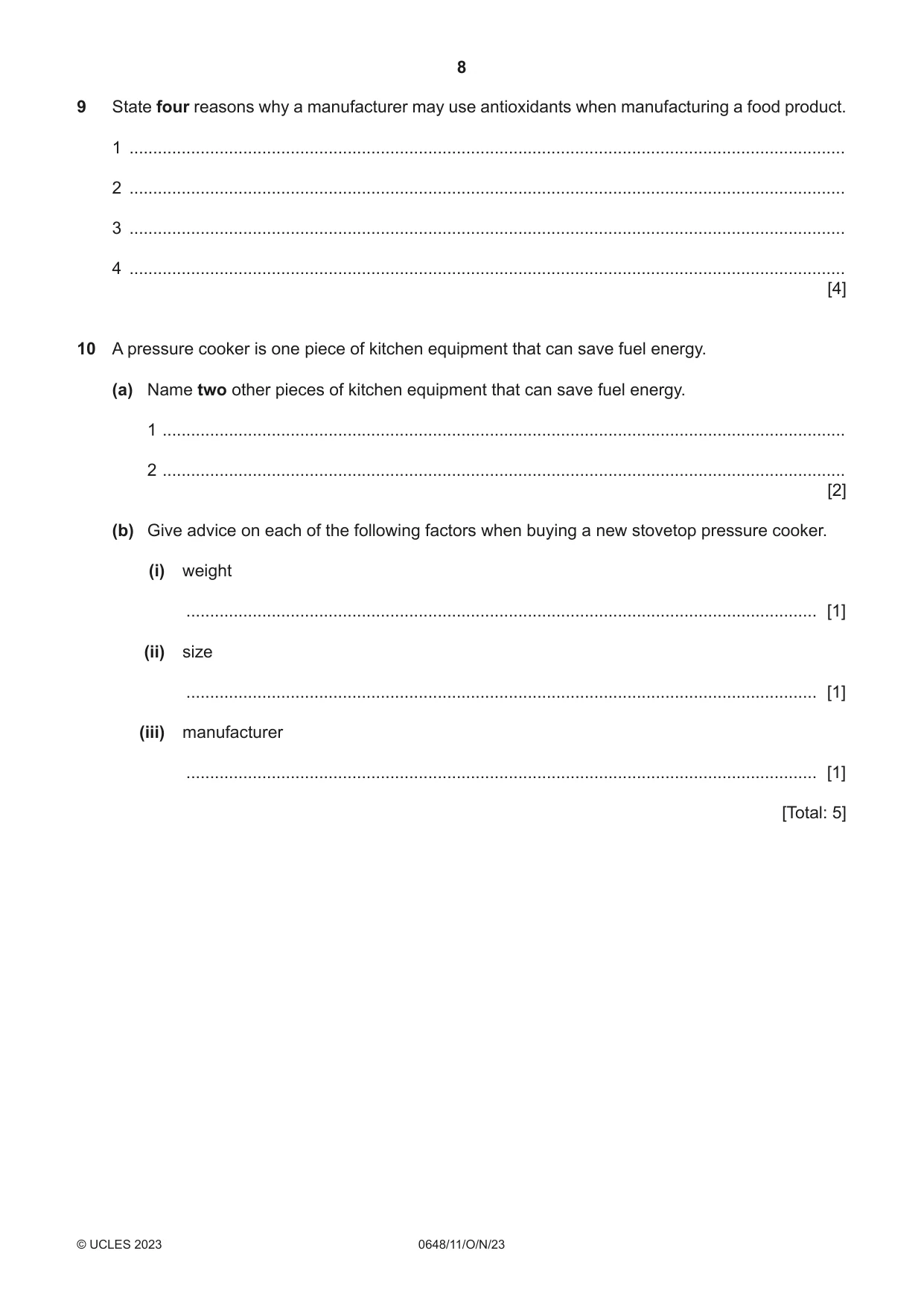
8 0648/11/O/N/23 © UCLES 2023 9 State four reasons why a manufacturer may use antioxidants when manufacturing a food product. 1 … 2 … 3 … 4 … [4] 10 A pressure cooker is one piece of kitchen equipment that can save fuel energy. (a) Name two other pieces of kitchen equipment that can save fuel energy. 1 … 2 … [2] (b) Give advice on each of the following factors when buying a new stovetop pressure cooker. (i) weight … [1] (ii) size … [1] (iii) manufacturer … [1] [Total: 5]
Question paper, page 9
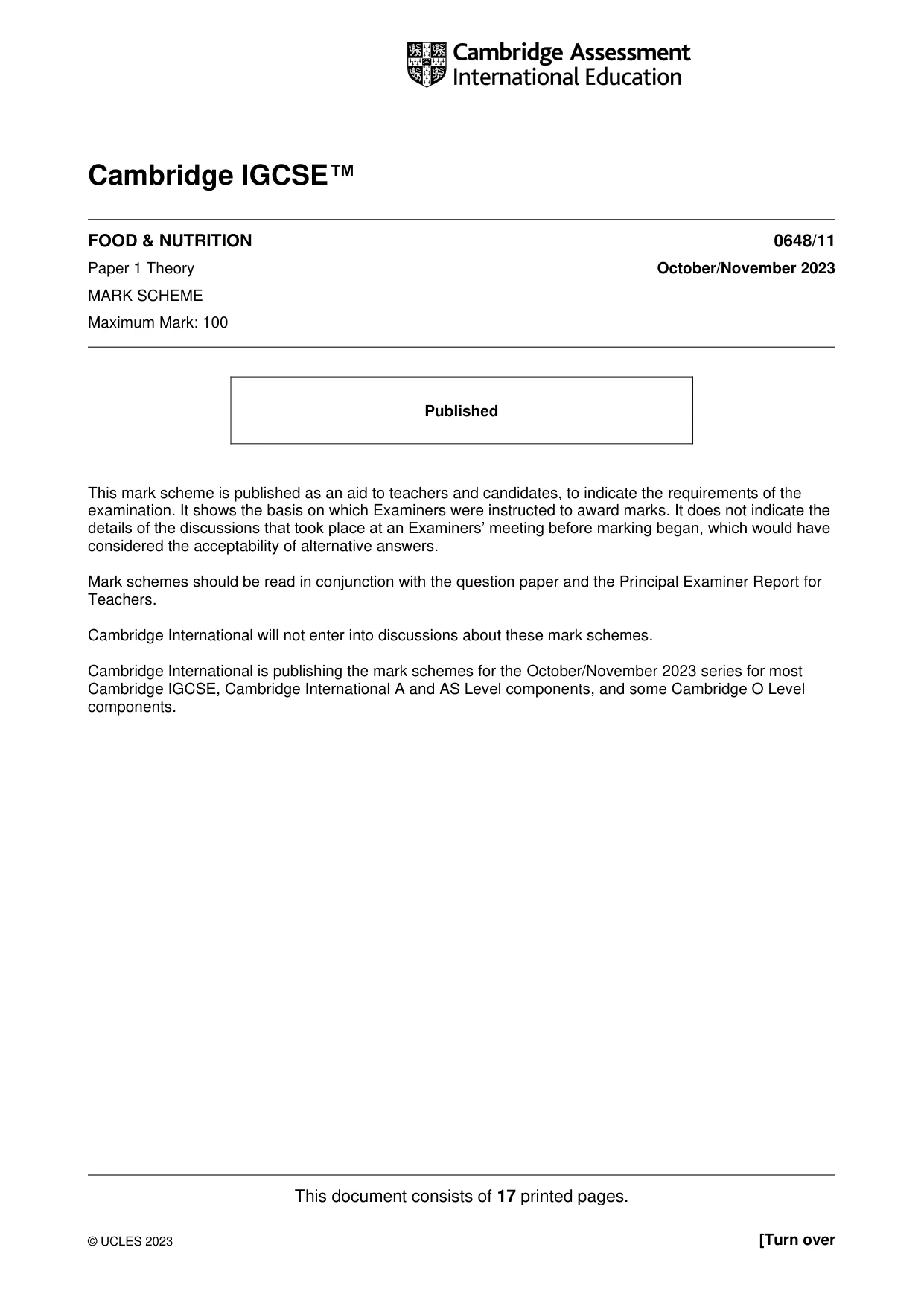
9 0648/11/O/N/23 © UCLES 2023 [Turn over Section C Answer either Question 11 or 12. 11 An adult male family member is convalescing from surgery for a broken leg. • Discuss his special nutritional needs. • Discuss other factors to consider when cooking and serving meals for a convalescent. [15] OR 12 Stir-frying and stewing are both popular methods of cooking. Compare and contrast stir-frying and stewing as methods of cooking. [15] … … … … … … … … … … … … … … … … … … … … …
Question paper, page 10
10 0648/11/O/N/23 © UCLES 2023 … … … … … … … … … … … … … … … … … … … … … … … … … … … …
Question paper, page 11
11 0648/11/O/N/23 © UCLES 2023 … … … … … … … … … … … … … … … … … … … … … … … … … … … …
Question paper, page 12
12 0648/11/O/N/23 © UCLES 2023 Permission to reproduce items where third-party owned material protected by copyright is included has been sought and cleared where possible. Every reasonable effort has been made by the publisher (UCLES) to trace copyright holders, but if any items requiring clearance have unwittingly been included, the publisher will be pleased to make amends at the earliest possible opportunity. To avoid the issue of disclosure of answer-related information to candidates, all copyright acknowledgements are reproduced online in the Cambridge Assessment International Education Copyright Acknowledgements Booklet. This is produced for each series of examinations and is freely available to download at www.cambridgeinternational.org after the live examination series. Cambridge Assessment International Education is part of Cambridge Assessment. Cambridge Assessment is the brand name of the University of Cambridge Local Examinations Syndicate (UCLES), which is a department of the University of Cambridge. BLANK PAGE
Mark scheme, page 1
This document consists of 17 printed pages. © UCLES 2023 [Turn over Cambridge IGCSE™ FOOD & NUTRITION 0648/11 Paper 1 Theory October/November 2023 MARK SCHEME Maximum Mark: 100 Published This mark scheme is published as an aid to teachers and candidates, to indicate the requirements of the examination. It shows the basis on which Examiners were instructed to award marks. It does not indicate the details of the discussions that took place at an Examiners’ meeting before marking began, which would have considered the acceptability of alternative answers. Mark schemes should be read in conjunction with the question paper and the Principal Examiner Report for Teachers. Cambridge International will not enter into discussions about these mark schemes. Cambridge International is publishing the mark schemes for the October/November 2023 series for most Cambridge IGCSE, Cambridge International A and AS Level components, and some Cambridge O Level components.
Mark scheme, page 2
0648/11 Cambridge IGCSE – Mark Scheme PUBLISHED October/November 2023 © UCLES 2023 Page 2 of 17 Generic Marking Principles These general marking principles must be applied by all examiners when marking candidate answers. They should be applied alongside the specific content of the mark scheme or generic level descriptors for a question. Each question paper and mark scheme will also comply with these marking principles. GENERIC MARKING PRINCIPLE 1: Marks must be awarded in line with: • the specific content of the mark scheme or the generic level descriptors for the question • the specific skills defined in the mark scheme or in the generic level descriptors for the question • the standard of response required by a candidate as exemplified by the standardisation scripts. GENERIC MARKING PRINCIPLE 2: Marks awarded are always whole marks (not half marks, or other fractions). GENERIC MARKING PRINCIPLE 3: Marks must be awarded positively: • marks are awarded for correct/valid answers, as defined in the mark scheme. However, credit is given for valid answers which go beyond the scope of the syllabus and mark scheme, referring to your Team Leader as appropriate • marks are awarded when candidates clearly demonstrate what they know and can do • marks are not deducted for errors • marks are not deducted for omissions • answers should only be judged on the quality of spelling, punctuation and grammar when these features are specifically assessed by the question as indicated by the mark scheme. The meaning, however, should be unambiguous. GENERIC MARKING PRINCIPLE 4: Rules must be applied consistently, e.g. in situations where candidates have not followed instructions or in the application of generic level descriptors.
Mark scheme, page 3
0648/11 Cambridge IGCSE – Mark Scheme PUBLISHED October/November 2023 © UCLES 2023 Page 3 of 17 GENERIC MARKING PRINCIPLE 5: Marks should be awarded using the full range of marks defined in the mark scheme for the question (however; the use of the full mark range may be limited according to the quality of the candidate responses seen). GENERIC MARKING PRINCIPLE 6: Marks awarded are based solely on the requirements as defined in the mark scheme. Marks should not be awarded with grade thresholds or grade descriptors in mind. Science-Specific Marking Principles 1 Examiners should consider the context and scientific use of any keywords when awarding marks. Although keywords may be present, marks should not be awarded if the keywords are used incorrectly. 2 The examiner should not choose between contradictory statements given in the same question part, and credit should not be awarded for any correct statement that is contradicted within the same question part. Wrong science that is irrelevant to the question should be ignored. 3 Although spellings do not have to be correct, spellings of syllabus terms must allow for clear and unambiguous separation from other syllabus terms with which they may be confused (e.g. ethane / ethene, glucagon / glycogen, refraction / reflection). 4 The error carried forward (ecf) principle should be applied, where appropriate. If an incorrect answer is subsequently used in a scientifically correct way, the candidate should be awarded these subsequent marking points. Further guidance will be included in the mark scheme where necessary and any exceptions to this general principle will be noted. 5 ‘List rule’ guidance For questions that require n responses (e.g. State two reasons …): • The response should be read as continuous prose, even when numbered answer spaces are provided. • Any response marked ignore in the mark scheme should not count towards n. • Incorrect responses should not be awarded credit but will still count towards n. • Read the entire response to check for any responses that contradict those that would otherwise be credited. Credit should not be awarded for any responses that are contradicted within the rest of the response. Where two responses contradict one another, this should be treated as a single incorrect response. • Non-contradictory responses after the first n responses may be ignored even if they include incorrect science.
Mark scheme, page 4
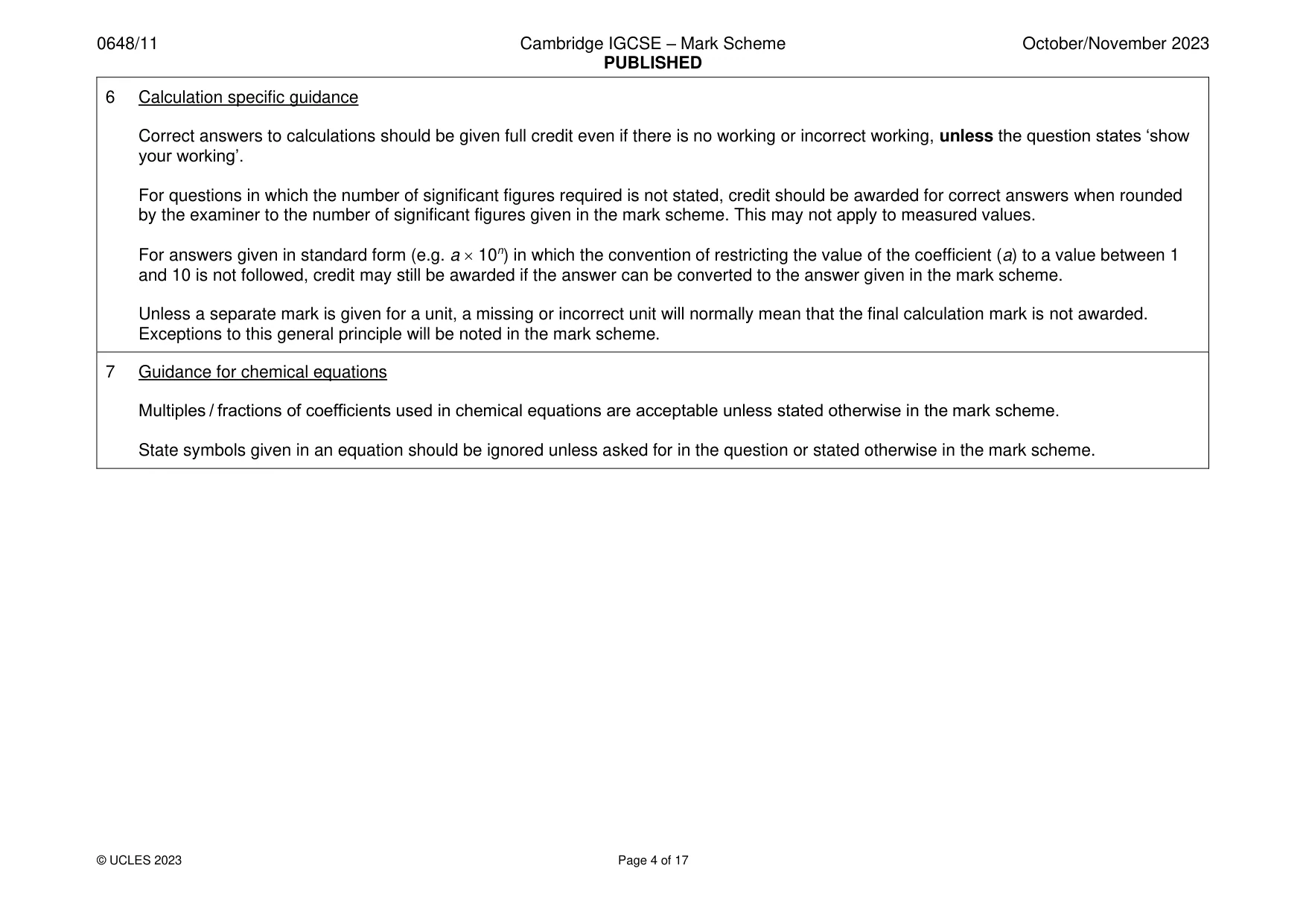
0648/11 Cambridge IGCSE – Mark Scheme PUBLISHED October/November 2023 © UCLES 2023 Page 4 of 17 6 Calculation specific guidance Correct answers to calculations should be given full credit even if there is no working or incorrect working, unless the question states ‘show your working’. For questions in which the number of significant figures required is not stated, credit should be awarded for correct answers when rounded by the examiner to the number of significant figures given in the mark scheme. This may not apply to measured values. For answers given in standard form (e.g. a 10n) in which the convention of restricting the value of the coefficient (a) to a value between 1 and 10 is not followed, credit may still be awarded if the answer can be converted to the answer given in the mark scheme. Unless a separate mark is given for a unit, a missing or incorrect unit will normally mean that the final calculation mark is not awarded. Exceptions to this general principle will be noted in the mark scheme. 7 Guidance for chemical equations Multiples / fractions of coefficients used in chemical equations are acceptable unless stated otherwise in the mark scheme. State symbols given in an equation should be ignored unless asked for in the question or stated otherwise in the mark scheme.
Mark scheme, page 5
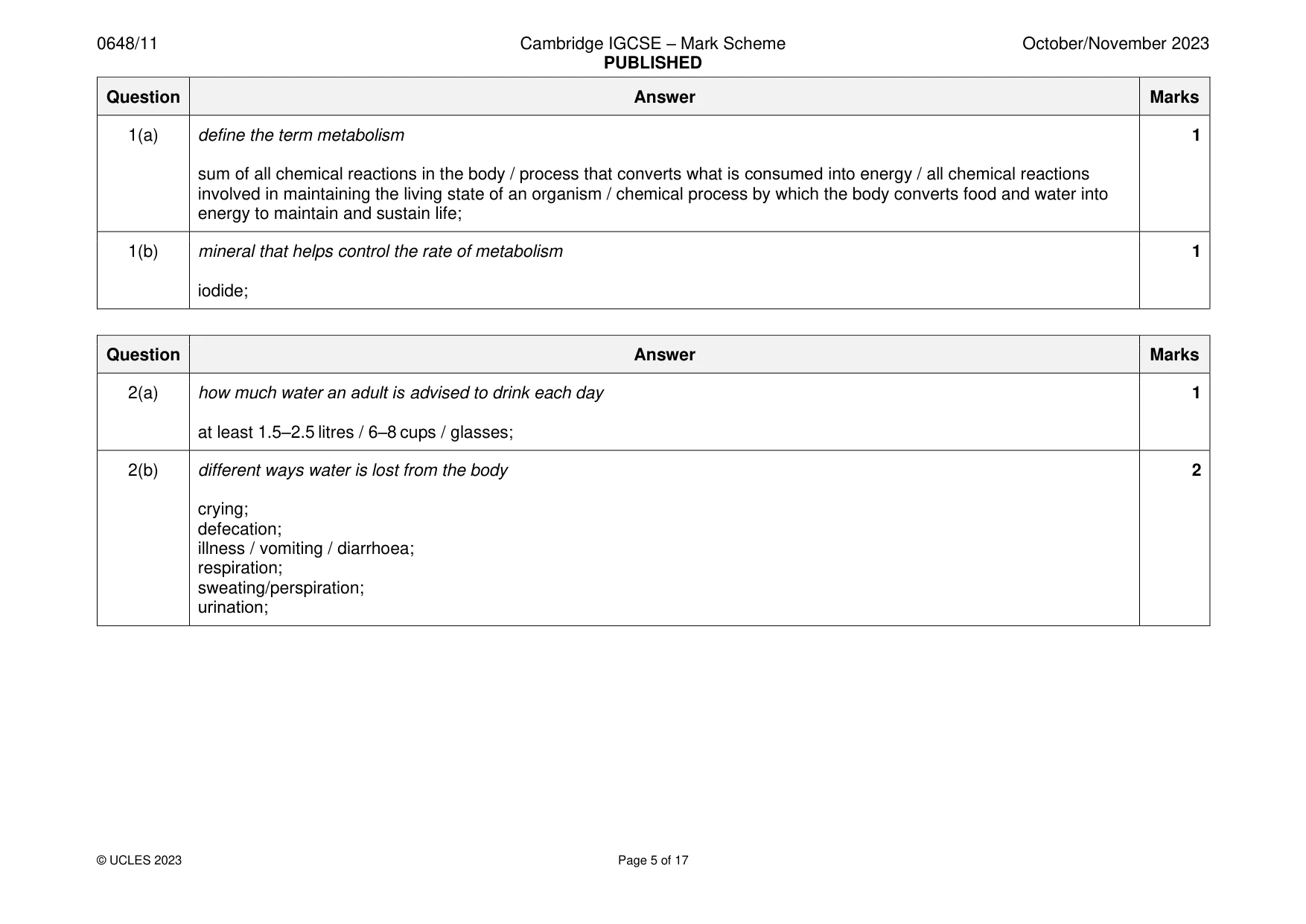
0648/11 Cambridge IGCSE – Mark Scheme PUBLISHED October/November 2023 © UCLES 2023 Page 5 of 17 Question Answer Marks 1(a) define the term metabolism sum of all chemical reactions in the body / process that converts what is consumed into energy / all chemical reactions involved in maintaining the living state of an organism / chemical process by which the body converts food and water into energy to maintain and sustain life; 1 1(b) mineral that helps control the rate of metabolism iodide; 1 Question Answer Marks 2(a) how much water an adult is advised to drink each day at least 1.5–2.5 litres / 6–8 cups / glasses; 1 2(b) different ways water is lost from the body crying; defecation; illness / vomiting / diarrhoea; respiration; sweating/perspiration; urination; 2
Mark scheme, page 6
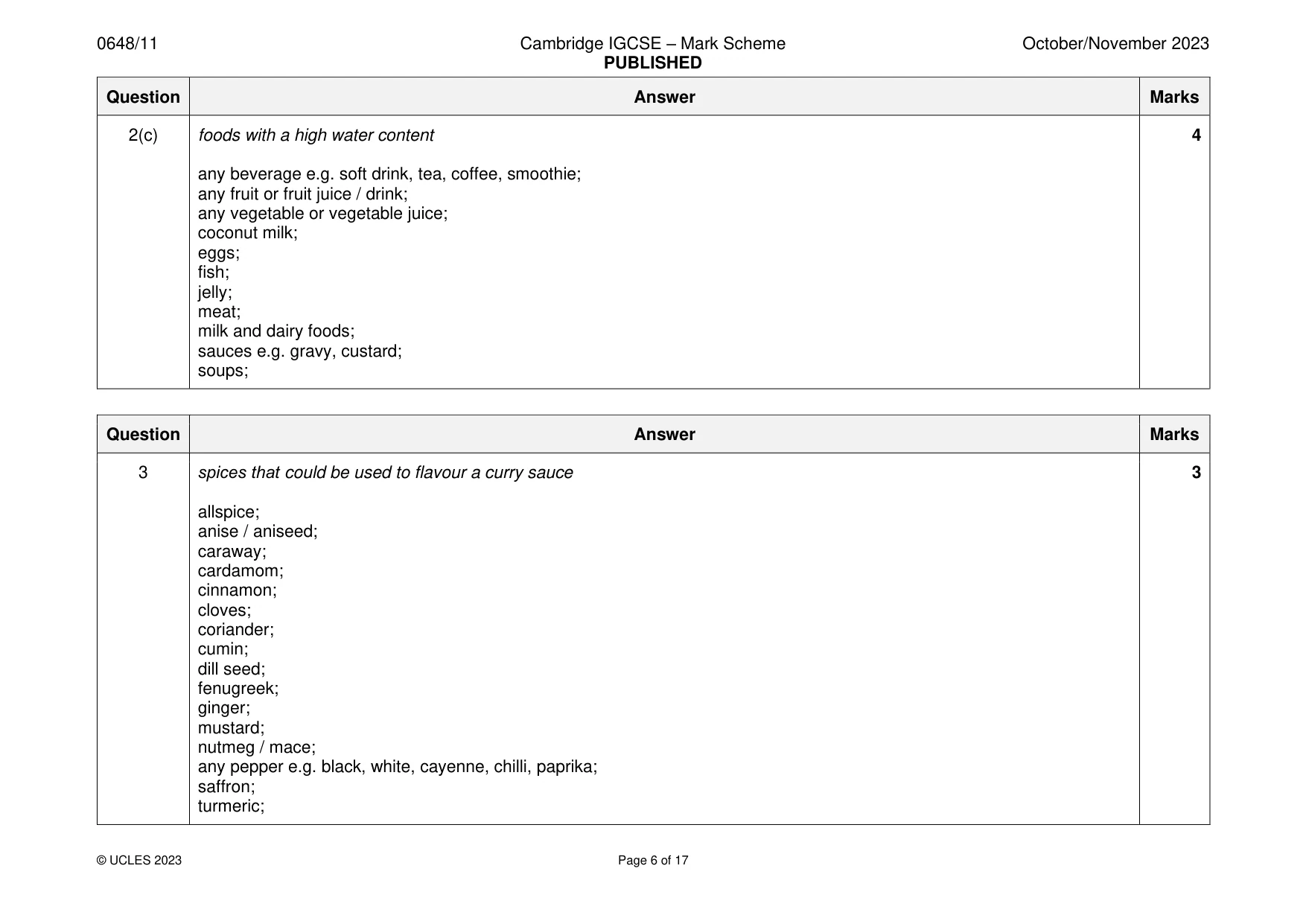
0648/11 Cambridge IGCSE – Mark Scheme PUBLISHED October/November 2023 © UCLES 2023 Page 6 of 17 Question Answer Marks 2(c) foods with a high water content any beverage e.g. soft drink, tea, coffee, smoothie; any fruit or fruit juice / drink; any vegetable or vegetable juice; coconut milk; eggs; fish; jelly; meat; milk and dairy foods; sauces e.g. gravy, custard; soups; 4 Question Answer Marks 3 spices that could be used to flavour a curry sauce allspice; anise / aniseed; caraway; cardamom; cinnamon; cloves; coriander; cumin; dill seed; fenugreek; ginger; mustard; nutmeg / mace; any pepper e.g. black, white, cayenne, chilli, paprika; saffron; turmeric; 3
Mark scheme, page 7
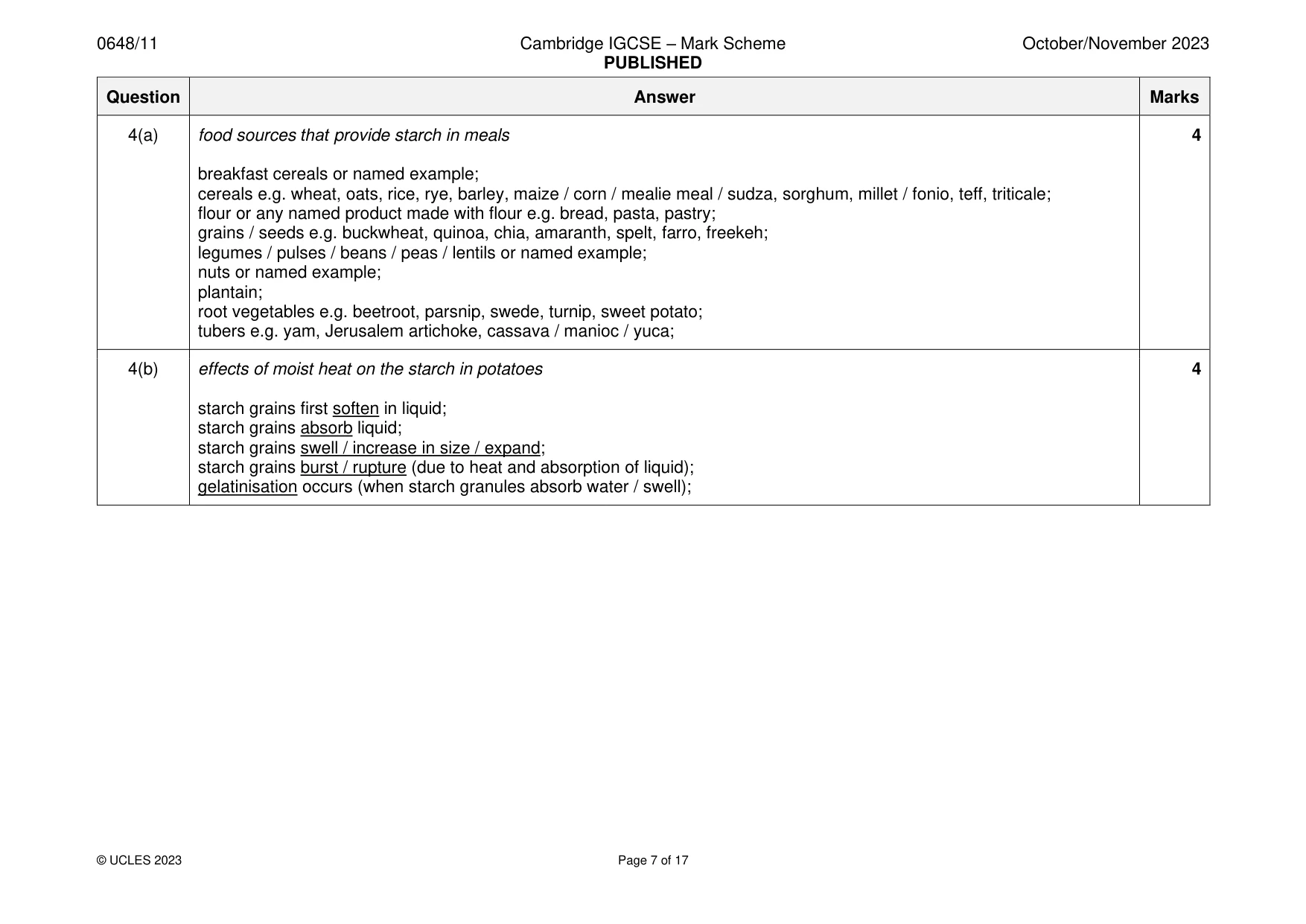
0648/11 Cambridge IGCSE – Mark Scheme PUBLISHED October/November 2023 © UCLES 2023 Page 7 of 17 Question Answer Marks 4(a) food sources that provide starch in meals breakfast cereals or named example; cereals e.g. wheat, oats, rice, rye, barley, maize / corn / mealie meal / sudza, sorghum, millet / fonio, teff, triticale; flour or any named product made with flour e.g. bread, pasta, pastry; grains / seeds e.g. buckwheat, quinoa, chia, amaranth, spelt, farro, freekeh; legumes / pulses / beans / peas / lentils or named example; nuts or named example; plantain; root vegetables e.g. beetroot, parsnip, swede, turnip, sweet potato; tubers e.g. yam, Jerusalem artichoke, cassava / manioc / yuca; 4 4(b) effects of moist heat on the starch in potatoes starch grains first soften in liquid; starch grains absorb liquid; starch grains swell / increase in size / expand; starch grains burst / rupture (due to heat and absorption of liquid); gelatinisation occurs (when starch granules absorb water / swell); 4
Mark scheme, page 8
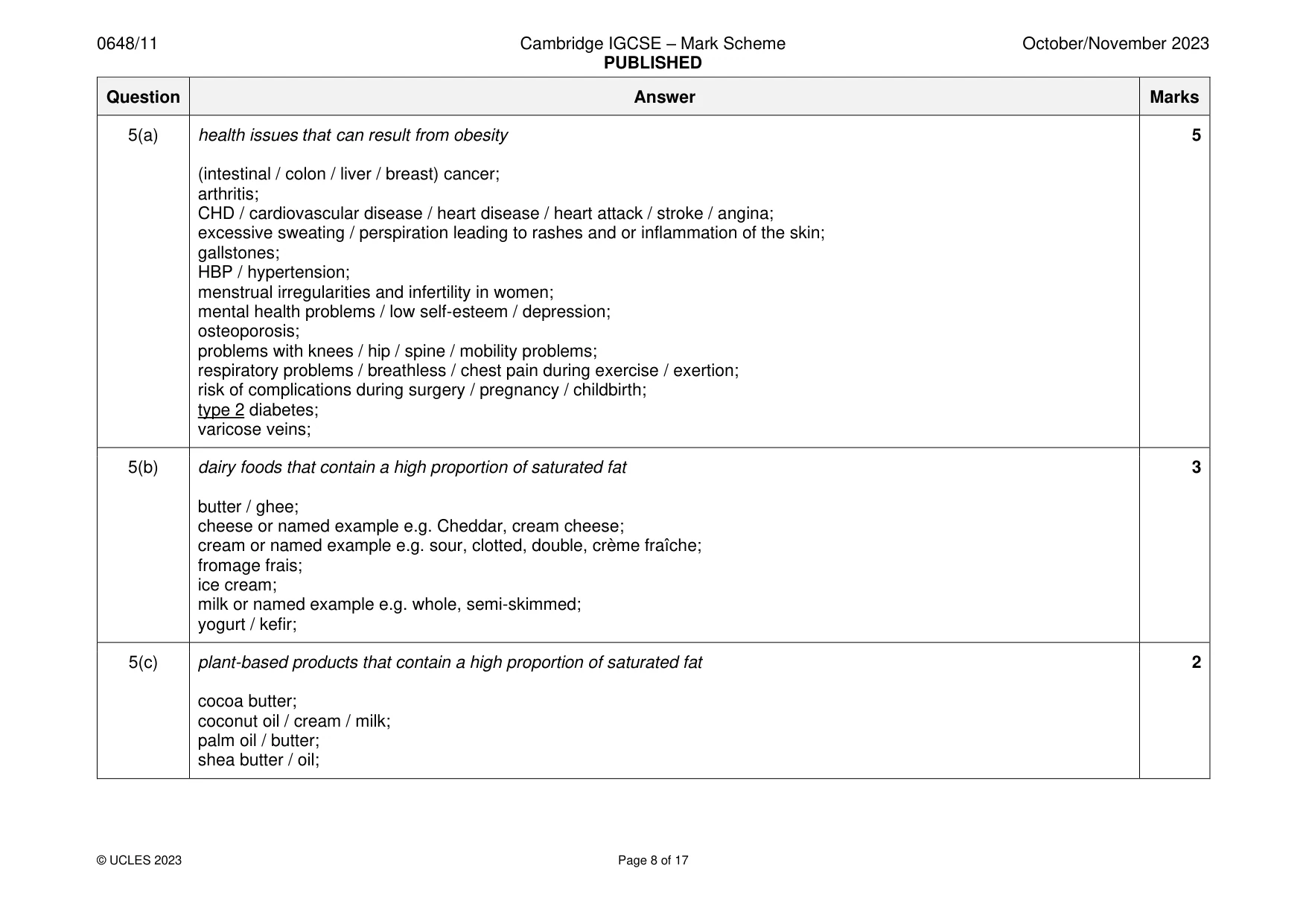
0648/11 Cambridge IGCSE – Mark Scheme PUBLISHED October/November 2023 © UCLES 2023 Page 8 of 17 Question Answer Marks 5(a) health issues that can result from obesity (intestinal / colon / liver / breast) cancer; arthritis; CHD / cardiovascular disease / heart disease / heart attack / stroke / angina; excessive sweating / perspiration leading to rashes and or inflammation of the skin; gallstones; HBP / hypertension; menstrual irregularities and infertility in women; mental health problems / low self-esteem / depression; osteoporosis; problems with knees / hip / spine / mobility problems; respiratory problems / breathless / chest pain during exercise / exertion; risk of complications during surgery / pregnancy / childbirth; type 2 diabetes; varicose veins; 5 5(b) dairy foods that contain a high proportion of saturated fat butter / ghee; cheese or named example e.g. Cheddar, cream cheese; cream or named example e.g. sour, clotted, double, crème fraîche; fromage frais; ice cream; milk or named example e.g. whole, semi-skimmed; yogurt / kefir; 3 5(c) plant-based products that contain a high proportion of saturated fat cocoa butter; coconut oil / cream / milk; palm oil / butter; shea butter / oil; 2
Mark scheme, page 9
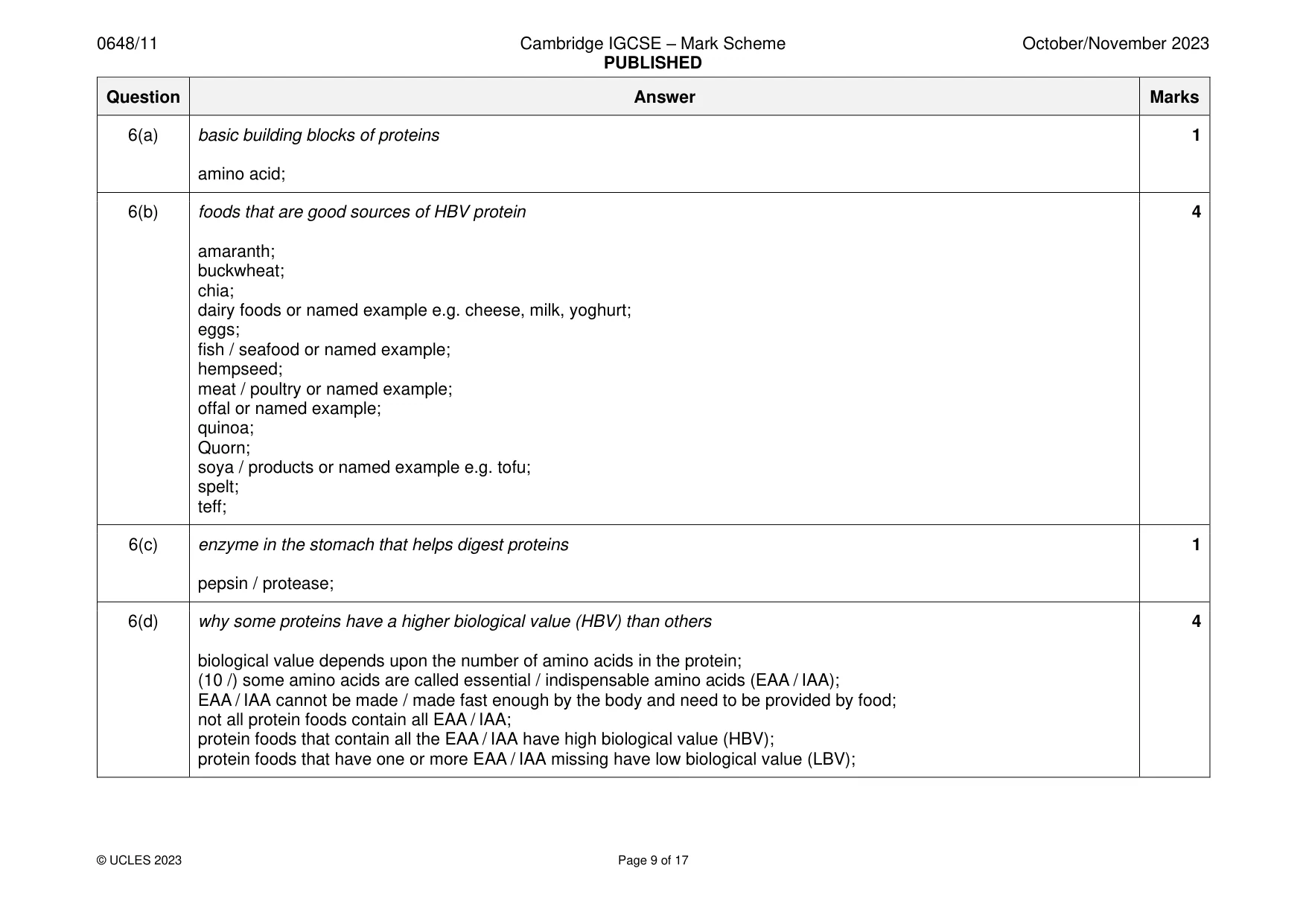
0648/11 Cambridge IGCSE – Mark Scheme PUBLISHED October/November 2023 © UCLES 2023 Page 9 of 17 Question Answer Marks 6(a) basic building blocks of proteins amino acid; 1 6(b) foods that are good sources of HBV protein amaranth; buckwheat; chia; dairy foods or named example e.g. cheese, milk, yoghurt; eggs; fish / seafood or named example; hempseed; meat / poultry or named example; offal or named example; quinoa; Quorn; soya / products or named example e.g. tofu; spelt; teff; 4 6(c) enzyme in the stomach that helps digest proteins pepsin / protease; 1 6(d) why some proteins have a higher biological value (HBV) than others biological value depends upon the number of amino acids in the protein; (10 /) some amino acids are called essential / indispensable amino acids (EAA / IAA); EAA / IAA cannot be made / made fast enough by the body and need to be provided by food; not all protein foods contain all EAA / IAA; protein foods that contain all the EAA / IAA have high biological value (HBV); protein foods that have one or more EAA / IAA missing have low biological value (LBV); 4
Mark scheme, page 10
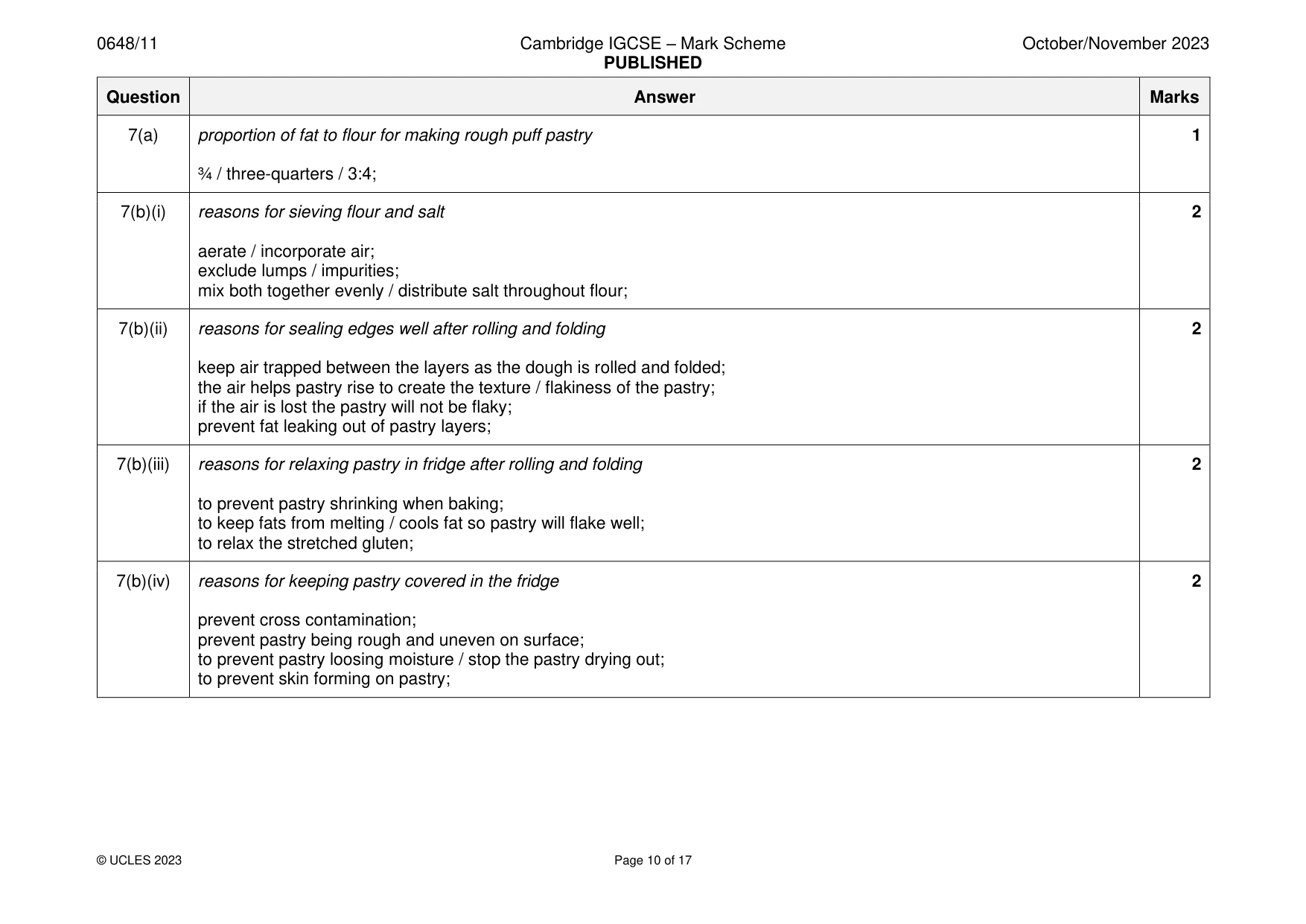
0648/11 Cambridge IGCSE – Mark Scheme PUBLISHED October/November 2023 © UCLES 2023 Page 10 of 17 Question Answer Marks 7(a) proportion of fat to flour for making rough puff pastry ¾ / three-quarters / 3:4; 1 7(b)(i) reasons for sieving flour and salt aerate / incorporate air; exclude lumps / impurities; mix both together evenly / distribute salt throughout flour; 2 7(b)(ii) reasons for sealing edges well after rolling and folding keep air trapped between the layers as the dough is rolled and folded; the air helps pastry rise to create the texture / flakiness of the pastry; if the air is lost the pastry will not be flaky; prevent fat leaking out of pastry layers; 2 7(b)(iii) reasons for relaxing pastry in fridge after rolling and folding to prevent pastry shrinking when baking; to keep fats from melting / cools fat so pastry will flake well; to relax the stretched gluten; 2 7(b)(iv) reasons for keeping pastry covered in the fridge prevent cross contamination; prevent pastry being rough and uneven on surface; to prevent pastry loosing moisture / stop the pastry drying out; to prevent skin forming on pastry; 2
Mark scheme, page 11
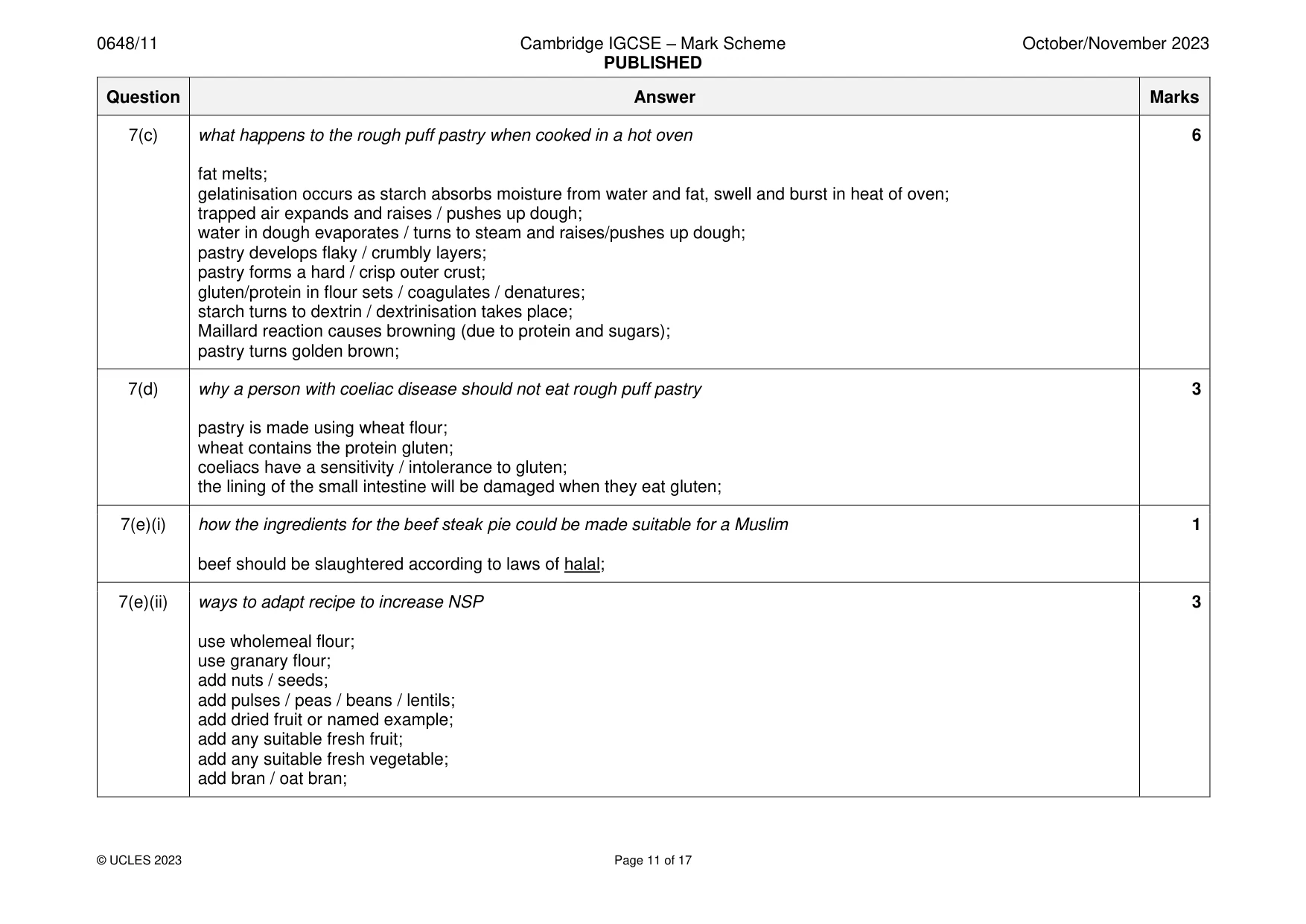
0648/11 Cambridge IGCSE – Mark Scheme PUBLISHED October/November 2023 © UCLES 2023 Page 11 of 17 Question Answer Marks 7(c) what happens to the rough puff pastry when cooked in a hot oven fat melts; gelatinisation occurs as starch absorbs moisture from water and fat, swell and burst in heat of oven; trapped air expands and raises / pushes up dough; water in dough evaporates / turns to steam and raises/pushes up dough; pastry develops flaky / crumbly layers; pastry forms a hard / crisp outer crust; gluten/protein in flour sets / coagulates / denatures; starch turns to dextrin / dextrinisation takes place; Maillard reaction causes browning (due to protein and sugars); pastry turns golden brown; 6 7(d) why a person with coeliac disease should not eat rough puff pastry pastry is made using wheat flour; wheat contains the protein gluten; coeliacs have a sensitivity / intolerance to gluten; the lining of the small intestine will be damaged when they eat gluten; 3 7(e)(i) how the ingredients for the beef steak pie could be made suitable for a Muslim beef should be slaughtered according to laws of halal; 1 7(e)(ii) ways to adapt recipe to increase NSP use wholemeal flour; use granary flour; add nuts / seeds; add pulses / peas / beans / lentils; add dried fruit or named example; add any suitable fresh fruit; add any suitable fresh vegetable; add bran / oat bran; 3
Mark scheme, page 12
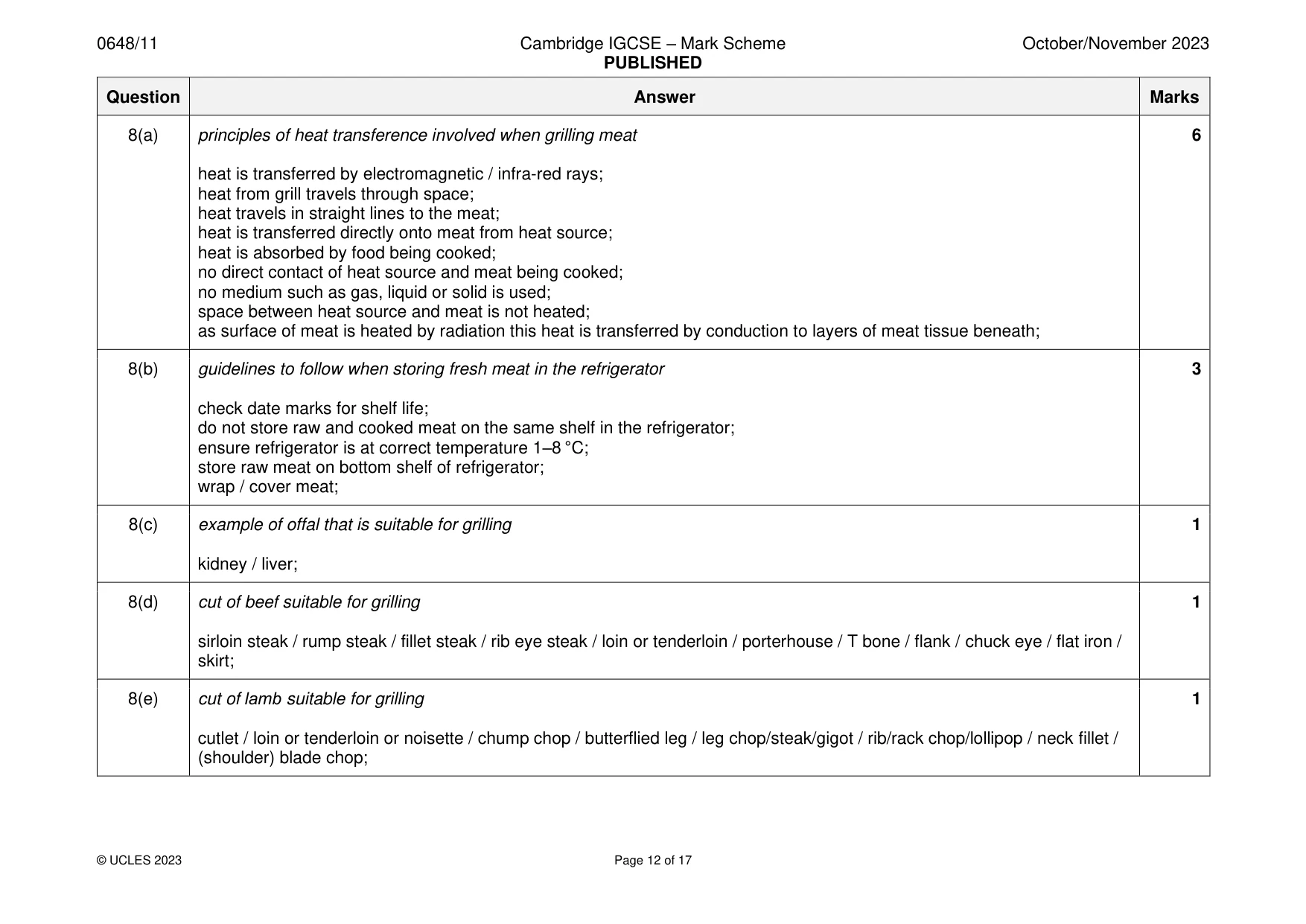
0648/11 Cambridge IGCSE – Mark Scheme PUBLISHED October/November 2023 © UCLES 2023 Page 12 of 17 Question Answer Marks 8(a) principles of heat transference involved when grilling meat heat is transferred by electromagnetic / infra-red rays; heat from grill travels through space; heat travels in straight lines to the meat; heat is transferred directly onto meat from heat source; heat is absorbed by food being cooked; no direct contact of heat source and meat being cooked; no medium such as gas, liquid or solid is used; space between heat source and meat is not heated; as surface of meat is heated by radiation this heat is transferred by conduction to layers of meat tissue beneath; 6 8(b) guidelines to follow when storing fresh meat in the refrigerator check date marks for shelf life; do not store raw and cooked meat on the same shelf in the refrigerator; ensure refrigerator is at correct temperature 1–8 °C; store raw meat on bottom shelf of refrigerator; wrap / cover meat; 3 8(c) example of offal that is suitable for grilling kidney / liver; 1 8(d) cut of beef suitable for grilling sirloin steak / rump steak / fillet steak / rib eye steak / loin or tenderloin / porterhouse / T bone / flank / chuck eye / flat iron / skirt; 1 8(e) cut of lamb suitable for grilling cutlet / loin or tenderloin or noisette / chump chop / butterflied leg / leg chop/steak/gigot / rib/rack chop/lollipop / neck fillet / (shoulder) blade chop; 1
Mark scheme, page 13
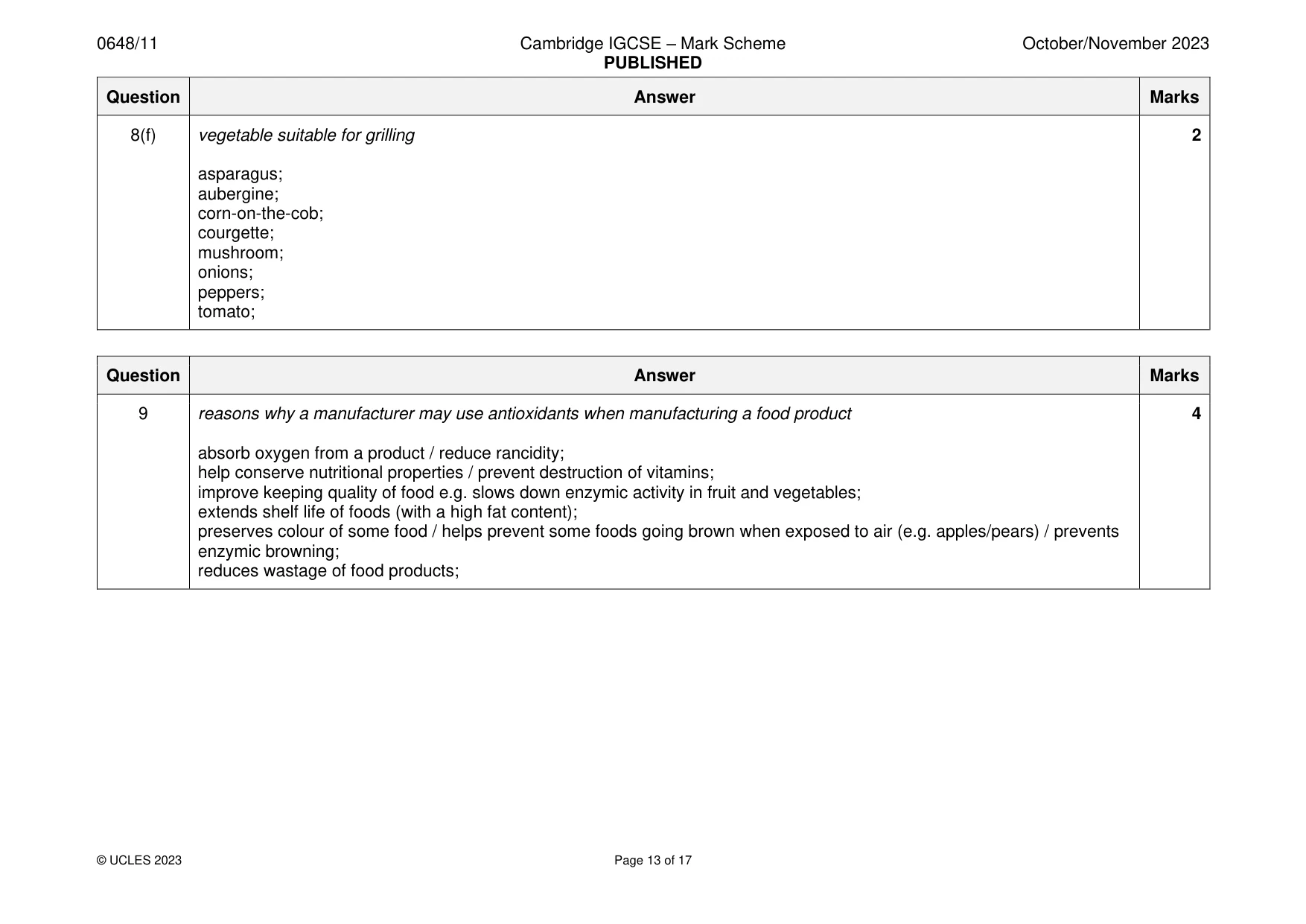
0648/11 Cambridge IGCSE – Mark Scheme PUBLISHED October/November 2023 © UCLES 2023 Page 13 of 17 Question Answer Marks 8(f) vegetable suitable for grilling asparagus; aubergine; corn-on-the-cob; courgette; mushroom; onions; peppers; tomato; 2 Question Answer Marks 9 reasons why a manufacturer may use antioxidants when manufacturing a food product absorb oxygen from a product / reduce rancidity; help conserve nutritional properties / prevent destruction of vitamins; improve keeping quality of food e.g. slows down enzymic activity in fruit and vegetables; extends shelf life of foods (with a high fat content); preserves colour of some food / helps prevent some foods going brown when exposed to air (e.g. apples/pears) / prevents enzymic browning; reduces wastage of food products; 4
Mark scheme, page 14
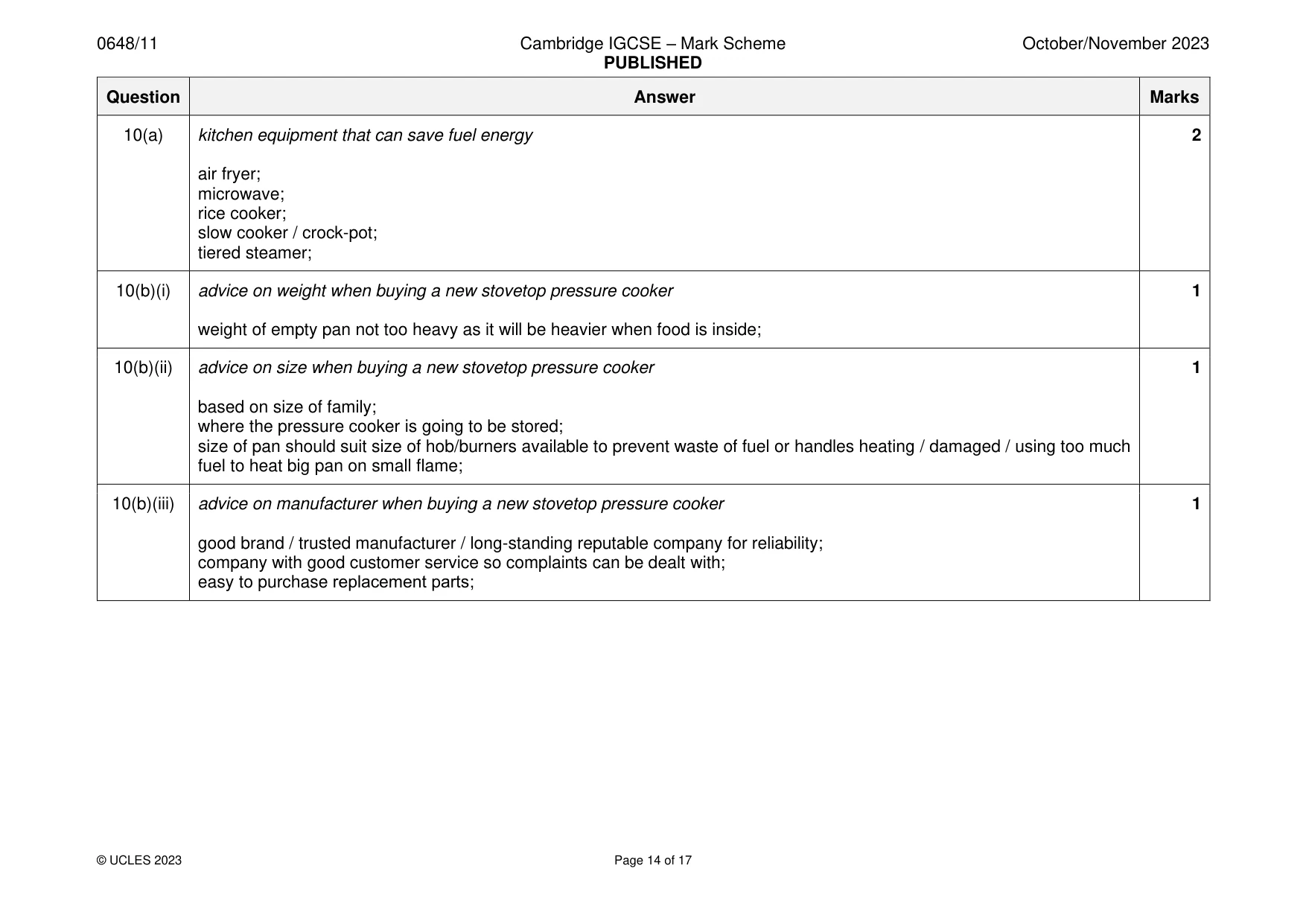
0648/11 Cambridge IGCSE – Mark Scheme PUBLISHED October/November 2023 © UCLES 2023 Page 14 of 17 Question Answer Marks 10(a) kitchen equipment that can save fuel energy air fryer; microwave; rice cooker; slow cooker / crock-pot; tiered steamer; 2 10(b)(i) advice on weight when buying a new stovetop pressure cooker weight of empty pan not too heavy as it will be heavier when food is inside; 1 10(b)(ii) advice on size when buying a new stovetop pressure cooker based on size of family; where the pressure cooker is going to be stored; size of pan should suit size of hob/burners available to prevent waste of fuel or handles heating / damaged / using too much fuel to heat big pan on small flame; 1 10(b)(iii) advice on manufacturer when buying a new stovetop pressure cooker good brand / trusted manufacturer / long-standing reputable company for reliability; company with good customer service so complaints can be dealt with; easy to purchase replacement parts; 1
Mark scheme, page 15
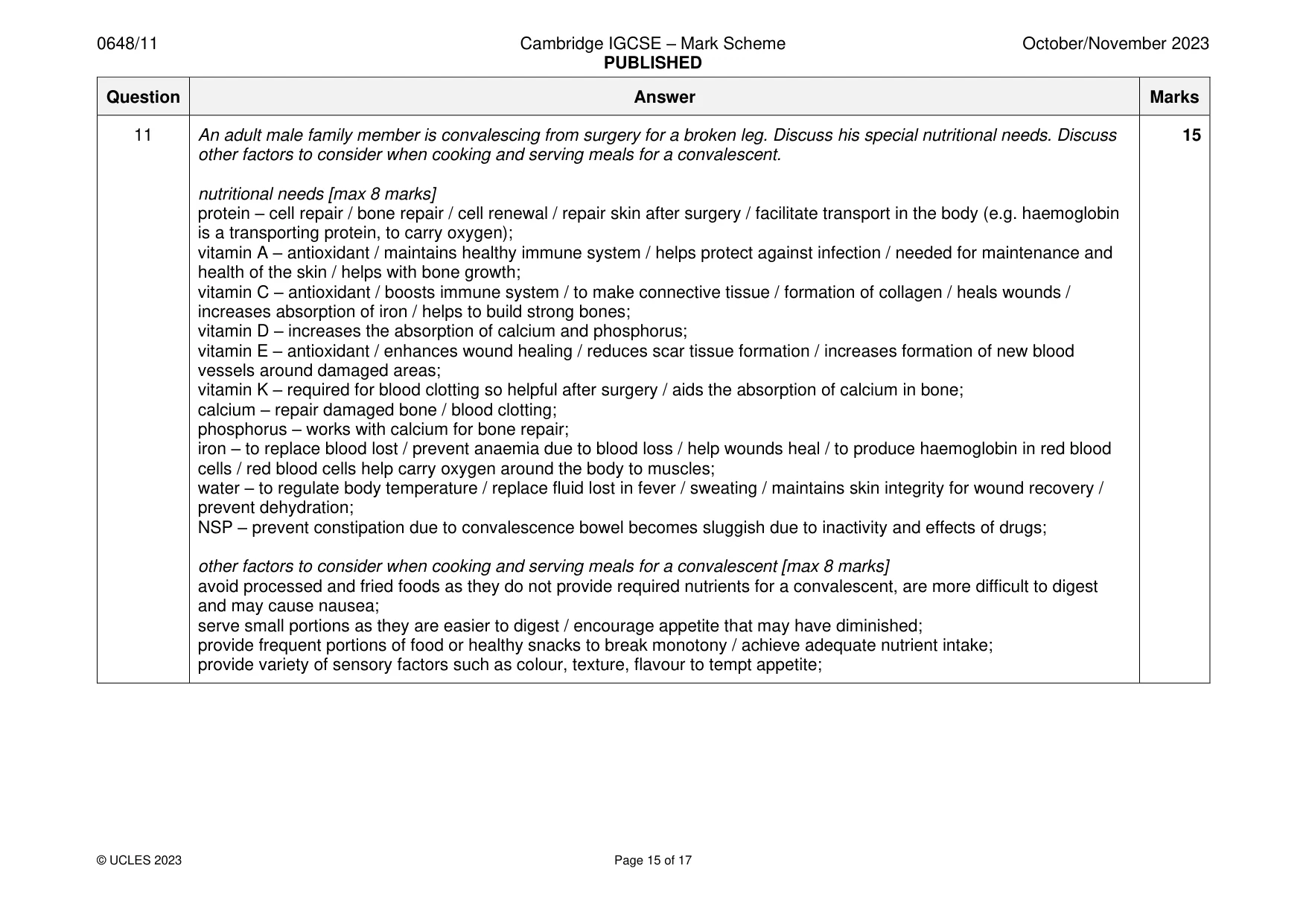
0648/11 Cambridge IGCSE – Mark Scheme PUBLISHED October/November 2023 © UCLES 2023 Page 15 of 17 Question Answer Marks 11 An adult male family member is convalescing from surgery for a broken leg. Discuss his special nutritional needs. Discuss other factors to consider when cooking and serving meals for a convalescent. nutritional needs [max 8 marks] protein – cell repair / bone repair / cell renewal / repair skin after surgery / facilitate transport in the body (e.g. haemoglobin is a transporting protein, to carry oxygen); vitamin A – antioxidant / maintains healthy immune system / helps protect against infection / needed for maintenance and health of the skin / helps with bone growth; vitamin C – antioxidant / boosts immune system / to make connective tissue / formation of collagen / heals wounds / increases absorption of iron / helps to build strong bones; vitamin D – increases the absorption of calcium and phosphorus; vitamin E – antioxidant / enhances wound healing / reduces scar tissue formation / increases formation of new blood vessels around damaged areas; vitamin K – required for blood clotting so helpful after surgery / aids the absorption of calcium in bone; calcium – repair damaged bone / blood clotting; phosphorus – works with calcium for bone repair; iron – to replace blood lost / prevent anaemia due to blood loss / help wounds heal / to produce haemoglobin in red blood cells / red blood cells help carry oxygen around the body to muscles; water – to regulate body temperature / replace fluid lost in fever / sweating / maintains skin integrity for wound recovery / prevent dehydration; NSP – prevent constipation due to convalescence bowel becomes sluggish due to inactivity and effects of drugs; other factors to consider when cooking and serving meals for a convalescent [max 8 marks] avoid processed and fried foods as they do not provide required nutrients for a convalescent, are more difficult to digest and may cause nausea; serve small portions as they are easier to digest / encourage appetite that may have diminished; provide frequent portions of food or healthy snacks to break monotony / achieve adequate nutrient intake; provide variety of sensory factors such as colour, texture, flavour to tempt appetite; 15
Mark scheme, page 16
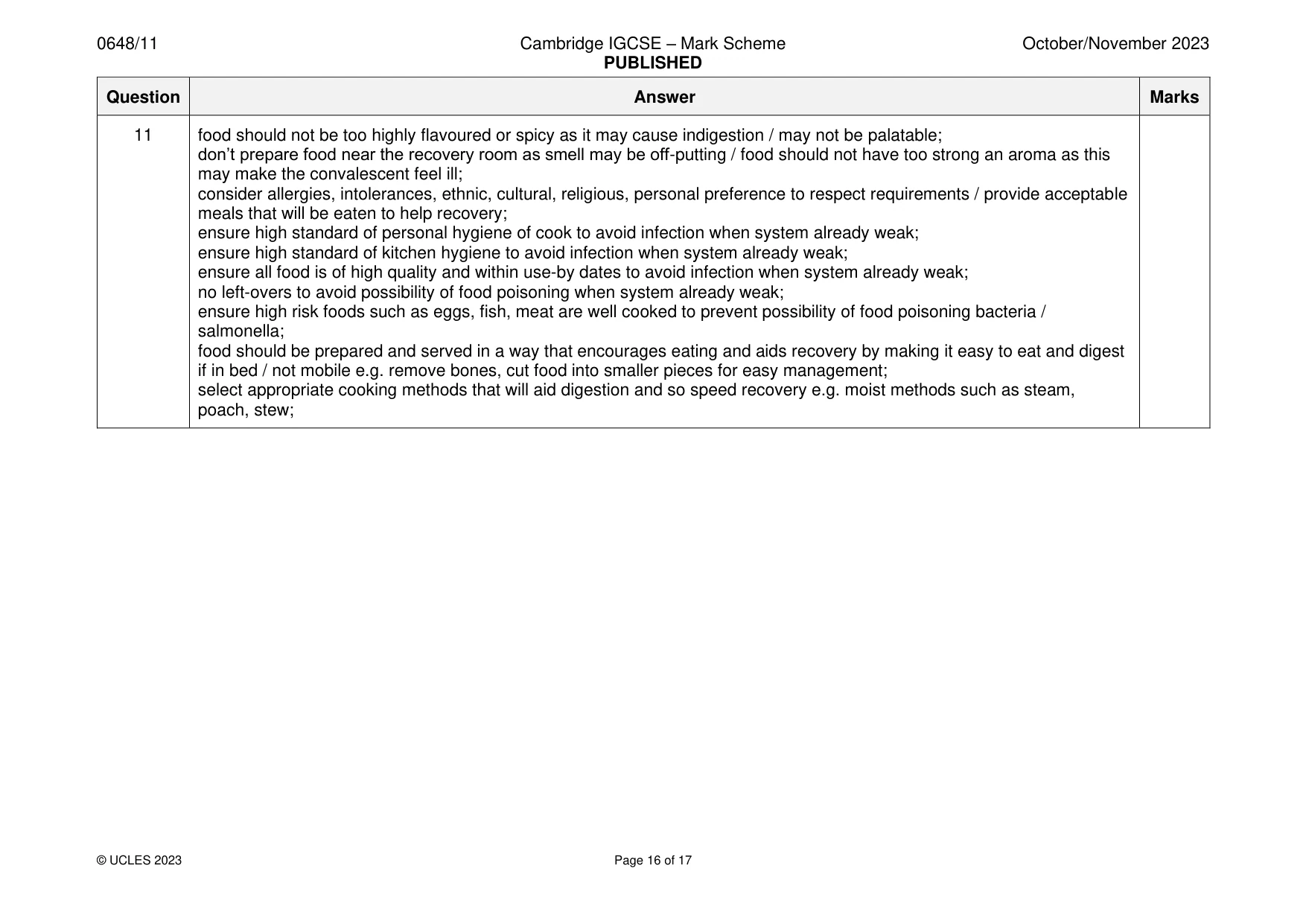
0648/11 Cambridge IGCSE – Mark Scheme PUBLISHED October/November 2023 © UCLES 2023 Page 16 of 17 Question Answer Marks 11 food should not be too highly flavoured or spicy as it may cause indigestion / may not be palatable; don’t prepare food near the recovery room as smell may be off-putting / food should not have too strong an aroma as this may make the convalescent feel ill; consider allergies, intolerances, ethnic, cultural, religious, personal preference to respect requirements / provide acceptable meals that will be eaten to help recovery; ensure high standard of personal hygiene of cook to avoid infection when system already weak; ensure high standard of kitchen hygiene to avoid infection when system already weak; ensure all food is of high quality and within use-by dates to avoid infection when system already weak; no left-overs to avoid possibility of food poisoning when system already weak; ensure high risk foods such as eggs, fish, meat are well cooked to prevent possibility of food poisoning bacteria / salmonella; food should be prepared and served in a way that encourages eating and aids recovery by making it easy to eat and digest if in bed / not mobile e.g. remove bones, cut food into smaller pieces for easy management; select appropriate cooking methods that will aid digestion and so speed recovery e.g. moist methods such as steam, poach, stew;
Mark scheme, page 17
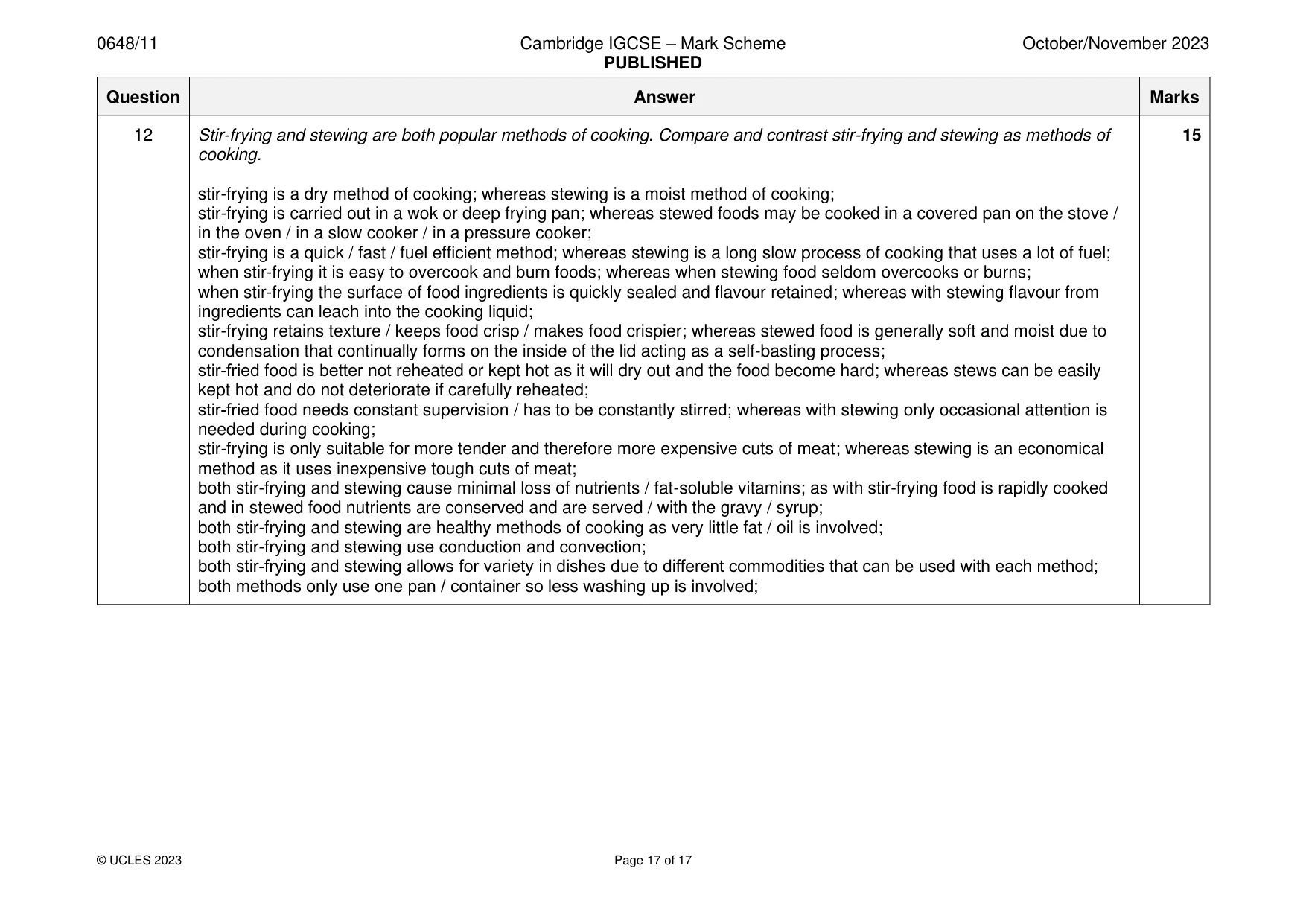
0648/11 Cambridge IGCSE – Mark Scheme PUBLISHED October/November 2023 © UCLES 2023 Page 17 of 17 Question Answer Marks 12 Stir-frying and stewing are both popular methods of cooking. Compare and contrast stir-frying and stewing as methods of cooking. stir-frying is a dry method of cooking; whereas stewing is a moist method of cooking; stir-frying is carried out in a wok or deep frying pan; whereas stewed foods may be cooked in a covered pan on the stove / in the oven / in a slow cooker / in a pressure cooker; stir-frying is a quick / fast / fuel efficient method; whereas stewing is a long slow process of cooking that uses a lot of fuel; when stir-frying it is easy to overcook and burn foods; whereas when stewing food seldom overcooks or burns; when stir-frying the surface of food ingredients is quickly sealed and flavour retained; whereas with stewing flavour from ingredients can leach into the cooking liquid; stir-frying retains texture / keeps food crisp / makes food crispier; whereas stewed food is generally soft and moist due to condensation that continually forms on the inside of the lid acting as a self-basting process; stir-fried food is better not reheated or kept hot as it will dry out and the food become hard; whereas stews can be easily kept hot and do not deteriorate if carefully reheated; stir-fried food needs constant supervision / has to be constantly stirred; whereas with stewing only occasional attention is needed during cooking; stir-frying is only suitable for more tender and therefore more expensive cuts of meat; whereas stewing is an economical method as it uses inexpensive tough cuts of meat; both stir-frying and stewing cause minimal loss of nutrients / fat-soluble vitamins; as with stir-frying food is rapidly cooked and in stewed food nutrients are conserved and are served / with the gravy / syrup; both stir-frying and stewing are healthy methods of cooking as very little fat / oil is involved; both stir-frying and stewing use conduction and convection; both stir-frying and stewing allows for variety in dishes due to different commodities that can be used with each method; both methods only use one pan / container so less washing up is involved; 15
What you needed in this session
Cambridge’s own grade thresholds for 2023 Oct/Nov, Paper 1 · Variant 1. A higher threshold means an easier paper — the bar moves with how the cohort did.