Cambridge IGCSE Food and Nutrition 0648 — 2023 May/June Paper 1 · Variant 3
0648/13/M/J/23 · 100 marks · ≈113 min
The question paper and its mark scheme, free to read here and free to download. This is Cambridge’s own paper, exactly as it was sat.
Question paper12 pages


Mark scheme19 pages
Answers below. Sit the paper first if you are practising.
Paper as text
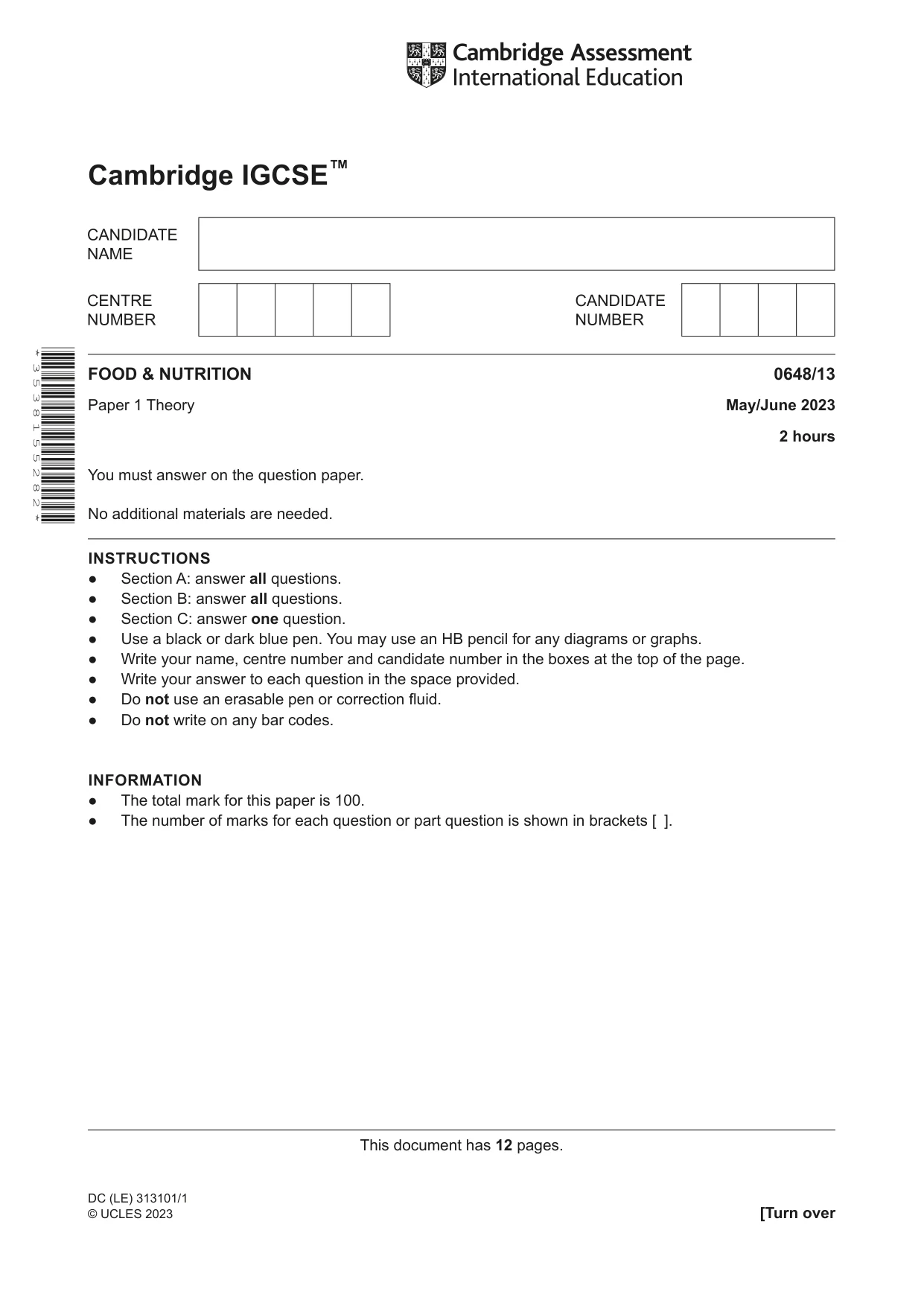
Question paper, page 1
This document has 12 pages. [Turn over Cambridge IGCSE™ DC (LE) 313101/1 © UCLES 2023 FOOD & NUTRITION 0648/13 Paper 1 Theory May/June 2023 2 hours You must answer on the question paper. No additional materials are needed. INSTRUCTIONS ● Section A: answer all questions. ● Section B: answer all questions. ● Section C: answer one question. ● Use a black or dark blue pen. You may use an HB pencil for any diagrams or graphs. ● Write your name, centre number and candidate number in the boxes at the top of the page. ● Write your answer to each question in the space provided. ● Do not use an erasable pen or correction fluid. ● Do not write on any bar codes. INFORMATION ● The total mark for this paper is 100. ● The number of marks for each question or part question is shown in brackets [ ]. * 3 5 3 8 1 5 5 2 8 2 *
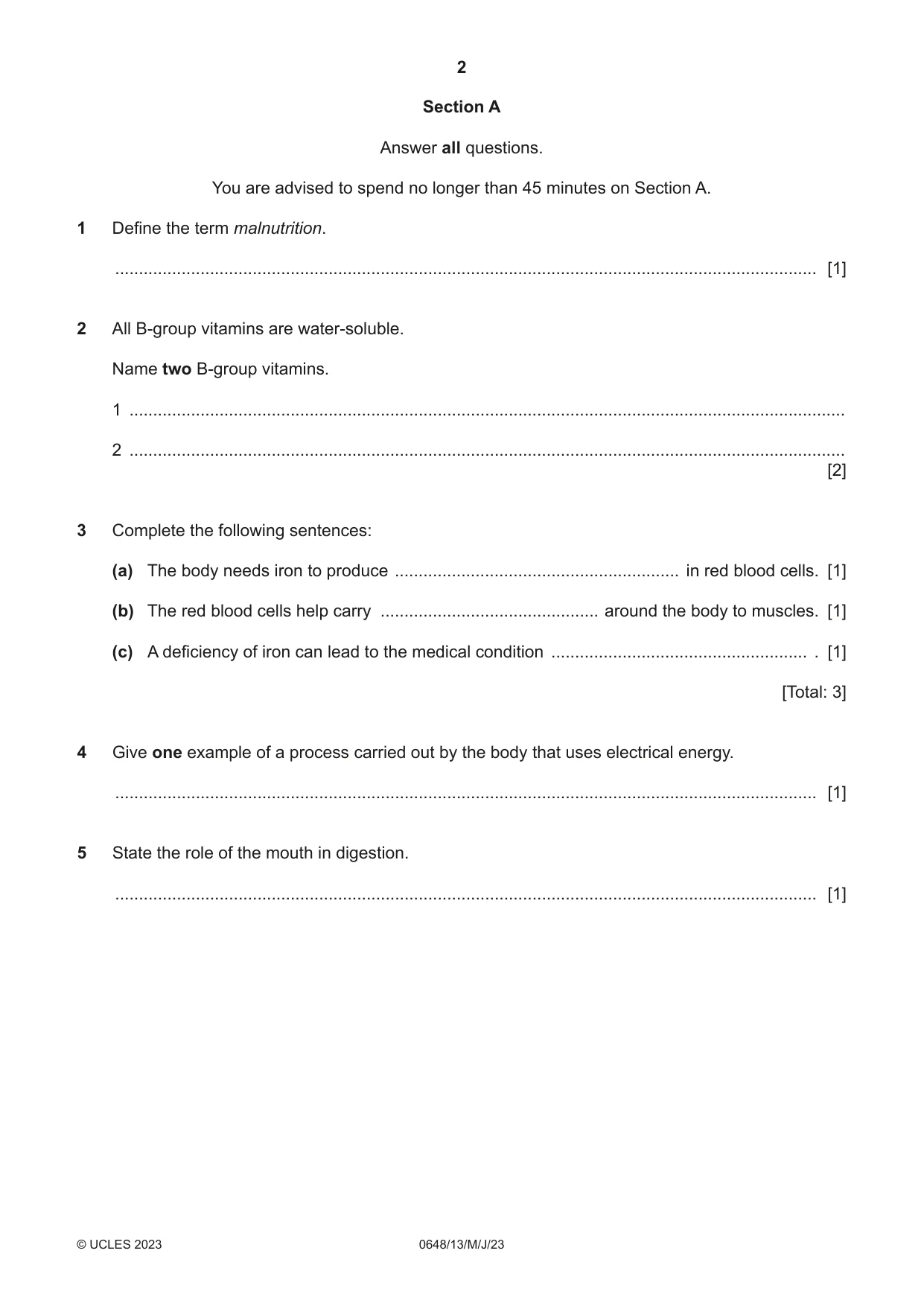
Question paper, page 2
2 0648/13/M/J/23 © UCLES 2023 Section A Answer all questions. You are advised to spend no longer than 45 minutes on Section A. 1 Define the term malnutrition. … [1] 2 All B-group vitamins are water-soluble. Name two B-group vitamins. 1 … 2 … [2] 3 Complete the following sentences: (a) The body needs iron to produce … in red blood cells. [1] (b) The red blood cells help carry … around the body to muscles. [1] (c) A deficiency of iron can lead to the medical condition … . [1] [Total: 3] 4 Give one example of a process carried out by the body that uses electrical energy. … [1] 5 State the role of the mouth in digestion. … [1]
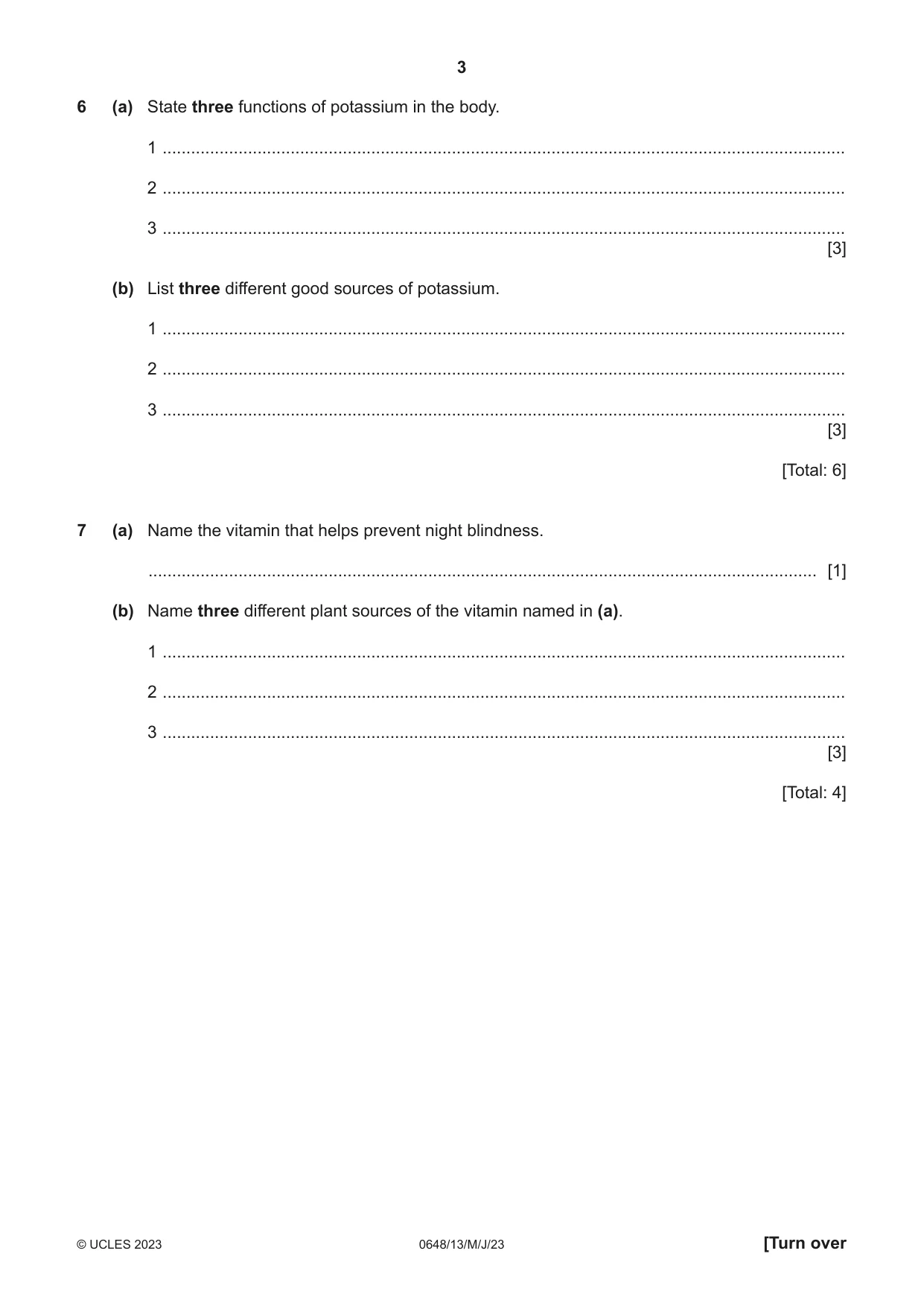
Question paper, page 3
3 0648/13/M/J/23 © UCLES 2023 [Turn over 6 (a) State three functions of potassium in the body. 1 … 2 … 3 … [3] (b) List three different good sources of potassium. 1 … 2 … 3 … [3] [Total: 6] 7 (a) Name the vitamin that helps prevent night blindness. … [1] (b) Name three different plant sources of the vitamin named in (a). 1 … 2 … 3 … [3] [Total: 4]
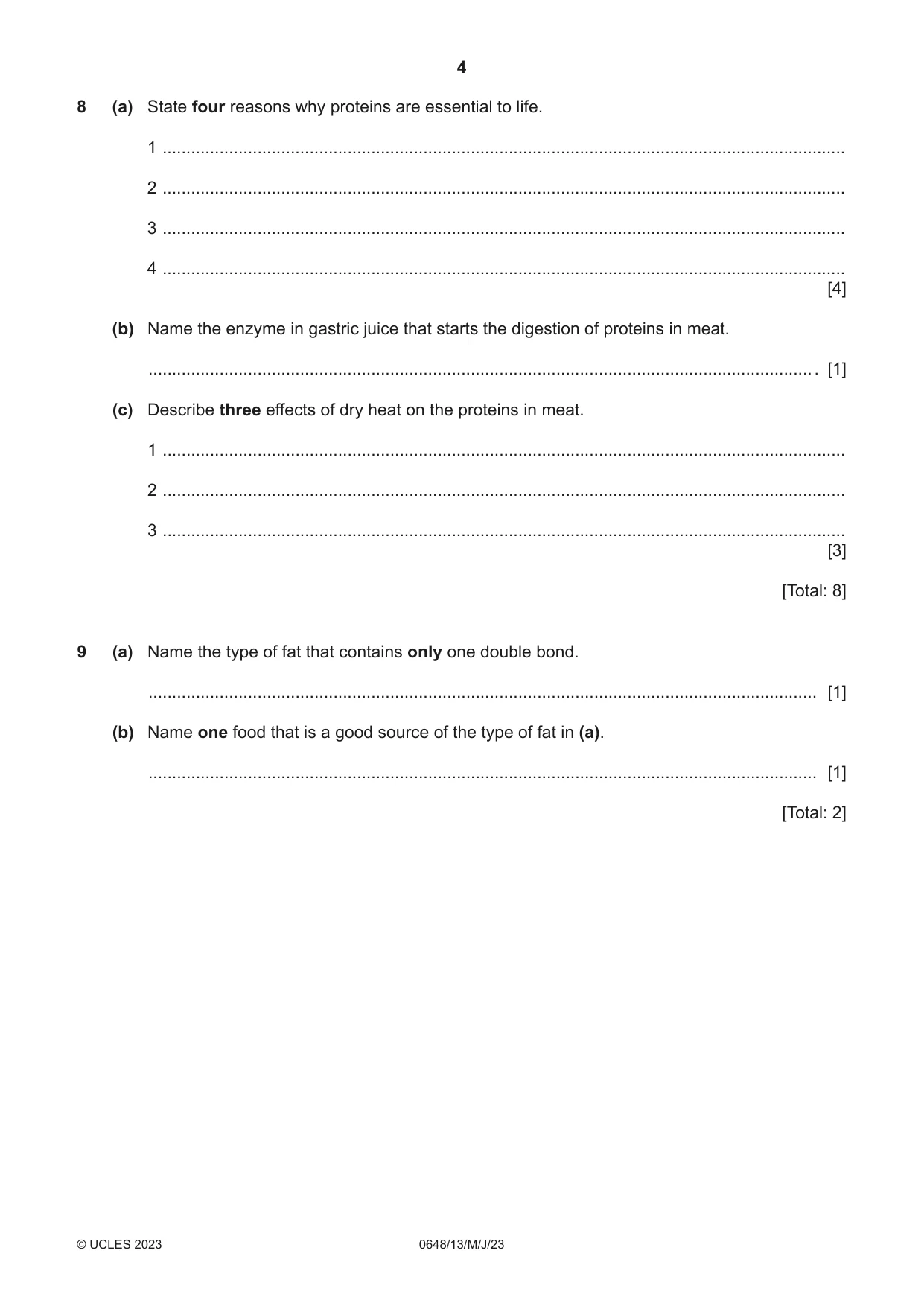
Question paper, page 4
4 0648/13/M/J/23 © UCLES 2023 8 (a) State four reasons why proteins are essential to life. 1 … 2 … 3 … 4 … [4] (b) Name the enzyme in gastric juice that starts the digestion of proteins in meat. … [1] (c) Describe three effects of dry heat on the proteins in meat. 1 … 2 … 3 … [3] [Total: 8] 9 (a) Name the type of fat that contains only one double bond. … [1] (b) Name one food that is a good source of the type of fat in (a). … [1] [Total: 2]
Question paper, page 5
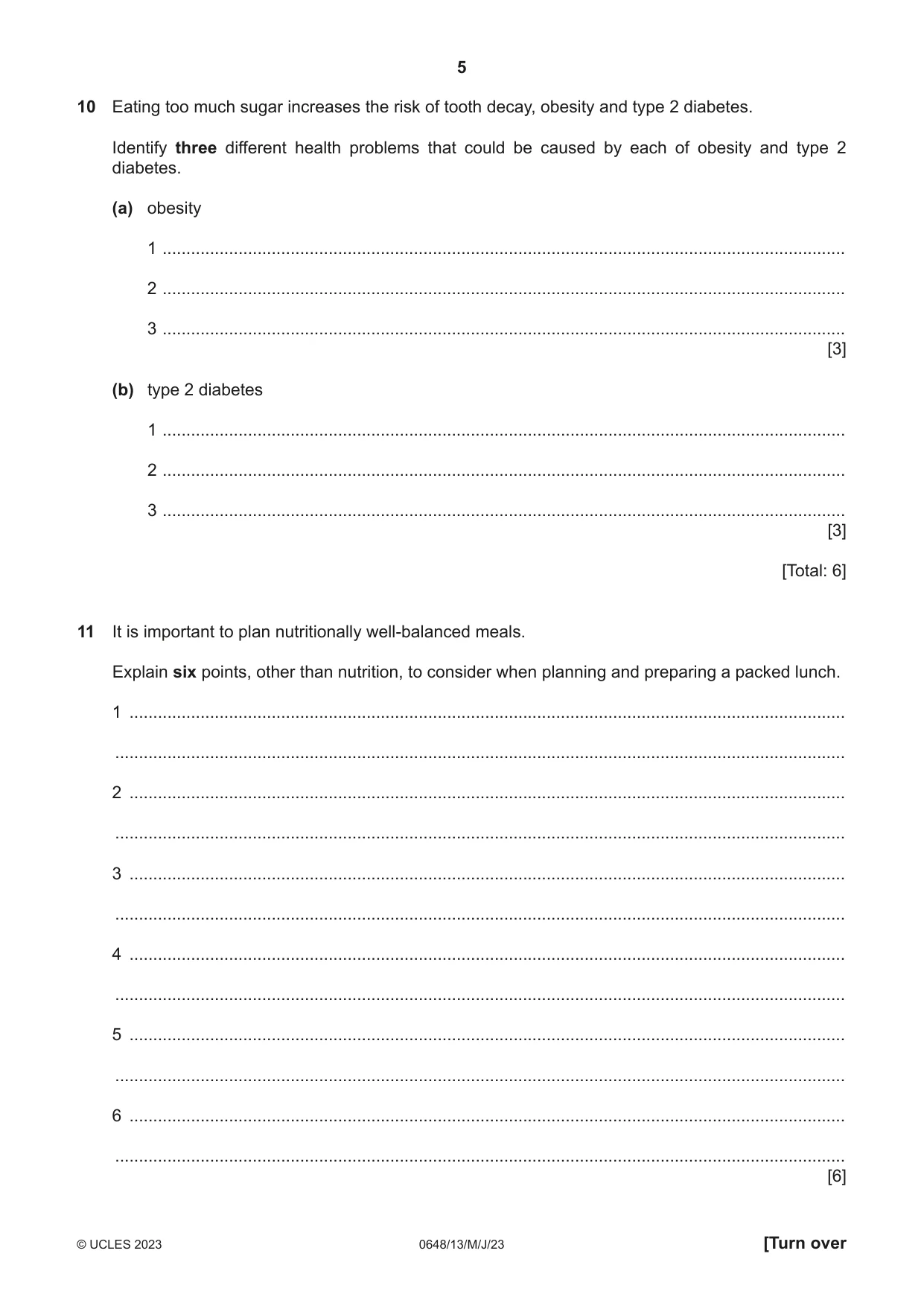
5 0648/13/M/J/23 © UCLES 2023 [Turn over 10 Eating too much sugar increases the risk of tooth decay, obesity and type 2 diabetes. Identify three different health problems that could be caused by each of obesity and type 2 diabetes. (a) obesity 1 … 2 … 3 … [3] (b) type 2 diabetes 1 … 2 … 3 … [3] [Total: 6] 11 It is important to plan nutritionally well-balanced meals. Explain six points, other than nutrition, to consider when planning and preparing a packed lunch. 1 … … 2 … … 3 … … 4 … … 5 … … 6 … … [6]
Question paper, page 6
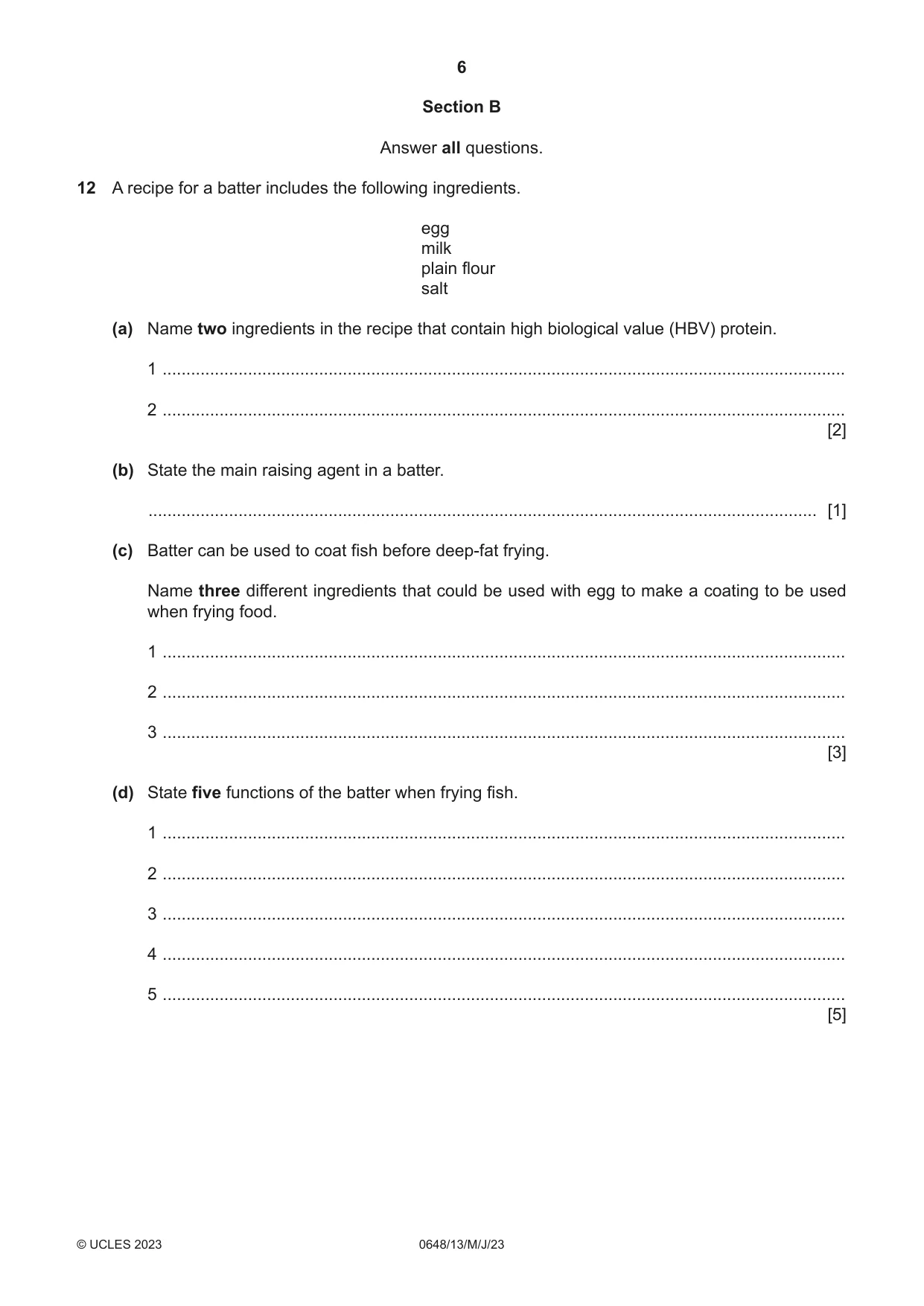
6 0648/13/M/J/23 © UCLES 2023 Section B Answer all questions. 12 A recipe for a batter includes the following ingredients. egg milk plain flour salt (a) Name two ingredients in the recipe that contain high biological value (HBV) protein. 1 … 2 … [2] (b) State the main raising agent in a batter. … [1] (c) Batter can be used to coat fish before deep-fat frying. Name three different ingredients that could be used with egg to make a coating to be used when frying food. 1 … 2 … 3 … [3] (d) State five functions of the batter when frying fish. 1 … 2 … 3 … 4 … 5 … [5]
Question paper, page 7
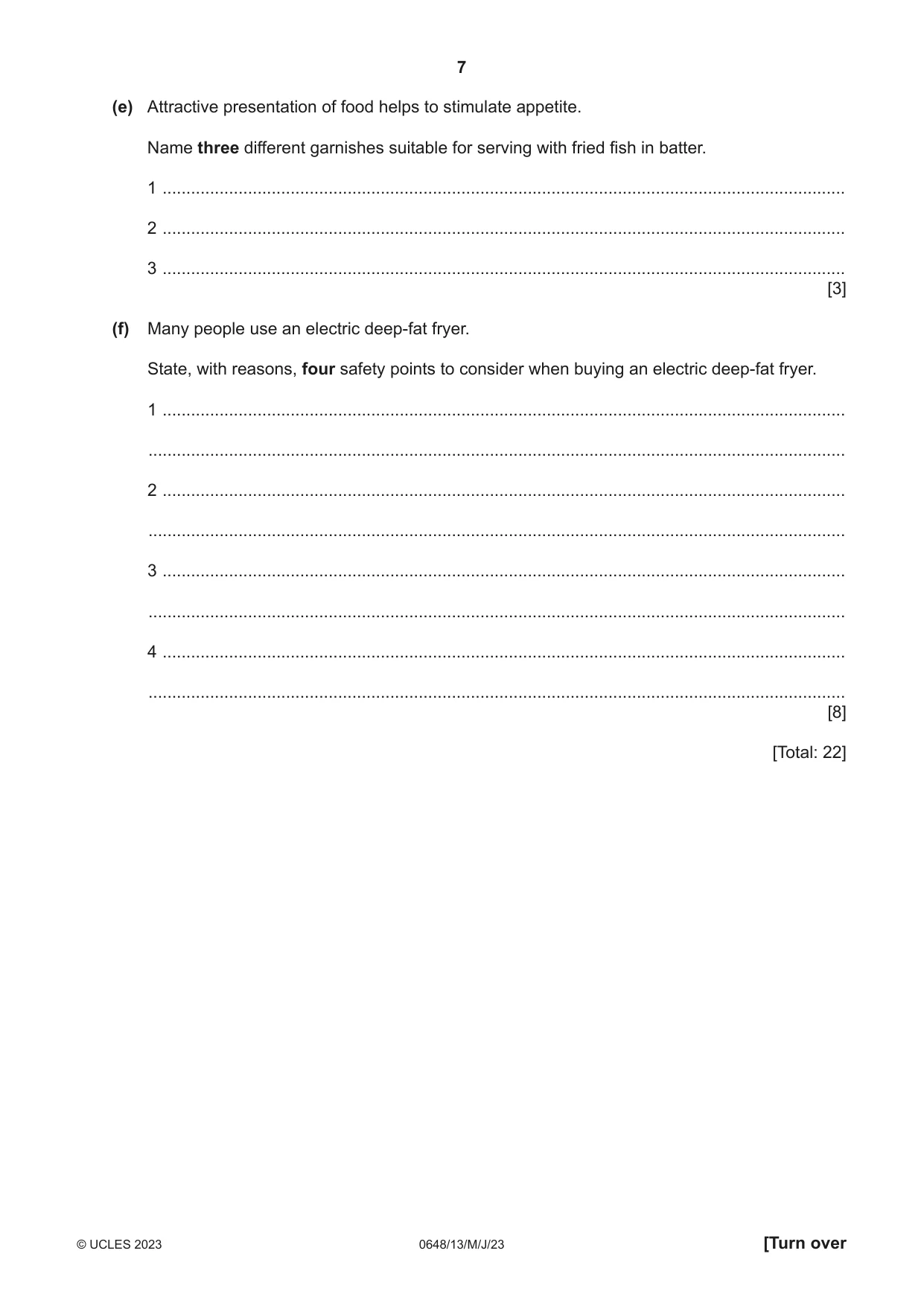
7 0648/13/M/J/23 © UCLES 2023 [Turn over (e) Attractive presentation of food helps to stimulate appetite. Name three different garnishes suitable for serving with fried fish in batter. 1 … 2 … 3 … [3] (f) Many people use an electric deep-fat fryer. State, with reasons, four safety points to consider when buying an electric deep-fat fryer. 1 … … 2 … … 3 … … 4 … … [8] [Total: 22]
Question paper, page 8
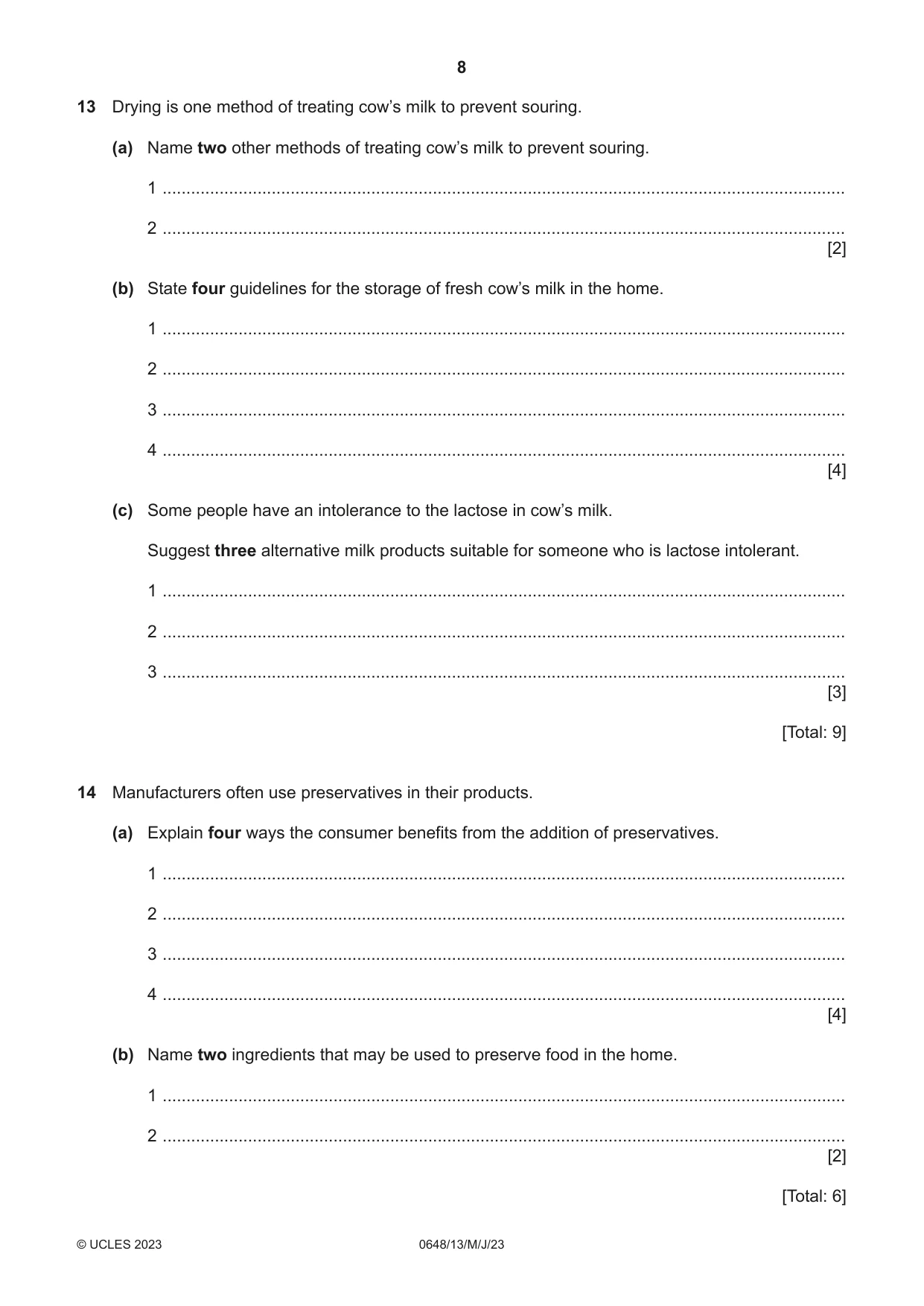
8 0648/13/M/J/23 © UCLES 2023 13 Drying is one method of treating cow’s milk to prevent souring. (a) Name two other methods of treating cow’s milk to prevent souring. 1 … 2 … [2] (b) State four guidelines for the storage of fresh cow’s milk in the home. 1 … 2 … 3 … 4 … [4] (c) Some people have an intolerance to the lactose in cow’s milk. Suggest three alternative milk products suitable for someone who is lactose intolerant. 1 … 2 … 3 … [3] [Total: 9] 14 Manufacturers often use preservatives in their products. (a) Explain four ways the consumer benefits from the addition of preservatives. 1 … 2 … 3 … 4 … [4] (b) Name two ingredients that may be used to preserve food in the home. 1 … 2 … [2] [Total: 6]
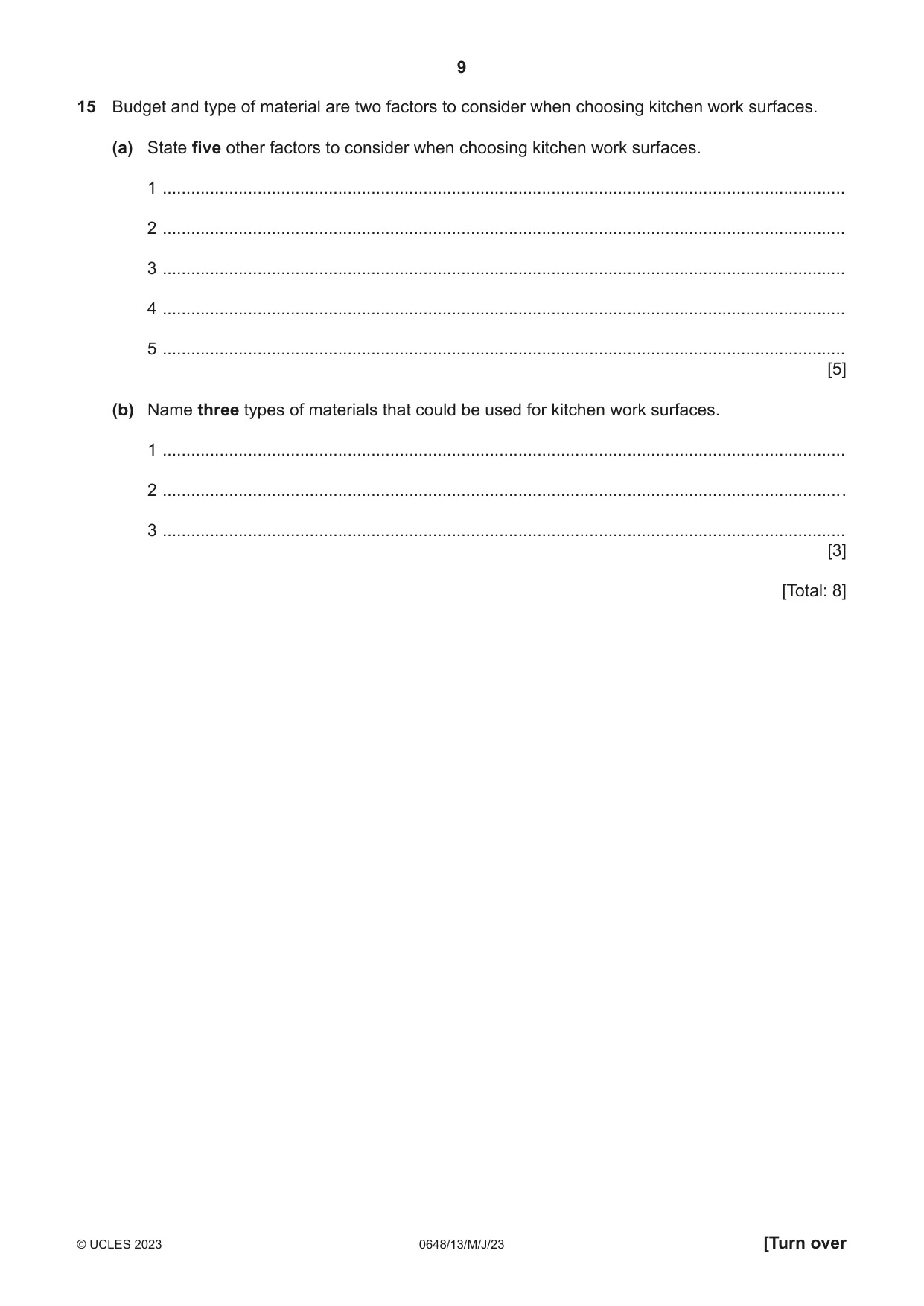
Question paper, page 9
9 0648/13/M/J/23 © UCLES 2023 [Turn over 15 Budget and type of material are two factors to consider when choosing kitchen work surfaces. (a) State five other factors to consider when choosing kitchen work surfaces. 1 … 2 … 3 … 4 … 5 … [5] (b) Name three types of materials that could be used for kitchen work surfaces. 1 … 2 … 3 … [3] [Total: 8]
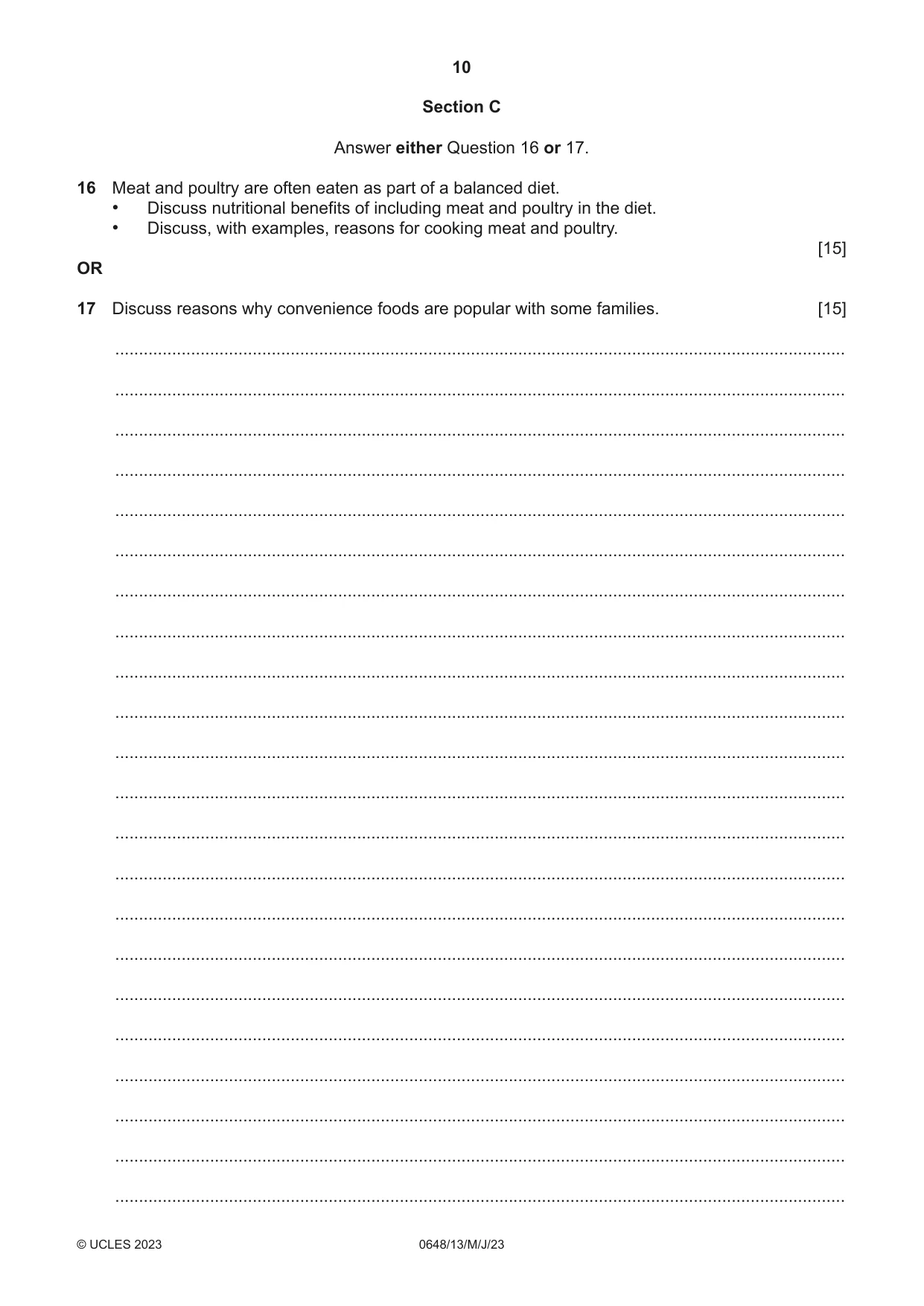
Question paper, page 10
10 0648/13/M/J/23 © UCLES 2023 Section C Answer either Question 16 or 17. 16 Meat and poultry are often eaten as part of a balanced diet. • Discuss nutritional benefits of including meat and poultry in the diet. • Discuss, with examples, reasons for cooking meat and poultry. [15] OR 17 Discuss reasons why convenience foods are popular with some families. [15] … … … … … … … … … … … … … … … … … … … … … …
Question paper, page 11
11 0648/13/M/J/23 © UCLES 2023 [Turn over … … … … … … … … … … … … … … … … … … … … … … … … … … … …
Question paper, page 12
12 0648/13/M/J/23 © UCLES 2023 Permission to reproduce items where third-party owned material protected by copyright is included has been sought and cleared where possible. Every reasonable effort has been made by the publisher (UCLES) to trace copyright holders, but if any items requiring clearance have unwittingly been included, the publisher will be pleased to make amends at the earliest possible opportunity. To avoid the issue of disclosure of answer-related information to candidates, all copyright acknowledgements are reproduced online in the Cambridge Assessment International Education Copyright Acknowledgements Booklet. This is produced for each series of examinations and is freely available to download at www.cambridgeinternational.org after the live examination series. Cambridge Assessment International Education is part of Cambridge Assessment. Cambridge Assessment is the brand name of the University of Cambridge Local Examinations Syndicate (UCLES), which is a department of the University of Cambridge. … … … … … … … … … … … … … … … … … … … … … … …
Mark scheme, page 1
This document consists of 19 printed pages. © UCLES 2023 [Turn over Cambridge IGCSE™ FOOD AND NUTRITION 0648/13 Paper 1 Theory May/June 2023 MARK SCHEME Maximum Mark: 100 Published This mark scheme is published as an aid to teachers and candidates, to indicate the requirements of the examination. It shows the basis on which Examiners were instructed to award marks. It does not indicate the details of the discussions that took place at an Examiners’ meeting before marking began, which would have considered the acceptability of alternative answers. Mark schemes should be read in conjunction with the question paper and the Principal Examiner Report for Teachers. Cambridge International will not enter into discussions about these mark schemes. Cambridge International is publishing the mark schemes for the May/June 2023 series for most Cambridge IGCSE, Cambridge International A and AS Level and Cambridge Pre-U components, and some Cambridge O Level components.
Mark scheme, page 2
0648/13 Cambridge IGCSE – Mark Scheme PUBLISHED May/June 2023 © UCLES 2023 Page 2 of 19 Generic Marking Principles These general marking principles must be applied by all examiners when marking candidate answers. They should be applied alongside the specific content of the mark scheme or generic level descriptors for a question. Each question paper and mark scheme will also comply with these marking principles. GENERIC MARKING PRINCIPLE 1: Marks must be awarded in line with: the specific content of the mark scheme or the generic level descriptors for the question the specific skills defined in the mark scheme or in the generic level descriptors for the question the standard of response required by a candidate as exemplified by the standardisation scripts. GENERIC MARKING PRINCIPLE 2: Marks awarded are always whole marks (not half marks, or other fractions). GENERIC MARKING PRINCIPLE 3: Marks must be awarded positively: marks are awarded for correct/valid answers, as defined in the mark scheme. However, credit is given for valid answers which go beyond the scope of the syllabus and mark scheme, referring to your Team Leader as appropriate marks are awarded when candidates clearly demonstrate what they know and can do marks are not deducted for errors marks are not deducted for omissions answers should only be judged on the quality of spelling, punctuation and grammar when these features are specifically assessed by the question as indicated by the mark scheme. The meaning, however, should be unambiguous. GENERIC MARKING PRINCIPLE 4: Rules must be applied consistently, e.g. in situations where candidates have not followed instructions or in the application of generic level descriptors.
Mark scheme, page 3
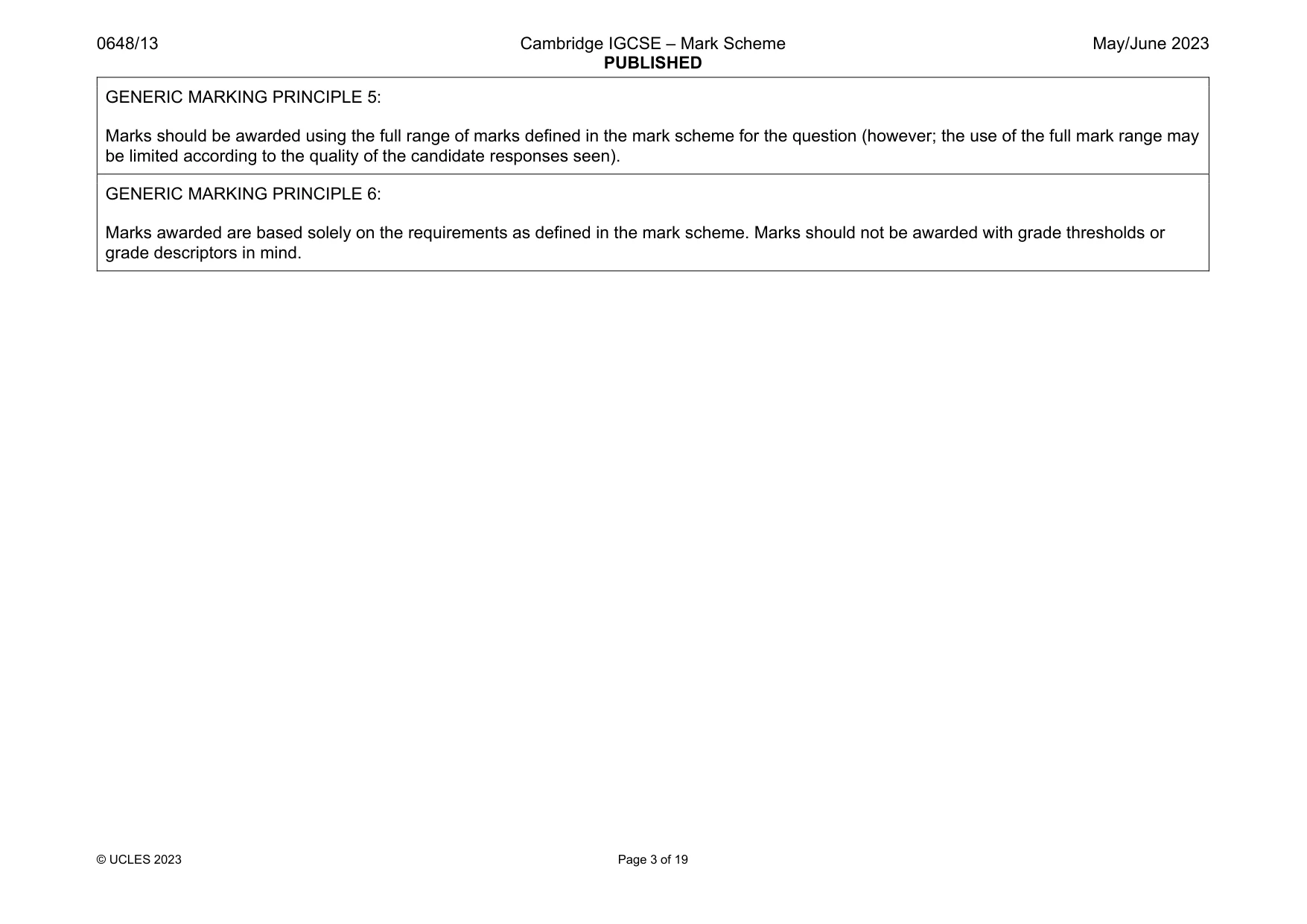
0648/13 Cambridge IGCSE – Mark Scheme PUBLISHED May/June 2023 © UCLES 2023 Page 3 of 19 GENERIC MARKING PRINCIPLE 5: Marks should be awarded using the full range of marks defined in the mark scheme for the question (however; the use of the full mark range may be limited according to the quality of the candidate responses seen). GENERIC MARKING PRINCIPLE 6: Marks awarded are based solely on the requirements as defined in the mark scheme. Marks should not be awarded with grade thresholds or grade descriptors in mind.
Mark scheme, page 4
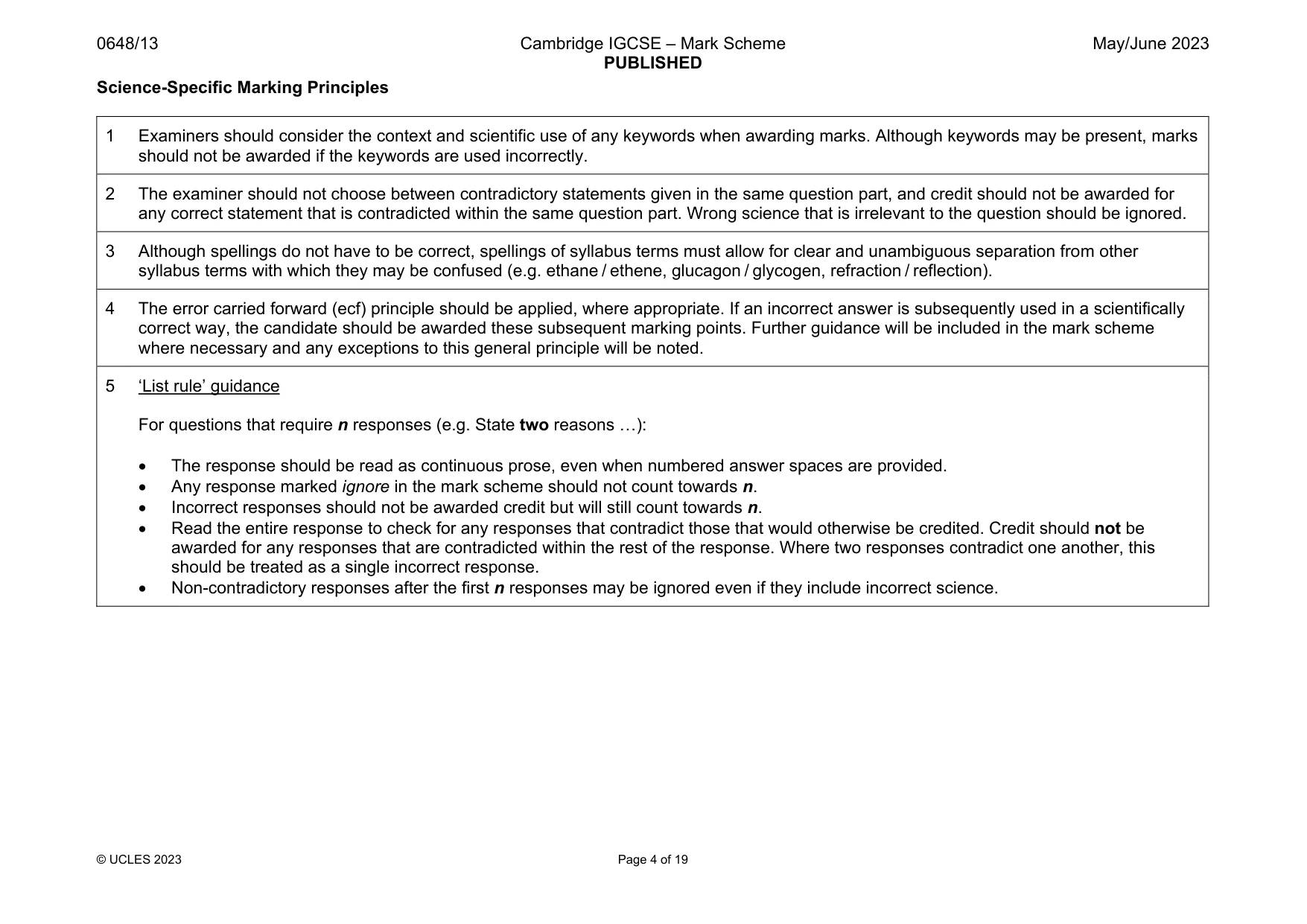
0648/13 Cambridge IGCSE – Mark Scheme PUBLISHED May/June 2023 © UCLES 2023 Page 4 of 19 Science-Specific Marking Principles 1 Examiners should consider the context and scientific use of any keywords when awarding marks. Although keywords may be present, marks should not be awarded if the keywords are used incorrectly. 2 The examiner should not choose between contradictory statements given in the same question part, and credit should not be awarded for any correct statement that is contradicted within the same question part. Wrong science that is irrelevant to the question should be ignored. 3 Although spellings do not have to be correct, spellings of syllabus terms must allow for clear and unambiguous separation from other syllabus terms with which they may be confused (e.g. ethane / ethene, glucagon / glycogen, refraction / reflection). 4 The error carried forward (ecf) principle should be applied, where appropriate. If an incorrect answer is subsequently used in a scientifically correct way, the candidate should be awarded these subsequent marking points. Further guidance will be included in the mark scheme where necessary and any exceptions to this general principle will be noted. 5 ‘List rule’ guidance For questions that require n responses (e.g. State two reasons …): The response should be read as continuous prose, even when numbered answer spaces are provided. Any response marked ignore in the mark scheme should not count towards n. Incorrect responses should not be awarded credit but will still count towards n. Read the entire response to check for any responses that contradict those that would otherwise be credited. Credit should not be awarded for any responses that are contradicted within the rest of the response. Where two responses contradict one another, this should be treated as a single incorrect response. Non-contradictory responses after the first n responses may be ignored even if they include incorrect science.
Mark scheme, page 5
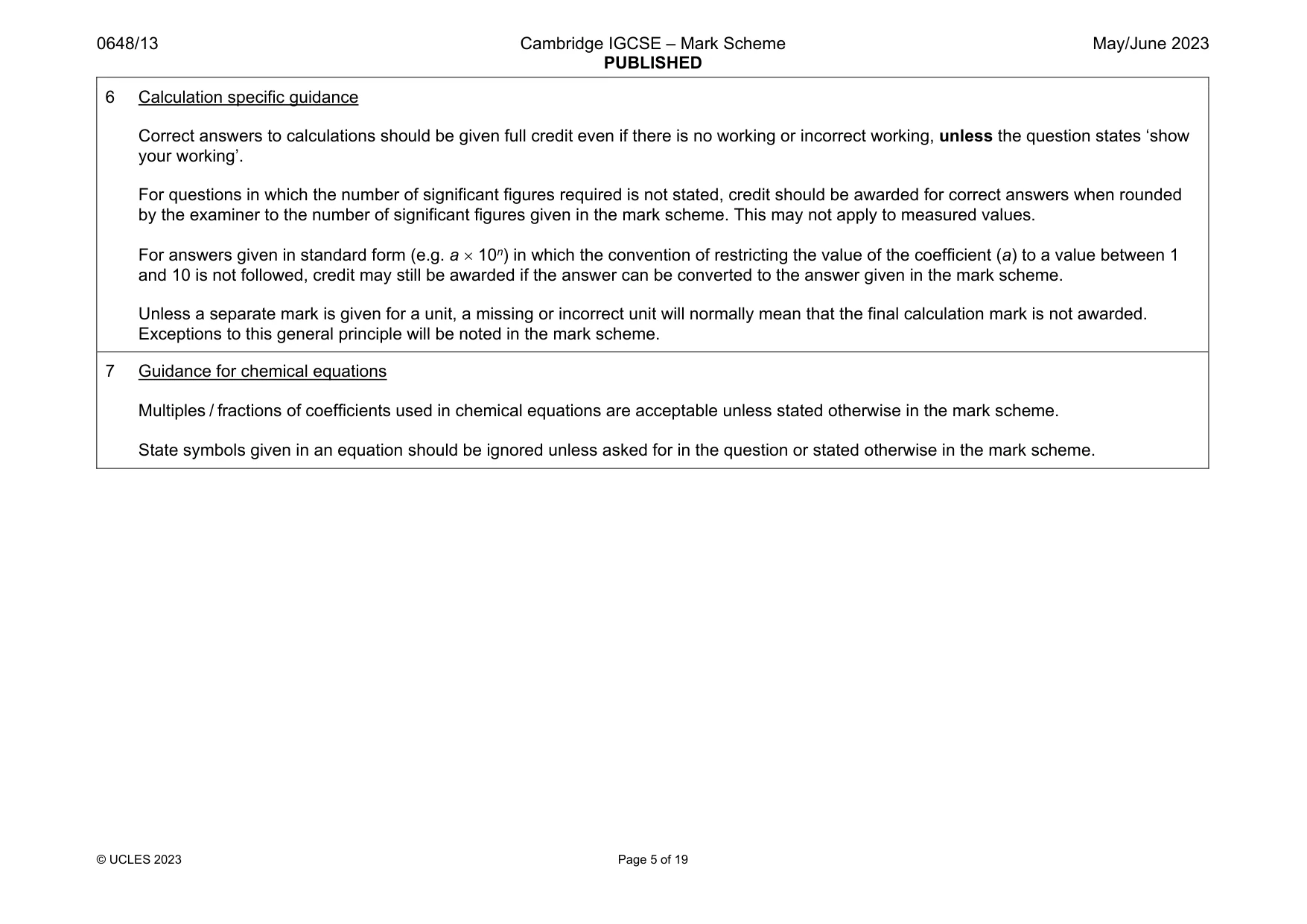
0648/13 Cambridge IGCSE – Mark Scheme PUBLISHED May/June 2023 © UCLES 2023 Page 5 of 19 6 Calculation specific guidance Correct answers to calculations should be given full credit even if there is no working or incorrect working, unless the question states ‘show your working’. For questions in which the number of significant figures required is not stated, credit should be awarded for correct answers when rounded by the examiner to the number of significant figures given in the mark scheme. This may not apply to measured values. For answers given in standard form (e.g. a 10n) in which the convention of restricting the value of the coefficient (a) to a value between 1 and 10 is not followed, credit may still be awarded if the answer can be converted to the answer given in the mark scheme. Unless a separate mark is given for a unit, a missing or incorrect unit will normally mean that the final calculation mark is not awarded. Exceptions to this general principle will be noted in the mark scheme. 7 Guidance for chemical equations Multiples / fractions of coefficients used in chemical equations are acceptable unless stated otherwise in the mark scheme. State symbols given in an equation should be ignored unless asked for in the question or stated otherwise in the mark scheme.
Mark scheme, page 6
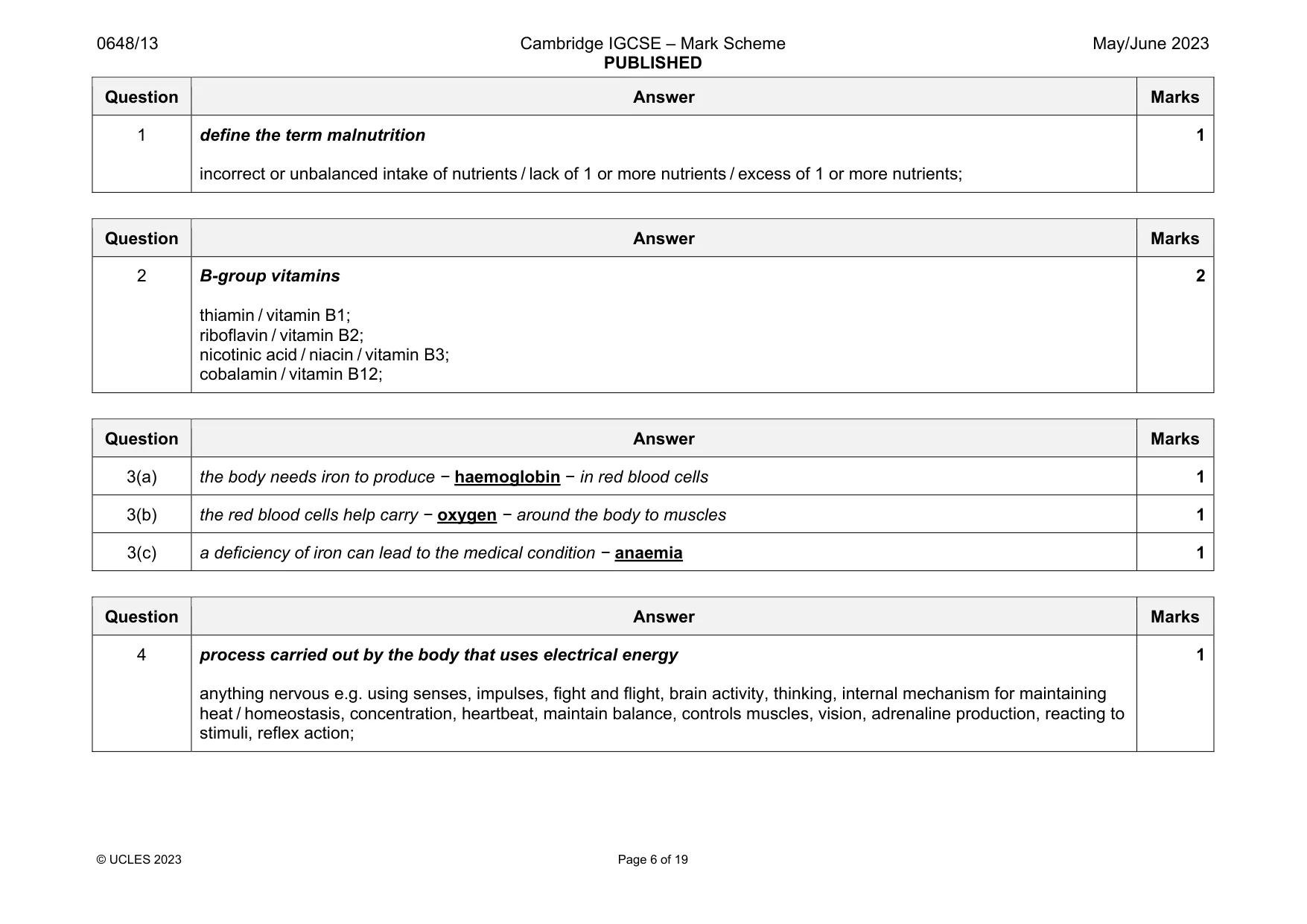
0648/13 Cambridge IGCSE – Mark Scheme PUBLISHED May/June 2023 © UCLES 2023 Page 6 of 19 Question Answer Marks 1 define the term malnutrition incorrect or unbalanced intake of nutrients / lack of 1 or more nutrients / excess of 1 or more nutrients; 1 Question Answer Marks 2 B-group vitamins thiamin / vitamin B1; riboflavin / vitamin B2; nicotinic acid / niacin / vitamin B3; cobalamin / vitamin B12; 2 Question Answer Marks 3(a) the body needs iron to produce − haemoglobin − in red blood cells 1 3(b) the red blood cells help carry − oxygen − around the body to muscles 1 3(c) a deficiency of iron can lead to the medical condition − anaemia 1 Question Answer Marks 4 process carried out by the body that uses electrical energy anything nervous e.g. using senses, impulses, fight and flight, brain activity, thinking, internal mechanism for maintaining heat / homeostasis, concentration, heartbeat, maintain balance, controls muscles, vision, adrenaline production, reacting to stimuli, reflex action; 1
Mark scheme, page 7
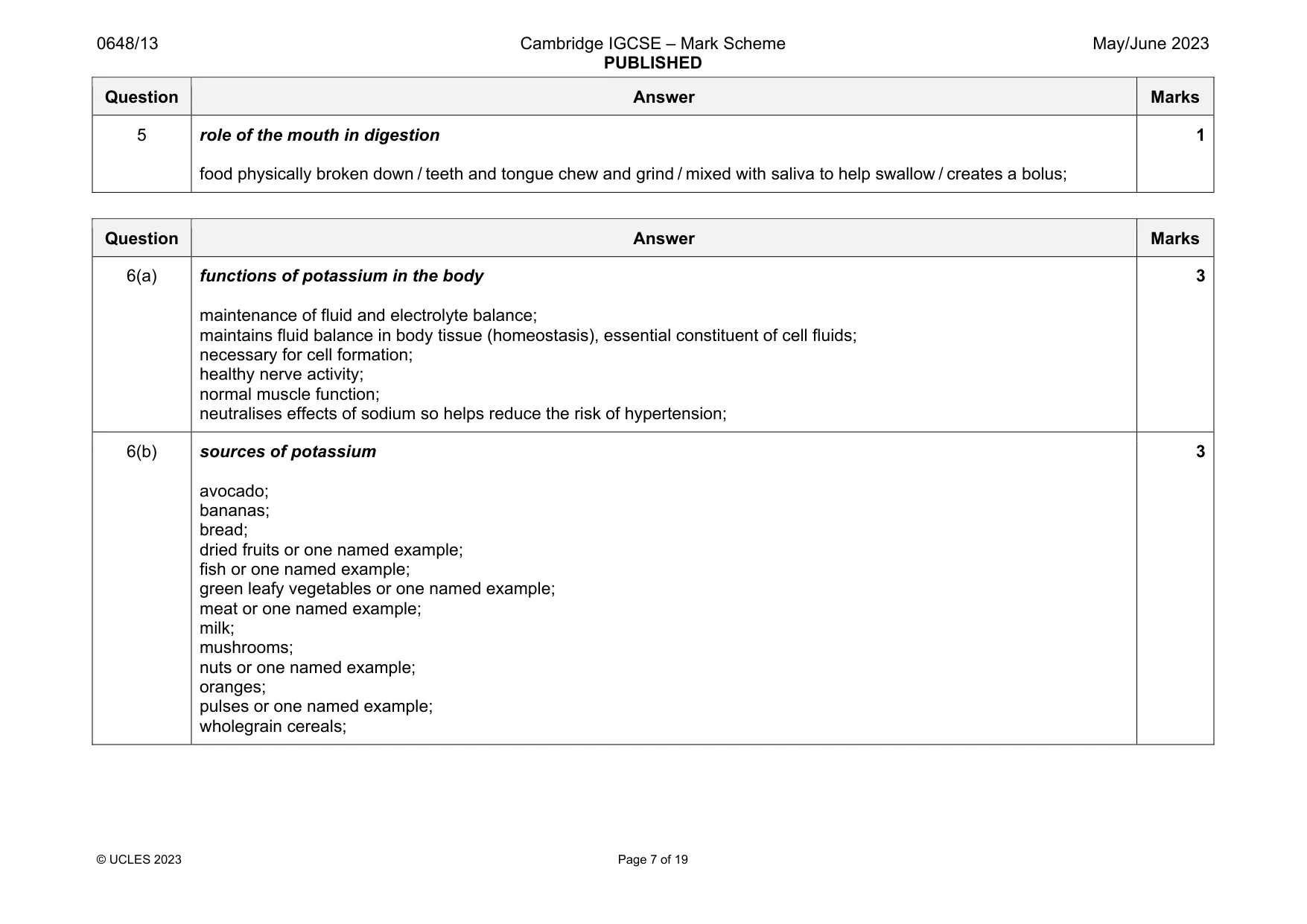
0648/13 Cambridge IGCSE – Mark Scheme PUBLISHED May/June 2023 © UCLES 2023 Page 7 of 19 Question Answer Marks 5 role of the mouth in digestion food physically broken down / teeth and tongue chew and grind / mixed with saliva to help swallow / creates a bolus; 1 Question Answer Marks 6(a) functions of potassium in the body maintenance of fluid and electrolyte balance; maintains fluid balance in body tissue (homeostasis), essential constituent of cell fluids; necessary for cell formation; healthy nerve activity; normal muscle function; neutralises effects of sodium so helps reduce the risk of hypertension; 3 6(b) sources of potassium avocado; bananas; bread; dried fruits or one named example; fish or one named example; green leafy vegetables or one named example; meat or one named example; milk; mushrooms; nuts or one named example; oranges; pulses or one named example; wholegrain cereals; 3
Mark scheme, page 8
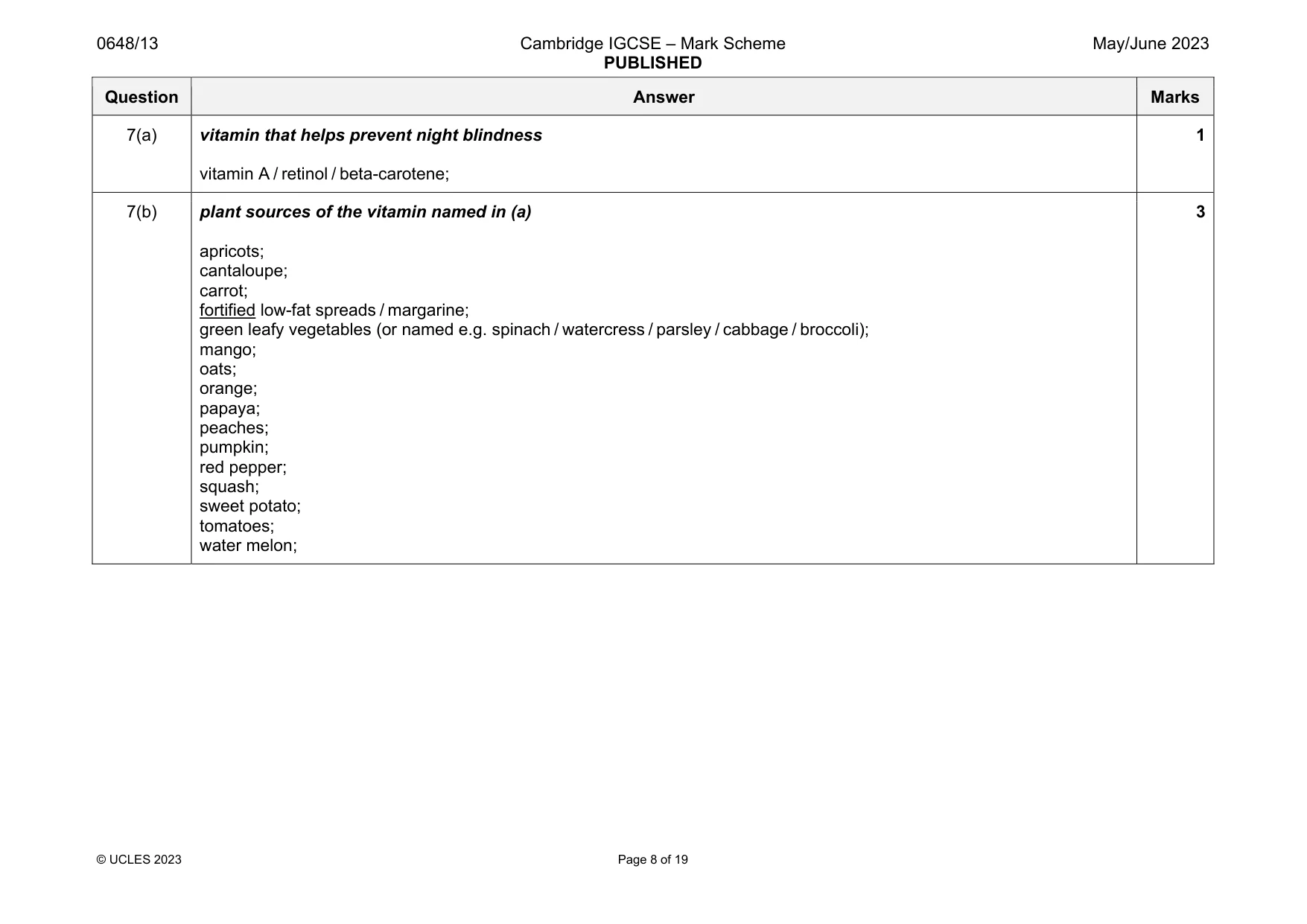
0648/13 Cambridge IGCSE – Mark Scheme PUBLISHED May/June 2023 © UCLES 2023 Page 8 of 19 Question Answer Marks 7(a) vitamin that helps prevent night blindness vitamin A / retinol / beta-carotene; 1 7(b) plant sources of the vitamin named in (a) apricots; cantaloupe; carrot; fortified low-fat spreads / margarine; green leafy vegetables (or named e.g. spinach / watercress / parsley / cabbage / broccoli); mango; oats; orange; papaya; peaches; pumpkin; red pepper; squash; sweet potato; tomatoes; water melon; 3
Mark scheme, page 9
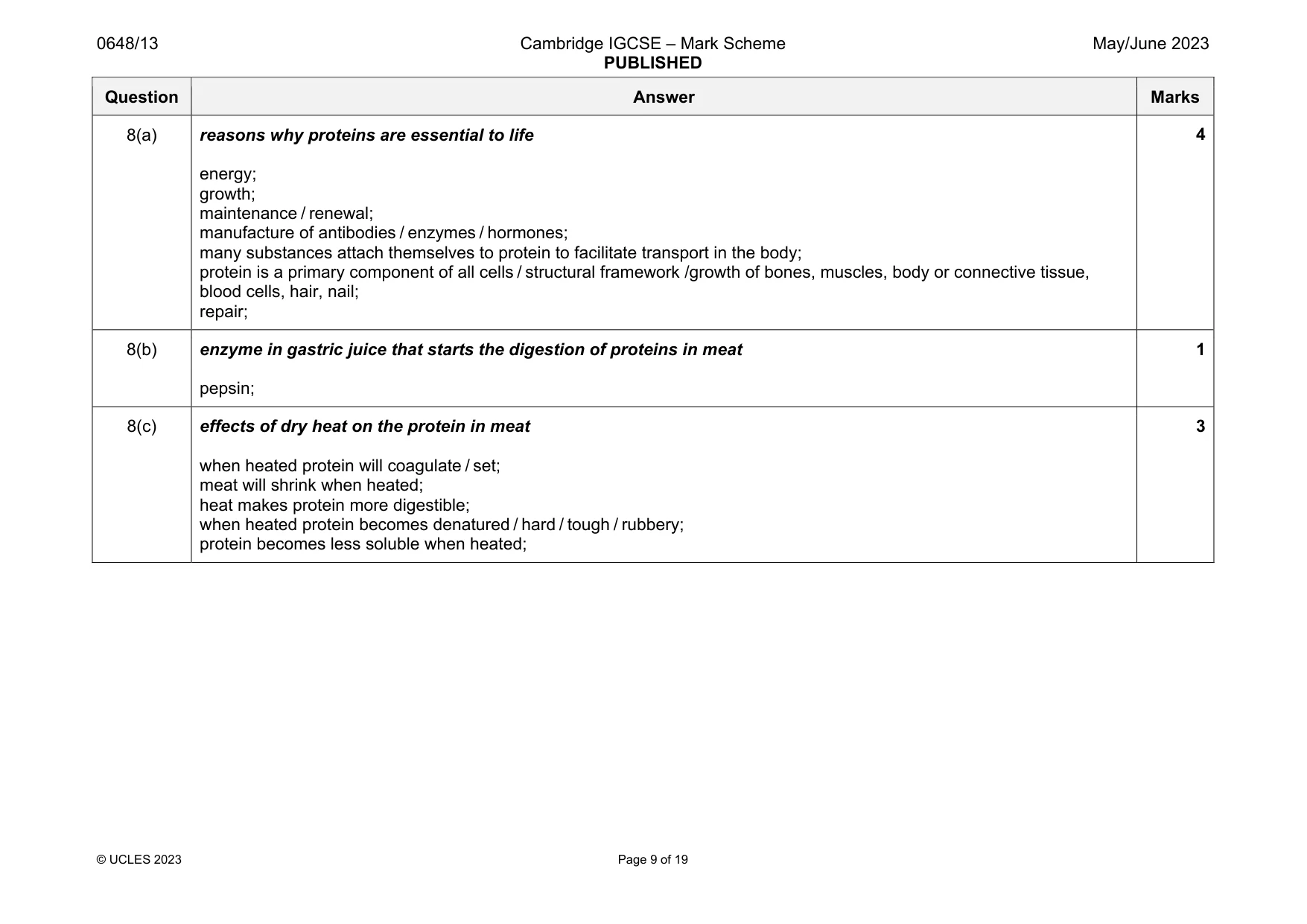
0648/13 Cambridge IGCSE – Mark Scheme PUBLISHED May/June 2023 © UCLES 2023 Page 9 of 19 Question Answer Marks 8(a) reasons why proteins are essential to life energy; growth; maintenance / renewal; manufacture of antibodies / enzymes / hormones; many substances attach themselves to protein to facilitate transport in the body; protein is a primary component of all cells / structural framework /growth of bones, muscles, body or connective tissue, blood cells, hair, nail; repair; 4 8(b) enzyme in gastric juice that starts the digestion of proteins in meat pepsin; 1 8(c) effects of dry heat on the protein in meat when heated protein will coagulate / set; meat will shrink when heated; heat makes protein more digestible; when heated protein becomes denatured / hard / tough / rubbery; protein becomes less soluble when heated; 3
Mark scheme, page 10
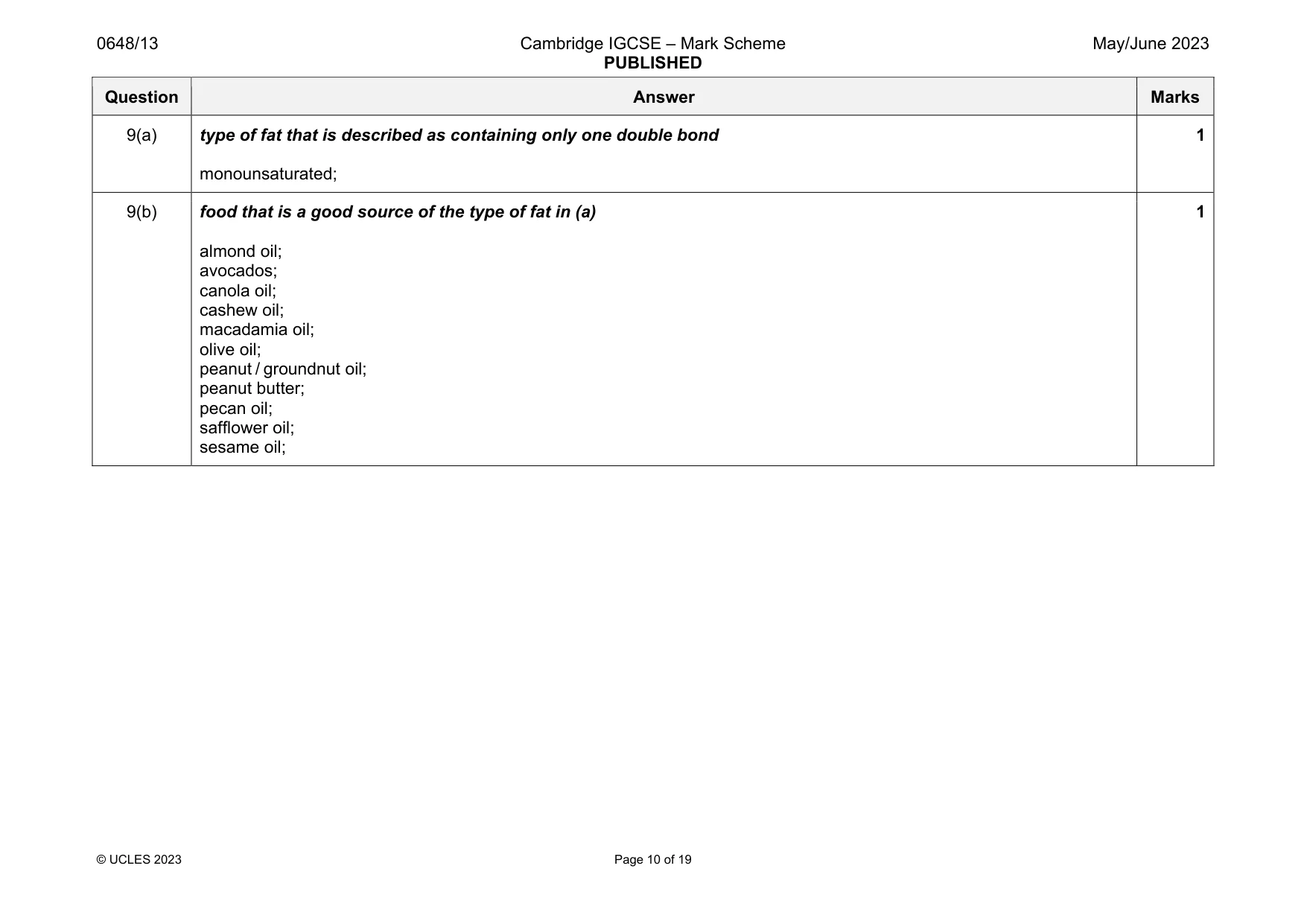
0648/13 Cambridge IGCSE – Mark Scheme PUBLISHED May/June 2023 © UCLES 2023 Page 10 of 19 Question Answer Marks 9(a) type of fat that is described as containing only one double bond monounsaturated; 1 9(b) food that is a good source of the type of fat in (a) almond oil; avocados; canola oil; cashew oil; macadamia oil; olive oil; peanut / groundnut oil; peanut butter; pecan oil; safflower oil; sesame oil; 1
Mark scheme, page 11
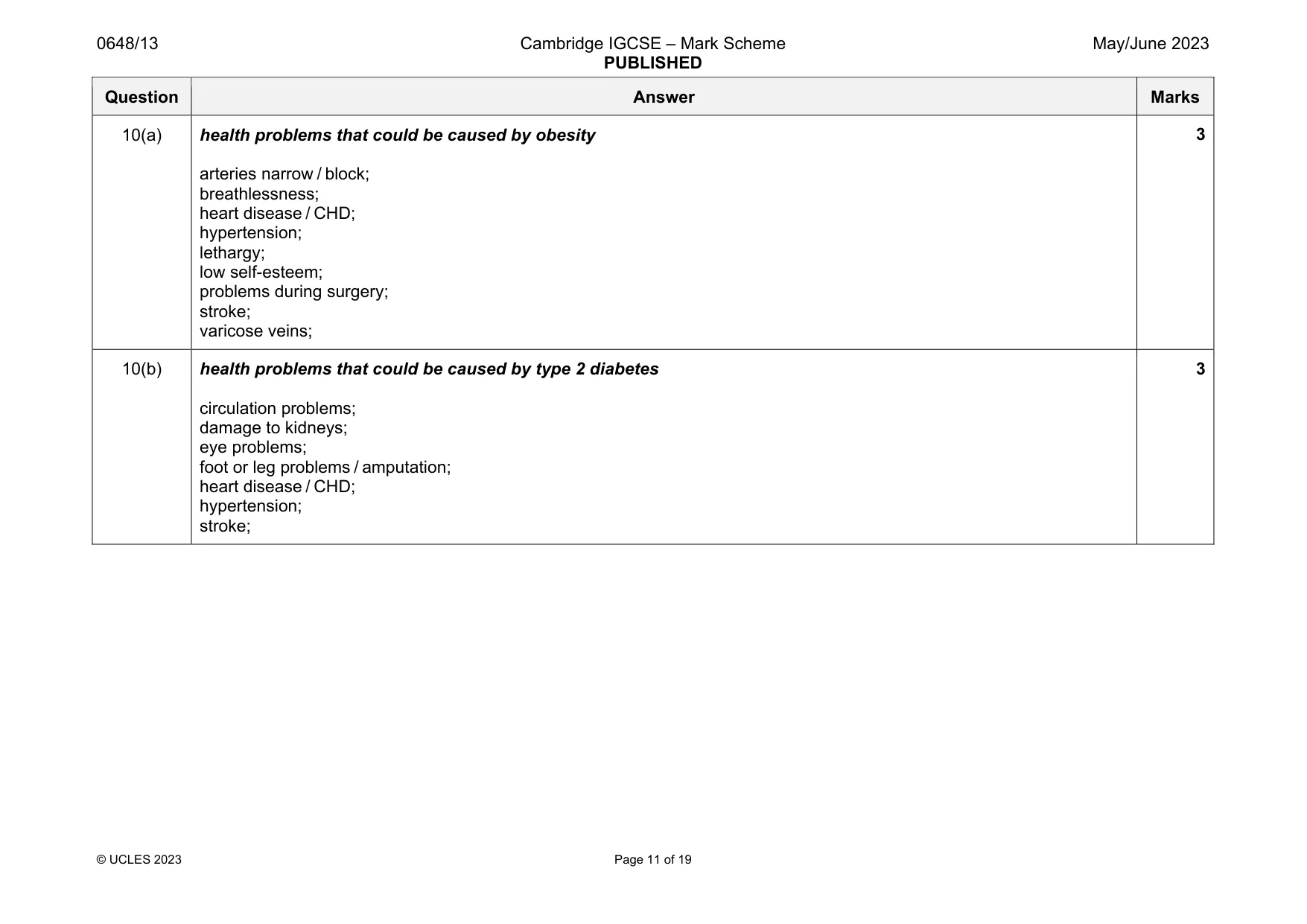
0648/13 Cambridge IGCSE – Mark Scheme PUBLISHED May/June 2023 © UCLES 2023 Page 11 of 19 Question Answer Marks 10(a) health problems that could be caused by obesity arteries narrow / block; breathlessness; heart disease / CHD; hypertension; lethargy; low self-esteem; problems during surgery; stroke; varicose veins; 3 10(b) health problems that could be caused by type 2 diabetes circulation problems; damage to kidneys; eye problems; foot or leg problems / amputation; heart disease / CHD; hypertension; stroke; 3
Mark scheme, page 12
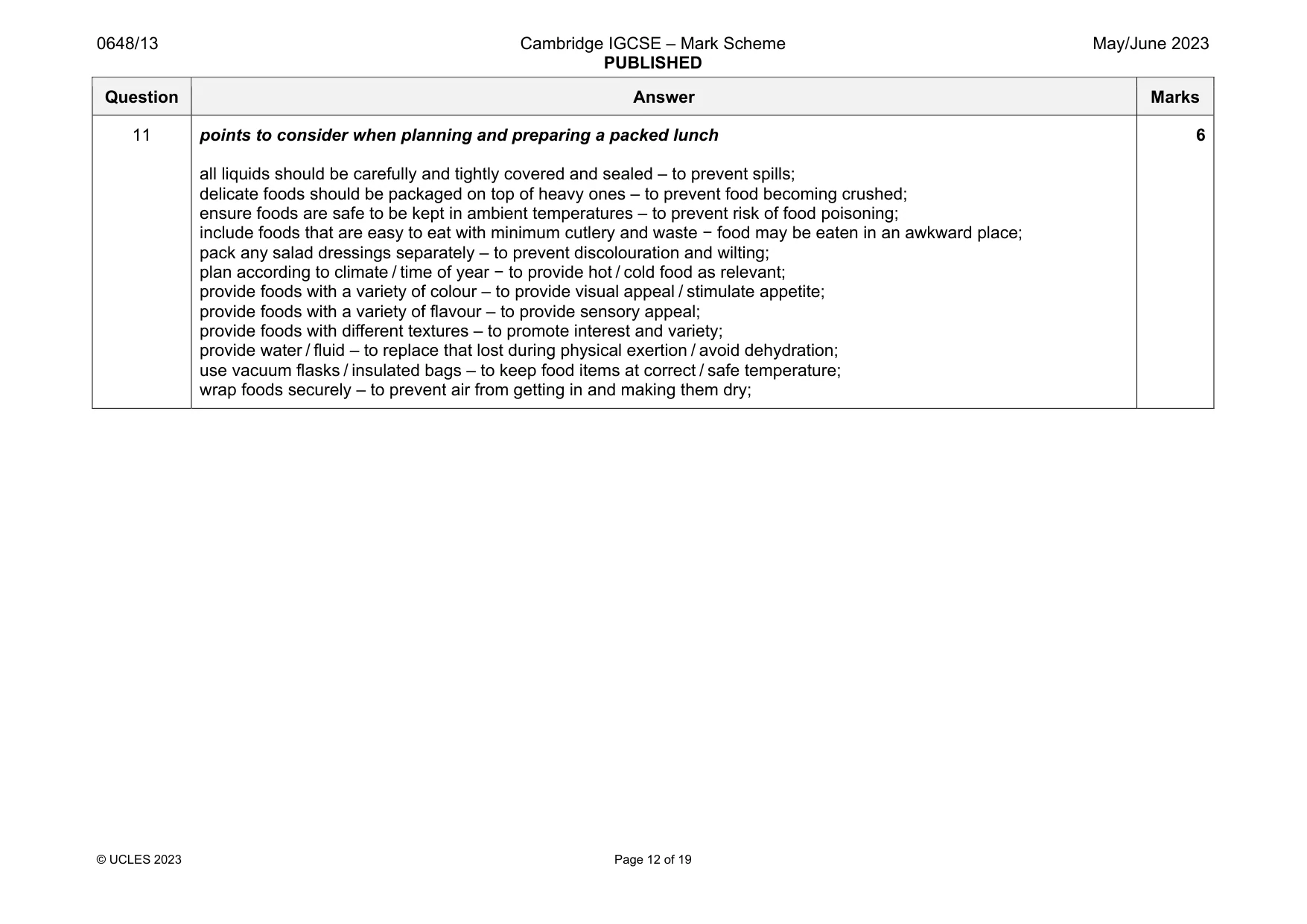
0648/13 Cambridge IGCSE – Mark Scheme PUBLISHED May/June 2023 © UCLES 2023 Page 12 of 19 Question Answer Marks 11 points to consider when planning and preparing a packed lunch all liquids should be carefully and tightly covered and sealed – to prevent spills; delicate foods should be packaged on top of heavy ones – to prevent food becoming crushed; ensure foods are safe to be kept in ambient temperatures – to prevent risk of food poisoning; include foods that are easy to eat with minimum cutlery and waste − food may be eaten in an awkward place; pack any salad dressings separately – to prevent discolouration and wilting; plan according to climate / time of year − to provide hot / cold food as relevant; provide foods with a variety of colour – to provide visual appeal / stimulate appetite; provide foods with a variety of flavour – to provide sensory appeal; provide foods with different textures – to promote interest and variety; provide water / fluid – to replace that lost during physical exertion / avoid dehydration; use vacuum flasks / insulated bags – to keep food items at correct / safe temperature; wrap foods securely – to prevent air from getting in and making them dry; 6
Mark scheme, page 13
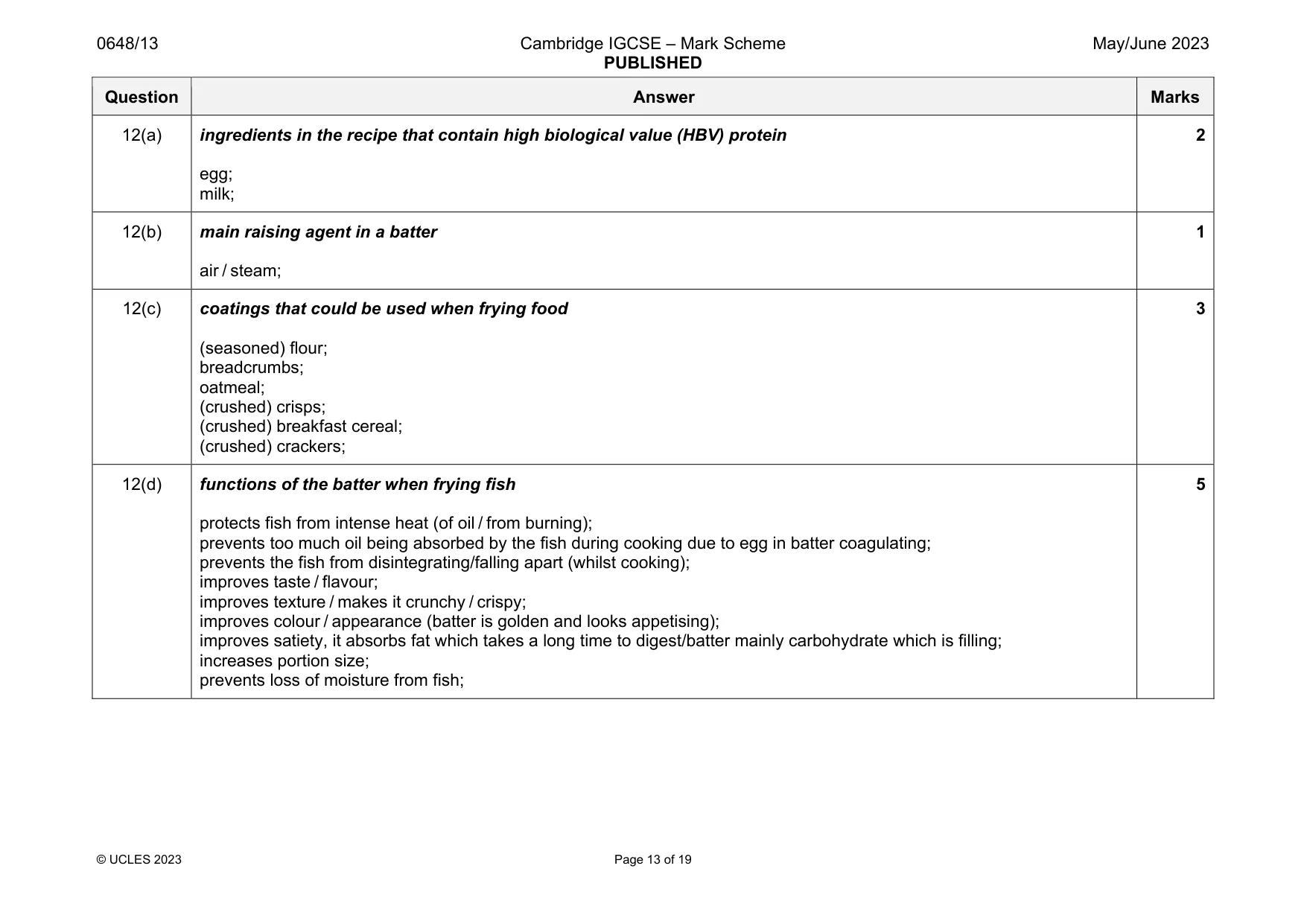
0648/13 Cambridge IGCSE – Mark Scheme PUBLISHED May/June 2023 © UCLES 2023 Page 13 of 19 Question Answer Marks 12(a) ingredients in the recipe that contain high biological value (HBV) protein egg; milk; 2 12(b) main raising agent in a batter air / steam; 1 12(c) coatings that could be used when frying food (seasoned) flour; breadcrumbs; oatmeal; (crushed) crisps; (crushed) breakfast cereal; (crushed) crackers; 3 12(d) functions of the batter when frying fish protects fish from intense heat (of oil / from burning); prevents too much oil being absorbed by the fish during cooking due to egg in batter coagulating; prevents the fish from disintegrating/falling apart (whilst cooking); improves taste / flavour; improves texture / makes it crunchy / crispy; improves colour / appearance (batter is golden and looks appetising); improves satiety, it absorbs fat which takes a long time to digest/batter mainly carbohydrate which is filling; increases portion size; prevents loss of moisture from fish; 5
Mark scheme, page 14
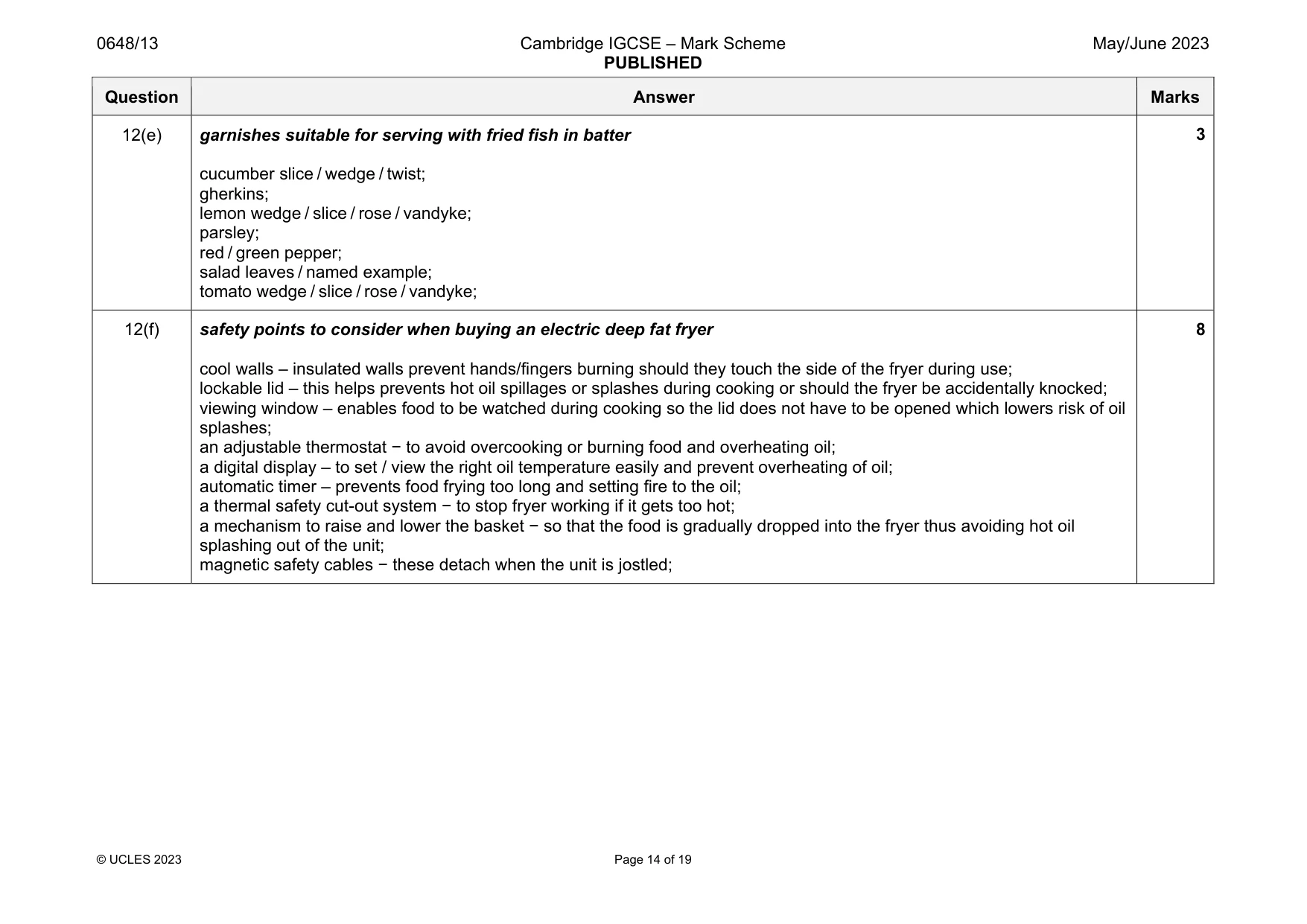
0648/13 Cambridge IGCSE – Mark Scheme PUBLISHED May/June 2023 © UCLES 2023 Page 14 of 19 Question Answer Marks 12(e) garnishes suitable for serving with fried fish in batter cucumber slice / wedge / twist; gherkins; lemon wedge / slice / rose / vandyke; parsley; red / green pepper; salad leaves / named example; tomato wedge / slice / rose / vandyke; 3 12(f) safety points to consider when buying an electric deep fat fryer cool walls – insulated walls prevent hands/fingers burning should they touch the side of the fryer during use; lockable lid – this helps prevents hot oil spillages or splashes during cooking or should the fryer be accidentally knocked; viewing window – enables food to be watched during cooking so the lid does not have to be opened which lowers risk of oil splashes; an adjustable thermostat − to avoid overcooking or burning food and overheating oil; a digital display – to set / view the right oil temperature easily and prevent overheating of oil; automatic timer – prevents food frying too long and setting fire to the oil; a thermal safety cut-out system − to stop fryer working if it gets too hot; a mechanism to raise and lower the basket − so that the food is gradually dropped into the fryer thus avoiding hot oil splashing out of the unit; magnetic safety cables − these detach when the unit is jostled; 8
Mark scheme, page 15
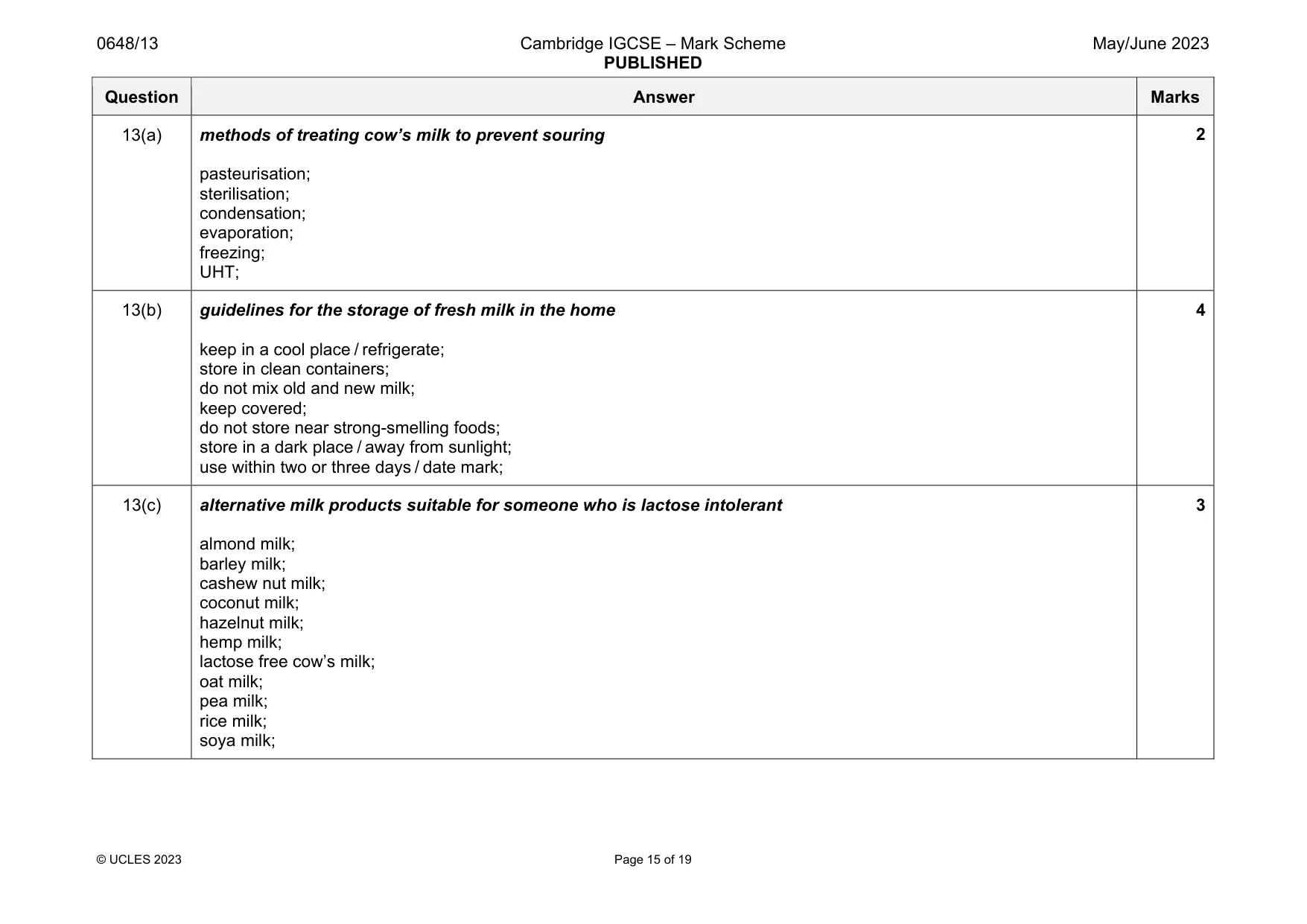
0648/13 Cambridge IGCSE – Mark Scheme PUBLISHED May/June 2023 © UCLES 2023 Page 15 of 19 Question Answer Marks 13(a) methods of treating cow’s milk to prevent souring pasteurisation; sterilisation; condensation; evaporation; freezing; UHT; 2 13(b) guidelines for the storage of fresh milk in the home keep in a cool place / refrigerate; store in clean containers; do not mix old and new milk; keep covered; do not store near strong-smelling foods; store in a dark place / away from sunlight; use within two or three days / date mark; 4 13(c) alternative milk products suitable for someone who is lactose intolerant almond milk; barley milk; cashew nut milk; coconut milk; hazelnut milk; hemp milk; lactose free cow’s milk; oat milk; pea milk; rice milk; soya milk; 3
Mark scheme, page 16
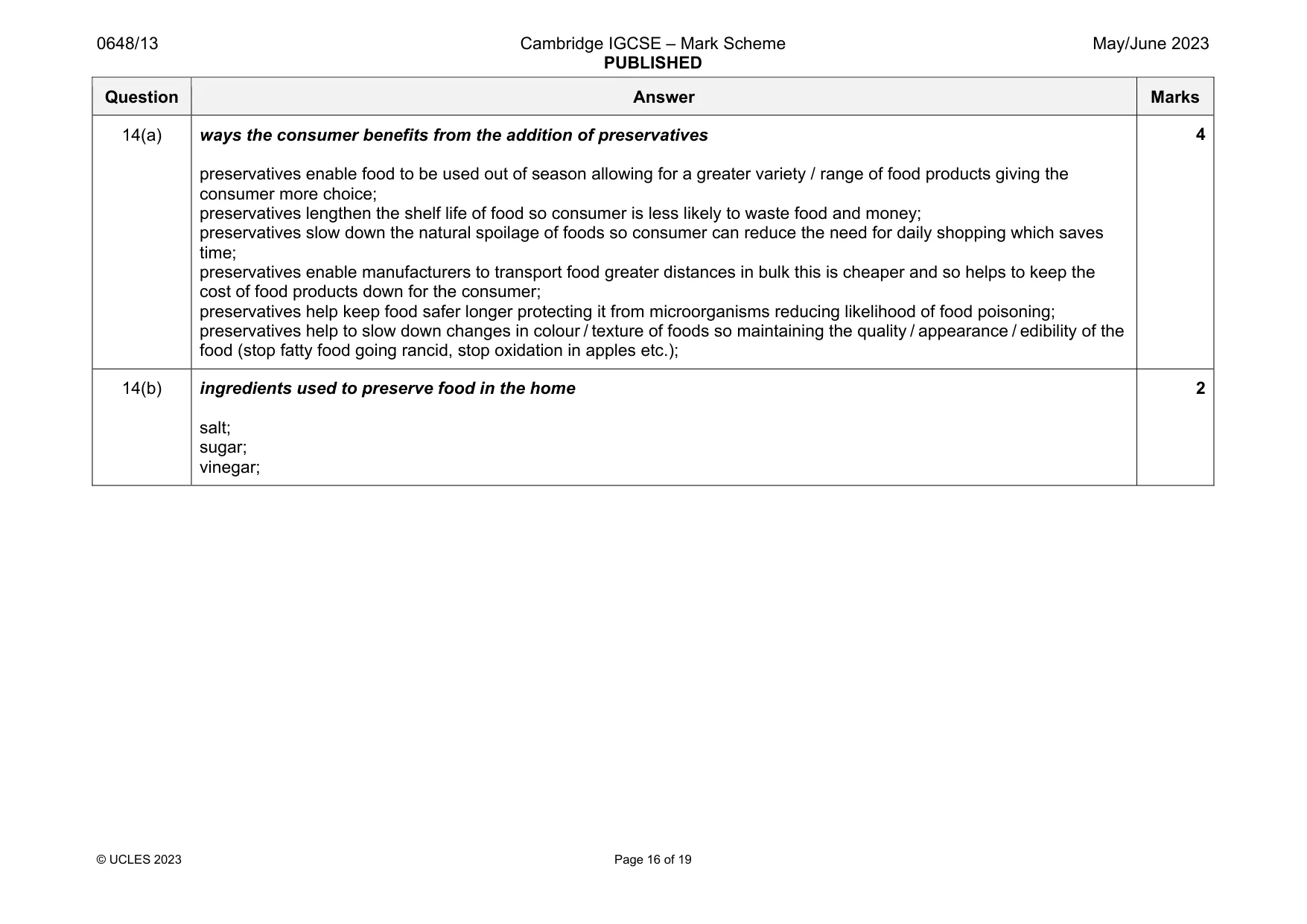
0648/13 Cambridge IGCSE – Mark Scheme PUBLISHED May/June 2023 © UCLES 2023 Page 16 of 19 Question Answer Marks 14(a) ways the consumer benefits from the addition of preservatives preservatives enable food to be used out of season allowing for a greater variety / range of food products giving the consumer more choice; preservatives lengthen the shelf life of food so consumer is less likely to waste food and money; preservatives slow down the natural spoilage of foods so consumer can reduce the need for daily shopping which saves time; preservatives enable manufacturers to transport food greater distances in bulk this is cheaper and so helps to keep the cost of food products down for the consumer; preservatives help keep food safer longer protecting it from microorganisms reducing likelihood of food poisoning; preservatives help to slow down changes in colour / texture of foods so maintaining the quality / appearance / edibility of the food (stop fatty food going rancid, stop oxidation in apples etc.); 4 14(b) ingredients used to preserve food in the home salt; sugar; vinegar; 2
Mark scheme, page 17
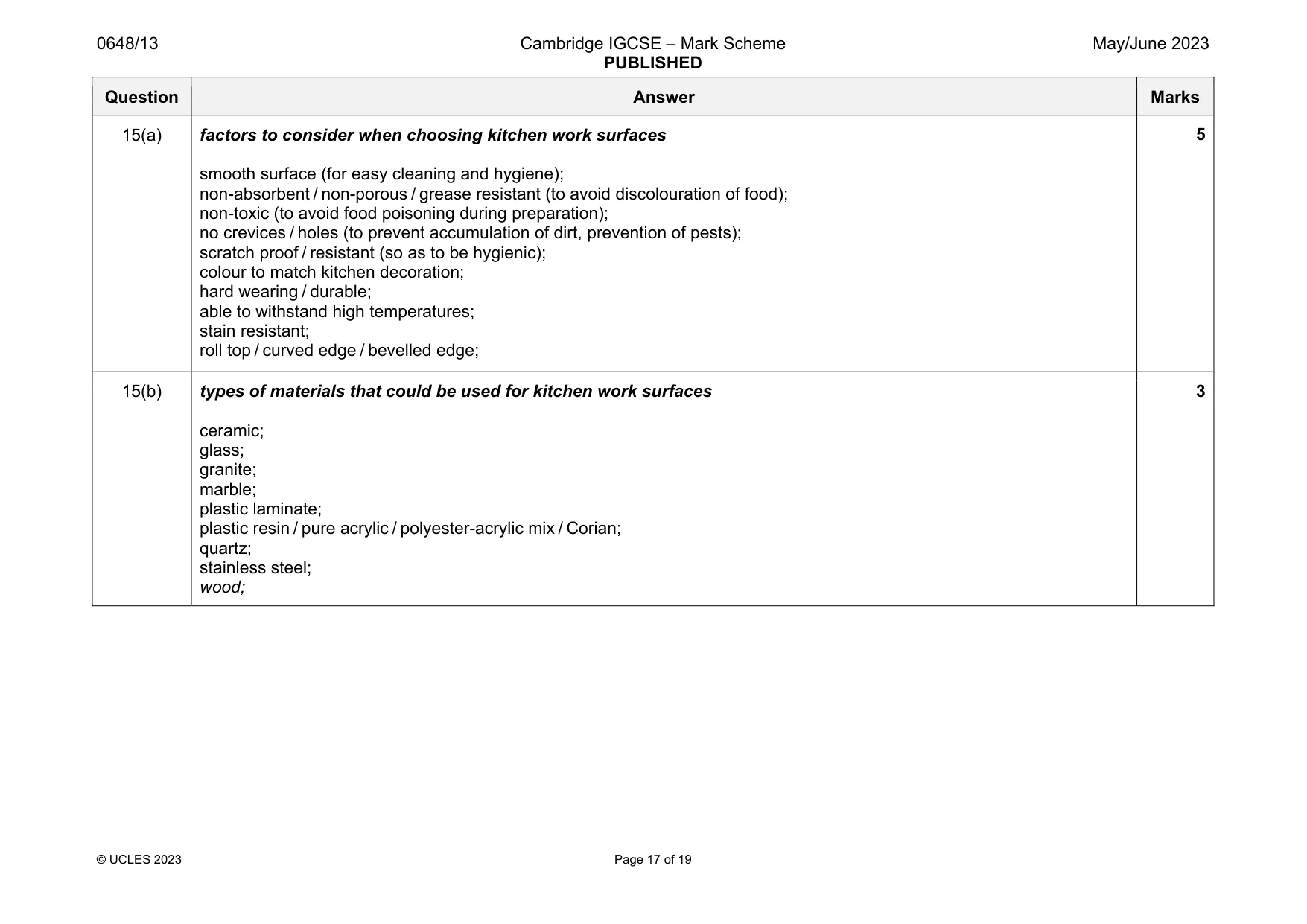
0648/13 Cambridge IGCSE – Mark Scheme PUBLISHED May/June 2023 © UCLES 2023 Page 17 of 19 Question Answer Marks 15(a) factors to consider when choosing kitchen work surfaces smooth surface (for easy cleaning and hygiene); non-absorbent / non-porous / grease resistant (to avoid discolouration of food); non-toxic (to avoid food poisoning during preparation); no crevices / holes (to prevent accumulation of dirt, prevention of pests); scratch proof / resistant (so as to be hygienic); colour to match kitchen decoration; hard wearing / durable; able to withstand high temperatures; stain resistant; roll top / curved edge / bevelled edge; 5 15(b) types of materials that could be used for kitchen work surfaces ceramic; glass; granite; marble; plastic laminate; plastic resin / pure acrylic / polyester-acrylic mix / Corian; quartz; stainless steel; wood; 3
Mark scheme, page 18
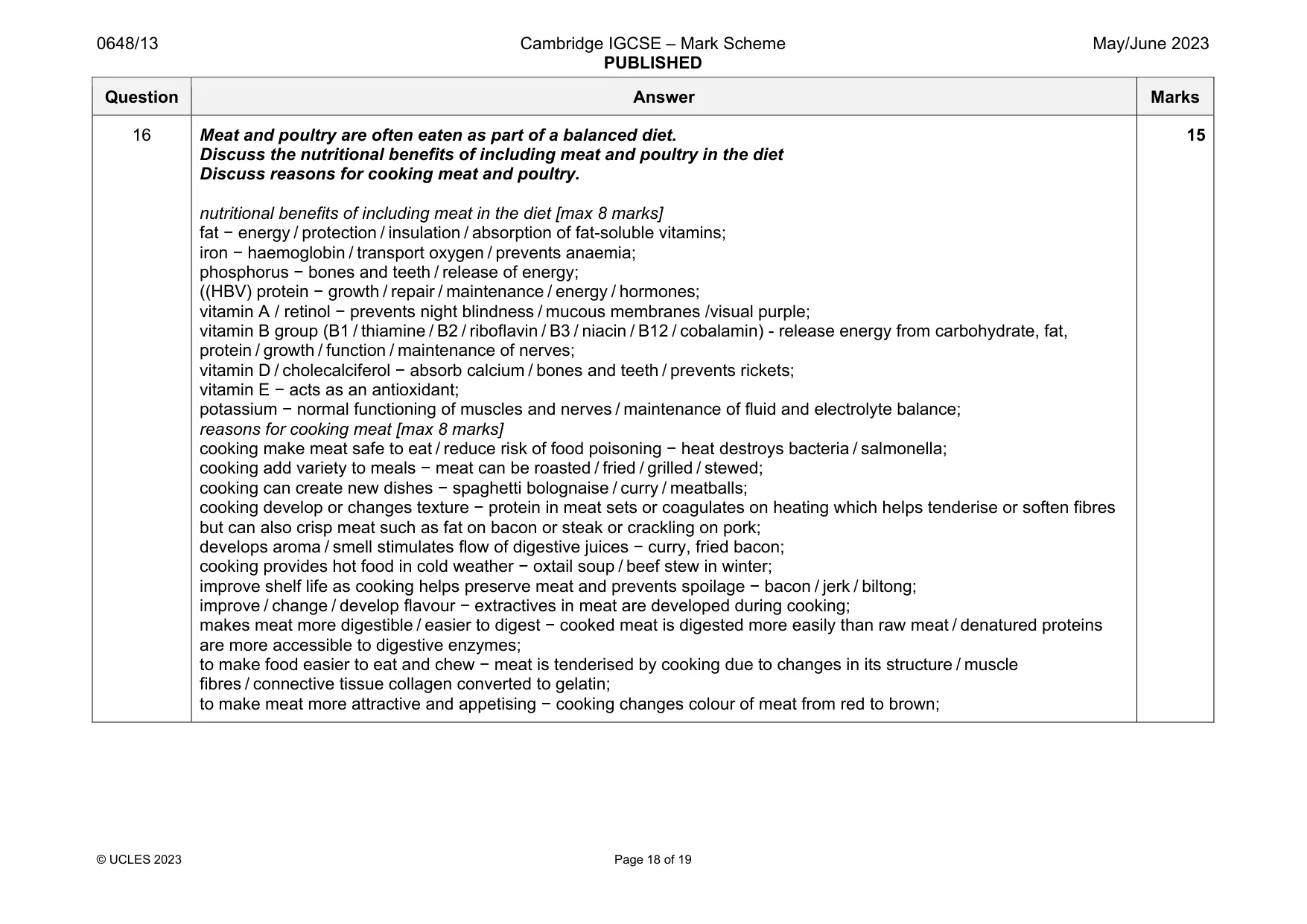
0648/13 Cambridge IGCSE – Mark Scheme PUBLISHED May/June 2023 © UCLES 2023 Page 18 of 19 Question Answer Marks 16 Meat and poultry are often eaten as part of a balanced diet. Discuss the nutritional benefits of including meat and poultry in the diet Discuss reasons for cooking meat and poultry. nutritional benefits of including meat in the diet [max 8 marks] fat − energy / protection / insulation / absorption of fat-soluble vitamins; iron − haemoglobin / transport oxygen / prevents anaemia; phosphorus − bones and teeth / release of energy; ((HBV) protein − growth / repair / maintenance / energy / hormones; vitamin A / retinol − prevents night blindness / mucous membranes /visual purple; vitamin B group (B1 / thiamine / B2 / riboflavin / B3 / niacin / B12 / cobalamin) - release energy from carbohydrate, fat, protein / growth / function / maintenance of nerves; vitamin D / cholecalciferol − absorb calcium / bones and teeth / prevents rickets; vitamin E − acts as an antioxidant; potassium − normal functioning of muscles and nerves / maintenance of fluid and electrolyte balance; reasons for cooking meat [max 8 marks] cooking make meat safe to eat / reduce risk of food poisoning − heat destroys bacteria / salmonella; cooking add variety to meals − meat can be roasted / fried / grilled / stewed; cooking can create new dishes − spaghetti bolognaise / curry / meatballs; cooking develop or changes texture − protein in meat sets or coagulates on heating which helps tenderise or soften fibres but can also crisp meat such as fat on bacon or steak or crackling on pork; develops aroma / smell stimulates flow of digestive juices − curry, fried bacon; cooking provides hot food in cold weather − oxtail soup / beef stew in winter; improve shelf life as cooking helps preserve meat and prevents spoilage − bacon / jerk / biltong; improve / change / develop flavour − extractives in meat are developed during cooking; makes meat more digestible / easier to digest − cooked meat is digested more easily than raw meat / denatured proteins are more accessible to digestive enzymes; to make food easier to eat and chew − meat is tenderised by cooking due to changes in its structure / muscle fibres / connective tissue collagen converted to gelatin; to make meat more attractive and appetising − cooking changes colour of meat from red to brown; 15
Mark scheme, page 19
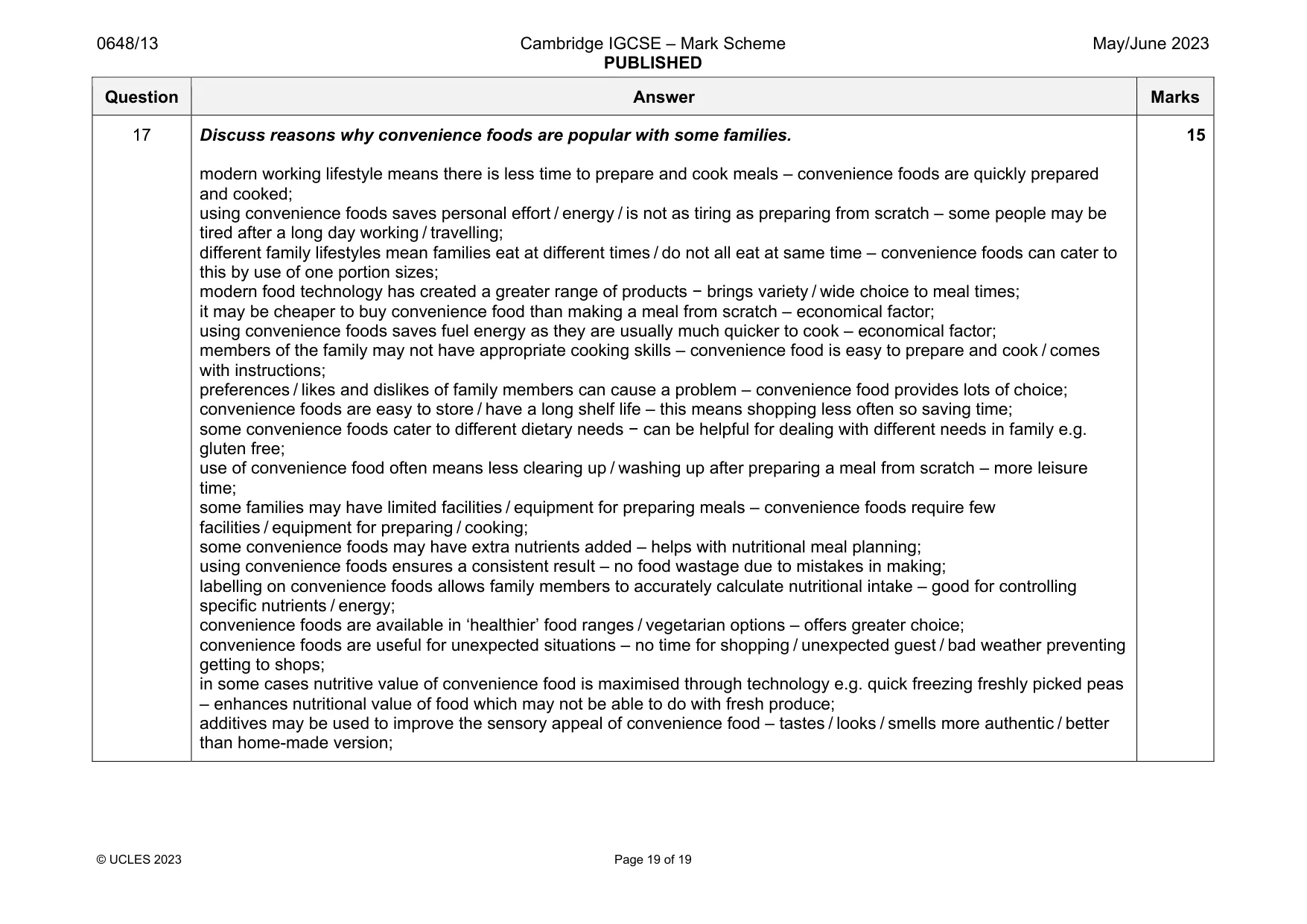
0648/13 Cambridge IGCSE – Mark Scheme PUBLISHED May/June 2023 © UCLES 2023 Page 19 of 19 Question Answer Marks 17 Discuss reasons why convenience foods are popular with some families. modern working lifestyle means there is less time to prepare and cook meals – convenience foods are quickly prepared and cooked; using convenience foods saves personal effort / energy / is not as tiring as preparing from scratch – some people may be tired after a long day working / travelling; different family lifestyles mean families eat at different times / do not all eat at same time – convenience foods can cater to this by use of one portion sizes; modern food technology has created a greater range of products − brings variety / wide choice to meal times; it may be cheaper to buy convenience food than making a meal from scratch – economical factor; using convenience foods saves fuel energy as they are usually much quicker to cook – economical factor; members of the family may not have appropriate cooking skills – convenience food is easy to prepare and cook / comes with instructions; preferences / likes and dislikes of family members can cause a problem – convenience food provides lots of choice; convenience foods are easy to store / have a long shelf life – this means shopping less often so saving time; some convenience foods cater to different dietary needs − can be helpful for dealing with different needs in family e.g. gluten free; use of convenience food often means less clearing up / washing up after preparing a meal from scratch – more leisure time; some families may have limited facilities / equipment for preparing meals – convenience foods require few facilities / equipment for preparing / cooking; some convenience foods may have extra nutrients added – helps with nutritional meal planning; using convenience foods ensures a consistent result – no food wastage due to mistakes in making; labelling on convenience foods allows family members to accurately calculate nutritional intake – good for controlling specific nutrients / energy; convenience foods are available in ‘healthier’ food ranges / vegetarian options – offers greater choice; convenience foods are useful for unexpected situations – no time for shopping / unexpected guest / bad weather preventing getting to shops; in some cases nutritive value of convenience food is maximised through technology e.g. quick freezing freshly picked peas – enhances nutritional value of food which may not be able to do with fresh produce; additives may be used to improve the sensory appeal of convenience food – tastes / looks / smells more authentic / better than home-made version; 15
What you needed in this session
Cambridge’s own grade thresholds for 2023 May/June, Paper 1 · Variant 3. A higher threshold means an easier paper — the bar moves with how the cohort did.