Cambridge IGCSE Food and Nutrition 0648 — 2022 Oct/Nov Paper 1 · Variant 2
0648/12/O/N/22 · 100 marks · ≈113 min
The question paper and its mark scheme, free to read here and free to download. This is Cambridge’s own paper, exactly as it was sat.
Question paper12 pages


Mark scheme17 pages
Answers below. Sit the paper first if you are practising.
Paper as text
Question paper, page 1
This document has 12 pages. [Turn over DC (RW) 303612/2 © UCLES 2022 * 3 9 4 2 0 3 1 8 4 5 * FOOD & NUTRITION 0648/12 Paper 1 Theory October/November 2022 2 hours You must answer on the question paper. No additional materials are needed. INSTRUCTIONS ● Section A: answer all questions. ● Section B: answer all questions. ● Section C: answer one question. ● Use a black or dark blue pen. You may use an HB pencil for any diagrams or graphs. ● Write your name, centre number and candidate number in the boxes at the top of the page. ● Write your answer to each question in the space provided. ● Do not use an erasable pen or correction fluid. ● Do not write on any bar codes. INFORMATION ● The total mark for this paper is 100. ● The number of marks for each question or part question is shown in brackets [ ]. Cambridge IGCSE™
Question paper, page 2
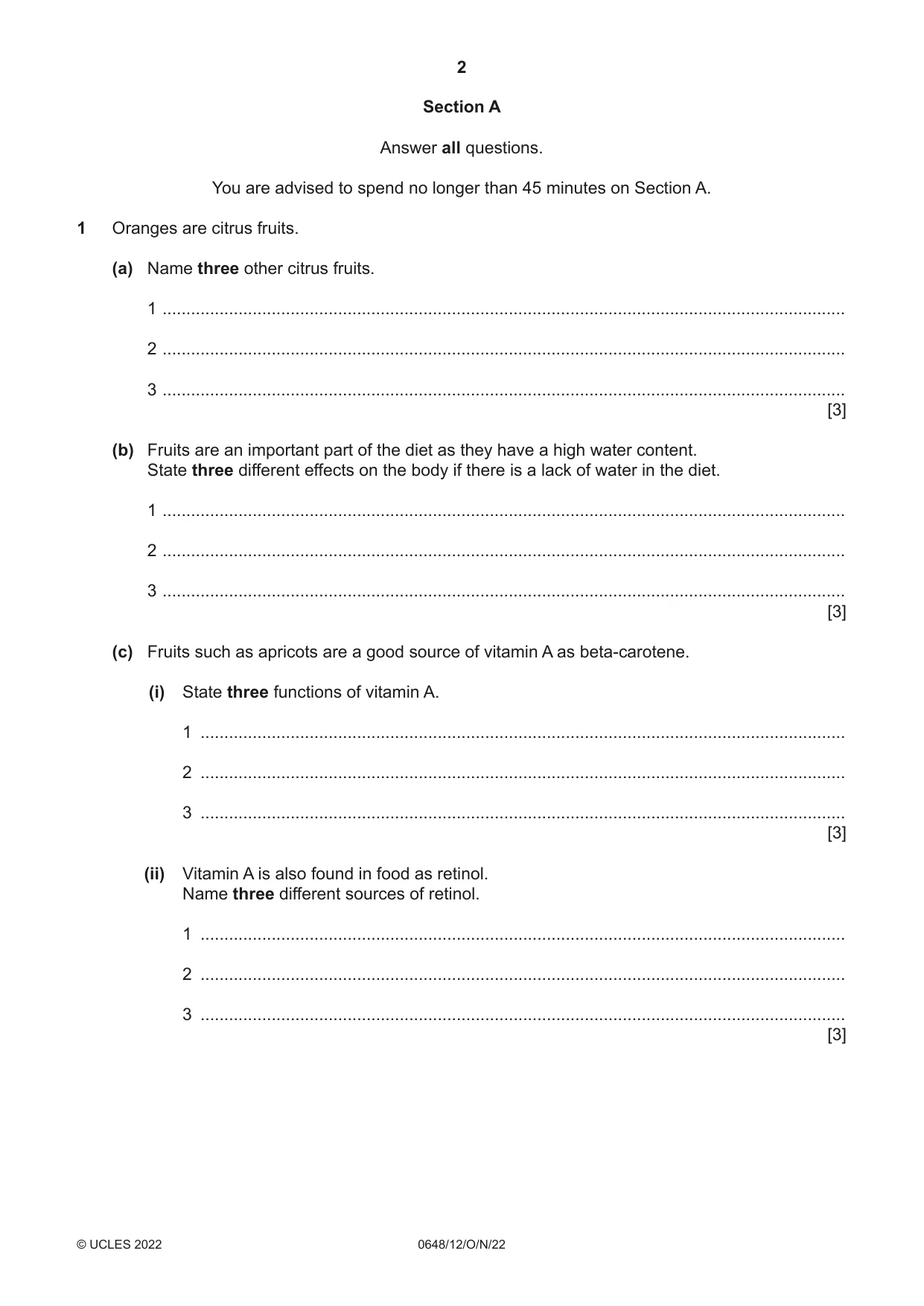
2 0648/12/O/N/22 © UCLES 2022 Section A Answer all questions. You are advised to spend no longer than 45 minutes on Section A. 1 Oranges are citrus fruits. (a) Name three other citrus fruits. 1 … 2 … 3 … [3] (b) Fruits are an important part of the diet as they have a high water content. State three different effects on the body if there is a lack of water in the diet. 1 … 2 … 3 … [3] (c) Fruits such as apricots are a good source of vitamin A as beta‑carotene. (i) State three functions of vitamin A. 1 … 2 … 3 … [3] (ii) Vitamin A is also found in food as retinol. Name three different sources of retinol. 1 … 2 … 3 … [3]
Question paper, page 3
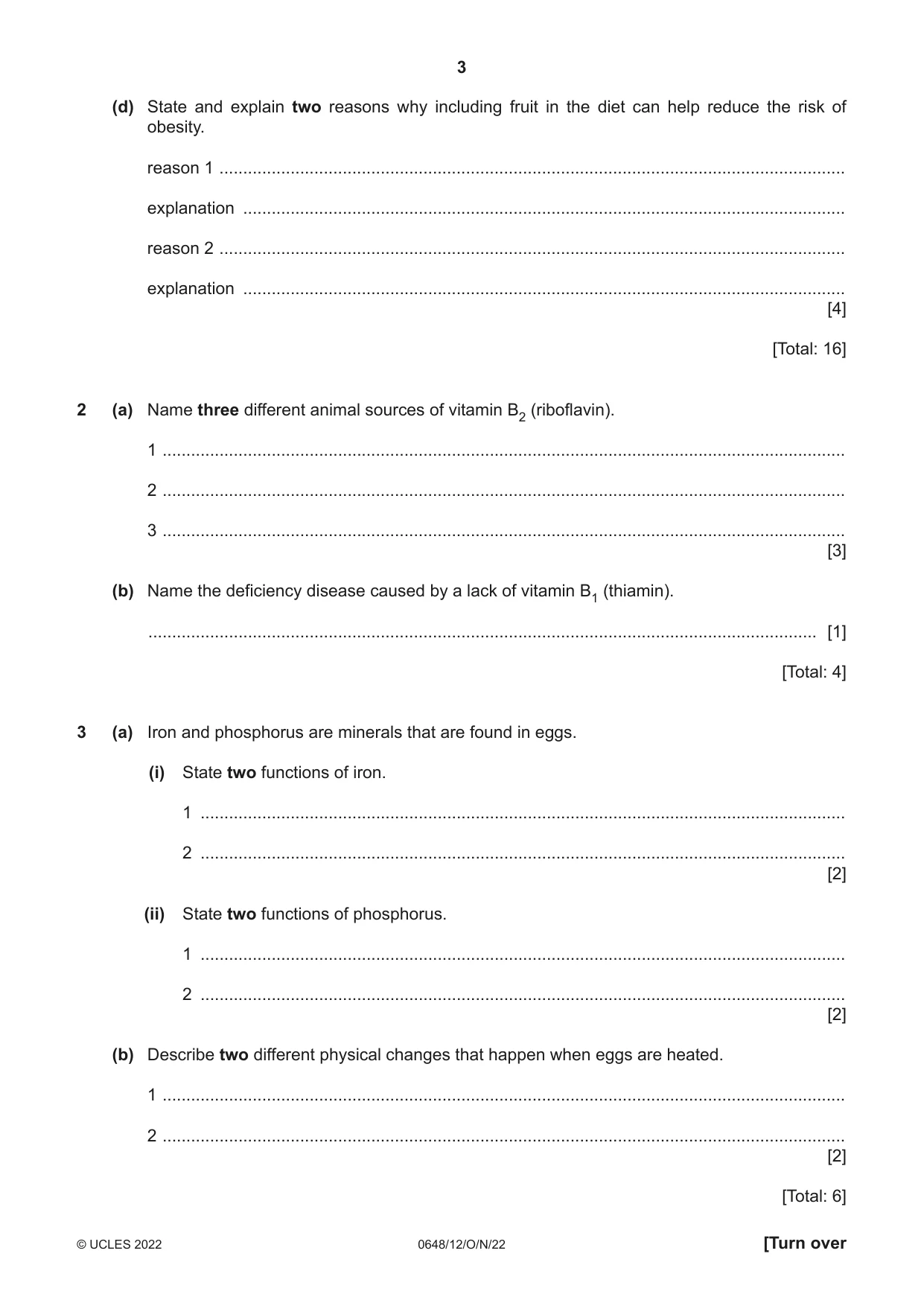
3 0648/12/O/N/22 © UCLES 2022 [Turn over (d) State and explain two reasons why including fruit in the diet can help reduce the risk of obesity. reason 1 … explanation … reason 2 … explanation … [4] [Total: 16] 2 (a) Name three different animal sources of vitamin B2 (riboflavin). 1 … 2 … 3 … [3] (b) Name the deficiency disease caused by a lack of vitamin B1 (thiamin). … [1] [Total: 4] 3 (a) Iron and phosphorus are minerals that are found in eggs. (i) State two functions of iron. 1 … 2 … [2] (ii) State two functions of phosphorus. 1 … 2 … [2] (b) Describe two different physical changes that happen when eggs are heated. 1 … 2 … [2] [Total: 6]
Question paper, page 4
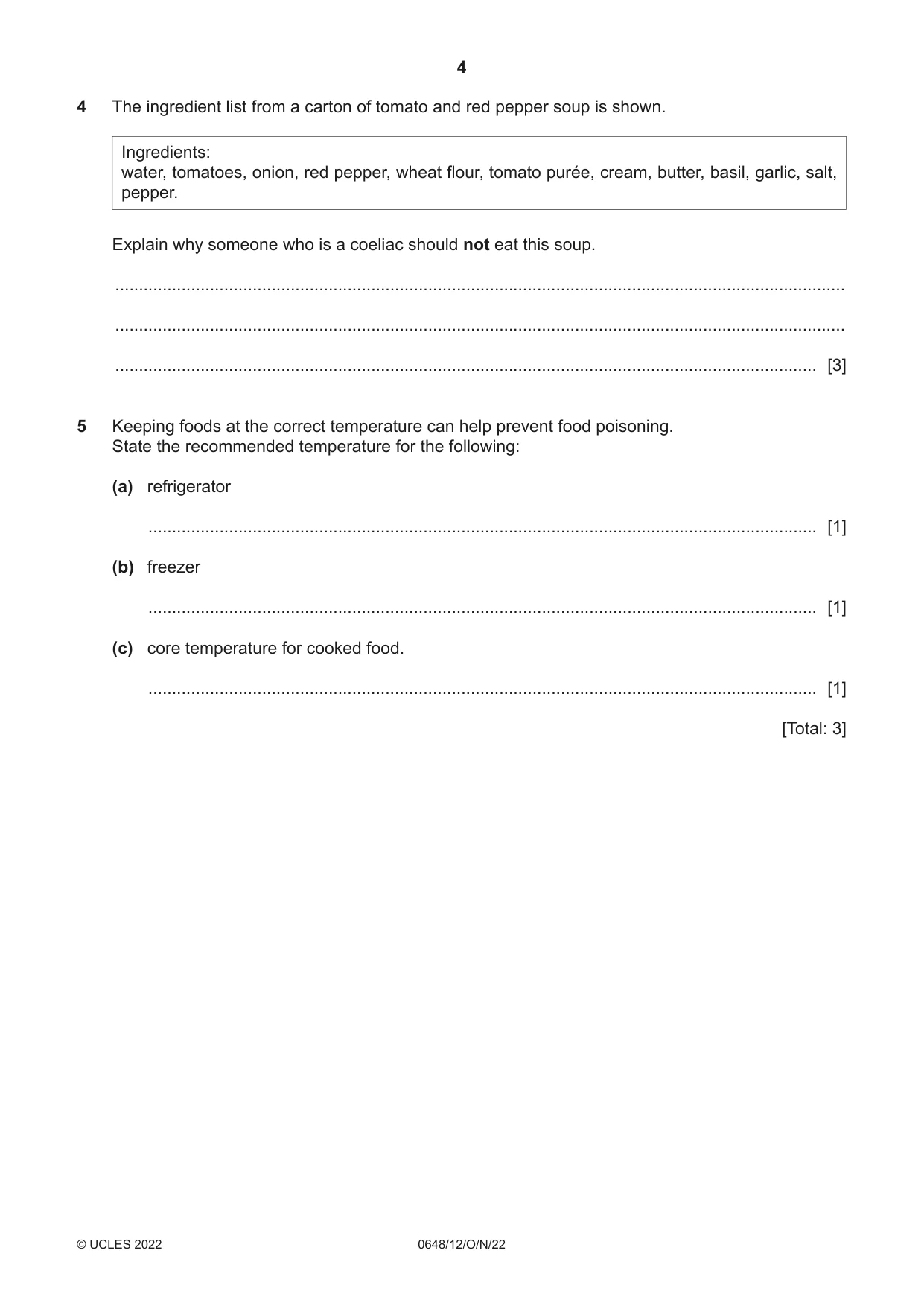
4 0648/12/O/N/22 © UCLES 2022 4 The ingredient list from a carton of tomato and red pepper soup is shown. Ingredients: water, tomatoes, onion, red pepper, wheat flour, tomato purée, cream, butter, basil, garlic, salt, pepper. Explain why someone who is a coeliac should not eat this soup. … … … [3] 5 Keeping foods at the correct temperature can help prevent food poisoning. State the recommended temperature for the following: (a) refrigerator … [1] (b) freezer … [1] (c) core temperature for cooked food. … [1] [Total: 3]
Question paper, page 5
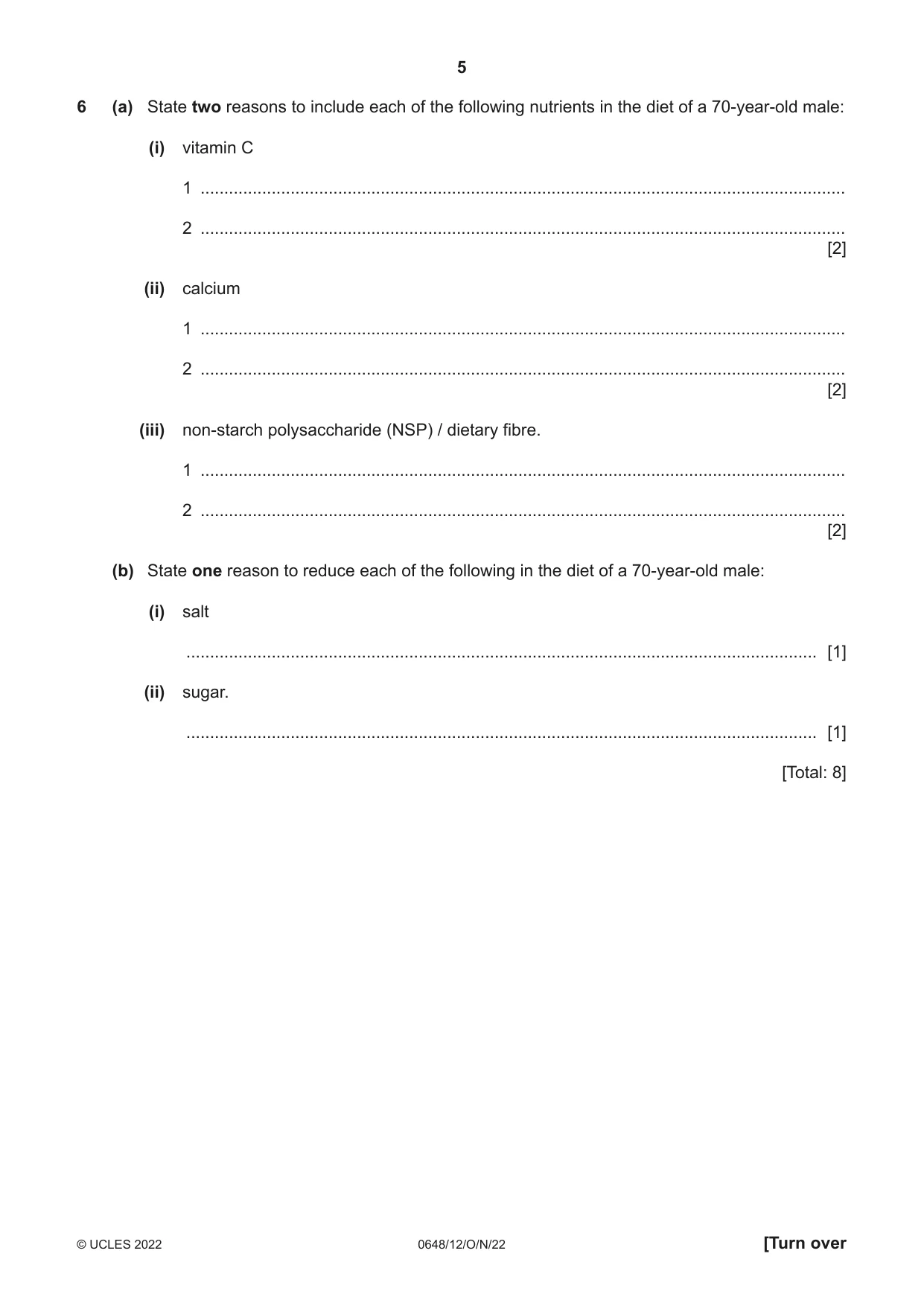
5 0648/12/O/N/22 © UCLES 2022 [Turn over 6 (a) State two reasons to include each of the following nutrients in the diet of a 70‑year‑old male: (i) vitamin C 1 … 2 … [2] (ii) calcium 1 … 2 … [2] (iii) non‑starch polysaccharide (NSP) / dietary fibre. 1 … 2 … [2] (b) State one reason to reduce each of the following in the diet of a 70‑year‑old male: (i) salt … [1] (ii) sugar. … [1] [Total: 8]
Question paper, page 6
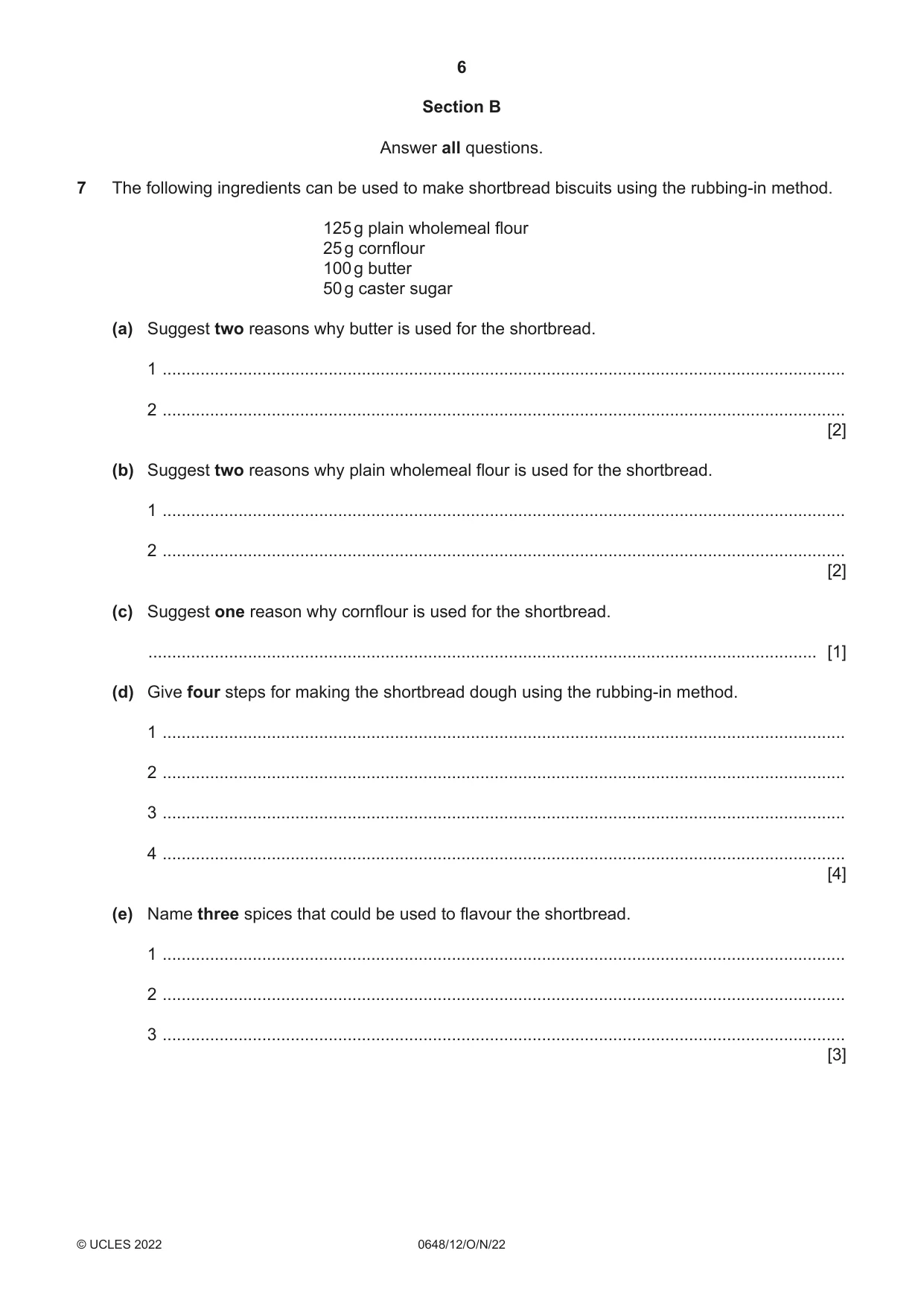
6 0648/12/O/N/22 © UCLES 2022 Section B Answer all questions. 7 The following ingredients can be used to make shortbread biscuits using the rubbing‑in method. 125 g plain wholemeal flour 25 g cornflour 100 g butter 50 g caster sugar (a) Suggest two reasons why butter is used for the shortbread. 1 … 2 … [2] (b) Suggest two reasons why plain wholemeal flour is used for the shortbread. 1 … 2 … [2] (c) Suggest one reason why cornflour is used for the shortbread. … [1] (d) Give four steps for making the shortbread dough using the rubbing‑in method. 1 … 2 … 3 … 4 … [4] (e) Name three spices that could be used to flavour the shortbread. 1 … 2 … 3 … [3]
Question paper, page 7
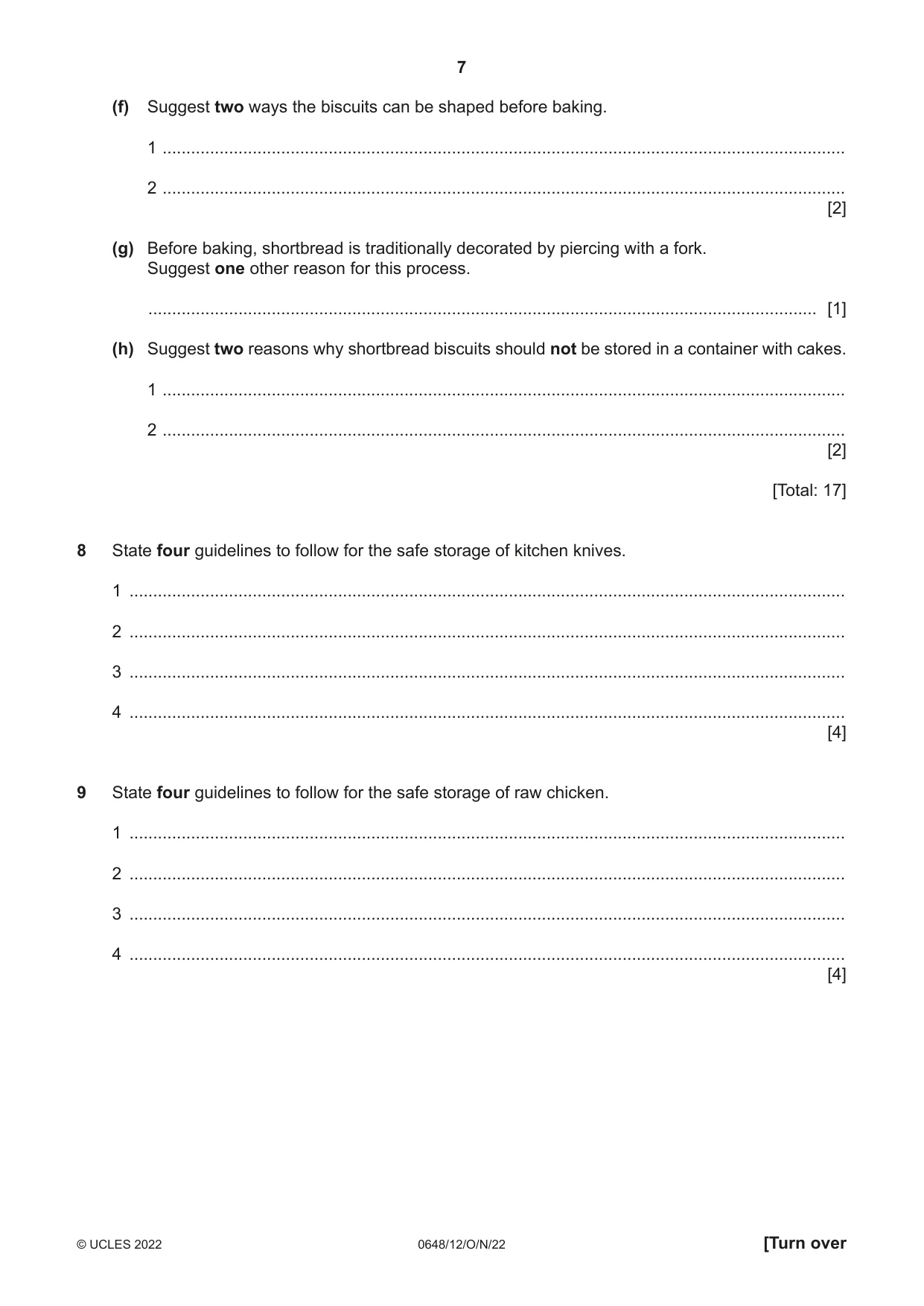
7 0648/12/O/N/22 © UCLES 2022 [Turn over (f) Suggest two ways the biscuits can be shaped before baking. 1 … 2 … [2] (g) Before baking, shortbread is traditionally decorated by piercing with a fork. Suggest one other reason for this process. … [1] (h) Suggest two reasons why shortbread biscuits should not be stored in a container with cakes. 1 … 2 … [2] [Total: 17] 8 State four guidelines to follow for the safe storage of kitchen knives. 1 … 2 … 3 … 4 … [4] 9 State four guidelines to follow for the safe storage of raw chicken. 1 … 2 … 3 … 4 … [4]
Question paper, page 8
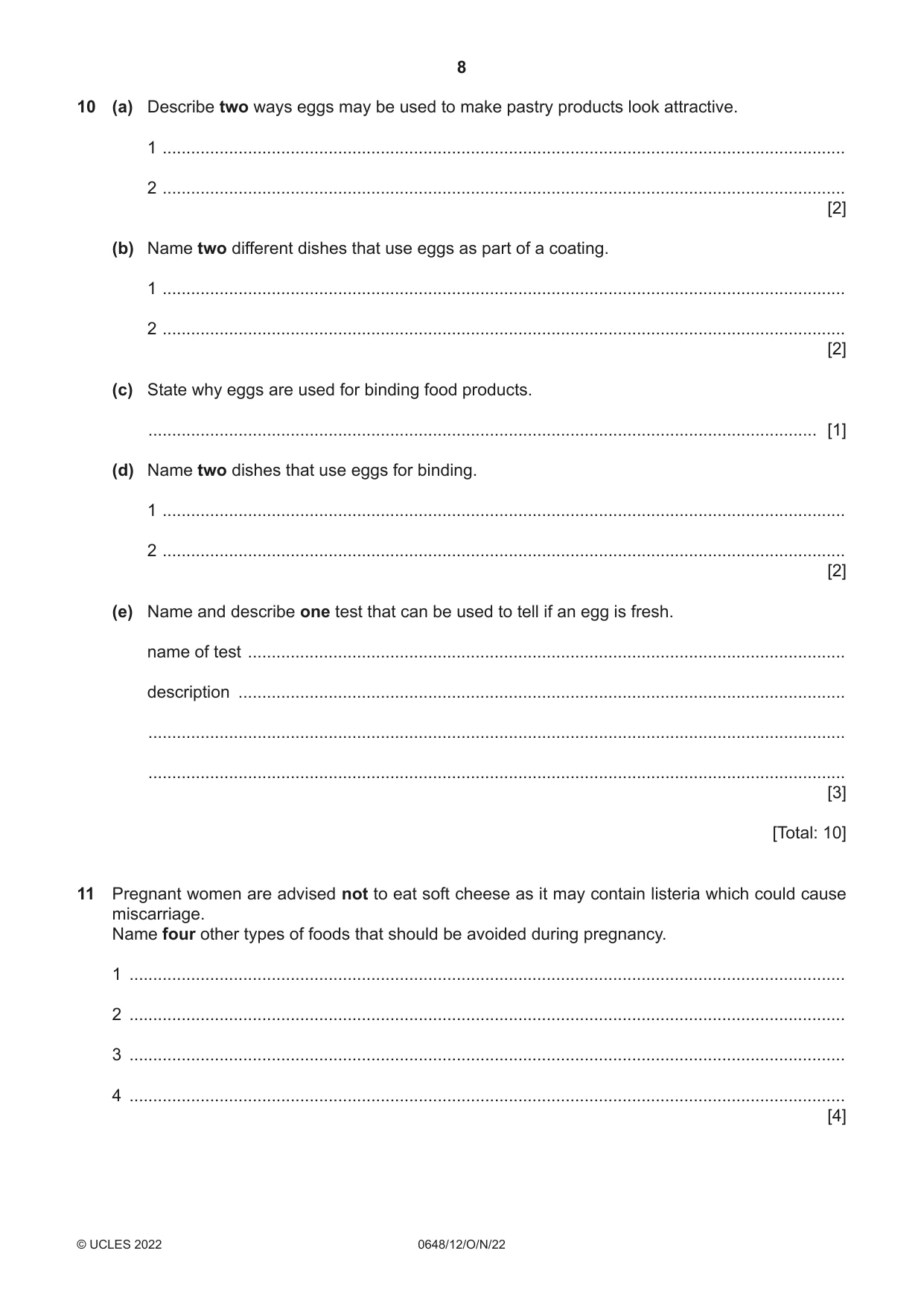
8 0648/12/O/N/22 © UCLES 2022 10 (a) Describe two ways eggs may be used to make pastry products look attractive. 1 … 2 … [2] (b) Name two different dishes that use eggs as part of a coating. 1 … 2 … [2] (c) State why eggs are used for binding food products. … [1] (d) Name two dishes that use eggs for binding. 1 … 2 … [2] (e) Name and describe one test that can be used to tell if an egg is fresh. name of test … description … … … [3] [Total: 10] 11 Pregnant women are advised not to eat soft cheese as it may contain listeria which could cause miscarriage. Name four other types of foods that should be avoided during pregnancy. 1 … 2 … 3 … 4 … [4]
Question paper, page 9
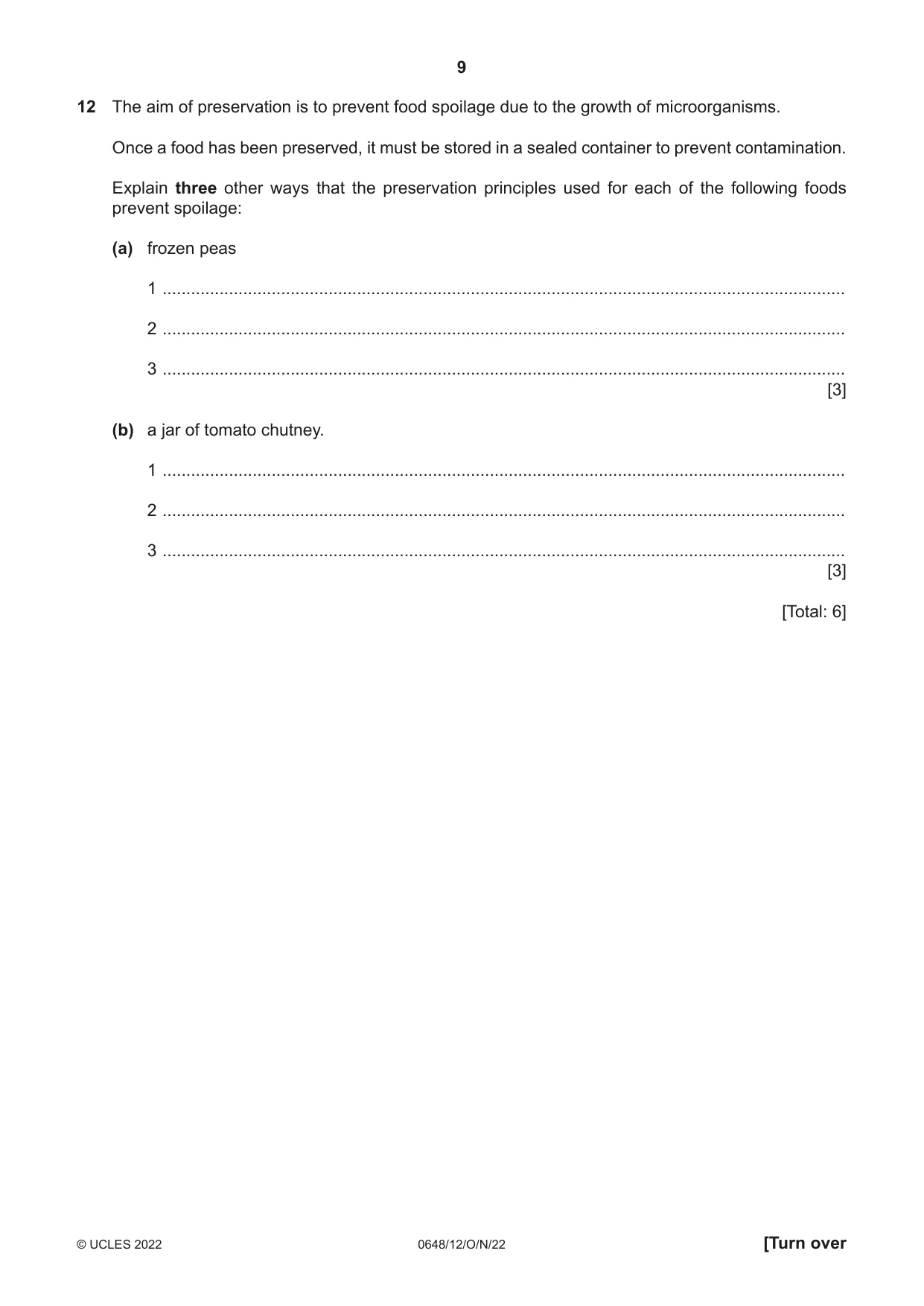
9 0648/12/O/N/22 © UCLES 2022 [Turn over 12 The aim of preservation is to prevent food spoilage due to the growth of microorganisms. Once a food has been preserved, it must be stored in a sealed container to prevent contamination. Explain three other ways that the preservation principles used for each of the following foods prevent spoilage: (a) frozen peas 1 … 2 … 3 … [3] (b) a jar of tomato chutney. 1 … 2 … 3 … [3] [Total: 6]
Question paper, page 10
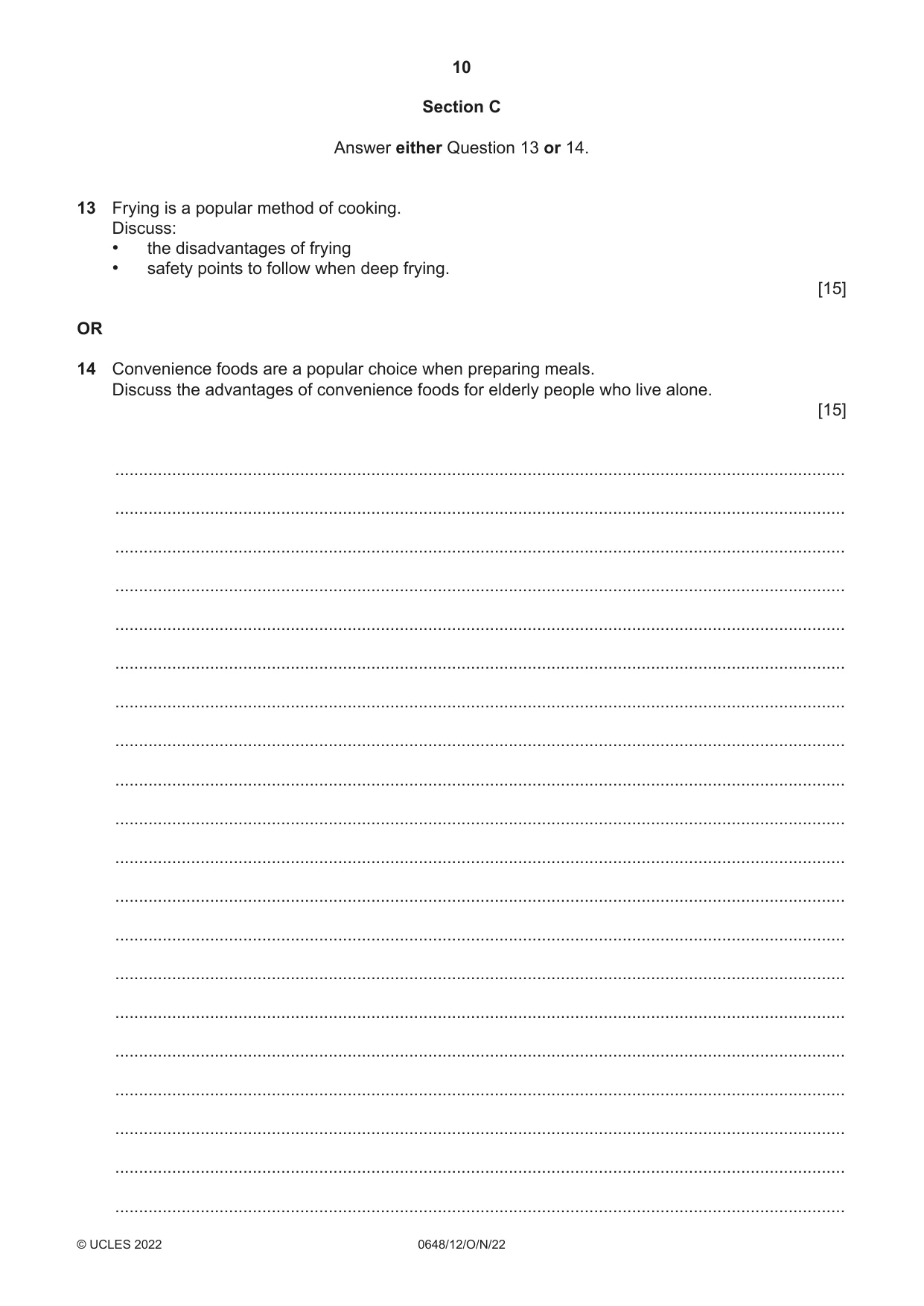
10 0648/12/O/N/22 © UCLES 2022 Section C Answer either Question 13 or 14. 13 Frying is a popular method of cooking. Discuss: • the disadvantages of frying • safety points to follow when deep frying. [15] OR 14 Convenience foods are a popular choice when preparing meals. Discuss the advantages of convenience foods for elderly people who live alone. [15] … … … … … … … … … … … … … … … … … … … …
Question paper, page 11
11 0648/12/O/N/22 © UCLES 2022 [Turn over … … … … … … … … … … … … … … … … … … … … … … … … … … … …
Question paper, page 12
12 0648/12/O/N/22 © UCLES 2022 Permission to reproduce items where third‑party owned material protected by copyright is included has been sought and cleared where possible. Every reasonable effort has been made by the publisher (UCLES) to trace copyright holders, but if any items requiring clearance have unwittingly been included, the publisher will be pleased to make amends at the earliest possible opportunity. To avoid the issue of disclosure of answer‑related information to candidates, all copyright acknowledgements are reproduced online in the Cambridge Assessment International Education Copyright Acknowledgements Booklet. This is produced for each series of examinations and is freely available to download at www.cambridgeinternational.org after the live examination series. Cambridge Assessment International Education is part of Cambridge Assessment. Cambridge Assessment is the brand name of the University of Cambridge Local Examinations Syndicate (UCLES), which is a department of the University of Cambridge. … … … … … … … … … … … … … … … … … … … … … … … …
Mark scheme, page 1
This document consists of 17 printed pages. © UCLES 2022 [Turn over Cambridge IGCSE™ FOOD & NUTRITION 0648/12 Paper 1 Theory October/November 2022 MARK SCHEME Maximum Mark: 100 Published This mark scheme is published as an aid to teachers and candidates, to indicate the requirements of the examination. It shows the basis on which Examiners were instructed to award marks. It does not indicate the details of the discussions that took place at an Examiners’ meeting before marking began, which would have considered the acceptability of alternative answers. Mark schemes should be read in conjunction with the question paper and the Principal Examiner Report for Teachers. Cambridge International will not enter into discussions about these mark schemes. Cambridge International is publishing the mark schemes for the October/November 2022 series for most Cambridge IGCSE™, Cambridge International A and AS Level components and some Cambridge O Level components.
Mark scheme, page 2
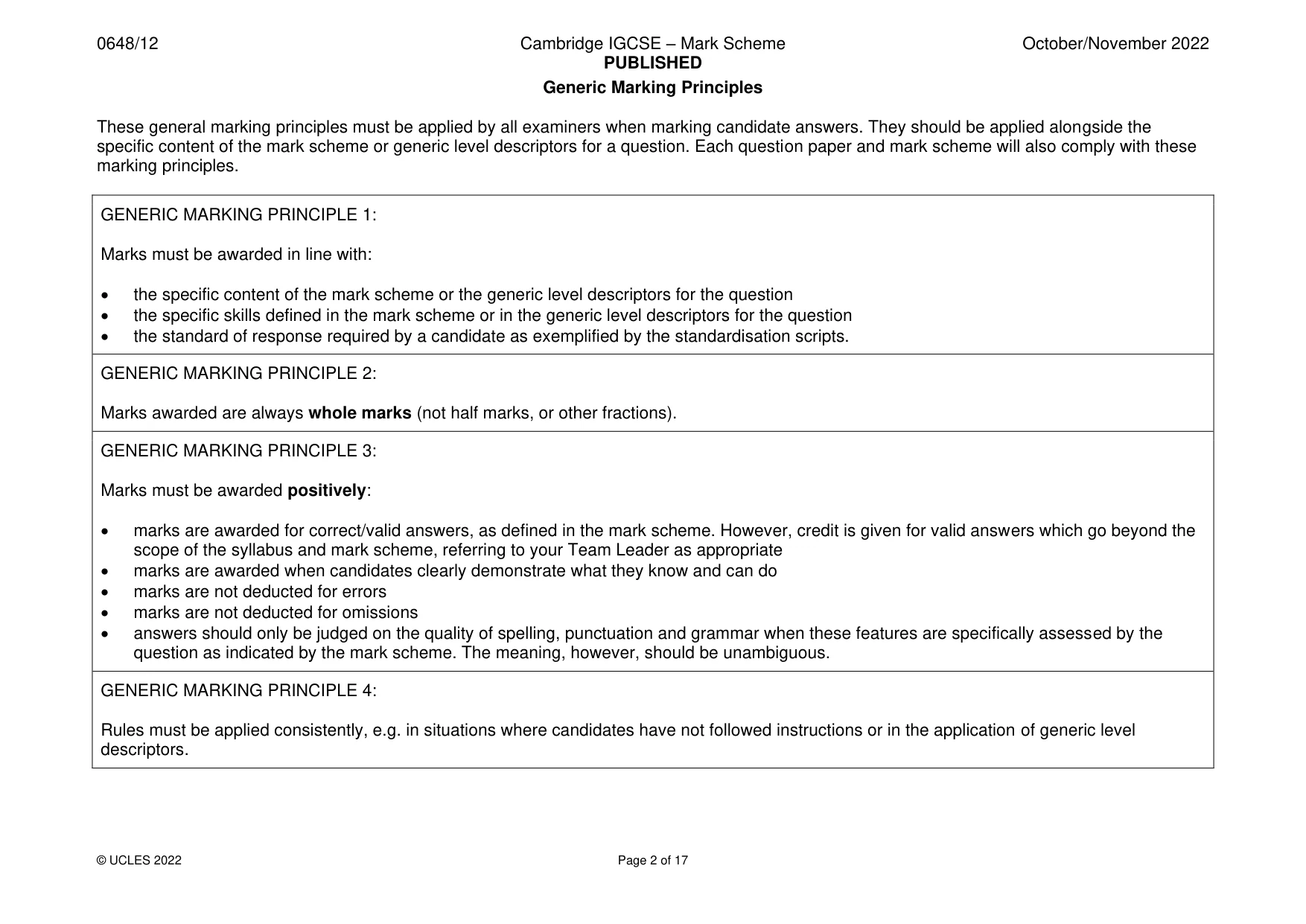
0648/12 Cambridge IGCSE – Mark Scheme PUBLISHED October/November 2022 © UCLES 2022 Page 2 of 17 Generic Marking Principles These general marking principles must be applied by all examiners when marking candidate answers. They should be applied alongside the specific content of the mark scheme or generic level descriptors for a question. Each question paper and mark scheme will also comply with these marking principles. GENERIC MARKING PRINCIPLE 1: Marks must be awarded in line with: • the specific content of the mark scheme or the generic level descriptors for the question • the specific skills defined in the mark scheme or in the generic level descriptors for the question • the standard of response required by a candidate as exemplified by the standardisation scripts. GENERIC MARKING PRINCIPLE 2: Marks awarded are always whole marks (not half marks, or other fractions). GENERIC MARKING PRINCIPLE 3: Marks must be awarded positively: • marks are awarded for correct/valid answers, as defined in the mark scheme. However, credit is given for valid answers which go beyond the scope of the syllabus and mark scheme, referring to your Team Leader as appropriate • marks are awarded when candidates clearly demonstrate what they know and can do • marks are not deducted for errors • marks are not deducted for omissions • answers should only be judged on the quality of spelling, punctuation and grammar when these features are specifically assessed by the question as indicated by the mark scheme. The meaning, however, should be unambiguous. GENERIC MARKING PRINCIPLE 4: Rules must be applied consistently, e.g. in situations where candidates have not followed instructions or in the application of generic level descriptors.
Mark scheme, page 3
0648/12 Cambridge IGCSE – Mark Scheme PUBLISHED October/November 2022 © UCLES 2022 Page 3 of 17 GENERIC MARKING PRINCIPLE 5: Marks should be awarded using the full range of marks defined in the mark scheme for the question (however; the use of the full mark range may be limited according to the quality of the candidate responses seen). GENERIC MARKING PRINCIPLE 6: Marks awarded are based solely on the requirements as defined in the mark scheme. Marks should not be awarded with grade thresholds or grade descriptors in mind.
Mark scheme, page 4
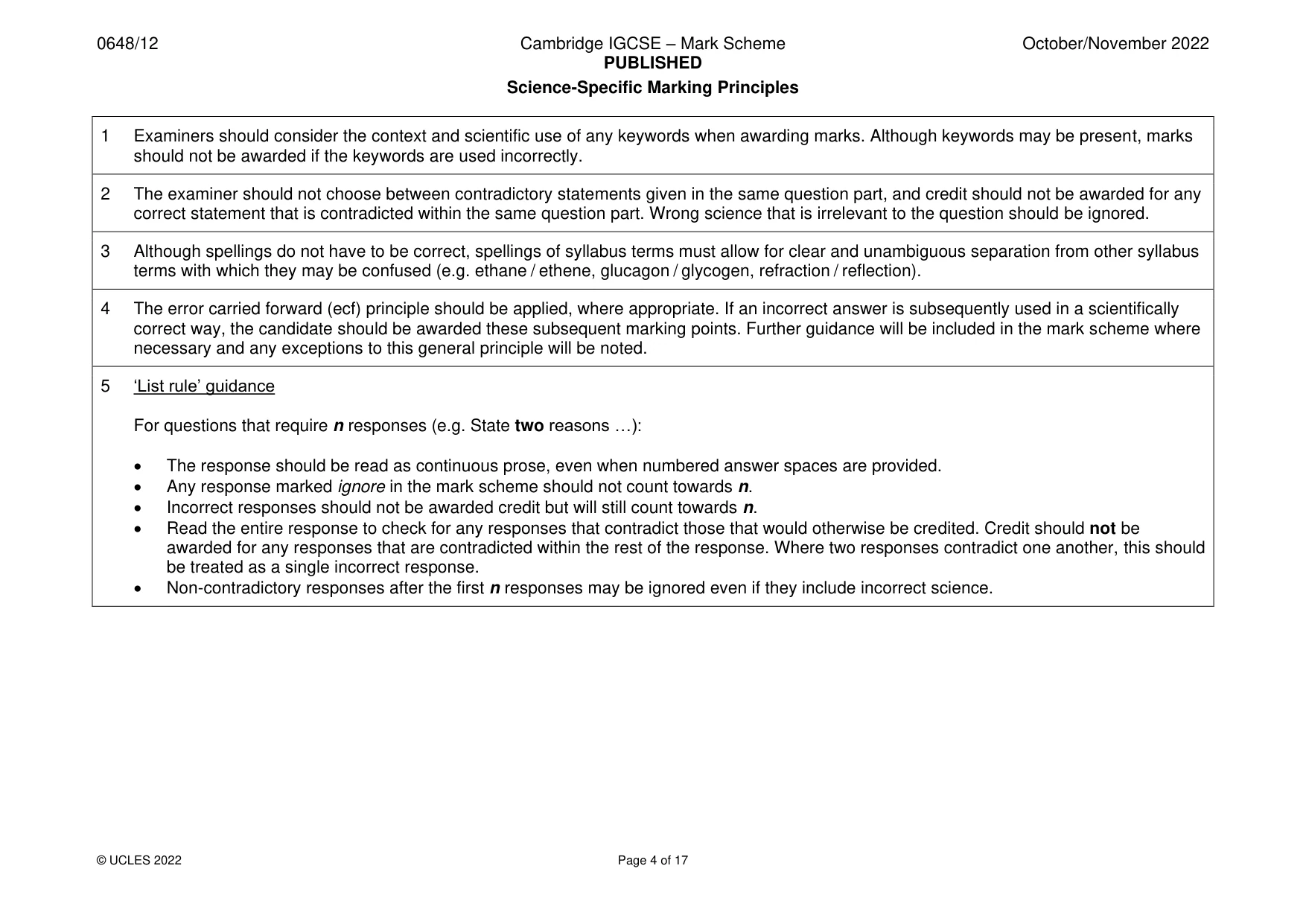
0648/12 Cambridge IGCSE – Mark Scheme PUBLISHED October/November 2022 © UCLES 2022 Page 4 of 17 Science-Specific Marking Principles 1 Examiners should consider the context and scientific use of any keywords when awarding marks. Although keywords may be present, marks should not be awarded if the keywords are used incorrectly. 2 The examiner should not choose between contradictory statements given in the same question part, and credit should not be awarded for any correct statement that is contradicted within the same question part. Wrong science that is irrelevant to the question should be ignored. 3 Although spellings do not have to be correct, spellings of syllabus terms must allow for clear and unambiguous separation from other syllabus terms with which they may be confused (e.g. ethane / ethene, glucagon / glycogen, refraction / reflection). 4 The error carried forward (ecf) principle should be applied, where appropriate. If an incorrect answer is subsequently used in a scientifically correct way, the candidate should be awarded these subsequent marking points. Further guidance will be included in the mark scheme where necessary and any exceptions to this general principle will be noted. 5 ‘List rule’ guidance For questions that require n responses (e.g. State two reasons …): • The response should be read as continuous prose, even when numbered answer spaces are provided. • Any response marked ignore in the mark scheme should not count towards n. • Incorrect responses should not be awarded credit but will still count towards n. • Read the entire response to check for any responses that contradict those that would otherwise be credited. Credit should not be awarded for any responses that are contradicted within the rest of the response. Where two responses contradict one another, this should be treated as a single incorrect response. • Non-contradictory responses after the first n responses may be ignored even if they include incorrect science.
Mark scheme, page 5
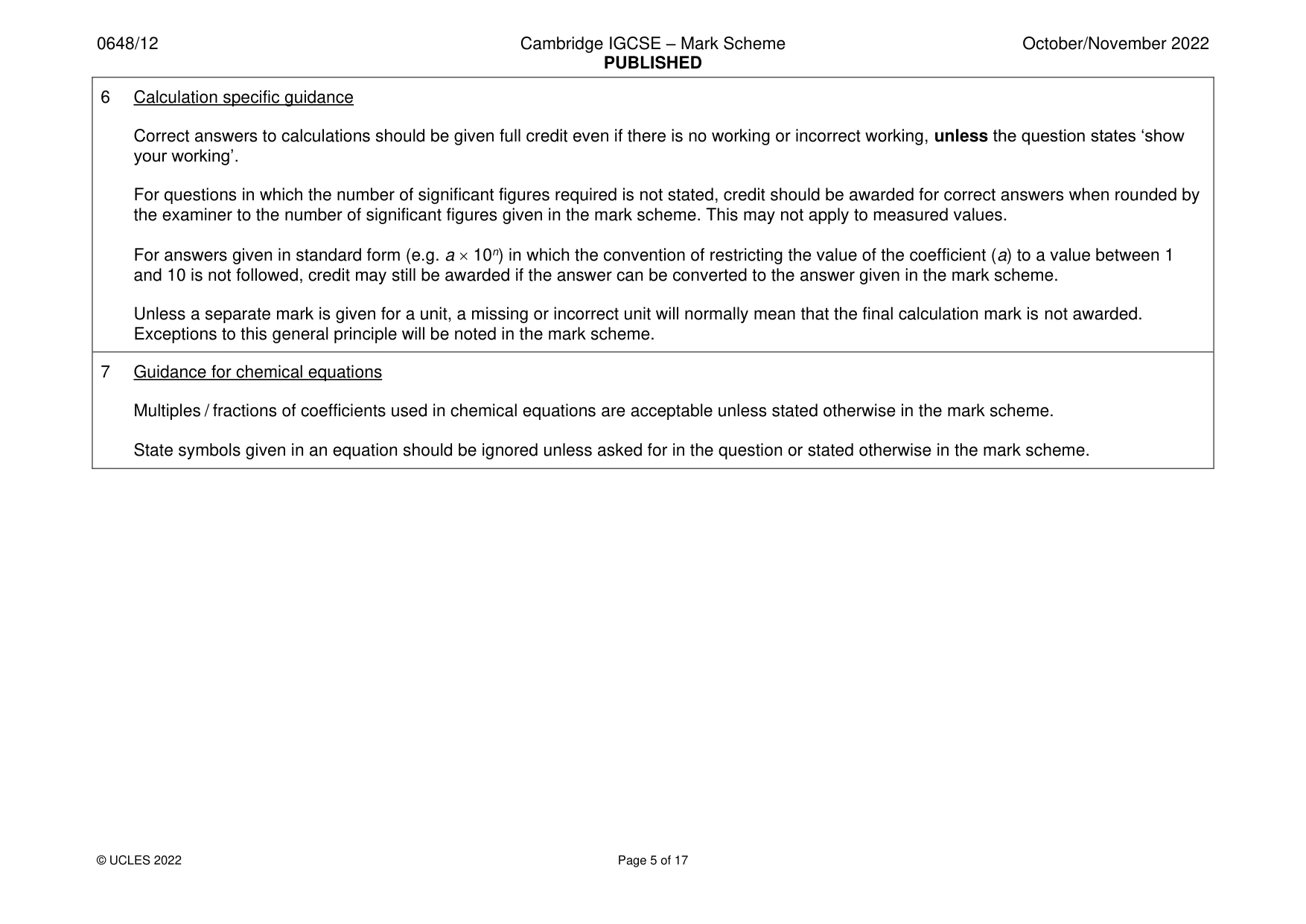
0648/12 Cambridge IGCSE – Mark Scheme PUBLISHED October/November 2022 © UCLES 2022 Page 5 of 17 6 Calculation specific guidance Correct answers to calculations should be given full credit even if there is no working or incorrect working, unless the question states ‘show your working’. For questions in which the number of significant figures required is not stated, credit should be awarded for correct answers when rounded by the examiner to the number of significant figures given in the mark scheme. This may not apply to measured values. For answers given in standard form (e.g. a 10n) in which the convention of restricting the value of the coefficient (a) to a value between 1 and 10 is not followed, credit may still be awarded if the answer can be converted to the answer given in the mark scheme. Unless a separate mark is given for a unit, a missing or incorrect unit will normally mean that the final calculation mark is not awarded. Exceptions to this general principle will be noted in the mark scheme. 7 Guidance for chemical equations Multiples / fractions of coefficients used in chemical equations are acceptable unless stated otherwise in the mark scheme. State symbols given in an equation should be ignored unless asked for in the question or stated otherwise in the mark scheme.
Mark scheme, page 6
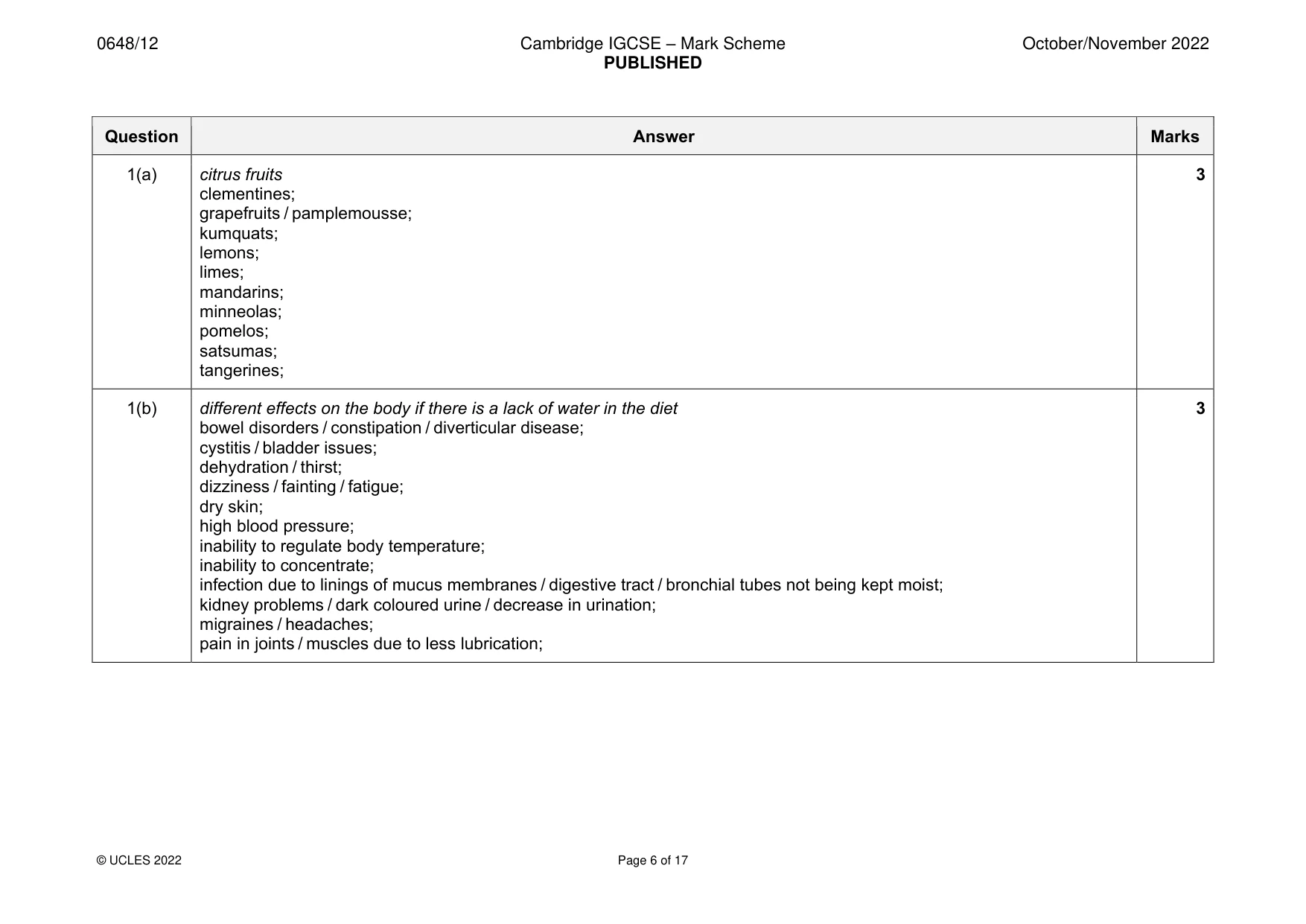
0648/12 Cambridge IGCSE – Mark Scheme PUBLISHED October/November 2022 © UCLES 2022 Page 6 of 17 Question Answer Marks 1(a) citrus fruits clementines; grapefruits / pamplemousse; kumquats; lemons; limes; mandarins; minneolas; pomelos; satsumas; tangerines; 3 1(b) different effects on the body if there is a lack of water in the diet bowel disorders / constipation / diverticular disease; cystitis / bladder issues; dehydration / thirst; dizziness / fainting / fatigue; dry skin; high blood pressure; inability to regulate body temperature; inability to concentrate; infection due to linings of mucus membranes / digestive tract / bronchial tubes not being kept moist; kidney problems / dark coloured urine / decrease in urination; migraines / headaches; pain in joints / muscles due to less lubrication; 3
Mark scheme, page 7
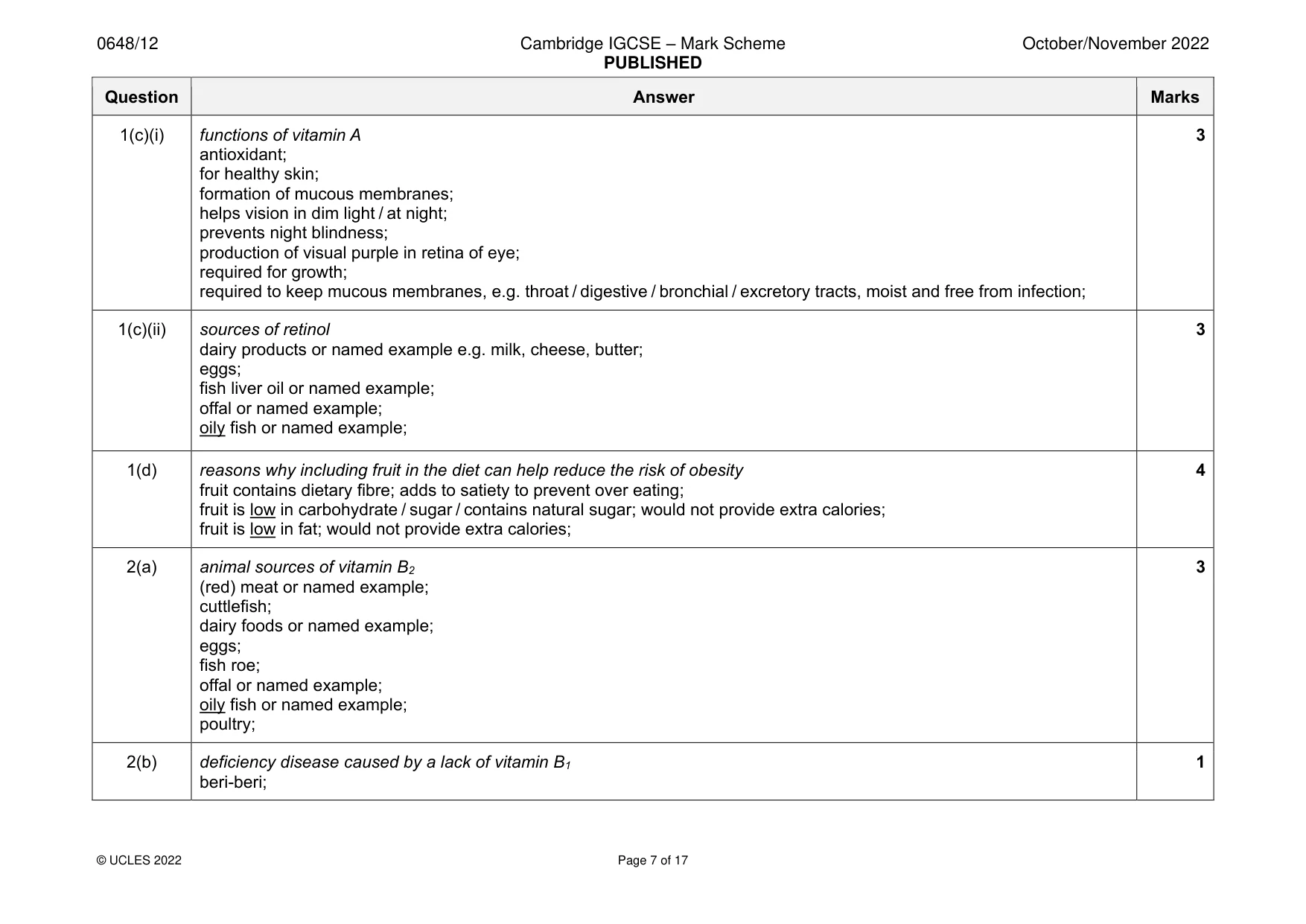
0648/12 Cambridge IGCSE – Mark Scheme PUBLISHED October/November 2022 © UCLES 2022 Page 7 of 17 Question Answer Marks 1(c)(i) functions of vitamin A antioxidant; for healthy skin; formation of mucous membranes; helps vision in dim light / at night; prevents night blindness; production of visual purple in retina of eye; required for growth; required to keep mucous membranes, e.g. throat / digestive / bronchial / excretory tracts, moist and free from infection; 3 1(c)(ii) sources of retinol dairy products or named example e.g. milk, cheese, butter; eggs; fish liver oil or named example; offal or named example; oily fish or named example; 3 1(d) reasons why including fruit in the diet can help reduce the risk of obesity fruit contains dietary fibre; adds to satiety to prevent over eating; fruit is low in carbohydrate / sugar / contains natural sugar; would not provide extra calories; fruit is low in fat; would not provide extra calories; 4 2(a) animal sources of vitamin B2 (red) meat or named example; cuttlefish; dairy foods or named example; eggs; fish roe; offal or named example; oily fish or named example; poultry; 3 2(b) deficiency disease caused by a lack of vitamin B1 beri-beri; 1
Mark scheme, page 8
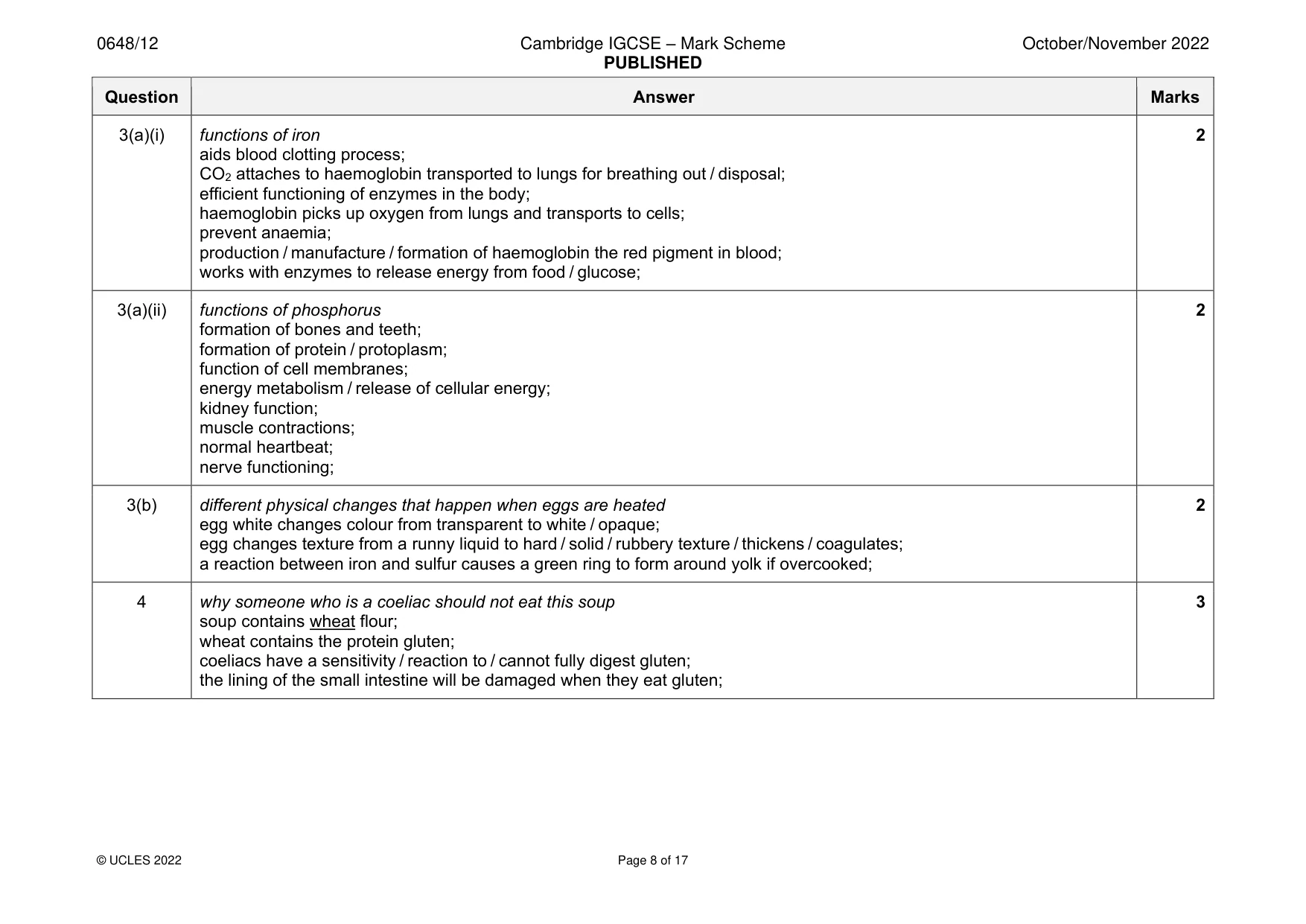
0648/12 Cambridge IGCSE – Mark Scheme PUBLISHED October/November 2022 © UCLES 2022 Page 8 of 17 Question Answer Marks 3(a)(i) functions of iron aids blood clotting process; CO2 attaches to haemoglobin transported to lungs for breathing out / disposal; efficient functioning of enzymes in the body; haemoglobin picks up oxygen from lungs and transports to cells; prevent anaemia; production / manufacture / formation of haemoglobin the red pigment in blood; works with enzymes to release energy from food / glucose; 2 3(a)(ii) functions of phosphorus formation of bones and teeth; formation of protein / protoplasm; function of cell membranes; energy metabolism / release of cellular energy; kidney function; muscle contractions; normal heartbeat; nerve functioning; 2 3(b) different physical changes that happen when eggs are heated egg white changes colour from transparent to white / opaque; egg changes texture from a runny liquid to hard / solid / rubbery texture / thickens / coagulates; a reaction between iron and sulfur causes a green ring to form around yolk if overcooked; 2 4 why someone who is a coeliac should not eat this soup soup contains wheat flour; wheat contains the protein gluten; coeliacs have a sensitivity / reaction to / cannot fully digest gluten; the lining of the small intestine will be damaged when they eat gluten; 3
Mark scheme, page 9
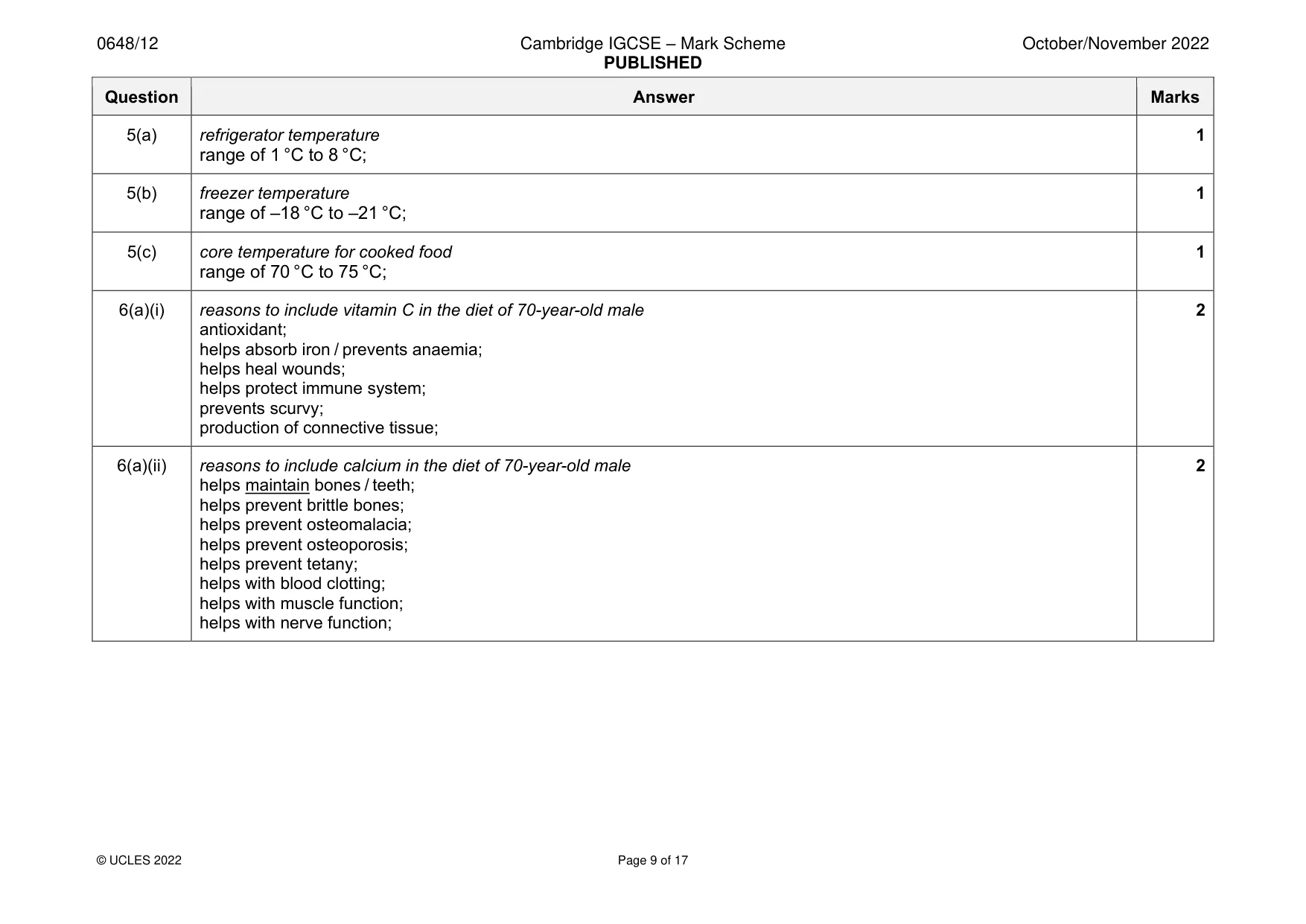
0648/12 Cambridge IGCSE – Mark Scheme PUBLISHED October/November 2022 © UCLES 2022 Page 9 of 17 Question Answer Marks 5(a) refrigerator temperature range of 1 °C to 8 °C; 1 5(b) freezer temperature range of –18 °C to –21 °C; 1 5(c) core temperature for cooked food range of 70 °C to 75 °C; 1 6(a)(i) reasons to include vitamin C in the diet of 70-year-old male antioxidant; helps absorb iron / prevents anaemia; helps heal wounds; helps protect immune system; prevents scurvy; production of connective tissue; 2 6(a)(ii) reasons to include calcium in the diet of 70-year-old male helps maintain bones / teeth; helps prevent brittle bones; helps prevent osteomalacia; helps prevent osteoporosis; helps prevent tetany; helps with blood clotting; helps with muscle function; helps with nerve function; 2
Mark scheme, page 10
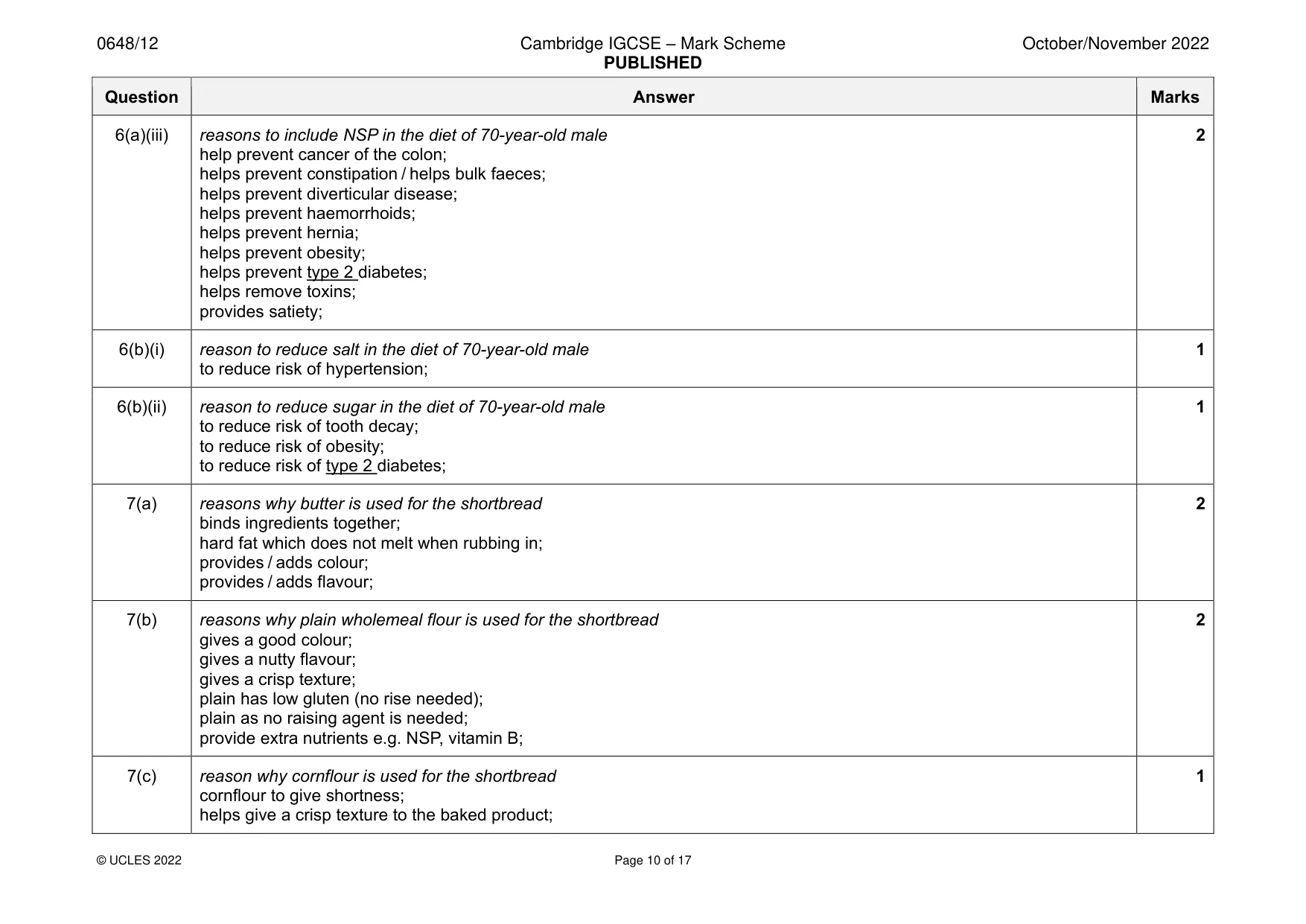
0648/12 Cambridge IGCSE – Mark Scheme PUBLISHED October/November 2022 © UCLES 2022 Page 10 of 17 Question Answer Marks 6(a)(iii) reasons to include NSP in the diet of 70-year-old male help prevent cancer of the colon; helps prevent constipation / helps bulk faeces; helps prevent diverticular disease; helps prevent haemorrhoids; helps prevent hernia; helps prevent obesity; helps prevent type 2 diabetes; helps remove toxins; provides satiety; 2 6(b)(i) reason to reduce salt in the diet of 70-year-old male to reduce risk of hypertension; 1 6(b)(ii) reason to reduce sugar in the diet of 70-year-old male to reduce risk of tooth decay; to reduce risk of obesity; to reduce risk of type 2 diabetes; 1 7(a) reasons why butter is used for the shortbread binds ingredients together; hard fat which does not melt when rubbing in; provides / adds colour; provides / adds flavour; 2 7(b) reasons why plain wholemeal flour is used for the shortbread gives a good colour; gives a nutty flavour; gives a crisp texture; plain has low gluten (no rise needed); plain as no raising agent is needed; provide extra nutrients e.g. NSP, vitamin B; 2 7(c) reason why cornflour is used for the shortbread cornflour to give shortness; helps give a crisp texture to the baked product; 1
Mark scheme, page 11
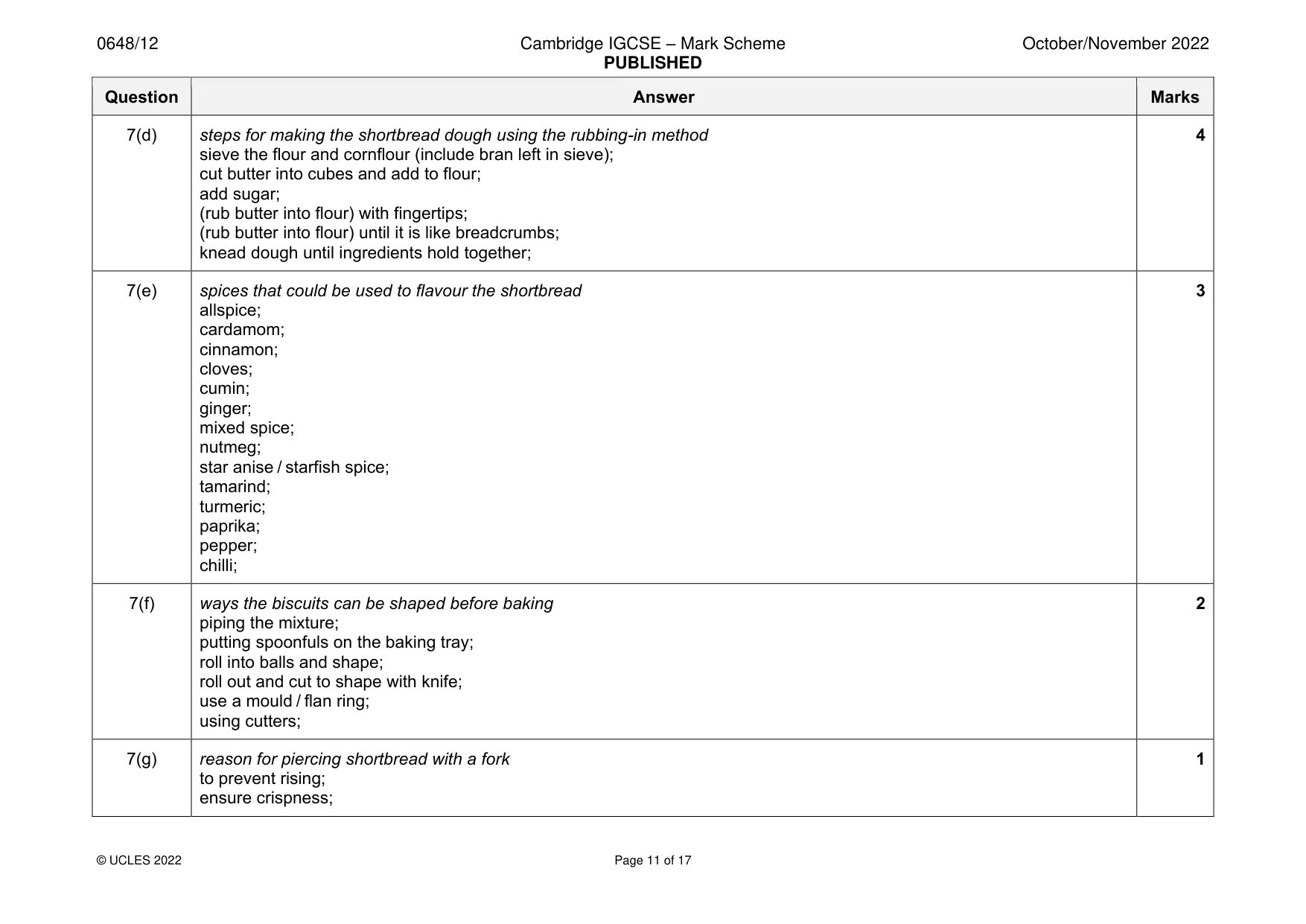
0648/12 Cambridge IGCSE – Mark Scheme PUBLISHED October/November 2022 © UCLES 2022 Page 11 of 17 Question Answer Marks 7(d) steps for making the shortbread dough using the rubbing-in method sieve the flour and cornflour (include bran left in sieve); cut butter into cubes and add to flour; add sugar; (rub butter into flour) with fingertips; (rub butter into flour) until it is like breadcrumbs; knead dough until ingredients hold together; 4 7(e) spices that could be used to flavour the shortbread allspice; cardamom; cinnamon; cloves; cumin; ginger; mixed spice; nutmeg; star anise / starfish spice; tamarind; turmeric; paprika; pepper; chilli; 3 7(f) ways the biscuits can be shaped before baking piping the mixture; putting spoonfuls on the baking tray; roll into balls and shape; roll out and cut to shape with knife; use a mould / flan ring; using cutters; 2 7(g) reason for piercing shortbread with a fork to prevent rising; ensure crispness; 1
Mark scheme, page 12
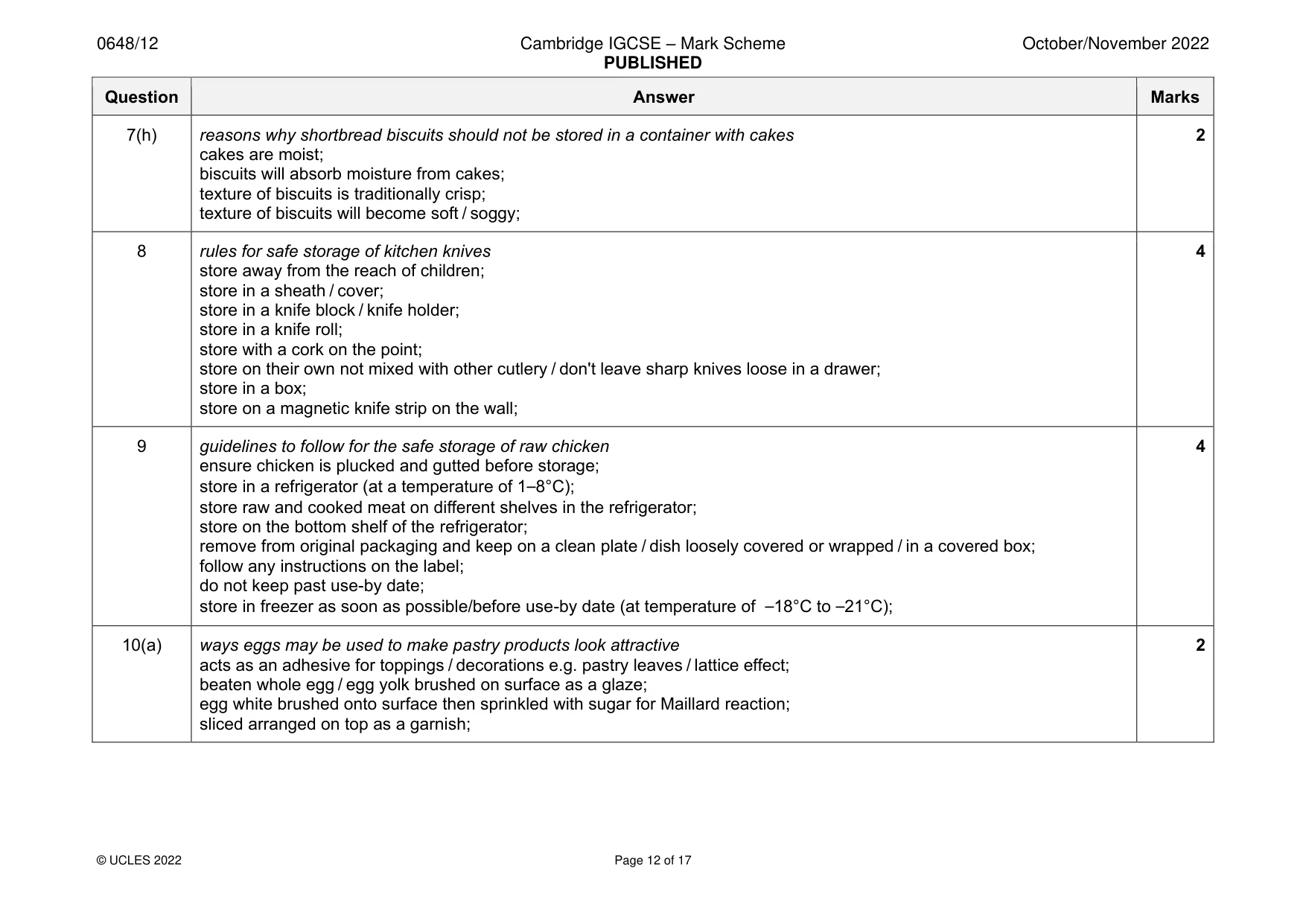
0648/12 Cambridge IGCSE – Mark Scheme PUBLISHED October/November 2022 © UCLES 2022 Page 12 of 17 Question Answer Marks 7(h) reasons why shortbread biscuits should not be stored in a container with cakes cakes are moist; biscuits will absorb moisture from cakes; texture of biscuits is traditionally crisp; texture of biscuits will become soft / soggy; 2 8 rules for safe storage of kitchen knives store away from the reach of children; store in a sheath / cover; store in a knife block / knife holder; store in a knife roll; store with a cork on the point; store on their own not mixed with other cutlery / don't leave sharp knives loose in a drawer; store in a box; store on a magnetic knife strip on the wall; 4 9 guidelines to follow for the safe storage of raw chicken ensure chicken is plucked and gutted before storage; store in a refrigerator (at a temperature of 1–8°C); store raw and cooked meat on different shelves in the refrigerator; store on the bottom shelf of the refrigerator; remove from original packaging and keep on a clean plate / dish loosely covered or wrapped / in a covered box; follow any instructions on the label; do not keep past use-by date; store in freezer as soon as possible/before use-by date (at temperature of –18°C to –21°C); 4 10(a) ways eggs may be used to make pastry products look attractive acts as an adhesive for toppings / decorations e.g. pastry leaves / lattice effect; beaten whole egg / egg yolk brushed on surface as a glaze; egg white brushed onto surface then sprinkled with sugar for Maillard reaction; sliced arranged on top as a garnish; 2
Mark scheme, page 13
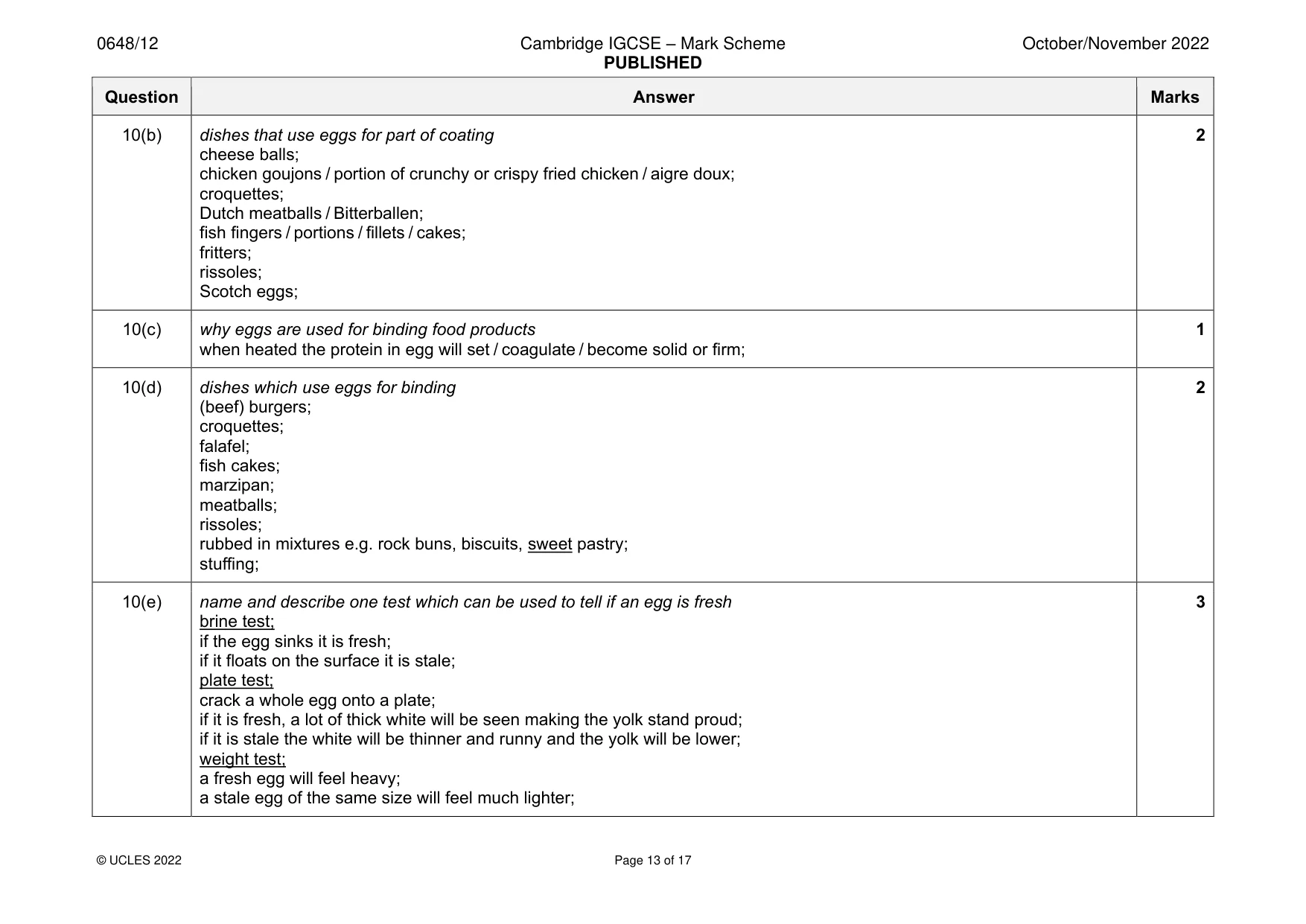
0648/12 Cambridge IGCSE – Mark Scheme PUBLISHED October/November 2022 © UCLES 2022 Page 13 of 17 Question Answer Marks 10(b) dishes that use eggs for part of coating cheese balls; chicken goujons / portion of crunchy or crispy fried chicken / aigre doux; croquettes; Dutch meatballs / Bitterballen; fish fingers / portions / fillets / cakes; fritters; rissoles; Scotch eggs; 2 10(c) why eggs are used for binding food products when heated the protein in egg will set / coagulate / become solid or firm; 1 10(d) dishes which use eggs for binding (beef) burgers; croquettes; falafel; fish cakes; marzipan; meatballs; rissoles; rubbed in mixtures e.g. rock buns, biscuits, sweet pastry; stuffing; 2 10(e) name and describe one test which can be used to tell if an egg is fresh brine test; if the egg sinks it is fresh; if it floats on the surface it is stale; plate test; crack a whole egg onto a plate; if it is fresh, a lot of thick white will be seen making the yolk stand proud; if it is stale the white will be thinner and runny and the yolk will be lower; weight test; a fresh egg will feel heavy; a stale egg of the same size will feel much lighter; 3
Mark scheme, page 14
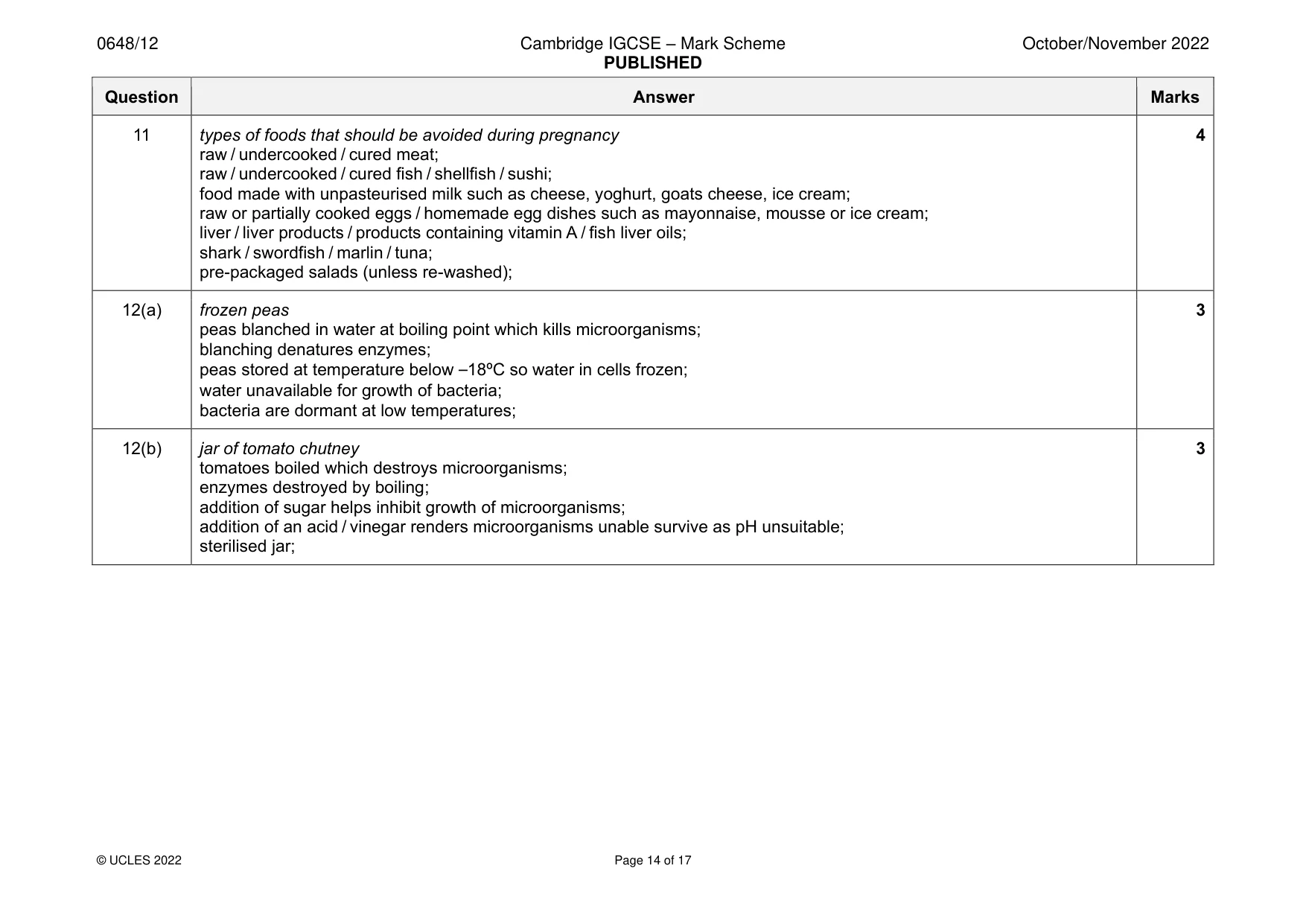
0648/12 Cambridge IGCSE – Mark Scheme PUBLISHED October/November 2022 © UCLES 2022 Page 14 of 17 Question Answer Marks 11 types of foods that should be avoided during pregnancy raw / undercooked / cured meat; raw / undercooked / cured fish / shellfish / sushi; food made with unpasteurised milk such as cheese, yoghurt, goats cheese, ice cream; raw or partially cooked eggs / homemade egg dishes such as mayonnaise, mousse or ice cream; liver / liver products / products containing vitamin A / fish liver oils; shark / swordfish / marlin / tuna; pre-packaged salads (unless re-washed); 4 12(a) frozen peas peas blanched in water at boiling point which kills microorganisms; blanching denatures enzymes; peas stored at temperature below –18ºC so water in cells frozen; water unavailable for growth of bacteria; bacteria are dormant at low temperatures; 3 12(b) jar of tomato chutney tomatoes boiled which destroys microorganisms; enzymes destroyed by boiling; addition of sugar helps inhibit growth of microorganisms; addition of an acid / vinegar renders microorganisms unable survive as pH unsuitable; sterilised jar; 3
Mark scheme, page 15
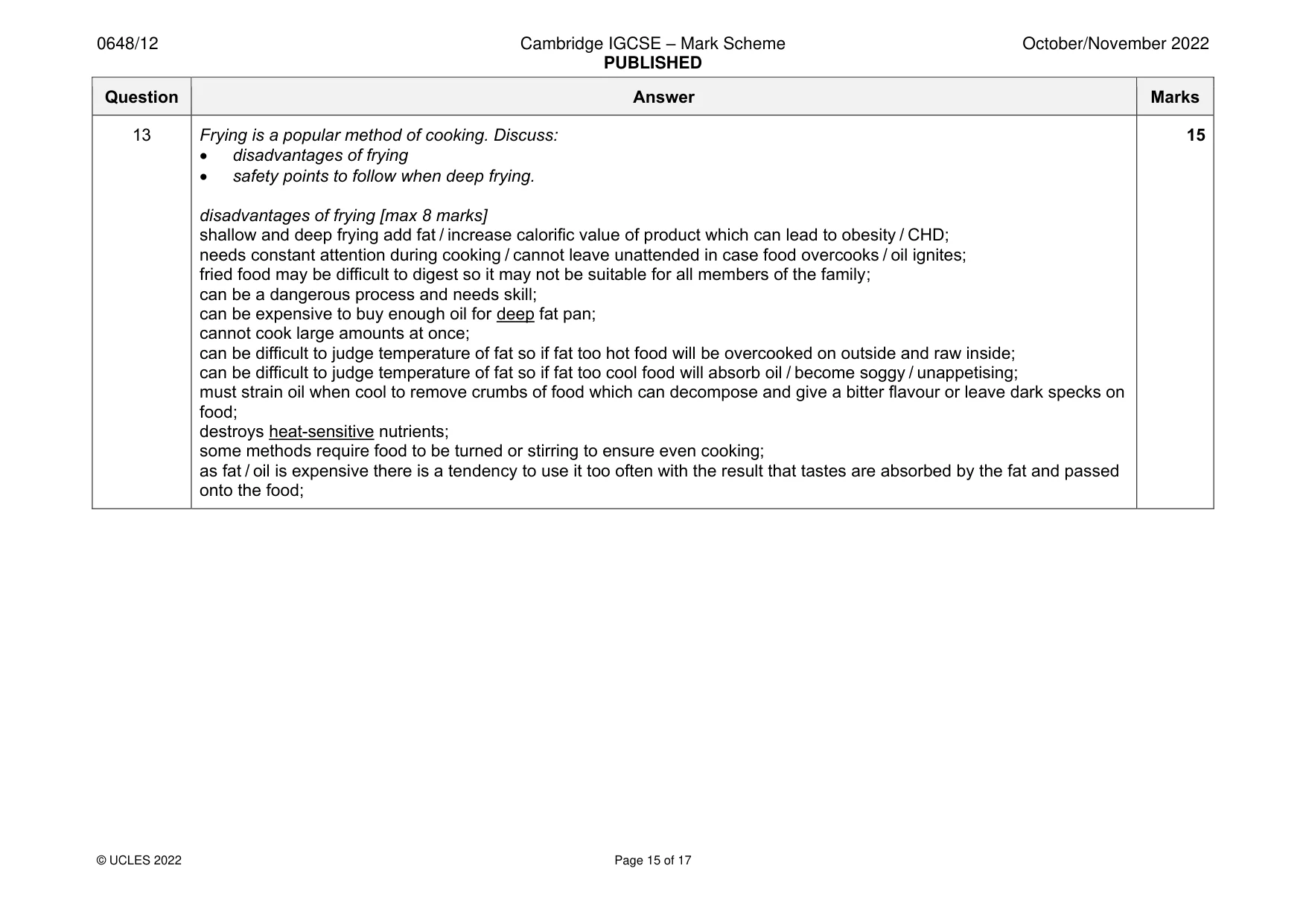
0648/12 Cambridge IGCSE – Mark Scheme PUBLISHED October/November 2022 © UCLES 2022 Page 15 of 17 Question Answer Marks 13 Frying is a popular method of cooking. Discuss: • disadvantages of frying • safety points to follow when deep frying. disadvantages of frying [max 8 marks] shallow and deep frying add fat / increase calorific value of product which can lead to obesity / CHD; needs constant attention during cooking / cannot leave unattended in case food overcooks / oil ignites; fried food may be difficult to digest so it may not be suitable for all members of the family; can be a dangerous process and needs skill; can be expensive to buy enough oil for deep fat pan; cannot cook large amounts at once; can be difficult to judge temperature of fat so if fat too hot food will be overcooked on outside and raw inside; can be difficult to judge temperature of fat so if fat too cool food will absorb oil / become soggy / unappetising; must strain oil when cool to remove crumbs of food which can decompose and give a bitter flavour or leave dark specks on food; destroys heat-sensitive nutrients; some methods require food to be turned or stirring to ensure even cooking; as fat / oil is expensive there is a tendency to use it too often with the result that tastes are absorbed by the fat and passed onto the food; 15
Mark scheme, page 16
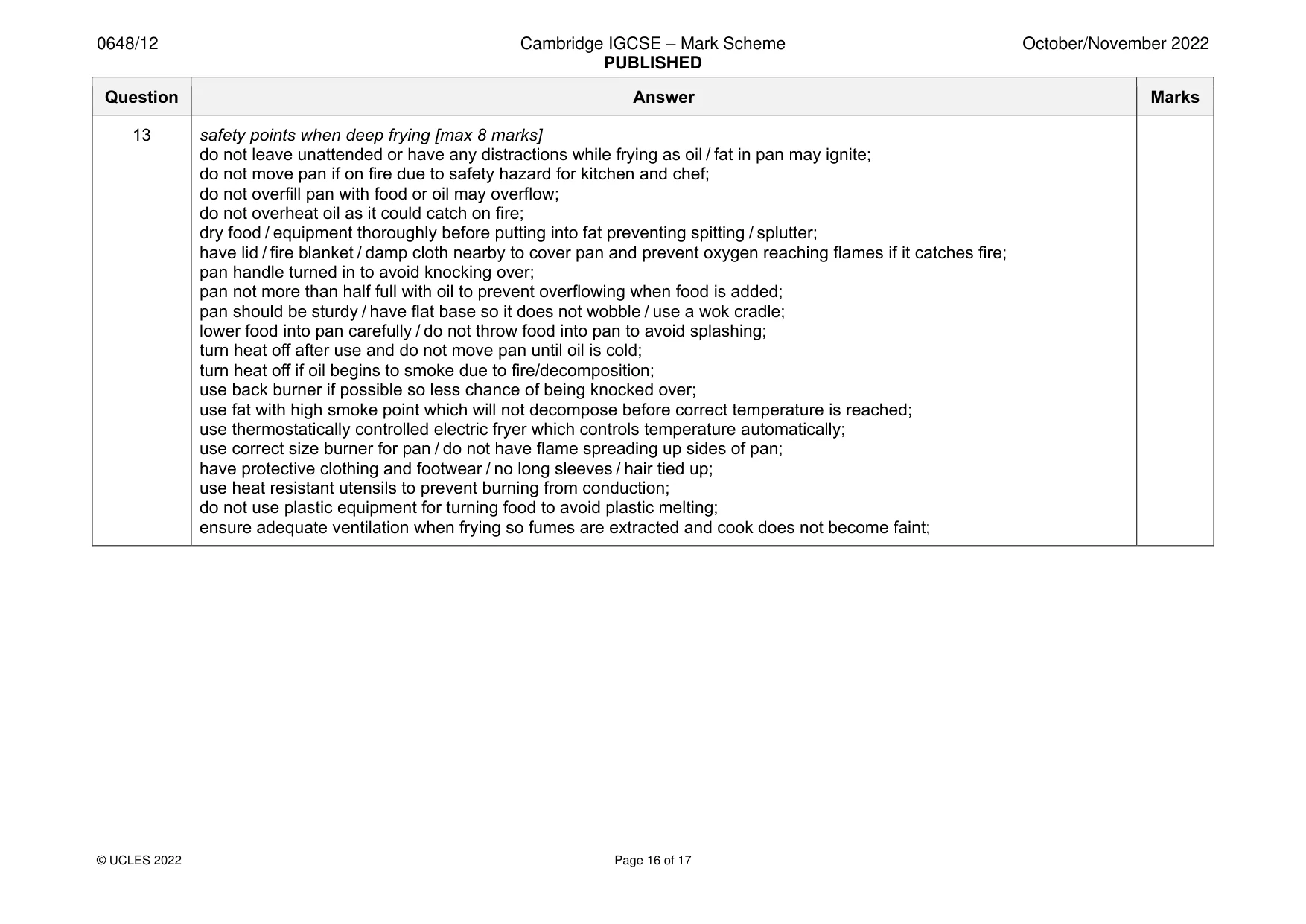
0648/12 Cambridge IGCSE – Mark Scheme PUBLISHED October/November 2022 © UCLES 2022 Page 16 of 17 Question Answer Marks 13 safety points when deep frying [max 8 marks] do not leave unattended or have any distractions while frying as oil / fat in pan may ignite; do not move pan if on fire due to safety hazard for kitchen and chef; do not overfill pan with food or oil may overflow; do not overheat oil as it could catch on fire; dry food / equipment thoroughly before putting into fat preventing spitting / splutter; have lid / fire blanket / damp cloth nearby to cover pan and prevent oxygen reaching flames if it catches fire; pan handle turned in to avoid knocking over; pan not more than half full with oil to prevent overflowing when food is added; pan should be sturdy / have flat base so it does not wobble / use a wok cradle; lower food into pan carefully / do not throw food into pan to avoid splashing; turn heat off after use and do not move pan until oil is cold; turn heat off if oil begins to smoke due to fire/decomposition; use back burner if possible so less chance of being knocked over; use fat with high smoke point which will not decompose before correct temperature is reached; use thermostatically controlled electric fryer which controls temperature automatically; use correct size burner for pan / do not have flame spreading up sides of pan; have protective clothing and footwear / no long sleeves / hair tied up; use heat resistant utensils to prevent burning from conduction; do not use plastic equipment for turning food to avoid plastic melting; ensure adequate ventilation when frying so fumes are extracted and cook does not become faint;
Mark scheme, page 17
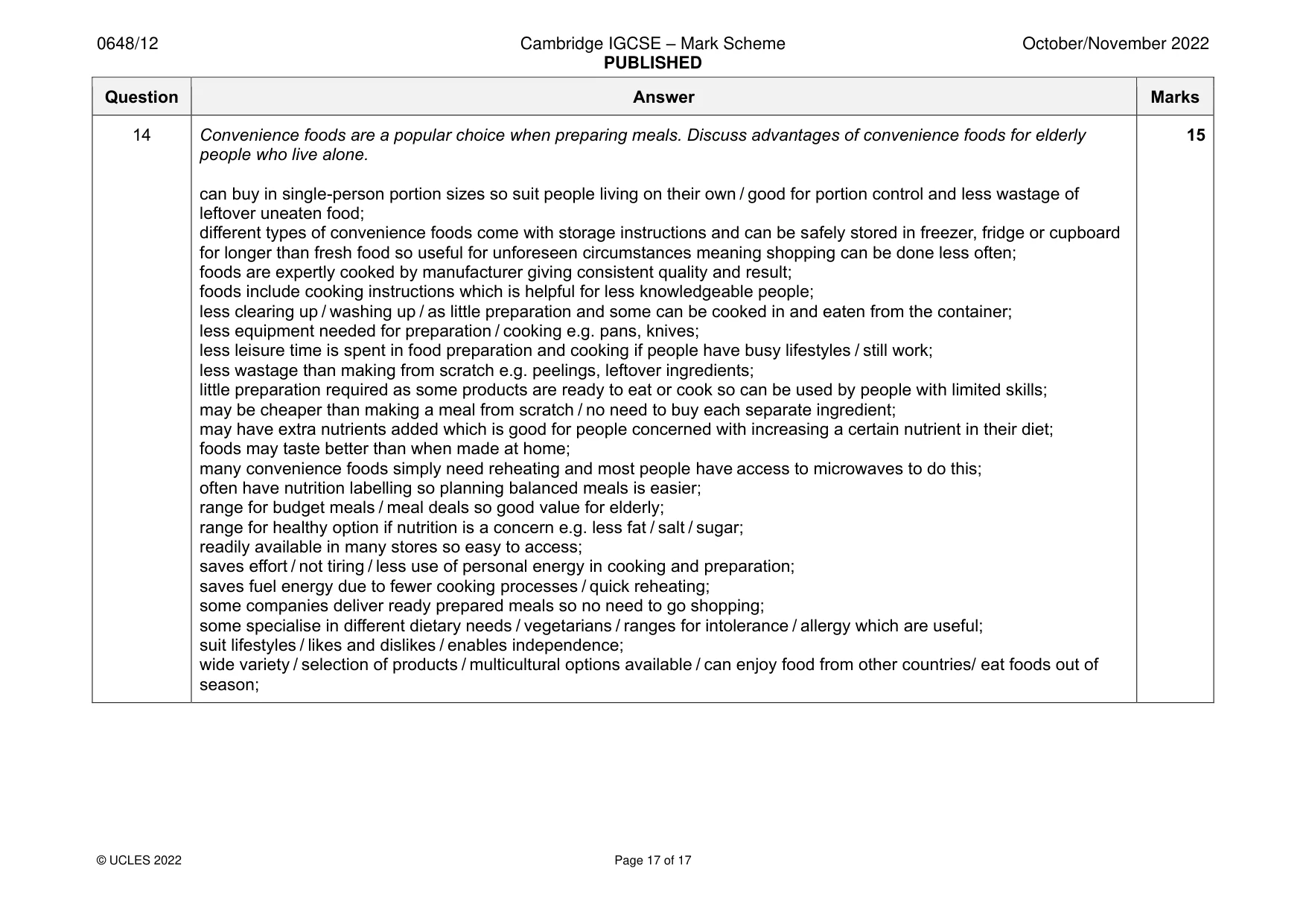
0648/12 Cambridge IGCSE – Mark Scheme PUBLISHED October/November 2022 © UCLES 2022 Page 17 of 17 Question Answer Marks 14 Convenience foods are a popular choice when preparing meals. Discuss advantages of convenience foods for elderly people who live alone. can buy in single-person portion sizes so suit people living on their own / good for portion control and less wastage of leftover uneaten food; different types of convenience foods come with storage instructions and can be safely stored in freezer, fridge or cupboard for longer than fresh food so useful for unforeseen circumstances meaning shopping can be done less often; foods are expertly cooked by manufacturer giving consistent quality and result; foods include cooking instructions which is helpful for less knowledgeable people; less clearing up / washing up / as little preparation and some can be cooked in and eaten from the container; less equipment needed for preparation / cooking e.g. pans, knives; less leisure time is spent in food preparation and cooking if people have busy lifestyles / still work; less wastage than making from scratch e.g. peelings, leftover ingredients; little preparation required as some products are ready to eat or cook so can be used by people with limited skills; may be cheaper than making a meal from scratch / no need to buy each separate ingredient; may have extra nutrients added which is good for people concerned with increasing a certain nutrient in their diet; foods may taste better than when made at home; many convenience foods simply need reheating and most people have access to microwaves to do this; often have nutrition labelling so planning balanced meals is easier; range for budget meals / meal deals so good value for elderly; range for healthy option if nutrition is a concern e.g. less fat / salt / sugar; readily available in many stores so easy to access; saves effort / not tiring / less use of personal energy in cooking and preparation; saves fuel energy due to fewer cooking processes / quick reheating; some companies deliver ready prepared meals so no need to go shopping; some specialise in different dietary needs / vegetarians / ranges for intolerance / allergy which are useful; suit lifestyles / likes and dislikes / enables independence; wide variety / selection of products / multicultural options available / can enjoy food from other countries/ eat foods out of season; 15
What you needed in this session
Cambridge’s own grade thresholds for 2022 Oct/Nov, Paper 1 · Variant 2. A higher threshold means an easier paper — the bar moves with how the cohort did.