Cambridge IGCSE Food and Nutrition 0648 — 2022 Oct/Nov Paper 1 · Variant 1
0648/11/O/N/22 · 100 marks · ≈113 min
The question paper and its mark scheme, free to read here and free to download. This is Cambridge’s own paper, exactly as it was sat.
Question paper12 pages


Mark scheme18 pages
Answers below. Sit the paper first if you are practising.
Paper as text
Question paper, page 1
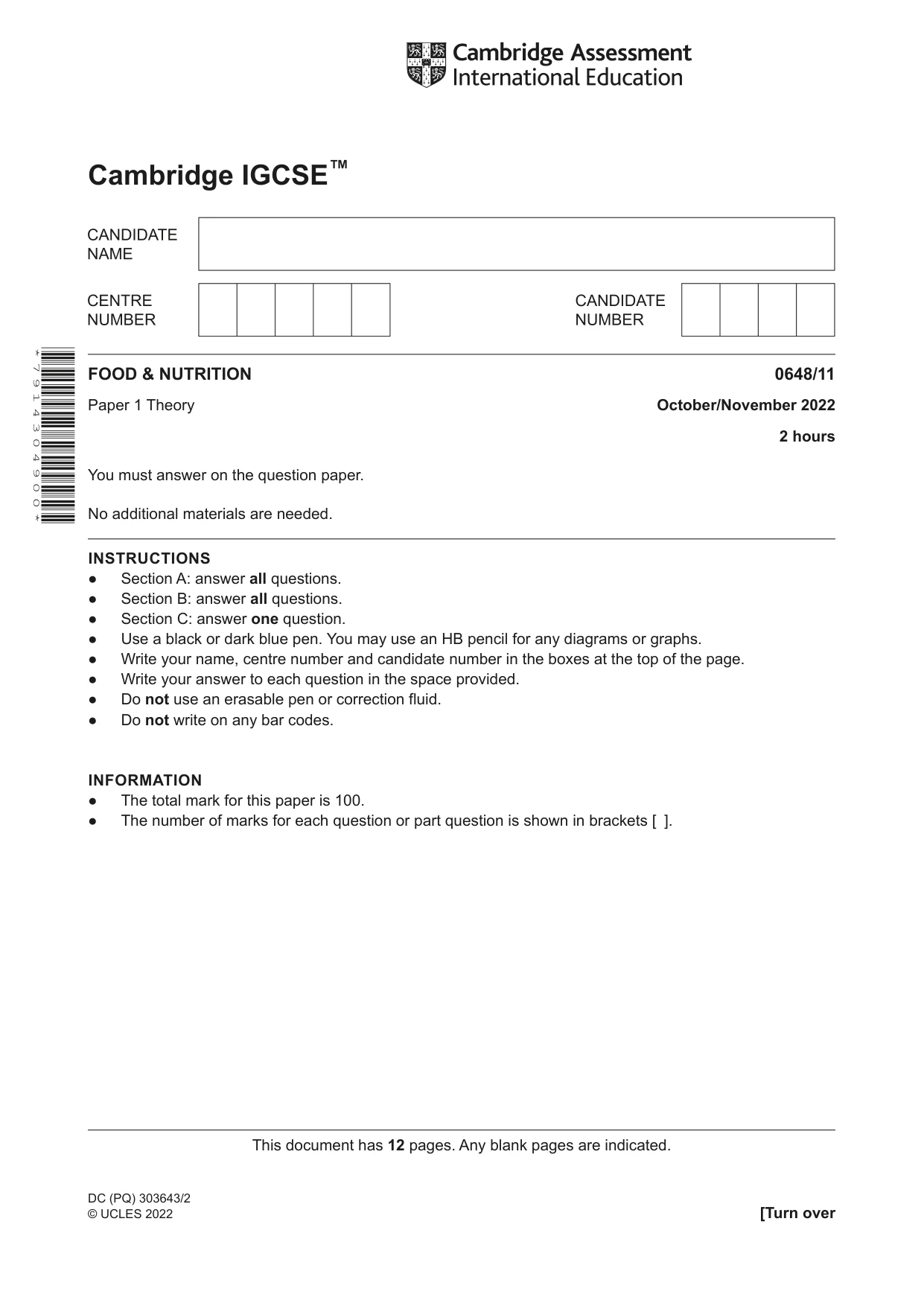
This document has 12 pages. Any blank pages are indicated. [Turn over Cambridge IGCSE™ DC (PQ) 303643/2 © UCLES 2022 * 7 9 1 4 3 0 4 9 0 0 * FOOD & NUTRITION 0648/11 Paper 1 Theory October/November 2022 2 hours You must answer on the question paper. No additional materials are needed. INSTRUCTIONS ● Section A: answer all questions. ● Section B: answer all questions. ● Section C: answer one question. ● Use a black or dark blue pen. You may use an HB pencil for any diagrams or graphs. ● Write your name, centre number and candidate number in the boxes at the top of the page. ● Write your answer to each question in the space provided. ● Do not use an erasable pen or correction fluid. ● Do not write on any bar codes. INFORMATION ● The total mark for this paper is 100. ● The number of marks for each question or part question is shown in brackets [ ].
Question paper, page 2
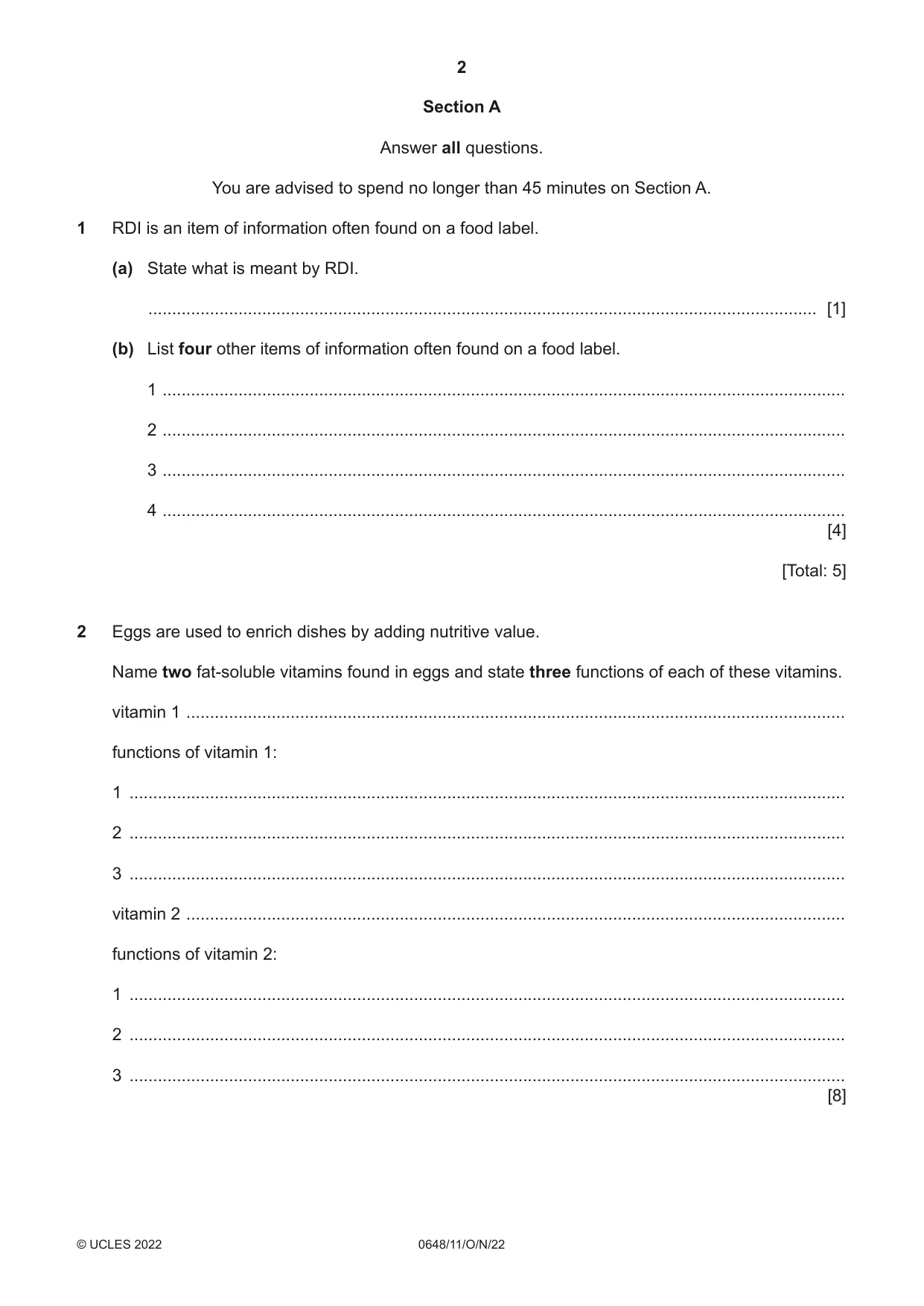
2 0648/11/O/N/22 © UCLES 2022 Section A Answer all questions. You are advised to spend no longer than 45 minutes on Section A. 1 RDI is an item of information often found on a food label. (a) State what is meant by RDI. … [1] (b) List four other items of information often found on a food label. 1 … 2 … 3 … 4 … [4] [Total: 5] 2 Eggs are used to enrich dishes by adding nutritive value. Name two fat-soluble vitamins found in eggs and state three functions of each of these vitamins. vitamin 1 … functions of vitamin 1: 1 … 2 … 3 … vitamin 2 … functions of vitamin 2: 1 … 2 … 3 … [8]
Question paper, page 3
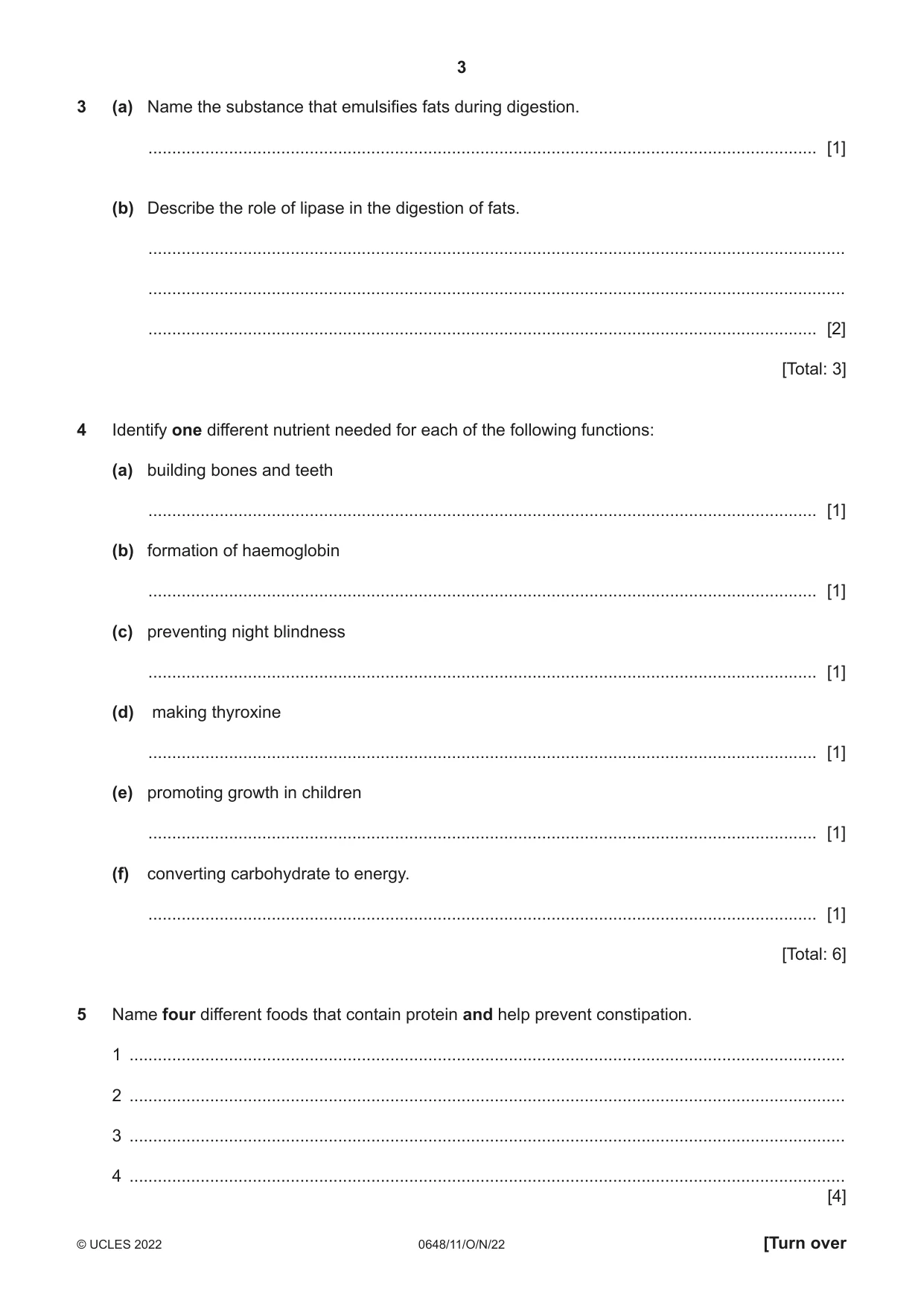
3 0648/11/O/N/22 © UCLES 2022 [Turn over 3 (a) Name the substance that emulsifies fats during digestion. … [1] (b) Describe the role of lipase in the digestion of fats. … … … [2] [Total: 3] 4 Identify one different nutrient needed for each of the following functions: (a) building bones and teeth … [1] (b) formation of haemoglobin … [1] (c) preventing night blindness … [1] (d) making thyroxine … [1] (e) promoting growth in children … [1] (f) converting carbohydrate to energy. … [1] [Total: 6] 5 Name four different foods that contain protein and help prevent constipation. 1 … 2 … 3 … 4 … [4]
Question paper, page 4
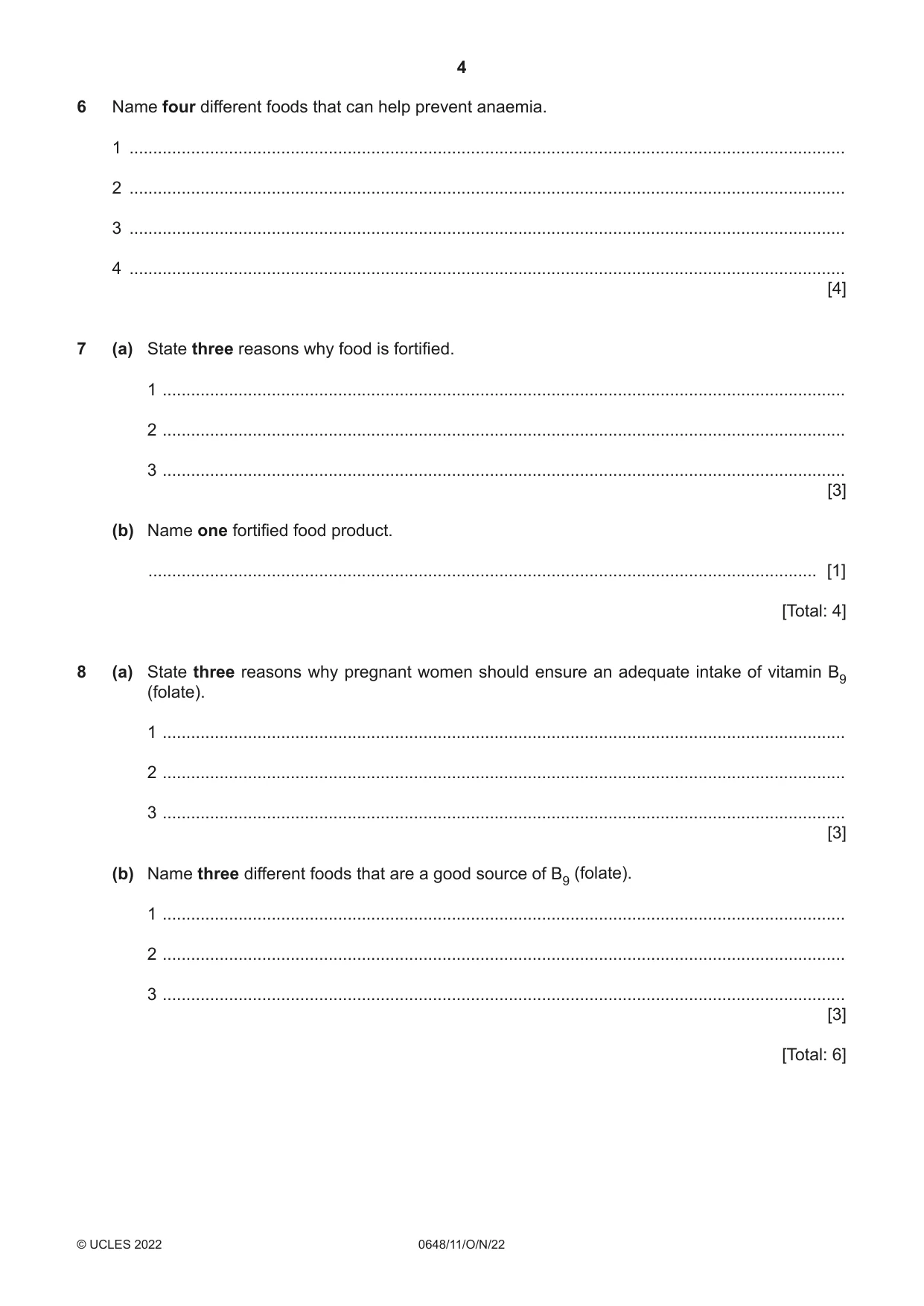
4 0648/11/O/N/22 © UCLES 2022 6 Name four different foods that can help prevent anaemia. 1 … 2 … 3 … 4 … [4] 7 (a) State three reasons why food is fortified. 1 … 2 … 3 … [3] (b) Name one fortified food product. … [1] [Total: 4] 8 (a) State three reasons why pregnant women should ensure an adequate intake of vitamin B9 (folate). 1 … 2 … 3 … [3] (b) Name three different foods that are a good source of B9 (folate). 1 … 2 … 3 … [3] [Total: 6]
Question paper, page 5
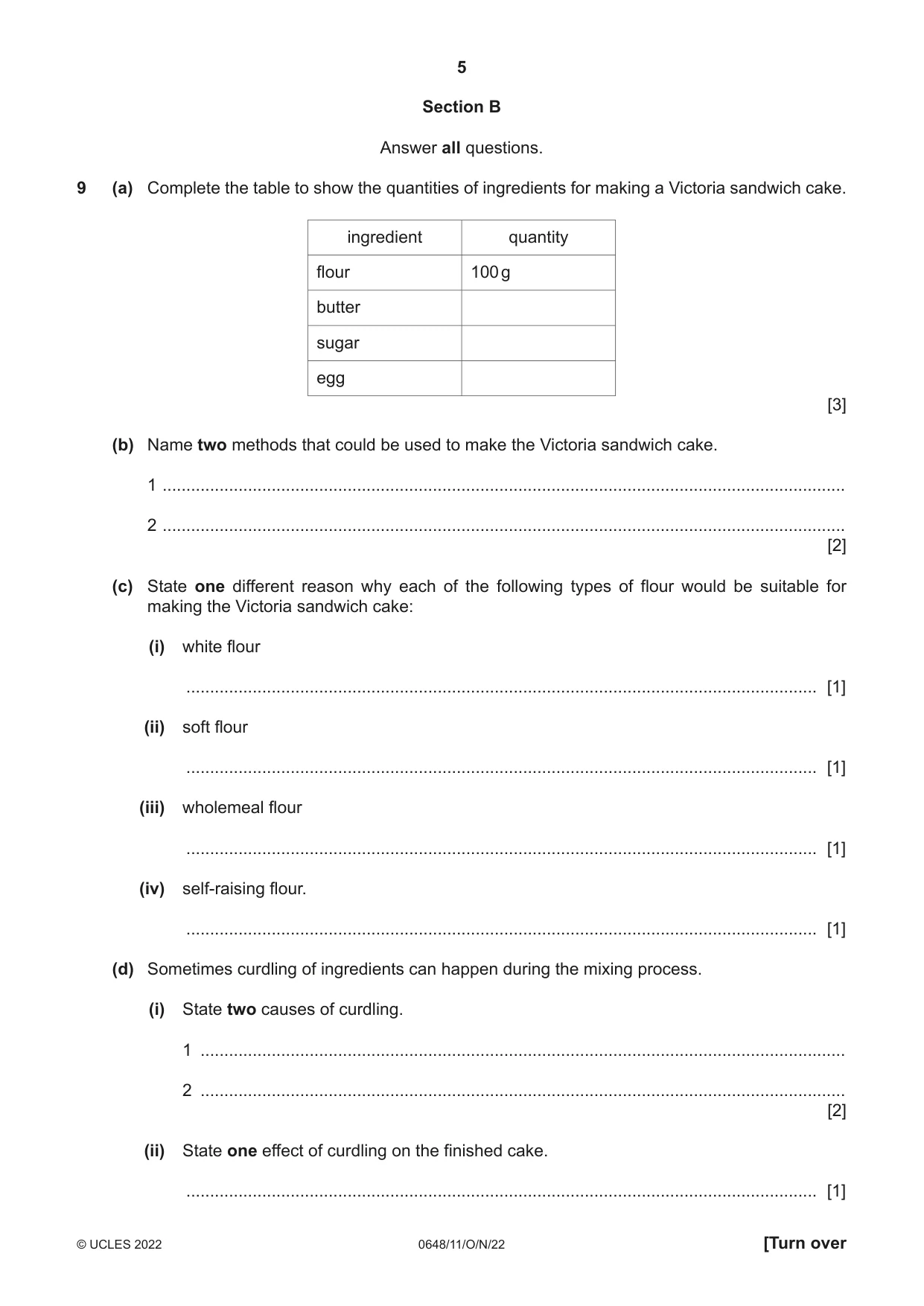
5 0648/11/O/N/22 © UCLES 2022 [Turn over Section B Answer all questions. 9 (a) Complete the table to show the quantities of ingredients for making a Victoria sandwich cake. ingredient quantity flour 100 g butter sugar egg [3] (b) Name two methods that could be used to make the Victoria sandwich cake. 1 … 2 … [2] (c) State one different reason why each of the following types of flour would be suitable for making the Victoria sandwich cake: (i) white flour … [1] (ii) soft flour … [1] (iii) wholemeal flour … [1] (iv) self-raising flour. … [1] (d) Sometimes curdling of ingredients can happen during the mixing process. (i) State two causes of curdling. 1 … 2 … [2] (ii) State one effect of curdling on the finished cake. … [1]
Question paper, page 6
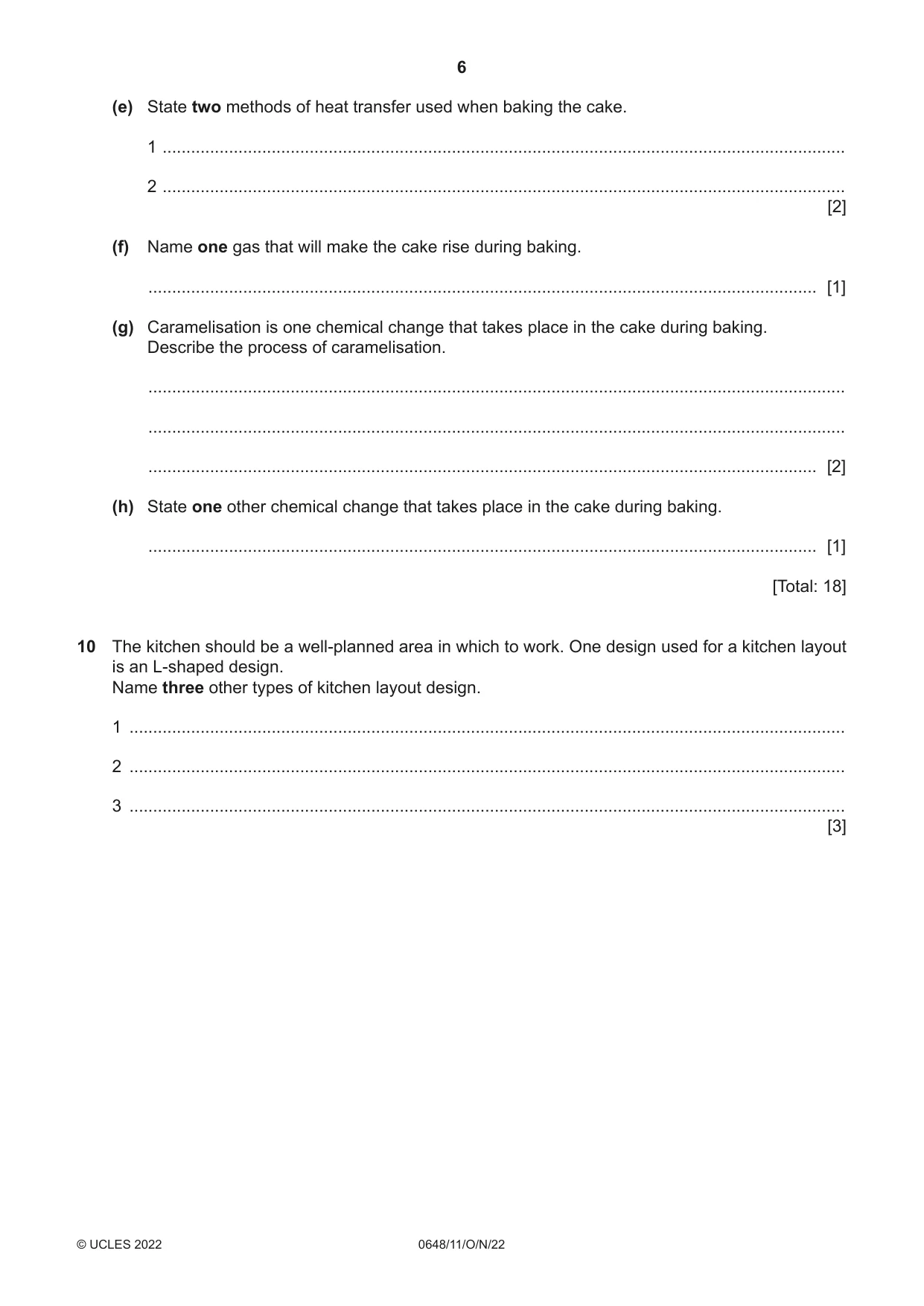
6 0648/11/O/N/22 © UCLES 2022 (e) State two methods of heat transfer used when baking the cake. 1 … 2 … [2] (f) Name one gas that will make the cake rise during baking. … [1] (g) Caramelisation is one chemical change that takes place in the cake during baking. Describe the process of caramelisation. … … … [2] (h) State one other chemical change that takes place in the cake during baking. … [1] [Total: 18] 10 The kitchen should be a well-planned area in which to work. One design used for a kitchen layout is an L-shaped design. Name three other types of kitchen layout design. 1 … 2 … 3 … [3]
Question paper, page 7
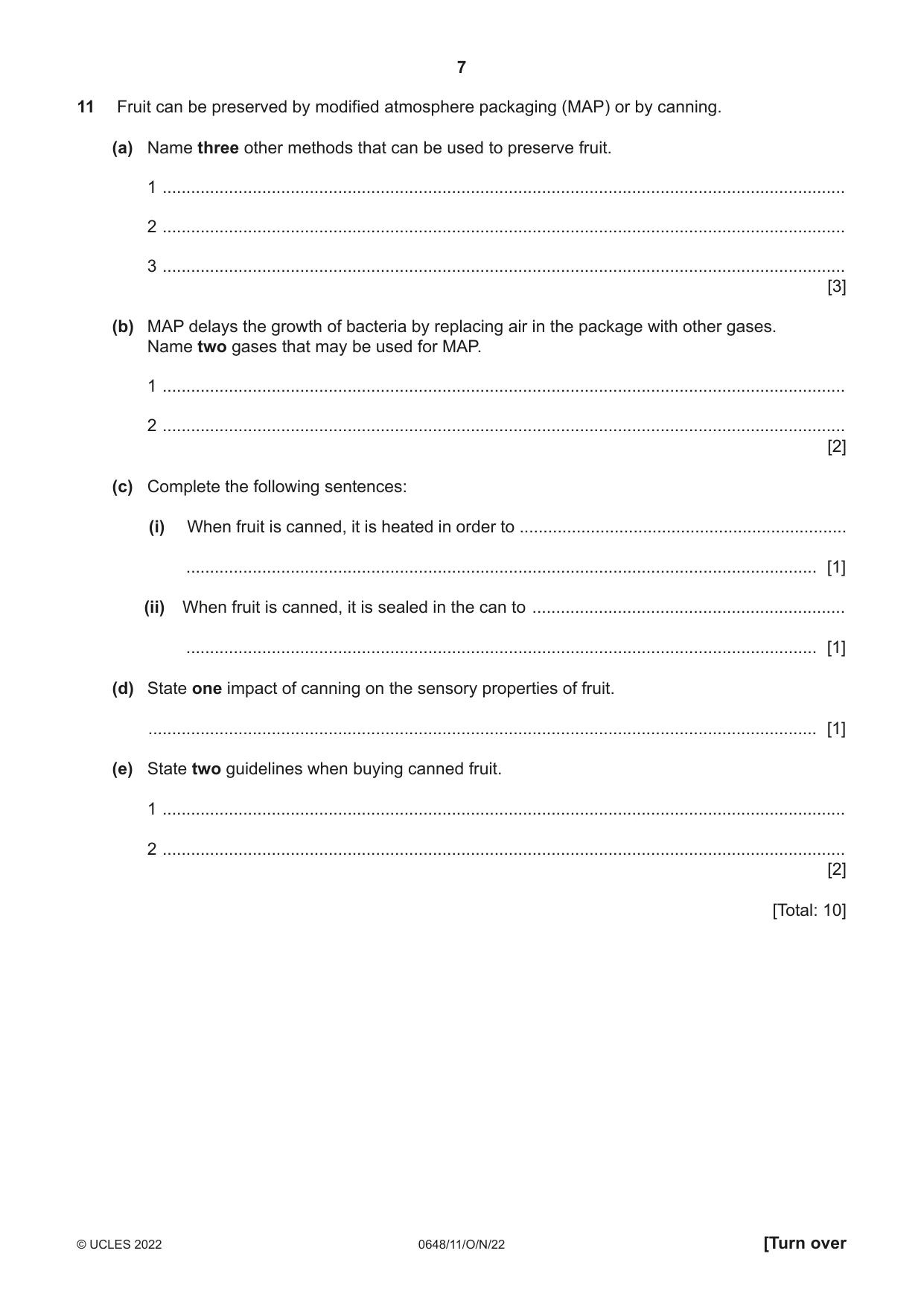
7 0648/11/O/N/22 © UCLES 2022 [Turn over 11 Fruit can be preserved by modified atmosphere packaging (MAP) or by canning. (a) Name three other methods that can be used to preserve fruit. 1 … 2 … 3 … [3] (b) MAP delays the growth of bacteria by replacing air in the package with other gases. Name two gases that may be used for MAP. 1 … 2 … [2] (c) Complete the following sentences: (i) When fruit is canned, it is heated in order to … … [1] (ii) When fruit is canned, it is sealed in the can to … … [1] (d) State one impact of canning on the sensory properties of fruit. … [1] (e) State two guidelines when buying canned fruit. 1 … 2 … [2] [Total: 10]
Question paper, page 8
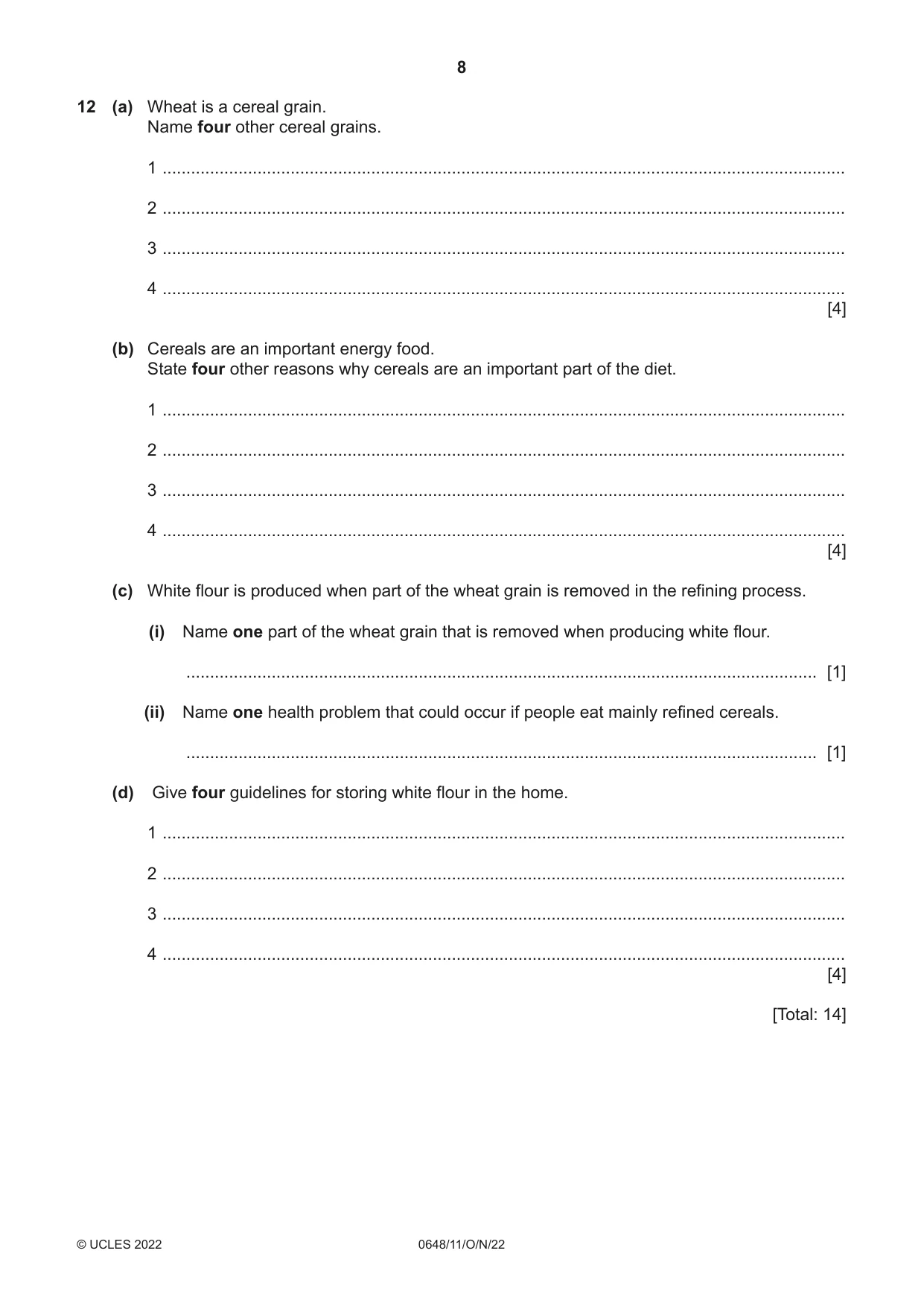
8 0648/11/O/N/22 © UCLES 2022 12 (a) Wheat is a cereal grain. Name four other cereal grains. 1 … 2 … 3 … 4 … [4] (b) Cereals are an important energy food. State four other reasons why cereals are an important part of the diet. 1 … 2 … 3 … 4 … [4] (c) White flour is produced when part of the wheat grain is removed in the refining process. (i) Name one part of the wheat grain that is removed when producing white flour. … [1] (ii) Name one health problem that could occur if people eat mainly refined cereals. … [1] (d) Give four guidelines for storing white flour in the home. 1 … 2 … 3 … 4 … [4] [Total: 14]
Question paper, page 9
9 0648/11/O/N/22 © UCLES 2022 [Turn over Section C Answer either Question 13 or 14. 13 High levels of bacteria in food can result in food poisoning. Identify and explain personal, kitchen and food hygiene techniques to avoid causing food poisoning when preparing family meals. [15] OR 14 Many households own a microwave oven. Discuss: • reasons why a microwave oven is useful for an elderly person who lives alone • safety when using a microwave oven. [15] … … … … … … … … … … … … … … … … … … … …
Question paper, page 10
10 0648/11/O/N/22 © UCLES 2022 … … … … … … … … … … … … … … … … … … … … … … … … … … … …
Question paper, page 11
11 0648/11/O/N/22 © UCLES 2022 … … … … … … … … … … … … … … … … … … … … … … … … … … … …
Question paper, page 12
12 0648/11/O/N/22 © UCLES 2022 Permission to reproduce items where third-party owned material protected by copyright is included has been sought and cleared where possible. Every reasonable effort has been made by the publisher (UCLES) to trace copyright holders, but if any items requiring clearance have unwittingly been included, the publisher will be pleased to make amends at the earliest possible opportunity. To avoid the issue of disclosure of answer-related information to candidates, all copyright acknowledgements are reproduced online in the Cambridge Assessment International Education Copyright Acknowledgements Booklet. This is produced for each series of examinations and is freely available to download at www.cambridgeinternational.org after the live examination series. Cambridge Assessment International Education is part of Cambridge Assessment. Cambridge Assessment is the brand name of the University of Cambridge Local Examinations Syndicate (UCLES), which is a department of the University of Cambridge. BLANK PAGE
Mark scheme, page 1
This document consists of 18 printed pages. © UCLES 2022 [Turn over Cambridge IGCSE™ FOOD & NUTRITION 0648/11 Paper 1 Theory October/November 2022 MARK SCHEME Maximum Mark: 100 Published This mark scheme is published as an aid to teachers and candidates, to indicate the requirements of the examination. It shows the basis on which Examiners were instructed to award marks. It does not indicate the details of the discussions that took place at an Examiners’ meeting before marking began, which would have considered the acceptability of alternative answers. Mark schemes should be read in conjunction with the question paper and the Principal Examiner Report for Teachers. Cambridge International will not enter into discussions about these mark schemes. Cambridge International is publishing the mark schemes for the October/November 2022 series for most Cambridge IGCSE™, Cambridge International A and AS Level components and some Cambridge O Level components.
Mark scheme, page 2
0648/11 Cambridge IGCSE – Mark Scheme PUBLISHED October/November 2022 © UCLES 2022 Page 2 of 18 Generic Marking Principles These general marking principles must be applied by all examiners when marking candidate answers. They should be applied alongside the specific content of the mark scheme or generic level descriptors for a question. Each question paper and mark scheme will also comply with these marking principles. GENERIC MARKING PRINCIPLE 1: Marks must be awarded in line with: • the specific content of the mark scheme or the generic level descriptors for the question • the specific skills defined in the mark scheme or in the generic level descriptors for the question • the standard of response required by a candidate as exemplified by the standardisation scripts. GENERIC MARKING PRINCIPLE 2: Marks awarded are always whole marks (not half marks, or other fractions). GENERIC MARKING PRINCIPLE 3: Marks must be awarded positively: • marks are awarded for correct/valid answers, as defined in the mark scheme. However, credit is given for valid answers which go beyond the scope of the syllabus and mark scheme, referring to your Team Leader as appropriate • marks are awarded when candidates clearly demonstrate what they know and can do • marks are not deducted for errors • marks are not deducted for omissions • answers should only be judged on the quality of spelling, punctuation and grammar when these features are specifically assessed by the question as indicated by the mark scheme. The meaning, however, should be unambiguous. GENERIC MARKING PRINCIPLE 4: Rules must be applied consistently, e.g. in situations where candidates have not followed instructions or in the application of generic level descriptors.
Mark scheme, page 3
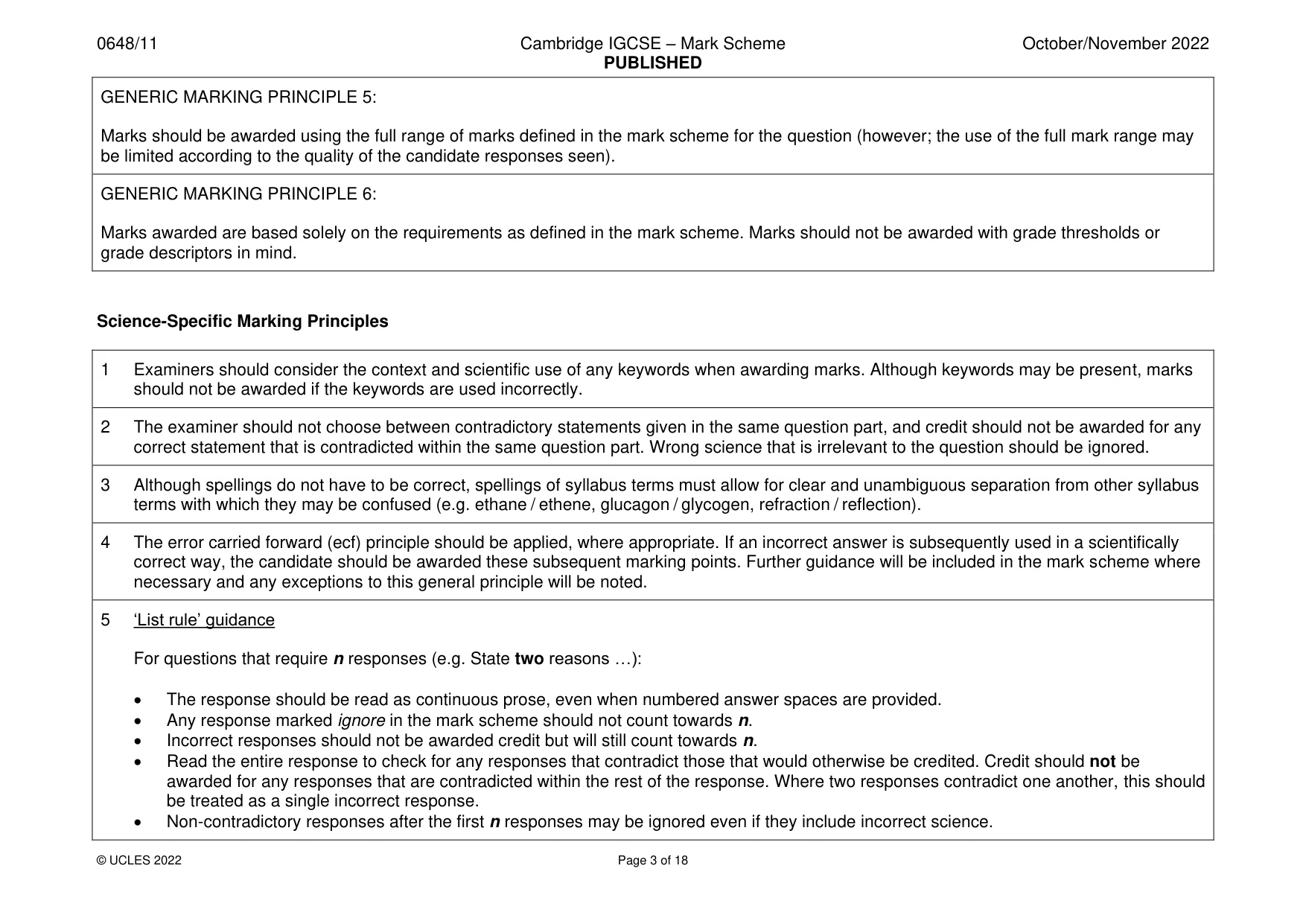
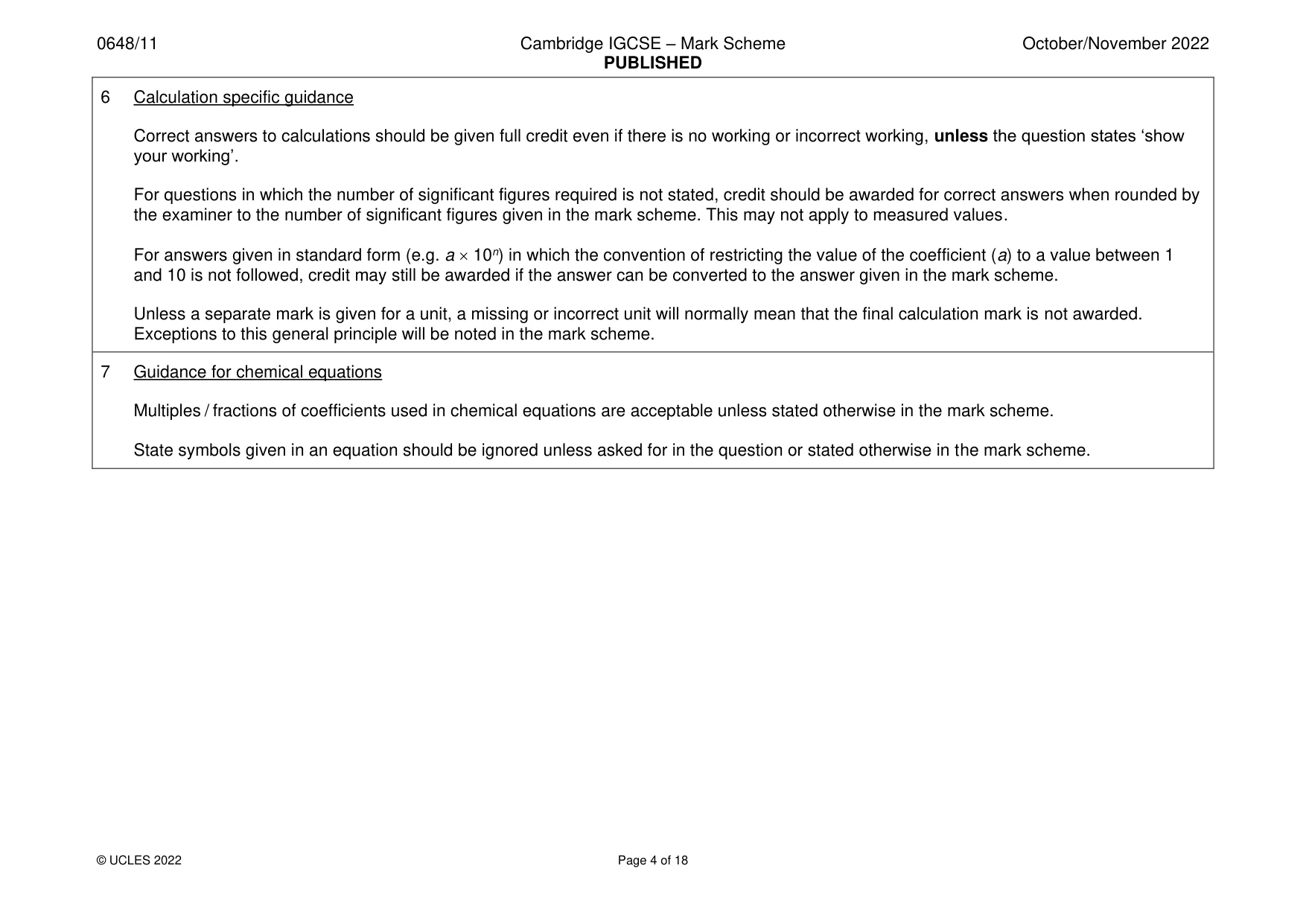
0648/11 Cambridge IGCSE – Mark Scheme PUBLISHED October/November 2022 © UCLES 2022 Page 3 of 18 GENERIC MARKING PRINCIPLE 5: Marks should be awarded using the full range of marks defined in the mark scheme for the question (however; the use of the full mark range may be limited according to the quality of the candidate responses seen). GENERIC MARKING PRINCIPLE 6: Marks awarded are based solely on the requirements as defined in the mark scheme. Marks should not be awarded with grade thresholds or grade descriptors in mind. Science-Specific Marking Principles 1 Examiners should consider the context and scientific use of any keywords when awarding marks. Although keywords may be present, marks should not be awarded if the keywords are used incorrectly. 2 The examiner should not choose between contradictory statements given in the same question part, and credit should not be awarded for any correct statement that is contradicted within the same question part. Wrong science that is irrelevant to the question should be ignored. 3 Although spellings do not have to be correct, spellings of syllabus terms must allow for clear and unambiguous separation from other syllabus terms with which they may be confused (e.g. ethane / ethene, glucagon / glycogen, refraction / reflection). 4 The error carried forward (ecf) principle should be applied, where appropriate. If an incorrect answer is subsequently used in a scientifically correct way, the candidate should be awarded these subsequent marking points. Further guidance will be included in the mark scheme where necessary and any exceptions to this general principle will be noted. 5 ‘List rule’ guidance For questions that require n responses (e.g. State two reasons …): • The response should be read as continuous prose, even when numbered answer spaces are provided. • Any response marked ignore in the mark scheme should not count towards n. • Incorrect responses should not be awarded credit but will still count towards n. • Read the entire response to check for any responses that contradict those that would otherwise be credited. Credit should not be awarded for any responses that are contradicted within the rest of the response. Where two responses contradict one another, this should be treated as a single incorrect response. • Non-contradictory responses after the first n responses may be ignored even if they include incorrect science.
Mark scheme, page 4
0648/11 Cambridge IGCSE – Mark Scheme PUBLISHED October/November 2022 © UCLES 2022 Page 4 of 18 6 Calculation specific guidance Correct answers to calculations should be given full credit even if there is no working or incorrect working, unless the question states ‘show your working’. For questions in which the number of significant figures required is not stated, credit should be awarded for correct answers when rounded by the examiner to the number of significant figures given in the mark scheme. This may not apply to measured values. For answers given in standard form (e.g. a 10n) in which the convention of restricting the value of the coefficient (a) to a value between 1 and 10 is not followed, credit may still be awarded if the answer can be converted to the answer given in the mark scheme. Unless a separate mark is given for a unit, a missing or incorrect unit will normally mean that the final calculation mark is not awarded. Exceptions to this general principle will be noted in the mark scheme. 7 Guidance for chemical equations Multiples / fractions of coefficients used in chemical equations are acceptable unless stated otherwise in the mark scheme. State symbols given in an equation should be ignored unless asked for in the question or stated otherwise in the mark scheme.
Mark scheme, page 5
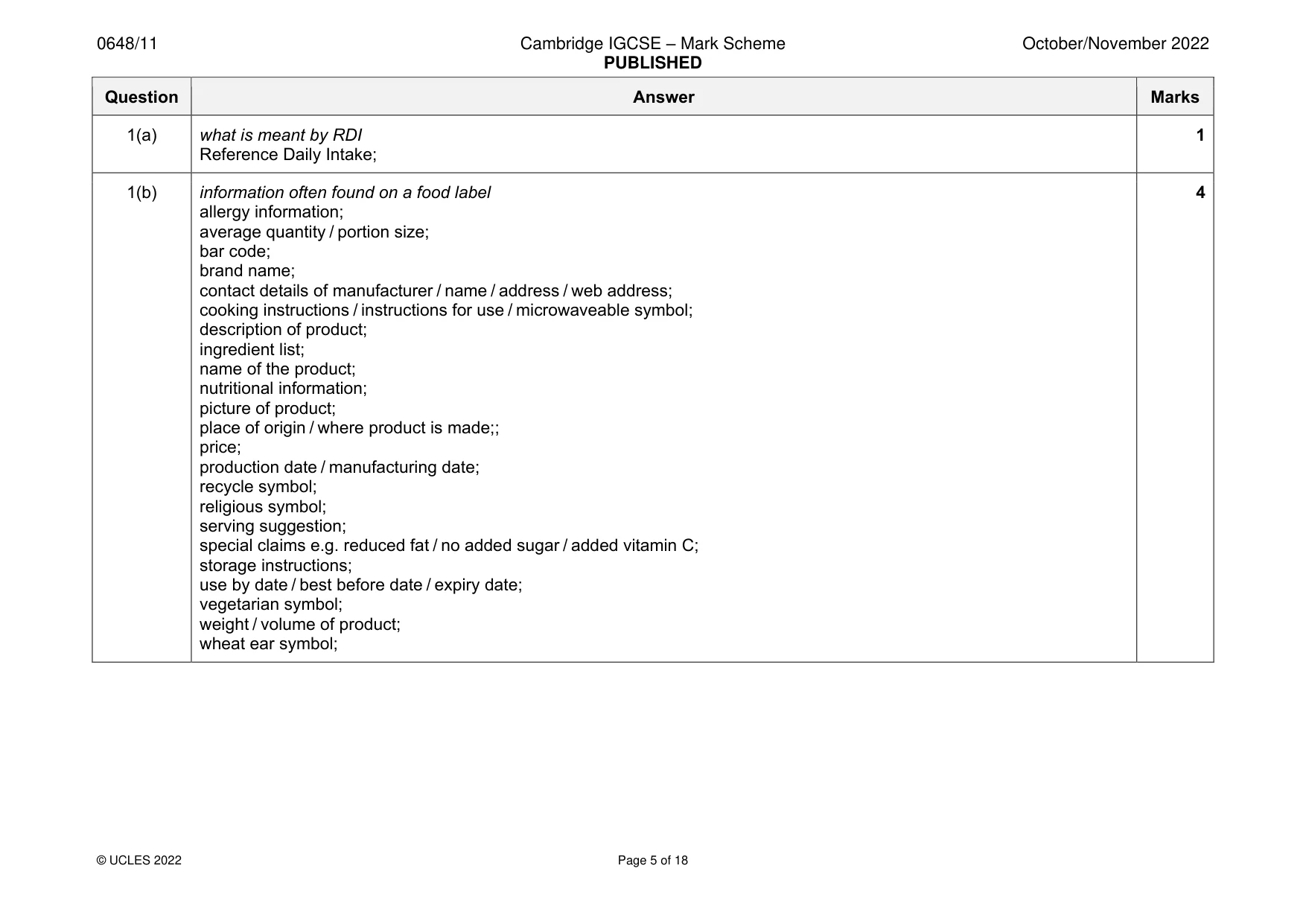
0648/11 Cambridge IGCSE – Mark Scheme PUBLISHED October/November 2022 © UCLES 2022 Page 5 of 18 Question Answer Marks 1(a) what is meant by RDI Reference Daily Intake; 1 1(b) information often found on a food label allergy information; average quantity / portion size; bar code; brand name; contact details of manufacturer / name / address / web address; cooking instructions / instructions for use / microwaveable symbol; description of product; ingredient list; name of the product; nutritional information; picture of product; place of origin / where product is made;; price; production date / manufacturing date; recycle symbol; religious symbol; serving suggestion; special claims e.g. reduced fat / no added sugar / added vitamin C; storage instructions; use by date / best before date / expiry date; vegetarian symbol; weight / volume of product; wheat ear symbol; 4
Mark scheme, page 6
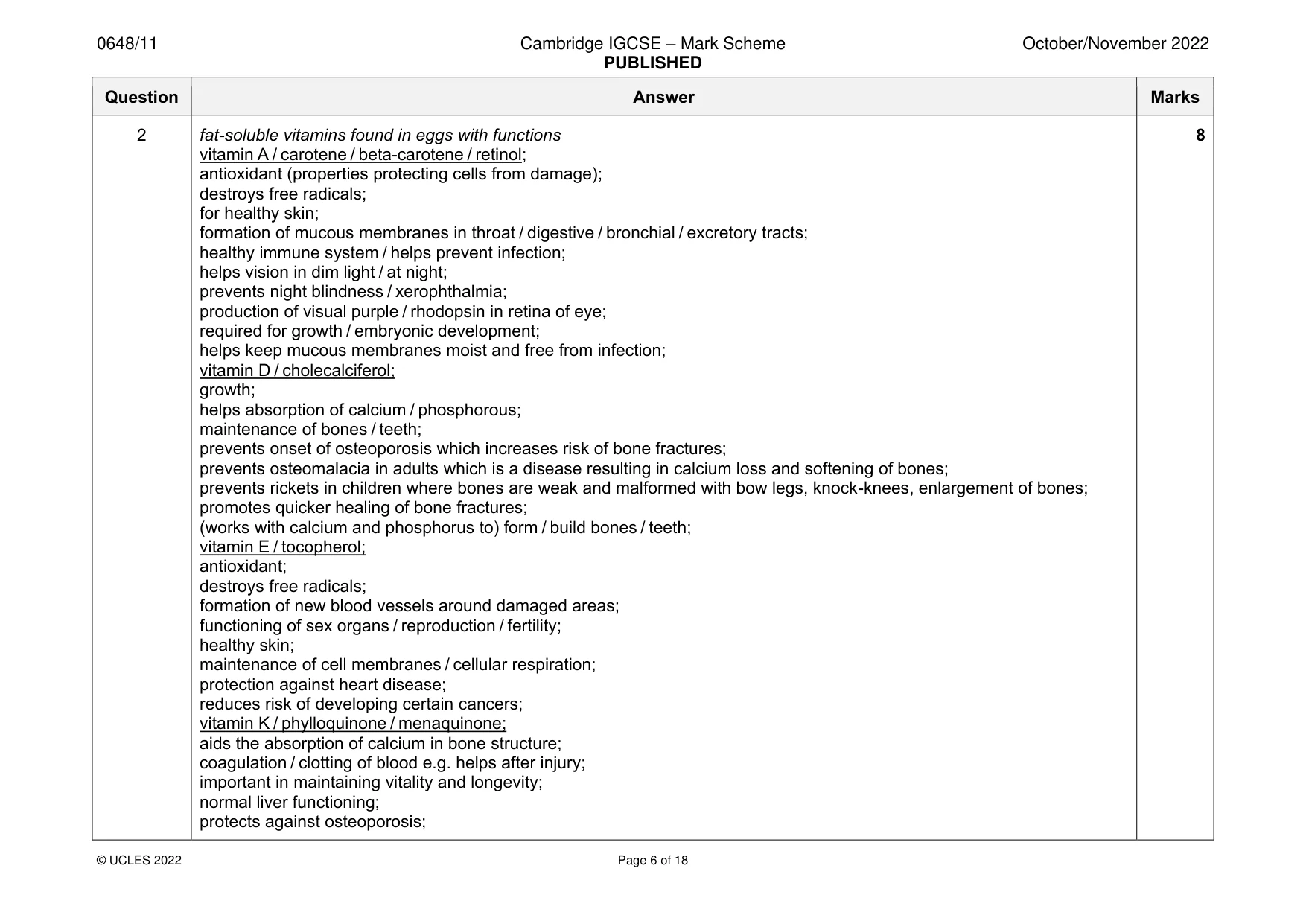
0648/11 Cambridge IGCSE – Mark Scheme PUBLISHED October/November 2022 © UCLES 2022 Page 6 of 18 Question Answer Marks 2 fat-soluble vitamins found in eggs with functions vitamin A / carotene / beta-carotene / retinol; antioxidant (properties protecting cells from damage); destroys free radicals; for healthy skin; formation of mucous membranes in throat / digestive / bronchial / excretory tracts; healthy immune system / helps prevent infection; helps vision in dim light / at night; prevents night blindness / xerophthalmia; production of visual purple / rhodopsin in retina of eye; required for growth / embryonic development; helps keep mucous membranes moist and free from infection; vitamin D / cholecalciferol; growth; helps absorption of calcium / phosphorous; maintenance of bones / teeth; prevents onset of osteoporosis which increases risk of bone fractures; prevents osteomalacia in adults which is a disease resulting in calcium loss and softening of bones; prevents rickets in children where bones are weak and malformed with bow legs, knock-knees, enlargement of bones; promotes quicker healing of bone fractures; (works with calcium and phosphorus to) form / build bones / teeth; vitamin E / tocopherol; antioxidant; destroys free radicals; formation of new blood vessels around damaged areas; functioning of sex organs / reproduction / fertility; healthy skin; maintenance of cell membranes / cellular respiration; protection against heart disease; reduces risk of developing certain cancers; vitamin K / phylloquinone / menaquinone; aids the absorption of calcium in bone structure; coagulation / clotting of blood e.g. helps after injury; important in maintaining vitality and longevity; normal liver functioning; protects against osteoporosis; 8
Mark scheme, page 7
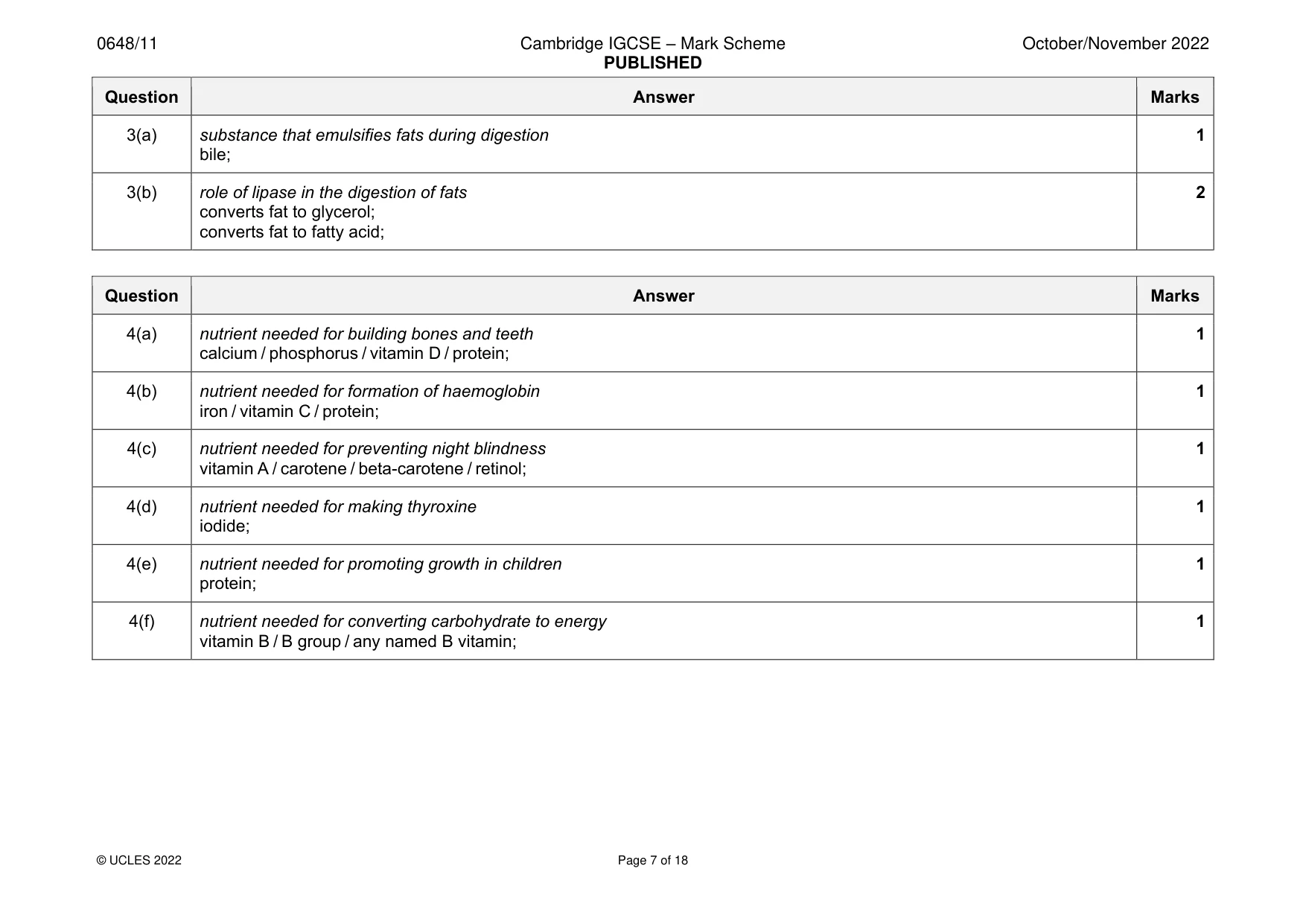
0648/11 Cambridge IGCSE – Mark Scheme PUBLISHED October/November 2022 © UCLES 2022 Page 7 of 18 Question Answer Marks 3(a) substance that emulsifies fats during digestion bile; 1 3(b) role of lipase in the digestion of fats converts fat to glycerol; converts fat to fatty acid; 2 Question Answer Marks 4(a) nutrient needed for building bones and teeth calcium / phosphorus / vitamin D / protein; 1 4(b) nutrient needed for formation of haemoglobin iron / vitamin C / protein; 1 4(c) nutrient needed for preventing night blindness vitamin A / carotene / beta-carotene / retinol; 1 4(d) nutrient needed for making thyroxine iodide; 1 4(e) nutrient needed for promoting growth in children protein; 1 4(f) nutrient needed for converting carbohydrate to energy vitamin B / B group / any named B vitamin; 1
Mark scheme, page 8
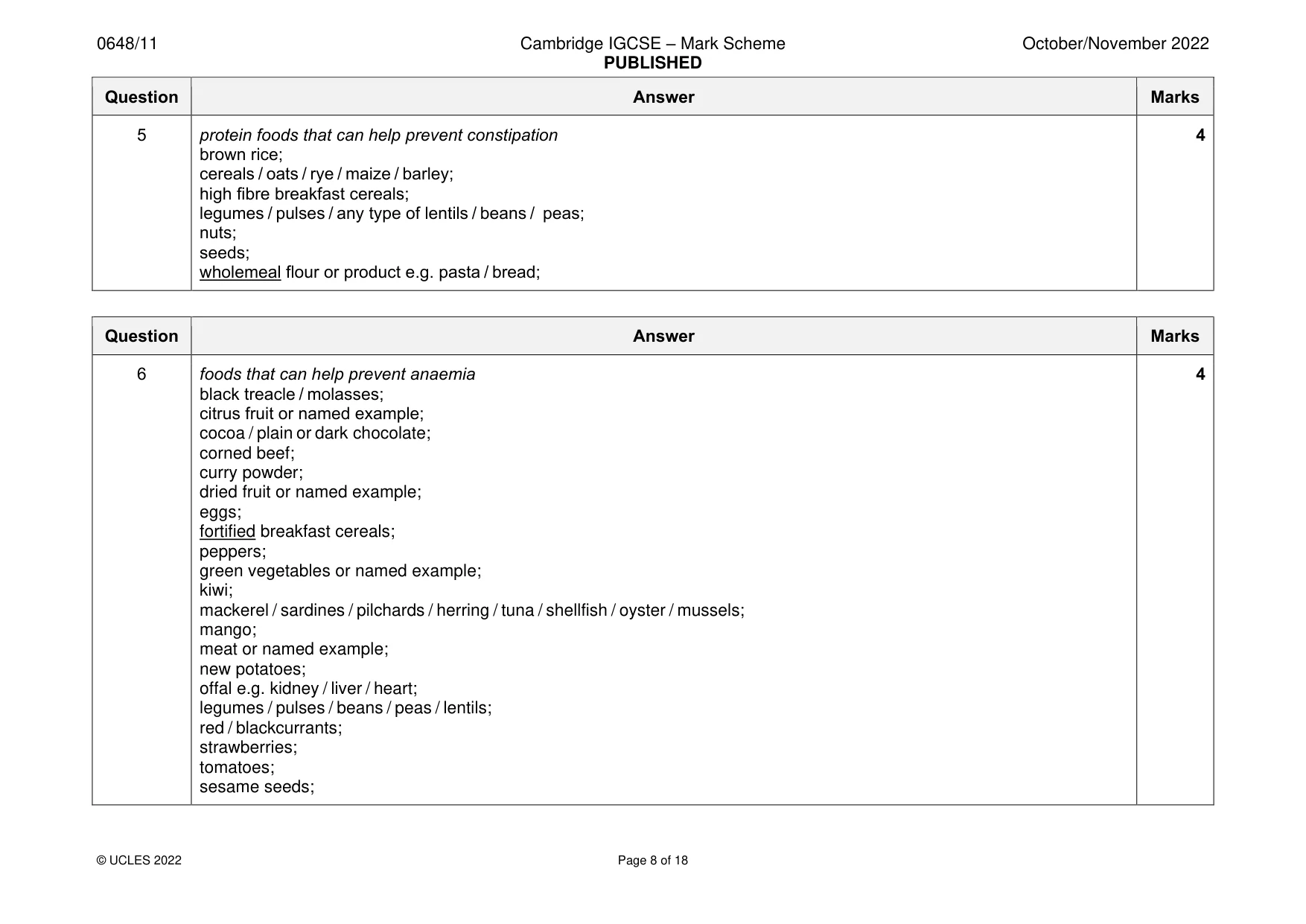
0648/11 Cambridge IGCSE – Mark Scheme PUBLISHED October/November 2022 © UCLES 2022 Page 8 of 18 Question Answer Marks 5 protein foods that can help prevent constipation brown rice; cereals / oats / rye / maize / barley; high fibre breakfast cereals; legumes / pulses / any type of lentils / beans / peas; nuts; seeds; wholemeal flour or product e.g. pasta / bread; 4 Question Answer Marks 6 foods that can help prevent anaemia black treacle / molasses; citrus fruit or named example; cocoa / plain or dark chocolate; corned beef; curry powder; dried fruit or named example; eggs; fortified breakfast cereals; peppers; green vegetables or named example; kiwi; mackerel / sardines / pilchards / herring / tuna / shellfish / oyster / mussels; mango; meat or named example; new potatoes; offal e.g. kidney / liver / heart; legumes / pulses / beans / peas / lentils; red / blackcurrants; strawberries; tomatoes; sesame seeds; 4
Mark scheme, page 9
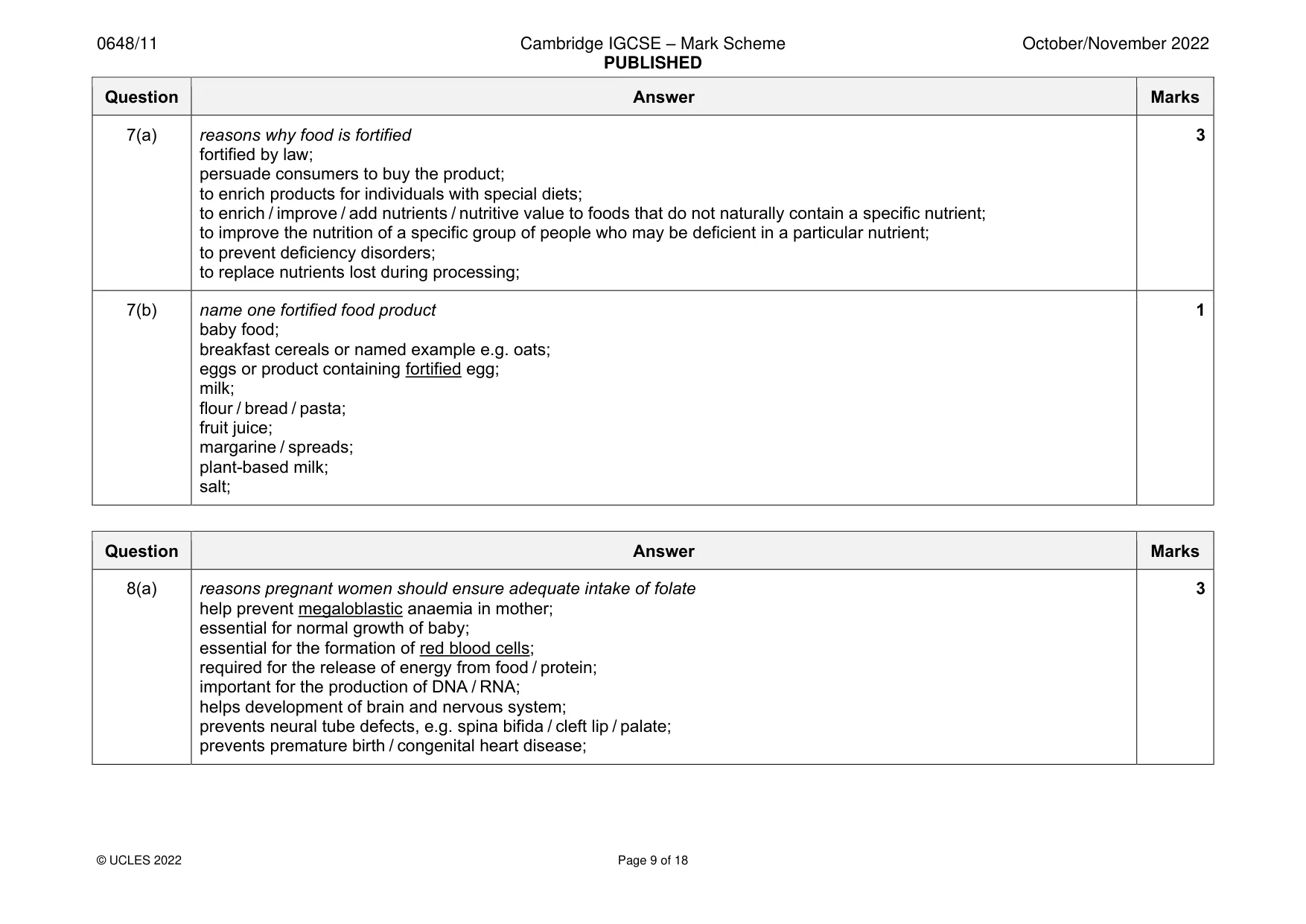
0648/11 Cambridge IGCSE – Mark Scheme PUBLISHED October/November 2022 © UCLES 2022 Page 9 of 18 Question Answer Marks 7(a) reasons why food is fortified fortified by law; persuade consumers to buy the product; to enrich products for individuals with special diets; to enrich / improve / add nutrients / nutritive value to foods that do not naturally contain a specific nutrient; to improve the nutrition of a specific group of people who may be deficient in a particular nutrient; to prevent deficiency disorders; to replace nutrients lost during processing; 3 7(b) name one fortified food product baby food; breakfast cereals or named example e.g. oats; eggs or product containing fortified egg; milk; flour / bread / pasta; fruit juice; margarine / spreads; plant-based milk; salt; 1 Question Answer Marks 8(a) reasons pregnant women should ensure adequate intake of folate help prevent megaloblastic anaemia in mother; essential for normal growth of baby; essential for the formation of red blood cells; required for the release of energy from food / protein; important for the production of DNA / RNA; helps development of brain and nervous system; prevents neural tube defects, e.g. spina bifida / cleft lip / palate; prevents premature birth / congenital heart disease; 3
Mark scheme, page 10
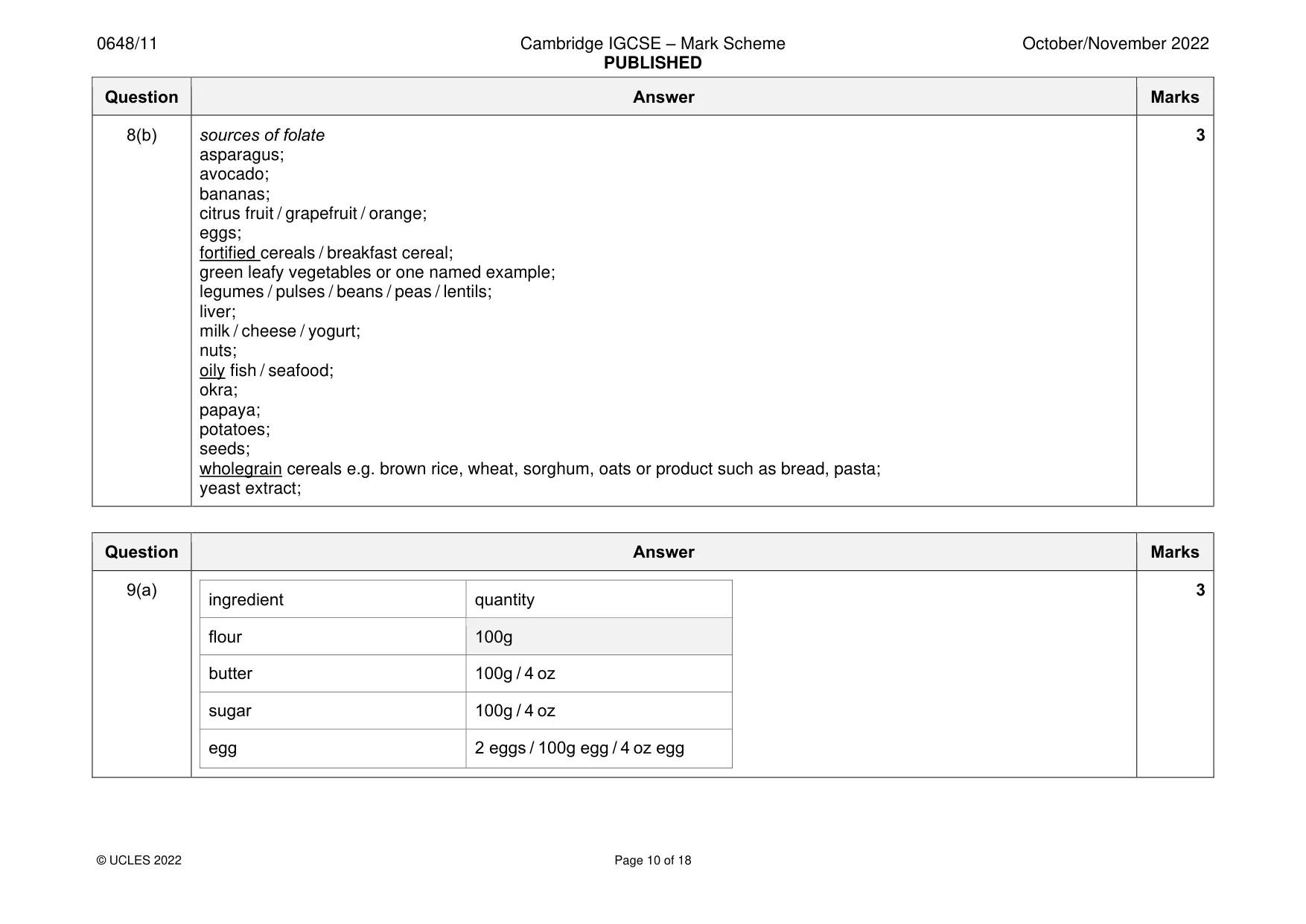
0648/11 Cambridge IGCSE – Mark Scheme PUBLISHED October/November 2022 © UCLES 2022 Page 10 of 18 Question Answer Marks 8(b) sources of folate asparagus; avocado; bananas; citrus fruit / grapefruit / orange; eggs; fortified cereals / breakfast cereal; green leafy vegetables or one named example; legumes / pulses / beans / peas / lentils; liver; milk / cheese / yogurt; nuts; oily fish / seafood; okra; papaya; potatoes; seeds; wholegrain cereals e.g. brown rice, wheat, sorghum, oats or product such as bread, pasta; yeast extract; 3 Question Answer Marks 9(a) ingredient quantity flour 100g butter 100g / 4 oz sugar 100g / 4 oz egg 2 eggs / 100g egg / 4 oz egg 3
Mark scheme, page 11
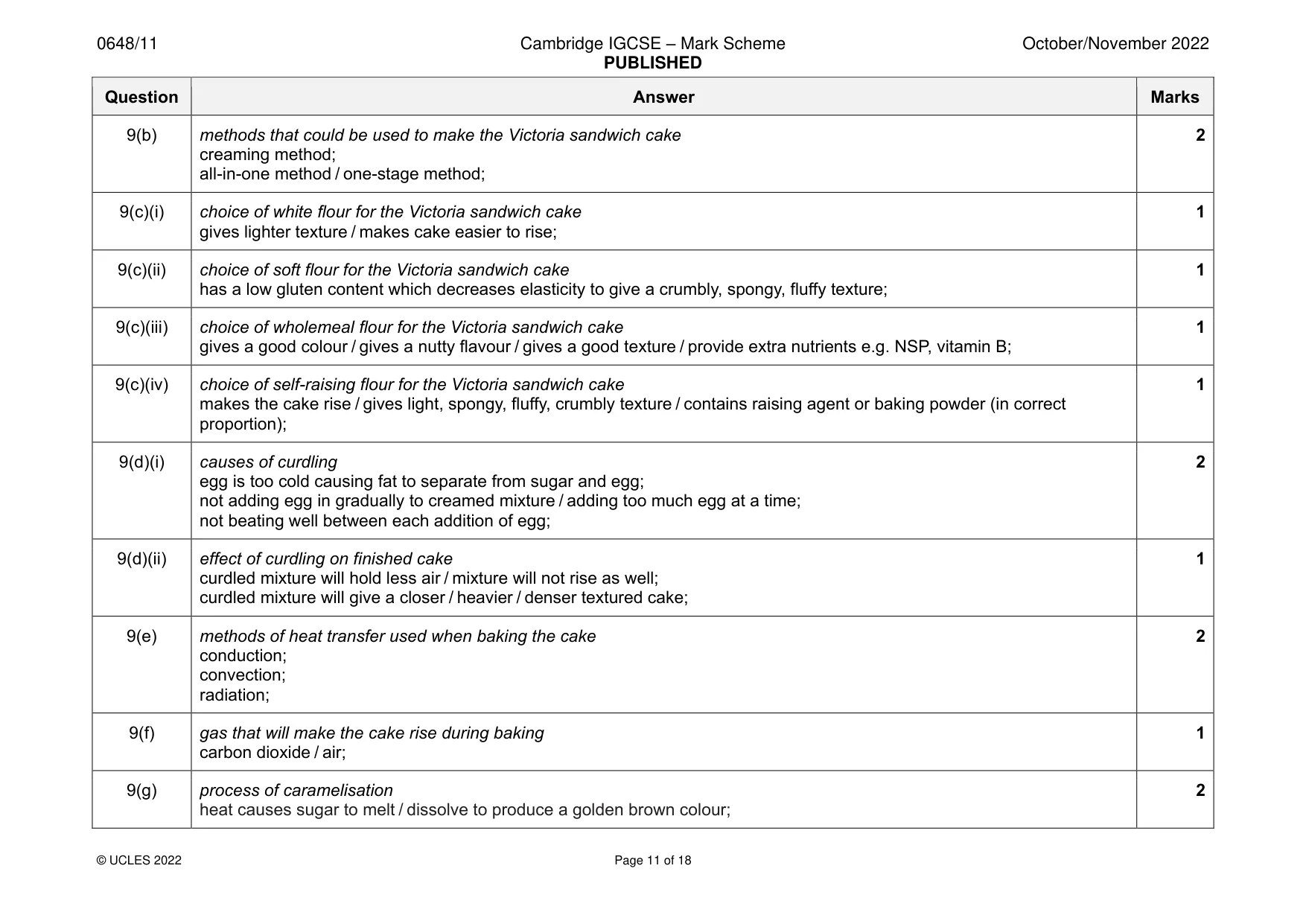
0648/11 Cambridge IGCSE – Mark Scheme PUBLISHED October/November 2022 © UCLES 2022 Page 11 of 18 Question Answer Marks 9(b) methods that could be used to make the Victoria sandwich cake creaming method; all-in-one method / one-stage method; 2 9(c)(i) choice of white flour for the Victoria sandwich cake gives lighter texture / makes cake easier to rise; 1 9(c)(ii) choice of soft flour for the Victoria sandwich cake has a low gluten content which decreases elasticity to give a crumbly, spongy, fluffy texture; 1 9(c)(iii) choice of wholemeal flour for the Victoria sandwich cake gives a good colour / gives a nutty flavour / gives a good texture / provide extra nutrients e.g. NSP, vitamin B; 1 9(c)(iv) choice of self-raising flour for the Victoria sandwich cake makes the cake rise / gives light, spongy, fluffy, crumbly texture / contains raising agent or baking powder (in correct proportion); 1 9(d)(i) causes of curdling egg is too cold causing fat to separate from sugar and egg; not adding egg in gradually to creamed mixture / adding too much egg at a time; not beating well between each addition of egg; 2 9(d)(ii) effect of curdling on finished cake curdled mixture will hold less air / mixture will not rise as well; curdled mixture will give a closer / heavier / denser textured cake; 1 9(e) methods of heat transfer used when baking the cake conduction; convection; radiation; 2 9(f) gas that will make the cake rise during baking carbon dioxide / air; 1 9(g) process of caramelisation heat causes sugar to melt / dissolve to produce a golden brown colour; 2
Mark scheme, page 12
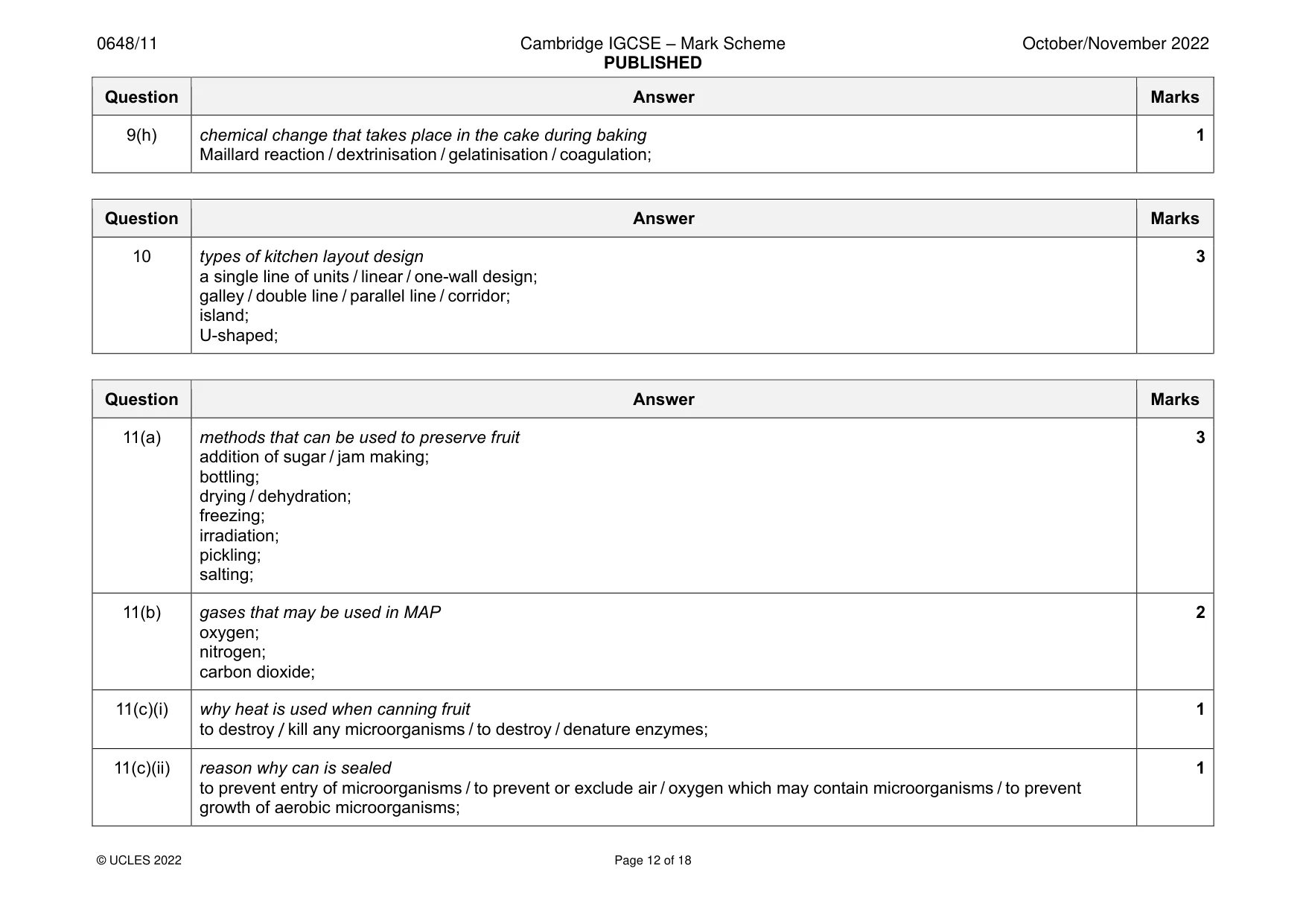
0648/11 Cambridge IGCSE – Mark Scheme PUBLISHED October/November 2022 © UCLES 2022 Page 12 of 18 Question Answer Marks 9(h) chemical change that takes place in the cake during baking Maillard reaction / dextrinisation / gelatinisation / coagulation; 1 Question Answer Marks 10 types of kitchen layout design a single line of units / linear / one-wall design; galley / double line / parallel line / corridor; island; U-shaped; 3 Question Answer Marks 11(a) methods that can be used to preserve fruit addition of sugar / jam making; bottling; drying / dehydration; freezing; irradiation; pickling; salting; 3 11(b) gases that may be used in MAP oxygen; nitrogen; carbon dioxide; 2 11(c)(i) why heat is used when canning fruit to destroy / kill any microorganisms / to destroy / denature enzymes; 1 11(c)(ii) reason why can is sealed to prevent entry of microorganisms / to prevent or exclude air / oxygen which may contain microorganisms / to prevent growth of aerobic microorganisms; 1
Mark scheme, page 13
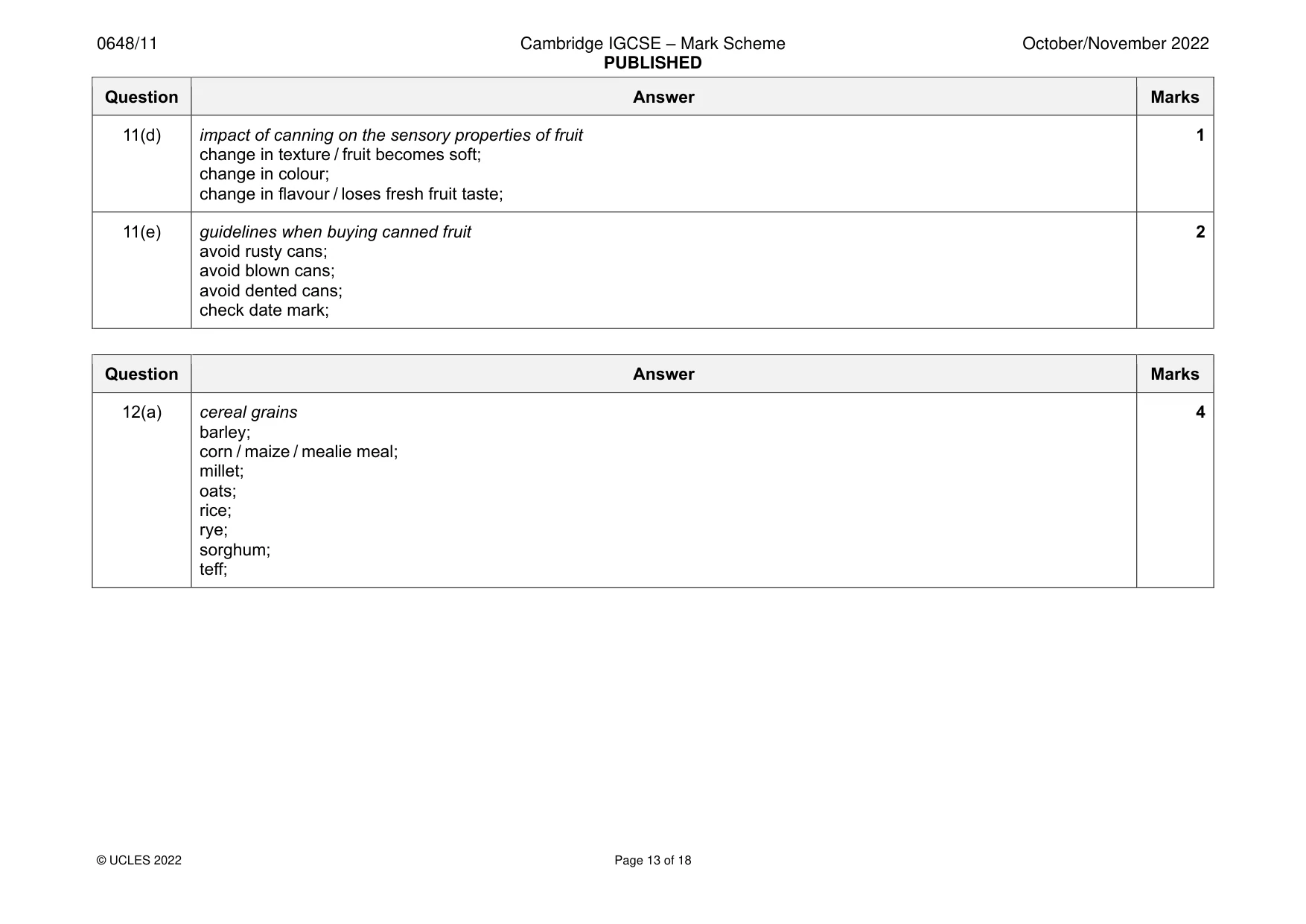
0648/11 Cambridge IGCSE – Mark Scheme PUBLISHED October/November 2022 © UCLES 2022 Page 13 of 18 Question Answer Marks 11(d) impact of canning on the sensory properties of fruit change in texture / fruit becomes soft; change in colour; change in flavour / loses fresh fruit taste; 1 11(e) guidelines when buying canned fruit avoid rusty cans; avoid blown cans; avoid dented cans; check date mark; 2 Question Answer Marks 12(a) cereal grains barley; corn / maize / mealie meal; millet; oats; rice; rye; sorghum; teff; 4
Mark scheme, page 14
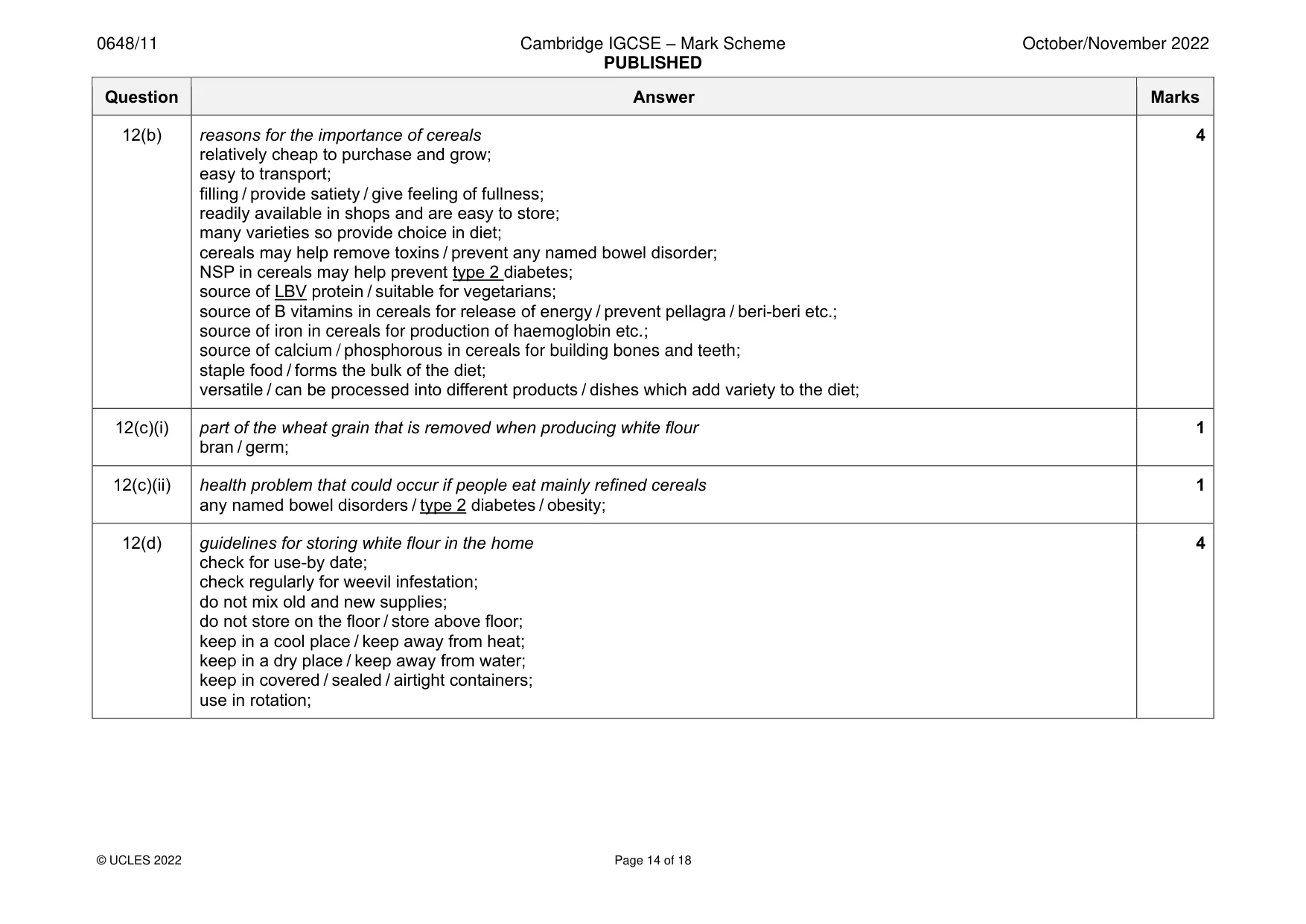
0648/11 Cambridge IGCSE – Mark Scheme PUBLISHED October/November 2022 © UCLES 2022 Page 14 of 18 Question Answer Marks 12(b) reasons for the importance of cereals relatively cheap to purchase and grow; easy to transport; filling / provide satiety / give feeling of fullness; readily available in shops and are easy to store; many varieties so provide choice in diet; cereals may help remove toxins / prevent any named bowel disorder; NSP in cereals may help prevent type 2 diabetes; source of LBV protein / suitable for vegetarians; source of B vitamins in cereals for release of energy / prevent pellagra / beri-beri etc.; source of iron in cereals for production of haemoglobin etc.; source of calcium / phosphorous in cereals for building bones and teeth; staple food / forms the bulk of the diet; versatile / can be processed into different products / dishes which add variety to the diet; 4 12(c)(i) part of the wheat grain that is removed when producing white flour bran / germ; 1 12(c)(ii) health problem that could occur if people eat mainly refined cereals any named bowel disorders / type 2 diabetes / obesity; 1 12(d) guidelines for storing white flour in the home check for use-by date; check regularly for weevil infestation; do not mix old and new supplies; do not store on the floor / store above floor; keep in a cool place / keep away from heat; keep in a dry place / keep away from water; keep in covered / sealed / airtight containers; use in rotation; 4
Mark scheme, page 15
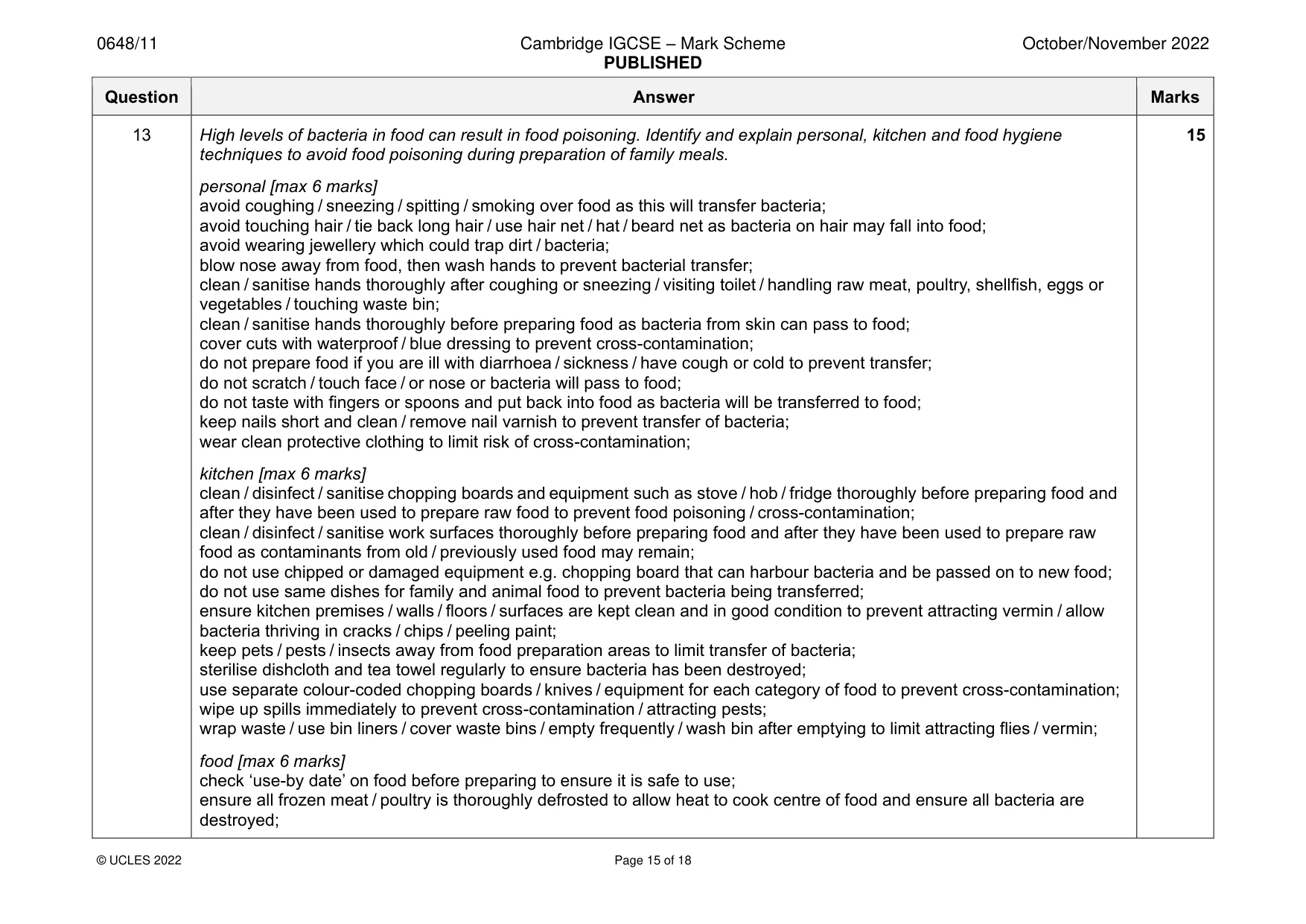
0648/11 Cambridge IGCSE – Mark Scheme PUBLISHED October/November 2022 © UCLES 2022 Page 15 of 18 Question Answer Marks 13 High levels of bacteria in food can result in food poisoning. Identify and explain personal, kitchen and food hygiene techniques to avoid food poisoning during preparation of family meals. personal [max 6 marks] avoid coughing / sneezing / spitting / smoking over food as this will transfer bacteria; avoid touching hair / tie back long hair / use hair net / hat / beard net as bacteria on hair may fall into food; avoid wearing jewellery which could trap dirt / bacteria; blow nose away from food, then wash hands to prevent bacterial transfer; clean / sanitise hands thoroughly after coughing or sneezing / visiting toilet / handling raw meat, poultry, shellfish, eggs or vegetables / touching waste bin; clean / sanitise hands thoroughly before preparing food as bacteria from skin can pass to food; cover cuts with waterproof / blue dressing to prevent cross-contamination; do not prepare food if you are ill with diarrhoea / sickness / have cough or cold to prevent transfer; do not scratch / touch face / or nose or bacteria will pass to food; do not taste with fingers or spoons and put back into food as bacteria will be transferred to food; keep nails short and clean / remove nail varnish to prevent transfer of bacteria; wear clean protective clothing to limit risk of cross-contamination; kitchen [max 6 marks] clean / disinfect / sanitise chopping boards and equipment such as stove / hob / fridge thoroughly before preparing food and after they have been used to prepare raw food to prevent food poisoning / cross-contamination; clean / disinfect / sanitise work surfaces thoroughly before preparing food and after they have been used to prepare raw food as contaminants from old / previously used food may remain; do not use chipped or damaged equipment e.g. chopping board that can harbour bacteria and be passed on to new food; do not use same dishes for family and animal food to prevent bacteria being transferred; ensure kitchen premises / walls / floors / surfaces are kept clean and in good condition to prevent attracting vermin / allow bacteria thriving in cracks / chips / peeling paint; keep pets / pests / insects away from food preparation areas to limit transfer of bacteria; sterilise dishcloth and tea towel regularly to ensure bacteria has been destroyed; use separate colour-coded chopping boards / knives / equipment for each category of food to prevent cross-contamination; wipe up spills immediately to prevent cross-contamination / attracting pests; wrap waste / use bin liners / cover waste bins / empty frequently / wash bin after emptying to limit attracting flies / vermin; food [max 6 marks] check ‘use-by date’ on food before preparing to ensure it is safe to use; ensure all frozen meat / poultry is thoroughly defrosted to allow heat to cook centre of food and ensure all bacteria are destroyed; 15
Mark scheme, page 16
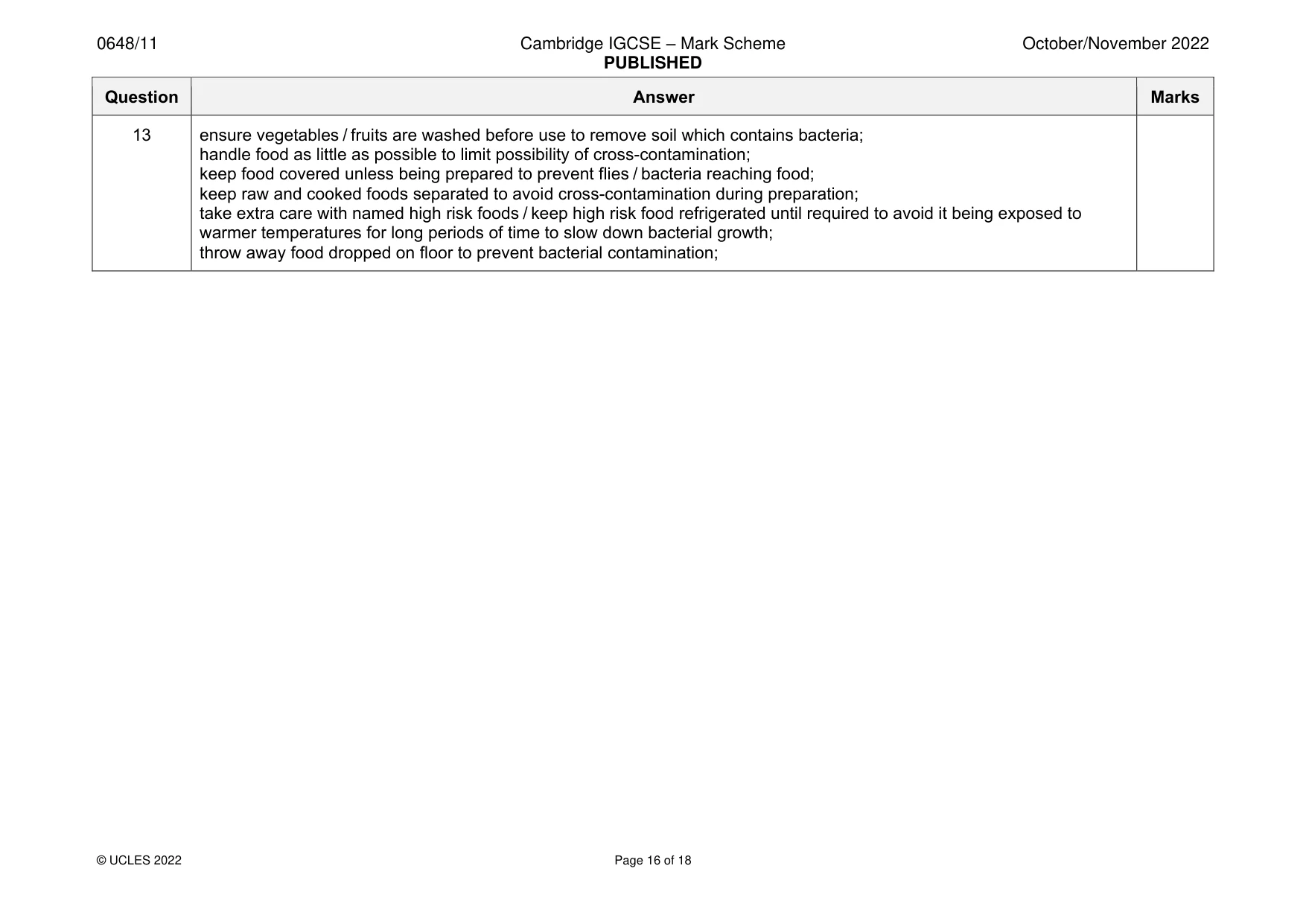
0648/11 Cambridge IGCSE – Mark Scheme PUBLISHED October/November 2022 © UCLES 2022 Page 16 of 18 Question Answer Marks 13 ensure vegetables / fruits are washed before use to remove soil which contains bacteria; handle food as little as possible to limit possibility of cross-contamination; keep food covered unless being prepared to prevent flies / bacteria reaching food; keep raw and cooked foods separated to avoid cross-contamination during preparation; take extra care with named high risk foods / keep high risk food refrigerated until required to avoid it being exposed to warmer temperatures for long periods of time to slow down bacterial growth; throw away food dropped on floor to prevent bacterial contamination;
Mark scheme, page 17
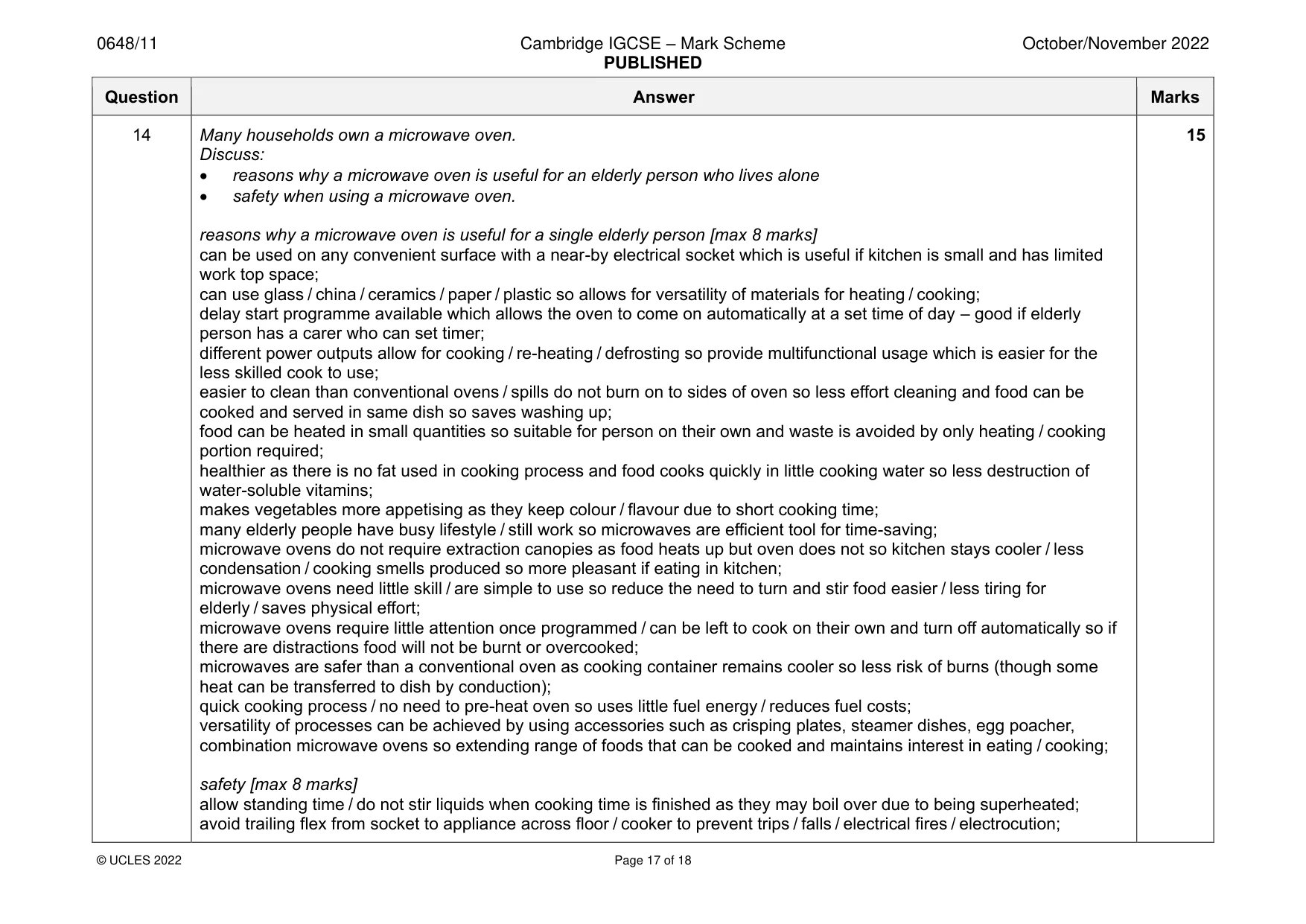
0648/11 Cambridge IGCSE – Mark Scheme PUBLISHED October/November 2022 © UCLES 2022 Page 17 of 18 Question Answer Marks 14 Many households own a microwave oven. Discuss: • reasons why a microwave oven is useful for an elderly person who lives alone • safety when using a microwave oven. reasons why a microwave oven is useful for a single elderly person [max 8 marks] can be used on any convenient surface with a near-by electrical socket which is useful if kitchen is small and has limited work top space; can use glass / china / ceramics / paper / plastic so allows for versatility of materials for heating / cooking; delay start programme available which allows the oven to come on automatically at a set time of day – good if elderly person has a carer who can set timer; different power outputs allow for cooking / re-heating / defrosting so provide multifunctional usage which is easier for the less skilled cook to use; easier to clean than conventional ovens / spills do not burn on to sides of oven so less effort cleaning and food can be cooked and served in same dish so saves washing up; food can be heated in small quantities so suitable for person on their own and waste is avoided by only heating / cooking portion required; healthier as there is no fat used in cooking process and food cooks quickly in little cooking water so less destruction of water-soluble vitamins; makes vegetables more appetising as they keep colour / flavour due to short cooking time; many elderly people have busy lifestyle / still work so microwaves are efficient tool for time-saving; microwave ovens do not require extraction canopies as food heats up but oven does not so kitchen stays cooler / less condensation / cooking smells produced so more pleasant if eating in kitchen; microwave ovens need little skill / are simple to use so reduce the need to turn and stir food easier / less tiring for elderly / saves physical effort; microwave ovens require little attention once programmed / can be left to cook on their own and turn off automatically so if there are distractions food will not be burnt or overcooked; microwaves are safer than a conventional oven as cooking container remains cooler so less risk of burns (though some heat can be transferred to dish by conduction); quick cooking process / no need to pre-heat oven so uses little fuel energy / reduces fuel costs; versatility of processes can be achieved by using accessories such as crisping plates, steamer dishes, egg poacher, combination microwave ovens so extending range of foods that can be cooked and maintains interest in eating / cooking; safety [max 8 marks] allow standing time / do not stir liquids when cooking time is finished as they may boil over due to being superheated; avoid trailing flex from socket to appliance across floor / cooker to prevent trips / falls / electrical fires / electrocution; 15
Mark scheme, page 18
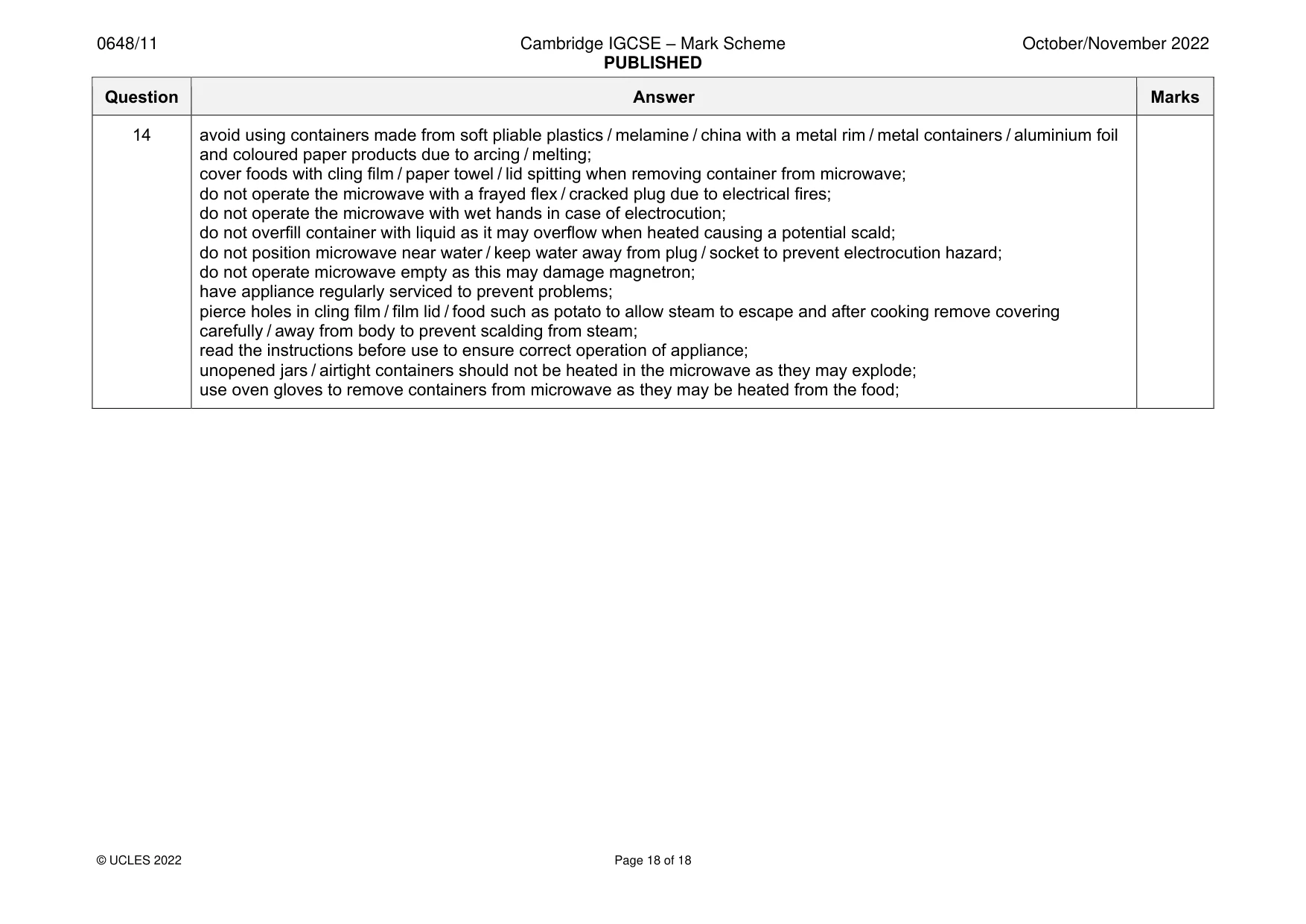
0648/11 Cambridge IGCSE – Mark Scheme PUBLISHED October/November 2022 © UCLES 2022 Page 18 of 18 Question Answer Marks 14 avoid using containers made from soft pliable plastics / melamine / china with a metal rim / metal containers / aluminium foil and coloured paper products due to arcing / melting; cover foods with cling film / paper towel / lid spitting when removing container from microwave; do not operate the microwave with a frayed flex / cracked plug due to electrical fires; do not operate the microwave with wet hands in case of electrocution; do not overfill container with liquid as it may overflow when heated causing a potential scald; do not position microwave near water / keep water away from plug / socket to prevent electrocution hazard; do not operate microwave empty as this may damage magnetron; have appliance regularly serviced to prevent problems; pierce holes in cling film / film lid / food such as potato to allow steam to escape and after cooking remove covering carefully / away from body to prevent scalding from steam; read the instructions before use to ensure correct operation of appliance; unopened jars / airtight containers should not be heated in the microwave as they may explode; use oven gloves to remove containers from microwave as they may be heated from the food;
What you needed in this session
Cambridge’s own grade thresholds for 2022 Oct/Nov, Paper 1 · Variant 1. A higher threshold means an easier paper — the bar moves with how the cohort did.