Cambridge IGCSE Food and Nutrition 0648 — 2022 May/June Paper 1 · Variant 1
0648/11/M/J/22 · 100 marks · ≈113 min
The question paper and its mark scheme, free to read here and free to download. This is Cambridge’s own paper, exactly as it was sat.
Question paper12 pages


Mark scheme17 pages
Answers below. Sit the paper first if you are practising.
Paper as text
Question paper, page 1
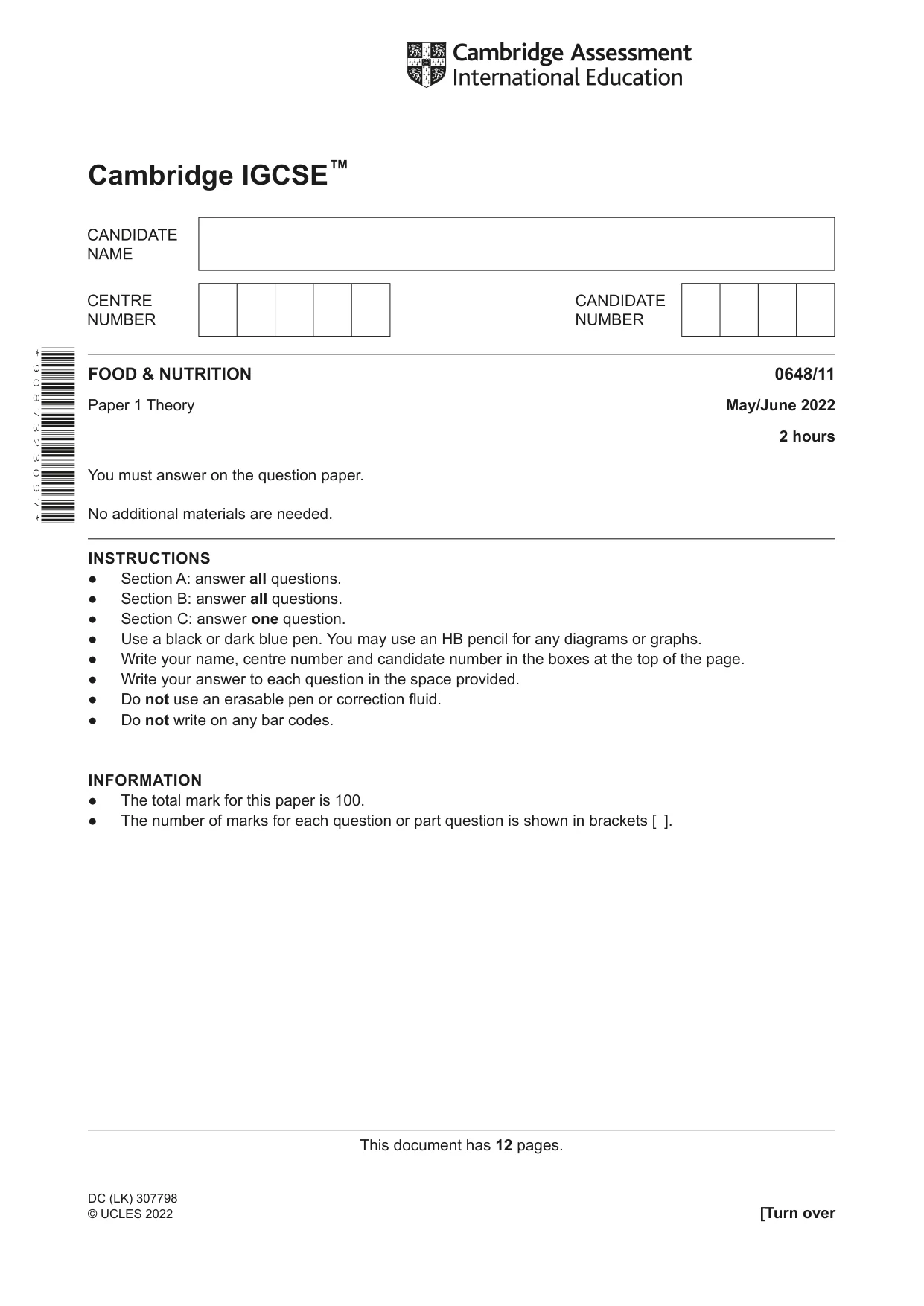
This document has 12 pages. [Turn over Cambridge IGCSE™ DC (LK) 307798 © UCLES 2022 * 9 0 8 7 3 2 3 0 9 7 * FOOD & NUTRITION 0648/11 Paper 1 Theory May/June 2022 2 hours You must answer on the question paper. No additional materials are needed. INSTRUCTIONS ● Section A: answer all questions. ● Section B: answer all questions. ● Section C: answer one question. ● Use a black or dark blue pen. You may use an HB pencil for any diagrams or graphs. ● Write your name, centre number and candidate number in the boxes at the top of the page. ● Write your answer to each question in the space provided. ● Do not use an erasable pen or correction fluid. ● Do not write on any bar codes. INFORMATION ● The total mark for this paper is 100. ● The number of marks for each question or part question is shown in brackets [ ].
Question paper, page 2
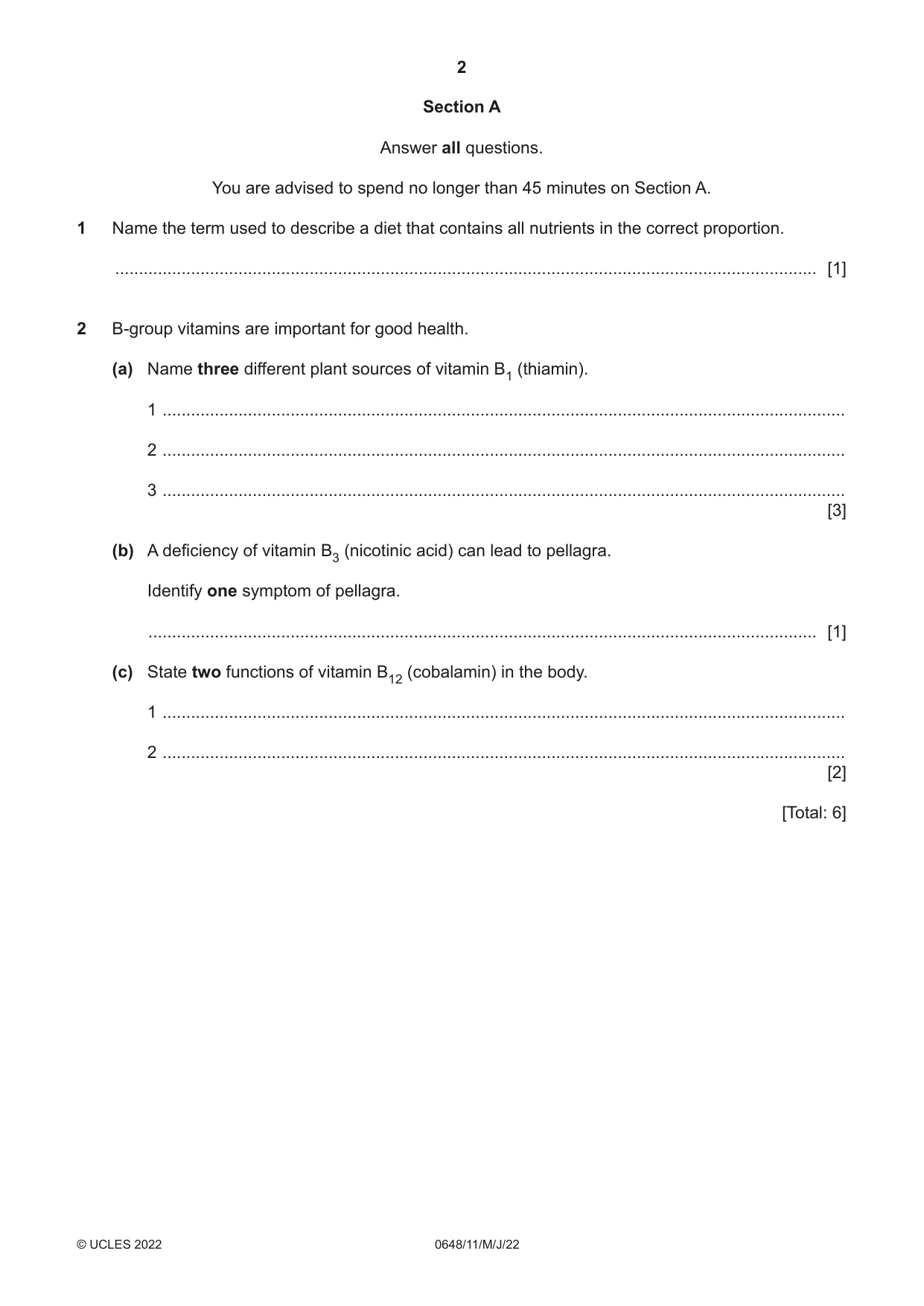
2 0648/11/M/J/22 © UCLES 2022 Section A Answer all questions. You are advised to spend no longer than 45 minutes on Section A. 1 Name the term used to describe a diet that contains all nutrients in the correct proportion. … [1] 2 B-group vitamins are important for good health. (a) Name three different plant sources of vitamin B1 (thiamin). 1 … 2 … 3 … [3] (b) A deficiency of vitamin B3 (nicotinic acid) can lead to pellagra. Identify one symptom of pellagra. … [1] (c) State two functions of vitamin B12 (cobalamin) in the body. 1 … 2 … [2] [Total: 6]
Question paper, page 3
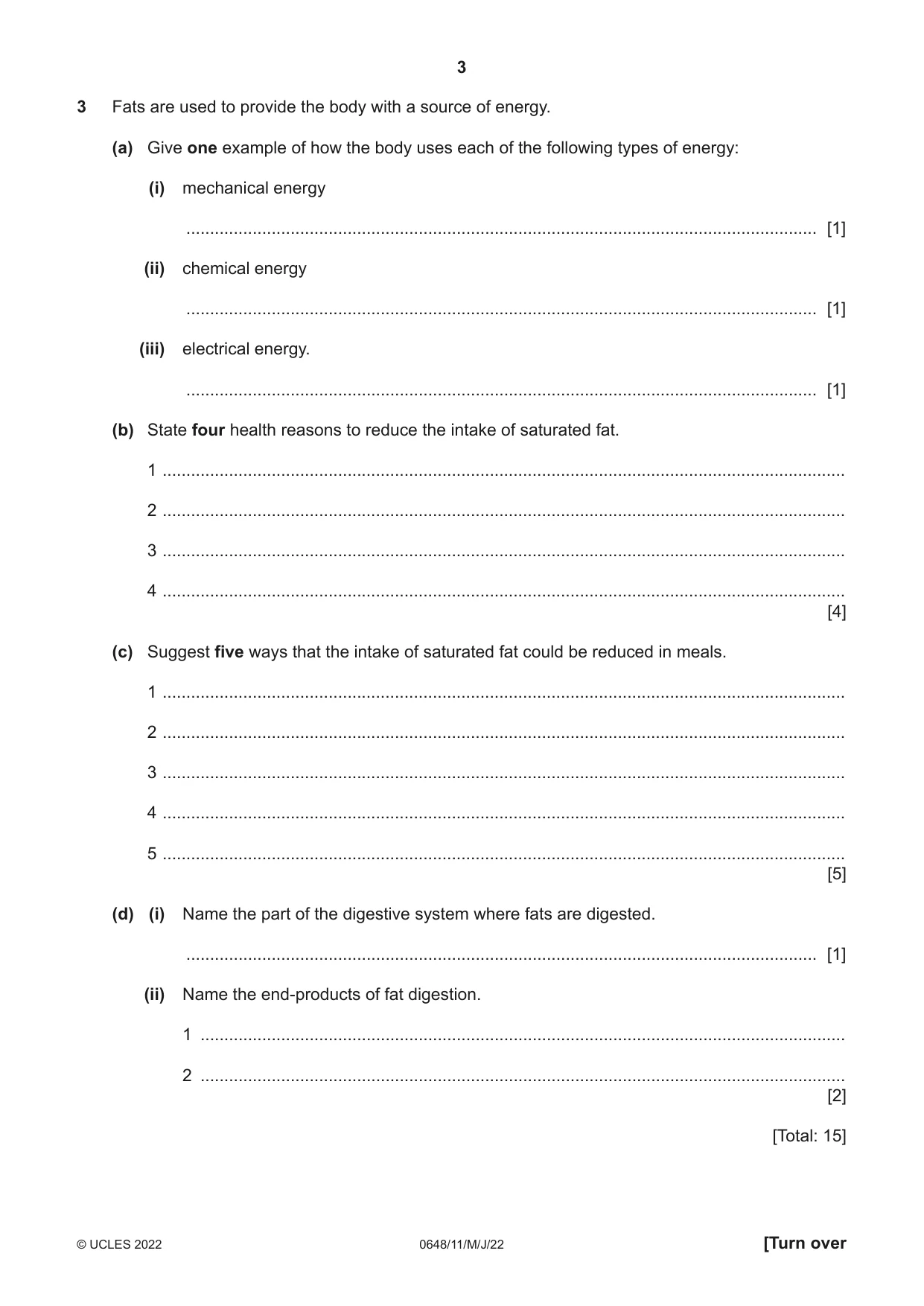
3 0648/11/M/J/22 © UCLES 2022 [Turn over 3 Fats are used to provide the body with a source of energy. (a) Give one example of how the body uses each of the following types of energy: (i) mechanical energy … [1] (ii) chemical energy … [1] (iii) electrical energy. … [1] (b) State four health reasons to reduce the intake of saturated fat. 1 … 2 … 3 … 4 … [4] (c) Suggest five ways that the intake of saturated fat could be reduced in meals. 1 … 2 … 3 … 4 … 5 … [5] (d) (i) Name the part of the digestive system where fats are digested. … [1] (ii) Name the end-products of fat digestion. 1 … 2 … [2] [Total: 15]
Question paper, page 4
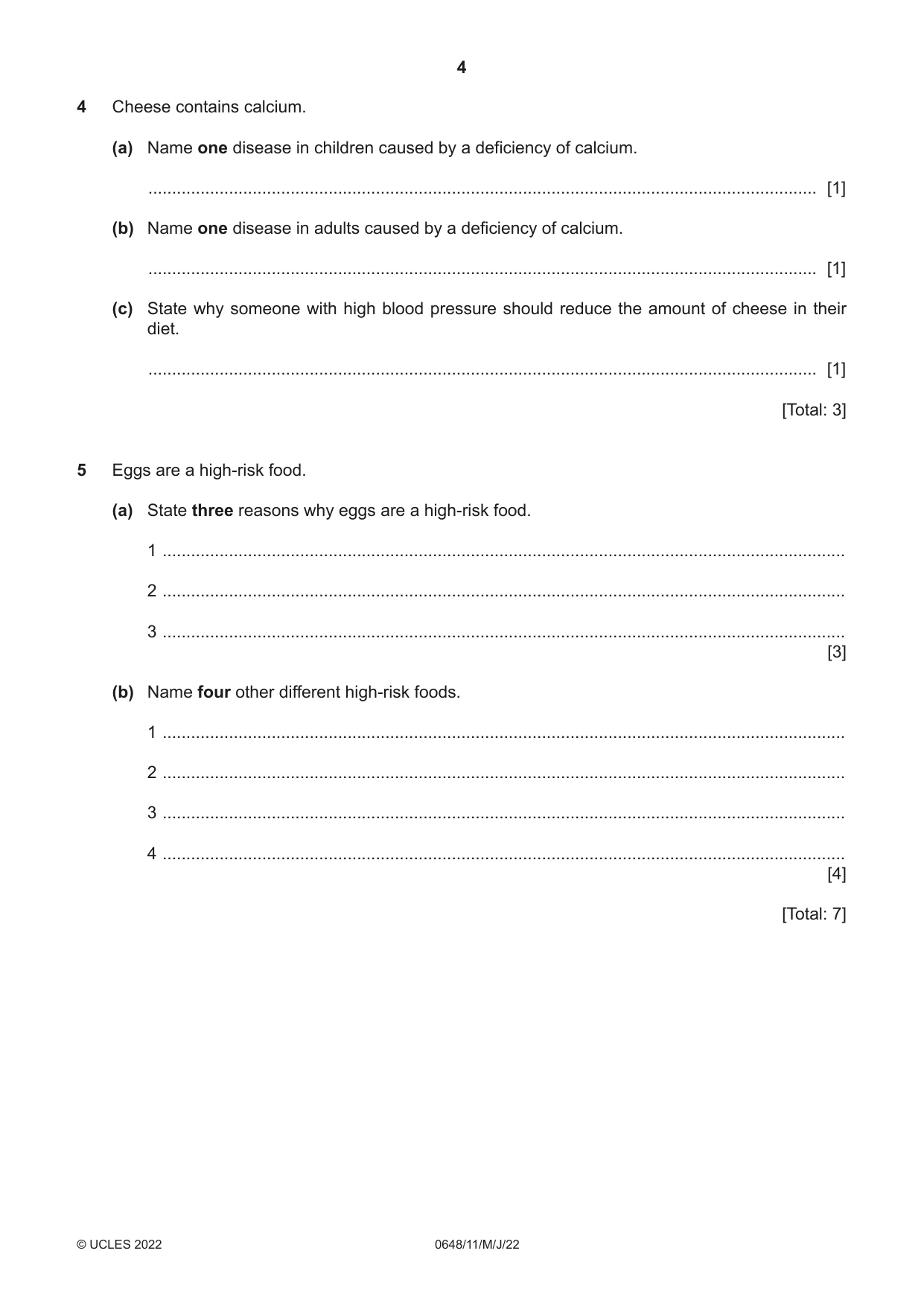
4 0648/11/M/J/22 © UCLES 2022 4 Cheese contains calcium. (a) Name one disease in children caused by a deficiency of calcium. … [1] (b) Name one disease in adults caused by a deficiency of calcium. … [1] (c) State why someone with high blood pressure should reduce the amount of cheese in their diet. … [1] [Total: 3] 5 Eggs are a high-risk food. (a) State three reasons why eggs are a high-risk food. 1 … 2 … 3 … [3] (b) Name four other different high-risk foods. 1 … 2 … 3 … 4 … [4] [Total: 7]
Question paper, page 5
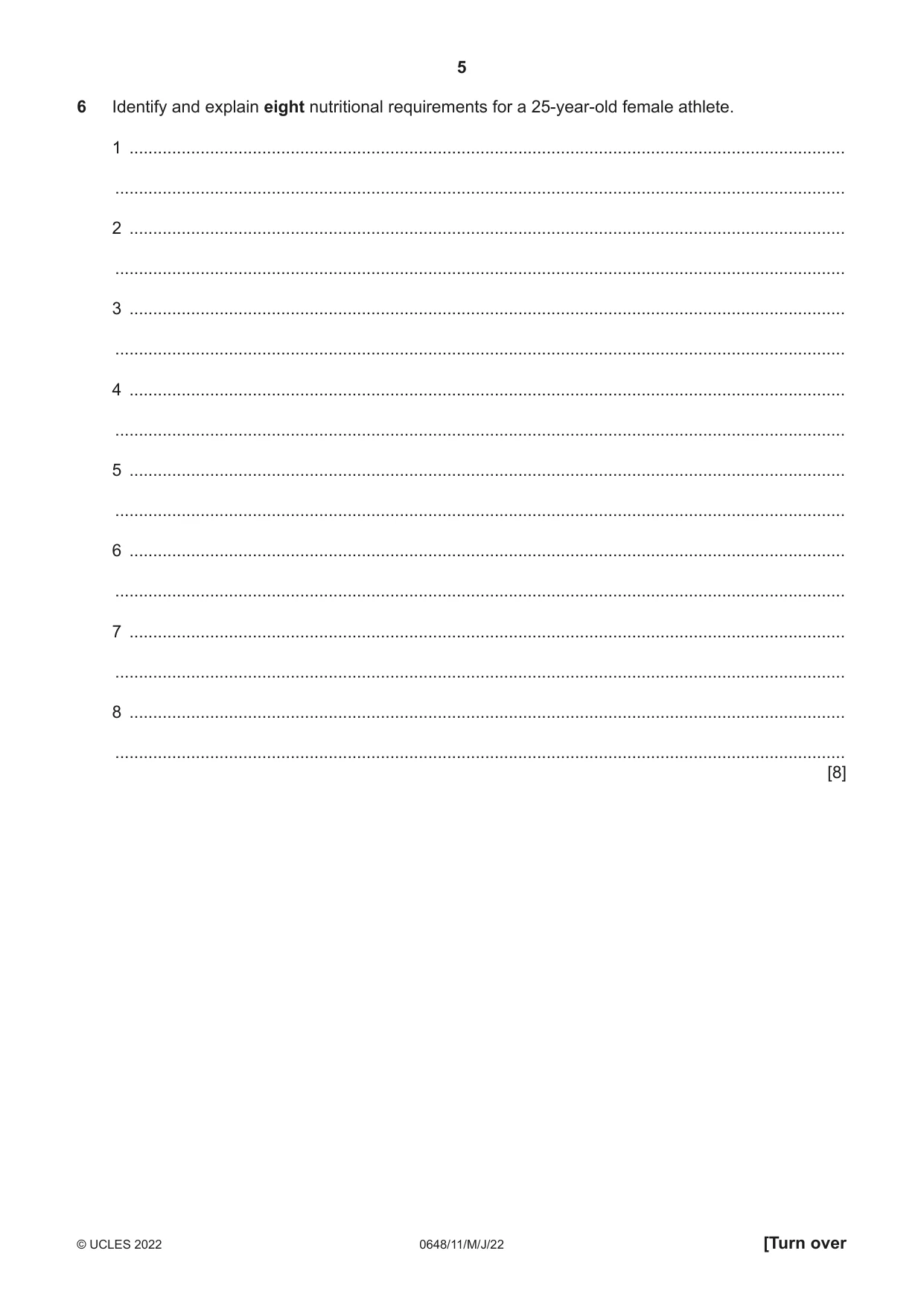
5 0648/11/M/J/22 © UCLES 2022 [Turn over 6 Identify and explain eight nutritional requirements for a 25-year-old female athlete. 1 … … 2 … … 3 … … 4 … … 5 … … 6 … … 7 … … 8 … … [8]
Question paper, page 6
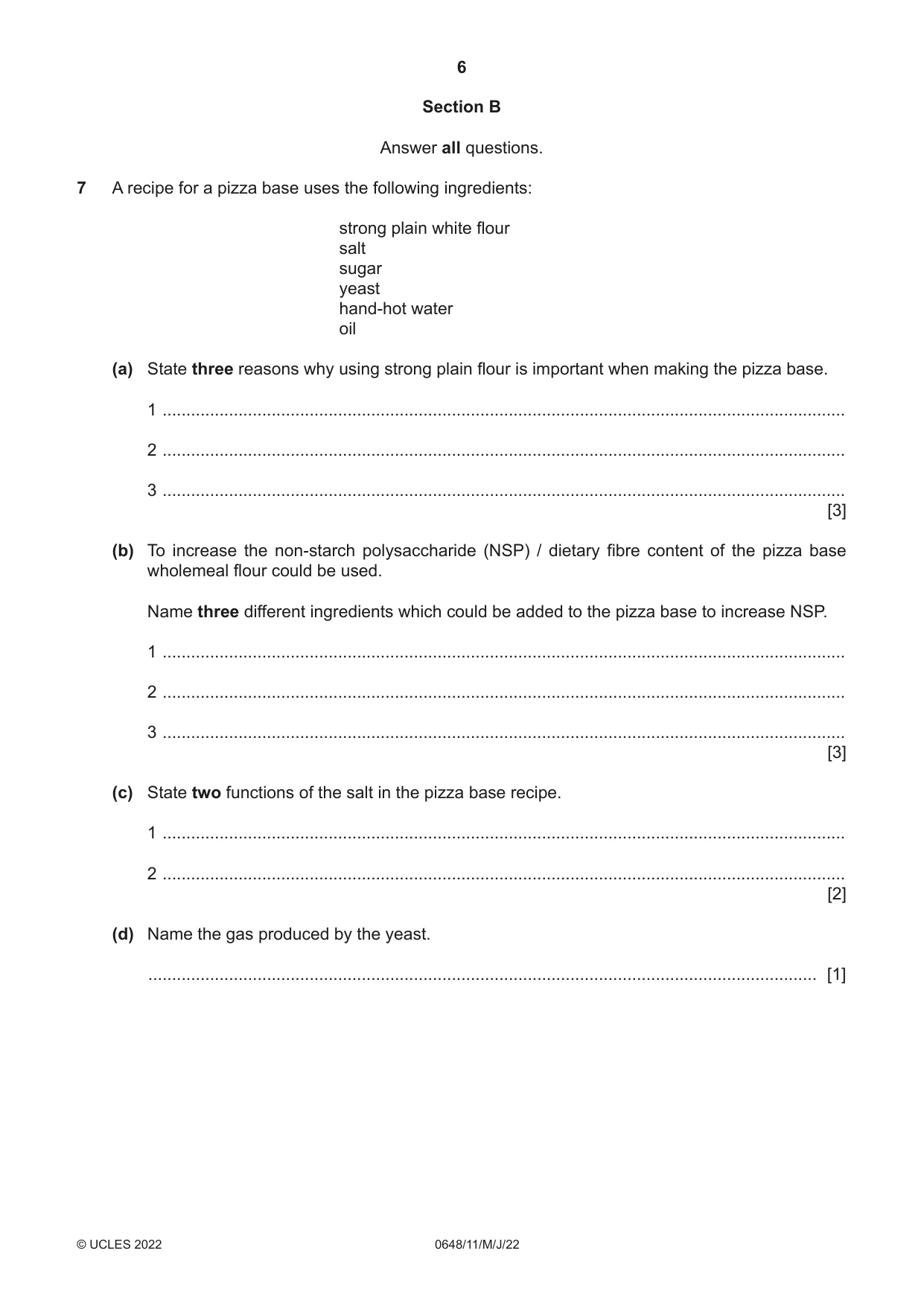
6 0648/11/M/J/22 © UCLES 2022 Section B Answer all questions. 7 A recipe for a pizza base uses the following ingredients: strong plain white flour salt sugar yeast hand-hot water oil (a) State three reasons why using strong plain flour is important when making the pizza base. 1 … 2 … 3 … [3] (b) To increase the non-starch polysaccharide (NSP) / dietary fibre content of the pizza base wholemeal flour could be used. Name three different ingredients which could be added to the pizza base to increase NSP. 1 … 2 … 3 … [3] (c) State two functions of the salt in the pizza base recipe. 1 … 2 … [2] (d) Name the gas produced by the yeast. … [1]
Question paper, page 7
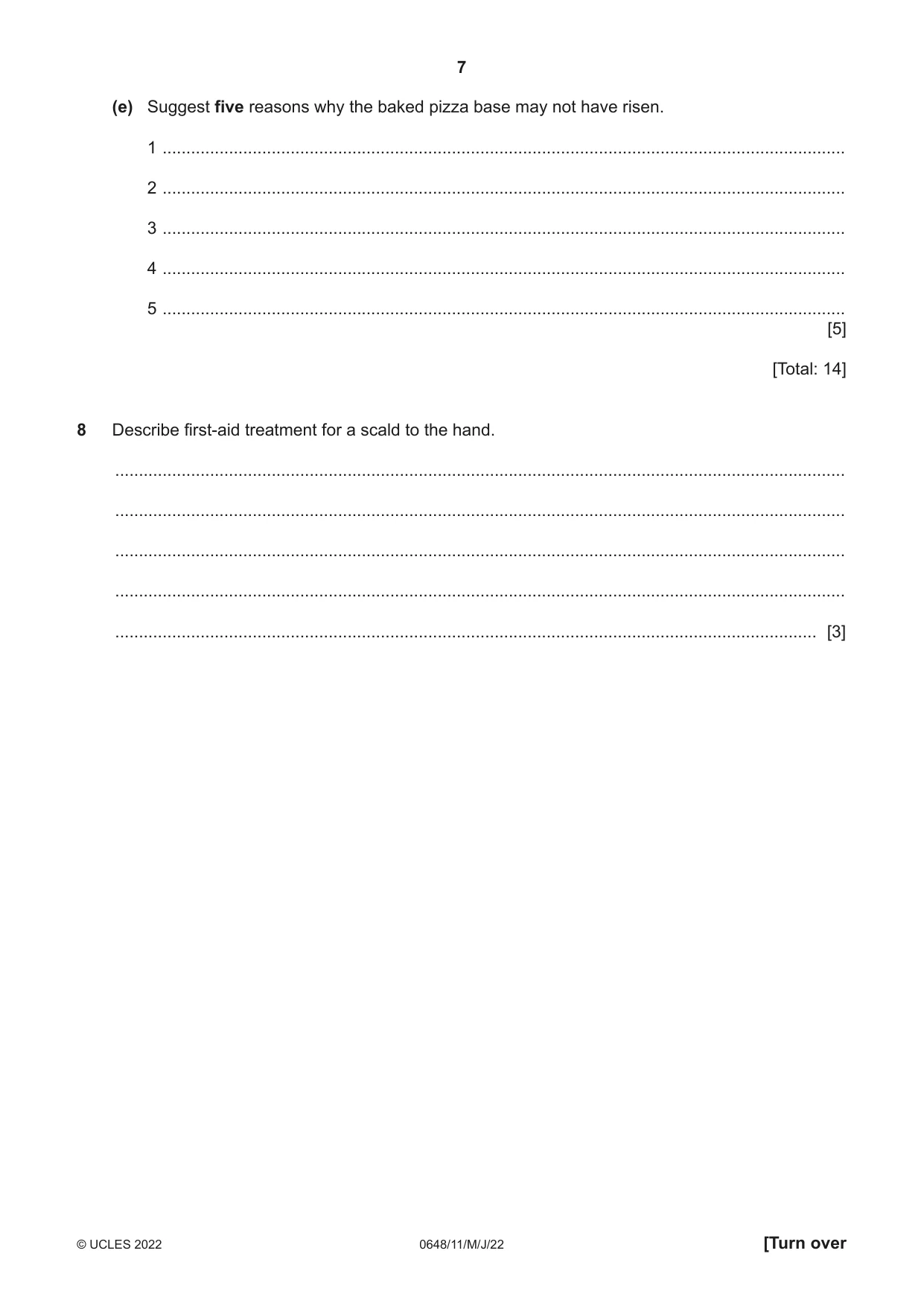
7 0648/11/M/J/22 © UCLES 2022 [Turn over (e) Suggest five reasons why the baked pizza base may not have risen. 1 … 2 … 3 … 4 … 5 … [5] [Total: 14] 8 Describe first-aid treatment for a scald to the hand. … … … … … [3]
Question paper, page 8
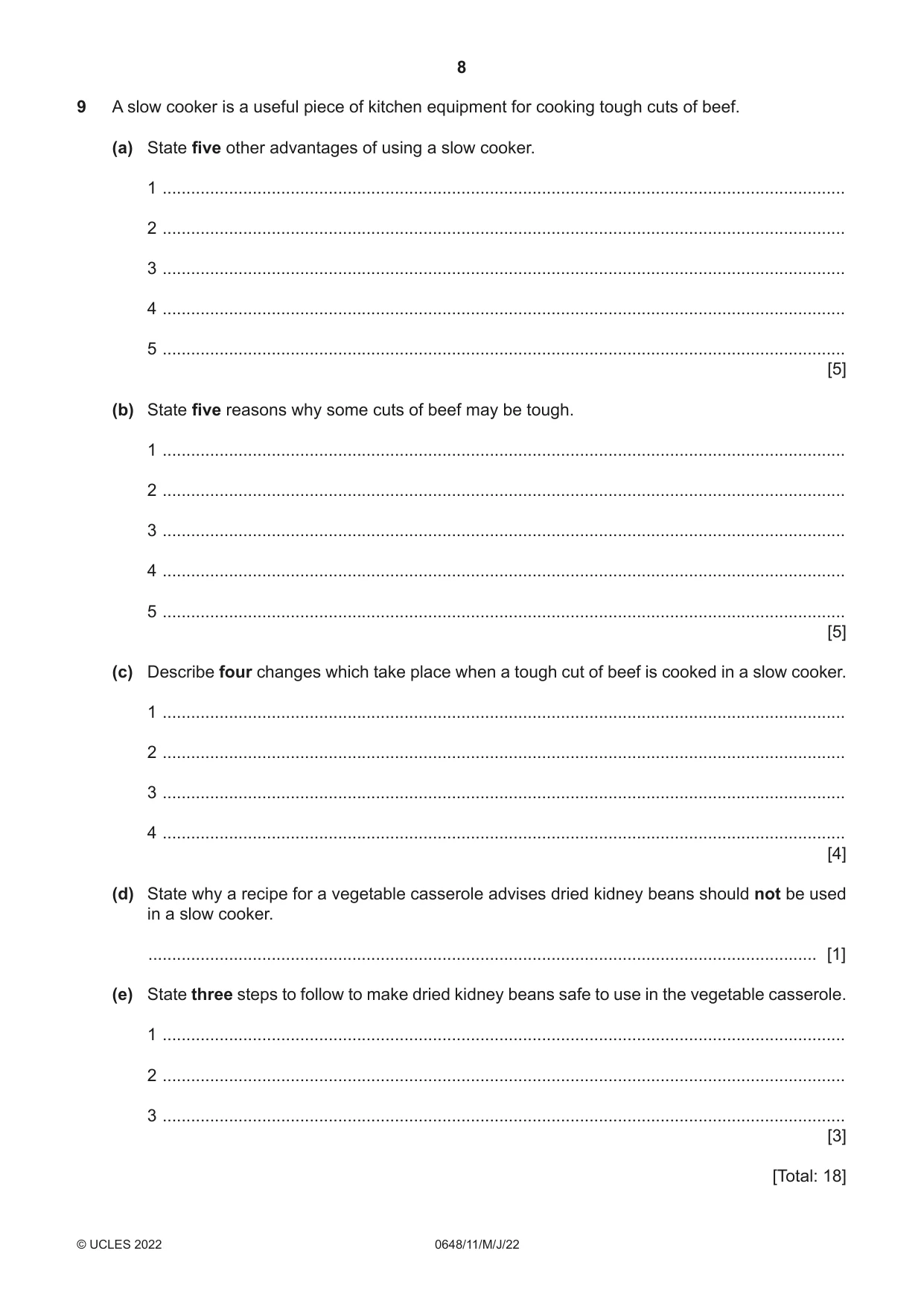
8 0648/11/M/J/22 © UCLES 2022 9 A slow cooker is a useful piece of kitchen equipment for cooking tough cuts of beef. (a) State five other advantages of using a slow cooker. 1 … 2 … 3 … 4 … 5 … [5] (b) State five reasons why some cuts of beef may be tough. 1 … 2 … 3 … 4 … 5 … [5] (c) Describe four changes which take place when a tough cut of beef is cooked in a slow cooker. 1 … 2 … 3 … 4 … [4] (d) State why a recipe for a vegetable casserole advises dried kidney beans should not be used in a slow cooker. … [1] (e) State three steps to follow to make dried kidney beans safe to use in the vegetable casserole. 1 … 2 … 3 … [3] [Total: 18]
Question paper, page 9
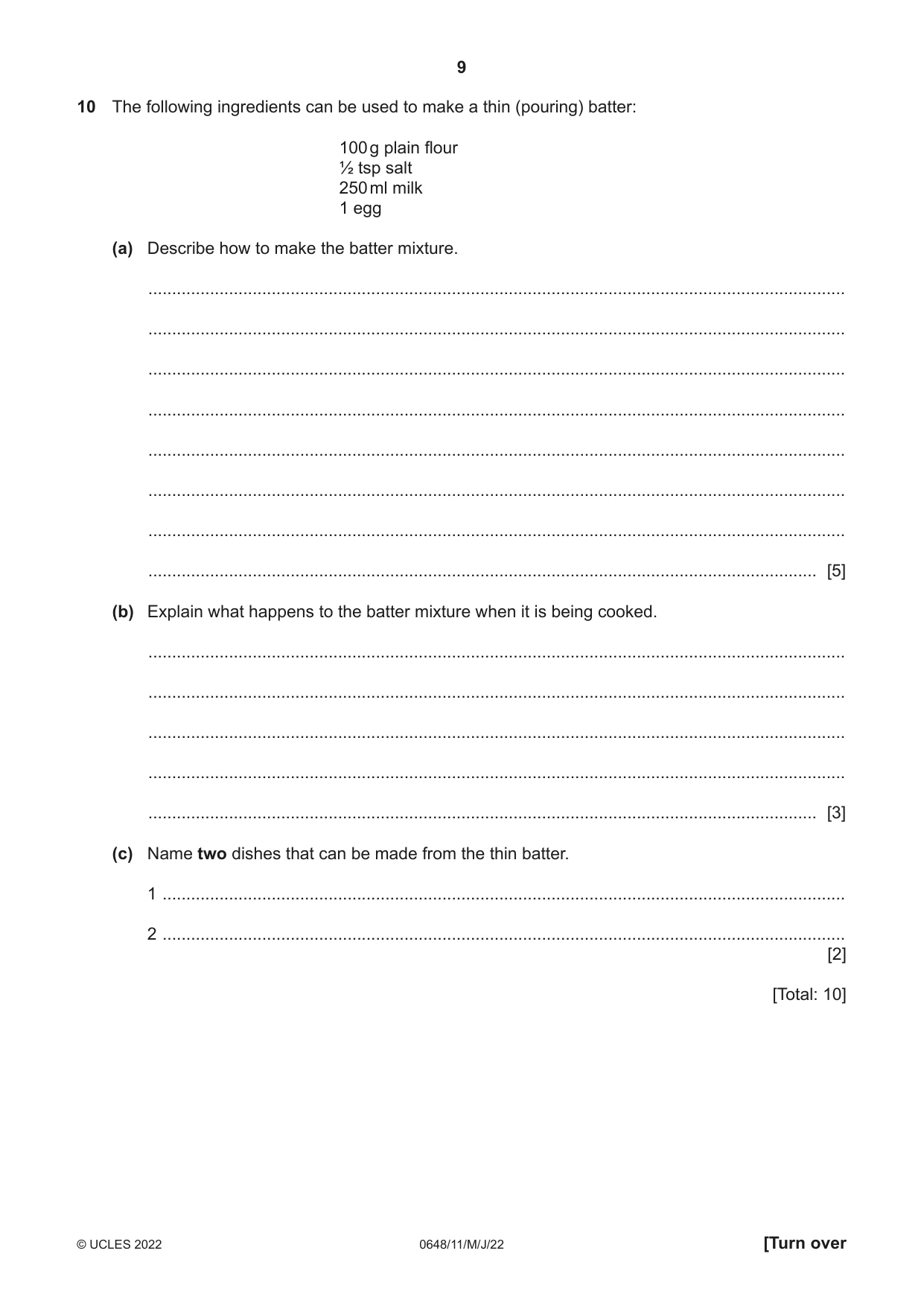
9 0648/11/M/J/22 © UCLES 2022 [Turn over 10 The following ingredients can be used to make a thin (pouring) batter: 100 g plain flour ½ tsp salt 250 ml milk 1 egg (a) Describe how to make the batter mixture. … … … … … … … … [5] (b) Explain what happens to the batter mixture when it is being cooked. … … … … … [3] (c) Name two dishes that can be made from the thin batter. 1 … 2 … [2] [Total: 10]
Question paper, page 10
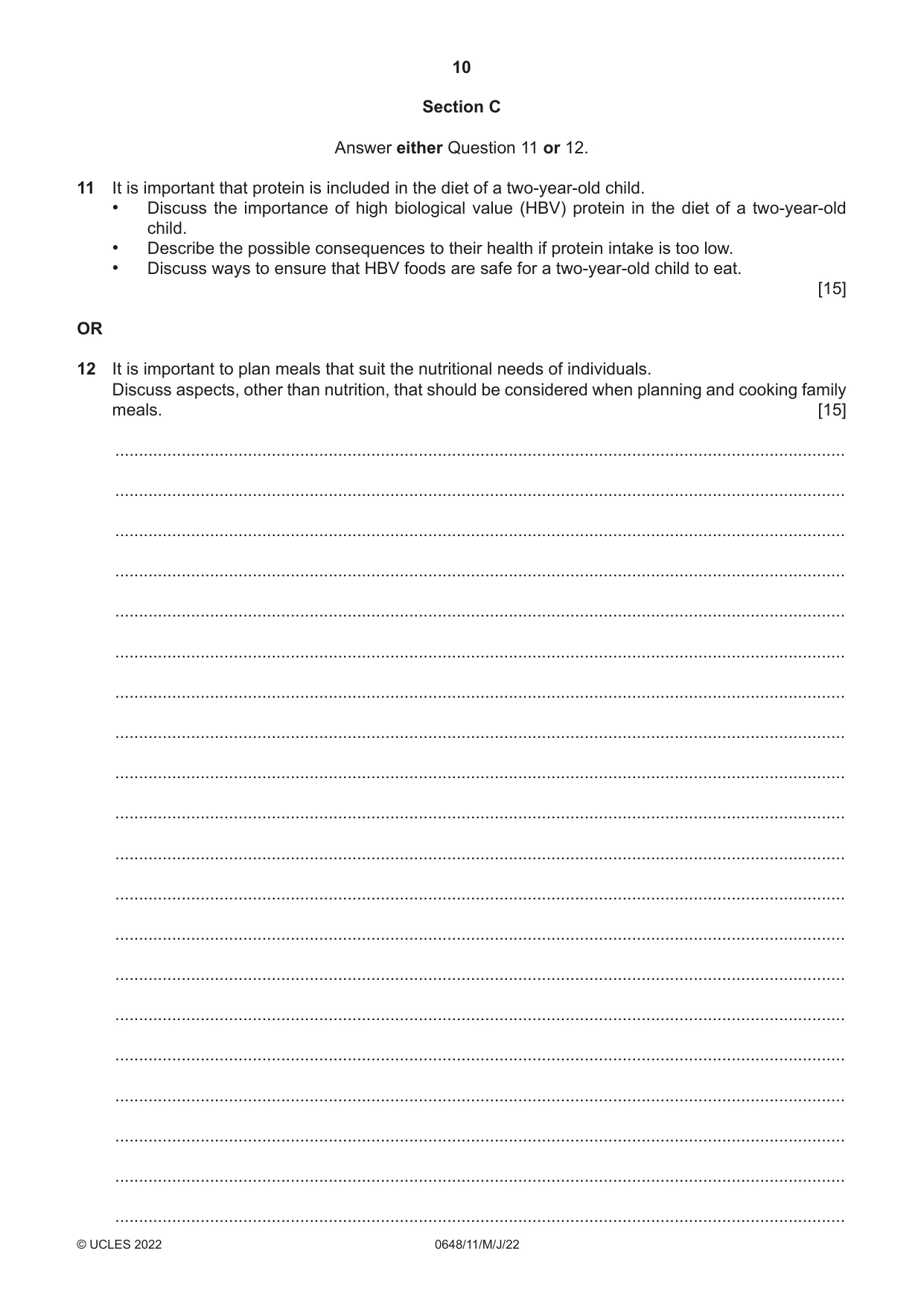
10 0648/11/M/J/22 © UCLES 2022 Section C Answer either Question 11 or 12. 11 It is important that protein is included in the diet of a two-year-old child. • Discuss the importance of high biological value (HBV) protein in the diet of a two-year-old child. • Describe the possible consequences to their health if protein intake is too low. • Discuss ways to ensure that HBV foods are safe for a two-year-old child to eat. [15] OR 12 It is important to plan meals that suit the nutritional needs of individuals. Discuss aspects, other than nutrition, that should be considered when planning and cooking family meals. [15] … … … … … … … … … … … … … … … … … … … …
Question paper, page 11
11 0648/11/M/J/22 © UCLES 2022 [Turn over … … … … … … … … … … … … … … … … … … … … … … … … … … … …
Question paper, page 12
12 0648/11/M/J/22 © UCLES 2022 … … … … … … … … … … … … … … … … … … … … … … … … Permission to reproduce items where third-party owned material protected by copyright is included has been sought and cleared where possible. Every reasonable effort has been made by the publisher (UCLES) to trace copyright holders, but if any items requiring clearance have unwittingly been included, the publisher will be pleased to make amends at the earliest possible opportunity. To avoid the issue of disclosure of answer-related information to candidates, all copyright acknowledgements are reproduced online in the Cambridge Assessment International Education Copyright Acknowledgements Booklet. This is produced for each series of examinations and is freely available to download at www.cambridgeinternational.org after the live examination series. Cambridge Assessment International Education is part of Cambridge Assessment. Cambridge Assessment is the brand name of the University of Cambridge Local Examinations Syndicate (UCLES), which is a department of the University of Cambridge.
Mark scheme, page 1
This document consists of 17 printed pages. © UCLES 2022 [Turn over Cambridge IGCSE™ FOOD AND NUTRITION 0648/11 Paper 1 Theory May/June 2022 MARK SCHEME Maximum Mark: 100 Published This mark scheme is published as an aid to teachers and candidates, to indicate the requirements of the examination. It shows the basis on which Examiners were instructed to award marks. It does not indicate the details of the discussions that took place at an Examiners’ meeting before marking began, which would have considered the acceptability of alternative answers. Mark schemes should be read in conjunction with the question paper and the Principal Examiner Report for Teachers. Cambridge International will not enter into discussions about these mark schemes. Cambridge International is publishing the mark schemes for the May/June 2022 series for most Cambridge IGCSE, Cambridge International A and AS Level and Cambridge Pre-U components, and some Cambridge O Level components.
Mark scheme, page 2
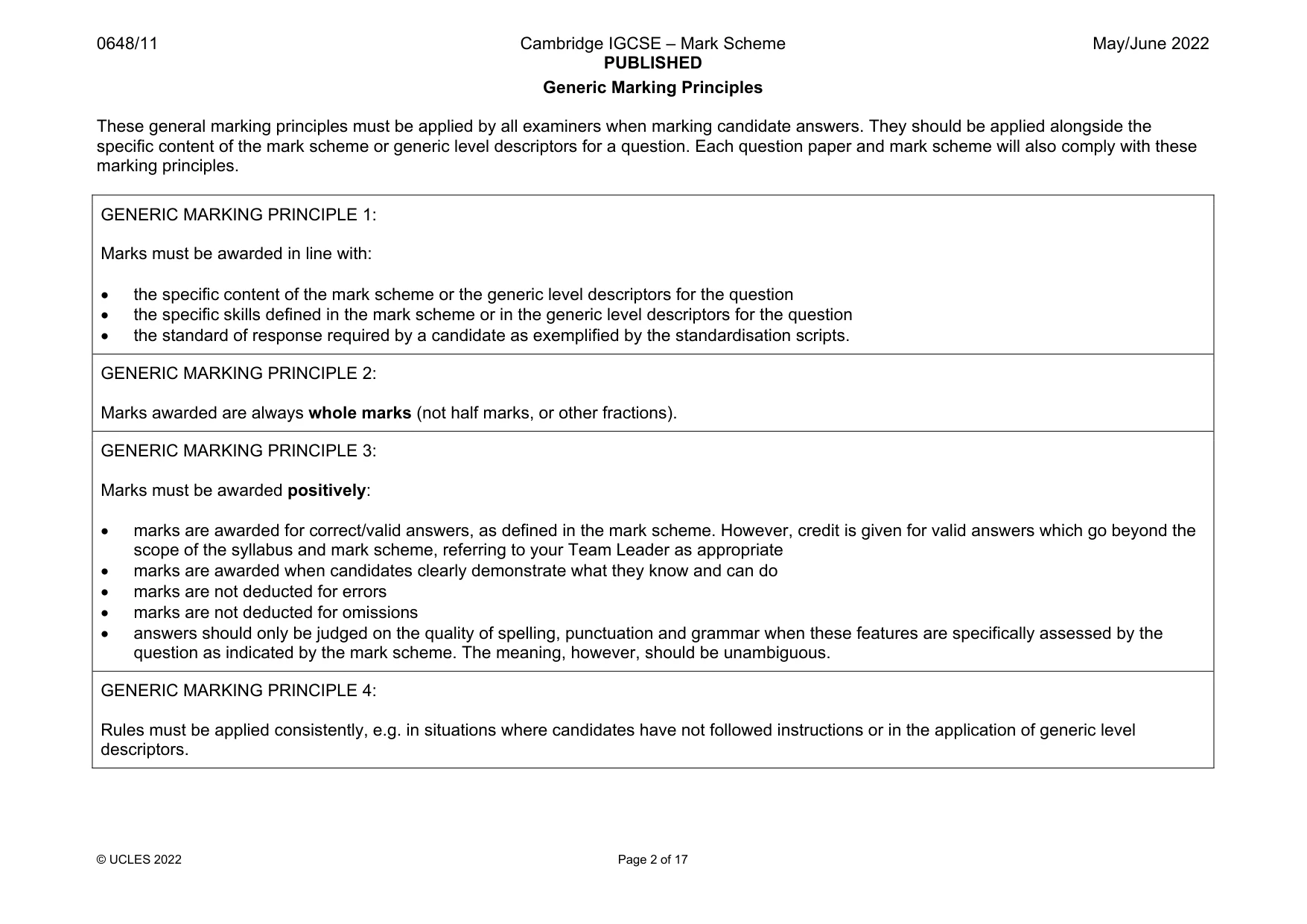
0648/11 Cambridge IGCSE – Mark Scheme PUBLISHED May/June 2022 © UCLES 2022 Page 2 of 17 Generic Marking Principles These general marking principles must be applied by all examiners when marking candidate answers. They should be applied alongside the specific content of the mark scheme or generic level descriptors for a question. Each question paper and mark scheme will also comply with these marking principles. GENERIC MARKING PRINCIPLE 1: Marks must be awarded in line with: the specific content of the mark scheme or the generic level descriptors for the question the specific skills defined in the mark scheme or in the generic level descriptors for the question the standard of response required by a candidate as exemplified by the standardisation scripts. GENERIC MARKING PRINCIPLE 2: Marks awarded are always whole marks (not half marks, or other fractions). GENERIC MARKING PRINCIPLE 3: Marks must be awarded positively: marks are awarded for correct/valid answers, as defined in the mark scheme. However, credit is given for valid answers which go beyond the scope of the syllabus and mark scheme, referring to your Team Leader as appropriate marks are awarded when candidates clearly demonstrate what they know and can do marks are not deducted for errors marks are not deducted for omissions answers should only be judged on the quality of spelling, punctuation and grammar when these features are specifically assessed by the question as indicated by the mark scheme. The meaning, however, should be unambiguous. GENERIC MARKING PRINCIPLE 4: Rules must be applied consistently, e.g. in situations where candidates have not followed instructions or in the application of generic level descriptors.
Mark scheme, page 3
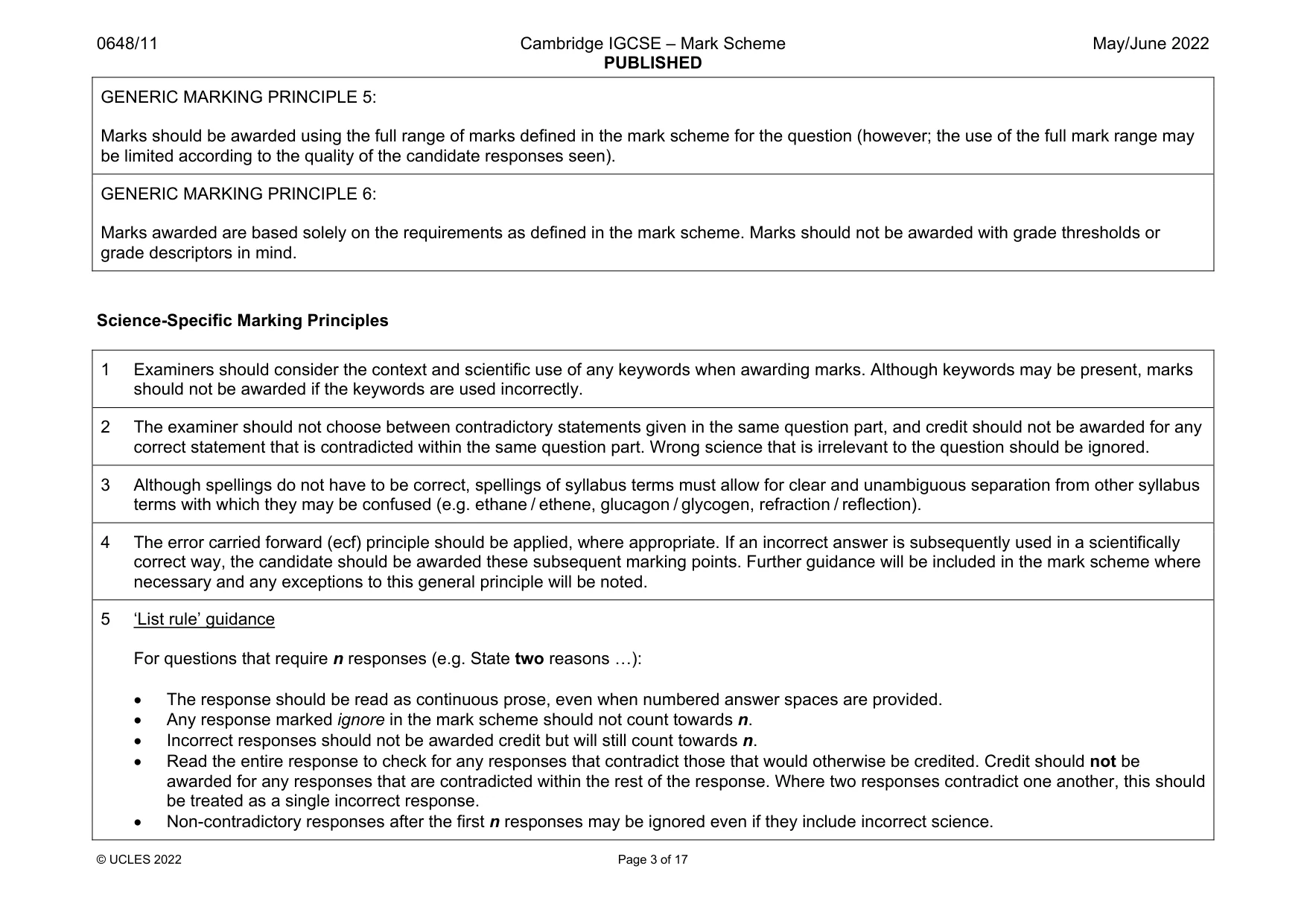
0648/11 Cambridge IGCSE – Mark Scheme PUBLISHED May/June 2022 © UCLES 2022 Page 3 of 17 GENERIC MARKING PRINCIPLE 5: Marks should be awarded using the full range of marks defined in the mark scheme for the question (however; the use of the full mark range may be limited according to the quality of the candidate responses seen). GENERIC MARKING PRINCIPLE 6: Marks awarded are based solely on the requirements as defined in the mark scheme. Marks should not be awarded with grade thresholds or grade descriptors in mind. Science-Specific Marking Principles 1 Examiners should consider the context and scientific use of any keywords when awarding marks. Although keywords may be present, marks should not be awarded if the keywords are used incorrectly. 2 The examiner should not choose between contradictory statements given in the same question part, and credit should not be awarded for any correct statement that is contradicted within the same question part. Wrong science that is irrelevant to the question should be ignored. 3 Although spellings do not have to be correct, spellings of syllabus terms must allow for clear and unambiguous separation from other syllabus terms with which they may be confused (e.g. ethane / ethene, glucagon / glycogen, refraction / reflection). 4 The error carried forward (ecf) principle should be applied, where appropriate. If an incorrect answer is subsequently used in a scientifically correct way, the candidate should be awarded these subsequent marking points. Further guidance will be included in the mark scheme where necessary and any exceptions to this general principle will be noted. 5 ‘List rule’ guidance For questions that require n responses (e.g. State two reasons …): The response should be read as continuous prose, even when numbered answer spaces are provided. Any response marked ignore in the mark scheme should not count towards n. Incorrect responses should not be awarded credit but will still count towards n. Read the entire response to check for any responses that contradict those that would otherwise be credited. Credit should not be awarded for any responses that are contradicted within the rest of the response. Where two responses contradict one another, this should be treated as a single incorrect response. Non-contradictory responses after the first n responses may be ignored even if they include incorrect science.
Mark scheme, page 4
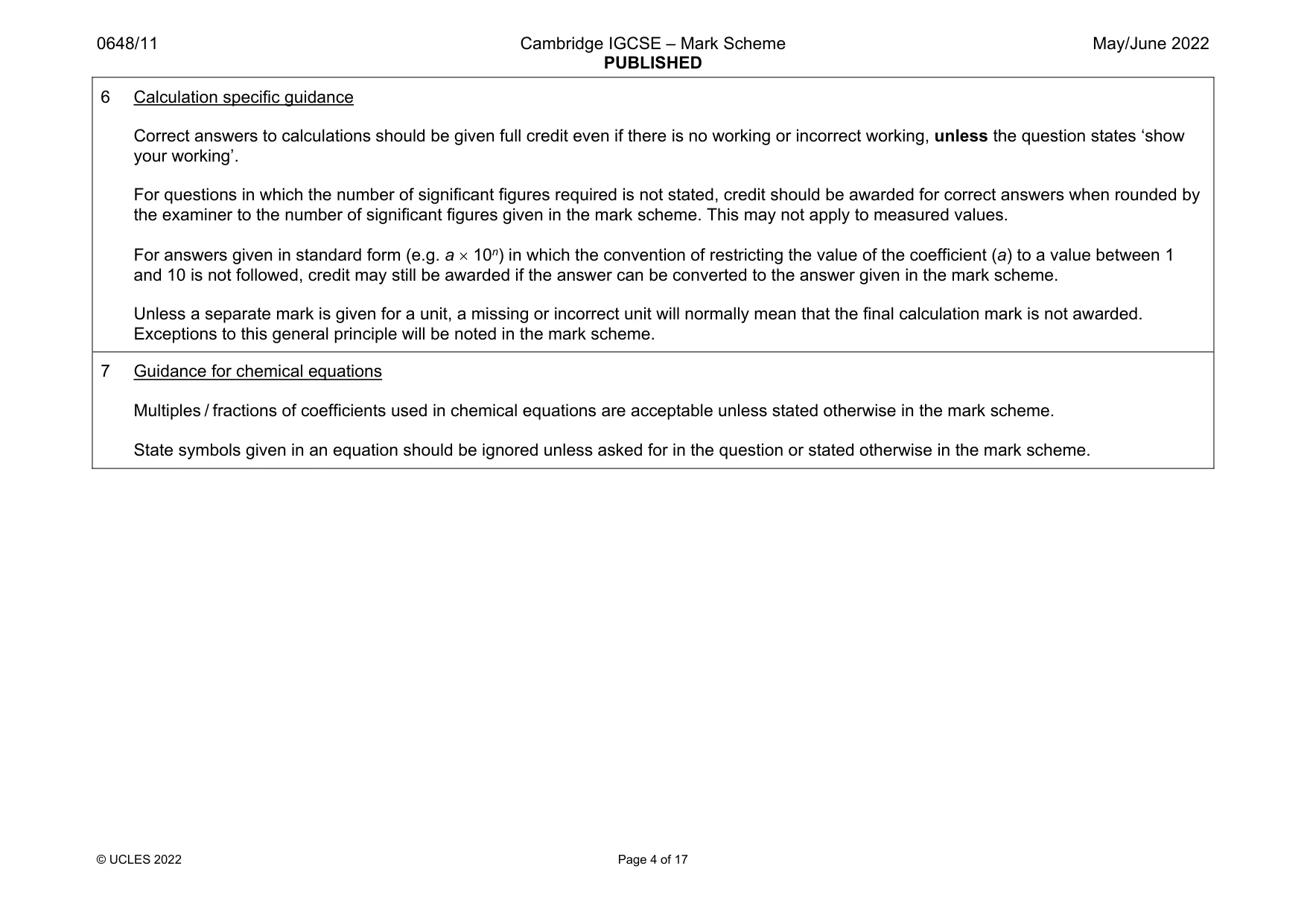
0648/11 Cambridge IGCSE – Mark Scheme PUBLISHED May/June 2022 © UCLES 2022 Page 4 of 17 6 Calculation specific guidance Correct answers to calculations should be given full credit even if there is no working or incorrect working, unless the question states ‘show your working’. For questions in which the number of significant figures required is not stated, credit should be awarded for correct answers when rounded by the examiner to the number of significant figures given in the mark scheme. This may not apply to measured values. For answers given in standard form (e.g. a 10n) in which the convention of restricting the value of the coefficient (a) to a value between 1 and 10 is not followed, credit may still be awarded if the answer can be converted to the answer given in the mark scheme. Unless a separate mark is given for a unit, a missing or incorrect unit will normally mean that the final calculation mark is not awarded. Exceptions to this general principle will be noted in the mark scheme. 7 Guidance for chemical equations Multiples / fractions of coefficients used in chemical equations are acceptable unless stated otherwise in the mark scheme. State symbols given in an equation should be ignored unless asked for in the question or stated otherwise in the mark scheme.
Mark scheme, page 5
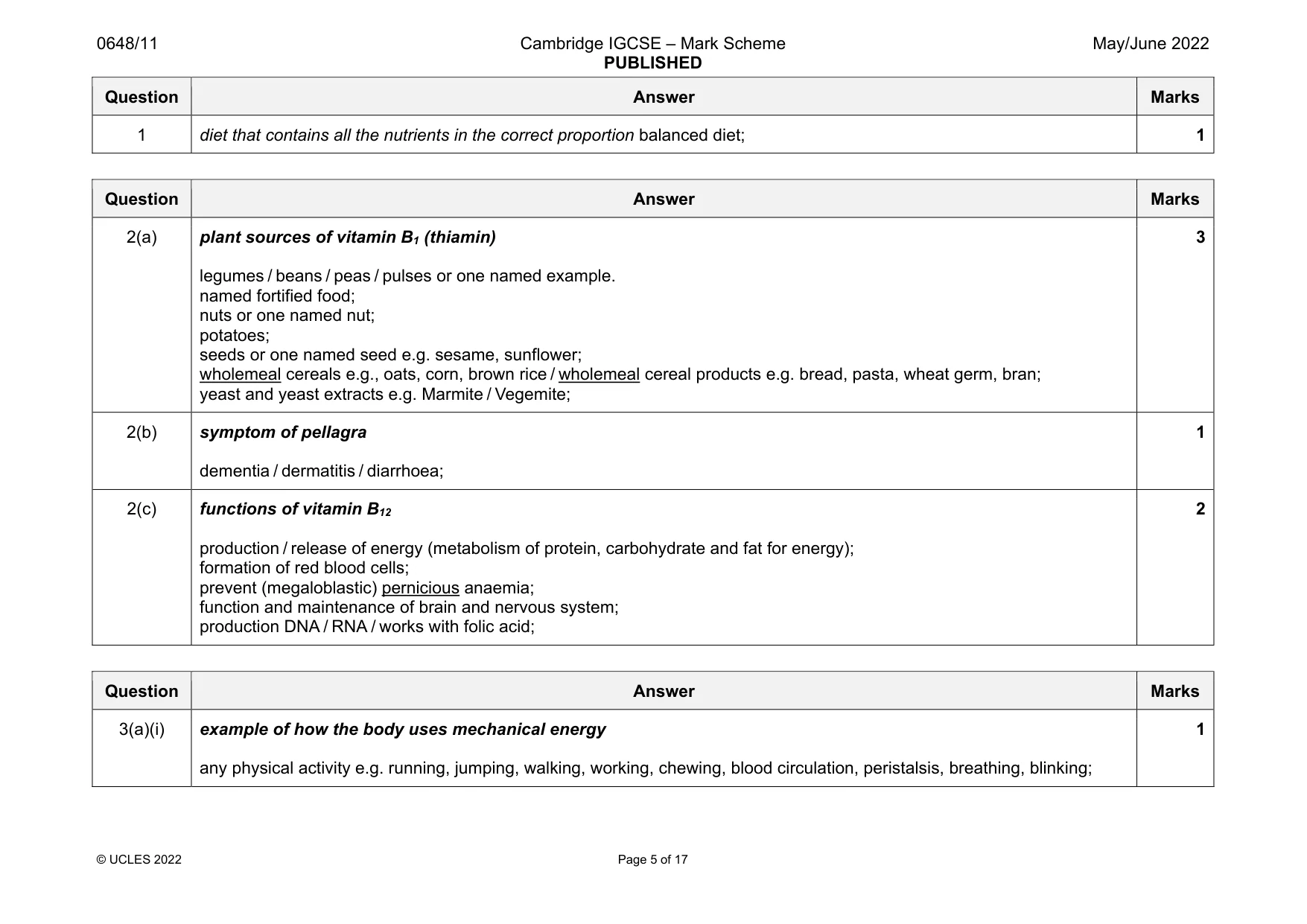
0648/11 Cambridge IGCSE – Mark Scheme PUBLISHED May/June 2022 © UCLES 2022 Page 5 of 17 Question Answer Marks 1 diet that contains all the nutrients in the correct proportion balanced diet; 1 Question Answer Marks 2(a) plant sources of vitamin B1 (thiamin) legumes / beans / peas / pulses or one named example. named fortified food; nuts or one named nut; potatoes; seeds or one named seed e.g. sesame, sunflower; wholemeal cereals e.g., oats, corn, brown rice / wholemeal cereal products e.g. bread, pasta, wheat germ, bran; yeast and yeast extracts e.g. Marmite / Vegemite; 3 2(b) symptom of pellagra dementia / dermatitis / diarrhoea; 1 2(c) functions of vitamin B12 production / release of energy (metabolism of protein, carbohydrate and fat for energy); formation of red blood cells; prevent (megaloblastic) pernicious anaemia; function and maintenance of brain and nervous system; production DNA / RNA / works with folic acid; 2 Question Answer Marks 3(a)(i) example of how the body uses mechanical energy any physical activity e.g. running, jumping, walking, working, chewing, blood circulation, peristalsis, breathing, blinking; 1
Mark scheme, page 6
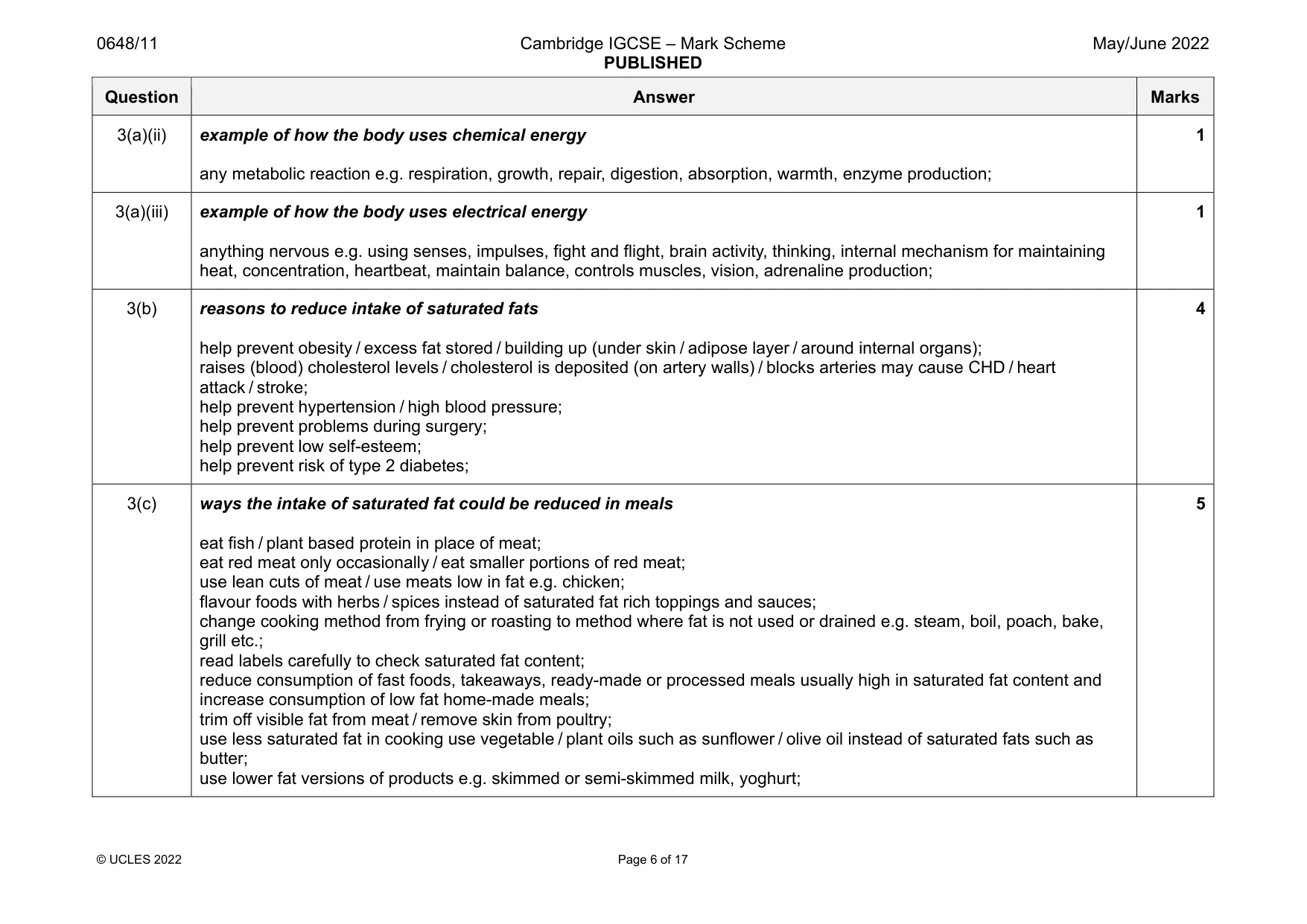
0648/11 Cambridge IGCSE – Mark Scheme PUBLISHED May/June 2022 © UCLES 2022 Page 6 of 17 Question Answer Marks 3(a)(ii) example of how the body uses chemical energy any metabolic reaction e.g. respiration, growth, repair, digestion, absorption, warmth, enzyme production; 1 3(a)(iii) example of how the body uses electrical energy anything nervous e.g. using senses, impulses, fight and flight, brain activity, thinking, internal mechanism for maintaining heat, concentration, heartbeat, maintain balance, controls muscles, vision, adrenaline production; 1 3(b) reasons to reduce intake of saturated fats help prevent obesity / excess fat stored / building up (under skin / adipose layer / around internal organs); raises (blood) cholesterol levels / cholesterol is deposited (on artery walls) / blocks arteries may cause CHD / heart attack / stroke; help prevent hypertension / high blood pressure; help prevent problems during surgery; help prevent low self-esteem; help prevent risk of type 2 diabetes; 4 3(c) ways the intake of saturated fat could be reduced in meals eat fish / plant based protein in place of meat; eat red meat only occasionally / eat smaller portions of red meat; use lean cuts of meat / use meats low in fat e.g. chicken; flavour foods with herbs / spices instead of saturated fat rich toppings and sauces; change cooking method from frying or roasting to method where fat is not used or drained e.g. steam, boil, poach, bake, grill etc.; read labels carefully to check saturated fat content; reduce consumption of fast foods, takeaways, ready-made or processed meals usually high in saturated fat content and increase consumption of low fat home-made meals; trim off visible fat from meat / remove skin from poultry; use less saturated fat in cooking use vegetable / plant oils such as sunflower / olive oil instead of saturated fats such as butter; use lower fat versions of products e.g. skimmed or semi-skimmed milk, yoghurt; 5
Mark scheme, page 7
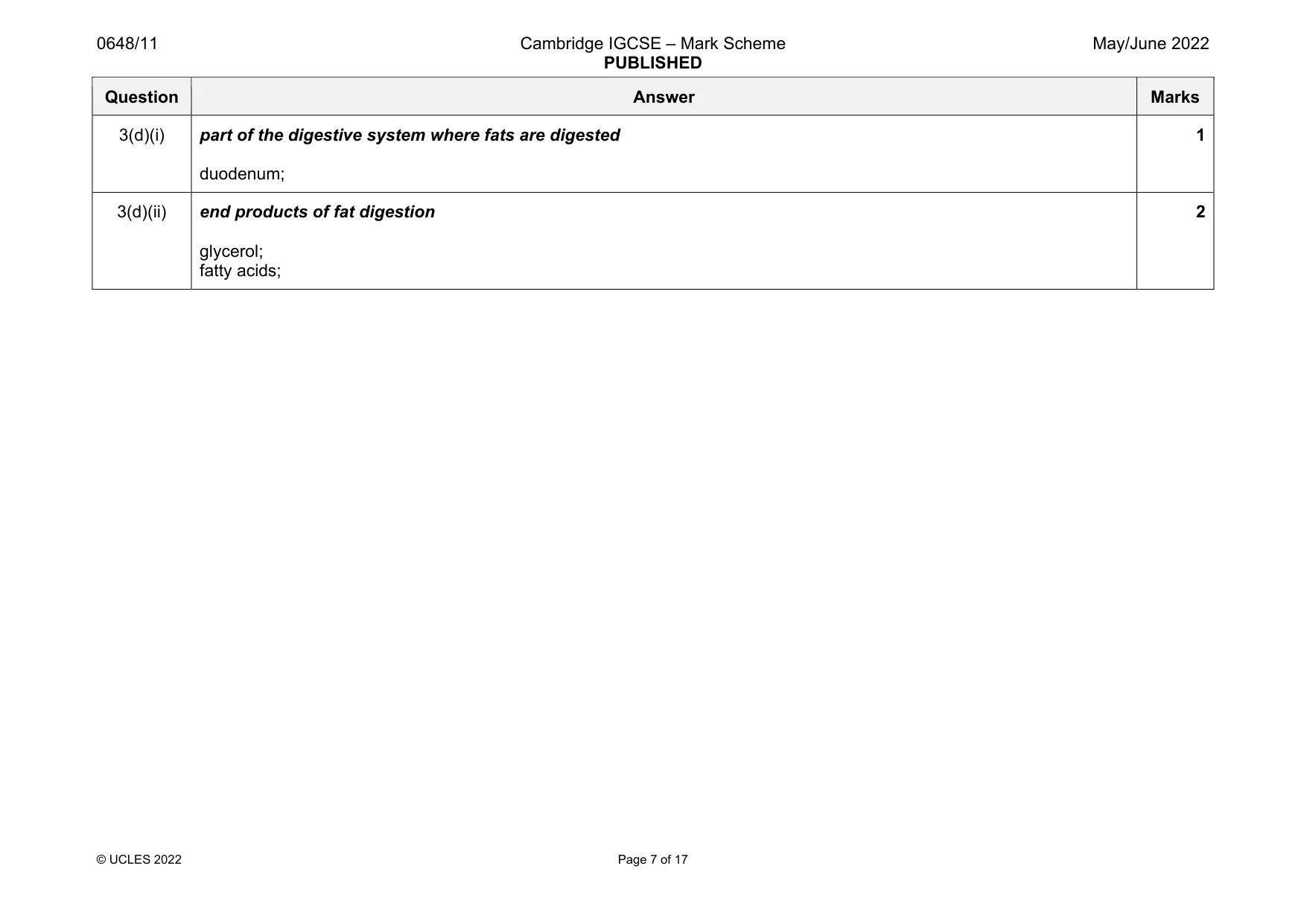
0648/11 Cambridge IGCSE – Mark Scheme PUBLISHED May/June 2022 © UCLES 2022 Page 7 of 17 Question Answer Marks 3(d)(i) part of the digestive system where fats are digested duodenum; 1 3(d)(ii) end products of fat digestion glycerol; fatty acids; 2
Mark scheme, page 8
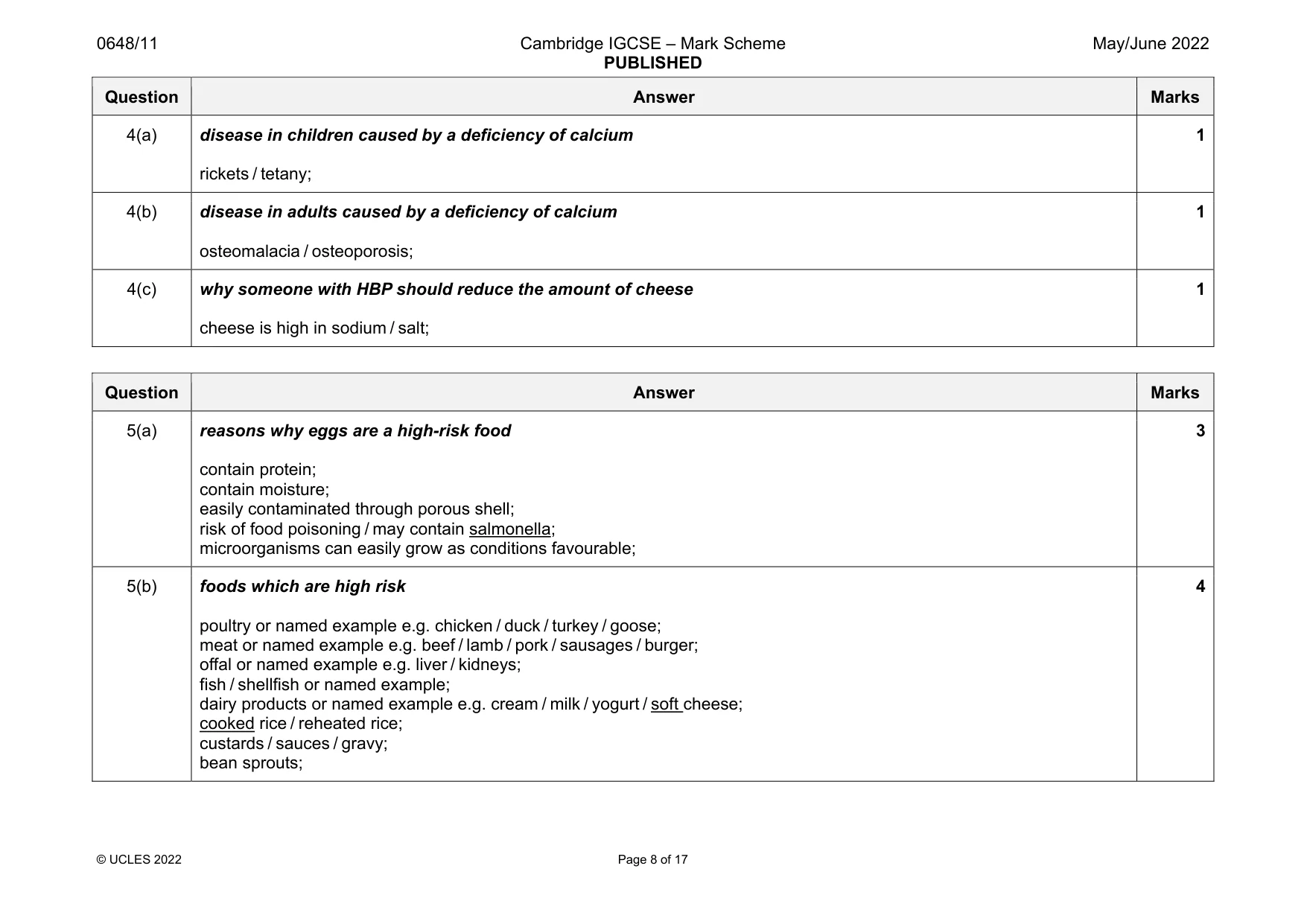
0648/11 Cambridge IGCSE – Mark Scheme PUBLISHED May/June 2022 © UCLES 2022 Page 8 of 17 Question Answer Marks 4(a) disease in children caused by a deficiency of calcium rickets / tetany; 1 4(b) disease in adults caused by a deficiency of calcium osteomalacia / osteoporosis; 1 4(c) why someone with HBP should reduce the amount of cheese cheese is high in sodium / salt; 1 Question Answer Marks 5(a) reasons why eggs are a high-risk food contain protein; contain moisture; easily contaminated through porous shell; risk of food poisoning / may contain salmonella; microorganisms can easily grow as conditions favourable; 3 5(b) foods which are high risk poultry or named example e.g. chicken / duck / turkey / goose; meat or named example e.g. beef / lamb / pork / sausages / burger; offal or named example e.g. liver / kidneys; fish / shellfish or named example; dairy products or named example e.g. cream / milk / yogurt / soft cheese; cooked rice / reheated rice; custards / sauces / gravy; bean sprouts; 4
Mark scheme, page 9
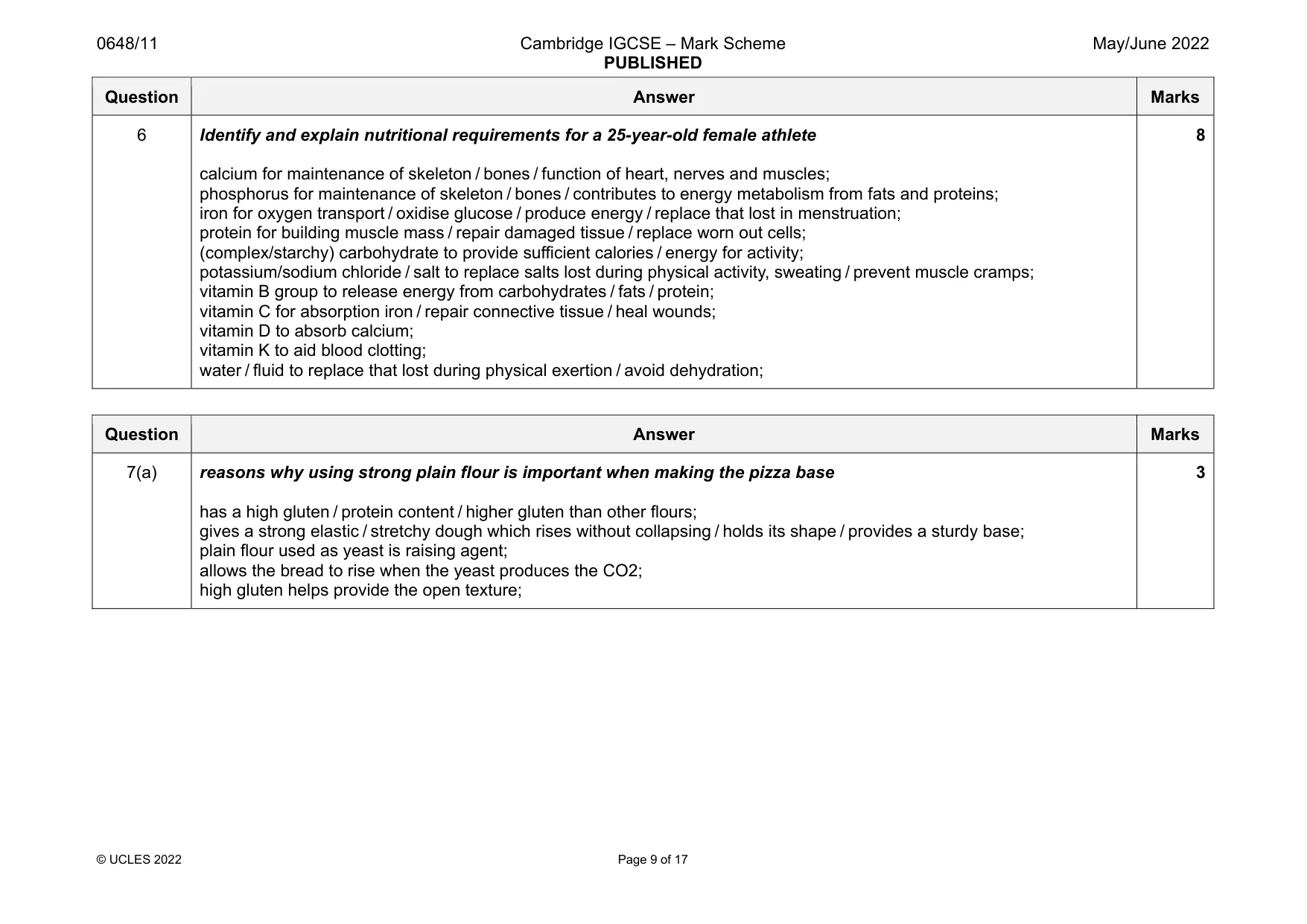
0648/11 Cambridge IGCSE – Mark Scheme PUBLISHED May/June 2022 © UCLES 2022 Page 9 of 17 Question Answer Marks 6 Identify and explain nutritional requirements for a 25-year-old female athlete calcium for maintenance of skeleton / bones / function of heart, nerves and muscles; phosphorus for maintenance of skeleton / bones / contributes to energy metabolism from fats and proteins; iron for oxygen transport / oxidise glucose / produce energy / replace that lost in menstruation; protein for building muscle mass / repair damaged tissue / replace worn out cells; (complex/starchy) carbohydrate to provide sufficient calories / energy for activity; potassium/sodium chloride / salt to replace salts lost during physical activity, sweating / prevent muscle cramps; vitamin B group to release energy from carbohydrates / fats / protein; vitamin C for absorption iron / repair connective tissue / heal wounds; vitamin D to absorb calcium; vitamin K to aid blood clotting; water / fluid to replace that lost during physical exertion / avoid dehydration; 8 Question Answer Marks 7(a) reasons why using strong plain flour is important when making the pizza base has a high gluten / protein content / higher gluten than other flours; gives a strong elastic / stretchy dough which rises without collapsing / holds its shape / provides a sturdy base; plain flour used as yeast is raising agent; allows the bread to rise when the yeast produces the CO2; high gluten helps provide the open texture; 3
Mark scheme, page 10
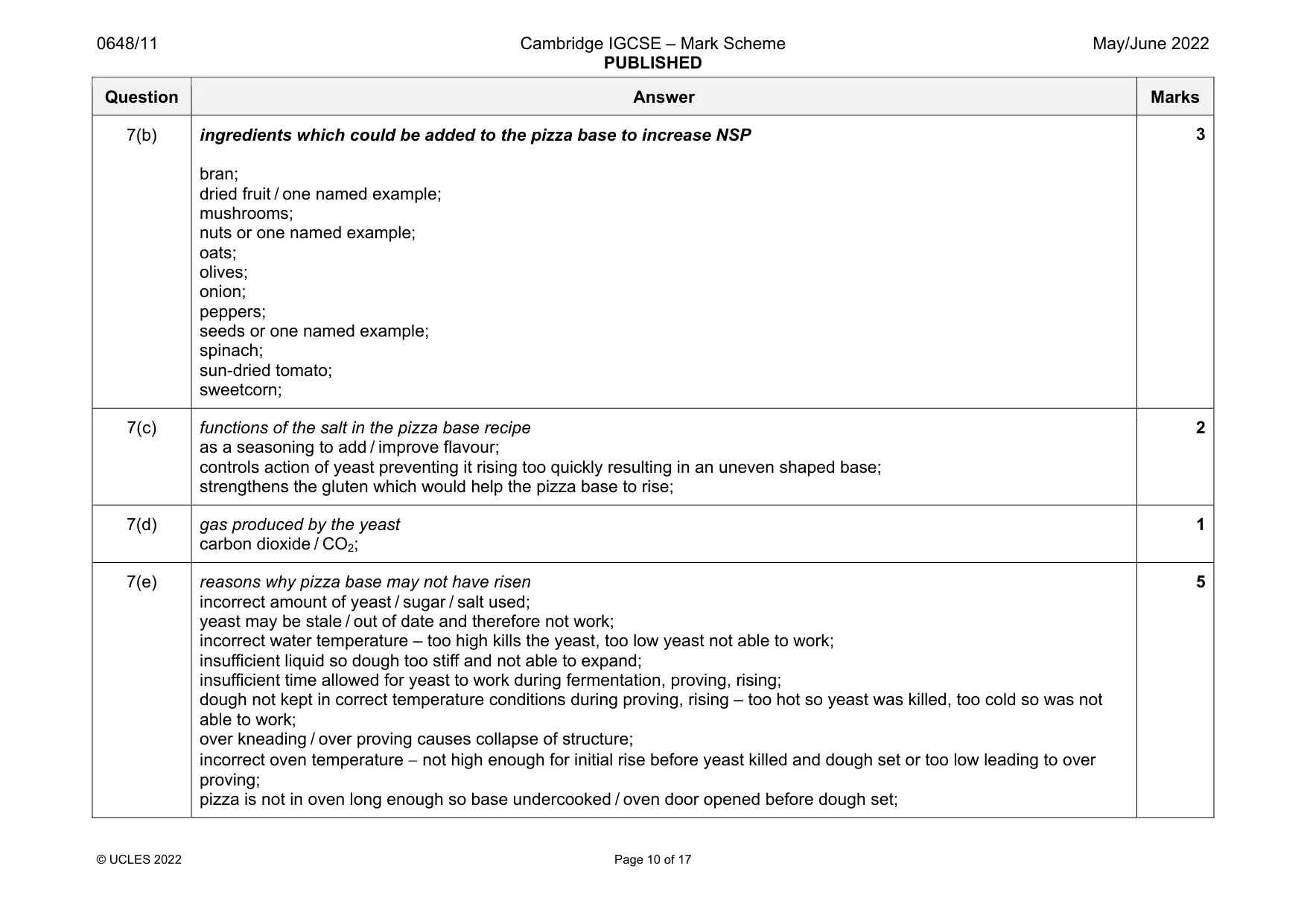
0648/11 Cambridge IGCSE – Mark Scheme PUBLISHED May/June 2022 © UCLES 2022 Page 10 of 17 Question Answer Marks 7(b) ingredients which could be added to the pizza base to increase NSP bran; dried fruit / one named example; mushrooms; nuts or one named example; oats; olives; onion; peppers; seeds or one named example; spinach; sun-dried tomato; sweetcorn; 3 7(c) functions of the salt in the pizza base recipe as a seasoning to add / improve flavour; controls action of yeast preventing it rising too quickly resulting in an uneven shaped base; strengthens the gluten which would help the pizza base to rise; 2 7(d) gas produced by the yeast carbon dioxide / CO2; 1 7(e) reasons why pizza base may not have risen incorrect amount of yeast / sugar / salt used; yeast may be stale / out of date and therefore not work; incorrect water temperature – too high kills the yeast, too low yeast not able to work; insufficient liquid so dough too stiff and not able to expand; insufficient time allowed for yeast to work during fermentation, proving, rising; dough not kept in correct temperature conditions during proving, rising – too hot so yeast was killed, too cold so was not able to work; over kneading / over proving causes collapse of structure; incorrect oven temperature not high enough for initial rise before yeast killed and dough set or too low leading to over proving; pizza is not in oven long enough so base undercooked / oven door opened before dough set; 5
Mark scheme, page 11
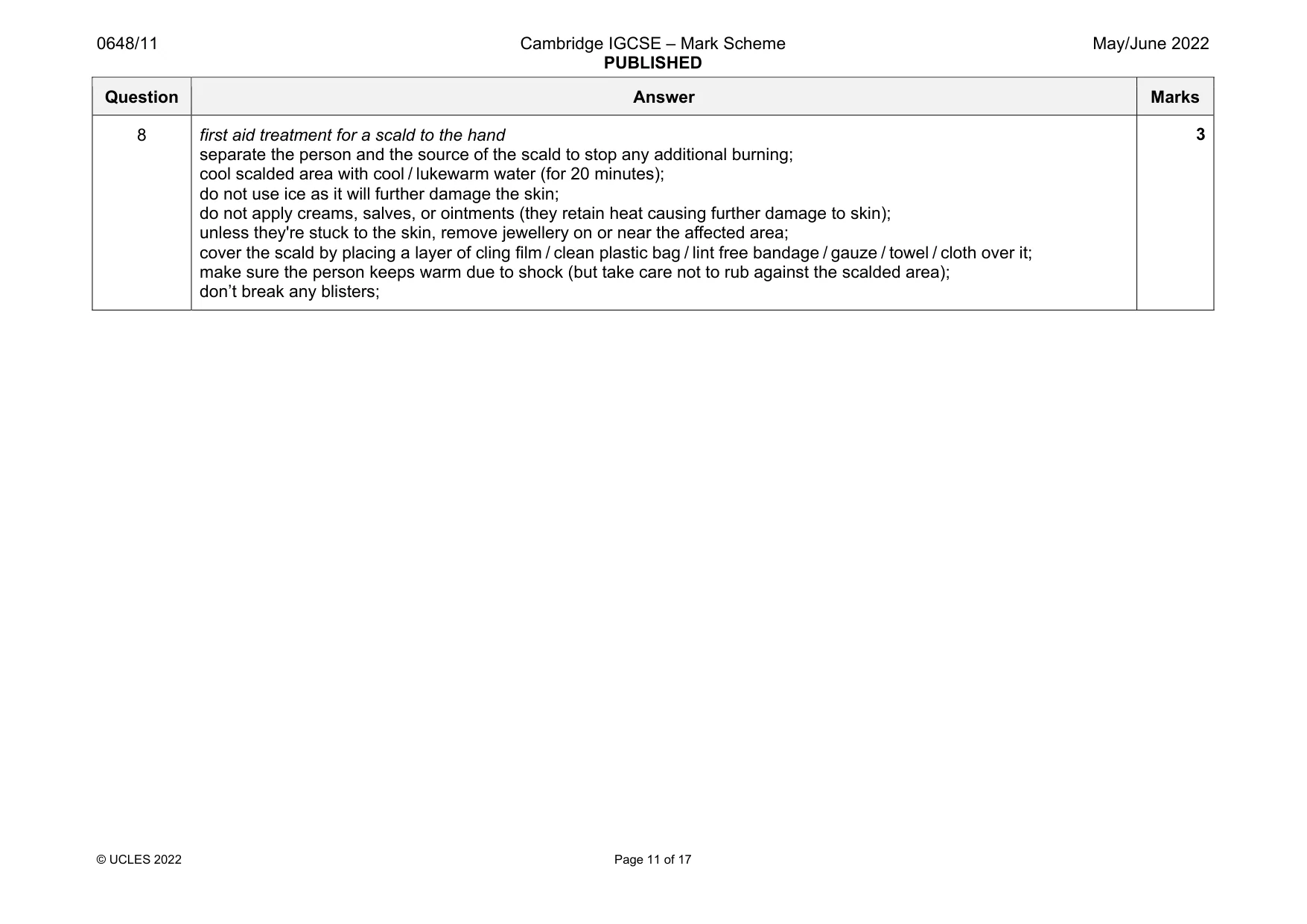
0648/11 Cambridge IGCSE – Mark Scheme PUBLISHED May/June 2022 © UCLES 2022 Page 11 of 17 Question Answer Marks 8 first aid treatment for a scald to the hand separate the person and the source of the scald to stop any additional burning; cool scalded area with cool / lukewarm water (for 20 minutes); do not use ice as it will further damage the skin; do not apply creams, salves, or ointments (they retain heat causing further damage to skin); unless they're stuck to the skin, remove jewellery on or near the affected area; cover the scald by placing a layer of cling film / clean plastic bag / lint free bandage / gauze / towel / cloth over it; make sure the person keeps warm due to shock (but take care not to rub against the scalded area); don’t break any blisters; 3
Mark scheme, page 12
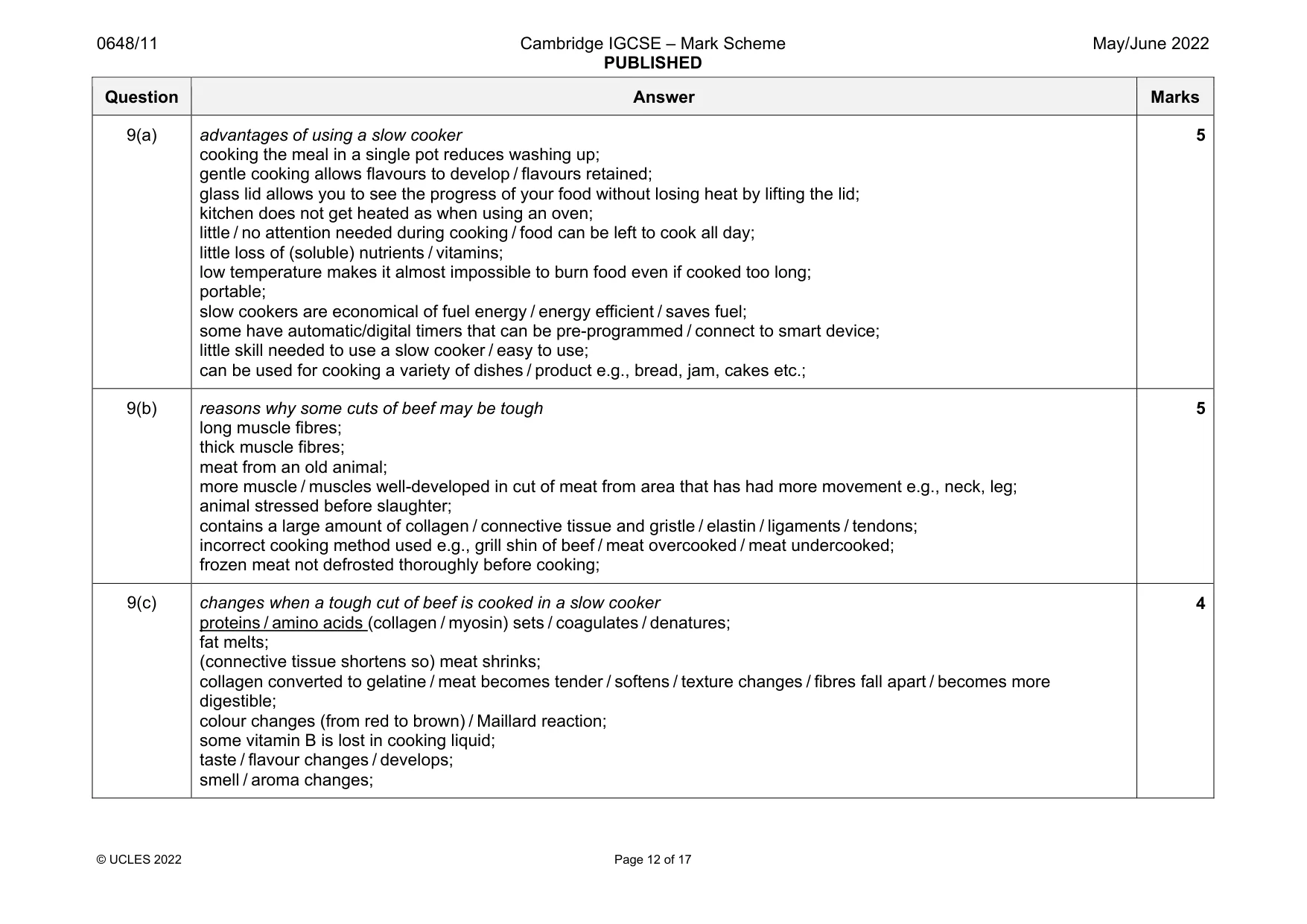
0648/11 Cambridge IGCSE – Mark Scheme PUBLISHED May/June 2022 © UCLES 2022 Page 12 of 17 Question Answer Marks 9(a) advantages of using a slow cooker cooking the meal in a single pot reduces washing up; gentle cooking allows flavours to develop / flavours retained; glass lid allows you to see the progress of your food without losing heat by lifting the lid; kitchen does not get heated as when using an oven; little / no attention needed during cooking / food can be left to cook all day; little loss of (soluble) nutrients / vitamins; low temperature makes it almost impossible to burn food even if cooked too long; portable; slow cookers are economical of fuel energy / energy efficient / saves fuel; some have automatic/digital timers that can be pre-programmed / connect to smart device; little skill needed to use a slow cooker / easy to use; can be used for cooking a variety of dishes / product e.g., bread, jam, cakes etc.; 5 9(b) reasons why some cuts of beef may be tough long muscle fibres; thick muscle fibres; meat from an old animal; more muscle / muscles well-developed in cut of meat from area that has had more movement e.g., neck, leg; animal stressed before slaughter; contains a large amount of collagen / connective tissue and gristle / elastin / ligaments / tendons; incorrect cooking method used e.g., grill shin of beef / meat overcooked / meat undercooked; frozen meat not defrosted thoroughly before cooking; 5 9(c) changes when a tough cut of beef is cooked in a slow cooker proteins / amino acids (collagen / myosin) sets / coagulates / denatures; fat melts; (connective tissue shortens so) meat shrinks; collagen converted to gelatine / meat becomes tender / softens / texture changes / fibres fall apart / becomes more digestible; colour changes (from red to brown) / Maillard reaction; some vitamin B is lost in cooking liquid; taste / flavour changes / develops; smell / aroma changes; 4
Mark scheme, page 13
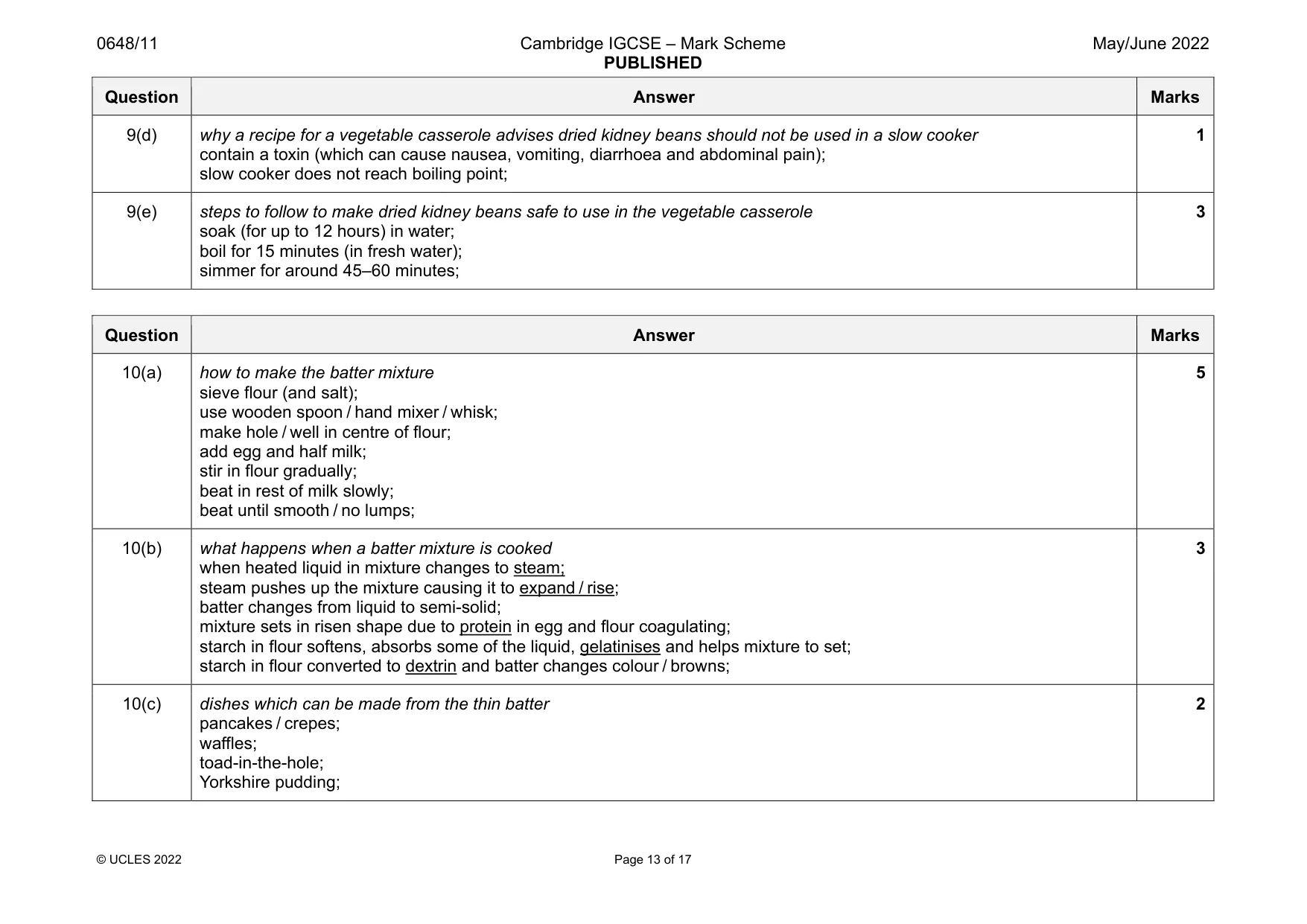
0648/11 Cambridge IGCSE – Mark Scheme PUBLISHED May/June 2022 © UCLES 2022 Page 13 of 17 Question Answer Marks 9(d) why a recipe for a vegetable casserole advises dried kidney beans should not be used in a slow cooker contain a toxin (which can cause nausea, vomiting, diarrhoea and abdominal pain); slow cooker does not reach boiling point; 1 9(e) steps to follow to make dried kidney beans safe to use in the vegetable casserole soak (for up to 12 hours) in water; boil for 15 minutes (in fresh water); simmer for around 45–60 minutes; 3 Question Answer Marks 10(a) how to make the batter mixture sieve flour (and salt); use wooden spoon / hand mixer / whisk; make hole / well in centre of flour; add egg and half milk; stir in flour gradually; beat in rest of milk slowly; beat until smooth / no lumps; 5 10(b) what happens when a batter mixture is cooked when heated liquid in mixture changes to steam; steam pushes up the mixture causing it to expand / rise; batter changes from liquid to semi-solid; mixture sets in risen shape due to protein in egg and flour coagulating; starch in flour softens, absorbs some of the liquid, gelatinises and helps mixture to set; starch in flour converted to dextrin and batter changes colour / browns; 3 10(c) dishes which can be made from the thin batter pancakes / crepes; waffles; toad-in-the-hole; Yorkshire pudding; 2
Mark scheme, page 14
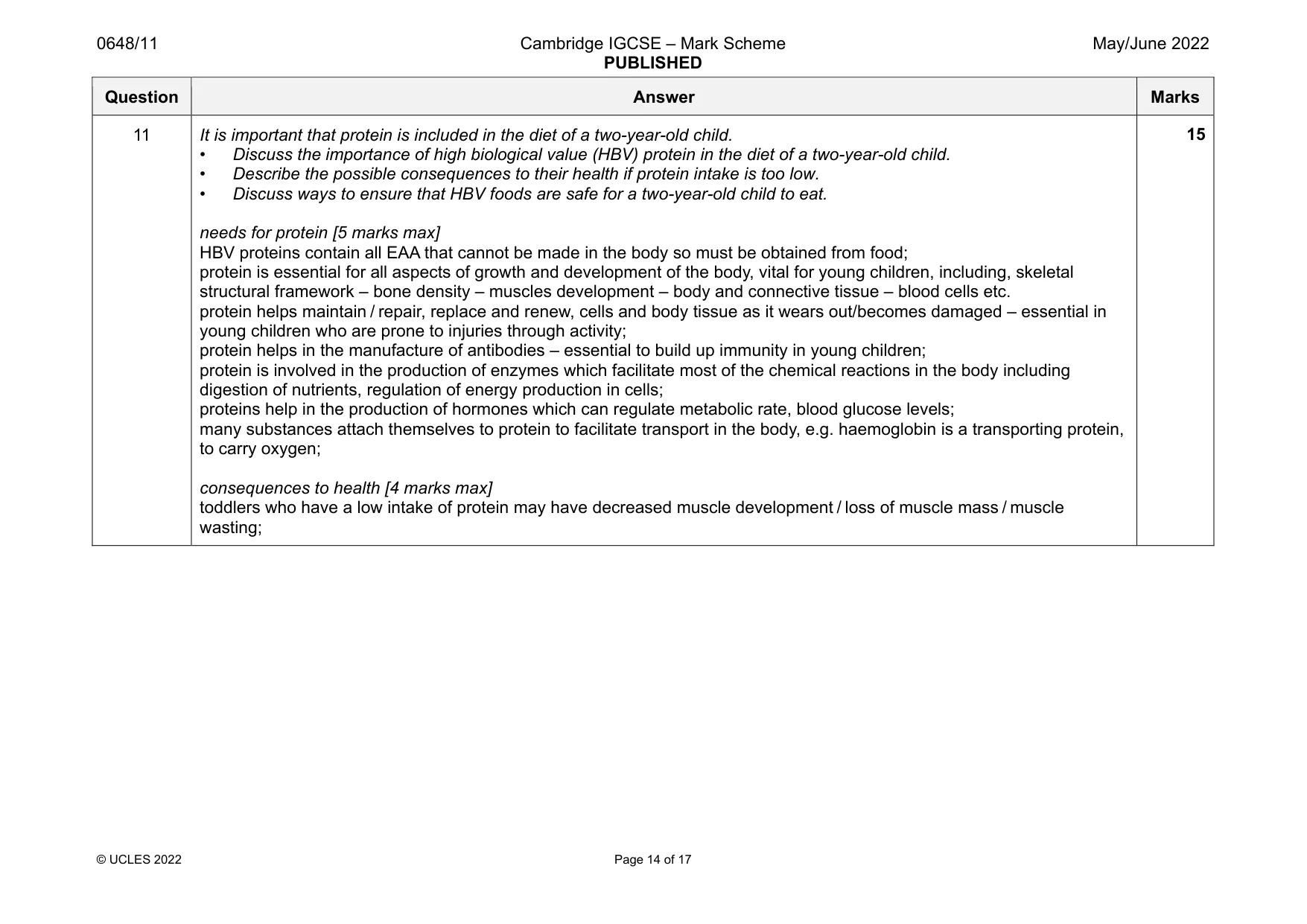
0648/11 Cambridge IGCSE – Mark Scheme PUBLISHED May/June 2022 © UCLES 2022 Page 14 of 17 Question Answer Marks 11 It is important that protein is included in the diet of a two-year-old child. • Discuss the importance of high biological value (HBV) protein in the diet of a two-year-old child. • Describe the possible consequences to their health if protein intake is too low. • Discuss ways to ensure that HBV foods are safe for a two-year-old child to eat. needs for protein [5 marks max] HBV proteins contain all EAA that cannot be made in the body so must be obtained from food; protein is essential for all aspects of growth and development of the body, vital for young children, including, skeletal structural framework – bone density – muscles development – body and connective tissue – blood cells etc. protein helps maintain / repair, replace and renew, cells and body tissue as it wears out/becomes damaged – essential in young children who are prone to injuries through activity; protein helps in the manufacture of antibodies – essential to build up immunity in young children; protein is involved in the production of enzymes which facilitate most of the chemical reactions in the body including digestion of nutrients, regulation of energy production in cells; proteins help in the production of hormones which can regulate metabolic rate, blood glucose levels; many substances attach themselves to protein to facilitate transport in the body, e.g. haemoglobin is a transporting protein, to carry oxygen; consequences to health [4 marks max] toddlers who have a low intake of protein may have decreased muscle development / loss of muscle mass / muscle wasting; 15
Mark scheme, page 15
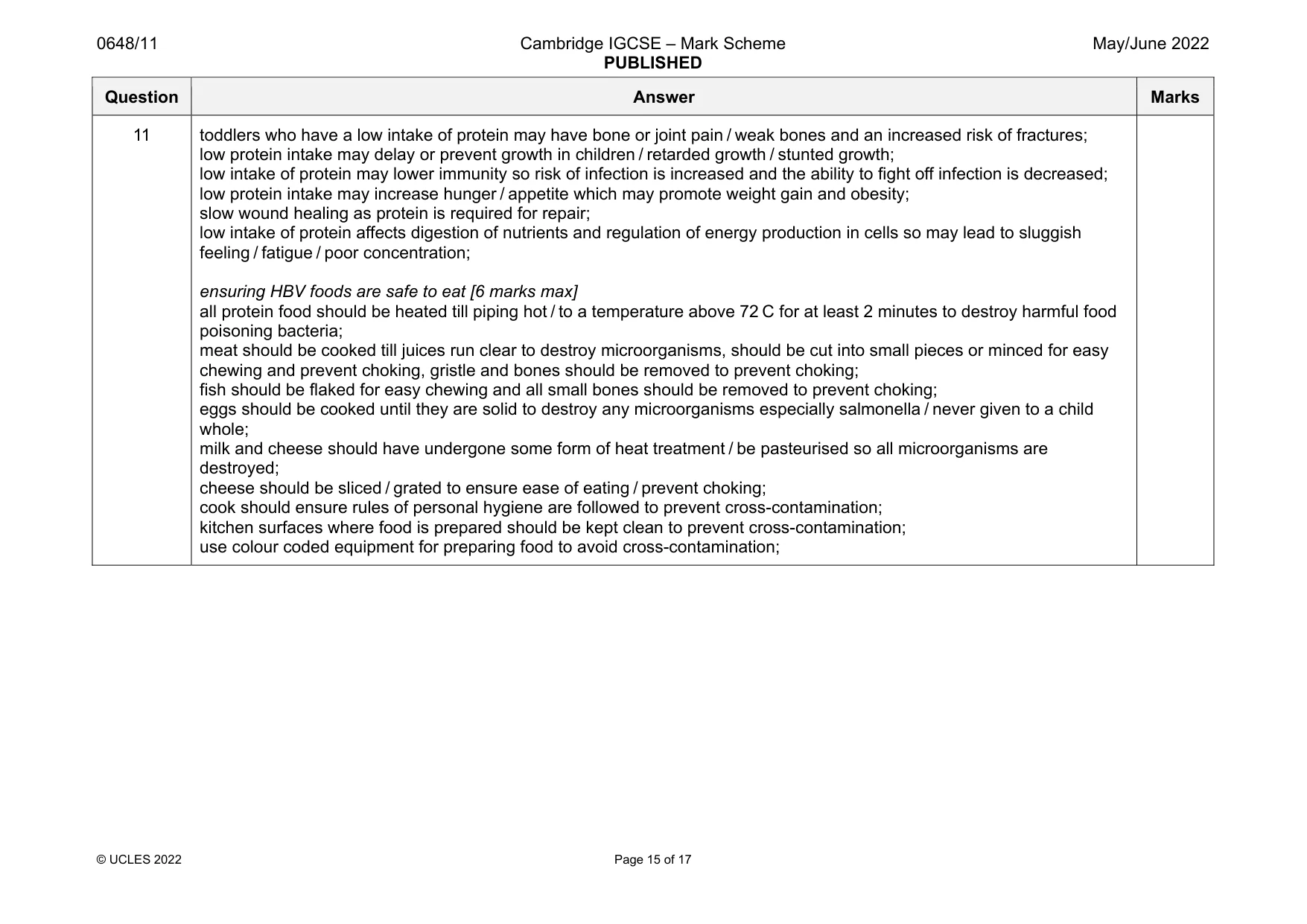
0648/11 Cambridge IGCSE – Mark Scheme PUBLISHED May/June 2022 © UCLES 2022 Page 15 of 17 Question Answer Marks 11 toddlers who have a low intake of protein may have bone or joint pain / weak bones and an increased risk of fractures; low protein intake may delay or prevent growth in children / retarded growth / stunted growth; low intake of protein may lower immunity so risk of infection is increased and the ability to fight off infection is decreased; low protein intake may increase hunger / appetite which may promote weight gain and obesity; slow wound healing as protein is required for repair; low intake of protein affects digestion of nutrients and regulation of energy production in cells so may lead to sluggish feeling / fatigue / poor concentration; ensuring HBV foods are safe to eat [6 marks max] all protein food should be heated till piping hot / to a temperature above 72 C for at least 2 minutes to destroy harmful food poisoning bacteria; meat should be cooked till juices run clear to destroy microorganisms, should be cut into small pieces or minced for easy chewing and prevent choking, gristle and bones should be removed to prevent choking; fish should be flaked for easy chewing and all small bones should be removed to prevent choking; eggs should be cooked until they are solid to destroy any microorganisms especially salmonella / never given to a child whole; milk and cheese should have undergone some form of heat treatment / be pasteurised so all microorganisms are destroyed; cheese should be sliced / grated to ensure ease of eating / prevent choking; cook should ensure rules of personal hygiene are followed to prevent cross-contamination; kitchen surfaces where food is prepared should be kept clean to prevent cross-contamination; use colour coded equipment for preparing food to avoid cross-contamination;
Mark scheme, page 16
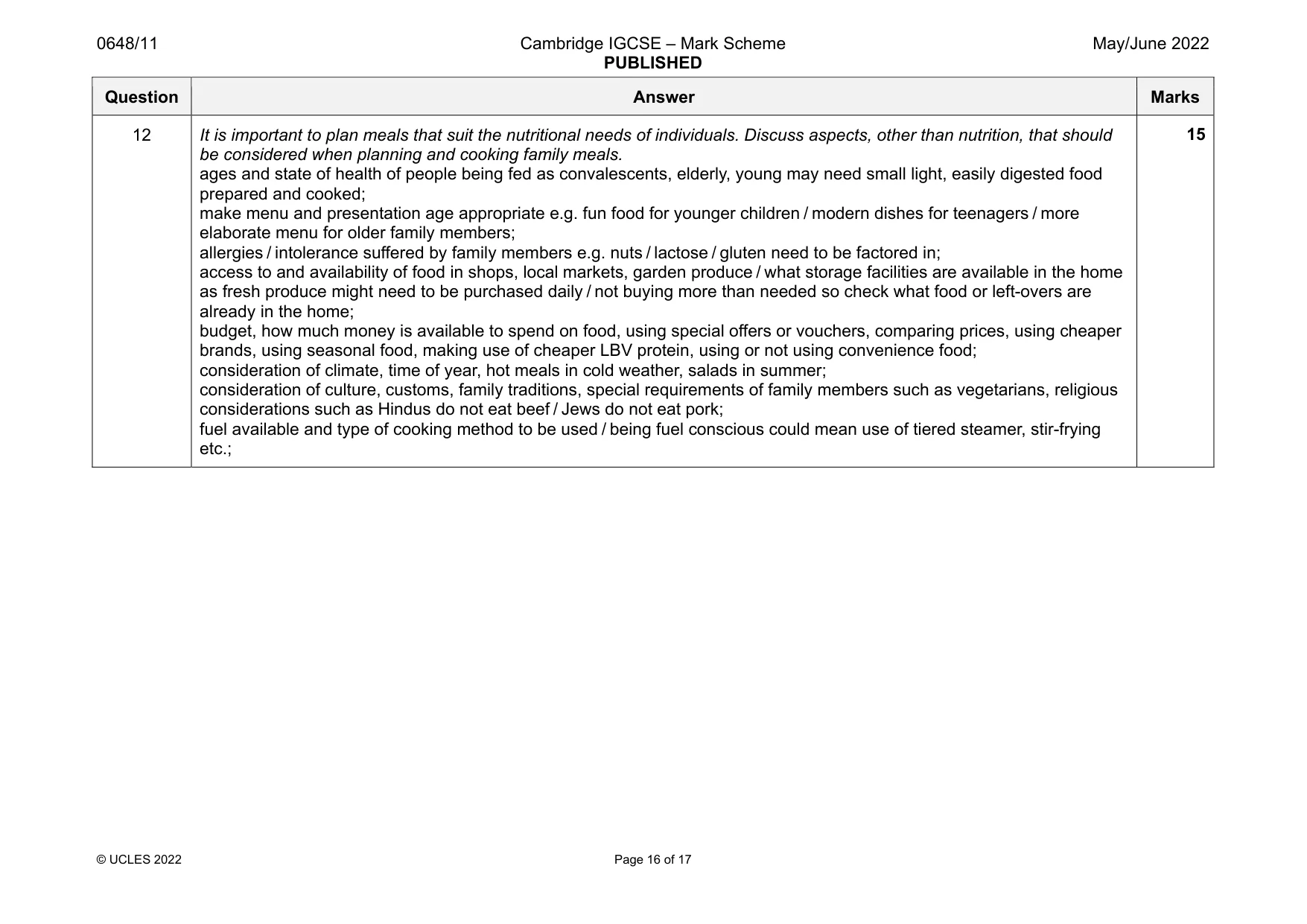
0648/11 Cambridge IGCSE – Mark Scheme PUBLISHED May/June 2022 © UCLES 2022 Page 16 of 17 Question Answer Marks 12 It is important to plan meals that suit the nutritional needs of individuals. Discuss aspects, other than nutrition, that should be considered when planning and cooking family meals. ages and state of health of people being fed as convalescents, elderly, young may need small light, easily digested food prepared and cooked; make menu and presentation age appropriate e.g. fun food for younger children / modern dishes for teenagers / more elaborate menu for older family members; allergies / intolerance suffered by family members e.g. nuts / lactose / gluten need to be factored in; access to and availability of food in shops, local markets, garden produce / what storage facilities are available in the home as fresh produce might need to be purchased daily / not buying more than needed so check what food or left-overs are already in the home; budget, how much money is available to spend on food, using special offers or vouchers, comparing prices, using cheaper brands, using seasonal food, making use of cheaper LBV protein, using or not using convenience food; consideration of climate, time of year, hot meals in cold weather, salads in summer; consideration of culture, customs, family traditions, special requirements of family members such as vegetarians, religious considerations such as Hindus do not eat beef / Jews do not eat pork; fuel available and type of cooking method to be used / being fuel conscious could mean use of tiered steamer, stir-frying etc.; 15
Mark scheme, page 17
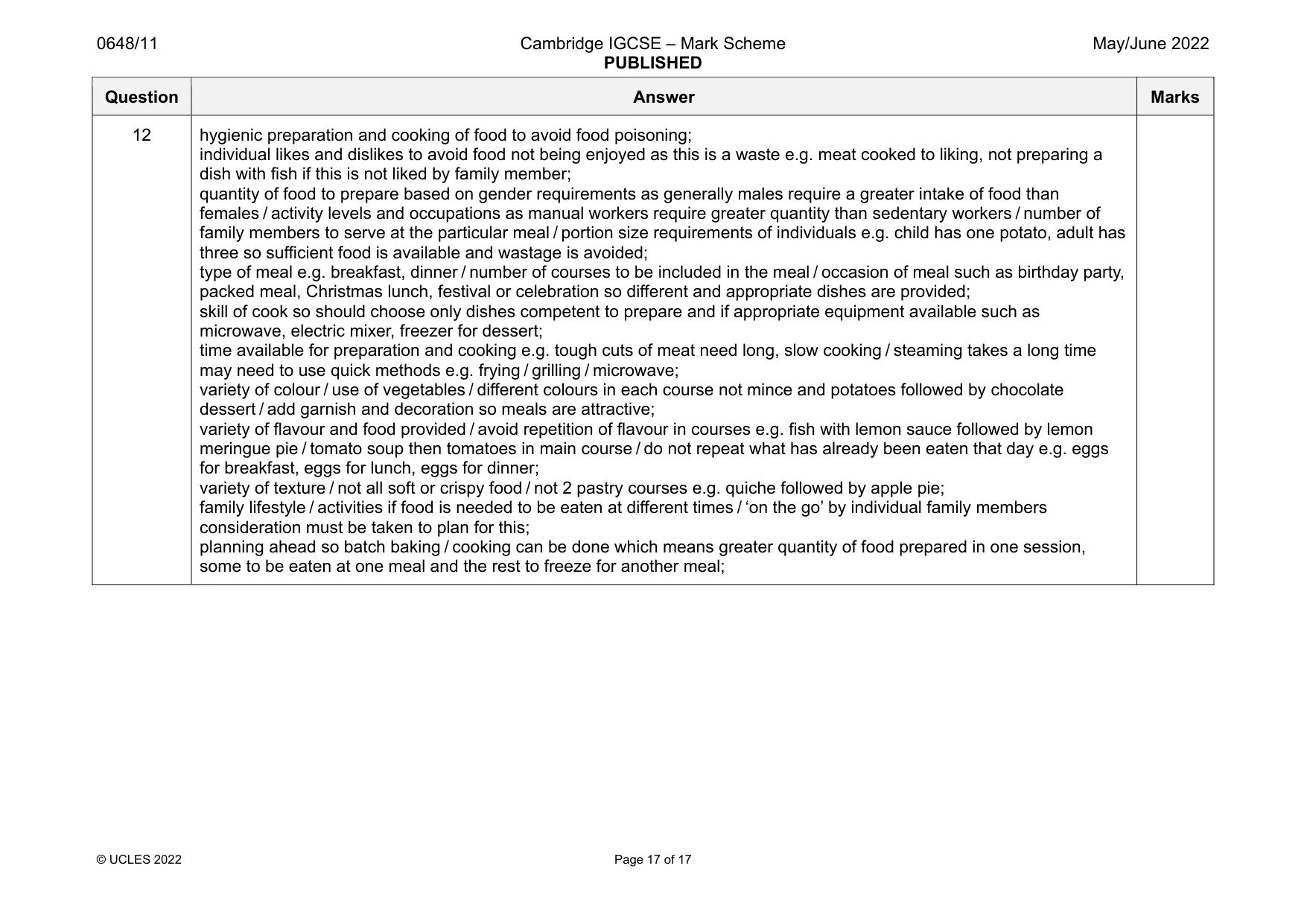
0648/11 Cambridge IGCSE – Mark Scheme PUBLISHED May/June 2022 © UCLES 2022 Page 17 of 17 Question Answer Marks 12 hygienic preparation and cooking of food to avoid food poisoning; individual likes and dislikes to avoid food not being enjoyed as this is a waste e.g. meat cooked to liking, not preparing a dish with fish if this is not liked by family member; quantity of food to prepare based on gender requirements as generally males require a greater intake of food than females / activity levels and occupations as manual workers require greater quantity than sedentary workers / number of family members to serve at the particular meal / portion size requirements of individuals e.g. child has one potato, adult has three so sufficient food is available and wastage is avoided; type of meal e.g. breakfast, dinner / number of courses to be included in the meal / occasion of meal such as birthday party, packed meal, Christmas lunch, festival or celebration so different and appropriate dishes are provided; skill of cook so should choose only dishes competent to prepare and if appropriate equipment available such as microwave, electric mixer, freezer for dessert; time available for preparation and cooking e.g. tough cuts of meat need long, slow cooking / steaming takes a long time may need to use quick methods e.g. frying / grilling / microwave; variety of colour / use of vegetables / different colours in each course not mince and potatoes followed by chocolate dessert / add garnish and decoration so meals are attractive; variety of flavour and food provided / avoid repetition of flavour in courses e.g. fish with lemon sauce followed by lemon meringue pie / tomato soup then tomatoes in main course / do not repeat what has already been eaten that day e.g. eggs for breakfast, eggs for lunch, eggs for dinner; variety of texture / not all soft or crispy food / not 2 pastry courses e.g. quiche followed by apple pie; family lifestyle / activities if food is needed to be eaten at different times / ‘on the go’ by individual family members consideration must be taken to plan for this; planning ahead so batch baking / cooking can be done which means greater quantity of food prepared in one session, some to be eaten at one meal and the rest to freeze for another meal;
What you needed in this session
Cambridge’s own grade thresholds for 2022 May/June, Paper 1 · Variant 1. A higher threshold means an easier paper — the bar moves with how the cohort did.