Cambridge IGCSE Food and Nutrition 0648 — 2021 May/June Paper 1 · Variant 2
0648/12/M/J/21 · 100 marks · ≈113 min
The question paper and its mark scheme, free to read here and free to download. This is Cambridge’s own paper, exactly as it was sat.
Question paper12 pages




Mark scheme15 pages
Answers below. Sit the paper first if you are practising.
Paper as text
Question paper, page 1
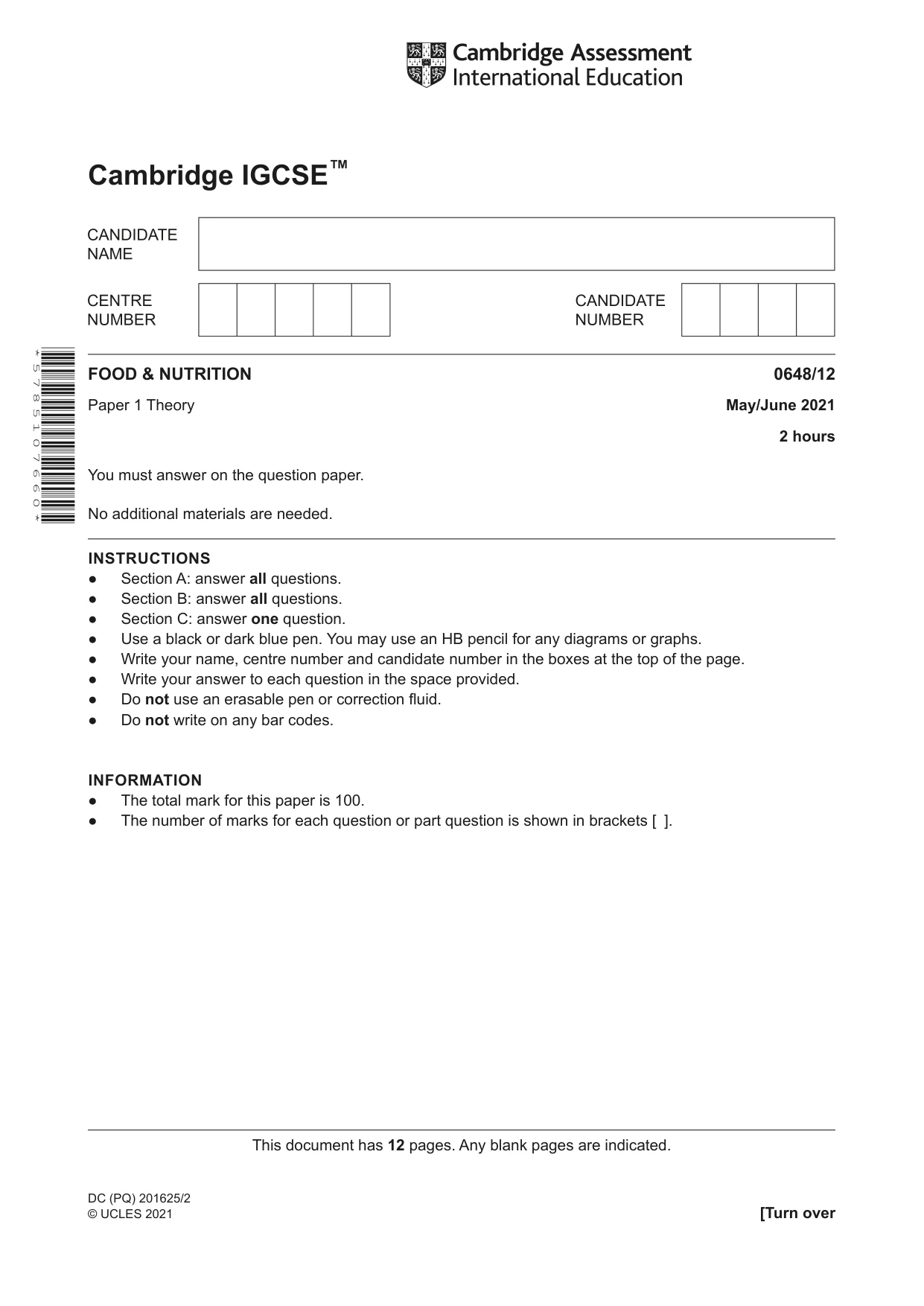
This document has 12 pages. Any blank pages are indicated. Cambridge IGCSE™ DC (PQ) 201625/2 © UCLES 2021 [Turn over * 5 7 8 5 1 0 7 6 6 0 * FOOD & NUTRITION 0648/12 Paper 1 Theory May/June 2021 2 hours You must answer on the question paper. No additional materials are needed. INSTRUCTIONS ● Section A: answer all questions. ● Section B: answer all questions. ● Section C: answer one question. ● Use a black or dark blue pen. You may use an HB pencil for any diagrams or graphs. ● Write your name, centre number and candidate number in the boxes at the top of the page. ● Write your answer to each question in the space provided. ● Do not use an erasable pen or correction fluid. ● Do not write on any bar codes. INFORMATION ● The total mark for this paper is 100. ● The number of marks for each question or part question is shown in brackets [ ].
Question paper, page 2
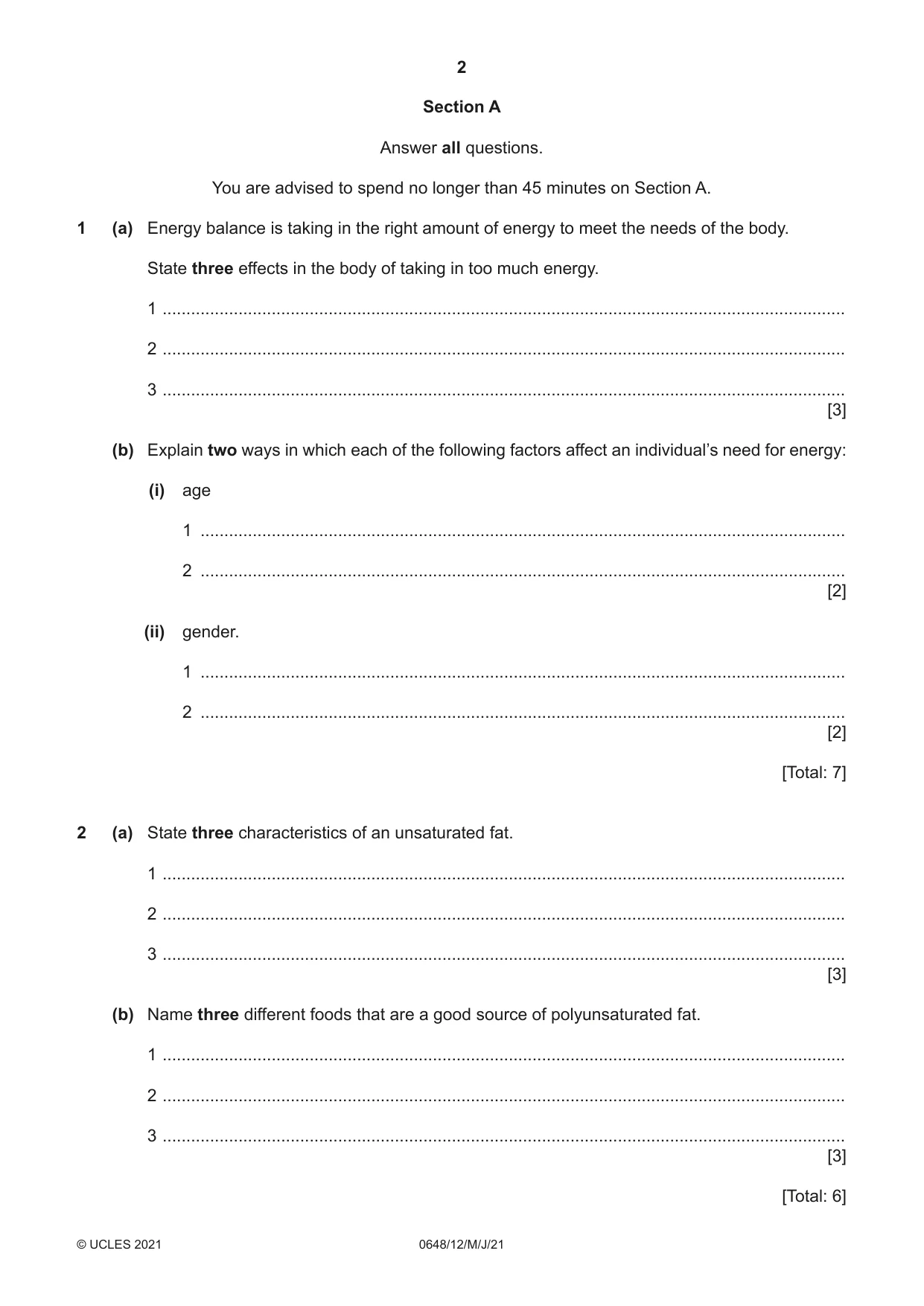
2 0648/12/M/J/21 © UCLES 2021 Section A Answer all questions. You are advised to spend no longer than 45 minutes on Section A. 1 (a) Energy balance is taking in the right amount of energy to meet the needs of the body. State three effects in the body of taking in too much energy. 1 … 2 … 3 … [3] (b) Explain two ways in which each of the following factors affect an individual’s need for energy: (i) age 1 … 2 … [2] (ii) gender. 1 … 2 … [2] [Total: 7] 2 (a) State three characteristics of an unsaturated fat. 1 … 2 … 3 … [3] (b) Name three different foods that are a good source of polyunsaturated fat. 1 … 2 … 3 … [3] [Total: 6]
Question paper, page 3
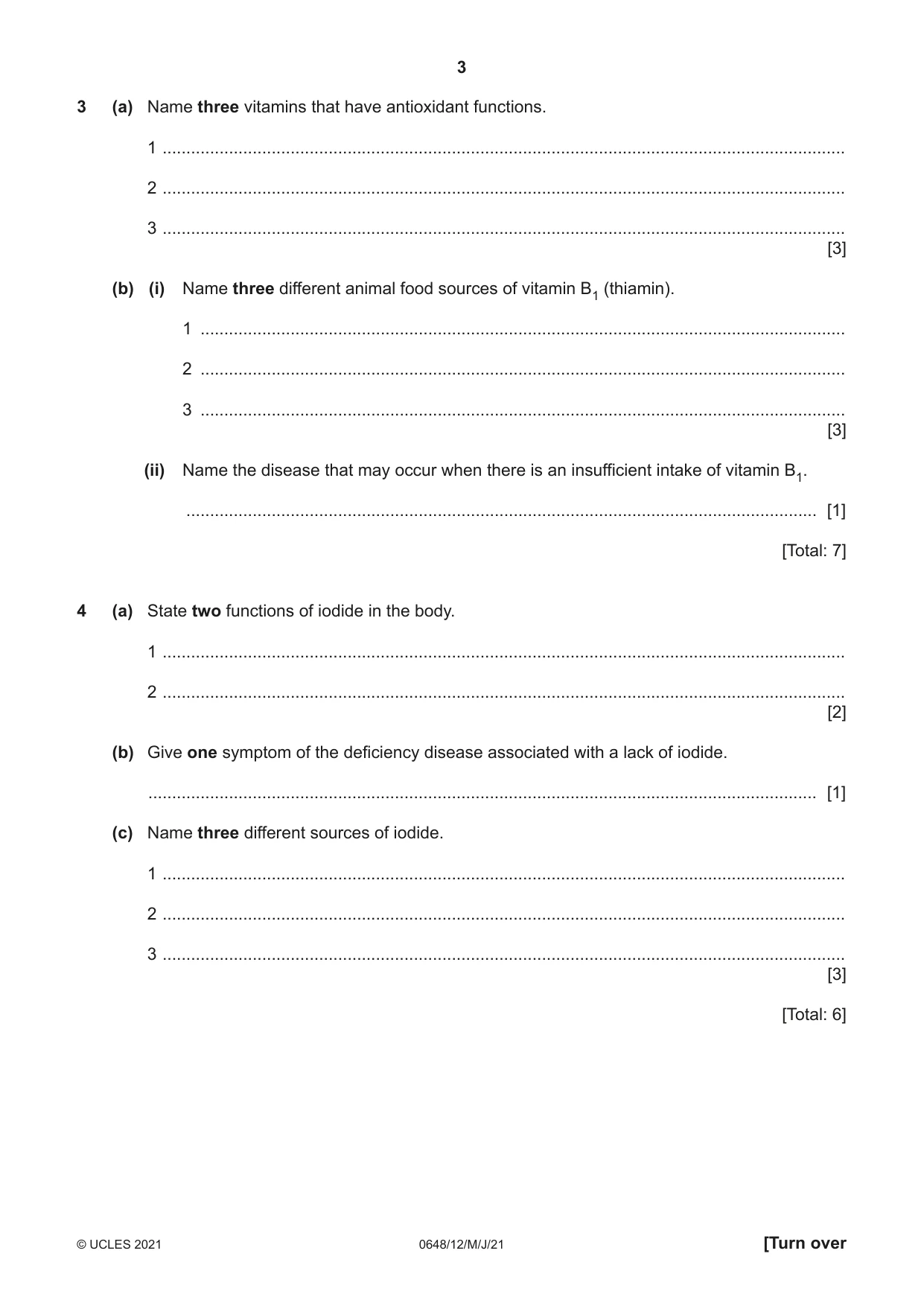
3 0648/12/M/J/21 © UCLES 2021 [Turn over 3 (a) Name three vitamins that have antioxidant functions. 1 … 2 … 3 … [3] (b) (i) Name three different animal food sources of vitamin B1 (thiamin). 1 … 2 … 3 … [3] (ii) Name the disease that may occur when there is an insufficient intake of vitamin B1. … [1] [Total: 7] 4 (a) State two functions of iodide in the body. 1 … 2 … [2] (b) Give one symptom of the deficiency disease associated with a lack of iodide. … [1] (c) Name three different sources of iodide. 1 … 2 … 3 … [3] [Total: 6]
Question paper, page 4
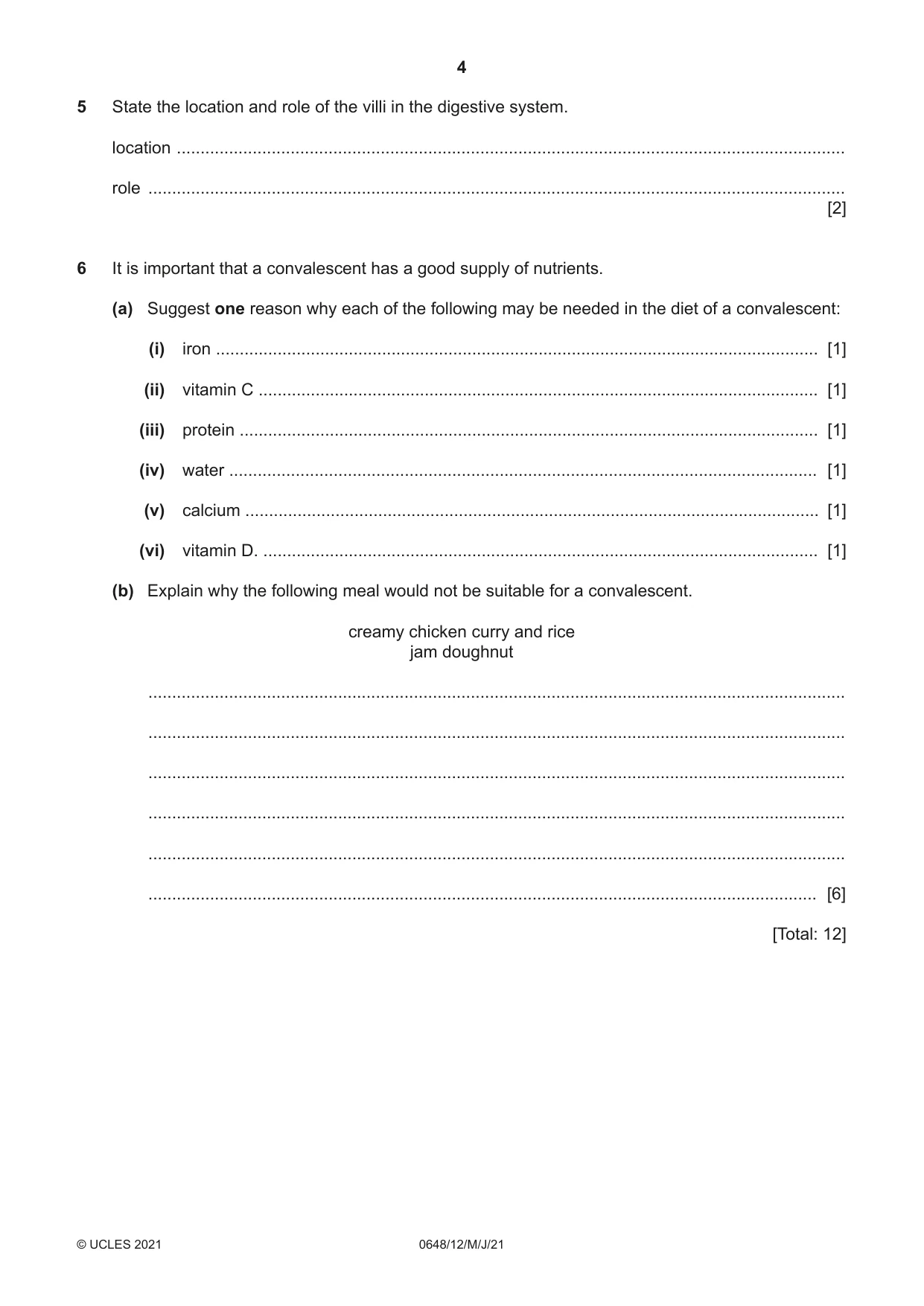
4 0648/12/M/J/21 © UCLES 2021 5 State the location and role of the villi in the digestive system. location … role … [2] 6 It is important that a convalescent has a good supply of nutrients. (a) Suggest one reason why each of the following may be needed in the diet of a convalescent: (i) iron … [1] (ii) vitamin C … [1] (iii) protein … [1] (iv) water … [1] (v) calcium … [1] (vi) vitamin D. … [1] (b) Explain why the following meal would not be suitable for a convalescent. creamy chicken curry and rice jam doughnut … … … … … … [6] [Total: 12]
Question paper, page 5
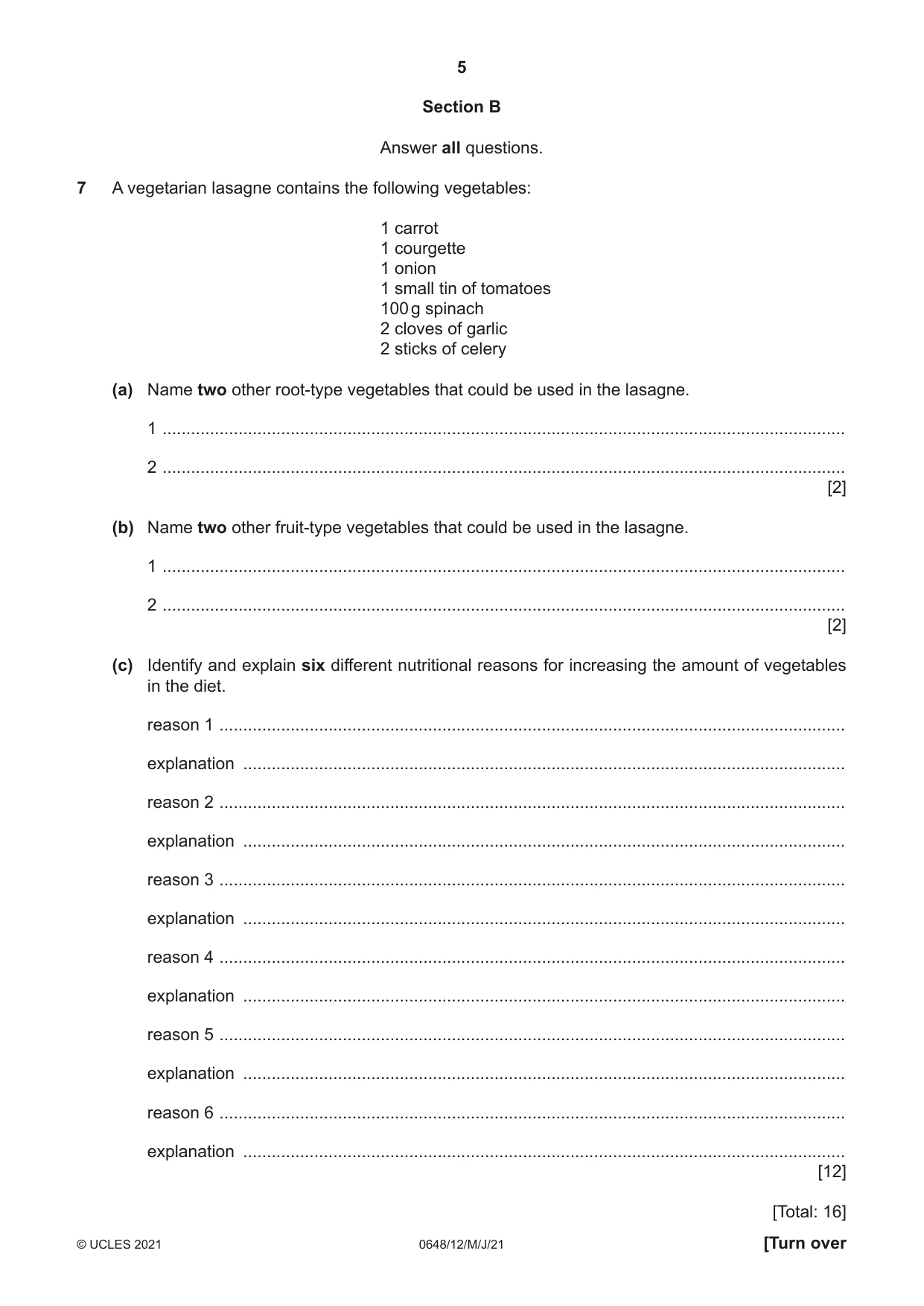
5 0648/12/M/J/21 © UCLES 2021 [Turn over Section B Answer all questions. 7 A vegetarian lasagne contains the following vegetables: 1 carrot 1 courgette 1 onion 1 small tin of tomatoes 100 g spinach 2 cloves of garlic 2 sticks of celery (a) Name two other root-type vegetables that could be used in the lasagne. 1 … 2 … [2] (b) Name two other fruit-type vegetables that could be used in the lasagne. 1 … 2 … [2] (c) Identify and explain six different nutritional reasons for increasing the amount of vegetables in the diet. reason 1 … explanation … reason 2 … explanation … reason 3 … explanation … reason 4 … explanation … reason 5 … explanation … reason 6 … explanation … [12] [Total: 16]
Question paper, page 6
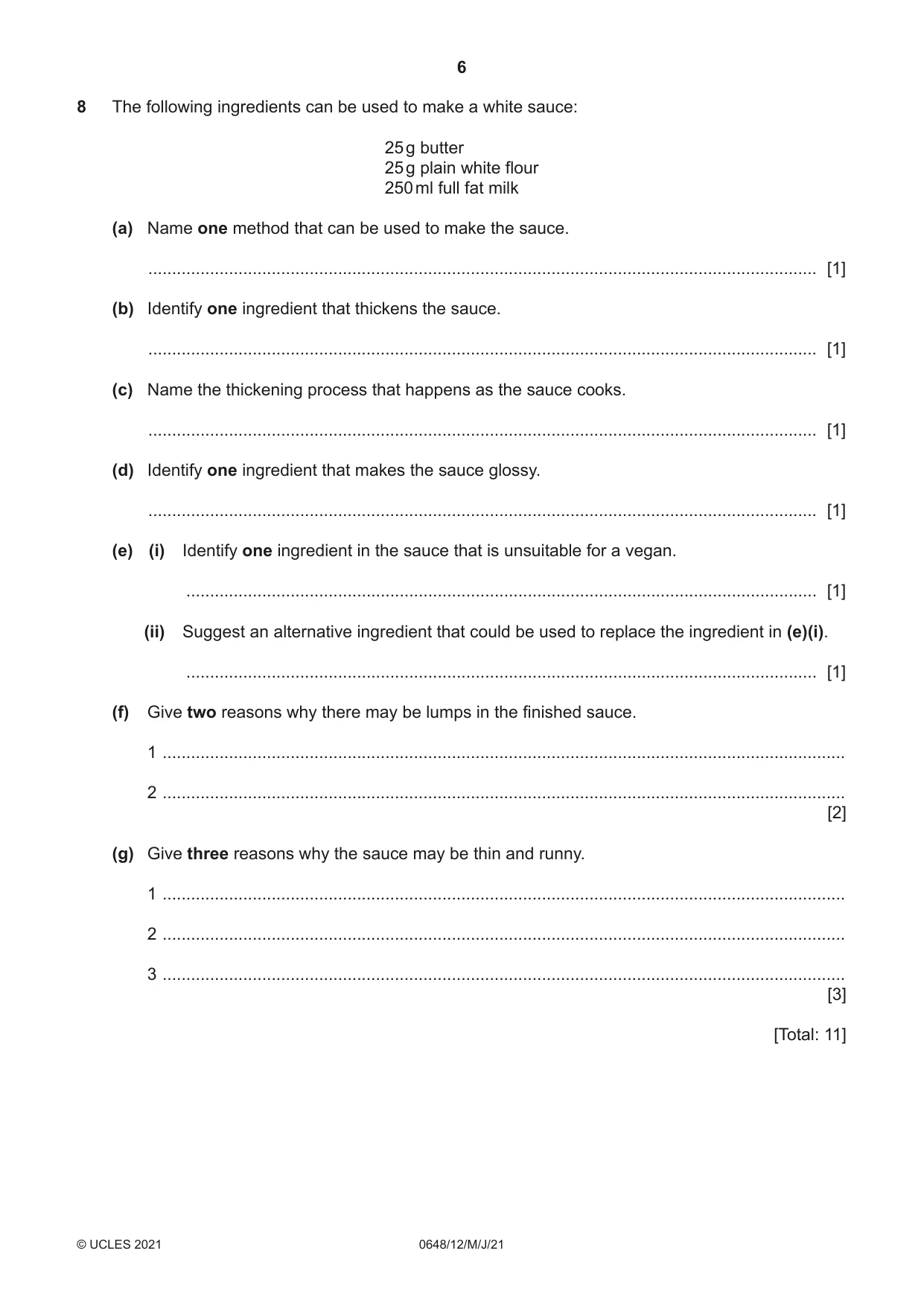
6 0648/12/M/J/21 © UCLES 2021 8 The following ingredients can be used to make a white sauce: 25 g butter 25 g plain white flour 250 ml full fat milk (a) Name one method that can be used to make the sauce. … [1] (b) Identify one ingredient that thickens the sauce. … [1] (c) Name the thickening process that happens as the sauce cooks. … [1] (d) Identify one ingredient that makes the sauce glossy. … [1] (e) (i) Identify one ingredient in the sauce that is unsuitable for a vegan. … [1] (ii) Suggest an alternative ingredient that could be used to replace the ingredient in (e)(i). … [1] (f) Give two reasons why there may be lumps in the finished sauce. 1 … 2 … [2] (g) Give three reasons why the sauce may be thin and runny. 1 … 2 … 3 … [3] [Total: 11]
Question paper, page 7
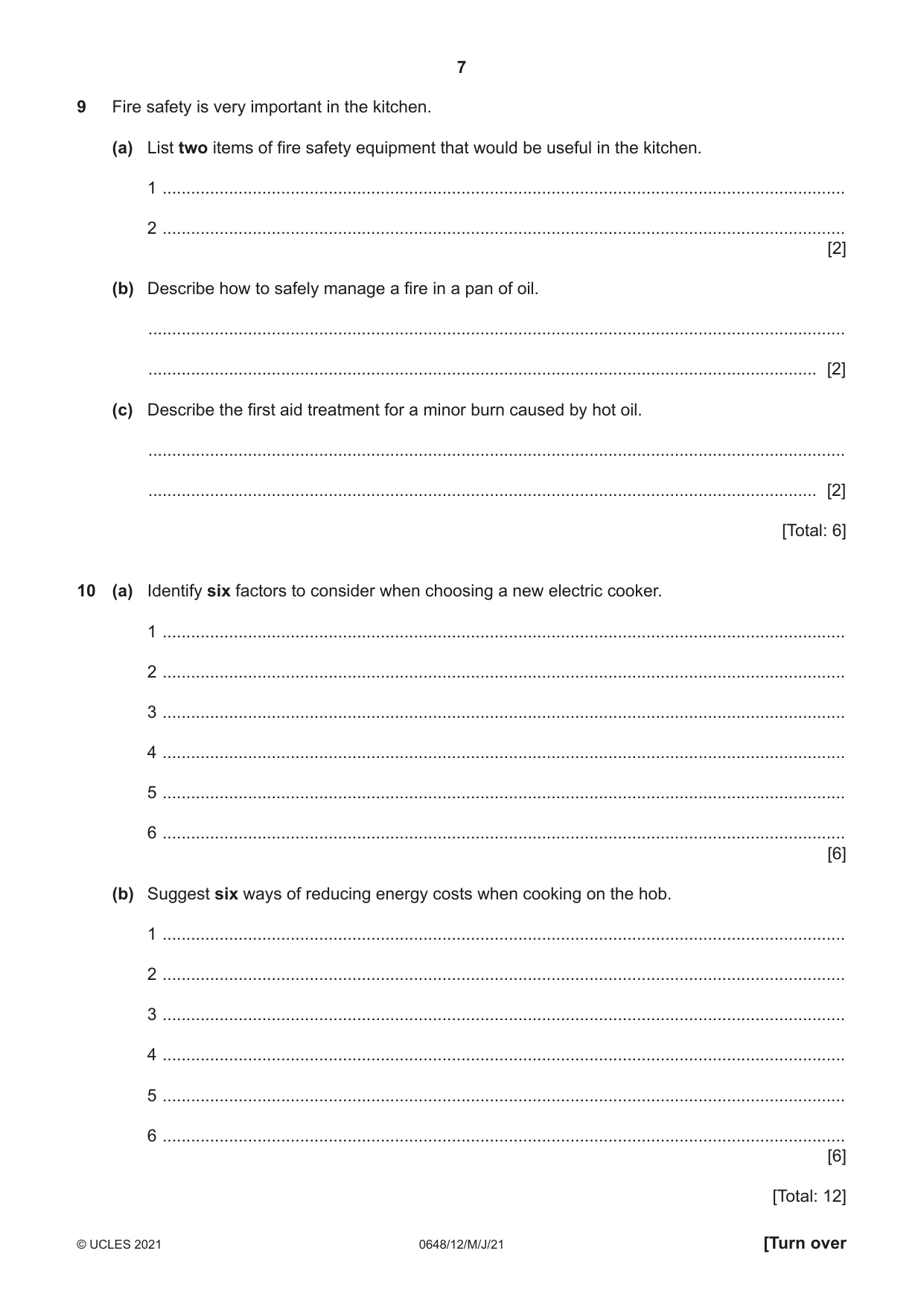
7 0648/12/M/J/21 © UCLES 2021 [Turn over 9 Fire safety is very important in the kitchen. (a) List two items of fire safety equipment that would be useful in the kitchen. 1 … 2 … [2] (b) Describe how to safely manage a fire in a pan of oil. … … [2] (c) Describe the first aid treatment for a minor burn caused by hot oil. … … [2] [Total: 6] 10 (a) Identify six factors to consider when choosing a new electric cooker. 1 … 2 … 3 … 4 … 5 … 6 … [6] (b) Suggest six ways of reducing energy costs when cooking on the hob. 1 … 2 … 3 … 4 … 5 … 6 … [6] [Total: 12]
Question paper, page 8
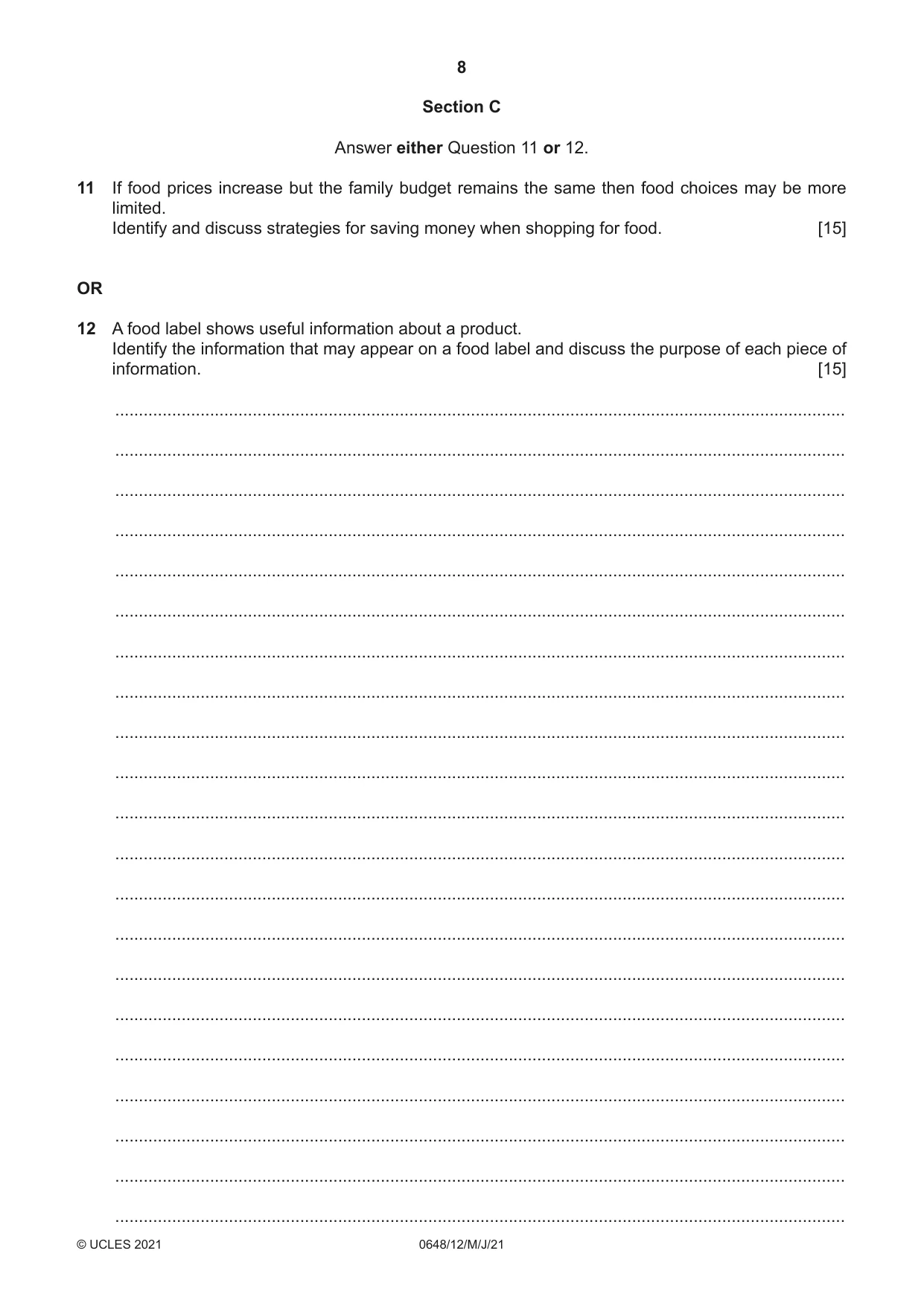
8 0648/12/M/J/21 © UCLES 2021 Section C Answer either Question 11 or 12. 11 If food prices increase but the family budget remains the same then food choices may be more limited. Identify and discuss strategies for saving money when shopping for food. [15] OR 12 A food label shows useful information about a product. Identify the information that may appear on a food label and discuss the purpose of each piece of information. [15] … … … … … … … … … … … … … … … … … … … … …
Question paper, page 9
9 0648/12/M/J/21 © UCLES 2021 [Turn over … … … … … … … … … … … … … … … … … … … … … … … … … … … …
Question paper, page 10
10 0648/12/M/J/21 © UCLES 2021 … … … … … … … … … … … … … … … … … … … … … … … … … … … [Total: 15]
Question paper, page 11
11 0648/12/M/J/21 © UCLES 2021 BLANK PAGE
Question paper, page 12
12 0648/12/M/J/21 © UCLES 2021 Permission to reproduce items where third-party owned material protected by copyright is included has been sought and cleared where possible. Every reasonable effort has been made by the publisher (UCLES) to trace copyright holders, but if any items requiring clearance have unwittingly been included, the publisher will be pleased to make amends at the earliest possible opportunity. To avoid the issue of disclosure of answer-related information to candidates, all copyright acknowledgements are reproduced online in the Cambridge Assessment International Education Copyright Acknowledgements Booklet. This is produced for each series of examinations and is freely available to download at www.cambridgeinternational.org after the live examination series. Cambridge Assessment International Education is part of the Cambridge Assessment Group. Cambridge Assessment is the brand name of the University of Cambridge Local Examinations Syndicate (UCLES), which itself is a department of the University of Cambridge. BLANK PAGE
Mark scheme, page 1
This document consists of 15 printed pages. © UCLES 2021 [Turn over Cambridge IGCSE™ FOOD AND NUTRITION 0648/12 Paper 1 Theory May/June 2021 MARK SCHEME Maximum Mark: 100 Published This mark scheme is published as an aid to teachers and candidates, to indicate the requirements of the examination. It shows the basis on which Examiners were instructed to award marks. It does not indicate the details of the discussions that took place at an Examiners’ meeting before marking began, which would have considered the acceptability of alternative answers. Mark schemes should be read in conjunction with the question paper and the Principal Examiner Report for Teachers. Cambridge International will not enter into discussions about these mark schemes. Cambridge International is publishing the mark schemes for the May/June 2021 series for most Cambridge IGCSE™, Cambridge International A and AS Level components and some Cambridge O Level components.
Mark scheme, page 2
0648/12 Cambridge IGCSE – Mark Scheme PUBLISHED May/June 2021 © UCLES 2021 Page 2 of 15 Generic Marking Principles These general marking principles must be applied by all examiners when marking candidate answers. They should be applied alongside the specific content of the mark scheme or generic level descriptors for a question. Each question paper and mark scheme will also comply with these marking principles. GENERIC MARKING PRINCIPLE 1: Marks must be awarded in line with: • the specific content of the mark scheme or the generic level descriptors for the question • the specific skills defined in the mark scheme or in the generic level descriptors for the question • the standard of response required by a candidate as exemplified by the standardisation scripts. GENERIC MARKING PRINCIPLE 2: Marks awarded are always whole marks (not half marks, or other fractions). GENERIC MARKING PRINCIPLE 3: Marks must be awarded positively: • marks are awarded for correct/valid answers, as defined in the mark scheme. However, credit is given for valid answers which go beyond the scope of the syllabus and mark scheme, referring to your Team Leader as appropriate • marks are awarded when candidates clearly demonstrate what they know and can do • marks are not deducted for errors • marks are not deducted for omissions • answers should only be judged on the quality of spelling, punctuation and grammar when these features are specifically assessed by the question as indicated by the mark scheme. The meaning, however, should be unambiguous. GENERIC MARKING PRINCIPLE 4: Rules must be applied consistently, e.g. in situations where candidates have not followed instructions or in the application of generic level descriptors.
Mark scheme, page 3
0648/12 Cambridge IGCSE – Mark Scheme PUBLISHED May/June 2021 © UCLES 2021 Page 3 of 15 GENERIC MARKING PRINCIPLE 5: Marks should be awarded using the full range of marks defined in the mark scheme for the question (however; the use of the full mark range may be limited according to the quality of the candidate responses seen). GENERIC MARKING PRINCIPLE 6: Marks awarded are based solely on the requirements as defined in the mark scheme. Marks should not be awarded with grade thresholds or grade descriptors in mind. Science-Specific Marking Principles 1 Examiners should consider the context and scientific use of any keywords when awarding marks. Although keywords may be present, marks should not be awarded if the keywords are used incorrectly. 2 The examiner should not choose between contradictory statements given in the same question part, and credit should not be awarded for any correct statement that is contradicted within the same question part. Wrong science that is irrelevant to the question should be ignored. 3 Although spellings do not have to be correct, spellings of syllabus terms must allow for clear and unambiguous separation from other syllabus terms with which they may be confused (e.g. ethane / ethene, glucagon / glycogen, refraction / reflection). 4 The error carried forward (ecf) principle should be applied, where appropriate. If an incorrect answer is subsequently used in a scientifically correct way, the candidate should be awarded these subsequent marking points. Further guidance will be included in the mark scheme where necessary and any exceptions to this general principle will be noted. 5 ‘List rule’ guidance For questions that require n responses (e.g. State two reasons …): • The response should be read as continuous prose, even when numbered answer spaces are provided. • Any response marked ignore in the mark scheme should not count towards n. • Incorrect responses should not be awarded credit but will still count towards n. • Read the entire response to check for any responses that contradict those that would otherwise be credited. Credit should not be awarded for any responses that are contradicted within the rest of the response. Where two responses contradict one another, this should be treated as a single incorrect response. • Non-contradictory responses after the first n responses may be ignored even if they include incorrect science.
Mark scheme, page 4
0648/12 Cambridge IGCSE – Mark Scheme PUBLISHED May/June 2021 © UCLES 2021 Page 4 of 15 6 Calculation specific guidance Correct answers to calculations should be given full credit even if there is no working or incorrect working, unless the question states ‘show your working’. For questions in which the number of significant figures required is not stated, credit should be awarded for correct answers when rounded by the examiner to the number of significant figures given in the mark scheme. This may not apply to measured values. For answers given in standard form (e.g. a × 10n) in which the convention of restricting the value of the coefficient (a) to a value between 1 and 10 is not followed, credit may still be awarded if the answer can be converted to the answer given in the mark scheme. Unless a separate mark is given for a unit, a missing or incorrect unit will normally mean that the final calculation mark is not awarded. Exceptions to this general principle will be noted in the mark scheme. 7 Guidance for chemical equations Multiples / fractions of coefficients used in chemical equations are acceptable unless stated otherwise in the mark scheme. State symbols given in an equation should be ignored unless asked for in the question or stated otherwise in the mark scheme.
Mark scheme, page 5
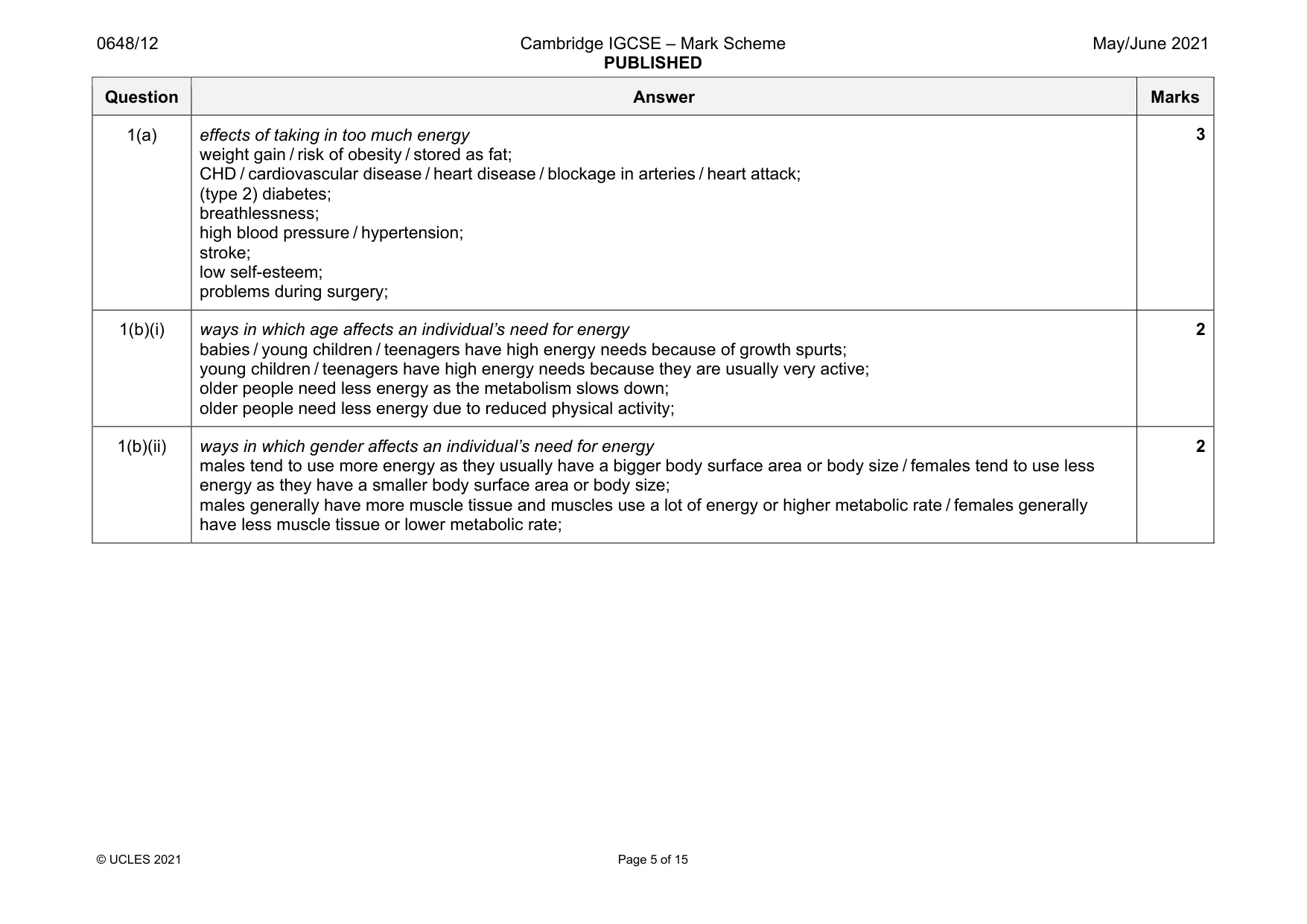
0648/12 Cambridge IGCSE – Mark Scheme PUBLISHED May/June 2021 © UCLES 2021 Page 5 of 15 Question Answer Marks 1(a) effects of taking in too much energy weight gain / risk of obesity / stored as fat; CHD / cardiovascular disease / heart disease / blockage in arteries / heart attack; (type 2) diabetes; breathlessness; high blood pressure / hypertension; stroke; low self-esteem; problems during surgery; 3 1(b)(i) ways in which age affects an individual’s need for energy babies / young children / teenagers have high energy needs because of growth spurts; young children / teenagers have high energy needs because they are usually very active; older people need less energy as the metabolism slows down; older people need less energy due to reduced physical activity; 2 1(b)(ii) ways in which gender affects an individual’s need for energy males tend to use more energy as they usually have a bigger body surface area or body size / females tend to use less energy as they have a smaller body surface area or body size; males generally have more muscle tissue and muscles use a lot of energy or higher metabolic rate / females generally have less muscle tissue or lower metabolic rate; 2
Mark scheme, page 6
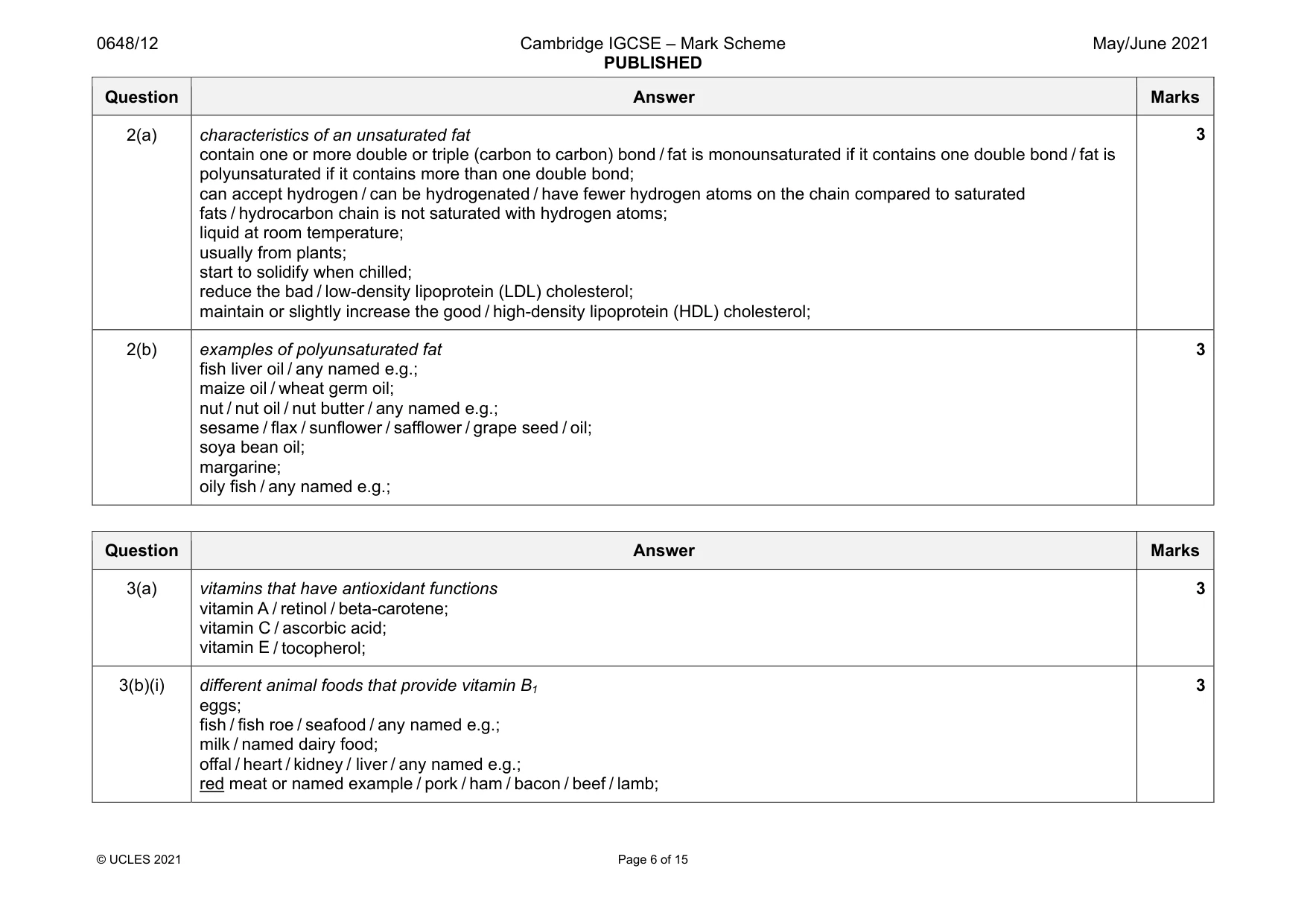
0648/12 Cambridge IGCSE – Mark Scheme PUBLISHED May/June 2021 © UCLES 2021 Page 6 of 15 Question Answer Marks 2(a) characteristics of an unsaturated fat contain one or more double or triple (carbon to carbon) bond / fat is monounsaturated if it contains one double bond / fat is polyunsaturated if it contains more than one double bond; can accept hydrogen / can be hydrogenated / have fewer hydrogen atoms on the chain compared to saturated fats / hydrocarbon chain is not saturated with hydrogen atoms; liquid at room temperature; usually from plants; start to solidify when chilled; reduce the bad / low-density lipoprotein (LDL) cholesterol; maintain or slightly increase the good / high-density lipoprotein (HDL) cholesterol; 3 2(b) examples of polyunsaturated fat fish liver oil / any named e.g.; maize oil / wheat germ oil; nut / nut oil / nut butter / any named e.g.; sesame / flax / sunflower / safflower / grape seed / oil; soya bean oil; margarine; oily fish / any named e.g.; 3 Question Answer Marks 3(a) vitamins that have antioxidant functions vitamin A / retinol / beta-carotene; vitamin C / ascorbic acid; vitamin E / tocopherol; 3 3(b)(i) different animal foods that provide vitamin B1 eggs; fish / fish roe / seafood / any named e.g.; milk / named dairy food; offal / heart / kidney / liver / any named e.g.; red meat or named example / pork / ham / bacon / beef / lamb; 3
Mark scheme, page 7
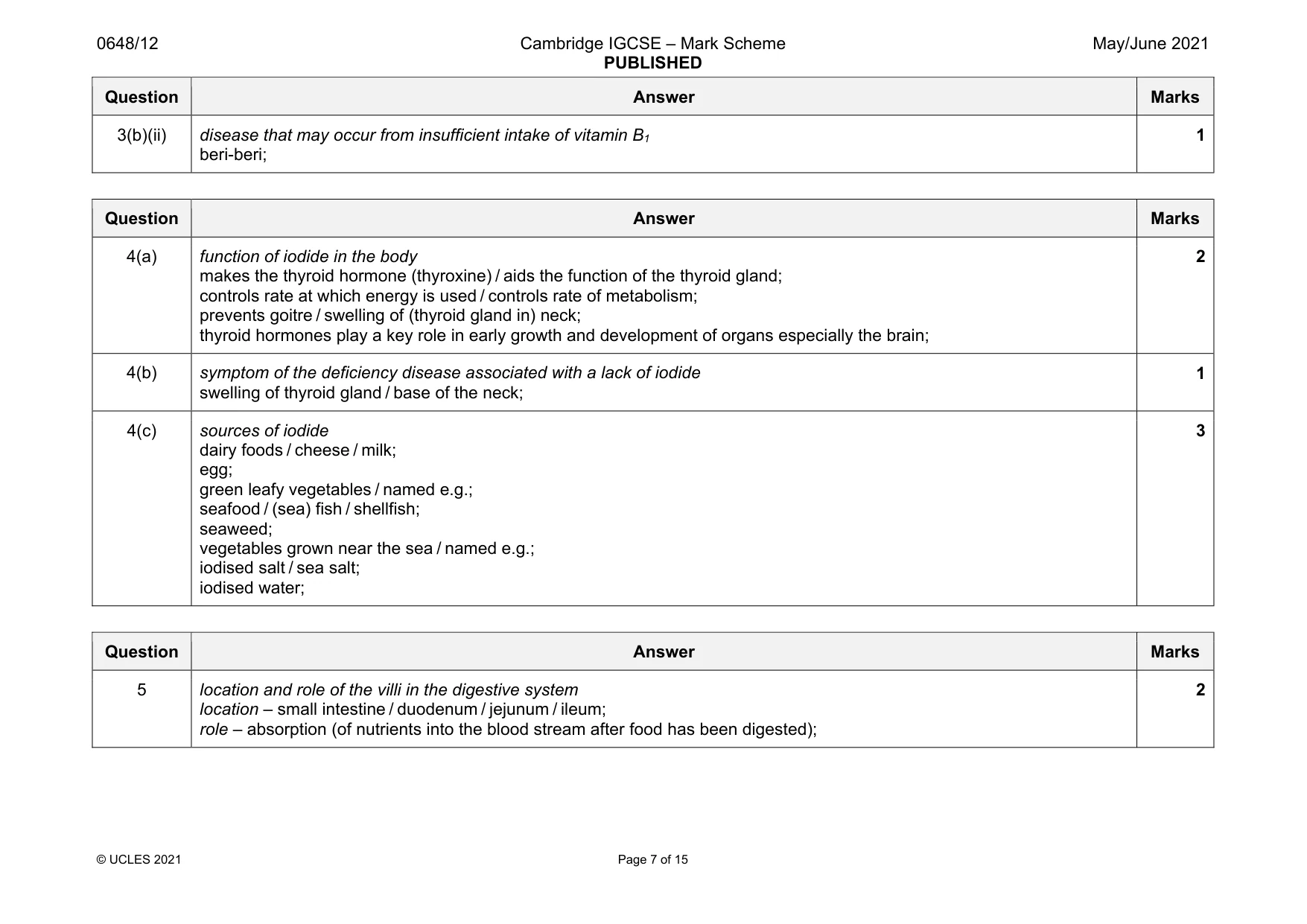
0648/12 Cambridge IGCSE – Mark Scheme PUBLISHED May/June 2021 © UCLES 2021 Page 7 of 15 Question Answer Marks 3(b)(ii) disease that may occur from insufficient intake of vitamin B1 beri-beri; 1 Question Answer Marks 4(a) function of iodide in the body makes the thyroid hormone (thyroxine) / aids the function of the thyroid gland; controls rate at which energy is used / controls rate of metabolism; prevents goitre / swelling of (thyroid gland in) neck; thyroid hormones play a key role in early growth and development of organs especially the brain; 2 4(b) symptom of the deficiency disease associated with a lack of iodide swelling of thyroid gland / base of the neck; 1 4(c) sources of iodide dairy foods / cheese / milk; egg; green leafy vegetables / named e.g.; seafood / (sea) fish / shellfish; seaweed; vegetables grown near the sea / named e.g.; iodised salt / sea salt; iodised water; 3 Question Answer Marks 5 location and role of the villi in the digestive system location – small intestine / duodenum / jejunum / ileum; role – absorption (of nutrients into the blood stream after food has been digested); 2
Mark scheme, page 8
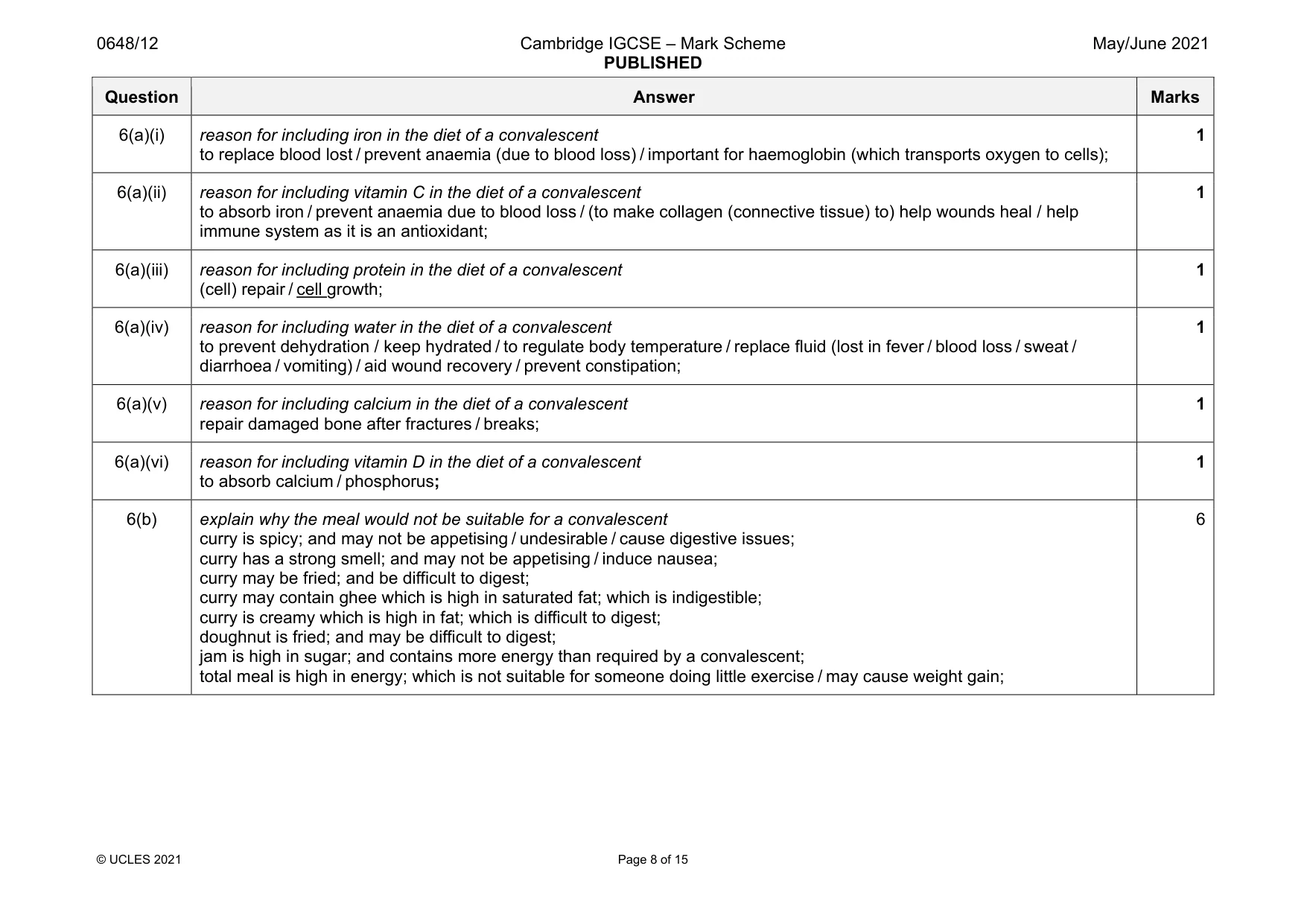
0648/12 Cambridge IGCSE – Mark Scheme PUBLISHED May/June 2021 © UCLES 2021 Page 8 of 15 Question Answer Marks 6(a)(i) reason for including iron in the diet of a convalescent to replace blood lost / prevent anaemia (due to blood loss) / important for haemoglobin (which transports oxygen to cells); 1 6(a)(ii) reason for including vitamin C in the diet of a convalescent to absorb iron / prevent anaemia due to blood loss / (to make collagen (connective tissue) to) help wounds heal / help immune system as it is an antioxidant; 1 6(a)(iii) reason for including protein in the diet of a convalescent (cell) repair / cell growth; 1 6(a)(iv) reason for including water in the diet of a convalescent to prevent dehydration / keep hydrated / to regulate body temperature / replace fluid (lost in fever / blood loss / sweat / diarrhoea / vomiting) / aid wound recovery / prevent constipation; 1 6(a)(v) reason for including calcium in the diet of a convalescent repair damaged bone after fractures / breaks; 1 6(a)(vi) reason for including vitamin D in the diet of a convalescent to absorb calcium / phosphorus; 1 6(b) explain why the meal would not be suitable for a convalescent curry is spicy; and may not be appetising / undesirable / cause digestive issues; curry has a strong smell; and may not be appetising / induce nausea; curry may be fried; and be difficult to digest; curry may contain ghee which is high in saturated fat; which is indigestible; curry is creamy which is high in fat; which is difficult to digest; doughnut is fried; and may be difficult to digest; jam is high in sugar; and contains more energy than required by a convalescent; total meal is high in energy; which is not suitable for someone doing little exercise / may cause weight gain; 6
Mark scheme, page 9
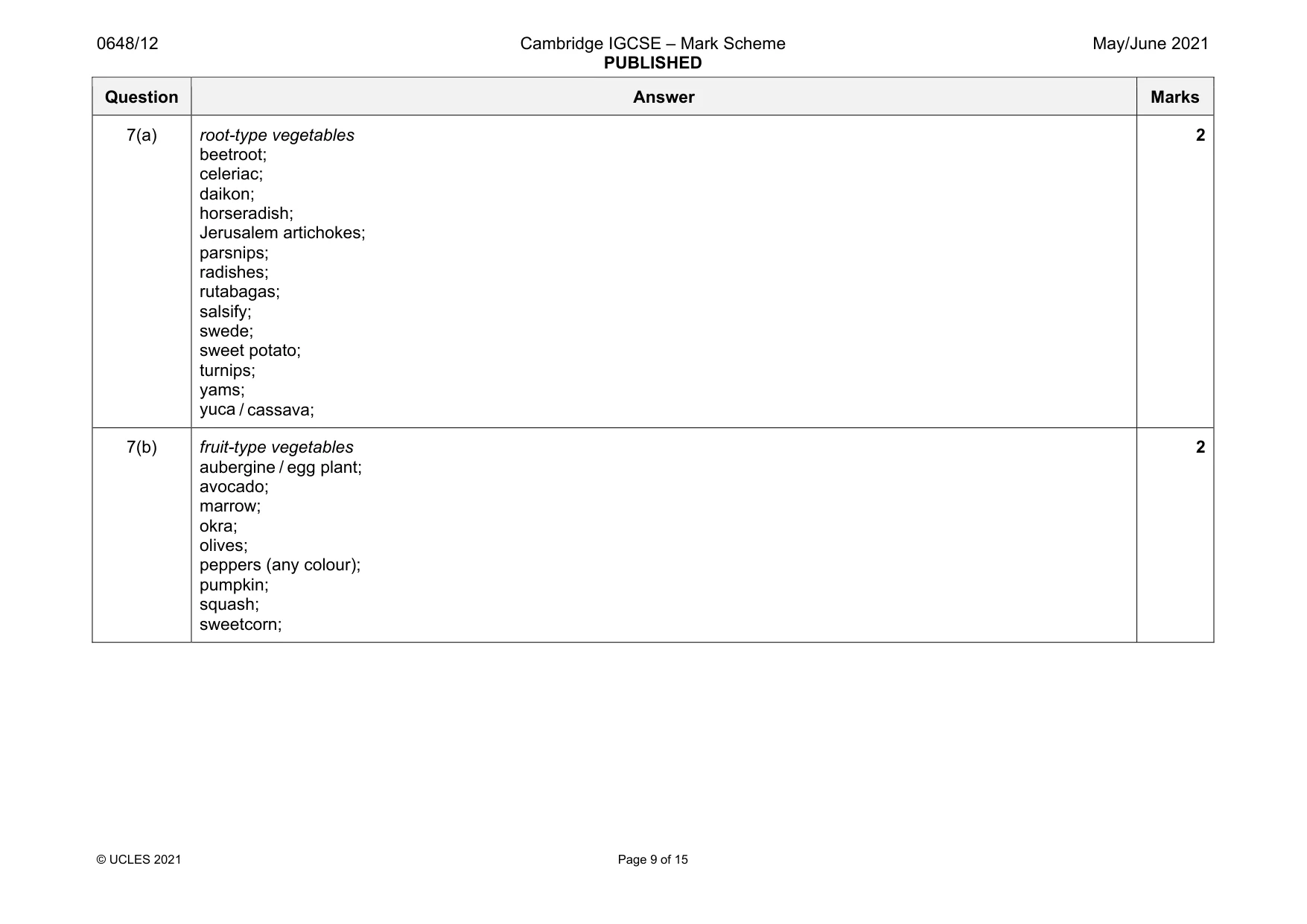
0648/12 Cambridge IGCSE – Mark Scheme PUBLISHED May/June 2021 © UCLES 2021 Page 9 of 15 Question Answer Marks 7(a) root-type vegetables beetroot; celeriac; daikon; horseradish; Jerusalem artichokes; parsnips; radishes; rutabagas; salsify; swede; sweet potato; turnips; yams; yuca / cassava; 2 7(b) fruit-type vegetables aubergine / egg plant; avocado; marrow; okra; olives; peppers (any colour); pumpkin; squash; sweetcorn; 2
Mark scheme, page 10
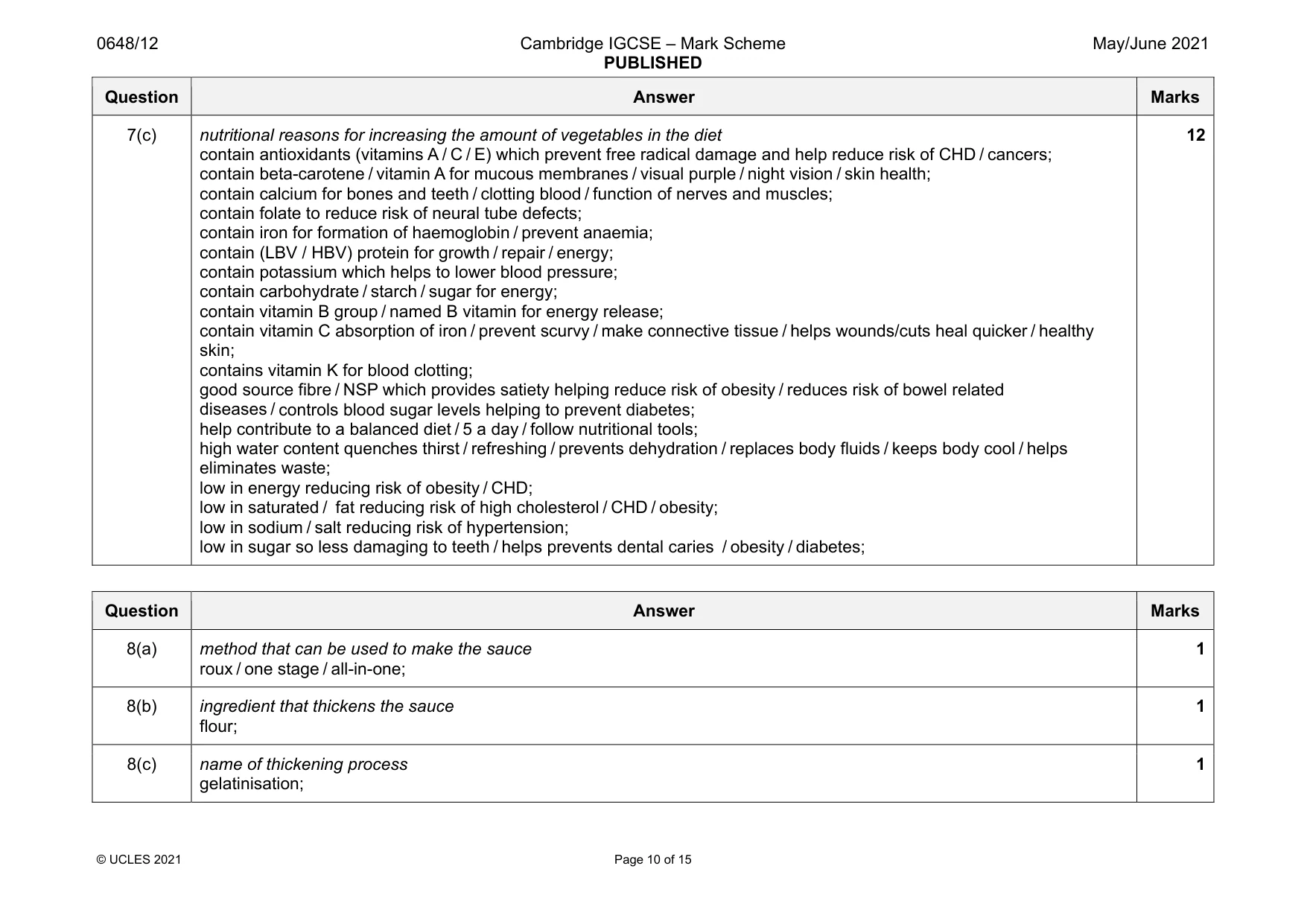
0648/12 Cambridge IGCSE – Mark Scheme PUBLISHED May/June 2021 © UCLES 2021 Page 10 of 15 Question Answer Marks 7(c) nutritional reasons for increasing the amount of vegetables in the diet contain antioxidants (vitamins A / C / E) which prevent free radical damage and help reduce risk of CHD / cancers; contain beta-carotene / vitamin A for mucous membranes / visual purple / night vision / skin health; contain calcium for bones and teeth / clotting blood / function of nerves and muscles; contain folate to reduce risk of neural tube defects; contain iron for formation of haemoglobin / prevent anaemia; contain (LBV / HBV) protein for growth / repair / energy; contain potassium which helps to lower blood pressure; contain carbohydrate / starch / sugar for energy; contain vitamin B group / named B vitamin for energy release; contain vitamin C absorption of iron / prevent scurvy / make connective tissue / helps wounds/cuts heal quicker / healthy skin; contains vitamin K for blood clotting; good source fibre / NSP which provides satiety helping reduce risk of obesity / reduces risk of bowel related diseases / controls blood sugar levels helping to prevent diabetes; help contribute to a balanced diet / 5 a day / follow nutritional tools; high water content quenches thirst / refreshing / prevents dehydration / replaces body fluids / keeps body cool / helps eliminates waste; low in energy reducing risk of obesity / CHD; low in saturated / fat reducing risk of high cholesterol / CHD / obesity; low in sodium / salt reducing risk of hypertension; low in sugar so less damaging to teeth / helps prevents dental caries / obesity / diabetes; 12 Question Answer Marks 8(a) method that can be used to make the sauce roux / one stage / all-in-one; 1 8(b) ingredient that thickens the sauce flour; 1 8(c) name of thickening process gelatinisation; 1
Mark scheme, page 11
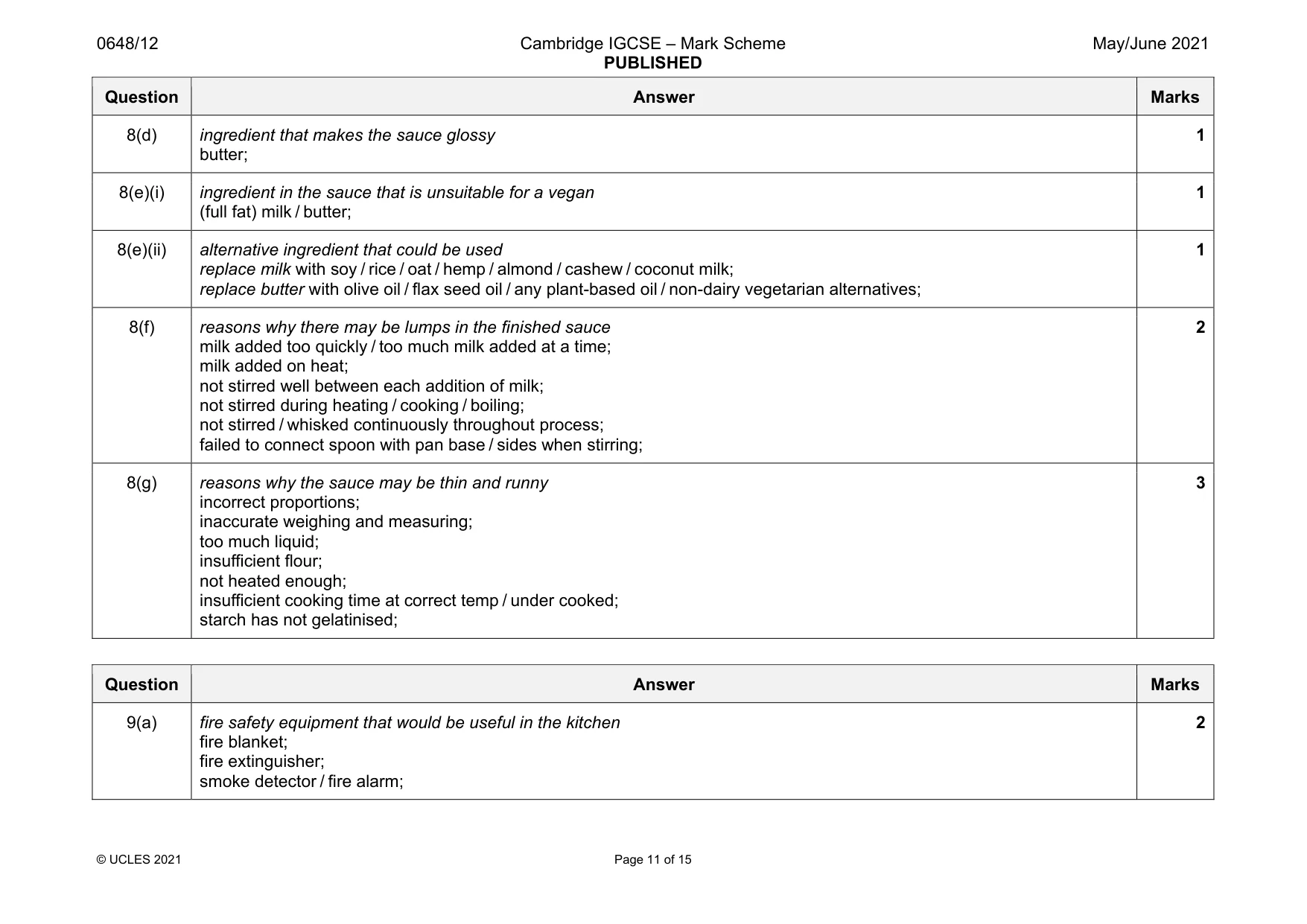
0648/12 Cambridge IGCSE – Mark Scheme PUBLISHED May/June 2021 © UCLES 2021 Page 11 of 15 Question Answer Marks 8(d) ingredient that makes the sauce glossy butter; 1 8(e)(i) ingredient in the sauce that is unsuitable for a vegan (full fat) milk / butter; 1 8(e)(ii) alternative ingredient that could be used replace milk with soy / rice / oat / hemp / almond / cashew / coconut milk; replace butter with olive oil / flax seed oil / any plant-based oil / non-dairy vegetarian alternatives; 1 8(f) reasons why there may be lumps in the finished sauce milk added too quickly / too much milk added at a time; milk added on heat; not stirred well between each addition of milk; not stirred during heating / cooking / boiling; not stirred / whisked continuously throughout process; failed to connect spoon with pan base / sides when stirring; 2 8(g) reasons why the sauce may be thin and runny incorrect proportions; inaccurate weighing and measuring; too much liquid; insufficient flour; not heated enough; insufficient cooking time at correct temp / under cooked; starch has not gelatinised; 3 Question Answer Marks 9(a) fire safety equipment that would be useful in the kitchen fire blanket; fire extinguisher; smoke detector / fire alarm; 2
Mark scheme, page 12
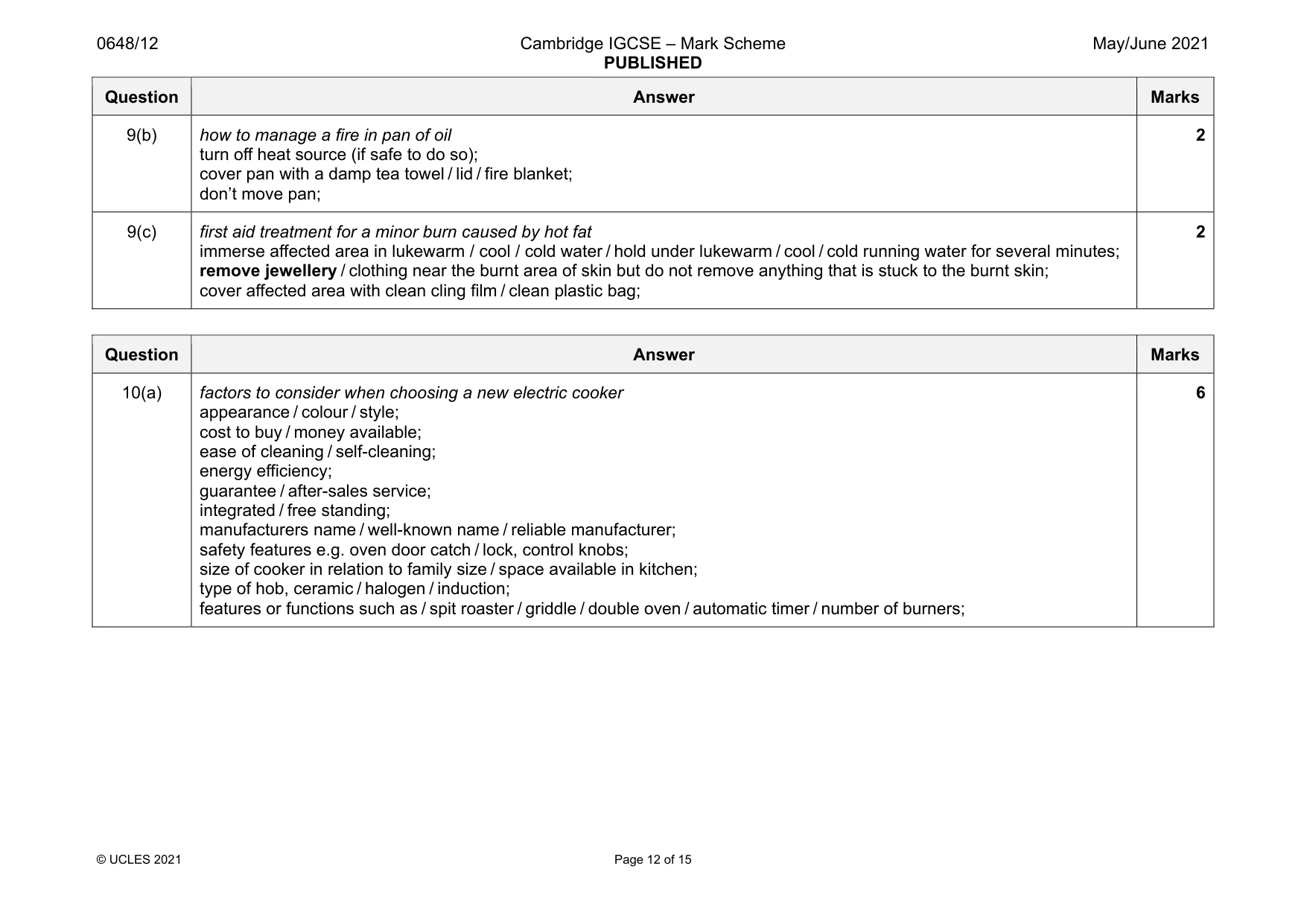
0648/12 Cambridge IGCSE – Mark Scheme PUBLISHED May/June 2021 © UCLES 2021 Page 12 of 15 Question Answer Marks 9(b) how to manage a fire in pan of oil turn off heat source (if safe to do so); cover pan with a damp tea towel / lid / fire blanket; don’t move pan; 2 9(c) first aid treatment for a minor burn caused by hot fat immerse affected area in lukewarm / cool / cold water / hold under lukewarm / cool / cold running water for several minutes; remove jewellery / clothing near the burnt area of skin but do not remove anything that is stuck to the burnt skin; cover affected area with clean cling film / clean plastic bag; 2 Question Answer Marks 10(a) factors to consider when choosing a new electric cooker appearance / colour / style; cost to buy / money available; ease of cleaning / self-cleaning; energy efficiency; guarantee / after-sales service; integrated / free standing; manufacturers name / well-known name / reliable manufacturer; safety features e.g. oven door catch / lock, control knobs; size of cooker in relation to family size / space available in kitchen; type of hob, ceramic / halogen / induction; features or functions such as / spit roaster / griddle / double oven / automatic timer / number of burners; 6
Mark scheme, page 13
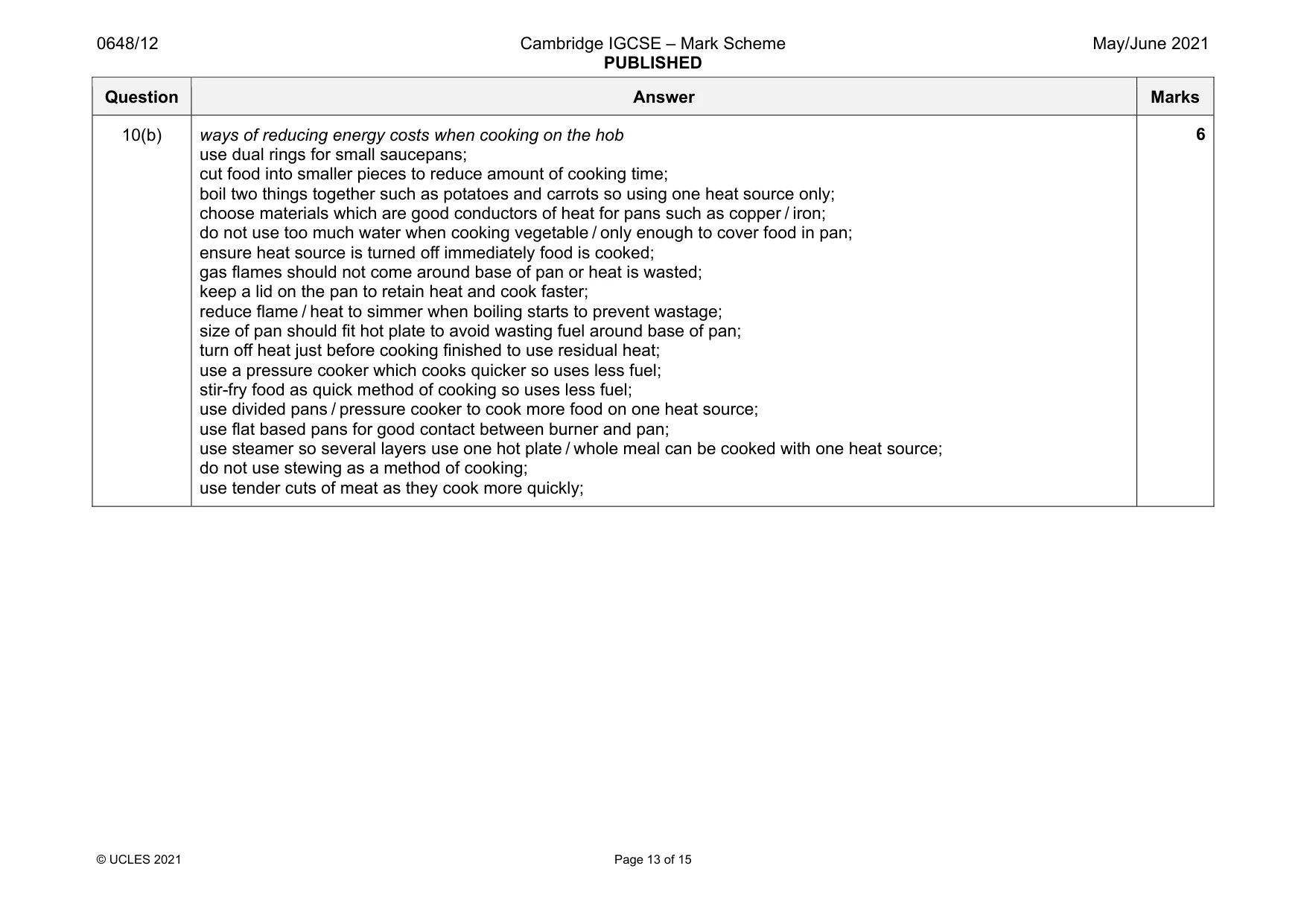
0648/12 Cambridge IGCSE – Mark Scheme PUBLISHED May/June 2021 © UCLES 2021 Page 13 of 15 Question Answer Marks 10(b) ways of reducing energy costs when cooking on the hob use dual rings for small saucepans; cut food into smaller pieces to reduce amount of cooking time; boil two things together such as potatoes and carrots so using one heat source only; choose materials which are good conductors of heat for pans such as copper / iron; do not use too much water when cooking vegetable / only enough to cover food in pan; ensure heat source is turned off immediately food is cooked; gas flames should not come around base of pan or heat is wasted; keep a lid on the pan to retain heat and cook faster; reduce flame / heat to simmer when boiling starts to prevent wastage; size of pan should fit hot plate to avoid wasting fuel around base of pan; turn off heat just before cooking finished to use residual heat; use a pressure cooker which cooks quicker so uses less fuel; stir-fry food as quick method of cooking so uses less fuel; use divided pans / pressure cooker to cook more food on one heat source; use flat based pans for good contact between burner and pan; use steamer so several layers use one hot plate / whole meal can be cooked with one heat source; do not use stewing as a method of cooking; use tender cuts of meat as they cook more quickly; 6
Mark scheme, page 14
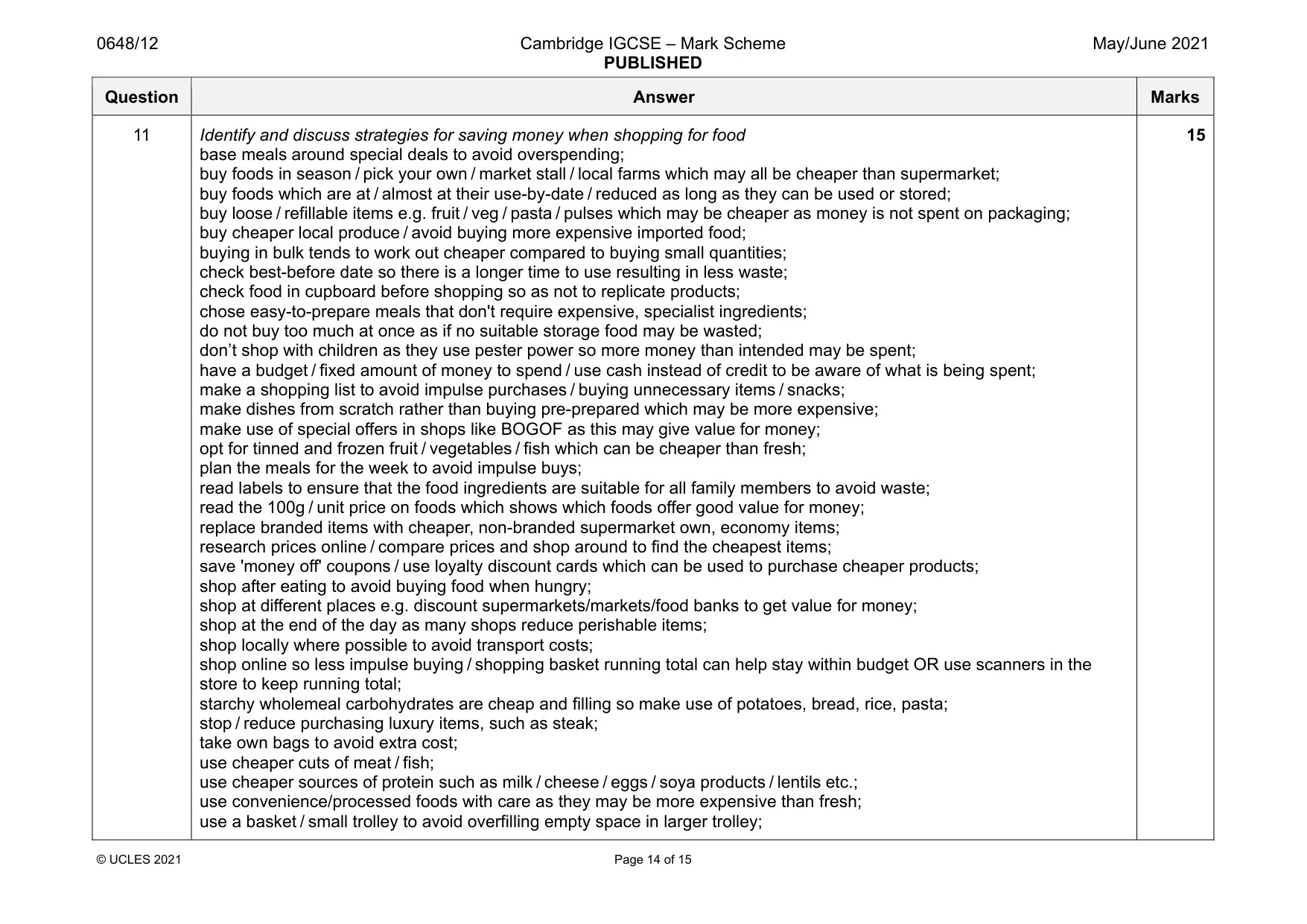
0648/12 Cambridge IGCSE – Mark Scheme PUBLISHED May/June 2021 © UCLES 2021 Page 14 of 15 Question Answer Marks 11 Identify and discuss strategies for saving money when shopping for food base meals around special deals to avoid overspending; buy foods in season / pick your own / market stall / local farms which may all be cheaper than supermarket; buy foods which are at / almost at their use-by-date / reduced as long as they can be used or stored; buy loose / refillable items e.g. fruit / veg / pasta / pulses which may be cheaper as money is not spent on packaging; buy cheaper local produce / avoid buying more expensive imported food; buying in bulk tends to work out cheaper compared to buying small quantities; check best-before date so there is a longer time to use resulting in less waste; check food in cupboard before shopping so as not to replicate products; chose easy-to-prepare meals that don't require expensive, specialist ingredients; do not buy too much at once as if no suitable storage food may be wasted; don’t shop with children as they use pester power so more money than intended may be spent; have a budget / fixed amount of money to spend / use cash instead of credit to be aware of what is being spent; make a shopping list to avoid impulse purchases / buying unnecessary items / snacks; make dishes from scratch rather than buying pre-prepared which may be more expensive; make use of special offers in shops like BOGOF as this may give value for money; opt for tinned and frozen fruit / vegetables / fish which can be cheaper than fresh; plan the meals for the week to avoid impulse buys; read labels to ensure that the food ingredients are suitable for all family members to avoid waste; read the 100g / unit price on foods which shows which foods offer good value for money; replace branded items with cheaper, non-branded supermarket own, economy items; research prices online / compare prices and shop around to find the cheapest items; save 'money off' coupons / use loyalty discount cards which can be used to purchase cheaper products; shop after eating to avoid buying food when hungry; shop at different places e.g. discount supermarkets/markets/food banks to get value for money; shop at the end of the day as many shops reduce perishable items; shop locally where possible to avoid transport costs; shop online so less impulse buying / shopping basket running total can help stay within budget OR use scanners in the store to keep running total; starchy wholemeal carbohydrates are cheap and filling so make use of potatoes, bread, rice, pasta; stop / reduce purchasing luxury items, such as steak; take own bags to avoid extra cost; use cheaper cuts of meat / fish; use cheaper sources of protein such as milk / cheese / eggs / soya products / lentils etc.; use convenience/processed foods with care as they may be more expensive than fresh; use a basket / small trolley to avoid overfilling empty space in larger trolley; 15
Mark scheme, page 15
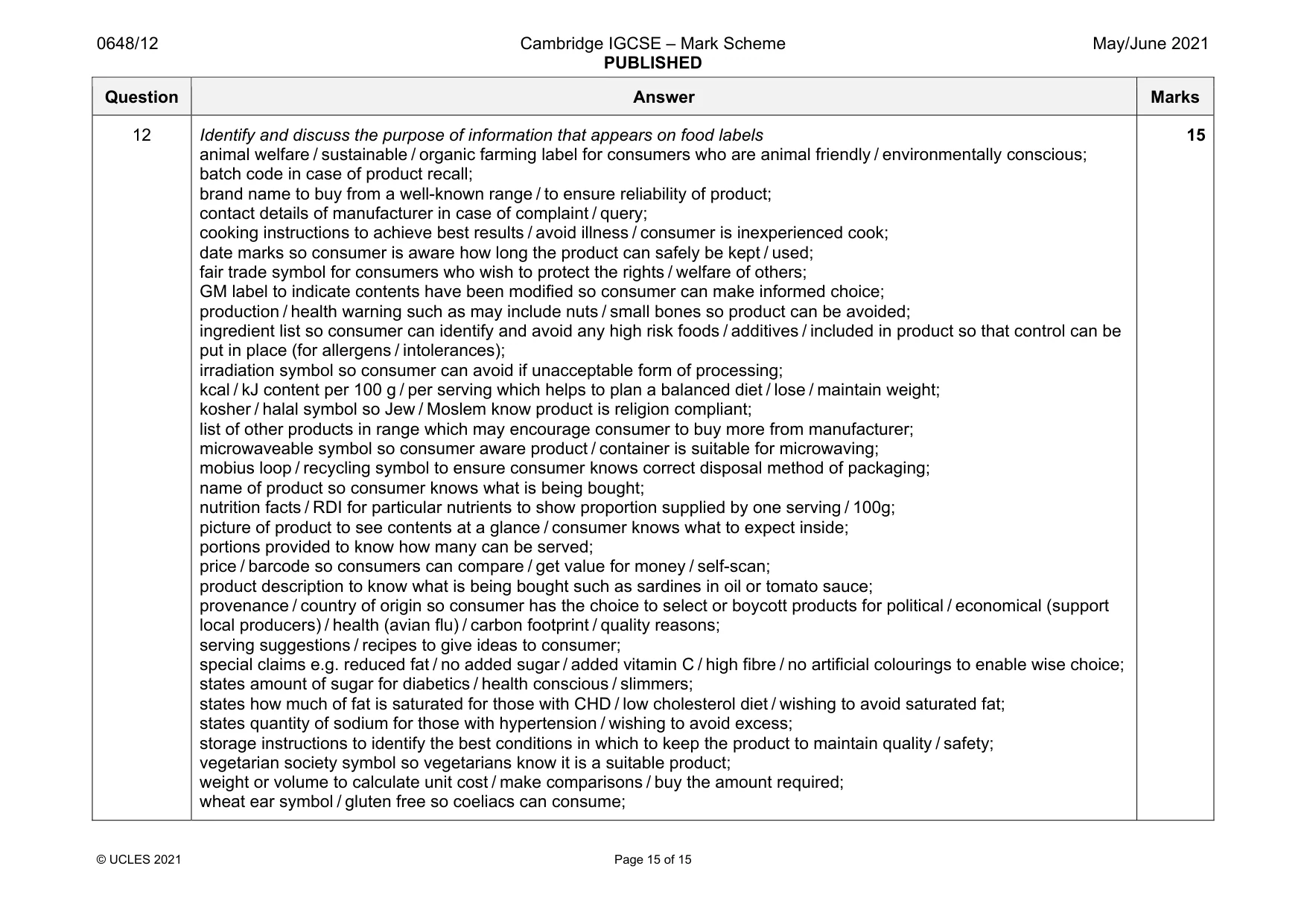
0648/12 Cambridge IGCSE – Mark Scheme PUBLISHED May/June 2021 © UCLES 2021 Page 15 of 15 Question Answer Marks 12 Identify and discuss the purpose of information that appears on food labels animal welfare / sustainable / organic farming label for consumers who are animal friendly / environmentally conscious; batch code in case of product recall; brand name to buy from a well-known range / to ensure reliability of product; contact details of manufacturer in case of complaint / query; cooking instructions to achieve best results / avoid illness / consumer is inexperienced cook; date marks so consumer is aware how long the product can safely be kept / used; fair trade symbol for consumers who wish to protect the rights / welfare of others; GM label to indicate contents have been modified so consumer can make informed choice; production / health warning such as may include nuts / small bones so product can be avoided; ingredient list so consumer can identify and avoid any high risk foods / additives / included in product so that control can be put in place (for allergens / intolerances); irradiation symbol so consumer can avoid if unacceptable form of processing; kcal / kJ content per 100 g / per serving which helps to plan a balanced diet / lose / maintain weight; kosher / halal symbol so Jew / Moslem know product is religion compliant; list of other products in range which may encourage consumer to buy more from manufacturer; microwaveable symbol so consumer aware product / container is suitable for microwaving; mobius loop / recycling symbol to ensure consumer knows correct disposal method of packaging; name of product so consumer knows what is being bought; nutrition facts / RDI for particular nutrients to show proportion supplied by one serving / 100g; picture of product to see contents at a glance / consumer knows what to expect inside; portions provided to know how many can be served; price / barcode so consumers can compare / get value for money / self-scan; product description to know what is being bought such as sardines in oil or tomato sauce; provenance / country of origin so consumer has the choice to select or boycott products for political / economical (support local producers) / health (avian flu) / carbon footprint / quality reasons; serving suggestions / recipes to give ideas to consumer; special claims e.g. reduced fat / no added sugar / added vitamin C / high fibre / no artificial colourings to enable wise choice; states amount of sugar for diabetics / health conscious / slimmers; states how much of fat is saturated for those with CHD / low cholesterol diet / wishing to avoid saturated fat; states quantity of sodium for those with hypertension / wishing to avoid excess; storage instructions to identify the best conditions in which to keep the product to maintain quality / safety; vegetarian society symbol so vegetarians know it is a suitable product; weight or volume to calculate unit cost / make comparisons / buy the amount required; wheat ear symbol / gluten free so coeliacs can consume; 15
What you needed in this session
Cambridge’s own grade thresholds for 2021 May/June, Paper 1 · Variant 2. A higher threshold means an easier paper — the bar moves with how the cohort did.