Cambridge IGCSE Food and Nutrition 0648 — 2021 May/June Paper 1 · Variant 3
0648/13/M/J/21 · 100 marks · ≈113 min
The question paper and its mark scheme, free to read here and free to download. This is Cambridge’s own paper, exactly as it was sat.
Question paper12 pages

Mark scheme17 pages
Answers below. Sit the paper first if you are practising.
Paper as text
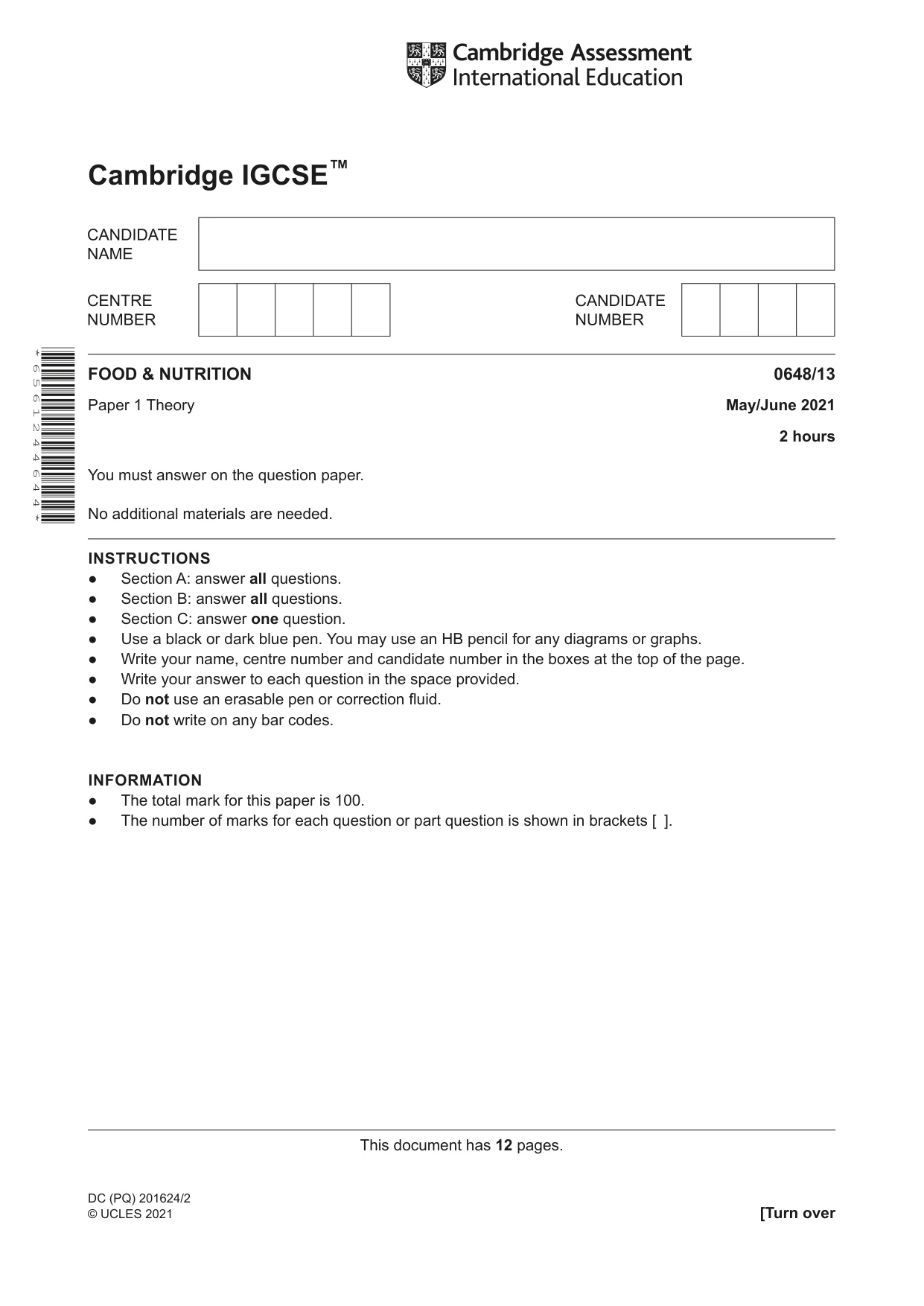
Question paper, page 1
This document has 12 pages. Cambridge IGCSE™ DC (PQ) 201624/2 © UCLES 2021 [Turn over * 6 5 6 1 2 4 4 6 4 4 * FOOD & NUTRITION 0648/13 Paper 1 Theory May/June 2021 2 hours You must answer on the question paper. No additional materials are needed. INSTRUCTIONS ● Section A: answer all questions. ● Section B: answer all questions. ● Section C: answer one question. ● Use a black or dark blue pen. You may use an HB pencil for any diagrams or graphs. ● Write your name, centre number and candidate number in the boxes at the top of the page. ● Write your answer to each question in the space provided. ● Do not use an erasable pen or correction fluid. ● Do not write on any bar codes. INFORMATION ● The total mark for this paper is 100. ● The number of marks for each question or part question is shown in brackets [ ].
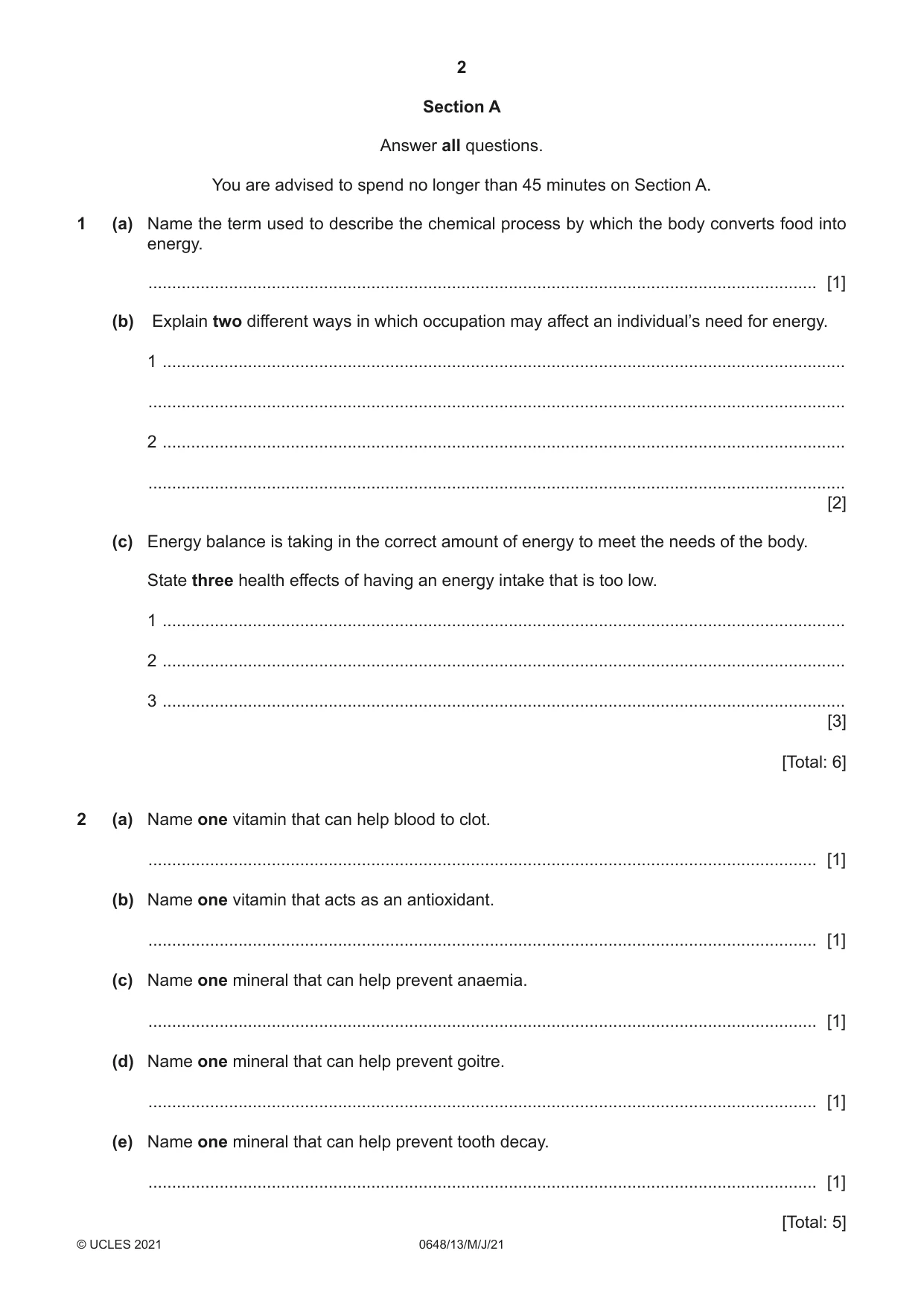
Question paper, page 2
2 0648/13/M/J/21 © UCLES 2021 Section A Answer all questions. You are advised to spend no longer than 45 minutes on Section A. 1 (a) Name the term used to describe the chemical process by which the body converts food into energy. … [1] (b) Explain two different ways in which occupation may affect an individual’s need for energy. 1 … … 2 … … [2] (c) Energy balance is taking in the correct amount of energy to meet the needs of the body. State three health effects of having an energy intake that is too low. 1 … 2 … 3 … [3] [Total: 6] 2 (a) Name one vitamin that can help blood to clot. … [1] (b) Name one vitamin that acts as an antioxidant. … [1] (c) Name one mineral that can help prevent anaemia. … [1] (d) Name one mineral that can help prevent goitre. … [1] (e) Name one mineral that can help prevent tooth decay. … [1] [Total: 5]
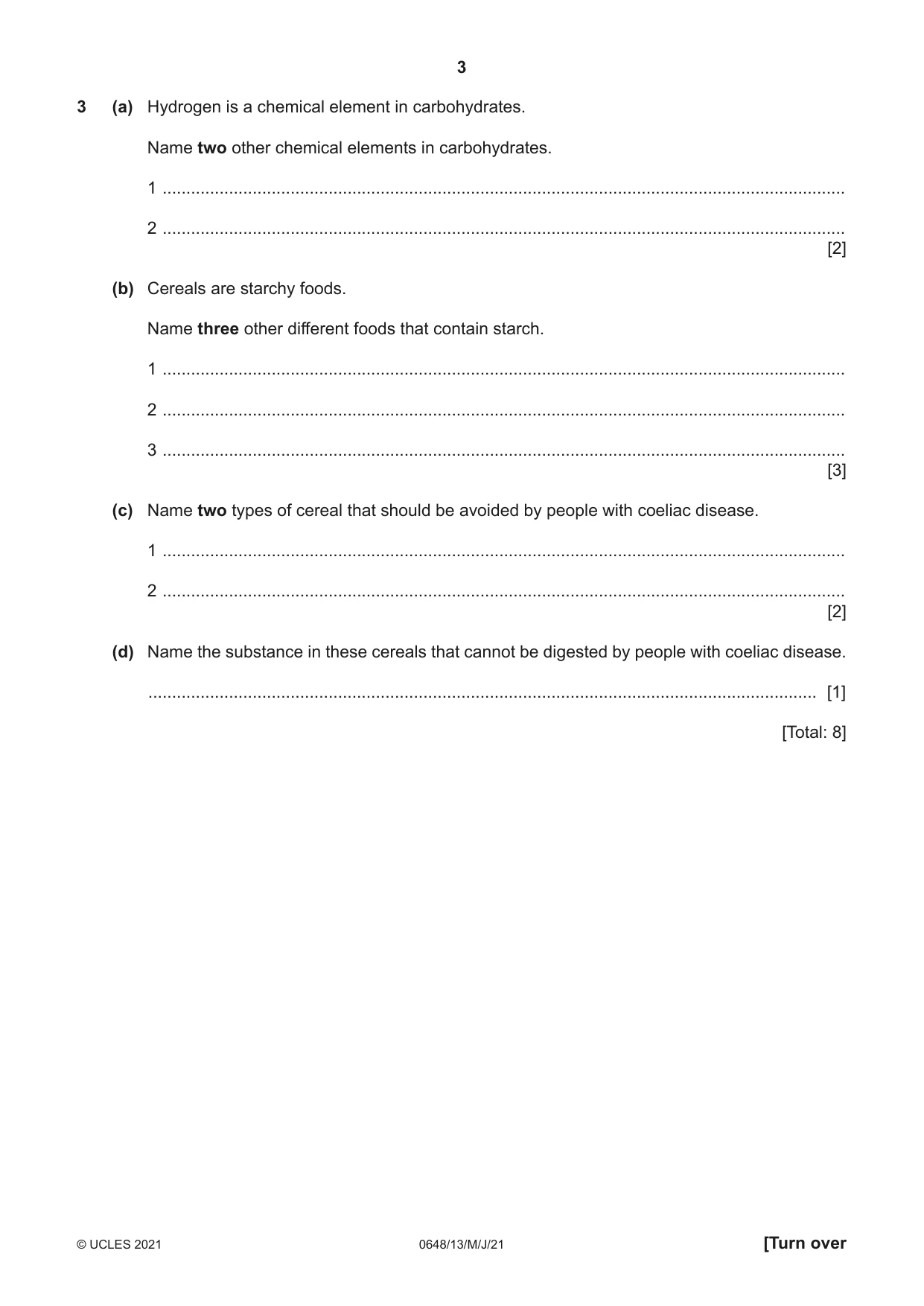
Question paper, page 3
3 0648/13/M/J/21 © UCLES 2021 [Turn over 3 (a) Hydrogen is a chemical element in carbohydrates. Name two other chemical elements in carbohydrates. 1 … 2 … [2] (b) Cereals are starchy foods. Name three other different foods that contain starch. 1 … 2 … 3 … [3] (c) Name two types of cereal that should be avoided by people with coeliac disease. 1 … 2 … [2] (d) Name the substance in these cereals that cannot be digested by people with coeliac disease. … [1] [Total: 8]
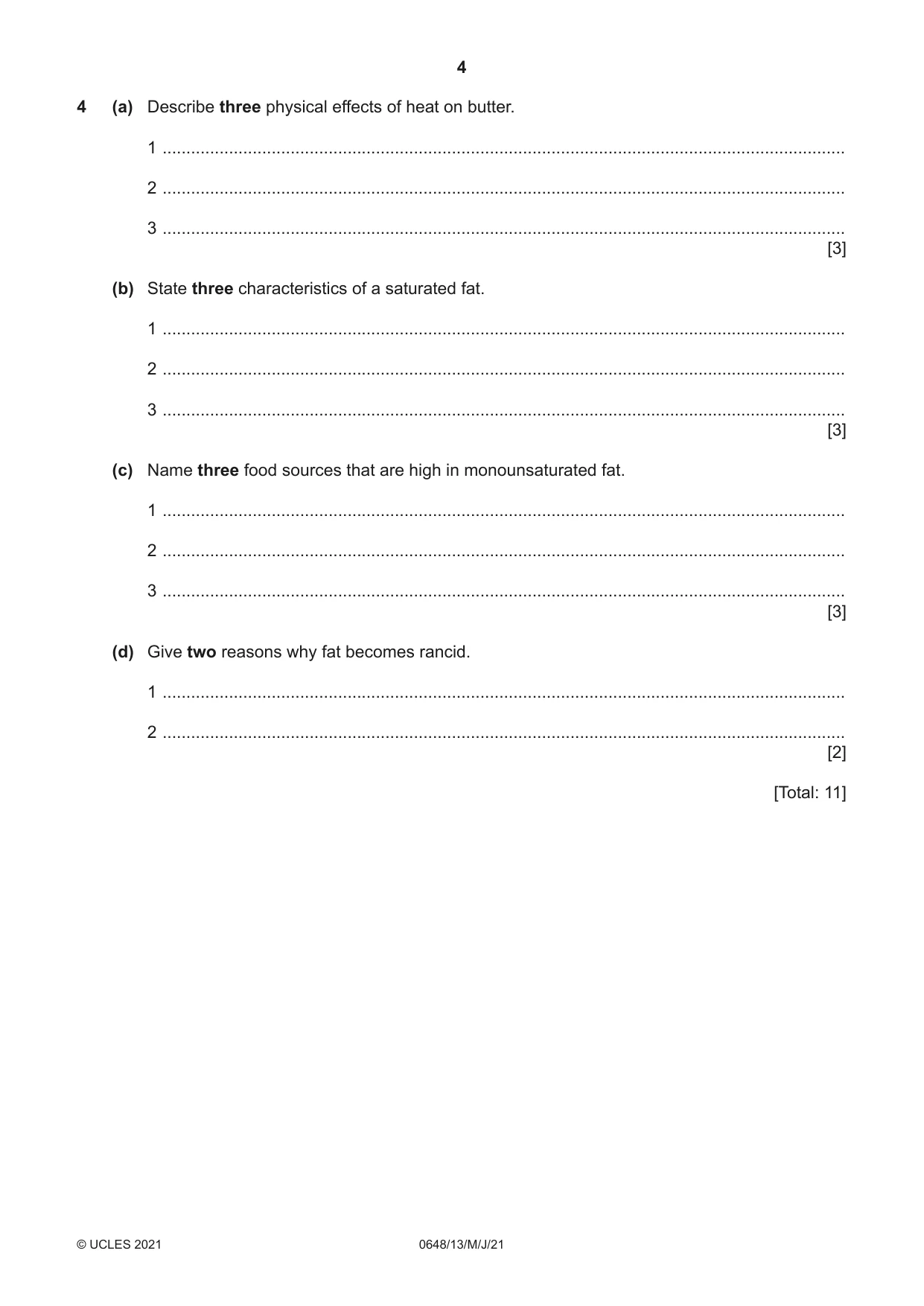
Question paper, page 4
4 0648/13/M/J/21 © UCLES 2021 4 (a) Describe three physical effects of heat on butter. 1 … 2 … 3 … [3] (b) State three characteristics of a saturated fat. 1 … 2 … 3 … [3] (c) Name three food sources that are high in monounsaturated fat. 1 … 2 … 3 … [3] (d) Give two reasons why fat becomes rancid. 1 … 2 … [2] [Total: 11]
Question paper, page 5
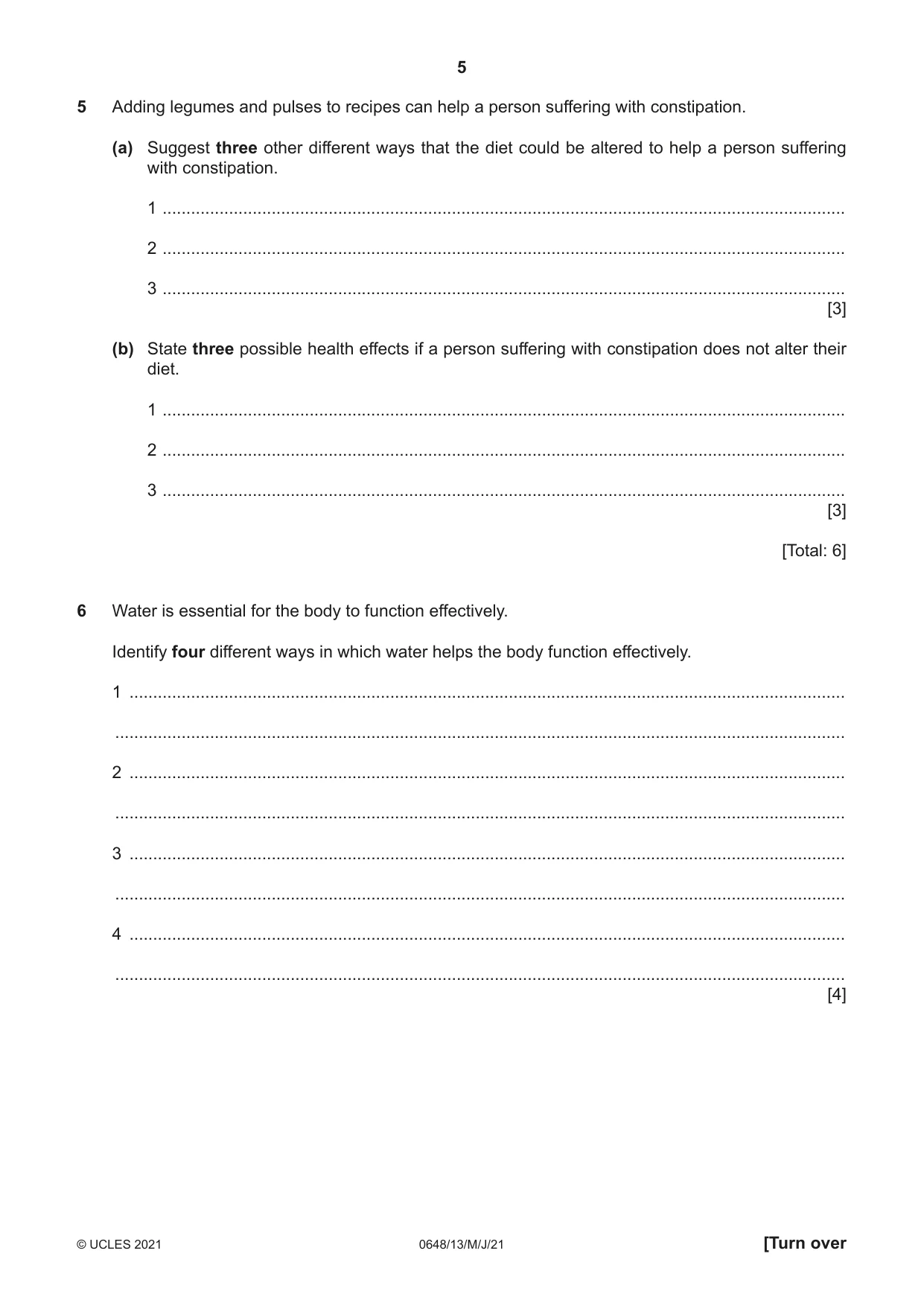
5 0648/13/M/J/21 © UCLES 2021 [Turn over 5 Adding legumes and pulses to recipes can help a person suffering with constipation. (a) Suggest three other different ways that the diet could be altered to help a person suffering with constipation. 1 … 2 … 3 … [3] (b) State three possible health effects if a person suffering with constipation does not alter their diet. 1 … 2 … 3 … [3] [Total: 6] 6 Water is essential for the body to function effectively. Identify four different ways in which water helps the body function effectively. 1 … … 2 … … 3 … … 4 … … [4]
Question paper, page 6
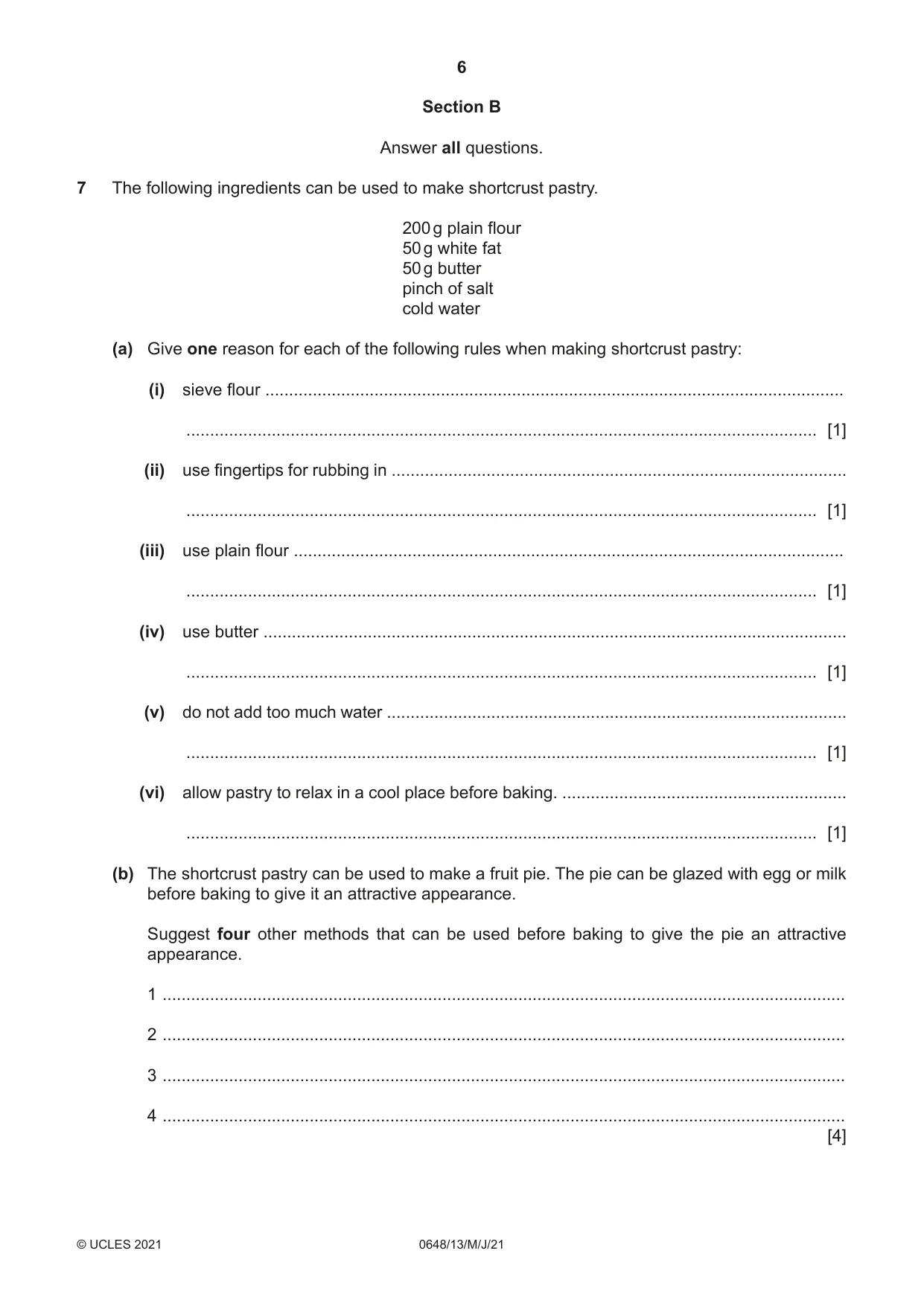
6 0648/13/M/J/21 © UCLES 2021 Section B Answer all questions. 7 The following ingredients can be used to make shortcrust pastry. 200 g plain flour 50 g white fat 50 g butter pinch of salt cold water (a) Give one reason for each of the following rules when making shortcrust pastry: (i) sieve flour … … [1] (ii) use fingertips for rubbing in … … [1] (iii) use plain flour … … [1] (iv) use butter … … [1] (v) do not add too much water … … [1] (vi) allow pastry to relax in a cool place before baking. … … [1] (b) The shortcrust pastry can be used to make a fruit pie. The pie can be glazed with egg or milk before baking to give it an attractive appearance. Suggest four other methods that can be used before baking to give the pie an attractive appearance. 1 … 2 … 3 … 4 … [4]
Question paper, page 7
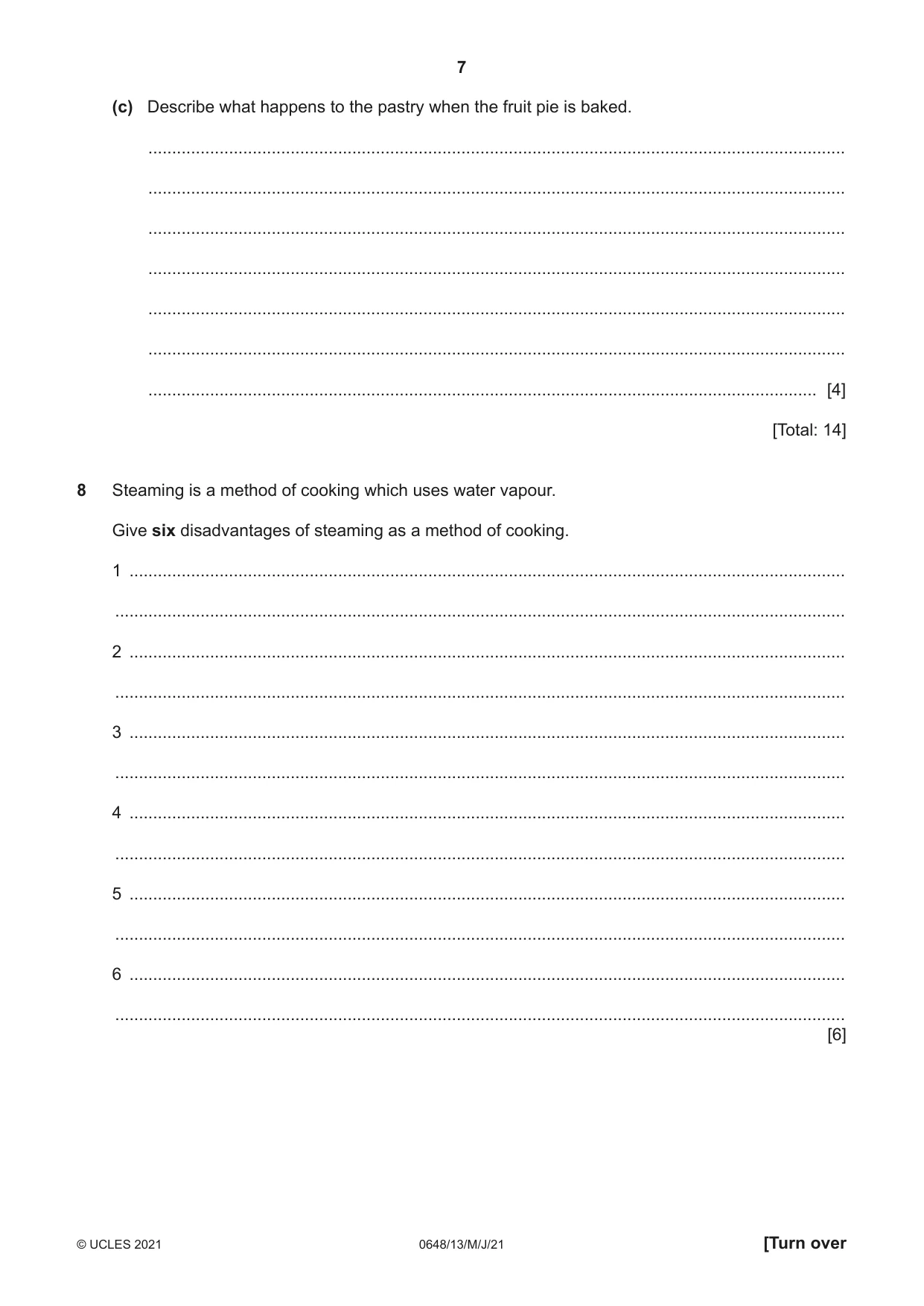
7 0648/13/M/J/21 © UCLES 2021 [Turn over (c) Describe what happens to the pastry when the fruit pie is baked. … … … … … … … [4] [Total: 14] 8 Steaming is a method of cooking which uses water vapour. Give six disadvantages of steaming as a method of cooking. 1 … … 2 … … 3 … … 4 … … 5 … … 6 … … [6]
Question paper, page 8
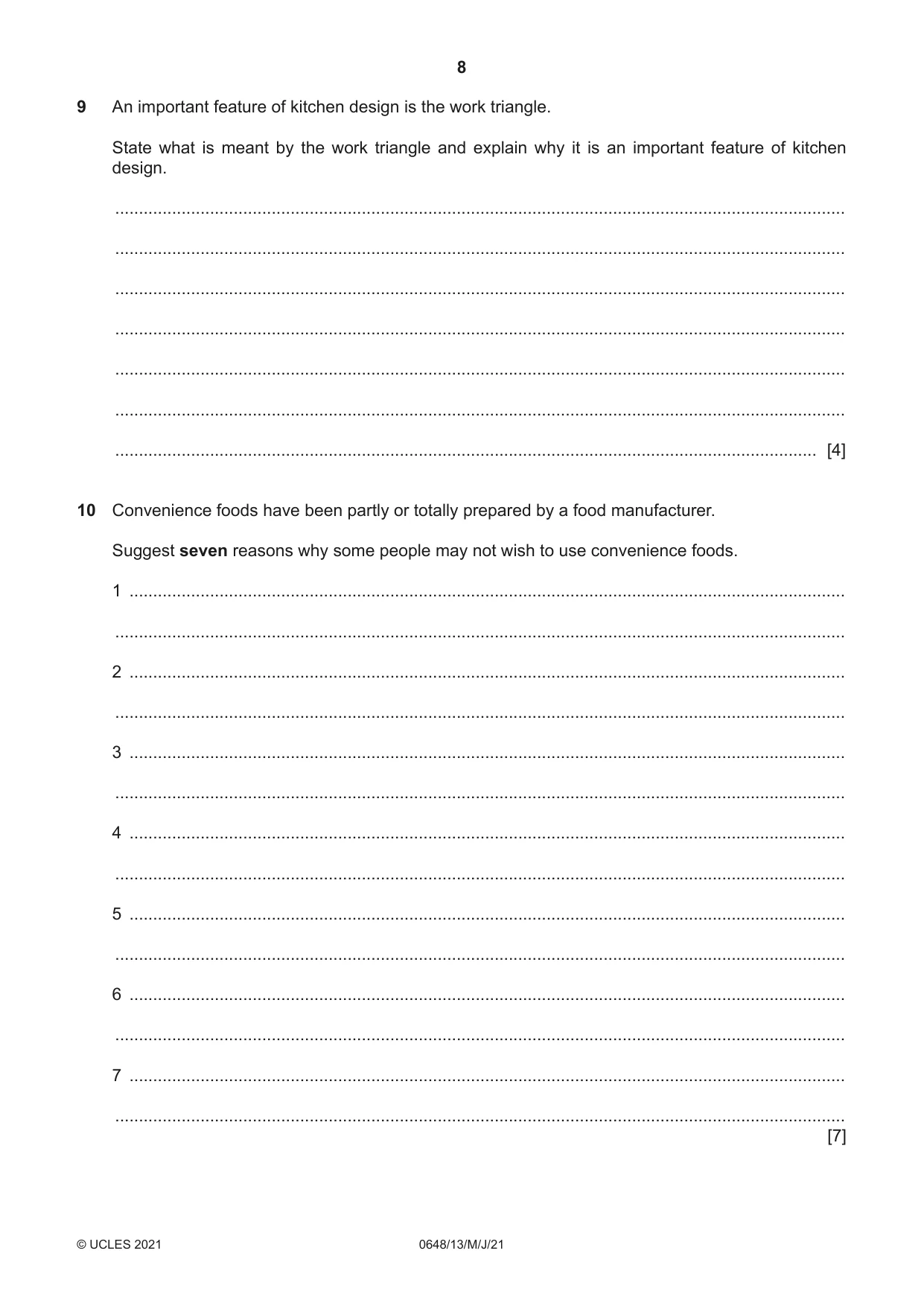
8 0648/13/M/J/21 © UCLES 2021 9 An important feature of kitchen design is the work triangle. State what is meant by the work triangle and explain why it is an important feature of kitchen design. … … … … … … … [4] 10 Convenience foods have been partly or totally prepared by a food manufacturer. Suggest seven reasons why some people may not wish to use convenience foods. 1 … … 2 … … 3 … … 4 … … 5 … … 6 … … 7 … … [7]
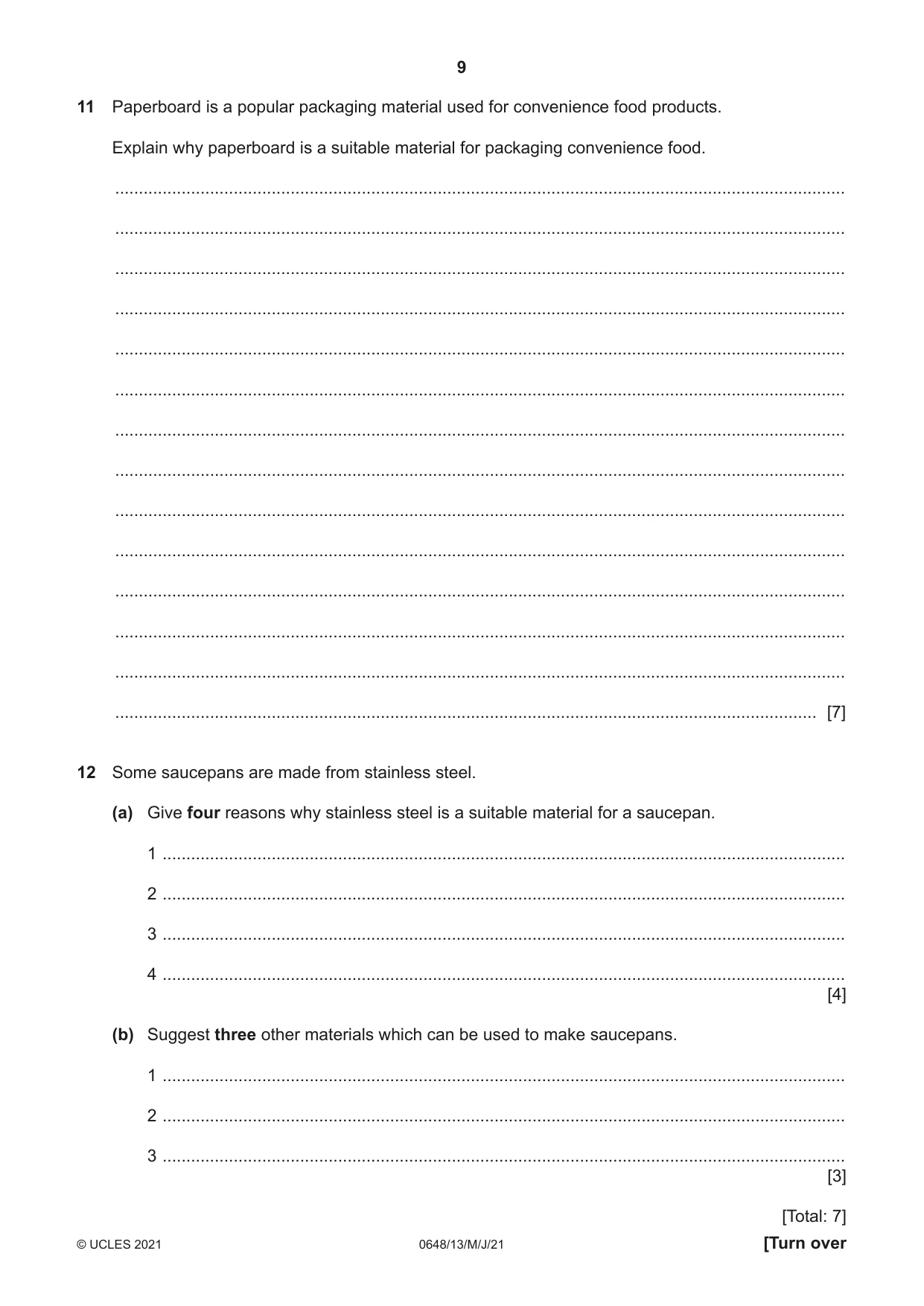
Question paper, page 9
9 0648/13/M/J/21 © UCLES 2021 [Turn over 11 Paperboard is a popular packaging material used for convenience food products. Explain why paperboard is a suitable material for packaging convenience food. … … … … … … … … … … … … … … [7] 12 Some saucepans are made from stainless steel. (a) Give four reasons why stainless steel is a suitable material for a saucepan. 1 … 2 … 3 … 4 … [4] (b) Suggest three other materials which can be used to make saucepans. 1 … 2 … 3 … [3] [Total: 7]
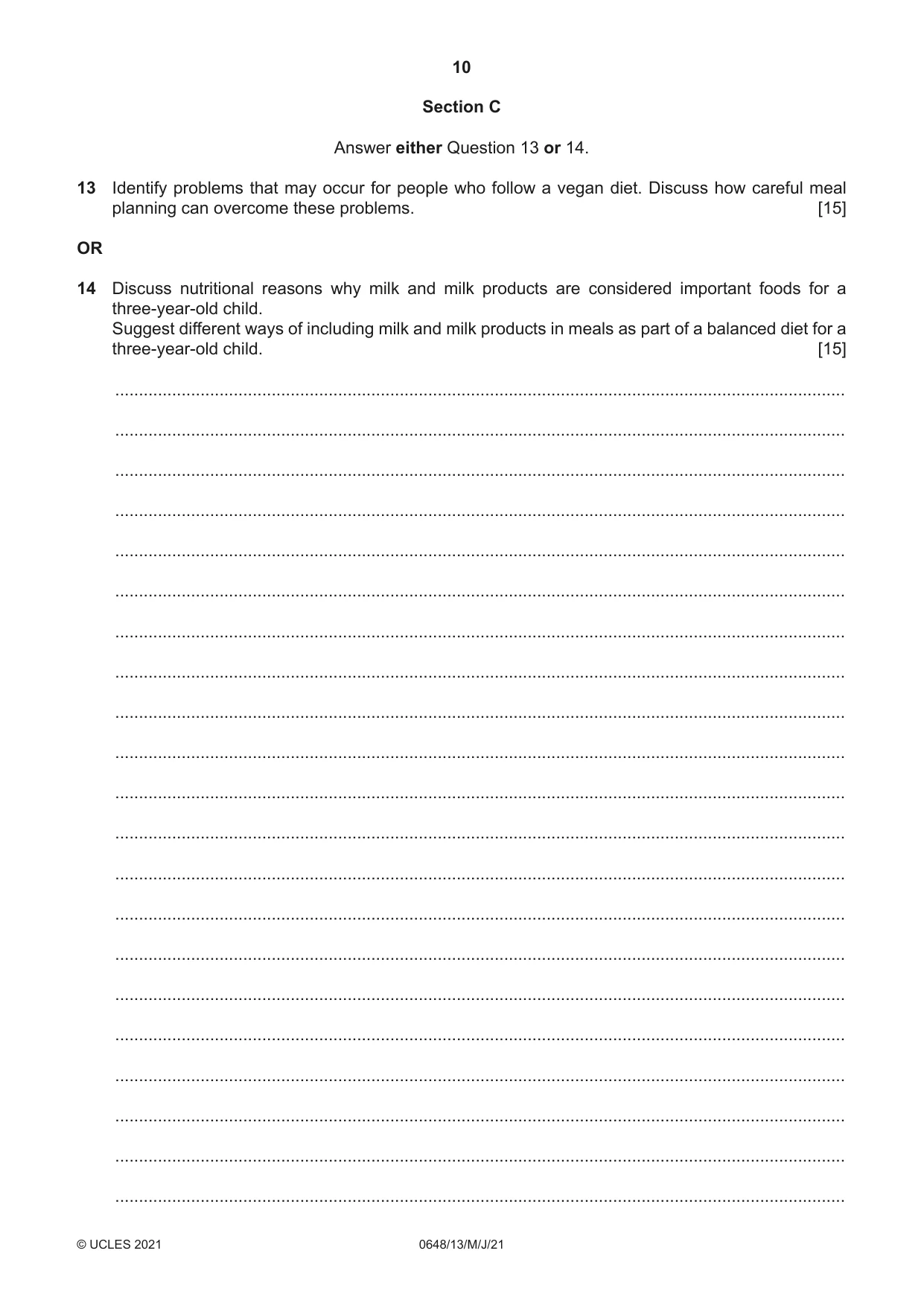
Question paper, page 10
10 0648/13/M/J/21 © UCLES 2021 Section C Answer either Question 13 or 14. 13 Identify problems that may occur for people who follow a vegan diet. Discuss how careful meal planning can overcome these problems. [15] OR 14 Discuss nutritional reasons why milk and milk products are considered important foods for a three-year-old child. Suggest different ways of including milk and milk products in meals as part of a balanced diet for a three-year-old child. [15] … … … … … … … … … … … … … … … … … … … … …
Question paper, page 11
11 0648/13/M/J/21 © UCLES 2021 [Turn over … … … … … … … … … … … … … … … … … … … … … … … … … … … …
Question paper, page 12
12 0648/13/M/J/21 © UCLES 2021 … … … … … … … … … … … … … … … … … … … … … … … [Total: 15] Permission to reproduce items where third-party owned material protected by copyright is included has been sought and cleared where possible. Every reasonable effort has been made by the publisher (UCLES) to trace copyright holders, but if any items requiring clearance have unwittingly been included, the publisher will be pleased to make amends at the earliest possible opportunity. To avoid the issue of disclosure of answer-related information to candidates, all copyright acknowledgements are reproduced online in the Cambridge Assessment International Education Copyright Acknowledgements Booklet. This is produced for each series of examinations and is freely available to download at www.cambridgeinternational.org after the live examination series. Cambridge Assessment International Education is part of the Cambridge Assessment Group. Cambridge Assessment is the brand name of the University of Cambridge Local Examinations Syndicate (UCLES), which itself is a department of the University of Cambridge.
Mark scheme, page 1
This document consists of 17 printed pages. © UCLES 2021 [Turn over Cambridge IGCSE™ FOOD AND NUTRITION 0648/13 Paper 1 Theory May/June 2021 MARK SCHEME Maximum Mark: 100 Published This mark scheme is published as an aid to teachers and candidates, to indicate the requirements of the examination. It shows the basis on which Examiners were instructed to award marks. It does not indicate the details of the discussions that took place at an Examiners’ meeting before marking began, which would have considered the acceptability of alternative answers. Mark schemes should be read in conjunction with the question paper and the Principal Examiner Report for Teachers. Cambridge International will not enter into discussions about these mark schemes. Cambridge International is publishing the mark schemes for the May/June 2021 series for most Cambridge IGCSE™, Cambridge International A and AS Level components and some Cambridge O Level components.
Mark scheme, page 2
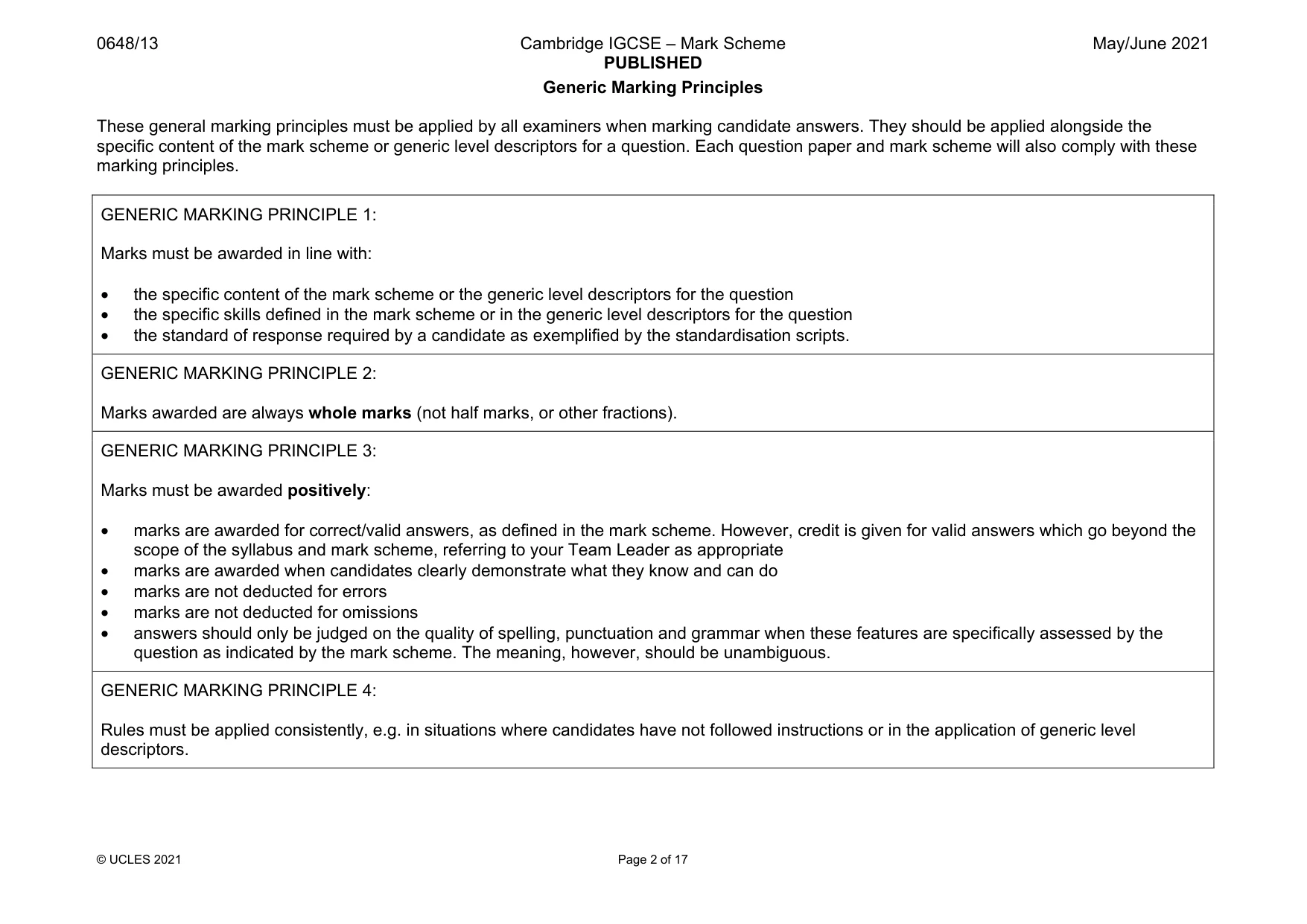
0648/13 Cambridge IGCSE – Mark Scheme PUBLISHED May/June 2021 © UCLES 2021 Page 2 of 17 Generic Marking Principles These general marking principles must be applied by all examiners when marking candidate answers. They should be applied alongside the specific content of the mark scheme or generic level descriptors for a question. Each question paper and mark scheme will also comply with these marking principles. GENERIC MARKING PRINCIPLE 1: Marks must be awarded in line with: • the specific content of the mark scheme or the generic level descriptors for the question • the specific skills defined in the mark scheme or in the generic level descriptors for the question • the standard of response required by a candidate as exemplified by the standardisation scripts. GENERIC MARKING PRINCIPLE 2: Marks awarded are always whole marks (not half marks, or other fractions). GENERIC MARKING PRINCIPLE 3: Marks must be awarded positively: • marks are awarded for correct/valid answers, as defined in the mark scheme. However, credit is given for valid answers which go beyond the scope of the syllabus and mark scheme, referring to your Team Leader as appropriate • marks are awarded when candidates clearly demonstrate what they know and can do • marks are not deducted for errors • marks are not deducted for omissions • answers should only be judged on the quality of spelling, punctuation and grammar when these features are specifically assessed by the question as indicated by the mark scheme. The meaning, however, should be unambiguous. GENERIC MARKING PRINCIPLE 4: Rules must be applied consistently, e.g. in situations where candidates have not followed instructions or in the application of generic level descriptors.
Mark scheme, page 3
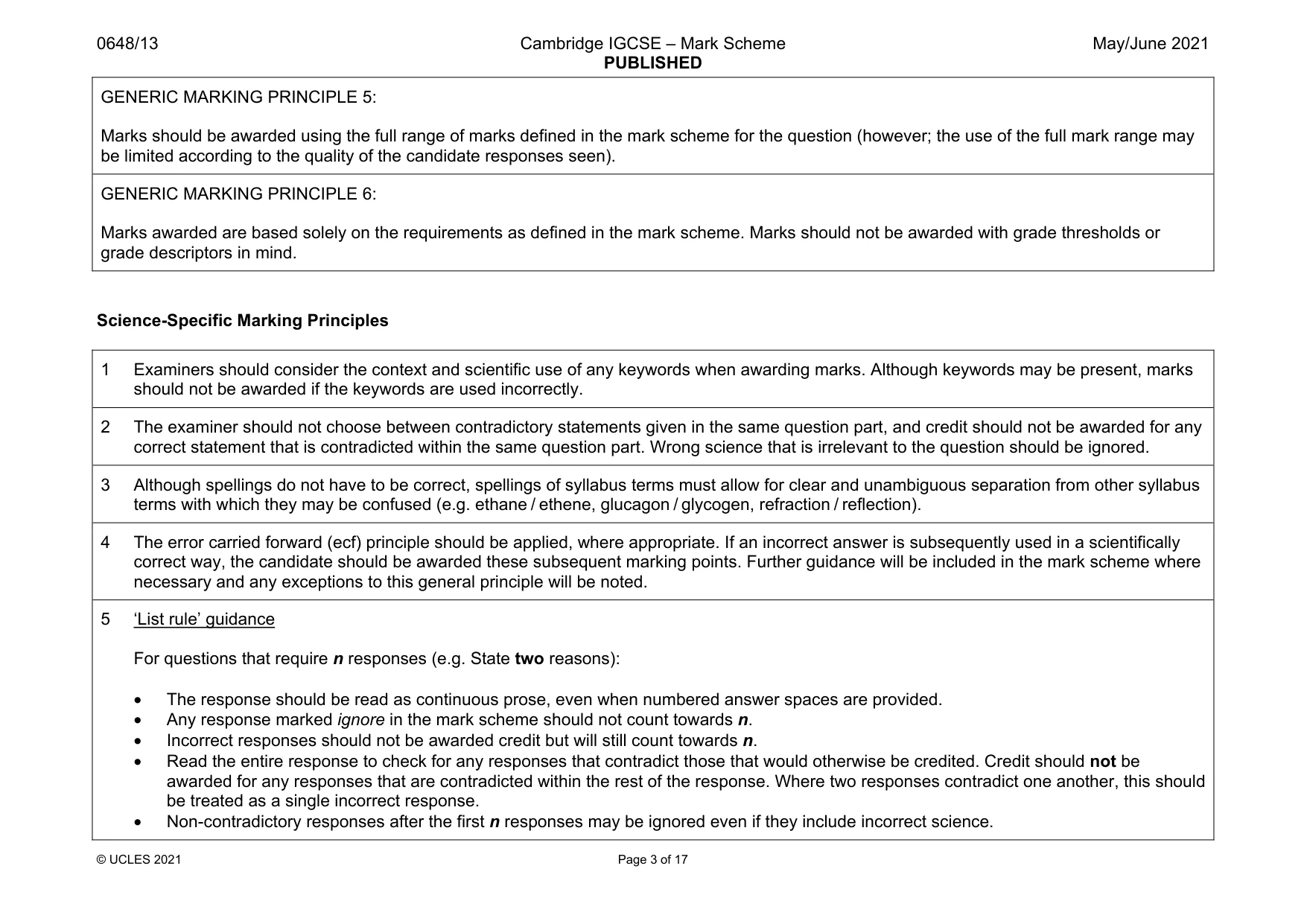
0648/13 Cambridge IGCSE – Mark Scheme PUBLISHED May/June 2021 © UCLES 2021 Page 3 of 17 GENERIC MARKING PRINCIPLE 5: Marks should be awarded using the full range of marks defined in the mark scheme for the question (however; the use of the full mark range may be limited according to the quality of the candidate responses seen). GENERIC MARKING PRINCIPLE 6: Marks awarded are based solely on the requirements as defined in the mark scheme. Marks should not be awarded with grade thresholds or grade descriptors in mind. Science-Specific Marking Principles 1 Examiners should consider the context and scientific use of any keywords when awarding marks. Although keywords may be present, marks should not be awarded if the keywords are used incorrectly. 2 The examiner should not choose between contradictory statements given in the same question part, and credit should not be awarded for any correct statement that is contradicted within the same question part. Wrong science that is irrelevant to the question should be ignored. 3 Although spellings do not have to be correct, spellings of syllabus terms must allow for clear and unambiguous separation from other syllabus terms with which they may be confused (e.g. ethane / ethene, glucagon / glycogen, refraction / reflection). 4 The error carried forward (ecf) principle should be applied, where appropriate. If an incorrect answer is subsequently used in a scientifically correct way, the candidate should be awarded these subsequent marking points. Further guidance will be included in the mark scheme where necessary and any exceptions to this general principle will be noted. 5 ‘List rule’ guidance For questions that require n responses (e.g. State two reasons): • The response should be read as continuous prose, even when numbered answer spaces are provided. • Any response marked ignore in the mark scheme should not count towards n. • Incorrect responses should not be awarded credit but will still count towards n. • Read the entire response to check for any responses that contradict those that would otherwise be credited. Credit should not be awarded for any responses that are contradicted within the rest of the response. Where two responses contradict one another, this should be treated as a single incorrect response. • Non-contradictory responses after the first n responses may be ignored even if they include incorrect science.
Mark scheme, page 4
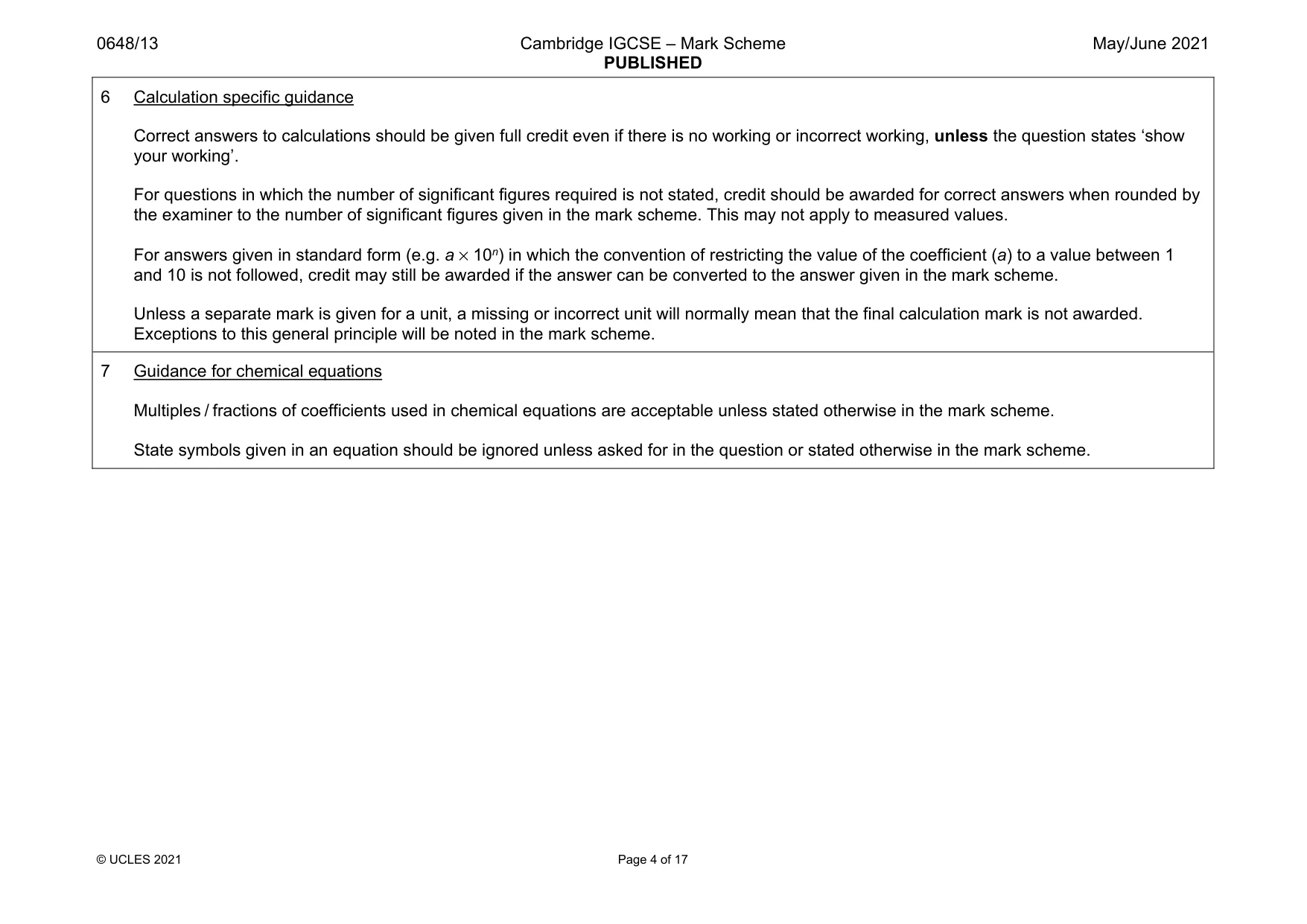
0648/13 Cambridge IGCSE – Mark Scheme PUBLISHED May/June 2021 © UCLES 2021 Page 4 of 17 6 Calculation specific guidance Correct answers to calculations should be given full credit even if there is no working or incorrect working, unless the question states ‘show your working’. For questions in which the number of significant figures required is not stated, credit should be awarded for correct answers when rounded by the examiner to the number of significant figures given in the mark scheme. This may not apply to measured values. For answers given in standard form (e.g. a × 10n) in which the convention of restricting the value of the coefficient (a) to a value between 1 and 10 is not followed, credit may still be awarded if the answer can be converted to the answer given in the mark scheme. Unless a separate mark is given for a unit, a missing or incorrect unit will normally mean that the final calculation mark is not awarded. Exceptions to this general principle will be noted in the mark scheme. 7 Guidance for chemical equations Multiples / fractions of coefficients used in chemical equations are acceptable unless stated otherwise in the mark scheme. State symbols given in an equation should be ignored unless asked for in the question or stated otherwise in the mark scheme.
Mark scheme, page 5
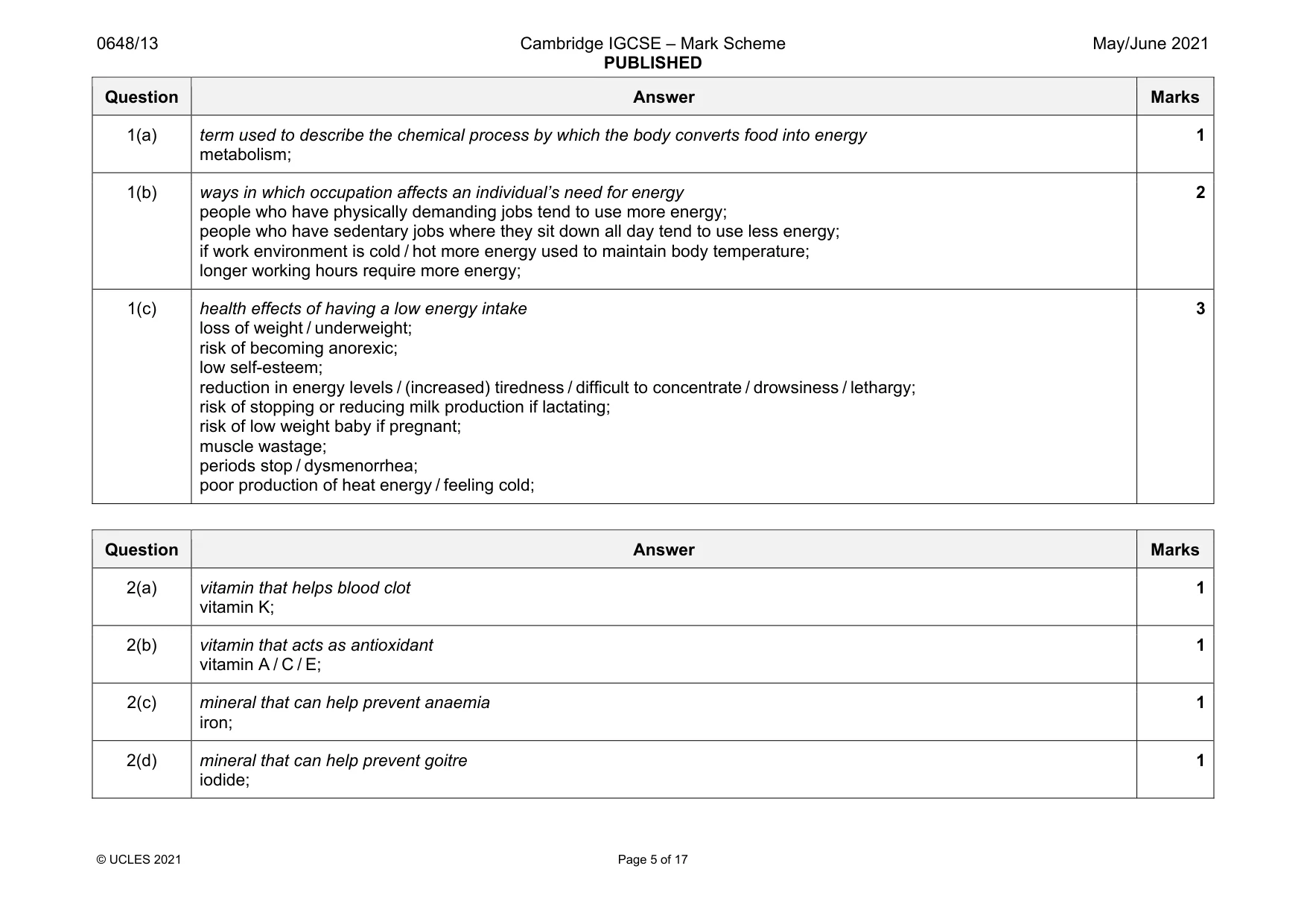
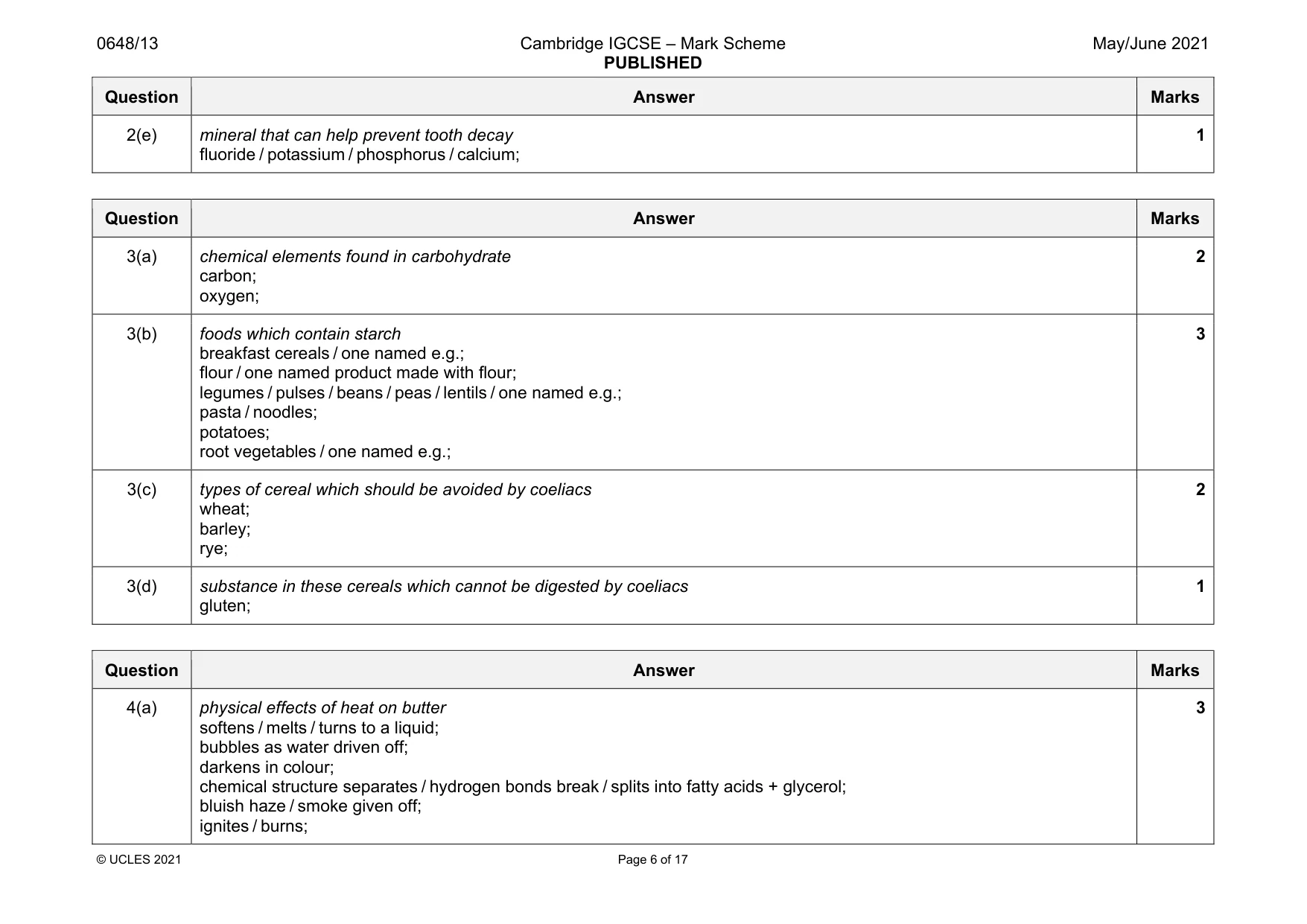
0648/13 Cambridge IGCSE – Mark Scheme PUBLISHED May/June 2021 © UCLES 2021 Page 5 of 17 Question Answer Marks 1(a) term used to describe the chemical process by which the body converts food into energy metabolism; 1 1(b) ways in which occupation affects an individual’s need for energy people who have physically demanding jobs tend to use more energy; people who have sedentary jobs where they sit down all day tend to use less energy; if work environment is cold / hot more energy used to maintain body temperature; longer working hours require more energy; 2 1(c) health effects of having a low energy intake loss of weight / underweight; risk of becoming anorexic; low self-esteem; reduction in energy levels / (increased) tiredness / difficult to concentrate / drowsiness / lethargy; risk of stopping or reducing milk production if lactating; risk of low weight baby if pregnant; muscle wastage; periods stop / dysmenorrhea; poor production of heat energy / feeling cold; 3 Question Answer Marks 2(a) vitamin that helps blood clot vitamin K; 1 2(b) vitamin that acts as antioxidant vitamin A / C / E; 1 2(c) mineral that can help prevent anaemia iron; 1 2(d) mineral that can help prevent goitre iodide; 1
Mark scheme, page 6
0648/13 Cambridge IGCSE – Mark Scheme PUBLISHED May/June 2021 © UCLES 2021 Page 6 of 17 Question Answer Marks 2(e) mineral that can help prevent tooth decay fluoride / potassium / phosphorus / calcium; 1 Question Answer Marks 3(a) chemical elements found in carbohydrate carbon; oxygen; 2 3(b) foods which contain starch breakfast cereals / one named e.g.; flour / one named product made with flour; legumes / pulses / beans / peas / lentils / one named e.g.; pasta / noodles; potatoes; root vegetables / one named e.g.; 3 3(c) types of cereal which should be avoided by coeliacs wheat; barley; rye; 2 3(d) substance in these cereals which cannot be digested by coeliacs gluten; 1 Question Answer Marks 4(a) physical effects of heat on butter softens / melts / turns to a liquid; bubbles as water driven off; darkens in colour; chemical structure separates / hydrogen bonds break / splits into fatty acids + glycerol; bluish haze / smoke given off; ignites / burns; 3
Mark scheme, page 7
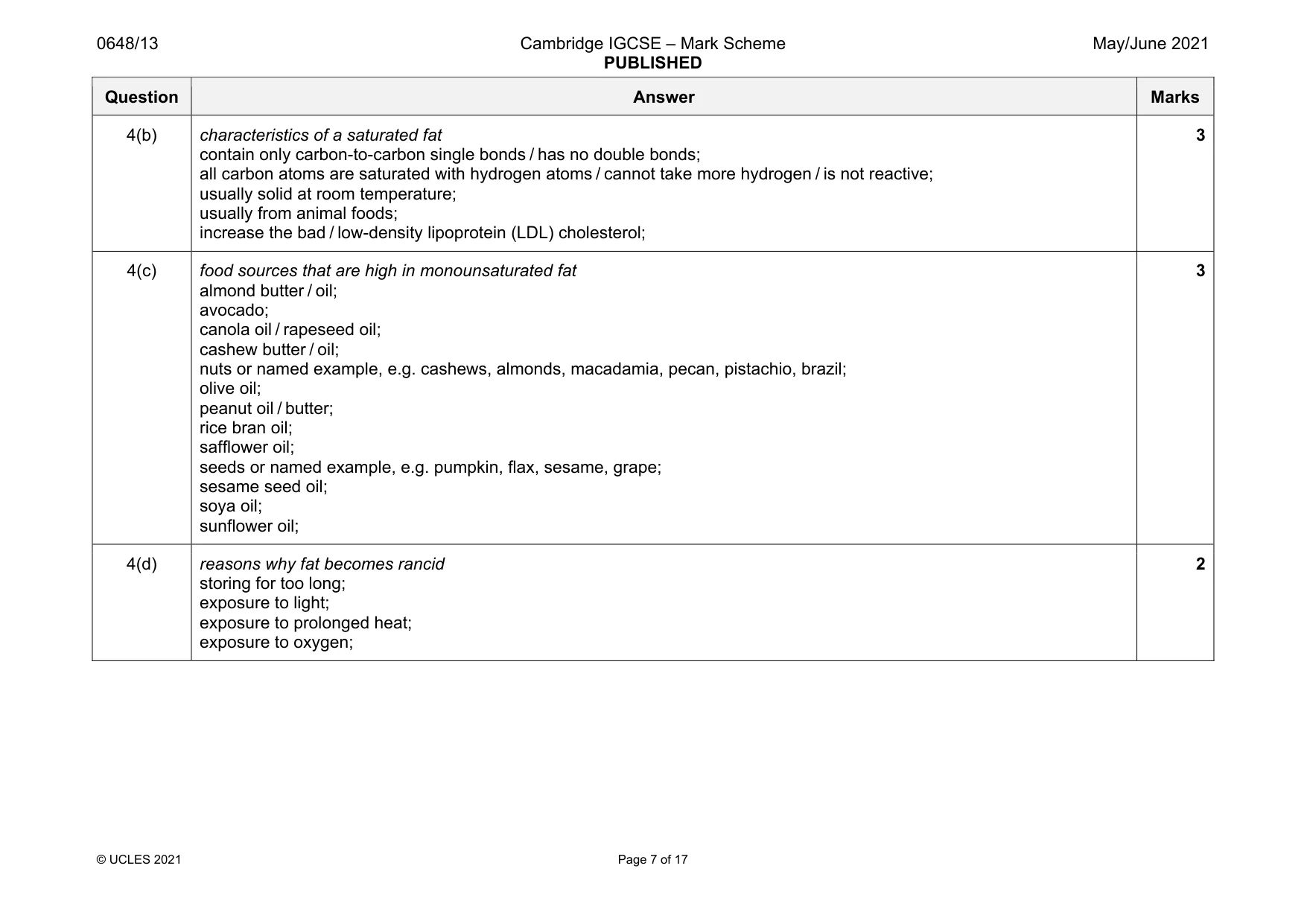
0648/13 Cambridge IGCSE – Mark Scheme PUBLISHED May/June 2021 © UCLES 2021 Page 7 of 17 Question Answer Marks 4(b) characteristics of a saturated fat contain only carbon-to-carbon single bonds / has no double bonds; all carbon atoms are saturated with hydrogen atoms / cannot take more hydrogen / is not reactive; usually solid at room temperature; usually from animal foods; increase the bad / low-density lipoprotein (LDL) cholesterol; 3 4(c) food sources that are high in monounsaturated fat almond butter / oil; avocado; canola oil / rapeseed oil; cashew butter / oil; nuts or named example, e.g. cashews, almonds, macadamia, pecan, pistachio, brazil; olive oil; peanut oil / butter; rice bran oil; safflower oil; seeds or named example, e.g. pumpkin, flax, sesame, grape; sesame seed oil; soya oil; sunflower oil; 3 4(d) reasons why fat becomes rancid storing for too long; exposure to light; exposure to prolonged heat; exposure to oxygen; 2
Mark scheme, page 8
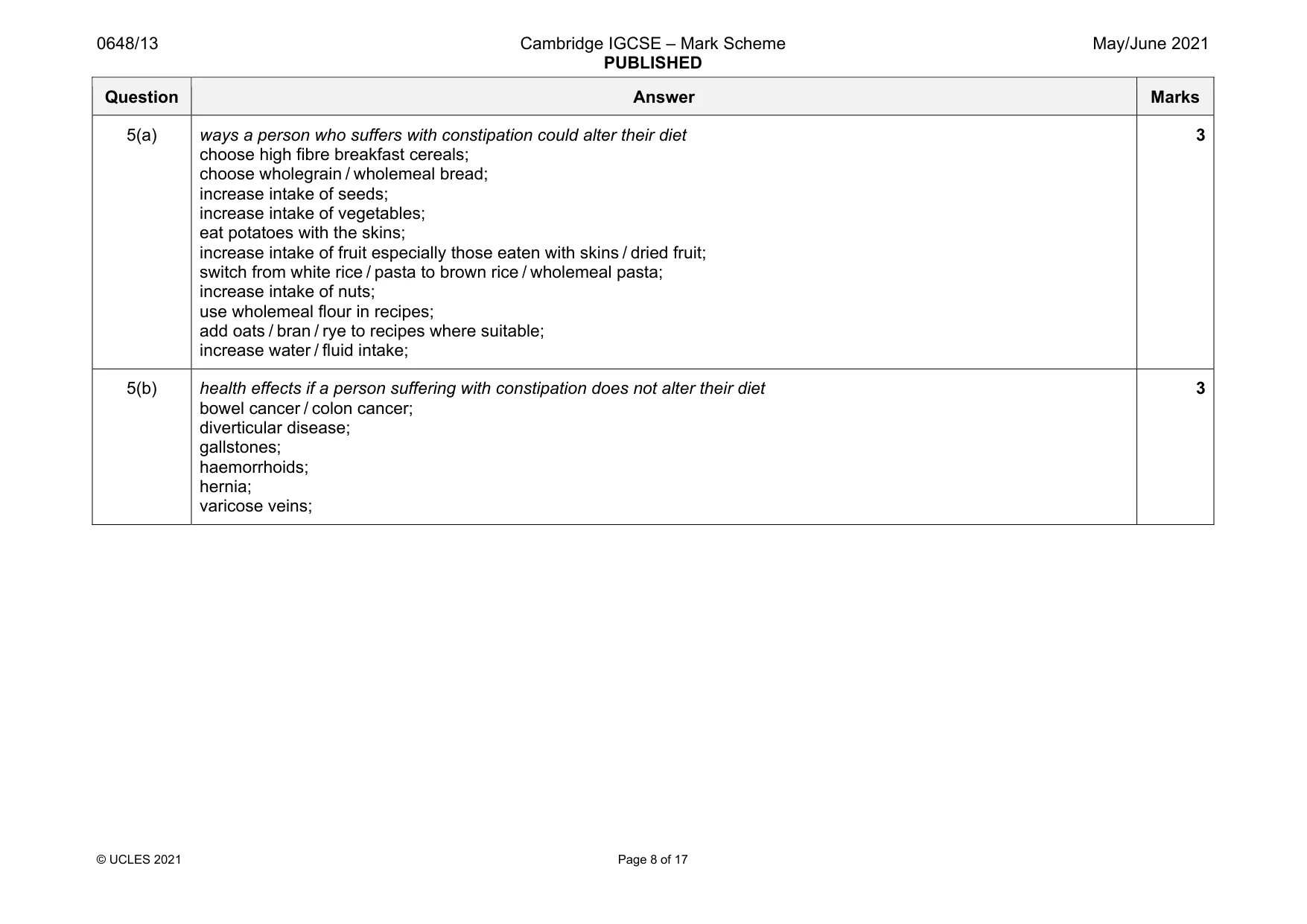
0648/13 Cambridge IGCSE – Mark Scheme PUBLISHED May/June 2021 © UCLES 2021 Page 8 of 17 Question Answer Marks 5(a) ways a person who suffers with constipation could alter their diet choose high fibre breakfast cereals; choose wholegrain / wholemeal bread; increase intake of seeds; increase intake of vegetables; eat potatoes with the skins; increase intake of fruit especially those eaten with skins / dried fruit; switch from white rice / pasta to brown rice / wholemeal pasta; increase intake of nuts; use wholemeal flour in recipes; add oats / bran / rye to recipes where suitable; increase water / fluid intake; 3 5(b) health effects if a person suffering with constipation does not alter their diet bowel cancer / colon cancer; diverticular disease; gallstones; haemorrhoids; hernia; varicose veins; 3
Mark scheme, page 9
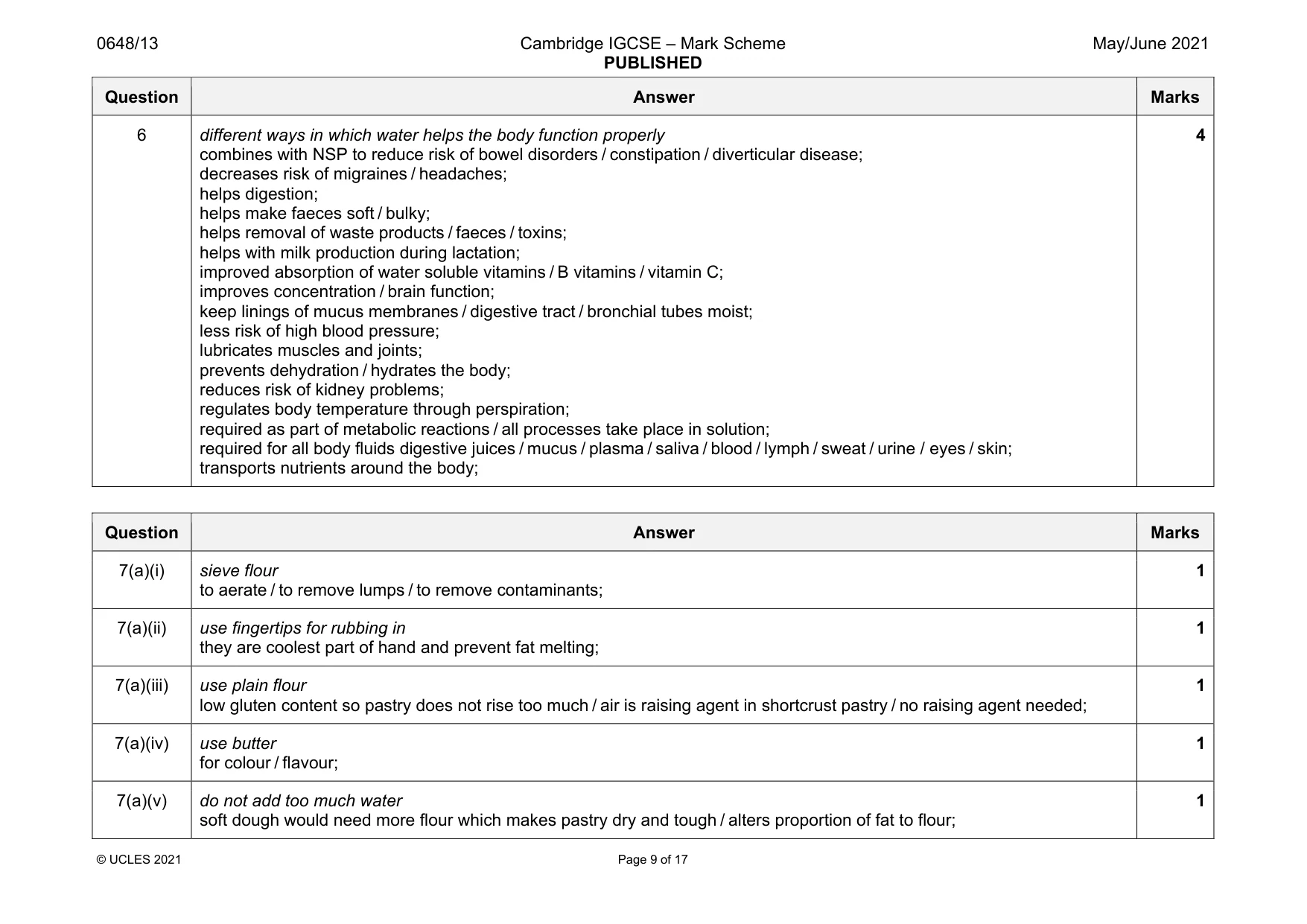
0648/13 Cambridge IGCSE – Mark Scheme PUBLISHED May/June 2021 © UCLES 2021 Page 9 of 17 Question Answer Marks 6 different ways in which water helps the body function properly combines with NSP to reduce risk of bowel disorders / constipation / diverticular disease; decreases risk of migraines / headaches; helps digestion; helps make faeces soft / bulky; helps removal of waste products / faeces / toxins; helps with milk production during lactation; improved absorption of water soluble vitamins / B vitamins / vitamin C; improves concentration / brain function; keep linings of mucus membranes / digestive tract / bronchial tubes moist; less risk of high blood pressure; lubricates muscles and joints; prevents dehydration / hydrates the body; reduces risk of kidney problems; regulates body temperature through perspiration; required as part of metabolic reactions / all processes take place in solution; required for all body fluids digestive juices / mucus / plasma / saliva / blood / lymph / sweat / urine / eyes / skin; transports nutrients around the body; 4 Question Answer Marks 7(a)(i) sieve flour to aerate / to remove lumps / to remove contaminants; 1 7(a)(ii) use fingertips for rubbing in they are coolest part of hand and prevent fat melting; 1 7(a)(iii) use plain flour low gluten content so pastry does not rise too much / air is raising agent in shortcrust pastry / no raising agent needed; 1 7(a)(iv) use butter for colour / flavour; 1 7(a)(v) do not add too much water soft dough would need more flour which makes pastry dry and tough / alters proportion of fat to flour; 1
Mark scheme, page 10
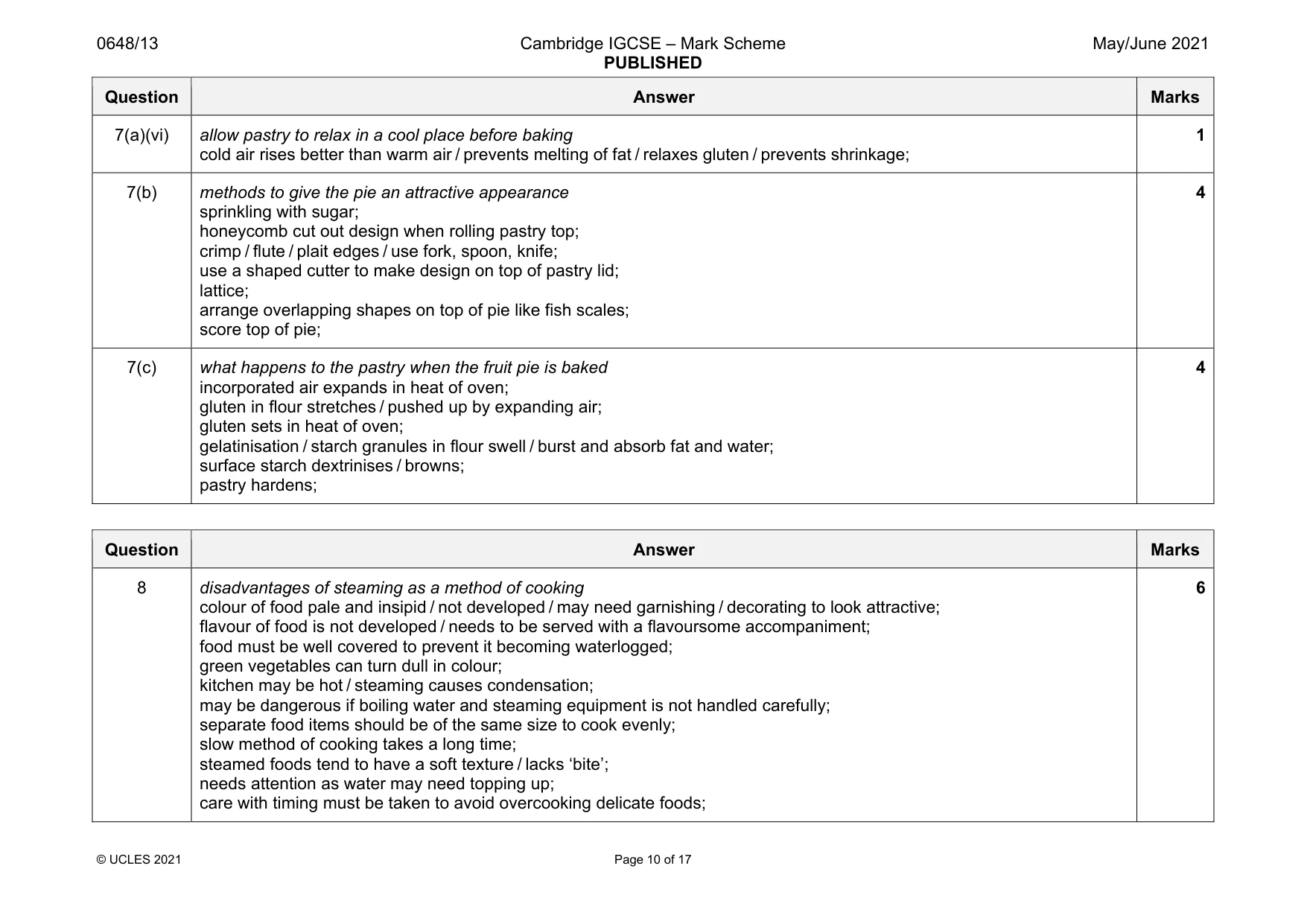
0648/13 Cambridge IGCSE – Mark Scheme PUBLISHED May/June 2021 © UCLES 2021 Page 10 of 17 Question Answer Marks 7(a)(vi) allow pastry to relax in a cool place before baking cold air rises better than warm air / prevents melting of fat / relaxes gluten / prevents shrinkage; 1 7(b) methods to give the pie an attractive appearance sprinkling with sugar; honeycomb cut out design when rolling pastry top; crimp / flute / plait edges / use fork, spoon, knife; use a shaped cutter to make design on top of pastry lid; lattice; arrange overlapping shapes on top of pie like fish scales; score top of pie; 4 7(c) what happens to the pastry when the fruit pie is baked incorporated air expands in heat of oven; gluten in flour stretches / pushed up by expanding air; gluten sets in heat of oven; gelatinisation / starch granules in flour swell / burst and absorb fat and water; surface starch dextrinises / browns; pastry hardens; 4 Question Answer Marks 8 disadvantages of steaming as a method of cooking colour of food pale and insipid / not developed / may need garnishing / decorating to look attractive; flavour of food is not developed / needs to be served with a flavoursome accompaniment; food must be well covered to prevent it becoming waterlogged; green vegetables can turn dull in colour; kitchen may be hot / steaming causes condensation; may be dangerous if boiling water and steaming equipment is not handled carefully; separate food items should be of the same size to cook evenly; slow method of cooking takes a long time; steamed foods tend to have a soft texture / lacks ‘bite’; needs attention as water may need topping up; care with timing must be taken to avoid overcooking delicate foods; 6
Mark scheme, page 11
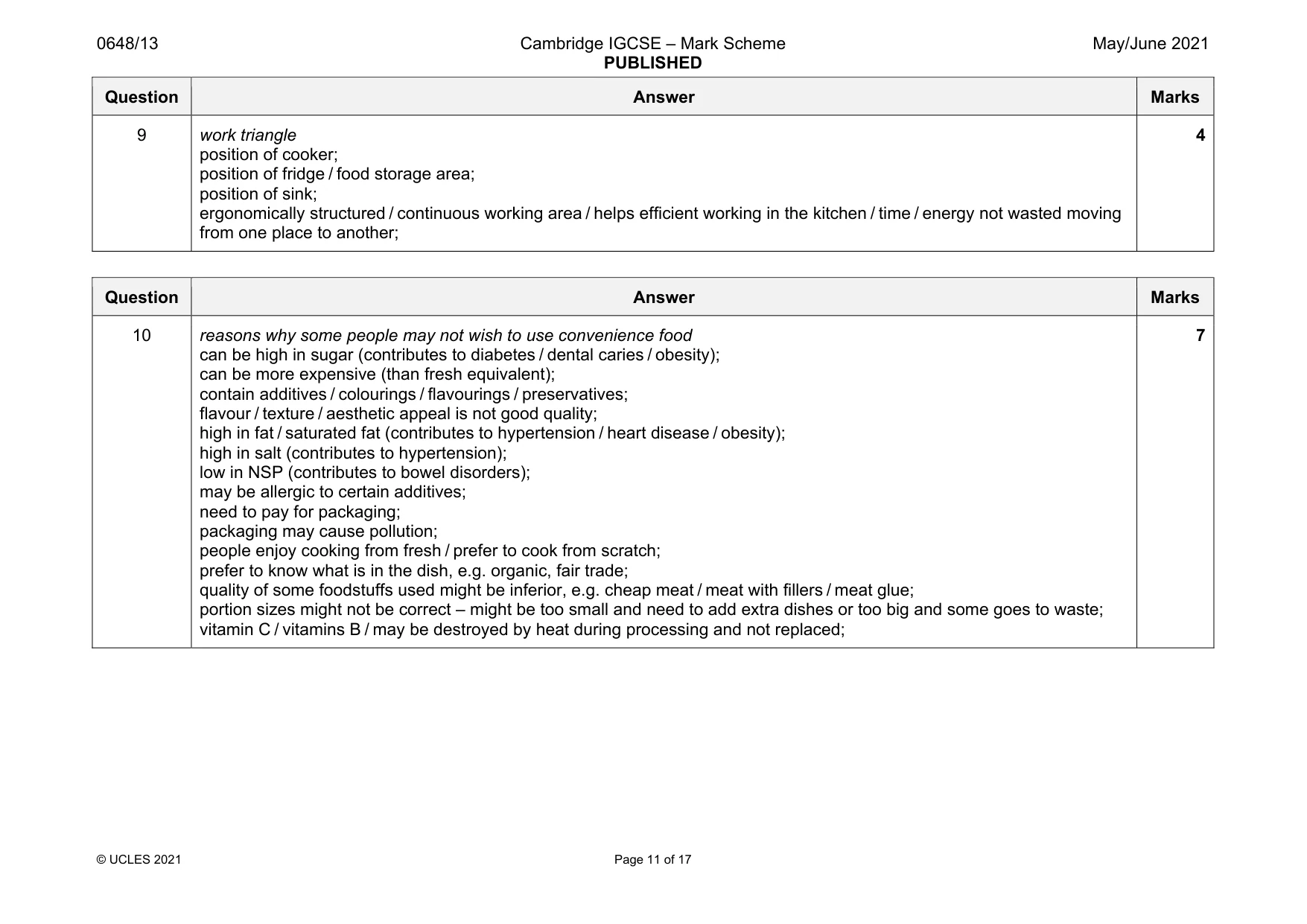
0648/13 Cambridge IGCSE – Mark Scheme PUBLISHED May/June 2021 © UCLES 2021 Page 11 of 17 Question Answer Marks 9 work triangle position of cooker; position of fridge / food storage area; position of sink; ergonomically structured / continuous working area / helps efficient working in the kitchen / time / energy not wasted moving from one place to another; 4 Question Answer Marks 10 reasons why some people may not wish to use convenience food can be high in sugar (contributes to diabetes / dental caries / obesity); can be more expensive (than fresh equivalent); contain additives / colourings / flavourings / preservatives; flavour / texture / aesthetic appeal is not good quality; high in fat / saturated fat (contributes to hypertension / heart disease / obesity); high in salt (contributes to hypertension); low in NSP (contributes to bowel disorders); may be allergic to certain additives; need to pay for packaging; packaging may cause pollution; people enjoy cooking from fresh / prefer to cook from scratch; prefer to know what is in the dish, e.g. organic, fair trade; quality of some foodstuffs used might be inferior, e.g. cheap meat / meat with fillers / meat glue; portion sizes might not be correct – might be too small and need to add extra dishes or too big and some goes to waste; vitamin C / vitamins B / may be destroyed by heat during processing and not replaced; 7
Mark scheme, page 12
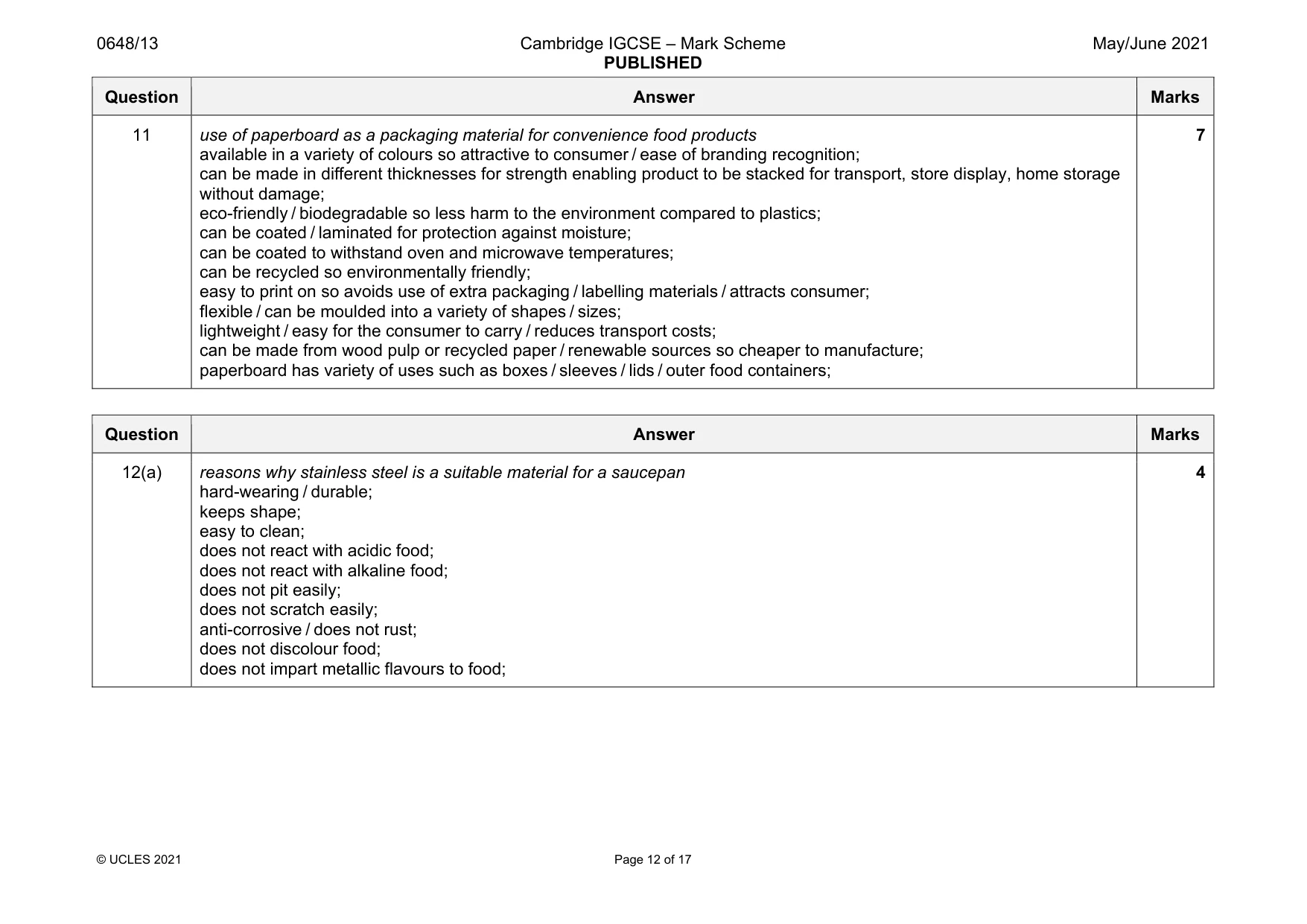
0648/13 Cambridge IGCSE – Mark Scheme PUBLISHED May/June 2021 © UCLES 2021 Page 12 of 17 Question Answer Marks 11 use of paperboard as a packaging material for convenience food products available in a variety of colours so attractive to consumer / ease of branding recognition; can be made in different thicknesses for strength enabling product to be stacked for transport, store display, home storage without damage; eco-friendly / biodegradable so less harm to the environment compared to plastics; can be coated / laminated for protection against moisture; can be coated to withstand oven and microwave temperatures; can be recycled so environmentally friendly; easy to print on so avoids use of extra packaging / labelling materials / attracts consumer; flexible / can be moulded into a variety of shapes / sizes; lightweight / easy for the consumer to carry / reduces transport costs; can be made from wood pulp or recycled paper / renewable sources so cheaper to manufacture; paperboard has variety of uses such as boxes / sleeves / lids / outer food containers; 7 Question Answer Marks 12(a) reasons why stainless steel is a suitable material for a saucepan hard-wearing / durable; keeps shape; easy to clean; does not react with acidic food; does not react with alkaline food; does not pit easily; does not scratch easily; anti-corrosive / does not rust; does not discolour food; does not impart metallic flavours to food; 4
Mark scheme, page 13
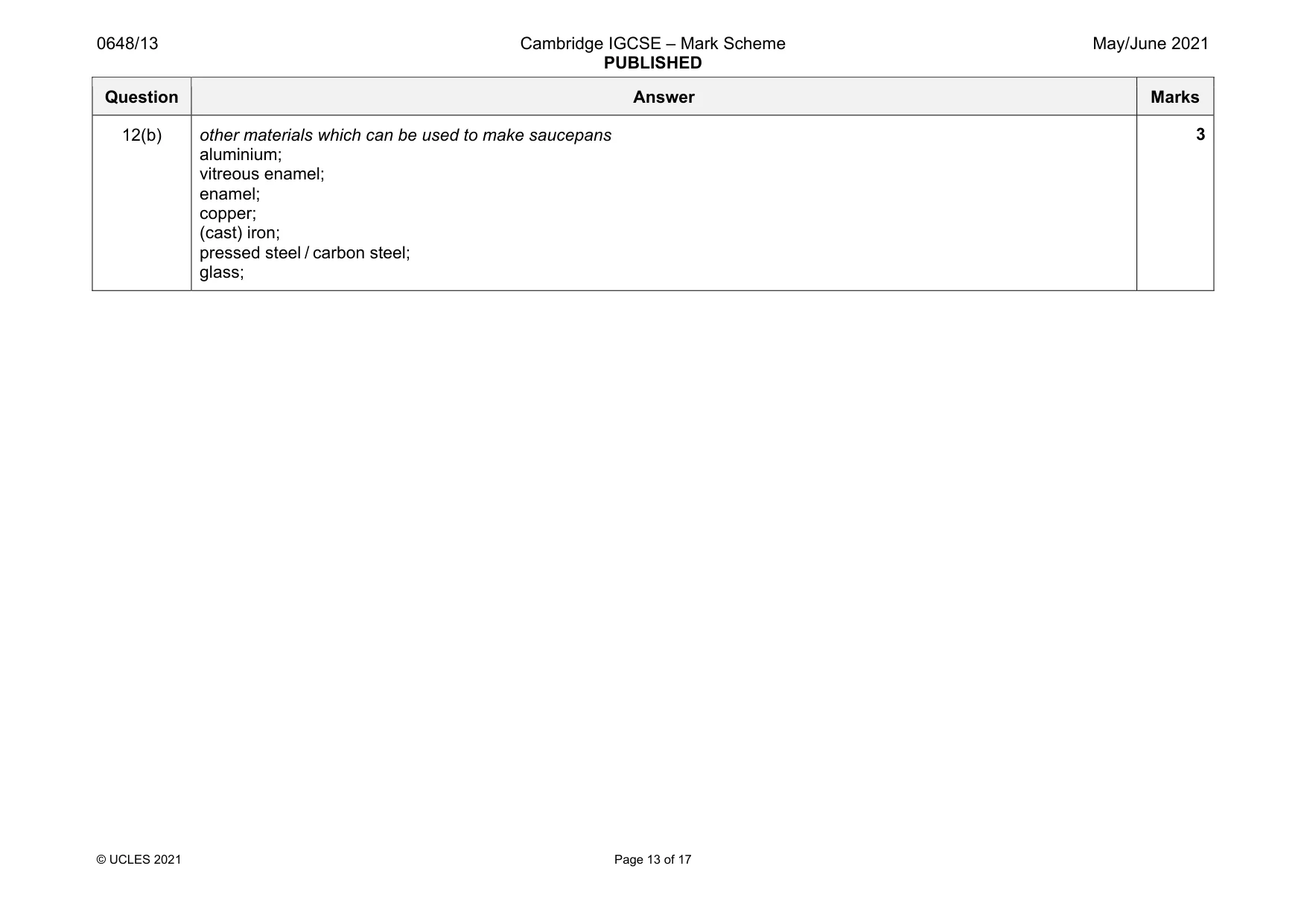
0648/13 Cambridge IGCSE – Mark Scheme PUBLISHED May/June 2021 © UCLES 2021 Page 13 of 17 Question Answer Marks 12(b) other materials which can be used to make saucepans aluminium; vitreous enamel; enamel; copper; (cast) iron; pressed steel / carbon steel; glass; 3
Mark scheme, page 14
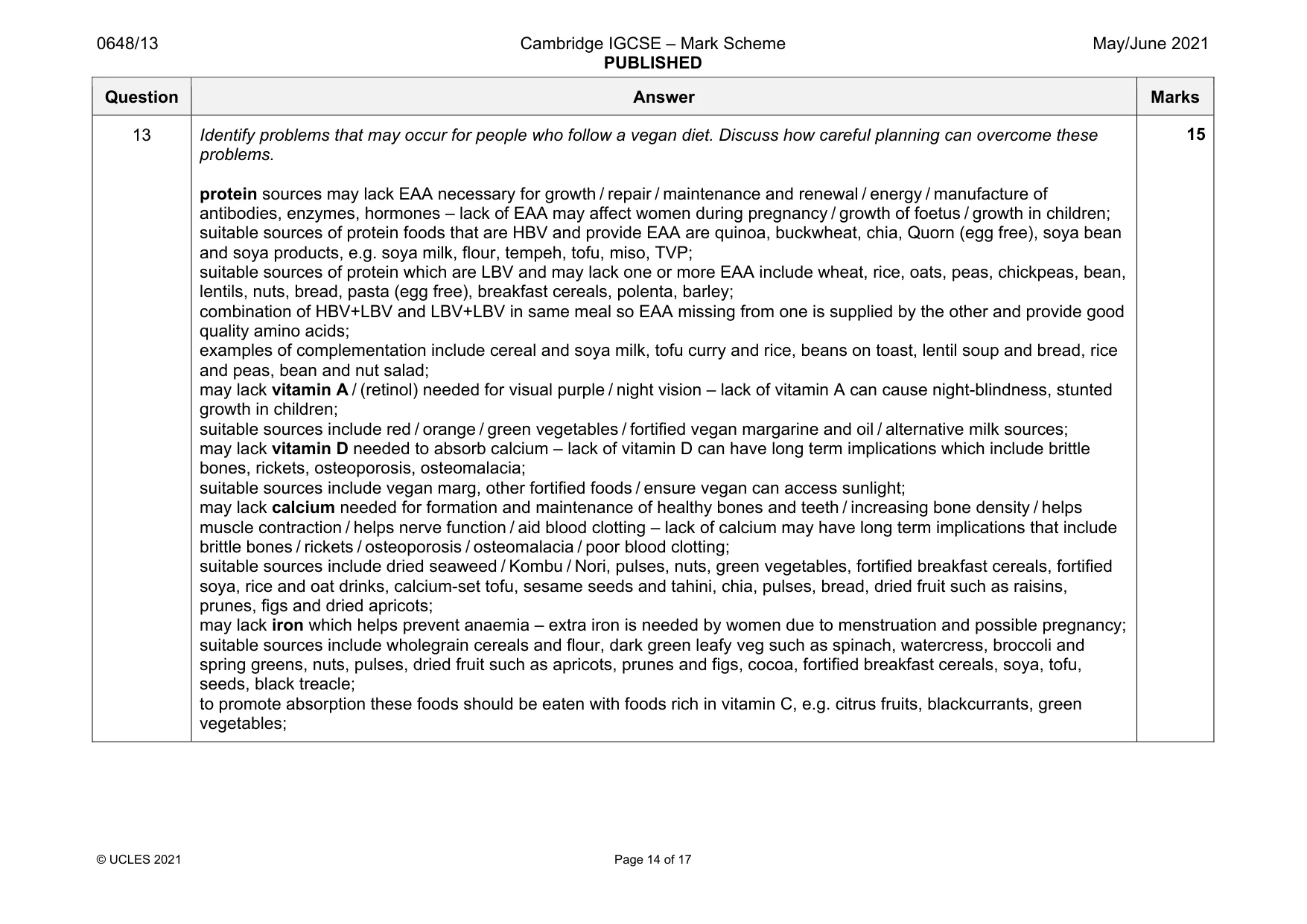
0648/13 Cambridge IGCSE – Mark Scheme PUBLISHED May/June 2021 © UCLES 2021 Page 14 of 17 Question Answer Marks 13 Identify problems that may occur for people who follow a vegan diet. Discuss how careful planning can overcome these problems. protein sources may lack EAA necessary for growth / repair / maintenance and renewal / energy / manufacture of antibodies, enzymes, hormones – lack of EAA may affect women during pregnancy / growth of foetus / growth in children; suitable sources of protein foods that are HBV and provide EAA are quinoa, buckwheat, chia, Quorn (egg free), soya bean and soya products, e.g. soya milk, flour, tempeh, tofu, miso, TVP; suitable sources of protein which are LBV and may lack one or more EAA include wheat, rice, oats, peas, chickpeas, bean, lentils, nuts, bread, pasta (egg free), breakfast cereals, polenta, barley; combination of HBV+LBV and LBV+LBV in same meal so EAA missing from one is supplied by the other and provide good quality amino acids; examples of complementation include cereal and soya milk, tofu curry and rice, beans on toast, lentil soup and bread, rice and peas, bean and nut salad; may lack vitamin A / (retinol) needed for visual purple / night vision – lack of vitamin A can cause night-blindness, stunted growth in children; suitable sources include red / orange / green vegetables / fortified vegan margarine and oil / alternative milk sources; may lack vitamin D needed to absorb calcium – lack of vitamin D can have long term implications which include brittle bones, rickets, osteoporosis, osteomalacia; suitable sources include vegan marg, other fortified foods / ensure vegan can access sunlight; may lack calcium needed for formation and maintenance of healthy bones and teeth / increasing bone density / helps muscle contraction / helps nerve function / aid blood clotting – lack of calcium may have long term implications that include brittle bones / rickets / osteoporosis / osteomalacia / poor blood clotting; suitable sources include dried seaweed / Kombu / Nori, pulses, nuts, green vegetables, fortified breakfast cereals, fortified soya, rice and oat drinks, calcium-set tofu, sesame seeds and tahini, chia, pulses, bread, dried fruit such as raisins, prunes, figs and dried apricots; may lack iron which helps prevent anaemia – extra iron is needed by women due to menstruation and possible pregnancy; suitable sources include wholegrain cereals and flour, dark green leafy veg such as spinach, watercress, broccoli and spring greens, nuts, pulses, dried fruit such as apricots, prunes and figs, cocoa, fortified breakfast cereals, soya, tofu, seeds, black treacle; to promote absorption these foods should be eaten with foods rich in vitamin C, e.g. citrus fruits, blackcurrants, green vegetables; 15
Mark scheme, page 15
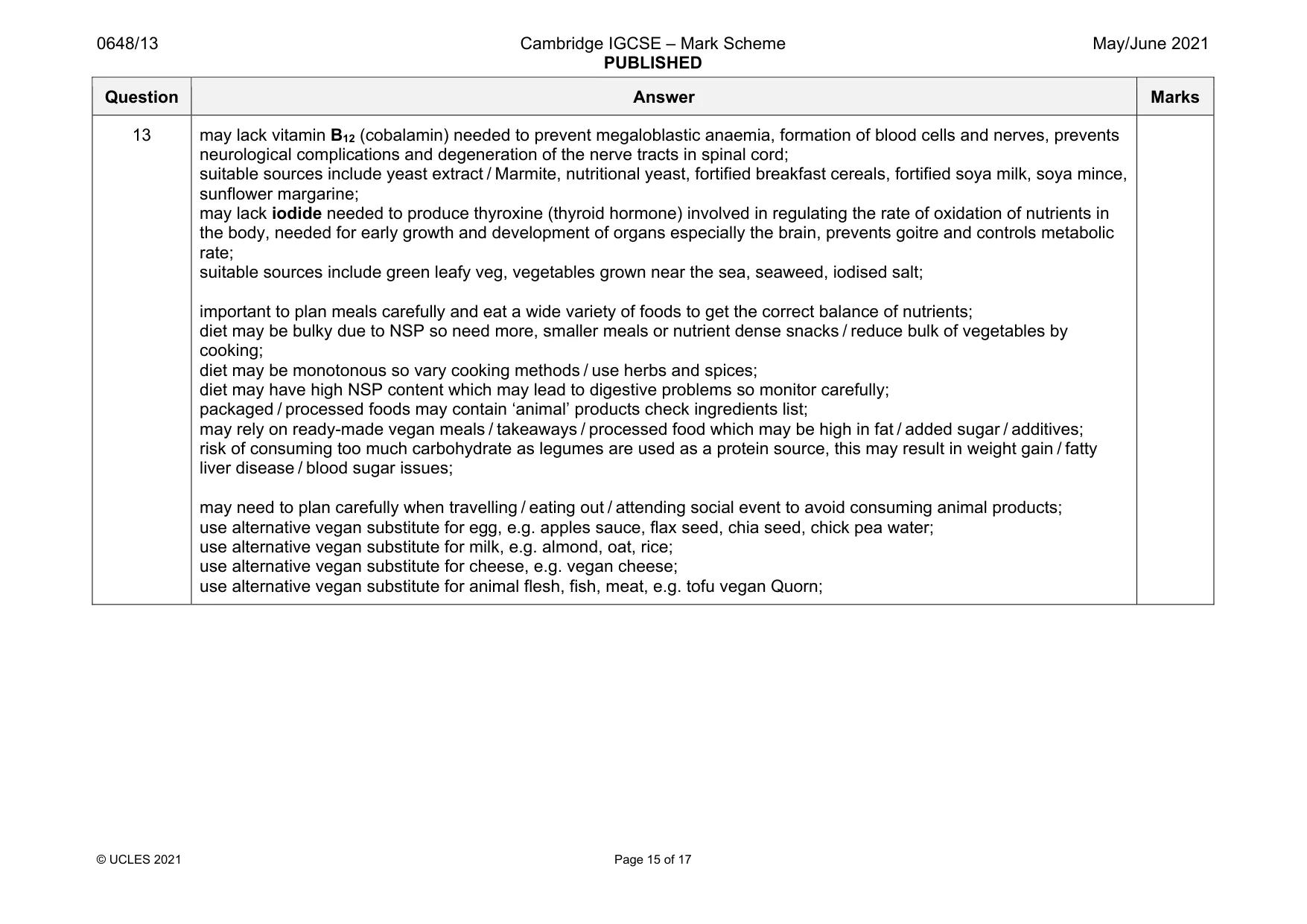
0648/13 Cambridge IGCSE – Mark Scheme PUBLISHED May/June 2021 © UCLES 2021 Page 15 of 17 Question Answer Marks 13 may lack vitamin B12 (cobalamin) needed to prevent megaloblastic anaemia, formation of blood cells and nerves, prevents neurological complications and degeneration of the nerve tracts in spinal cord; suitable sources include yeast extract / Marmite, nutritional yeast, fortified breakfast cereals, fortified soya milk, soya mince, sunflower margarine; may lack iodide needed to produce thyroxine (thyroid hormone) involved in regulating the rate of oxidation of nutrients in the body, needed for early growth and development of organs especially the brain, prevents goitre and controls metabolic rate; suitable sources include green leafy veg, vegetables grown near the sea, seaweed, iodised salt; important to plan meals carefully and eat a wide variety of foods to get the correct balance of nutrients; diet may be bulky due to NSP so need more, smaller meals or nutrient dense snacks / reduce bulk of vegetables by cooking; diet may be monotonous so vary cooking methods / use herbs and spices; diet may have high NSP content which may lead to digestive problems so monitor carefully; packaged / processed foods may contain ‘animal’ products check ingredients list; may rely on ready-made vegan meals / takeaways / processed food which may be high in fat / added sugar / additives; risk of consuming too much carbohydrate as legumes are used as a protein source, this may result in weight gain / fatty liver disease / blood sugar issues; may need to plan carefully when travelling / eating out / attending social event to avoid consuming animal products; use alternative vegan substitute for egg, e.g. apples sauce, flax seed, chia seed, chick pea water; use alternative vegan substitute for milk, e.g. almond, oat, rice; use alternative vegan substitute for cheese, e.g. vegan cheese; use alternative vegan substitute for animal flesh, fish, meat, e.g. tofu vegan Quorn;
Mark scheme, page 16
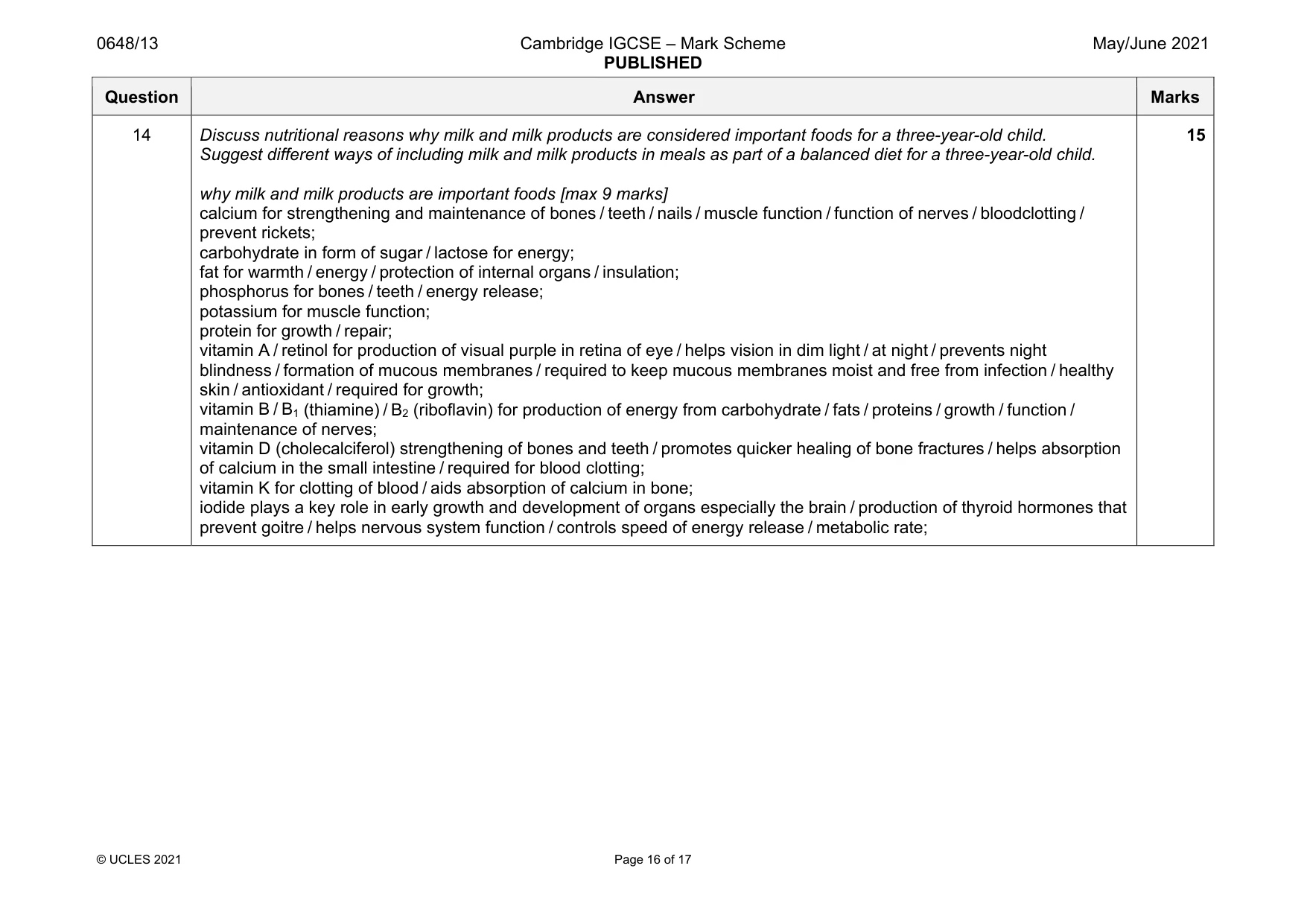
0648/13 Cambridge IGCSE – Mark Scheme PUBLISHED May/June 2021 © UCLES 2021 Page 16 of 17 Question Answer Marks 14 Discuss nutritional reasons why milk and milk products are considered important foods for a three-year-old child. Suggest different ways of including milk and milk products in meals as part of a balanced diet for a three-year-old child. why milk and milk products are important foods [max 9 marks] calcium for strengthening and maintenance of bones / teeth / nails / muscle function / function of nerves / bloodclotting / prevent rickets; carbohydrate in form of sugar / lactose for energy; fat for warmth / energy / protection of internal organs / insulation; phosphorus for bones / teeth / energy release; potassium for muscle function; protein for growth / repair; vitamin A / retinol for production of visual purple in retina of eye / helps vision in dim light / at night / prevents night blindness / formation of mucous membranes / required to keep mucous membranes moist and free from infection / healthy skin / antioxidant / required for growth; vitamin B / B1 (thiamine) / B2 (riboflavin) for production of energy from carbohydrate / fats / proteins / growth / function / maintenance of nerves; vitamin D (cholecalciferol) strengthening of bones and teeth / promotes quicker healing of bone fractures / helps absorption of calcium in the small intestine / required for blood clotting; vitamin K for clotting of blood / aids absorption of calcium in bone; iodide plays a key role in early growth and development of organs especially the brain / production of thyroid hormones that prevent goitre / helps nervous system function / controls speed of energy release / metabolic rate; 15
Mark scheme, page 17
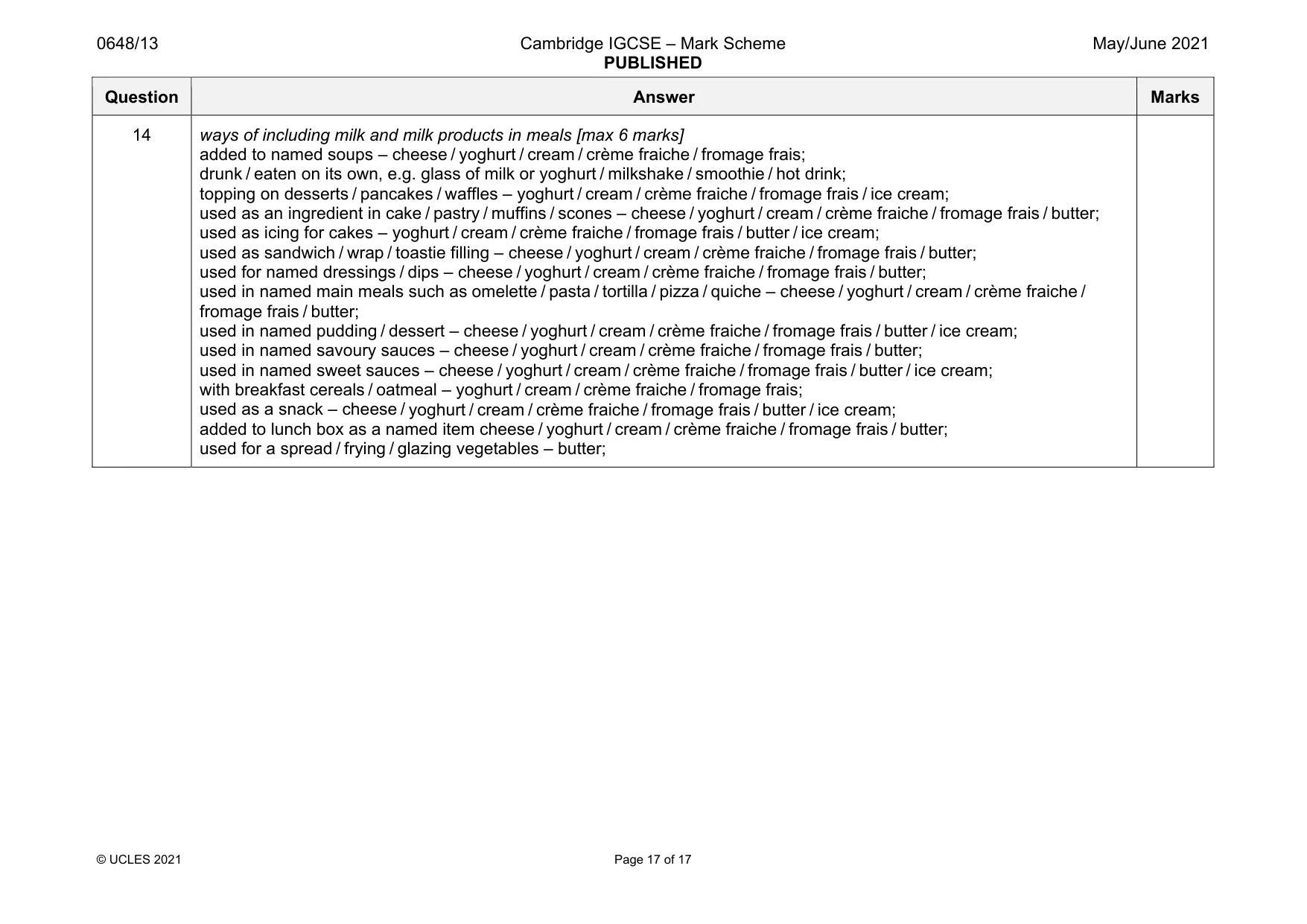
0648/13 Cambridge IGCSE – Mark Scheme PUBLISHED May/June 2021 © UCLES 2021 Page 17 of 17 Question Answer Marks 14 ways of including milk and milk products in meals [max 6 marks] added to named soups – cheese / yoghurt / cream / crème fraiche / fromage frais; drunk / eaten on its own, e.g. glass of milk or yoghurt / milkshake / smoothie / hot drink; topping on desserts / pancakes / waffles – yoghurt / cream / crème fraiche / fromage frais / ice cream; used as an ingredient in cake / pastry / muffins / scones – cheese / yoghurt / cream / crème fraiche / fromage frais / butter; used as icing for cakes – yoghurt / cream / crème fraiche / fromage frais / butter / ice cream; used as sandwich / wrap / toastie filling – cheese / yoghurt / cream / crème fraiche / fromage frais / butter; used for named dressings / dips – cheese / yoghurt / cream / crème fraiche / fromage frais / butter; used in named main meals such as omelette / pasta / tortilla / pizza / quiche – cheese / yoghurt / cream / crème fraiche / fromage frais / butter; used in named pudding / dessert – cheese / yoghurt / cream / crème fraiche / fromage frais / butter / ice cream; used in named savoury sauces – cheese / yoghurt / cream / crème fraiche / fromage frais / butter; used in named sweet sauces – cheese / yoghurt / cream / crème fraiche / fromage frais / butter / ice cream; with breakfast cereals / oatmeal – yoghurt / cream / crème fraiche / fromage frais; used as a snack – cheese / yoghurt / cream / crème fraiche / fromage frais / butter / ice cream; added to lunch box as a named item cheese / yoghurt / cream / crème fraiche / fromage frais / butter; used for a spread / frying / glazing vegetables – butter;
What you needed in this session
Cambridge’s own grade thresholds for 2021 May/June, Paper 1 · Variant 3. A higher threshold means an easier paper — the bar moves with how the cohort did.