Cambridge IGCSE Food and Nutrition 0648 — 2020 Oct/Nov Paper 1 · Variant 2
0648/12/O/N/20 · 100 marks · ≈113 min
The question paper and its mark scheme, free to read here and free to download. This is Cambridge’s own paper, exactly as it was sat.
Question paper12 pages


Mark scheme18 pages
Answers below. Sit the paper first if you are practising.
Paper as text
Question paper, page 1
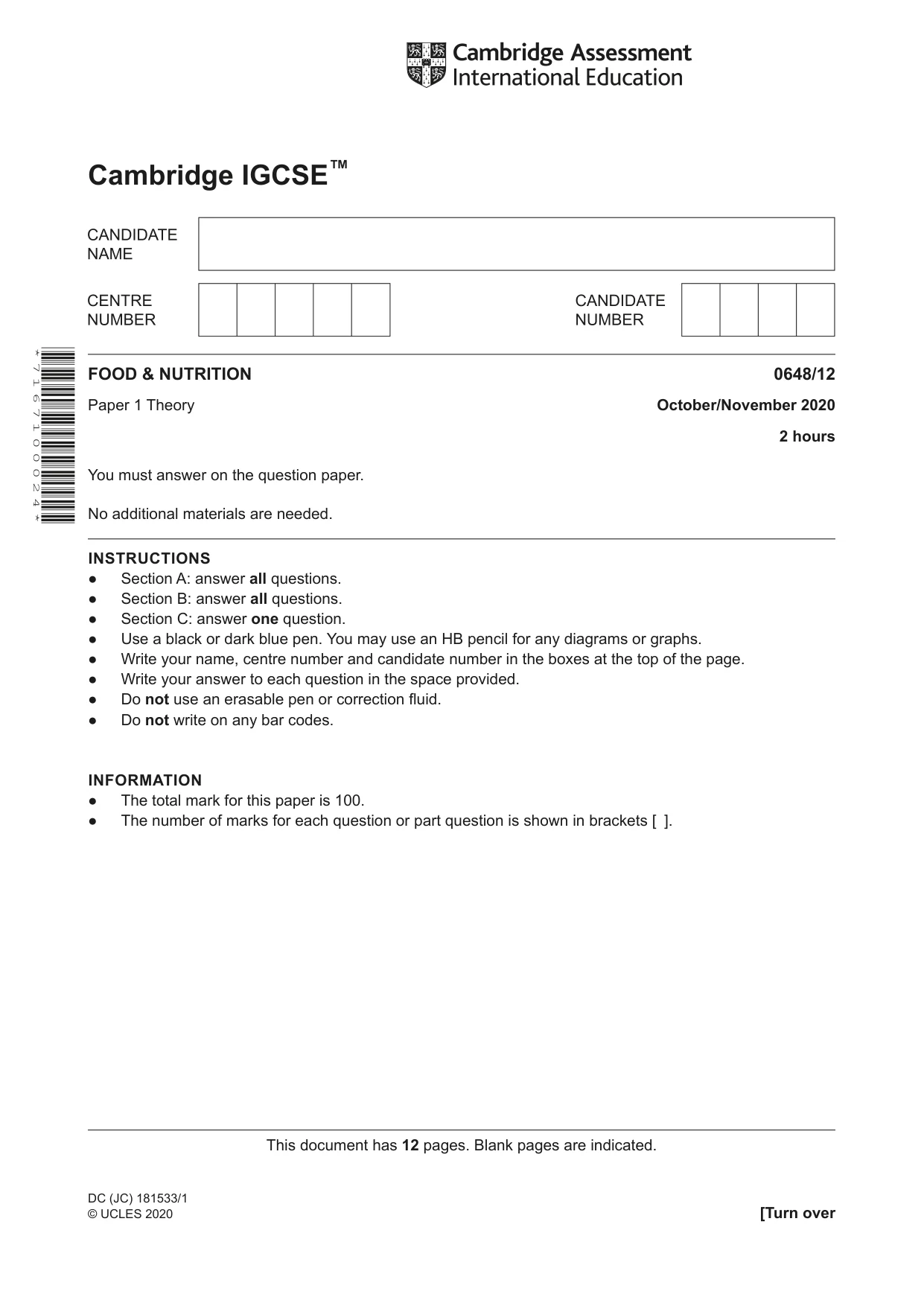
Cambridge IGCSE™ * 7 1 6 7 1 0 0 0 2 4 * This document has 12 pages. Blank pages are indicated. DC (JC) 181533/1 © UCLES 2020 [Turn over FOOD & NUTRITION 0648/12 Paper 1 Theory October/November 2020 2 hours You must answer on the question paper. No additional materials are needed. INSTRUCTIONS ● Section A: answer all questions. ● Section B: answer all questions. ● Section C: answer one question. ● Use a black or dark blue pen. You may use an HB pencil for any diagrams or graphs. ● Write your name, centre number and candidate number in the boxes at the top of the page. ● Write your answer to each question in the space provided. ● Do not use an erasable pen or correction fluid. ● Do not write on any bar codes. INFORMATION ● The total mark for this paper is 100. ● The number of marks for each question or part question is shown in brackets [ ].
Question paper, page 2
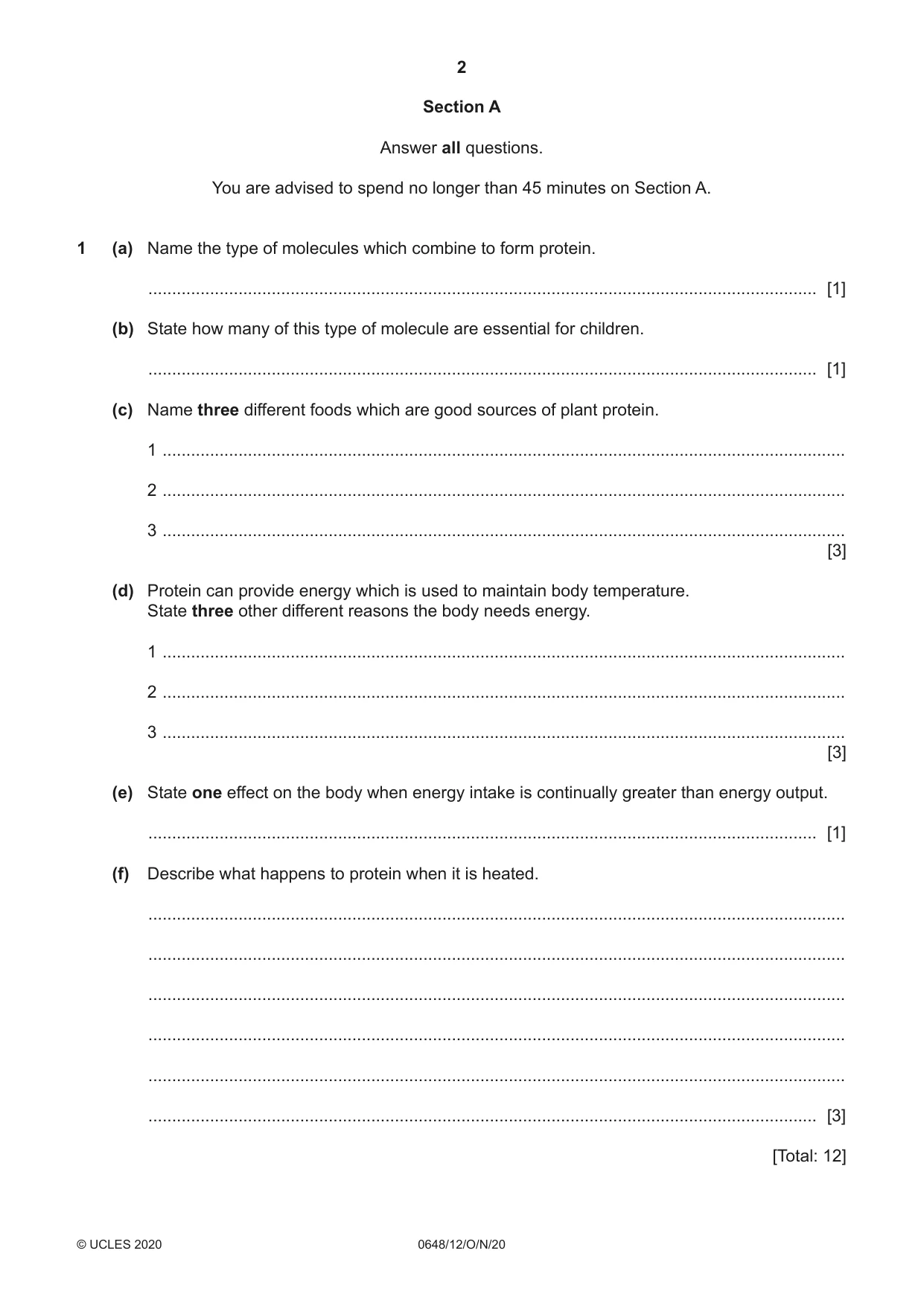
2 0648/12/O/N/20 © UCLES 2020 Section A Answer all questions. You are advised to spend no longer than 45 minutes on Section A. 1 (a) Name the type of molecules which combine to form protein. … [1] (b) State how many of this type of molecule are essential for children. … [1] (c) Name three different foods which are good sources of plant protein. 1 … 2 … 3 … [3] (d) Protein can provide energy which is used to maintain body temperature. State three other different reasons the body needs energy. 1 … 2 … 3 … [3] (e) State one effect on the body when energy intake is continually greater than energy output. … [1] (f) Describe what happens to protein when it is heated. … … … … … … [3] [Total: 12]
Question paper, page 3
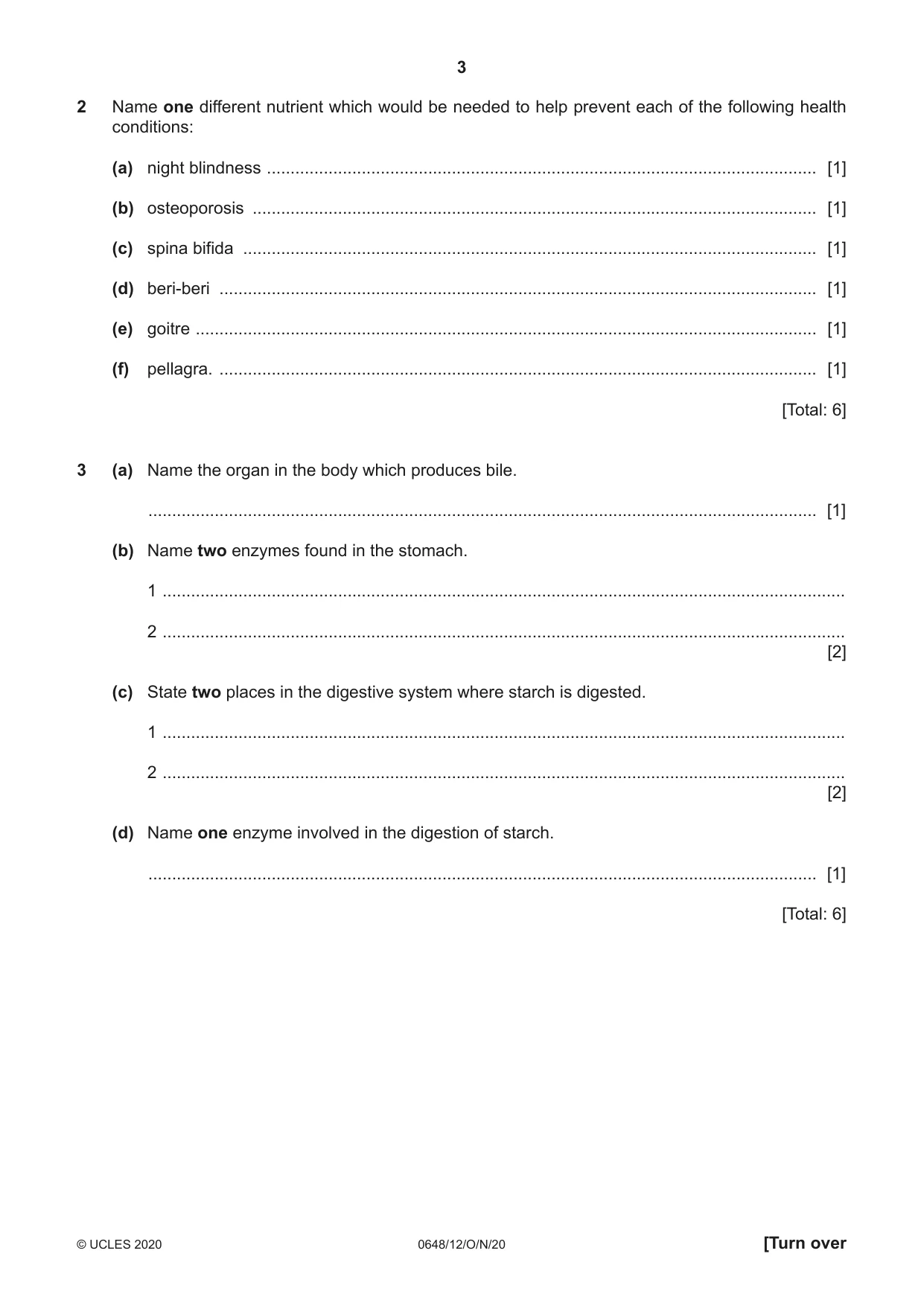
3 0648/12/O/N/20 © UCLES 2020 [Turn over 2 Name one different nutrient which would be needed to help prevent each of the following health conditions: (a) night blindness … [1] (b) osteoporosis … [1] (c) spina bifida … [1] (d) beri-beri … [1] (e) goitre … [1] (f) pellagra. … [1] [Total: 6] 3 (a) Name the organ in the body which produces bile. … [1] (b) Name two enzymes found in the stomach. 1 … 2 … [2] (c) State two places in the digestive system where starch is digested. 1 … 2 … [2] (d) Name one enzyme involved in the digestion of starch. … [1] [Total: 6]
Question paper, page 4
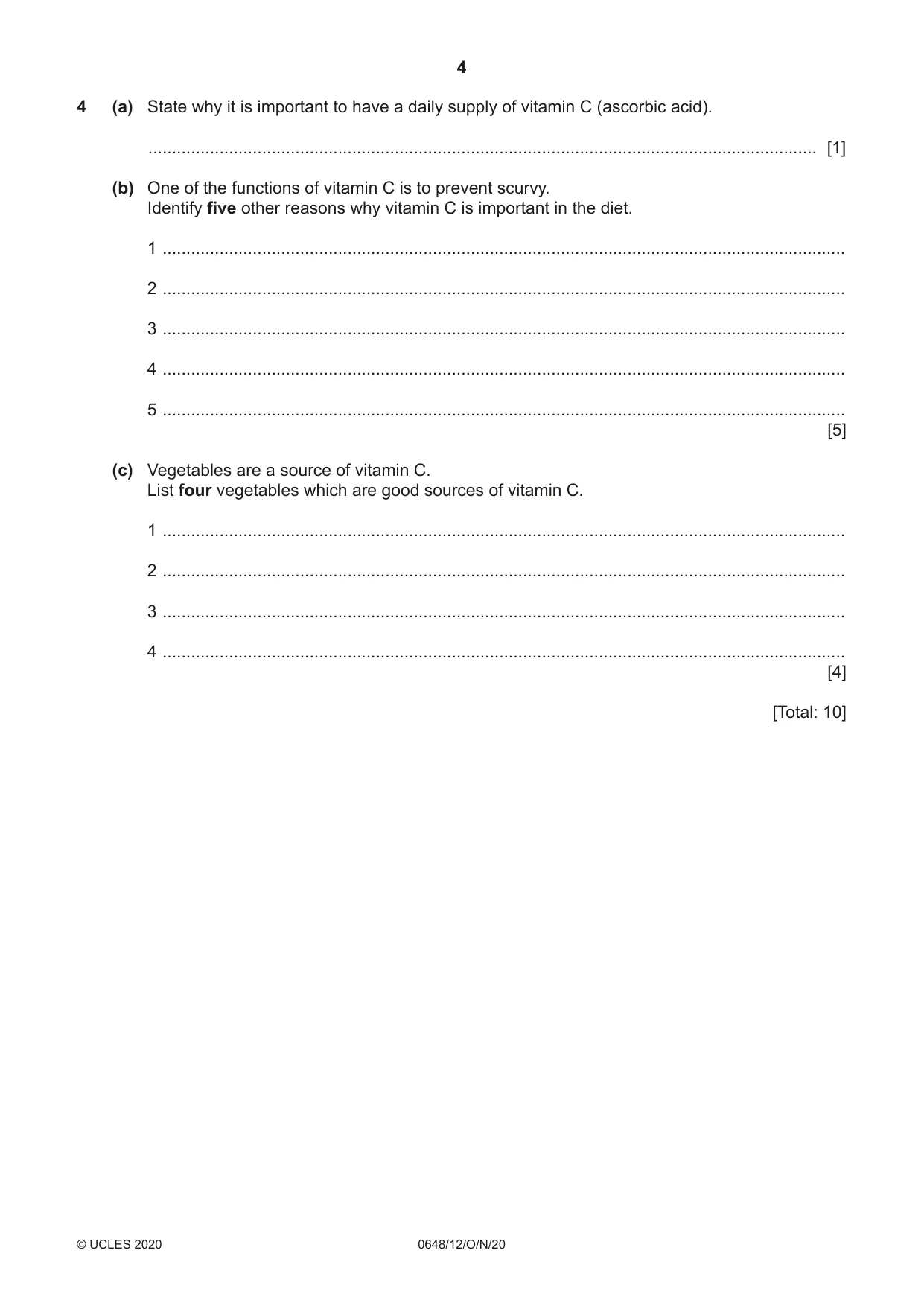
4 0648/12/O/N/20 © UCLES 2020 4 (a) State why it is important to have a daily supply of vitamin C (ascorbic acid). … [1] (b) One of the functions of vitamin C is to prevent scurvy. Identify five other reasons why vitamin C is important in the diet. 1 … 2 … 3 … 4 … 5 … [5] (c) Vegetables are a source of vitamin C. List four vegetables which are good sources of vitamin C. 1 … 2 … 3 … 4 … [4] [Total: 10]
Question paper, page 5
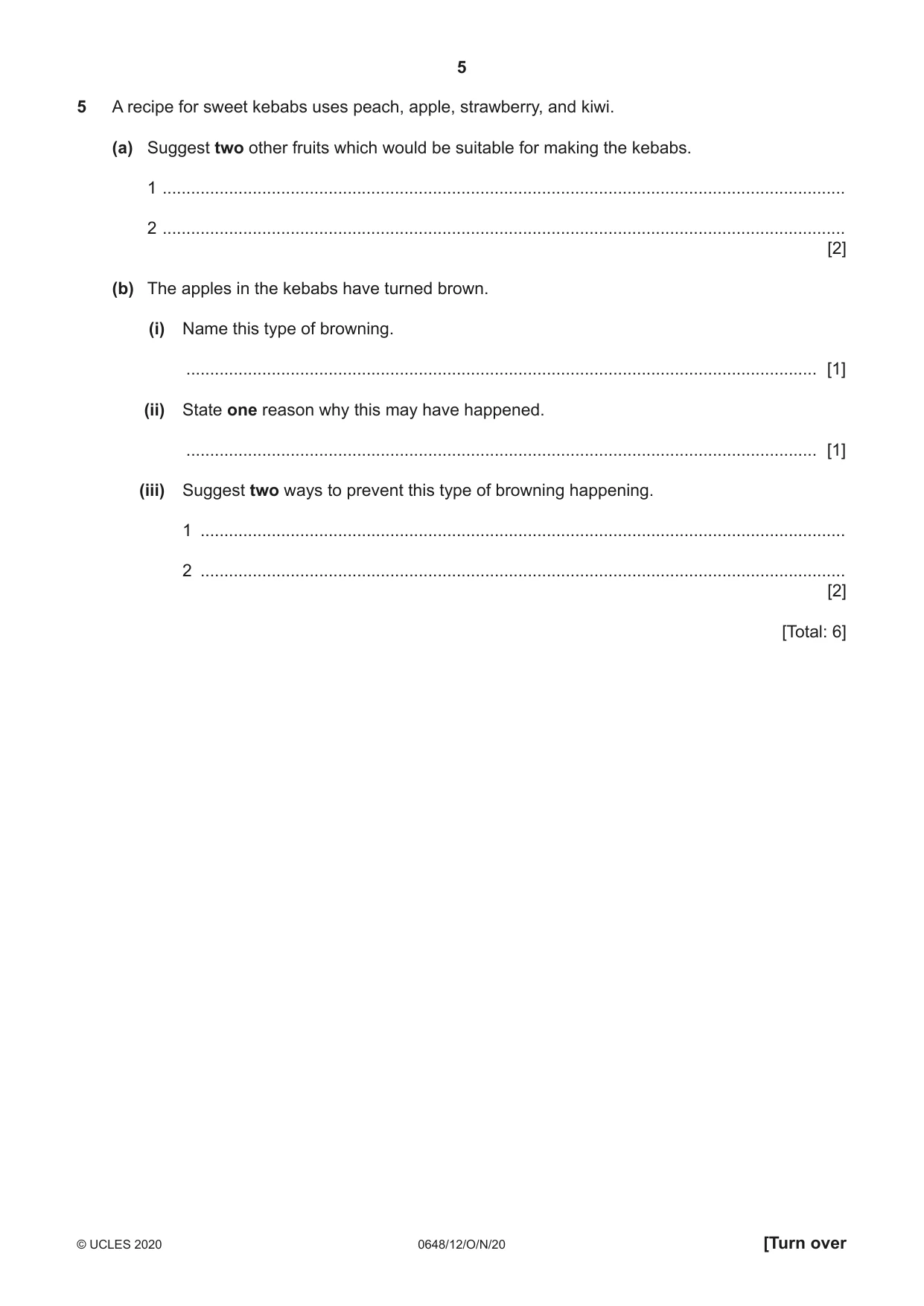
5 0648/12/O/N/20 © UCLES 2020 [Turn over 5 A recipe for sweet kebabs uses peach, apple, strawberry, and kiwi. (a) Suggest two other fruits which would be suitable for making the kebabs. 1 … 2 … [2] (b) The apples in the kebabs have turned brown. (i) Name this type of browning. … [1] (ii) State one reason why this may have happened. … [1] (iii) Suggest two ways to prevent this type of browning happening. 1 … 2 … [2] [Total: 6]
Question paper, page 6
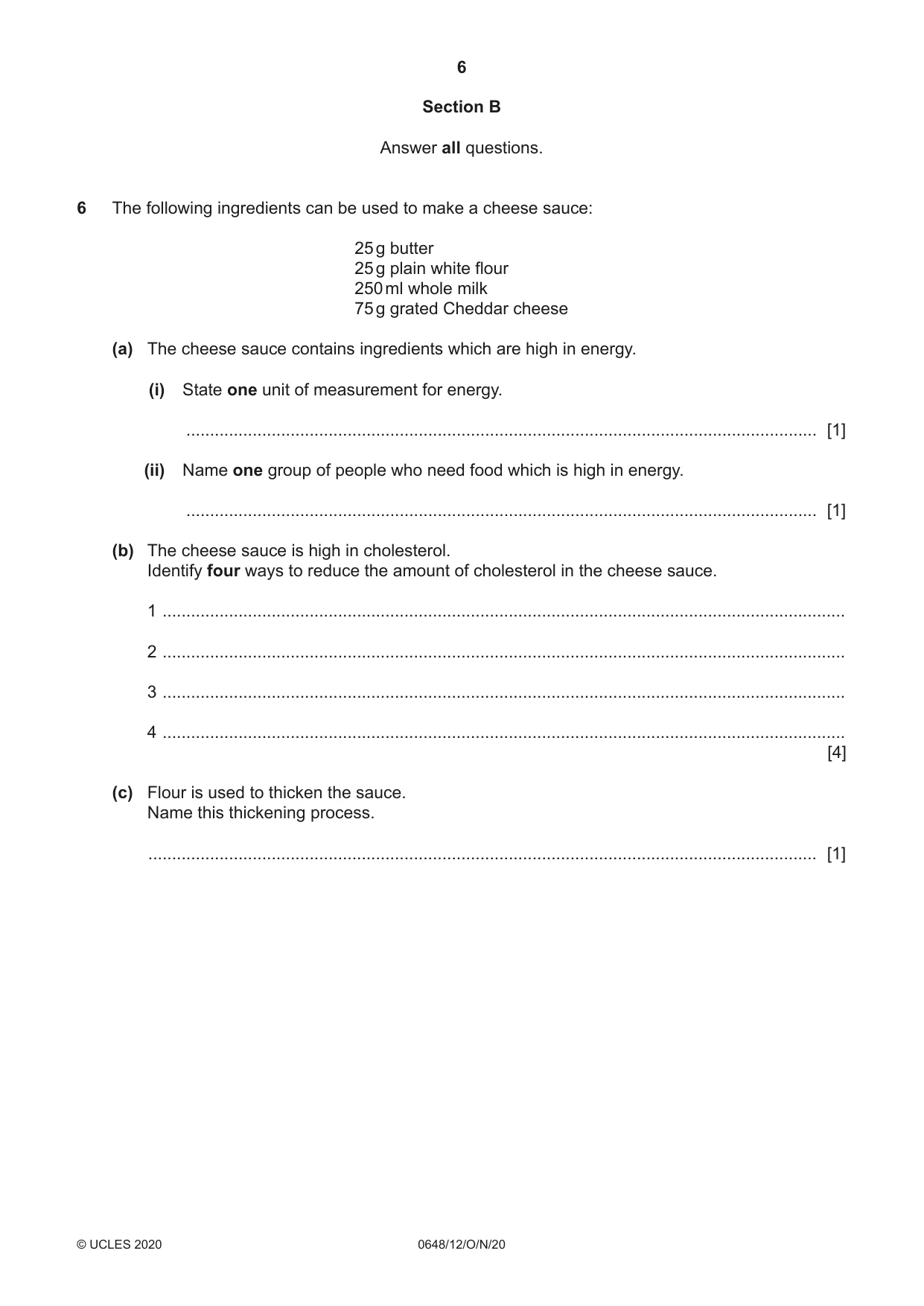
6 0648/12/O/N/20 © UCLES 2020 Section B Answer all questions. 6 The following ingredients can be used to make a cheese sauce: 25 g butter 25 g plain white flour 250 ml whole milk 75 g grated Cheddar cheese (a) The cheese sauce contains ingredients which are high in energy. (i) State one unit of measurement for energy. … [1] (ii) Name one group of people who need food which is high in energy. … [1] (b) The cheese sauce is high in cholesterol. Identify four ways to reduce the amount of cholesterol in the cheese sauce. 1 … 2 … 3 … 4 … [4] (c) Flour is used to thicken the sauce. Name this thickening process. … [1]
Question paper, page 7
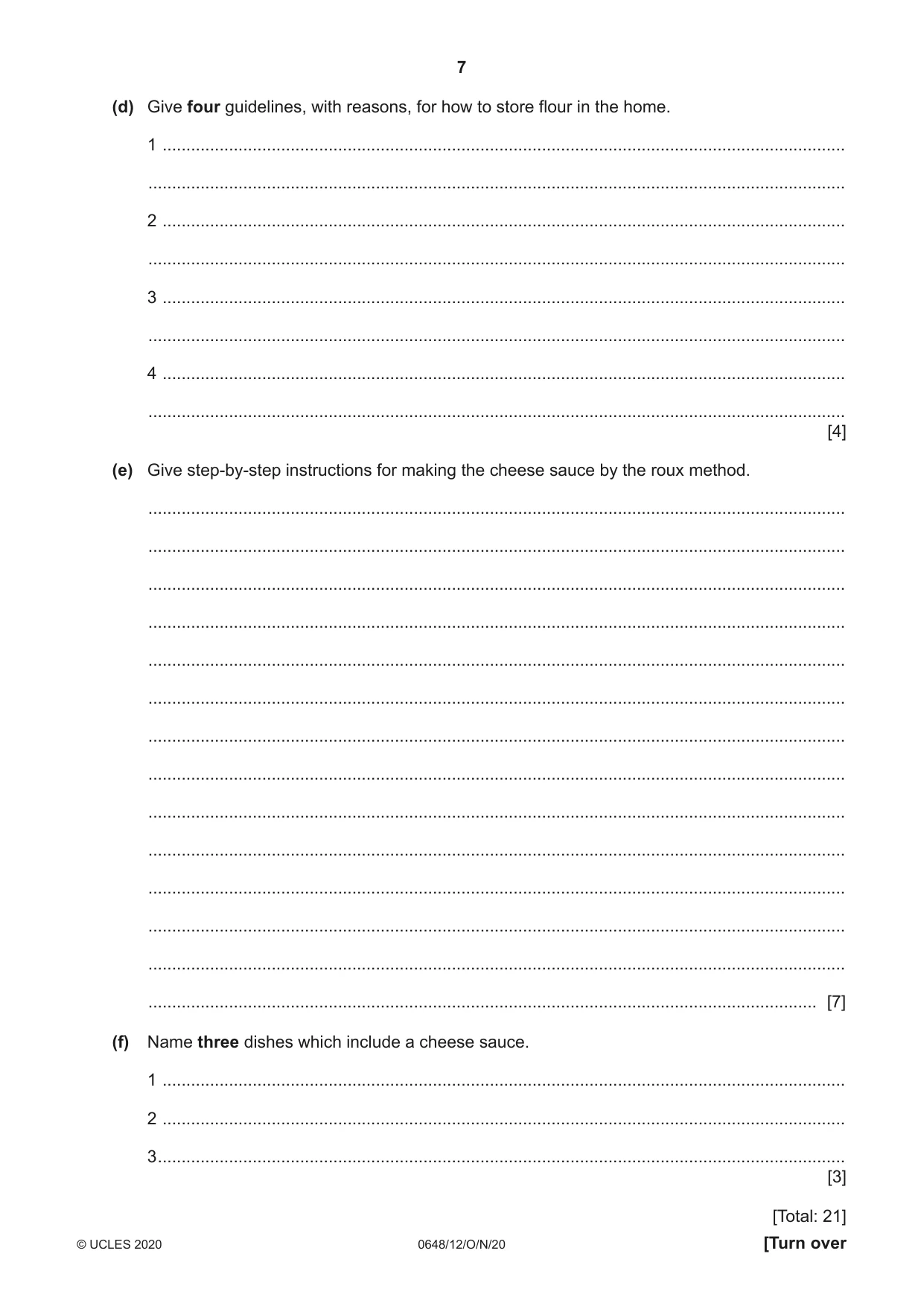
7 0648/12/O/N/20 © UCLES 2020 [Turn over (d) Give four guidelines, with reasons, for how to store flour in the home. 1 … … 2 … … 3 … … 4 … … [4] (e) Give step-by-step instructions for making the cheese sauce by the roux method. … … … … … … … … … … … … … … [7] (f) Name three dishes which include a cheese sauce. 1 … 2 … 3 … [3] [Total: 21]
Question paper, page 8
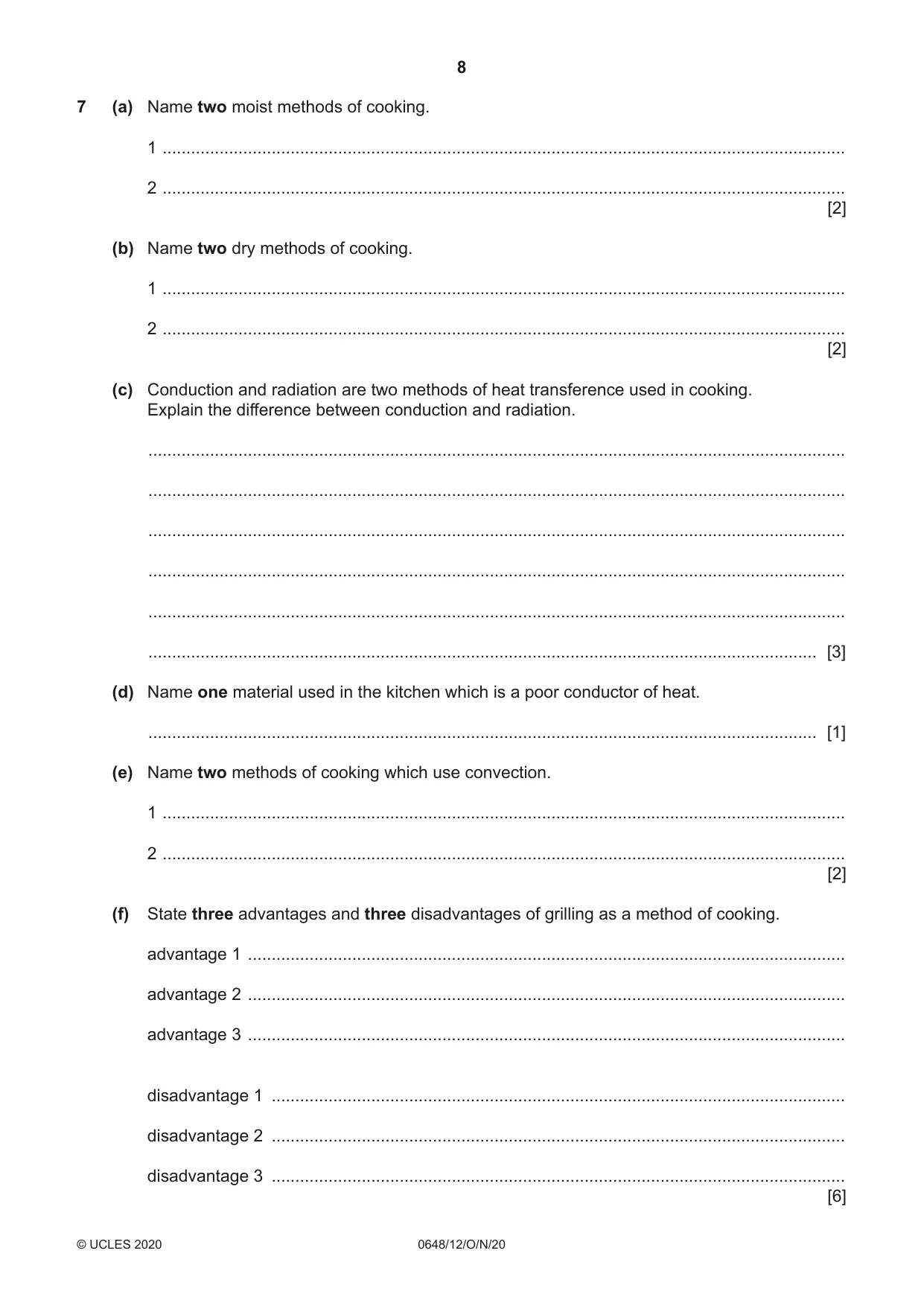
8 0648/12/O/N/20 © UCLES 2020 7 (a) Name two moist methods of cooking. 1 … 2 … [2] (b) Name two dry methods of cooking. 1 … 2 … [2] (c) Conduction and radiation are two methods of heat transference used in cooking. Explain the difference between conduction and radiation. … … … … … … [3] (d) Name one material used in the kitchen which is a poor conductor of heat. … [1] (e) Name two methods of cooking which use convection. 1 … 2 … [2] (f) State three advantages and three disadvantages of grilling as a method of cooking. advantage 1 … advantage 2 … advantage 3 … disadvantage 1 … disadvantage 2 … disadvantage 3 … [6]
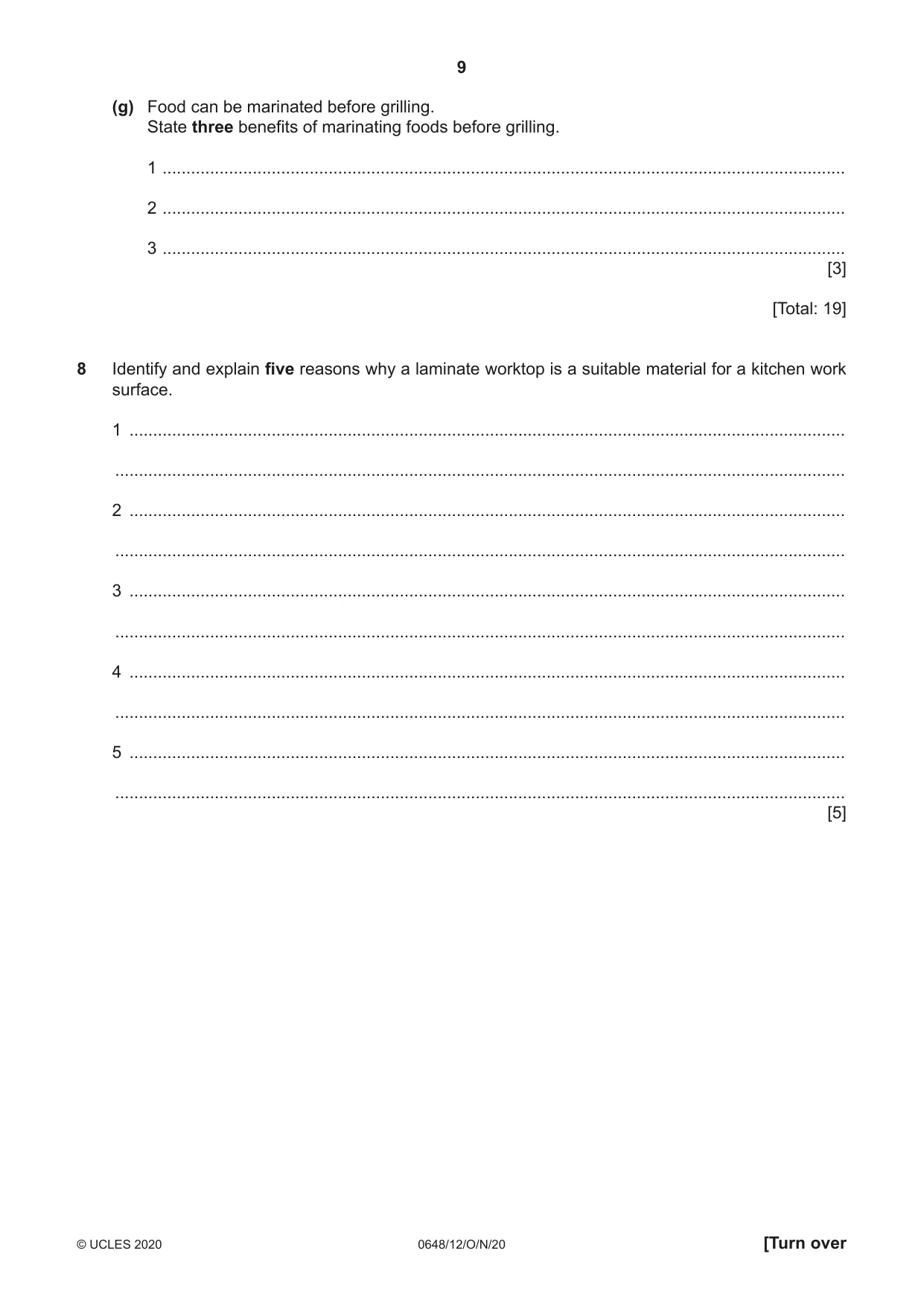
Question paper, page 9
9 0648/12/O/N/20 © UCLES 2020 [Turn over (g) Food can be marinated before grilling. State three benefits of marinating foods before grilling. 1 … 2 … 3 … [3] [Total: 19] 8 Identify and explain five reasons why a laminate worktop is a suitable material for a kitchen work surface. 1 … … 2 … … 3 … … 4 … … 5 … … [5]
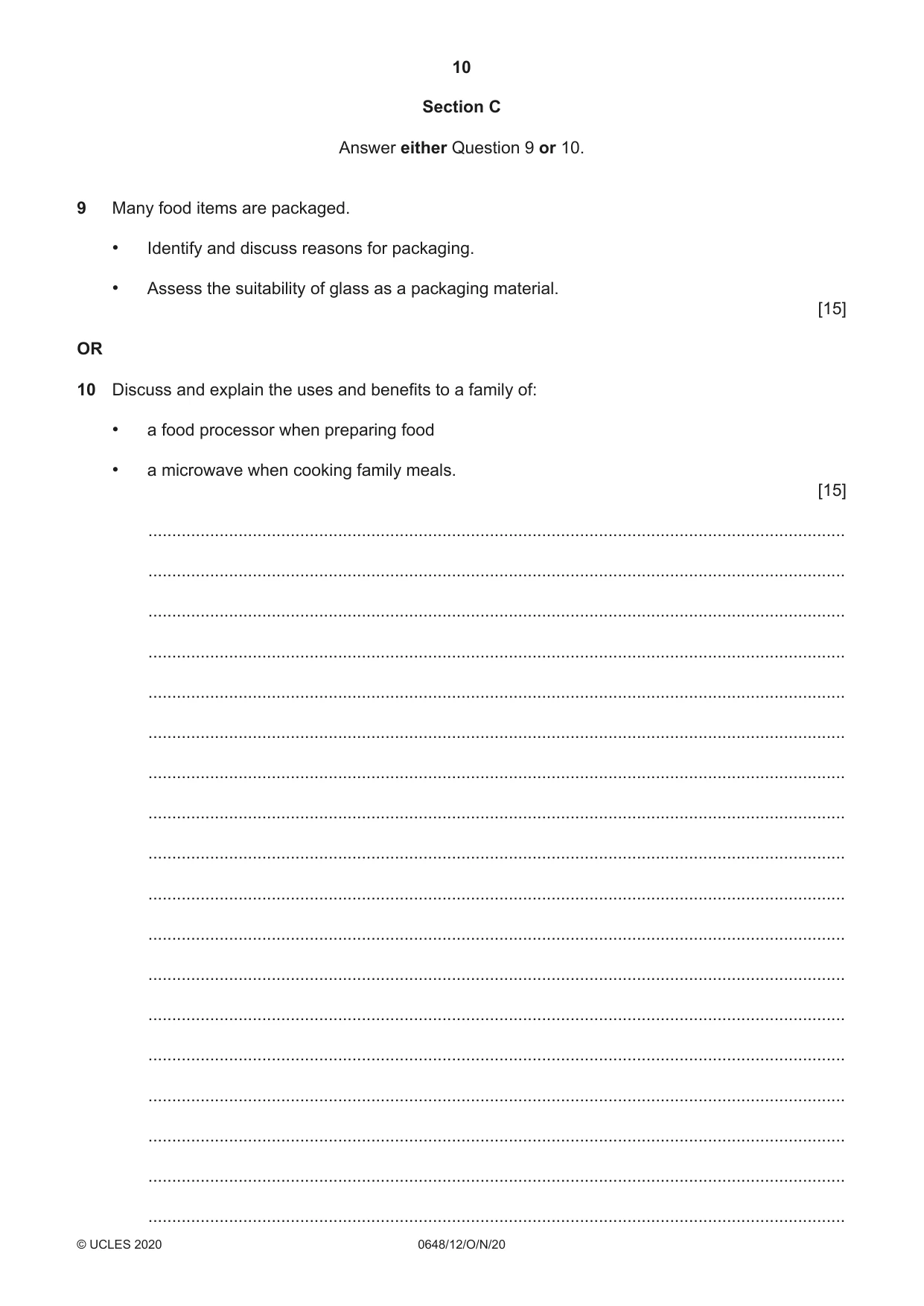
Question paper, page 10
10 0648/12/O/N/20 © UCLES 2020 Section C Answer either Question 9 or 10. 9 Many food items are packaged. • Identify and discuss reasons for packaging. • Assess the suitability of glass as a packaging material. [15] OR 10 Discuss and explain the uses and benefits to a family of: • a food processor when preparing food • a microwave when cooking family meals. [15] … … … … … … … … … … … … … … … … … …
Question paper, page 11
11 0648/12/O/N/20 © UCLES 2020 [Turn over … … … … … … … … … … … … … … … … … … … … … … … … … … … …
Question paper, page 12
12 0648/12/O/N/20 © UCLES 2020 Permission to reproduce items where third-party owned material protected by copyright is included has been sought and cleared where possible. Every reasonable effort has been made by the publisher (UCLES) to trace copyright holders, but if any items requiring clearance have unwittingly been included, the publisher will be pleased to make amends at the earliest possible opportunity. To avoid the issue of disclosure of answer-related information to candidates, all copyright acknowledgements are reproduced online in the Cambridge Assessment International Education Copyright Acknowledgements Booklet. This is produced for each series of examinations and is freely available to download at www.cambridgeinternational.org after the live examination series. Cambridge Assessment International Education is part of the Cambridge Assessment Group. Cambridge Assessment is the brand name of the University of Cambridge Local Examinations Syndicate (UCLES), which itself is a department of the University of Cambridge. … … … … … … … … … … … … … … … … … … … … … … … …
Mark scheme, page 1
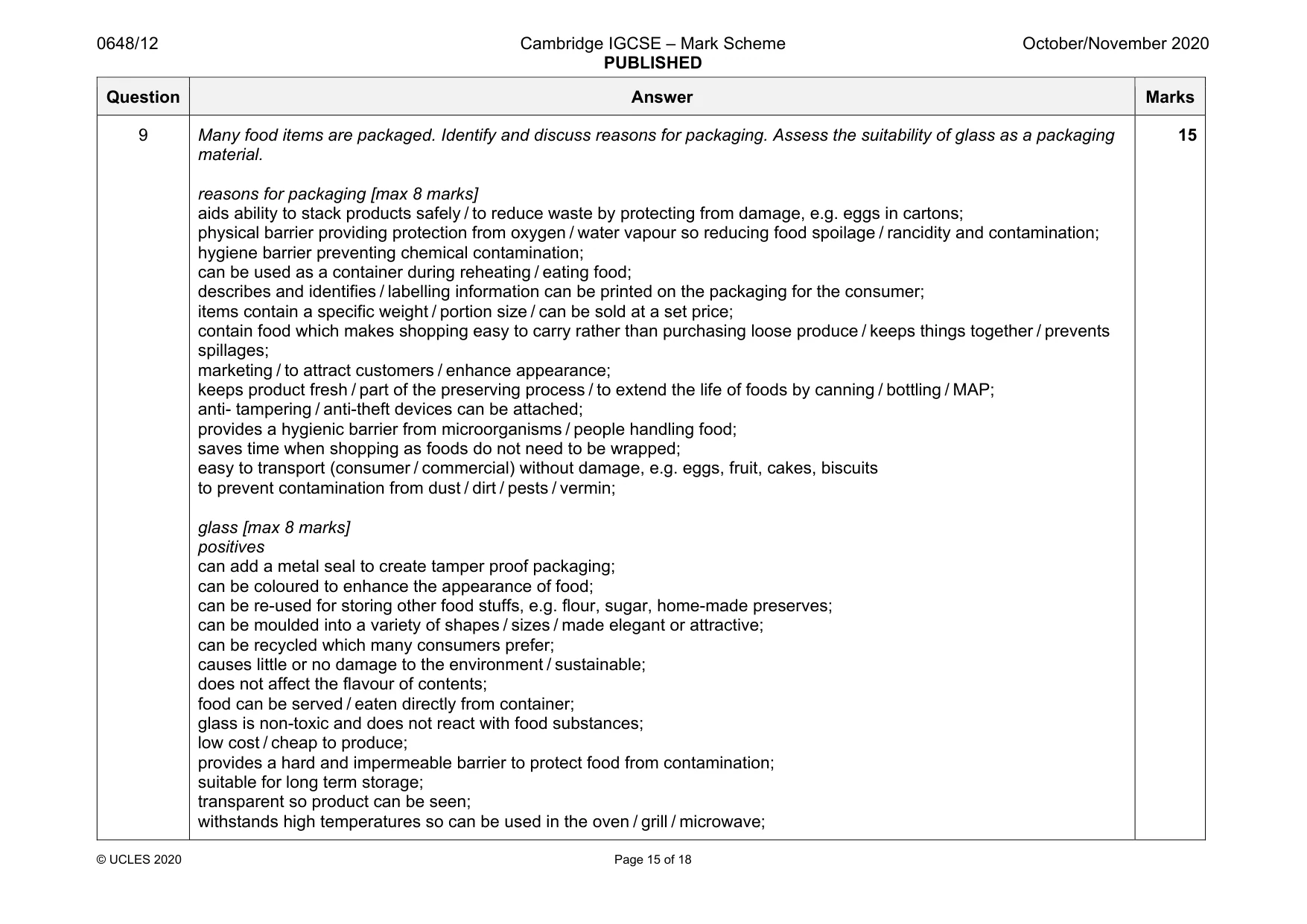
This document consists of 18 printed pages. © UCLES 2020 [Turn over Cambridge IGCSE™ FOOD & NUTRITION 0648/12 Paper 1 Theory October/November 2020 MARK SCHEME Maximum Mark: 100 Published This mark scheme is published as an aid to teachers and candidates, to indicate the requirements of the examination. It shows the basis on which Examiners were instructed to award marks. It does not indicate the details of the discussions that took place at an Examiners’ meeting before marking began, which would have considered the acceptability of alternative answers. Mark schemes should be read in conjunction with the question paper and the Principal Examiner Report for Teachers. Cambridge International will not enter into discussions about these mark schemes. Cambridge International is publishing the mark schemes for the October/November 2020 series for most Cambridge IGCSE, Cambridge International A and AS Level and Cambridge Pre-U components, and some Cambridge O Level components.
Mark scheme, page 2
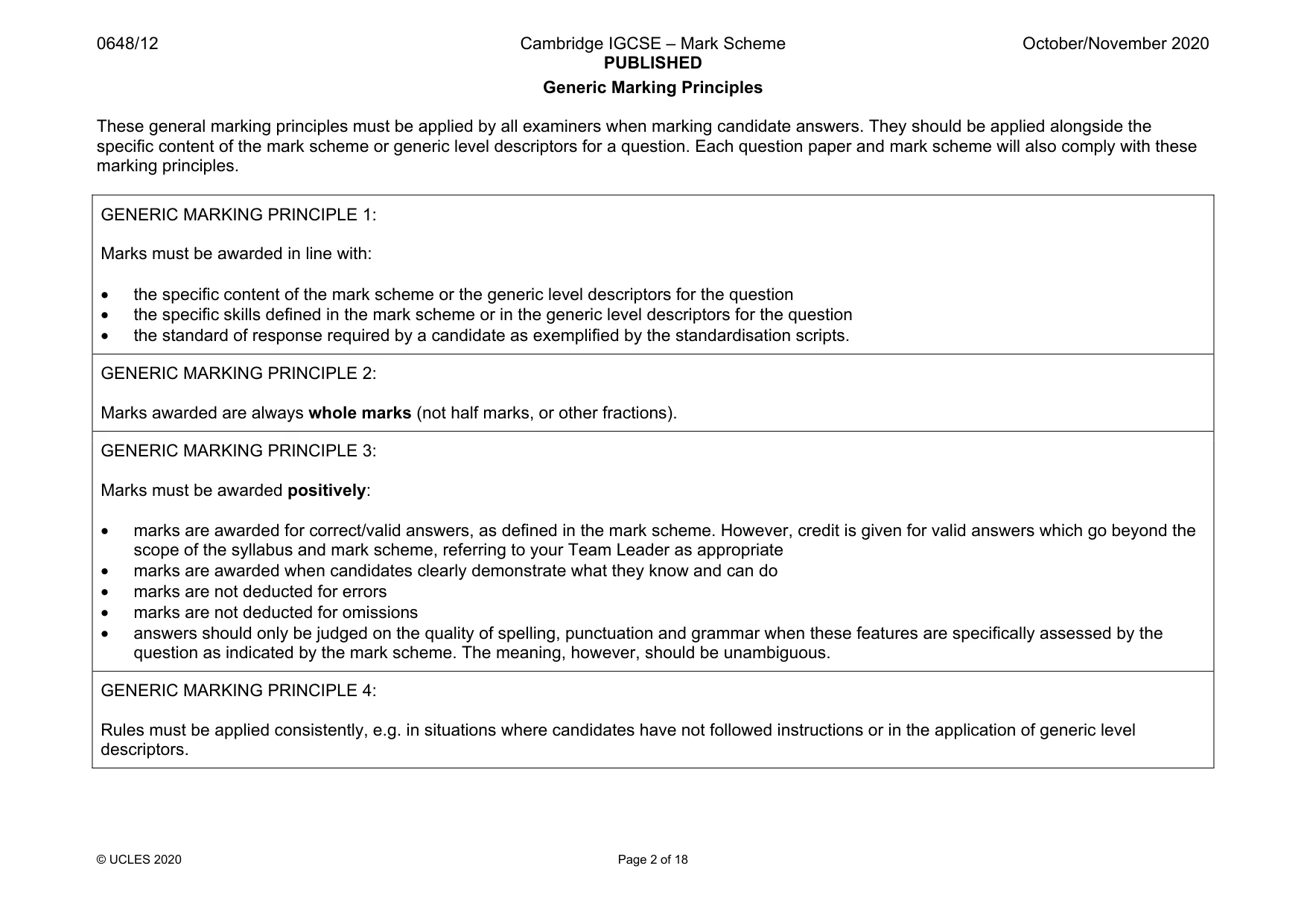
0648/12 Cambridge IGCSE – Mark Scheme PUBLISHED October/November 2020 © UCLES 2020 Page 2 of 18 Generic Marking Principles These general marking principles must be applied by all examiners when marking candidate answers. They should be applied alongside the specific content of the mark scheme or generic level descriptors for a question. Each question paper and mark scheme will also comply with these marking principles. GENERIC MARKING PRINCIPLE 1: Marks must be awarded in line with: • the specific content of the mark scheme or the generic level descriptors for the question • the specific skills defined in the mark scheme or in the generic level descriptors for the question • the standard of response required by a candidate as exemplified by the standardisation scripts. GENERIC MARKING PRINCIPLE 2: Marks awarded are always whole marks (not half marks, or other fractions). GENERIC MARKING PRINCIPLE 3: Marks must be awarded positively: • marks are awarded for correct/valid answers, as defined in the mark scheme. However, credit is given for valid answers which go beyond the scope of the syllabus and mark scheme, referring to your Team Leader as appropriate • marks are awarded when candidates clearly demonstrate what they know and can do • marks are not deducted for errors • marks are not deducted for omissions • answers should only be judged on the quality of spelling, punctuation and grammar when these features are specifically assessed by the question as indicated by the mark scheme. The meaning, however, should be unambiguous. GENERIC MARKING PRINCIPLE 4: Rules must be applied consistently, e.g. in situations where candidates have not followed instructions or in the application of generic level descriptors.
Mark scheme, page 3
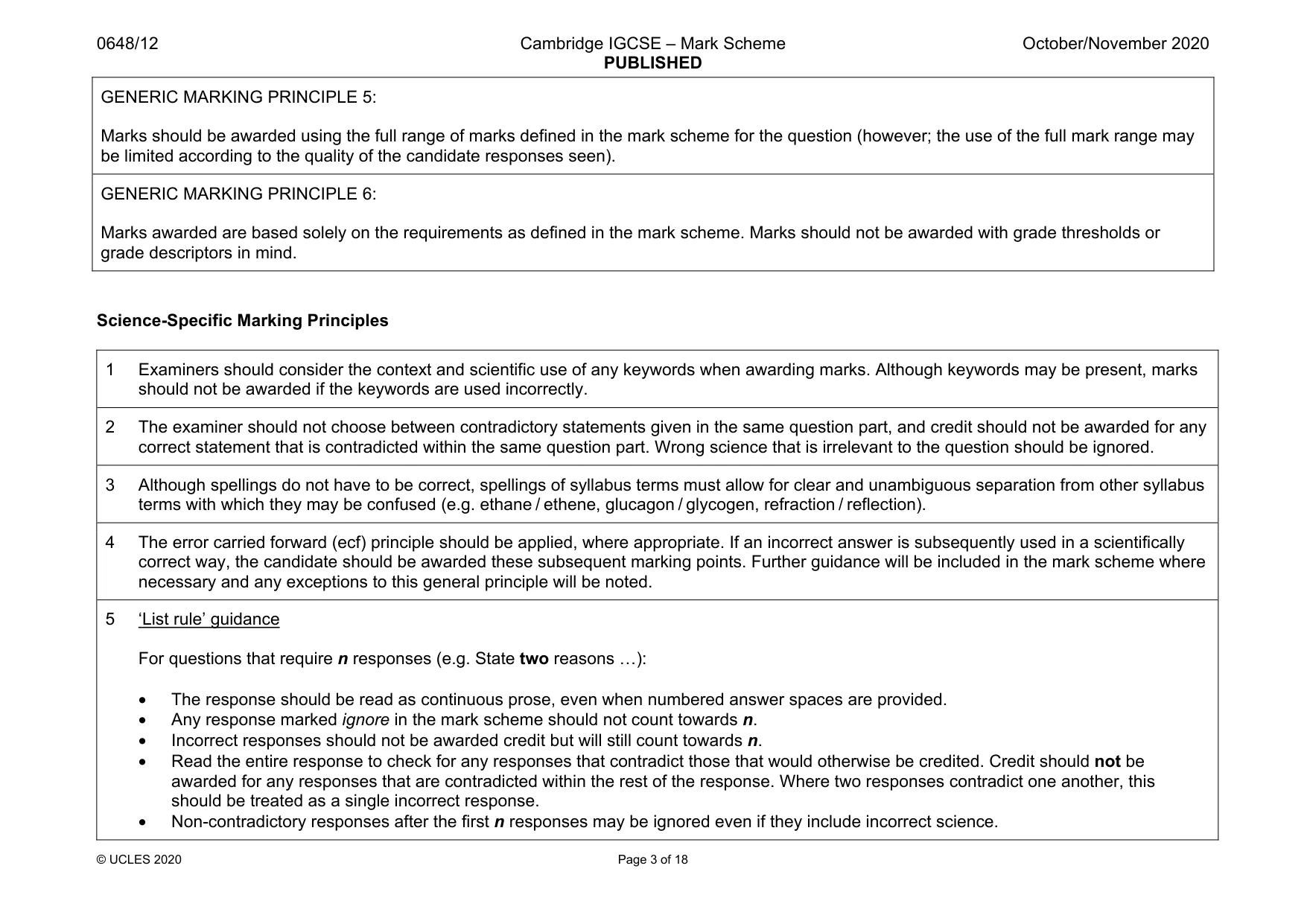
0648/12 Cambridge IGCSE – Mark Scheme PUBLISHED October/November 2020 © UCLES 2020 Page 3 of 18 GENERIC MARKING PRINCIPLE 5: Marks should be awarded using the full range of marks defined in the mark scheme for the question (however; the use of the full mark range may be limited according to the quality of the candidate responses seen). GENERIC MARKING PRINCIPLE 6: Marks awarded are based solely on the requirements as defined in the mark scheme. Marks should not be awarded with grade thresholds or grade descriptors in mind. Science-Specific Marking Principles 1 Examiners should consider the context and scientific use of any keywords when awarding marks. Although keywords may be present, marks should not be awarded if the keywords are used incorrectly. 2 The examiner should not choose between contradictory statements given in the same question part, and credit should not be awarded for any correct statement that is contradicted within the same question part. Wrong science that is irrelevant to the question should be ignored. 3 Although spellings do not have to be correct, spellings of syllabus terms must allow for clear and unambiguous separation from other syllabus terms with which they may be confused (e.g. ethane / ethene, glucagon / glycogen, refraction / reflection). 4 The error carried forward (ecf) principle should be applied, where appropriate. If an incorrect answer is subsequently used in a scientifically correct way, the candidate should be awarded these subsequent marking points. Further guidance will be included in the mark scheme where necessary and any exceptions to this general principle will be noted. 5 ‘List rule’ guidance For questions that require n responses (e.g. State two reasons …): • The response should be read as continuous prose, even when numbered answer spaces are provided. • Any response marked ignore in the mark scheme should not count towards n. • Incorrect responses should not be awarded credit but will still count towards n. • Read the entire response to check for any responses that contradict those that would otherwise be credited. Credit should not be awarded for any responses that are contradicted within the rest of the response. Where two responses contradict one another, this should be treated as a single incorrect response. • Non-contradictory responses after the first n responses may be ignored even if they include incorrect science.
Mark scheme, page 4
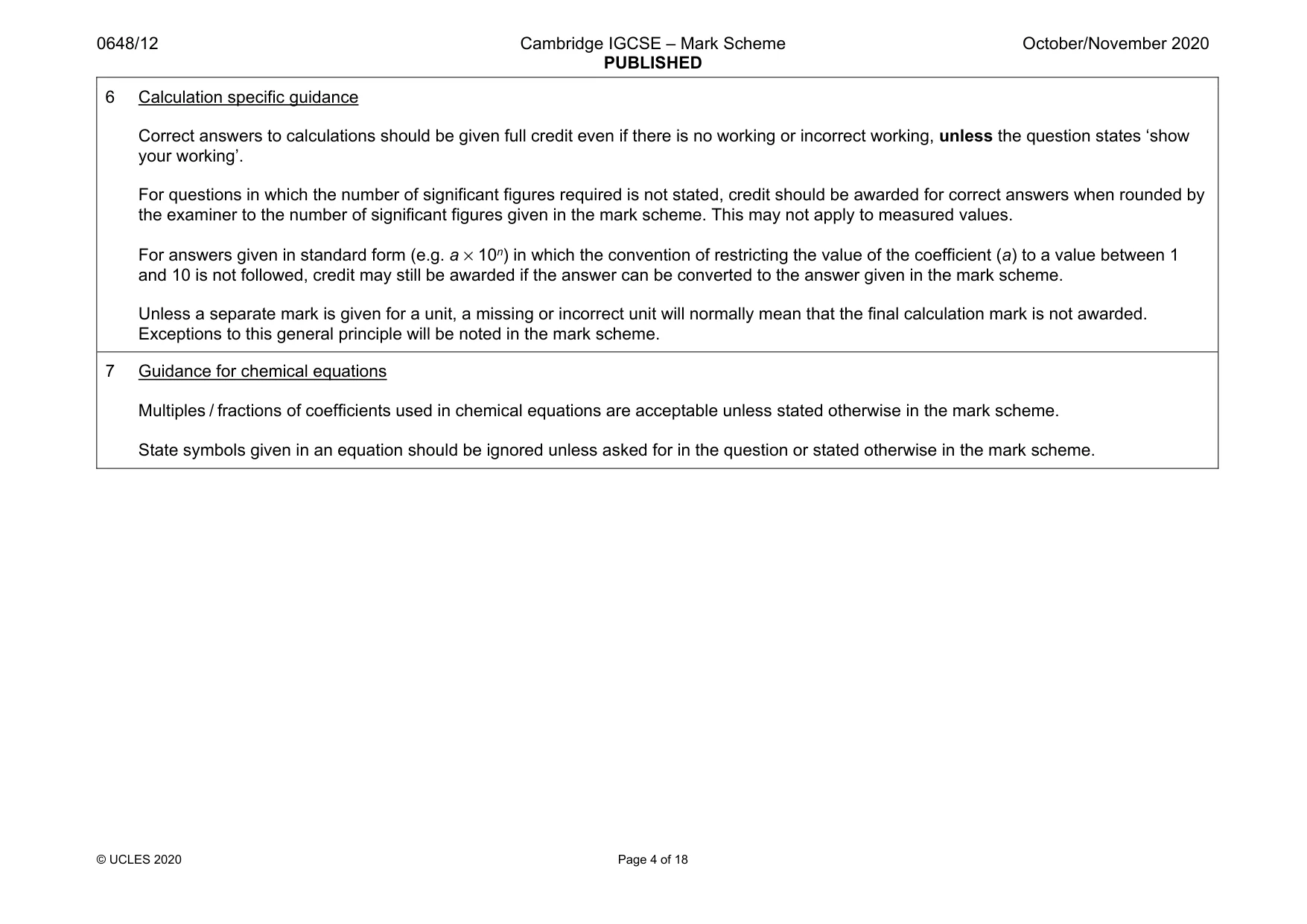
0648/12 Cambridge IGCSE – Mark Scheme PUBLISHED October/November 2020 © UCLES 2020 Page 4 of 18 6 Calculation specific guidance Correct answers to calculations should be given full credit even if there is no working or incorrect working, unless the question states ‘show your working’. For questions in which the number of significant figures required is not stated, credit should be awarded for correct answers when rounded by the examiner to the number of significant figures given in the mark scheme. This may not apply to measured values. For answers given in standard form (e.g. a × 10n) in which the convention of restricting the value of the coefficient (a) to a value between 1 and 10 is not followed, credit may still be awarded if the answer can be converted to the answer given in the mark scheme. Unless a separate mark is given for a unit, a missing or incorrect unit will normally mean that the final calculation mark is not awarded. Exceptions to this general principle will be noted in the mark scheme. 7 Guidance for chemical equations Multiples / fractions of coefficients used in chemical equations are acceptable unless stated otherwise in the mark scheme. State symbols given in an equation should be ignored unless asked for in the question or stated otherwise in the mark scheme.
Mark scheme, page 5
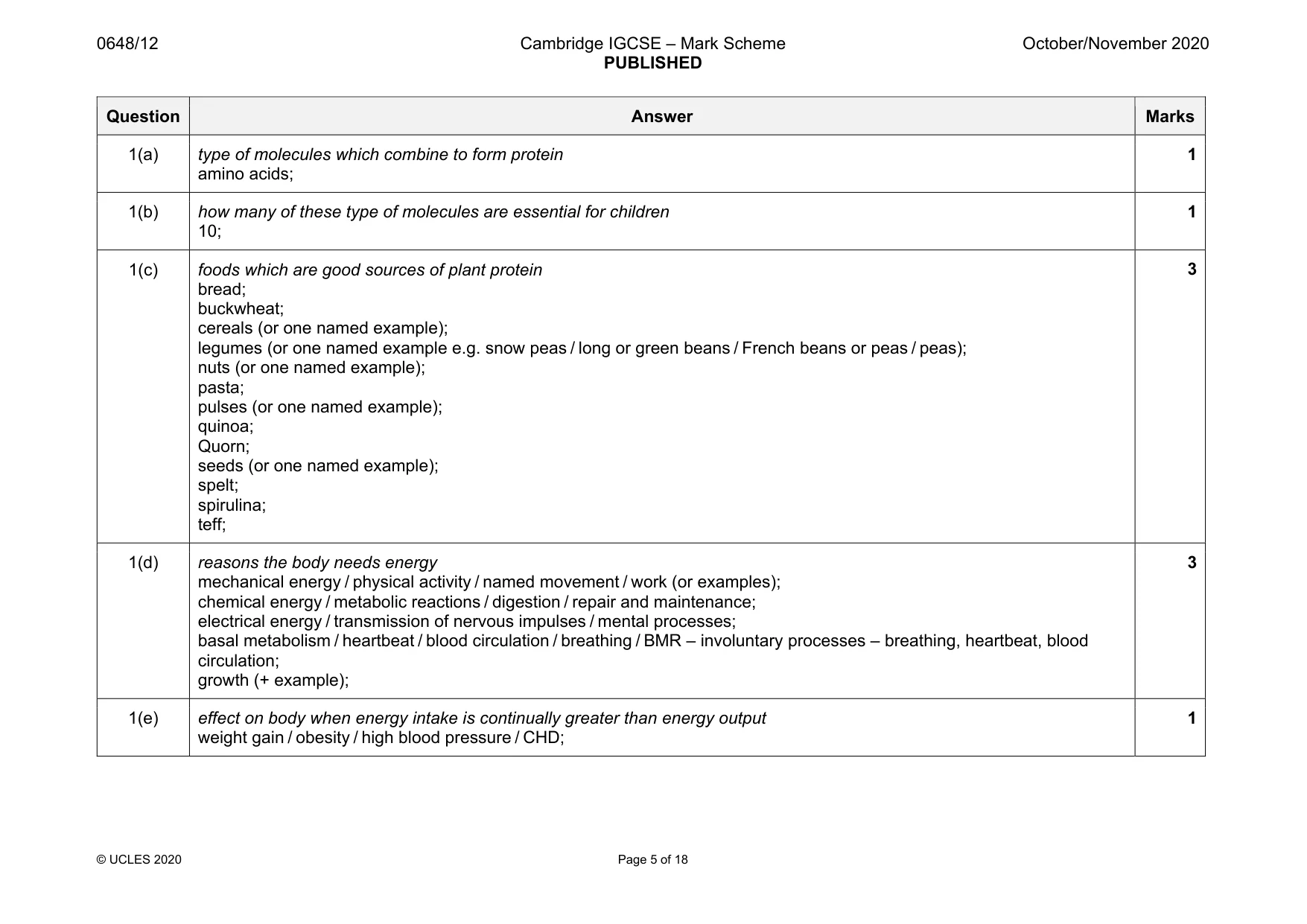
0648/12 Cambridge IGCSE – Mark Scheme PUBLISHED October/November 2020 © UCLES 2020 Page 5 of 18 Question Answer Marks 1(a) type of molecules which combine to form protein amino acids; 1 1(b) how many of these type of molecules are essential for children 10; 1 1(c) foods which are good sources of plant protein bread; buckwheat; cereals (or one named example); legumes (or one named example e.g. snow peas / long or green beans / French beans or peas / peas); nuts (or one named example); pasta; pulses (or one named example); quinoa; Quorn; seeds (or one named example); spelt; spirulina; teff; 3 1(d) reasons the body needs energy mechanical energy / physical activity / named movement / work (or examples); chemical energy / metabolic reactions / digestion / repair and maintenance; electrical energy / transmission of nervous impulses / mental processes; basal metabolism / heartbeat / blood circulation / breathing / BMR – involuntary processes – breathing, heartbeat, blood circulation; growth (+ example); 3 1(e) effect on body when energy intake is continually greater than energy output weight gain / obesity / high blood pressure / CHD; 1
Mark scheme, page 6
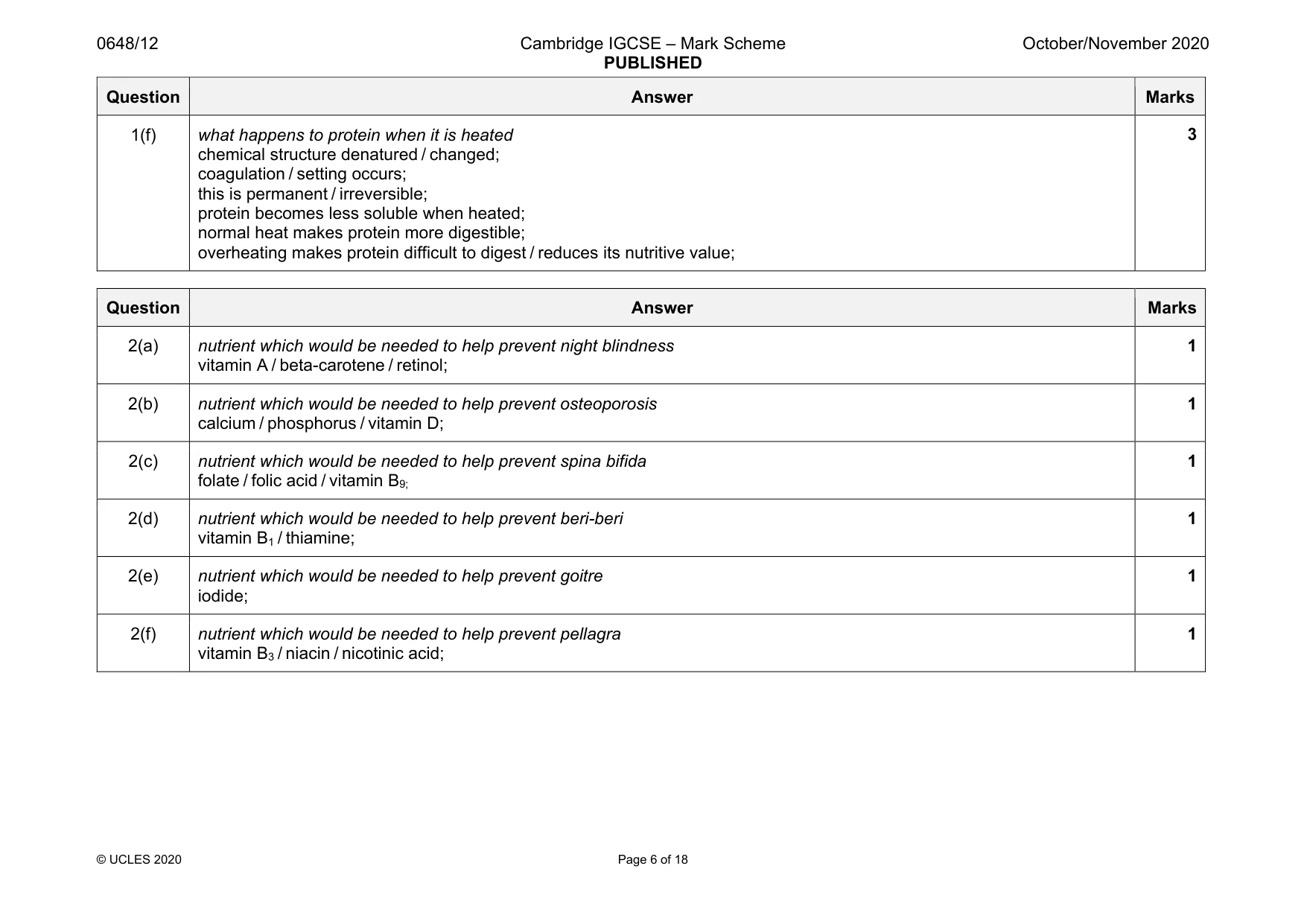
0648/12 Cambridge IGCSE – Mark Scheme PUBLISHED October/November 2020 © UCLES 2020 Page 6 of 18 Question Answer Marks 1(f) what happens to protein when it is heated chemical structure denatured / changed; coagulation / setting occurs; this is permanent / irreversible; protein becomes less soluble when heated; normal heat makes protein more digestible; overheating makes protein difficult to digest / reduces its nutritive value; 3 Question Answer Marks 2(a) nutrient which would be needed to help prevent night blindness vitamin A / beta-carotene / retinol; 1 2(b) nutrient which would be needed to help prevent osteoporosis calcium / phosphorus / vitamin D; 1 2(c) nutrient which would be needed to help prevent spina bifida folate / folic acid / vitamin B9; 1 2(d) nutrient which would be needed to help prevent beri-beri vitamin B1 / thiamine; 1 2(e) nutrient which would be needed to help prevent goitre iodide; 1 2(f) nutrient which would be needed to help prevent pellagra vitamin B3 / niacin / nicotinic acid; 1
Mark scheme, page 7
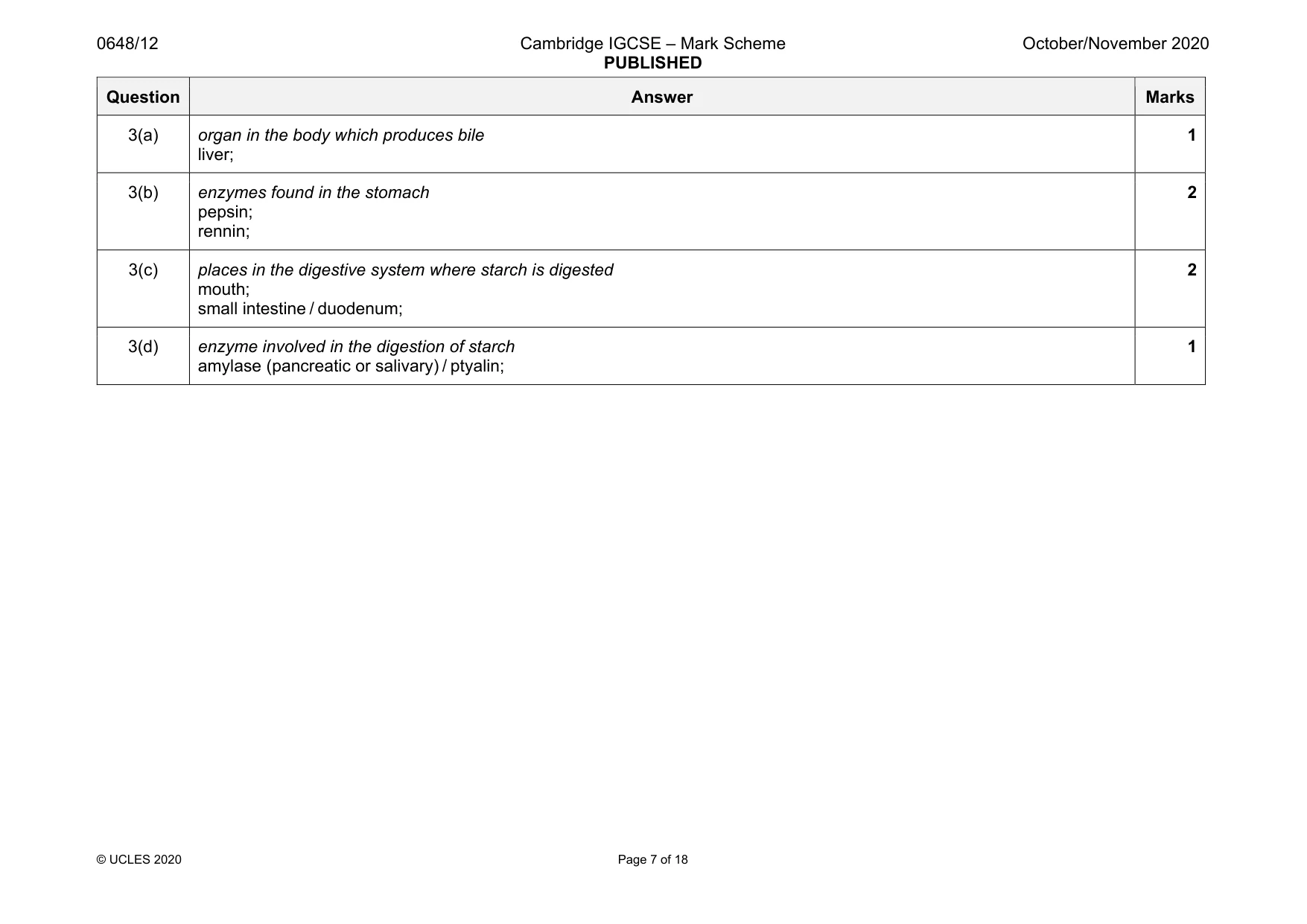
0648/12 Cambridge IGCSE – Mark Scheme PUBLISHED October/November 2020 © UCLES 2020 Page 7 of 18 Question Answer Marks 3(a) organ in the body which produces bile liver; 1 3(b) enzymes found in the stomach pepsin; rennin; 2 3(c) places in the digestive system where starch is digested mouth; small intestine / duodenum; 2 3(d) enzyme involved in the digestion of starch amylase (pancreatic or salivary) / ptyalin; 1
Mark scheme, page 8
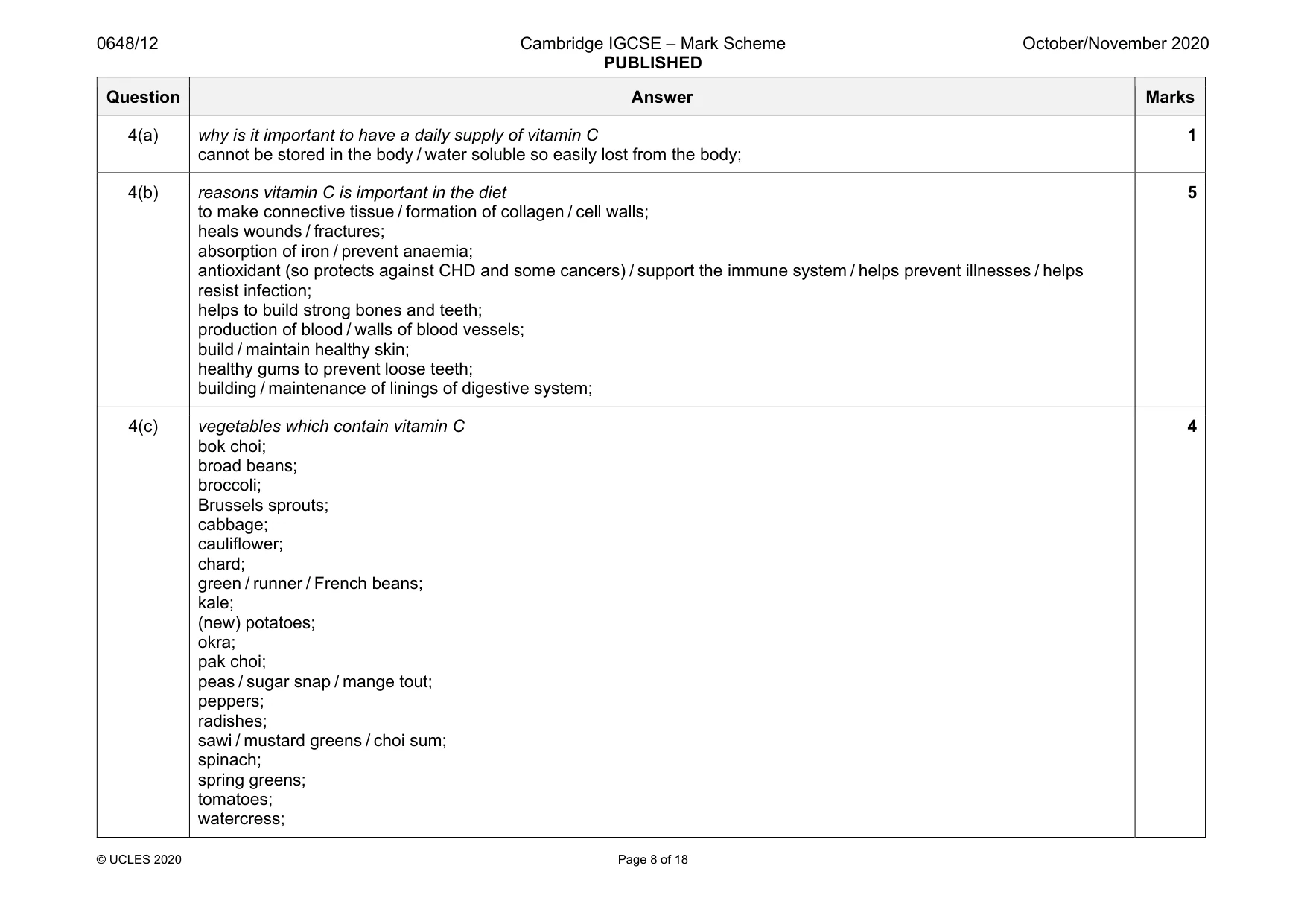
0648/12 Cambridge IGCSE – Mark Scheme PUBLISHED October/November 2020 © UCLES 2020 Page 8 of 18 Question Answer Marks 4(a) why is it important to have a daily supply of vitamin C cannot be stored in the body / water soluble so easily lost from the body; 1 4(b) reasons vitamin C is important in the diet to make connective tissue / formation of collagen / cell walls; heals wounds / fractures; absorption of iron / prevent anaemia; antioxidant (so protects against CHD and some cancers) / support the immune system / helps prevent illnesses / helps resist infection; helps to build strong bones and teeth; production of blood / walls of blood vessels; build / maintain healthy skin; healthy gums to prevent loose teeth; building / maintenance of linings of digestive system; 5 4(c) vegetables which contain vitamin C bok choi; broad beans; broccoli; Brussels sprouts; cabbage; cauliflower; chard; green / runner / French beans; kale; (new) potatoes; okra; pak choi; peas / sugar snap / mange tout; peppers; radishes; sawi / mustard greens / choi sum; spinach; spring greens; tomatoes; watercress; 4
Mark scheme, page 9
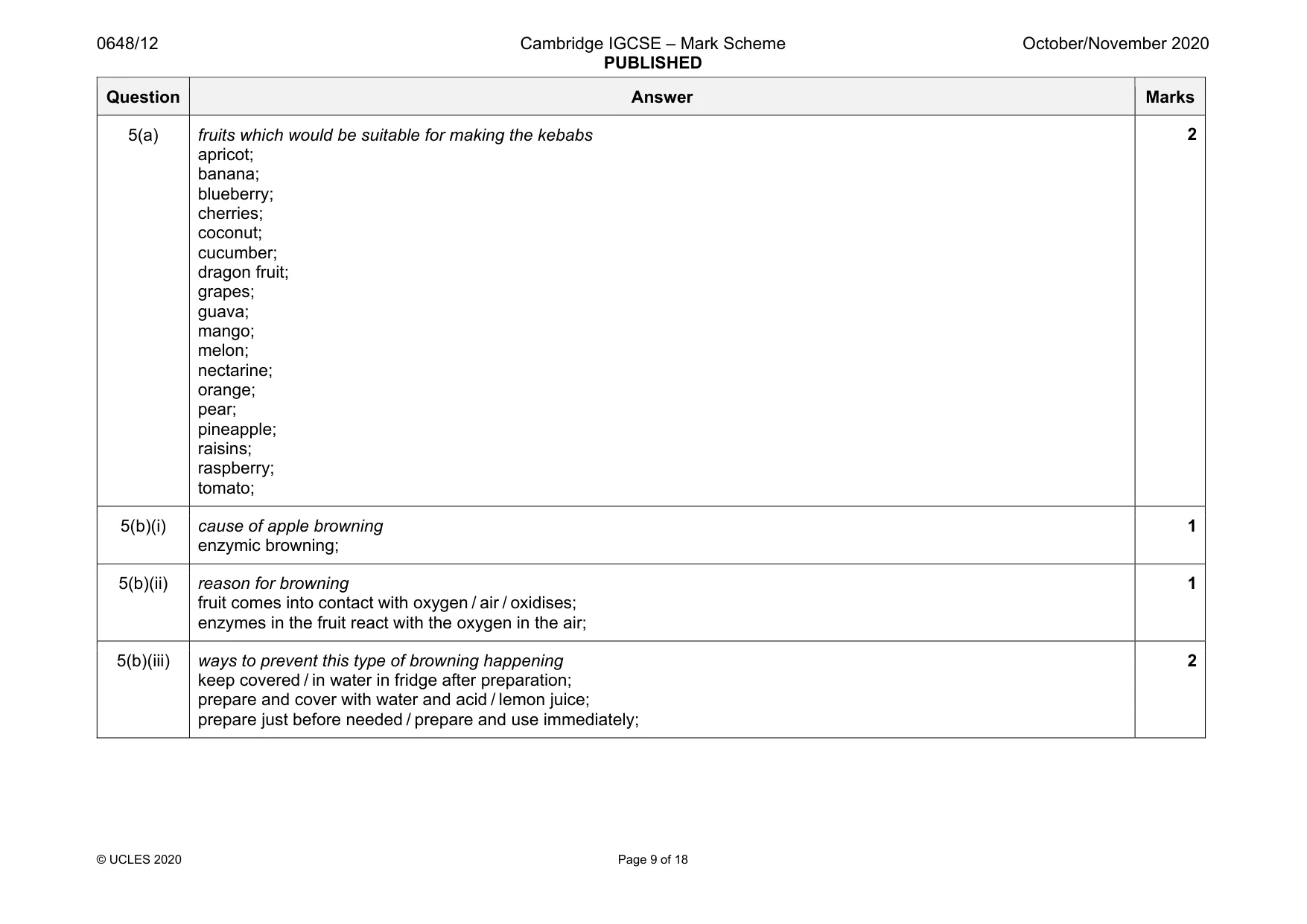
0648/12 Cambridge IGCSE – Mark Scheme PUBLISHED October/November 2020 © UCLES 2020 Page 9 of 18 Question Answer Marks 5(a) fruits which would be suitable for making the kebabs apricot; banana; blueberry; cherries; coconut; cucumber; dragon fruit; grapes; guava; mango; melon; nectarine; orange; pear; pineapple; raisins; raspberry; tomato; 2 5(b)(i) cause of apple browning enzymic browning; 1 5(b)(ii) reason for browning fruit comes into contact with oxygen / air / oxidises; enzymes in the fruit react with the oxygen in the air; 1 5(b)(iii) ways to prevent this type of browning happening keep covered / in water in fridge after preparation; prepare and cover with water and acid / lemon juice; prepare just before needed / prepare and use immediately; 2
Mark scheme, page 10
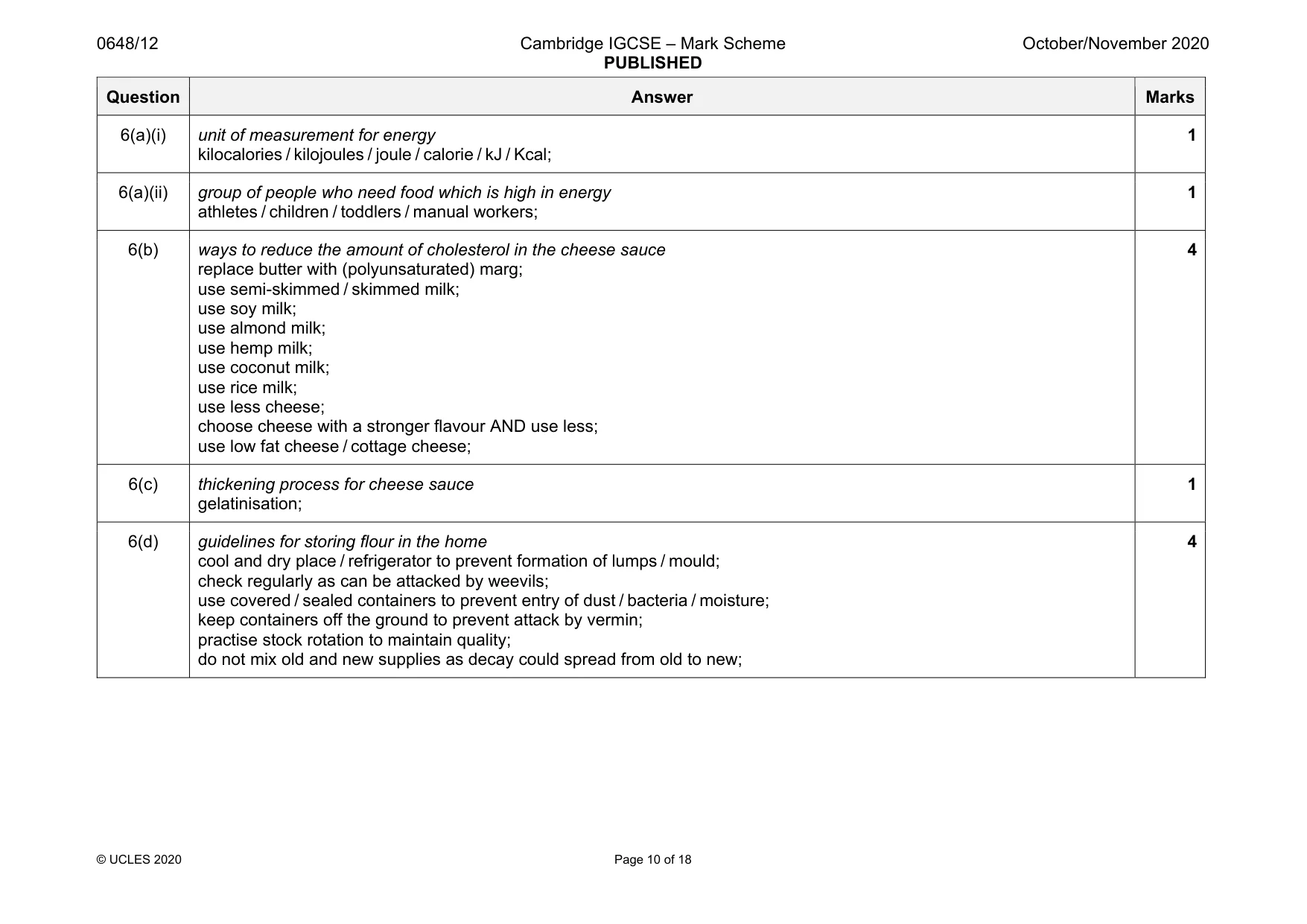
0648/12 Cambridge IGCSE – Mark Scheme PUBLISHED October/November 2020 © UCLES 2020 Page 10 of 18 Question Answer Marks 6(a)(i) unit of measurement for energy kilocalories / kilojoules / joule / calorie / kJ / Kcal; 1 6(a)(ii) group of people who need food which is high in energy athletes / children / toddlers / manual workers; 1 6(b) ways to reduce the amount of cholesterol in the cheese sauce replace butter with (polyunsaturated) marg; use semi-skimmed / skimmed milk; use soy milk; use almond milk; use hemp milk; use coconut milk; use rice milk; use less cheese; choose cheese with a stronger flavour AND use less; use low fat cheese / cottage cheese; 4 6(c) thickening process for cheese sauce gelatinisation; 1 6(d) guidelines for storing flour in the home cool and dry place / refrigerator to prevent formation of lumps / mould; check regularly as can be attacked by weevils; use covered / sealed containers to prevent entry of dust / bacteria / moisture; keep containers off the ground to prevent attack by vermin; practise stock rotation to maintain quality; do not mix old and new supplies as decay could spread from old to new; 4
Mark scheme, page 11
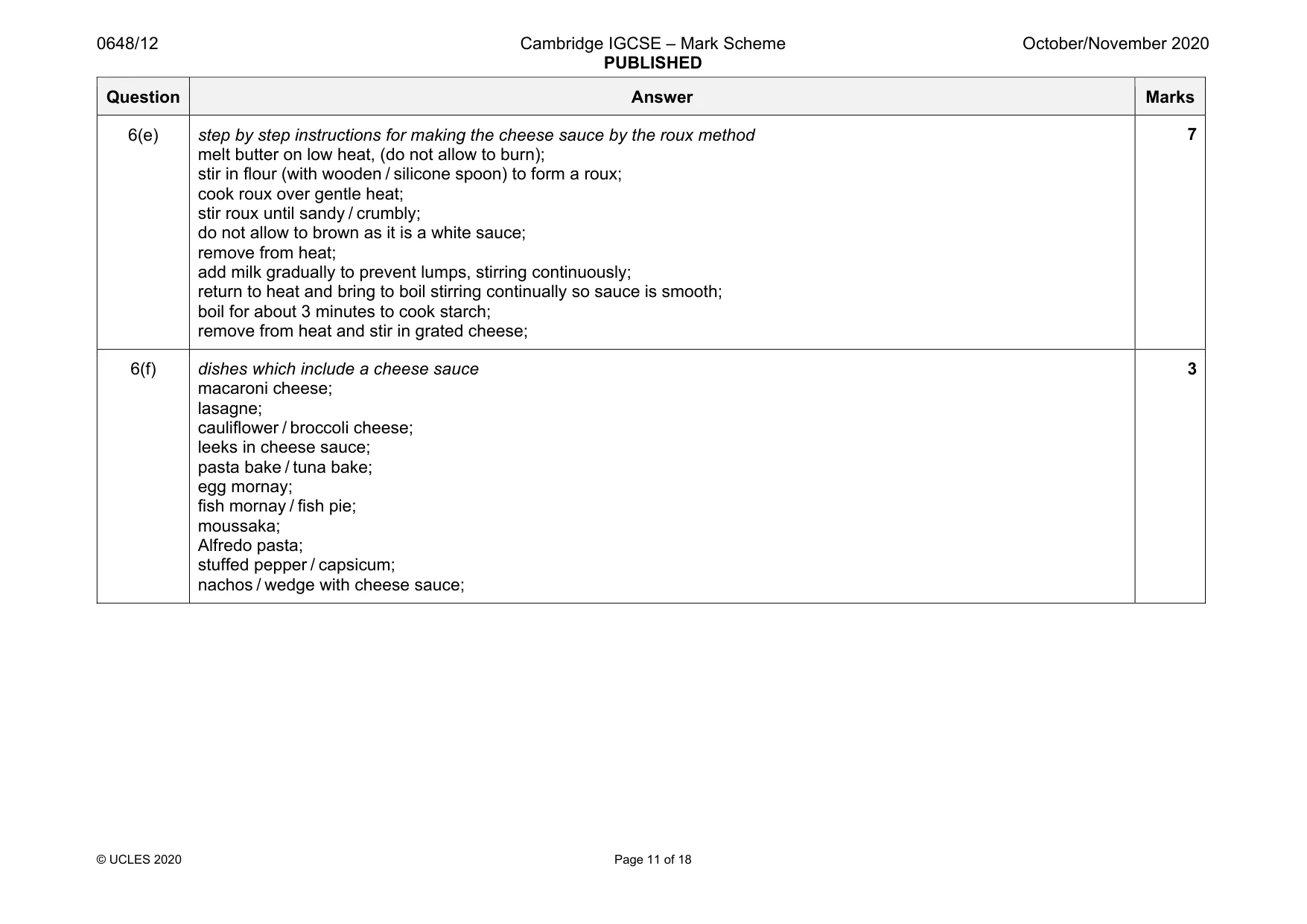
0648/12 Cambridge IGCSE – Mark Scheme PUBLISHED October/November 2020 © UCLES 2020 Page 11 of 18 Question Answer Marks 6(e) step by step instructions for making the cheese sauce by the roux method melt butter on low heat, (do not allow to burn); stir in flour (with wooden / silicone spoon) to form a roux; cook roux over gentle heat; stir roux until sandy / crumbly; do not allow to brown as it is a white sauce; remove from heat; add milk gradually to prevent lumps, stirring continuously; return to heat and bring to boil stirring continually so sauce is smooth; boil for about 3 minutes to cook starch; remove from heat and stir in grated cheese; 7 6(f) dishes which include a cheese sauce macaroni cheese; lasagne; cauliflower / broccoli cheese; leeks in cheese sauce; pasta bake / tuna bake; egg mornay; fish mornay / fish pie; moussaka; Alfredo pasta; stuffed pepper / capsicum; nachos / wedge with cheese sauce; 3
Mark scheme, page 12
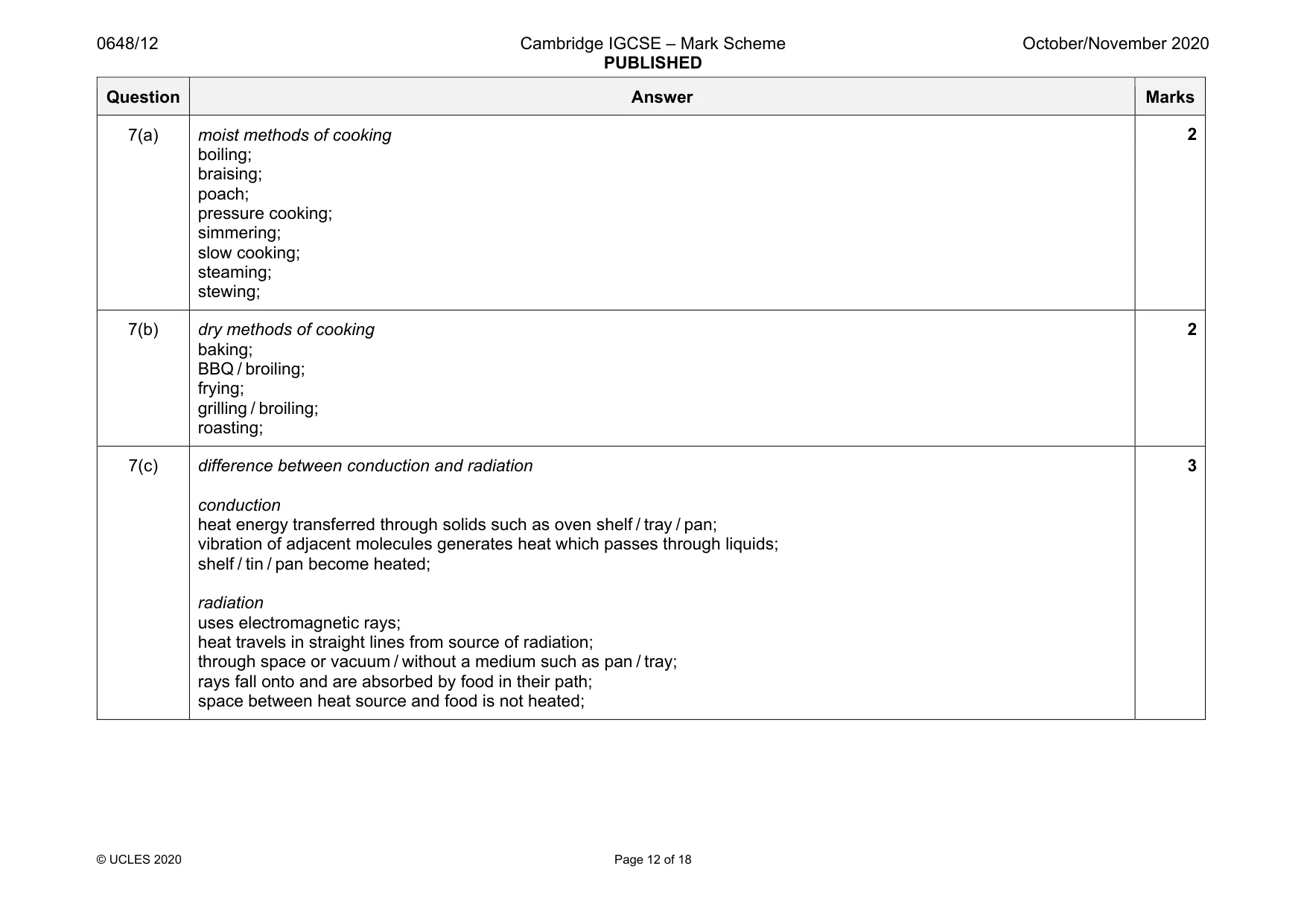
0648/12 Cambridge IGCSE – Mark Scheme PUBLISHED October/November 2020 © UCLES 2020 Page 12 of 18 Question Answer Marks 7(a) moist methods of cooking boiling; braising; poach; pressure cooking; simmering; slow cooking; steaming; stewing; 2 7(b) dry methods of cooking baking; BBQ / broiling; frying; grilling / broiling; roasting; 2 7(c) difference between conduction and radiation conduction heat energy transferred through solids such as oven shelf / tray / pan; vibration of adjacent molecules generates heat which passes through liquids; shelf / tin / pan become heated; radiation uses electromagnetic rays; heat travels in straight lines from source of radiation; through space or vacuum / without a medium such as pan / tray; rays fall onto and are absorbed by food in their path; space between heat source and food is not heated; 3
Mark scheme, page 13
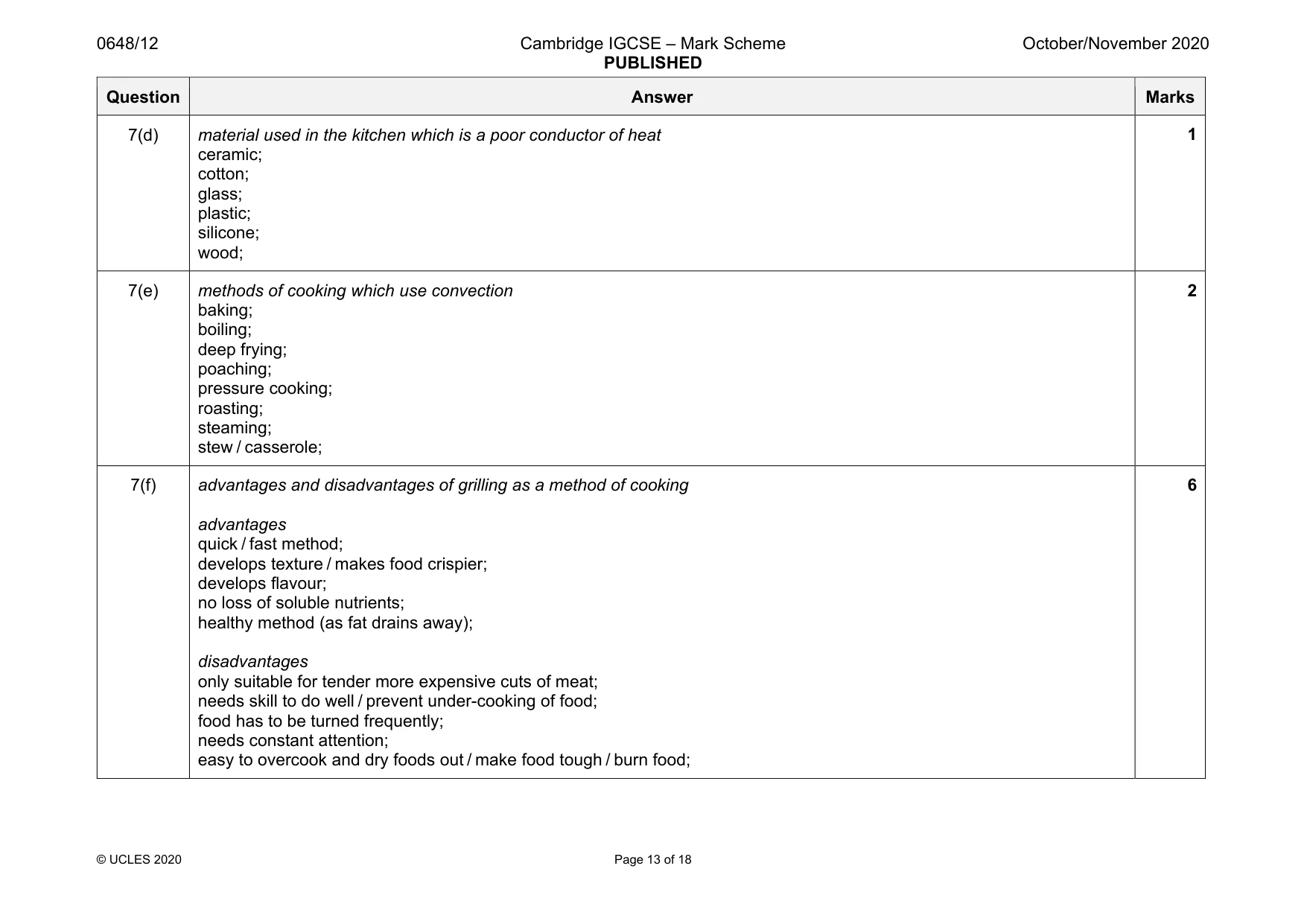
0648/12 Cambridge IGCSE – Mark Scheme PUBLISHED October/November 2020 © UCLES 2020 Page 13 of 18 Question Answer Marks 7(d) material used in the kitchen which is a poor conductor of heat ceramic; cotton; glass; plastic; silicone; wood; 1 7(e) methods of cooking which use convection baking; boiling; deep frying; poaching; pressure cooking; roasting; steaming; stew / casserole; 2 7(f) advantages and disadvantages of grilling as a method of cooking advantages quick / fast method; develops texture / makes food crispier; develops flavour; no loss of soluble nutrients; healthy method (as fat drains away); disadvantages only suitable for tender more expensive cuts of meat; needs skill to do well / prevent under-cooking of food; food has to be turned frequently; needs constant attention; easy to overcook and dry foods out / make food tough / burn food; 6
Mark scheme, page 14
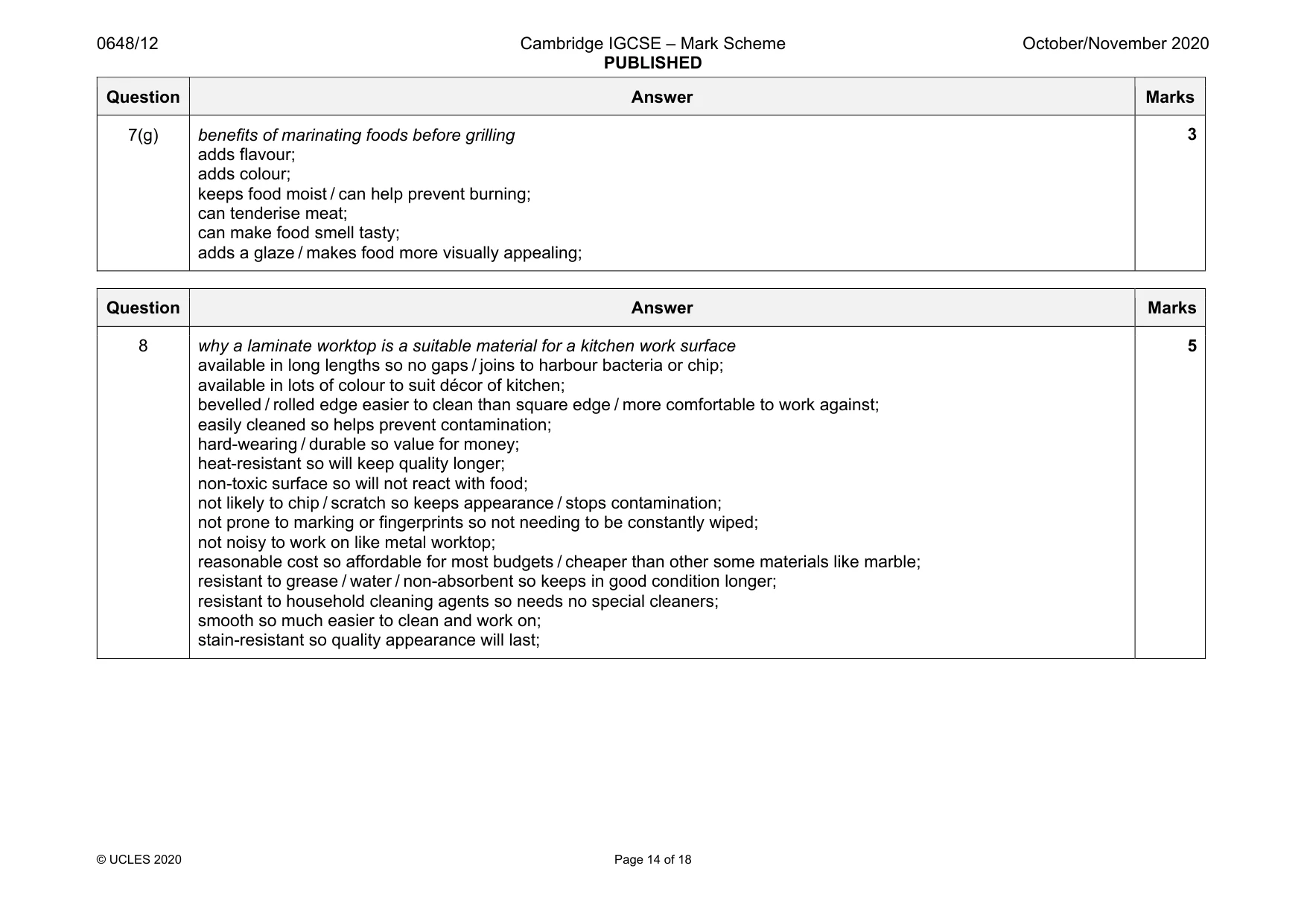
0648/12 Cambridge IGCSE – Mark Scheme PUBLISHED October/November 2020 © UCLES 2020 Page 14 of 18 Question Answer Marks 7(g) benefits of marinating foods before grilling adds flavour; adds colour; keeps food moist / can help prevent burning; can tenderise meat; can make food smell tasty; adds a glaze / makes food more visually appealing; 3 Question Answer Marks 8 why a laminate worktop is a suitable material for a kitchen work surface available in long lengths so no gaps / joins to harbour bacteria or chip; available in lots of colour to suit décor of kitchen; bevelled / rolled edge easier to clean than square edge / more comfortable to work against; easily cleaned so helps prevent contamination; hard-wearing / durable so value for money; heat-resistant so will keep quality longer; non-toxic surface so will not react with food; not likely to chip / scratch so keeps appearance / stops contamination; not prone to marking or fingerprints so not needing to be constantly wiped; not noisy to work on like metal worktop; reasonable cost so affordable for most budgets / cheaper than other some materials like marble; resistant to grease / water / non-absorbent so keeps in good condition longer; resistant to household cleaning agents so needs no special cleaners; smooth so much easier to clean and work on; stain-resistant so quality appearance will last; 5
Mark scheme, page 15
0648/12 Cambridge IGCSE – Mark Scheme PUBLISHED October/November 2020 © UCLES 2020 Page 15 of 18 Question Answer Marks 9 Many food items are packaged. Identify and discuss reasons for packaging. Assess the suitability of glass as a packaging material. reasons for packaging [max 8 marks] aids ability to stack products safely / to reduce waste by protecting from damage, e.g. eggs in cartons; physical barrier providing protection from oxygen / water vapour so reducing food spoilage / rancidity and contamination; hygiene barrier preventing chemical contamination; can be used as a container during reheating / eating food; describes and identifies / labelling information can be printed on the packaging for the consumer; items contain a specific weight / portion size / can be sold at a set price; contain food which makes shopping easy to carry rather than purchasing loose produce / keeps things together / prevents spillages; marketing / to attract customers / enhance appearance; keeps product fresh / part of the preserving process / to extend the life of foods by canning / bottling / MAP; anti- tampering / anti-theft devices can be attached; provides a hygienic barrier from microorganisms / people handling food; saves time when shopping as foods do not need to be wrapped; easy to transport (consumer / commercial) without damage, e.g. eggs, fruit, cakes, biscuits to prevent contamination from dust / dirt / pests / vermin; glass [max 8 marks] positives can add a metal seal to create tamper proof packaging; can be coloured to enhance the appearance of food; can be re-used for storing other food stuffs, e.g. flour, sugar, home-made preserves; can be moulded into a variety of shapes / sizes / made elegant or attractive; can be recycled which many consumers prefer; causes little or no damage to the environment / sustainable; does not affect the flavour of contents; food can be served / eaten directly from container; glass is non-toxic and does not react with food substances; low cost / cheap to produce; provides a hard and impermeable barrier to protect food from contamination; suitable for long term storage; transparent so product can be seen; withstands high temperatures so can be used in the oven / grill / microwave; 15
Mark scheme, page 16
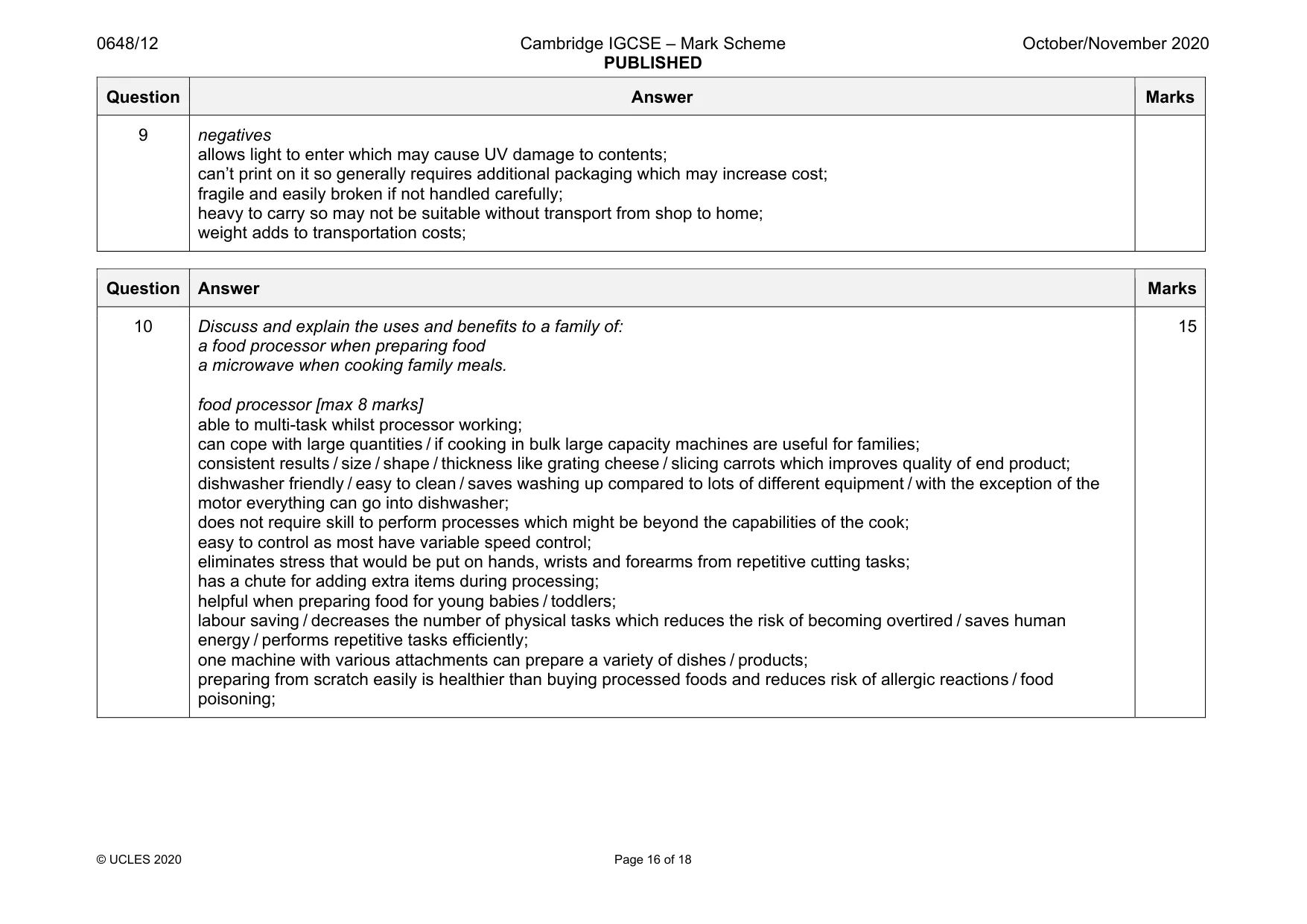
0648/12 Cambridge IGCSE – Mark Scheme PUBLISHED October/November 2020 © UCLES 2020 Page 16 of 18 Question Answer Marks 9 negatives allows light to enter which may cause UV damage to contents; can’t print on it so generally requires additional packaging which may increase cost; fragile and easily broken if not handled carefully; heavy to carry so may not be suitable without transport from shop to home; weight adds to transportation costs; Question Answer Marks 10 Discuss and explain the uses and benefits to a family of: a food processor when preparing food a microwave when cooking family meals. food processor [max 8 marks] able to multi-task whilst processor working; can cope with large quantities / if cooking in bulk large capacity machines are useful for families; consistent results / size / shape / thickness like grating cheese / slicing carrots which improves quality of end product; dishwasher friendly / easy to clean / saves washing up compared to lots of different equipment / with the exception of the motor everything can go into dishwasher; does not require skill to perform processes which might be beyond the capabilities of the cook; easy to control as most have variable speed control; eliminates stress that would be put on hands, wrists and forearms from repetitive cutting tasks; has a chute for adding extra items during processing; helpful when preparing food for young babies / toddlers; labour saving / decreases the number of physical tasks which reduces the risk of becoming overtired / saves human energy / performs repetitive tasks efficiently; one machine with various attachments can prepare a variety of dishes / products; preparing from scratch easily is healthier than buying processed foods and reduces risk of allergic reactions / food poisoning; 15
Mark scheme, page 17
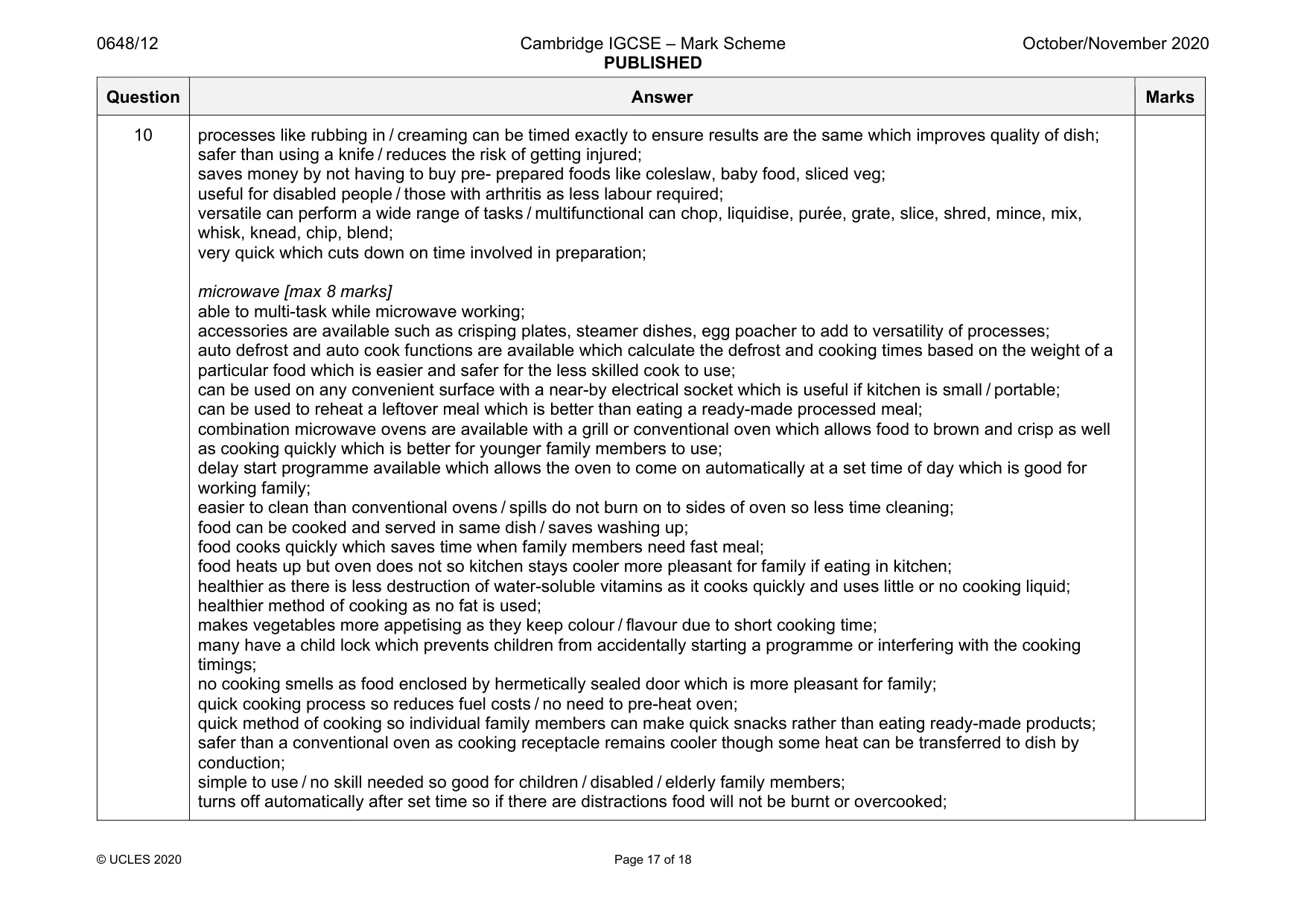
0648/12 Cambridge IGCSE – Mark Scheme PUBLISHED October/November 2020 © UCLES 2020 Page 17 of 18 Question Answer Marks 10 processes like rubbing in / creaming can be timed exactly to ensure results are the same which improves quality of dish; safer than using a knife / reduces the risk of getting injured; saves money by not having to buy pre- prepared foods like coleslaw, baby food, sliced veg; useful for disabled people / those with arthritis as less labour required; versatile can perform a wide range of tasks / multifunctional can chop, liquidise, purée, grate, slice, shred, mince, mix, whisk, knead, chip, blend; very quick which cuts down on time involved in preparation; microwave [max 8 marks] able to multi-task while microwave working; accessories are available such as crisping plates, steamer dishes, egg poacher to add to versatility of processes; auto defrost and auto cook functions are available which calculate the defrost and cooking times based on the weight of a particular food which is easier and safer for the less skilled cook to use; can be used on any convenient surface with a near-by electrical socket which is useful if kitchen is small / portable; can be used to reheat a leftover meal which is better than eating a ready-made processed meal; combination microwave ovens are available with a grill or conventional oven which allows food to brown and crisp as well as cooking quickly which is better for younger family members to use; delay start programme available which allows the oven to come on automatically at a set time of day which is good for working family; easier to clean than conventional ovens / spills do not burn on to sides of oven so less time cleaning; food can be cooked and served in same dish / saves washing up; food cooks quickly which saves time when family members need fast meal; food heats up but oven does not so kitchen stays cooler more pleasant for family if eating in kitchen; healthier as there is less destruction of water-soluble vitamins as it cooks quickly and uses little or no cooking liquid; healthier method of cooking as no fat is used; makes vegetables more appetising as they keep colour / flavour due to short cooking time; many have a child lock which prevents children from accidentally starting a programme or interfering with the cooking timings; no cooking smells as food enclosed by hermetically sealed door which is more pleasant for family; quick cooking process so reduces fuel costs / no need to pre-heat oven; quick method of cooking so individual family members can make quick snacks rather than eating ready-made products; safer than a conventional oven as cooking receptacle remains cooler though some heat can be transferred to dish by conduction; simple to use / no skill needed so good for children / disabled / elderly family members; turns off automatically after set time so if there are distractions food will not be burnt or overcooked;
Mark scheme, page 18
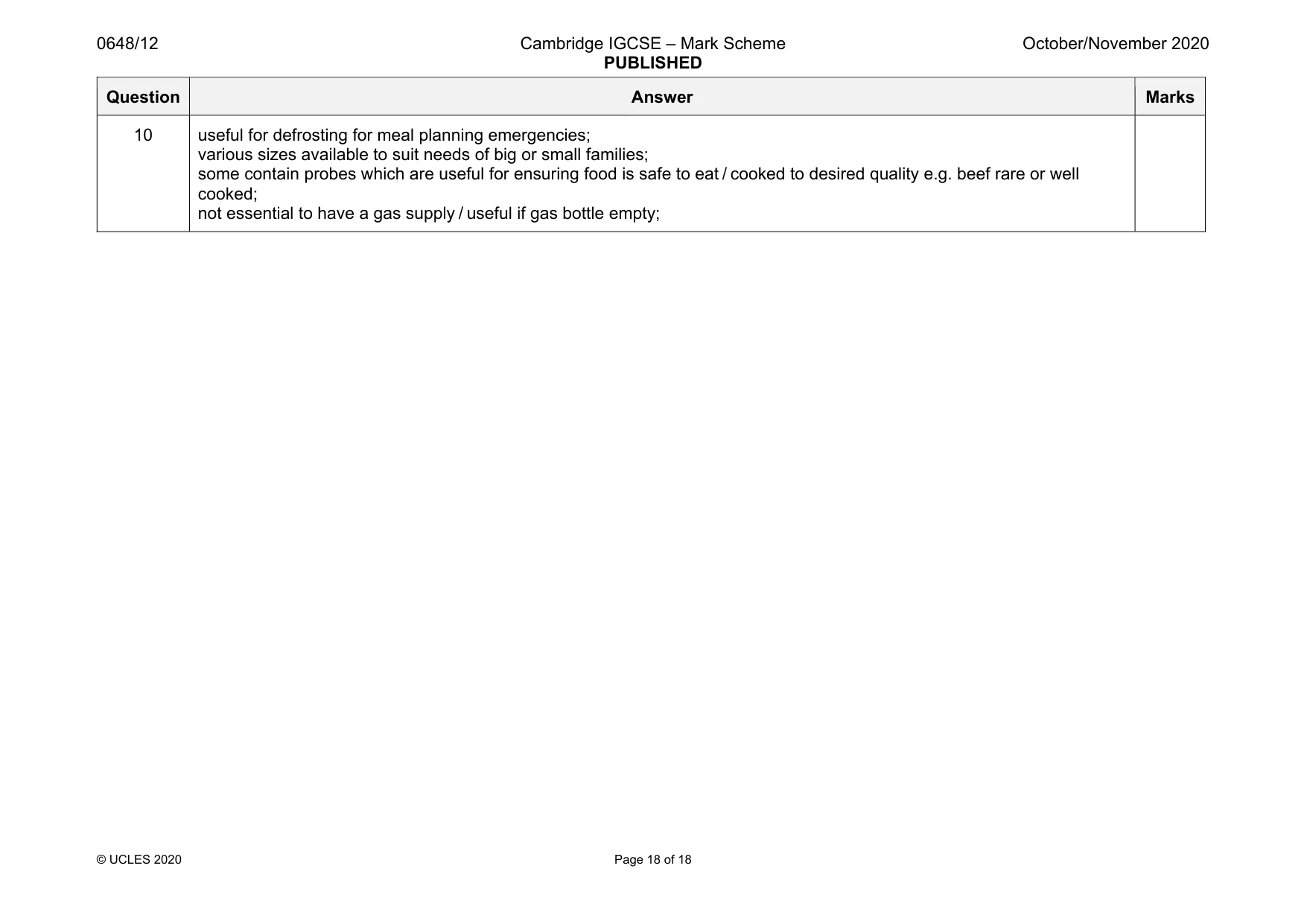
0648/12 Cambridge IGCSE – Mark Scheme PUBLISHED October/November 2020 © UCLES 2020 Page 18 of 18 Question Answer Marks 10 useful for defrosting for meal planning emergencies; various sizes available to suit needs of big or small families; some contain probes which are useful for ensuring food is safe to eat / cooked to desired quality e.g. beef rare or well cooked; not essential to have a gas supply / useful if gas bottle empty;
What you needed in this session
Cambridge’s own grade thresholds for 2020 Oct/Nov, Paper 1 · Variant 2. A higher threshold means an easier paper — the bar moves with how the cohort did.