Cambridge IGCSE Food and Nutrition 0648 — 2020 Oct/Nov Paper 1 · Variant 3
0648/13/O/N/20 · 100 marks · ≈113 min
The question paper and its mark scheme, free to read here and free to download. This is Cambridge’s own paper, exactly as it was sat.
Question paper12 pages


Mark scheme17 pages
Answers below. Sit the paper first if you are practising.
Paper as text
Question paper, page 1
Cambridge IGCSE™ * 9 1 1 4 7 7 9 8 5 9 * DC (PQ) 198014 © UCLES 2020 [Turn over This document has 12 pages. Blank pages are indicated. FOOD & NUTRITION 0648/13 Paper 1 Theory October/November 2020 2 hours You must answer on the question paper. No additional materials are needed. INSTRUCTIONS ● Section A: answer all questions. ● Section B: answer all questions. ● Section C: answer one question. ● Use a black or dark blue pen. You may use an HB pencil for any diagrams or graphs. ● Write your name, centre number and candidate number in the boxes at the top of the page. ● Write your answer to each question in the space provided. ● Do not use an erasable pen or correction fluid. ● Do not write on any bar codes. INFORMATION ● The total mark for this paper is 100. ● The number of marks for each question or part question is shown in brackets [ ].
Question paper, page 2
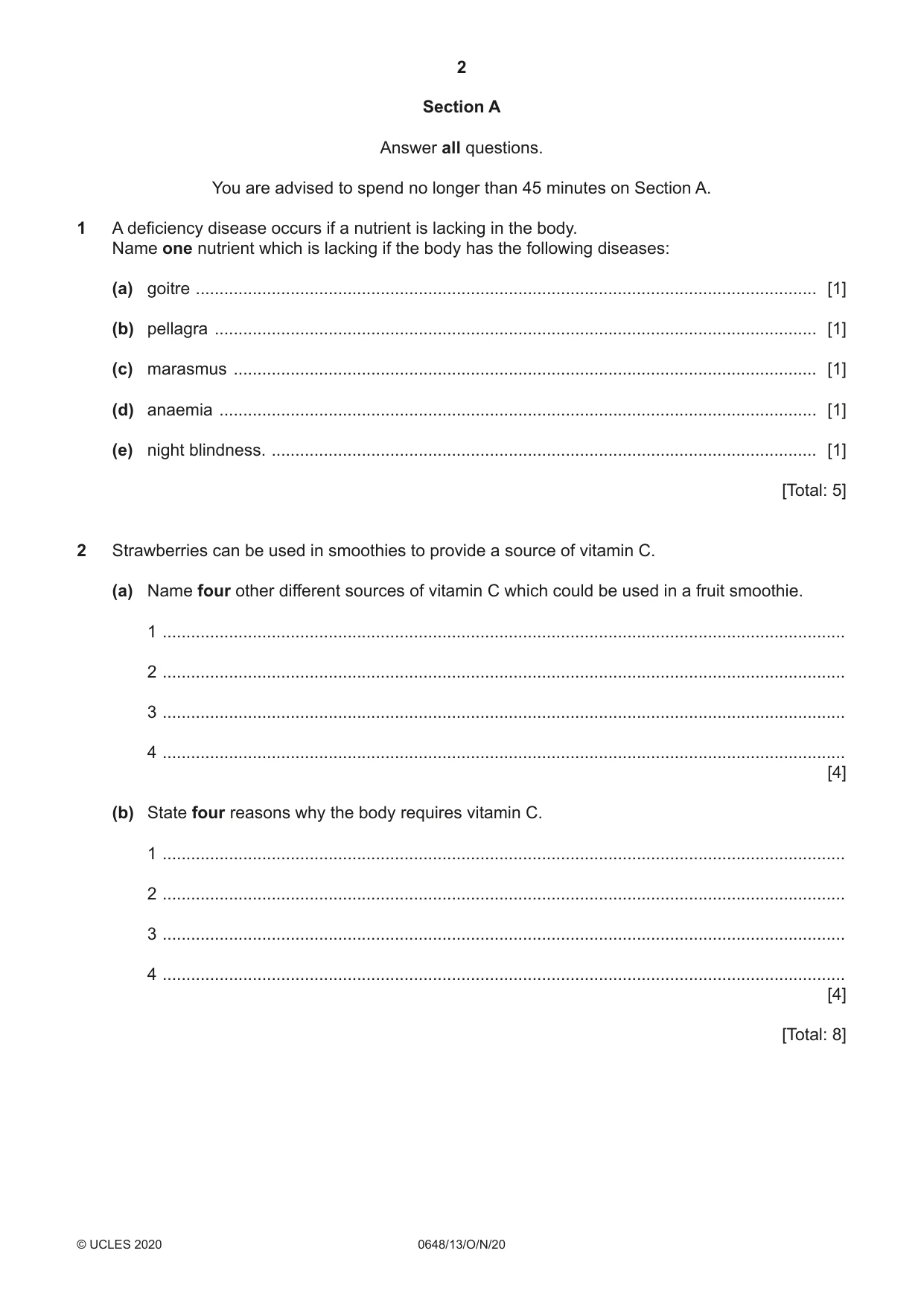
2 0648/13/O/N/20 © UCLES 2020 Section A Answer all questions. You are advised to spend no longer than 45 minutes on Section A. 1 A deficiency disease occurs if a nutrient is lacking in the body. Name one nutrient which is lacking if the body has the following diseases: (a) goitre … [1] (b) pellagra … [1] (c) marasmus … [1] (d) anaemia … [1] (e) night blindness. … [1] [Total: 5] 2 Strawberries can be used in smoothies to provide a source of vitamin C. (a) Name four other different sources of vitamin C which could be used in a fruit smoothie. 1 … 2 … 3 … 4 … [4] (b) State four reasons why the body requires vitamin C. 1 … 2 … 3 … 4 … [4] [Total: 8]
Question paper, page 3
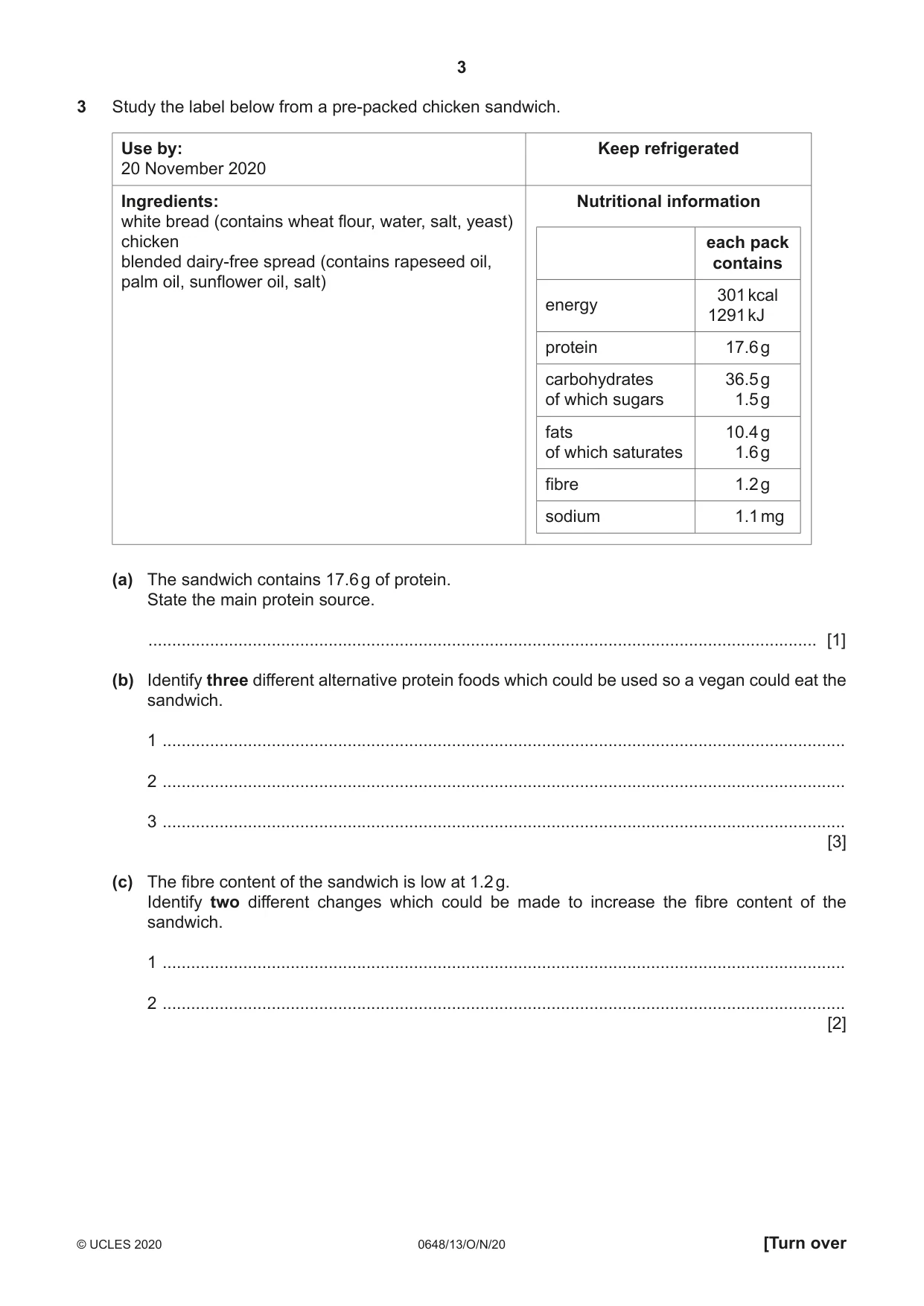
3 0648/13/O/N/20 © UCLES 2020 [Turn over 3 Study the label below from a pre-packed chicken sandwich. Use by: 20 November 2020 Keep refrigerated Ingredients: white bread (contains wheat flour, water, salt, yeast) chicken blended dairy-free spread (contains rapeseed oil, palm oil, sunflower oil, salt) Nutritional information each pack contains energy 301 kcal 1291 kJ protein 17.6 g carbohydrates of which sugars 36.5 g 1.5 g fats of which saturates 10.4 g 1.6 g fibre 1.2 g sodium 1.1 mg (a) The sandwich contains 17.6 g of protein. State the main protein source. … [1] (b) Identify three different alternative protein foods which could be used so a vegan could eat the sandwich. 1 … 2 … 3 … [3] (c) The fibre content of the sandwich is low at 1.2 g. Identify two different changes which could be made to increase the fibre content of the sandwich. 1 … 2 … [2]
Question paper, page 4
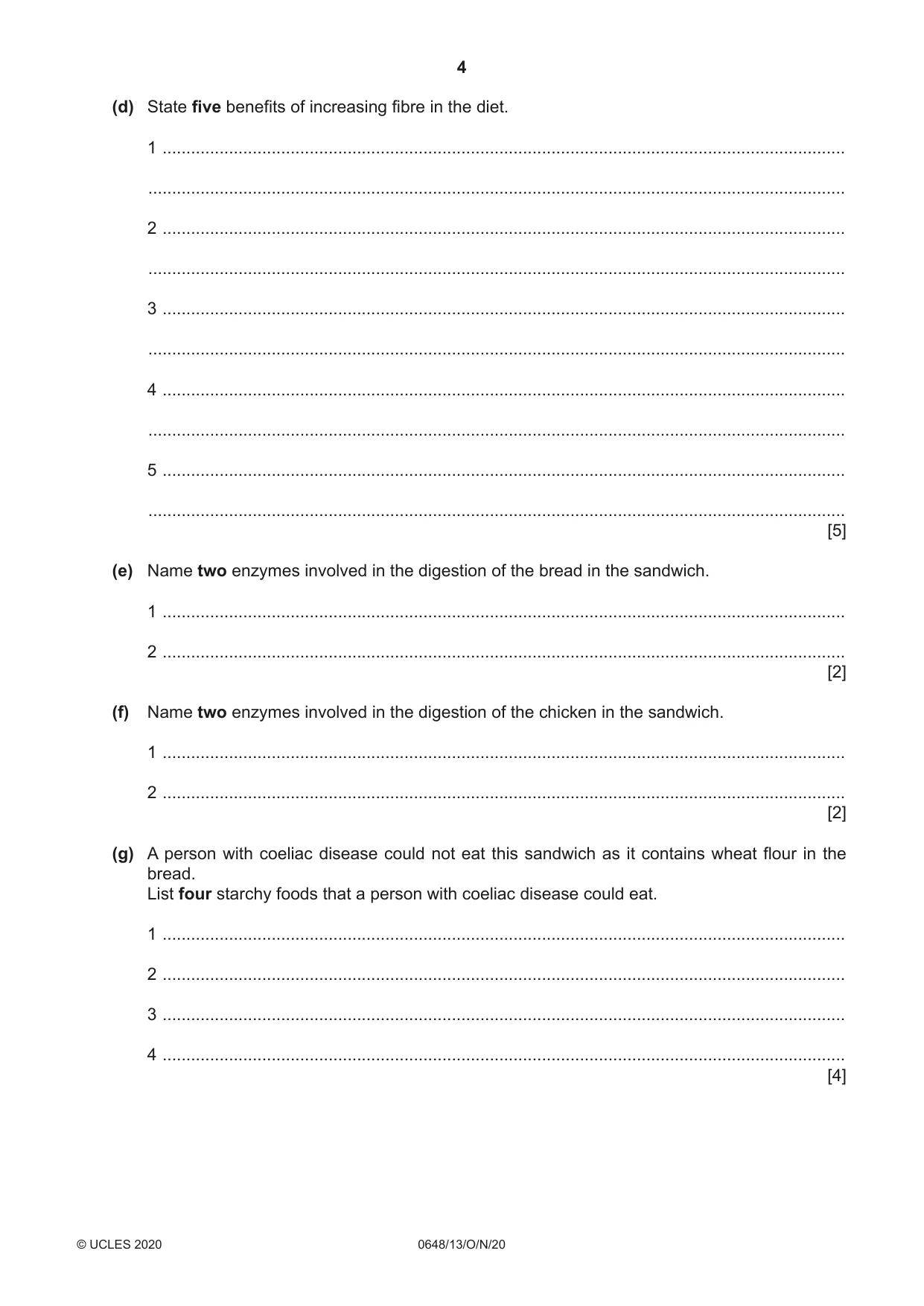
4 0648/13/O/N/20 © UCLES 2020 (d) State five benefits of increasing fibre in the diet. 1 … … 2 … … 3 … … 4 … … 5 … … [5] (e) Name two enzymes involved in the digestion of the bread in the sandwich. 1 … 2 … [2] (f) Name two enzymes involved in the digestion of the chicken in the sandwich. 1 … 2 … [2] (g) A person with coeliac disease could not eat this sandwich as it contains wheat flour in the bread. List four starchy foods that a person with coeliac disease could eat. 1 … 2 … 3 … 4 … [4]
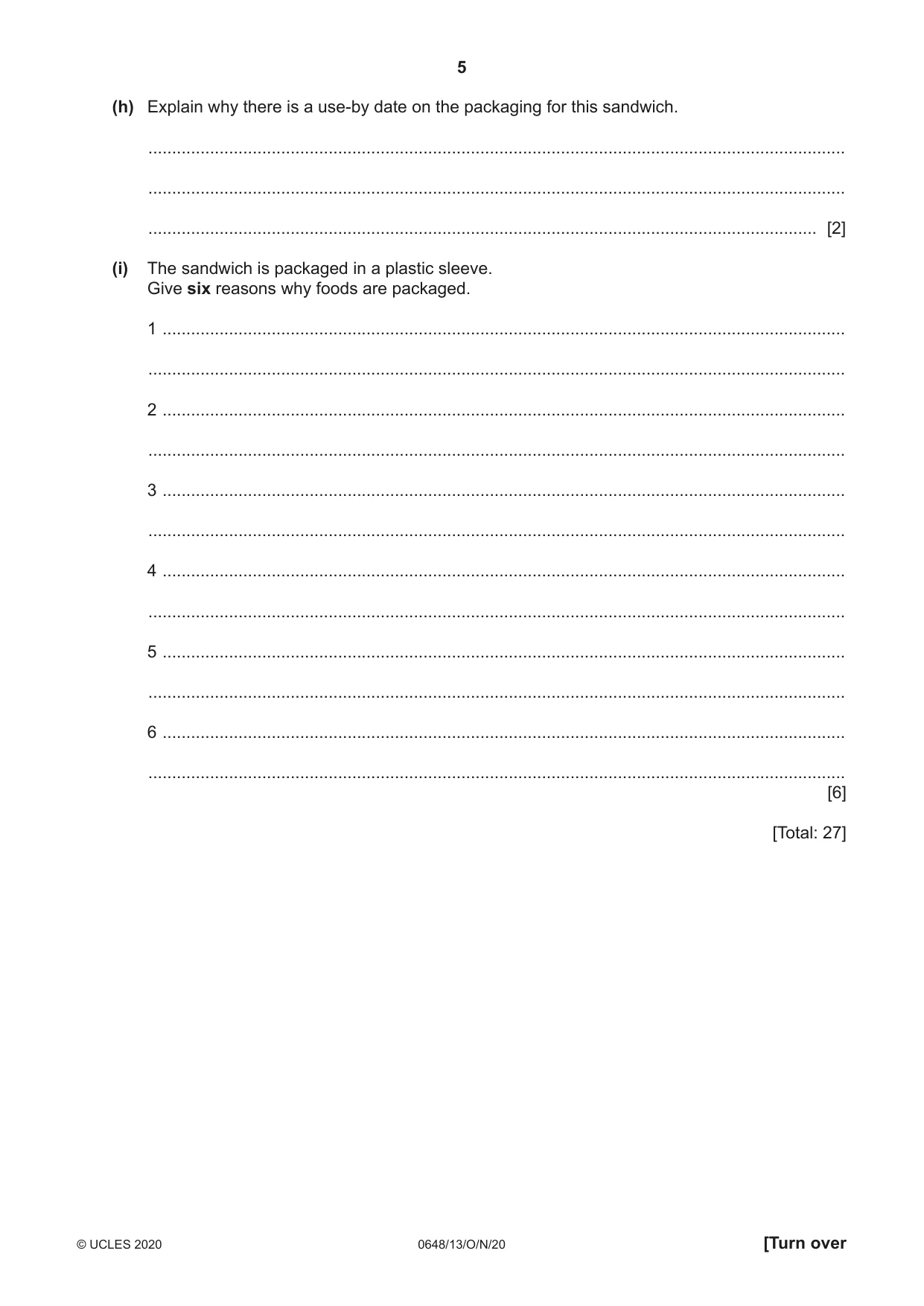
Question paper, page 5
5 0648/13/O/N/20 © UCLES 2020 [Turn over (h) Explain why there is a use-by date on the packaging for this sandwich. … … … [2] (i) The sandwich is packaged in a plastic sleeve. Give six reasons why foods are packaged. 1 … … 2 … … 3 … … 4 … … 5 … … 6 … … [6] [Total: 27]
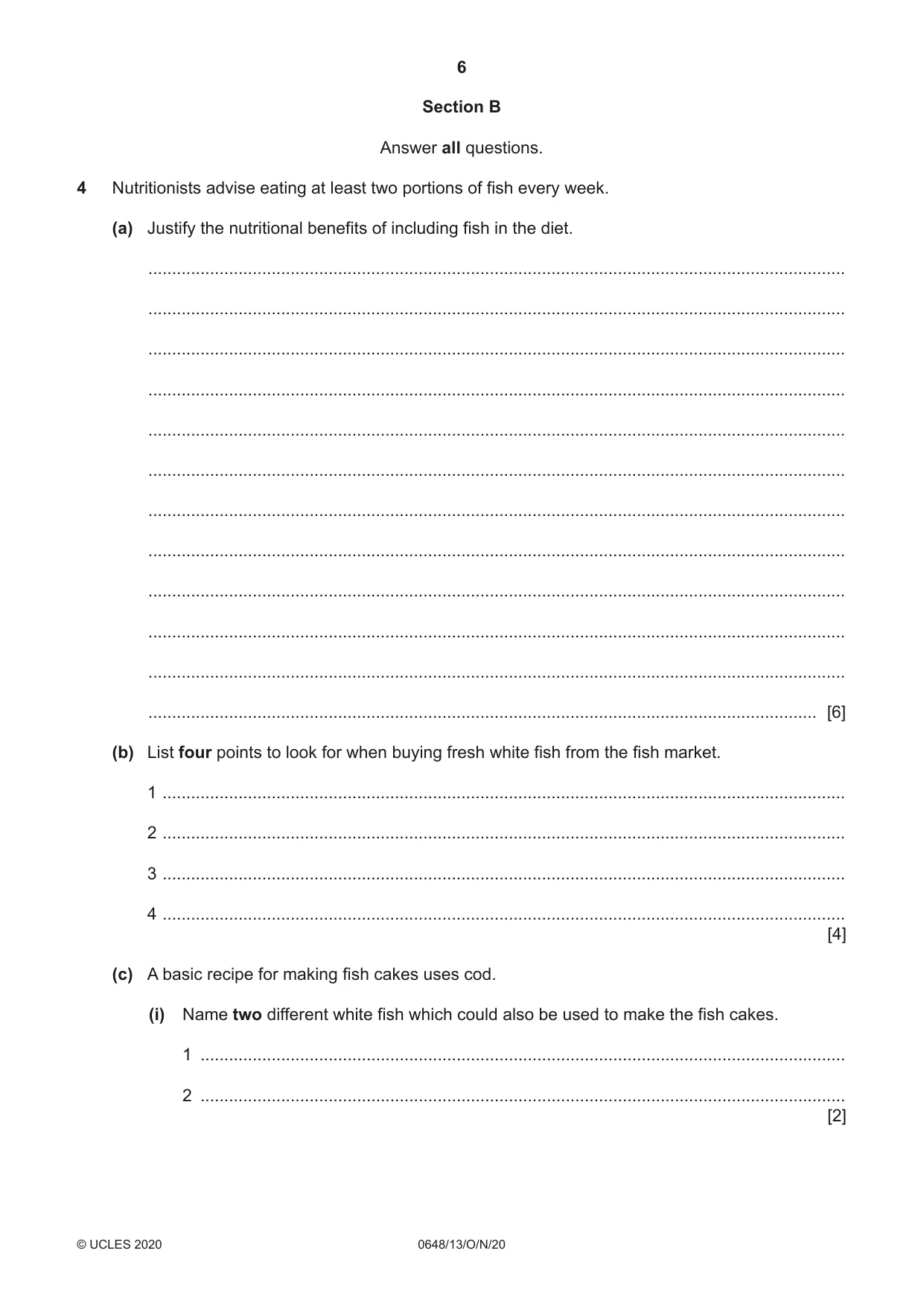
Question paper, page 6
6 0648/13/O/N/20 © UCLES 2020 Section B Answer all questions. 4 Nutritionists advise eating at least two portions of fish every week. (a) Justify the nutritional benefits of including fish in the diet. … … … … … … … … … … … … [6] (b) List four points to look for when buying fresh white fish from the fish market. 1 … 2 … 3 … 4 … [4] (c) A basic recipe for making fish cakes uses cod. (i) Name two different white fish which could also be used to make the fish cakes. 1 … 2 … [2]
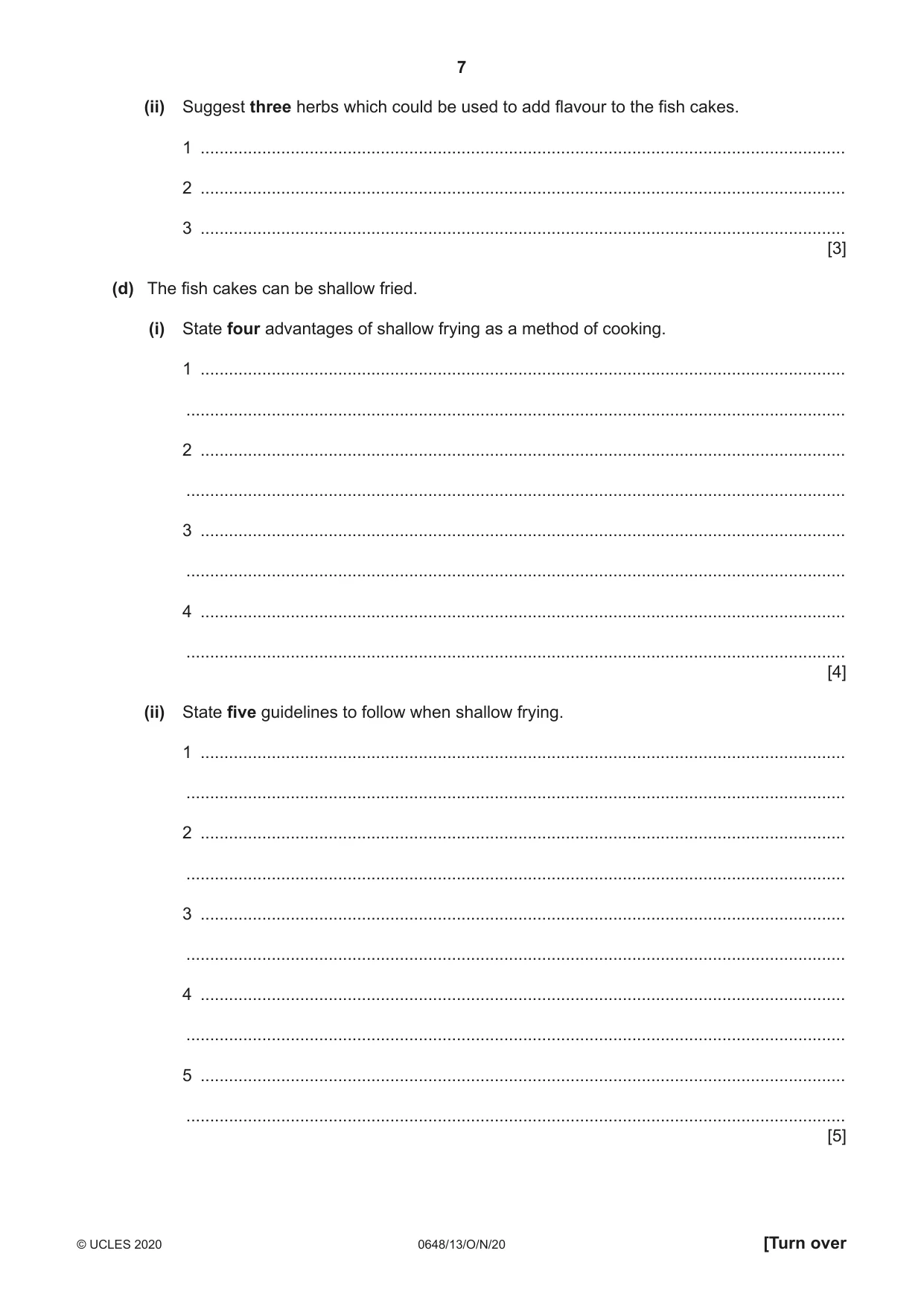
Question paper, page 7
7 0648/13/O/N/20 © UCLES 2020 [Turn over (ii) Suggest three herbs which could be used to add flavour to the fish cakes. 1 … 2 … 3 … [3] (d) The fish cakes can be shallow fried. (i) State four advantages of shallow frying as a method of cooking. 1 … … 2 … … 3 … … 4 … … [4] (ii) State five guidelines to follow when shallow frying. 1 … … 2 … … 3 … … 4 … … 5 … … [5]
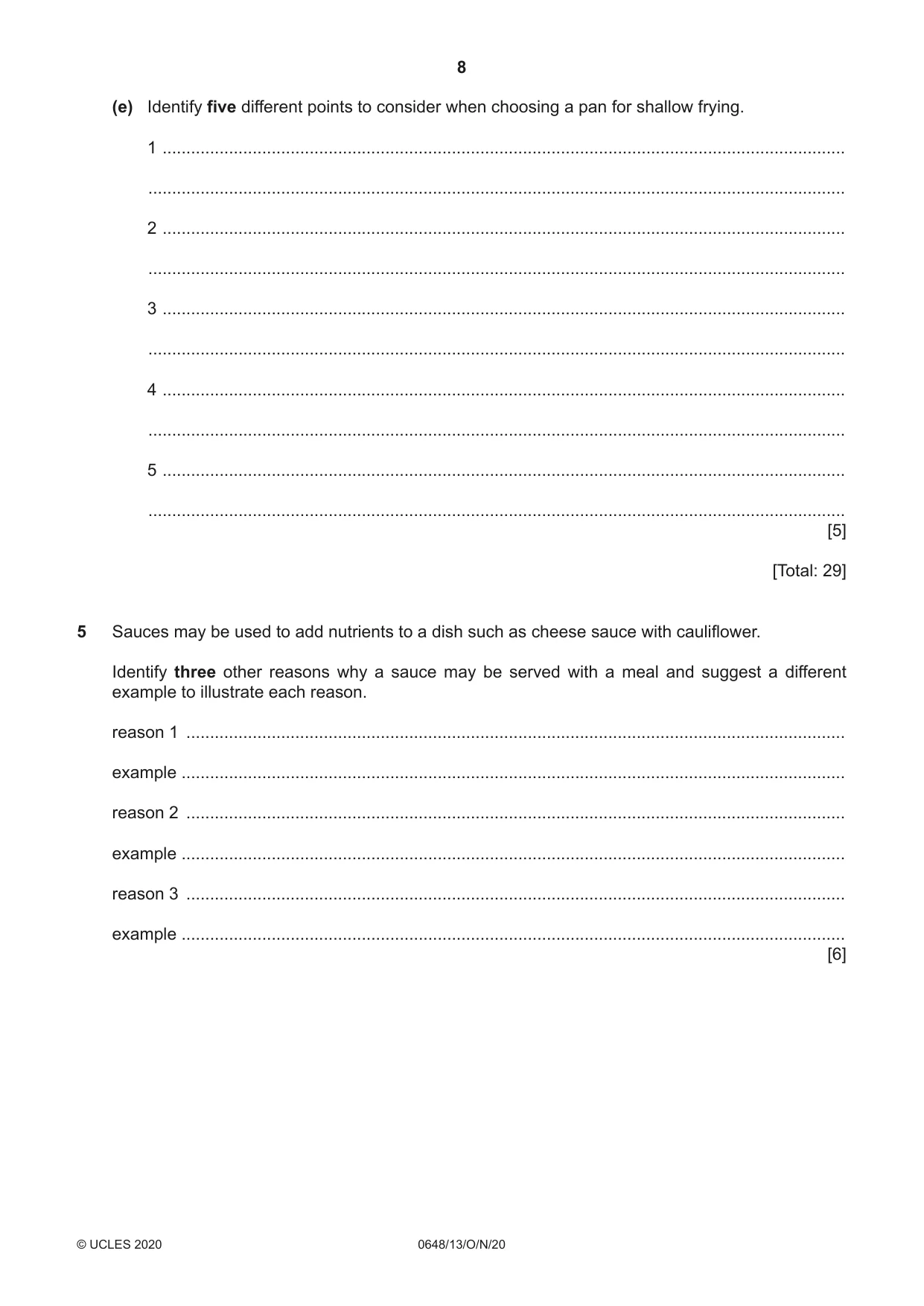
Question paper, page 8
8 0648/13/O/N/20 © UCLES 2020 (e) Identify five different points to consider when choosing a pan for shallow frying. 1 … … 2 … … 3 … … 4 … … 5 … … [5] [Total: 29] 5 Sauces may be used to add nutrients to a dish such as cheese sauce with cauliflower. Identify three other reasons why a sauce may be served with a meal and suggest a different example to illustrate each reason. reason 1 … example … reason 2 … example … reason 3 … example … [6]
Question paper, page 9
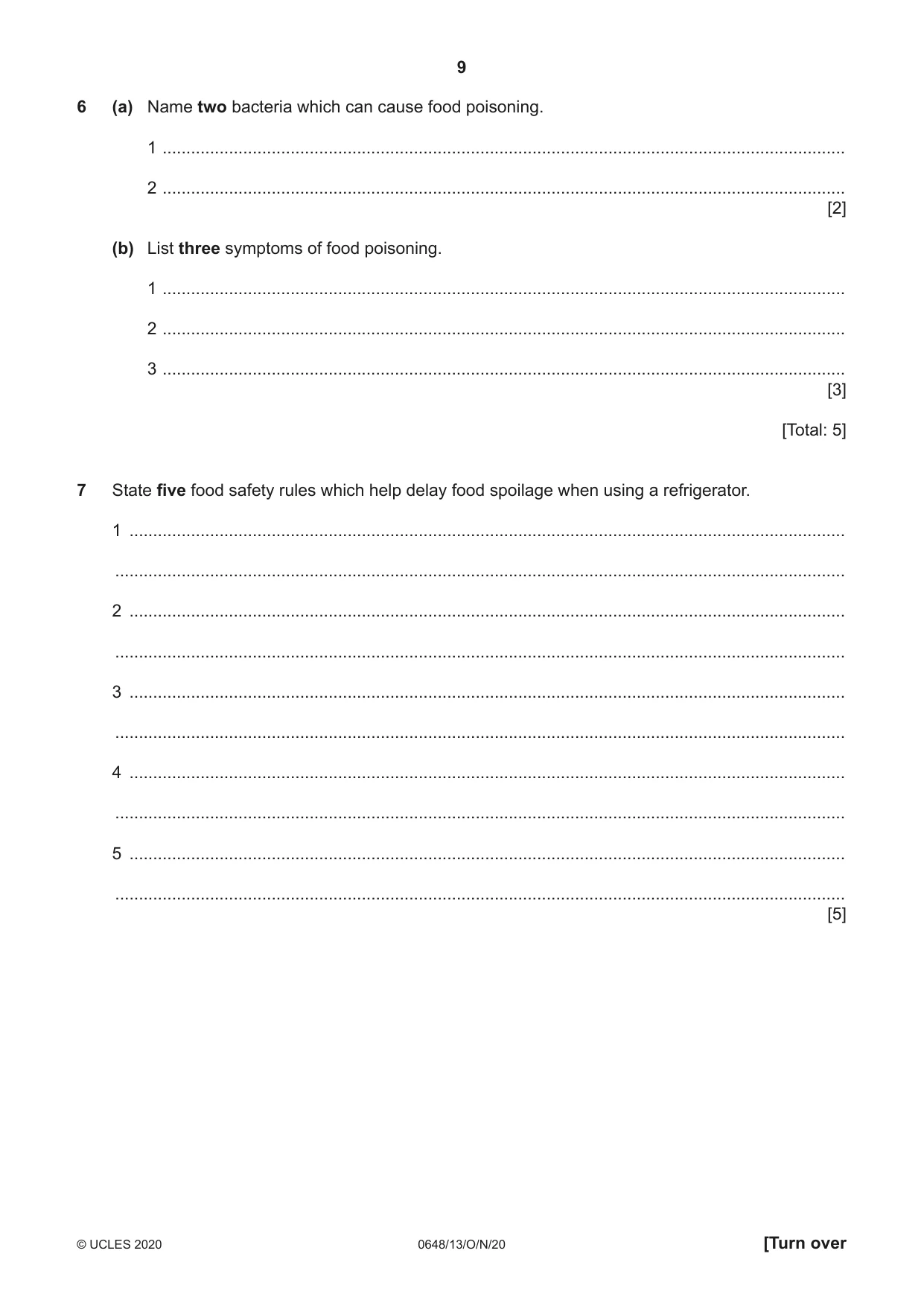
9 0648/13/O/N/20 © UCLES 2020 [Turn over 6 (a) Name two bacteria which can cause food poisoning. 1 … 2 … [2] (b) List three symptoms of food poisoning. 1 … 2 … 3 … [3] [Total: 5] 7 State five food safety rules which help delay food spoilage when using a refrigerator. 1 … … 2 … … 3 … … 4 … … 5 … … [5]
Question paper, page 10
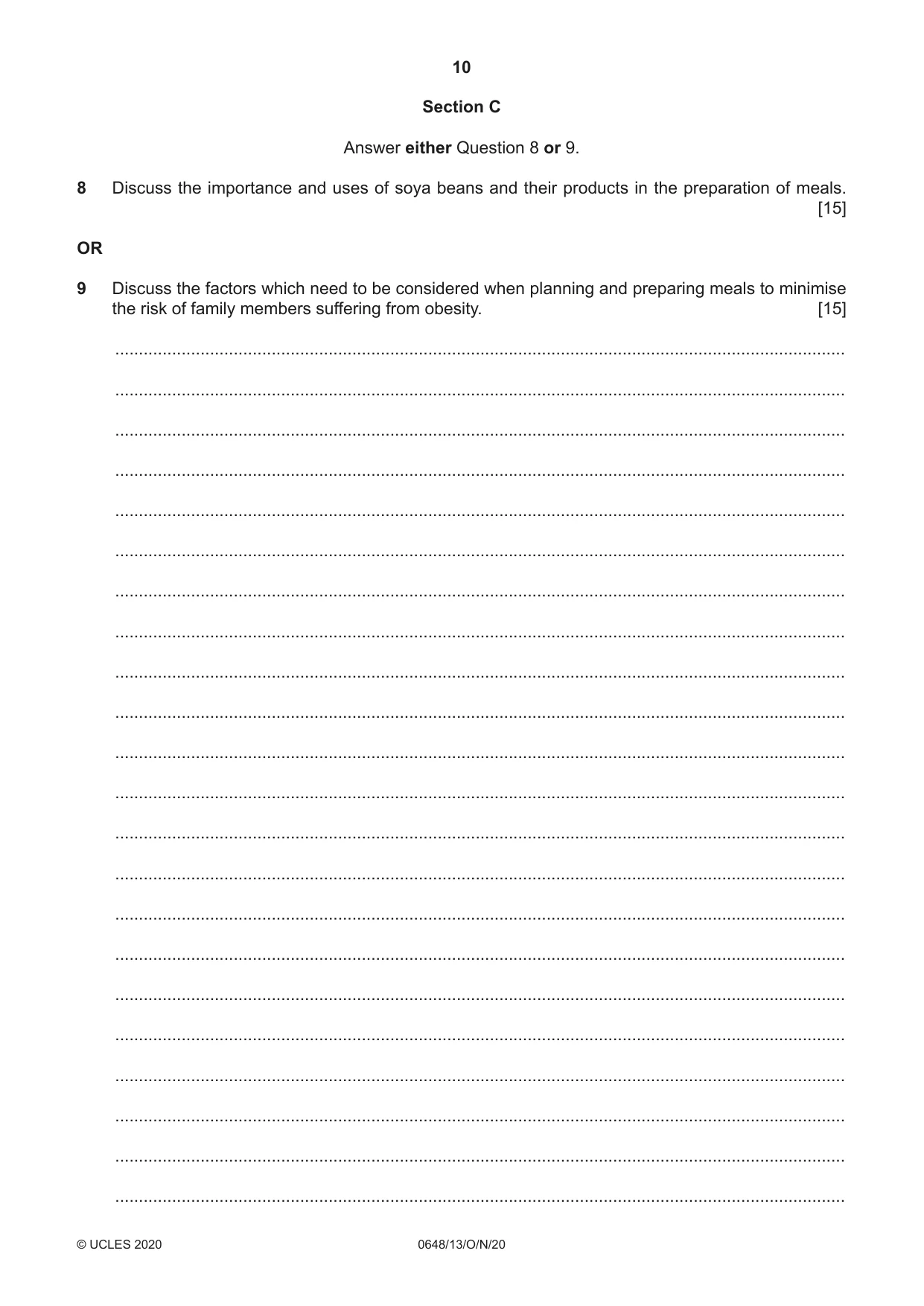
10 0648/13/O/N/20 © UCLES 2020 Section C Answer either Question 8 or 9. 8 Discuss the importance and uses of soya beans and their products in the preparation of meals. [15] OR 9 Discuss the factors which need to be considered when planning and preparing meals to minimise the risk of family members suffering from obesity. [15] … … … … … … … … … … … … … … … … … … … … … …
Question paper, page 11
11 0648/13/O/N/20 © UCLES 2020 [Turn over … … … … … … … … … … … … … … … … … … … … … … … … … … … …
Question paper, page 12
12 0648/13/O/N/20 © UCLES 2020 Permission to reproduce items where third-party owned material protected by copyright is included has been sought and cleared where possible. Every reasonable effort has been made by the publisher (UCLES) to trace copyright holders, but if any items requiring clearance have unwittingly been included, the publisher will be pleased to make amends at the earliest possible opportunity. To avoid the issue of disclosure of answer-related information to candidates, all copyright acknowledgements are reproduced online in the Cambridge Assessment International Education Copyright Acknowledgements Booklet. This is produced for each series of examinations and is freely available to download at www.cambridgeinternational.org after the live examination series. Cambridge Assessment International Education is part of the Cambridge Assessment Group. Cambridge Assessment is the brand name of the University of Cambridge Local Examinations Syndicate (UCLES), which itself is a department of the University of Cambridge. … … … … … … … … … … … … … … … … … … … … … … … …
Mark scheme, page 1
This document consists of 17 printed pages. © UCLES 2020 [Turn over Cambridge IGCSE™ FOOD & NUTRITION 0648/13 Paper 1 Theory October/November 2020 MARK SCHEME Maximum Mark: 100 Published This mark scheme is published as an aid to teachers and candidates, to indicate the requirements of the examination. It shows the basis on which Examiners were instructed to award marks. It does not indicate the details of the discussions that took place at an Examiners’ meeting before marking began, which would have considered the acceptability of alternative answers. Mark schemes should be read in conjunction with the question paper and the Principal Examiner Report for Teachers. Cambridge International will not enter into discussions about these mark schemes. Cambridge International is publishing the mark schemes for the October/November 2020 series for most Cambridge IGCSE, Cambridge International A and AS Level and Cambridge Pre-U components, and some Cambridge O Level components.
Mark scheme, page 2
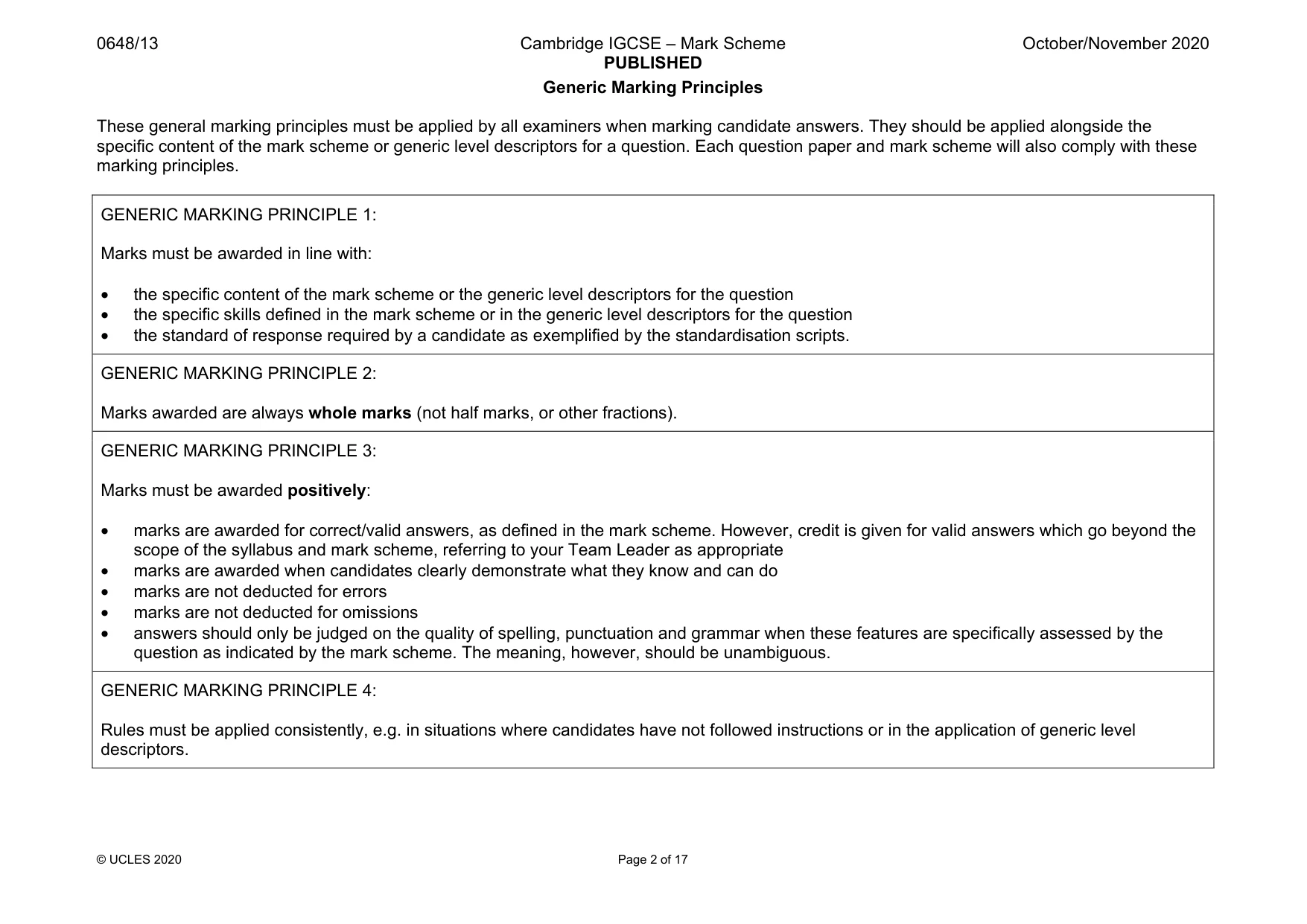
0648/13 Cambridge IGCSE – Mark Scheme PUBLISHED October/November 2020 © UCLES 2020 Page 2 of 17 Generic Marking Principles These general marking principles must be applied by all examiners when marking candidate answers. They should be applied alongside the specific content of the mark scheme or generic level descriptors for a question. Each question paper and mark scheme will also comply with these marking principles. GENERIC MARKING PRINCIPLE 1: Marks must be awarded in line with: • the specific content of the mark scheme or the generic level descriptors for the question • the specific skills defined in the mark scheme or in the generic level descriptors for the question • the standard of response required by a candidate as exemplified by the standardisation scripts. GENERIC MARKING PRINCIPLE 2: Marks awarded are always whole marks (not half marks, or other fractions). GENERIC MARKING PRINCIPLE 3: Marks must be awarded positively: • marks are awarded for correct/valid answers, as defined in the mark scheme. However, credit is given for valid answers which go beyond the scope of the syllabus and mark scheme, referring to your Team Leader as appropriate • marks are awarded when candidates clearly demonstrate what they know and can do • marks are not deducted for errors • marks are not deducted for omissions • answers should only be judged on the quality of spelling, punctuation and grammar when these features are specifically assessed by the question as indicated by the mark scheme. The meaning, however, should be unambiguous. GENERIC MARKING PRINCIPLE 4: Rules must be applied consistently, e.g. in situations where candidates have not followed instructions or in the application of generic level descriptors.
Mark scheme, page 3
0648/13 Cambridge IGCSE – Mark Scheme PUBLISHED October/November 2020 © UCLES 2020 Page 3 of 17 GENERIC MARKING PRINCIPLE 5: Marks should be awarded using the full range of marks defined in the mark scheme for the question (however; the use of the full mark range may be limited according to the quality of the candidate responses seen). GENERIC MARKING PRINCIPLE 6: Marks awarded are based solely on the requirements as defined in the mark scheme. Marks should not be awarded with grade thresholds or grade descriptors in mind. Science-Specific Marking Principles 1 Examiners should consider the context and scientific use of any keywords when awarding marks. Although keywords may be present, marks should not be awarded if the keywords are used incorrectly. 2 The examiner should not choose between contradictory statements given in the same question part, and credit should not be awarded for any correct statement that is contradicted within the same question part. Wrong science that is irrelevant to the question should be ignored. 3 Although spellings do not have to be correct, spellings of syllabus terms must allow for clear and unambiguous separation from other syllabus terms with which they may be confused (e.g. ethane / ethene, glucagon / glycogen, refraction / reflection). 4 The error carried forward (ecf) principle should be applied, where appropriate. If an incorrect answer is subsequently used in a scientifically correct way, the candidate should be awarded these subsequent marking points. Further guidance will be included in the mark scheme where necessary and any exceptions to this general principle will be noted. 5 ‘List rule’ guidance For questions that require n responses (e.g. State two reasons …): • The response should be read as continuous prose, even when numbered answer spaces are provided. • Any response marked ignore in the mark scheme should not count towards n. • Incorrect responses should not be awarded credit but will still count towards n. • Read the entire response to check for any responses that contradict those that would otherwise be credited. Credit should not be awarded for any responses that are contradicted within the rest of the response. Where two responses contradict one another, this should be treated as a single incorrect response. • Non-contradictory responses after the first n responses may be ignored even if they include incorrect science.
Mark scheme, page 4
0648/13 Cambridge IGCSE – Mark Scheme PUBLISHED October/November 2020 © UCLES 2020 Page 4 of 17 6 Calculation specific guidance Correct answers to calculations should be given full credit even if there is no working or incorrect working, unless the question states ‘show your working’. For questions in which the number of significant figures required is not stated, credit should be awarded for correct answers when rounded by the examiner to the number of significant figures given in the mark scheme. This may not apply to measured values. For answers given in standard form (e.g. a × 10n) in which the convention of restricting the value of the coefficient (a) to a value between 1 and 10 is not followed, credit may still be awarded if the answer can be converted to the answer given in the mark scheme. Unless a separate mark is given for a unit, a missing or incorrect unit will normally mean that the final calculation mark is not awarded. Exceptions to this general principle will be noted in the mark scheme. 7 Guidance for chemical equations Multiples / fractions of coefficients used in chemical equations are acceptable unless stated otherwise in the mark scheme. State symbols given in an equation should be ignored unless asked for in the question or stated otherwise in the mark scheme.
Mark scheme, page 5
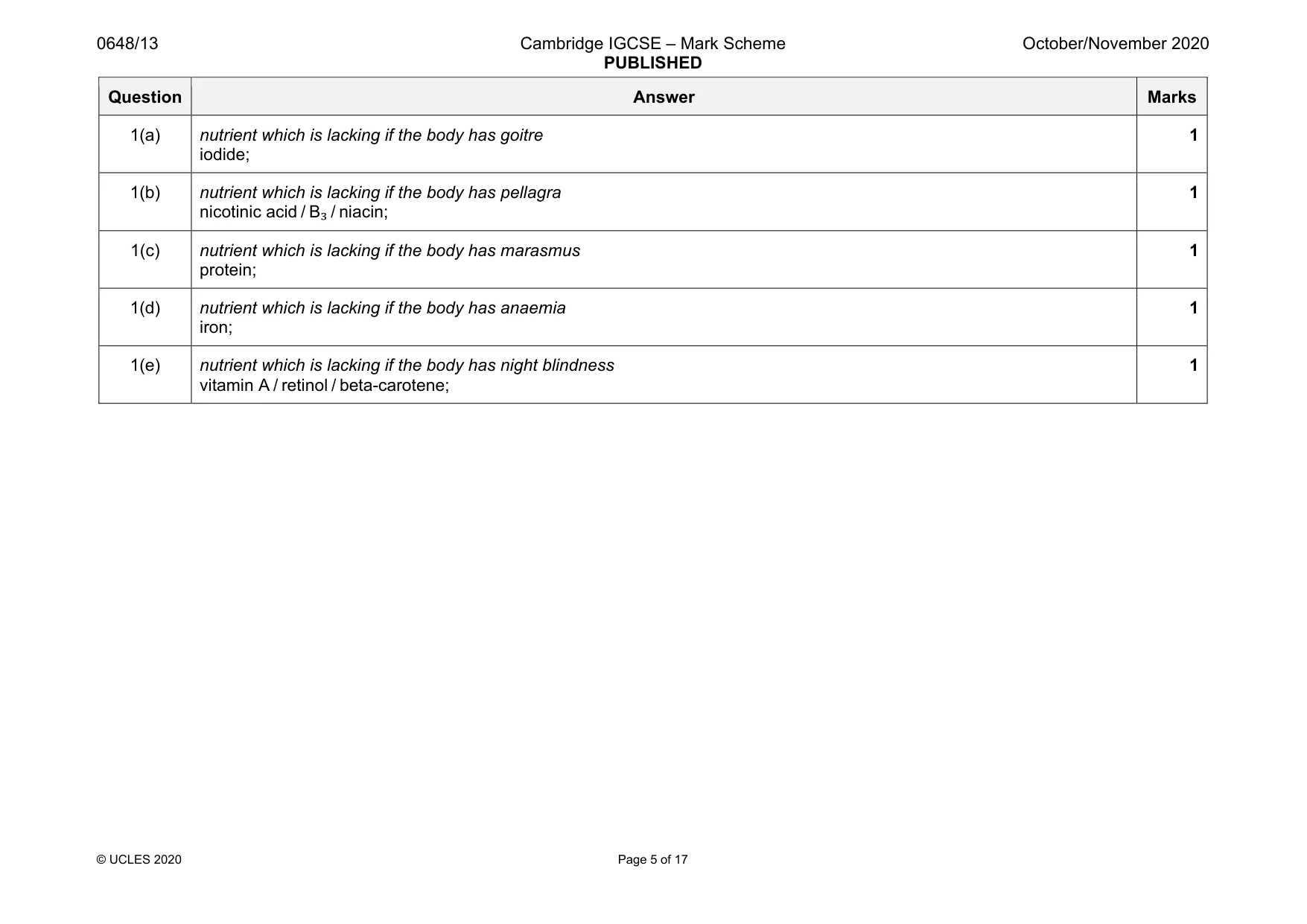
0648/13 Cambridge IGCSE – Mark Scheme PUBLISHED October/November 2020 © UCLES 2020 Page 5 of 17 Question Answer Marks 1(a) nutrient which is lacking if the body has goitre iodide; 1 1(b) nutrient which is lacking if the body has pellagra nicotinic acid / B₃ / niacin; 1 1(c) nutrient which is lacking if the body has marasmus protein; 1 1(d) nutrient which is lacking if the body has anaemia iron; 1 1(e) nutrient which is lacking if the body has night blindness vitamin A / retinol / beta-carotene; 1
Mark scheme, page 6
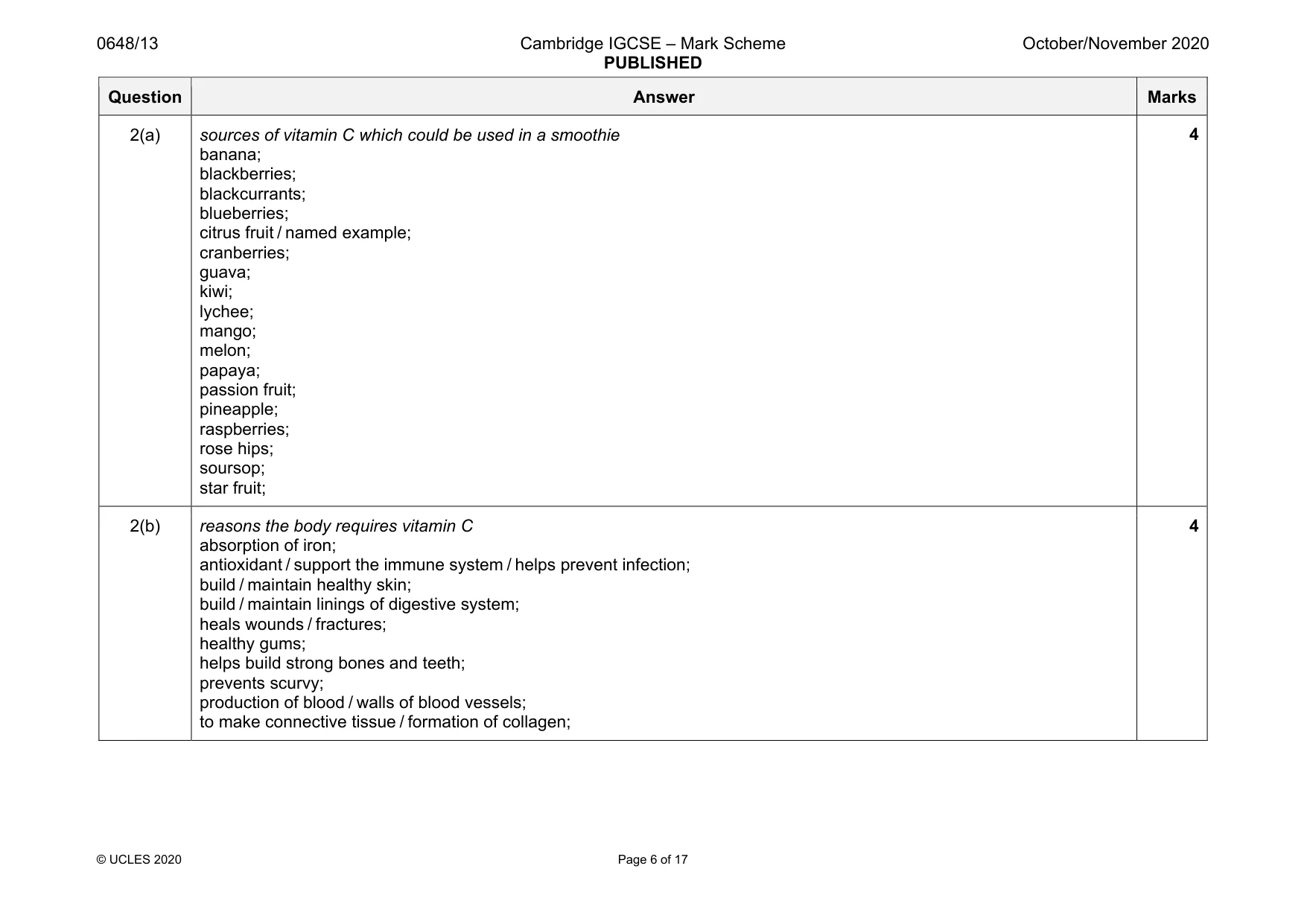
0648/13 Cambridge IGCSE – Mark Scheme PUBLISHED October/November 2020 © UCLES 2020 Page 6 of 17 Question Answer Marks 2(a) sources of vitamin C which could be used in a smoothie banana; blackberries; blackcurrants; blueberries; citrus fruit / named example; cranberries; guava; kiwi; lychee; mango; melon; papaya; passion fruit; pineapple; raspberries; rose hips; soursop; star fruit; 4 2(b) reasons the body requires vitamin C absorption of iron; antioxidant / support the immune system / helps prevent infection; build / maintain healthy skin; build / maintain linings of digestive system; heals wounds / fractures; healthy gums; helps build strong bones and teeth; prevents scurvy; production of blood / walls of blood vessels; to make connective tissue / formation of collagen; 4
Mark scheme, page 7
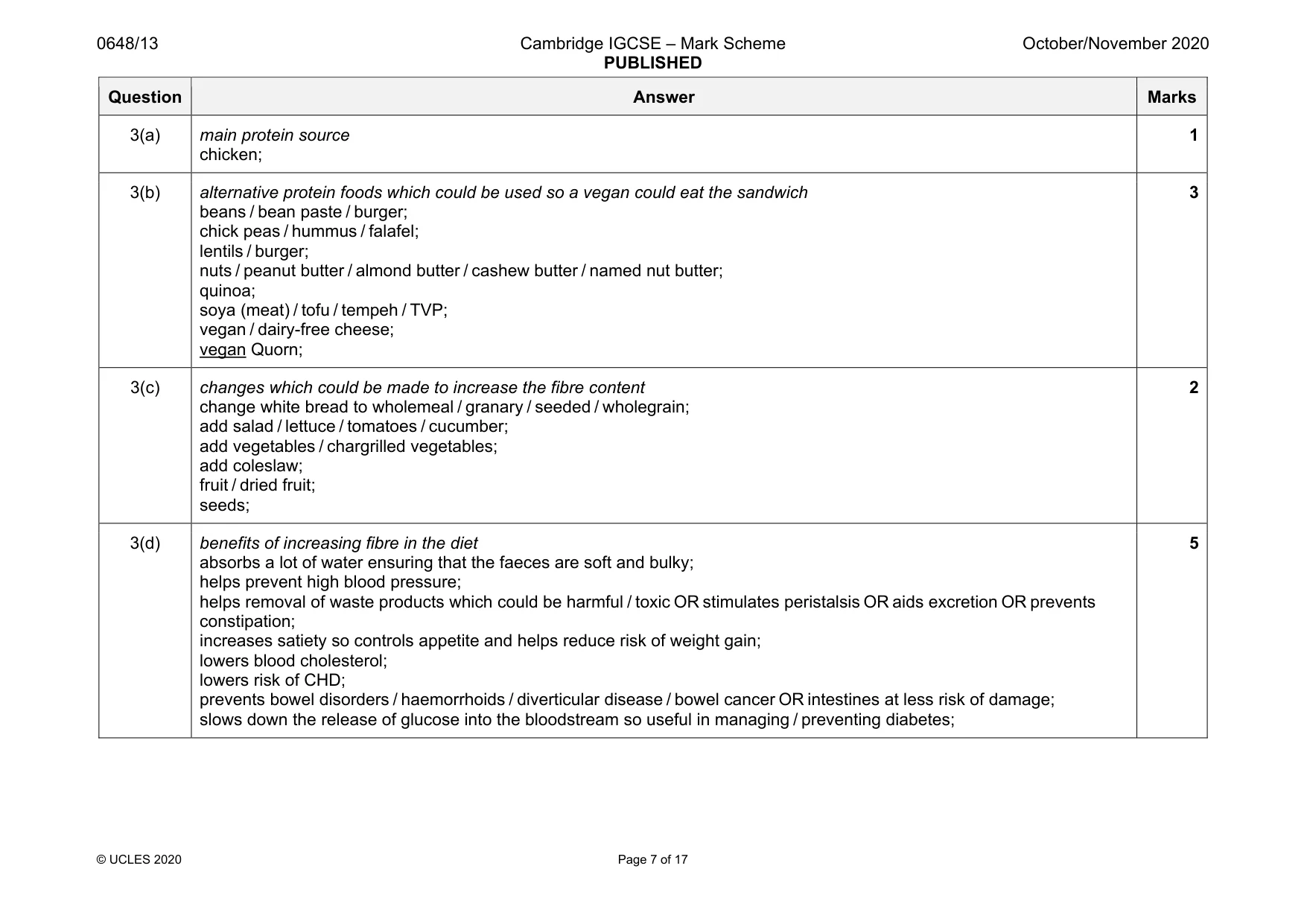
0648/13 Cambridge IGCSE – Mark Scheme PUBLISHED October/November 2020 © UCLES 2020 Page 7 of 17 Question Answer Marks 3(a) main protein source chicken; 1 3(b) alternative protein foods which could be used so a vegan could eat the sandwich beans / bean paste / burger; chick peas / hummus / falafel; lentils / burger; nuts / peanut butter / almond butter / cashew butter / named nut butter; quinoa; soya (meat) / tofu / tempeh / TVP; vegan / dairy-free cheese; vegan Quorn; 3 3(c) changes which could be made to increase the fibre content change white bread to wholemeal / granary / seeded / wholegrain; add salad / lettuce / tomatoes / cucumber; add vegetables / chargrilled vegetables; add coleslaw; fruit / dried fruit; seeds; 2 3(d) benefits of increasing fibre in the diet absorbs a lot of water ensuring that the faeces are soft and bulky; helps prevent high blood pressure; helps removal of waste products which could be harmful / toxic OR stimulates peristalsis OR aids excretion OR prevents constipation; increases satiety so controls appetite and helps reduce risk of weight gain; lowers blood cholesterol; lowers risk of CHD; prevents bowel disorders / haemorrhoids / diverticular disease / bowel cancer OR intestines at less risk of damage; slows down the release of glucose into the bloodstream so useful in managing / preventing diabetes; 5
Mark scheme, page 8
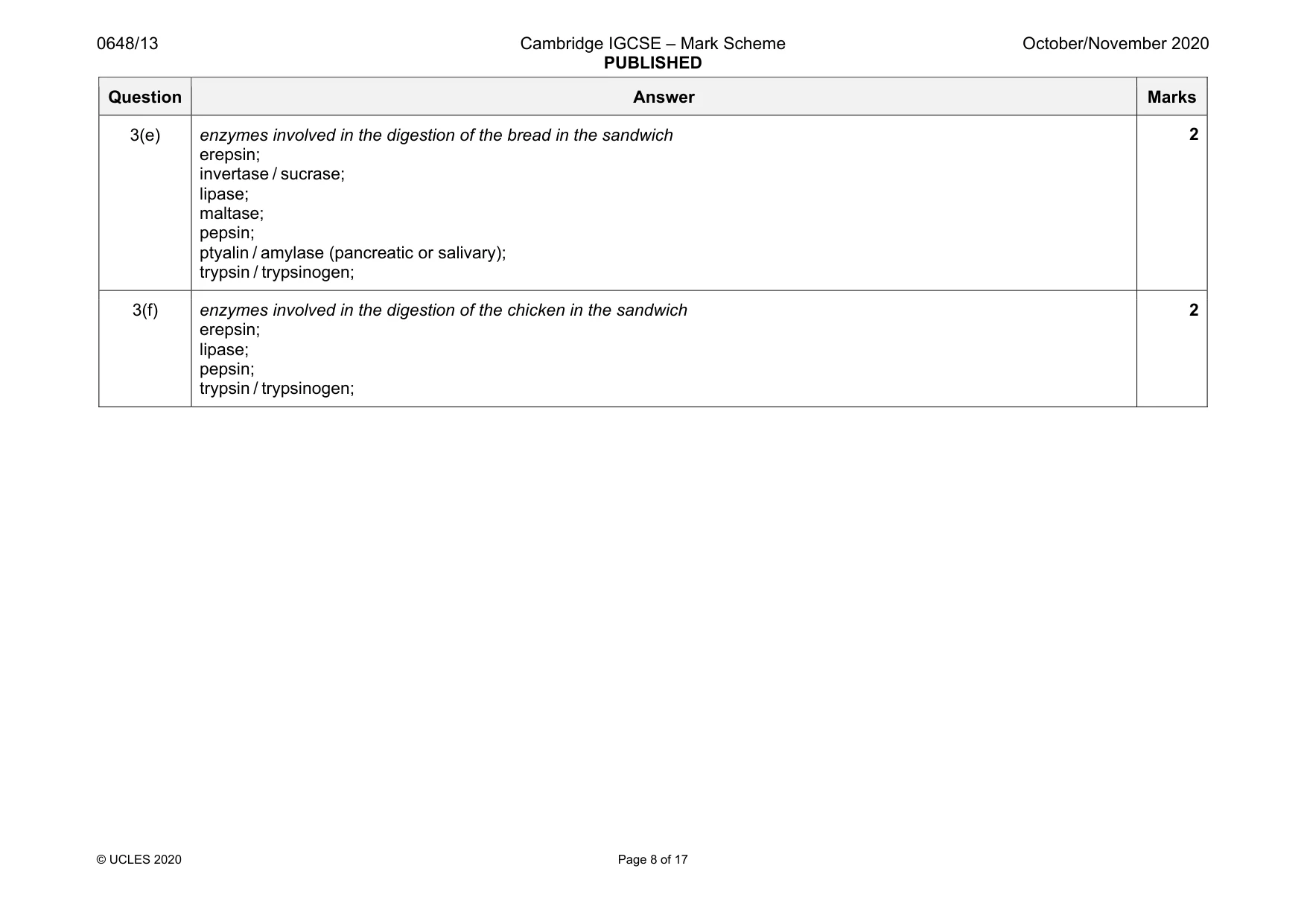
0648/13 Cambridge IGCSE – Mark Scheme PUBLISHED October/November 2020 © UCLES 2020 Page 8 of 17 Question Answer Marks 3(e) enzymes involved in the digestion of the bread in the sandwich erepsin; invertase / sucrase; lipase; maltase; pepsin; ptyalin / amylase (pancreatic or salivary); trypsin / trypsinogen; 2 3(f) enzymes involved in the digestion of the chicken in the sandwich erepsin; lipase; pepsin; trypsin / trypsinogen; 2
Mark scheme, page 9
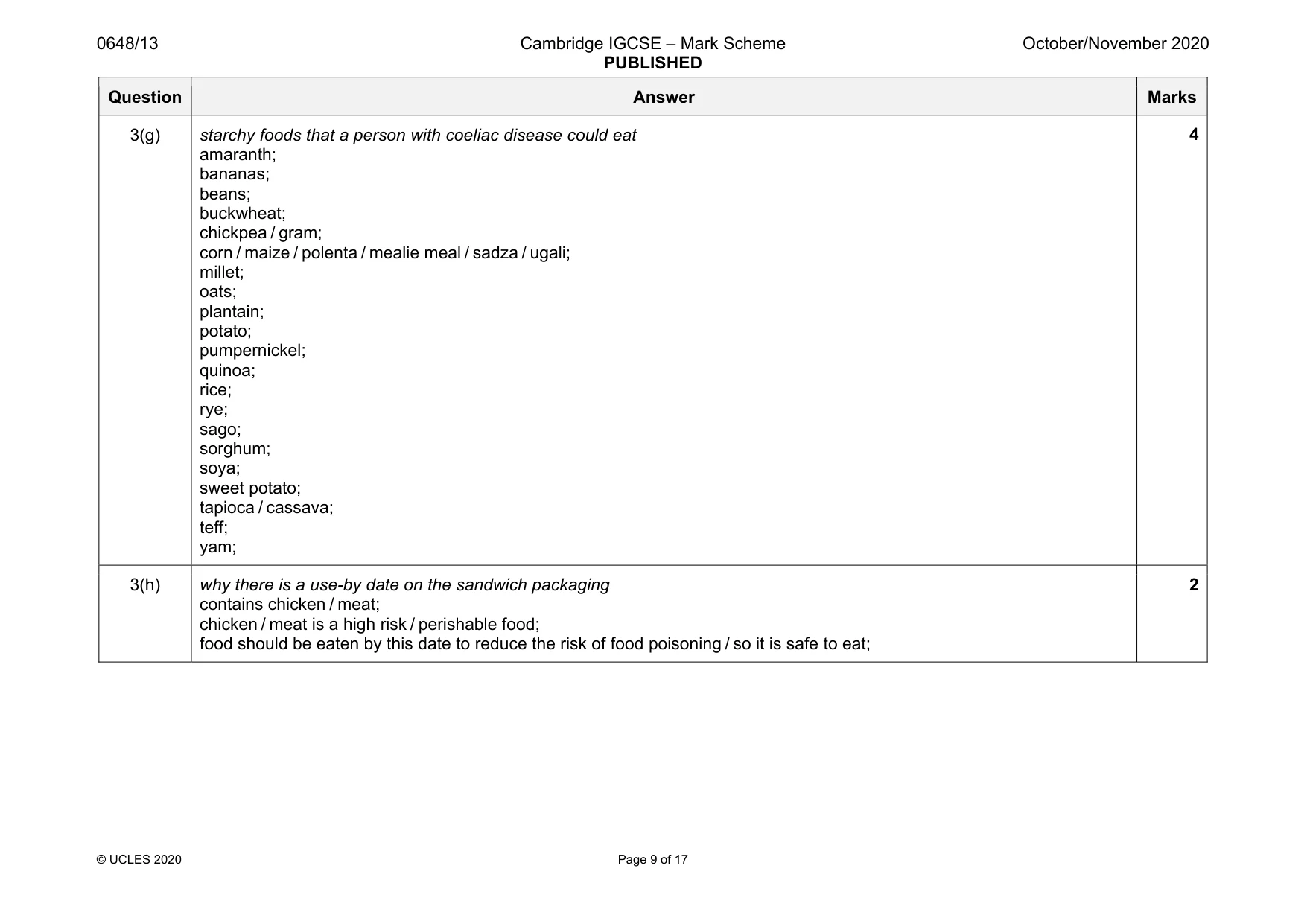
0648/13 Cambridge IGCSE – Mark Scheme PUBLISHED October/November 2020 © UCLES 2020 Page 9 of 17 Question Answer Marks 3(g) starchy foods that a person with coeliac disease could eat amaranth; bananas; beans; buckwheat; chickpea / gram; corn / maize / polenta / mealie meal / sadza / ugali; millet; oats; plantain; potato; pumpernickel; quinoa; rice; rye; sago; sorghum; soya; sweet potato; tapioca / cassava; teff; yam; 4 3(h) why there is a use-by date on the sandwich packaging contains chicken / meat; chicken / meat is a high risk / perishable food; food should be eaten by this date to reduce the risk of food poisoning / so it is safe to eat; 2
Mark scheme, page 10
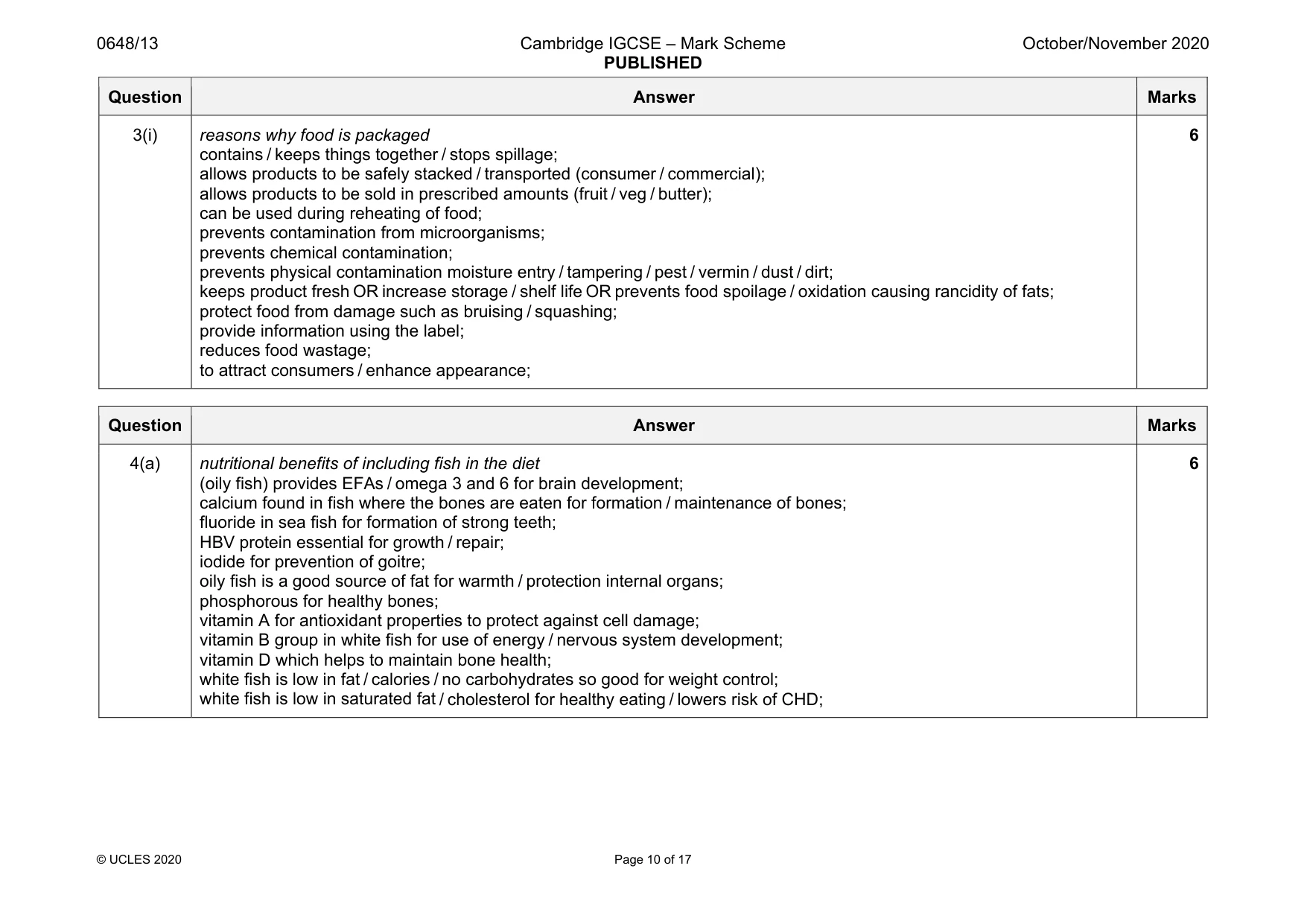
0648/13 Cambridge IGCSE – Mark Scheme PUBLISHED October/November 2020 © UCLES 2020 Page 10 of 17 Question Answer Marks 3(i) reasons why food is packaged contains / keeps things together / stops spillage; allows products to be safely stacked / transported (consumer / commercial); allows products to be sold in prescribed amounts (fruit / veg / butter); can be used during reheating of food; prevents contamination from microorganisms; prevents chemical contamination; prevents physical contamination moisture entry / tampering / pest / vermin / dust / dirt; keeps product fresh OR increase storage / shelf life OR prevents food spoilage / oxidation causing rancidity of fats; protect food from damage such as bruising / squashing; provide information using the label; reduces food wastage; to attract consumers / enhance appearance; 6 Question Answer Marks 4(a) nutritional benefits of including fish in the diet (oily fish) provides EFAs / omega 3 and 6 for brain development; calcium found in fish where the bones are eaten for formation / maintenance of bones; fluoride in sea fish for formation of strong teeth; HBV protein essential for growth / repair; iodide for prevention of goitre; oily fish is a good source of fat for warmth / protection internal organs; phosphorous for healthy bones; vitamin A for antioxidant properties to protect against cell damage; vitamin B group in white fish for use of energy / nervous system development; vitamin D which helps to maintain bone health; white fish is low in fat / calories / no carbohydrates so good for weight control; white fish is low in saturated fat / cholesterol for healthy eating / lowers risk of CHD; 6
Mark scheme, page 11
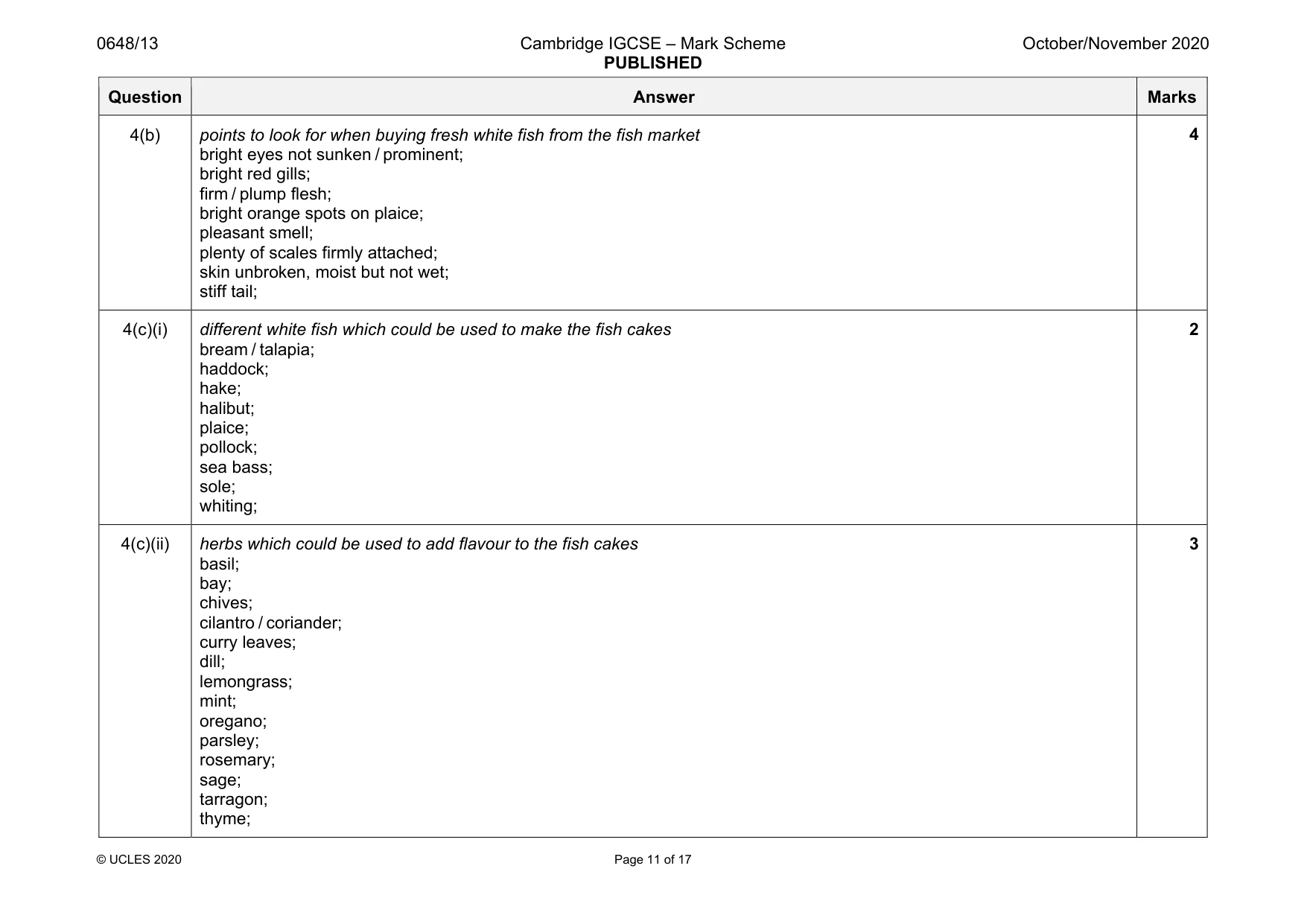
0648/13 Cambridge IGCSE – Mark Scheme PUBLISHED October/November 2020 © UCLES 2020 Page 11 of 17 Question Answer Marks 4(b) points to look for when buying fresh white fish from the fish market bright eyes not sunken / prominent; bright red gills; firm / plump flesh; bright orange spots on plaice; pleasant smell; plenty of scales firmly attached; skin unbroken, moist but not wet; stiff tail; 4 4(c)(i) different white fish which could be used to make the fish cakes bream / talapia; haddock; hake; halibut; plaice; pollock; sea bass; sole; whiting; 2 4(c)(ii) herbs which could be used to add flavour to the fish cakes basil; bay; chives; cilantro / coriander; curry leaves; dill; lemongrass; mint; oregano; parsley; rosemary; sage; tarragon; thyme; 3
Mark scheme, page 12
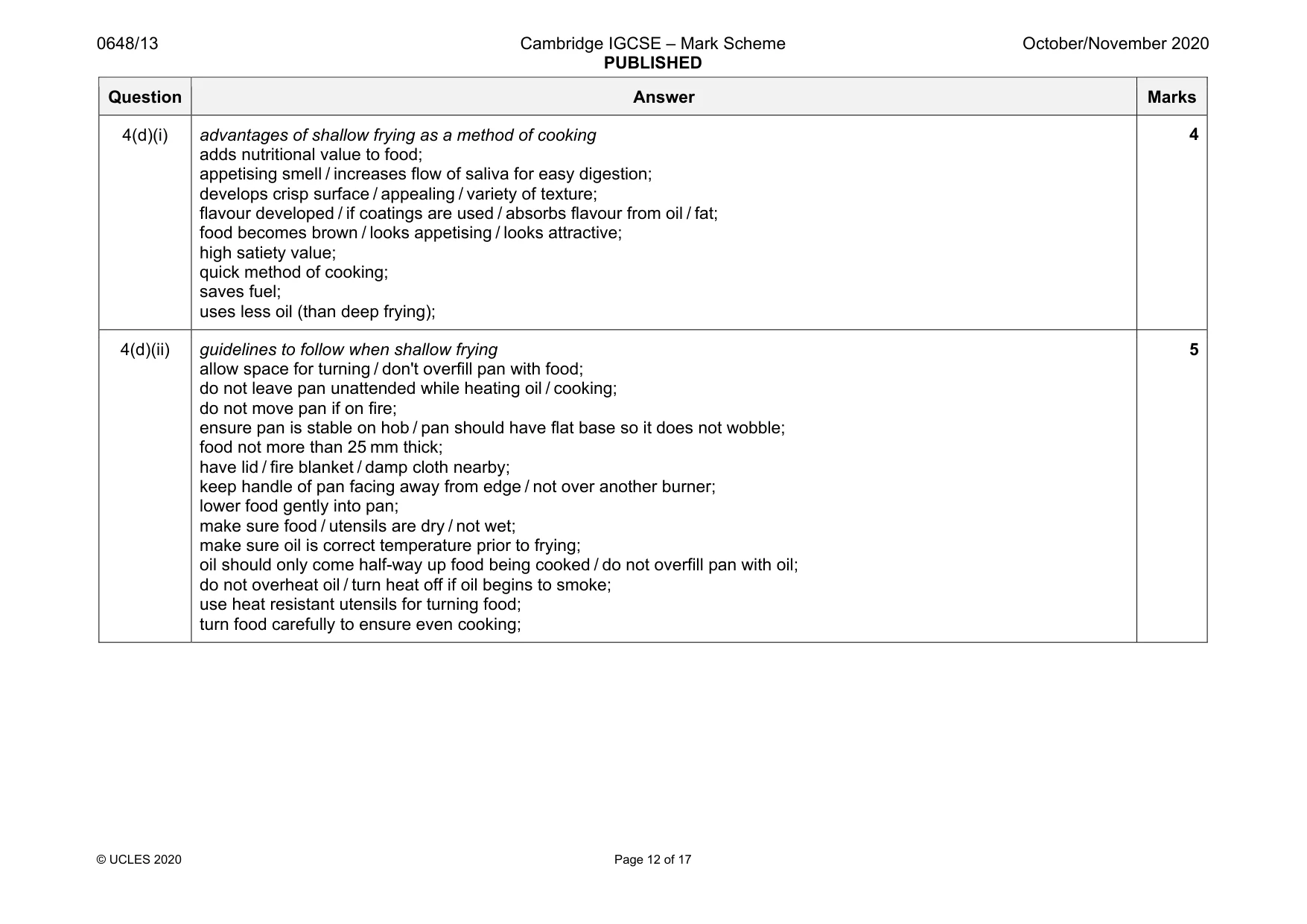
0648/13 Cambridge IGCSE – Mark Scheme PUBLISHED October/November 2020 © UCLES 2020 Page 12 of 17 Question Answer Marks 4(d)(i) advantages of shallow frying as a method of cooking adds nutritional value to food; appetising smell / increases flow of saliva for easy digestion; develops crisp surface / appealing / variety of texture; flavour developed / if coatings are used / absorbs flavour from oil / fat; food becomes brown / looks appetising / looks attractive; high satiety value; quick method of cooking; saves fuel; uses less oil (than deep frying); 4 4(d)(ii) guidelines to follow when shallow frying allow space for turning / don't overfill pan with food; do not leave pan unattended while heating oil / cooking; do not move pan if on fire; ensure pan is stable on hob / pan should have flat base so it does not wobble; food not more than 25 mm thick; have lid / fire blanket / damp cloth nearby; keep handle of pan facing away from edge / not over another burner; lower food gently into pan; make sure food / utensils are dry / not wet; make sure oil is correct temperature prior to frying; oil should only come half-way up food being cooked / do not overfill pan with oil; do not overheat oil / turn heat off if oil begins to smoke; use heat resistant utensils for turning food; turn food carefully to ensure even cooking; 5
Mark scheme, page 13
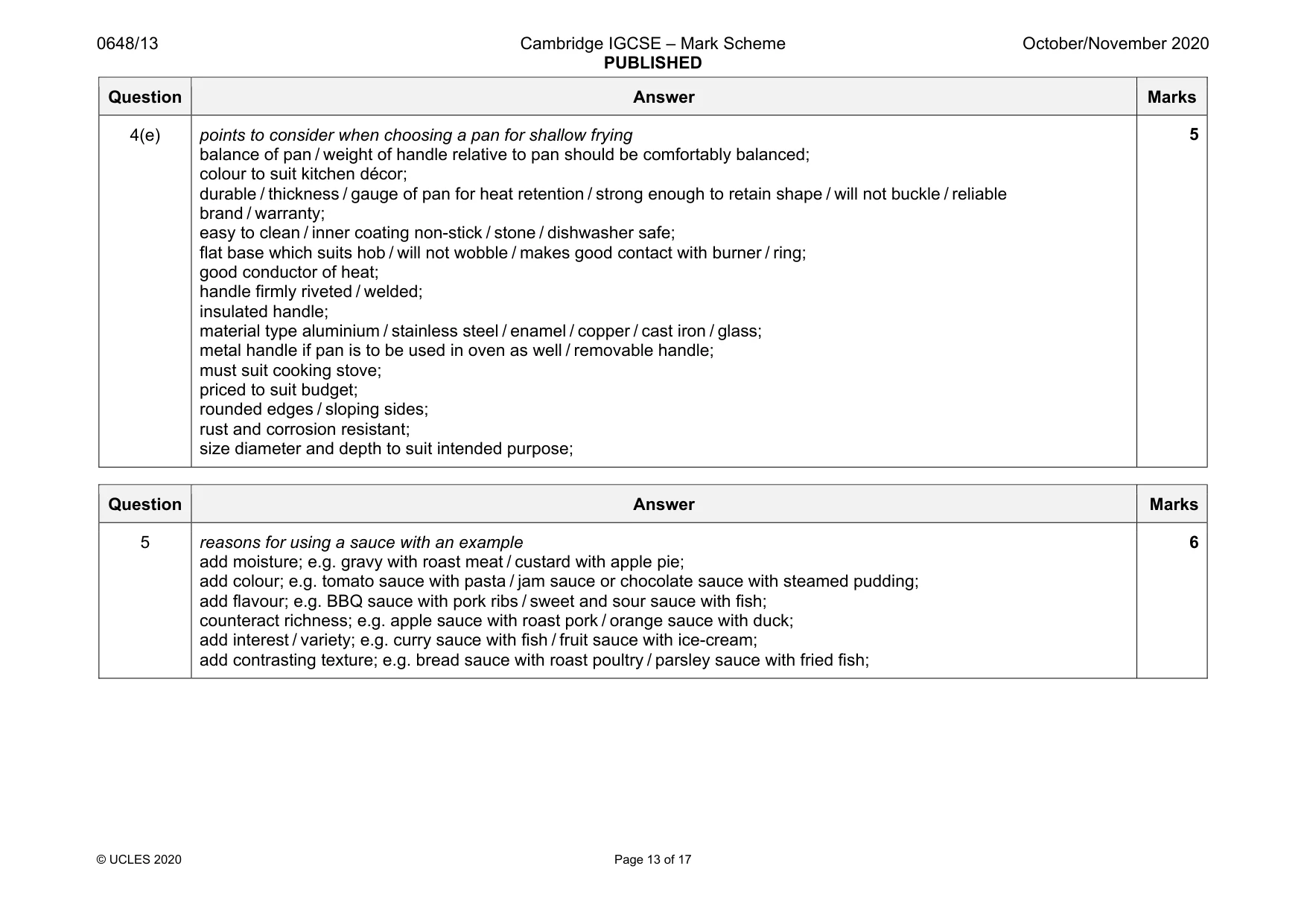
0648/13 Cambridge IGCSE – Mark Scheme PUBLISHED October/November 2020 © UCLES 2020 Page 13 of 17 Question Answer Marks 4(e) points to consider when choosing a pan for shallow frying balance of pan / weight of handle relative to pan should be comfortably balanced; colour to suit kitchen décor; durable / thickness / gauge of pan for heat retention / strong enough to retain shape / will not buckle / reliable brand / warranty; easy to clean / inner coating non-stick / stone / dishwasher safe; flat base which suits hob / will not wobble / makes good contact with burner / ring; good conductor of heat; handle firmly riveted / welded; insulated handle; material type aluminium / stainless steel / enamel / copper / cast iron / glass; metal handle if pan is to be used in oven as well / removable handle; must suit cooking stove; priced to suit budget; rounded edges / sloping sides; rust and corrosion resistant; size diameter and depth to suit intended purpose; 5 Question Answer Marks 5 reasons for using a sauce with an example add moisture; e.g. gravy with roast meat / custard with apple pie; add colour; e.g. tomato sauce with pasta / jam sauce or chocolate sauce with steamed pudding; add flavour; e.g. BBQ sauce with pork ribs / sweet and sour sauce with fish; counteract richness; e.g. apple sauce with roast pork / orange sauce with duck; add interest / variety; e.g. curry sauce with fish / fruit sauce with ice-cream; add contrasting texture; e.g. bread sauce with roast poultry / parsley sauce with fried fish; 6
Mark scheme, page 14
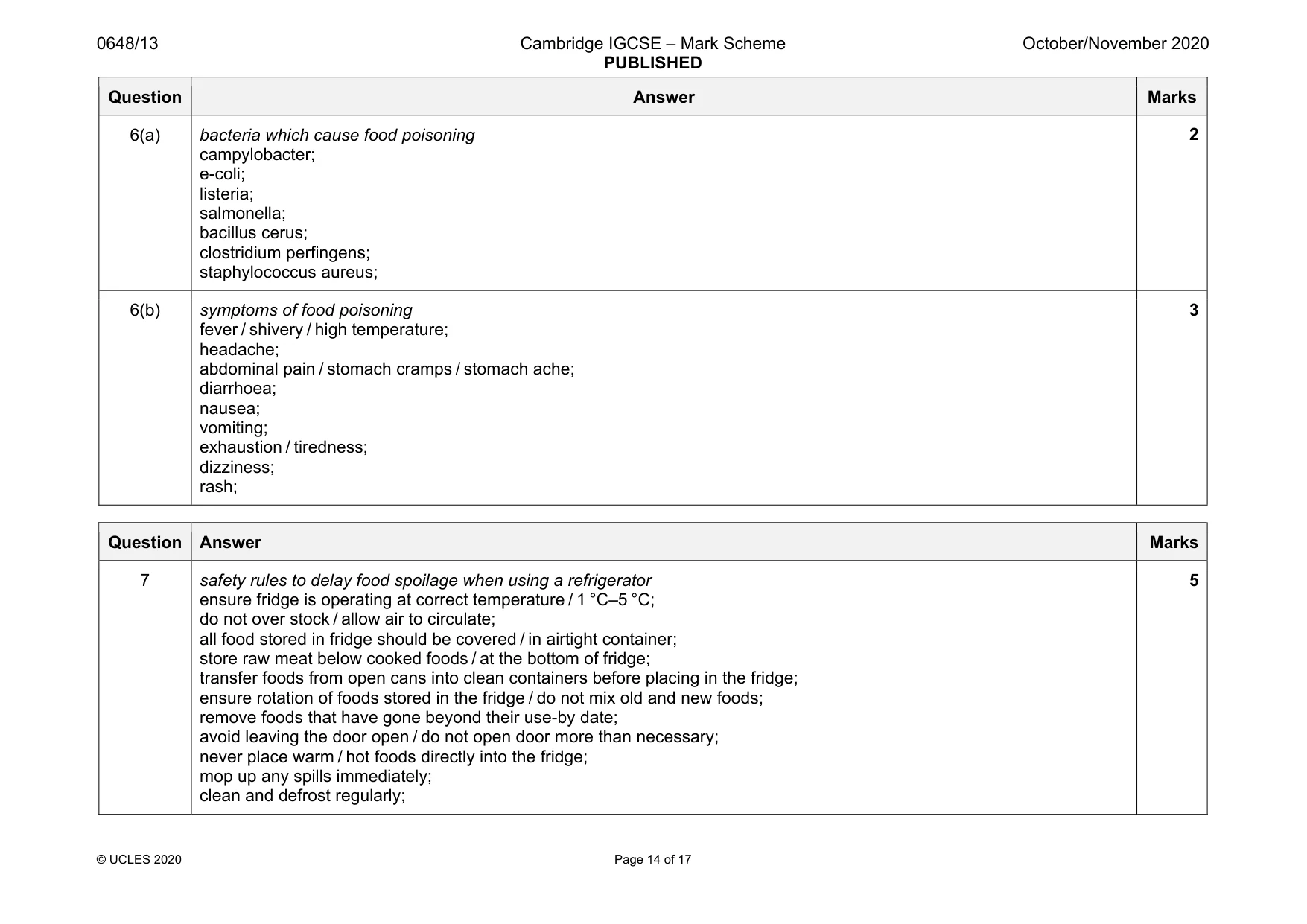
0648/13 Cambridge IGCSE – Mark Scheme PUBLISHED October/November 2020 © UCLES 2020 Page 14 of 17 Question Answer Marks 6(a) bacteria which cause food poisoning campylobacter; e-coli; listeria; salmonella; bacillus cerus; clostridium perfingens; staphylococcus aureus; 2 6(b) symptoms of food poisoning fever / shivery / high temperature; headache; abdominal pain / stomach cramps / stomach ache; diarrhoea; nausea; vomiting; exhaustion / tiredness; dizziness; rash; 3 Question Answer Marks 7 safety rules to delay food spoilage when using a refrigerator ensure fridge is operating at correct temperature / 1 °C–5 °C; do not over stock / allow air to circulate; all food stored in fridge should be covered / in airtight container; store raw meat below cooked foods / at the bottom of fridge; transfer foods from open cans into clean containers before placing in the fridge; ensure rotation of foods stored in the fridge / do not mix old and new foods; remove foods that have gone beyond their use-by date; avoid leaving the door open / do not open door more than necessary; never place warm / hot foods directly into the fridge; mop up any spills immediately; clean and defrost regularly; 5
Mark scheme, page 15
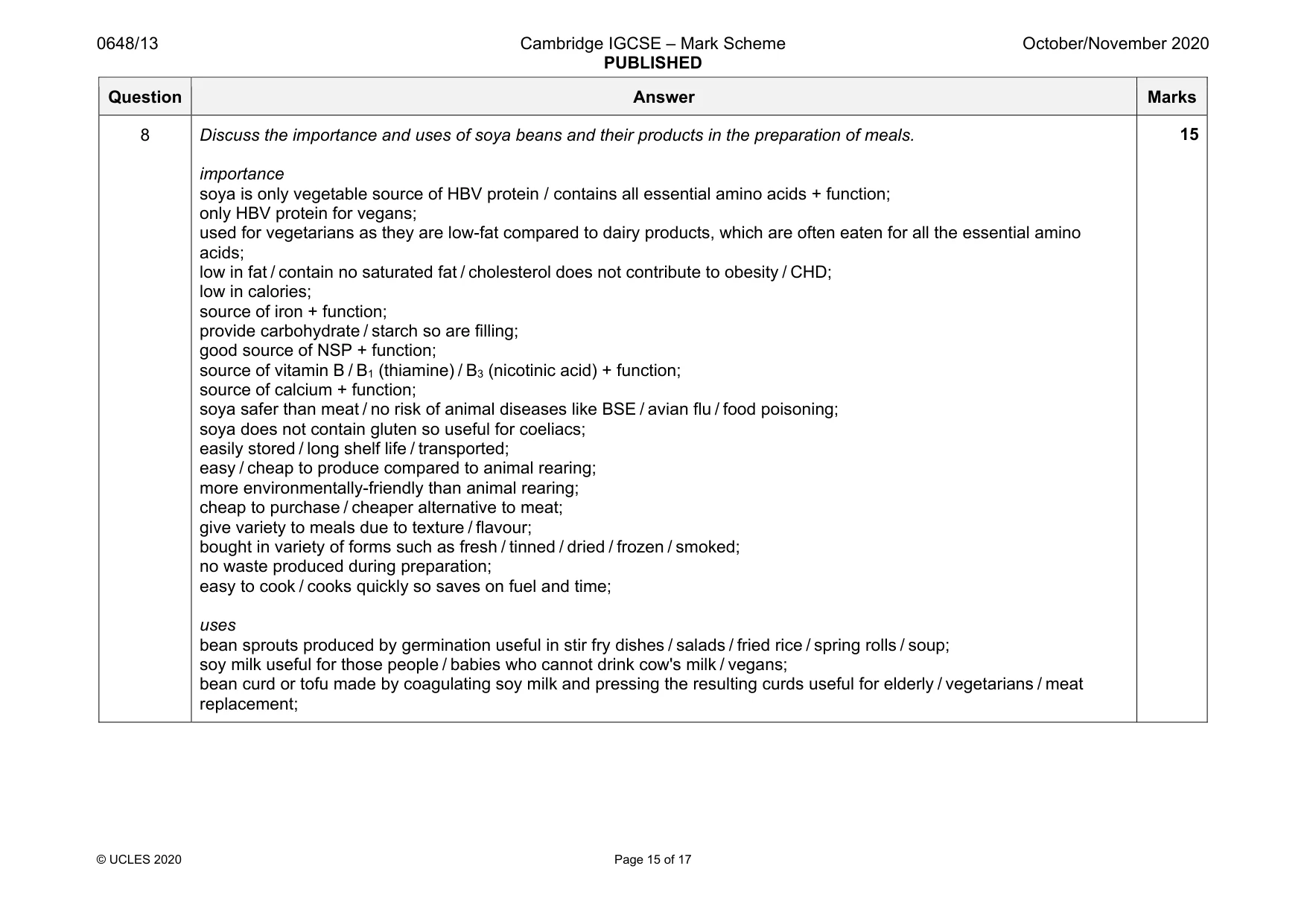
0648/13 Cambridge IGCSE – Mark Scheme PUBLISHED October/November 2020 © UCLES 2020 Page 15 of 17 Question Answer Marks 8 Discuss the importance and uses of soya beans and their products in the preparation of meals. importance soya is only vegetable source of HBV protein / contains all essential amino acids + function; only HBV protein for vegans; used for vegetarians as they are low-fat compared to dairy products, which are often eaten for all the essential amino acids; low in fat / contain no saturated fat / cholesterol does not contribute to obesity / CHD; low in calories; source of iron + function; provide carbohydrate / starch so are filling; good source of NSP + function; source of vitamin B / B1 (thiamine) / B3 (nicotinic acid) + function; source of calcium + function; soya safer than meat / no risk of animal diseases like BSE / avian flu / food poisoning; soya does not contain gluten so useful for coeliacs; easily stored / long shelf life / transported; easy / cheap to produce compared to animal rearing; more environmentally-friendly than animal rearing; cheap to purchase / cheaper alternative to meat; give variety to meals due to texture / flavour; bought in variety of forms such as fresh / tinned / dried / frozen / smoked; no waste produced during preparation; easy to cook / cooks quickly so saves on fuel and time; uses bean sprouts produced by germination useful in stir fry dishes / salads / fried rice / spring rolls / soup; soy milk useful for those people / babies who cannot drink cow's milk / vegans; bean curd or tofu made by coagulating soy milk and pressing the resulting curds useful for elderly / vegetarians / meat replacement; 15
Mark scheme, page 16
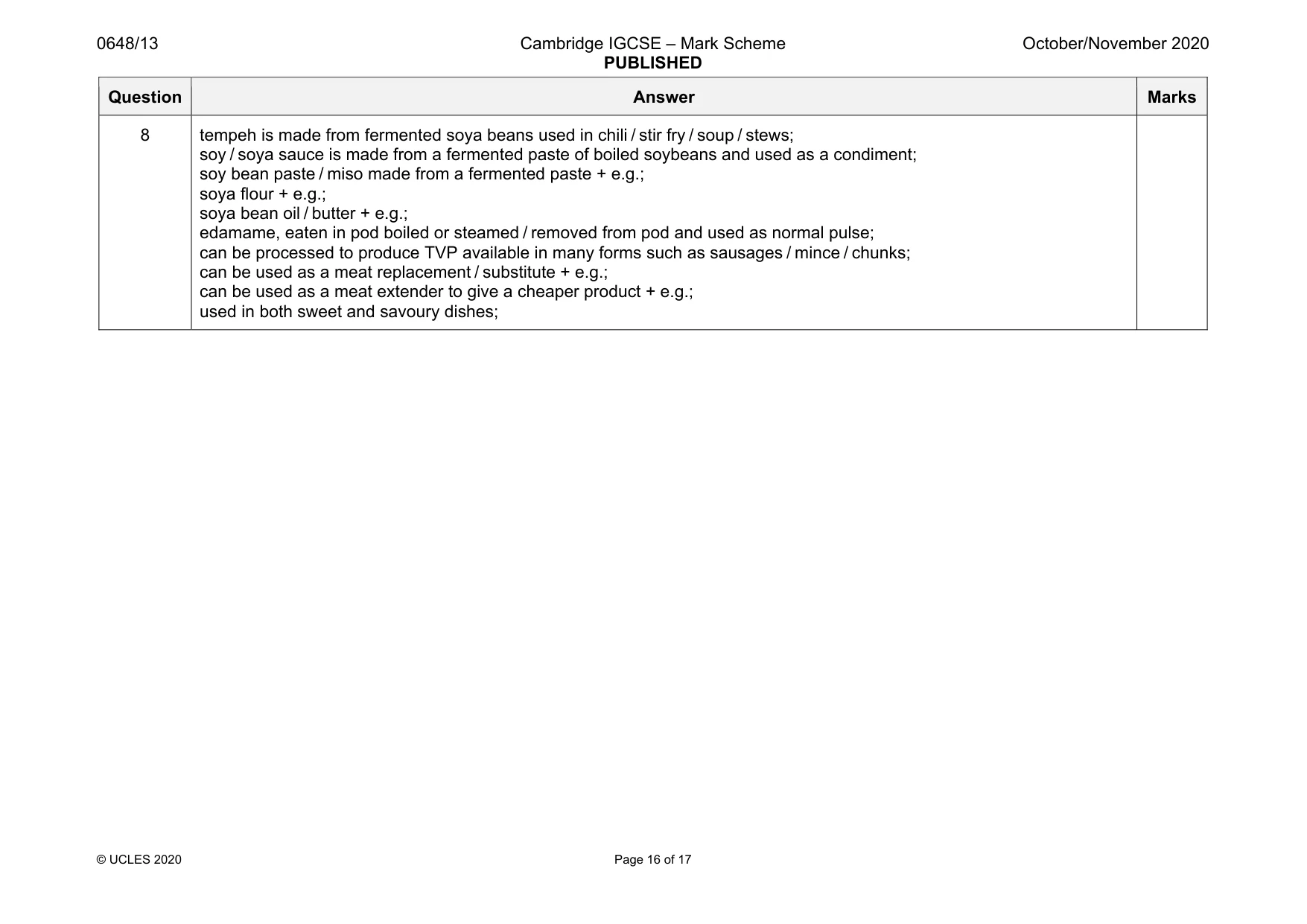
0648/13 Cambridge IGCSE – Mark Scheme PUBLISHED October/November 2020 © UCLES 2020 Page 16 of 17 Question Answer Marks 8 tempeh is made from fermented soya beans used in chili / stir fry / soup / stews; soy / soya sauce is made from a fermented paste of boiled soybeans and used as a condiment; soy bean paste / miso made from a fermented paste + e.g.; soya flour + e.g.; soya bean oil / butter + e.g.; edamame, eaten in pod boiled or steamed / removed from pod and used as normal pulse; can be processed to produce TVP available in many forms such as sausages / mince / chunks; can be used as a meat replacement / substitute + e.g.; can be used as a meat extender to give a cheaper product + e.g.; used in both sweet and savoury dishes;
Mark scheme, page 17
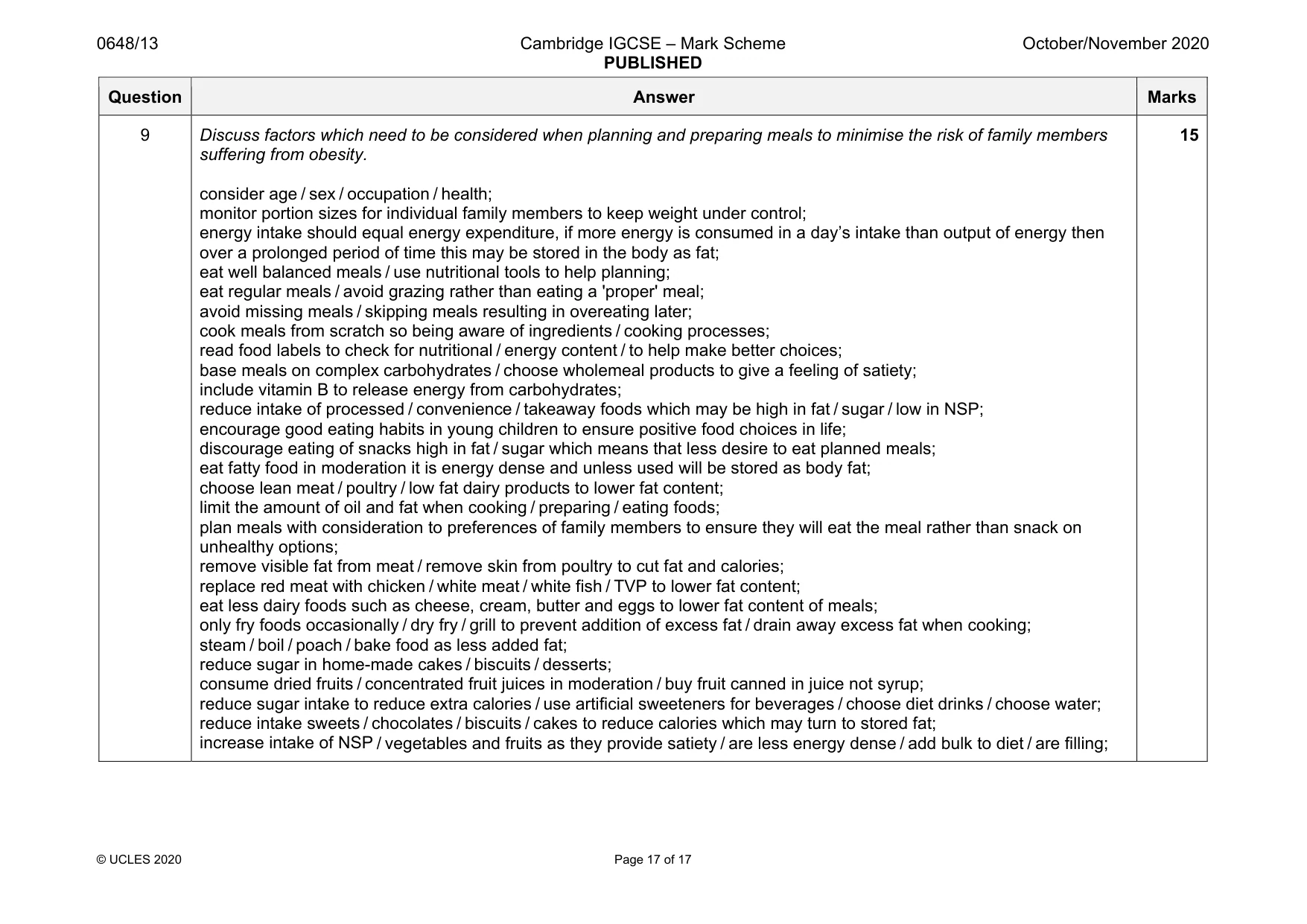
0648/13 Cambridge IGCSE – Mark Scheme PUBLISHED October/November 2020 © UCLES 2020 Page 17 of 17 Question Answer Marks 9 Discuss factors which need to be considered when planning and preparing meals to minimise the risk of family members suffering from obesity. consider age / sex / occupation / health; monitor portion sizes for individual family members to keep weight under control; energy intake should equal energy expenditure, if more energy is consumed in a day’s intake than output of energy then over a prolonged period of time this may be stored in the body as fat; eat well balanced meals / use nutritional tools to help planning; eat regular meals / avoid grazing rather than eating a 'proper' meal; avoid missing meals / skipping meals resulting in overeating later; cook meals from scratch so being aware of ingredients / cooking processes; read food labels to check for nutritional / energy content / to help make better choices; base meals on complex carbohydrates / choose wholemeal products to give a feeling of satiety; include vitamin B to release energy from carbohydrates; reduce intake of processed / convenience / takeaway foods which may be high in fat / sugar / low in NSP; encourage good eating habits in young children to ensure positive food choices in life; discourage eating of snacks high in fat / sugar which means that less desire to eat planned meals; eat fatty food in moderation it is energy dense and unless used will be stored as body fat; choose lean meat / poultry / low fat dairy products to lower fat content; limit the amount of oil and fat when cooking / preparing / eating foods; plan meals with consideration to preferences of family members to ensure they will eat the meal rather than snack on unhealthy options; remove visible fat from meat / remove skin from poultry to cut fat and calories; replace red meat with chicken / white meat / white fish / TVP to lower fat content; eat less dairy foods such as cheese, cream, butter and eggs to lower fat content of meals; only fry foods occasionally / dry fry / grill to prevent addition of excess fat / drain away excess fat when cooking; steam / boil / poach / bake food as less added fat; reduce sugar in home-made cakes / biscuits / desserts; consume dried fruits / concentrated fruit juices in moderation / buy fruit canned in juice not syrup; reduce sugar intake to reduce extra calories / use artificial sweeteners for beverages / choose diet drinks / choose water; reduce intake sweets / chocolates / biscuits / cakes to reduce calories which may turn to stored fat; increase intake of NSP / vegetables and fruits as they provide satiety / are less energy dense / add bulk to diet / are filling; 15
What you needed in this session
Cambridge’s own grade thresholds for 2020 Oct/Nov, Paper 1 · Variant 3. A higher threshold means an easier paper — the bar moves with how the cohort did.