Cambridge IGCSE Food and Nutrition 0648 — 2020 May/June Paper 1 · Variant 2
0648/12/M/J/20
The question paper and its mark scheme, free to read here and free to download. This is Cambridge’s own paper, exactly as it was sat.
Question paper12 pages





Mark scheme15 pages
Answers below. Sit the paper first if you are practising.
Paper as text
Question paper, page 1
Cambridge IGCSE™ DC (ST) 181536/1 © UCLES 2020 [Turn over This document has 12 pages. Blank pages are indicated. FOOD & NUTRITION 0648/12 Paper 1 Theory May/June 2020 2 hours You must answer on the question paper. No additional materials are needed. INSTRUCTIONS ● Section A: answer all questions. ● Section B: answer all questions. ● Section C: answer one question. ● Use a black or dark blue pen. You may use an HB pencil for any diagrams or graphs. ● Write your name, centre number and candidate number in the boxes at the top of the page. ● Write your answer to each question in the space provided. ● Do not use an erasable pen or correction fluid. ● Do not write on any bar codes. INFORMATION ● The total mark for this paper is 100. ● The number of marks for each question or part question is shown in brackets [ ]. * 9 2 0 4 9 7 2 0 1 6 *
Question paper, page 2
2 0648/12/M/J/20 © UCLES 2020 Section A Answer all questions. You are advised to spend no longer than 45 minutes on Section A. 1 (a) Name the term used to describe an incorrect intake of nutrients. … [1] (b) State what is meant by energy balance. … [1] (c) Office workers are generally less active so need less energy-giving foods. State three other factors which affect the need for energy-giving foods. 1 … 2 … 3 … [3] (d) Protein can provide the body with energy. Name two other groups of nutrients which provide the body with energy. 1 … 2 … [2] (e) Name one vitamin which helps to release energy from nutrients. … [1] [Total: 8]
Question paper, page 3
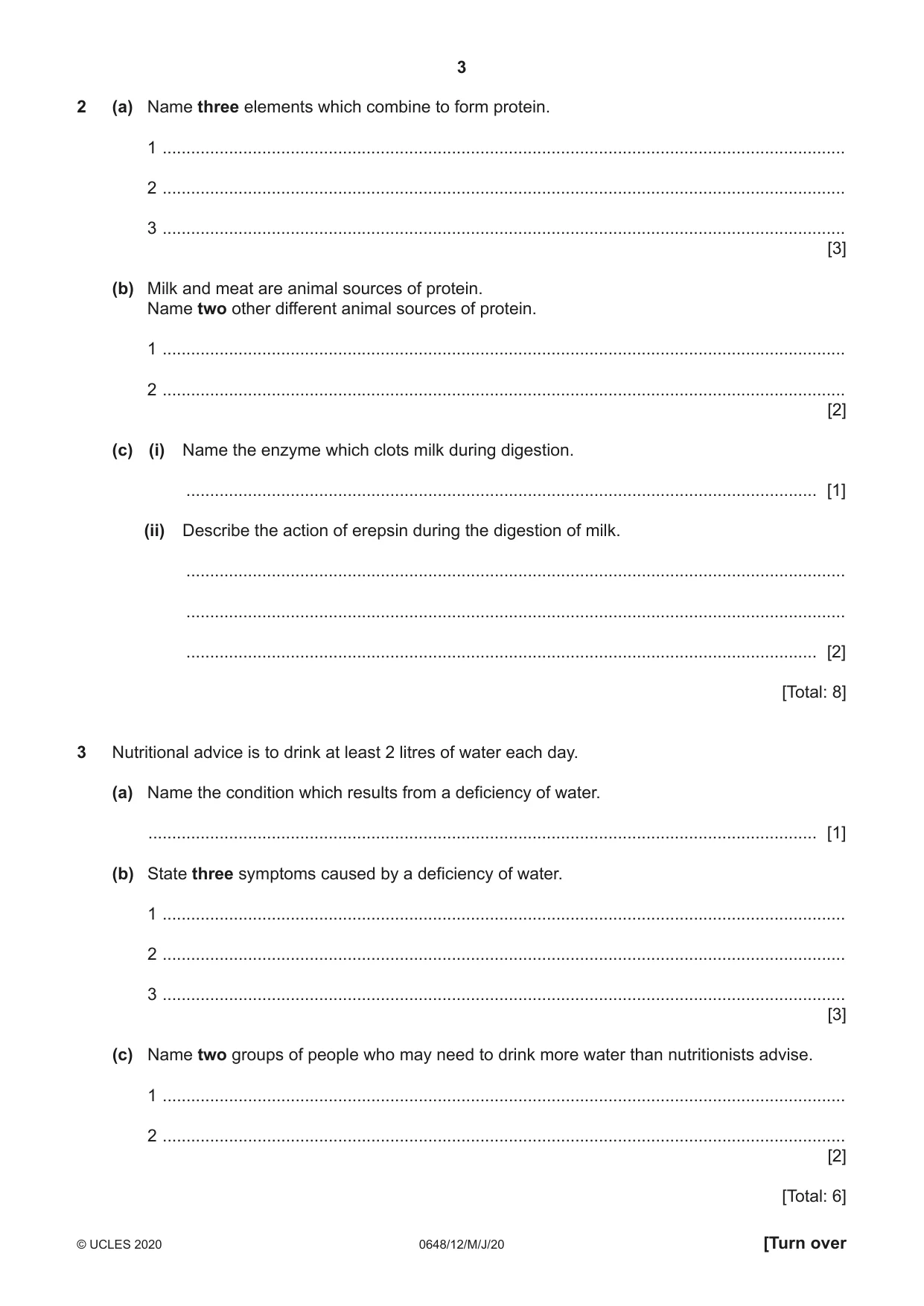
3 0648/12/M/J/20 © UCLES 2020 [Turn over 2 (a) Name three elements which combine to form protein. 1 … 2 … 3 … [3] (b) Milk and meat are animal sources of protein. Name two other different animal sources of protein. 1 … 2 … [2] (c) (i) Name the enzyme which clots milk during digestion. … [1] (ii) Describe the action of erepsin during the digestion of milk. … … … [2] [Total: 8] 3 Nutritional advice is to drink at least 2 litres of water each day. (a) Name the condition which results from a deficiency of water. … [1] (b) State three symptoms caused by a deficiency of water. 1 … 2 … 3 … [3] (c) Name two groups of people who may need to drink more water than nutritionists advise. 1 … 2 … [2] [Total: 6]
Question paper, page 4
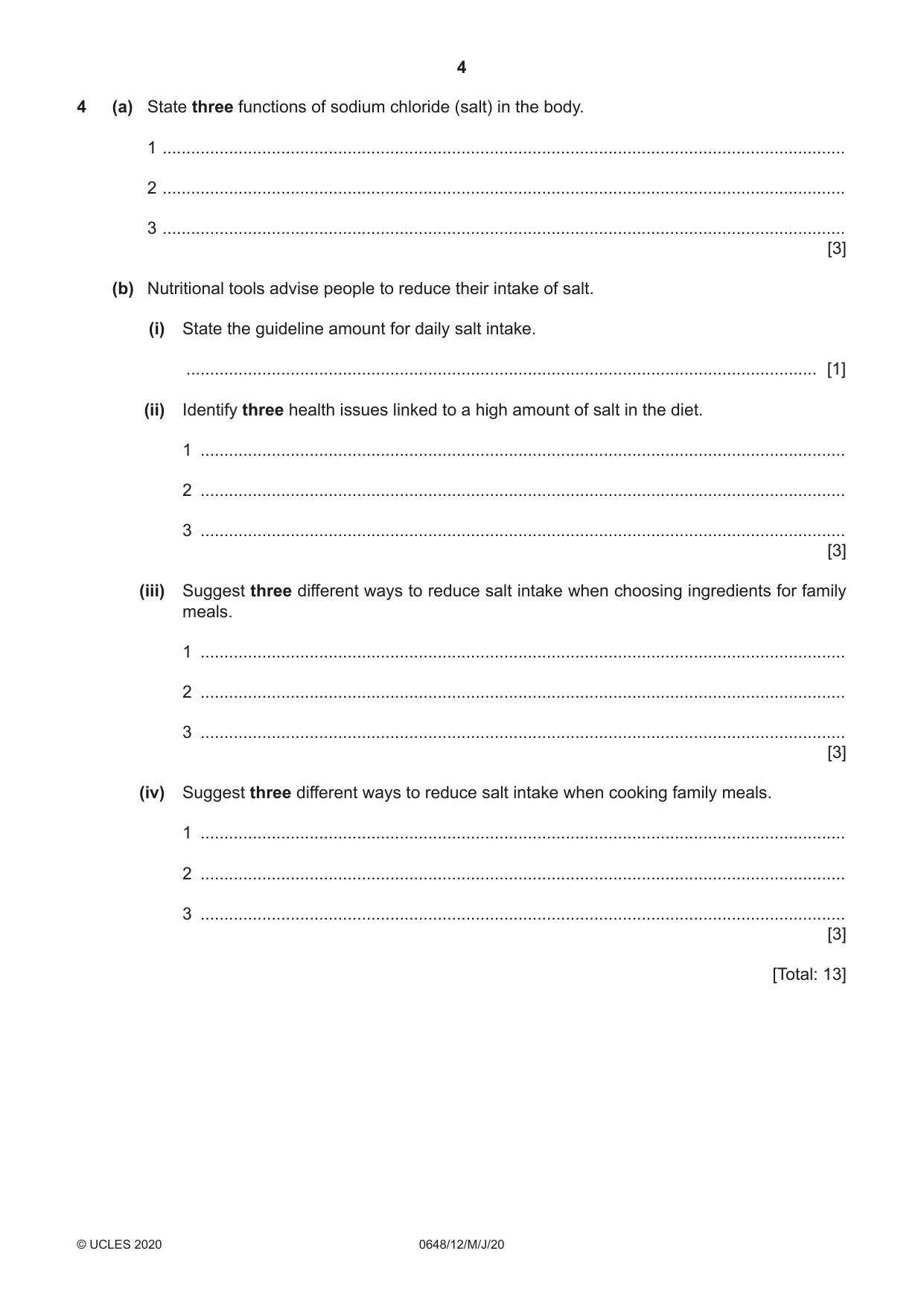
4 0648/12/M/J/20 © UCLES 2020 4 (a) State three functions of sodium chloride (salt) in the body. 1 … 2 … 3 … [3] (b) Nutritional tools advise people to reduce their intake of salt. (i) State the guideline amount for daily salt intake. … [1] (ii) Identify three health issues linked to a high amount of salt in the diet. 1 … 2 … 3 … [3] (iii) Suggest three different ways to reduce salt intake when choosing ingredients for family meals. 1 … 2 … 3 … [3] (iv) Suggest three different ways to reduce salt intake when cooking family meals. 1 … 2 … 3 … [3] [Total: 13]
Question paper, page 5
5 0648/12/M/J/20 © UCLES 2020 [Turn over 5 Discuss the importance of calcium when planning meals for a child. … … … … … … … … … … … … [5]
Question paper, page 6
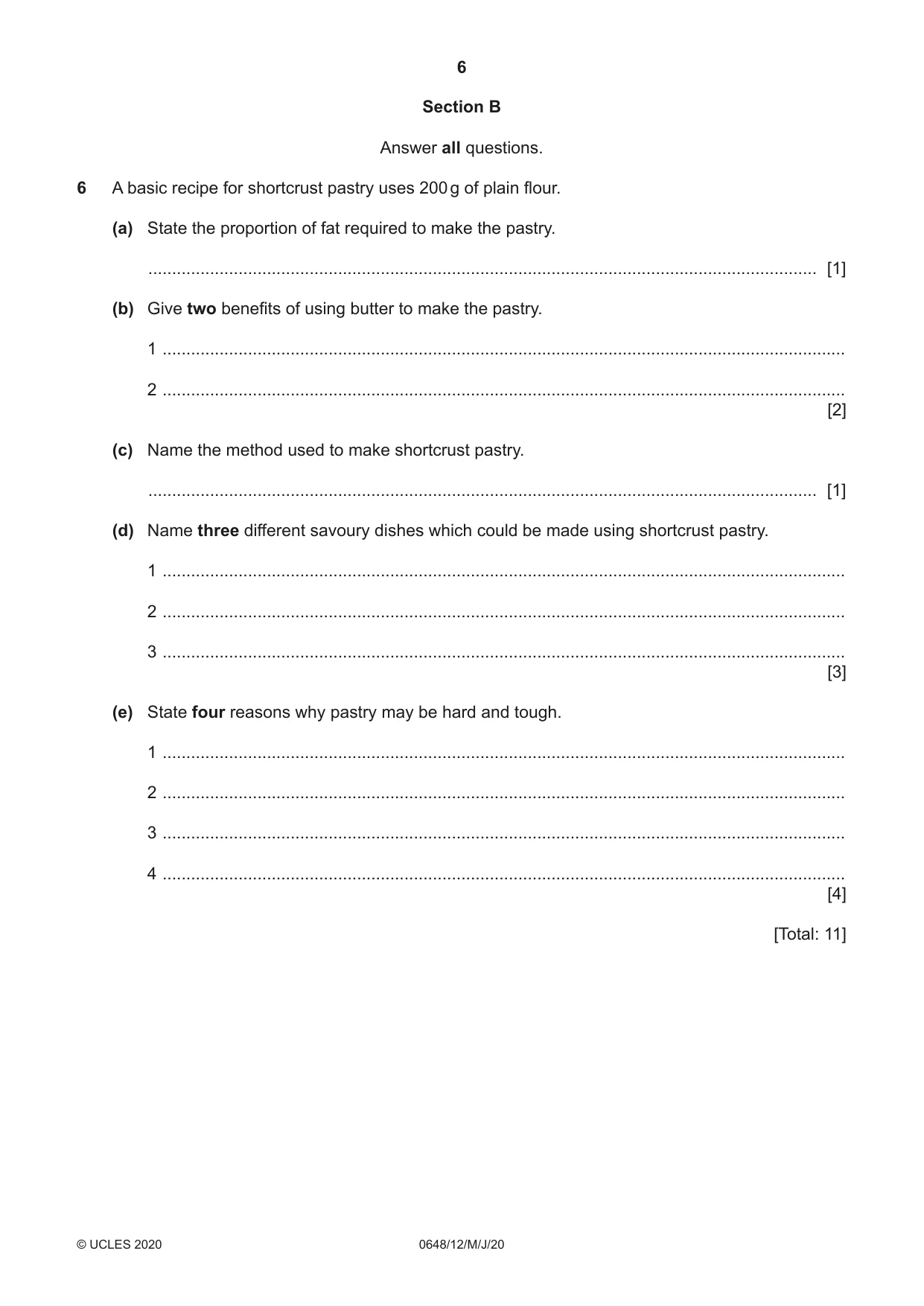
6 0648/12/M/J/20 © UCLES 2020 Section B Answer all questions. 6 A basic recipe for shortcrust pastry uses 200 g of plain flour. (a) State the proportion of fat required to make the pastry. … [1] (b) Give two benefits of using butter to make the pastry. 1 … 2 … [2] (c) Name the method used to make shortcrust pastry. … [1] (d) Name three different savoury dishes which could be made using shortcrust pastry. 1 … 2 … 3 … [3] (e) State four reasons why pastry may be hard and tough. 1 … 2 … 3 … 4 … [4] [Total: 11]
Question paper, page 7
7 0648/12/M/J/20 © UCLES 2020 [Turn over 7 Meat is a source of protein for many people. (a) State three other different nutrients found in red meat. 1 … 2 … 3 … [3] (b) Current nutritional advice is to reduce the intake of red meat. Identify and explain the reasons for this advice. … … … … … … … … … … … … [5] (c) Suggest three different ways protein can be provided for people who do not eat any animal products. 1 … 2 … 3 … [3]
Question paper, page 8
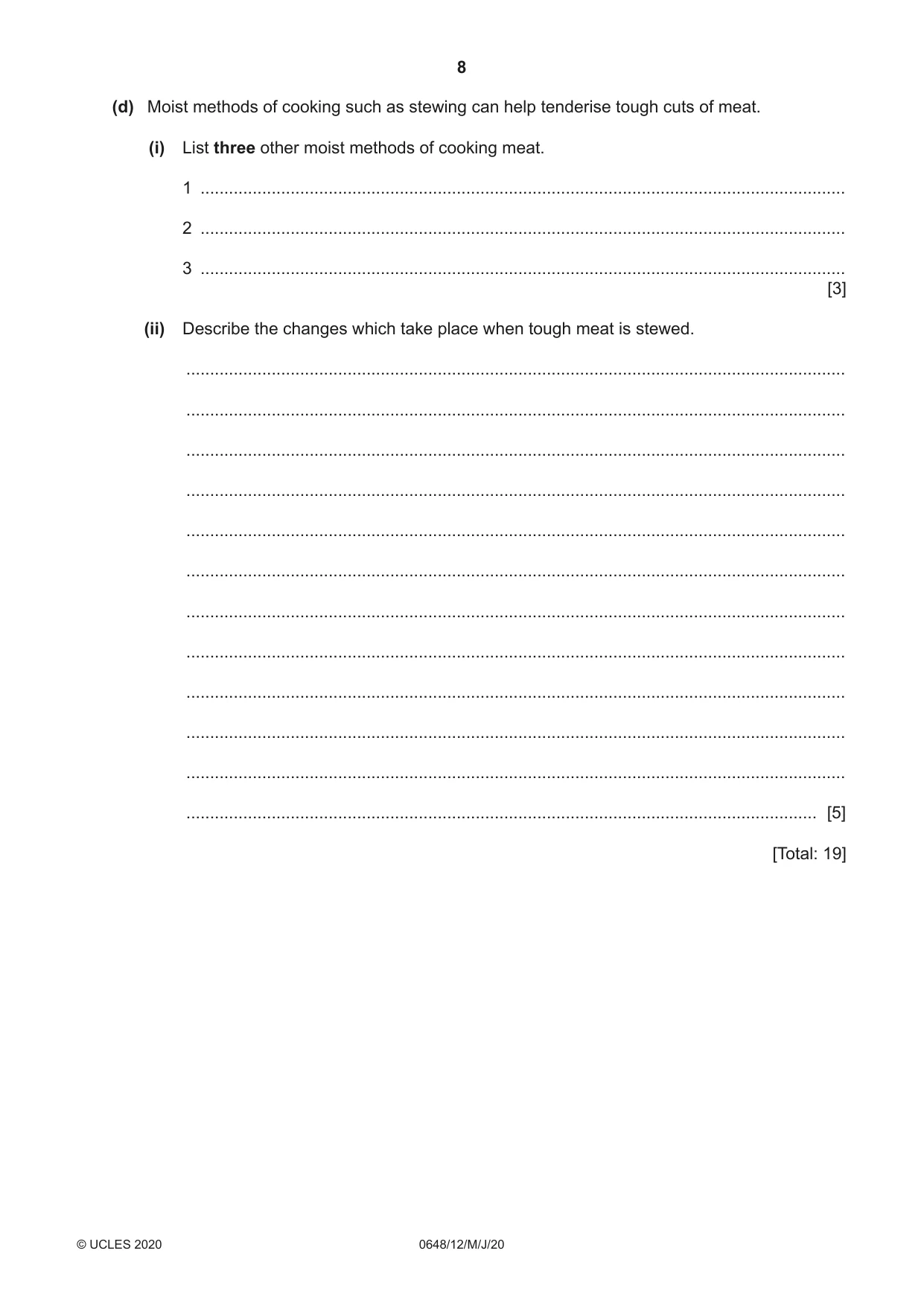
8 0648/12/M/J/20 © UCLES 2020 (d) Moist methods of cooking such as stewing can help tenderise tough cuts of meat. (i) List three other moist methods of cooking meat. 1 … 2 … 3 … [3] (ii) Describe the changes which take place when tough meat is stewed. … … … … … … … … … … … … [5] [Total: 19]
Question paper, page 9
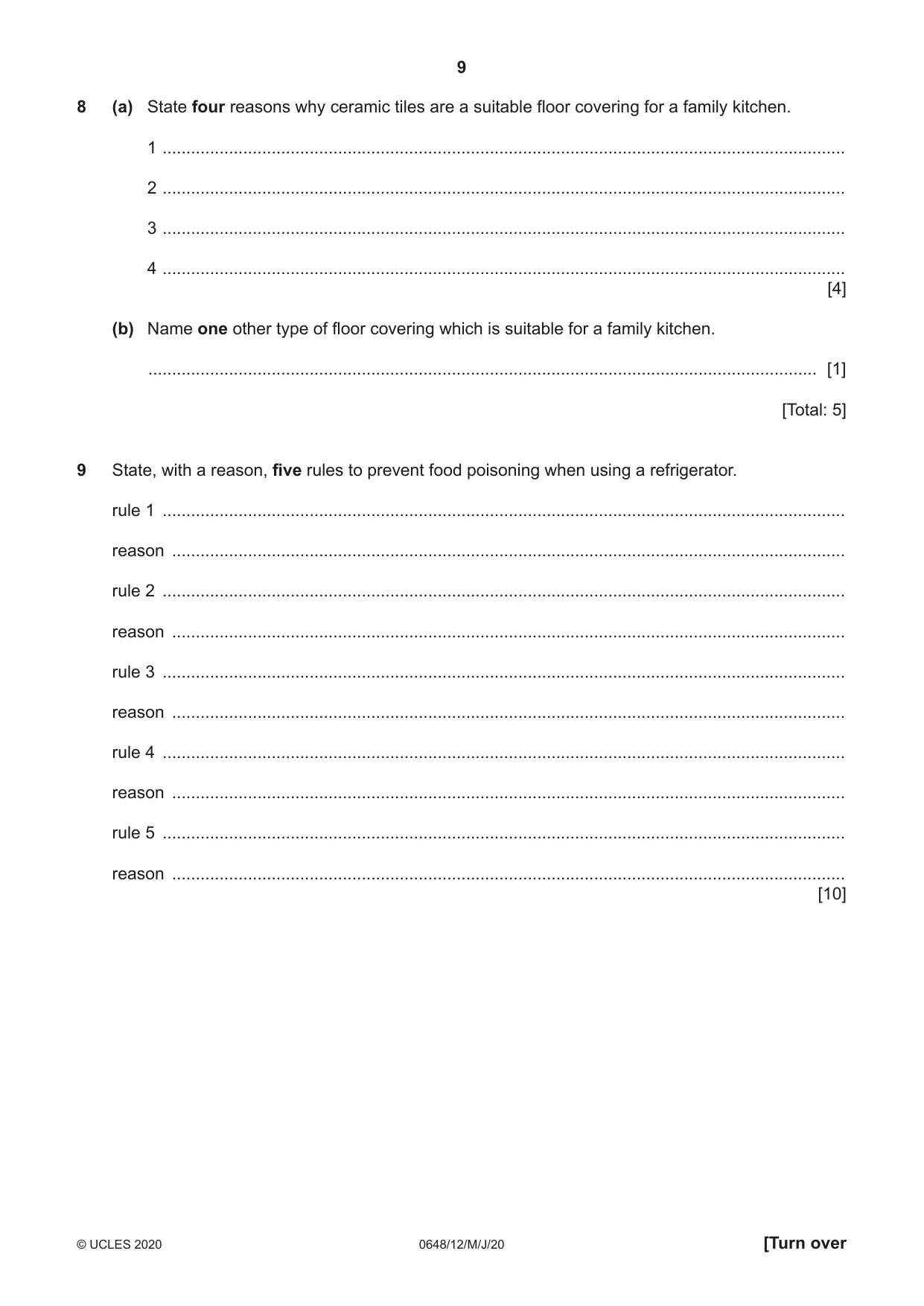
9 0648/12/M/J/20 © UCLES 2020 [Turn over 8 (a) State four reasons why ceramic tiles are a suitable floor covering for a family kitchen. 1 … 2 … 3 … 4 … [4] (b) Name one other type of floor covering which is suitable for a family kitchen. … [1] [Total: 5] 9 State, with a reason, five rules to prevent food poisoning when using a refrigerator. rule 1 … reason … rule 2 … reason … rule 3 … reason … rule 4 … reason … rule 5 … reason … [10]
Question paper, page 10
10 0648/12/M/J/20 © UCLES 2020 Section C Answer either Question 10 or 11. 10 Give advice, with reasons, on the choice of nutrients and diet for a person who plays a lot of sport. [15] OR 11 Evaluate the importance of fruit when planning family meals. [15] … … … … … … … … … … … … … … … … … … … … … … …
Question paper, page 11
11 0648/12/M/J/20 © UCLES 2020 [Turn over … … … … … … … … … … … … … … … … … … … … … … … … … … … …
Question paper, page 12
12 0648/12/M/J/20 © UCLES 2020 Permission to reproduce items where third-party owned material protected by copyright is included has been sought and cleared where possible. Every reasonable effort has been made by the publisher (UCLES) to trace copyright holders, but if any items requiring clearance have unwittingly been included, the publisher will be pleased to make amends at the earliest possible opportunity. To avoid the issue of disclosure of answer-related information to candidates, all copyright acknowledgements are reproduced online in the Cambridge Assessment International Education Copyright Acknowledgements Booklet. This is produced for each series of examinations and is freely available to download at www.cambridgeinternational.org after the live examination series. Cambridge Assessment International Education is part of the Cambridge Assessment Group. Cambridge Assessment is the brand name of the University of Cambridge Local Examinations Syndicate (UCLES), which itself is a department of the University of Cambridge. … … … … … … … … … … … … … … … … … … … … … … …
Mark scheme, page 1
This document consists of 15 printed pages. © UCLES 2020 [Turn over Cambridge IGCSE™ FOOD AND NUTRITION 0648/12 Paper 1 Theory May/June 2020 MARK SCHEME Maximum Mark: 100 Published Students did not sit exam papers in the June 2020 series due to the Covid-19 global pandemic. This mark scheme is published to support teachers and students and should be read together with the question paper. It shows the requirements of the exam. The answer column of the mark scheme shows the proposed basis on which Examiners would award marks for this exam. Where appropriate, this column also provides the most likely acceptable alternative responses expected from students. Examiners usually review the mark scheme after they have seen student responses and update the mark scheme if appropriate. In the June series, Examiners were unable to consider the acceptability of alternative responses, as there were no student responses to consider. Mark schemes should usually be read together with the Principal Examiner Report for Teachers. However, because students did not sit exam papers, there is no Principal Examiner Report for Teachers for the June 2020 series. Cambridge International will not enter into discussions about these mark schemes. Cambridge International is publishing the mark schemes for the June 2020 series for most Cambridge IGCSE™ and Cambridge International A & AS Level components, and some Cambridge O Level components.
Mark scheme, page 2
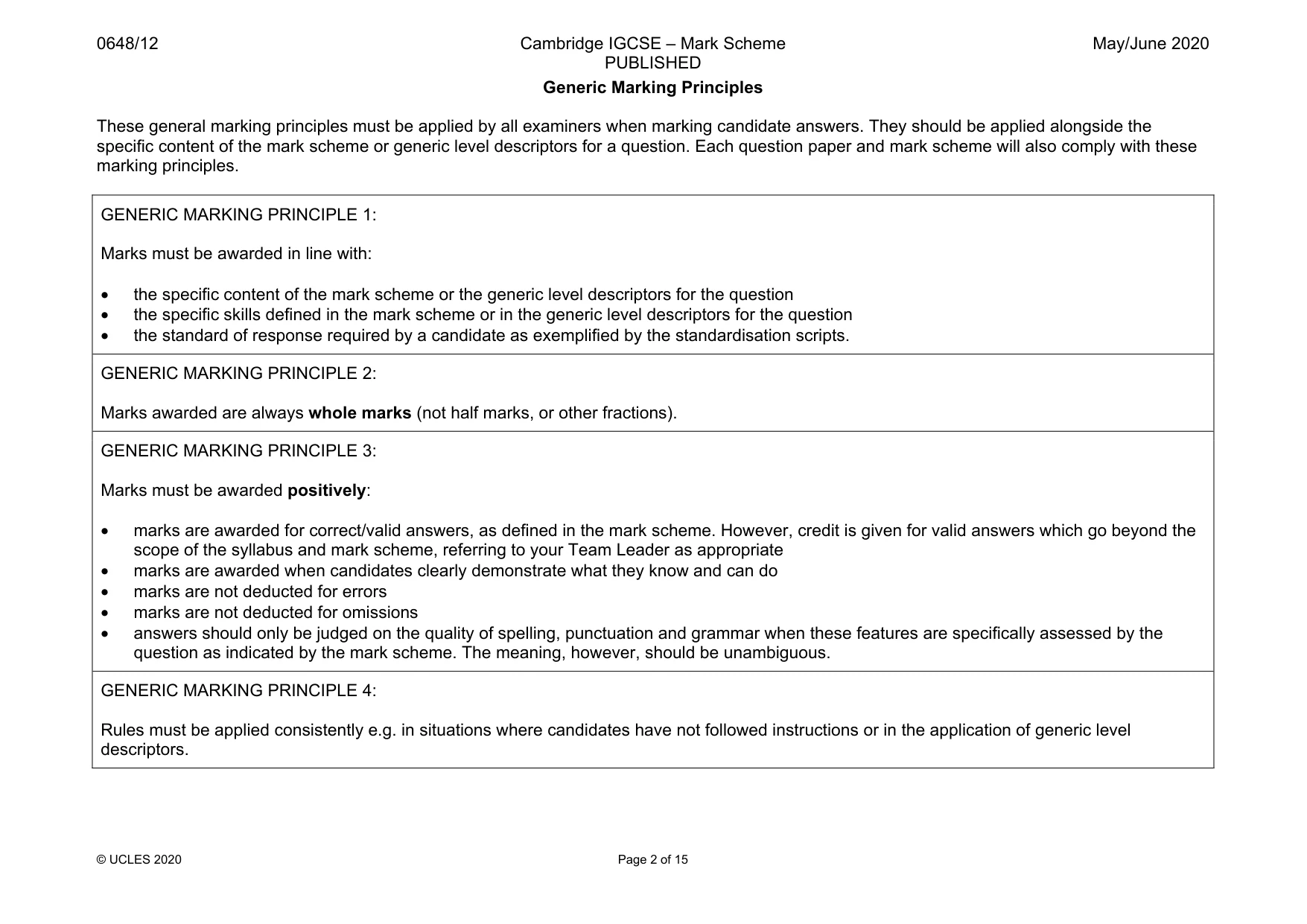
0648/12 Cambridge IGCSE – Mark Scheme PUBLISHED May/June 2020 © UCLES 2020 Page 2 of 15 Generic Marking Principles These general marking principles must be applied by all examiners when marking candidate answers. They should be applied alongside the specific content of the mark scheme or generic level descriptors for a question. Each question paper and mark scheme will also comply with these marking principles. GENERIC MARKING PRINCIPLE 1: Marks must be awarded in line with: • the specific content of the mark scheme or the generic level descriptors for the question • the specific skills defined in the mark scheme or in the generic level descriptors for the question • the standard of response required by a candidate as exemplified by the standardisation scripts. GENERIC MARKING PRINCIPLE 2: Marks awarded are always whole marks (not half marks, or other fractions). GENERIC MARKING PRINCIPLE 3: Marks must be awarded positively: • marks are awarded for correct/valid answers, as defined in the mark scheme. However, credit is given for valid answers which go beyond the scope of the syllabus and mark scheme, referring to your Team Leader as appropriate • marks are awarded when candidates clearly demonstrate what they know and can do • marks are not deducted for errors • marks are not deducted for omissions • answers should only be judged on the quality of spelling, punctuation and grammar when these features are specifically assessed by the question as indicated by the mark scheme. The meaning, however, should be unambiguous. GENERIC MARKING PRINCIPLE 4: Rules must be applied consistently e.g. in situations where candidates have not followed instructions or in the application of generic level descriptors.
Mark scheme, page 3
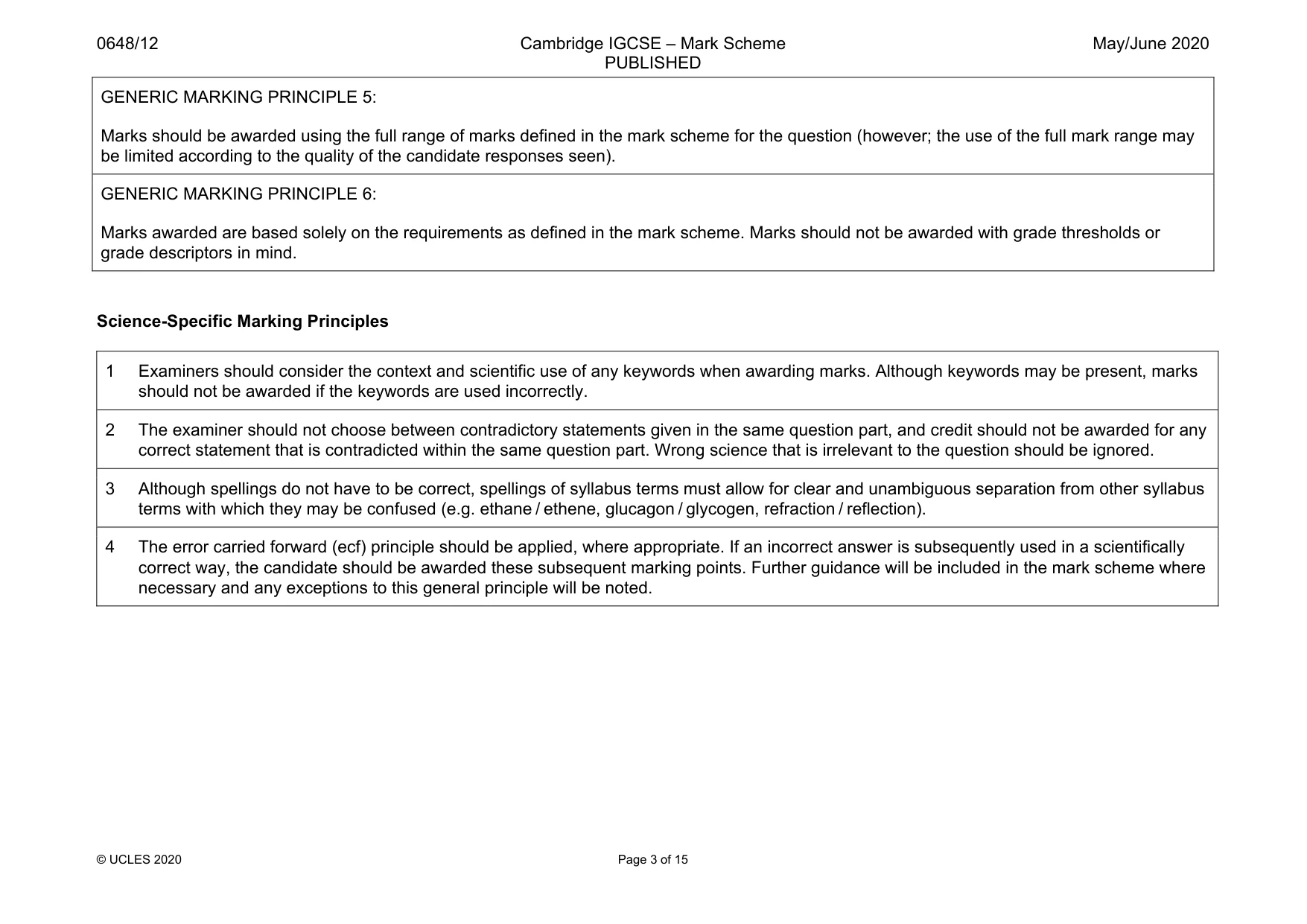
0648/12 Cambridge IGCSE – Mark Scheme PUBLISHED May/June 2020 © UCLES 2020 Page 3 of 15 GENERIC MARKING PRINCIPLE 5: Marks should be awarded using the full range of marks defined in the mark scheme for the question (however; the use of the full mark range may be limited according to the quality of the candidate responses seen). GENERIC MARKING PRINCIPLE 6: Marks awarded are based solely on the requirements as defined in the mark scheme. Marks should not be awarded with grade thresholds or grade descriptors in mind. Science-Specific Marking Principles 1 Examiners should consider the context and scientific use of any keywords when awarding marks. Although keywords may be present, marks should not be awarded if the keywords are used incorrectly. 2 The examiner should not choose between contradictory statements given in the same question part, and credit should not be awarded for any correct statement that is contradicted within the same question part. Wrong science that is irrelevant to the question should be ignored. 3 Although spellings do not have to be correct, spellings of syllabus terms must allow for clear and unambiguous separation from other syllabus terms with which they may be confused (e.g. ethane / ethene, glucagon / glycogen, refraction / reflection). 4 The error carried forward (ecf) principle should be applied, where appropriate. If an incorrect answer is subsequently used in a scientifically correct way, the candidate should be awarded these subsequent marking points. Further guidance will be included in the mark scheme where necessary and any exceptions to this general principle will be noted.
Mark scheme, page 4
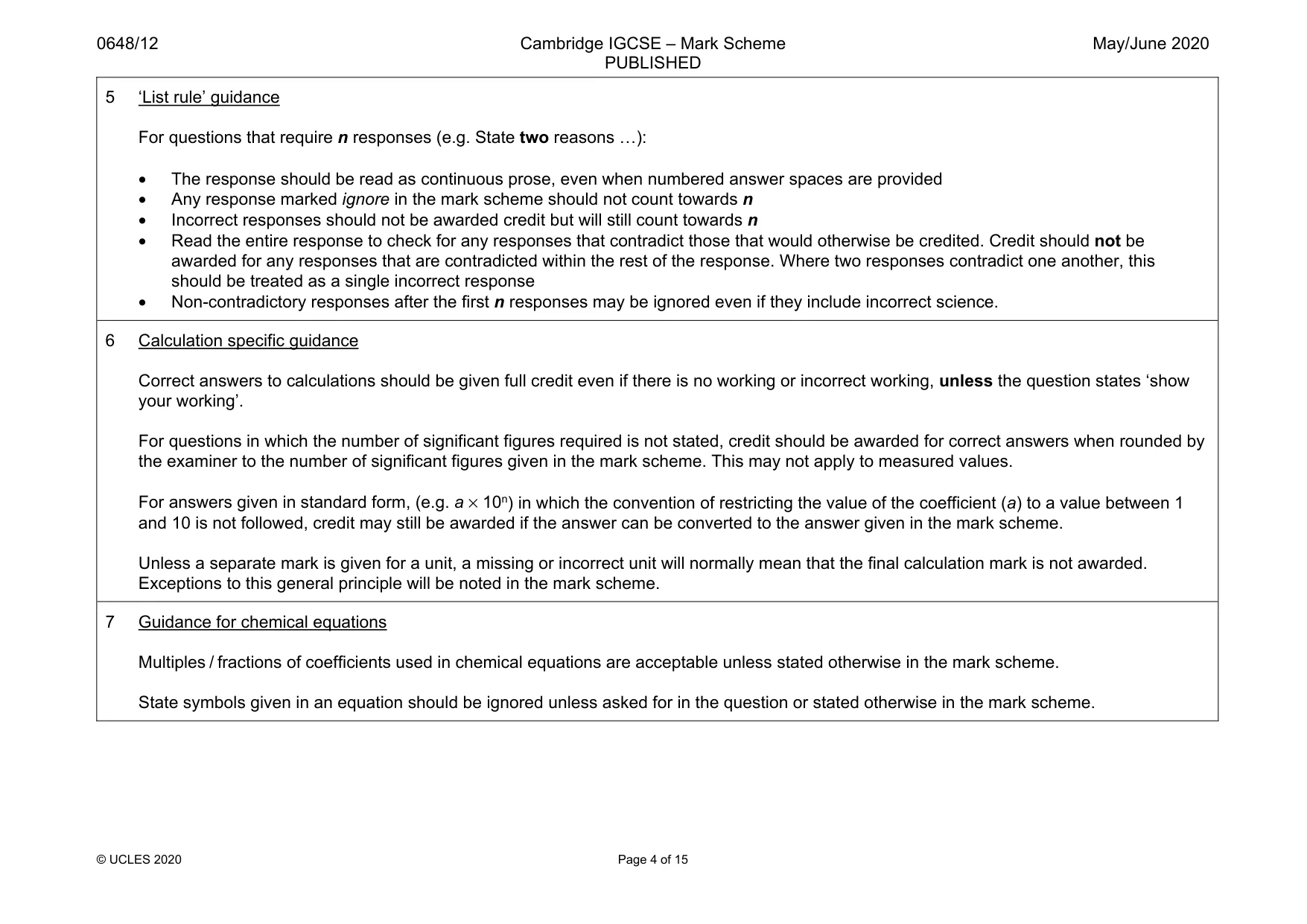
0648/12 Cambridge IGCSE – Mark Scheme PUBLISHED May/June 2020 © UCLES 2020 Page 4 of 15 5 ‘List rule’ guidance For questions that require n responses (e.g. State two reasons …): • The response should be read as continuous prose, even when numbered answer spaces are provided • Any response marked ignore in the mark scheme should not count towards n • Incorrect responses should not be awarded credit but will still count towards n • Read the entire response to check for any responses that contradict those that would otherwise be credited. Credit should not be awarded for any responses that are contradicted within the rest of the response. Where two responses contradict one another, this should be treated as a single incorrect response • Non-contradictory responses after the first n responses may be ignored even if they include incorrect science. 6 Calculation specific guidance Correct answers to calculations should be given full credit even if there is no working or incorrect working, unless the question states ‘show your working’. For questions in which the number of significant figures required is not stated, credit should be awarded for correct answers when rounded by the examiner to the number of significant figures given in the mark scheme. This may not apply to measured values. For answers given in standard form, (e.g. a × 10n) in which the convention of restricting the value of the coefficient (a) to a value between 1 and 10 is not followed, credit may still be awarded if the answer can be converted to the answer given in the mark scheme. Unless a separate mark is given for a unit, a missing or incorrect unit will normally mean that the final calculation mark is not awarded. Exceptions to this general principle will be noted in the mark scheme. 7 Guidance for chemical equations Multiples / fractions of coefficients used in chemical equations are acceptable unless stated otherwise in the mark scheme. State symbols given in an equation should be ignored unless asked for in the question or stated otherwise in the mark scheme.
Mark scheme, page 5
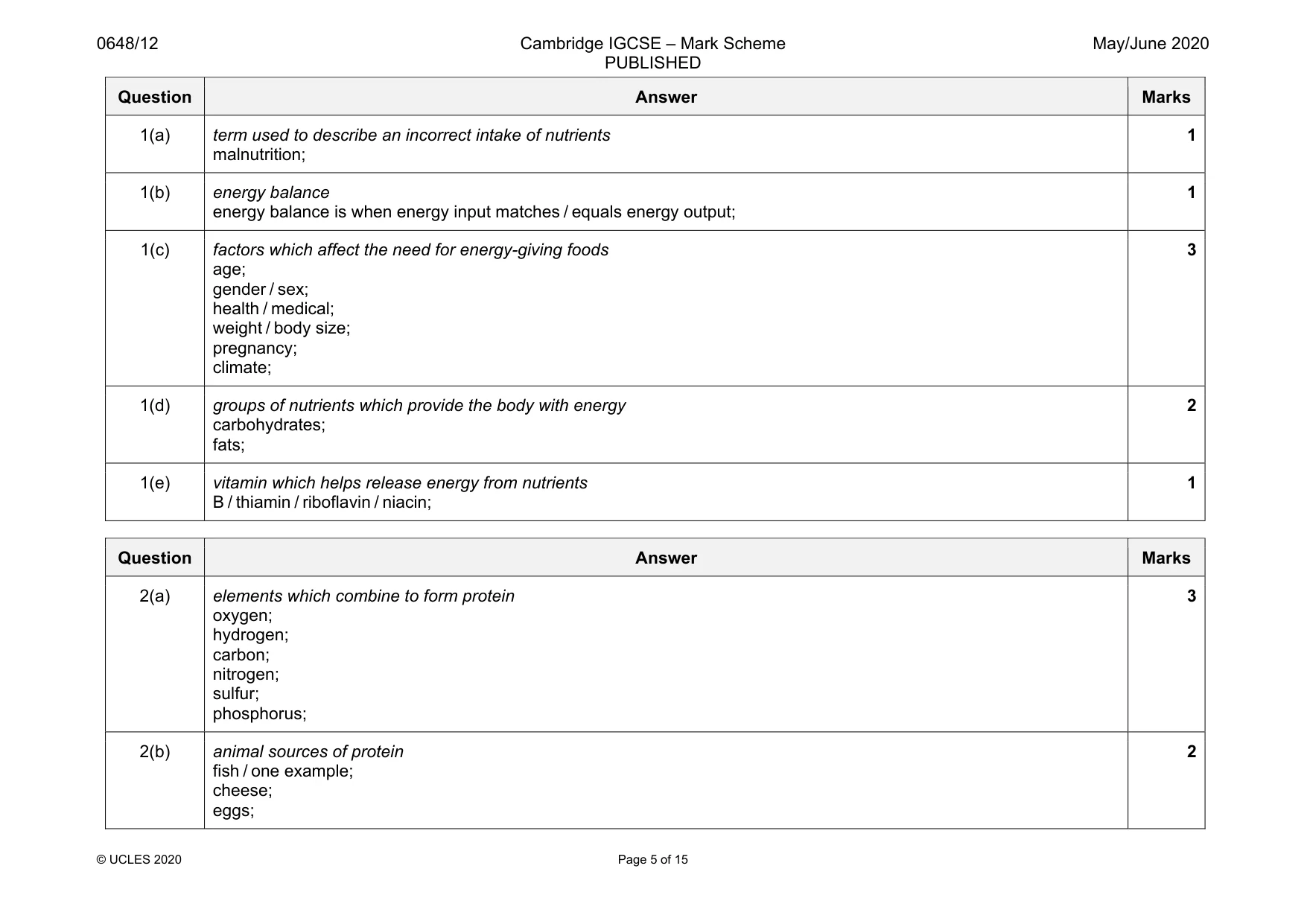
0648/12 Cambridge IGCSE – Mark Scheme PUBLISHED May/June 2020 © UCLES 2020 Page 5 of 15 Question Answer Marks 1(a) term used to describe an incorrect intake of nutrients malnutrition; 1 1(b) energy balance energy balance is when energy input matches / equals energy output; 1 1(c) factors which affect the need for energy-giving foods age; gender / sex; health / medical; weight / body size; pregnancy; climate; 3 1(d) groups of nutrients which provide the body with energy carbohydrates; fats; 2 1(e) vitamin which helps release energy from nutrients B / thiamin / riboflavin / niacin; 1 Question Answer Marks 2(a) elements which combine to form protein oxygen; hydrogen; carbon; nitrogen; sulfur; phosphorus; 3 2(b) animal sources of protein fish / one example; cheese; eggs; 2
Mark scheme, page 6
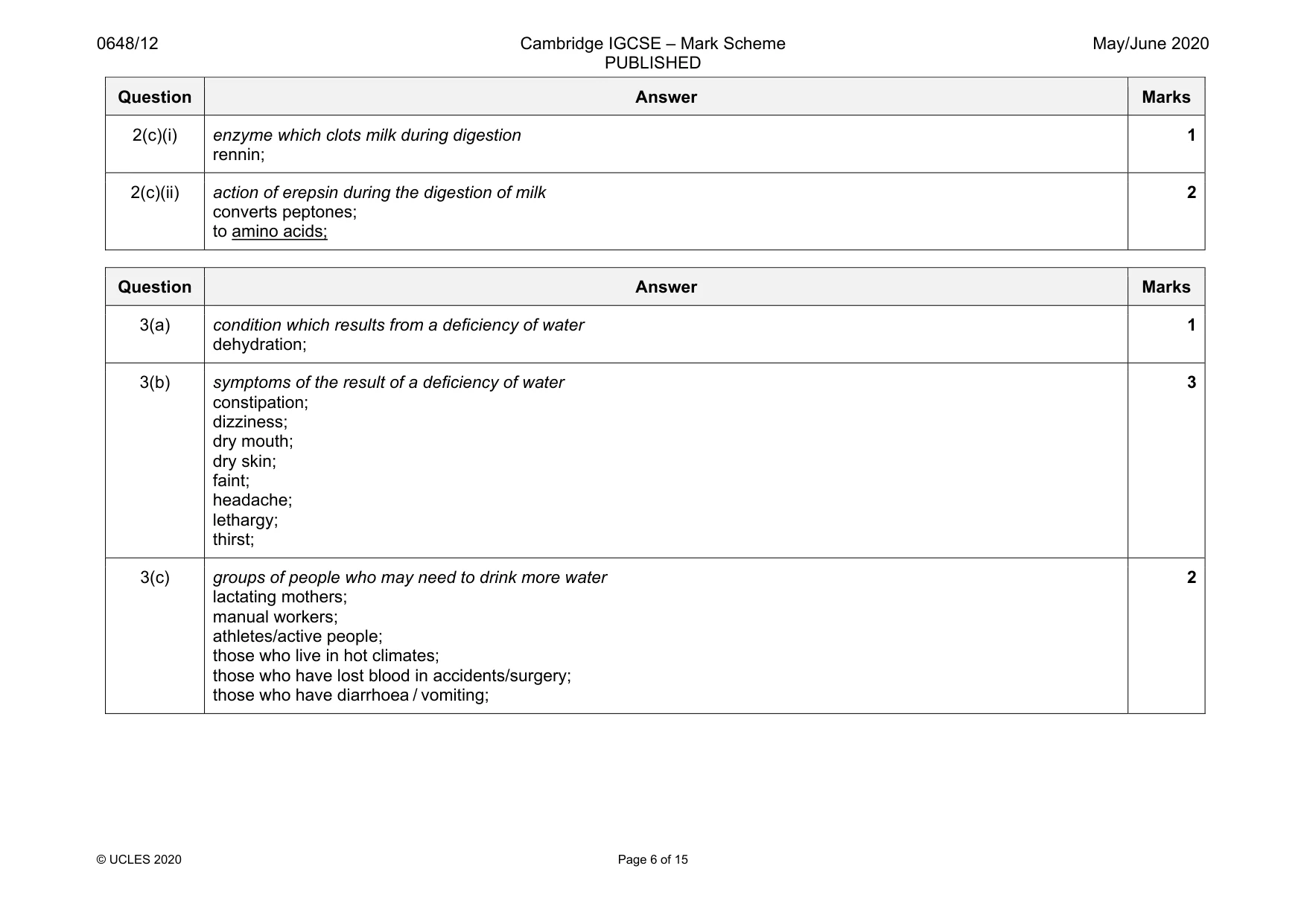
0648/12 Cambridge IGCSE – Mark Scheme PUBLISHED May/June 2020 © UCLES 2020 Page 6 of 15 Question Answer Marks 2(c)(i) enzyme which clots milk during digestion rennin; 1 2(c)(ii) action of erepsin during the digestion of milk converts peptones; to amino acids; 2 Question Answer Marks 3(a) condition which results from a deficiency of water dehydration; 1 3(b) symptoms of the result of a deficiency of water constipation; dizziness; dry mouth; dry skin; faint; headache; lethargy; thirst; 3 3(c) groups of people who may need to drink more water lactating mothers; manual workers; athletes/active people; those who live in hot climates; those who have lost blood in accidents/surgery; those who have diarrhoea / vomiting; 2
Mark scheme, page 7
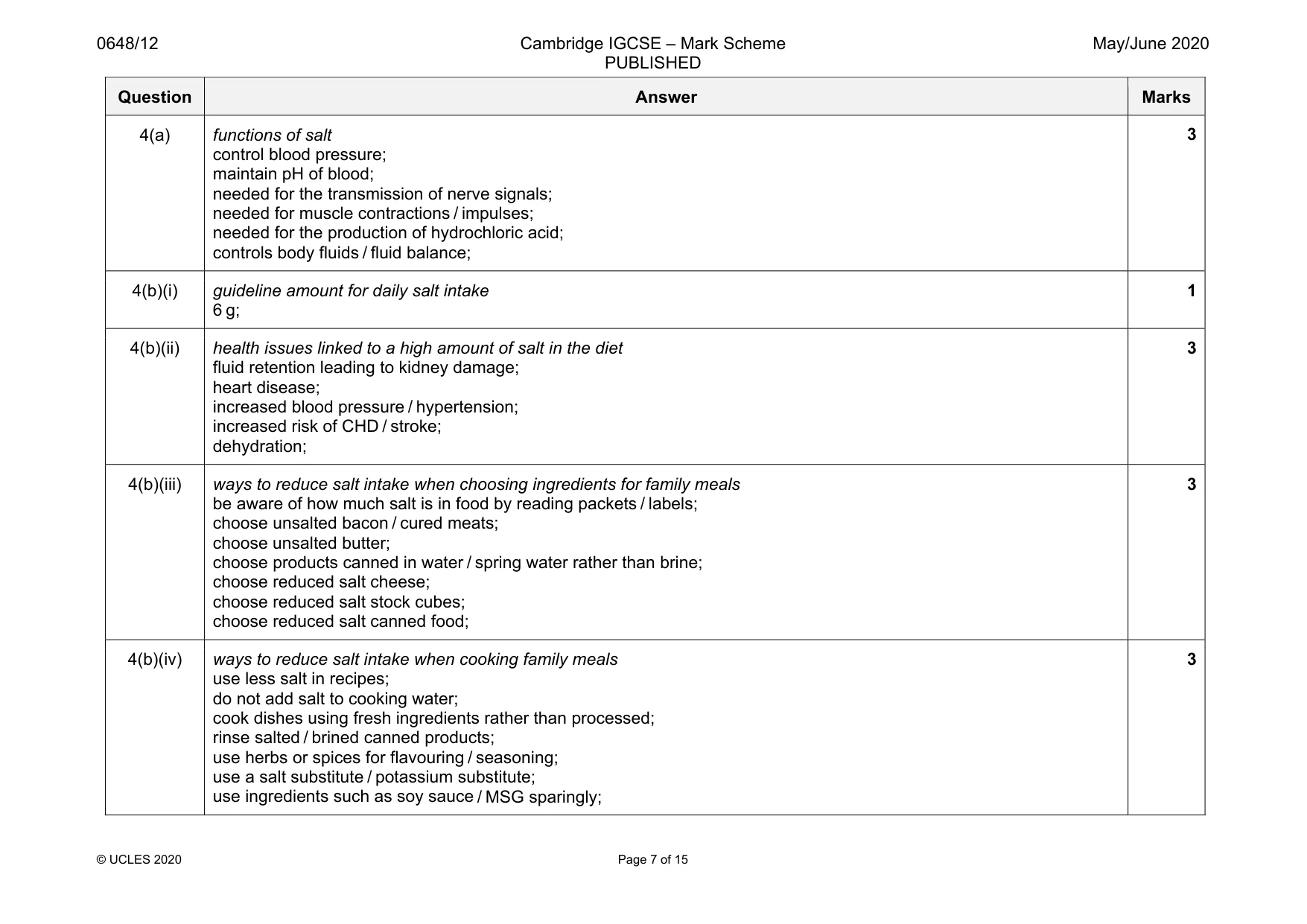
0648/12 Cambridge IGCSE – Mark Scheme PUBLISHED May/June 2020 © UCLES 2020 Page 7 of 15 Question Answer Marks 4(a) functions of salt control blood pressure; maintain pH of blood; needed for the transmission of nerve signals; needed for muscle contractions / impulses; needed for the production of hydrochloric acid; controls body fluids / fluid balance; 3 4(b)(i) guideline amount for daily salt intake 6 g; 1 4(b)(ii) health issues linked to a high amount of salt in the diet fluid retention leading to kidney damage; heart disease; increased blood pressure / hypertension; increased risk of CHD / stroke; dehydration; 3 4(b)(iii) ways to reduce salt intake when choosing ingredients for family meals be aware of how much salt is in food by reading packets / labels; choose unsalted bacon / cured meats; choose unsalted butter; choose products canned in water / spring water rather than brine; choose reduced salt cheese; choose reduced salt stock cubes; choose reduced salt canned food; 3 4(b)(iv) ways to reduce salt intake when cooking family meals use less salt in recipes; do not add salt to cooking water; cook dishes using fresh ingredients rather than processed; rinse salted / brined canned products; use herbs or spices for flavouring / seasoning; use a salt substitute / potassium substitute; use ingredients such as soy sauce / MSG sparingly; 3
Mark scheme, page 8
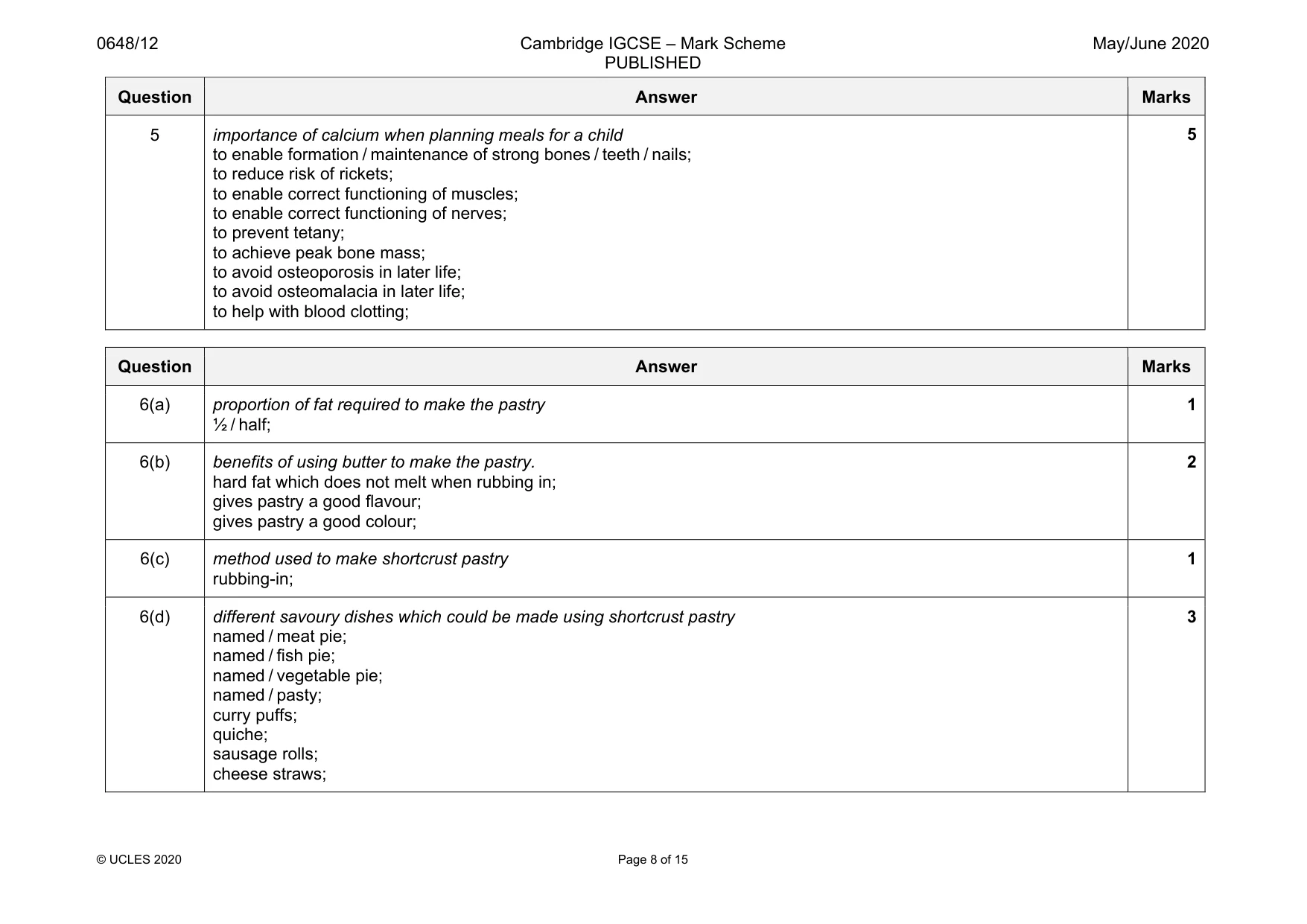
0648/12 Cambridge IGCSE – Mark Scheme PUBLISHED May/June 2020 © UCLES 2020 Page 8 of 15 Question Answer Marks 5 importance of calcium when planning meals for a child to enable formation / maintenance of strong bones / teeth / nails; to reduce risk of rickets; to enable correct functioning of muscles; to enable correct functioning of nerves; to prevent tetany; to achieve peak bone mass; to avoid osteoporosis in later life; to avoid osteomalacia in later life; to help with blood clotting; 5 Question Answer Marks 6(a) proportion of fat required to make the pastry ½ / half; 1 6(b) benefits of using butter to make the pastry. hard fat which does not melt when rubbing in; gives pastry a good flavour; gives pastry a good colour; 2 6(c) method used to make shortcrust pastry rubbing-in; 1 6(d) different savoury dishes which could be made using shortcrust pastry named / meat pie; named / fish pie; named / vegetable pie; named / pasty; curry puffs; quiche; sausage rolls; cheese straws; 3
Mark scheme, page 9
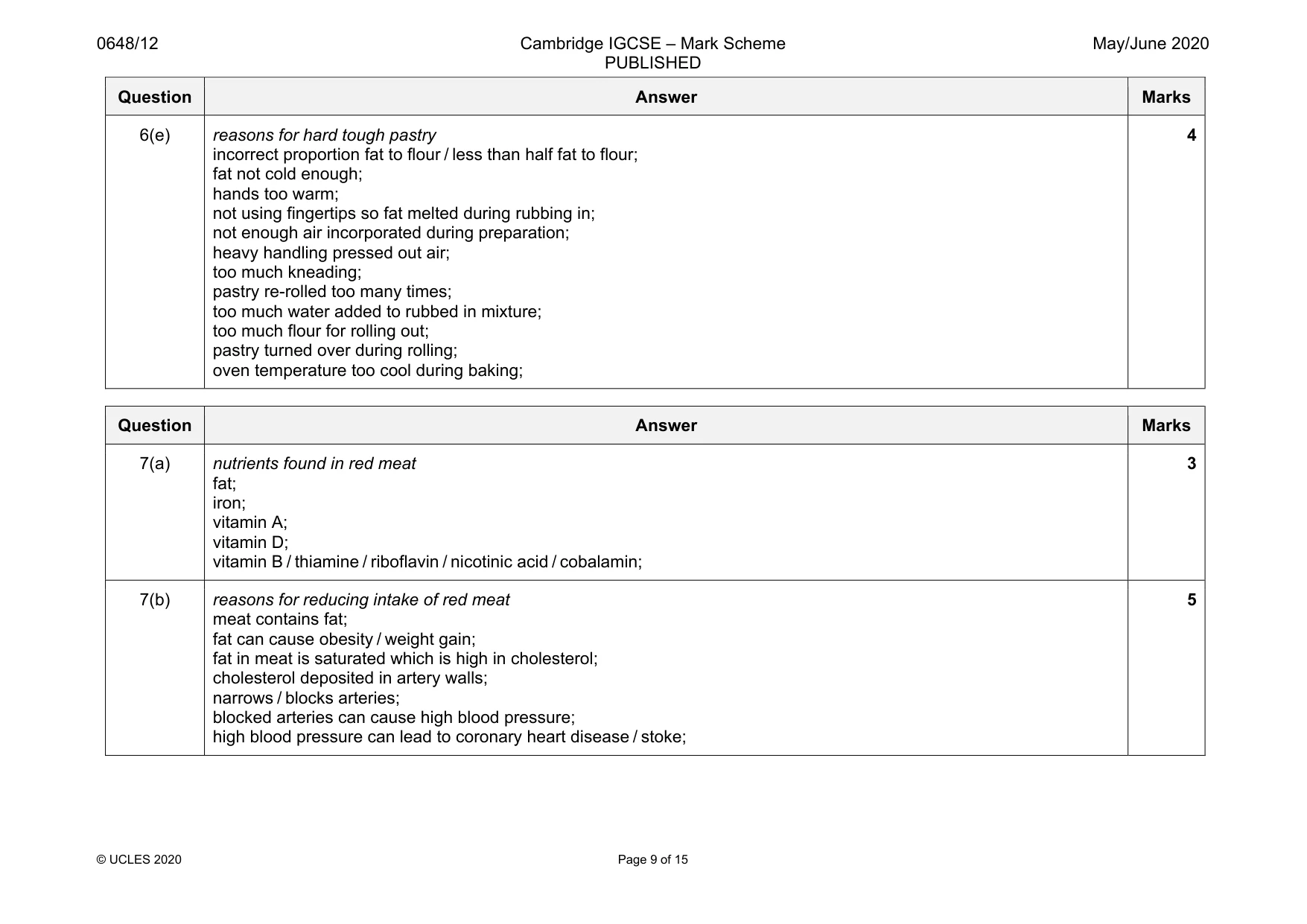
0648/12 Cambridge IGCSE – Mark Scheme PUBLISHED May/June 2020 © UCLES 2020 Page 9 of 15 Question Answer Marks 6(e) reasons for hard tough pastry incorrect proportion fat to flour / less than half fat to flour; fat not cold enough; hands too warm; not using fingertips so fat melted during rubbing in; not enough air incorporated during preparation; heavy handling pressed out air; too much kneading; pastry re-rolled too many times; too much water added to rubbed in mixture; too much flour for rolling out; pastry turned over during rolling; oven temperature too cool during baking; 4 Question Answer Marks 7(a) nutrients found in red meat fat; iron; vitamin A; vitamin D; vitamin B / thiamine / riboflavin / nicotinic acid / cobalamin; 3 7(b) reasons for reducing intake of red meat meat contains fat; fat can cause obesity / weight gain; fat in meat is saturated which is high in cholesterol; cholesterol deposited in artery walls; narrows / blocks arteries; blocked arteries can cause high blood pressure; high blood pressure can lead to coronary heart disease / stoke; 5
Mark scheme, page 10
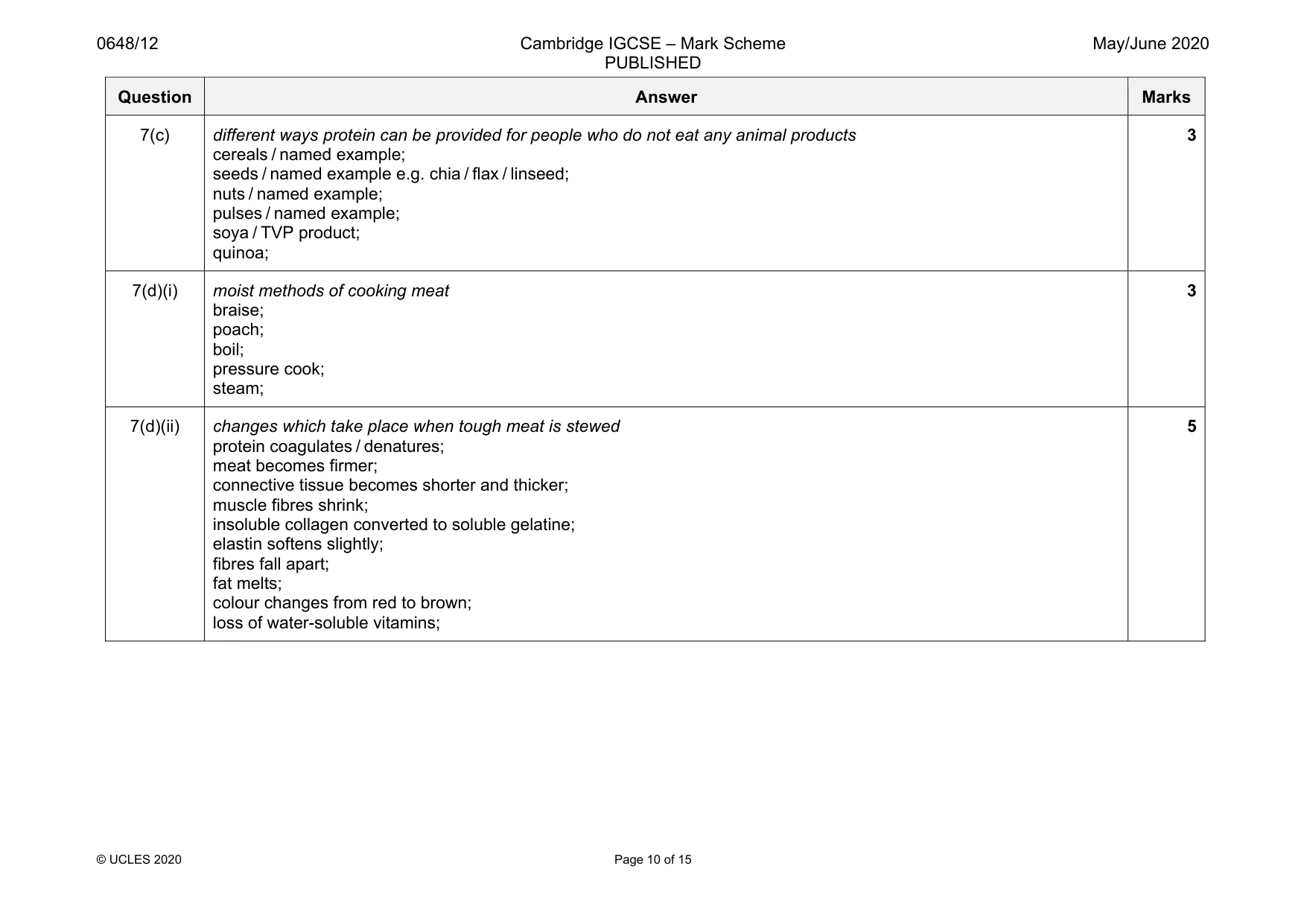
0648/12 Cambridge IGCSE – Mark Scheme PUBLISHED May/June 2020 © UCLES 2020 Page 10 of 15 Question Answer Marks 7(c) different ways protein can be provided for people who do not eat any animal products cereals / named example; seeds / named example e.g. chia / flax / linseed; nuts / named example; pulses / named example; soya / TVP product; quinoa; 3 7(d)(i) moist methods of cooking meat braise; poach; boil; pressure cook; steam; 3 7(d)(ii) changes which take place when tough meat is stewed protein coagulates / denatures; meat becomes firmer; connective tissue becomes shorter and thicker; muscle fibres shrink; insoluble collagen converted to soluble gelatine; elastin softens slightly; fibres fall apart; fat melts; colour changes from red to brown; loss of water-soluble vitamins; 5
Mark scheme, page 11
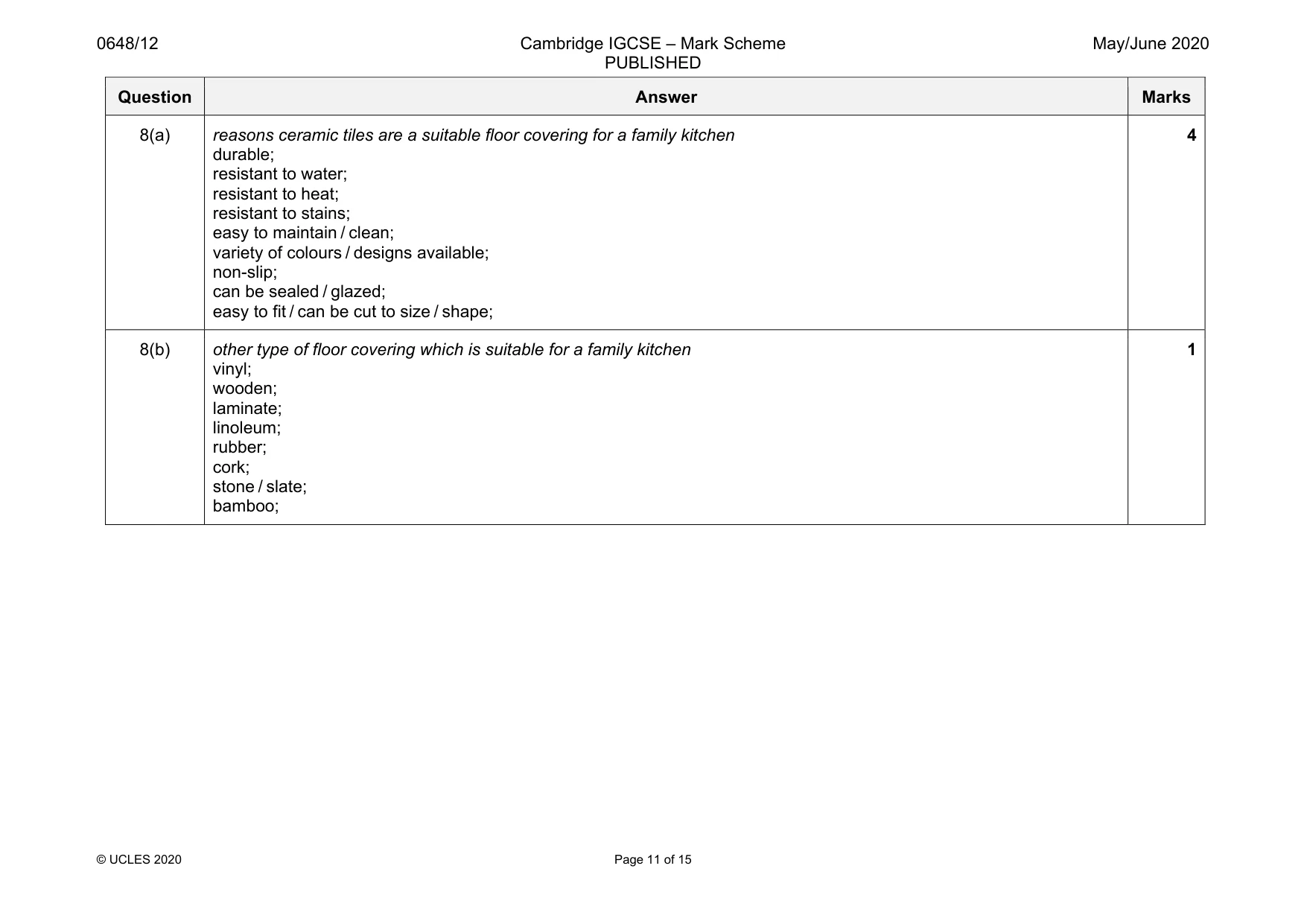
0648/12 Cambridge IGCSE – Mark Scheme PUBLISHED May/June 2020 © UCLES 2020 Page 11 of 15 Question Answer Marks 8(a) reasons ceramic tiles are a suitable floor covering for a family kitchen durable; resistant to water; resistant to heat; resistant to stains; easy to maintain / clean; variety of colours / designs available; non-slip; can be sealed / glazed; easy to fit / can be cut to size / shape; 4 8(b) other type of floor covering which is suitable for a family kitchen vinyl; wooden; laminate; linoleum; rubber; cork; stone / slate; bamboo; 1
Mark scheme, page 12
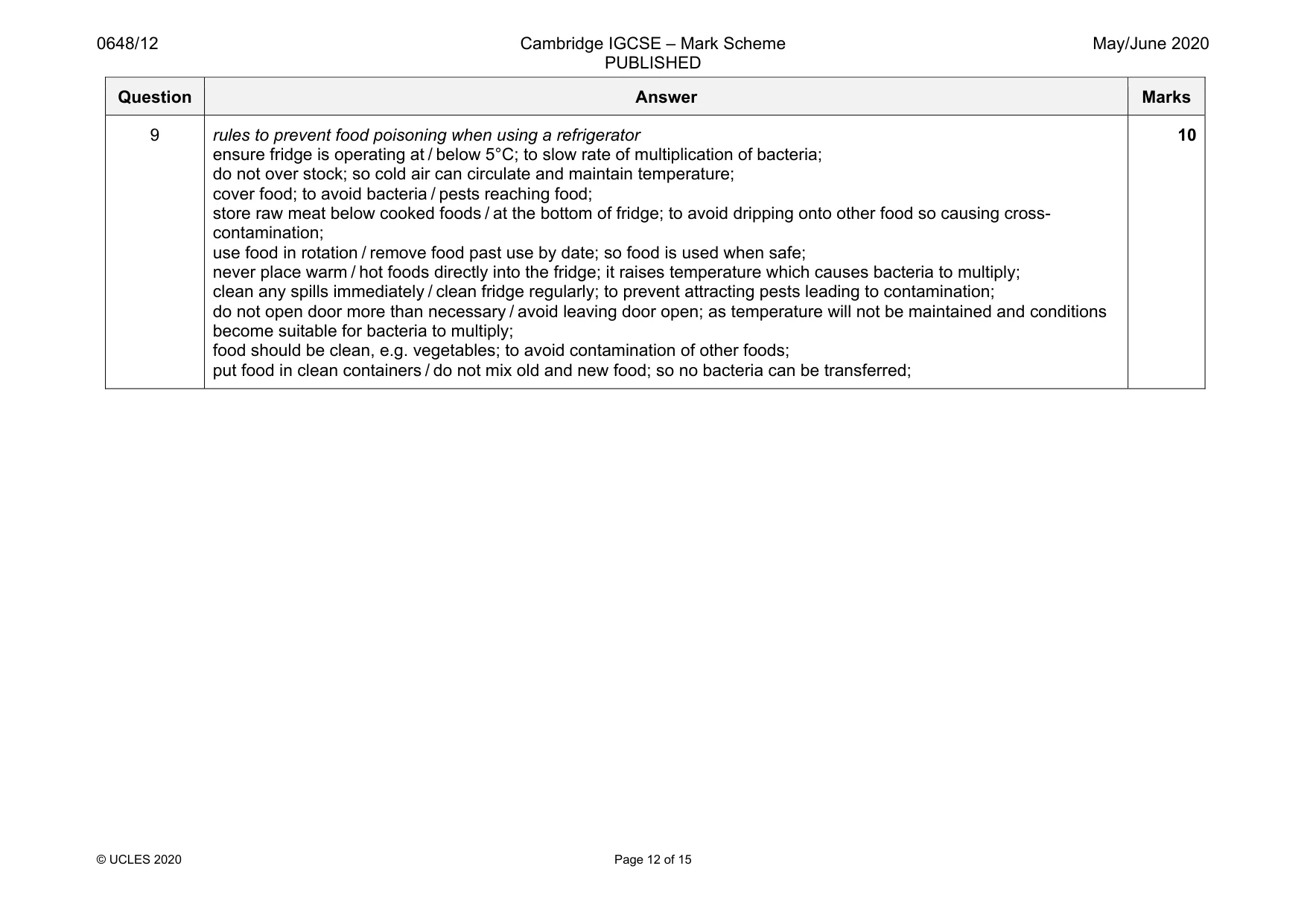
0648/12 Cambridge IGCSE – Mark Scheme PUBLISHED May/June 2020 © UCLES 2020 Page 12 of 15 Question Answer Marks 9 rules to prevent food poisoning when using a refrigerator ensure fridge is operating at / below 5°C; to slow rate of multiplication of bacteria; do not over stock; so cold air can circulate and maintain temperature; cover food; to avoid bacteria / pests reaching food; store raw meat below cooked foods / at the bottom of fridge; to avoid dripping onto other food so causing cross- contamination; use food in rotation / remove food past use by date; so food is used when safe; never place warm / hot foods directly into the fridge; it raises temperature which causes bacteria to multiply; clean any spills immediately / clean fridge regularly; to prevent attracting pests leading to contamination; do not open door more than necessary / avoid leaving door open; as temperature will not be maintained and conditions become suitable for bacteria to multiply; food should be clean, e.g. vegetables; to avoid contamination of other foods; put food in clean containers / do not mix old and new food; so no bacteria can be transferred; 10
Mark scheme, page 13
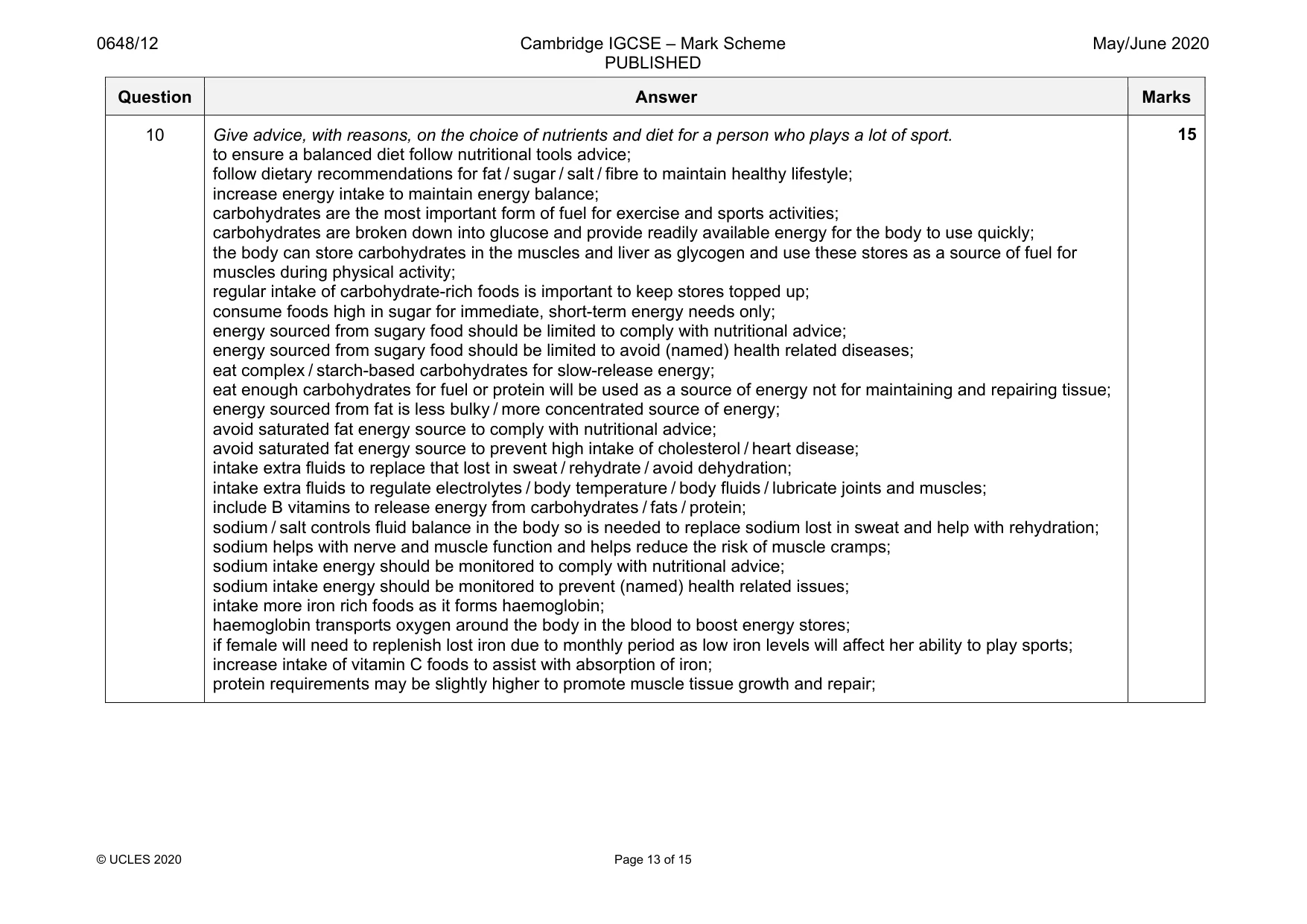
0648/12 Cambridge IGCSE – Mark Scheme PUBLISHED May/June 2020 © UCLES 2020 Page 13 of 15 Question Answer Marks 10 Give advice, with reasons, on the choice of nutrients and diet for a person who plays a lot of sport. to ensure a balanced diet follow nutritional tools advice; follow dietary recommendations for fat / sugar / salt / fibre to maintain healthy lifestyle; increase energy intake to maintain energy balance; carbohydrates are the most important form of fuel for exercise and sports activities; carbohydrates are broken down into glucose and provide readily available energy for the body to use quickly; the body can store carbohydrates in the muscles and liver as glycogen and use these stores as a source of fuel for muscles during physical activity; regular intake of carbohydrate-rich foods is important to keep stores topped up; consume foods high in sugar for immediate, short-term energy needs only; energy sourced from sugary food should be limited to comply with nutritional advice; energy sourced from sugary food should be limited to avoid (named) health related diseases; eat complex / starch-based carbohydrates for slow-release energy; eat enough carbohydrates for fuel or protein will be used as a source of energy not for maintaining and repairing tissue; energy sourced from fat is less bulky / more concentrated source of energy; avoid saturated fat energy source to comply with nutritional advice; avoid saturated fat energy source to prevent high intake of cholesterol / heart disease; intake extra fluids to replace that lost in sweat / rehydrate / avoid dehydration; intake extra fluids to regulate electrolytes / body temperature / body fluids / lubricate joints and muscles; include B vitamins to release energy from carbohydrates / fats / protein; sodium / salt controls fluid balance in the body so is needed to replace sodium lost in sweat and help with rehydration; sodium helps with nerve and muscle function and helps reduce the risk of muscle cramps; sodium intake energy should be monitored to comply with nutritional advice; sodium intake energy should be monitored to prevent (named) health related issues; intake more iron rich foods as it forms haemoglobin; haemoglobin transports oxygen around the body in the blood to boost energy stores; if female will need to replenish lost iron due to monthly period as low iron levels will affect her ability to play sports; increase intake of vitamin C foods to assist with absorption of iron; protein requirements may be slightly higher to promote muscle tissue growth and repair; 15
Mark scheme, page 14
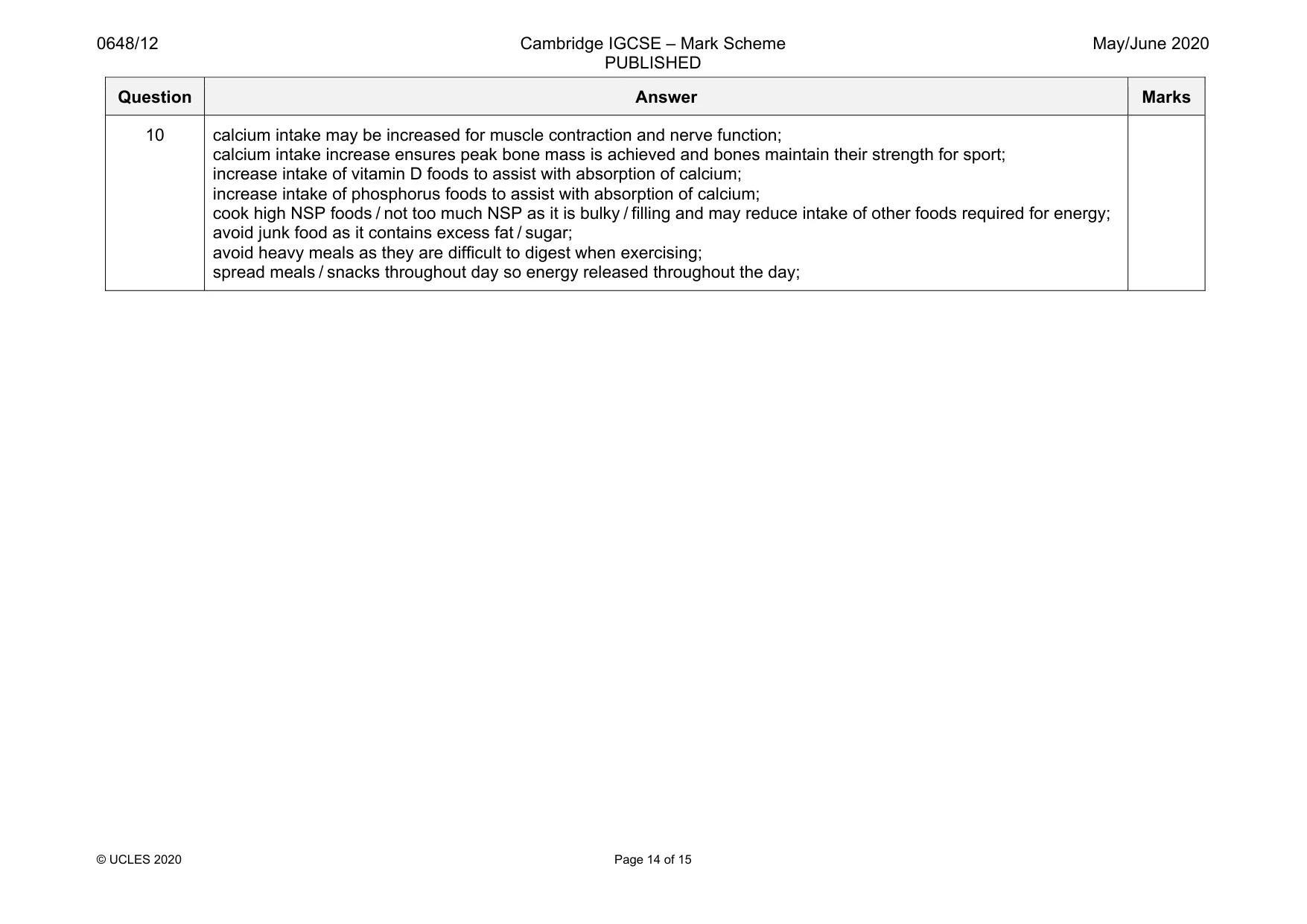
0648/12 Cambridge IGCSE – Mark Scheme PUBLISHED May/June 2020 © UCLES 2020 Page 14 of 15 Question Answer Marks 10 calcium intake may be increased for muscle contraction and nerve function; calcium intake increase ensures peak bone mass is achieved and bones maintain their strength for sport; increase intake of vitamin D foods to assist with absorption of calcium; increase intake of phosphorus foods to assist with absorption of calcium; cook high NSP foods / not too much NSP as it is bulky / filling and may reduce intake of other foods required for energy; avoid junk food as it contains excess fat / sugar; avoid heavy meals as they are difficult to digest when exercising; spread meals / snacks throughout day so energy released throughout the day;
Mark scheme, page 15
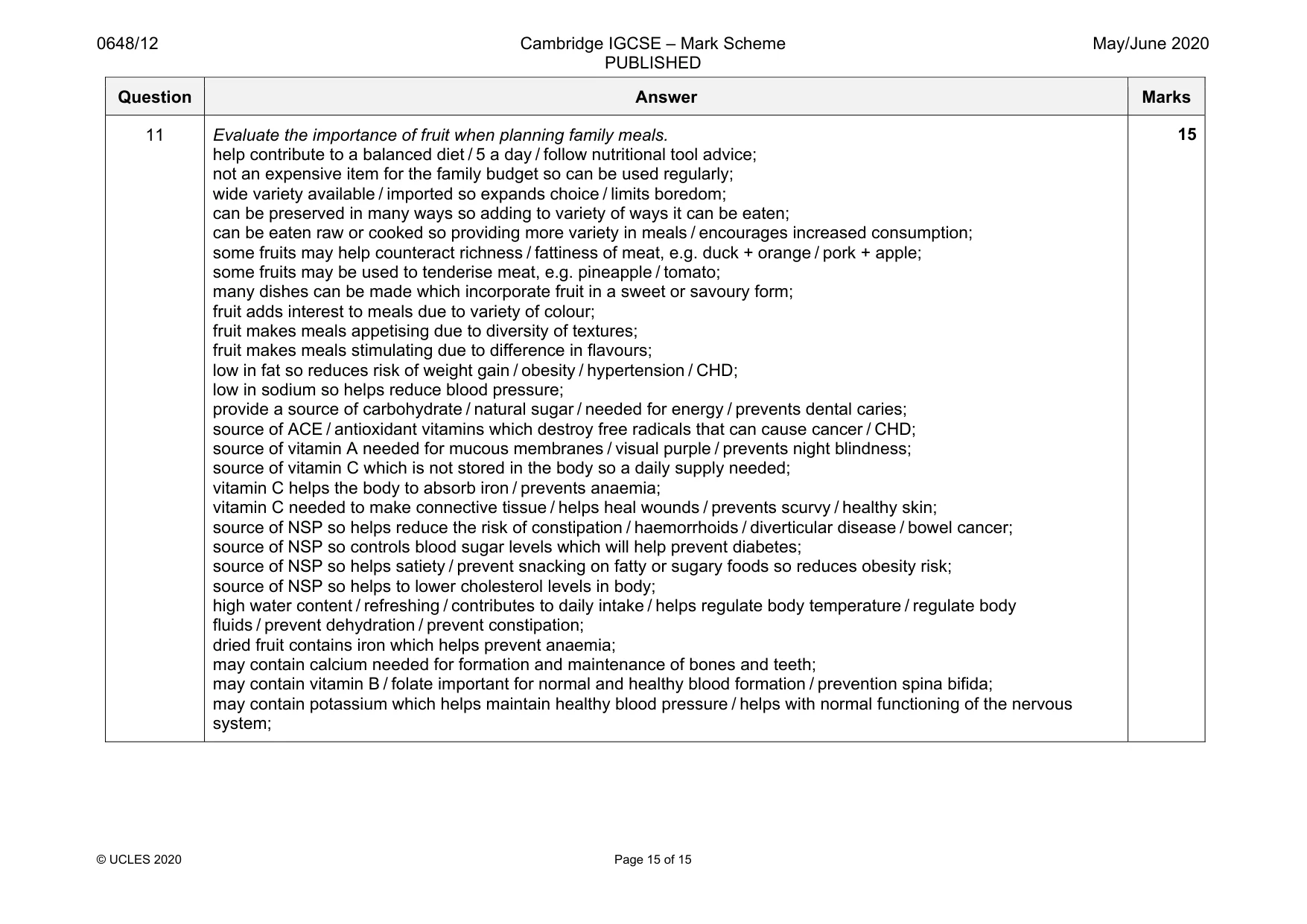
0648/12 Cambridge IGCSE – Mark Scheme PUBLISHED May/June 2020 © UCLES 2020 Page 15 of 15 Question Answer Marks 11 Evaluate the importance of fruit when planning family meals. help contribute to a balanced diet / 5 a day / follow nutritional tool advice; not an expensive item for the family budget so can be used regularly; wide variety available / imported so expands choice / limits boredom; can be preserved in many ways so adding to variety of ways it can be eaten; can be eaten raw or cooked so providing more variety in meals / encourages increased consumption; some fruits may help counteract richness / fattiness of meat, e.g. duck + orange / pork + apple; some fruits may be used to tenderise meat, e.g. pineapple / tomato; many dishes can be made which incorporate fruit in a sweet or savoury form; fruit adds interest to meals due to variety of colour; fruit makes meals appetising due to diversity of textures; fruit makes meals stimulating due to difference in flavours; low in fat so reduces risk of weight gain / obesity / hypertension / CHD; low in sodium so helps reduce blood pressure; provide a source of carbohydrate / natural sugar / needed for energy / prevents dental caries; source of ACE / antioxidant vitamins which destroy free radicals that can cause cancer / CHD; source of vitamin A needed for mucous membranes / visual purple / prevents night blindness; source of vitamin C which is not stored in the body so a daily supply needed; vitamin C helps the body to absorb iron / prevents anaemia; vitamin C needed to make connective tissue / helps heal wounds / prevents scurvy / healthy skin; source of NSP so helps reduce the risk of constipation / haemorrhoids / diverticular disease / bowel cancer; source of NSP so controls blood sugar levels which will help prevent diabetes; source of NSP so helps satiety / prevent snacking on fatty or sugary foods so reduces obesity risk; source of NSP so helps to lower cholesterol levels in body; high water content / refreshing / contributes to daily intake / helps regulate body temperature / regulate body fluids / prevent dehydration / prevent constipation; dried fruit contains iron which helps prevent anaemia; may contain calcium needed for formation and maintenance of bones and teeth; may contain vitamin B / folate important for normal and healthy blood formation / prevention spina bifida; may contain potassium which helps maintain healthy blood pressure / helps with normal functioning of the nervous system; 15