Cambridge IGCSE Food and Nutrition 0648 — 2020 May/June Paper 1 · Variant 3
0648/13/M/J/20
The question paper and its mark scheme, free to read here and free to download. This is Cambridge’s own paper, exactly as it was sat.
Question paper12 pages


Mark scheme15 pages
Answers below. Sit the paper first if you are practising.
Paper as text
Question paper, page 1
Cambridge IGCSE™ DC (ST) 181535/2 © UCLES 2020 [Turn over This document has 12 pages. Blank pages are indicated. FOOD & NUTRITION 0648/13 Paper 1 Theory May/June 2020 2 hours You must answer on the question paper. No additional materials are needed. INSTRUCTIONS ● Section A: answer all questions. ● Section B: answer all questions. ● Section C: answer one question. ● Use a black or dark blue pen. You may use an HB pencil for any diagrams or graphs. ● Write your name, centre number and candidate number in the boxes at the top of the page. ● Write your answer to each question in the space provided. ● Do not use an erasable pen or correction fluid. ● Do not write on any bar codes. INFORMATION ● The total mark for this paper is 100. ● The number of marks for each question or part question is shown in brackets [ ]. * 6 3 8 8 2 4 7 0 4 4 *
Question paper, page 2
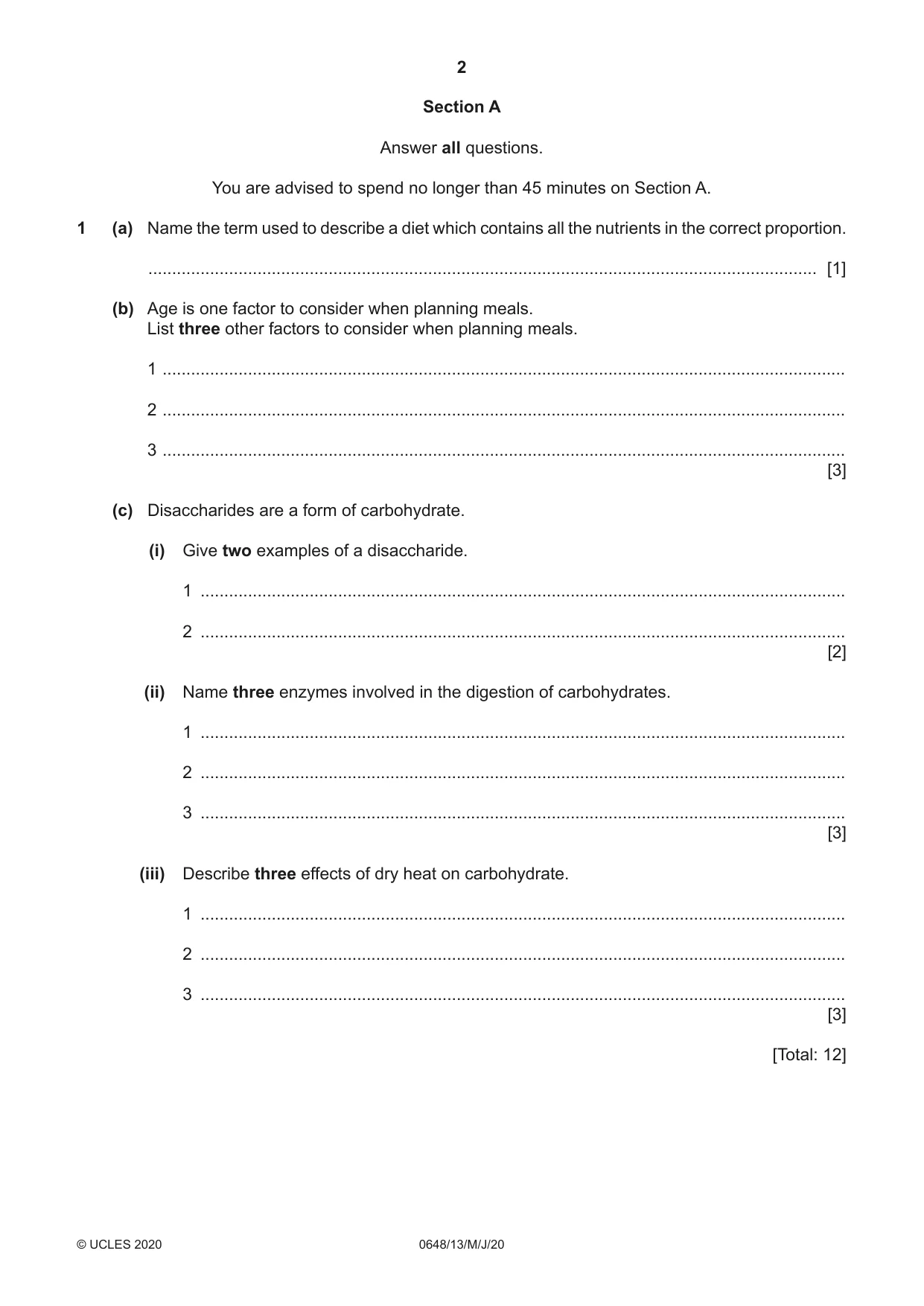
2 0648/13/M/J/20 © UCLES 2020 Section A Answer all questions. You are advised to spend no longer than 45 minutes on Section A. 1 (a) Name the term used to describe a diet which contains all the nutrients in the correct proportion. … [1] (b) Age is one factor to consider when planning meals. List three other factors to consider when planning meals. 1 … 2 … 3 … [3] (c) Disaccharides are a form of carbohydrate. (i) Give two examples of a disaccharide. 1 … 2 … [2] (ii) Name three enzymes involved in the digestion of carbohydrates. 1 … 2 … 3 … [3] (iii) Describe three effects of dry heat on carbohydrate. 1 … 2 … 3 … [3] [Total: 12]
Question paper, page 3
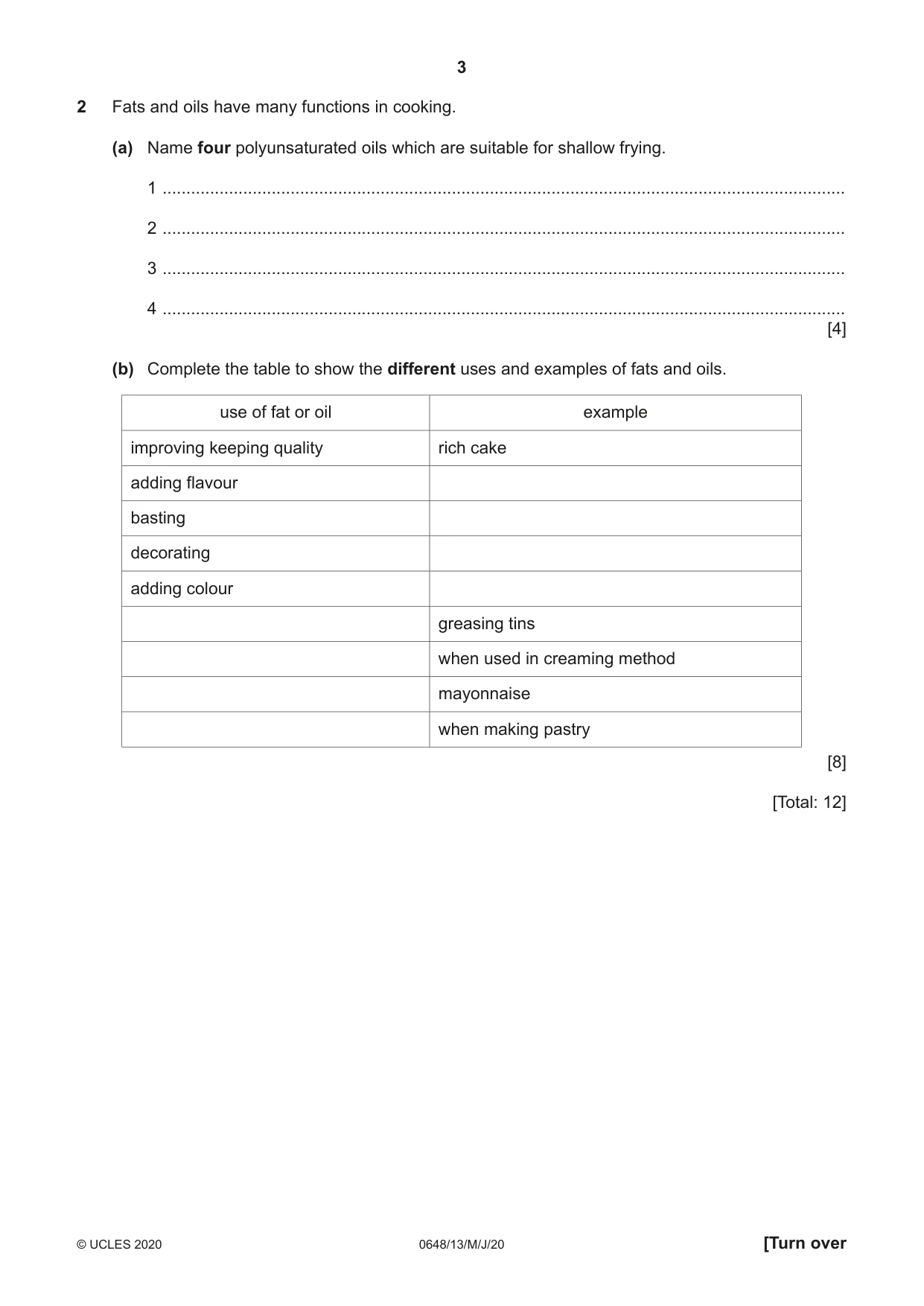
3 0648/13/M/J/20 © UCLES 2020 [Turn over 2 Fats and oils have many functions in cooking. (a) Name four polyunsaturated oils which are suitable for shallow frying. 1 … 2 … 3 … 4 … [4] (b) Complete the table to show the different uses and examples of fats and oils. use of fat or oil example improving keeping quality rich cake adding flavour basting decorating adding colour greasing tins when used in creaming method mayonnaise when making pastry [8] [Total: 12]
Question paper, page 4
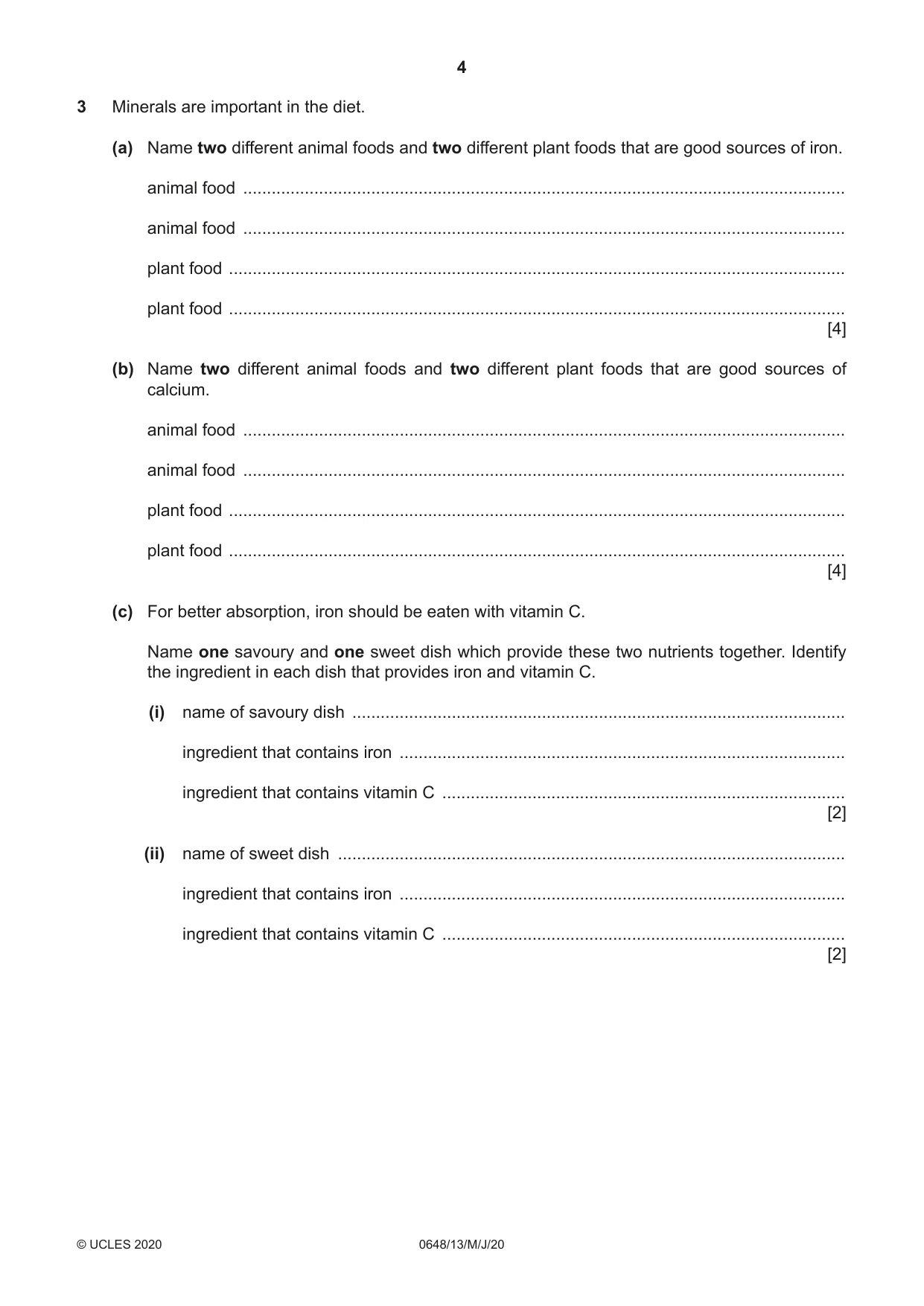
4 0648/13/M/J/20 © UCLES 2020 3 Minerals are important in the diet. (a) Name two different animal foods and two different plant foods that are good sources of iron. animal food … animal food … plant food … plant food … [4] (b) Name two different animal foods and two different plant foods that are good sources of calcium. animal food … animal food … plant food … plant food … [4] (c) For better absorption, iron should be eaten with vitamin C. Name one savoury and one sweet dish which provide these two nutrients together. Identify the ingredient in each dish that provides iron and vitamin C. (i) name of savoury dish … ingredient that contains iron … ingredient that contains vitamin C … [2] (ii) name of sweet dish … ingredient that contains iron … ingredient that contains vitamin C … [2]
Question paper, page 5
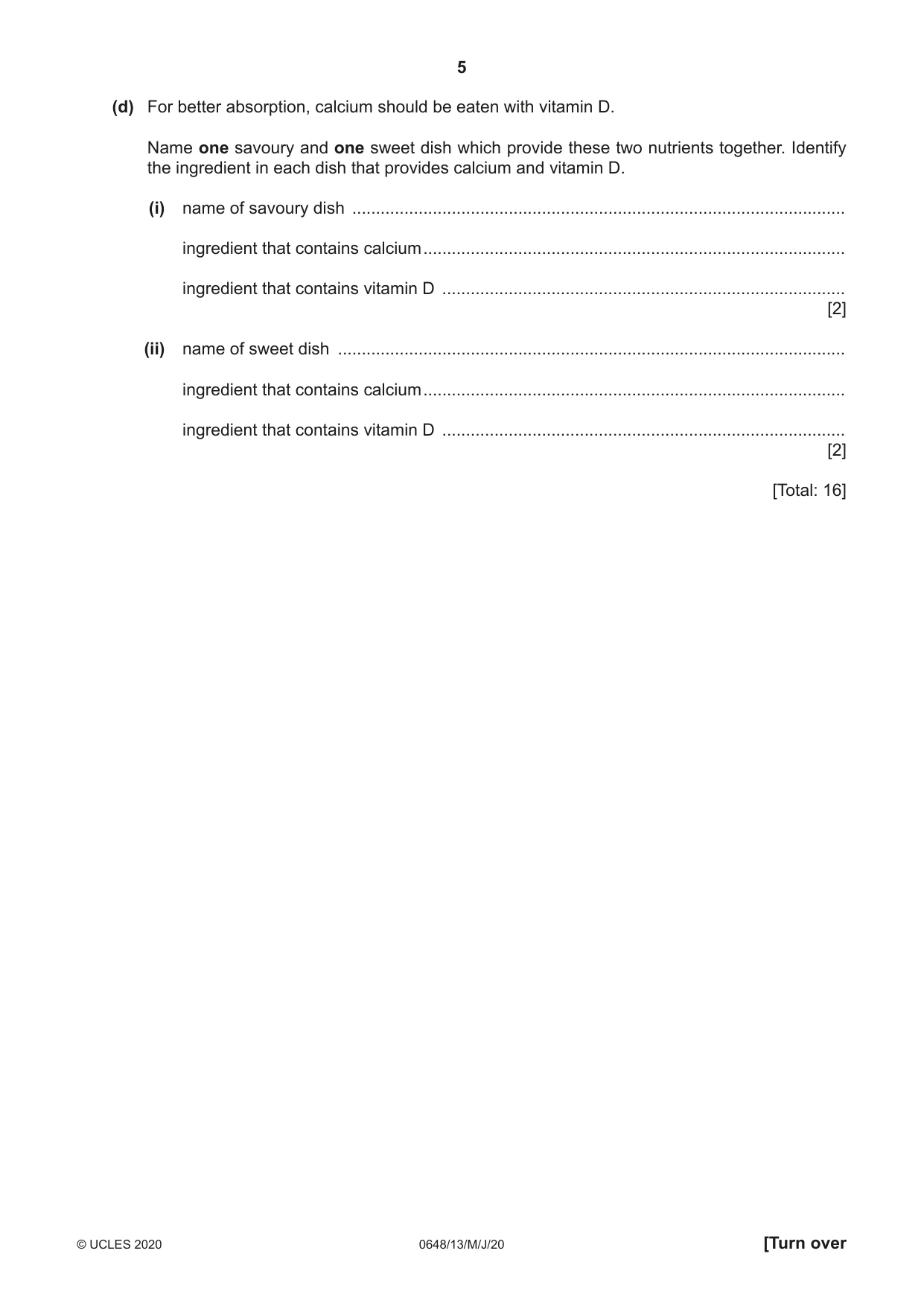
5 0648/13/M/J/20 © UCLES 2020 [Turn over (d) For better absorption, calcium should be eaten with vitamin D. Name one savoury and one sweet dish which provide these two nutrients together. Identify the ingredient in each dish that provides calcium and vitamin D. (i) name of savoury dish … ingredient that contains calcium … ingredient that contains vitamin D … [2] (ii) name of sweet dish … ingredient that contains calcium … ingredient that contains vitamin D … [2] [Total: 16]
Question paper, page 6
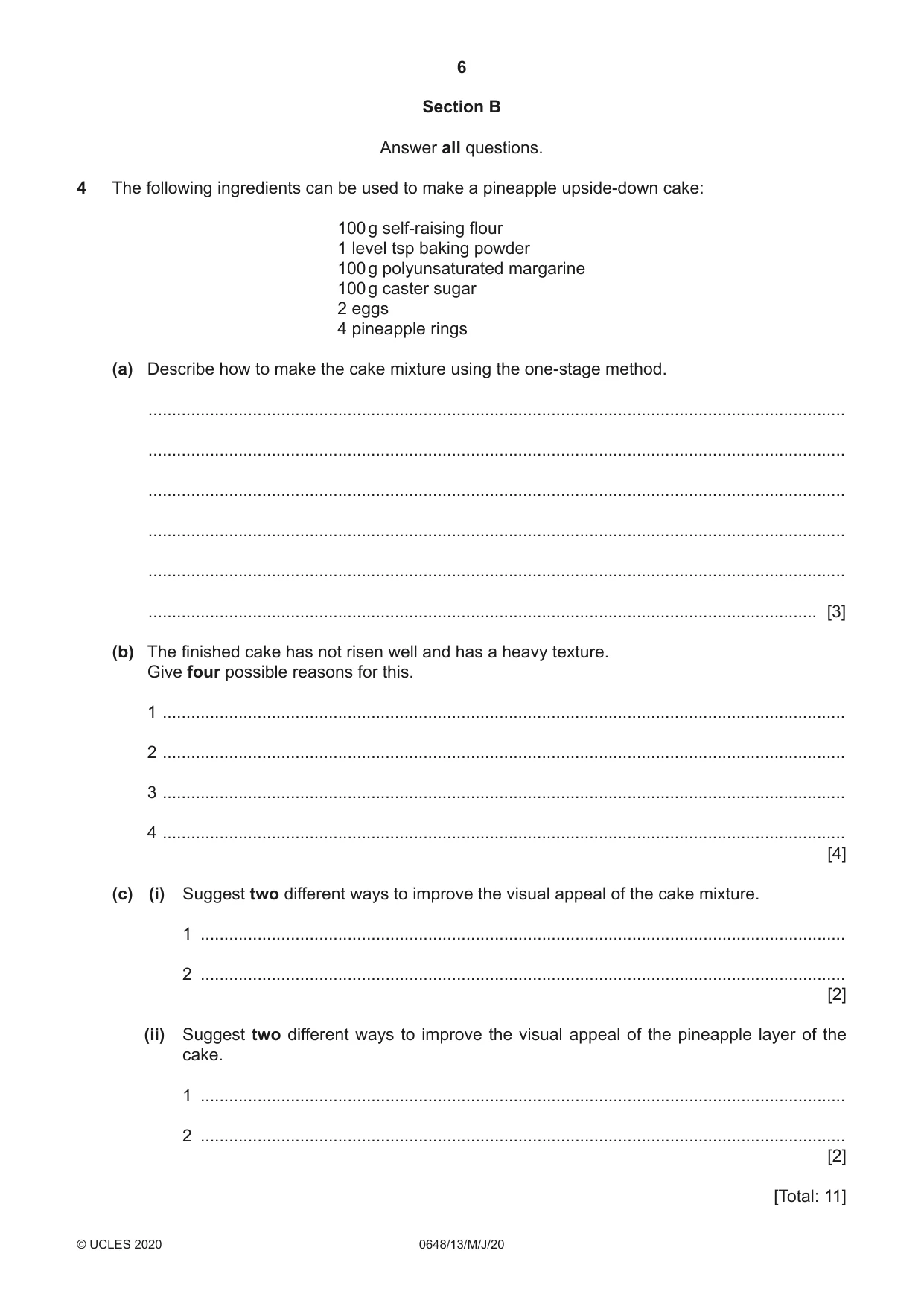
6 0648/13/M/J/20 © UCLES 2020 Section B Answer all questions. 4 The following ingredients can be used to make a pineapple upside-down cake: 100 g self-raising flour 1 level tsp baking powder 100 g polyunsaturated margarine 100 g caster sugar 2 eggs 4 pineapple rings (a) Describe how to make the cake mixture using the one-stage method. … … … … … … [3] (b) The finished cake has not risen well and has a heavy texture. Give four possible reasons for this. 1 … 2 … 3 … 4 … [4] (c) (i) Suggest two different ways to improve the visual appeal of the cake mixture. 1 … 2 … [2] (ii) Suggest two different ways to improve the visual appeal of the pineapple layer of the cake. 1 … 2 … [2] [Total: 11]
Question paper, page 7
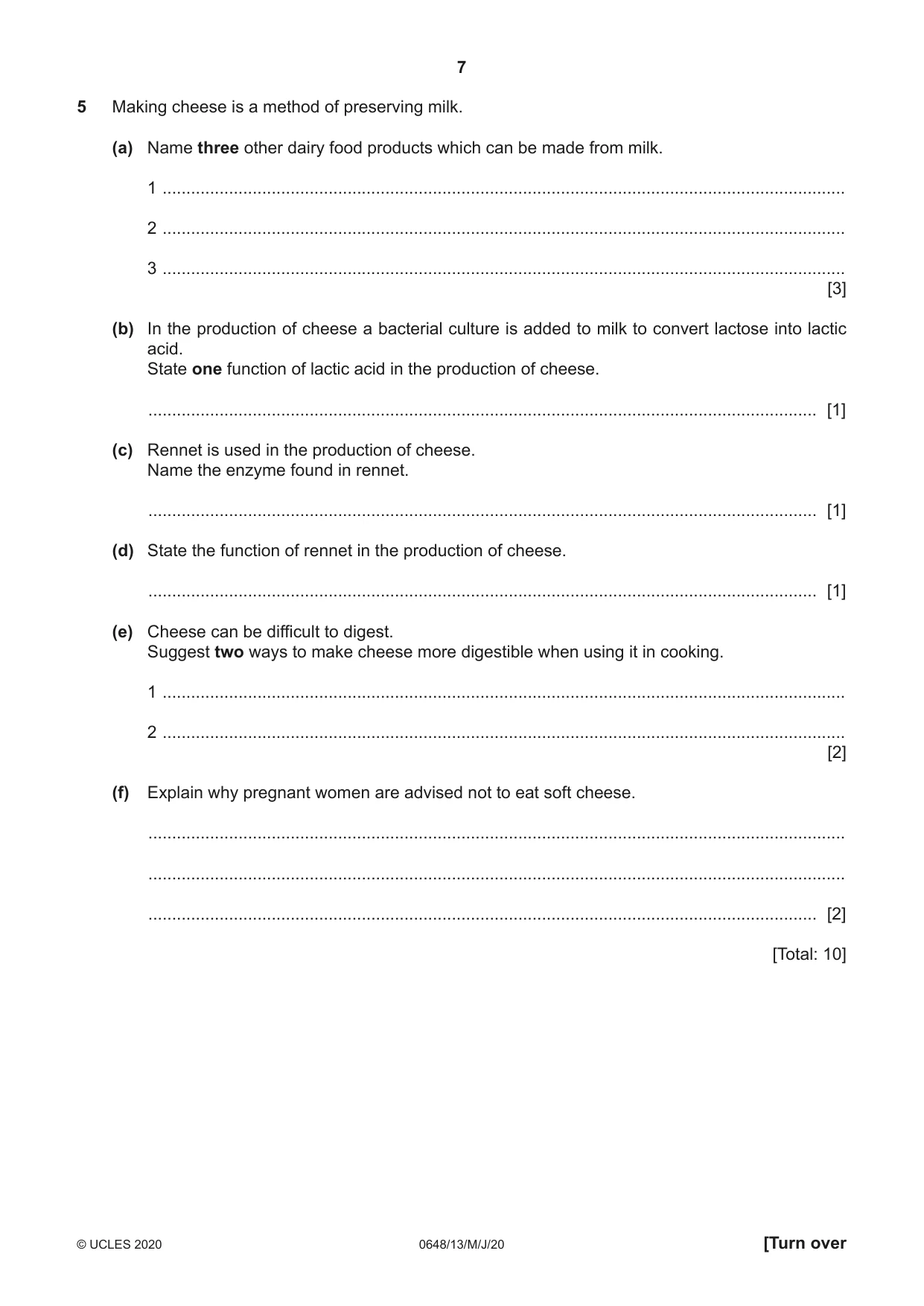
7 0648/13/M/J/20 © UCLES 2020 [Turn over 5 Making cheese is a method of preserving milk. (a) Name three other dairy food products which can be made from milk. 1 … 2 … 3 … [3] (b) In the production of cheese a bacterial culture is added to milk to convert lactose into lactic acid. State one function of lactic acid in the production of cheese. … [1] (c) Rennet is used in the production of cheese. Name the enzyme found in rennet. … [1] (d) State the function of rennet in the production of cheese. … [1] (e) Cheese can be difficult to digest. Suggest two ways to make cheese more digestible when using it in cooking. 1 … 2 … [2] (f) Explain why pregnant women are advised not to eat soft cheese. … … … [2] [Total: 10]
Question paper, page 8
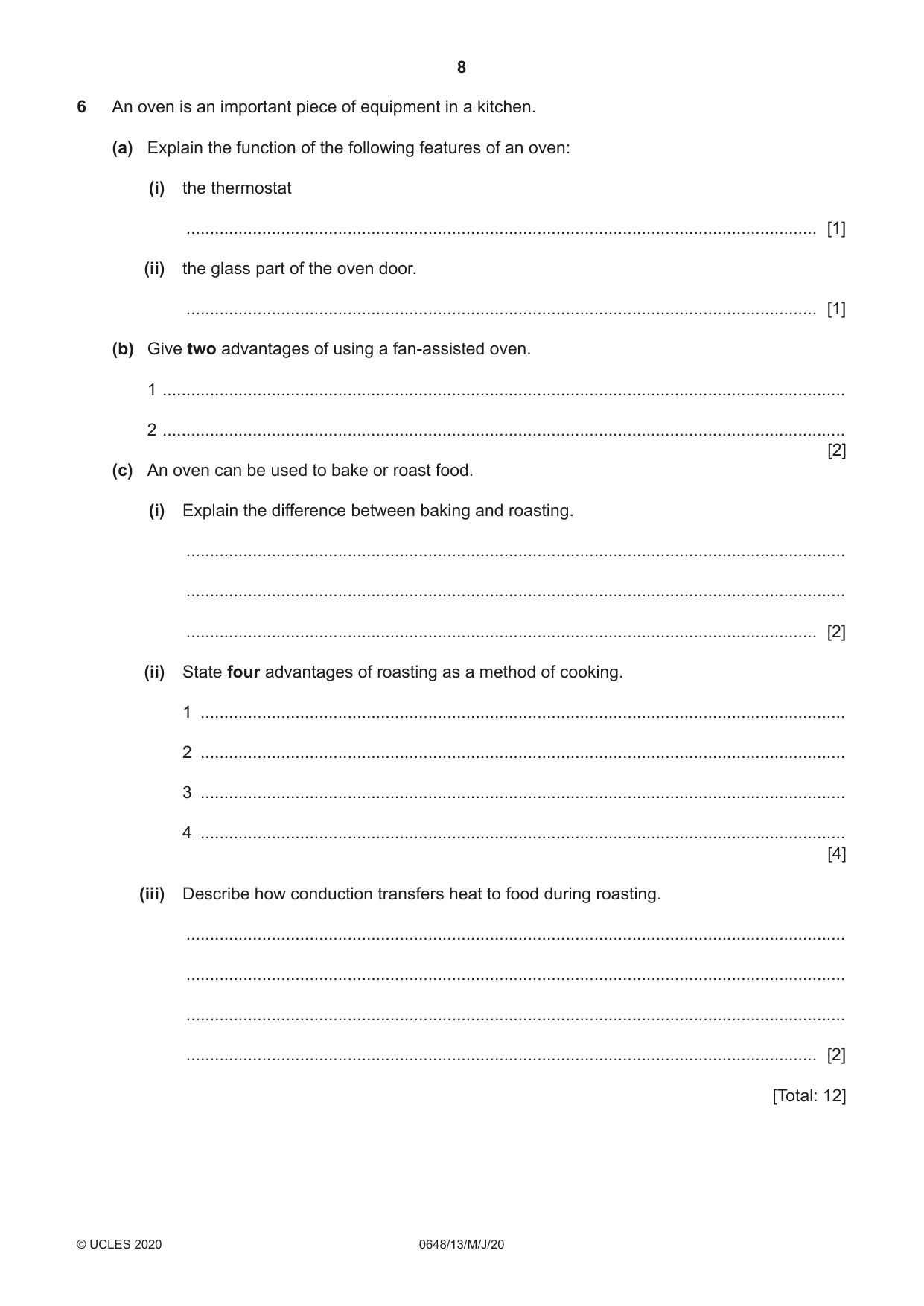
8 0648/13/M/J/20 © UCLES 2020 6 An oven is an important piece of equipment in a kitchen. (a) Explain the function of the following features of an oven: (i) the thermostat … [1] (ii) the glass part of the oven door. … [1] (b) Give two advantages of using a fan-assisted oven. 1 … 2 … [2] (c) An oven can be used to bake or roast food. (i) Explain the difference between baking and roasting. … … … [2] (ii) State four advantages of roasting as a method of cooking. 1 … 2 … 3 … 4 … [4] (iii) Describe how conduction transfers heat to food during roasting. … … … … [2] [Total: 12]
Question paper, page 9
9 0648/13/M/J/20 © UCLES 2020 [Turn over 7 Good lighting in a kitchen reduces the risk of accidents. (a) State two ways a kitchen can be lit by natural light. 1 … 2 … [2] (b) Identify two areas in a kitchen which may need additional lighting. 1 … 2 … [2] [Total: 4] 8 Give four rules, with an appropriate reason, on the safe use and care of knives in the kitchen. rule 1 … reason … rule 2 … reason … rule 3 … reason … rule 4 … reason … [8]
Question paper, page 10
10 0648/13/M/J/20 © UCLES 2020 Section C Answer either Question 9 or 10. 9 Outline and explain factors which should be considered when planning and preparing meals to help prevent: • hypertension (high blood pressure) • colorectal cancer. [15] OR 10 Explain how a low income may influence food choice when planning and preparing family meals. [15] … … … … … … … … … … … … … … … … … … … …
Question paper, page 11
11 0648/13/M/J/20 © UCLES 2020 [Turn over … … … … … … … … … … … … … … … … … … … … … … … … … … … …
Question paper, page 12
12 0648/13/M/J/20 © UCLES 2020 Permission to reproduce items where third-party owned material protected by copyright is included has been sought and cleared where possible. Every reasonable effort has been made by the publisher (UCLES) to trace copyright holders, but if any items requiring clearance have unwittingly been included, the publisher will be pleased to make amends at the earliest possible opportunity. To avoid the issue of disclosure of answer-related information to candidates, all copyright acknowledgements are reproduced online in the Cambridge Assessment International Education Copyright Acknowledgements Booklet. This is produced for each series of examinations and is freely available to download at www.cambridgeinternational.org after the live examination series. Cambridge Assessment International Education is part of the Cambridge Assessment Group. Cambridge Assessment is the brand name of the University of Cambridge Local Examinations Syndicate (UCLES), which itself is a department of the University of Cambridge. … … … … … … … … … … … … … … … … … … … … … … …
Mark scheme, page 1
This document consists of 15 printed pages. © UCLES 2020 [Turn over Cambridge IGCSE™ FOOD AND NUTRITION 0648/13 Paper 1 Theory May/June 2020 MARK SCHEME Maximum Mark: 100 Published Students did not sit exam papers in the June 2020 series due to the Covid-19 global pandemic. This mark scheme is published to support teachers and students and should be read together with the question paper. It shows the requirements of the exam. The answer column of the mark scheme shows the proposed basis on which Examiners would award marks for this exam. Where appropriate, this column also provides the most likely acceptable alternative responses expected from students. Examiners usually review the mark scheme after they have seen student responses and update the mark scheme if appropriate. In the June series, Examiners were unable to consider the acceptability of alternative responses, as there were no student responses to consider. Mark schemes should usually be read together with the Principal Examiner Report for Teachers. However, because students did not sit exam papers, there is no Principal Examiner Report for Teachers for the June 2020 series. Cambridge International will not enter into discussions about these mark schemes. Cambridge International is publishing the mark schemes for the June 2020 series for most Cambridge IGCSE™ and Cambridge International A & AS Level components, and some Cambridge O Level components.
Mark scheme, page 2
0648/13 Cambridge IGCSE – Mark Scheme PUBLISHED May/June 2020 © UCLES 2020 Page 2 of 15 Generic Marking Principles These general marking principles must be applied by all examiners when marking candidate answers. They should be applied alongside the specific content of the mark scheme or generic level descriptors for a question. Each question paper and mark scheme will also comply with these marking principles. GENERIC MARKING PRINCIPLE 1: Marks must be awarded in line with: • the specific content of the mark scheme or the generic level descriptors for the question • the specific skills defined in the mark scheme or in the generic level descriptors for the question • the standard of response required by a candidate as exemplified by the standardisation scripts. GENERIC MARKING PRINCIPLE 2: Marks awarded are always whole marks (not half marks, or other fractions). GENERIC MARKING PRINCIPLE 3: Marks must be awarded positively: • marks are awarded for correct/valid answers, as defined in the mark scheme. However, credit is given for valid answers which go beyond the scope of the syllabus and mark scheme, referring to your Team Leader as appropriate • marks are awarded when candidates clearly demonstrate what they know and can do • marks are not deducted for errors • marks are not deducted for omissions • answers should only be judged on the quality of spelling, punctuation and grammar when these features are specifically assessed by the question as indicated by the mark scheme. The meaning, however, should be unambiguous. GENERIC MARKING PRINCIPLE 4: Rules must be applied consistently e.g. in situations where candidates have not followed instructions or in the application of generic level descriptors.
Mark scheme, page 3
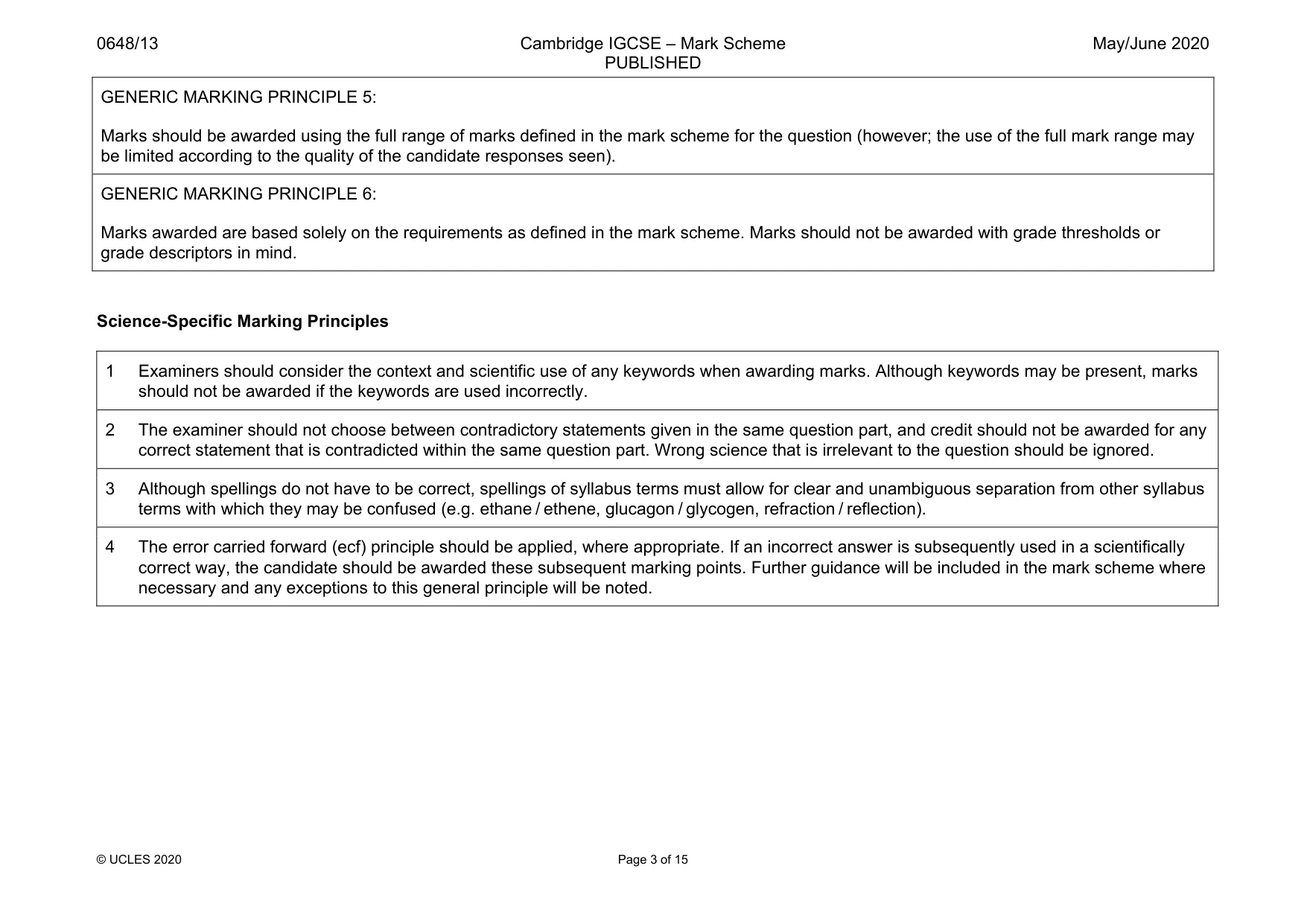
0648/13 Cambridge IGCSE – Mark Scheme PUBLISHED May/June 2020 © UCLES 2020 Page 3 of 15 GENERIC MARKING PRINCIPLE 5: Marks should be awarded using the full range of marks defined in the mark scheme for the question (however; the use of the full mark range may be limited according to the quality of the candidate responses seen). GENERIC MARKING PRINCIPLE 6: Marks awarded are based solely on the requirements as defined in the mark scheme. Marks should not be awarded with grade thresholds or grade descriptors in mind. Science-Specific Marking Principles 1 Examiners should consider the context and scientific use of any keywords when awarding marks. Although keywords may be present, marks should not be awarded if the keywords are used incorrectly. 2 The examiner should not choose between contradictory statements given in the same question part, and credit should not be awarded for any correct statement that is contradicted within the same question part. Wrong science that is irrelevant to the question should be ignored. 3 Although spellings do not have to be correct, spellings of syllabus terms must allow for clear and unambiguous separation from other syllabus terms with which they may be confused (e.g. ethane / ethene, glucagon / glycogen, refraction / reflection). 4 The error carried forward (ecf) principle should be applied, where appropriate. If an incorrect answer is subsequently used in a scientifically correct way, the candidate should be awarded these subsequent marking points. Further guidance will be included in the mark scheme where necessary and any exceptions to this general principle will be noted.
Mark scheme, page 4
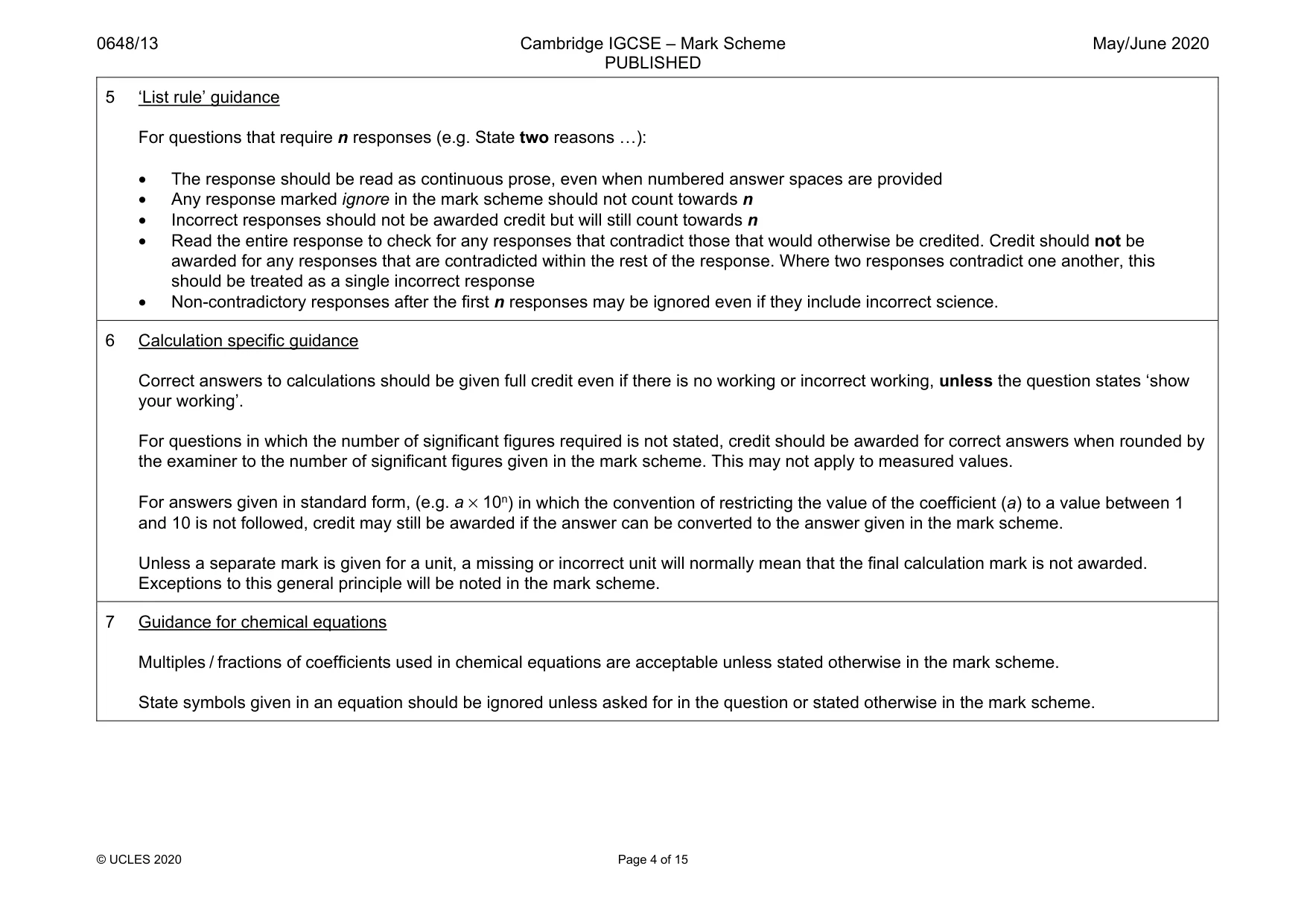
0648/13 Cambridge IGCSE – Mark Scheme PUBLISHED May/June 2020 © UCLES 2020 Page 4 of 15 5 ‘List rule’ guidance For questions that require n responses (e.g. State two reasons …): • The response should be read as continuous prose, even when numbered answer spaces are provided • Any response marked ignore in the mark scheme should not count towards n • Incorrect responses should not be awarded credit but will still count towards n • Read the entire response to check for any responses that contradict those that would otherwise be credited. Credit should not be awarded for any responses that are contradicted within the rest of the response. Where two responses contradict one another, this should be treated as a single incorrect response • Non-contradictory responses after the first n responses may be ignored even if they include incorrect science. 6 Calculation specific guidance Correct answers to calculations should be given full credit even if there is no working or incorrect working, unless the question states ‘show your working’. For questions in which the number of significant figures required is not stated, credit should be awarded for correct answers when rounded by the examiner to the number of significant figures given in the mark scheme. This may not apply to measured values. For answers given in standard form, (e.g. a × 10n) in which the convention of restricting the value of the coefficient (a) to a value between 1 and 10 is not followed, credit may still be awarded if the answer can be converted to the answer given in the mark scheme. Unless a separate mark is given for a unit, a missing or incorrect unit will normally mean that the final calculation mark is not awarded. Exceptions to this general principle will be noted in the mark scheme. 7 Guidance for chemical equations Multiples / fractions of coefficients used in chemical equations are acceptable unless stated otherwise in the mark scheme. State symbols given in an equation should be ignored unless asked for in the question or stated otherwise in the mark scheme.
Mark scheme, page 5
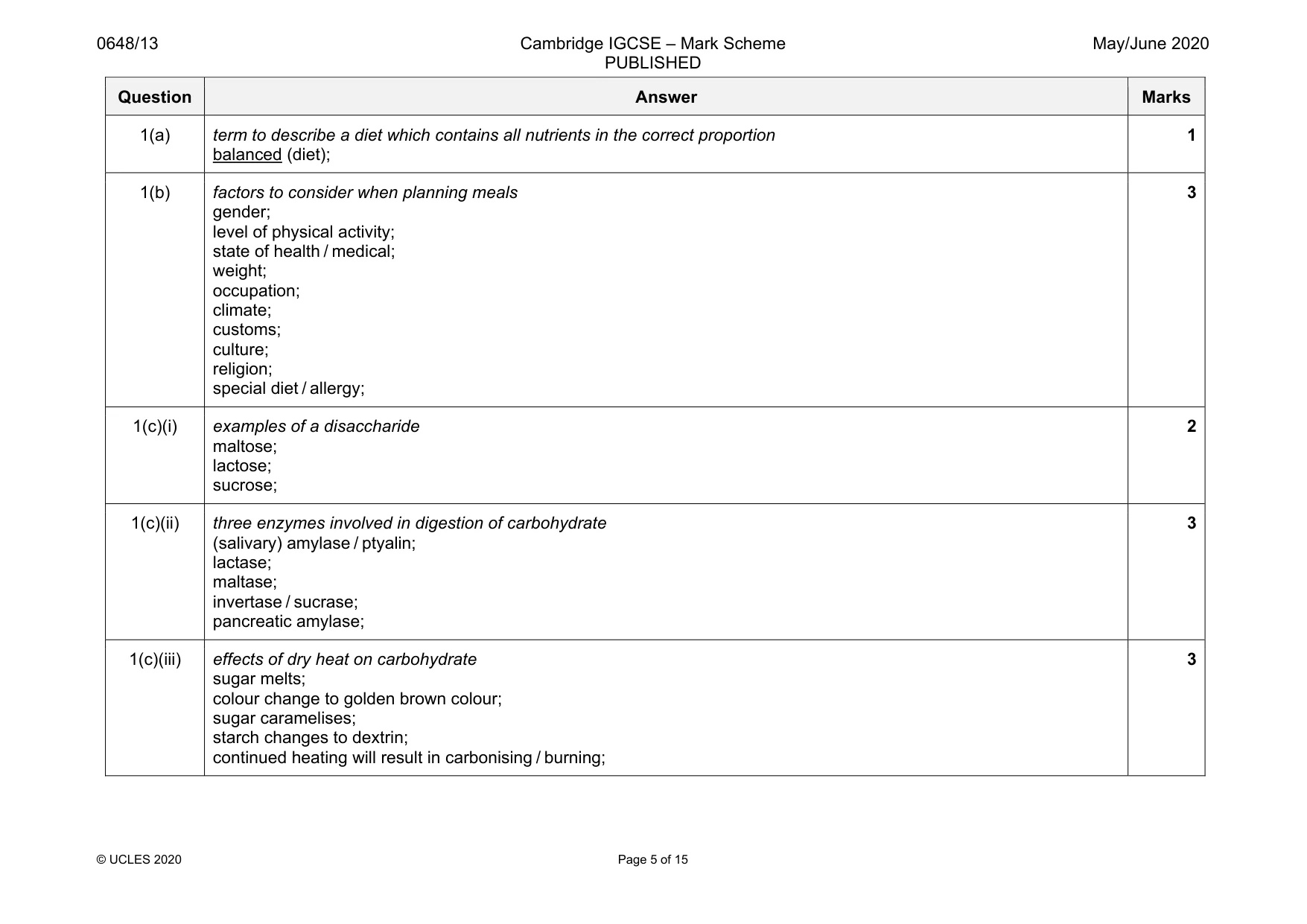
0648/13 Cambridge IGCSE – Mark Scheme PUBLISHED May/June 2020 © UCLES 2020 Page 5 of 15 Question Answer Marks 1(a) term to describe a diet which contains all nutrients in the correct proportion balanced (diet); 1 1(b) factors to consider when planning meals gender; level of physical activity; state of health / medical; weight; occupation; climate; customs; culture; religion; special diet / allergy; 3 1(c)(i) examples of a disaccharide maltose; lactose; sucrose; 2 1(c)(ii) three enzymes involved in digestion of carbohydrate (salivary) amylase / ptyalin; lactase; maltase; invertase / sucrase; pancreatic amylase; 3 1(c)(iii) effects of dry heat on carbohydrate sugar melts; colour change to golden brown colour; sugar caramelises; starch changes to dextrin; continued heating will result in carbonising / burning; 3
Mark scheme, page 6
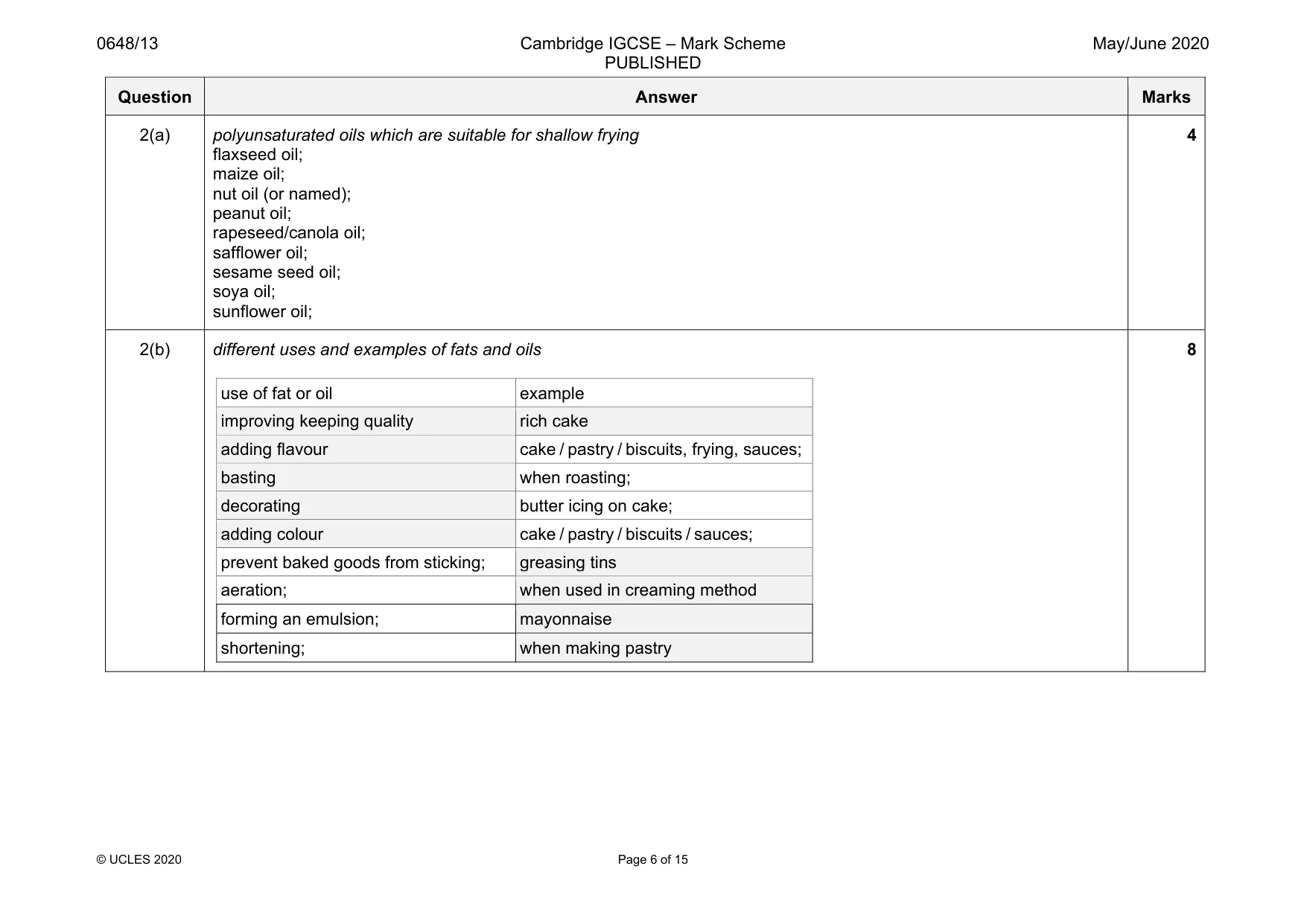
0648/13 Cambridge IGCSE – Mark Scheme PUBLISHED May/June 2020 © UCLES 2020 Page 6 of 15 Question Answer Marks 2(a) polyunsaturated oils which are suitable for shallow frying flaxseed oil; maize oil; nut oil (or named); peanut oil; rapeseed/canola oil; safflower oil; sesame seed oil; soya oil; sunflower oil; 4 2(b) different uses and examples of fats and oils use of fat or oil example improving keeping quality rich cake adding flavour cake / pastry / biscuits, frying, sauces; basting when roasting; decorating butter icing on cake; adding colour cake / pastry / biscuits / sauces; prevent baked goods from sticking; greasing tins aeration; when used in creaming method forming an emulsion; mayonnaise shortening; when making pastry 8
Mark scheme, page 7
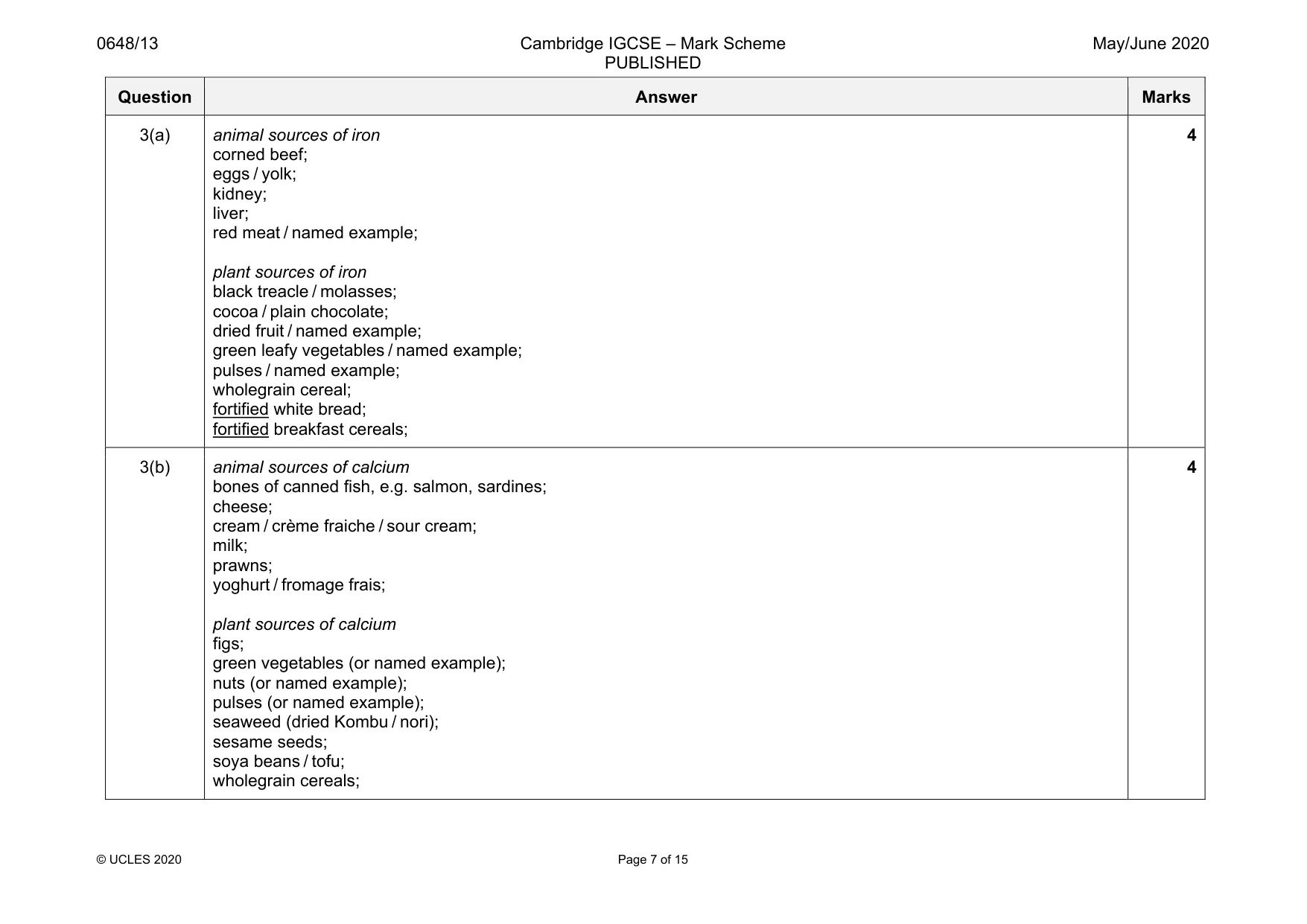
0648/13 Cambridge IGCSE – Mark Scheme PUBLISHED May/June 2020 © UCLES 2020 Page 7 of 15 Question Answer Marks 3(a) animal sources of iron corned beef; eggs / yolk; kidney; liver; red meat / named example; plant sources of iron black treacle / molasses; cocoa / plain chocolate; dried fruit / named example; green leafy vegetables / named example; pulses / named example; wholegrain cereal; fortified white bread; fortified breakfast cereals; 4 3(b) animal sources of calcium bones of canned fish, e.g. salmon, sardines; cheese; cream / crème fraiche / sour cream; milk; prawns; yoghurt / fromage frais; plant sources of calcium figs; green vegetables (or named example); nuts (or named example); pulses (or named example); seaweed (dried Kombu / nori); sesame seeds; soya beans / tofu; wholegrain cereals; 4
Mark scheme, page 8
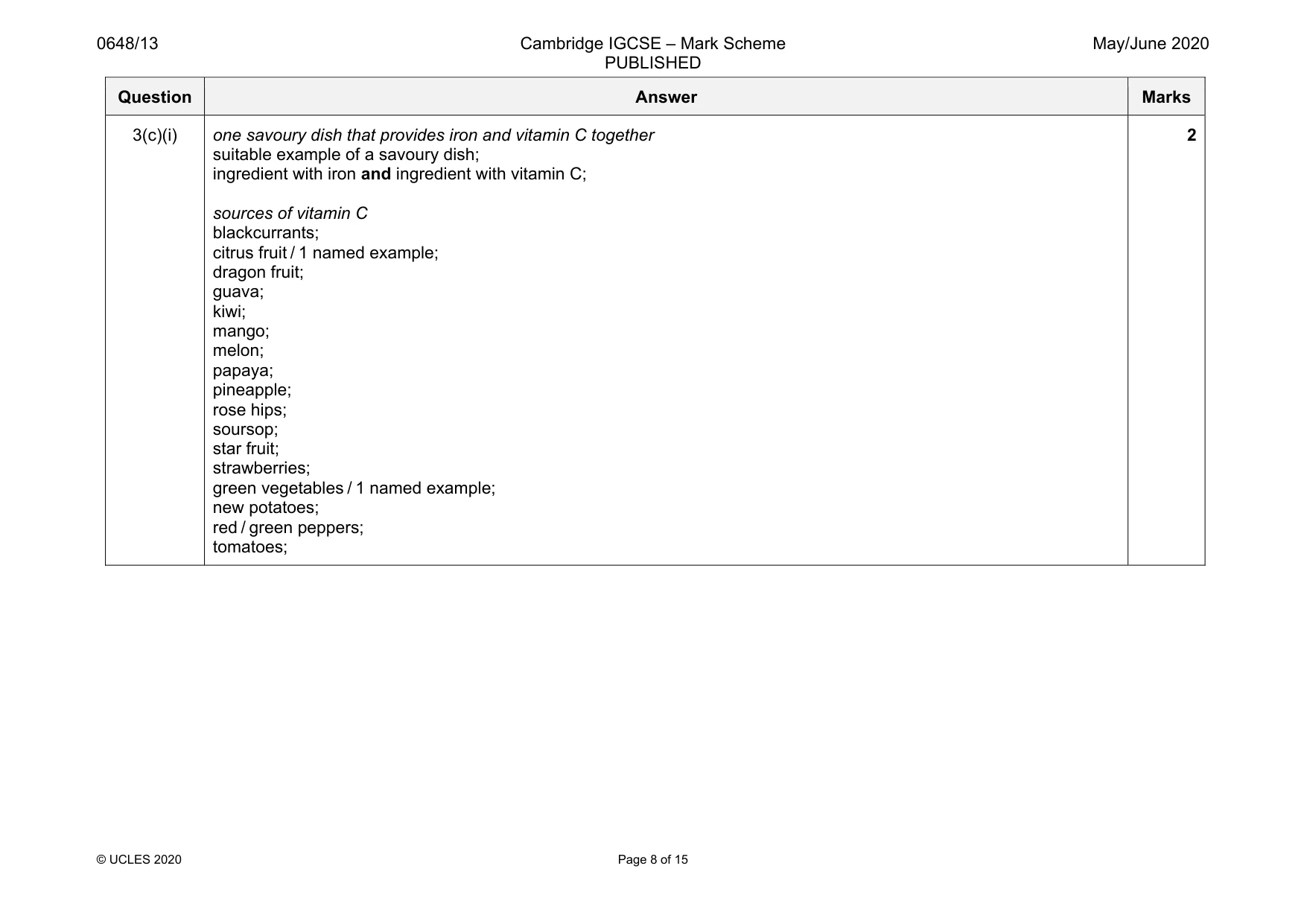
0648/13 Cambridge IGCSE – Mark Scheme PUBLISHED May/June 2020 © UCLES 2020 Page 8 of 15 Question Answer Marks 3(c)(i) one savoury dish that provides iron and vitamin C together suitable example of a savoury dish; ingredient with iron and ingredient with vitamin C; sources of vitamin C blackcurrants; citrus fruit / 1 named example; dragon fruit; guava; kiwi; mango; melon; papaya; pineapple; rose hips; soursop; star fruit; strawberries; green vegetables / 1 named example; new potatoes; red / green peppers; tomatoes; 2
Mark scheme, page 9
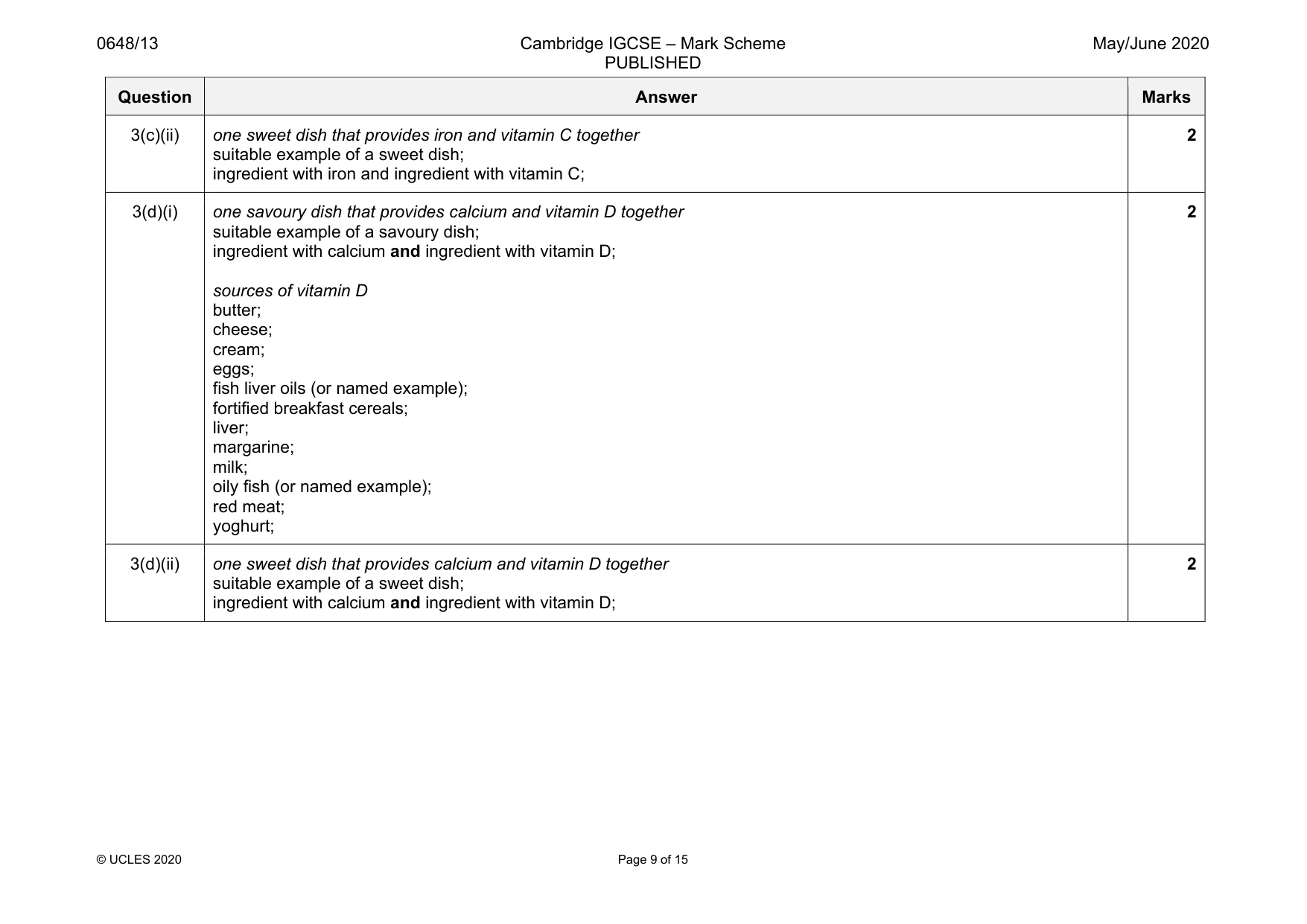
0648/13 Cambridge IGCSE – Mark Scheme PUBLISHED May/June 2020 © UCLES 2020 Page 9 of 15 Question Answer Marks 3(c)(ii) one sweet dish that provides iron and vitamin C together suitable example of a sweet dish; ingredient with iron and ingredient with vitamin C; 2 3(d)(i) one savoury dish that provides calcium and vitamin D together suitable example of a savoury dish; ingredient with calcium and ingredient with vitamin D; sources of vitamin D butter; cheese; cream; eggs; fish liver oils (or named example); fortified breakfast cereals; liver; margarine; milk; oily fish (or named example); red meat; yoghurt; 2 3(d)(ii) one sweet dish that provides calcium and vitamin D together suitable example of a sweet dish; ingredient with calcium and ingredient with vitamin D; 2
Mark scheme, page 10
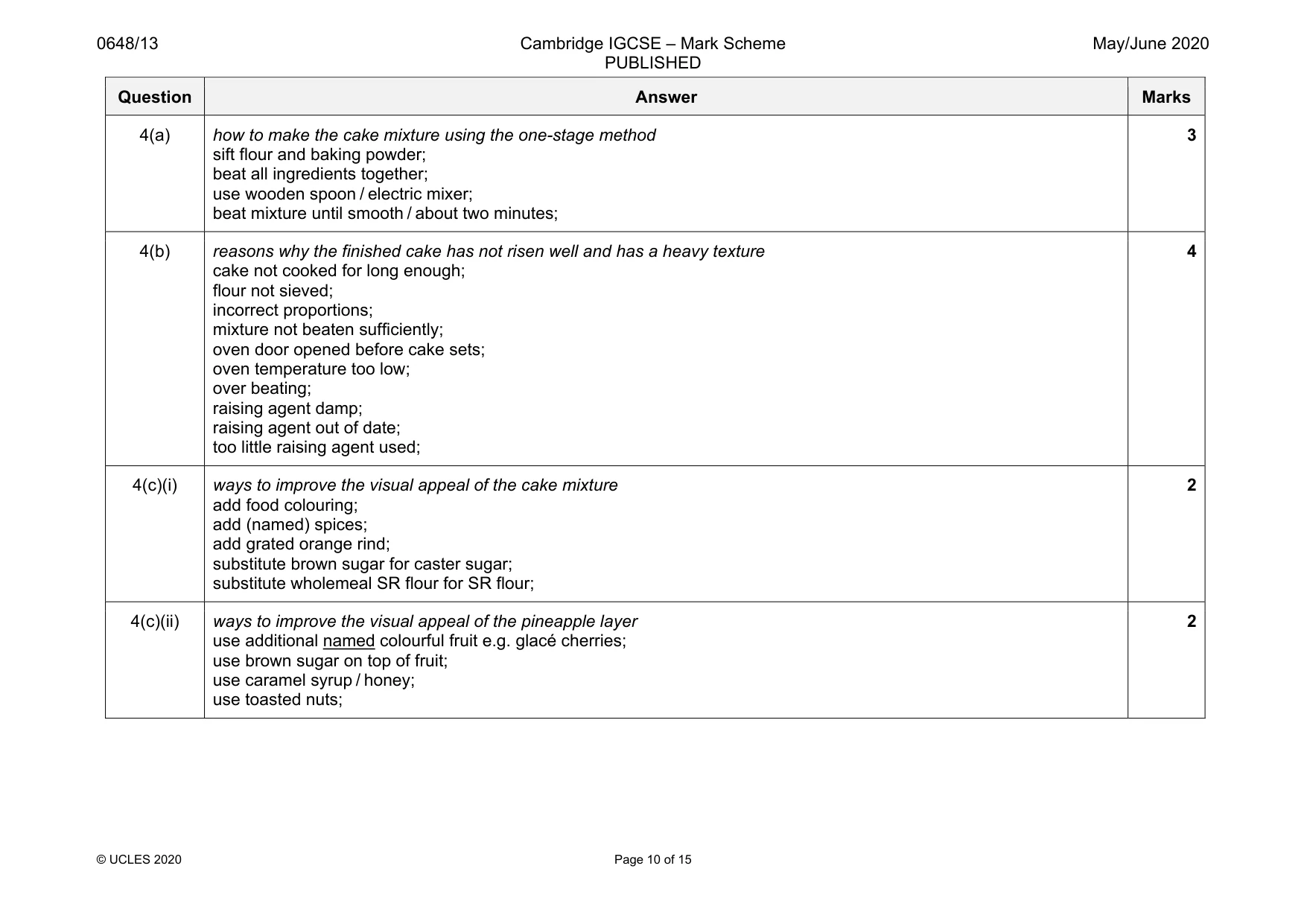
0648/13 Cambridge IGCSE – Mark Scheme PUBLISHED May/June 2020 © UCLES 2020 Page 10 of 15 Question Answer Marks 4(a) how to make the cake mixture using the one-stage method sift flour and baking powder; beat all ingredients together; use wooden spoon / electric mixer; beat mixture until smooth / about two minutes; 3 4(b) reasons why the finished cake has not risen well and has a heavy texture cake not cooked for long enough; flour not sieved; incorrect proportions; mixture not beaten sufficiently; oven door opened before cake sets; oven temperature too low; over beating; raising agent damp; raising agent out of date; too little raising agent used; 4 4(c)(i) ways to improve the visual appeal of the cake mixture add food colouring; add (named) spices; add grated orange rind; substitute brown sugar for caster sugar; substitute wholemeal SR flour for SR flour; 2 4(c)(ii) ways to improve the visual appeal of the pineapple layer use additional named colourful fruit e.g. glacé cherries; use brown sugar on top of fruit; use caramel syrup / honey; use toasted nuts; 2
Mark scheme, page 11
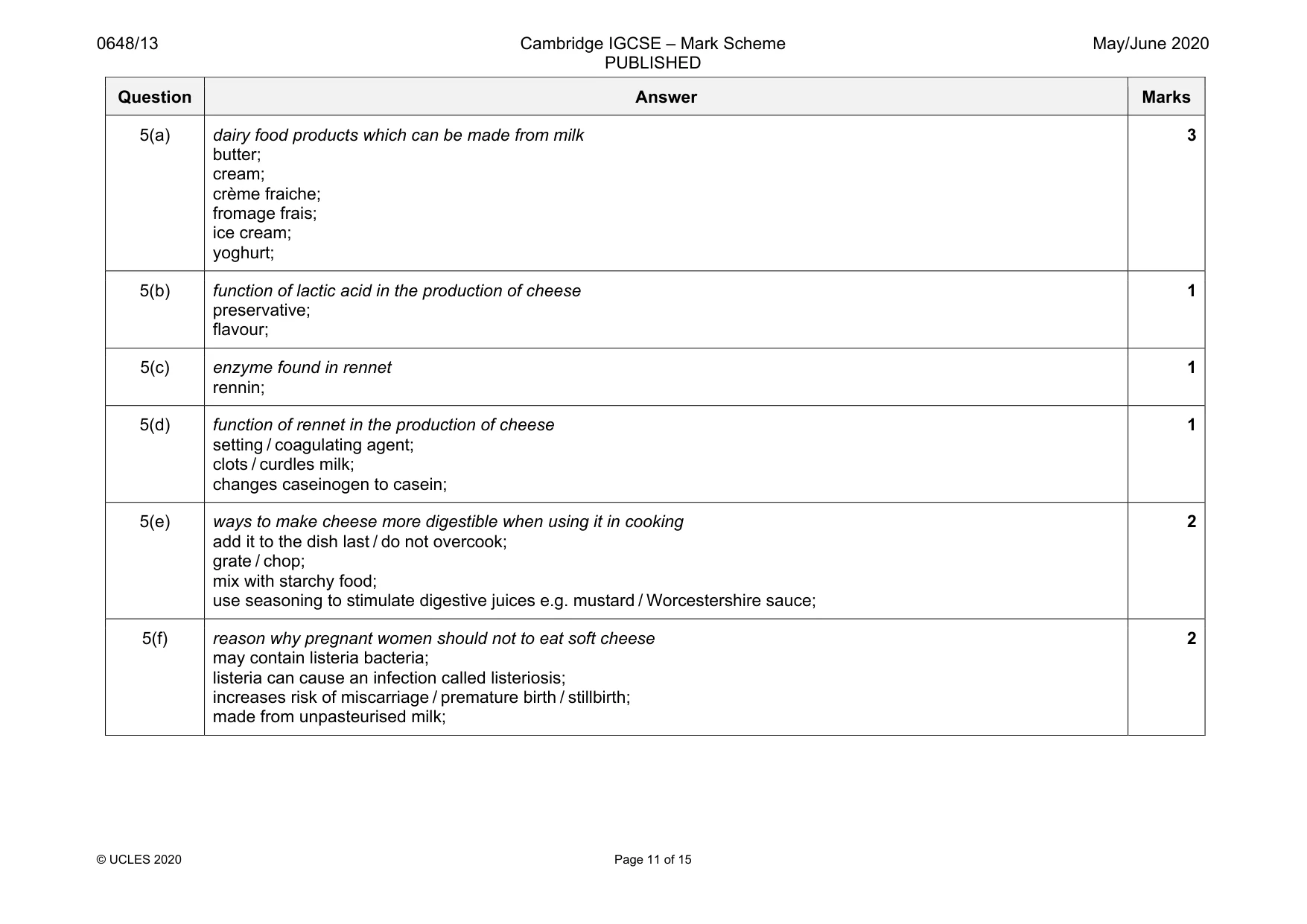
0648/13 Cambridge IGCSE – Mark Scheme PUBLISHED May/June 2020 © UCLES 2020 Page 11 of 15 Question Answer Marks 5(a) dairy food products which can be made from milk butter; cream; crème fraiche; fromage frais; ice cream; yoghurt; 3 5(b) function of lactic acid in the production of cheese preservative; flavour; 1 5(c) enzyme found in rennet rennin; 1 5(d) function of rennet in the production of cheese setting / coagulating agent; clots / curdles milk; changes caseinogen to casein; 1 5(e) ways to make cheese more digestible when using it in cooking add it to the dish last / do not overcook; grate / chop; mix with starchy food; use seasoning to stimulate digestive juices e.g. mustard / Worcestershire sauce; 2 5(f) reason why pregnant women should not to eat soft cheese may contain listeria bacteria; listeria can cause an infection called listeriosis; increases risk of miscarriage / premature birth / stillbirth; made from unpasteurised milk; 2
Mark scheme, page 12
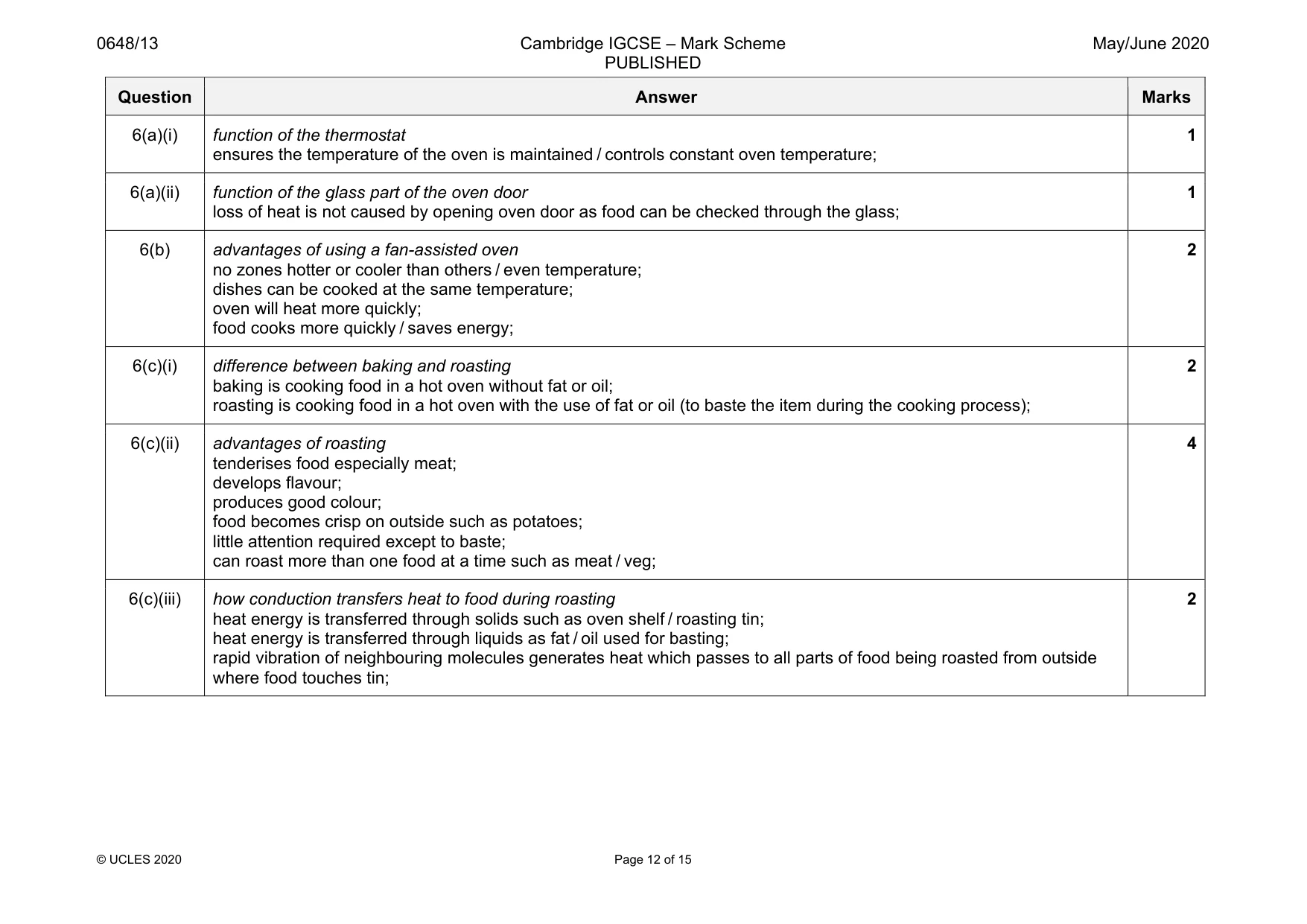
0648/13 Cambridge IGCSE – Mark Scheme PUBLISHED May/June 2020 © UCLES 2020 Page 12 of 15 Question Answer Marks 6(a)(i) function of the thermostat ensures the temperature of the oven is maintained / controls constant oven temperature; 1 6(a)(ii) function of the glass part of the oven door loss of heat is not caused by opening oven door as food can be checked through the glass; 1 6(b) advantages of using a fan-assisted oven no zones hotter or cooler than others / even temperature; dishes can be cooked at the same temperature; oven will heat more quickly; food cooks more quickly / saves energy; 2 6(c)(i) difference between baking and roasting baking is cooking food in a hot oven without fat or oil; roasting is cooking food in a hot oven with the use of fat or oil (to baste the item during the cooking process); 2 6(c)(ii) advantages of roasting tenderises food especially meat; develops flavour; produces good colour; food becomes crisp on outside such as potatoes; little attention required except to baste; can roast more than one food at a time such as meat / veg; 4 6(c)(iii) how conduction transfers heat to food during roasting heat energy is transferred through solids such as oven shelf / roasting tin; heat energy is transferred through liquids as fat / oil used for basting; rapid vibration of neighbouring molecules generates heat which passes to all parts of food being roasted from outside where food touches tin; 2
Mark scheme, page 13
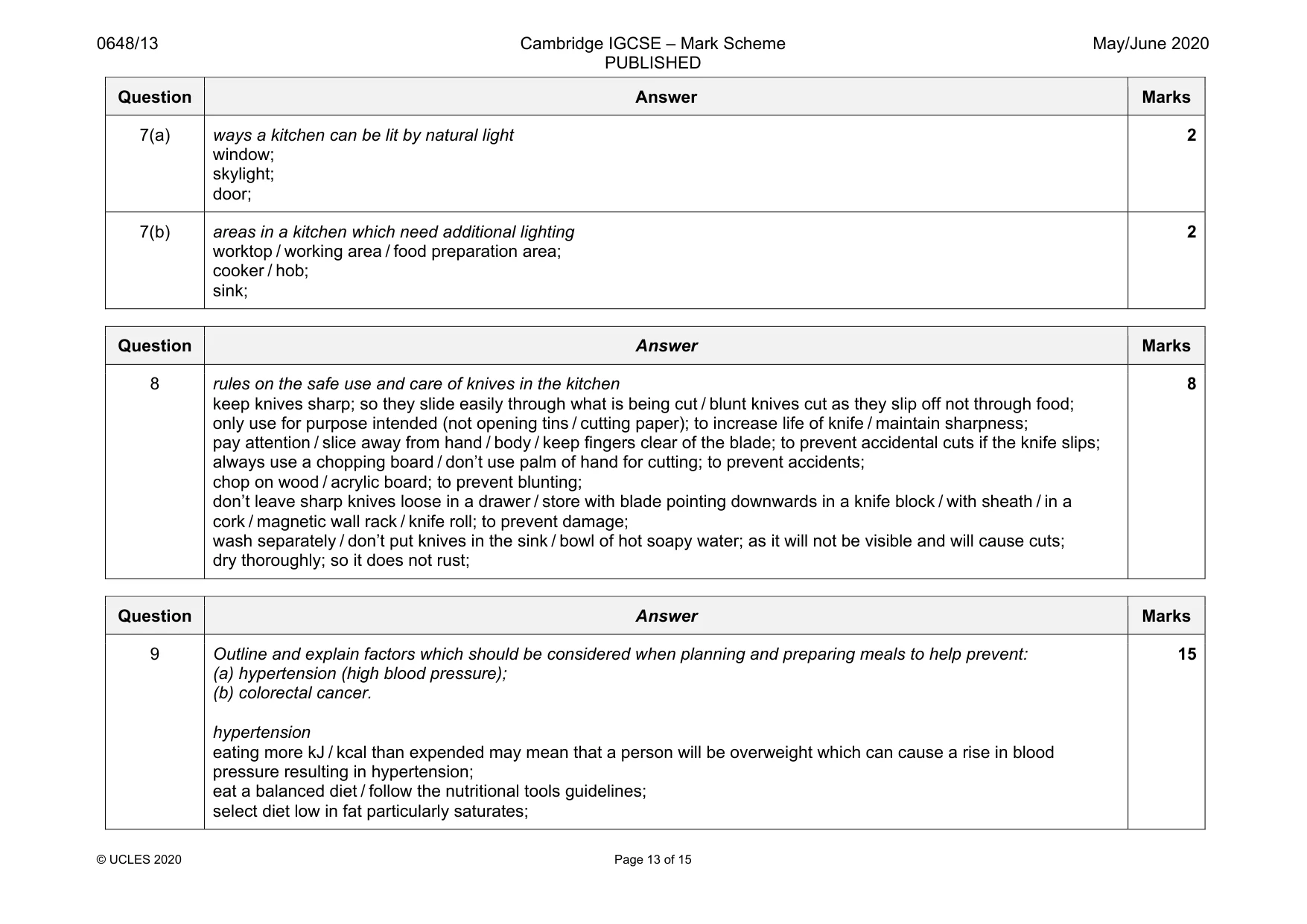
0648/13 Cambridge IGCSE – Mark Scheme PUBLISHED May/June 2020 © UCLES 2020 Page 13 of 15 Question Answer Marks 7(a) ways a kitchen can be lit by natural light window; skylight; door; 2 7(b) areas in a kitchen which need additional lighting worktop / working area / food preparation area; cooker / hob; sink; 2 Question Answer Marks 8 rules on the safe use and care of knives in the kitchen keep knives sharp; so they slide easily through what is being cut / blunt knives cut as they slip off not through food; only use for purpose intended (not opening tins / cutting paper); to increase life of knife / maintain sharpness; pay attention / slice away from hand / body / keep fingers clear of the blade; to prevent accidental cuts if the knife slips; always use a chopping board / don’t use palm of hand for cutting; to prevent accidents; chop on wood / acrylic board; to prevent blunting; don’t leave sharp knives loose in a drawer / store with blade pointing downwards in a knife block / with sheath / in a cork / magnetic wall rack / knife roll; to prevent damage; wash separately / don’t put knives in the sink / bowl of hot soapy water; as it will not be visible and will cause cuts; dry thoroughly; so it does not rust; 8 Question Answer Marks 9 Outline and explain factors which should be considered when planning and preparing meals to help prevent: (a) hypertension (high blood pressure); (b) colorectal cancer. hypertension eating more kJ / kcal than expended may mean that a person will be overweight which can cause a rise in blood pressure resulting in hypertension; eat a balanced diet / follow the nutritional tools guidelines; select diet low in fat particularly saturates; 15
Mark scheme, page 14
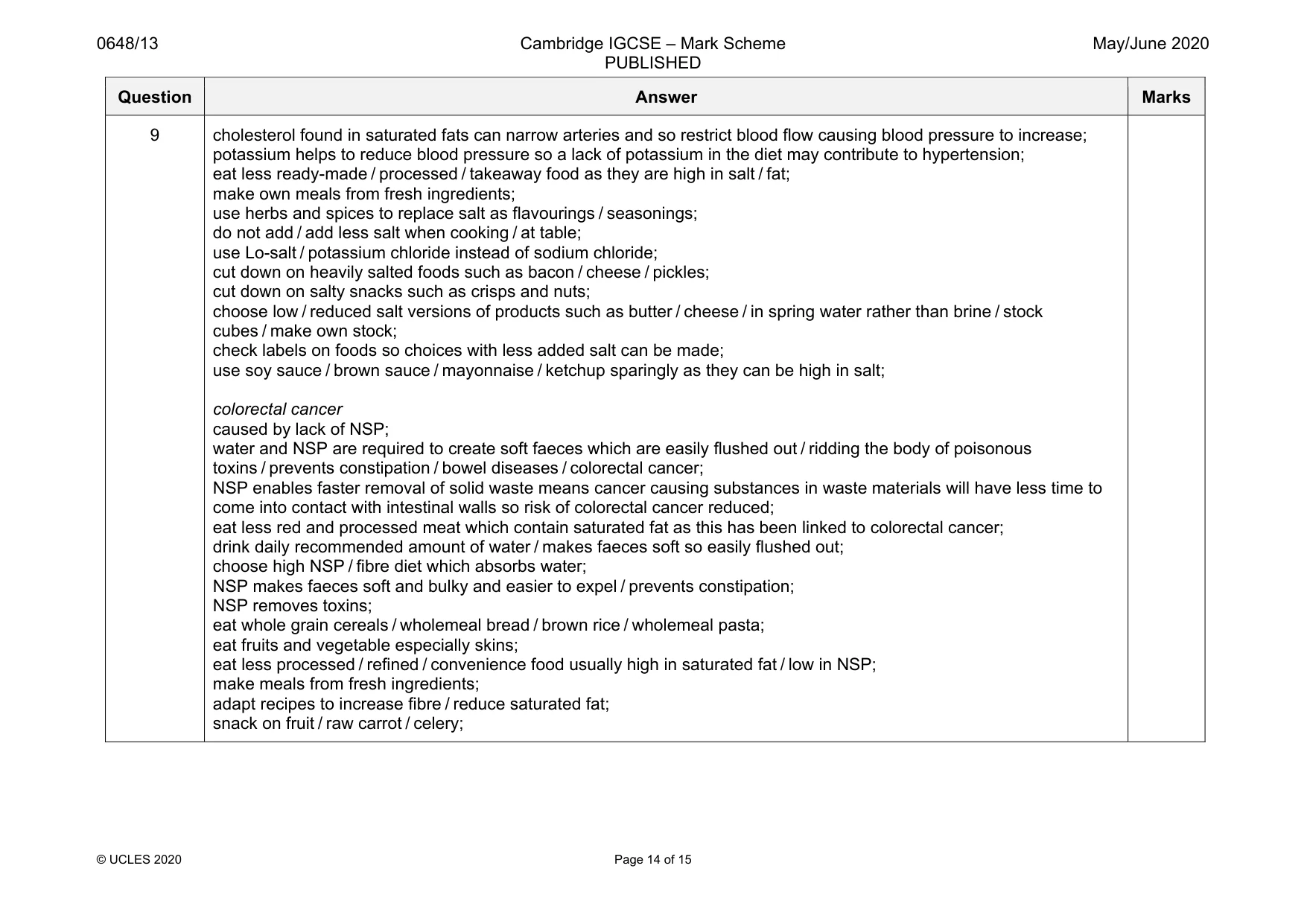
0648/13 Cambridge IGCSE – Mark Scheme PUBLISHED May/June 2020 © UCLES 2020 Page 14 of 15 Question Answer Marks 9 cholesterol found in saturated fats can narrow arteries and so restrict blood flow causing blood pressure to increase; potassium helps to reduce blood pressure so a lack of potassium in the diet may contribute to hypertension; eat less ready-made / processed / takeaway food as they are high in salt / fat; make own meals from fresh ingredients; use herbs and spices to replace salt as flavourings / seasonings; do not add / add less salt when cooking / at table; use Lo-salt / potassium chloride instead of sodium chloride; cut down on heavily salted foods such as bacon / cheese / pickles; cut down on salty snacks such as crisps and nuts; choose low / reduced salt versions of products such as butter / cheese / in spring water rather than brine / stock cubes / make own stock; check labels on foods so choices with less added salt can be made; use soy sauce / brown sauce / mayonnaise / ketchup sparingly as they can be high in salt; colorectal cancer caused by lack of NSP; water and NSP are required to create soft faeces which are easily flushed out / ridding the body of poisonous toxins / prevents constipation / bowel diseases / colorectal cancer; NSP enables faster removal of solid waste means cancer causing substances in waste materials will have less time to come into contact with intestinal walls so risk of colorectal cancer reduced; eat less red and processed meat which contain saturated fat as this has been linked to colorectal cancer; drink daily recommended amount of water / makes faeces soft so easily flushed out; choose high NSP / fibre diet which absorbs water; NSP makes faeces soft and bulky and easier to expel / prevents constipation; NSP removes toxins; eat whole grain cereals / wholemeal bread / brown rice / wholemeal pasta; eat fruits and vegetable especially skins; eat less processed / refined / convenience food usually high in saturated fat / low in NSP; make meals from fresh ingredients; adapt recipes to increase fibre / reduce saturated fat; snack on fruit / raw carrot / celery;
Mark scheme, page 15
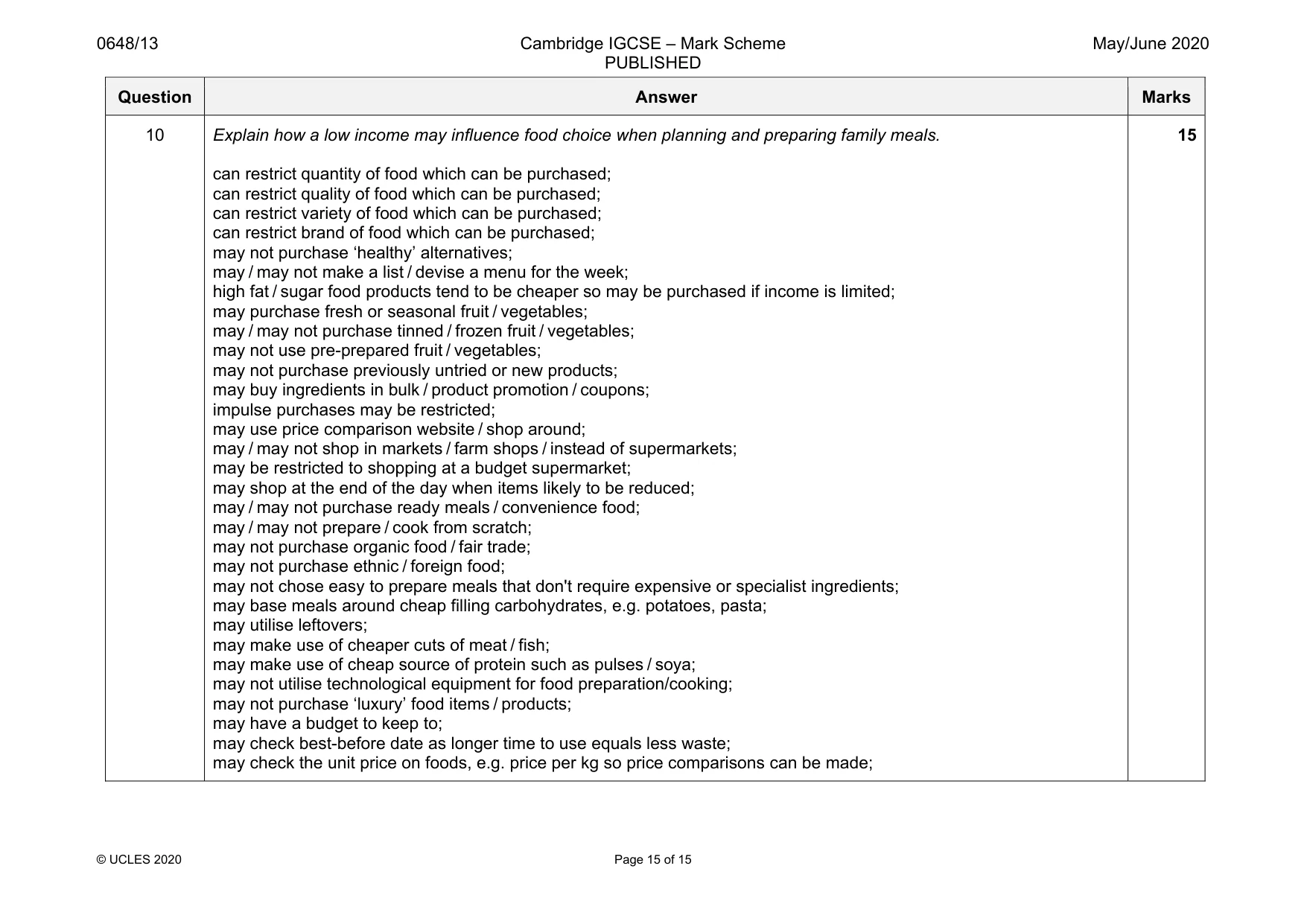
0648/13 Cambridge IGCSE – Mark Scheme PUBLISHED May/June 2020 © UCLES 2020 Page 15 of 15 Question Answer Marks 10 Explain how a low income may influence food choice when planning and preparing family meals. can restrict quantity of food which can be purchased; can restrict quality of food which can be purchased; can restrict variety of food which can be purchased; can restrict brand of food which can be purchased; may not purchase ‘healthy’ alternatives; may / may not make a list / devise a menu for the week; high fat / sugar food products tend to be cheaper so may be purchased if income is limited; may purchase fresh or seasonal fruit / vegetables; may / may not purchase tinned / frozen fruit / vegetables; may not use pre-prepared fruit / vegetables; may not purchase previously untried or new products; may buy ingredients in bulk / product promotion / coupons; impulse purchases may be restricted; may use price comparison website / shop around; may / may not shop in markets / farm shops / instead of supermarkets; may be restricted to shopping at a budget supermarket; may shop at the end of the day when items likely to be reduced; may / may not purchase ready meals / convenience food; may / may not prepare / cook from scratch; may not purchase organic food / fair trade; may not purchase ethnic / foreign food; may not chose easy to prepare meals that don't require expensive or specialist ingredients; may base meals around cheap filling carbohydrates, e.g. potatoes, pasta; may utilise leftovers; may make use of cheaper cuts of meat / fish; may make use of cheap source of protein such as pulses / soya; may not utilise technological equipment for food preparation/cooking; may not purchase ‘luxury’ food items / products; may have a budget to keep to; may check best-before date as longer time to use equals less waste; may check the unit price on foods, e.g. price per kg so price comparisons can be made; 15