Cambridge IGCSE Food and Nutrition 0648 — 2019 Oct/Nov Paper 1 · Variant 2
0648/12/O/N/19 · 100 marks · ≈113 min
The question paper and its mark scheme, free to read here and free to download. This is Cambridge’s own paper, exactly as it was sat.
Question paper12 pages



Mark scheme16 pages
Answers below. Sit the paper first if you are practising.
Paper as text
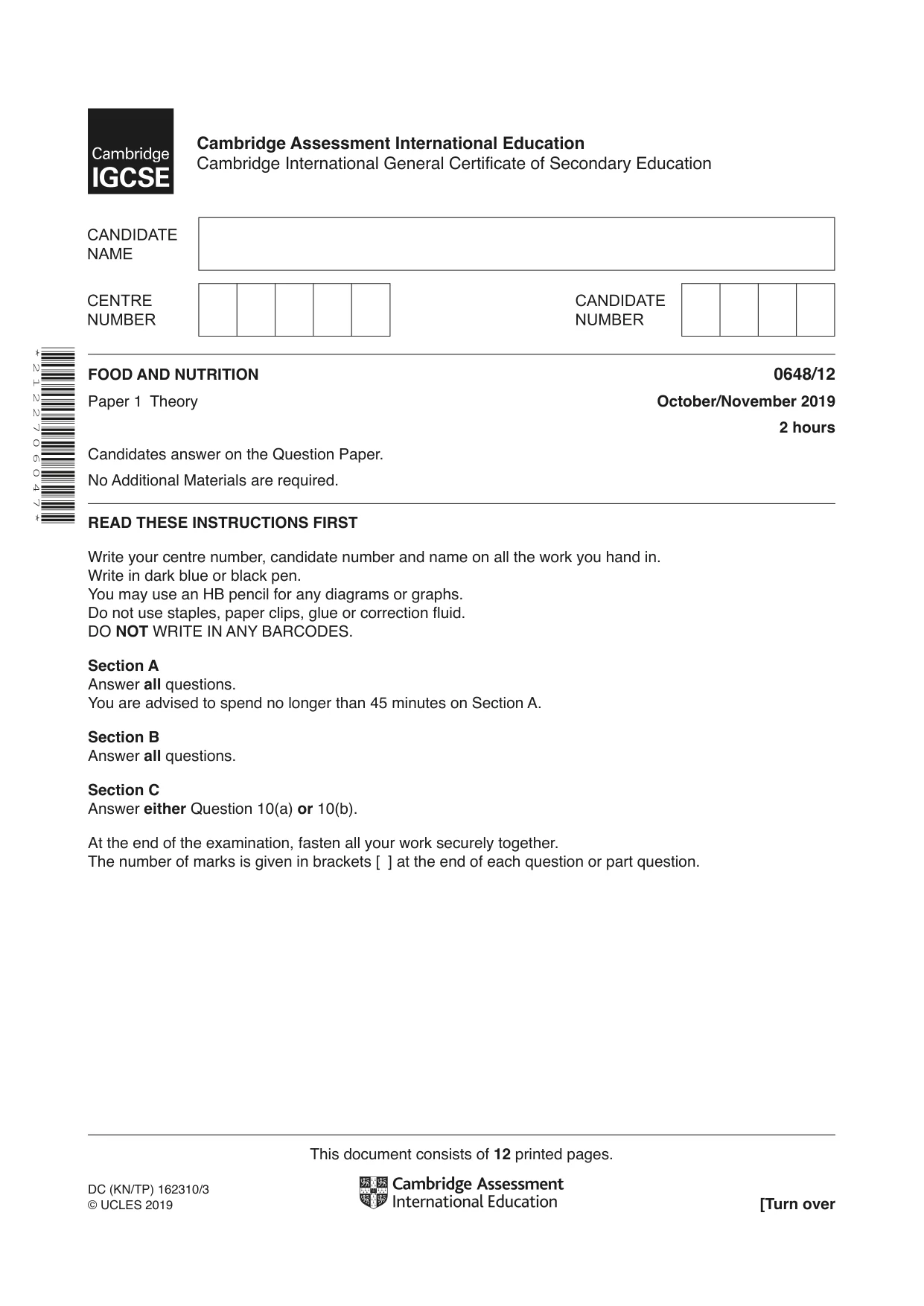
Question paper, page 1
This document consists of 12 printed pages. DC (KN/TP) 162310/3 © UCLES 2019 [Turn over Cambridge Assessment International Education Cambridge International General Certificate of Secondary Education * 2 1 2 2 7 0 6 0 4 7 * FOOD AND NUTRITION 0648/12 Paper 1 Theory October/November 2019 2 hours Candidates answer on the Question Paper. No Additional Materials are required. READ THESE INSTRUCTIONS FIRST Write your centre number, candidate number and name on all the work you hand in. Write in dark blue or black pen. You may use an HB pencil for any diagrams or graphs. Do not use staples, paper clips, glue or correction fluid. DO NOT WRITE IN ANY BARCODES. Section A Answer all questions. You are advised to spend no longer than 45 minutes on Section A. Section B Answer all questions. Section C Answer either Question 10(a) or 10(b). At the end of the examination, fasten all your work securely together. The number of marks is given in brackets [ ] at the end of each question or part question.
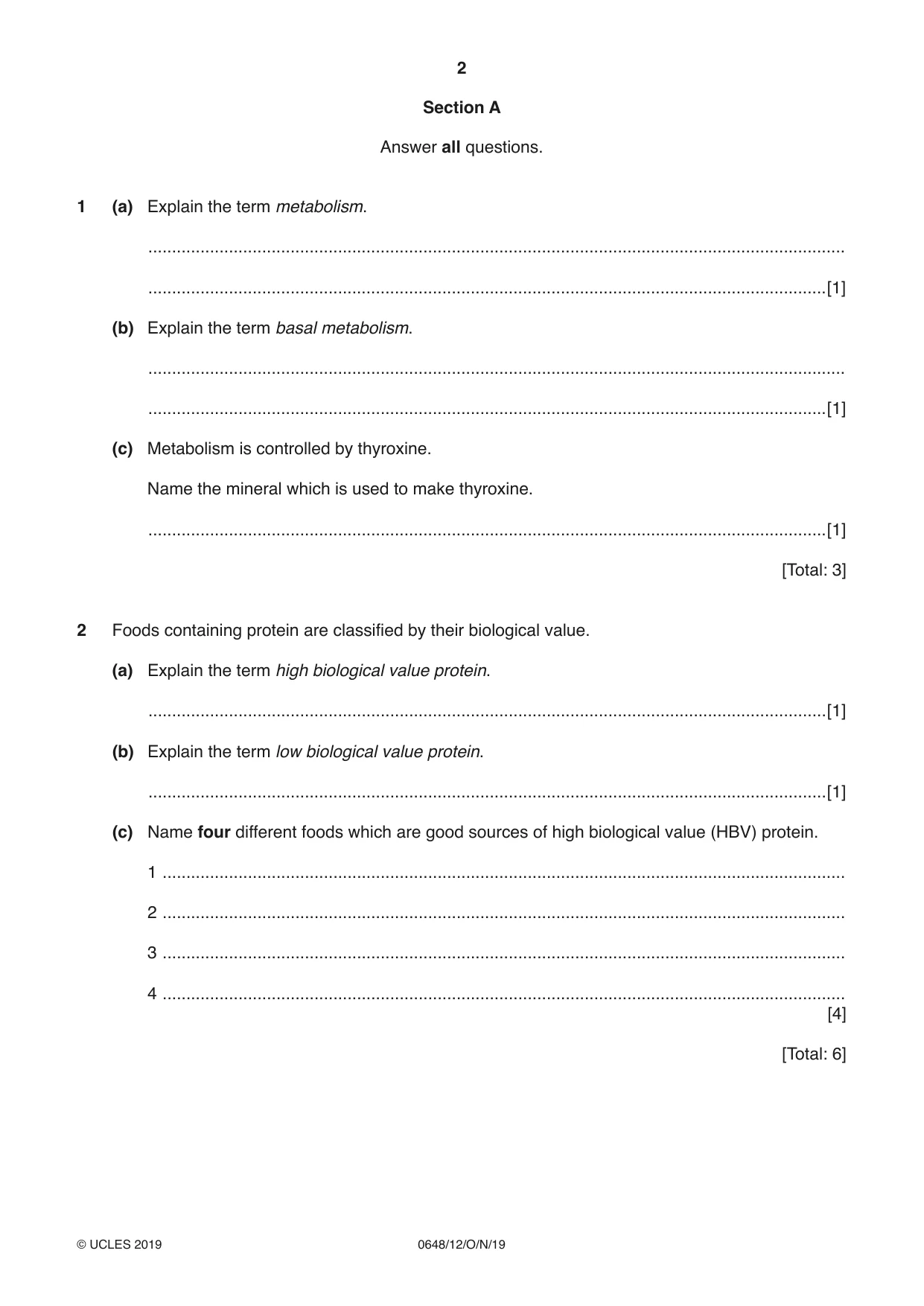
Question paper, page 2
2 0648/12/O/N/19 © UCLES 2019 Section A Answer all questions. 1 (a) Explain the term metabolism. … …[1] (b) Explain the term basal metabolism. … …[1] (c) Metabolism is controlled by thyroxine. Name the mineral which is used to make thyroxine. …[1] [Total: 3] 2 Foods containing protein are classified by their biological value. (a) Explain the term high biological value protein. …[1] (b) Explain the term low biological value protein. …[1] (c) Name four different foods which are good sources of high biological value (HBV) protein. 1 … 2 … 3 … 4 … [4] [Total: 6]
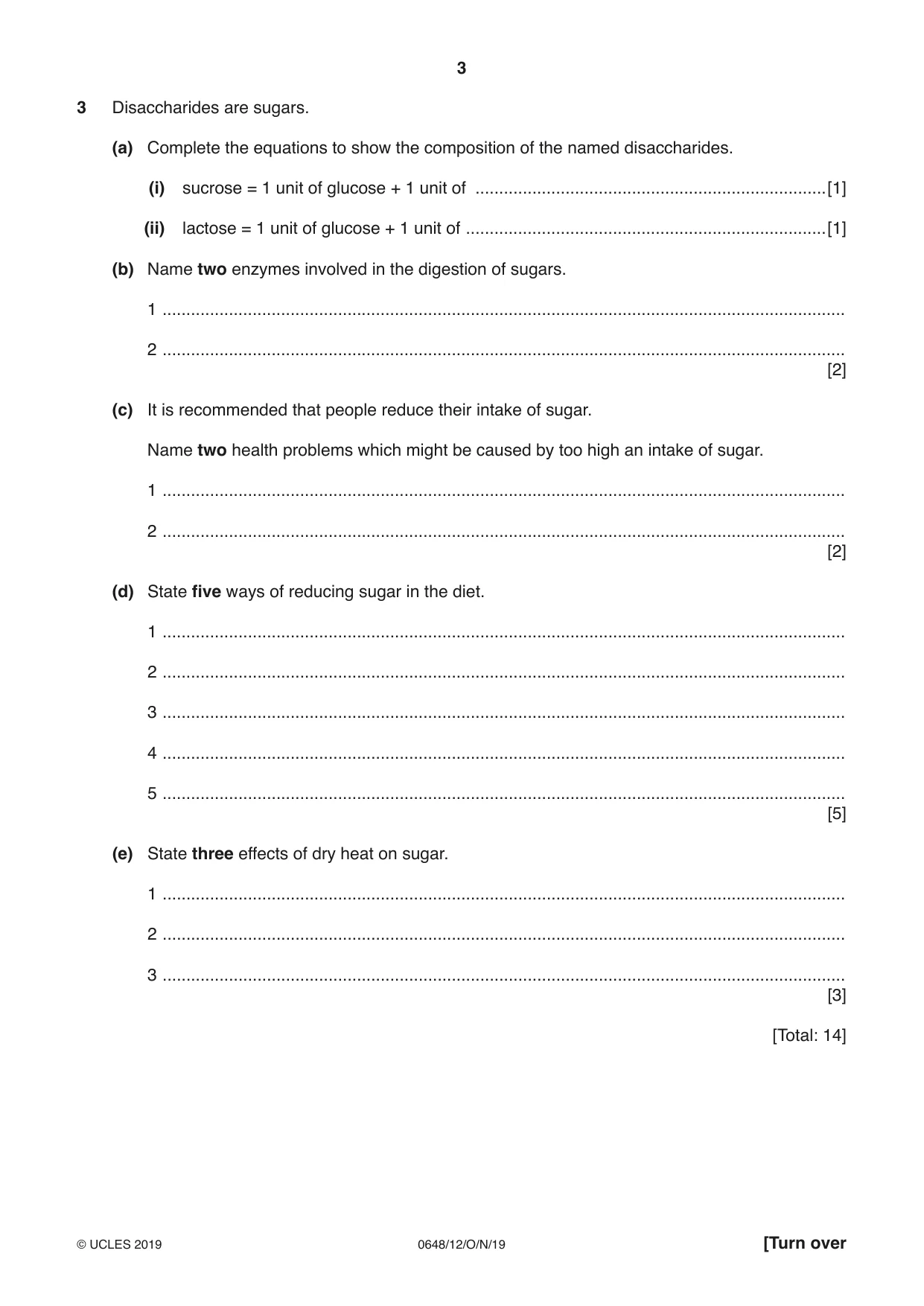
Question paper, page 3
3 0648/12/O/N/19 © UCLES 2019 [Turn over 3 Disaccharides are sugars. (a) Complete the equations to show the composition of the named disaccharides. (i) sucrose = 1 unit of glucose + 1 unit of …[1] (ii) lactose = 1 unit of glucose + 1 unit of …[1] (b) Name two enzymes involved in the digestion of sugars. 1 … 2 … [2] (c) It is recommended that people reduce their intake of sugar. Name two health problems which might be caused by too high an intake of sugar. 1 … 2 … [2] (d) State five ways of reducing sugar in the diet. 1 … 2 … 3 … 4 … 5 … [5] (e) State three effects of dry heat on sugar. 1 … 2 … 3 … [3] [Total: 14]
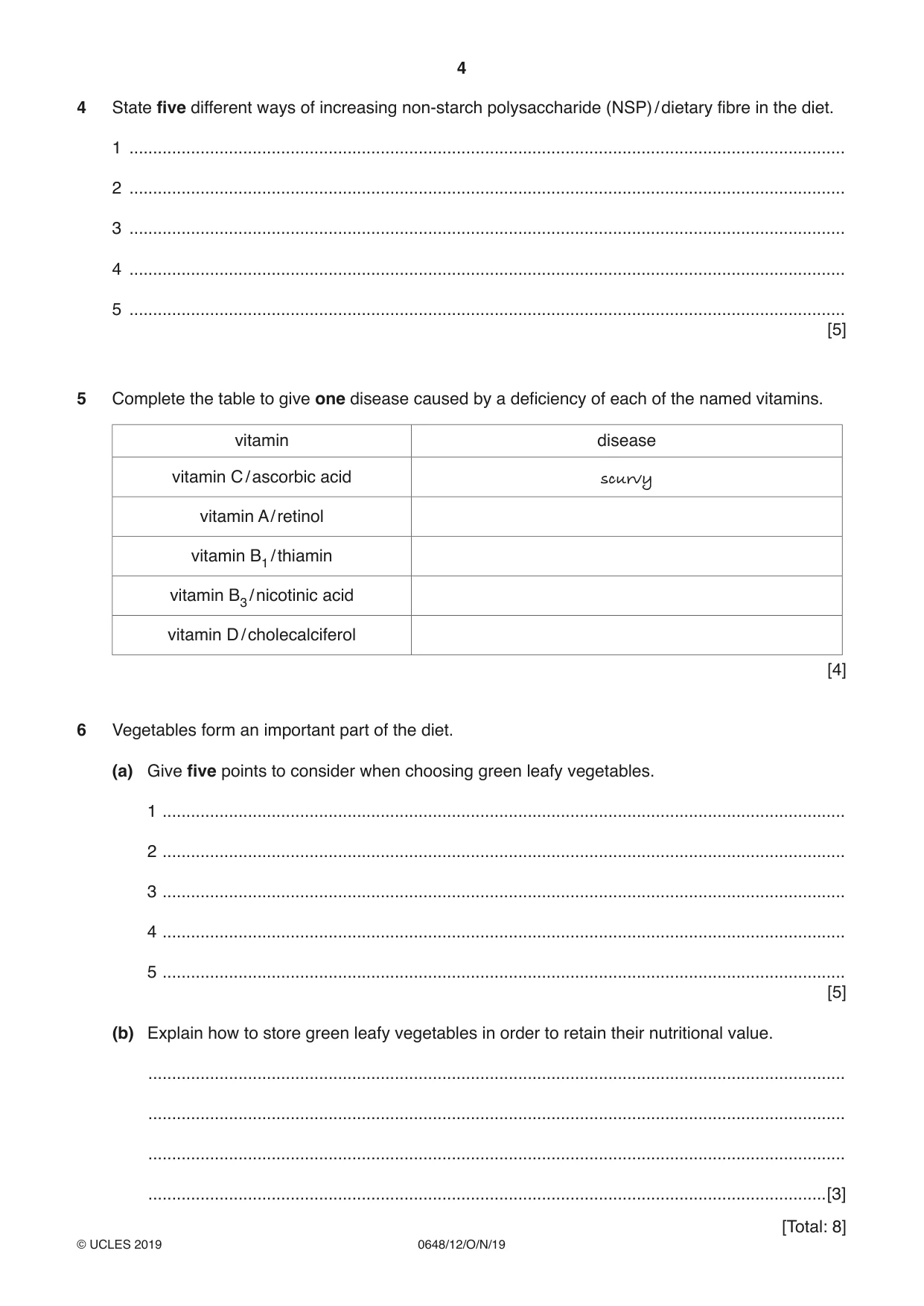
Question paper, page 4
4 0648/12/O/N/19 © UCLES 2019 4 State five different ways of increasing non-starch polysaccharide (NSP) / dietary fibre in the diet. 1 … 2 … 3 … 4 … 5 … [5] 5 Complete the table to give one disease caused by a deficiency of each of the named vitamins. vitamin disease vitamin C / ascorbic acid scurvy vitamin A / retinol vitamin B1 / thiamin vitamin B3 / nicotinic acid vitamin D / cholecalciferol [4] 6 Vegetables form an important part of the diet. (a) Give five points to consider when choosing green leafy vegetables. 1 … 2 … 3 … 4 … 5 … [5] (b) Explain how to store green leafy vegetables in order to retain their nutritional value. … … … …[3] [Total: 8]
Question paper, page 5
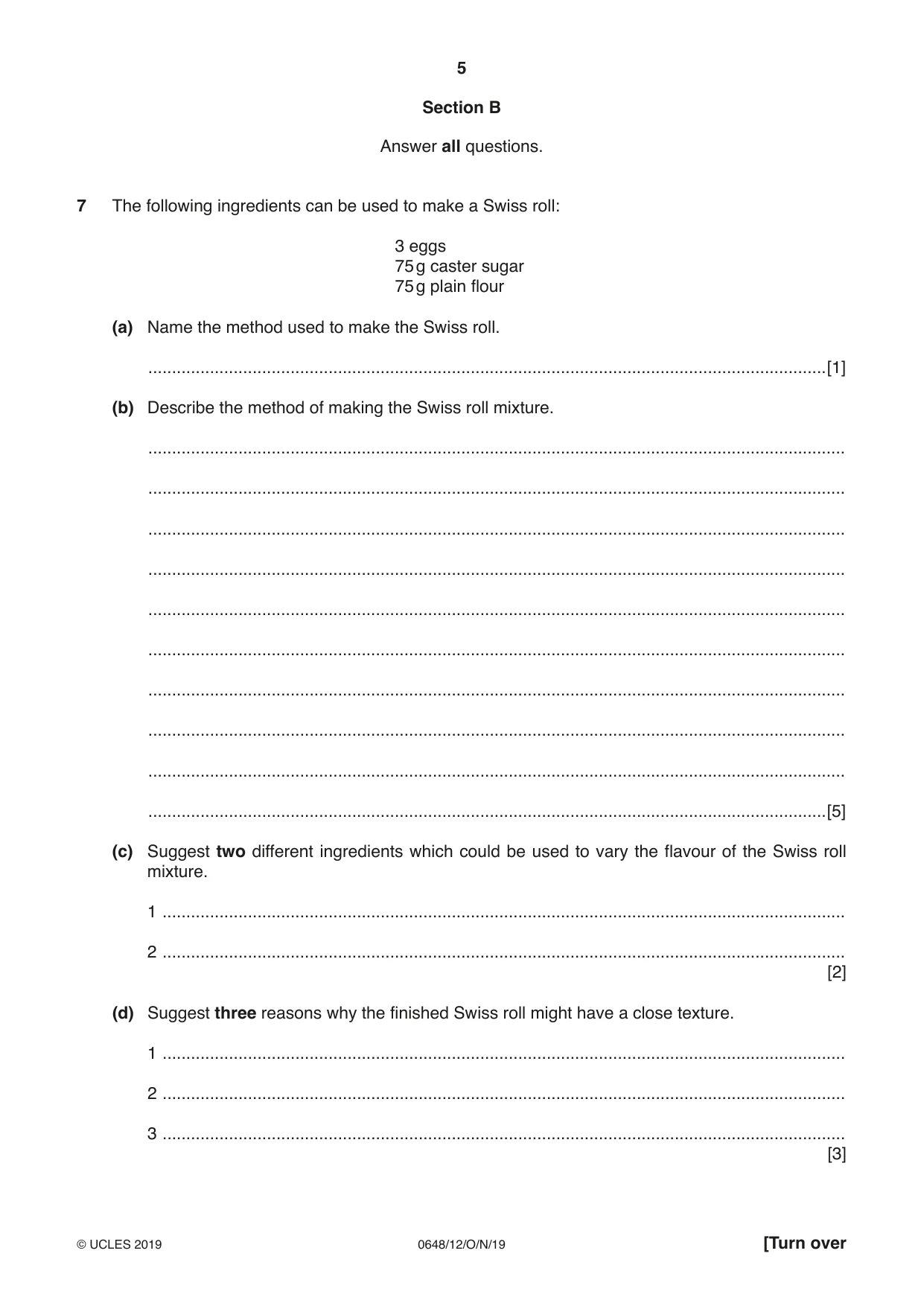
5 0648/12/O/N/19 © UCLES 2019 [Turn over Section B Answer all questions. 7 The following ingredients can be used to make a Swiss roll: 3 eggs 75 g caster sugar 75 g plain flour (a) Name the method used to make the Swiss roll. …[1] (b) Describe the method of making the Swiss roll mixture. … … … … … … … … … …[5] (c) Suggest two different ingredients which could be used to vary the flavour of the Swiss roll mixture. 1 … 2 … [2] (d) Suggest three reasons why the finished Swiss roll might have a close texture. 1 … 2 … 3 … [3]
Question paper, page 6
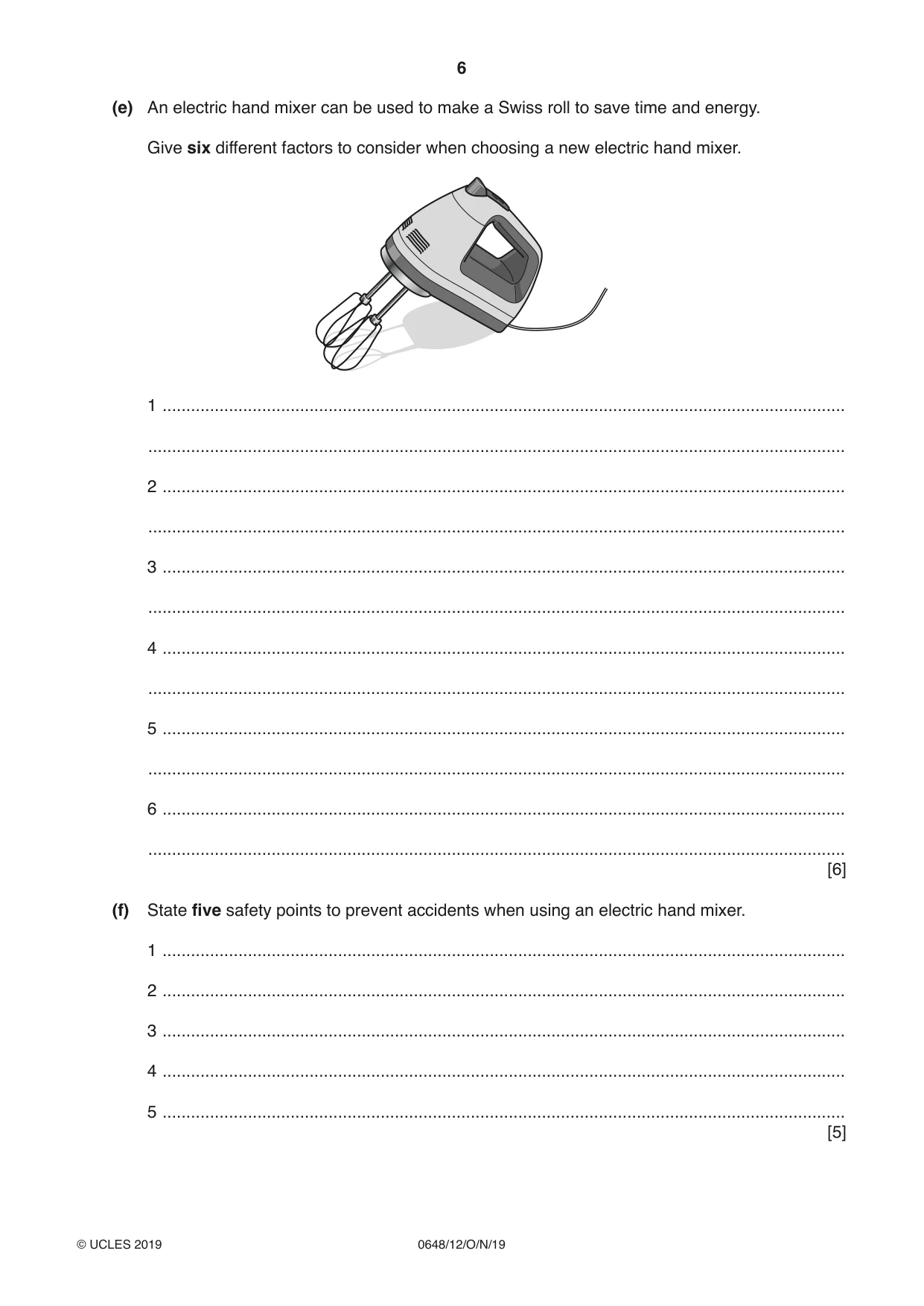
6 0648/12/O/N/19 © UCLES 2019 (e) An electric hand mixer can be used to make a Swiss roll to save time and energy. Give six different factors to consider when choosing a new electric hand mixer. 1 … … 2 … … 3 … … 4 … … 5 … … 6 … … [6] (f) State five safety points to prevent accidents when using an electric hand mixer. 1 … 2 … 3 … 4 … 5 … [5]
Question paper, page 7
7 0648/12/O/N/19 © UCLES 2019 [Turn over (g) Describe the first aid procedure for a person who has just received an electric shock. … … … … … …[3] [Total: 25]
Question paper, page 8
8 0648/12/O/N/19 © UCLES 2019 8 Microorganisms cause food spoilage. (a) Identify three conditions needed for the growth of microorganisms. 1 … 2 … 3 … [3] (b) Some microorganisms can be used to make yoghurt from milk. Give a reason for the following when making yoghurt: (i) sterilising all equipment; …[1] (ii) after heating the milk, allow to cool and add Lactobacillus bulgaricus and Streptococcus thermophilus; …[1] (iii) adding a stabiliser to the yoghurt. …[1] (c) Give two different reasons for each of the following pieces of information found on the label of a pot of yoghurt: (i) a list of ingredients; 1 … 2 … [2] (ii) storage instructions; 1 … 2 … [2] (iii) weight of product. 1 … 2 … [2] [Total: 12]
Question paper, page 9
9 0648/12/O/N/19 © UCLES 2019 [Turn over 9 Identify and explain eight reasons why convenience foods are popular. 1 … … 2 … … 3 … … 4 … … 5 … … 6 … … 7 … … 8 … … [8]
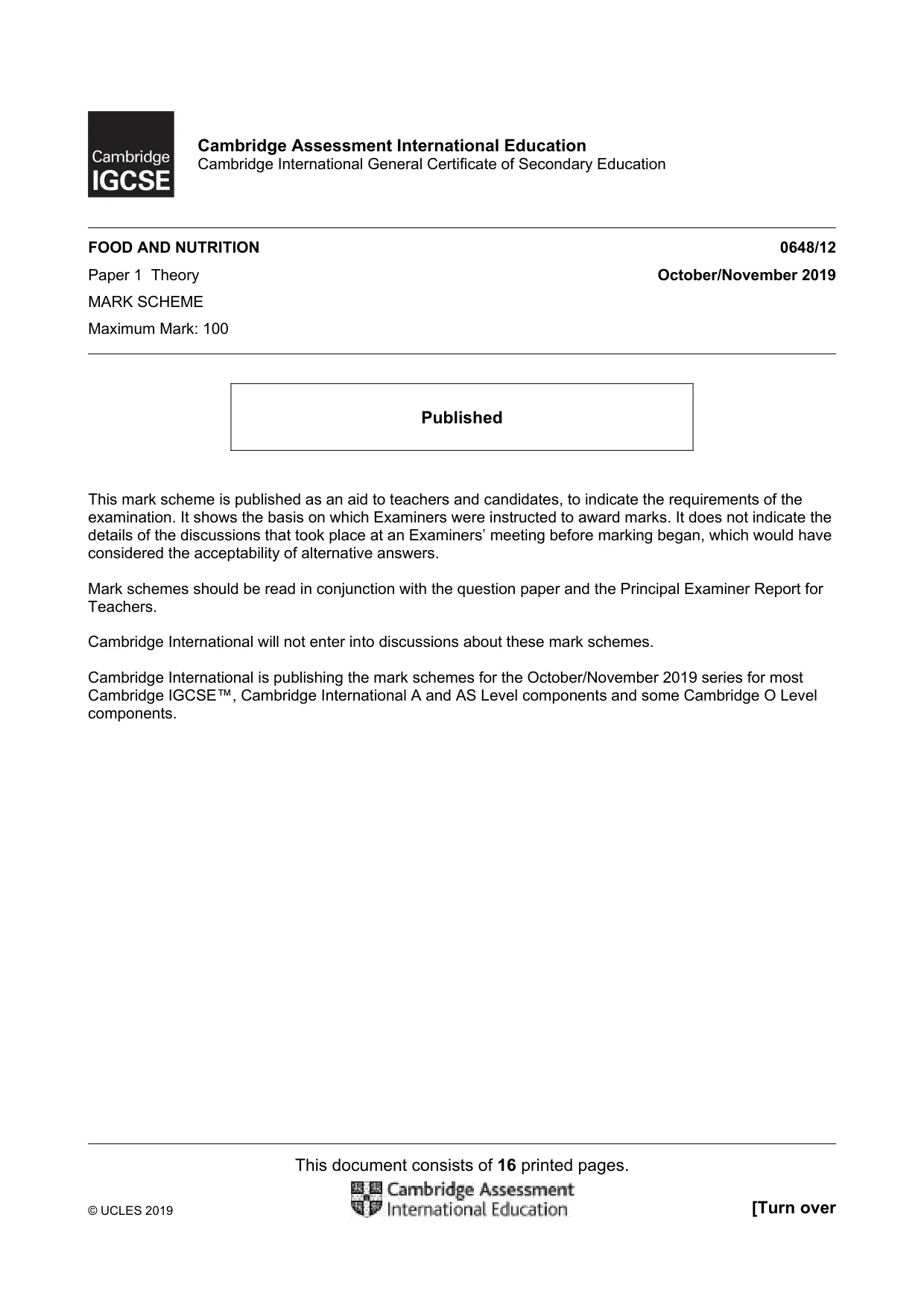
Question paper, page 10
10 0648/12/O/N/19 © UCLES 2019 Section C Answer either Question 10(a) or 10(b). 10 (a) Compare and contrast grilling and stewing as methods of cooking. [15] OR (b) Discuss the role that different religions play in influencing food choices. [15] … … … … … … … … … … … … … … … … … … … … … … …
Question paper, page 11
11 0648/12/O/N/19 © UCLES 2019 [Turn over … … … … … … … … … … … … … … … … … … … … … … … … … … … …
Question paper, page 12
12 0648/12/O/N/19 © UCLES 2019 Permission to reproduce items where third-party owned material protected by copyright is included has been sought and cleared where possible. Every reasonable effort has been made by the publisher (UCLES) to trace copyright holders, but if any items requiring clearance have unwittingly been included, the publisher will be pleased to make amends at the earliest possible opportunity. To avoid the issue of disclosure of answer-related information to candidates, all copyright acknowledgements are reproduced online in the Cambridge Assessment International Education Copyright Acknowledgements Booklet. This is produced for each series of examinations and is freely available to download at www.cambridgeinternational.org after the live examination series. Cambridge Assessment International Education is part of the Cambridge Assessment Group. Cambridge Assessment is the brand name of the University of Cambridge Local Examinations Syndicate (UCLES), which itself is a department of the University of Cambridge. … … … … … … … … … … … … … … … … … … … … … … …
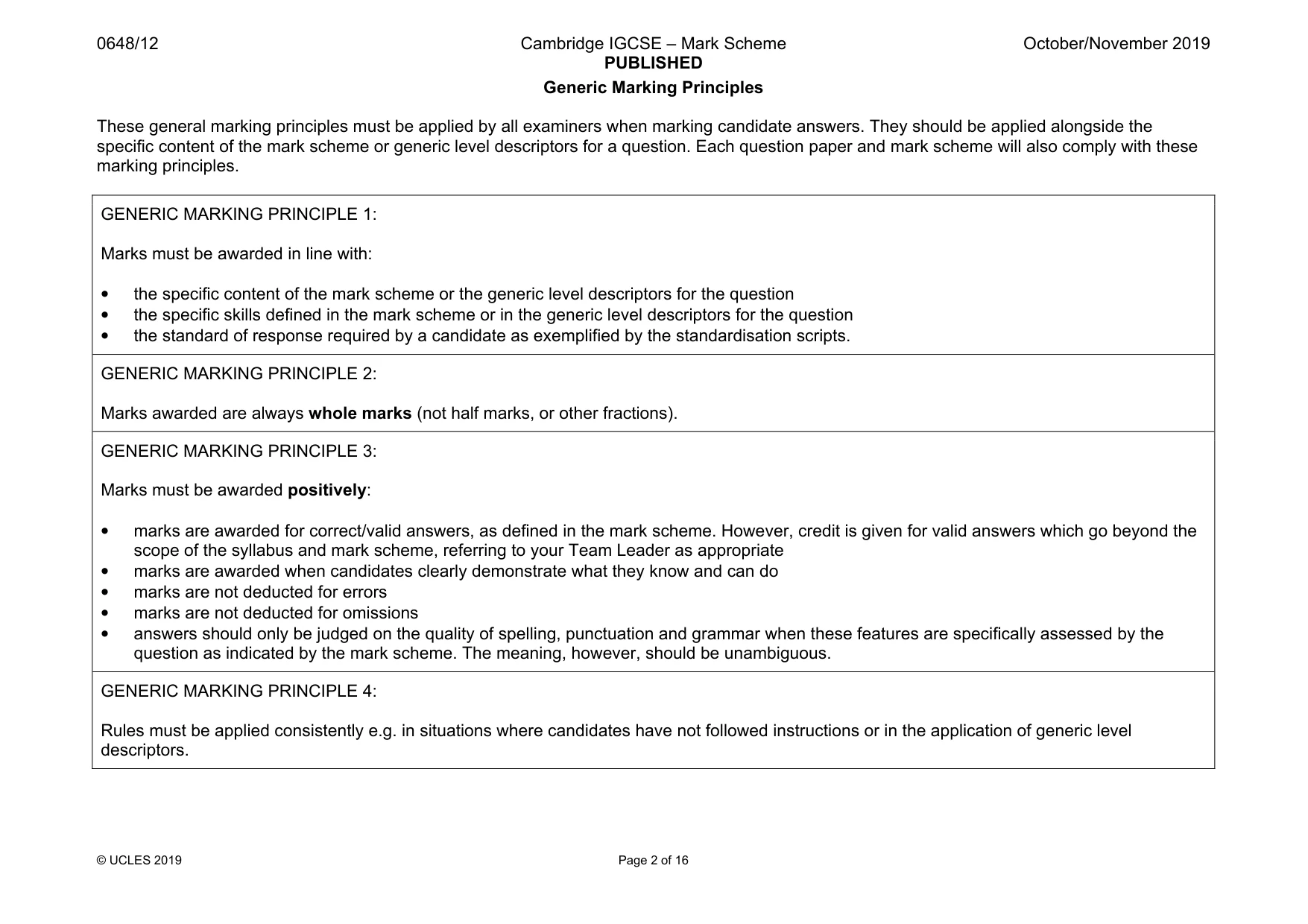
Mark scheme, page 1
This document consists of 16 printed pages. © UCLES 2019 [Turn over Cambridge Assessment International Education Cambridge International General Certificate of Secondary Education FOOD AND NUTRITION 0648/12 Paper 1 Theory October/November 2019 MARK SCHEME Maximum Mark: 100 Published This mark scheme is published as an aid to teachers and candidates, to indicate the requirements of the examination. It shows the basis on which Examiners were instructed to award marks. It does not indicate the details of the discussions that took place at an Examiners’ meeting before marking began, which would have considered the acceptability of alternative answers. Mark schemes should be read in conjunction with the question paper and the Principal Examiner Report for Teachers. Cambridge International will not enter into discussions about these mark schemes. Cambridge International is publishing the mark schemes for the October/November 2019 series for most Cambridge IGCSE™, Cambridge International A and AS Level components and some Cambridge O Level components.
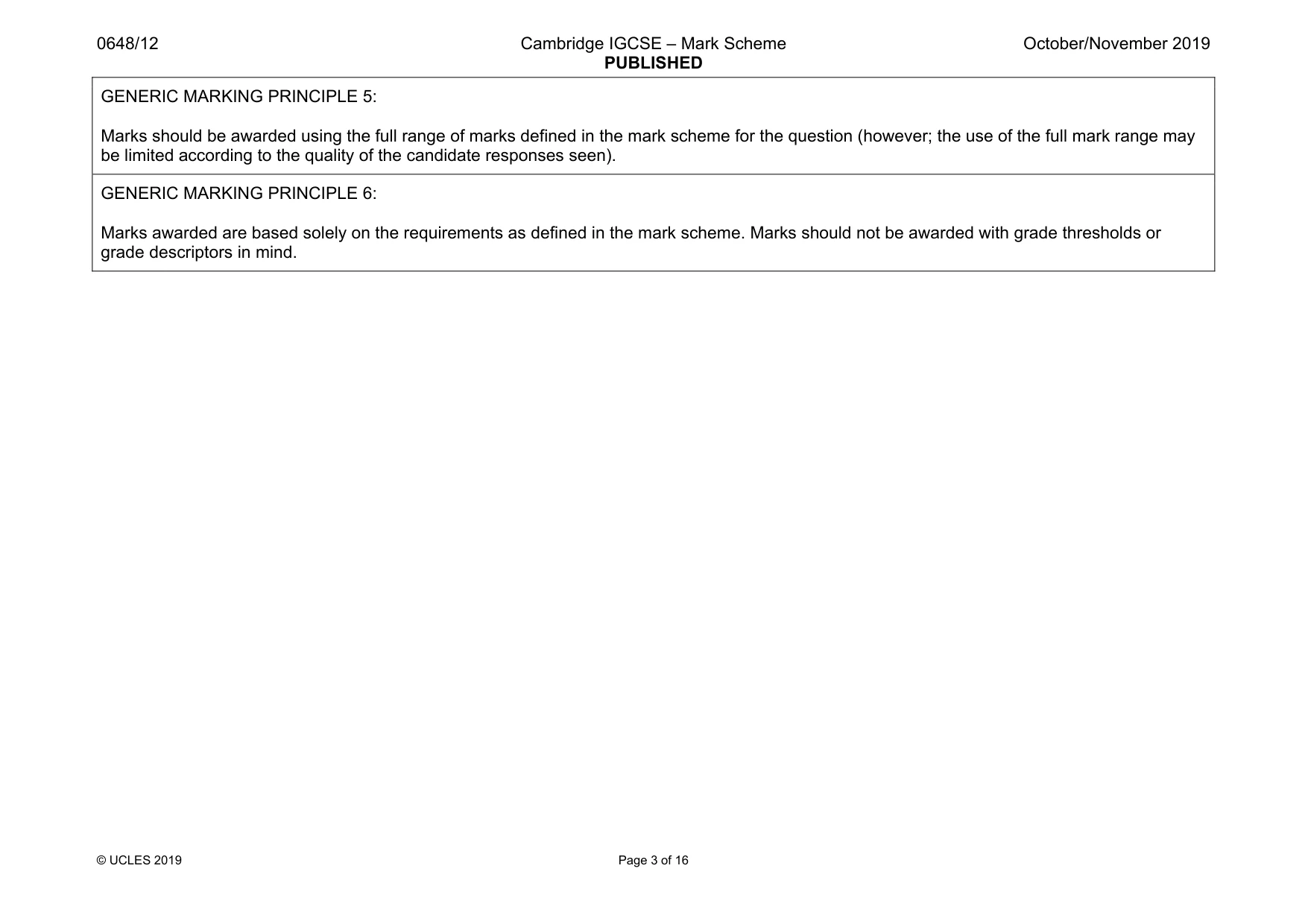
Mark scheme, page 2
0648/12 Cambridge IGCSE – Mark Scheme PUBLISHED October/November 2019 © UCLES 2019 Page 2 of 16 Generic Marking Principles These general marking principles must be applied by all examiners when marking candidate answers. They should be applied alongside the specific content of the mark scheme or generic level descriptors for a question. Each question paper and mark scheme will also comply with these marking principles. GENERIC MARKING PRINCIPLE 1: Marks must be awarded in line with: • the specific content of the mark scheme or the generic level descriptors for the question • the specific skills defined in the mark scheme or in the generic level descriptors for the question • the standard of response required by a candidate as exemplified by the standardisation scripts. GENERIC MARKING PRINCIPLE 2: Marks awarded are always whole marks (not half marks, or other fractions). GENERIC MARKING PRINCIPLE 3: Marks must be awarded positively: • marks are awarded for correct/valid answers, as defined in the mark scheme. However, credit is given for valid answers which go beyond the scope of the syllabus and mark scheme, referring to your Team Leader as appropriate • marks are awarded when candidates clearly demonstrate what they know and can do • marks are not deducted for errors • marks are not deducted for omissions • answers should only be judged on the quality of spelling, punctuation and grammar when these features are specifically assessed by the question as indicated by the mark scheme. The meaning, however, should be unambiguous. GENERIC MARKING PRINCIPLE 4: Rules must be applied consistently e.g. in situations where candidates have not followed instructions or in the application of generic level descriptors.
Mark scheme, page 3
0648/12 Cambridge IGCSE – Mark Scheme PUBLISHED October/November 2019 © UCLES 2019 Page 3 of 16 GENERIC MARKING PRINCIPLE 5: Marks should be awarded using the full range of marks defined in the mark scheme for the question (however; the use of the full mark range may be limited according to the quality of the candidate responses seen). GENERIC MARKING PRINCIPLE 6: Marks awarded are based solely on the requirements as defined in the mark scheme. Marks should not be awarded with grade thresholds or grade descriptors in mind.
Mark scheme, page 4
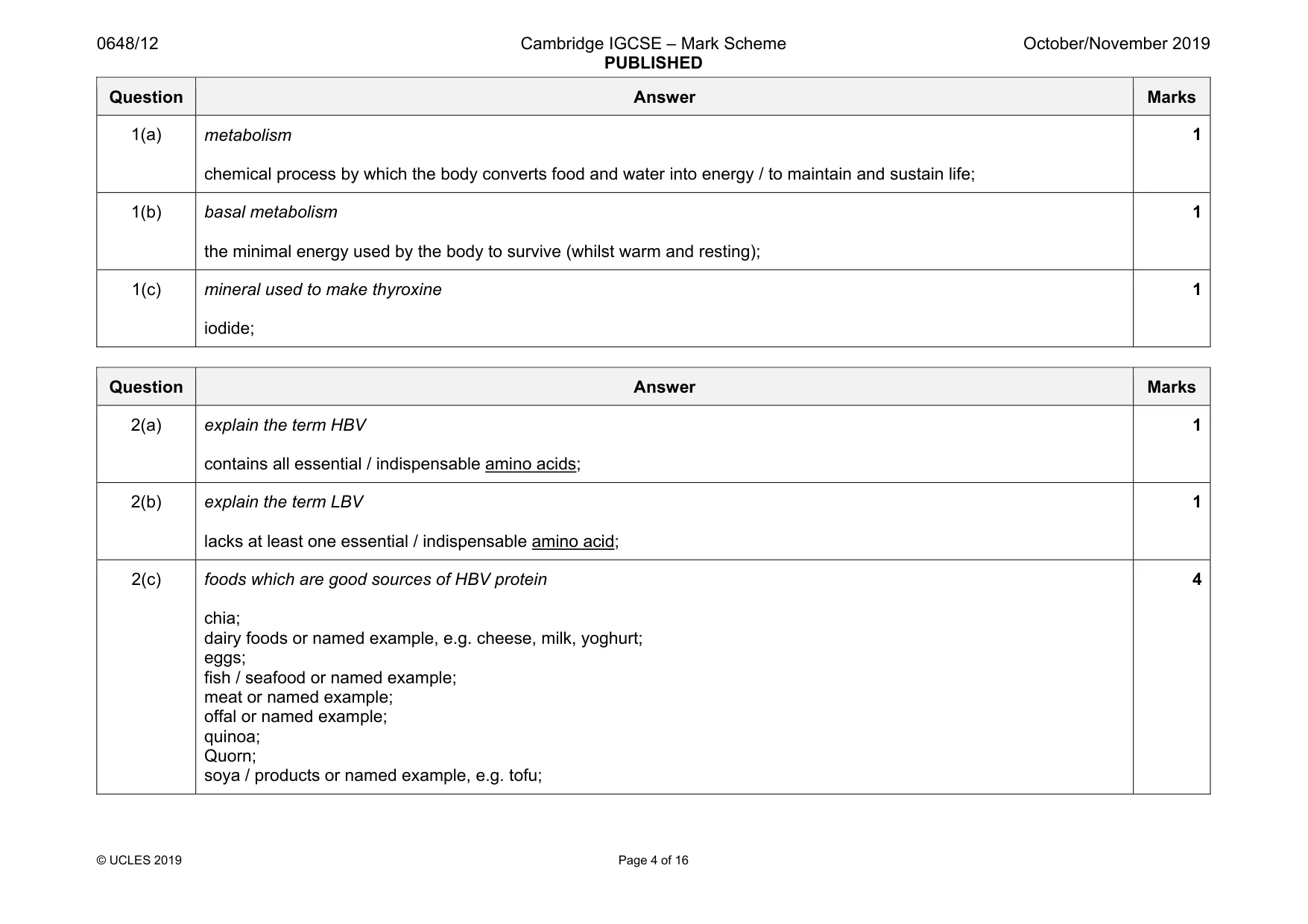
0648/12 Cambridge IGCSE – Mark Scheme PUBLISHED October/November 2019 © UCLES 2019 Page 4 of 16 Question Answer Marks 1(a) metabolism chemical process by which the body converts food and water into energy / to maintain and sustain life; 1 1(b) basal metabolism the minimal energy used by the body to survive (whilst warm and resting); 1 1(c) mineral used to make thyroxine iodide; 1 Question Answer Marks 2(a) explain the term HBV contains all essential / indispensable amino acids; 1 2(b) explain the term LBV lacks at least one essential / indispensable amino acid; 1 2(c) foods which are good sources of HBV protein chia; dairy foods or named example, e.g. cheese, milk, yoghurt; eggs; fish / seafood or named example; meat or named example; offal or named example; quinoa; Quorn; soya / products or named example, e.g. tofu; 4
Mark scheme, page 5
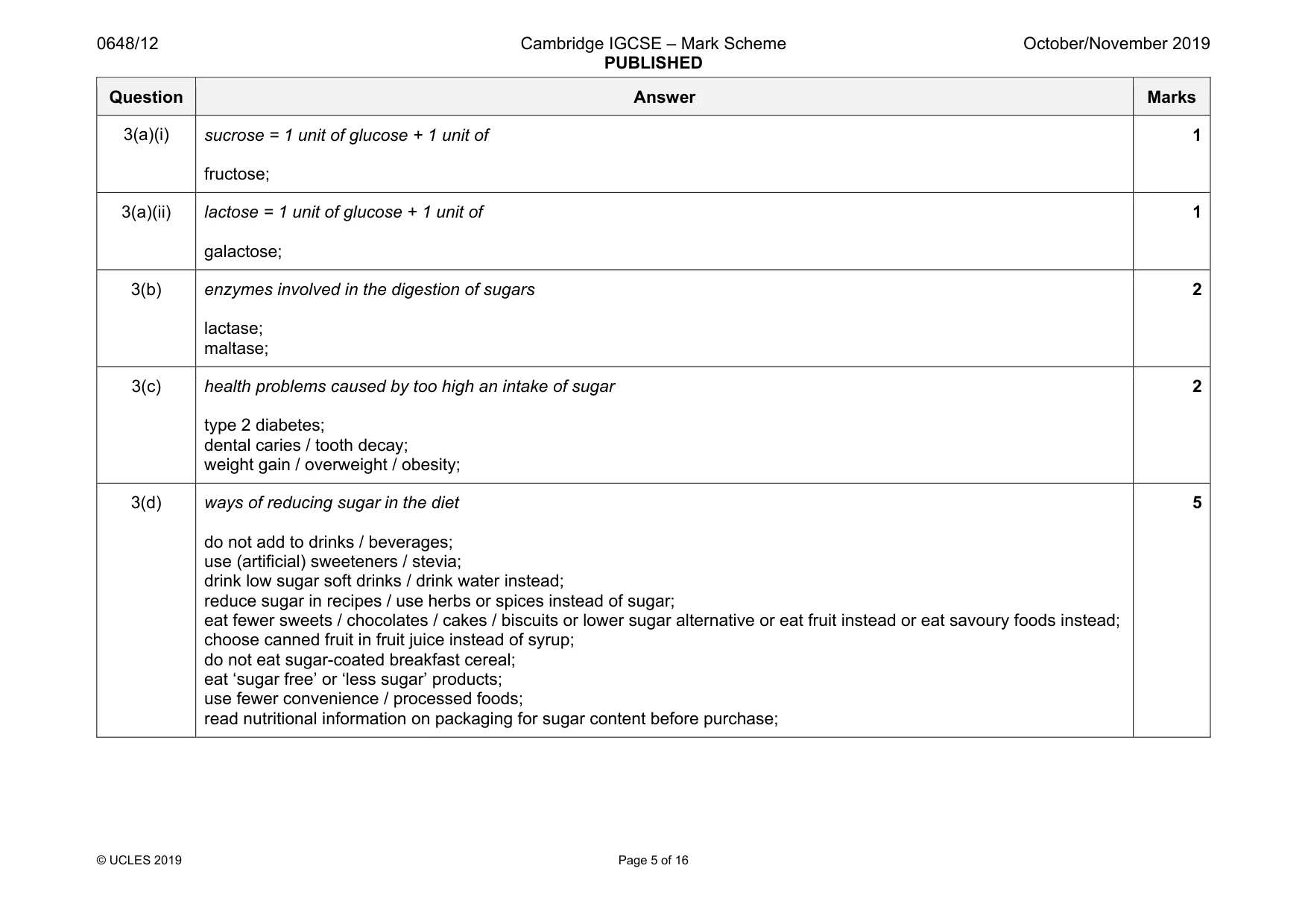
0648/12 Cambridge IGCSE – Mark Scheme PUBLISHED October/November 2019 © UCLES 2019 Page 5 of 16 Question Answer Marks 3(a)(i) sucrose = 1 unit of glucose + 1 unit of fructose; 1 3(a)(ii) lactose = 1 unit of glucose + 1 unit of galactose; 1 3(b) enzymes involved in the digestion of sugars lactase; maltase; 2 3(c) health problems caused by too high an intake of sugar type 2 diabetes; dental caries / tooth decay; weight gain / overweight / obesity; 2 3(d) ways of reducing sugar in the diet do not add to drinks / beverages; use (artificial) sweeteners / stevia; drink low sugar soft drinks / drink water instead; reduce sugar in recipes / use herbs or spices instead of sugar; eat fewer sweets / chocolates / cakes / biscuits or lower sugar alternative or eat fruit instead or eat savoury foods instead; choose canned fruit in fruit juice instead of syrup; do not eat sugar-coated breakfast cereal; eat ‘sugar free’ or ‘less sugar’ products; use fewer convenience / processed foods; read nutritional information on packaging for sugar content before purchase; 5
Mark scheme, page 6
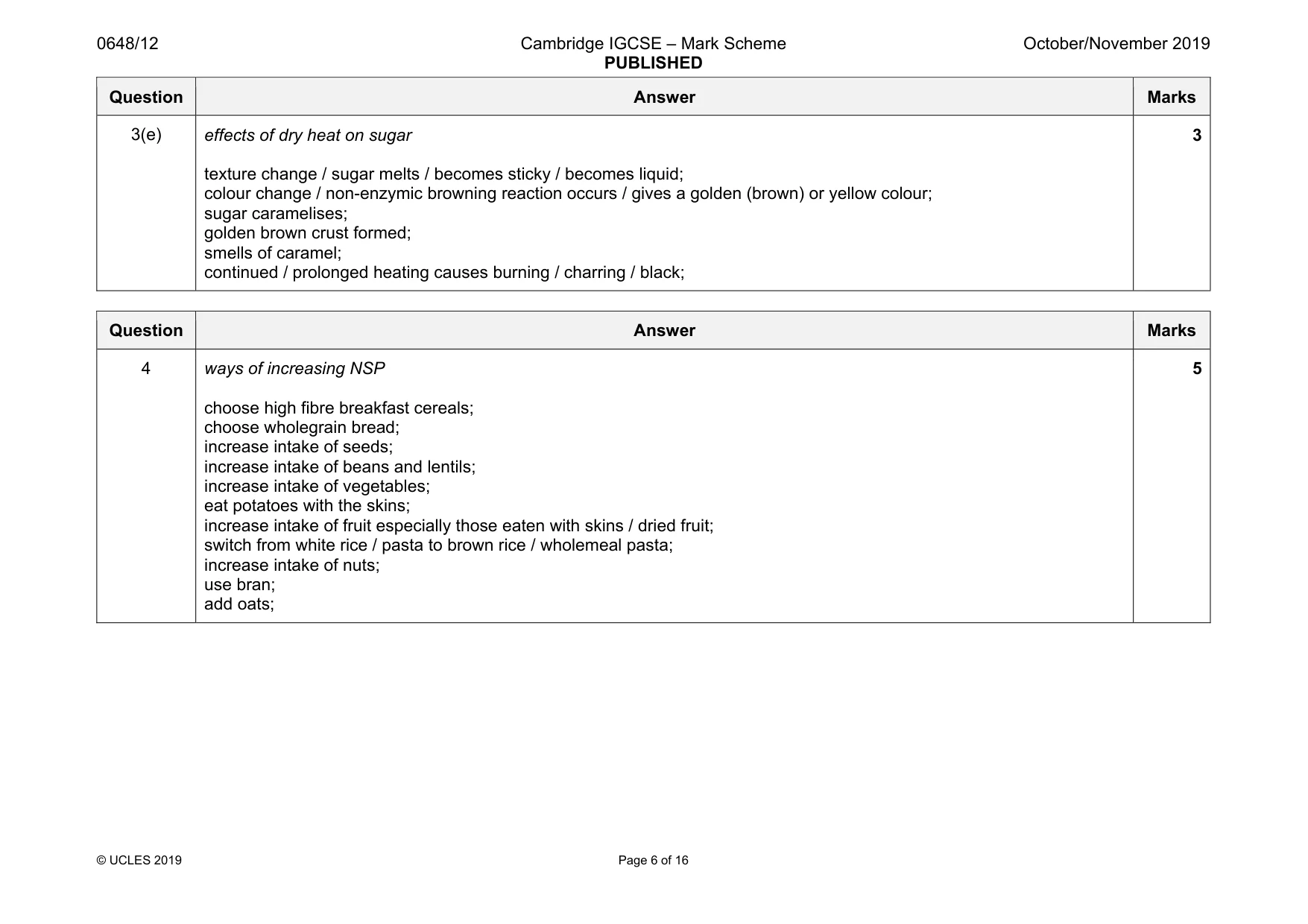
0648/12 Cambridge IGCSE – Mark Scheme PUBLISHED October/November 2019 © UCLES 2019 Page 6 of 16 Question Answer Marks 3(e) effects of dry heat on sugar texture change / sugar melts / becomes sticky / becomes liquid; colour change / non-enzymic browning reaction occurs / gives a golden (brown) or yellow colour; sugar caramelises; golden brown crust formed; smells of caramel; continued / prolonged heating causes burning / charring / black; 3 Question Answer Marks 4 ways of increasing NSP choose high fibre breakfast cereals; choose wholegrain bread; increase intake of seeds; increase intake of beans and lentils; increase intake of vegetables; eat potatoes with the skins; increase intake of fruit especially those eaten with skins / dried fruit; switch from white rice / pasta to brown rice / wholemeal pasta; increase intake of nuts; use bran; add oats; 5
Mark scheme, page 7
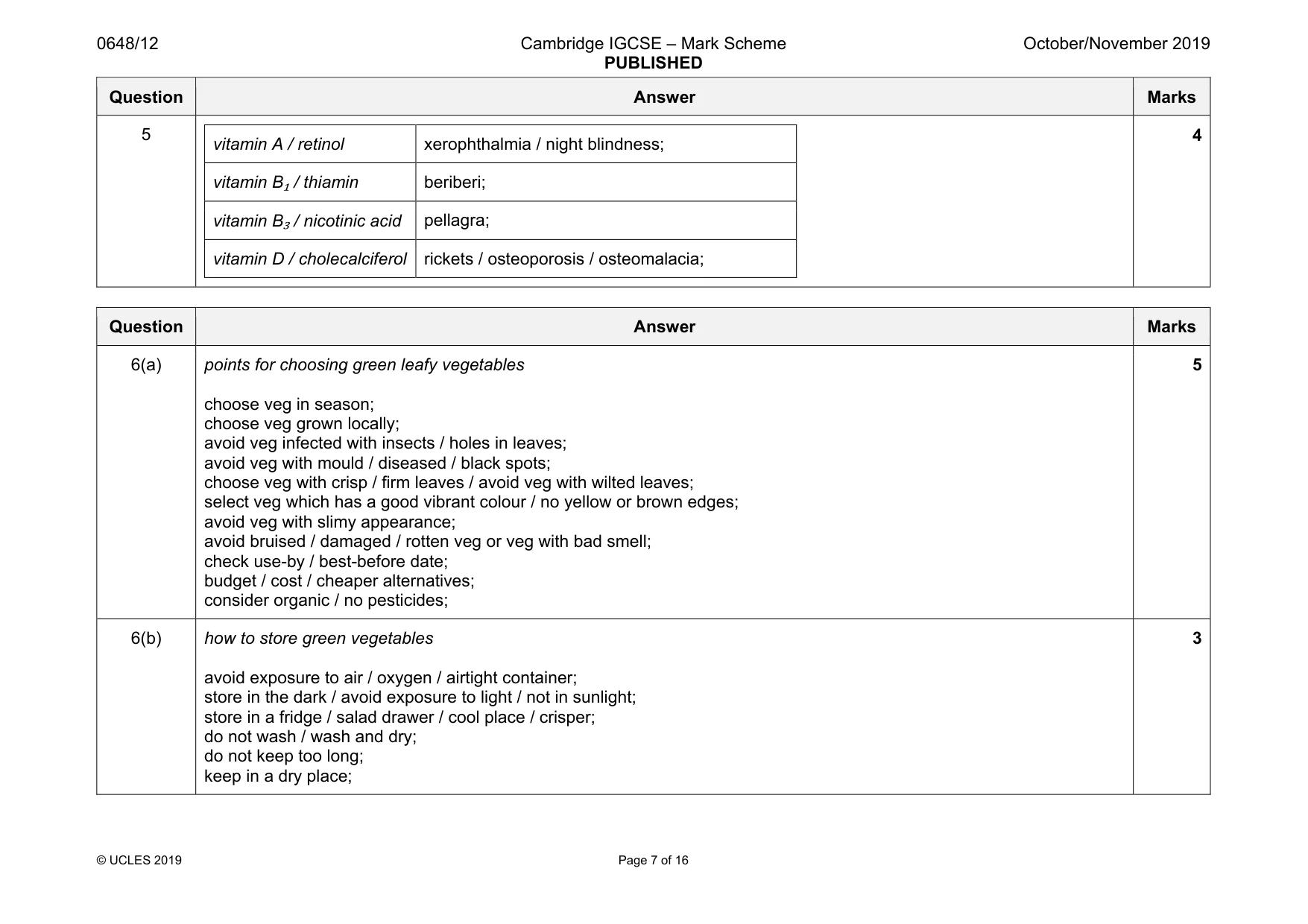
0648/12 Cambridge IGCSE – Mark Scheme PUBLISHED October/November 2019 © UCLES 2019 Page 7 of 16 Question Answer Marks 5 vitamin A / retinol xerophthalmia / night blindness; vitamin B₁ / thiamin beriberi; vitamin B₃ / nicotinic acid pellagra; vitamin D / cholecalciferol rickets / osteoporosis / osteomalacia; 4 Question Answer Marks 6(a) points for choosing green leafy vegetables choose veg in season; choose veg grown locally; avoid veg infected with insects / holes in leaves; avoid veg with mould / diseased / black spots; choose veg with crisp / firm leaves / avoid veg with wilted leaves; select veg which has a good vibrant colour / no yellow or brown edges; avoid veg with slimy appearance; avoid bruised / damaged / rotten veg or veg with bad smell; check use-by / best-before date; budget / cost / cheaper alternatives; consider organic / no pesticides; 5 6(b) how to store green vegetables avoid exposure to air / oxygen / airtight container; store in the dark / avoid exposure to light / not in sunlight; store in a fridge / salad drawer / cool place / crisper; do not wash / wash and dry; do not keep too long; keep in a dry place; 3
Mark scheme, page 8
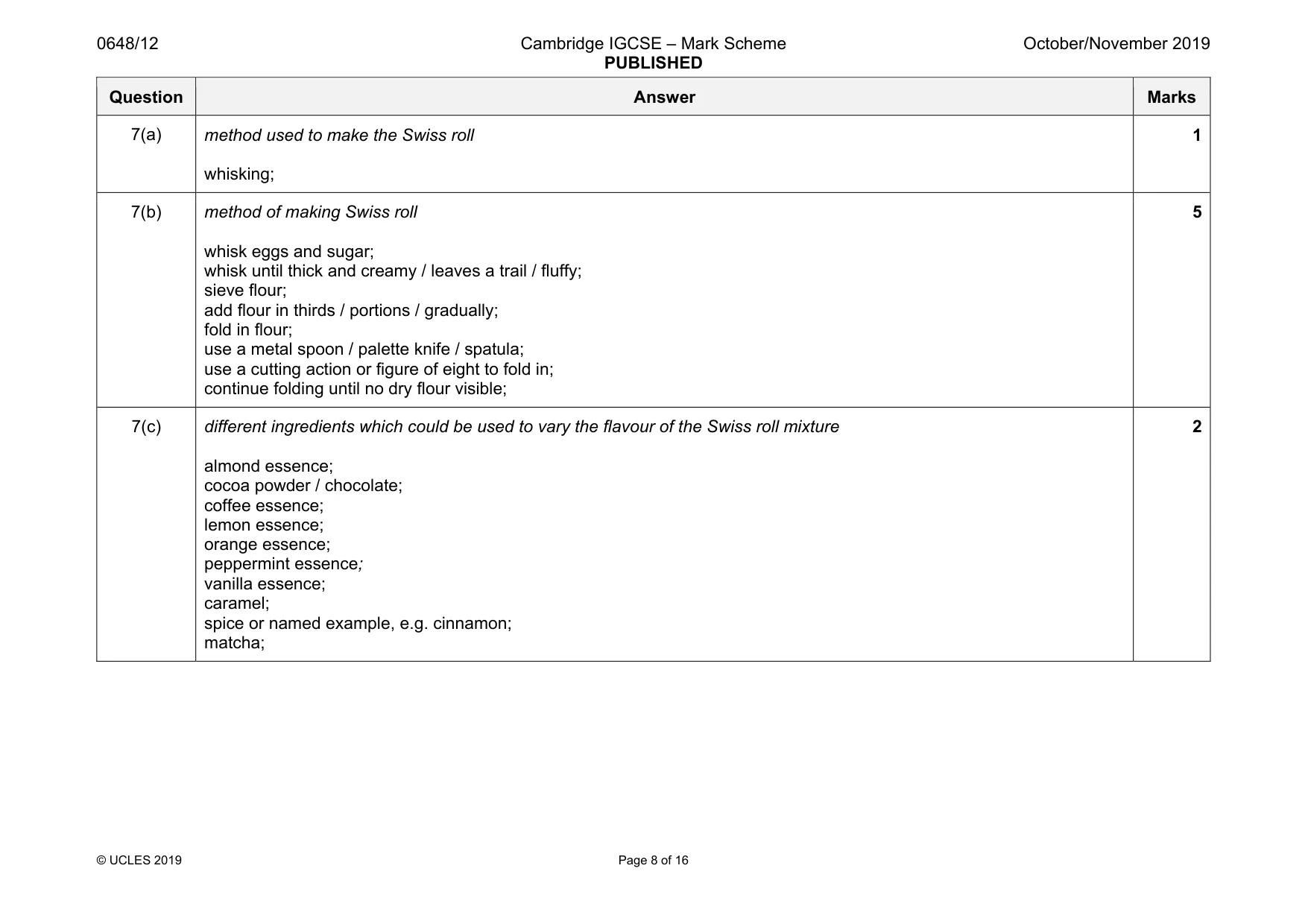
0648/12 Cambridge IGCSE – Mark Scheme PUBLISHED October/November 2019 © UCLES 2019 Page 8 of 16 Question Answer Marks 7(a) method used to make the Swiss roll whisking; 1 7(b) method of making Swiss roll whisk eggs and sugar; whisk until thick and creamy / leaves a trail / fluffy; sieve flour; add flour in thirds / portions / gradually; fold in flour; use a metal spoon / palette knife / spatula; use a cutting action or figure of eight to fold in; continue folding until no dry flour visible; 5 7(c) different ingredients which could be used to vary the flavour of the Swiss roll mixture almond essence; cocoa powder / chocolate; coffee essence; lemon essence; orange essence; peppermint essence; vanilla essence; caramel; spice or named example, e.g. cinnamon; matcha; 2
Mark scheme, page 9
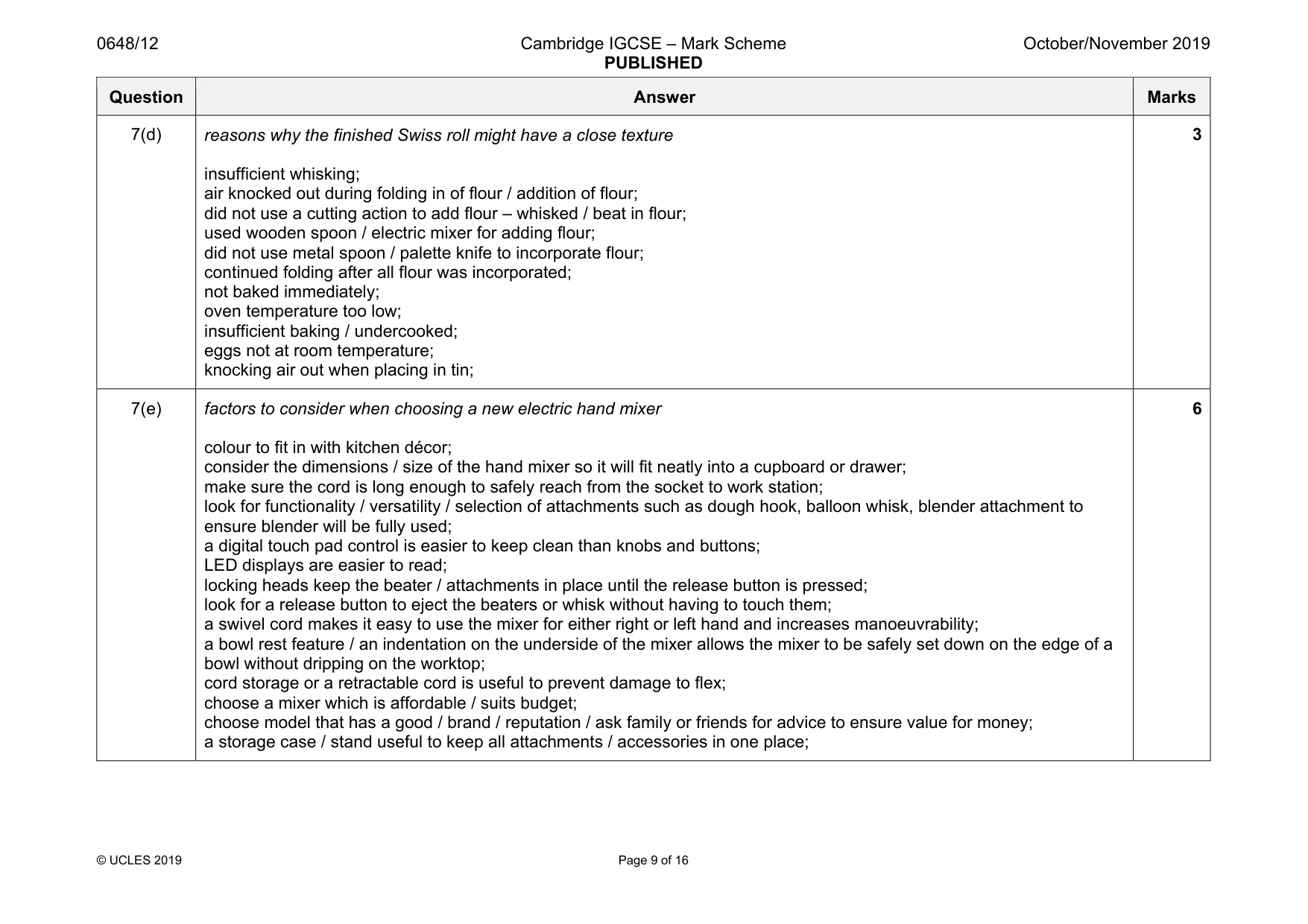
0648/12 Cambridge IGCSE – Mark Scheme PUBLISHED October/November 2019 © UCLES 2019 Page 9 of 16 Question Answer Marks 7(d) reasons why the finished Swiss roll might have a close texture insufficient whisking; air knocked out during folding in of flour / addition of flour; did not use a cutting action to add flour – whisked / beat in flour; used wooden spoon / electric mixer for adding flour; did not use metal spoon / palette knife to incorporate flour; continued folding after all flour was incorporated; not baked immediately; oven temperature too low; insufficient baking / undercooked; eggs not at room temperature; knocking air out when placing in tin; 3 7(e) factors to consider when choosing a new electric hand mixer colour to fit in with kitchen décor; consider the dimensions / size of the hand mixer so it will fit neatly into a cupboard or drawer; make sure the cord is long enough to safely reach from the socket to work station; look for functionality / versatility / selection of attachments such as dough hook, balloon whisk, blender attachment to ensure blender will be fully used; a digital touch pad control is easier to keep clean than knobs and buttons; LED displays are easier to read; locking heads keep the beater / attachments in place until the release button is pressed; look for a release button to eject the beaters or whisk without having to touch them; a swivel cord makes it easy to use the mixer for either right or left hand and increases manoeuvrability; a bowl rest feature / an indentation on the underside of the mixer allows the mixer to be safely set down on the edge of a bowl without dripping on the worktop; cord storage or a retractable cord is useful to prevent damage to flex; choose a mixer which is affordable / suits budget; choose model that has a good / brand / reputation / ask family or friends for advice to ensure value for money; a storage case / stand useful to keep all attachments / accessories in one place; 6
Mark scheme, page 10
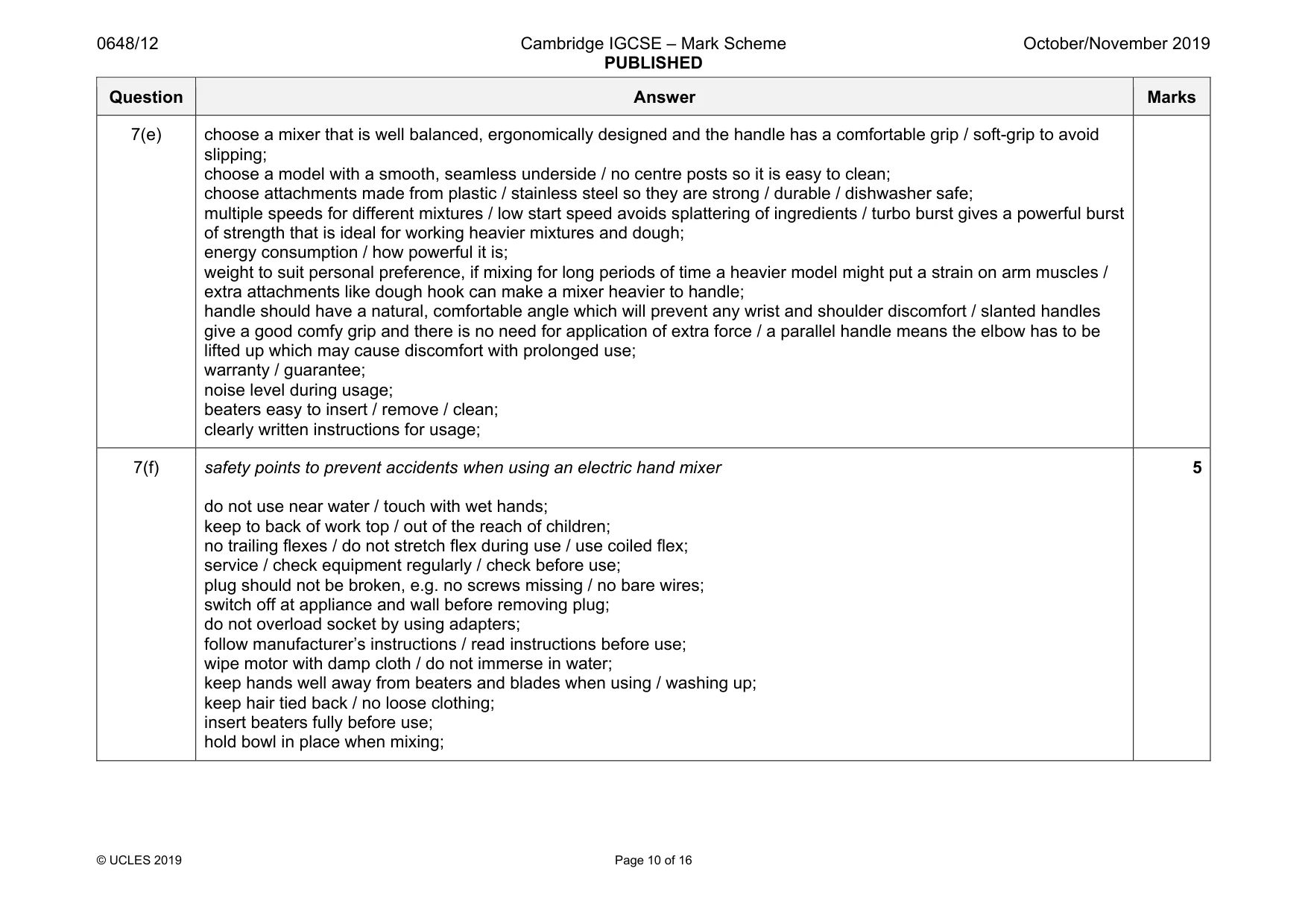
0648/12 Cambridge IGCSE – Mark Scheme PUBLISHED October/November 2019 © UCLES 2019 Page 10 of 16 Question Answer Marks 7(e) choose a mixer that is well balanced, ergonomically designed and the handle has a comfortable grip / soft-grip to avoid slipping; choose a model with a smooth, seamless underside / no centre posts so it is easy to clean; choose attachments made from plastic / stainless steel so they are strong / durable / dishwasher safe; multiple speeds for different mixtures / low start speed avoids splattering of ingredients / turbo burst gives a powerful burst of strength that is ideal for working heavier mixtures and dough; energy consumption / how powerful it is; weight to suit personal preference, if mixing for long periods of time a heavier model might put a strain on arm muscles / extra attachments like dough hook can make a mixer heavier to handle; handle should have a natural, comfortable angle which will prevent any wrist and shoulder discomfort / slanted handles give a good comfy grip and there is no need for application of extra force / a parallel handle means the elbow has to be lifted up which may cause discomfort with prolonged use; warranty / guarantee; noise level during usage; beaters easy to insert / remove / clean; clearly written instructions for usage; 7(f) safety points to prevent accidents when using an electric hand mixer do not use near water / touch with wet hands; keep to back of work top / out of the reach of children; no trailing flexes / do not stretch flex during use / use coiled flex; service / check equipment regularly / check before use; plug should not be broken, e.g. no screws missing / no bare wires; switch off at appliance and wall before removing plug; do not overload socket by using adapters; follow manufacturer’s instructions / read instructions before use; wipe motor with damp cloth / do not immerse in water; keep hands well away from beaters and blades when using / washing up; keep hair tied back / no loose clothing; insert beaters fully before use; hold bowl in place when mixing; 5
Mark scheme, page 11
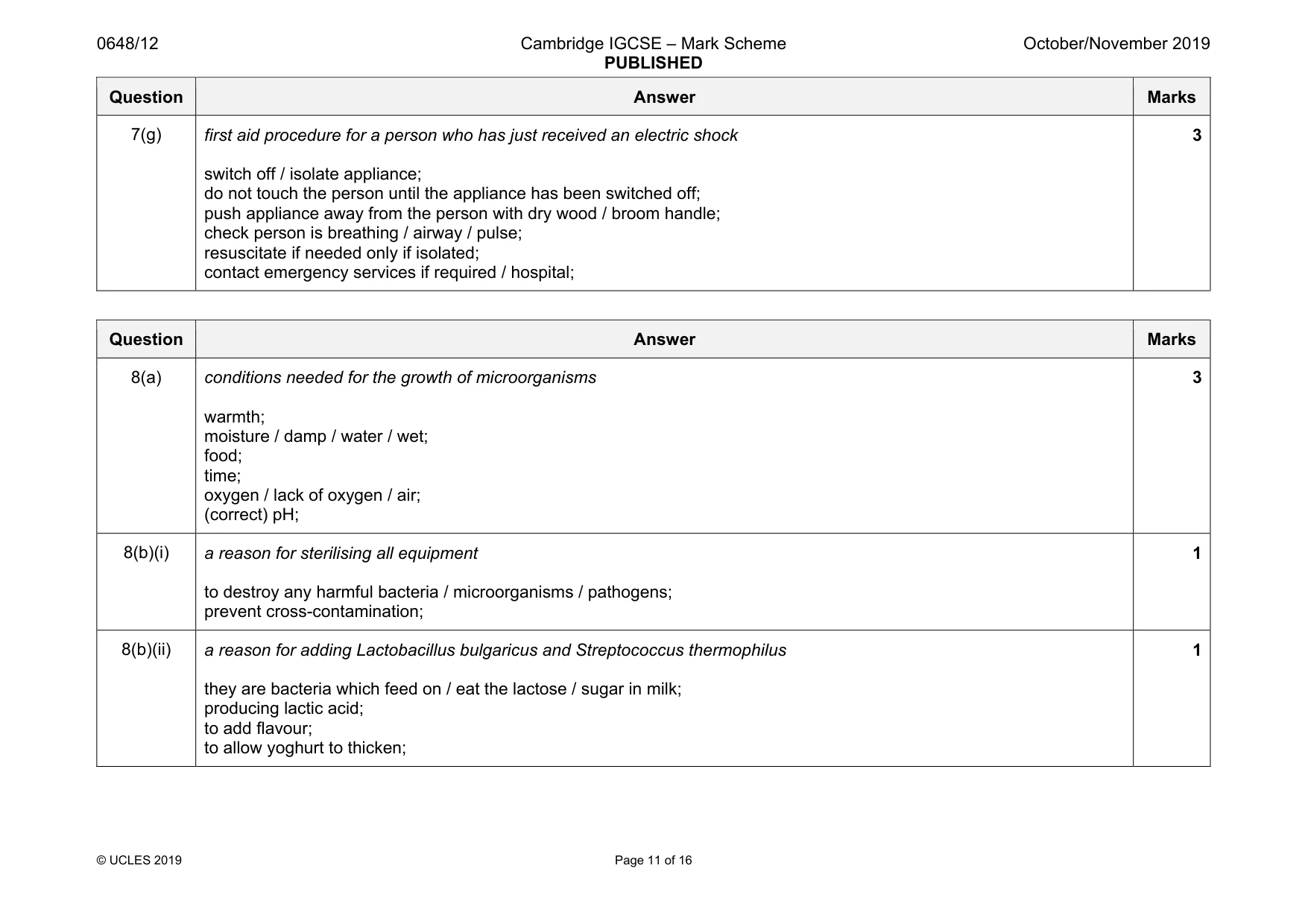
0648/12 Cambridge IGCSE – Mark Scheme PUBLISHED October/November 2019 © UCLES 2019 Page 11 of 16 Question Answer Marks 7(g) first aid procedure for a person who has just received an electric shock switch off / isolate appliance; do not touch the person until the appliance has been switched off; push appliance away from the person with dry wood / broom handle; check person is breathing / airway / pulse; resuscitate if needed only if isolated; contact emergency services if required / hospital; 3 Question Answer Marks 8(a) conditions needed for the growth of microorganisms warmth; moisture / damp / water / wet; food; time; oxygen / lack of oxygen / air; (correct) pH; 3 8(b)(i) a reason for sterilising all equipment to destroy any harmful bacteria / microorganisms / pathogens; prevent cross-contamination; 1 8(b)(ii) a reason for adding Lactobacillus bulgaricus and Streptococcus thermophilus they are bacteria which feed on / eat the lactose / sugar in milk; producing lactic acid; to add flavour; to allow yoghurt to thicken; 1
Mark scheme, page 12
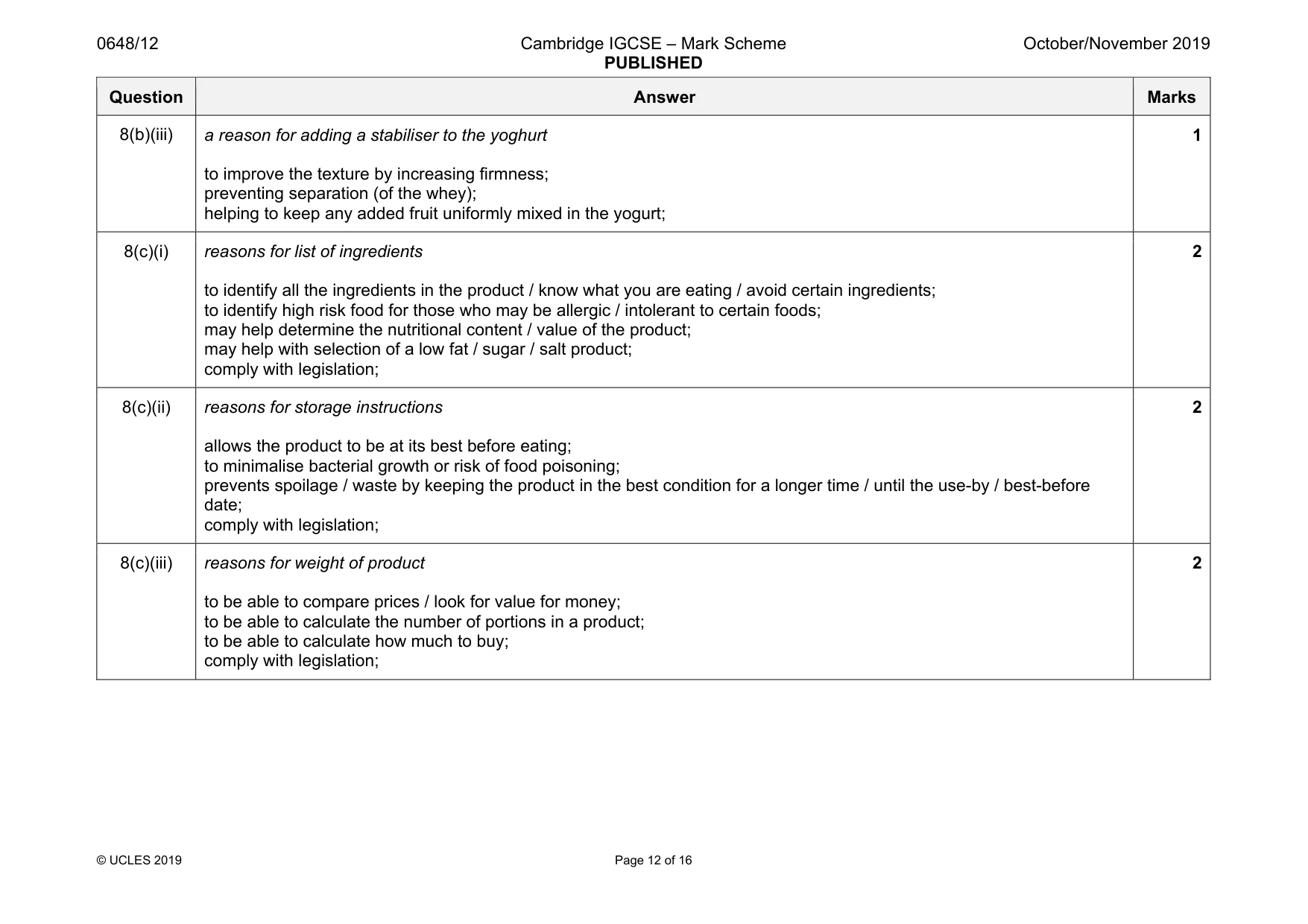
0648/12 Cambridge IGCSE – Mark Scheme PUBLISHED October/November 2019 © UCLES 2019 Page 12 of 16 Question Answer Marks 8(b)(iii) a reason for adding a stabiliser to the yoghurt to improve the texture by increasing firmness; preventing separation (of the whey); helping to keep any added fruit uniformly mixed in the yogurt; 1 8(c)(i) reasons for list of ingredients to identify all the ingredients in the product / know what you are eating / avoid certain ingredients; to identify high risk food for those who may be allergic / intolerant to certain foods; may help determine the nutritional content / value of the product; may help with selection of a low fat / sugar / salt product; comply with legislation; 2 8(c)(ii) reasons for storage instructions allows the product to be at its best before eating; to minimalise bacterial growth or risk of food poisoning; prevents spoilage / waste by keeping the product in the best condition for a longer time / until the use-by / best-before date; comply with legislation; 2 8(c)(iii) reasons for weight of product to be able to compare prices / look for value for money; to be able to calculate the number of portions in a product; to be able to calculate how much to buy; comply with legislation; 2
Mark scheme, page 13
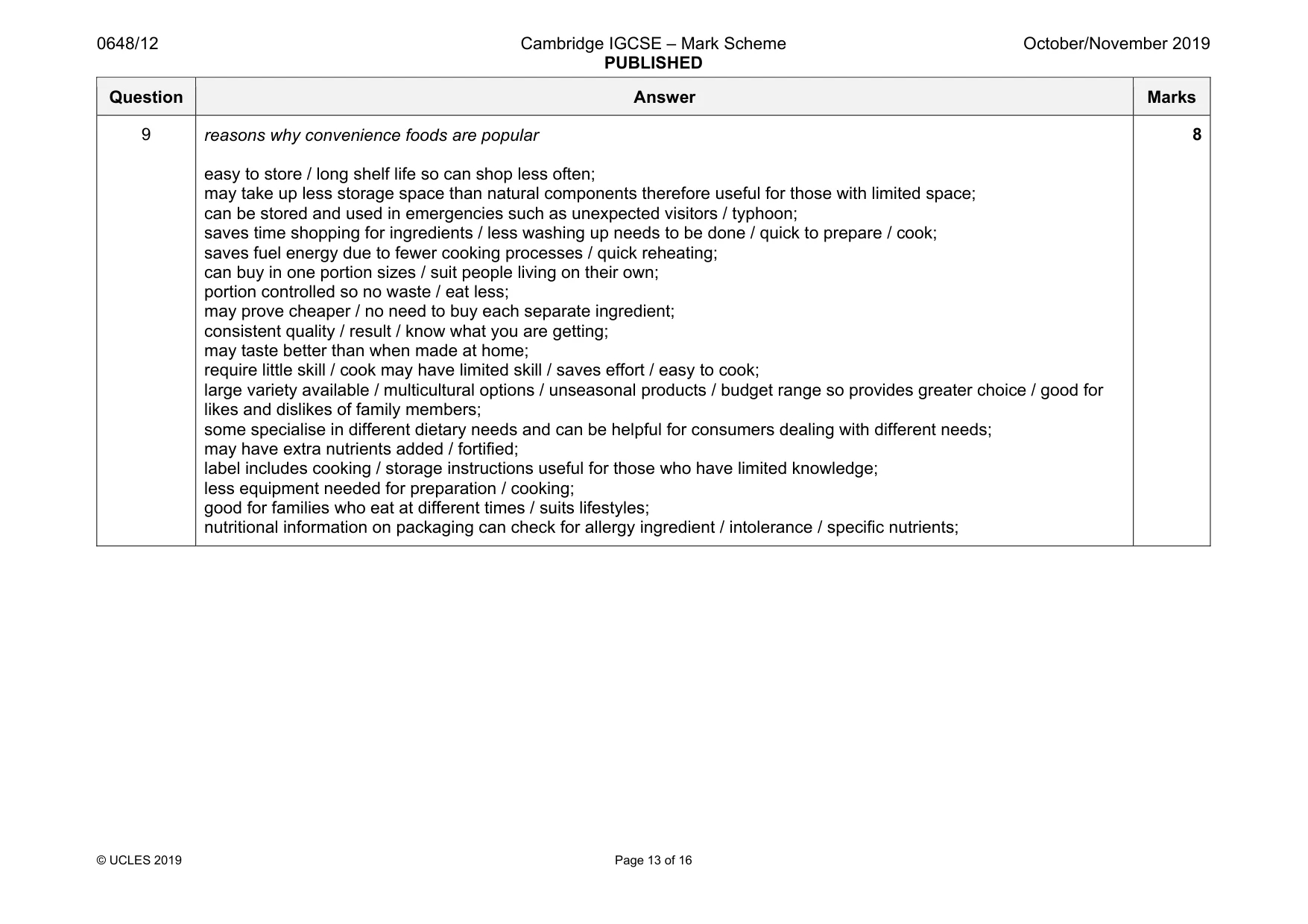
0648/12 Cambridge IGCSE – Mark Scheme PUBLISHED October/November 2019 © UCLES 2019 Page 13 of 16 Question Answer Marks 9 reasons why convenience foods are popular easy to store / long shelf life so can shop less often; may take up less storage space than natural components therefore useful for those with limited space; can be stored and used in emergencies such as unexpected visitors / typhoon; saves time shopping for ingredients / less washing up needs to be done / quick to prepare / cook; saves fuel energy due to fewer cooking processes / quick reheating; can buy in one portion sizes / suit people living on their own; portion controlled so no waste / eat less; may prove cheaper / no need to buy each separate ingredient; consistent quality / result / know what you are getting; may taste better than when made at home; require little skill / cook may have limited skill / saves effort / easy to cook; large variety available / multicultural options / unseasonal products / budget range so provides greater choice / good for likes and dislikes of family members; some specialise in different dietary needs and can be helpful for consumers dealing with different needs; may have extra nutrients added / fortified; label includes cooking / storage instructions useful for those who have limited knowledge; less equipment needed for preparation / cooking; good for families who eat at different times / suits lifestyles; nutritional information on packaging can check for allergy ingredient / intolerance / specific nutrients; 8
Mark scheme, page 14
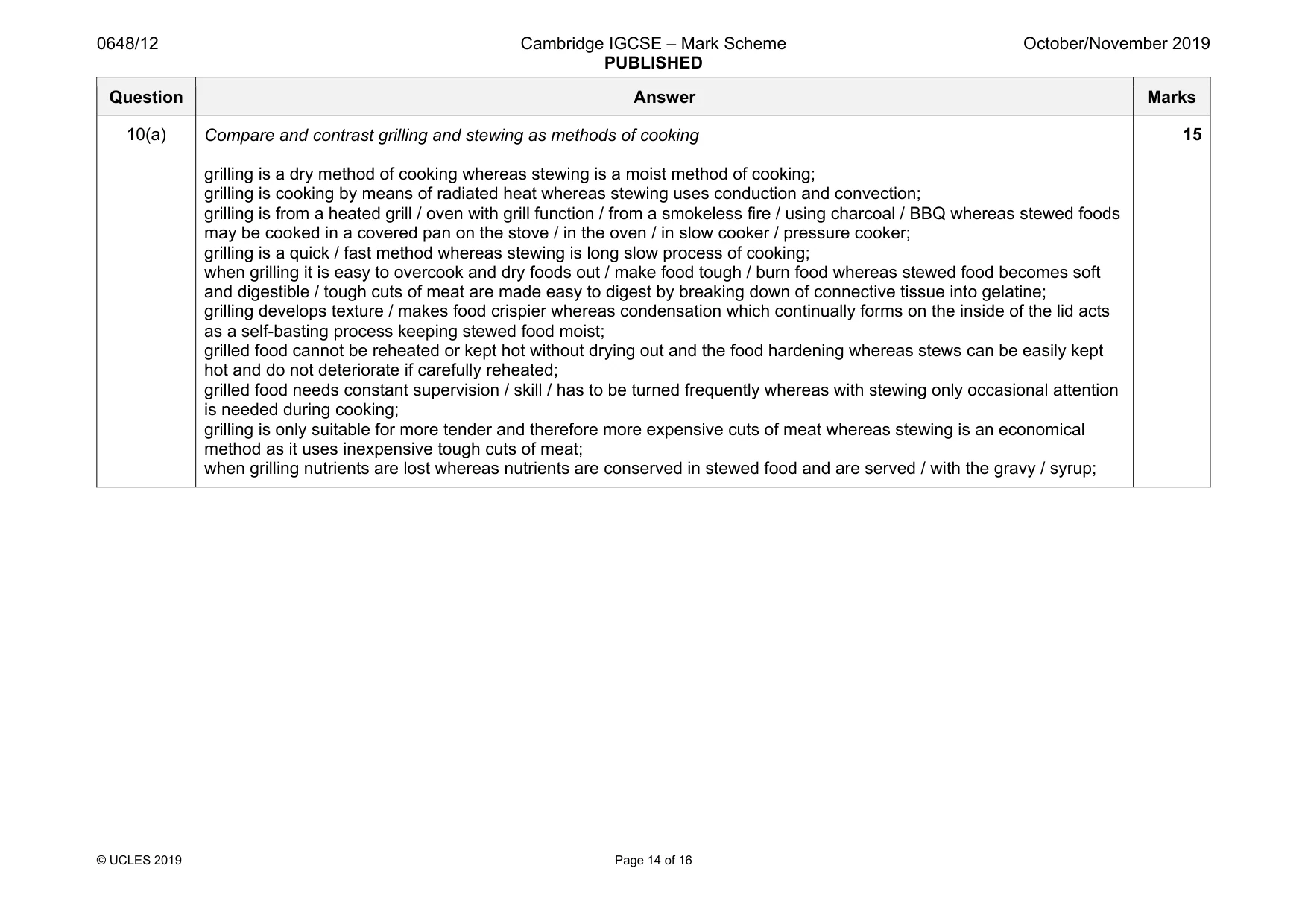
0648/12 Cambridge IGCSE – Mark Scheme PUBLISHED October/November 2019 © UCLES 2019 Page 14 of 16 Question Answer Marks 10(a) Compare and contrast grilling and stewing as methods of cooking grilling is a dry method of cooking whereas stewing is a moist method of cooking; grilling is cooking by means of radiated heat whereas stewing uses conduction and convection; grilling is from a heated grill / oven with grill function / from a smokeless fire / using charcoal / BBQ whereas stewed foods may be cooked in a covered pan on the stove / in the oven / in slow cooker / pressure cooker; grilling is a quick / fast method whereas stewing is long slow process of cooking; when grilling it is easy to overcook and dry foods out / make food tough / burn food whereas stewed food becomes soft and digestible / tough cuts of meat are made easy to digest by breaking down of connective tissue into gelatine; grilling develops texture / makes food crispier whereas condensation which continually forms on the inside of the lid acts as a self-basting process keeping stewed food moist; grilled food cannot be reheated or kept hot without drying out and the food hardening whereas stews can be easily kept hot and do not deteriorate if carefully reheated; grilled food needs constant supervision / skill / has to be turned frequently whereas with stewing only occasional attention is needed during cooking; grilling is only suitable for more tender and therefore more expensive cuts of meat whereas stewing is an economical method as it uses inexpensive tough cuts of meat; when grilling nutrients are lost whereas nutrients are conserved in stewed food and are served / with the gravy / syrup; 15
Mark scheme, page 15
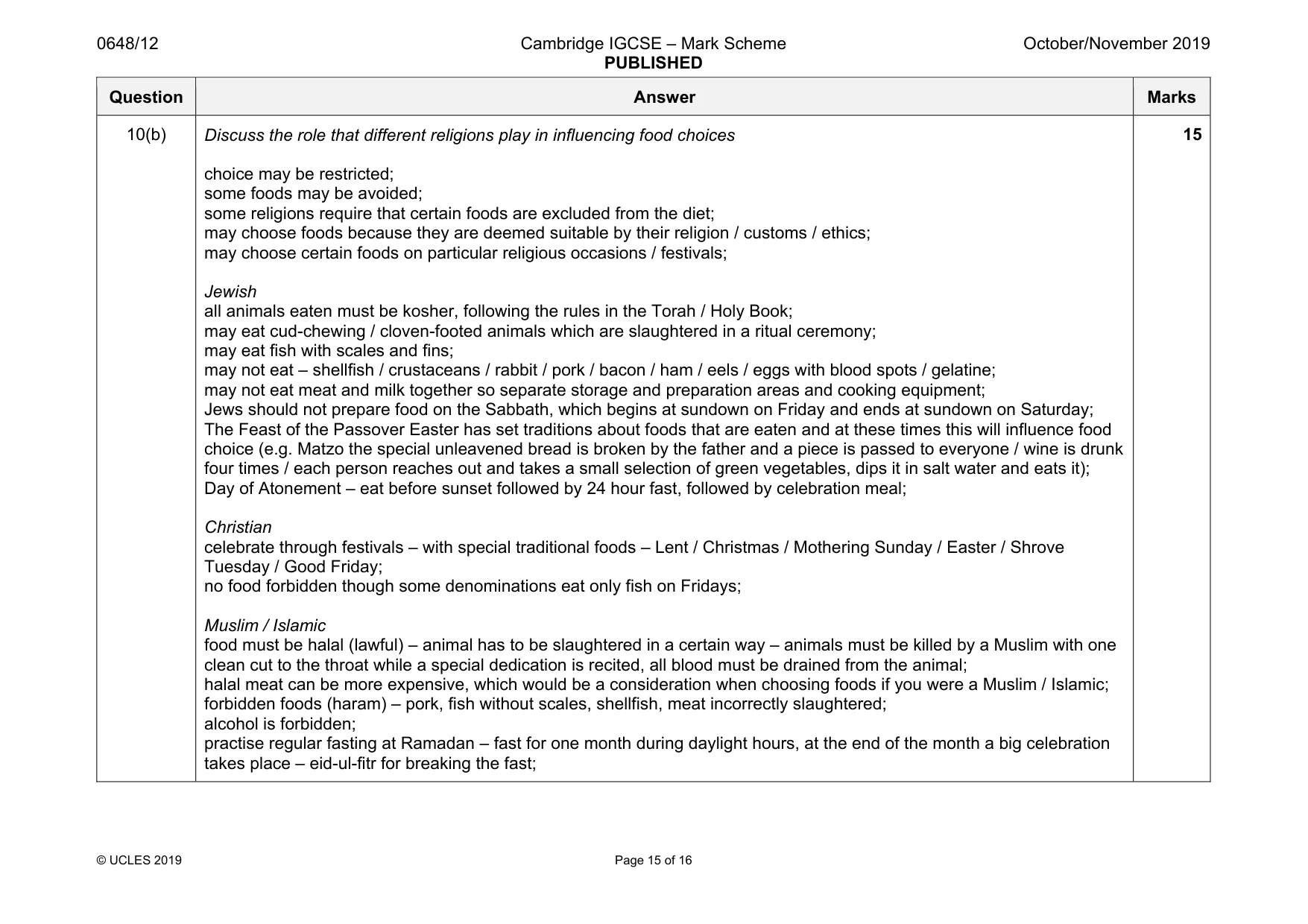
0648/12 Cambridge IGCSE – Mark Scheme PUBLISHED October/November 2019 © UCLES 2019 Page 15 of 16 Question Answer Marks 10(b) Discuss the role that different religions play in influencing food choices choice may be restricted; some foods may be avoided; some religions require that certain foods are excluded from the diet; may choose foods because they are deemed suitable by their religion / customs / ethics; may choose certain foods on particular religious occasions / festivals; Jewish all animals eaten must be kosher, following the rules in the Torah / Holy Book; may eat cud-chewing / cloven-footed animals which are slaughtered in a ritual ceremony; may eat fish with scales and fins; may not eat – shellfish / crustaceans / rabbit / pork / bacon / ham / eels / eggs with blood spots / gelatine; may not eat meat and milk together so separate storage and preparation areas and cooking equipment; Jews should not prepare food on the Sabbath, which begins at sundown on Friday and ends at sundown on Saturday; The Feast of the Passover Easter has set traditions about foods that are eaten and at these times this will influence food choice (e.g. Matzo the special unleavened bread is broken by the father and a piece is passed to everyone / wine is drunk four times / each person reaches out and takes a small selection of green vegetables, dips it in salt water and eats it); Day of Atonement – eat before sunset followed by 24 hour fast, followed by celebration meal; Christian celebrate through festivals – with special traditional foods – Lent / Christmas / Mothering Sunday / Easter / Shrove Tuesday / Good Friday; no food forbidden though some denominations eat only fish on Fridays; Muslim / Islamic food must be halal (lawful) – animal has to be slaughtered in a certain way – animals must be killed by a Muslim with one clean cut to the throat while a special dedication is recited, all blood must be drained from the animal; halal meat can be more expensive, which would be a consideration when choosing foods if you were a Muslim / Islamic; forbidden foods (haram) – pork, fish without scales, shellfish, meat incorrectly slaughtered; alcohol is forbidden; practise regular fasting at Ramadan – fast for one month during daylight hours, at the end of the month a big celebration takes place – eid-ul-fitr for breaking the fast; 15
Mark scheme, page 16
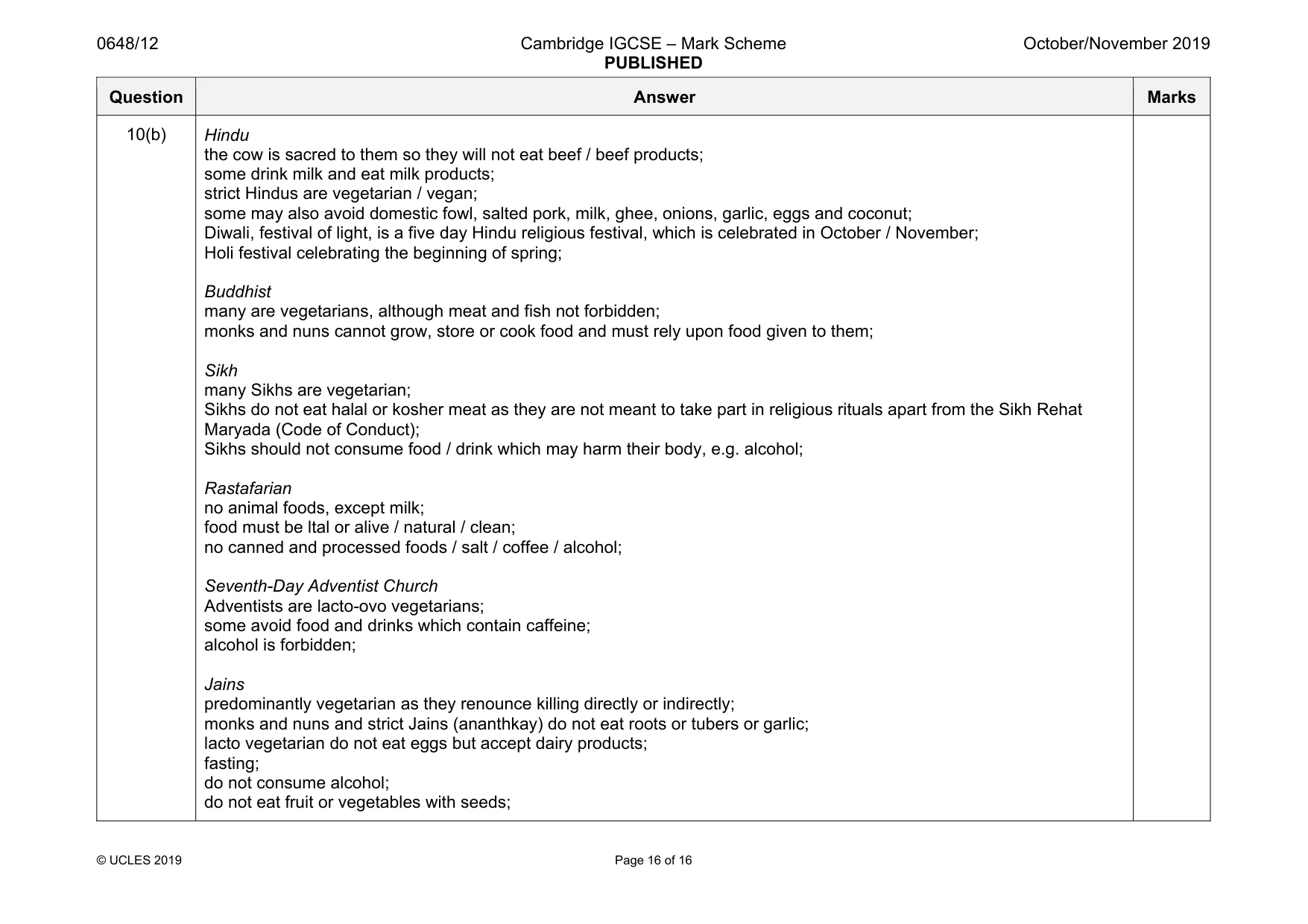
0648/12 Cambridge IGCSE – Mark Scheme PUBLISHED October/November 2019 © UCLES 2019 Page 16 of 16 Question Answer Marks 10(b) Hindu the cow is sacred to them so they will not eat beef / beef products; some drink milk and eat milk products; strict Hindus are vegetarian / vegan; some may also avoid domestic fowl, salted pork, milk, ghee, onions, garlic, eggs and coconut; Diwali, festival of light, is a five day Hindu religious festival, which is celebrated in October / November; Holi festival celebrating the beginning of spring; Buddhist many are vegetarians, although meat and fish not forbidden; monks and nuns cannot grow, store or cook food and must rely upon food given to them; Sikh many Sikhs are vegetarian; Sikhs do not eat halal or kosher meat as they are not meant to take part in religious rituals apart from the Sikh Rehat Maryada (Code of Conduct); Sikhs should not consume food / drink which may harm their body, e.g. alcohol; Rastafarian no animal foods, except milk; food must be ltal or alive / natural / clean; no canned and processed foods / salt / coffee / alcohol; Seventh-Day Adventist Church Adventists are lacto-ovo vegetarians; some avoid food and drinks which contain caffeine; alcohol is forbidden; Jains predominantly vegetarian as they renounce killing directly or indirectly; monks and nuns and strict Jains (ananthkay) do not eat roots or tubers or garlic; lacto vegetarian do not eat eggs but accept dairy products; fasting; do not consume alcohol; do not eat fruit or vegetables with seeds;
What you needed in this session
Cambridge’s own grade thresholds for 2019 Oct/Nov, Paper 1 · Variant 2. A higher threshold means an easier paper — the bar moves with how the cohort did.