Cambridge IGCSE Food and Nutrition 0648 — 2019 Oct/Nov Paper 1 · Variant 3
0648/13/O/N/19 · 100 marks · ≈113 min
The question paper and its mark scheme, free to read here and free to download. This is Cambridge’s own paper, exactly as it was sat.
Question paper12 pages


Mark scheme16 pages
Answers below. Sit the paper first if you are practising.
Paper as text
Question paper, page 1
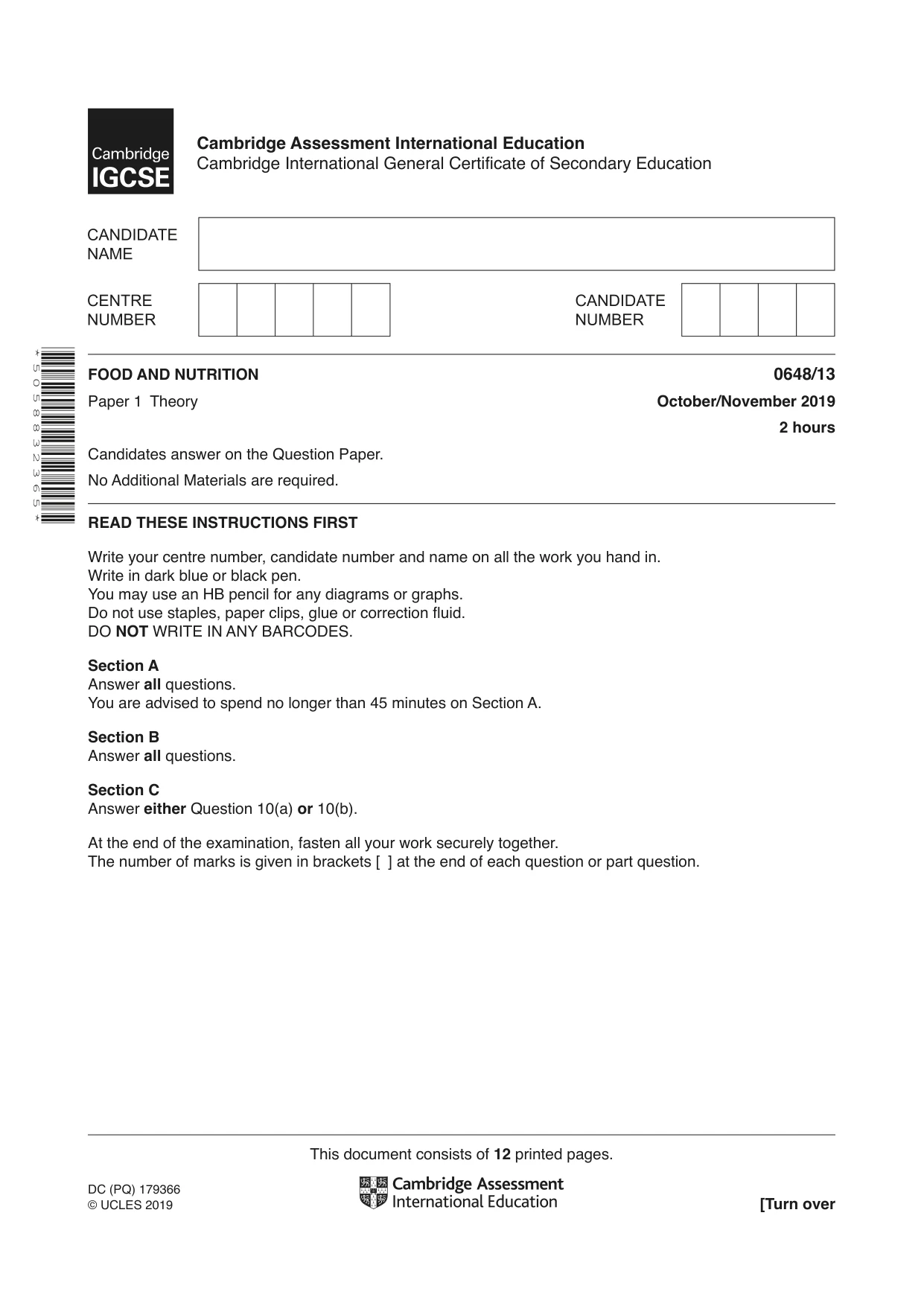
This document consists of 12 printed pages. DC (PQ) 179366 © UCLES 2019 [Turn over Cambridge Assessment International Education Cambridge International General Certificate of Secondary Education * 5 0 5 8 8 3 2 3 6 5 * FOOD AND NUTRITION 0648/13 Paper 1 Theory October/November 2019 2 hours Candidates answer on the Question Paper. No Additional Materials are required. READ THESE INSTRUCTIONS FIRST Write your centre number, candidate number and name on all the work you hand in. Write in dark blue or black pen. You may use an HB pencil for any diagrams or graphs. Do not use staples, paper clips, glue or correction fluid. DO NOT WRITE IN ANY BARCODES. Section A Answer all questions. You are advised to spend no longer than 45 minutes on Section A. Section B Answer all questions. Section C Answer either Question 10(a) or 10(b). At the end of the examination, fasten all your work securely together. The number of marks is given in brackets [ ] at the end of each question or part question.
Question paper, page 2
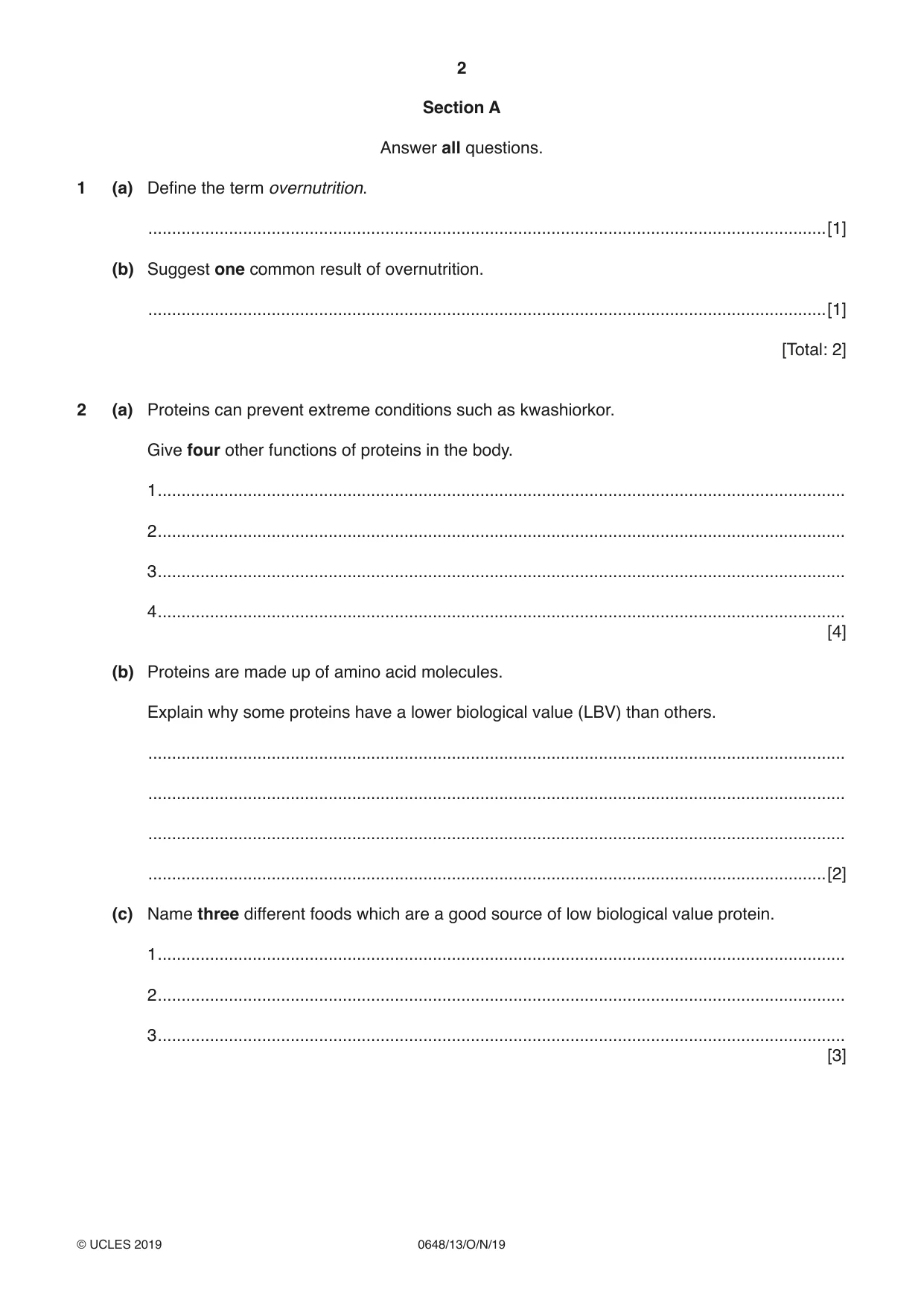
2 0648/13/O/N/19 © UCLES 2019 Section A Answer all questions. 1 (a) Define the term overnutrition. …[1] (b) Suggest one common result of overnutrition. …[1] [Total: 2] 2 (a) Proteins can prevent extreme conditions such as kwashiorkor. Give four other functions of proteins in the body. 1 … 2 … 3 … 4 … [4] (b) Proteins are made up of amino acid molecules. Explain why some proteins have a lower biological value (LBV) than others. … … … …[2] (c) Name three different foods which are a good source of low biological value protein. 1 … 2 … 3 … [3]
Question paper, page 3
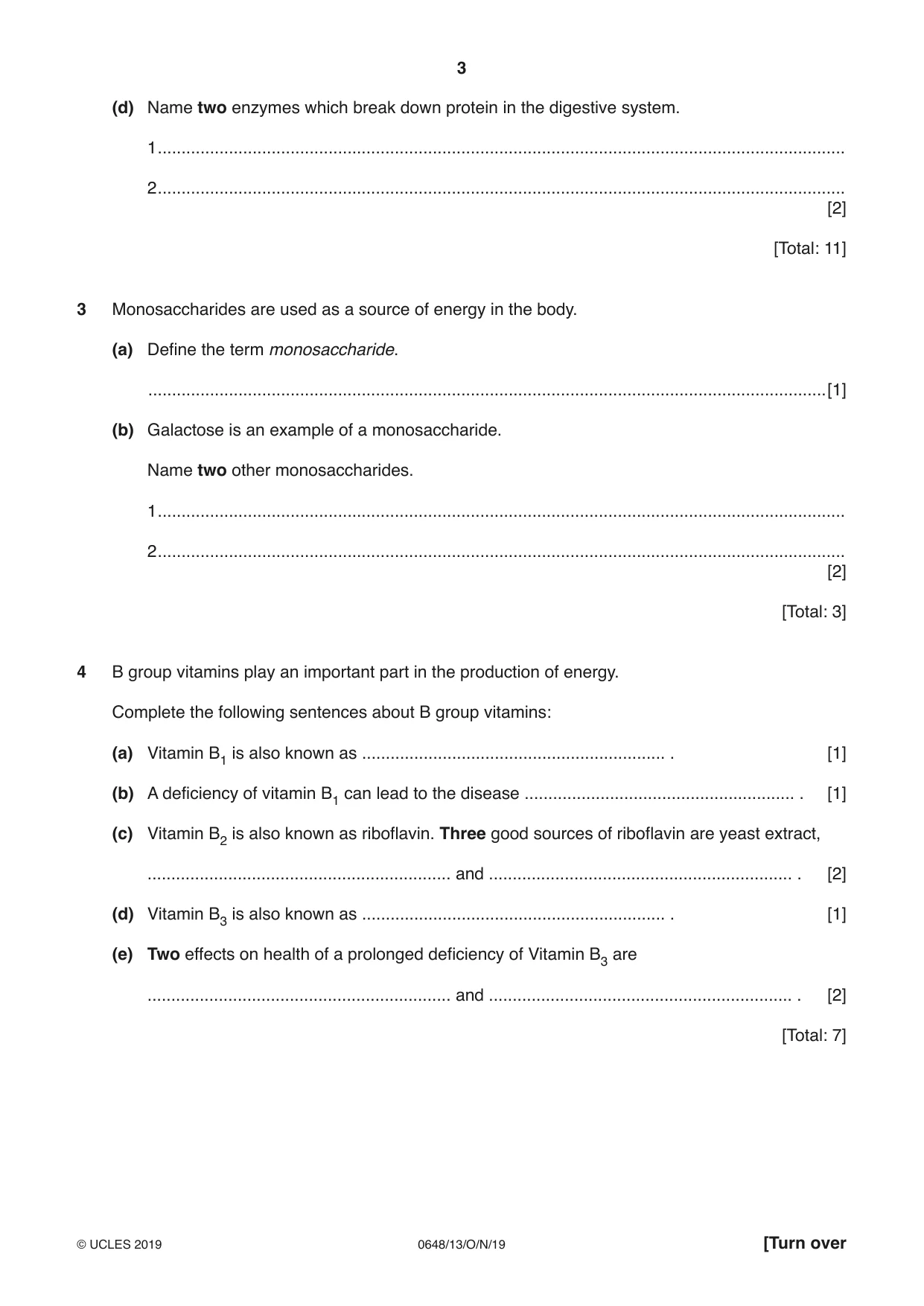
3 0648/13/O/N/19 © UCLES 2019 [Turn over (d) Name two enzymes which break down protein in the digestive system. 1 … 2 … [2] [Total: 11] 3 Monosaccharides are used as a source of energy in the body. (a) Define the term monosaccharide. …[1] (b) Galactose is an example of a monosaccharide. Name two other monosaccharides. 1 … 2 … [2] [Total: 3] 4 B group vitamins play an important part in the production of energy. Complete the following sentences about B group vitamins: (a) Vitamin B1 is also known as … . [1] (b) A deficiency of vitamin B1 can lead to the disease … . [1] (c) Vitamin B2 is also known as riboflavin. Three good sources of riboflavin are yeast extract, … and … . [2] (d) Vitamin B3 is also known as … . [1] (e) Two effects on health of a prolonged deficiency of Vitamin B3 are … and … . [2] [Total: 7]
Question paper, page 4
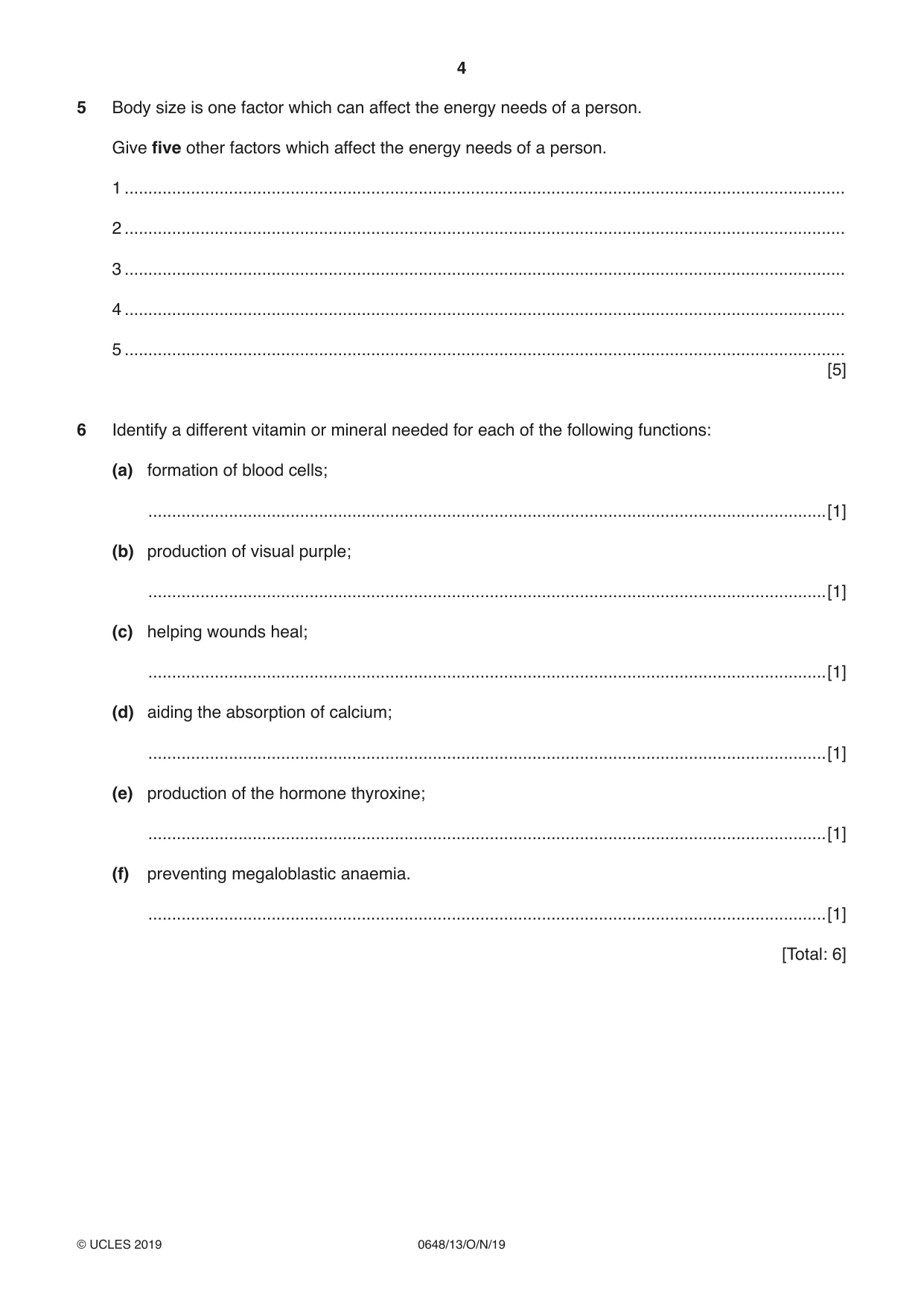
4 0648/13/O/N/19 © UCLES 2019 5 Body size is one factor which can affect the energy needs of a person. Give five other factors which affect the energy needs of a person. 1 … 2 … 3 … 4 … 5 … [5] 6 Identify a different vitamin or mineral needed for each of the following functions: (a) formation of blood cells; …[1] (b) production of visual purple; …[1] (c) helping wounds heal; …[1] (d) aiding the absorption of calcium; …[1] (e) production of the hormone thyroxine; …[1] (f) preventing megaloblastic anaemia. …[1] [Total: 6]
Question paper, page 5
5 0648/13/O/N/19 © UCLES 2019 [Turn over 7 Most absorption of digested food takes place in the ileum. Describe the structure of the ileum. … … … … … … … … … … … …[6]
Question paper, page 6
6 0648/13/O/N/19 © UCLES 2019 Section B Answer all questions. 8 Current dietary advice is to include fresh fruit in the diet each day. (a) Identify and explain five nutritional reasons for this advice. 1 … … 2 … … 3 … … 4 … … 5 … … [5] (b) Fruit can be preserved by making jam. Explain how each of the following steps helps to prevent fruit spoiling when making jam: (i) boiling fruit; …[1] (ii) adding sugar; …[1] (iii) sealing jars. …[1]
Question paper, page 7
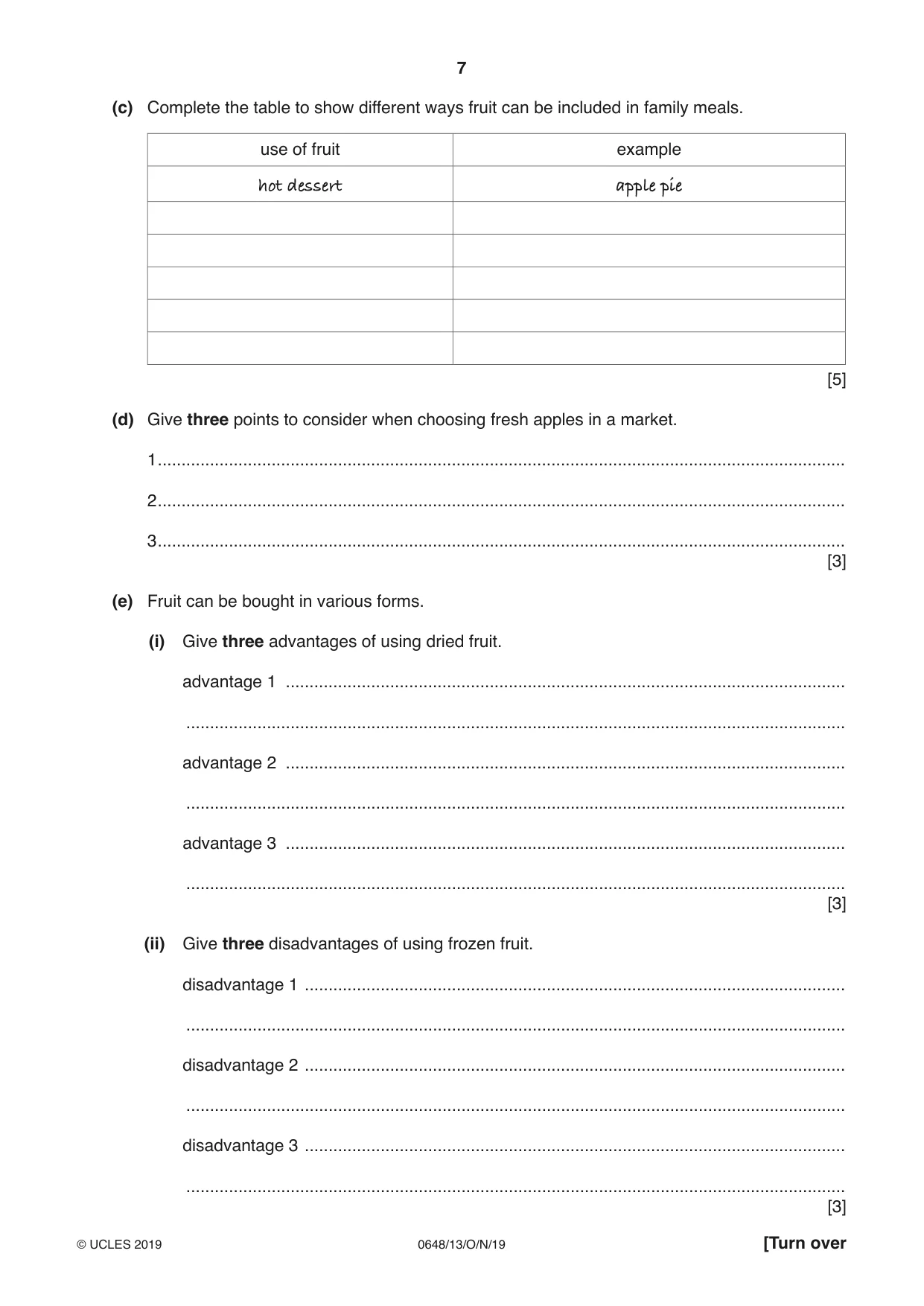
7 0648/13/O/N/19 © UCLES 2019 [Turn over (c) Complete the table to show different ways fruit can be included in family meals. use of fruit example hot dessert apple pie [5] (d) Give three points to consider when choosing fresh apples in a market. 1 … 2 … 3 … [3] (e) Fruit can be bought in various forms. (i) Give three advantages of using dried fruit. advantage 1 … … advantage 2 … … advantage 3 … … [3] (ii) Give three disadvantages of using frozen fruit. disadvantage 1 … … disadvantage 2 … … disadvantage 3 … … [3]
Question paper, page 8
8 0648/13/O/N/19 © UCLES 2019 (f) Describe one method of preparing and freezing strawberries. … … … … … … … … … … [5] [Total: 27] 9 A basic recipe for a chicken pie uses the following ingredients: shortcrust pastry 200 g plain flour 50 g butter 50 g white vegetable fat pinch of salt 100 ml cold water filling 200 g cooked chicken breast 100 ml white sauce (a) Give four steps for making the shortcrust pastry. 1 … 2 … 3 … 4 … [4]
Question paper, page 9
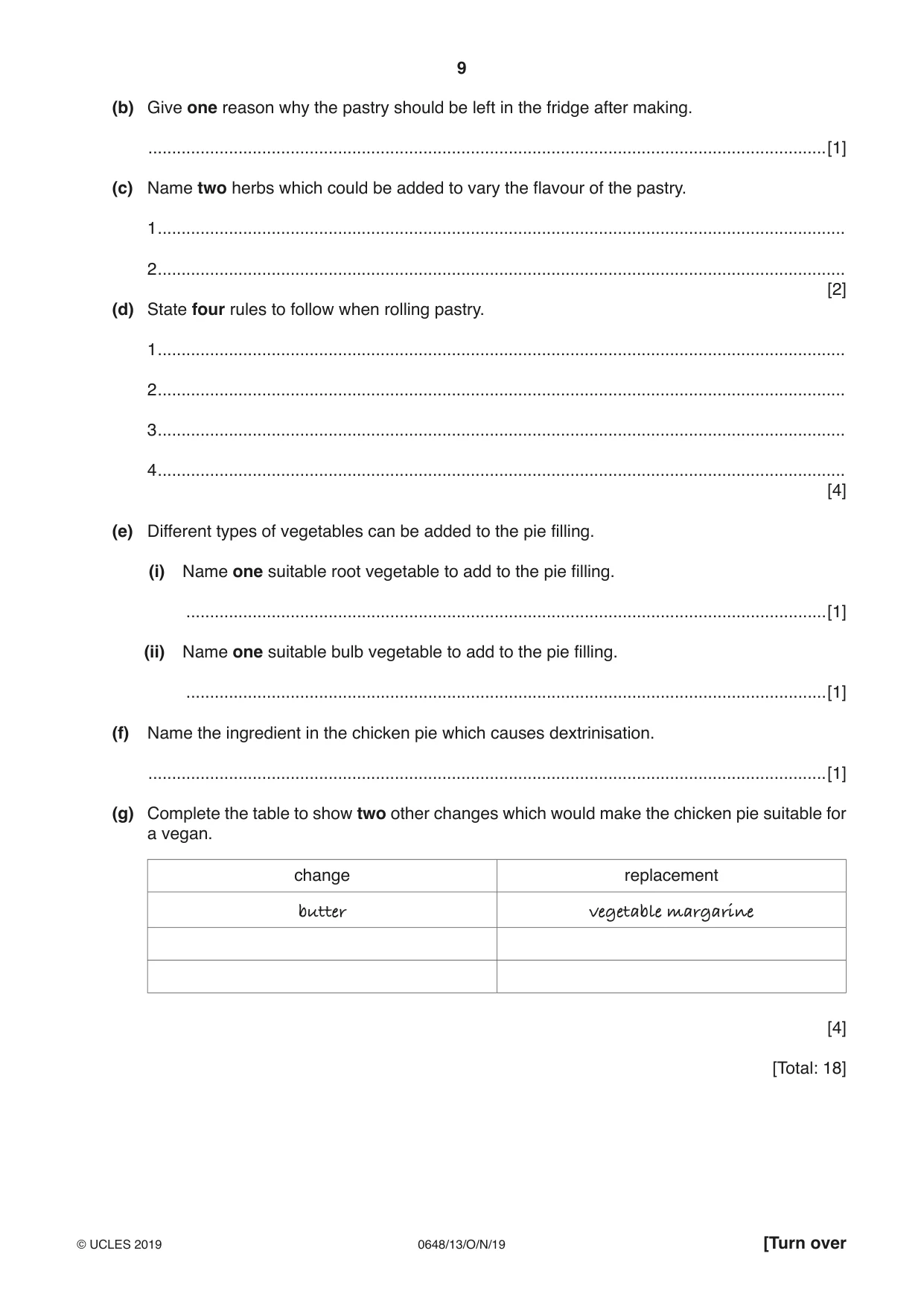
9 0648/13/O/N/19 © UCLES 2019 [Turn over (b) Give one reason why the pastry should be left in the fridge after making. …[1] (c) Name two herbs which could be added to vary the flavour of the pastry. 1 … 2 … [2] (d) State four rules to follow when rolling pastry. 1 … 2 … 3 … 4 … [4] (e) Different types of vegetables can be added to the pie filling. (i) Name one suitable root vegetable to add to the pie filling. …[1] (ii) Name one suitable bulb vegetable to add to the pie filling. …[1] (f) Name the ingredient in the chicken pie which causes dextrinisation. …[1] (g) Complete the table to show two other changes which would make the chicken pie suitable for a vegan. change replacement butter vegetable margarine [4] [Total: 18]
Question paper, page 10
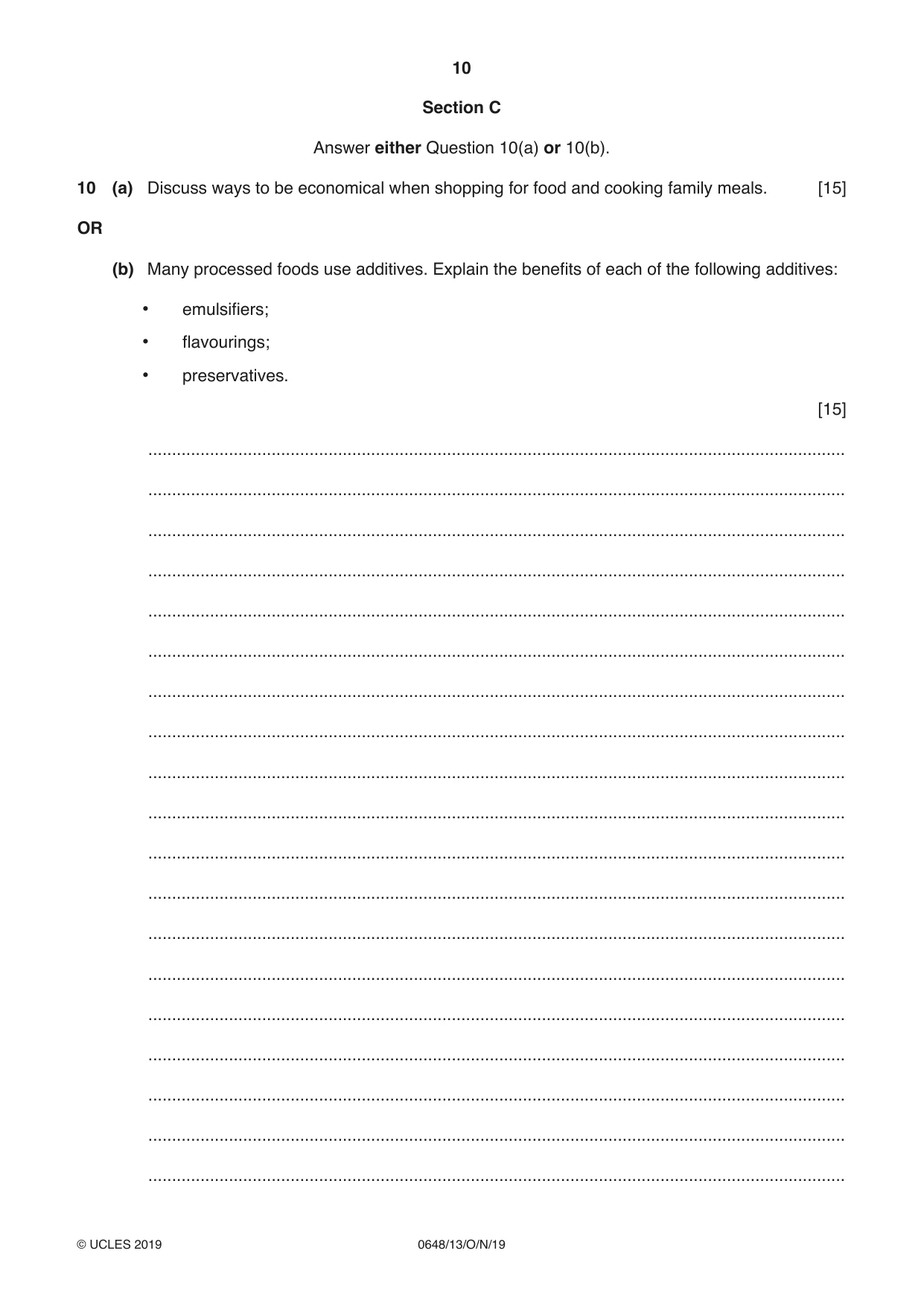
10 0648/13/O/N/19 © UCLES 2019 Section C Answer either Question 10(a) or 10(b). 10 (a) Discuss ways to be economical when shopping for food and cooking family meals. [15] OR (b) Many processed foods use additives. Explain the benefits of each of the following additives: • emulsifiers; • flavourings; • preservatives. [15] … … … … … … … … … … … … … … … … … … …
Question paper, page 11
11 0648/13/O/N/19 © UCLES 2019 [Turn over … … … … … … … … … … … … … … … … … … … … … … … … … … … …
Question paper, page 12
12 0648/13/O/N/19 © UCLES 2019 Permission to reproduce items where third-party owned material protected by copyright is included has been sought and cleared where possible. Every reasonable effort has been made by the publisher (UCLES) to trace copyright holders, but if any items requiring clearance have unwittingly been included, the publisher will be pleased to make amends at the earliest possible opportunity. To avoid the issue of disclosure of answer-related information to candidates, all copyright acknowledgements are reproduced online in the Cambridge Assessment International Education Copyright Acknowledgements Booklet. This is produced for each series of examinations and is freely available to download at www.cambridgeinternational.org after the live examination series. Cambridge Assessment International Education is part of the Cambridge Assessment Group. Cambridge Assessment is the brand name of the University of Cambridge Local Examinations Syndicate (UCLES), which itself is a department of the University of Cambridge. … … … … … … … … … … … … … … … … … … … … … … …
Mark scheme, page 1
This document consists of 16 printed pages. © UCLES 2019 [Turn over Cambridge Assessment International Education Cambridge International General Certificate of Secondary Education FOOD AND NUTRITION 0648/13 Paper 1 Theory October/November 2019 MARK SCHEME Maximum Mark: 100 Published This mark scheme is published as an aid to teachers and candidates, to indicate the requirements of the examination. It shows the basis on which Examiners were instructed to award marks. It does not indicate the details of the discussions that took place at an Examiners’ meeting before marking began, which would have considered the acceptability of alternative answers. Mark schemes should be read in conjunction with the question paper and the Principal Examiner Report for Teachers. Cambridge International will not enter into discussions about these mark schemes. Cambridge International is publishing the mark schemes for the October/November 2019 series for most Cambridge IGCSE™, Cambridge International A and AS Level components and some Cambridge O Level components.
Mark scheme, page 2
0648/13 Cambridge IGCSE – Mark Scheme PUBLISHED October/November 2019 © UCLES 2019 Page 2 of 16 Generic Marking Principles These general marking principles must be applied by all examiners when marking candidate answers. They should be applied alongside the specific content of the mark scheme or generic level descriptors for a question. Each question paper and mark scheme will also comply with these marking principles. GENERIC MARKING PRINCIPLE 1: Marks must be awarded in line with: • the specific content of the mark scheme or the generic level descriptors for the question • the specific skills defined in the mark scheme or in the generic level descriptors for the question • the standard of response required by a candidate as exemplified by the standardisation scripts. GENERIC MARKING PRINCIPLE 2: Marks awarded are always whole marks (not half marks, or other fractions). GENERIC MARKING PRINCIPLE 3: Marks must be awarded positively: • marks are awarded for correct/valid answers, as defined in the mark scheme. However, credit is given for valid answers which go beyond the scope of the syllabus and mark scheme, referring to your Team Leader as appropriate • marks are awarded when candidates clearly demonstrate what they know and can do • marks are not deducted for errors • marks are not deducted for omissions • answers should only be judged on the quality of spelling, punctuation and grammar when these features are specifically assessed by the question as indicated by the mark scheme. The meaning, however, should be unambiguous. GENERIC MARKING PRINCIPLE 4: Rules must be applied consistently e.g. in situations where candidates have not followed instructions or in the application of generic level descriptors.
Mark scheme, page 3
0648/13 Cambridge IGCSE – Mark Scheme PUBLISHED October/November 2019 © UCLES 2019 Page 3 of 16 GENERIC MARKING PRINCIPLE 5: Marks should be awarded using the full range of marks defined in the mark scheme for the question (however; the use of the full mark range may be limited according to the quality of the candidate responses seen). GENERIC MARKING PRINCIPLE 6: Marks awarded are based solely on the requirements as defined in the mark scheme. Marks should not be awarded with grade thresholds or grade descriptors in mind.
Mark scheme, page 4
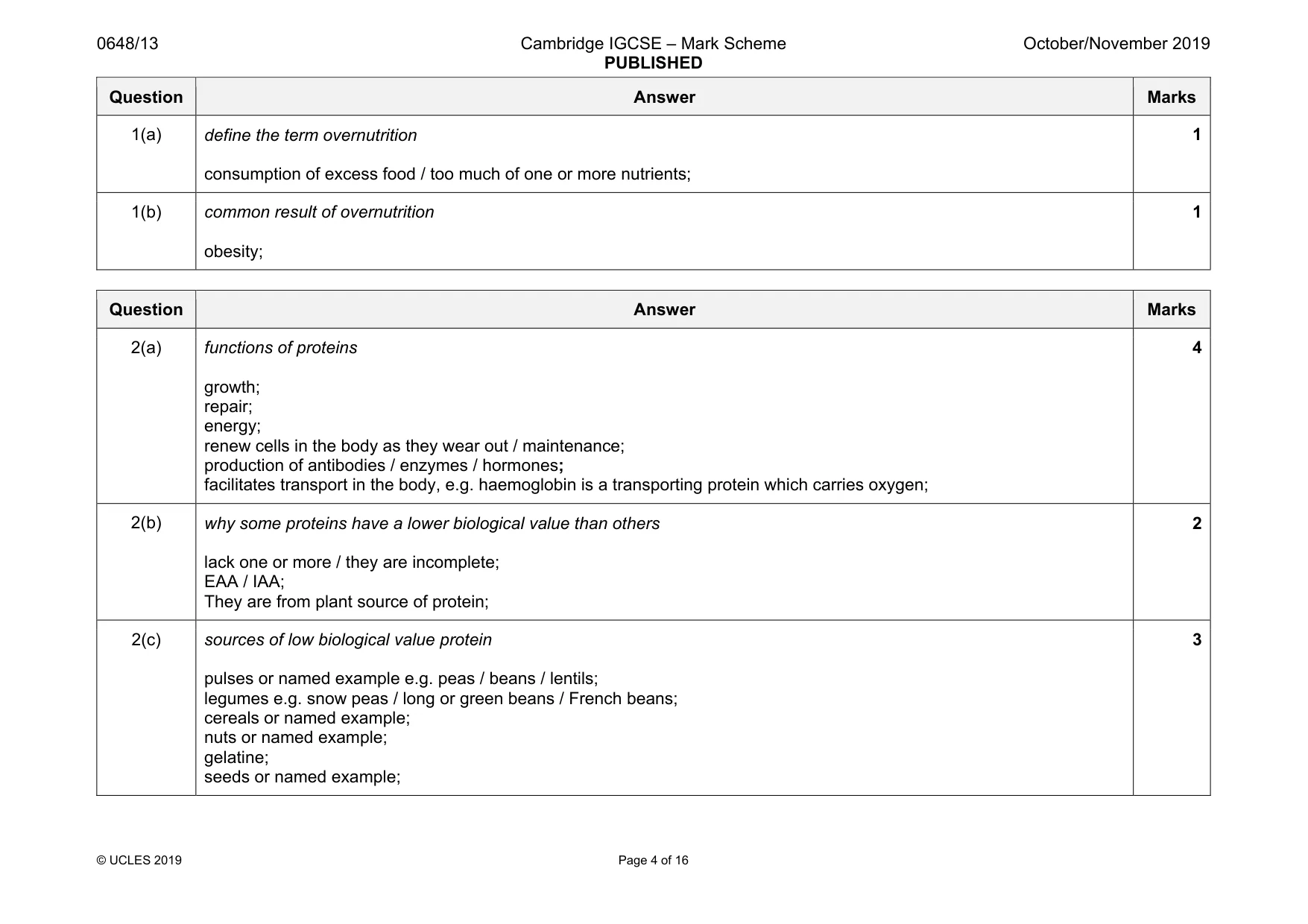
0648/13 Cambridge IGCSE – Mark Scheme PUBLISHED October/November 2019 © UCLES 2019 Page 4 of 16 Question Answer Marks 1(a) define the term overnutrition consumption of excess food / too much of one or more nutrients; 1 1(b) common result of overnutrition obesity; 1 Question Answer Marks 2(a) functions of proteins growth; repair; energy; renew cells in the body as they wear out / maintenance; production of antibodies / enzymes / hormones; facilitates transport in the body, e.g. haemoglobin is a transporting protein which carries oxygen; 4 2(b) why some proteins have a lower biological value than others lack one or more / they are incomplete; EAA / IAA; They are from plant source of protein; 2 2(c) sources of low biological value protein pulses or named example e.g. peas / beans / lentils; legumes e.g. snow peas / long or green beans / French beans; cereals or named example; nuts or named example; gelatine; seeds or named example; 3
Mark scheme, page 5
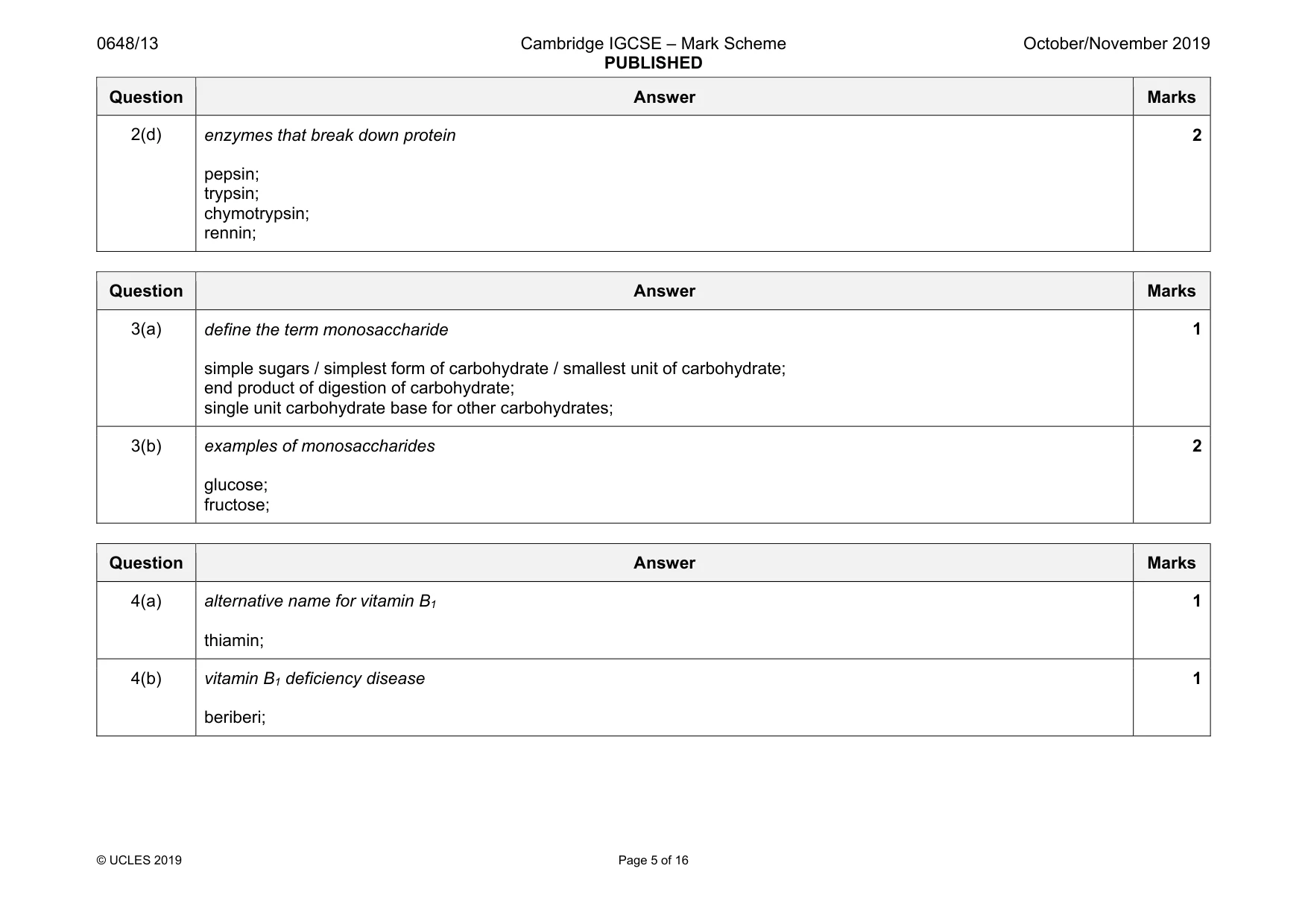
0648/13 Cambridge IGCSE – Mark Scheme PUBLISHED October/November 2019 © UCLES 2019 Page 5 of 16 Question Answer Marks 2(d) enzymes that break down protein pepsin; trypsin; chymotrypsin; rennin; 2 Question Answer Marks 3(a) define the term monosaccharide simple sugars / simplest form of carbohydrate / smallest unit of carbohydrate; end product of digestion of carbohydrate; single unit carbohydrate base for other carbohydrates; 1 3(b) examples of monosaccharides glucose; fructose; 2 Question Answer Marks 4(a) alternative name for vitamin B1 thiamin; 1 4(b) vitamin B1 deficiency disease beriberi; 1
Mark scheme, page 6
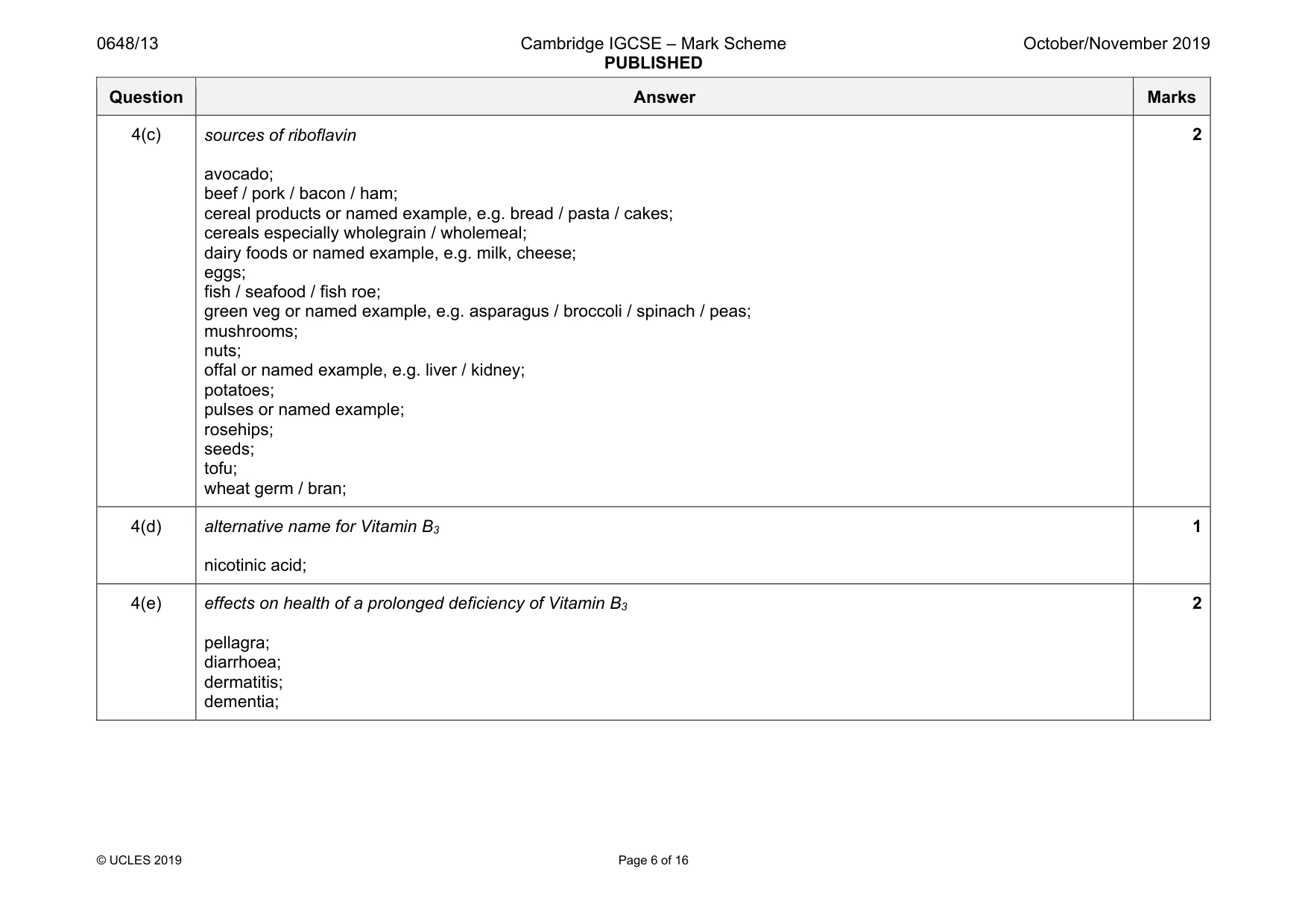
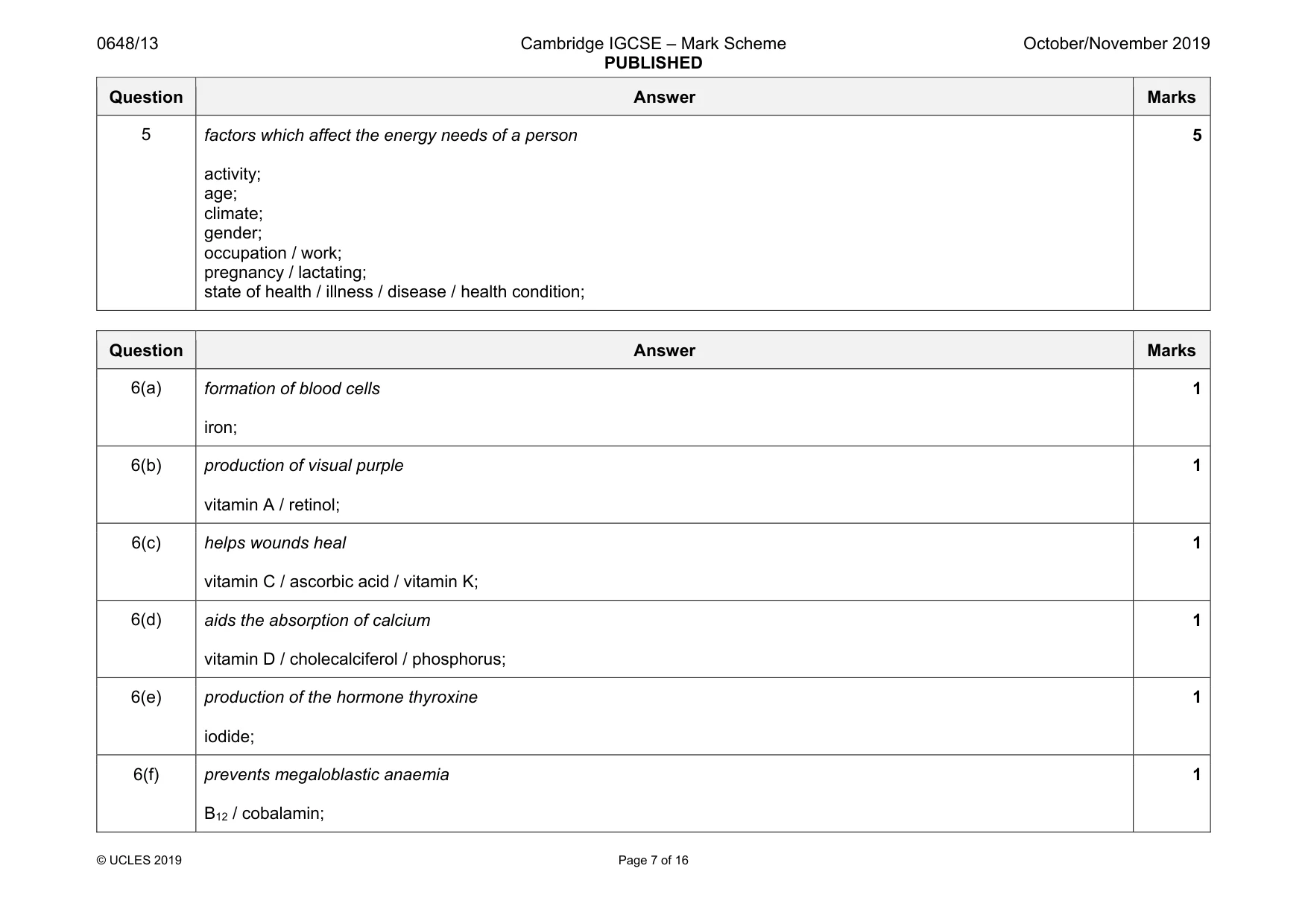
0648/13 Cambridge IGCSE – Mark Scheme PUBLISHED October/November 2019 © UCLES 2019 Page 6 of 16 Question Answer Marks 4(c) sources of riboflavin avocado; beef / pork / bacon / ham; cereal products or named example, e.g. bread / pasta / cakes; cereals especially wholegrain / wholemeal; dairy foods or named example, e.g. milk, cheese; eggs; fish / seafood / fish roe; green veg or named example, e.g. asparagus / broccoli / spinach / peas; mushrooms; nuts; offal or named example, e.g. liver / kidney; potatoes; pulses or named example; rosehips; seeds; tofu; wheat germ / bran; 2 4(d) alternative name for Vitamin B3 nicotinic acid; 1 4(e) effects on health of a prolonged deficiency of Vitamin B3 pellagra; diarrhoea; dermatitis; dementia; 2
Mark scheme, page 7
0648/13 Cambridge IGCSE – Mark Scheme PUBLISHED October/November 2019 © UCLES 2019 Page 7 of 16 Question Answer Marks 5 factors which affect the energy needs of a person activity; age; climate; gender; occupation / work; pregnancy / lactating; state of health / illness / disease / health condition; 5 Question Answer Marks 6(a) formation of blood cells iron; 1 6(b) production of visual purple vitamin A / retinol; 1 6(c) helps wounds heal vitamin C / ascorbic acid / vitamin K; 1 6(d) aids the absorption of calcium vitamin D / cholecalciferol / phosphorus; 1 6(e) production of the hormone thyroxine iodide; 1 6(f) prevents megaloblastic anaemia B12 / cobalamin; 1
Mark scheme, page 8
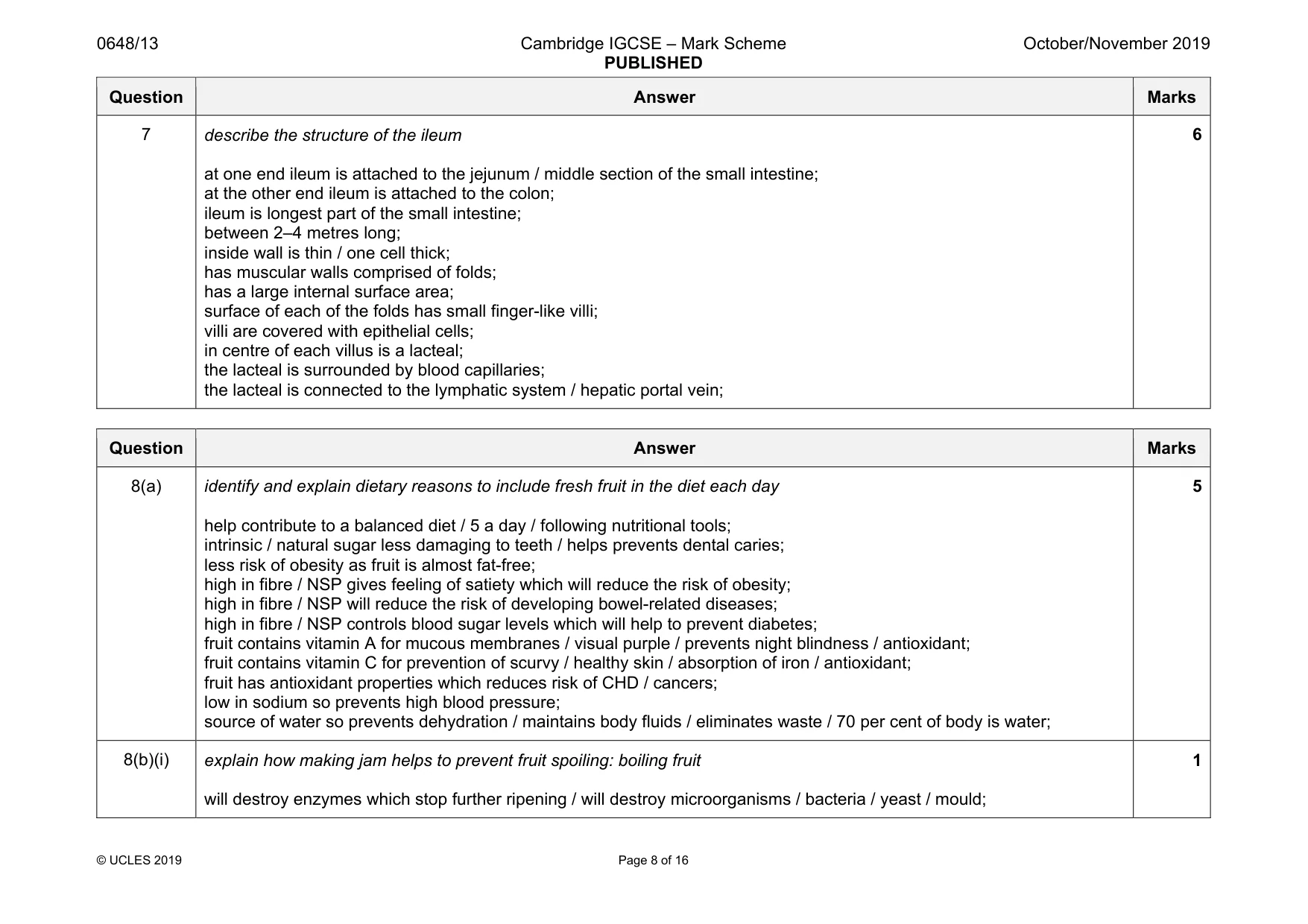
0648/13 Cambridge IGCSE – Mark Scheme PUBLISHED October/November 2019 © UCLES 2019 Page 8 of 16 Question Answer Marks 7 describe the structure of the ileum at one end ileum is attached to the jejunum / middle section of the small intestine; at the other end ileum is attached to the colon; ileum is longest part of the small intestine; between 2–4 metres long; inside wall is thin / one cell thick; has muscular walls comprised of folds; has a large internal surface area; surface of each of the folds has small finger-like villi; villi are covered with epithelial cells; in centre of each villus is a lacteal; the lacteal is surrounded by blood capillaries; the lacteal is connected to the lymphatic system / hepatic portal vein; 6 Question Answer Marks 8(a) identify and explain dietary reasons to include fresh fruit in the diet each day help contribute to a balanced diet / 5 a day / following nutritional tools; intrinsic / natural sugar less damaging to teeth / helps prevents dental caries; less risk of obesity as fruit is almost fat-free; high in fibre / NSP gives feeling of satiety which will reduce the risk of obesity; high in fibre / NSP will reduce the risk of developing bowel-related diseases; high in fibre / NSP controls blood sugar levels which will help to prevent diabetes; fruit contains vitamin A for mucous membranes / visual purple / prevents night blindness / antioxidant; fruit contains vitamin C for prevention of scurvy / healthy skin / absorption of iron / antioxidant; fruit has antioxidant properties which reduces risk of CHD / cancers; low in sodium so prevents high blood pressure; source of water so prevents dehydration / maintains body fluids / eliminates waste / 70 per cent of body is water; 5 8(b)(i) explain how making jam helps to prevent fruit spoiling: boiling fruit will destroy enzymes which stop further ripening / will destroy microorganisms / bacteria / yeast / mould; 1
Mark scheme, page 9
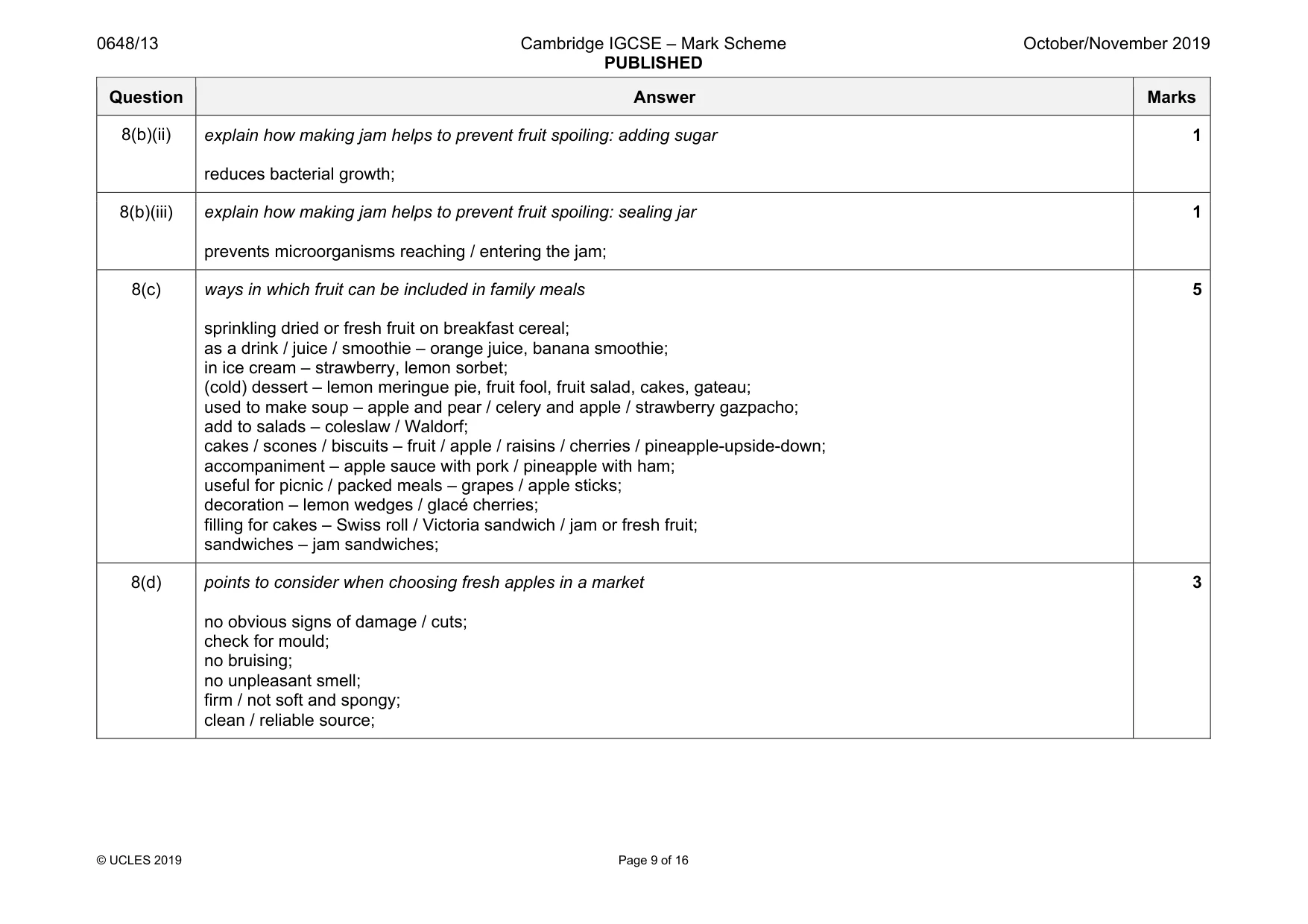
0648/13 Cambridge IGCSE – Mark Scheme PUBLISHED October/November 2019 © UCLES 2019 Page 9 of 16 Question Answer Marks 8(b)(ii) explain how making jam helps to prevent fruit spoiling: adding sugar reduces bacterial growth; 1 8(b)(iii) explain how making jam helps to prevent fruit spoiling: sealing jar prevents microorganisms reaching / entering the jam; 1 8(c) ways in which fruit can be included in family meals sprinkling dried or fresh fruit on breakfast cereal; as a drink / juice / smoothie – orange juice, banana smoothie; in ice cream – strawberry, lemon sorbet; (cold) dessert – lemon meringue pie, fruit fool, fruit salad, cakes, gateau; used to make soup – apple and pear / celery and apple / strawberry gazpacho; add to salads – coleslaw / Waldorf; cakes / scones / biscuits – fruit / apple / raisins / cherries / pineapple-upside-down; accompaniment – apple sauce with pork / pineapple with ham; useful for picnic / packed meals – grapes / apple sticks; decoration – lemon wedges / glacé cherries; filling for cakes – Swiss roll / Victoria sandwich / jam or fresh fruit; sandwiches – jam sandwiches; 5 8(d) points to consider when choosing fresh apples in a market no obvious signs of damage / cuts; check for mould; no bruising; no unpleasant smell; firm / not soft and spongy; clean / reliable source; 3
Mark scheme, page 10
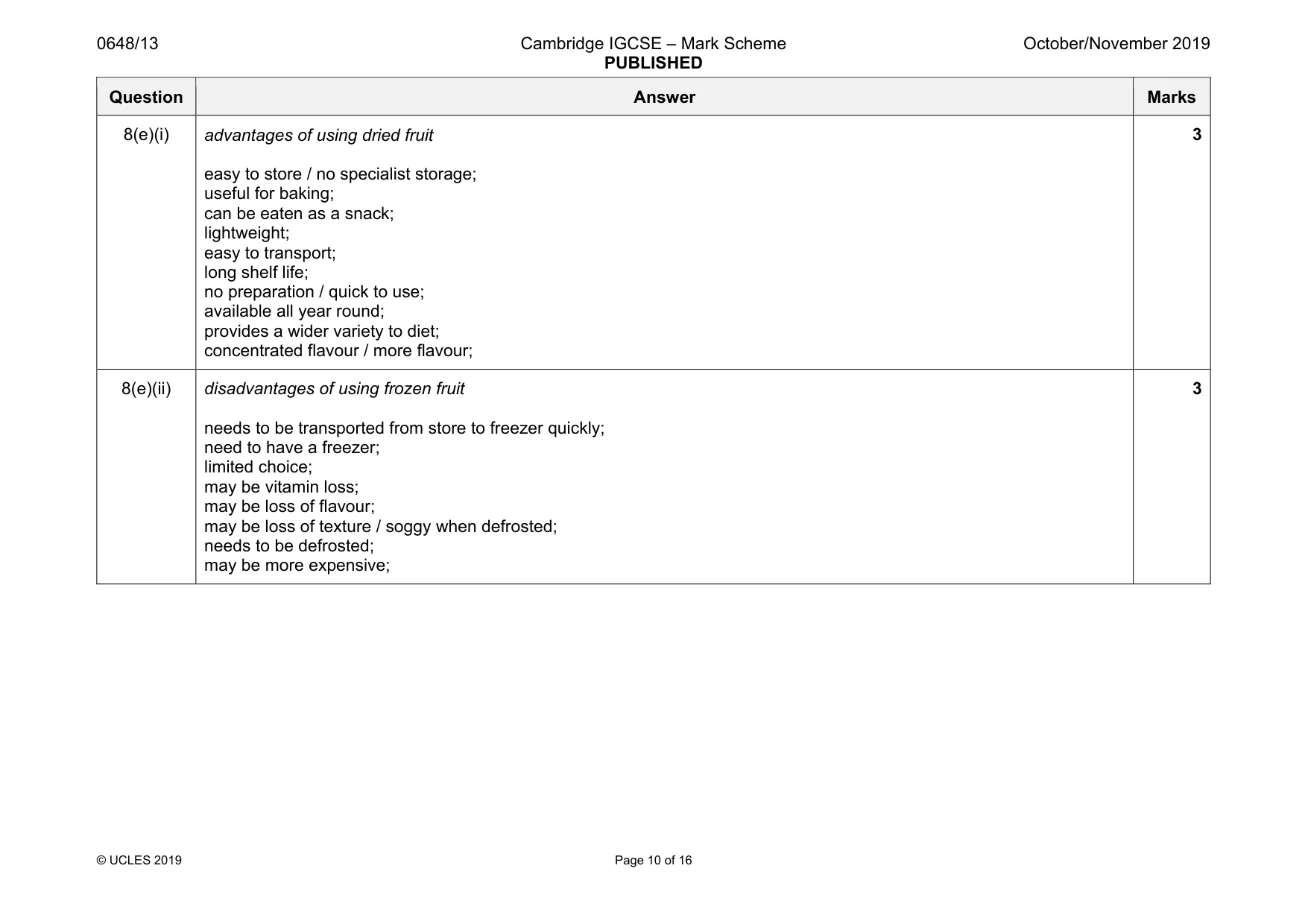
0648/13 Cambridge IGCSE – Mark Scheme PUBLISHED October/November 2019 © UCLES 2019 Page 10 of 16 Question Answer Marks 8(e)(i) advantages of using dried fruit easy to store / no specialist storage; useful for baking; can be eaten as a snack; lightweight; easy to transport; long shelf life; no preparation / quick to use; available all year round; provides a wider variety to diet; concentrated flavour / more flavour; 3 8(e)(ii) disadvantages of using frozen fruit needs to be transported from store to freezer quickly; need to have a freezer; limited choice; may be vitamin loss; may be loss of flavour; may be loss of texture / soggy when defrosted; needs to be defrosted; may be more expensive; 3
Mark scheme, page 11
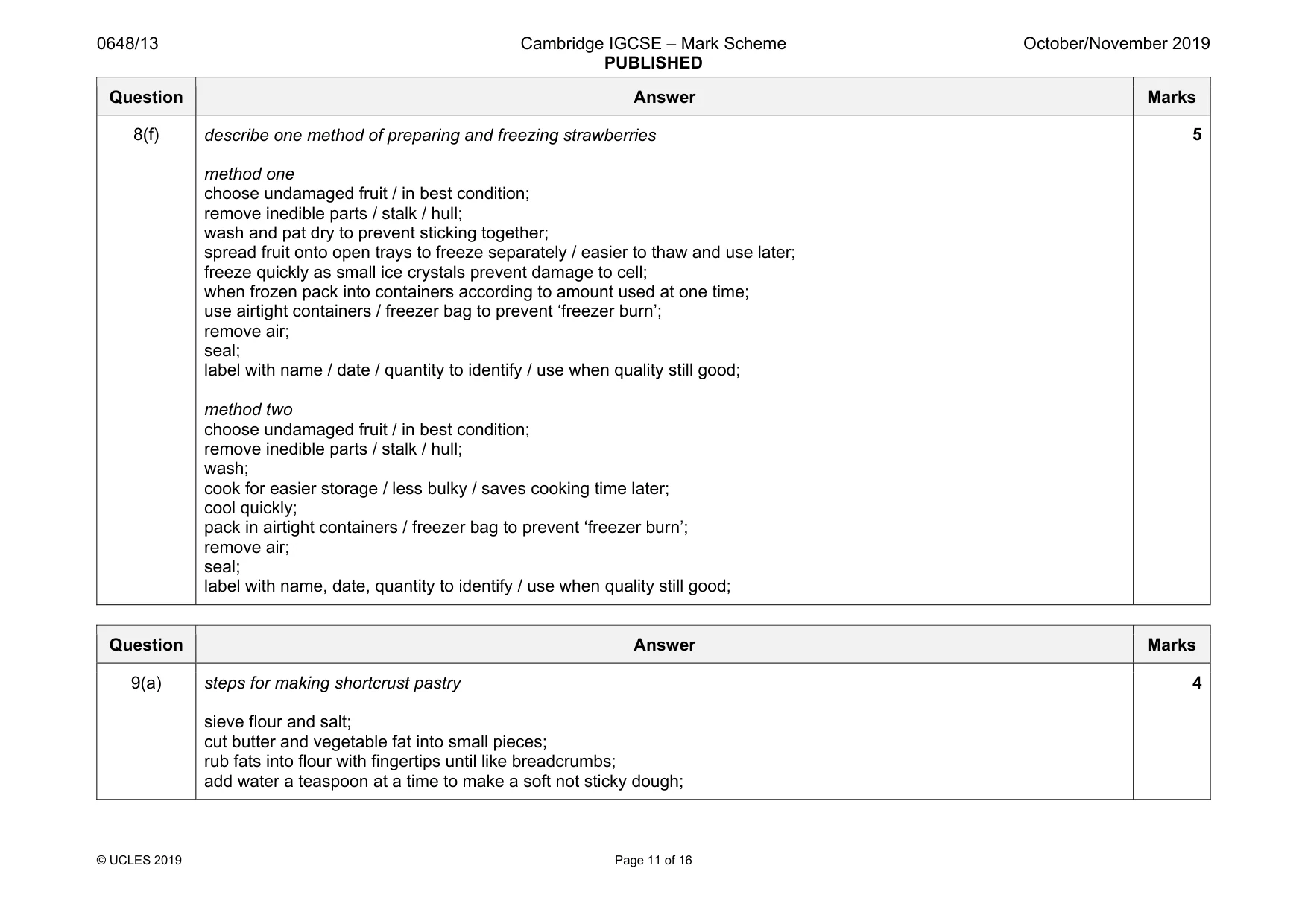
0648/13 Cambridge IGCSE – Mark Scheme PUBLISHED October/November 2019 © UCLES 2019 Page 11 of 16 Question Answer Marks 8(f) describe one method of preparing and freezing strawberries method one choose undamaged fruit / in best condition; remove inedible parts / stalk / hull; wash and pat dry to prevent sticking together; spread fruit onto open trays to freeze separately / easier to thaw and use later; freeze quickly as small ice crystals prevent damage to cell; when frozen pack into containers according to amount used at one time; use airtight containers / freezer bag to prevent ‘freezer burn’; remove air; seal; label with name / date / quantity to identify / use when quality still good; method two choose undamaged fruit / in best condition; remove inedible parts / stalk / hull; wash; cook for easier storage / less bulky / saves cooking time later; cool quickly; pack in airtight containers / freezer bag to prevent ‘freezer burn’; remove air; seal; label with name, date, quantity to identify / use when quality still good; 5 Question Answer Marks 9(a) steps for making shortcrust pastry sieve flour and salt; cut butter and vegetable fat into small pieces; rub fats into flour with fingertips until like breadcrumbs; add water a teaspoon at a time to make a soft not sticky dough; 4
Mark scheme, page 12
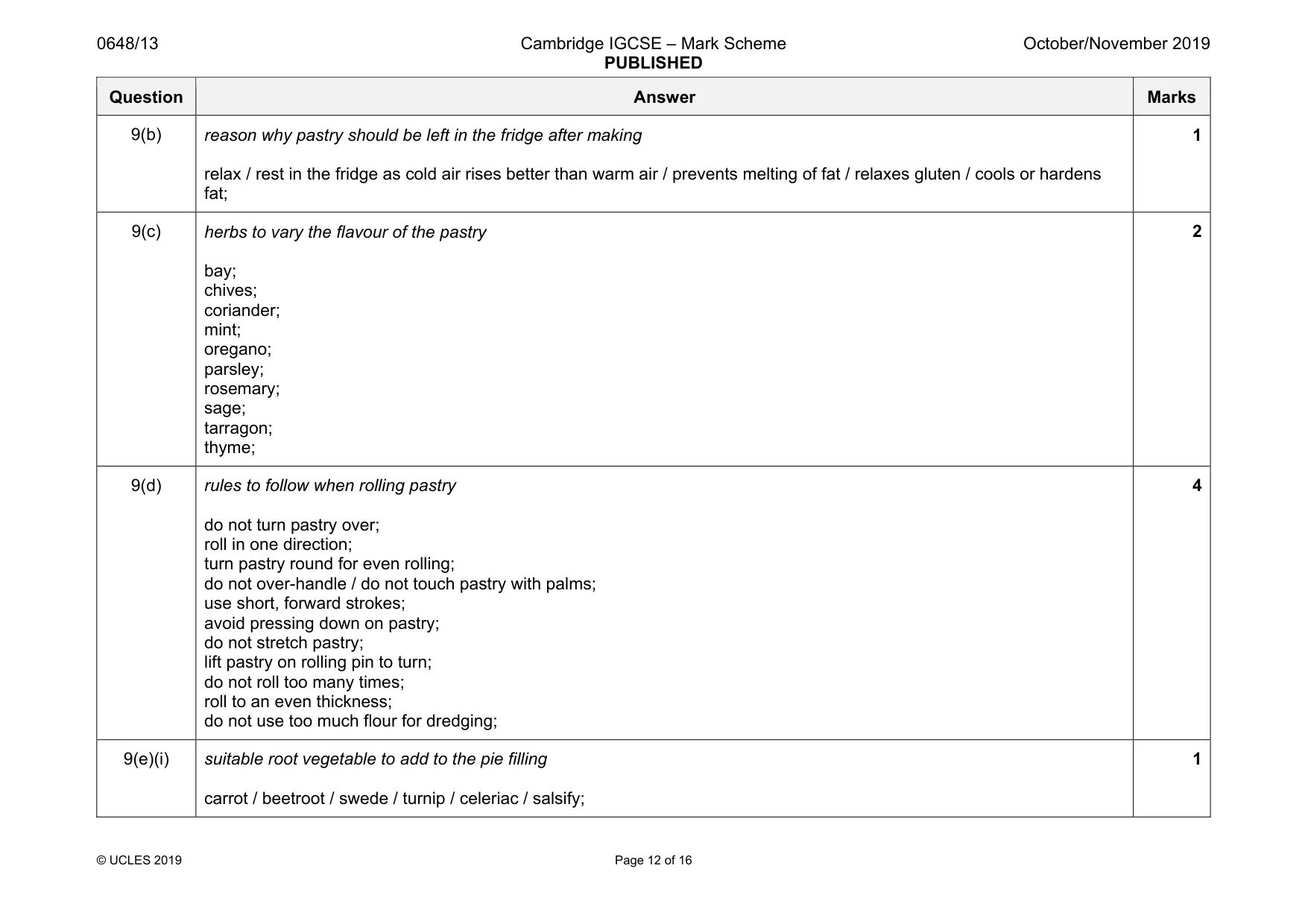
0648/13 Cambridge IGCSE – Mark Scheme PUBLISHED October/November 2019 © UCLES 2019 Page 12 of 16 Question Answer Marks 9(b) reason why pastry should be left in the fridge after making relax / rest in the fridge as cold air rises better than warm air / prevents melting of fat / relaxes gluten / cools or hardens fat; 1 9(c) herbs to vary the flavour of the pastry bay; chives; coriander; mint; oregano; parsley; rosemary; sage; tarragon; thyme; 2 9(d) rules to follow when rolling pastry do not turn pastry over; roll in one direction; turn pastry round for even rolling; do not over-handle / do not touch pastry with palms; use short, forward strokes; avoid pressing down on pastry; do not stretch pastry; lift pastry on rolling pin to turn; do not roll too many times; roll to an even thickness; do not use too much flour for dredging; 4 9(e)(i) suitable root vegetable to add to the pie filling carrot / beetroot / swede / turnip / celeriac / salsify; 1
Mark scheme, page 13
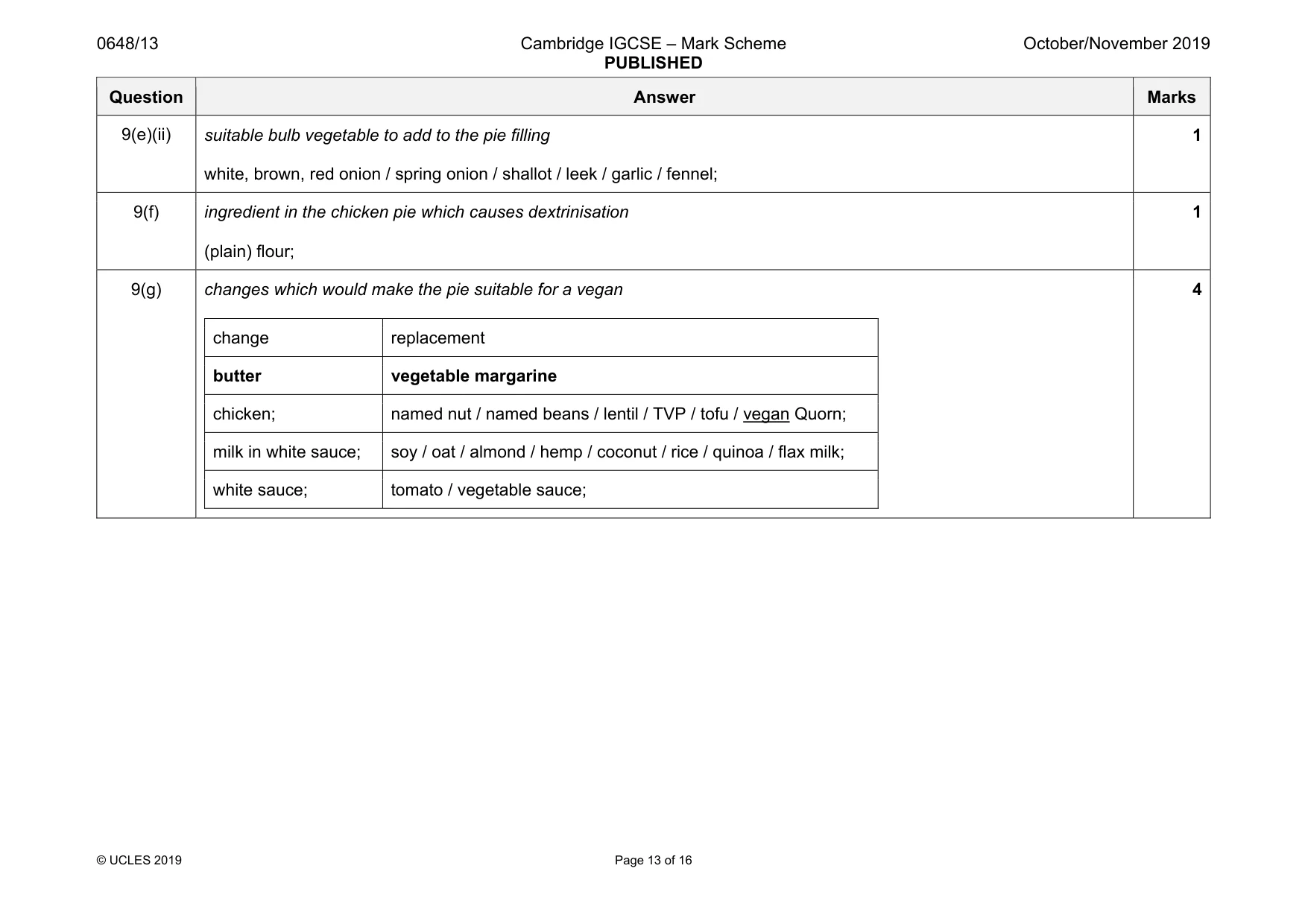
0648/13 Cambridge IGCSE – Mark Scheme PUBLISHED October/November 2019 © UCLES 2019 Page 13 of 16 Question Answer Marks 9(e)(ii) suitable bulb vegetable to add to the pie filling white, brown, red onion / spring onion / shallot / leek / garlic / fennel; 1 9(f) ingredient in the chicken pie which causes dextrinisation (plain) flour; 1 9(g) changes which would make the pie suitable for a vegan change replacement butter vegetable margarine chicken; named nut / named beans / lentil / TVP / tofu / vegan Quorn; milk in white sauce; soy / oat / almond / hemp / coconut / rice / quinoa / flax milk; white sauce; tomato / vegetable sauce; 4
Mark scheme, page 14
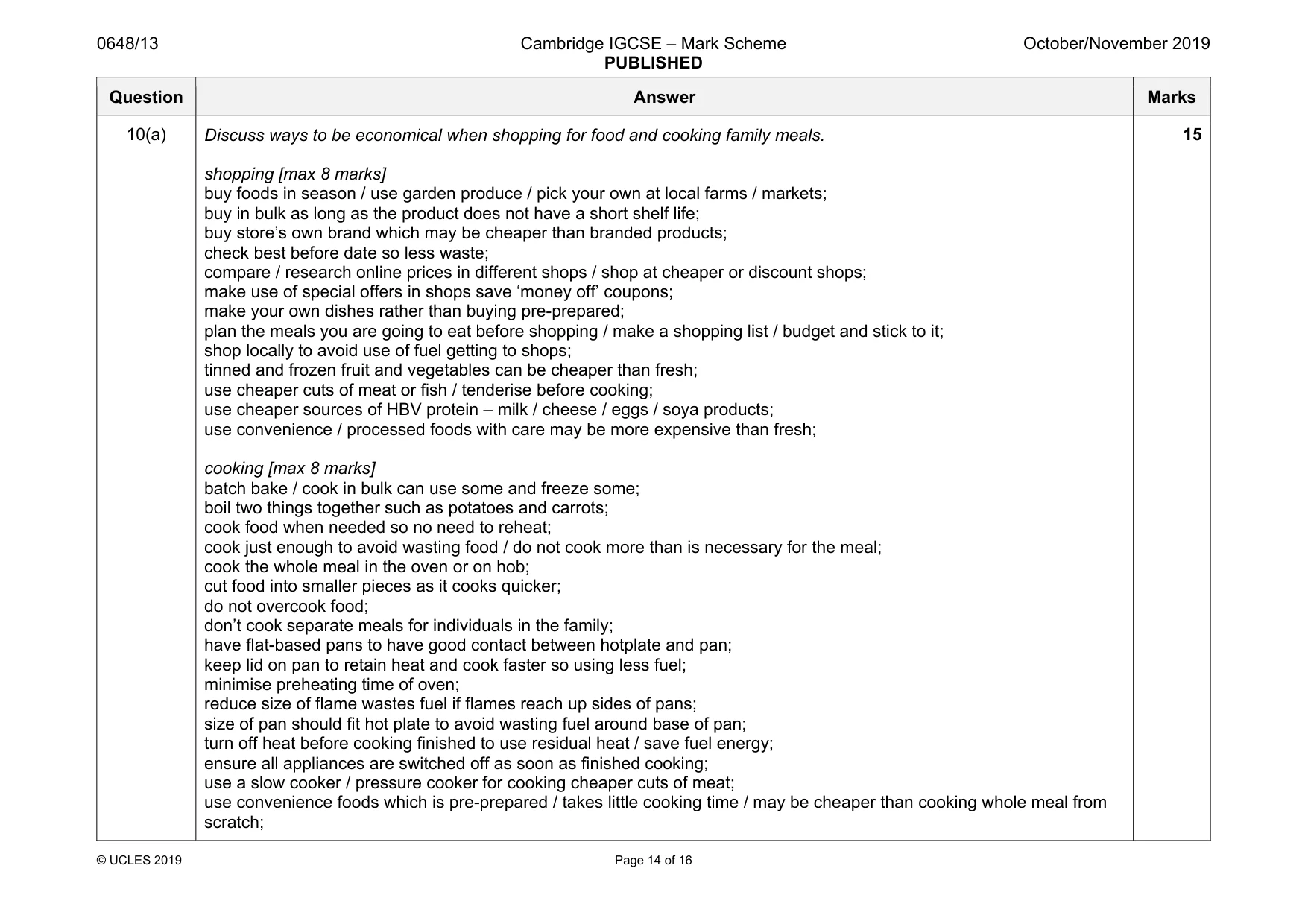
0648/13 Cambridge IGCSE – Mark Scheme PUBLISHED October/November 2019 © UCLES 2019 Page 14 of 16 Question Answer Marks 10(a) Discuss ways to be economical when shopping for food and cooking family meals. shopping [max 8 marks] buy foods in season / use garden produce / pick your own at local farms / markets; buy in bulk as long as the product does not have a short shelf life; buy store’s own brand which may be cheaper than branded products; check best before date so less waste; compare / research online prices in different shops / shop at cheaper or discount shops; make use of special offers in shops save ‘money off’ coupons; make your own dishes rather than buying pre-prepared; plan the meals you are going to eat before shopping / make a shopping list / budget and stick to it; shop locally to avoid use of fuel getting to shops; tinned and frozen fruit and vegetables can be cheaper than fresh; use cheaper cuts of meat or fish / tenderise before cooking; use cheaper sources of HBV protein – milk / cheese / eggs / soya products; use convenience / processed foods with care may be more expensive than fresh; cooking [max 8 marks] batch bake / cook in bulk can use some and freeze some; boil two things together such as potatoes and carrots; cook food when needed so no need to reheat; cook just enough to avoid wasting food / do not cook more than is necessary for the meal; cook the whole meal in the oven or on hob; cut food into smaller pieces as it cooks quicker; do not overcook food; don’t cook separate meals for individuals in the family; have flat-based pans to have good contact between hotplate and pan; keep lid on pan to retain heat and cook faster so using less fuel; minimise preheating time of oven; reduce size of flame wastes fuel if flames reach up sides of pans; size of pan should fit hot plate to avoid wasting fuel around base of pan; turn off heat before cooking finished to use residual heat / save fuel energy; ensure all appliances are switched off as soon as finished cooking; use a slow cooker / pressure cooker for cooking cheaper cuts of meat; use convenience foods which is pre-prepared / takes little cooking time / may be cheaper than cooking whole meal from scratch; 15
Mark scheme, page 15
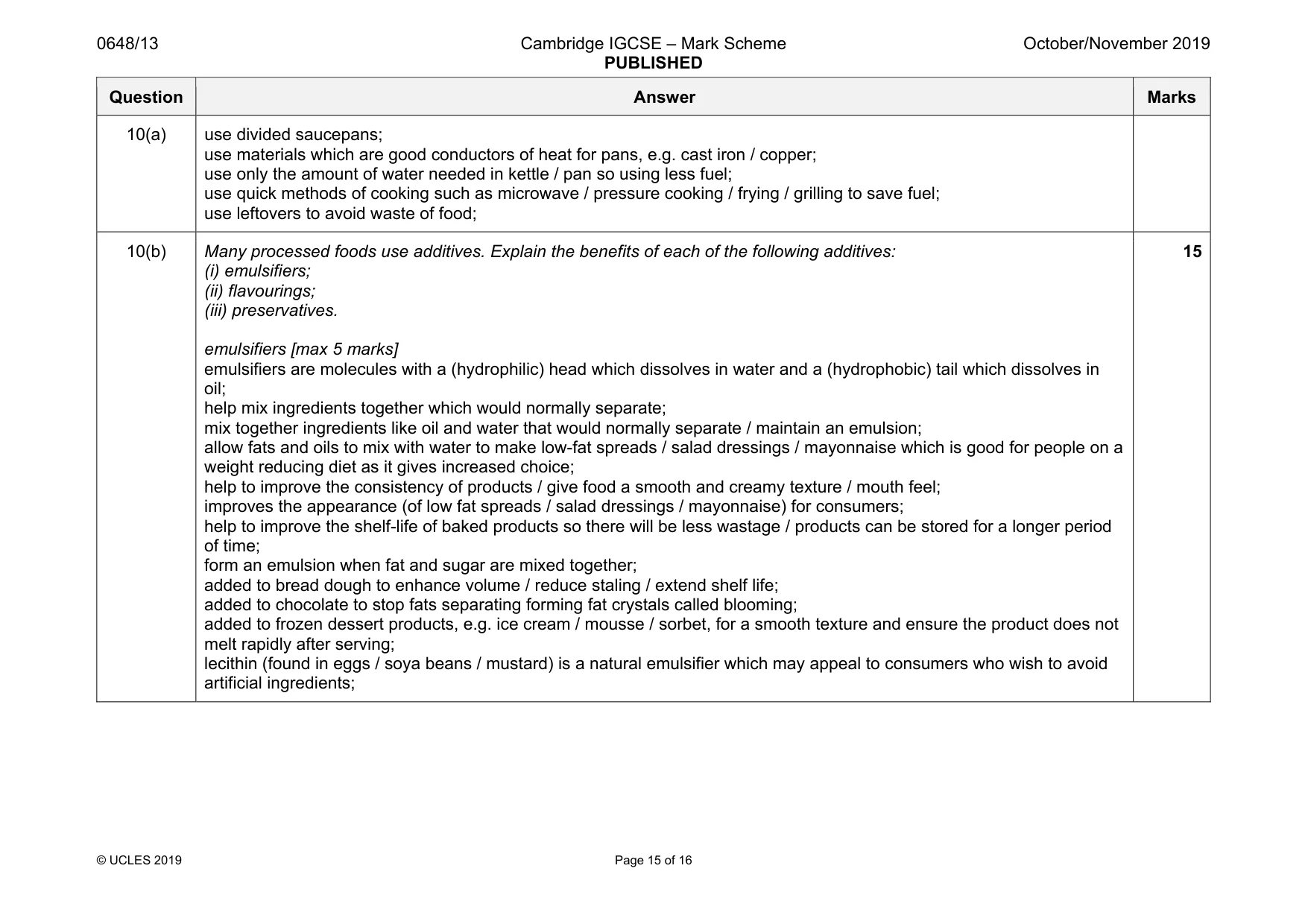
0648/13 Cambridge IGCSE – Mark Scheme PUBLISHED October/November 2019 © UCLES 2019 Page 15 of 16 Question Answer Marks 10(a) use divided saucepans; use materials which are good conductors of heat for pans, e.g. cast iron / copper; use only the amount of water needed in kettle / pan so using less fuel; use quick methods of cooking such as microwave / pressure cooking / frying / grilling to save fuel; use leftovers to avoid waste of food; 10(b) Many processed foods use additives. Explain the benefits of each of the following additives: (i) emulsifiers; (ii) flavourings; (iii) preservatives. emulsifiers [max 5 marks] emulsifiers are molecules with a (hydrophilic) head which dissolves in water and a (hydrophobic) tail which dissolves in oil; help mix ingredients together which would normally separate; mix together ingredients like oil and water that would normally separate / maintain an emulsion; allow fats and oils to mix with water to make low-fat spreads / salad dressings / mayonnaise which is good for people on a weight reducing diet as it gives increased choice; help to improve the consistency of products / give food a smooth and creamy texture / mouth feel; improves the appearance (of low fat spreads / salad dressings / mayonnaise) for consumers; help to improve the shelf-life of baked products so there will be less wastage / products can be stored for a longer period of time; form an emulsion when fat and sugar are mixed together; added to bread dough to enhance volume / reduce staling / extend shelf life; added to chocolate to stop fats separating forming fat crystals called blooming; added to frozen dessert products, e.g. ice cream / mousse / sorbet, for a smooth texture and ensure the product does not melt rapidly after serving; lecithin (found in eggs / soya beans / mustard) is a natural emulsifier which may appeal to consumers who wish to avoid artificial ingredients; 15
Mark scheme, page 16
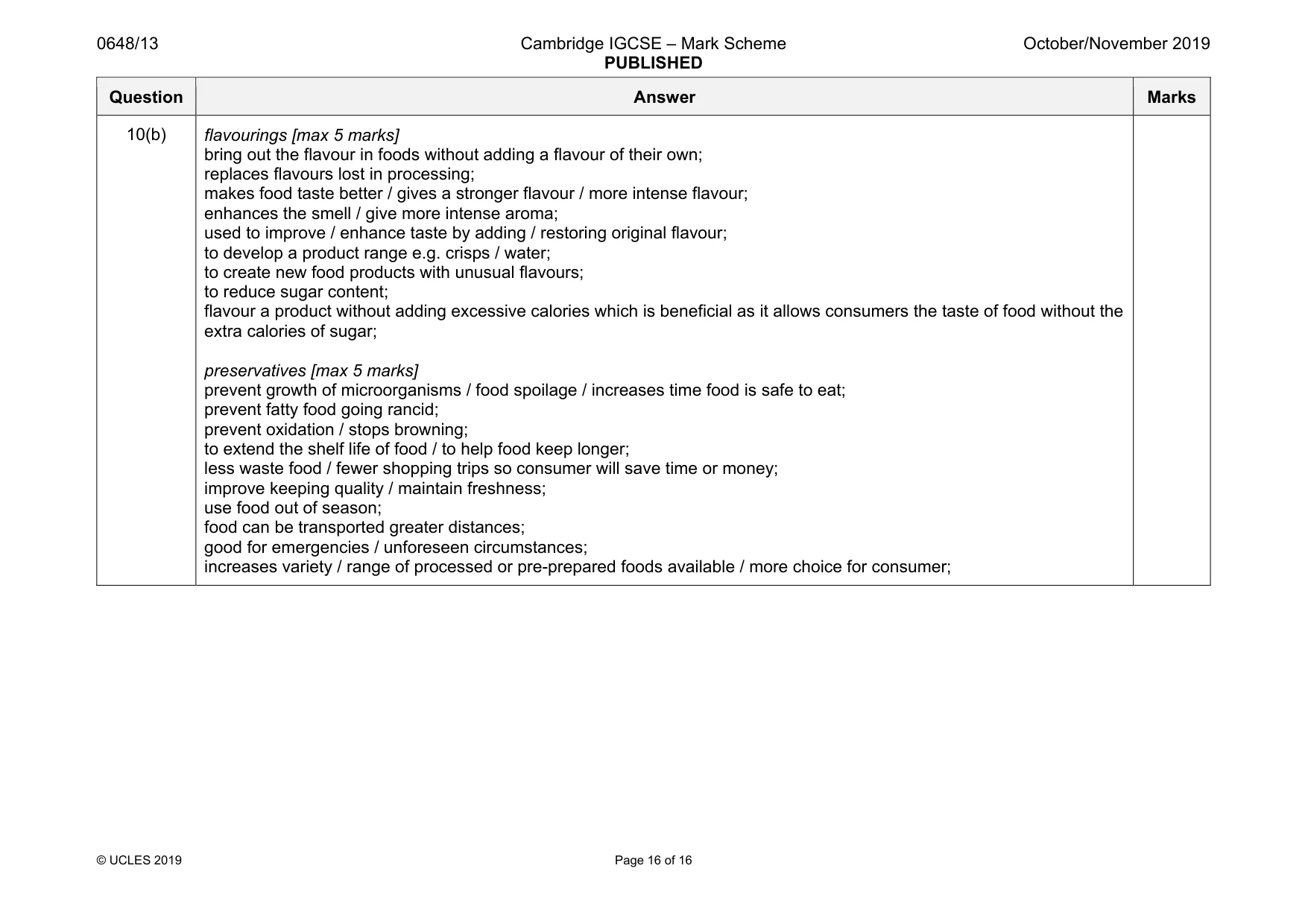
0648/13 Cambridge IGCSE – Mark Scheme PUBLISHED October/November 2019 © UCLES 2019 Page 16 of 16 Question Answer Marks 10(b) flavourings [max 5 marks] bring out the flavour in foods without adding a flavour of their own; replaces flavours lost in processing; makes food taste better / gives a stronger flavour / more intense flavour; enhances the smell / give more intense aroma; used to improve / enhance taste by adding / restoring original flavour; to develop a product range e.g. crisps / water; to create new food products with unusual flavours; to reduce sugar content; flavour a product without adding excessive calories which is beneficial as it allows consumers the taste of food without the extra calories of sugar; preservatives [max 5 marks] prevent growth of microorganisms / food spoilage / increases time food is safe to eat; prevent fatty food going rancid; prevent oxidation / stops browning; to extend the shelf life of food / to help food keep longer; less waste food / fewer shopping trips so consumer will save time or money; improve keeping quality / maintain freshness; use food out of season; food can be transported greater distances; good for emergencies / unforeseen circumstances; increases variety / range of processed or pre-prepared foods available / more choice for consumer;
What you needed in this session
Cambridge’s own grade thresholds for 2019 Oct/Nov, Paper 1 · Variant 3. A higher threshold means an easier paper — the bar moves with how the cohort did.