Cambridge IGCSE Food and Nutrition 0648 — 2018 May/June Paper 1 · Variant 2
0648/12/M/J/18 · 100 marks · ≈113 min
The question paper and its mark scheme, free to read here and free to download. This is Cambridge’s own paper, exactly as it was sat.
Question paper16 pages




Mark scheme15 pages
Answers below. Sit the paper first if you are practising.
Paper as text
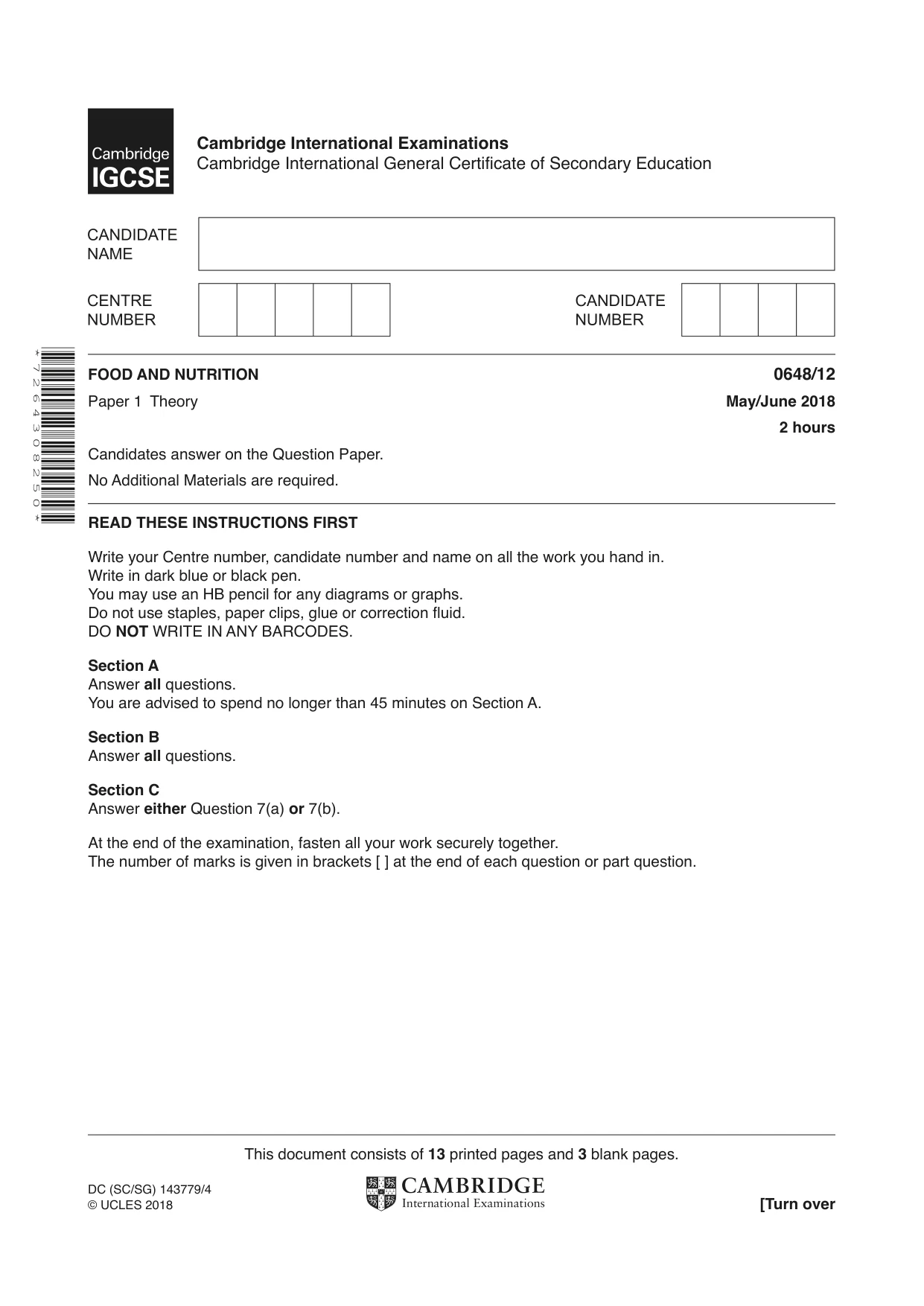
Question paper, page 1
* 7 2 6 4 3 0 8 2 5 0 * This document consists of 13 printed pages and 3 blank pages. DC (SC/SG) 143779/4 © UCLES 2018 [Turn over Cambridge International Examinations Cambridge International General Certificate of Secondary Education FOOD AND NUTRITION 0648/12 Paper 1 Theory May/June 2018 2 hours Candidates answer on the Question Paper. No Additional Materials are required. READ THESE INSTRUCTIONS FIRST Write your Centre number, candidate number and name on all the work you hand in. Write in dark blue or black pen. You may use an HB pencil for any diagrams or graphs. Do not use staples, paper clips, glue or correction fluid. DO NOT WRITE IN ANY BARCODES. Section A Answer all questions. You are advised to spend no longer than 45 minutes on Section A. Section B Answer all questions. Section C Answer either Question 7(a) or 7(b). At the end of the examination, fasten all your work securely together. The number of marks is given in brackets [ ] at the end of each question or part question.
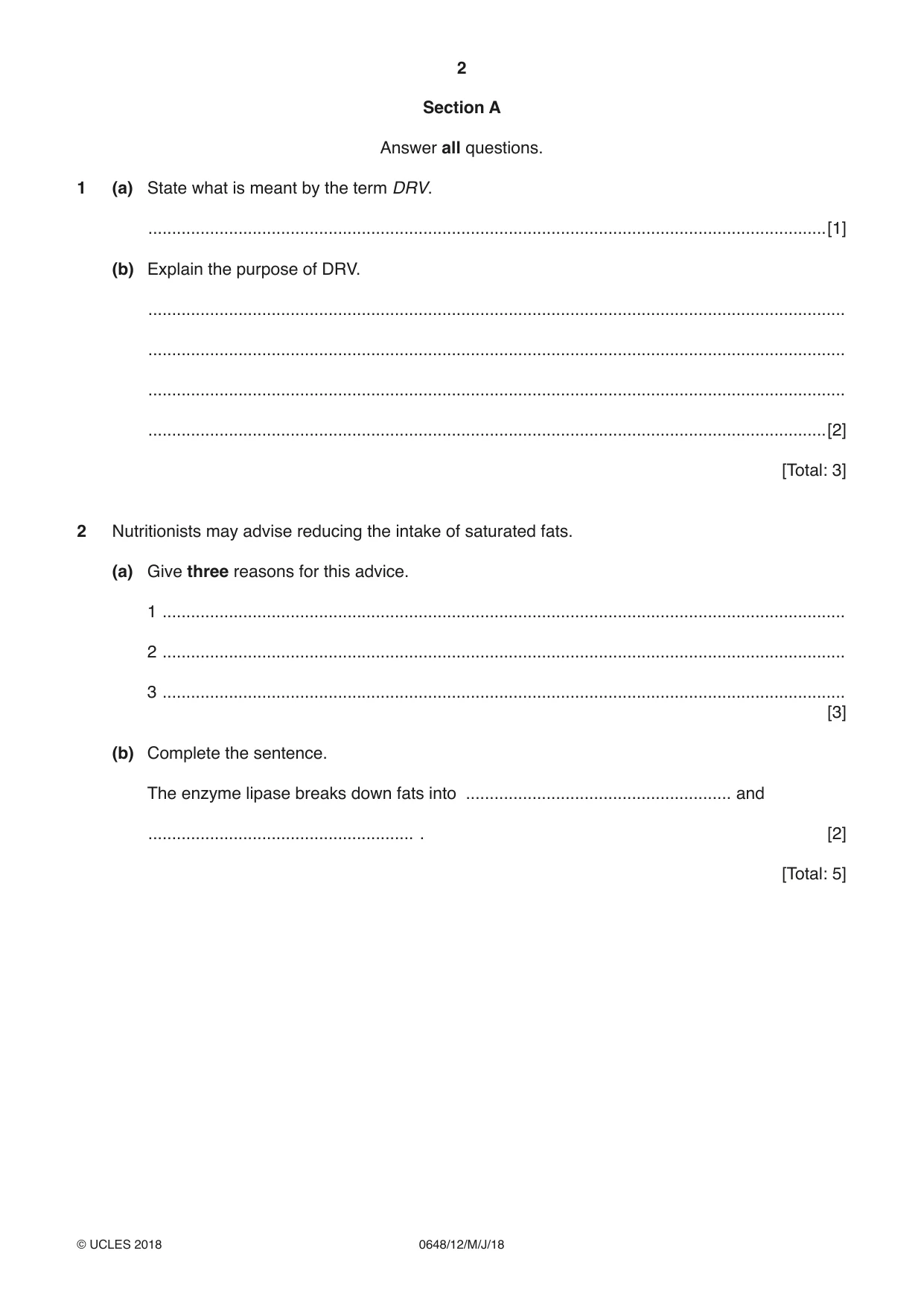
Question paper, page 2
2 0648/12/M/J/18 © UCLES 2018 Section A Answer all questions. 1 (a) State what is meant by the term DRV. …[1] (b) Explain the purpose of DRV. … … … …[2] [Total: 3] 2 Nutritionists may advise reducing the intake of saturated fats. (a) Give three reasons for this advice. 1 … 2 … 3 … [3] (b) Complete the sentence. The enzyme lipase breaks down fats into … and … . [2] [Total: 5]
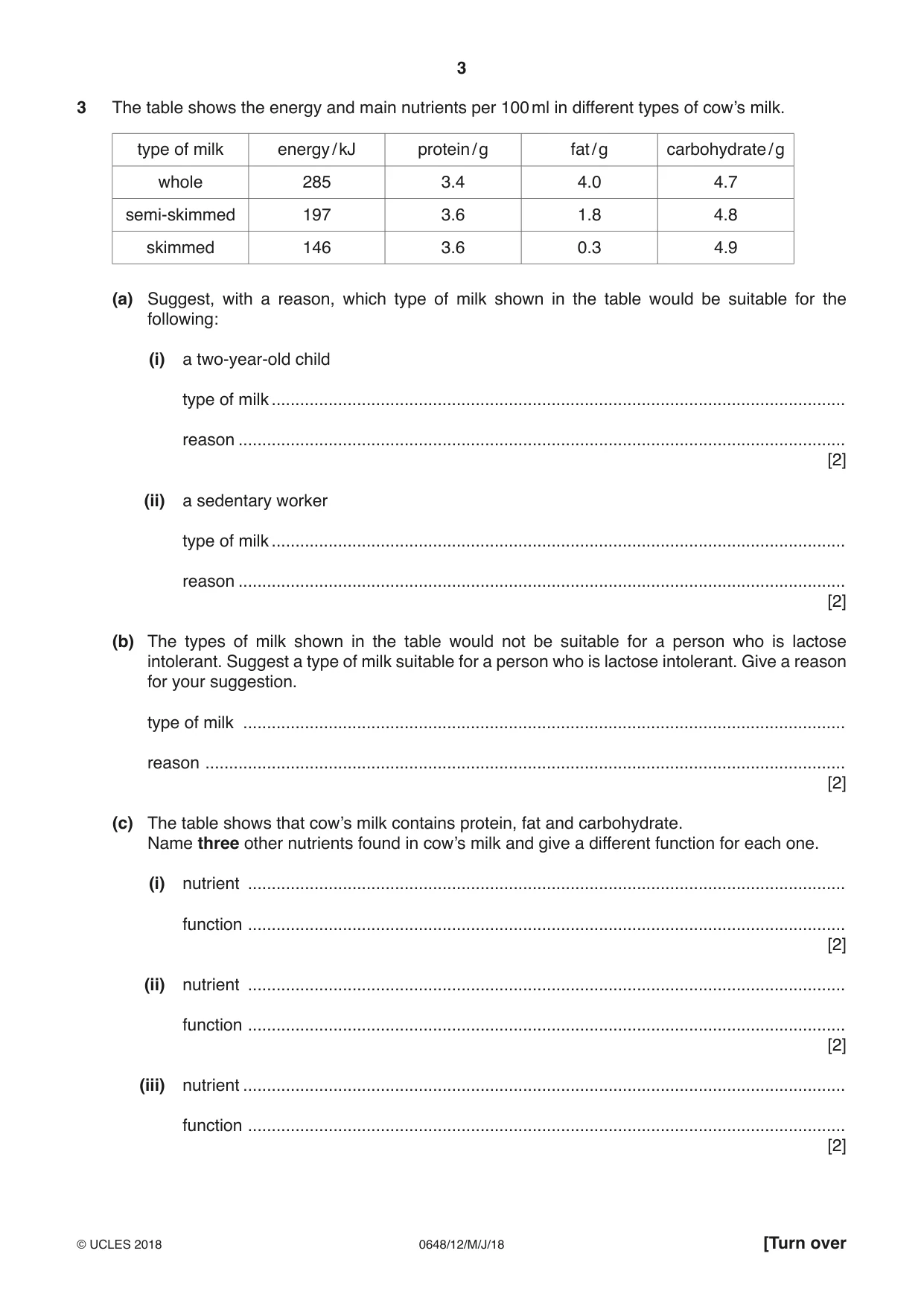
Question paper, page 3
3 0648/12/M/J/18 © UCLES 2018 [Turn over 3 The table shows the energy and main nutrients per 100 ml in different types of cow’s milk. type of milk energy / kJ protein / g fat / g carbohydrate / g whole 285 3.4 4.0 4.7 semi-skimmed 197 3.6 1.8 4.8 skimmed 146 3.6 0.3 4.9 (a) Suggest, with a reason, which type of milk shown in the table would be suitable for the following: (i) a two-year-old child type of milk … reason … [2] (ii) a sedentary worker type of milk … reason … [2] (b) The types of milk shown in the table would not be suitable for a person who is lactose intolerant. Suggest a type of milk suitable for a person who is lactose intolerant. Give a reason for your suggestion. type of milk … reason … [2] (c) The table shows that cow’s milk contains protein, fat and carbohydrate. Name three other nutrients found in cow’s milk and give a different function for each one. (i) nutrient … function … [2] (ii) nutrient … function … [2] (iii) nutrient … function … [2]
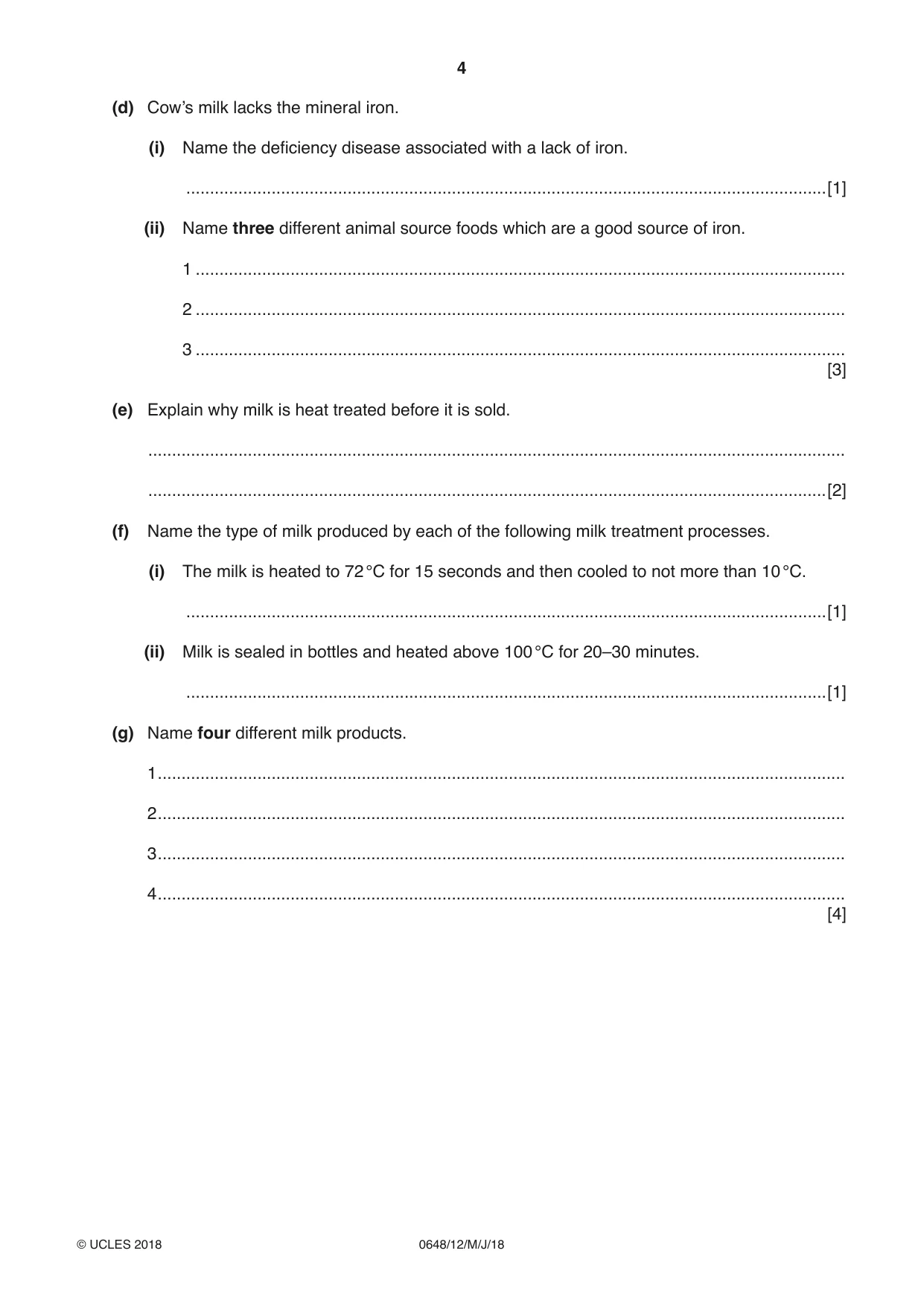
Question paper, page 4
4 0648/12/M/J/18 © UCLES 2018 (d) Cow’s milk lacks the mineral iron. (i) Name the deficiency disease associated with a lack of iron. …[1] (ii) Name three different animal source foods which are a good source of iron. 1 … 2 … 3 … [3] (e) Explain why milk is heat treated before it is sold. … …[2] (f) Name the type of milk produced by each of the following milk treatment processes. (i) The milk is heated to 72 °C for 15 seconds and then cooled to not more than 10 °C. …[1] (ii) Milk is sealed in bottles and heated above 100 °C for 20–30 minutes. …[1] (g) Name four different milk products. 1 … 2 … 3 … 4 … [4]
Question paper, page 5
5 0648/12/M/J/18 © UCLES 2018 [Turn over (h) (i) Explain the process which occurs when milk boils over when heated. … … … … … … … …[4] (ii) Give advice, with reasons, for the storage of fresh milk in the home. … … … … … … … …[4] [Total: 32]
Question paper, page 6
6 0648/12/M/J/18 © UCLES 2018 Section B Answer all questions. 4 The following ingredients can be used to make a basic vegetable soup: 1 diced onion 1 diced carrot 1 diced courgette 1 sliced stick of celery 1 diced potato 25 g butter 500 ml vegetable stock (a) Name two other root vegetables which could be used for making soup. 1 … 2 … [2] (b) The vegetables were prepared an hour before the soup was made. The potatoes have turned brown. (i) Name this type of browning. …[1] (ii) Suggest three ways to prevent this type of browning occurring when preparing potatoes. 1 … … 2 … … 3 … … [3]
Question paper, page 7
7 0648/12/M/J/18 © UCLES 2018 [Turn over (c) Some people prefer to use ready-prepared vegetables. Give three advantages and three disadvantages of using ready-prepared vegetables. advantage 1 … … advantage 2 … … advantage 3 … … disadvantage 1 … … disadvantage 2 … … disadvantage 3 … … [6] (d) Suggest four different ingredients which could add low biological value (LBV) protein to soup. 1 … 2 … 3 … 4 … [4] (e) State two functions of each of the following types of additives which are used in canned soup. (i) preservatives function 1 … function 2 … [2] (ii) flavourings function 1 … function 2 … [2]
Question paper, page 8
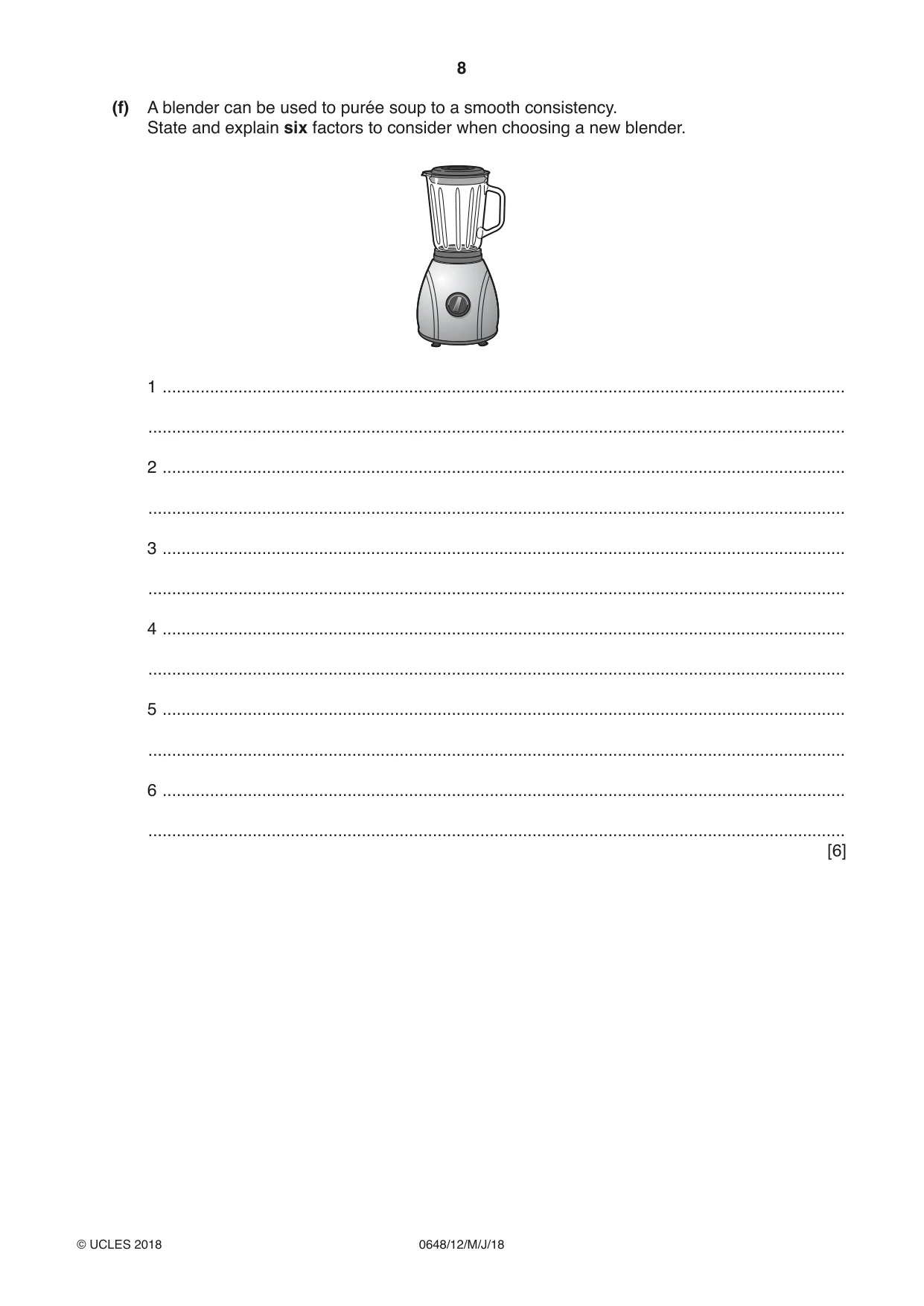
8 0648/12/M/J/18 © UCLES 2018 (f) A blender can be used to purée soup to a smooth consistency. State and explain six factors to consider when choosing a new blender. 1 … … 2 … … 3 … … 4 … … 5 … … 6 … … [6]
Question paper, page 9
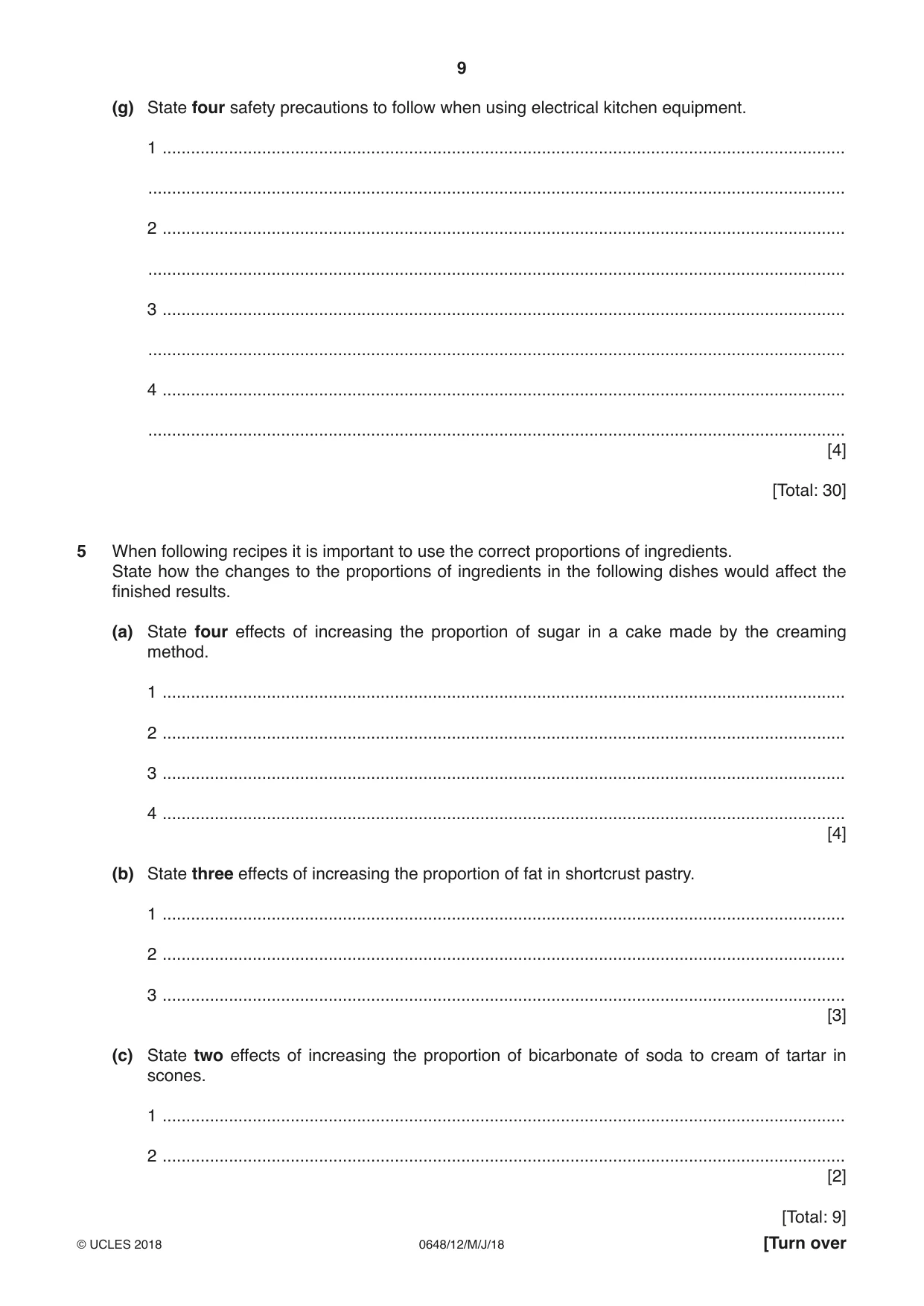
9 0648/12/M/J/18 © UCLES 2018 [Turn over (g) State four safety precautions to follow when using electrical kitchen equipment. 1 … … 2 … … 3 … … 4 … … [4] [Total: 30] 5 When following recipes it is important to use the correct proportions of ingredients. State how the changes to the proportions of ingredients in the following dishes would affect the finished results. (a) State four effects of increasing the proportion of sugar in a cake made by the creaming method. 1 … 2 … 3 … 4 … [4] (b) State three effects of increasing the proportion of fat in shortcrust pastry. 1 … 2 … 3 … [3] (c) State two effects of increasing the proportion of bicarbonate of soda to cream of tartar in scones. 1 … 2 … [2] [Total: 9]
Question paper, page 10
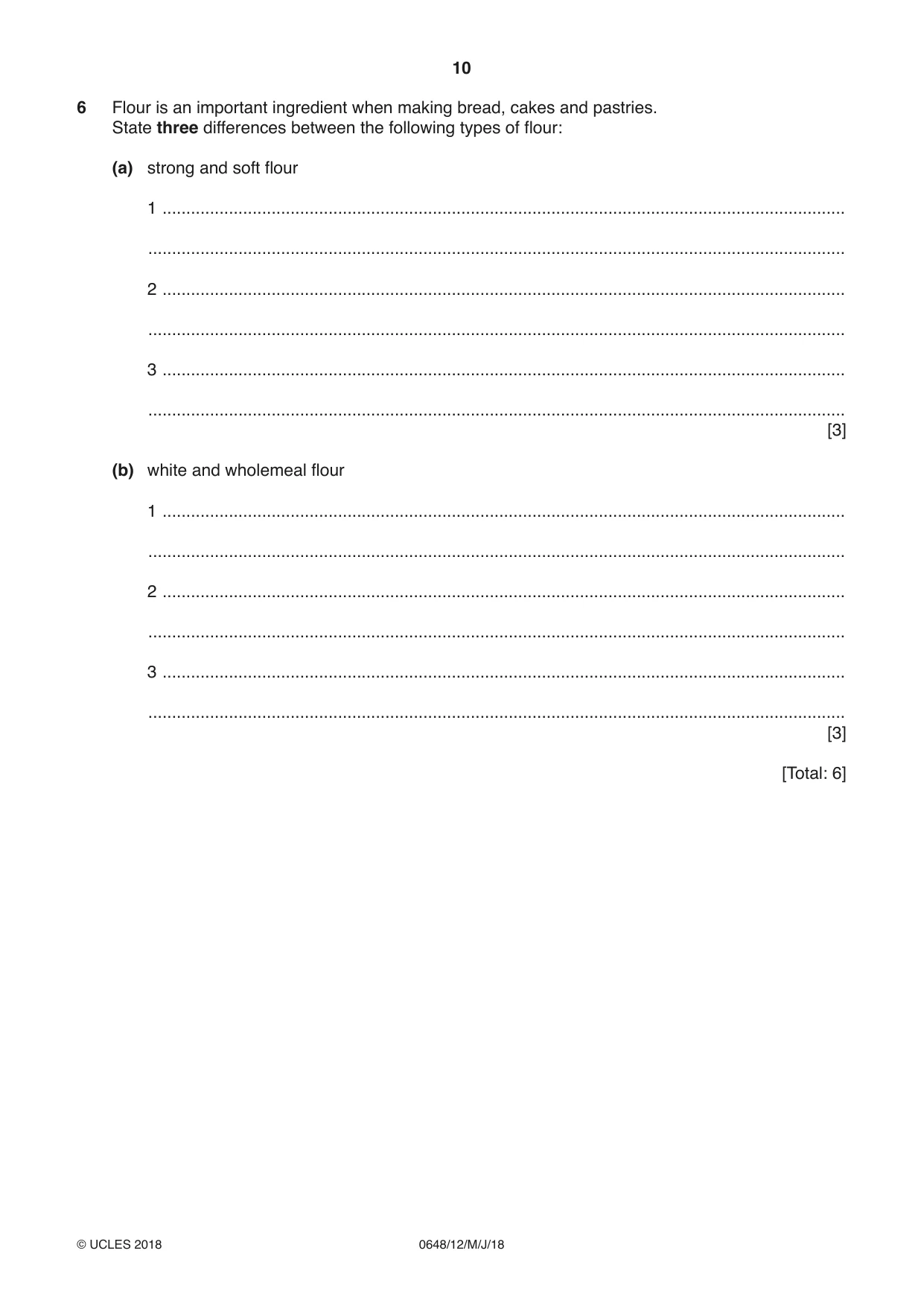
10 0648/12/M/J/18 © UCLES 2018 6 Flour is an important ingredient when making bread, cakes and pastries. State three differences between the following types of flour: (a) strong and soft flour 1 … … 2 … … 3 … … [3] (b) white and wholemeal flour 1 … … 2 … … 3 … … [3] [Total: 6]
Question paper, page 11
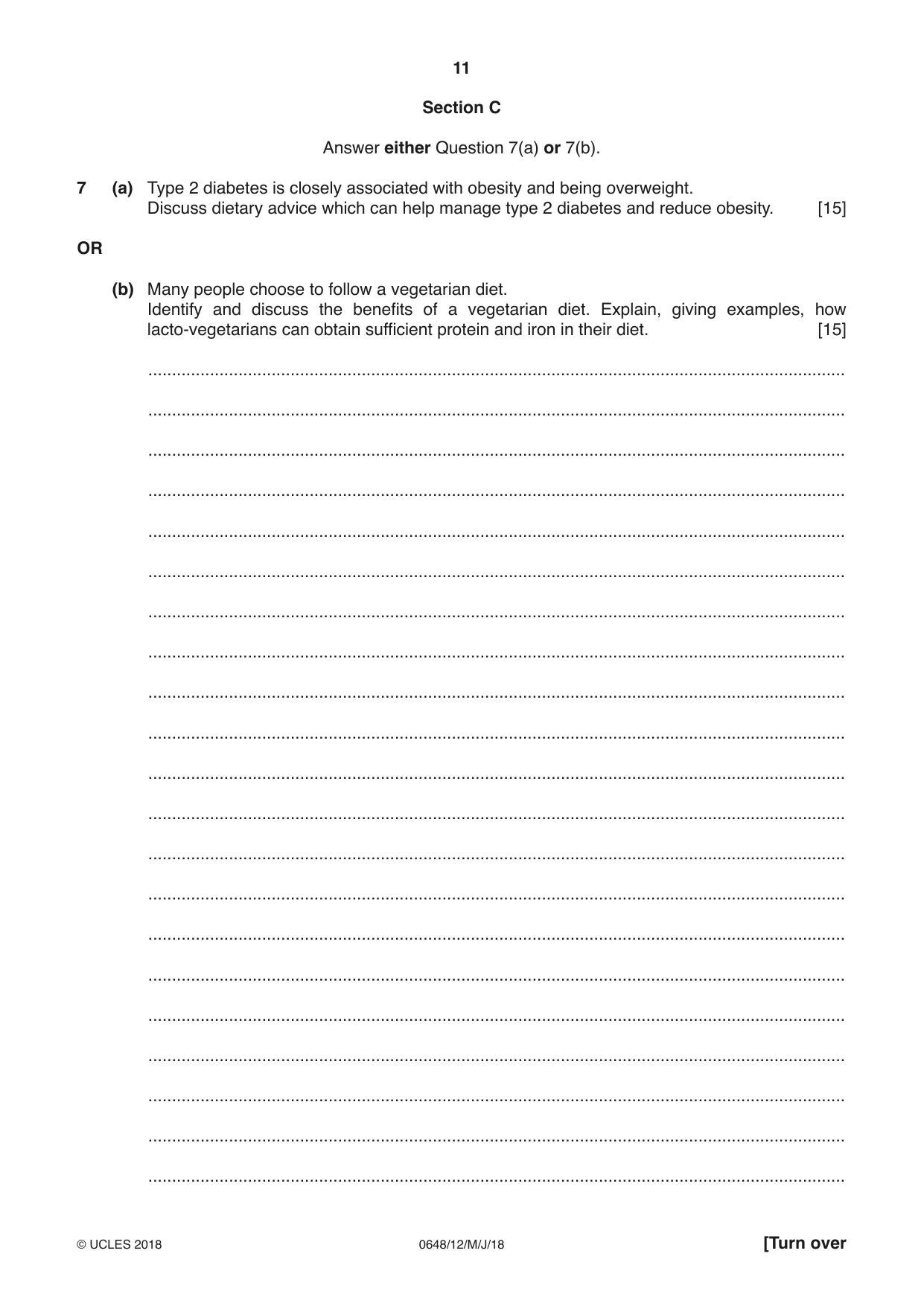
11 0648/12/M/J/18 © UCLES 2018 [Turn over Section C Answer either Question 7(a) or 7(b). 7 (a) Type 2 diabetes is closely associated with obesity and being overweight. Discuss dietary advice which can help manage type 2 diabetes and reduce obesity. [15] OR (b) Many people choose to follow a vegetarian diet. Identify and discuss the benefits of a vegetarian diet. Explain, giving examples, how lacto-vegetarians can obtain sufficient protein and iron in their diet. [15] … … … … … … … … … … … … … … … … … … … … …
Question paper, page 12
12 0648/12/M/J/18 © UCLES 2018 … … … … … … … … … … … … … … … … … … … … … … … … … … … …
Question paper, page 13
13 0648/12/M/J/18 © UCLES 2018 … … … … … … … … … … … … … … … … … … … … … … … … … … … [Total: 15]
Question paper, page 14
14 0648/12/M/J/18 © UCLES 2018 BLANK PAGE
Question paper, page 15
15 0648/12/M/J/18 © UCLES 2018 BLANK PAGE
Question paper, page 16
16 0648/12/M/J/18 © UCLES 2018 Permission to reproduce items where third-party owned material protected by copyright is included has been sought and cleared where possible. Every reasonable effort has been made by the publisher (UCLES) to trace copyright holders, but if any items requiring clearance have unwittingly been included, the publisher will be pleased to make amends at the earliest possible opportunity. To avoid the issue of disclosure of answer-related information to candidates, all copyright acknowledgements are reproduced online in the Cambridge International Examinations Copyright Acknowledgements Booklet. This is produced for each series of examinations and is freely available to download at www.cie.org.uk after the live examination series. Cambridge International Examinations is part of the Cambridge Assessment Group. Cambridge Assessment is the brand name of University of Cambridge Local Examinations Syndicate (UCLES), which is itself a department of the University of Cambridge. BLANK PAGE
Mark scheme, page 1
IGCSE™ is a registered trademark. This document consists of 15 printed pages. © UCLES 2018 [Turn over Cambridge Assessment International Education Cambridge International General Certificate of Secondary Education FOOD AND NUTRITION 0648/12 Paper 1 Theory May/June 2018 MARK SCHEME Maximum Mark: 100 Published This mark scheme is published as an aid to teachers and candidates, to indicate the requirements of the examination. It shows the basis on which Examiners were instructed to award marks. It does not indicate the details of the discussions that took place at an Examiners’ meeting before marking began, which would have considered the acceptability of alternative answers. Mark schemes should be read in conjunction with the question paper and the Principal Examiner Report for Teachers. Cambridge International will not enter into discussions about these mark schemes. Cambridge International is publishing the mark schemes for the May/June 2018 series for most Cambridge IGCSE™, Cambridge International A and AS Level and Cambridge Pre-U components, and some Cambridge O Level components.
Mark scheme, page 2
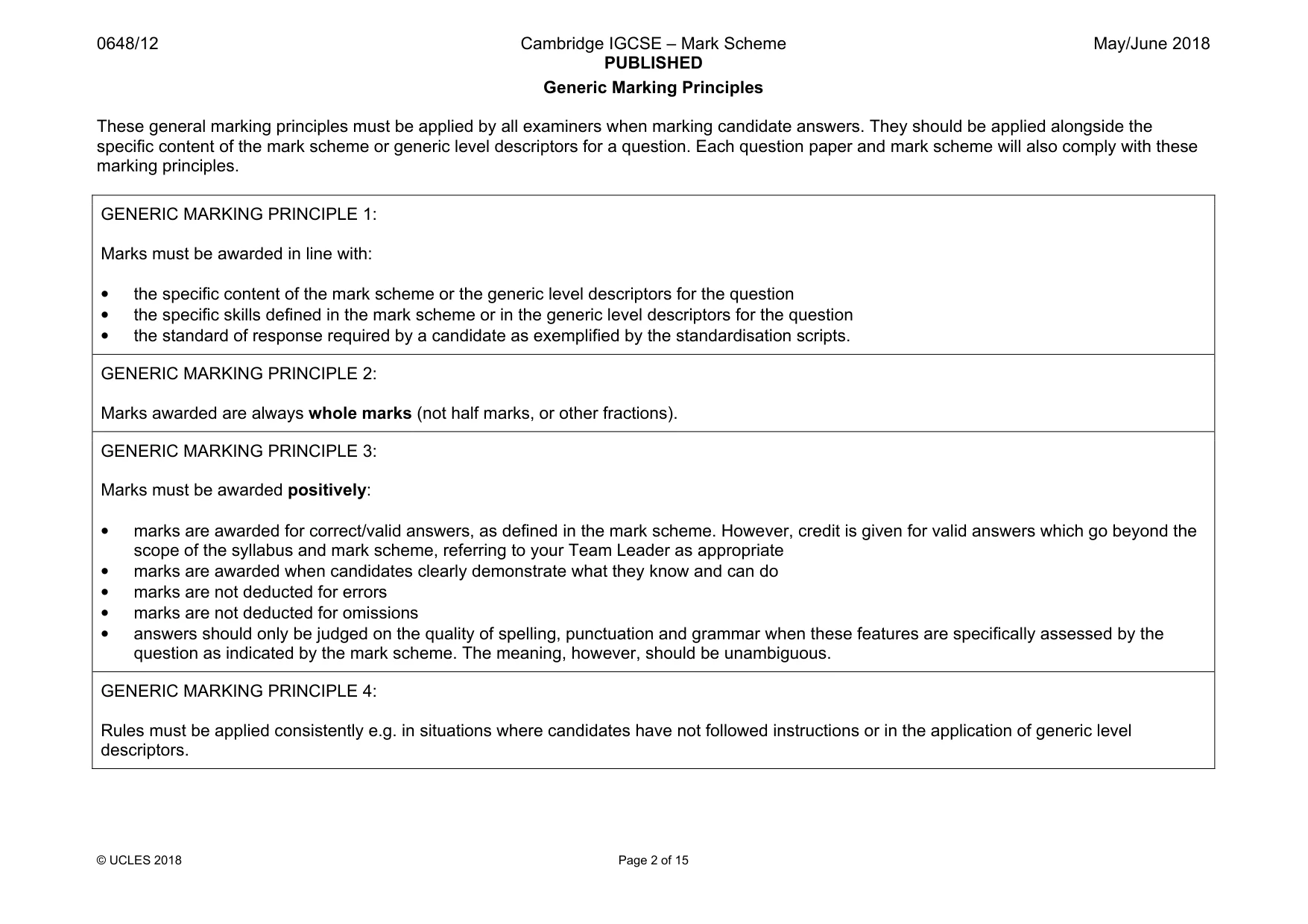
0648/12 Cambridge IGCSE – Mark Scheme PUBLISHED May/June 2018 © UCLES 2018 Page 2 of 15 Generic Marking Principles These general marking principles must be applied by all examiners when marking candidate answers. They should be applied alongside the specific content of the mark scheme or generic level descriptors for a question. Each question paper and mark scheme will also comply with these marking principles. GENERIC MARKING PRINCIPLE 1: Marks must be awarded in line with: • the specific content of the mark scheme or the generic level descriptors for the question • the specific skills defined in the mark scheme or in the generic level descriptors for the question • the standard of response required by a candidate as exemplified by the standardisation scripts. GENERIC MARKING PRINCIPLE 2: Marks awarded are always whole marks (not half marks, or other fractions). GENERIC MARKING PRINCIPLE 3: Marks must be awarded positively: • marks are awarded for correct/valid answers, as defined in the mark scheme. However, credit is given for valid answers which go beyond the scope of the syllabus and mark scheme, referring to your Team Leader as appropriate • marks are awarded when candidates clearly demonstrate what they know and can do • marks are not deducted for errors • marks are not deducted for omissions • answers should only be judged on the quality of spelling, punctuation and grammar when these features are specifically assessed by the question as indicated by the mark scheme. The meaning, however, should be unambiguous. GENERIC MARKING PRINCIPLE 4: Rules must be applied consistently e.g. in situations where candidates have not followed instructions or in the application of generic level descriptors.
Mark scheme, page 3
0648/12 Cambridge IGCSE – Mark Scheme PUBLISHED May/June 2018 © UCLES 2018 Page 3 of 15 GENERIC MARKING PRINCIPLE 5: Marks should be awarded using the full range of marks defined in the mark scheme for the question (however; the use of the full mark range may be limited according to the quality of the candidate responses seen). GENERIC MARKING PRINCIPLE 6: Marks awarded are based solely on the requirements as defined in the mark scheme. Marks should not be awarded with grade thresholds or grade descriptors in mind.
Mark scheme, page 4
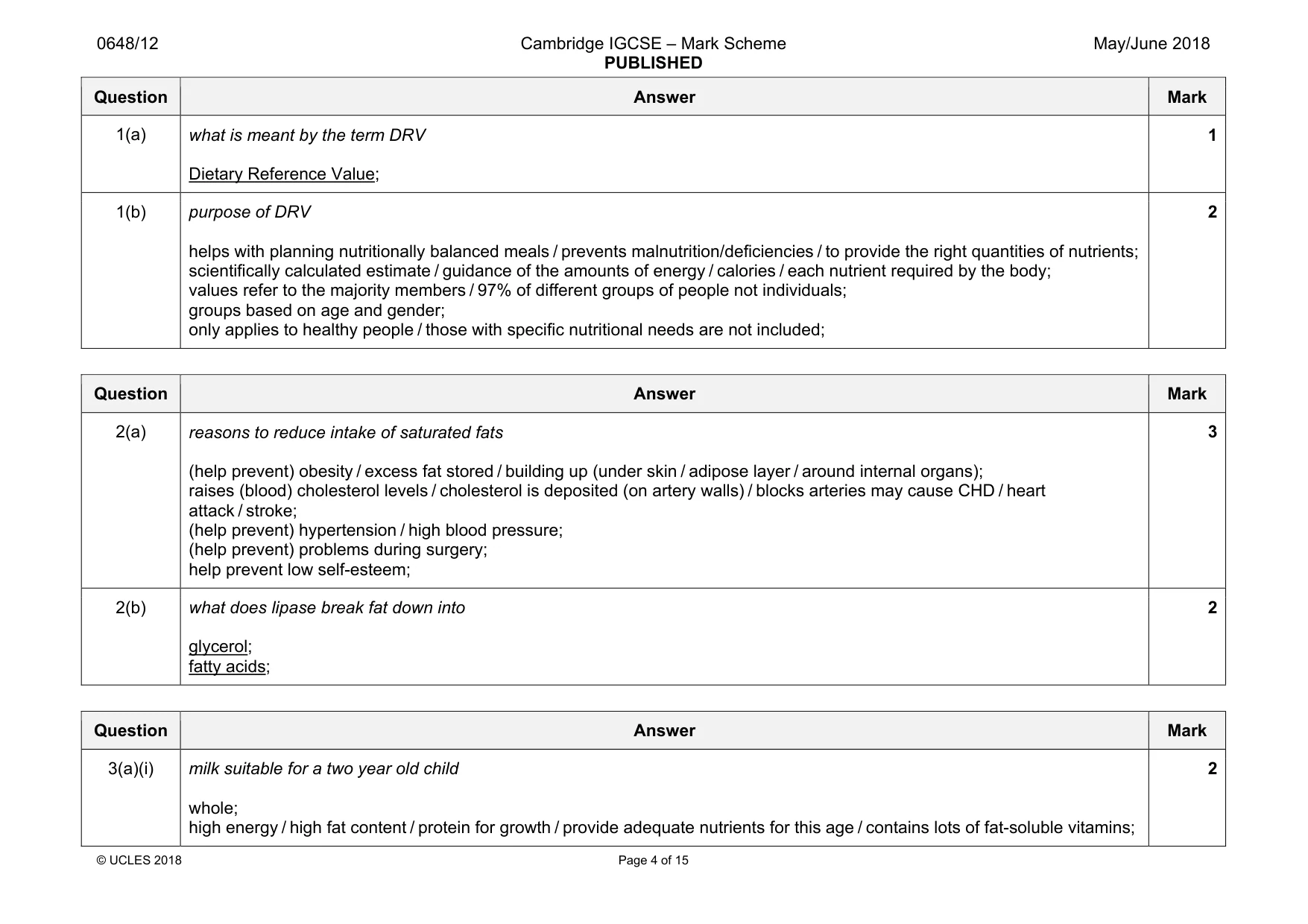
0648/12 Cambridge IGCSE – Mark Scheme PUBLISHED May/June 2018 © UCLES 2018 Page 4 of 15 Question Answer Mark 1(a) what is meant by the term DRV Dietary Reference Value; 1 1(b) purpose of DRV helps with planning nutritionally balanced meals / prevents malnutrition/deficiencies / to provide the right quantities of nutrients; scientifically calculated estimate / guidance of the amounts of energy / calories / each nutrient required by the body; values refer to the majority members / 97% of different groups of people not individuals; groups based on age and gender; only applies to healthy people / those with specific nutritional needs are not included; 2 Question Answer Mark 2(a) reasons to reduce intake of saturated fats (help prevent) obesity / excess fat stored / building up (under skin / adipose layer / around internal organs); raises (blood) cholesterol levels / cholesterol is deposited (on artery walls) / blocks arteries may cause CHD / heart attack / stroke; (help prevent) hypertension / high blood pressure; (help prevent) problems during surgery; help prevent low self-esteem; 3 2(b) what does lipase break fat down into glycerol; fatty acids; 2 Question Answer Mark 3(a)(i) milk suitable for a two year old child whole; high energy / high fat content / protein for growth / provide adequate nutrients for this age / contains lots of fat-soluble vitamins; 2
Mark scheme, page 5
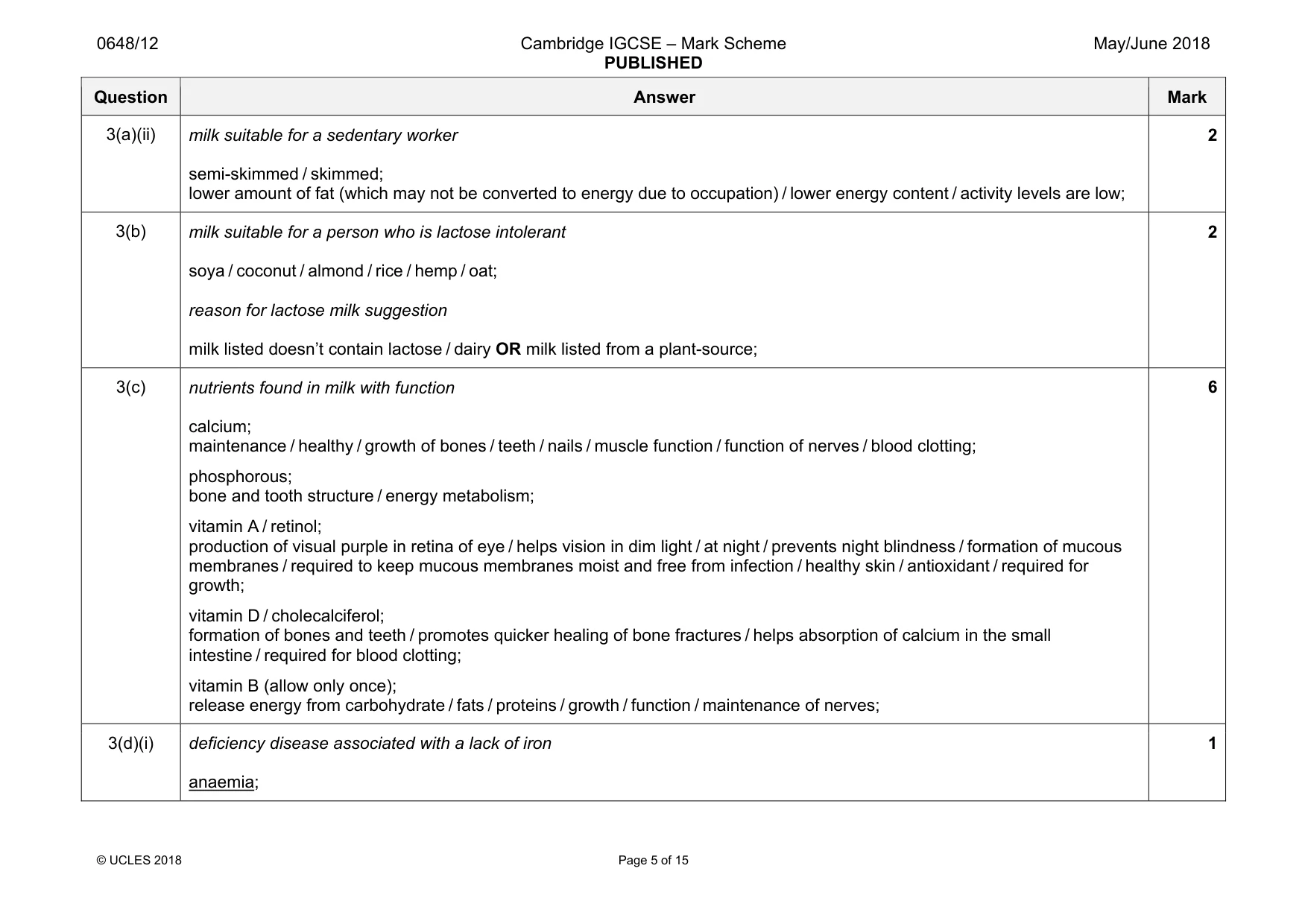
0648/12 Cambridge IGCSE – Mark Scheme PUBLISHED May/June 2018 © UCLES 2018 Page 5 of 15 Question Answer Mark 3(a)(ii) milk suitable for a sedentary worker semi-skimmed / skimmed; lower amount of fat (which may not be converted to energy due to occupation) / lower energy content / activity levels are low; 2 3(b) milk suitable for a person who is lactose intolerant soya / coconut / almond / rice / hemp / oat; reason for lactose milk suggestion milk listed doesn’t contain lactose / dairy OR milk listed from a plant-source; 2 3(c) nutrients found in milk with function calcium; maintenance / healthy / growth of bones / teeth / nails / muscle function / function of nerves / blood clotting; phosphorous; bone and tooth structure / energy metabolism; vitamin A / retinol; production of visual purple in retina of eye / helps vision in dim light / at night / prevents night blindness / formation of mucous membranes / required to keep mucous membranes moist and free from infection / healthy skin / antioxidant / required for growth; vitamin D / cholecalciferol; formation of bones and teeth / promotes quicker healing of bone fractures / helps absorption of calcium in the small intestine / required for blood clotting; vitamin B (allow only once); release energy from carbohydrate / fats / proteins / growth / function / maintenance of nerves; 6 3(d)(i) deficiency disease associated with a lack of iron anaemia; 1
Mark scheme, page 6
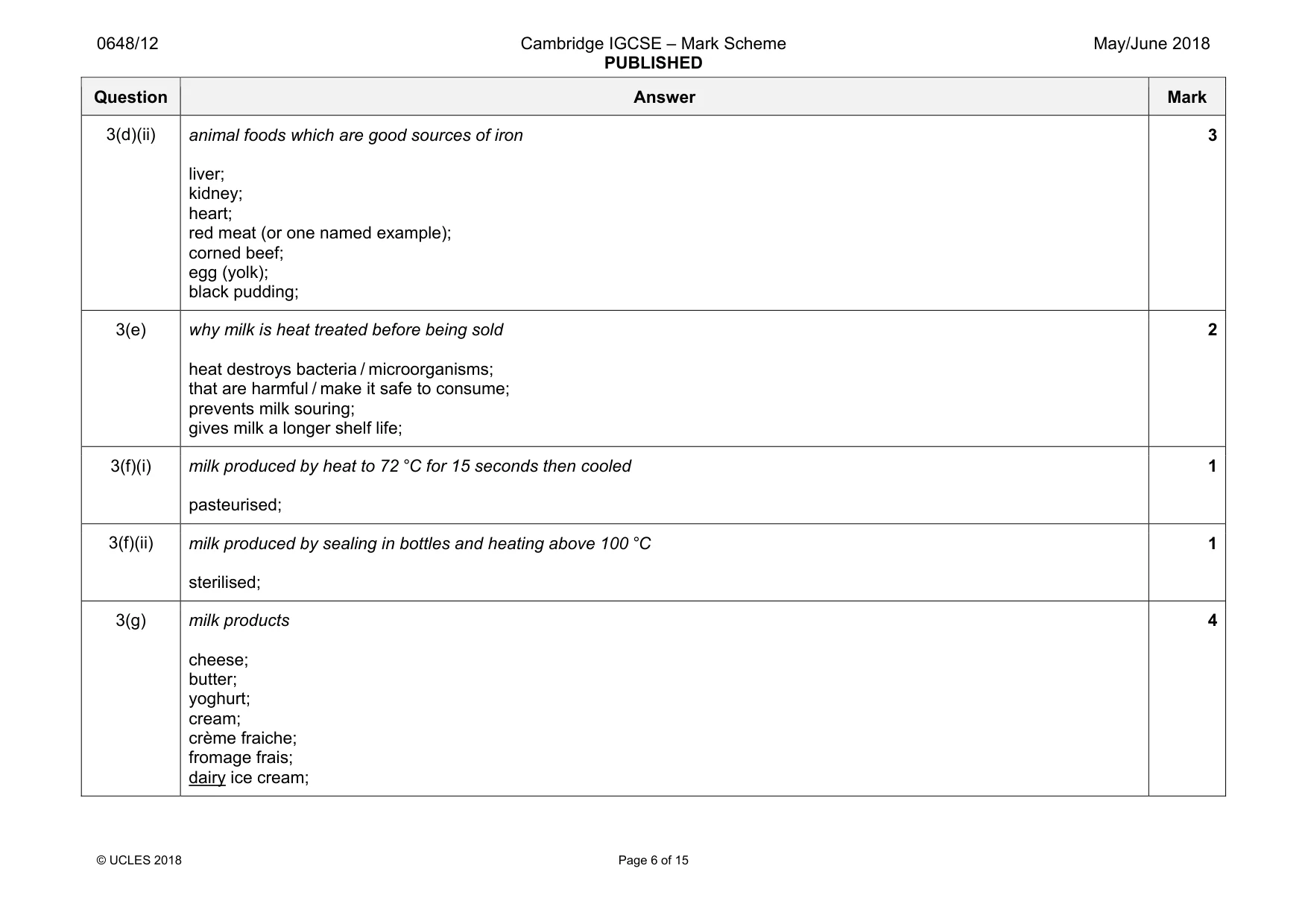
0648/12 Cambridge IGCSE – Mark Scheme PUBLISHED May/June 2018 © UCLES 2018 Page 6 of 15 Question Answer Mark 3(d)(ii) animal foods which are good sources of iron liver; kidney; heart; red meat (or one named example); corned beef; egg (yolk); black pudding; 3 3(e) why milk is heat treated before being sold heat destroys bacteria / microorganisms; that are harmful / make it safe to consume; prevents milk souring; gives milk a longer shelf life; 2 3(f)(i) milk produced by heat to 72 °C for 15 seconds then cooled pasteurised; 1 3(f)(ii) milk produced by sealing in bottles and heating above 100 °C sterilised; 1 3(g) milk products cheese; butter; yoghurt; cream; crème fraiche; fromage frais; dairy ice cream; 4
Mark scheme, page 7
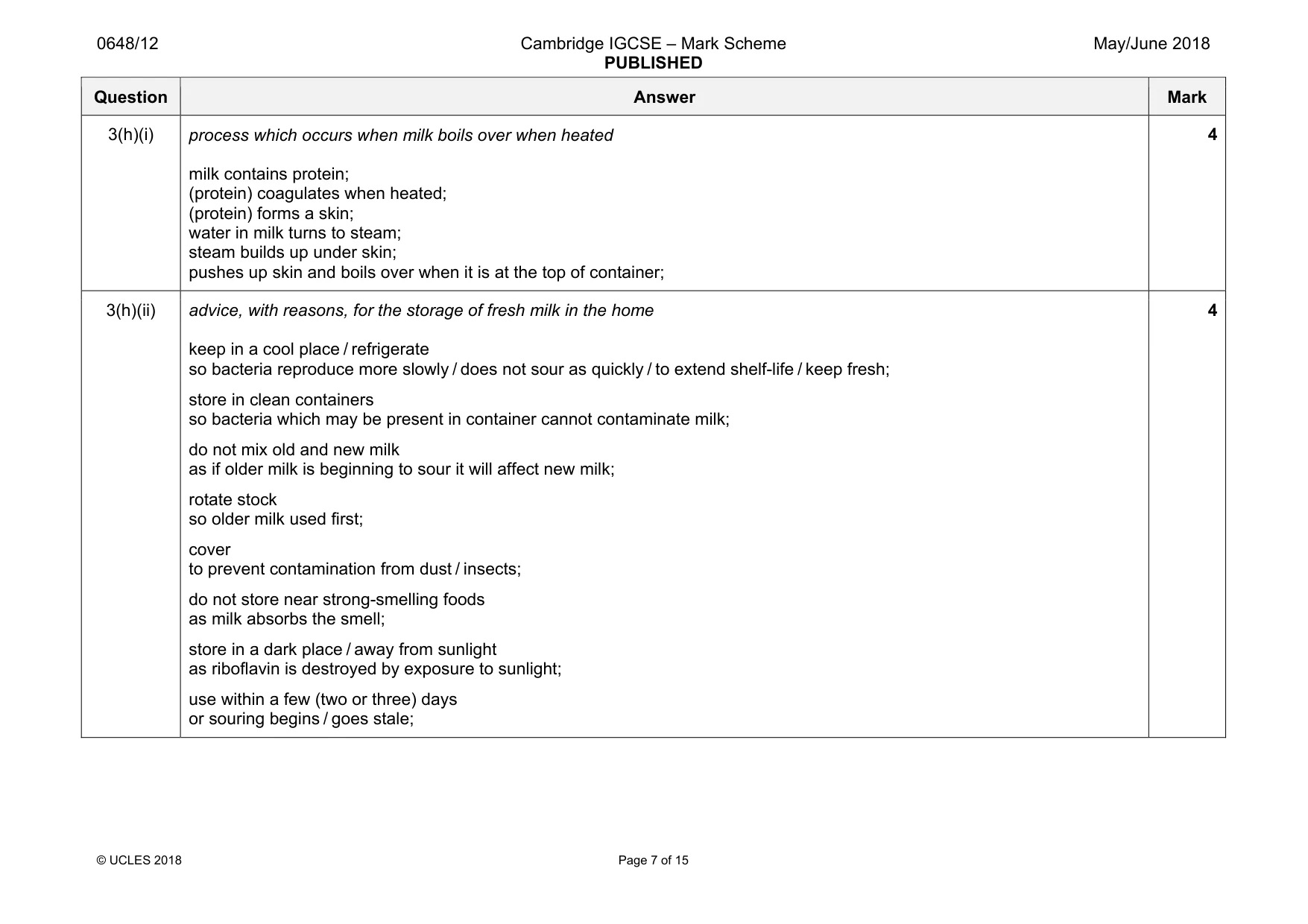
0648/12 Cambridge IGCSE – Mark Scheme PUBLISHED May/June 2018 © UCLES 2018 Page 7 of 15 Question Answer Mark 3(h)(i) process which occurs when milk boils over when heated milk contains protein; (protein) coagulates when heated; (protein) forms a skin; water in milk turns to steam; steam builds up under skin; pushes up skin and boils over when it is at the top of container; 4 3(h)(ii) advice, with reasons, for the storage of fresh milk in the home keep in a cool place / refrigerate so bacteria reproduce more slowly / does not sour as quickly / to extend shelf-life / keep fresh; store in clean containers so bacteria which may be present in container cannot contaminate milk; do not mix old and new milk as if older milk is beginning to sour it will affect new milk; rotate stock so older milk used first; cover to prevent contamination from dust / insects; do not store near strong-smelling foods as milk absorbs the smell; store in a dark place / away from sunlight as riboflavin is destroyed by exposure to sunlight; use within a few (two or three) days or souring begins / goes stale; 4
Mark scheme, page 8
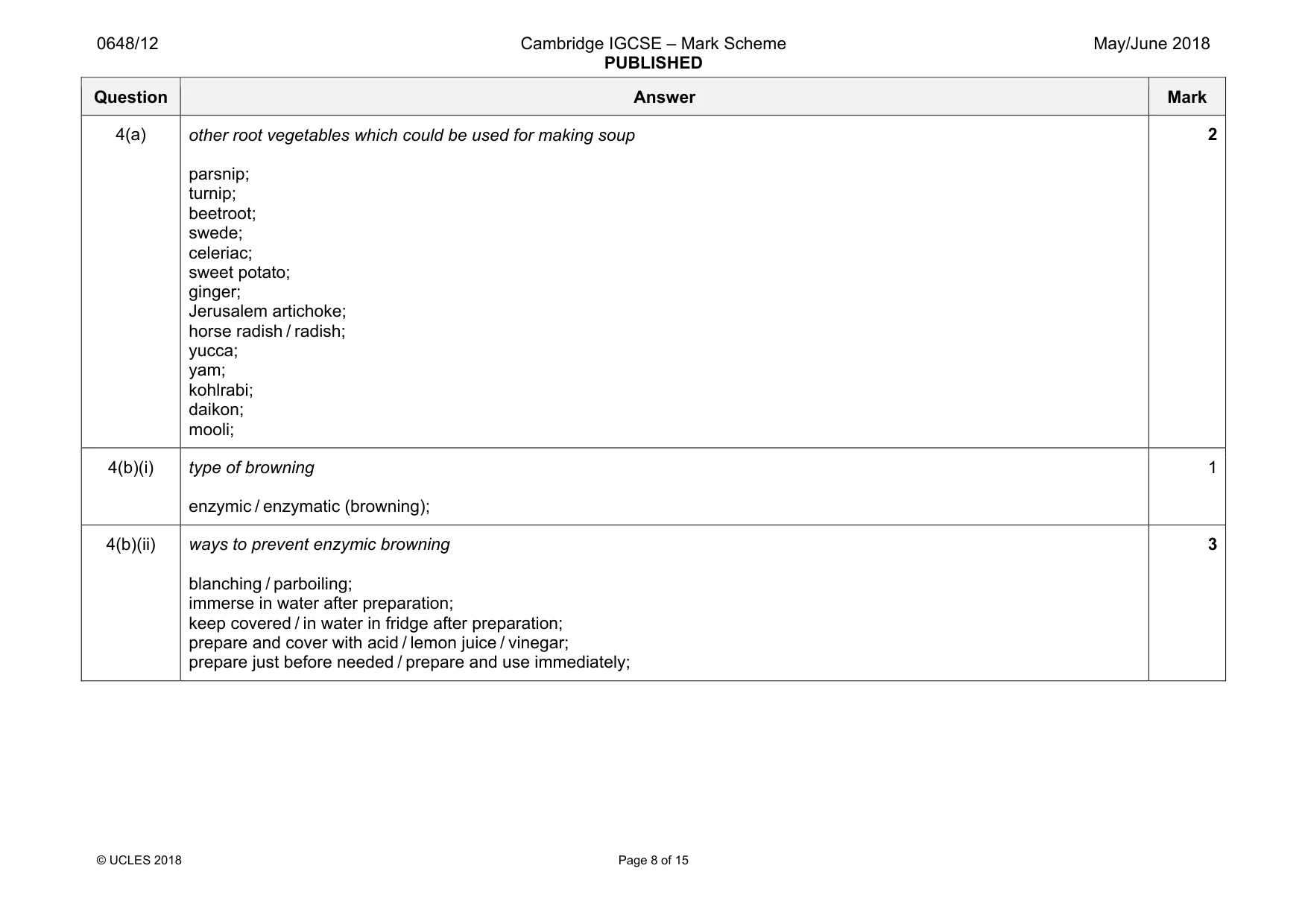
0648/12 Cambridge IGCSE – Mark Scheme PUBLISHED May/June 2018 © UCLES 2018 Page 8 of 15 Question Answer Mark 4(a) other root vegetables which could be used for making soup parsnip; turnip; beetroot; swede; celeriac; sweet potato; ginger; Jerusalem artichoke; horse radish / radish; yucca; yam; kohlrabi; daikon; mooli; 2 4(b)(i) type of browning enzymic / enzymatic (browning); 1 4(b)(ii) ways to prevent enzymic browning blanching / parboiling; immerse in water after preparation; keep covered / in water in fridge after preparation; prepare and cover with acid / lemon juice / vinegar; prepare just before needed / prepare and use immediately; 3
Mark scheme, page 9
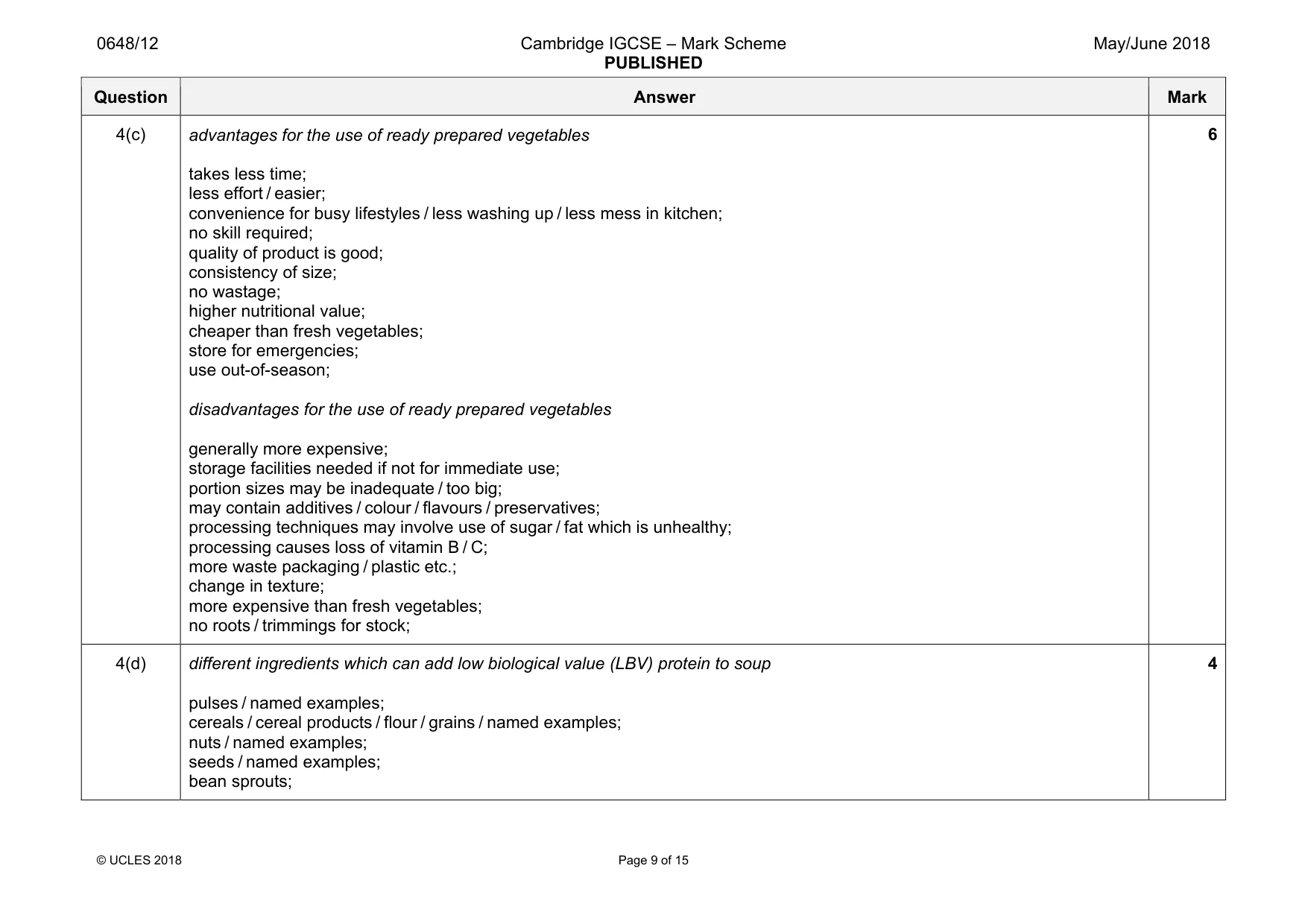
0648/12 Cambridge IGCSE – Mark Scheme PUBLISHED May/June 2018 © UCLES 2018 Page 9 of 15 Question Answer Mark 4(c) advantages for the use of ready prepared vegetables takes less time; less effort / easier; convenience for busy lifestyles / less washing up / less mess in kitchen; no skill required; quality of product is good; consistency of size; no wastage; higher nutritional value; cheaper than fresh vegetables; store for emergencies; use out-of-season; disadvantages for the use of ready prepared vegetables generally more expensive; storage facilities needed if not for immediate use; portion sizes may be inadequate / too big; may contain additives / colour / flavours / preservatives; processing techniques may involve use of sugar / fat which is unhealthy; processing causes loss of vitamin B / C; more waste packaging / plastic etc.; change in texture; more expensive than fresh vegetables; no roots / trimmings for stock; 6 4(d) different ingredients which can add low biological value (LBV) protein to soup pulses / named examples; cereals / cereal products / flour / grains / named examples; nuts / named examples; seeds / named examples; bean sprouts; 4
Mark scheme, page 10
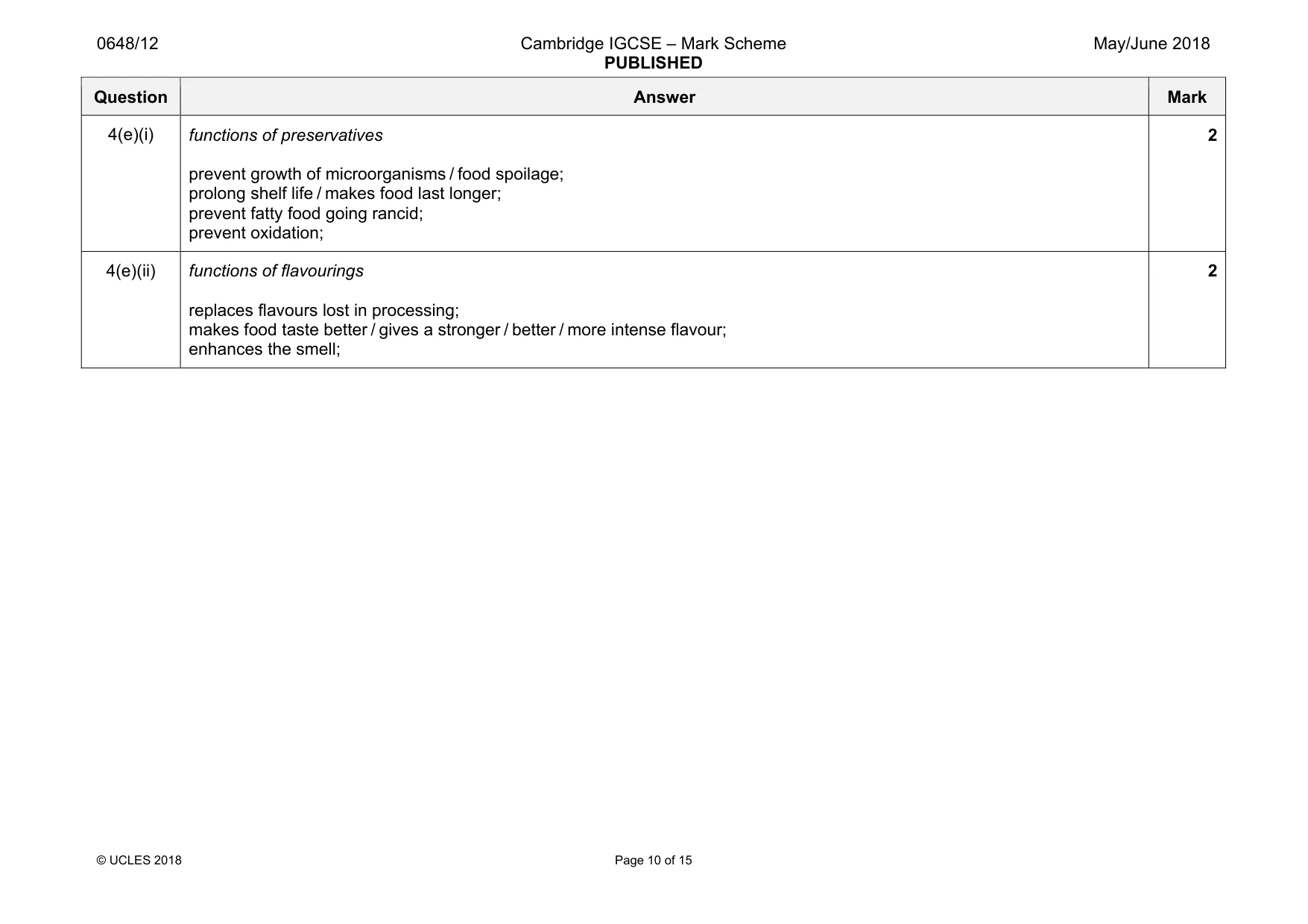
0648/12 Cambridge IGCSE – Mark Scheme PUBLISHED May/June 2018 © UCLES 2018 Page 10 of 15 Question Answer Mark 4(e)(i) functions of preservatives prevent growth of microorganisms / food spoilage; prolong shelf life / makes food last longer; prevent fatty food going rancid; prevent oxidation; 2 4(e)(ii) functions of flavourings replaces flavours lost in processing; makes food taste better / gives a stronger / better / more intense flavour; enhances the smell; 2
Mark scheme, page 11
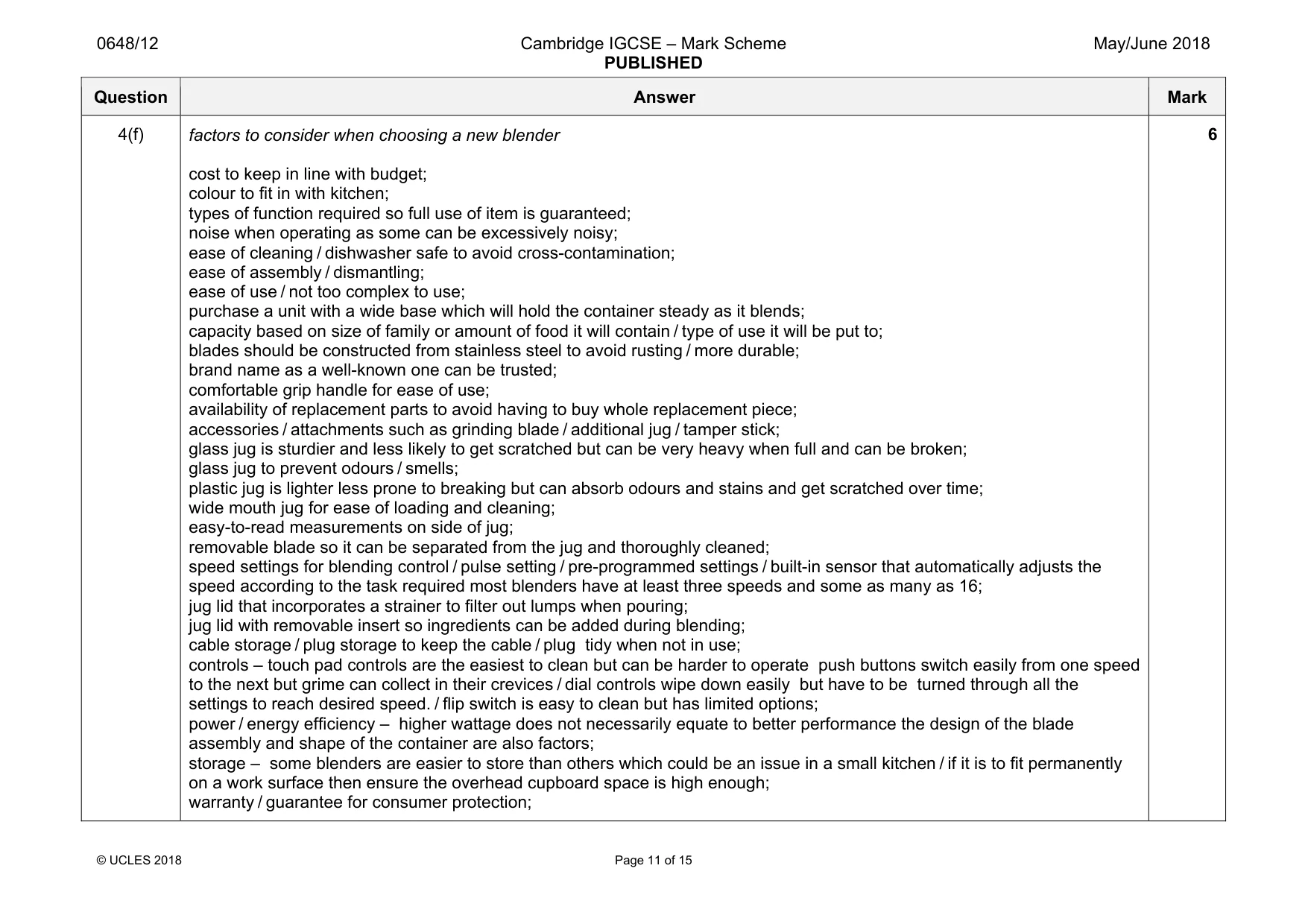
0648/12 Cambridge IGCSE – Mark Scheme PUBLISHED May/June 2018 © UCLES 2018 Page 11 of 15 Question Answer Mark 4(f) factors to consider when choosing a new blender cost to keep in line with budget; colour to fit in with kitchen; types of function required so full use of item is guaranteed; noise when operating as some can be excessively noisy; ease of cleaning / dishwasher safe to avoid cross-contamination; ease of assembly / dismantling; ease of use / not too complex to use; purchase a unit with a wide base which will hold the container steady as it blends; capacity based on size of family or amount of food it will contain / type of use it will be put to; blades should be constructed from stainless steel to avoid rusting / more durable; brand name as a well-known one can be trusted; comfortable grip handle for ease of use; availability of replacement parts to avoid having to buy whole replacement piece; accessories / attachments such as grinding blade / additional jug / tamper stick; glass jug is sturdier and less likely to get scratched but can be very heavy when full and can be broken; glass jug to prevent odours / smells; plastic jug is lighter less prone to breaking but can absorb odours and stains and get scratched over time; wide mouth jug for ease of loading and cleaning; easy-to-read measurements on side of jug; removable blade so it can be separated from the jug and thoroughly cleaned; speed settings for blending control / pulse setting / pre-programmed settings / built-in sensor that automatically adjusts the speed according to the task required most blenders have at least three speeds and some as many as 16; jug lid that incorporates a strainer to filter out lumps when pouring; jug lid with removable insert so ingredients can be added during blending; cable storage / plug storage to keep the cable / plug tidy when not in use; controls – touch pad controls are the easiest to clean but can be harder to operate push buttons switch easily from one speed to the next but grime can collect in their crevices / dial controls wipe down easily but have to be turned through all the settings to reach desired speed. / flip switch is easy to clean but has limited options; power / energy efficiency – higher wattage does not necessarily equate to better performance the design of the blade assembly and shape of the container are also factors; storage – some blenders are easier to store than others which could be an issue in a small kitchen / if it is to fit permanently on a work surface then ensure the overhead cupboard space is high enough; warranty / guarantee for consumer protection; 6
Mark scheme, page 12
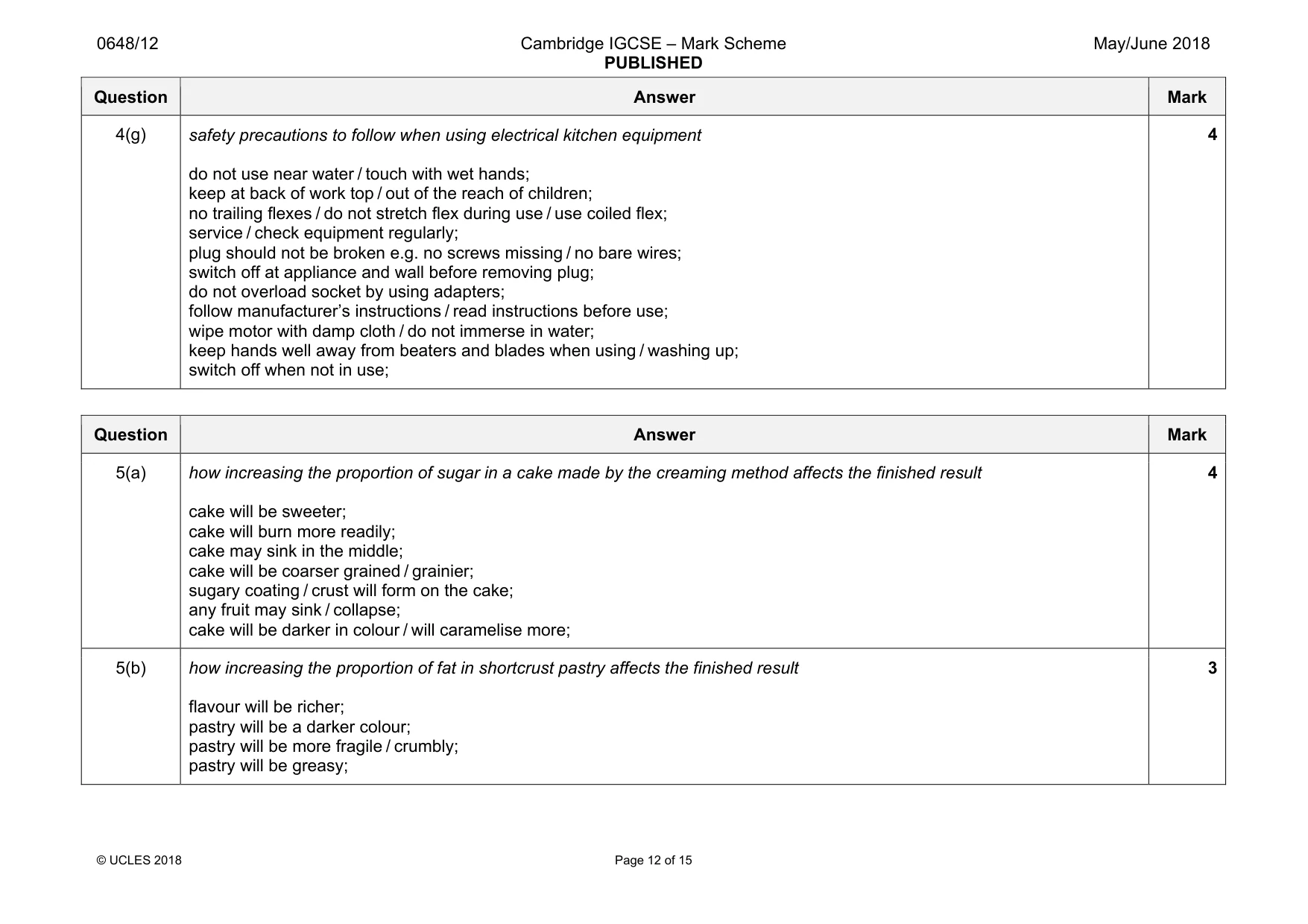
0648/12 Cambridge IGCSE – Mark Scheme PUBLISHED May/June 2018 © UCLES 2018 Page 12 of 15 Question Answer Mark 4(g) safety precautions to follow when using electrical kitchen equipment do not use near water / touch with wet hands; keep at back of work top / out of the reach of children; no trailing flexes / do not stretch flex during use / use coiled flex; service / check equipment regularly; plug should not be broken e.g. no screws missing / no bare wires; switch off at appliance and wall before removing plug; do not overload socket by using adapters; follow manufacturer’s instructions / read instructions before use; wipe motor with damp cloth / do not immerse in water; keep hands well away from beaters and blades when using / washing up; switch off when not in use; 4 Question Answer Mark 5(a) how increasing the proportion of sugar in a cake made by the creaming method affects the finished result cake will be sweeter; cake will burn more readily; cake may sink in the middle; cake will be coarser grained / grainier; sugary coating / crust will form on the cake; any fruit may sink / collapse; cake will be darker in colour / will caramelise more; 4 5(b) how increasing the proportion of fat in shortcrust pastry affects the finished result flavour will be richer; pastry will be a darker colour; pastry will be more fragile / crumbly; pastry will be greasy; 3
Mark scheme, page 13
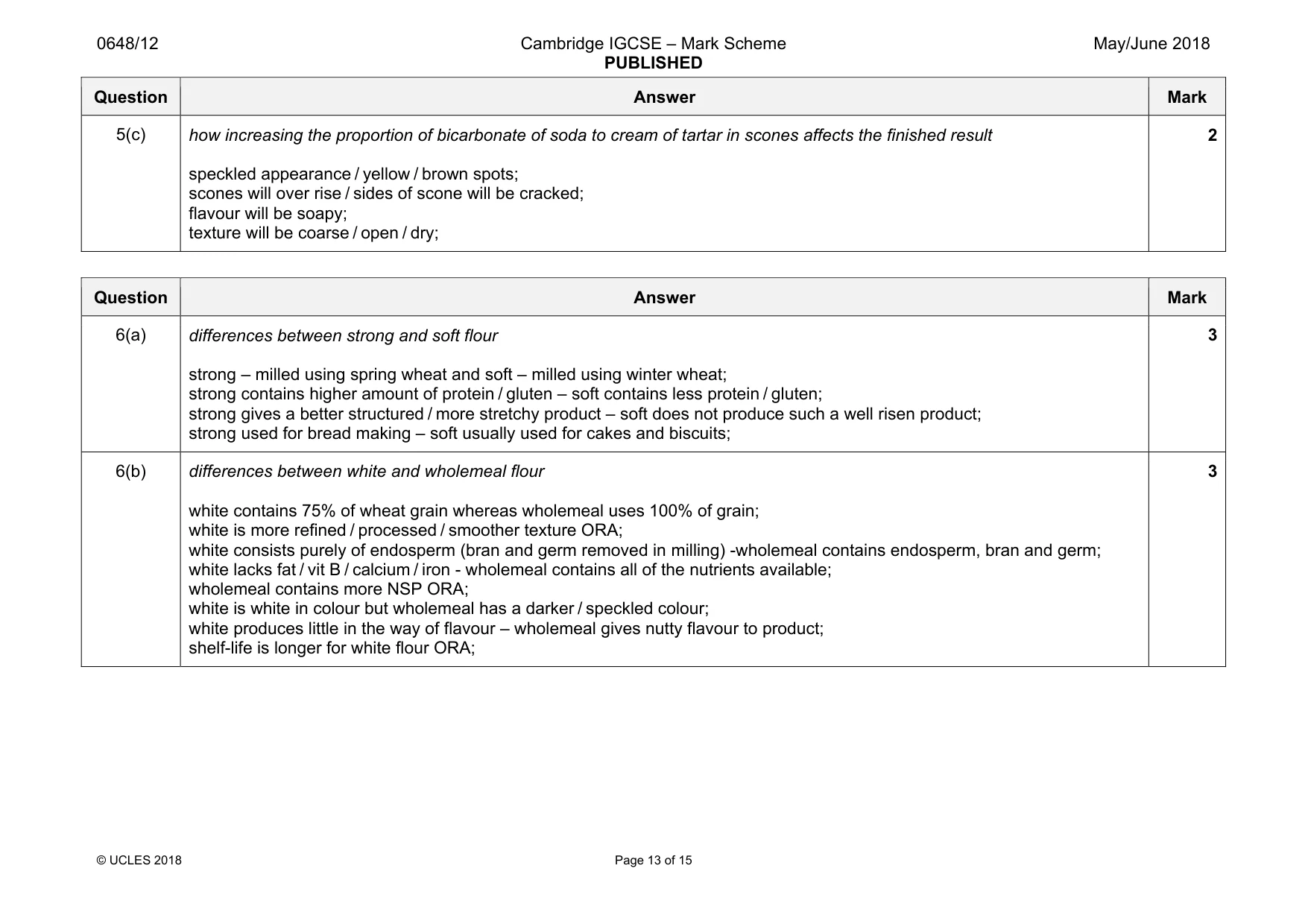
0648/12 Cambridge IGCSE – Mark Scheme PUBLISHED May/June 2018 © UCLES 2018 Page 13 of 15 Question Answer Mark 5(c) how increasing the proportion of bicarbonate of soda to cream of tartar in scones affects the finished result speckled appearance / yellow / brown spots; scones will over rise / sides of scone will be cracked; flavour will be soapy; texture will be coarse / open / dry; 2 Question Answer Mark 6(a) differences between strong and soft flour strong – milled using spring wheat and soft – milled using winter wheat; strong contains higher amount of protein / gluten – soft contains less protein / gluten; strong gives a better structured / more stretchy product – soft does not produce such a well risen product; strong used for bread making – soft usually used for cakes and biscuits; 3 6(b) differences between white and wholemeal flour white contains 75% of wheat grain whereas wholemeal uses 100% of grain; white is more refined / processed / smoother texture ORA; white consists purely of endosperm (bran and germ removed in milling) -wholemeal contains endosperm, bran and germ; white lacks fat / vit B / calcium / iron - wholemeal contains all of the nutrients available; wholemeal contains more NSP ORA; white is white in colour but wholemeal has a darker / speckled colour; white produces little in the way of flavour – wholemeal gives nutty flavour to product; shelf-life is longer for white flour ORA; 3
Mark scheme, page 14
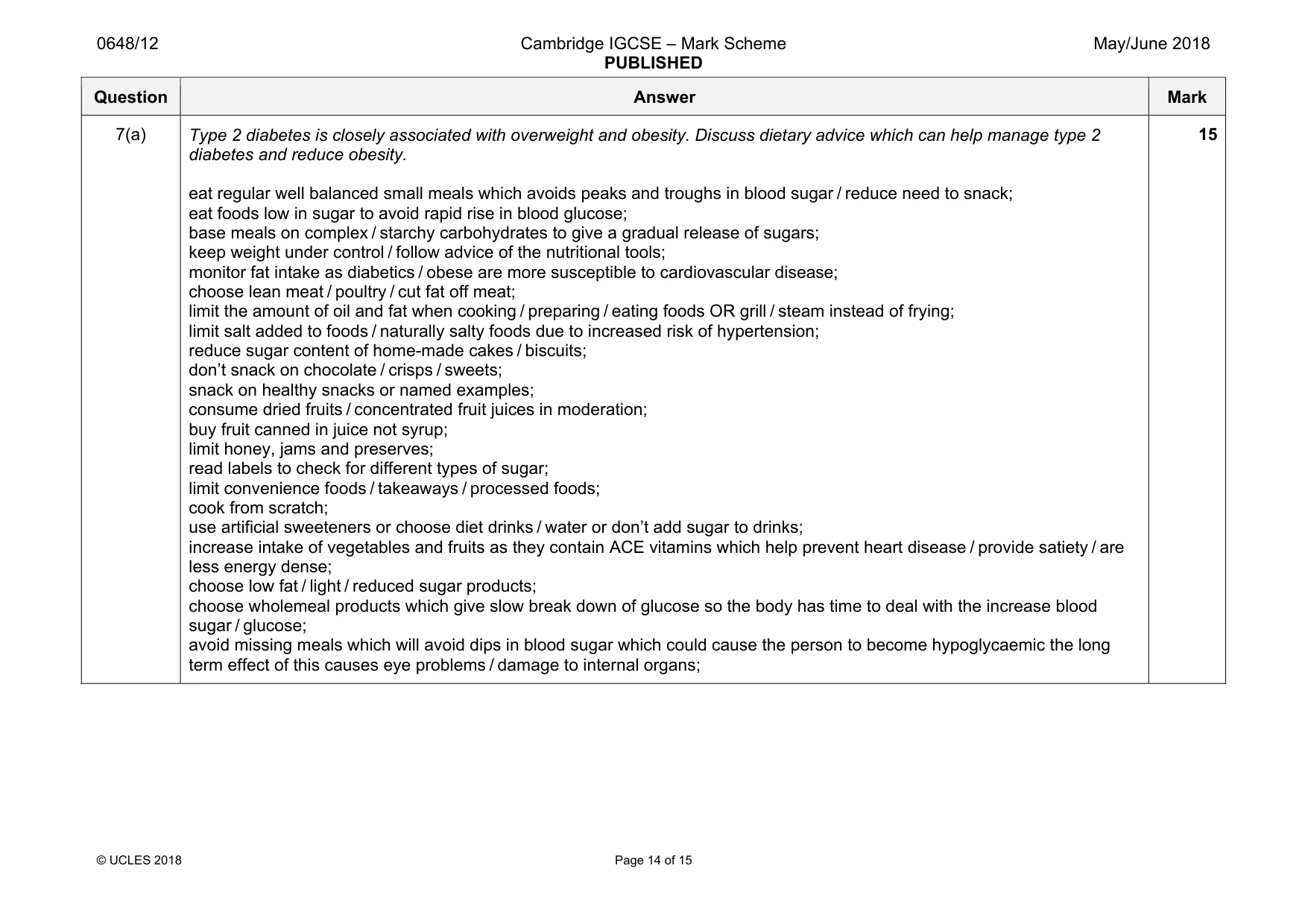
0648/12 Cambridge IGCSE – Mark Scheme PUBLISHED May/June 2018 © UCLES 2018 Page 14 of 15 Question Answer Mark 7(a) Type 2 diabetes is closely associated with overweight and obesity. Discuss dietary advice which can help manage type 2 diabetes and reduce obesity. eat regular well balanced small meals which avoids peaks and troughs in blood sugar / reduce need to snack; eat foods low in sugar to avoid rapid rise in blood glucose; base meals on complex / starchy carbohydrates to give a gradual release of sugars; keep weight under control / follow advice of the nutritional tools; monitor fat intake as diabetics / obese are more susceptible to cardiovascular disease; choose lean meat / poultry / cut fat off meat; limit the amount of oil and fat when cooking / preparing / eating foods OR grill / steam instead of frying; limit salt added to foods / naturally salty foods due to increased risk of hypertension; reduce sugar content of home-made cakes / biscuits; don’t snack on chocolate / crisps / sweets; snack on healthy snacks or named examples; consume dried fruits / concentrated fruit juices in moderation; buy fruit canned in juice not syrup; limit honey, jams and preserves; read labels to check for different types of sugar; limit convenience foods / takeaways / processed foods; cook from scratch; use artificial sweeteners or choose diet drinks / water or don’t add sugar to drinks; increase intake of vegetables and fruits as they contain ACE vitamins which help prevent heart disease / provide satiety / are less energy dense; choose low fat / light / reduced sugar products; choose wholemeal products which give slow break down of glucose so the body has time to deal with the increase blood sugar / glucose; avoid missing meals which will avoid dips in blood sugar which could cause the person to become hypoglycaemic the long term effect of this causes eye problems / damage to internal organs; 15
Mark scheme, page 15
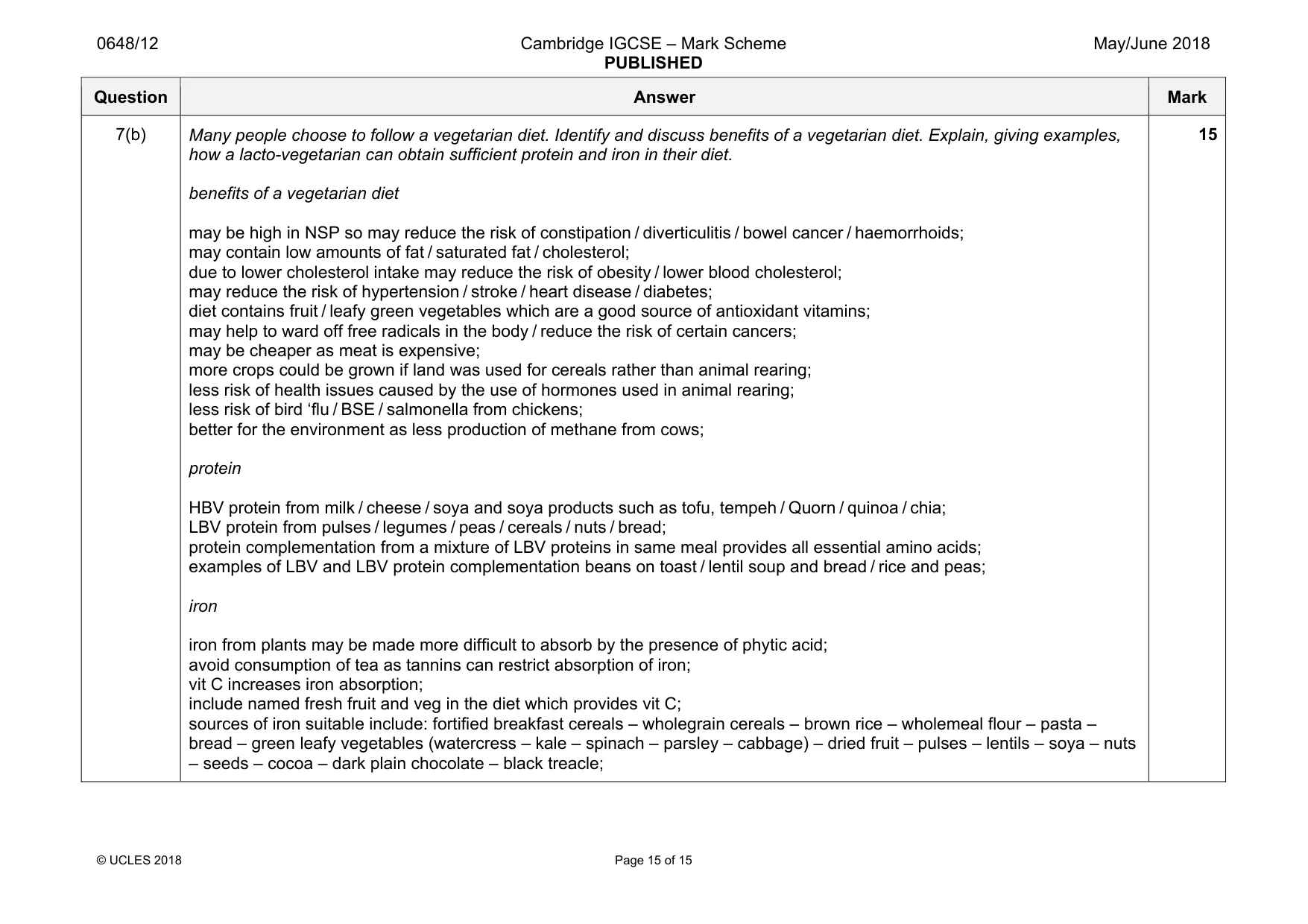
0648/12 Cambridge IGCSE – Mark Scheme PUBLISHED May/June 2018 © UCLES 2018 Page 15 of 15 Question Answer Mark 7(b) Many people choose to follow a vegetarian diet. Identify and discuss benefits of a vegetarian diet. Explain, giving examples, how a lacto-vegetarian can obtain sufficient protein and iron in their diet. benefits of a vegetarian diet may be high in NSP so may reduce the risk of constipation / diverticulitis / bowel cancer / haemorrhoids; may contain low amounts of fat / saturated fat / cholesterol; due to lower cholesterol intake may reduce the risk of obesity / lower blood cholesterol; may reduce the risk of hypertension / stroke / heart disease / diabetes; diet contains fruit / leafy green vegetables which are a good source of antioxidant vitamins; may help to ward off free radicals in the body / reduce the risk of certain cancers; may be cheaper as meat is expensive; more crops could be grown if land was used for cereals rather than animal rearing; less risk of health issues caused by the use of hormones used in animal rearing; less risk of bird ‘flu / BSE / salmonella from chickens; better for the environment as less production of methane from cows; protein HBV protein from milk / cheese / soya and soya products such as tofu, tempeh / Quorn / quinoa / chia; LBV protein from pulses / legumes / peas / cereals / nuts / bread; protein complementation from a mixture of LBV proteins in same meal provides all essential amino acids; examples of LBV and LBV protein complementation beans on toast / lentil soup and bread / rice and peas; iron iron from plants may be made more difficult to absorb by the presence of phytic acid; avoid consumption of tea as tannins can restrict absorption of iron; vit C increases iron absorption; include named fresh fruit and veg in the diet which provides vit C; sources of iron suitable include: fortified breakfast cereals – wholegrain cereals – brown rice – wholemeal flour – pasta – bread – green leafy vegetables (watercress – kale – spinach – parsley – cabbage) – dried fruit – pulses – lentils – soya – nuts – seeds – cocoa – dark plain chocolate – black treacle; 15
What you needed in this session
Cambridge’s own grade thresholds for 2018 May/June, Paper 1 · Variant 2. A higher threshold means an easier paper — the bar moves with how the cohort did.