Cambridge IGCSE Food and Nutrition 0648 — 2018 May/June Paper 1 · Variant 3
0648/13/M/J/18 · 100 marks · ≈113 min
The question paper and its mark scheme, free to read here and free to download. This is Cambridge’s own paper, exactly as it was sat.
Question paper12 pages


Mark scheme15 pages
Answers below. Sit the paper first if you are practising.
Paper as text
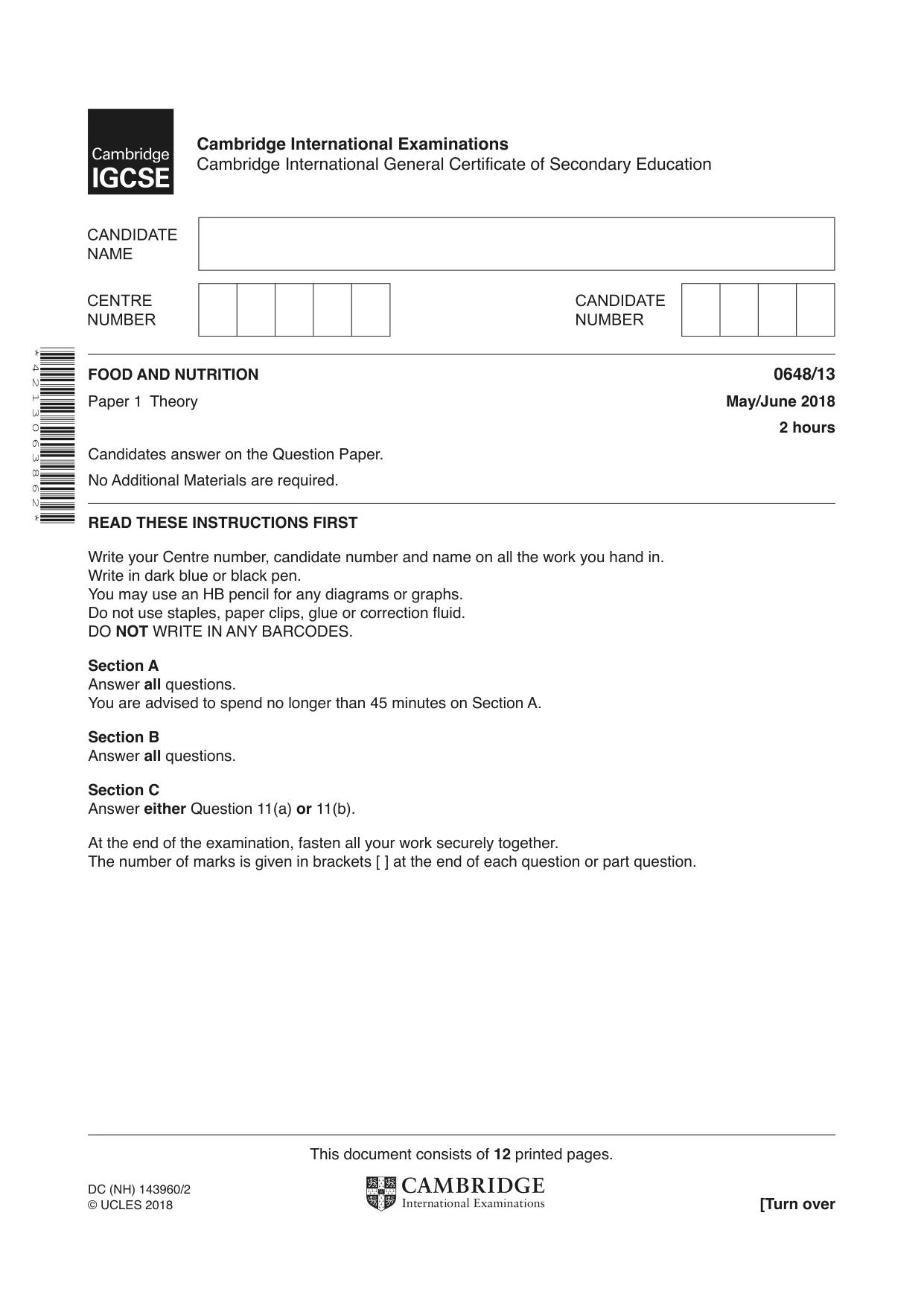
Question paper, page 1
This document consists of 12 printed pages. DC (NH) 143960/2 © UCLES 2018 [Turn over * 4 2 1 3 0 6 3 8 6 2 * Cambridge International Examinations Cambridge International General Certificate of Secondary Education FOOD AND NUTRITION 0648/13 Paper 1 Theory May/June 2018 2 hours Candidates answer on the Question Paper. No Additional Materials are required. READ THESE INSTRUCTIONS FIRST Write your Centre number, candidate number and name on all the work you hand in. Write in dark blue or black pen. You may use an HB pencil for any diagrams or graphs. Do not use staples, paper clips, glue or correction fluid. DO NOT WRITE IN ANY BARCODES. Section A Answer all questions. You are advised to spend no longer than 45 minutes on Section A. Section B Answer all questions. Section C Answer either Question 11(a) or 11(b). At the end of the examination, fasten all your work securely together. The number of marks is given in brackets [ ] at the end of each question or part question.
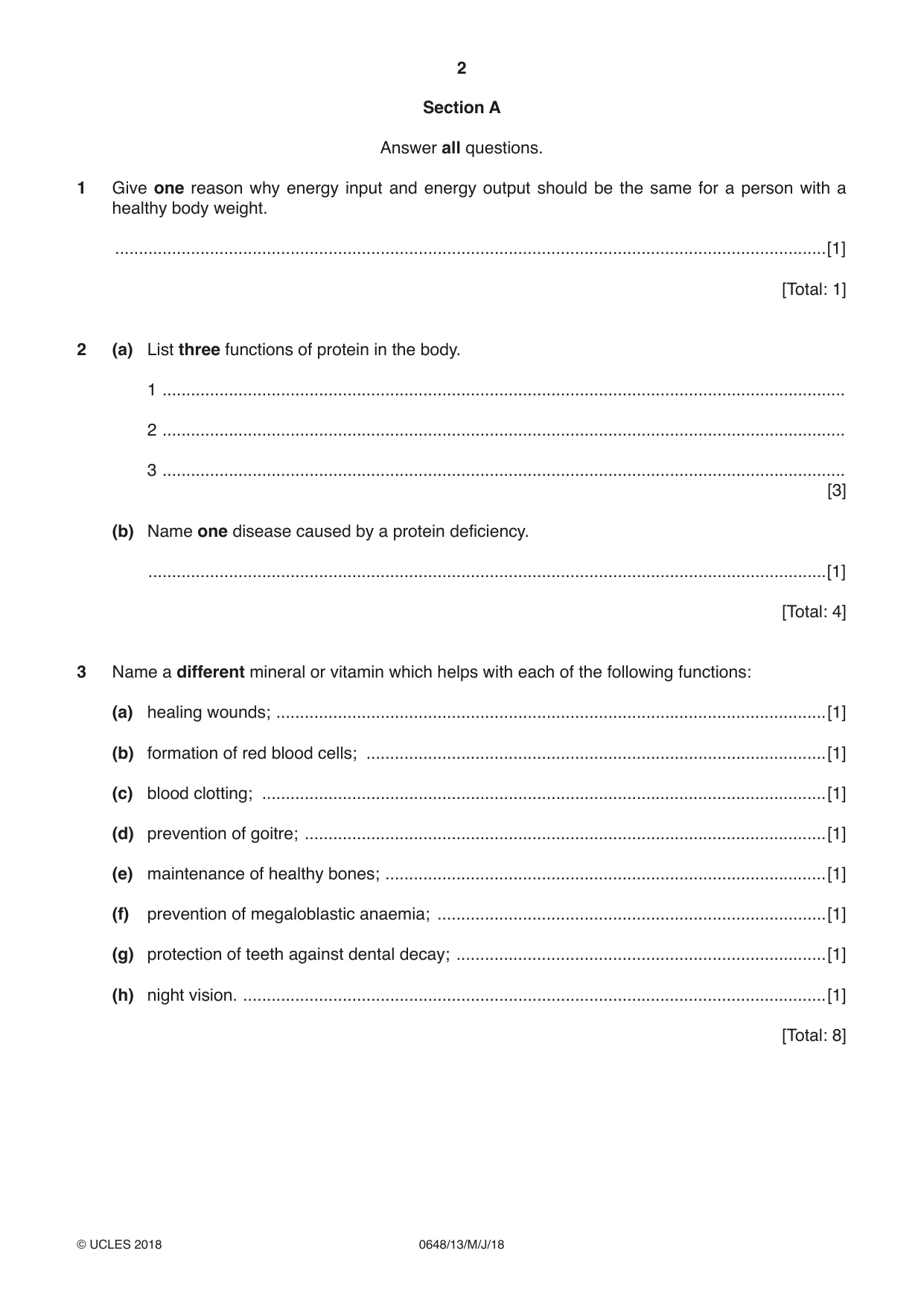
Question paper, page 2
2 0648/13/M/J/18 © UCLES 2018 Section A Answer all questions. 1 Give one reason why energy input and energy output should be the same for a person with a healthy body weight. …[1] [Total: 1] 2 (a) List three functions of protein in the body. 1 … 2 … 3 … [3] (b) Name one disease caused by a protein deficiency. …[1] [Total: 4] 3 Name a different mineral or vitamin which helps with each of the following functions: (a) healing wounds; …[1] (b) formation of red blood cells; …[1] (c) blood clotting; …[1] (d) prevention of goitre; …[1] (e) maintenance of healthy bones; …[1] (f) prevention of megaloblastic anaemia; …[1] (g) protection of teeth against dental decay; …[1] (h) night vision. …[1] [Total: 8]
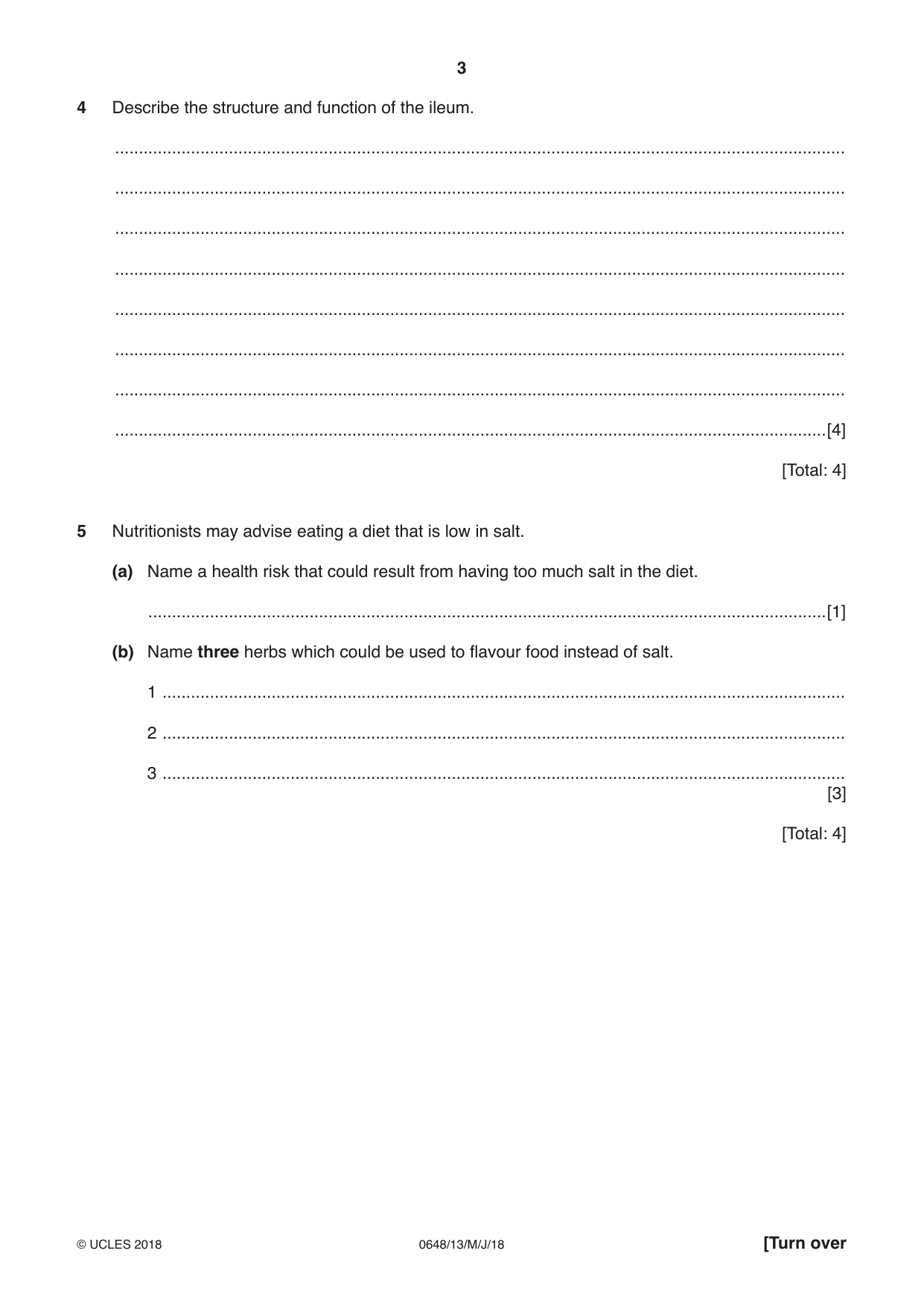
Question paper, page 3
3 0648/13/M/J/18 © UCLES 2018 [Turn over 4 Describe the structure and function of the ileum. … … … … … … … …[4] [Total: 4] 5 Nutritionists may advise eating a diet that is low in salt. (a) Name a health risk that could result from having too much salt in the diet. …[1] (b) Name three herbs which could be used to flavour food instead of salt. 1 … 2 … 3 … [3] [Total: 4]
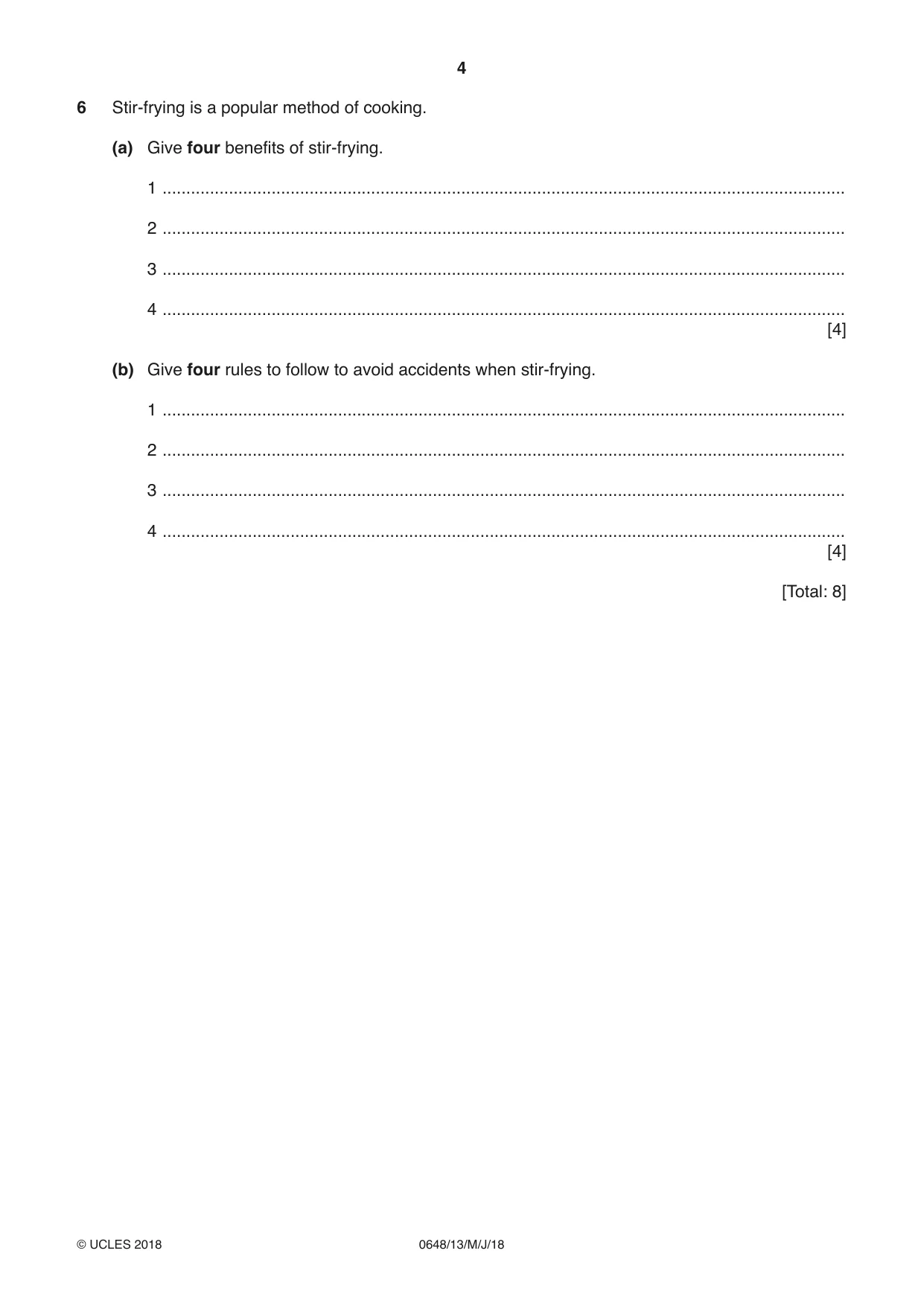
Question paper, page 4
4 0648/13/M/J/18 © UCLES 2018 6 Stir-frying is a popular method of cooking. (a) Give four benefits of stir-frying. 1 … 2 … 3 … 4 … [4] (b) Give four rules to follow to avoid accidents when stir-frying. 1 … 2 … 3 … 4 … [4] [Total: 8]
Question paper, page 5
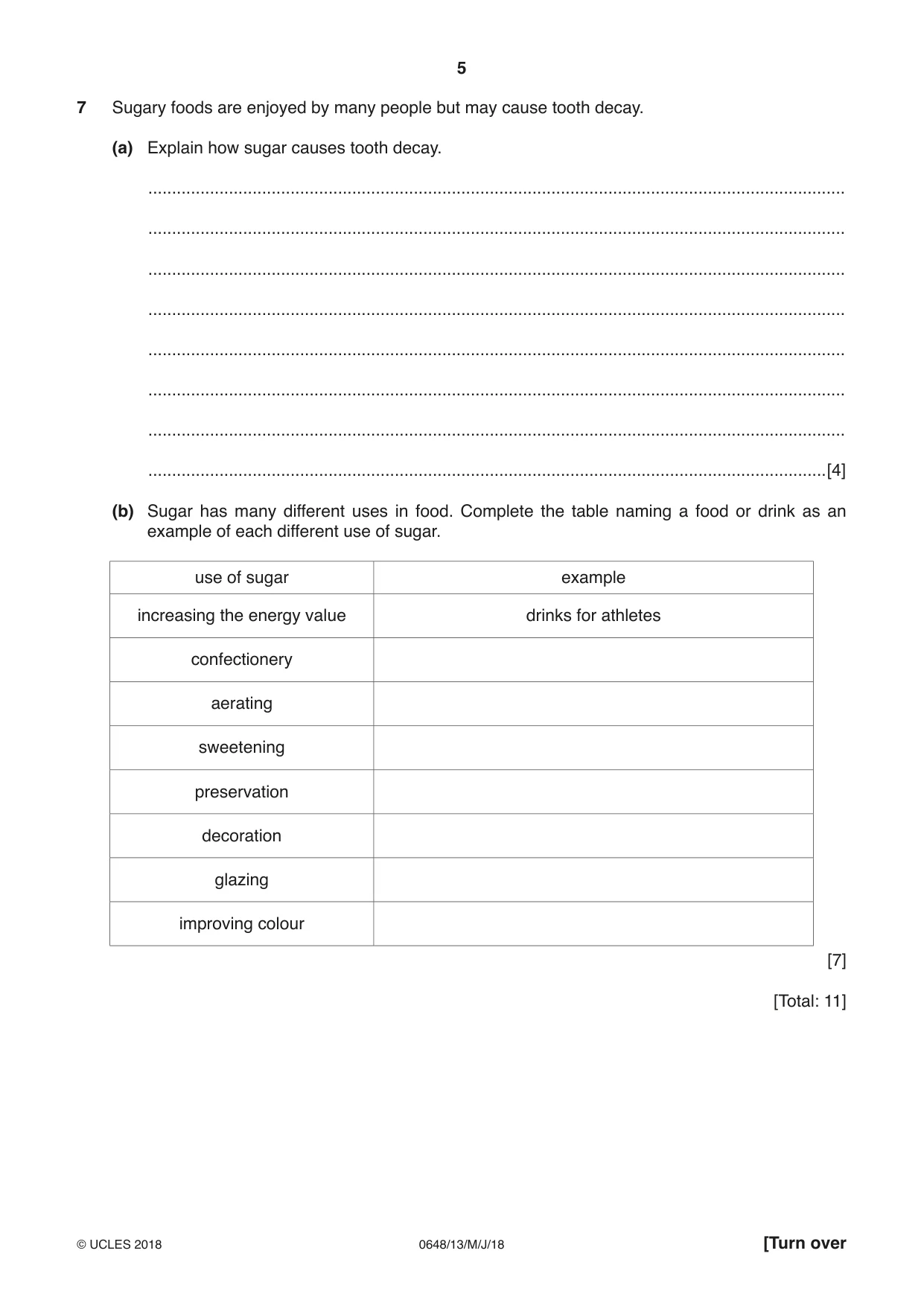
5 0648/13/M/J/18 © UCLES 2018 [Turn over 7 Sugary foods are enjoyed by many people but may cause tooth decay. (a) Explain how sugar causes tooth decay. … … … … … … … …[4] (b) Sugar has many different uses in food. Complete the table naming a food or drink as an example of each different use of sugar. use of sugar example increasing the energy value drinks for athletes confectionery aerating sweetening preservation decoration glazing improving colour [7] [Total: 11]
Question paper, page 6
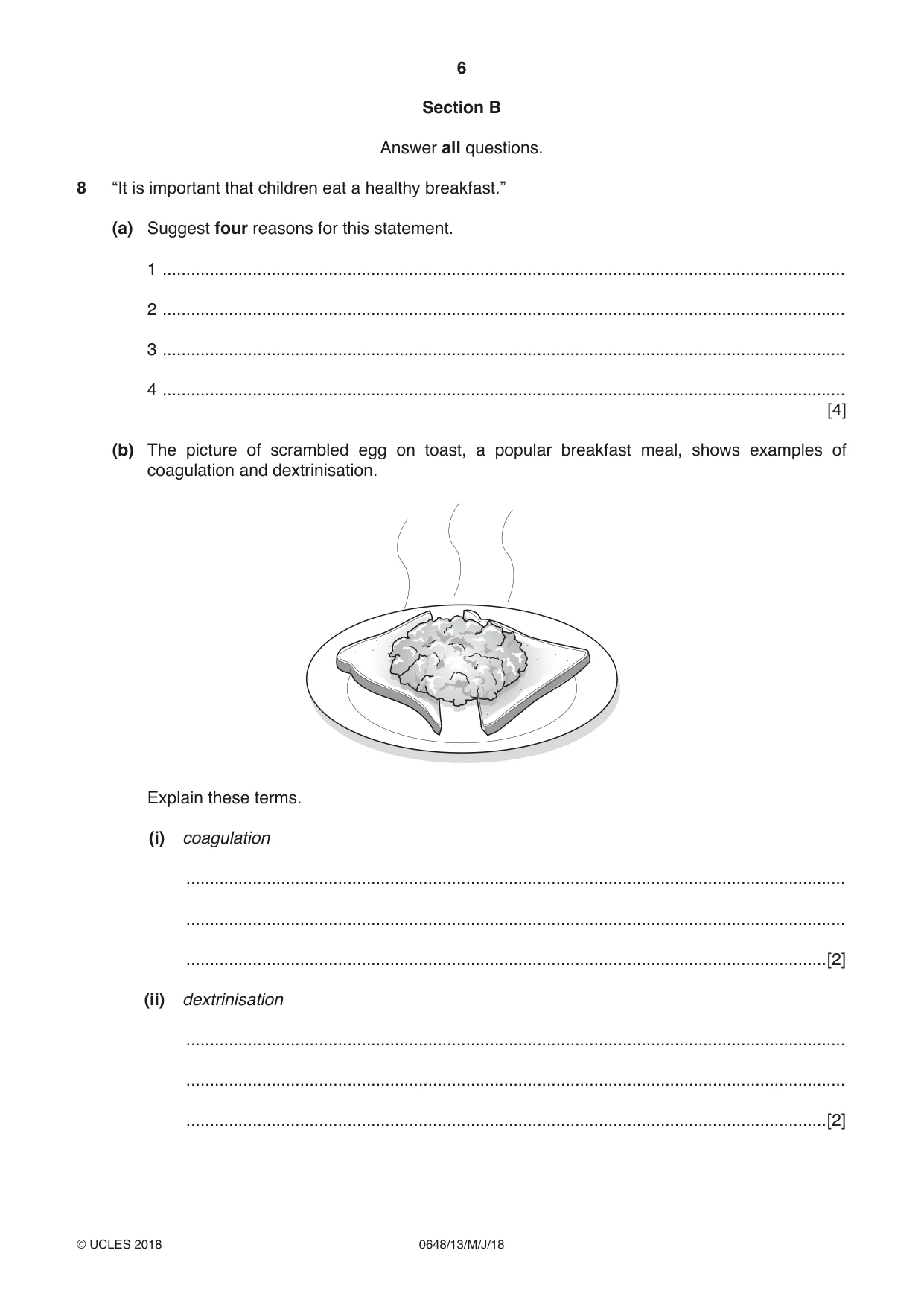
6 0648/13/M/J/18 © UCLES 2018 Section B Answer all questions. 8 “It is important that children eat a healthy breakfast.” (a) Suggest four reasons for this statement. 1 … 2 … 3 … 4 … [4] (b) The picture of scrambled egg on toast, a popular breakfast meal, shows examples of coagulation and dextrinisation. Explain these terms. (i) coagulation … … …[2] (ii) dextrinisation … … …[2]
Question paper, page 7
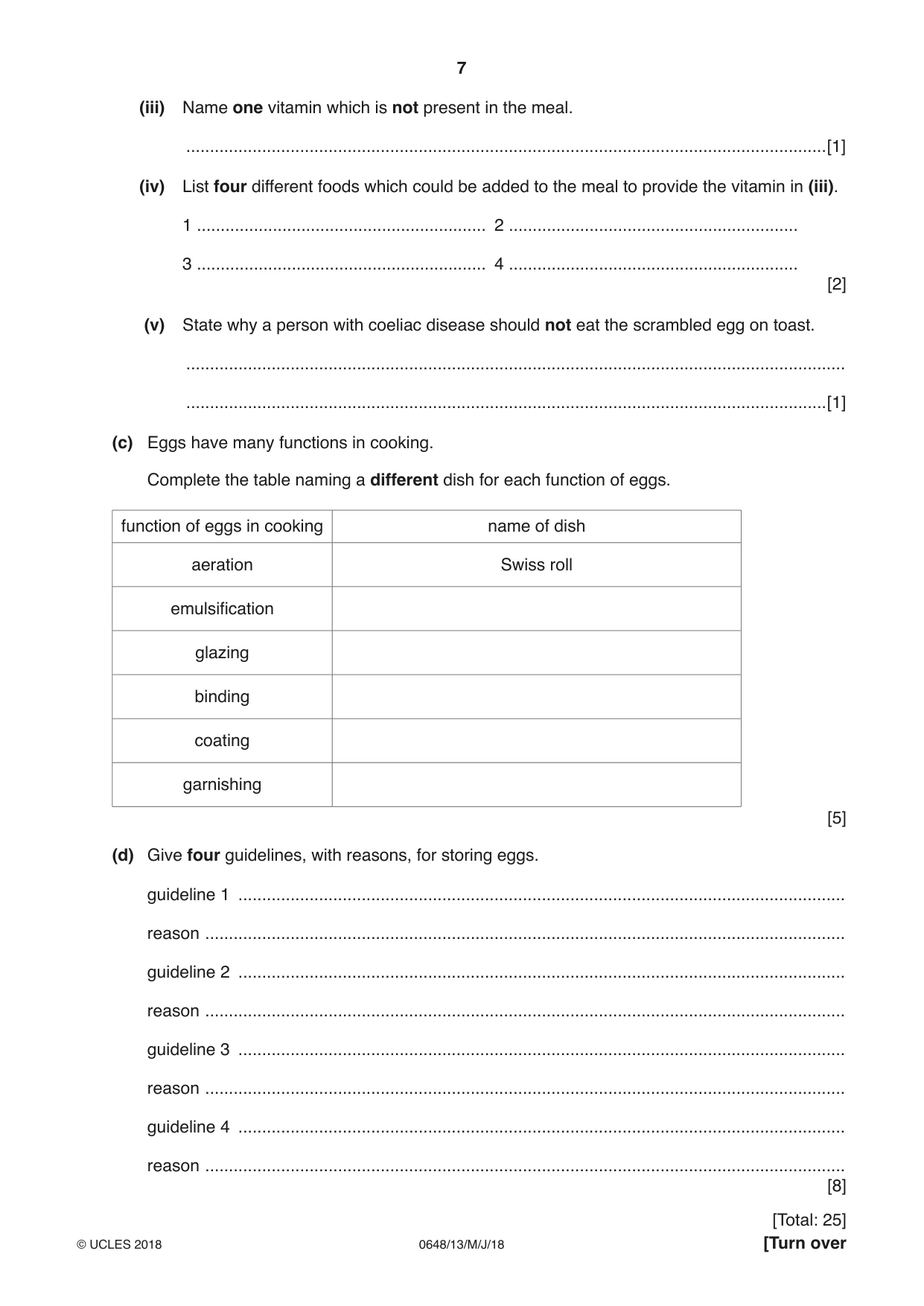
7 0648/13/M/J/18 © UCLES 2018 [Turn over (iii) Name one vitamin which is not present in the meal. …[1] (iv) List four different foods which could be added to the meal to provide the vitamin in (iii). 1 … 2 … 3 … 4 … [2] (v) State why a person with coeliac disease should not eat the scrambled egg on toast. … …[1] (c) Eggs have many functions in cooking. Complete the table naming a different dish for each function of eggs. function of eggs in cooking name of dish aeration Swiss roll emulsification glazing binding coating garnishing [5] (d) Give four guidelines, with reasons, for storing eggs. guideline 1 … reason … guideline 2 … reason … guideline 3 … reason … guideline 4 … reason … [8] [Total: 25]
Question paper, page 8
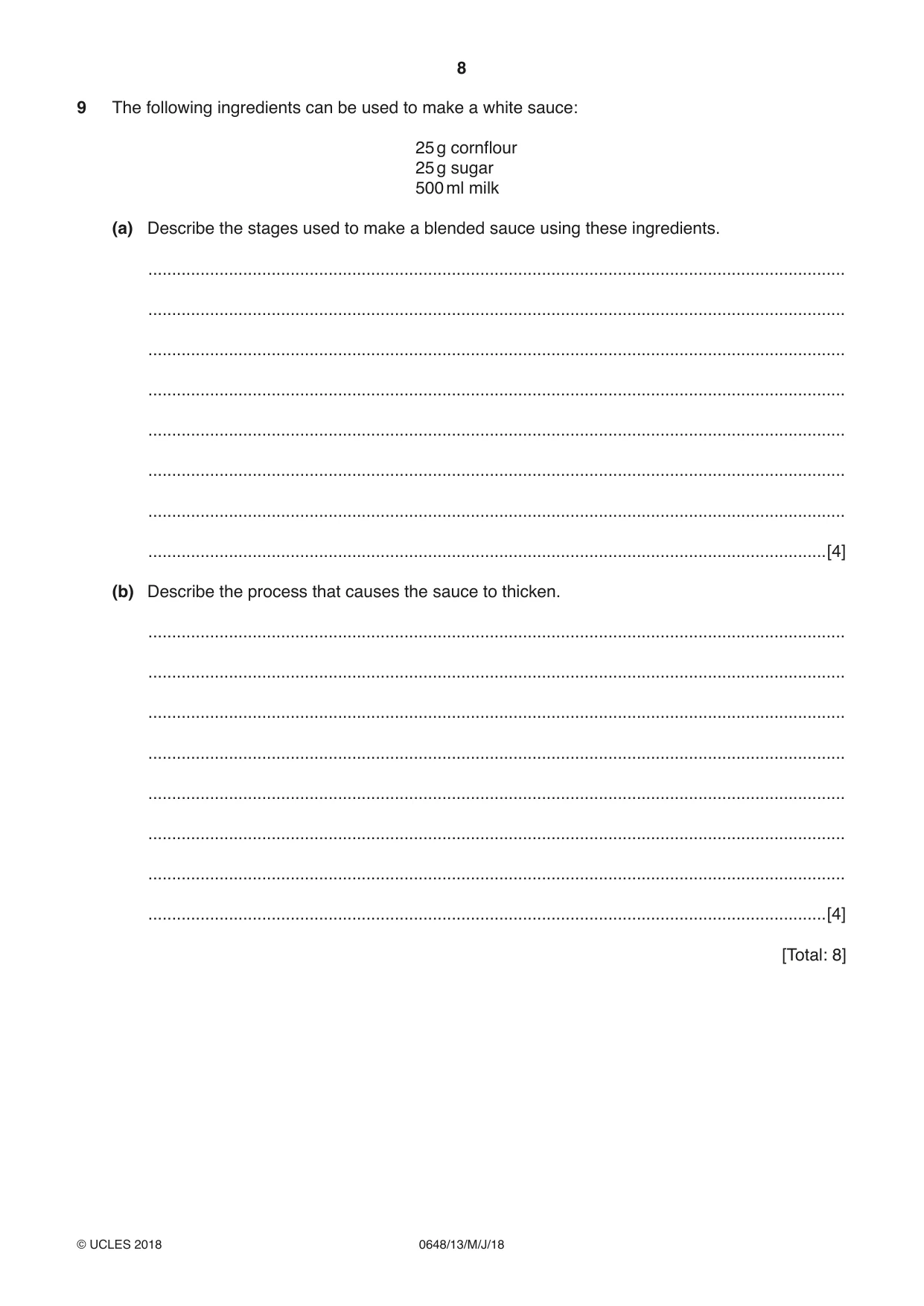
8 0648/13/M/J/18 © UCLES 2018 9 The following ingredients can be used to make a white sauce: 25 g cornflour 25 g sugar 500 ml milk (a) Describe the stages used to make a blended sauce using these ingredients. … … … … … … … …[4] (b) Describe the process that causes the sauce to thicken. … … … … … … … …[4] [Total: 8]
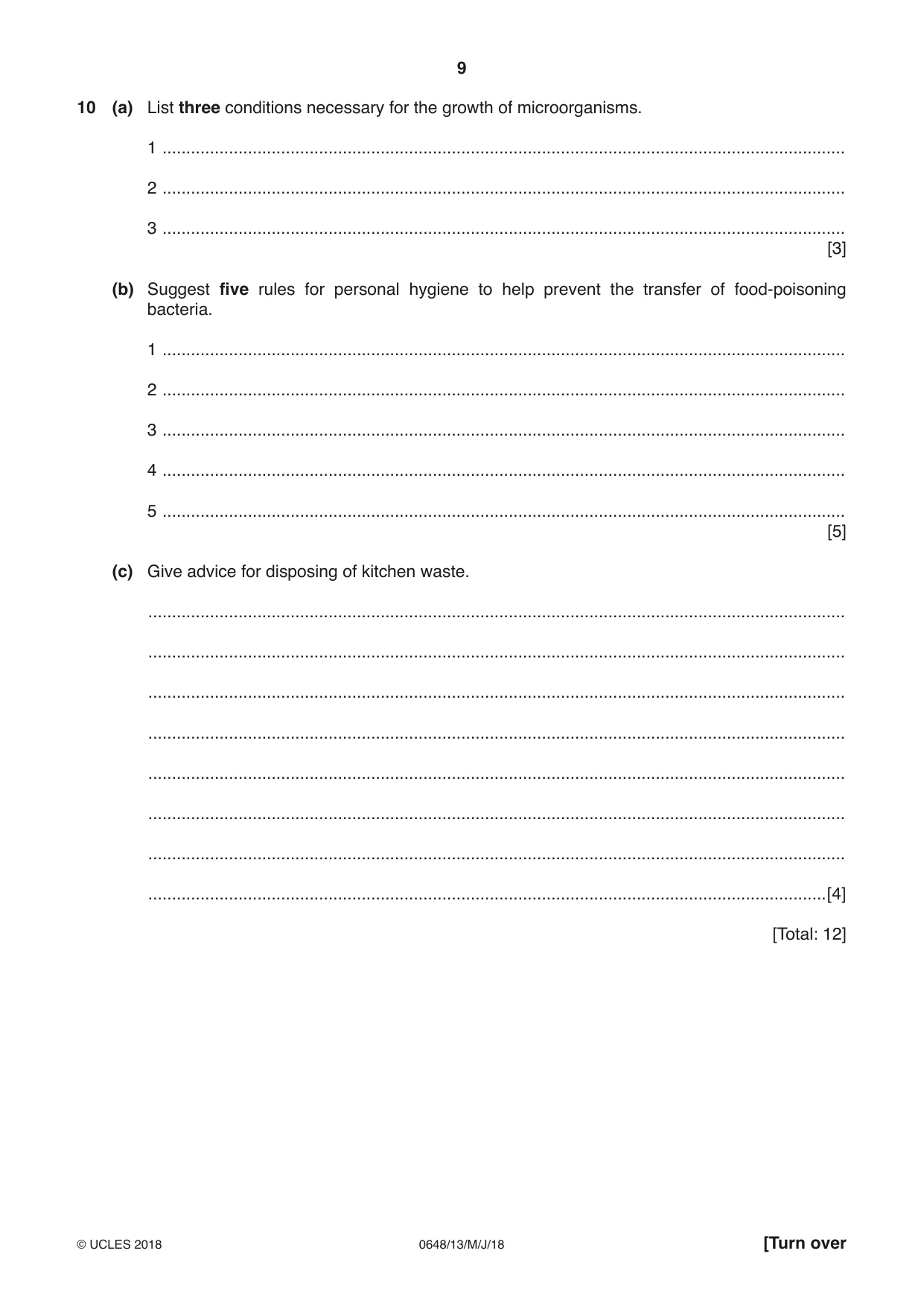
Question paper, page 9
9 0648/13/M/J/18 © UCLES 2018 [Turn over 10 (a) List three conditions necessary for the growth of microorganisms. 1 … 2 … 3 … [3] (b) Suggest five rules for personal hygiene to help prevent the transfer of food-poisoning bacteria. 1 … 2 … 3 … 4 … 5 … [5] (c) Give advice for disposing of kitchen waste. … … … … … … … …[4] [Total: 12]
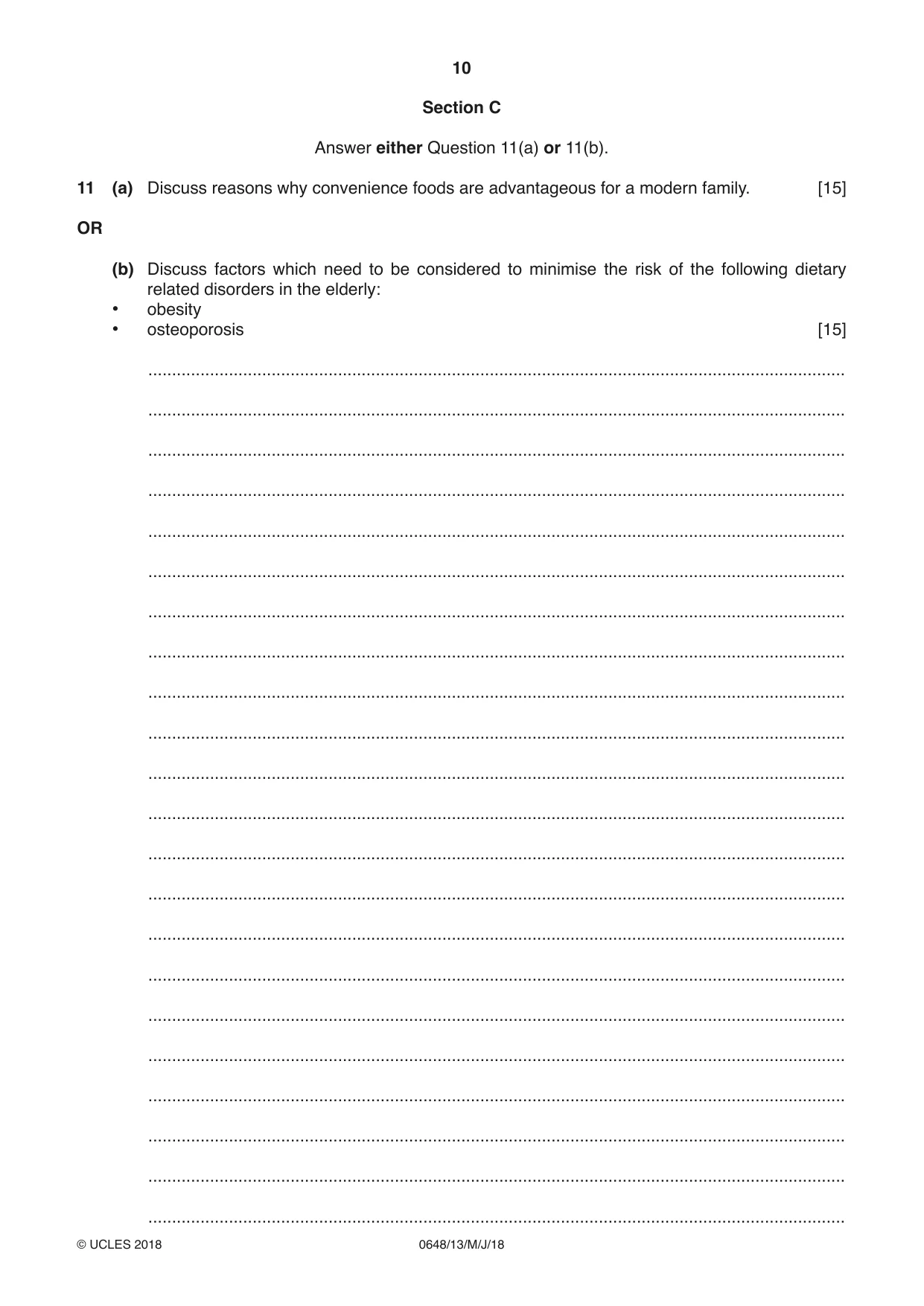
Question paper, page 10
10 0648/13/M/J/18 © UCLES 2018 Section C Answer either Question 11(a) or 11(b). 11 (a) Discuss reasons why convenience foods are advantageous for a modern family. [15] OR (b) Discuss factors which need to be considered to minimise the risk of the following dietary related disorders in the elderly: • obesity • osteoporosis [15] … … … … … … … … … … … … … … … … … … … … … …
Question paper, page 11
11 0648/13/M/J/18 © UCLES 2018 [Turn over … … … … … … … … … … … … … … … … … … … … … … … … … … … …
Question paper, page 12
12 0648/13/M/J/18 © UCLES 2018 Permission to reproduce items where third-party owned material protected by copyright is included has been sought and cleared where possible. Every reasonable effort has been made by the publisher (UCLES) to trace copyright holders, but if any items requiring clearance have unwittingly been included, the publisher will be pleased to make amends at the earliest possible opportunity. To avoid the issue of disclosure of answer-related information to candidates, all copyright acknowledgements are reproduced online in the Cambridge International Examinations Copyright Acknowledgements Booklet. This is produced for each series of examinations and is freely available to download at www.cie.org.uk after the live examination series. Cambridge International Examinations is part of the Cambridge Assessment Group. Cambridge Assessment is the brand name of University of Cambridge Local Examinations Syndicate (UCLES), which is itself a department of the University of Cambridge. … … … … … … … … … … … … … … … … … … … … … … … [Total: 15]
Mark scheme, page 1
IGCSE™ is a registered trademark. This document consists of 15 printed pages. © UCLES 2018 [Turn over Cambridge Assessment International Education Cambridge International General Certificate of Secondary Education FOOD AND NUTRITION 0648/13 Paper 1 Theory May/June 2018 MARK SCHEME Maximum Mark: 100 Published This mark scheme is published as an aid to teachers and candidates, to indicate the requirements of the examination. It shows the basis on which Examiners were instructed to award marks. It does not indicate the details of the discussions that took place at an Examiners’ meeting before marking began, which would have considered the acceptability of alternative answers. Mark schemes should be read in conjunction with the question paper and the Principal Examiner Report for Teachers. Cambridge International will not enter into discussions about these mark schemes. Cambridge International is publishing the mark schemes for the May/June 2018 series for most Cambridge IGCSE™, Cambridge International A and AS Level and Cambridge Pre-U components, and some Cambridge O Level components.
Mark scheme, page 2
0648/13 Cambridge IGCSE – Mark Scheme PUBLISHED May/June 2018 © UCLES 2018 Page 2 of 15 Generic Marking Principles These general marking principles must be applied by all examiners when marking candidate answers. They should be applied alongside the specific content of the mark scheme or generic level descriptors for a question. Each question paper and mark scheme will also comply with these marking principles. GENERIC MARKING PRINCIPLE 1: Marks must be awarded in line with: • the specific content of the mark scheme or the generic level descriptors for the question • the specific skills defined in the mark scheme or in the generic level descriptors for the question • the standard of response required by a candidate as exemplified by the standardisation scripts. GENERIC MARKING PRINCIPLE 2: Marks awarded are always whole marks (not half marks, or other fractions). GENERIC MARKING PRINCIPLE 3: Marks must be awarded positively: • marks are awarded for correct/valid answers, as defined in the mark scheme. However, credit is given for valid answers which go beyond the scope of the syllabus and mark scheme, referring to your Team Leader as appropriate • marks are awarded when candidates clearly demonstrate what they know and can do • marks are not deducted for errors • marks are not deducted for omissions • answers should only be judged on the quality of spelling, punctuation and grammar when these features are specifically assessed by the question as indicated by the mark scheme. The meaning, however, should be unambiguous. GENERIC MARKING PRINCIPLE 4: Rules must be applied consistently e.g. in situations where candidates have not followed instructions or in the application of generic level descriptors.
Mark scheme, page 3
0648/13 Cambridge IGCSE – Mark Scheme PUBLISHED May/June 2018 © UCLES 2018 Page 3 of 15 GENERIC MARKING PRINCIPLE 5: Marks should be awarded using the full range of marks defined in the mark scheme for the question (however; the use of the full mark range may be limited according to the quality of the candidate responses seen). GENERIC MARKING PRINCIPLE 6: Marks awarded are based solely on the requirements as defined in the mark scheme. Marks should not be awarded with grade thresholds or grade descriptors in mind.
Mark scheme, page 4
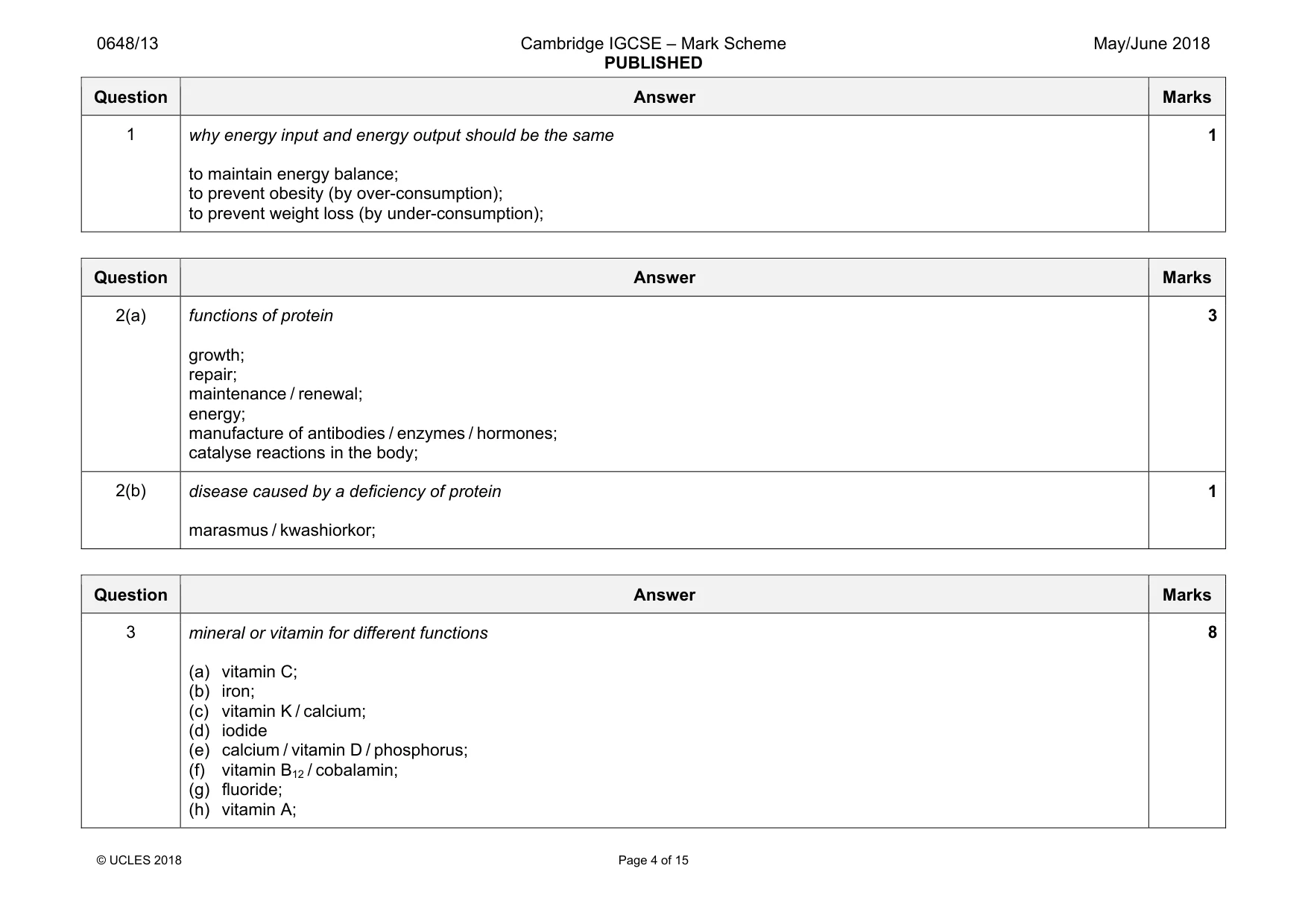
0648/13 Cambridge IGCSE – Mark Scheme PUBLISHED May/June 2018 © UCLES 2018 Page 4 of 15 Question Answer Marks 1 why energy input and energy output should be the same to maintain energy balance; to prevent obesity (by over-consumption); to prevent weight loss (by under-consumption); 1 Question Answer Marks 2(a) functions of protein growth; repair; maintenance / renewal; energy; manufacture of antibodies / enzymes / hormones; catalyse reactions in the body; 3 2(b) disease caused by a deficiency of protein marasmus / kwashiorkor; 1 Question Answer Marks 3 mineral or vitamin for different functions (a) vitamin C; (b) iron; (c) vitamin K / calcium; (d) iodide (e) calcium / vitamin D / phosphorus; (f) vitamin B12 / cobalamin; (g) fluoride; (h) vitamin A; 8
Mark scheme, page 5
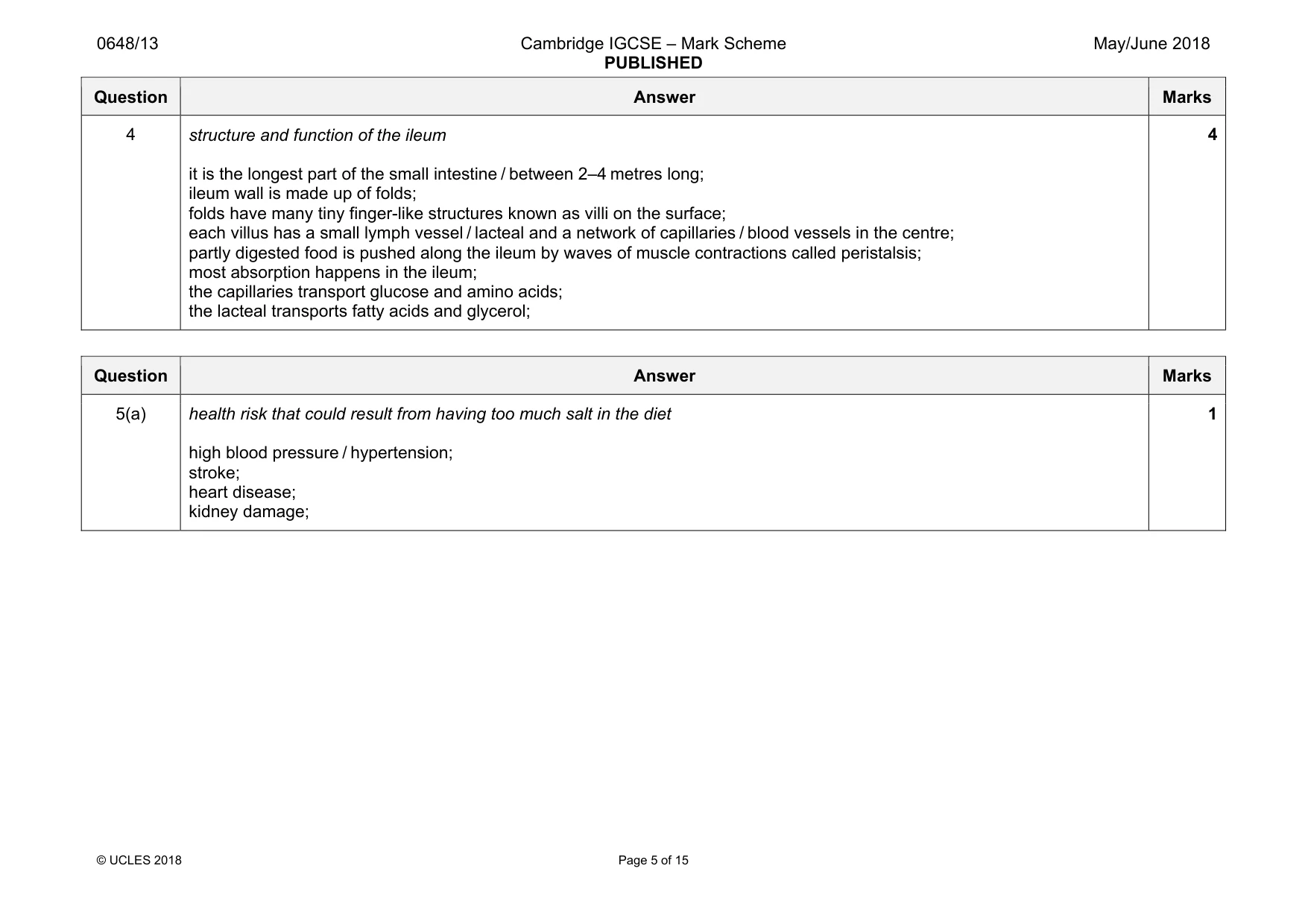
0648/13 Cambridge IGCSE – Mark Scheme PUBLISHED May/June 2018 © UCLES 2018 Page 5 of 15 Question Answer Marks 4 structure and function of the ileum it is the longest part of the small intestine / between 2–4 metres long; ileum wall is made up of folds; folds have many tiny finger-like structures known as villi on the surface; each villus has a small lymph vessel / lacteal and a network of capillaries / blood vessels in the centre; partly digested food is pushed along the ileum by waves of muscle contractions called peristalsis; most absorption happens in the ileum; the capillaries transport glucose and amino acids; the lacteal transports fatty acids and glycerol; 4 Question Answer Marks 5(a) health risk that could result from having too much salt in the diet high blood pressure / hypertension; stroke; heart disease; kidney damage; 1
Mark scheme, page 6
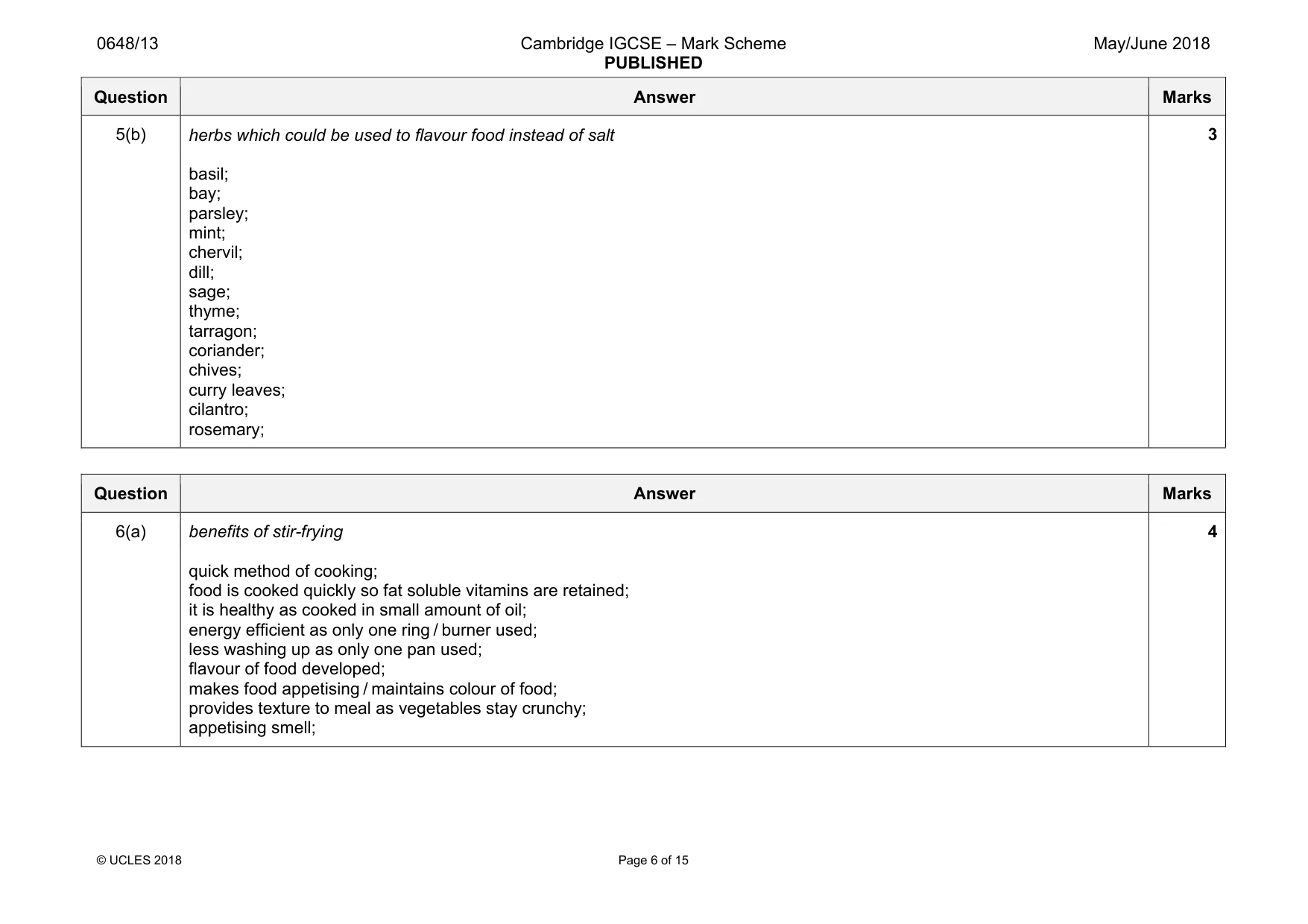
0648/13 Cambridge IGCSE – Mark Scheme PUBLISHED May/June 2018 © UCLES 2018 Page 6 of 15 Question Answer Marks 5(b) herbs which could be used to flavour food instead of salt basil; bay; parsley; mint; chervil; dill; sage; thyme; tarragon; coriander; chives; curry leaves; cilantro; rosemary; 3 Question Answer Marks 6(a) benefits of stir-frying quick method of cooking; food is cooked quickly so fat soluble vitamins are retained; it is healthy as cooked in small amount of oil; energy efficient as only one ring / burner used; less washing up as only one pan used; flavour of food developed; makes food appetising / maintains colour of food; provides texture to meal as vegetables stay crunchy; appetising smell; 4
Mark scheme, page 7
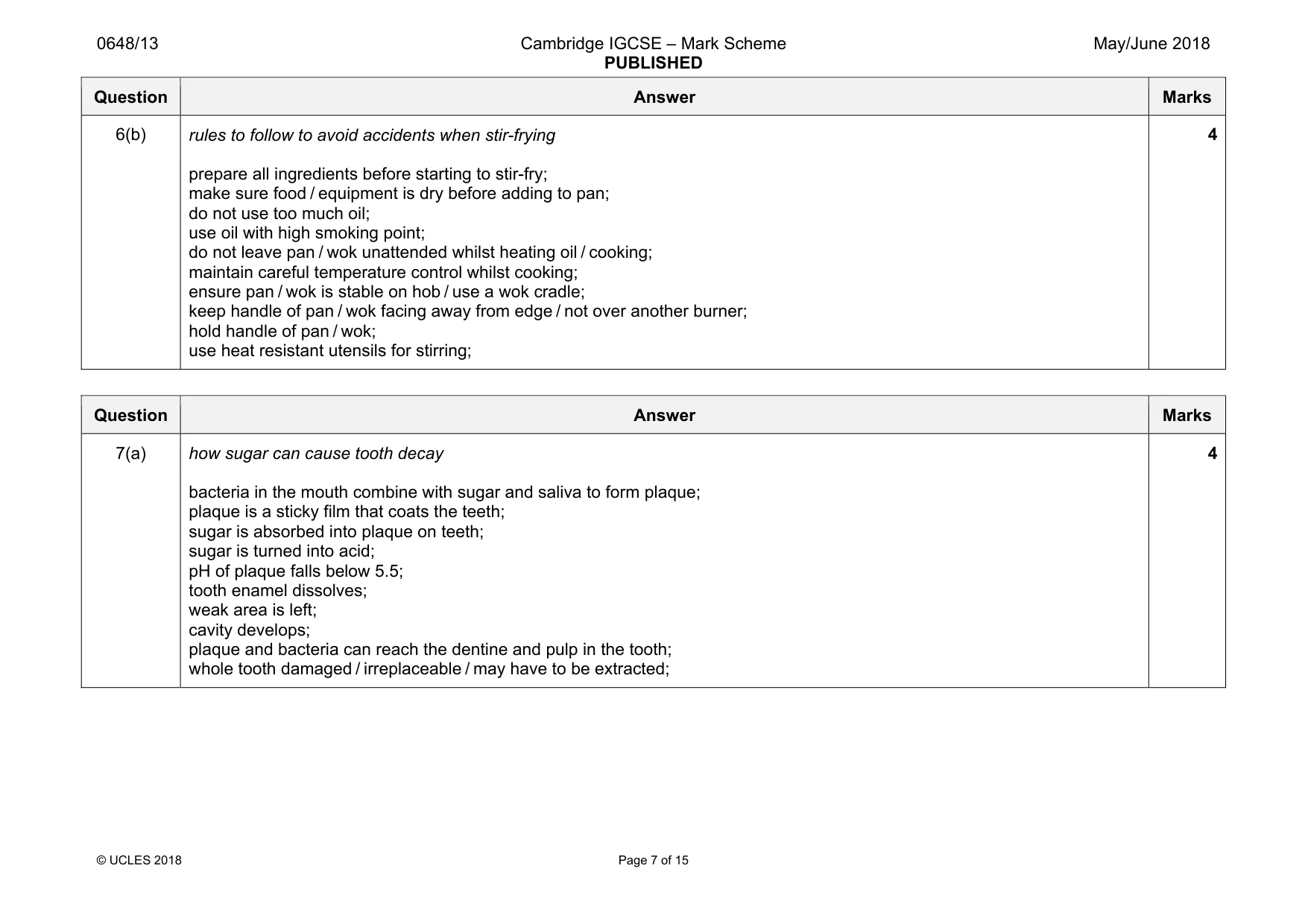
0648/13 Cambridge IGCSE – Mark Scheme PUBLISHED May/June 2018 © UCLES 2018 Page 7 of 15 Question Answer Marks 6(b) rules to follow to avoid accidents when stir-frying prepare all ingredients before starting to stir-fry; make sure food / equipment is dry before adding to pan; do not use too much oil; use oil with high smoking point; do not leave pan / wok unattended whilst heating oil / cooking; maintain careful temperature control whilst cooking; ensure pan / wok is stable on hob / use a wok cradle; keep handle of pan / wok facing away from edge / not over another burner; hold handle of pan / wok; use heat resistant utensils for stirring; 4 Question Answer Marks 7(a) how sugar can cause tooth decay bacteria in the mouth combine with sugar and saliva to form plaque; plaque is a sticky film that coats the teeth; sugar is absorbed into plaque on teeth; sugar is turned into acid; pH of plaque falls below 5.5; tooth enamel dissolves; weak area is left; cavity develops; plaque and bacteria can reach the dentine and pulp in the tooth; whole tooth damaged / irreplaceable / may have to be extracted; 4
Mark scheme, page 8
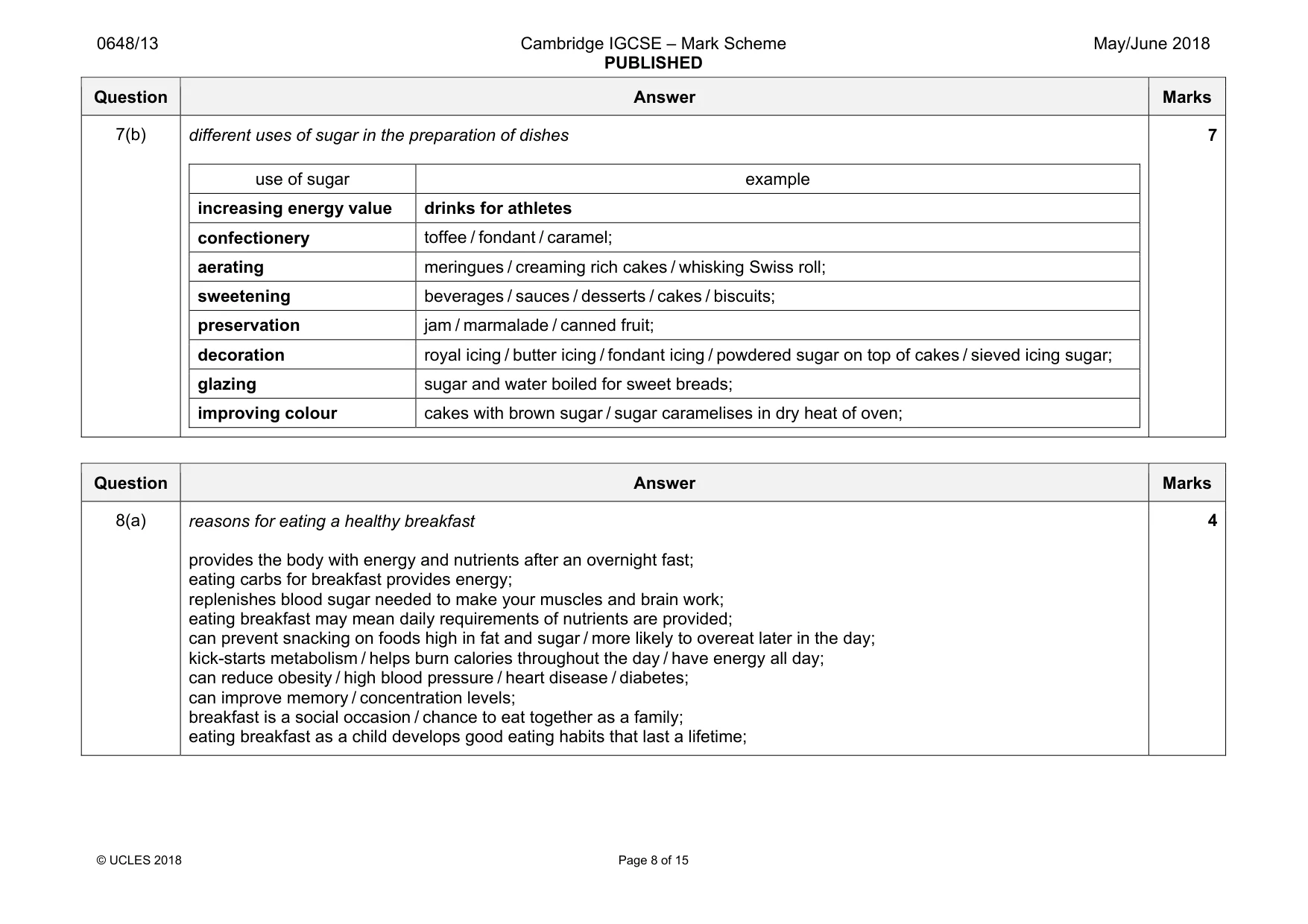
0648/13 Cambridge IGCSE – Mark Scheme PUBLISHED May/June 2018 © UCLES 2018 Page 8 of 15 Question Answer Marks 7(b) different uses of sugar in the preparation of dishes use of sugar example increasing energy value drinks for athletes confectionery toffee / fondant / caramel; aerating meringues / creaming rich cakes / whisking Swiss roll; sweetening beverages / sauces / desserts / cakes / biscuits; preservation jam / marmalade / canned fruit; decoration royal icing / butter icing / fondant icing / powdered sugar on top of cakes / sieved icing sugar; glazing sugar and water boiled for sweet breads; improving colour cakes with brown sugar / sugar caramelises in dry heat of oven; 7 Question Answer Marks 8(a) reasons for eating a healthy breakfast provides the body with energy and nutrients after an overnight fast; eating carbs for breakfast provides energy; replenishes blood sugar needed to make your muscles and brain work; eating breakfast may mean daily requirements of nutrients are provided; can prevent snacking on foods high in fat and sugar / more likely to overeat later in the day; kick-starts metabolism / helps burn calories throughout the day / have energy all day; can reduce obesity / high blood pressure / heart disease / diabetes; can improve memory / concentration levels; breakfast is a social occasion / chance to eat together as a family; eating breakfast as a child develops good eating habits that last a lifetime; 4
Mark scheme, page 9
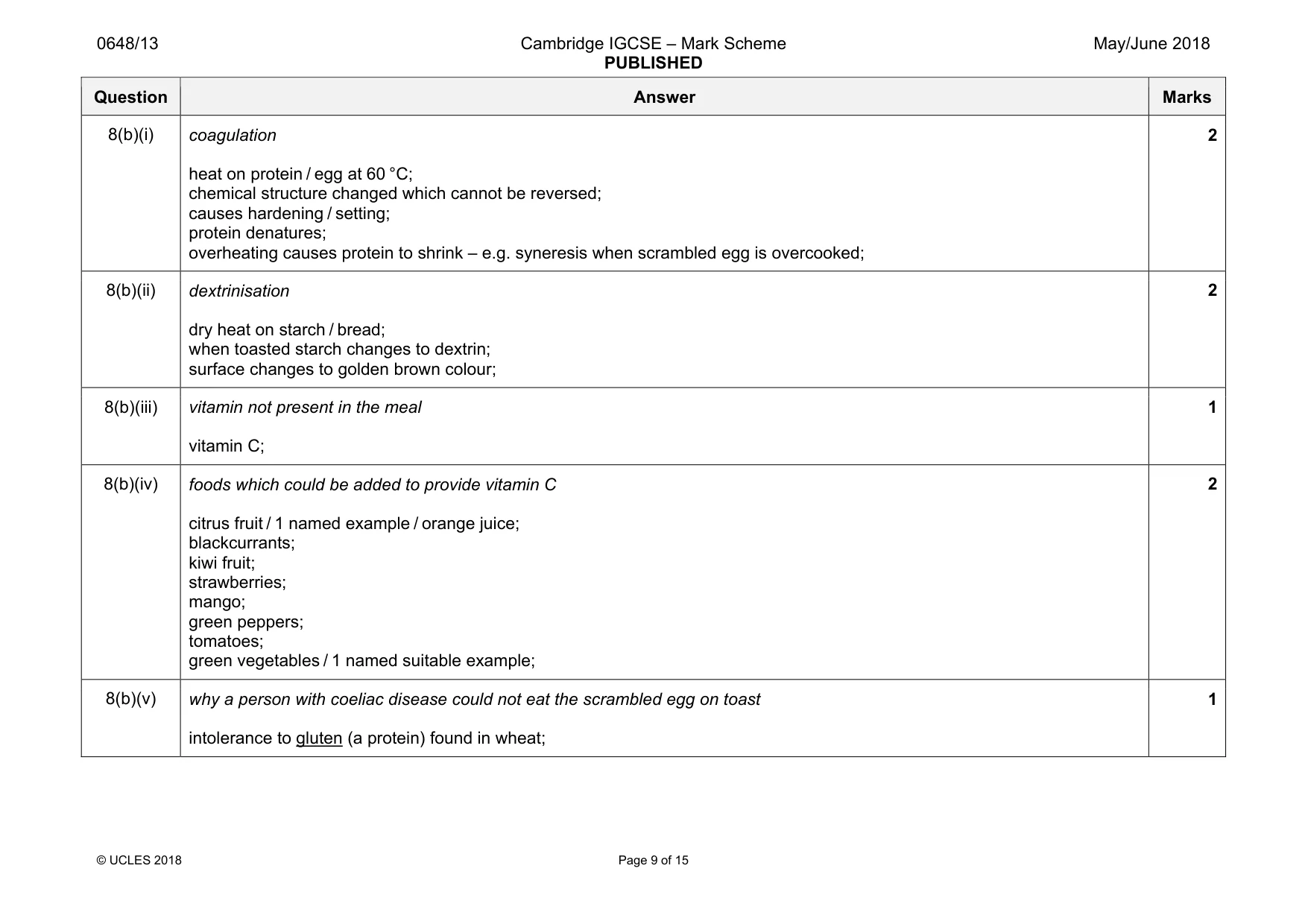
0648/13 Cambridge IGCSE – Mark Scheme PUBLISHED May/June 2018 © UCLES 2018 Page 9 of 15 Question Answer Marks 8(b)(i) coagulation heat on protein / egg at 60 °C; chemical structure changed which cannot be reversed; causes hardening / setting; protein denatures; overheating causes protein to shrink – e.g. syneresis when scrambled egg is overcooked; 2 8(b)(ii) dextrinisation dry heat on starch / bread; when toasted starch changes to dextrin; surface changes to golden brown colour; 2 8(b)(iii) vitamin not present in the meal vitamin C; 1 8(b)(iv) foods which could be added to provide vitamin C citrus fruit / 1 named example / orange juice; blackcurrants; kiwi fruit; strawberries; mango; green peppers; tomatoes; green vegetables / 1 named suitable example; 2 8(b)(v) why a person with coeliac disease could not eat the scrambled egg on toast intolerance to gluten (a protein) found in wheat; 1
Mark scheme, page 10
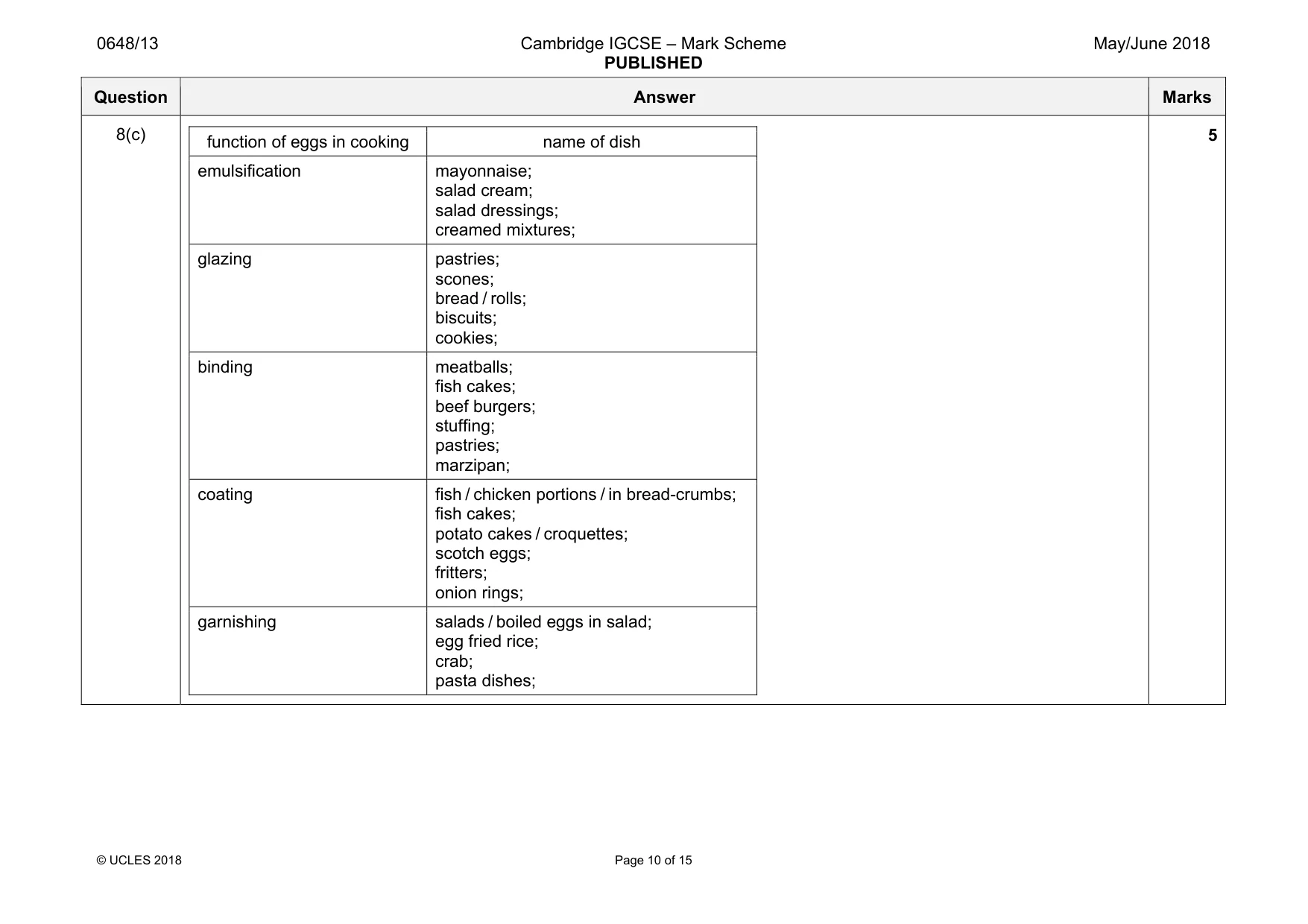
0648/13 Cambridge IGCSE – Mark Scheme PUBLISHED May/June 2018 © UCLES 2018 Page 10 of 15 Question Answer Marks 8(c) function of eggs in cooking name of dish emulsification mayonnaise; salad cream; salad dressings; creamed mixtures; glazing pastries; scones; bread / rolls; biscuits; cookies; binding meatballs; fish cakes; beef burgers; stuffing; pastries; marzipan; coating fish / chicken portions / in bread-crumbs; fish cakes; potato cakes / croquettes; scotch eggs; fritters; onion rings; garnishing salads / boiled eggs in salad; egg fried rice; crab; pasta dishes; 5
Mark scheme, page 11
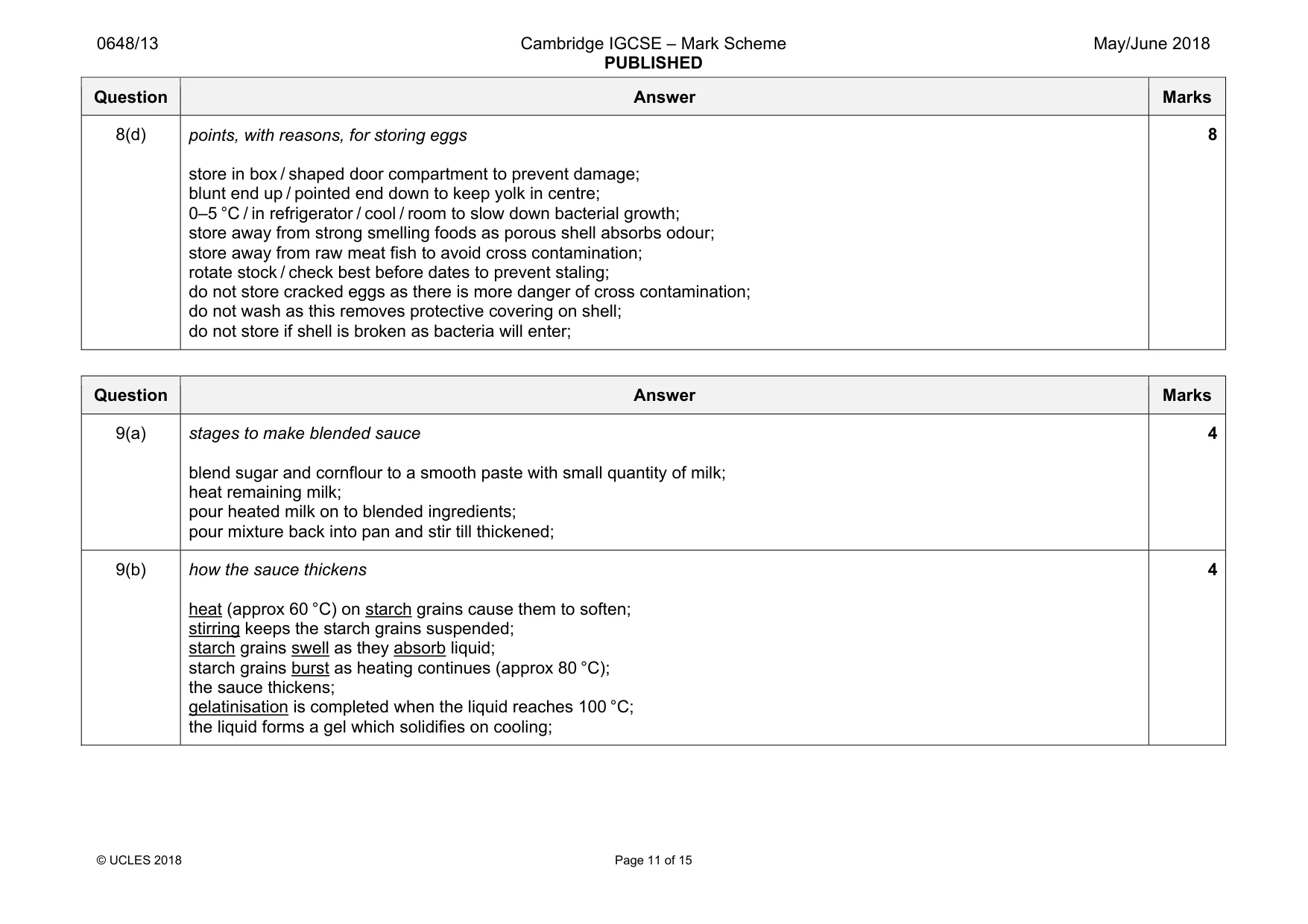
0648/13 Cambridge IGCSE – Mark Scheme PUBLISHED May/June 2018 © UCLES 2018 Page 11 of 15 Question Answer Marks 8(d) points, with reasons, for storing eggs store in box / shaped door compartment to prevent damage; blunt end up / pointed end down to keep yolk in centre; 0–5 °C / in refrigerator / cool / room to slow down bacterial growth; store away from strong smelling foods as porous shell absorbs odour; store away from raw meat fish to avoid cross contamination; rotate stock / check best before dates to prevent staling; do not store cracked eggs as there is more danger of cross contamination; do not wash as this removes protective covering on shell; do not store if shell is broken as bacteria will enter; 8 Question Answer Marks 9(a) stages to make blended sauce blend sugar and cornflour to a smooth paste with small quantity of milk; heat remaining milk; pour heated milk on to blended ingredients; pour mixture back into pan and stir till thickened; 4 9(b) how the sauce thickens heat (approx 60 °C) on starch grains cause them to soften; stirring keeps the starch grains suspended; starch grains swell as they absorb liquid; starch grains burst as heating continues (approx 80 °C); the sauce thickens; gelatinisation is completed when the liquid reaches 100 °C; the liquid forms a gel which solidifies on cooling; 4
Mark scheme, page 12
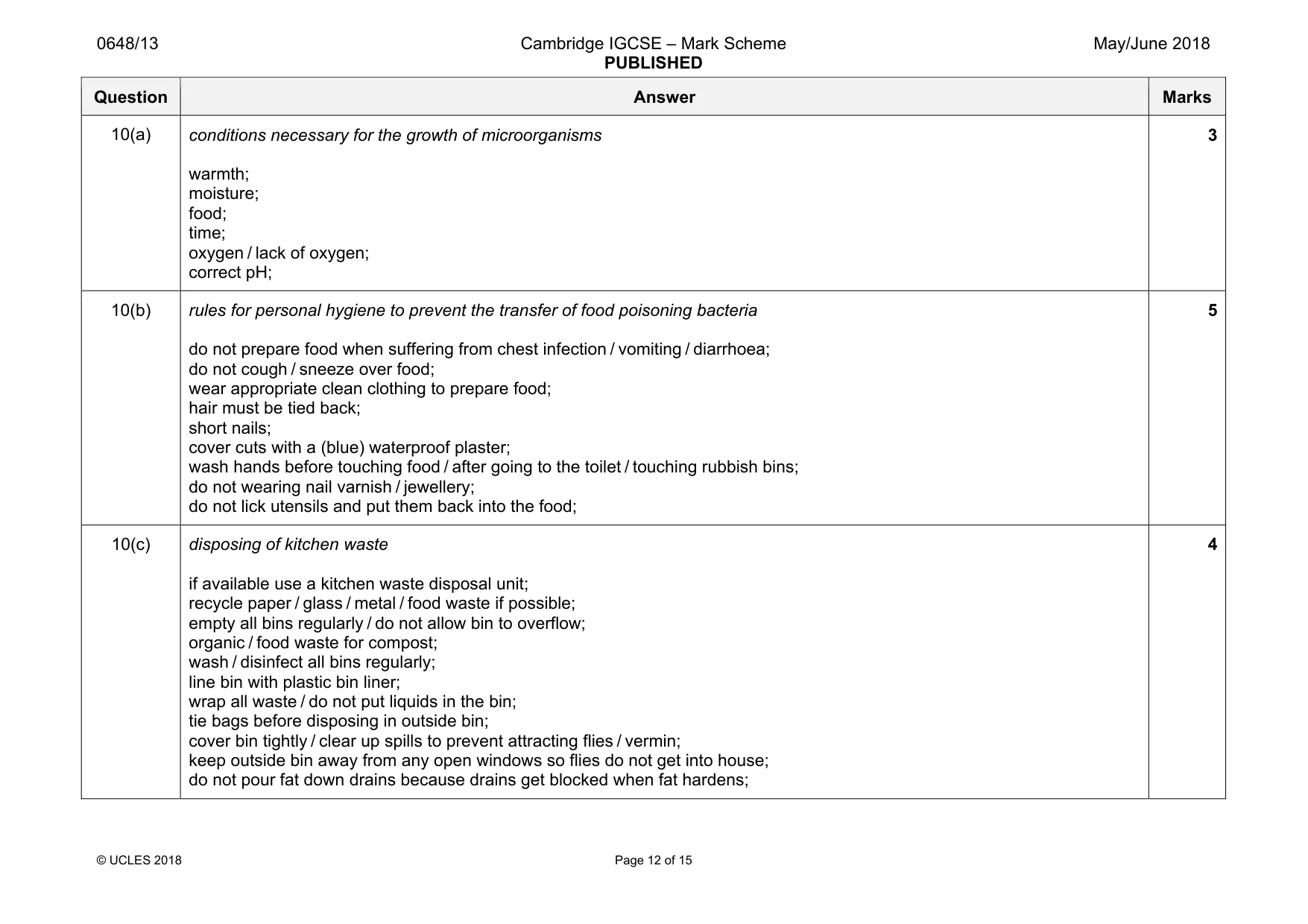
0648/13 Cambridge IGCSE – Mark Scheme PUBLISHED May/June 2018 © UCLES 2018 Page 12 of 15 Question Answer Marks 10(a) conditions necessary for the growth of microorganisms warmth; moisture; food; time; oxygen / lack of oxygen; correct pH; 3 10(b) rules for personal hygiene to prevent the transfer of food poisoning bacteria do not prepare food when suffering from chest infection / vomiting / diarrhoea; do not cough / sneeze over food; wear appropriate clean clothing to prepare food; hair must be tied back; short nails; cover cuts with a (blue) waterproof plaster; wash hands before touching food / after going to the toilet / touching rubbish bins; do not wearing nail varnish / jewellery; do not lick utensils and put them back into the food; 5 10(c) disposing of kitchen waste if available use a kitchen waste disposal unit; recycle paper / glass / metal / food waste if possible; empty all bins regularly / do not allow bin to overflow; organic / food waste for compost; wash / disinfect all bins regularly; line bin with plastic bin liner; wrap all waste / do not put liquids in the bin; tie bags before disposing in outside bin; cover bin tightly / clear up spills to prevent attracting flies / vermin; keep outside bin away from any open windows so flies do not get into house; do not pour fat down drains because drains get blocked when fat hardens; 4
Mark scheme, page 13
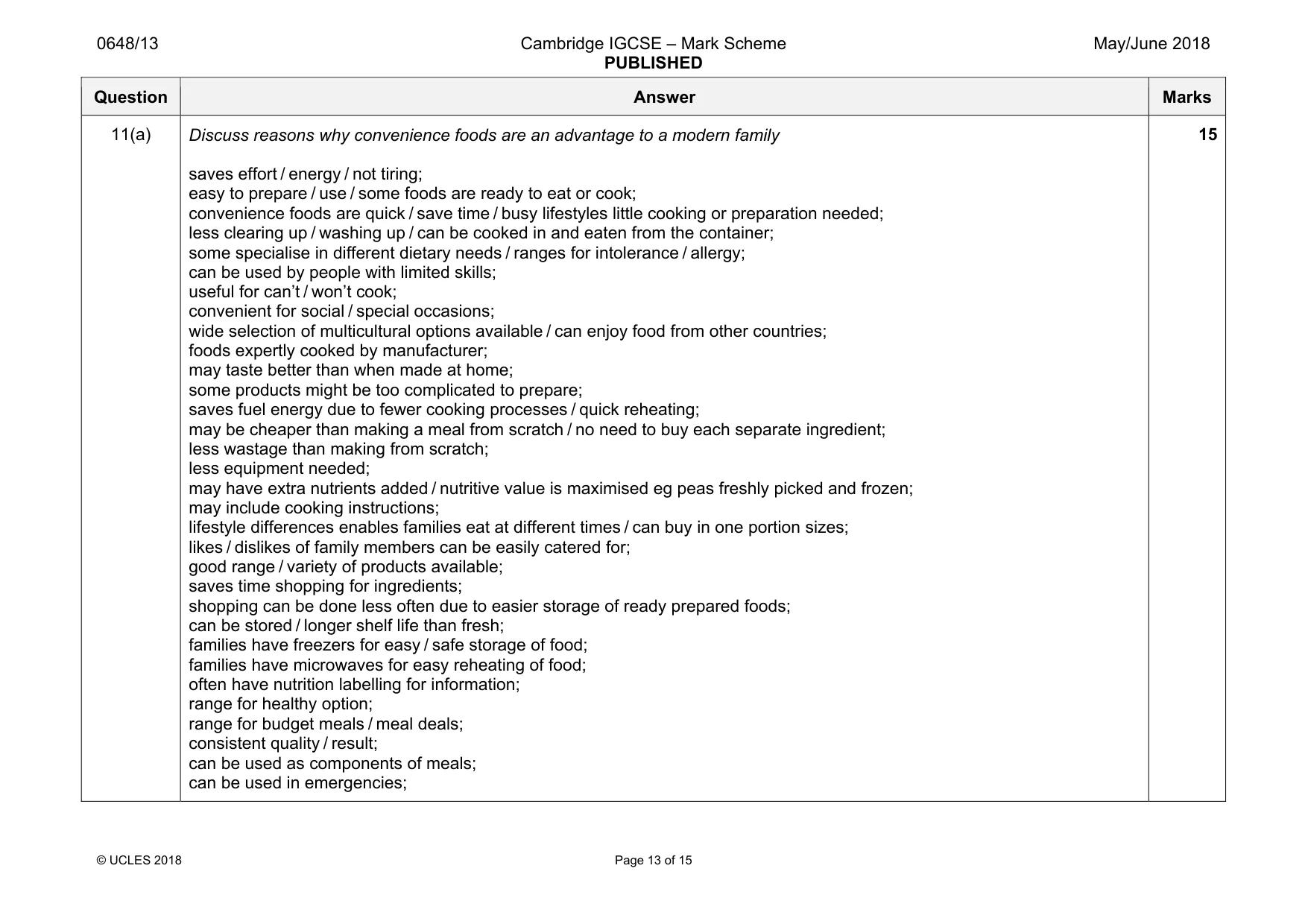
0648/13 Cambridge IGCSE – Mark Scheme PUBLISHED May/June 2018 © UCLES 2018 Page 13 of 15 Question Answer Marks 11(a) Discuss reasons why convenience foods are an advantage to a modern family saves effort / energy / not tiring; easy to prepare / use / some foods are ready to eat or cook; convenience foods are quick / save time / busy lifestyles little cooking or preparation needed; less clearing up / washing up / can be cooked in and eaten from the container; some specialise in different dietary needs / ranges for intolerance / allergy; can be used by people with limited skills; useful for can’t / won’t cook; convenient for social / special occasions; wide selection of multicultural options available / can enjoy food from other countries; foods expertly cooked by manufacturer; may taste better than when made at home; some products might be too complicated to prepare; saves fuel energy due to fewer cooking processes / quick reheating; may be cheaper than making a meal from scratch / no need to buy each separate ingredient; less wastage than making from scratch; less equipment needed; may have extra nutrients added / nutritive value is maximised eg peas freshly picked and frozen; may include cooking instructions; lifestyle differences enables families eat at different times / can buy in one portion sizes; likes / dislikes of family members can be easily catered for; good range / variety of products available; saves time shopping for ingredients; shopping can be done less often due to easier storage of ready prepared foods; can be stored / longer shelf life than fresh; families have freezers for easy / safe storage of food; families have microwaves for easy reheating of food; often have nutrition labelling for information; range for healthy option; range for budget meals / meal deals; consistent quality / result; can be used as components of meals; can be used in emergencies; 15
Mark scheme, page 14
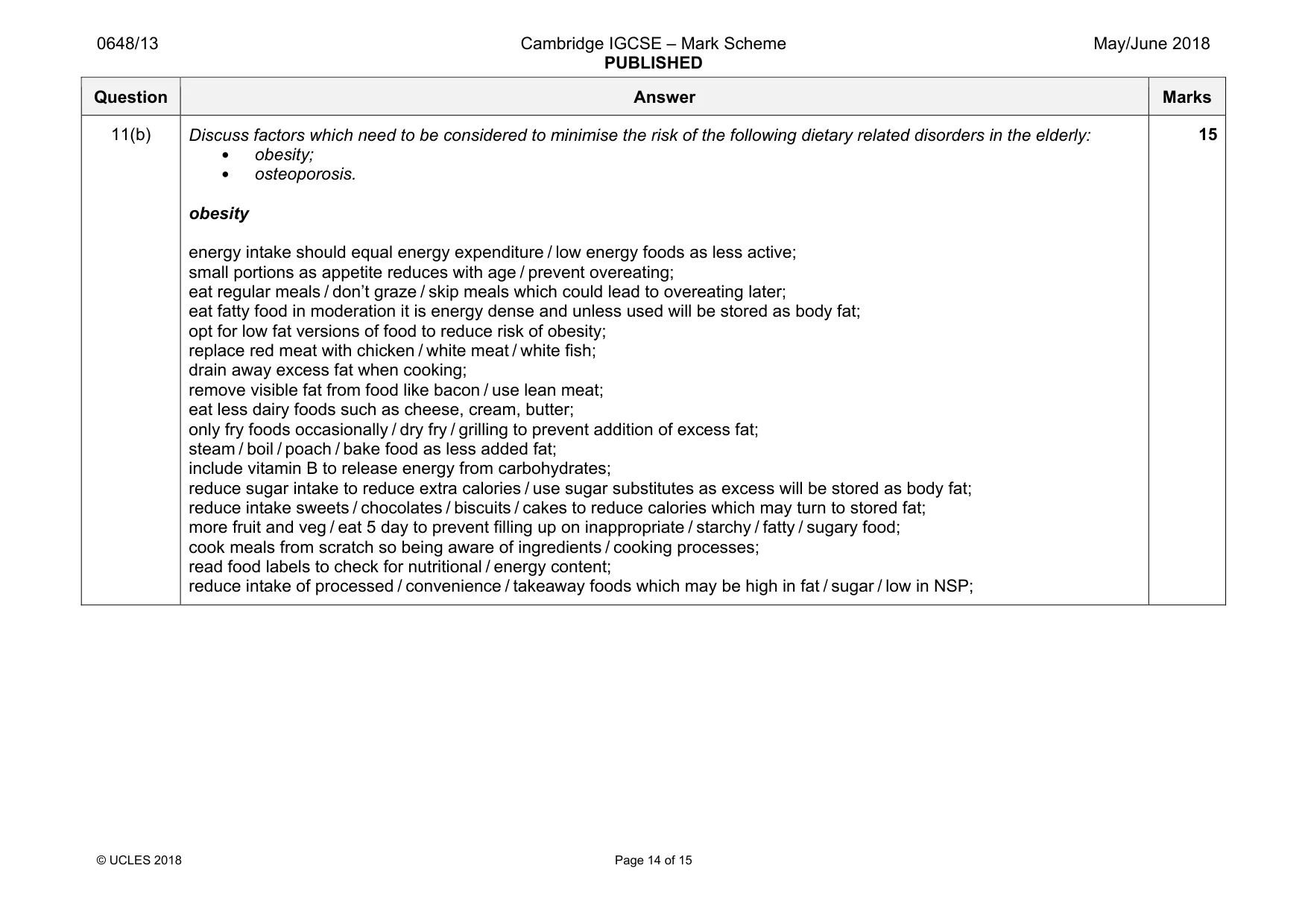
0648/13 Cambridge IGCSE – Mark Scheme PUBLISHED May/June 2018 © UCLES 2018 Page 14 of 15 Question Answer Marks 11(b) Discuss factors which need to be considered to minimise the risk of the following dietary related disorders in the elderly: • obesity; • osteoporosis. obesity energy intake should equal energy expenditure / low energy foods as less active; small portions as appetite reduces with age / prevent overeating; eat regular meals / don’t graze / skip meals which could lead to overeating later; eat fatty food in moderation it is energy dense and unless used will be stored as body fat; opt for low fat versions of food to reduce risk of obesity; replace red meat with chicken / white meat / white fish; drain away excess fat when cooking; remove visible fat from food like bacon / use lean meat; eat less dairy foods such as cheese, cream, butter; only fry foods occasionally / dry fry / grilling to prevent addition of excess fat; steam / boil / poach / bake food as less added fat; include vitamin B to release energy from carbohydrates; reduce sugar intake to reduce extra calories / use sugar substitutes as excess will be stored as body fat; reduce intake sweets / chocolates / biscuits / cakes to reduce calories which may turn to stored fat; more fruit and veg / eat 5 day to prevent filling up on inappropriate / starchy / fatty / sugary food; cook meals from scratch so being aware of ingredients / cooking processes; read food labels to check for nutritional / energy content; reduce intake of processed / convenience / takeaway foods which may be high in fat / sugar / low in NSP; 15
Mark scheme, page 15
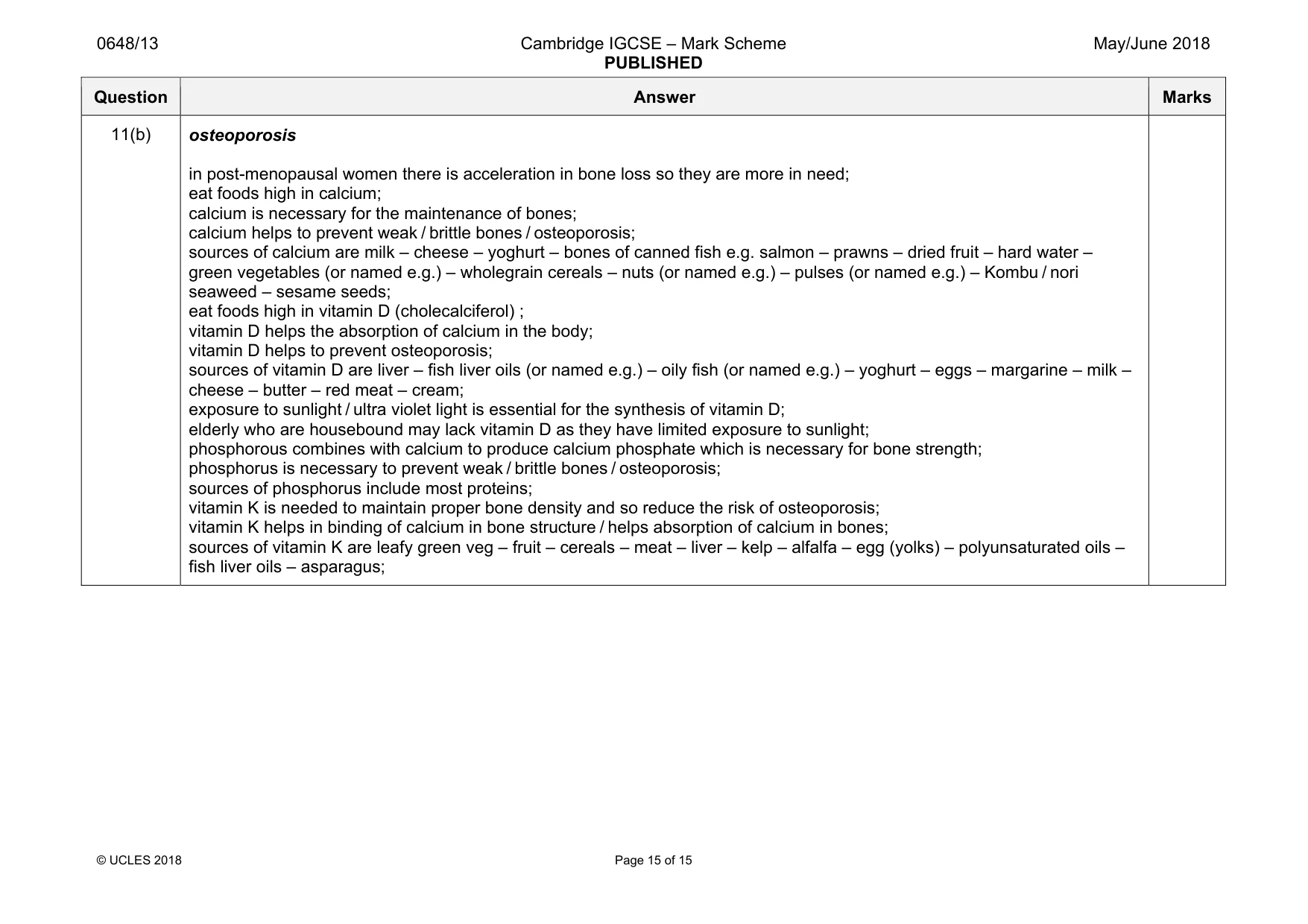
0648/13 Cambridge IGCSE – Mark Scheme PUBLISHED May/June 2018 © UCLES 2018 Page 15 of 15 Question Answer Marks 11(b) osteoporosis in post-menopausal women there is acceleration in bone loss so they are more in need; eat foods high in calcium; calcium is necessary for the maintenance of bones; calcium helps to prevent weak / brittle bones / osteoporosis; sources of calcium are milk – cheese – yoghurt – bones of canned fish e.g. salmon – prawns – dried fruit – hard water – green vegetables (or named e.g.) – wholegrain cereals – nuts (or named e.g.) – pulses (or named e.g.) – Kombu / nori seaweed – sesame seeds; eat foods high in vitamin D (cholecalciferol) ; vitamin D helps the absorption of calcium in the body; vitamin D helps to prevent osteoporosis; sources of vitamin D are liver – fish liver oils (or named e.g.) – oily fish (or named e.g.) – yoghurt – eggs – margarine – milk – cheese – butter – red meat – cream; exposure to sunlight / ultra violet light is essential for the synthesis of vitamin D; elderly who are housebound may lack vitamin D as they have limited exposure to sunlight; phosphorous combines with calcium to produce calcium phosphate which is necessary for bone strength; phosphorus is necessary to prevent weak / brittle bones / osteoporosis; sources of phosphorus include most proteins; vitamin K is needed to maintain proper bone density and so reduce the risk of osteoporosis; vitamin K helps in binding of calcium in bone structure / helps absorption of calcium in bones; sources of vitamin K are leafy green veg – fruit – cereals – meat – liver – kelp – alfalfa – egg (yolks) – polyunsaturated oils – fish liver oils – asparagus;
What you needed in this session
Cambridge’s own grade thresholds for 2018 May/June, Paper 1 · Variant 3. A higher threshold means an easier paper — the bar moves with how the cohort did.