Cambridge IGCSE Food and Nutrition 0648 — 2017 Oct/Nov Paper 1 · Variant 2
0648/12/O/N/17 · 100 marks · ≈113 min
The question paper and its mark scheme, free to read here and free to download. This is Cambridge’s own paper, exactly as it was sat.
Question paper12 pages
Mark scheme18 pages
Answers below. Sit the paper first if you are practising.
Paper as text
Question paper, page 1
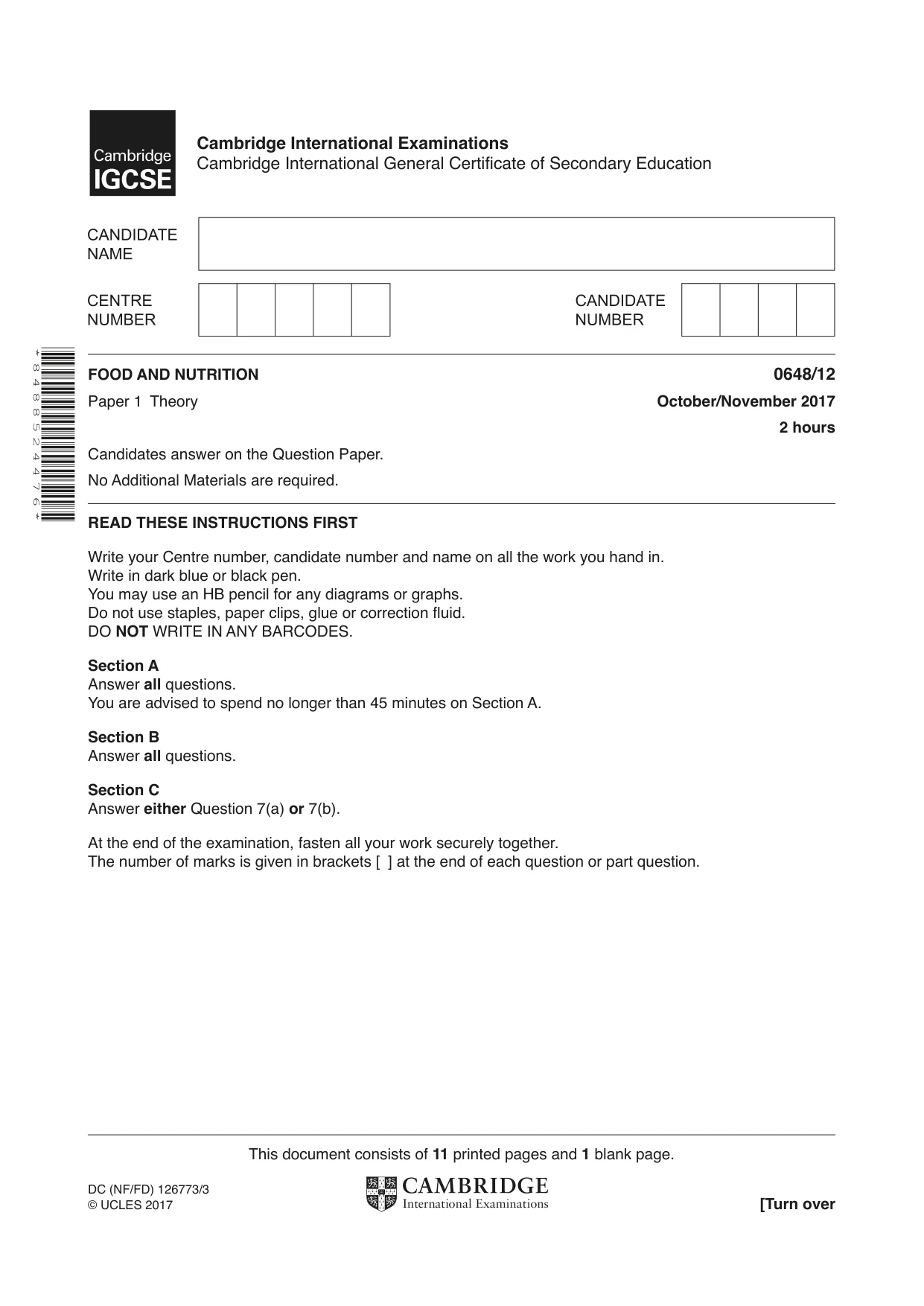
This document consists of 11 printed pages and 1 blank page. DC (NF/FD) 126773/3 © UCLES 2017 [Turn over Cambridge International Examinations Cambridge International General Certificate of Secondary Education * 8 4 8 8 5 2 4 4 7 6 * FOOD AND NUTRITION 0648/12 Paper 1 Theory October/November 2017 2 hours Candidates answer on the Question Paper. No Additional Materials are required. READ THESE INSTRUCTIONS FIRST Write your Centre number, candidate number and name on all the work you hand in. Write in dark blue or black pen. You may use an HB pencil for any diagrams or graphs. Do not use staples, paper clips, glue or correction fluid. DO NOT WRITE IN ANY BARCODES. Section A Answer all questions. You are advised to spend no longer than 45 minutes on Section A. Section B Answer all questions. Section C Answer either Question 7(a) or 7(b). At the end of the examination, fasten all your work securely together. The number of marks is given in brackets [ ] at the end of each question or part question.
Question paper, page 2
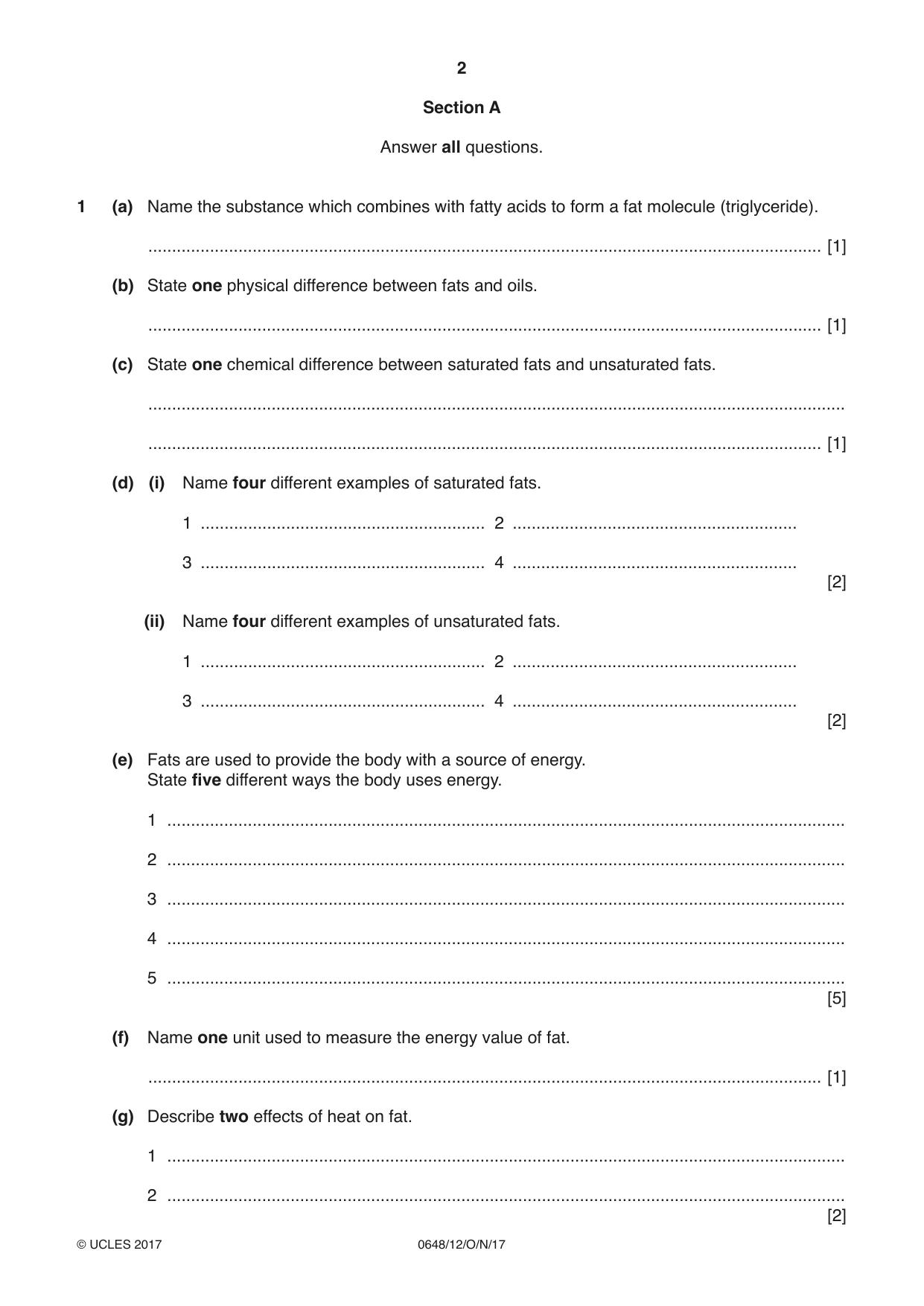
2 0648/12/O/N/17 © UCLES 2017 Section A Answer all questions. 1 (a) Name the substance which combines with fatty acids to form a fat molecule (triglyceride). … [1] (b) State one physical difference between fats and oils. … [1] (c) State one chemical difference between saturated fats and unsaturated fats. … … [1] (d) (i) Name four different examples of saturated fats. 1 … 2 … 3 … 4 … [2] (ii) Name four different examples of unsaturated fats. 1 … 2 … 3 … 4 … [2] (e) Fats are used to provide the body with a source of energy. State five different ways the body uses energy. 1 … 2 … 3 … 4 … 5 … [5] (f) Name one unit used to measure the energy value of fat. … [1] (g) Describe two effects of heat on fat. 1 … 2 … [2]
Question paper, page 3
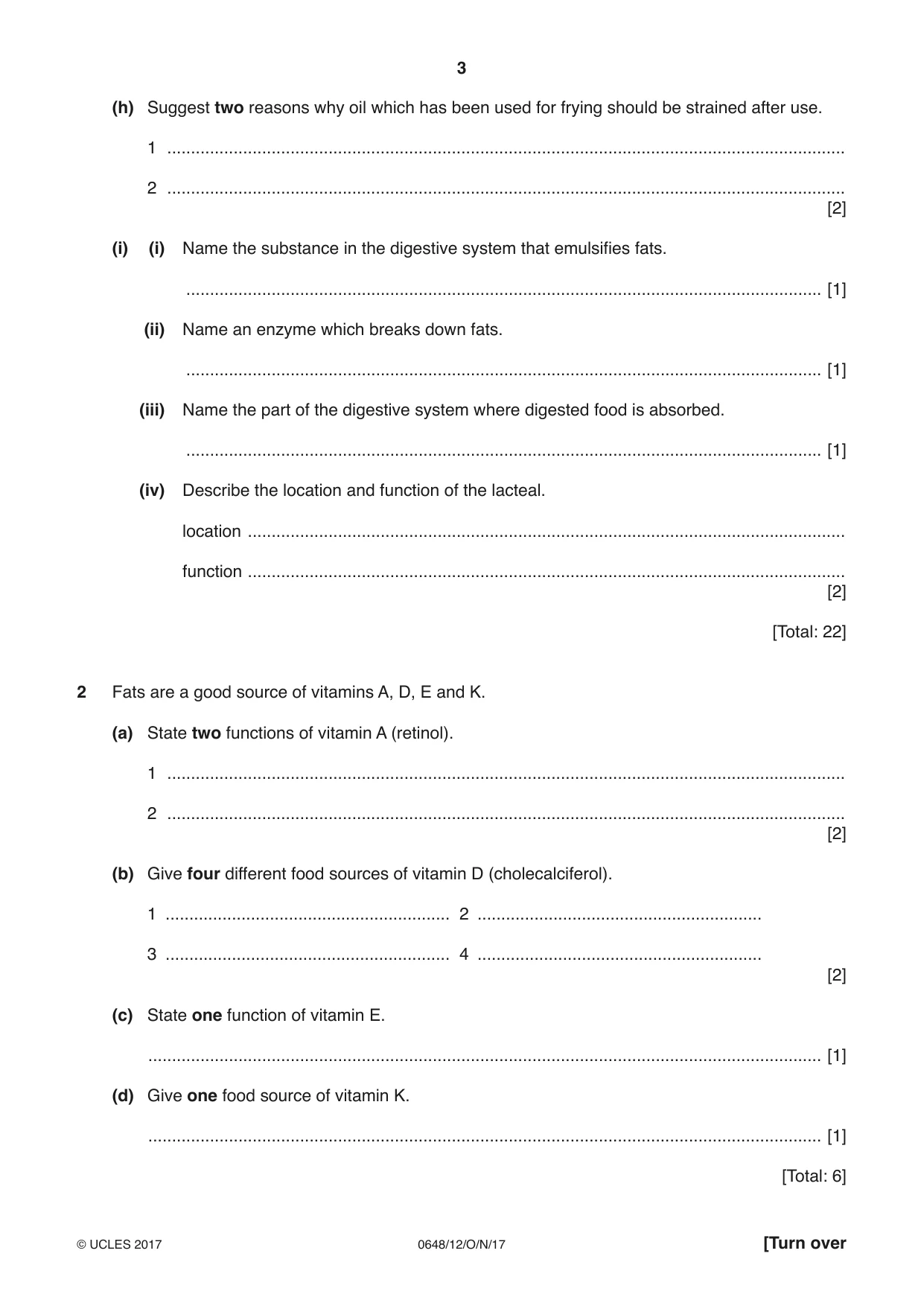
3 0648/12/O/N/17 © UCLES 2017 [Turn over (h) Suggest two reasons why oil which has been used for frying should be strained after use. 1 … 2 … [2] (i) (i) Name the substance in the digestive system that emulsifies fats. … [1] (ii) Name an enzyme which breaks down fats. … [1] (iii) Name the part of the digestive system where digested food is absorbed. … [1] (iv) Describe the location and function of the lacteal. location … function … [2] [Total: 22] 2 Fats are a good source of vitamins A, D, E and K. (a) State two functions of vitamin A (retinol). 1 … 2 … [2] (b) Give four different food sources of vitamin D (cholecalciferol). 1 … 2 … 3 … 4 … [2] (c) State one function of vitamin E. … [1] (d) Give one food source of vitamin K. … [1] [Total: 6]
Question paper, page 4
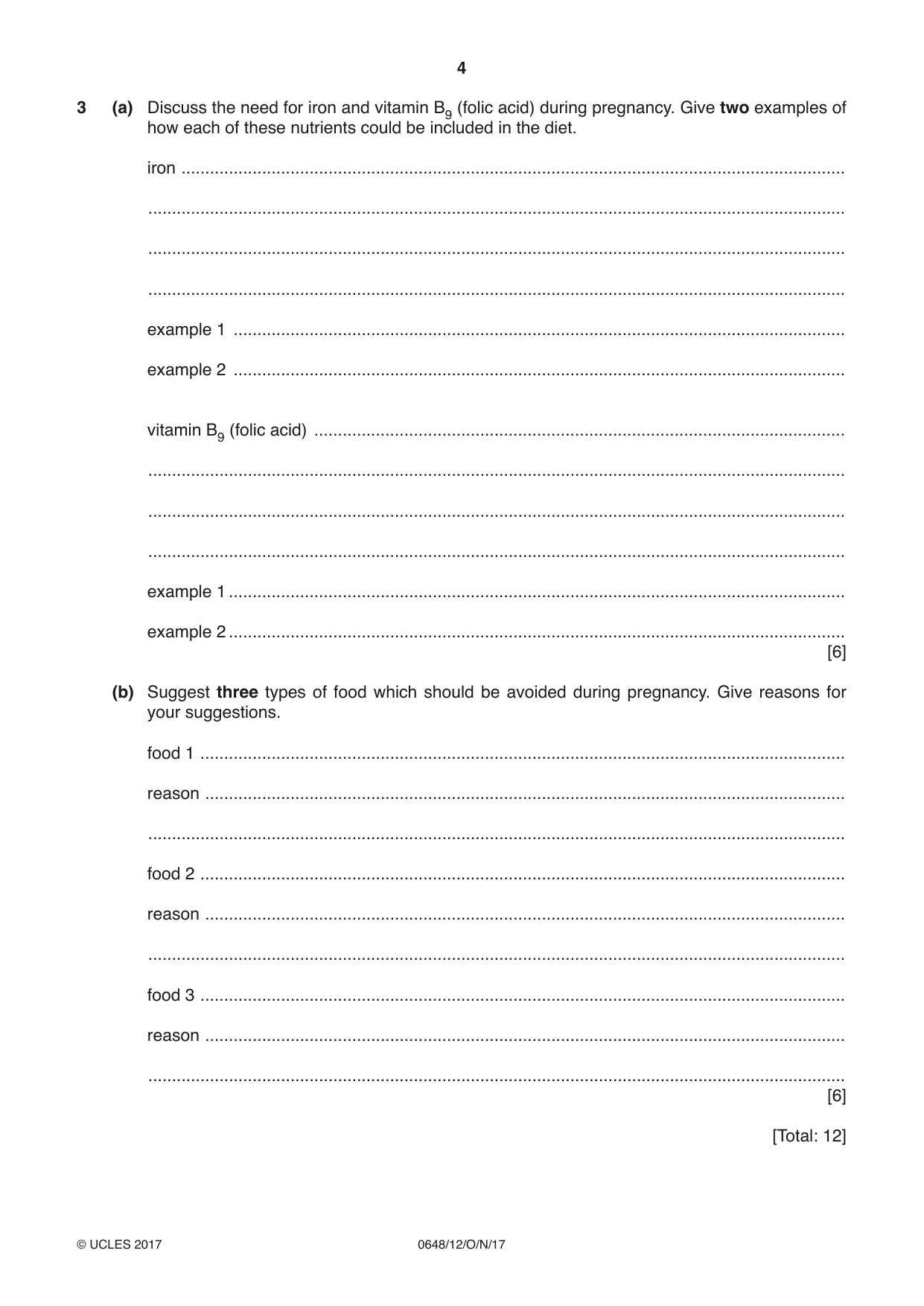
4 0648/12/O/N/17 © UCLES 2017 3 (a) Discuss the need for iron and vitamin B9 (folic acid) during pregnancy. Give two examples of how each of these nutrients could be included in the diet. iron … … … … example 1 … example 2 … vitamin B9 (folic acid) … … … … example 1 … example 2 … [6] (b) Suggest three types of food which should be avoided during pregnancy. Give reasons for your suggestions. food 1 … reason … … food 2 … reason … … food 3 … reason … … [6] [Total: 12]
Question paper, page 5
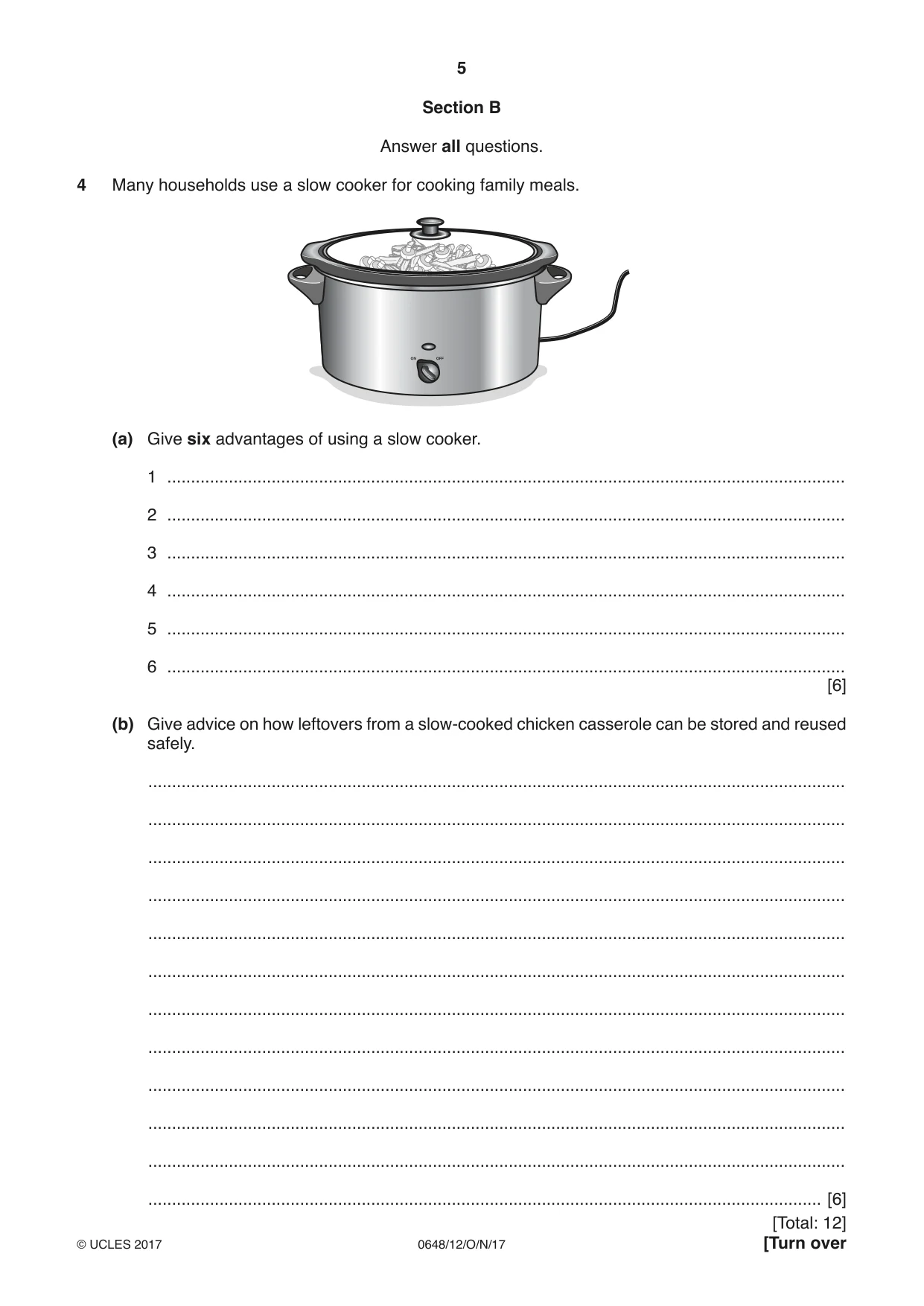
5 0648/12/O/N/17 © UCLES 2017 [Turn over Section B Answer all questions. 4 Many households use a slow cooker for cooking family meals. (a) Give six advantages of using a slow cooker. 1 … 2 … 3 … 4 … 5 … 6 … [6] (b) Give advice on how leftovers from a slow-cooked chicken casserole can be stored and reused safely. … … … … … … … … … … … … [6] [Total: 12]
Question paper, page 6
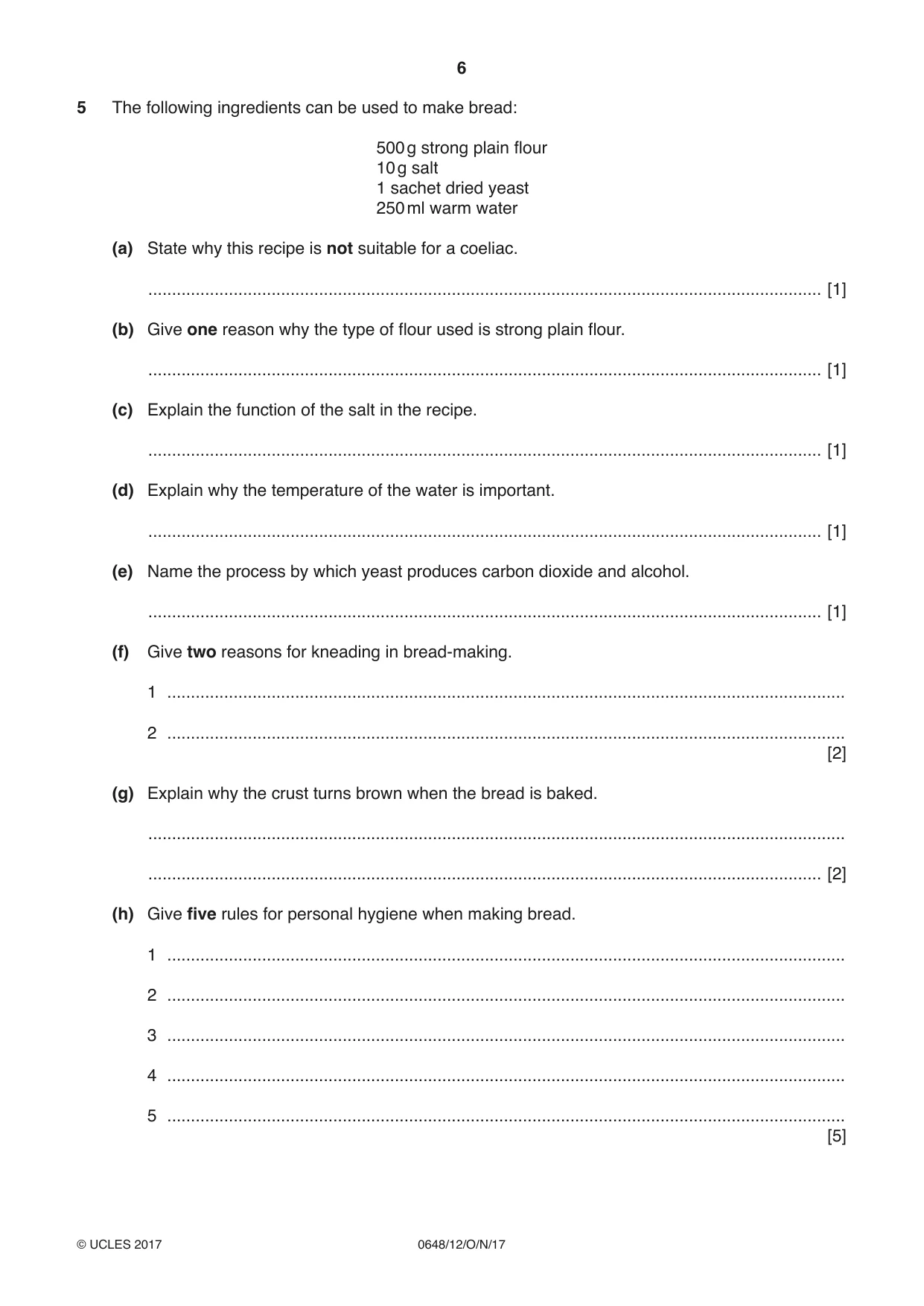
6 0648/12/O/N/17 © UCLES 2017 5 The following ingredients can be used to make bread: 500 g strong plain flour 10 g salt 1 sachet dried yeast 250 ml warm water (a) State why this recipe is not suitable for a coeliac. … [1] (b) Give one reason why the type of flour used is strong plain flour. … [1] (c) Explain the function of the salt in the recipe. … [1] (d) Explain why the temperature of the water is important. … [1] (e) Name the process by which yeast produces carbon dioxide and alcohol. … [1] (f) Give two reasons for kneading in bread-making. 1 … 2 … [2] (g) Explain why the crust turns brown when the bread is baked. … … [2] (h) Give five rules for personal hygiene when making bread. 1 … 2 … 3 … 4 … 5 … [5]
Question paper, page 7
7 0648/12/O/N/17 © UCLES 2017 [Turn over (i) Bread can be bought packaged in plastic wrapping. Name two other types of packaging material and give an example of a use of each to package food. type 1 … example … type 2 … example … [4] [Total: 18]
Question paper, page 8
8 0648/12/O/N/17 © UCLES 2017 6 Fish can be an important part of a healthy diet. (a) List three points to look for when buying fresh fish. 1 … 2 … 3 … [3] (b) Give two different examples of each of the following: (i) oily fish; 1 … 2 … [2] (ii) shellfish. 1 … 2 … [2] (c) Fish is often coated before deep frying. Suggest two suitable coatings which could be used. 1 … 2 … [2] (d) State and explain four safety points to follow when deep frying. 1 … … 2 … … 3 … … 4 … … [4] (e) Suggest two different ways to make steamed white fish look more appetising when served as part of a main meal. 1 … 2 … [2] [Total: 15]
Question paper, page 9
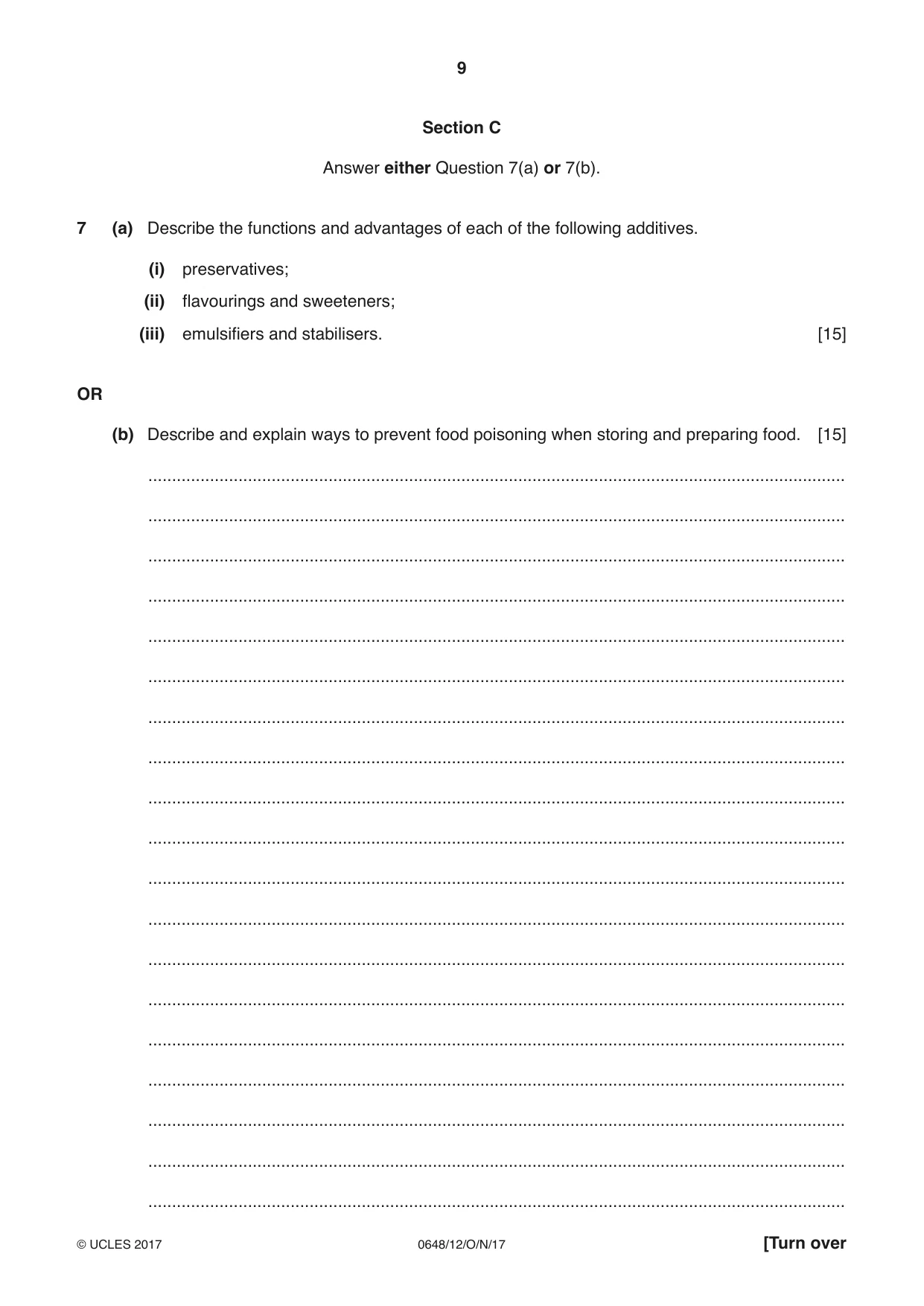
9 0648/12/O/N/17 © UCLES 2017 [Turn over Section C Answer either Question 7(a) or 7(b). 7 (a) Describe the functions and advantages of each of the following additives. (i) preservatives; (ii) flavourings and sweeteners; (iii) emulsifiers and stabilisers. [15] OR (b) Describe and explain ways to prevent food poisoning when storing and preparing food. [15] … … … … … … … … … … … … … … … … … … …
Question paper, page 10
10 0648/12/O/N/17 © UCLES 2017 … … … … … … … … … … … … … … … … … … … … … … … … … … … …
Question paper, page 11
11 0648/12/O/N/17 © UCLES 2017 … … … … … … … … … … … … … … … … … … … … … … … … … … … [Total: 15]
Question paper, page 12
12 0648/12/O/N/17 © UCLES 2017 BLANK PAGE Permission to reproduce items where third-party owned material protected by copyright is included has been sought and cleared where possible. Every reasonable effort has been made by the publisher (UCLES) to trace copyright holders, but if any items requiring clearance have unwittingly been included, the publisher will be pleased to make amends at the earliest possible opportunity. To avoid the issue of disclosure of answer-related information to candidates, all copyright acknowledgements are reproduced online in the Cambridge International Examinations Copyright Acknowledgements Booklet. This is produced for each series of examinations and is freely available to download at www.cie.org.uk after the live examination series. Cambridge International Examinations is part of the Cambridge Assessment Group. Cambridge Assessment is the brand name of University of Cambridge Local Examinations Syndicate (UCLES), which is itself a department of the University of Cambridge.
Mark scheme, page 1
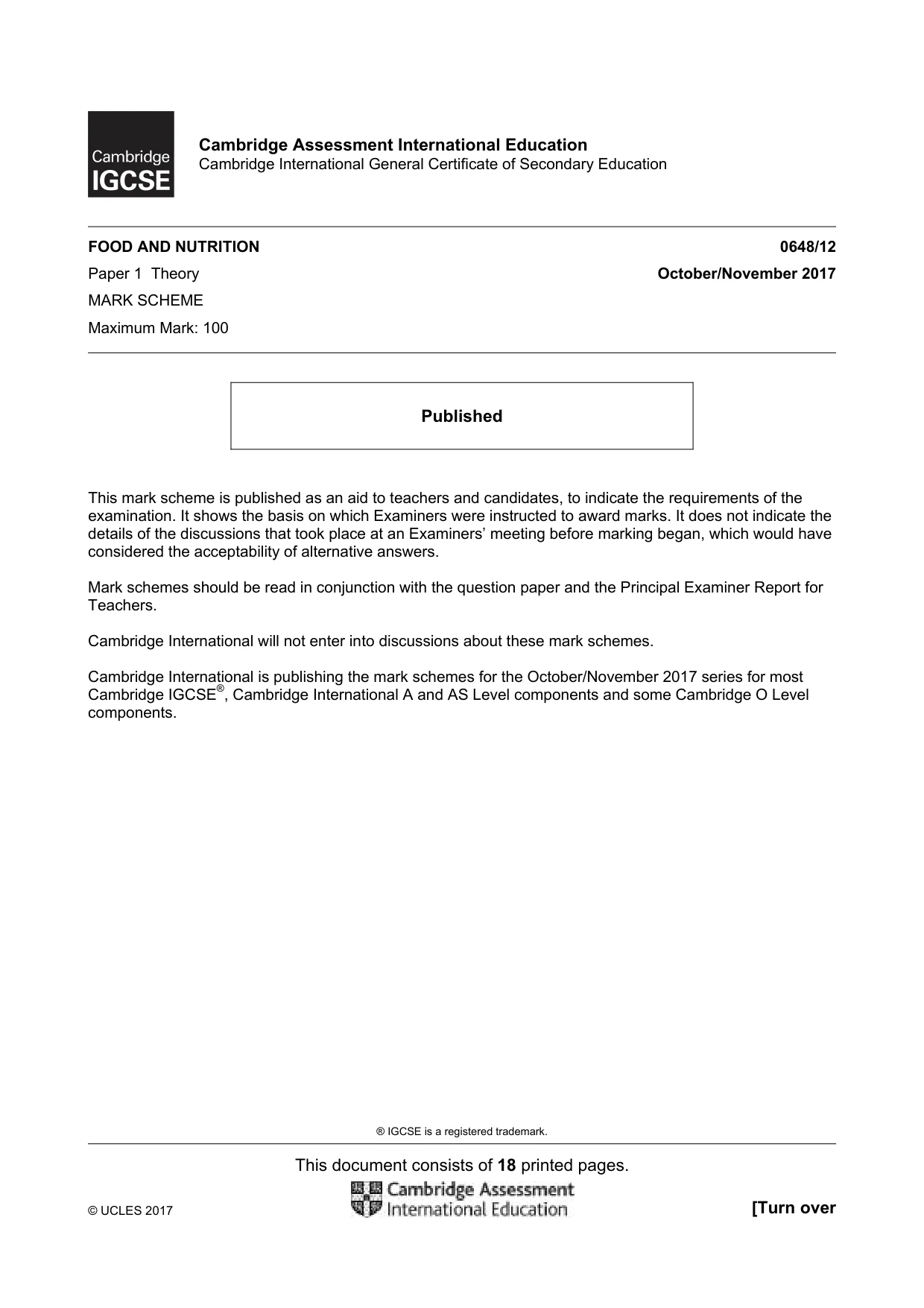
® IGCSE is a registered trademark. This document consists of 18 printed pages. © UCLES 2017 [Turn over Cambridge Assessment International Education Cambridge International General Certificate of Secondary Education FOOD AND NUTRITION 0648/12 Paper 1 Theory October/November 2017 MARK SCHEME Maximum Mark: 100 Published This mark scheme is published as an aid to teachers and candidates, to indicate the requirements of the examination. It shows the basis on which Examiners were instructed to award marks. It does not indicate the details of the discussions that took place at an Examiners’ meeting before marking began, which would have considered the acceptability of alternative answers. Mark schemes should be read in conjunction with the question paper and the Principal Examiner Report for Teachers. Cambridge International will not enter into discussions about these mark schemes. Cambridge International is publishing the mark schemes for the October/November 2017 series for most Cambridge IGCSE®, Cambridge International A and AS Level components and some Cambridge O Level components.
Mark scheme, page 2
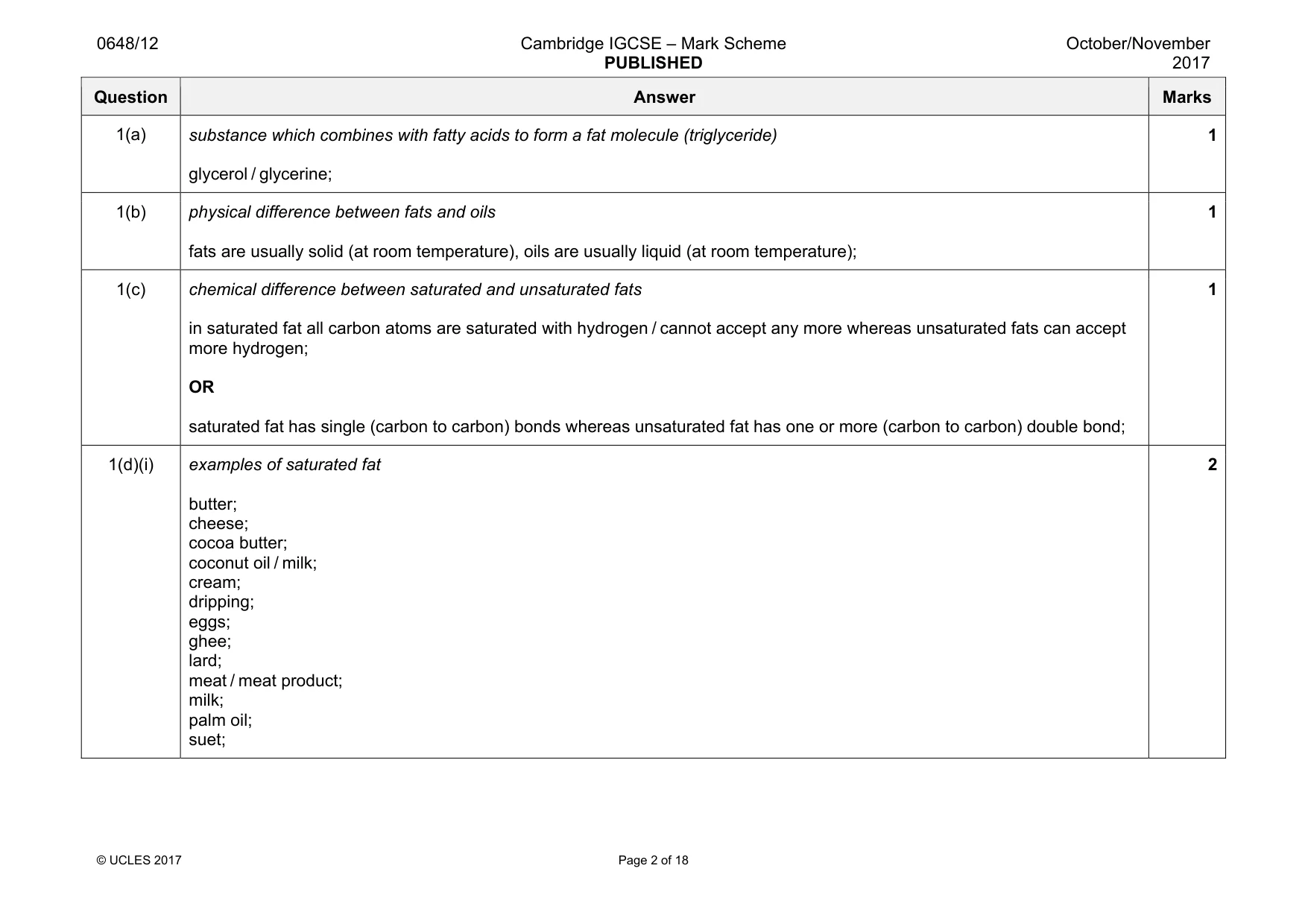
0648/12 Cambridge IGCSE – Mark Scheme PUBLISHED October/November 2017 © UCLES 2017 Page 2 of 18 Question Answer Marks 1(a) substance which combines with fatty acids to form a fat molecule (triglyceride) glycerol / glycerine; 1 1(b) physical difference between fats and oils fats are usually solid (at room temperature), oils are usually liquid (at room temperature); 1 1(c) chemical difference between saturated and unsaturated fats in saturated fat all carbon atoms are saturated with hydrogen / cannot accept any more whereas unsaturated fats can accept more hydrogen; OR saturated fat has single (carbon to carbon) bonds whereas unsaturated fat has one or more (carbon to carbon) double bond; 1 1(d)(i) examples of saturated fat butter; cheese; cocoa butter; coconut oil / milk; cream; dripping; eggs; ghee; lard; meat / meat product; milk; palm oil; suet; 2
Mark scheme, page 3
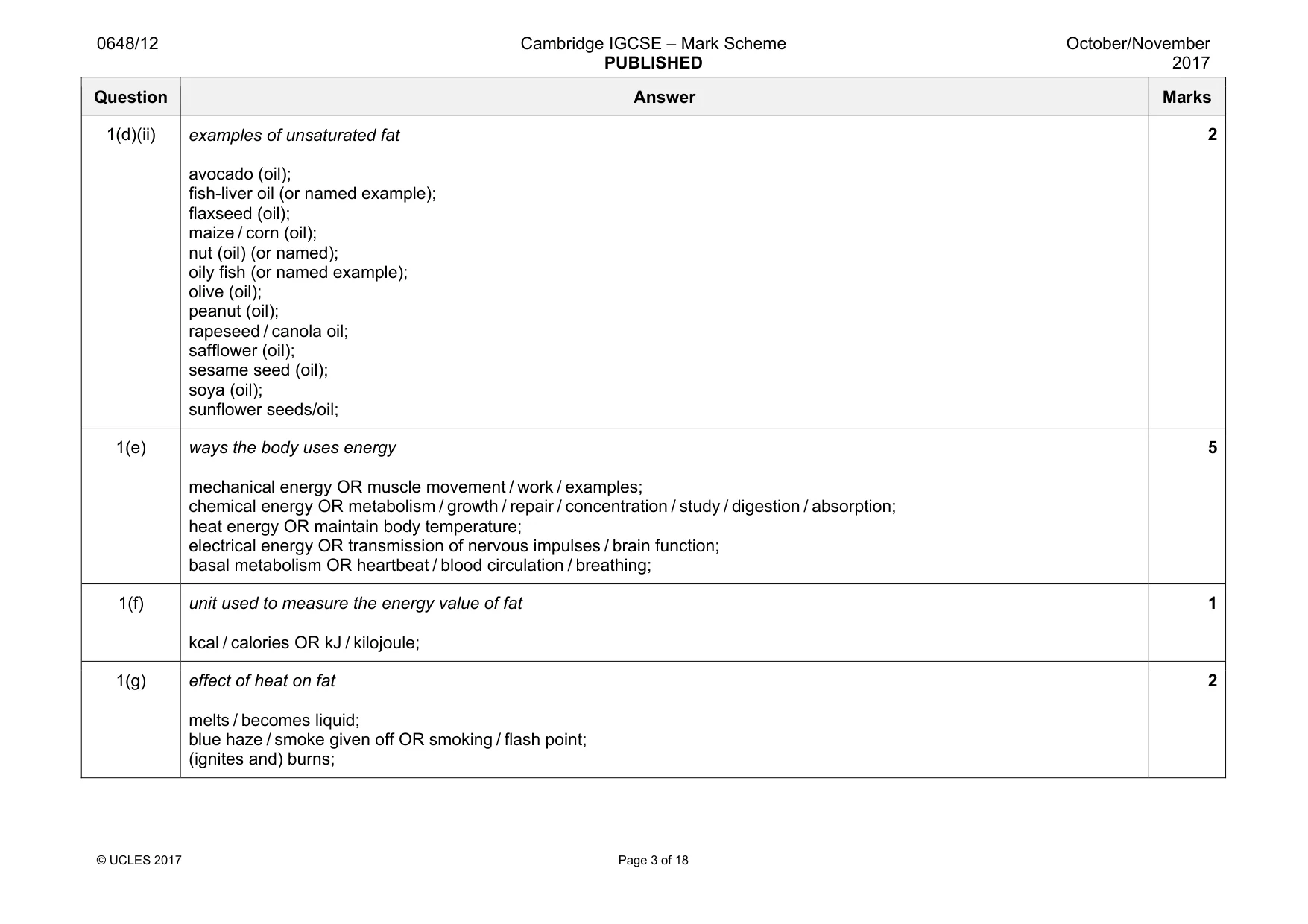
0648/12 Cambridge IGCSE – Mark Scheme PUBLISHED October/November 2017 © UCLES 2017 Page 3 of 18 Question Answer Marks 1(d)(ii) examples of unsaturated fat avocado (oil); fish-liver oil (or named example); flaxseed (oil); maize / corn (oil); nut (oil) (or named); oily fish (or named example); olive (oil); peanut (oil); rapeseed / canola oil; safflower (oil); sesame seed (oil); soya (oil); sunflower seeds/oil; 2 1(e) ways the body uses energy mechanical energy OR muscle movement / work / examples; chemical energy OR metabolism / growth / repair / concentration / study / digestion / absorption; heat energy OR maintain body temperature; electrical energy OR transmission of nervous impulses / brain function; basal metabolism OR heartbeat / blood circulation / breathing; 5 1(f) unit used to measure the energy value of fat kcal / calories OR kJ / kilojoule; 1 1(g) effect of heat on fat melts / becomes liquid; blue haze / smoke given off OR smoking / flash point; (ignites and) burns; 2
Mark scheme, page 4
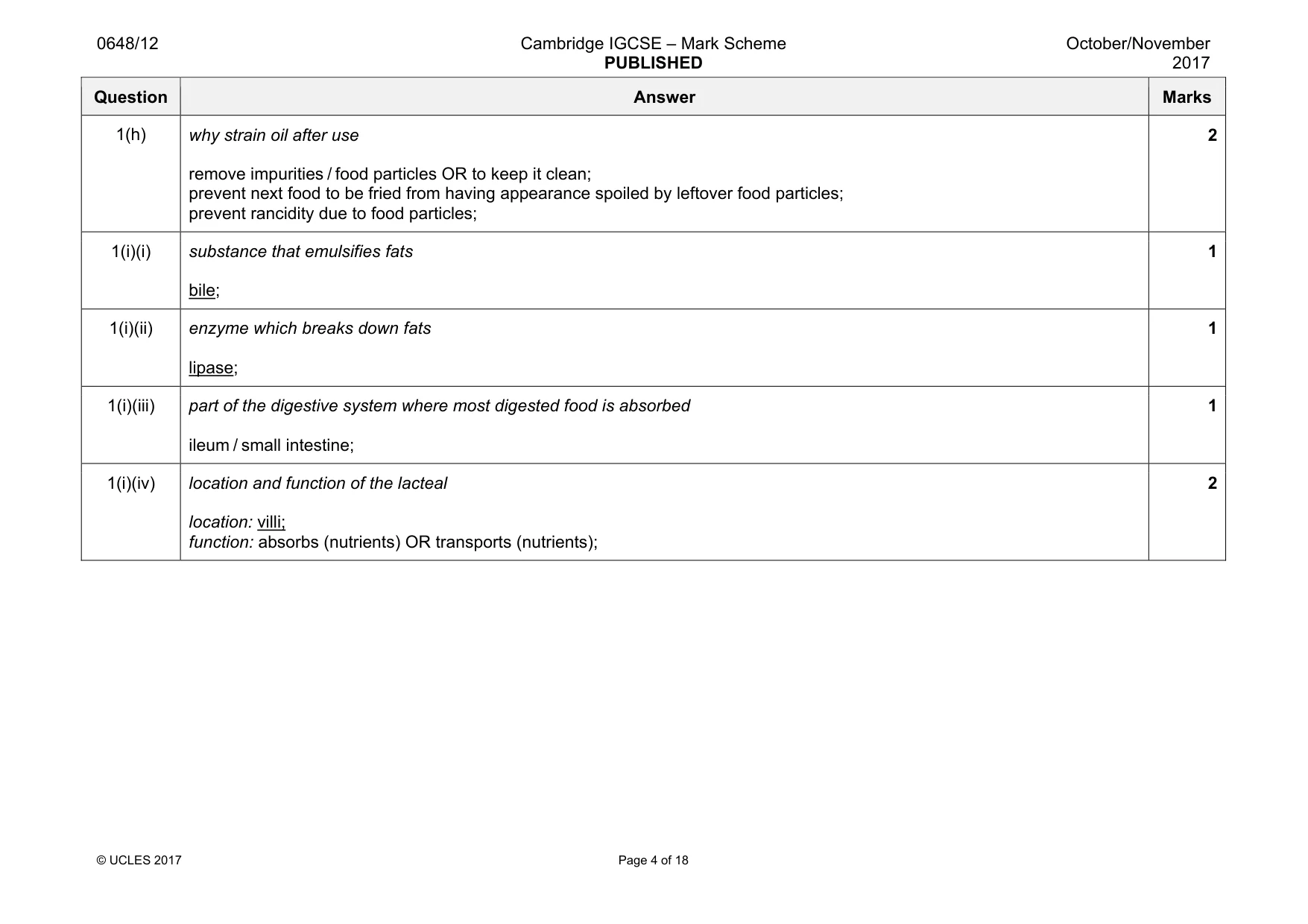
0648/12 Cambridge IGCSE – Mark Scheme PUBLISHED October/November 2017 © UCLES 2017 Page 4 of 18 Question Answer Marks 1(h) why strain oil after use remove impurities / food particles OR to keep it clean; prevent next food to be fried from having appearance spoiled by leftover food particles; prevent rancidity due to food particles; 2 1(i)(i) substance that emulsifies fats bile; 1 1(i)(ii) enzyme which breaks down fats lipase; 1 1(i)(iii) part of the digestive system where most digested food is absorbed ileum / small intestine; 1 1(i)(iv) location and function of the lacteal location: villi; function: absorbs (nutrients) OR transports (nutrients); 2
Mark scheme, page 5
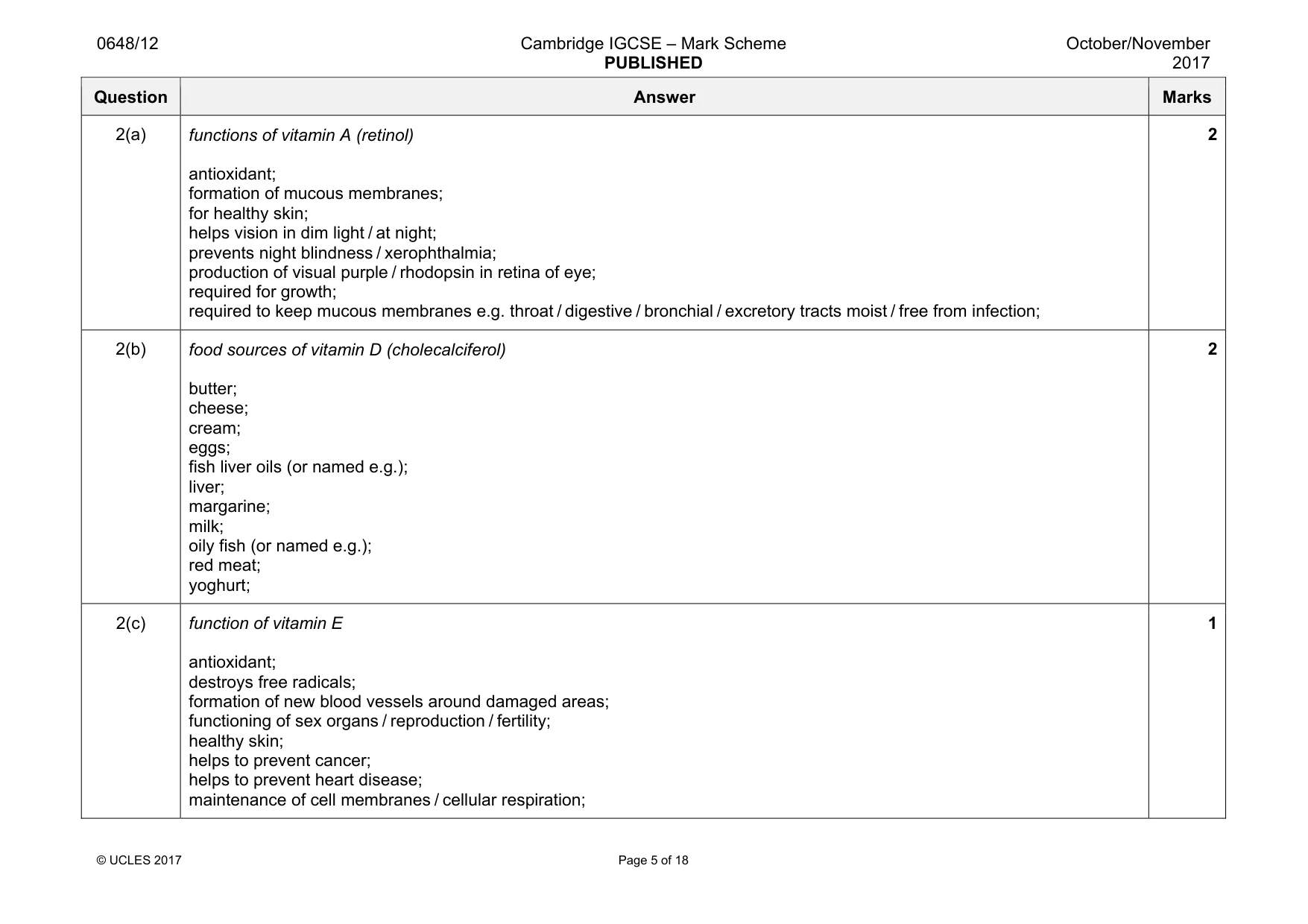
0648/12 Cambridge IGCSE – Mark Scheme PUBLISHED October/November 2017 © UCLES 2017 Page 5 of 18 Question Answer Marks 2(a) functions of vitamin A (retinol) antioxidant; formation of mucous membranes; for healthy skin; helps vision in dim light / at night; prevents night blindness / xerophthalmia; production of visual purple / rhodopsin in retina of eye; required for growth; required to keep mucous membranes e.g. throat / digestive / bronchial / excretory tracts moist / free from infection; 2 2(b) food sources of vitamin D (cholecalciferol) butter; cheese; cream; eggs; fish liver oils (or named e.g.); liver; margarine; milk; oily fish (or named e.g.); red meat; yoghurt; 2 2(c) function of vitamin E antioxidant; destroys free radicals; formation of new blood vessels around damaged areas; functioning of sex organs / reproduction / fertility; healthy skin; helps to prevent cancer; helps to prevent heart disease; maintenance of cell membranes / cellular respiration; 1
Mark scheme, page 6
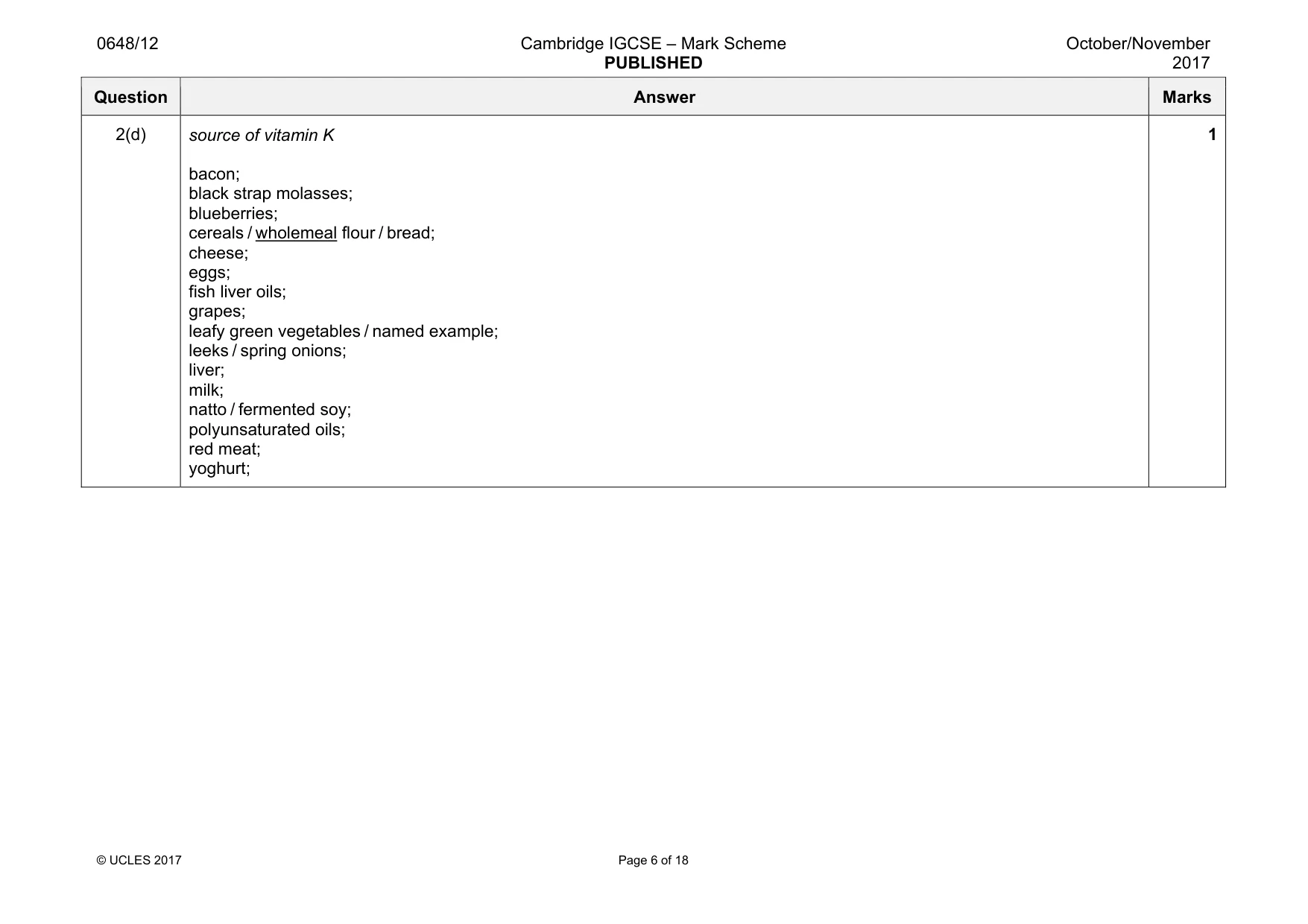
0648/12 Cambridge IGCSE – Mark Scheme PUBLISHED October/November 2017 © UCLES 2017 Page 6 of 18 Question Answer Marks 2(d) source of vitamin K bacon; black strap molasses; blueberries; cereals / wholemeal flour / bread; cheese; eggs; fish liver oils; grapes; leafy green vegetables / named example; leeks / spring onions; liver; milk; natto / fermented soy; polyunsaturated oils; red meat; yoghurt; 1
Mark scheme, page 7
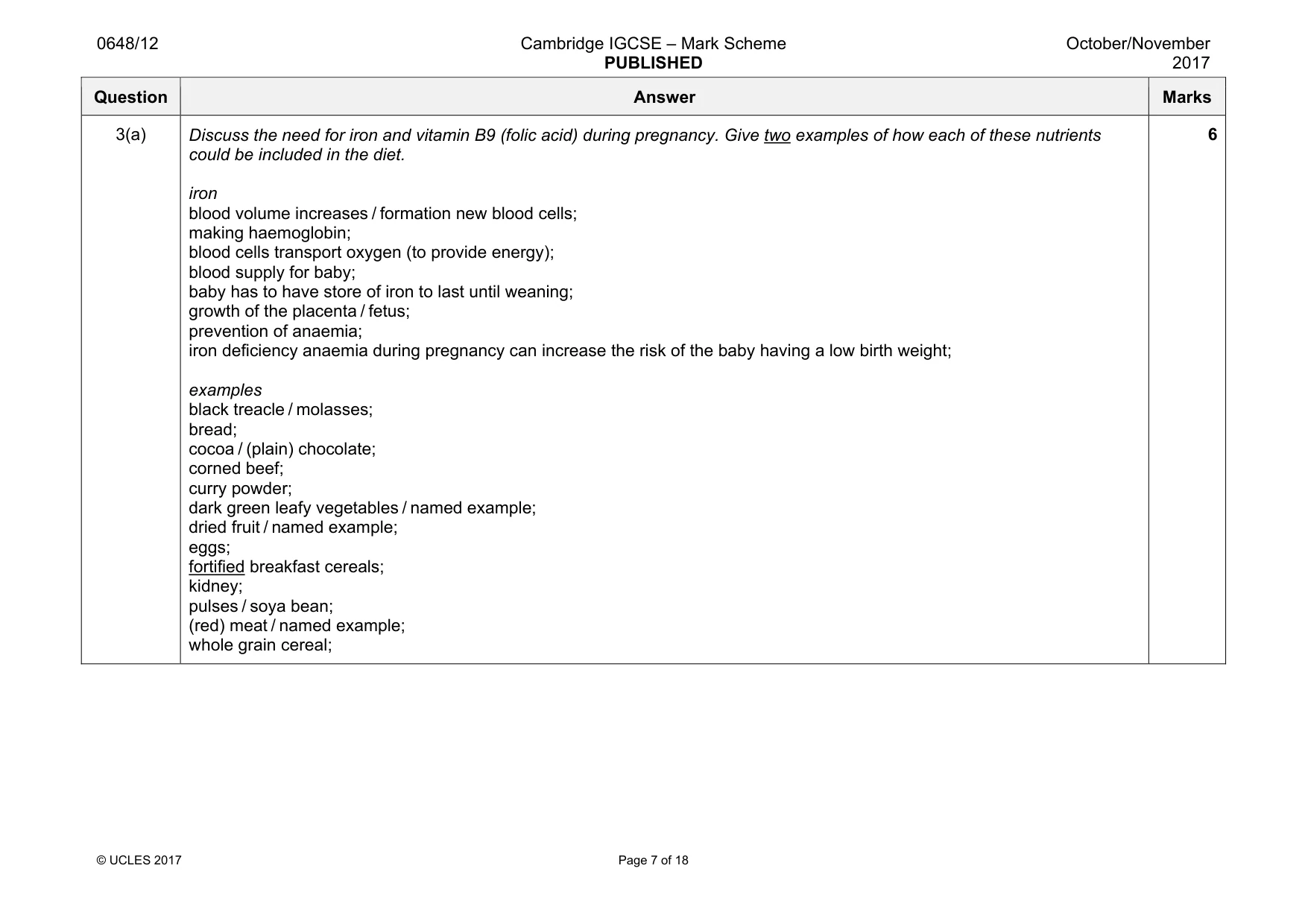
0648/12 Cambridge IGCSE – Mark Scheme PUBLISHED October/November 2017 © UCLES 2017 Page 7 of 18 Question Answer Marks 3(a) Discuss the need for iron and vitamin B9 (folic acid) during pregnancy. Give two examples of how each of these nutrients could be included in the diet. iron blood volume increases / formation new blood cells; making haemoglobin; blood cells transport oxygen (to provide energy); blood supply for baby; baby has to have store of iron to last until weaning; growth of the placenta / fetus; prevention of anaemia; iron deficiency anaemia during pregnancy can increase the risk of the baby having a low birth weight; examples black treacle / molasses; bread; cocoa / (plain) chocolate; corned beef; curry powder; dark green leafy vegetables / named example; dried fruit / named example; eggs; fortified breakfast cereals; kidney; pulses / soya bean; (red) meat / named example; whole grain cereal; 6
Mark scheme, page 8
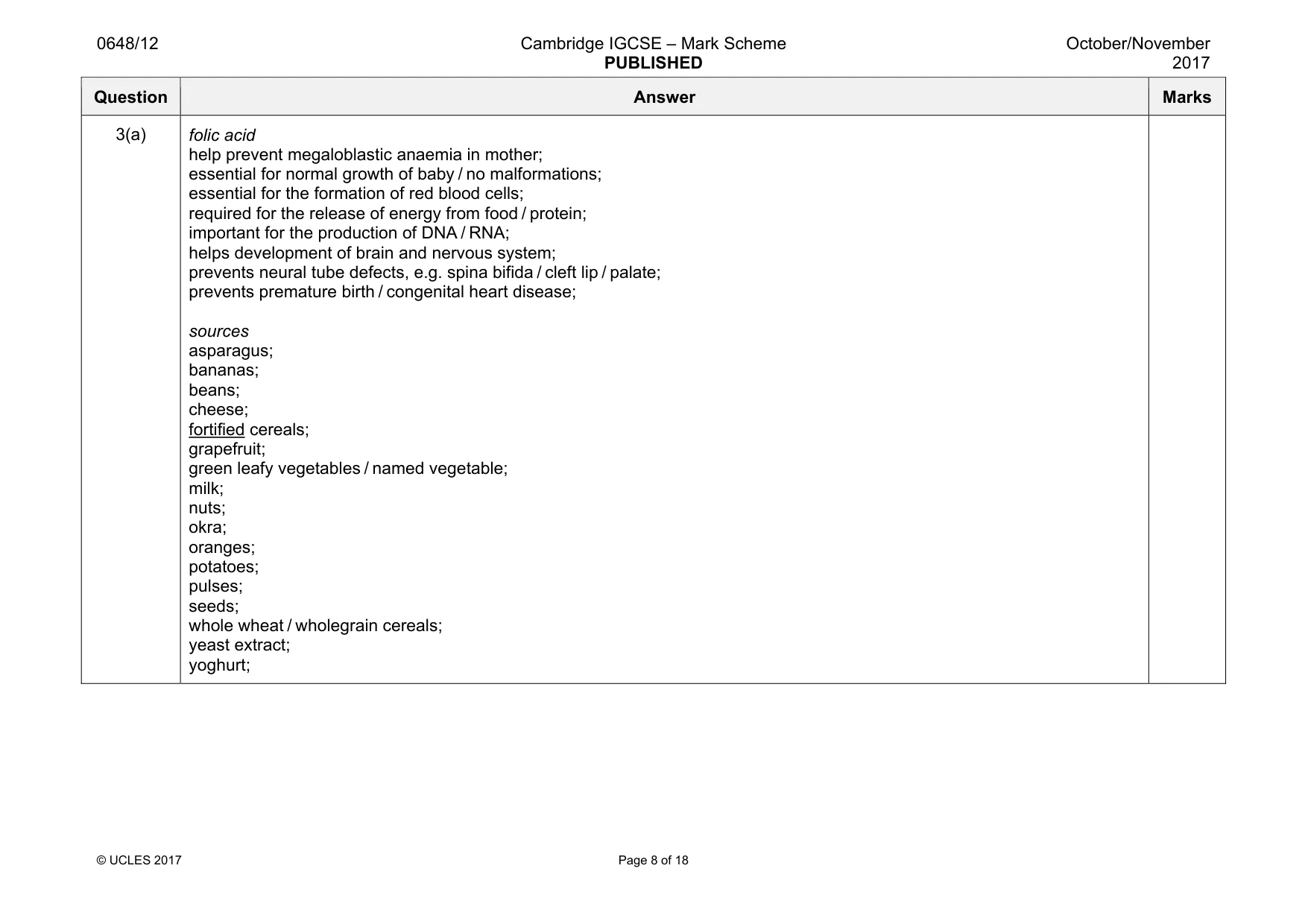
0648/12 Cambridge IGCSE – Mark Scheme PUBLISHED October/November 2017 © UCLES 2017 Page 8 of 18 Question Answer Marks 3(a) folic acid help prevent megaloblastic anaemia in mother; essential for normal growth of baby / no malformations; essential for the formation of red blood cells; required for the release of energy from food / protein; important for the production of DNA / RNA; helps development of brain and nervous system; prevents neural tube defects, e.g. spina bifida / cleft lip / palate; prevents premature birth / congenital heart disease; sources asparagus; bananas; beans; cheese; fortified cereals; grapefruit; green leafy vegetables / named vegetable; milk; nuts; okra; oranges; potatoes; pulses; seeds; whole wheat / wholegrain cereals; yeast extract; yoghurt;
Mark scheme, page 9
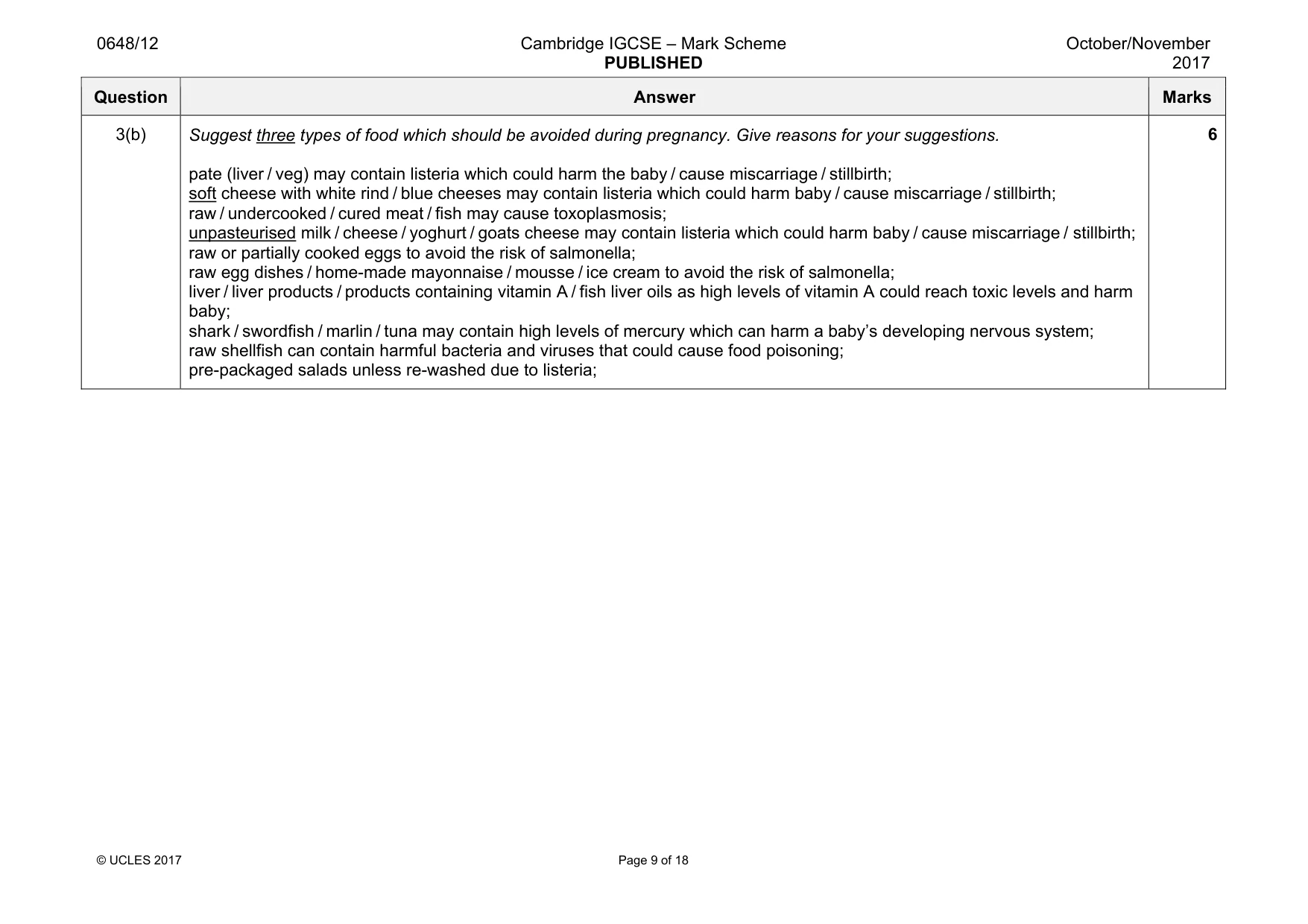
0648/12 Cambridge IGCSE – Mark Scheme PUBLISHED October/November 2017 © UCLES 2017 Page 9 of 18 Question Answer Marks 3(b) Suggest three types of food which should be avoided during pregnancy. Give reasons for your suggestions. pate (liver / veg) may contain listeria which could harm the baby / cause miscarriage / stillbirth; soft cheese with white rind / blue cheeses may contain listeria which could harm baby / cause miscarriage / stillbirth; raw / undercooked / cured meat / fish may cause toxoplasmosis; unpasteurised milk / cheese / yoghurt / goats cheese may contain listeria which could harm baby / cause miscarriage / stillbirth; raw or partially cooked eggs to avoid the risk of salmonella; raw egg dishes / home-made mayonnaise / mousse / ice cream to avoid the risk of salmonella; liver / liver products / products containing vitamin A / fish liver oils as high levels of vitamin A could reach toxic levels and harm baby; shark / swordfish / marlin / tuna may contain high levels of mercury which can harm a baby’s developing nervous system; raw shellfish can contain harmful bacteria and viruses that could cause food poisoning; pre-packaged salads unless re-washed due to listeria; 6
Mark scheme, page 10
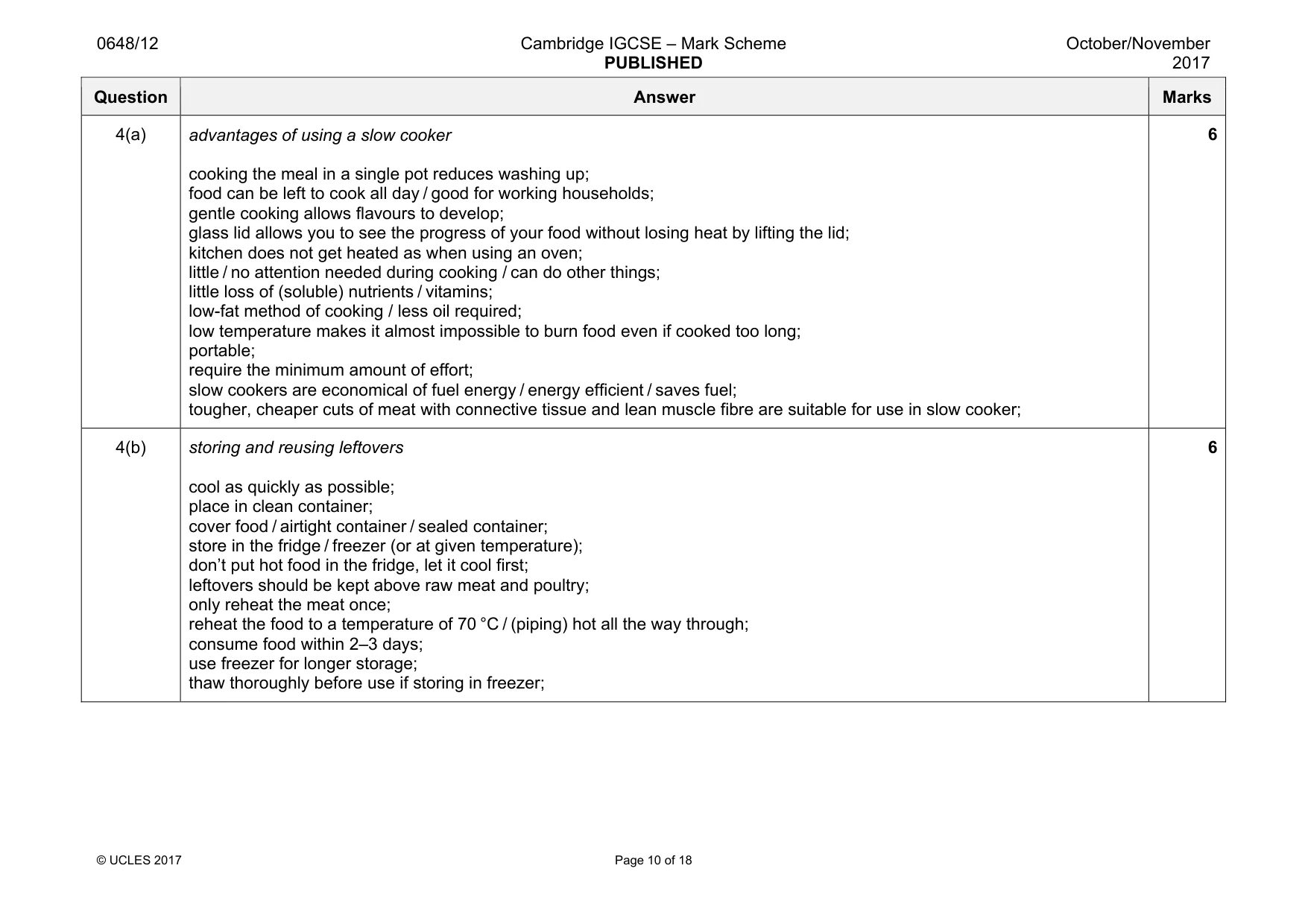
0648/12 Cambridge IGCSE – Mark Scheme PUBLISHED October/November 2017 © UCLES 2017 Page 10 of 18 Question Answer Marks 4(a) advantages of using a slow cooker cooking the meal in a single pot reduces washing up; food can be left to cook all day / good for working households; gentle cooking allows flavours to develop; glass lid allows you to see the progress of your food without losing heat by lifting the lid; kitchen does not get heated as when using an oven; little / no attention needed during cooking / can do other things; little loss of (soluble) nutrients / vitamins; low-fat method of cooking / less oil required; low temperature makes it almost impossible to burn food even if cooked too long; portable; require the minimum amount of effort; slow cookers are economical of fuel energy / energy efficient / saves fuel; tougher, cheaper cuts of meat with connective tissue and lean muscle fibre are suitable for use in slow cooker; 6 4(b) storing and reusing leftovers cool as quickly as possible; place in clean container; cover food / airtight container / sealed container; store in the fridge / freezer (or at given temperature); don’t put hot food in the fridge, let it cool first; leftovers should be kept above raw meat and poultry; only reheat the meat once; reheat the food to a temperature of 70 °C / (piping) hot all the way through; consume food within 2–3 days; use freezer for longer storage; thaw thoroughly before use if storing in freezer; 6
Mark scheme, page 11
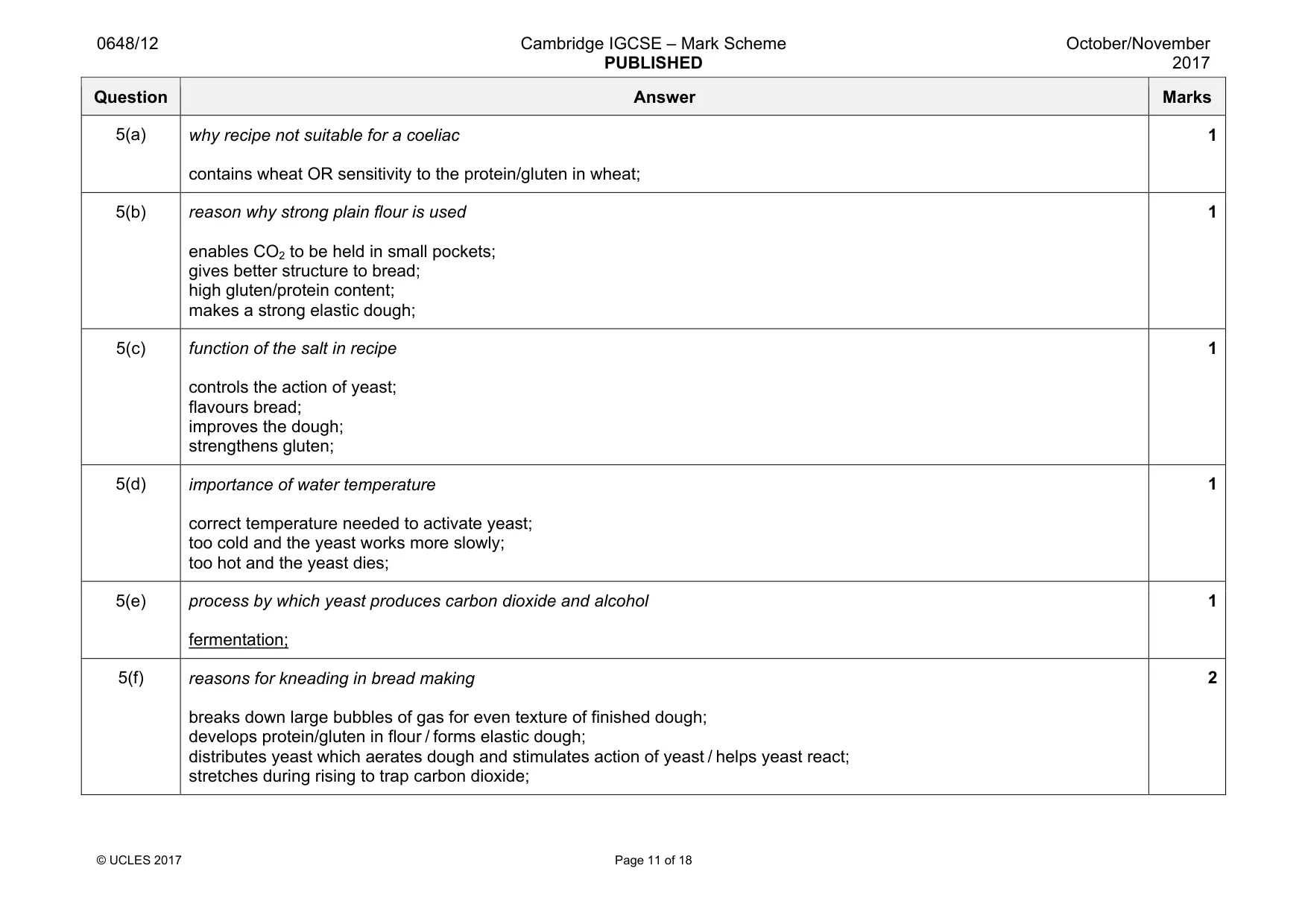
0648/12 Cambridge IGCSE – Mark Scheme PUBLISHED October/November 2017 © UCLES 2017 Page 11 of 18 Question Answer Marks 5(a) why recipe not suitable for a coeliac contains wheat OR sensitivity to the protein/gluten in wheat; 1 5(b) reason why strong plain flour is used enables CO2 to be held in small pockets; gives better structure to bread; high gluten/protein content; makes a strong elastic dough; 1 5(c) function of the salt in recipe controls the action of yeast; flavours bread; improves the dough; strengthens gluten; 1 5(d) importance of water temperature correct temperature needed to activate yeast; too cold and the yeast works more slowly; too hot and the yeast dies; 1 5(e) process by which yeast produces carbon dioxide and alcohol fermentation; 1 5(f) reasons for kneading in bread making breaks down large bubbles of gas for even texture of finished dough; develops protein/gluten in flour / forms elastic dough; distributes yeast which aerates dough and stimulates action of yeast / helps yeast react; stretches during rising to trap carbon dioxide; 2
Mark scheme, page 12
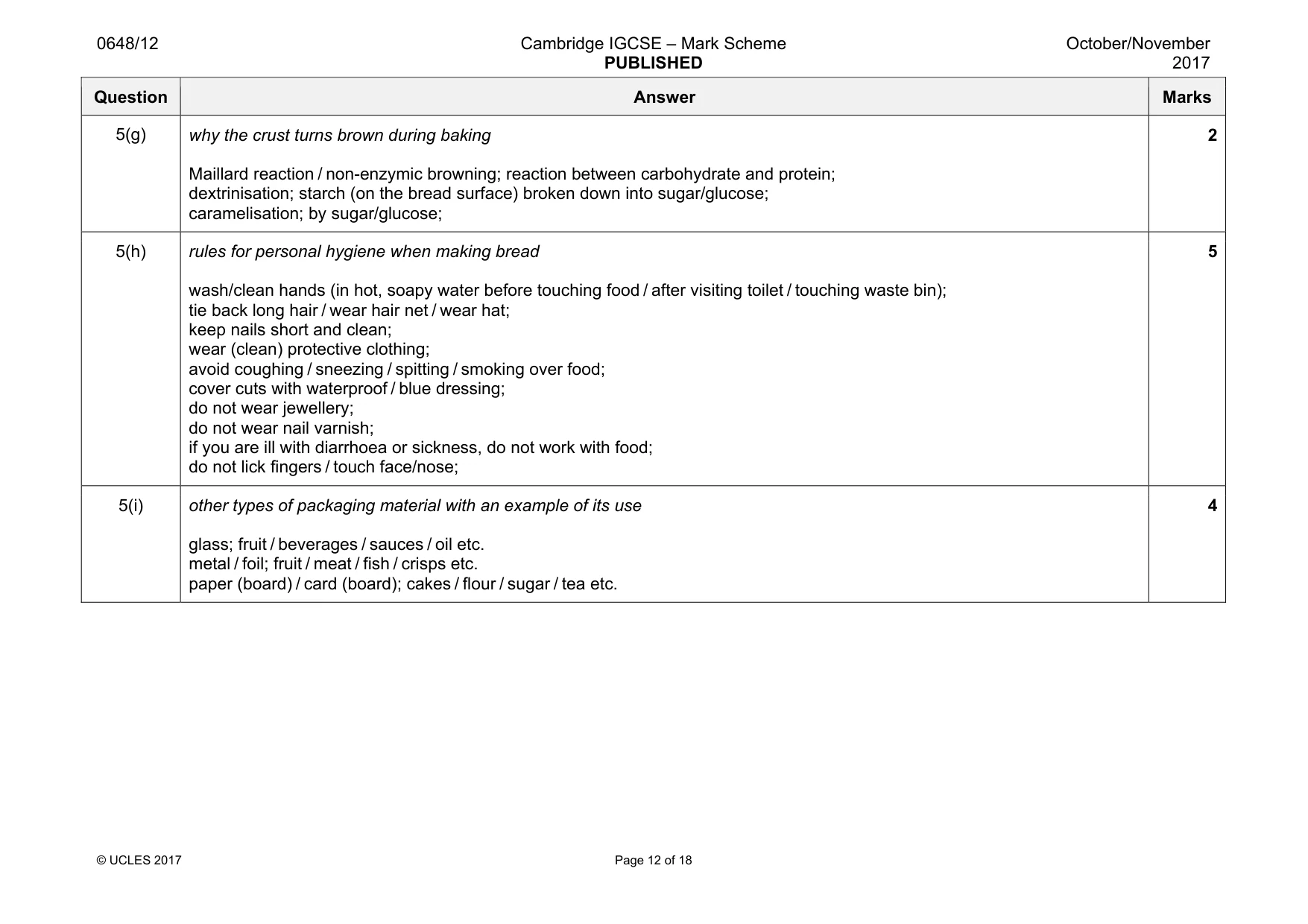
0648/12 Cambridge IGCSE – Mark Scheme PUBLISHED October/November 2017 © UCLES 2017 Page 12 of 18 Question Answer Marks 5(g) why the crust turns brown during baking Maillard reaction / non-enzymic browning; reaction between carbohydrate and protein; dextrinisation; starch (on the bread surface) broken down into sugar/glucose; caramelisation; by sugar/glucose; 2 5(h) rules for personal hygiene when making bread wash/clean hands (in hot, soapy water before touching food / after visiting toilet / touching waste bin); tie back long hair / wear hair net / wear hat; keep nails short and clean; wear (clean) protective clothing; avoid coughing / sneezing / spitting / smoking over food; cover cuts with waterproof / blue dressing; do not wear jewellery; do not wear nail varnish; if you are ill with diarrhoea or sickness, do not work with food; do not lick fingers / touch face/nose; 5 5(i) other types of packaging material with an example of its use glass; fruit / beverages / sauces / oil etc. metal / foil; fruit / meat / fish / crisps etc. paper (board) / card (board); cakes / flour / sugar / tea etc. 4
Mark scheme, page 13
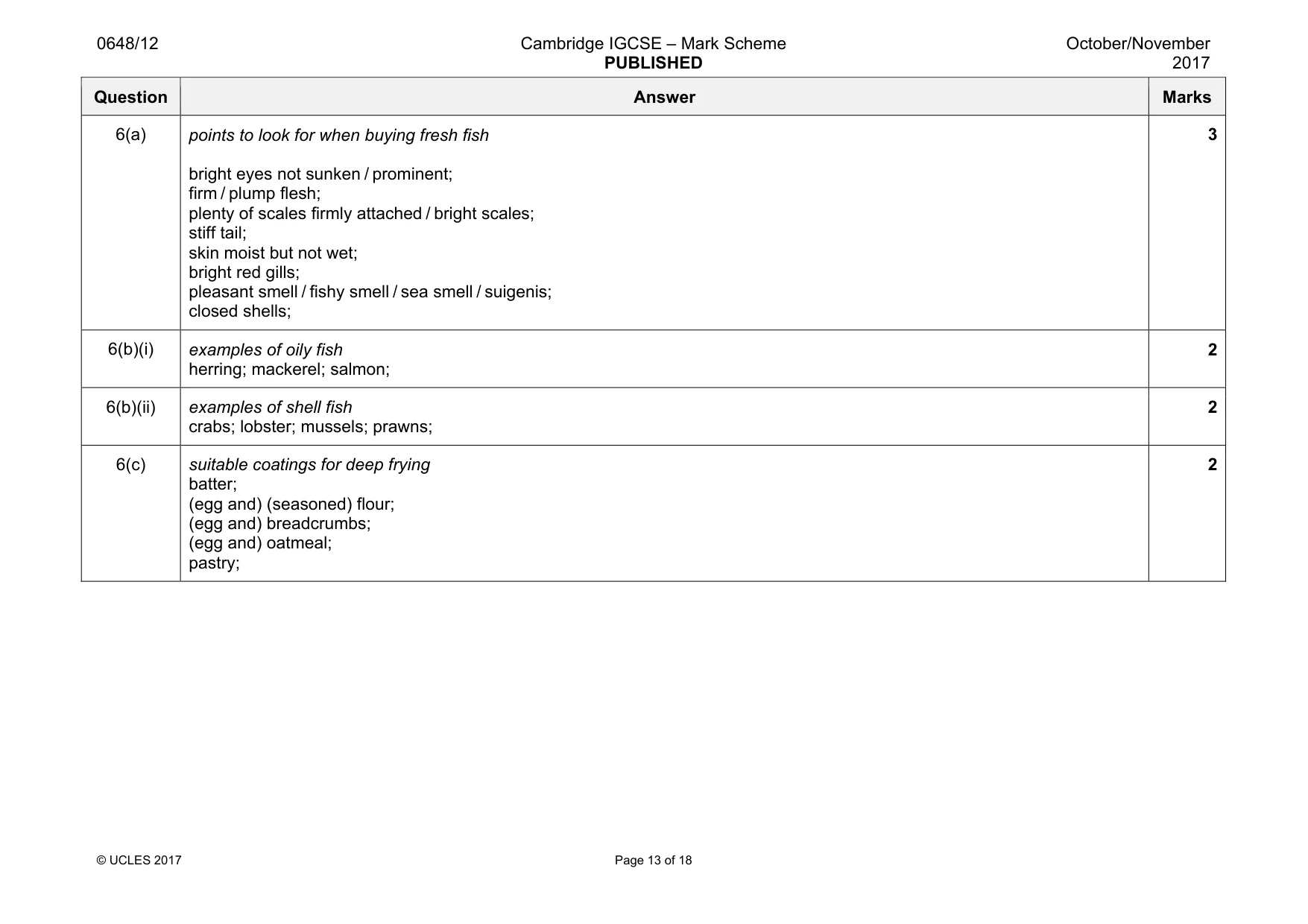
0648/12 Cambridge IGCSE – Mark Scheme PUBLISHED October/November 2017 © UCLES 2017 Page 13 of 18 Question Answer Marks 6(a) points to look for when buying fresh fish bright eyes not sunken / prominent; firm / plump flesh; plenty of scales firmly attached / bright scales; stiff tail; skin moist but not wet; bright red gills; pleasant smell / fishy smell / sea smell / suigenis; closed shells; 3 6(b)(i) examples of oily fish herring; mackerel; salmon; 2 6(b)(ii) examples of shell fish crabs; lobster; mussels; prawns; 2 6(c) suitable coatings for deep frying batter; (egg and) (seasoned) flour; (egg and) breadcrumbs; (egg and) oatmeal; pastry; 2
Mark scheme, page 14
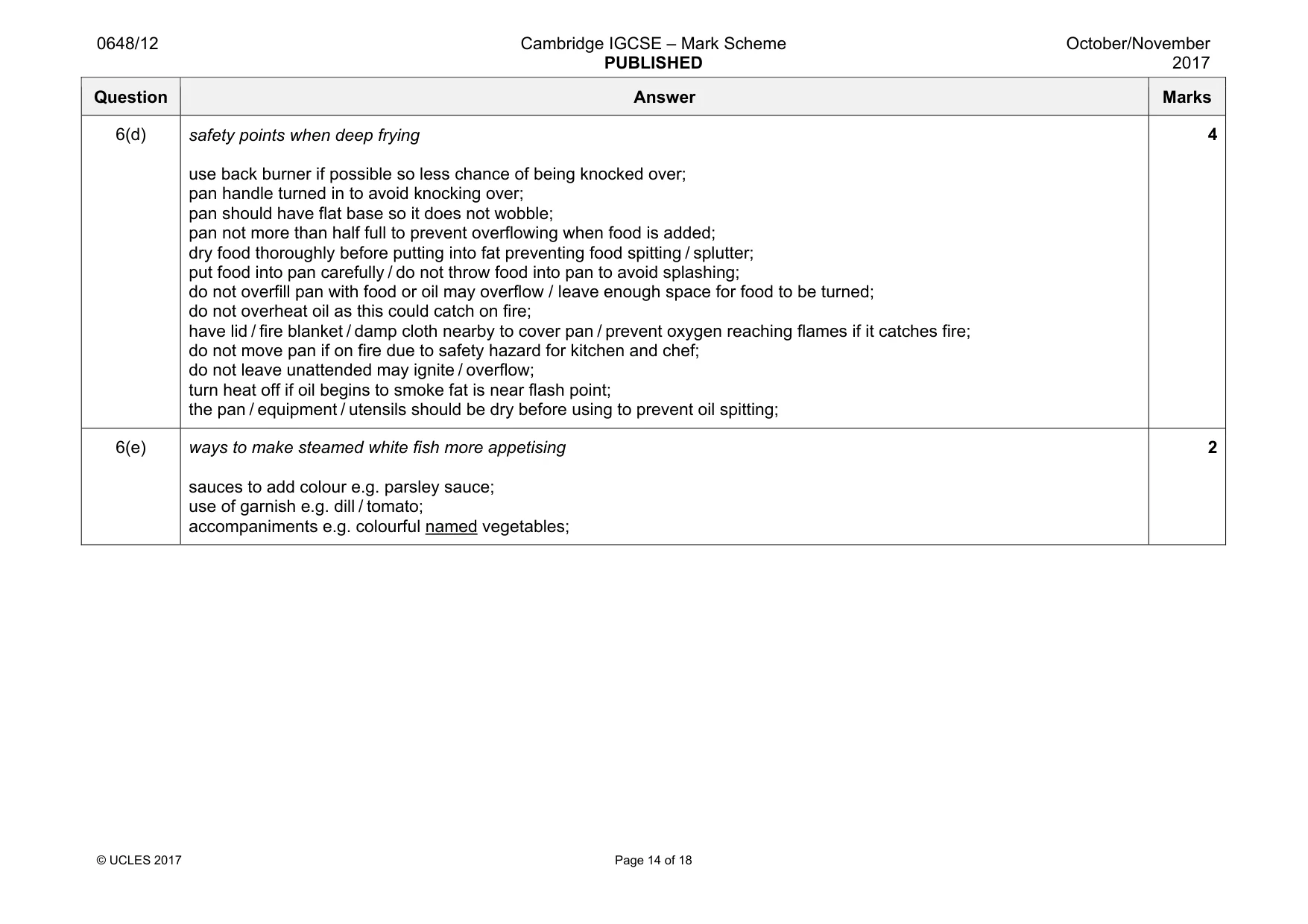
0648/12 Cambridge IGCSE – Mark Scheme PUBLISHED October/November 2017 © UCLES 2017 Page 14 of 18 Question Answer Marks 6(d) safety points when deep frying use back burner if possible so less chance of being knocked over; pan handle turned in to avoid knocking over; pan should have flat base so it does not wobble; pan not more than half full to prevent overflowing when food is added; dry food thoroughly before putting into fat preventing food spitting / splutter; put food into pan carefully / do not throw food into pan to avoid splashing; do not overfill pan with food or oil may overflow / leave enough space for food to be turned; do not overheat oil as this could catch on fire; have lid / fire blanket / damp cloth nearby to cover pan / prevent oxygen reaching flames if it catches fire; do not move pan if on fire due to safety hazard for kitchen and chef; do not leave unattended may ignite / overflow; turn heat off if oil begins to smoke fat is near flash point; the pan / equipment / utensils should be dry before using to prevent oil spitting; 4 6(e) ways to make steamed white fish more appetising sauces to add colour e.g. parsley sauce; use of garnish e.g. dill / tomato; accompaniments e.g. colourful named vegetables; 2
Mark scheme, page 15
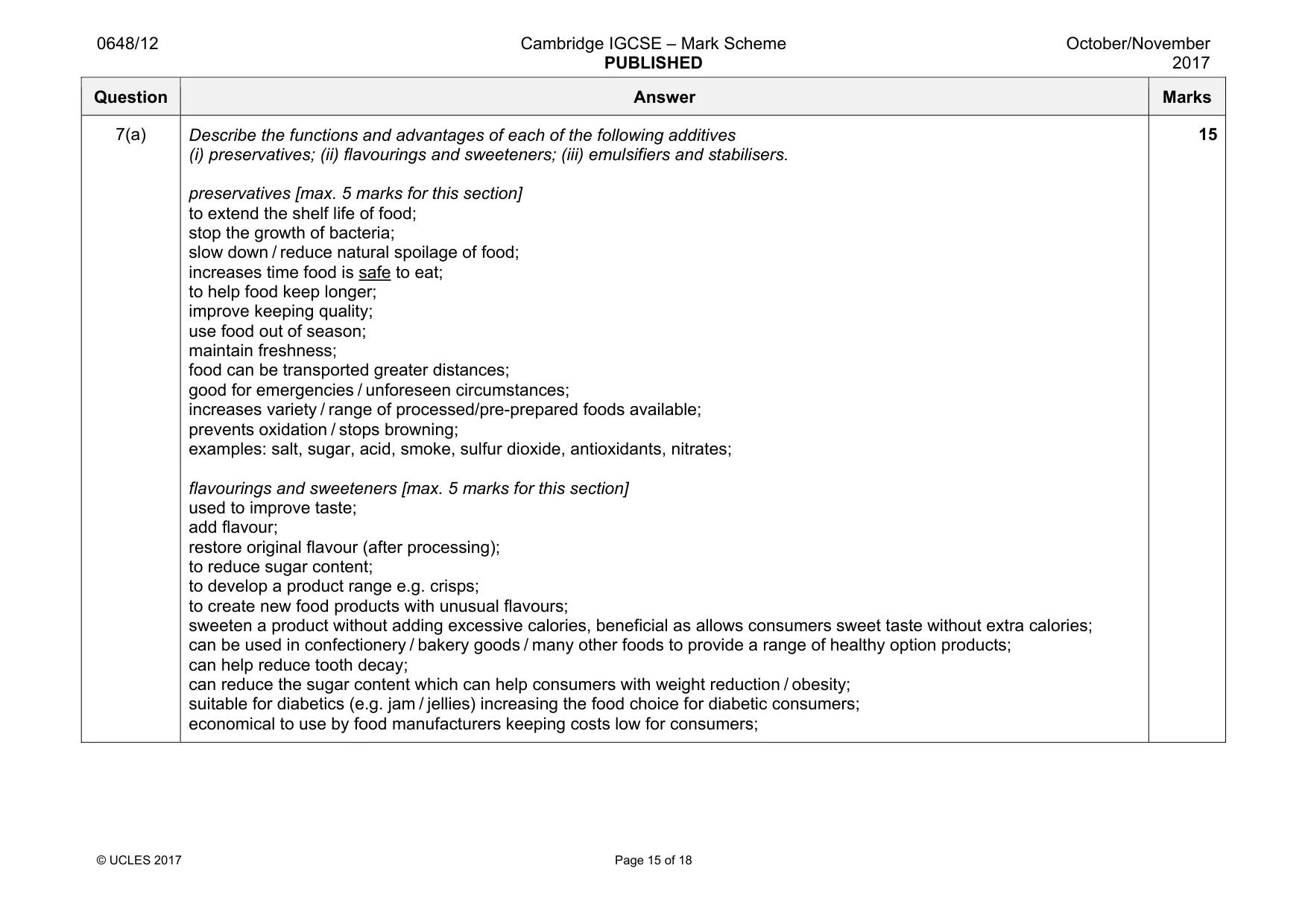
0648/12 Cambridge IGCSE – Mark Scheme PUBLISHED October/November 2017 © UCLES 2017 Page 15 of 18 Question Answer Marks 7(a) Describe the functions and advantages of each of the following additives (i) preservatives; (ii) flavourings and sweeteners; (iii) emulsifiers and stabilisers. preservatives [max. 5 marks for this section] to extend the shelf life of food; stop the growth of bacteria; slow down / reduce natural spoilage of food; increases time food is safe to eat; to help food keep longer; improve keeping quality; use food out of season; maintain freshness; food can be transported greater distances; good for emergencies / unforeseen circumstances; increases variety / range of processed/pre-prepared foods available; prevents oxidation / stops browning; examples: salt, sugar, acid, smoke, sulfur dioxide, antioxidants, nitrates; flavourings and sweeteners [max. 5 marks for this section] used to improve taste; add flavour; restore original flavour (after processing); to reduce sugar content; to develop a product range e.g. crisps; to create new food products with unusual flavours; sweeten a product without adding excessive calories, beneficial as allows consumers sweet taste without extra calories; can be used in confectionery / bakery goods / many other foods to provide a range of healthy option products; can help reduce tooth decay; can reduce the sugar content which can help consumers with weight reduction / obesity; suitable for diabetics (e.g. jam / jellies) increasing the food choice for diabetic consumers; economical to use by food manufacturers keeping costs low for consumers; 15
Mark scheme, page 16
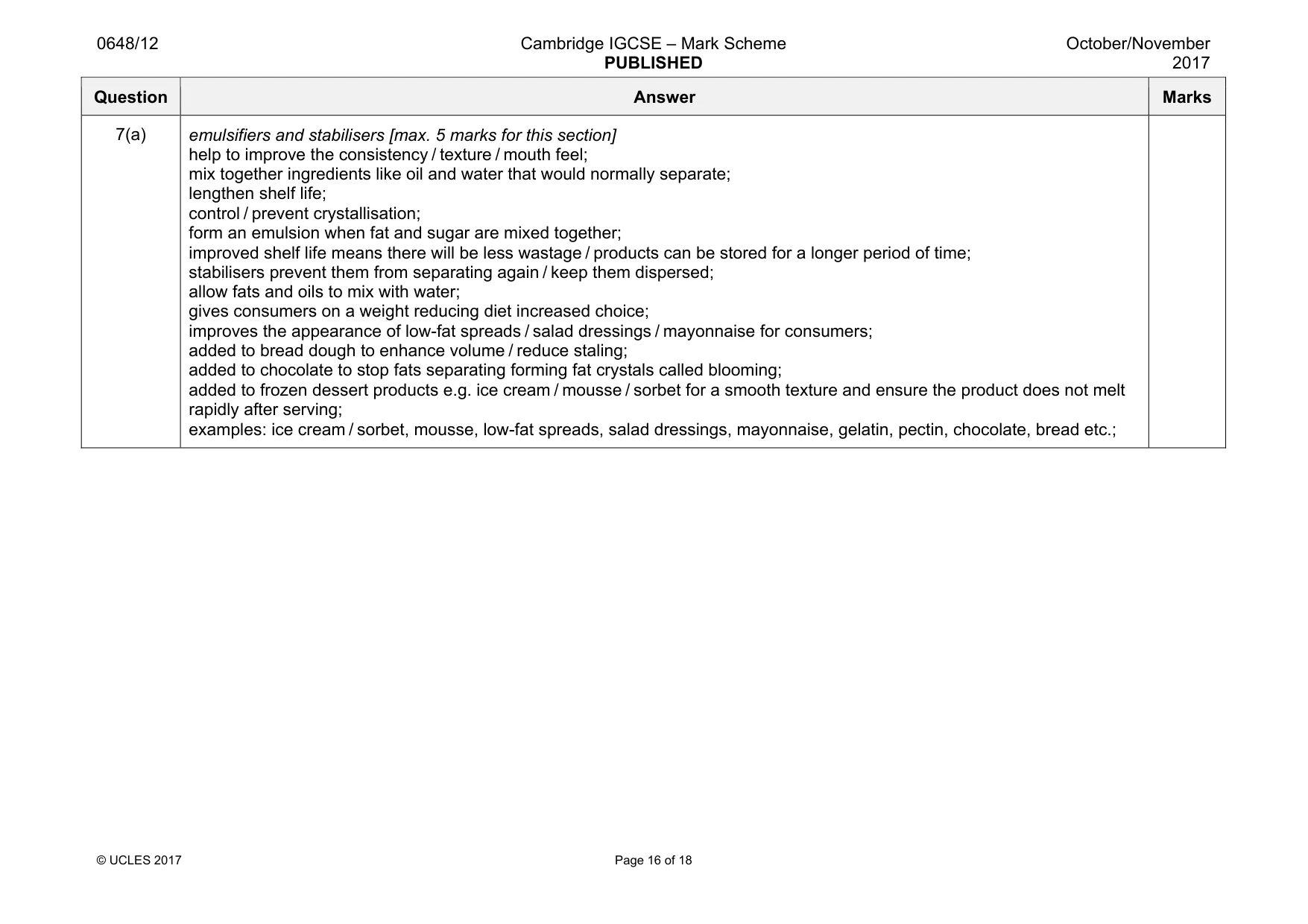
0648/12 Cambridge IGCSE – Mark Scheme PUBLISHED October/November 2017 © UCLES 2017 Page 16 of 18 Question Answer Marks 7(a) emulsifiers and stabilisers [max. 5 marks for this section] help to improve the consistency / texture / mouth feel; mix together ingredients like oil and water that would normally separate; lengthen shelf life; control / prevent crystallisation; form an emulsion when fat and sugar are mixed together; improved shelf life means there will be less wastage / products can be stored for a longer period of time; stabilisers prevent them from separating again / keep them dispersed; allow fats and oils to mix with water; gives consumers on a weight reducing diet increased choice; improves the appearance of low-fat spreads / salad dressings / mayonnaise for consumers; added to bread dough to enhance volume / reduce staling; added to chocolate to stop fats separating forming fat crystals called blooming; added to frozen dessert products e.g. ice cream / mousse / sorbet for a smooth texture and ensure the product does not melt rapidly after serving; examples: ice cream / sorbet, mousse, low-fat spreads, salad dressings, mayonnaise, gelatin, pectin, chocolate, bread etc.;
Mark scheme, page 17
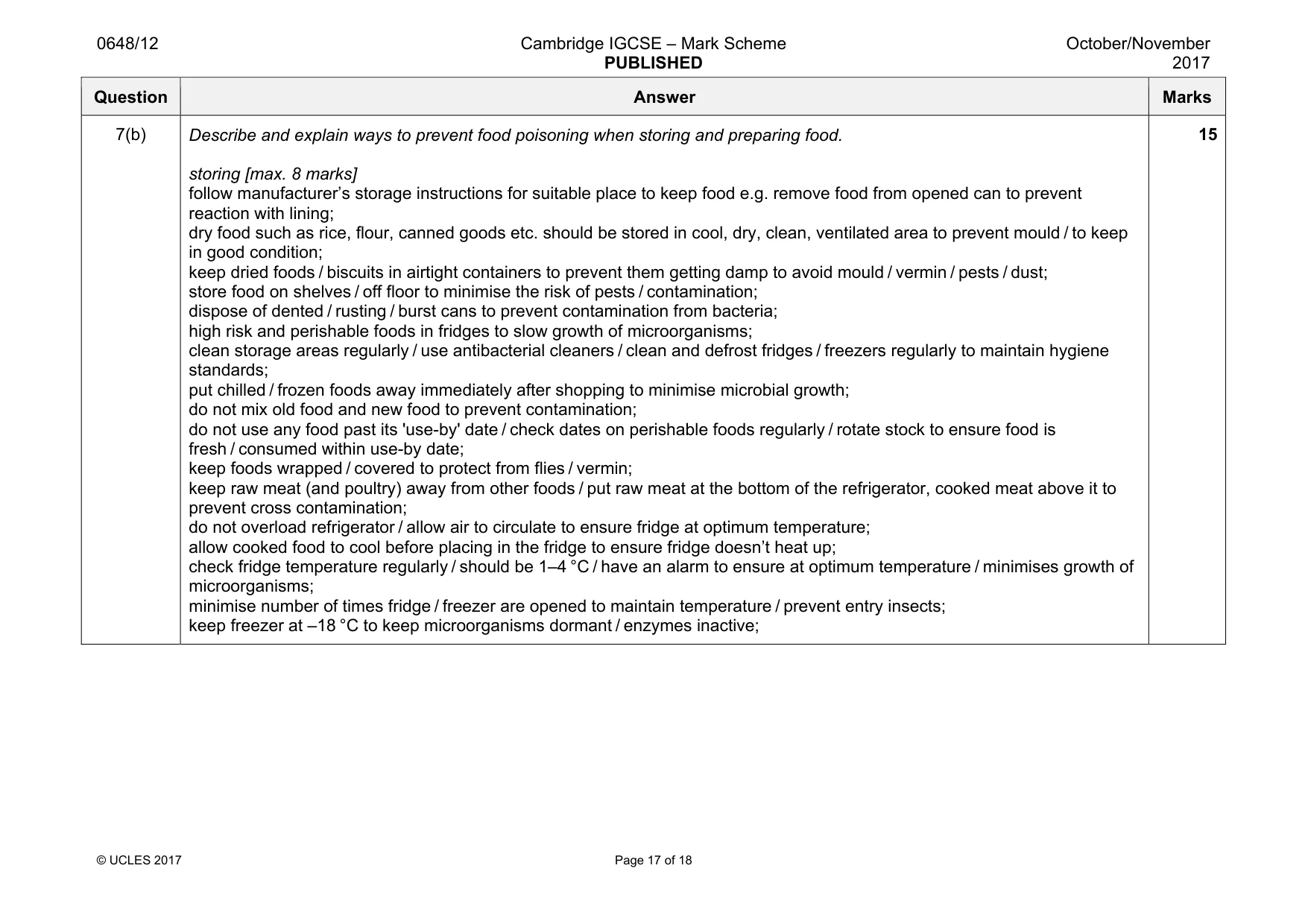
0648/12 Cambridge IGCSE – Mark Scheme PUBLISHED October/November 2017 © UCLES 2017 Page 17 of 18 Question Answer Marks 7(b) Describe and explain ways to prevent food poisoning when storing and preparing food. storing [max. 8 marks] follow manufacturer’s storage instructions for suitable place to keep food e.g. remove food from opened can to prevent reaction with lining; dry food such as rice, flour, canned goods etc. should be stored in cool, dry, clean, ventilated area to prevent mould / to keep in good condition; keep dried foods / biscuits in airtight containers to prevent them getting damp to avoid mould / vermin / pests / dust; store food on shelves / off floor to minimise the risk of pests / contamination; dispose of dented / rusting / burst cans to prevent contamination from bacteria; high risk and perishable foods in fridges to slow growth of microorganisms; clean storage areas regularly / use antibacterial cleaners / clean and defrost fridges / freezers regularly to maintain hygiene standards; put chilled / frozen foods away immediately after shopping to minimise microbial growth; do not mix old food and new food to prevent contamination; do not use any food past its 'use-by' date / check dates on perishable foods regularly / rotate stock to ensure food is fresh / consumed within use-by date; keep foods wrapped / covered to protect from flies / vermin; keep raw meat (and poultry) away from other foods / put raw meat at the bottom of the refrigerator, cooked meat above it to prevent cross contamination; do not overload refrigerator / allow air to circulate to ensure fridge at optimum temperature; allow cooked food to cool before placing in the fridge to ensure fridge doesn’t heat up; check fridge temperature regularly / should be 1–4 °C / have an alarm to ensure at optimum temperature / minimises growth of microorganisms; minimise number of times fridge / freezer are opened to maintain temperature / prevent entry insects; keep freezer at –18 °C to keep microorganisms dormant / enzymes inactive; 15
Mark scheme, page 18
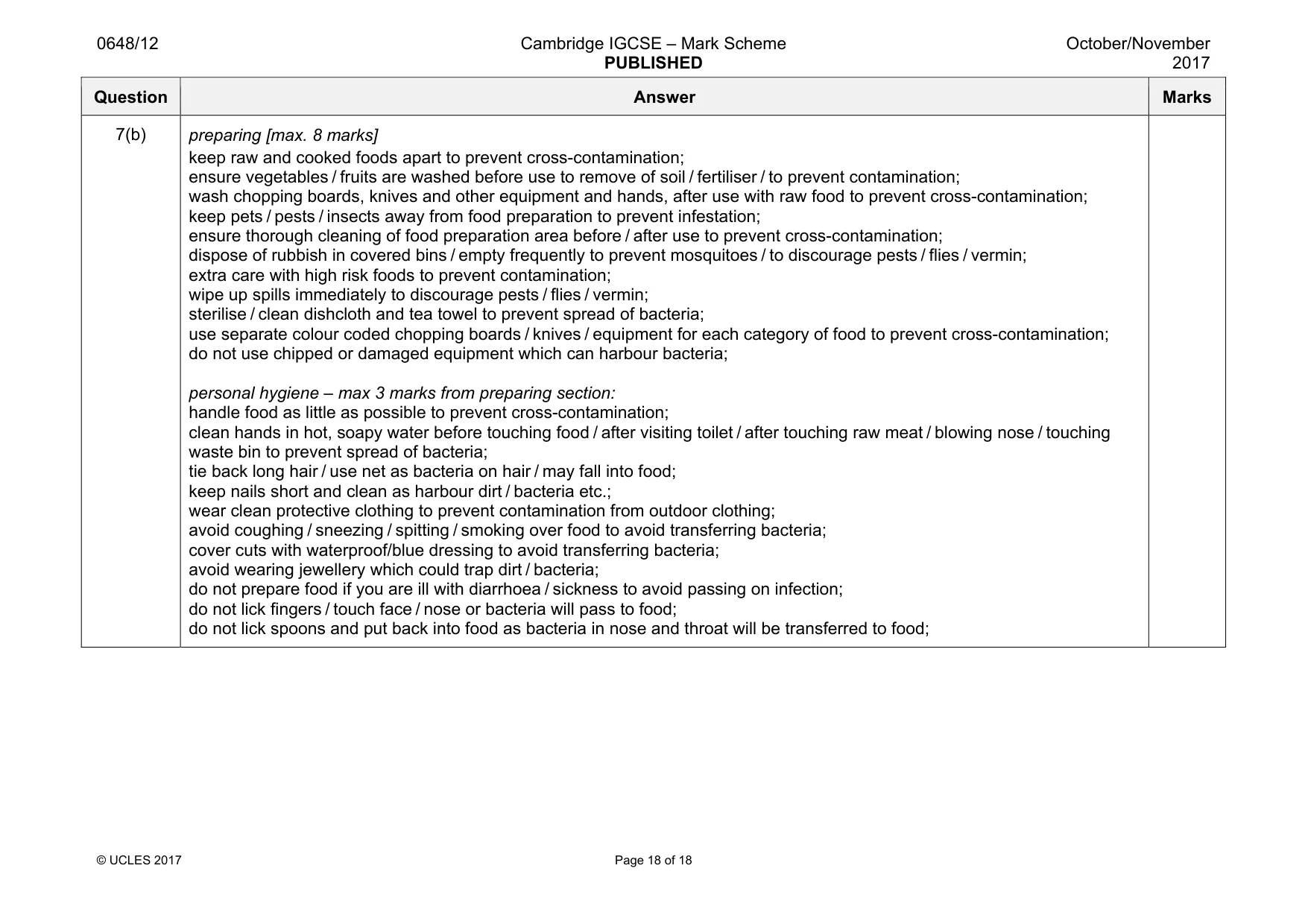
0648/12 Cambridge IGCSE – Mark Scheme PUBLISHED October/November 2017 © UCLES 2017 Page 18 of 18 Question Answer Marks 7(b) preparing [max. 8 marks] keep raw and cooked foods apart to prevent cross-contamination; ensure vegetables / fruits are washed before use to remove of soil / fertiliser / to prevent contamination; wash chopping boards, knives and other equipment and hands, after use with raw food to prevent cross-contamination; keep pets / pests / insects away from food preparation to prevent infestation; ensure thorough cleaning of food preparation area before / after use to prevent cross-contamination; dispose of rubbish in covered bins / empty frequently to prevent mosquitoes / to discourage pests / flies / vermin; extra care with high risk foods to prevent contamination; wipe up spills immediately to discourage pests / flies / vermin; sterilise / clean dishcloth and tea towel to prevent spread of bacteria; use separate colour coded chopping boards / knives / equipment for each category of food to prevent cross-contamination; do not use chipped or damaged equipment which can harbour bacteria; personal hygiene – max 3 marks from preparing section: handle food as little as possible to prevent cross-contamination; clean hands in hot, soapy water before touching food / after visiting toilet / after touching raw meat / blowing nose / touching waste bin to prevent spread of bacteria; tie back long hair / use net as bacteria on hair / may fall into food; keep nails short and clean as harbour dirt / bacteria etc.; wear clean protective clothing to prevent contamination from outdoor clothing; avoid coughing / sneezing / spitting / smoking over food to avoid transferring bacteria; cover cuts with waterproof/blue dressing to avoid transferring bacteria; avoid wearing jewellery which could trap dirt / bacteria; do not prepare food if you are ill with diarrhoea / sickness to avoid passing on infection; do not lick fingers / touch face / nose or bacteria will pass to food; do not lick spoons and put back into food as bacteria in nose and throat will be transferred to food;
What you needed in this session
Cambridge’s own grade thresholds for 2017 Oct/Nov, Paper 1 · Variant 2. A higher threshold means an easier paper — the bar moves with how the cohort did.