Cambridge IGCSE Food and Nutrition 0648 — 2017 Oct/Nov Paper 1 · Variant 3
0648/13/O/N/17 · 100 marks · ≈113 min
The question paper and its mark scheme, free to read here and free to download. This is Cambridge’s own paper, exactly as it was sat.
Question paper12 pages


Mark scheme14 pages
Answers below. Sit the paper first if you are practising.
Paper as text
Question paper, page 1
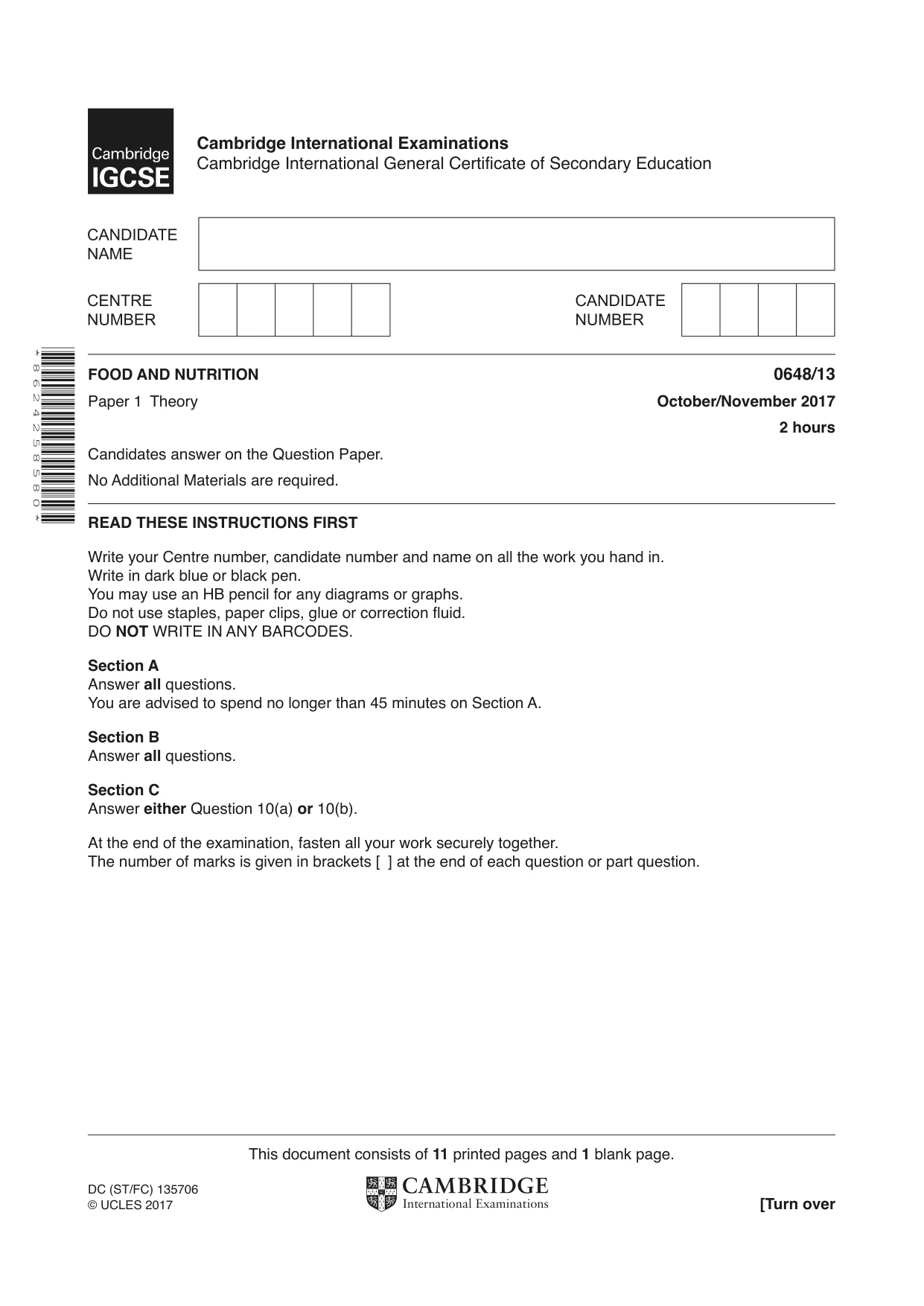
This document consists of 11 printed pages and 1 blank page. DC (ST/FC) 135706 © UCLES 2017 [Turn over Cambridge International Examinations Cambridge International General Certificate of Secondary Education * 8 6 2 4 2 5 8 5 8 0 * FOOD AND NUTRITION 0648/13 Paper 1 Theory October/November 2017 2 hours Candidates answer on the Question Paper. No Additional Materials are required. READ THESE INSTRUCTIONS FIRST Write your Centre number, candidate number and name on all the work you hand in. Write in dark blue or black pen. You may use an HB pencil for any diagrams or graphs. Do not use staples, paper clips, glue or correction fluid. DO NOT WRITE IN ANY BARCODES. Section A Answer all questions. You are advised to spend no longer than 45 minutes on Section A. Section B Answer all questions. Section C Answer either Question 10(a) or 10(b). At the end of the examination, fasten all your work securely together. The number of marks is given in brackets [ ] at the end of each question or part question.
Question paper, page 2
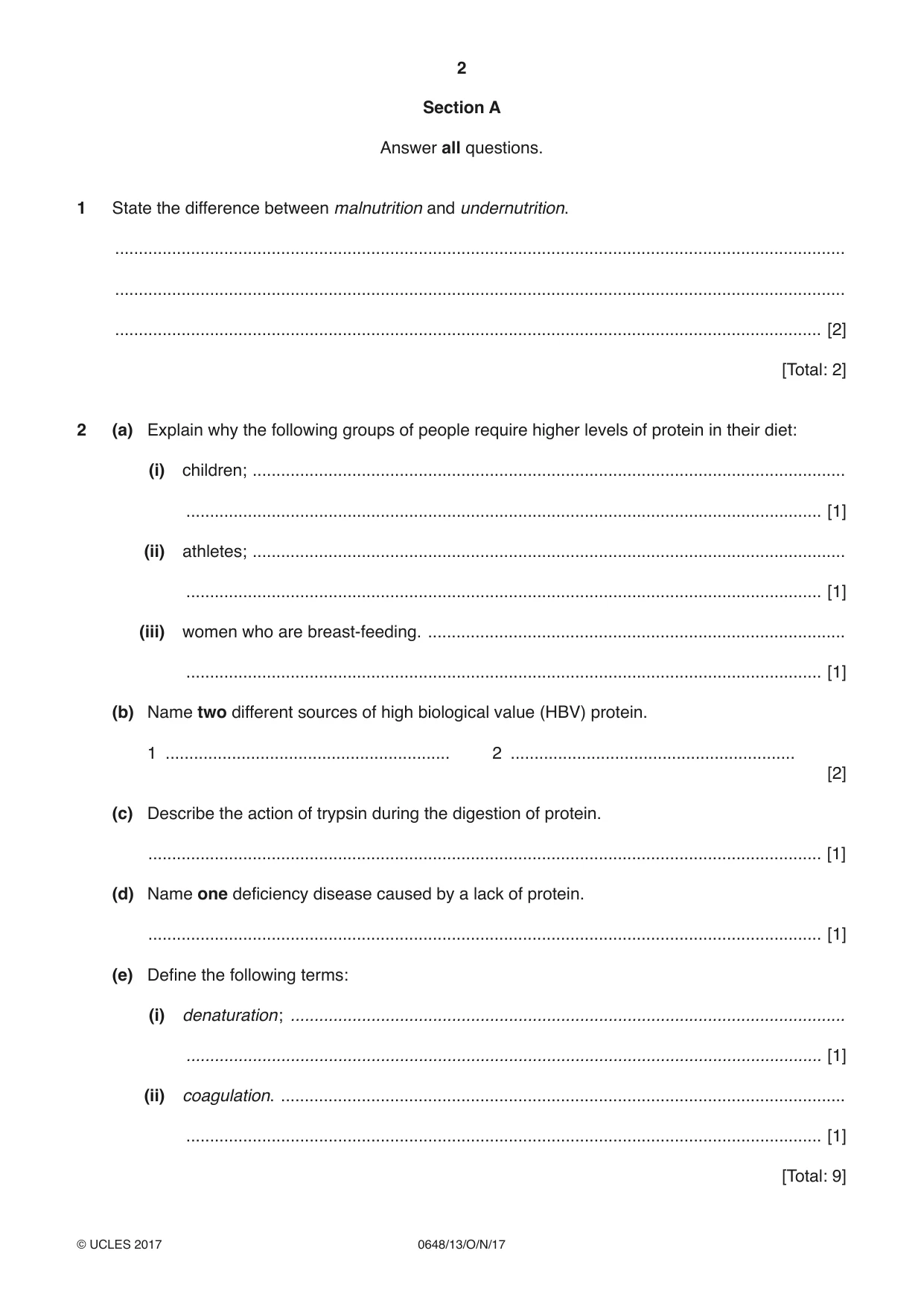
2 0648/13/O/N/17 © UCLES 2017 Section A Answer all questions. 1 State the difference between malnutrition and undernutrition. … … … [2] [Total: 2] 2 (a) Explain why the following groups of people require higher levels of protein in their diet: (i) children; … … [1] (ii) athletes; … … [1] (iii) women who are breast-feeding. … … [1] (b) Name two different sources of high biological value (HBV) protein. 1 … 2 … [2] (c) Describe the action of trypsin during the digestion of protein. … [1] (d) Name one deficiency disease caused by a lack of protein. … [1] (e) Define the following terms: (i) denaturation; … … [1] (ii) coagulation. … … [1] [Total: 9]
Question paper, page 3
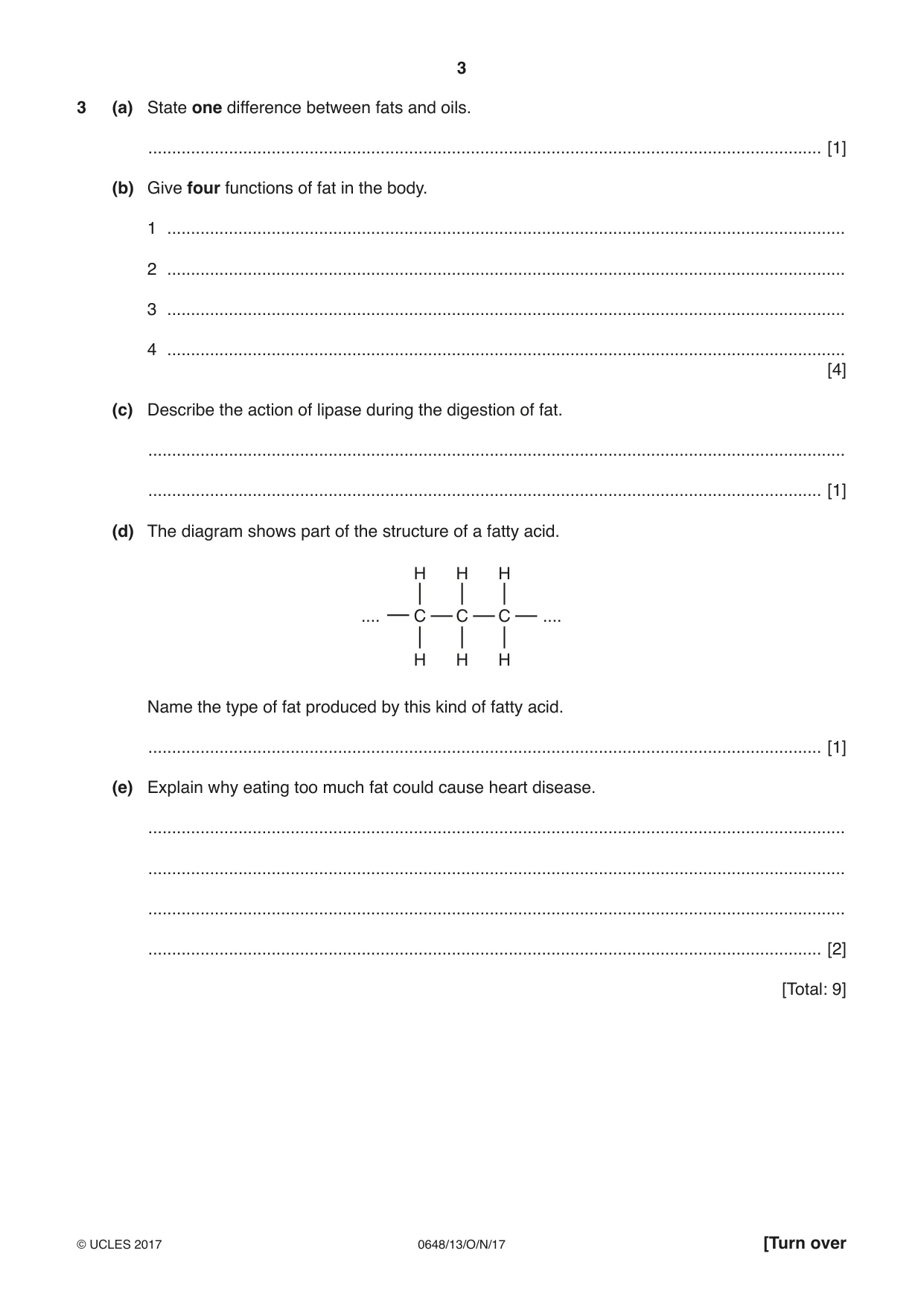
3 0648/13/O/N/17 © UCLES 2017 [Turn over 3 (a) State one difference between fats and oils. … [1] (b) Give four functions of fat in the body. 1 … 2 … 3 … 4 … [4] (c) Describe the action of lipase during the digestion of fat. … … [1] (d) The diagram shows part of the structure of a fatty acid. H … … C H H C H H C H Name the type of fat produced by this kind of fatty acid. … [1] (e) Explain why eating too much fat could cause heart disease. … … … … [2] [Total: 9]
Question paper, page 4
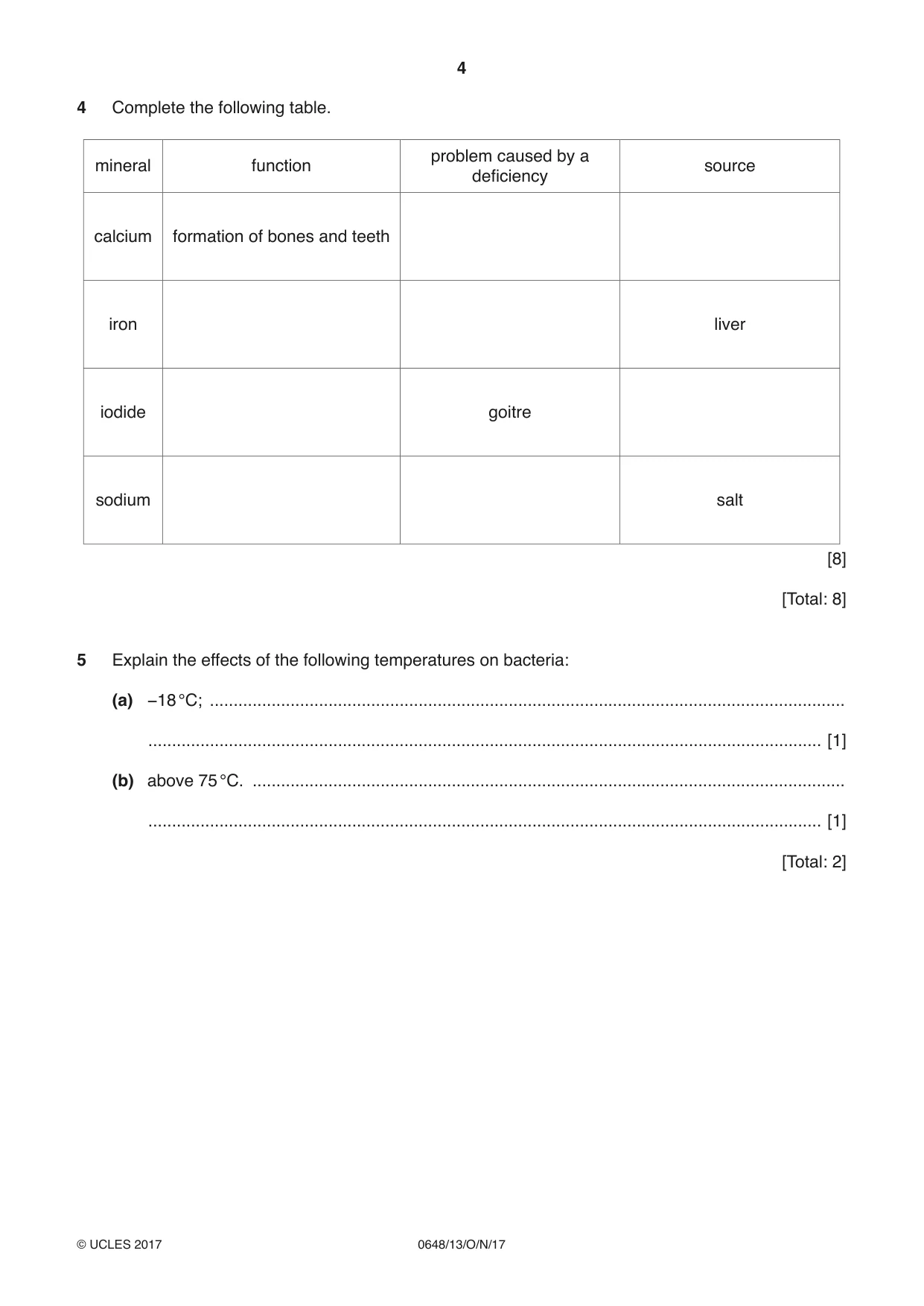
4 0648/13/O/N/17 © UCLES 2017 4 Complete the following table. mineral function problem caused by a deficiency source calcium formation of bones and teeth iron liver iodide goitre sodium salt [8] [Total: 8] 5 Explain the effects of the following temperatures on bacteria: (a) −18 °C; … … [1] (b) above 75 °C. … … [1] [Total: 2]
Question paper, page 5
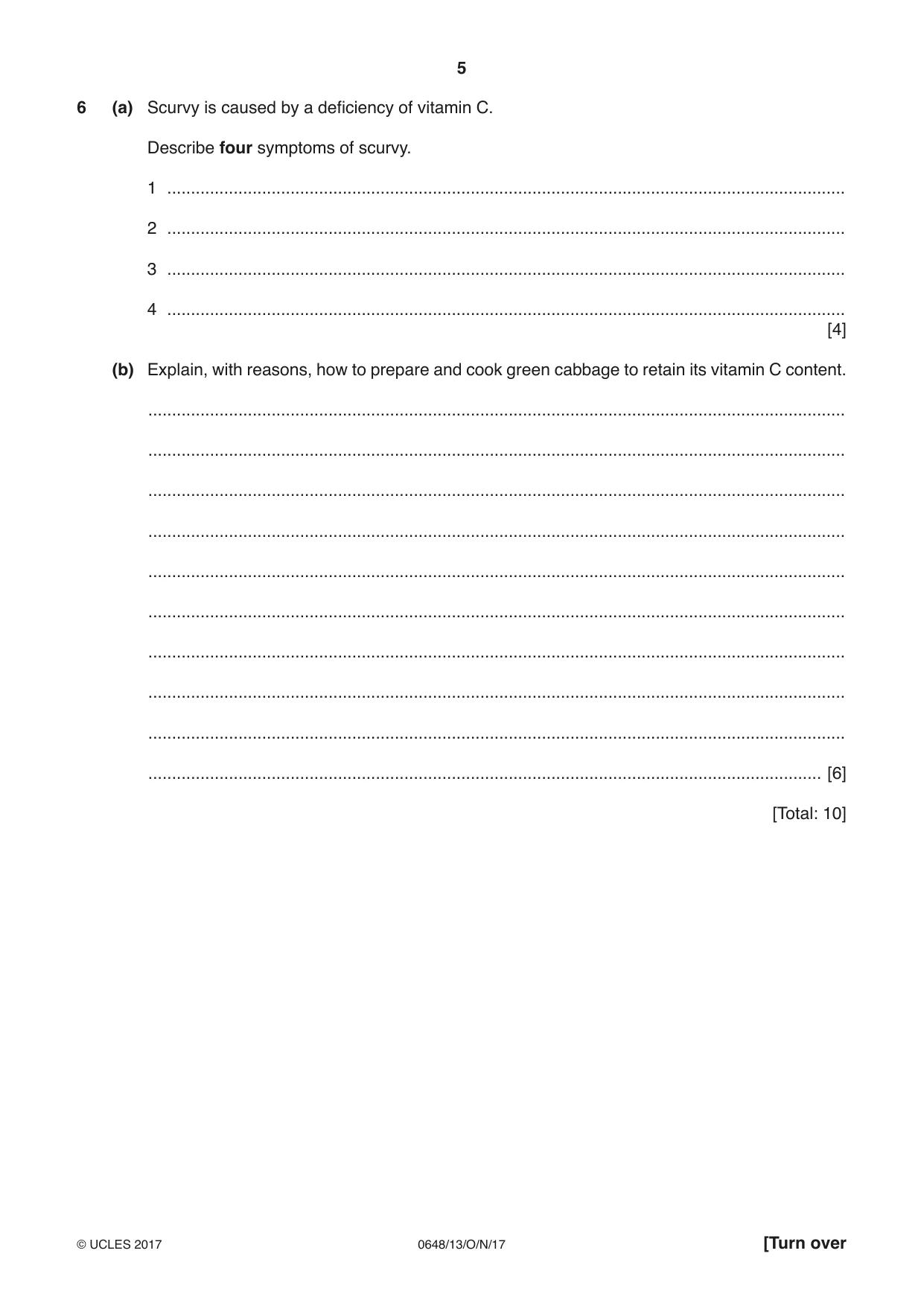
5 0648/13/O/N/17 © UCLES 2017 [Turn over 6 (a) Scurvy is caused by a deficiency of vitamin C. Describe four symptoms of scurvy. 1 … 2 … 3 … 4 … [4] (b) Explain, with reasons, how to prepare and cook green cabbage to retain its vitamin C content. … … … … … … … … … … [6] [Total: 10]
Question paper, page 6
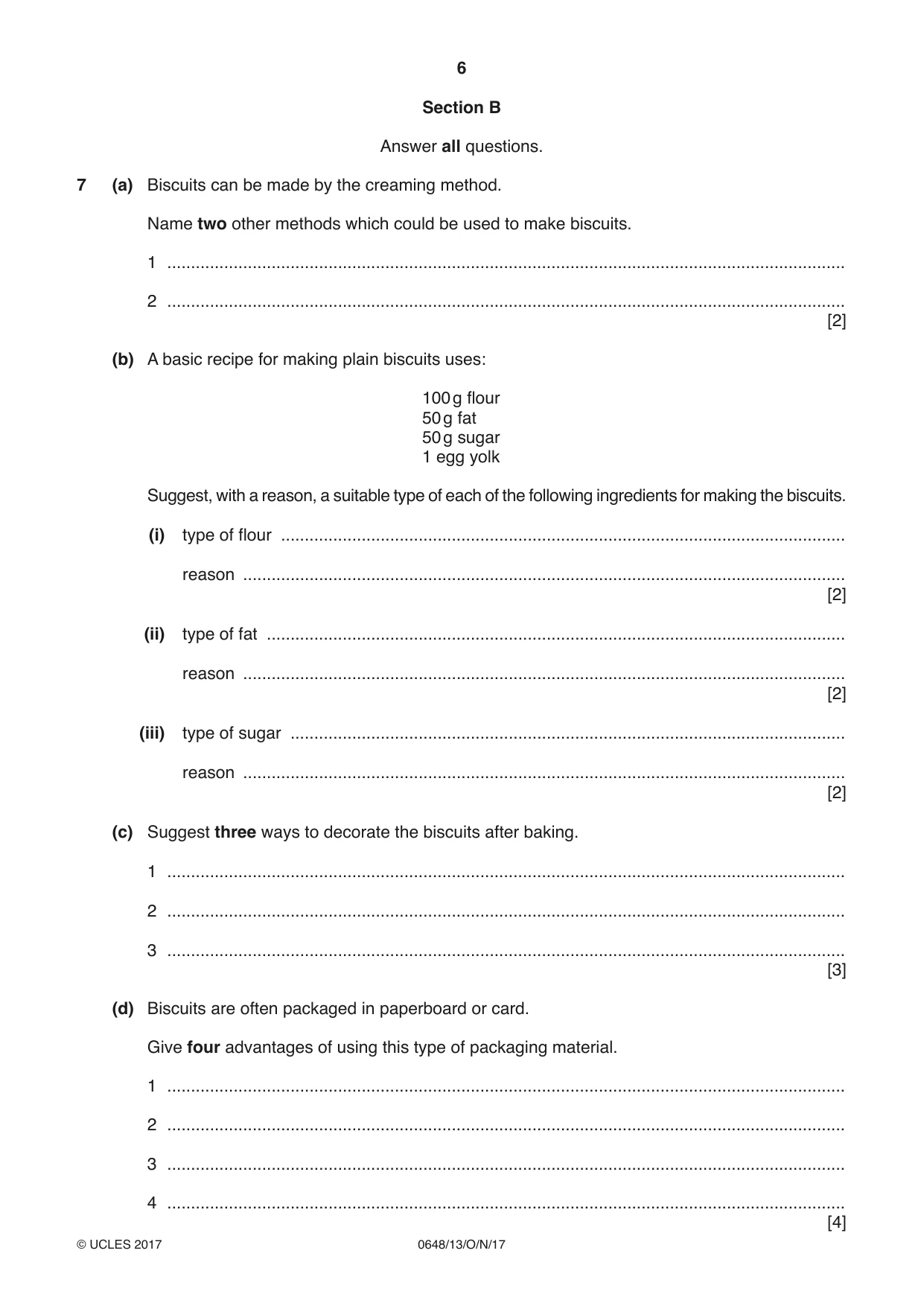
6 0648/13/O/N/17 © UCLES 2017 Section B Answer all questions. 7 (a) Biscuits can be made by the creaming method. Name two other methods which could be used to make biscuits. 1 … 2 … [2] (b) A basic recipe for making plain biscuits uses: 100 g flour 50 g fat 50 g sugar 1 egg yolk Suggest, with a reason, a suitable type of each of the following ingredients for making the biscuits. (i) type of flour … reason … [2] (ii) type of fat … reason … [2] (iii) type of sugar … reason … [2] (c) Suggest three ways to decorate the biscuits after baking. 1 … 2 … 3 … [3] (d) Biscuits are often packaged in paperboard or card. Give four advantages of using this type of packaging material. 1 … 2 … 3 … 4 … [4]
Question paper, page 7
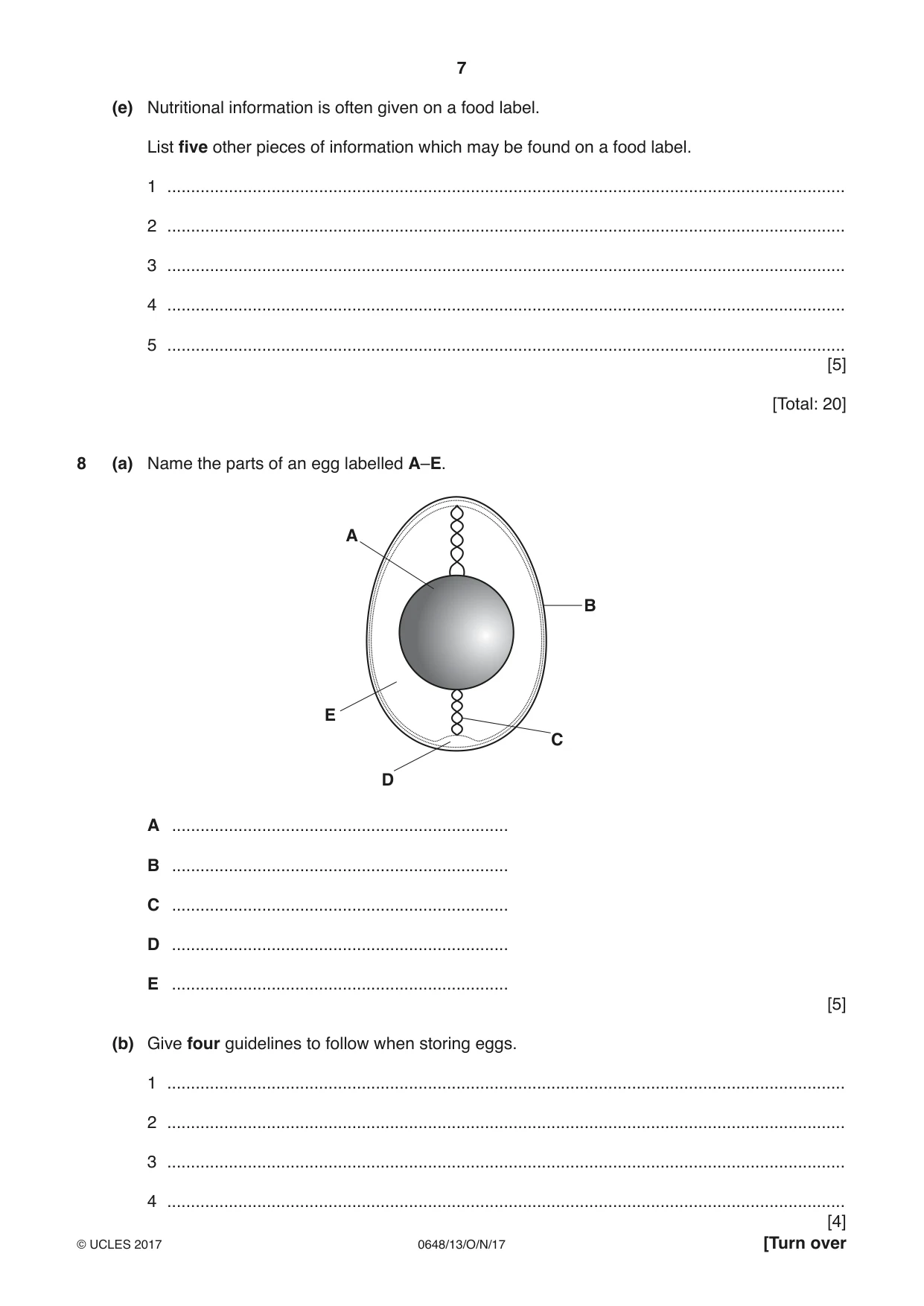
7 0648/13/O/N/17 © UCLES 2017 [Turn over (e) Nutritional information is often given on a food label. List five other pieces of information which may be found on a food label. 1 … 2 … 3 … 4 … 5 … [5] [Total: 20] 8 (a) Name the parts of an egg labelled A–E. A C B E D A … B … C … D … E … [5] (b) Give four guidelines to follow when storing eggs. 1 … 2 … 3 … 4 … [4]
Question paper, page 8
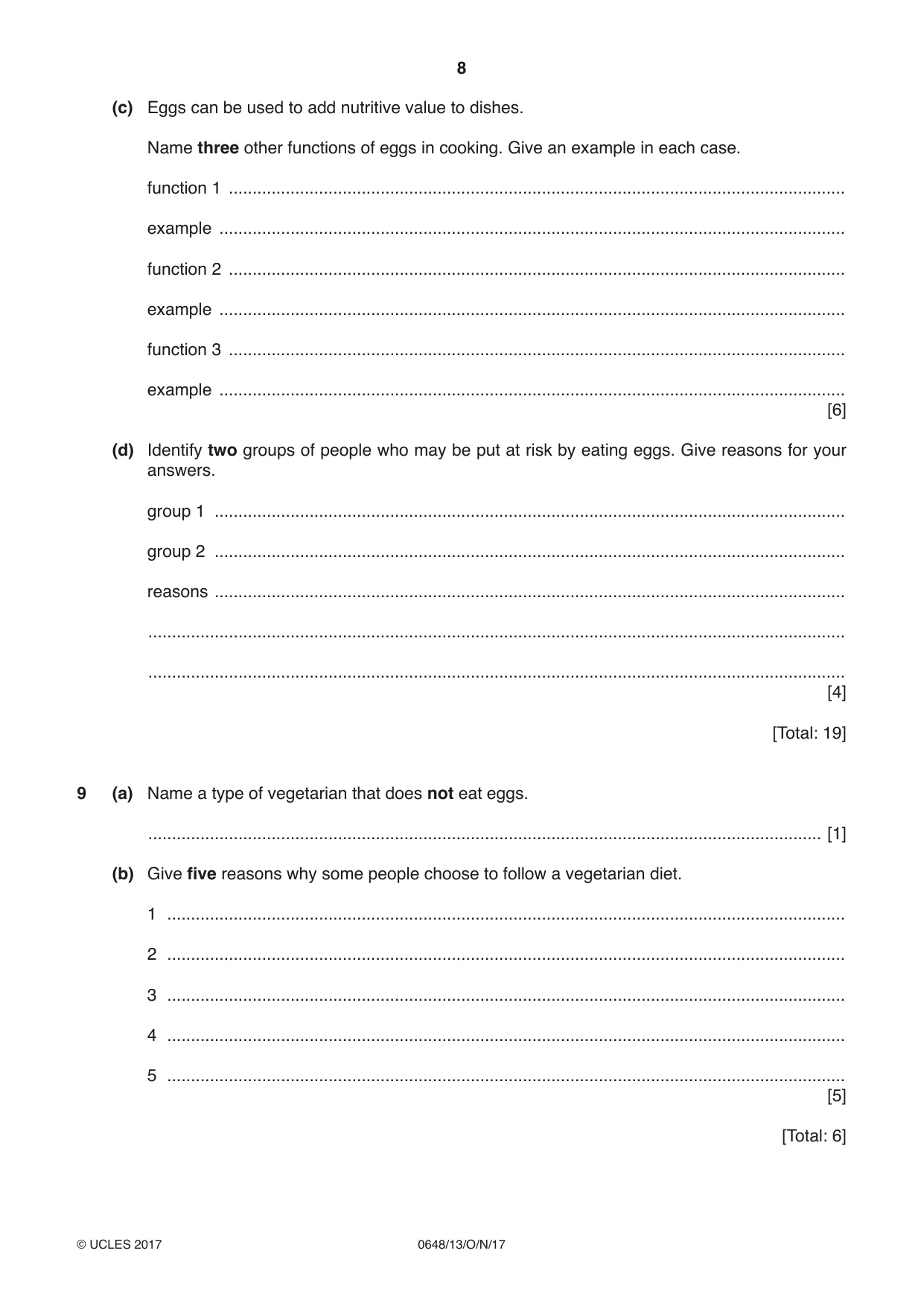
8 0648/13/O/N/17 © UCLES 2017 (c) Eggs can be used to add nutritive value to dishes. Name three other functions of eggs in cooking. Give an example in each case. function 1 … example … function 2 … example … function 3 … example … [6] (d) Identify two groups of people who may be put at risk by eating eggs. Give reasons for your answers. group 1 … group 2 … reasons … … … [4] [Total: 19] 9 (a) Name a type of vegetarian that does not eat eggs. … [1] (b) Give five reasons why some people choose to follow a vegetarian diet. 1 … 2 … 3 … 4 … 5 … [5] [Total: 6]
Question paper, page 9
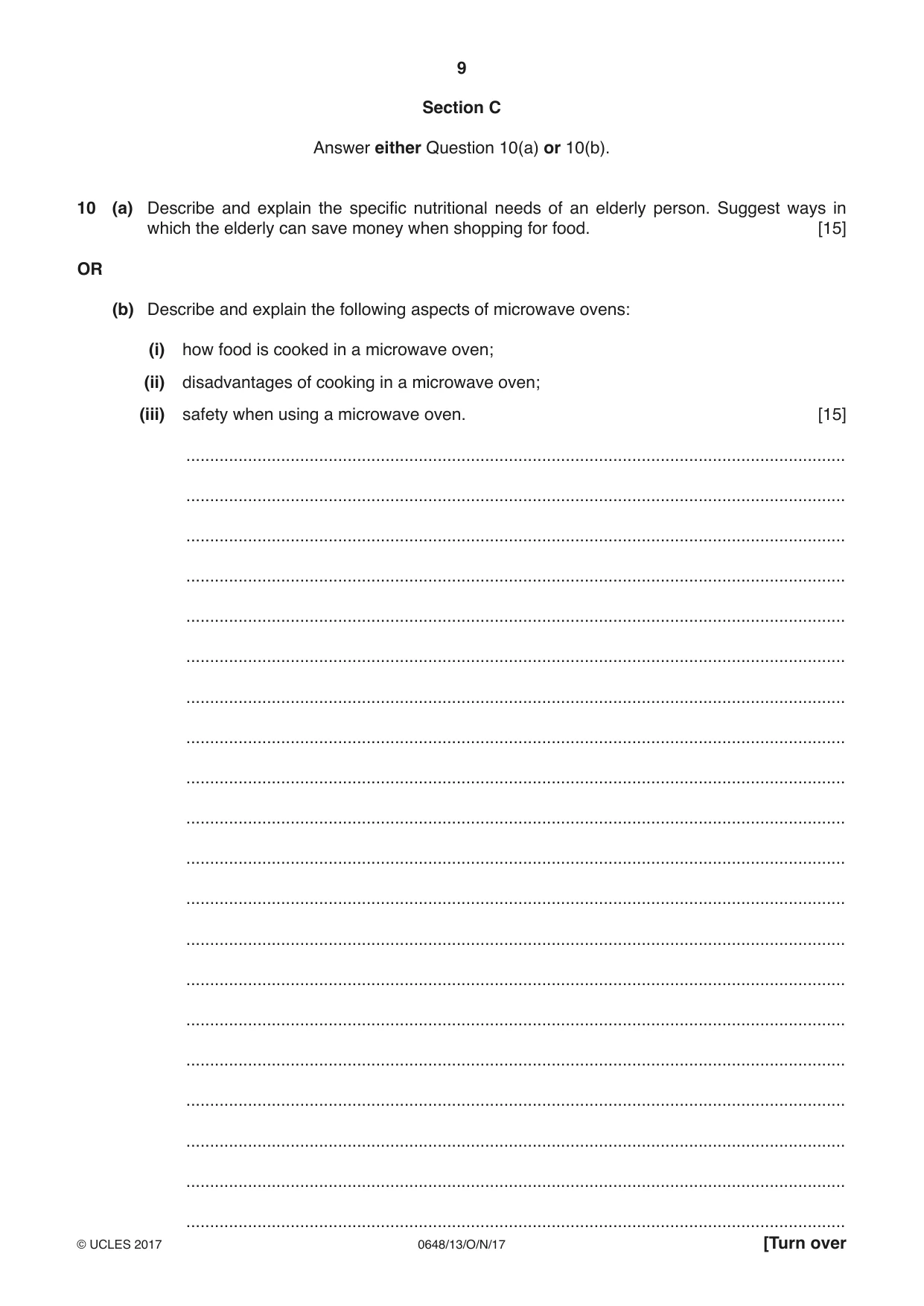
9 0648/13/O/N/17 © UCLES 2017 [Turn over Section C Answer either Question 10(a) or 10(b). 10 (a) Describe and explain the specific nutritional needs of an elderly person. Suggest ways in which the elderly can save money when shopping for food. [15] OR (b) Describe and explain the following aspects of microwave ovens: (i) how food is cooked in a microwave oven; (ii) disadvantages of cooking in a microwave oven; (iii) safety when using a microwave oven. [15] … … … … … … … … … … … … … … … … … … … …
Question paper, page 10
10 0648/13/O/N/17 © UCLES 2017 … … … … … … … … … … … … … … … … … … … … … … … … … … … …
Question paper, page 11
11 0648/13/O/N/17 © UCLES 2017 … … … … … … … … … … … … … … … … … … … … … … … … … … … [Total: 15]
Question paper, page 12
12 0648/13/O/N/17 © UCLES 2017 BLANK PAGE Permission to reproduce items where third-party owned material protected by copyright is included has been sought and cleared where possible. Every reasonable effort has been made by the publisher (UCLES) to trace copyright holders, but if any items requiring clearance have unwittingly been included, the publisher will be pleased to make amends at the earliest possible opportunity. To avoid the issue of disclosure of answer-related information to candidates, all copyright acknowledgements are reproduced online in the Cambridge International Examinations Copyright Acknowledgements Booklet. This is produced for each series of examinations and is freely available to download at www.cie.org.uk after the live examination series. Cambridge International Examinations is part of the Cambridge Assessment Group. Cambridge Assessment is the brand name of University of Cambridge Local Examinations Syndicate (UCLES), which is itself a department of the University of Cambridge.
Mark scheme, page 1
® IGCSE is a registered trademark. This document consists of 14 printed pages. © UCLES 2017 [Turn over Cambridge Assessment International Education Cambridge International General Certificate of Secondary Education FOOD AND NUTRITION 0648/13 Paper 1 Theory October/November 2017 MARK SCHEME Maximum Mark: 100 Published This mark scheme is published as an aid to teachers and candidates, to indicate the requirements of the examination. It shows the basis on which Examiners were instructed to award marks. It does not indicate the details of the discussions that took place at an Examiners’ meeting before marking began, which would have considered the acceptability of alternative answers. Mark schemes should be read in conjunction with the question paper and the Principal Examiner Report for Teachers. Cambridge International will not enter into discussions about these mark schemes. Cambridge International is publishing the mark schemes for the October/November 2017 series for most Cambridge IGCSE®, Cambridge International A and AS Level components and some Cambridge O Level components.
Mark scheme, page 2
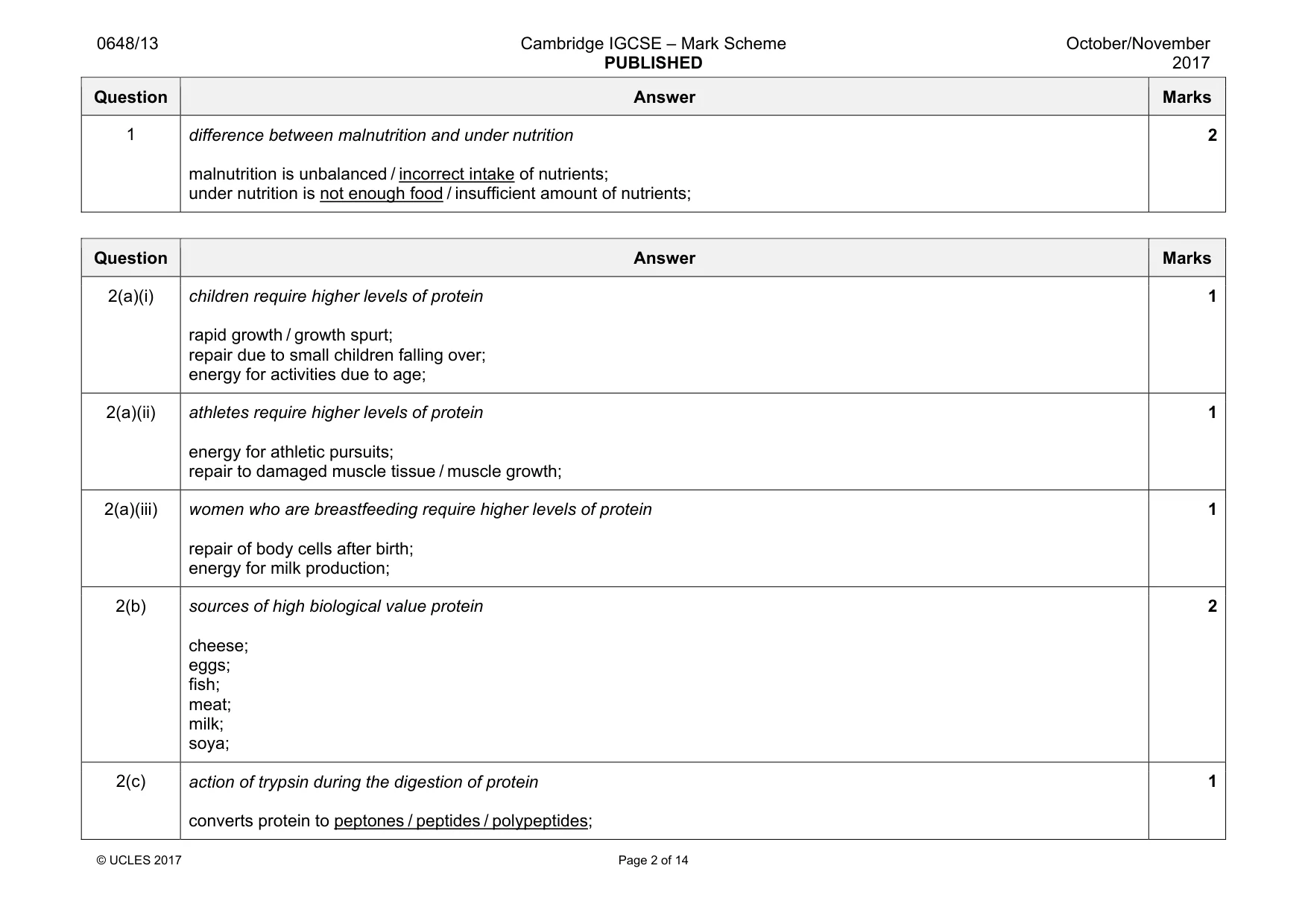
0648/13 Cambridge IGCSE – Mark Scheme PUBLISHED October/November 2017 © UCLES 2017 Page 2 of 14 Question Answer Marks 1 difference between malnutrition and under nutrition malnutrition is unbalanced / incorrect intake of nutrients; under nutrition is not enough food / insufficient amount of nutrients; 2 Question Answer Marks 2(a)(i) children require higher levels of protein rapid growth / growth spurt; repair due to small children falling over; energy for activities due to age; 1 2(a)(ii) athletes require higher levels of protein energy for athletic pursuits; repair to damaged muscle tissue / muscle growth; 1 2(a)(iii) women who are breastfeeding require higher levels of protein repair of body cells after birth; energy for milk production; 1 2(b) sources of high biological value protein cheese; eggs; fish; meat; milk; soya; 2 2(c) action of trypsin during the digestion of protein converts protein to peptones / peptides / polypeptides; 1
Mark scheme, page 3
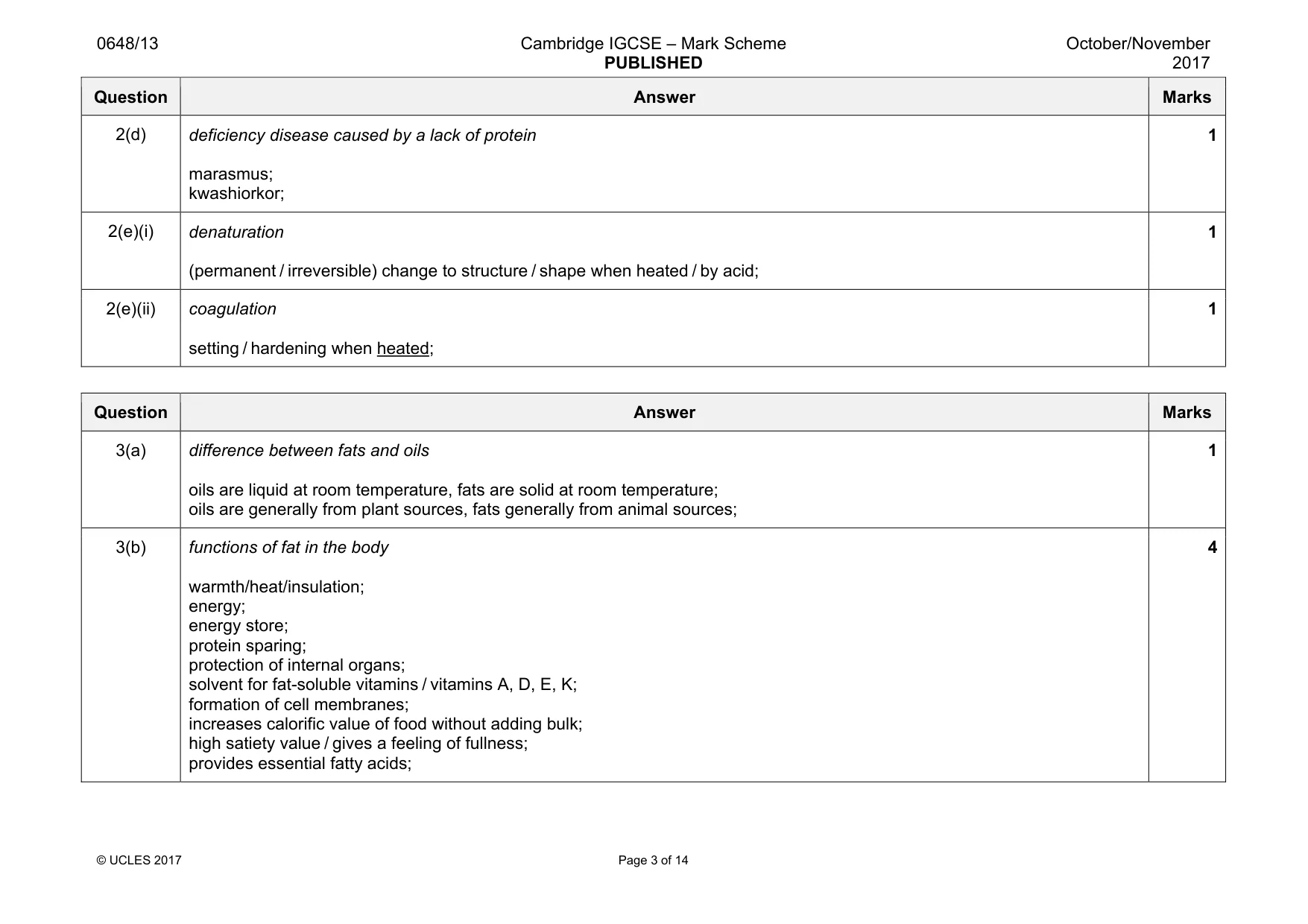
0648/13 Cambridge IGCSE – Mark Scheme PUBLISHED October/November 2017 © UCLES 2017 Page 3 of 14 Question Answer Marks 2(d) deficiency disease caused by a lack of protein marasmus; kwashiorkor; 1 2(e)(i) denaturation (permanent / irreversible) change to structure / shape when heated / by acid; 1 2(e)(ii) coagulation setting / hardening when heated; 1 Question Answer Marks 3(a) difference between fats and oils oils are liquid at room temperature, fats are solid at room temperature; oils are generally from plant sources, fats generally from animal sources; 1 3(b) functions of fat in the body warmth/heat/insulation; energy; energy store; protein sparing; protection of internal organs; solvent for fat-soluble vitamins / vitamins A, D, E, K; formation of cell membranes; increases calorific value of food without adding bulk; high satiety value / gives a feeling of fullness; provides essential fatty acids; 4
Mark scheme, page 4
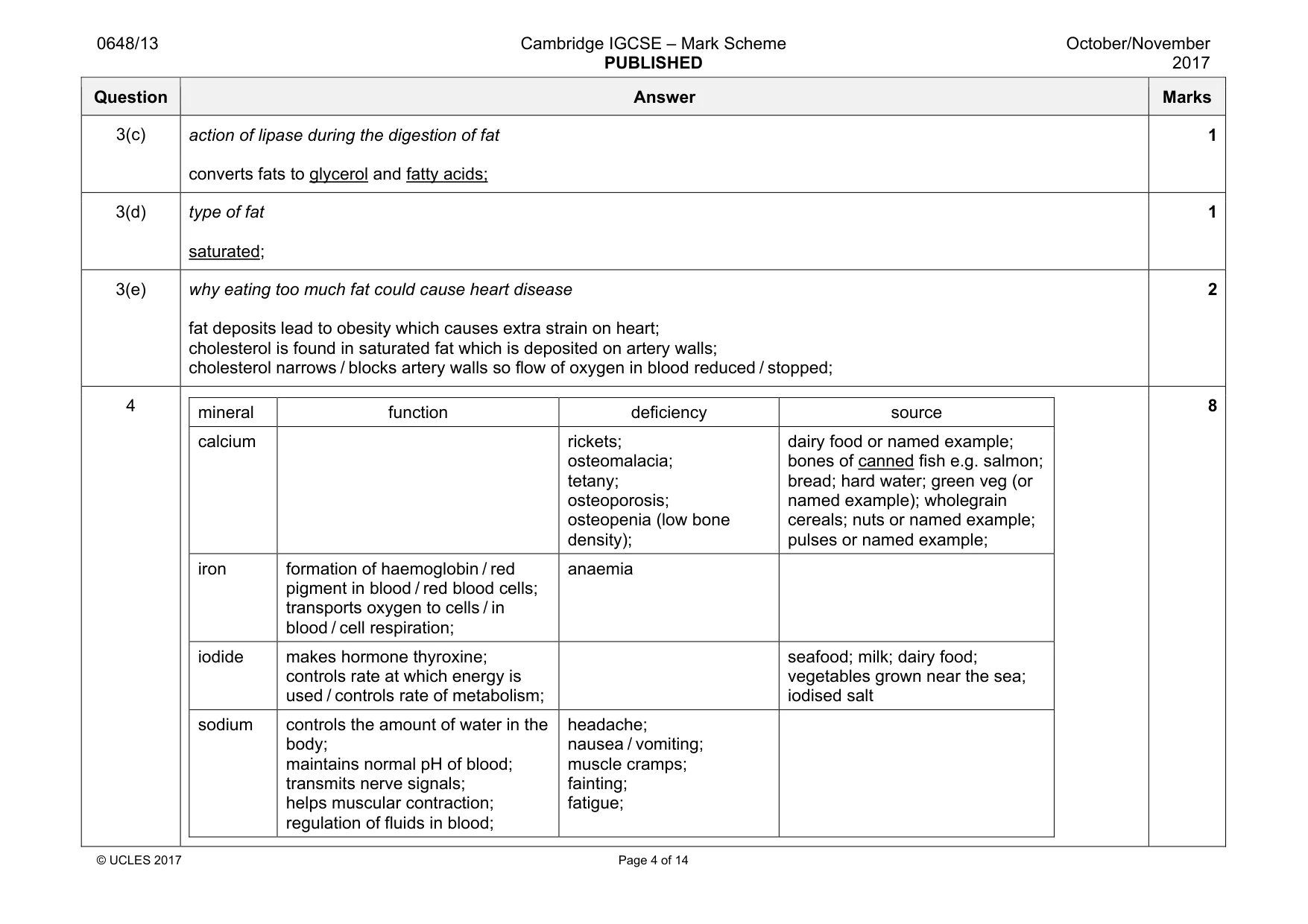
0648/13 Cambridge IGCSE – Mark Scheme PUBLISHED October/November 2017 © UCLES 2017 Page 4 of 14 Question Answer Marks 3(c) action of lipase during the digestion of fat converts fats to glycerol and fatty acids; 1 3(d) type of fat saturated; 1 3(e) why eating too much fat could cause heart disease fat deposits lead to obesity which causes extra strain on heart; cholesterol is found in saturated fat which is deposited on artery walls; cholesterol narrows / blocks artery walls so flow of oxygen in blood reduced / stopped; 2 4 mineral function deficiency source calcium rickets; osteomalacia; tetany; osteoporosis; osteopenia (low bone density); dairy food or named example; bones of canned fish e.g. salmon; bread; hard water; green veg (or named example); wholegrain cereals; nuts or named example; pulses or named example; iron formation of haemoglobin / red pigment in blood / red blood cells; transports oxygen to cells / in blood / cell respiration; anaemia iodide makes hormone thyroxine; controls rate at which energy is used / controls rate of metabolism; seafood; milk; dairy food; vegetables grown near the sea; iodised salt sodium controls the amount of water in the body; maintains normal pH of blood; transmits nerve signals; helps muscular contraction; regulation of fluids in blood; headache; nausea / vomiting; muscle cramps; fainting; fatigue; 8
Mark scheme, page 5
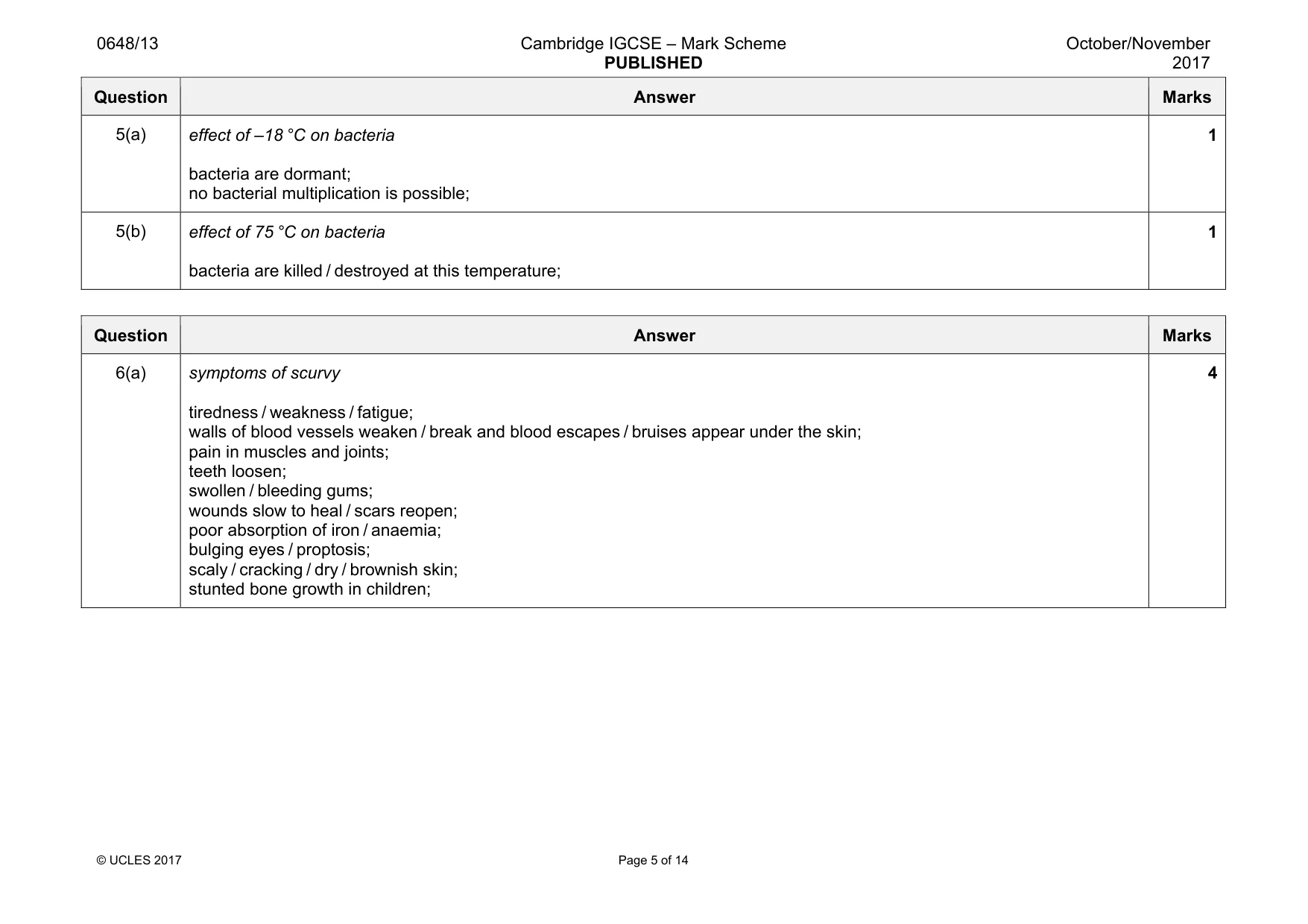
0648/13 Cambridge IGCSE – Mark Scheme PUBLISHED October/November 2017 © UCLES 2017 Page 5 of 14 Question Answer Marks 5(a) effect of –18 °C on bacteria bacteria are dormant; no bacterial multiplication is possible; 1 5(b) effect of 75 °C on bacteria bacteria are killed / destroyed at this temperature; 1 Question Answer Marks 6(a) symptoms of scurvy tiredness / weakness / fatigue; walls of blood vessels weaken / break and blood escapes / bruises appear under the skin; pain in muscles and joints; teeth loosen; swollen / bleeding gums; wounds slow to heal / scars reopen; poor absorption of iron / anaemia; bulging eyes / proptosis; scaly / cracking / dry / brownish skin; stunted bone growth in children; 4
Mark scheme, page 6
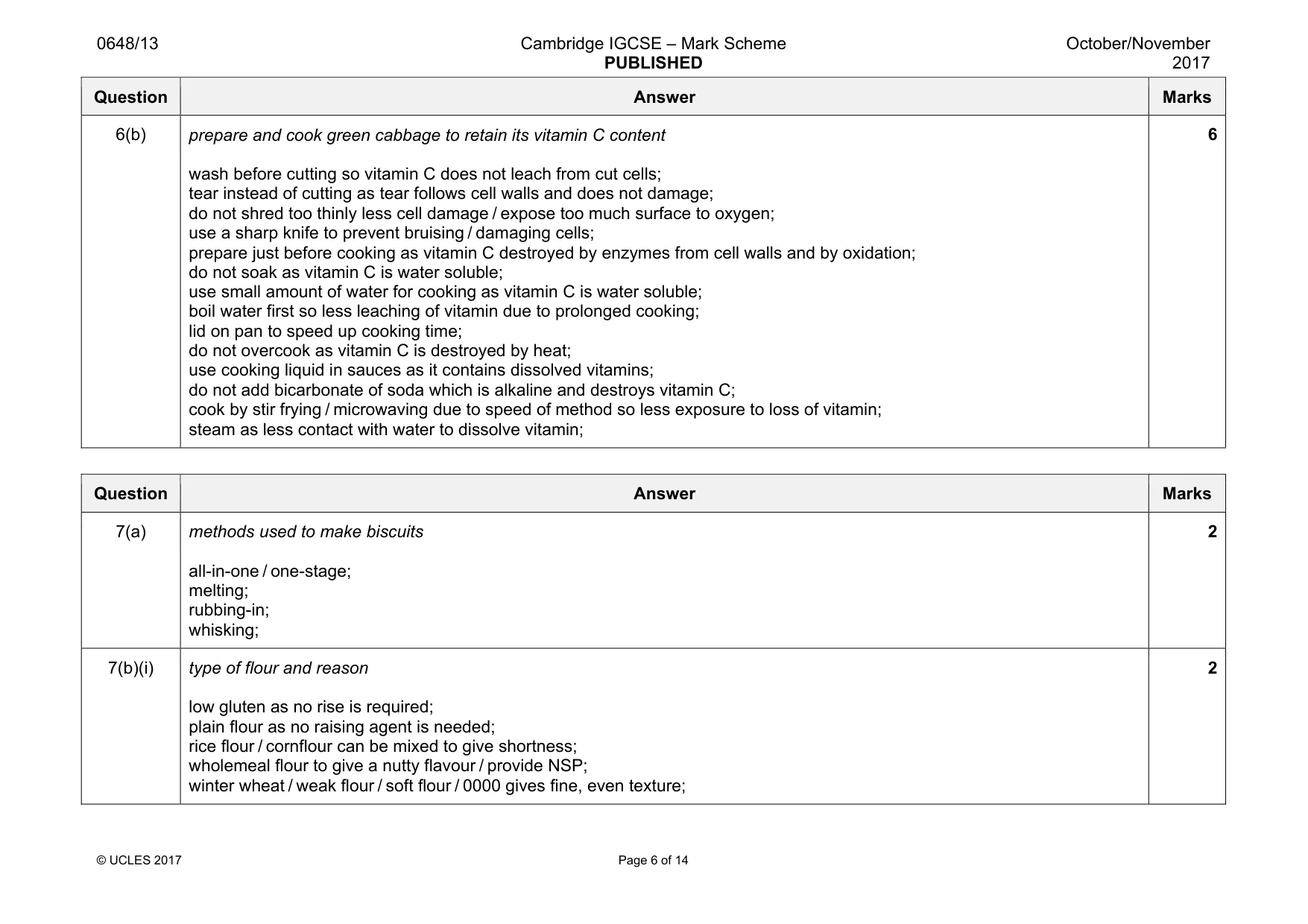
0648/13 Cambridge IGCSE – Mark Scheme PUBLISHED October/November 2017 © UCLES 2017 Page 6 of 14 Question Answer Marks 6(b) prepare and cook green cabbage to retain its vitamin C content wash before cutting so vitamin C does not leach from cut cells; tear instead of cutting as tear follows cell walls and does not damage; do not shred too thinly less cell damage / expose too much surface to oxygen; use a sharp knife to prevent bruising / damaging cells; prepare just before cooking as vitamin C destroyed by enzymes from cell walls and by oxidation; do not soak as vitamin C is water soluble; use small amount of water for cooking as vitamin C is water soluble; boil water first so less leaching of vitamin due to prolonged cooking; lid on pan to speed up cooking time; do not overcook as vitamin C is destroyed by heat; use cooking liquid in sauces as it contains dissolved vitamins; do not add bicarbonate of soda which is alkaline and destroys vitamin C; cook by stir frying / microwaving due to speed of method so less exposure to loss of vitamin; steam as less contact with water to dissolve vitamin; 6 Question Answer Marks 7(a) methods used to make biscuits all-in-one / one-stage; melting; rubbing-in; whisking; 2 7(b)(i) type of flour and reason low gluten as no rise is required; plain flour as no raising agent is needed; rice flour / cornflour can be mixed to give shortness; wholemeal flour to give a nutty flavour / provide NSP; winter wheat / weak flour / soft flour / 0000 gives fine, even texture; 2
Mark scheme, page 7
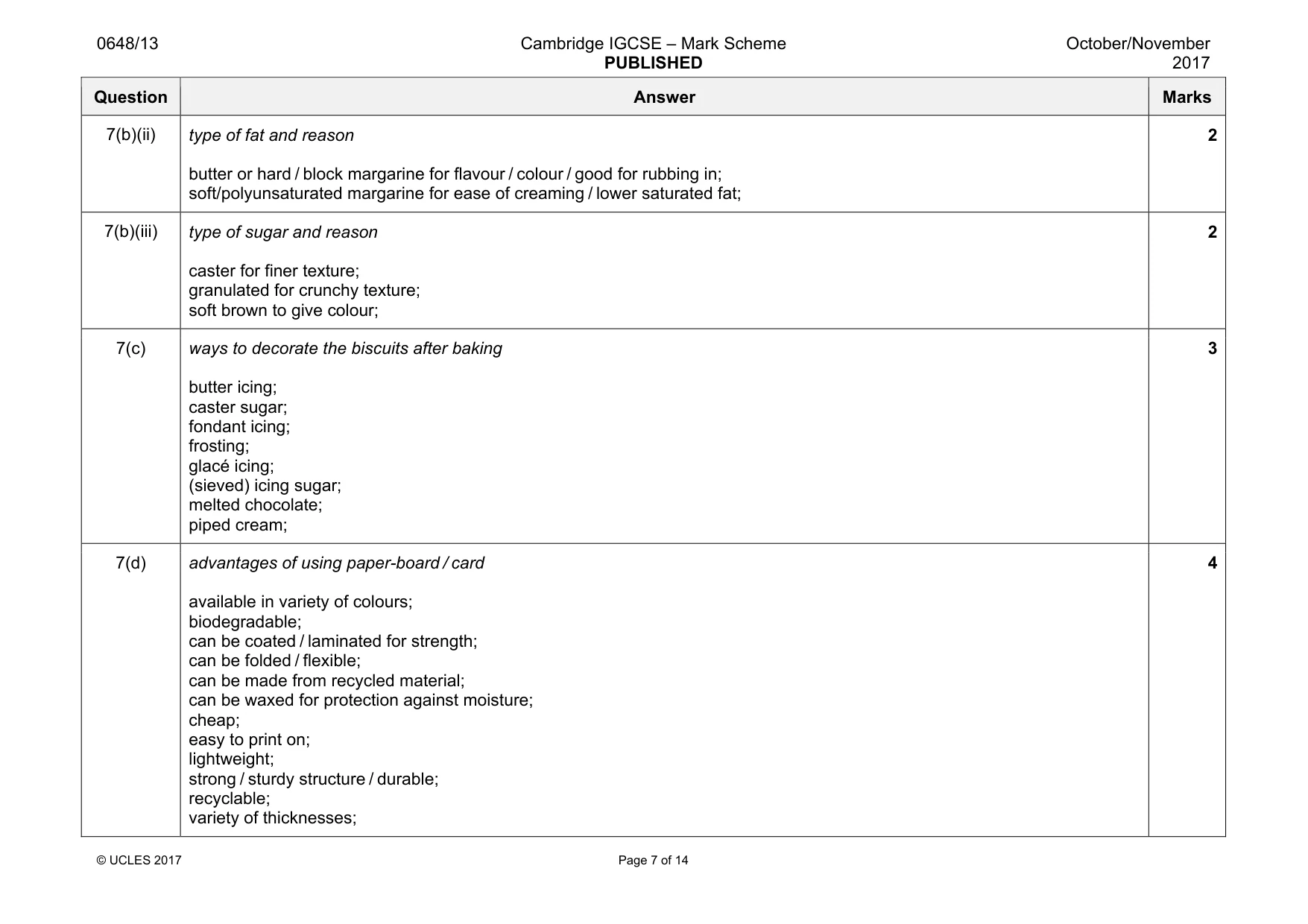
0648/13 Cambridge IGCSE – Mark Scheme PUBLISHED October/November 2017 © UCLES 2017 Page 7 of 14 Question Answer Marks 7(b)(ii) type of fat and reason butter or hard / block margarine for flavour / colour / good for rubbing in; soft/polyunsaturated margarine for ease of creaming / lower saturated fat; 2 7(b)(iii) type of sugar and reason caster for finer texture; granulated for crunchy texture; soft brown to give colour; 2 7(c) ways to decorate the biscuits after baking butter icing; caster sugar; fondant icing; frosting; glacé icing; (sieved) icing sugar; melted chocolate; piped cream; 3 7(d) advantages of using paper-board / card available in variety of colours; biodegradable; can be coated / laminated for strength; can be folded / flexible; can be made from recycled material; can be waxed for protection against moisture; cheap; easy to print on; lightweight; strong / sturdy structure / durable; recyclable; variety of thicknesses; 4
Mark scheme, page 8
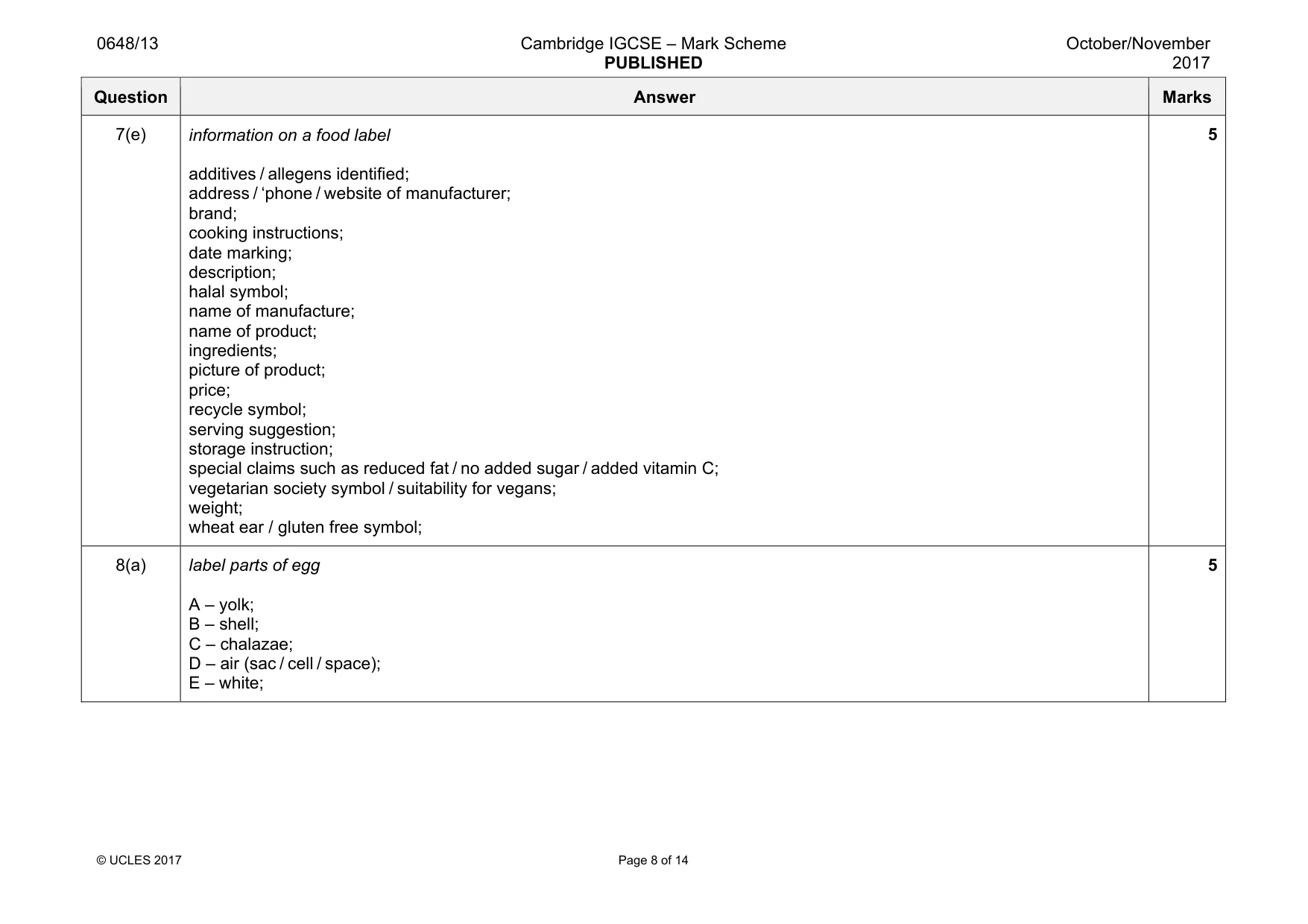
0648/13 Cambridge IGCSE – Mark Scheme PUBLISHED October/November 2017 © UCLES 2017 Page 8 of 14 Question Answer Marks 7(e) information on a food label additives / allegens identified; address / ‘phone / website of manufacturer; brand; cooking instructions; date marking; description; halal symbol; name of manufacture; name of product; ingredients; picture of product; price; recycle symbol; serving suggestion; storage instruction; special claims such as reduced fat / no added sugar / added vitamin C; vegetarian society symbol / suitability for vegans; weight; wheat ear / gluten free symbol; 5 8(a) label parts of egg A – yolk; B – shell; C – chalazae; D – air (sac / cell / space); E – white; 5
Mark scheme, page 9
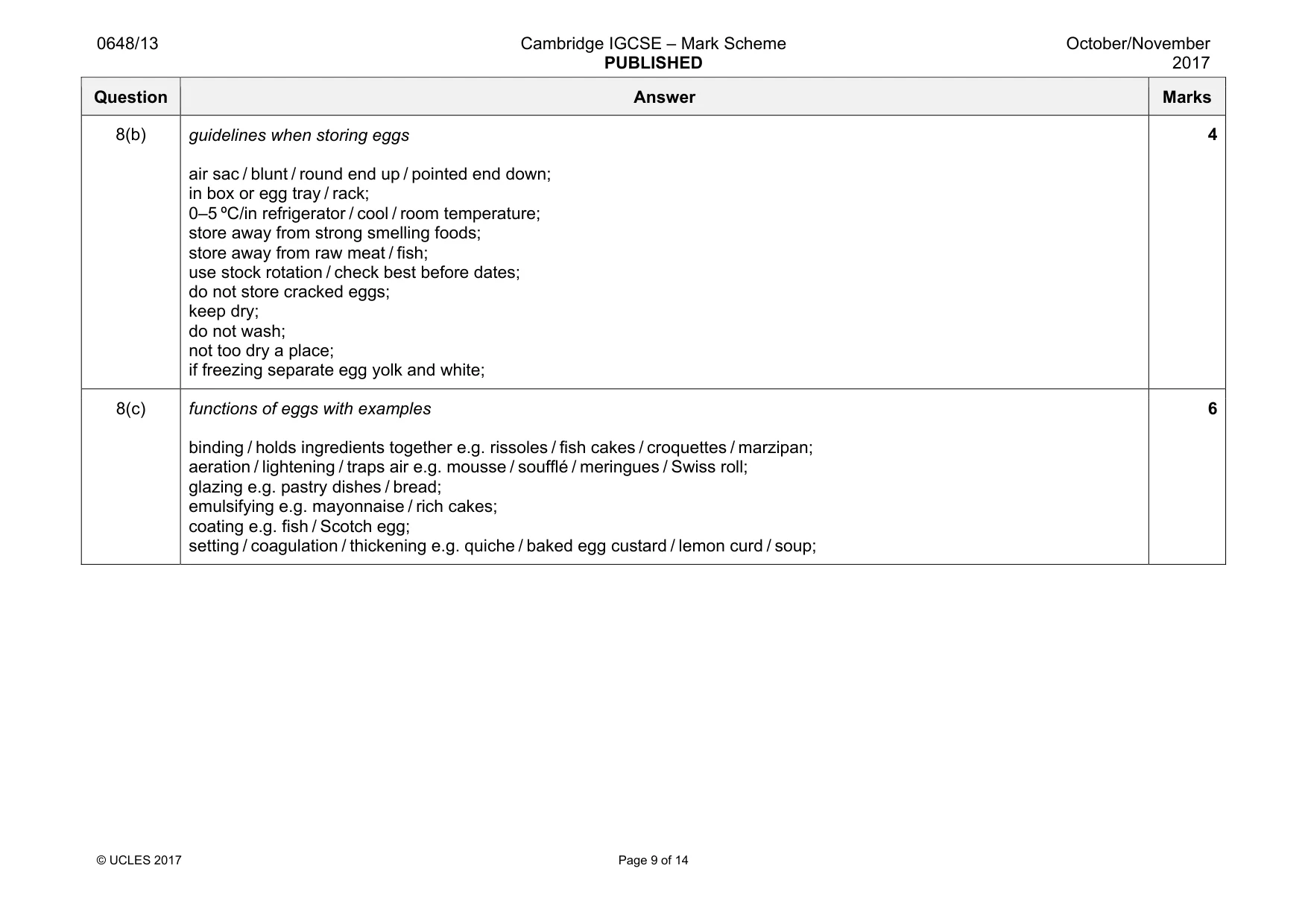
0648/13 Cambridge IGCSE – Mark Scheme PUBLISHED October/November 2017 © UCLES 2017 Page 9 of 14 Question Answer Marks 8(b) guidelines when storing eggs air sac / blunt / round end up / pointed end down; in box or egg tray / rack; 0–5 ºC/in refrigerator / cool / room temperature; store away from strong smelling foods; store away from raw meat / fish; use stock rotation / check best before dates; do not store cracked eggs; keep dry; do not wash; not too dry a place; if freezing separate egg yolk and white; 4 8(c) functions of eggs with examples binding / holds ingredients together e.g. rissoles / fish cakes / croquettes / marzipan; aeration / lightening / traps air e.g. mousse / soufflé / meringues / Swiss roll; glazing e.g. pastry dishes / bread; emulsifying e.g. mayonnaise / rich cakes; coating e.g. fish / Scotch egg; setting / coagulation / thickening e.g. quiche / baked egg custard / lemon curd / soup; 6
Mark scheme, page 10
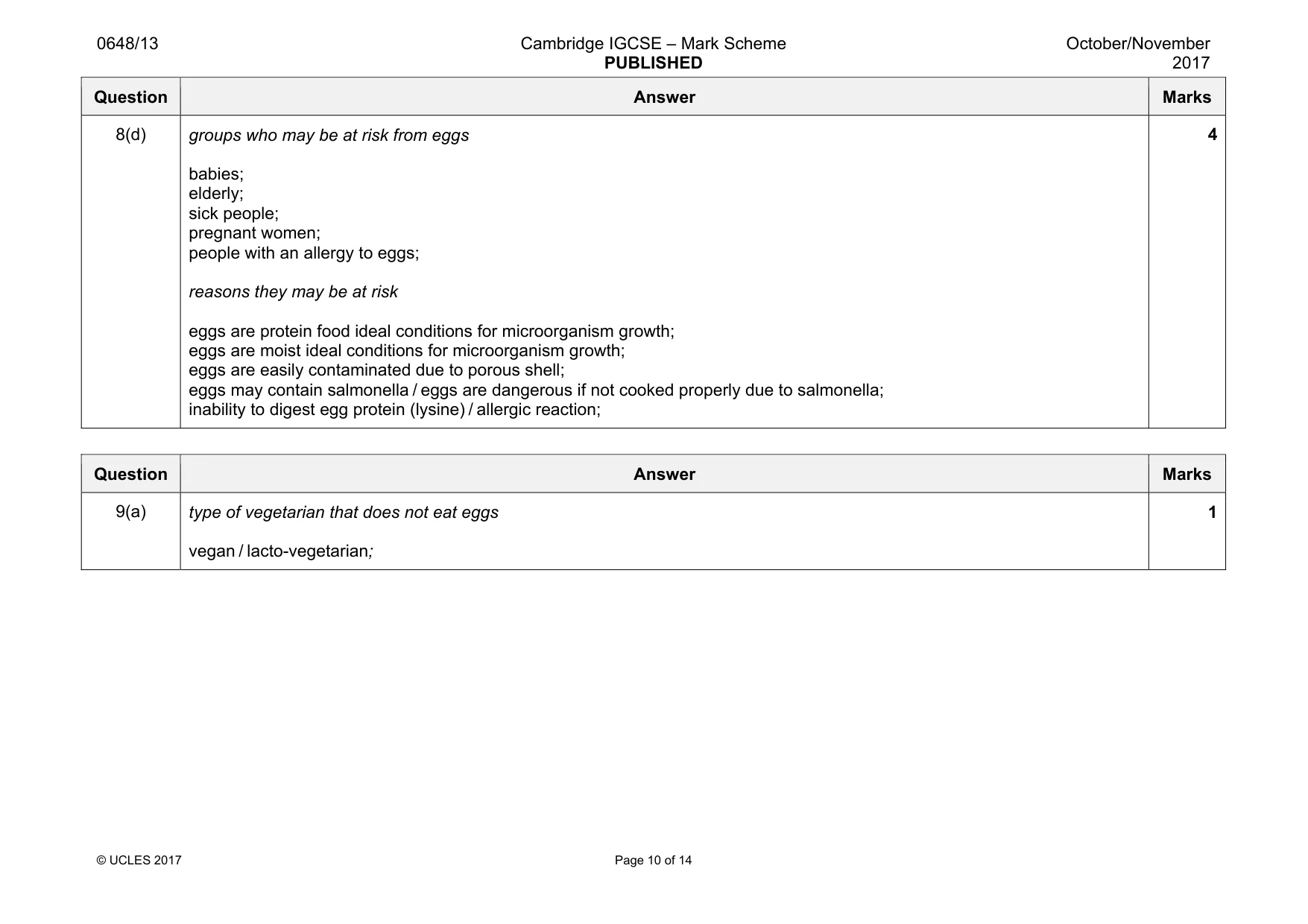
0648/13 Cambridge IGCSE – Mark Scheme PUBLISHED October/November 2017 © UCLES 2017 Page 10 of 14 Question Answer Marks 8(d) groups who may be at risk from eggs babies; elderly; sick people; pregnant women; people with an allergy to eggs; reasons they may be at risk eggs are protein food ideal conditions for microorganism growth; eggs are moist ideal conditions for microorganism growth; eggs are easily contaminated due to porous shell; eggs may contain salmonella / eggs are dangerous if not cooked properly due to salmonella; inability to digest egg protein (lysine) / allergic reaction; 4 Question Answer Marks 9(a) type of vegetarian that does not eat eggs vegan / lacto-vegetarian; 1
Mark scheme, page 11
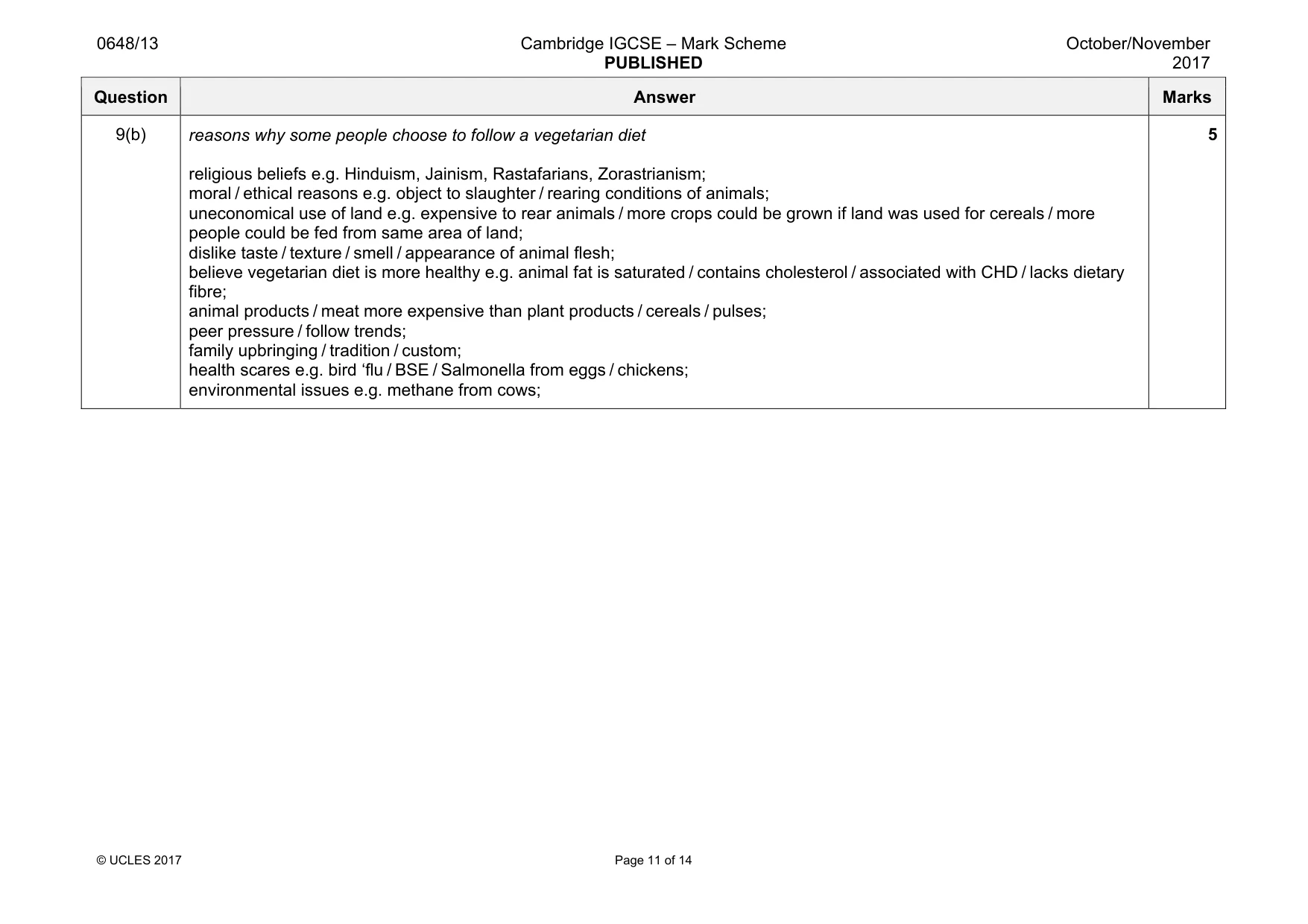
0648/13 Cambridge IGCSE – Mark Scheme PUBLISHED October/November 2017 © UCLES 2017 Page 11 of 14 Question Answer Marks 9(b) reasons why some people choose to follow a vegetarian diet religious beliefs e.g. Hinduism, Jainism, Rastafarians, Zorastrianism; moral / ethical reasons e.g. object to slaughter / rearing conditions of animals; uneconomical use of land e.g. expensive to rear animals / more crops could be grown if land was used for cereals / more people could be fed from same area of land; dislike taste / texture / smell / appearance of animal flesh; believe vegetarian diet is more healthy e.g. animal fat is saturated / contains cholesterol / associated with CHD / lacks dietary fibre; animal products / meat more expensive than plant products / cereals / pulses; peer pressure / follow trends; family upbringing / tradition / custom; health scares e.g. bird ‘flu / BSE / Salmonella from eggs / chickens; environmental issues e.g. methane from cows; 5
Mark scheme, page 12
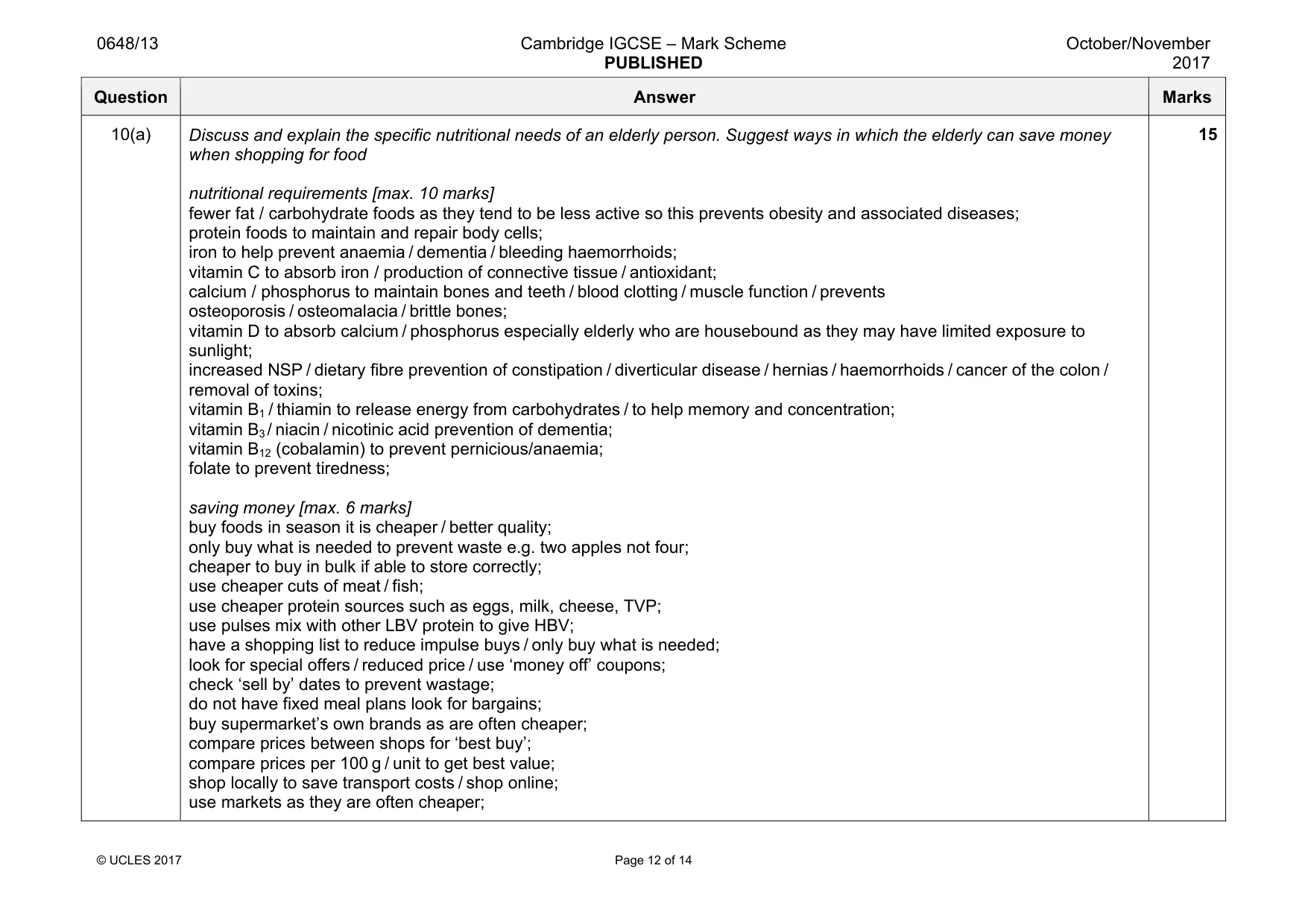
0648/13 Cambridge IGCSE – Mark Scheme PUBLISHED October/November 2017 © UCLES 2017 Page 12 of 14 Question Answer Marks 10(a) Discuss and explain the specific nutritional needs of an elderly person. Suggest ways in which the elderly can save money when shopping for food nutritional requirements [max. 10 marks] fewer fat / carbohydrate foods as they tend to be less active so this prevents obesity and associated diseases; protein foods to maintain and repair body cells; iron to help prevent anaemia / dementia / bleeding haemorrhoids; vitamin C to absorb iron / production of connective tissue / antioxidant; calcium / phosphorus to maintain bones and teeth / blood clotting / muscle function / prevents osteoporosis / osteomalacia / brittle bones; vitamin D to absorb calcium / phosphorus especially elderly who are housebound as they may have limited exposure to sunlight; increased NSP / dietary fibre prevention of constipation / diverticular disease / hernias / haemorrhoids / cancer of the colon / removal of toxins; vitamin B1 / thiamin to release energy from carbohydrates / to help memory and concentration; vitamin B3 / niacin / nicotinic acid prevention of dementia; vitamin B12 (cobalamin) to prevent pernicious/anaemia; folate to prevent tiredness; saving money [max. 6 marks] buy foods in season it is cheaper / better quality; only buy what is needed to prevent waste e.g. two apples not four; cheaper to buy in bulk if able to store correctly; use cheaper cuts of meat / fish; use cheaper protein sources such as eggs, milk, cheese, TVP; use pulses mix with other LBV protein to give HBV; have a shopping list to reduce impulse buys / only buy what is needed; look for special offers / reduced price / use ‘money off’ coupons; check ‘sell by’ dates to prevent wastage; do not have fixed meal plans look for bargains; buy supermarket’s own brands as are often cheaper; compare prices between shops for ‘best buy’; compare prices per 100 g / unit to get best value; shop locally to save transport costs / shop online; use markets as they are often cheaper; 15
Mark scheme, page 13
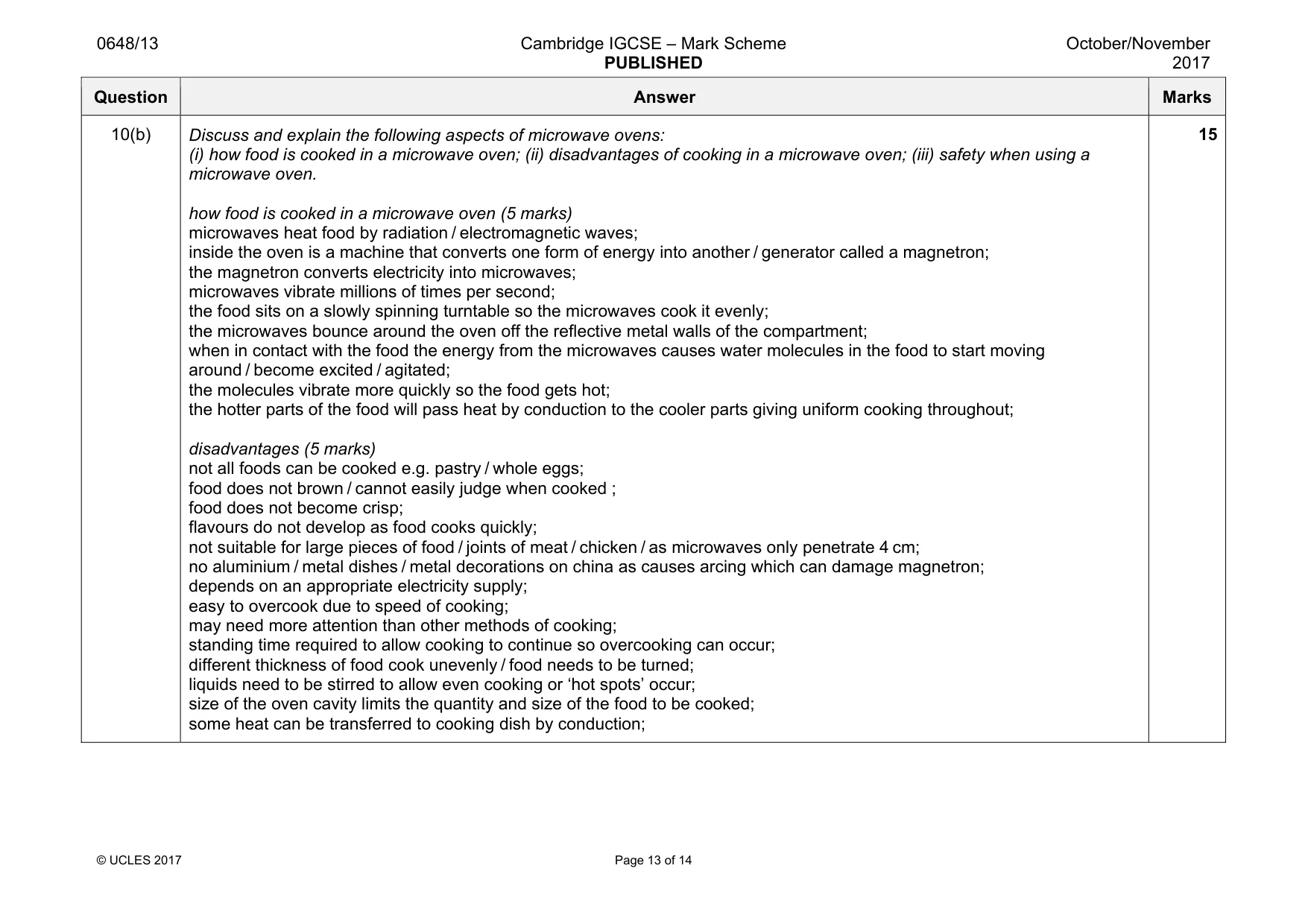
0648/13 Cambridge IGCSE – Mark Scheme PUBLISHED October/November 2017 © UCLES 2017 Page 13 of 14 Question Answer Marks 10(b) Discuss and explain the following aspects of microwave ovens: (i) how food is cooked in a microwave oven; (ii) disadvantages of cooking in a microwave oven; (iii) safety when using a microwave oven. how food is cooked in a microwave oven (5 marks) microwaves heat food by radiation / electromagnetic waves; inside the oven is a machine that converts one form of energy into another / generator called a magnetron; the magnetron converts electricity into microwaves; microwaves vibrate millions of times per second; the food sits on a slowly spinning turntable so the microwaves cook it evenly; the microwaves bounce around the oven off the reflective metal walls of the compartment; when in contact with the food the energy from the microwaves causes water molecules in the food to start moving around / become excited / agitated; the molecules vibrate more quickly so the food gets hot; the hotter parts of the food will pass heat by conduction to the cooler parts giving uniform cooking throughout; disadvantages (5 marks) not all foods can be cooked e.g. pastry / whole eggs; food does not brown / cannot easily judge when cooked ; food does not become crisp; flavours do not develop as food cooks quickly; not suitable for large pieces of food / joints of meat / chicken / as microwaves only penetrate 4 cm; no aluminium / metal dishes / metal decorations on china as causes arcing which can damage magnetron; depends on an appropriate electricity supply; easy to overcook due to speed of cooking; may need more attention than other methods of cooking; standing time required to allow cooking to continue so overcooking can occur; different thickness of food cook unevenly / food needs to be turned; liquids need to be stirred to allow even cooking or ‘hot spots’ occur; size of the oven cavity limits the quantity and size of the food to be cooked; some heat can be transferred to cooking dish by conduction; 15
Mark scheme, page 14
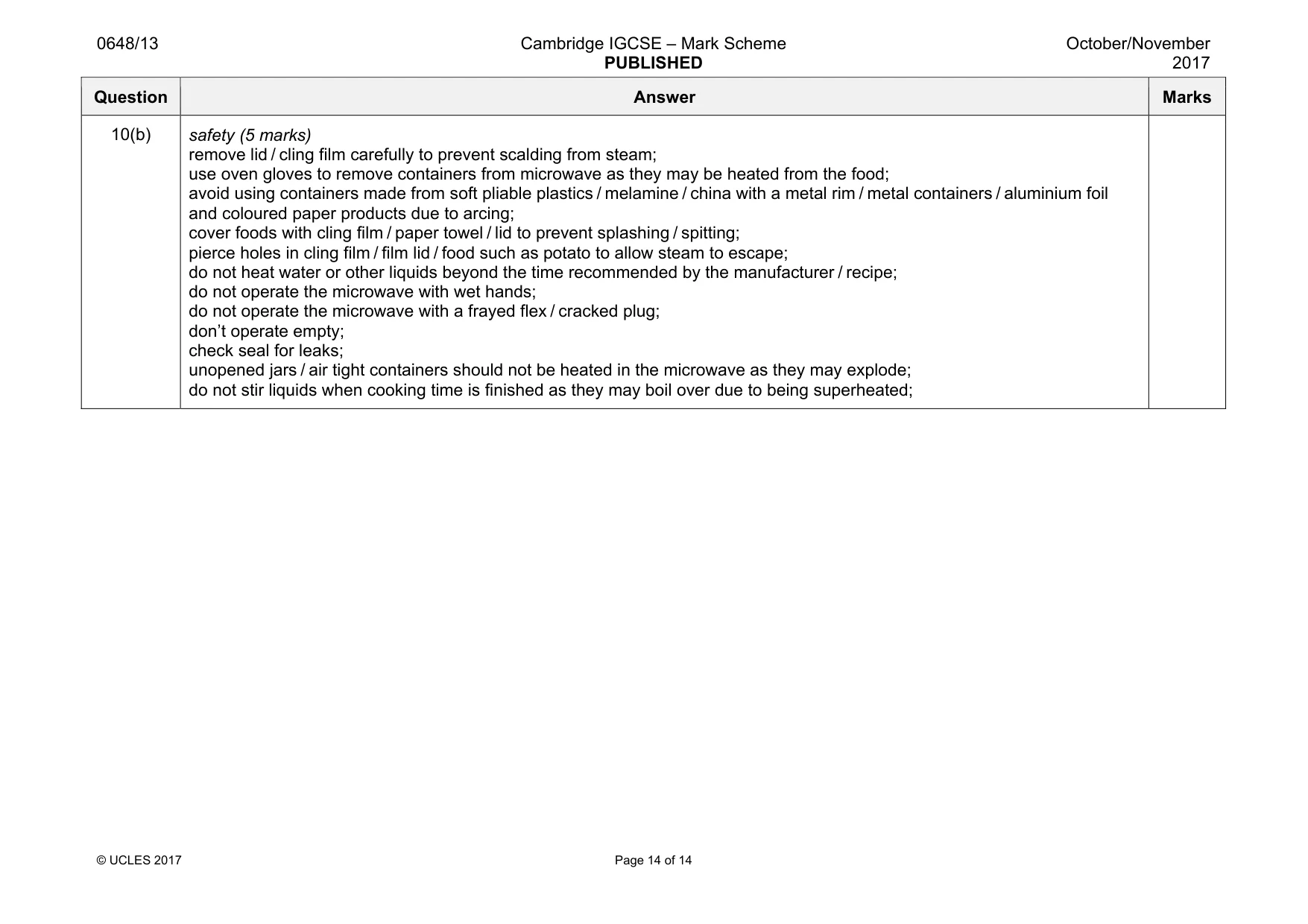
0648/13 Cambridge IGCSE – Mark Scheme PUBLISHED October/November 2017 © UCLES 2017 Page 14 of 14 Question Answer Marks 10(b) safety (5 marks) remove lid / cling film carefully to prevent scalding from steam; use oven gloves to remove containers from microwave as they may be heated from the food; avoid using containers made from soft pliable plastics / melamine / china with a metal rim / metal containers / aluminium foil and coloured paper products due to arcing; cover foods with cling film / paper towel / lid to prevent splashing / spitting; pierce holes in cling film / film lid / food such as potato to allow steam to escape; do not heat water or other liquids beyond the time recommended by the manufacturer / recipe; do not operate the microwave with wet hands; do not operate the microwave with a frayed flex / cracked plug; don’t operate empty; check seal for leaks; unopened jars / air tight containers should not be heated in the microwave as they may explode; do not stir liquids when cooking time is finished as they may boil over due to being superheated;
What you needed in this session
Cambridge’s own grade thresholds for 2017 Oct/Nov, Paper 1 · Variant 3. A higher threshold means an easier paper — the bar moves with how the cohort did.