Cambridge IGCSE Food and Nutrition 0648 — 2017 May/June Paper 1 · Variant 2
0648/12/M/J/17 · 100 marks · ≈113 min
The question paper and its mark scheme, free to read here and free to download. This is Cambridge’s own paper, exactly as it was sat.
Question paper12 pages

Mark scheme9 pages
Answers below. Sit the paper first if you are practising.
Paper as text
Question paper, page 1
This document consists of 12 printed pages. DC (ST) 127377/2 © UCLES 2017 [Turn over Cambridge International Examinations Cambridge International General Certificate of Secondary Education * 6 5 6 8 2 4 3 1 2 7 * FOOD AND NUTRITION 0648/12 Paper 1 Theory May/June 2017 2 hours Candidates answer on the Question Paper. No Additional Materials are required. READ THESE INSTRUCTIONS FIRST Write your Centre number, candidate number and name on all the work you hand in. Write in dark blue or black pen. You may use an HB pencil for any diagrams or graphs. Do not use staples, paper clips, glue or correction fluid. DO NOT WRITE IN ANY BARCODES. Section A Answer all questions. You are advised to spend no longer than 45 minutes on Section A. Section B Answer all questions. Section C Answer either Question 8(a) or 8(b). At the end of the examination, fasten all your work securely together. The number of marks is given in brackets [ ] at the end of each question or part question.
Question paper, page 2
2 0648/12/M/J/17 © UCLES 2017 Section A Answer all questions. 1 (a) Explain the difference between undernutrition and overnutrition. … … …[2] (b) (i) Name two diseases caused by undernutrition. 1 … 2 … [2] (ii) Name two effects on health caused by overnutrition. 1 … 2 … [2] [Total: 6] 2 Describe how the following nutrients work together in the body: (a) carbohydrates and B group vitamins; … … …[2] (b) vitamin C and iron; … … …[2] (c) sodium and potassium. … … …[2] [Total: 6]
Question paper, page 3
3 0648/12/M/J/17 © UCLES 2017 [Turn over 3 (a) List four functions of protein in the body. 1 … 2 … 3 … 4 … [4] (b) Explain why some proteins have a higher biological value than others. … … … … … …[3] (c) Describe the digestion of protein: (i) in the stomach; … … … …[3] (ii) in the ileum. … … … …[3]
Question paper, page 4
4 0648/12/M/J/17 © UCLES 2017 (d) Explain what happens to protein when it is heated. … … … … … …[3] (e) Suggest six advantages of soya beans as a source of protein. 1 … … 2 … … 3 … … 4 … … 5 … … 6 … … [6] [Total: 22]
Question paper, page 5
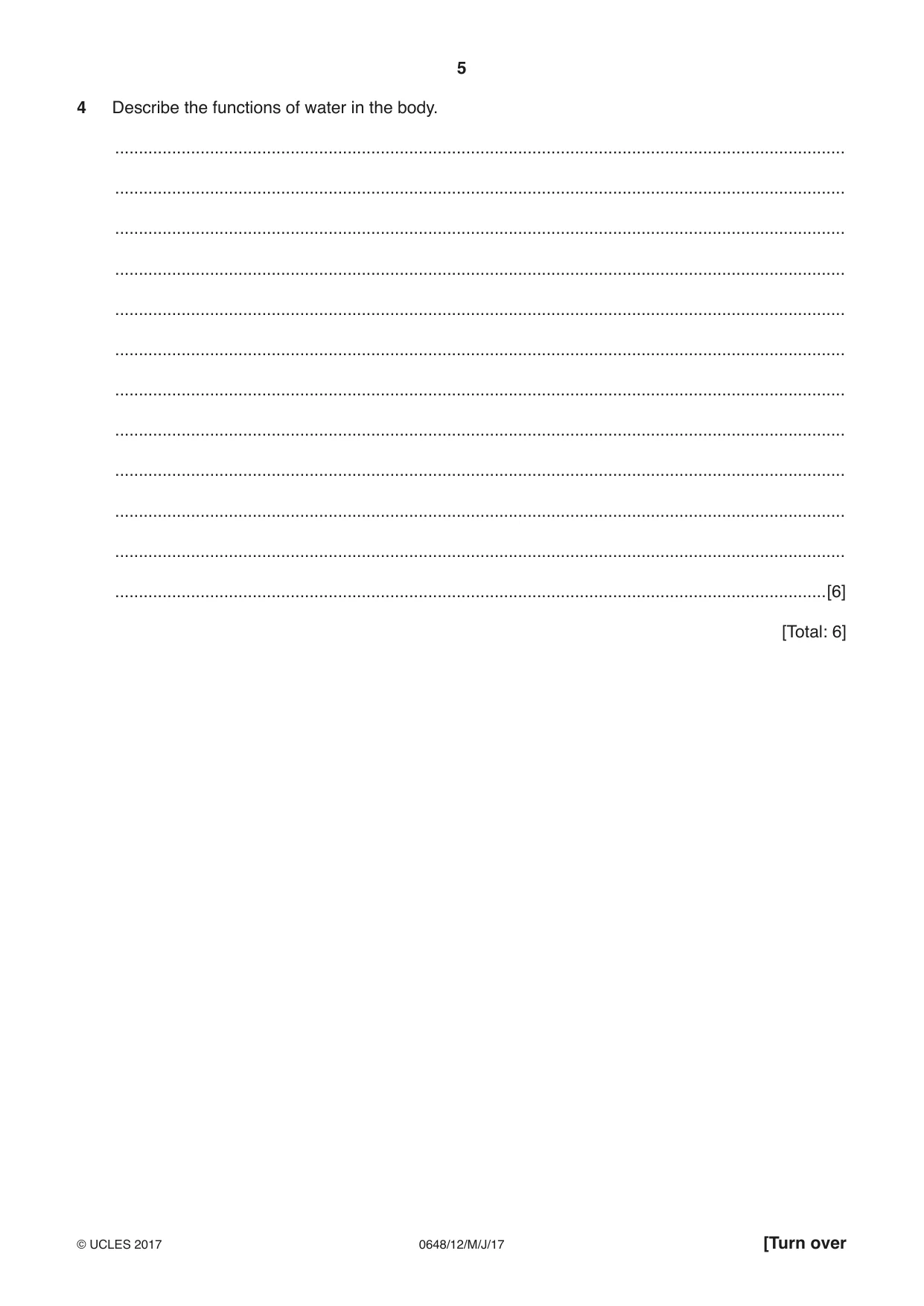
5 0648/12/M/J/17 © UCLES 2017 [Turn over 4 Describe the functions of water in the body. … … … … … … … … … … … …[6] [Total: 6]
Question paper, page 6
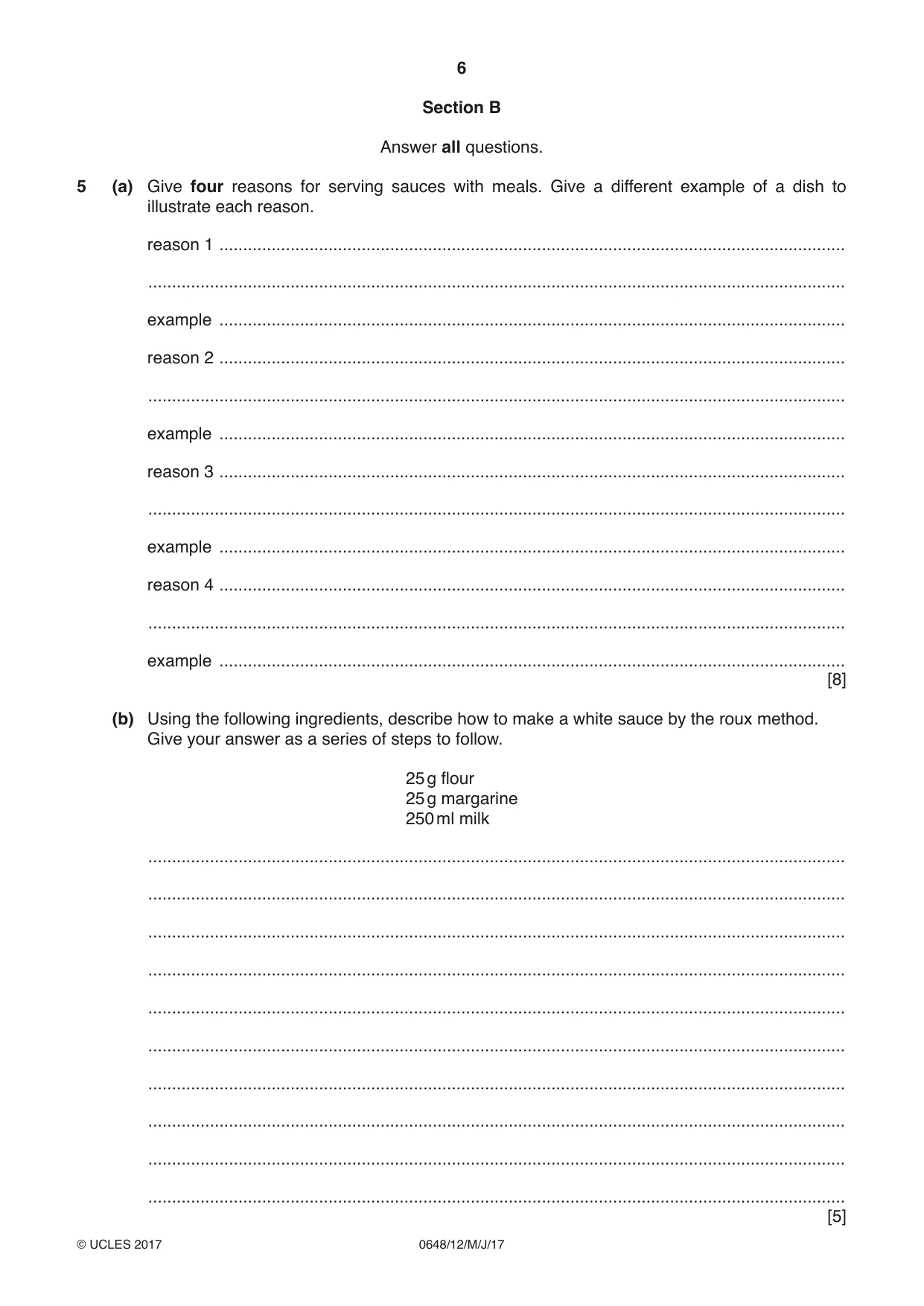
6 0648/12/M/J/17 © UCLES 2017 Section B Answer all questions. 5 (a) Give four reasons for serving sauces with meals. Give a different example of a dish to illustrate each reason. reason 1 … … example … reason 2 … … example … reason 3 … … example … reason 4 … … example … [8] (b) Using the following ingredients, describe how to make a white sauce by the roux method. Give your answer as a series of steps to follow. 25 g flour 25 g margarine 250 ml milk … … … … … … … … … … [5]
Question paper, page 7
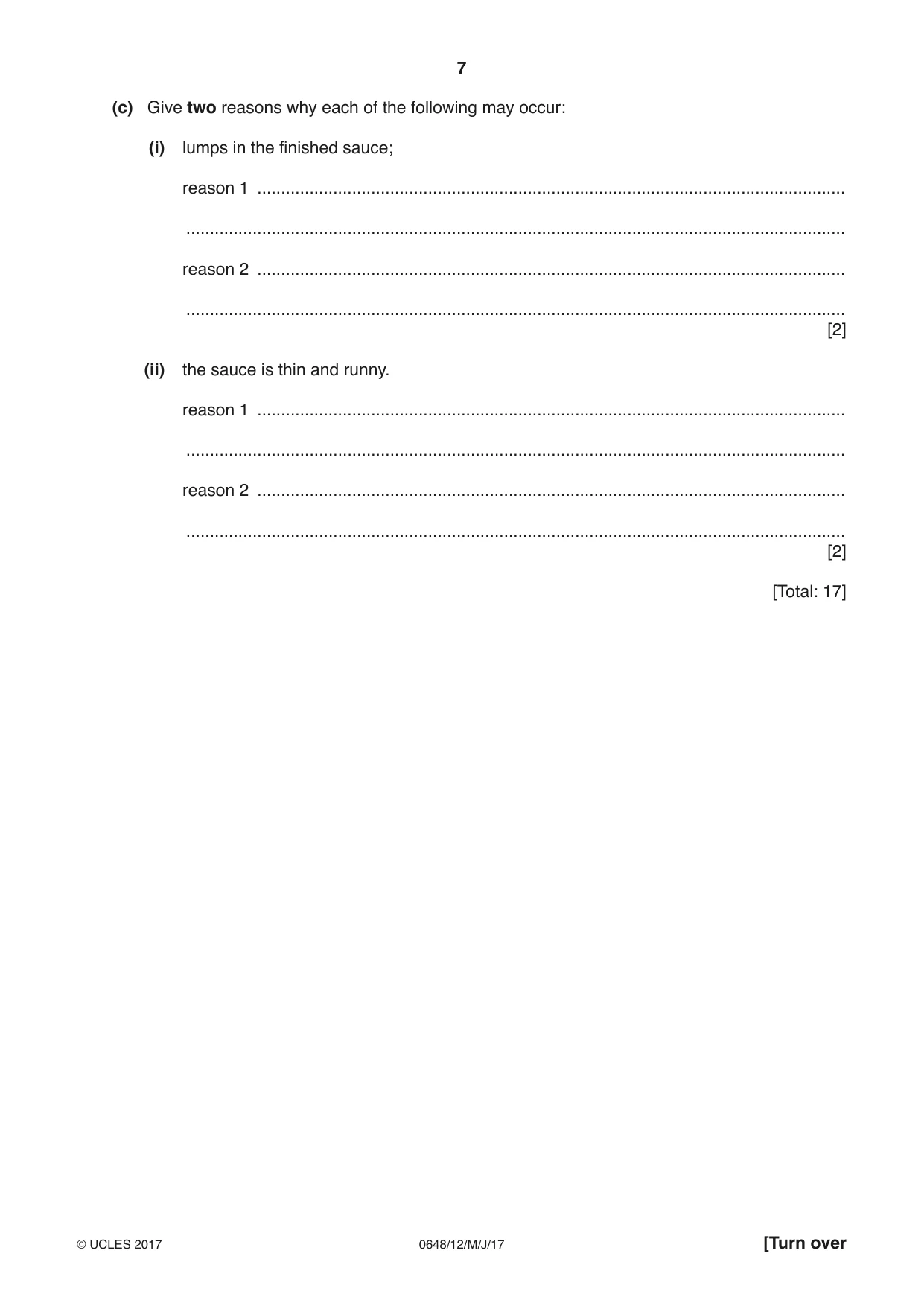
7 0648/12/M/J/17 © UCLES 2017 [Turn over (c) Give two reasons why each of the following may occur: (i) lumps in the finished sauce; reason 1 … … reason 2 … … [2] (ii) the sauce is thin and runny. reason 1 … … reason 2 … … [2] [Total: 17]
Question paper, page 8
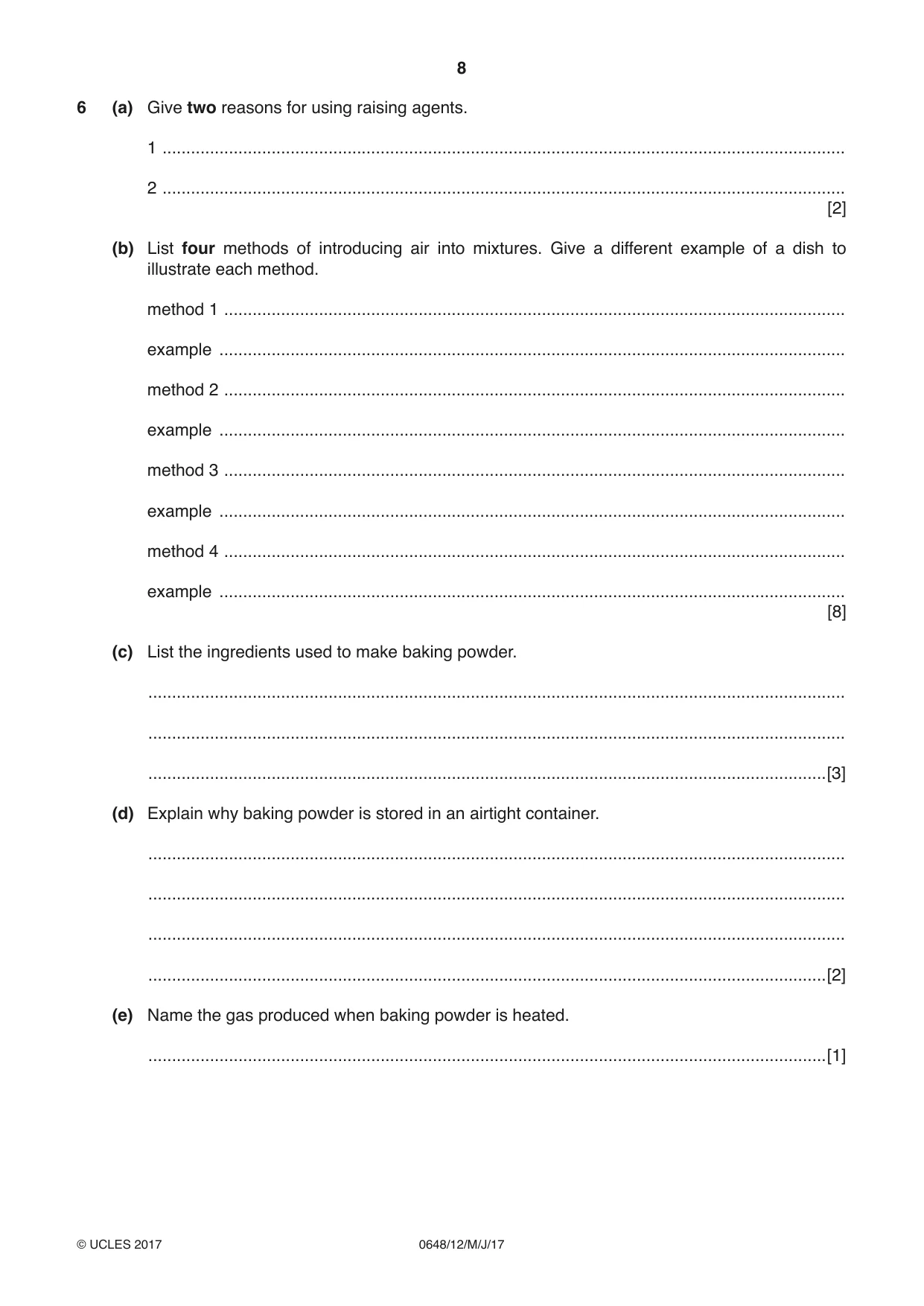
8 0648/12/M/J/17 © UCLES 2017 6 (a) Give two reasons for using raising agents. 1 … 2 … [2] (b) List four methods of introducing air into mixtures. Give a different example of a dish to illustrate each method. method 1 … example … method 2 … example … method 3 … example … method 4 … example … [8] (c) List the ingredients used to make baking powder. … … …[3] (d) Explain why baking powder is stored in an airtight container. … … … …[2] (e) Name the gas produced when baking powder is heated. …[1]
Question paper, page 9
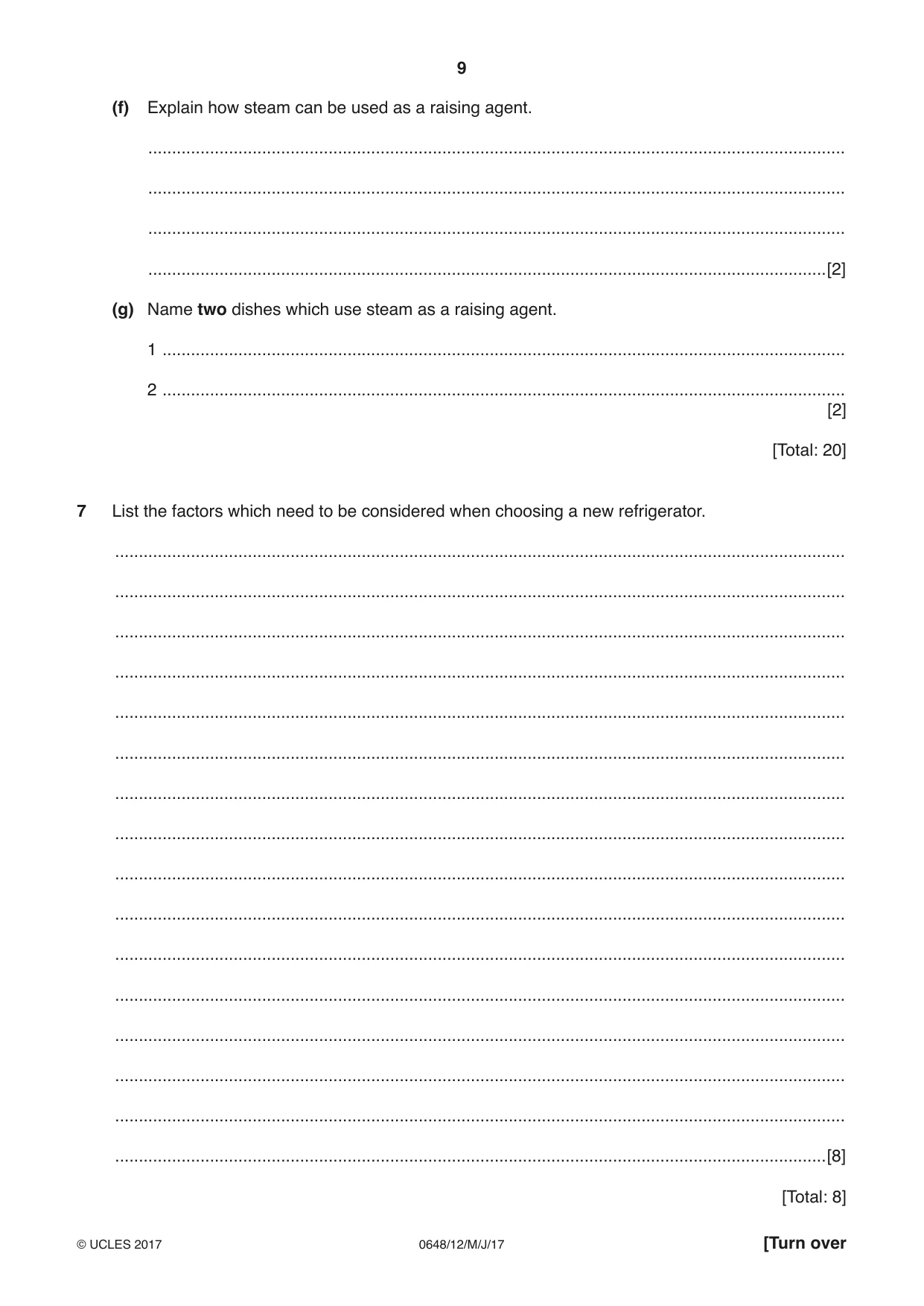
9 0648/12/M/J/17 © UCLES 2017 [Turn over (f) Explain how steam can be used as a raising agent. … … … …[2] (g) Name two dishes which use steam as a raising agent. 1 … 2 … [2] [Total: 20] 7 List the factors which need to be considered when choosing a new refrigerator. … … … … … … … … … … … … … … … …[8] [Total: 8]
Question paper, page 10
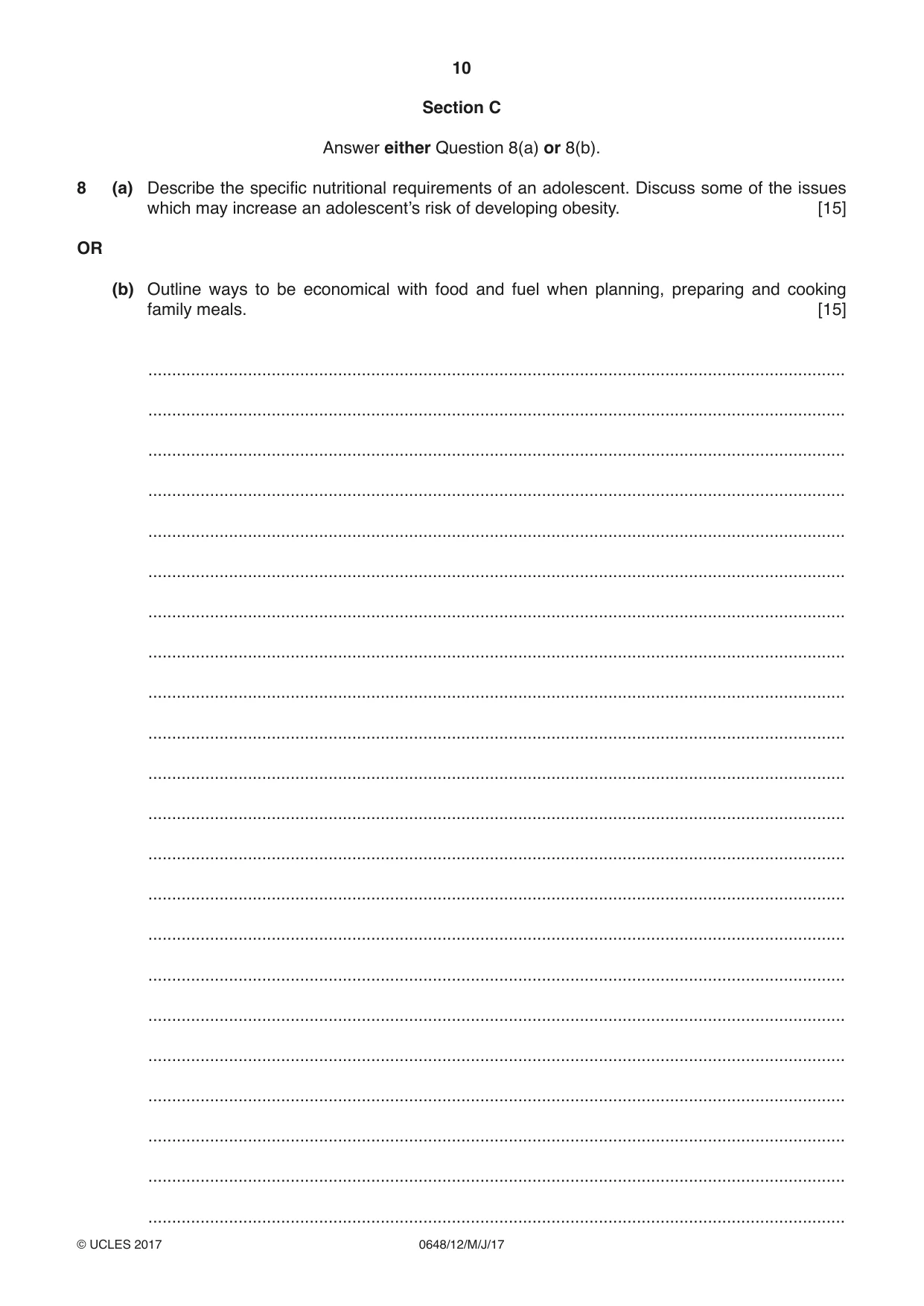
10 0648/12/M/J/17 © UCLES 2017 Section C Answer either Question 8(a) or 8(b). 8 (a) Describe the specific nutritional requirements of an adolescent. Discuss some of the issues which may increase an adolescent’s risk of developing obesity. [15] OR (b) Outline ways to be economical with food and fuel when planning, preparing and cooking family meals. [15] … … … … … … … … … … … … … … … … … … … … … …
Question paper, page 11
11 0648/12/M/J/17 © UCLES 2017 [Turn over … … … … … … … … … … … … … … … … … … … … … … … … … … … …
Question paper, page 12
12 0648/12/M/J/17 © UCLES 2017 Permission to reproduce items where third-party owned material protected by copyright is included has been sought and cleared where possible. Every reasonable effort has been made by the publisher (UCLES) to trace copyright holders, but if any items requiring clearance have unwittingly been included, the publisher will be pleased to make amends at the earliest possible opportunity. To avoid the issue of disclosure of answer-related information to candidates, all copyright acknowledgements are reproduced online in the Cambridge International Examinations Copyright Acknowledgements Booklet. This is produced for each series of examinations and is freely available to download at www.cie.org.uk after the live examination series. Cambridge International Examinations is part of the Cambridge Assessment Group. Cambridge Assessment is the brand name of University of Cambridge Local Examinations Syndicate (UCLES), which is itself a department of the University of Cambridge. … … … … … … … … … … … … … … … … … … … … … … [Total: 15]
Mark scheme, page 1
® IGCSE is a registered trademark. This document consists of 9 printed pages. © UCLES 2017 [Turn over Cambridge International Examinations Cambridge International General Certificate of Secondary Education FOOD AND NUTRITION 0648/12 Paper 1 Theory May/June 2017 MARK SCHEME Maximum Mark: 100 Published This mark scheme is published as an aid to teachers and candidates, to indicate the requirements of the examination. It shows the basis on which Examiners were instructed to award marks. It does not indicate the details of the discussions that took place at an Examiners’ meeting before marking began, which would have considered the acceptability of alternative answers. Mark schemes should be read in conjunction with the question paper and the Principal Examiner Report for Teachers. Cambridge will not enter into discussions about these mark schemes. Cambridge is publishing the mark schemes for the May/June 2017 series for most Cambridge IGCSE®, Cambridge International A and AS Level and Cambridge Pre-U components, and some Cambridge O Level components.
Mark scheme, page 2
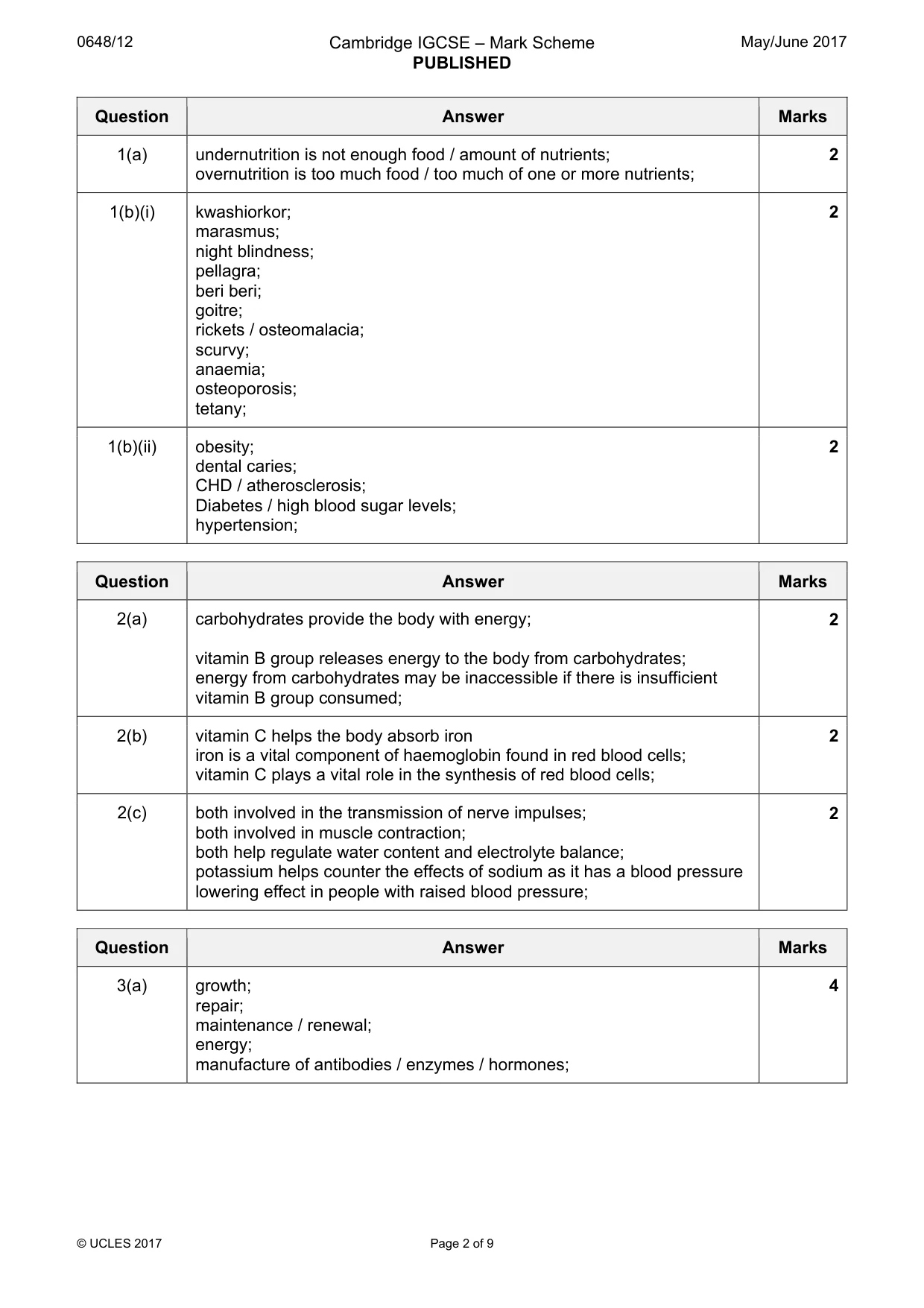
0648/12 Cambridge IGCSE – Mark Scheme PUBLISHED May/June 2017 © UCLES 2017 Page 2 of 9 Question Answer Marks 1(a) undernutrition is not enough food / amount of nutrients; overnutrition is too much food / too much of one or more nutrients; 2 1(b)(i) kwashiorkor; marasmus; night blindness; pellagra; beri beri; goitre; rickets / osteomalacia; scurvy; anaemia; osteoporosis; tetany; 2 1(b)(ii) obesity; dental caries; CHD / atherosclerosis; Diabetes / high blood sugar levels; hypertension; 2 Question Answer Marks 2(a) carbohydrates provide the body with energy; vitamin B group releases energy to the body from carbohydrates; energy from carbohydrates may be inaccessible if there is insufficient vitamin B group consumed; 2 2(b) vitamin C helps the body absorb iron iron is a vital component of haemoglobin found in red blood cells; vitamin C plays a vital role in the synthesis of red blood cells; 2 2(c) both involved in the transmission of nerve impulses; both involved in muscle contraction; both help regulate water content and electrolyte balance; potassium helps counter the effects of sodium as it has a blood pressure lowering effect in people with raised blood pressure; 2 Question Answer Marks 3(a) growth; repair; maintenance / renewal; energy; manufacture of antibodies / enzymes / hormones; 4
Mark scheme, page 3
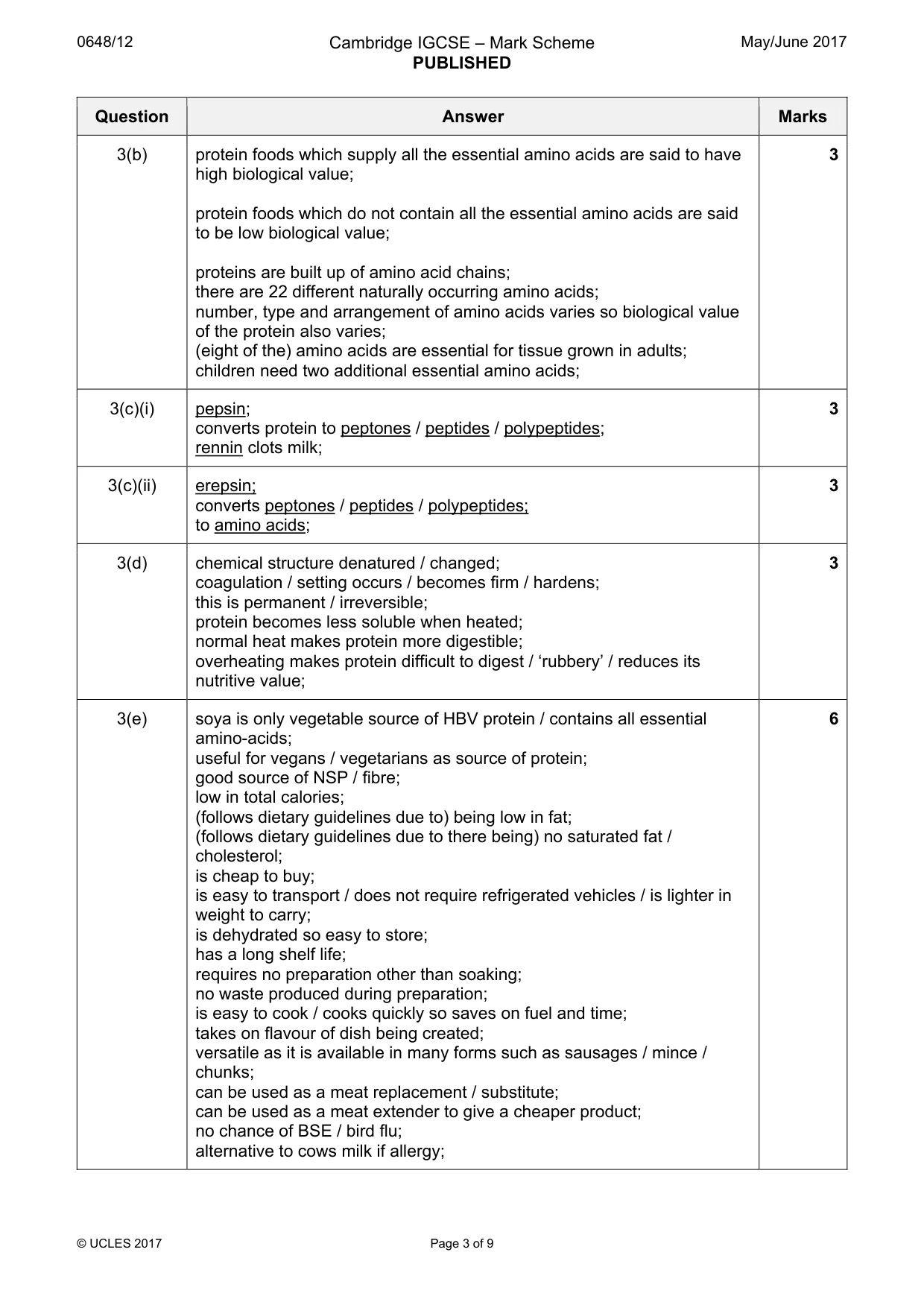
0648/12 Cambridge IGCSE – Mark Scheme PUBLISHED May/June 2017 © UCLES 2017 Page 3 of 9 Question Answer Marks 3(b) protein foods which supply all the essential amino acids are said to have high biological value; protein foods which do not contain all the essential amino acids are said to be low biological value; proteins are built up of amino acid chains; there are 22 different naturally occurring amino acids; number, type and arrangement of amino acids varies so biological value of the protein also varies; (eight of the) amino acids are essential for tissue grown in adults; children need two additional essential amino acids; 3 3(c)(i) pepsin; converts protein to peptones / peptides / polypeptides; rennin clots milk; 3 3(c)(ii) erepsin; converts peptones / peptides / polypeptides; to amino acids; 3 3(d) chemical structure denatured / changed; coagulation / setting occurs / becomes firm / hardens; this is permanent / irreversible; protein becomes less soluble when heated; normal heat makes protein more digestible; overheating makes protein difficult to digest / ‘rubbery’ / reduces its nutritive value; 3 3(e) soya is only vegetable source of HBV protein / contains all essential amino-acids; useful for vegans / vegetarians as source of protein; good source of NSP / fibre; low in total calories; (follows dietary guidelines due to) being low in fat; (follows dietary guidelines due to there being) no saturated fat / cholesterol; is cheap to buy; is easy to transport / does not require refrigerated vehicles / is lighter in weight to carry; is dehydrated so easy to store; has a long shelf life; requires no preparation other than soaking; no waste produced during preparation; is easy to cook / cooks quickly so saves on fuel and time; takes on flavour of dish being created; versatile as it is available in many forms such as sausages / mince / chunks; can be used as a meat replacement / substitute; can be used as a meat extender to give a cheaper product; no chance of BSE / bird flu; alternative to cows milk if allergy; 6
Mark scheme, page 4
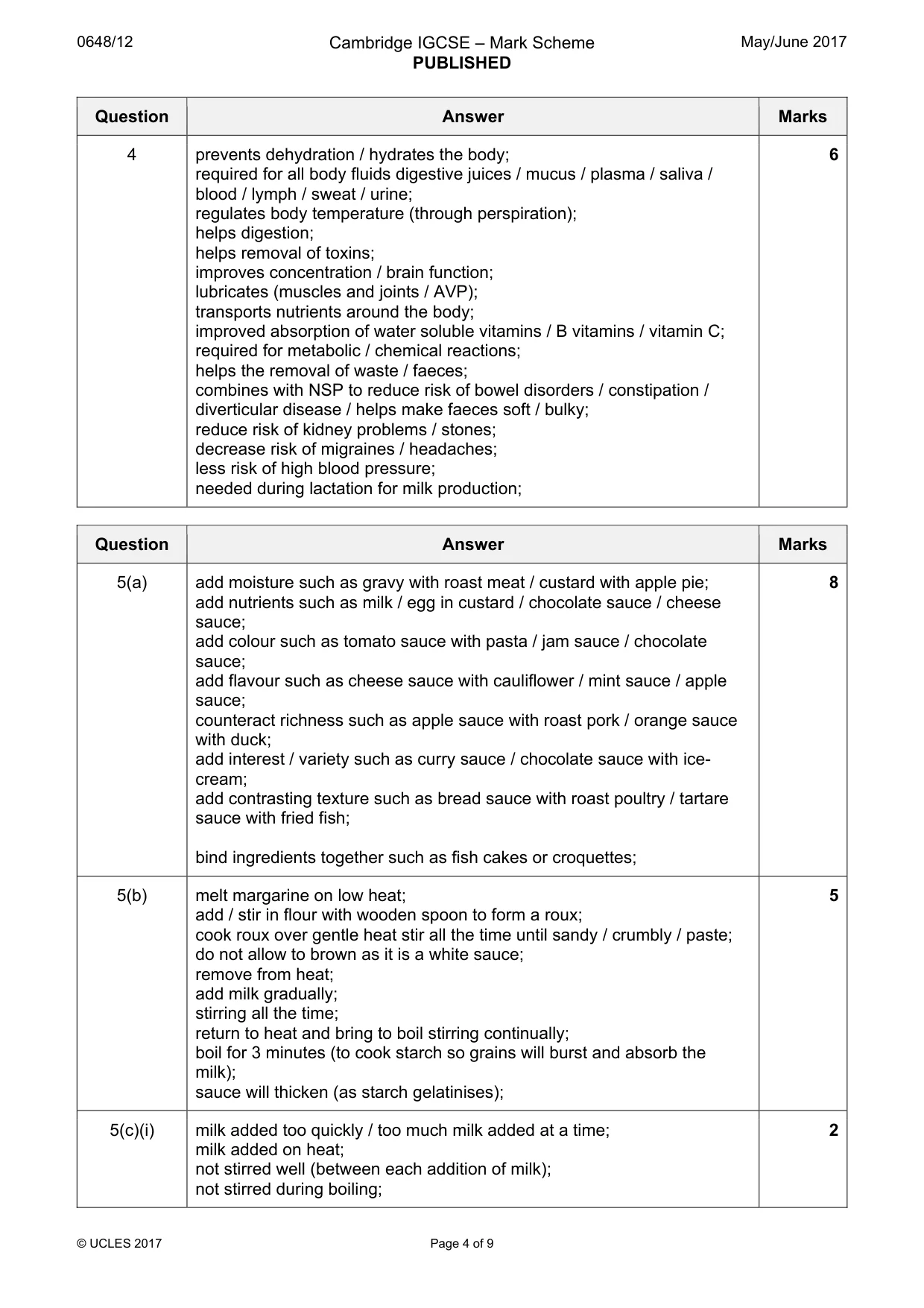
0648/12 Cambridge IGCSE – Mark Scheme PUBLISHED May/June 2017 © UCLES 2017 Page 4 of 9 Question Answer Marks 4 prevents dehydration / hydrates the body; required for all body fluids digestive juices / mucus / plasma / saliva / blood / lymph / sweat / urine; regulates body temperature (through perspiration); helps digestion; helps removal of toxins; improves concentration / brain function; lubricates (muscles and joints / AVP); transports nutrients around the body; improved absorption of water soluble vitamins / B vitamins / vitamin C; required for metabolic / chemical reactions; helps the removal of waste / faeces; combines with NSP to reduce risk of bowel disorders / constipation / diverticular disease / helps make faeces soft / bulky; reduce risk of kidney problems / stones; decrease risk of migraines / headaches; less risk of high blood pressure; needed during lactation for milk production; 6 Question Answer Marks 5(a) add moisture such as gravy with roast meat / custard with apple pie; add nutrients such as milk / egg in custard / chocolate sauce / cheese sauce; add colour such as tomato sauce with pasta / jam sauce / chocolate sauce; add flavour such as cheese sauce with cauliflower / mint sauce / apple sauce; counteract richness such as apple sauce with roast pork / orange sauce with duck; add interest / variety such as curry sauce / chocolate sauce with ice- cream; add contrasting texture such as bread sauce with roast poultry / tartare sauce with fried fish; bind ingredients together such as fish cakes or croquettes; 8 5(b) melt margarine on low heat; add / stir in flour with wooden spoon to form a roux; cook roux over gentle heat stir all the time until sandy / crumbly / paste; do not allow to brown as it is a white sauce; remove from heat; add milk gradually; stirring all the time; return to heat and bring to boil stirring continually; boil for 3 minutes (to cook starch so grains will burst and absorb the milk); sauce will thicken (as starch gelatinises); 5 5(c)(i) milk added too quickly / too much milk added at a time; milk added on heat; not stirred well (between each addition of milk); not stirred during boiling; 2
Mark scheme, page 5
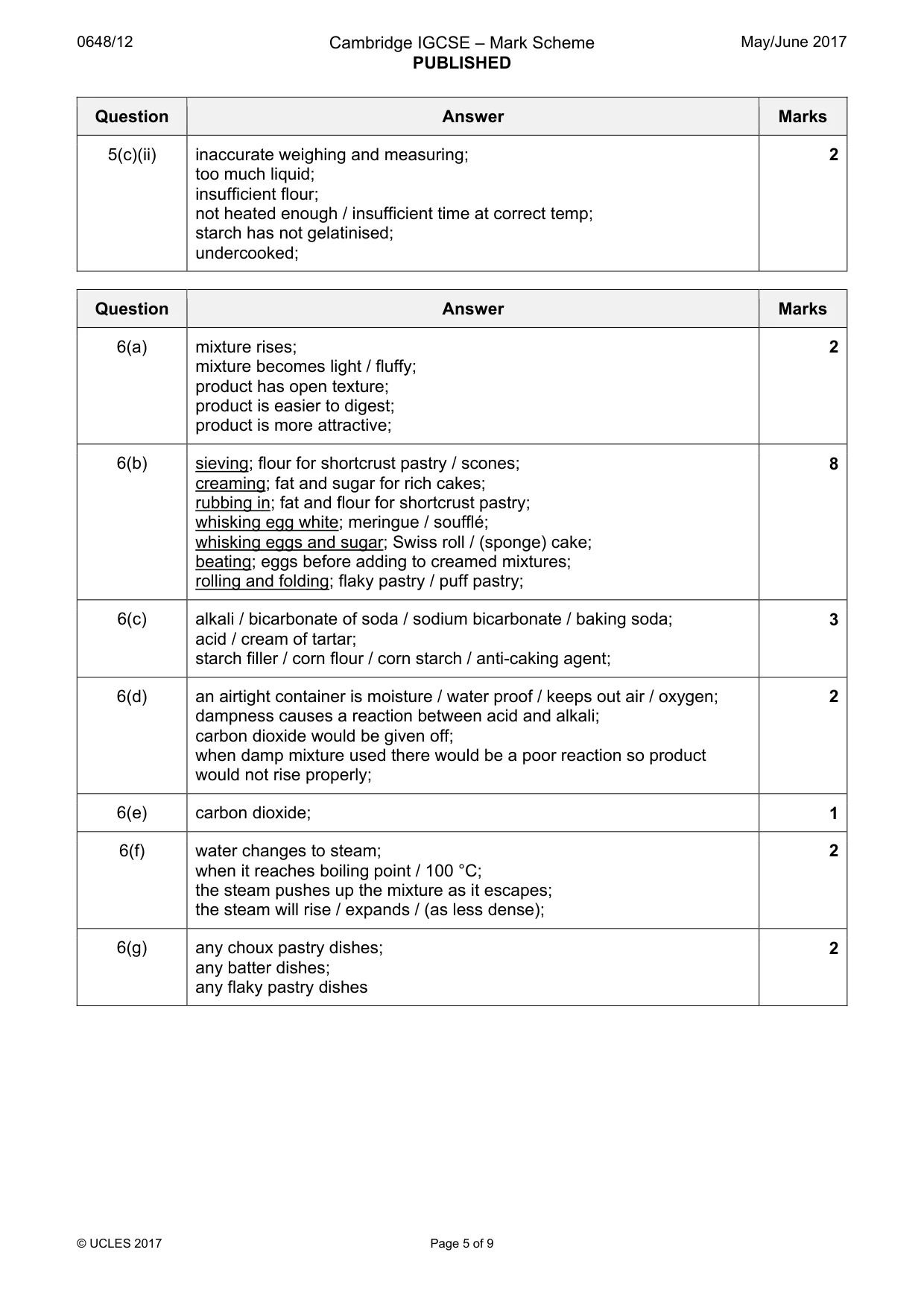
0648/12 Cambridge IGCSE – Mark Scheme PUBLISHED May/June 2017 © UCLES 2017 Page 5 of 9 Question Answer Marks 5(c)(ii) inaccurate weighing and measuring; too much liquid; insufficient flour; not heated enough / insufficient time at correct temp; starch has not gelatinised; undercooked; 2 Question Answer Marks 6(a) mixture rises; mixture becomes light / fluffy; product has open texture; product is easier to digest; product is more attractive; 2 6(b) sieving; flour for shortcrust pastry / scones; creaming; fat and sugar for rich cakes; rubbing in; fat and flour for shortcrust pastry; whisking egg white; meringue / soufflé; whisking eggs and sugar; Swiss roll / (sponge) cake; beating; eggs before adding to creamed mixtures; rolling and folding; flaky pastry / puff pastry; 8 6(c) alkali / bicarbonate of soda / sodium bicarbonate / baking soda; acid / cream of tartar; starch filler / corn flour / corn starch / anti-caking agent; 3 6(d) an airtight container is moisture / water proof / keeps out air / oxygen; dampness causes a reaction between acid and alkali; carbon dioxide would be given off; when damp mixture used there would be a poor reaction so product would not rise properly; 2 6(e) carbon dioxide; 1 6(f) water changes to steam; when it reaches boiling point / 100 °C; the steam pushes up the mixture as it escapes; the steam will rise / expands / (as less dense); 2 6(g) any choux pastry dishes; any batter dishes; any flaky pastry dishes 2
Mark scheme, page 6
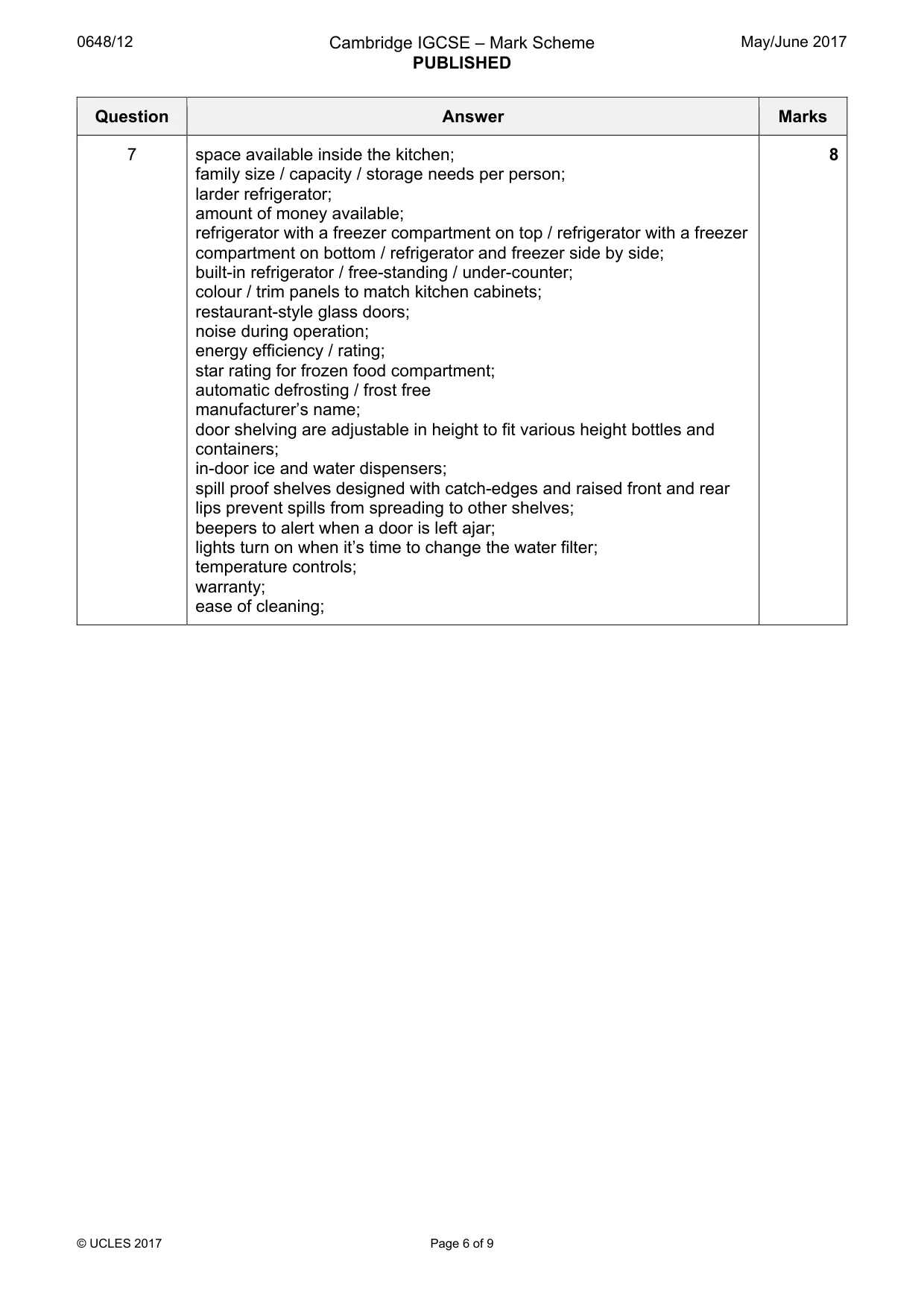
0648/12 Cambridge IGCSE – Mark Scheme PUBLISHED May/June 2017 © UCLES 2017 Page 6 of 9 Question Answer Marks 7 space available inside the kitchen; family size / capacity / storage needs per person; larder refrigerator; amount of money available; refrigerator with a freezer compartment on top / refrigerator with a freezer compartment on bottom / refrigerator and freezer side by side; built-in refrigerator / free-standing / under-counter; colour / trim panels to match kitchen cabinets; restaurant-style glass doors; noise during operation; energy efficiency / rating; star rating for frozen food compartment; automatic defrosting / frost free manufacturer’s name; door shelving are adjustable in height to fit various height bottles and containers; in-door ice and water dispensers; spill proof shelves designed with catch-edges and raised front and rear lips prevent spills from spreading to other shelves; beepers to alert when a door is left ajar; lights turn on when it’s time to change the water filter; temperature controls; warranty; ease of cleaning; 8
Mark scheme, page 7
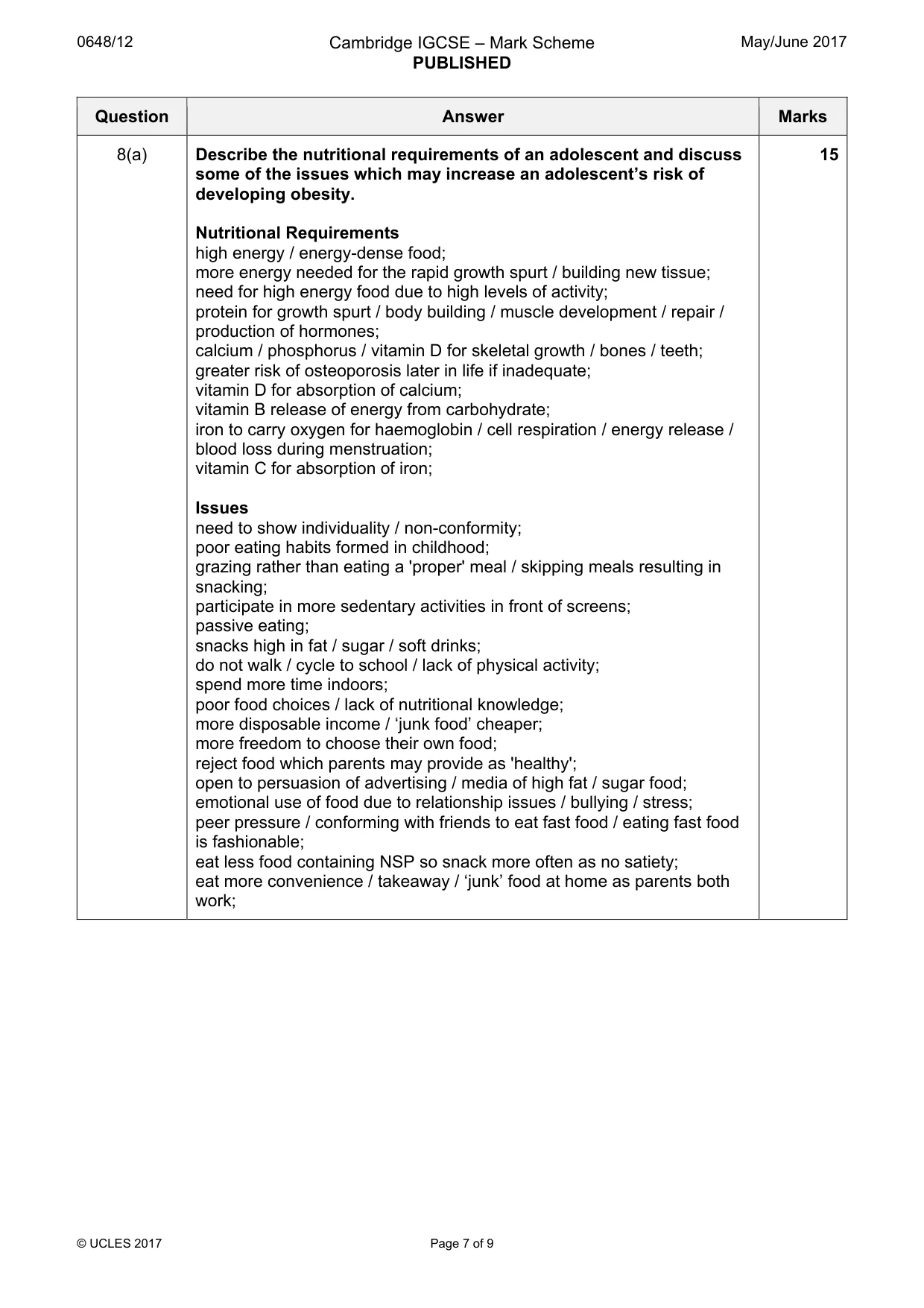
0648/12 Cambridge IGCSE – Mark Scheme PUBLISHED May/June 2017 © UCLES 2017 Page 7 of 9 Question Answer Marks 8(a) Describe the nutritional requirements of an adolescent and discuss some of the issues which may increase an adolescent’s risk of developing obesity. Nutritional Requirements high energy / energy-dense food; more energy needed for the rapid growth spurt / building new tissue; need for high energy food due to high levels of activity; protein for growth spurt / body building / muscle development / repair / production of hormones; calcium / phosphorus / vitamin D for skeletal growth / bones / teeth; greater risk of osteoporosis later in life if inadequate; vitamin D for absorption of calcium; vitamin B release of energy from carbohydrate; iron to carry oxygen for haemoglobin / cell respiration / energy release / blood loss during menstruation; vitamin C for absorption of iron; Issues need to show individuality / non-conformity; poor eating habits formed in childhood; grazing rather than eating a 'proper' meal / skipping meals resulting in snacking; participate in more sedentary activities in front of screens; passive eating; snacks high in fat / sugar / soft drinks; do not walk / cycle to school / lack of physical activity; spend more time indoors; poor food choices / lack of nutritional knowledge; more disposable income / ‘junk food’ cheaper; more freedom to choose their own food; reject food which parents may provide as 'healthy'; open to persuasion of advertising / media of high fat / sugar food; emotional use of food due to relationship issues / bullying / stress; peer pressure / conforming with friends to eat fast food / eating fast food is fashionable; eat less food containing NSP so snack more often as no satiety; eat more convenience / takeaway / ‘junk’ food at home as parents both work; 15
Mark scheme, page 8
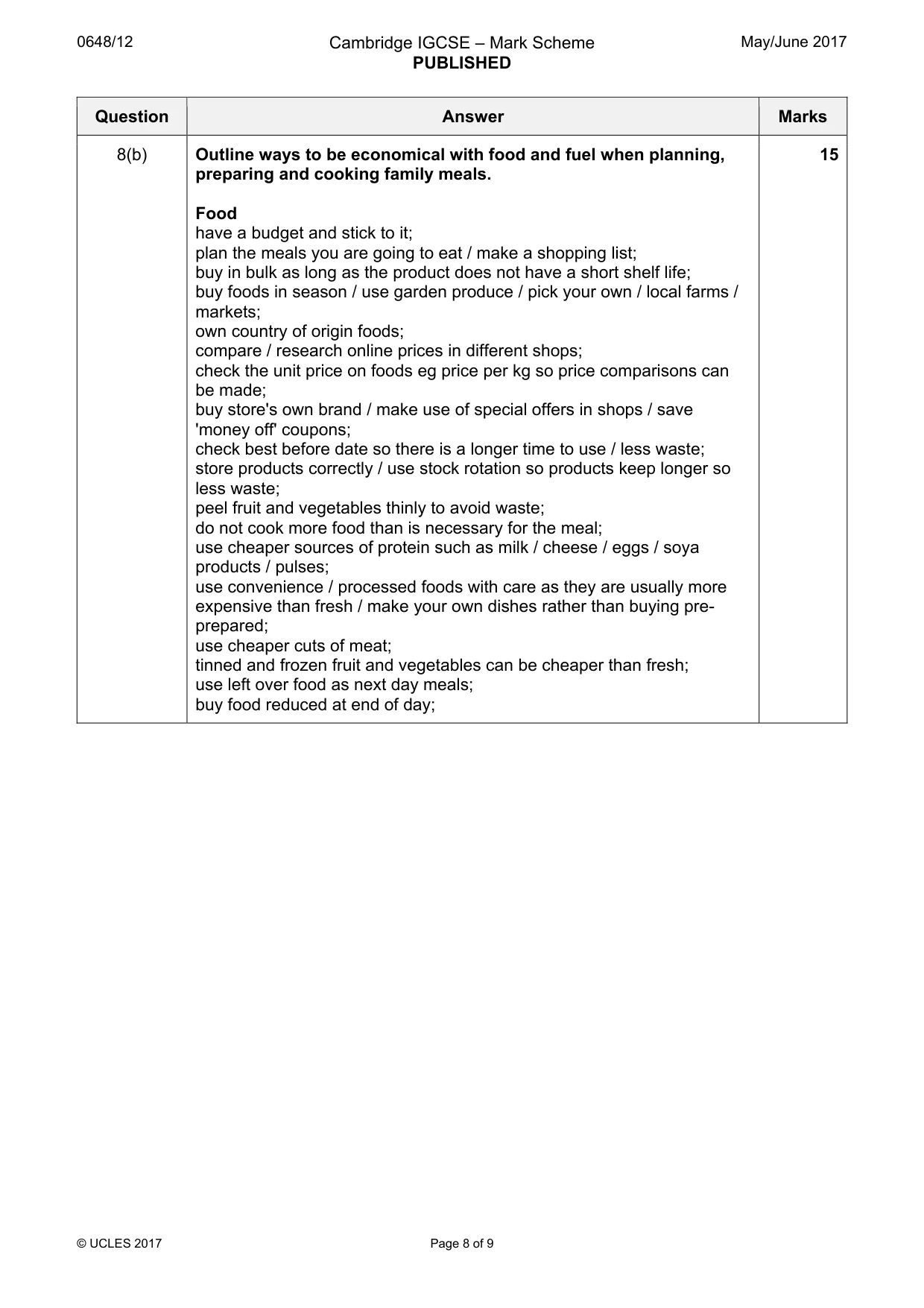
0648/12 Cambridge IGCSE – Mark Scheme PUBLISHED May/June 2017 © UCLES 2017 Page 8 of 9 Question Answer Marks 8(b) Outline ways to be economical with food and fuel when planning, preparing and cooking family meals. Food have a budget and stick to it; plan the meals you are going to eat / make a shopping list; buy in bulk as long as the product does not have a short shelf life; buy foods in season / use garden produce / pick your own / local farms / markets; own country of origin foods; compare / research online prices in different shops; check the unit price on foods eg price per kg so price comparisons can be made; buy store's own brand / make use of special offers in shops / save 'money off' coupons; check best before date so there is a longer time to use / less waste; store products correctly / use stock rotation so products keep longer so less waste; peel fruit and vegetables thinly to avoid waste; do not cook more food than is necessary for the meal; use cheaper sources of protein such as milk / cheese / eggs / soya products / pulses; use convenience / processed foods with care as they are usually more expensive than fresh / make your own dishes rather than buying pre- prepared; use cheaper cuts of meat; tinned and frozen fruit and vegetables can be cheaper than fresh; use left over food as next day meals; buy food reduced at end of day; 15
Mark scheme, page 9
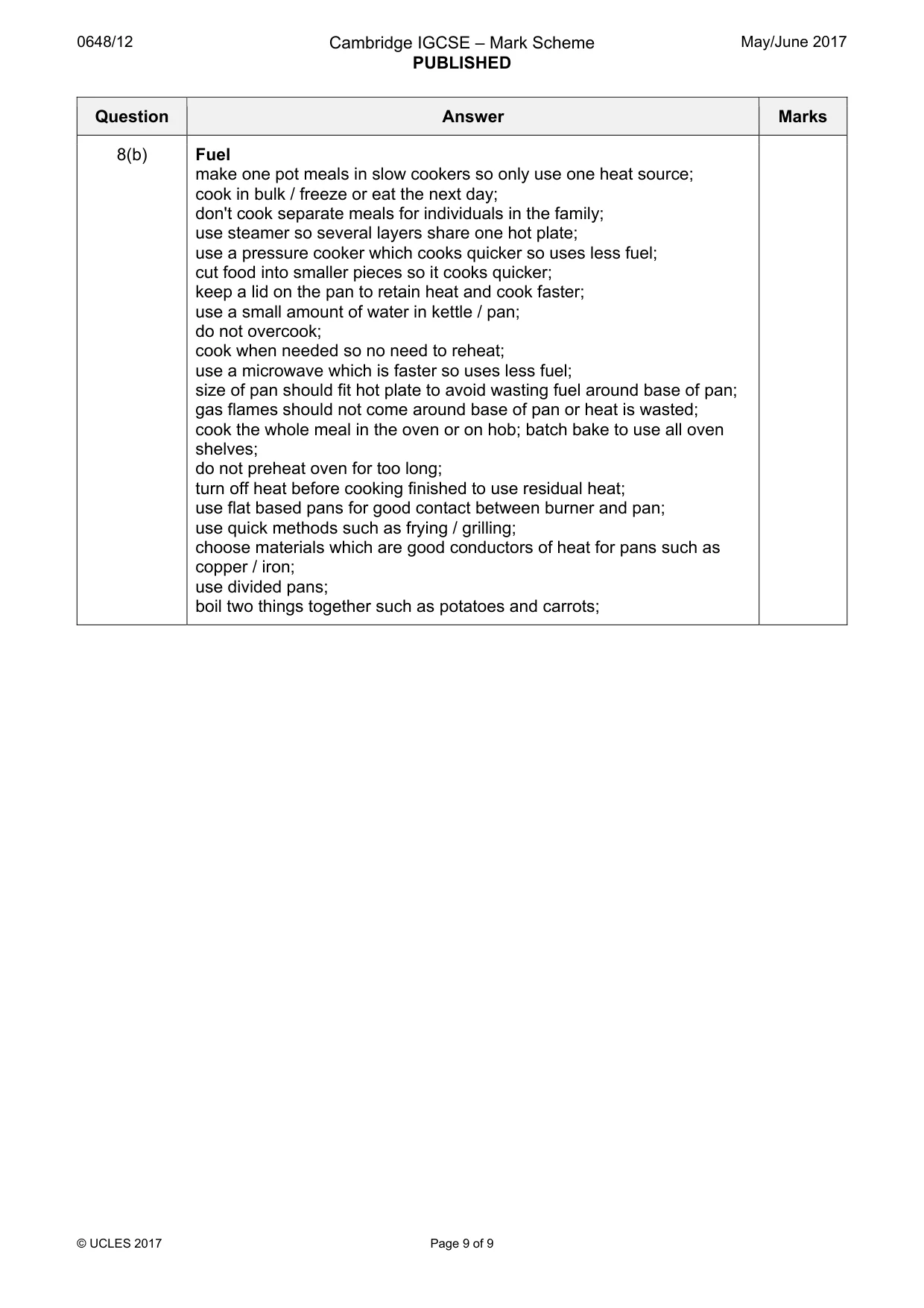
0648/12 Cambridge IGCSE – Mark Scheme PUBLISHED May/June 2017 © UCLES 2017 Page 9 of 9 Question Answer Marks 8(b) Fuel make one pot meals in slow cookers so only use one heat source; cook in bulk / freeze or eat the next day; don't cook separate meals for individuals in the family; use steamer so several layers share one hot plate; use a pressure cooker which cooks quicker so uses less fuel; cut food into smaller pieces so it cooks quicker; keep a lid on the pan to retain heat and cook faster; use a small amount of water in kettle / pan; do not overcook; cook when needed so no need to reheat; use a microwave which is faster so uses less fuel; size of pan should fit hot plate to avoid wasting fuel around base of pan; gas flames should not come around base of pan or heat is wasted; cook the whole meal in the oven or on hob; batch bake to use all oven shelves; do not preheat oven for too long; turn off heat before cooking finished to use residual heat; use flat based pans for good contact between burner and pan; use quick methods such as frying / grilling; choose materials which are good conductors of heat for pans such as copper / iron; use divided pans; boil two things together such as potatoes and carrots;
What you needed in this session
Cambridge’s own grade thresholds for 2017 May/June, Paper 1 · Variant 2. A higher threshold means an easier paper — the bar moves with how the cohort did.